
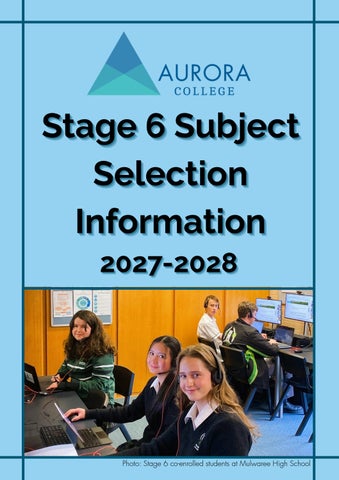
Photo: Stage 6 co-enrolled students at Mulwaree High School

General Information:
Stage 6 at Aurora
Principal’s message
2027 subject selection & application process
Information for rural & remote schools
Information for metropolitan & regional schools
Course eligibility
Information about the Higher School Certificate:
The Higher School Certificate - requirements, explanation and eligibility
Stage 6 Pathways
University entry - ATAR
Assessment and reporting
Faculty: English
English Advanced
English Extension 1
English Extension 2 (HSC Year only)
Faculty: Human Society & Its Environment
Aboriginal Studies
Economics
Legal Studies
Modern History
History Extension (HSC Year only)
Faculty: Mathematics
Mathematics Advanced
Mathematics Extension 1
Mathematics Extension 2 (HSC Year only)
Software Engineering
Faculty: Science
Agriculture
Biology
Chemistry
Earth and Environmetal Science
Physics
Science Extension (HSC year only)
Aurora College offers Stage 6 students in government high schools the opportunity to study one or more subjects in a flexible online learning environment. This opportunity is available to students with a learning style suited to working in the online environment and who have well-established intrinsic motivation to succeed in their educational pursuits
To enrol in any Stage 6 subject, including current Year 10 Aurora students, applicants must have the support of their home school principal.
Applications for Year 11 (2027) open Monday 20 July 2026 and close on Friday 16 October 2026.
Applications for Year 12 (2027, commencing Term 4, 2026) open on Monday 20 July 2026 and close on Friday 11 September 2026.
Each Stage 6 subject is taught through regular timetabled lessons, which are delivered online, live, in real time. Timetable options are available for perusal on the ‘partner schools’ page of the Aurora College website
Subject availability for 2027 will depend on student numbers, staffing, and timetable feasibility. This is an expression of interest only, allowing Aurora to plan accordingly with partner schools. This prospectus should be read alongside any information provided by your local secondary school.
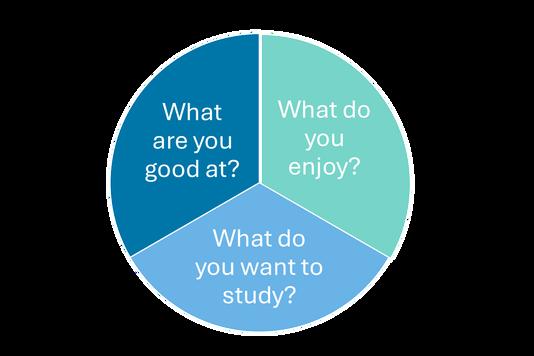
Subjects you study at school can influence the type of career your choose
Doing subjects you are interested in makes life at school more enjoyable
You are more likely to do well in a subject that you enjoy
Ask yourself the following questions:
What subjects are available through my home school?
What subjects are available through Aurora College?
What subjects interest me?
What subjects am I good at?
What subjects do I need for further study?
In 2027, Aurora College is continuing to provide innovative, flexible learning in a modern context, by allowing students to connect locally and to learn globally Aurora students connect with their teachers and classmates in timetabled lessons through a cutting edge virtual learning environment, comprising of web conferencing software, a learning management system, and a range of online communication and collaboration tools The school also operates one of the state’s only fully digital school libraries.
For Stage 6 (Years 11 and 12), Aurora College delivers academically rigorous HSC courses that local schools may not be able to consistently offer their students. Beginning with Year 11 2027, we are proud to be able to offer this provision to all NSW public high school students Our aim is to support all schools to ensure every student can access their curriculum of choice while attending their local school.
Learning with Aurora College is an immensely personalised experience. Our highly qualified and experienced teachers are recruited from schools in all parts of the state They receive specialised training and support in delivering best practice learning and teaching in a virtual environment, and a maximum class size of 15 in Years 11 and 12 enables them to provide our students with the individual attention they require
Aurora College ensures consistent connections with partner schools by ensuring each school has an Aurora College Coordinator (ACC) appointed. The ACC adds an important layer of support for our students in managing their learning across two schools. Aurora students are also well supported by our Wellbeing and Learning Support Team, who provide specialised assistance to students in need.
Aurora’s Masterclass Program gives our students the opportunity to learn from people who are leaders in their field, across a broad range of careers and human endeavours. Aurora students may also elect to work directly with a mentor in an area of interest to them, providing invaluable insights into their career paths and professional lives.
Every year, Aurora College hosts a range of Higher School Certificate (HSC) study workshops to support student learning across NSW. Subject experts, experienced teachers and HSC markers present HSC examination advice and up-to-date information on course content. Aurora students are joined in our virtual learning environment each year by more than 8,000 students for the HSC Study Days Program
The subjects that you choose for your Stage 6 pattern of study need to be selected carefully Making wise, well-considered subject choices is the first step towards a rewarding senior secondary school experience, a successful HSC and enhanced post school opportunities. It is important that you seek advice from your teachers, and from specialists such as our Careers Adviser. Your parents should be active participants in this process.
The NSW Education Standards Authority (NESA) has the following advice for students choosing Stage 6 courses:
Your aim is to attain the best HSC result you can. So, you should choose courses that you are good at, interested in and may use in the future.
When considering which courses to study, explore the content of a course. For example, what are the course outcomes? Will you be required to submit a major work, or perform, as part of your examination? Talk with your teachers about your strengths and weaknesses, as well as individual course requirements, before making your selections
To be eligible for enrolment in Aurora College, students must also be enrolled in a NSW Government school. With the approval of your home school principal, you may apply to study one or more Stage 6 courses with Aurora College A maximum of 10 units may be studied in Year 11 with Aurora College.
The following pages contain important information about the Stage 6 courses on offer at Aurora College in 2027. Applications for enrolment in Year 11 (2027) open on Monday 20 July 2026 and close on Friday 16 October 2026. Information about how to make an application can be found on our website.
Resources:
https://educationstandards.nsw.edu.au/wps/portal/nesa/11-12/hsc/subject-selection
https://aurora.schools.nsw.gov.au/about-us/enrol
https://aurora schools nsw gov au/partner-schools/resources
We look forward to receiving your application to study Year 11 courses with Aurora College, the NSW Department of Education’s awardwinning virtual school.
Chris Robertson | Principal
Aurora College line structure published
Propectus published
Year 11 applications open
Stage 6 subject information webinar
Year 11 Applications close
Students and schools notified of application outcome
Ensure you thoroughly study the documentation provided by the school, NESA and the University Admission Centre and have discussed possible subjects with your parents, carers, families and teachers Ensure you understand all the HSC and ATAR requirements and that you are aware of any exclusions that may exist.
Students who attend rural and remote schools are eligible for co-enrolment in ALL available Aurora College subjects for Years 11 and 12.
Full list of eligible rural and remote schools
Aurora College’s expanded Stage 6 provision from 2027 will mean twice as many timetable options, compared to previous years. We continue to offer all of the same courses
as in 2026 (plus one new course), with the main change being that schools will have greater flexibility in selecting a timetable option that suits students’ needs.
Funding support continues to be available for rural and remote schools that share coenrolments with Aurora College Current Aurora College students in Year 10 will continue to be given priority for access to Stage 6 co-enrolment.
Beginning with Year 11 2027, students in metropolitan Sydney and large regional centres (including Wollongong, Newcastle, Tweed Heads and Queanbeyan) will be eligible for coenrolment with Aurora College.
Full list of schools newly eligible for Aurora College
Metropolitan and regional schools do not incur any loss of funding or staffing entitlement for co-enrolments with Aurora College, up to a threshold set by the Department of Education (which depends on the size of the school’s Year 11 cohort).
A set of academically rigorous HSC courses has been selected for metropolitan and regional students in order to maximise opportunities for high achievement across all public secondary schools.

Check the label on each course ’ s information page Chemistry | Economics | English Advanced |
Courses available to all NSW government secondary school students have this icon:
Courses available to rura and remote students only have this icon:
Aboriginal Studies | Agriculture | Biolo al Science Legal Studies | Modern Histo

To be eligible to study: You must also study (at Aurora College or another school):
The Higher School Certificate recognises 13 years of schooling. In the interests of greater career choices and increased opportunities at university and TAFE, it offers you a full range of study areas matching individual abilities, interests and goals
Courses are linked to further education and training:
The HSC will fairly assess each student’s knowledge and skills
Extension courses enable students to undertake more in-depth study in areas of special interest.
Vocational Education and Training (VET) courses count towards the HSC and lead to qualifications recognised across a range of industries (not offered by Aurora College)
Life skills courses for students with special education needs (not offered by Aurora College)
For each course you will receive easy-to-understand reports, which contain detailed information about your skill development. These reports provide clear indications of what you have demonstrated you know, understand, and can do in each course.
To qualify for the Higher School Certificate, students must complete at least 22 units of study. You must satisfactorily complete:
a Preliminary (usually Year 11) pattern of study that includes at least 12 units at least 10 units of study in the HSC.
Both the Preliminary and the HSC patterns of study must include at least:
6 units from Board Developed Courses, which must include at least 2 units of a Board Developed Course in English
Three courses of 2-unit value or greater
Four subjects
All courses offered for the Higher School Certificate have a value of 1 unit or 2 units. Most courses are 2unit courses. Each unit involves class time of approximately 2 hours per week (60 hours per scholastic year) In the HSC, each unit has a value of 50 marks
1 unit = 2 hours per week or 60 hours per year = 50 marks
2 units = 4 hours per week or 120 hours per year = 100 marks
Extension courses build on the content of 2-unit courses and carry an additional value of 1 unit. Students must study the relevant 2-unit course to be eligible for Extension courses. Check the course eligibility page of this Prospectus for information about course requirements.

Preliminary courses are usually studied in Year 11 To satisfactorily complete the minimum 12 units of study, a student must: complete classwork and experiences, tests and homework to a level which meets the designated outcomes of the course complete the prescribed assessment tasks have a record of attendance in each subject that allows the outcomes of the course to be met (a minimum of 85% of all lessons is an approximate guide)
Content covered in all Year 11 courses is a prerequisite for HSC courses, but may or may not be examined in the final HSC examination. Class teachers may rule that a student has not met the course outcomes – In this case, a non-completion determination (“N-Award”) will be given The Principal decides on any appeals lodged against an N-determination.
The HSC course commences in Term 4 of Year 11. The requirements are the same as for the Year 11 course. Schoolbased assessment tasks will contribute to 50% of your HSC mark. The other 50% will come from the HSC examination.
To be eligible for the award of the HSC, you need to comply with the following: be enrolled at a NSW government school, or a registered and accredited nongovernment school, or a TAFE institute study a permitted combination of courses complete the online module HSC: All My Own Work before you submit any work for Preliminary or HSC courses complete the requirements for each course, including any necessary practical or project work complete tasks in the internal assessment program designed by the school responsible for delivering your HSC course sit for, and make a genuine attempt at, the required Higher School Certificate examinations meet the HSC minimum standard of literacy and numeracy within five years of starting your HSC course.
The RoSA is a cumulative credential for students who leave school before completing their Higher School Certificate. Students are awarded a grade (A-E) at the completion of Stage 5 (Year 10) and the Preliminary course (Year 11). The RoSA lists all mandatory Stage 5 and, where applicable, Stage 6 courses completed by the student, along with the grade awarded. It also shows courses commenced but not completed, any minimum standard literacy and numeracy test results (if completed), and the date of leaving school Therefore, the RoSA provides a complete record of student participation and achievement from Year 10 until they leave school.
Students may only progress to the Preliminary Course (Year 11) and then HSC if they successfully complete their RoSA (Year 10)
Only students who leave school and who satisfy eligibility requirements for the RoSA will receive the formal credential
Students who leave school and who are not eligible for a RoSA will be able to receive a Transcript of Study at their time of departure The ‘Transcript of Study’ will contain the same information as the RoSA for courses satisfactorily completed
All students will also have access to a record of their grades through Students Online
The RoSA offers the opportunity for students who are leaving school before completing the HSC to sit for literacy and numeracy tests which can provide further evidence to employers of capabilities
The RoSA will also offer opportunities to record a student’s extra curricular activities and therefore further provide a more comprehensive profile of their achievements.
Most students complete their Preliminary and HSC studies in Years 11 and 12 over two years; however, NESA allows flexibility in the form of the ‘Pathways’ initiative.
You may accumulate the HSC over a period of up to five (5) years. This allows students to combine their studies with work experience, part time employment, training, or other responsibilities. Students receive cumulative Records of Achievement for Year 11 and HSC courses attempted. In subjects that include extension courses, you may accumulate by completing the 2 unit course in one year and the extension course in a later year
NOTE: Requirements listed previously must still be met by part-time students.
You may repeat HSC courses, within the 5 year accumulation period. In the calculation of an ATAR, the most recent mark in a course will be used
You may be granted credit for other studies (e.g. TAFE, overseas study)
Acceleration is available to more-able students, to complete course content in a shorter time HSC studies can be undertaken at the same time as a part-time traineeship
The Australian Tertiary Admission Rank (‘ATAR’) is a measure of academic achievement in the HSC that assists institutions with ranking applicants for selection in tertiary education courses An ATAR cut-off is the minimum ATAR for entry to a particular degree at a specific university – this is the ATAR of the last person admitted to the degree.
To be eligible for an ATAR in NSW, you must complete at least 10 units of Board Developed Courses including:
2 units of English
3 Board Developed courses of 2 units or greater
4 subjects
If you are doing more than 10 units then your English result and the best eight units from the remaining units are used to calculate your ATAR.
VET courses within the Industry Curriculum Frameworks as well as English Studies and Mathematics Standard 1 (with external examinations) can be included in your ATAR
The ATAR is calculated by the university sector and is released by the Universities Admission Centre (UAC).
The Higher School Certificate (HSC) is awarded by the NSW Education Standards Authority (NESA)
The HSC serves many purposes, but the ATAR serves only one – to assist universities in ranking school leaver applications across Australia for tertiary selection in a fair and equitable way. The ATAR should not be used for any other purpose.
The ranking of students depends solely on their performance in both school-based assessment and HSC examinations in Year 12 only
The ATAR is a rank; it is not a mark. Students who do not wish to go to university will not need to select their subjects with an ATAR in mind, but should still be careful not to limit their future options.

The HSC reports will provide you with detailed descriptions of the knowledge, skills and understanding you have attained in each subject
The syllabuses, along with assessment and examination information and a performance scale, will be used to describe your level of achievement and give a clear idea of the standards that are expected
The Stronger HSC Standards have capped the maximum number of formal assessment tasks to three in Year 11, and four in Year 12. This is designed to help motivate and challenge students to achieve at their highest level and reduce excessive stress.
School-based assessment tasks are designed to measure performance in a wider range of outcomes than may be tested in an examination alone. Assessment tasks may include tests, written or oral assignments, practical activities, field work and projects. The assessment requirements for each Board Developed Course are set out in each syllabus.
School-based assessment tasks will contribute to 50% of your HSC mark. The other 50% will come from the HSC examination.
For VET courses (not offered by Aurora College), you are assessed on your competency in performing work related tasks. This assessment count towards your VET qualification but not towards an HSC mark.
Your HSC mark for 2-unit courses will be reported on a scale of 0 to 100. A mark of 50 will represent the minimum standard expected. If you achieve the minimum standard expected in a course, you will receive a mark of 50 There will be five performance bands above 50 that correspond to different levels of achievement in knowledge, skills and understanding. The band from 90–100 will correspond to the highest level of achievement.
English Advanced
English subjects offered in 2027:
English Extension 1
English Extension 2
English is the only compulsory HSC subject and there are multiple levels available, allowing each student to ensure their literary skills are developed to a level that matches their abilities and interests. At Aurora College, we offer rigorous English courses that allow students to become truly refined users of language and deeply critical text analysts.
English Advanced - 2 Units
Is aimed at the top 30% of students in the state
Is an ideal preparation for university, with a strong focus on extended writing
Has a stronger focus on literature across novels, plays, film and poetry, including a compulsory study of Shakespeare
Is required for students who wish to complete Extension 1 or Extension 2
English Extension 1 - 1 unit (must also study Advanced)
Is ideal for those students wishing to complete tertiary studies in literature or the humanities
Is ideal for those students with a passion for the subject and for literature in all its forms
Requires extensive critical reading and independent investigation.
English Extension 2 - 1 unit (must also study Ext 1)
Is ideal for students who wish to compose their own substantial text (major work)
Is ideal for students with a passion for literature and a particular form or genre
Requires intensive critiques of other works and an extensive literature review
Note: English Advanced students may NOT study English Standard or English Studies
The English Advanced course is designed for students who have a particular interest and ability in the subject and who desire to engage with challenging learning experiences that will enrich their personal, intellectual, academic, social and vocational lives. Students appreciate, analyse and respond imaginatively and critically to literary texts drawn from a range of personal, social, historical and cultural contexts, including literature from the past and present and from Australian and other cultures. They study challenging written, spoken, visual, multimodal and digital texts that represent and reflect a changing global world
Year 11
Common Module: Reading to Write
Module A: Narratives that Shape our World
Module B: Critical Study of Literature
Course requirements
Year 12
Common Module: Texts and Human Experiences
Module A: Textual Conversations
Module B: Critical Study of Literature
Module C: The Craft of Writing (studied concurrently with other modules and also a standalone unit)
Across Stage 6 the selection of texts will give students experience of:
a range of types of texts inclusive of prose fiction, drama, poetry, nonfiction, film, media and digital texts which are widely regarded as quality literature, including a range of literary texts written about intercultural experiences and the peoples and cultures of Asia
a range of Australian texts, including texts by Aboriginal and/or Torres Strait Islander authors and those that give insights into diverse experiences of Aboriginal and/or Torres Strait Islander peoples
texts with a wide range of cultural, social and gender perspectives
integrated modes of reading, writing, listening, speaking, viewing and representing as appropriate.
1 Unit Board Developed Syllabus Link
Note: English Extension 1 students must also study English Advanced
English Extension 1 provides students with the opportunity to extend their use of language and self-expression in creative and critical ways. Students engage with increasingly complex concepts through a broad range of literature from different contexts. Through this, they refine their understanding and appreciation of the significance of texts, and the way that literature shapes and reflects the world
A core requirement of this course is that students must complete their own Related Research Project.
Through the study of English Extension 1, students: learn to use clear written and verbal communication for a range of purposes and audiences interpret and evaluate information and arguments for clarity, precision and effectiveness make inferences about intention and meaning of language based on contextual clues explore using verbal and written language to confidently express personal experiences and opinions, and reflect on development of knowledge and skills as independent learners.
Year 11
Texts, culture and value (and the Related Research Project)
Year 12
Literary worlds
Note: English Extension 2 students must also study English Advanced and English Extension 1
English Extension 2 extends students’ conceptual understanding of the ways literature is read and written through their consideration of authorship and their authorial role. Students develop their understanding of the composition process to create a substantial text, which constitutes their major work for this course.
English Extension 2 students must: be undertaking study of the English Extension 1 Year 12 course compose their own substantial text (major work) document coursework in a major work journal.
Through the study of English Extension, students: learn to use clear written and verbal communication for a range of purposes and audiences interpret and evaluate information and arguments for clarity, precision and effectiveness make inferences about intention and meaning of language based on contextual clues explore using verbal and written language to confidently express personal experiences and opinions, and reflect on the development of knowledge and skills as independent learners.
Author and authority
Major work
HSIE subjects offered in 2027:
Aboriginal Studies Economics
Legal Studies
Modern History
New from Term 4 2027 (for 2028 HSC):
History Extension
The key learning area of Human Society and Its Environment (“HSIE”) offers subjects that provide a well-rounded education by encouraging students to consider the people, places, systems and ideas that shape our world.
Through Stage 6 HSIE courses, students refine their skills in critical thinking, research, analysis and communication, with a focus on their specialised areas of interest
At Aurora College, we are proud to offer a range of HSIE subjects that build skills needed by our modern society, which is increasingly interconnected and undergoing faster change than ever before.

Critical analysis

Source evaluation

Data interpretation
Empathy and perspective
Well-structured
2 Units Board Developed Syllabus Link
Course description
The Year 11 course focuses on Aboriginal peoples’ relationship to the Land, Aboriginal heritage and identity, and an historical examination of colonialism, racism and prejudice from pre-contact times to the 1960s The course also includes the development of skills in culturally appropriate research and inquiry methods, including case studies.
The HSC course provides for in depth study of legislation, policy, judicial processes and current events from the 1960s. During the course, students will undertake consultation with Aboriginal communities and will study the course through the experiences of national and international Indigenous communities Students apply research and inquiry methods through the completion of a major project.
Part I: Aboriginality and the Land
Part II: Heritage and Identity
Part III: International Indigenous Community: Comparative Study
Part IV: Research and Inquiry Methods: Local Community Case Study
Part I – Social Justice and Human Rights Issues
Part II – Case Study of an Aboriginal community
Part III – Research and Inquiry Methods – Major Project
2 Units Board Developed
Syllabus Link
Course description
Economic decisions have a crucial influence on the quality of life experienced by people throughout the world. The study of economics can help individuals, groups and societies make choices that assist them to improve their quality of life.
As a subject, Economics is distinctive because of the range of problems and issues that it investigates and the skills that it develops. A student who has completed the Year 11 and HSC courses should have knowledge and skills enabling them to:
comprehend the background and implications of contemporary economic issues discuss appropriate policies to solve economic problems and issues
understand what a change in interest rates, share values or the value of the Australian dollar means to individuals and the economy
identify fluctuations in the global and Australian economies and their likely effects on business understand reasons for changes in employment patterns identify, using economic thinking, appropriate strategies to protect the natural environment
Year 11
Introduction to Economics
Markets
Household and business sector
Financial sector
Government sector
International sector
Year 12
Economic issues in the Australian economy
Economic management of the Australian economy Australia and the Global economy
2 Units Board Developed
Syllabus Lin
Course description
The Legal Studies 11–12 Syllabus enables students to develop knowledge and understanding of the domestic and international legal systems and how they have been shaped over time. Students investigate the key features of the law and understand how the law interacts with aspects of society.
What students learn
Through the study of Legal Studies 11–12, students: develop an understanding of the foundations of law, the criminal justice system, and international relations and human rights explore the role of the law in society and how laws are made and changed develop an understanding of how the law operates in practice develop skills in analysis and reasoning to make judgements about the extent to which the law achieves justice for individuals, groups and society construct reasoned arguments supported by a range of evidence.
Year 11
Investigating the law
Disputes under the law
Changing the law
Experiences with the law
Year 12
The criminal justice system (core)
International relations and human rights (core)
Students must study TWO options from:
Consumer law
Family law
Housing law
Peace, conflict and the law
Workplace law
The study of Modern History engages students in an investigation of the forces that have shaped the world, based on the analysis and interpretation of sources. It offers students the opportunity to investigate the possible motivations and actions of individuals and groups, and how they have shaped the world politically, culturally, economically and socially. Modern History stimulates students’ curiosity and imagination, and enriches their appreciation of humanity by introducing them to a range of historical developments and experiences that have defined the modern world.
The Year 11 Course is structured to provide students with the opportunity to develop their inquiry skills through an understanding of the work of the historian including interpretation and analysis of sources and applying the methods of collecting evidence to communicate reasoned conclusions.
The Year 12 course is structured to provide students with opportunities to apply their understanding of sources and relevant historiographical issues in the investigation of the modern world. Students will undertake focus studies to develop a critical perspective on power and authority in the contemporary world.
Year 11
Section I: Investigating Modern History
Section II: Historical Investigation
Section III: The Shaping of the Modern World
Year 12
Section I: Core Study: Democracy and dictatorship 1919–1939
Section II: National Studies
Section III: Peace and Conflict
Section IV: Change in the Modern World

1 Unit; Year 12 only Board
Developed
Syllabus Link
Note: Only available from Term 4 2027, for the 2028 HSC
Note: History Extension students must also study Modern History and/or Ancient History
The History Extension Syllabus focuses on the nature of history as a discipline and how and why differing historical interpretations have been produced. It requires students to critically examine how history is constructed and analyse the role of historians and other producers of history in this process. This involves a close examination of a range of historical works, considering how context, methodology and purpose have shaped their development. Students explore historiographical ideas through the works of historians, writers and others involved in the practice of history in different eras.
History Extension appeals to students who appreciate the intellectual rigour and challenge of historical debate and the construction and defence of a position through reasoned and cohesive argument. The course requires students to engage with complex historiographical ideas, methodologies and sources. It encourages them to communicate perceptive, sustained and coherent arguments about the nature and construction of history. Students work independently in researching and applying their historiographical understanding developed through the course to an individual project of personal interest.
The History Extension course is designed to enhance the development of critical and reflective thinking and research skills which are essential for effective participation in further learning, including tertiary study, work and the broader community. It fosters students’ ability to approach complex tasks flexibly, analyse and synthesise information from a range of sources and contexts, explore a range of perspectives, develop considered responses, work independently, and reflect on the methodologies with which they engage

Main topics covered: Historiographical skills
What is history?
Who are the producers of history in different eras?
How has history been constructed, recorded and presented in different eras? Why have approaches to history changed in different eras?
Stage 6 Mathematics is where the subject truly comes into its own. It’s no longer just about simply learning techniques — it’s about using them to solve complex problems, make predictions, and explore abstract ideas with precision and depth.
At Aurora College, we offer rigorous mathematics courses that challenge students to think critically, work systematically and build deep understandings. These courses are not just preparation for exams; they’re preparation for a way of thinking that underpins science, technology, economics and innovation.
Whether you're refining algebraic fluency or exploring proofs, modelling, or calculus, you'll be supported by a passionate teaching team that values both process and insight.
Mathematics Advanced - 2 Units develops foundational skills in calculus while building capacity for problem solving is aimed at students who intend to study university subjects requiring mathematical skills – many university degrees consider Mathematics Advanced to be ‘assumed knowledge’ requires students to have strong fundamental skills in Years 7–10 Mathematics, including the extension (‘Pathways’) content is required for students who wish to complete Extension 1 or Extension 2
Mathematics Extension 1 - 1 unit (must also study Advanced) is ideal for students who wish to progress to ‘STEM’ careers (science, technology, engineering, mathematics) and require highly-refined skills focuses on solving problems in unfamiliar contexts, using rigorous proof methods requires a dedicated approach to consistently build familiarity with course content
Mathematics Extension 2 - 1 unit (must also study Ext 1) is designed for students to develop true mastery of highly specialised mathematical techniques is ideal for students who thrive on being challenged at levels far beyond Advanced or Extension 1 requires a high level of dedication, including a strong routine of home revision, to ensure full understanding of the course content.
Developed
Note: Mathematics Advanced students may NOT study Mathematics Standard or Numeracy
The new Mathematics Advanced syllabus (recently launched in 2026) brings a renewed focus to how students think, reason, and apply mathematics. It’s not just about mastering techniques it’s about learning to model real-world situations, justify solutions, and communicate mathematical ideas with clarity and confidence.
Working Mathematically now sits at the heart of the course — not as a separate skill, but as an essential part of everything students do Whether it's exploring functions, interpreting data, or applying calculus to solve problems, students are expected to think critically, work flexibly, and reflect on their methods. This course doesn’t simply prepare students for university study and future career paths; it also develops critical thinkers for a data-driven world.
Year 11 develops a strong foundation across algebra, functions, trigonometry, exponentials and logarithms, and introductory calculus. Students begin to connect ideas, analyse patterns, and reason through unfamiliar problems laying the groundwork for success in Year 12 and beyond.
Year 12 deepens this understanding, moving into integral calculus, sequences and series, further statistical analysis, and advanced mathematical modelling. There’s a growing emphasis on synthesis, real-world applications, and sustained reasoning across multiple steps or topics.
Mathematics Advanced is a rigorous academic course. Students should expect to revise regularly, practise consistently, and engage with challenging problems both in and out of class. A steady commitment of several hours per week at home will support success, especially as concepts become more layered and abstract.
Note: Mathematics Extension 1 students must also study Mathematics Advanced
Mathematics Extension 1 is a challenging and rewarding course designed for students with a strong mathematical foundation and a passion for problem-solving. It extends the core content of Mathematics Advanced and introduces more sophisticated mathematical thinking ideal for students considering university studies in science, engineering, economics, or data-rich fields.
In the current syllabus (which was first taught in 2026), Working Mathematically is the overarching outcome Students are expected not only to find correct solutions but to justify reasoning, generalise patterns, and apply mathematical techniques creatively in unfamiliar contexts.
Students explore topics such as advanced algebra, functions and relations, inverse functions, surds, trigonometric identities, and introductory proof techniques. The emphasis is on building fluency while developing the capacity to think abstractly and reason logically
Year 12 content builds on these foundations with deeper calculus, parametric equations, more complex proofs, and advanced applications of probability and statistics. Students will solve multi-step, open-ended problems that demand strategic thinking and precise communication.
Extension 1 students should be prepared to dedicate consistent time to mastering new concepts both inside and outside of class.
Success in this course requires persistence, attention to detail, and a genuine interest in understanding why mathematics works, not just how.
1 Unit; Year 12 only Board Developed
Note: Mathematics Extension 2 students must also study Mathematics Advanced and Mathematics Extension 1
Course description
Mathematics Extension 2 is the most advanced mathematics course available in NSW schools. It is designed for highly capable students who enjoy mathematical challenge, abstraction, and formal reasoning. The course is rigorous, elegant, and intellectually demanding ideal preparation for university-level mathematics, theoretical science, actuarial studies, or computer science.
Extension 2 deepens every aspect of mathematical thinking. Working Mathematically is central: students are expected to pose questions, construct formal arguments, and engage with mathematical ideas at a sophisticated level.
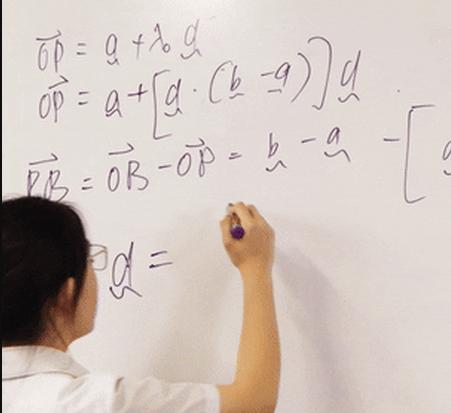
Topics include mathematical induction, complex numbers, vectors, advanced calculus (including harder integration techniques), mechanics, and real-world mathematical modelling. Students explore the structure of mathematics itself, gaining insight into how mathematical systems are built and connected.
Course expectations
Extension 2 demands high levels of independence, resilience, and curiosity. Students should expect to invest 5+ hours per week outside class time on revision, problem-solving, and working through challenging proofs and ideas. While demanding, this course is deeply rewarding offering a glimpse into the power and beauty of mathematics at its highest school level.
Software Engineering is a future-focused course that equips students with the skills to design, build, and evaluate software systems. From simple algorithms to complete web apps, students learn how software is developed — and why ethical and secure coding matters in a world increasingly shaped by technology. This course blends creativity, logic and problem solving. Students will apply algorithmic solutions (primarily in Python), data structures, version control, testing and debugging. Alongside technical skills, students develop collaboration, project management, and communication all essential for modern software development.
In Year 11, students explore fundamental algorithmic skills and data structure techniques, build software using an object-oriented paradigm and experiment with mechatronics. Projects are small but meaningful, helping students build foundational skills while learning to plan, write, and test their own programs.
Year 12 challenges students to build more complex, real-world applications. They will use a security-by-design approach, learn how to build powerful web technologie, and design AI and ML algorithms from the ground up A major project gives students the chance to design, develop, and document a software solution from start to finish.
Software Engineering is both technical and creative. It suits students who enjoy problem solving, logical thinking, and working on projects over time Regular practice at home is important around 3 to 4 hours per week ior coding experience is required me extra time in the beginning). nk critically is essential
For students who wish to pu in software, cybersecurity game design and beyond, builds the thinking and prac be part of creating the digita

Science isn’t just a subject; it’s a journey of discovery, curiosity and real-world impact. Whether you're digging into soil in Agriculture, exploring the wonders of life in Biology, mixing up reactions in Chemistry, unlocking the forces of the universe in Physics, uncovering our planet’s secrets in Earth & Environmental Science, or diving deeper through Science Extension, there's something exciting for everyone.
In the HSC, science courses help to understand the world around us and equip students with skills that open doors to countless future careers – from medicine and engineering, to environmental sustainability and food security. More than that, it’s fun! We ask questions, run experiments and solve real-life problems, all while learning how the very forces of nature operate.
You may study a maximum of:
Six units (three courses) of sciences for Year 11
Seven units (three courses plus Science Extension) of sciences for Year 12
2 Units
Board
Developed
Syllabus Lin
This course provides students with the opportunity to study the interactions between the components of agricultural production, marketing and management, while giving consideration to the issue of sustainability of the farming system It places greater emphasis on farm management to maximise productivity and environmental sustainability. This is an 'on-farm', environment-oriented course A Farm Product Study is used as a basis for analysing and relate to sustainability.

In the Preliminary course, you’ll learn how different parts of farming like production, marketing, and management work together. You’ll also explore how to keep farming sustainable and environmentally friendly. The course focuses on what happens directly on the farm
The HSC course builds on what you learnt in the Preliminary course. It looks more deeply at the science behind farming and how to manage a farm to get the best results while caring for the environment. You’ll also complete a Farm Product Study, which helps you understand and respond to social, environmental, and economic issues related to sustainable farming.
This course provides students with the opportunity to learn about variations in the structures and functions of organisms and provides an understanding of the effects of the environment on living things Students investigate reproduction, inheritance patterns and the causes of genetic variation. Applications of this knowledge in biotechnology and genetic technologies are explored.
In Year 11 Biology, you'll dive into the building blocks of life by exploring how cells work and how the body takes in and moves nutrients and gases. You’ll also look at the incredible variety of living things and discover how different environments shape the way organisms live and survive
Year 12 takes you deeper into the science of life, focusing on how living things reproduce and pass on traits through genetics. You’ll explore the latest in biotechnology and genetic engineering, and how these tools help treat, prevent and control the spread of diseases and improve health in both humans and other organisms.
Chemistry allows you to immerse yourself in the world of chemical reactions and atoms! It provides students with the opportunity to develop their knowledge, understanding and skills in relation to the properties and structure of matter and a wide variety of chemical reactions incorporating organic compounds and acid/base equilibrium reactions. It requires students to develop a sound understanding of mathematical concepts relating to stoichiometry and equilibrium
Year 11
In Year 11 Chemistry, you’ll explore atomic structure, bonding and composing chemical formulae. Then we move on to how different substances react, and why chemical reactions happen. You’ll also learn how to measure the amounts of chemicals involved in reactions all while building practical skills essential for working as a scientist at university or in industry.
Year 12
Your final year takes your Chemistry knowledge further by diving into equilibrium reactions, organic compounds, acids and bases, and more complex industrial reactions. You’ll learn how to analyse and identify chemicals using real world techniques such as titration, helping you understand the structure, behaviour, and patterns of a wide range of substances
2 Units Board Developed Syllabus Link
Course description
This course provides students with the opportunity to learn about the compositional layers of the Earth and investigate how processes of plate tectonics, the formation of water and the introduction of life interact with different spheres and climate.
In Year 11, you’ll explore what the Earth is made of, how minerals form, and how tectonic plates shape our planet. You’ll also investigate how energy moves through Earth systems and look at the impact humans have on natural resources and landscapes.
Year 12 takes a deeper look at how Earth’s systems — including the atmosphere, oceans, land, and life — interact through processes like plate tectonics and the water cycle. You’ll also explore natural hazards, how we manage resources, and why sustainability is key to protecting the planet for future generations.
2 Units
Board Developed
Syllabus Link
Course description
This course provides students with the opportunity to develop their knowledge, understanding and skills relevant to the study of motion. Students examine energy in its different forms, and how we describe and measure electricity and magnetism and their interrelated effects.
Year 11 Physics is all about understanding how and why objects move — from speeding cars to falling apples. You'll learn to describe motion using mathematics, explore Newton’s laws, and investigate waves, sound, electricity and magnetism. Through experiments, data analysis and real-world applications, you’ll start to see how energy is transferred and how science explains what we experience every day.
In Year 12 Physics, the concepts deepen. You’ll explore advanced motion, including satellites and projectiles, and dive into electromagnetism, the nature of light, and the physics of atoms and the universe. This course is ideal for students who enjoy solving problems, asking big questions, and discovering how everything from a falling apple to a distant galaxy connects through physics.
Note: Science Extension students must also study at least one of: Biology, Chemistry, Earth & Environmental Science, Physics
If you enjoyed your Year 11 science course, in Aurora College or your home school, you might love Science Extension in Year 12. It’s a chance to take your curiosity further with in depth research and real world science investigations.
This course focuses on the authentic application of scientific research skills to produce a Scientific Research Report. Students propose and develop a research question, formulate a hypothesis and develop evidence-based responses to create their Scientific Research Report which is supported by a Scientific Research Portfolio.