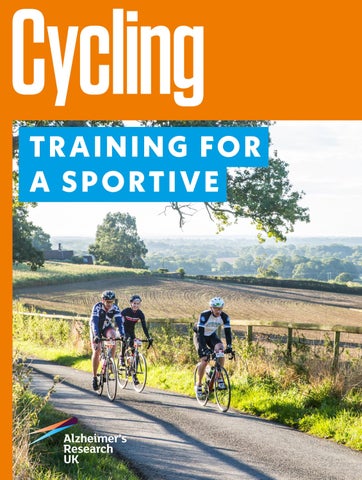
T R A I N I N G FO R A SPORTIVE
T R A I N I N G FO R A SPORTIVE T h i n k in g a b o u t t a k i ng on a b i g cycl i n g ch a l l e n ge? Do n’t k n ow h ow to c h o o s e a n eve nt or h ow to t ra i n for i t ? Th is t ra in in g gu i de w i l l h e l p you t h rough .
M
ost of us are aware that dementia is a growing problem. Every day, almost 600 people in the UK develop dementia, but only 1 in 3 UK adults is actually aware that they can reduce their risk of dementia. One of the best ways to reduce your risk is to increase your physical activity, and what better to get you out of the door than a goal to aim for.
1
CHOOSE AN EVENT A goal event should be challenging but achievable, both in terms of your current ability and the time left until the event. For instance, you might be longing to do London to Brighton, but if the event is only 4 weeks away and you haven’t started training yet that might be a bit ambitious! Also consider how hilly the course is. Unless you’re a featherweight mountain goat, you might want to choose a flat ride like the Cambridgeshire Classic. If it’s windy you can save up to 40% of your energy by sheltering in a group but there is no hiding place in the hills.
2
DECIDE WHICH DAYS YOU CAN TRAIN Training 3 to 4 days per week will bring about significant fitness gains whilst allowing plenty of time to rest and recover. Training two days in a row is very effective and a good use of your free time at weekends. For example: Tuesday, Thursday, Saturday & Sunday. If you can only manage 3 days then just do one ride at weekends.
3
CHOOSE YOUR WORKOUTS Training at the right intensity and frequency is at the heart of an effective training plan. It can be very confusing to understand your sweet-spot from your VO2 max, but it needn’t be. One of the simplest (and most effective) systems to define intensity is the Polarised Training approach. This utilises a simple, 3-zone system: Easy, Moderate, Hard, or Green, Yellow, Red if you prefer. EASY At, or just or below your aerobic threshold [55-78% of max. heart rate]. You should be able to talk in short bursts whilst riding, but not continually. It is the intensity you will use on your long weekend endurance rides. MODERATE [78-86% of max. heart rate]. Often referred to as ‘Tempo’ this is the zone in-between Easy and Hard. HARD At or above your anaerobic threshold [over 86% of max. heart rate]. Anything from an all-out sprint to ‘as hard as you can go for an hour’.
4
CHOOSE WHAT TO DO WHEN Aim to do your high intensity ride early in the week when rested and your long endurance ride on a Saturday or Sunday. For instance: Day
Intensity
Example Workout
Monday
Recovery
If you can find time to do some simple stretching and foam rolling, this is the ideal day.
Tuesday
Hard day
After a 15min warm-up, do 3x3mins all-out, 3mins very easy, followed by a 5min cool-down. Progress this over the weeks to 5x3mins.
Wednesday
Rest
Thursday
Easy day
Friday
Rest
Saturday (optional)
Medium day
After a 15min warm-up, do 3x10mins at a moderate pace followed by a 5min cool-down. Progress over the weeks to 2x20mins.
Sunday
Easy day
Start at 1½ hours of steady-paced effort. Progress to 2½ - 3 hours depending on the length of your event by adding 15mins each week.
After a 15min warm-up, do 3x10mins at a moderate intensity, 5mins very easy, followed by a 5min cool-down.
OT H E R T H I N G S TO CO N S I D E R I N YO U R P L A N N I N G Plan in blocks of four weeks: three weeks hard, one week easy. In your easy week drop one workout and reduce the number of intervals in your high intensity session but don’t drop the intensity. As you progress from one block to the next, change your high intensity session. If you are doing 3-minute intervals, reduce the duration to 90 seconds and increase the intensity and number of repetitions.
T H E W E E K O F T H E EV E N T
Drop one workout and reduce the number of repetitions in your high intensity session. Don’t back off the intensity though or you’ll feel sluggish on the day. This is known as tapering and if done right, will shed fatigue without excessively losing fitness, making you feel fresh and motivated on the big day.
T H E DAY O F T H E EV E N T In the days and weeks leading up to the event make a packing checklist for the day of the event. That way you won’t be kept awake the night before thinking of things you might have forgotten. This greatly reduces your stress on the day. Eat a normal meal the night before and a normal breakfast on the morning of the event. Set-off at a comfortable pace, you can always push up the intensity later on if
you feel good. Try and get in a group of similar ability; it helps motivation and lets you ride faster! Most of all, enjoy it. You’ve done all the hard work, now it’s time to reap the rewards. If you need further help or advice there are plenty of good cycling coaches out there who regularly blog helpful hints and tips.
Find out more about Alzheimer’s Research UK and their cycling events here https://www.alzheimersresearchuk.org/how-you-can-help/fundraise/events/