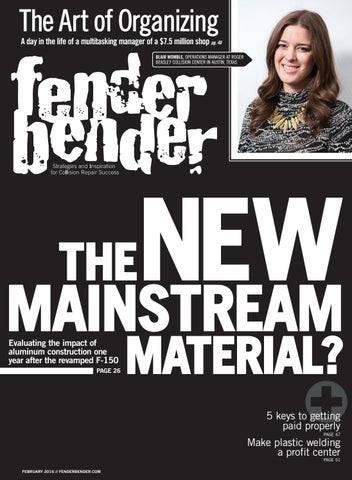
The Art of Organizing
A day in the life of a multitasking manager of a $7.5 million shop pg. 40 BLAIR WOMBLE, OPERATIONS MANAGER AT ROGER BEASLEY COLLISION CENTER IN AUSTIN, TEXAS
NEW MAINSTREAM THE
Evaluating the impact of aluminum construction one year after the revamped F-150
PAGE 26
MATERIAL? 5 keys to getting paid properly PAGE 47
Make plastic welding a profit center PAGE 51
FEBRUARY 2016 // FENDERBENDER.COM
Better for the environment. Best for your bottom line.
Doing good for our planet can be great for business. Converting to the ENVIROBASE® High Performance basecoat system not only delivers environmental benefits, it provides superior color match and easier blending, plus improved cycle time performance. With added productivity and superb quality, it’s no wonder more shops have converted to the Envirobase High Performance system in National Rule areas than in all compliant regions of North America combined.
ENGINEERED
FOR EXCELLENCE
Follow us online:
www.ppgrefinish.com
©2015 PPG Industries, Inc. All rights reserved. The PPG Logo and Envirobase are registered trademarks of PPG Industries Ohio, Inc.
CONTENTS
ON THE COVER
Blair Womble photographed by Jason Jones
FEBRUARY 2016 // VOLUME 18 // NUMBER 02
26. Rise of Aluminum One year after the introduction of the aluminum-bodied F-150, we look at the impact on the industry, and how aluminum is trending. BY BRYCE EVANS
34. Ultimate Efficiency Shop owner Scott Chase came up with a system of visual cues to keep his operation moving without disruptions. BROOKE BUTTERFIELD
BY TRAVIS BEAN
40. Renaissance Woman From the front desk to the parts department, how Blair Womble juggles multiple roles at Roger Beasley Collision Center.
Hands Off Scott Chase in his shop, Keith’s Body Shop in North Platte, Neb., which essentially runs itself thanks to a detailed visual production system.
BY TRAVIS BEAN
PRINTED IN THE U.S.A. COPYRIGHT ©2016 BY 10 MISSIONS MEDIA LLC. All rights reserved. FenderBender (ISSN 1937-7150) is published monthly by 10 Missions Media, LLC, 571 Snelling Avenue North, St. Paul, MN 55104. FenderBender content may not be photocopied, reproduced or redistributed without the consent of the publisher. Periodicals postage paid at Twin Cities, MN, and additional mailing offices. FenderBender is a member of BPA Worldwide. POSTMASTERS Send address changes to: FenderBender, 571 Snelling Avenue North, St. Paul, MN 55104.
F E B R U A RY 2 0 1 6
//
FENDERBENDER.COM
3
CONTENTS
22
47
STRATEGY 7. Past the Page 9. Driver’s Seat 11. Light Hits
47. Finance+ Operations
12. Snap Shop
The keys to effective leadership
A walk around A1 Auto’s CARSTAR Collision in Spring, Texas
15. Quick Fix
» BY KEVIN RAINS
24. On the Business
The secret KPI you must know
ANALYSIS State Farm’s market
shakeup NUMBERS Working on vs. in your
business HOW IT WORKS The asTech2 AWARDS INSIGHT Building an
efficient parts process IDEA SHOP Facebook essentials
» BY MIKE ANDERSON
60. Questions
Former Tesla exec discusses bringing purpose to your business
62. Innovations
A simple way to store PPS liners
51. Tech+Tools
With bumper covers accounting for the vast majority of repairs, it pays to invest in the tools and training needed to repair rather than replace those parts.
54. Case Study
How Big Sky Collision in Billings, Mont., established team systems to dramatically cut cycle time.
EDITORIAL
SALES
EDITOR
PUBLISHER
Jake Weyer
Chris Messer 651.846.9462 cmesser@10missions.com
ASSOCIATE EDITOR
Bryce Evans
NATIONAL ADVERTISING SALES
SENIOR STAFF WRITER
Andrew Johnson 651.846.9459
STAFF WRITER
REGIONAL ADVERTISING SALES MANAGER
Anna Zeck
ajohnson@10missions.com
Travis Bean
10 MISSIONS MEDIA
WEB CONTENT PRODUCER
PRESIDENT
Austin Becker 651.846.9454 abecker@10missions.com
Tess Collins
Jay DeWitt
CONTRIBUTING WRITERS
MARKETING COMMUNICATIONS SPECIALIST
Robert Knudsen 651.846.9452
SALES SERVICE SUPERVISOR
Melody Todd 651.846.9468
SALES SERVICE REPRESENTATIVE
Daniel Weinberger 651.846.9473
Mike Anderson, Kevin Rains
PRODUCTION ART DIRECTOR
Zach Pate
PRODUCTION AND INTERNET COORDINATOR
Seth Engman
SENIOR GRAPHIC DESIGNER
Nick Spaeth
GRAPHIC DESIGNER
Fue Vang
GRAPHIC AND PRODUCTION DESIGNER
Tessa Luedtke
Anders Seefeldt Mariah Straub
Meghann Moore
DIGITAL MARKETING ASSISTANT
Pheng Lee
REGIONAL ADVERTISING SALES
rknudsen@10missions.com mtodd@10missions.com dweinberger@10missions.com Eugine Welch 651.846.9477 ewelch@10missions.com
REPRINT MARKETING STRATEGIST
Daniel Weinberger
EDITORIAL ADVISORY BOARD Ryan Cropper Able Body Shop Robert McSherry North Haven Auto Body Greg McVicker Budd Baer Collision Center Steven Morris Pride Collision Centers Mark Probst Probst Auto Body Kerry Woodson Jungerman CARSTAR
» HOW TO REACH US SUBSCRIPTION SERVICE tel 800.869.6882 fax 866.658.6156 email fndr@kmpsgroup.com The annual subscription rate is $72 (U.S.A. only) for companies not qualified to receive complimentary copies of FenderBender. BACK ISSUES Past issue single copies are $8. Go to fenderbender.com/backissues OFFICE OF THE PUBLISHER 10 Missions Media, LLC, 571 Snelling Avenue North, St. Paul, MN 55104 tel 651.224.6207 fax 651.224.6212 web fenderbender.com LETTERS TO THE EDITOR letters@fenderbender.com ARTICLE REPRINTS For high-quality reprints or e-prints of articles in this issue, call 651.846.9452 or email reprints@fenderbender.com.
4
FENDERBENDER.COM
//
F E B R U A RY 2 0 1 6
THINKSTOCK
22. The Big Idea
Getting properly reimbursed by insurers is a common struggle for shops. Here are a few steps to help you improve those negotiations for the benefit of your bottom line.
Some see a crumpled hunk of steel; you see resurrection. At Chief, we’re inspired by your craftsmanship – that’s why we offer products, training and unrivaled support to help you breathe new life into your projects.
chiefautomotive.com/nothingelse/fb
NOTHING ELSE IS A
Kia vehicles are at the forefront of today’s automotive design. Unique details in our Kia vehicles demand precise engineering and fit. Kia customers deserve Genuine Kia collision replacement parts to keep them satisfied for years to come. Our brand’s popularity continues to grow meaning more Kia customers for your shop. Always specify Genuine Kia Parts for the highest level of fit, finish and quality. Contact your local Kia dealer today for assistance and delivery of your parts.
FENDERBENDER.COM
COMMENTS, DISCUSSIONS, FEEDBACK AND MORE FROM AROUND THE WEB
The Latest from LinkedIn Popular discussions from the FenderBender Forum Ramin Hakimi, general manager at Oscar Auto Body, asked group members for recommendations on a frame measuring system. What would you suggest? Join the conversation at fenderbender.com/linkedin.
ONLINE EXTRAS
COLLISION C A S T
This month, associate editor Bryce Evans sits down with Aaron Clark, vice president of technical compliance for the Assured Performance Network, to discuss all things aluminum structural repair. Listen now at fenderbender.com/collisioncast.
2016
FenderBender recently announced that trainer, consultant and all-around industry superstar Mike Anderson will deliver the keynote at the FenderBender Management Conference, Sept. 19-21 in Chicago. During the all-new presentation, “Choice, Chance, Change: Practicing the Three C’s to Grow Your Collision Repair Business,” Anderson will provide the know-how and inspiration needed to succeed today and in the years ahead. Anderson will also be on hand for networking opportunities throughout the event, and deliver an additional session on shop-insurer negotiations. For more information or to register, visit fenderbenderconference.com.
CONNECT WITH US ONLINE
FROM THIS ISSUE’S SPONSORS Click on the logo below for product information.
Axalta Coating Systems
Mercedes-Benz
BASF
Nissan North America
CAPA
O’Reilly Auto Parts
CARSTAR
PPG
CAR-O-LINER
SATA DanAm Remember Group ®
www.car-o-liner.com | 800-521-9696
Nissan
SATA DanAm
Innovative Tools & Technologies
U-POL
Kia Motors America
Urethane Supply Company
facebook/FenderBenderMag @FenderBenderMag FenderBender - The Collision Repair Professionals Forum youtube.com/FenderBenderMag fenderbenderlive.com fenderbender.com/googleplus
Vehicle Services Group
Go Where Your Customers Are Get your own mobile friendly site and get found. Custom mobile websites for $995.
Call 866.414.2582 for Details remembergroup.com
DRIVER’S SEAT
Let It Go Those of you who have young children or grandchildren might be
To move forward, you have to let go of what’s holding you back.
familiar with a Disney movie by the name of Frozen that has become wildly popular in recent years. If you know the film, then you also know that it has a particularly catchy soundtrack, with songs that will be stuck in your head for days at a time, especially when you’ve seen the movie as many times as I have (I have two young boys). There’s one song that I haven’t been able to shake for some time now called Let It Go. Why should you care? Just hang with me a moment. I’m writing this while sitting in an airport waiting to board a delayed flight to Palm Springs for the Collision Industry Conference. Leaving the office, especially at the peak of the magazine production cycle—which it is—is not easy. Many immediate needs have to be delayed or delegated. Plenty of remote communication will (and already has) happened. But you know, there’s a lesson in that Disney song, Let It Go, that’s playing in my head. It’s a lesson that could probably benefit many of you as shop operators as well. You can’t be involved in everything, and you really shouldn’t be if you want your business and your staff to grow. Sometimes to truly move forward, you have to first let go of the things that are holding you back, and that goes beyond tasks. Let go of the philosophies that lead you to believe your staff can’t handle the work or that you have to have the final say—or the first say. Let go of the anxiety. I am a perfect example of this being much easier said than done, but I can tell you that no work trip or vacation has downed the company. In fact, it’s usually quite the opposite. So, here’s to letting go in 2016, and seeing what we gain.
Jake Weyer, editor jweyer@fenderbender.com
F E B R U A RY 2 0 1 6
//
FENDERBENDER.COM
9
Performance. Reliability. Success. With our competitively priced replacement parts, you no longer have to settle for anything less than Mercedes-Benz quality. But that’s just part of the story. You see, our starters and alternators all carry a 12-month, no mileage-restriction warranty. So our parts are not only a great deal. They’re a great value. Since they’re genuine Mercedes-Benz, you can have confidence they’ll last, and so will your relationship with your customers. Contact an authorized Mercedes-Benz dealer or learn more at www.mbwholesaleparts.com.
* MSRP excludes state and local taxes, and freight if applicable. Prices may vary by dealer. See your authorized Mercedes-Benz dealer for additional details or a copy of the Mercedes-Benz parts limited warranty. Excludes CORE deposit.
LIGHT HITS
Your Industry’s News, in Brief STUDY SHOWS CONSUMERS WANT AUTONOMOUS FEATURES The 2016 Autotrader Car Tech Impact Study released in January shows that consumers want vehicles with autonomous features. The research for the study was conducted online by KS&R among 1,012 U.S. vehicle shoppers in September 2015. The study showed that 70 percent of car shoppers surveyed are more likely to consider vehicles with autonomous features. “As consumers hear more about autonomous features like automatic braking and collision avoidance technologies, and they begin to understand how they work or actually experience them, they appreciate what they do and they want them,” said Michelle Krebs, Autotrader senior analyst. Other findings in the study show that 83 percent of consumers say that advanced safety features are more important to them than information and entertainment features and 47 percent of consumers said they would sync their vehicle if they owned a smart watch. Other findings from the study: • 46 percent of consumers surveyed would pay up to $1,499 for an interactive dashboard • 65 percent of consumers surveyed said they would switch brands to get the technology features they wanted (up 9 percent from 2014) • 65 percent of consumers surveyed said they would watch the road even though they wouldn’t be driving in a self-driving or autonomous vehicle; only 11 percent said they would use the time to work. • 39 percent of consumers prefer the navigation system on a smartphone rather than the one built into their vehicles (up 19 percent from 2014) HONDA CR-V RECEIVES HIGHEST OVERALL SCORE FOR COLLISION SAFETY The 2016 Honda CR-V received a 5-star overall vehicle score from the National
Highway Traffic Safety Administration (NHTSA) New Car Assessment Program (NCAP). The CR-V previously earned a Top Safety Pick+ rating from the Insurance Institute for Highway Safety (IIHS). “Consumers have made the CR-V America’s best-selling SUV for good reason, and this top government safety rating just adds one more appealing and class-leading attribute,” said Jeff Conrad, senior vice president and general manager of the Honda Division of American Honda Motor Co. “Honda is committed to offering vehicles that deliver advanced safety, fun-to-drive performance and connectivity, with top fuel economy ratings. CR-V is that kind of vehicle.” By receiving the 5-star overall vehicle score from the NHTSA, the 2016 CR-V has also met the requirements of the agency’s three recommended technologies: rear video system (back-up camera), forward collision warning and lane departure warning. Key safety and driver-assistive features include: • SmartVent front side airbags • Side curtain airbags with rollover Ssnsor • Lower anchors and tethers for children (LATCH) • Vehicle Stability Assist (VSA) with Traction Control • Motion-Adaptive Electric Power Steering (EPS) • Anti-lock braking system (ABS) • Honda LaneWatch (EX, EX-L Navi) • Hill-start assist (HSA) • Expanded-View Driver’s Mirror • Multi-angle rearview camera
CALIBER COLLISION ENDS 2015 WITH RECORD VEHICLE DONATIONS Caliber Collision wrapped up 2015 by repairing and donating a company record 30 vehicles through the National Auto Body Council’s (NABC) Recycled Rides program. Caliber teamed up with insurance partners to provide transportation to
active service members and veterans, families in need, single parents, and nonprofit support service organizations. “Recycled Rides reflects our highest purpose which is to restore our customers and the communities we serve to the rhythm of their lives,” said Steve Grimshaw, Caliber Collision CEO. “As we continue to grow and expand, our teammates across the country are equally committed to restoring hope to individuals and families by removing barriers due to a lack of transportation.” “We thank our insurance partners and many others in our industry whose collaboration enables us to collectively make a positive impact in our communities,” added Grimshaw.
PARTSTRADER INTEGRATES PLATFORM WITH AXALTA’S PROFITNET PartsTrader announced in December an integration between its electronic partspurchasing platform and Axalta Coating Systems’ ProfitNet Collision Shop Management System (CSMS). The new interface is a two-way electronic interface between the ProfitNet Management System and PartsTrader, which helps eliminate redundant tasks between the two systems. Information needed for parts procurement and order status can now be transferred between parts vendors and collision shops using the system. “By partnering with Axalta, PartsTrader continues in its commitment to streamlining the parts procurement process with this integration between two industry leading platforms,” said Dale Sailer, PartsTrader’s vice president of business development. “Collision repairers who use both PartsTrader and the ProfitNet CSMS are positioned to achieve additional savings. The improved margins that PartsTrader can help collision repair shops achieve, combined with the reduced administration costs by using the ProfitNet CSMS, are designed to result in bottom line profits for our mutual customers.” F E B R U A RY 2 0 1 6
//
FENDERBENDER.COM
11
SNAP SHOP
LOCATION OWNER SIZE STAFF
1
A1 Auto’s CARSTAR Collision
SHOP
Spring, Texas
Don Ward
15,000 square feet 13
AVERAGE MONTHLY CAR COUNT ANNUAL REVNUE:
114
$2 million
Ten years after first opening a two-bay collision repair business, Don Ward opened his “dream shop” in November 2015, A1 Auto’s CARSTAR Collision in Spring, Texas. The shop is a mashup of all of the things he loves—retro auto shops, vintage diners and art deco. In 2009, while still operating out of a different location, Ward purchased two acres to build on. Due to the poor economy at the time, construction had to wait. The extra time allowed him to work on putting together the finances and getting the business plan ready. The results speak for themselves. The exterior of A1 Auto’s CARSTAR Collision represents the three themes that Ward wanted to incorporate into his shop. The building as a whole is meant to look like an old cinema: The dark gray color outlines the silhouette of a 1950s diner, and the windows were inspired by service stations from the 50s. Customers are greeted by statues of the Blues Brothers and Elvis when they visit A1, another cinematic touch added by Ward. For his estimator station, Ward wanted something unique that still had an old-school touch. “You know, back in the 50s, most travel was by cars with the suitcases loaded in the trunk and the family in the back seat. We fix cars in a retro-inspired facility, so let’s use suitcases from the 50s,” says Ward about the inspiration behind the unique desk. He ordered suitcases from the 1950s and cut them to size so the fronts could be used on the counter. The plan is for the lobby to be used as a display room for vintage cars. Currently, there’s a Plymouth Prowler that is being used as a place holder for a 1959 Corvette and a ‘71 Cuda that Ward is in the market for. Until the actual car comes in, customers will have to make do with the large mural of a vintage Cadillac painted in the lobby.
3
Other special touches in the lobby include another mural in memory of Ward’s father, who passed away in 2011. Ward hired the company Murals Your Way, which can take any photograph and make it into a mural, to do the artwork in the shop. The photograph he chose represented all of the things that his father loved and the company even surprised him by putting his father’s name on the side of the truck.
The shop is broken up into two sections, body and paint, which are separated by a fire wall. The body shop has 18 bays and the paint shop has six. When a job comes in, it goes into the disassembly for repair (DFR) station. Once a production manager sees a file in the DFR rack, all of the damaged parts are put on a parts cart and put back in its designated area while waiting for the new parts.
» To see other shop spaces or to submit your own, go to fenderbender.com/snapshop CLICK HERE
12
FENDERBENDER.COM
//
F E B R U A RY 2 0 1 6
6 COURTESY A1 AUTO’S CARSTAR COLLISION
Every employee has their picture framed at A1 Auto’s CARSTAR Collision. “I want my customers to see who is working on their car. It gives my employees a sense of pride that we take the time and courtesy to display their titles and certification,” says Ward.
2
4
5
7
8
F E B R U A RY 2 0 1 6
//
FENDERBENDER.COM
13
New lo o same g k, rea produc t t!
ONE DURABLE COATING, UNLIMITED USES More than just a bed liner, use RAPTOR® Bed Liner and Protective Coating on a variety of surfaces that need a protective barrier that withstands the toughest situations. Using RAPTOR® is easy – Spray, roll or brush black or tintable RAPTOR® for a no mess, no clean-up application. It’s as easy as FILL, SHAKE, SHOOT! • Customizable
• UV
• Durable
• Waterproof
AUTOMOTIVE
Resistant
• Easy
to Clean
• Chemical
• Easy
to Apply
• Sound
OFF ROAD
Resistant Deadener
MARINE
COMMERCIAL
INDUSTRIAL
QUICK FIX
DID YOU KNOW
Some shops saw their rates decrease by more than 10 percent as a result of State Farm’s new market designations.
NEWS // IDEAS // PEOPLE // TRENDS IN BRIEF
ANALYSIS
State Farm ‘Refines’ Market Designations, Alters PCPS A change to the insurance giant’s zoning classifications has forced some shops to accept drastically reduced rates, and fear what’s to come
http://www.email.com
changes to PCP until such time that B2B can be updated with current rates. If changes have occurred which impact the prices you charge State Farm per section 4 of the Select Service Agreement, please call and let me know. Current Rate Information for the Chicago-Naperville-Elgin market area: Body: $50.00 Refinish: $50.00 Frame: $75.00 Recycled Mark-up: 35% OEM Part Discount - Domestic: 0% OEM Part Discount - Foreign: 0% Paint and Material Pricing Level: $30.00
Rate Change State Farm issued an email to Select Service shops in its newly redesignated Chicago market last November (email is depicted above). For some shops, it resulted in drastic decreases in rates.
If you have any questions, please contact me.
BY BRYCE EVANS
STAFF GRAPHIC
Christy Hayes thought it was a mistake.
She received the email, read through it, and instantly reached for the phone. This was Nov. 5, the day she was informed that her and her husband’s shop—located in rural Sycamore, Ill., a town of just 17,500—had been placed in a new “government defined market” by State Farm. Hayes’ Body Shop Inc. is a Select Service shop, and as of receiving that email, the business was now considered to be part of the Chicago market (the shop is roughly 70 miles west of the city), a change brought on by the insurance giant’s effort in “refining certain market boundaries utilized to determine prevailing competitive prices (PCPs),” according to a copy of the email notification FenderBender obtained through a shop source. And that PCP? For body work, it was now $50; same for refinishing. Paint and material pricing was now $30. Each
of those new rates marked decreases of more than 10 percent for Hayes’ shop, which generates roughly 30–35 percent of its $2 million in overall sales through the Select Service program. That’s when the phone call was made. “I honestly called expecting them to say they sent me the wrong email, and that they’d forward the correct one,” Hayes says. “I was just—I was completely in shock.” The change was effective as of Nov. 4, the day prior to the email notification. The new rates would be enforced immediately.
Widespread Move According to a number of shops and industr y consultants with close knowledge of the situation, Hayes’ story is similar to those heard throughout the U.S. last fall. State Farm announced in July that there would be changes made to
designated markets in its 2015 Auto Repair Facility Survey, which it uses to determine PCPs and paint and material price levels for each area. Shifting the boundaries in some areas could result in PCP changes, the insurer warned at the time. For many shops like Hayes’, that turned out to be the case. She was told the rates—and new market definition— were non-negotiable if she wanted to stay in the Select Service program. When contacted by FenderBender, a State Farm representative said the company would not comment beyond its original July notification. “We’ve been in business 30 years, and we’ve worked with State Farm for a long time over those years, and they’re a very good company to work with,” Hayes says. “We value that relationship a great deal. I’m just—it’s hard to understand a decision like this. I don’t get it.” Neither did Jen Fisher, manager of F E B R U A RY 2 0 1 6
//
FENDERBENDER.COM
15
MARKET DESIGNATIONS
CONTINUED
her family’s Kenosha, Wis., shop, Jay-Bee Collision. Fisher was also informed of the market shift via email, and her shop—located in rural, southeastern Wisconsin—was also grouped in the Chicago metro. She also saw doubledigit decreases in rates across the board. “Our paint and materials levels are now back to what they were in 2008,” she says. “We checked back with our vendors, and since 2008, our paint and materials costs have increased 42 percent. It makes no sense.” One shop owner in Kentucky told FenderBender that his market didn’t see a PCP reduction, but also hasn’t seen an increase from State Farm in six years. When his facility tried to charge $2 above the $40 PCP State Farm had set for the area, he says the insurer “refused” to pay it. His facility is not part of the Select Service program. Other shops in Louisiana have
experienced similar issues, according to an email sent by Alysia Hanks, executive director of the Louisiana Collision Industry Association.
Ramifications and Reactions Jay-Bee Collision is on the border of Kenosha County. Five miles up the road, Fisher says, is another shop in the State Farm program—one not in Kenosha County. That shop was not regrouped. Its $56-per-hour labor rate has remained. “Throw out the difficulty this puts on our bottom line, and one of the big issues for us now,” Fisher says, “is how this impacts recruiting technicians. “We give our team raises based on the success of the business, and what we [receive as payment]. We’re not sure how this will affect all of that going forward.” The other concern, according to multiple shop owners, is the fear that
other insurers might look to do the same. Both Fisher and Hayes say they have never seen rates go backward in all their years working with multiple insurers. The fear of a new precedent is very real, they say. Hayes’ shop is growing. The day Hayes received that email from State Farm, she had just hired two additional technicians, bringing her team to 11 total. She said her team will “buckle down” and try to run more work through the shop to make up for the slimmer margin on State Farm work. But, as the emotion breaks through in her voice, she says that it’s a “BandAid fix” at best. They’re still looking for a long-term solution. “I just keep hoping that this is a mistake. I mean, what are we supposed to do? What are we going to do?” says Hayes before pausing; then she adds, reassuringly: “We’ll get through this. We have to. We’ll find a way.”
READ WHAT THE PROS READ. “I HAVE TO TAKE MY HAT OFF TO FENDERBENDER. IT’S DEFINITELY BETTER & ABOVE THE REST.”
- Greg Lobsiger, Owner Loren’s Auto Body, Bluffton, IND.
Grow your collision repair business with ideas and insights from industry experts.
TO SUBSCRIBE OR RENEW FOR FREE TODAY, VISIT
FENDERBENDER.COM/SUBSCRIBE 16
FENDERBENDER.COM
//
F E B R U A RY 2 0 1 6
It isn’t just a bar-coded sticker. It’s proof you care about quality. Too many aftermarket crash parts are like cheap burgers. You don’t know what mystery meat they’re made of. So why mess with them? Specify CAPA Certified replacement parts and you won’t have to. As the nation’s leading independent certifying authority we protect you and your customers by putting parts through tough tests to see if they fit, perform, last and are as safe as the originals. Those that pass earn CAPA
Certification. Those that fail? They’re out there somewhere. If you care about quality specify CAPA Certified parts by name. Look for the CAPA Quality Seal on each part to be sure you get the real deal. They’re the Gold Standard in replacement parts. It’s no mystery why.
If it isn’t CAPA Certified, it isn’t a genuine replacement part.
CAPAcertified.org
Want to see what happens to a replacement bumper that isn’t CAPA Certified? Check out the video at CAPAcertified.org/crash
QUICK FIX
NUMBERS
Benefits of Working On vs. In Your Business One of the most common refrains touted by business coaches and consultants is to work on your business, versus in it. When asked in the 2015 How I Work survey to describe their leadership styles, respondents most commonly answered either “Direct involvement. I get my hands dirty on the shop floor and lead by example” (43 percent) or “Visionary. I focus on the big picture and inspire staff to succeed” (24 percent). But while nearly half of shop owners are still directly involved, the “visionary” leaders may be reaping greater benefit: 82 percent of shop owners who described their leadership style as “visionary” also reported total yearly sales of more than $1 million, while 30 percent of shop owners who described their leadership style as “direct involvement” reported the same figures.
18
FENDERBENDER.COM
//
F E B R U A RY 2 0 1 6
“I get my hands dirty on the shop floor and lead by example”
DIRECT INVOLVEMENT
30%
*Leadership Style vs. Annual Revenue
“I encourage staff input in decision making”
DEMOCRATIC
63%
“It’s done my way or it doesn’t get done”
AUTHORITARIAN “I trust my team with key decisions and am not afraid to delegate”
HANDS OFF “I focus on the big picture and inspire staff to succeed”
VISIONARY
66% 69% 82%
% of shop operators with each leadership style whose business generates more than $1 million per year.
HOW IT WORKS
asTech2 Improve repair quality and save money on scan tools with a remote diagnostic tool
ASTECH2
BY ANNA ZECK
WEBSITE: astech2.com
COURTESY INYSTEM
COST: $2,500 for the device, $85 per scan
HOW IT WORKS: As computer programs and lights on the dash became more of an issue in the collision repair industry over the last few years, the more issues he ran into at his business, the three-location B Street Collision Center in Omaha, Neb, says production manager Tony Wiese. For one, he says, purchasing aftermarket scan tools was expensive and required yearly updates. But secondly, he says the larger obstacle was training related. “The biggest expense is always training the technician to be able to competently use it and be able to read the information it’s giving them so they know what to do,” he says. “Anybody can sit a guy behind a tool and pull codes but the actual diagnostic code time of getting on the computer, doing research to figure out what those codes mean and what the proper solving procedure is, is the problem.” Wiese was looking for a way around that problem, which is why he decided to invest in the asTech2 remote diagnostic tool roughly a year ago. At an upfront cost of $2,500, it’s not only cheaper than one scan tool, but it also gives him access to nearly all makes and models 2008 and newer, allows him to find out what issue is causing the dashboard warning lights to stay lit, ensures all sensor systems are functioning properly, and identifies any hidden damage due to collision. The way it works is simple: The technician connects the wireless, portable asTech2 unit to the vehicle’s OBD-II port and turns the ignition on. Then, he submits a service request (which is usually vehicle information, whether it’s a pre- or post-
TRAINING: Virtually none USES: Remotely diagnose vehicles Head to bit.ly/fbastech2 to check out FenderBender’s first-hand look at the new asTech2 after it was named runner-up for best new collision repair product at the 2015 SEMA Show.
repair scan and the lights that are on) through the asTech website. Then, an OEM master technician at asTech’s headquarters will perform a full diagnosis of every vehicle module to resolve whatever problems might be occurring, generally within 30 minutes. During that time, the shop’s technicians do not have to be present and can work on other jobs. “Having that skilled tech on the other end of the line is where the majority of the value lies,” he says. “It keeps my guys pulling dents and painting cars.” Once the scan is complete, the shop will receive a full report, which includes an itemized printout of each module that needs to be addressed and the process that needs to be completed to fix that component. “It’s a full written document that is proof of what the issues were on the car,” Wiese says. “It gives me all the information I need to justify what I did to the insurance company.”
THE RETURN: Wiese says the asTech2 is one of the most useful tools in his shops for cutting cycle times. The benefits have been numerous. First, he no longer has to keep purchasing scan tools or calculate the ROI on those expensive tools. In addition, the asTech team works directly with OEMs to receive
all updates that dealers do. That means that Wiese no longer has to worry about repair quality or comebacks due to inaccurate or incomplete information. “The amount of time it takes to take a car to the dealer with two guys, go pick the car back up and have it sit there at the dealership, it might sit for a day or longer,” he says. “This creates significant help in decreasing that amount of time.” Wiese estimates it took him roughly three months to recoup the cost of the tool. When it comes to the $85 cost per scan, he bills it out to his insurance companies. Wiese notes that it was a new concept for the insurers he works with, so before starting use of the tool, he met with his insurance partners and explained the value of it and how it would benefit them, as well. Wiese now rarely runs into trouble billing it out, but he does note that he needs to have a “justifiable reason” for the scan. That’s why he doesn’t scan every single vehicle, although he says he hopes to progressively start using it more and eventually scan more vehicles. “If it’s a $700 bumper job, it’s highly unlikely you’ll have a code,” Wiese says. “There’s not a justifiable reason.”
» Interested in knowing the impact of a particular collision repair product in the shop? Send your suggestions to howitworks@fenderbender.com. CLICK HERE
F E B R U A RY 2 0 1 6
//
FENDERBENDER.COM
19
QUICK FIX
AWARDS INSIGHT
An Organized Parts Process Chesiree Johnson’s standardized system keeps cars flowing through Gerber Collision
AS TOLD TO TRAVIS BEAN
When I started here, the entire repair process was definitely something new to learn. I did have a background for part of it, but mechanical class in high school is a lot different than being in the industry. The key for me was organization. You have to keep everything in line, because if I get something wrong, then the tech is 20
FENDERBENDER.COM
//
F E B R U A RY 2 0 1 6
under the wrong impression, and then it just backs up the whole shop. To start the day, I go through the list of vehicles that are in the shop, making sure all of my orders have been placed the night before and that they were all answered. Then I get ready for the morning meeting at 8 a.m., so when they do ask me about those parts and when they’re going to get in, I have answers. Then we do a walkthrough of all the vehicles so we can see if they need additional parts and so I can collect any other information for our writers. I have my clipboards arranged on my office’s wall and separated out for each job. I order the parts for those vehicles and make sure the body techs have their sheets filled out so they know what vehicles they have for their parts racks and so they can put all their parts in their designated areas. A lot of that information is derived from our CCC ONE estimating system. I pull the parts list from the estimates, and those parts are checked throughout the day by our writers. Our parts are pulled from there. I go one step above and take that information and set up sublets for glass when those get called in as the car progresses through the shop. It’s essential to keeping the flow going in the shop and getting things moving in the right direction.
I have a 1 p.m. meeting with Bill, and we go down to the vehicles that are going to leave that day or the next day, making sure all those parts are here, correct, ready to go. Usually by that time, the cars are together and washed. I have filing bins where I have orders that are in process, and orders still waiting for ETAs. I have them stacked up by dates. I keep them all together. If they’re coming in today, they’ll be in my stack for those, and then if they’re coming in tomorrow or if it’s backordered, that will go in a separate bin. Throughout the day, I’m constantly opening and checking parts as they arrive. I go out to the vehicle with the part to make sure it’s correct and that the tech doesn’t need anything else. If something is wrong, I make it a priority and can usually fix it pretty quickly. I keep a huge log of all my different contacts. I’m constantly emailing, talking on my desk phone, calling them on my personal phone. And then at the end of the day, I go back, rearrange my filing bins and make sure all the orders are placed for the next day.
» FenderBender Awards Insights feature past FenderBender Award nominees. To nominate an inspiring collision repair professional, or for more information, go to fenderbenderawards.com. CLICK HERE
TESSA LUEDTKE
Chesiree Johnson started running auto repair shops in high school. Well … sort of. Her auto shop technologies class would take on repair jobs in the community, and the teacher assigned Johnson to be the manager of the school’s “shop” during her junior and senior year. That teacher must have observed the same traits in Johnson that production manager Bill Huffine saw when he hired the then-18-year-old to be parts manager for Gerber Collision in Scottsdale, Ariz., two years ago. “Although [Johnson] has only been in the industry a short two years, her skills far exceed parts managers I have worked with [with] three times the experience,” writes Huffine in his FenderBender Award nomination for Johnson. “With her attention to detail and following procedures to a ‘T,’ she has kept our returns to a minimum while increasing cycle time and tech productivity.” Johnson is a shining example that age doesn’t always factor into success. If you’re organized and driven, you can keep a business running smoothly.
IDEA SHOP
Facebook Essentials for Body Shops Social media helps achieve branding goals. You may not necessarily find people on social media who are in direct need of a collision repair shop at that moment. It’s about building up your brand and positioning your business as a high-quality shop or specialist. Then, when your online listings do come up for someone in immediate need of your services, they’ll know who you are and be more likely to convert. That’s according to Lee Emmons, creative director of Absolute Perfection Media, an industry marketing firm. Emmons discusses what every Facebook page for a body shop should have. AS TOLD TO ANNA ZECK
There have been some significant changes to Facebook that every shop needs to take into consideration when putting together a strategy for that platform. What I think is the biggest hurdle for a lot of shops is to understand that Facebook is now a paid platform. The cost is very low in comparison to most other forms of advertising, but without any budget it’s very difficult for business Facebook pages to get any exposure. Facebook now will only show your posts to a very small percentage of your page’s followers unless you boost those posts or create Facebook ads. We also have some case studies in which we’ve found that a boost of only $5 can have a huge impact. What happens is that when you don’t boost a post in any way, nobody ever sees it. But if you boost it for only $5, at least enough people see it to start interacting with it, and then people who are connected to them see the ways that they have interacted with it. Another important change is that, even though posting photos is still important because they’re excellent content for social media, Facebook is only organically delivering photos to an average of 3.73 percent of a page’s followers, which is even less than shared links (5.29 percent) and text-only statuses (5.77 percent). They’re trying to put an emphasis on video, which has an average organic reach of 8.71 percent on Facebook. Let’s start with the basics, though. Just because there have been changes doesn’t mean that the same principles as before don’t apply. Every Facebook page should have the same name, address and phone number (NAP) as
your Google+ page. The reason to have it sync up is because the more places that have the correct NAP will help you show up higher in rankings for your service area. Next, you want a mixture of photos, videos and links. First, you’ll want good pictures representing yourself on that page. That includes pictures of your staff, your facility and perhaps vehicles you’re working on. Although photos don’t have a huge organic reach, they are still very engaging content. When you’re creating text posts, post relevant content that is tailored to your customers. Most people aren’t on Facebook to see ads, so be sure not to come across too promotional. Anything you can do to tailor your content to being genuinely interesting or engaging is good. Show personality, post content that is more “fun” and don’t forget to ask questions and listen. You want to foster a community that has interaction. When it comes to video, I think it’s good to take into consideration that there are a wide range of types of videos that can be made. It’s not just a 30-second commercial and in fact, that type of video is going to perform the least well because it’s not as interesting. It’s good to position yourself as an expert and differentiate yourself from most shops. So, for example, if you do a lot of work on Audis, showcase different types of cars that have gone through there or different maintenance tips. Just keep the videos fairly short and snappy with engaging visuals. No one wants to watch a video where someone is just standing and talking. Finally, don’t forget about Facebook reviews. Every company should have
procedures and possibly a script for replying to reviews, both good and bad. While shops should encourage happy customers to leave reviews on Google My Business, because those reviews are by far the most prominent because of their role in local listings, many people will leave Facebook reviews because it’s one of the easiest ways to do that. So, everyone should monitor those reviews and make sure positive reviews get a thank you, and negative reviews get a response and then are moved offline to a direct email or phone conversation. If you’re looking to take your Facebook page to the next level, Facebook Ads are the way to go. First, it’s not very expensive. A lot of times, you see people putting a lot of hours into posting stuff to Facebook but they’re not making sure that the stuff they’re doing has some type of reach. They could just be putting a little money into Facebook to have a much bigger impact. As I mentioned before, you can start off by just boosting a post for $5. That will help you get that process started of people liking stuff, sharing it with their friends and getting a bigger reach that way. However, I would say that you should really be using the Ads Manager and creating targeted ads that go after the people you want. Through that manager on Facebook, you can easily create ads that are targeted to certain people. For example, a lot of shops have certifications and they should be targeting people who are likely to have those cars. Not only do you get the best price per engagement, you are also guaranteeing that the right kind of people are looking at your ad.
» Give us your ideas about marketing with Facebook by visiting fenderbender.com/ideashop. CLICK HERE
F E B R U A RY 2 0 1 6
//
FENDERBENDER.COM
21
THE BIG IDEA
The Making of a Leader Leaders often attempt to do one of two things: make people happy or drive
them to perform. Those who can do both, win. Having good leadership in your shop is critical from the owner to those on the shop floor. But what is leadership? Often leadership feels like an idea or an ideal but what does it look like in everyday situations? Someone once said, “Managers do things right. Leaders do the right thing.” Without a doubt, managers who can do things right are needed in every shop. And not every manager is cut out to be a leader. In my shops, though, I always make an effort to develop managers into leaders. However, as the saying goes, “You can lead a horse to water but you can’t make them drink.” I’ve found this to be so true and despite my best efforts, resources, exposure to trainings, conversations, mentoring, hoping, etc., some managers just are not capable of making the leap to leadership. But those who are end up being happier personally and professionally. Learning to lead is not only a way to get higher profits, it also connects people to a higher purpose, better relationships and greater respect in their wider circle of friends, family and community. So, how do we become better leaders and how do we develop 22
FENDERBENDER.COM
//
F E B R U A RY 2 0 1 6
those around us into leaders? While this challenge can be difficult, it doesn’t have to be overly complicated or confusing. In 1945 there was a study done at Ohio State University in which researchers studied the performance of International Harvester foremen. What they found was that the most effective leaders exhibited two key behaviors. First, the best performers demonstrated consideration for those they led. In other words, they treated their employees with respect and dignity. They treated them like human beings, not cogs in a wheel to be used for their own professional progress. Secondly, the highest performers implemented disciplined structures and processes that moved their team members and the organization as a whole to higher performance. From this study we can conclude that the two key behaviors for becoming an effective leader are simply demonstrating care for the people on your team and driving performance with a disciplined approach to implementing structure, systems and processes. People skills. Performance skills. That’s it. Simple? Yes. Easy? No. The road to becoming a leader and developing leaders around you is never going to be easy because most people are naturally gifted on one
side of that equation or the other. You either have a natural tendency toward people skills or performance skills—developing your weak side is the key to becoming a great leader. Personally, I have always struggled on the performance skills side of that equation. I re-entered this industry after over 15 years of social work and professional ministry. For obvious reasons, those professions lean heavily in their orientation to developing people skills like empathy, helpfulness and service. I’ve found that one of the best ways to develop your weak side is find a high-leverage habit or behavior that can be practiced daily. You will want to find something that is high leverage, meaning if you can make progress on this one thing, several other things will come along with it. This is what Charles Duhigg calls a “keystone habit” in his book The Power of Habit. An example from my personal life is exercise. When I make time to exercise, I automatically start to eat better, sleep better, have more energy during the day and my confidence improves. The same is true in our shops. There are key behaviors—daily practices and habits we can practice—that, once installed into our routines, will create a positive momentum in several areas. Here are a couple key behaviors
THINKSTOCK
Learning the people and performance skills needed for success
KEVIN RAINS
under each of those two categories to consider. If you need to develop the people skills side of the equation, spend a little time each day interacting with all of your team members on a personal level. Find out what is important to them outside of work. Ask how their family is doing. Do they have any hobbies or things besides cars that occupy them outside of work? Ask great questions and really listen to the answer. Oftentimes, that means shutting up and waiting for a response before moving on or filling the silence with more words. And work on making eye contact when you’re speaking to them. This demonstrates that you are sincerely listening. Of course too much eye contact is creepy, but too little unintentionally communicates you really don’t care about what they’re saying. If you are trying to develop people skills and you already know this is not your strong side, then hold the eye contact a little longer than you would normally be comfortable with. If, like me, you need to keep developing the performance side of the equation, spend time working on a key process that your team keeps fumbling. For us recently, that was customer intake. When we were checking cars in, we would miss a step or two that seemed small but often would create problems down the line as the repair progressed. Our team would often miss simple things like tagging the key, putting it on the roster, making sure there were pictures attached to the repair order and writing key information on the car. I developed a checklist for whoever was doing the intake. There were about 10 key things I wanted our receptionists to do before handing the job off to a manager so I listed them in a checklist format and printed off several copies and explained that every job had to be processed in this exact way. So, find a recurring problem— something that bugs you, that your team struggles with inexplicably—
and turn that into a personal challenge to fix with a new process that you develop and communicate to your team. Then hold them accountable to do it right every time, with excellence and precision. Growing in our ability to lead and developing the leaders around us does not need to be complicated. But it has to be intentional. Pick your weak
side, find a simple behavior and make it a daily practice until it becomes a habit. I am confident the results will be both surprising and rewarding. Kevin Rains is the owner of Center City Collision in Cincinnati and Precision Frame & Body in West Chester, Ohio. He is also an industry consultant and founder of marketing website Body Shop 2.0. He can be reached at krains@fenderbender. com. For an archive of his columns, go to fenderbender.com/rains.
DO YOU MEASURE WHEN YOU ESTIMATE?
QUALITY DURABILITY Leading the industry in OEM Certified Approvals
Leading the Industry in OEM Certified Approvals
MEASURE WITH CAR-O-LINER CONFIDENCE! Don't Guess . . . Fix it Right the First Time! Watch Our Videos To Learn More! www.youtube.com/user/CarOLinerAuto
www.car-o-liner.com
844-833-9419
Contact Your Local Distributor For A FREE Demonstration! F E B R U A RY 2 0 1 6
//
FENDERBENDER.COM
23
ON THE BUSINESS
WANT TO MEET MIKE ANDERSON? He’s the keynote at the FenderBender Management Conference Sept. 19–21 in Chicago and will be available for questions and discussion.
Stop Sitting on Money I hear it everywhere I go: Sales are
slow. We can’t get enough work. We can’t find the jobs. We can’t close enough sales. Sounds familiar, right? The vast majority of shops across the country have a burning desire to increase sales. Most of them could do so, almost instantly, by paying attention to one key performance indicator (KPI): assignment-received to estimate-start date cycle time. If you’ve never heard of it, don’t worry; you’re not alone. If you have heard of it and are effective at tracking it and maintaining strong results … well, you’re actually pretty alone on that. To put it bluntly: This is something the industry, as a whole, struggles greatly with. And most shops don’t even realize it. So, what does it mean? Assignment-received to estimatestart date (let’s call it AED) refers 24
FENDERBENDER.COM
//
F E B R U A RY 2 0 1 6
to the amount of time it takes from the date you receive an assignment from an insurance carrier or through your estimating system to the time it takes you to complete the estimate. It’s pretty simple, and seeing as these are jobs that are literally handed to you, we should expect some pretty stellar numbers, right? Nope. Between 20 Groups and private clients I see these numbers from hundreds of shops. Most shops average right at five days for this. That’s horrible, just horrible. Meanwhile, best-in-class shops turn these around in less than 2.2 days. Most of those shops are MSOs. And this is something that insurance carriers are paying very close attention to, recently. Insurers have found that there is a direct correlation between how long it takes a shop to get in touch with a customer and perform an estimate
to how much they wind up paying in bodily injury claims. That’s a big deal to them, and how you perform in AED could affect your standing with those carriers. Now, there might be some people saying, “But, Mike, I’m not a DRP shop. This doesn’t apply to me.” You’re wrong. If you’re receiving assignments through an estimating system, like CCC’s Open Shop or Mitchell’s RepairCenter Connect, those are free business leads. And if you’re not monitoring and achieving strong results in AED, you’re wasting those; you’re wasting money. OK, so what should you do? First off, you need to track that KPI. Start now. Don’t wait. If you have CCC ONE, you already have the ability to track it, whether you know it or not. (See the accompanying screenshot for where to find it in the system.) CCC even allows you to compare
STAFF GRAPHIC
Shops across the country are missing out on surefire jobs because they are unaware of a critical KPI
MIKE ANDERSON
against the average shops in your market. If you don’t have CCC, this is something that is very simple to add to your basic reports. All you have to track is the time and date of when an assignment comes in, and the time and date of when the estimate was performed. It’s as simple as that. Now that you’re tracking it, you need to ensure that you’re hitting the proper benchmarks. The shops that have an AED of less than 2 days all follow similar tactics. For MSOs, this is why they have call centers; they’re not there to update customers on the repair status, but rather to have someone available to call a customer as soon as an assignment comes in. The best MSOs average just 7 minutes between getting an assignment and getting the customer on the phone. That’s huge if you’re trying to get the estimate done in the next 36
hours, especially when a number of them offer mobile estimating. If you don’t have a call center, the first step is to make sure you have someone in your organization responsible for monitoring those assignments and getting in touch with customers. Then, create a standard operating procedure for doing this—everything from the pecking order of who’s responsible to how often to check (for a single-shop independent, I’d recommend checking every hour), reminders in place for checking (Outlook works well), and a word track for calling the customer and getting the vehicle into your shop. When you do this and have your AED getting lower and lower, you’ll see a direct correlation in the amount of jobs you captured. Imagine being a consumer: You get in a car accident, notify your insurance company, and then you’re supposed to wait five
days for a shop to call you? As a shop, you likely lost that customer, or at the very least, underwhelmed them. This KPI is critical from an insurance standpoint. It’s critical in providing high-level customer service. And when it’s clicking, it will increase your sales and bottom line. When I walk into a shop and hear those common refrains about lack of work and slow sales, the first thing I do is look at AED. That’s the very first thing. And why not? It’s a very simple way to improve your business. This industry can be tough—far too tough to miss out on work handed right to you. Mike Anderson, the former owner of Wagonwork Collision Centers in Alexandria, Va., operates CollisionAdvice.com, a training and consulting firm that assists shop operators nationwide. He is also a facilitator for Axalta Coating Systems’ 20 Groups in the U.S. and Canada, and is an Accredited Automotive Manager. Reach Anderson at manderson@fenderbender.com. For an archive of his columns, go to fenderbender.com/anderson.
F E B R U A RY 2 0 1 6
//
FENDERBENDER.COM
25
The
26
FENDERBENDER.COM
//
F E B R U A RY 2 0 1 6
BY BRYCE E VANS PHOTOGRAPHY BY AMANDA HEIKKILA
Effect ROUGHLY A YEAR FOLLOWING THE ROLLOUT OF FORD’S GROUNDBREAKING ALUMINUM-BODIED F-150, THE COLLISION REPAIR INDUSTRY IS CAUGHT IN A RACE TO ALUMINUM-READINESS
F E B RX UXAXRY X 22001156 / / / FFEENNDDEERRBBEENNDDEERR. .CCOOMM
27
“This is truck country.”
Matt Parker lets the words linger for a moment. The answer, to him at least, was that clear cut. Parker Auto Body, his 18,000-square-foot West Monroe, La., collision repair facility, pushes through $3 million of work annually—nearly 40 percent of which comes from light-duty trucks. “Louisiana is truck country,” he repeats. “That truck, it changed everything. Everything.” First, here’s the question: Why should you invest in becoming capable of aluminum structural work? The cost of entry can be steep—very steep—depending on circumstances, Parker admits. And, as of this story going to press, the number of aluminum structural repairs occurring throughout the industry have been a bit, well, lackluster (more on that later). But, still, there’s that truck: the 2015 Ford F-150, North America’s first mainstream aluminum-bodied vehicle—the hulking, sparkling embodiment of what many believe to be the future of vehicle construction forged from an auto industry consumed by a furious race to lightweight designs and decrease fuel consumption. As FenderBender reported in 2015 (“Advanced Materials: Collision Repair’s New Frontier,” June 2015), aluminum use in vehicles is on the verge of reaching critical mass, a point at which being capable of performing extensive work on aluminum will become a necessity for the majority of shops. The message from many across the industry was clear: The time for change is here. But, roughly a year after the first aluminum-bodied F-150s hit the streets, how much change has really occurred? Is the collision repair industry ready for aluminum structural repair? And, maybe more importantly, should it be?
Do the Math: The Prevalence of Aluminum — According to FenderBender’s 2015 How I Work survey, only 5.2 percent of respondents said that “vehicle design enhancements” (which would include aluminum-body vehicle designs, by the way) as the “single biggest challenge” facing the repair industry. Compare that to the oft-cited technician shortage (32 percent) or insurer influence on repairs (28.3 percent), and you get a pretty good idea of where advanced materials sits on the hierarchy of shop operator concerns. Other numbers, though, suggest more should pay attention. The total aluminum consumption for light vehicles in North America has risen by 28 percent since 2012, according to the 2015 North American Light Vehicle Aluminum Content Study, conducted by Ducker Worldwide on behalf of DriveAluminum. For the 17.47 million vehicles sold in 2015, nearly 7 billion pounds of aluminum was used in construction—about 11 percent of which consists of body and closure parts. In all, more than 500,000 pickups and electric vehicles produced in 2015 had aluminum bodies, Ducker estimated. And as for the F-150, a shortage of vehicles due to manufacturing constraints caused a sluggish start to 2015 sales. When Ford reached full production in the second half of the year, though, sales ramped up. More than 65,000 F-series trucks were sold in November, a 10.4 percent year over year improvement, and Ford topped 85,000 trucks in December, the first time it had done so in more than a decade. 28
FENDERBENDER.COM
//
F E B R U A RY 2 0 1 6
In all, more than 780,000 F-series trucks were sold in 2015, marking the 34th straight year it finished as the nation’s highest-selling vehicle. Still, only a fraction of those aluminum-intensive vehicles will need repairs this year. Various reports suggest that there will be less than 70,000 aluminum-intensive vehicles coming into shops in 2016, roughly 700,000 if vehicle closures (trunks, hoods, etc.) are included. But, this is just the start, according to Ducker. By 2025, when Corporate Average Fuel Economy standards are to be met, Ducker’s research suggests that 70 percent of all new light-duty trucks will have aluminum bodies, and all major automakers will have an aluminum-body platform. More than 75 percent of all pickup body and closure components will be aluminum, 24 percent for economy vehicles, 22 percent for SUVs, and 18 percent for minivans.
The Shop Experience — Currently, aluminum repair is simply another repair segment or specialty for a body shop, says Scott Biggs, president and CEO of Assured Performance Network (APN), which now administers the certified or recommended repair programs for six separate OEMs. The automaker programs go far beyond aluminum work, but Biggs says aluminum is a critical piece for the advancement of collision businesses in the future. For its part, I-CAR holds a similar position—and stresses the importance of becoming capable of repairing advanced materials.
Familiar Sight? Matt Parker has a dedicated aluminum bay in his 18,000-squarefoot Louisiana shop. As more automakers move toward lighter materials, more shops may need the same.
“As we approach the Corporate Average Fuel Economy (CAFE) standards requirement by 2025, we’re finding that collision repair professionals need to be prepared to repair increasingly complex and varied materials beyond aluminumand steel-intensive vehicles,” says Jason Bartanen, I-CAR’s director of industry technical relations. “Mixed-material
Aluminum Market Share Breakdown According to the 2015 North American Light Vehicle Aluminum Content Study, conducted by Ducker Worldwide, more than 500,000 light-duty trucks and electric vehicles produced in 2015 had aluminum bodies. Based on a total of 17.47 million vehicles sold in 2015, that comes out to 2.9 percent of the overall market. That might sound miniscule, until you start making some comparisons.
ALUMINUM -BODIED VEHICLES IN 2 015 ACCOUNTED FOR 2 .9% OF THE MARKET. Audi: Volkswagen: BMW: Mercedes: Jaguar, Land Rover, Mini, Porsche, Volvo and Audi (combined):
1.2%* 2%* 2%* 2.1%* 2.7%*
*NUMBERS FROM THE WALL STREET JOURNAL
vehicles comprised of steel, aluminum, composites and other materials are becoming more commonplace as solutions to reduce weight, increase safety and accommodate technology. Aluminum- and steel-intensive vehicles, along with mixed-material vehicles, require specific training, tools, and equipment for complete, safe and quality repairs.” So, again, what has the shop experience been like for early adopters?
Getting Ready: Aluminum Adoption — Parker started the process of becoming aluminum-ready near the end of 2014. It took roughly five months, he estimates, to purchase (and receive) the needed equipment, build an in-house aluminum clean room, and train himself and all three technicians. In all, he says the cost came out to just under $100,000. “We didn’t spare any expense with it,” he says. “I tend to go all out when I do things—do it the absolute best way I’m able to. I’d guess, if we went with some [more affordable] options, like not constructing a clean room, having less people take the training, etc., it would’ve been more like $50,000 or $60,000.” The cost of entry tends to vary greatly, Biggs says. Some shops are already well equiped, others need to make large changes. Today, Parker and Parker Auto Body are among the nearly 2,500 in APN’s group of certified shops, the majority of which hold multiple OEM approvals. F E B R U A RY 2 0 1 6
//
FENDERBENDER.COM
29
Timeline: Production AluminumBodied Vehicles 1992: 1994: 2000: 2013: 2014: 2014: 2015: 2016: 2016: 2016:
Jaguar XJ Audi A8 Audi A2 Tesla Model S Jaguar F-Type Land Rover/Range Rover Ford F-150 Jaguar XE Cadillac CT6 BMW i8
*INFORMATION FROM DUCKER WORLDWIDE
Making the Investment Matt Parker has worked to build his shop’s aluminum credentials in the last year, and now, he says, the business wants to see a real return.
That accounts for a little more than 5 percent of the total industry, a drastic rise from the less than 1 percent in the program just two years ago. Of those involved today, only roughly 25 percent are dealership owned; the rest range from small independent facilities to the largest MSOs. Specifically for Ford, there are already nearly 1,200 shops in its recommended network (which APN manages), roughly 700 of which are dealers. I-CAR has had more than 22,000 students go through its 2015 Ford F-150 Structural Repair Training Course, 63 percent of which were collision repair professionals; more than 5,700 organizations, overall, completed it. Of course, there is also a large number of shops involved in programs run independently by automakers themselves, including Mercedes-Benz, Audi, Jaguar Land Rover, and, most recently, GM’s Cadillac. In all, it’s estimated that there are nearly 4,000 facilities in the country capable of aluminum structural repairs. And it appears the industry is on a strong pace to becoming aluminum ready, says State Farm spokesman Justin Tomczak. “Obviously, State Farm doesn’t repair vehicles but we do have the opportunity to observe repairer work, hear feedback from our customers and engage in discussions with the repairer community,” Tomczak says. “ … Our customers have not reported having difficulties in finding a repairer for their aluminum repair needs. We think that may be a good indicator that the industry is adapting to the needs of customers in their local market.” 30
FENDERBENDER.COM
//
F E B R U A RY 2 0 1 6
Getting Paid: Real-World Experience — The first aluminum structural job that ran through Parker’s shop in mid-2015 was an extensive repair on an F-150. The total ticket topped $20,000. “It was a job that went through Progressive”, he says. “And they paid it without question, including our aluminum labor rate.” That rate, Parker says, is set at $125, more than double his $62-per-hour rate on traditional body work. It’s a large sum, he admits, but for the difficulty of the work, the training that goes into it, and the equipment costs, he says it is justified. “[Progressive] paid the next one, too, without question,” he says. “But I’ve had some issues at other times. I had one truck that [an insurer] chose to total rather than pay my rate. Some have had no problem, some have, but I refuse to do it for any less.” State Farm’s Tomczak says, “The market will determine what is competitive for the repairs performed.” Steve Trapp, North American strategic accounts manager at Axalta Coating Systems, says that typical rates accepted by insurers have tended to be around “1.5 times the normal body rate.” That calculation jives reasonably well with the results from National AutoBody Research’s variable rate surveys. The average rate for structural aluminum work in each of the 11 states that have posted, public results, all range between 1.5 and 2 times the average body labor rate. Although none top that, the “high rate” for structural aluminum work in multiple states was above 2.5 times the average body rate.
Those rates are up to the shops to determine, Biggs says, and he says he has heard “virtually nothing” about pushback from insurers. He feels that many carriers have a strong understanding of what it takes to make these advanced repairs and are willing to pay for what is necessary. Education will continue to play a crucial role, says John W. Eck, manager of the wholesale dealer channel at GM. For the company’s Cadillac program, launched in late 2015 in anticipation of the release of the aluminum-intensive 2016 Cadillac CT6, GM has set up self-guided courses for insurers that detail the repair process of the new vehicle. “We want a best-in-class repair experience for [CT6 divers],” Eck says. “We want the vehicle restored to the OE standard, and we want everyone involved to understand what that entails.”
Getting a Return: Recouping Costs —
As of December 2015, Parker estimated that less than 3 percent of his shop’s $3 million annual workload came through his certification programs—about what he expected for a transition year into aluminum work, he says. “Still, this is a long-term investment,” he says. “I wasn’t expecting to make back my $100,000 in a few months.” “This is about positioning myself for the future.” Some automakers require vehicle owners to only use their certified shops, and that’s where some advantages for those in various networks come in. Cadillac is going that route for structural work on its CT6,
Average Aluminum Labor Rates As part of its variable rate surveys, launched in multiple states across the country, National AutoBody Research polled respondents on their business’s average rates for aluminum structural repair. In the 11 states with reported results so far, the difference between those aluminum rates and the average body labor rate is drastic.
STATE
AVG. BODY LABOR RATE
AVG. STRUCTURAL ALUMINUM RATE
AZ
$52
$88
CA
$70
$106
FL
$46
$74
GA
$44
$85
ID
$54
$96
IN
$52
$101
NJ
$54
$93
NC
$46
$72
OH
$51
$78
TX
$48
$91
UT
$48
$93
Eck says. And the company will only sell certain parts and vehicle components to certified shops to ensure it stays that way. Repairing the vehicle “requires an additional level of readiness,” he explains, and the company doesn’t want to take the chance. There is a misconception, though, Biggs says, about the purpose of the certification programs, and “immediate” gains shops may or may not get. “Certainly, shops are choosing certification as an alternative to DRPs, but it doesn’t work the same,” he says. “There’s no one turning on the faucet for you once you have the certification, the way it might go for a DRP. You have to gain that business still. You still need to market it.” Ford, for instance, does not require its vehicle owners go to a Ford recommended shop for aluminum structural work. The auto giant has no restrictions on its parts. Biggs does not see that as a problem; neither does Parker. “This is an expensive vehicle,” Parker says. “I have a 2015 [F-150] King Ranch, and it was $63,000. People spend money on these vehicles, and they care about them. They aren’t going to trust just anyone repairing it.” “Consumers are smarter than we often give them credit for,” Biggs says. “They know, above all else, they want their vehicles repaired correctly—especially if they’re driving a vehicle that would be in one of these [repair] programs.” APN does a great deal of consumer-facing marketing, and Eck says Cadillac will have “a glovebox companion” available to educate customers. In a more tangible sense, the costs of certification (normally an annual fee ranging between $2,500 to $5,000) is recovered in a couple repairs. The initial cost of entry (equipment, tools, facility enhancements, training, etc.) can take several years.
A Look Ahead — Advanced materials are not going away, I-CAR’s Bartanen says. And the industry is going to need to continue to push its education and training as vehicles continue to advance. The launch of the 2015 F-150 changed the landscape of aluminum repair, and according to the Ducker Worldwide Study, last year marked a turning point for wide adoption of the material in vehicle design. The next 10 years will see a rapid increase. “Is it a must for shops to be doing this today?” Biggs asks. “It depends on how you look at it. I can tell you that it’s imperative to get in today, as the cost of entry will only get greater and greater in terms of capturing that market share.” Parker Auto Body is part of eight different repair programs (General Motors, Ford, Fiat Chrysler, Hyundai, Nissan, Infiniti, Honda and Acura), and Parker feels his business is in a position to capitalize on its expertise in the future—while competitors will be left behind. “It’s sort of a waiting game right now,” he says. “We’re building that reputation, and waiting for the market to [saturate] with those vehicles. The vehicles will come. This is truck country. I have no doubt they’ll come.” F E B R U A RY 2 0 1 6
//
FENDERBENDER.COM
31
Change the rules.
You pursue excellence, set your own rules and refuse to settle. In fact, that’s what motivated us to invent a low-VOC solventborne basecoat that meets your high standards for quality, color match, application ease and environmental responsibility. Cromax Mosaic. Because the art of refinishing will never die as long as you’re in charge.
BECAUSE your reputation wasn’t Call 855-6-AXALTA to set up an in-shop demo, or go to cromax.us/freemosaicdemo to discover this revolutionary new paint technology.
Š2016 Axalta Coating Systems, LLC and affiliates. All rights reserved.
built on compromise.
BY TR AVIS BE AN PHOTOGRAPHY BY BROOKE BUTTERFIELD
Scott Chase achieved ultimate efficiency through nonverbal communication during the repair process
KEITH’S BODY SHOP LOCATION NORTH PLATTE, NEB. SIZE 11,220 SQUARE FEET (THREE BUILDINGS) STAFF 8 (3 TECHNICIANS, 1 PAINTER, 1 DETAILER, 1 ESTIMATOR, 1 MANAGER/ESTIMATOR/ PARTS MANAGER, 1 OWNER) AVERAGE MONTHLY CAR COUNT 48 ANNUAL REVENUE $1.4 MILLION Competitive Edge After entering the collision repair industry, Scott Chase worked to refine a production system that allowed his team to perform quality work without delays.
34
FENDERBENDER.COM
//
F E B R U A RY 2 0 1 6
F E B R U A RY 2 0 1 6
//
FENDERBENDER.COM
35
ONE HUNDRED PERCENT WORKFLOW
WHEN BODY TECHNICIAN TERRY CHAMBERLAIN checks his mailbox each morning, he doesn’t find bills or advertisements or magazines. He finds a repair order. To clarify, Chamberlain isn’t at home; he is at work. And this isn’t just any mailbox; this mailbox exemplifies a system owner Scott Chase has perfected over the past five years at Keith’s Body Shop in North Platte, Neb. Chamberlain knows when his mailbox is full because a small LED light shines above it in bright red. That light is turned on by manager/estimator Jamie Piper, who leaves her office in a separate building, walks a couple hundred feet down Rodeo Road, heads into another building, drops off Chamberlain’s latest assignment and a parts rack, flips on that light, and walks away without saying a single word. Less than 10 minutes later, Chamberlain flips the light off, opens his mailbox, and finds a folder containing everything he needs to get started: the vehicle’s repair order number, the name of the customer, the estimator assigned to the vehicle, a list of parts, and the expected date-out for the job. As soon as Chamberlain is done with his repairs, he’ll walk into the paint and prep building and mimic what Piper did earlier. And from prep to paint to detail, and so on and so forth, until the keys are returned to the vehicle owner’s hands, the staff at Keith’s Body Shop will work perfectly in sync—likely without having to speak to one another about the job. It might not be for everyone, but for Chase, nonverbal communication is the key to mastering efficiency during the repair process. “Nonverbal communication is imperative,” Chase says. “Everything is lost in interpretation. If it’s not written down, it’s not true.”
100 PERCENT WORKFLOW When Jim Anderson walked into Keith’s Body Shop, he couldn’t believe it. Anderson is a consultant at Management Success!, and Chase, always craving to improve shop efficiency, had reached out for advice on his repair process. Chase was “pretty green” when he decided to enter the collision repair industry. Before taking over Keith’s Body Shop in 2010, he had a history in managing hotels, where procedure is key. From check-in to customer service to cleaning to check out, a system of established practices between various departments keeps operations running smoothly and customers up-to-date and satisfied. “It all came very naturally to me,” Chase says of transitioning into collision. “I wanted to create a relaxed atmosphere and really focus on improving efficiency.” Starting out in a 4,620-square-foot building, Chase grew the business into two more neighboring buildings on the same block, where various stages of the repair process are 36
FENDERBENDER.COM
//
F E B R U A RY 2 0 1 6
housed. While he originally envisioned moving operations into one building, he’s actually discovered no flaws with separating the departments. If anything, it has aided achieving nonverbal communication. “These guys can move a vehicle and never say a word,” he says. “It’s beautiful.” His system has been five years in the making, and it’s not done evolving yet. Every week, Chase says his SOP boards— which rest alongside the mailboxes in each department—are updated with new policies aimed at eliminating verbal communication and making the process more efficient. The results? Three buildings staffed with eight employees combining for an average monthly car count of 48 and annual revenue of $1.4 million. Over the past four years, cycle time has improved by 2 to 3 days. Chase’s labor costs have dropped from 35 to 18 percent; parts costs are down from 32 to 21 percent; and paint and materials costs went from 10.5 to 6.1 percent. And one more stat from Anderson: 100 percent workflow. “It’s the only inspection I’ve ever done where everything was exactly the way it should be,” he says. “You’d think being spread over three buildings would make it challenging, but everything is so clearly identified and organized that the shop just functions flawlessly.”
THE NONVERBAL PROCESS The Layout To understand the intricacies of Chase’s nonverbal system, the three-building layout should be overviewed. Building One: 4,000 square feet; staffs two body technicians, two estimators, one owner; houses office, estimating, blueprinting and parts departments, and two bays for collision. Building Two: 2,600 square feet; staffs one technician; houses one bay for frame work. Building Three: 4,620 square feet; staffs one painter and one detailer; houses prep, polish, paint and detail departments, and paint booths.
The Meeting Every morning at 9 a.m., Keith’s Body Shop’s eight employees gather in the main office. This meeting—which lasts no longer than 10 minutes—is crucial for ensuring nonverbal communication throughout the day. On two white boards, Chase lists the in- and out-dates for all current repair orders and discusses the reports from the previous day. “They know exactly where that vehicle is at during entire process,” he says. “I’ll lay out the weekly schedule on Monday, and for the rest of the week, they’ll know exactly which vehicles are coming out on which days.”
1
2
4
5–8
3
Critical Elements Shop owner Scott Chase devised a system of visual cues to alert his team as a vehicle passes through the shop. The numbers on the photos correspond to those in the story.
The Repair The estimator takes a pre-check-in sheet and examines the vehicle damage. This document, referred to as the (1) quality control (QC) sheet at Keith’s, is the first, integral piece of the nonverbal repair process. Stashed in a hanging repair order protector attached with a string, it contains the repair order number, customer information, the employees assigned to the vehicle, the date-in and expected date-out, and all parts to be used for the vehicle. The QC sheet moves into the parts department, where parts are listed and piled onto a (2) parts rack. While the car travels from department to department, building to building, the QC sheet will accompany it and the parts rack. At no point will those three items be separated. As the car and parts rack move between departments, the QC sheet is either put inside or hung from an employee’s (3) mailbox—each labeled with the department name—and the (4) red light is flipped on. According to standard operating procedures, the employee has 10 minutes to retrieve the QC sheet and turn the light off. Everyone knows this because, in each department, there is a (5) red board that lists the (6) SOPs for various stages in the repair process: check-in,
refinishing panels, refinishing plastic, prepping, polishing, parts check-in, etc. The SOPs visually lay out, through (7) charts and images, the steps for administering a “quality inspection.” Each employee must initial that he or she completed a quality inspection on the QC sheet, as well as check off that each part is accounted for at that station. Because of their ubiquity, these quality control instructions have nearly eliminated comeback customers, Chase says. “We have lots of visual stuff,” Chase says. “Body guys are extremely visual. They see things and can work through things in ways other people can’t.” There are even SOPs and QC check-offs for the company Keith’s sublets glass repairs out to. “They go to their board, do their work, have the technician sign off on the vehicle so that it passes through our final QC, and then they put the bill right in the folder and flip on the light so we know we can move ahead.” Each board also contains a (8) “Work Flow Quality Control Diagram,” which lists every stage in the repair process so the employee knows where the vehicle should travel next: office, parts, disassembly, repair, prep, paint, polish, reassembly, etc. F E B R U A RY 2 0 1 6
//
FENDERBENDER.COM
37
ONE HUNDRED PERCENT WORKFLOW
9
10
In the prep area, Chase set up (9) dry erase boards that list every vehicle that needs to be primed alongside each repair order number. “He can go to one area in the prep shop and see everything and categorize it according to out dates,” he says. “It’s his responsibility to prioritize each job every single day.” Before the keys are returned to the customer, the vehicle is transferred over to the detail department, where the board looks a little different. Hanging above each mailbox is a (10) paper clock, which Scott or his manager rotates to relay when the vehicle must be completed (the clock system is used for the pre-wash in the polishing department as well). You can guess what happens next: The car is detailed, the QC sheet is checked and initialed, returned to the original building and hung from the manager’s final QC board, and the light is flipped on. The manager then performs a final quality control before handing the keys back to the customer.
A CORE GROUP Establishing this system over the past few years hasn’t been easy. Chase says he lost over 20 employees who balked at his goal for a nonverbal system. “You get guys that are unwilling, who can’t see how, 38
FENDERBENDER.COM
//
F E B R U A RY 2 0 1 6
Not the Norm Scott Chase took an unconventional approach to improving efficiency, turning an unassuming repair business into one that now functions on a detailed, nonverbal communication process between team members.
down the road, this is going to help,” he says. “They want to fight and argue because it’s not the way they did it in this or that shop. Those attitudes don’t work.” To find the right employees, Chase implemented a four-step interview process spread out over several days. If they are on board with the nonverbal system, their fourth interview is a total submersion into Keith’s repair process. “Once they walk the shop and get a firsthand look, they want to be here and part of the team,” he says. “Once a new person is hired … within three months they have a fantastic understanding.” Chase eventually formed a core group that has worked under the system for three-and-a-half years now. And as he tinkers with processes and makes them more cohesive, that staff will only get more efficient with each passing day. “I joke because I don’t talk to these guys anymore,” he says. “I say hello to them in the morning and then I might not see them until 5 p.m. when they leave. They know their job. They’re professionals, and they know exactly what to do. It’s perfect.”
THE PERFECT FINISH
STARTS HERE
FEATURING PROFESSIONAL GRADE, SUPERIOR PERFORMANCE, BUILT TO EXCEL
URETHANE CLEARCOATS TO MEET ANY NEED • • • •
Versatile Air dry or bake Spot, panel or overall refinish Can be used with all solvent or waterborne basecoats
FirstCallOnline.com
PHOTOGRAPHY BY JASON JONES
BLAIR WOMBLE SPLITS TIME BETWEEN OVERSEEING HER SHOP’S PRODUCTION SCHEDULE AND FILLING IN DEPARTMENTAL GAPS
Forming a Pattern Blair Womble works to incorporate repeatable processes throughout her day to help the rest of the team at Roger Beasley Collision Center operate at maximum efficiency.
40
FENDERBENDER.COM
//
F E B R U A RY 2 0 1 6
F E B R U A RY 2 0 1 6
//
FENDERBENDER.COM
41
IF YOU ASK BLAIR WOMBLE WHAT HER POSITION IS AT ROGER BEASLEY COLLISION CENTER, SHE WON’T HAVE AN ANSWER.
That’s probably because, from the front desk to the parts department to the wash rack to the service writing, Womble has pretty much covered everything. Daughter of Dusty Womble, the company’s vice president, she adapts by filling holes in various sectors, moving between the Austin, Texas, shop’s south and north locations and providing relief wherever needed. Womble has always had a knack for leading teams. For years she’s bounced between California and Texas, managing staff in a variety of settings, from department stores to theater wardrobe departments. Growing tired of her random, late-into-the-night hours, she returned to Roger Beasley Collision three years ago, where she had spent her summer months during high school and had enjoyed a more concrete schedule. And now that the 31-year-old has finally settled into a managerial role in the company’s 40-employee north location, she’s taking advantage of being able to schedule out her entire day, splitting time between organizing the production schedule, updating the shop’s high-end customers, and hiring for open positions at the company.
ROGER BEASLEY COLLISION CENTER - NORTH LOCATION AUSTIN, TEXAS SIZE 33,700 SQUARE FEET STAFF 40
AS TOLD TO TR AVIS BE AN
AVERAGE MONTHLY CAR COUNT 250-300 ANNUAL REVENUE $7.5 MILLION
We have a meeting with all the service writers, technicians and management staff at 8 a.m. every morning. The meeting
runs from 35 minutes to an hour, depending on how many vehicles we have being delivered in the next few days. Our production manager, our owner and myself lead the meeting. I’ll print off the production list, which I’ve prepared the night before. We go technician by technician, starting in the body department, and discuss all cars in body, paint, reassembly, etc. We’re specifically looking at vehicles that don’t have dates set yet and vehicles due out this week. Then the techs are released. 42
FENDERBENDER.COM
//
F E B R U A RY 2 0 1 6
With the service writers, we go over vehicles that are on-lot, which is anywhere from 170 to 215 cars, that haven’t moved into production yet. We discuss what we are waiting on and supplemental vehicles. It gives the service writers a chance to say, “That car has been here for six days and we still haven’t gotten customer authorization or an insurance estimate. We need to follow up on that.” Once the meeting is over, I’ll stay back with the production manager and go through what we have due today. We’ll set times
for pick-ups, and go over any additional issues that need
to be addressed: Do we have a specific hot-case customer that needs to be addressed? Do we have personnel issues we need to talk about? After the meeting, I come in with the list, and fill out the day’s schedule in CCC ONE, set dates, and then print and pass out a list of vehicles scheduled to be delivered today. If I have insurance adjusters show up or dealerships calling me, this part of the day takes me anywhere from 30 minutes to two or three hours. It all depends on how big the workload is and how much I get pulled away while doing it.
Standing Out With two locations in the Austin, Texas, area, Roger Beasley Collision Center has a number of OEM certifications.
Before lunch, I’m contacting my customers with updates on their vehicles. It may be one or two phone calls a day, just because
I like to space them out over the week. I’m overseeing 13 dealerships that feed our shops and handling all of our OEM stuff right now: Audi aluminum, Porsche aluminum, Volvo, Maserati. We’re in the process of getting our Tesla certification. I deal with those customers that fall into those camps. That’s all high-end stuff, so it’s a different kind of customer. There are less of them, but they require more care. You have to be more verse with the more complicated repair methods and be able to talk to customers about that. They usually want a different kind of attention, meaning we’re either dealing with an assistant, or they’re executives F E B R U A RY 2 0 1 6
//
FENDERBENDER.COM
43
SHOP TALK
and are in and out of town, in and out of meetings; so it just takes a different approach. We use UpdatePlus through CCC One and send them emails and text messages. That can be especially important with the owners of the exotic and aluminum vehicles who have these crazy, busy lives, who just want to look down at a text message and know what’s going on. I’ll walk through the shop at least once a day. It’s pretty rare I
don’t have to go out and talk to a tech or at least go to the parts department. For the vehicles I specifically work with, it’s usually only one tech I deal with. It’s a tech that’s been here 11 years who we trust with those vehicles. I’ll also talk to our production manager, talk to our parts manager when checking on a specific car. I try to get all of that taken care of before my 11:30 lunch, before anything else falls in my lap. If I have time in the morning, I will, more than likely, have to make a run to one of the dealerships to deliver a car. If I’m too busy in the morning, I do that in the afternoon. Organizing my mornings properly is important because the afternoon is my project time. Right now, my project is interviewing
and hiring. We used to give résumés to our owner and he would pick who we were going to interview. Now he’s too busy running three businesses. Also, our office manager used to put all of our ads on Craigslist and Monster, but now she’s managing two locations and she has too much on her plate, as well. So I’m trying to offset both of them. In the mornings, I’ll usually print off any résumés we’ve gotten overnight, and then look them over after lunch. I have a list of job descriptions for positions we have hired in the past or regularly hire for, so I just copy and paste those into ads. And then I’ll look over the résumés that come in and make a phone call for an interview. Since I’m new to interviewing, I’m actually in the process of reading a book I heard about at a human resources seminar called “Topgrading.” It’s about the hiring process, weeding out the silly people versus the good people. It splits employees into A player, B player and C player categories, and explains how to get grade-A people through the interview process. One of the big things is when we get references, I ask for prior supervisors. I don’t want to talk to your uncle or high school baseball coach or youth minister—I want to talk to the people you’ve worked for. If they’re not willing to provide that info, then I usually will not look at them. I also elect to ask what I think is the most telling question: What are your strengths and what are your weaknesses? If you can’t give me any weakness about yourself, that probably means you’re not good at taking feedback or constructive criticism, and chances are you’re not somebody we want on the team. We want to have somebody that knows what their qualities are, what they can bring to the team, and where they need improvement. I always give an example of myself: 44
FENDERBENDER.COM
//
F E B R U A RY 2 0 1 6
Staying Connected Blair Womble, above with technician Travis Barrett, works to make sure the rest of the Roger Beasley Collision Center team is in a position to succeed.
I do not like confrontation. I hate it. Because I don’t handle it well, sometimes I don’t respond to it well. I always give something about me that I don’t like, to try and break down some doors and barriers so they don’t feel too vulnerable. At the end of the day, I get the production list ready around 5:15 p.m. for the following morning. I usually go in the back and
check in with our production manager to make sure there isn’t anything that’s happened throughout the day that I need to know about. I usually end the day with a pow wow with the office manager. She’s in charge of our PR, so we go over anything related in that department. Tomorrow we’ve got insurance renewal meetings, and we’ve got a Thanksgiving lunch, so we’re discussing the orders we have for the week and where we can order lunch from. That check-in is a nice way to round out the day, and then I usually leave by 6 p.m.
BOOST YOUR PROFITABILITY. Introducing Color Advance, the new line of GlasuritŽ mixing base concentrates that take painting efficiency to a whole new level. Color Advance mixing base concentrates deliver better hiding, reduce process times and save basecoat material by up to 50%. Plus you retain the proven advantages of the Glasurit 90 Line,™ such as world-class appearance, OEM certifications, proven quality and maximum efficiency. Get Color Advance and boost your profitability. Visit basfrefinish.com/GlasuritColorAdvance to learn more.
WANT TO SEE IMPROVEMENTS TO YOUR BOTTOM LINE?
CARSTAR DELIVERS BOTTOM-LINE BENEFITS FOR NORTH AMERICA'S LARGEST COLLISION REPAIR NETWORK • Increased sales of 11% in Year 1, up to 21.9% in Year 4 • KPI improvements to meet the highest insurance carrier standards • Enhanced purchasing efficiency and average annual rebates of $10,897 for stores purchasing between $1,000,000 and $1,499,999 • Expansion of your DRP programs from four in Year 1 to nine in Year 5 CARSTAR has helped our shops improve their efficiency and profitability. And they have helped us grow our network to 10 shops today. Steve Theobald, Owner, CARSTAR Collision Care
ARE YOU READY TO IMPROVE YOUR BOTTOM LINE THIS YEAR? Contact Scott Robertson at srobertson@carstar.com or 913-620-3888 to learn more today! WWW.CARSTAR.COM/JOINCARSTAR CARSTAR is a proud member of the Driven Brands family.
Data is based upon the CARSTAR Franchise Disclosure Document (“FDD”). See FDD for complete details. Past performance does not guarantee future results.
STRATEGY
CASE STUDY
“The techs came back and they had drank the Kool-Aid.” Matthew McDonnell, Big Sky Collision — PAGE 54—
MAKE MONEY // SAVE MONEY // WORK SMARTER
FINANCE+OPERATIONS
5 Steps to Getting Fully Reimbursed— on Every Job How to achieve target labor rates and maintain the margins you need BY ANNA ZECK
THINKSTOCK
Although it’s not a new problem, per se,
Steve Feltovich says that getting reimbursed by insurers is still one of the most pervasive issues within the body shops he works with as manager of business consulting services at Sherwin-Williams. And furthermore, he says it’s no surprise. “I’ve been doing consulting work over 20 years and I look over a lot of financial reports and I see the margins shrinking,” he says. “When you look at the profitability today and the factors that are squeezing body shop profits, there are a host of them that managers have to be trained on so they know how to understand and balance those issues.” Training, he says, is what the problem boils down to. “We have a major training gap in the collision repair industry, especially
with shop managers and estimators in terms of estimating effectiveness. That’s where the margin slippage occurs from,” Feltovich says. “We’re looking at 3 percent of our estimators have had any formal training classes in the last five years. That is just pathetic. That’s 3 percent who have had training in five years and we wonder why our margins are squeezed.” Maintaining proper margins is necessary in today’s collision repair environment, he says, and ensuring you get reimbursed for everything on every job is possible through a few simple steps that every shop can and should implement.
1) Train your front and back office staff.
The only way to offset the challenges squeezing body shop profits, says Feltovich, is training. Invest in training for your estimators and your front office staff so they know how to use the tools available and present them. “We really have to have astute estimators out there who know the numbers inside and out, know all three estimating platforms because insurers are using various ones,” he says. “And your people need formalized training. They can’t be trained by the insurance companies every day on the job. That’s who’s training them currently.” Feltovich says that estimator training provides estimators with the information they need to present a sound argument to the insurance carriers. With that training, he says that the back office F E B R U A RY 2 0 1 6
//
FENDERBENDER.COM
47
STRATEGY FINANCE+OPERATIONS
then needs an ultra efficient workflow process in place with elements of lean manufacturing. “We need a very deliberate, welldefined process without speed bumps,” he says.
2) Understand how to move your effective labor rate. Feltovich says one of the biggest keys to making margins is understanding your effective labor rate, which is calculated by the total labor dollars earned divided by the total hours actually worked. The way to move your effective labor rate (ELR), he says, comes from a balanced sales mix, which he says is connected directly to your estimate techniques and competencies. That sales mix should look as follows: 30 percent of the estimate should be body, frame and mechanical procedures; 20 percent should be refinish labor; 10 percent should be paint and materials; 38 percent should be parts; and 2 percent sublet. “A lot of estimate audits I do, their paint and material sales per estimate or per a month of estimates is under 10 percent,” Feltovich says. “If they have $200,000 in sales for a month, they should have $20,000 in sales for paint and material. If they come in at $18,000, they’re under the 10 percent mark and that lowers their margin on paint and material. So they’re not selling paint and material effectively.” Paint and materials (P&M) compensation has long been a source of heated debate—even lawsuits— between collision repair shops and insurance companies. Repairers commonly report underpayment or no payment for various materials used during repairs. Meanwhile, shops’ costs for those products have increased dramatically over the past decade, causing P&M profit margins to dwindle by the year. Using a P&M cost accounting system allows you to implement diligent documentation practices and improve insurance negotiation strategies. When it comes to frame and mechanical sales, Feltovich says you should do those tasks at tiered rates, 48
FENDERBENDER.COM
//
F E B R U A RY 2 0 1 6
rather than body rate. “When you negotiate a higher rate for your frame and mechanical, now you’ve changed your ELR. You have that 30 percent body frame and mechanical mix coming in at a higher-than-your-door rate for body and paint,” he says. The way to do that is to make sure your dedicated mechanic has ASE certifications, you’ve invested in equipment and then professionally negotiate with your insurance partner on a higher rate on mechanical, Feltovich says.
pertaining to non-included items or work performed that’s not billed out, says Feltovich. That library of tools should include manufacturer’s requirements for repair standards, P-pages, paint company recommendations, I-CAR information and ALLDATA information. “You need to support that with documentation,” he says. “Otherwise, their argument falls on deaf ears because they don’t know how to support it with third-party documentation or evidence to create a sound argument.”
3) Have access to all three estimating systems.
5) Don’t forget the non-included items.
Having access to all three estimating systems—Mitchell, AudaExplore and CCC—as reference tools is necessary, says Feltovich. “If an insurer is using a different database to write from, how do you know what’s non-included in their labor hours unless you have the reference on that particular estimating database? You need the keys to that database to know what those labor hours represent,” he says. Another reason access is so important to the estimating systems is to have access to the database-specific P-pages. “Lack of P-page knowledge in the databases are very commonly overlooked and not used on a daily basis when writing estimates,” Feltovich says. “Those are only really viewed if there’s a discrepancy about a charge or labor time on an estimate. Those should be utilized more regularly on writing every estimate.” P-pages are where those non-included items are located, he says, and today, that’s where your gross profit margins lie. If you write an estimate on base service time only and what readily comes up for the procedure in an estimating database, that will, best case scenario, cover your overhead and internal costs, says Feltovich. To put it bluntly: There’s no profit.
Feltovich says that one of the biggest issues with incomplete estimates is that estimating database providers keep lowering and moving labor times from the included operations under base service time. “A fender could’ve been 2.5 hours on a previous provider’s update, and now the latest update shows two labor hours to change out that fender. And where did the time go?” Feltovich says. “The time is actually in non-included items and you have to click on the non-included items and build the estimate up differently in order to achieve those same labor hours you used to be compensated for.” In fact, he says there are a whole stack of common repair operations that are performed and overlooked when the final bill is produced. Those include collision access time, R&I of wiring harnesses, pre-fitting of panels, paint and material items, undercoat, corrosion protection primer, etc. “There’s a host of those materials that go without being billed for, or in most cases, are charged out for a lot less than what the shop is actually being paid for because they don’t know their numbers on paint and materials, which are continuing to rise year to year,” Feltovich says. “The work is being produced in a quality shop environment by the techs but these operations are not being billed out for and they’re legitimate repair operations that should be paid for by either a customer or insurance company.”
4) Provide proper third-party documentation. You need a library of reference tools so you can find printed documentation to support the request for compensation
Delivering More for Less
35% OFF MSRP*
The Right Parts
The Right Price
Right Now
Nissan Genuine and Value Advantage™ Parts deliver Nissan validated fit, form and function to reduce cycle time and help improve customer satisfaction.
Save 35% off MSRP* on thousands of popular collision parts. Get instant pricing alerts with TRAXPOD™ .
With TRAXPOD™ get deals, deliveries and status notifications from your preferred Nissan dealer directly to your desktop.
TRAXPOD™ is Free to Install for all Shops
Visit www.traxpod.com to self-install or contact OPS @ 877-USE-TRAX for assisted install.
*See participating dealer for details. 35% off MSRP for eligible popular parts only. Value Advantage remanufactured engines and transmissions not included in eligible part categories and not eligible for discount. MSRP excludes all applicable taxes. Participating dealer sets actual price. Exclusions apply. Subject to part availability. Nissan, the Nissan Brand Symbol, “Innovation that excites” tagline and Nissan model names are Nissan trademarks. ©2016 Nissan North America, Inc.
Reduce the chance of costly paint mistakes due to poor color matching, not enough coverage, pre-paint and post-paint imperfections.
CH T A M N SU
R WINNNEEW
Ultra-high CRI, COB LED 95 CRI
BESTion And
No need to buy $100 back-up batteries; Sunmatch has the latest Lithium-Ion battery technology that gets up to 3 hours of battery life per charge
Collis Product Repair 16
SE M A
20
Charge indicator shows remaining battery life No more $60 bulbs to replace The Sunmatch LED lasts up to 100,000 hours Shock/water/dust resistant. Highly reliable. 1 Year warranty
Solvent resistant glass lens
Over 10,000 U.S satisfied customers in 2015 alone The Sunmatch is in every paint training center of the largest U.S. automotive paint company
Battery charge indicator > S U N M AT C H
Specifications
PA R T #: S G - SM $149
1.866.438.4 88 4 EXCLUSIVE U.S. DISTRIBUTOR OF SCANGRIP PRODUCTS
Ultra-high CRI COB LED 95 CRI 4500 Kelvin 1100/550 lux (step 1/step 2) 400/180 lumen (step 1/step 2) IP65 1h/3h operating time 3.7V/2200mAh Li-ion Charging time 4h
FOR VIDEO DEMONSTRATIONS AND INFORMATION, CONTACT YOUR LOCAL JOBBER OR FIND ONE ONLINE BY VISITING INNOVATIVETOOLS.COM
STRATEGY TECH+TOOLS
Capitalizing on Bumper Cover Repairs A full-time plastic welder details how to maximize your return on one of the industry’s biggest repair challenges BY TRAVIS BEAN
In its 2015 Q3 Industry Trends Report,
COURTESY PRO SPOT, NITROCELL, ROBAINA
Mitchell published the top 10 parts involved in collisions: fenders, grilles, hoods, headlamps and quarter panels all hovered around 30 percent each. At a whopping 68 percent? Bumper covers, of course. That percentage makes the next percentage all the more surprising: 72 percent of bumper covers are being replaced as opposed to being repaired. And in another report, Mitchell notes that more hours exist to do a quality bumper cover repair than are currently being estimated across the country. As the report points out, the accuracy of the repair-versus-replace decision is critical, and these trends signal a lack of equipment and knowledge regarding plastic welding. That’s why, Mitchell says, bumper cover repair training is necessary and something that shops should embrace. One of the shops that has made that transition is Kline Collision in San Mateo, Calif. Co-owner and fulltime plastic welder Warren Kline easily transitioned into the bumper repair role, and he says embracing plastic welding has put his shop one step ahead of the competition in his area. Here, he details how to get the maximum return on investment with bumper cover repairs.
Embrace the Technology Before buying a plastic welder for the shop, Kline admittedly had some doubts. He had heard horror stories about larger shops purchasing plastic welders, never using them and allowing them to collect dust. But once he embraced the technology, the shop immediately put it into use and several benefits became clear: Ease of use. Despite never repairing
a car before stepping into the role after a technician suddenly quit, Kline says a short training demo from a Urethane Supply Company representative and some tips from the shop’s A tech was enough to get him started on some practice repairs. Inexpensive upkeep. The nitrogen
used to fuel many plastic welders— which acts as a protective gas to block plastic from burning—is very cheap, Kline says. The shop spends around $100 per week for new nitrogen tanks. In addition, new welding rods range from 50 cents to $1, and Kline only goes through one to three per job.
YOUR OPTIONS —
Before settling on the Urethane Nitrocell Nitrogen Welding System, Kline Collision researched several options from various companies:
PRO SPOT NP-3. Pro Spot’s nitrogen welder offers digital controls for setting temperature, air and nitrogen flow settings. The welder’s gas pressure sensing system extends the heating element lifetime by detecting low air flow. A purchase comes with a staple welder, a welding iron and various plastic welding necessities, such as thermoplastic filler rods, aluminum tape and fine grit sandpaper.
URETHANE NITROCELL NITROGEN WELDING SYSTEM. The Nitrocell Welding System allows technicians to smooth welds with an airless welder and repair thermoset polyurethane. The system comes with an analog flow gauge, precision flow regulators on both the air and nitrogen sides, a welding torch and a welding cart with builtin holders for heating elements and tools.
F E B R U A RY 2 0 1 6
ROBAINA DIRECT PLASTIC FUSION PRO STATION. Robaina Direct’s tool can weld with or without nitrogen, and includes a plastic shaver and welding iron kit that’s designed to trim off plastic that can be reused and welded back on. It also includes a hot stapler, specialty flat vise type pliers, proprietary three-inch Eco Repair Systems abrasives and a nitrogen tank holder.
//
FENDERBENDER.COM
51
STRATEGY TECH+TOOLS
Significant ROI. While the cost of a plastic welder typically hovers between $5,000 and $7,000, Kline says it’s been a small expense in the long run. Before, Kline Collision’s biggest expense when it came to parts was always bumper covers, averaging $400 per order. But now, by repairing more often than replacing, the shop earns more money on labor and paint costs, is able to more easily get reimbursed by insurance, and offers the customer a better deal in the process. “When we give them the quotes, we say, ‘A new bumper is this price, but here’s what it is to repair it,’ and they give us the green light,” he says. “They’ll choose something $200 cheaper than the new one.” In addition, Kline says an average 6-inch repair costs less than $2, which is how much you pay just for the mixing when using two-part adhesives. Improved cycle times. No longer burdened with waiting for bumper replacement parts, which could take up to a week, Kline says cycle time immediately improved on lighter repairs by one day, pleasing both customers and insurance partners. Environmentally friendly. In California, environmental standards are very stringent for body shops, and Kline says there’s pressure to recycle as much as possible. To suffice, the shop keeps old bumpers that have been scrapped and uses pieces of them for plastic welds.
Have the Basic Necessities Kline says several additional tools and pieces of equipment go a long way in making plastic repairs easier and more efficient: • A sturdy surface or table to place the nitrogen welder, so it’s elevated alongside the bumper being repaired. • A “glorified version” of paint stands that hold bumpers steady, straight up and down and allow you to position them at any angle. • Very fine drill bits for wedging a hole at both ends of a crack to prevent it from spreading, making for a cleaner repair. 52
FENDERBENDER.COM
//
F E B R U A RY 2 0 1 6
Repair Versus Replace After recognizing the opportunity that repairing bumper covers presented, Kline Collision owner Warren Kline invested in the necessary equipment and training to learn plastic welding.
• Cleaning materials to polish down the surface before repairs. • Rods made of various types of plastic to match any type of bumper cover material, such as polypropylene, polyethylene, ABS and polyvinyl chloride. Kline suggests stocking up on rods made of thermoplastic polyolefins (TPO), a special kind of polyurethane that “seems to work with most repairs.”
more efficient. A perk with many plastic welders, including Urethane, is the value-added services that come with a purchase, which includes on-site training and feedback. As the importance of plastic welding becomes more apparent, more training options are becoming available. I-CAR recently established its first “Introduction to Nitrogen Plastic Welding” course to its Industry Training Alliance program.
Find the Right Technician
Find the Space
Kline easily transitioned into his current role by embracing training, but also by possessing three traits that aid plastic welding. Patience. You cannot rush the process, Kline says. The plastic welder works better if you take your time and avoid costly mistakes. “You can turn up the heat to look like it’s moving faster,” he says. “One of our former techs turned up the heat, caught a sharp edge on the front of the bumper and melted it. And as soon as it melts, it crumbles and deteriorates.” Steady hands. While that might seem obvious, Kline says steady hands aren’t exactly common and are a significant factor in performing precise repairs that won’t melt the plastic. Open to training. Training was one of Kline’s biggest hesitations when it came to plastic welding, as his technicians were very skeptical of change and adding a plastic welding station. However, Kline embraced the training and not only hosted Urethane onsite, but followed up with his representative for tips for making repairs easier and
Not only did a Urethane representative teach Kline the basics of plastic welding and how to use the system, but the representative also evaluated the shop layout and helped determine an optimal spot for the welder, whether you’re just finding space within an occupied shop or designing an express lane for bumper jobs. Fortunately, a bumper cover repair station encompasses a very small footprint, says Kline. His area only needs to hold a long table and a bumper stand with a few feet of room surrounding the station for mobility.
Advertise Your Services Once the plastic welding station was set up, Kline’s Collision began to offer more affordable bumper repairs to retail and wholesale clients. “It really gets customers coming in,” Kline says. “There’s a big hole in their bumper? Well, we can actually fix that for you for a lot less than insurance quoted you. We gain customers that way. A lot of other shops who don’t have the technology miss out on all that work.”
AN
REG
IS
D S TER BY AVE FEBRU UP ARY 29 TO 35%
THE MAN. THE MYTH. THE KEYNOTE SPEAKER. Mike Anderson is more than our keynote speaker. He’s a mentor and colleague of every shop leader who walks through our conference doors. Strike up a conversation with him and hear what he thinks of your shop strategies. His keynote is just the beginning.
Join Mike Anderson at the FenderBender Management Conference. Become part of the elite community of shop leaders. See his keynote topic and other speakers at fenderbenderconference.com. Save up to 35% if you register by February 29, 2016
2016
SEPTEMBER 19–21, 2016 // THE WESTIN LOMBARD // CHICAGO Fonts
Outlines
urethane supply company
®
For information on our limited number of sponsorships, contact Andrew Johnson at ajohnson@10missions.com.
Copyright ©2016 10 Missions Media, LLC ®
BY TR AVIS BE AN PHOTOGRAPHY BY K E LV IN H A MM OND
ESTABLISHING TEAM SYSTEMS HELPED CUT BIG SKY’S CYCLE TIME FROM 18 DAYS TO SIX
54
FENDERBENDER.COM
//
F E B R U A RY 2 0 1 6
In It Together Big Sky Collision introduced a two-team system in January 2014 that assigns specific duties to different technicians.
F E B R U A RY 2 0 1 6
//
FENDERBENDER.COM
55
Keeping Score Matthew McDonnell updates the shop’s scoreboard daily with his team’s cycle time, compared to the average length of rental in his market. A snowstorm temporarily increased the shop’s cycle time (pictured) in December.
esting above Big Sky Collision’s repair floor is a scoreboard—the kind of scoreboard you’d find in a high school basketball gym. Big Sky Collision’s daily opponent is “The Market.” On most days, the Big Sky crew can be found performing better than the statewide length of rental market average. And if they’ve fallen behind, you can be sure all 30-plus employees will work together to pull ahead. Call it strange, call it crazy, call it gimmicky, but at Matthew McDonnell’s shop, it’s all about teamwork, and the scoreboard represents a gigantic cultural shift that completely reshaped a disorganized repair process, reduced waste and unified the Billings, Mont., shop into a single unit working in sync to beat the market average. When McDonnell discovered his shop didn’t allow for efficient inter-departmental interaction, which created a culture of singularity that killed workflow, he knew he’d have to motivate employees to buy into a team system and manufacture a unified culture that, in the end, took the shop’s cycle time from 18 days to six—in just four months.
56
FENDERBENDER.COM
//
F E B R U A RY 2 0 1 6
THE BACKSTORY — Established in 1978 by McDonnell’s father, Matt, Big Sky Collision has gradually grown from a four-bay garage to a 22,000-square-foot facility since McDonnell took over eight years ago. With an increased focus on marketing—improving the shop’s SEO and establishing his Shar Pei, Raisin, as a local celebrity mascot—work started to flow in like never before. As customers poured in, the staff grew from a handful to over 30 employees, and McDonnell even established another location in Bozeman, Mont. But with the shop’s expansion came growing pains. As the building and staff size increased, the repair process remained stagnant. What had worked before—which involved one body tech and one paint tech taking on a vehicle—was suddenly killing Big Sky’s workflow and slowly increased cycle time to 18 days.
BIG SKY COLLISION LOCATION: BILLINGS, MONT. SIZE: 22,000 SQUARE FEET STAFF: 35 AVERAGE MONTHLY CAR COUNT: 148 ANNUAL REVENUE: $5.5 MILLION
THE PROBLEM — Because of the shop’s setup, work not only created a bottleneck in the paint department, but also a disjointed culture. The body shop was split into 24 vehicle stalls for eight body technicians. Each tech would receive three vehicles at a time, and those vehicles would be pushed to the paint department. Different severities of repairs and different skill levels between the eight technicians meant vehicles would leave the body department at will, on to six painters splitting time between two booths, creating the bottleneck. As McDonnell puts it, the layout created “eight miniature body shops” within one big one. “Techs were running their own shops. We didn’t know it at the time, but that’s what it was,” he says. “Each one was capable of doing the repair, but they weren’t enabled to work together efficiently.”
The lack of communication carried over to estimates, as well. Estimators would receive notes from the customer, but rarely notified technicians of a change. “We’d do a super good $5,000 repair. But the customer walks out, sees a dent he asked us to fix and asks, ‘Why didn’t you do that?’” McDonell says. “That voids out this wonderful repair we worked so hard on.” After visiting lean guru Aaron Marshall’s shop, Marshall Auto Body in Waukesha, Wis., McDonnell realized Big Sky’s “miniature body shop” system was not only killing communication, but also creating excess waste (each technician had tens of thousands of dollars worth of parts stored in their separate stalls). The new idea? Consolidate the stalls, get more hands on a vehicle at once and focus on pushing out one vehicle at a time. “Eight times three—that’s 24
cars jammed in our body shop,” says McDonnell. “When we really started working on this repair process, we asked everyone: ‘How many cars can you touch at one time?’ “We heard five, we heard three—but no. The answer is one. We wanted to establish and set up a way to make it efficient for touching one car at a time.”
THE SOLUTION — Since employees were so used to their individual repair stations, the communal “buy-in” became essential. That’s why, instead of preaching Marshall’s lean philosophies, McDonnell flew his technicians to Waukesha to see the process. “The techs came back, and they had drank the Kool-Aid,” he says. “They had completely bought in. It wasn’t something they were forced into—they were ready to start right away.” The new system (implemented in F E B R U A RY 2 0 1 6
//
FENDERBENDER.COM
57
CASE STUDY
January 2014) involved splitting the entire shop into two teams, with each team comprised of techs with very specific duties. Stalls were no longer occupied by one technician performing several duties, but instead by several technicians performing a single duty. “There were guys that were very skilled at putting in quarter panels, or very skilled at doing high-level repairs, or maybe their skill was in some type of electrical repair,” McDonnell says. “We had this mix of all these different people, and what we decided was to split it up into two team systems that focused on individual strengths.” Each team is made up of two A techs and two B techs working on a vehicle. Typically, McDonnell says two technicians will tear down a vehicle and then partner with one of the shop’s three estimators, who makes notes on the repair order, and one parts employee, who gathers a list of parts to order. As the vehicle moves into body repair, structural repair technicians work on the vehicle. If a specialized
task is required, the corresponding technicians perform the task. The shop has designated technicians who specialize in bumper repair/plastic welding, maintenance and running diagnostics. Both groups of body techs are partnered with one A tech and two B techs in the paint department, where paint, prep and masking duties are split between three painters. Throughout the process, visual indicators are key for nonverbal communication between departments. Repair orders are marked with one of five colors (green, yellow, orange, red or blue) to indicate the severity of the repair. The repair order contains a checklist of different parts for the vehicle, and each step (teardown, body, primer, prep, paint and buff) is coupled with a blank space for notes. In addition, customer service representatives, estimators and technicians will make notes on the vehicle and relay changes between departments. “We really have to set up a system where people have to talk to each other,
Expert Advice—
COMMUNICATING YOUR BUSINESS’S PURPOSE
When it comes to instilling company-wide change and getting your employees on board with new policies, Kevin Wolfe, founder of LeadersWay, says you won’t get very far without communicating the purpose behind those changes. There’s a great TED Talk called “Start With Why” by Simon Sinek. The concept he outlines is certainly transformational: How does Apple get their employees so motivated to help others? Walk into an any Apple store and their focus is on innovation and improving quality of life. If you’re considering buying something, they ask you: Who’s going to use it? What do you want to accomplish with it? What kind of products will you be using? It’s a different methodology. A neuroscientist did research on 40 Apple users, hooked them up with equipment, and watched their brains in live action. Researchers asked Apple users about their products and the company. Their brain patterns were identical to people who follow Jesus. The employees are driven by a philosophy to make the customers lives better. The primary thing business owners miss is they’re not clear enough on why they exist as a company. So if an organization can’t get people to embrace changes, it is because of a lack of leadership. A lack of purpose. No matter how hard we explain the logic behind why we do this and that, people don’t feel compelled. We’re not talking to right side of the brain. That’s been the challenge for collision: We fix cars and think that’s our primary purpose. It concerns me that we haven't moved past that.
58
FENDERBENDER.COM
//
F E B R U A RY 2 0 1 6
almost like a repair order,” McDonnell says. “If I know I won’t be the guy to put this back together, I better leave the 1-2-3 step for this process. We break the system down and communicate within our departments to deliver a good product.”
THE AFTERMATH — Improved communication has made the repair process more efficient. After four months, McDonnell’s new team system had reduced the 18-day cycle time to six days. Revenue climbed by over $1 million (it now sits at $5.5 million) and each team averages 74 cars per month, up from the previous storewide total average of 110. Those changes came just in time, too: In May 2014, a giant hail storm hit town, and Big Sky was able to clear $1 million in a single month. Between teardown, body and reassembly, technicians would discover new problems and order new parts. But with several eyes on a vehicle at once, supplement orders went down instantly. Staff camaraderie is also at an alltime high. The A techs are not only more productive with the added help, but are also able to mentor the B techs in a more nurturing environment.
THE TAKEAWAY — For McDonnell, it’s all about the buy-in: How do you unite your employees to work toward one common goal? “Our philosophy is, ‘We do things with you, not to you,’” McDonnell says. “It was important that management formed a process with employees as opposed to introducing a new idea out of the blue.” And that scoreboard on the wall? McDonnell updates it each day with the shop’s average cycle time (the goal is 7.5 days), compared to the market average for length of rental (often above 10 days), so the teams know where they stand. It’s now a daily reminder of the shop’s new mantra: When the Big Sky team succeeds, they do it together.
A X A LTA C O AT I N G S Y S T E M S
Always a Standout, Axalta’s Automotive Color of the Year 2016:
Brilliant Blue
© 2015 Axalta Coating Systems, LLC and affiliates. All rights reserved.
Learn more: axaltacs.com/color
QUESTIONS
A Former Tesla Executive on How to Bring Purpose to Your Business Louis Efron, an industry speaker and human resources consultant, explains how to find the purpose in your business AS TOLD TO ANNA ZECK
How do you define “purpose” and why is it impor tant? Purpose is a very gray concept and an airy-fairy concept for many people. People don’t see it as a hardcore business initiative but it really is. The way I like to define it is threefold. The dictionary definition is the reason for which something is done or used, the aim or intention of something. A personal definition is from the Purpose Institute, which says purpose is a definitive statement about the difference you are trying to make in the world. For the organization, it’s the reason your industry or organization exists, the “why.” I think the concept of your “why” is important because organizations don’t usually start to make money. It’s usually to have an impact on the world, to serve customers. The key is to understand that “why” for a corporation, and 60
FENDERBENDER.COM
//
F E B R U A RY 2 0 1 6
the power is understanding what the employee’s personal purpose is and how that connects to the organizational purpose to drive engagement and business results. The statistics around purpose back it up, too. In the book Firms of Endearment, they did a study that showed purpose-based organizations—like Ikea, Costco, Whole Foods—grew 1,646 percent between 1996 and 2011 compared to the stock market index, which only grew 157 percent. Those are huge differences. The study showed that there’s concrete evidence that purpose-based organizations are driving much higher results. How can you figure out your company’s purpose? The “what,” “where” and “why” is your mission, your vision, your purpose.
The mission is what you’re trying to accomplish. Every organization has something they’re trying to do. For the collision repair industry, the “what” is providing the right parts and service to make vehicles last longer, perform better and keep drivers safe. The “where” is your vision, where you’re going. That’s to serve every vehicle on the road. The ultimate “why” is to keep the world moving. That’s such a powerful purpose that’s often overlooked. You take it for granted that you get in your car each day. The power behind this is connecting what you do and how you impact the lives of others. They don’t think of a strong purpose-based industry. Through my career in human resources at medical device company Stryker, I had amazing experiences. But I also got to know myself more and what I do best, what my ultimate
COURTESY LOUIS EFRON
Louis Efron, former head of global employee engagement for Tesla Motors, delivered the keynote address, “Why Purpose Matters Most,” during the 2015 SEMA Show in Las Vegas. For more than two decades, Efron has worked with companies in various industries identifying organizational purpose, employee engagement, how a business can revitalize its talent pool and the power of knowing one’s organizational “what,” “where” and “why.” Efron discusses the importance of having a purpose in the workplace and how a company like Tesla has found success in doing so.
impact is on others and how I can have the most impact on the world. That transition started getting me thinking about what’s important to me, what I’m best at and Stryker was an amazing organization around HR. It was a real strategic business partner and they really helped people try to understand that, what you do best, where you’re best aligned in life, how you connect to the larger purpose of the organization. That journey, just asking those questions got me to where I am today. How can an experienced shop owner refresh his or her passion toward his or her business after being in it for so long? If the business has been around for a while, you’ve helped a lot of people. If you’re a small mom-and-pop shop, and the owners are a bit jaded, you can look back on the past 30 years and see the impact you’ve had on people. When you’ve considered how many people you’ve helped continue moving on with their lives, that’s a really important message. If you’re trying to refresh your business, have the owners start talking about how you impact the lives of others in your community. Once you understand that, integrate it into your business. For example, maybe you helped someone get to their wedding on time. Get a picture of that customer, get those stories and share them during team meetings or put them on the wall. Wherever you can reinforce that message of what you’re trying to do. It’s not just a commercial transaction of selling a part but also how you impact the life. If you can weave that into your business, for your customers and your employees, all the better. It’s probably going to get them more engaged in your business versus having a very generic experience that’s void of any purpose. How does a company like Tesla
reinforce its purpose? The one thing that really attracted me to Tesla is that it’s a huge purpose lab. It’s an organization that has driven success based on the employee’s connection to the mission and purpose of what Tesla is trying to do. The organization went from 400 employees five years ago to over 12,000 employees today. It’s really driven on that whole concept of their people believe they’re changing the world. Employees want to transition the world to electric vehicles. There’s
“The ultimate ‘why’ is to keep the world moving. That’s such a powerful purpose that’s often overlooked.” —Louis Efron, industry speaker and human resources consultant
that huge connection. What I was brought there to do was really harness that and start measuring employee engagement. Because even if you are really connected to mission and purpose, you can also find yourself in a pit stall where you’re so driven by what you’re trying to accomplish that other things in your life start to fall apart. You can quickly become disengaged, even from something that you love so much. You don’t pay attention to other areas of your life. What we’re trying to do is balance that with great leadership to balance the 360-degree view of life
with your people. Instead of creating a job, you create a life. You need to look out for them beyond their job. You need to care about their personal time, their friends, their family, their life as a whole. I launched something that was a tool I developed several years ago called Engagement360. It’s an engagement survey that has 16 core questions that measures the correlation between employee success and how engaged they are in the business. People had a chance to respond to it, give their good, bad and ugly feedback of what they were experiencing. The most important part of an engagement survey is what you do after. This initiative I developed was to get the feedback and understand the engagement levels team by team. What happened after that was that each team would get together with its scorecard, discuss the scores, what scores were high and which were low, then put an action in place that each team can improve upon for the next 6–12 months for their personal engagement. It’s not about the teams around them or the organization as a whole, but what will make the people on that specific team check a “five” on a certain engagement question? How do you make your life better as a team? One thing that comes up a lot is that the team doesn’t work really well together and they don’t know how best to work together. It could be as simple as getting to know the team better, whether that’s a lunch now and then, team meetings to go around the room. Sometimes it’s departments not working well together. Maybe they would go out to the other team and spend a day with another team so they understand what they do better and they can come back and use that information to make the information work better. It’s very customized to the team. Whatever the team feels they need to make things better for them. F E B R U A RY 2 0 1 6
//
FENDERBENDER.COM
61
INNOVATIONS
An Effective Way to Store PPS Cups and Liners Shop owner Eddie Stokes designed a four-slot PPS cup holder to keep cups off the table and build efficiency BY TESS COLLINS
in the afternoon, so the rack SHOP: only needs to be loaded a few Detroit Auto Body Inc. times per day; whereas before, LOCATION: they were mixing paint before Covina, Calif. every job. OWNER: At the start of each day, Eddie Stokes, president the employee mixing color SIZE: looks at the upcoming jobs, 14,000 square feet which are each assigned some STAFF: sort of identifier—a label or 17 number depending on the staff AVERAGE MONTHLY CAR COUNT: 120 member—and then the designated color required for the ANNUAL REVENUE: $3.2 million job. The paint for each vehicle is mixed into a designated PPS cup liner for each of the morning jobs. All of the morning jobs are then loaded, in order, into the slots on the quick-shot rack. The painter then has all of the color lined up for the morning and the process repeats in the afternoon. HOW IT’S MADE: Although there are products that are similar
THE INSPIRATION: It started with wanting to save space
and declutter the shop by finding an efficient way to store the 3M Paint Preparation System (PPS) cups and liners of Detroit Auto Body. Eddie Stokes, president and owner, began brainstorming for a solution. After thinking it over for a few months, he came up with an idea that would not only clean his shop up, but also keep the mixed paint from folding over in the liners while waiting to be loaded into the hard-case shell, keep the cup lids snapped on, and create an efficient system for the whole day. WHAT IT DOES: The quick-shot rack, as Stokes calls it, holds
four PPS cup liners or cups. The team averages anywhere from five to six paint jobs each the morning and the same 62
FENDERBENDER.COM
//
F E B R U A RY 2 0 1 6
THE COST: The cost of the steel needed to make the rack is
about $15. Stokes was able to find someone to help him with the laser cutting, which cut down cost. THE RETURN: “We’re able to get a least an extra car through
a day,” says Stokes. “With this setup, the tech can mix colors for four cars at a time and not have to walk back and forth between every job, which takes booth time down to an average of 45 minutes when it was an hour before.”
» Did you develop an innovative shop tool or piece of equipment to improve your operation? Tell us about it at innovations@fenderbender.com CLICK HERE
COURTESY DETROIT AUTO BODY INC.
WHAT IT IS: The quick-shot rack
to the quick-shot rack, Stokes didn’t like the shape of the holders available in the market. He wanted a rack that had a circular holder that could be attached to the wall, which was not available. Knowing what he wanted, he came up with a template design in his head and then he outsourced the project to someone who could assist him with the laser cutting needed for the four-slot design.
SATAjet®5000 B AS VERSATILE AS YOU Whatever you wish to paint: Our new high performance spray gun is exactly what you need. Regardless which object, climate, inlet pressure or application distance - the SATAjet 5000 B sets new standards in terms of versatility
• Fasts working speed • Flexible gun distance • Flexible air pressure (10-29psi) • Exceptionally high transfer efficiency • Durable for solvent or waterborne paint • Fast coverage & film build using less paint
For further information: www.satausa.com
Nozzle size
HVLP
1.0
–
1.2
WSB
1.3
1.4
1.5
1.7
1.9
2.2
RP
1.0
1.1
1.2
1.2 W
1.3
1.4
1.6
1.8
2.0
2.5
210732
–
Standard
with QCC RPS cups 0.3 l, 0.6 l, 0.9 l, 1 ea.
DIGITAL
with QCC RPS cups 0.3 l, 0.6 l, 0.9 l, 1 ea.
– 211094
210740 210757 210765 210799 210823 210831 210849 210856
215640 209858 209866 209874 209882 209890 209908 209916 –
–
211110 211128 211136 211151 211193 211201 211219
–
210138 210146 210153 210161 210179 210187 210195 210203 210211
–
The exclusive independent distributor of SATA products in the US and Puerto Rico Phone: 800-533-8016 E-mail: satajet@satausa.com www.satausa.com
RP version approved by SCAQMD and EPA, meets rule 40, part 63, HHHHHH SATA, SATAjet and/or other SATA products referenced herein are either registered trademarks or trademarks of SATA GmbH & Co. KG in the U.S. and/or other countries.