#16 December 2024 / 20 CHF
BLENDED LEADERSHIP Idealist, traditionalist, opportunity seeker, or integrator? It’s important to identify your leadership style. REGENERATION GAME From Baby Boomers to Gen Z, why we can all benefit if we learn to understand each other better. COMMUNITY CHEST Wikipedia and Firefox lead the way in a tech-driven, community-focused way of doing business.
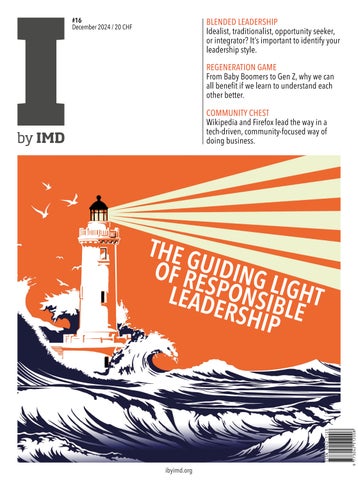
THE G OF REUIDING L S P O LEAD NSIBIGHT ERSH LE IP
ibyimd.org
21052 Dubai
21323 Grand Piano
10280 Flower Bouquet
LESS ACTION. M O R E S AT I S FA C T I O N . A D U LT S W E L C O M E
Experience LEGO ® Sets for Adults – rewarding and creatively challenging sets to suit all interests. LEGO.com/Adults
LEGO and the LEGO logo are trademarks of the LEGO Group. ©2021 The LEGO Group.
[ Foreword ]
Responsible leadership: what is it, and where do we go from here? In my opening article, I offer a short history of the way the archetypes of leadership have evolved and, with them, our understanding of corporate responsibility. Nicola Pless and Thomas Maak explore the different orientations of the responsible leader in an insightful, research-backed read that asks: are you an idealist, an integrator, an opportunity seeker, or a traditionalist? Mias de Klerk shares a manifesto for the responsible leader as part of an engaging overview of the field of study, and James Welch suggests five ways for leaders to build a lasting organizational legacy, not just short-term wins.
Illustration: Jörn Kaspuhl
W
When it comes to the day-to-day realities of responsible management, Ronit Kark, Sabine Sonnentag, and Laura Venz have summarized their fascinating research into the positive and negative impact that leaders can have on the ability of employees to recover from work each day – and the ramifications therein. Katharina Lange provides helpful perspectives on how better to manage the diverse expectations of different generations at work, and Sebastian Reiche looks at ways to safeguard “proximity” between organizations, leaders, and ever-changing hybrid workforces.
hat exactly is responsible leadership? I must admit that during my training as a leadership scholar in the 1990s, this question wasn’t a pressing one. The practitioner-oriented books I relied on while teaching leadership soon after – such as James Kouzes and Barry Posner’s The Leadership Challenge or Lee Bolman and Terry Deal’s Reframing Leadership – focused on performance, people, politics, structure, culture, and vision but didn’t place responsible leadership at the forefront.
In the magazine’s general section, we are delighted to share Bloomberg’s insightful findings about global attitudes to corporate reputation – a curtain raiser for our March edition, which will focus on the crisis of trust. In the wake of the US election, IMD President David Bach investigates the implications of a changing geopolitical landscape for business, while Stefan Michel – who is taking over the reins from me as Chair of the I by IMD Editorial Advisory Board – urges us to reframe the megatrends that are likely to continue to shape our world.
However, the world has changed dramatically in the wake of movements like #MeToo and Black Lives Matter, as well as the impact of the COVID-19 pandemic. New priorities, ranging from environmental sustainability to systemic injustice, have fundamentally reshaped the conversation, not only in popular discussions on leadership but also in boardrooms and C-suites. The debate over what a responsible leader should – or should not – be is hotter than ever.
It seems obvious to say that 2025 will likely prove to be another disruptive year for leaders and organizations, but it is likely to be just as full of opportunity, too. We hope this edition of I by IMD provides food for thought as we head into the new year and will prove a valuable guide for the challenges you face today and in the future.
In this edition of I by IMD, we delve into the latest thinking about responsible leadership, both from an academic research perspective and from the point of view of industry. What are the frameworks and approaches out there to help leaders define, understand, and refine their approach? How does the “responsible leader” respond to the challenges of the hybrid world of work, the platform economy, multi-generational workforces, and employee well-being?
Anand Narasimhan, Dean of Research December 2024 • I by IMD 1
[ CONTENTS ] 04 [In good company]
Many new businesses have few employees, no community roots, and rely on Big Tech for survival. How does this square with the demands for responsible leadership, asks Jerry Davis. BLENDED LEADERSHIP Idealist, traditionalist, opportunity seeker, or integrator? It’s important to identify your leadership style. REGENERATION GAME From Baby Boomers to Gen Z, why we can all benefit if we learn to understand each other better. COMMUNITY CHEST Wikipedia and Firefox lead the way in a tech-driven, community-focused way of doing business.
[ Responsible leadership ] Our experts offer clear insights and valuable guidance on how to define ‘responsible leadership’ and make it work for you, your people, and the planet.
THE G OF REUIDING LIGH LEADSPONSIB ERSH LE T IP
ibyimd.org ONLINE_16_IMD_2024_Edition_Dezember_2024_COVER_FINAL_ONLINE.indd 3
04.12.24 14:00
Cover-Illustration: Jörn Kaspuhl
14 39 [Brain circuits] Making all employees feel valued is the mark of an inclusive leader. Wei Zheng, Haoying Xu, and Peter G Dominick offer a quick diagnostic to see if you make the grade. 40 [Strategy] Paul Strebel, Angeliki Papasava, and
07 Anand Narasimhan outlines the changes in our perceptions
Patrick Reinmoeller explain how their easy-to-use tool can help leaders assess stakeholder impact on the creation and destruction of value.
10 Understanding your leadership style and how to blend
different approaches will enhance your ability to respond to new challenges, write Nicola Pless and Thomas Maak.
44 [The human factor] Fostering a ‘we’ culture of sharing, respect, and gratitude can help leaders make their organizations shine in an inclusive world, writes Shelley Zalis.
14 Mias De Klerk proposes a framework for becoming a caring
46 [In focus] Are the powerful few that shape a nation’s
20 James Welch introduces a five-step approach to help leaders foster sustainable legacies and social progress while ensuring a financially sound future.
48 [Corporate reputation] Anne Kawalerski, Michelle Lynn, and
of responsible leadership over time and explains why understanding these archetypes can inform your approach.
and ethical leader in an increasingly turbulent and complex world.
23 Today’s workforce often includes a mix of freelancers, temps,
and contractors. Sebastian Reiche sets out four work models to keep these disparate elements motivated.
26 Leaders must respect boundaries to help employees recover from workplace stress, according to research by Ronit Kark, Sabine Sonnentag, and Laura Venz.
29 David Wagner introduces ‘community-centricity’ – an inspirational idea for companies to evolve their focus on customers to include economic and societal impact.
32 Understanding generational differences is crucial to unlock-
ing potential, retaining talent, and becoming a more effective leader, argues Katharina Lange.
36 Henry Ford and Elon Musk have much in common – both industry titans with a lust for power. Ford eventually came unstuck, but who will rein in Musk, asks Michael Skapinker. 2 I by IMD • December 2024
economic and political fortunes creating value for society or hoarding it for themselves? To find out, explore our visual guide based on data from the Elite Quality Index.
Elisabeth Oak share insights from a Bloomberg Media study and
explain how leaders can positively influence corporate reputation.
[Technology]
52 The implications of generative AI for ‘knowledge’ work are
more profound than many of us might think. Organizations need to wake up, writes Michael Yaziji.
55 The American Arbitration Association has taken practical steps to harness the power of generative AI. Bridget McCormack and Jen Leonard give their verdict on the results.
58 Women worldwide are ideally equipped to lead the drive for an ethically driven ‘fair AI’ for the benefit of all, suggests Rupa Dash.
29
Photos David Malan via Getty Images
#16 December 2024 / 20 CHF
20
36
34 82
26
62 [CEO dialogue] Heineken CEO Dolf van den Brink tells
Jean-François Manzoni why a good leader needs to be authentic
and comfortable in their skin.
76 [Governance] Su-Mei Thompson warns of the perils of failing to adequately scrutinize marketing strategy.
64 [World view] David Bach assesses how companies can adapt to
78 [Coaching corner] The newly appointed CFO of a large company needed to change her leadership style to climb the career ladder. An executive coach equipped her with the tools required.
68 [Sustainability] When it comes to sustainability, effective
79 [The forecaster] Why is Hermès outpacing Nike, and what’s driving the success of Roche and NVIDIA? The Future-Readiness Indicator suggests ‘thoughtful restraint’ is the key, reveals Howard Yu.
71 [In the mind’s eye] Case studies are classic teaching tools for
82 [CEO questionnaire] Tiina Alahuhta-Kasko, President and CEO of the Finnish lifestyle design company Marimekko, reveals what inspires her in our rapid-fire question-and-answer session.
a new era of economic nationalism, trade disruption, and political uncertainty in the wake of Donald Trump’s election victory.
leadership, a clear narrative, and a shared vision are vital for bringing lasting change, argue Julia Binder and Knut Haanaes. sharpening analytical skills in business schools. But, says George Kohlrieser, the most important case study is you.
72 [Leadership] The art of ‘reframing’ can help unlock your thinking and help you cope with a world in flux, explains Stefan Michel.
84 [Afterword] David Bach reflects on the
lessons learned and the challenges faced during his first 90 days as IMD President. Scan the QR code to visit ibyimd.org
Photos: Wikipedia, Olena Bohovyk via Unsplash, Val Vesa via Unsplash, MARIMEKKO,
PUBLISHER International Institute for Management Development, Ch. de Bellerive 23, P.O. Box 915, CH-1001 Lausanne | Switzerland EDITORIAL ADVISORY BOARD Anand Narasimhan (Chair) Professor of Global Leadership and Dean of Research
the supervisory boards at Vodafone Group Plc and Louis-Dreyfus Company International Holdings B.V.
Christine Batruch Sustainability Advisor, Lundin Group; President, Bohdan Hawrylyshyn Family Foundation
Cynthia Hansen Managing Director of the Innovation Foundation, empowered by the Adecco Group
Vincent Bieri Co-Founder Nexthink; Member of the Board of Advisors Trust Valley Jean-Philippe Bonardi Professor of Strategic Management and Dean at HEC Lausanne, University of Lausanne
Prince Michael of Liechtenstein Founder and Chairman of Geopolitical Intelligence Services AG; Chairman of the European Centre of Austrian Economics Foundation in Vaduz; Member of STEP Ann-Marie Sevcsik Catalyst of social change through innovative partnerships
Stuart Crainer Thinkers50 Founder and author
Michael Skapinker Financial Times contributing editor
Michel Demaré Chairman of IMD; Chair of the Board at AstraZeneca Plc. and Nomoko AG; member of
Ian Charles Stewart Executive in Residence, IMD; Main Board Director Trustee International
Institute for Sustainable Development; Co-Founder of WiReD Magazine Su-Mei Thompson CEO at Media Trust EDITORIAL
Delia Fischer, Matt Falloon, Ken Toner ART DIRECTOR
Catharina De Gregorio PRINTING
Copytrend SA Lausanne Send Letters to the Editor to: content@imd.org
December 2024 • I by IMD 3
[ In good company ]
T
wo decades ago, I wrestled with the paradoxes of corporate social responsibility, where businesses were called on to be good citizens who looked after their employees and communities, even as they were outsourcing core parts of their operations and abandoning their attachments to any particular place. Exemplars of good corporate citizenship, such as Eastman Kodak and Westinghouse, fell by the wayside as enterprises with few employees or physical facilities rose. What did this portend for responsible leadership when enterprises were increasingly “placeless” and ephemeral?
Many new businesses have emerged in recent years with few employees, no roots in the community, and heavily reliant on Big Tech for survival. How does this square with the demands for responsible leadership, asks Jerry Davis 4 I by IMD • December 2024
What is the ‘responsibility paradox’? In our 2008 article for the Stanford Social Innovation Review, my coauthors and I had drawn attention to a defining feature of 21st-century corporate capitalism: the “responsibility paradox”. On the one hand, global corporations had become intangible and dispersed, with operations and legal identities spread around the world and the increasingly pervasive use of outside contractors. As we pointed out: “Tommy Hilfiger had its corporate headquarters in Hong Kong, its legal incorporation in the British Virgin Islands, its shares on the New York Stock Exchange, its annual meeting in Bermuda, and most of its manufacturing in Mexico and Asia. Likewise, Royal Caribbean International has its headquarters in Miami; registers its ships in the Bahamas, Malta, and Ecuador; and is legally incorporated in Liberia, where it is subject to neither Liberian nor US income taxes.” Corporations were skilled at fine-tuning their legal domiciles and corporate boundaries to avoid taxes and unwanted regulations, all in the name of creating shareholder value. They were, as Martin Wolf put it, “rootless cosmopolitans”. On the other hand, corporate leaders faced rising pressures for social responsibility. “Socially responsible” investment had grown from a fringe movement to a major force in the capital markets. Activist shareholders demanded transparency from corporations. Consumers held companies accountable for environmental and human rights issues in their supply chains and even for the actions of countries that housed their operations. Tax authorities questioned why many major companies claimed so much of their global profit in Ireland. The dilemma was acute: corporations were increasingly vague enti-
Illustration: Jörn Kaspuhl
Revisiting the ‘responsibility paradox' in an age of sharecropper capitalism
Today, a new system is emerging out of the rubble of 20th-century corporate capitalism, where Big Tech controls the pathways of economic and social interaction. The tech giants were briefly threatened by the assertive antitrust agenda of the Biden administration, but the recent US election is likely to leave them unfettered. At the periphery is a burgeoning sector of millions of tech-enabled smaller enterprises, which exploded during the COVID-19 pandemic. Their existence depends fatefully on tools provided by Big Tech. Call it sharecropper capitalism (or techno-feudalism, as the economist and politician Yanis Varoufakis labeled it). At the same time, we are seeing the hardening of national boundaries and perhaps a reversal of globalization. What this means for corporate responsibility will be decided in the coming years.
ties, yet stakeholders demanded accountability. How were leaders of 21st-century enterprises going to address this challenge? We concluded that global corporations would likely be governed by different standards for different issues. Environmental and product safety standards would be most assertively regulated by the EU because any company that did significant business in Europe would find it easier to raise the bar for their global operations to the European standard, which was generally the highest legal requirement. Corporate governance would be driven by the US because global corporations were attracted to the vast and liquid American capital markets and would be willing to accept the requirements this imposed – by 2005, all but two of the 25 largest global corporations were listed on the New York Stock Exchange, and thus subject to American securities regulation. Lastly, we predicted that international NGOs would be the dominant force in shaping human rights standards.
New challenges for responsible leaders In the nearly two decades since our article was published, the trends we highlighted have metastasized with the relentless digital revolution. Identifying the stakeholders to whom businesses are responsible has grown more puzzling as company boundaries have become ever more provisional, enabled by new technologies and lax regulation. The responsibility paradox has grown even more acute. Traditionally, the list of corporate stakeholders included employees, customers, investors, suppliers, the communities where operations were located, and the public. However, the 1990s brought widespread “Nikefication”, in which corporations contracted out core parts of their operations to external vendors around the world. This started with garments but spread to electronics and even heavy industries like autos. And it has not been limited to production: companies contracted out payroll, accounting, IT, and other professional services while new software-as-aservice (SaaS) providers proliferated. Were corporations responsible for employees of vendors one or two steps back in the supply chain? What did Tommy Hilfiger owe to its “communities” in Hong Kong, Mexico, or the British Virgin Islands? What does a lawn care company owe to the anonymous town that hosts the server farm leased by its HR partner? Nikefication has expanded to the point that many enterprises today have almost no employees and no physical establishments. Even auto companies like the late Fisker Automotive contracted out so much of their work that the corporation had fewer than 1,000 employees. The iPhone arrived just as our article was published, and smartphones quickly became ubiquitous. This enabled new business models that further accelerated the hollowing out of the corporation. Take employment. GPS-enabled smartphones and lax regulation enabled a model of engaging labor that explicitly relied on classifying workers as contractors and not employees to escape obligations for safety, eq-
‘Identifying the stakeholders to whom businesses are responsible has grown more puzzling as company boundaries have become ever more provisional, enabled by new technologies and lax regulation’ uity, and fair pay. Uber is the most visible example of this tech-enabled, employee-lite model, but many others exist. According to its most recent annual report, the food delivery platform DoorDash has more than seven million “dashers” (non-employee delivery drivers) but only 19,300 employees globally – its labor force includes 350 contractors for every employee. Of course, the business model requires excluding contractors as “stakeholders,” so the circle of obligation is fairly narrow. More traditional employers have adopted a similar approach to limiting headcount. In 2019, the New York Times reported that Google had 102,000 employees but 121,000 temps, vendors, and contractors (TVCs). In other words, most of those who worked at Google were contractors and not employees, and the compensation, benefits, and basic efforts at inclusion were notably lower, with TVCs prevented from accessing the internal jobs board. Lax disclosure requirements in the US do not allow us to report just how widely this core/periphery employment model has spread, but the economic benefits are clear. According to the New York Times: “OnContracting estimates that a technology company can save $100,000 a year on average per American job by using a contractor instead of a full-time employee." The same technologies enabled the astounding growth of geographically dispersed distribution channels such as Amazon at the expense of local retailers. At the time we were writing, Amazon was a fledgling endeavor and not the globe-straddling behemoth of today – at the start of 2005, the company reported just 9,000 full-time and part-time employees. It has since grown to become a universal distribution method for physical products, enabling companies like the maker of the Instant Pot to contract out all aspects of production, marketing, sales, and delivery. Today, Amazon has over 1.5 million employees and countless contractors, making it the world’s second-largest company (behind Walmart). The pandemic substantially boosted delivery-based retail and encouraged the proliferation of online-first enterprises. Meanwhile, Main Street stores and mall anchors such as Sears, JC Penney, Toys R Us, and dozens of others slipped into bankruptcy or liquidation. Retail has become increasingly placeless, too. » December 2024 • I by IMD 5
[ In good company ]
Smartphones and other mobile technologies changed finance, from touch-free payments and Venmo to stock trading apps like Robin Hood. Regulatory changes enabled businesses to raise capital online without going to a bank or a CDFI – again, challenging the locavore model of the community bank. Lastly, in the capital markets, we have seen the rise to dominance of giant index funds such as BlackRock and Vanguard, while campaigns by activist hedge funds bent on enforcing shareholder value have multiplied.
‘In 2020, an Irish Microsoft subsidiary with no employees reported profits equal to three-quarters of Ireland's GDP’
We have arrived at a place where enterprises can snap together the parts needed to do business without making permanent commitments to any particular community or set of employees. Traditional notions of stakeholders appear poorly suited to the contemporary business enterprise. What's a leader to do?
Corporate responsibility in a sharecropper economy It may be even worse than we think. The pandemic may turn out to have been a major turning point in the organization of the American economy and, with it, the meaning of corporate responsibility. Lockdowns and work-from-home/school-from-home mandates meant that vast swaths of the population connected with the outside world primarily through platforms like Google, Amazon, and Facebook using tools created by Apple and Microsoft (GAFAM). Big Tech's inescapability was reflected in their stock market valuations, as GAFAM made up more than one-quarter of the value of the entire S&P500. (The S&P500 makes up 80% of the value of the US stock market, which in turn makes up 60% of the world's stock market value). Big Tech ruled everything around us, following its own peculiar codes, and often controlled by billionaire founders with absolute voting control over the board. Far less visible was a dramatic surge in new business creation that started during the first year of the pandemic. The rate of startups for “real” businesses that actually employed people had been in decline since the late 1970s. Yet the US Treasury reported 19 million new business applications since the end of 2020; five million were for new employers. The Biden Administration oversaw an unprecedented increase in small businesses. The US has spawned a vast new lumpen bourgeoisie. But many of these startups were a different breed: tiny tech-enabled enterprises that looked more like Fisker than General Motors. Their employment rolls were modest, and they commonly contracted out large parts of their work (often to other tiny startups). Crucially, their ability to operate frequently relied heavily on Big Tech. They might use Microsoft software tools and cloud services and Apple hardware, advertise on Google and Facebook, and distribute their goods on Amazon or the Apple or Android (Google) app stores. The operations of this new sharecropper economy and, increasingly, our society hinges on Big Tech firms, monopolies that control indispensable information-based products and services. Big Tech is global, yet without any particular “home” to speak of, having fully mastered the dark arts 6 I by IMD • December 2024
of nationality arbitrage. (In 2020, an Irish Microsoft subsidiary with no employees reported profits equal to three-quarters of Ireland's GDP.) They exemplify the responsibility paradox, with no fixed community or even nationality. Milton Friedman argued that the social responsibility of business was “to make as much money as possible while conforming to the basic rules of the society, both those embodied in law and those embodied in ethical custom”. But which society is our guiding light today? And whose laws and ethics – the US, Ireland, the EU, China, or perhaps E-Estonia? The same goes for the millions of tiny enterprises Big Tech has enabled – app developers, small retailers, micro-professional services firms, and so on. Like the giant GAFAMs of this world, these small enterprises are relatively placeless and ephemeral. Few people are demanding more accountability from them, and many may operate from suburban homes, just nodes in a network of contractors. Neither of those business models fits the idea of corporate responsibility that evolved in the 20th century. But both are certain to be challenged by the return to economic nationalism embodied in recent elections around the world. It seems the boundaries among nations may be hardening around us. It may be time for another revolution in thinking about corporate responsibility. ■
JERRY DAVIS is the Gilbert and Ruth Whitaker Professor of Business Administration and Professor of Sociology at the University of Michigan’s Ross School of Business. He has published widely on management, sociology and finance. His latest book is Taming Corporate Power in the 21st Century (Cambridge University Press, 2022), part of the Cambridge Elements Series on Reinventing Capitalism.
[ Responsible leadership ]
The many avatars of the responsible leader ... an ever-evolving journey
Our perceptions of responsible leadership have changed radically over time. Anand Narasimhan gives a brief history and explains why understanding these archetypes can inform your approach
T
he terms “responsible leadership” and “responsible leader” are popular, but talk to a scholar about them and you’ll encounter a degree of perplexity. There is no widely held definition agreed upon by scholars, and the terms are understood in a variety of ways. How are we to understand what responsible leadership is, and who the responsible leader is? To answer these questions, we need to trace the evolution of leadership scholarship. As we journey from one wave of leadership research to another, we’ll find that our understanding of “the responsible leader” evolves.
'Responsible' is what a leader is The earliest systematic studies of leadership date from just after the First World War and focused on defining ingredients that distinguished leaders from non-leaders. They featured characteristics of leaders of great renown – typically in the political or military sphere, such as Napoleon Bonaparte or George Washington. The ingredients studied in this approach were typically biological or genetic traits such as age, height, weight, physique, appearance, and fluency of speech. Given its gender » December 2024 • I by IMD 7
[ Responsible leadership ]
bias, this strand of research has been labeled “the great man theory of leadership”. The scholar Ralph Stogdill surveyed this approach in 1948 and noted other ingredients that are more cognitive and emotive, such as capacity (e.g., intelligence and alertness), achievement (e.g., scholarship and knowledge), and participation (e.g., sociability and adaptability). These ingredients are mostly learnable and, therefore, can be developed in leaders. Interestingly, Stogdill identified “responsibility” as an ingredient of leadership, associating it with such qualities as dependability, initiative, persistence, aggressiveness, self-confidence, and the desire to excel. So, one avatar for responsible leadership emerges as, intuitively, a leader who possesses “responsibility” as an ingredient. This approach carries over into our times with ongoing attempts at uncovering what constitutes responsibility – and it is here where things get interesting. Just what does “responsibility” mean in practice? Is there a universal definition? Is “responsible” just another ingredient? If yes, of what kind? For example, in this issue of I by IMD, Mias De Klerk names integrity, authenticity, and accountability as core to responsible leadership.
‘Responsible’ is what a leader does After the Second World War, the focus on leadership research shifted toward observations of what leaders do. Researchers studied leaders in formal and informal settings with a view to understanding behaviors that determine the act of leadership. Harvard professor Robert Bales sorted what leaders do into two categories: task and relationship orientation. The task-oriented behaviors of leaders included problem-solving and removing obstacles to accomplish goals. Behaviors like eliciting participation and showing empathy were relationship-oriented. Simply put, what leaders do is to focus on goals and people. According to this approach, the responsible leader is an avatar who ensures the performance expected of an organization while taking care of employees and other people crucial to its activities. As Jerry Davis notes, scrutiny of responsible leadership has become partitioned, with activist investors monitoring what leaders do in delivering financial results and international NGOs scrutinizing what leaders do in mobilizing people across the value chain.
’Responsible’ is how followers see their leader Followers came into the view of scholars just as leadership came to be understood beyond simply who a leader is and what they do. Followership theories cast leadership as a relational process, contending that followers have a constitute role in shaping and supporting the role of the leader. 8 I by IMD • December 2024
In this approach, leadership is understood as a projection resulting from the somewhat unconscious and social perceptions of followers. Such a projection can be entirely romanticized, with the leader being attributed with heroic and superhuman capabilities. Followers idealize leaders to fulfill emotional needs for guidance, security, and inspiration, especially in times of anxiety, uncertainty, or crisis. Followers might credit leaders excessively for organizational outcomes, even when external factors or collective team efforts are the more significant contributors. In this avatar, the responsible leader is an idealized personage that fulfills the symbolic needs of followers at large. Figures such as Nelson Mandela, Yvon Chouinard of the outdoor clothing company Patagonia, and Dame Anita Roddick of The Body Shop are archetypes of the responsible leader in our collective consciousness.
‘Responsible’ as a woke leader The recent emphasis on inclusiveness has cast a bright light on several scholars working long in the shadows who have deconstructed established leadership theories – and rendered decisive and devastating critiques. Over the past few years, these critics have become “woke” establishment figures, owing to their definitive assessment of the power dynamics, inequalities, and ideologies embedded in traditional leadership theories and practices. A short list includes Betty Friedan, Frantz Fanon, Patricia Hill Collins, Judith Butler, and Elizabeth Barnes (see facing page). Their works have informed the issues that we now understand as inclusive leadership. This avatar of the responsible leader is a figure that takes accountability for redressing the havoc on humanity caused by reckless capitalism, gender inequity, and colonialism while being sensitive to concerns of sustainability, intersectionality, sexual normativity, and ableism.
‘Responsible’ is what a leader says Post-modern theories take a cue from philosophers Ludwig Wittgenstein and J L Austin in arguing that leadership is largely a “language game”. In this view, leadership is a communicative and social practice rather than a fixed set of traits or behaviors. This approach emphasizes that leadership is constructed, enacted, and understood through the specific language and interactions of a given context. Leaders create meaning and shared understanding by crafting and communicating compelling stories that align with organizational values, goals, and culture. In this avatar, the responsible leader works with a range of stakeholders to articulate their organization’s purpose and declare what they consider their responsibility. Effective leaders can skillfully engage in the "games" of language, fostering collaboration, shared understanding, and purpose-
5
BOOKS THAT SHAPED OUR IDEAS ABOUT INCLUSIVE LEADERSHIP The Feminine Mystique/Betty Friedan Friedan challenged the notion that American women should be fulfilled through their roles as housewives and mothers. The book sold a million copies upon publication in 1963 and is credited with instigating a second wave of feminism in the US. Black Skin, White Masks/Frantz Fanon Fanon studied medicine in France, specializing in psychiatry. He was working in Algeria when he joined the fight for independence. Published in 1952, the book had a major impact on civil rights, anti-colonial, and Black consciousness movements worldwide. Black feminist thought/Patricia Hill Collins Published in 1990, the book draws on fiction, poetry, music, and oral history to explore the ideas of Black feminist intellectuals. Hill Collins asserts that Black women cannot fully be members of feminist thought, which assumes whiteness, or Black social thought, which is predominately male. Gender Trouble/Judith Butler The philosopher and gender theorist, who is non-binary, challenged feminist thinking about concepts of sex and gender. The author argued that gender did not exist in an objective, predefined sense but was established and maintained through social performance and interaction. The Minority Body/ Elizabeth Barnes Barnes, an American professor of philosophy, argues that to be physically disabled is not to have a defective body but simply to have a minority body. Her groundbreaking 2016 book challenges prevailing attitudes and articulates the views of the disability rights movement.
ful action. In these pages, James Welch provides the example of former PepsiCo CEO Indu Nooyi working and delivering on the “Performance with Purpose” manifesto. In this manifesto, Nooyi spoke of performance in terms of sustainability, human health, and social responsibility, in addition to business success.
And finally, the ‘anti-irresponsible leader’ In the fairytales and fables that captivate us, the moment when the avatar meets the anti-avatar is particularly thrilling: we understand Batman as “Not-the-Joker” and Superman as “Not-Lex-Luthor”. In this vein, we understand responsible leaders as individuals who are not irresponsible. The scholar Barbara Kellerman has pointed out ways that leaders can be irresponsible by being ineffective and unethical. She identifies the various labels of the irresponsible leadership avatar: incompetent, rigid, intemperate, callous, corrupt, insular, and evil. In this avatar, the responsible leader is the one who cleans up after an irresponsible leader while also avoiding the pitfalls of becoming irresponsible. As this account shows, definitions of “responsible leadership” have evolved with the times: as leadership research is reimagined, so too is the avatar of the responsible leader. In the lightning-fast context of today’s intensifying challenges and demands, it is only inevitable that we will – perhaps more frequently – revisit and redefine our understanding of leadership and what it means to be a “responsible leader”. What is crucial, in such times, is to define your own parameters for responsible leadership on a personal level and in partnership with your board, team, and partners. Ultimately, this definition should reflect and uphold your own and your organization’s values, purpose, and mission, as well as the expectations of your stakeholders and, increasingly, wider society. So, ask yourself: what does responsible leadership mean for you? ■
ANAND NARASIMHAN serves as Shell Professor of Global Leadership and Dean
of Faculty and Research at IMD. He is also Director of the Team Dynamics Training for Boards program. He is an expert in leadership development for senior executive teams and boards. December 2024 • I by IMD 9
[ Responsible leadership ]
Set your leadership compass and embark on a journey of self-discovery Understanding your leadership style and how to adopt or blend different approaches will improve your ability to respond to intensifying challenges and stakeholder expectations, write Nicola Pless and Thomas Maak
T
hink about a business that doesn’t monitor its supply chain for child labor or exploits indigenous communities. Or a company that commits to ambitious climate targets but engages in greenwashing PR instead of action. If ignored, it’s not long before stories find their way to social media, triggering boycotts or threatening the social license to operate. If the firm’s leaders are unable to resolve the issue and rebuild public trust, the business can decline.
Through our research into different iterations of responsible leadership, we have created a framework to help leaders develop awareness, identify their mission, and articulate their approach.
The four archetypes of responsible leadership Based on a qualitative analysis of 25 business leaders and entrepreneurs, including Richard Branson of Virgin and former Shell CEO Peter Voser, we identified four orientations leaders use to demonstrate responsibility and implement CSR: traditionalists, opportunity seekers, integrators, and idealists. Crucially, our framework highlights differences in leaders’ perceptions of responsible leadership: it is not the same concept in the minds of all. These perceived responsibilities range from a limited, traditional focus on serving the needs of stockholders and owners, complying with laws and regulations, and creating jobs to those leaders who use the ingenuity of business as a force for good to solve social problems.
Peter Wuffli, a former finance industry CEO and chairman who now sits on multiple boards, told us recently that responsible leadership seems to be gaining tremendous momentum and has made it onto the CEO agenda. However, there appears to be a knowing-doing gap. An important step to closing this gap is for leaders to be aware of the values, behavior, and beliefs that drive decision-making. As Wuffli, the founder of social impact investment organization elea, stressed: “More than ever, [leaders] have a responsibility to articulate what they believe in, what their ethical stand is, what their values are that they are guided with.”
Traditionalists see their purpose as maximizing profit and creating shortterm economic value for shareholders. This type of responsible leader will likely be risk-averse, highly rational and analytical, and reserved or defensive regarding CSR. Any CSR initiatives are determined on a strict economic cost-benefit basis, ensuring basic compliance with laws and industry norms. Traditionalists are profit-driven leaders who invest in CSR and sustainability because it pays or is required by law: climate action (reducing water and energy use, for example) saves costs and positively affects the bottom line.
Knowing to whom and for what you owe responsibility, your reason for being and thus the purpose of your business, and how to engage with stakeholders and approach the grand challenges of our time – this is what responsible leadership is all about.
Opportunity seekers share some of the characteristics of the traditionalist. However, they view CSR and sustainability as strategic opportunities to maximize shareholder value and improve financial performance. They create social value because it is also good for business and has reputational benefits: their motto is “doing well by doing good”. However, as ESG targets have gained prominence, the opportunity seeker is conscious that CSR must be more than just a PR tool. They avoid window dressing and greenwashing. Instead, they invest in those societal issues that are aligned with the corporate strategy and realize win-win outcomes such as building new markets or serving new customer groups.
It helps link sustainability, corporate social responsibility (CSR), and performance to the actions of policymakers and leaders. In a world where trust in leaders is low and the reputations of firms are often called into question, it can help close the gap between public perception and increased accountability to all stakeholders. 10 I by IMD • December 2024
Dame Anita Roddick, the founder of The Body Shop, dedicated the cosmetics business to ‘the pursuit of social and environmental change’
Jeff Immelt, the former CEO of GE, exemplifies this mindset: “We are investing in environmentally cleaner technology because we believe it will increase our revenue, our value, and our profits, not because it is trendy or moral, but because it will accelerate our growth and make us more competitive." Integrators go beyond economic, legal, or strategic concerns to incorporate a broader purpose-driven perspective: “Doing the right thing is the right thing to do.” They show relational intelligence in their engagement with stakeholders and pursue a proactive approach towards CSR with the ambition to drive positive change and integrative value creation in business and society.
Photo: David Levenson/Getty Images
In contrast to opportunity seekers, the integrator’s stronger sense of accountability towards stakeholders means they try to deliver on and optimize multiple bottom lines (profit, people, planet) and respond to the demands of all legitimate stakeholders, not just financiers and the powerful. Their outlook is shaped by the belief that profits will come if a business is run responsibly and purposefully. Examples include Yvon Chouinard, the founder of the outdoor clothing company Patagonia, and the late Dame Anita Roddick, who showed it is possible to integrate profit, purpose, and principles. With the launch of The Body Shop at the London Stock Exchange 40 years ago, Roddick dedicated the business to “the pursuit of social and environmental change”. She demonstrated that you could drive a successful business model by focusing
on different stakeholders in an inclusive, responsible, and profitable way (by sourcing products from indigenous communities, for example). Idealists dedicate their businesses and energy to solving societal challenges like social entrepreneurs. They are driven by strong moral intentions, seeing the business as a means (not an end) to tackle social problems, even if that may impede a business’s growth or risk its longevity. Joe Madiath, founder and Chairman of Gram Vikas, an Indian developmental organization that strengthens capabilities and mobilizes resources in rural communities, is a perfect example. “My motivation was always the self-satisfaction I get when I can in some way change the lives of people for the better,” he said.
Avoiding the traps
Before determining the mindset that could best guide your future decision-making, it is essential to be conscious of the pros and cons of each one. The idealist: beware of underperformance or burnout Idealist leaders are well suited to tackle problems that government and large businesses do not engage in (e.g., rare diseases) and can realize a substantial positive impact on society. However, they often lack a business education background and need to build the management and leadership capabilities necessary to run and grow the organization effectively. If they do not invest in developing them, the idealist can » December 2024 • I by IMD 11
[ Responsible leadership ]
Learnings from the financial crises and corporate scandals have shown that the scope of responsibility has broadened, with growing stakeholder expectations for business leaders to do better. First, unchecked self-interest and narcissism do not lead to better business outcomes but expose the fault lines of selfish leadership. Second, too strict a focus on profit maximization and financiers can foster an inward orientation, neglecting stakeholders and perspective-taking. This may result in a “myopia” trap – where leaders are unable or unwilling to respond to stakeholder expectations. Stakeholder concerns are not heard, resulting in stakeholder conflicts or a corporate crisis. It is important to understand the limits of a myopic approach to CSR and that long-term success and legitimacy depend on an organization’s adherence to basic forms of social responsibility and, as Milton Friedman said, standards of common decency. The opportunity seeker: ‘profit first’ can erode trust What, instead, if one looked at ESG and CSR as an opportunity for growth and market success? Opportunity seekers do just that. They are very clear about their intentions, engage with a larger group of stakeholders, and realize win-win gains at the interface of business and society in the pursuit of creating shared value. The positive impact and scale can be enormous, as initiatives led by executives at GE, Nestlé, Unilever, and Walmart have proven. However, opportunity seekers pursue a “profit +” approach: their triple-bottom-line (people, planet, profit) is still based on the primacy of profit. They will only pursue social and environmental objectives if they benefit business. In critical situations, they would make decisions based on economic cost-benefit analysis. As a result, this approach is at risk of the credibility trap. Suppose leadership decides to scale back or stop social and/or environmental initiatives altogether, perhaps because of profit warnings or shareholder pressure. In that case, other stakeholders may interpret this as evidence that any former engagement was simply window-dressing or greenwashing, putting the social license at risk. As Warren Buffett said: “It takes 20 years to build a reputation and five minutes to ruin it.” As a case in point, with Unilever’s recent shift in its sustainability focus, senior leadership has been harshly criticized for its attempt to streamline its approach in light of shareholders’ pressure to cut costs. 12 I by IMD • December 2024
High Degree of responsibility toward others
The traditionalist: myopia can lead to disaster In contrast to the idealist, the traditionalist is mainly driven by self-interest with a primary, inward-looking focus on responsibility. This approach can work well in uncontested markets and when public scrutiny is absent. However, past scandals have shown that an internal orientation coupled with excessive self-interest and greed can result in behavior that pushes individuals or organizations outside the responsible leadership framework altogether, destroying jobs and shareholder value and threatening the company’s survival.
RESPONSIBLE LEADERSHIP ORIENTATIONS
Low
be caught in an underperformance trap or risk the organization’s very existence. The breadth and depth of their challenges also leave them more at risk of burnout.
Narrow
Idealist
Integrator
Traditionalist
Opportunity seeker
Breadth of stakeholder focus
Broad
Adjusted from: Pless, N.M., Maak, T. & Waldman, D. 2012. Different approaches toward doing the right thing: Mapping the responsibility orientations of leaders. Academy of Management Perspectives, 26(4), 51-65.
The integrator: don’t lose focus The integrator engages with all relevant stakeholders and tries to optimize or integrate value creation regarding profit, planet, and people. In critical situations, they would make decisions based on principles and a moral compass, not only a cost-benefit analysis. They may even pursue sustainability or CSR initiatives if integrity demands it, at the risk of temporarily hurting the economic bottom line because, for them, it is the right thing to do. That principled stewardship will always pay off in the longer run is the integrator’s core conviction. Take the example of CEO James Burke of Johnson & Johnson, who cleared the shelves of all pharmacies and supermarkets in the US when someone tampered with Tylenol bottles. While share prices dropped at first, the decision was eventually rewarded with increased consumer trust. It can be argued that an integrative approach is best suited to lead a business in a market of virtue – where ethics is rewarded – and to build an authentic, purposeful, trust-based brand. With growing expectations not just to do better but also to do more, integrators may be exposed to priority traps. As Paul Polman has cautioned: “You have to be careful that you do not get involved in a million things as the world has so many problems but ensure that the issues you do take on link to your business model and that you stay focused.” Focus, consistency, and purpose are key, as is a moral compass.
Elevating your scope of responsibility While these four mindsets are distinct regarding their underlying motivation, values, and reach, leaders can – and perhaps should – change between quadrants; for example, from an integrator to an opportunity seeker or from a traditionalist to an integrator. The latter is exactly what the late Ray Anderson, CEO of flooring manufacturer Interface, did when he realized that the way he led his company was unsustainable. This kind of transformation, however, requires a deliberate approach that starts with a journey of self-awareness and reflection on values and intentions. For CEOs of established companies, such introspection can help them adjust to changing expectations in a complex stakeholder environment and a market of virtue. Consider GE’s Jeff Immelt and the “Eco Imagination” campaign or Nestlé’s “Creating Shared Value” strategy, both leading to a solid positioning in the opportunity seeker quadrant. Or former Danone CEO Franck Riboud who, based on the existential realization that “there is only one earth, we only live once”, developed a new health-oriented strategy and business model guided by the mission to bring “health through food to as many people as possible”. But what about companies and leaders that come from a controversial industry background or emerge from a crisis? What about those who wish to rise from the ashes of irresponsibility? The most demanding transformation requires leaders to rebuild public trust and transition into the realm of responsible leadership. These leaders may face resistance within the company and skepticism from stakeholders. Being seen as a responsible leader requires integrity, trustworthiness, and a social license to operate. These must be earned through dedicated, responsible, consistent behavior, relentless stakeholder engagement, and sustainable change. Ray Anderson’s overhaul of Interface from a toxic carpet manufacturer into a role model of sustainability took almost 25 years. He started by reflecting on his values, beliefs, and the question of the purpose of business and concluded: “For those who think business only exists to make a profit, I suggest they think again. Business makes a profit to exist. Surely, it must exist for some higher, nobler purpose than that.” Based on this broader mission, which he first communicated in 1994, and with the goal of eliminating any negative environmental impact by 2020, Interface completed “Mission Zero” in 2019. It took an integrative approach, stakeholder engagement, sustainable innovation, courage, and perseverance. Today, Interface is working to reverse global warming with its “Climate Take Back” mission.
Tying it back to you So, how can the different orientations or combinations of responsible leadership help others navigate today’s challenges to achieve substantial, sustainable change? Start by using the responsible leadership compass: Where do you sit in the landscape of orientations? Do you see yourself as a traditionalist, an opportunity seeker, an integrator, or an idealist? Does
that position future-proof you and your organization? Does it help you to make the world a better place? Would you change your mindset and style to embrace aspects of another orientation that could enhance your approach? Would you partner with others to enrich diversity of thinking? The key to authentic responsible leadership is to be willing to adapt your orientation to help shape or refine your strategy in partnership with others. Management and leadership development play an important role here. For example, learning the ways of the opportunity seeker might help move a traditional economist orientation to a more enlightened perspective that views the business in relation to a broader set of stakeholders. Adopting the integrator’s approach of combining strategic thinking with social ideals could have significant implications for developing the identity and purpose of the organization, influencing strategy formulation, the quality of stakeholder engagement, brand building, and leadership development. Coaching and training can also help you understand your leadership orientation and areas for improvement to reduce the risk of falling into the traps described in this article. The idealist might benefit from finance, operations, and people management training to avoid the “underperformance” trap. The traditionalist might need to make an effort to get to know a broader range of stakeholders or to take a deep dive into the shifting sands of the social license to operate to avoid the “myopia” trap. The opportunity seeker might need support to reflect on how to align CSR and sustainability with corporate purpose and to integrate it into the organization’s strategy to avoid the “credibility” trap. The integrative leader might benefit from help balancing triple-bottom-line objectives, setting priorities, and identifying and coping with multiple and often conflicting stakeholder demands to escape the “priority” trap. Leadership is about choices. Our framework offers you a chance to reflect on the status quo and how to adapt as circumstances and expectations change. It can help to crystalize your values, purpose, and beliefs, articulate them, and translate them into your aspirations and vision through strategic responsible leadership. The four mindsets shape responsibility in different ways along the fault lines of leadership: creating meaningful work environments where people are, in the words of Nick Craig, Bill George, and Scott Snook, aligned, empowered, and committed to serving a broad set of constituencies; navigating a business successfully and sustainably in times of polycrisis; and making wise decisions when faced with complex problems and moral dilemmas. ■ NICOLA PLESS is Chair of Positive Business at the University of South Australia
and former Vice President of Leadership Development at a Fortune Global 500 company. In consecutive years, she has been listed among the world’s top 2% of scientists by Stanford University. She received the Faculty Pioneer Award for Teaching Innovation and Excellence from the Aspen Institute.
THOMAS MAAK is Chair of Ethics at the University of Queensland Business
School. Previously, he was Director of the Centre for Workplace Leadership and Professor of Leadership at the University of Melbourne. Maak is a global authority on ethics and responsible leadership. December 2024 • I by IMD 13
[ Responsible leadership ]
Integrity, authenticity, accountability: the art of responsible leadership As executives and organizations struggle to deal with an increasingly turbulent and complex world, Mias De Klerk offers a detailed framework for becoming a caring and ethical leader
According to the Global Responsible Leadership Initiative (GRLI), irresponsible leadership is at the heart of these ethical, organizational, ecological, and societal challenges and failures. Long-established leadership theories have been unable to prevent reckless behavior, and there is a clear need for a fresh approach characterized by integrity, responsibility, and accountability. Among the most pressing questions I receive from business leaders are:
Responsible leadership in context Responsible leadership builds on other leadership approaches, leveraging their strengths and expanding their focus to organizational, societal, and ecological domains. The traditional leadership models taught at business schools or leadership development programs focus on the relationship between leaders and followers. Responsible leadership, however, encompasses the systemic social-relational, ethical, and sustainability-related interactions between a leader and a wide array of direct and indirect stakeholders, society, and the natural environment. It develops what Bernard Bass, the American scholar, described as the four ‘I’s of transformational leadership: 1. Idealized inspiration: motivating stakeholders to participate in creating a better future. 2. Inspirational motivation: uniting stakeholders to achieve this vision. 3.Individualized consideration: attending to each stakeholder's needs and aspirations through collaboration. 4. Intellectual stimulation: encouraging innovative approaches to surpass current future projections.
1. How and where does responsible leadership fit with other theories and approaches they studied at business school? 2. How do they practice responsible leadership in their business routines?
Responsible leadership also focuses on the following:
Here, I will briefly answer the first question and offer actionable advice on the second.
Servant leadership: considering the needs of others with humility and a willingness to support them, not being self-focused. »
14 I by IMD • December 2024
Ethical leadership: guiding others to act morally and achieve mutual stakeholder goals ethically.
Photos: David Malan via Getty Images, Adobe Stock
S
ocieties around the world are grappling with escalating inequality, poverty, and the destructive impacts of climate change. The Intergovernmental Panel on Climate Change (IPCC) has declared climate change a global threat, leading to extreme weather patterns and food scarcity, endangering environmental sustainability and human survival. In 2015, the United Nations established the 2030 Agenda, introducing 17 Sustainable Development Goals (SDGs) and 139 specific targets to tackle critical sustainability issues. However, many organizations have not fully embraced the SDGs, continuing with a “business as usual” approach. Only 15% of SDG targets are on track, with 49% making minimal progress, 17% stagnating, and 19% regressing.
Ethical dilemma: an estimated 1,500 plastic water bottles end up in landfills or are thrown into the ocean every second. However, according to the UN, banning their use could leave more than two billion people without access to safe drinking water.
December 2024 • I by IMD 15
[ Responsible leadership ]
Authentic leadership: acknowledging that responsibility demands authenticity while eliminating negative traits such as stubbornness and arrogance. Fostering cooperation and promoting the common good. Values-based leadership: focusing on the common good with ethical and moral principles. However, responsible leadership is distinct from other styles and approaches in terms of: • The relational focus on active stakeholder engagement and balancing stakeholder interests. • The emphasis on a leader’s responsibility and accountability to all stakeholders. • An obligation to be morally and ethically responsible in all actions and decisions. • A comprehensive focus on assuring the long-term sustainability of society, the environment, and the planet. An effective and responsible leader must strive to understand and master all these leadership styles and approaches.
needs and priorities of others balances the system by preventing it from transmuting into self-centered excess. Responsible leaders navigate these complexities by meeting customer needs and ensuring that products are safe, transparently communicating risks, and upholding ethical standards in all business relationships. • Responsible leaders must also attend to the needs of the macro domain (planet). This involves taking care of the Earth's ecological and socio-economic needs by advocating for sustainability and preventing short-sighted consumerism and hyper-capitalism from harming the environment and society. Other crucial responsibilities include ensuring sustainable development, guiding stakeholders to help them understand the societal roles of business, and adopting eco-friendly practices such as using renewable resources, recycling, and enhancing energy efficiency.
The reputability triangle – doing what is ‘good’ and ‘right’ The reputability triangle emphasizes doing what is “good” and “right” within the three domains of systemic relationships. It underlines how responsible leadership actively contributes to global well-being through:
In summary, responsible leadership enhances traditional models by focusing on ethical, sustainable, and social interactions with a broad range of stakeholders. It builds upon existing leadership approaches, emphasizing stakeholder engagement, accountability, moral responsibility, and the pursuit of long-term societal and environmental sustainability. It is characterized by a commitment to navigating the complex interplay between business and society across economic, socio-political, ecological, and moral dimensions.
• Integrity: acting consistently according to a clear set of moral principles and ethical values.
Practicing responsible leadership
• Stewardship: identifying, overseeing, and protecting things that are worth caring for and preserving to ensure sustainability and goodness.
Responsible leadership exists in the dynamic interactions between business and society in economic, sociopolitical, ecological, and moral spheres. At its heart is a worldview of abundance and a life perspective transcending selfish needs. It involves leading a life of meaning and significance, striving to create a better world for future generations, and owning and stepping up to the associated responsibilities. It is anchored in the interplay among three critical domains — the micro, meso, and macro — that are inherently linked and must be thoughtfully balanced in our leadership endeavors. • Responsible leaders must prioritize and nurture the micro domain (self), comprising themselves, their organization and employees, and all internal stakeholders to guarantee their well-being and development and ensure short and long-term sustainability. Ignoring this domain can lead to unrealistic expectations and potential failure. • A second key priority is the meso domain (others), which encompasses external stakeholders and society at large. Leadership without this focus may result in selfish acts for those in the micro domain. Attending to the 16 I by IMD • December 2024
• Accountability: accepting liability for all your actions, what is entrusted to you, and what you leave behind. • Citizenship: recognizing that we are all part of a larger community and accepting liability for benevolence to all stakeholders.
• Being comfortable with uncertainty and ambiguity: we can’t know everything and have all the answers.
The paradoxes and dilemmas of responsible leadership Maintaining a sustainable systemic balance across these three domains is critical. However, it is fraught with paradoxes and dilemmas depending on the context. For example, there are differences between developed and developing economies in what would represent appropriate practices, such as: 1. Discarded plastic water bottles are one of the biggest global environmental problems. An estimated 1,500 of them end up in landfills or are thrown into the ocean every second. Banning the sale of single-use bottles would benefit the environment but would risk losing customers. However, this mainly represents a developed economy issue. In contrast, according to the UN, discontinuing the availability of water in disposable bottles could leave more than two billion people in developing countries without access to safe drinking water.
PLANET Socio-ecological and Socio-economic environments
THE CONCEPT OF RESPONSIBLE LEADERSHIP
B al
GOOD
Integrity
g
GREATER
in anc
Syste mic
MACRO DOMAIN
Accountability Citizenship
SELF Personal Own organization Internal stakeholders
MICRO DOMAIN
Stewardship
Reputability triangle
MESO DOMAIN
OTHERS Society and all external stakeholders
Sus tainable Ethical leadership Servant leadership Authentic leadership Values-based leadership Transformational leadership
The chart developed by Mias De Klerk and Michelle Jooste first appeared in Business and Society Review.
2. Emerging economies are up to 80% more reliant on revenue from mining to survive and grow than developed economies. The mining industry poses substantial risks to the environment and the safety of workers. But a reduction in mining activities or an increase in operational costs by adopting more eco-friendly technologies and extraction processes will result in hundreds of thousands of workers and their families losing their sole source of income in an emerging economy such as that of South Africa, which has an official unemployment rate of 33%. 3. Companies in developed economies increasingly mechanize their extraction operations in industries such as mining to reduce safety risks, eliminate labor problems, and increase output and profitability. However, given unemployment is one of the biggest social problems in emerg-
ing economies, reducing the labor complement of operations through mechanization will have serious negative consequences for individuals, society, and the economy. 4. Fresh produce is being shipped across the world to places where it is out of season or unavailable. The carbon footprint of shipping fresh produce is massive, contributing to around 22% of global CO2 emissions. However, consider the extensive table grape industry in the Northern Cape, South Africa, which provides more than 100,000 jobs to workers by exporting around 98% of its products. The cessation or drastic reduction of exports would have devastating effects on the workforce and their families in the region, with an expanded unemployment rate of 44%. » December 2024 • I by IMD 17
[ Responsible leadership ]
RESPECT, REFRAME, RETHINK: FOLLOW THE THREE Rs Any discussion of what practicing responsible leadership entails would be hugely complex, so I will highlight a few essential principles to help you reflect on what is involved and what is required. The practice can be neatly encapsulated in the 'three Rs': Respect, Reframe, and Rethink. These themes are complementary and iterative, forming a perpetual cycle of building on and complementing each other. 1. RESPECT Respect encompasses respect for oneself, colleagues, stakeholders, the wider community, and the natural environment. It extends to a reverence for societal well-being and the elements that ensure its proper and responsible functioning, as well as respect for the natural world, the planet, and future generations. When we have and show respect, we are inclined to treat everyone else appropriately and behave responsibly. Without respect, we are unlikely to live and work dutifully and responsibly. Almost every aspect of practicing responsible leadership starts with respect, but there are a few especially pertinent applications: 1. Respect yourself enough to be a humane and good person in all that you do. 2. Respect the law, regulations, and social norms as a minimum standard of behavior. 3. Showing respect toward individuals, groups, ethnic communities, and those with differing life orientations than yours. 4. Respect your stakeholders enough to collaborate sincerely and openly with them. 5. Respect your role and ability to influence others. 6. Respect nature by acting in an eco-responsible manner. 2. REFRAME Reframing means altering our perception of a challenge or situation and adapting to its complexities in a way that helps us uncover possible solutions. By reframing our thinking and mental models, we can shift our mindset 18 I by IMD • December 2024
from one that may exaggerate problems or view them negatively, leading us to feel overwhelmed or powerless, to a more positive and empowered stance. This adjustment helps us move away from cognitive distortions that hinder our ability to tackle challenges effectively. Examples of such cognitive distortions and reframed mindsets include: • Transitioning from an “all-or-nothing” mindset to understanding that every little that you can do helps and is worth your effort. • Moving away from a rigid, black-and-white perspective of situations to embracing the reality that perfection is elusive. The goal is to find the most suitable solution for each circumstance and to execute it to the best of your ability. • Shifting focus from considering only the most extreme or worst possible outcomes to considering a wider range of potential outcomes, some of which may have positive aspects worth striving for. • Avoiding over-generalization through sweeping statements such as, “This always happens” or “It will never work" in favor of seeking solutions that have a good chance of success. Navigating the intricate web of global challenges, marked by conflicting demands and complex relationships, underscores the absence of simple solutions. Reframing is pivotal in addressing these issues and a vital move toward practicing responsible leadership, regardless of the magnitude of individual contributions. The GRLI perfectly encapsulates the essence of adopting a new perspective on practicing responsible leadership through its motto: "Think big. Act small. Start now." 3. RETHINK Responsible leadership requires rethinking everything we do and considering if what we do or are about to do will demonstrate the best version of our authentic selves. Rethinking
builds on Viktor Frankl and Jean-Paul Sartre’s notion that we always have a choice over what we do and how we act and react. It means that we do not merely act on impulse; instead, we take a moment to consider our upcoming actions, the broader implications of these actions, and whether there is a more suitable or effective way to proceed in any given situation. Engaging in such thoughtful deliberation about what we are about to do stimulates our capacity to bring forth the most responsible version of ourselves. To illustrate how the principles of Respect, Reframe, and Rethink can work in practice, let’s consider how they lay the foundation for eco-responsible actions and decisions. By having a deep respect for the natural environment and our role in it, reframing our perceptions of what we can do to sustain it, and consistently rethinking how to lessen our impact, we are more likely to consistently engage in eco-responsible behaviors beyond surface-level activities. • Holding a deep respect for the environment and acknowledging our unavoidable impact motivates us to opt for choices that safeguard our planet's future sustainability. This respect drives a mindset shift, prompting us to consistently rethink and review our actions and decisions through an environmental sustainability lens. • Reframing our mental mindset and how we perceive our roles in protecting the environment and promoting sustainability helps us to understand that, even though our respective contributions might be small and even if other people do not do what they need to do, it is imperative to take as much action as possible within our spheres of influence and control. • Critically assessing every action’s and decision's potential environmental impact is key to discovering new insights and ways to lessen our environmental footprint and rethink our approaches to achieve more sustainable outcomes.
MANDELA AND A MANIFESTO FOR RESPONSIBLE LEADERSHIP In response to the growing need for leaders to practice responsible leadership, we developed a Manifesto for Responsible Leadership for a Better World at the Centre for Responsible Leadership Studies (Africa) at Stellenbosch Business School. The manifesto presents 10 guiding principles for responsible leadership, calling on leaders to put self-interest aside and focus on serving all stakeholders affected by their decisions, including those without a voice in the boardroom, such as the vulnerable and the natural environment. The manifesto challenges leaders across all sectors to assess themselves against its principles. Additionally, we encourage all stakeholders to evaluate leaders publicly on the 10 principles of responsible leadership. These principles call on leaders to: 1. Serve all stakeholders and pursue a greater common good that transcends self-interest. 2. Accept liability for protecting and promoting all that is good to create a better world. 3. Consider the systemic implications of decisions and actions on others and the planet. 4. Actively engage stakeholders while pursuing the common good. 5. Craft inspiring and deserving dreams that leave a worthy and lasting legacy behind. 6. Commitment to deliver on what was promised or agreed upon. 7. Be trustworthy and lead with courageous integrity. 8. Uncompromisingly take full accountability for all one’s decisions and actions. 9. Earn trust by treating others with care, dignity, respect, compassion, and inclusivity. 10. Enable and emplower others to become the best versions of themselves. Assessing yourself or a leader against these principles can be a simple exercise. For example, here is how I evaluated Nelson Mandela's
Photo: Nobel Foundation Archive
Although these examples are not unique to emerging economies, their impact is more profound. The bottom line is that practicing responsible leadership is not straightforward. It requires a sensitive awareness of the systemic balance between what is happening in the world and what is needed, along with the wisdom to deal with it appropriately.
Get started now While engaging in responsible leadership might not always be straightforward and often requires wisdom, it can be done. The actions and decisions of the responsible leader are frequently not demanding; they simply demand a profound respect for oneself, others, and our environ-
leadership style. While not without flaws, Mandela embodied these principles thoroughly, demonstrating them in his daily actions and decisions, such as his approach to the Springbok emblem leading up to the 1995 Rugby World Cup. His politically risky moves against severe opposition to embrace and protect this symbol to advance interracial harmony played a crucial role in transforming the Springbok rugby team into a uniting symbol of unity and pride for all South Africans (principles 1, 2, and 3). Mandela's life, defined by personal sacrifices, including 27 years spent in prison, was instrumental in building a new South Africa. He envisioned a country where equality prevails and everyone can dream and freely pursue opportunities (principles 1, 2, 5, 6, 7, and 8). His approach to engaging with various stakeholders, actively listening to their expectations and needs while taking full responsibility for the eventual decisions and actions as the primary leader in South Africa, was widely recognized and appreciated (principles 4 and 8). I never had the chance to meet Mandela, but for those who did, it is hard to find an account of anyone who was not profoundly moved by his humility and humanity, often leaving them inspired to become a better individual (principles 9 and 10). The numerous events, actions, decisions, and relationships Mandela was part of, along with the wisdom he imparted throughout his life, stand as a testament to his embodiment of responsible leadership.
ment. It involves shifting our mindset to recognize that every small action counts and reassessing each decision and action to ensure they are aligned with what is morally right and beneficial. By maintaining constant vigilance and a steadfast dedication to doing the “right thing”, and the willingness to act on it, we can effect positive change and contribute to creating a better world for all. ■ MIAS DE KLERK is Director of the Centre for Responsible Leadership Studies
and Professor in Leadership and Organizational Behavior at the University of Stellenbosch Business School. He is also the editor-in-chief of the South African Journal of Business Management.
December 2024 • I by IMD 19
[ Responsible leadership ]
Forget quick fixes, here are five keys to unlocking a lasting legacy James Welch introduces a five-step approach to help leaders foster sustainable legacies and social progress, while supporting financially sound futures for their organizations
G
us Levy, senior partner of Goldman Sachs in the 1970s, introduced the term "long-term greed" to describe a strategic focus on sustainability in business that sought more lasting success. He aimed to establish a company that would thrive for generations, attracting consistent client loyalty. This view suggests that effective leadership requires a long-term perspective that considers wider impacts and moves beyond focusing on the short term. Early theories of corporate leadership primarily concentrated on identifying the traits and characteristics that distinguished effective leaders from others, known as trait-based theories. This perspective emphasized that certain innate qualities – such as charisma, decisiveness, and intelligence – were the primary indicators of a successful leader. However, as research progressed, the field recognized that context, behavior, and relationships were equally critical to understanding leadership dynamics. In the mid-20th century, the focus shifted toward behavioral theories, which suggested that leadership effectiveness was not just about inherent traits but also observable behaviors and actions. Researchers like Kurt Lewin introduced leadership styles such as democratic, autocratic, 20 I by IMD • December 2024
Don’t saw off the branch you’re sitting on: Pacific Lumber was harvesting timber at a rate that allowed for forest regeneration, but its parent company ran into trouble when it went for quick profits Photo: Olena Bohovyk via Unsplash
and laissez-faire, highlighting the importance of a leader’s approach to achieving organizational outcomes. The subsequent rise of contingency theories, introduced by scholars like Fred Fiedler, further refined this understanding by suggesting that no single leadership style was universally effective. Instead, effective leadership was seen as contingent upon various factors, including the organizational environment, the nature of tasks, and the characteristics of followers.
who effectively incorporate ESG considerations into their strategies are seen as more likely to ensure sustainable success. This strategic alignment has led to comprehensive leadership principles that address micro (individual behavior, perceptions, and emotions) and macro (organizational culture, societal impact, and environmental factors) processes. Leaders must not only inspire their teams but also build robust systems that sustain growth and progress beyond their tenure.
As the 21st century began, transactional and transformational leadership theories became dominant. Transactional leaders focused on exchanges of rewards and performance, while transformational leaders sought to inspire and motivate followers toward achieving higher-order goals. James MacGregor Burns and Bernard Bass, key figures in developing the theory, emphasized that transformational leaders created a vision for change, engaged followers, and drove innovation, making it particularly relevant for long-term organizational success.
THE FIVE KEYS OF RESPONSIBLE LEADERSHIP
However, despite this evolution, most research remained focused on the short-term impacts of leadership behavior and style. Studies often centered on immediate outcomes, such as boosting employee morale, increasing productivity, or achieving quarterly financial goals. These outcomes were typically measured within brief time frames, limiting the understanding of how leadership decisions affect long-term organizational viability. For instance, leaders with charismatic traits may quickly gain follower loyalty, but this short-term appeal does not necessarily equate to sustainable success.
FROM SHORT-TERMISM TO LONGEVITY The concept of responsible leadership emerged in response to the limitations of short-term-focused research. This approach diverges from traditional theories by emphasizing ethical considerations, stakeholder engagement, and long-term impact. Scholars such as Nicola Pless, Thomas Maak, and David Waldman argue that, unlike earlier models, responsible leadership requires an expanded view of a leader’s role: it does not simply measure effectiveness by immediate performance outcomes. Instead, it assesses leadership based on how ethical decision-making, environmental sustainability, and social responsibility influence outcomes for enduring organizational health, stakeholder welfare, and societal progress. This framework has gained traction due to shifting societal expectations and increasing demand for sustainable business practices. Stakeholders, including investors, employees, and customers, are now more inclined to support organizations that adopt ethical, transparent, and socially responsible approaches. As the global business landscape becomes more complex – with challenges such as climate change, economic inequality, and technological disruption – leaders are compelled to consider the long-term implications of their decisions and strategies. Integrating responsible leadership into organizational strategy aligns with newer approaches like environmental, social, and governance (ESG) criteria, which are now vital components of business evaluation. Leaders
Responsible leadership offers a path to this kind of lasting success, shifting focus from short-term gains to enduring, impactful growth. Moving beyond traditional leadership models that prioritize immediate results, the following five keys promote a well-rounded approach that combines strategic vision, ethical integrity, and emotional intelligence. These create a robust framework for leaders dedicated to building resilient, inclusive, and ethically driven organizations.
1. Develop a long-term orientation A long-term perspective for organizational strategy, focusing on sustainable success rather than short-lived achievements, is fundamental. In a competitive landscape, many leaders are driven by the need to show immediate results, often to advance their careers or satisfy short-term stakeholder expectations. However, responsible leadership calls for a mindset shift – one that prioritizes patient, thoughtful planning over rapid, reactionary decision-making. This long-term approach involves investing in initiatives that, although slower to produce tangible results, are foundational to building a resilient organization. This key allows leaders to develop a culture that values steady growth, innovation, and adaptability, positioning the organization to withstand market fluctuations and changing demands. This long-term perspective contrasts sharply with the case of the Pacific Lumber Company, a California-based logging firm recognized for its sustainable practices until it was acquired by Maxxam in 1985. Before the takeover, Pacific Lumber followed a sustainable yield policy, harvesting timber at a rate that allowed for forest regeneration. Afterward, Maxxam adopted aggressive clear-cutting practices to manage debt from the leveraged buyout, leading to significant environmental damage and widespread public protests. This case is widely studied in business ethics as an example of the tension between short-term, profit-driven objectives and environmental responsibility and long-term sustainability.
2. Embrace organizational diversity Organizational diversity represents a powerful means to leverage a range of perspectives, skills, and ideas that foster innovation, resilience, and the agility required to adapt to evolving market demands. As today’s markets and workforces become increasingly diverse, organizations that mirror this diversity are better positioned to understand and serve the needs of clients, customers, and communities. Leaders who actively integrate diversity at all levels – from recruitment and team composition to » December 2024 • I by IMD 21
[ Responsible leadership ]
leadership practices and decision-making – create an environment rich in creativity, adaptability, and strategic insight. Diverse perspectives enable organizations to lay the groundwork for more comprehensive problem-solving and a deeper understanding of complex issues. Companies like Salesforce, known for a proactive approach to diversity and inclusion, set a strong example by creating a workplace where employees from all backgrounds feel valued, respected, and encouraged to contribute. This inclusive environment not only boosts morale, engagement, and retention but also enhances the organization’s reputation among clients, partners, and investors who prioritize social responsibility.
3. Display emotional intelligence Leaders with strong emotional intelligence (EI) offer a significant advantage to their organizations by recognizing how emotions influence behavior, decision-making, and relationships. A great example is Satya Nadella, CEO of Microsoft, who emphasizes empathy, self-awareness, and interpersonal skills alongside technical expertise and strategic vision. Under his leadership, Microsoft has cultivated a more inclusive and collaborative culture, focusing on understanding individual and team emotions. Becoming more attuned to their emotions and those of their team members, EI-driven leaders like Nadella can adapt their approaches to fit the organization’s unique dynamics, fostering trust, cohesion, and a unified workforce. Emotional intelligence allows leaders to connect with employees on a deeper level, addressing not only professional aspirations but also individual well-being and satisfaction. Skilled in identifying unspoken concerns, resolving conflicts constructively, and offering support, EI-focused leaders create a culture of psychological safety where employees feel empowered to express ideas, acknowledge mistakes, and take calculated risks without fear of retribution. This environment of openness boosts morale and drives engagement, enabling individuals to contribute their best efforts and creative insights.
4. Emphasize ethical decision-making Ethical decision-making is the compass that guides leaders in navigating complex challenges with integrity. Leaders who prioritize ethics demonstrate a commitment to principles that transcend short-term gains, cultivating a culture that values transparency, integrity, and accountability. This fosters an environment where ethical considerations are woven into everyday operations, influencing everything from internal policies to external interactions. When leaders model ethical behavior, they set a powerful example that reinforces trust within the organization and motivates employees to uphold the same standards. The impact extends beyond internal operations, serving as a foundation for building trust with clients, partners, and the broader community. Patagonia, a well-known example of ethical practices, has earned respect, trust, and loyalty from stakeholders by prioritizing environmental and social responsibility. This positively impacts customer loyalty, business 22 I by IMD • December 2024
partnerships, and investor confidence. Organizations in this mold are well-positioned to navigate market shifts and industry challenges, as stakeholders are likelier to back their vision and goals. In this way, ethical decision-making not only drives positive outcomes but strengthens resilience – an important differentiator in a complex, interconnected world.
5. Cast a strategic vision Strategic vision requires leaders to see beyond immediate challenges and short-term profits to envision a long-term pathway aligned with the organization’s mission and values. It goes beyond simply setting goals; it involves crafting a roadmap that not only reflects where the organization wants to go but also how it plans to get there sustainably. This requires a deep understanding of market trends, organizational strengths, and potential obstacles. Leaders with a strategic vision continuously evaluate and refine their approach, ensuring that each step aligns with the purpose and goals of the organization. This allows leaders to anticipate changes, pivot when necessary, and stay committed to the overarching mission, even if it requires difficult short-term trade-offs. Take, for example, Indra Nooyi, former CEO of PepsiCo, who introduced “Performance with Purpose” as a guiding principle. Nooyi redefined PepsiCo’s mission to focus not only on business success but also on positive impacts such as sustainability, health, and social responsibility. This vision fostered a shared purpose throughout the organization, engaging employees in initiatives that emphasized environmental stewardship and healthier product offerings. Nooyi’s leadership inspired a resilient, purpose-driven culture within PepsiCo, as employees were motivated to work toward a meaningful and well-defined mission.
THE PATHWAY TO A BETTER FUTURE While short-term gains may be more immediately gratifying, adopting a broader, forward-thinking perspective can lead to greater organizational effectiveness over time. The five keys offer a comprehensive approach to building organizations that are resilient, inclusive, and ethically driven. Focusing on long-term goals, fostering diversity, prioritizing emotional intelligence, making ethical decisions, and casting a strategic vision enables leaders to drive sustainable success while also contributing to social progress. This framework encourages leaders to transcend short-term pressures, building an organizational legacy that values stakeholder welfare, adaptability, and innovation. As businesses continue to navigate an increasingly complex global landscape, these principles provide a roadmap for lasting impact, ensuring that leadership decisions today lay the foundation for a thriving, responsible future. ■ JAMES WELCH is an associate teaching professor of Management at the University of Tampa, with expertise in business strategy, corporate social responsibility, and responsible leadership. His research has been published in the Journal of Business Strategy and Law and Financial Markets Review, among others. He is a fellow of the Royal Society of Arts.
[ Responsible leadership ]
We can work it out
Solving the puzzle of today's multi-dimensional labor force Gone are the days of the loyal company man or woman. Today’s workforce often includes a mix of freelancers, agency temps, and outside contractors. Sebastian Reiche sets out four work models to keep these disparate elements happy and motivated
W
ork design was easy in the era of stable workforces of full-time employees: a company simply hired the correct number of suitably qualified employees to get the job done. But permanent hiring and top-down command structures have been turned on their heads. Many companies, especially those in sectors where innovation is essential to survival, have moved toward work designs that rely more on external labor and greater employee autonomy. Even traditional companies may have units or departments – think research and development or new product design – that are unconventional. » December 2024 • I by IMD 23
[ Responsible leadership ]
While these new models cater to greater needs for flexibility, they present a challenge for organizations. How can companies ensure sufficient proximity to and connection with their workforce? This is important for talent retention and career advancement and ensuring working arrangements can respond to innovation, technological transformation, and changing strategic objectives. In a small company, where all members subscribe to a common goal and work interconnectedly, it is easy to see how proximity may be achieved in the context of decentralized decision-making. But how can larger organizations achieve proximity when employees are empowered to make decisions? How can companies tame the centrifugal forces that may push apart their various units?
Interdependence and autonomy To answer these questions, let’s begin with the concepts of interdependence and autonomy. These are key to understanding the changing nature of work arrangements and defining the best work design model for them. These concepts are not new, but they have become critically important since the widespread adoption of remote working, the advent of artificial intelligence and other digital technologies, and increasingly fluid attitudes toward work relationships and commitment.
‘For organizations to define their work models, it is important to consider the optimal mix of external and internal employees and the degree of autonomy employees will have’ Work interdependence is the extent to which performing tasks depends on interactions with externalized labor, such as freelancers or contract workers. Rideshare provider Uber is the perfect example of a company designed around a core of internal employees interacting with an army of external workers – its independent drivers. By contrast, a traditional company such as financial services giant BBVA is built around mostly internal employees. It is easy to imagine how interdependence affects proximity. Interactions among internal staff tend to be characterized by greater closeness and frequency; colleagues know each other, even if superficially. With exter24 I by IMD • December 2024
nal interdependencies, work arrangements are more fragmented. Internal employees may form connections with freelancers who they contract regularly, but there may be many others, especially in large companies, who they know only digitally. Autonomy is the degree of freedom employees are given in deciding how their work is done. In contemporary work models, typical manager-designed structures are increasingly complemented by worker-designed elements. People have become more proactive in crafting their work and careers, and organizations need to empower their members to design work. This is not limited to how a specific task is carried out but reflects individual agency in responding to changing work requirements. For organizations to define their work models, it is important to consider the optimal mix of external and internal employees and the degree of autonomy employees will have.
From command center to talent nomads
It helps to conceptualize companies along the axes of workplace interdependence (from mostly internal employees to mostly external employees) and work autonomy (from low to high). That produces four models: command center (internal employees with low autonomy), innovation hive (internal employees with high autonomy), network hub (external employees with low autonomy), and talent nomads (external employees with high autonomy). Most companies fall somewhere between the four, and it is possible to incorporate multiple work designs within the same organization. 1. Command center This is the most traditional company with a structured, centralized workplace. The vast majority of employees will be stable, full-time employees. Interactions with external workers will be sporadic in order, for example, to fill a temporary vacancy or meet a peak in client demand. This company will have a clear hierarchy and well-defined processes, with centralized decision-making and coordination. The roles of managers and human resource specialists are crucial: they design work activities, evaluate work execution, and map out career paths. Employee autonomy is low, and any self-direction will focus on how a job is performed rather than how it is structured. 2. Innovation hive As with the command center model, most workers are full-time employees, and interactions with external workers tend to be occasional arrangements to meet short-term needs. But, within the structured containment (the hive), there is a large degree of freedom. The model suggests busy, collaborative internal activity with employees cross-pollinating ideas. Spotify is a good example. This emphasis on less hierarchical and more self-directed approaches to work means managers and HR specialists must support empowered employees rather than direct them. They must promote common values and norms, not formal rules and practices. Many traditional HR decisions – on hiring, evaluation, and compensation, for example – may be decentral-
ized. This approach encourages team-based work and frequent internal rotations and requires companies to build trust-based relationships. 3. Network hub This model involves a central point coordinating multiple external connections and the organized management of outside relationships. There is a lower percentage of full-time workers and a heavy reliance on outside sources such as short-term agency workers, freelancers, and platform-mediated contractors. It may seem counterintuitive to say that autonomy is low in this kind of company. But, while freelancers may decide how, where, or when to work, the tasks and their structure remain prescribed and clearly bound by the organization. Compensation tends to be based on the completion of predefined tasks or projects. For this model to succeed, restricting external workers’ autonomy in some areas is essential. This arrangement may reduce company costs, boost flexibility, increase skill variety, and improve innovation. However, the distant working relationship may pose challenges, from potential disruptions to workflow to problems with work quality. Hiring may be centralized, but relationships may be short-term, task-based, or project-based. Performance evaluations often come from customer reviews rather than human resource processes. 4. Talent nomads This model is the most disruptive of the four and best suited to open innovation projects within established companies, startups, or creative collaborations. It enables flexibility, scalability, and modern ways of working: a fluid, adaptable workforce and access to diverse skills and capabilities on demand. Many outside workers with lots of autonomy come together to design and deliver specific projects. While these workers are generally mobile, they may return to the same organization for future projects, just like nomads return to the same places. Individuals have substantial discretion in crafting and designing their work roles, related responsibilities, and connections to other projects. The challenge of sustaining this model over the long run is clear, but so is the potential for creativity and innovation.
New work design and proximity Now, let’s discuss proximity or the sense of connection among people while satisfying their need for flexibility. Even organizations with mostly external workforces or with highly autonomous employees must achieve proximity to succeed over the long term. What that proximity looks like will depend on many factors, including the company’s size and the sector. However, forging productive connections under novel work designs clearly requires a different approach to situations where all employees are working under similar contracts and conditions. Here are four strategies to enhance proximity across your organization: 1. Clear accountability structures. This affects how objectives are set, implemented, assessed, and reviewed. Typical manager-led performance evaluations may be used, but they will sometimes need to be complemented by peer and client-led performance evaluations and
feedback, especially in companies with large external workforces. Organizations need to draw on various accountability mechanisms, complementing more typical processes and output control with social control. If not, employees of highly decentralized organizations may feel unaccountable. 2. Structural sources of alignment. Novel work designs may lead to flatter organizations, but management still provides guidance. When autonomy and reliance on externalized labor increases, organizations need to spend more effort on developing an internally consistent management system where its various elements support and reinforce each other, tying together work design, staffing, workflow management, performance evaluation, and incentives. Such a system provides a critical source of alignment and guides work behavior. 3. People-based sources of alignment. Companies should introduce liaison roles to connect and align teams to avoid organizational units drifting further apart. These are pivotal positions where key interfaces exist between a company’s functions, departments, business units, and subsidiaries. For example, such roles can be a team of organizational translators that transfer the company’s management system between units and/or countries, a corporate culture center that helps roll out and diffuse the company’s culture across its different divisions and units, or individuals with cross-functional or cross-cultural experience. 4. Material sources of alignment. Other forms of alignment can help keep companies relying more on externalized labor together. One example is building an early product prototype, which helps create a tangible vision for a product or solution that can unite employees by providing a big picture and a clear direction. Companies ignore the need for proximity at their peril. For example, freelancers who feel no connection to others in an organization may provide sub-par service and inflict reputational damage. Autonomous workers without meaningful links to a team may undermine project completion. Commitment will waver without sufficient proximity, impacting areas such as talent retention, achieving strategic goals, and innovating quickly. Novel work models allow companies and employees to rethink traditional relationships and structures. Building a new sense of proximity must be part of that process. ■
SEBASTIAN REICHE is Professor of Managing People in Organizations at IESE Business School in Barcelona. His research on navigating the global work environment has appeared in 80 peer-reviewed articles and book chapters. He received the Academy of Management’s International HRM Scholarly Research Award two years in a row. He works with leaders and organizations on how to thrive in distributed forms of work.
December 2024 • I by IMD 25
[ Responsible leadership ]
Rest and recovery: reaping the rewards of encouraging employees to switch off Leaders must foster strong relationships with teams and respect out-of-work boundaries to support their employees’ ability to recover from the demands of the workplace, according to research by Ronit Kark, Sabine Sonnentag, and Laura Venz
W
ork is becoming ever more demanding, taking a heavy toll on employees' mental health and well-being. According to a landmark survey by Leslie Perlow and Jessica Porter at Harvard Business School, 94% of 1,000 professionals reported working 50 or more hours a week, with nearly half working more than 65 hours. Most also spent 20 to 25 hours a week monitoring their phones and e-mails when out of the office. Post-pandemic data shows that technology-assisted work during “free time” has accelerated with negative consequences for mental health. Recent figures from the American Institute of Stress showed that 80% of employees feel stress at work, with a third suffering from exhaustion and 44% feeling overworked. In the wake of the COVID-19 lockdowns, a 2022 study by McKinsey of 15 countries worldwide found that four in five HR leaders acknowledged that employee mental health and well-being were priorities for their organizations. So, what is the most effective way of tackling the work stress pandemic? Encouraging and enabling rest and recovery allows employees to disconnect from work pressures and return the next day feeling refreshed and capable of performing at their best. Leaders play a critical role in fostering an environment that supports recovery through psychological detachment. Managers are trained to motivate and enhance employees’ investment in work to improve outcomes, but they are rarely taught about the damage that a lack of recovery time can cause. 26 I by IMD • December 2024
In our research, we explored the vital role that leadership support plays in employee recovery. We focused on which leadership behaviors have the most impact, such as showing empathy for recovery, respect for boundaries between work and leisure time, and the role modeling of healthy recovery behaviors.
The importance of psychological detachment Psychological detachment allows us to disengage from work-related thoughts and activities during non-work time. It is crucial for recovery, as it replenishes our cognitive and emotional resources. Without adequate psychological detachment, employees experience work-related stress during time off, at home, and on vacation, which can lead to exhaustion and burnout. Research has shown that psychological detachment is among the most important mechanisms for aiding recovery and boosting well-being. It enables employees (and managers) to “switch off” and recover from the cognitive and emotional demands of their jobs. Those who experience effective detachment during non-working hours report lower levels of emotional exhaustion and are more likely to feel refreshed and energized when they return to work, leading to improved performance and emotional resilience. A primary outcome of sustained stress at work is emotional exhaustion, characterized by feeling mentally and physically depleted. Employees who fail to detach from work remain in a heightened state of stress that prevents the restoration of their emotional and physical resources. Over time, this can lead to burnout, a state of chronic exhaustion that severely impacts job performance and personal health and well-being. Employees who successfully detach from work are more likely to experience what researchers call a "morning recovery state", a condition where they feel refreshed, energized, and ready to tackle the day's challenges. This is crucial for maintaining consistent job performance and emotional resilience.
Leadership responsibility for recovery: what can they do? Leaders play a significant role in their employees’ ability to rest and recover. Here are three ways they can help:
Finding joy: leaders need to give their teams time to relax and recuperate away from the pressures of work
1. Empathy for recovery: Leaders who understand the need for recovery and acknowledge the challenges their employees face in balancing work and leisure contribute to a more supportive environment. Empathy for recovery involves recognizing when employees are overworked or stressed and offering support through active listening and understanding. 2. Respecting boundaries: Leaders who respect the boundaries between work and personal time help employees mentally switch off. This involves refraining from contacting employees outside office hours, not expecting immediate responses to work-related inquiries, and being mindful of how work demands may impact employees’ personal lives. 3. Role modeling: Leaders serve as powerful role models by practicing healthy recovery behaviors themselves — such as taking regular breaks, disconnecting after work, taking vacations, and discussing the importance of rest. They send a signal that recovery is not only acceptable but also necessary for sustained performance and well-being. These dimensions work together to create an environment where employees feel empowered to prioritize their recovery without fear of judgment or negative repercussions.
Photo: Val Vesa via Unsplash
Unpacking our research into leadership support for recovery In a series of seven studies, supported by the Society for Human Resource Management (SHRM) and featuring 1,111 participants in Germany and Israel, we examined how leaders showed responsibility and support for their teams and how this affected employees’ recovery in terms of psychological detachment and well-being. In the first six studies, we developed measurement scales to understand the behaviors that leaders showed to support recovery responsibly. We found that the three
aspects mentioned above formed the foundation of leaders’ support for employee recovery. In our seventh and final study, we conducted a “diary” study with 175 German-speaking employees from various jobs and industries. They answered daily surveys for two consecutive weeks in the evenings (after 8.30pm) and the mornings (after 5am), resulting in 871 evening surveys and 1,063 morning surveys. We found that, of the three main established aspects, respect for boundaries was the most important in enabling employees’ psychological detachment from work in the evening and their subsequent well-being before the start of the next workday. Crucially, our research showed that the efficacy of leaders’ support for recovery (covering all three aspects) and, in particular, their empathy for recovery depended on the nature of their relationships with their employees.
Why does the leader-employee relationship matter? Our study found that the quality of the leader-employee relationship was crucial for an employee’s ability to benefit from leadership support for recovery and to detach from work. To establish this, we asked employees to report the quality of this relationship by using the “leader-member exchange” (LMX) measure, which assesses the distinct social exchange relationships that leaders cultivate with their employees. Employees in low-quality LMX relationships, which focus on economic exchanges shaped by contractual obligations, may not trust their leaders' intentions even if they express support for recovery and well-being. This lack of trust undermines the effectiveness of any leadership support: employees may hesitate or struggle to fully detach from work, fearing » December 2024 • I by IMD 27
[ Responsible leadership ]
that doing so might be viewed as a lack of commitment or dedication. High-quality LMX relationships extend beyond basic economic exchanges and are characterized by trust, mutual respect, and open communication. In such relationships, employees are more likely to believe that their leaders genuinely care about their well-being, making them more receptive to any leadership support for recovery: employees trust that their leaders have their best interests at heart. This trust allows employees to feel secure in taking the necessary steps to recover. They are more likely to take advantage of opportunities to rest and recharge.
What are the benefits of leaders’ support for recovery? Effective leadership support for recovery does not just benefit individual well-being – it has an impact at the broader organizational level. For instance, in our study, we found that employees who attained psychological detachment from work because of leader support for recovery were more likely to report lower levels of emotional exhaustion. This can enhance employee engagement, job performance, and loyalty, implying reduced turnover and recruitment costs. Well-rested and mentally refreshed employees are more creative, productive, and capable of handling complex tasks. They are less likely to make errors and more likely to contribute positively to team dynamics. In contrast, employees who are overworked and unable to detach from work are more prone to mistakes, lower productivity, and higher absenteeism. Organizations that promote recovery as part of their culture are better positioned to attract and retain top talent. As work-life balance becomes an increasingly important factor in career decisions, organizations that support recovery will stand out as employers of choice. By fostering a recovery-friendly environment, companies can differentiate themselves in a competitive job market and build a reputation as a great place to work.
How can leaders help their teams recover?
pathetic leaders create a supportive environment where their teams feel comfortable discussing their recovery needs and taking the necessary steps to detach from work. 4. ‘Role model’ recovery behaviors: Although role modeling did not materially impact recovery in our empirical study, it is important for leaders to practice healthy recovery behaviors themselves — such as taking regular breaks, disconnecting after work, and engaging in leisure activities. These behaviors demonstrate that recovery is acceptable and encouraged, valued within the organization, and essential for long-term success.
The essential role of leaders in employee recovery Leadership support for recovery is critical to employee well-being and long-term organizational success. By promoting psychological detachment from work, leaders help their employees manage stress, reduce exhaustion, and maintain high levels of job performance. Crucially, the quality of the leader-employee relationship is fundamental in determining how effectively any leadership support translates into employee recovery. Organizations should encourage leaders to build strong, trusting relationships with their employees, respect boundaries between work and personal life, show empathy for employees' recovery needs, and engage in healthy recovery behaviors themselves. This approach to supporting recovery, coupled with high-quality relationships, ensures that employees can prioritize their recovery and well-being when off work. As work-life balance becomes an increasingly important consideration for employees, leadership support for recovery is no longer a luxury but a necessity for organizations. Those who prioritize and support recovery will not only see improvements in employee well-being but also benefit from higher engagement, lower employee turnover, and enhanced performance. ■
To foster an environment that supports employee recovery, leaders should consider adopting the following practical strategies: 1. Build high-quality relationships: High LMX relationships are foundational to the effectiveness of leader support for recovery. Leaders should invest time in building rapport with their employees, fostering open communication, and demonstrating that they truly care about their well-being. This trust is crucial for encouraging employees to prioritize recovery. 2. Respect boundaries: Leaders must be mindful of the boundaries between work and personal life. Avoid unnecessary communication after work hours and ensure that employees are not expected to complete tasks during their time off. By respecting these boundaries, leaders reinforce the message that recovery matters and should be prioritized. 3. Show empathy for recovery needs: Leaders should actively listen to their employees and be attentive to signs of overwork or stress. Em28 I by IMD • December 2024
Scan the QR code to read the research paper RONIT KARK is Professor of Leadership and Organizational Psychology at Bar-Ilan University, Israel, and Exeter School of Business in the UK. She is an Anna Boyksen Fellow at TUM, Germany. Her research and work with managers focuses on enhancing responsible leadership. SABINE SONNENTAG is Professor of Work and Organizational Psychology at the University of Mannheim, Germany. Her research focuses on how people can stay engaged and healthy at work. LAURA VENZ is Professor of Work and Organizational Psychology at Leuphana University Lüneburg, Germany. Her research interests include well-being and recovery in the light of the changing world of work.
[ Responsible leadership ]
David Wagner introduces the concept of ‘community-centricity’ – an inspirational idea for leaders and organizations to evolve their focus on customers to include economic and societal impact
Like Wikipedia and Firefox, it’s time to embrace the opportunity of community
S
ocial scientists have grappled with the concept of community for at least 100 years, but it has gone through a renaissance recently. Community is about an individual’s sense of belonging to a wider collective, which is fundamental for humans. Community matters for organizations, too, if they aspire to instill a sense of belonging in their employees, partners, and other stakeholders.
Photos: Wikipedia (2)
Henry Mintzberg, an influential management scholar and professor, has repeatedly called for the rebuilding of companies into communities where people feel they are contributing to something bigger than themselves. He advocates “communityship”, a hybrid form of individual and collective leadership based on committed, distributed exchange between an organization’s members. The rise of social technologies has made interacting and organizing online easier. Some organizations have adopted unique community-based designs – think of Wikipedia, the online encyclopedia, or Mozilla, which created the free, open-source web browser Firefox – while others engage in virtual community building to tap into the wisdom of and coordinate action between multiple stakeholders, from employees to customers to crowds of problem solvers. Technology has become an enabler of community. » December 2024 • I by IMD 29
[ Responsible leadership ]
However, there is a bigger societal shift underway that is more appreciative of the role of community. In the face of multiple crises – from the pandemic to climate change to armed conflicts – community has become vital to responding to “grand challenges”. Solving these requires a coordinated and distributed effort from multiple stakeholders toward a defined goal, which community can deliver. Through the lens of the UN Sustainable Development Goals, leaders are more likely to find themselves working toward “decent work and economic growth” (SDG 8) or “industry, innovation, and infrastructure” (SDG 10). Yet, SDG 11 explicitly acknowledges a community focus: making cities and communities more sustainable.
From the customer to community Many organizations claim to be customer-focused, if not customer-obsessed. Customer-centricity has emerged as a prominent strategic orientation through which organizations obtain information about the desires and needs of customers through their targeted involvement in developing new products and services and receiving feedback on their use. It’s time for a recalibration. The focus on customers is too narrow. It neglects important (f)actors that are linked to input and output. Stronger integration of other stakeholder groups is necessary to reconcile the multiple demands on decision-makers, such as sustainability or digitalization. Take the recently enacted EU Supply Chain Act as an example of including suppliers as an important stakeholder group. This emphasizes the sourcing of materials and labor as inputs for production. On the output side, many organizations continue to impose substantial environmental footprints on the communities where they operate, which are often merely treated as “externalities” (beyond the responsibility of individual organizations). In short, the focus is no longer just on individual customers but on the bigger picture – the communities in which organizations are embedded and which they affect. Let's call this community-centricity.
Is yours a community-centric organization? It can be argued that community thinking has come a long way already. Many organizations run their own communities and employ dedicated community managers. I have been involved with the German Association for Community Management, a professional association focused on advancing the community industry, for several years. We have conducted multiple studies with community management professionals. One thing that has consistently stood out is the strong rooting of community in the marketing and communication departments of organizations. This may seem natural: communicators are well-placed to connect the dots between various stakeholders. Marketing is often closest to the customer, thus resulting in a strong industry focus on customer or brand communities. While this has been a significant area of growth in the field of community in the past decade or so, it presents a substantial problem. It limits the broader application and diffusion of the concept of community within organizations. For example, few community teams have direct support or mandates from senior executives or the boards of directors. 30 I by IMD • December 2024
Paid subscriptions on Substack, a newsletter platform for creators, is an innovative approach to monetizing the community
Consequently, they lack a strategic foundation and orientation. A change in perspective is required – from “community as an extended marketing channel” to “community as a genuine, overarching corporate philosophy”. How can we know if an organization has a genuine focus on community-centricity? The answer is: When community becomes its guiding principle and core resource. This must be visible in areas such as mission and vision, values, strategy, business model, finances, product development, personnel, and – last but not least – technology. Community-centricity will surface through the statements and actions of individuals (such as middle or senior management), collaboration within and between teams, and the involvement of external stakeholders. This comprehensive community thinking, while not widespread, has enormous potential.
The enablers of community-centricity If leaders want to build community-centric organizations, they must answer important – and sometimes challenging – questions. Here is a starting point: Mission and vision: Who you are, what you do (i.e., the main focus of business), and where you want to go (i.e., an aspiration). • Are there explicit references to a community orientation in your mission/vision statements (e.g., for self-concept, philosophy, public image, and goodwill)? • Does a community orientation align with the purpose of your business? • What kind of stakeholder orientation becomes obvious through these statements? • What kind of future does your organization envision? What is its place in this future? Building a sense of community is a common strategy in the missions of successful companies. In an analysis of high and low-performing Fortune 1000 companies, the high performers tended to include community and society in their mission statements more than the low performers (79% and 61%, respectively). Strategy: The current set of capabilities and the pathway taken to achieve a desired future, including initiatives that help to shape this path. • Are any internal and external community projects part of your strategic agenda?
• Are there strategic fields of action in which the development and expansion of communities play an explicit role? • Are various stakeholder groups involved in strategy development and decision-making?
companies, such as Mozilla, where a few full-time employees work hand in hand with a community of volunteers (who create much of the value). In these circumstances, a coherent participation culture has to be developed across different layers of the community.
The concept of “open strategy” has become increasingly popular. This happens when stakeholders beyond the traditional senior management team are integrated into the process. Studies have shown that companies such as IBM, Daimler, Hypo Vereinsbank, and the Wikimedia Foundation have adopted open practices for transparent discourse, co-creation, and more democratic decision-making.
Finances: Revenue and costs, investments, and return on investment (ROI). • Are there budgets for developing and activating communities (detached from the marketing budget)? • Are these budgets substantial compared to other strategic investments/initiatives? • Is the community being monetized? If so, what is the underlying revenue model? • Is there an ROI for the community?
Product management: The entire product lifecycle, i.e., how products are developed, brought to market, and ultimately disposed of or re-used. • To what extent are community members involved in the initial development of products? • How is feedback gathered from the community of users once products are on the market? • How do innovations from the community become integrated into products? • How are relevant stakeholders addressed when products reach the end of the lifecycle? To what extent are they integrated into developing sustainability solutions, e.g., for circular business models? Open innovation plays an important role here. In one research project, we observed how a new product at BMW came to life through an innovation community maintained for employees. Returning to the Firefox example, products developed exclusively by a community are also conceivable. Given the urgent need to develop more sustainable products or circular economy business models, community-centric thinking may prove particularly advantageous at the end of the product lifecycle. People and culture: Processes such as recruiting and selection, development and learning, compensation, and management and leadership development. • Does your organization create a sense of belonging for its members? If so, how? • Do diverse employees/community members feel included and valued? Are diverse community members represented in recruiting and development processes? • To what extent does management and leadership training include community-centric elements (e.g., self-leadership, distributed leadership, and servant leadership)? • Does your organization develop internal and external community management capabilities? Is community-based and peer learning established? • How are external stakeholders integrated into your organization? Are there formal policies for participation and promotion? In my research, I have observed HR-run community initiatives with a clear mandate to establish community-based thinking and learning in an organization, such as the GUIDE Network at Continental AG. Much may also be learned by looking more closely at open-source technology
A credible community orientation can only be established through significant financial investment. Visions and strategies are often about aspirations – and words. The financials are where the rubber hits the road, and the aspirations become tangible strategic projects. For example, lucrative financial returns have been observed in the context of brand communities. Here, more connected and engaged community members (customers) tend to purchase more. Think of paid subscriptions on Substack, a newsletter platform for creators, as an innovative approach to monetizing the community. Of course, these calculations become more difficult the more complex the community approach. Technology: Skills, resources, and infrastructure. • Does your organization need technology infrastructure to support the community? • Do you invest in technology and the development of technical platforms/expertise? • Do you rely on cooperation with established software partners, or do you have your own (community) developments? Community-centricity need not always be tied to a specific technology. Mintzberg and other early community thinkers probably did not envision a community requiring technology. However, given the advancements of the last decades, it seems likely that technology will be part of the solution. If we look at an organization such as PatientsLikeMe, a community for patients with rare diseases, it becomes obvious that some digital innovations are closely intertwined with the technologies supporting their communities – indeed, they would not exist without them. This list is not a checklist. Instead, it indicates where and how community-centricity becomes systematically visible at various points in an organization. Beyond individual components, community-centricity will come to life through integration. For example: Is a strategic community-orientation credibly communicated and implemented by senior management? Is it in harmony with operational processes and remuneration systems? Are personnel and technical resources committed to the development of community? The likelihood of community-centricity increases the more indicators point in this direction. On the other hand, one or more of the components mentioned above may be more mature » December 2024 • I by IMD 31
[ Responsible leadership ]
in terms of sophistication, whereas an overarching approach may be lacking. Here, work remains to be done.
Community at the core? When we hear and think about successful communities, we may think of the shiny community examples of Big Tech: the Trailblazer Community run by Salesforce, which connects software users; the Apple Support Community, which helps people tackle problems with their gadgets; or the Airbnb Community Center for travel hosts. While these organizations deserve praise for the professionalism and sophistication of their community solutions, they fall short in terms of community-centricity. All are platform companies at their core, serving as intermediaries for multi-sided markets in digital ecosystems. Yes, they connect stakeholders in communities, but they are not themselves community-driven and treat community as an extended marketing channel. The stronger candidates for community-centric design are less wellknown. They are organizations centered around the principles of community: Momunity, a community app for moms (an often-isolated social group); MOTOR-TALK, focused on automotive topics; or Avaaz, enabling collective action for pressing global or local issues. Connecting community members and solving their problems is the raison d'être for these organizations, while the community itself is the product. This is community-driven entrepreneurship, more aligned with community as a genuine, overarching corporate philosophy. A community-centric approach to organizing and managing has the potential to contribute substantially to solving the grand challenges of our time. These solutions call for a coordinated and distributed effort by many people toward a common goal. This requires a shift in mindset. First, we must move from depicting community as a form of local or geographical organization to an underlying management philosophy. Then, more attention needs to be paid to how organizations interact with communities, and how this interaction shapes their identity, strategy, and agenda. Finally, we must acknowledge technology’s critical role in providing the infrastructure for communities to operate and connecting stakeholder groups. The relevance of communities in a more digital economy and the need for more organizations to become genuinely community-centric is only likely to grow. ■
Generations apart? From boomers to Gen Z, there is much to learn from each other Understanding generational differences is crucial to unlocking potential, retaining talent, and becoming a more effective leader, argues Katharina Lange
J
ane is in her fifties and an experienced country manager at a global engineering company. She runs a large P&L and asks her team of 10 to report their results in a Monday morning meeting at the office over coffee and croissants. However, John, a new hire in his early twenties, asks to join the meetings virtually. He says the commute is a pain, and he could work more efficiently from home. Jane says no because she considers the meetings essential to building team culture and monitoring results. John resigns six weeks later. Losing talented team members is costly, so could this culture clash be prevented? Conversations with executives worldwide indicate three key levers to mitigate (or at least alleviate) these tensions. First, we need to better understand the trans-generational dynamics.
DAVID WAGNER is Professor of International Business and Digital Business at
Munich Business School. He is also the academic director of the Doctor in Business Administration (DBA) and Vice Dean of Research. He specializes in digital strategy, innovation, and transformation. 32 I by IMD • December 2024
Different generations, different cultures “Each of us is born into a moment in time that shapes us and our worldview more than we are aware,” writes Robert Greene in his book The Laws of Human Nature. Our generation influences our values, as-
BABY BOOMERS (1946-1964)
Generation X (1965-1980)
Millennials (1981-2000)
GEN Z (2001-2020)
Denzel Washington, actor (b.1954)
Giorgia Meloni, politician (b.1977)
Roger Federer, tennis player (b.1981)
Billie Eilish, singer (b. 2001)
pirations, and interactions with the world and frames our identity and perspective. Understanding the essence of our generation and the times we live in enables us to navigate the prevailing trends effectively. It helps us anticipate and set the trends that resonate with our peers and frees us from mental constraints imposed by our generation. In short, it will allow us to become the leaders we aspire to be. As responsible leaders, it is crucial to recognize the role of generational dynamics in the workplace and understand how they shape us and our colleagues and employees. This awareness allows us to manage a workforce of multiple generations more productively.
Photos: Wikipedia (4)
Generational patterns are universal and ancient A generation spans 20 to 25 years. The historical context shapes and develops specific tastes, values, and ways of thinking that we internalize. Dramatic events such as economic or health crises, wars, or technological disruptions in our teenage and young adult years, age 12-20, influence how we think. As young adults, we start having an impact on the world with our ideals and culture, often conflicting with older generations. Older generations may see the younger ones as immature and spoiled, but they envy their youth and energy. By the time we reach our 30s and 40s, we have started to reshape the world in ways that differ from how our parents experienced it. Each generation seeks to distinguish itself from its predecessors. This generational conflict is universal and ancient. Transgenerational dynamics can be understood as a recurring pattern in four steps. These patterns reflect the cyclical nature of societal change, where each generation plays a specific role in shaping the future.
Revolutionaries: The generational cycle starts with the revolutionaries who break from the past and its existing values. In doing so, they often create chaos and upheaval, disrupting established norms – and creating new ones. Order seekers: The next generation seeks to restore order by establishing new conventions and norms. They still feel the residual heat of the revolution but focus on creating stability and structure. Pragmatists: The third generation consists of pragmatists who seek to make life more comfortable and pleasant. They are more individualistic and less interested in the collective, focusing on personal success and practical solutions. Insecure: The fourth generation is insecure and questions the values inherited from the past. They often feel that society has lost its vitality and are more open to replacing outdated systems. This cycle repeats itself over time, and each generation plays its part in advancing it. Throughout history, periods of anarchy have preceded the decline of societies. Signs of impending revolution include local conflicts and rising tensions. As these disruptions occur, new generational patterns emerge, and society adapts to the changes brought by each new wave of influence.
Current generational patterns in the workforce Creating a generational profile can help us to gain a clearer view of our generation. This is not an exact science but an attempt to capture » December 2024 • I by IMD 33
[ Responsible leadership ]
and understand the spirit of a large group formed by the events that collectively shaped its approach to education, relationships, and physical and emotional well-being. Four generations are present in the workforce: Baby Boomers, Generation X, Millennials, and Gen Z. The Silent Generation largely left the workforce a while ago but still has an impact on how generations are shaped. THE SILENT GENERATION (1928-1945): This generation came of age during a time of major upheaval, shaped by the experiences of the Great Depression and two world wars. Known for their financial prudence, strong work ethic, and sense of self-sacrifice, they are the revolutionaries who laid the foundation for the post-war world. BABY BOOMERS (1946-1964): As the generation that sought to bring order after the chaos, Boomers are often blamed for the challenges of today, particularly in the US. They witnessed the space race, the Cold War, and the rise of nuclear power and weaponry. They moved from the idealism of the 1960s to the pragmatism of the 1980s, with many conforming to mainstream careers. Many Boomers are now retiring, passing the baton to the next generation. GENERATION X (1965-1980): Known for their pragmatism, Gen Xers came of age during the end of the Cold War and the beginning of globalization. They were early adopters of the internet and embraced the allure of entrepreneurship during the dot com bubble. As individualists, they preferred freelance work and startups over traditional corporate careers. Now in mid-life, many Gen Xers feel like survivors of economic and social shifts. MILLENNIALS (1981-2000): Millennials are the first digital natives. Shaped by events like 9/11 and the 2008 global financial crisis, they grew up with a heightened sense of insecurity. Overly involved “helicopter” parents and tiger moms and a focus on child safety defined their upbringing. They are deeply immersed in social media, and their tastes reflect a desire for sustainability and health-conscious living. If we apply the generational cycle to the existing generations in the workplace – what does it lead us to when we look at the next generation slowly making its way into the workplace? THE GEN Z / ALPHA (2001-2020), fully digital natives, are very much questioning the values they have inherited. Dramatically declining birthrates make children rarer. Often, they become “shiny objects” for an aging society. However, this generation faces the threat of artificial intelligence and aggravating climate change. As Jonathan Haidt outlined in his book The Anxious Generation, their reactions to the anxieties of the modern era are amplified by social media. If the generational cycle holds true, this youngest generation should be showing the first signs of rebellion. 34 I by IMD • December 2024
Leveraging the strengths of each generation If we define “responsible” as “responding to or answering” the call of duty, how can leaders respond to these generational challenges in a productive way? First, leaders will want to ease tensions and leverage the strengths of each generation. Executives should be able to recognize these traits and develop strategies to harness the power of each generation – while mitigating potential pitfalls – to create an inclusive and fair workplace culture. This will address potential mindset traps and guide the workforce toward productive development. The most prevalent generations in the workplace today are Gen X, often in leadership positions, along with Millennials and Gen Z, as team members or in emerging leadership roles. Let’s look at each in turn. • GEN X: PRAGMATIC, STABLE, AND LOYAL – BUT TOO RIGID? In the workforce, the strengths of Gen Xers lie in their pragmatism – getting things done in a no-nonsense, solution-oriented way. They prefer stability and more traditional work paths. A career in a (large) corporation is still seen as aspirational and valued. As pragmatists, they work independently and reliably, leaning toward an individualistic work style. They are almost as loyal to their employers as the Baby Boomers and the Silent Generation. However, overplaying these strengths risks a work atmosphere that stifles new ideas with routine and protocols. Rigid rules and reporting lines are the antithesis of egalitarian collaboration and create tensions with younger members of the workforce. • MILLENNIALS AND GEN Z: AGILE, PURPOSEFUL, AND DIGITAL – BUT DETACHED? The strengths of Millennials and Gen Z are their agility and flexibility: they can let go and adjust quickly to new conditions. Another superpower is their digital savviness, their ability to live in the digital world and use digital tools. Growing up with the internet and AI makes them skillful power users. This could be leveraged in reverse mentoring, even at the board level. Shadow boards, for example, have young, non-executive employees working with the executive board on strategic initiatives. These boards are designed to introduce a company’s (typically middle-aged) leadership team to new perspectives and insights, thereby helping to drive strategy. Millennials are also often characterized as purpose-driven: they aspire to lead a value-based, authentic, and meaningful life. Societal engagement and environmental responsibility are seen as equally if not more important than career progression. Overplaying these strengths, however, might cause tensions. Heightened agility might result in a more transactional approach to work:
when unexpected events crop up, it is “not their problem”. The ownership that older generations feel doesn’t connect with younger workers. Agility and flexibility could turn into a lack of loyalty, or as one executive from a large Nordic company put it: “They don’t ask what they can do for the company, but what the company can do for them. It is a very different mindset.” Their digital savviness might also be a cause for caution. Younger generations are masters of presenting themselves and their lives on social platforms. Social media amplifies anxiety, and instant gratification can exacerbate narcissistic behavior. According to our generational cycle, Gen X are the pragmatists, while Millennials and Gen Z represent the insecure, “anxious” generation. Like similarly placed generations before them, Gen Z questions the values and assumptions of previous generations. However, given their propensity for flexibility, they might be willing to let go of existing conventions even faster and more profoundly.
What can responsible leaders do? Ask yourself how you could address potentially observed tensions and anxieties between generations in a productive way. After all, they might be signs of larger disruptions to come. To manage a multi-generational workforce effectively and ease tensions between generations, leaders can follow these recommendations: Define a clear employer value proposition (EVP): Leaders need to communicate clearly what they can offer employees joining the company. Gravitating away from monetary incentives and reinforcing self-transcending values can help attract and retain Millennials and GenZers. As one executive explained: “The way to grow ‘intrapreneurs’ will need to change, and the older gen needs to adapt if they want their legacy to sustain.” The current model of compensation and rewards will need to evolve toward a different mix of the shorter and longer term. The younger generation was brought up with instant gratification – so that’s the place to start. And the (quick) successes and (quicker) failures along the way could lead to a preference for longer-term reward models. The income gap between the top layers of management and entry-level layers will need to be balanced over time. And leaders should voluntarily lead the way to reduce that gap – it will more likely drive inclusivity and engagement. Value-based productive friction: Leaders need to role model a well-curated set of self-enhancing and self-transcending values with integrity. This should include social justice, equality, humility, temperance, and benevolence. Given that Gen X is individualistic, this requires extra effort and self-awareness on their part. Also, leaders from older generations need to offer a safe space for productive friction and conflict. This applies to private settings as parents as well as in a professional work environment. Neither parents nor leaders should want to be the friends of their children or staff. Chasing the young generations’ approval would
be detrimental as it would inflame any narcissistic tendencies. As hard as it might be, being the strong backbone with a solid base of values on which the younger generation can grow through productive friction will be essential. Accountability: Team members need to count on each other. Being responsible is a reciprocal process. Linking the way the business purpose of the role of a younger team member relates to their individual purpose helps to increase accountability. In return, being held accountable in this way nurtures a sense of responsibility for the outcome of the younger generation’s actions. Learning that choices have consequences might be a painful but helpful experience. Communication: Different generations struggle to work together because they lack a common language. It is not just words but their meanings or connotations. If younger generations spent more time in direct contact with their employees (there has been a large percentage shift from boomers to younger gens), they would be more likely to stay and grow with their current employer. The outcomes would be lower attrition, increased efficiency, and more engagement. Listen to them actively and respond appropriately. Share a common vision and interpret this to set clear objectives, ensuring these are cascaded in terms of expectations for each team and team member. Keep balance in teams. Provide opportunities for communication, perhaps by creating inter-generational platforms, and address any potential issues immediately. Learn about and from each other: Older generations can learn about flexibility, social conscience, and inclusion from their younger colleagues. They can participate in reverse mentoring to stay afloat with innovative technology and cybersecurity. Boomers and Gen Xers can learn new tricks connected to technology and a better work-life balance – as well as how to have more fun at work or to take more risks. Responsible leaders should ensure that older colleagues remain flexible and embrace an inclusive approach. Younger generations can learn about commitment and that keeping commitments is important for their careers. Over time, they need to learn to appreciate history and context, as well as the wisdom and sound judgment that comes from reflected experience and patience. As one Scandinavian executive put it: “Young leaders in the armed forces must learn from history and not repeat the mistakes of past generations.” A better awareness of these generational dynamics will help to shape a more harmonious and productive work environment for all. By working together and understanding each other’s strengths and weaknesses, different generations can co-create that desired space for each other rather than falling into the same old traps of intergenerational conflict and unhappiness. ■ KATHARINA LANGE is Affiliate Professor of Leadership at IMD, where
she directs custom programs for Mondelez, BAE Systems, Novo Nordisk, Valmet, and E&Y. December 2024 • I by IMD 35
[ Responsible leadership ]
Ford was an industrial trailblazer who controlled his own media to promote controversial opinions and had several legal bust-ups. Sound familiar? He came unstuck after backing the wrong candidate for the White House. Musk has made no such mistake, writes Michael Skapinker.
Elon Musk and Henry Ford: flawed visionaries with problematic fathers
Musk, like Henry Ford, is a reckless and powerful leader. Can anyone apply the brakes?
O
bserving Elon Musk’s fervent support for Donald Trump during the US presidential campaign, the Financial Times commentator Edward Luce called him “the Henry Ford of the 2024 election”. Luce was referring to Ford’s backing for the right-wing populist and aviator Charles Lindbergh in the run-up to the Second World War.
their times. Ford’s ranged from schoolbooks to agriculture – he had a suit and tie made from soybeans to promote their use – to creating visitor attractions that recreated America’s past. Musk is obsessed with birthrate decline, multi-planetary existence – insisting that humans need to live on Mars – and creating brain-machine interfaces to ensure artificial intelligence doesn’t wipe out humanity.
The similarities go further. Ford and Musk both had fraught relationships with their fathers. Both had a prodigious breadth of interests fitting for
They are also two of the most consequential industrialists of their (or any) age. Ford created not just the first mass-produced motor car, the
36 I by IMD • December 2024
‘Business partners can try to constrain irresponsible leaders. Advertisers, including Disney, IBM, and Apple, withdrew business from X because of their concerns that the site was no longer moderating controversial posts’
Model T, transforming how America and the rest of the world traveled and inter-connected, but the modern factory assembly line. Musk ignited a move toward electric cars, one that had stalled until Tesla forced car manufacturers worldwide to come up with vehicles to compete with his. With SpaceX, he reinvented an American space industry that had appeared to have run its course. They both immersed themselves in the engineering details of their products and understood the importance of controlling supply chains. Both acquired and exploited the communications media of their day: newspapers and radio in Ford’s case – the “Ford Sunday Evening Hour” of music and commentary was broadcast on the CBS radio network – and social media in Musk’s. And this is where they both became, in the eyes of their critics, a menace to their societies.
Photo: Wikipedia
Can we constrain the mighty? In 1918, Ford bought the Dearborn Independent newspaper, which he used to indulge his obsessive antisemitism. In the newspaper, Ford accused Jews of being responsible for a host of ills, including controlling international finance, promoting Bolshevism, degrading baseball, and corrupting American music with jazz, as Steven Watts outlined in his
biography The People’s Tycoon: Henry Ford and the American Century. Added to this was the sometimes violent action that Ford’s company took against trade unions. Musk’s medium was Twitter, which he bought for $44bn in 2022 and renamed X. Saying he wanted to ensure free speech, Musk used the social network to air a range of incendiary views. When, shortly after his purchase, Paul Pelosi, husband of Congressional leader Nancy Pelosi, was attacked at home, Musk posted a baseless rumor about Pelosi’s relationship with the attacker. Musk deleted the tweet and apologized. When anti-immigrant and anti-Muslim riots took place in the UK in the summer, they were quickly suppressed with arrests and quick prison sentences. This did not stop Musk from saying on X that “civil war is inevitable” in Britain. In his book Elon Musk, Walter Isaacson asks whether this irascibility is the price we pay for industrial innovation. “Would a restrained Musk accomplish as much as a Musk unbound? Is being unfiltered and untethered integral to who he is?” And, if so, “do the audaciousness and hubris that drive him to attempt epic feats excuse his bad behavior, his callousness, his recklessness?” The answer, Isaacson says, is “no, of course not.” » December 2024 • I by IMD 37
[ Responsible leadership ]
This raises the question of what can be done about the irresponsible behavior of business titans like Ford and Musk. Who can control them and channel their talents in ways that do not damage society?
fering $1m a day to a registered voter in a swing state in the presidential elections. A Pennsylvania judge allowed the scheme to continue up to election day.
An obvious answer is their directors, but powerful personalities like Ford and Musk are a match for any board. In 2023, when Musk endorsed an X post saying that Jews promote “hatred against whites”, investors called on Tesla’s board to act. But Nell Minow, a Tesla investor and veteran shareholder rights activist, told CNN that she had “no confidence whatsoever” in the board’s ability to control Musk. Nor did Ford’s directors constrain his antisemitism or anti-unionism.
Musk and Ford: similar but not the same
The law occasionally had an effect. In 1925, Aaron Sapiro, an organizer of farm cooperatives, sued Ford for libel over articles in the Dearborn Independent, claiming that he was part of a Jewish plot to control the
‘By hitching himself to Trump, Musk helped ensure a spectacular Republican success. His voice will be influential in the Trump administration’ US economy. While the legal process was going on, Ford decided he had had enough. As Watts recounts, he was afraid of appearing in the witness box. He agreed to formally apologize to Sapiro and pay a cash settlement. In 1927, he shut the newspaper. Ford came up against the law, too, in his union-busting. In 1941, the US Supreme Court refused to intervene in a lower court decision requiring Ford to reinstate workers dismissed for union involvement.
Business partners can try to constrain irresponsible leaders. Advertisers, including Disney, IBM, and Apple, withdrew business from X because of their concerns that the site was no longer moderating controversial posts. In October, the Financial Times reported that spending on X from the top 100 US advertisers in the first half of 2024 was 68% lower than in the same period in 2022, before Musk bought Twitter. That did little to change Musk’s behavior – and had little impact on his other businesses. In the same month, the FT reported that Tesla had seen its shares boosted by a higher-than-expected quarterly profit result and a forecast of a “slight growth” in deliveries. Public opinion can rein in irresponsible leaders to some extent. Steven Watts wrote that Ford’s “mindless bigotry against Jews indelibly stained his reputation and raised questions about his moral and ideological character that would linger for the rest of his life”. As the popularity of the Model T declined and other car companies built their markets, Ford was revealed as “a man who had passed his peak”. But here is where Musk’s path diverges from Ford’s. The successive presidential victories of Franklin Roosevelt outflanked Ford’s political views. By hitching himself to Trump, Musk helped ensure a spectacular Republican success. His voice will be influential in the Trump administration. He may moderate his views and behavior, but this has not been his way so far. Nor is he likely to face many constraints if he continues in his customary style. Ford never gauged or caught the political wave. Musk has done both. Will he benefit from Trump’s vow to protect US manufacturers from foreign competitors, or will his sales in key markets like China suffer? He may be exultant now, but Ford provides a warning: the continuing success of their products rather than their political views determines an industrialist’s long-term success. ■
Musk has also had legal run-ins. In January 2024, a Delaware judge invalidated his $56bn compensation package precisely on the grounds that the Tesla directors who granted it were too beholden to Musk. In Brazil, the country’s supreme court ordered X to be shut down for refusing to remove the accounts of far-right groups. Musk was initially defiant but eventually agreed to remove the accounts, acceded to the court’s demand to appoint a legal representative in Brazil, and consented to pay millions of dollars in fines. However, the law does not always hold Musk back. In October, the US Department of Justice warned that he could be violating the law by of38 I by IMD • December 2024
MICHAEL SKAPINKER is an FT Contributing Editor, a member of the I by IMD editorial advisory board, and the author of Inside the Leaders’ Club: How top companies deal with pressing business issues.
[ Brain Circuits ]
BRAIN CIRCUITS
Put your inclusive leadership skills to the test Making all employees feel heard and valued is the mark of a genuinely inclusive leader, but it’s easier said than done. Wei Zheng, Haoying Xu, and Peter G Dominick offer a quick diagnostic to see if you make the grade
W
here are you on the spectrum of great, good, or frankly inadequate leaders when it comes to including everyone in the organization? Answer the three following questions as honestly as you can to find out.
To what extent do you prioritize efficiency, control, and task completion over individual and relationship concerns? A. Never – the whole won’t work unless all parts are in good working order. B. It depends – recognizing the diverse needs and challenges of individuals is important, but you need time and space to do it. C. Always – getting the job done has to be the priority in all circumstances.
What behavior best characterizes your approach to inclusivity? A. Proactive and detailed – you actively support all individuals, canvas input in decisions, and distribute information and resources equally. B. Ad hoc – you are sympathetic to the needs of non-mainstream individuals and provide help when called upon on a case-by-case basis within established channels. C. General and high-level – you address equity concerns and tackle bias incidents by referring to organization policy and gather input on decisions en masse through group emails and surveys. You notice that some team members habitually do not participate in meetings when important decisions are made. How do you respond? A. You put structured processes in place to gather input from every individual (such as round robins, pro/con discussions, and anonymous polls), and seek input from quieter members outside of meetings through one-on-one discussions and direct email exchanges. B. To encourage participation from quieter team members, you make a point of calling on them to share their thoughts and opinions when they do not speak up.
C. You respect their seeming preference not to participate and choose not to intervene, proceeding to make decisions based on the input of those who have no problem making their views known. How did you do? Mostly As: Keep up the great work – you understand the importance of taking everyone with you and can deservedly think of yourself as a truly inclusive leader. Mostly Bs: Good but could do better. Inclusion is not a switch that can be turned on when you find the time: people either feel included or not. If they don’t, they feel excluded, which undermines all your work – so turn that light on everyone and leave it on. Mostly Cs: Must try harder – much harder. You set a high priority on organizational performance, but don’t understand that truly inclusive leadership drives up work engagement and creativity – and, ultimately, organizational performance. Time to go back to the drawing board. Four key principles Great inclusive leadership follows four behavioral principles: 1. Affirming differences – assuming differences among individuals and affirming their unique value. 2. Striving for full participation – enabling actual participation of all members, not just members of the majority. 3. Adopting systematic approaches – using structured processes and group-level interventions to normalize inclusive practices. 4. Maximizing flexibility – leveraging various formal and informal approaches to solicit perspectives and build relationships.
Scan the QR code to explore five everyday scenarios that call for inclusive leadership.
WEI ZHENG is the Richard R Roscitt Endowed Chair Professor in Leadership at
Stevens Institute of Technology, New Jersey. Her research, teaching, and practice focus on leadership and diversity. She was a finalist in the 2021 Thinkers50 Distinguished Achievement Award for Leadership.
HAOYING XU, known as Howie, is Assistant Professor at Stevens Institute of Technology and researches leadership, workplace relationships, and emotions. His work has been featured in Harvard Business Review and Fortune. He holds a PhD from the University of Illinois, Chicago. PETER G DOMINICK is a teaching professor at Stevens Institute of Technology, specializing in leadership development. He coordinates MBA programs and consults for ExxonMobil and NASA, among others. Dominick has a PhD in Applied Psychology and has received awards for teaching excellence.
December 2024 • I by IMD 39
[ Strategy ]
Are stakeholders making or breaking your strategy? Here’s a way to find out Paul Strebel, Angeliki Papasava, and Patrick Reinmoeller explain how their easy-to-use tool can help executives assess and manage the impact of stakeholders on the creation and destruction of value.
W
hen Elon Musk took over Twitter, he apparently didn’t realize that its stakeholders played a very different role in value creation than he was used to. At Tesla and SpaceX, employees and external partners working on innovation were critical for the value proposition, while production workers and external partners were essential for value delivery. Musk created immense value with rapid prototyping by innovators and radical efficiency surges on the production line. At Twitter, however, customers were also value-creating partners critical to the company’s value proposition. Applying rapid prototyping and experimenting with payment schemes to turn “tweeters” into paying customers undermined the network’s value proposition to its users and their commitment as partners. Musk failed to appreciate the importance of content moderation for advertisers. Sacking software engineers in a radical efficiency surge resulted in the loss of software-driven content moderation and undercut the value proposition to advertisers, many of whom left. . Eroding the value proposition for critical stakeholders, including tweeters, advertisers, and software engineers, damaged the value of other assets. Soft assets such as brand appeal are especially vulnerable because their decline often remains undetected.
When financial performance is at stake, shareholders and owners demand cost-cutting and their support for sharing whatever value is created becomes lukewarm at best. However, without shared value, support from other stakeholders to ensure a sustainable future shrinks, and a vicious cycle sets in. In two decades of working with top teams on their strategic challenges, we have encountered numerous downward spirals in stakeholder confidence. To avoid this, you must prevent free-riders and predators, as well as your blind spots, from blocking the creation of value with stakeholders. Identify the leverage points where stakeholder involvement will have the largest positive impact on value creation and then integrate the relevant stakeholders, share value, and keep score.
Prevent free-riders and predators from breaking your strategy Firstly, cut ties with those inside and outside the company who extract value for themselves despite its long-term impact on the organization, society, and the environment. Sever links with free-riders such as overpaid executives who, in their self-interest, campaign to maintain unsustainable activities. Part ways with predators, including some shareholder activists and external advisors seeking short-term payouts. For example, the board of DSM, the €20bn Dutch biotech champion, consistently rejected proposals by activist investors and consultants to increase dividend payouts through restructuring and bankers’ advice to increase shareholder returns by taking on more debt. The company saw the moves as incompatible with its long-term sustainability objectives.
Avoid blind spots that derail stakeholder strategy
In our work with executives worldwide, we have frequently encountered managers unaware of their value-critical stakeholders and unable to progress on strategic issues. Their problem was not one of strategy but a need for more critical stakeholder involvement in the value-creation cycle.
There is a widespread lack of managerial awareness regarding how stakeholders affect the creation of soft and hard assets, as well as the quality of the processes linking stakeholders to the organization. There are four major blind spots that we have seen repeatedly while accompanying executives in making their strategic decisions.
The underlying problem is often incorrectly diagnosed because stakeholder involvement and the quality of assets are not readily visible.
1. Failing to support value-critical stakeholders A renowned French food condiment company failed to realize the impor-
40 I by IMD • December 2024
STAKEHOLDER VALUE-CREATING CYCLE: HOW IT WORKS The SVCC tool helps executives focus on where stakeholders can most impact the creation of the soft and hard assets essential to long-term value creation.
Valuedelivery partners, markets
Customers
Processes
DEMAND
BOARD, MANAGEMENT, EMPLOYEES
TS
I
Assets
Industry, society, environment
OSI
In n & d o va ti E P esignon R
OP
AT I
& ng nci nt Fi n a s t m e AS inve NG
OPER
SE
env Ma ir
TIO N S
Owners, banks, financial markets
Stakeholders
AND , BR
ctivi live ties ry
OPERAT ING CA Value SH d e a
mer acqui Custo activities sition
E etal & s soci AG ie M ting, tal activit rke men on
OW FL
Recruitin g & de velo p m ent
VA
LU
CAPA BILITIES Talent markets, learning partners
tance of its societal and environmental stakeholders. Relying solely on its fame and harming the environment eroded its brand image. The head of its B2C business found it almost impossible to expand internationally, where the demand for ecological packaging was acute, and a lack of investment in brand recognition meant its products had no international traction.
Infographics (2): Theresa Schwietzer
2. Becoming hostage to the wrong stakeholders Letting yourself become hostage to monopolistic stakeholders who extract value is potentially worse than not supporting your value-critical stakeholders. The managers of a global port company attempting to streamline operations across ports were blocked by terminal directors who were too dependent on labor unions that had monopolized port activity and were unwilling to accept any risk to workers’ compensation. 3. Underestimating the value of soft assets Failing to see the value of soft assets obscures the role of related stakeholders. A Nordic computer peripherals company built its success on superior hardware design and production. When profits declined, management had difficulty accepting that it would have to invest meaningfully in its software capability and a supporting stakeholder network to turn around the situation.
Valuecreating partners
4. Ignoring broken stakeholder engagement processes When the processes that integrate stakeholders into value creation are ineffective, it is tough to create value with them. At a leading European food packaging company, repeated tweaking of the customer acquisition process made it increasingly complex, inflexible, and unfit for purpose. The success rate in customer acquisition declined, forcing a reorganization of its channels and customer relationships, alienating many.
The stakeholder value-creating cycle To create value with stakeholders, it’s vital to consider their total positive and negative impact. This must extend to learning, financial, and societal partners, whose impact may be less immediately apparent, especially in the way they affect talent acquisition and soft assets, such as the development of critical capabilities and brand image. During our work with executives applying various stakeholder frameworks to analyze the “interest versus influence” relationship, we have found they often miss touchpoints between critical partners and the value-creating cycle. This is especially important in platform business models where the same stakeholders may be vital for creating more than one type of asset. A complementary assessment of the business model » December 2024 • I by IMD 41
[ Strategy ]
is needed to highlight the multiple points at which the same stakeholders may affect value creation.
hubris of R&D nor the conservatism of marketing but the lack of stakeholder support.
We developed the Stakeholder Value-Creating Cycle (SVCC) to help executives focus on where stakeholders can most impact the creation of the soft and hard assets essential to long-term value creation. This encourages executives to assess the company’s attractiveness to stakeholders, as well as the processes that link stakeholders to the organization and how these activities contribute to value creation for the company.
Being restricted to marketing and sales, the division had no influence over corporate financial and production activities. It lacked local talent to train customers and collect data on the efficacy of new products. Most importantly, because it was perceived as a low-price brand in Asia, it didn’t have a network of local healthcare professionals to help validate and market its products.
Using a circular diagram of the SVCC to visualize how external stakeholders play an integral part in the ecosystem of value creation makes it easier to identify the most important leverage points.
There had been limited appetite for creating an integrated Asian network of healthcare professionals. The market was fragmented, with widely varying levels of insurance and service, and the division’s financing was tight. The go-to approach for Wei Ling’s division was to deploy light touch training for customers and let the market validate the efficacy of a new product through use.
Creating soft assets like capabilities, value propositions, and image/ brand, as well as hard assets like demand, operating cashflow, and operating assets, depends on the commitment of the internal and external stakeholders. This requires effective processes to integrate the stakeholders into the value-creating cycle. The SVCC highlights the critical external stakeholders needed to develop each asset type. The state of the asset, increasing or decreasing in value, reflects the quality of the corresponding stakeholder relationships with the company and whether the stakeholders are really creating value. Evidence of the SVCC’s usefulness comes from responses from middle and senior managers with whom we have worked to develop a strategy for their business. This work has involved the application of 12 analytical frameworks to each participant’s business, with weekly assignments reviewed by a coach. A total of 1,416 executives from 94 countries and 430 companies participated during the first 10 years of this initiative as part of an executive education program. Of the 12 frameworks deployed, the SVCC was the second most cited for its usefulness.
Applying the SVCC The biggest value-creating opportunities involve critical stakeholder relationships and processes that have the largest potential impact on the value of assets. Capitalizing on these opportunities can unleash a wave of value creation, as the effect cascades through the value-creating cycle. To illustrate how this can work with the help of the SVCC, consider the following real-world example. The HR vice president of the Asian division of an international healthcare company, Wei Ling (not her real name), was struggling with a mandate from her regional CEO to mediate in a conflict between the heads of Global Research and Asian Marketing about the right strategy for the roll-out of a revolutionary new treatment. Research wanted a rapid roll-out to beat the competition, but marketing claimed there was insufficient demand. Before intervening, Wei Ling applied the SVCC to understand the situation better. Filling out a SVCC chart to highlight the pressure points for her division made it clear that the origin of the dispute was neither the 42 I by IMD • December 2024
However, Wei Ling realized that, in contrast to differences in regional regulations, healthcare professionals across markets shared similar professional interests and practical concerns when applying new treatments. This meant that an Asian network of healthcare professionals could be envisaged. Applying the SVCC, Wei Ling saw that an Asian network would enhance asset creation at three points in the value-creating cycle: as value-creating partners participating in the validation of the value proposition, as societal partners enhancing the brand’s value by participating in an online dialogue about healthcare, and as customers creating demand for the company’s products. The division’s most value-critical stakeholder was a missing network of Asian healthcare professionals. A solution to the dispute between the research and marketing departments was in Wei Ling’s hands. Apart from corporate finance’s refusal to provide resources for additional stakeholder activities, the critical constraint on the SVCC was the division’s recruiting process. The potential value-creating leverage would be considerable if this constraint were loosened. The SVCC diagram made it easier for Wei Ling to highlight the importance of
‘Quality assets require the long-term commitment of those stakeholders relevant to value creation. Soft assets, in particular, take time to develop and are vulnerable to neglect’
SVCC DIAGNOSIS
& ng nci nt Fi n a s t m e inve
NG ATI ECT R PE LL E F O O CO DENC O K S T VI LAC SSET CAL E A INI CL
Lack of talent & training partners
env Ma ir
BOARD, MANAGEMENT, EMPLOYEES
S DA E V EI CE RC RI PE W-P D LO RAN B Marketing partners lacking in Asian markets
In n & d o va ti esi o n gn
Value activ-deliv itie ery s
No financial support from HQ
mer acqui Custo activities sition
tal & ocie g, s ctivities tin tal a rke men on
OP CA ERAT S I SQ H FLO NG UEE W ZED
No training in use of new treatment
DEMAND LIMITED TO LOW END
No control over corporate value delivery partners
Recruitin g & de velo p m ent
CAPABILITIESONLY MARKETING AND SALES
How Wei Ling, a HR executive in an international healthcare company, applied the SVCC to understand and solve a dispute between the marketing and R&D departments.
missing stakeholder support and to quickly persuade her regional CEO to see that the recruiting process for talent and Asian healthcare partners was the most immediately available leverage point for value creation. Once the CEO realized the potential payoff from bringing in these stakeholders, he agreed to take the risk of reallocating some of the division’s limited resources for investment in new talent despite profit pressure.
Mobilize value-critical stakeholders To optimize the ecosystem represented by the SVCC, you must do three things: 1. Integrate effectively The relevant stakeholders must be explicitly integrated into the creation of soft assets. To help enhance her brand’s image in Asia, Wei Ling – after talking to Marketing – realized it was critical to take account of differing regulatory regimes by collecting and analyzing clinical data from different sources. This would validate the efficacy of new value propositions in the Asian context. To access field data, Wei Ling’s team developed an Asian network of healthcare professionals and others involved in using the new treatment.
LA LO CK O VA CAL F LID DA ATI TA ON
Valuecreating partners lacking in Asian markets
The organization created two internal stakeholder teams to interface with the external network: an internal digital team to collect and process data and a mixed internal and external education team to help customers use the treatment. To further enhance the brand’s image, Wei Ling followed the company’s practice in its home market. She encouraged the digital team to extend its reach beyond healthcare professionals and to incorporate patients in dialogue about their needs. 2. Share value The value created must be shared to ensure ongoing stakeholder commitment to developing and maintaining assets. Quality assets require the long-term commitment of those stakeholders relevant to value creation. Soft assets, in particular, take time to develop and are very vulnerable to neglect. In addition to access and training in the use of the new treatment, healthcare professionals received online access to the company’s international selection of scientific resources, as well as updates and best practices from the field and conferences on the latest innovations. Patients were » December 2024 • I by IMD 43
[ Strategy ]
invited to ongoing experience-sharing events to help them understand how to make the best decisions for their health. Drawing on the company’s extensive employee development program, Wei Ling was able to offer the new digital and educational teams an attractive value proposition involving exposure and integration into the corporate digital network, further digital and AI education, and related opportunities for promotion based on their contribution to clinical trials and their record in helping customers adopt the new treatment. 3. Keep score Given the importance of quantitative financial data for investors and financial markets, a special effort is needed to monitor the quality of soft assets and any related stakeholder engagement. A stakeholder ecosystem can play a major role in keeping engagement in the creation of soft assets “front of mind”. In the healthcare industry, a well-tended ecosystem of employee, technology, and industry partners, as well as active healthcare professionals and patients, plays a big part in sustaining value propositions, image, and brand, as well as the capabilities on which they depend, at the top of the executive agenda.
The ultimate test of the value created by stakeholders is the long-term financial performance of the value-creating cycle. Once the clinical data was in, Wei Ling’s division ramped up its marketing of the new treatment. The company’s image locally benefited, revenues increased, and the return on investment began to approach the corporate target. Wei Ling demonstrated the value that can be created by identifying critical stakeholders, integrating them effectively, sharing value, and keeping score. ■
PAUL STREBEL is Professor Emeritus of Governance, Strategy, and Change at
IMD. He has twice received the Research on Leadership Award from the Association of Executive Search Consultants and has written several books.
ANGELIKI PAPASAVA is an academic and entrepreneur with over 15 years of experience teaching management in universities worldwide. She is the founder of allBITTech, an IT company based in Sofia, Bulgaria. PATRICK REINMOELLER is Professor of Strategy and Innovation at IMD. His teaching, research, and consulting focus on strategic thinking for senior executives, with a particular emphasis on customer-centric innovation.
44 I by IMD • December 2024
Conscious leadership and the transformative power of kindness By fostering a ‘we’ culture of sharing, respect, and gratitude, leaders can transform their organizations to shine in an inclusive world, writes Shelley Zalis Illustration: Jörn Kaspuhl
To avoid blind spots, boards, and senior teams need communication channels and people in their ranks who are receptive to what’s happening on the frontline. In the case of the global healthcare company, this meant top executives at headquarters who were sensitive to the right degree of risk-taking in R&D and communication with the Asian market. In Wei Ling’s division, the capabilities to support communication with headquarters were absent until she recruited healthcare experts who emphasized the value of local clinical data and training.
[ The human factor ]
I
believe in the transformative strength of a "we" culture – one that prioritizes shared leadership, collaboration, and a foundation of respect and kindness in every interaction. Conscious leadership drives this transformation by challenging traditional power structures and reshaping them into shared responsibility rather than hierarchical control. This shift is essential in building workplaces where everyone feels valued and empowered to lead. In a conscious workplace, influence is not about authority over others; it’s about using one’s role to create an environment where everyone feels respected and capable of contributing to the organization’s success. Conscious leaders nurture a culture of inclusivity: leadership that flows from the top down, bottom up, and all around. This environment – where respect, kindness, and empathy thrive – fosters innovation and collaboration. Alison Fragale, author of Likeable Badass, highlights a critical distinction between power and status. Power is control over resources like authority, money, or information, while status is about the respect one commands. Many organizations focus on power without recognizing the importance of status, leaving leaders with authority but without the respect they need. This dynamic is especially challenging for women, who are disproportionately affected by incivility in the workplace. McKinsey reports that for every senior woman promoted, two leave, often due to exclusion or their judgment being undermined. A conscious approach to leadership can address this by cultivating both power and status through respect, kindness, and inclusion. Research consistently shows that companies with inclusive cultures are 35% more likely to outperform their competitors. When employees feel valued, retention improves, and turnover costs – often reaching 33% of an employee’s salary – are reduced. This shift toward inclusivity begins with hiring. Traditional hiring often emphasizes individual achievements and the potential for hierarchical advancement. However, in a conscious workplace, the focus is on finding people who align with the organization’s mission and values and can contribute to shared leadership, adaptability, and collaboration. Jeff Berman, CEO of content media company WaitWhat, attributes his success to building high-performing teams through a unique approach to hiring: he looks for “lifers” – individuals who can grow with the organization. Emphasizing culture fit and resilience, he asks questions that reveal a candidate’s problem-solving abilities and collaborative skills. He highly values strong communication, especially active listening, to ensure diverse perspectives are heard. Integrity is another cornerstone. “Word has to be bond,” he says, underscoring that trust is foundational to shared leadership.
Change the atmosphere Beyond hiring, conscious leadership means creating environments where care, kindness, and empathy are central. James Rhee, author of Red Helicopter, advocates the power of kindness in organizations, show-
ing how empathy and gratitude can create workplaces where people thrive. Expressing gratitude in the workplace is more than a feel-good gesture; it has measurable impacts. A Harvard Business Review study found that teams led by leaders who regularly express gratitude are 50% more productive. LinkedIn’s Workforce Study showed that recognizing contributions results in 73% higher engagement and 82% greater job satisfaction. Gratitude fosters respect, which in turn drives collaboration, but it’s essential to measure what matters. Traditional metrics like financial performance and hierarchical advancement tell only part of the story. For meaningful change, we need to evaluate qualities such as empathy, kindness, collaboration, and care. Tools like a “kindness barometer” or a “care barometer” could assess how well companies integrate empathy into their leadership models. Organizations such as Great Place to Work and The Happiness Index measure aspects of culture and well-being, but we need more specific assessments of conscious leadership’s impact on employees. Deloitte’s research shows that companies with inclusive leadership – where influence is shared and voices are heard – are twice as likely to meet or exceed financial targets. They are also six times more likely to be innovative and agile. Indeed, when influence is shared and leadership distributed, companies perform. The 2018 Global Leadership Forecast found that organizations prioritizing shared leadership experience 4.5 times higher leadership quality and are 29% more likely to foster teams that drive innovation. Google's Project Aristotle discovered that psychological safety – not hierarchy or seniority – is the key to high-performing teams. When employees feel safe to share ideas and take risks, creativity and innovation flourish, just as a "we" culture promotes. Moreover, the best qualities of conscious leaders – care, passion, kindness, and collaboration – are inherent in caregivers. Yet millions of caregivers, primarily women, leave the workforce due to the demands of caregiving, taking these leadership qualities with them. By better-supporting caregivers, companies not only retain great leaders but also preserve the qualities that drive success in a conscious workplace. At its core, conscious leadership recognizes that a little gratitude, care, and kindness go a long way. By focusing on conscious hiring, sharing power, and the transformative influence of empathy, we can redefine leadership for a new era. ■
SHELLEY ZALIS is Founder and CEO of The Female Quotient. She is an unwavering advocate for gender equality and an influential voice in redefining leadership for the modern era. She has recently been selected for Leaders50, a biennial listing of inspiring leaders from around the world.
December 2024 • I by IMD 45
[ In focus ]
How elites create (and extract) value Are the powerful few that shape a nation’s economic and political fortunes creating value for society or transferring it from stakeholders to themselves? Understanding the way that elites — coordinated groups with successful business models that accumulate wealth — influence our world is crucial in developing responsible approaches to policy, business, and leadership — and sustainable value creation. Ultimately, elites determine the fate of nations and their people. Tomas Casas i Klett, Guido Cozzi and their team — which produces the global Elite
Quality Index (EQx) — argue that the more that elites create value and the less they “rent seek”, the higher the potential for inclusive economic and human development. The EQx focuses on four index areas to connect "power" and "value" across economic and political dimensions. Each of the index areas hosts three pillars to give 12 key EQx pillars. While the EQx measures 146 political and economic indicators to produce its ranking for 151 nations, here we focus on its economic factors to explore how elites add or extract value in our societies.
ARE ELITES GROWING THE PIE FOR ALL OR JUST GRABBING A BIGGER SLICE? Elite quality: The degree to which the business models of elites in a country – on aggregate – create value.
Countries with low EQx have elites that capture more value than they create. Such elites increase their slice of the pie at the expense of the whole community, hindering inclusive economic development.
Low elite quality
The economy
Countries scoring comparatively highly in the EQx have elites that create more value than they capture. Such nations are primed for more inclusive economic development, as the size of the whole pie increases.
High elite quality
UNDERSTANDING THE EQx ECONOMIC PILLARS The EQx focuses on four index areas that link the "power" and "value" sub-indices to economic and political dimensions. Each of these index areas hosts three pillars to give 12 core index pillars. Here is how the economic index areas work:
Economic value
Economic power Measures elite dominance in the economy: at the firm level, at the industry level, and in creative destruction terms
Measures value creation in the economy’s three markets: product and services, capital markets, and labor markets Index pillars
Index pillars
Coalition dominance
Examines the economic power of leading industries by measuring the degree of business diversity and the distribution of power.
Firm dominance
Measures the power of single businesses within the economy, using Indicators such as top 3 firms' revenues as % of GDP.
46 I by IMD • December 2024
Creative destruction
Measures the pressures for renewal and disruption that exist within an economy and fuels value creation.
Producer value
Estimates the value created or the rents extracted by producers and suppliers in the market for goods and services.
Capital value
Measures the value created or the rents extracted both directly and indirectly through participation in the financial market.
Labor value
Assesses value created or the rents extracted in labor markets, for example, from interventions in supply and demand.
VALUE CREATORS OR EXTRACTORS? How scores vary globally when it comes to economic elite quality Country scores
Top 5 EQx nations (total political and economic dimensions) The political economy index ranks countries on the quality of their elites.
65
1
SINGAPORE
60
2
SWITZERLAND
55
3
NETHERLANDS
50
4
JAPAN
45
5
NEW ZEALAND
data not available
Download the full report:
Bigger pies: National elites leading the 'economic value' index area of the EQx Value creation
QATAR ISRAEL UNITED STATES SINGAPORE KOREA, REP. CANADA JAPAN NETHERLANDS AUSTRALIA SWITZERLAND GERMANY NEW ZEALAND UNITED KINGDOM CHINA SWEDEN UNITED ARAB EMIRATES DENMARK FINLAND AUSTRIA BAHRAIN
Value extraction
67.2% 66.6% 65.5% 64.6% 64.1% 64.0% 64.0% 63.5% 63.4% 63.2% 63.0% 62.4% 62.2% 62.1% 62.0% 60.7% 60.7% 60.5% 60.4% 59.8%
32.8% 33.4% 34.5% 35.4% 35.9% 36.0% 36.0% 36.5% 36.6% 36.8% 37.0% 37.6% 37.8% 37.9% 38.0% 39.3% 39.3% 39.5% 39.6% 40.2%
Infographic: Giulia De Amicis
December 2024 • I by IMD 47
[ Corporate reputation ]
Building a strong reputation: win over Gen X skeptics and play the long game Sharing insights from a Bloomberg Media study, marketing executives Anne Kawalerski, Michelle Lynn, and Elisabeth Oak highlight six ways leaders can influence corporate reputation approaches within their organizations
G
lobal forces are making corporate trust more difficult to cultivate than ever. Against a backdrop of volatile elections, economic instability, slowing momentum for ESG and DE&I initiatives, wariness of the promise and pitfalls of GenAI, and media distrust, how can business leaders ensure their corporate reputations will help them meet these challenges? To understand the dynamics of corporate reputation – how it shows up, how it’s valued within organizations, who’s responsible for it, and how it’s measured – we surveyed 1,269 senior business leaders based in the US, the UK, Hong Kong, and Singapore. These business leaders represented diverse functions across their organizations, including marketing, sales, product, finance, human resources, IT, and legal, as well as a range of roles from VP/Director level to the C-suite.
While most corporate reputation studies focus on rankings, our study – Corporate Reputation = Good Business: The Challenges and Opportunities in Building a Strong Corporate Reputation (fielded in spring 2024) – sought to surface actionable insights for business leaders. Corporate reputation is difficult to measure and diffusely “owned” – which is to say, scarcely owned at all – throughout most companies. Yet, it influences how those companies show up and their ability to impact the world around them. Building a strong corporate reputation requires playing the long game, and respondents across regions and functions agree it is the cornerstone of brand differentiation and market leadership. Here are six takeaways from the study that leaders can use to influence corporate reputation approaches within their organizations. 48 I by IMD • December 2024
1. Trust and action are top corporate reputation shapers, but global markets diverge over which matters more. Asked to choose between what most influences reputation – action and conduct, image and perception, or trust and credibility – responses show trust and action as the yin and yang of corporate reputation, with 26% of respondents strongly associating reputation with trust and ethical practices, and “actions and conduct” emerging as the number one element that shapes reputation. Cultural differences assert their influence. At 39%, business leaders in the US rate “trust and credibility” the highest of any market. At 13%, Hong Kong places the lowest emphasis on these authenticity and accountability markers. Instead, Hong Kong and the UK favor “action and conduct”. Singapore is alone in embracing “image and perception” – a “seeing is believing” approach to corporate reputation. These divides echo differences in macro thinking about corporate reputation, with the US and Singapore linking reputation and competitive edge much more strongly than Hong Kong and the UK. With the currency of corporate reputation varying from region to region, global companies need to build and manage it differently depending on where they’re doing business. This regional variance affects marketing, messaging, and media strategies, as well as internal communications, requiring a nuanced global and local approach.
2. Internal and external audiences represent corporate reputation ‘believers’ and ‘skeptics’. Persuading the skeptics is the pathway to business impact. Survey respondents agreed that a strong corporate reputation helped to deliver the business results leaders prioritized. For example, it mitigates risk, contributes to revenue growth, inspires investor confidence, and drives brand value. Even so, respondents acknowledged that circumstances ranging from a crisis to a need for increased revenue can deprioritize corporate reputation and the associated initiatives or campaigns. Fifty seven percent of surveyed leaders put business results above reputation in those instances. »
BUILDING BLOCKS OF CORPORATE REPUTATION The top five are highly relevant for all functions, especially when it comes to innovation. Products and services Financial performance Innovation Customer service Digital responsibility Social responsibility and DEI Industry leadership Workplace culture Governance and leadership Environmental responsibility 0%
20%
40%
60%
REGIONAL DIFFERENCES IN LINKING CORPORATE REPUTATION AND COMPETITIVE EDGE How surveyed markets diverge on reputation as a differentiator in competitive markets and industries: MARKETS Corporate reputation offers an advantage in highly competitive markets or industries.
UK
US
20%
51%
11%
Hong Kong
43%
Singapore
BELIEVERS SKEW
SKEPTICS SKEW
• Millennials • US-based • Work at B2C or DTC companies • Work at private or national companies • Lower management/ emerging
• GEN X • Outside the US • Work at B2B companies • Work at public or multinational companies • Established leaders, e.g., C-suite
'With the currency of corporate reputation varying from region to region, global companies need to build and manage it differently depending on where they’re doing business' Source: Bloomberg
December 2024 • I by IMD 49
[ Corporate reputation ]
Against this dynamic, three mutually exclusive segments emerged from the results: Believers, Skeptics, and Neutrals. Understanding each one – and what they have to learn from each other – creates a framework for making all functions of an organization feel invested in driving a strong reputation. With their Millennial skew, Believers – the 22% of respondents who prioritize corporate reputation over business results – represent an emerging generation of business leadership. They tend to be US-based and concentrated within B2C or DTC companies. Skeptics, on the other hand, are the 54% of respondents who prioritize business results over reputation. Belonging to Generation X, this cohort has already attained their positions in the higher ranks of business leadership, often outside of the US, and within B2B organizations. More than half of the study’s Skeptics hold positions in the C-suite. Similar to regional differences over whether action, image, or trust most influence corporate reputation, Skeptics and Believers vary on reputational priority areas and the channels most effective at improving it. Believers rank companies’ social and digital responsibility higher on the priority list than Skeptics. Skeptics favor financial performance and industry leadership more than Believers. Digital media is an effective channel for strengthening corporate reputation – on this point, the Skeptics and Believers agree. In keeping with their reverence for results, Skeptics regard channels like investor-relations communications as far more effective than Believers, who value the consumer voice on channels like customer-review platforms. Perhaps linked to their leadership roles in B2B companies, Skeptics place faith in thought leadership as a forum for building corporate reputation. This preference demonstrates comfort with complexity and an appreciation for examining an issue from all sides. Far from being corporate reputation obstructionists, Skeptics simply need to be persuaded by reputation’s links to business results, placing Believers and Skeptics not in conflict but in fruitful conversation.
3. Innovation underpins – and complicates – corporate reputation. One area where the Skeptics are more optimistic is innovation. They see innovation as a driver of corporate reputation, even ahead of traditional avenues like corporate governance. That’s likely because openness to iteration and improvement appeals to Skeptics’ drive to draw a direct line from reputation to results. At the same time, respondents express some reservations about innovations like GenAI. As much as the business community is embracing the technology, some respondents perceive GenAI as potentially doing more harm than good for corporate reputation. This ambivalence is felt most keenly by marketers, who are likely concerned with avoiding risks to their brands. These innovation-based qualms hold sway even as CMOs 50 I by IMD • December 2024
and their teams prize digital media as the top external channel for influencing corporate reputation. Even with the technological fluency associated with their generation, Believers see innovation as less of a corporate reputation priority than Skeptics.
4. Corporate reputation is seen more as the responsibility of external-facing teams than internal, but it could pay to reexamine these silos. In cataloging obstacles to building corporate reputation, budget limitations sit at the bottom of the list. This might mean that no one sees funding it as a problem because no one sees it as their problem. When it comes to whose job it is to project and protect reputation, respondents largely assign this responsibility to externally focused functions, like customer service, marketing, and investor relations. Interestingly, the divisions seen as least responsible for corporate reputation are traditionally linked with building trust: public relations, legal and compliance, and human resources. Those in externally focused marketing and sales roles also tend to be Skeptics, which means the responsibility for corporate reputation often falls on the most skeptical employees. While skepticism can be healthy, companies should ensure that Believers are also stakeholders in building and maintaining corporate reputation.
5. Mind the company you keep. Partner reputations bleed into yours. These days, no corporate entity is an island. In a knowledge economy, complete autonomy from the reputation of other companies is a near-impossibility. When you factor in the imperative to scale and build out capabilities and customer bases via acquisition, this near - impossibility narrows to the completely impossible. And while higher levels of transparency are a good thing, they also mean that the company that brands keep can quickly become part of their own narratives. When asked to cite the audiences most key to corporate reputation, investors, employees, and customers came out on top. Right behind them, respondents named suppliers, underscoring how supply chains are scrutinized as reputational extensions of the organizations they support. In fact, suppliers rank as a more important audience than the media or government.
‘Digital media is an effective
channel for strengthening corporate reputation – on this point, the Skeptics and Believers agree’
AUDIENCES WHO ARE MOST KEY TO CORPORATE REPUTATION For business leaders, the general public is less important than audiences that are closer to home such as investors, employees, and customers.
Investors Employees Customers Suppliers Industry peers Trade associations General public NGOs local Media Government 0%
10%
20%
30%
40%
50% Source: Bloomberg
The idea that traditional recipients of corporate reputation messaging, like the media and government, are seen as less important than suppliers signals that leaders are cognizant of the ways they show up alongside other companies. Respondents cited partnerships with reputable organizations right behind the availability of technology and analytics for brand monitoring as the top challenges to building corporate reputation. The takeaway? Even though measuring one’s corporate reputation can be challenging, it’s important to develop diagnostic tools for doing so, in addition to carefully choosing partners based on their corporate reputations.
6. Looking to the future, business leaders will add customer loyalty to the business results that corporate reputation delivers. In an increasingly digital economy where customers engage with companies through screens, brand loyalty is more fluid than ever. Even so, when respondents considered which business outcomes they hoped to achieve through corporate reputation, customer loyalty topped the list, indicating some appreciation for the synergies between how customers see brands showing up in the world and which brands they want to reward with repeat business. Corporate reputation is seen as more aligned with growth, underscoring its relevance on the agenda of leaders. With the complexities that shape corporate reputation – and the obstacles to measuring it – it’s understandable leaders can feel tempted to default to quick wins. However, a strong corporate reputation is about showing up consistently and developing the right constituencies, which results from playing the long game.
How can organizations and leaders use insights from our study to deliver more effective corporate reputation initiatives? They should be cross-functional, tied to business results, conducted in trusted environments alongside trusted partners, and managed and measured throughout the organization. That way, everyone will feel like they are contributing to the company’s reputation while also being held to a higher standard. ■
In the March 2025 edition of I by IMD, we will further explore the crisis of trust and its repercussions for organizations and leaders. ANNE KAWALERSKI is the Global Chief Client Officer of Bloomberg Media, where she oversees the company’s key global partnerships, communities, and thought leadership initiatives. Since joining eight years ago, she has been integral in managing and enhancing the Bloomberg Media brand, internally and externally. MICHELLE LYNN is the Global Head of Audience, Data Science, and Measure-
ment across the commercial and consumer organizations at Bloomberg Media. She is responsible for understanding, activating, and measuring the company's audience and creating proprietary tools and thought leadership studies. ELISABETH D OAK is the Global Head of Media Strategy at Bloomberg Media.
She is responsible for elevating new business thinking through data and insights, working with clients to produce strategic and data-driven content, and developing thought leadership to enhance the company’s reputation.
December 2024 • I by IMD 51
[ Technology ]
A
Think AI is a useful ‘copilot'? Soon, it will take over the controls The implications of generative AI for ‘knowledge’ work are more profound than many of us might think. Organizations need to wake up, says Michael Yaziji 52 I by IMD • December 2024
W
hile previous artificial intelligence (AI) systems have excelled at specific tasks, the next generation of AI is poised to become the primary actor in professional roles, fundamentally reshaping how knowledge work is performed. For existing organizations, the critical question isn't how to compete with AI-native organizations but how to manage their own transition as their human-centered operations model becomes increasingly uncompetitive. The evolution of AI can be characterized by three overlapping yet distinct phases, each representing a significant leap in capability and scope. This progression underscores how AI is advancing beyond mere task support to perform roles with increasingly comprehensive responsibilities.
Phase 1: AI as task expert (2022-onward) Most of our astonishment about AI concerns the ability of neural networks to perform a wide range of disparate tasks at super-human levels with super-human speed and at negligible cost. These include: • Protein-folding in Nobel-prize-winning research. • Reading medical scans and medical diagnosis. • PhD-level subject matter expertise and comprehension. • Reading and writing documents. • Computer vision for quality control in manufacturing. • The ability to answer a wide range of questions with sophistication. • Social media algorithms that can hook us for hours. • Predictive analytics for business and weather forecasting. While impressive and transformative, these early phase incarnations of AI are assistants for specific tasks and are inherently siloed. They exhibit deep but narrow expertise, excelling in isolation but requiring human mediation for deployment, applying findings, bridging disciplines, and interpreting results within a broader business context. Professional roles demand more than isolated expertise. Consider a management consultant leading a project. This requires seamless coordination across multiple domains, such as strategic analysis, project planning, client engagement, and team leadership. Until now, AI could support these functions piecemeal but could not integrate them in a coordinated, end-to-end manner. The need for human oversight in weaving these threads into a cohesive strategic vision kept AI in a subsidiary role. Today’s AI-forward manager leverages AI whenever she can. She might employ AI to help her conduct an industry and SWOT analysis. She might have an AI assistant draft a strongly worded email to her boss asking for additional resources for a project. She might even use recent AI models to run statistical analyses and generate charts for a presentation. But while our consultant embraces AI to help with specific tasks, she still controls, manages, and oversees the span of activities, pulling in AI expertise as appropriate for narrow tasks.
All of this explains why the dominant rhetoric today is that AI will be a companion, copilot, or assistant for knowledge workers rather than a replacement. However, recent advances suggest a different and very disruptive future.
PhD-Level Science Questions (GPQA Diamond) 100
Phase 2: AI as task manager (2024-onward)
They can be given a very high-level task and autonomously carry out appropriate research and statistical analyses, draft a report including charts and graphs, and prepare the texts for personalized emails to stakeholders. This capacity for holistic task management foreshadows a future where AI could replace roles rather than just assist us. Returning to our consultant, with AI as task expert and holistic task manager, her role really begins to shrink. Are we facing a future where AI manages all the tasks associated with knowledge work? The implications are profound: moving beyond the paradigm of AI as a tool toward AI as the primary actor, with humans increasingly serving in supportive or administrative roles. The potential scale of the disruption is significant. It can cost $100,000 a year for each human expert or manager a company hires, whereas another “instance” of an AI agent in an AI “organization” would cost close to zero. It now becomes clear why Microsoft, Meta, OpenAI, and Google plan to spend hundreds of billions of dollars developing the next generations of AI.
Phase 3: AI as digital system manager (2025-onward) Today's AI-forward professional workers primarily interact with generative AI through chat interfaces alongside other digital tools in their workflow. These include Office applications, video conferencing platforms, specialist applications, databases, and internet-based services. For AI systems to evolve beyond assistant or copilot roles, they must learn to navigate and utilize these digital tools and interfaces independently. We're already seeing early demonstrations of AI systems with "computer use" capabilities – the first glimpses of AI that can interact autonomously with software. These systems are beginning to access and navigate the internet through browsers, modify file systems, and write and execute code. Ilya Sutskever and other AI visionaries envision models functioning as operating systems for our computers. In this scenario, users would communicate high-level, long-term goals through natural speech, and AI would break down complex tasks into manageable sub-tasks. The system would call upon existing applications as needed, build new applications when required, and manage task execution autonomously.
accuracy
The newest models handle more than just specific tasks. Like OpenAI's o1, they demonstrate unprecedented capabilities in complex chain-of-reasoning tasks. These systems can break down intricate problems into smaller components, solve each part systematically, and synthesize comprehensive solutions – all with minimal human intervention.
80 60
78.3
78.0
o1 preview
o1
69.7
56.1
40 20 0
gpt4o
expert human
Today’s best generalist Large Language Models exceed human PhD-level accuracy on a benchmark of physics, biology, and chemistry problems (GPQA).
Source: https://openai.com/index/learning-to-reason-with-llms/
The digital interfaces between AI systems and computer applications remain limited, requiring API access rather than direct chat interface integration. However, given the rapid learning capabilities of digital AI systems, we can expect significant advancement in this area. As with “task manager” capabilities, “digital system manager” capabilities promise to supercharge AI to vastly outperform traditional human-first organizations (where all of us currently live).
What are the implications? A phenomenon observed in climate change biology is known as the "escalator to extinction". As global temperatures rise, species on mountains gradually migrate upward to maintain their preferred climate conditions. Each generation moves slightly higher until, eventually, they reach the summit, and there is nowhere left to go. This powerful metaphor resonates with AI advancement. Just as species ascend to escape rising temperatures until they run out of mountain, human workers are moving toward increasingly sophisticated cognitive tasks as AI capabilities expand from below. We first abandoned routine manual labor to machines, then basic cognitive tasks to computers, and now increasingly complex knowledge work to AI systems. With each advance in AI capability, humans move “up the mountain” toward what » December 2024 • I by IMD 53
[ Technology ]
7
Novelty
Excitement
Feasibility
Effectiveness
Overall
score
6 5 4 3 Human AI
AI + Rerank
Current models now match or outperform PhDs in generating novel research ideas. This involves multiple steps including reviewing the existing literature, identifying interesting open questions, and designing empirical research methods to address the questions. Source: https://arxiv.org/pdf/2409.04109
we believe to be the uniquely human domains of creativity, strategic thinking, emotional intelligence, and ethical judgment. Yet, like the species approaching the summit, we may find ourselves running out of higher ground as AI capabilities advance into these supposedly safe havens of human cognition. This transformation rips up the narrative of AI as a copilot. While current discussions often focus on preserving uniquely human skills or emphasizing relationship-based roles, this framing misunderstands the nature of the change. The progression from narrow task expertise to comprehensive role management isn't merely an expansion of AI capabilities but a categorical shift in how knowledge work is performed. This isn't about humans learning to work alongside AI but about AI systems becoming the primary performers, with humans supporting technology that demonstrates superior capabilities in complex cognitive tasks.
In contrast, organizations built from the ground up around AI possess inherent structural advantages that go beyond mere technological superiority. Their architecture assumes AI as the primary actor, with human roles designed specifically to support and enhance AI capabilities rather than the reverse. This critical difference allows for exponential scaling at minimal cost, creating an insurmountable efficiency gap that traditional organizations cannot bridge through incremental adaptation. Given these realities, incumbent organizations face stark choices. Strategic exit – realizing value through sale or merger before market position deteriorates – may often be the most rational response. Those seeking to maintain relevance might pursue parallel innovation by creating autonomous AI-first subsidiaries, essentially starting anew without the constraints of legacy operations. Strategic partnerships with AI companies offer another path, though this likely means accepting a subordinate role.
Incumbent woes and AI-native advantage
Be bold, now
Incumbent organizations face more than adaptation challenges – they confront an existential threat to their operating model. At the core lies structural inertia, where existing processes, systems, and cultural norms create resistance to change. This inertia is reinforced by substantial investments in current infrastructure and deeply embedded organizational hierarchies. However, the most significant barrier isn't resistance to change; it's that the very nature of the traditional organization is rendered obsolete in an AI-centric world. When AI systems can perform knowledge work more effectively at near-zero marginal cost, the traditional model of human-centered organizations becomes fundamentally uncompetitive.
The rise of autonomous AI represents more than a technological shift; it marks the emergence of a new organizational species better adapted to performing knowledge work in the digital age. The question for most incumbent organizations isn't how to adapt. It’s how to manage the transition out of an increasingly uncompetitive and outdated business model as more AI-native companies emerge and transform their industries. This transformation will likely accelerate as AI capabilities advance. The organizations that succeed will be those that recognize the magnitude of this shift and take decisive action. ■
Today’s usual organizational transformation strategies – calls for greater agility, cultural change, or innovation initiatives – may be inadequate in the face of what’s to come. They assume organizations can evolve to meet new competitive pressures while maintaining their basic structures. But the AI revolution is much more than a competitive pressure; it’s an existential threat to the human-centric nature of knowledge work. 54 I by IMD • December 2024
MICHAEL YAZIJI is Professor of Strategy and Leadership at IMD, where his expertise spans strategy, leadership, and sustainability. He lectures regularly on artificial intelligence and leads the IMD faculty interest group on the topic.
[ Technology ]
The law according to GenAI: take a structured approach, collaborate, and seek help Bridget McCormack and Jen Leonard give their verdict on the American Arbitration Association’s efforts to harness the power of generative AI. They explain why incumbent organizations must seize the opportunities without delay.
S
ince Chat GPT emerged two years ago, we have been working to determine what this weird and wonderful tech might mean for our field. While the vision is still unclear, we believe generative AI will transform how we learn, work, and deliver services, especially in knowledge work like law.
Ready for a new chapter? The legal profession has always been slow to use technology
Here, we will share – through the story of AI transformation at the American Arbitration Association (AAA) – what we have learned in understanding how innovation theories and frameworks create pathways for AI literacy, adoption, and integration. Our insights can be grouped into three core principles that we believe have practical relevance for others as they seek to integrate and unleash the potential of AI.
Principle 1: Solving the innovator’s dilemma
Photo: Erol Ahmed via Unsplash
In his book The Innovator’s Dilemma, Clayton Christensen describes the challenges facing industry-leading incumbents when new technologies emerge. Innovators at their inception, these giants emerged by unlocking new ways to provide value to the world. Their success strengthened their belief that their approach was superior in their domain, so they doubled down on what made them cutting-edge, unconvinced that any upstart could unseat them. In addition to this confirmation bias, there are two additional problems. First, the satisfied customers of the incumbent know the product. They aren’t clamoring for change because they can’t envision new models either. So, incumbents refine their legacy offerings, securing consistent customer satisfaction. They don’t see that another model could render that positive feedback moot once a new offering better meets their users’ needs. Borders is a classic example. The successful brick-and-mortar bookstore chain was heavily invested in its physical stores and traditional business model. When online book sales began to emerge, led by Amazon, » December 2024 • I by IMD 55
[ Technology ]
Borders was slow to recognize the potential of e-commerce and digital books. Instead of developing a robust online presence, it initially outsourced its online sales to Amazon in 2001, essentially handing over its digital customers to a competitor. The company also failed to invest significantly in e-books and e-readers, missing the shift in consumer preferences. By the time Borders tried to catch up, it was too late – the market had moved on. This reluctance to cannibalize its existing business in favor of new technologies ultimately led to bankruptcy in 2011. Second, incumbent leaders are trained to deliver value for the conditions that existed when the company found success, maintaining the structure – departments, roles, and market posture – that once worked so well. However, those structures are the very thing that makes the incumbent unable to adapt. Arguably, the American Arbitration Association-International Center for Dispute Resolution (AAA-ICDR) falls into this incumbent category and faces the challenges that go with it. It has provided alternative dispute resolution services to businesses, governments, individuals, and nonprofits for almost 100 years, dealing with over eight million cases and around 500,000 in 2023 alone. It has staff in 28 offices in the US and Singapore, and many of its team members have worked for the organization for decades. When ChatGPT was released, the AAA-ICDR leadership realized the technology would disrupt the business and practice of law and the organizations that serve lawyers and their clients. How would it respond? One of its first actions was to bring futurists in law and technology to speak to the executive team: to make significant change, you need to ensure there are no blockers. The team aligned on the challenges ahead, including the possibilities for operational efficiency improvements and new user offerings. What new processes might make arbitration better, faster, less expensive, and fairer? What new ways of resolving disputes would users prefer, and for what disputes? It is likely the AAA-ICDR’s engineering team could have built any new product or service it wanted to offer, but that would have stretched resources to the disservice of users and undermined the existing business. That realization led to the acquisition of two new businesses: ODR.com, an online dispute resolution SAAS startup, and its parent company, Resourceful Internet Solutions (RIS), a community of resources and services for mediation. ODR and RIS would lead the new build projects – online dispute resolution, new mediation models, and markets. Other collaborative ventures were sought and developed with organizations with expertise or agility in new markets to explore new products and services. One example is a partnership with Suffolk Law School in Boston to build an ODR platform and process for family law. The goal was to create a user-friendly, court-adjacent, remote process for families who can’t afford lawyers. Suffolk has expertise in mediation and strong relationships with courts, while the AAA-ICDR has dispute resolution experience and market history. Both have engineering expertise in common. 56 I by IMD • December 2024
Similarly, when deciding whether to build in-house, bespoke generative AI-enabled chatbots on different domain expertise for users and staff, the AAA-ICDR ran an experiment with the AI Q&A platform Josef Q to learn how to build bots and evaluate the best use of development bandwidth. This led to the decision that – relative to using internal resources – the Josef Q platform provided attractive benefits: easy governance, a simple setup, and Josef Q's legal-centric features. The Netflix story offers another example of how to address the innovator’s dilemma. The company’s founder, Reed Hastings, became convinced that streaming was the future of entertainment at a time when its DVD rental model was still wildly successful. He decided that the leadership team must separate its strategy and business meetings. As a result, the DVD “legacy” team was no longer invited to the new business meetings. Hastings felt it was the only way to continue existing activities and build for the future.
Principle 2: Innovation is structured The legal profession has come later than others to the innovation game, but we’re catching up. According to data Infodash sourced from the International Legal Technology Association, law firm innovation roles have grown by 1,769% over the past 10 years, with 30 roles carrying a “chief” title compared with no such roles in 2014. For many lawyers, innovation sounds messy and risky, the opposite of the attributes that lawyers most value – order and security. However, the most important thing an organization can do is create a structure for its innovation strategy. This creates a space where creativity, experimentation, and “art of the possible” ideation can happen while containing that activity to minimize risk. Vijay Govindarajan’s book The Three Box Solution: A Strategy for Leading Innovation offers a framework we like. He counsels organizations to organize their efforts around three core activities: strengthening services that continue to provide value, editing practices that no longer serve customers, and shaping the future to create new value for existing customers and new markets. The AAA-ICDR has a structured innovation program, with four full-time innovation staff reporting to a chief innovation officer, including those at the executive level. There are nine innovation teams, five program chairs, and 44 coaches. No matter their role, every team member completes three hours of innovation training and is encouraged to participate in innovation projects. Innovation can come from anywhere and everywhere. Ideas that have promise are sent to innovation go-teams, who conduct customer discovery and design sprints and build business models to assess the case for adoption. This program, governed by a weekly AI steering committee, has been critical for generative technology learning and building, resulting in more ideas for operational improvement and new products and services than there are resources.
Along with an all-idea evaluation rubric (does the idea align with the mission, what is the cost-benefit analysis for adopting it), adoption requires the continuous consideration of five questions:
made, the innovation team reports back about the process and decision to the staff involved. To keep people engaged in innovation, they must be included in the process.
• What does the organization do that is no longer valuable? • What can the team do that it could not before? • What can it democratize and bring downmarket? • What can be done upmarket to compete in new markets or with new services? • Will building this new workflow, product, or service help the generative AI learning curve for the team?
This inclusive approach has produced concrete results. Before Bright Idea, the organization tracked innovation ideas on a Sharepoint site – the number of ideas adopted annually shot up from 22 before Bright Idea to 56 after its adoption.
Principle 3: Siloes are dangerous Generative AI presents many challenges: its emergent capabilities, the “jagged frontier” of what it’s capable of as described by leading AI researchers, and the law of uneven AI distribution knowledge highlighted by expert Paul Roetzer. A significant problem for organizations is the siloing of information and experiences, which prevents use case sharing and obscures training needs. As Wharton Professor Ethan Mollick noted: “Your employees are your R&D lab.” You need everyone, not just your engineers, running experiments and sharing outcomes. It is unhelpful to think about generative AI as a comparator to earlier waves of technology that produced deterministic rather than probabilistic outcomes. Tech was designed to automate rather than replicate what human workers do. It came with instruction manuals describing when and how to use it, and the IT department provided clearly defined training to upskill the workforce. Other technologies, like social media, relied on network effects for adoption. The “fear of missing out” (FOMO) drove us to open accounts. We learned how to use it by watching our friends and colleagues and modeling (or avoiding!) their behavior. The rapid adoption of generative AI was unprecedented, but we know little about how others are using it. We need to construct methods to create transparency while breaking down siloes so we can learn and innovate at scale. Otherwise, we risk driving our organizations into obsolescence and losing top talent eager to contribute to AI-emergent companies. The AAA-ICDR’s innovation culture is top-down and bottom-up. The entire staff uses a web-based platform, Bright Idea, to share ideas for development, and the platform encourages crowd-sourcing ideation – staff comment on ideas, upvote them, and make suggestions for improvements and adjacencies. The platform is where people from business units and offices remote from each other can collaborate. There are no sub-groups by design, and 680 ideas have been uploaded since its launch in April 2023, 57 of which are generative AI ideas. Almost all staff participate in discussions on the site. Of these ideas, 70 have been implemented immediately or via go-team design sprints. When ideas move through the pipeline, staff who submitted them (and colleagues who commented) are involved, or at least kept in the loop. When final decisions are
To navigate the innovation generative technology would enable, the AAA-ICDR supplemented its regular practice with exploratory groups of staff and panelists (independent contractors). These groups meet regularly and share successes and frustrations with the technology, use cases, and ideas for enterprise adoption. They, too, are unsiloed – people who focus on different parts of the business must brainstorm together. The organization also holds monthly all-staff town halls about generative technology, with invited speakers offering insights about new use cases and staff sharing their experiences.
Change is upon us When we travel and present to legal audiences, we frequently encounter skepticism that generative AI could negatively impact our profession, which has been durable, stubborn, lucrative, and comfortable for those in power. Or we see openness that change is here, but that it is no different from previous waves of tech advancements in legal, like electronic research, e-mail, e-discovery, and document automation. This fundamental misunderstanding of the nature and scale of generative AI’s impact could be our undoing. It requires leadership and education to shape a shared vision of a transformed and better future infused with generative technologies. You likely face similar headwinds in your industry, too. We hope these principles and best practices will serve as a roadmap to drive change in your arena. The AI transformation in legal will not be linear and won’t often be ordered, which is especially uncomfortable for lawyers. But that should incentivize us to approach it intentionally, collaboratively, and transparently. ■
BRIDGET MCCORMACK is President and CEO of the American Arbitration
Association. She previously served as the Chief Justice of the Michigan Supreme Court.
JEN LEONARD is founder of Creative Lawyers. She previously served as Penn
Carey Law’s Chief Innovation Officer and Executive Director of the Future of the Profession Initiative. McCormack and Leonard co-teach Generative Technologies in Practice to law students at the University of Pennsylvania and co-host the podcast 2030 Vision: AI and the Future of Law.
December 2024 • I by IMD 57
[ Technology ]
The ability of women to empathize and act ethically and responsibly makes them ideally placed to lead us into a future where AI benefits all society, not just the wealthy, argues Rupa Dash
58 I by IMD • December 2024
I
magine a world where artificial intelligence reflects the needs, insights, and aspirations of all humanity – not just a select few. This future is within reach, but it will involve a seismic shift from women-centered AI initiatives to women-governed AI leadership. This shift is taking shape. As we’ll see in a series of mini-case studies, women are leading breakthroughs in the responsible use of digital technologies. A key first step is to root out the gender and ethnic biases that often plague existing AI models. Other initiatives are aimed at greatly increasing the number of women involved with AI – including not only
Photo: iStock
Women worldwide must play a leading role in a new age of ‘fair AI for all’
college-educated women but also those in poor or troubled parts of the world. In all cases, the movement is toward new forms of “fair AI” that will benefit all. Such movement is needed because the stakes are high. AI's global market is projected to surpass $1.5 trillion by 2035. New AI will reshape industries from healthcare to agriculture and entertainment to education. More than ever, we will need to prioritize societal well-being over unchecked profit. The time has come to ensure that equity and sustainability are foundational, not optional. So, imagine what could happen if women governed even half of the innovation ahead. Intelligent digital medicine systems, designed not to overlook biological gender differences (as many now do), could save millions of lives. AI-driven climate change solutions, spearheaded by female leaders, could accelerate the race to mitigate environmental crises. Inclusive digital ecosystems could unlock $28tn in global GDP by fully integrating women into the tech economy. These projections are more than pipe dreams. The foundations are being laid as you read. However, a core question arises, which should be addressed upfront: why are women essential to building a brighter AI future?
Algorithms to advocacy: women leading AI with integrity Given the massive influences that AI can exert, there are growing calls for oversight of the technology. However, along with oversight, responsible leaders must step forward to drive direct and inclusive participation in AI. Studies show that diverse leadership teams deliver up to 30% better outcomes in innovation and ethical decision-making. Multiple factors point to women emerging as key players. Many people have long had an intuitive sense that women are especially well-suited to lead responsibly. Now, research is affirming this and documenting why it is true. A multi-firm study by a team at the U niversity of Urbino Carlo Bo in Italy found that: “female leadership contributes to the promotion and implementation of environmental and social practices through several characteristics [including]: the ability to empathize and listen and the predisposition to sharing and collaboration [as well as] thinking systematically/holistically, managing complexity, and taking an inclusive approach to leadership.” Let’s see how these characteristics can be valuable in AI’s development and use. The following sections outline both the dangers and possibilities of the new technologies. They then show how women are taking on lead roles in making our new age — the Intelligent Age — work for everybody.
Challenging AI flaws: toward an ethical and responsible future The dangers of artificial intelligence extend far beyond the ability of generative AI to create deepfake images or misleading text. AI’s most
‘Studies show that diverse leadership teams deliver up to 30% better outcomes in innovation and ethical decision-making. Multiple factors point to women emerging as key players’ common uses thus far consist of analyzing data to recommend actions, and often, the results turn out to be biased. A 2024 research paper by an international team summarized the pitfalls: “In AI, biases can originate in the data (pre-existing bias), in the design of AI algorithms and systems (technical bias), and in the organizational processes using AI models (emerging bias). Fairness in AI (or simply, fair AI) aims at designing methods for detecting, mitigating, and controlling biases in AI-supported decision-making, especially when such biases lead to (in an ethical sense) unfair or (in a legal sense) discriminatory decisions.” Researchers at National Taiwan University demonstrated “the large and varied potential for AI to echo and even amplify existing human bias” — specifically, gender bias — and they point to the role that diversified leadership can play in ethical AI development. Examples of harmful bias in AI have been tracked for several years. They have included: • A financial lending algorithm that offered lower credit limits to women than to men (in one case, giving the wife of a two-income couple a much lower credit limit than her husband, even though she had a higher overall credit score). • A recruiting AI that overlooked female job candidates, and a risk-assessment AI used by a criminal court system in the US. This AI projected that a young Black woman, with a single minor offense on her record, would pose a much higher risk of recidivism than a middle-aged white career criminal. There are no easy solutions. AI programs are trained by using massive data sets, all of which are from the past and may have past social biases built into them. Also, the algorithms designed to analyze data and churn out results are very complex. “Interrogating” the training data — for example, by having it independently audited — can help. Still, many experts believe a more fundamental solution is to involve diverse groups of people, particularly women, in AI development. » December 2024 • I by IMD 59
[ Technology ]
One prominent woman is setting a new standard in the field of medical data. The forms of healthcare you receive, from prescription medicines to surgeries and other therapies, are based to a large degree on data showing which treatments work best for the most patients in similar situations. But there is a catch. Women’s bodies are different from men’s and may respond differently to the same treatments. (Even women’s hearts are different.) These differences often are not accounted for in the data. For example, women tend to be under-represented in clinical trials of new medicines. Sylvia Thun and her colleagues are on a mission to ensure that the most reliable data is available to practitioners worldwide. Dr Thun, a medical doctor with deep expertise in information technology, directs the digital medicine unit at the Berlin Institute of Health in Germany. She is also co-founder with Dr Christiane Gross of a global network called #SheHealth, aimed explicitly at meeting women’s needs. Their initiatives include bringing more female professionals into critical and high-ranking positions in digital medicine. Broader efforts are being organized by women as well. One example is another global coalition, f<a+i>r (the Feminist AI Research Network), an ongoing project of The <A+> Alliance for Inclusive Algorithms. The women in this network are technologists, academics, and activists drawn from institutions in the Global South along with Europe and North America. Tecnológico de Costa Rica (TEC, the Costa Rica Institute of Technology) is a key university partner, while research leaders are based in locales ranging from Indonesia and the Philippines to African and South American nations. Geographic diversity is crucial, as women in many regions face inbred cultural challenges and forms of marginalization to a greater degree than women in more inclusive societies. The f<a+i>r agenda consists of moving from “what’s wrong” with current AI to prototyping data methods and development models that can work better going forward. R&D is focused on removing gender bias and proactively addressing real-world problems that women encounter. The f<a+i>r members are far from alone in their mission. Global groups such as Women in AI are channeling female leaders and tech experts into other “fair AI” initiatives, and women are increasingly well represented in the teams assembled by governments and corporations.
Her insight, her impact: tackling AI’s toughest issues A great potential upside lies in getting more women involved with AI. Here are several examples of women learning and applying advanced digital technology to create a positive societal impact: A new Indian company Trestle Labs, founded by Akshita Sachdeva and Bonny Dave, produces inclusive digital technology for the country’s growing knowledge sectors. Their Kibo (Knowledge in a Box) software can scan, digitize, translate, and generate audio versions of inputted text across 60 global and 13 Indian languages. This makes the content accessible to people who are visually impaired or not fluent in the source language. Kibo is already used at the Indian Parliament Library and several universities in India. 60 I by IMD • December 2024
I would further highlight two projects in which the World Woman Foundation (WWF), in collaboration with the US-India Strategic Partnership Forum (USISPF), is playing a major part. One is an initiative to train a million Indigenous women in AI, starting with a pilot in Mayurbhanj, Odisha, India. By equipping Indigenous women with AI skills, this program aims to address tech disparities — India has a pronounced digital divide between urban and rural regions — as well as promoting economic opportunities and preserving cultural heritage. It is often assumed that only highly educated professionals can take part in developing and applying AI. We plan to show that this elitist assumption is wrong. Women around the world can participate and deliver widespread benefits by learning their way into the field gradually and then expanding their reach. Training in the Mayurbhanj pilot covers data annotation, an entry-level skill that allows women from many backgrounds to contribute to AI development. The program further includes an intro to AI-powered agriculture — which can enhance crop productivity and resilience — and basic learning across a spectrum of other digital applications. Training in Natural Language Processing (NLP) will help to preserve Indigenous languages and cultural heritage. AI applications in health enable access to telemedicine and predictive care, which is essential for remote areas. And environmental monitoring merges Indigenous knowledge with technology for conservation efforts. Altogether, these skills empower Indigenous women to actively participate in the digital economy, shaping a more equitable and sustainable future in AI. At the same time, a similar project is taking shape in Tijuana, Mexico. Together with the Mexican software firm ITJ, the WWF is launching an AI training initiative for women. The goal is to tackle critical challenges of mass migration and job insecurity in the Tijuana and Mexico-US border regions. By current estimates, up to 75% of Tijuana’s working-class women lack access to formal tech education and high-paying job opportunities. Studies show that empowering women economically can reduce poverty rates by up to 30% in low-income areas, creating a ripple effect that benefits entire communities. This initiative — which brings together stakeholders from both sides of the border — provides women with marketable skills for the near term while preparing them for future jobs in sectors like AI, where demand is projected to grow by 25% annually. Such collaborative, cross-border interventions offer a blueprint for addressing migration and economic challenges in other global border areas, such as the Mediterranean/Europe regions or the Indian subcontinent. Wherever instability drives migration flows, bringing women into AI and advanced digital technology can help to turn members of so-called “problem populations” into valuable human assets. As in other situations, the result should be richer, more fulfilling lives for all concerned.
Proof in the present: the future demands our focus As the Intelligent Age unfolds, women-led governance will be a cornerstone of creating an inclusive, equitable, and sustainable AI-powered
Rupa Dash: ‘The future of AI is not yet written, but it has the potential to be a story of collaboration, fairness, and mutual benefits’
‘Training in the Mayurbhanj pilot covers data annotation, an entry-level skill that allows women from many backgrounds to contribute to AI development’ future. This shift is not just a moral imperative but a strategic necessity in a world where AI could shape the destiny of humanity.
Photo: Handout
When women govern AI, they bring unique perspectives that balance innovation with compassion and equity with efficiency. This leadership can ensure AI evolves to solve humanity's greatest challenges, from eradicating poverty to advancing human rights while unlocking untapped opportunities for prosperity. Some trends seem to show that widespread female tech leadership is inevitable. There have been years of efforts to close the gender gap in STEM fields, and the efforts are starting to bear fruit. By 2030, the number of women in lead AI roles could grow by 50%. And by 2040, we could
see women filling 40% of decision-making roles in global technology firms – a sharp increase from today’s 16%. However, we cannot afford to take progress for granted. Governments and corporations must continue creating pathways for women to ascend. Policies like gender targets, mentorship programs, and inclusive education initiatives can help. The bottom line is that it’s no longer sufficient for women to merely contribute to AI; they must share the reins in governing it. The future of AI is not yet written, but it has the potential to be a story of collaboration, fairness, and mutual benefits. It’s time for women to take the pen and author a new chapter in the human-AI narrative, where intelligence is guided by empathy, inclusion, and visionary leadership. The Intelligent Age belongs to everyone, and women will be its leading architects. ■
RUPA DASH is Co-Founder and CEO of the World Woman Foundation, leading
the global initiative of empowering a million women by 2030. She is the first Indian American managing director of the world’s largest women’s entrepreneurship network recognized by the White House. She is also the Partner of Dash Global Media, a consulting company preparing startup companies for the global reset in Asia and Central Africa.
December 2024 • I by IMD 61
[ CEO dialogue ]
Refreshingly authentic: Heineken chief says it’s vital just to be yourself Early in his career, Dolf van den Brink
did everything he could to project an image of authority – including wearing spectacles he didn’t need. It wasn’t until he learned to be comfortable in his skin that he began to excel as a leader, he tells Jean-François Manzoni
I
n 1873, less than a decade after taking over a brewery on Amsterdam’s canals, Gerard Heineken expanded to the port city of Rotterdam, laying the foundations for a global company. Just as a far-flung maritime presence had underpinned the Dutch Global Age, Heineken had the foresight that would turn his beer into a worldwide brand.
Today, a blend of locally empowered operations combined with global reach is the recipe behind the Dutch brewer’s 160-year success story. As the world’s second-largest beer company, Heineken operates more than 160 breweries, producing 25 billion liters of beer annually – enough to fill 10,000 Olympic-sized swimming pools – which it sells in over 190 markets.
“She looked at me and said, ‘You know what? Start by taking those damn glasses off. They really don't look good on you. Just be Dolf, do your thing.’ It sounds so trivial, but it was the little kick up the behind I needed,” recalls Van den Brink. “I took off the glasses, I took off the suit, I told people to call me by my first name. I just started to follow my intuition.”
Define your authenticity Van den Brink believes much of the dysfunction in business arises when people try to act against their true nature. He’s observed cultures where leaders feel pressured to appear strong and tough, even if it doesn’t align with their core selves. “That creates a distortion in how you show up and how you lead people, and people feel it. I wish everyone could figure out early in life what works for them and what doesn’t.” Raised in a family where a lively debate was a dinner table staple, Van den Brink learned early that intellectual dominance was a social survival mechanism. But, as he advanced in his career, he realized that this instinct could backfire, pushing people to simply follow orders rather than foster real collaboration. “What I love about the art of leadership and the art of self-development is that you're never done. I aspire to be a 90-year-old man – if it's given to be that old – and still learning, still peeling back other elements,” he says.
Mirroring Heineken’s global nature, Chief Executive Dolf van den Brink rose through the ranks – and carved out his own distinct leadership style – through a series of diverse international assignments. Aged 32, he left the Netherlands to become the commercial director in the Democratic Republic of Congo, leading a team of 750 people – a role that not only gave him a chance to run his own P&L account but also nurtured the entrepreneurial spirit that drives Heineken’s culture. The experience became a defining episode in his leadership journey.
Now 51, he credits his four years in Kinshasa for helping him discover what makes him “tick” as a leader and how to engage and connect meaningfully with others. Leading teams by providing direction and clarity and building self-confidence, especially when they feel “a little lost in the forest”, became his guiding purpose – one that has continued to drive him even as his responsibilities have grown.
Before stepping into the role, several people had advised him to assert his authority early on, some even suggesting he should fire a few people to be taken seriously. Conscious of his youthful appearance, Van den Brink wore a suit that felt unnatural and glasses he didn’t need, hoping to look older. Six months in, however, he was drained. He confessed to his wife Sylvia that he didn’t think he could keep going.
Van den Brink went on to run Heineken’s US and Mexican markets, later becoming president of the Asia Pacific region before assuming the roles of CEO and Chair in 2020. He succeeded Jean-François van Boxmeer, who over his 15-year tenure more than doubled the size of the Dutch brewer through a string of strategic acquisitions in emerging markets.
62 I by IMD • December 2024
In the footsteps of an iconic leader
narrative, contrasting sharply with his view of the country’s beauty and potential. As CEO of a major Dutch-rooted company, he felt a responsibility to address this sentiment rather than ignore it. Reflecting on the impact of globalization, he recognized that, while it benefited global companies like Heineken, many in society – especially the less-advantaged workforce facing job insecurity and wage stagnation – felt left behind. He wanted to help bridge this divide by advocating for business leaders to find a voice in addressing societal challenges. “If we don't bring our employees along in the world, if they're anxious or feel disempowered, nothing good will come from that. At the same time, we should not be naive about the competitiveness of Europe in a changing global world order.” He believes businesses must engage thoughtfully in the conversation. “It's always dangerous when business gets political. That's not the intent. But I do believe we need to re-find our voice as business,” he says, calling on other leaders to speak up about the importance of economic competitiveness, entrepreneurship, and a secure future for their workforce. His strong sense of purpose stems from a weekend spent with his father when he was dying from a brain tumor. Van den Brink, who studied the unusual combination of business and philosophy, asked his father “every question, I could imagine,” including ‘what’s your purpose?’”
Stepping into the shoes of such a formidable predecessor might have been daunting, but Van den Brink had other preoccupations. When he became CEO in June 2020, the COVID-19 pandemic had forced bars and restaurants to close, halted travel, and sent beer sales plummeting. “I didn’t have a spare second to dwell on any of those concerns,” he recalls. “I just had to give it everything to keep the company afloat. The entire board was saying, ‘This is unprecedented; we all need to support the executive team.’ In a way, that made it easier.” In 2021, Van den Brink unveiled Heineken’s EverGreen strategy – a multiyear plan designed to turn the brewer – which also owns the brands Amstel, Tiger, and Desperados – into a highly adaptive organization capable of thriving in a dynamic environment while at the same creating long-term sustainable value for shareholders.
Photo: Heineken
“It's not just about maximizing profit,” he explains. “It's about serving your customers, taking care of your employees over time, and sustaining the continuity of the company.” Being publicly listed but still controlled by the fifth generation of the Heineken family helps. “It is this notion of, "Am I going to leave this company in the hands of my successors better than I found it?"
Taking a stand Returning to the Netherlands to become CEO after 15 years abroad, Van den Brink was struck by the negativity and polarization in the national
“He said to me, ‘Dear Dolf, it's to make the world a little bit better, but to work hard for it because it doesn't happen automatically.’” His father died a few weeks later, but that conversation became a turning point in Van den Brink’s career, helping him to move beyond just the need to excel and prove himself to working for a purpose. Today, Van den Brink is driven by a desire to care for his employees, help them solve problems, remove obstacles, and empower them. “The greatest gift you can give your people is the gift of self-respect and self-confidence. And when you do that, teams will pay you back 20-fold. They can move mountains; they can change the world.” ■
Scan the QR code to watch the full interview in which Dolf van den Brink explains why he has put 25% of the company’s marketing budget behind a non-alcoholic beer that makes up less than 5% of sales, how he is striving to help Heineken leverage its size while remaining fast and agile, and his three key insights to maintain himself at peak performance. JEAN-FRANÇOIS MANZONI is Professor of Leadership and Organizational
Development at IMD, where he served as President and Nestlé Chaired Professor of Leadership and Organizational Development from 2017 to 2024. His research, teaching, and consulting activities focus on leadership, developing high-performance organizations, and corporate governance. December 2024 • I by IMD 63
[ World view ]
Navigating a fragmented future: what Trump victory means for global business As the dust settles on the US election, the business landscape faces a new era of economic nationalism, trade disruption, and political uncertainty. David Bach assesses how companies can adapt to the shifting dynamics of US policy
W
e are stepping into an era defined by heightened economic nationalism, naked transactionalism, trade deflection, and exchange rate volatility. This fragmented and turbulent landscape will demand agility and foresight from business leaders. And while the coming year may offer opportunities for growth, it will also bring significant challenges, particularly as incoming US President Donald Trump’s protectionist policies begin to reshape the global economic order. Though concluded, the 2024 US presidential election continues to reveal new insights. As new data emerges, the narrative of American politics will continue to evolve, with significant implications for domestic policy and global business. For now, while Trump’s victory seemed like a decisive result, it was underpinned by fragile margins and a deeply divided electorate. Key to Trump’s win were six pivotal states – Pennsylvania, Michigan, Wisconsin, Arizona, Georgia, and Nevada – all of which flipped from President Joe Biden’s column in 2020 to Trump’s in 2024. Yet, the margins were razor thin. In Pennsylvania, Michigan, and Wisconsin alone, Trump’s combined advantage was just 263,000 votes – equivalent to 0.1% of the 262 million eligible voters. This narrowness highlights the ongoing volatility and division within US politics, underscoring just how fluid and unpredictable the political landscape remains. Perhaps the most notable development was the nationwide shift toward the Republican Party. This was a change election, with President-elect Donald Trump representing a change from the incumbent party. Across nearly all demographics – age, gender, and racial groups – Republicans made significant gains compared to 2020. This trend highlights a broad-
64 I by IMD • December 2024
er conservative movement, particularly evident among younger voters, Black men, and Hispanic voters. Even historically strong Democratic strongholds showed signs of erosion.
The battle of the contrasting priorities Defined by two starkly contrasting narratives, the 2024 US presidential election reflected the deeply divided concerns of the American electorate. For Republicans, the campaign centered on inflation and immigration – issues that resonated strongly with voters grappling with economic pressures and concerns over border security. Democrats, in contrast, focused on defending democracy and protecting reproductive rights, particularly in the wake of the Supreme Court's Dobbs decision, which overturned Roe v. Wade. Exit polls highlighted the pivotal role of these issues in driving voter behavior. Among those who identified inflation or immigration as their top concern, an overwhelming majority cast their votes for Trump. Meanwhile, voters prioritizing democracy or abortion rights overwhelmingly backed Harris. It is also important to note that this year was a bumper election year globally, with elections in the European Union, India, France, and the UK. What we saw was that incumbent parties lost votes everywhere. In this context, the US result stands out as comparatively favorable for the incumbent Democratic Party, as their losses were modest compared to their global counterparts.
Once-in-a-generation political realignment However, what happened in the US is more than just inflation-fueled anti-incumbent sentiment. The country is in the middle of a once-in-a-generation political realignment. What we see is voting behavior is no longer driven by class. Instead, it is driven by education. For the first time, Democrats are no longer seen as representing the working class. For the longest time, voting behavior in the US was based on socioeconomic status. You could make inferences about who somebody would vote for based on where they sat in the socioeconomic strata of the country. And that is no longer the case.
Trump: pointing the world in unpredictable new directions
Photo: Allison Robbert/AFP/Bloomberg via Getty Images
The single most important predictor of how somebody is going to vote in America today is education. Simply put: do you have a college degree, or not? These days, it does not matter what your income is – a college degree (or no college degree) is far more likely to determine your preference. Democrats now represent more educated voters and Republicans now represent less educated voters. The two parties have essentially switched over the past three decades, and what Trump has done from an electoral point of view, his real achievement, has been to clarify where Republicans stand. When you see some of the things he does and his unusual behavior, it's all about signaling that he is focused on this particular set of voters, and Democrats have been taking the other side.
Biden and Trump It’s tempting to view the political divide between Biden and Trump as absolute, with little common ground between the two. However, a closer examination reveals key areas where their policies align, particularly in how they approach economic and national security issues. Take China, for example. Trump initiated the trade war with China, and Biden carried it forward. Trump’s stance on China is likely to become even more aggressive in the future.
Both leaders view tariffs and protectionism as legitimate statecraft tools to bolster American industries. They also support industrial policy, giving special treatment to certain sectors, albeit with different priorities. Both presidents have championed energy independence, with Biden focusing on green energy while Trump has prioritized the development of fossil fuels. Remarkably, the US is now the largest oil producer in the world – a striking achievement, considering the country’s position just a few years ago. When it comes to border security, they are in agreement: they view fortifying the US border as critical, in part due to public opinion on the issue. However, their differences are stark when it comes to respect for institutions, both domestic and international. Biden’s most significant diplomatic achievement is his steadfast support for NATO, an alliance that Trump has criticized and sought to undermine. Biden’s reentry into the Paris Agreement after Trump withdrew is another clear example of their divergent approaches to global institutions. These policy differences highlight a fundamental divergence in worldview: Biden believes in engaging with and strengthening international institutions, while Trump sees them as constraints on American sovereignty. Moreover, Biden’s deep loyalty to longstanding allies in Europe, Asia, and the Middle East contrasts sharply with Trump’s preference for » December 2024 • I by IMD 65
[ World view ]
isolationism. For Biden, the US must maintain strong relationships with its allies, as people around the world are counting on America. Trump, however, is driven by an “America First” mentality and questions why the US should care about global affairs. Finally, when it comes to climate change, Biden sees it as an existential crisis, and his administration has made it a top priority. Conversely, Trump continues to lead the Republican Party’s skepticism toward climate science, signaling that this divide will remain a central point of contention. And then there is the unusual affinity Trump has shown toward Russia, a sentiment that starkly contrasts Biden’s more traditional and adversarial approach to dealing with Moscow.
Meanwhile, the US and Europe have gradually lost their grip on industrial power. China’s position in manufacturing makes it a formidable player on the global stage, one that cannot be ignored. On the financial front, the US dollar remains the undisputed global currency. The dollar’s continued dominance allows the US to exert immense financial influence, as seen in the sanctions and military support provided to Ukraine. In contrast, neither China nor Europe can even come close to rivaling the financial sway the US holds in the world today.
G-Zero world
The narrative around Trump’s second term is that he will be far more effective than the first. Why? Because he has learned from his mistakes. He has learned that he should not surround himself with people who are experts in their respective fields and instead should surround himself with loyalists, and that's exactly what he's doing.
Where we find ourselves today is this: the US still holds the reins in military and financial power, but Trump seems uninterested in taking on a global leadership role. China, for its part, has cemented its dominance in manufacturing, but President Xi doesn’t seem all that concerned with stepping up to address global issues either. And Europe? It wants to lead, but without dominance in key areas, it’s an uphill battle. Europe is great at drafting strong regulations and hoping the rest of the world will adopt them. The desire to lead is there, but the influence? Not as strong.
He's also effectively immune from prosecution. The US Supreme Court has granted presidents immunity from prosecution for official acts carried out during their time in office. This immunity gives Trump some legal protection. In addition, with no possibility of re-election, Trump can act without regard for his future electoral prospects. But that doesn’t mean there aren’t major challenges ahead.
This brings us to what political analyst Ian Bremmer calls a "G-Zero world," where no single country – or group of countries – can effectively tackle the global challenges we face. We’re heading into an era where no one seems ready to step up and establish order. Nor is anyone taking the lead on critical issues like climate change, AI regulation, global health, or conflict resolution. And that, frankly, has some serious implications for all of us.
The Republican Party, still under Trump’s influence, is heading into a period of internal division and jockeying for power. The slim majority in the House and ongoing infighting will only intensify as Trump becomes a "lame duck" president. He won’t have to worry about re-election, but the MAGA movement will soon be looking for a new leader, and the power struggles within the party will become fierce. At 78 years old, Trump also faces the physical and mental toll of the presidency.
So, what can we expect in a G-Zero world? With everything we know about Trump, we can expect to see a lot of deal-making. Copies of his 1987 book The Art of The Deal are no doubt being dusted off and re-read. Not only are leaders reading up on how to make deals with Trump, but some, like South Korea’s Yoon Suk Yeol, are even brushing up on their golf skills in preparation for future meetings with him.
Trump in a second term
Trump’s effectiveness in his second term will depend on how he navigates these challenges and whether he can focus on the bigger picture amidst the party’s shifting power dynamics.
Sources of global power In our new reality, I see three material sources of global power: military expenditure, manufacturing, and finance. Despite representing a somewhat smaller share of total global defense spending, the US remains the dominant force in military power, with a defense budget three times the size of China’s. While China has significantly ramped up its defense spending, it’s still far from challenging the military dominance of the US. For all its recent investments in defense spurred by the war in Ukraine, Europe still trails the US by a large margin. However, China has risen to an extraordinary level of dominance in manufacturing and is now responsible for nearly 40% of global output. 66 I by IMD • December 2024
One area that Trump will focus on heavily is tariffs, putting China, the EU, and Mexico at the highest risk. These are all the countries that the US is running trade deficits with, and he very much believes that if there is a trade deficit, it means the other countries are taking advantage of the US. Obviously, this is not how most economists would describe this situation, but this is how Trump thinks about it. Despite economists’ estimates that these tariffs would cost the average American family $2,600 in increased costs, even when goods are assembled in the US, Trump will raise them. However, it is also important to bear in mind that the one thing Trump cares more about than anything else is his popularity. And if prices go up and this impacts his popularity or approval rating, this may just as easily go in another direction. As my IMD colleague Simon Evenett has argued, certain sectors are more exposed than others, like toy or furniture manufacturing. Electrical machines, appliances, oil, and plastics are also vulnerable. The US imports more than $50bn annually in these sectors, representing a large share
‘We're heading into a world where nobody is going to create order, where nobody is going to take the lead in addressing the bigger issues that we're all facing – be it climate change, AI regulation, global health, or even conflict resolution – and that has some serious implications for all of us’
of total global imports. As you think about the future, I encourage you to assess the importance of the US market to your organization and industry. How reliant are you on the US? And equally important, how many alternative markets are available to you? The global landscape is going to be dynamic. As some companies are effectively shut out of the US market, they’ll be forced to find new opportunities elsewhere. This will lead to increased competition in those markets. The key takeaway is that the US market may not be the only game in town anymore, and the ripple effects of these changes will likely be felt far beyond our borders. It’s important to think about how this will impact your business strategies, market positioning, and long-term planning.
Hot-to-go economy Trump will continue to stoke the US economy in 2025 with aggressive policies aimed at sparking growth. Expect him to push for making corporate tax cuts permanent, implement additional income tax cuts, and reduce regulations across the board. He will also put pressure on the Federal Reserve to lower interest rates even further, possibly even taking drastic steps, like trying to fire the Fed's chair. The result will be a "redhot" economy – one that’s growing at a rapid pace. However, with this kind of economic heat, inflation is a risk. Historically, inflation has been a major factor in eroding government popularity and destabilizing economies. Trump will likely push the economy until inflation starts creeping back, at which point he may need to dial things back. In the short term, though, we can expect a very strong US economy fueled by tax cuts, deregulation, and low interest rates – at least until inflation forces a change.
Energy transition Similarly, Trump may pull the US out of the Paris Agreement, but the energy transition will keep moving forward, even within the US. Don't be mistaken – this is far from the end of the energy transition. Too many other countries and businesses are fully committed to it. Why? Well, for one, it simply makes sense. A recent article in The Economist shows how our projections about renewable energy have often been too pessimistic. In many countries, renewables are now cost-competitive with fossil fuels. So, even if the US pulls back on its climate change commitments, many businesses and countries will keep pushing forward because the economics of renewables are just too attractive. Take Biden's Inflation Reduction Act, for example. It’s his signature piece of climate legislation, and Trump wants to repeal it – but doing so will be a huge challenge. Why? Because businesses love it, and a significant portion of the benefits flow to red states, which are led by Republicans. So, despite what Trump may want, much of it will stick around. There won’t be a huge influx of new investment in renewables, but a lot of the existing momentum will remain. You can see that reflected in Tesla's stock price, which was up 40% one week after the election.
Agility and resilience are key While Trump’s protectionist and transactional policies are set to dominate the domestic agenda, their ripple effects will reverberate across global trade, economics, and geopolitics. Multinational companies will need to be agile, adapting to the evolving trade landscape and identifying new market opportunities while also navigating increased competition from countries and regions adjusting to the shifting global order. For businesses, the challenge is clear: how to remain resilient in a world where geopolitical tensions, trade deflection, and regulatory shifts are the new normal. As Trump continues to stoke a red-hot US economy, inflation and rising costs will pose risks, but the long-term effects on global business will ultimately depend on how companies navigate these complex challenges, embrace new opportunities, and adjust their strategies to thrive in an increasingly unpredictable global environment. ■
DAVID BACH is President of IMD and is recognized globally as an innovator in
management education. As Nestlé Professor of Strategy and Political Economy, Bach helps leaders navigate the myriad political challenges facing business. He previously served as IMD’s Dean of Innovation and Programs.
December 2024 • I by IMD 67
[ Sustainability ]
Use your head, hands, and heart to lead sustainability transformation Effective leadership, a clear narrative, and a shared vision are vital ingredients for bringing lasting change, write Julia Binder and Knut Haanaes
W
hen sustainability is discussed in boardrooms and exco meetings, the focus often gravitates toward strategy. Bold goals, decarbonization roadmaps, and ESG frameworks dominate the conversation, but something essential is usually missing: leadership.
The success of any sustainability initiative depends not just on strategy but the people who bring it to life and the commitment behind it. Leadership is the glue that binds vision to execution, turning plans into actions and ambitions into tangible outcomes. Yet, it receives far less attention than it deserves. Much has been written about the strategic aspects of sustainability, such as how organizations can reduce emissions, address resource scarcity, or meet evolving ESG targets. However, behind every successful sustainability transformation are leaders who possess the vision, resilience, and emotional intelligence to navigate their organizations through complex, interconnected challenges. Corporate sustainability has moved beyond compliance or moral obligation. It is about surviving and thriving in an era defined by three major challenges: climate change, resource shortages, and social unrest.
68 I by IMD • December 2024
Addressing these issues is an opportunity to build competitive advantages. Companies that mitigate climate risks, foster innovation through resource efficiency, and address social issues responsibly are more likely to earn trust, attract top talent, and secure their market positions. Yet, sustainability efforts are too often limited to ESG programs focusing primarily on risk management. While these programs are vital, true sustainability goes further. It requires a shift in perspective, moving from mitigating harm to actively creating value for people and the planet. Leaders play a critical role in making this shift happen, embedding sustainability as a core organizational value and mobilizing teams to turn it into action.
‘Infinity loop’ of adaption and commitment Leadership of this kind requires more than technical expertise or adherence to frameworks. Leaders must embody a combination of head (strategic foresight), heart (emotional commitment), and hands (practical action). This means fostering a shared vision, building trust, and addressing sustainability – internally through self-awareness, mindfulness, and emotional intelligence, and externally by seeking insights and collaborating across ecosystems. Leadership becomes an ongoing interplay between strategy and action, continuously reinforced through an "infinity loop" of adaptation and commitment. It’s about bringing inspiration to sustainability, not just fear and obligations. The question is no longer whether sustainability is essential but how leaders can bring it to life in their organizations. In this article, we offer leadership insights from Leading the Sustainable Business Transformation: A Playbook from IMD, where colleagues share perspectives and recommendations on making sustainability a success. The book looks at strategic and leadership imperatives, but here we focus on leadership as the missing piece of the puzzle.
How to embed sustainability in your organization Sustainability requires cultural, systemic, and communicative shifts led by committed individuals. From our work with leading companies, we see that business leaders who succeed in this mission focus on three areas: 1. Empowering change with a shared vision and trust Cultural transformation is the foundation of sustainability. Without a culture that embraces long-term thinking and collective accountability, even the most innovative strategies will struggle to gain traction. As Jean-François Manzoni and Anand Narasimhan remind us in the playbook, leadership in sustainability begins with the ability to lead and manage change effectively. Many leaders find that change initiatives often fail despite their best efforts. This is usually not because the strategy is flawed but because the human aspects of change are complex and challenging. Effective leadership requires a deep understanding of the emotions, fears, and motivations that drive behavior. Leaders must create a shared vision and
Leaders must embody a combination of head (strategic foresight), hands (practical action), and heart (emotional commitment)
build trust within their teams, fostering an environment where change is not just accepted but embraced. Trust is paramount. Employees need to see that leadership is purposeful, authentic, committed, and aligned with the company’s core values. This calls for transparency, consistency, and a willingness to engage employees at all levels. Leaders like Feike Sijbesma, the former CEO of DSM Firmenich (then DSM), exemplified this by embedding sustainability into the company’s purpose, ensuring employees felt a personal connection to the mission.
Photo: Shutterstock
Albrecht Enders and Michael Watkins emphasize that, next to an “inner journey”, leaders need to embark on an “outer journey” – seeking external perspectives to stress-test their leadership approach. For example, Skanska runs “discovery expeditions”, where executives visit sites (like a sustainable construction project in Seattle) to gain insights that inform their practices. In addition, sustainability requires a fundamental shift in power dynamics: from “power over” to “power with,” as Susan Goldsworthy reports. Leaders must foster collaborative environments where employees feel empowered to take ownership of sustainability goals, cultivating a culture of inclusion and innovation. However, achieving this transformation is often challenging due to entrenched organizational habits, short-term thinking, and resistance to change.
A compelling example comes from the Brazilian energy company Eneva, which transitioned from external engineers to hiring locally in the Amazon. This decision reduced costs, strengthened community ties, and fostered local development. As Robert Hooijberg observed in his analysis of Eneva’s approach, this shift went beyond operational benefits – it helped the company adopt a more sustainable mindset, embedding shared value creation into its business practices. By prioritizing local engagement and collaboration, Eneva demonstrated how inclusivity and empowerment can drive change within the organization and the community. 2. Leading systems by building ecosystem partnerships No organization can achieve sustainability in isolation. The complexity of global challenges like climate change, resource depletion, and social inequality requires collaboration across industries, sectors, and geographies. Leaders must build ecosystems that unite diverse stakeholders, from suppliers and customers to governments and NGOs. Building these ecosystem partnerships is not only a prerequisite for successfully transforming toward sustainability but also a source of competitive advantage and long-term value, as Mark Greeven and Howard Yu point out. Take AI and digital transformation. Didier Bonnet and Michael Wade explain that it is mindset more than any technological imperative for embracing digital that will drive sustainability impact. That is a true leadership opportunity. Öykü Işık and José Parra Moyano argue that AI can drive sustainability performance if leaders embrace future » December 2024 • I by IMD 69
[ Sustainability ]
opportunities instead of reinforcing pre-existing, unsustainable practices.
comes and remains a core part of their organization’s DNA rather than just a goal.
Peter Bakker, President of the World Business Council for Sustainable Development, has championed the role of ecosystem partnerships in driving systemic change. Under his leadership, WBCSD has brought together corporations to address challenges from carbon reduction to circular economy practices.
First, cultivate resilience to navigate the complexities of sustainable transformation. Resistance, setbacks, and uncertainty are inevitable, but strong leaders view these as opportunities to learn and adapt rather than obstacles. Resilience also requires a long-term perspective, balancing short-term operational demands with future-focused investments.
Effective ecosystem leadership goes beyond forming alliances – it involves creating adaptive networks that can respond to evolving challenges and become engines of transformation. For example, Wärtsilä’s Sustainable Technology Hub is a platform where academia, industry, and policymakers collaborate to innovate decarbonization solutions.
Second, foster collaboration by creating networks of trust and inclusion. This involves breaking down silos, both within organizations and across sectors, to unlock the collective strength of diverse stakeholders. Collaboration is not just a means to an end – it is a way to build adaptive and resilient systems in the face of change.
3. Talking the walk: communicating change As well as taking decisive action, leaders must “talk the walk” – crafting narratives that inspire alignment and engagement among all stakeholders. Without clear, compelling communication, even the most ambitious initiatives can fail to gain the buy-in needed.
Third, inspire action through clear, purpose-driven communication that connects sustainability to the organization’s mission. By aligning internal teams and external stakeholders, effective leaders build momentum for lasting impact.
As Heather Cairns-Lee explains, effective communication involves storytelling that connects sustainability to the organization’s mission and values, not just sharing progress reports or setting public sustainability targets. Logitech’s Carbon as a Calorie initiative, led by Prakash Arunkundrum, illustrates the power of a well-crafted narrative. By equating carbon emissions to the calorie count on food labels, Logitech made the abstract concept of carbon footprints relatable and actionable for consumers. This metaphor empowered customers to make informed decisions, aligning their purchasing behaviors with sustainability goals while reinforcing Logitech’s commitment to transparency and environmental responsibility. Skepticism or resistance must also be addressed. Leaders should engage in dialogue, demonstrate the business case for sustainability, and make the benefits relatable. By crafting authentic, inspiring, and actionable narratives, leaders can foster trust, build alignment, and ensure that sustainability becomes an integral part of their organization’s identity.
Leading successfully in a sustainable era There is no one-size-fits-all formula for sustainable leadership. Every organization faces unique challenges and opportunities depending on its industry, geography, and stakeholders. However, through our work with executives, we have found that successful leaders share a common set of skills and attributes that enable them to navigate complexity, inspire collective action, and drive meaningful transformation. It is not a one-time effort but a continuous, iterative process. It requires resilience to overcome setbacks, adaptability to respond to evolving challenges, and vision to align short-term actions with long-term goals. By cultivating these qualities and tailoring their approach to the unique contexts of their organizations, leaders can ensure that sustainability be70 I by IMD • December 2024
Finally, challenge the status quo. Transformative change often involves stepping outside of traditional business models, taking calculated risks, and redefining what success looks like. ■
Leading the Sustainable Business Transformation: A Playbook from IMD is edited by Julia Binder and Knut Haanaes and published by John Wiley & Sons. JULIA BINDER is Professor of Sustainable Innovation and Business
Transformation at IMD and Program Director of the organization’s Creating Value in the Circular Economy program. She is a renowned thought leader, recognized on the 2022 Thinkers50 Radar list for her work at the intersection of sustainability and innovation.
KNUT HAANAES is Professor of Strategy and Lundin Sustainability Chair at IMD. His research and teaching focus on strategy and sustainability. He was previously Dean of the Global Leadership Institute at the WEF and senior partner in BCG. He was central to the launch of the Business Schools for Climate Leadership (BS4CL) alliance in 2021. The ‘infinity loop’ model was developed for IMD’s Leading Sustainable Business Transformation program by Binder, Haanaes, and James Henderson, Professor of Strategic Management at IMD.
[ In the mind‘s eye ]
Want to be a great leader? Be your own case study By George Kohlrieser
A
nyone who’s been to business school knows case studies are classic teaching tools for sharpening analytical skills. In my classroom, however, there’s only one case study: you. Whether it’s the loss of a parent, a ruthless boss who leaves you to sink or swim, or a sibling who never lets up, our past experiences shape how we show up at work. While past traumas often get the spotlight, a cushy upbringing can be just as defining – those who faced little hardship growing up often struggle most with setbacks. In 25 years of running an executive education program designed to develop high-performance leaders, I have observed countless examples of unresolved loss and grief derailing leadership potential. There was the executive who lost his father at a young age and assumed the role of head of the household by default, learning to put everyone else’s needs above his own. And the overindulged child whose parents failed to set boundaries, leaving him expecting the world to pander to him, too. Most people bury these experiences and don’t learn from them. This repression can manifest in impatience, angry outbursts, or an inability to trust your team. Yet trust is a crucial foundation of high-performance leadership: 93% of business executives say building and maintaining trust improves the bottom line, according to PWC’s 2024 Trust Survey.
Illustration: Jörn Kaspuhl
To avoid falling foul of these emotional triggers and the unhelpful leadership behaviors they foster, you must understand how your past shaped you. Let’s take myself as a case study. I grew up on a farm in Ohio and at 13, I was sent to a Catholic seminary with the goal of becoming a priest. While I have many positive memories of my religious education, I endured the loss of a “normal” adolescence and, after eight years, the experience turned into a negative ordeal when I couldn’t face the truth that I wanted to leave. Hostage to conflicting emotions, I was paralyzed by indecision until a confidant at the seminary told me I was free to choose to do what I wanted. This trial was what pioneering leadership thinker Warren Bennis has described as one of the “crucibles of leadership” – an intense, often
traumatic, experience that rewires your brain and transforms your life. Leadership episodes don’t have to be dramatic or violent. They can be as common as being passed over for a promotion, a demanding boss, or feeling alienated in a foreign culture. What matters is how the individual interprets, finds meaning, and adapts to potential setbacks. My decision to leave the seminary meant I had to contend with the sadness of not meeting the expectations of myself and others. Reflecting on this offered another crucial lesson: to stop overfocusing on goals. My time working as a hostage negotiator was pivotal here. Hostage negotiators never give an ultimatum to the hostage taker. Instead, I learned to establish a connection through dialogue. And it works. Hostage negotiation has a 95% success rate. It’s similar in the business world. Sure, you have performance targets and objectives. However, to achieve those, leaders must become a secure base for others by creating trust and forming strong bonds to make quick decisions and enabling employees to take risks and seize new opportunities. This doesn’t mean leaders should shy away from conflict, so addressing past experiences that might have made you conflict-averse is important. Many people are afraid to hold others to account, preferring to save face rather than put “the fish on the table”, as I like to tell the executives I teach. A high-performing leader is kind and courageous, giving honest but respectful feedback. In an increasingly polarized world, we need more leaders who have become their own case studies, so that they can lead collaboratively with purpose, empathy, and self-control. Leaders who understand and mitigate their emotional triggers will inspire the most positive (and least negative) outcomes. ■ GEORGE KOHLRIESER is Distinguished Professor of Leadership and Organizational Behavior at IMD and has directed the High Performance Leadership program for 25 years. December 2024 • I by IMD 71
[ Leadership ]
Breakthrough in 2025: reframe and be ready for a leap into the unknown More than ever, leaders risk getting lost in information overload and complexity. It’s time to look at the world through fresh eyes, writes Stefan Michel
W
hen feeling overwhelmed or stuck, I often say: “If you cannot find the answer to the question, change the question.” Asking new questions requires different ways of looking at a problem and the world. This is what I call reframing: shifting our perspectives, challenging our assumptions, and seeing things in a fresh light. Let’s consider the Fosbury Flop. This iconic high jump technique revolutionized the sport. Instead of jumping over the bar facing forward, like everyone else, Dick Fosbury decided to go over backward and headfirst. When Fosbury won the gold medal in the 1968 Olympic Games in Mexico City, all athletes changed their technique.
Dick Fosbury’s flop was the height of success in 1968
72 I by IMD • December 2024
In his 2008 whitepaper, Bitcoin: A Peer-to-Peer Electronic Cash System, Satoshi Nakamoto introduced a revolutionary concept – a decentralized digital currency that operated independently of any central bank or
Photo: Wikipedia
What about the Apple Macintosh in 1984? Before the Mac, personal computers were clunky, complex machines used mainly by businesses and tech enthusiasts. Steve Jobs and his team completely reframed the personal computer market. They introduced a user-friendly computer with a graphical interface and a mouse, making it intuitive and accessible to everyone. Apple challenged IBM's dominance by changing how people perceived computers – they were no longer just complicated tools but tools for everyone.
government. It reframed the concept of currencies and financial transactions, changing how we think about money. “Nothing is so powerful as an idea whose time has come,” said Victor Hugo. While the timing for these examples was undoubtedly correct, it took reframers like Fosbury and Jobs to create those breakthroughs. But what – and who – are reframers, and why must leaders take on this role to navigate the big trends and increased uncertainty in 2025?
How to become a skilled reframer In their book Framers: Human Advantage in an Age of Technology and Turmoil, Kenneth Cukier, Viktor Mayer-Schönberger, and Francis de Véricourt explore the power of "framing" – the ability to create and shift mental models to generate new perspectives and solutions. They argue that, in a world of increasing complexity and uncertainty, framing is not just a useful skill but a crucial and uniquely human capability that allows us to navigate challenges and shape our future. Unlike machines, we can step outside existing paradigms, challenge assumptions, and imagine alternative realities. This enables us to approach problems from different angles, generate creative solutions, and adapt to changing circumstances. For example, counterfactual thinking – imagining "what if" scenarios – is a powerful tool for reframing, enabling us to break free from conventional thinking and discover new options. In a turbulent world, leaders must become skilled framers, adept at shaping perceptions and guiding their organizations through uncertainty. This involves more than just reacting to change; it demands a proactive approach to sensemaking and influencing how others interpret events. These five factors form the foundation of skilled reframing for leaders: 1. Embrace ambiguity. Resist the urge to prematurely force clarity or impose simplistic solutions on complex situations. Instead, create space for exploration and diverse perspectives; recognize that uncertainty can generate innovation and opportunity. An empirical study published in the Journal of Applied Behavioral Science in 2018 by Bilal Asfar and Mariam Masood showed positive relationships between transformational leadership, uncertainty avoidance, and innovative work behavior. 2. Engage in rigorous self-reflection. Constantly question your biases and assumptions. This enables a more objective understanding of the situation and helps to avoid making decisions based on ingrained mental models that might no longer be relevant. Dietrich Dörner’s book The Logic of Failure demonstrates the cognitive processes that lead to poor decision-making, particularly in complex situations. It highlights how our mental models, biases, and assumptions can blind us to crucial information and lead to unintended consequences. Dörner argues that our mental models, while helpful in simplifying the world, can become outdated or overly rigid. 3. Learn how to tell great stories. Craft compelling narratives that not only explain the "why" behind a change but inspire and motivate others to embrace new possibilities. These narratives create a sense of
6
MEGATRENDS TO WATCH IN THE NEW YEAR
• Geopolitical shifts An increasingly multipolar world where the rise of China, the unilateral approach of Donald Trump, the war in Ukraine, and the Israel-Palestine conflict lead to increased tension in every dimension.
• Technological innovation Advancements in AI, biotech, and automation accelerate, disrupting industries, creating opportunities, and raising ethical concerns. The race to develop and control these technologies will intensify, with implications for economic growth and national security. • Global warming The effects of climate change are becoming more severe, leading to displacement, food insecurity, and conflict. Urgent action to reduce emissions and adapt to a changing climate is more critical than ever, but there is a lack of political common ground. • Increasing migration Driven by conflict, poverty, and climate change, rising migration will put further pressure on receiving countries, leading to social and political tensions. Finding sustainable solutions for refugees and migrants will prove a major challenge in the coming years. • Unbalanced government debt Many countries face unsustainable levels of debt, exacerbated by the COVID-19 pandemic and geopolitical instability, limiting their ability to invest in essential services and respond to crises. Addressing this requires international cooperation and innovative financial solutions. • Shift in the workforce Automation and the gig economy are changing the nature of work. Traditional jobs are disappearing while new skills are in demand, leading to increased inequality and requiring investment in education and training to prepare workforces for the future.
shared purpose and provide a framework for collective action. Watch YouTube videos from masters like Tom Peters. Record your presentations on video and analyze them with a coach. The challenge here is that you don’t overdo it but remain authentic and natural. While Jobs was undeniably a visionary leader, he was known for his perfectionism, blunt feedback, and tendency to humiliate employees publicly. Despite this challenging demeanor, Jobs possessed an extraordinary ability to rally talented individuals behind his vision. This was largely due to his exceptional storytelling skills. He had a knack for crafting compelling narratives that captured the imagination and inspired those around him. » December 2024 • I by IMD 73
[ Leadership ]
a reframing of the business model that created a breakthrough in the entertainment business. In recent years, it has monetized its global viewer base with strategic and flexible pricing.
Reframers are made, not born Turbulent times require leaders to think differently, reframe their perspectives on the external environment and organizational resources and capabilities, and create a very personal narrative for breakthroughs. Reframing is more than a tool – it is a mindset leaders must cultivate. Here are three steps you can take on an individual, team, and organizational level to harness the power of reframing as a leader:
‘Unlike machines, we can step outside existing paradigms, challenge assumptions, and imagine alternative realities’
4. Foster a culture of experimentation and learning. Encourage risk-taking and treat setbacks not as failures but as valuable learning opportunities that inform future decisions and drive innovation. Google’s founders, Larry Page and Sergey Brin, fostered a culture of experimentation from the company’s earliest days. This has been key to its success, from search engines and browsers to machine learning and generative AI. They viewed failure as a learning opportunity, encouraging risk-taking and bold ideas. 5. Be agile and adaptable. Continuously monitor the evolving landscape: remain open to new information and adjust strategies and approaches as needed. This flexibility will help you navigate complexity and seize opportunities that emerge from unexpected turns of events. Between 2009 and 2024, Netflix has continuously anticipated what customers would value next. After disrupting the US rental DVD market through a customer-focused business model, in 2011, it split into two companies, one for streaming and one for DVD rentals, in response to increased licensing costs and a sharp drop in its market valuation. It rediscovered success by producing original TV shows like House of Cards – 74 I by IMD • December 2024
For team meetings, appoint a “devil’s advocate” to question the prevailing viewpoint. Consider applying Edward de Bono’s “six thinking hats” methodology. Explore different perspectives on a topic by mentally wearing different “hats” to guide your thinking. Each hat represents a distinct mode of thought: white for objective facts, red for emotions, black for critical judgment, yellow for optimism, green for creativity, and blue for process control. On an organizational and strategic level, regularly engage with people from different backgrounds, industries, or roles. Attend cross-disciplinary events or invite guest speakers to share insights from unrelated fields. These interactions offer fresh insights into your challenges. Brainstorm alternative scenarios. Ask questions like, “What if we want 20% growth, not 5%?” or “What if a startup with strong funding (backed up by Google, for example) enters our market?” ■ STEFAN MICHEL is Professor of Management and the Dean of Faculty and
Research at IMD. He is the director of IMD’s signature Breakthrough Program for Senior Executives (BPSE) and leads the online course on strategic thinking. Michel has written 15 books and is listed among the top 50 bestselling authors by The Case Centre.
Photo: Wikipedia
Steve Jobs with a Macintosh 128K in 1984. He reframed how we thought about personal computers
On a personal level, start writing a reflective journal and schedule regular “pause" moments to evaluate recent decisions and identify patterns in your thinking. Use these insights to recalibrate your approach. Identify a challenging situation in your own life or career. Reframe it by asking, “What is this teaching me?” or “How can this challenge be turned into an opportunity?” Share this narrative with your team to model the power of reframing.
Sponsored content by
How industrial AI will transform sustainability Most organizations believe AI will help them achieve their green targets. Here are three steps to accelerate your strategy. The world faces a race against the clock to decarbonize and mitigate human-induced environmental impacts. Yet, nearly half of respondents to a recent Siemens/Reuters Events survey indicated their business was at risk of missing interim targets. Within this context, artificial intelligence holds promise to be a game-changer. “Artificial intelligence systems have the potential to help us understand the world in all its complexity and optimize industrial processes not only for strong business outcomes but also for holistic social and environmental outcomes,” says James Cole, Chief Innovation Officer at the Cambridge Institute for Sustainability Leadership. There is near unanimous support among survey respondents that industrial AI – the application of AI within the industrial world – will help accelerate the energy transition over the next three years. It will likely be applied across operational and product processes, helping organizations reduce their carbon footprints and improve efficiency. However, embracing AI does not come without challenges. More than a third of respondents cited difficulty projecting or measuring return on investment. About a quarter highlighted implementation costs, while a third reported difficulty in finding reliable solutions, vendors, or partners. And 22% suggested a lack of maturity in solution providers for their respective industries. The research also found that more than a quarter (26%) of respondents said a lack of appropriate skills within their organizations was holding back the adoption of AI. Thankfully, these challenges are far from insurmountable. To overcome these hurdles and leverage the potential impact of industrial AI, businesses should consider the following three steps: Scale strategically to change mindsets • Establish or progress a robust data strategy and data backbone that AI can leverage. • Prioritize early pilots and smaller data evaluations that easily demonstrate value. • Have broader implementations that “grow with the task” to engage more stakeholders. • Incentivize: impact demands a growth mindset of curiosity and adoption. Partnerships: embrace an ecosystem-centric approach • Industrial AI’s adoption and implementation is rarely a onecompany show.
THE KEY NUMBERS 46% of organizations are at risk of missing interim energy transition targets.
95%
foresee industrial AI as helping them achieve their sustainability goals.
91% of respondents say industrial AI would have a ‘high’ or ‘medium’ impact on accelerating the energy transition over the next three years.
69% say industrial AI is “essential” in simplifying the complexity of climate change.
38% say the biggest challenge in adopting industrial AI is difficulties in measuring a return on investment.
70%
say future innovation in sustainability will be driven by industrial AI. • Clarify essentials with partners upfront: definitions, expectations, skill gaps, and industry know-how. • Combine technological and domain knowledge to apply innovative solutions across scenarios. Reskill and upskill capabilities • Different skill sets must collaborate. Impactful use cases don't stem from isolation. • Ensure ongoing training around key issues like data awareness as leaders pursue new skills to integrate AI into business models and product deployments. • Embrace the opportunity of AI itself – enhanced human-machine collaboration – to support the growing demand for specialist skills. “AI can make the complicated simple. Its convergence with other powerful technologies – like digital twin technologies, edge computing, and software-defined automation – is helping to optimize critical systems across industries,” says Peter Koerte, Managing Board Member, Chief Technology Officer, and Chief Strategy Officer at Siemens. “The opportunity before us is also deeply human. It requires our willingness to collaborate in open ecosystems: to put innovation into everyone’s hands, learn from one another, and work together.”
Read the full report featuring exclusive, proprietary data and insights from over 200 senior executives.
[ Governance ]
A BOARD’S EYE
VIEW
Keep an eye on marketing if you want to avoid a car crash As campaign disasters at Apple, Bud Light, and Jaguar demonstrate, boards shy away from marketing oversight at their peril, argues Su-Mei Thompson
I
n 2004, Harvard Business Review published an article noting that despite misguided marketing strategies having “destroyed more shareholder value than shoddy accounting or shady fiscal practices”, marketing functions typically reside deep in the organization, far from the boardroom. Over the past two decades, it has become even more evident that marketing campaigns that land badly can pose a significant risk to brand value, particularly amid the rapid emergence of social media and generative AI. There are various explanations for why marketing expertise is uncommon on boards, including in-group bias, where existing boards, which often comprise individuals with non-marketing backgrounds, tend to favor candidates with similar profiles from their own networks. However, the most prevalent reason is a belief that boards should be focused on strategic rather than tactical issues. As marketing is seen to be tactical, many directors consider monitoring marketing activities as overstepping their remit or “getting too far into the weeds”. A 2019 study by Spencer Stuart found that less than 3% of seats on Fortune 1000 company boards are held by directors with marketing acumen, and there is no reason to believe there has been a significant shift in the intervening years. Particularly in today’s digital era, there is a growing need for boards to provide more effective marketing oversight: to ask the right questions 76 I by IMD • December 2024
and ensure the right processes are in place to avoid the kind of crises that have affected several leading brands in the past 18 months. In 2023, the Bud Light campaign featuring transgender influencer Dylan Mulvaney led to a significant backlash, particularly from conservative groups who felt alienated by the brand's decision to take a social stance that they perceived as out of touch with their values. The resulting boycott had a notable impact on the brand's value and sales, particularly in Republican-leaning areas in the US. By July 2023, the market value of Anheuser-Busch had plummeted by $20bn, and sales of Bud Light had dropped nearly 30% year-over-year. Consider also the controversial "Crush" ad for Apple's new iPad Pro, which depicted a hydraulic press crushing objects to highlight the product's capabilities. This did not go down well, given its perceived negative message about technology overriding human creativity and destroying the human experience. Apple was forced to pull the campaign and issued a statement saying: “We missed the mark with this video, and we’re sorry.” Jaguar's recent release of a new logo and a social media tease featuring a diverse group of models in bright clothes but no vehicles prompted widespread bemusement and derision, with Elon Musk posting,“Do you sell cars?” and others criticizing the brand for “going woke”. Nearly all the “top like” Instagram comments on Jaguar’s post were critical of the concept: the top comment (liked more than 13,000 times) claimed the company had killed a British icon. Jaguar’s CEO hit out at what he called “vile hatred and intolerance”, a stance which might feel out of tune in what has been heralded as the end of the era of “woke capitalism” following Donald Trump’s election victory, with a wave of major companies from Walmart to Ford to Harley Davison recently dismantling or dialing back on DE&I teams and initiatives. The FT’s John Burn-Murdoch noted that the past 10 years would go down as the decade in which ROI and P&Ls were overtaken by ESG and DE&I and corporate culture and communications moved from being predominantly conservative and understated to increasingly progressive and activist. However, away from the politically driven clamor, it is worth bearing in mind that most brands are just trying to retain current audiences while reaching new ones. For many traditional brands with an ageing customer base, in particular, their new target audience of Millennials and Gen Z constitute a highly socially conscious consumer group who prioritize ethical considerations when making purchases. Woke or non-woke, there is no getting away from the fact that brands must be able to articulate their purpose and values, and it’s critical that they understand their consumer base’s position on societal issues. In addition, more and more employees – another key stakeholder group – expect their workplaces to embody meaningful values and purpose, with Gartner’s recent Human Deal study finding that employees are seeking deeper connections and shared purpose in their work environments. Here is where boards can – and should – help by providing diverse perspectives and oversight to marketing practices in line with an organization’s strategic goals, mission, and values.
Colorful encounter: Jaguar's new advertising campaign has bemused and outraged in equal measure
How boards can help Here are five ways boards can step up to enhance their oversight of marketing: 1. Align marketing with strategy: objectives and reviews Ensure that marketing strategies align with the company's strategic objectives and values. Encourage management to provide transparent, honest, and regular marketing updates that allow the board to ensure marketing remains on track and in keeping with the company's vision and goals. 2. Embrace data and analytics: dashboards and decisions Use tools like dashboards to monitor data on marketing performance against KPIs and campaign objectives. Benchmark marketing performance against industry standards and best practice. Champion the internal use of data and analytics to inform marketing decisions, leaning into the opportunities offered by generative AI to rewire internally for a more unified view across disparate systems and platforms.
Photo: Jaguar.com
3. Manage the risks: identify, mitigate, and plan Routinely assess the risks related to marketing campaigns, from reputation to regulation, and seek to actively mitigate and manage these risks. Crisis management plans should be in place to respond to negative publicity or other consequences. In the event of a crisis, as a board member, you should know the protocol for how the board will be contacted and when and which board members will be involved. 4. Advocate for ethical practices: standards and accessibility Boards should clearly signal their commitment for marketing to meet ethical standards. Additionally, more and more brands are committing to making their advertising accessible to everyone, whether it’s consumers
with visual or hearing impairments, motor accessibility, and/or cognition challenges. Ensuring ads are accessible to all is not only an opportunity for brands to amplify their reach but also to reinforce brand values centered around empathy and social responsibility. 5. Seek out stakeholder views: external and internal Board members should also consider the appropriate way to ensure they maintain healthy communication with, and get to hear the perspective of, stakeholders including customers, investors, and employees, to keep their fingers on the pulse. Many companies have regular external stakeholder council meetings which board members can attend. At Media Trust, a big part of our work is connecting organizations with civil society groups to exchange insights and foster meaningful allyship. Depending on the strength of stakeholder feedback, boards should be prepared to challenge marketing strategies. For too long, marketing has been seen as beneath the remit of many corporate boards. However, in light of some very public marketing disasters and the heightened risk to brand value, reputation, and sales, it is time for board members to step up. By embracing a structured, informed, and thoughtful approach to oversight, boards can help to optimize the positive impact of marketing strategies while negating or – at least – reducing the fallout from campaigns that slip up. ■
SU-MEI THOMPSON is CEO of Media Trust, a UK-based non-profit that exists
to give civil society organizations a stronger voice while supporting media industry partners with their CSR and DE&I priorities. An IMD Class of 2001 MBA alumnus, Su-Mei is also an Editorial Advisory Board member of I by IMD and IMD Supervisory Board member.
December 2024 • I by IMD 77
[ Coaching corner ]
COACHING CORNER
Anne must learn to delegate and be proactive Paul Vanderbroeck explains how an executive coach helped the future CFO of a large company transform her leadership style
valued at the consultancy, her new employers expect her to be more proactive about immediate business and growth objectives. Then there’s the question of style. At the level of CFO, her employers expect her to be more direct with recommendations that touch the whole organization and not wait for guidance from her peers or superiors. Anne has not adapted to this way of doing business. The coach suggests that Anne tries reframing her role to attenuate this gap. She is encouraged to think back to her consulting days and look at her organization and its stakeholders as clients again: to come into meetings with the board and other unit managers and proactively present ideas and recommendations. Anne readily agrees, but there is a problem. Because Anne finds it hard to delegate, she has so much on her desk that she will struggle to find time to prepare. She must learn to hand over work to her team and have them deliver the data she will need in meetings. Delegating is new to Anne, and she’s unsure where to begin.
Anne has recently been named deputy CFO for a large multinational manufacturing group. It is a big change of direction: previously, she worked as a senior consultant with a top consultancy. Her appointment stems from a long and successful relationship with her employer, a former client.
Anne’s coach helps her understand that her team needs to be empowered – letting them step up and take on the responsibility gives them the autonomy and trust they need to thrive in their roles. This is a breakthrough moment. She is able to reframe her relationship with her organization and her direct reports in ways that feel positive and achievable.
Anne is keen to make her mark and move swiftly up the ranks and sees herself as a potential successor to the group CFO. For this to happen, however, she understands that she must pivot from the specialist approach of a consultant to a generalist leadership perspective. However, it’s not easy.
The impact
While the organization supports Anne and has faith in her abilities as a finance expert, some leaders have noticed that she stays in her specialist mindset too much. She is taking on too much work herself and failing to delegate. In conversations with management, Anne remains hyper-focused on how her function is performing. She isn’t strategic enough about how finance can better contribute to the organization’s growth plans. Furthermore, her attitude and body language can seem passive. Feedback from the board and senior leaders is that Anne is reactive and not sufficiently proactive. Eager to find a way through this, Anne accepts the offer from her organization to work with an executive coach.
The coaching journey At first, Anne is surprised at the feedback from colleagues. While she understands the need to broaden her leadership skills, she is dismayed that her ability to focus deeply on the needs of her unit is not as valued as in her previous role. Talking to the coach, Anne makes two discoveries. First, the culture in her new organization is very different: where long-term thinking, intellectual capacity, and specialization were highly 78 I by IMD • December 2024
Anne has started to delegate far more to her team, and feedback from them and the senior leadership has been universally positive. She has made time to prepare for meetings so that her input is strategic and forthright, and she has noticed a significant transition in the interpersonal dynamics with peers. As Anne makes this shift, she is prioritizing conversations with her manager to monitor her progress and performance. She feels empowered, in control of her career, and more confident about fulfilling her longer-term goals.
Questions to ask yourself 1. How open are you to growing beyond your existing skillset, and what will it take to do so? 2. Are you open or resistant to feedback? Can you overcome or look beyond what feels hurtful to locate what is valuable? 3. If you are moving into a new role or organization, do you stop to analyze what you need to flourish professionally and personally? ■ PAUL VANDERBROECK has 15 years of senior HR executive experience at blue-chip multinational companies like General Motors, Royal/Dutch Shell, Georg Fischer, and UBS. An award-winning author, his books include Leadership Strategies for Women (Springer 2014).
[ The forecaster ]
Thoughtful restraint beats the dash for growth in quest to be future-ready Why is Hermès outpacing Nike, and what’s driving the success of Roche and NVIDIA? Their cautious and steady approach is making them the best-equipped to face an uncertain 2025, explains Howard Yu
H Illustration: Jörn Kaspuhl
ow can companies become future-ready in a world that feels increasingly unknowable? Our research has taught us one important lesson: the companies set to win the future have embraced thoughtful expansion and refrained from aggressive growth. Whether geopolitics, the environment, or customer behavior, everything appears increasingly erratic and hard to predict, and it feels impossible to plan for the long term with any certainty. Given that future-readiness seems an even tougher goal for most companies, it’s all the more important to look at the outliers bucking the trend. These are companies consistently able to adjust and adapt over time while unpacking and realizing the deeper behaviors they have embraced so they always remain a fraction ahead. It’s the essence and mechanics of this capability, which has the power to resonate across sectors and industries, that my team and I try to identify, assess, and understand. Every year, we produce the Future Readiness Indicator – a ranking of top global companies that goes far beyond measuring financial performance. We investigate what each company does through a 360-degree assessment based on publicly available hard data: no surveys, no personal judgment, just facts. We assess factors such as their near-term financial health, new product launches, research and development intensity, diversity of talent, cash and debt ratios, and innovation traction in the marketplace. In other words, we are obsessed with how a small group of companies, despite inevitable near-term fluctuations, man-
age to trend at the top year after year. What can this teach organizations looking to become more future-ready? In the latest rankings, we cover big names from the worlds of fashion, technology, and pharmaceuticals. We want to know what lessons we can learn from their wins and struggles. What are the behaviors and mindsets of future-ready companies, and how does that contrast with less well-prepared organizations? What lessons can others learn as we move into 2025? Two companies jumped out in fashion: the luxury brand that went through “thoughtful expansion” to reinforce its strengths while building for the future and the famous sneaker brand that lost its way. Let’s take the latter first. The fall of Nike from first to fourth place in our ranking serves as a cautionary tale of what happens when companies don’t quite get the balance right between managing the present and looking ahead. In its rush to reinvent itself and embrace direct-to-consumer sales, Nike strayed from its core performance-focused identity. As the US giant, under recently departed CEO John Donahoe, had shifted its focus to online sales, it began pulling back from traditional retail partnerships with outlets like Foot Locker, DSW, and Urban Outfitters. Independent shops, skater stores, and small boutiques that had long been the arbiters of what was cool in youth culture were also cut out of the equation.
Straying too far and too fast from the core The short-term results from this pivot during the pandemic and up until 2023 were great for sales, but they left a vacuum that Nike’s competitors were all too happy to fill. Brands like On, Hoka, adidas, and New Balance snapped up the shelf space Nike left behind, quickly gaining traction with customers who had once been Nike loyalists. The shift in strategy was about more than distribution. Internally, Donahoe had leaned heavily on efficiency at the expense of creativity. He eliminated some product categories, organizing them by gender rather than sport. This diluted the brand’s expertise in areas like » December 2024 • I by IMD 79
[ The forecaster ]
FUTURE READINESS INDICATOR 2024: FASHION
PHARMACEUTICALS
Rank
Company
Score
Movement
Rank
Company
Score
Movement
1. 2. 3. 4. 5. 6. 7. 8.
HERMÈS LVMH INDITEX NIKE LULULEMON KERING RICHEMONT PRADA
100.0 97.5 91.9 86.2 68.0 65.7 65.5 64.1
+1 +2 +5 –3 +2
1. 2. 3. 4. 5. 6. 7. 8.
ROCHE NOVO NORDISK ELI LILLY ASTRAZENECA NOVARTIS JOHNSON & JOHNSON BRISTOL-MYERS SQUIBB MERCK & CO
100.0 98.6 95.0 94.4 93.1 85.0 84.2 74.5
+4 +5 0 –2 –1
9. 10. 11. 12. 13. 14. 15. 16. 17. 18. 19. 20. 21. 22. 23. 24. 25. 26. 27. 28. 29.
ZALANDO ADIDAS PUMA TJX VFC BURBERRY CAPRI HOLDINGS FAST RETAILING PVH TAPESTRY ROSS STORES H&M GAP ANTA UNDER ARMOUR MACY'S NORDSTROM FOOT LOCKER NEXT SWATCH GROUP HANESBRANDS
57.2 56.8 56.4 54.7 52.2 52.1 49.6 49.6 45.2 41.6 36.2 36.2 33.4 29.7 24.7 21.7 19.7 18.4 16.8 10.8 1.0
9. 10. 11. 12. 13. 14. 15. 16. 17. 18. 19. 20. 21. 22. 23. 24.
PFIZER GILEAD SCIENCES REGENERON PHARMACEUTICALS ABBVIE SANOFI GSK AMGEN GENMAB CHUGAI PHARMACEUTICALS TAKEDA PHARMACEUTICALS BAYER MERCK KGaA BIOGEN CSL DAIICHI SANKYO TEVA PHARMACEUTICALS
69.6 63.3 63.2 58.1 58.1 57.2 48.1 46.3 34.5 32.6 30.0 28.9 27.9 26.3 24.5 1.0
–3 –1 +2 –4 +4 +1 +13 +2 –5 +2 +3 +3 –7 +8 –7 –5 +1 –2 0
+1 +4 +2 +5 –4 +2 +5 +2 –6 +3 –4 –1 +1 +1
+3 0 –9 –6 0
basketball, tennis, and track and field, again leaving room for competitors to fill the gaps. Nike products began to feel more generic and less cutting-edge, and its marketing lost some of its spark. Once known for powerful, emotive storytelling, the brand moved toward a more data-driven, analytical approach. Thoughtfulness is key when it comes to future-readiness. That’s how Hermès achieved a perfect score in this year's indicator. While other luxury brands raced to embrace digital strategies and aggressive growth, Hermès chose "thoughtful expansion", prioritizing cultural relevance over rapid scaling up. LVMH followed a similar path to claim the second spot, demonstrating that, in luxury, slower can indeed mean smarter. Both brands diversified away from China ahead of others while focusing on creating local relevance and redefining what the crucial luxury concepts of exclusivity and prestige mean, even for Generation Z. 80 I by IMD • December 2024
+2 –1 +1 –8 +4
This pattern of thoughtful restraint yielding superior results wasn't limited to fashion – it’s one of the big pan-industry takeaways of 2024. In pharmaceuticals, Roche's rise to the top spot, with a perfect score, reflects a similar philosophy. While the pharma industry buzzed with excitement over mRNA vaccines and quick wins, Roche maintained a balanced approach to innovation, avoiding the trap that ensnared Pfizer – the risk of over-promising on new technologies. Managing investor expectations while meaningfully scaling new treatment areas has become crucial for success. In 2025, Novo Nordisk and Eli Lilly must exercise restraint. Both have seen spectacular success with GLP-1 drugs, but their triumph brings new challenges. Eli Lilly's price-to-earnings ratio has surpassed major tech firms, creating immense pressure to deliver on sky-high expectations. The industry now faces a delicate balancing act between maintaining
profitability and ensuring drug accessibility, particularly as GLP-1 therapy costs draw regulatory attention.
TECH
Tech's new paradigm
Rank
Company
Score
Movement
The most fascinating example of the “slow and steady wins the race” phenomenon comes from the technology sector, where NVIDIA's Jensen Huang has rewritten the Silicon Valley playbook. At 61, Huang isn't the typical tech wunderkind who achieved fame before 30. Instead, his 30-year journey to AI leadership challenges the valley's obsession with rapid scaling. NVIDIA's success isn't a one-hit wonder. The thoughtful persistence with its parallel computing platform and programming model CUDA – investing over $10bn and making it freely available – positioned the company at the center of the AI revolution. What Huang calls a "zero-billion-dollar" strategy seemed foolish when the market didn't exist, but now it looks like genius.
1. 2. 3. 4. 5. 6. 7. 8.
NVIDIA MICROSOFT META ALPHABET APPLE AMAZON AMD QUALCOMM
100.0 96.7 84.7 80.7 79.3 76.2 73.4 58.3
+1 –1 0 0 0
9. 10. 11. 12. 13. 14. 15. 16. 17. 18. 19. 20. 21. 22. 23. 24. 25. 26. 27. 28. 29. 30. 31. 32. 33. 34. 35. 36. 37.
SAP NETFLIX SALESFORCE TSMC INTEL BROADCOM ADOBE TENCENT CISCO ORACLE IBM SAMSUNG MARVELL TECHNOLOGY INTUIT SPOTIFY XIAOMI AUTODESK ANALOG DEVICES MICRON TECHNOLOGY ALIBABA BAIDU DELL TECHNOLOGIES ASML SONY LAM RESEARCH CORPORATION NXP SEMICONDUCTORS APPLIED MATERIALS HP TEXAS INSTRUMENTS
58.3 57.4 57.1 55.9 55.3 54.5 53.2 52.8 52.2 51.8 50.2 47.3 44.9 44.6 44.4 44.2 43.7 42.8 41.3 40.1 38.2 38.0 37.0 35.6 30.3 30.0 28.8 28.5 26.6
38. 39. 40.
EBAY NINTENDO JD.COM
25.7 23.7 1.0
Meta's resurgence offers another compelling example of this new paradigm. Under Mark Zuckerberg's leadership, Meta has aggressively invested in AI despite Wall Street skepticism. The company's "AI Abundance" strategy has transformed its advertising effectiveness and content feed performance, maintaining a healthy 28% free cashflow-torevenue ratio despite high infrastructure costs. What's remarkable isn't just the investment in AI but how Meta is using it to enhance cultural relevance across its platforms.
Embracing thoughtful restraint for future success What emerges from our analysis of these big companies in 2024? A profound shift in the factors driving business success. Future-ready companies don't just chase easy growth, straightforward revenue, and investor adoration. Instead, they think about hedging risk thoughtfully and developing deeper capabilities that will be necessary no matter what the world throws at them. The global business landscape faces even more complexity from rising geopolitical tensions in 2025. Donald Trump's proposed economic policies – particularly aggressive tariffs – are forcing companies across sectors to rethink their strategies. We are all standing behind what philosophers call the “veil of ignorance" – no one can perfectly predict what's coming. Yet future-ready companies are better prepared for what lies ahead than their competitors. To win today while simultaneously preparing themselves to win tomorrow, they scale up new capabilities thoughtfully without abandoning their traditional strengths or growing too fast. ■ HOWARD YU is LEGO® Professor of Management and Innovation at IMD and director of the Center for Future Readiness. Recognized globally for his expertise, in 2023 he was honored with the Thinkers50 Strategy Award and inclusion in the Thinkers50 list. Jialu Shan, Lawrence Tempel, and Alexandre Sonderegger contributed to this article.
+4 +1 +6 +10 +2 –5 +9 +5 +3 –8 –5 –8 –2 +1 +7 +1 –9 0 +7 –10 –1 +2 –4 –3 +5 +2 +5 –3 –6 +1 +2 –5 –4 0 0
Scan the QR code for in-depth analytics and interactive comparative graphs.
December 2024 • I by IMD 81
[ CEO questionnaire ]
THE FINAL WORD ...
From the Northern Lights to Meryl Streep, Tiina Alahuhta-Kasko, President and CEO of the Finnish lifestyle design company Marimekko, reveals what inspires her
1. Your motto.
Live, don’t pretend – always be your authentic self and act with integrity.
2. Name three traits that make a great business leader.
The best leaders are good listeners, coaches, and servant leaders. They are curious and future-oriented – inspiring what could be – and see the essential in a world of complexity. Finally, they are their genuine selves and have high integrity and emotional intelligence.
3. What one experience had the greatest influence on your leadership style?
Throughout my career, I have been fortunate to have excellent superiors who have pushed me out of my comfort zone to develop. I was 30 years old when I was appointed chief marketing officer and 33 when I started as the president of Marimekko. In neither case was I the most experienced or knowledgeable candidate, but my boss believed in me and my potential. This candid trust placed in me at a young age and in the early stages of my career has been a formative, extremely empowering experience that has shaped my leadership style.
4.
How do you balance well-being, personal life, and leadership?
When we have a good balance and feel well, we can also be the best versions of ourselves at work. My husband Antti and dog Roosa are very important to me. We enjoy spending time in nature – hiking in Lapland or the Alps and having adventures in the beautiful Finnish archipelago. I love downhill skiing and tennis and take part in the tournaments at our own Marimekko Tennis Club. With dynamic work, prioritizing rest and sleep is very important.
5.
What one piece of advice would you give to an aspiring CEO?
I have two. Be curious and get experience in building and leading diverse teams and P/L. And continuously deepen self-awareness and develop your authentic leadership style.
6.
Empathy and emotional intelligence are key to being strong people leaders in this fast-changing world. Curiosity and continuous learning are also essential to success.
7.
What one trend/factor will change your industry in the next five years, and why?
Sustainability is the biggest challenge facing the fashion and design industry, and we need to solve it together. The change has started, but we will need to speed it up across our industry and leverage the increasing number of innovative solutions.
82 I by IMD • December 2024
Photos: MARIMEKKO, Handout (2), Wikipedia
What is the most important trait business leaders will need in the future?
[ PREVIEW ] 8. Name one thing that people might be surprised to learn about you.
I played double bass for 10 years as a kid. It’s a lovely instrument, and I enjoyed playing in the orchestra, but logistically, it’s not the easiest choice.
Coming in January 2025
9. A location of inspiration?
Finnish Lapland in the heart of winter. The magic of the arctic nature, the extreme silence, and the occasional Northern Lights.
10. What talent would you like to have?
I would like to know how to sing. Even without this talent, I love karaoke!
11. What trends are undervalued?
Humble, egoless leadership. Leaders are there for our people. This leadership style is gaining traction, but I would love to see it more.
12. What is the best advice you have ever received?
“Maximum is not the optimum.” In the early part of my career, I struggled with perfectionism. What helped me unlearn it was the realization that trying to do everything perfectly does not deliver the best results and, coming from a leader, does not inspire the desired behavior in the organization.
13. Your biggest extravaganza?
When I turned 40, I organized a big birthday party for my family and friends. I will cherish this special memory for the rest of my life. Life is all about people.
14. Who or what would you love to be for a day?
Photos: Fernando Puente via Unsplash, Elena Gonzalez Hontoria via iStock
Meryl Streep. I enjoy movies, and she is one of my favorite actresses. I would love to find out how she gets into the characters and prepares for her roles.
15.
The craziest thing you have ever done?
I learned horseback riding a few years back.
BUILDING TRUST Trust is hard won and easily lost. It can make or break a company, and a career. How can leaders and organizations earn and keep the trust of their stakeholders in a polarized world? In the March edition of I by IMD, we take a fresh look at the crisis of trust to help you navigate the pitfalls and seize the opportunities.
In the meantime, join us online daily at ibyimd.org, where you will find articles, videos, podcasts, and learning exercises that will spark conversation and help you and your teams excel.
16.
Which personality would you like to have dinner with and why?
Bernard Arnault. The story of the LVMH empire is impressive.
Scan the QR code to visit ibyimd.org
December 2024 • I by IMD 83
[ Afterword ]
PRESIDENT'S SOLILOQUY
Lessons, challenges, and surprises from an eventful first 90 days
I
’m writing these lines on day 87 since assuming the IMD presidency. I promise you, I’m not habitually counting! I know the number because I’m approaching the first 90 days and, as you – as IMD alumni and friends – know, that milestone holds special significance for us. It is, after all, the title of my colleague Michael Watkins’ international bestseller, a book included in the Thinkers50 Management Classics Booklist. Earlier today, Michael and I discussed my first 90 days – surprises, challenges, early wins, and lessons learned – which you can watch by scanning the QR code at the foot of the page.
turbulence increases, IMD has an important role to play. At the CEO Roundtable, my colleagues Arturo Bris, Richard Baldwin, and Simon Evenett shared insights and frameworks to help participants improve their decision-making amid profound uncertainty. In Singapore, Niccolò Pisani led a much-praised OWP stream on the implications for global strategy. Simon and Richard are working on a new open program on business and geopolitics. There is no question that helping our partners and participants cope with the new geopolitical order will be a major focus for IMD in 2025.
I have had the opportunity to travel, meet many IMD alumni, connect with partners and clients, and engage with journalists and opinion shapers. Let me share a few impressions.
Third, this is a critical moment for Europe. Both at the inaugural Fortune Europe CEO Forum that I attended in London and the IMD CEO Roundtable, the message from business leaders was clear – Europe urgently needs bold initiatives in areas ranging from energy to capital markets if it is to compete effectively with the US and China. What struck me, however, is that the discussions went far beyond economic performance. As Russian troops advance in Ukraine and an “America First” foreign policy team prepares for office in the US, Europe must reinvigorate its defense industry and increasingly provide for its own security. At the same time, Europe’s sustainability commitment will likely come under pressure as European businesses compete globally with rivals held to lesser standards. Finally, as Trump threatens tariffs, will Europe keep its markets open? Ultimately, what is at stake across these issues is Europe’s place in the world. The questions go far beyond economics. Yet, the key to any European influence on the global stage is economic vibrancy and thriving Europe-based businesses.
First, we have extraordinary alumni. Through events organized by the IMD alumni clubs in Zurich, Hong Kong, and Shanghai and reunions on campus, including those of the MBA Class of 1984 and the International Alumni Symposium, I have had the opportunity to learn about the many ways our alumni impact business and society. In Shanghai, a pair of MBA classmates reconnected after not seeing each other for 20 years, and they didn’t miss a beat. In Zurich, I got to compare notes with EMBA alumna Susanne Wille as she prepared to assume the leadership of Swiss Radio and Television. The Class of 1984 reunion enabled me to learn about the life and legacy of Gillian Welshe and the recipients of the annual Welshe Women Award that her class established in her honor. This year, we are celebrating 25 years of the IMD EMBA program with an alumni gathering and a book featuring portraits of 25 EMBA alumni whose impactful leadership across sectors is exemplary. Our alumni are our greatest asset, and I look forward to meeting many more of you in the coming months. Second, geopolitics is on everyone’s mind. That was true before Donald Trump’s election victory and is even more so now. In China, I met leaders of highly innovative companies that are navigating complex politics at home and abroad as they seek growth in industries ranging from solar panels to electric cars and from financial services to travel. In Singapore, during our signature Orchestrating Winning Performance (OWP) program, which took place two weeks after Trump’s victory, concerns about tariffs, trade wars, and macroeconomic instability were omnipresent. Back in Lausanne, at our annual CEO Roundtable, which was masterfully facilitated by my predecessor, Jean-François Manzoni, leaders from a broad range of industries discussed how to create inclusive prosperity in an increasingly fragmented world. As 84 I by IMD • December 2024
There is a red thread connecting these impressions. For decades, IMD alumni have ably led teams and organizations through challenging circumstances. As graduates of one of the most global business schools in the world, our alumni are particularly well-suited to dealing with complex political and cultural currents. At IMD, we never lose sight of the broader purpose of business – to contribute to a more prosperous, sustainable, and inclusive world. Across our programs and activities, this will be our North Star as we help you navigate what lies ahead. ■
David Bach IMD President
Live. Learn. Play. It’s go time. Time to get yourself out of bed and get going, because the day belongs to those who claim it. It’s go time. Time to live, love, learn, teach, work and play on SA’s Bozza Network. It’s go time. Time to rewrite your story, stake your claim, or start that start-up. Time to slay, make your moves, and add your own unique flavour to the world. It’s go time. The time for waiting is over. The time for going is here.
*Based on MyBroadband 2020