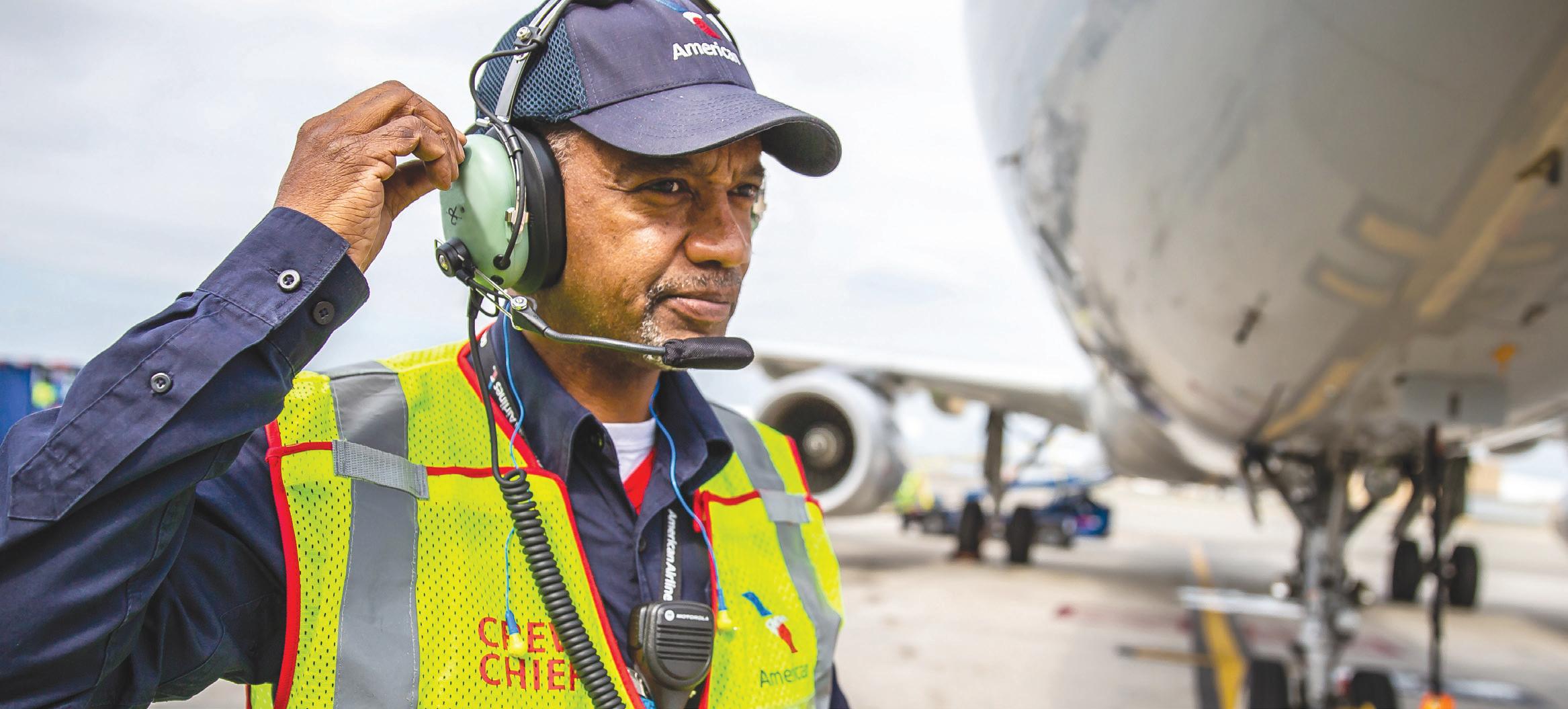
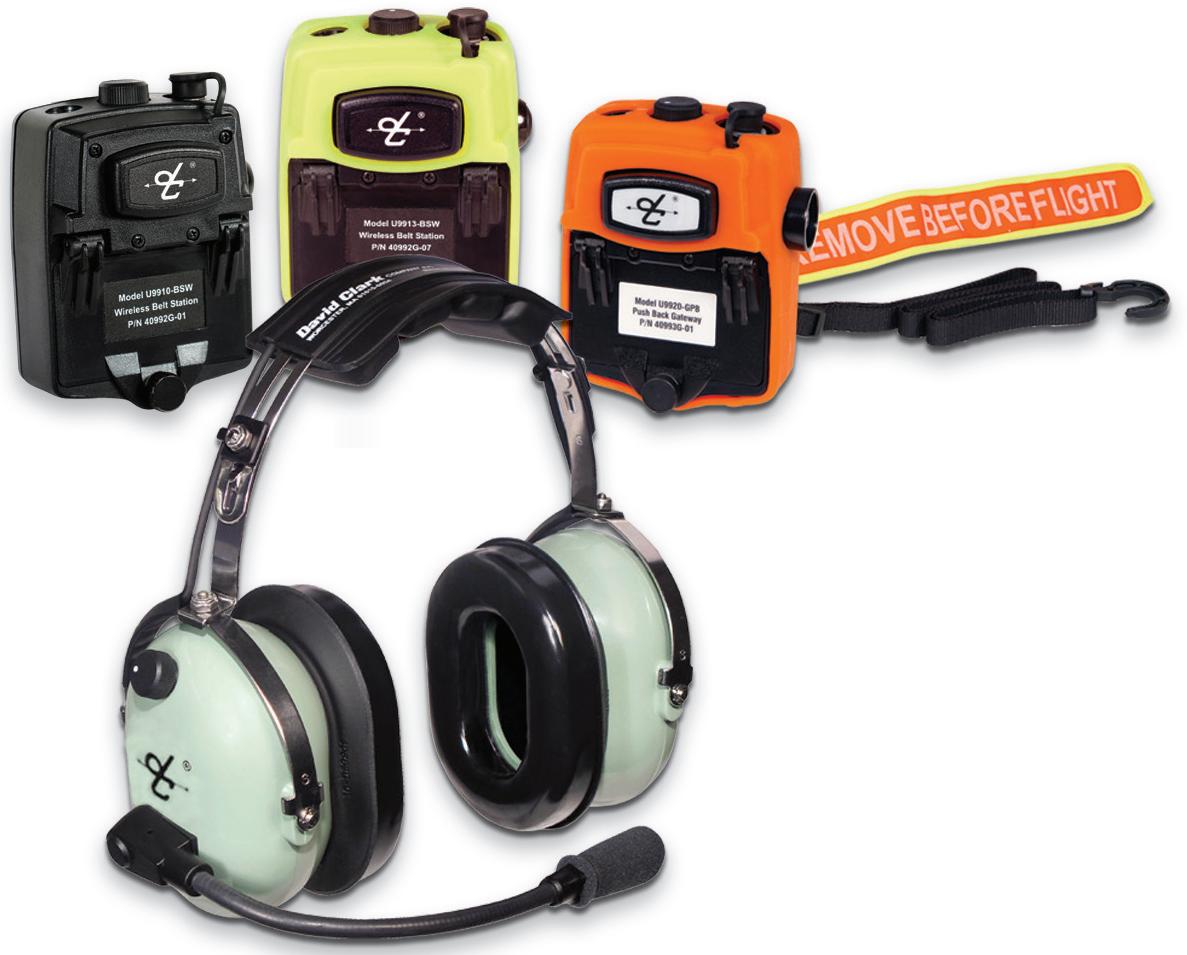
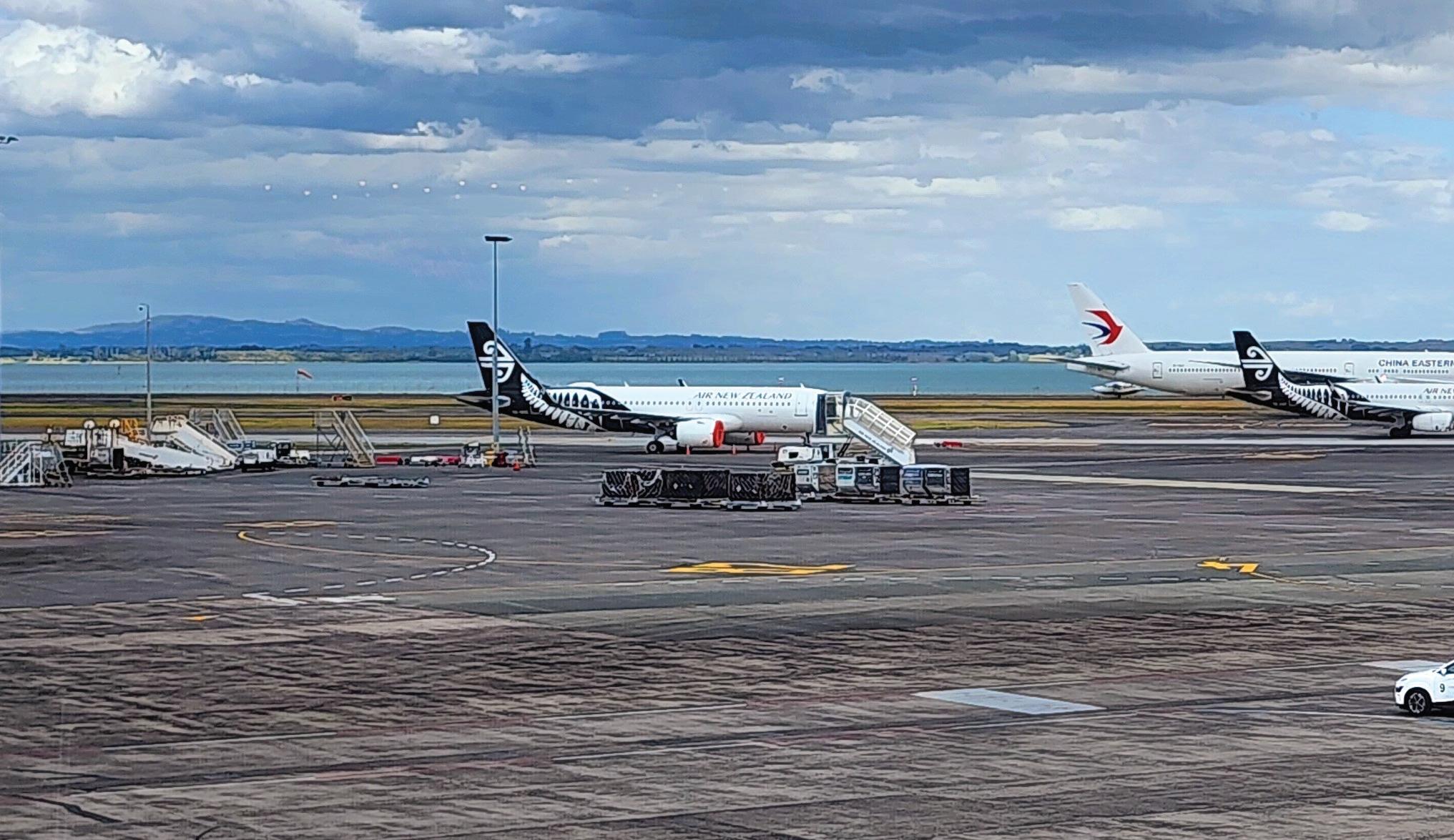
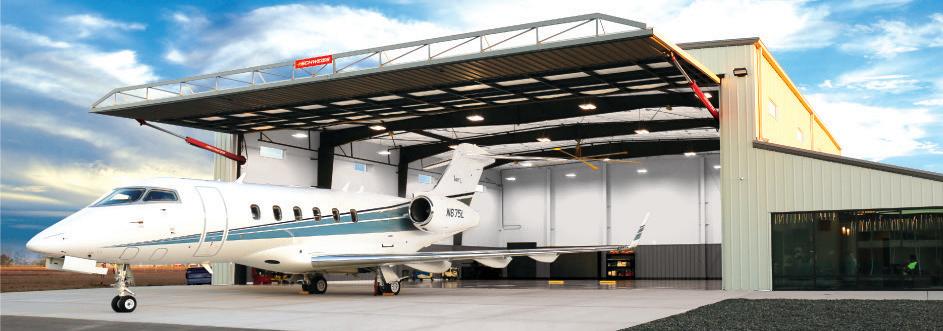
It might be a string of baggage carts, a food service vehicle, tug, or even another aircraft –in the wrong place at the wrong time. Our Wireless Headset Systems enhance ground crew communication, improve safety and heighten situational awareness to help avoid airside incidents. Because when you’re pushing around 20-million dollar aircraft, accidents just can’t happen. Call 800-298-6235 (508-751-5800 Outside the USA) for a system demonstration or visit www.davidclark.com for more information.
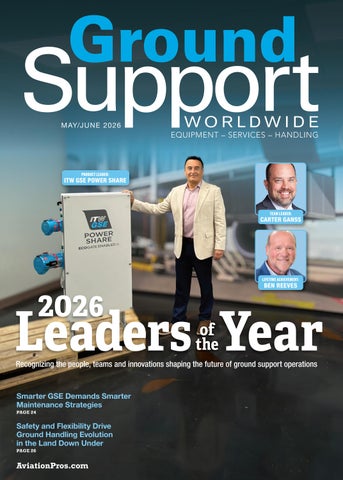
Southwest’s GSE leader is elevating performance by connecting people, technology and real-time fleet visibility across the network
ITW GSE’s new system helps airports expand eGSE charging without major infrastructure investment
Veteran Power Stow executive and IAEMA chair helped bring rollertrack technology to North America while building a reputation for honesty and frontline advocacy
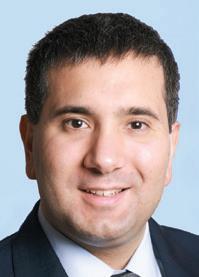
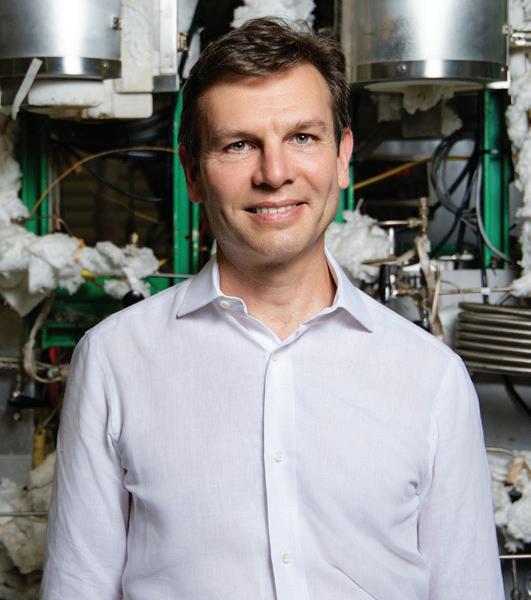
Swissport’s David Fernandez discusses how electrification, connectivity and predictive analytics are changing how GSE is
Recent
Alexei
Grounded In Reality
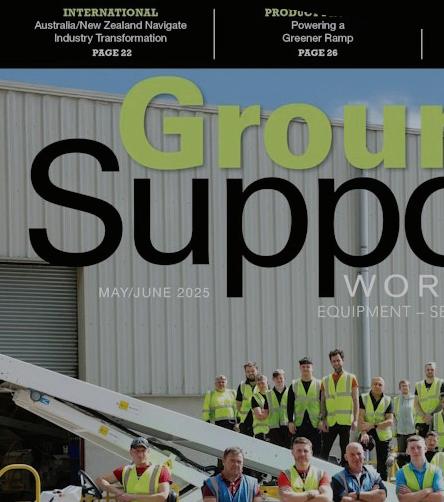
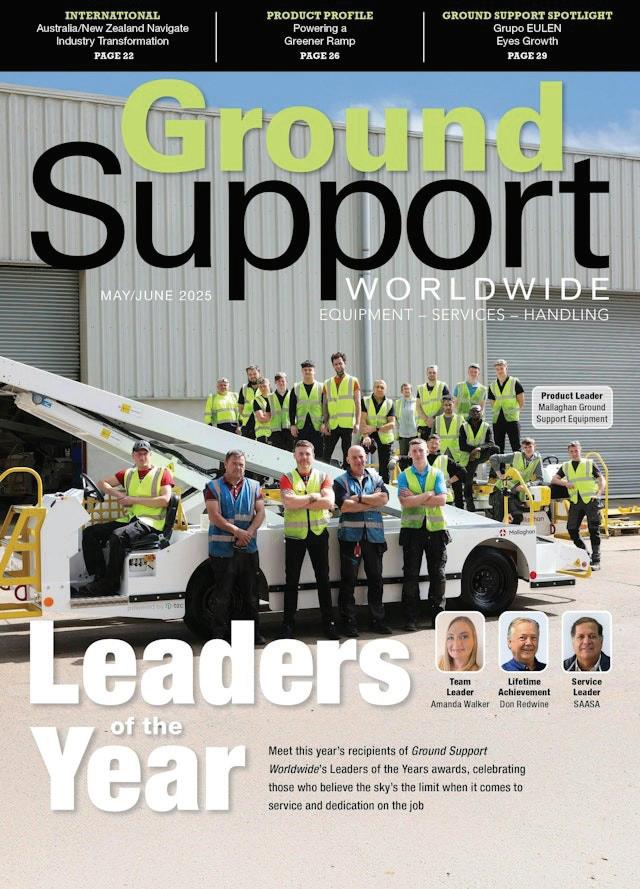
Seeing challenges clearly and responding with purpose connect this year’s Leaders of the Year
One of the privileges of putting together Ground Support Worldwide’s Leaders of the Year issue is the opportunity to spend time talking with people who have spent their careers solving problems, building teams and improving our industry.
Every year, certain comments from those conversations stick with me. This year, one thought in particular has been echoing in my mind long after the interviews ended.
During my conversation with Lifetime Achievement Award winner Ben Reeves, he talked about the importance of being honest, especially when it’s dif cult.
He wasn’t talking about grand ethical dilemmas. He was talking about the realities of business. Sometimes things go wrong. Sometimes your company makes a mistake. Sometimes customers have every right to be frustrated.
JENNY LESCOHIER Editor In Chief jlescohier@endeavorb2b.com
In those moments, Reeves believes the best approach is also the simplest: be straightforward. Own the mistake. Explain what happened. Explain how you’re going to x it.
The more I thought about it, the more I realized how rare that kind of honesty can be when stakes are high. Yet it is often the fastest path to credibility and trust.
I found myself returning to that idea while re ecting on this year’s other Leaders of the Year winners.
Team Leader of the Year Carter Ganss of Southwest Airlines spoke about the importance of clarity in leadership. People perform best when they understand the mission, know what’s expected of them and can see how their work contributes to a larger goal. In an industry as complex as ground operations, clarity builds con dence.
Like honesty, clarity is fundamentally about helping people see reality as it is.
The same principle surfaced again in a very different form with our Product Leader of the Year, ITW GSE’s Power Share system.
As airports electrify GSE eets, access to power has become a growing challenge. Rather than focusing on how to obtain more power, Power Share helps operators make better use of the capacity they already have. It’s a simple idea on the surface, but one that required challenging assumptions and seeing an opportunity others had overlooked.
What strikes me is that all three winners, despite their very different accomplishments, share a similar mindset: they focus on reality.
Reeves advocates confronting problems honestly rather than explaining them away. Ganss creates clarity so teams understand exactly what needs to be done. Power Share succeeds because its designers looked at an existing constraint and found a practical solution hiding in plain sight.
As our industry navigates workforce challenges, operational complexity, sustainability goals and economic uncertainty, there is value in leaders who see situations clearly, communicate honestly and focus on practical solutions. Those qualities might not generate the biggest headlines, but they are often the qualities that build trust, strengthen organizations and move our industry forward. They’re more than worth recognizing.
VP/MARKET LEADER – INFRASTRUCTURE & AVIATION GROUP
Michael Costantino 402-836-6266 michael.costantino@infogroup.com
Kevin Collopy 402-836-6265 kevin.collopy@infogroup.com
PRODUCTION & CIRCULATION
Art Director Jennifer Dakas
Production Manager Sheila Ward 603-891-9132 sward@endeavorb2b.com
Ad Services Manager Terry Gann tgann@endeavorb2b.com
Audience Development Manager Debbie Dumke 920-563-1776 ddumke@endeavorb2b.com
INTERNATIONAL GSE EXPO
International GSE Expo Event Director Sue Ralston 847-848-0943 sralston@endeavorb2b.com
ENDEAVOR AVIATION GROUP Penny Hazeltine Administrative Assistant
Chris Ferrell CEO Patrick Rains COO Jacquie Niemiec CDO Tracy Kane CALO Amanda Landsaw CMO
Kylie Hirko EVP Infrastructure & Public Sector Group
Michelle Kopier VP of Content Strategy, Infrastructure & Public Sector Group
SUBSCRIPTION CUSTOMER SERVICE 877-382-9187; 847-559-7598
CIRC.GROUNDSUPPORTWW@OMEDA.COM PO BOX 3257 NORTHBROOK, IL 60065-3257 Ground Support Worldwide (USPS 0015-386), (ISSN 1934-2861 print; ISSN 2150-4016 online) is published 6 times per year in January/February, March/April, May/June, July/August, September/October and November/December by Endeavor Business Media, LLC. 201 N Main St 5th Floor, Fort Atkinson, WI 53538. Periodicals postage paid at Fort Atkinson, WI 53538 and additional mailing offices. POSTMASTER: Send address changes to Ground Support Worldwide, PO Box 3257, Northbrook, IL 60065-3257. Canada Post PM40612608. Return undeliverable Canadian addresses to: Ground Support Worldwide PO Box 25542, London, ON N6C 6B2.
SUBSCRIPTIONS: Individual print and digital subscriptions are available without charge to qualified subscribers worldwide. Please visit www.aviationppros.com and click on “Subscribe”. Publisher reserves the right to reject non-qualified subscriptions. Subscription prices: U.S. $65.00 per year, $127.00 two years; Canada/Mexico $96.00 per year, $178.00 two years; All other countries $140 per year, $264.00 two years. Back issue $15 prepaid, if available. All subscriptions payable in U.S. funds. Canadian GST #842773848. Send subscription inquiries to Ground Support Worldwide, PO Box 3257, Northbrook, IL 60065-3257. Customer service can be reached toll-free at 877-382-9187 or at circ.groundsupportww@omeda.com for
Printed in the USA. Copyright 2026 Endeavor Business Media, LLC. All rights reserved. No part of this publication may be reproduced or transmitted in any form or by any means, electronic or
EcoGate
Stop upgrading infrastructure
Start connecting your equipment
Electrification shouldn’t mean costly infrastructure upgrades or operational compromise.
By sharing power, data, and technical synergies, EcoGate removes bottlenecks, accelerates electrification, and advances gate economics — at contact gates, remote stands, and beyond.
Learn more on itwgse.com/ecogate
TOP NEWS
IATA Urges Ground Handlers to Accelerate Standards Adoption, GSE Modernization and Digitalization
Ground handlers must intensify efforts to standardize operations, modernize equipment fleets and embrace digital technologies if the aviation industry is to keep pace with growing demand while maintaining safety and efficiency, according to Monika Mejstrikova, director of ground operations at the International Air Transport Association.
Speaking at the 38th IATA Ground Handling Conference (IGHC) in Cairo, Mejstrikova said the industry faces mounting pressure from increasing traffic volumes, infrastructure constraints, workforce challenges and geopolitical instability that is disrupting operations through airspace closures, diversions and fuel supply concerns.
If we get the fundamentals right, we build ground operations that are not only safer, but smarter, more efficient, more sustainable, and truly resilient.”
Monika Mejstrikova, director of ground operations, International Air Transport Association
“Ground handling has always been complex. But today, that complexity is growing and the margin for error is shrinking,” Mejstrikova said.
While highlighting the industry’s safety performance, she pointed to areas where improvement is still needed. In 2025, the industry recorded no fatal ground handling
accidents and one serious injury across nearly 40 million flights. However, more than 29,000 aircraft damage events and nearly 38,000 loading errors were also reported.
To address those challenges, IATA is focusing on three priorities: stronger implementation of global standards, modernization of ground support equipment (GSE) fleets and increased digitalization.
Mejstrikova said adoption of IATA operational standards and auditing programs continues to expand. Nearly 300 audits were conducted in 2025 under an updated ISAGO audit model that places greater focus on operational practices on the ramp, in warehouses and at gates. ISAGO now supports more than 230 ground handling service providers operating at 441 accredited stations across more than 250 airports.
She said modernization of GSE fleets is critical to reducing aircraft damage and improving operational performance. Since launching the Enhanced GSE Recognition Program in 2024, IATA has received 450+ applications and recognized 75 stations for reducing operational risk through technology.
Mejstrikova also emphasized the environmental benefits of transitioning from diesel-powered equipment to electric fleets. According to IATA, electric GSE can reduce turnaround-related emissions by 35% to 52%, depending on equipment types and electricity sources.
Digitalization formed the third major theme of her remarks,
UPCOMING EVENTS
June 24-26, 2026
Air Cargo China
Shanghai, China
Aug. 30-Sept. 1, 2026
Air Cargo Middle East Expo
Riyadh, Saudi Arabia
Sept. 15-17, 2026
GSE Expo Europe
Lisbon, Portugal
Sept. 29-Oct. 1, 2026
GSE&RAMP-OPS Global
Athens, Greece
Oct. 20-22, 2026
NBAA-BACE
Las Vegas, NV
Dec. 1-3, 2026
AAPA LATAM
Guatemala City, Guatemala
particularly in baggage operations and aircraft loading processes.
Mejstrikova cited passenger research showing that 81% of travelers want better baggage tracking and 88% expect real-time mobile updates. To meet those expectations, IATA recently launched the Baggage Community System (BCS), designed to connect airlines, airports and ground handlers through real-time baggage information sharing.
She also highlighted adoption of the X565 data standard for aircraft weight and balance information, which replaces manual processes with digital workflows. Airlines using digital load control and reconciliation systems have reported loading error reductions exceeding 90%, she said.
“Ground handling is often invisible to passengers. But when it goes wrong, everyone notices,” she said. “If we get the fundamentals right, we build ground operations that are not only safer, but smarter, more efficient, more sustainable, and truly resilient.”
Airlines Grapple With Fuel Spike as Ground Operations Feel the Pressure
Airlines around the world are adjusting operations, raising fares and trimming capacity as jet fuel prices remain elevated amid ongoing conflict involving Iran and concerns over disruption in the Strait of Hormuz, creating ripple effects that could increasingly affect ground handlers, airports and GSE providers.
According to the latest data from the International Air Transport Association, the global average jet fuel price stood at $162.55 per barrel last week, far above historical norms after surging from roughly $85-$90 per barrel earlier this year.
The impact is already visible across the airline industry. Reuters reported airlines across North America, Europe and Asia are implementing fuel surcharges, increasing baggage fees, reducing schedules and lowering profit outlooks.
Delta Air Lines and United Airlines have reduced planned capacity growth, while Air France-KLM downgraded its growth outlook and increased long-haul fares. Lufthansa said rising fuel costs could add a 1.7 billion euro hit to its 2026 fuel bill. Several Asian carriers, including AirAsia X and Thai AirAsia, have suspended or reduced flights entirely.
For ground handlers, the situation presents a mixed outlook.
Reduced schedules and higher fares could eventually suppress passenger demand and aircraft movements if fuel prices remain elevated through the summer and into 2027. Fewer flights can translate into reduced turns, lower fueling activity and less demand for ramp services, particularly among low-cost and regional carriers operating on thinner margins.
At the same time, higher fuel costs are increasing pressure on airlines to improve operational efficiency on the ground. With fuel representing up to a quarter of airline operating expenses, carriers are expected to place greater scrutiny on turnaround efficiency, idle-time reduction and equipment utilization.
Ground Handlers Post Strong Results Despite Growing Pressure on Airlines
Several of the world’s largest ground handling providers are reporting strong financial results even as airlines face mounting operational and economic pressure tied to rising fuel costs and instability in the Middle East.
Recently, Swissport, Menzies Aviation and dnata have all reported earnings growth, increased operational activity and continued investment in infrastructure, cargo operations and ground support equipment.
The results come as airlines globally contend with rising fuel costs linked to ongoing conflict involving Iran and broader instability across the Gulf region. Several carriers have warned of margin pressure as higher fuel costs force adjustments to fares, schedules and operating forecasts.
Against that backdrop, recent earnings reports from major handlers suggest continued strength in outsourced airport services and cargo operations.
At dnata, airport operations revenue, including ground and cargo handling, increased to AED 11.2 billion (US$3.1 billion) during the company’s 2025-26 financial year. Aircraft turns handled globally rose 12% to 888,793, while cargo volumes increased 2% to 3.2 million tonnes. The company also continued investment in electric and hybrid GSE, cargo infrastructure and automated handling systems.
Menzies Aviation recently reported record revenue exceeding $3 billion, up 16% year over year, alongside record EBITDA of $406 million.
Swissport also reported record revenue of €3.9 billion in 2025, with growth across ground handling, cargo and hospitality operations. The company said airport ground operations increased 4%, while air cargo revenue rose 10%.
Across the three companies, several common themes are emerging, including continued outsourcing demand from airlines, cargo market stability and long-term investment in operational infrastructure and technology.
For the ground support sector, the recent earnings cycle points to continued investment in airport operations, cargo infrastructure and GSE modernization even as the broader airline industry faces a more uncertain operating environment.
Menzies Reaches 25% Electric GSE Milestone Across Global Network
Menzies Aviation has reached its target of operating a ground support equipment fleet that is 25% electric following a $200 million investment in fleet modernization and lower-emission technologies.
The ground handler added more than 620 electric GSE assets in 2025, increasing the share of electric equipment across its global operations from 22% in 2024 to 25% by the end of the year. The company said 11 stations now operate fleets that are more than 70% electric.
Europe remains Menzies’ most advanced region for electrification, with more than half of all GSE now electric. At Milan Malpensa Airport (MXP), where Menzies operates
alongside AGS Handling, more than 80% of motorized GSE is electric, including electric pre-conditioned air units that support fully electric aircraft turns.
In the UK, Menzies deployed additional hybrid de-icing rigs in Manchester and introduced fully electric fuel hydrant dispensers at London Gatwick Airport (LGW) and
Copenhagen Airport (CPH).
Outside Europe, operations across Oceania and Southeast Asia reached 30% electric GSE penetration in 2025, while the company also began electric ground power unit trials in Cairns, Australia.
Where full electrification remains challenging, Menzies continues expanding the use of Hydrotreated Vegetable Oil (HVO) as a lower-emission alternative to diesel.
The company used two million liters of HVO during 2025, a 50% increase year over year.
“2025 was a year of real progress towards our net-zero target,” said Jonathan Hankin, head of ESG at Menzies Aviation.
MENZIES AVIATION
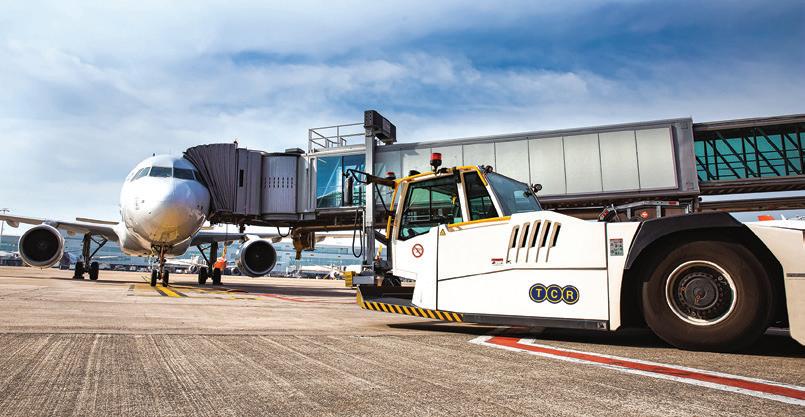
TCR, JetBlue Sign GSE Agreement Across Three U.S. Airports
TCR has announced a strategic ground support equipment agreement with JetBlue to provide GSE services across three major U.S. airports, with additional locations already identified for future expansion.
Under the partnership, TCR will support JetBlue operations with GSE maintenance and repair services, while select equipment will move
under TCR’s Full-Service Rental program at certain airports.
To support the agreement, TCR is expanding its North American footprint with an additional airside workshop at Boston Logan International Airport and new workshops at Fort Lauderdale-Hollywood International Airport and Orlando International Airport. Additional airports are expected to be implemented in the second half of 2026.
The partnership will support more than 500 daily turnarounds through GSE leasing and maintenance services designed to improve equipment availability, reliability and safety. TCR said the collaboration also will help JetBlue modernize and electrify its GSE fleet in the coming
years by providing fleet replacement flexibility and capital expenditure efficiency.
“We are proud to support JetBlue as a trusted GSE partner in North America,” said Stephanie Rajzbaum, managing director of TCR Americas. “This partnership reflects our shared commitment to operational excellence and underscores how TCR turns operational pressure into practical, flexible, and futureready solutions.”
For JetBlue’s ground operations, the agreement adds dedicated maintenance infrastructure at key stations while giving the airline more flexibility to manage fleet reliability, replacement cycles and future eGSE adoption.
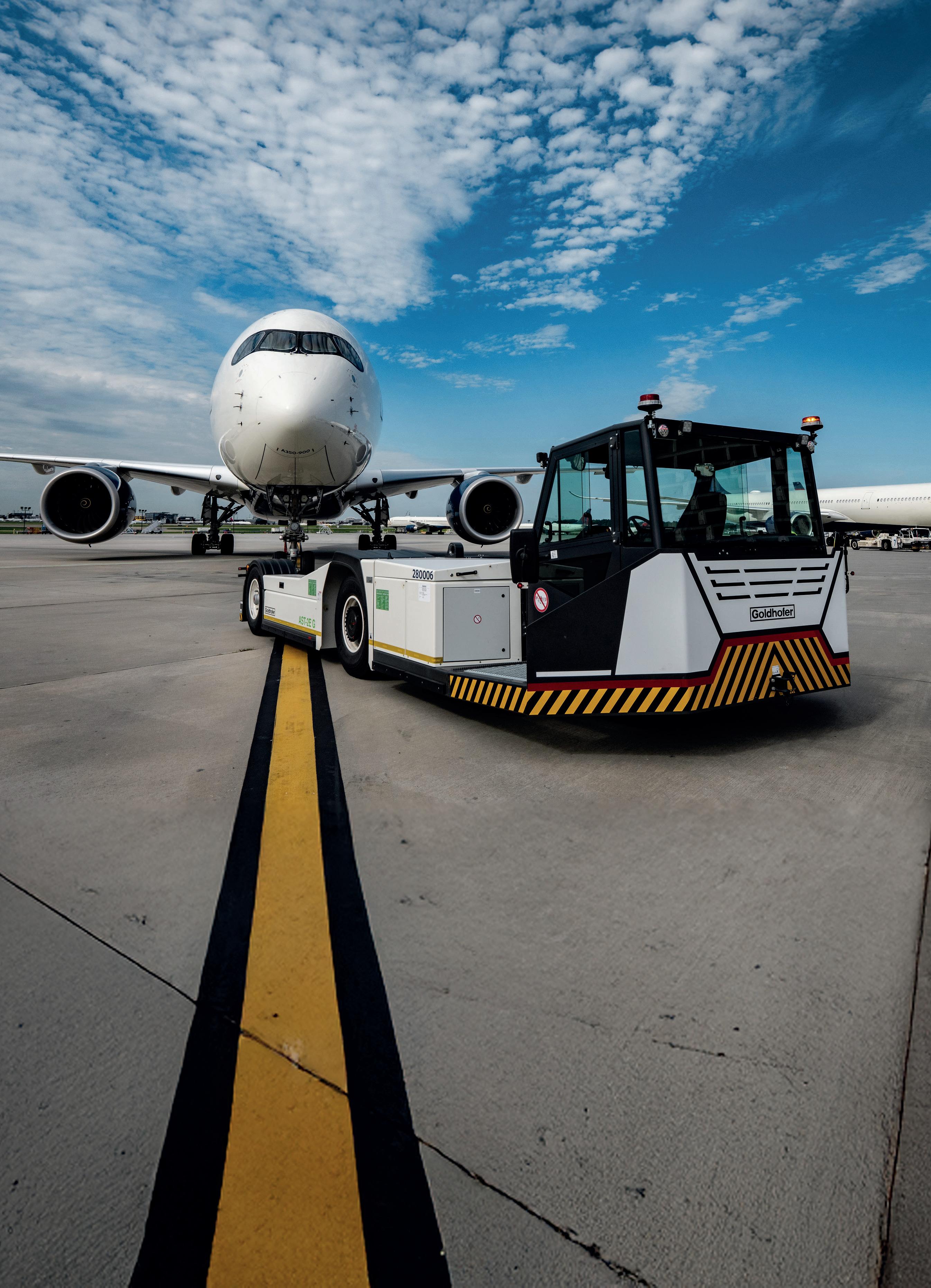
»ATLAS« 2 THE ONE WHO MAKES THE DIFFERENCE.
With the new Goldhofer »ATLAS« 2, every detail reflects a relentless focus on efficiency –from streamlined development to intelligent design. Engineered without compromise, the »ATLAS« 2 delivers powerful, energy-efficient performance for gate operations. By maximizing output while minimizing energy consumption, it sets new standards in sustainable and economical ground handling. For more information, please download the brochure on Goldhofer’s all-electric towbarless gate operation tractor here.
Invests in Cargo Facility at Western Sydney International Airport
dnata will invest A$32 million to establish a cargo terminal operation at Western Sydney International Airport.
The company will operate from a 5,000-square-meter warehouse within the airport’s 24-hour cargo precinct and install a semi-motorized materials handling system.
About A$6 million of the investment will support specialized equipment and technology, including handling capabilities for pharmaceuticals and other temperature-sensitive shipments.
Freighter operations are scheduled to begin in July 2026 ahead of
the airport’s full passenger opening later this year. At maturity, the facility will handle up to 60,000 tons of cargo annually.
The development is projected to create about 50 jobs initially, with additional impacts expected across freight forwarding, logistics and ground handling in Western Sydney.
Emirates Group Hires 9,700 Employees from 3.5 Million Applications
Emirates Group, which owns Emirates airline and dnata, received 3.5 million job applications during the 2025-26 financial year and hired nearly 9,700 new employees.
The Group launched a new technology platform, Masar, which helped hiring managers shortlist 390,000 candidates and onboard employees in the UAE, according to the company’s annual report.
The Group said its total workforce grew 8% to 130,919 employees as Emirates and dnata continued recruitment activities globally to support expanding operations.
Emirates airline added 5,515 new employees during the financial year ended March 31, 2026, increasing its workforce to 74,980. Earlier this year, Emirates said it expects to recruit nearly 20,000 operational employees over the next five years, including cabin crew, pilots, engineers, technicians and airport staff.
dnata, which provides ground handling, cargo, travel and flight catering services, also increased its workforce by 8% to 55,939 employees.
Emirates Group announced the hiring growth alongside record financial results, including a bonus equivalent to 20 weeks’ salary for employees.
“Our people are a big part of our success, enabling us to respond with agility in a dynamic operating environment,” said Sheikh Ahmed bin Saeed Al Maktoum.
The Group also noted that fuel and employee costs remained the airline’s two largest expense categories during 2025-26.
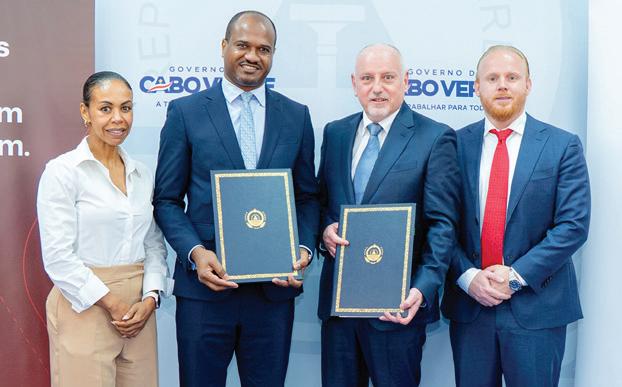
Swissport Acquires Majority Stake In CV Handling
Swissport has signed an agreement to acquire a majority stake in CV Handling, the main ground handling provider serving seven airports in Cabo Verde.
The acquisition marks Swissport’s entry into the Cabo Verde market and expands its presence in Africa, where the company already operates 30 stations in six countries, including Algeria, Morocco, Ghana, Kenya, Tanzania and South Africa.
Swissport was selected as the preferred bidder through a competitive privatization process led by the Cabo Verdean government. Through the investment, CV Handling is expected to gain access to Swissport’s global operating standards, digital tools and
international network.
The company said the move supports its broader growth strategy across ground handling, air cargo and aviation hospitality, including strategic acquisitions in high-growth aviation markets.
Air service plays an important role in Cabo Verde’s domestic connectivity, tourism industry and access to
international markets. Swissport said it plans to invest in infrastructure upgrades, operational improvements, digital tools and training facilities.
The company also plans to establish a Swissport Training Academy in Cabo Verde to support local workforce development.
“We are building a long-term strategic partnership with Cabo Verde’s aviation community, including airports, airlines, and the government,” said Warwick Brady, president and CEO of Swissport International. “We are determined to help develop a resilient, future-ready ground handling operator that supports the country’s economic growth, tourism and connectivity over the long term.”
Seamless
LINC NODE
Agnostic gateway brings the data from fixtures and sensors to
Team Leader
Carter Ganss Builds a Culture of Clarity, Capability and Care at Southwest Airlines
Southwest’s GSE leader is elevating performance by connecting people, technology and real-time fleet visibility across the network
BY JENNY LESCOHIER
For Carter Ganss, leadership tends to show up in the details.
It’s in how teams are structured and supported, how problems are understood and solved, and in the consistency of how people are treated, whether during routine operations or periods of disruption.
That steady, methodical approach has de ned Ganss’ rise through Southwest Airlines and now shapes a sweeping transformation of the airline’s ground support equipment (GSE) organization. Named Ground Support Worldwide’s Team Leader of the Year, Ganss is widely credited by colleagues and industry partners for building a high-performing, future-focused GSE function while maintaining a deeply human, team- rst leadership style.
Those who nominated him – and there were several – point to a rare
TEAM LEADER OF THE YEAR
This award celebrates managers and frontline leaders who build high-performing teams, foster strong safety cultures, champion just culture principles, and create meaningful improvements in training, accountability, and workforce engagement.
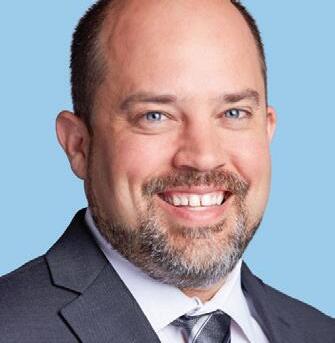
Carter Ganss, Managing Director of GSE, Southwest Airlines
balance. As Rob Lamb, Vice President, Vehicle & After-Market Sales at Charlatte America noted, “Carter overcomes leadership challenges by building world-class management teams and equipping them with the support they need to succeed. The teams he’s built…are some of the best in the business.”
A career shaped by aviation and determination
Ganss’ path into aviation was anything but accidental. He grew up in a household shaped by the industry. His father was a pilot and his mother a ight attendant for Braniff International, a
now-defunct airline known for its bold branding and colorful aircraft.
“I grew up in a commercial airline family,” Ganss said. “That’s really where the passion started.”
That early exposure left a lasting impression, even as his parents encouraged him to pursue a more stable career after Braniff’s collapse. He followed practical advice at rst, earning a nance degree and beginning his career in nancial services. But aviation remained the goal.
“I was the second-born rebel son,” he said. “I thought, ‘I’ll show you.’”
He joined Southwest Airlines in the early 2000s and built a career across nance, network planning and strategic roles before making a deliberate shift into operations.
“What I really wanted to learn was the execution side – how those plans actually get delivered,” he said.
Turning crisis into transformation
Ganss’ leadership of the GSE organization came into sharper focus following Winter Storm Elliott, a disruptive event in 2022 that exposed gaps in visibility and coordination across the airline’s ground operations.
The experience became a turning point. It revealed a lack of real-time
CARTER GANSS/SOUTHWEST AIRLINES
insight into fleet status and performance, limitations that hindered decision-making during a system-wide disruption.
“We had blind spots,” Ganss said. “We didn’t have an objective, data-driven way to understand what was happening with the fleet.”
What followed was a comprehensive transformation strategy focused on real-time visibility, data integration and operational accountability. But just as important as the systems being built was the organizational structure behind them.
Joe Griffith, Chief Commercial Officer at Mallaghan GSE, one of the industry leaders who nominated Ganss, described the impact in stark terms: “Within one year, Carter not only revolutionized the Southwest GSE function but also set it on a path as a leader in delivering exceptional efficiency, innovation and reliability.”
The transformation has included expanded telemetry, new analytics platforms, increased technician staffing and the creation of dedicated planning, engineering and fleet strategy functions. The goal is not only to understand when equipment fails, but why – and to fix those root causes.
“If something is out of service for three days, we need to know what caused every part of that delay,” Ganss said.
Building a team to match the vision
Central to that effort has been a dramatic expansion of the GSE planning organization, growing from a handful of people into a multi-disciplinary team spanning engineering, fleet management, analytics and project execution.
“The team is why we are succeeding,” Ganss said. “Everything revolves around how we support the people in the field and make them more effective.”
That team-first approach is something Southwest colleagues consistently highlighted in nominations.
Madison Dern, Manager of Ground Equipment Projects and Analytics (GSE) at Southwest, described Ganss as “a defining force” in the organization.
“Carter has strengthened partnerships across Southwest and advanced new tools, insights and processes that streamline how work gets done,” she said. “He leads not by authority, but by example, creating a safety-focused, empowered and collaborative culture.”
The results are both structural and cultural. Under Ganss’ leadership, GSE has gained increased visibility at the executive level, leading to significant investments in staffing, infrastructure and long-term capability building.
Innovation grounded in the ramp
While strategy and structure are central to the transformation, Ganss’ work is equally defined by practical innovation.
A key example is the development of a seatbelt compliance system that uses telemetry and engineering controls to enforce safe operating behavior, an initiative that directly addresses a persistent risk on the ramp.
As Lamb noted in his nomination, “This initiative reflects his strong understanding of new technologies and his ability to pair this with practical improvements to the ramp.”
The same philosophy extends across the GSE operation: use data to identify problems, apply technology where it makes sense, and always tie improvements back to real-world outcomes for operators and technicians.
Leadership through clarity and care
Ask Ganss to describe his leadership philosophy, and he returns to a single word: clarity.
“It starts with clarity of mission,” he said.
From there, the approach is structured but human. Define roles. Align teams. Identify obstacles.
Ganss is known as someone who has a passion for execution, when plans are put in motion.
A team-first approach is central to Ganss’ style of leadership, a point made clear by those who nominated him for Team Leader of the Year.
Remove them. And throughout it all, invest in people.
“You can have very high standards and also care for people,” he said, reflecting a philosophy influenced in part by former Southwest President Colleen Barrett.
That balance – accountability paired with empathy – has been a defining trait of Southwest’s culture since the days of Herb Kelleher, co-founder and long-time CEO of Southwest Airlines, and it continues to shape how Ganss leads today.
Dern emphasized that point in her nomination, noting that Ganss “naturally earns buy-in through authenticity and transparency” and consistently creates an environment of trust and respect, even during periods of significant change.
Advice for the next generation For emerging leaders, Ganss offers a message grounded in his own experience: start with people.
“Understand who they are, what their roles are, what success looks like for them, and what’s getting in their way,” he said.
From there, expand outward – aligning with customers, leadership and organizational priorities – but always anchored in the needs of the team.
It is a philosophy that mirrors the way he has approached his own career: learn broadly, stay curious and focus on enabling others to succeed.
A leader defined by his team
Two years into the GSE transformation, Ganss sees progress, but
also more work ahead. His focus remains on completing the foundation his team has built and positioning the organization for long-term success.
“For the foreseeable future, I want to continue to provide leadership and support within GSE,” he said.
When it comes to recognition, however, he is quick to shift the spotlight.
“I feel like I’m being given an award for what my team is doing,” he said. “The team does all the work.”
Those who nominated Ganss say that mindset is precisely what makes him an effective leader: one who creates clarity, builds trust and gives people the tools and confidence to perform at their highest level.
Your Total Airport Equipment Solutions Provider
Since 1983, Fortbrand has been supplying ground support equipment (GSE) and airport maintenance equipment (AME) to passenger airlines, ground handlers, airports, air cargo carriers, and fixed-base operators. We pride ourselves on bringing you practical, turnkey solutions—customized to your needs.
Whether you’re looking to buy, rent, lease, repair, and/or maintain equipment, we complement our offering with attractive financing options, not to mention a technical support agenda, convenient trade-in-program, and full appraisal services. Even better, when partnering with Fortbrand, you can also access equipment offered through Sourcewell and other cooperative programs.
Power Share Is Built for the Electric Ramp
ITW GSE’s new system helps airports expand eGSE charging without major infrastructure investment
BY JENNY LESCOHIER
As airports accelerate the transition to electric ground support equipment, one of the industry’s biggest obstacles has become increasingly clear: charging infrastructure. Building new electrical capacity across an airport ramp is expensive, disruptive and often constrained by aging utility systems. For ITW GSE, that challenge became the starting point for developing Power Share, Ground Support Worldwide’s 2026 Product Leader of the Year.
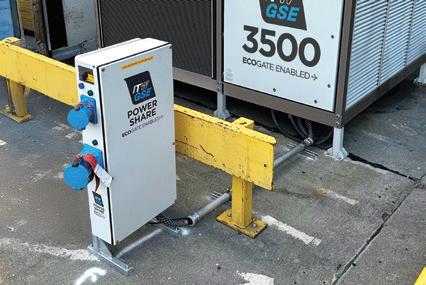
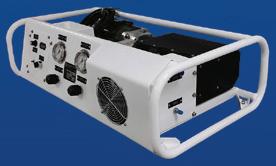
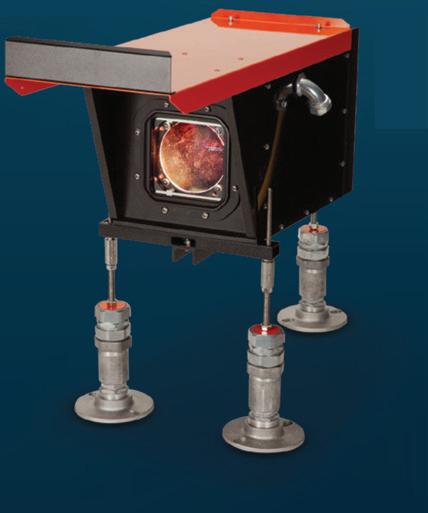
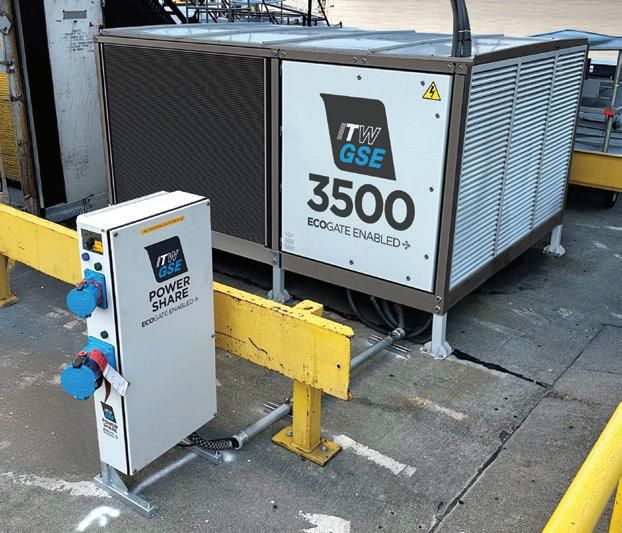
Rather than asking airports and airlines to overhaul their infrastructure, ITW GSE developed a system that extracts unused electrical capacity from existing gate equipment and redistributes it to charge eGSE. The result is a compact add-on device that allows operators to create new charging points without constructing entirely new power systems.
According to Alberto Rocha, Director of Sales at ITW GSE, the concept emerged directly from customer conversations and a broader companywide innovation strategy centered on solving real operational pain points.
“We are spending a lot of time listening to customers about their day-to-day challenges,” Rocha said. “We’re learning a lot. This box came about because they were very challenged with the new trend of eGSE and not having the ability to charge.”
In response, ITW GSE wanted to
rethink how airports use electrical capacity already installed at gates and ramp positions.
Solving the infrastructure problem
The rapid growth of electric GSE has created a dif cult reality for airports. While airlines and handlers are increasingly adopting battery-powered tugs, belt loaders and other ramp equipment, the infrastructure required to support widespread charging has lagged behind.
Adding traditional charging stations often requires major construction projects involving new electrical feeds, upgraded substations and extensive permitting. At some airports, Rocha said, available power capacity is already stretched thin.
“We’re talking primarily about running a brand-new electrical feed to then have a charger,” he explained.
PRODUCT LEADER OF THE YEAR
The Product Leader of the Year highlights signi cant achievements in the GSE space. Ground Support Worldwide looks for experts who produce equipment designed to improve the turnaround process, make ground handling tasks more ef cient and enhance the passenger experience with innovative engineering and creative solutions.
“At most airports, that power is not available. It could be as intense and challenging as having to build a new power station to feed the airport.”
Power Share approaches the problem differently.
The system connects directly to existing ITW GSE ground power units (GPUs) and preconditioned air units (PCAs), which already supply aircraft at gates. Those systems are designed for peak demand conditions, but in day-to-day operations they often use only a fraction of their available electrical capacity.
Power Share captures that unused capacity and redirects it to charging outlets for electric GSE.
“The products that provide power and air are not consuming maximum capacity all the time,” Rocha said.
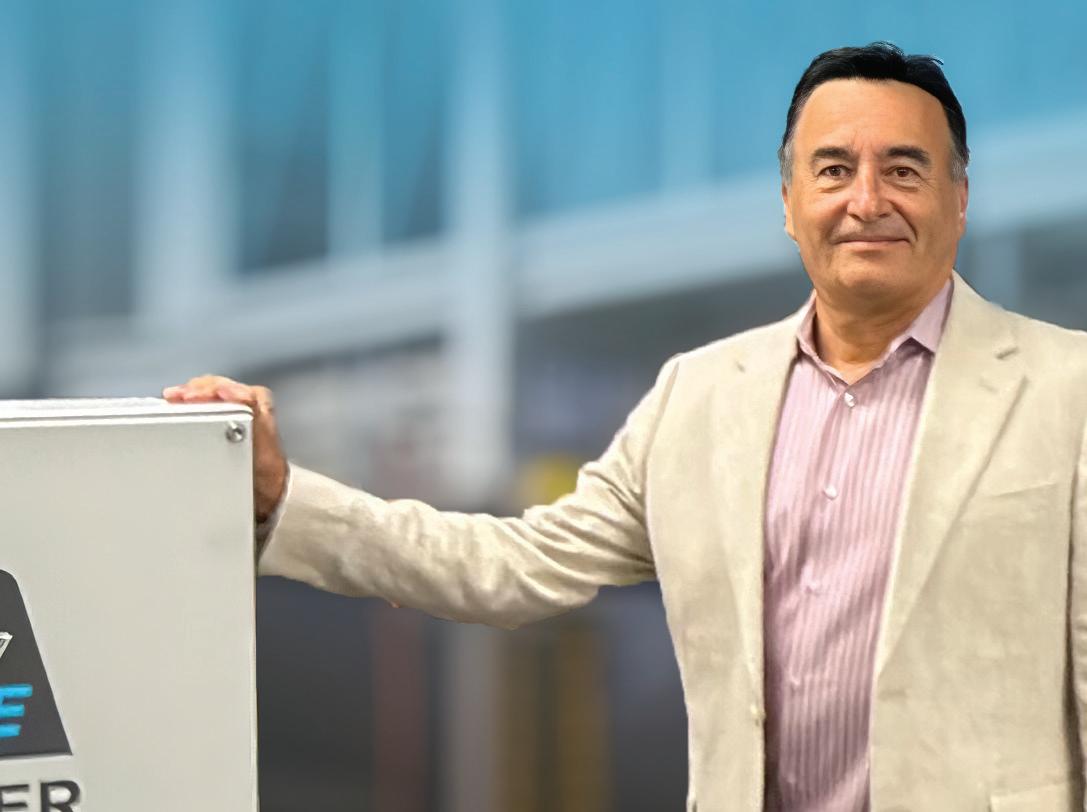
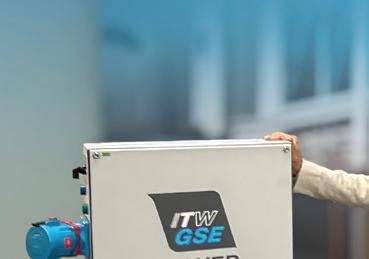
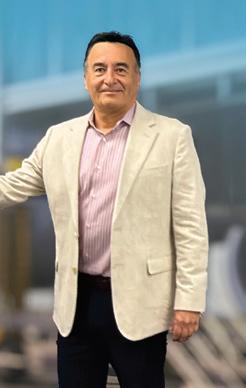
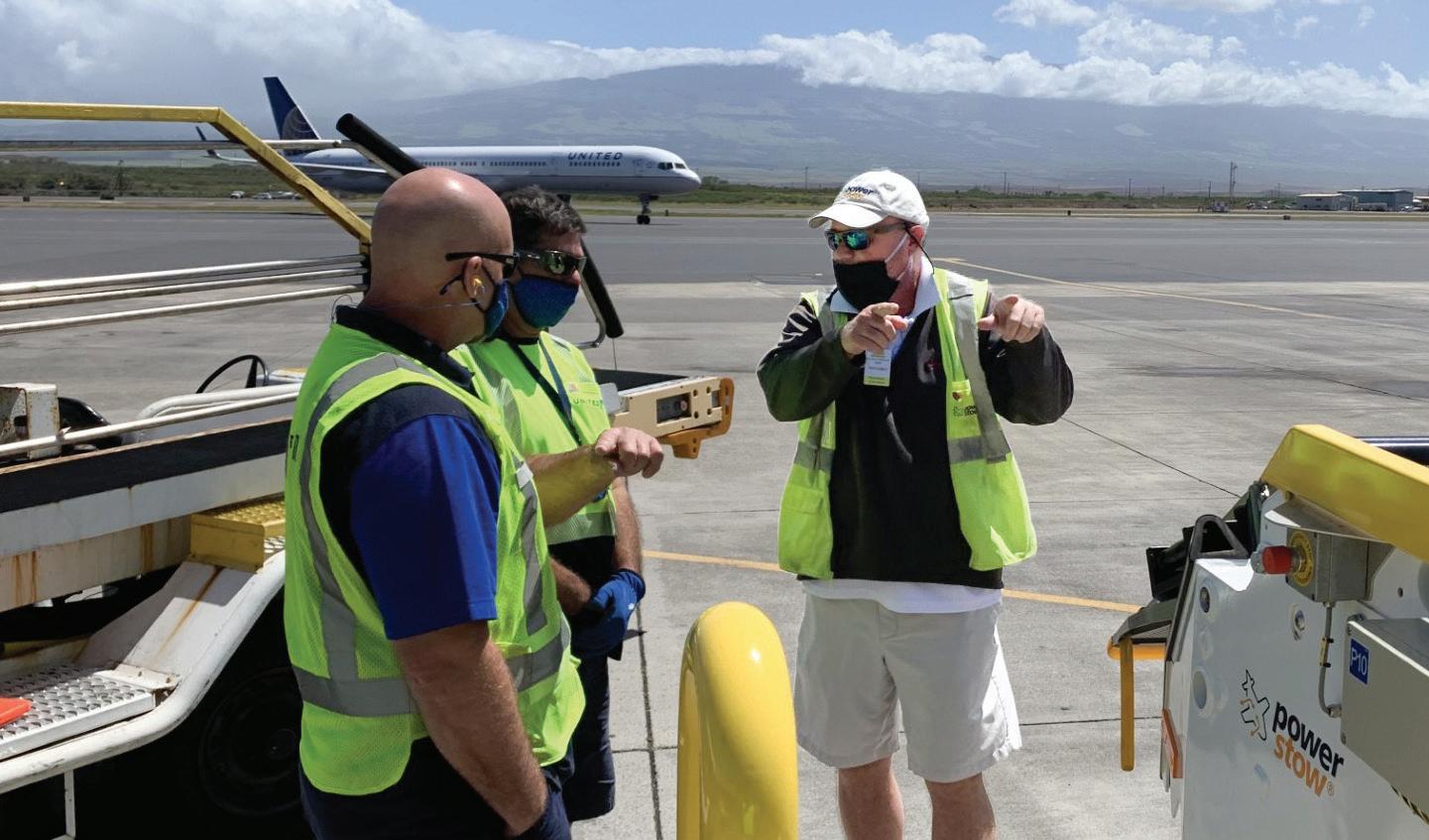
Alberto Rocha, Director of Sales at ITW GSE, with the Power Share device that reduces the need for new infrastructure.
“The reality is that when this machine is connected to the aircraft, it may be using 50 percent of its power, or sometimes even less. At that point, the preconditioned air unit or the ground power unit tells this little box, ‘I have all this power available. You can feed somebody else if they need it.’”
That intelligence is central to the system’s operation. Rather than adding entirely new infrastructure, Power Share leverages equipment airports already own and already trust.
Built around existing equipment
One of the defining characteristics of Power Share is its integration with ITW GSE’s existing product ecosystem.
When connected to an ITW GSE GPU or PCA, the Power Share unit communicates directly with the equipment to determine how much excess power is available at any given moment. The larger unit effectively manages the energy allocation, allowing the smaller charging box to distribute available electricity without compromising aircraft servicing operations.
“The main objective is that if you already have an ITW GSE appliance, this box basically mates to it seamlessly,” Rocha said. “There’s a lot of intelligence not necessarily in the box itself, but in the other piece of equipment that is telling this little box, ‘Right now I’m not really working hard, so you can borrow this
electricity to charge other products.’”
Rocha compared the concept to a high-performance vehicle that rarely uses its full horsepower capability.
“The design engineer said you’re going to need all this power for that unit, but the reality is you’re often only using 30 to 50 percent of it,” he said. “We’re saying the horsepower you don’t need right now can be used for something else.”
This offers significant advantages to airports trying to scale eGSE adoption without waiting for infrastructure projects to be completed.
Early deployments gain momentum
ITW GSE officially introduced Power Share in 2025, and the company has
already moved from pilot deployments into larger-scale implementations.
According to Rocha, Denver International Airport currently represents the company’s largest installation.
The number of units required varies widely depending on an airport’s operational needs and layout. Some facilities may require only a single charging location, while others may deploy dozens across multiple gates and remote positions.
“The customer needs to determine how many charging points they really need and where they need them,” Rocha explained. “It could be as many as 20, but it could be as simple as maybe just one.”
Customer feedback has been strong, particularly from operators already pursuing broader electrification strategies.
“Customers that have it honestly want more because they’re seeing the benefits,” Rocha said. “United now is looking at not just a single airport, but all their hubs, because it really solves a lot of the problems they have with charging points for their eGSE.”
First-mover advantage
Rocha believes Power Share currently occupies a unique position within the competitive landscape.
“At this point in time, I think we’re first movers,” he said. “We don’t see anybody that has a product like it.”
While other charging solutions exist in the broader eGSE market, Power Share differentiates itself through its integration with existing gate infrastructure and its ability to utilize otherwise unused electrical capacity.
For airports facing pressure to reduce emissions while controlling capital expenditures, that distinction may prove increasingly valuable.
The product also reflects a broader shift in how suppliers are approaching ramp electrification. Rather than treating charging as a standalone
Power
Share is unique in its ability to utilize otherwise unused electrical capacity.
system, manufacturers are increasingly exploring ways to integrate charging capability into existing airport operations and equipment networks.
Expanding the product ecosystem
ITW GSE sees Power Share as part of a growing connected product family rather than a standalone device.
One of the company’s next priorities is integrating the system with its newer DC charger products, including a charger currently being evaluated by Delta Air Lines in Atlanta.
“This year will really be the year we try to make a splash with our DC charger,” Rocha said. “Right now, we are finalizing the software/intelligence of the DC charger to work in conjunction with the Power Share and the rest of our products.”
As compatibility expands, ITW GSE envisions a broader network of interconnected ramp power solutions capable of dynamically managing electrical resources across multiple operational needs.
Beyond charging eGSE
Although Power Share was designed primarily to support eGSE charging, customers are already using the system in other ways.
The box can be configured with multiple outlet types, including standard 110- or 120-volt outlets
requested by customers for smaller operational needs.
“They’re using those outlets for charging iPads, phones, tools, lamps and lights at night,” Rocha said. “But because we also have 480-volt threephase power, you can literally connect welding equipment and other things that may not even be related to GSE.”
That flexibility highlights the broader operational value of distributed ramp power access. In many ramp environments, simply having reliable electrical access at the point of operation can eliminate inefficiencies and reduce reliance on temporary generators or extension setups.
Customer-driven innovation
For Rocha, Power Share ultimately represents more than a single successful product launch. It also reflects a larger cultural shift within ITW’s approach to innovation.
The company’s “customer-back innovation” strategy intentionally reverses the traditional product development process by focusing first on operational pain points rather than engineering concepts developed internally.
“Years ago, we would come up with ideas on our own and think, ‘Oh, it would be cool to have this,’” Rocha said. “But we didn’t always know if the customer truly needed it.”
Power Share changed that process by starting with a problem airport operators were already struggling to solve.
As the aviation industry continues pushing toward greater electrification, products that maximize existing infrastructure may become increasingly important. For airports balancing sustainability targets, operational efficiency and infrastructure limitations, ITW GSE’s Power Share is demonstrating that sometimes the fastest path forward is making smarter use of the power already available.
ITW GSE
Ben Reeves Recognized for a Career Defined by Integrity, Mentorship and Industry Impact
Veteran Power Stow executive and IAEMA chair helped bring rollertrack technology to North America while building a reputation for honesty, mentorship and frontline advocacy
BY JENNY LESCOHIER
For more than three decades, Ben Reeves has been a familiar and respected figure in the ground support equipment industry. His career has stretched from the sales floor of TUG Manufacturing to helping introduce new cargo-loading technology to North America, all while also serving as a steady advocate for honesty, customer service and long-term relationships across the aviation community.
Now serving as Executive Vice President of Power Stow Americas and Chair of the International Airport Equipment Manufacturers Association (IAEMA), Reeves is the recipient of Ground Support Worldwide’s 2026 Lifetime Achievement Award. The honor reflects not only his professional accomplishments, but also the reputation he built over decades in an industry he describes as closeknit, demanding and deeply relationship driven.
Interestingly, Reeves’ path into aviation was not carefully mapped out. Unlike many long-time industry veterans, he did not grow up dreaming about airplanes or airports.
“I didn’t know what GSE was,” Reeves admitted while reflecting on the beginning of his career. “I was glad to have a job.”
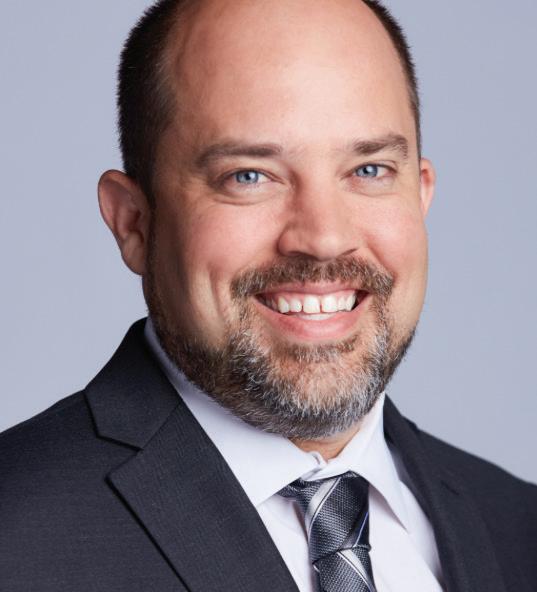
Ben
Reeves, Executive Vice President of Power Stow Americas and Chair of the International Airport Equipment Manufacturers Association (IAEMA)
Learning the industry from the ground up
That opportunity came in 1993, when Reeves joined TUG Manufacturing as a sales representative. Initially focused on smaller U.S. airlines, he steadily moved into larger accounts before eventually taking on international responsibilities and, later, worldwide sales leadership.
Reeves even got his hands dirty on some GSE early in his career, noted Ken Brown, President and EVP of Sales at Power Stow.
“When starting his sales career at TUG, Ben actually participated in the building of a belt loader,” Brown said, “which helped give him insight and perspective as well as credibility with his future customers.”
The industry itself ultimately became part of the appeal.
“I realized pretty quickly this was an industry I wanted to stay in, there have been so many good people,” Reeves recalled. “Even my competitors and other salesmen in the industry are great people who’ve become lifelong friends.”
Building trust through transparency
Those relationships became foundational to Reeves’ philosophy and leadership style. He learned early that aviation ground support is both highly interconnected and heavily dependent on trust.
“This is a fairly small industry, and there are no secrets,” Reeves said. “Your personal reputation is very important.”
That perspective shaped the way he approached customers, colleagues and challenges throughout his career. Reeves repeatedly emphasized the importance of transparency,
BEN REEVES
particularly when dealing with difficult situations.
“You’ve just got to be totally honest with people and treat them fairly and with respect,” he said. “If you treat someone poorly in this industry, everybody knows about it before the sun goes down.”
That reputation extends well beyond his own company. Brown described Reeves as “well known at any GSE event worldwide,” and credited him with helping connect people across the industry.
“Ben is well known for his calm, approachable demeanor,” Brown said. “He’s also been a fantastic leader, coach and mentor to many over the years.”
Reeves recalled learning some of those lessons during difficult periods involving production delays and delivery issues earlier in his career. Rather than avoiding uncomfortable conversations, he found that direct communication strengthened longterm credibility.
“I learned to be very upfront with people, and that’s helped me retain credibility with customers,” he said. “I learned to under promise and over deliver.”
That same approach extended to quality concerns and product support. Reeves emphasized that aviation equipment manufacturing depends on responsiveness and accountability.
“We supply machines that are assembled by humans, and humans make mistakes,” he said. “When necessary, we’ve been able to turn a negative situation into a positive experience for the customer, just by responding quickly and being upfront and honest.”
Bringing rollertrack technology to North America
While Reeves built a strong reputation during his years at TUG, one of
LIFETIME ACHIEVEMENT
Ground Support Worldwide’s Lifetime Achievement award honors dedicated proponents of the ground support industry. Aimed at individuals in the ground handling sector or GSE manufacturing market, this award goes to those who have devoted their lives to improving how aircraft are serviced on the ramp.
the defining chapters of his career came after he briefly stepped away from aviation entirely. Following several years outside the industry, he reconnected with Power Stow founder Martin Vestergaard, who had previously discussed bringing the company’s rollertrack conveyor technology to the North American market.
alongside Arly Wurtzen in 2014, helping grow both the company’s footprint and the visibility of rollertrack technology throughout the region.
Reeves helped introduce airlines and ramp operations teams to the system designed to reduce the physical strain associated with loading luggage deep into aircraft cargo compartments.
Without such a conveyor system, Reeves explained, ramp personnel often kneel near the aircraft cargo door and manually throw heavy bags long distances inside the compartment.
“With the advent of baggage fees, that family of four traveling to Disney World is not taking four suitcases anymore,” Reeves said. “They pack it all into two, so the suitcases have gotten heavier.”
Despite being unsure at the time whether the concept would gain traction in the United States, he expressed a passion for it.
“When I first went to work for Power Stow, I said, ‘Martin, I think I can bring this product to the customers,’” Reeves recalled.
Brown credited Reeves with spearheading Power Stow’s expansion into the North American market
Combined with an aging ramp workforce, the physical demands created growing ergonomic and injury concerns.
For Reeves, one of the most satisfying aspects of the product’s success has been the response from frontline workers themselves.
“The ramp employees became our biggest advocates because it makes their lives easier,” he said.
BEN REEVES
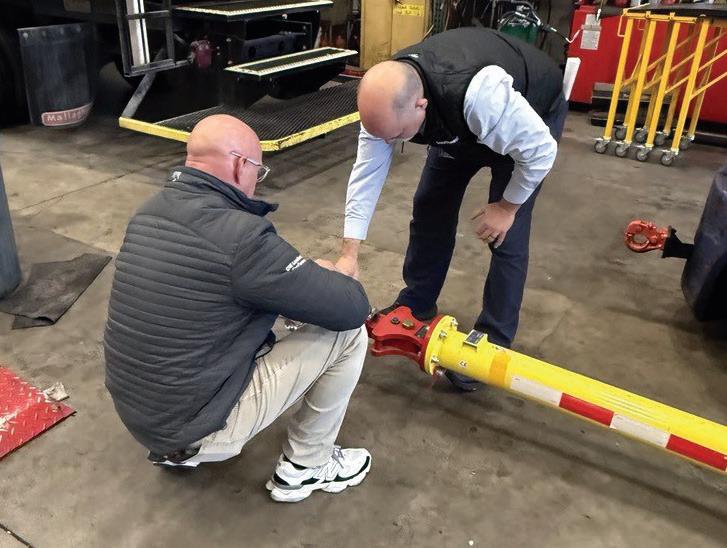
Reeves helped bring rollertrack technology to North America, greatly improving working conditions for frontline personnel.
Lifetime Achievement
Justin Brennan, Vice President of Sales at Power Stow, said, “Ben has a passion for the frontline airline worker. He knew the Power Stow Rollertrack would make the lives of the ramp agent safer and bring longevity to their career.”
Brennan added that Reeves persisted even when the technology initially faced resistance in North America.
them are his late father-in-law, Don Chapman, longtime colleague Julie Hendricks, the Vestergaard family, and several former leaders and coworkers from TUG.
“John Keating was a mentor of mine - a boss and a friend - and our current CEO, Henrietta Olson, has also been a major influence,” Reeves said.
Always be honest, even when it’s painful, and protect your personal reputation.”
Ben Reeves, Executive Vice President of Power Stow Americas and Chair of the International Airport Equipment Manufacturers Association (IAEMA)
“Ben was able to bring to market a product that has vastly improved the personal lives of our frontline aviation employees,” he said.
Under Reeves’ leadership, Power Stow Americas expanded significantly. What began as a one-person operation eventually grew into a 50,000-square-foot facility with approximately 40 employees.
Along the way, Reeves became known not only for sales leadership, but also for helping foster a strong culture around customer support and teamwork.
“The salesperson gets the first order, but you don’t get the second order without good production and after sales folks behind you,” Reeves said. “If you don’t have that team behind you, you’re not going to be successful long term.”
A legacy of mentorship and leadership
That appreciation for teamwork is reflected in the people Reeves credits throughout his career. He pointed to his wife, Amy, their children, Kirstie, Amanda and Wood, as well as mentors and colleagues who’ve helped shape his professional journey. Among
Even as Reeves approaches a gradual form of retirement, he remains focused on ensuring continuity for the next generation of leadership. He’s transitioning into an advisory board role at Power Stow Americas while helping train Brown as his successor.
He also expressed pride in the experienced sales and leadership team that remains in place, including Brown, Brennan and Hendricks, as well as Mike Magnotti and Russ Yeager.
“Between them, they have 130 years of experience in the industry,” Reeves said. “It’s quite a good team. I’m proud of that, and I feel really good about stepping back and letting those guys run with it.”
For younger professionals entering the aviation ground support industry, Reeves’ advice remains consistent with the principles that guided his own career. He encourages newcomers to seek out organizations that prioritize customers, build quality products and stand behind their equipment after the sale.
Most importantly, he believes integrity remains non-negotiable.
“Always be honest, even when it’s
painful, and protect your personal reputation,” Reeves said.
Beyond the products and sales milestones, colleagues repeatedly pointed to Reeves’ mentorship as one of his most enduring contributions to the industry.
“Ben’s lasting impact has been through mentorship and leadership of some of the best and most well-known GSE industry veterans,” Brennan said. “I have personally benefited from Ben’s willingness to mentor, lead and develop people to better serve the greater industry.”
That legacy of mentorship, combined with Reeves’ long-standing advocacy for customers and frontline workers, helped shape a career that has touched nearly every corner of the GSE community.
The relationships Reeves built over the years are also what continue to make industry gatherings like the GSE Expo meaningful to him.
“You build all these relationships around the country,” Reeves said. “Then, all of a sudden, you get to Las Vegas, and all those folks come to one place. It’s kind of like a family reunion.”
Receiving a Lifetime Achievement Award has given Reeves an opportunity to reflect on the breadth of those relationships and experiences. His response to the honor was characteristically modest.
“I’m very honored and humbled,” Reeves said, admitting, “It kind of makes me feel a little bit old.”
Though at 58, Reeves is by no means old, and his legacy remains timeless. For an industry built on reliability, operational trust and long-term partnerships, Reeves’ career serves as a reminder that leadership is often measured not only by innovation or growth, but just as much or more by consistency, honesty and respect earned over time.
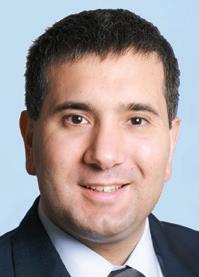
Swissport’s David Fernandez discusses how electrification, connectivity and predictive analytics are changing the way ground support equipment is managed
BY MARIO PIEROBON
As aviation operations grow more complex, the vehicles and machinery that keep aircraft moving on the ground are becoming smarter, more connected and increasingly electri ed. With greater sophistication, however, comes greater operational responsibility, demanding new maintenance philosophies, deeper data literacy and a workforce equipped for the digital era. At the center of this shift is a critical question: How does an industry built on physical reliability adapt to a world of software, sensors and real-time analytics? David Fernandez, global head of eet at Swissport, offers a front-row perspective on how the industry is navigating this transition and what it means for the future of ground operations.
Connected GSE creates new maintenance challenges Ground support equipment (GSE) is evolving rapidly alongside the growing interconnectivity, electrication and operational complexity of the aviation industry, according to Fernandez.
“This transformation is not only changing the equipment itself, but also the way the industry thinks about performance, reliability, maintenance and cost ef ciency in ground operations. Across the industry, GSE performance continues to rely on a well-established operational discipline, now increasingly supported by data and technology,” he says. “As equipment becomes more sophisticated, particularly with the growth of electric and connected eets, dayto-day management is also becoming more complex.”
Today’s failure patterns are well understood and largely consistent, Fernandez says.
“Traditional mechanical wear and tear on high-usage components remains a major concern, as do battery and charging issues in electric equipment and performance or calibration issues related to sensors and safety systems,” he says. “At the same time, software stability and connectivity are becoming an integral part of the overall reliability picture. Most operational impacts are not caused by major failures, but by minor, localized issues that can affect performance if not identi ed promptly.”
That shift is changing the industry’s approach to inspections.
“While daily pre-use checks remain essential, a broader trend is emerging toward continuous, data-driven monitoring, which helps
identify issues early and respond more effectively,” Fernandez says.
Predictive maintenance gains ground in aviation GSE
Predictive maintenance is no longer a futuristic concept, Fernandez says, but an increasingly practical tool in modern operating environments, particularly among digitally mature eets.
“Using telematics and data analytics, operators gain a more immediate understanding of equipment condition and performance, improving both planning and availability,” he says. “What is proving most effective is not individual data, but the combination of technical and operational information.”
Fernandez says usage patterns, charging behavior, downtime, inspection results and defect trends provide a clearer understanding of how equipment is being used and how that usage translates into wear over time.
“With the continued modernization of eets, particularly through electri cation and increased connectivity, this more integrated approach to data is becoming essential for managing GSE,” he says. “The pace of adoption, however, varies across the industry, in uenced by differences in eet age, digital maturity and systems integration with original equipment manufacturers.”
Why electric GSE requires new technician skills
The evolution of GSE is also rede ning the concept of maintenance itself, according to Fernandez.
“Beyond traditional mechanical expertise, the need for expertise in electronics, software systems, battery technologies and connected equipment diagnostics is growing,” he says. “This is re ected in the way organizations are developing their
teams through more specialized training, closer collaboration with OEMs and airports, and stronger internal governance to ensure consistency across increasingly complex eets.”
Regulation is evolving alongside the technology, with increased focus on battery safety, electrical systems, cybersecurity and automation.
experience with digital tools and advanced analytics.
“The opportunity lies in combining these elements to support both operational resilience and the continued growth of global aviation,” Fernandez says.
GSE management is steadily moving away from reactive repair cycles and toward a continuous,
Ground support equipment is evolving rapidly alongside the growing interconnectivity, electrification and operational complexity of the aviation industry.
“While frameworks are evolving in tandem with technology, continuous industry-wide alignment remains critical to support consistent and safe implementation,” Fernandez says.
Fernandez believes the broader direction of the industry is clear.
“GSE operations are becoming more connected, more electri ed and more data-driven,” he says. “This is progressively changing the way reliability and ramp performance are managed, pushing the industry toward more informed and proactive decision-making.”
Data and electrification reshape ground operations
Across the industry, operators are increasingly focused on building the skill sets needed to support this transition, combining operational
intelligence-driven model where data, electri cation and connectivity shape operational decisions before problems occur. The shift is not only technological. Teams must be retrained, regulatory frameworks updated and digital infrastructure expanded. The industry’s ability to combine decades of operational experience with emerging analytics capabilities will ultimately determine how effectively these increasingly sophisticated systems are implemented.
Dr. Mario Pierobon provides solutions in the areas of documentation, training and consulting to organizations operating in safety-sensitive industries. He has conducted a doctoral research project investigating aircraft ground handling safety. He may be reached at mariopierobon@alphaomega.dev.
Safety and Flexibility Drive Ground Handling Evolution in the Land Down Under
Stakeholders are strengthening ramp safety, workforce flexibility and digital operations to support geographically dispersed air networks
BY MARIO PIEROBON
Australia and New Zealand occupy a unique position in the global aviation landscape. Vast distances, dispersed communities and a high dependence on air connectivity de ne an operating environment that is both demanding and distinctive.
From the ramps of large international airports to the lean, multiskilled operations of remote regional airports, ground handling providers across the region must balance international safety standards with the practical realities of geography and scale.
This report examines how safety culture, workforce models, GSE logistics and emerging digital technologies are shaping ground operations across Australia and New Zealand. Ramp safety shifts toward shared responsibility
The Civil Aviation Authority (CAA) of New Zealand says airport and
apron safety have received increasing attention over the past decade as understanding of ground handling risks has improved globally. Although the International Civil Aviation Organization (ICAO) has developed Standards and Recommended Practices for ground handling, those standards have not yet been formally adopted in New Zealand. As a result, ramp safety continues to be managed primarily through airport operators’ safety management systems, where it is treated as a shared risk among multiple stakeholders.
In Australia and New Zealand, the growing focus on safety has led to a more proactive and integrated approach to ground handling operations, according to Anthony Filacouridis, CEO for Australia at Swissport.
“Safety is an integral part of operational decision-making, training, equipment deployment, and dayto-day performance management, rather than being considered a
standalone compliance function,” Filacouridis says. “This has resulted in more consistent practices and greater coordination between airlines, ground handling operators and airport management.”
He says the industry has also shifted from a simple compliance mindset to a more mature safety culture focused on reporting, shared responsibility and a systemic understanding of risk, particularly at organizational interfaces.
The CAA of New Zealand says ramp safety is increasingly being addressed through airport-level forums where airports, operators and ground handling staff work collectively to identify risks and implement control measures. This re ects a broader move toward integrated safety management, where outcomes depend on coordination between multiple stakeholders rather than the actions of individual organizations alone.
At major hubs, such as Sydney, Australia, safety systems have become more structured and formalized due to the complexity of those operating environments.
At major hubs, where multiple ground handling organizations operate simultaneously, safety systems have become more structured and formalized due to the complexity of those operating environments. These systems often include comprehensive training programs, competency frameworks and phased communication strategies for change management.
Filacouridis says major airports are also seeing increased adoption of technology-driven safety tools, including telematics for equipment visibility and maintenance monitoring, operational imaging systems used to support incident review and safety analysis, and LiDAR-based collision avoidance systems installed on high-risk powered GSE operating near aircraft.
“These tools are helping teams shift from a reactive incident response to a more preventative and data-driven safety culture,” he says.
At regional airports, the safety evolution continues, although often through more operationally focused approaches centered on procedural
discipline, ongoing training and practical risk management.
The CAA of New Zealand says smaller regional airports, which are often served by a single operator, tend to rely on simpler, relationship-based safety frameworks that re ect lower operational complexity. The regulator also points to increased transparency and proactive communication during periods of operational change, including the use of publicly accessible operator brie ngs during major infrastructure projects at Auckland Airport.
“Overall, the trend in New Zealand has been to view ramp safety as a systemic issue, requiring coordination, shared responsibility and ongoing commitment from all parties operating at the airport,” the spokesperson says.
Regional airports rely on flexible workforce models
Filacouridis says regional and shorthaul operations across Australia and New Zealand require a different operating model than major metropolitan airports.
“The primary challenge is size,” he says. “These locations are essential for connectivity, but lack the same
ready access to spare parts, backup equipment or specialized technical support available at larger hubs.”
To maintain operational continuity, operators rely on long-term planning, standardized processes and strong network integration. Critical components are typically supplied through metropolitan logistics networks, while specialized expertise is supported through remote assistance, mobile engineering resources and coordination with larger airports when needed.
Rather than duplicating extensive infrastructure at every location, operators focus on applying consistent standards while tailoring support to the operational needs of individual airports.
Billie Moore, chief executive of the NZ Airports Association, says most ground handling services in New Zealand are contracted directly by airlines.
“These are important partnerships in the aviation ecosystem, crucial to facilitating both passenger and cargo transport,” Moore says. “New Zealand’s geography creates operational complexity.”
Moore notes that many of the country’s airports serve smaller
Regional Report: Australia and New Zealand
communities, making exibility in staf ng and operations essential. She says training initiatives have helped create a pipeline of young workers entering ground handling careers across the country.
The CAA of New Zealand says regional connectivity remains a critical component of the country’s aviation system, particularly given the nation’s geography and reliance on limited-route air service.
At smaller airports, low traf c volumes often make it uneconomical to maintain dedicated ground handling teams, specialized GSE eets or large inventories of spare parts. In response, operators increasingly rely on multi-skilled employees capable of handling duties such as refueling, baggage handling and marshalling.
GSE availability is typically managed through streamlined and standardized eets aligned with the primary aircraft types serving the airport, along with careful planning around maintenance and deployment. Some equipment is also provided directly by operators.
The CAA says attracting and retaining quali ed personnel at regional airports remains challenging, increasing the importance of cross-training and locally based workforces supported by periodic transfers from larger airports for specialized functions and training.
“Overall, regional airports manage these constraints through adaptability, standardization and a high degree of workforce exibility,” the spokesperson says. “They remain effective in supporting safe and reliable operations for New Zealand’s remote communities.”
AI and digital tools gain ground in ramp operations
Filacouridis says Australia and New Zealand are steadily adopting digital and intelligent operational
tools, with a focus on technologies that deliver immediate operational value.
“In ground operations, the emphasis is on technologies that can immediately improve safety, visibility, utilization and operational control,” he says.
These technologies include telematics systems that provide insight into equipment usage and maintenance needs, operational imaging systems for incident analysis and safety analytics, and proximity sensing technologies designed to improve safety in high-traf c ramp areas. Larger airports are also increasingly using digital asset tracking for GSE such as carts and unit load devices.
Compared to some larger aviation markets, Filacouridis says adoption across Australia and New Zealand is progressing at a measured pace, particularly regarding trials involving advanced automation and autonomous equipment.
“However, the regional approach is highly targeted, with a strong emphasis on ensuring that new technologies offer clear operational value and can be effectively implemented in different airport contexts,” he says.
He says the region’s pragmatic approach helps ensure digital sys-
tems are implemented to support safety, ef ciency and reliability rather than being adopted simply for the sake of innovation.
Measured innovation defi nes the region
Ground handling across Australia and New Zealand continues to evolve through a combination of stronger safety collaboration, workforce exibility and pragmatic technology adoption. The region’s geographic realities continue to shape operational models, particularly at regional airports that serve as vital lifelines for remote communities.
As electri cation advances and AI-driven operational tools become more common, the region’s deliberate approach to change may ultimately prove advantageous by ensuring new technologies are genuinely t for purpose and operationally sustainable.
Dr. Mario Pierobon provides solutions in the areas of documentation, training and consulting to organizations operating in safety-sensitive industries. He has conducted a doctoral research project investigating aircraft ground handling safety. He may be reached at mariopierobon@alphaomega.dev.
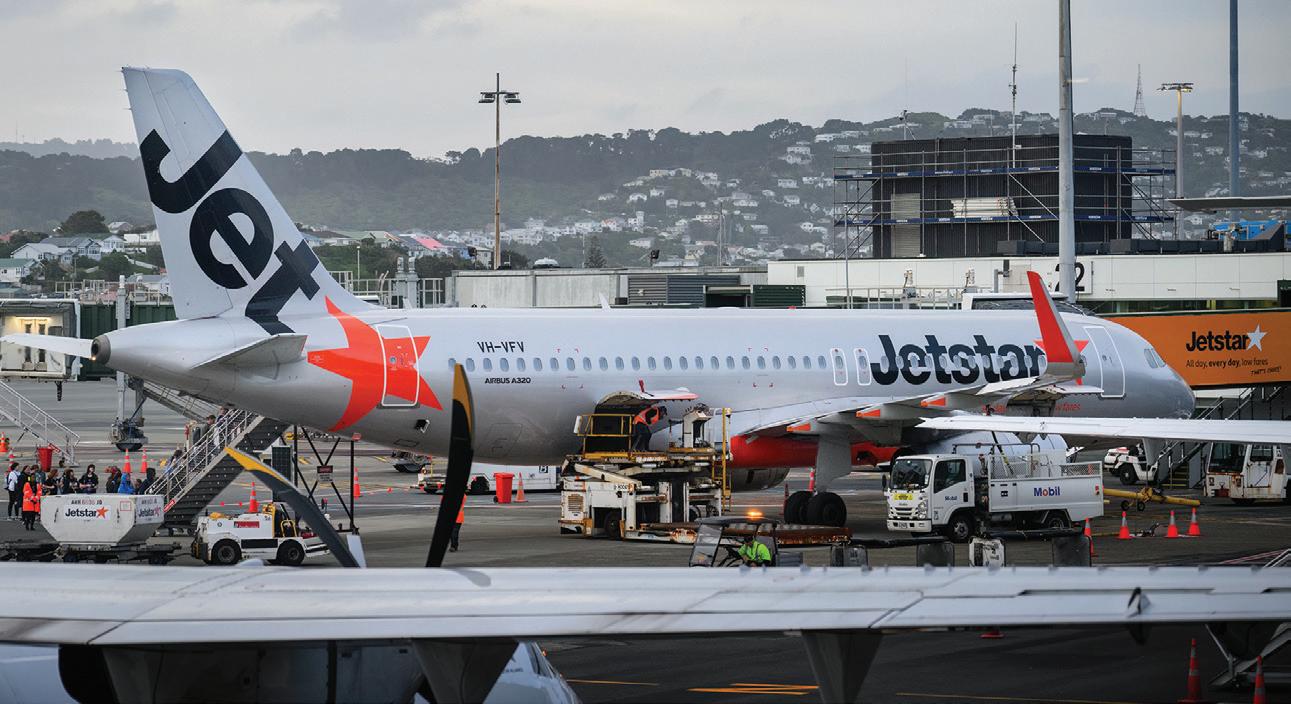
New Zealand airports, such as Wellington, are steadily adopting digital and intelligent operational tools with a focus on technologies that deliver immediate operational value.
Equipment Focus
The Communication Challenge Facing Modern Ramp Operations
Recent incidents are highlighting the growing communication, workload and situational-awareness pressures facing modern ground operations
BY JENNY LESCOHIER
Arecent surface collision at New York’s LaGuardia Airport has renewed industry attention on one of aviation’s most persistent operational vulnerabilities: communication breakdowns during ground movement.
In March, an Air Canada Express aircraft collided with a Port Authority fire rescue vehicle crossing an active runway at LaGuardia, killing both pilots and injuring dozens of passengers and emergency personnel. Preliminary details released by the National Transportation Safety Board (NTSB) highlighted a complex
chain of events involving radio communications, controller workload, vehicle tracking limitations and situational awareness challenges.
According to investigators, the airport fire truck involved in the collision was not equipped with a transponder, meaning the vehicle was not fully integrated into the airport’s Airport Surface Detection Equipment, Model X (ASDE-X) system. The surveillance platform combines radar and transponder data to help controllers monitor aircraft and vehicle movement across the airfield and identify potential conflicts.
Communication isn’t optional, it’s infrastructure.”
David O’Connell, dBD Communications CEO
Air traffic control recordings reviewed after the accident captured a controller urgently repeating “Stop, stop, stop!” moments before impact. NTSB Chair Jennifer Homendy later emphasized that major aviation accidents rarely stem from a single mistake.
“We rarely, if ever, investigate a major accident where it was one failure,” Homendy said during a media briefing following the crash. “When something goes wrong, that means many, many things went wrong.”
While investigators continue to examine the specific causes of the LaGuardia collision, the incident has reinforced broader concerns across the industry about how communication, technology and human performance intersect in increasingly congested operational environments.
For ground handlers, the issue extends far beyond radios alone.
Communication under pressure
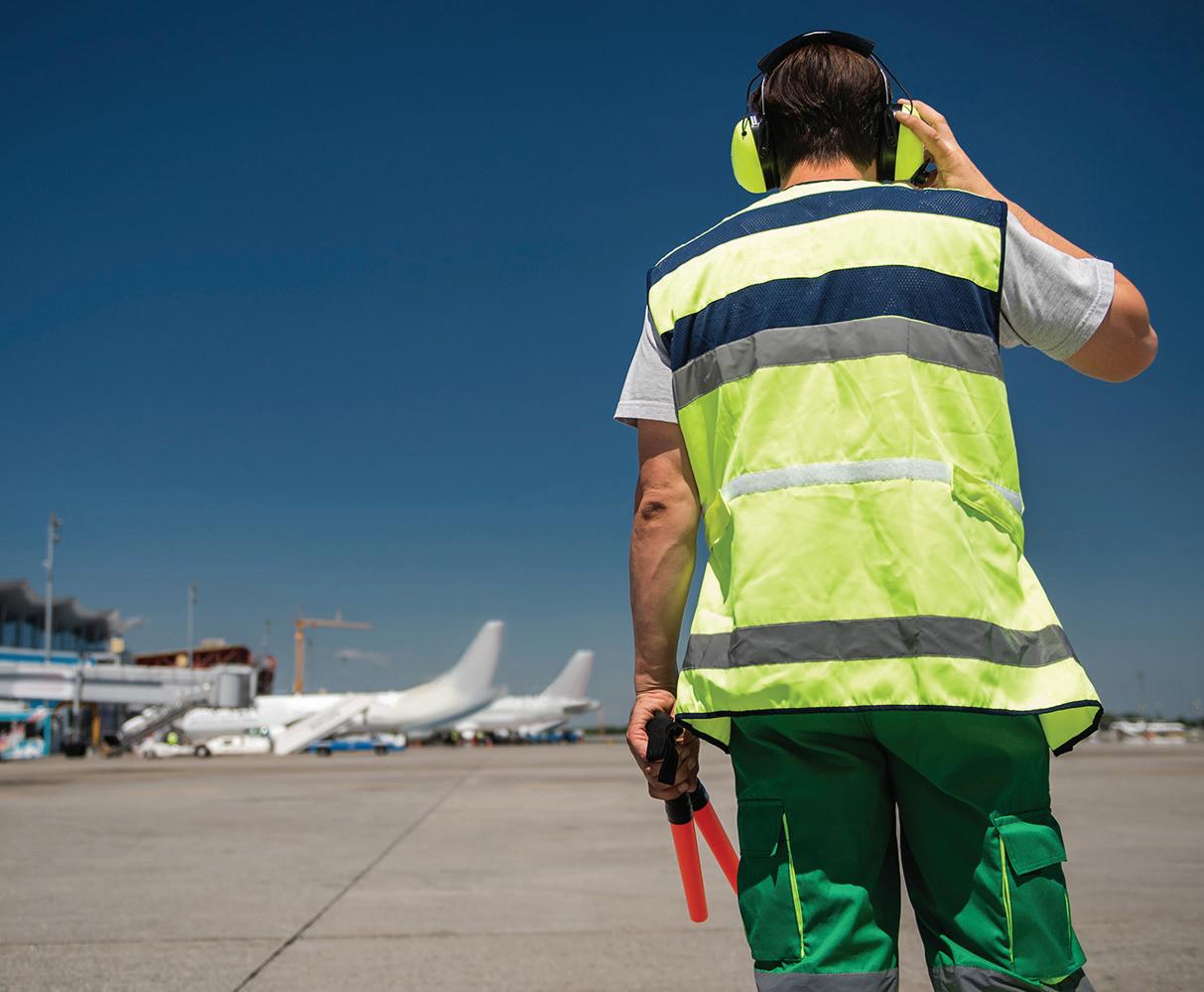
Modern airport ramps are among the most communication-intensive workplaces in transportation. Pushback crews coordinate with flight decks through headsets, wing walkers rely on visual signaling, dispatchers relay timing updates and multiple vehicle operators move simultaneously through congested operating areas.
At major hubs, much of that communication takes place against
Equipment Focus
a backdrop of engine noise, radio congestion, compressed turnaround schedules and constant operational pressure.
Industry safety organizations continue to identify communication as a central factor in ground incidents. The International Air Transport Association has repeatedly emphasized the importance of standardized procedures, human factors awareness and clear operational coordination within its ground operations guidance and training programs.
NASA’s Aviation Safety Reporting System has also identified communication issues as a recurring contributor in ramp guidance events, underscoring how easily misunderstandings can escalate during aircraft movement and servicing operations.
In many stations, experienced ramp workers are now working alongside newer employees with significantly less operational familiarity. At the same time, multilingual workforces and contract handling environments can introduce additional variability in communication styles, phraseology and procedural expectations.
Fatigue and distraction further complicate the picture. Human factors specialists have long identified communication breakdowns, loss of situational awareness and task saturation as recurring precursors to operational incidents.
The problem is rarely a complete lack of procedure. More often, communication failures emerge when multiple layers of pressure begin to overlap simultaneously.
RAMP COMMUNICATION BY THE NUMBERS
• The FAA has recorded roughly 1,600-1,700 runway incursions annually over the past decade, even as overall flight activity has continued to increase.
• Most incursions are categorized as lower-risk events with sufficient time or distance to avoid a collision, though serious incidents continue to occur.
• From 2021 to 2024, LaGuardia Airport recorded approximately 15 runway incursions per 1 million flight operations, according to analysis cited by Embry-Riddle Aeronautical University professor Robert Joslin.
• Over the same 2021–2024 period, Seattle-Tacoma International Airport recorded approximately 10.4 incursions per 1 million operations
The challenge is not simply whether personnel can communicate, but whether information is clearly understood, prioritized and acted upon in high-pressure conditions.
That pressure has intensified in recent years. Airlines continue pushing for faster turns and higher aircraft utilization while many operators are still managing workforce shortages, high employee turnover and the integration of newer personnel into complex operational environments.
Layered failures
The recent LaGuardia collision illustrated that complexity.
According to preliminary reporting, radio transmissions indicated controllers were aware that emergency vehicles were preparing to cross the runway. However, investigators are examining whether multiple simultaneous duties, workload demands and technology limitations contributed to a breakdown in the airport’s layered safety defenses.
That concept of “layered failures” is increasingly central to how the aviation industry approaches safety analysis.
Communication errors are rarely isolated events. Instead, they often occur alongside operational distractions, visual limitations, procedural misunderstandings or incomplete situational awareness. A missed radio call alone may not create an accident, but combined with workload saturation or conflicting operational priorities, the risk profile can change rapidly.
Ground support operations face many of the same pressures.
Earlier this year, a Delta Air Lines employee was killed at Orlando International Airport after a tug vehicle collided with a passenger boarding bridge while an aircraft was parked at the gate. The incident, which remains under investigation, highlighted the continued risks associated with vehicle movement and coordination on active ramps.
While the circumstances differed significantly from the LaGuardia runway collision, both incidents underscored a broader operational reality: airport surface environments depend on constant coordination between people, vehicles, aircraft and infrastructure.
When communication degrades within those systems, the consequences can become severe very quickly.
Beyond the radio
As operational complexity has increased, communication technology has evolved alongside it.
Traditional wired headsets and analog radio systems are steadily giving way to digital wireless platforms designed specifically for highnoise ramp environments. Many operators are now evaluating communication systems not simply as
accessories, but as core operational infrastructure tied directly to safety, efficiency and turnaround reliability.
Wireless headset provider dBD Communications, for example, has expanded its aviation communication systems into the North American market as airlines and handlers seek more reliable ramp communications solutions. The company’s systems are designed to reduce interference, improve clarity in noisy operating conditions and allow greater mobility for ground crews.
“Communication isn’t optional, it’s infrastructure,” dBD Communications CEO David O’Connell said in a 2025 interview with Ground Support Worldwide. “Just like a tug or a GPU, wireless comms should be part of the standard toolkit.”
O’Connell said operators are increasingly focused on communication systems that can withstand long shifts, maintain battery life throughout extended operations and perform reliably in congested signal environments.
The push toward wireless communication reflects a broader shift occurring across ramp operations.
Today’s systems are expected to do more than transmit voice instructions. Operators increasingly want communication platforms integrated with operational data, safety alerts, telematics and digital task management systems. Some emerging platforms are incorporating predictive analytics and automated notifications designed to reduce reliance on verbal coordination alone.
At the airport surface level, technology developers and regulators are also continuing to expand the use of surveillance and conflict-detection tools aimed at reducing runway incursions and vehicle conflicts.
Systems such as ASDE-X already provide controllers with detailed tracking of aircraft and authorized
The goal is to help crews communicate more effectively in environments where distractions, time pressure and operational complexity continue to grow, such as O’Hare
vehicles operating on airport movement areas. However, the recent LaGuardia investigation has also demonstrated the limitations that can emerge when not all vehicles are fully integrated into those systems.
The incident has renewed industry discussion around vehicle transponders, automated alerts and broader surface-awareness integration.
Building a smarter ramp
Despite advances in communication technology, industry experts caution that equipment alone cannot eliminate operational risk.
Even the most sophisticated systems still rely on human interpretation, timely decision-making and procedural discipline. Technology can strengthen communication, but it cannot fully replace the need for situational awareness and standardized operating practices.
For many operators, that reality is shifting attention toward a more holistic approach to ramp safety.
Training programs increasingly emphasize human factors awareness, communication discipline and operational coordination alongside
technical skills. Digital systems are being paired with standardized phraseology, fatigue management initiatives and recurring safety reinforcement programs aimed at reducing ambiguity during high-pressure operations.
The broader goal is not simply to help crews talk more. It is to help them communicate more effectively in environments where distractions, time pressure and operational complexity continue to grow.
As airports become busier and turnaround expectations tighten further, the communication challenge facing ground operations is likely to become even more critical.
The recent incidents at LaGuardia and Orlando served as stark reminders that airport surface safety depends on far more than a single radio transmission or warning system. It relies on an interconnected network of people, procedures and technologies functioning together under pressure.
When those layers align, ramp operations can move with remarkable speed and efficiency.
When they do not, the margin for error can disappear in seconds.
Airport in Chicago.
Alexei Beltyukov CEO of Unifuel
As the aviation industry pushes toward decarbonization, sustainable aviation fuel (SAF) continues to dominate the conversation. But while production is increasing, technical and operational limitations still prevent SAF from fully replacing conventional jet fuel.
Ground Support Worldwide Editor Jenny Lescohier recently spoke with Alexei Beltyukov, CEO of Unifuel, about a potential step forward. The company’s Flexiforming technology aims to solve one of SAF’s most persistent challenges: producing a fuel that can function as a true drop-in replacement without requiring changes to aircraft or infrastructure.
Below is an edited Q&A from that conversation.
How Close Is SAF to Becoming a True Drop-In Fuel?
BY JENNY LESCOHIER
makes economic sense for the companies adopting the technology.
You recently announced some significant news. What’s the key development?
The announcement centers on third-party testing results showing that fuels produced using our technology can help bridge the gap toward fully drop-in SAF. In other words, a fuel that can function as a complete replacement for fossil-derived jet fuel.
What we do is take a low-value byproduct from existing SAF production – called naphtha – and convert it into those missing aromatic components.
So you’re essentially using a byproduct to improve the fuel itself?
GSW: Let’s start with the basics. What is Unifuel all about?
BELTYUKOV: Unifuel is a chemical technology company. We develop and license technologies focused on what we call profitable decarbonization. The idea is not just to reduce emissions, but to do so in a way that also
That’s important because today’s SAF still has limitations that prevent it from being used on its own in commercial aviation.
Your technology is called Flexiforming. At a high level, how does it work?
Flexiforming is a catalytic chemical process that converts a range of feedstocks into speci c products. One of those products is a type of molecule – called aromatics – that is currently missing from most SAF.
To simplify it, jet fuel needs a speci c mix of molecules to perform correctly. SAF produced today often lacks these aromatic molecules, which are critical for both performance and safety.
Exactly. When producers make SAF from materials like used cooking oil or animal fats, they inevitably generate naphtha as a byproduct. That material has limited value on its own.
Our technology converts that byproduct into something much more valuable that improves the performance of SAF and brings it closer to being a full replacement for conventional jet fuel.
So we’re solving two problems at once: improving fuel quality and improving the economics of SAF production.
Why are these aromatic molecules so important?
There are a few reasons. First, they help maintain the integrity of aircraft fuel systems, inclu ding seals and gaskets. Without them, those components can degrade.
Jug of Unifuel’s Flexiforming SAF.
Second, they play a role in how fuel levels are measured in aircraft tanks. The instrumentation relies on certain physical properties that these molecules provide. Because current SAF lacks aromatics, it must be blended with fossil fuel. That’s a major reason why you can’t use it on its own today.
If this technology is successful, would SAF behave the same as conventional jet fuel?
Yes, and in some ways, better. From an operational standpoint, it would behave the same. It would meet the same performance and safety requirements.
In fact, because SAF can have a more controlled composition, it may contain fewer contaminants, such as sulfur or metals. That could lead to lower emissions and potentially less wear on equipment.
Let’s talk about cost. SAF has historically been much more expensive than conventional fuel. How does your approach change that?
SAF is still more expensive, and we shouldn’t pretend otherwise. Traditional SAF can cost several times more than fossil jet fuel.
What we’re doing is helping bring that cost closer. By improving the yield and value of what’s produced in a refinery, we can reduce the overall cost of SAF production.
So we’re solving two problems at once: improving fuel quality and improving the economics of SAF
Our goal is to get within about 50% of the cost of fossil fuel, which would be a significant
compared to where the industry is today. It is worth noting that in the price environment we’ve seen in [the last few months], Flexiforming SAF can achieve price parity with fossil jet fuel even today.
What does this mean for ground operations? Would fueling processes or infrastructure need to change?
That’s one of the most important points. Today, because SAF is not a full drop-in fuel, it often requires separate logistics –separate storage, transportation and blending processes.
Spotlight Interview
If SAF becomes fully compliant as a drop-in fuel, that changes everything. It could be handled exactly like conventional jet fuel.
That means the same pipelines, storage tanks and fueling systems could be used without modification. You wouldn’t need parallel infrastructure.
So SAF and conventional fuel could be stored and transported together?
Yes. Once it meets the necessary standards, it becomes fungible with
fossil jet fuel. It can be mixed in any ratio and handled through the same systems.
That’s a major simplification for airports and ground handlers, especially compared to today’s more complex logistics.
What still needs to happen before that becomes reality?
The key step is qualification. Organizations like ASTM need to validate that these fuels meet all safety and performance standards. That process takes time and
involves extensive testing and collaboration with aircraft and engine manufacturers. Depending on the specific way to use Flexiforming to make SAF – because there are several – we’re looking at a few months to a few years before full approval could happen.
How is the industry responding so far?
There’s a lot of interest globally, from North America, Europe and Asia. At the same time, refiners are understandably cautious.
They operate complex and capitalintensive facilities, so they evaluate new technologies very carefully. That’s a good thing. It ensures safety and reliability.
Our role is to demonstrate that this technology is both safe and economically viable.
What’s next for Unifuel?
We’re working with several refining partners to bring this technology into commercial use. Facilities are currently being designed with our process in mind.
If everything goes well, we hope to announce a commercial launch in the near future.
There’s been some skepticism about the future of SAF. What’s your perspective?
I think the long-term direction is clear. Decarbonization is not driven by a single policy or administration. It’s driven by broader global priorities. There may be periods of slower progress, but those are opportunities to refine the approach, especially around economics and safety.
We see strong momentum continuing, and we’re confident that SAF will play a central role in aviation’s future.
Unifuel’s pilot plant for the production of fully synthetic SAF.
THE WORLD’S MOST POWERFUL BUSINESS AVIATION EVENT
Step into the future of business aviation at the 2026 NBAA Business Aviation Convention & Exhibition (NBAA-BACE).
NBAA-BACE is where you can get up close with the newest business aircraft, meet legendary heroes of flight and witness epic announcements. It’s where business aviation comes together – not just to do business, but to connect, belong and celebrate the shared passion that unites our industry.
SUPPORT THAT KEEPS SAFETY FIRST.
Reliable equipment is critical to safe and efficient operations. Keeping your fleet in prime condition takes more than great engineering; it takes clear communication and ongoing care.
Oshkosh AeroTech Customer Care teams help ensure your equipment, systems and operators stay connected. This connection is enabled through trusted technical support, new technologies, expert training, refurbishments and upgrade options, promoting safety and performance across your operation.