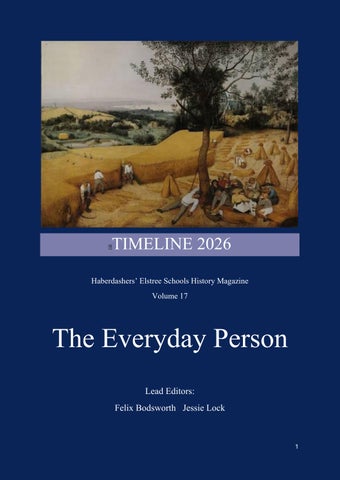
TIMELINE 2026

Haberdashers’ Elstree Schools History Magazine Volume 17
The Everyday Person Lead Editors: Felix Bodsworth Jessie Lock
1
Editors’ Note: History is a discipline in which, despite invariably concerning people, the normal person can be passed over. When one considers the appeal of the glamour of some eras, this is easily understood. And yet, it is nevertheless important for the everyday person to be kept in mind. Not only are they an effective medium through which to study impacts and causes, but also, they are a constant reminder of the severity of much of history. If the everyday person is forgotten, it risks normalising atrocities by boiling them down to simply decisions taken in government headquarters, to part of an A-Level or GCSE course, or to an indicator of a ruler’s temperament. Instead, we must strive to keep the unglamorous, the normal, the mundane, in mind, to ensure that history can be viewed not only as a series of actions taken, but as a series of impacts on people too. It is in that mind in which we decided to choose the ‘Everyday Person’ as our theme for this year’s Timeline Magazine. Hopefully, it has been a challenging and rewarding area of study for the contributors, pushing them to think outside of their normal historical areas of interest. We have enjoyed reading the entries enormously and hope that you do too. Sincerely, The Timeline Magazine Team
Timeline 2026 Team Lead Editors: Felix Bodsworth and Jessie Lock Staff: Mr Heyman and Miss Barnett Editorial Team: Ruby Giam, Ela Ghosh, Elina Patel, Lucas Argent
2
Contents Page Claudette Colvin: The First Rosa Parks - Wini Townshend
pg.4
Samuel Sharpe - Elyas Abdul
pg.6
Sam Martinez -A Hard-Working Life serving the British Empire – Louis Zeng
pg.8
A day in the life of Ur’s worst copper salesman - Reuben Goulden
pg.11
“To What Extent Might One Reconstruct the History of a Non-Literate Society?”Winner of the Phoenix Essay Prize - Tabitha Smith
pg.14
The Making of a Soldier in the First World War: An Ordinary Man - Ruby Giam
pg.18
The Everyday Lives of Women in World War 1 in Britain - Jessie Lock
pg.21
How did the British Blockade affect the German people in WW1? - Aadi Bagchi
pg.23
Evacuees: The Ordinary Children Changed by the War - Elina Patel
pg.26
The Bear Comes to Life – Lily Eavis
pg.29
To what extent did Anglo-Saxon law enable everyday women? - Felix Bodsworth
pg.30
The Role of Women in the History of Medicine - Ela Ghosh
pg.34
Should the Holodomor be considered genocide? Explain your answer. - Jessie Lock
pg.36
What was life like during the Russian Civil War? - Samuel Frangi
pg.40
Rapid Change in Singapore between 1965 and 1990 – Louis Chew
pg.43
3
Claudette Colvin: The First Rosa Parks Wini Townshend, Year 7
All of us know the story of Rosa Parks, an African American woman who refused to give up her seat on a bus for a white man when asked to by the bus driver. She was convicted of a crime for violating Alabama's state segregation laws and arrested. She is a symbol of black rights and justice, but what about Claudette Colvin?
Claudette Colvin was born on the 5th of September 1939 in Birmingham, Alabama. She grew up in a poor and segregated neighbourhood in Montgomery. She was raised by her aunt and uncle and was very smart. Claudette attended the segregated Bokker T. Washington High School and learnt about courageous black women like Harriet Tubman. Along with this, she learnt the laws of Jim Crow – which enforced segregation - and punishment for black people talking to a white child at a young age.
On March 2, 1955, when Claudette was 15 years old, she was on the bus on her way home from school, sat with three of her classmates, and there were 10 other passengers. The bus was split in half; people of colour sat at the back while the white people sat at the front. On that day, the white section was full, and a lady needed to sit down, so the bus driver told Claudette and her friends to move for the lady. Claudette’s three friends moved but she refused. She was very interested in politics and was very aware about discrimination. It was at about this time that a fellow student, Jeremiah Reeves, was sentenced to death on suspicion of the rape of a white woman. She later stated, “History glued me to my seat” and “It felt like Harriet Tubman’s hand was pushing me down on the one shoulder and Sojourner’s hand on the other. Learning about these two [anti -slavery campaigners] gave me the strength to stay seated that day”. Everyone had cleared the row for the white woman apart from her. “We’d been studying the Constitution…I knew I had rights.” She remarked. The white woman continued to stay standing as she couldn’t sit in the same row as a black girl. “If she sat down in the same row as me, it meant I was as good as her,” Claudette noted. “Why are you still sittin’ there?” the bus driver shouted. “A white passenger yelled from the front, ‘You got to get up!’” A girl named Margaret Johnson spoke from the back, “She ain’t got to do nothin’ but stay black and die.”
She was dragged off, screaming by police officers, handcuffed and pushed into a patrol car. Black passengers said she, “fought like a little tigress”, but Colvin maintained that she went limp and “didn’t fight back. “. The officers then proceeded to make comments on her body, specifically her bra size. She feared being raped and tried to cover herself and thought about other things. “I recited Edgar Allan Poe, Annabel Lee, the characters of Midsummer’s Night Dream, the Lord’s Prayer and the 23rd Psalm.”. She later reported. She was thrown into a cell and charged with misconduct, violating segregation laws and assaulting a police officer.
The civil right activists of Montgomery were outraged, but because of this they got to work. Well known activists like Rosa Parks and white ally Virginia Durr made fundraising campaigns for
4
Claudette and received many generous donations by the hundred. Rosa Parks helped massively, encouraging more young people to take part and attention to be drawn in NAACP youth meetings. She even got Claudette to participate in the youth council.
They also made a petition saying that black people should be treated with more respect and there should be no visible signs of segregation. However, Rosa Parks disagreed with this, as she “Didn’t want to ask any white folks for favours”. She instead also refused to give up her seat to white people on the bus, and some of the black community refused to take the bus without change. This was called the Montgomery Movement. Leaders of this movement -like Martin Luther King thought about using Claudette’s story as a test case against segregation laws; separate but equal. They decided not to and Claudette was excluded from the Montgomery movement because they thought that Claudette was unlikely to gain support from white and wealthy black communities. Their reasoning was she was “Too dark”, she was poor, lived in a “Bad neighbourhood”, and was on a rebellious path.” They just dropped me …none of them spoke to me. They didn’t see if I was ok …they just didn’t want to know me “
Claudette had been raped by a married man soon after her arrest and became pregnant. Soon after, another Black teen- Mary Louise Smith- did the same as Claudette, but Mary’s father was allegedly an alcoholic therefore the Montgomery Movement didn’t use her for the test case. Shortly after this the Montgomery Movement became aware of the campaigner, Rosa Parks, an older middle-class seamstress who was also a member of NAACP and friends with Claudette. Rosa Parks then refused to give up her seat, and this made a big difference. The movement became an overall success, and Claudette bravely was a witness at 16 despite bad experience with a hostile white lawyer. The supreme court late deemed racial discrimination on public transport unconstitutional. Rosa Parks became a famous heroine whilst Claudette and others went unrecognised, despite refusing their seat 9 months before Rosa. In her later years Claudette did get some recognition, a street in her hometown of Alabama was named after her, as well as an obituary. Sadly, she passed away on the 13th of January 2026 at the age of 86. She was a determined, passionate activist and will be remembered. Claudette Colvin said “I knew then and I know now that, when it comes to justice, there’s no easy way to get it “.
5
Samuel Sharpe Elyas Abdul, Year 9
Samuel Sharpe was born into Jamaica which was a colony to the British empire. He was one of the most influential slaves and his movement led to the abolition of slavery. Born in 1901 in St James’s Parish, he was the main organiser behind the 1831 – 1832 Baptist war, the largest slave rebellion In Jamaican history. His actions led to the acceleration the abolition of slavery across the British Empire.
Early Life (1901 – 1917) Samuel Sharpe was born in 1901 and was born as a slave. Samuel Sharpe was born enslaved on a plantation owned by Samuel and Batty Sharpe in St. James, Jamaica. Records list his name as Archer and was noted as the son of Eve. Although he was born a slave, he became literate through the use of newspaper articles and books. His literacy allowed him to gain respect of other slaves. Slaves had to endure severe work on the plantations for sugar, tobacco and coffee which was in demand across Europe. The practise of slavery was brutal and enslaved people faced harsh treatment and abuse, Often, they were separated from their families and died from the inhumane conditions. Religion (1917 – 1930) Despite growing up in an oppressive environment, his passion for religion shined. Samuel Sharpe joined the church and became a Baptist Deacon. Religious meetings were a permissible form of organised activity by slaves, and Sharpe used these meetings to inspire his congregation and communicate his plans and concerns. This small amount of freedom allowed him to change the destiny of Jamaican’s forever. By 1930, Sharpe had become a powerful voice within the enslaved community and openly declared how he would rather die than live in oppression.
6
“I would rather die upon yonder gallows, than live in slavery.” In other words, he is saying that freedom is more important than life itself. This signifies his courage to stand up against the oppression. This is very meaningful. The Christian Deacon’s believed their freedom was morally supported by the Christian teachings. This religious environment encouraged equality, and Samuel united them together for the rebellion. The Baptist war (1831) The 1831 uprise in Jamaica, was the biggest slave revolt in Caribbean history. It began on the 25th of December and around 60,000 slaves, and Sharpe and his other rebels were educated through the Baptist ministry network, which exposed them to abolitionist ideas from Britain. However, tension rose after rumours broke out of the British emancipation and that the Jamaican planters were hiding it. When the colonial government denied these rumours, the protests escalated into full scale rebellion. Enslaved people set fire to plantations, destroyed property and fought against the militia forces. The uprising lasted 11 days until they were violently supressed by the British forces. Over 300 enslaved people were killed, compared to the 14 colonial troops. After the rebellion, Samuel Sharpe was captured and executed, but he famously said that he would “rather die upon yonder gallows than live in slavery.” The scale of determination and uprising the rebellion caught meant that slavery could no longer continue and was in the running up to the abolition of slavery in 1833. Samuel’s story is so interesting as we learn of his deep fight for his cause. Despite being from a poor, enslaved family, he was able to bring together 60,000 enslaved people which lead to the abolition of slavery. We learn of how much impact an everyday person can have on the world around us. One voice can make the difference. History is also shaped by the people around us who stand up to what is right.
7
Sam Martinez – A Hard-Working Life Serving the British Empire By Louis Zeng 9C2 In 1941, during the Second World War, Sam Martinez travelled through the dangers of the Atlantic Ocean towards Scotland to support the war effort for the British Empire. Sam was born in Barranco, near Punta Gorda, in the south of Belize, which used to be called British Honduras from 1862 to 1973. He was the sixth of a family of 11. Sam was well educated, attending schools, where English was taught as a first language, and a Baptist school. He was also fluent and could communicate other languages such as Spanish and Garifuna. At 9 years old, Sam, as a student, would often work whilst studying. It was clear from the start that he was a really hard worker and would support the family by earning money by working in the plantations and delivering food to a local grocer. After finishing school, Sam took up many different occupations such as working for a local fruit juice maker, teaching Garifuna to children in the local jungles then moving away from his family 300km north to work as a butler in Bomba. This was followed by a job to harvest bananas on a plantation. However not all his jobs were so pleasant. In 1931, there was a catastrophic hurricane through the whole of Belize. Sam barely escaped death by hanging onto a tree. By the end of the devastating tragedy, there was a job to recover and collect bodies and would have paid him 5 cents per body found; unfortunately for Sam he this would be his next job. Sam’s two brothers perished alongside 2,500 other people in this event. His wide range of different occupations continued as he then worked as a police officer before joining the BHFU (British Honduran Forestry Unit). In this job, he chopped down mahogany trees. This is a really difficult job it required a huge amount of physical strength as it may take up to a whole day for a man to fell the tree. By this time, Britain was heavily involved in the Second World War and are running low on the resources of timber, which was used for military construction and mining, as many of the forestry workers were now involves in the armed services. The British Forestry commission gave itself a target to produce 5.7 tonnes so there was a call for support around the British Empire and Sam was one who responded to this call. 20 companies came from Canada and 900 men came from British Honduras. Sam responded to the call by saying, “We were British, we belonged to the British Empire, so we subdued ourselves to that and we looked upon Britain as our guardians.” The journey was a treacherous, gruelling 14-days long through the Atlantic Ocean. His journey included sailing to New Orleans from Belize City before travelling by train to New York before crossing to Glasgow, Scotland. This journey needed to be extremely secretive as any signal or movements could attract the attention of enemies; especially German U-boats. Sam commented that “If we were torpedoed, we would be the first to die – but we were prepared for all that. And also, we felt quite safe, because it was the British, British ships.” This would show that Sam has a lot of trust on Britain and its empire. Sam arrived In Glasgow on the 26th November 1942. They were to sent to their respective working sites all across Scotland: Golspie, Kinlochewe, Duns, Ullapool, Tranent. Sam was sent to Ullapool. When he arrived, the snow was knee-deep and was sent to work immediately. Many different perspectives and opinions appeared. Many reports and articles would have described the conditions as poor with not well insulated huts and the cold harsh climate. The cabinet minister
8
Harold Macmillan commented, “They arrived in the cold English winter from a climate which I understand is never less warm than the most highly heated hothouse in our old-fashioned gardens. They therefore shivered and huddled themselves together”. However, Sam would never complain and often of his time spent in Ullapool, “that was the main thing. What's the use of moaning? Make yourself comfortable.” In the media, there are different perspectives as a BBC article would write that Sam’s grandson echoed Sam’s opinion, after his death in 2016, and described the locals as ‘not welcoming’; whilst in a The Herald’s magazine article and an article from the Scotsman showed that Sam was positive about the locals and fitted in well. Sam remembered it as a ‘harmonious time’. He recalled many parties and dances along the bankside of Loch Broom and there had many friendships with the locals. Sam also worked some time at Duns. The forestry unit is separated before the end of the war and workers were left with the choice to return back to the Belize or to stay in Britain. 1 in 6 people chose to stay and that is what Sam chose to do. Sam went on to marry and have six children and took up a job as a cook. Continuing his wide range of occupations, he worked in the building trade and then worked at the Balnero paper mill. Some days to save bus fares, Sam would walk 8.5 miles to and from Edinburgh, where he lived, to work in Balnero. When the mill ultimately closed down, he worked as a street cleaner until retiring at 65. He chose to continue working in a local butcher until he was 94. He was involved in many different documentaries, such as The Tree Fellers, which was nominated for the BAFTA award. He also appeared in BBC shows. Sam lived an eventful life with many different experiences and through difficulties and struggles, he powered through and always remained positive. He could be viewed as a role model for resilience with a great sense of optimism. This year, the “Timeline Magazine” explores the everyday person. Sam would have been an average man in Belize but historical events lead his life into a world full of adventures and unknown. All information and quotes came from other articles; all written in my own words.
Reference list: Author Unknown (2006). THE LAST LUMBERJACK Sam Martinez left his homeland of British Honduras in 1941, bound for a new life as a woodcutter in Scotland. Now 96, he shares his wisdom with Vicky Allan and talks about changed times, staying positive and life as a local celebrity. [online] The Herald. Available at: https://www.heraldscotland.com/default_content/12443406.last-
lumberjack-sam-martinez-left-homeland-british-honduras-1941-bound-new-life-woodcutterscotland-now-96-shares-wisdom-vicky-allan-talks-changed-times-staying-positive-life-localcelebrity/ [Accessed 14 Apr. 2026]. By The Newsroom (2016). The Scotsman. [online] The Scotsman. Available at:
https://www.scotsman.com/sport/football/obituary-sam-martinez-forester-and-oldest-hibsfan-1466678 [Accessed 14 Apr. 2026]. Phillips, J. and Williams, T. (2026). Black Essential Workers, Racialised Citizenship and Community ‘Friendliness’: The British Honduran Forestry Unit in Scotland, 1941–1943. The Journal of Imperial and Commonwealth History, pp.1–29. doi:https://doi.org/10.1080/03086534.2026.2644431.
9
A day in the life of Ur’s worst copper salesman By Reuben Goulden, Year 10
How many 4000-year-olds do you know with a Guiness World Record? None? Typical. But there is one, a man who lived c.1800 BCE in the ancient city of Ur, in Sumer. He was a copper salesman by trade, a member of the Alik Tilmun guild of copper merchants that operated out of Dilmun (modernday Bahrain). His house was excavated in Sir Leonard Wooley’s digs at Ur from 1922-1934, and in one room was discovered over a dozen clay tablets. Among these is an imaginatively-named clay tablet, where a certain Nanni has a go at our copper merchant. This is the first written customer complaint, landing Ea-Nasir and the ‘Complaint Tablet to Ea-Nasir’ a place in history. But what was life like for our shoddy protagonist? How was the daily routine of a Sumerian similar and different to ours, and why was copper such an important resource in Sumerian society?
For a typical Sumerian, food would have been a staple, probably a porridge-like barley dish topped with onions or flat barley cakes. Variety was not uncommon. Cucumbers, dates and figs were common fruit, and meat (especially mutton and goat) was found in market stalls. Fish from the many rivers or canals often supplemented the main food as well. But the king of all Sumerian foodstuffs would have been the ale, constituting almost 40% of the barley yield in some years. Ale was brewed (mostly by women) in households, even the royal one, and was sometimes used as salaries or even currency. Richer Sumerians (maybe like our Ea-Nasir) could afford beef and veal, as well as date wine.
Ea-Nasir’s house, where his tablets were found, was a larger one. Encompassing multiple building plots, it had enough room for his own archives, where he collected various complaints from various disgruntled customers. A Sumerian house would usually be two storeys and contain rooms for sleeping and family gathering, with space on the roof for vegetable gardens, made out of tightlypacked mudbrick. Many houses also contained private breweries and shopfronts, to consume and sell beer, as well as spaces to bake bread from barley rations. Some, especially in the later period when Ea-nasir was around, were built around a central, shaded courtyard. Ea-nasir probably spent a lot of his time in Dilmun (modern Bahrain), a major entrepot in the Middle Bronze Age, especially for selling copper from Magan (modern Oman) to Ur (in southern Iraq). Copper was a lynchpin in Sumerian society. Weapons were made out it, good for Ea-nasir, who was active during a particularly turbulent time in Urian history. Tools, like scythes, hoes and shovels, useful for the farming and digging of irrigation crucial in Mesopotamian life. Artwork, including figurines of gods and larger wall-mounted sculptures, were also made of copper or its alloy bronze. There is even evidence to suggest that the copper trade, and Ea-nasir, operated under the close watch of the Urian government.
10
Fig. 1: the Royal Game of Ur
For the Sumerian not selling such poor-quality copper, life would have revolved around the family meal. After a long day of working in the barley fields, or building a ziggurat, or smithing bronze, or any number of jobs in and around the city, the family meal was a welcome break from the loud, noisy and smelly world. Dishes included simple soups and broths, including the barley and mutton-based Tuh’u, as well as fruits and vegetables, such a dates and figs. Crucially, though, was the music and storytelling. The earliest written story we have, the Epic of Gilgamesh, dates back to the Ur III Period (2100 BCE). One can imagine, in a cool Middle-Eastern night, melodic retellings of the stories of a people – their heroes, gods and ancestors. It would be accompanied by perhaps the reed pipe, the flute, a frame drum and the lyre. The family would also gather for activities and games, with children playing with rattles, figurines and toy battles, and older members playing what we now call ‘The Royal Game of Ur’. Despite the name, this game was played by a large portion of the population, with rules similar to backgammon: get your counters to complete a circuit while blocking your opponent.
To conclude, life in Sumer was not so different from ours. They ate many of the same foods, they commuted like us, they had a family meal and entertainment like us. And they had business, and shoddy businessmen, as Ea-nasir testifies. When we talk about ancient civilisations as completely separate and incomprehensible, we remove the humanity that built them, that made them so intriguing. If we perceive them as utterly different, we cannot understand their fabric and intentions. So, if you lie in bed tonight, spare a thought for Ea-nasir lying in his bed 4,000 years ago, perhaps chuckling to himself about his successful scams, and how he is not so much different than you.
11
“To What Extent Might One Reconstruct the History of a Non-Literate Society?”- Winner of the Phoenix Essay Prize Tabitha Smith, Year 8
The vast majority of human history was experienced by non-literate people. Humans only began writing things down around 3000 BCE in Mesopotamia. Are the histories of those non-literate people, spanning tens of thousands of years, completely lost to us? No, because the absence of a written record does not mean the absence of other evidence about their lives and experiences. Different methodological approaches allow us to reconstruct remarkable details about human societies that flourished thousands of years ago without leaving any written records. By examining four distinct types of evidence—visual art from Upper Palaeolithic cave paintings, monumental archaeology at Stonehenge, oral traditions from Africa and Aboriginal Australia, and Roman ethnographic accounts of Celtic and Germanic peoples—this essay demonstrates that it is possible to reconstruct fundamental aspects of the history of non-literate societies, even if that reconstruction can never be total.
Arguably the most illuminating and valuable kind of artefact which helps us reconstruct non-literate civilisations is the visual art they left behind. Visual art allows us to deduce not just the technological sophistication of past civilisations, but also it allows us to speculate about their cultural values and spiritual beliefs. Perhaps the most prominent example of this cryptic yet endlessly intriguing source of evidence is cave art from the Stone Age, which allows us to discern both the realities of life tens of thousands of years ago as well as the complex, symbolic thought that Upper Palaeolithic people were capable of. In Lascaux in South-Western France, for example, approximately 600 cave paintings have been discovered, dating from between 17,000 and 15,000 BCE. Most notably, they depict the animals that these past communities would have regularly encountered and symbolically valued: horses appear most frequently, succeeded by deer and aurochs (a type of extinct wild cattle), ibex and bison. Though still significant, there are notably fewer depictions of carnivores such as lions and bears. From the location, and repeated use of these sites, it becomes evident that they held some kind of significance for the people who made them. Situated deep underground, Lascaux’s illustrations are found far from the entrance, allowing us to infer that torchlight was utilised in their creation. Moreover, these images demonstrate some of the first known uses of occlusion—the technique of overlapping shapes to create the illusion of three-dimensional depth—in human art. Other techniques demonstrating deliberate skilled artistic practice include utilisation of the natural contours of the cave walls, polychrome painting in multiple pigments (most notably red, black and yellow), and, remarkably, even signs of constructed scaffolding to reach the upper cavities. These images therefore record that this was a society that had sophisticated artistic and technological capabilities and a level of social organisation that allowed large-scale projects to develop over a period of time, which does give us some sense of their history. They also show us the elements of daily life that they most valued.
However, historians have also tried to push beyond this surface understanding of what these paintings tell us about the lives of these Upper Palaeolithic people. A good example of this is David Lewis-
12
Williams, who argues that these caves were viewed not just as a canvas for artwork, but as a portal to the supernatural world created by shamans experiencing altered states of consciousness. LewisWilliams based this interpretation of ancient cave art on his observation of rock drawings created by the shamans of the San Bushmen people in Southern Africa, one of the oldest indigenous cultures still in existence. Lewis-Williams states, “We do not have to explain everything to explain something,” a quote demonstrating that while a full reconstruction of the history of an ancient, non-literate society is unrealistic, some speculations are still valid.1 Of course, this viewpoint is subjective and assumes that the same experiences took place universally amongst hunter-gatherer people throughout history, when there would be great variability in those societies across both geography and time. Ultimately, there are some things we will never know just through a reading of visual art. In the words of the French historian Jean Clottes, contemplating the people who made the cave art at Lascaux, “All cultures […] stories about the world, how the world came to be […] They must have had those stories and they’re gone—the only thing we have is those images they left on the walls.”2
Alongside visual art, ancient non-literate peoples also left behind monuments. Though at first the blank rocks at Stonehenge might seem more difficult to read than the animal paintings at Lascaux, modern-day technology is revolutionising what we can know about the history of the non-literate people who constructed it. Since the 1950s, carbon dating has been used to place the construction of Stonehenge at approximately 3000-1500BCE. In its early stages, the monument was merely a simple earthwork, and over the next couple of millenniums, large sarsen trilithons and (smaller) bluestones were constructed to create the magnificent collection of megaliths we admire today. In recent years, however, revolutionary progress in geochemistry, isotopic analysis and ancient DNA analysis have all helped to unlock the secrets behind the enigmatic mysteries of Stonehenge. They have illuminated not just when it was built, but who built it, where they and their materials came from, and the unfathomably advanced social networks that made Stonehenge possible. A 2025 study, for example, examined the “Newall boulder,” a fragment of rock excavated in 1924. Using X-ray, geochemical, microscopic, and surface textural analyses, researchers concluded the boulder was not the product of glacial deposits. Instead, they were able to attribute its presence at Stonehenge to Neolithic human endeavours—more specifically, transportation from Pembrokeshire, Wales (over 200 kilometres away).3 In 2024, another revolutionary discovery was made about the Altar Stone: by analysing the age and chemical composition of detrital zircon, apatite and rutile grains within fragments of the sixtonne sandstone block, it was revealed that it actually originates from northeast Scotland—more than 466 miles away, making us completely re-evaluate over a century of understanding and research.4 Not only did this ancient civilisation clearly use trade and transportation networks over a vast geographical scale, they also overcame geographical barriers, suggesting marine travel, which emphasises the fact that Neolithic Britain was tremendously more interconnected than we had previously imagined. Analysis of animal teeth and bones at the site also confirms this: oxen from western Britain hauled bluestones at the site, pigs were brought there from Scotland, Ireland and Wales, and local cattle and sheep were also slaughtered there, highlighting Stonehenge’s potential role as a communal hub congregating people from all across Britain for a significant period of time. As Mike Parker has conjectured, “The fact that all of its stones originated from distant regions, making it unique among over 900 stone circles in Britain, suggests that the stone circle may have had a political as well as a religious purpose—as a monument of unification for the peoples of Britain, celebrating their eternal links with their ancestors and the cosmos.”5 However, while we know that Stonehenge had multiple uses over time and was built with clear purpose, the true intent of its original builders and a deeper sense of their history will most likely forever remain a mystery.
13
Less tangibly than surviving art or monuments, a different approach to examining the history of nonliterate peoples is by listening to their own words through oral tradition – the transmission of historical knowledge, genealogies, and cultural memory by word of mouth across generations. Unlike Stonehenge or Lascaux, where the builders or artists apparently builders left no descendants to preserve their stories, oral tradition survives primarily in societies where continuous cultural memory forms a bridge between the illiterate past and today. Without oral tradition, histories of pre-colonial Africa, Aboriginal Australia, pre-contact Americas, and Pacific Islander societies would ultimately be lost to time, emphasising its potential importance for historians. As Jan Vansina has written, “Without oral traditions, we would know very little about the past of large parts of the world. And we would not know them from the inside.”6 A prime example of this is the history of the Kuba Kingdom. In 1952, Vansina was able to reconstruct the political history of Kuba (now located in the Democratic Republic of Congo) through oral traditions. His research included cross-referencing different oral accounts and correlating them with material evidence, including king lists, migrations and major events reaching back three to five centuries. This was one of the earliest examples which proved that in societies which formally valued and protected oral transmission, oral traditions could convincingly function as reliable historical sources across long time periods. Patrick Nunn believes that oral history can take us even deeper into the history of non-literate peoples. Arguably Aboriginal Australians provide the most striking example. They lived in an oral society where in-depth knowledge of the natural world was crucial for survival, and to this day, memories of dramatic sea level rise that occurred roughly 700013000 years ago at the end of the last Ice Age are still being passed down. Modern geology has corroborated this remarkable endurance. The most tangible examples of this predominantly relate to place names. For example, what is now called Fitzroy Island bears the Aboriginal name “gabar,” which translates as “lower arm” of a former mainland promontory – a situation that could only be true when the sea level was 30 metres lower than it is today. This last happened 9960 years ago, meaning that this title has been passed down orally for approximately 400 generations. These oral traditions were therefore not merely stories but imperative pieces of information needed as means of existence for generations of people. As Nunn asserts, “What science has discovered in the last hundred years or so about postglacial sea-level rise confirms the eyewitness accounts of our ancestors, not the other way round.”7 However, there are limits to the history we can recover from purely oral transmission. Oral tradition can reconstruct broad patterns of migration and political structure, environmental changes and societal organisation, and cultural values and major conflicts. However, it cannot give precise chronologies or specific events without corroboration from archaeology. Moreover, unpleasant truths that communities chose to supress will also be lost to time; and, of course, details that were not considered worth recalling may be forever consigned to oblivion.
A fourth route to reconstructing the history of non-literate societies emerges when they encounter literate societies. While these written accounts of non-literate peoples can help us to reconstruct their history through information about subjects like political structures, religious practices, military tactics and social customs, these accounts were written by outsiders. It is therefore highly plausible that they often misunderstood what they observed. These narratives were inevitably filtered by bias, prejudice and the literary conventions of the culture of the author. The Roman invasions of Gaul and Britain present the most famous examples of this kind of cultural encounter. Julius Ceasar and Tacitus both left accounts about the Celtic peoples of Gaul and Britain which exemplify these tensions. As David Henige has described, “Julius Caesar must be considered one of history’s earliest […] ‘spin
14
doctors’.”8 His account of his conquest of Gaul (58-50 BCE) is our main source of information on the conflict, even though it was written as a piece of political propaganda to enhance Ceasar’s reputation (for example, his claim that one battle ended in the deaths of 430,000 Gauls with no Roman casualties). Nevertheless, the account is still valuable to historians looking to reconstruct aspects of Gallic life: elements of warfare, tribal confederations and the material culture of Gallic society are all contained in his account, in spite of the fact that Ceasar dismisses much social and cultural detail. Similarly, Tacitus’s Germania (98CE), was a historical and ethnographic account of Germanic peoples. It is unlikely that Tacitus ever saw the region that he was describing firsthand. Christopher Krebs writes, “The Germania appears as a mosaic of Greek and Roman stereotypes, arranged by a writer who most likely never went north of the Alps, and whose concern was of a moral and political rather than a scientific nature.”9 As such, there is a limit to what the historian can reconstruct of Gallic history from this account, especially since Tacitus wrote with a clear bias, showing the Germans as stereotypically uncouth and savage. Yet without this kind of account, even more of nonliterate Gallic life and culture would be lost to history.
As this essay has demonstrated, non-literate societies can be reconstructed to some extent, and the extent to which historians can reconstruct the history of those societies has expanded dramatically over recent decades and continues to evolve. The 2024 revelation about Stonehenge's Altar Stone originating from Scotland, Patrick Nunn's verification of 10,000-year-old Aboriginal sea-level memories, and Lewis-Williams' framework for interpreting cave art all demonstrate that our sense of the history of ancient, non-literate people is always expanding, even if there remain aspects of those histories which remain beyond our understanding—at least for now. Moreover, these non-literate people have actually achieved something that no literate society has yet accomplished through the written word. They have communicated something about their lives and histories over tens of thousands of years. To date, no written source has lasted for much more than 5000 years. What’s more, languages die: a number of literate societies, like the Indus Valley Civilization, left behind scripts that can no longer be read. Ultimately, these surviving records prove that a society can leave a lasting legacy without ever writing a single word.
15
The Making of a Soldier in the First World War: An Ordinary Man Ruby Giam, Year 12
The British involvement in the war on the Western Front lasted for 1,294 days. On average, each day 1,751 men were wounded and 436 dead. 436 members of British society, excited and fuelled by their patriotic duty to serve their country, fooled by the idea of a “short-war” and deluded by the propaganda of social Darwinism. “BRITONS WANTS YOU… Join Your Country’s Army”. The ordinary man would walk past this slogan multiple times a day, whilst balancing the unspoken social pressure to report to duty, many men felt that this was their purpose after being brainwashed with an abundance of anti-German propaganda. In the first two months of recruitment nearly half a million men were enlisted into the army, with half of these younger than 18 years of age. It was not uncommon for men to lie about their age or give a false name however it was not skilled soldiers the army was looking for, it was a legion of people that could be utilised to seem more substantial than Germany’s army. By 1916 men had to join the war regardless of their personal preferences, this came to be known as conscription, the introduction of conscription significantly altered the trajectory of ordinary men’s lives. Not only were ordinary men stripped from their identities: the working man, the loving husband, the devoted father. The ordinary man was reduced down to their name, their unit and administratively identified by a regimental number. The refusal to kill another man was labelled as cowardice, men who repudiated military service were labelled as conscientious objectors (CO), not only were many COs punished, they were publicly humiliated being given a white feather if not in uniform. The idea was to shame men into fighting for their country, the ordinary man could not escape infamy.
16
Records demonstrate that many men from Coalville enlisted to fight in the Western Front due to their specialised skills as miners and knowledge of tunnelling operations. In specific, “The Famous Fifty”, were selected from Coalville, Leicestershire, to work on tunnelling in the Western Front 1914. The community between miners was infamous and ordinary miners enlisted via the “Pals Battalion” recruitment system, this encouraged men to join up with friends, colleagues and neighbours to reassure men they would be serving their country alongside their close ones. The harsh reality confronted them with shocking clarity, not only were the trenches narrow, unpleasant and unhygienic, the living standards were abhorrent and the vast majority of their close ones had limited days on the Western Front. From the security of a warm bed and wholesome home-cooked meals to the squalor of rat-infested dugouts, lice-ridden illness, and meagre rations, countless men struggled to acclimatise fully to life on the Western Front. Historians can study the letters of past soldiers discussing the living standards, many men such as Burgon Bickersteth reported in 1915, “There is the awful smell of the trenches after an engagement…a stench I shall never forget” in his letters home. The human body is not accustomed to the smell of decaying flesh, by the first day on the frontline, every soldier had experienced this. The sheer amount of casualties not only played a physical toll on the army, the psychological trauma ordinary people were exposed to daily was staggering. Post traumatic stress disorder (PTSD) was not only discarded as “weak” and “unmanly” but severely punished with unethical medical treatments to execution by firing squad. Private James Taylor (14166) was an ordinary man, analogously to his peers, Taylor was enlightened and intrigued by the glory of serving one’s motherland. In early 1916 Taylor sold his farm in New Zealand and enlisted, after three months of training he was stationed in France to join the 2nd South Canterbury Company, 1st Battn N.Z Infantry Brigade. There is little known about Taylor, he was the symbol of an average man sent to war, naïve and willing to fulfil his duty. Taylor was the only son of Magdalene Taylor, before his death he sent home a letter to his sister entailing, “The man who gets through can shake hands with himself”. Private James Taylor was killed in action on the 6th May aged 28 years old. Taylor’s message is a powerful reminder that there was no victory for the countless working men sent to the Western Front, in fact, the everyday man most likely would never return home, never see their loved ones and will never be recovered. Left on the battlefield never to return home. On November 11th 1918 the First World War came to an end. On this day alone there were nearly 11,000 casualties with an estimate of 5 million total casualties from inception to conclusion. From a modern-day perspective, many historians find themselves unable to name more than 5 soldiers killed in action during the First World War. The 5 million casualties were everyday people - the men of society - their identities reach far beyond a soldier but individuals with lives and families of their own. These ordinary people were deeply affected by the historical changes conducted by their political figures. In the end, it was the everyday men – stripped of identity and confronted by unimaginable hardship – who bore the true weight of the war, forever impacted by historical change.
17
The Everyday Lives of Women in World War 1 in Britain Jessie Lock, Year 12
World War 1 was a watershed moment which led to the fall of many great dynasties, revolution in Russia, and ultimately laid the foundations for World War 2. The war also had a dramatic effect on the lives of women in Britain, opening up new opportunities for them, increasing their social freedoms and independence, while additionally strengthening their case for the right to vote. Women’s lives looked very different at the end of the war to how they had looked four years earlier. Although there were a few women in work before the war, this was mainly in textile manufacture. By the beginning of 1915, with both the industrial demands of modern warfare intensifying and with men leaving their jobs to enlist, the need for women in the workforce increased. Gradually men’s jobs on the home front were taken over by women, with large numbers being brought into munitions manufacturing. According to the Imperial War Museum, by the end of the war in 1918, almost one million women were employed in this industry. In August 1914, shortly after the beginning of the war, pressure began building from women for a uniformed service for them to support the war effort. Reluctant at first, the British government soon accepted that many jobs done by soldiers could in fact be done by women, freeing up men to fight. Thus the Women’s Army Auxiliary Corps, Britain’s first all-female military unit, was established in December 1916. Led by Alexander Chalmers Watson, the first Chief Controller, the women were only permitted to complete so-called ‘feminine’ roles, such as cooking, driving and administration. Initially restricted to work in Britain, this was later expanded to France, with Helen Gwynne-Vaughan appointed Chief Controller Overseas. Impressed by their work, Queen Mary became their patron in 1918 and shortly afterwards it was renamed Queen Mary’s Army Auxiliary Corps. Even though they were restricted to auxiliary roles, they still faced danger, often being exposed to enemy attacks. Overall, 81 women of the Auxiliary Corps were killed during the war, 5 awarded military medals, and 40 awarded an OBE for their service. The Auxiliary Corps were kept on in France after the war, helping with the clean-up operation, such as assisting with the establishment and tending of the cemetery gardens. Eventually, however, the unit was disbanded in September 1921, when the Army was restored to peacetime levels. Furthermore, women played a critical role in caring for the sick and wounded soldiers throughout the war. Women of the Queen Alexander’s Imperial Military Nursing Service nursed soldiers in the war, both in Britain and abroad, working in a variety of locations such as field hospitals, ambulance trains and hospitals ships. According to the Red Cross, at the start of the war, there were almost 300 nurses in the service; but by 1918, there were over 10,000, serving on all the fronts and in all campaigns. Many women also signed up to be part of the voluntary aid detachments, providing aid to naval, military and auxiliary hospitals, whilst also performing ‘general service’ duties.
18
Women’s contributions to the war effort did not stop there though: they served as police officers for the first time, they worked as spies and also in the transport industry. As a result of the war, women’s lives changed forever. Most importantly, the war marked a huge change for women’s rights. At the outbreak of the war, both the suffragists and suffragettes agreed to suspend their campaigning, as they recognised the need to support the war effort, and that it could in fact benefit the campaign. This proved true as, just before the end of the war, the government finally passed a law enabling women over the age of 30 to vote. It took another 10 years for the vote to be achieved for women over the age of 21, but this was a start. Furthermore, the evolution of women’s fashions was accelerated by the war. As women were working in manufacturing and serving in the auxiliary service, they wore a variety of uniforms and different clothes. After the war, clothes became looser and more practical, hair was worn shorter, and trousers were generally accepted for the first time. Another impact of the war was on women’s football, which became more widely spread and more popular. Several factories developed their own teams, and the Munitionettes’ Cup was established in 1917 by munitions factories. As the war came to an end and women stopped working in factories, women’s football continued. For another 3 years, the game was very popular, and by 1921 there were around 150 women’s football clubs. However, this changed in December 1921, as the English Football Association banned women’s football matches from being played on Association pitches, calling football ‘not fitted for females’. So, in many ways women’s lives did change for the better, but unfortunately it was not all positive. When the Armistice was signed in November 1918, thousands of men returned to Britain, to continue the lives they had left behind. The Restoration of Pre-War Practices Act meant that soldiers returning from the war were given their old jobs back. As everything was returning to pre-war times, the shutting down of munitions factories meant many women were forced out of the workplace, and the jobs they had taken up during the war. They were put back into lower-paid and domestic roles, or kept their jobs, working alongside men but with lower wages. For a lot of women, the lives they had lived during the war were only brief, and after the war things went back to the way they had always been, but the contributions they made should never be forgotten.
Sources Did World War One Transform Women's Lives? | Imperial War Museums Women In The First World War - 5 Inspirational Stories | IWM 12 Things You Didn't Know About Women In World War 1 | IWM Women and the First World War - The National Archives Women's involvement | WW1 volunteers | British Red Cross Women's football and the First World War | Imperial War Museums Queen Mary’s Army Auxiliary Corps | National Army Museum
19
How did the British blockade affect the German people in WW1? By Aadi Bagchi (Year 9) The British blockade of Germany from 1914-1919 marked a pivotal point in military history. It was the first time where a distant blockade over an entire country was successful, and its scale and length was groundbreaking for the time. Naval blockades, which used to consist of ships lurking off enemy ports and risking themselves to returning fire, could now be far away from enemy territory, permanently transforming the naval theatre. However, in revolutionising naval strategy and helping to win the war, the blockade would change the lives of Germans for the time it was in place. We will discuss how that blockade worked to cut Germany completely off from trade, and how that restriction impacted the lives of the German people. In June 1914, with the possibility of war with Germany ever present, British naval strategists had to design a way to prevent Germany from continuing to buy equipment and food with other nations in the case of conflict. The best way to do this was with a naval blockade, which occurs when the navy of one country ‘cuts off’ the enemy country’s access to the sea by preventing vessels from moving in or out, therefore preventing Germany from trading. However, what made the British blockade of Germany in WW1 unique was how it was implemented. Referring to Figure 1 (left), a distant blockade was strategized, where fast warships like light cruisers and destroyers would patrol two gaps; one gap from the Shetland Islands to Norway, and the other from Dover to Calais (jagged lines). This allowed for the blockade to be much more thorough, as it covered all German imports from the Atlantic by patrolling a small area, alongside the additional bonus of being close to home shores. Thus, when war was declared two months later, the blockade was able to be launched almost immediately, and by November 1914, combined with a blockade of German trade routes in the Mediterranean, Germany and its civilians were cut off from outside trade. Janicki (2014) By 1914, Germany was dependent on imports for approximately 1/3 of her food, livestock feed and fertiliser, yet the German government still believed that German agriculture could feed the rest of the nation in a time of war, primarily because of increased agricultural productivity pre-war and imports from neutral nations. Other efforts to increase food security in Germany were minimal at best due to this belief alongside the assumption that the war would be swift and over in a year.
20
The unpreparedness for a long-term war and trade restrictions created a deadly situation when the full blockade was imposed in November 1914. Staple foods were hoarded and bought at an incredibly fast rate, with prices soaring to the point that local German authorities had to step in to introduce price ceilings for basic food. The situation was also exacerbated by the large amount of farmers leaving for war, and the wives who replaced them were faced with a lack of fertiliser and equipment whose numbers had fallen by half due to the reliance on imports. Similarly, over the course of the war crop yields fell by 50%, and with an absence of any proper stockpiling, rationing had to be implemented. By the end of 1915, most household essentials like potatoes, fat, sugar, soap and bread, once common in German lives, were now all being rationed. To make matters even worse, many German farmers in the countryside often hoarded their own produce for themselves, leaving little for the urban population after the military took their share. Black markets had, therefore, emerged very quickly in the cities to smuggle food outside the rationing system, with some estimates approximating 1/3 of all food and 50% of all meat being accessed by civilians was from illegal markets. However, this couldn’t accommodate for the many civilians who couldn’t pay the high prices on these markets, leading them to have to eat replacement foods. From 1916 – 1917, Germany suffered the infamous ‘turnip winter’, where food shortages forced many citizens to eat turnips as their main diet, usually food for cattle. German civilians also ate ersatz foods, which were ‘staple foods’ made using substitute ingredients. For example, ersatz bread was made with ground dried beans, peas, and sometimes sawdust was added too Deary, T. and Brown, M. (2018). The replacement of core foods in a German diet with bland and nutritionally-poor substitutes not only made work harder and more tiring for an exhausted population, but also ruined the morale at home and made many more people wish for an end to the war, and therefore the rationing. By late 1918, the food situation had come to a breaking point. There were no more potatoes and little to no meat, even despite the better harvest and new Ukrainian grain. The bread ration was just 160g a day, and the daily ration for a German civilian was 1400 calories, much below the required amount. Malnutrition alone had taken the lives of over 750,000 people. In the town of Chemnitz, over half of all schoolchildren suffered from anaemia and 40% from rickets. When in November 1918 socialist revolutionaries would declare a republic and send envoys to make peace, an event unthinkable four years earlier, there was little civil opposition to the latter for it was clear to all German civilians the war had to end to stop the suffering. In the words of Dr. St John himself: “While the German army in the field was being driven back, it was not broken. What broke first was morale at home and in the navy.” Even after the armistice was signed in November 1918, the blockade would continue long into 1919 to enforce the treaties imposed upon Germany. The fact that the blockade and its effects alone could be used to enforce a notoriously harsh treaty gives us an idea on how detrimental its impacts were on the German people. The blockade of Germany during WW1 was a crucial event that significantly helped bringing the war to an end quickly, sparing the lives of many soldiers from both sides. But its
21
means of doing so involved the negative transformation of the life of an ordinary German civilian, and it raises a fundamental question; at what point do the lives of soldiers matter more than the lives of innocent civilians?
Reference list Boak, H. (2015). Food and the First World War in Germany. [online] Herts.ac.uk. Available at:
https://everydaylivesinwar.herts.ac.uk/2015/04/food-and-the-first-world-war-in-germany/. Deary, T. and Brown, M. (2018). Terrible Trenches Field Book. London: Scholastic. Imperial War Museums (n.d.). Bauern - Tut euere Pflicht - Die Städte Hungern [Farmers - Do your Duty - The Cities are Hungry]. [online] Imperial War Museums. Available at: https://www.iwm.org.uk/collections/item/object/13556. Imperial War Museums (2023). What You Need to Know about the British Naval Blockade of the First World War. [online] Imperial War Museums. Available at: https://www.iwm.org.uk/history/whatyou-need-to-know-about-the-british-naval-blockade-of-the-first-world-war. Janicki, D.A. (2014). The British Blockade During World War I: The Weapon of Deprivation. Inquiries Journal, [online] 6(06). Available at: http://www.inquiriesjournal.com/articles/899/thebritish-blockade-during-world-war-i-the-weapon-of-deprivation. Kramer, A. (2024). Naval Blockade (of Germany) / 1.0 / handbook - 1914-1918-Online (WW1) Encyclopedia. [online] 1914-1918-Online (WW1) Encyclopedia. Available at:
https://encyclopedia.1914-1918-online.net/article/naval-blockade-ofgermany/#toc_germany_and_the_blockade.
St, I. (2023). Haberdashers’ School Occasional Papers Series in the Humanities Occasional Paper Number Sixty-Five Food Supply and World War One: An Analysis of Avner Offer’s The First World War: An Agrarian Interpretation. [online] Available at: https://www.habselstree.org.uk/boys/wpcontent/uploads/sites/2/2024/06/OP65StJohnFoodSupplyandWorldWarOne.pdf.
22
Evacuees: The Ordinary Children Changed by the War Elina Patel, Year 12
An early start to evacuation is made by children of Myrdle School in Stepney. The children assembled at school at 5am on Friday 1 September 1939. This photograph shows evacuees and adults walking along a street carrying suitcases and gas mask boxes. Some of the adults are wearing arm bands which identify them as volunteer marshals.
The Second World War is recognized by many as one of the most devastating and globally impactful wars in human history. Soldiers fought on the front lines for their countries and their lives, while families around the world experienced immense loss and hardship. At the same time, however, children, siblings and relatives faced a different kind of battle — one shaped by loneliness, fear, and the challenge of leaving behind the only place they had ever called home. An influx of children filled the countryside, often experiencing the countryside for the first time. Approximately four million people, the majority of which were school children, were evacuated from their homes to escape the air raids of the Blitz, making it the largest mass movement in British history. The experiences of these evacuees reveal how deeply the war affected everyday people, especially young children.
From September 1939, the evacuation plan known as Operation Pied Piper was introduced as the threat of bombing from the Germans became increasingly imminent. Millions of confused children from large cities were placed on trains and sent away from the only homes they had ever known to unfamiliar destinations, where they would stay with unknown families. Many were unable to recognize their parents upon their return in 1945, when they came back to cities that had been devastated by bombing. It was by no means an easy decision for parents to send their children away, and many reluctantly consented to separation in the hope that the safety of the countryside would protect them from the constant threat of air raids hanging over major cities.
23
The impact of evacuation on children’s lives across the country was significant, as it exposed deep social divides between urban poverty and rural living. For many children, the countryside was an exciting adventure and their first experience outside the city. However, others suffered from harsh living conditions, neglect, and severe homesickness. Some evacuees experienced emotional damage that lasted throughout their lives. The experiences of evacuees often depended heavily on the quality of care provided by their foster families. While some families were caring and welcoming, others were motivated mainly by the government payment of 10 shillings and 6 pence (the equivalent of 9 pounds in terms of today’s spending power) they received for looking after a child. Some evacuees faced neglect and were even expected to work on farms for their foster families. The consequences of these experiences often continued into later life, as children neglected during critical stages of development could experience long-term emotional difficulties and delayed intellectual development due to the lack of stable attachment and care during childhood.
Whilst the aim of evacuation was to protect children from the immediate threat of bombing, the experience of being displaced into an unknown setting and being separated from family for an extended period of time, inevitably lead to future mental health issues. Evacuation was critical to the future psychological development of evacuees. Rusby and Tasker’s study aimed to investigate the possible long term effects on the adult mental health of 870 respondents aged 62-72 years due to temporary childhood separation by evacuation in the United Kingdom during World War 2. It is evident that good quality foster care, especially if children were older resulted in the children being at an even lower risk of mental health issues than children who hadn’t been evacuated. Whereas children who were evacuated age 4-6 years old or received poor quality care were found to be at a greater risk of depression and clinical anxiety, with high levels of self-criticism. Percy Smith, a boy who was only 5 years old at the outbreak of the war, had a stable life in St Leonards, Hastings. The son of a bus director for the Maidstone and District buses, he described himself as being part of ‘a typical middle class family’. However, on the 26th July 1940, his childhood was changed forever. Smith moved with his school to Bedfordshire, he was taken in by a maiden lady and her niece, he reported that he was treated kindly and given lots of freedom. Smith’s adjustment in the countryside was far from easy though, he described being bullied by other children at his new school. Smith reported that he found comfort in an unlikely friendship formed with an Italian soldier who was staying at an Italian POW (Prisoner of War) camp nearby. Smith described his bond with this soldier as “Two lonely souls joined in a common humanity.” Percy Smith reflected on his experiences as an evacuee from 1940-43. Smith reported adopting a defense mechanism of self absorption which he linked to the emotional upheaval that he went through at only 6 years old leading to a strong resistance to any form of change. Smith described how his foster parents were far from overbearing, instead giving him lots of freedom, and Smith related this to the fact that as an adult he still insisted on his own personal space. Smith also highlighted the strong sense of self sufficiency he developed during the war, which could have been due to his distrust of adults, and he reported that “I viewed them as unreliable in my childish mind”. Due to the lack of stability in his childhood, Smith described seeking comfort in secure structures, as a child of war he explained that he developed a feeling of pride and fondness for British history and the empire, too young to understand the horrors of the war, he looked up to his brothers who fought for Britain “After all, my brothers - older than me - were serving their country. George was in the Commandoes and would eventually win the military medal for bravery.”.
24
The story of the evacuees is more crucial than we know in shaping the modern world. Evacuation exposed severe urban poverty, malnutrition, and disease leading to movements like the Welfare Reform (This forced mixing of demographics and laid the groundwork for post-war social policies,). And though some evacuees thrived, stories of those who endured abuse, neglect and deep emotional under care have come to light since WWII, leading to increased psychological research, showing the cruciality of a good quality, secure attachment for a child whilst they are still developing. Since 1945 this research has improved so many children’s lives by upgrading the foster care system, increasing security measures so as few children as possible experience neglect and abuse. Therefore, the stories of evacuees were more than just children who were moved to the countryside to escape the Blitz in the Second World War, the legacy of the WWII evacuation movement leaves an ongoing mark on our society today.
25
The Bear Comes to Life Lily Eavis, Year 7
We all know the famous book Paddington. Its reputation has spread worldwide, and many people have a love for the Peruvian bear. The story shines a light on a young bear from Darkest Peru called Paddington. Paddington dreams of visiting London, and when he does, he gets adopted by the Brown family. Through his many journeys, Paddington makes many friends, including Mr. Gruber, a kind old man who owns an antique shop in London. But have you ever wondered how this beary good classic came to be? It turns out that every character in Paddington is based on real-life people from World War 2. Let’s start with Mr. Gruber, the friend of Paddington who works and owns an antique shop. He works at 86 Portobello Street and has a great time lending Paddington some of his most prized possessions. Turns out, Mr. Gruber was based off a Hungarian refugee who escaped the war without any injury to come and work at the BBC Monitoring Service in Caversham after the war had ended. When the refugee was alive, Caversham Park was filled with refugees. Caversham is in Reading and in 2025, it was one of the richest areas in Reading. Let’s next talk about Paddington himself. Paddington, in the books, is a bear from darkest Peru who is taken in by a family called the Browns. Michael Bond grew up in Reading, where the refugee was after the war, and said that Paddington was in fact inspired by him and newsreels of evacuee children. Paddington has a little suitcase, filled with his private items and has a label tied to his neck. This was all based off the children who were evacuated using the Kinder transport. The children had labels around their necks and suitcases with their personal belongings. In his spare time, Michael wrote the first book of Paddington and based the bear off his own wife. Mr. Bond actually started to think that Paddington related more to his father than Michael Bond himself. Many people contributed to the inspiration of Paddington and when mixed, made a happy and jolly bear from darkest Peru. The famous duffel cost that Paddington wears is actually based off what Michael Bond was wearing when he wrote the book. He told the BBC, ‘I was wearing a duffel coat myself at the time.’ At the time he was writing, Michael Bond turned out to be writing on a roof on top of his house. Suddenly, a drone flew over his head and he ended up falling through the roof! Turns out Mr. Bond was just as chaotic and clumsy as the bear in his stories. Overall, Michael Bond may have seemed like a usual writer, just like Paddington seemed like a fun and normal story. When we look at fascinating evidence such as this, we can see just how extraordinary such a young and loveable bear can be. Things are never as we expect them to be so when you read Paddington, just remember how this story has shaped our understanding of WWII.
26
To what extent did Anglo-Saxon law enable everyday women? Felix Bodsworth, Year 12 In examining Anglo-Saxon law’s impact on the role of women within society, two different aspects should be measured: the property rights of women and agency allowed by law. The surviving records of charters, wills and law codes provide enough evidence for there to be general assumptions made on property rights and agency provided to Anglo-Saxon women through law codes. Furthermore, by focusing on their ability to give and hold lands, a key tool needed in order to wield power in AngloSaxon England, closely linked to the class of the person, and their ability to make their own life decisions without the input of a husband, the role of women before the Norman Conquest can be easily differentiated from the role after it. To begin with, female agency in Anglo-Saxon England revolved around one key concept, that of the ‘mundium’. Women were always under the mundium of someone: at first the father, or another male family member, then a husband, or possibly the church, should she choose an ecclesiastical lifestyle, or become widowed. This must be kept in mind when assessing agency, though within the mundium, it can be clearly demonstrated how an independent role was carved out for women through law. In terms of marriage, women had a surprisingly strong position granted for them: while this is an outlier, Aethelberht, a 7th century king of Kent, states in his law code that women could walk out of a marriage, along with half the property should they take the children with them, demonstrating female agency being placed on the same status as that of men. Furthermore, this agency was also a condition of the marriage: a surviving 11th century marriage contract describes the husband, Godwine, as giving his bride-to-be ‘a pound’s weight of gold, to induce her to accept’ his proposal, highlighting the active role women played within the engagement process. This was more than just a custom too, with Cnut’s laws giving a codified example of women having a choice in the engagement process; no woman was ‘ever to be forced to marry a man whom she herself dislikes’. Hence, all throughout the process of marriage, women were granted significant levels of agency, with the morgengifu, the morning-gift, a sum of money given to the wife by the husband after the wedding, representing female independence in the marriage, by acting as finances of her own, inaccessible to the husband, allowing the wife free rein to do as she liked with them. Post-marriage, the position of widows was one that could be precarious; having been removed from the sphere of marriage, where, as we have seen, women had a stable and independent role, a number of possibilities faced them, including remarriage, living with her children, or entering a monastery. As such, there were naturally issues that arose: widows were dependent on their eldest son, whom the largest share of the inheritance passed to, and their course of action was controlled, with both Aethelberht and Cnut having laws limiting widows from immediately remarrying. The temporal and social distances between these two kings, one a 7th century king of Kent, and the other an 11th century Viking king of England, demonstrates the universality of legal control over widows, a limit on their agency. However, Theodore Rivers persuasively argues that as the period progressed, widows actually saw increasing agency and independence under the eyes of the law, thanks to the role of the church. First Edgar, and then Aethelred the Unready, two 10th and 11th century kings of England, placed widows under the mundium of the church rather than male family members. This meant that, as their guardian
27
was no longer a man whom they were closely related to, control of widows became indirect, and less forced at the turn of the millennium, resulting in improved independence for widows. Furthermore, prior to this ‘soft touch’ system, earlier law codes like those of Aethelberht, and Ine, a West Saxon king, essentially provided what would be seen today as child support for widows with children. While this was very much for the upbringing of children, it nevertheless cements the idea of Anglo-Saxon widows as being given more independence in law than other women. Upon examination, it emerges that Anglo-Saxon laws were designed to protect women as commodities, rather than protecting their agency. The punishments for assaulting a woman were ‘more stringently dominated by their class than their sex’, according to Sarah Fell, demonstrating that rather than looking to protect women, Anglo-Saxon law codes simply looked to safeguard women in their role as the property of men. However, there are still examples of women’s independence being maintained through law codes: Alfred the Great’s laws had a graduated fine system for the sexual assault of a freewoman, therefore giving them independence from the overbearing advances of men. Indeed, there can even be equality between men and women highlighted in some law codes: during Aethelred’s reign, there are examples of both men and women forfeiting estates for adultery, implying that free, land-holding women were viewed on a somewhat equal stead as men of the same class, and therefore had some independence of their own. Nevertheless, as Theodore Rivers points out, these laws were products of a societal belief of the inferiority of women, and their need to be protected. Hence, while Anglo-Saxon law codes contain some remarkably liberating conditions, these only applied to women of a certain social status and must be viewed in a context where women were seen as commodities, whose value must be safeguarded, which therefore impacts on their agency. Hence, while there are significant limits to how much independence Anglo-Saxon women were granted via law, this is largely an assumption made based upon one-off sexual assault laws. When viewed from a more detached, holistic perspective, including the ability of women to make their own choices as wives or widows, there was a remarkable amount of room for agency and independence, the way for which was paved by various law codes. The other aspect of women’s role under Anglo-Saxon law, property rights, is arguably less nuanced, with a much clearer sense of power for women, as compared to their independence granted generally by law. This clear role can be seen as applying to both married and unmarried women: a surviving document describes an unmarried young woman named Aelfgyth as holding the Oakley estate, with the ability to ‘grant or sell to whom she would’, with half a hide of land for her own use, demonstrating both an unmarried, independent young woman owning land for herself, as well as having the authority to sell an estate under the eyes of the law. Furthermore, as previously established, women’s legal rights were not removed once married, and this applied to property too: the morgengifu was often a piece of land, and there is evidence of a morgengifu gift of 5 hides of land later being sold on by a woman in the 9th century, illustrating that if property was given as a morgengifu, it was very much the wife’s to do with it as she liked. Additionally, while this was not necessarily a custom, a marriage contract from Kemble during Cnut’s reign contains the agreement that whoever should live longer should have ‘everything’, demonstrating that for many marriages, women and men may have been equally able to gain and hold property, including lands.
28
Widows also saw an increasing ability to hold and use lands independently throughout the period. While the 6th century Aethelberht’s laws did not allow widows to inherit land, Aethelred and Cnut both allowed widows to be able to gain estates and landed property from their husbands. However, it cannot be assumed that these rules were widespread before the reigns of Aethelred and Cnut in the 10th century, so for much of the period widows may not have had this right, and all legal power granted to widows by the aforementioned 10th century kings was dependent on the faithfulness of the wife during the marriage, a condition not applicable to men, highlighting an area of inequality between men and women under law. Furthermore, outside of marriage, women were viewed as legitimate options for the giving of estates and land. The will of Wulfwaru, an 11th century mother, calls for an estate to be shared ‘as fairly as they can’ between an older brother and younger sister, and a 9th century King Aelfred gives his legitimate daughter two estates, with the option of choosing which to give to her illegitimate brother, keeping the other. Both examples illustrate that women were as capable under law of receiving estates and land in wills as their brothers. Indeed, in some cases there seems to be almost an obligation to leave land to daughters, rather than just there being an option. A will of Wulfric leaves his ‘unhappy’, that is probably mentally ill, daughter two estates, with a minder to look after them for her, implying a sense of necessity of leaving land to daughters, even if it had no benefit to them, like in Wulfric’s case. Finally, women also had the ability to contest property rights under law: one such case survives, between a woman called Wynflaed and a man named Leofwine, over two estates, which Wynflaed won, demonstrating how women were able to not only gain and hold estates, but impart in legal battles, against men, to retain or win them. Hence, while much of the property that women did hold in Anglo-Saxon England can be traced to a grant from a male relative or husband, showing that women were still very much reliant on men on the topic of property, they nevertheless were on par with men in terms of property rights in many cases, and overall had much greater power in their role as land holders than what the feudal system would replace it with. Overall, therefore, law was a sphere in which women were sufficiently able to carve out a role independent from the control of patriarchal figures, whether this be through general law codes, or property rights specifically. This is to a further extent concerning property rights, though both contributed to the agency enjoyed by Anglo-Saxon women, compared to their post-conquest counterparts. This is largely thanks to the relative legal independence of women during marriage, as well as for widows, but also to property customs, such as leaving land to daughters, which were adopted into laws, codifying women’s ability to receive, contest, and hold land just as men would be able to. Hence, while being wary of generalising across 500 years, and multitudes of kingdoms, customs and law codes, women’s role under the eyes of the law during the Anglo-Saxon period was one containing a relatively large scope for independence. Therefore, it can be seen as enabling independence and agency for the majority of free Anglo-Saxon women to a relatively significant extent.
29
The Role of Women in the History of Medicine Ela Ghosh, Year 12
Usually when people think of the History of medicine, it is associated with famous men who helped shape modern medicine, such as Louis Pasteur, Hippocrates and Alexander Fleming. This creates the impression that medicine was entirely developed by male scientists and doctors, however in reality this is not the case. Before women were even given the opportunity to study professionally, they played important roles in medicine, working as midwives, healers, nursers and caregivers. Furthermore, in the past, the majority of ordinary people didn’t have access to physicians as they were extremely expensive, therefore everyday healthcare often depended on women within homes and local communities instead. However, despite the vital role women played in medicine, they were still excluded from universities, hospitals and other professional medical institutions. This may have been due to societies’ views about women at the time, seeing them as intellectually inferior, more emotional and better suited to domestic roles. Medicine reflected societies’ attitudes about gender, and due to these prejudices women’s contributions were often undervalued or ignored. Therefore, although women did have a significant impact on medicine, their importance in history often fails to be recognised.
Before medicine became professionalised, women were central to healthcare. For example, during Medieval and Early Modern periods, trained physicians were expensive and most ordinary people were unable to afford them. Therefore, communities depended on local healers, herbal remedies and midwives. Midwives played a particularly important role, delivering the majority of babies for centuries. As a result, they became very highly respected within local communities due to their experience. However, despite women being trusted with childbirth and caregiving, they were not treated as professionals, and their work was viewed as domestic and as a natural female responsibility. Additionally, male physicians became increasingly dismissive towards women’s medical knowledge and medicine became more scientific and institutionalised. As medicine became professionalised, with universities and formal training becoming more important, women were excluded from medical education, and male doctors became increasingly more dominant. This can be shown through male doctors gradually replacing female midwives during the 18th/19th centuries. This is because society associated women with emotion and caregiving, whilst men were associated with science and logic. These harmful stereotypes helped to justify the exclusion of women from professional medicine. The role women played in medicine for ordinary people highlights their importance, demonstrating how everyday healthcare still heavily depended on women despite their lack of recognition. During the 19th century, women were still facing major barriers when trying to enter professional medicine, with most universities and medical schools refusing female students. Many people still believed women were intellectually weaker and emotionally unstable, and society expected women to prioritise marriage, motherhood and domestic duties. An example of someone who challenged the stereotypical role of women in medicine was Elizabeth Anderson, who was denied entry into medical schools so instead studied privately with doctors. She managed to qualify through a loophole in the Society of Apothecaries examinations in 1865, and following her qualification, the society changed the rules to prevent more women from qualifying this way. This highlights how institutions made active attempts to exclude women from medicine. Elizabeth later helped to establish the London
30
School of Medicine for Women, giving future women more opportunities. Sophia Jex-Blake was also faced with challenges in medicine, applying to study medicine at Edinburgh University she faced hostility from male students and staff. This demonstrates how threatened many males felt by women entering medicine. Furthermore, the views held about women by Victorian society often influenced medicine. An example of this is the diagnosis of ‘female hysteria’ which reflects how women’s emotions were often treated as medical problems, highlighting how medicine reinforced gender stereotypes. However, despite these barriers, women continued to fight for access to professional medicine. Women also played a major role in medicine through transforming hospitals and patient care during the 19th century. Florence Nightingale became famous during the Crimean War, at a time where hospitals suffered from overcrowding, poor sanitation, disease and a lack of organisation. This meant many soldiers were dying from disease rather than their wounds. Nightingale significantly improved the poor conditions, including cleanliness, ventilation, hygiene and organisation. Nightingale’s success can be shown through death rates falling significantly after her changes. However, medicine also relied on thousands of ordinary nurses, who worked in extremely dangerous conditions within hospitals during war. However, despite nursing becoming more respected, women were still expected to remain subordinate to male doctors.
Despite women’s importance, they were often overlooked in medical history, with history mainly focusing on famous male scientists and discoveries. Whereas women’s work often took place privately within homes and hospitals, so their contributions were less visible in historical records. Furthermore, caregiving was often viewed as a natural female responsibility rather than skilled labour, so women’s contributions were often undervalued. Even in the 20th century female doctors still faced discrimination, with women often requiring separate hospitals, organisations and medical schools. This shows how women played a crucial role in shaping healthcare and without their contributions, the development of modern medicine wouldn’t have been possible. Overall, women played an essential role in medicine throughout history. The roles of women as nurses, midwives, healers and doctors all contributed significantly to healthcare, despite the exclusion and prejudice they faced. In conclusion, ordinary women shaped healthcare in many ways, despite not being recognised by history. Without their contributions, modern medicine could not have developed in the same way.
31
Should the Holodomor be considered genocide? Explain your answer. Jessie Lock, Year 12
The Holodomor took place in Ukraine between 1932 and1933, leading to the deaths of millions of Ukrainians. Whilst no official death toll exists, it is estimated that between 6 and 10 million people died as a result, and another 60 million were starved or witnessed starving, ultimately surviving but most likely scarred for life. The famine was the result of Soviet policies implemented by Joseph Stalin, and whilst the Holodomor was part of the larger Soviet famine which took place in the years 1931-34, this Ukrainian famine was made worse by decisions seemingly targeting Ukrainians, leading to unequal rates of mortality. At the time, Ukrainians accounted for about 20% of the Soviet population, yet made up at least 40% of the famine deaths, showing a stark disproportion of Ukrainian deaths. Additionally, studies have shown that areas with higher proportions of Ukrainians suffered from the highest mortality. However, the key question is whether the Soviet Union purposefully targeted ethnic Ukrainians, or it was simply a coincidence that Ukrainians inhabited the main grainproducing regions of the Soviet Union, which were more susceptible to the changes in weather and poorly conceived government schemes, in order to come to a conclusion as to whether or not the Holodomor should be considered a genocide.
In order to fully answer this question, we must first define what a genocide is. The UN has defined genocide in Article II of the ‘Convention on the Prevention and Punishment of the Crime of Genocide’, as committing specific acts ‘with intent to destroy, in whole or in part, a national, ethnical, racial or religious group’. Genocide is now a criminal offence internationally, and today a person or state can be convicted of genocide in either international or domestic courts. Whilst this famine predates the UN, and its definition, we can still use it to answer the question. With regards to the Holodomor, the famine has not been recognised as a genocide by any court, however a number of Governments and Parliaments have passed retrospective resolutions recognising the Holodomor as a genocide, including France, the USA, Australia, the UK and Canada. Additionally, the Holodomor has been recognised as a genocide by the European Parliament since a resolution declaring this was passed in December 2022. This divide between Governments that have recognised the Holodomor as a genocide, and those who have not, shows how highly debated the topic is, and how it has been difficult for people to come to a conclusion about it. The same also applies to historians, who have been divided in their opinions as to whether the Holodomor should be considered a genocide. In this essay I will explore both sides to this argument, looking at the causes and different sides of the famine, in order to reach my own opinion on the subject.
The USSR had (and still has) a large agrarian economy, with agriculture accounting for around 50% GDP in 1926. Russia had previously experienced major famines, all of which could be traced back to poor harvests in those year, or the preceding years. For instance, the famine in 1892 was prompted by a drought, causing poor harvests, which was exacerbated by a Cholera epidemic, and overall claimed approximately half a million lives. The famine of 1922 led to the deaths of somewhere between 3 and
32
5 million people, which can once again be linked back to the reduction of the area of cultivation by at least 30%, and a severe drought in 1921. These examples both show how significant a reduced harvest due to weather conditions could be, and the major impact it had, alongside showing how much Russia relied on agriculture for their economy and sustenance. However, the famine of 1933 cannot be explained by war destruction or worse technology for agriculture, even though the famine killed a significantly larger number of people. In addition, the highest mortality rates were seen in Ukraine, rather than areas prone to droughts, such as the Volga region, therefore it would stand to reason that something else caused the famine, rather than simply weather. Thus it can be concluded there must be other factors that contributed to the Holodomor, as the weather was necessary to cause poor harvests, in turn causing the famine, however weather is not sufficient enough to explain the extent and scale of the famine. There must be something else to give explanation for the escalation of the famine, turning it into an event killing millions. The Collectivisation campaign launched by the Soviet Communists in late 1929 had a significant impact upon agricultural production. Through this programme, peasants were forced to surrender land, livestock and tools, and were required instead to work together on collective farms. This was implemented for a number of reasons, one being that it meant searching farms became easier, as searching only one collective was a lot simpler and quicker than a number of individuals. The new impositions also allowed 100% tax on any surplus grain. The implementation of collectivisation led to the harvests of 1931 and 1932 falling exceptionally short of government expectations, causing food shortages and a sense of chaos in the agricultural sector. People stopped growing more than what they required for subsistence; given that any excess produce could be confiscated, farmers felt that there was no point. It can thus be determined that the policy of collectivisation was a key contributor to the harvest decline, and in turn the famine, especially in areas such as Ukraine, where the harvest drop could not be predicted, reasoning that it took place due to collectivisation. To further evidence this, it can be shown that Ukrainian areas with higher collectivisation rates also had higher mortality rates. This shows that collectivisation was a significant reason for declining harvest rates, and the collectivisation was a policy implemented by the government, and implemented harshly in Ukraine, which supports the idea that it was government policies and decisions that led to the deadly famine in Ukraine. In addition to this, looking at the distribution of collectivisation and the famine, whilst the harvest in Ukraine in 1932 was below average, it is unlikely to have led to famine had the Soviet Union not taken away anything, let alone over 40% of the harvest. The confiscation of these crops also was not necessary, as other areas had adequate harvests, which would support the idea that the government were targeting ethnic Ukrainians, and also supports the idea that this was intentional in order to target ethnic Ukrainians, as the government took away a larger percentage of their harvest. This evidences the argument that the Holodomor should be considered a genocide, as it was purposeful and specifically targeted at an ethnic group (which is specified in the definition I looked at earlier in this essay). Another piece of evidence to reason that the Holodomor was created by the Soviet government, specifically targeting ethnic Ukrainians, are the statistics published by various Ukrainian districts which indicate that the intensity of collectivisation was higher in ethnic Ukrainians areas. When looking at areas with similar agroclimatic conditions and similar past productivity levels, on average those with more ethnic Ukrainians experienced higher collectivisation rates in 1930. Following this, procurement in 1932 was more severe in these areas, leaving them with less food after the harvests. If one were to look at the mortality rates overall from 1923 to 1940, and compare the rates in Ukraine, Russia and Belarus, Ukraine shows a larger spike in 1933, when the Holodomor took place. Even
33
when you drop Ukraine from the sample, and consider only ethnic Ukrainians living in Russia and Belarus, the statistics continue to show a bias against them, as there was still a higher famine mortality rate for ethnic Ukrainians. Finally, the plan was always to procure more from ethnic Ukrainian territories, as their previous production figures had been higher. Whilst this was not necessarily on purpose, this did expose Ukrainians and make them more vulnerable if the harvest was below anticipated levels. This all shows how ethnic Ukrainians suffered more from the famine than other groups of people, and shows that such measures intensified and exacerbated the famine, showing that it was purposeful, and further supporting the argument that is was a genocide against the Ukrainian people, with the intention to wipe them out. The relevance and importance of ethnicity at the time should also be taken into consideration. Ukraine had attempted to declare independence in 1918 but failed, leading Stalin to fear losing them. Stalin famously wrote in 1932, ‘We could lose Ukraine’. The Soviet regime saw Ukraine almost as a threat, and had unprecedented bias towards them. The Collectivisation initiative against kulaks was also effectively a tool to increase control over Ukraine and their resources. Historians have recorded around 4,000 rebellions in the early 1930s against the Soviet regime, showing the resistance Ukrainians put up against the Soviet rule. Stalin saw this as a threat, hence why he then set extremely high procurement quotas for Ukraine. It should also be noted that at the time, the government refused to accept that the famine was taking place, and instead denied it. They also refused any aid to Ukraine from foreign powers. Even today, the Russian Federation will not acknowledge that the Holodomor was intentional, only stating that there were famines in the 1930s in the USSR. This can clearly demonstrate how the Holodomor should be considered genocide.
On the other hand, there are arguments for why the famine might not be considered genocide. A key argument is that there is a lack of evidence or official documents to state that Stalin explicitly ordered the policies to be implemented to specifically target ethnic Ukrainians. Nonetheless, this is not a strong counterargument because the Soviet regime could very easily have destroyed such documents. As another counterargument, it can be said that the famine was caused by small harvests, and lower grain productions than expected. However, if one compares the harvest size of 1932 to the harvests of 1921 and 1936, it can be concluded that harvest decline cannot be used to explain the famine. The 1932 harvest was almost twice the size of the 1921 harvest, and yet the 1933 famine took a lot more lives than in 1921. The 1936 harvest was smaller than in 1932, but no famine took place then. This clearly shows that the argument based on the harvest being below average, and that being the main reason for the Holodomor, is weak and cannot prove that the Holodomor should not be considered a genocide.
In conclusion, it can be confidently asserted that the famine was created by government policies, and this was intentional. Through this conclusion, we can also conclude that the Holodomor should be considered a genocide. To further reiterate this argument we can look at the views of historians who have studied and written on the subject matter. Historian Raphael Lemkin, an expert in international criminal law, once described the Holodomor as “the classic example of Soviet genocide”. Lemkin was a pioneer in determining the term ‘genocide’, and utilized the term genocide in relation to the Holodomor in a speech given in 1953, stating that it was ‘an attempt to destroy the Ukrainian nation’. There are a number of other historians who have also spent a significant amount of time researching the Holodomor, such as James Mace and Anne Applebaum, to name a few, and all have published conclusions that state that it was a genocide. From this, and the evidence I have explored previously in
34
this essay, I can conclude that the Holodomor was intentionally targeted towards ethnic Ukrainians, and therefore should be considered a genocide.
35
What was life like during the Russian Civil War? By Samuel Frangi, Year 8 After the Russian Revolution in 1917, a political war ensued that would decide the fate of Russia. This was a war fought by rival political parties looking to take control of Russia and independence movements across the country, trying to take advantage of the end of the tsar’s regime. In this essay I will explore how the Russian people, both the peasants and the elite, lived under this time of turmoil and uncertainty. After the Russian revolution disposed of the tsar in 1917, the new provisional government were overthrown in the October Revolution, a coupe led by the Bolshevik Party, who at once took control of Russia. This sparked many other political factions to not accept the Bolsheviks as the ones in power leading to a civil war starting in November 1918. The two main armies of the civil war were the infamous Red Army, who fought for the Bolsheviks and the White Army, who fought for the White Movement, a political faction lead by right-leaning officers of the old Russian Empire. Other parties included Ukrainian Anarchists, independence movements from countries such as Poland, Finland and Azerbaijan, and non-ideological Green Armies, militia groups made up of armed peasants. The first large toll that the civil war had on the Russian people was conscription. The Red Army was particularly brutal with conscription, as it’s head, Leonard Trotsky, made joining the army mandatory for peasants from June 1918 onwards. The Bolsheviks did receive opposition in rural areas but were overcame by any means necessary with taking hostages shooting people in reported incidences. These people forced into the Red Army were not motivated to fight for the Communist Ideology. When many unmotivated soldiers escaped the army as deserters, the Russian secret police (Cheka) took friends and family as hostage to force soldiers in the army. This did lead to the Bolsheviks having a larger army than the Whites, but with a great toll taken on the Russian people. Life in the army was extremely hard as well, a collapsing economy lead to food shortages in the Red Army, along with disease and brutal combat conditions. The chaotic brutality on the war had massive impacts on normal peasants and their families. Throughout the war from 1918-1922, 8 million civilians alone died in the crossfire. Cities exchanged sides multiple times during the war, with Kiev changing hands 16 times. Artillery shelling and street fighting between armies massively affected residential areas, roughly 300,000-500,000 civilians died in the crossfire. A minority greatly targeted during the war were the Jews, where many White Army pogroms killed and destroyed Jewish communities, with many happening across Ukraine. By the end of the Civil War, approximately 35-250,000 Jews had died with half a million forced out of their homes. The next massive factor to life during the Russian Civil War was the implementation of “War Communism”. This was the extremes of the Communist ideology put into action to try and keep up with the war effort during the Civil War. One thing that affected the richer Russian People was the new laws on nationalization (aka the government taking over), specifically private businesses and apartment spaces. Companies with just over 10 people would become government property. So by the end of the war, around 37,000 companies were nationalized. People owning larger apartments than necessary were squeezed in to the large bourgeoise houses of the old Russian Empire. The next action taken by the Bolsheviks was Food Requestioning, probably the most negatively affecting law in War Communism. This was where food produced by peasants, specifically grain, had
36
to be given to the state authorities, thus removing the peasants of the rights to their own crops. Food was needed in great supply by besieged cities and the Red Army. By 1919, the Bolsheviks moved to Prodrazyorstka (translating to “food apportionment") creating a certain amount of grain needed by the government from farms, no matter the needs of the families who relied on the farms. Military units, known as “Food Armies”, regulated the amount of grain coming from the peasants, making sure no extra food was smuggled to the peasants themselves. Raid groups patrolled the countryside, checking for secret staches, sometimes committing abuse to these communities. Rebellions against Food Requestioning were seen across Russia, with hostages taken from villages until the required grain was bought. In July 1918, over 200 rebellions happened across Russia alone, all of them being crushed with terrible force. The Tambov Rebellion (1920-1922) had 120,000 peasants take part, the Red Army even using poison gas in some situations to stop rebellions. To avoid Food Requestioning, some farms cut sowing areas to reduce the amount seized from them. This massively impacted Russia’s economy, making grain harvests plummet to a quarter of what was achieved pre-1917, bringing a large toll on the economy. The Russian Famine (1921-1922) killed 5 million people from an already war battered country. People in the cities migrated to the countryside in search of a better source of food, meaning Petrograd losing 70% of their population and Moscow losing 50%. The final big implement of War Communism was rations. The Bolsheviks implemented a system where the amount of food you would get would be based on your class or position in society. The people who would get the most were people working heavy physical labour, followed by ordinary workers, sick people and children, then family members of workers and finally the “bourgeoise” which included old factory owners and traders. This system purposely targeted the upper class in favour of people working in the industry to create weapons for the war. In Moscow, the ratio (in order of those listed) was 4:3:2:1 but an even greater difference in Petrograd where it was 8:4:2:1. Lenin wanted to put the bourgeoise on a “one eighth” ration, or give them nothing in favour of the working proletariat who were vital to the success of the Bolsheviks in the war. The final thing that changed the Russian people during the civil war was the use of propaganda and the Cheka, the Bolshevik’s secret police. The secret police’s full name was Russian Extraordinary Commission for Combating Counter-Revolution, Profiteering and Corruption. The Cheka brought the Bolsheviks oppressive reign into action by getting rid of revolutionary groups internal to the land ruled by the Bolsheviks. The first targets were Anarchists, along with normal people who showed any form of discontent to the government. They were sent to labour camps (the precursors to gulag camps), or were tortured to extract information about hiding spots of revolutionary groups. The bourgeoisie (the elite of the old Russian Empire) were again the target of the Bolshevik government, to be taken as hostages and be shot as a warning to anti-Bolshevik groups. The amount of people killed by the Cheka during the civil war is not certain, but historians estimate from 50,000 people to 500,000 people! In 1920, Lenin commented on these mass atrocities, saying, “"We did not hesitate to shoot thousands of people, and we shall not hesitate, and we shall save the country." Proving the brutality of the Bolshevik’s early regime and the measures they would take to “save the country”. The government also heavily used propaganda to keep faith and obedience among the Russian people. Both the Red and White armies used posters to sway the people in their direction. The Bolsheviks were known to cover trains in posters depicting the Bolshevik promise of “Peace, Land and Bread”, showing military heroes to depict the success of the Red Army. The White Army on the other hand, showed Russian traditionalism and the immorality of the Bolsheviks. Both sides depicted oppositions as enemies of the people, leading many peasants to join pogroms to attack minority groups such as
37
Jews. With the lack of literature and free speech during the war from oppression from the Cheka, the propaganda became the only source of knowledge, changing people to believe in the government. This made conscription even greater, dividing communities over ideology from the propaganda being spread. To conclude this essay, the Russian Civil War was a mess of clashing ideologies and oligarchical factions trying to take control of the people. Living during that time meant many dangers; from persecution, to being caught in the crossfire or for simply criticizing the current regime. The Russian Revolution left an abyss of power and with so many different factions trying to take advantage of the situation, Russia was torn apart into a bloody mess. Families torn apart and the economy decimated, communities never really survived the Civil War. The chaos of that time teaches us a lesson about the dangers of ideological wars, and innocent people being wrongly massacred for the arguments of far away leaders. In our modern world, where a few people can change the lives of millions, it is important to remember how individuals must stand up for themselves, must be represented and be aloud to speak for themselves, in a world where world leaders hardly ever listen.
Wounded Red Army soldiers facing the hardships of war
38
How did Ordinary People Witness Change in Singapore Between 1965 and 1990? By Louis Chew Year 12 From 1963, the island of Singapore was a part of a union with Malaysia and was expelled from it only two years later due to racial, political and economic tensions with the Malay government. Around three quarters of the population is ethnically Chinese, while the rest are of Indian and Malay descent. With the separation, Singapore’s future became uncertain. However, by the end of the 20th century, this small island nation was one of the richest, most developed high-income countries in south-east Asia, if not the world. For an ordinary person, this transformation didn’t happen overnight. At the start, uncertainties were rooted in Singapore’s lack of natural resources, along with economic problems in housing, unemployment and social divisions. Singapore had already been hindered by unequal economic treatment by the previous federal government of Malaysia. To most people, Singapore had been “kicked out”, and many had shared Prime Minister Lee Kuan Yew’s belief in “a merger and unity of these two territories”. One of the most important changes people witnessed was an adoption of a new national identity: Singaporean. National identity began to be based upon a shared sense of survival crisis and a civicnation consciousness deliberately imposed by the government. Being part of this nation was no longer about race: differences put aside, people obeyed Lee Kuan Yew’s doctrine of multiracialism – a dream he conceived out of the hardships of life under the Malaysian government’s ideas of ethnic Malay supremacy. From this the tree of civic nationalism grew, and with it, customs that defined the nation and instilled the idea of the Singaporean nation. Already there was a national anthem introduced in 1958, along with a flag the following year which were kept when it was part of Malaysia’s federation, having joined the nation in 1963 as a self-governing state, maintaining a degree of autonomy. After separation, the government introduced a daily national pledge in schools and identity cards – red for signified Singaporean citizens (full political rights), blue for permanent citizens (less political privileges, but still able to live/work) – in 1966.
Figure 1: Citizens reciting the pledge
39
The pledge along with flag-raising helped promote patriotism among the younger generations of the time and was aided by the introduction of compulsory national service (NS) for 18-year-olds in March 1967. This had a particular effect on ordinary people by bringing them together, bridging divides caused not only by race, but class and other backgrounds to work towards a common goal of national defence, with this effect being repeated across the generations that served after. This patriotism, however, was not going to be enough to make the country self-sufficient. A major problem Singapore faced was its poor living standards. Even long before separation, settlers and ordinary people had lived in a variety of poor housing conditions: kampongs, where water supplies were often hand-dug wells, basic utilities were scarce and shared, and houses were often made of wooden walls and thatched roofs while families lived off agriculture to supply daily needs and income; along with these were shophouses – small three-storey buildings - which slums were made up of. Settlements were poorly constructed and shophouses usually had over 11 households living in them. High population density and the materials used for housing meant that slums had dangerous fire hazards and poor sanitation. Workers often shared the same beds, with some night shift workers sleeping in beds in the day before being used by day shift workers at night. Around 550,000 people lived in conditions like this – nearly a third of the population - by 1965.
Figure 2: kampong days The Housing and Development Board (HDB) had already been created in 1960 to help solve this problem, building 21,000 flats in three years, although these were only available for rental. In 1964, the Home Ownership for the People Scheme was introduced as a move to try and enable Singaporeans to own their homes. In 1967, the government’s Land Acquisition Act allowed slums to be cleared for the construction of more homes, and over three quarters of land were owned by the government by 1985. While this meant many people were forcibly and legally relocated from their homes for the
40
construction of more flats, often for seemingly unfair compensation, the construction of new homes meant that more people were able to access clean water, adequate sanitation and electricity. By the 1980s, the HDB was also building and designing towns, replacing the unsanitary kampongs with communities, and helping create the government’s ideal multiracial society and significantly increasing home ownership. The expansion of the job market was critical to this, solving unemployment and making these homes affordable to average people. By opening the country to foreign investors through tax incentives, job opportunities were introduced, with foreign companies building infrastructure such as factories and ports while the government invested in training a competent workforce in English as a first language. By the 1980s, only 3% of the population was unemployed. All these successful government measures meant that the People’s Action Party (PAP) has held a consistent supermajority by having over half the seats in Parliament, with weak opposition. While concerns did arise from the idea of Singapore essentially being a “one-party state”, along with the way the government dealt with political opposition in an effective and legal manner, Singaporeans were generally accepting of this new society, where outlawing gum, corporal punishment and the execution of drug-carriers was the way of law and order. Even with the suppression of some individual liberties, it was undeniable for ordinary people that they were much better off than before separation. When Lee Kuan Yew stepped down after 31 years as Prime Minister in 1990, he was highly respected by the population and remained so for the last 25 years of his life. By 1990, ordinary people saw their way of life shaped by government schemes, designed to not only improve living conditions, but bring people together and build a modern nation setting apart racial differences that kept them divided for so long. With the improvement of living standards under their new flag, people accepted the loss of some civil liberties for progress, and the man who governed Singapore from its independence in 1965 up until 1990 was now revered for having taken them so far from the humble slums the island used to be.
Bibliography:
https://www.nlb.gov.sg/main/article-detail?cmsuuid=9641f35d-3ae5-41d8-9fa67ca8b845ea53 https://www.hdb.gov.sg/about-us/our-story/our-history https://www.channelnewsasia.com/today/voices/in-full-pm-lee-race-multiracialism-andsingapores-place-in-world-5559191 https://www.sg101.gov.sg/society/sharedidentity/ https://en.wikipedia.org/wiki/History_of_Singapore# https://www.mnd.gov.sg/our-city-our-home/our-early-struggles Lee, K.Y (2000) From Third World to First: The Singapore Story
https://www.sg101.gov.sg/economy/surviving-our-independence/1965-1970/ 41
42