2026
Q4
SPECIAL BELL INVESTMENTS ISSUE
BELL WEALTH
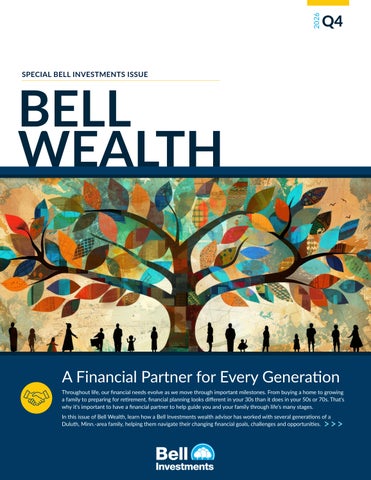
A Financial Partner for Every Generation Throughout life, our financial needs evolve as we move through important milestones. From buying a home to growing a family to preparing for retirement, financial planning looks different in your 30s than it does in your 50s or 70s. That’s why it’s important to have a financial partner to help guide you and your family through life’s many stages. In this issue of Bell Wealth, learn how a Bell Investments wealth advisor has worked with several generations of a Duluth, Minn.-area family, helping them navigate their changing financial goals, challenges and opportunities.
More than a decade ago, Deb Flynn and her husband, Denny, started working with Bell Investments wealth advisor Kristin Montgomery. Over the years, Deb and Denny got to know Kristin on a personal level as she helped them prepare for retirement and work toward other financial goals, including establishing 529 college savings plans for their grandchildren and, more recently, greatgrandchildren. “I trust Kristin, and that’s big for us,” said Deb, now 73. In recent years, several of Deb’s children and grandchildren have also chosen to work with Kristin, and Deb has enjoyed seeing those relationships develop. “My kids and grandkids trust her, they like working with her,” Deb said. “That means a lot to me.”
A TRUSTED RELATIONSHIP
Both of Deb’s daughters, Kristen Lesemann and Kara Ward, also work with Kristin. Like Deb, Kristen has built a strong relationship with Kristin over the years. That matters, Kristen said, because her previous financial advisors often treated her more like a number than a person. “There wasn’t much of a relationship at all in those cases,” Kristen said. “Your statements would come in the mail, and maybe you’d have an annual review, but that was it.” Her relationship with Kristin is very different from those examples. The two speak regularly, Kristen said, not only about investments and accounts but also about life and family. “I don’t just consider her my advisor. I consider her my friend,” Kristen said. “Even though she spells her first name wrong,” she added with a laugh.
For 30-year-old Hannah, Kristin’s guidance came during a period of change, after she moved cross-country for a new job. Kristin helped Hannah and her husband, Taylor, manage the financial complexities of that transition. That included rolling over Hannah’s 401(k) from her old job, buying their first home and paying off debt from the move. “Kristin has helped me through major life changes and has taught me a lot,” Hannah said. “She goes above and beyond for us, and that’s been huge for me at my age.”
A FINANCIAL PARTNER FOR EVERY STAGE OF LIFE
Hannah has a 3-year-old son, Emerson, and Deb and Denny have already worked with Kristin to establish a 529 plan for him. Through that plan, Kristin is now helping a fourth generation of the family prepare for the future. “It’s a privilege to work with a family across generations and be trusted with such an important part of their financial lives,” Kristin said. “I’m grateful for the opportunity to help guide them through important decisions, knowing that what we do today can have an impact for future generations.”
Kristen Lesemann, left, with son Joshua Ernst, husband Jim Lesemann, and dog Ari.
Rob Woytassek, Bell Investments program manager, says the family's example illustrates the value of having a financial partner who can be there at every stage of life. “Financial planning isn’t a one-time conversation,” Rob said. “Life changes, and we want to help when it does.” For Kristin and Bell Investments, that commitment now spans multiple generations. As the family continues to grow, she looks forward to helping navigate whatever comes next. Hannah Magee, left, with son Emerson and husband Taylor.
JOB CHANGES, FIRST HOMES AND SAVING FOR THE FUTURE
Kristin also works with Kristen’s son Joshua Ernst, as well as Kara’s two children, Reece Ward and Hannah Magee, representing the third generation of the family to work with Kristin.
Denny and Deb Flynn.
Kristin Montgomery, CFP® VP/Wealth Advisor
2
These statements are testimonials by clients of the financial professional as of October 14, 2026. The clients have not been paid or received any other compensation for making these statements. As a result, the client does not receive any material incentives or benefits for providing the testimonial. These views may not be representative of the views of other clients and are not indicative of future performance or success.
INVESTMENT SCAMS:
WHAT TO KNOW AND HOW TO PROTECT YOURSELF
Emmett Worth, MBA, AIF® | VP/Wealth Advisor
In 2025, investment fraud resulted in more than $8.6 billion in reported losses, according to the FBI’s most recent internet crime report. Investment scam losses have increased exponentially since 2020, the FBI reported, and show no signs of slowing down.
HOW TO IDENTIFY INVESTMENT SCAMS
With this type of fraud posing a threat, here is what to know about these scams and how you can protect yourself.
• Research thoroughly: Investigate any investment opportunity before making a decision. Doing your own research by tracking a company, its record, and the people behind it can help you determine whether it is legitimate
Avoiding investment scams requires vigilance and skepticism. Here are some essential tips to protect yourself and your accounts.
WHAT ARE INVESTMENT SCAMS?
Investment scams are fraudulent practices that prey on individuals or businesses seeking financial gain. Typically, these scams promise substantial monetary gains with little to no risk, enticing victims to invest their money. Investment scams can take many forms, with scammers using infomercials, social media, online ads, emails or phone calls to reach out to unsuspecting victims. This makes it imperative to be cautious and verify any requests before responding.
or not. Lean on your wealth advisor, who can help examine investment opportunities and provide guidance on recognizing fraud tactics that might be at play. • Be skeptical: It is always best practice to be skeptical of any promises, especially if they promote high returns with little risk. Such a claim is likely too good to be true. It is okay to be suspicious, to ask questions and to pause and be certain before acting.
TYPES OF INVESTMENT SCAMS
• Beware of cold calls and unsolicited emails: Be wary of unexpected phone calls or emails, as more legitimate investments do not typically approach investors like this. Do not provide or confirm any sensitive information, especially to someone you don’t know.
Some of the most common types of investment scams include: • Investment training: Scammers will make empty promises and claim they have a “patented” or “proven” strategy that will teach you how to “get rich” fast by investing in specific products or markets.
• Avoid pressure tactics: Scammers often pressure you into making a hasty decision. Take your time and investigate thoroughly. Someone with your best financial interests in mind would not pressure you into making a major decision in a short period of time.
• Real estate: These scams claim there is a lucrative property development deal that you can’t pass up. The goal of this scam is to get you to listen to their sales pitch and convince you to act urgently and invest money in a property that is either inadequate or nonexistent.
• Educate yourself: Stay up to date on the latest investment scams, different investment types and common tactics. The more informed you are, the better equipped you will be to notice red flags and protect yourself from fraud.
• Ponzi/pyramid scheme: These schemes occur when investors earn potential returns by recruiting more investors. However, the investments are usually fake and very few assets actually exist. As the total number of investors grows, the supply of new investors slows down. This eventually leads to not enough money being made to pay any promised returns or cover the investors trying to cash out.
3
Tyler Swanson, CFP®, CEPA® | VP/Wealth Advisor
UNDERSTANDING THE TYPICAL COMPONENTS OF AN ESTATE PLAN The topic of estate planning may be difficult to think about, but it can be important for achieving financial wellness, both for yourself and your loved ones. Besides designating how you want your assets to be distributed, an estate plan provides your healthcare directives, simplifies or avoids the probate process and may help minimize taxes. Additionally, it helps protect your loved ones by minimizing conflicts and ensuring their financial security.
advisor can help review whether charitable giving, lifetime gifts to family members or other planning strategies may fit your overall goals, cash flow needs and tax picture. Coordinating your wishes with your advisor can help provide direction within the context of your personal financial plan to enhance what we call your “return on life.”
Estate planning is also an opportunity to make sure your financial plan reflects your personal values. Your wealth
LAST WILL AND TESTAMENT This document outlines how you want your assets distributed after your death.
Read on to learn about the typical components of a comprehensive estate plan.
4
It allows you to name an executor who will manage your estate, pay debts and distribute your assets. You can also designate guardians for minor children. REVOCABLE LIVING TRUST A trust is a legal entity that can “own” assets. The document looks much like a will, and like a will, includes instructions for who is to handle final affairs and who is to receive the deceased’s assets. Today, many people use a revocable living trust instead of a will in their estate plan because it avoids the need for court action at death (probate) and at incapacity.
Creating an estate plan involves careful consideration and documentation to ensure your wishes are honored and your loved ones are taken care of after your death.
To create a basic revocable living trust, you create a document called a trust agreement or declaration of trust, which is similar to a will. You typically name yourself as trustee (the person in charge of the trust property). If you and your spouse create a trust together, you can be co-trustees. As long as you are alive and competent, you can change the trust document, add or remove assets, or even cancel the trust.
process for trust-owned assets because assets are legally owned by the trust, not the deceased individual.
communicate them, including instructions on life support, resuscitation and other critical care decisions.
It is important to coordinate with your wealth advisor and attorney to confirm that account ownership, asset titling and beneficiary designations align with your plans. Even a well-drafted estate plan may not work as intended if accounts are not titled properly or beneficiary designations are outdated.
BENEFICIARY DESIGNATIONS For assets like life insurance policies, retirement accounts and payable-ondeath accounts, beneficiary designations are crucial. These designations override the instructions in your will or revocable living trust, giving these assets directly to the named beneficiaries.
For a revocable living trust to work properly, you must transfer your assets into it or name your trust as the beneficiary of the account or property. Titles/ownership of assets must be changed from your individual name (or joint name with a spouse or partner) to the name of your trust. You typically serve as the trustee while alive, managing the assets, and a successor trustee takes over upon death or incapacity, distributing assets directly to beneficiaries or continuing to hold those assets in trust without court involvement. This bypasses the probate
DURABLE POWER OF ATTORNEY This document designates someone to make financial decisions on your behalf if you are unable to do so. The chosen individual can manage your assets, pay bills and handle other financial matters.
Beneficiary designations should be reviewed regularly, especially after major life events such as marriage, divorce, the birth of a child, the death of a loved one or changes to your estate plan. Retirement accounts and life insurance policies often pass outside of a will, so keeping these designations current is a key part of making sure your plans are carried out.
HEALTHCARE DIRECTIVE Also known as a medical/healthcare power of attorney or living will, this document appoints someone to make medical decisions for you in the event you are incapacitated. This document ensures that your healthcare preferences are respected even when you cannot
Creating an estate plan involves careful consideration and documentation to ensure your wishes are honored and your loved ones are taken care of after your death. Consulting with your advisor and an estate planning attorney can help you navigate the complexities of estate planning and create a comprehensive plan that meets your needs. This information is not intended to be a substitute for specific individualized tax or legal advice. Estate planning may require tax and/or legal assistance, which neither LPL Financial, nor its registered representatives, provide. While the tax or legal information provided is based on our understanding of current laws, and has been gathered from sources believed to be reliable, it cannot be guaranteed. Federal tax laws are complex and subject to change. Always consult a qualified tax and/or legal advisor for information as to how taxes may affect your particular situation.
5
Nick Peterson, CFP® | VP/Wealth Advisor
INVEST IN THEIR FUTURE WITH A 529 PLAN Looking for a great way to invest in a child’s future? A tax-advantaged 529 college savings plan can be a great option. A 529 plan is specifically designed to help families save for future college expenses, and can make a big difference in helping a child achieve their education goals and career aspirations.
HOW 529 PLANS WORK
As you contribute to a 529 plan, the assets grow tax-free over time. When the funds are used for qualified education expenses such as tuition, room and board, books or even certain K-12 costs, you don’t pay federal income taxes on the withdrawals. 529 plans can be tailored to fit your needs and provide flexibility through: • The ability to use funds at any accredited institution. Funds can be used at eligible colleges, universities, vocational schools and even some international institutions. • High contribution limits. Many plans have no annual contribution cap, and lifetime limits vary by state but are often substantial. The federal gift tax exemption for contributions to 529 plans is also high: currently $95,000 per person every five years.
• Control over the funds. The account owner retains control over how and when the funds are used.
KEY BENEFITS
One of the biggest benefits of 529 plans is that you get to enjoy tax-free growth and withdrawals for qualified expenses (some states offer additional tax deductions or credits for contributions). Additionally, if your beneficiary ends up not needing the funds, you can transfer the account to another family member.
WHO CAN OPEN A 529 PLAN?
Parents, grandparents, godparents, aunts, uncles or even family friends can open and contribute to a 529 plan. You can also name anyone as the beneficiary.
SECURE ACT 2.0 CHANGES
In the past, some families hesitated to fund 529 plans out of fear that their contributions would be trapped and penalized if their child skipped college. The SECURE Act 2.0, signed into law in December 2022, addressed this concern by permitting tax and penaltyfree rollovers of unused funds into a beneficiary’s Roth IRA, up to a lifetime limit of $35,000.
6
To qualify for this rollover option, accounts must be at least 15 years old; contributions and earnings from the past 5 years are excluded; and transfers are bound by annual Roth contribution limits and earned income requirements. These changes helped make 529 plans more flexible, effectively turning an educational nest egg into tax-free retirement savings for any child who chooses not to go to college.
START EARLY
Just like with your 401(k) retirement plan, the earlier you start saving in a 529, the more time your money has to grow. Even small, regular contributions can add up over time. Prior to investing in a 529 plan, investors should consider whether the investor's or designated beneficiary's home state offers any state tax or other state benefits such as financial aid, scholarship funds, and protection from creditors that are only available for investments in such state's qualified tuition program. Withdrawals used for qualified expenses are federally tax free. Tax treatment at the state level may vary. Please consult with your tax advisor before investing.
BUILDING A BRIDGE TO RETIREMENT: HOW SEMI-RETIREMENT CAN HELP PROVIDE A TRANSITION FROM FULL-TIME WORK
Missy Hexum, ChFC® | VP/Wealth Advisor
After decades of working, retirement represents a new chapter of life. However, that change from full-time work to the freedom and flexibility of retirement can sometimes feel abrupt. For some people, semi-retirement is a way to bridge that gap. Semi-retirement is a transitional phase allowing individuals to reduce their work hours or shift to less demanding roles while still earning an income. It is an increasingly popular option for those who are not quite ready (or financially able) to stop working entirely but want more flexibility and time for personal pursuits. Depending on an individual's goals and financial needs, semi-retirement could involve scaling back hours at their current job or transitioning to part-time roles, freelance work or consulting. Benefits of semi-retirement can include: • Financial security. Through a continued income, you can preserve your savings and delay drawing down retirement accounts. • Mental and physical well-being. Maintaining a routine and sense of purpose through part-time work can help support your health. • Flexibility. Enjoy more personal time without fully giving up the benefits of working. • Gradual transition. Semi-retirement eases the psychological shift from a careerfocused life to full retirement.
A SIX-STEP PLAN FOR ACHIEVING SEMI-RETIREMENT
Successful semi-retirement can require careful financial and lifestyle planning. Depending on your situation, key considerations may include:
1
2 3 4 5 6
Financial assessment: Evaluate your current savings, retirement accounts and income needs. Calculate how much you need to supplement your retirement savings with part-time work. Flexible income streams: Identify potential income sources, such as consulting, part-time employment or non-retirement investment accounts, to ensure you’re financially secure. Healthcare coverage: Consider how you’ll maintain health insurance, especially if you leave a full-time job with benefits. Options might include Continuation of Health Coverage (COBRA), spousal coverage or private insurance. Social Security strategy: Delaying Social Security benefits can increase your monthly amount later. Decide whether to claim early or wait. Skill assessment and career pivot: If you’re planning to shift industries or take on freelance work, upskill or retrain as needed before scaling back. Lifestyle adjustments: Practice living on a semi-retirement budget to see if it feels sustainable.
The most difficult part of semi-retirement is the mindset, not the math. For decades, we have been conditioned to save, build and accumulate. Shifting overnight to spending down your net worth can trigger immense financial anxiety. Semiretirement acts as a psychological bridge, essentially giving you permission to transition slowly without the shock of watching your nest egg immediately decrease. With careful planning and preparation, you can create a flexible, fulfilling lifestyle that bridges the gap between full-time work and complete retirement. If you’re wondering if semi-retirement could be right for you, contact a Bell Investments wealth advisor today. Informational Sources: Fidelity: “Guide to Working Less and Living More” (November 18, 2024); Smart Asset: “What Is Semi-Retirement and How Do You Do It? (May 29, 2024). This material is for general information only and is not intended to provide specific advice or recommendations for any individual.
7
Inside this issue: s A Financial Partner for Life s What to Know About Investment Scams
www.bell.bank
520 Main Ave | Fargo, ND 58103
s Understanding the Different Parts of an Estate Plan s Invest in a Child's Future With a 529 Plan s Building a Bridge to Retirement 701-451-3000 | 800-709-5781 The content is developed from sources believed to be providing accurate information. The information in this material is not intended as tax or legal advice. It may not be used for the purpose of avoiding any federal tax penalties. Please consult legal or tax professionals for specific information regarding your individual situation. This material was developed and produced by FMG Suite to provide information on a topic that may be of interest. FMG Suite is not affiliated with the named broker-dealer, state- or SEC-registered investment advisory firm. The opinions expressed and material provided are for general information and should not be considered a solicitation for the purchase or sale of any security. Copyright FMG Suite. This newsletter has been written for the general information of clients and friends of Bell Bank. It is not intended, nor may it be relied upon, as tax or legal advice with respect to any matter. This newsletter also cannot be used by a taxpayer for the purpose of avoiding penalties that may be imposed by the Internal Revenue Service or other taxing authority. Your Bank (“Financial Institution”) provides referrals to financial professionals of LPL Financial LLC (“LPL”) pursuant to an agreement that allows LPL to pay the Financial Institution for these referrals. This creates an incentive for the Financial Institution to make these referrals, resulting in a conflict of interest. The Financial Institution is not a current client of LPL for advisory services. Please visit https://www. lpl.com/disclosures/is-lpl-relationship-disclosure.html for more detailed information. Securities and advisory services are offered through LPL Financial (LPL), a registered investment advisor and broker/dealer (member FINRA/SIPC). Insurance products are offered through LPL or its licensed affiliates. Bell Bank and Bell Investments are not registered as a broker/dealer or investment advisor. Registered representatives of LPL offer products and services using the name Bell Investments, and may also be employees of Bell Bank. These products and services are being offered through LPL or its affiliates, which are separate entities from and not affiliates of Bell Bank or Bell Investments. Securities and insurance offered through LPL or its affiliates are: Not Insured by FDIC or Any Other Government Agency
Not Bank Guaranteed
8
Not Bank Deposits or Obligations
May Lose Value