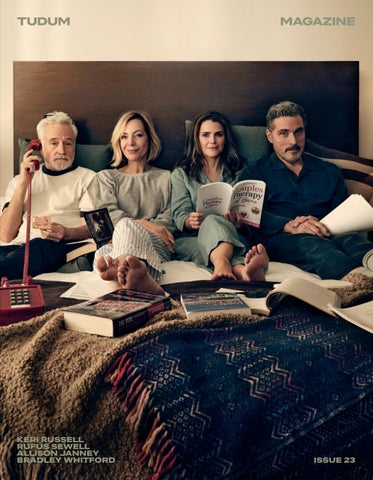
TUDUM
KERI RUSSELL RUFUS SEWELL ALLISON JANNEY BRADLEY WHITFORD
MAGAZINE
ISSUE 23
Table of Contents 04 Queued Up 28 Features
30 The Diplomat Cast 40 Cillian Murphy 46 BEEF
52 Book to Screen:
Death by Lightning 56 Stranger Things 64 Jude Law & Jason Bateman 70 Mae Martin 76 Sean Combs: The Reckoning 80 Squid Game 104 Charlie Hunnam 114 The Beast in Me 118 Rachel Weisz 122 Justine Lupe, Timothy Simons & Jackie Tohn 128 Louis Theroux 132 Wednesday 138 Emily in Paris 144 Generation N 150 Dinner Party: Gordon Ramsay
84 Unscripted ON THE COVER
Charlie Hunnam photographed by Carter Smith. The cast of The Diplomat photographed by Art Streiber.
Tudum Magazine
40 CILLIAN MURPHY returns to Tommy Shelby’s story in Peaky Blinders: The Immortal Man
30
THE DIPLOMAT CAST
navigates diplomacy, marriage, and modern power in Season 3
3
114 THE BEAST IN ME
dives into moral ambiguity and humanity’s hidden shadows
104
CHARLIE HUNNAM
confronts terror head-on in Monster: The Ed Gein Story
46 BEEF
comes back bigger, darker, and more uncomfortably intimate Issue 23
Noah Schnapp and Millie Bobby Brown on the set of Stranger Things Season 5.
Queued Up 06 THE BREAKTHROUGH
Yerin Ha
08 THE MAP
Stranger Things
10 PLAYLIST
Nobody Wants This
12 SPOTLIGHT
Being Eddie
14 ARTIFACTS
Bridgerton
18 SPOTLIGHT
Something Very Bad Is Going to Happen
20 WATCH LIST
Spring Flings
P H OTO BY N I KO TAVE R N I S E.
22 SOUND BITES
That’s What They Said
24 SPOTLIGHT
His & Hers
26 THE LEGEND
Laurie Metcalf Issue 23
The Breakthrough
Yerin Ha The latest actress to join Bridgerton shares her take on her enchanting character, Sophie Baek. By Ariana Romero Photograph by Mei Tao Benedict Bridgerton (Luke Thompson) didn’t want to go to his mother’s masquerade ball. He was much happier in the unbuttoned revelry of the demimonde, where artists gather, port wine flows freely, and anyone could kiss in the low lighting. But he still loves his mother, so by the midpoint of the Bridgerton Season 4 premiere, Benedict shows up to her party. Late. But he’s there, and one woman makes the trip worth it: the Lady in Silver (Yerin Ha). Benedict’s heart is struck by Cupid’s arrow when he spots this mysterious “silver ingenue” — who is the maid Sophie Baek in disguise — across the Bridgerton ballroom. Sophie is also bowled over. “It was love at first sight,” Ha says. “Ever since that night, Sophie’s life changes, and [she] goes on quite a journey.” Despite all the emotion, Sophie doesn’t melt into Benedict’s arms when she realizes she’s speaking with Mayfair’s most eligible bachelor. Instead, Sophie recognizes that he uses his famous charm to keep conversations from getting too personal, so she urges him to leave the comfort of shallow waters for something “deeper” with her. “She does challenge him, but not out of spite,” Ha says. “She challenges him because she is curious and wants to see if he can banter … with her.” Tudum Magazine
The result is a dance on the terrace that sizzles with desire, reaching a crescendo with three searing kisses — one on Sophie’s cheek, one on her ungloved wrist, and a third on the lips, initiated by Sophie herself. “There are definitely moments when Sophie does lean into the fantasy and the dreamlike quality of potentially finding someone finally for the first time in her life,” Ha says. This is just the first of Benedict and Sophie’s fateful meetings. As their fairy-tale love story unfolds, it’s clear that destiny has something to say about these would-be star-crossed lovers. Ha joins Thompson in Bridgerton Season 4 after roles in Dune: Prophecy and the Aussie drama The Survivors. “What drew me to Sophie as a character was her strong moral compass,” the Korean Australian actor says. “She doesn’t change who she is for anybody else. She is faced with a lot of obstacles, but she moves through them with such grace and kindness.” In Part 1, we learn Sophie is the daughter of a nobleman and a maid; after experiencing years of hardship and tragedy because of it, she’s determined not to follow in her mother’s footsteps. Nothing terrifies Sophie more than the idea of giving her heart to an aristocrat
like Benedict — no matter how much she feels for him. While joining the fourth season of a global phenomenon could’ve been daunting, Ha found a safe landing. Not only was she welcomed with kind words and friendly gifts — “Claudia [Jessie] got me a little bookmark,” Ha says — she was given the perfect on-set introduction. Some of Thompson and Ha’s first scenes together were filmed at Loseley Park, the stand-in for Benedict’s country estate, My Cottage. “That’s really where Benedict and Sophie’s relationship blossoms,” Ha explains. “It’s parallel [to] Luke and me, because that’s where our friendship started to blossom as co-stars. I have a nostalgic, sentimental attachment to that place now.” If Ha appears particularly charming on the shores of My Cottage, that’s because the lake scene was part of her audition, Bridgerton showrunner Jess Brownell reveals. “In the role, Yerin embodies this childlike playfulness that we talked about a lot for Sophie. This comes from the idea that Sophie’s childhood got taken away from her,” Brownell says. “But Yerin also has a seriousness and a gravitas that make her a good foil for Benedict, who is a man with a strong will.”
7
The Map
Stranger Things
20
18
19
17
The Duffer Brothers’ cultural phenomenon is set in an immersive world. By Jenny Changnon Illustration by Andrew DeGraff
When the final season of Stranger Things begins, the small Midwestern community of Hawkins, Indiana, is in chaos. The Rifts have blurred the lines between the real world and the Upside Down, and the town is under quarantine and occupied by the military. While the Hawkins heroes are no strangers to a challenge, these conditions make their hunt to find and stop the allpowerful Vecna more complicated. “We usually set up their normal life and how they’re going about school, and then we introduce the supernatural element. But in this case, this season is sprinting from the start,” says co-creator Ross Duffer. After five expansive seasons, the creative team answers long-lingering questions in the last chapter, about the complexities of the Upside Down, the origins of its biggest bad, and how Henry Creel’s mind ties them all together. “I think we’ve slowly been peeling back the layers over the seasons, but this being our final season, our characters finally learn exactly what this place is,” adds co-creator Matt Duffer. Here, take a look at some of the key locations in the Stranger sprawl.
1. Eleven’s training camp 2. Hawkins High School 3. Hawkins Library 4. Hawkins Hospital 5. Hawkins Lab
Tudum Magazine
16
14
15
13
12
11
6. The Byers’ house 7. Exotic matter 8. “The Squawk” radio station and tower 9. Gable Ridge Road base 10. Mind Flayer
11. Hawkins Lab Rainbow Room 12. Center of Henry Creel’s mind 13. The Wheelers’ house 14. Hawkins Elementary School and playground 15. The mineshaft
16. The cave 17. The Snow Ball dance 18. The Creel house 19. 1959 Hawkins High School hallway 20. The high school’s play
9
10
9
8 7
6
5
2 4 3
1
Issue 23
Nobody Wants This
Playlist
By Jenny Changnon
Noah (Adam Brody) and Joanne (Kristen Bell).
The comedy series Nobody Wants This has become defined by its relatable romance and the undeniable chemistry between its leads, Kristen Bell and Adam Brody as Joanne and Noah. But it’s also known for its soundtrack and the earworms that fill it. So when music supervisors Manish Raval, Tom Wolfe, and Jonathan Leahy of Aperture Music joined the Erin Foster– created show ahead of its sophomore outing, they had their work cut out for them. “[The series] came fully preloaded with an amazing cast, an amazing first season, an amazing palette of music that they had already established in Season 1,” says Raval. “The only agenda we had was, ‘How do we take what they’re already doing so well [and] take it to the next level?’” Tudum Magazine
The answer was to create a wholly original soundtrack of new music from today’s most popular artists, including FINNEAS, Selena Gomez, GIVĒON, Alessia Cara, and ROLE MODEL. “Erin is really a fan of today’s music,” says Raval. “I think that lends itself to us really anchoring the show in today’s culture and today’s way of speaking.” Nestled alongside chart-topping hits from Chappell Roan, Taylor Swift, and Sabrina Carpenter, the original songs come from a stable of performers who fit in perfectly with the rom-com’s atmosphere — and who were already fans. “When you get a show like [this] where you galvanize … artists who like the show as well, it makes it so much
easier to then try to solicit them to make original music,” Raval says. He and his team encouraged the musicians to share unreleased music rather than write anything new. “We never wanted to have artists write directly about a moment that was happening [on the show]. That ends up helping because a lot of these songs that play in these scenes, they’re not specifically talking about the moment that’s happening in the show,” he explains. “They’re talking about a very universal feeling or emotion. And I think that’s what we’re responding to as the viewer and as a listener.” To score your own love story, queue up this Nobody Wants This playlist.
TAYLOR SWIFT BY MATT WINKELMEYER / GETTY IMAGES FOR THE RECORDING ACADEMY; FINNEAS O’CONNELL BY VALERIE MACON / AFP VIA GETTY IMAGES; SELENA GOMEZ BY TAYLOR HILL / FILMMAGIC.
11 SONG TITLE
PERFORMED BY
EPISODE
TIMESTAMP
Cuco
01
00:23:58
Chappell Roan
02
00:00:01
Taylor Swift
02
00:23:14
FINNEAS
03
00:25:40
Baylee Lynn
05
00:23:02
“Manchild”
Sabrina Carpenter
06
00:00:01
“My House”
Alessia Cara
06
00:02:26
“Saddle Again”
ROLE MODEL
07
00:14:49
“Heart Letting Go”
Chris Stapleton
09
00:17:26
“In the Dark”
Selena Gomez
10
00:01:43
GIVĒON
10
00:16:19
“Homesick” “Good Luck, Babe!” “... Ready for It?” “Palomino” “That’s What I’ll Be”
“Dancing in the Smoke”
“… Ready for It?”
This cut from Taylor Swift’s Reputation pairs perfectly with matriarch Bina’s (Tovah Feldshuh) quest to break up her son Noah and his girlfriend Joanne, particularly the moment she announces, “I have scissors.” Raval and the music supervision team went big for the moment, and it highlights the importance of complementing the series’ comedy rather than overpowering it. “It was just really about [finding] a way to enhance the joke there and not really play the joke,” he explains.
“Palomino”
This track from the Grammy- and Oscar-winning musician FINNEAS underscores the emotional beat when Noah announces he’s resigning from Temple Chai and stepping away from his dream job to pursue his life with Joanne. “We didn’t have any idea that that’s where the song would go, but the combination of this music and that scene ended up becoming such an amazing, powerful moment in the show,” says Raval.
“In the Dark”
Original tracks by some of the biggest established and rising stars in music play throughout the finale, which features an emotional whirlwind of an engagement party. The episode’s sonic tone could have gone in multiple directions, but once they placed this song by Selena Gomez, “suddenly that episode really took on a shape,” Raval says. “It was just this amazing moment, the way the season ended with this last episode with all of these songs. [It] was this huge victory for us.” Issue 23
Being Eddie Spotlight
13 The documentary offers an inside account of one of comedy’s defining voices, Eddie Murphy. For the first time, Eddie Murphy looks back on the extraordinary journey of his career — and looks ahead at what’s still to come. Being Eddie chronicles his meteoric rise from teen comic phenom to Saturday Night Live breakout, and stand-up supernova to box-office titan. In this intimate portrait, the Oscar-nominated actor opens up his home and dives deep into his eclectic career of 50 years. “There is no one else like him,” director and two-time Oscar winner Angus Wall says. “He’s been famous longer than just about anyone alive, and he’s never lost who he is. He has survived it all with grace.” In the documentary, Murphy discusses entertaining three generations of fans with a filmography that spans comedy, action, drama, animation, musicals, and family fare. Friends, co-stars, directors, and fellow comics like Adam Sandler, Arsenio Hall, Chris Rock, Dave Chappelle, Jamie Foxx, Jerry Seinfeld, Kevin Hart, and Tracee Ellis Ross offer insights into Murphy’s singular career and the influence it has had: stand-up films like Raw, ’80s megahits like Beverly Hills Cop and Coming to America, ’90s classics like The Nutty Professor, 2000s franchises like Shrek, and his Oscar-nominated performance in Dreamgirls. “There’s a clip of Eddie on a talk show early in his career talking about how he’s always been able to do impersonations and different voices. He talks about how his mom used to ask him, ‘Who’s Eddie? What voice is Eddie’s voice?’ This movie answers that question,” Wall says. “The only time the audience usually sees me is if I’m promoting a movie, so they’re not really ever seeing me,” Murphy says. “They’re seeing my comic persona — doing my shtick. But in the documentary, this is me. This is my house, this is my family, and this is how I did it. For the first time, they’re getting a little peek at me.”
Top to bottom: Eddie Murphy in his 1983 stand-up special, Delirious; Murphy with Vernon Lynch and Charlie Murphy; Murphy as a child with his Willie Talk ventriloquist doll.
Issue 23
Bridgerton Artifacts
Explore the costumes and wigs that shaped the storytelling in Bridgerton Season 4.
By Olivia Harrison Photography by Guillaume Blondiau The stunning sartorial world-building of Bridgerton continues in Season 4 as the artisans up their creative ante, starting with the Bridgertons’ jaw-dropping masquerade ball in Episode 1. It’s at this ball that the season’s main love story is set up between Benedict Bridgerton (Luke Thompson) and Sophie Baek (Yerin Ha). The costume team — which includes designer John Glaser, associate designer Dougie Hawkes, and assistant designer George Sayer — created 172 unique looks, while hair and makeup designer Nic Collins and her team assembled approximately 160 wigs. The opulent occasion is a highlight for sure, but the fashion feats don’t stop at the masquerade ball — wedding bells are ringing by the season’s end.
1
1. SOPHIE’S MASQUERADE SHOES & GLOVES The pumps — a modified Jimmy Choo heel — that Sophie borrows are emblematic of the luxuries of society that have always been just out of reach for the well-educated maid. For an added pop — and as an important plot device — the already flashy heels were also bedecked with shiny shoe clips. 2. BENEDICT’S MASQUERADE MASK & BRACELET Sarah Blackmore and the other milliners were able to create a molded domino mask for Benedict’s bohemian nature. “It was meant to fit him perfectly and allow a romantic, masculine feel, but be quite simple so that it didn’t take away too much from Sophie, for example, or the rest of his outfit or his face,” says Blackmore. 3. QUEEN CHARLOTTE’S MASQUERADE HEADPIECE & WIG Featuring a heart-shaped outer cage crafted from hair and silver leaf, this wig is a nod to Queen Charlotte’s enduring devotion to her husband George and his love of astronomy. “Queen Charlotte’s cage is a star formation from the constellation,” says Collins. “Inside this cage, there is a replica of the nuptial crown that George gifted to her, also made from hair.”
Tudum Magazine
2
3
Artifacts
4
5
Scan the QR code to explore more looks from the season. 6
Tudum Magazine
17 4. SOPHIE’S MASQUERADE DRESS “We wanted Sophie to have a moment to feel beautiful and like a princess,” showrunner Jess Brownell says of the character’s initial appearance as the Lady in Silver. “For Sophie’s dress, we created tiny appliqués, beaded with sequins, bugle beads, and seed beads, and gave final touches with crystal beads and a sparkle-pleated tulle in every single appliqué,” says head embellisher Maria Elena Gomez Patino. 5. QUEEN CHARLOTTE’S “TREE OF LIFE” WIG This wig, known as the Tree of Life, features 13 branches, each representing one of Queen Charlotte’s children. The acrylic gray hair is intricately braided upward to form the shape of a tree. It’s an artistic take on the Apollo knot, a top knot–style trend that began to rise in popularity around 1815.
7
6. QUEEN CHARLOTTE’S MASQUERADE DRESS & JEWELS This gown’s ornamentation — particularly the bows that frame the bodice and cascade down the opening of the overskirt — reflects the embellishment team’s sculptural approach to their Season 4 wardrobe work as a whole. “This season was more couture, it was more structural,” says Gomez Patino. “Even the bows weren’t just bows.” 7. BENEDICT’S WEDDING FOBS Commonly worn by men in the Regency era, fobs hung from trousers and held watches, keys, and even wax stamps used to seal letters or documents. On Benedict’s wedding day, the fobs also feature very sentimental charms symbolizing all that Benedict holds most dear: a propelling artist’s pencil, a sketchbook, and a cottage. The suggestion is that Sophie may have gifted these baubles to her new husband. 8. SOPHIE’S WEDDING DRESS “The wedding dress is a simpler version of the masquerade dress,” says Glaser. Now that we know who Sophie is, she’s free to be herself — versus the elaborate fantasy of the Lady in Silver. “The main idea was that the dress must be country and romantic at the same time,” says Gomez Patino.
9
9. SOPHIE’S PENDANT NECKLACE Sophie’s necklace symbolizes a connection to her heritage. During a consultation with the jewelry department, Glaser decided that the pendant should feature amethyst, a stone commonly mined in Korea. From there, jeweler Helen Christie sourced two options. The modest but meaningful piece perfectly compliments Sophie’s style, including her wedding attire. 10. BENEDICT’S KITE PIN Benedict dons this kite pin on his wedding cravat as an homage to an earlier scene when Sophie is endeared to the Bridgerton son’s playful nature as he convinces her to fly a kite. Hawkes also said that, according to jewelry maker Poonam Thanki, the kite was meant to represent the sense of freedom Benedict finally feels as he marries his true love.
8
10
Issue 23
Something Very Bad Is Going to Happen Spotlight
The psychological horror series follows a couple facing mounting dread in the week leading up to their wedding. By Henry Goldblatt
In the opening scene of Something Very Bad Is Going to Happen, a bride walks down the aisle to Wagner’s “Bridal Chorus.” You hear her breathing and her heartbeat and see her crimson lipstick and nails. Suddenly, she’s besieged by a flood of memories — or premonitions? — and the camera cuts to screams and a trail of blood. And it’s very clear that the show is going to live up to its name. From creator Haley Z. Boston (Guillermo del Toro’s Cabinet of Curiosities) and executive produced by Ross and Matt Duffer (Stranger Things), the psychological horror series follows engaged couple Rachel and Nicky — played by Emmy nominee Camila Morrone (Daisy Jones & The Six) and Actor Award winner Adam DiMarco (The White Lotus) — in the week leading up to their wedding as they face a pervasive feeling of dread. “The show is really about the feeling of doubt before you make this ultimate commitment of marriage,” says Boston. Tudum Magazine
While creating the thrillingly twisty series, Boston drew inspiration from Rosemary’s Baby, Carrie, and the Danish film The Celebration. But, rather ironically, the idea for the series originally stemmed from her parents’ “beautiful” marriage. “They sort of taught me that true love exists. And when I was very young, my mom told me, ‘Just make sure that you don’t marry the wrong person, because it can ruin your life,’” Boston says. “So I have been sort of haunted by this concept of there being a right person and a wrong person to marry. I’ve always said that it’s like a curse.” But even amid the mounting dread and creepiness — wait until you meet Nicky’s tight-knit family, the Cunninghams — Boston hopes that themes of love emerge, too: “I hope that the audience is engaging with this question of, ‘What is a soulmate? And how do I define what makes someone right for me?’”
19 “When I was very young, my mom told me, ‘Just make sure that you don’t marry the wrong person, because it can ruin your life.’” HALEY Z. BOSTON
Rachel (Camila Morrone) and Nicky (Adam DiMarco).
Issue 23
Spring Watch List
Forever
Set in 2018, Mara Brock Akil’s young adult romance follows Keisha (Lovie Simone) and Justin (Michael Cooper Jr.) as they fall in love — with each other and with the selves they’re helping each other become — against the sun-kissed beauty on both sides of Los Angeles’s 10 freeway.
Emily in Paris While Emily (Lily Collins) has found many love interests courting her across Paris and Rome during the series’ five seasons, the most enduring love story of all may be her friendship with Mindy (Ashley Park). Whoever comes next, one thing is certain: With Mindy by her side, Emily is never without deep love.
The Four Seasons In this adaptation of Alan Alda’s 1981 big-screen romantic comedy, longtime friends weather the shifting seasons of marriage and commitment. Danny (Colman Domingo) and Claude (Marco Calvani), like the other couples in the friend group, communicate through knowing glances and half sentences, the quiet language of long-term love. Tudum Magazine
Scan the QR code for more swoon-worthy series to fall hard and fast for.
Flings
21 To get in the mood for the season of love, check out these series fit for any hopeless romantic. By Madeleine Saaf-Welsh
Love on the Spectrum This unscripted favorite continues to charm as hopeful love-seekers navigate the dating world. In Season 3, Madison, the doll collector and jewelry designer, gives the audience butterflies as they watch her connect with country-boy Tyler in a romance that feels both tender and entirely their own.
Nobody Wants This Unlikely duo Noah (Adam Brody), a rabbi, and Joanne (Kristen Bell), a podcaster, prove that real relationships aren’t always easy but they can still be worth fighting for. Season 2 continues to explore whether Joanne will convert to Judaism, introducing new doubts, perspectives, and emotional stakes.
Virgin River For seven seasons, Mel (Alexandra Breckenridge) and Jack (Martin Henderson) have kept viewers rooting for their love just as fiercely as the townspeople do. In the latest season, settling into married life is the next river they’ll have to cross — together.
Issue 23
Sound Bites “I really do think maybe the first marker of aging is [the] vertical jump.” GEORGE CLOONEY, JAY KELLY
Skip Intro with Krista Smith
That’s What They Said
Familiar voices had some things to say on Netflix podcasts. Scan the QR code to listen to the latest Netflix podcasts.
“The Spice Girls gave me my personality back. They made me realize I actually wasn’t morose.” VICTORIA BECKHAM, VICTORIA BECKHAM
Skip Intro with Krista Smith Tudum Magazine
23 “I absolutely love not going to after-parties that go on till three o’clock in the morning.” KATE WINSLET, GOODBYE JUNE
Skip Intro with Krista Smith
“I used to rollerblade from audition to audition. With wrist guards.” CLAIRE DANES, THE BEAST IN ME
Skip Intro with Krista Smith
“We went from that normal experience of just sitting in your living room and watching [the Oscars] to the next year being in the front row and Billy Crystal singing a song to us.” MATT DAMON, THE RIP
Skip Intro with Krista Smith
“Every lingering look, every attempted pinnacle, every cheeky glimpse of a nobleman’s bum.” ALISON HAMMOND, THE GREAT BRITISH BAKING SHOW Bridgerton: The Official Podcast
Issue 23
R E P ORT I N G BY A R I A N A R OM E R O A N D OL I V I A H A R R I S ON .
Spotlight
Tudum Magazine
His &
Hers Jack (Jon Bernthal) and Anna (Tessa Thompson).
25
The twisty thriller unpacks marriage, murder, and mistrust. There are two sides to every story: his and hers, which means someone is always lying. And the seductive and twisty psychological thriller His & Hers — from visionary filmmaker William Oldroyd (Eileen, Lady Macbeth) and adapted from Alice Feeney’s novel of the same name — invites you to decide who to trust. Tessa Thompson (Creed, Passing) and Emmy winner Jon Bernthal (The Bear, The Walking Dead) lead the drama as Anna Andrews and Jack Harper, two Georgia residents with an intriguing connection to a shocking murder. “I am beyond elated to be collaborating with a filmmaker I have long admired and an incredible team to make a fresh offering in a genre that I can never get enough of,” says Thompson, who also executive produces His & Hers. “From the second I heard what Will was imagining doing with Alice Feeney’s brilliant book to the moment I visited the town where our story is set, I was hooked.” In the sweltering heat of Atlanta, Anna lives in haunted reclusion, fading away from her friends and career as a news anchor. But when she overhears talk about a murder in Dahlonega — the sleepy north Georgia town where she grew up — she is snapped back to life, pouncing on the case and searching for answers. Her estranged husband, Detective Jack Harper, is suspicious of her involvement, chasing her into the crosshairs of his own investigation. While the drama may have its sultry moments and shocking twists, Bernthal explains that family and trauma are at the center of His & Hers. “Ultimately, it really is about this broken relationship between Anna and Jack mending itself,” Bernthal says. “They realize the only way to truly mend is to come together. Then you really see how capable this couple can be.” Issue 23
Laurie Metcalf The Legend
The decorated performer flexes her range in Monster: The Ed Gein Story and Big Mistakes. By Jenny Changnon
Metcalf plays matriarch Linda in comedy thriller Big Mistakes.
In Monster: The Ed Gein Story, the actor chills as Ed’s mother, Augusta.
Tudum Magazine
Throughout her decades-long, genrespanning career, Laurie Metcalf has time and again illustrated that she’s able to do just about anything. Across stage and screen, the two-time Tony Award and four-time Emmy winner has embraced broad comedies (Roseanne, The Conners) and provocative dramas (JFK, Broadway’s A Doll’s House, Part 2), as well as instant coming-of-age classics like the Toy Story franchise and Lady Bird, which earned her an Academy Award nomination. No matter the part, it’s impossible to take your eyes off Metcalf, and now, in Monster: The Ed Gein Story and Big Mistakes, the actor proves just how sweeping her range really is. Metcalf turns in one of the most chilling performances of her career
as Augusta Gein, mother of infamous Wisconsin serial killer Ed Gein. The latest installment of Ryan Murphy and Ian Brennan’s anthology series shifts its lens to the shocking murders and grave robberies that terrorized the Geins’ smalltown community and the imaginations of many more throughout the 1950s and beyond. Ed, played by Golden Globe and Actor Award nominee Charlie Hunnam, was raised in isolation by Augusta on a secluded plot of farmland, and the Emmy-winning anthology explores their troubling codependent relationship — which loosely inspired the iconic motherson dynamic in Alfred Hitchcock’s Psycho. Metcalf utterly transforms as she inhabits the elder Gein’s fearsome personality; Augusta is steadfast in her religious fanaticism and the staunch moral codes that shape Ed’s disturbing worldview and behavior. Even after her death, Augusta’s presence haunts Ed as he descends deeper into his own madness. The Monster series questions whether monsters are born or made, and Metcalf is unflinching in her portrayal of Ed’s maker. Metcalf can also be seen as a very different kind of matriarch in the family crime comedy Big Mistakes. The performer stars opposite Emmy Award winner Dan Levy, who co-creates, executive produces, and showruns the comedy thriller series. In Big Mistakes, Metcalf plays Linda, a slightly domineering but devoted mother who isn’t afraid to use tough love with her adult children — Nicky (Levy), Morgan (Taylor Ortega), and Natalie (Abby Quinn) — and who manages the chaos of her brood even as she grieves the death of her own mother. Linda, a business owner and an upstanding member of her New Jersey community, is navigating her own mayoral campaign, running on a family-first strategy. Meanwhile, unbeknownst to her, the hopeless Nicky and Morgan are being blackmailed into the world of organized crime. Metcalf’s killer comedic sensibility and scene-stealing choices make the fierce and protective Linda an instant entry into her armory of singular performances.
P ORT R A I T BY CA R OL I N E TOM PK I N S / T H E N EW YOR K T I M E S / R E DU X ; O N S E T PH OTO G RA PH F RO M BI G M I STA KE S BY S PE N C E R PA Z E R.
27
Issue 23
TUDUM THE DIPLOMAT PEAKY BLINDERS: THE IMMORTAL MAN BEEF DEATH BY LIGHTNING STRANGER THINGS BLACK RABBIT WAYWARD SEAN COMBS: THE RECKONING SQUID GAME MONSTER: THE ED GEIN STORY THE BEAST IN ME VLADIMIR NOBODY WANTS THIS LOUIS THEROUX: INSIDE THE MANOSPHERE WEDNESDAY EMILY IN PARIS BEING GORDON RAMSAY MAGAZINE
Kitchen Cabinet
Keri Russell, Rufus Sewell, Allison Janney, and Bradley Whitford marry diplomacy with domesticity in the third season of the Emmy-nominated drama The Diplomat. By JENNY CHANGNON Photography by ART STREIBER
32
T
The characters of The Diplomat couldn’t be facing a bigger crisis when the third season of the hit political drama picks up. In the preceding season’s finale, Kate Wyler (Keri Russell) discovered that the president of the United States had a heart attack, making Vice President Grace Penn (Allison Janney) the leader of the free world. Did we mention that Kate recently learned Grace orchestrated a terrorist plot? “It’s second-by-second what happens, which is actually really interesting — the whole breakdown of what happens when there’s a death of a president and how important it is, how they go through all the protocol,” says Russell. The Emmy-nominated series’ return whisks Kate, her husband Hal (Rufus Sewell), and Grace through the chaos of succession and the selection of a new VP. “If you’re playing someone who’s confident, it’s really good to get to play them absolutely rattled,” says Sewell. “You get to see another side of all of us.” The latest season of the drama, created by Debora Cahn, delves into the underbelly of another political power couple: Grace’s husband, Todd (three-time Emmy winner Bradley Whitford), enters as the “first lady” — a moniker he begrudgingly gives himself. “Having the character of Todd come on [means] you get to see … the private-facing Grace, not just the publicfacing Grace,” Janney says. “It’s so great that it’s Brad, because we have a relationship already.” Whitford reunites with his West Wing collaborators Janney and Cahn, who began her career writing and producing the White House drama. “Shows that really hum, that resonate and become a chord, are the ones where the political issues are resonating with the personal issues,” says Whitford. “The thing that I love about this show is the diplomacy is always just amplified and resonating with what’s going on personally. I realized it the moment I saw the first episode. And that’s really fun. There’s a power dynamic. There’s negotiation.” Tudum Magazine
35
“This season is about getting what you want and what that does to you.”
ON T H E C OV E R : K E R I R U S S EL L W EA R S A DO M I PA JA M A S E T, R UF U S S E W EL L W E A RS A LUN YA PA JA M A S E T, A LLI S O N JA N N E Y WE A RS A TOP BY S U Z I E KONDI A N D PA N TS BY BE DH E A D PJ , A N D BR A D LE Y W H I T F O R D WE A R S A S AVE K H A K I U N I TE D T- S H I RT A N D S WE ATPA N TS .
RUFUS SEWELL
Alliances shift over the course of the season, often from episode to episode, as Grace chooses Hal over Kate as her VP despite his impulsivity. Meanwhile, Kate and Hal move forward with a public marriage despite a private separation, and Todd struggles to make sense of his role within this reluctant foursome. “What’s so great is we have this huge choice to make as individuals and as a couple this season, and it’s enormous for [them] and for their individual lives. It shifts everything,” Russell says. Adds Sewell, “This season is about getting what you want and what that does to you.” Since the series premiere, The Diplomat has been nominated for 11 Critics Choice Television Awards, seven Golden Globe Awards, five Actor Awards, and three Emmy Awards, including Outstanding Drama Series. Even as their characters navigate turmoil, the cast found nothing but harmony among themselves: “Acting is a team sport,” says Janney. And with a fourth season on the horizon — with Janney and Whitford expanding their roles to series regulars alongside Russell and Sewell — they get to keep playing it. Here, the performers look back on the making of the third season of The Diplomat, some of the most jaw-dropping moments, and more. As actors in, but also fans of, The Diplomat, what was it like getting the scripts for the season? Allison Janney: It was pretty great to see where it was going to go in Season 3. Debora made the great decision to start right where we left off. So here I am, thrust into the role of being president. It was a pretty dramatic season for me. Rufus Sewell: The first decision she makes is such an incredible shocker for us. Everything that we’ve established in terms of the dynamic, the tables [are] completely being reversed, which is fantastic for all of [us].
There is such an intimacy this season between these two couples and the way their partnerships cross between the personal and the political. How has it been playing with those dynamics? Keri Russell: I love the variety of it. Everyone has their own rhythm, and each couple has its own energy, and they’re all equally different and fun in their own ways. Janney: Grace gets to choose between [Hal and Kate], and I think she realizes that Hal is more aligned with the way she operates in the political world. She’s willing to go a little way to the left to get to the right. She’s willing to do whatever it takes. I think Kate is a little more by the book. Sewell: It’s very illuminating. This idea of what is in character and what is out of character can be very, very misleading. It could be a very dangerous road to go down and to find different aspects of who you are by who you’re dealing with. Janney: The old axiom that politics makes strange bedfellows? It’s perfect for this. Though he’s just been introduced this season, Todd has loomed over the series since the first episode, when a scandal that surrounds him requires Kate to be placed in the UK. Bradley, what was it like to be approached to play him? Bradley Whitford: I was a huge fan of the show, and jealous [of it]. Debora’s writing is incredible. Exploring adult relationships in the metaphor of international diplomacy is a brilliant idea. And so I was like, “I’ll do anything, anything, anything.” [Todd has] just been so much fun. I think he’s a guy who thought he was a supportive, evolved male and is Issue 23
36
“The old axiom that politics makes strange bedfellows? It’s perfect for this.” ALLISON JANNEY
just struggling with the fact that suddenly he’s going to be playing tambourine for a couple of years. Allison, what was it like when you heard that you were going to be reunited with Bradley as your onscreen husband? Janney: I was like, “No, please rethink this!” No, I couldn’t have been more excited. It was the perfect way [to be reunited], because these characters are so not our characters in The West Wing. He was the perfect choice for Todd, and I couldn’t have been more excited to have him, because I knew what he was going to be able to bring to a role like this. When you’re in this business, and you have a significant other, they always have to hold the purse, and this is just on the largest scale, “He’s got to hold the purse.” Oh, it’s making him feel so emasculated. One of the season’s highlights is the episode where you all collide at the Penns’ Amagansett home. What was it like to shoot that episode where so much happened under one roof? Russell: So good. Oyster episode. Whitford: My favorite line I’ve ever said is, “I don’t have hepatitis.” Sewell: I’d been looking forward to it for a long time, just going to the same place every day. It was so much fun. Janney: It was like a play. Whitford: When I got the script, I was like, “Oh my God.” I mean, knowing I was going to be with [Allison], knowing I was going to be able to do an episode and a scene like that. I’m a very lucky person. Tudum Magazine
39
“I was a huge fan of the show, and jealous [of it]. Exploring adult relationships in the metaphor of international diplomacy is a brilliant idea.”
ON T H E S P R E A DS : K ER I R US S E LL WE A R S S H I RT A N D S H ORTS BY LOR O PI A N A , R U F US S E WE LL WE A RS A S AVE K H A KI UN I TE D S H I RT A ND L E V I ’S JE A NS , A L LI S O N JA N N E Y W E A R S A R E FO R M AT I ON PA JA M A S ET W I T H J E WE LRY BY A . JA F F E , A N D BRA D LE Y WH I TF O RD WE A RS A T- S H I RT A N D PA NTS BY S AV E KH A KI U NITE D.
BRADLEY WHITFORD
Debora Cahn works so closely with political consultants to shape storylines and plot points, but are there real-life figures you hold on to as you’re thinking about your characters?
Janney: I just got chills when you said that. Just to see it on Keri’s face, like she realizes, “Oh my God, what is happening now? How far are these people willing to go?”
Russell: There are so many. One of the coolest parts of this job is getting to meet all of those people. The person early on that we talked about a lot was Samantha Power, who ran USAID. Because of this show and the nature of when we were filming it, Ambassador Hartley was in post [production] in London. I became close with her, and we had dinner with her. Those circles are exciting. They are so smart, capable, and curious.
Russell: The other thing that’s also scary is — in real life too, and scary on the show — it’s who’s in power, but [it’s also] who’s in their ear? Is it a wife? Is it a partner?
Sewell: Richard Holbrooke was an influence, and Bill Clinton also, and [their] relationship. It’s very useful to absorb as much information as you can, just to see what sticks and what doesn’t, but then just to take it from anywhere. When you do meet the people, it’s not the “jobness” that you get from them, it’s the “personness.” Because actually the sense of humor, the sense of the reality of a person wearing a uniform and the discrepancy between that and the public figure, is what this show is about really. Whitford: It’s interesting, shows like this. I realized halfway through West Wing, “Oh, it’s a backstage drama.” The joy of these things is putting heart and muscle and bone and the idiocy of everyday life in the midst of these titanic responsibilities. In the season finale, as Kate understands what Grace and Hal are capable of as president and vice president, you realize how quickly things can shift between the political alliances and how terrifying power can be when there is so much uncertainty of how it will be used. What was it like to play that moment?
Sewell: What I really love about the writing in general is that no matter how things are framed in one particular scene, especially like a final part of a final episode of a season, nothing is black or white. No person is entirely wrong. And the writing is so good that everyone has the entire benefit of the writers’ intelligence. Everyone, when given their moment, can explain every intelligent reason for doing what they did. People don’t suddenly become one-dimensional in order to push the story forward. What’s it like to be a part of this troupe? Sewell: There’s this thing that I’ve said before … that there are people who uniformly deserve to be there, but also, like Brad was saying, have been around long enough to know that just because you deserve it doesn’t mean you can’t be grateful. You don’t have to be grateful to the man — you’re grateful, just grateful to the universe, because they’re not all like this. Everyone here is so grateful for the luck that they have. Russell: This show feels so unique in that — and we say this often — every single person that Debora has cast could have their own show. The quality of the actors is so high and so good. They come at it with all of the things. They have incredible emotional intelligence, they’re funny, they’re in the world that is the specialness of this show. Everyone is so good. Issue 23
40
In Peaky Blinders: The Immortal Man, Cillian Murphy returns to his iconic role as Tommy Shelby. By Kristin Iversen Photography by Tom Craig Tudum Magazine
42
y k a Pe s r e d Blin premiered over a dozen years ago when actor Cillian Murphy first donned a flat cap and long coat, gracing screens as the imposing, impenetrable, and inimitable Thomas Shelby. Over the course of its six-season run, as Peaky became a global phenomenon — accumulating millions of fans (from Snoop Dogg to Brad Pitt to the late David Bowie), inspiring countless trips to the barbershop with a request for the “Tommy Shelby haircut,” and motivating pilgrimages to the real Garrison Pub in Birmingham, England — the drama’s central character became so recognizable that even with that cap pulled down low over his eyes and that stare momentarily masked, Tommy Shelby is always unmistakably himself. Just a glimpse of him can evoke the opening chords of Nick Cave and the Bad Seeds’ “Red Right Hand.” All of this is why it’s all the more shocking to get about midway through Peaky Blinders: The Immortal Man, the Tudum Magazine
new film written by Peaky creator Steven Knight and directed by Tom Harper that picks up with the Shelby family a few years after the series left off, and hear a man ask Tommy — and in the Garrison, no less — “Who the fuck is Tommy Shelby?” While the man who posed this daring question in the movie gets a very fitting reply that can’t really be replicated with mere words, it’s worth reflecting on this question a little bit more to see if there is a satisfactory answer to it. Because, despite all the time spent with Tommy Shelby, despite knowing about his affinity for horses, his deep loyalty to his family, his residual trauma from serving in World War I, and his ability to show compassion and cruelty in equal measures, there’s a way in which he can seem completely unknowable, more myth than man. So perhaps it’s best to ask the man himself. For Murphy, who has inhabited this character for about a quarter of his life, the answer to the question, “Who is
Tommy Shelby?” is both clear and complicated. “He’s an incredibly complex, contradictory, frustrating, relentless character,” Murphy says, “and I think that people are very attracted to that.” The pull toward Tommy can be nothing short of magnetic. “Everything orbits around Tommy Shelby. Everything orbits around Cillian,” Knight says. “And his performance is so strong and so real. I read a thing which you shouldn’t really be proud of, but there was a real mafia boss interviewed in jail in New York, and [he was asked], ‘Who is the most realistic [fictional gangster]?’ And he said, ‘Tommy Shelby.’” And yet, at the beginning of The Immortal Man, Tommy Shelby is at the center of nothing so much as his own suffering; he’s a prisoner of his mind, replaying a tragic past in which he’s lost his loves, his children, his family — everything. “What’s that saying? ‘The mind is a wonderful servant, but a terrible
ON S ET P H OTO GR A P H BY R O BE RT VI G L A S K Y.
43
master,’” says Murphy, “and when we meet [Tommy] at the beginning of the film, he’s a recluse, and he’s retreated to addiction and drugs — and then there’s his grief.” While Tommy might be resigned to his retreat from the world, the world has other plans. The film takes place in 1940, already deep in the darkness of World War II. Even though nowhere in England is unaffected by German bombers, the Shelby family’s home turf of Birmingham is hit particularly hard because of its abundance of munitions factories. The stakes are incredibly high for the country and for the Shelbys, and it’s this setting that made The Immortal Man seem so urgent to Murphy, who says about the film, “It needed to exist for a reason.” And there really isn’t a better one than the existential threat posed by World War II. “As a veteran of World War I and a decorated soldier, how would Tommy Shelby react in World War II, where it’s his
people — Romani Gypsy people — that are among the millions being targeted by the Nazis,” Murphy says. “How does he respond to it?” At first, it’s unclear if Tommy can respond. He isn’t calling the shots in his family anymore; he has stepped back from that role, ceding it to his eldest son, Duke (Barry Keoghan). “When we meet [Tommy], he’s as broken as he has been,” Murphy says. “He’s just medicating and living in this purgatory that he’d created for himself in this big old house. He’s in this liminal space — he’s not really living, he’s not really dead. He’s ignoring the world; he’s ignoring his family.” He’s also contemplating his own mortality — and the legacy he’s leaving behind, based both on his past deeds and how he’s set up the next generation of Shelbys, specifically Duke. Keoghan is new to the Peaky universe, and found out he’d be playing Tommy’s son while texting with Murphy on Father’s Day of
all days. Murphy praises Keoghan in the role, saying that the actor has “this kind of magic onscreen … an intelligence and unpredictability that people are very attracted to; we wanted someone who could match Tommy in terms of charisma, and he has that.” Keoghan, in turn, has nothing but praise for his onscreen father. When asked what it is that Murphy brings to the role of Tommy, he says, “Everything you could ask for, if I’m being honest. Not a certain thing or two. He gives you so much, each take, each time. As an actor, as a person, he’s very supportive. He makes you raise your game entirely. And that’s the place I want to be, where I have to keep raising the bar. But that’s Cillian, that’s not Tommy.” Of course, while Cillian Murphy and Tommy Shelby are completely different (even if Murphy does say that “when you’ve played a character for that long, you do kind of swap atoms with them”), Issue 23
44
“It’s a massi ve gift to be chara given a cter w ho’s that ri c h and that c omple x, that challe play , anging to wildly nd is so differe nt to me .” Cillia n Mur
Peaky Blinders: The Immortal Man marks a legacy-defining moment for both actor and character. “It’s a long time to be playing a character,” says Murphy. “And it’s a massive gift to be given a character who’s that rich and that complex, that challenging to play, and is so wildly different to me as a person and requires great lengths to travel to get to.” Murphy’s legacy feels secured as an actor who takes risks and challenges himself not only by embodying the singular Tommy Shelby, but also with roles in films both epic (such as his Oscar– winning performance in Oppenheimer) and intimate (like his acclaimed turns in the films Steve and Small Things Like These). But what about the legacy of Tommy Shelby? The Immortal Man director Tom Harper has some thoughts. “Tommy and Cillian are both reluctant kings,” Harper says. “Clearly, Cillian loves acting and is brilliant Tudum Magazine
phy
at it, but there are some things that go along with it that he will demur from. And we love him for it. Same for Tommy. He’s the chosen one, and he knows he has a role to fulfill, and he doesn’t shy away from it, but at the same time, there’s something reluctant about it.” As for Murphy, he doesn’t know if he can say for sure what Tommy’s legacy is — though he can share some thoughts about what it means to Tommy Shelby to be the “immortal man.” “He was always unafraid of death; he always wanted death as a release,” Murphy says. “Everyone else around him kept being lost to him, but he kept existing, yet didn’t want to. So maybe [thinking of himself as an immortal man] is a bittersweet play on his situation, his legacy. Or maybe it’s in the generational trauma that he’s handed down to people that still continues, because of all the terrible deeds. I wouldn’t want to be the son of Tommy Shelby.”
Creator Lee Sung Jin returns with a second season of the beloved anthology BEEF, starring Oscar Isaac, Carey Mulligan, Cailee Spaeny, and Charles Melton. BY JENNY CHANGNON
FOR
creator Lee Sung Jin, writing from a deeply personal place has proven particularly fruitful. The first season of his darkly comedic anthology series BEEF, which follows two strangers after a road rage incident inspired by Lee’s own experience, resonated for its distinctive relatability and vulnerability. That season, which debuted in 2023 and starred Steven Yeun and Ali Wong, won three Golden Globes, two Actor Awards, and eight Emmys, including Outstanding Limited or Anthology Series. So when it came time to craft a second season of BEEF, Lee stayed true to his storytelling instincts. “This Tudum Magazine
season, much like Season 1, is also ripped from the headlines of my life,” he says. In the new season, Gen Z couple Ashley and Austin, played by Cailee Spaeny (Priscilla, Wake Up Dead Man) and Charles Melton (May December, Warfare), witness an upsetting fight between their boss, Josh (Oscar Isaac, Frankenstein), who runs the Monte Vista Point Country Club, and his interior decorator wife, Lindsay (Carey Mulligan, Maestro). “We’ve all been seen at our worst in the privacy of our own home,” says Lee, but this interaction is made more uncomfortable when Josh and Lindsay discover the young
Josh (Oscar Isaac) and Lindsay (Carey Mulligan).
couple recorded their volatile row, setting off a feud steeped in favors and blackmail at the ritzy, sun-soaked club. “Season 1’s beef was so in your face — road rage is about as aggro of a beef as you can get,” says Lee, who also directs three of the eight-part season’s episodes. “We wanted to change the feeling of this season’s beef, [so] it’s a little bit more passive-aggressive. It’s more of the internal repression of rage that you see in the workplace.” Ashley and Austin are low-level employees at the Montecito establishment, while Josh has spent years at the helm, tending to wealthy and connected members, while stalling his and his
wife’s plan to open a luxury bed-and-breakfast. “We’ve seen so much [of the] boomer couple versus [the] younger couple in the past. We thought, ‘What if we actually made them a little bit closer in age, and highlight the generational divide between the millennial couple and the Gen Z couple?’ ” Lee explains. There’s a stark contrast between the two relationships at the center of the second incarnation of BEEF. Josh and Lindsay find nothing but fault in each other, and their life together has none of the hope and promise it did in its ambitious beginning, as evidenced by their partially renovated home. “Josh is really trying to Issue 23
50
“SO MUCH OF BEEF IS EXPRESSING THE THINGS THAT WE DON’T WANT TO TALK ABOUT OUT LOUD.” LEE SUNG JIN
keep his status quo alive. He’s not willing to give up his current life, because he really loves the camaraderie and the feeling of belonging that he gets at work,” says Lee. But Lindsay yearns for something, for anything — whether it’s a different fabric on an armchair or a different person to share her life with. “She constantly reminds her husband that this wasn’t their plan,” adds Lee. “This wasn’t their dream, to just be servicing members at a country club. She’s definitely reaching a breaking point.” Isaac and Mulligan, who starred together in Drive as well as Inside Llewyn Davis, hold nothing back as they portray a marriage in chaos. Ashley and Austin are still in the honeymoon phase, freshly engaged and excited to get married. Despite struggling to make ends meet, they’re just happy they found each other. “They’re sort of naïve [about] all the curveballs that life could throw at them,” says Lee. “They think all they need is each other — and the beach.” Conflict arises as they navigate how to deal with Josh and Lindsay in the aftermath of a shocking fight, and the grim reality of getting by sets in. “They just want health insurance, to be able to pay the bills, keep the lights on at home. And that is proving very difficult to do in late-stage capitalism,” says Lee. The other relationships this season are at the opposite end of the country-club social hierarchy. The indulgent Troy (William Fichtner) and Ava (Mikaela Hoover) — a successful music industry executive and his much younger trophy wife — are beloved members with whom Josh and Lindsay have a jealousy-tinged fascination. Academy Award winner Youn Yuh-jung (Minari) commands the series as Chairwoman Park, the new billionaire owner of the club, whose second husband, the plastic surgeon Dr. Kim (Actor Award winner Song Kang-ho, Parasite), causes her Tudum Magazine
headaches while she’s getting Monte Vista Point up to her high standards. Working with Korean cinema titans like Youn and Song is “the absolute peak,” says Lee. “It’s just been the greatest honor to collaborate with them. They’re just the most wonderful human beings. I think, this season, you really see a lot [from] these two that you haven’t seen in their long, accomplished careers.” The anthology series’ return reunites Lee with past collaborators while incorporating new talents into the fold. Yeun and Wong, who won Emmys for their performances in the first season, remain executive producers of the series; the actors passed the torch to their successors — Isaac, Mulligan, Melton, and Spaeny — ahead of filming with a group dinner and an escape-room trip. Grammy- and Oscar-winning musician Finneas O’Connell joins to compose an original score, and Academy Award nominee James Laxton (Moonlight) comes on board as cinematographer. “We were really excited this season to change up the feel,” says Lee. “Season 1 was very gritty and grungy and sort of raw, whereas [with] this country club world, we wanted to feel very composed and subtle and elegant.” More BEEF also means more of Lee’s signature honesty, and more of his interrogation into the toll modern life takes on identity and the sense of self. The couples this season struggle to find themselves and each other in their partnerships as they negotiate their status-obsessed environment and the crushing weight of the American dream. “So much of BEEF is expressing the things that we don’t want to talk about out loud. It’s these intrusive thoughts that you have to yourself late at night,” Lee says. “We always try to find ways to take real life and embed it into the show with very little alteration. I hope people can sense and feel that truth.”
Top to bottom: Austin (Charles Melton) and Ashley (Cailee Spaeny); Troy (William Fichtner) and Ava (Mikaela Hoover); Dr. Kim (Song Kang-ho) and Chairwoman Park (Youn Yuh-jung).
Book to Screen
DEATH BY LIGHTNING Creator Mike Makowsky and author Candice Millard on adaptation. By John DiLillo Illustrations by Xiao Hua Yang Tudum Magazine
James Garfield was only president of the United States for 120 days when he was shot by Charles Guiteau, a disgruntled office seeker. He survived another 80 days before succumbing to his wounds. As the limited series Death by
Lightning depicts, Garfield’s story outlived him. “He was a man who was so ahead of the times in a lot of ways in terms of his political views,” says creator and writer Mike Makowsky. Makowsky was unaware
of Garfield’s history before reading Candice Millard’s book Destiny of the Republic, upon which Death by Lightning is based. “I think she made a really, really potent case that this man would have been one of our great presidents.” In the series, Garfield is played by Michael Shannon, with Matthew Macfadyen taking on the role of assassin Guiteau. “America was a real mess when he became president,” Shannon says. “We had not picked up the pieces from
the Civil War. There was still a lot of tension and disarray, and it was a monumental challenge to be president at that time.” Into the midst of that disarray marches Charles Guiteau, a vagabond who finds a way to blame Garfield for his personal problems. “He becomes obsessed with him,” says Macfadyen. “All his energy, all his eggs go into the Garfield basket, and that becomes his world. When Garfield is elected president, Guiteau really believes
that he’s responsible, and he’s the key to his success — and then, of course, feels very let down and betrayed.” Even 16 years after the assassination of Abraham Lincoln, American presidents lacked security — which allowed Guiteau to fire two bullets at President Garfield in Washington’s Baltimore and Potomac Railroad Station. Here, Makowsky and Millard discuss bringing this story of American history to the page and to the screen. Issue 23
54
On Discovering the Book
Mike Makowsky: Before I read the back cover, like many people, I’m not sure I could’ve even told you with full certainty that James Garfield had been assassinated. But then, to my utter surprise, I wound up reading the entire book in one sitting. I canceled my plans for the day. I needed to know what was going to happen next. So much about the story felt so contemporary and vital to me. It was moving and tragic and poignant, but also kind of absurdly funny at times that I wasn’t expecting. Candice really honed in on this sort of parallel structure, where she was constantly weighing the president, this great man James Garfield, against the man who would come to kill him, Guiteau. And then there’s Chester A. Arthur [Nick Offerman], who had possibly the most insane, improbable rise of any president in history. As soon as I finished reading it, I knew I needed to reach out to Candice.
On the Republican Convention Scene
Candice Millard: I was lucky enough to visit the set, and I got to watch a little bit of the convention scene and what led up to it. And it was so perfect to me because these two characters, Roscoe Conkling [Shea Whigham] and James Blaine [Bradley Whitford], they hate each other so much. And they would ridicule each other on the floor of Congress, and it was this long-standing hatred that was just amplified when Grant didn’t get the nomination. Watching it through Mike’s creation, it just rang so true. Their hatred of each other is almost a physical thing. It just vibrates. It’s really, really fun to watch. And it’s so true of so much of this series. It is true, absolutely in the spirit of it. These sort of sidelined personalities and relationships really come through, and they really ring true to what happened in real life.
Top to bottom: James Garfield’s surprising speech at the Republican National Convention changes the course of American history; hats feature prominently in the series, including President Abraham Lincoln’s iconic top hat.
55
On Humor in History
Makowsky: [Humor] is something that very much was baked into Candice’s book to begin with. Guiteau is a very dark and complicated figure, but despite the horrible acts he perpetrated, there’s something undeniably absurd about the way he often navigated this world. It was important to us that this didn’t feel like your typical period piece or a dry history lesson, that it’d have more of a contemporary verve to speak to audiences today — while still remaining true to the spirit of these people and their world and not cheapening the truth of this incredible story.
On President Garfield’s Legacy
Millard: One of the ideas in my head as I was writing the book was, “Here’s a man of such great promise, and here is this completely unpredictable, unimaginable, staggering loss.” The tragedy was twofold. Not only have we lost this president who meant so much to the country, and was really bringing the country back together and was so brave and progressive and brilliant, but he’s going to be forgotten. [People] understood that at the time, and that was for them, I think, the additional tragedy. I hoped in my small way through a book that I could bring him back to life. But I feel like Mike, through this series, will bring so many more to Garfield’s story and the understanding of what we lost at that time. And maybe the understanding of what we could have again. Makowsky: He’s been relegated to this obscure footnote. I wanted to be able to introduce people to a man I think we all wish that we could have known. Obviously he didn’t have the ability to effect very much change during his hundred or so days in office before getting shot. He was a man who deserved the platform he received, largely against his will. It is one of the great “what-ifs” in American history.
Top to bottom: The series is bookended by the discovery of Charles Guiteau’s brain in a jar; Guiteau holds the smoking gun that ultimately causes President Garfield’s death.
56
PERFECT STRANGERS In the final season of Stranger Things, friendship proves stronger than any monster for the kids of Hawkins, Indiana. By Gina McIntyre Photography by Pamela Hanson
MILLIE BOBBY BROWN Tudum Magazine
Issue 23
NOAH SCHNAPP
57
FINN WOLFHARD
58
59
“We’ve all gotten even closer than how we were that first season because we all went through this shared experience together.” Finn Wolfhard
IN
Stranger Things 5, Eleven (Millie Bobby Brown), tasked with saving the world one last time, is in full-on warrior mode. In her quest to be better, sharper, and faster, she won’t let anything stand in her way. “All she’s thinking about is protecting her friends,” Brown says. “Her friends are her chosen family, so she will do whatever it takes to protect them.” And there’s a lot to protect them from in the final eight episodes of the Emmy Award–winning cultural juggernaut from creators Matt and Ross Duffer. Throughout the latest season, the young heroes find themselves up against constant danger, sending them into melting buildings and colliding dimensions and putting them faceto-face with a towering, bellowing incarnation of the series’ biggest bad, the Mind Flayer. But now that Stranger Things has ended its groundbreaking run — and its decade with the Hawkins gang — the emotional moments among the principal cast are what resonate. “This is the biggest season we’ve ever had in terms of action, visual effects, and story,” Ross Duffer says, “but ultimately what people want is to see these characters together one last time.” Throughout the yearlong shoot for Stranger Things 5, the cast and crew never lost sight of that goal, prioritizing the relationships among the characters as they embarked on their final adventure. For the Duffers, guiding the show’s ensemble of young stars — also including Finn Wolfhard as Mike, Caleb McLaughlin as Lucas,
Gaten Matarazzo as Dustin, Noah Schnapp as Will, and Sadie Sink as Max — through their final scenes was “astonishing.” The actors executed both the action sequences and the most demanding character moments with as much grace as Eleven leaping over a rusted school bus inside a Hawkins, Indiana, junkyard. Their shared commitment bled into their lives offscreen. “I think it also helped that none of them were going through it alone. They were all facing the same challenges,” says Matt Duffer. “To watch them grow up into these amazing young adults has just been an amazing, once-in-a-lifetime experience,” adds Ross. “We’re just so grateful for it.” That bond among the core group of actors dates back to the summer of 2015, when they first met in Los Angeles for the initial screen test. The sense of camaraderie was immediate. “From the beginning, I knew that [this group] would get me,” Wolfhard recalls. “I was like, ‘These guys are awesome.’ I think we’ve all gotten even closer than how we were that first season because we all went through this shared experience together.” “The chemistry reads we did early on were probably one of the most important parts of the process and allowed us to find each other,” Schnapp adds. “That chemistry is everything for our show.” Although Sink joined Stranger Things later, in the second season, she also felt an instant connection to her co-stars that has only strengthened over the years. “I can’t think of anyone else I’ve known longer, other than my actual family. The bonds and Issue 23
60
SADIE SINK Tudum Magazine
Issue 23
CALEB MCLAUGHLIN
61
62
“To have the experience of those formative years being defined by the show and defined by our relationships with each other has been a real honor.” Gaten Matarazzo
memories that were made with them, I’m just going to cherish those,” says Sink. Her co-stars echo her sentiment. “We all grew up together and went through the same thing together. It’s a relationship and a bond that I will never have again, because I experienced my adolescence with them, and that only happens one time in everyone’s lifetime,” McLaughlin says. “It’s very rare you get to grow up with your friends and remain so close into adulthood, and to have the experience of those formative years being defined by the show and defined by our relationships with each other has been a real honor,” Matarazzo adds. In Stranger Things 5, the actors had the chance to build on their IRL rapport, bringing newfound depth and maturity to their roles as the characters leave behind adolescence and step into young adulthood. Brown was overjoyed to play Eleven as she comes into her own, even if the surrounding circumstances are fraught. “She’s making her own decisions, even if they’re tough ones, and she’s learning to trust herself,” Brown says. “That’s such an important part of growing up, and it was really powerful to play those moments [in which] she’s not just reacting to what’s happening around her but [also] actually shaping her own story.” It was Schnapp’s Will Byers, however, who underwent the greatest personal transformation, wielding psionic powers of his own after seasons spent wrestling with his identity and selfworth. No longer insecure and haunted, Will comes to terms with Tudum Magazine
his sexuality, and by embracing his authentic self, he discovers that he can accomplish more than he ever imagined. “Will was really this shy, very insular kid who wouldn’t open up about anything,” Schnapp says. “He was scared to share his feelings and felt like he didn’t belong and he was wrong for being different. And through the years of being on the outside and being excluded, and being slower to grow up, he realizes that that’s kind of his superpower. And that’s one of the themes of our show: What makes everyone so special and beautiful and unique are their differences.” By showcasing characters who are flawed yet learn from their mistakes — who evolve and change over time — Stranger Things managed to connect deeply with its audience, McLaughlin believes. “What’s very interesting about the show is that it’s a real portrait of how humans are,” he says. “There’s a lot of insecurity, a lot of fear, a lot of excitement, a lot of love, and it is expressed in a fun way in this world the Duffers built with the Upside Down. The supernatural world offers an escape, where it’s like, ‘Oh, it’s not real,’ but we’re still able to connect with people on a human level.” Wolfhard agrees. “It’s a universal story because it appeals to all age groups. It appeals to people who grew up in the ’80s, and there’s that nostalgia for them, but also, it’s about friendship. There are many people my age who watch the show because it’s about this ensemble of friends, and I think people will always relate to that no matter what time period it’s in.”
Issue 23
GATEN MATARAZZO
63
run, rabbit,
Jude Law and Jason Bateman discuss the dangerous, relatable dynamic of brothers in Black Rabbit. BY RUTHIE KINANE
run
Vince (Jason Bateman) returns to New York and sets the series on a chaotic course.
67
When Jason Bateman first read the script for Black Rabbit, he was drawn to its moodiness and risk but appreciated that the story wasn’t so outrageous that people watching at home would struggle to relate. “It was tangible for us normal folks who like to stay out of jail!” says the star and executive producer.
What made the story accessible was the relationship of the brothers at its core. “One’s a screwup, and the other is much more buttoned-up — or is better at hiding his dysfunction,” says Bateman. “Everybody can relate to that. Everybody’s either got a sibling or a friendship where you love being with one another, but it’s kind of dangerous — where that person usually gets you in trouble, but they’re really exciting to be around.” Created by Zach Baylin and Kate Susman and set against the backdrop of the high-pressure New York nightlife scene, the limited series dives into the chaotic lives of brothers Jake and Vince Friedken (played by Jude Law and Bateman). After a stint in a rock band together, they opened Black Rabbit, a restaurant and VIP lounge, which is poised to become the hottest spot in New York. Law, who plays Jake and also serves as an executive producer on the series, was particularly excited to develop the
grimy and glamorous world of the restaurant. “The inspiration for this story really came from a couple of restaurants in New York in the ’90s, and I knew the restaurants, and I frequented them,” he says. “I loved the idea of re-creating that. The behind-the-scenes hustle and bustle of everyday performance that occurs in restaurants and bars such as these. The façade that some of the folks that have fronted these establishments have in comparison to what’s going on behind the scenes, juggling the financial and emotional. I just thought that that was a really rich and fertile place for a story.” Out of this soil of financial and emotional strain sprouts the story of two brothers who love each other but just can’t quite find alignment. It was that complex dynamic that formed the starting point for Black Rabbit creators Baylin and Susman. “We both have siblings and were interested in exploring the idea that you’re one person with your sibling and someone else in the world,” says Susman. “And that no matter what you do or where you go in life, your childhood dynamic can be really hard to escape.” In Black Rabbit, Vince is the prodigal son but also the consummate screwup — and it isn’t long before he’s bringing everything down around him. “Vince is kind of a fuckup,” says Bateman. “He makes a bunch of mistakes and is risky to have around, but he’s a well-meaning guy.” When Black Rabbit begins, Vince has been long erased from the restaurant masthead, but comes sloshing back into Jake’s life after a violent encounter with a thief in Reno ends with him once again penniless. “Vince is a problem, but he’s super lovable because he’s just not that bright,” says Bateman. “And you have empathy for a guy who you can see is trying to make the right decision but just can’t get out of his own way.” That amicable nature is of slight comfort to Jake when gambling addict Vince sweeps back into town. He’s a chaos magnet, and soon Jake is dragged down into the murky depths of New York’s criminal underworld, trying to keep his business afloat and his loved ones alive. But, of course, Jake still loves his brother. Issue 23
68
“You understand why this guy gets away with it,” Law says. “Sometimes with characters like this you think, ‘How is this 50-year-old guy getting away with this?’ In Jason’s hands, because Jason is so likable and humorous and warm and entertaining, you understand why people keep getting lured into the fray.” In the years since Vince left town, Jake has built Black Rabbit into a New York City powerhouse. “When you meet Jake, he’s sort of turned his life around,” says Law. “He’s put aside his juvenile behavior and really taken the reins of the place and made it a success and made himself a success — or so it seems. Like me, he’s turned 50 and still feels vital but is also at an age where he’s looking back on life trying to learn from his mistakes, to try to live the life [he] really wants to live.” As producers, Bateman and Law worked hard to make sure the brothers’ relationship was fully realized. “When you really lift everything up, they’re all they’ve got,” says Law. “The two of them make a whole. They’re incredibly supportive of each other. They put up with each other. They assume roles.” But as the story unfolds, the lines blur and chaos engulfs them. “What’s beautiful is their love for each other. It’s something that was on the page, but that we really found as we played the scenes,” says Law. “They get into all sorts of appalling scenarios. They drag each other into all sorts of dangerous and volatile situations. And they have each other’s back, always. At the heart is a great love and a great sense of loyalty, which I hope rings true to a lot of people.” For Law, the fraternal feeling went beyond Jake and Vince. “It was a wonderful brotherhood collaboration from the beginning,” he says of working with Bateman. “As a director, he sees shots and storytelling in a way that I just have never been able to do. And as a partner, you gotta be on your toes. He thinks super fast. He has brilliant ideas and changes everything every take. Jason the director and Jason the actor are one and the same. They’re very nimble and generous and creative, and they love a happy team.” Tudum Magazine
Bateman was equally impressed by his onscreen brother and co-executive producer. “Jude is so collaborative, open to being directed even if he doesn’t need any direction, and is one of the most professional people I’ve ever worked with,” he says. “When you’re working together for months and months, you have to like who you’re with, and it’s shocking to me that it’s rare to have a good set in that way. With Jude, I knew I had a great partner to set that vibe with everyone.” Good vibes on set are crucial when so much havoc is being wreaked onscreen. Amidst the mayhem, Jake and Vince’s journey, and the revelations they make along the way, are what ground Black Rabbit: “They’re running on the past,” says Law. “It’s about reckoning. It’s about evaluating your life and asking, ‘Have you lost sight of your own dreams and taken on someone else’s? What are you doing this for?’ And that, you could argue, is a huge lesson for us all.”
“They drag each other into all sorts of dangerous and volatile situations. And they have each other’s back, always. At the heart is a great love and a great sense of loyalty, which I hope rings true to a lot of people.” Jude Law
Jake (Jude Law) runs the Black Rabbit restaurant and bar at the base of the Brooklyn Bridge.
Mae a
Wayward creator MAE MARTIN turns the tumult of being a teenager into eight thrilling episodes. BY LILY MARX PHOTOGRAPHY BY SATY + PRATHA
finds way
72
Amassing an incredible 1.5 billion streaming minutes in a single week, Mae Martin’s thriller Wayward is the creator’s twistiest, most imaginative project yet. The 38-year-old comedian, writer, and actor got their start in Toronto’s stand-up scene as a teenager — a turbulent time that inspired Wayward. As evidenced by their two Netflix specials, Dope and SAP, and their semiautobiographical series Feel Good, Martin is unafraid of messy emotions and thorny topics like identity, relationships, and addiction. “In my stand-up and in Feel Good, I often talk around adolescence, or I write characters who are processing their teens,” they explain. “I’ve always known I wanted to more directly dive into that time and all those visceral feelings.” Wayward builds suspense and pathos out of these transitional years: Protagonists Leila (Alyvia Alyn Lind) and Abbie (Sydney Topliffe) are best friends living in Toronto in the early aughts; they skip class, smoke weed, and love music. When they’re transplanted to a mysterious institute for troubled teens called Tall Pines Academy, they find themselves tangled in a web of secrets strung together by the school’s sinister leader, Evelyn, brilliantly rendered by Emmy winner Toni Collette. Martin, BAFTA-nominated for their performance in Feel Good, stars here as Alex, a well-meaning, deeply flawed cop who moves to town with his wife, Laura (Sarah Gadon). “We were all teenagers once (or still are), and then we slowly transformed into adults who forget,” says Martin’s fellow executive producer and co-showrunner Ryan Scott. “Wayward is about this metamorphosis.” Here, Martin speaks about the inspiration for Wayward and how the world of Tall Pines came together. Tudum Magazine
How would you describe the tone of the show? Martin: Wayward has a lot of societal metaphors for the systems that we all participate in as adults, and how much of our empathy and critical thinking we have to suppress just to live in the world. You don’t have to bend the truth that much to make it terrifying. But then on top of that, we added some genre elements. I think Fargo is a good comparison, because it’s a lot of character-driven comedy but also gets properly scary and heartfelt. Also Get Out, because even though it’s a very dark world, there’s a levity and elements of the place you want to spend time in. There’s no point in writing about teens unless you’re going to get to that visceral feeling that you have at that age — where everything’s a first and everything’s brand new and everything’s life or death. In the beginning, we were saying it’s like if you took the kids from Booksmart and put them in One Flew Over the Cuckoo’s Nest. Teenagers are hilarious, so there’s naturally a lot of comedy in Wayward, even in life-and-death situations. What research did you do? Martin: My friend Nicole was a consultant and talked to the writers room about her experience. We also had a writer who had been to one of those schools. In researching these schools, I learned about Synanon. That was a self-help cult in the ’70s in LA, which was ultimately shut down, but it kind of transformed and was part of
A DD I T I ON AL R E P ORT I N G BY K R I ST I N I V E R S E N A N D A R I A N A R O M E R O. ON S ET P H OTO G RA PH Y BY M I C H A E L G I BS O N .
A
Why did you want to tell this story? Mae Martin: I was a wayward teen in the early 2000s, and my best friend Nicole was sent to one of these “troubled teen” institutes when she was 16. When she came back and shared her stories, I became pretty obsessed with the industry. I was deeply intrigued to learn that its origins actually came in part from self-help groups and cults in the ’70s, and that there can be huge profits and often questionable practices. I knew it was rich for thriller territory.
Mae Martin, right, not only stars as Alex Dempsey in Wayward but also leads the series as creator, coshowrunner, executive producer, and writer.
Left: Director Euros Lyn with actors Sarah Gadon as Laura, Toni Collette as Evelyn, and Martin as Alex. Below: Alex (Martin), Leila (Alyvia Alyn Lind), and Abbie (Sydney Topliffe).
“You don’t have to bend the truth that much to make it terrifying.” Mae Martin
74
Left: Evelyn (Collette) leads a group session at Tall Pines Academy. Below: Alex (Martin) and Officer Andrews (Brandon Jay McLaren).
“When you empower young people to be creative collaborators, they rise to the occasion.” Mae Martin
Left: Abbie (Topliffe) and Leila (Alyn Lind) explore the grounds of Tall Pines Academy.
75
Alex (Martin) and Evelyn (Collette) meet for the first time.
the beginnings of the “troubled teen” industry. So we took those facts and then dialed them up. I also spoke to Gabor Maté, who’s one of my favorite Canadian thinkers and writers. He was a physician, but he writes a lot about addiction and mental health and about young people. How did you approach creating the characters, especially Alex? Martin: Grappling with that feeling of otherness and looking for belonging is central to Wayward — and relatable. You always try to write three-dimensional characters who are flawed. I’m drawn to the protagonists who are figuring things out in real time with the audience. I wanted Alex to be the voice of the audience. For Alex to find this community that’s so accepting on the surface, especially in 2003, is a huge part of why he stays and makes so many terrible decisions. He’s very desperate to conform, fit in, and find community. I like that struggle in him. And he’s
a little bit bumbling. I definitely wanted to make sure I was critical of the systems that he’s a part of. What was it like to work with Toni Collette and Sarah Gadon? Martin: Sarah is so intelligent, and you can see that in all of the characters she plays. Thinking about the arc of Laura as a character, I really wanted to find somebody who has that kind of quiet power. [For Evelyn], we kept saying during the writing process, “Oh, this character is someone like Toni Collette.” Then to actually get the person that you had in your mind while writing is so amazing. Toni is one of those few actors who really understands the joke and can be so dryly funny, but then also absolutely terrifying. She really has presence. What about the young stars of the show, Sydney Topliffe and Alyvia Alyn Lind? Martin: It was super important to us to do a huge casting search and
find some really fresh and interesting young people. They carry the emotional heart of the show. I sent them both 30 pages of context, backstory, and stuff about my teens in Toronto in the early 2000s. They were just so hungry for that context, and so up for being creative collaborators. When you empower young people to be creative collaborators, they rise to the occasion. How do you hope people feel at the end of Wayward? Martin: Similarly to Feel Good, I don’t like things that are black and white. I prefer moral ambiguity. So I hope people feel satisfied that they watched a really messed-up fairy tale. I hope they wonder what they would do in the same circumstances, and think about their teens. Or, if they have children, I want them to think about how they’re going to raise them. I just hope Wayward stays with people. Issue 23
The documentarian’s latest series unpacks the shocking allegations behind Sean “Diddy” Combs and his Bad Boy empire, spanning decades of his life and career.
and Sean Combs is in a hotel room overlooking NYC, on the phone with his attorney. “Things are happening, and it’s like — I want to fight for my life. I want to fight for justice, [for] not guilty. I want to have a life to be able to live. It’s really going to be hard for me to take more hits than I’ve taken, and — God forbid — get in front of a jury and have a chance.” “You didn’t do anything wrong,” his attorney Marc Agnifilo advises. “You’ve handled this with complete honor.” “I don’t think it’s working,” Combs retorts. “We’re losing.” Six days later, Combs will be indicted in the Southern District of New York on charges of racketeering, sex trafficking, and transportation for purposes of prostitution; he will later be acquitted of the first two offenses and found guilty of two counts of prostitution-related offenses under the Mann Act. So begins Sean Combs: The Reckoning, the documentary series by Emmy Award–winning director Alexandria Stapleton, which features intimate footage of a vulnerable Combs, ensconced in his hotel room and surrounded by trusted friends and associates, during what would be one of the most critical moments in his life. Shot with Combs’s knowledge, the footage depicts a raw, real Combs in the days leading up to his arrest. At the time, Combs was under federal investigation, and dealing with raids on his homes, lawsuits, and headlines — all from his hotel room. Stapleton explains the origin of the footage: “It came to us, we obtained the footage legally and have the necessary rights. One thing about Sean Combs is that he’s always filming himself, and it’s been an obsession throughout the Tudum Magazine
79
ALEXANDRIA STAPLETON
decades. We also reached out to Sean Combs’s legal team for an interview and comment multiple times, but did not hear back.” The series is a staggering examination of the media mogul, music legend, and convicted offender. (In July 2025, Combs was found guilty of two counts of transportation for purposes of prostitution, and, at time of print, is serving time in federal prison. He is appealing his conviction and his sentence.) Born with an insatiable drive for stardom and a knack for spotting talent, Combs made a quick ascent through the ranks of the music industry with Bad Boy Entertainment and was crucial in bringing hip-hop to the pop masses and launching the careers of dozens of generationdefining artists like the Notorious B.I.G., Mary J. Blige, Jodeci, and Danity Kane. But along the way, and as detailed by his former associates, childhood friends, artists, and employees, something darker began to color his ambitions — much of which began coming to light following R&B singer Casandra Ventura’s lawsuit against Combs in November 2023. “Being a woman in the industry, and going through the #MeToo movement — watching giants in music and film go on trial, and to know what their outcomes were … When Cassie dropped her lawsuit, I just thought this could go a million different directions,” says Stapleton. “I wondered how she had the confidence to go out there against a mogul like Sean Combs. As a filmmaker, I instantly knew it was a stress test of whether we’ve changed as a culture, as far as being able to process allegations like this in a fair way.” The documentary features conversations with people from Combs’s past including Aubrey O’Day of Danity Kane, co-founder
of Bad Boy Entertainment Kirk Burrowes, and several Making the Band contestants. “I spend a lot of time with interview subjects. Especially with artists, writers, producers, and rappers — [I want them to] talk about what it felt like to be in the music [industry],” Stapleton says of her approach. “No one entered thinking that they were going to get chewed up and spit out. They had a dream and were trying to get a piece of the American dream.” It is not just the voices of those whose faces are seen in the documentary that Stapleton relied on to piece together the timeline and facts. “Extreme efforts were made to contact as many people as we could,” says the director. “I’ve had many off-therecord conversations. There are some people who I’ve been able to talk with to verify and fact-check certain pieces of information, but they did not want to do an interview. And their reasons are vast. There was a lot of fear — Combs’s tentacles spread very wide. And I think a lot of people want to put this behind them. A lot of people are really struggling with being so connected to his legacy and want to be independent of that. And some of those reasons I will never know.” What the documentary illuminates is fundamentally far broader than an examination of a cultural figure. “This isn’t just about the story of Sean Combs or the story of Cassie, or the story of any of the victims, or the allegations against him, or the trial,” says Stapleton. “Ultimately, this story is a mirror [reflecting us] as the public, and what we are saying when we put our celebrities on such a high pedestal. I hope [this documentary] is a wake-up call for how we idolize people, and to understand that everybody is a human being.” Issue 23
S
F
O
R
D
U
I
D
Q
D
S
U
T
H
E
S
U
I
L
O
V
E
D
Q
I
O
F
I
S
Q
U
I
D
U
Q
S
T
H
E
D
S
Q
G
A
M
E
Q
S
Creator Hwang Dong-hyuk weaves a tale of hope with the ending of Squid Game. BY MIRANDA TSANG Tudum Magazine
P H O T O G R A P H B Y G O W O N -TA E
of children’s games writ large — from Red Light, Green Light (refereed by a now-famous, towering doll with motion-detecting eyes) to the eponymous Squid Game. Players enter playground-style arenas to take part in familiar childhood activities. But as each game ends, it isn’t simply time to come in from recess — losing has life-ordeath consequences. Each game whittles down the competition significantly as the jackpot increases. Despite the steep odds, by the end of the first season, Gi-hun has won the Squid Game, besting his childhood friend, Cho Sang-woo (Park Hae-soo), in the final challenge. Yet when Gi-hun arrives back home a rich man, he discovers that his mother is dead and his daughter has gone to LA — and he can’t shake the guilt that the prize money came at the cost of
Something changed in Hwang Donghyuk as he was writing the third and final season of his award-winning series Squid Game. The writer-director had created a show whose societal critiques resonated with viewers around the world — so much so that when it first began streaming in 2021, it became the most-watched show on Netflix (a status it holds to this day, five years from its debut). Squid Game centers on a desperate gambler named Seong Gi-hun (played by Lee Jung-jae), who enters a battle royale called Squid Game in order to win its massive 4.56 billion won jackpot — it’s his Hail Mary, a final bet on himself, as the loan sharks close in on him and his disappointed family begins to slip away. The competition takes place on a remote island, and it consists of a series
D
I
S
Q
U
I
D
S
Q
U
S
I
S
Q
W
A
N
T
E
D
I
D
U
I
T
U
I
D
Q
U
Q
U
S
Q
S
I
D
T
O
S
D
I
U
Q
S
D
I
U
Q
S
D
E
L
V
E
D
D
E
E
P
E
R
S
Q
D
S
I
U
Q
S
I
N
T
O
U
I
Q
T
H
E
D
I
U
Q
S
D
I
U
F
U
N
D
A
M
E
N
T
A
L
Q
S
Q
U
E
S
T
I
O
N
S
U
W
E
U
I
D
S
Q
U
I
D
I
D
S
Q
F
A
C
E
.
S
Q
H WA N G D O N G - H Y U K
Tudum Magazine
his fellow players’ deaths. Season 2 jumps three years ahead as Gi-hun reenters the Squid Game, seeking vengeance for all his fellow players and determined to put an end to the games altogether. The show was an instant phenomenon; from those ubiquitous pink guard Halloween costumes to the rising popularity of dalgona candy and green tracksuits, Squid Game was a huge hit around the world. Hwang, already an established writer and director in South Korea, first conceived of the series a decade before it appeared on Netflix; then, all of a sudden, his idea was a reality, and it was everywhere. “Seeing scenes come to life — even better than I imagined — was deeply moving,” remembers Hwang. “The moments when I thought, ‘What I had envisioned in my head is actually materializing right in front of me,’ I’ll miss and hold onto that feeling for a long time.” Critical acclaim followed. Squid Game made history as the first non-English — and first Korean — show nominated for a Primetime Emmy, and Lee Jung-jae and Lee You-mi became the first Asian actors to win Outstanding Lead Actor in a Drama Series and Outstanding Guest Actress in a Drama Series, respectively. Hwang took home the Outstanding Director for a Drama Series prize. All in all, the series earned 14 Emmy nominations and won six of those. The show’s third season has already been nominated for an Actor Award for Outstanding Stunt Ensemble and won a Critics Choice Award for Best Foreign Language Series. The series’ final season feels special: As Hwang began writing Season 3, something shifted for the creator and for his story — it wasn’t all about revenge anymore. “Season 3 is really about Gi-hun’s transformation, and how he overcomes what stands in his way,” says the director. “I wanted it to delve deeper into the fundamental questions we face, compared to what its predecessors explored.” Throughout its run, Squid Game’s story has highlighted some of the more negative aspects of humanity, such as in the players’ desperation, or the pink guards who traffick the organs of the deceased, or the VIPs who enjoy watching players fight to the death as if they’re animals. But the series has also spotlighted the tender moments between players who form strong friendships even while pitted against one another, and Gi-hun’s moral
OP P OS I T E P H OTO BY N O J U -H A N .
82
83
Lee Jung-jae films a scene in the final season of Squid Game.
compass growing stronger as he is repeatedly tested throughout the games. “Do I see human existence in a pessimistic or optimistic light? Do I have a hopeless or hopeful view of the future?” Hwang remembers asking himself while developing Season 3. “I eventually came to believe that, no matter how hopeless and dark the world and the events around us may seem, perhaps we still have a chance if we can find even a glimpse of hope within ourselves.” Though he originally saw Gi-hun surviving the Squid Game for a second time in the finale, Hwang decided to close his hero’s chapter more definitively, while leaving viewers with a message of hope. During the third season, one of the
players gives birth, and the baby becomes an official contender in the Squid Game, taking its mother’s number when she dies. When the final game arrives, only Gi-hun and the baby remain; Gi-hun makes the difficult decision to sacrifice himself so the baby can win and survive. For Hwang, the baby represents all future generations. “I believe we also have the responsibility and duty to try everything that we can in our power to leave a better world for the future generation,” he says of his show’s enduring message. “The baby coming out [as] the winner was in line with the meaning of Squid Game.” Hwang likens the arc of his series to the Greek myth of Pandora: “They say that when Pandora’s box was opened,
after all the disasters and calamities sprang out, the last thing left in the box was hope,” he says. “Season 3 shines a light on whether we still have hope, and the willingness to preserve it and cast it upon the world.” As the writer-director looks back on his journey with Squid Game, it’s clear that, like his series, he too has grown in hope and optimism. “Working with such an amazing cast and crew for so long created countless great memories,” Hwang recalls. “All those layers of memories will stay with me for a very long time. Traveling abroad and going to awards ceremonies was memorable too, but beneath it all are the memories we share and the joy we felt as we made something together.” Issue 23
84
These stories are drawn from real people, shaped by human hands, and guided by intuition as much as by design and lived experience. From casting to sets to the choices made in the edit, every detail reflects care, collaboration, and trust in authenticity. The result is television that feels honest, personal, and beautifully
UNSCRIPTED Tudum Magazine
85
Love on the Spectrum
Star Search 94
86
Squid Game: The Challenge 96
America’s Sweethearts: Dallas Cowboys Cheerleaders 90
Love Is Blind & Age of Attraction 100
LOVE ON THE SPECTRUM
Creators Cian O’Clery and Karina Holden share how they bring an authentic depiction of autism to the screen. BY JENNY CHANGNON
88
T
he romantic hopefuls of the endearing Love on the Spectrum are back for their fourth and most intimate season yet. The latest installment of the Emmy-winning series, which follows a group of young people on the autism spectrum looking for — and then navigating — love, returns with fan favorites Madison, Connor, Tyler, Georgie, James, and Shelley. They’re joined by newcomers Logan, Emma, and Dylan, and they’re all on a quest to find and nurture their perfect match. “I hope the biggest takeaway from all our seasons is the understanding of just how diverse the autistic population is, and each new season we relish the opportunity to introduce audiences to new cast members who represent this diversity,” explains
Tudum Magazine
executive producer and co-creator Cian O’Clery. “We’re in a unique position to be able to tell the real-life stories of so many people, in their own voices.” Cast members’ excitement for new experiences and their openness and vulnerability have been so important to Love on the Spectrum. “It’s the confidence that people have to be authentic in themselves, to know what they want, and to pursue love,” says co-creator Karina Holden. “I think the show itself has actually become the template for people to then think, ‘Well then I can have that — that’s what love can look like in my life. I can be like that character who doesn’t necessarily fit the typical stereotype of other [reality] shows.’ The uniqueness of individuals within Love on the Spectrum has allowed people to be
confident to pursue their version of relationships and friendships and love.” The cast has expanded this season to include Hannah Montana enthusiast Logan, bubbly Emma, and Los Angeles native Dylan, heartwarming additions to the beloved cast. “As the show becomes more known, more and more people get in touch, and our small team does their best to speak to everyone,” says O’Clery. “We look for people who have a unique story and point of view, people we like and think audiences will want to spend time with, and of course people who really want to find love. That’s the No. 1 consideration, always.” For the show’s creators, who also serve as part of the casting team, finding potential singles is a lengthy process that prioritizes representations of diversity. They
89
Love on the Spectrum follows couples and hopefuls as they navigate first-date jitters, true love, and sometimes heartbreak.
“It’s the confidence that people have to be authentic in themselves, to know what they want, and to pursue love.” KARINA HOLDEN
get to know each potential cast member thoroughly. “I think you really want to find those people who you just automatically root for, who you just really connect with [around] their strong desire for love, and you just feel it. Is this someone whose journey you want to go on?” Holden says. “The important thing for us, as the seasons progress, is to keep evolving and meeting new people and expanding the audience’s perspective. We feel like a little bit of fresh storytelling with new characters is always going to help this series.” Key to the storytelling of each season of Love on the Spectrum is a unique approach to editing. The reality series uses a team of editors — including Leanne Cole and John Rosser — with a back‐ ground in documentary filmmaking to
ensure the narratives onscreen are true to life. It’s a collaborative process, with each editor first focusing on building particular cast members’ season arcs. Then the stories are brought together as the editors cut their individual narratives to fit into the larger story of the season. “It’s that process of deciding how we’re going to balance it and how their arcs fit together,” says Cole. “You want a real mix and contrast in each episode — some happiness and some sadness and some funniness and some emotion. It’s very much like a jigsaw puzzle when it comes to deciding the running order of each episode,” explains Rosser. This process keeps the show’s format fresh and allows new ideas to emerge — an approach that’s earned admiration from audiences and critics alike. The last season of the series was nominated for seven Emmys and won two, including Outstanding Unstructured Reality Program. “We love being able to tell stories that resonate and engage without needing to push for competition or conflict. We always strive to make the best series we possibly can and never take anything for granted,” says O’Clery. Love on the Spectrum isn’t afraid to show the highs and lows of the cast members’ journeys, which makes the milestone moments all the more triumphant. “We have no idea where that story’s going to go. We have no idea how many times we’re going to go back to visit these people. We have no idea how many dates we might film,” O’Clery says. “It’s all just kind of worked out as we go — what’s feeling right and what’s feeling good in their individual stories.” Holden agrees: “With this show, it always builds. And that’s just because you kind of get invested and deeper into the storytelling. It’s just such a beautiful payoff for so many stories.”
Issue 23
AMERICA’S SWEETHEARTS: DALLAS COWBOYS CHEERLEADERS
DCC director Kelli Finglass and head choreographer Judy Trammell discuss the team’s evolution in the series’ second season. BY OLIVIA HARRISON
92
The Dallas Cowboys Cheerleaders let cameras into their practices, their performances, and their homes in the series.
K
elli Finglass’s voice is the first one you hear in America’s Sweethearts: Dallas Cowboys Cheerleaders, the nowbeloved sports series by Cheer director and executive producer Greg Whiteley. It’s not her inside voice, either; like she’s done countless times before, the longtime director of the squad is corralling her team backstage before a halftime show. “OK y’all, are we ready?” Finglass shouts from offscreen. “Yes ma’am,” the group dutifully answers. “OK, listen up!” Finglass says, increasing her volume by just the right number of decibels to let you know she means business. Her tone implies that what’s coming could be a series of last-minute corrections or a full-blown dressing-down. But then her voice softens. “I just want to remind y’all that you are known as world-famous, the best in the business … how hard y’all worked to get here. You’re gonna perform like you practice. Let’s do it.” That voice — and that leadership style — continue into Season 2, revealing even more of Finglass in action: delivering tough truths, hyping
Tudum Magazine
up her dancers, and reflecting on what it takes to lead a team that performs under the brightest lights. It perfectly sums up Finglass as a coach and mentor, which she has been for the Dallas Cowboys Cheerleaders for 35 years. Right alongside her is a quieter voice — and an equally authoritative presence. Judy Trammell, the team’s head choreographer for the past four decades, is just as vital. A former DCC herself in the early ’80s, Trammell brings a deep passion for dance — but she’s never been in it for the spotlight. “Kelli knows: Even when she met me, I was very shy. I didn’t want to ever be in the spotlight. I just wanted to be behind the scenes. I was very quiet … But quiet people can be quiet leaders and still do the job well,” says Trammell. “I am a different person when I’m in front of the squad, and I need to command the room. That’s just second nature to me.” Season 2 explores that side of the reserved choreographer and how her life experiences inform how she leads. Together, the two make sure the high kicks are sharp and each dancer’s
look is flawless — down to the inseam of those pristinely white hotpants. Finglass and Trammell sat down to discuss how the Dallas Cowboys Cheerleaders have evolved since they were on the team, the tough lessons they’ve learned as coaches, and how America’s Sweethearts captures a cheerleader story that’s never been told. To get us started, what’s the most common question you’re asked about DCC? Kelli Finglass: “Do the girls really get along? Are they really friends inside the locker room?” The common answer to that is, yes, they become very, very close friends. Many of them don’t know each other at the [beginning of] the audition process — they survive the battle of training camp together and become close friends. And I’m living proof; I’m very close to my rookie friends. It [goes] beyond their experiences as a cheerleader … the friendships get stronger once we all grow into families, careers, and reallife situations.
93
Judy Trammell: Everybody thinks there are catfights going on and disagreements, but they truly are sisters and enjoy each other’s friendships.
“It [goes] beyond their experiences as a cheerleader ... the friendships get stronger once we all grow into families, careers, and real-life situations.” K E L L I F I N G L AS S
“The talent has gotten better and better and better each year.” J U DY T R A M M E L L
You were both Dallas Cowboys Cheerleaders in the ’80s. How has the team changed since then? Trammell: The talent has gotten better and better and better each year, which has challenged me to make sure that we are trending on the dances and everything is the best it can be. Back in our days, if we had one or two real dancers, we were like, “Wow, they’re so good.” But now we’ve got 36 very talented young women. It makes my job more fun and more challenging because we can do a lot more with their performances now. We just added a new hip-hop piece, and you wouldn’t even know that these are the same girls that then do [AC/DC’s] “Thunderstruck” so beautifully. We can do so many more types of dancing now. Finglass: There are some things that have not changed, from our USO tours to our hospital and senior center visits. The mission part of our organization has stayed the same. Where we have changed is, we’re now in the TV business. There are some things — the audition process that people see on TV now, our endof-year banquet, the friendships and relationships — you could plop right back into 1980-something, and it’d feel the same. Judy, you’ve been the lead choreographer for four decades. How do you feel you’ve evolved as a leader through that change? Trammell: I think I’m a lot more understanding. I’ve been through every part of life with my family that [the cheerleaders] are now going through. I have three children and my daughter cheered, and now I’m a grandmother. So I empathize with different things and want to show them a lot more love, just like I would want for my kids.
You both put pressure on the cheerleaders to perform at a certain level of excellence, but they also put a tremendous amount of pressure on themselves. How do you advise them to handle this kind of pressure while also pushing them to perform at their peak? Trammell: I think they come to us as women who excel in everything they do, and they want to be their best at all times. They were the captains of their college teams and their drill teams in high school. Most of them are college graduates with really great degrees. It’s something we’re really proud of and respect, and they come to us wanting to be their best at all times. Finglass: Judy and I do our best to prepare them for every situation that could come at them in a football game or a live show. And by helping prepare them, that gives them confidence, and then they perform at their best, and hopefully, can stay calm under pressure. Our Netflix Jake Paul vs. Mike Tyson performance was probably one of the most dynamic live performances — far different from any football game or any stage we’ve ever been on — and it took great focus and great preparation, but it’s also fun. I think the girls like the challenge. What about your own teachable moments during your years of coaching? Have you had times when you’ve taken a step back and realized you were too hard on someone? Finglass: There have been times when I may say things too quickly in the moment, and then I’ve thought back that maybe that wasn’t the best time [to say it]. I have followed back up with some cheerleaders privately and apologized a couple of times. We’re coaches, and we’re under pressure too, and we say things, but we do have to be very aware that they can fall on tired or sensitive or vulnerable moments. So we do the best we can, and we’re still learning.
Issue 23
STAR SEARCH 94
The iconic talent show returns, featuring new judges and a live, audience-vote format, hosted by comedian Anthony Anderson. PHOTOGRAPH BY BIRDIE THOMPSON
W
hen looking back at the list of musicians and comedians who competed on the original, Ed McMahon–hosted iteration of Star Search — Aaliyah, Christina Aguilera, Dave Chappelle, Justin Timberlake, Ray Romano, Britney Spears, Martin Lawrence, Alanis Morissette, not to mention Beyoncé — the cultural impact of the series is clear. Now a fresh batch of breakout stars are coming to the screen as the legendary talent competition show returns in a brand-new format, with Jelly Roll, Sarah Michelle Gellar, and Chrissy Teigen joining as judges. Every performance, every reveal, every elimination happens in real time and is powered by audience votes. Stepping in as host is Anthony Anderson, an actor beloved for his big-hearted humor and steady presence. For Tudum Magazine, the host and comedian discusses his new gig leading the next era of competition and what its like to guide audiences through the high-stakes live performances that can shift a performer’s career in seconds.
Tudum Magazine
What did it mean to you personally to take on this legendary hosting role? Anthony Anderson: I grew up watching this show and wanting to be a part of it, and here I am a part of it. It’s an iconic show. It’s a show that started all the shows that we watch today: American Idol, The Voice, America’s Got Talent, and any other incarnation. All these shows started with Star Search 40-plus years ago. So when I got the call to do it, I didn’t even let them finish the sentence. I was like, “Yes, I’m there. When do we start?” What excites you most about this new iteration? Anderson: The fans are the ones that are going to be buying the albums, that are going to be going to the shows, that are going to be watching these performers perform wherever they are. So I think it’s great for the viewing public to vote in real time, live, as they’re watching. And it’s about searching for this generation’s next star, so why not have them be a part of it?
“When I got the call to do it, I didn’t even let them finish the sentence. I was like, ‘Yes, I’m there. When do we start?’” ANTHONY ANDERSON
What’s your biggest piece of advice for the performers? Anderson: Well, first, they have to understand that this is a competition show. It’s competitive. There’s a winner, and there’s somebody who’s a runner-up. And I don’t ever want them to be discouraged when they are not the winner that night, because it doesn’t discount who they are and what their talent is. Voting is all subjective anyway. I just want them to continue to persevere, to be persistent, to continue to work hard, believe in who they are, and never question their talent just because of an outcome. I want them to understand that they will have their time. Everything happens in time, and it happens when it’s supposed to.
95
Contestants gather in the iconic dormitory set.
A new batch of 456 players faces brutal decisions and supersized games in the high-stakes competition for a life-changing $4.56 million.
BY CHRISTOPHER HUDSPETH
SQUID GAME: THE CHALLENGE
98
The players play Slides and Ladders.
W
ith 456 contestants, a $4.56 million cash prize, and eight stress-inducing games to determine the sole winner, Squid Game: The Challenge whisks audiences back into the massive dormitory modeled after the one in the original Emmy-winning drama series from the mind of creator Hwang Dong-hyuk. In the unscripted edition, the iconic set serves as both the living quarters and a high-stakes playground for a fresh batch of eager contenders trying to stave off elimination and outlast opponents — all en route to life-changing winnings. Filmed in the United Kingdom, the second season features games new and old that push
Tudum Magazine
players to their limits and put viewers on the edge of their seats. Finding the perfect players for the Emmy-nominated reality competition show requires casting a wide net. The production team curates an expansive group of contestants of different ages, identities, and backgrounds. In Season 2, the 456 players come from around the globe — from Mexico to England, Japan to the United Arab Emirates — each with their own story. They range in age from 21 to 77 and include more than a few nurses and bartenders, as well as an NFL cheerleader, a retired bomb technician, a Dairy Queen owner, a lobster fisherman, and even Robert Pattinson’s stunt double in Twilight.
Adapting the global phenomenon Squid Game for the real world requires some reimagining, but executive producer Tim Harcourt says that Season 2 features subtle references and nods to various games throughout the series that eagle-eyed viewers might catch. “Some people will spot them, some won’t, but we hope they see those little things and know what they’re about,” he says. “There are decals on the walls of the dorm — some are games that we don’t use, some are new games.” One of the familiar games featured in Squid Game: The Challenge is the Pentathlon, in which players split into groups of 10 that are then split into two teams of five. Each team has their legs
99
“When looking at new games, simplicity and immediacy are key.” N I C O L A B R OW N , EXECUTIVE PRODUCER
tied together, and each player plays a minigame that must be completed to advance. Unlike the Pentathlon in the scripted series, in which teams are thrust into a five-minute race against the clock to complete the circuit or be eliminated, this iteration has no time limit. The teams race each other headto-head, and the winners advance while the losers are eliminated. Executive producer Stephen Yemoh explains the decision to swap the five-minute time limit for a foot race: “In the scripted series, the Pentathlon was an opportunity for both teams of five to make it through to the next round. We decided to change that slightly. We wanted to bring in that sense of competition quite early. Rather than making it so any of these 10 people could pass to the next round, we did five versus five. It was a race against each other. That means some people who knew each other from the outside world were actually split up. That was one of the first big emotional parts of our show.” When it comes to fresh challenges for contestants, executive producer Nicola Brown cites a core philosophy: “When looking at new games, simplicity and immediacy are key.” In Catch, an intimidating spin on a classic, players divide themselves into four different-colored groups, and within each group, the players must line up along colored dots on the floor. In the center of the room, one thrower will stand and throw the ball to someone at the front of one of the lines. If the ball is caught, the thrower passes the game, and the catcher becomes the new thrower. But if the ball is dropped, both are eliminated. “With Catch, it’s an
incredibly simple game — can you catch the ball, can you throw a ball?” But in Squid Game: The Challenge, nothing is as easy as it seems. Series director Diccon Ramsay appreciates Catch for the layers embedded in the game. “You’ve got the spectacle of all the players being in the same space. You’ve got the drama of the game playing out in the center of the room,” he says. “It’s a really good example of how we use a game to drive the story and not just be pure spectacle.” Another new game is the vividly rendered Slides and Ladders. Production designer Ben Norman describes it as a familiar board game turned into something “supersized and fun” with “quite high stakes. It adds to the fear of … Glass Bridge — that sense of unknown choices that can just send you straight out of the game when you don’t expect [them] to.” In the challenge, giant slides and ladders move players up and down the board. When they encounter slides, they have to choose between two: If they choose the right one, players
are only shuttled down on the board, but if they choose the wrong one, they’re eliminated. Translating that vision into an actual set in which players could compete — and do so safely — was a massive undertaking for the entire production team. The 35-foot-tall set went through more than 200 rounds of testing to make sure it functioned exactly the way it was supposed to. “In [my] 20-year history of working in television, I have never tested a game as much as I tested Slides,” says executive games producer Anna Kidd. “A few slide companies said our concept just wouldn’t work,” adds Norman. The crew needed to do everything from locking down a manufacturer who believed in the idea to figuring out exactly what type of wax to coat the slides with to accommodate players of all sizes. As for how the game functions, it’s relatively simple — but perfectly designed to bring out the best and worst in the players. “We wanted Slides and Ladders to have that Squid feel — brutal decisions,” says Norman.
Players (and twins) Jacob and Raoul.
Issue 23
100
The hosts of Love Is Blind and Age of Attraction know a thing or two about modern dating. BY COLE DELBYCK
WHEN THE LACHEYS MET THE VIALLS
Tudum Magazine
101
Nick and Vanessa Lachey (left), and Nick and Natalie Joy Viall (right) host innovative dating shows.
L
ove in the age of Netflix reality means two things: You’re about to go on the most unconventional date of your life, and you’ll probably bump into Nick and Vanessa Lachey. The couple has been bringing soulmates together since 2020, appearing in The Ultimatum: Marry or Move On and Love Is Blind, which launched its landmark 10th season in February. Now the Lacheys are getting some help from another married duo, Nick Viall and Natalie Joy Viall, the hosts of the new dating experiment Age of Attraction. In the Love Is Blind pods, singles across the country (and now the globe) have to discover whether love is truly blind, whereas Age of Attraction asks if it’s also ageless — daters mix and mingle without ever knowing the ages of the others. “I can’t wait to watch your show,” Vanessa excitedly tells the Netflix newcomers in a recent chat between the two couples. “It’s another pebble in that pond that opens people’s eyes to love and changes their ways of thinking.” As a former contestant on The Bachelor, Nick Viall is no stranger to dating series. He’s quick to give credit where it’s due. “Love Is Blind has been the road map to follow,” he says. “I’ve always loved how it makes people peel back layers, sit in a room, and just have
Issue 23
102
From top left: Natalie Joy Viall, Nick Viall, Nick Lachey, and Vanessa Lachey.
a conversation. The world of digital dating makes it really difficult for people to build an emotional connection, because everything is physical. People have gotten lonelier and lonelier, and I think their perception of who’s an eligible mate has been warped. With Age of Attraction, we’re also creating this environment to encourage people to really focus on compatibility.” That’s the reality TV tissue connecting the two series. Both Love Is Blind and Age of Attraction hook audiences with out-of-the-box premises — but it’s the genuine connections that count.
Tudum Magazine
“It’s another pebble in that pond that opens people’s eyes to love and changes their ways of thinking.” VA N E S SA L AC H E Y
“The format of Love Is Blind gives people the security and safety to feel comfortable enough to ask tough questions that normally you wouldn’t want to,” says Nick Lachey. “Every season we step into that lounge, we see the excitement and the relief in their eyes, and it’s amazing how quickly people are willing to let their guard down.” Adds Vanessa, “Netflix took the guessing game out of it. What we love about the show is the simplicity and how it’s bringing [dating] back to old school.” Quick to distinguish Age of Attraction from more salacious series like MILF
103
“You just see these beautiful relationships unfold and realize that age really doesn’t matter.”
LOV E I S BL I N D P H OTO GR A P H Y BY A DA M R O S E . AGE O F ATT R ACTI O N P H OTO G RA PH Y BY LI N D S AY S I U.
N ATA L I E J OY V I A L L
Manor, Nick Viall says the new series is about “giving people a safe space” to find long-lasting love. “With Love Is Blind, people feel unfairly judged because of their physical appearance,” he adds. “People also feel unfairly judged by what age they are.” If you don’t believe him, look at his own relationship with Natalie, who’s 18 years his junior. “If you’re someone who wants to find love and is having a hard time doing it, maybe opening up your mind to the possibility of partners that you didn’t before could be a great thing. It certainly was for me,” he says. “There’s not a lot of positive information out there about age-different relationships,” Natalie points out. “But watching this show, you just see these beautiful relationships unfold and realize that age really doesn’t matter. It goes out the window completely. By the end of it, you’re like, ‘Oh my God, I’m rooting for them. I love them. I hope they get married and have babies.’” During the first day of filming, the hosts were caught off guard by just how committed participants were to the promise. “My biggest takeaway in the first 10 minutes was how excited everybody was to be introduced to other singles who were also looking for love,” says Nick Viall. “There was this really pure sincerity about it. Everybody who showed up here is genuinely grateful and willing to take this huge leap of faith.” Both the Lacheys and Vialls aim to be a soft place to land for the participants. Acting as stewards of their journeys, examples of what successful marriage can look like, and the face of a franchise for millions of fans isn’t for the faint of heart — and it’s a responsibility neither take lightly.
“We genuinely feel like parents with our kids,” Nick Lachey says of the Love Is Blind singles. “We want to see everyone succeed and find what they came here to find. When you see it flourish, really take shape, and culminate in a marriage that lasts, we get irrationally excited about that.” As for the passionate response from fans, he has come to accept that “you can’t please everybody,” especially when it comes time for the reunion. “If you go in too hard on somebody, there’s going to be a segment of people out there that are saying, ‘Why were you so mean to so-and-so?’” he adds. “But if you don’t ask those tough questions, then the other half is going to say, ‘Well, why didn’t you dig into the tough questions?’” Imparting some words of wisdom from host to host, Vanessa encourages the Vialls not to get too invested in praise or criticism. “Nick always tells me they build you up to tear you down,” she says. “You’re going to get all the accolades, and then you’re also going to have to fall on the sword for anything that didn’t go well. According to the fans, we’re in charge of casting, editing, and reunion questions.” “When I was first on The Bachelor, I was like, ‘Oh, this is Chris Harrison’s show. He’s in charge,’” Nick Viall recalls. “You learn fast that it doesn’t work that way.” Working on Age of Attraction gave Nick and Natalie a “newfound appreciation” for the Lacheys. “You are the face of the show, but you’re [actually] part of this larger team — production,
“Everybody who showed up here is genuinely grateful and willing to take this huge leap of faith.” NICK VIALL
“The format … gives people the security and safety to feel comfortable enough to ask tough questions.” N I C K L AC H E Y
directors, producers, the network — and fans don’t see the behind the scenes.” Plus, the participants aren’t the only ones getting vulnerable. For years, the Lacheys have given fans a window into their own lives, including their age gap, courtship process, and marital challenges. Six or seven seasons in, however, they realized that audiences weren’t responding in the same way. So they switched up their approach. “What I think we’ve learned is that the viewing public doesn’t want it to be about us,” says Nick. “It’s not about us anymore.” Heading into their first season of filming, Nick and Natalie were still figuring out what that balance looks like for them. How much should they share? What will audiences respond to? Will it give them license to, as Nick puts it, “just pick them apart”? “It’s really hard because you’re standing in front of, in our case, 40 nervous people — we’re also nervous,” Natalie says. “You’re trying to give them something to feel not so isolated and like we’re all family here. This is a comfortable space, this is a safe space. And then you kind of forget, ‘Oh yeah, this is being filmed for millions of people to see.’” But therein lies the reward of hosting a dating series on a global platform with your spouse: You have each other. “To know that he’s sitting right there next to you, has your back, and isn’t a co-host who’s trying to outshine — that safety factor is so beautiful,” Vanessa adds. “He just wants to lift you up, and if I’m ever uncomfortable, I’ll just kind of grab his leg and then he comes in. I honestly don’t know that I could work with anyone else ever again.”
Issue 23
CHARLIE HUNNAM IS NOT AFRAID OF THE DARK Stepping into the wild world of Ryan Murphy, the actor brings a terrifying figure to life in the anthology series Monster: The Ed Gein Story. By KRISTA SMITH Photography by CARTER SMITH Styling by NATALIA BRUSCHI
106
C
harlie Hunnam has never been afraid of a challenge. Since his breakout role at just 18 years old in the original British version of Queer as Folk, he’s had the kind of spark that’s impossible to look away from — whether he’s anchoring epic adventures like Guillermo del Toro’s Pacific Rim or James Gray’s The Lost City of Z or commanding an ensemble through seven seasons of the vigilante motorcycle gang drama Sons of Anarchy. Now, some 25 years after his breakout performance, Hunnam has taken on a role far outside anything he’s ever done. As the lead of the third season of Ryan Murphy and Ian Brennan’s anthology series, Monster: The Ed Gein Story, he was tasked with bringing the story of the real serial killer Ed Gein to chillingly vivid life. Playing a murderer as haunting and disturbing as Gein, whose crimes loosely inspired legions of films and media — including the culture-shifting Psycho, The Texas Chain Saw Massacre, and The Silence of the Lambs — could never be easy. But in a series that interrogates how real-life monsters are created, Hunnam faced the formidable undertaking of bringing humanity to the inhumane, while still exploring the deep darkness that catapulted Gein to infamy. Spoiler alert: Hunnam threads the needle perfectly. With his high-pitched voice and hulking but vulnerable demeanor, Hunnam’s Gein is a master class in creative commitment. Alongside actors Laurie Metcalf, Lesley Manville, Vicky Krieps, and Tom Hollander, Hunnam hooks us with a performance as hypnotic as it is horrifying. Tudum Magazine
CH A R LI E H UN N A M WE A R S A L L V I N TAG E C LOT H I N G F R OM WOR L D V I N TAG E S H OWRO O M L A ; TH I S PAG E : S WE ATE R BY M A RN I .
109
As with the other two seasons of Monster — which centered on Jeffrey Dahmer and the Menendez brothers, respectively — The Ed Gein Story has been a global sensation. Hunnam’s performance earned Golden Globe, Actor Award, and Critics Choice nominations, and the performer will return in the next installment of the Monster anthology, playing Andrew Borden in a season that focuses on Lizzie Borden. Here, Hunnam reflects on how an actor steps into (and, just as importantly, out of) a role like Ed Gein. An edited version of the conversation follows. Krista Smith: Monster: The Ed Gein Story isn’t an easy watch, but you are just so captivating, I couldn’t stop watching. I had heard of Ed Gein. Obviously, I’d seen Psycho, The Silence of the Lambs, and The Texas Chain Saw Massacre. But I didn’t know anything about Gein. Charlie Hunnam: He had such an enormous cultural impact and yet most people actually don’t know the story of Ed Gein himself. Working with Ryan [Murphy] was a joy. I also have to attribute a lot of my success in that show to Max Winkler. He’s a dear friend of mine who was the producer and directed six of the episodes. He had this instinct that getting Ryan and I together would be a good thing and that maybe it would lead to something that we could all do together. When I went in to meet Ryan initially, I thought we were just meeting
generally. Max intentionally came an hour late because he wanted Ryan and I to have some time together and to get to know each other. And Ryan came full of creative fervor. He had been writing all day on Monster. We started having this great creative discussion. I was so taken by his enthusiasm — there was nothing jaded or tired about him, even though he’s told, at this point, a hundred stories. I was just so taken by him, his process, who this character that he was describing to me was. Then two hours in, he just said, “I think you should play him.” I want to talk about Ed’s high-pitched voice, because it’s so specific. And it’s so delicate. I read that you got access to a tape recording of him — how was it to first hear his voice? Hunnam: It was very, very hard to get that tape. I got it probably only about 10 days before we started shooting. So I’d already had to commit in a vacuum to what this voice was going to be, which was actually really great because we knew that we wanted the voice to be specific, but we had no reference point. So I had to go back to the research and say, “How can we bring forth everything we know about this character in the way he moves and the way he sounds?” There was a lot of text about how Ed would break down in tears. He’s very delicate, he’s very vulnerable. One of the reasons he had so much trouble ingratiating himself in the society around him was that he just didn’t really know how to
“I KNEW FROM THE BEGINNING THAT THIS WAS GOING TO BE A HUGE CHALLENGE.” CHARLIE HUNNAM
Issue 23
110
interact with people in a normal way. And part of it was that fragility. The voice became the thing I [used] to explore more of his psychology. He was told every day by his mom, who was the most important person in his life, that she hated him because he wasn’t born the daughter that she always wanted. So that was the access point to me. I thought, “If this boy is sort of in isolation with this woman, who was his only opportunity for love, how would he go about achieving that?” It seemed clear to me that maybe one of the ways he would do that was to try to affect the thing he thought his mother wanted him to be, so he would sound like the daughter that she wanted. It was a swing. I was terrified. I thought, “Boy, oh boy, this could go so wrong.” It seemed so crazy when I started to do it. After shooting, how did you let go of Ed? You spent so much time with him. Hunnam: The hardest part of the process for me is ending. When I’m working is the time when life makes sense. I don’t know how to live a regular life. I do it because we all have to, but life makes sense to me when I’m working, when I have a mountain to climb and a community around me and singular focus — enormous purpose. Then it ends abruptly. You’re in it, it’s complete immersion, and then they call cut on the last take, and you’re finished. And invariably, there’s an enormous amount of wreckage that happens to one’s normal life in that period because you’ve horribly neglected it while you’ve been 100% focused on this other thing. I often find a period of depression follows where I’m just feeling a bit lost, sort of ungrounded. So what was your life like after you spent a week decompressing? Hunnam: I ate everything because I had been starving myself for six months. I had been depriving myself of ice cream, so there was some ice cream involved. There was some liquor involved because, as we all know, liquor’s no good for the waistline. I actually had been renovating a house while I was doing all of this, which was suboptimal conditions to be trying to concentrate on Ed Gein. Tudum Magazine
113
“WHEN I’M WORKING IS THE TIME WHEN LIFE MAKES SENSE. I DON’T KNOW HOW TO LIVE A REGULAR LIFE.” CHARLIE HUNNAM And you have a ranch, right? Hunnam: Yeah, I have a ranch in the Santa Ynez Valley, which is my happy place. That’s where I go to howl at the moon and have a campfire and drink a little too much whiskey. There’s this completely unspoiled valley that’s never been built on, and that came up for sale, so I went out there and had this deeply emotional experience walking that land and feeling connected to it. I’d been walking for about 45 minutes, and the sun was setting, and I looked over, and there was a mountain lion about 300 feet from me, just watching me. I know everyone who knows anything about the natural world is going to say I’m an absolute idiot, but I just had this instinct. I said, “I just don’t feel threat from this animal right now. I feel curiosity.” So I made myself small. I sat on the ground, and it sat down, and we had one of the most seminal, glorious moments of my life — we just looked at each other for a good two or three minutes, and then it got up and walked away. Actors always say you can’t judge your characters, otherwise you can’t play them. When you were pacing yourself through this script, how were you getting into the mindset? How did you really get to him? Hunnam: There were no scripts available initially when I started the process. So it was down to me just doing my own research. I set about tasking myself as the leading authority on Ed Gein. I read absolutely everything, including this giant,
thick dossier of all of his medical records, which was the most helpful. Most of the literature that has been written about Ed are these sort of sensationalist, grotesque catalogues of his misdeeds. They weren’t tasking themselves with exploring the man behind this or the reason he did it. They were sort of entertaining themselves with the facts of the grotesqueness of his behavior. There was a moment where I really felt like I’d made a mistake. It seemed so impossibly dark and horrible, and I was really struggling to find my way in. Reading those medical documents was sort of a turning point. But at the same time, I knew from the beginning that this was going to be a huge challenge, and I really wanted that. I sort of wanted to embrace the darkness. I thought a little bit about why we tell these stories. To ruminate on corners of the human condition that are difficult to understand. That’s the function of storytelling. Within that, telling dark stories has real value because it’s very difficult to understand why evil people do these types of things. I think the function of these shows is for people to test themselves and face the darkness a little bit. We’re all afraid of the boogeyman, right? We all have this sense of something terrible that’s lurking in the shadows. And to turn around and face that is really, really helpful. All our fears come from somewhere in us. The illumination that comes from that is the gift. Issue 23
INTO THE BELLY OF THE BEAST
nd es a nter n a re D ys e Clai ew Rh e of th am Mat plex g e as an m s a co d mou cles n i a cat r chron man o a auth ory of murder t f s the cted o n Me. e i susp e Beast h TT BLA in T OLD YG ENR
BY H
S
torytelling has uniquely life-alternating powers — as do those who get to wield it. In the thriller series The Beast in Me, the magnitude of that power is felt as Pulitzer Prize–winning author and grieving mother Aggie (three-time Emmy winner Claire Danes) becomes enmeshed in the world of wealthy real estate magnate Nile Jarvis (Emmy winner Matthew Rhys). Nile may or may not have killed his first wife. Their initial encounter is the opposite of a meet cute — it involves a jogging path and some frightening German shepherds. Nevertheless, Aggie abandons work on her book about Ruth Bader Ginsburg when she realizes that writing Nile’s story could be much more explosive. The story of how The Beast in Me came to be is also quite compelling, spanning almost a decade and touching on such phenomena as The Art of the Deal, Jodie Foster, The X-Files, and Johnny Cash. The concept for The Beast in Me came to creator and executive producer Gabe Rotter (The X-Files) after he read an article about Tony Schwartz, the ghostwriter of Donald Trump’s book The Art of the Deal. “Tony Schwartz was this sort of levelheaded, struggling writer who was … pretty much given unfettered access to Donald Trump and quickly realized who and what he was dealing with,” explains Rotter. “He had to make this sort of Faustian bargain to glorify and mythologize a guy who some people might think of as a monster. He spent the next decades really feeling horrible guilt about it, and he went on sort of an apology tour.” Rotter’s script wound its way through Hollywood, eventually passing through Conan O’Brien’s production company and Tudum Magazine
finding its way to actor and filmmaker Jodie Foster. (“She gave one big note that changed the direction of it,” says Rotter.) Foster brought it to her longtime friend Claire Danes, who signed on to the project in 2020. For Danes, the story evoked another book that had always stuck with her. “I read a book in college called The Journalist and the Murderer by Janet Malcolm, about a journalist who is profiling a man who’s on trial for murdering his family. [The journalist] earns his trust and then destroys it, betrays him, and writes a really damning piece,” says Danes. “It’s just fascinating that they have the same moral value, and you’re kind of horrified by the cynical nature of that. That was fun to play with. [Aggie] seems quite unassuming and cerebral and kind of remote, but she also has great ambition and an appetite for destruction.” From there, The Beast began to grow through Danes’s connections. She pulled in Emmy-winning writer and producer Howard Gordon, with whom she’d worked on Homeland for eight seasons. (Coincidentally, Gordon and Rotter both worked on The X-Files during different eras and knew each other in passing from conventions.) In addition, Danes recruited playwright and screenwriter Daniel Pearle, her collaborator on the film A Kid Like Jake. “I thought their sensibilities would be perfectly suitable to this,” says Danes. “And then we wrestled it to the ground.” Filmmaker Antonio Campos (The Staircase, The Devil All the Time) was brought on as a director and executive producer — he was a valuable asset because of his background in crime dramas.
One of Gordon’s first strategies for polishing the Hitchcockian thriller was to sharpen the Nile character so he wasn’t “just a mustache-twirly guy,” says Gordon. “[He needs to be] charming, clever, and then when he falls silent, you don’t know what’s going on. [Rhys] really developed for Nile an incredible vocabulary of behavior, of presentation, and ultimately the fact that we can feel for this sociopath in a strange way — even at the very end when he says to her, ‘I really liked you.’ Colors that I’d only hoped for and imagined were so much more vivid.” Gordon was also attuned to the drama’s varied portraits of parenthood. Aggie and her ex-wife, Shelley (Natalie Morales), lost their son in a car crash, which is a catalyst for the dissolution of their marriage. Nile’s father, Martin (Jonathan Banks), struggles with the idea that he may have nurtured a monster, all the while still maliciously parenting two additional young sons of his own. Adding to the tension, Nile has made clear to his second wife, Nina (Brittany Snow), that he doesn’t want children, but he discovers she’s pregnant. “I know people who have lost their children, and so as a writer, as a human being, as a friend, it is everyone’s worst possible nightmare,” says Gordon. “But perhaps an even worse nightmare is to have sired a monster, which Jonathan Banks’s character has to deal with.
“WHA MOSTT IF YOUR DARKEHEINOUS, URGES ST COME ACTUALLY EXISTEINTO CLAIR NCE?” E DAN ES
Loss as a theme, and grief, is something that is catnip to a writer, because you get to work through these fears and horrors on the page or on the screen.” Despite the darkness, Danes and Rhys were delighted to confront the series’ sharp edges. “I think what Howard, Daniel, and Gabe write incredibly well is that there’s great fallibility in everyone,” says Rhys. “The line between us all is relatively thin. It’s all a mash of circumstance.” Adds Danes, “I liked this idea of somebody having a shadow self, having their id become manifest in another person. What if your most heinous, darkest urges actually come into existence? I thought that was really intriguing.” Something that remained with the series throughout its ever-winding journey was Rotter’s title: The Beast in Me is named for a ballad released by Johnny Cash in 1994 about the struggle to contain inner pain and anger. The second verse could serve as the series’ mantra: “The beast in me / has had to learn to live with pain / and how to shelter from the rain / and in the twinkling of the eye / might have to be restrained / God help the beast in me.” That these lines could refer either to Aggie or Niles, says Gordon, is where the series’ intrigue resides: “We’re living at a time where we are smearing people and jumping to conclusions, but it’s always been thus. I realized whether it’s Monica Lewinsky or Amanda Knox or Nile Jarvis, sometimes we are quick to make assumptions and to believe what we’re reading. But when we are forced to look at it from another angle, do we have the humility and the compassion to listen and to revise the narrative?” Issue 23
RACHEL WEISZ
BRINGS JULIA MAY JONAS’S INSCRUTABLE NARRATOR TO LIFE IN THE IRRESISTIBLE NEW SERIES ADAPTATION OF VLADIMIR. By Brookie McIlvaine Photography by Sophy Holland
120
W
ith Vladimir, the series adaptation of her 2022 novel, author Julia May Jonas had to figure out a way to bring an introspective and unreliable narrator to the screen. The eight episodes chart a middle-aged professor’s all-consuming obsession with her younger colleague, Vladimir, as her life unravels around her. “The big challenge,” says Jonas, “was how to take a book that was really internal and make it external.” Jonas achieves this by having the protagonist, who remains unnamed, address the camera directly. Her fantasies about Vladimir play out onscreen, an intoxicating escape from her stale reality. The role is equal parts mischievous, sexy, and thought-provoking, and it required an actor who could thread a precarious needle. Jonas immediately thought of Rachel Weisz. “As we were going over who could do it in the early days, I thought of her,” says the writer, creator, and executive producer. “I needed someone who is incredibly intelligent but also able to have this wicked humor and be lovable at the same time.” When we meet Weisz’s unnamed protagonist, she’s feeling discarded and impotent. Her writing career has stalled. She no longer feels sexually desired, and her open marriage to fellow professor John (John Slattery) is sluggish with scar tissue. Even her only daughter, Sid (Ellen Robertson), keeps her at arm’s length. “She’s relatable because of her fears that as you grow into an older woman, you’re asked to want less, take up less space, be more of service,” says Jonas. It’s against this stagnant backdrop that the protagonist falls down the rabbit hole of her obsession with Vladimir (Leo Woodall), a hotshot young writer who joins the faculty along with his magnetic wife, Cynthia (Jessica Henwick). “It’s like a heightened fairy tale,” says Weisz, who also executive produces Vladimir. “Her fantasy is about the power of desire. The invigorating, stimulating, inspiring, and revivifying feeling that she gets from her obsession with Vlad. What it’s about is coming back to life in a certain way that had lain dormant for some time.” Weisz has starred in scores of intense and idiosyncratic films, reaching a level of rare celebrity but always maintaining a deep relationship to her craft and audience. She carried
Tudum Magazine
blockbuster franchises like The Mummy and has earned two Oscar nominations, for 2005’s The Constant Gardener and 2018’s The Favourite, winning for the former. But Vladimir brings out a different, more playful side of the beloved actor. “There’s a very natural, charming kookiness about Rachel that I think is perfect for the role,” says Woodall. “She’s very organic, she’s very generous. She’s heaven.” Slattery agrees, noting how deftly Weisz plays the character’s wide range. “She rides the line of sincere and untruthful. Funny, heartfelt, deep, and complicated,” he says. “I don’t know how she does it. It all seems to be in there, and she just kind of lets it fly. It’s a ballsy thing to do.” Ultimately, Vladimir is an in-depth character study. “[Weisz is] in practically every scene, which I’ve never experienced in all my years of directing,” says Oscar-nominated director Shari Springer Berman. “She doesn’t just show up as an actress. She shows up as the sort of shoulders that we’re laying the whole show on. She’s everything you could ever want in a leading woman.” An edited version of the conversation with Weisz follows. What are some of the themes Vladimir explores, and how are they approached? Rachel Weisz: The series explores themes related to desire, obsession, sexuality, lust. It also delves into the world of campus gender politics and cancel culture. There’s comedy and drama. It’s mischievous. The protagonist speaks directly to the camera at points. What do these asides reveal about her? Weisz: Julia May Jonas came up with the idea of having my character speak to the camera in personal asides, because the novel is a first-person narrative. You have direct access to what the character is thinking and then also what she wants you to think. What she wants you to think is a little distant from the total truth. The narrative she tells isn’t always accurate — but that seems like a very human trait: to adjust the truth for one’s audience when things are going out of control.
121
Tell us about your character’s headspace at the beginning of the series. Weisz: My character and her husband, John, have been the king and queen of the English literary department. But 10 years ago, John had affairs with students, who were all over 18. This has come to light as the series begins. John has been suspended from teaching. The woman you meet at the beginning of the series is trying to hold on for dear life as the earth has shifted out from under her because her husband’s going to be tried for his past indiscretions. This affects her standing as a professor because, by association, her reputation is tainted. Students question how she can “stand by her man.” She is losing her throne.
What makes academia such a pressure-cooker environment for these themes of gender politics, desire, and creativity? Weisz: For the protagonist, academia is her whole world, and everything gets very heightened. It’s a liberal arts college, so there’s a lot of political awareness in this student body, and it’s a complicated environment for her to defend her husband in. What is it about Vladimir that intrigues the protagonist? Weisz: He is kind. He listens. He has old-school manners. He’s thoughtful. He’s interested in her writing career. He asks her questions that other people don’t ask her. And, of course, it’s helpful that he is staggeringly handsome. But it’s really his personality — his kindness and the fact that he notices her. What does Leo Woodall bring to the role of Vladimir? Weisz: Leo’s a really soulful young man. He’s incredibly talented. I always tease him. Acting just seems very easy for him; I don’t know how he does it, because I can never see the wheels turning. He’s got empathy, heart, wit, and gentleness. He’s also got machismo, which is really natural to him and not put on. So he’s an interesting cocktail. What makes the protagonist’s experience as a woman, wife, and mother relatable? Weisz: My character has been married for a long time. She’s stood by her husband through thick and thin. They’re best friends. But he’s pushed her right to the edge of what she can handle with his behavior. She is a really devoted mother. She’s got one child, Sid. She’s tried really hard to keep her family together, but there have been some unusual circumstances that are putting them under quite a lot of pressure.
Shari Springer Berman
How do you prepare to take on such a complex role? Weisz: I had Julia’s novel, which I’d read prior to being offered the role, and I had her screenplays. Her writing is so superb. It’s so funny and truthful — and slightly ridiculous. That’s what makes it funny.
Issue 23
Justin Tim Jack AND
Tudum Magazine
ne mothy kie AND
In Season 2, Nobody Wants This gives its supporting players storylines as complex as the central coupleʼs. By Owen Myers Photography by Ruvén Afanador
Issue 23
124
W
Sasha (Timothy Simons), Esther (Jackie Tohn), and Morgan (Justine Lupe).
Tudum Magazine
hen the first season of Nobody Wants This premiered, it was a welcome shot in the arm to the genre of romantic comedies. Some discounted the rom-com in the years after Nora Ephron and Nancy Meyers helmed its golden age in the ’80s and ’90s. Upon its debut, Nobody Wants This turned out to be everything viewers had been missing, and it became an instant hit. The series tells the heart-swelling, yet refreshingly authentic, story of a hoop-shooting rabbi (Noah, played by Adam Brody) who falls for a fiery agnostic podcaster (Joanne, played by Kristen Bell, who also executive produces). The show, created by Erin Foster, became a critical darling, with an Emmy nomination for Outstanding Comedy Series, Emmy acting nods for Brody and Bell, and a 2026 Actor Award nomination for Brody. Nobody Wants This inhabits a space between the rosy escapism of classic rom-coms and the relatable anxieties of modern dating. Part of what makes the show sing is the unforgettable supporting cast that circles the lovebirds, a troupe of bona fide scene stealers: Justine Lupe as Joanne’s cynical, wisecracking sister, Morgan; Timothy Simons as Noah’s loyal brother, Sasha; and Jackie Tohn as Sasha’s wife, Esther, a tough cookie with seemingly infinite one-liners. In Season 2, Nobody Wants This further breaks the traditional rom-com mold by following its supporting characters on journeys that are as complex as the central couple’s. If there was any risk of describing Sasha, Morgan, and Esther as sidekicks in Season 1, they’re now firmly in the spotlight. “Romantic comedy films are 90 minutes long, and you don’t get to flesh the supporting characters
125
“I was a little awestruck that they were endowing me with this bonkers — and also really soulful — storyline.” Justine Lupe
ON S ET P H OTO GR A P H Y BY ER I N S I M K I N .
Adam Brody and Kristen Bell star as Noah and Joanne, whose relationship brings the group together.
out as much,” says Simons. “So it was fun to be able to see more of their relationship, beyond just the support. You get to know more about their lives.” Creator Foster and co-showrunners Jenni Konner and Bruce Eric Kaplan were determined to make Season 2 more grounded than Season 1 — they wanted to go beyond the tidy first kiss, first “I love you” narrative checkpoints. In Season 2’s opener, Morgan goes into full ice queen mode on the very handsome and eligible stranger, Lenny (Miles Fowler), seated next to her at a dinner — despite Joanne and Noah’s efforts to bring the pair together. When Morgan later runs into the bachelor at a basketball game, he doesn’t hold back. “You didn’t even ask me my name,” Lenny tells her, as Morgan’s face falls. “I want to be with a real person.” Later in the episode, Morgan privately cries in a bathroom stall — behind her tough-talking exterior, her feelings can be easily bruised. “I think Morgan’s having a bit of an identity crisis this season,” says Lupe. “She’s going, ‘I’m in my mid to late 30s, and I’m alone, and my sister just found her romantic partner. Am I going to find that?’ ” Unsure of herself and at a crossroads, Morgan’s vulnerability leads her to rush into a shotgun engagement with her former therapist, Dr. Andy (Arian Moayed). The surprising romance allowed Lupe to reunite with her Succession co-star Moayed. “When we were thinking of people and Jenni [Konner] brought him up, immediately I was like, ‘Yes, he’s perfect for the part!’ ” says Lupe. “It turned out to be a really awesome part of this season for me and for the show as a whole.” Morgan is seemingly blind to the huge red flags in the relationship with Dr. Andy, so it’s up to her sister, Joanne, to give her
Morgan (Lupe) develops a romantic relationship in season 2 that could lead to an altar.
Issue 23
126
Above: Dr. Andy (Arian Moayed) connects with Morgan (Lupe) first as her therapist and then as her boyfriend. Right: Esther (Tohn) and Joanne (Bell) forge an oddcouple friendship.
a much-needed reality check in a profanity-laced showdown in a bridal store. “I think Morgan feels the threat of Joanne leaving their codependent relationship in the first season,” says Lupe. “Her sister knows her like the back of her hand, and I think that Morgan knows if anyone will see through this situation, it’s Joanne.” That tension couldn’t be more different from Bell and Lupe’s close IRL relationship. “Kristen is just a fun, playful, and present actress — and also a dear friend,” adds Lupe. As Morgan emotionally flounders, she becomes reliant on Sasha as a confidant, and someone to share dumb memes with. This doesn’t sit right with Sasha’s wife, Esther — it reminds her of a closeness that she and Sasha once had. Diving deeper into Esther’s psyche as she struggles within her relationship was a treat for Tohn. “The thing I was most excited about in Season 2 was the multidimensionality that we got to experience from Esther,” she says. “She’s silly and goofy at times. She’s trying to be fun. She’s not doing great, but she’s trying, and she’s on her self-realization journey.” Since Season 1, Esther has been the type to crack a joke to diffuse awkwardness. (When the topic of fantasy threesomes comes up in a conversation with Sasha and Morgan, she snaps, “First of all, neither of you would be involved.”) But in Season 2, her bon mots often point to painful, deeper truths. “I’ve never gotten to play like this before,” says Tohn. “For a huge piece of my career, I was just trying to not be myself so I could get hired. I was like, ‘No, no. I’ll be less.’ Then I came to this party, and it was like, ‘No, no, no. Do that. Be that. This is you, and this makes sense for you.’” Soul-searching is always a challenge, but it becomes even tougher when you’re trying to keep a marriage’s spark alive. That’s the difficulty faced by Sasha, who’s convinced that having another child will restore the closeness he once felt with Esther. “What’s fun about this show is it’s not the wife who says we have to have another baby,” says Tohn. “The show does a really good job at turning these things upside down.” After Esther’s pregnancy test comes back negative, Sasha is bereft, and the couple must confront their problems head-on. “There are things that everybody in a long-term relationship deals with,” says Simons. “You grow, and you change, and you’re different Tudum Magazine
“Itʼs not the wife who says we have to have another baby. The show does a really good job at turning these things upside down.” Jackie Tohn
Esther (Tohn) and Sasha (Simons) find their marriage tested in new ways.
127
people. Would you make the same decision at that moment that you did 20 years previous, when they are annoying the hell out of you? And then 15 minutes later you’re like, ‘Oh my God. This is the best thing ever.’ I think that did resonate with people, and it was fun to be able to explore that.” Reflecting on those decisions leads the couple to take a step back from one another in the season’s finale. “With Sasha and Esther, it’s almost like you’re seeing what [Noah and Joanne’s] relationship could be 15 years later, where it’s not as easy and you haven’t just met,” explains Simons. “That’s a very real, human thing that can happen in relationships, and it’s just showing you a different side of those things.” The supporting characters’ arcs combine in Season 2 to create a lived-in and interwoven tapestry of relationships — knotty yet joyful, just like real-life chosen family can be. Foster’s efforts to make sure there were healthy dynamics between members of the full ensemble led to a natural feeling in all the show’s relationships. “Kristen and Adam didn’t do chemistry reads with each other, but they did with the people auditioning to be the siblings,” the series creator says. “When it came to that, it was all about the chemistry between them.” This nurturing attitude toward the show’s cast empowered Lupe to bring a new level of commitment to her role. “As someone who’s been a supporting character in TV shows before, I’ve just never been given this amount of trust or real estate to play with,” she says. “I was a little awestruck that they were endowing me with this bonkers — and also really soulful — storyline. What’s underneath it is quite deep, and it was really exciting to be given that amount of responsibility.”
“It was fun to be able to see more of their relationship, beyond just the support. You get to know more about their lives.” Timothy Simons
Sasha (Simons) and Morgan (Lupe) continue the friendship that Season 1 fans rooted for.
Issue 23
Documentarian Louis Theroux unpacks the influence of the manosphere’s extreme fringes on a generation of boys. PHOTOGRAPHY BY PIP
eroux
osph
: Inside ere
the M
an
Th
u o i L s
130
“I’m just trying to understand them, get my questions answered,
ritish American documentarian Louis Theroux has long tackled subjects many people find uncomfortable to confront. Theroux brings information to the viewer by going straight into the eye of the storm. From his early work on Michael Moore’s TV Nation series to Louis Theroux’s Weird Weekends to The Most Hated Family in America and beyond, he’s spent time with religious extremists, neo-Nazis, and — in his most recent documentary — members of the manosphere. “The manosphere describes a group of almost exclusively male influencers who provide content about fitness, business, and self-improvement,” says the filmmaker of his subject in Louis Theroux: Inside the Manosphere. “Many of them are relatively mainstream, but at the edge is a community of figures whose views are much more extreme, and that’s the focus of the documentary.” Theroux interviews some of the leading social media influencers and podcasters who profit from and spread ideas from the most extreme fringes of the manosphere. “Those in the manosphere embody a swaggering machismo,” says Theroux, “that is at turns misogynistic, homophobic, antisemitic, and racist. Increasingly, these aren’t figures on the margins — anyone who’s got kids, and especially boys, will know that they are making inroads into the culture. Their influence is being felt in schools, in the workplace, and all across the internet.” Here, the BAFTA-winning presenter reflects on his experience probing into the manosphere and discusses its impact on culture. Tudum Magazine
Why do you think this movement has risen — what unmet need is it feeding? Louis Theroux: I think there are a lot of lonely men out there, and there’s now a whole industry dedicated to them. There are millions of hours of podcasts that talk about the masculinity crisis — how we’ve seen a decline in manufacturing jobs in the West and how there have been efforts to correct the patriarchal skew in society that has in turn triggered a backlash. As the saying goes, “If you’ve previously been privileged, then losing that privilege can feel like an assault” — and that’s maybe how it’s been perceived by certain groups of men. I think a lot of boys and men are lost, and when they see easy answers — when they see a muscular guy who seems to be very rich, telling them it’s not their fault and here’s who’s to blame — then that’s massively appealing. Perhaps most especially when you’re only 15, 16, 17 years old — I think it can’t be underestimated how young a lot of this audience is. It’s being marketed at kids, and sometimes for them it’s hard not to take it at face value. You mention in the documentary that the people you’re meeting are deeply mistrustful of mainstream media. Why do you think they agreed to take part? Theroux: A few things were helpful. One was the fact that the programs that I’ve made are quite liked by young people. I think they can see there’s a sort of free-spirited, openminded, fun, slightly cheeky view of life that’s enjoyable to be around and isn’t pious or pearl-clutching. I also think I’ve got enough of a heterodox outlook that I’m simpatico with the
131
and then challenge and push back on the parts that don’t make sense to me or strike me as
dangerous.” LOUIS THEROUX
parts of internet culture that are provocative and outrageous and cheeky. The other thing is that they genuinely don’t give a shit about being cancelled, so I think it was low risk for them. How do you balance giving people a platform to explain their position versus amplifying potentially harmful ideologies? Theroux: My view is always I’m not trying to embarrass them or trick them in any way. I am trying to tell the truth, and I will confront them appropriately. I’m not trying to pick a fight. I’m just trying to understand them, get my questions answered, and then challenge and push back on the parts that don’t make sense to me or strike me as dangerous. At the end of the day, I’m trying to make TV that engages people — so a few fireworks don’t go amiss and some raised voices or a sense of menace is actually quite helpful. Is it fair to say the individuals you meet share a drive for money, power, and influence over others? Theroux: Yes, there are three key aspects to this part of the manosphere: wealth, fitness, and sexual prowess, which is very reductive. It’s almost like primate behavior — you need to be an alpha who gets all the women and all the food. If you happen to be a skinny, bespectacled older primate, who’s maybe not handy in a scrap, well then you may as well wither away and die. Thankfully, we live in a civilization where there’s more to life than how tall you are or what your body count is.
As a parent to three boys yourself, what concerns you most about the subject? Theroux: As a parent, you hope that your influence will outweigh whatever they’re being fed online. But, truthfully, they spend many more hours on their phones than they do with us, and we don’t always know what they’re looking at. It would be easy to say, “Oh well, they don’t take it too seriously,” which a lot of the time I think they don’t. But at a certain point, a joke is no longer a joke, especially when it’s unchallenged and repeated. So we try to stay on top of what they’re watching and have conversations with them about it, but it’s hard. You touch upon the notion of unprocessed trauma in a few of the men you interview, whether that’s from abuse or absent fathers. Do you think that plays a part in why they’re involved in the manosphere? Theroux: Absolutely. What they’re doing is evangelizing an outlook they’ve created as a survival strategy for themselves. If you’ve grown up in something horrific and have created a suit of armor or a set of tools to cope, then when you come out the other side you’ll value that. I think that’s why they so often present this warrior ethos, this kind of “ruthless, takeno-prisoners, you-against-the-world” mentality. Now I’ve been the beneficiary of a happy, loving upbringing, and I’m going to blandly announce that it’s not you against the world — rather, we’re all in it together. That sort of mindset of “no one’s going to help you, and you can’t trust anyone” is not really reflective of the world that most of us live in, nor would want to live in. Issue 23
Lady Gaga discusses her Wednesday debut and the inspiration for her song, “The Dead Dance,” written for the series. BY CHRISTIAN ZAMORA
PHOTOGRAPHY BY SOPHY HOLLAND
134
BEFORE WEDNESDAY SEASON 1, LADY GAGA’S BROODING ELECTRO-DANCE TRACK “BLOODY MARY” WAS THE KIND OF FAN-FAVORITE DEEP CUT YOU BRAGGED ABOUT KNOWING — a pulsating gem from her 2011 album Born This Way. “It’s such an interesting, beautiful record,” says Gaga, reflecting on the surprise resurrection of “Bloody Mary.” “But it was considered too weird and too hard for radio — too much of everything.” When a fan swapped out the original Cramps’ “Goo Goo Muck” backing of Jenna Ortega’s Season 1 “Wednesday dance” with “Bloody Mary,” the clip went viral almost instantly. The song trended worldwide, transforming it into a TikTok phenomenon and weaving it into the show’s DNA as tightly as Wednesday’s black braids. Gaga noticed. She re-created the dance on TikTok, cementing a connection between herself and the world of Wednesday that made her appearance in Season 2 feel inevitable. “I still don’t understand why fans took ‘Goo Goo Muck’ off her dance and put it on my song, but thank you,” Gaga says of the remix that brought the track back into the zeitgeist. Lady Gaga appears in the series’ second season as former Nevermore professor Rosaline Rotwood in Episode 6, and her monstrous earworm “The Dead Dance” tracks Enid (Emma Myers) and Agnes (Evie Templeton)’s dance in Episode 7. But how exactly did the marriage of Lady Gaga and Wednesday come together? That’s a wonderfully woeful tale to tell.
call that the show was looking for music,” Gaga recalls. “I immediately had a song in mind called ‘The Dead Dance.’ Once I knew it would be for Wednesday, I decided to work on it even more and made it extra special for the show.” Millar and Gough were immediately hooked. “Her team sent us the most incredible song, and we fell in love with it the first time we heard it,” Gough recalls, confident the song would be the perfect spiritual successor to “Bloody Mary.” But “The Dead Dance” isn’t a gloomy song for the deceased. In fact, Gaga hopes the song is affirming and full of life. “The inspiration for ‘The Dead Dance’ was a breakup, and it’s about how we sometimes feel when it’s over — how a relationship ending can kill our ability to feel hopeful about love,” she says. “In the song, I say, ‘I’ll keep on dancing till I’m dead,’ meaning that I’m acknowledging that, and I’m going to keep going. I’m also saying, ‘I’m taking the power back.’” And the real power of the song perhaps rests in the moment when, as Gaga says, its meaning is transformed, shifting from heartache to celebration: “In the middle of the song, it says, ‘Do the Dead Dance, the Dead Dance’ over and over. And that is when the song becomes not just about the relationship. It becomes about having fun with your friends when you’ve been through something tough and amazing.”
“THE REASON THAT
After “Bloody Mary” had a viral moment during the initial airing of Season 1, co-creators and showrunners Miles Millar and Alfred Gough approached Gaga to work on a new song for Season 2. “Lady Gaga emerged as a big fan of Season 1 when ‘Bloody Mary’ became the de facto song on TikTok for Wednesday’s viral dance,” Gough reiterates. “And in the gala [scene] this season, we have another dance sequence, and we wanted to use a Lady Gaga song.” The timing couldn’t have been more perfect. When Millar and Gough reached out, Gaga already had a new idea for a song haunting the gothic hallways of her mind. “I got a phone Tudum Magazine
I AM IN WEDNESDAY REALLY HAS TO DO WITH THE MUSIC. AFTER [‘THE DEAD DANCE’] HAPPENED, THEY ASKED ME IF
I WANTED TO BE ON THE SHOW, AND I SAID, ‘ABSOLUTELY.’” LADY GAGA
Mother Monster Comes to Nevermore
Millar and Gough wanted to bring Gaga fully into the Wednesday world, and what better role than of the ghost of former Nevermore professor Rosaline Rotwood? “The reason that I am in Wednesday really has to do with music,” Gaga explains. “After [‘The Dead Dance’] happened, they asked me if I wanted to be on the show, and I said, ‘Absolutely.’” “She plays Rosaline Rotwood, whose grave Wednesday visits to try to restore her psychic powers,” Gough says. “She’s an Oscar-nominated actor. Her scenes are great.”
P H OTO BY H EL E N S LOA N .
Summoning the Soundtrack
Agnes (Evie Templeton) and Enid (Emma Myers) performing the Dead Dance.
Wednesday executive producer Tim Burton and Lady Gaga.
137
In Episode 6, it’s revealed that Professor Rotwood taught at Nevermore during the 1960s and once served as Grandmama Frump’s (Joanna Lumley) mentor when Hester was a student. Though Rotwood died under mysterious circumstances and was buried in the school graveyard, Wednesday discovers that if she can recite the inscription on her headstone, she’ll be granted temporary psychic sight. Unfortunately for Wednesday, this summons Rotwood and her dark psychic abilities, and when Enid unexpectedly interrupts the ritual, Enid and Wednesday swap bodies. It’s a deliciously twisted plot, and one that came to life when Gaga stepped onto director Tim Burton’s gothic Addams playground. “Being on the set was such a trip — it was just so sick,” Gaga says. “The art direction, the craftsmanship, the attention to detail. I feel like I got to see something coming into Wednesday that I bet everyone would love to see.” That magic didn’t stop at the set design. To achieve Gaga’s floating scene as the ghost of Rotwood, the team implemented a teeter-totter, which is essentially a seesaw that lifted the pop star six feet in the air. To no one’s surprise, Gaga and Burton hit it off between takes, discovering a similar sense of humor. “One of my favorite things about working with him was that we thought the same things were funny,” Gaga says. “We’re in this dark world, and we’re all kind of laughing about me floating across the room. I don’t know how to explain it, but when you have a kindred, shared interest in this type of artistry, there’s a certain vibe — and it’s nice.”
Teach Me How to Dead Dance
From the moment Gaga stepped into the Wednesday universe, the series started moving to her beat — literally. Choreographer Corey Baker was tasked with creating the dance for Enid and Agnes’s Venetian Gala sequence set to “The Dead Dance.” No pressure. Baker, who previously collaborated with Burton on Beetlejuice Beetlejuice, was given the script and couldn’t contain his excitement. “The whole thing was crazy. I didn’t know that it was going to be a brand-new Lady Gaga track when I first was brought onto this job,” Baker says. “I remember reading the script, seeing this dance would be to a Lady Gaga song, and freaking out.”
After finally getting his hands on “The Dead Dance” — a process Baker likened to achieving James Bond–level security clearances — the choreographer had a short timeline. “We had about a week in the studio to come up with some ideas,” Baker recalls. “Four or five dancers and I got into a studio and developed some moves, tried to establish a tone, figure out a structure for the dance, and make something that felt true to the song, the world of Wednesday, and the characters.” Similar to Ortega’s creative input for the “Wednesday dance” in Season 1, Baker collaborated closely with actors Myers and Templeton to polish the dance sequence. “I got to choreograph it and come up with the structure, the tone, and the moves,” Baker says. “Then we brought that to Emma and Evie, and in that process, they naturally contributed, saying, ‘This is quite wolf-y. What if I do it like this?’ We collaborated on those little finishing touches, which has been a huge joy.” The final choreography delighted Gaga too. “I always like working with new people. I love the dance,” she says. “I really love the move when I make the Thing hand, and then crawl up my arm. My favorite part.”
A Pop Culture Possession
The poetic parallel between the resurrection of “Bloody Mary” and Wednesday herself isn’t lost on the song’s creator. “‘Bloody Mary’ was this very off-the-beaten-path, kind of deep cut on my album Born This Way,” Gaga says. “In the spirit of Wednesday, it’s so cool that an underdog song started racing up the charts when the dance took place. It means a lot to me, because you believe in something that you’ve worked on and you go, ‘This is ahead of its time, so no one might get it now,’ and it actually happens, 10 years later.” The same against-the-odds magic powers Gaga’s official Wednesday debut. The actor and singer didn’t just drop in for a cameo in Season 2 — she slipped into the series’ bloodstream, delivering a ghostly performance and a haunting anthem to match. “To me, when you know that music and pop culture and Tim Burton all come together … that’s a very special recipe,” Gaga says. “That’s why I’m here.” If “Bloody Mary” was the spark, “The Dead Dance” is the fire.
“THE ART DIRECTION,
THE CRAFTSMANSHIP, THE ATTENTION
TO DETAIL. I FEEL LIKE I GOT TO SEE
SOMETHING COMING
INTO WEDNESDAY THAT I BET EVERYONE
WOULD LOVE TO SEE.” LADY GAGA
Issue 23
How Emily in Paris costume designer Marylin Fitoussi rewrote the Emily Cooper style code for Italy. By MADE LE IN E SA A F-W E LSH Illustrations by LOV I SA BURFI T T
140
Au revoir, Paris,
and ciao, Italia. In Season 5 of Darren Star’s series Emily in Paris, marketing maven Emily Cooper (Lily Collins) leaves behind the banks of the Seine for the cobblestone streets of Rome and the canals of Venice. In doing so, she enters a new fashion era, expertly crafted by two-time Emmy-nominated costume designer Marylin Fitoussi, who has helmed the costumes for all five seasons of the hit series. “We said to ourselves, ‘If we’re filming in Italy, then let’s pay tribute to one of Italy’s finest assets: Italian cinema,’’’ says Fitoussi. “I’ve always been quite a fan of Italian cinema. I loved
Silvana Mangano, Anna Magnani, Sophia Loren, Claudia Cardinale: All these women embody a celebration of femininity, drama, and glamour.” For Emily, Fitoussi has always leaned into bright, daring colors, intelligent pattern mixing, and high-contrast pairings to craft a character that fans worldwide emulate. “I hope this show can encourage girls to express themselves and not hide themselves,” she says. “Show people, tell the world, ‘Here I am!’ It’s about distancing yourself from trends and from the rules imposed by fashion. Let’s dress in clothes that we think are beautiful, interesting, that enhance us, arrest us, move us, all while freeing ourselves from all the rules.” Fitoussi, who published her book Emily in Paris: The Fashion Guide in December 2025, opened up Emily’s Italian closet to share the process of bringing television’s favorite trend-breaker and setter into a new era and design language.
YEAR OF THE BOB
When Fitoussi saw Emily’s sleek new bob, it immediately changed how she thought about styling for the character in Season 5. “For me, it’s like a new book, a new chapter. It’s a blank page. I can renew myself.” This meant new silhouettes, new inspiration, and new designers. One look that hinged on the new do was the brown-and-white-print Diane von Furstenberg jumpsuit that Emily wears at the end of Episode 2. “We love Diane, and I think her designs never age,” says Fitoussi. “The silhouette is completely timeless. A little bit of ’70s revival print and big sunglasses, while the bob was short and modern. With long, wavy hair, it wouldn’t have been possible. You can feel Emily’s very in control and she’s natural, beautiful.”
THE VESPA DILEMMA
Fitoussi was inspired by Italian stars of the screen and vintage silhouettes when styling Emily’s travels through Rome and Venice in Season 5.
Tudum Magazine
In Season 5, Emily unveils more couture surprises, from flat shoes to trousers. “We are not used to seeing Emily in shorts,” Fitoussi says. The biggest influence on the newfound love of shorts and trousers? “I didn’t know if she was going to drive a scooter or not!” Fitoussi was considering the practical transport implications of the new city, from impromptu rides on the back of a Vespa with her love interest Marcello (Eugenio Franceschini) to the uneven cobblestone streets. “For Darren, too, it was, ‘Oh my gosh, she’s in flat shoes!’” Fitoussi laughs.
143
However, one look that Collins insisted on heels for was the vintage-inspired, jacquard, turquoise Huishan Zhang dress and coat in Episode 3. “It was a long night of filming walking on stones, up, down, everything,” recalls Fitoussi. Though flat shoes were offered, Collins opted for Aquazzura heels. “I love Lily for that resilience. When she has something in mind, she’s fearless and strong.”
Emily’s Italian voyages introduced tailored jackets and trousers, florals and pattern mixing, and even flat footwear into her wardrobe via Fitoussi.
THE RED ROSE OF ROME
“Emily is really blooming in Rome. She’s decided to stay in Rome not for work, but for love,” Fitoussi says. The costume designer wove that very romance into Emily’s fashion narrative through the use of floral prints — most boldly, pairing the crisp shirt and shorts in a red-rose print that Emily wears when visiting Fendi for a pitch meeting. The idea of the blooming rose was inspired by a gift from Collins to the costume designer. “At the end of Season 4, Lily offered me a crystal rose and said, ‘Because you make me bloom as a flower.’ I thought that was a beautiful metaphor for the Roman parts, where she’s deeply in love and as joyful as she can be.”
ROMANCE IS IN THE STYLE
By the end of the season, Emily is in love with Marcello and floating down the canals of Venice, but she’s also facing decisions that will alter her relationship and future. One of Fitoussi’s most loved outfits that captures Emily’s fairy tale: the Mary Katrantzou floral dress on the Venetian gondola where Nico (Nicolas de Léon) proposes to Mindy (Ashley Park). “For the end of the season, we have these soft, very romantic 1950s silhouettes. Every element is poetic,” says Fitoussi. “We matched the colors of Venice.”
WEARING THE MOOD
Fans who want to emulate Emily’s style should consider Fitoussi’s own sartorial perspective. “Everything happening to you in your life influences the way you dress,” she says. “Sometimes we are in a good mood, sometimes we want to disappear. I don’t think we need to have a singular style. In real life, we can be as many characters as we want.” Emily embodies that ethos, playing with different silhouettes and influences as she makes her way through Italy. “She’s showing care of the situation through the
way she’s dressed, while breaking rules and expressing herself,” Fitoussi notes. The change of scenery deepened Emily’s relationship with fashion, using clothes not just to stand out, but to reflect on where she is, who she loves, and who she’s becoming. With Emily ultimately leaving Italy at the end of the season, she’ll no doubt continue that journey of self-discovery. Fitoussi is already thinking about where she’ll take the beloved character next. “Now the challenge is to renew ourselves,” she says. “What have I done? What have I not yet done? That is the most beautiful challenge: to see what is next. And the best is yet to come.” Issue 23
MIA MCKENNABRUCE
JA MIE CA M PBEL L BOWER
NELL FISHER
OWEN CO OP E R
145
C OR EY MYLCH REEST
N Introducing ...
GENERATION
J E S S IC A GU N N I N G
A new era of British talent is making waves at home and abroad. They are award winners, record breakers, conversation sparkers, and they’re just getting started. They are Generation N. Issue 23
“When you’re playing a part like that, I don’t think you ever see them as the villain. You see the human in every character you try and play.” Jessica Gunning, Baby Reindeer Tudum Magazine
“Famous people that I’ve watched since I was a kid saying they’ve watched the show, they love it, it’s like … ‘They’ve watched me on a screen?’” Owen Cooper, Adolescence
147
“I was the kid who would always put on shows in our living room for our parents.” Jamie Campbell Bower, Stranger Things
“It was my first day and I was surrounded by all these people who I’d watched for years and I managed not to run away, which I was pretty proud of.” Nell Fisher, Stranger Things
“In the moments where I’m going, ‘Oh my God, what if I get this wrong?’ I’m like, ‘Just do it with conviction. Commit to it.’” Mia McKenna-Bruce, Agatha Christie’s Seven Dials Tudum Magazine
“I’m doing the thing that I love and I get many more opportunities to do that. I’m so grateful and will be eternally so.” Corey Mylchreest, Hostage
Dinner at Gordon’s In Being Gordon Ramsay, the chef invites viewers into his world. Here, he invites friends over for an imagined dream dinner party. By Madeleine Saaf-Welsh Illustrations by Barry Falls
152
Tudum Magazine
I
n 1999, Boiling Point, a documentary series that premiered on Channel 4 in the UK, followed a young, fiery chef during a stressful, exhilarating time in his life as he opened his first restaurant. Restaurant Gordon Ramsay went on to receive three Michelin stars, and the chef at the helm went on to build a culinary empire. Ramsay has since become one of the best-known names in the food world through his restaurants, cookbooks, and countless television programs. “I think there’s one persona out there, whether you’re watching Kitchen Nightmares or Hell’s Kitchen or 24 Hours to Hell and Back, they see 150 hours condensed into 42 minutes of a manic, frantic, high-octane, dramatic episode,” Ramsay says of the public image that was first introduced in Boiling Point. But in his latest and most personal series yet, Ramsay reveals a new side to himself. Being Gordon Ramsay follows the Emmy winner and his family as he opens several new restaurants at the top of the 22 Bishopsgate skyscraper in London. “Doing this documentary, for me, was not just embarking on that incredible journey of opening up five restaurants in one day. It was [also me] at home, it was in transit, it was at work, it was being a dad, and I think it gave the entire roundabout of me on that carousel. We left no stones unturned.” To enter this more personal and vulnerable space required Ramsay to build trust with the team that would come into his home, interview his family and friends, and travel with him. “Handpicking that team was like picking a team to run a restaurant, a brand-new restaurant that the spotlight is on. And I’ll be honest — they’ve done an incredible job.”
153
Hosting, for Ramsay, is another extension of how he works, applying the same high standards and controlled chaos, as well as a deep respect for who you put around the table. Ramsay shared with Tudum Magazine his dream dinner party, hosted at his home with friends past and present, plus a surprising character put to work in the kitchen. I was cooking with David Beckham the other day. This guy clearly knows how to play football, but secretly, his risottos are off the charts. Whilst he was playing in Italy, he’d go to culinary school after training and spend three hours perfecting Italian cuisine. So I would have him in the kitchen straight off. That guy’s precision is incredible. He knows what he’s doing. Another foodie close to my heart, the only one in the family that wants to follow in my footsteps, is my daughter Matilda. So I would have her in the kitchen with David. We’d start off with the mocktail, letting everyone feel at ease. I’m a very citrusy, fragrant guy. There’s something quite tantalizing from a chef’s palette. So a Japanese-inspired yuzu mocktail with some citrus salt and some candied lemon or pink grapefruit to really make it a little bit effervescent, so it’s sparkly and light. Then I’d go for a beautiful white Burgundy for the fish course, and treat the guests to a glass of Sassicaia for the red. I would start off with a light appetizer: a bao bun with duck. And then for fish, I would go for a classic lobster ravioli. For the main course, it’s got to be the showstopper, the filet of beef Wellington. And then for desserts, I would do a Madagascar vanilla bean soufflé with caramelized-milk ice cream. I would
put Tilly on the bao buns and the meringue for the soufflé, but David would nail the Wellingtons. I’ve been very fortunate throughout my career to meet some incredible guests. I go back to the beginning of my career, one of the most gracious ladies that was such a foodie, so excited to be tasting new things, and one of the most gentle, witty ladies that I’ve ever met in my entire life — Lady Di. She kicks off the head of the table. And then alongside her, I would sit, first of all, my wife, Tana. She knows how to host brilliantly. We don’t do that many dinner parties at home, but when we do, they are very special. Alongside Tana would be one of her good friends, Victoria Beckham. She’d want to be there to see what David’s up to in the kitchen. Other guests would include Michael Strahan, a dear friend and massive foodie. Jimmy Kimmel is into barbecue, and he knows delicious meat like no tomorrow. We worked with Bradley Cooper on his movie Burnt, when he was spending time in my kitchen training. Opposite him, I would have Gigi Hadid. I’d also put Anna Wintour on that table, and I would try to put a smile on her face because I’ve never seen her smile yet. After that, I would go down the route of entertainment for dinner: Olivia Dean, Noah Kahan, and Nikki Glaser. I went to see [Glaser] recently, and oh my good God, she is incredible. Then one final guest. I was very lucky to cook for their 90th birthday, and that was Nelson Mandela. Incredible time, listening to his stories, his insights, and what he stood for. Just to get him back across that table would be a dream.
Issue 23
The End.
“What’s so great is we have this huge choice to make as individuals and as a couple this season. It shifts everything.”
Anthony Anderson Jason Bateman Jon Bernthal Haley Z. Boston Jamie Campbell Bower Millie Bobby Brown Nicola Brown Jess Brownell Owen Cooper Claire Danes Matt Duffer Ross Duffer Kelli Finglass Nell Fisher Erin Foster Lady Gaga Howard Gordon Jessica Gunning Yerin Ha Karina Holden Charlie Hunnam Hwang Dong-hyuk Allison Janney Nick Lachey Vanessa Lachey Jude Law Lee Sung Jin Justine Lupe Matthew Macfadyen Mike Makowsky Mae Martin Gaten Matarazzo Mia McKenna-Bruce Caleb McLaughlin Laurie Metcalf Candice Miller Cillian Murphy Eddie Murphy Corey Mylchreest Cian O’Clery Gordon Ramsay Matthew Rhys Gabe Rotter KERI RUSSELL Noah Schnapp Rufus Sewell Michael Shannon Timothy Simons Sadie Sink Alexandria Stapleton Louis Theroux Tessa Thompson Jackie Tohn Judy Trammell Natalie Joy Viall Nick Viall Angus Wall Rachel Weisz Bradley Whitford Finn Wolfhard