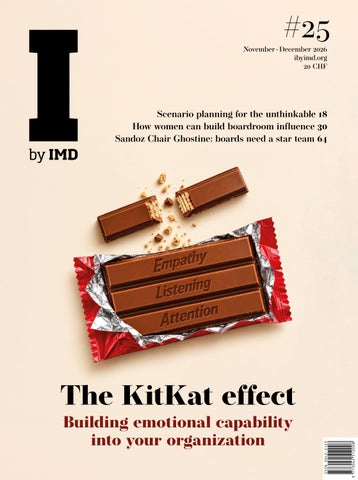
#25
November - December 2026 ibyimd.org 20 CHF
Scenario planning for the unthinkable 18 How women can build boardroom influence 30 Sandoz Chair Ghostine: boards need a star team 64
The KitKat effect Building emotional capability into your organization
Get the next issue! M
A
G
A
Z
I
FINANCE AND TECHNOLOGY UNPACKED
Use SWISSQUOTE Magazine for knowledge,decision making and your trading activities.
N
E
WWW.SWISSQUOTE.COM
6 bimonthly issues → LONGTERM INFORMATION ON TRADING THEMES → JOURNALISTICALLY INDEPENDENT AND GLOBALLY RELEVANT → PROVIDING KNOWLEDGE, ANALYSIS AND INSIGHTS
WWW.SWISSQUOTE.COM/MAGAZINE
WELCOME
Culture is not what leaders say. It’s what they reward and punish
E
very organization has two cultures. One appears in value statements, on posters, and in town hall speeches. The other shows up when something goes wrong. Employees learn quickly which one counts. This edition of I by IMD includes several articles on culture, and they share one insight: culture is not what leaders declare. It is what people learn from what happens next.
The cover story by Eugene Cha Navarro uses KitKat’s remarkable success in Japan to show how organizations can build emotional capability. Her point is uncomfortable. A company full of emotionally intelligent leaders is not automatically an emotionally capable organization. Imagine a factory manager who stops production to protect consumers and is then penalized for the missed target. Everyone learns that empathy is welcome only when it costs nothing. Eva Bilhuber Galli and Günter Müller-Stewens show that organizations have never communicated more and listened less. A “like” is not listening. People feel heard only when they can see what changed because they spoke up. Gilbert Ghostine describes building the Sandoz board from scratch. His lesson: culture starts earlier than most people think. The first meeting sets expectations, but the first disagreement sets the tone. Our cartoon case, Empowerment Theatre, shows a CEO who tells his team they no longer need his approval. One correction later (“Check first next time”), the team is waiting for him once again. He announced empowerment; they learned caution.
Illustration: Jörn Kaspuhl
All of these articles point the same way. Leaders do not shape culture through what they say. They shape it through what they reward, what they punish, and how they react in the moments that matter. Those moments are small and frequent, and everyone sees them. As always, I urge you to read, enjoy, and reflect.
Stefan Michel,
Professor of Management, Dean of Faculty and Research
November - December 2026 / I by IMD
1
CONTENTS
November - December 2026
COVERSTORY 04 Corporate Culture
Through the lens of KitKat’s remarkable success in Japan, we explore how organizations can turn empathy into an operating system for competitive advantage. Eugene Cha Navarro
ACTS OF LEADERSHIP 18 Strategy
18
Business leaders are scenario planning without confronting the ‘unimaginable’ risks of a systems breakdown. Thomas Gauthier and Andrew Hoffman
25 10 leading questions
Håkon Bruaset Kjøl of True Corporation, the Thai telecoms group, shares his thoughts on leadership and his ideal dinner guest.
26 IMD MBA Dialogue
Clinique La Prairie CEO Simone Gibertoni discusses modernizing a heritage brand and turning the promise of longevity into a science-based reality. Kate Millican
30 Governance
Women can struggle for impact in the boardroom. We offer three behaviors to turn presence into influence. Jennifer Jordan, Ruth Aguilera, and Alexander Fleischmann
OPERATING SYSTEMS
36 Energy transition
As the market-led approach to decarbonization gives way to more policy-informed thinking, how can business leaders shift focus from ambitious promises to deliverable strategy? Hans-Christoph Hirt and Tom Gosling
44 Strategy
Firms have never had better data, yet many remain slow to act. ‘Organizational latency’ may be to blame. Luigi Mirri and Niccolò Pisani
2 I by IMD / November - December 2026
26
Capturing engineering expertise with ‘physical AI’, and not relying on generic algorithms, is the next frontier in unlocking value. Kazuo Ichijo and Yunfei Feng
56 Infographic
Will the advent of AI strip us of our superpowers? We look at the data.
Cover: Midjourney V8 @ paulandcat
50 Technology
Scan the QR code to visit ibyimd.org
THE SANDBOX
FRESH THINKING
We have never communicated more and absorbed less. We need to ‘consciously listen’ in a world full of noise. Eva Bilhuber Galli and Günter Müller-Stewens
The financial fate of most Americans hangs on the performance of a handful of Big Tech stock prices, and that’s dangerous. Jerry Davis
58 Team leadership
64 Board’s eye view
At boardroom level, a star team is more effective than a team of stars. Gilbert Ghostine
68 Cartoon case
An innovative look at a complex leadership challenge with no simple solution.
70 Brain circuits
Systemic anxiety can adversely affect team performance. Learn to spot the signs and tackle the problem early. Alyson Meister
72 Coaching Corner
Photo: ALAMY, Midjourney V8 @ paulandcat, IMD
What were once strengths can become constraints when taking on a new role. You must master the art of unlearning. Angelica Adamski
14 In good company
55 The human factor
The AI revolution needs another revolution ... and that’s integrating human intelligence. Shelley Zalis
74 The forecaster
For more than a century, consumer goods companies competed for shelf space in a physical store. That playbook has had its day. Howard Yu
79 P.S. The president’s soliloquy
David Bach urges businesses and governments in the West to move faster to ensure future prosperity.
+
THE LOCKER ROOM 13 WHAT’S HOT AND WHAT’S NOT 49 BEST OF I BY IMD ONLINE 63 DO YOU KNOW? 67
14
November - December 2026 / I by IMD
3
COVERSTORY / Corporate Culture
4 I by IMD / November - December 2026
Learn to ‘read the air’: how to build emotional capability into your organization
Photo: iStock by Getty Images
Eugene Cha Navarro explores how organizations can turn human understanding into an operating system for repeatable competitive advantage
November - December 2026 / I by IMD
5
W
COVERSTORY / Corporate Culture
hy is KitKat, the quintessentially British confectionery, so popular in Japan? What does this unlikely “glocalization” success story teach organizations struggling to connect with unfamiliar markets? And how do the organizations that get this right work differently on the inside? Early in my career, I moved from a global strategy development role in Switzerland to work more closely with the Japanese market, where I encountered KitKat’s popularity firsthand. At headquarters, I was accustomed to thinking about global brands through strategy, brand guidelines, and toolkits. These disciplines matter. They create consistency and scale. Yet this lens alone could not explain KitKat’s runaway success in Japan. A chocolate bar with crisp wafer layers, created in 1935 by Rowntree’s of York, England, a confectioner with Victorian roots, had somehow become affectionately embedded in modern Japanese culture. Japanese consumers buy about five million KitKats a day, according to Nestlé Japan, and by 2017 Japan had become the brand’s biggest market by sales, ahead of the UK. It topped Japan’s confectionery charts and sold in hundreds of flavors connected to regions and seasons, including sake, wasabi, soy sauce, and matcha. This creative diversity differed radically from how KitKat was marketed elsewhere. Its cultural relevance in Japan extended beyond flavor. The name KitKat sounds like kitto katsu in Japanese, which translates as “to surely win”. This serendipitous play on words meant the chocolate bar became a way for parents, friends, and teachers to encourage students facing high-pressure examinations. Nestlé, which acquired KitKat in 1988, did not simply grow or translate a global proposition. As food industry commentator Pearly Neo has noted, the Swiss multinational noticed a cultural meaning forming around the brand and learned how to serve it. Working in Japan made me realize the importance of kuuki wo yomu, often translated as “reading the air”. For me, it meant paying attention to the expectations and concerns surrounding what people said, including what remained unspoken. It offered a useful lens on the KitKat story by highlighting that understanding a market involves noticing not only preferences, but also what a product allows people to express to one another. The experience left a question that has followed me across countries, companies, and categories. How can an organization cultivate this attentiveness so it becomes locally meaningful without losing the advantage of global scale? And how can it develop that sensitivity to local context as a shared capability rather than depend on individual instinct?
6 I by IMD / November - December 2026
Looking across industries and geographies, I kept noticing a similar pattern. Some organizations navigate the distance between global ambition and local relevance with remarkable consistency. They earn a place in people’s daily lives, their culture, and identity. Others, with equally strong products and equally rigorous strategies, never quite cross that threshold. The difference is often described as consumer insight, local knowledge, or good leadership. Each description captures part of the answer but leaves a fundamental question unresolved: how does human understanding become reliable across markets, functions, and generations of leaders? An insightful individual may notice what others overlook. The larger challenge is whether the organization can repeatedly notice, interpret, and act on what matters to people in different environments. The organizational management concept of “emotional capability” offers a different way to look at the challenge. It shifts attention from whether a few leaders are naturally good with people to whether the organization itself has learned how to work with emotion. It asks how human understanding is carried through routines, decisions, and relationships, and how it becomes an advantage that does not disappear when talented or emotionally attuned individuals move on.
Beyond emotionally intelligent leaders
Emotional intelligence is usually understood as an individual ability. American psychologists John Mayer, Peter Salovey, and David Caruso describe it as accurately perceiving emotion, understanding emotional information, using it to support thought, and regulating emotion effectively. This helps explain why some people read a room well, remain constructive under pressure, or recognize what another person may be experiencing. Emotional capability sits at the organizational level. As INSEAD Professor of Strategy Quy Nguyen Huy has explored, it is an organization’s collective capacity to acknowledge, recognize, and respond to the emotions of its people through shared norms and routines. The two do not automatically coalesce. An aggregation of emotionally intelligent leaders does not make an emotionally capable organization. This distinction is similar to the difference between employing financially skilled individuals and having robust financial controls. Individual expertise matters, yet organizational reliability requires systems that make the desired practice consistent. Emotional capability is built inside the organization, but its applications extend beyond internal matters. An influential study of 163 firms in Turkey by Ali Akgün, Halit Keskin and John Byrne illustrates how emotional capability can help a company steer through radical change when people must let go of familiar ways of work-
The quarterly magazine is part of IbyIMD+ subscription To enjoy the full experience, please log in or subscribe to IbyIMD+
Login or subscribe