Whether it’s a modern or historic house of worship, aesthetics and intelligible audio are critical. By Michael Grotticelli
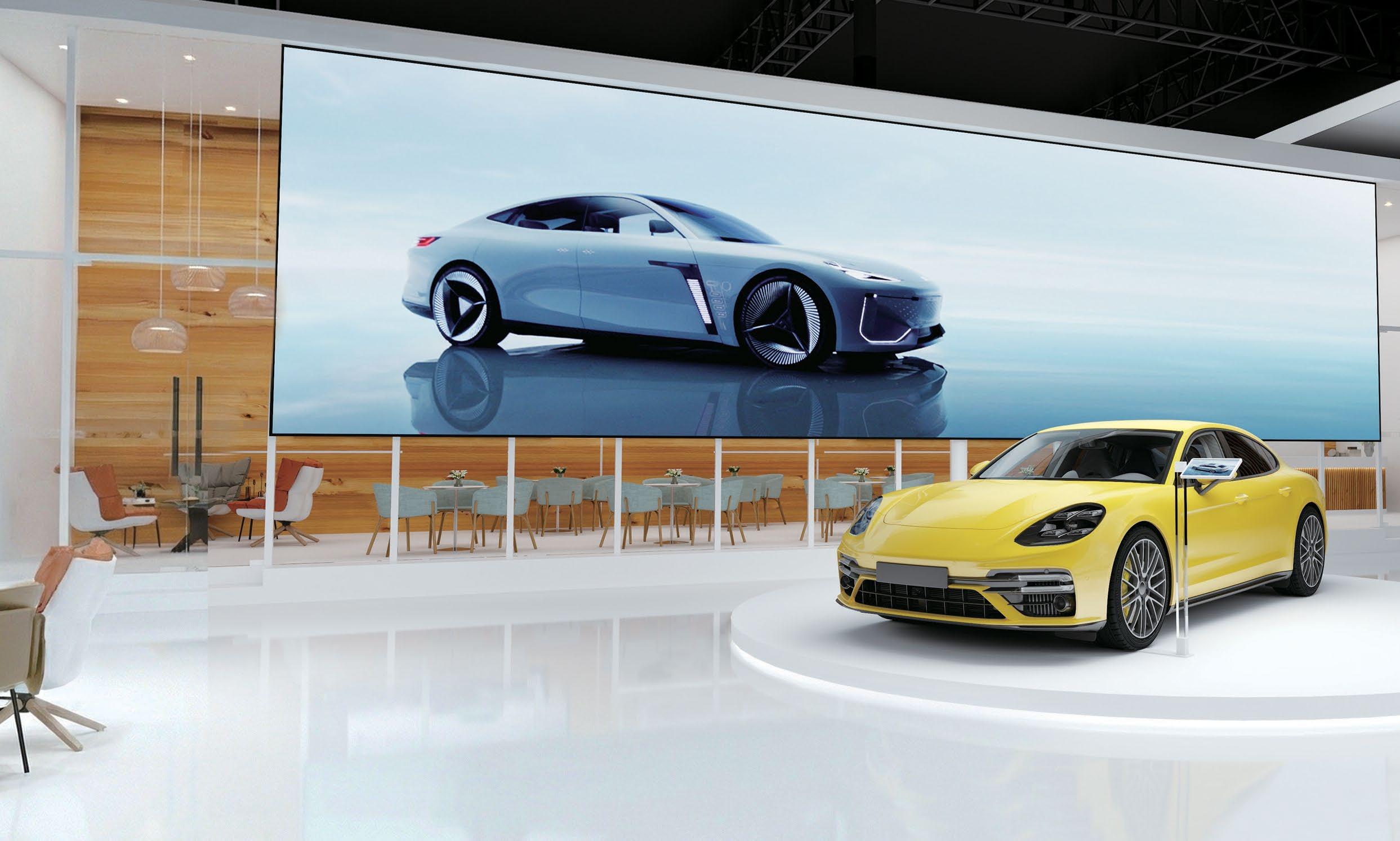
Integration Guide to Video Walls
18 A Combination of Contemplation and ‘Wow’
A new video wall is supporting a mission of wellness at the University of Virginia. By James Careless
24 Video Wall Brings MLK’s Vision to Life at King Center
Visitors to the facility are being greeted with a new video wall and high-end audio. By Wayne Cavadi
30 Cloud Power
The status of cloud production is changing, and it turns out the real value proposition is choice. By Dave Van Hoy
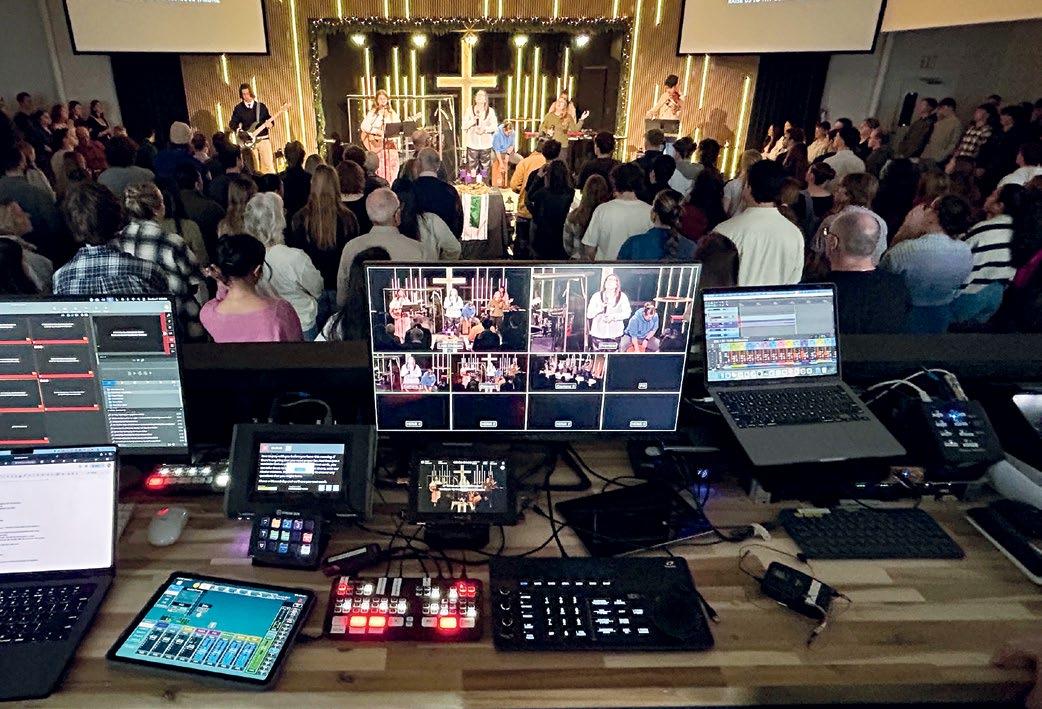
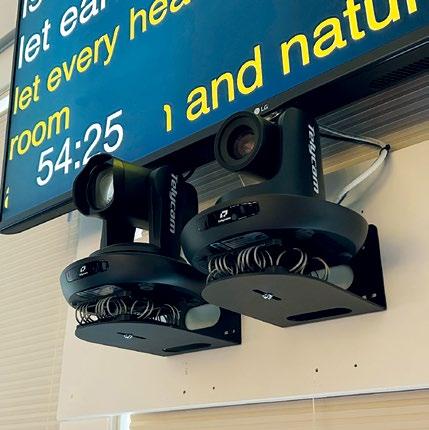
31 Red Hills Church Switches to PTZ
The need to regain seating space from manually operated cameras has also improved video productions. 14
Viewpoint
34 An ‘Insult’ Crafted My Path
Want to be more credible? Here are six steps to elevate you from salesperson to advisor.
By Rob Voorhees
SYSTEMS CHECK
For Whom the Alarm Bell Tolls
Nobody wants their home alarm triggered, especially at 4:30 a.m. And yet, there I was, awakened from a dead sleep from something a lot louder (and earlier) than my Apple Watch’s happy little chirping to announce a new day.
In some homes, the alarm is an absolute call to action. You’ll find someone instantly alert, shotgun in hand and bandolier magically slung over one shoulder. Next comes that chuck/chuck sound of a round being loaded in said shotgun, followed by a pithy comment worthy of Bruce Willis in his prime.
In my home, the response was somewhat different. There was no shotgun. There was a man muttering about his glasses and wandering over to the control panel.
Why so calm? When my alarm went off, it didn’t include that high-pitch siren that informs me of a breach. It was just the alarm. Don’t get me wrong, it was annoying, but I was reasonably sure I wouldn’t have to channel my inner John McClane.
Turns out I was right to be annoyed rather than panicked. The control panel declared there was a low battery. Not a battery on one of the sensors—that would trip a real alarm. Instead, it was the chunky battery that sits in the control box year after year until it can find an inopportune time to lose its charge. One bleary-eyed order placed with Amazon later, I was in bed trying to will myself back to sleep.
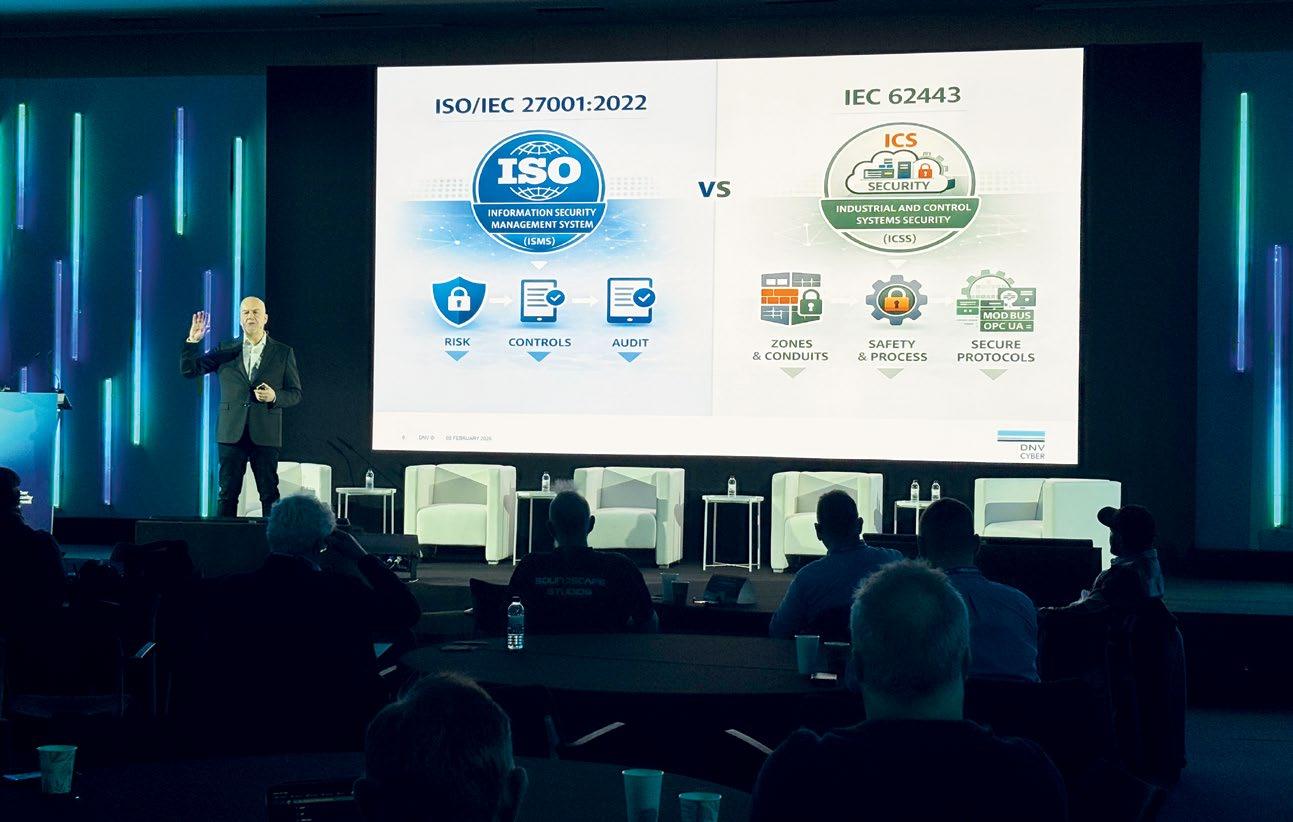
Now, if you really wanted to sound an alarm, you should have joined me at the inaugural Cybersecurity Summit last month at ISE 2026. I sat in on the opening session, “Building Cyber Resilience: Why AV systems become part of critical infrastructure,” and let’s just say it didn’t appease my trust issues.
The speaker was Shaun Reardon from DNV Cyber, and his message focused on the importance of planning. Reardon, who is outrageously qualified to speak on matters of security and cybersecurity, didn’t sugarcoat the situation. Cyberattacks are a given, and if you don’t think about cybersecurity early, it’s going to cost you a lot of money later.
Pro AV has its own cybersecurity challenges, because our industry’s supply chain includes a heaping pile of vendors and a surplus of high-risk entry points, from IP-based cameras to digital signage systems and more. Reardon warned that this is where integrators can encounter liability; in fact, cybersecurity negligence can lead to lawsuits, fines, even potential prison time.
We’ve probably all heard about the case of the hackers who stole data from about 40 million credit cards from Target’s IT network more than a decade ago. They broke in using stolen network credentials from a third-party HVAC vendor. In the case of Pro AV, you’ve got all sorts of gear with default passwords that need to be changed and/or firmware that needs to be patched (seriously, when was the last time you plugged in a new device and it didn’t want to immediately update its software). Plus, there’s the added wrinkle of managed services. Yes, we all love that it reduces truck rolls and provides a steady revenue stream, but it’s yet another access point that can be breached by the cyber bad guys. And I haven’t even talked about potential personnelbased cybersecurity threats.
It’s easy to be complacent with cybersecurity, treating it like you would a checklist for packing your suitcase for summer vacation. However, Reardon considers the cybersecurity standards in place for our industry and others as minimal effort—conformity is not security. Consider those the starting point for your cybersecurity journey.
Yes, journey: Cybersecurity needs to be a continuous effort, not a one-time deal. Basically, Reardon suggested a holistic approach. That means having a comprehensive understanding of your Pro AV environment, an incident response plan in place for when the cyberattack comes, and an active security mindset. Yippee Ki-Yay.
CONTENT
Content Director Mark J. Pescatore, Ph.D. mark.pescatore@futurenet.com
Senior Content Manager Wayne Cavadi
Contributors Erin Budnik, Michael Grotticelli, Jennifer Guhl, Dave Van Hoy, Rob Voorhees Art Editors Rob Crossland, Sam Richwood
Production Managers
Nicole Schilling, Heather Tatrow
ADVERTISING SALES
Managing Vice President of Sales, B2B Tech
Adam Goldstein, adam.goldstein@futurenet.com, 212-378-0465
Sales John Casey, john.casey@futurenet.com, 845-678-3839
To subscribe, change your address, or check on your current account status, go to avnetwork.com and click on About Us, email futureplc@computerfulfillment. com, call 888-266-5828, or write P.O. Box 1051, Lowell, MA 01853.
LICENSING/REPRINTS/PERMISSIONS
SCN is available for licensing. Contact the Licensing team to discuss partnership opportunities. Head of Print Licensing Rachel Shaw licensing@futurenet.com
MANAGEMENT
SVP, MD, B2B Amanda Dawrman-Allen VP, Global Head of Content, B2B Carmel King MD, Content, AV Anthony Savona Global Head of Sales, Future B2B Tom Sikes Managing VP of Sales, B2B Tech Adam Goldstein VP, Global Head of Strategy & Ops, B2B Allison Markert
DNV Cyber’s Shaun Reardon didn’t sugarcoat the importance of cybersecurity into today’s Pro AV environments.
Sharp Completes NEC Display Solutions Acquisition—Now What?
By Mark J. Pescatore
Back in March 2020, NEC Display Solutions announced that Sharp had acquired a majority stake in the company. Last November, Sharp became the sole owner of the company, changing the name globally over the last few months.
Moving forward, all new products will carry the Sharp brand name. Sharp’s Mark Quiroz, SVP and general manager, displays, said Sharp Display Solutions is the division handling all displays. That division is part of Sharp Imaging and Information Company of America, which itself is a division of Sharp Electronics Corporation.
“This timing allowed us to thoughtfully address evolving customer needs while advancing innovation in a way that aligned both organizations. Full integration between two global brands is a multiyear effort, particularly when it involves aligning product roadmaps and technology platforms.”
To minimize customer confusion, Quiroz said Sharp “intentionally overcommunicated” to help inform customers what was changing, what was not, and what they could expect moving forward. “Our goal was to provide clarity, reduce uncertainty, and give customers confidence throughout the integration process,” he added.
So, what took so long? According to Quiroz, the unhurried approach was intentional, designed to support long-term product performance as well as technological progression.
“From the outset, we planned for a standard five-year refresh cycle, which is consistent with refresh rates within the industry,” Quiroz told SCN.
With the merging of two global brands, there were plenty of lessons to be learned. For Quiroz, the biggest was respecting established organizations with deep institutional knowledge. “Both companies had longterm teams with well-defined processes and structures that had evolved over time,” he explained. “Business decisions have a direct impact on how organizations operate day to day, so it was critical to be deliberate and balanced in how we brought the teams together. In a joint venture between two global companies, we also learned the value of approaching integration with curiosity and openness to how work is done across different geographies, including outside the U.S.”
Quiroz said that with its expanded portfolio, Sharp is now positioned to deliver greater value and deeper support to its customers worldwide. “We’re focused on continuing to deliver the best customer experience and the lowest total cost of ownership,” he noted. “No other display organization can offer our level of customer experience on a global scale. Building off that strength, Sharp plans to drive innovation and remain at the forefront of display technology and customer support.”
Level 3 Audiovisual Joins Online Instruments
Amajor milestone in its global expansion strategy, India-based Online Instruments has acquired U.S.-based Level 3 Audiovisual. The move establishes a direct operational presence for Online Instruments in the United States and enhances its ability to serve multinational enterprises with consistent, scalable, and regionally aligned AV solutions.
Level 3 Audiovisual will continue to operate under its current brand and leadership team. “Maintaining our leadership structure and operational approach ensures consistency for our customers as we take this next step,” said Jeremy Elsesser, president and CEO, Level 3 Audiovisual. “Becoming part of Online Instruments positions us to grow our U.S. presence, deepen our capabilities, and support customers with a more globally integrated delivery model.”
Through Level 3 Audiovisual, Online Instruments gains a strong operational presence supported by established technical teams, mature delivery processes, and deep insight into the U.S. enterprise AV landscape. Integrating this U.S. capability with Online Instruments’ established operations across India, the Middle East, and Asia strengthens the company’s global delivery platform.
Pleneo Launches to Simplify Large Meeting Room Deployments
Pleneo has announced its launch as a new collaboration technology company, introducing a fresh approach to medium and large meeting rooms. Built by the team behind Xilica, a 25-year professional audio brand with thousands of large rooms deployed globally, Pleneo combines deep experience in complex spaces with a new operating model designed for modern IT and UC environments.
While small meeting rooms are now routinely deployed as standard IT endpoints, larger rooms are still delivered room by room—making them harder to deploy, more complex to operate, and increasingly difficult to manage consistently as organizations scale. Pleneo has been created to address this gap.
Rather than treating each room as a bespoke project, Pleneo focuses on enabling rooms to behave and be managed as a single system, enabling simple deployment for IT teams and clearer, more repeatable delivery for UC and AV channel partners.
“Pleneo was created to offer a new way forward—one that makes large rooms easier to deploy, easier to operate, with a user experience ready for what collaboration is becoming,”said James Knight, CEO of Pleneo.
At the heart of Pleneo is Room OS, a softwaredriven operating layer that defines how medium and large meeting rooms are deployed and operated. Room OS combines secure, on-device intelligence
with cloud-based orchestration via Pleneo Cloud, enabling zero-touch provisioning of componentbased room systems.
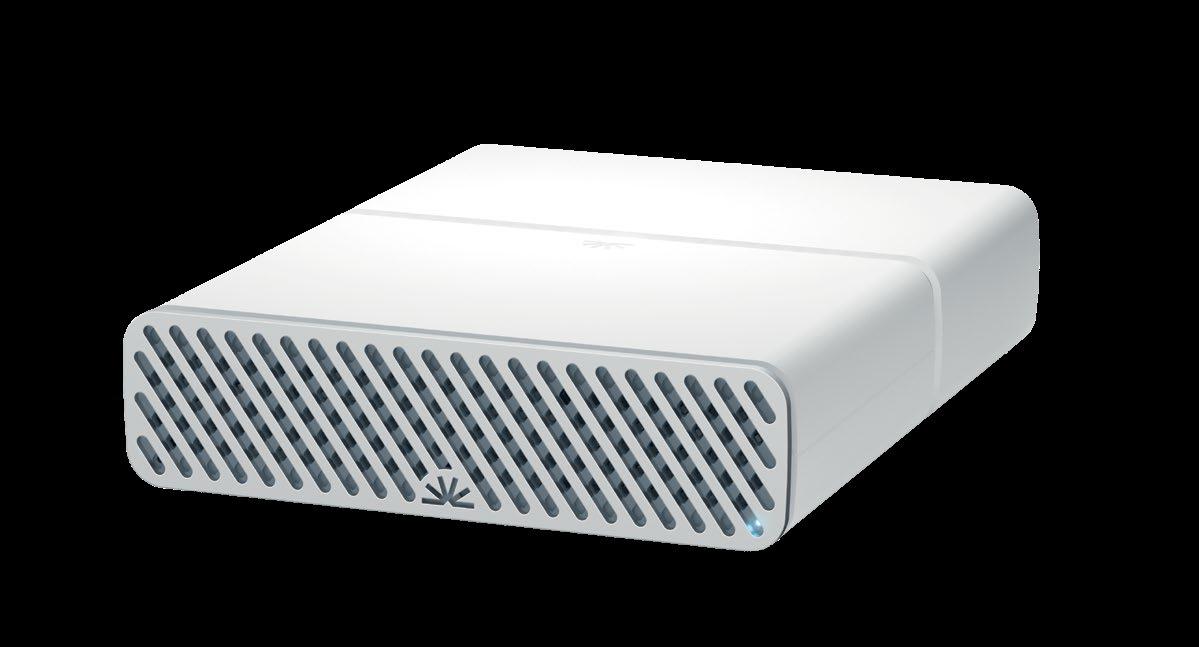
Pleneo’s approach is anchored by RoomHub, the physical heart of the Pleneo room. RoomHub brings secure, localized edge intelligence into the room while remaining tightly integrated with Pleneo Cloud. By processing audio and video at the edge, RoomHub
Mark Quiroz
RoomHub
ISE 2026: Points of Interest from Barcelona
By Mark J. Pescatore
I’ve been covering trade shows for a long time, and the energy on the ISE show floor never seems to disappoint. ISE 2026, which wrapped up its fourday exhibition on Feb. 6, was no different.
The Next Big Thing is still MIA in Pro AV, but technology is still moving and shaking. Driven by AI, which seemed to be an underlying theme for everything but the paella in Barcelona, there were plenty of points of interest to explore on the show floor.
This year’s theme, “Push Beyond,” could have easily been applied to the show itself, not just the industry. Co-owned by AVIXA and CEDIA, ISE 2026 broke its own records, with an 8% increase in total attendance over last year. According to show officials, there were a record 1,751 exhibitors, including 323 first timers, to welcome 92,170 visitors across the largest total show floor space in ISE history.
What fuels the energy at ISE? While the widespread availability of espresso on the show floor doesn’t hurt, the fact is Pro AV is a vibrant industry serving tons of vertical markets. And there’s plenty of business to be done once the show floor closes, from small, one-off projects to enterprise-wide retrofits.
During the show, I spoke with Tom Morrod, co-founder and research director at Caretta Research. While he agreed Pro AV is growing and it’s a “very diverse industry,” corporate meeting rooms are still the top draw, with a “huge transformation” taking place from simple audioconferencing to multimedia production.
To that end, the platforms to manage these transformations not only need to be bulletproof but must work for end users who are less proficient at using these types of tools. “Democratization of technology is a big driver,” he noted.
Of course, Pro AV hasn’t had the smoothest path in recent months. While tariffs have had a “broadly negligible impact on growth,” there has been disruption—and integrators have had to bear the brunt of it.
“It can be really difficult if you’re in the middle of it,” Morrod explained. “The channel has been dealing with the complexity of it.”
InfoComm is getting even more international.
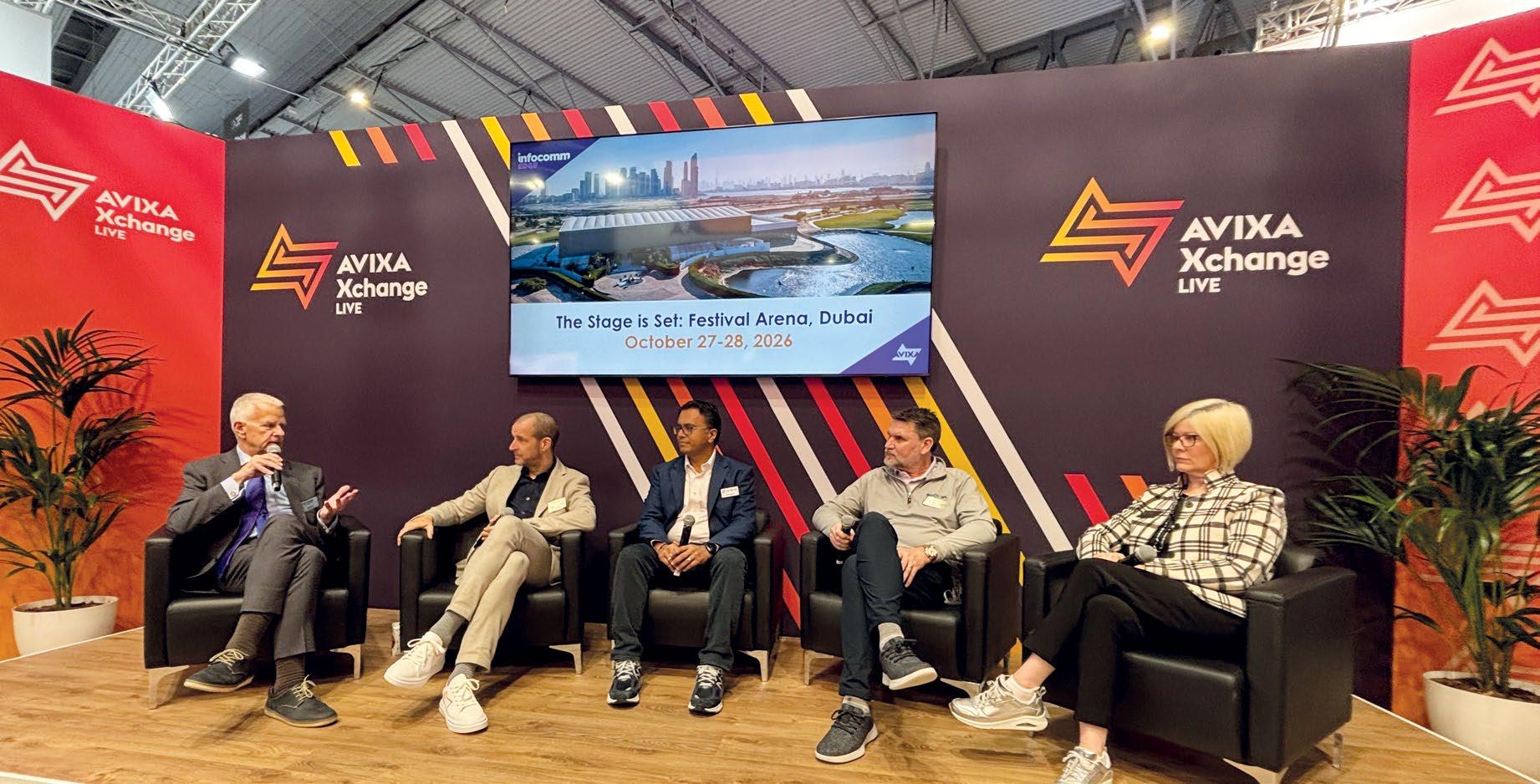
During the show, AVIXA officials announced the launch of InfoComm EDGE, which is scheduled for Oct. 27-28 at Dubai’s Festival Arena. It was designed from the ground up as an experiential event designed to raise the profile of the Pro AV industry with stakeholders outside of the industry.
Why Dubai? From a Pro AV perspective, it’s booming. According to AVIXA research, roughly 85% of end user entities in the region plan to increase Pro AV spend this year, and the annual spend on Pro AV in the GCC region in 2026 will exceed $15 billion for the first time.
But they’ll be doing things a little differently at InfoComm EDGE. Instead of a grid, the floor plan is built around a center stage. There will also be four zones representing the priority verticals for the region, including government and enterprise, leisure and entertainment, education, and retail. The show will be curated for key buyers and influencers from the region, allowing them to experience Pro AV innovation through thought leadership, networking, and technology.
David Labuskes CEO, AVIXA, said initial expectations are about 4,000 attendees. Yes, that’s a lot smaller than ISE, but InfoComm EDGE will be intentionally compact, focused on quality, not quantity. Labuskes anticipates the event will “end up being about connections being made, not people through the door.”
There were reasons to celebrate.
Anniversaries certainly kept the mood festive in several booths on the show floor. First, the PSNI Global Alliance celebrated 40 years of global collaboration. The network of integrators, manufacturers, service providers, and technology partners provides coverage in more than 70 countries across six continents.
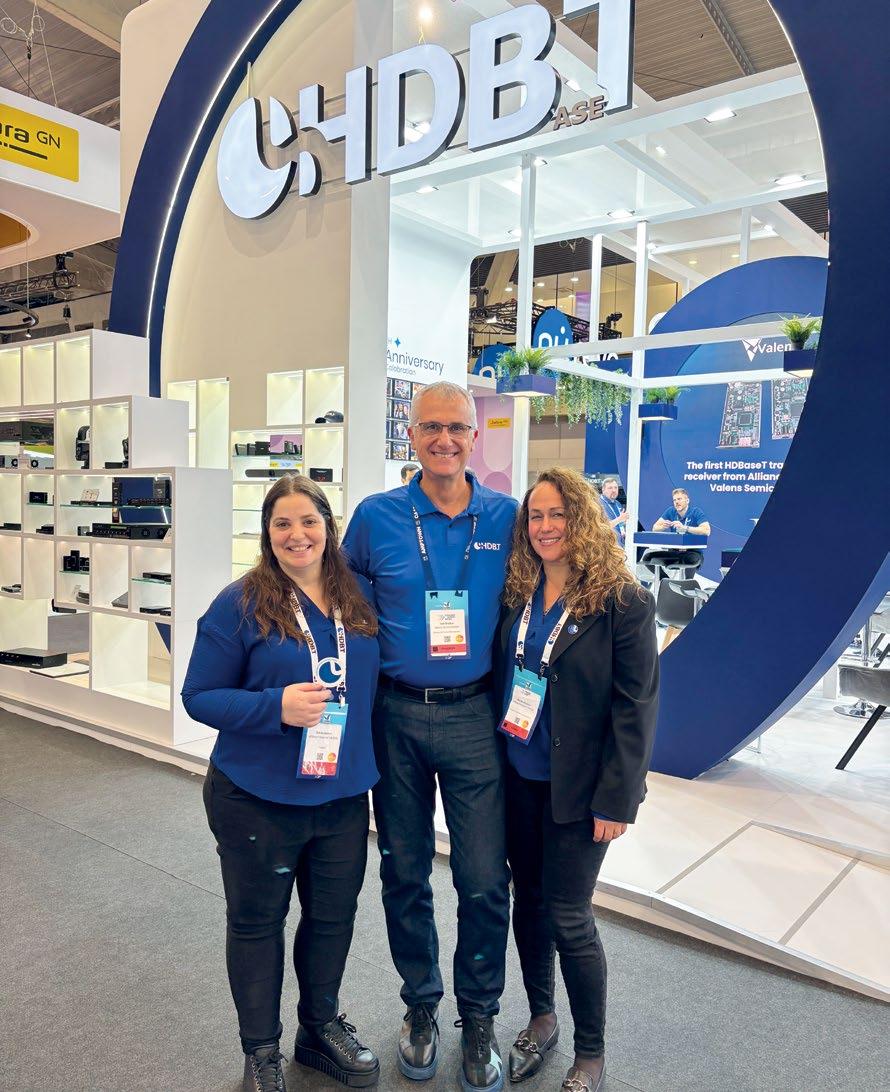
Meanwhile, the HDBaseT Alliance celebrated its 15th anniversary. The organization has come a long way since it was founded by LG, Samsung, Sony, and Valens Semiconductor. Today, there are almost 200 members, and a display at the booth showcased dozens of new products from more than 30 of those members. Effi Goldstein, president of the HDBaseT Alliance, told me the secret to the alliance’s “connectivity backbone” success has been technological reliability and true partnerships between manufacturers.
Then there were the companies. Both Alfalite and SpinetiX marked their 20th anniversaries at ISE. SpinetiX used the occasion to launch “The Year of High
Impact Experiences,” while Alfalite showcased “20 years lighting the future.” And Matrox Video and Symetrix celebrated their 50th anniversaries.
On the other end of the scale, the Alliance for IP Media Solutions (AIMS) officially launched its Internet Protocol Media Experience (IPMX) as a fully developed, certifiable standard at the show. According to Andrew Starks, marketing working group chair and a member of the AIMS board of directors, the AV over IP standard was officially certified on Jan. 23 after years of development. Next up: more refinements, including multi-vendor HDCP and multi-vendor privacy encryption.
That’s a lot to celebrate. Congratulations all around!
Was I right about e-paper?
After last year’s show, I was pretty high on e-paper. In fact, I predicted a breakthrough in two years. Well, it’s only been a year, but I checked with a few ISE exhibitors. Looks like I need to be more patient.
Vicky Fox at Philips (PPDS) tactfully admitted that, although the company has been involved in some big projects, it’s a “maturing” space. While the market works to catch up to the idea, the company is focused on improving the technology and delivering color accuracy.
So, what’s the hold up? For Till Gotterbarm, VP of business development at AUO Display+, part of the problem behind the slow adoption is the learning curve. Users have to differentiate e-paper as “digital print” as opposed to a replacement for LCD. “We still have to educate the market,” he added. “I do see that starting to resonate.”
Tom Morrod
AVIXA officials announced InfoComm EDGE, a new Dubai-based experiential event, at ISE 2026.
HDBaseT celebrated its 15th anniversary at ISE 2026.
SCN Celebrates Best of Show at ISE 2026 Winners
By Mark J. Pescatore
As in previous years, Future publications contracts with AV industry experts to evaluate products submitted by manufacturers exhibiting at ISE 2026 for its Best of Show awards. This year, the Best of Show awards are presented by nine of Future’s industry titles, including Systems Contractor News
While our judges remain anonymous, we can tell you they are your peers, AV/IT managers, directors, engineers, or industry consultants and integrators. They also take their judging duties very seriously, and were meticulous in reviewing the products chosen for them to evaluate. And the winners are …
AIMS Alliance, IPMX
What the judges said: Two years ago, I asked AIMS at InfoComm about encryption. They must have listened, because it’s a feature now. Nicely done! A certification process makes this a much more useful standard.
Airtame, Airtame 3
What the judges said: Airtame continues to improve its list of products for BYOD capabilities. A very neat little product that could fit behind any screen, and I really like the cloud capabilities for such a small device.
AISpeech Co., AISPEECH
What the judges said: We could say AI is going to take the AV sound engineer’s job; well, this unit is really performing many tasks to assist with sound reinforcement. I could see this device used in several tricky building designs with high ceilings or poor acoustics.
AtlasIED, Atlas+Fyne FC-D (Ceiling) and FS-D (Surface) Dante-Enabled PoE++ Loudspeakers
What the judges said: These new loudspeakers finally allow integrators a true single cable solution that provides excellent frequency response and strong SPL
coverage. The ability to use POE++ creates a whole new category of audio system design for integrators.
AVI-SPL, AVI-SPL Symphony
What the judges said: Every product has to have embedded AI these days, whether it needs it or not, but I like that Symphony is a quiet workhorse with AI features that enhance what it already does well. The aggregation of events helps to cut down on noise and alert fatigue. I liked the dashboard that gives technicians a birds-eye view of where the problems are, with the ability to filter for high-importance spaces. I like that Symphony is hardware agnostic. Its rich feature set means that it can integrate with just about everything. It looks to be a great way to augment a ticketing system.
Christie, Korus Series
What the judges said: The projector has a great design and great image output, and the color reproduction is good quality. It’s easy to install and easy to setup with the blending system.
d&b audiotechnik, U-Series
What the judges said: d&b’s U-Series is now one of the most versatile, small form factor, point source speaker systems for integrators in the world. The legendary sound of d&b’s storied history now fits into immersive environments and portable experiences without sacrificing quality. Besides the sound quality, what will really blow contractors away is the ability to deploy either passive or networked POE++ U-Series cabinets, depending on the application.
What the judges said: IXD Networks Westfield Rise creates a whole new avenue of possibility for AV integrators looking to supplant traditional print advertising. The low pixel pitch provides ultra-close viewing for high-end retail environments with a projected lifespan of 10 years, creating huge upside when it comes to ROI for end users and integrators.
Grass Valley, AMPP OS
What the judges said: I really liked their prebuilt templates and such a variety of solutions.
Jetbuilt, Jetbot Drawings
What the judges said: Anything that makes an AV designer’s drawings easier is a bonus, and Jetbot really assists in mapping out designs in an easy-to-read layout.
Mimo, Mimo FlashCast Visual Alert Overlay
What the judges said: Mimo FlashCast is a messaging overlay device that integrators can use to enhance the security and operational awareness of their clients. The easy-to-deploy hardware solution directly ties into existing platforms that your clients most likely already have on premise. The Cloud UI is cost effective and simple to use.
NETGEAR AV, Engage Controller
2.4
What the judges said: Offline and advanced configuration will solve so many headaches. You can have a network admin configure things in advance and then deploy when you receive the hardware. The ability to use templates will be a huge time saver.
Pleneo, Pleneo RoomHub
What the judges said: Pleneo RoomHub may look like an early 2000’s external hard drive, but it provides a compact yet powerful processing engine that allows integrators to use cloud-based configuration tools to control PTZ cameras, microphones, and room hardware. What is really impressive for integrators is the ease of which the Pleneo RoomHub works with Zoom and Teams rooms.
Williams AV, Infinium
What the judges said: Infinium by Williams AV has delivered integrators the ultimate assistive listening device using ultra low-latency Bluetooth. Integrated Dante with a convenient web-based configuration and long distance Cat 5e extension for transmitters make the Infinium one of the easiest systems to deploy. The ability for venues to allow users to BYOD or use an Auracast receiver provides the ultimate level of convenience for the guest and the management team.
By Erin Budnik
TPro AV Entering Strong in January
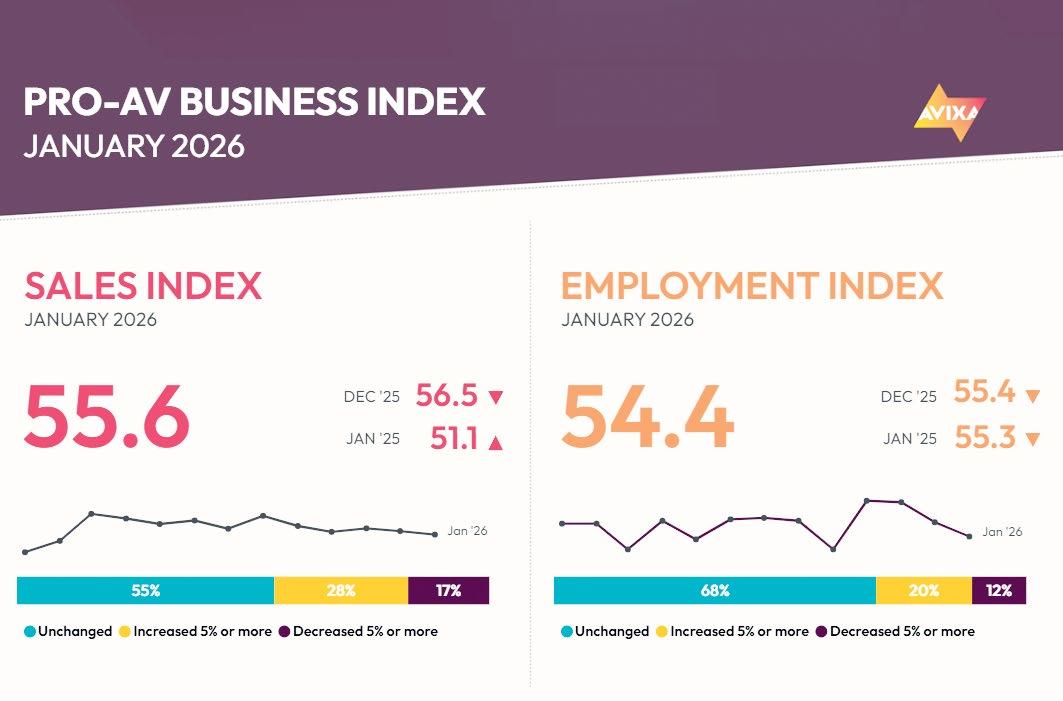
he AV Sales Index (AVI-S) for January registered 55.6, easing from December’s 56.6 and reflecting a typical start-of-year moderation in AV demand. The pullback is consistent with seasonal patterns, as education, corporate, and live events markets pause amid calendar resets, budget finalization, and slower project starts.
Despite the slight month-to-month softening, the index remains solidly in expansion territory, signaling continued growth in overall AV activity. Importantly, January’s AVI-S stands above year ago levels (51.5), reinforcing that underlying demand conditions entering 2026 are stronger than in early 2025.
January’s index reflects a combination of typical seasonal effects and broader macroeconomic conditions, including stable but still restrictive interest rates, cautious business investment, and
soft non-residential construction activity early in the year. Education, corporate, and live events markets all experienced slower starts as budgets reset, project timelines extended, and cost pressures persisted.
The January AV Employment Index (AVI-E) dropped by one point to 54.4. January 2026 U.S. labor market conditions appear stable but soft, with low layoffs and subdued hiring momentum.
“Economic uncertainty on both a global and local scale is making a lot of our customers back off. Especially churches. Businesses and government and large-scale construction projects that were already planned for 2026-2027 are still moving forward, but the small day-to-day projects from local schools and churches have really fallen off because no one knows what is going to happen next,” shared a North American AV Integrator.
The Pro-AV Business Index report is derived
from a monthly survey of the AVIXA Insights Community, a research community of industry members that tracks business trends in commercial AV. The report comprises two diffusion indexes: the AV Sales Index (AVI-S) and the AV Employment Index (AVI-E). In each case, an index above 50 indicates an increase in sales or employment activity. Visit www.avixa.org/AVindex to access the free monthly Pro-AV Business Index reports and learn more about the methodology. For more information about joining the AVIXA Insights Community, visit www.avixa.org/AVIP
Erin Budnik is the manager of market insight for AVIXA.
PEOPLE EXECUTIVE Q&A
Looking Back, Moving Forward
Courtland Gray celebrates 60 years of Peavey and the future of networked audio.
By Mark J. Pescatore
SCN: How long have you been with Peavey, and what are your responsibilities?
Courtland Gray: I’ve been working at Peavey for 24 years. I started in our finance division. I became more involved with various parts of the business as time went on, and have served as COO, CFO, and since our legendary founder, Hartley Peavey, has referred to me as CEO in a few emails to people, I claim that now as well. The responsibilities are broad and wide, covering both our Commercial Audio division and the musical instrument side of the business.
SCN: Last year, Peavey celebrated its 60th anniversary. How has the company been celebrating?
CG: From a product viewpoint, we have brought back several classic Peavey guitar amps from over the years and put them into a pedal preamp format, which have been very popular. And after many years of development, we are thrilled to release Scion, the next generation of MediaMatrix. We are immensely proud of our long-term legacy.
In September, we had an anniversary party in Bali for our APAC distributors and customers, which was a great event. We have also brought our 60th anniversary celebrations to trade shows, with both our ISE and InfoComm booths heavily leaning on our U.S. heritage with an old time Western bar theme showing our achievements over the past six decades. Like most established companies, we have had our share of ups and downs, but we continue to learn and grow as we look to the future with exciting new developments on the horizon.
SCN: I know it’s available in some of your mixers, so I have to ask: Are you for or against Auto-Tune?
CG: I’m for it. There is a big difference between the aggressive T-Pain effect of Auto Tune and its use for a tired singer trying to stay in key toward the end of a gig. Our mixers help tweak it just enough to make a pleasant experience for everyone.
SCN: What prompted Peavey to move into the Pro AV market back in the 1990s?
CG: We were approached by a startup company to distribute the technology that is MediaMatrix. At the time, there were some heated debates about doing
this, as some saw Peavey as a hardware company and not a software company. But Hartley saw the opportunities this would have for the brand, and we flew people in and out of Meridian to teach them about the future of audio DSP. We were the first to market with this technology, and it proved to be a good decision that continues to give us opportunities for growth and expansion.
SCN: It’s all audio, of course, but what sort of technological overlap is there between your Pro AV products and your instrument/amp products?
CG: Peavey Commercial Audio is, essentially, made up of two halves—Crest Audio develops and manufactures products for the live performance space such as sound reinforcement, mixers, and amplifiers, while our MediaMatrix line focuses on networked audio, matrices, and sound distribution. Ultimately, it’s all about high-quality, reliable sound, so we use our extensive experience in speaker design to produce, for example, our superb Versarray speaker line.
Courtland Gray
Position: COO
Company: Peavey
Overtime: That would be getting outside, working in the garden or greenhouse, and taking care of my horse and donkeys. I also like to cook.
However, anything new is moving to Dante or soon to sNET, our protocol that is backward compatible with current nWare installs as well as RAVENNA and AES67. The first CobraNet installation was with MediaMatrix.
SCN: What new Pro AV initiatives are we likely to see from your company?
CG: This is an exciting year for us as we launch the latest and greatest addition to our MediaMatrix range. It’s called Scion and is, quite simply, the most advanced and powerful media and control processor platform available. Scion is the third generation MediaMatrix DSP from Peavey and calls upon 30 years of our pro audio engineering excellence in both hardware and software design.
But I will say the divisions have not overlapped as much as I would like. We need tighter integration of technology, but our engineering groups have been mostly apart and have not collaborated ideally. I see opportunity to take some of the most advanced audio technology on the market from MediaMatrix into our other sound reinforcement and MI products. The cost of driving the code has come down dramatically over the years, which could make the very different price points of each division less of an issue today.
SCN: What makes Peavey’s MediaMatrix unique in the industry?
CG: That’s an excellent question which I’m always happy to answer. Quite simply, Peavey was the very first to introduce networked audio protocols to the industry. Even Dante can trace its roots back to MediaMatrix.
SCN: Is CobraNet still an important selling point for your MediaMatrix DSP solutions, or has Dante taken over completely?
CG: We still have some customers running CobraNet and we can still, for a little longer, support them.
We have MediaMatrix systems operating in venues today that continue to run without issue for more than 20 years. This latest generation is purpose built from the ground up to meet the demands for today’s (and tomorrow’s) IP-networked installations. With proven 24/7/365 reliability in the most demanding and prestigious venues globally, we believe we are delivering the most powerful DSP based media and control system available today.
SCN: From an audio standpoint, what's next for the Pro AV market?
CG: There is little doubt that the future of all AV installations will be on the network. Across the U.S. and Europe, AVoIP solutions are now the norm, with the Middle East and Far East now embracing the technology. India continues to be a booming market for AV as a whole for both legacy and AVoIP technology. Longer term, I wouldn’t be surprised to see zero cabling in certain projects in the years to come. Bluetooth and 6G will have almost limitless data capability, removing the need for cables altogether. I would expect many organizations to cling to their legacy infrastructure as the new technology is proven for security and reliability, but there will certainly be a lot less cabling as a whole. Similarly to the connection conundrums we have had around DVI, HDMI, and USB-C, it will be great if there was one wireless uniform connection protocol looming to make things easier for everyone, from manufacturers to end users.
ANALOG WAY appointed JEFF SINGER as chief marketing officer. With more than 30 years of experience in global marketing and product launches, Singer has led go-to-market and demand generation strategies for technology-driven organizations worldwide. He previously served as executive director of global product marketing at Crestron. In this worldwide role, Singer leads Analog Way’s global marketing strategy with a strong focus on go-to-market execution, sales enablement, and ownership of the company’s product roadmap and product definition.
On the heels of investment news, OPENDRIVES promoted long-time COO, TREVOR MORGAN, to CEO. Morgan has led a multi-year operational and strategic transformation of the business and brings deep experience in data management and SaaS across both early-stage companies and Fortune 500 enterprises, including Cisco and Capital One.
RE-SAUCE has appointed BEKY CANN as head of global PR and marketing. Cann joins the Re-Sauce leadership team in 2026 to expand the consultancy’s communications and media services worldwide, strengthening its ability to support clients in brand storytelling, channel influence, trade press engagement, and strategic marketing delivery across Europe, Middle East, India, North America, and APAC.
SOUNDTUBE ENTERTAINMENT
appointed ANDERS OLSEN as European manager. With an extensive background in the audio industry spanning more than 17 years, Olsen brings a wealth of knowledge and experience to SoundTube and its brands. In his new role, Olsen leverages his expertise to expand SoundTube’s presence in international markets, with a particular focus on Europe. His goal is to strengthen existing partnerships, develop new business opportunities, and drive growth for the SoundTube brands.
STREAMGUYS appointed DARA KALVORT as VP of digital sales and strategy and promoted EDUARDO MARTINEZ to EVP of technology. Kalvort leads the company’s sales efforts for the StreamGuys Ad Network. Martinez, who spent nearly two decades at StreamGuys, previously served as VP of technology, leading R&D and helping bring many of the company’s core products to market.
SYMETRIX has welcomed JASON DICAMPELLO, CTS, as Eastern regional sales manager. With more than 25 years of experience in the Pro AV industry, DiCampello is recognized for his consultative approach and deep commitment to customer success. Throughout his career, he has built strong relationships across the Eastern United States by delivering thoughtful solutions and trusted support.
Trevor Morgan
Beky Cann
Dara Kalvort
Eduardo Martinez
Jason DiCampello
Anders Olsen
Jeff Singer
By Michael Grotticelli
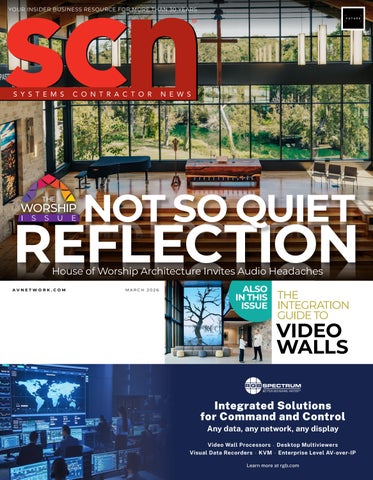
FNot So Quiet Reflection
Whether it’s a modern or historic house of worship, aesthetics and intelligible audio are critical.
or houses of worship of all types, installing a high-quality audio system that delivers clear speech from the altar, supports musical performances, and accommodates live streaming is often the most critical component of a new build or retrofit. Achieving the right balance between speech intelligibility and musical reinforcement can be challenging—particularly if acoustics, architecture, and aesthetics are not carefully considered from the outset.
The specifics of an effective audio system depend heavily on the space itself, as well as the technologies selected to support it. Two recent projects—one a modern chapel in Texas and the other a historic church in New York City—illustrate how thoughtful system design, collaboration, and planning can overcome acoustic challenges in vastly different worship environments.
Modern Problems
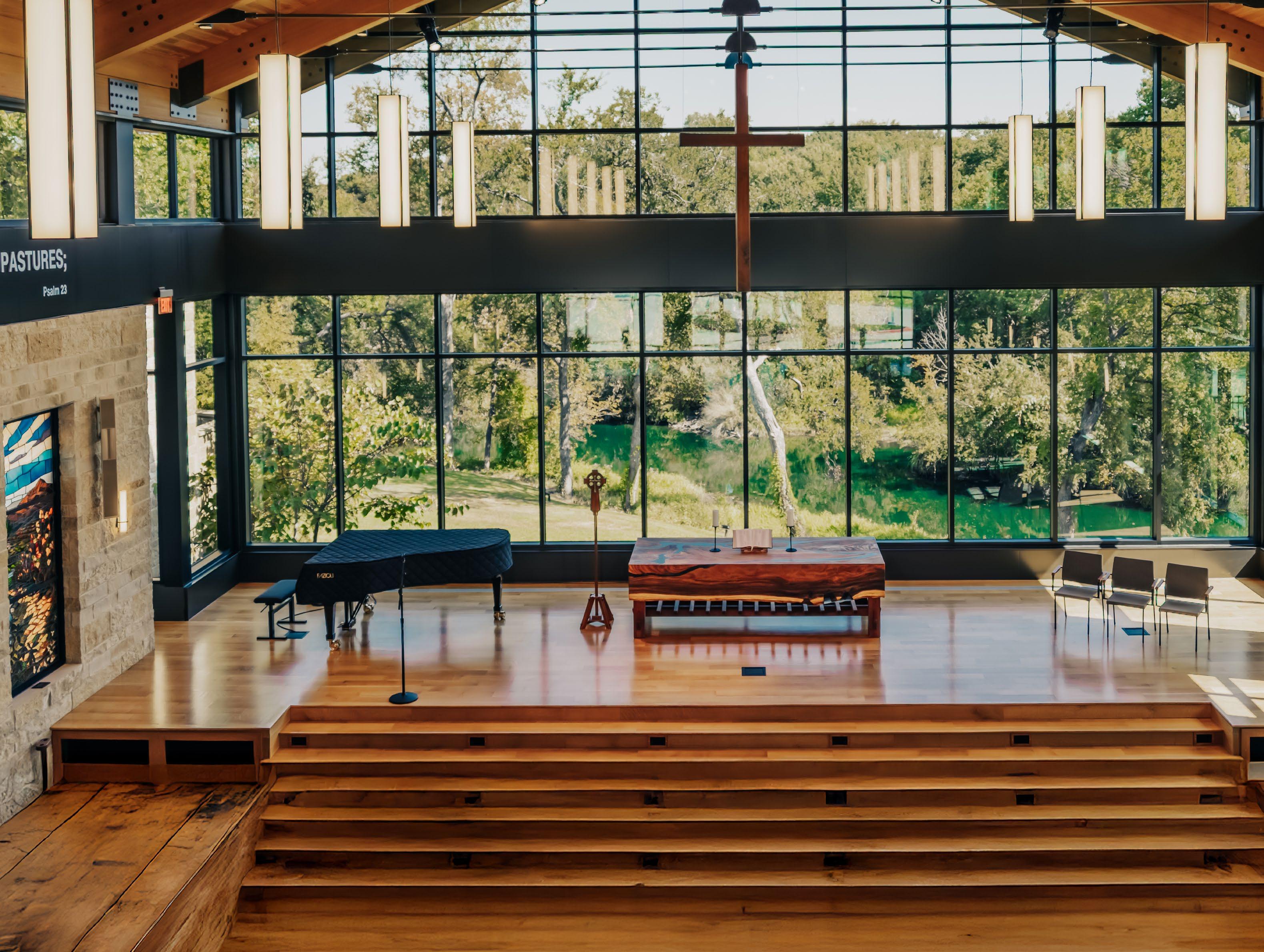
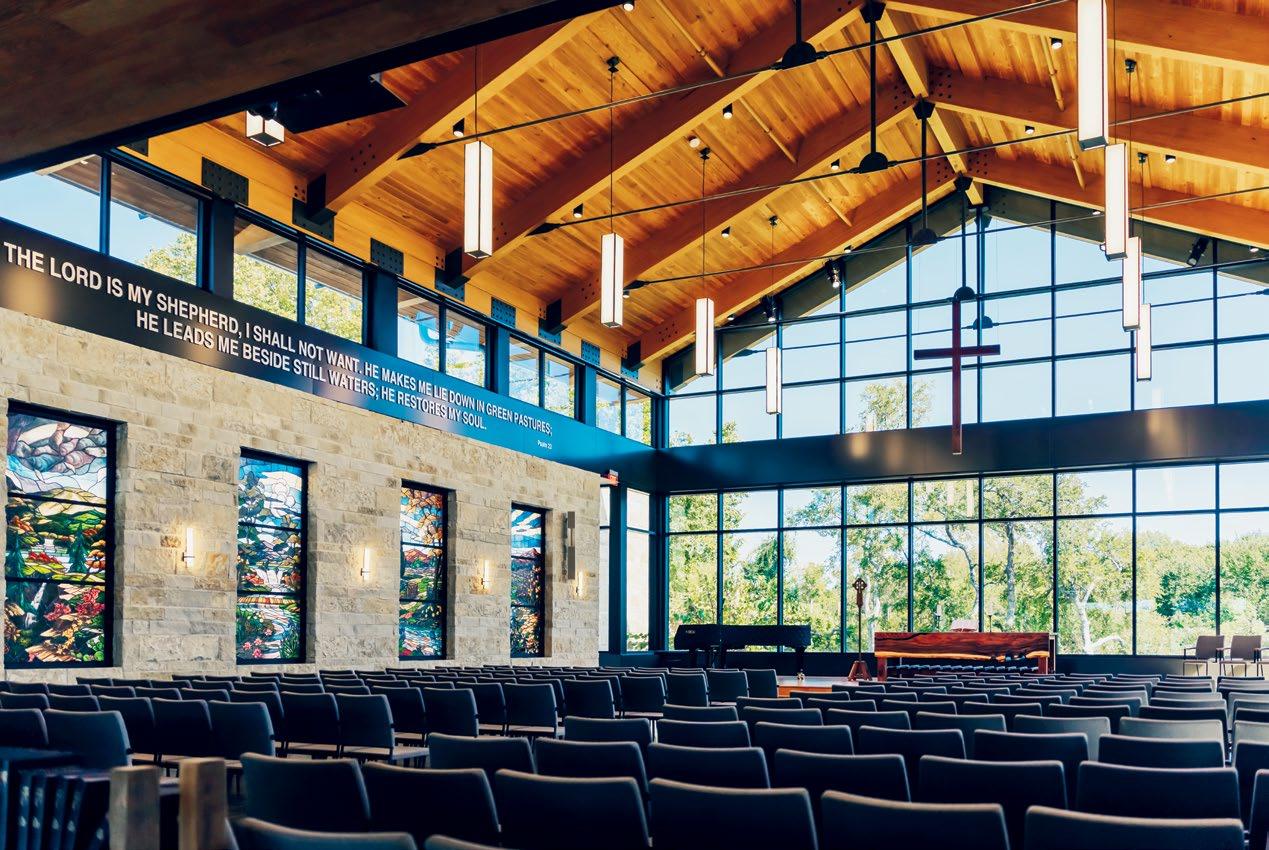
Located on the campus of St. Andrew Methodist Church in Plano, TX, Hasley Chapel was designed to be as visually striking as it is acoustically refined. Designed by Dallas-based architectural firm GFF, with audio system specification and installation by local integrator Clear ProAV, the chapel overlooks a pond and wooded area and hosts traditional worship services, weddings, memorials, small conferences, and other events.
Compared to the church’s main worship hall, which accommodates both contemporary and traditional services, Hasley Chapel is more intimate, seating approximately 120 people on the main floor, with a balcony for overflow seating or a modest choir. Despite its smaller footprint, the space presented significant audio challenges: The area behind the stage is entirely glass, the stone side walls feature multiple windows, and the chapel’s 35-foot ceiling and high-pitched roof further complicate sound control.
While the chapel embraces a traditional aesthetic, its modern execution demanded that technology be seamlessly integrated. “The aesthetics are huge,” explained Chad Fuller, systems designer at Clear ProAV. “Everything we did, especially with the audio, had to fit into the design. The look and feel of the chapel are beautiful, but there are a lot of reflective surfaces to contend with. We really had to think carefully about the system as a whole and how it fit into the space.”
The floor-to-ceiling glass walls limited speaker placement options and increased concerns around reflections and glare from natural light. Working closely with church leadership and the architectural team, Clear ProAV focused on minimizing the visual impact of technology while maintaining consistent, intelligible coverage.
A custom-designed L-Acoustics audio system was selected for its sonic performance and its ability to visually blend with the chapel’s stone walls. Subwoofers and front-fill speakers were also discreetly integrated into the stage and surrounding steps, while an additional pair of L-Acoustics speakers supports the
balcony. All audio is managed via a Q-SYS control system and a Yamaha digital mixing console.
The result is a system that delivers “natural, even sound” throughout the room, according to Fuller. “Anytime we’re designing audio in a traditional space, reflective surfaces like stone and wood are a major concern,” he added. “We also had to account for the balcony to ensure coverage to the back of the room while minimizing reflections.”
To address these issues, Clear ProAV collaborated with the architect to slightly tilt the glass balcony panels downward, redirecting reflected sound into the audience rather than back toward the stage. Speaker placement was also carefully calculated to minimize energy directed at the glass wall behind the altar.
Equally important was preserving the chapel’s visual integrity. “They don’t want to see a big PA hanging in the room,” Fuller explained. “In a space like Hasley Chapel, the audio system must become part of the architecture. So, we’re taking our technology and making it part of the room.”
While acoustic treatments such as wall or ceiling panels can help control reflections, they are not always acceptable from a design/aesthetic standpoint. “If we can find treatments that match the aesthetic, we’ll recommend them,” Fuller said. “But sometimes the client wants a nice, clean look with no visible treatment at all.”
Retrofitting History
If new builds pose challenges, retrofitting audio systems in historic worship spaces can be even more complex. Michael Walker, director of engineering at system integrator IVCi, in Hauppauge, NY, recently worked on a major audio upgrade at St. Bartholomew’s Church in New York City.
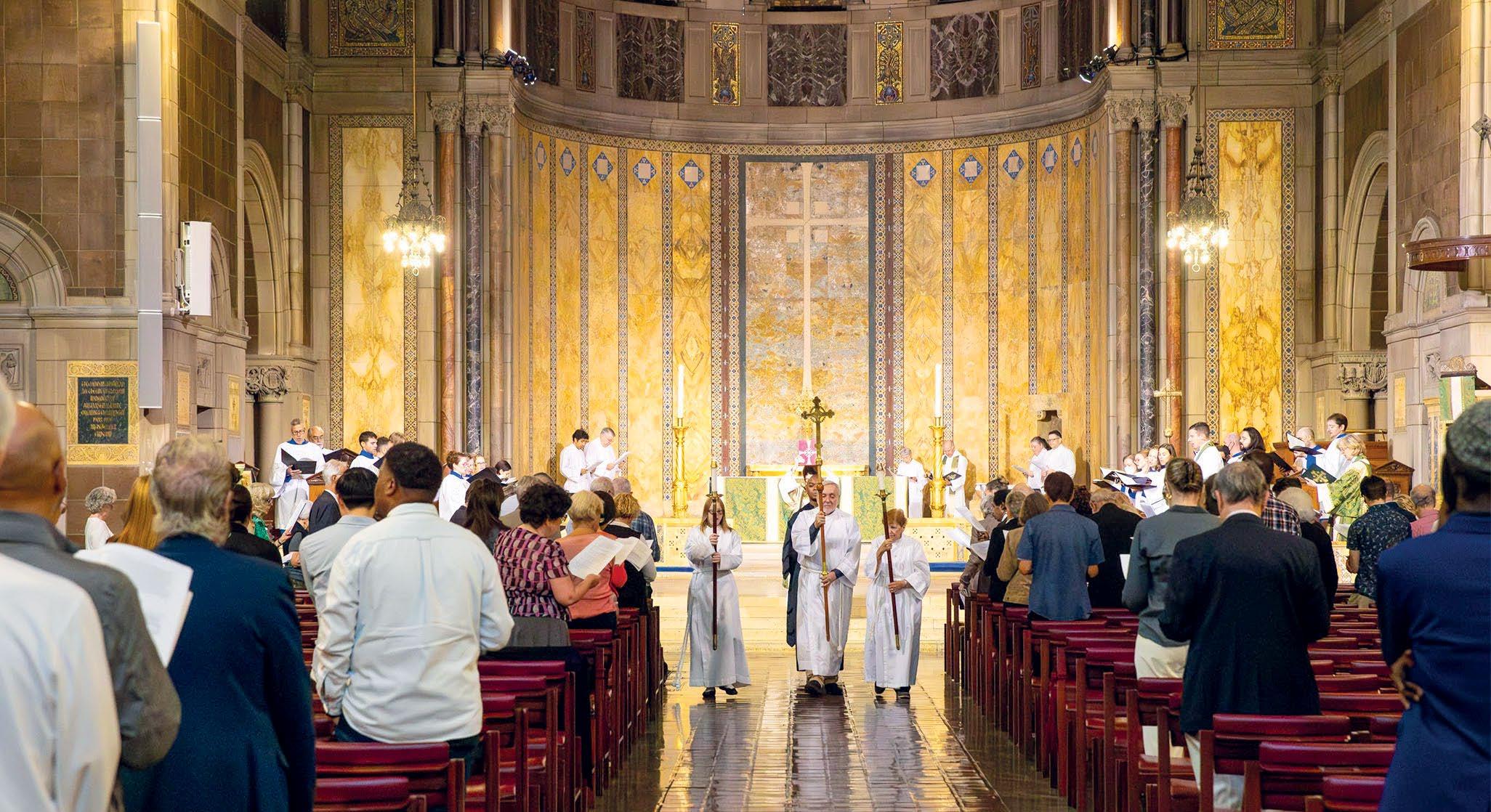
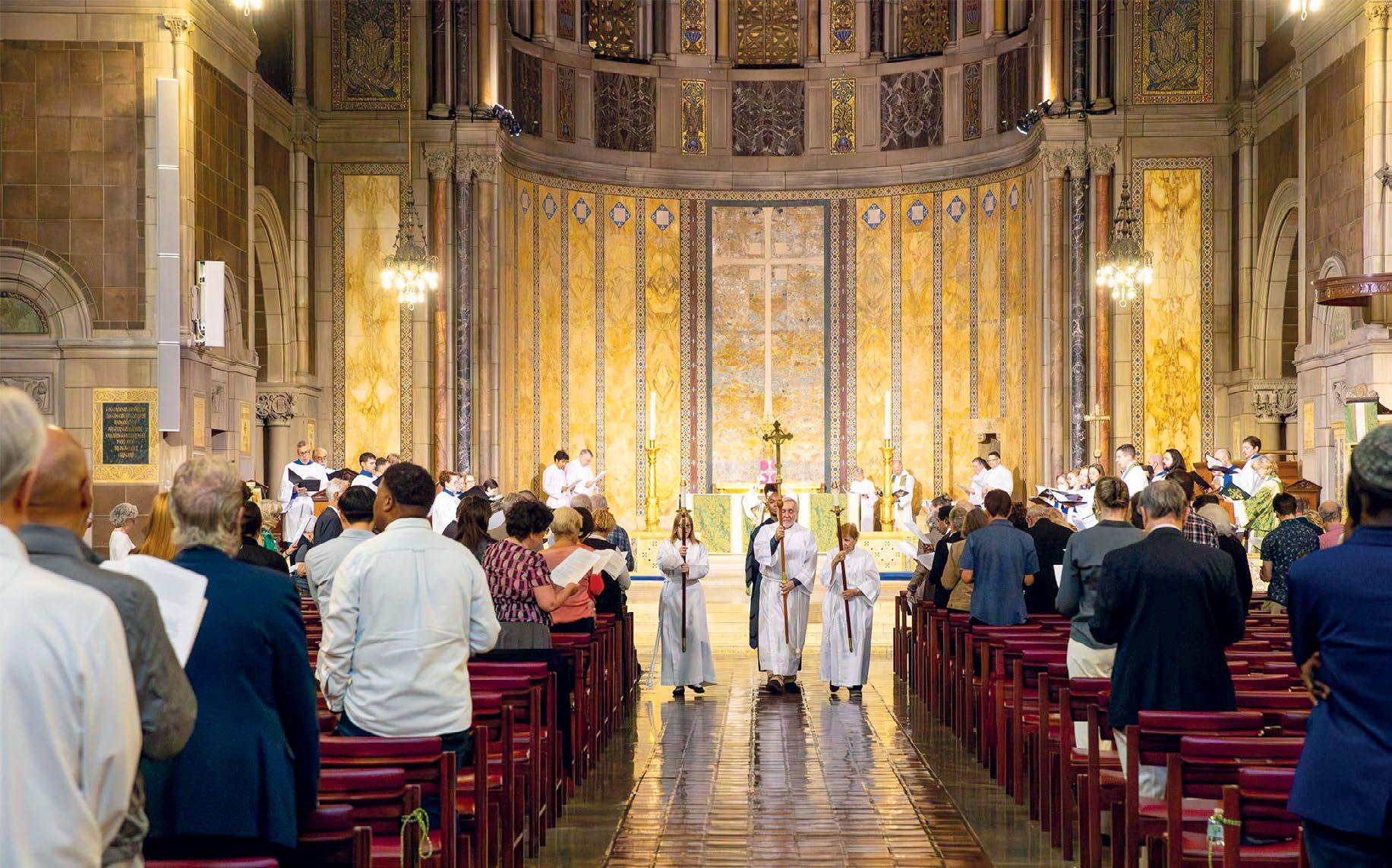
Preserving the church’s architectural heritage was paramount. Over nine months, the church collaborated with reseller AudioPros, design consultant Salas O’Brien, and IVCi to deploy a new audio system— including an Allen & Heath AH-SQ-5 digital mixing console, Shure microphones, and Eastern Acoustic Works (EAW) AC6 ADAPTive column loudspeakers, all on a Dante network.
“One of the biggest challenges is that St. Bartholomew’s has the second-largest pipe organ in the world. There are thousands of pipes throughout the building, so you can’t just drill wherever you want,” Walker noted. “Everything must be planned very carefully.”
In some cases, the installation team drilled through more than a foot of limestone to route new fiber cabling to the basement. Structural engineers were also brought in to confirm that mounting locations could
Preserving the architecture of St. Bartholomew’s Church was an important consideration for the recent audio retrofit (see column loudspeaker, left).
safely support the selected loudspeakers.
The team chose EAW AC6 speakers for their “steerability,” which allows sound to be precisely directed to a specific area of the room, using EAW’s Resolution software. “You install the speakers, then steer the audio so it goes where you want it and nowhere else,” Walker explained. “That’s critical in a space with long reverberation times.”
EAW’s Resolution software (specifically Resolution 2) is free-to-use simulation software for audio engineers to design, model, and optimize EAW loudspeaker systems. It can accurately predict coverage and performance in venues using EAW’s proprietary F Chart acoustics modeling software engine for precise acoustic and mechanical analysis, which includes interactive array adjustments and real-time feedback
for systems like adaptive audio. Resolution enabled Walker and his team to use detailed sound mapping, whereby individual lobes of the loudspeaker could be focused on specific seating areas. The approach helped maintain sonic clarity while reducing reverberant buildup caused by the church’s soaring cathedral ceilings.
“Directional control in loudspeakers is extremely important in these environments,” said Bryan DiFabio, application and support engineer at EAW. “It keeps sound on the audience and off reflective surfaces like walls and balconies.”
No Substitute for Planning
DiFabio noted that EAW’s proprietary design tools such as Resolution and F Chart allow system designers to model performance in advance, experimenting with different arrays, heights, and coverage patterns before installation. “That reduces guesswork and helps ensure a consistent, high-quality experience for worshippers,” he said.
Maintaining speech intelligibility while delivering
adequate sound pressure levels remains one of the biggest challenges in worship spaces. “You want a strong direct sound-to-reverberant ratio at every seat,” DiFabio explained. “High ceilings, reflective surfaces, and long decay times make that balancing act especially difficult.”
Modern IP-based audio systems rely on software tools to fine-tune performance. At IVCi, Walker’s company has developed custom internal applications for project management, system design, and pricing, alongside industry-standard tools such as sound pressure level (SPL) meters and real-time analyzers to identify and correct problematic frequencies.
Ultimately, both projects underscore the importance of planning and communication.
“Everyone has to be on the same page well before you step on site,” Fuller said. “You have to understand the space and have a clear plan for how you’re going to fill it with sound.”
Whether designing a modern glass-walled chapel or retrofitting a centuries-old landmark, successful audio installations in houses of worship depend on careful coordination between architecture, technology, and acoustics—ensuring clarity, consistency, and reverence for the space itself.
Maintaining the aesthetics of Hasley Chapel created several audio challenges.
Serious Christmas Spirit
Prestonwood Baptist Church adds immersive audio to its annual holiday mega-production.
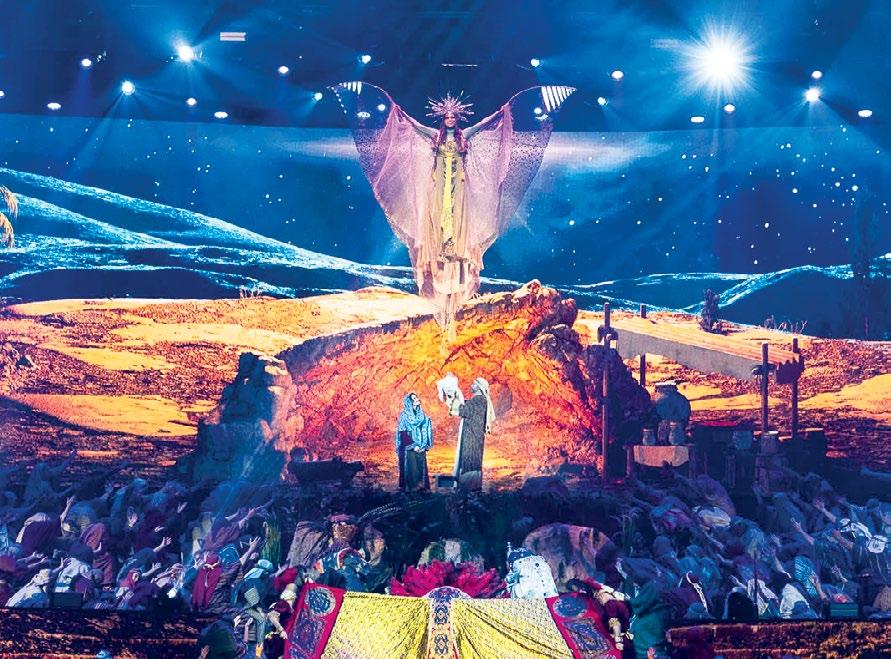
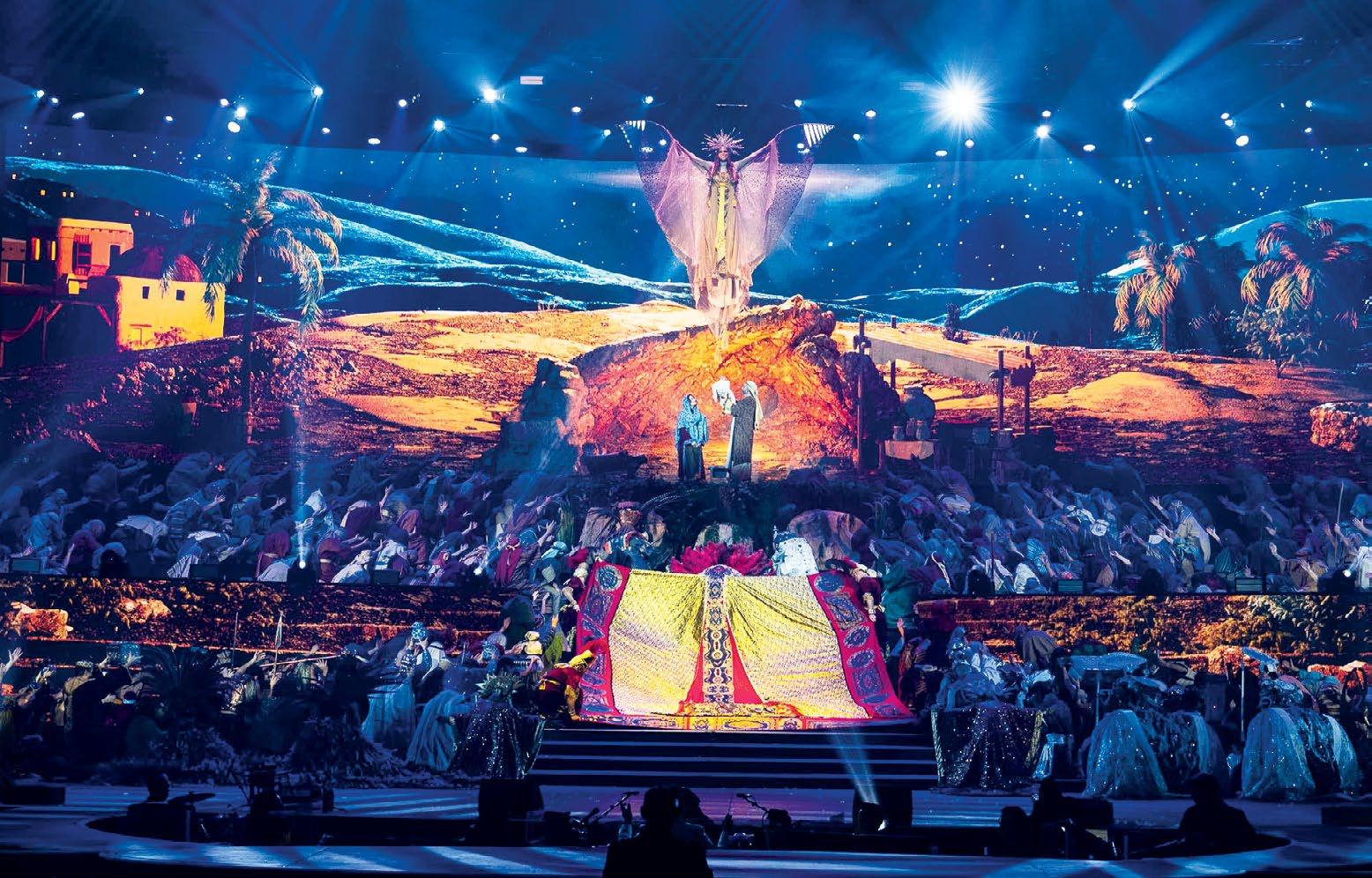
Based in Plano, TX, Prestonwood Baptist Church is known as one of the largest megachurches in the United States. Its annual production, The Gift of Christmas, features a nearly 1,000-member cast and choir, as well as a live orchestra and live animals. To ensure the audio experience matched the monumental scale and theatrical demands of the show, Prestonwood partnered with integration firm Spectrum Sound to replace its aging PA system with a comprehensive d&b audiotechnik Soundscape with En-Scene and En-Space deployment featuring SL-Series line arrays and subwoofers.
“The capabilities for an immersive audio option soon became the core of the discussion, and we arranged a Soundscape demo,” explained Zach Mitchell, operations manager, Spectrum Sound. “It was not difficult to make the decision for a Soundscape installation once we went down that road. The sonic clarity and spatialization we now have in our weekly services are just unbelievable, but The Gift of Christmas is really where the system is used to its maximum potential.”
Running almost two hours and featuring pyro, laser, and lighting effects, The Gift of Christmas is the church’s most intricate production. “We have around 200 console snapshots, with about 25 snapshots automated with control bus routing and fader movements via Create.Control,” said Mike Smith,
Prestonwood's head of audio. “Making manual operation of such a complex mix would be next to impossible. Included in our automation are En-Scene and En-Space changes to enable immersive audio experiences that adapt throughout the production.”
Executed in conjunction with d&b and Spectrum Sound, the design process went through several refinements due to the room’s enormous size, wide shape, and curves. “The final design required five hangs of the SL-Series line array on a custom curved truss,” shared Mitchell. “Our selection of d&b XSL loudspeakers was strategic due to their cardioid behavior, keeping stage noise down, and their perfect size to fill Prestonwood’s large room.”
Spectrum Sound implemented the large installation in three distinct phases, starting with surrounds and fills to accommodate the church’s active schedule. Mitchell said the final phase, when the main PA went up, started on a Sunday afternoon and was ready for a rehearsal on Thursday, so there was time for pre-programming before weekend services. “The installation was incredibly easy and went in flawlessly thanks to the planning and system design work we did with ArrayCalc and then d&b’s efficient rigging features,” he added.
The d&b audiotechnik system configuration includes 20 XSLi8, 30 XSLi12, eight KSLi-SUB, and six SL-SUB for the main PA components. Numerous point source loudspeakers are placed throughout the room including four V7P, two Y7P, four 24S, six 24S-D, and 35 44S. Processing is
provided by a DS100 signal engine running Soundscape with En-Scene and En-Space software. The entire system is connected through three DS10 audio network bridges and powered by three D80, 33 40D, and nine 5D power amplifiers.
According to Smith, Prestonwood’s musical team arranges and orchestrates the music for every service and production. Now, they are designing new elements with Soundscape in mind because they have the tools to “translate their creativity” into the 7,000-seat main sanctuary.
“The overall benefit of Soundscape is that it opens up the sonic palette,” Smith added. “Previously, mixing was constrained, and we needed to shove everything into two points. Now, we can spread things apart and we don’t have sound objects fighting in the same frequency spectrum. This freedom means we use so much less EQ and processing than before. Plus, the ability to create and distribute sound within its sonic landscape allows the team to run the mix in a way that feels more present, without it necessarily being louder.”
The results of the d&b Soundscape installation have been extremely positive. “We’ve received praise from everyone on the upgrade, from the worship leader and the band to the choir, to the congregation themselves,” Smith shared. “But the favorite feedback I’ve received came from two elderly people that who told me, ‘We don’t know what you did differently, but it now sounds so good in here, we don’t have to mess with our hearing aids anymore. We can now hear everything.’ That right there, knowing we’re able to reach everyone in the audience, was worth a thousand compliments.”
Prestonwood Baptist Church uses d&b audiotechnik Soundscape with En-Scene and En-Space to immerse its congregation during its annual holiday production.
VIDEO WALLS
A Combination of Contemplation and ‘Wow’
A video wall helps support a mission of wellness at the University of Virginia.
By Jennifer Guhl
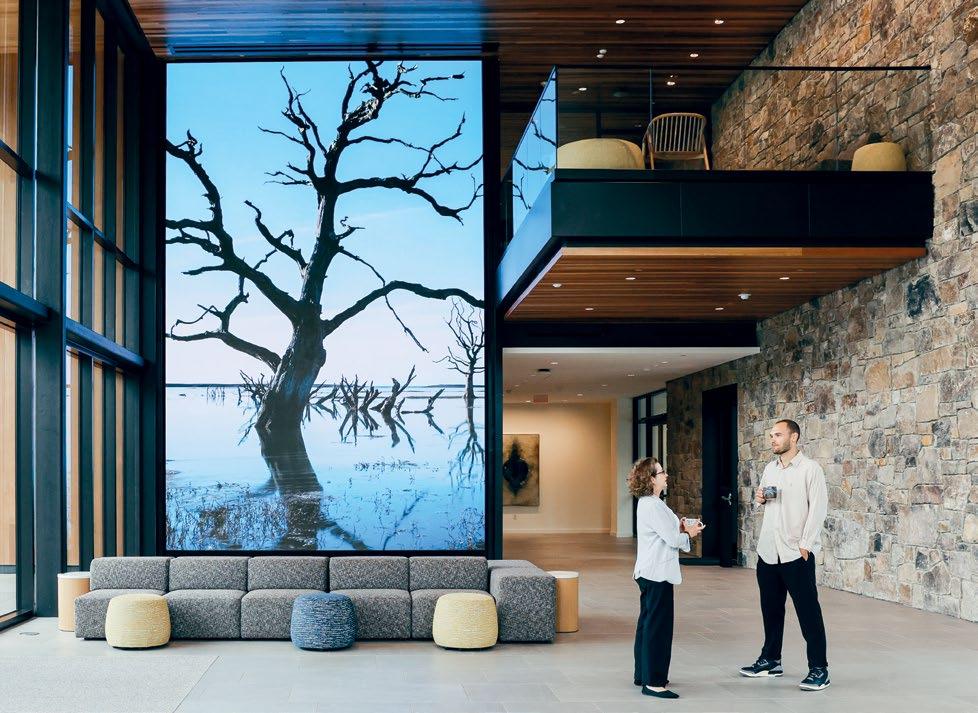
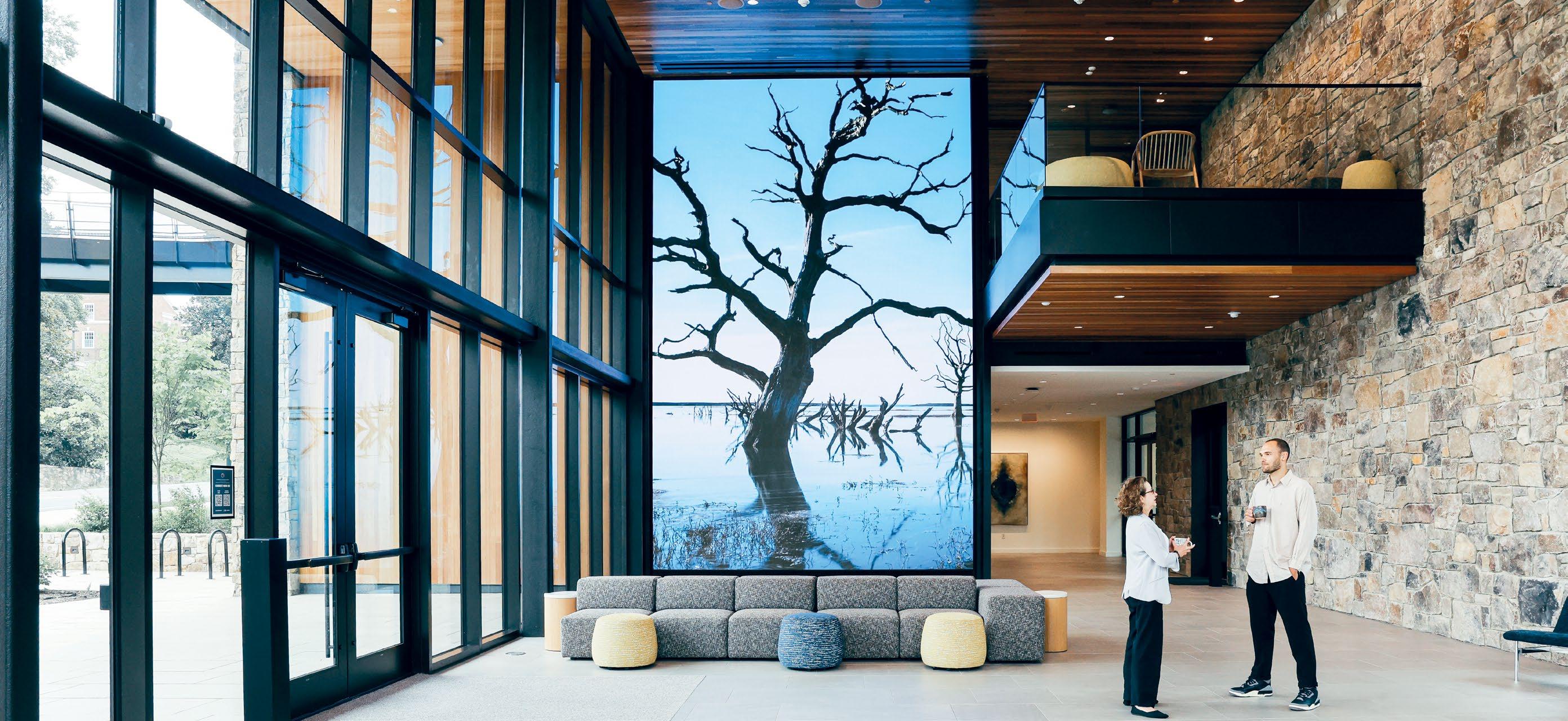
The University of Virginia’s new Contemplative Commons, located within the 57,000-square-foot Contemplative Sciences Center on the Charlottesville campus, was envisioned as an inviting central hub that could bring the campus together and support wellness and mindbody practices through studios, gathering spaces, and shared learning environments. But when thinking about how to integrate technology into the new space, a central AV need emerged: a large-format LED canvas visible from the street that serves as an experiential, immersive entry point.
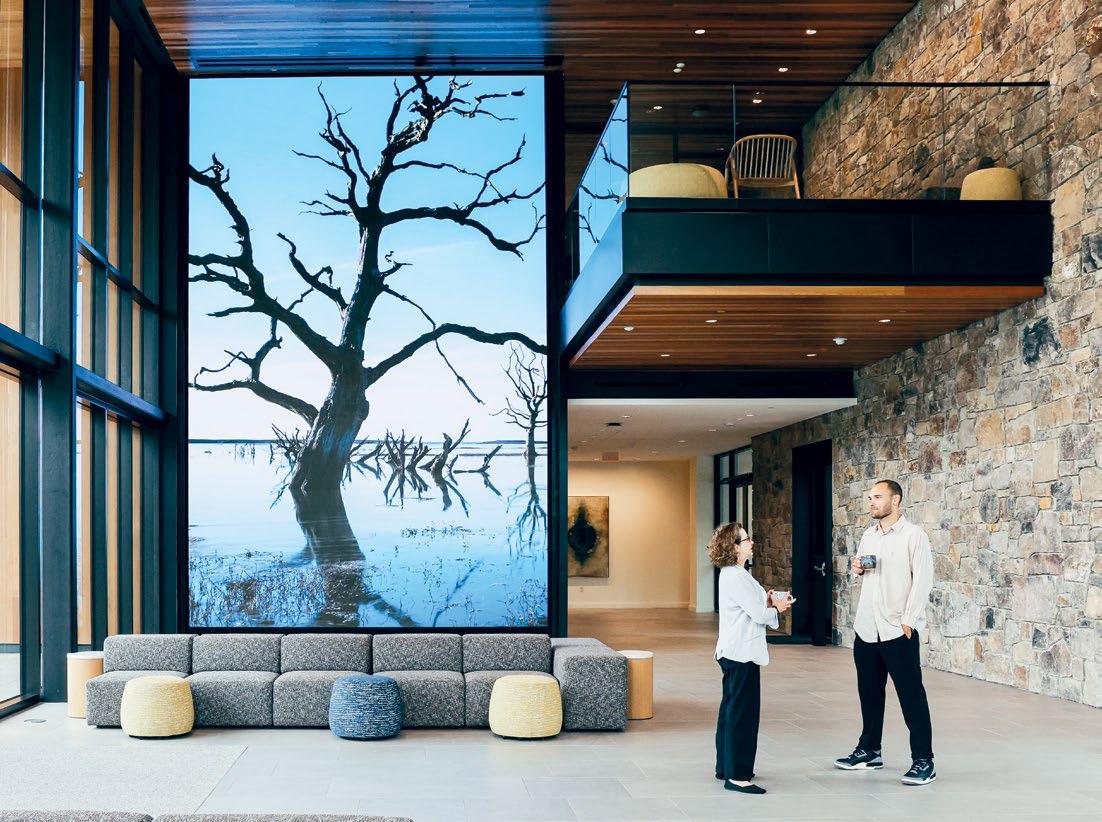
The donor for the video wall system envisioned a large display within the lobby to show contemplative scenes from nature and complement the building entry. This request led to the design and installation of a floor-to-ceiling, 16x24-foot Planar DirectLight Ultra Series LED video wall with 1.2mm pixel pitch. It definitely provides a visible “wow” when people enter the space. The display also features an ERO matte coating, a practical option to provide durability in a public space where students mill around and may brush or tap against it.
Planning Phases (and Pauses)
Project design began in 2019. To help realize this vision, Aidlin Darling Design served as the design architect for the building, with VMDO Architects as the
architect of record. Planar worked closely with Apeiro Design, which provided design consulting for the AV systems and architectural lighting within the Contemplative Commons.
But this long timeline, including some brief project pauses due to COVID-19, can be challenging in the ever-changing world of products. “That’s a lifetime for products,” said Lainie Mataras, general manager and consultant, Architect Design Group with Planar. “Technology is changing so quickly, so you can design with one product and then end up with a different product.”
Even with such early planning, the install followed a familiar pattern in the AV world. “It can take three years talking about it, but about three days to actually install it,” said William Seifert, president–Southeast for Pavion, which served as the AV integrator.
While the size of the video wall helped create the “wow” factor, its location posed technical challenges for the team. The lobby design includes floor-to-ceiling windows, which can complicate LED use.
“One of the biggest challenges was the temperature when the sun hits directly at a certain point in the day,” explained Mike Shaner, account executive with Pavion. “We installed temperature sensors behind the wall to monitor it. If the module is below 92 degrees, it’s green, but the minute that it gets over 95 degrees or higher, the affected module will actually appear red, and the video wall will shut down, so there’s no damage.”
Speaking of heat, as a lobby space with furniture arranged to encourage communal gathering, installers
wanted to avoid heat from the video wall affecting people’s ability to do that. “You never want to have too much heat bothering the people who are relaxing in that lobby space,” Mataras noted.
With the installation occurring at the same time as construction, the wall also needed protection from “all the other trades and all that dust,” Shaner said, as it was part of an active job site. This required extensive coordination with all other on-site trade partners to ensure their work could progress while keeping the display protected from the comings and goings of ongoing construction. For the display itself, ActiveLock technology helped maintain positive contact between modules by accounting for vibrations, heating, and cooling, keeping everything aligned.
The Content Conversation
When it came to managing the video wall, Analog Way’s Picturall Quad Mark II media servers were selected to support operational simplicity and provide continuous playback, helping the impressive video wall avoid becoming an expensive, dark screen. “That’s one of the major reasons why we sell the Picturall server line— it’s designed specifically for 24/7/365 playback,” said Seth Teates, senior regional sales manager for Analog Way. The goal was also to minimize downtime risk on the video wall, and the Picturall media servers provided features to help with this. “The machines have redundant power supplies built in, so if you should have a power supply failure, there’s no downtime,” Teates added. “It’s a Linux-based system running on all
INTEGRATION GUIDE VIDEO WALLS
server-grade hardware with our own proprietary drivers.”
For a canvas of this size, the content often is the difference between being impactful and awkward. “How many lobbies do you walk through where there’s a video wall with something like the Weather Channel on stretched beyond recognition?” Seifert offered. “Nobody planned for it, they just said they wanted a big TV in the lobby.”
Planar agreed and emphasized that content was the most important topic to discuss before display specifications. “When we start a conversation about an LED video wall, we often talk about content way more than we talk about the actual video wall,” Mataras said. She added that many end users neglect to consider the cost of content and its management, which can exceed the cost of the video wall over time.
At Issue
How
For UVA, these complexities were magnified by the unconventional aspect ratio, but that’s where the Picturall media server shines, as it is designed to display high-resolution content across a multi-output canvas. “The end user can create the content files at full native resolution of the wall, load those right into the machine, and the machine just automatically sends it to the right segment of the screen,” Teates explained.
An Architectural Element
Full-resolution, pre-recorded custom content was used to showcase nature scenes from around the world, highlighting the space’s natural design elements, such as the beautiful stone wall set beside the video wall.
Pavion noted the final content wasn’t available at the outset, so temporary content was used during the
early stages of the install. “It wasn’t until the very end that the firm came in, and we had to make sure Analog Way was there at the same time,” said Shaner. He added that this required multiple visits with the content team, making adjustments during each visit.
“In AV design, the challenge is always designing a system that users who are not necessarily AV people understand and find easy to use,” said Daniel Mei, associate principal, AV technology, Apeiro Design. Analog Way did its part, providing field engineers to train the UVA team on the Picturall GUI and the Media Manager workflow, helping them build playlists, set the playback order, and define transitions between segments without disrupting the canvas.
One thing all the partners agreed on was that the video wall functioned as an architectural element within the space, not just as AV. “I look at spaces like this, and I’m most proud of the fact that LED is now kind of considered an architectural element,” said Mataras. “You don’t look at it and see a space that added an LED wall.”
Seifert said the video wall is receiving the reaction Pavion was hoping for within the space. “Everything I’ve heard has been extremely positive,” he added. “It’s that ‘wow’ factor, and it sets the space apart.”
are video walls being used creatively in retail and hospitality environments?
JOHN KOZLOWSKY CHANNEL MANAGER,
ABSEN
Video walls in retail and hospitality have evolved from digital signage into experience-driving design elements. In retail, brands use immersive LED as dynamic storefronts that showcase seasonal campaigns, real-time product storytelling, and interactive moments that guide customers through the space. In hospitality, video walls create atmosphere: grounding lobbies into destinations, elevating bar and dining environments with motion-driven ambiance, and supporting wayfinding with premium design. The most creative deployments blend content, architecture, and customer flow in a way that makes them feel deeply integrated while staying reliable enough for continuous operation.
RUDY VITTI
GROUP MANAGER, PRODUCT MARKETING, PANASONIC PROJECTOR & DISPLAY AMERICAS
Audience expectations for immersive and dynamic experiences continue to grow, leaving retail and hospitality organizations to continuously evolve their customer touchpoints. High-quality, captivating visual storytelling has emerged as a differentiator, taking these experiences to the next level. Video walls provide the ideal canvas to elevate brand experiences. Retailers can immerse
customers in the brand through exciting visuals and showcase products in real-world settings. Outfitting hotel conference rooms with video walls gives presenters the power to transport attendees to another world. Similarly, hotel lobbies can use video walls to highlight the top attractions in the area and drive guests’ excitement.
ANNA KOZEL
VP OF MARKETING, VUWALL | G&D
While video walls are often associated with eye-catching retail and hospitality experiences, some of the most creative and impactful uses are in missioncritical control rooms, where creativity isn’t about spectacle—it’s about turning complex information into clear, actionable insight. Across public safety, transportation, utilities, healthcare, and stadium security, video walls unify real-time video, data, maps, and alerts into a shared operational view. The real “wow” factor is faster decisions, stronger collaboration, and better outcomes when every second counts.
COLIN FARQUHAR
SVP SALES, VITEC
Retail and hospitality brands are deploying increasingly eye-catching video walls to create immersive environments that capture attention, deliver deeper engagement, and increase dwell time.
In retail, high-impact visuals, branding elements, advertisements, and real-time promotions can be displayed across creative layouts of almost any shape or size, maximizing impact and enhancing the customer experience. In hospitality, video walls can be deployed to deliver atmospheric, brand-defining visuals that transform lobbies and event spaces, while aligning with broader AV and digital touchpoints throughout the location to maintain consistent brand identity. Hardware-based video wall solutions ensure synchronized, ultra-reliable playback across layouts, supporting cohesive storytelling.
MARK MILLER
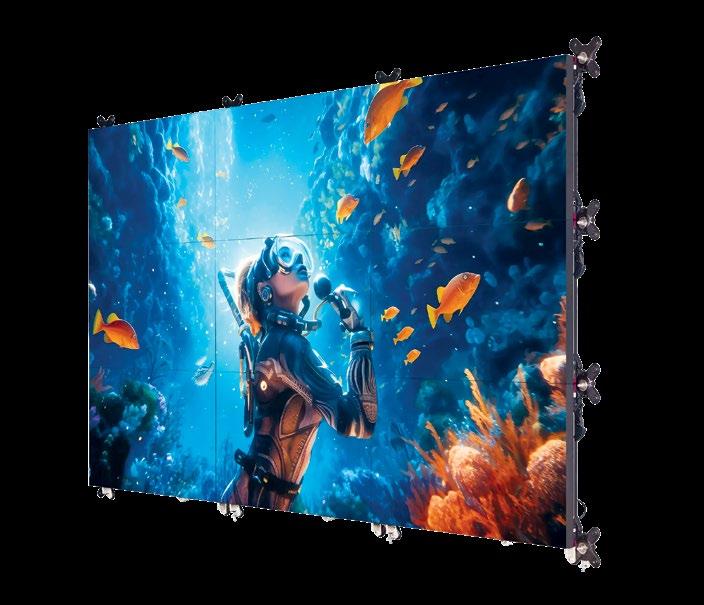
PRODUCT MANAGER, SHARP dvLED video walls are being used creatively to transform retail and hospitality spaces into immersive, experience-driven environments. In retail, they can showcase eye-catching dynamic branding, seasonal campaigns, and interactive product storytelling. In hospitality, dvLED walls create striking digital lobbies, wayfinding displays, and mood-setting backdrops for bars, restaurants, and event spaces. Their seamless, modular design enables floor-to-ceiling visuals, curved installations, and architectural integration—helping brands engage visitors emotionally, elevate ambiance, and deliver memorable, shareworthy experiences.
From left, Daniel Mei, Mike Shaner, Lainie Mataras, Seth Teates, and William Seifert
INTEGRATION GUIDE VIDEO WALLS
ROBERT DETWILER SENIOR DIRECTOR OF PRODUCT MANAGEMENT, PLANAR
Increasingly, we see video walls designed to work with or blend into a building’s architecture. Pair this with more of today’s LED technologies moving away from traditional square and rectangle designs, enabling unique and even custom shapes, and customers experience fewer limitations and more creative freedom with indoor and outdoor installations.
Imagine attending a concert or visiting a clothing boutique to see footage or advertisements projected across archways, rotating towers, or wave-shaped columns. As we see finer pixel pitches as well as improvements in brightness and color performance emerge, these creative uses cases will be supported by even higher quality viewing experiences.
MARK BISHOP PRESIDENT, LYNTEC
From our perspective, the creative use of video walls in retail/ hospitality settings places significant demands on power control and distribution infrastructure. These
displays often operate on schedules that surge and fall being tied to guest traffic, special events, or time of day, making sequenced power-up and automated shutdown essential to prevent inrush current, reduce heat buildup, and extend display lifespan. Centralized or distributed power control allows facilities teams to remotely monitor circuits, perform hard resets without physical access, and fully remove displays from the grid rather than leaving them in standby. This approach improves uptime in high-visibility environments while helping venues manage energy costs, reduce maintenance, and maintain consistent performance across complex, multi-zone installations.
BILL ZHU DIRECTOR OF BUSINESS
DEVELOPMENT, JB&A
Modern retail environments have been using video walls to turn their stores into immersive brand experiences. Nike’s House of Innovation, for example, uses massive LED walls that shift between cityscapes, athletes, and product stories, making customers feel inside the brand world. Some stores use interactive walls that respond to motion,
triggering animations as customers approach. These creative executions transform stores into experiential spaces that capture attention, strengthen brand identity, and make shopping more memorable and engaging.
JASON METCALFE
BUSINESS MANAGER, CRYSTAL LED, SONY ELECTRONICS
Video walls are being used in retail and hospitality environments, as well as in corporate and higher education, to showcase content and information that elevates engagement and unlocks more valuable and relevant customer interactions. For retail and hospitality, large scale, color accurate, immersive content, and storytelling can draw in and drive business and cross-selling opportunities, highlight timely and localized communications such as upcoming events and promotions, capture an audience’s attention, provide wayfinding opportunities, and create an experiential destination. All of this can strengthen brand perception, provide a premium ambiance, increase dwell time, create social moments, and help generate repeat business.
INTEGRATION GUIDE VIDEO WALLS
Video Wall Brings MLK’s Vision to Life at King Center
By Wayne Cavadi
Located near downtown Atlanta, the Martin Luther King Jr. Center for Nonviolent Social Change, or the King Center, was established by the civil rights leader’s wife, Coretta Scott King, in 1968. What began in the basement of the King home eventually moved to its current location in 1981. In the spirit of changing for the betterment of all, the King Center recently went through a technological upgrade, with a new BLOX LED video wall and a FlatPanel audio system powered by LEA Professional.
Scott King had said the King Center is not simply a monument, but “a living memorial, filled with all the vitality that was [King Jr.’s], a center of human endeavor, committed to the causes for which he lived and died.” While guests can see his birth home and historic Ebenezer Baptist Church where he preached, the center also educates visitors in King Jr.’s Nonviolence365 philosophy.
According to William Collins, account manager for Atlanta-based S&L Integrated, which was awarded the project, prior to the new video wall, King Jr.’s speeches and other videos were simply displayed on a portable screen from an ultra-short throw projector. The installation took five days on site, with
four additional days of pre-deployment shop and post deployment commissioning.
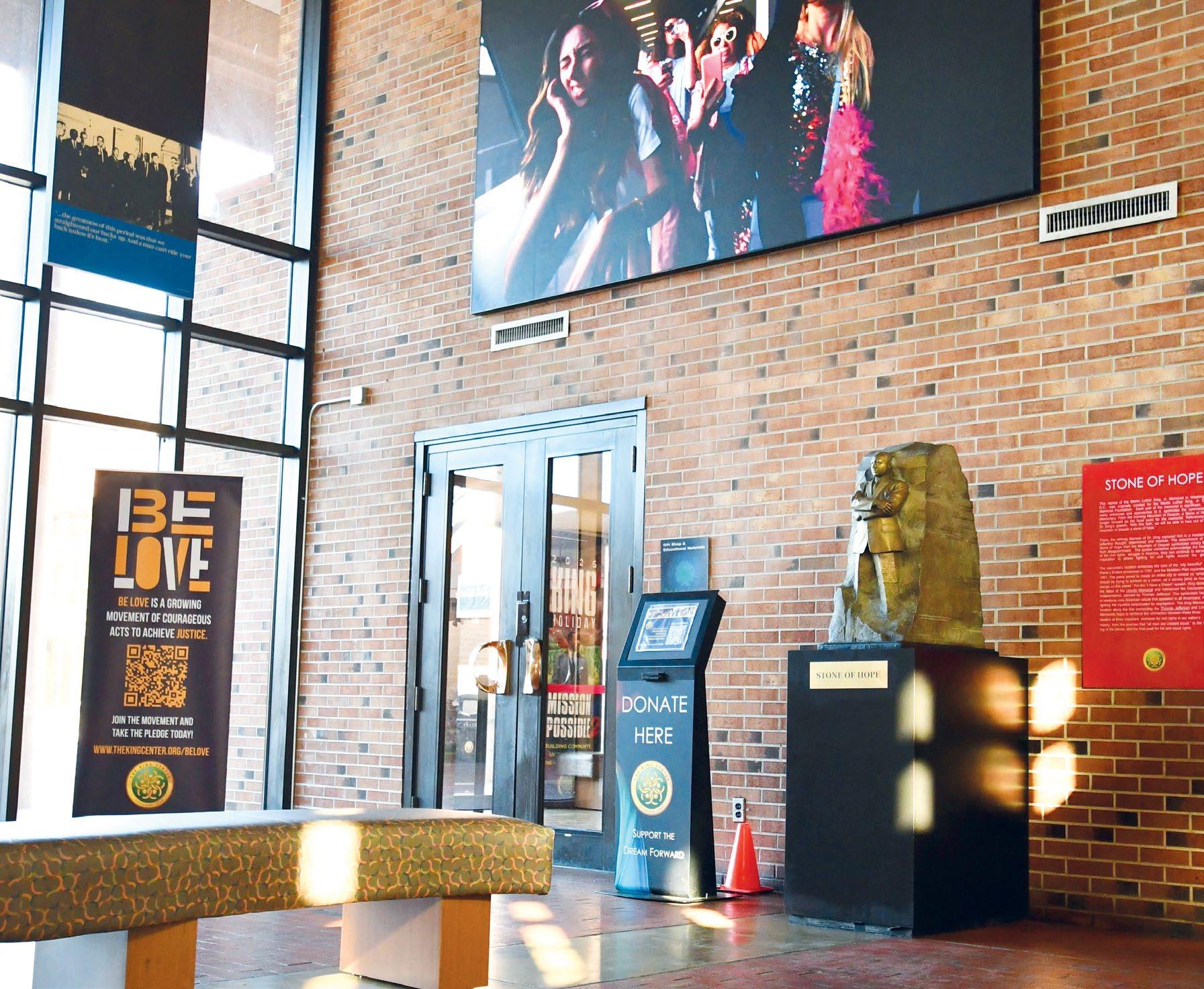
The large video wall was installed in the main lobby at the King Center to serve as the central visual element, ideal for digital signage and video content. It is a challenging space, with brick walls, large glass windows, and a tiled floor. Glares and acoustics were certainly a large consideration.
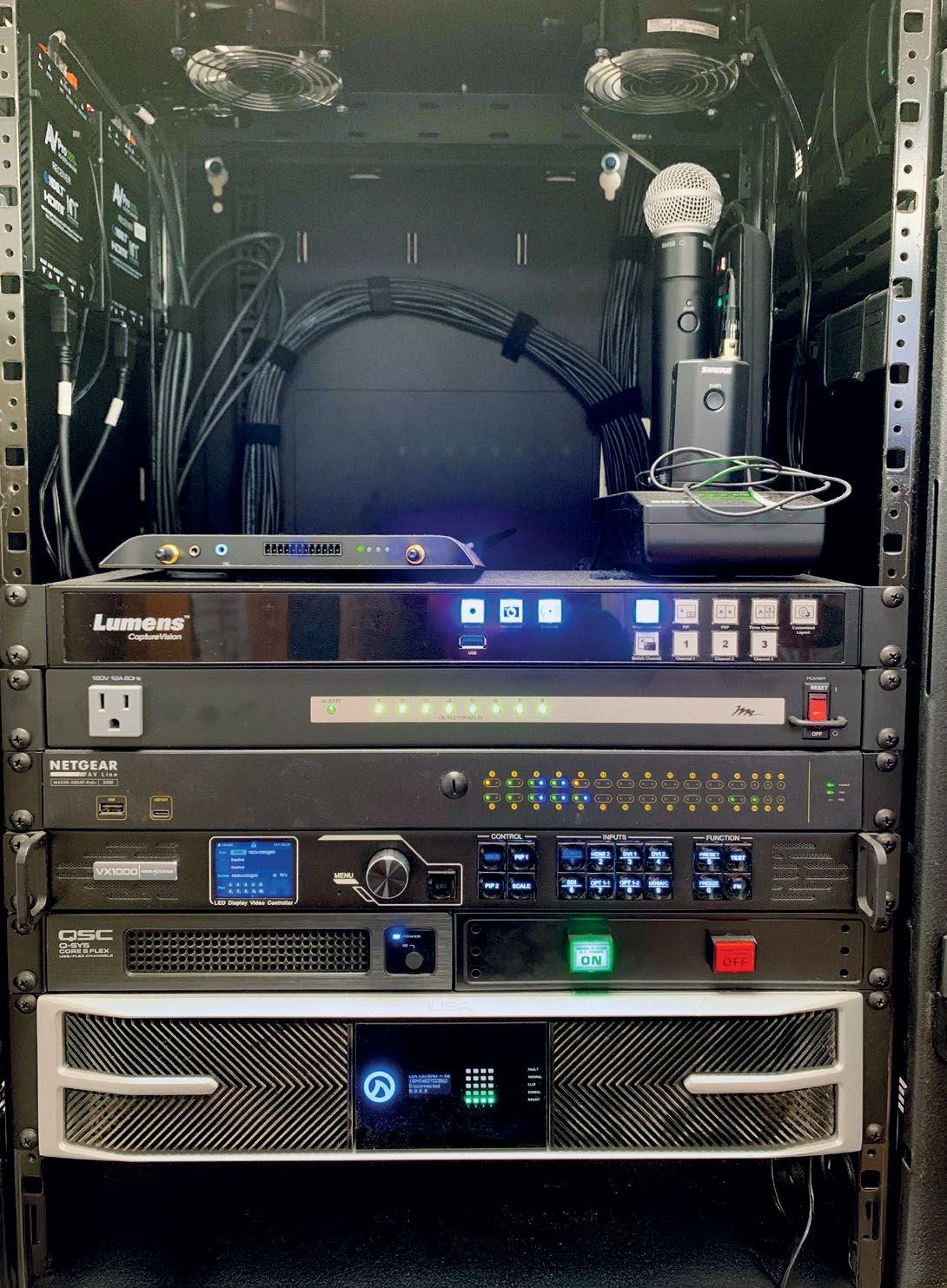
Per Collins, S&L Integrated went with a 160-inch diagonal BLOX LED dvLED video wall above the bookstore entrance in the lobby. The wall includes a NovaStar video processor for signal input and LED mapping. The system is powered by a LynTec power relay panel with four 20-amp relays. A Lumens LC200 video processor functions as a system switcher to handle multiple video inputs and enables the ability to have several multi-window options, as well as the ability to record or stream events in real time.
The content source for the video wall is a BrightSign XD235 PoE+ digital signage player, which was selected because of its ability to deliver 4K video content. The system also includes an HDBaseT receiver capable of 4K transmission up to 230 feet and a 12x optical zoom PTZ camera for live video capture. Control is driven by the Q-SYS Core 8 Flex and accessed by two Q-SYS touchscreen controllers. A NETGEAR M4250-26G4F-PoE+ serves as a managed switch.
The video wall is being used for event replays, seminars, sponsor videos, calendar, and announcements—essentially, everything from digital signage to pre-produced and live content. That meant not only was it important for the visuals to be lag-free and sharp, but the audio needed to be clear and concise as well.
With the many reflective surfaces presenting a challenge, Collins and the S&L Integrated team went with a FlatPanel Audio System and amplifier from LEA Professional. Collins said the reflective surfaces were the primary reason these were his choice. The only problem? “There were no issues with the audio other than the sub working too well at first,” he joked. “One minor adjustment was all that was required.”
S&L installed two FlatPanel Audio DML500 loudspeakers paired with a FlatPanel Audio LS118 subwoofer in the beautiful, but tricky, lobby. Their 165-degree conical coverage and sound waves transparently deliver FPA’s signal path. The center’s employees told Collins the speakers paired with the LEA amplifier yield a “significant sound quality improvement” over the previous system.
Both visitors and the King Center’s staff have been overwhelmingly pleased with both the video wall and audio system supporting it. “They have been very impressed with the functionality,” Collins concluded. “It was quite a change from the previous equipment, but I have been there along with our service and support team to onboard them, especially with the video scheduling. They are now very confidently using the integrated systems well on their own.”
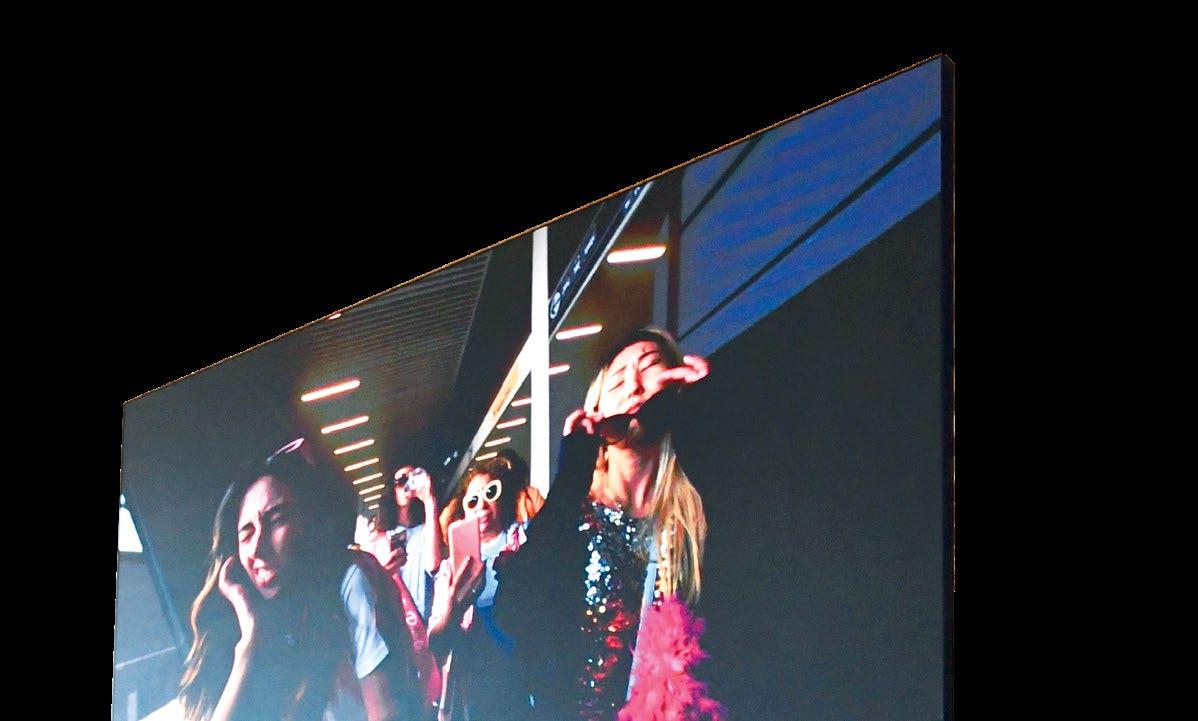
A new video wall at the King Center pairs live and pre-recorded visuals with high-end audio.
The new lobby system is managed through components from BrightSign, LEA Professional, LynTec, Lumens, NovaStar, QSC, and more.
INTEGRATION GUIDE VIDEO WALLS
Absen JD-H Series
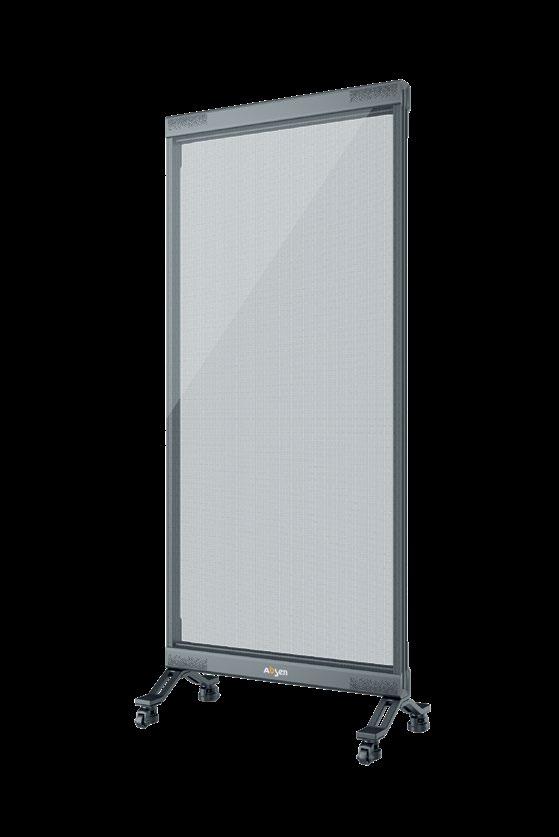
Absen’s JD-Holographic Series is designed for transparent, designforward installations in retail and hospitality environments. With more than 90% light transmittance, an ultrathin profile, and a lightweight structure (5kg/m2), it integrates directly onto glass without disrupting architectural lighting. The display supports naked-eye 3D floating visuals for attentiongrabbing storytelling, while modular construction enables fast on-site maintenance and flexible installation on curved or uniquely shaped glass structures.
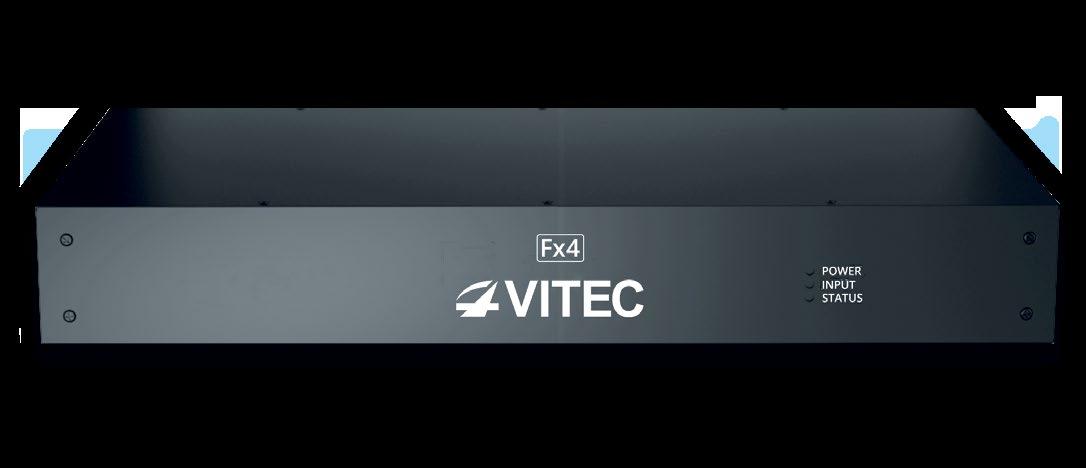
VITEC Fx4
Planar CarbonLight CLI Flex Series
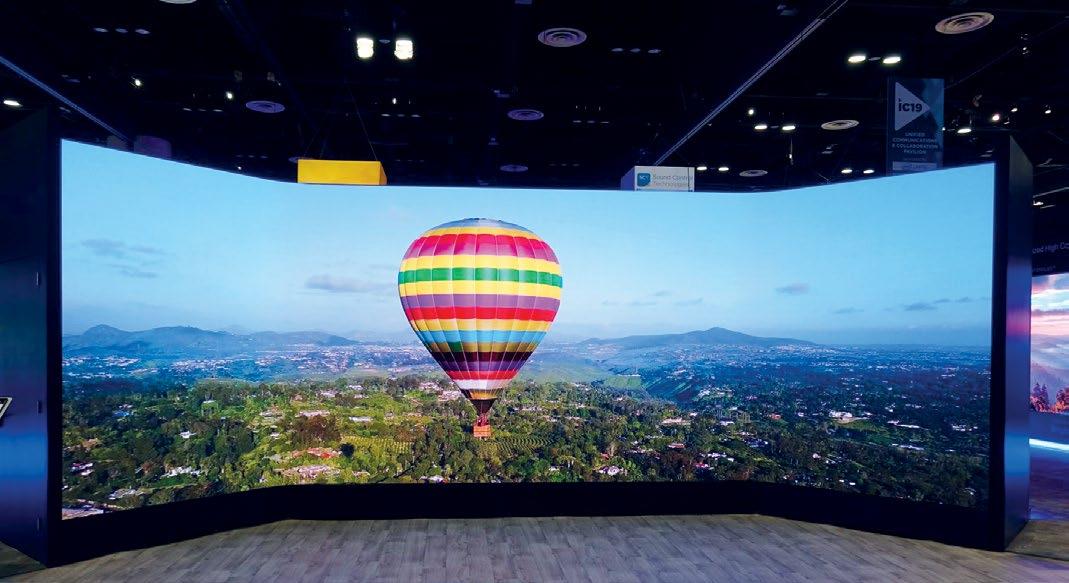
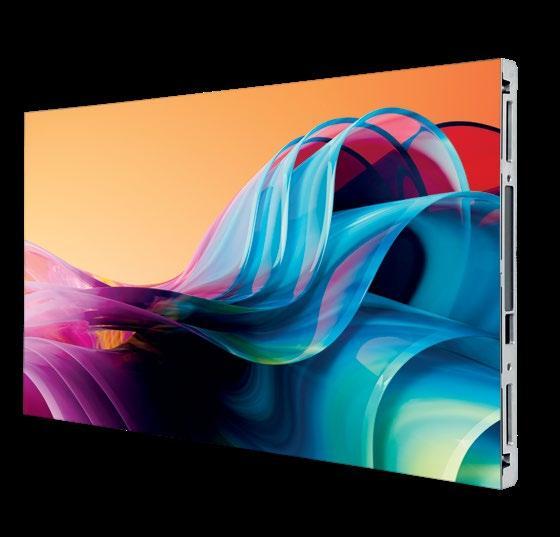
Planar CarbonLight CLI Flex Series pliable LED video wall displays combine to create immersive concave or convex curved video walls that bring stories to life. Available in pixel pitches ranging from 0.9 to 3.9mm, the modules can form curves as tight as 25 inches without color shift, offering a more visually appealing alternative to faceting flat LED cabinets into segmented curves. The series supports wall-mounting, free-standing, or hanging installations requiring smooth curves, waves, or column wraps.
VITEC’s Fx4 is a powerful, standalone 4K video wall controller designed for flexible, creative display environments. With a choice of DisplayPort 1.2 and HDMI 1.4 inputs plus four genlocked outputs, it delivers seamless 1080p60 playback across multi-display arrays. Its high-bandwidth loopthrough enables scalable daisy-chaining, while Wall Designer software simplifies configuration of unique layouts, rotations, and cropping. FX4 empowers retailers, hospitality venues, and public spaces to deploy visually striking, custom video walls with ease.
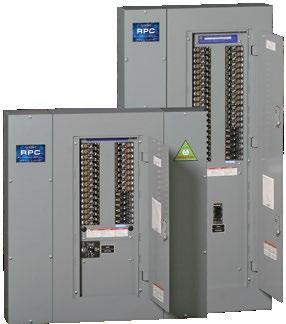
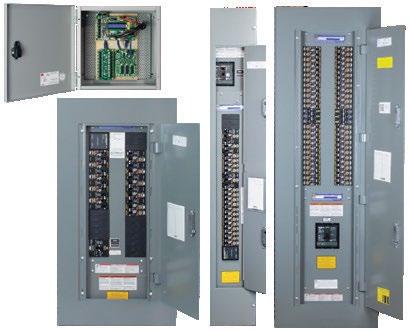
LynTec RPC Series
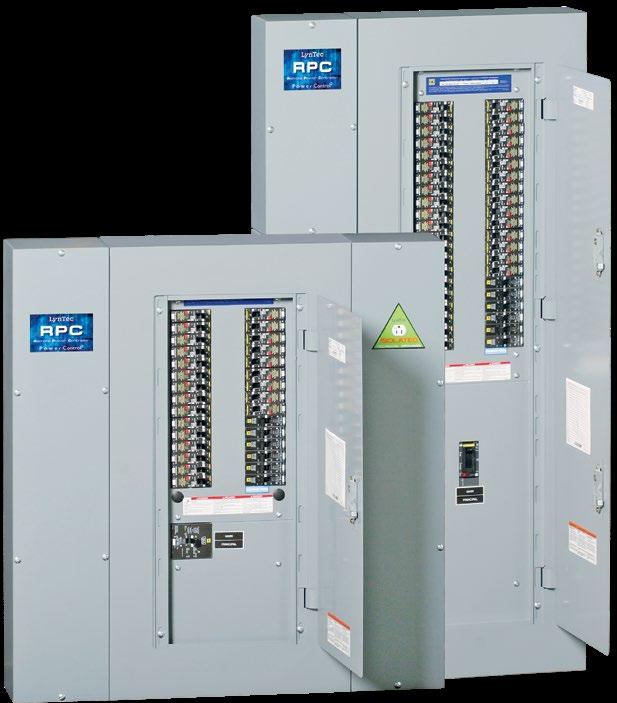
LynTec’s Remote Control Breaker Panel (RPC) Series combines circuit protection, power control, and monitoring in a single integrated solution. Built on the Square D Powerlink platform, the RPC uses motorized circuit breakers that can be remotely operated via an onboard web server or third-party control systems. It supports multiple control protocols— including DMX, sACN, HTTP, Telnet, RS-232, and BACnet—for flexible integration in any AV or lighting environment. The panel offers advanced features such as circuit-level sequencing, load shedding, scheduling with an astronomical clock, and brownout protection, delivering safe, reliable, and energy-efficient power management for complex installations.
INTEGRATION GUIDE VIDEO WALLS
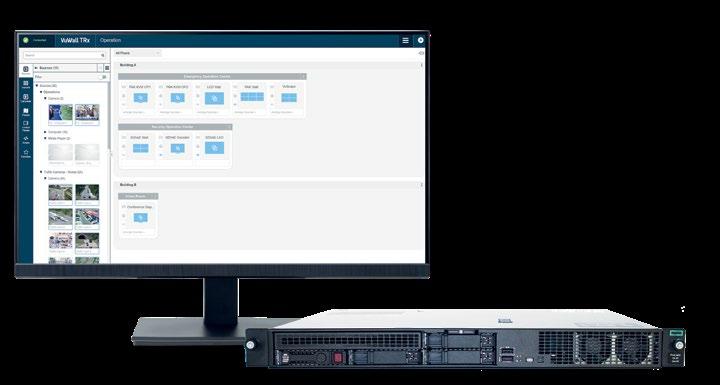
VuWall | G&D TRx
TRx, VuWall’s centralized video wall and KVM management platform, enables organizations to visualize, control, and distribute content across multiple displays and operator workstations from a single interface. Designed for mission-critical environments, TRx manages AV over IP sources, G&D KVM systems, and other connected devices within one secure, scalable ecosystem. Operators can instantly route any source to any display, improving situational awareness and more.
Sharp EC Series
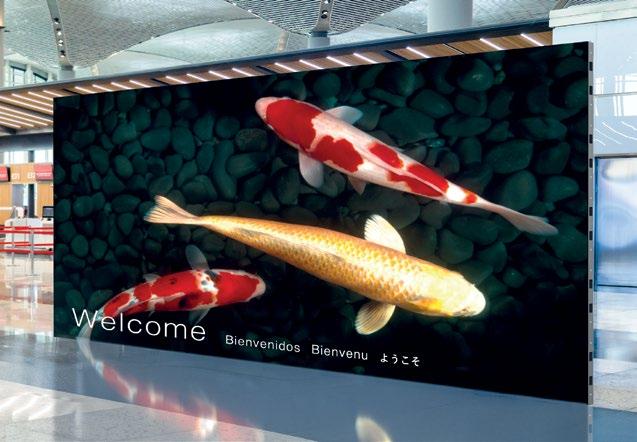
The upcoming Sharp EC Series dvLED displays deliver exceptional durability, energy efficiency, and visual performance in a cost-effective design. Featuring COB technology, the EC Series offers enhanced image quality and reduced power consumption compared to traditional SMD displays. Plus, the added durability from COB technology makes the EC series ideal for public, high-traffic areas found in retail and hospitality environments. High contrast ratios and multiple pixel
pitch options ensure vivid, reliable performance in almost any application.
JB&A Barco UniSee II
Barco UniSee II takes LCD video wall visualization to the next level, delivering striking performance for critical decision-making. New mini-LED and Chip-on-Glass innovations boost contrast with deeper blacks, while quantum dot technology adds crisper color and richer saturation. Revolutionary uniformity and advanced interpanel communication keep images consistent across the wall. Paired with Barco’s bezel-less LCD panels, UniSee II creates the look and feel of one seamless, single-canvas display.
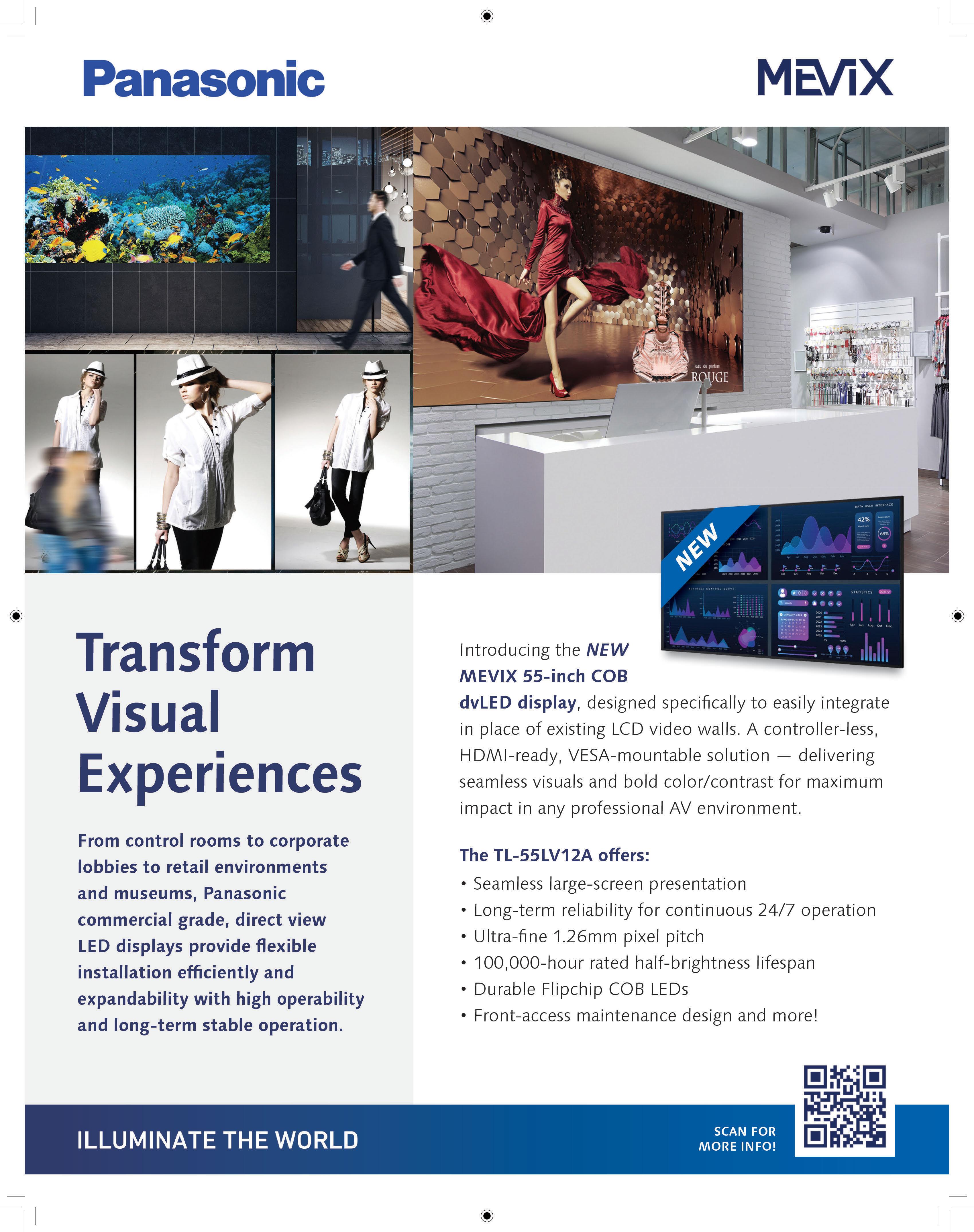
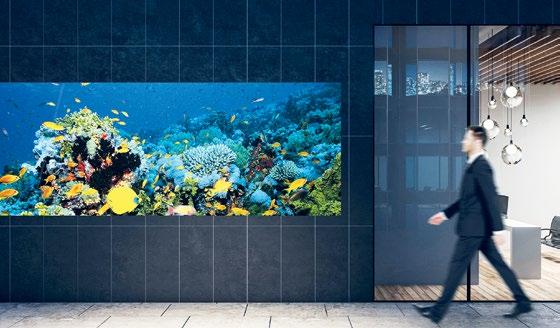
Building and upgrading video walls can pose complexities. The upcoming TL-55LV12AW 55-inch LED video wall panel streamlines this process with its VESA mounting pattern that simplifies the replacement of existing LCD video walls. Its self-contained design with a built-in controller supports ease of use, empowering AV professionals to display content without seams or bezels. COB LED technology drives energy efficiency, resulting in a flexible, high-performance solution that delivers dynamic visual experiences.
Sony Crystal LED S Series
The Crystal LED S Series is the latest expansion to Sony’s immersive and impactful Crystal LED dvLED lineup. The ZRD-S12G and ZRD-S15G are mid-market displays that feature a 1.25 and 1.56 mm pixel pitch, respectively, while providing brightness of 800 cd/m2. This is paired with simplified installation, flexibility, durability, and a reduction in total cost of ownership. The models are optimized for a diverse range of uses, including corporate settings, educational institutions, and commercial facilities.
By Dave Van Hoy
EThe Changing Status of Cloud Production
Turns out the real value proposition is choice,
not cloud.
very few years, the AV industry declares that this is the moment everything moves to the cloud. And every time, reality is far more complicated.
What’s happening now follows that familiar pattern. When people speak of the “state of cloud production,” there’s often an assumption that AV infrastructure is racing toward public cloud platforms like AWS, Microsoft Azure, or Google Cloud at the same pace that IT departments adopted cloud solutions for data storage and software hosting. But from where I sit, working with enterprise clients every day, that’s not what’s happening.
What we’re really seeing is a very big movement toward cloud management infrastructure, but not a big movement of AV infrastructure itself to the cloud. And the reasons why have everything to do with budgets, existing investments, and probably the biggest driver right now, the broader economy.
For quite a while, the idea of shifting from CapEx to OpEx was a major motivator for companies moving toward cloud workflows. But with today’s interest rates and economic pressures, the financial advantages of public cloud have softened. Without that pressure, organizations are less inclined to abandon hardware they’ve already paid for, especially when that hardware still does the job.
Meanwhile, our vendors, who’ve poured time and money into cloud-based versions of their products, find themselves pushing against a market that’s hit the pause button. The result is that private cloud has become the dominant force.
What ‘Private Cloud’ Means in AV
There’s a lot of confusion around this term, so let’s define it. Private cloud doesn’t mean spinning up a bunch of AWS or Azure compute instances on premise. It means running cloud-designed, software-defined tools on servers that the customer owns.
A private cloud can be as simple as one big, fast server in your server room. Or it can be a full rack running a hypervisor with all the bells and whistles. Either way, the cloud piece is in the software architecture, not the location.
Vendors like this model because moving from hardware to software dramatically shortens R&D cycles. When you’re building physical hardware,
especially with custom chips or FPGAs, you’re talking about long development, prototype, and test cycles. In software, you can iterate that in days or weeks. So, the shift is less about “moving to the cloud” and more about moving to software-defined AV, which just happens to be cloud-compatible.
Every now and then, someone asks whether the “second or third-tier” cloud providers change the equation. And yes, many of them are less expensive simply because they charge less. But the economic model is the same: You pay based on how much you use. The classic disaster scenario remains—someone forgets to shut down the infrastructure before the end of the day, and the organization receives a surprise bill.
You also have models like co-location facilities, where companies, such as Level 3, rent out data center space. In that case, you get their power, cooling, and security, but you bring your own hardware. That brings the model back to CapEx, but still gives you the resilience and scale of a professional data center.
All these variations prove one thing: Very little in this space is black-and-white.
Where Are We Going?
Public cloud adoption for AV remains relatively small. Software-defined AV continues to grow. And more of that software is running on customer-owned hardware, not cloud infrastructure.
It’s an interesting shift and it creates its own challenges. For example, moving to private cloud means an organization must deal with its own security team, server maintenance, replacement cycles, and so on.
But because all this hardware is COTS, AV teams can lean on existing IT skill sets. Maintaining a server today isn’t exotic. It’s everyday IT work.
The upside for vendors is that, if they build correctly using containerized technologies like Kubernetes and Docker, the same software can run in a room, in a company’s data center, at a colocation center (colo), or in the public cloud. That flexibility is absolutely new to the AV world.
This capability means that I can take, for example, a software-based video switcher and run the exact same tool in four different places without changing anything except the license assignment. That allows companies to choose deployment models based on what matters most to them today.
If a CFO wants the most predictable cost model possible, the company can run it on owned hardware. If the priority is maximum uptime, they can run in a
highly redundant colo. If they want operators anywhere in the world to produce events in any room in the world, cloud instances become attractive.
The key point is this: The AV operator uses the same tool no matter what business decision their company makes. That has never been the case before.
This flexibility isn’t tied to a specific type of corporate AV, either. It applies to everyone, from production studios to everyday meeting room operations. The software runs wherever it makes the most sense at that moment.
Complicated Financial Planning
For years, the industry talked about cloud as a financial strategy: Move CapEx to OpEx. But true financial planning is more complicated. Companies care about total cost of operation, efficiency, and competitive edge. Our clients aren’t trying to become AV companies. They want to communicate, collaborate, and run their businesses as effectively as possible. We need to think at that level. If I’m working with an automotive company, their goal is not to become the best videoconferencing organization. They want to build great cars; they expect us to deliver solutions that make them better at their business.
Cloud, whether it’s public or private, doesn’t automatically do that. Software-defined workflows might. Flexibility might. Better uptime might. Lower total cost of operation might. But the answer is different for every organization. That’s why the movement toward software-defined AV, rather than public cloud, is the real story right now.
Many people mistakenly equate “softwaredefined” with “public cloud.” Those are very different ideas. Software-defined AV can run anywhere, including on prem. As our industry gets more comfortable with containerization and virtualization, customers will gain even more freedom to shape workflows around their business priorities, not the limitations of hardware.
At the end of the day, our industry is shifting from asking, “Should we move to cloud?” to asking, “Where should this run to make our organization most effective?” That’s a much more mature conversation. And it signals a future where AV technology isn’t just keeping up, it’s finally aligning with the way enterprises actually operate.
Dave Van Hoy is the president of Advanced Systems Group, and was named a member of the SCN Hall of Fame in 2026. Contact him at dvh@asgllc.com.
CHURCH VIDEO TECHNOLOGY
Red Hills Church Switches to PTZ
Needing to regain valuable seating space for worship attendees in their auditorium, Red Hills Church in Newberg, OR, switched its video productions from using manually operated cameras to Telycam PTZ cameras. The results exceeded the church’s expectations, delivering both practical and team bonding benefits beyond their original goals.
Red Hills Church hosts approximately 600 people across three worship services every Sunday. With the auditorium of the century-old building holding just 250 people, space is at a premium. To accommodate growing attendance, the church has overflow rooms within its main facility and in separate buildings on the same block. Live video of each service is distributed from the auditorium to TVs in each overflow space.
The church had been using high-end DSLR cameras, with a volunteer operator at each one. “Each camera position and operator took up the space of six seats, but we needed to maximize seating,” explained Chris Hahn, production director, Red Hills Church.
Red Hills Church purchased three Telycam Vision+ N3 PTZ cameras, two with 20x optical zoom and one with 30x optical zoom as the main camera for following worship leaders and presenters. The cameras are controlled with a Telycam V-Joy+ AT PTZ controller, with SDI output from the cameras routed to a Blackmagic ATEM Production Studio 4K switcher. A Blackmagic ATEM Mini Pro then combines the program output from the switcher with ProPresenter graphics content, while an Epiphan LiveScript system applies live captioning.
The Vision+ cameras and V-Joy+ controller have also eliminated difficulties the volunteers had with their previous DSLR cameras, which were frustrating because of manually adjustments to zoom and focus. “With the Telycam PTZ system we have one-touch auto-focus, and zooming in and out is just twisting a knob on the controller. It’s very easy,” Hahn noted.
The ease-of-use of the cameras and controller have also enhanced the volunteer experience. “I’m all about trying to create a technology stack that’s
really easy for my volunteers so they can feel like they’re participating in the worship service, not just doing a volunteer role,” said Hahn. “The way the PTZ cameras work with the Telycam control surface,
letting us dial in presets during early rehearsal and then with one person creatively controlling three different shots, lets the operator become a key part of the experience.”
Three new Telycam PTZ cameras have saved space and improved productions at Red Hills Church.
Arlington CableAble
Designed for commercial or residential applications, CableAble cable and conduit support brackets are effective for power, data, communications, and control systems. They provided high cable density with a small footprint, as well as multiple mounting
options including Unistrut, beam clamp, metal or wood stud or joint, or threaded rod. Effective for indoor, outdoor, or wet locations, they can handle extreme temperatures (23-194 degrees Fahrenheit). By minimizing space required for support, CableAble support brackets are ideal for crowded ceilings and can lower total installed costs.
Telycam Mix One
Purpose-built for PTZ-centric workflows, the Mix One all-in-one video production solution combines an encoder, decoder, monitor, video switcher, and PTZ controller within a single, compact unit for live streaming, podcasting, and professional content production. It supports up to six video sources in virtually any combination of IP and physical inputs. On the audio side, Mix One features one stereo line-in and one XLR analog audio input, with flexible gain, level, and routing controls to support professional audio integration. An 8.8-inch LCD touchscreen provides real-time input preview, audio control, graphics creation, and system configuration. For remote operation, the built-in, browser-based web user interface mirrors the intuitive experience, enabling fast setup and control from anywhere on the network. Mix One supports local recording up to UHD resolution to external USB flash drives, HDDs, and SD cards.
dBTechnologies VIO W12T
A high-performance, 12-inch coaxial active monitor, the VIO W12T was developed to address the evolving technical requirements of stage monitoring and distributed sound reinforcement across a variety of deployment scenarios. Purpose-built to perform as a wedge, its transducer is housed behind a rotatable 60x40-degree horn, delivering 138 dB SPL (AES75). This configuration provides directional precision and point-source coherence for highly intelligible performance in short-throw and tightly controlled zones. The system is powered by a 1600W RMS Class-D amplifier operating on dBTechnologies’ Digipro G4 16S4 platform. A suite of selectable high-pass filters (60–120 Hz) allows for precise contextual tuning. For remote control, monitoring, and integration, the W12T features native RDNet support via AuroraNet, along with a dedicated expansion slot for A2Net or Dante networking. The enclosure features a polyurea-coated wooden cabinet, wraparound powdercoated metal grille, and recessed handle design.
RØDE RØDECaster Video S
Building on the success of the flagship RØDECaster Video, this streamlined model packs the same processing power and broadcast-quality performance into a more compact form factor. Designed for professional content creation for solo creators, video podcasters, and live streamers, the RØDECaster Video S combines powerful video switching, recording, and streaming capabilities with a fully integrated professional audio mixer. It features three HDMI inputs and a configurable HDMI output, making it easy to connect and switch between multiple cameras or other external devices. A flexible USB-C input adds even more versatility, allowing creators to integrate additional video or audio sources as their setup evolves. Each of the nine stereo audio channels is powered by APHEX processing. For solo operators, the RØDECaster Video S includes intelligent auto-switching, which automatically switches camera angles based on who’s speaking for hands-free video control.
ElektraLite Stingray Mini IP65
A weather-resistant version of elektraLite’s compact ellipsoidal Stingray Mini, the new Stingray Mini IP65 is an ideal choice for outdoor and indoor lighting applications. Available in two power configurations (30-watt and 80-watt) and boasting a CRI of 95 or greater, each new model utilizes a single-source COB LED module as its light engine. Both are available in warm white, cool white, variable white, and RGBW versions. Fixtures are equipped with interchangeable zoom lenses, offering a choice of 15-30 or 25-50-degree beam spreads, and feature camera manual rotary control for fully adjustable focusing. Housed in marine-grade aluminum chassis, the Stingray Mini IP65 is IP65 rated and fanless. Fixtures can be operated manually or controlled via DMX. A four-piece shutter assembly allows for exact cuts, plus there’s a gobo slot for custom gobos and a double-slot for optional accessories.
Extron DTP3 T 211
The DPT3 T 211 transmitter sends USB-C video and bidirectional RS232 signals up to 330 feet (100 meters) over a shielded Cat 6A cable. It enables the reliable, long distance transmission of USB-C DisplayPort alt-mode video supporting HDR, Deep Color up to 12-bit, 3D, and embedded HD lossless audio formats. Plus, it provides up to 100 watts of charging power to the USB-C source when deployed with the Extron UPI 100 power injector. The transmitter supports video resolutions up to 4K/60 at 4:4:4 color sampling, EDID Minder, and HDCP 2.3. All supported video resolutions are transported without compression. The compact enclosure size and remote power capability make the DTP3 T 211 ideal for discreet placement in lecterns, beneath tables, or wherever needed to meet application requirements. HDMI loop-through is also available for convenient local monitoring.
There are six steps of credibility that elevate you from salesperson to advisor.
t's not very often that a perceived insult can be flattering—but there I was, a college freshman working as a retail sales associate at a big box electronics store. I had just sold a Bose 3-2-1 system along with a Sony WEGA flatscreen CRT TV to an elderly woman. After handing her the receipt she gave me a polite smile and said, “You know, you would make an awful car salesman!”
I laughed it off at first, until she added, “You are too honest.”
It’s important to note that I have a lot of respect for those in automotive sales. It’s a high-stress job that is more often plagued by a dirty reputation than just about any other career. I have certainly had my share of bad experiences while car shopping, though I’ve also had some incredibly positive ones.
In this particular instance, I took this as a compliment, and it is something that has continued to shape me as I’ve gotten older. What this customer was so eloquently trying to explain was that I had been a trusted advisor to her on that day; while I could have upsold her to a larger home theater system or a more expensive television, I didn’t because that was not what she needed.
As a director of business development, I still hear it to this day. Everyone loves to think they are an advisor or that they provide “white glove” service. However, that’s just not the case. How can we elevate ourselves from salesperson to advisor? Here are my “Six Steps of Credibility.”
Step 1 Be better than the brochure.
Don’t be afraid to put in the work and educate yourself on the products/ services you are selling. Perfect your pitch and relate those products/ services and their benefits to your customers on an individual basis.
Step 2 Above everything, be honest.
It should go without saying, even when it might cost you a particular sale, but the customer can usually determine when you are attempting to “con” them. That elderly customer didn’t need a $2,000 home theater system to watch Wheel of Fortune and her soap operas, and I advised her of that at the time.
Step 3 Show up when it doesn’t matter. Sometimes, there simply isn’t a sale to be made. Customers are not afraid to do their research and educate themselves. It’s important that we show up at those times just as much as we do during the actual sale. Be available to troubleshoot, offer opinions, or explain new technology and trends. It will go a long way that could lead to plentiful future business opportunities.
Step 4 Their business matters, not yours. There are numerous times in my career where I heard a salesperson pitch a product because it helps them. Maybe it’s a higher commission or simply something that’s in stock at that time. Whatever the motivation, it completely ignores the obvious flaw—it’s not right for the customer.
Take the time to learn about the customer’s business, how they plan to use their control system,
new video wall, or audio setup. When you learn why the gear is so important to them, that will enable you to offer a more thorough advisory during the discussion.
Step 5 Your word is your calling card. Someone’s integrity usually outweighs all else. I’d rank it up at the top of the list along with honesty. If you promise a deadline, make sure you achieve it. If you promise to follow up, set that calendar reminder to ensure that you do. This seems to be such a rarity in this day and age that when I do follow up with a customer, they seem legitimately surprised, even if they do not intend on purchasing at that exact time.
Step 6 Post-sale can be the most important sale.
Don’t disappear after the sale! Ironically enough, this happened to me recently. I bought my daughter her first used car in March. The salesperson was one of the more persistent ones. I even got a post-sale email, which seemed very personalized to my daughter and me.
A couple of weeks later, her air conditioner stopped working correctly. Since it was a used car, I was worried about what was covered and what wasn’t, so I called the salesperson. Needless to say, I am still waiting for the salesperson to return my messages or calls. Thankfully, the issue did get fixed, but that salesperson has lost any chance of future business with us.
Be present and be prepared to guide that customer long after the sale is made. It could lead to several more opportunities.
The “advisor” title shouldn’t be self-proclaimed. It needs to be earned and conferred by past customers. We earn the title through each interaction we find ourselves in and each relationship we have worked tirelessly to build.
In the Pro AV industry, with all its new technology and bells and whistles, building credibility through our interactions cannot afford to become a lost art. Thankfully, based on those that I have crossed paths with over the better part of a decade, I am confident we have enough “advisors” to guide us further into the future.
Rob Voorhees is the director of business development for Almo Pro AV.