Welcome to the June 3rd, 2026 issue of Radio World
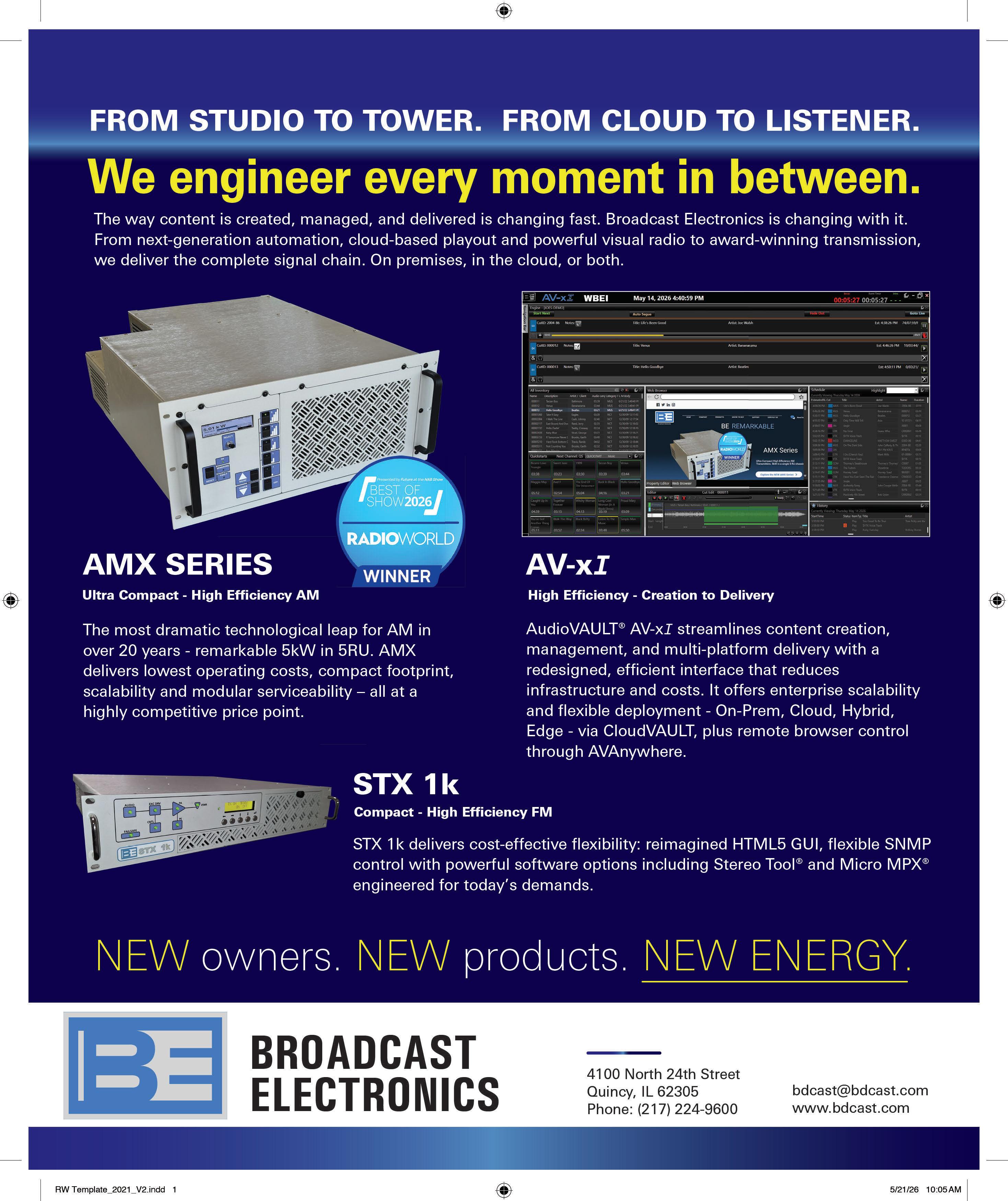
The way content is created, managed, and delivered is changing fast. Broadcast Electronics is changing with it. From next-generation automation, cloud-based playout and powerful visual radio to award-winning transmission, we deliver the complete signal chain. On premises, in the cloud, or both.
AMX SERIES
The most dramatic technological leap for AM in over 20 years - remarkable 5kW in 5RU. AMX delivers lowest operating costs, compact footprint, scalability and modular serviceability – all at a highly competitive price point.
STX 1k
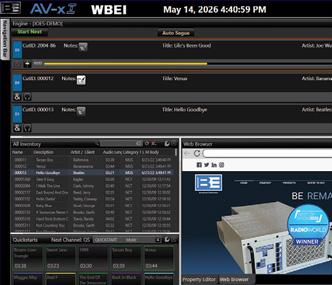
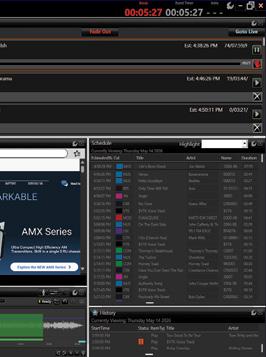
AV-xI
AudioVAULT® AV-xI streamlines content creation, management, and multi-platform delivery with a redesigned, e cient interface that reduces infrastructure and costs. It o ers enterprise scalability and flexible deployment - On-Prem, Cloud, Hybrid, Edge - via CloudVAULT, plus remote browser control through AVAnywhere.
STX 1k delivers cost-e ective flexibility: reimagined HTML5 GUI, flexible SNMP control with powerful software options including Stereo Tool® and Micro MPX® engineered for today’s demands.
Technology & news for radio decision makers
AI tools for radio sales
Buyer’s Guide offers powerful options from Adthos, CreativeReady, ENCO, Futuri and Radio Creator.
We still believe Donna Halper talks to radio talent and programmers about why they’re enthusiastic for this business.
Be proactive
The radio industry would benefit from more of a collective approach to its challenges.
Check out the recipients of our 2026 Best of Show Awards from the NAB Show.
Managing Director, Content & Editor in Chief Paul J. McLane, paul.mclane@futurenet.com, 845-414-6105
Content Producer Nick Langan, nicholas.langan@futurenet.com
Technical Advisors W.C. “Cris” Alexander, Thomas R. McGinley, Doug Irwin
Contributors: Michael Baldauf, David Bialik, John Bisset, Edwin Bukont, James Careless, Ken Deutsch, Todd Dixon, Mark Durenberger, Charles Fitch, Donna Halper, William Harrison, Alan Jurison, Paul Kaminski, John Kean, Mark Lapidus, James O’Neal, Jim Peck, Mark Persons, Jeremy Preece, John Schneider, Gregg Skall, Dan Slentz, Randy Stine, Tom Vernon, Chris Wygal
Production Manager Nicole Schilling
Senior Design Director Lisa McIntosh
Senior Art Editor Will Shum
ADVERTISING SALES
Senior Business Director & Publisher, Radio World John Casey, john.casey@futurenet.com, 845-678-3839
To subscribe, change your address, or check on your current account status, go to www.radioworld.com and click on Subscribe, email futureplc@computerfulfillment.com, call 888-266-5828, or write P.O. Box 254, Lowell, MA 01853.
LICENSING/REPRINTS/PERMISSIONS
Radio World is available for licensing. Contact the Licensing team to discuss partnership opportunities. Head of Print Licensing Rachel Shaw licensing@futurenet.com
MANAGEMENT
SVP, MD, B2B Amanda Darman-Allen
VP, Market Lead Carmel King
MD, Content, Broadcast Tech Paul J. McLane
Global Head of Sales, Future B2B Tom Sikes
Managing VP of Sales, B2B Tech Adam Goldstein VP, Global Head of Strategy & Ops, B2B Allison Markert
VP, Product & Marketing, B2B Andrew Buchholz
Head of Production US & UK Mark Constance Head of Design, B2B Nicole Cobban
FUTURE US, INC.
Future US LLC, 130 West 42nd Street, 7th Floor, New York, NY 10036
If you submit material to us, you warrant that you own the material and/ or have the necessary rights/permissions to supply the material and you automatically grant Future and its licensees a licence to publish your submission in whole or in part in any/all issues and/or editions of publications, in any format published worldwide and on associated websites, social media channels and associated products. Any material you submit is sent at your own risk and, although every care is taken, neither Future n or its employees, agents, subcontractors or licensees shall be liable for loss or damage. We assume all unsolicited material is for publication unless otherwise stated, and reserve the right to edit, amend, adapt all submissions.
Radio World (ISSN 0274-8541) is published bi-weekly by Future B2B. 130 W. 42nd St, 7th Floor, NY NY 10036.
Periodicals postage paid at New York, NY and at additional mailing offices.
POSTMASTER: Send address changes to PO Box 254 Lowell MA 01853.
Please recycle. We are committed to only using magazine paper which is derived from responsibly managed, certified forestry and chlorine-free manufacture. The paper in this magazine was sourced and produced from sustainable managed forests, conforming to strict environmental and socioeconomic standards. The manufacturing paper mill and printer hold full FSC and PEFC certification and accreditation.
AI with caveats
Usage is up but listeners are wary
Paul McLane Editor in Chief
Do radio listeners care whether a station plays AI-created music? Definitely.
Jacobs Media asked about AI on the radio as part of its annual Techsurvey, which analyzes answers from listeners of 506 commercial stations in the United States. Most respondents are “core radio listeners” and members of those radio stations’ email databases.
Our Randy Stine reported on the Radio World website: “There are some clear indications … that radio listeners are giving AI-created songs the stink eye.”
He wrote that the survey asked if participants would listen to radio stations playing AI-created music, and their answer was a resounding no.
“Nearly three-fourths of the respondents indicated that hearing AIgenerated music on their favorite station would be a ‘deal-breaker.’”
Jacobs says that AI use is growing but that the “alarm rate” remains high. Perhaps counterintuitively, Gen Z gave the biggest negative response, as 81% indicated that they have a major problem with AI music.
With iHeartMedia having made headlines with its “Guaranteed Human” pledge, Jacobs tested the phrase up against three other positioners and found that it resonated with six in 10 core radio listeners, especially with women.
Yet the results also showed that the adoption of AI by respondents is increasing, with nearly 30% using it weekly for things tasks at school and work; and another 32% said they use AI occasionally. In all, AI usage has tripled within two years.
Millennials are buying in at the fastest rate at 37%, while Gen Z appears the most startled by the growing reliance on AI. The survey asked respondents if there was “at least some alarm” over AI’s rapid growth, and the zoomers overwhelmingly, at 81%, said yes.
“Women are clearly more flipped out over AI than our men, and interestingly, younger people are as well,” Fred Jacobs said during a webinar about the survey.
One in Six Who Is Employed Expresses Concern Over AI Taking Their Job, Particularly Gen Zs
Jacobs believes Gen Z is upset, in part, “because it seems like every article that’s written talks about how Gen Z is going to pay the price for AI, and all these entry level jobs are going to disappear. (Gen Z) is reading these articles — or they’re actually feeling the actual pain of what is going on with AI, and their jobs,” Jacobs said.
AI is just one interesting angle of the Techsurvey, which explores key trends in the social, mobile and “connected
“Women are clearly more flipped out over AI than our men, and interestingly, younger people are as well. ”
The results reinforce the importance of localism, personalities and visuals in the car dashboard, and they remind us that listeners put great value on radio being free. Jacobs also documents the continued shift in how radio users actually listen, with more and more of them shifting to digital platforms to access their stations.
You can read Randy’s four-part wrapup at http:// radioworld.com, enter Techsurvey in the search field.
Writer
Donna L. Halper
We still believe in radio
Feeling low about our business? These announcers and PDs would like a word
It’s easy to find plenty of articles telling you that “radio is dead.” The people I’ve been talking to don’t agree.
They are announcers and program directors in markets of all sizes, and their assessments were remarkably consistent.
They’re well aware that radio is no longer the only game in town for new music: Stations are competing with Spotify and TikTok and Sirius/XM. They know that many stations are owned by corporations that have voice-tracking, tight playlists and little community involvement.
Yet they have seen firsthand that people will still engage with certain stations, including theirs. Why? They believe listeners still want a station with a unique personality, a station where they know the folks on the air, a station that has a live and local presence.
In Duluth, for example, Midwest Communications station KQDS-FM “Classic Rock KQ” remains very popular, even
with younger listeners, according to PD and morning show host Jason Manning. He notes that KQ frequently sits at or near the top of the ratings.
(In the fall of 2025, according to Nielsen, KQDS enjoyed a 16.2 AQH share for persons 12+, Monday–Sunday 6 a.m. to midnight. Its nearest competitor had a 6.6.)
“We’ve even won 18- to 34-year-old men,” Manning says. “And whenever we have an event, people of all ages show up.”
Manning cites the Half-Eaten Donut 5.0 festivities, held at the Fortune Bay Resort Casino on the Friday of Labor Day weekend last year. More than 500 people came to see a live concert, meet announcers and have a chance to win prizes.
“The venue is about 80 miles north of Duluth, which means a lot of people traveled a long way just to hang out with us that night.”
What’s his station’s secret?
The author wrote previously about the Duke Wright Media Technology Institute of the Wisconsin Broadcasters Association.
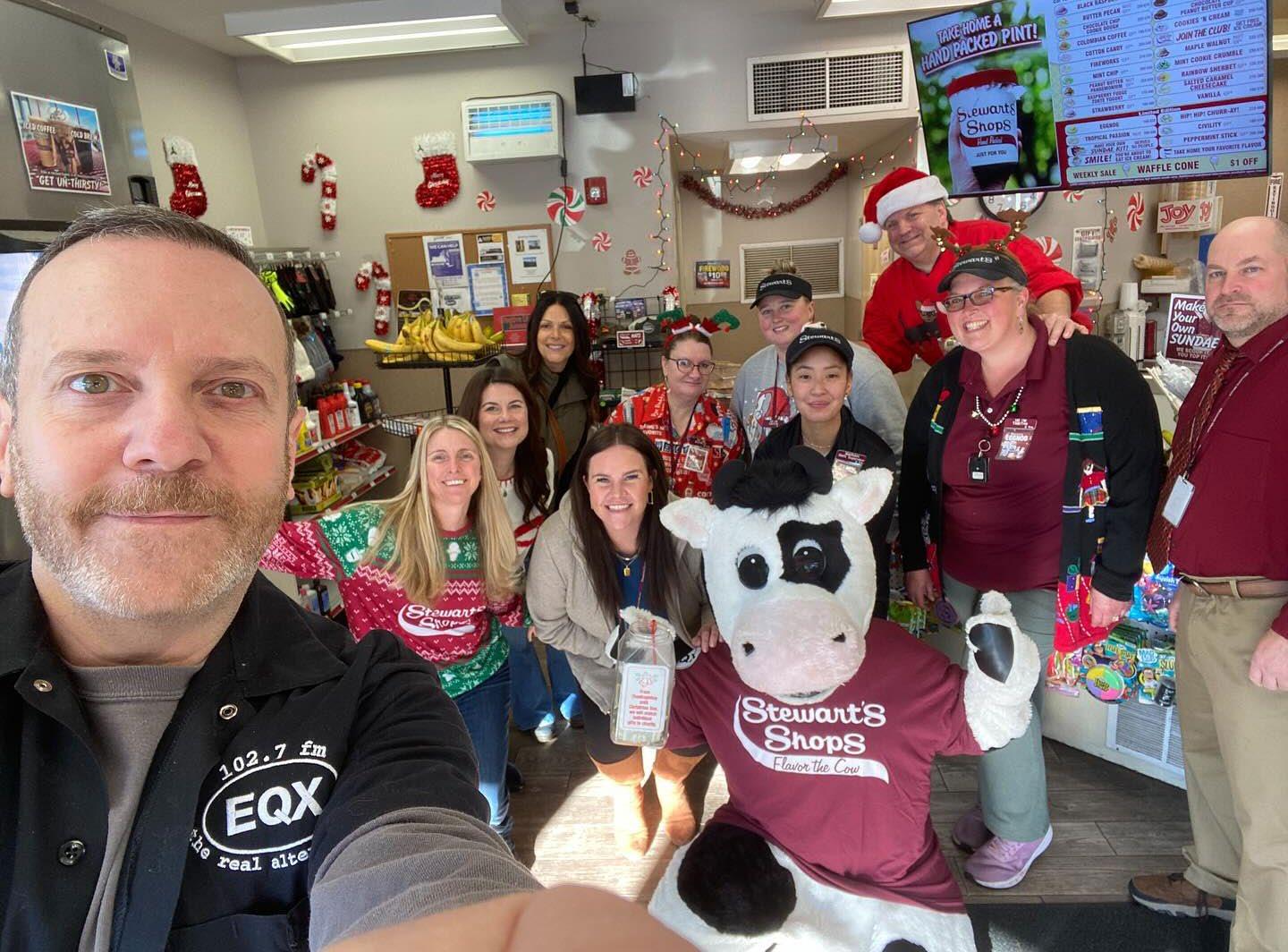
Above Vermont station WEQX is radio partner for a holiday match program run by the Stewart’s Shops chain, which raises millions of dollars for local charities. The station’s Jason Keller is at the Ballston Spa, N.Y., location.
Right KQDS-FM in Duluth, Minn., is the radio partner of the 31st Annual Kolar Toyota ALS Fishing Tournament. “Join Jason Manning from the KQ Morning Show, along with his son Colby, as they cast for a cure in the fight against ALS,” the station website says.
“Find something you’re passionate about and bring it to your show.
”
“We do good, engaging radio. We do fun things, and we’re very involved in the community. The listeners know us. When they see us outside of the station, they like to come up and say hi.”
Manning talks about the importance of personality on the air. He shares stories about his family and always relates to the listeners as people.
“Listeners don’t want robo-jocks,” he says. And although he has been at KQ since the late 1990s, radio never gets old for him.
“I’m so lucky to be doing this,” he says. “I still get excited about being on the air.”
“I fell hard”
That sentiment is echoed by Jaime Williams, whose air name is “Just Jaime.”
She’s on the air noon to 3 at hit music station 102 WVAQ(FM) in Morgantown, W.Va., which earned a 14.0 AQH 12+ in the fall of 2025, second in the market. It’s owned by WVRC Media.
Williams has been there for nine years, having also worked in Denver and in Fairbanks, Alaska. She got interested in radio while in college in Alaska.
“Once I got on the air, I was in love. I fell hard for radio,” she recalls. And that hasn’t changed. She is especially happy about being at WVAQ.
“It’s so refreshing to work for owners who understand the value of being live and local.”
On air, she enjoys talking about popular culture and celebrity news, and she also enjoys being involved in local charities, like raising money for a local animal shelter, Animal Friends of North Central West Virginia.
She says she loves everything about being a deejay, and she finds that the audience likes being able to interact with WVAQ’s announcers.
“I’m a cheerleader for the station,” she says, and the listeners appreciate that enthusiasm. Her advice to up-andcoming deejays: “Find something you’re passionate about and bring it to your show.”
Ideas from everywhere
But at many stations these days, that’s easier said than done, according to veteran classic rock deejay Carter Alan.
“There is so much homogenized entertainment. But people want personality. They want what’s real, what’s authentic,” he said.
Alan has been with iHeartMedia’s WZLX(FM) in Boston for nearly three decades, but he says it never gets old.
“I still enjoy doing my show, and I still love talking about the music, talking about the bands I know, using social media to do features about them. I can always find a fresh way to talk about [the music].”
That enthusiasm for the music, and for radio itself, can be contagious, says Jazzy Jim Archer, program director for Bonneville’s KMVQ-FM “99.7 Now,” a top-40 that was in the top five stations in San Francisco in the fall book.
And Archer believes this kind of personality-driven radio can attract a younger audience. He even does outreach to high schools and finds there are some teens who now tell him radio is “much cooler than [they] thought.”
Archer has been PD of the station since 2017. He sees radio as a way to “bring joy to people’s lives,” and he wants his deejays to “inspire the listener’s imagination.”
Archer grew up listening to great top40 deejays, and he loves the format to this day.
“Radio changed my life,” he says, and he believes that good radio brings a connection you can’t find elsewhere. “We try to talk about whatever our listeners are interested in,” he said. “We take ideas from everywhere, from local news or something on TikTok or a great taco stand someone on the staff loved. And even on a top-40 station, creating good conversation can make a positive impact.”
What resonates
Helping to cement that human connection means being available to your listeners, according to Jeff Morad, program director of alternative rock WEQX, “The Real Alternative,” in Manchester, Vt., which is heard in parts of four states.
Above
While it does not subscribe to Nielsen, Morad said it can measure its results by audience response. He notes with amusement that listeners will call immediately if they think one of the announcers made a mistake on the air. And on a more serious note, the station has had numerous successful collaborations with local businesses to raise money for charities.
“Listeners do still care about who is on the air. They love to engage with the station. So many stations sound the same, but that’s not us,” he said.
“We’re live and local. We take requests. We put callers on the air. We do live broadcasts. We play the best local bands. We’re part of the community — we are locally owned. Our deejays have the freedom to play new music, and the listeners know we love what we’re doing. We give the audience radio that doesn’t suck.”
Afternoon deejay Jason Keller, who uses the name “Keller” on air, agrees. He also is production director, a job that he loves.
The station is profitable, he says, and its events are wellattended. The live concerts at local venues are a great way to meet the listeners.
“The exciting part of being a deejay is knowing I can say something that resonates with the audience.” And audience engagement includes not just taking calls but active participation on social media.
“We know our listeners trust us. People even tell us, ‘I feel like I know you.’ It’s like we’re an extended family.”
He praises the local owner, Mimi Brown, for believing in the station and standing by it over the years.
Brown too is a believer in what the station is doing. Her late husband Brooks founded the station.
“When [he] passed in 2013, I thought, let’s keep his legacy alive. Over these past years I realized that EQX is not just a business. The loyal, passionate people that work with me
to keep it going have become my family, and for that I am truly grateful and blessed.”
Perhaps you are thinking that none of this seems like the magic answer to radio’s supposed woes. Perhaps it seems like these stations represent a lot of “old-school” wisdom: Reach out to the audience in as many ways as possible, host live events, make human connections, play great songs, do good for the community, work closely with sponsors to create exciting promotions.
But maybe that’s the point. As Jason Manning of KQDS says, “Radio is not dead. The pendulum swings back. Maybe people take us for granted, because there are so many choices today, but we still matter.”
Jazzy Jim Archer of 99.7 Now agrees. “People are confusing ‘nobody listens to radio’ with the fact that fewer people listen.”
That’s not necessarily a bad thing. “The [total] audience may be smaller, but the people who are here want to be here.” He believes there is a good opportunity to grow that audience.
“I want us to stop thinking there’s one easy answer. Just keep being a positive force in your listeners’ lives. Just care about your audience.”
And don’t be afraid to reach out to younger listeners. “When they’re exposed to great radio, they like it.”
Comment on this or any article. Email radioworld@ futurenet.com with “Letter to the Editor” in the subject line.
“Over these past years I realized that EQX is not just a business. ”
Jaime Williams of WVAQ is shown in a 2025 Facebook promotion for Animal Friends of North Central West Virginia.
Writer Nick Langan Content Producer
Remembering Richard Ross
He was part of the New York engineering scene for decades
Richard Ross, a longtime chief engineer in New York City, died in February at the age of 89.
His daughter Erica shared many details from his life.
Ross joined 1280 WADO(AM) in 1972 as a relief engineer. By his count, he would go through eight ownership changes until retirement as chief engineer from Univision Radio in 2020 at the age of 84.
“It is a rare occasion where one starts their career in any major city and they eventually work their way up the line to more important positions in major communications hubs,” he wrote in a piece for Storyworth.
Ross also spent many hours with the equipment atop the Empire State Building after Heftel Broadcasting purchased 105.9 WNWK(FM).
Univision’s footprint in New York would continue to grow with the addition of 92.7 WQBU(FM) in Garden City, followed by the trade of 105.9 with New York Public Radio for 96.3, then WQXR(FM), in 2009.
Lifelong love
Born in 1936 on Manhattan’s Upper West Side, he developed a knack for machines and tinkering. He attended boarding school in North Carolina, and the experience of navigating his way back to Manhattan via train sparked a fascination with locomotives. He later attended Brooklyn Technical High School, where he joined the radio club.
At the University of Bridgeport he earned an associate’s degree in electrical engineering, then served in the New York Air National Guard.
In 1958, he got his break into radio, joining Municipal Broadcasting System’s WNYC(AM/FM) as a provisional engineer. By the early 1970s, Ross had transitioned to WADO as a summer relief engineer. He’d work at the Spanish-language AM station well into the 21st century.
Ross became active in the IBEW Local 1212, the labor union for broadcast engineers, and would stay even after he became WADO’s chief engineer, following the passing of his friend Phil Greenstone.
“He was more than a colleague; he was a brother in every sense of the word,” IBEW 1212 wrote on its website. He was also a loyal member of the Society of Broadcast Engineers.
Meadowlands move
As the broadcast landscape evolved, Ross coordinated WADO’s transmitting power increase in the New Jersey Meadowlands in 1999.
As recounted by Scott Fybush, WADO had used a BlawKnox diamond-shaped tower. It ran 5 kW day and night as part of a power restriction on regional channels like 1280.
But the FCC lifted the restriction in the 1990s. WADO sought to upgrade to 50 kW by day and 7.2 kW at night, which required a new system.
The Blaw-Knox came down, and three new towers were needed, along with a renovation of the 1930s-era transmitter building. Hispanic Broadcasting had filed for a CP but most of the work did not start until just prior to its expiration.
As Ross wrote in his Storyworth, for the next four months, he visited the Meadowlands daily to complete the project under great stress.
The antenna system was designed by Ron Rackley of du Treil, Lundin & Rackley, who consulted on the project and praised Ross for its execution.
“On Feb. 1, I invited David Lykes, Hispanic Broadcasting’s chief operating officer, to come up from Dallas to push the activate button at 6 p.m.,” Ross wrote. “My heart was in my throat, but the damn system worked.”
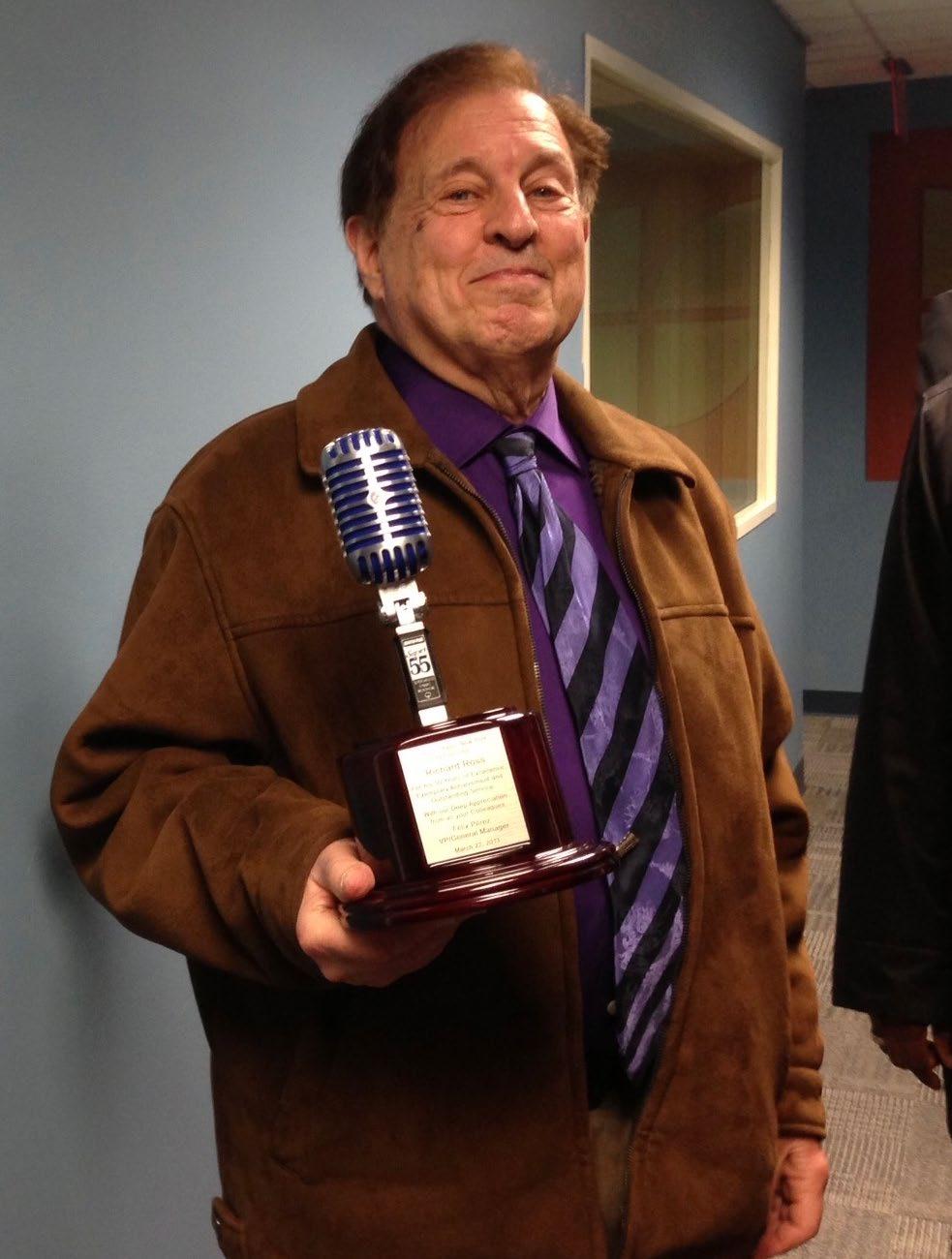
In 2013, Univision honored his 50 years of broadcasting service by naming a studio after him. Ross passed away at home in his Hell’s Kitchen apartment — where he lived since 1964 — just shy of his 90th birthday.
A longer version of this article is available at http:// radioworld.com, enter “Richard Ross” in the search field.
Erica Ross
Above
In 2013 WADO honored Ross by naming a studio for him.
John Bisset
CPBE
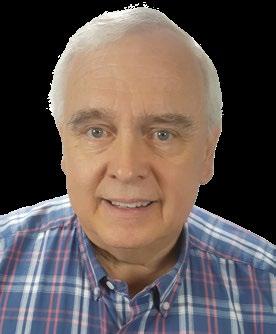
The author is in his 34th year of writing Workbench. He handles western U.S. radio sales for the Telos Alliance and is a past recipient of the SBE’s Educator of the Year Award.
Power us up! Workbench tips qualify for SBE recertification credit. Email your ideas to johnpbisset@ gmail.com
Power supplies need clean air
Dust-choked vent intakes can result in equipment faults
Contract engineer Stephanie Donnell has dealt with more than her fair share of power supply problems.
One common issue is dirt.
In one former job, she worked as a sustaining engineer for a company that produced huge color inkjet printers. One of her tasks was to extend the lives of the main power supplies used in these minibus-size systems.
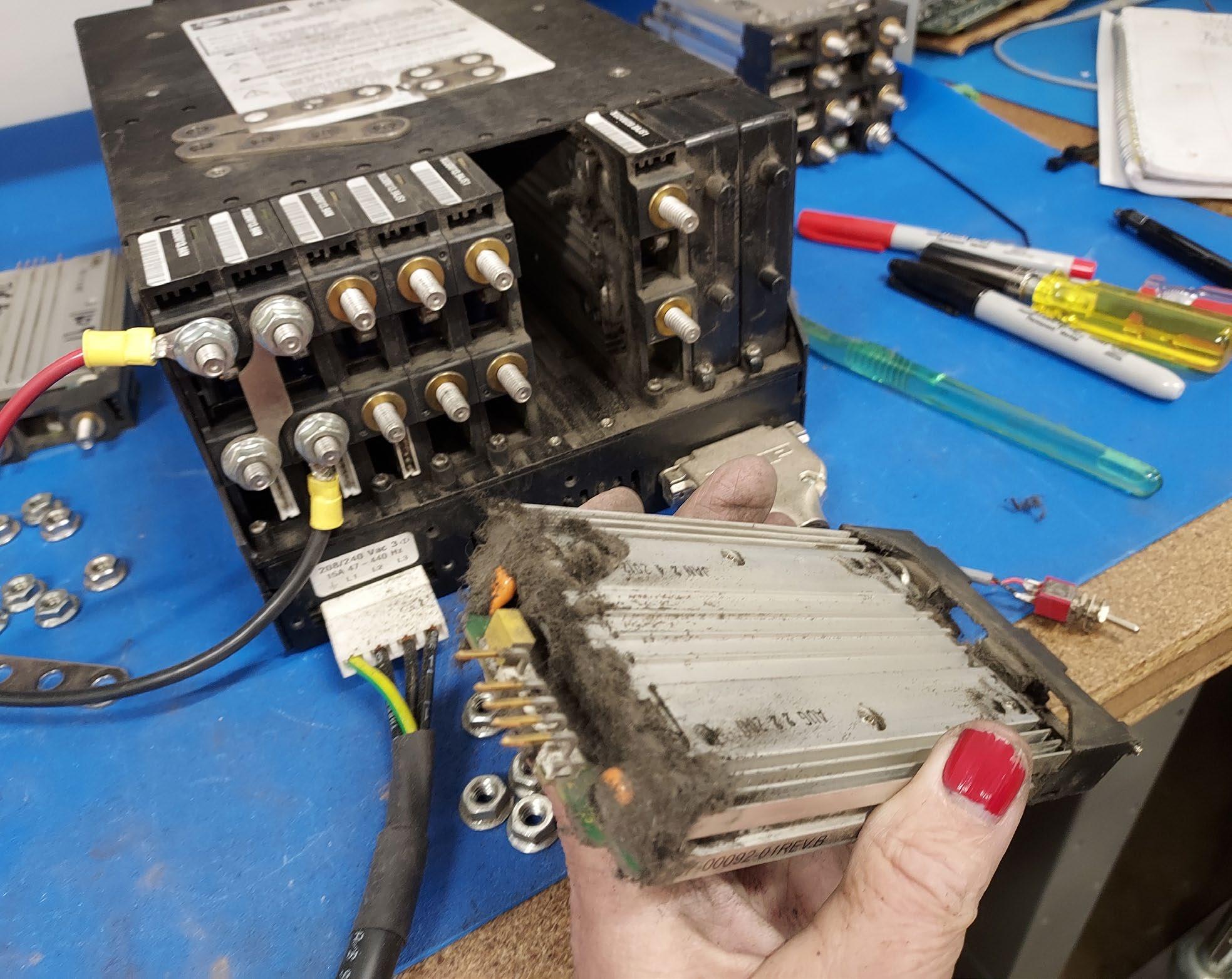
The supplies were rated at 4 kW and operated on three-phase, 208 VAC. Seasoned engineers will know that supplies at this power level turn into “dust magnets,” as do the supplies in high-power transmitters.
The “mainframe” of each supply was about the size of a shoe box. A mainframe would be loaded with various modules set for various DC output voltages, depending on the model of printer.
The modules could be removed easily from the mainframes, which allowed her to configure the power supplies. It didn’t take her long to realize that a big reason many of the power supply modules were failing was a heavy buildup of dust and “fuzz.” This led to the modules overheating, accelerating their failure rate greatly. Unfortunately, this had not been addressed as part of routine maintenance.
Dust-choked vent intakes also can result in equipment faults. But the vents might not be where you expect them to be.
Early in her career, Stephanie was alerted to a silence condition at one of the transmitter sites she maintained. The equipment was in an older wood-frame building with no air conditioning. Cooling was by way of drawing in the outside air and venting the hot air back out with a fan. When she arrived at the site, the fan was operating, as
“It didn’t take her long to realize that a big reason many of the power supply modules were failing was a heavy buildup of dust and ‘fuzz.’
Above
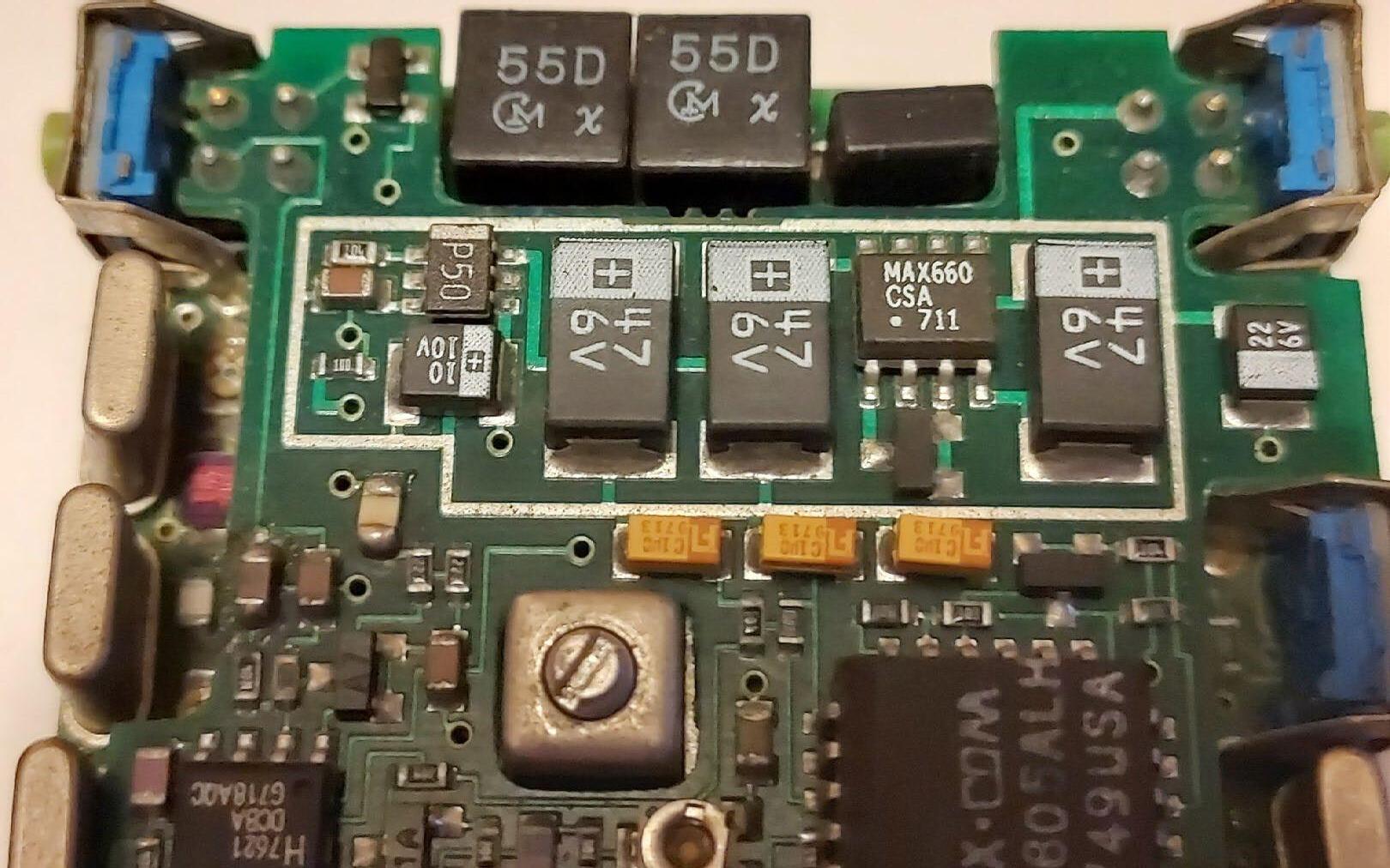
Keep switching power supply chips running cool.
Right
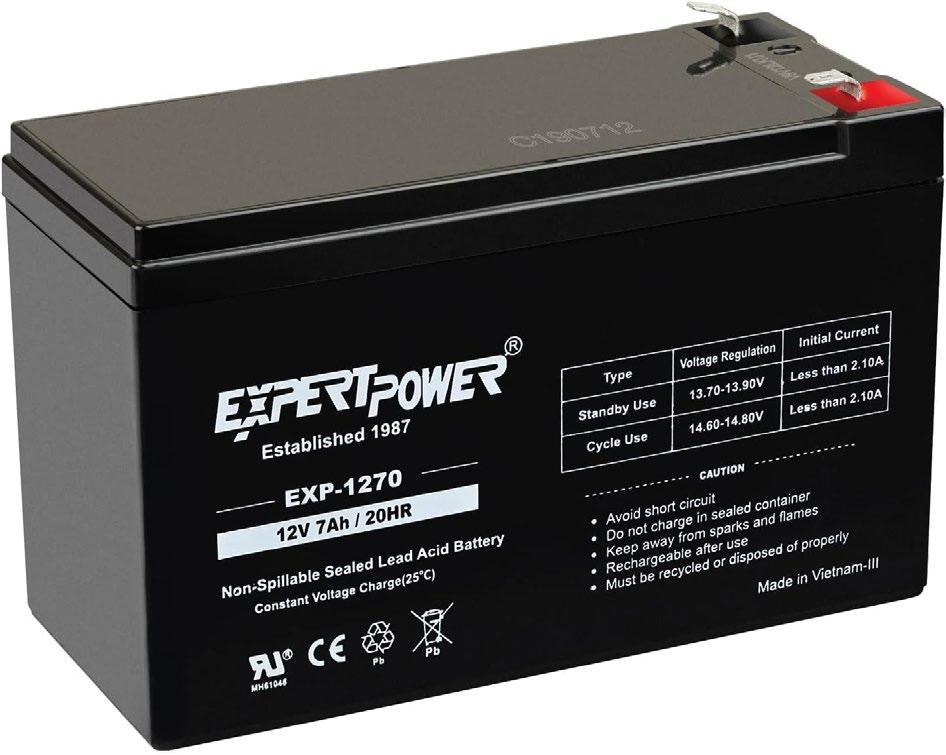
When replacing a UPS battery, like this one from ExpertPower, label it with the date and source.
was the transmitter, but there was no program audio being fed into it.
She traced the “failure” to the Aphex processor. She touched its case and felt blazing heat. Had its power supply failed? Or perhaps its cooling fan? At this point, she wasn’t sure that the processor even had a fan because there wasn’t a vent on the rear of the case.
Then she found it, along the SIDE of the case. The intake was completely covered with fuzz. She cleared the opening and allowed the fan to cool the inside of the processor. It returned to life, and program audio reappeared on the transmitter.
When installing equipment with cooling ports, consider how you will access the intake routinely.
For instance, some Crown FM transmitters had intakes for cooling fans on the bottom of their cases, not where you’d expect to find them.
The Nautel VS300 transmitter has fan intakes on each side of its case. This can be difficult to access when the transmitter is fix-mounted in a rack. In this case, you could install the transmitter in such a way that it can slide out slightly — just three to four inches, enough so you can access the intake filters to keep them clear of debris. Same for the Nautel HD Exciter for the larger VS series transmitters.
Or instead of fix-mounting it or using a slide-out tray, you could rest the transmitter on heavy “L” metal stock that can slide out a few inches so you can clean the intake filters. (Remember to provide adequate slack in any cabling.)
The same goes for models with the intake on the bottom. Leave free space so that a hand can reach in from the front or rear to get at the intake filter.
On certain Moseley STLs, the power supply section has a tiny cooling fan and it’s not always easy to see whether debris has built up or to verify that the blades are turning. Stephanie would shine a light to check the intake vent.
UPS batteries
If you buy and install several uninterruptible power supplies at the same time, you run a risk that all of their batteries will need to be replaced later at the same time too.
Mike Kernen, CSRE, engineering manager in Detroit for Crawford Broadcasting, shared a tip in the company’s Local Oscillator newsletter: Check with Home Depot or Lowes for replacement sealed lead-acid batteries. They’ll cost less than they would from your IT provider, and the box retailers will deliver.
Don’t forget to add a label with the date that you installed the new battery, along with the battery model number and where it was purchased, to save time later.
Writer Paul McLane
Editor in Chief
OOH, OTT, CTV and other revenue drivers
Rick Ducey on the evolving radio sales ecosystem
This is excerpted from the ebook “Where Tech Meets Revenue.”
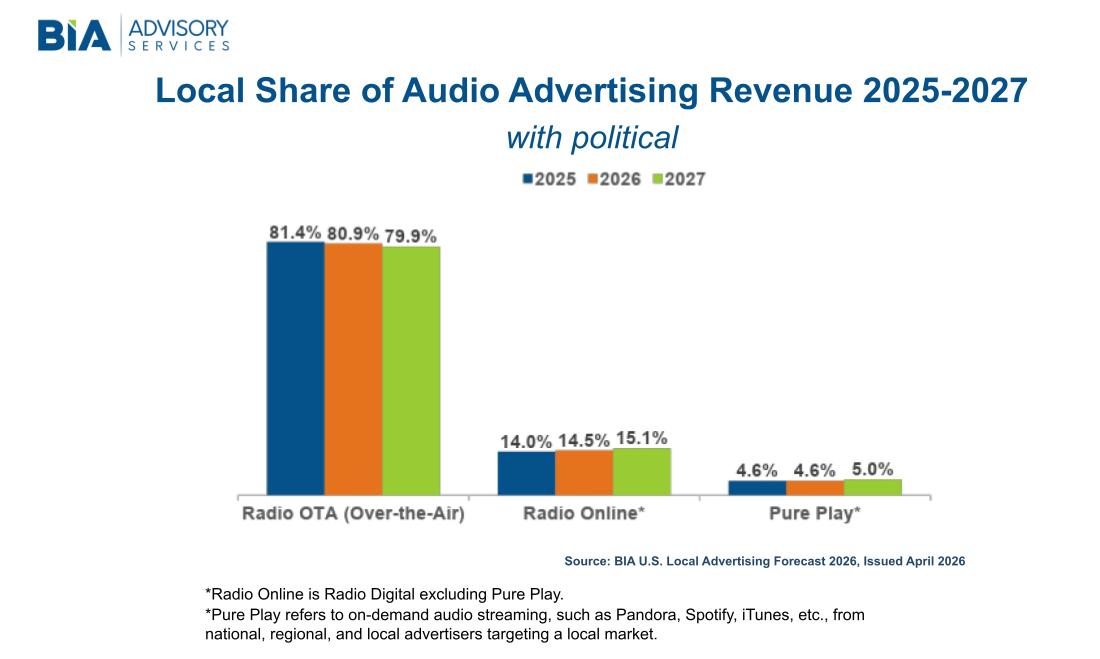
ick Ducey, managing director of BIA Advisory Services, sees radio broadcasters applying various technologies to help drive revenue.
For instance, “iHeart, Cumulus and Audacy are among those using ad tech integrations to sync broadcast radio and outdoor digital billboards run by ‘out of home’ (OOH) advertising companies like Clear Channel Outdoor, Lamar Advertising
“This can create dynamic creative executions tied to event-driven triggers like weather, traffic, events, etc. The combination of local radio plus digital OOH creates a highvalue messaging environment offering dynamic creative inventory tying together the power of DOOH boards and live radio.”
What role do platforms like OTT and CTV have in radio sales ecosystem?
“Buyers targeting local audiences highly value both audio and video inventory, and increasingly in cross-platform activations,” Ducey replied.
“Radio stations with locally deployed sales forces and high-value client relationships can add CTV — i.e., premium content ad inventory on TV screens — and OTT — i.e., in-stream video ad inventory on TV, mobile,
PC, tablet screens — offers into the marketing mix they offer clients.”
He said CTV/OTT are high-growth media channels offering local radio stations some differentiation from the competition and path to revenue growth. BIA estimates that this category will grow to $5.1 billion in 2026, up more than 50% from the year prior.
“CTV can be local radio’s highest revenue growth category and combined with audio — broadcast and streaming — makes an extremely compelling local, cross-platform activation.”
Ducey also noted the application of “visual geotargeting” by GeoBroadcast Solutions, which is a BIA client. “FM stations using MaxxCasting technology to fill in weak coverage areas can geotarget RDS and HD Radio text and visual content at the booster level,” he said.
About GBS ZoneCasting, which allows geotargeted content on localized FM boosters, Ducey said it is in various stages of deployment in about a dozen markets.
“The path to revenue is in early stages. Using FCC experimental licensing, ZoneCasting was deployed in the San Francisco and embedded San Jose market to showcase geotargeted ads for San Francisco/South Bay as one zone and East Bay as another zone.
“Different ads, traffic, weather, community information, etc. originated in each zone for part of the broadcast day. Dentsu and its client Jack in the Box were among those trying ZoneCasting during this project and expressed optimism for its value to buyers.”
Ducey feels that the combination of ZoneCasting and DTS AutoStage analytics creates an important opportunity for advertisers and stations.
“Sometimes it’s not just one innovation that creates the most value, but a combined use of new capabilities that will get stations to their maximum ROI.”
According to Ducey, audio is hot for the brand and agency community right now, including cross-platform broadcast, streaming and podcasting.
Read about technologies that can drive revenue at http://radioworld.com/ebooks
Right Rick Ducey
Read
Best of Show Awards
Best of Show, 2026
An overview of the recipients
Radio World announced the recipients of the Radio World “Best of Show” Award at the 2026 NAB Show in Las Vegas.
Recipients are chosen by a panel of engineers and editors. Companies pay a fee to enter. Not all are winners. The awards celebrate companies leading the way in media and technology, as exhibited at the convention.
Information about how the program works can be found in an FAQ at https://future.swoogo.com/bestofshowat-nab.
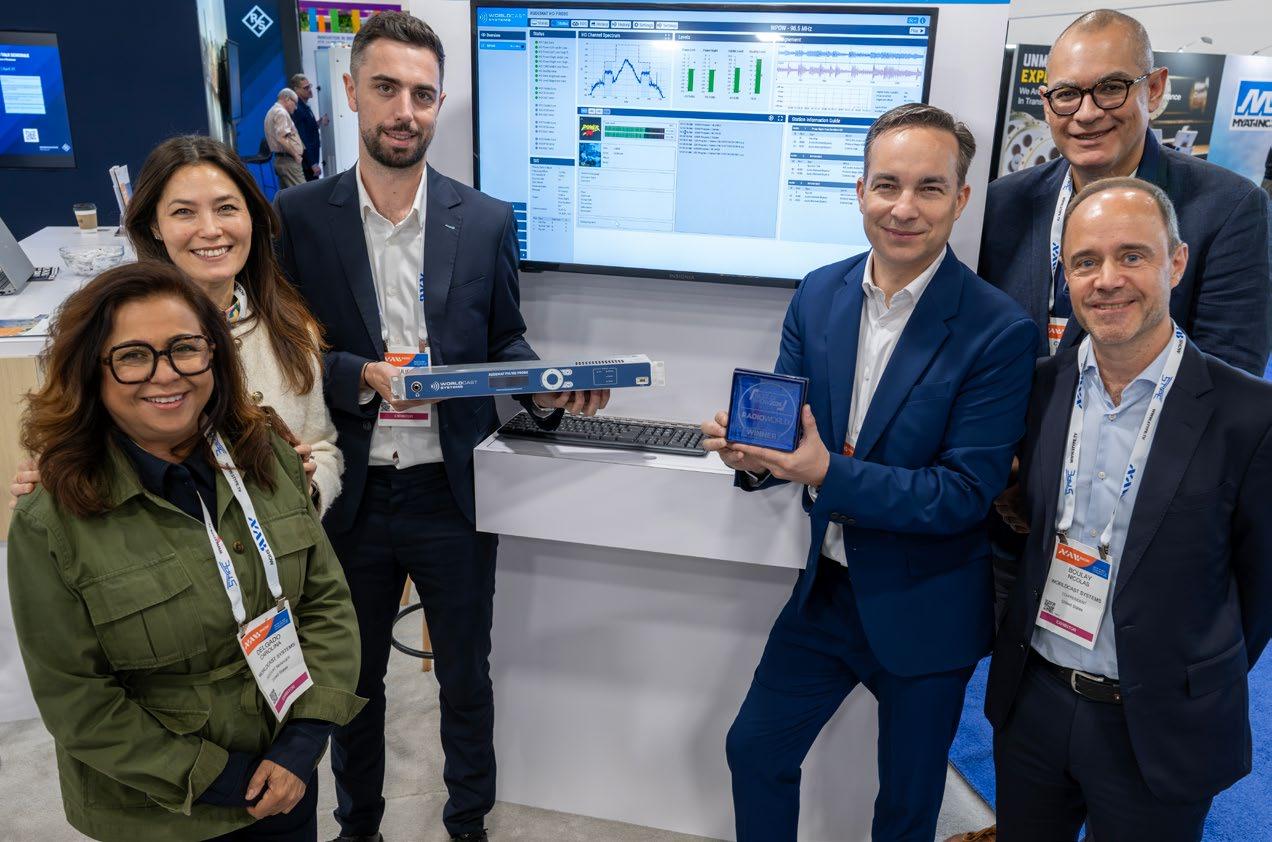
WorldCast Systems Audemat FM/HD Probe
Here’s a next-generation monitoring solution designed with U.S. broadcasters in mind. It addresses the growing complexity of hybrid FM and HD Radio broadcasting.
The FM/HD Probe provides simultaneous monitoring of FM, RDS and HD Radio channels, including HD1, HD2 and HD3. It tracks signal presence, audio levels and metadata integrity while ensuring synchronization between broadcast paths.
Advanced compliance and measurement capabilities include NRSC mask monitoring and real-time spectrum analysis to detect out-of-tolerance conditions quickly. HD/ FM alignment tools provide accurate delay measurement, enabling precise correction when discrepancies occur.
Features include audio streaming and recording so you can access and review broadcast content in real time. Alarm notifications via email and SNMP ensure awareness of any anomaly. The Probe provides an intuitive web-based interface and a compact, robust hardware platform.
Carolina Delgado, Chantal Fourgeaud, Julien Libeau, Gregory Mercier, Cyrus Uible and Nicolas Boulay are shown.
Info: www.worldcastsystems.com
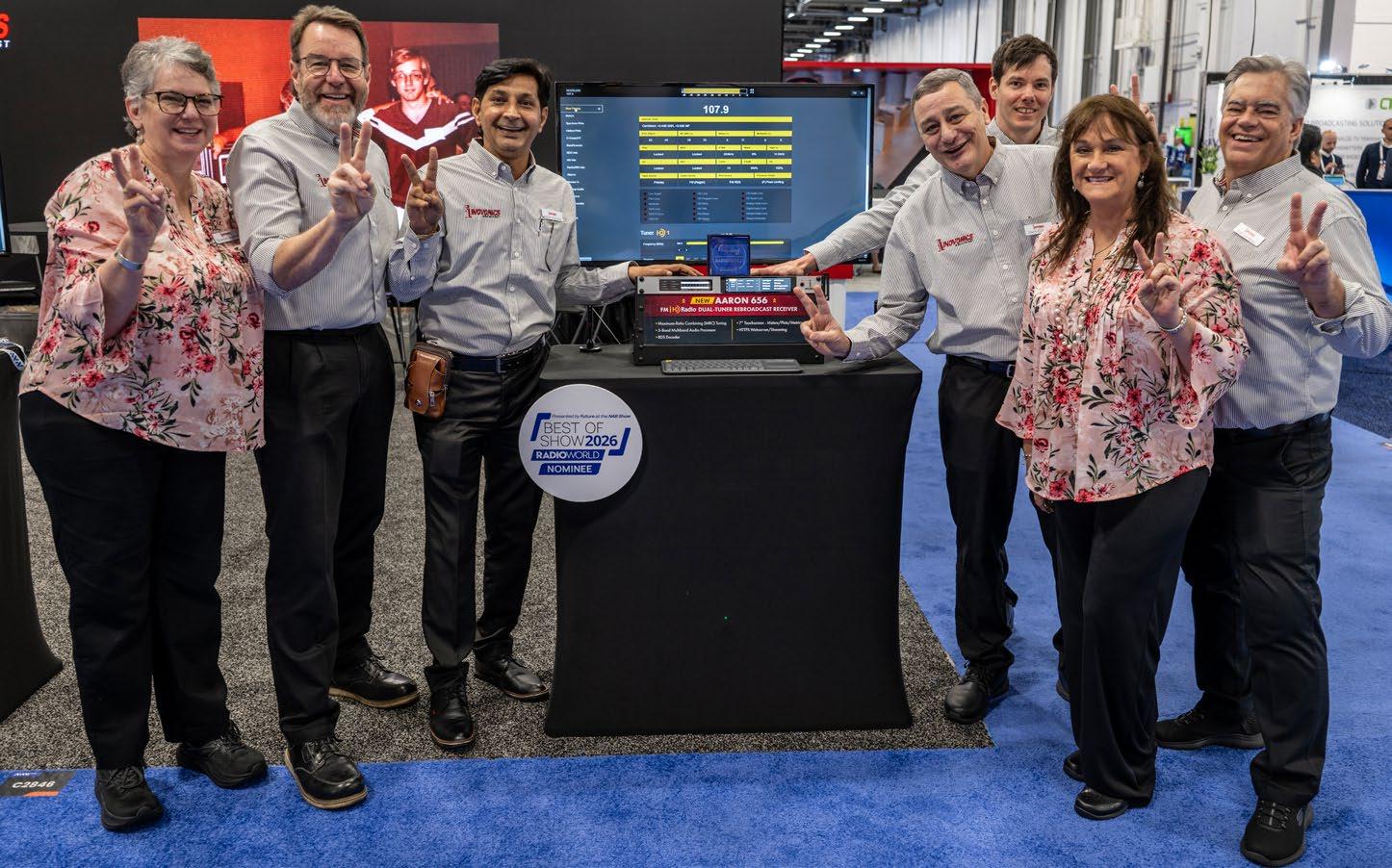
Inovonics Broadcast AARON 656
Here is an FM/HD Radio Dual Tuner Rebroadcast Receiver built around a Maximum-Ratio Combining (MRC) tuning system that continuously monitors signalto-noise readings from Antenna 1, Antenna 2 and both combined, dynamically selecting the best configuration.
Inovonics says the technology improves performance in tricky reception areas, especially around bodies of water and other inversion layer or weather challenges.
Features include remote control via onboard webserver; BandScanner; RDS encoder; stereo regeneration; five-band audio processing; lots of failover and alarm capabilities; and the cool metersw , plots and metrics that Inovonics does so well.
Putting up two fingers for this dual tuner are Sharon Barber, Ben Barber, Mukesh Chaudhary, Zach Calden, Josh McAtee, Laura Sondreal and Earl Sondreal.
Info: www.inovonicsbroadcast.com/product/656
Jim Peck
Jim Peck
Jim Peck
Best of Show Awards
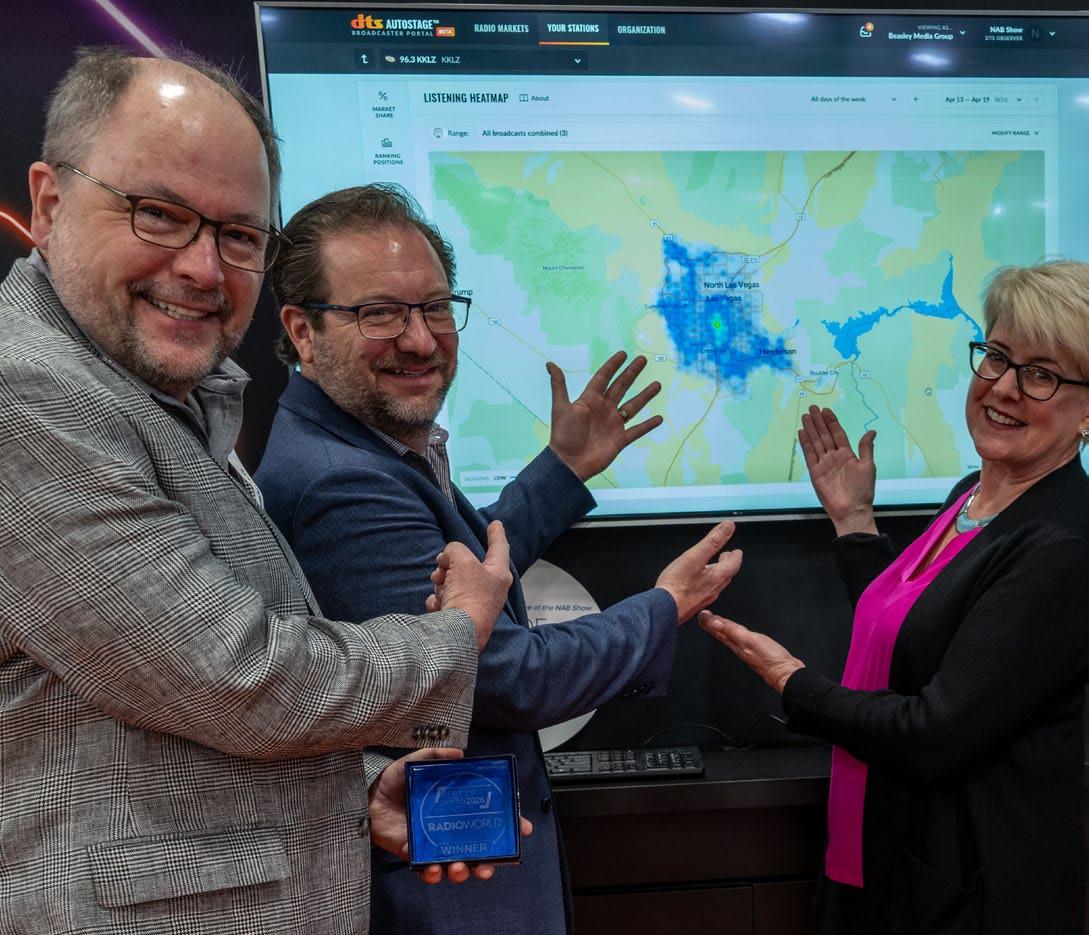
Xperi DTS AutoStage Broadcaster Portal Premium
Xperi is raising its metrics game by adding a premium level to its DTS AutoStage Broadcaster Portal.
“For the first time, radio stations can see exactly where their station ranks in both their market and neighboring markets across various dayparts,” it states.
The portal measures and analyzes listening behavior in more than 9 million vehicles in the United States in 300 markets. Xperi says the sample sizes are 14 times larger than current radio ratings, and 53 times in the biggest markets.
The information comes from daily listening in vehicles; the portal uses machine learning technology to synthesize and analyze data, giving stations detailed results within 24 hours.
Broadcasters can see how their stations perform beyond their core markets, capturing listening in adjacent territories; sales teams can use the info to turn “spillover” listening into incremental revenue.
Capabilities include station market share percentage, overall cume, average time spent listening, latest station ranking/position, daypart activity, top 100 music charts and more, including the number of vehicles listening and market sample sizes, updated daily. Broadcasters can drill down into a station’s data for various parts of the day, across the last week, month and quarter, and download reports.
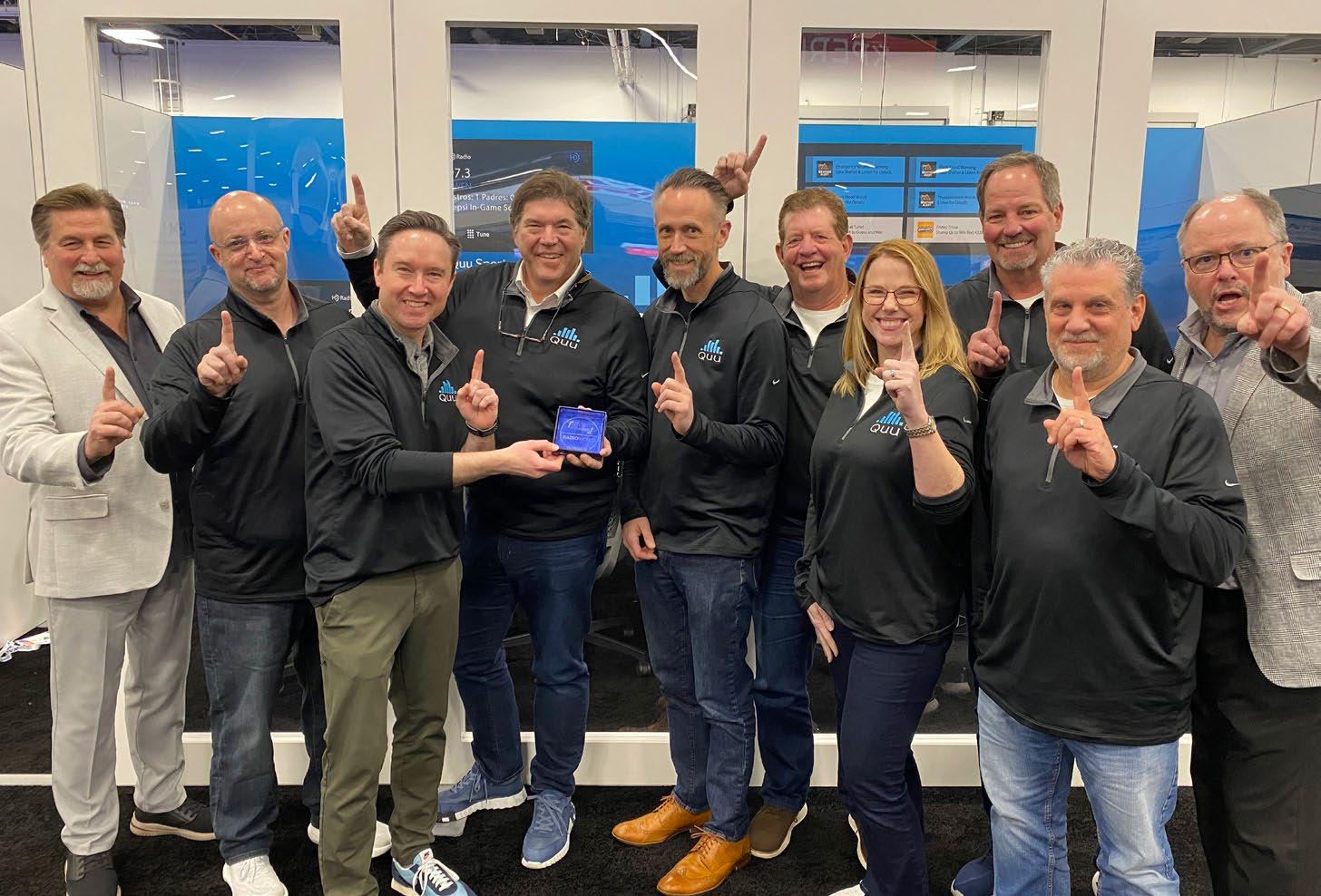
Quu Quu HotQuus + IQuu Sports
Quu’s Quick Content Activation System changes how radio operates in the vehicle by bringing real-time execution to in-dash displays.
“Combining HotQuus and IQuu Sports within the IQuu Agents platform, Quu replaces delayed, manual processes with instant activation and intelligent automation, built specifically for how radio works in the real world,” the company says.
HotQuus delivers one-click control, modeled after the “Hot Key” systems programmers use. HotQuus allows stations to trigger messages to RDS and HD Radio displays without scheduling or workflow limitations. Use it for severe weather, breaking news or a live on-air moment.
IQuu Sports solves the inability to keep visual displays aligned with live sports. You build a template, then Quu integrates live data feeds, updating scores, managing game timing and automatically publishing synchronized messages throughout your broadcast.
Pricing is structured for both commercial and non-commercial categories, determined by market size and BIA revenue market ranking.
In the
Info: https://dts.com/autostage
“This system replaces passive, scheduled messaging with real-time activation and automation,” Quu proclaims.
Info: https://myquu.net
At the show, from left, are John Casey of Radio World; Dan Binder, Joe Marshall, Steve Newberry, Ben Husmann, Sam Rogers, Laura Gonzo, Pete Benedetti and Greg Yudkin of Quu; and Paul McLane of RW.
booth with Paul McLane are Joe D’Angelo and Donna Detweiler.
Jim Peck
Radio World
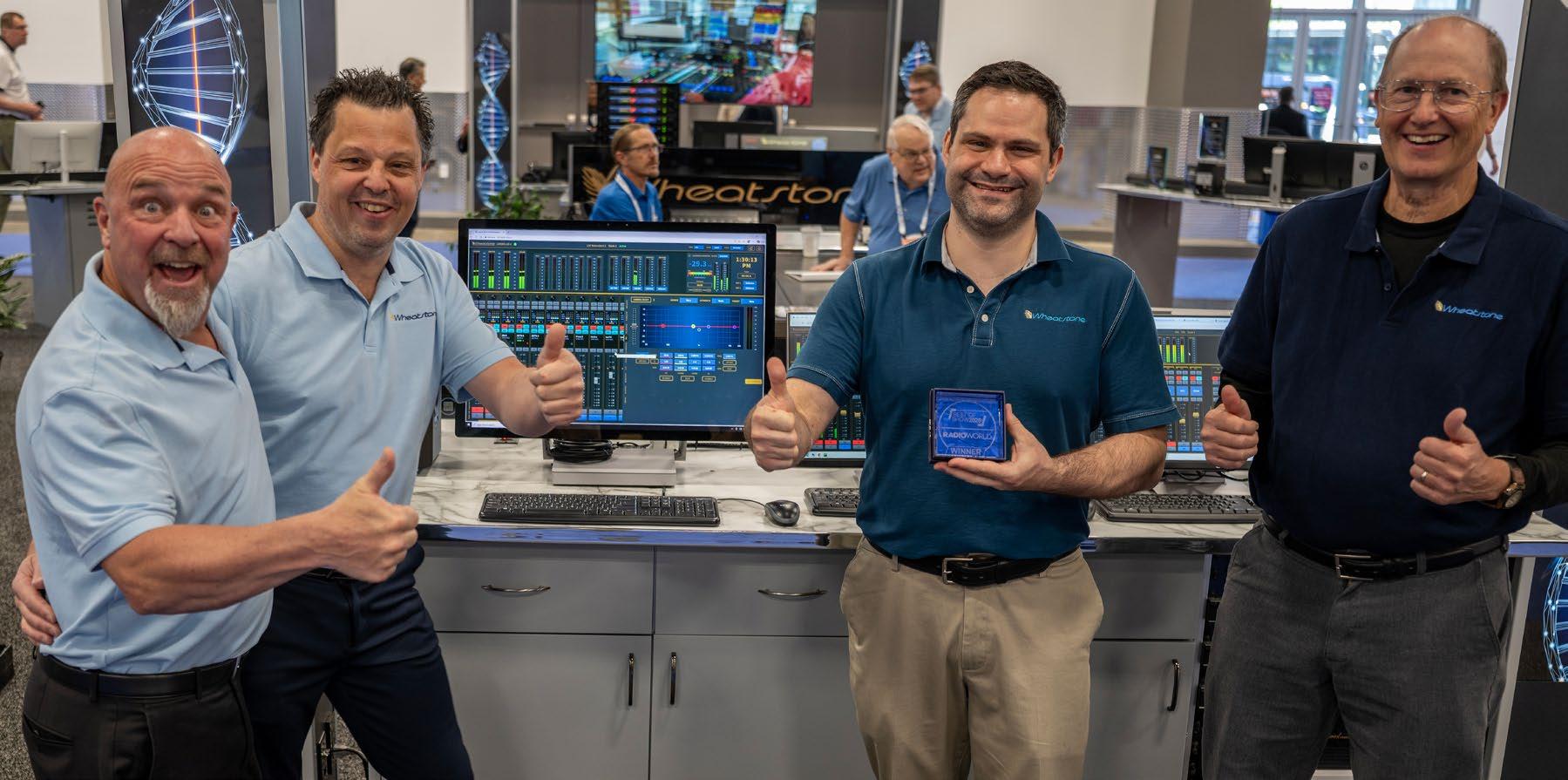
Wheatstone VMX Mix Engine Platform
VMX is designed to remove the physical limitations of the traditional studio. It can serve as a single virtual mixing backend for an operation. Users can access the company’s VML virtual broadcast console through a browser on a laptop, tablet or desktop computer.
Best of Show Awards
“VMX removes the physical limitations — and hardware costs — of studios, making it possible to instantly set up mixing for remote broadcasts or to quickly add on a voicetrack, on-air or production studio without the capital expenditure,” the company said.
It is AES67-compliant for interoperability within SMPTE ST 2110 facilities and other AES67 networks.
This is an addition to Wheatstone’s Layers software suite, its technology for virtualizing the air chain as an extension of the WheatNet IP audio network.
Darrin Paley, Danny Teunissen, Dominic Giambo and Dave Breithaupt are shown.
Info: https://wheatstone.com/product/vmx/
Nautel Software-Based Air Chain Subscription
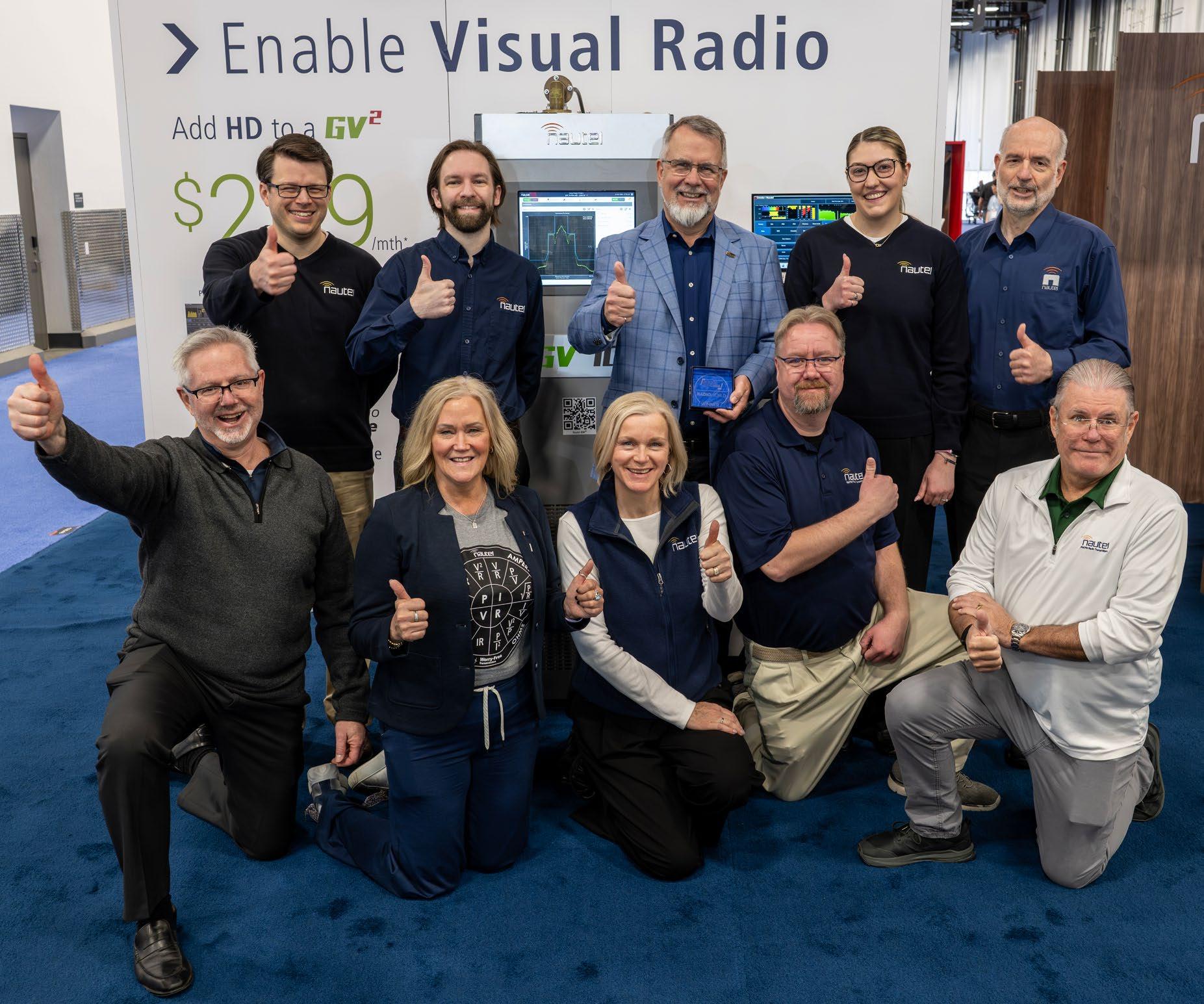
Nautel is offering its HD Radio SoftwareBased Air Chain as a subscription solution that costs $299 per month for U.S. users of GV2 FM transmitters.
This initiative is targeted to FM broadcasters seeking to launch, expand or modernize HD Radio services. The aim is to lower barriers to adoption while enabling new, measurable visual advertising revenue opportunities.
A subscription includes Omnia for Nautel Audio Processing; FM+HD Blend Lock, for time alignment and to eliminate blend drift; an HD Importer and Exporter; Exgine HD Radio exciter functionality; and NautelCare support service.
The result is a production-ready HD Radio air chain without external appliances, wiring or dedicated rack space.
Info: www.nautel.com/products/ innovations/ hd-radio/adio-air-chain/ Jim Peck
Jim Peck
Best of Show Awards
2wcom Systems MPX-2c
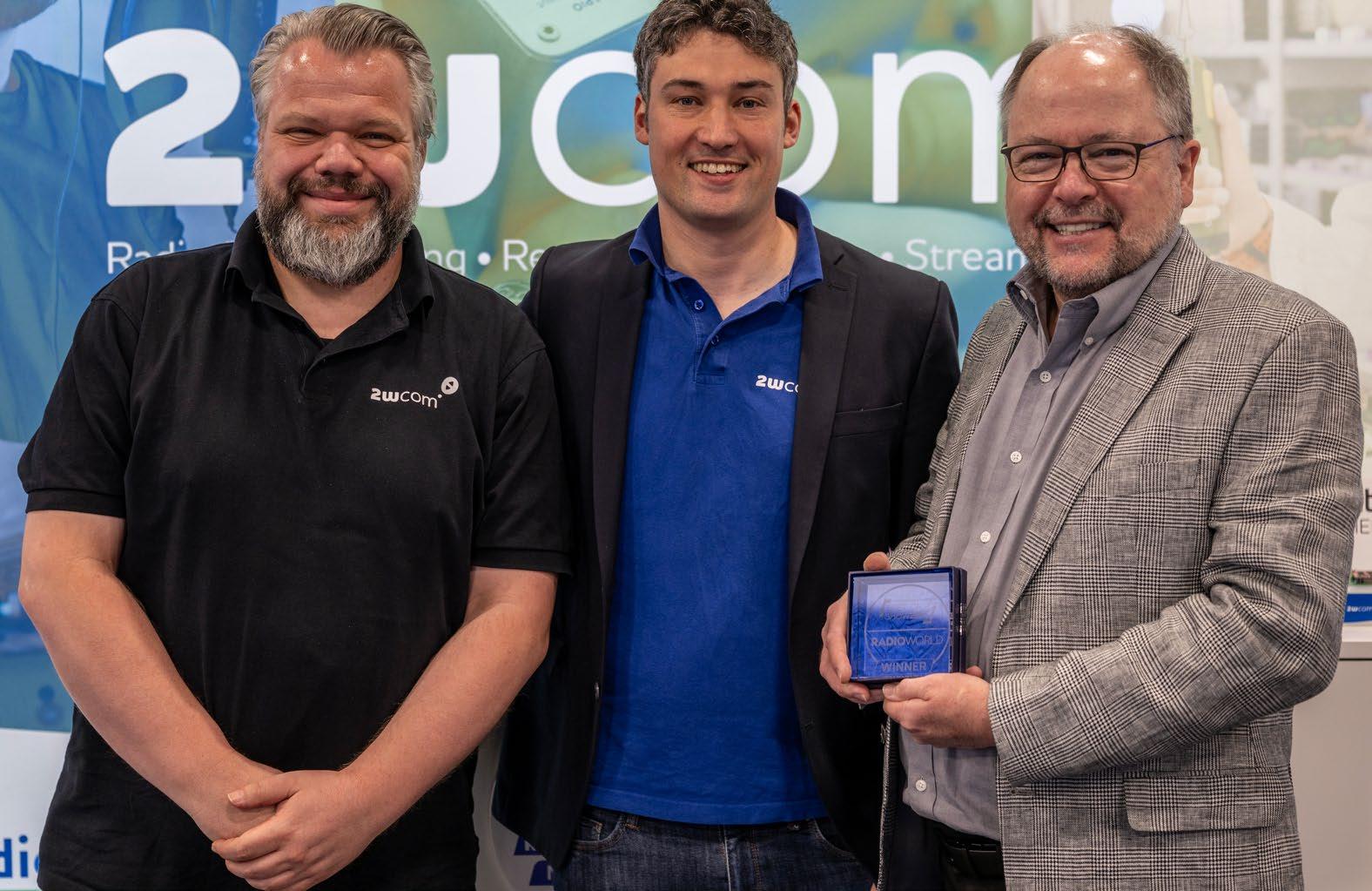
With new capabilities, the MPX-2c allows broadcasters to combine an HD Radio E2X signal from any Exporter with an analog or digital MPX signal into one synchronized stream. Instead of managing separate signal paths, HD and FM are transported together and arrive at the transmitter fully aligned.
At NAB, 2wcom demonstrated this with a real-world setup. A combined FM + HD stream was sent from Germany to California, more than 5,000 miles, to show that the signals remained synchronized with SFN-level precision and no audible diversity delay.
The MPX-2c works with any HD Radio Exporter and supports both analog and digital MPX signals, easing integration into existing infrastructures.
By using GPS with a 1PPS reference, the MPX-2c maintains synchronization between HD and FM signals across the distribution chain. “This level of accuracy is sufficient for FM Single-Frequency Network operation and enables new approaches to network design, coverage optimization and spectrum usage,” the company says.
It supports uncompressed MPX from 1.5 to 6.1 Mbps for maximum signal quality, as well as bandwidth-efficient compressed MPX such as µMPX at around 320 kbps.
Joost Schultke and Leif Cipriani are with Paul. Info: www.2wcom.com/hd-radio-fm-sync
Flexible SNMP Remote Control
Built-In Relays, Status Inputs, and Metering ALL FOR LESS THAN $2K!
IOX-24S SNMP Remote Control
• Standalone SNMPv2 remote control system with included Windows GUI for full control and status monitoring
• Provides 24 control relays, 24 status inputs, and 8 analog metering inputs for broad monitoring and control needs
• Responsive, simple Windows App supports up to eight IOX-24S units even across different locations
The IOX-24S
Jim Peck
Best of Show Awards
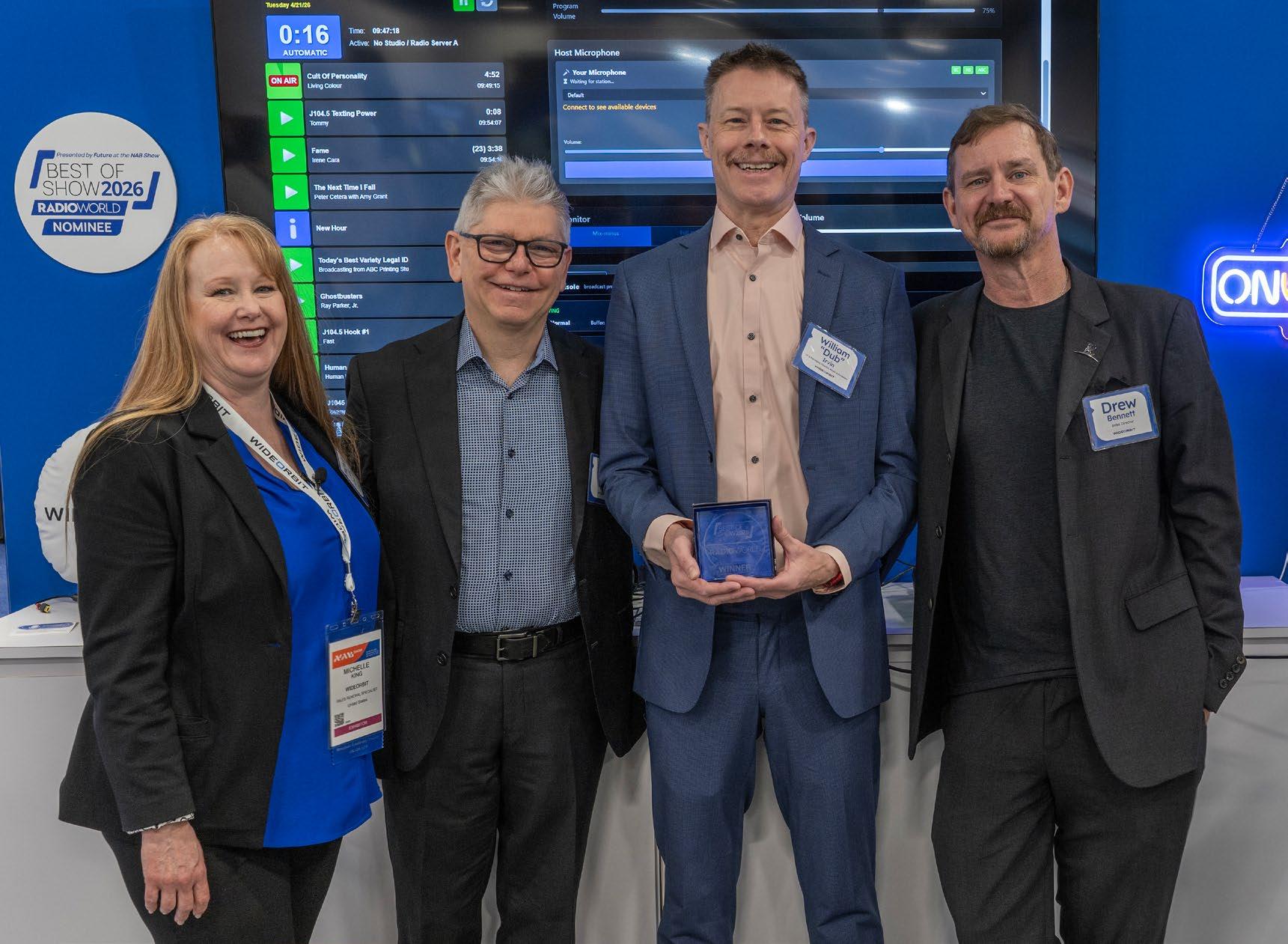
WideOrbit WO Aurora
If you stopped by the WideOrbit booth you may have seen Beasley Media’s Shawn Stevens live broadcasting over a local Las Vegas station.
He was demonstrating the capabilities of the new WO Aurora system, including its browser-based Web Studio interface to control the station remotely, along with a Live Mic feature to deliver real-time, on-site programming.
WO Aurora offers cloud, on-premise and hybrid deployment options, promising broadcasters much more flexibility in their infrastructure deployment. Its Web Studio UI eliminates the friction of traditional desktop applications. The Live Mic feature enables location-agnostic broadcasting by allowing talent to go live from anywhere while maintaining professional-grade reliability. It is built into the WO Aurora software, so you don’t need external audio codecs.
Celebrating the win are Michelle King, Brad Young, Dub Irvin and Drew Bennett.
Info: www.wideorbit.com/aurora
Jim Peck
Best of Show Awards
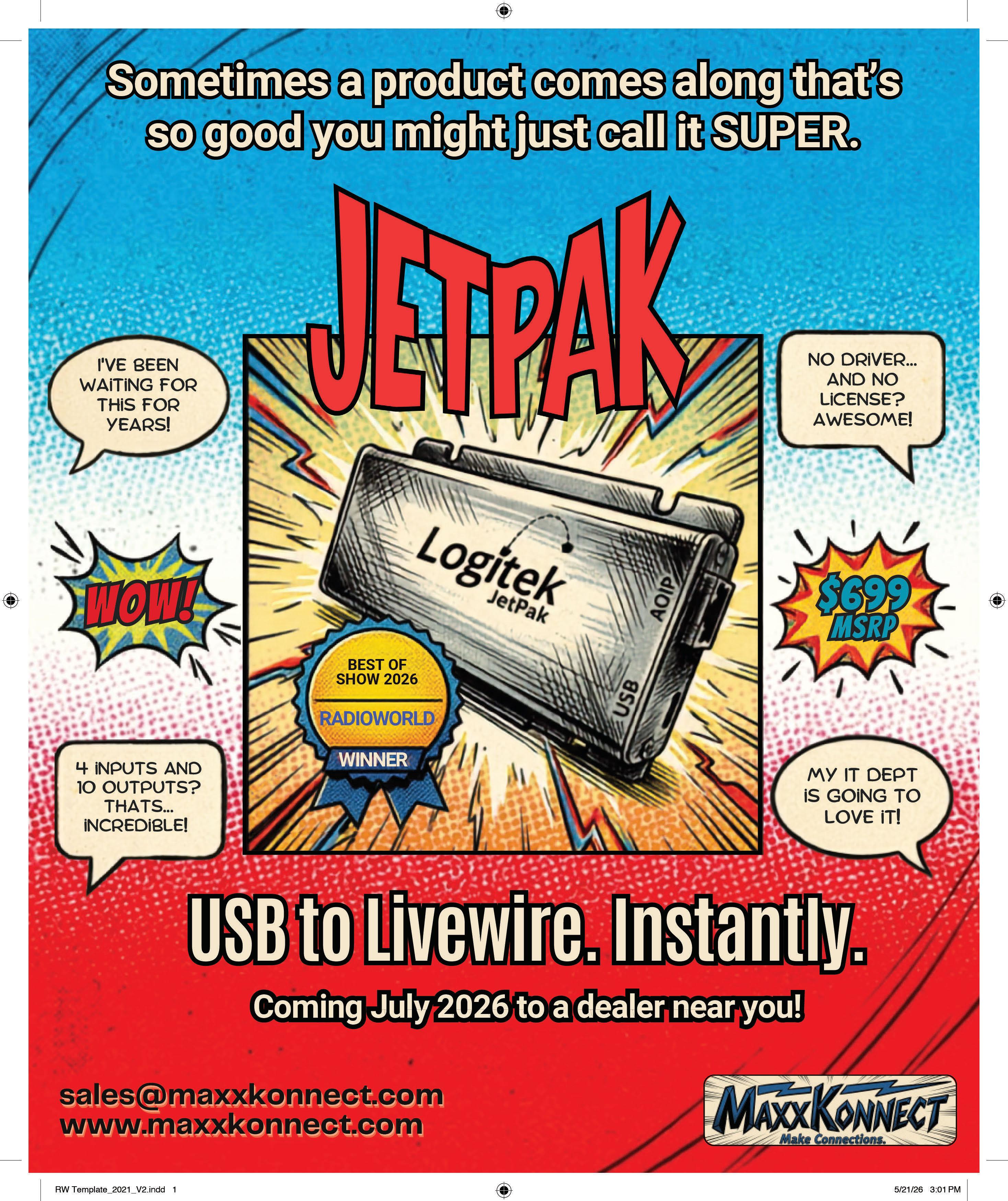
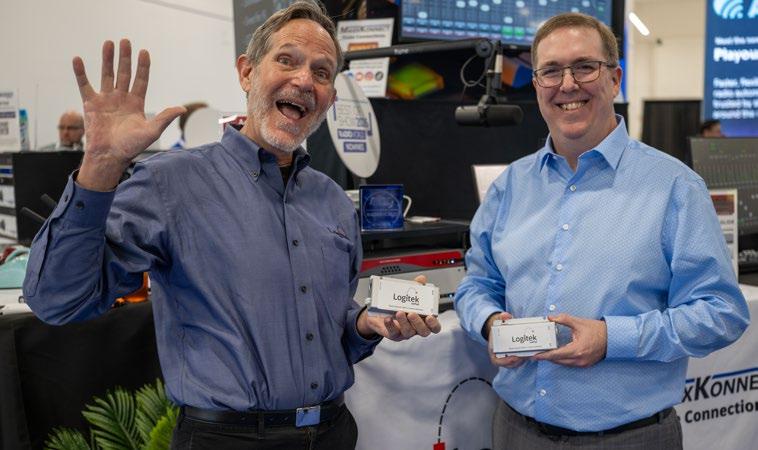
Logitek Audio JetPak
Logitek, working with MaxxKonnect, launched a hardwarebased USB audio interface designed to simplify how computers connect to Livewire AoIP networks.
It costs $699 and fits in your palm. “Supporting up to four stereo inputs and 10 stereo outputs, along with integrated GPIO and logic control, JetPak provides a direct bridge between standard USB audio and Livewire environments, without the need for dedicated software drivers or additional licensing,” it says.
Configuration is stored in the device, allowing it to move between systems while retaining channel mapping and logic — nice for easy deployment and fast disaster recovery.
It combines the ease of plug-and-play USB sound with the security of a physical hardware buffer, minimizing direct network exposure from host computers.
With growing concern about network security, especially where AoIP is present, “JetPak puts it all to rest by fencing-in Livewire.”
Tag Borland and Josh Bohn prepare to put on their JetPaks.
Info: https://logitek.audio
Broadcast Bionics
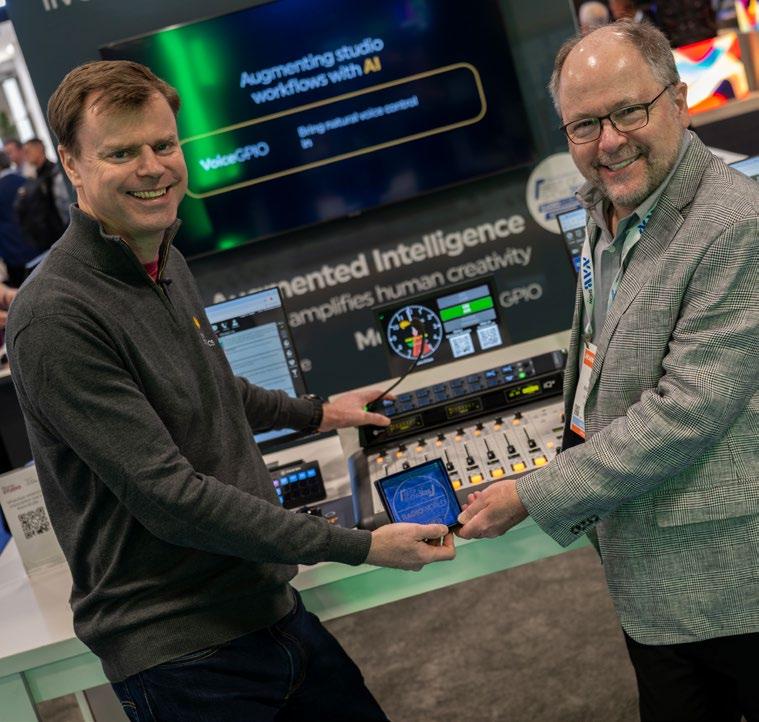
VoiceGPIO
This software service integrates with compatible AoIP systems and equipment, enabling control through simple voice commands. Bionics says it allows operators working in fast-paced live environments to stay focused while making studio operation more accessible.
Operators can issue commands and receive spoken feedback through their existing talkback system or console for a hands-free control experience that reduces reliance on screens, physical controls and visual cues.
It is designed to be used with Telos Infinity IP talkback systems. It runs on-prem and integrates natively with AoIP broadcast infrastructure to control consoles, talkshow systems, routing and other functions.
Dan McQuillin accepts the award from Paul McLane. Info: https://bionics.co.uk/voicegpio
Jim Peck
Jim Peck
Best of Show Awards
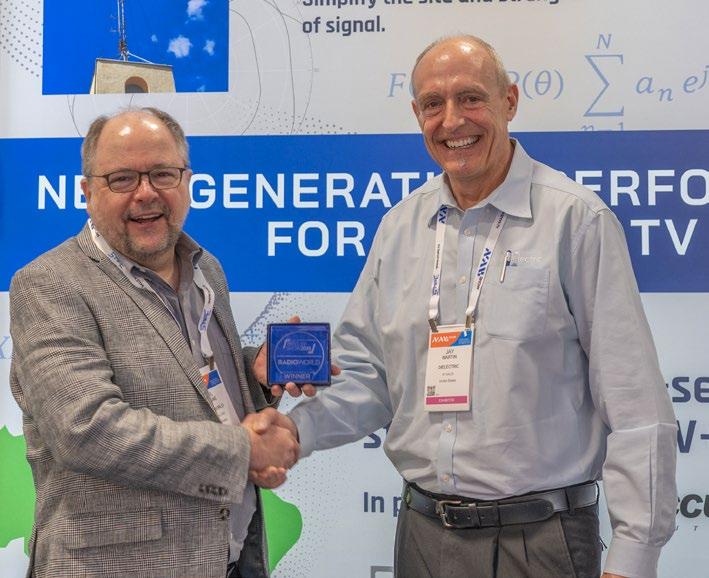
Dielectric RingMaster Antenna System
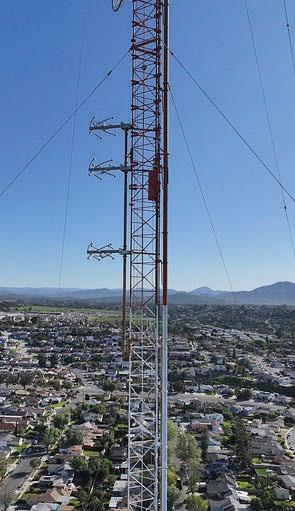
This high-efficiency master antenna system merges new and familiar tech to create more economical, efficient and adaptable solutions for side-mount systems that can also input multiple FM stations into the antenna. It is aimed at multi-station, single-antenna applications such as a 10-station, 13-channel job deployed recently by Vertical Bridge in Texas.
Dielectric cites powerful reductions in system complexity and tower load thanks to streamlined builds that use up to 33 percent fewer components, largely through reduced radiating elements.
RingMaster merges spacing elements that incorporate full and half-wavelength spaced arrays. Half-wave bays are spaced closer together and behave as a single bay, enabling full FM bandwidth.
“The breakthrough comes with a transition to full-wave spacing at a very precise point, maintaining full FM bandwidth through the remainder of the system with fewer parts.”
Paul McLane congratulates Jay Martin of Dielectric.
Info: www.dielectric.com/antenna/ringmaster
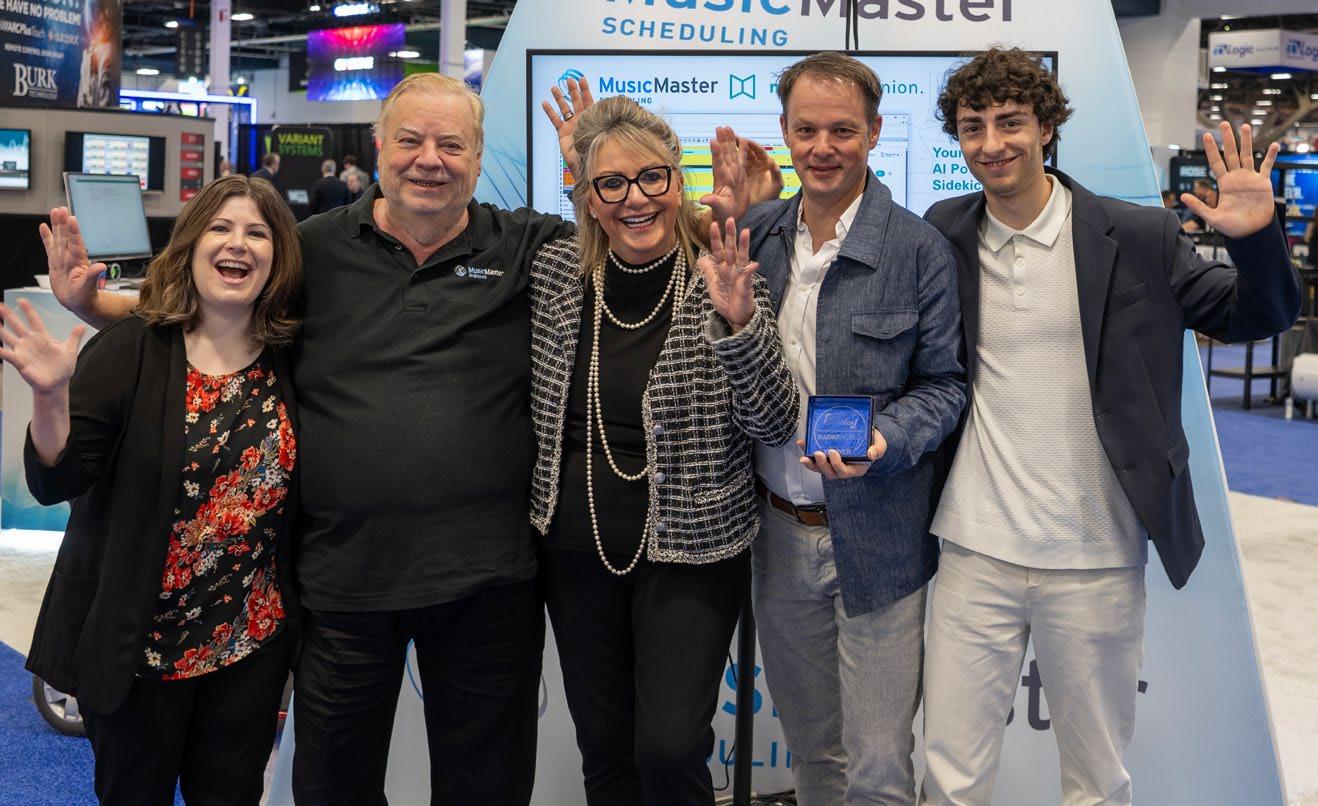
MusicMaster and SwissMediaPartners MusicMaster + musiccompanion
“In live broadcast, a single AI hallucination isn’t just a glitch, it’s a compliance nightmare,” says MusicMaster.
“While the industry rushes to adopt Large Language Models, the missing link has been a ‘trust layer’ that bridges generative power with broadcast-grade accuracy.”
The MusicMaster and musiccompanion partnership introduces a human-verified data layer between AI systems and broadcast output. Its core concept is a “song molecule,” a structured, curated unit of information that the company says transforms unstructured AI noise
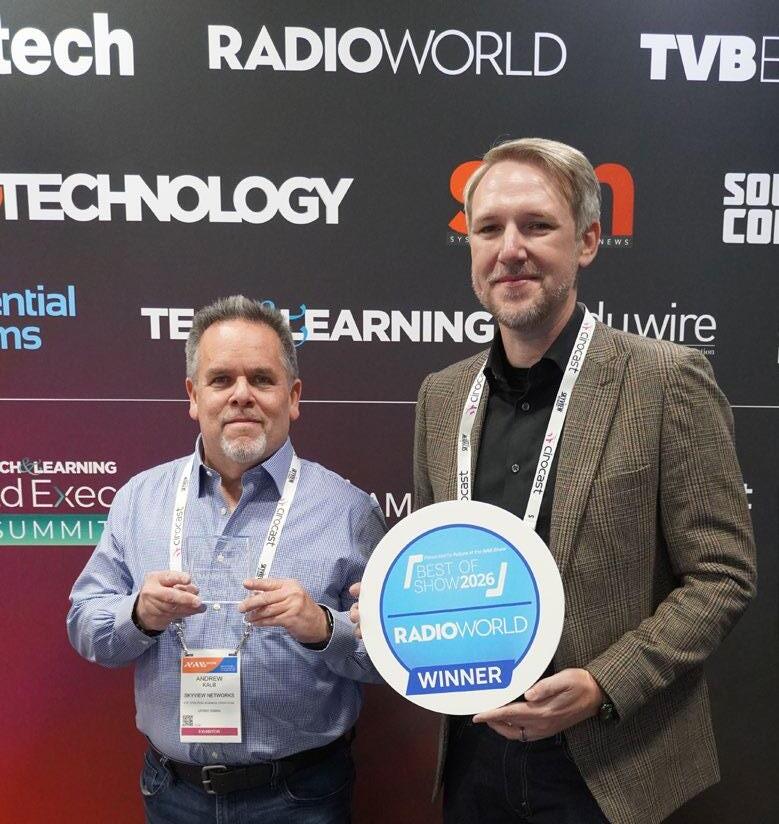
Skyview Networks
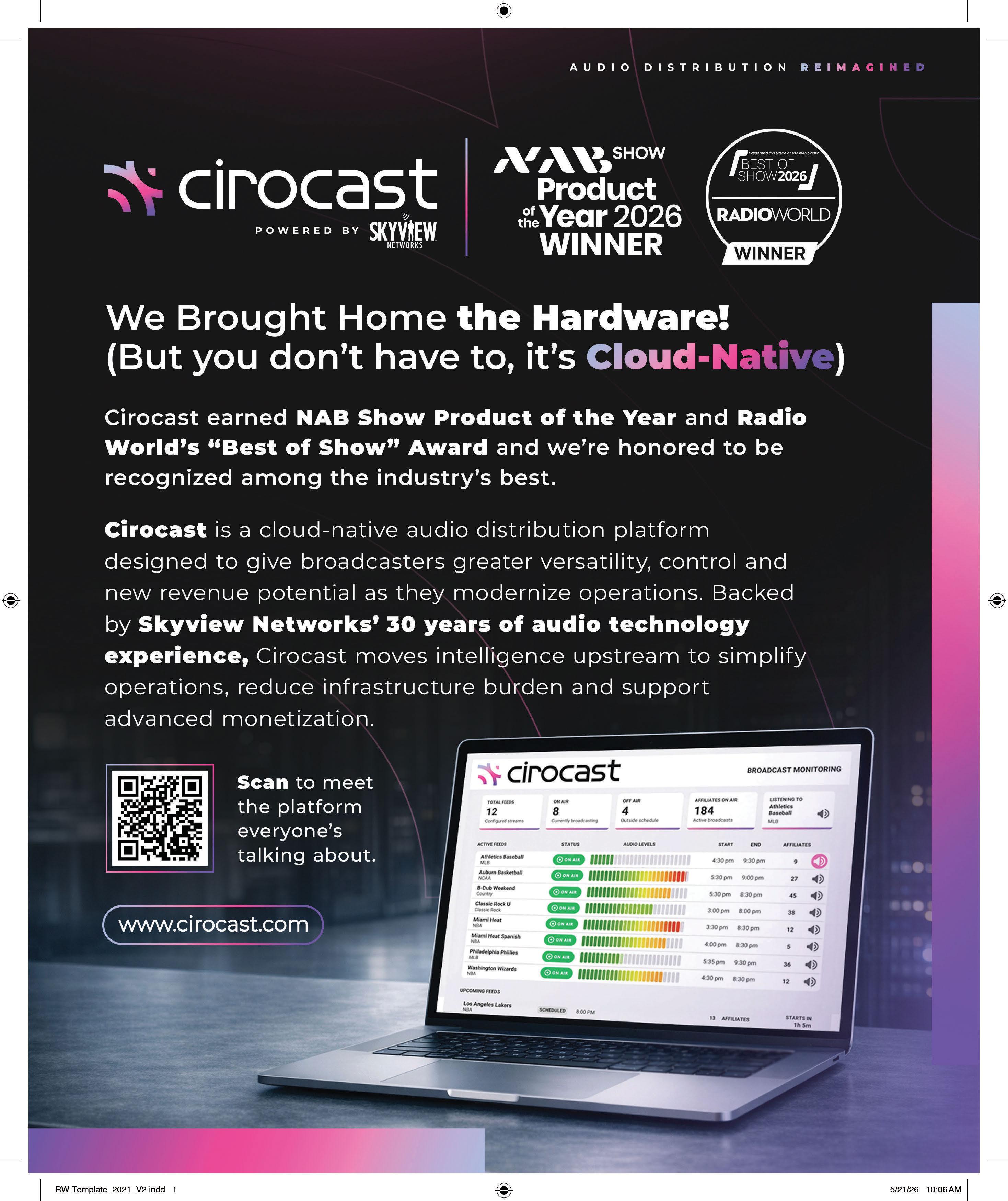
Cirocast
Technical and regulatory trends are driving a need to migrate from satellite systems to IP, according to Skyview Networks.
Cirocast is a new cloudnative audio distribution platform. “It is the first radio distribution platform to perform real-time, per-affiliate ad assembly and automation triggering in the cloud,” Skyview says.
“Finished feeds reach versatile endpoints including cloud automation systems, IP codecs, purpose-built hardware or fully virtual deployments.”
Audio is delivered to the cloud. Ad traffic instructions and commercial audio connect through Skyview’s Adview Inventory Management platform or a network’s existing traffic system. Cirocast’s Feed Orchestrator detects break markers such as cue tones, embedded metadata or SCTE-35 triggers, and selects the correct spot by market and campaign, normalizes loudness and mixes a unique feed for each endpoint.
Andrew Kalb and Aaron Mellis hold the hardware.
Info: https://cirocast.com
into a deterministic data asset.
“These contain verified metadata and contextual information sourced from authoritative references and reviewed by a designated editor before being made available to AI processes.”
Integrated tools assist the user in comparing and selecting reliable metadata sources. This ensures that high-quality data is used to enrich a music library, whether for scheduling, reporting or presentation. AI-assisted song analysis supports coding and classification tasks from within the same framework. A key principle is that the AI is not permitted to operate on the open internet or with unverified data.
This architecture also supports AI-assisted voicetracking. Script generation is constrained to verified molecule data, and its prompting strategies produce broadcast-appropriate language that aligns with your station tone and format. These scripts can be rendered as audio using synthetic voices and delivered into playout.
Shown, from left, are Laurie Knapp, Joe Knapp and Melanie Knapp of MusicMaster, and Michael Buholzer and Hervé Zucchinetti of SwissMediaPartners.
Info: www.deliver.media/musiccompanion
Jim Peck
Jim Peck
Jim Peck
Best of Show Awards
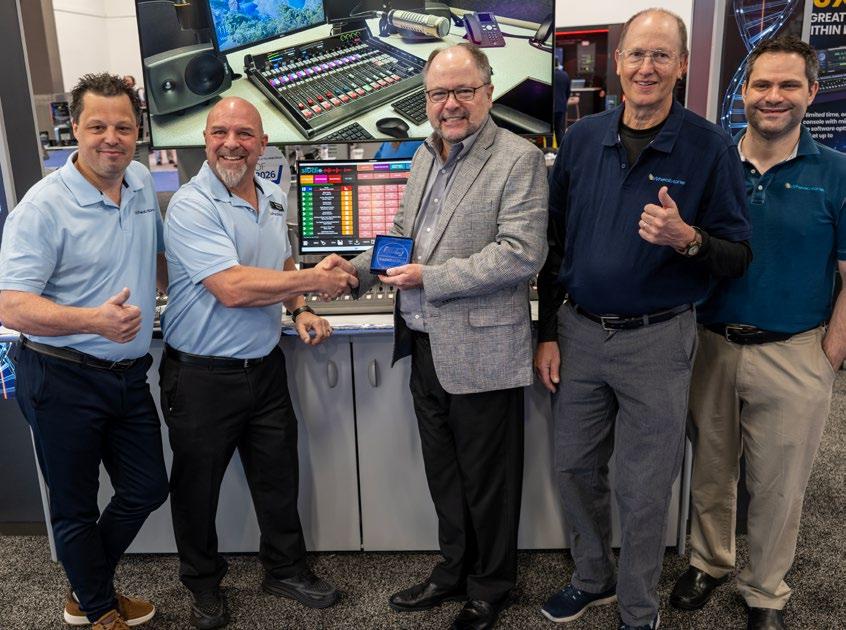
Wheatstone DMX-12
“Studios are getting smaller and doing more,” says Wheatstone, “which is why we announced a 12-channel Audioarts DMX console this NAB show.”
Now in production, the DMX 12 is the latest addition to Wheatstone’s Audioarts DMX console line, which includes an eight-channel console, a 16-channel console and optional Remote DMX for access from anywhere.
DMX consoles are an all-in-one solution for budget studios that serve backup to a main studio in a large facility or as the main studio console for smaller operations. Adding DMX-12 to the line fills a gap between large and smaller studios.
Like the eight- and 16-channel versions, DMX 12 is ready for air and comes with a rack-mount engine with audio, logic, I/O and expansion ports. Included is a five-port Ethernet switch as well as WheatNet IP audio network connectivity, plus WheatNet IP automation control protocol for automation and playout integration and the ability to add touchscreen panels using WheatNet IP ScreenBuilder tools.
With Paul are Danny Teunissen, Darrin Paley, Dave Breithaupt and Dominic Giambo.
RCS has expanded its cloud-native offerings with SelectorCloud.
It AI-based musica scheduling engine continuously analyzes patterns, listener data and station objectives to optimize rotations and balance music and non-music elements. The company says the result is precision and balance unattainable through traditional software.
Accessible via a browser interface, SelectorCloud integrates Media Monitors Mscore and Mediabase Research scores and gives programmers actionable insight at the moment of scheduling.
SelectorCloud supports custom attributes, global and station-specific metadata and an enhanced Goals interface featuring multiple balance panels. It works in concert with ZettaCloud, RCS’ cloud-native playout system used by approximately 600 AM and FM stations.
In the booth are Chip Jellison and Susan Larkin.
Info: www.rcsworks.com
Jim Peck
Jim Peck
Best of Show Awards
Telos Alliance Axia Pulsar
The latest Axia product from Telos is a small-formfactor networked mixing console that starts with eight faders and can expand up to 16.
Its eight-fader master module includes TFT IPS displays for readability and five user-programmable function keys to trigger functions controlled by Telos’ Axia Pathfinder Core PRO.
Each channel strip has two user-defined function buttons, touch-sensitive encoders and 100-millimeter motorized faders. In addition to per-channel TFT displays, a customizable color stripe allows for identification of source groups.
With its compact form factor and advanced mixing capabilities, Axia Pulsar is ideal for studios, newsrooms, production facilities or backup locations, Telos said.
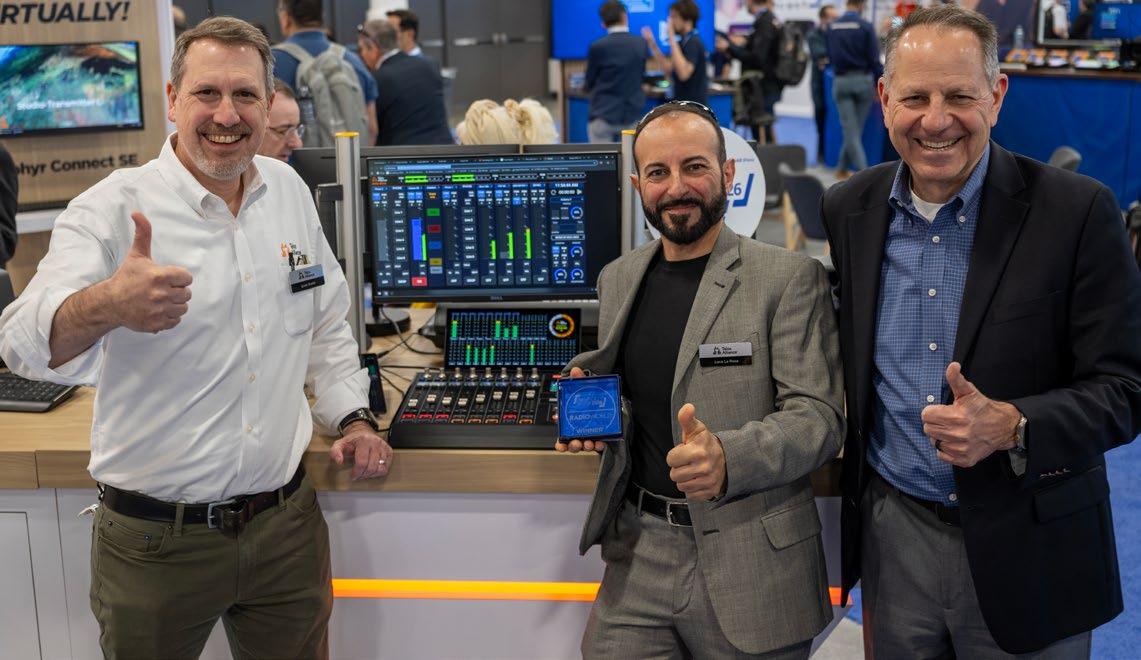
Scott Stiefel, Luca De Rosa and Marty Sacks are shown.
Info: http://telosalliance.com
Broadcast Software International BSI Stratus Music Scheduler
American Amplifier Technologies EmPower Controller VNA
This new tool combines intelligent SNMP-based remote monitoring, site automation and an integrated Vector Network Analyzer. It provides continuous, real-time visibility into RF transmission systems — transmitter to antenna — without requiring a site visit or taking the station off-air.
EmPower Controller VNA delivers two complementary forms of RF analysis.
Time-domain reflectometry continuously monitors the feedline and antenna system, comparing live measurements against a saved baseline to detect and locate faults anywhere along the transmission line. When a discrepancy is detected it calculates the distance to the fault and alerts the engineer via mobile app or email so corrective action can be taken before the issue becomes an outage.
Frequency-domain analysis provides a full picture of system performance across the broadcast spectrum, the company said, enabling engineers to evaluate VSWR, return loss and overall antenna health.
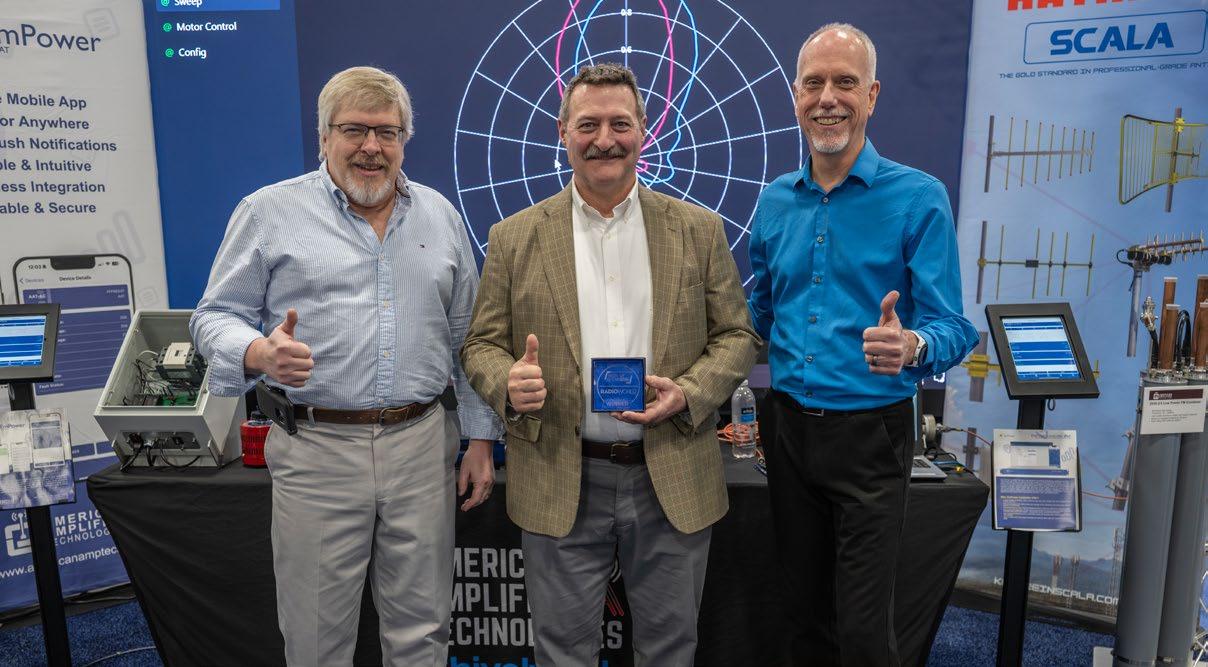
Shown are Dale Ladner, Sean Edwards and Sam Wallington. Info: www.americanamptech.com
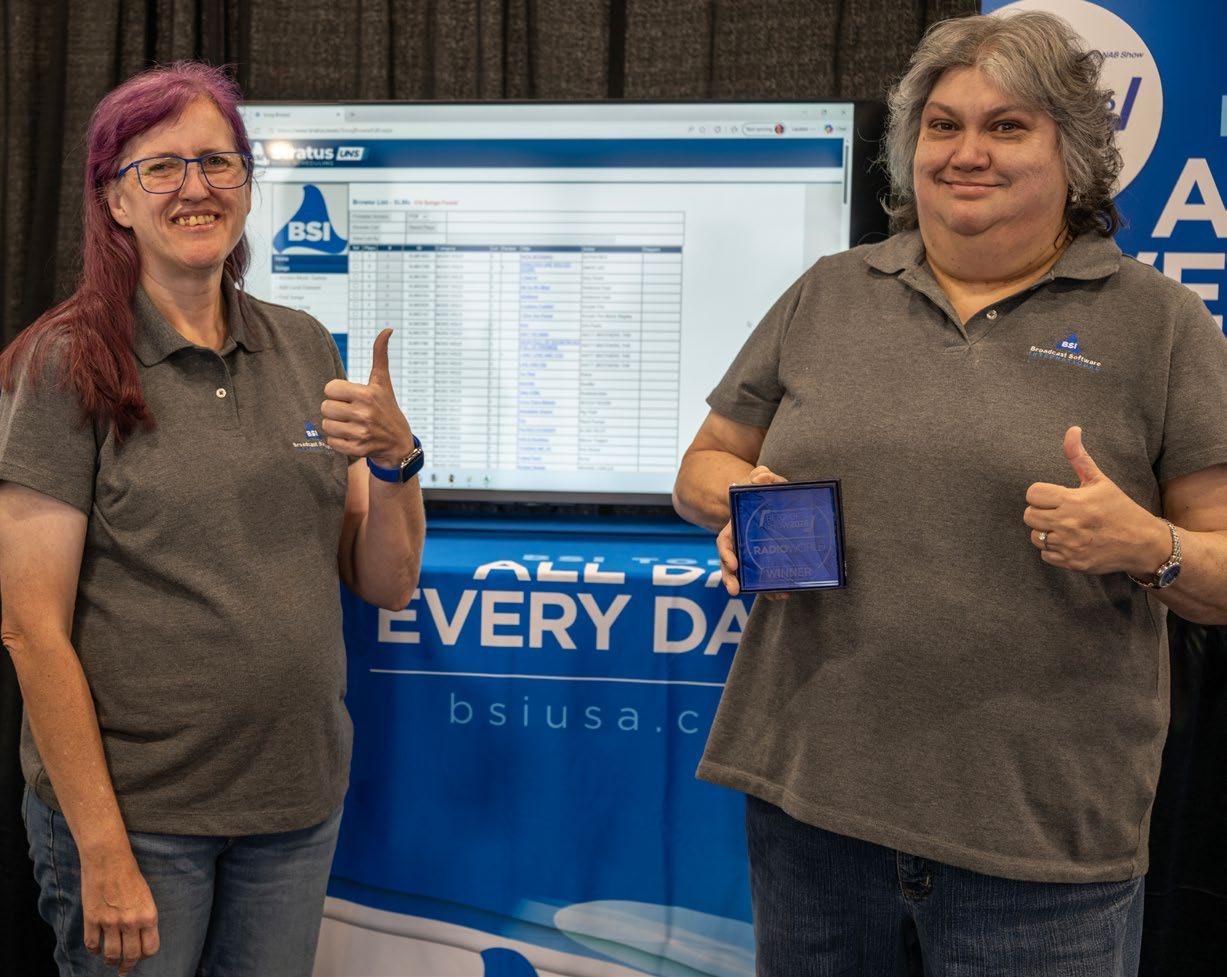
BSI’s Stratus Music Scheduler is built with modern radio workflows in mind. It offers intuitive tools, flexible customization and seamless integration with existing automation systems.
“Whether you’re programming a single station or managing a multiformat network, Stratus empowers broadcasters to streamline their music scheduling with precision and ease,” the company states. Features intelligent music rotation and rule-based scheduling; real-time preview and conflict resolution; cloud-enabled access and collaboration; integration with BSI’s existing automation platforms; and integration with other major radio automation. A 30-day free demo is available.
Prism is a broadcast audio delivery ecosystem built for IP. It integrates dedicated hardware and/or virtual endpoints, a cloud-based management portal and a globally distributed Audio Delivery Network into a platform intended to replace satellite and STL distribution.
“Prism is designed for radio networks, content syndicators and broadcasters distributing audio to multiple affiliates or endpoints,” the company says.
“It targets organizations seeking to eliminate satellite infrastructure costs, modernize aging STL links, and achieve carrier-grade reliability over public internet or private SD-WAN infrastructure.”
It says Prism’s omnidirectional distribution architecture treats the internet as a layered fabric. Identical audio streams are simultaneously distributed across multiple independent paths, spanning cloud vendors, ISPs, geographic regions and protocols. No path is designated as “primary.”
The Prism Quattro receiver is an intelligent endpoint, not a passive decoder. It loads all available streams and continuously evaluates each for latency, continuity, buffer state and packet loss. Switching between paths is instantaneous.
The receiver also reports its own health metrics, including internet speed, back to the cloud-based management portal.
It is a drop-in replacement for satellite receivers, sharing the same 32-pin relay closure configuration, eliminating rewiring at the rack.
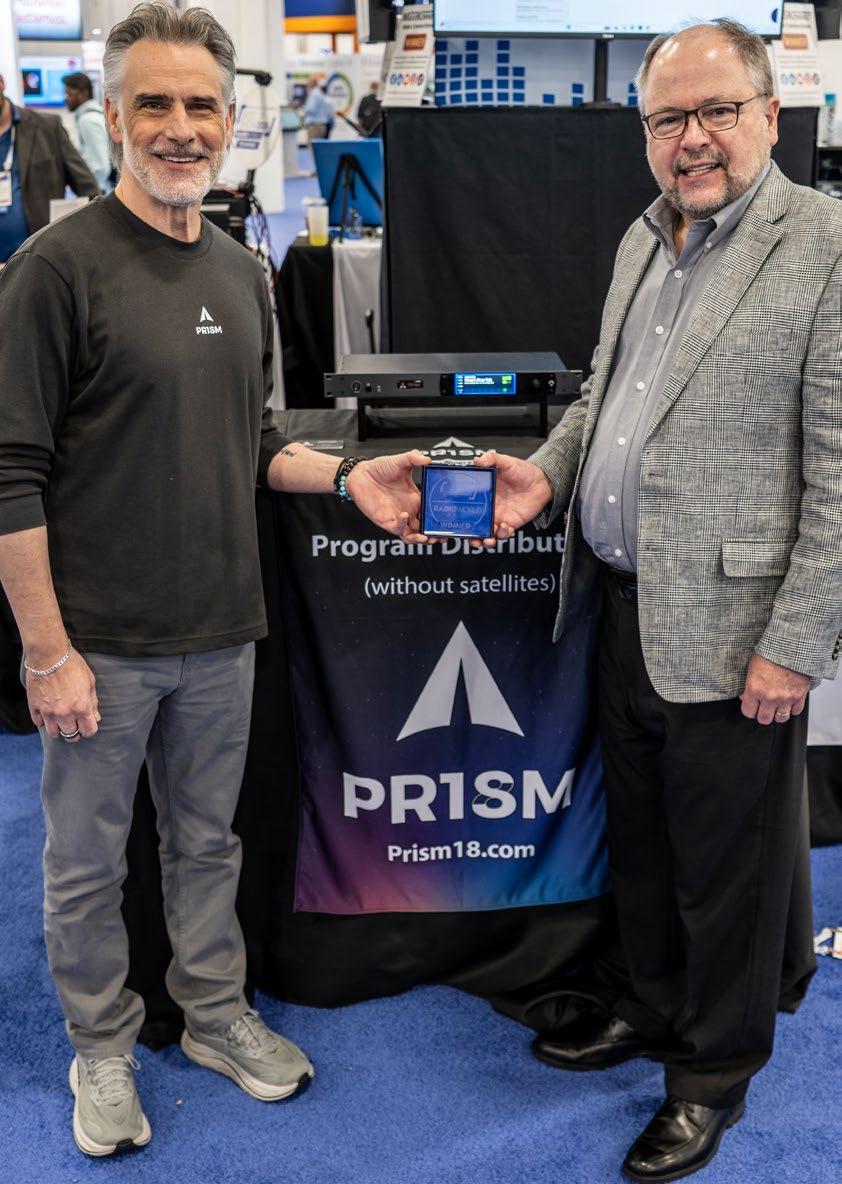
Shown, Adrian Berkovits meets with Paul McLane.
Info: https://prism18.com
The IP STL Solution
Still doing STL the old-fashioned way? Upgrade to the industry’s favourite - MicroMPX
• Trusted Worldwide
The broadcast industry’s top equipment manufacturers - including 2wcom, Tieline, Aqua Broadcast, Telos, BE, Ferncast and many more - have already built it into their gear.
• Full Composite MPX over IP
MicroMPX, the composite STL codec, delivers full-quality composite audio over IP at just 320 kbps. That’s rightyour entire FM multiplex signal: stereo, RDS, the works!
• Uncompromising Audio Quality
No psychoacoustic voodoo - just all the benefits of composite processing without the cost.
• Hardware or Software - You Decide
Run it on your own hardware or pick up purpose-built gear from your favourite vendor.
• Built-in error correction
Because dropouts aren’t an option.
Jim Peck
Best of Show Awards
ENCO aiTrack Cloud
ENCO has been a key driver of applying AI to radio workflows. The new iteration of its aiTrack is cloudnative and automation-agnostic, combining dynamic content generation, flexible scheduling and cloudbased delivery.
It enables broadcasters to generate, customize and schedule AI-driven audio segments for live and automated programming with an architecture not limited by traditional infrastructure.
“Accessible through any web browser for the first time, aiTrack Cloud allows on-air and production teams to create broadcast-ready content in seconds using advanced generative AI models and natural-sounding synthetic voices,” delivering seamless insertion into live broadcasts or scheduled playlists.
The architecture uses large language models, real-time data integration and advanced prompt engineering along with high-quality synthetic voice technology. A “foundation prompt” framework streamlines complex AI processes into intuitive templates — you put in variables like location, branding elements or sponsorship details, and it generates onbrand content without requiring AI expertise.
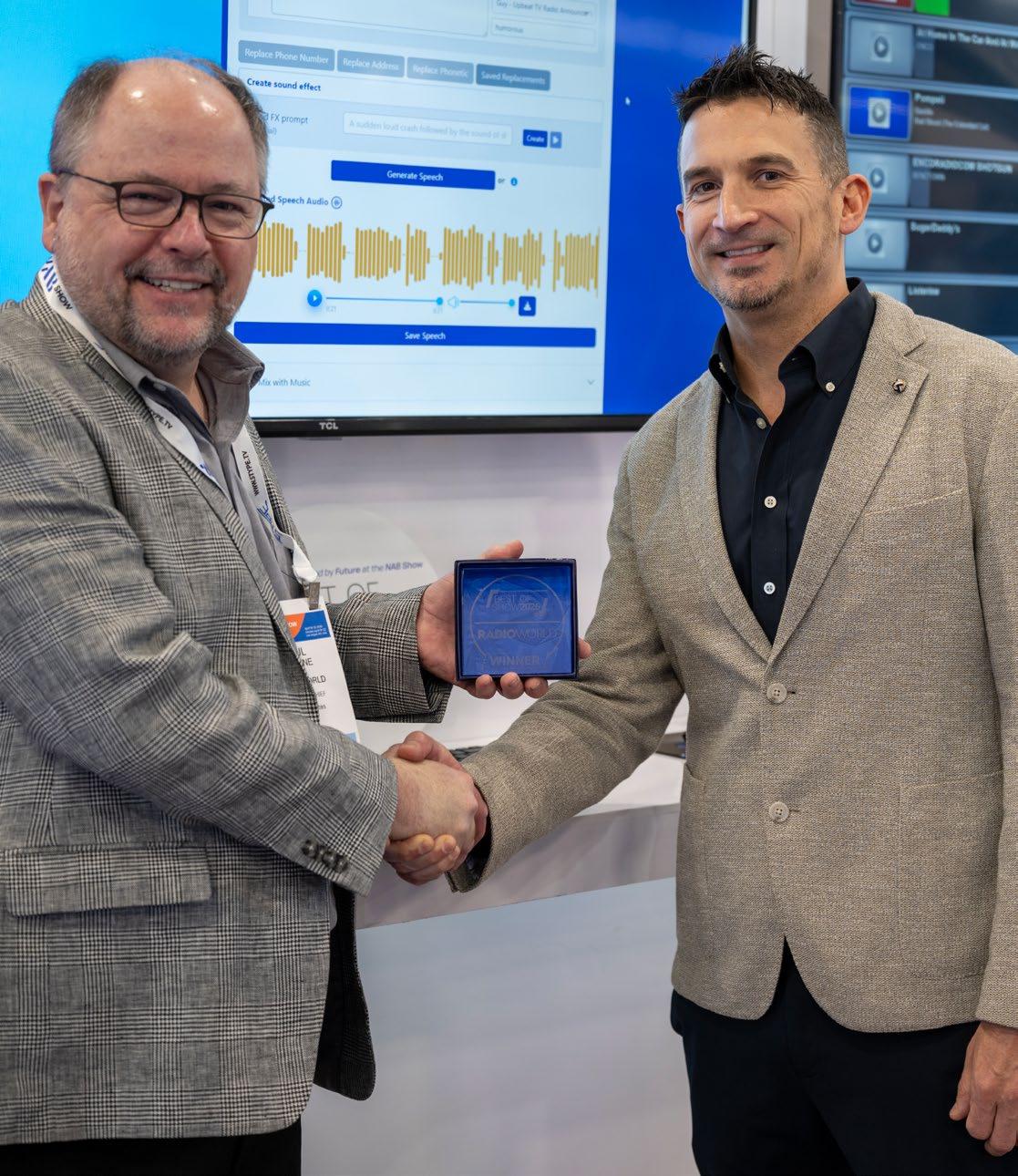
Ken Frommert, right, shakes with Paul.
Info: www.enco.com/products/specai
Telos Alliance Omnia XII FM + HD/ DAB Audio Processor
Targeting FM, HD Radio and DAB, this is the new flagship processor from Telos, developed by Frank Foti and the Omnia team.
In two rack units it includes a wideband AGC; five-band multiband AGC and compressor; and a six-band multiband limiter, coupled with “smart” dynamic EQ and refined bass management tools.
Telos says the multiband section feeds a clipper based on research into delivering on-air loudness while eliminating distortion and listener fatigue that can come with aggressive processing. (The clipper is called “Clemenza” after a character in “The Godfather.”)
Its toolkit includes a dynamic RDS encoder, ratings watermark integration and an insertion point that allows external devices such as the Voltair to be introduced at the “sweet spot” in the airchain.
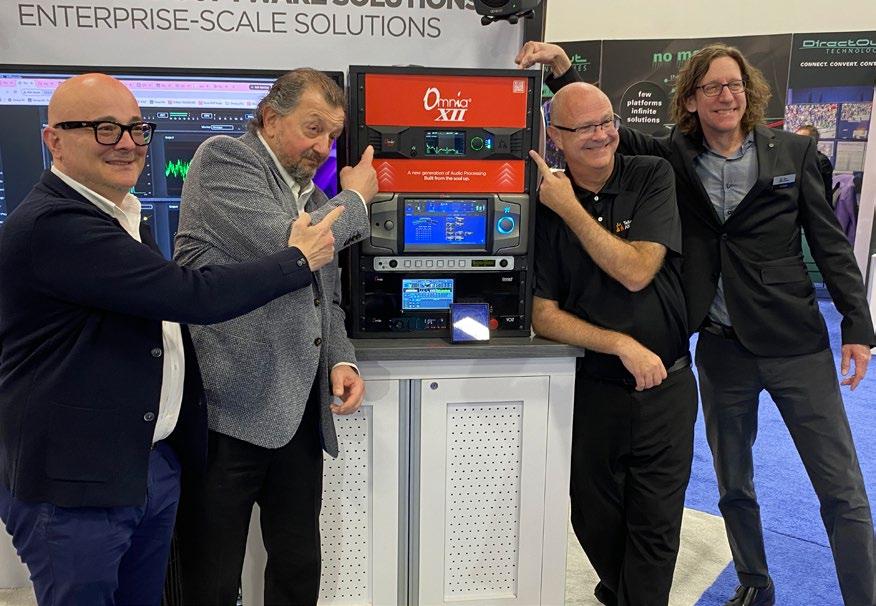
Max Pandini, Frank Foti, Paul Kriegler and Jim Weber pose with Omnia XII.
Info: www.telosalliance.com
Thimeo Audio Technology MicroMPX V.5
Version 5 of (the already influential) MicroMPX delivers stronger reliability, easier integration and smarter control.
It improves handling of network interruptions when packet loss or signal issues occur, as is common on public internet or wireless links; the system recovers faster and keeps audio clean and stable.
“The result is shorter audible glitches due to packet loss and a consistently higher-quality listener experience,” the company says.
Integration also is simpler and more flexible, with support for standard RTP transport, fitting broadcast and IP workflows. “Engineers can use familiar tools to monitor performance, including packet loss, delay and jitter. This reduces setup time and makes it easier to deploy across both traditional and modern infrastructures.”
Efficiency has improved; Version 5 uses less CPU power while delivering more accurate audio performance, allowing broadcasters to run more services on the same hardware or lower infrastructure costs in virtual or cloud environments.
It also adds smarter monitoring and control, and coordination across multiple sites is easier thanks to a new standardized method for triggering topof-the-hour station IDs.
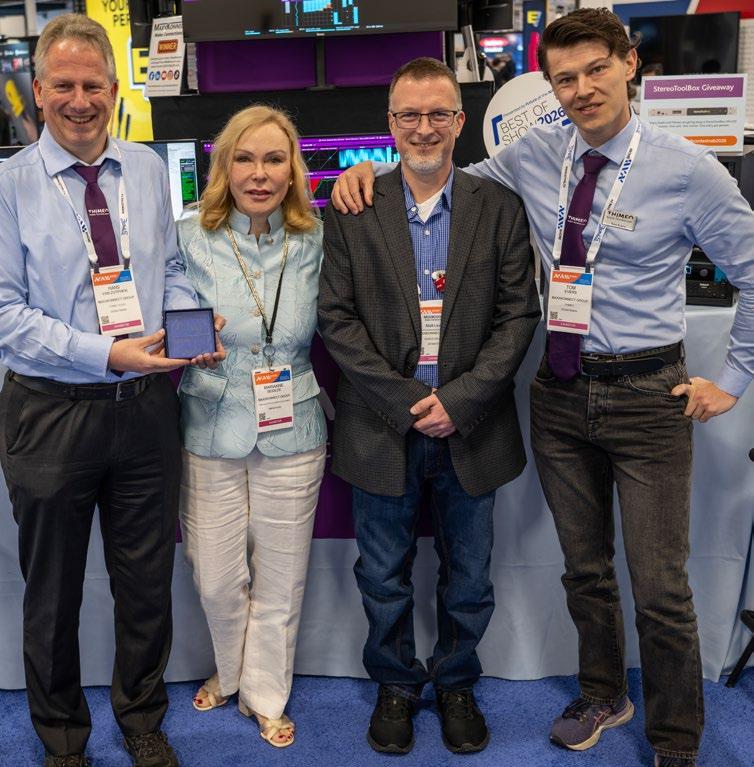
In the booth are Hans Van Zutphen, Marianne Seidler, Matt Levin and Tom Evers.
Info: www.thimeo.com/micrompx
Paul McLane
Jim Peck
Jim Peck
Best of Show Awards
Broadcast Electronics
AMX Compact AM Transmitter Platform
Here’s an AM transmitter that you can ship via UPS or FedEx.
Broadcast Electronics describes the AMX as a nextgeneration platform based around high efficiency, scalability, simplified maintenance and significantly reduced footprint.
“Using simple building blocks, you can scale a transmitter up to 5 kW in a single 5 RU chassis for analog, HD Radio or DRM broadcasts.”
Silicon carbide MOSFETs like those in electric vehicles are used for the PDM modulator and RF amplifier. BE says it’s a first for AM transmitters, delivering increased voltage and current capability, reduced capacitance and increased robustness.
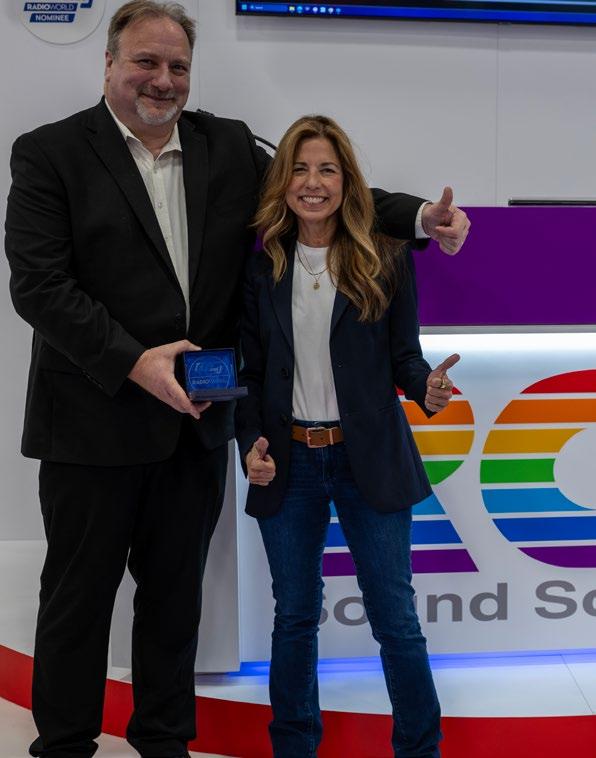
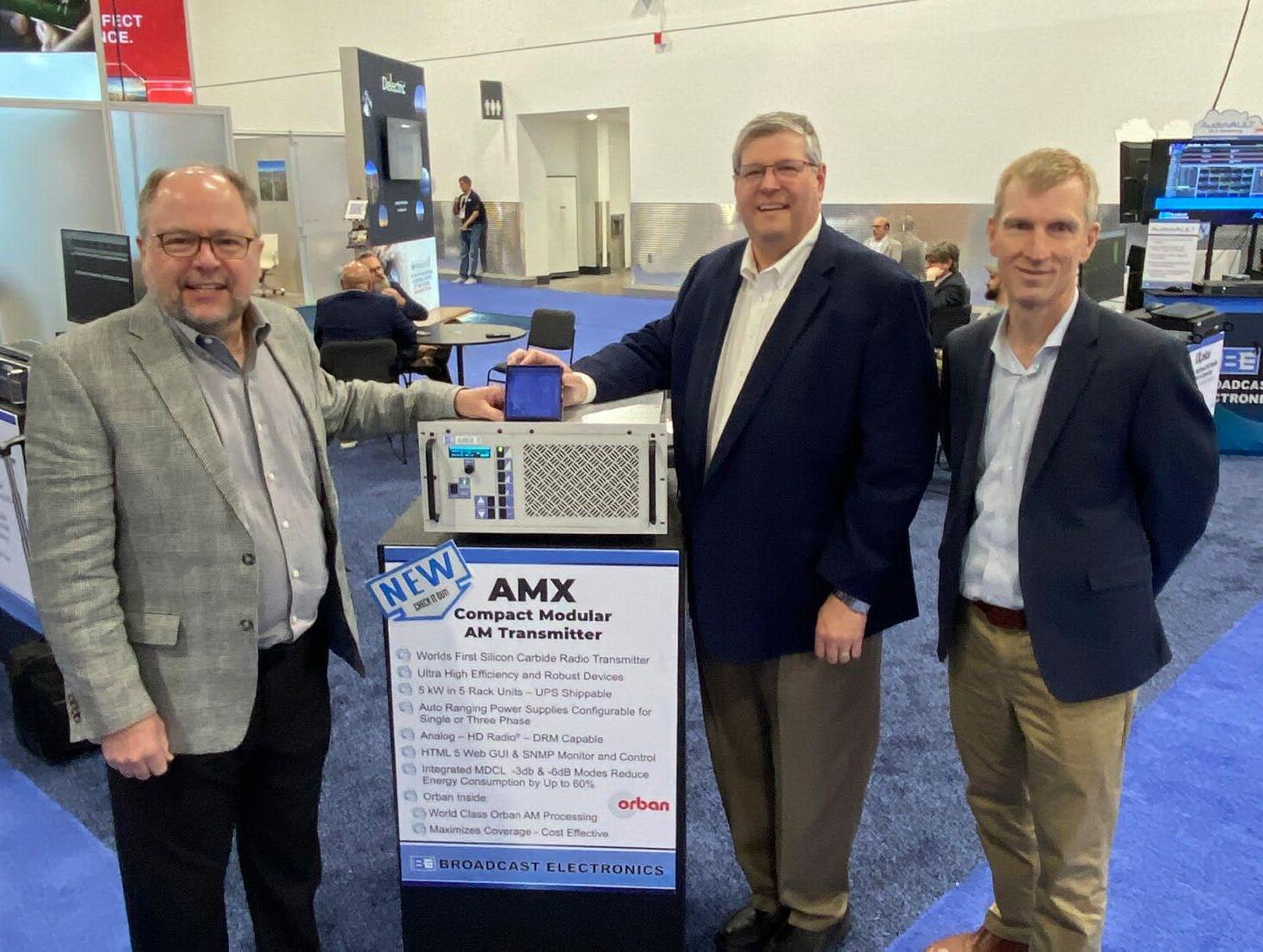
Features include redundant auto ranging power supplies for single- or three-phase power configurable at the transmitter. Modulation Dependent Carrier Level operation is supported for reduced energy consumption. Orban Inside is an available option. At the booth with Paul are Rich Redmond and Tim Hardy. Info: www.bdcast.com
John Casey
About Buyer’s Guide
The Buyer’s Guide section appears in every other issue, focusing on a particular category of equipment and services. It is intended to help buyers know what’s on the market and gain insight into how their peers are using such products.
Tech Update Futuri Offers
AI Video Spec Spots
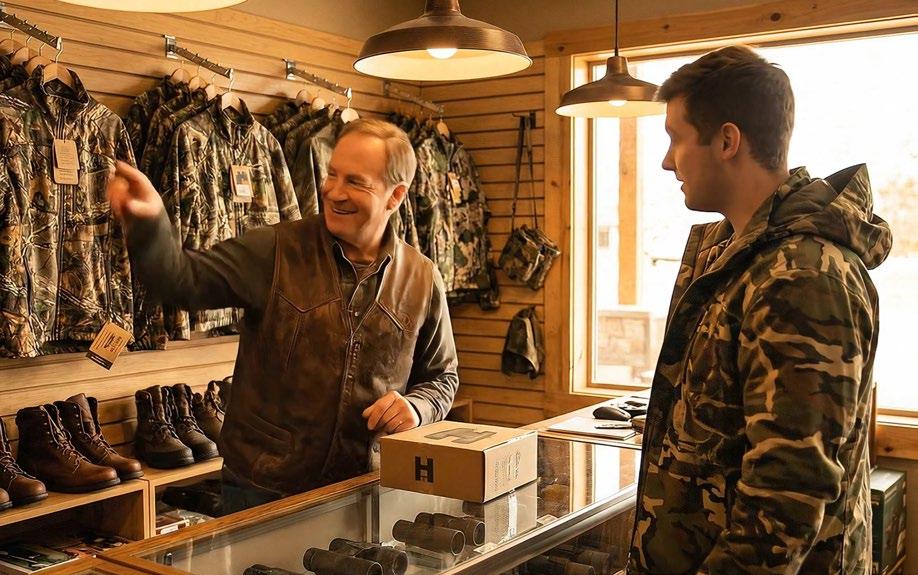
Futuri’s SpotOn Video is a new feature of its SpotOn platform.
“SpotOn Video empowers sellers to generate shortform, branded AI video spec spots in minutes, accelerating the sales pitch process with instant creative that helps close business faster,” it says.
Given a business name and a website URL, SpotOn produces a video spec spot with custom branding, animated visuals, a call-to-action screen and an AIgenerated voiceover. Spots can be 15, 30 or 60 seconds.
This builds on SpotOn’s audio engine, which transforms simple advertiser inputs into written, voiced and produced spec spots.
“One of the most exciting features of SpotOn Video is its ability to automatically pull and animate images directly
Tech Update
Spec-Mate
from a business’s website,” said Kathy Eagle, president of topline sales intelligence at Futuri in a press release.
This allows for greater personalization without adding production time, she said.
The accompanying image shows an AI-generated scene from a spot for a company that sells hunting products.
Info: www.futurimedia.com/SpotOn
Joins the Full CreativeReady Platform
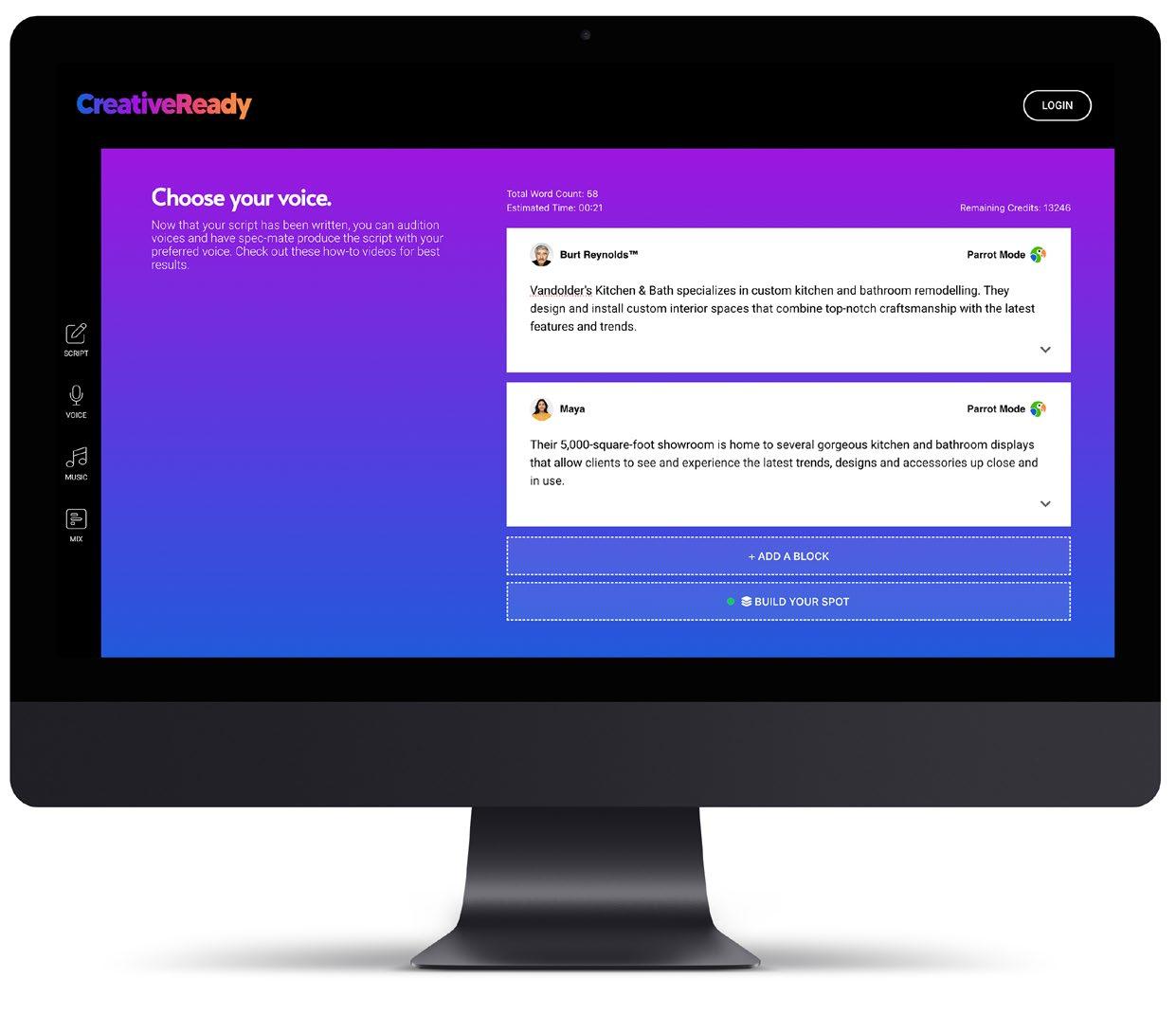
CreativeReady has consolidated its product lineup, bringing AI-powered production tool Spec-Mate into the same subscription as its library of Singables (jingles), preproduced campaigns, audio logos and music beds.
It said ths reflects how stations actually use the platform.
“Sellers and production teams rarely need just one tool. They need fast access to ready-made creative, customization options and full production capabilities.”
Spec-Mate itself has been significantly upgraded. Its Voice module now offers a larger library of professional voices and was among the first to support multi-voice spot production.
These join existing capabilities like Parrot Mode, which mimics the user’s delivery into a professional voice; a script builder trained on radio advertising; and music and mix modules designed for anyone to use.
CreativeReady combines human-made music, AIpowered production tools and an available support team, all via monthly subscription. With its library of productionready assets created by musicians and producers, the unified offering gives sellers and production teams a single platform “for any client, any budget, any timeline.”
Info: https://creativeready.com/
Tech Update
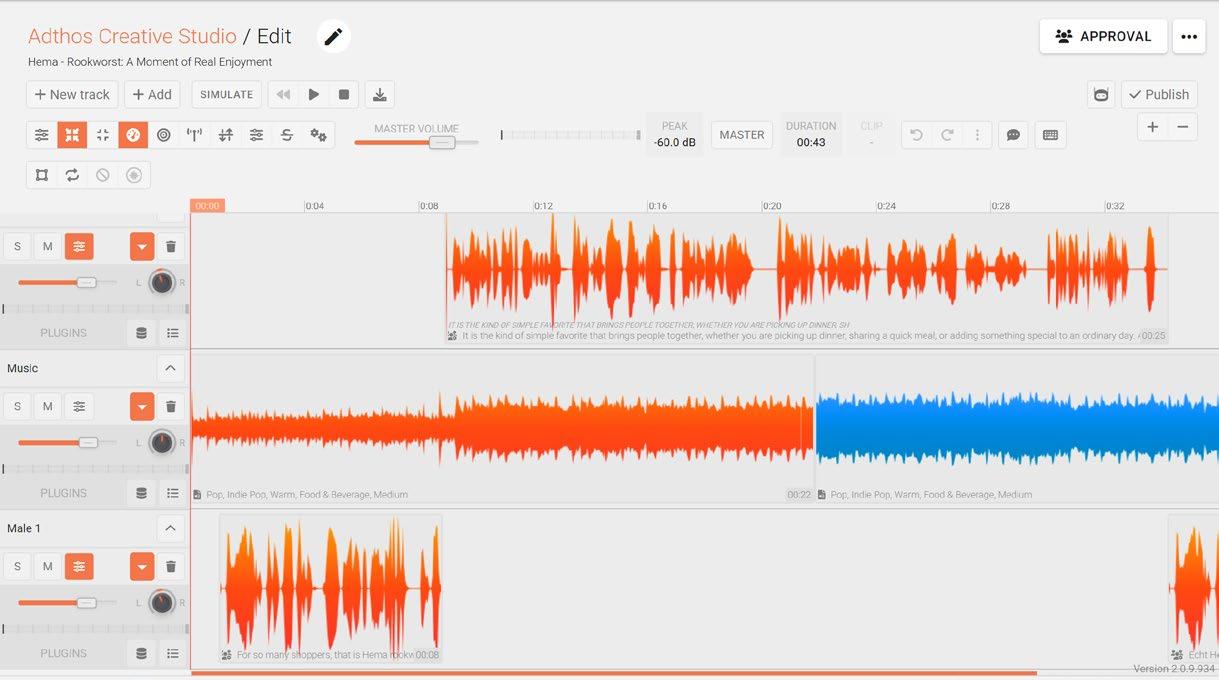
Adthos Offers AI-Powered Audio Ad Creation
The Adthos AI audio platform allows advertisers to create produced, broadcast-ready commercials in minutes through a self-service portal, with no production expertise required.
Users submit a short brief, or even simply upload a product image, and the platform generates a complete spot: script, voiceover, music and sound effects, mixed and ready to air.
It provides access to approximately 23,500 AI voices from leading providers. “Sales teams can match tone, style and language to virtually any advertiser brief.”
The platform also supports advanced geotargeting and dynamic data insertion, so a single creative can automatically adapt based on location, weather, pricing or live sports results, making campaigns more relevant without adding production overhead.
Adthos says this lowers the barrier for “long-tail” advertisers who might otherwise not commit to a campaign, while freeing production teams to focus on higher-value work.
Integrations with radio automation systems and ad servers mean that once an ad is approved, it moves straight to playout. “The result is a faster sales cycle, broader advertiser access and a stronger case for radio as an agile, personalised medium in a competitive audio landscape.”
Info: www.adthos.com
Tech Update
ENCO Enhances SPECai
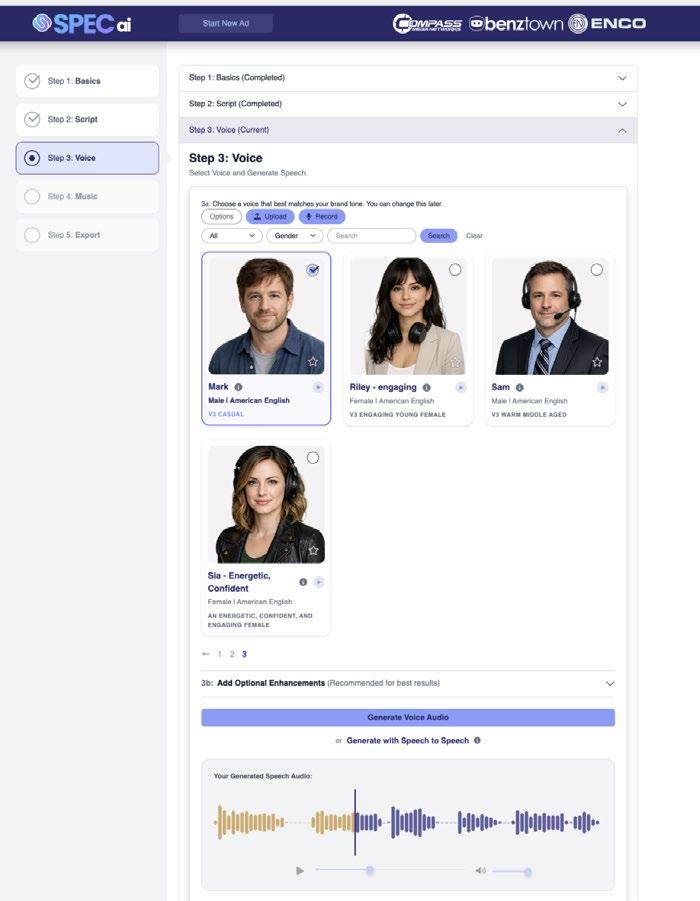
ENCO has added enhancements to the SPECai ad creation platform, which allows broadcast sales teams to create spec ads in seconds in front of their clients. ENCO offers SPECai in partnership with Benztown and Compass Media Networks.
AEs can use the tool to generate broadcast-ready commercials with professional voiceovers, music beds and fully written scripts. ENCO has added more creative capabilities, workflow improvements and expanded automation tools.
Also, a new SPECai plug-in allows users to produce video spots that incorporate scripts and audio from previously-produced radio spec spots.
New features include Multi-Voice & Emotion Control, generating ads with multiple speakers, each with customizable emotional tone.
Producers now can add and position sound effects within ads, creating more dynamic audio productions.
Voice-to-Voice technology allows users to record their own voice performance and have it transformed into a different synthetic voice, preserving pacing, tone, and delivery while expanding creative possibilities.
A redesigned user interface introduces a more
intuitive, step-by-step production flow.
A popular feature is InstaSpot, which allows the user to generate a complete commercial by entering an advertiser’s website URL.
Info: www.enco.com/products/specai
Radio Creator Highlights AI Assistant for Prospecting
Radio Creator’s AI Tools are a collection of assistants designed to support teams across radio station departments.
“For sales organizations, one of the specialized tools is Peter Prospect, an AI assistant built to help account executives prepare for new-business outreach,” it said.
Peter Prospect creates a compact research briefing before a first contact with a prospective advertiser. The assistant is designed to identify a company’s products and services, likely business model, public communication style and possible recruiting needs.
It also helps surface likely decision-makers, including management and marketing contacts when publicly available, and summarizes potential business pain points that could shape a more relevant sales conversation.
“The goal is to give radio sellers a faster and better-informed starting point for prospecting,” the company said.
“Instead of beginning with a generic call, account executives can approach a prospect with a clearer understanding of the company’s market presence, messaging and possible advertising needs.”
Radio Creator says the assistant is structured to produce concise, scanfriendly briefings that are usable in day-to-day sales work.
“One sales representative recently used Peter Prospect to research a large bakery chain before an outreach call. According to the seller, the preparation was so thorough that the prospect responded, ‘Wow! You’re really well prepared.’ A campaign from the bakery chain is now running on the station.”
The image shows the company’s AI assistants Ava Ads, Peter Prospect, Emma Email and Danny Data.
Info: www.radio-creator.com/en/ai-tools.html
Quantum Is Here
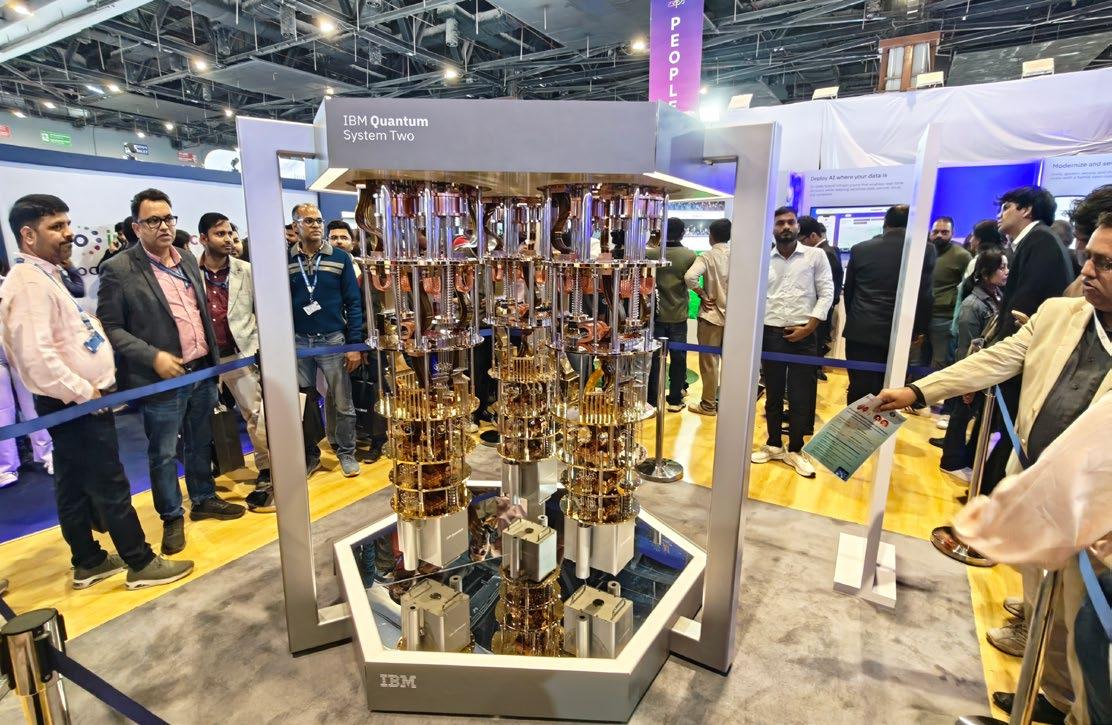
Todd Dixon has a message for us: AI-assisted quantum computing is here, whether we’re ready or not.
Dixon is chief engineer for Crawford Broadcasting in Birmingham, Ala. In an article that first appeared in Crawford’s Local Oscillator newsletter, Dixon writes: “We’re coming into some scary times regarding the protection of data that even the best of practices will have a hard time combating.”
He said quantum computers will throw a wrench into some longestablished security practices.
“Unlike the device you’re probably reading this article on, one that uses binary 0’s and 1’s (called bits of data) to chew efficiently through the math required by your programs and to generate content, quantum computers use quantum bits (qubits), where the bit value can be both values at once at the same time.
“The power in quantum computing comes when the hardware is able to begin reading multiple qubits which expands exponentially as 2n, where n is the number of qubits.”
This has implications for your security. Even the most advanced supercomputers struggle to break the encryption that powers most of the internet. “In contrast, a quantum computer is fantastic at encryption-style math.”
Dixon writes that the problem is going to affect all of us. “Most
companies (or people) simply aren’t ready for what is going to be necessary to protect themselves.”
Also, entities have been stealing encrypted data for a long time and waiting for this opportunity. Dixon calls them the “Harvest Now, Decrypt Later” folks who now will seek their payday.
He encourages us all to become informed about these changes, to use password managers and to deploy two-factor authentication with as many accounts as possible.
To read his article on this topic, go to http://radioworld.com and enter “Quantum” in the search tool.
Pallava Bagla/Getty Images Replica of IBM’s Quantum Computer at the India AI Impact Summit in New Delhi, in February.
A Gizmo for Your Phones
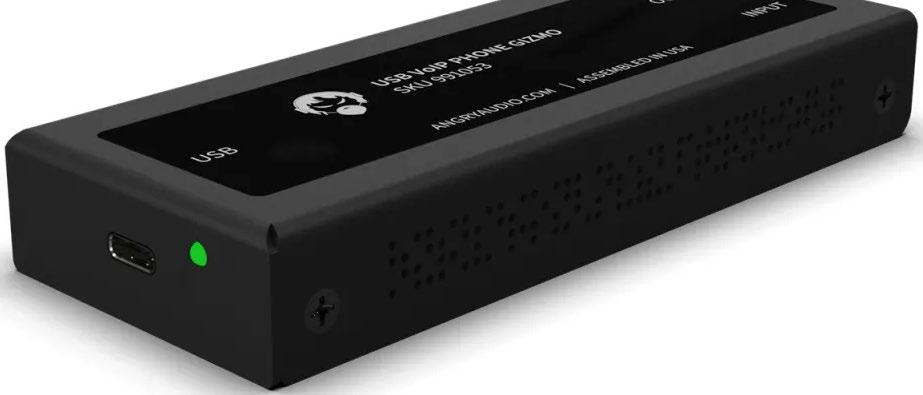
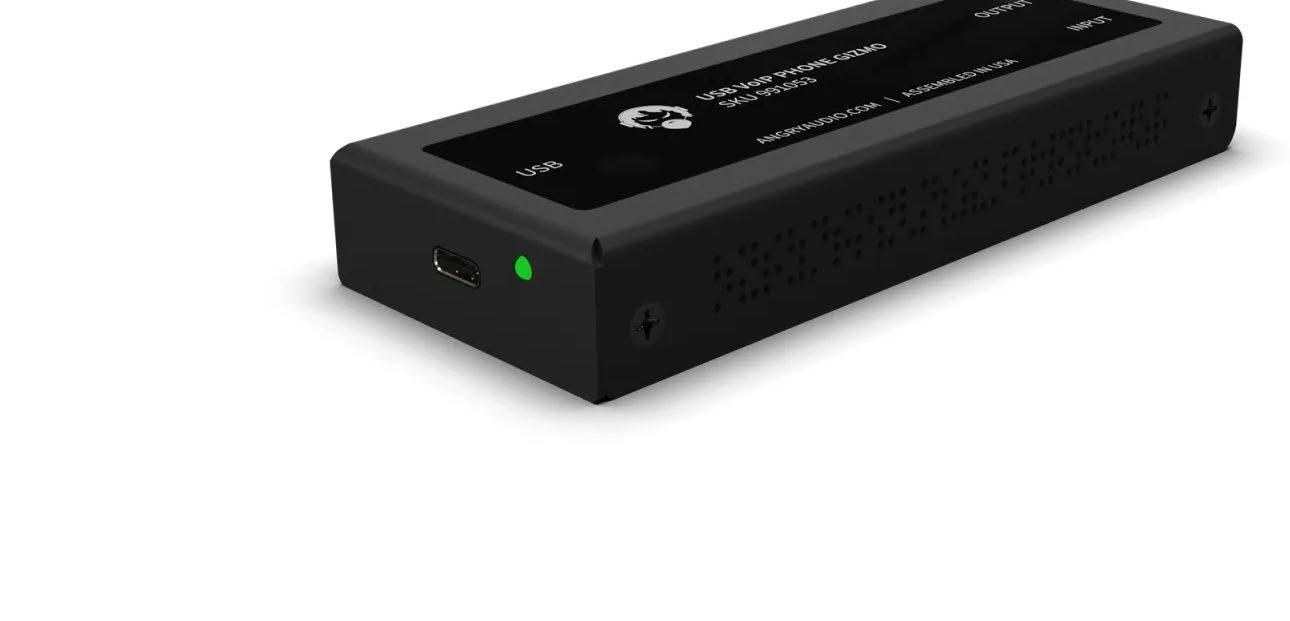
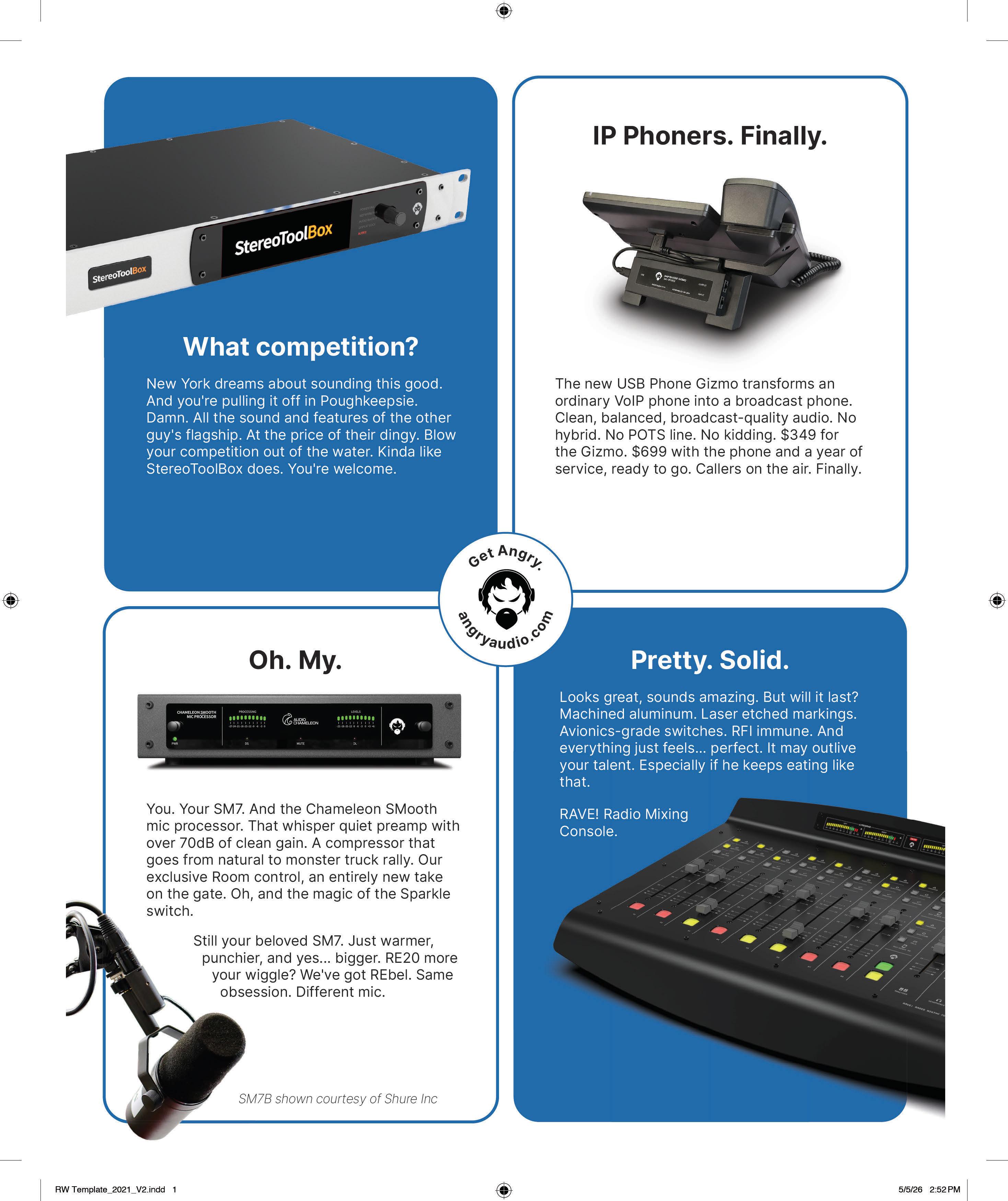
Angry Audio has introduced a device that lets you take calls on the air without a phone hybrid. It’s called simply The Phone Gizmo.
“It connects a Yealink SIP desk phone directly to your console using clean balanced analog audio. No apps. No drivers. You just plug it in and it works,” the company says.
“As POTS service fades out, the old way of putting phone calls on the air is disappearing with it. The choices have been emulated POTS to keep phone hybrids alive or replacing the whole phone system.”
This device offers another choice, Angry says.
It mounts to the back of the phone with a snap-in stand that props the phone up. The Phone Gizmo is galvanically isolated for power, ground and data, so audio stays clean, according to the company.
“Since the phone is handling the VoIP side, even wideband and HD voice calls are supported.” In a SIP to SIP arrangement, the audio is 50 Hz to 7 kHz. Otherwise it delivers regular phone audio.
Audio connects at nominal +4 dBu using balanced analog lines on StudioHub R-J45 connectors. The Gizmo comes with StudioHub to XLR adapter cables.
Retail price is $349 to pair with a Yealink SIP T46U and VoIP service. The company also offers a bundle for $699 that includes the Gizmo, Yealink phone, a phone number and a year of service through Maxxphone
Info: https://angryaudio.com/products/phonegizmo
Writer
Eivind Engberg Technical Consultant, Norsk Localradioforbund
A European radio model may be useful
There is a clearer recognition that radio must actively defend its position
I’d like to offer a short response to recent commentaries by John Caracciolo and Jerry Del Colliano. I’m writing from a European local radio perspective, following two weeks of travel in the United States and observations of how radio is positioned in today’s in-car and digital audio environment.
As a technical consultant for Norwegian local radio stations, my work involves helping stations adapt to changes in technology, listening habits and distribution. That is why I read the commentaries with great interest. Both identify important parts of the challenge facing American radio. Financial pressure, debt and ownership strategy clearly matter. But after two weeks of travel in the United States, and based both on conversations and my own observations, I am not convinced that balance-sheet pressure alone explains the broader position the industry now finds itself in.
some U.S. rental cars was that radio did not always feel like the natural first choice. Over time, that matters and affects business.
The increasingly difficult position of AM radio is part of the same picture. Even if Congress supports AM’s continued presence in vehicles, that alone is unlikely to resolve the deeper issue.
The real challenge is fragmentation, combined with the growing influence of technology platforms over listening habits and dashboard access.
This is where a European perspective may be useful. In Europe, broadcasters, regulators and technology partners have at least tried to respond more collectively. There has been greater emphasis on hybrid radio, metadata, dashboard prominence, platform access and cooperation through initiatives such as Radioplayer.
Below
The author says American radio may benefit from stronger cooperation and more collaborative models.
From my perspective, American radio is also facing a structural challenge in a fragmented audio market. Mainstream music radio no longer competes only with other radio stations. It competes with streaming services, podcasts, social media platforms and a growing range of digital options in the car that might replace radio. In that environment, relevance alone is not enough. Radio also must be easy to find, easy to access and clearly prominent in the listener experience. What struck me in
Europe has not solved everything, but there is a clearer recognition that radio must actively defend its position in the connected car rather than assume it will remain secure on its own.
What stands out to me is not that U.S. radio is under pressure. That is understandable. What stands out is that the response still appears relatively fragmented at a time when broader cooperation may be increasingly necessary.
So, while debt and strategy are clearly part of the story, they are not the whole story. The current difficulties in American radio may also reflect a slower or less coordinated response to a more fundamental shift in the audio market. A stronger focus on digital advertising and AI may be part of the answer, but it is unlikely to be enough on its own.
From a European point of view, this may be a moment for American radio to think not only about financial restructuring, but also about stronger cooperation in the fight for visibility, prominence and ease of access in the car. That may also be a reason to look more closely at collaborative models such as Radioplayer.
Radio still has significant strengths. But in a market shaped by fragmentation and platform competition, those strengths may need to be defended more actively and more collectively than before.
The author assists local radio stations with technological solutions and technical challenges. The Norwegian Local Radio Association, or Norsk Localradioforbund, is a member-based organization for local radio stations in Norway. To learn more about it, visit www.lokalradio.no and click on the English button in the top menu.
Disband the FCC
Mark Jamison’s suggestion to disband the FCC (March 1 issue) was a breath of fresh air.
His argument is persuasive, but he seems to have left unsaid what essential functions any successor agency should inherit.
Biggest example: Wouldn’t there still have to be an airwaves policeman to ensure non-interference among licensees? We don’t need a return to the wild west to know what chaos would result from retiring that cop.
The biggest problem, of course, is that any changes to the current system will require legislation; and the very politicization that Jamison decries has also neutered Congress. The needed changes cannot be accomplished by executive action alone.
I suppose one can always hope.
How to submit Radio World welcomes comment on all relevant topics. Email radioworld@ futurenet.com with “Letter to the Editor” in the subject field.
John Covell Augusta, Maine
The author was executive producer for KALW(FM) in San Francisco, and is now retired.
Fix it, don’t can it
I stand four-square opposed to Dr. Jamison’s thesis in “Is It Time to Disband the FCC” (March 1 issue).
That venerable institution is already wracked with the debilitating disease of deregulation, with its negative effects on the public that owns the spectrum.
In contradistinction to other media, the RF spectrum is a limited, precious resource.
The most egregious abandonment of technical responsibility occurred with the reduction in field engineering offices and personnel. We technical practitioners witness commonplace cynicism with regard to the rules, which are seen as mere suggestions to be ignored when convenient, in AM and FM broadcasting as well as land mobile and marine frequencies. Fewer cops means more criminals.
In earlier times, operating a station involved the notion of public interest, convenience and necessity. Now many stations thumb their noses at their COLs, then wonder why their audience fled to more friendly media.
Sharp limits on multiple ownership ensured a variety of content and political viewpoints on the radio. Loosing those
restrictions resulted in conglomerates airing homogenized voice-tracked plastic pap, devoid of “live and local.”
Dr. Jamison’s most egregious recommendation is to fragment the numerous functional entities of the FCC and distribute them among other federal agencies. He fails to realize the need for unit cohesion. Having those functions under one umbrella provides opportunities for crosspollination of ideas contributing to problem resolution, facilitated by physical proximity within the facility.
Let’s focus on the core missions of fair licensure; prosecuting rules violators; streamlining online reporting; and maintaining language and image censorship rules.
Also I recommend reintroducing PICN as fundamental to retaining licensure; reintroducing the Local Studio Rule; retaining ownership limits; hiring more engineers and fewer lawyers; and focusing more on RF OTA than wired media.
A strong FCC is needed more today than at any time in history.
James B. Potter Owner Cutting Edge Engineering of Missouri
Apply common sense
In my countless interactions with them, FCC engineers have been professional and knowledgeable. Many felt like friends and colleagues, not enforcers.
I had virtually no interaction with the Washington bureaucrats. That was just fine with me!
Of course the landscape has changed. However I think the commission made serious errors by doing away with field engineers and field offices.
I know engineers who still work there, and I hear stories about bureaucratic hand tying, not being allowed to do their jobs and be engineers.
In any bureaucracy, the enforcers should know more about what they are enforcing than those they are enforcing against. In many cases that is no longer the case, which is a comment not about the personnel but the bureaucracy. This is not unique to the FCC. The same has happened across a kaleidoscope of federal regulatory agencies.
I agree that many of the founding principles from 1934 have changed, but I believe there is still a role for the commission and the technically competent people who work there. There will always be a necessity for bureaucrats and lawyers, but let’s keep them in Washington.
Some common sense and engineering logic should govern future moves.
Mark Allen Principal Member of the Technical Staff M. Allen & Associates, Broadcast Radio Engineers Dallas, Texas