Christmas and steel
0 Wilson Winters Talks About His 30 Years As a "Lifer'

Grady E. Poulard
Nancy E. Sartin
William L. Gray
Columnists:
Art Sears, Jr
Eddie L Madison, Jr
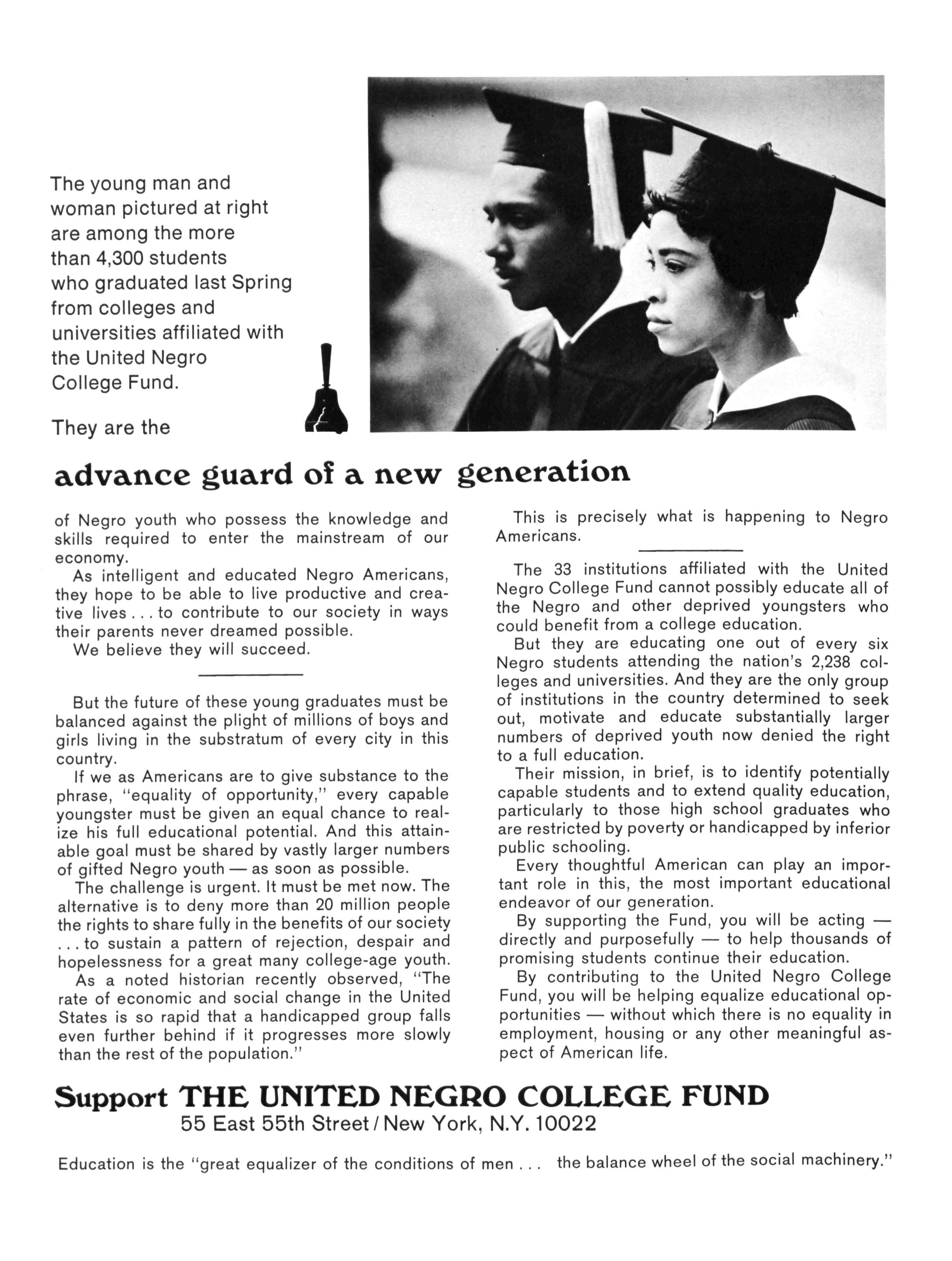
The young man and woman pictured at right are among the more than 4,300 students who graduated last Spring from colleges and universities affiliated with the United Negro College Fund.
They are the
advance guard of a new generation
of Negro youth who possess the knowledge and skills required to enter the mainstream of our economy
As intelligent and educated Negro Americans, they hope to be able to live productive and creative lives to contribute to our society in ways their parents never dreamed possible
We believe they will succeed
But the future of these young graduates must be balanced against the plight of millions of boys and girls living in the substratum of every city in this country.
If we as Americans are to give substance to the phrase, "equality of opportunity," every capable youngster must be given an equal chance to realize his full educational potential And this attainable goal must be shared by vastly larger numbers of gifted Negro youth — as soon as possible.
The challenge is urgent It must be met now The alternative is to deny more than 20 million people the rights to share fully in the benefits of our society to sustain a pattern of rejection, despair and hopelessness for a great many college-age youth
As a noted historian recently observed, "The rate of economic and social change in the United States is so rapid that a handicapped group falls even further behind if it progresses more slowly than the rest of the population."
This is precisely what is happening to Negro Americans.
The 33 institutions affiliated with the United Negro College Fund cannot possibly educate all of the Negro and other deprived youngsters who could benefit from a college education
But they are educating one out of every six Negro students attending the nation's 2,238 colleges and universities And they are the only group of institutions in the country determined to seek out, motivate and educate substantially larger numbers of deprived youth now denied the right to a full education
Their mission, in brief, is to identify potentially capable students and to extend quality education, particularly to those high school graduates who are restricted by poverty or handicapped by inferior public schooling
Every thoughtful American can play an important role in this, the most important educational endeavor of our generation.
By supporting the Fund, you will be acting — directly and purposefully — to help thousands of promising students continue their education.
By contributing to the United Negro College Fund, you will be helping equalize educational opportunities — without which there is no equality in employment, housing or any other meaningful aspect of American life
Support THE UNITED NEGRO COLLEGE FUND
Education is the "great equalizer of the conditions of men the balance wheel of the social machinery."
The Sphinx
Editor-in-Chief George M Daniels
Editorial Assistant Ernest B Boynton Jr
Contributing Editors
Malvin R Goode, Martin L Harvey, L W Jeffries, Eddie L Madison, Frank L Stanley, Sr., Art Sears, Jr., L H Stanton, Charles Wesley, Randolph White, 0 Wilson Winters, Laurence T Young
Editorial Advisory Committee
Frank Ellis, Malvin R Goode, Marshall Harris, John H Johnson, Moss H Kendrix, J Herbert King, Belford V Lawson, Samuel A Madden, J E Martin, Lionel H Newsom, Gus T Ridgel, Floyd Shepherd, L H Stanton, Felix Warren, Laurence T Young
Staff Photographer Henry Crawford
The Sphinx is the official magazine of the Alpha Phi Alpha Fraternity, Inc., 4432 South Parkway, Chicago, III., with editorial offices at 282 Convent Ave., New York, N Y Published four times a year: February, May, October and December Address all editorial mail to P.O Box 285, Lincolnton Station, New York, N Y 10037
Change of Address: Send both addresses to Alpha Phi Alpha Fraternity, 4432 South Parkway, Chicago, III Manuscripts or art submitted to The Sphinx should be accompanied by addressed envelopes and return postage Editor assumes no responsibi'ity for return of unsolicited manuscripts of art
Subscription: $2.00 per year
Opinions expressed in columns and articles do not necessarily reflect the views and policies of Alpha Phi Alpha Fraternity, Inc., and use of any person's name in fiction, semi-fiction articles or humorous features is to be regarded as a coincidence and not as the responsibility of The Sphinx It is never done knowingly Copyright 1965 by The Sphinx, Alpha Phi Alpha Fraternity, Inc Reproduction or use, without written permission, of the editorial or pictorial content in any manner is prohibited
The Sphinx has been published continuously since 1914 Organizing Editor: Bro Raymond W Cannon Organizing General President: Bro Henry Lake Dickason
Second class postage paid at New York, N Y
Postmaster: Send form 3579 and all correspondence to P.O Box 285, Lincolnton Station, New York, N Y 10037
ALPHA PHI ALPHA FRATERNITY, INC.
P.O Box 285
Lincolnton Station
New York, N Y 10037
Henry A Callis
Phi Alpha Fraternity, Inc Directory for 1966-1967
Officers
General President — Bro Lionel H Newsom 3286 E St., N.E , Washington D C
General Secretary — Bro Laurence T Young 4432 South Parkway, Chicago, III
Genera Treasurer- Bro LevenC Weiss 4676 West Outer Drive, Detroit, Michigan
General Counsel — Bro Morris M Hatchett
Editor, The Sphinx — Bro George M Daniels 470 Lenox Ave., New York, N Y
Eastern — Bro Frank J Ellis
Midwestern — Bro Gus T Ridgel
Southwestern — Bro Earnest L Wallace
Southern — Bro Luke H Chatman
Western — Bro C P Johnson
Vice Presidents
1929 W Lanvale St., Baltimore, Md Kentucky State College, Frankfort Ky 2018 Van Cleve, Dallas, Texas P.O Box 1311, Greenville, S C
Assistant Vice Presidents
Eastern — Bro Conrad Cathcart M ld ^ es i!* n Br2- Edw m pat J on ,, - i" 8 4 Parkside, Cleveland, Ohio
Southwestern — Bro James E Glover
Western — Bro Harold Taylor
Southern — Bro Clifford Webb
Historian — Bro Charles H Wesley
Dir Ed Activities — Bro Thomas D Pawley, III
Chr Alpha Phi Alpha Building Foundation, Inc.Bro William M Alexander
1824 Taylor Street, N.W., Washington, D.C Lincoln University, Jefferson City, Mo 4272 Washington St., St Louis, Mo
REGIONAL DIRECTORS
Eastern Region
Massachusetts —Bro James Howard 105 Greenwood St., Boston, Mass
Rhode Island —Bro Ralph Allen 179 Doyle Ave., Providence R I Connecticut — Bro W Decker Clark 66 Dry Hill Road Norwalk Conn New York, Northern New Jersey Bro Albert Holland 31 Hickory Hill Rd., Tappan, N Y
Pennsylvania, Delaware, Southern N J —Bro Frank Devine 6202 Washington Ave., Phila., Pa
Maryland-Washington — Bro Thomas Hunt 911 Spa Rd., Annapolis, Md
Virginia — Bro Talmadge Tabb 324 Greenbriar Ave., Hampton, Va Midwestern Region
Indiana — Bro Montague Oliver Il l E 19th, Gary Indiana
Northeast Ohio — Bro Charles Nunn 10926 Pasadena Ave., Cleveland, Ohio
Central Ohio — Bro Oliver Sumlin 2724 Hoover Ave., Dayton, Ohio
Northwest Ohio — Bro Robert Stubblefield 1340 W Woodruff, Toledo Ohio
Southern Illinois — Bro Harold Thomas 1731 Gaty Ave., East St Louis, Illinois
West Missouri and Kansas — Bro Edwin Byrd 2533 W Paseo Dr., Kansas City Mo
Wisconsin — Bro Hoyt Harper 5344 N 64th Milwaukee, Wisconsin
Southeast Ohio — Bro Paul Turner 2335 Gardendale Dr., Columbus 19, Ohio
Western Michigan — Bro William Boards, Jr 680 W Van Buren St. Battle Creek, Mich
Northern Illinois — Bro J Herbert King 4728 Drexel Blvd., Chicago, Illinois
East Missouri — Bro Clifton Bailey 3338A Aubert Ave., St Louis 15, Mo Iowa — Bro Ernest Russell 3927 Amherst St. Des Moines, Iowa
Southwest Ohio — Bro Holloway Sells 699 N Crescent Ave., Cincinnati, Ohio
Kentucky — Bro Herbert Olivera Kentucky State College, Frankfort, Kentucky
West Central Missouri — Bro Jimmy Buford 3548 Park Avenue, Kansas City, Mo
Central Missouri — Bro Thomas D Pawley, Jr 1010 Lafayette, Jefferson City Mo'
Regional Secretary—Bro Cramon Myers 404 West 44th Street, Indianapolis, Indiana
Oklahoma — Bro Vernon L Foshee
Southwestern Region
725 Terrace Blvd., Muskogee, Oklahoma
Louisiana — Bro Elliot J Keyes 7462 Benjamin St., New Orleans, Louisiana
Arkansas — Bro T E Patterson 1624 W 21st St., Little Rock, Arkansas
Texas Bro Reby Cary 1804 Bunche Dr., Ft Worth, Texas
Southern Region
Alabama — Bro Kirkwood Balton
Georgia — Bro Henry Collier
Florida — Bro Herbert Starke
Mississippi — Bro T J Ranee
1303 Main St., Birmingham, Ala
1527 Mills B Lane Ave. Savannah, Ga
724 N.W 27th St., Fort Lauderdale, Fla
407 Washington St. Brookhaven, Miss
North Carolina — Bro G H Vaughn 1708 Shady Ave., Winston-Salem, N C
South Carolina — Bro Luke Chatman P.O Box 1311, Greeneville S C
Tennessee — Bro George W James 1527 E 3rd St., Chattanooga, Tenn
Bro Odell Lewis
Bro William Corbin
Western Region
330-22nd Avenue, East, Seattle, Washington
2401 W Cherry Lynn Road Phoenix, Arizona
Bro Carlton Dias 949 Broderick St., San Francisco, California
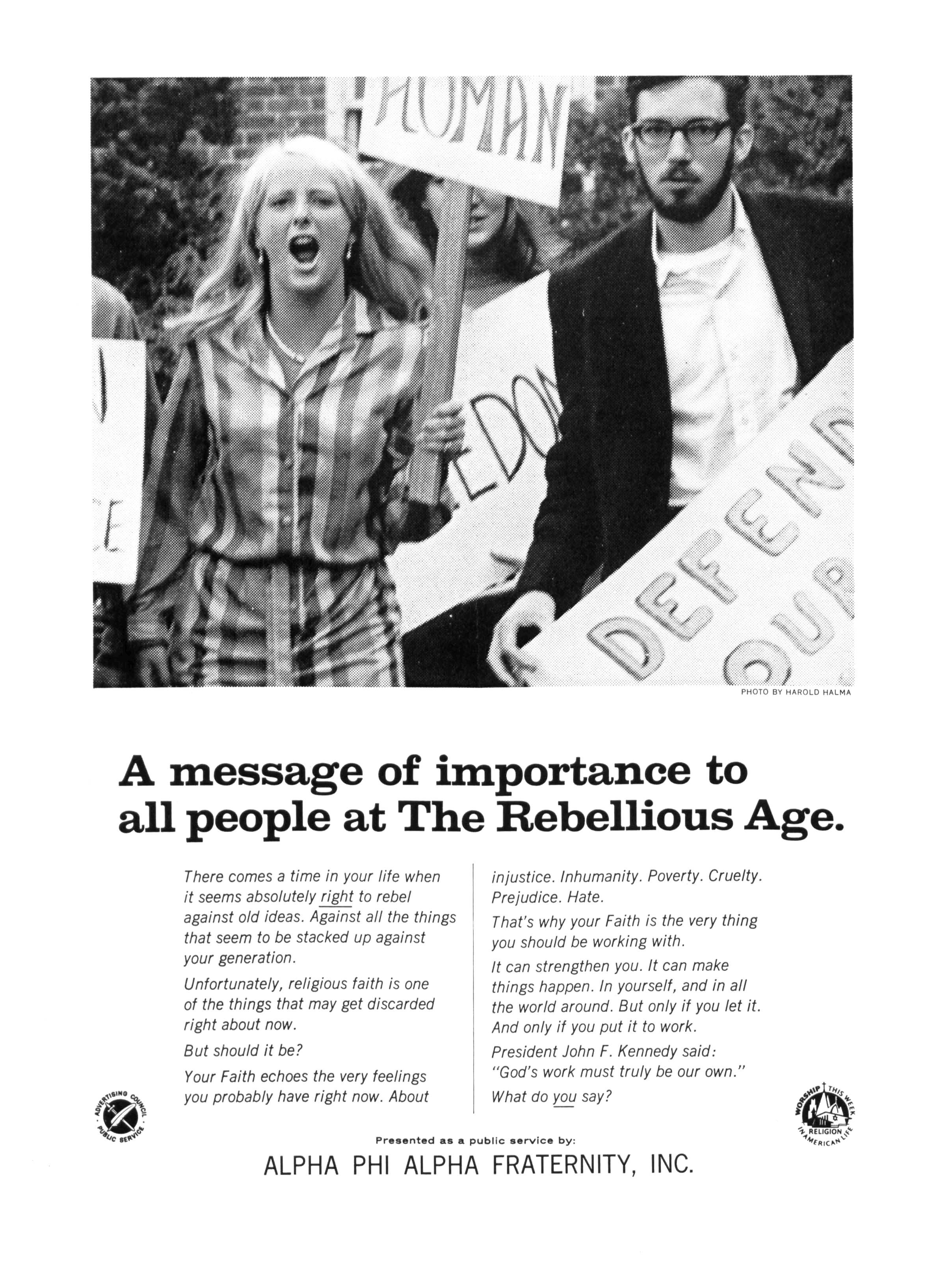
A message of importance to all people at The Rebellious Age.
There comes a time in your life when it seems absolutely right to rebel against old ideas. Against all the things that seem to be stacked up against your generation.
Unfortunately, religious faith is one of the things that may get discarded right about now.
But should it be?
Your Faith echoes the very feelings you probably have right now. About
injustice. Inhumanity. Poverty. Cruelty. Prejudice. Hate.
That's why your Faith is the very thing you should be working with.
It can strengthen you. It can make things happen. In yourself, and in all the world around. But only if you let it. And only if you put it to work.
President John F. Kennedy said: "God's work must truly be our own."
What do you say?
PHOTO BY HAROLD HALMA
TOP OF THE MONTH
Life Membership Campaign
This month ends the 30th year since Brother O Wilson Winters became Alpha's first life member by cashing in a ten-year endowment policy made out to Alpha The Sphinx honors Brother Winters, as well, for he has written Frat Fun and Frat Humor for thirty-five years.
New Columnists and Departments
Art Sears, Jr. and Eddie Madison, Jr. appear in The Sphinx for the first time. Both are professional journalists who have joined our growing list of contributing editors. Both will write on subjects-at-random and pen special features about Alpha and national and world issues
A Very Special Word
Among the hundreds of newspapers and magazines that I read in the course of a single month is the Menard Time, long regarded as America's foremost prison newspaper, published by the inmates of Menard State Prison, Menard, 111. Nearly a year ago this month, it carried a column by William L Gray, who was then the associate editor. It soimpressed me that Idecided then and there to write Mr. Gray and request an expanded version of the column (See page 13) Christmas and Steel for the Sprinx.
Gray is 33and he isserving 20to40on aCook County charge of armed robbery. He will appear before the parole board in 1974 But what Gray has done is past; it is the future that he now dreams about and prepares for
Gray is the first Negro employed full time on Time's staff. In August, when the editor was paroled to begin work on a Centralia newspaper, Gray moved up to editor. He had taught in the prison's high school for three years and has been active in prison activities since he entered Menard in 1963 He has completed 20 collegelevel courses through Southern Illinois University's extension department with a 4.25 grade average (equivalent to an "A" minus) He has participated in three Great Books discussion programs sponsored by the University, and in 1965 became the first full-time transcriber to tape record textbooks for blind students at SIU Brother Andrew Venable is a member of Beta Gamma and in House of Alpha he unloads a few pointed barbs as Alpha. Brother Grady Poulard, a member of Mu Lambda, well-known to many Alphas, presently serves as director for community relations in the Office of Civil Rights Office of Economic Opportunity, Washington, D C
THE EDITOR
ALPHA PHI ALPHA FRATERNITY, INC - the first Negro college fraternity - was founded December 4, 1906, at Cornell University, Ithaca, New York
Beginning with its seven founders more than 30,000 men have been initiated into Alpha Phi Alpha Interracial since 1945, there are now 131 undergraduate chapters on college campuses and 199 graduate chapters in 38 states, the District of Columbia, West Indies, Europe and Africa
Its members have served and continue to serve with distinction in widely diverse areas and furnish responsible leadership in hundreds of communities In the emerging economic advance, in their business enterprises, in the professions, in government and in civic life it is Alphadom that comprises the heart of the Negro market
A close knit organization bound together with common loyalty in the struggle for human dignity; with common causes for cultural enrichment; and with historic accomplishments in educational advance - Alpha Phi Alpha stands dedicated to the principles on which this nation was founded, Alphamen, everywhere, constructively help in achieving America's promise ««._«.« » >,
"Since Alpha Phi Alpha was founded at Cornell University in 1906, it has espoused many good causes and achieved many victories of benefit to the country, but its most important service has been in the development of the scholars and creative leaders who will assist our country in meeting the challenges of the 1960S."
JOHN F KENNEDY
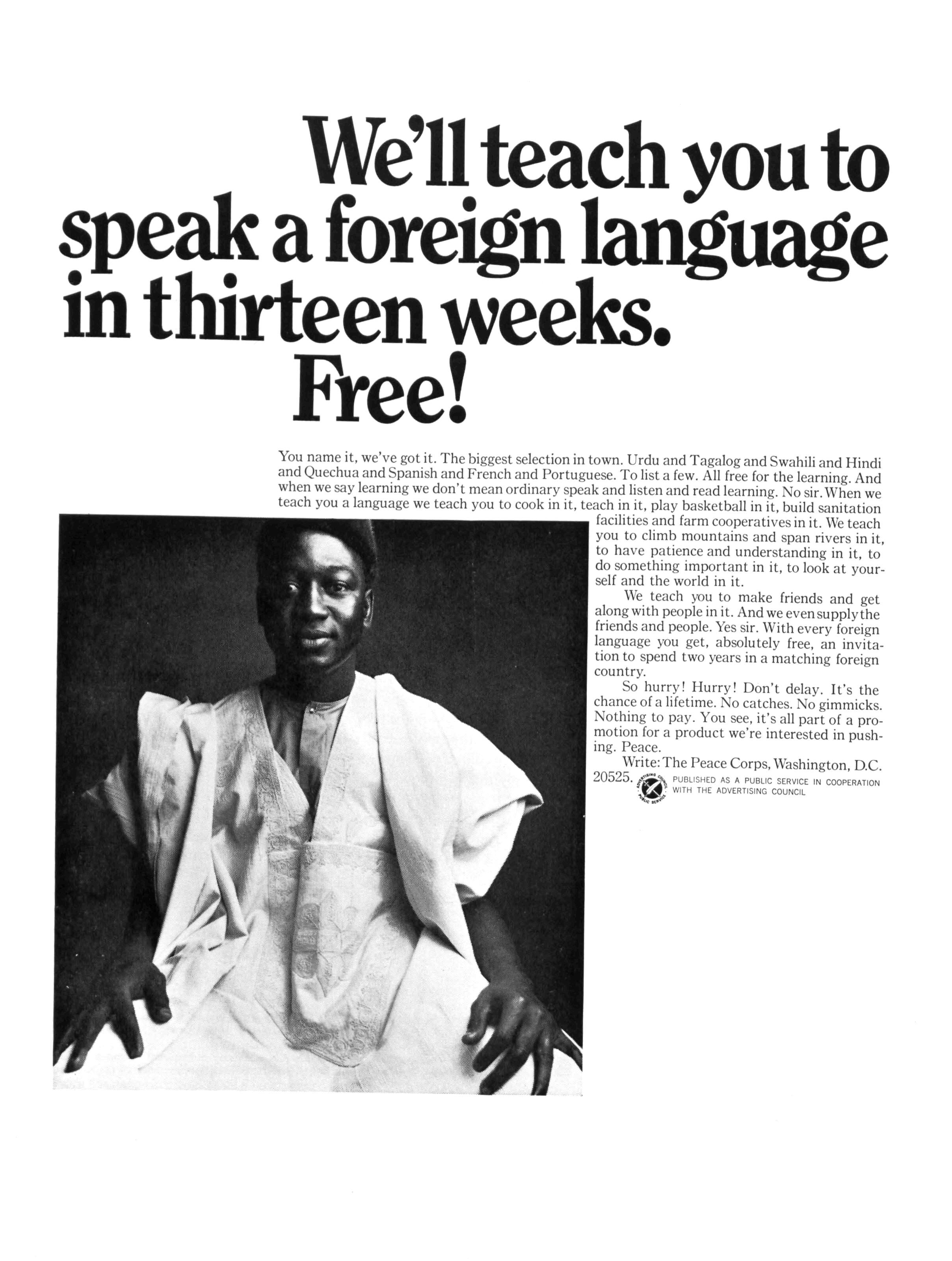
Wellteachyouto speakaforeignlanguage inthirteenweeks.
Free!
Younameit,we'vegotit.Thebiggestselectionintown.UrduandTagalogandSwahiliand Hindi andQuechuaandSpanishandFrenchand Portuguese Tolistafew Allfree forthelearning And whenwesaylearningwedon't meanordinaryspeakandlistenandreadlearning Nosir Whenwe teachyou alanguageweteach you tocookinit,teachinit,playbasketball init,build sanitation facilitiesand farmcooperativesinit Weteach you to climb mountains and span rivers init, to have patienceand understanding in it, to dosomething important in it,tolookat yourself and theworld in it
We teach you to make friends and get alongwithpeopleinit Andweevensupplythe friendsandpeople.Yessir.Withevery foreign language you get, absolutely free, an invitationto spend twoyearsinamatching foreign country
So hurry! Hurry! Don't delay It's the chanceofalifetime Nocatches Nogimmicks Nothing to pay You see,it'sallpartof apromotion fora product we'reinterested inpushing. Peace.
Write:ThePeaceCorps,Washington,D.C.
ART SEARS, JR
HISTORY WONT GIVEANSWER FOR RACE PROBLEM
Solutions offered to solve America's agonizing problem of the disadvantaged range from a notion of assimilation through intermarriage to cries of back to Africa!
Ranked in between are tritely traditional assertions, such as: the way of salvation lies in quality education; in pulling oneself up by one's bootstraps; in exercising the vote; in massive federal funding; in creation of a separate state; in thepowerstructure givingthedisadvantaged athousand and one things. Take your pick.
Negro leaders detail again and again importance of their favorite facet among those listed above The black nationalist leadership, which appears to want something totally different from anybody else, is actually seeking a full share of the good life; even though many of its methods for reaching the goal may seem peculiar
On the other side, white leaders have a similar variety of solutions; and they also have coteries of detractors seeking to stalemate change of the status quo.
Round and round discussions of solutions goes; where it stops, everybody knows; it's been re-played so often In the meantime, nothing's changing very much, or very fast.
Only this past summer the flames of hate and fury engulfed over 100 cities A part of the reason was attributed to the widesperad hopelessness and despair of the disadvantaged
The plethora of piecemeal efforts to aid the poor and deprived, and the increased intensity of the riots, drive home one inescapable point. That programs progressing downward (in size) form those spawned by the pockmarked (from potshots) Office of Economic Opportunity and its money millions, to those advanced by the five-dollar budgeted storefront efforts of block clubs, have neither the muscle nor the solution
Whatever changes the pyramiding parade of programs, projects and protests have wrought have, ostensibly, only added to the lengthening list of tokenism
As art, tokenology may be fine It has not, however, enabled the overwhelming masses of deprived Negroes and other minority groups to move into the mainstream What it has done is given a few more Negroes (count them) on the fringe of middle class achievement a boost in their careers
If the problem we face is ever going to be solved, however, then this country, including its diversity of types, groups and sects are going to have to re-think — together some widely held notions. Consider these.
There is no parallel in history to the Negro experience That also includes efforts to pro-rate the travails of the African brother (who suffered and suffers from the effects of colonialsim) with the Negro problem Recorded history contains no previous experience (despite all those who defend to the death the worth and relevance of historical experience) like the Negroes'
It istrue, however, that some experiences of other ethnic groups are applicable in helping to resolve the Negro problem But the only parallels most often used by the establishment are those which pre-supposes that the black man iswhite; or can be white
The established welfare system, the sociologic and psychologic methodology used, at best, are only helpful in extremely limited fashion because the basic principles of thesefields werecreatedfor benefit of European immigrants
So long as this nation continues to tackle the race problem through established precepts, concepts and methods, that long will it take him to become a viable, vibrant part of the mainstream Prejudice, bias and the emphasis upon negative aspects of difference in this society, vividly suggest that the Negro will never achieve, in any traditional way, the rights he is due, the opportunities which should be his, or the integration he seeks
The time is past for halfway measures or the practice of tokenology, if the Negro is to gain his inalienable rights before another 400 pears passes Negro youths refuse to wait So do the overwhelming majority of older Negroes
Couldn't hear anybody praying,thispast summer, because the searing heat of burning buildings, the stench of dead bodies, and the smashed windows of dreams too long deferred blotted out everything else
Will we be any better tuned to meet the problem next year? Who can say The chances seem slim, indeed For there's too much talk about yesterday about history But the answer is not there The answer lies in the hearts and minds of living men And they're always too early for history
Thesmal__l arms sniaii ctix J.IA» sweepstakes
ONE OFTHE LEAST publicizedrecent statements byPresident Johnson was hisestimateofthenational defense budget for 1968, awhopping $73billion Now that figures have appeared fortheearly months of1967, itisclear that this year's total maywell reach that projected for next year, and that five orsix billion may have tobeadded totheestimate for1968
SUMS SO VAST become meaningless. This year's increase of $10billion was enough by itself todisbalance the national economy. What theDefense Department spends each year toprotect the United States would produce themeans toblow up theworld several times over Agreat deal of it goes for non-nuclear armaments. Howefficient arethese so-called small arms asadefense? More important, how efficiently does control of nuclear arms insure peace fortheworld which small arms trade remains uncontrolled?
The United States spends $12on defense forevery $20spent ongroceries, $20 forevery $10 spent onpublic education, $1400 forthe average family of four each year Onetenth ofourentire gross national product goes fordefense Yet there isless debate in Congress on the gigantic defense budget than onprograms proposed inhousing, education, economic opportunity and overseas aid,allof which lumped together areinsignificant by comparison
In 1968, more money may bespenton defense bythe United Statesthan in1945, when 50percent ofthenational budget went forarms. The present budget is not attributable chiefly toAmerican involvement inVietnam Wehave developedin the past two decades, ontheprincipleof deterrence, a large permanent military establishment, aconscripted army, and a national posture of belligerance, all of
which arealientoAmerican democracy. However, deterrence has not purchased peace inthe lasttwenty years Neither nuclear weapons, notlarge standing armies, nor thedevelopment ofmore and more sophisticated armaments hasprevented a constant recurrence of hostilities.The chief effect of continued Americanadvances inordnance isthe increased lethal capability which any nation can purchase; and the consequent higher cost inlives and money ofany small border clash between belligerent states
Into the Middle East tinderbox the United States, Russia, France, andEngland poured nearly $4billion inmilitary equipment duringyearsofmounting ArabIsraeli tension More than half ofitisnow strewn useless across theSinai Peninsula and among the hillsofSyria and Jordan Nuclear arms donotpresent an immediate threat topeace But, astheU.S Arms Control andDisarmament Agency points out inits1966 annual report, "The increasing international trade inconventional armaments canresult in the initiation oracceleration ofregional arms races." ACDA canurge controls, but has nopowertoregulatetheexchangeofarms
An easy commodity tocome by,arms are purchasable onmore favorable credit terms than some other merchandise Unlike staple foods, forinstance, whichare to bepaid indollars ata going interest rate ofsixpercent, arms canbebought from a friendly bigpower onlocal currency,often atfour percent interest
Such terms encourage insecure nations to over-reach their means inorder topurchase a security that become unreal as neighboring states dothesame
When India andPakistan fought over Kashmir,and inthe Arab-Israeliwar,both sides used American weapons, someof which arenotyetpaid for India finds it
By NANCY E. SARTIN
more and more difficult toimport food for her drought stricken regions Assistance to rebuild themutilated Arab landsand economieslagsfar behind the replacement of arms
When arms are notavailable byofficial government agreement, theycanbe gotten privately orthrough third nation arrangements Neither theU.S norRussia puts any ceiling orstipulation onarms sales, though many controls are exerted over other international trade
How much does theworld spendon arms, onbattle tickets? Themost recent tallies, those for1964, show atotalfor theworld of$132.6billionby conservative calculation Countries ofNATO and the Warsaw Pact accounted for85per cent of this, with Russia and theUnited States far inthelead Forallthese nationswar ishypothetical. The world's affluence, stability, andfull dinner pails arecontained in this group
War becomes a real danger to nations whose security isthreatened byscarcity and who donotfitunder the protective mantle ofagreat power. These, the Third World, are not just underdeveloped areas They arethevictims andbattle grounds They pay for thebattle ticketsinthe small arms sweepstakes That other fifteen per cent ofeach year's arms ispaid for in hunger, ignorance, andshortened life expectancy by70percent oftheworld's people.
Jordan, forinstance, spent $59 million on defense in1964, 14.4 percent of her gross national product. Seven outof ten Jordanians cannot read A Jordanian farmer isold atforty from years ofgrueling hand cultivation ofcrops that provide scanty subsistence What hespendson arms outof hisyearly income would not take youandyour family outfor an evening, butitwould beenough for him
to buy a goat for milk, or schooling for one of his children.
Occasionally an under-developed nation comes to resent the constant drain of resources into defense purchase and decides to develop its own weapons
Egypt decided in 1962 to design and build its own missiles. Importing foreign technical advice, a program was undertaken, engineers, equipment, testing facilities, and more advice, a hundred million dollars or so was sunk in the scheme in itsfirst hopeful phase Atangleof technical problems, mechanical failures, and mishapsdrew more and more heavily on government funds Four years and hundreds of millions of dollars and man hours later, Egypt abandoned theproject uncompleted andboughtentire missilesitesfrom Russia. And they were taken by Israel in the recent war.
The Egyptian economy is farther behind than ever. Yearly expenditures of half a billion dollars help keep Egypt in abject poverty and chronic debt.
The tally for other developing nations is similarly discouraging Where cash of any kind is scarce, a down payment on defense installations istheinvestment least likely to bring beneficial results, but the one most likely tobe urged on easy terms
Any Number Can Run
Russia spends 13 percent of its gross national product on defense each year in order to remain a poor second inthe arms race But Russia is wealthy compared to some other members of the world community, brave in rags with glittering bayonets, prowling in want outside our economic barriers In the Middle East the nest of belligerents began rearming the week hostilitiesceased.Those not supplied by the West can get help from Russia or China.
U.S policy has been to match military competition, to maintain a "balance of force" in such explosive situations In practice this means that if a government can persuade our representatives of a potential threat, American military aid can beobtained; and athreatwillexist whether it did before or not
In a recent trade, Iran and Algeria received assistance in arms from Russia; Turkey,Greece,and Moroccoreceived aid
from the U.S Our part of the round was reported as a "limited pledge," since "the United States is unwilling to appear to be contributing to an arms race." However, the $15 million in arms that went to Morocco is more in one single purchase than Morocco spends in an entire year on education and public health combined Eighty-six percent of Morocco's people cannot read About that percentage have never seen a doctor
Dependence on military power has harnessed foreign policy to a balance of forces orientation and ruled out other major considerations such as regional development, economic stabilization, or cooperative multi-national facilities for power, marketing, or education Two thirds of the world is chronically hungry; hut the only long range international programstoraise food production by improving local farming methods, financing agricultural cooperatives, and increasing water supilies are those of the UN, which are voluntary, those of the churches, and those of private philanthropies Congress debated three weeks before continuing to fund US AID on a greatly reduced scale some months ago Late last April, a military appropriations bill took all of fifteen minutes topass,long enough for the Congress to increase the amount $360 million over what had been requested. Congress in these acts merely reflected a primitive national outlook toward the rest of the world. In sophistication we have moved a step beyond Caesar who conquered to tax. We have learned to tax without conquering, to defend ourselveson the soilof other nations. The small arms race is not only profitable to major American industries, but foreign capital invested in arms is effectively removed from competition with us in world markets
H J Kuss, Jr., arms salesman for the U.S. Defense Department, was described in a N.Y Times article as assuming "implicitly that the central world arms race betwen the industrialized Western nations and the Soviet Union will continue indefinitely." Mr Kussandhisstaff, priming emerging nations with long term loans, encourage them toplan military purchases overafiveyear period "Thevery existence of afiveyear plan,"saysthe Times, "helps
persuade thecountry involved to purchase arms."
In Africa, of a total defense expenditure in 1964of half abillion dollars, South Africa spent $375 million Not only does such an expense have very little defensive justification, but it makes necessary the build-upof defense forces inother African nations, which will drain those slim economies of any loose capital for industrial growth Similarly Brazil has become militarily dominant in South America among neighbors hardly to be classed as belligerents, but who are scrambling to acquire jet fighters for air forces that can barely take off without violating their neighbors' airspace.
Across the way in Southeast Asia, official response to a complete change in the Indonesian government has been extremely cautious Offers of assistance in shoring up the crippled economy of the country, even an extension of credit or re-establishment of channels of communication, are slow in coming The first visible move in that area since the overthrow of Sukarno was both private and indirect In March of this year the sale of 23,000 of the new M16 rifle to Singapore was announced by Colt, the manufacturer. If Indonesia requests arms to counteract this move by a neighbor, will this plea receive the attention that months of economic pleading failed to get?
The effect of all such actions is to perpetuate an arms oriented diplomacy in an era when war itself has become impractical Emile Benoit, a Columbia University Economics Professor, points out in the newly issued book, Disarmament and World Economic Interdependence, that the magnitude of nuclear weapons capability has made military force obsolete, as gunpowder "destroyed the viability of feudalism It is surprising," Dr Benoit remarks, "that in the light of these developments, so many people can expect a political system based on war as the means of settling disputes to go on much as before."
"In effect," he continues, "what has occurred is a mass exchange of hostages, leaving the population of the world's major cities subject to sudden slaughter by hostile governments."
The present situation, however, is not
quite Prof Benoit's envisioned stalemate Rather, with each sale of new and improved conventional weapons,planes, and other equipment, the small arms race in which everyonecan run takes astep closer to the big arms race which anyone loses who enters. It isnotjust great cities which are subject toholocaust They are,in fact, safer than tiny hamlets of Vietnamese rice farmers and the ancient villages of the Holy Land which may become infernos at any moment in what we still call conventional war Pageants and Windmills
In the thirty-one daysof May this year, the United States spent more than $7 billion on armaments That sum for one month's arms is equal to an entire year's national income for Indonesia, a nation of more than ahundred million people "The greatest military power the
Aircraft, and General Dynamics, each of which received more than $1 billion last year in government contracts, all have foreign subsidiaries and extensive foreign interests General Motors, DuPont, and IT&T have friendly public images in spite of their share in military manufacture.
In Germany, Krupp, munitions maker for two world wars, is in financial difficulty Czechoslovakia, amajor arms maker and Germany's traditional enemy,bids for Krupp shares. Arms is a large and very profitable enterprise; and profit can overcome even old animosities
The situation that encourages arms production continues to exist More subtle public relations has simply created a respectable image for purveyors of weapons Also, modern warfare involves a much broader portion of manufacturers in the military effort than was once the case
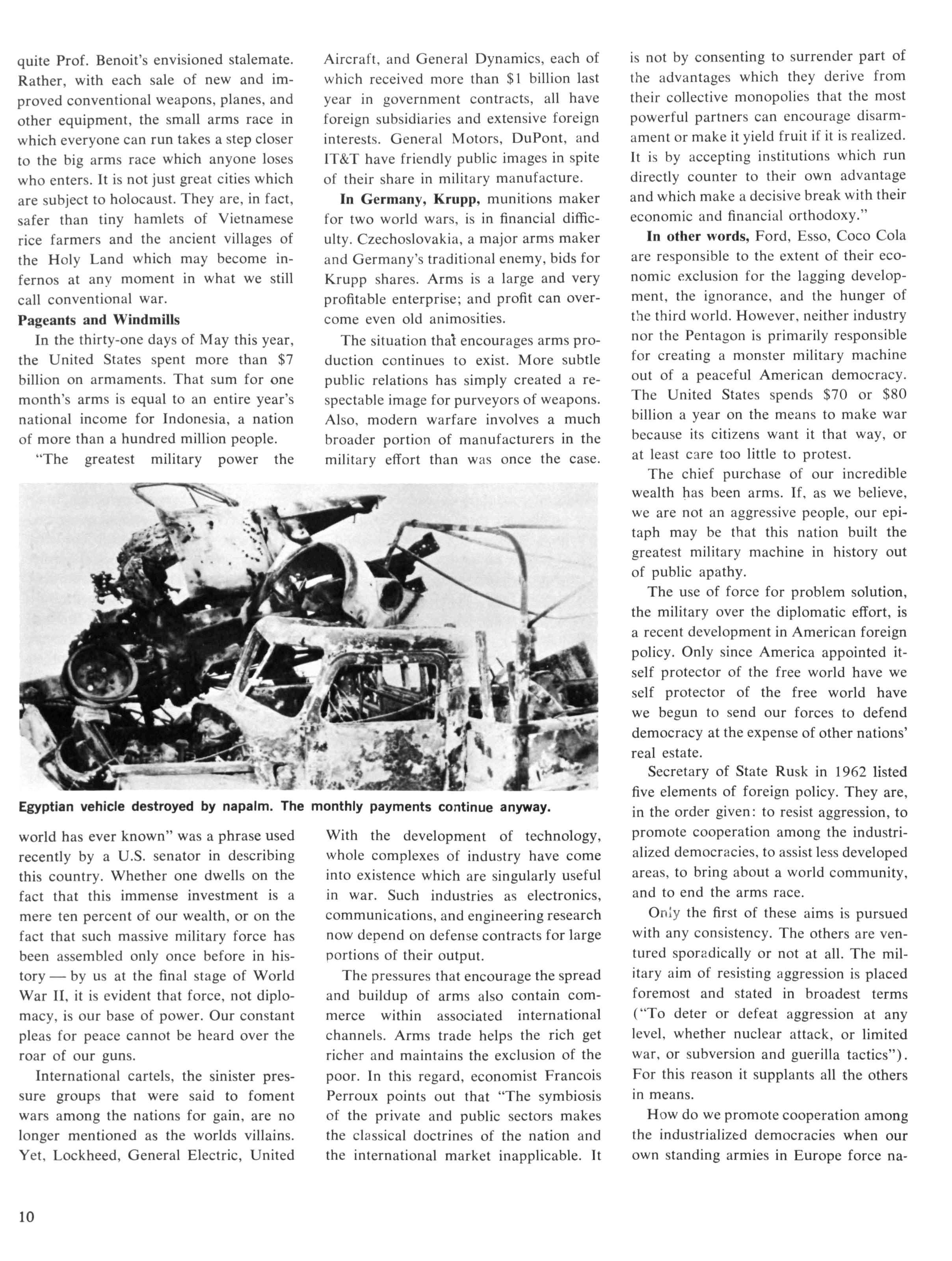
Egyptian vehicle destroyed by napalm. The world has ever known" was aphrase used recently by a U.S senator in describing this country Whether one dwells on the fact that this immense investment is a mere ten percent of our wealth, or on the fact that such massive military force has been assembled only once before in history— by us at the final stage of World War II, it isevident that force, not diplomacy, is our base of power Our constant pleas for peace cannot be heard over the roar of our guns.
International cartels, the sinister pressure groups that were said to foment wars among the nations for gain, are no longer mentioned as the worlds villains. Yet, Lockheed, General Electric, United
With the development of technology, whole complexes of industry have come into existence which are singularly useful in war Such industries as electronics, communications, andengineering research nowdepend ondefense contracts for large portions of their output
The pressures thatencourage the spread and buildup of arms also contain commerce within associated international channels Arms trade helps the rich get richer and maintains the exclusion of the poor In this regard, economist Francois Perroux points out that "The symbiosis of the private and public sectors makes the classical doctrines of the nation and the international market inapplicable It
is not by consenting to surrender part of the advantages which they derive from their collective monopolies that the most powerful partners can encourage disarmament ormake ityield fruit ifitisrealized It is by accepting institutions which run directly counter to their own advantage and whichmake adecisivebreakwith their economic and financial orthodoxy."
In other words, Ford, Esso, Coco Cola are responsible to the extent of their economic exclusion for the lagging development, the ignorance, and the hunger of the third world However, neither industry nor the Pentagon is primarily responsible for creating a monster military machine out of a peaceful American democracy
The United States spends $70 or $80 billion a year on the means to make war because its citizens want it that way, or at least care too little to protest
The chief purchase of our incredible wealth has been arms. If, as we believe, we are not an aggressive people, our epitaph may be that this nation built the greatest military machine in history out of public apathy
The use of force for problem solution, the military over the diplomatic effort, is a recent development inAmerican foreign policy. Only since America appointed itself protector of the free world have we self protector of the free world have we begun to send our forces to defend democracy attheexpenseofother nations' real estate
Secretary of State Rusk in 1962 listed five elements of foreign policy They are, in the order given: to resist aggression, to promote cooperation among the industrialized democracies,toassistlessdeveloped areas, to bring about a world community, and to end the arms race
Only the first of these aims is pursued with any consistency The others are ventured sporadically or not at all. The military aim of resisting aggression is placed foremost and stated in broadest terms ("To deter or defeat aggression at any level, whether nuclear attack, or limited war, or subversion and guerilla tactics") For this reason it supplants all the others in means
How dowepromotecooperation among the industrialized democracies when our own standing armies in Europe force na-
monthly payments continue anyway
tions there to match our forces by NATO agreement, and to raise their own military quotas?
How can we assist less developed areas when thechief helpweoffer isthe military buildup which promotes internal and external strife and retards the processes by which such areas can progress?
How can weend thearms racewhen we not only provide arms and advice to the militia of seventy countries, but habitually bypass any international peacekeeping jurisdiction such as the various treaty organizations or the UN?
Thomas L Hughes, Director of Intelligence and Research for the Department ofState,pointsout in an articlein Foreign Affairs that in sifting the extremely complex and often conflicting patterns of fact which confront him, "The policy maker's understandable preference for fact? pointing toward minimal choices versus facts thrusting toward major changes in policy • . . affects the fate of facts in the realm of foreign policy."
His opinion is echoed elsewhere in the same periodical by Secretary of the Air Force Harold Brown who reminds us of "numerous broad areas where uncertainty complicateschoicesabout the composition and magnitude of our forces What, for example, are the prospects in fifteen or twenty years for widespread nuclear proliferation, for shifts in alliances, for a largely disarmed world? Our planning is projected forward at least ten and sometimes fifteen years. Yet in fact we know very little about how many or what kind of missiles the Russians will have ten years from now, because they probably havenotreached adecisionthemselves Policy makers will find, almost invariably, that it is easier to produce military hardware than it is to know what policy to follow."
Since the foreign policy decisions of therest of theworld are largelya response to developments in the U.S., Secretary Brown's analysis indicates that military possibilities, technological improvement rather than any basic change, govern the foreseeable future. In this frame of reference there is no possibility at all for general disarmament Technology is not likely to respond to hypothetical weapons
development ten years hence with a plowshare, or even a tractor. Caution dictates weapons against the unknown, and against weapons, the unknown can have only one response— more weapons
Abetting the natural cautiousness in foreign affairs of American politicians, and a suspiciousness that sometimes approaches paranoia, are the skillfully applied pressures of the military establishment and the business community, or at least that segment of it that profits from arms production No one is actually in favor of the arms race; but all assist its forward motion.
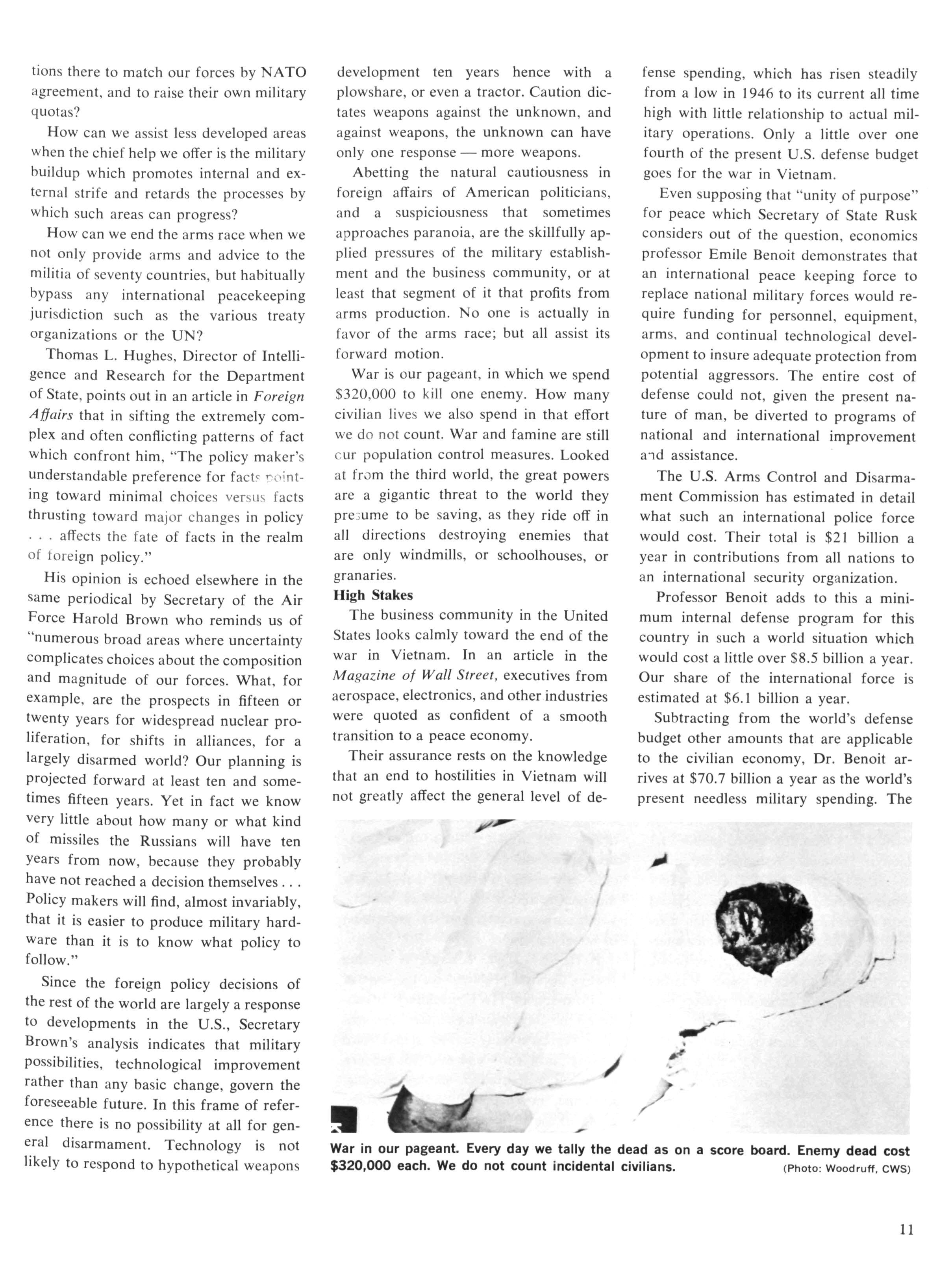
War is our pageant, in which we spend $320,000 to kill one enemy How many civilian lives we also spend in that effort wedo not count War and famine are still cur population control measures Looked at from the third world, the great powers are a gigantic threat to the world they presume to be saving, as they ride off in all directions destroying enemies that are only windmills, or schoolhouses, or granaries
High Stakes
The business community in the United States looks calmly toward the end of the war in Vietnam In an article in the Magazine of Wall Street, executives from aerospace,electronics,and other industries were quoted as confident of a smooth transition to a peace economy
Their assurance rests on the knowledge that an end to hostilities in Vietnam will not greatly affect the general level of de-
fense spending, which has risen steadily from a low in 1946 to its current all time high with little relationship to actual military operations. Only a little over one fourth of the present U.S defense budget goes for the war in Vietnam
Even supposing that "unity of purpose" for peace which Secretary of State Rusk considers out of the question, economics professor Emile Benoit demonstrates that an international peace keeping force to replace national military forces would require funding for personnel, equipment, arms, and continual technological development toinsureadequateprotection from potential aggressors The entire cost of defense could not, given the present nature of man, be diverted to programs of national and international improvement and assistance
The U.S. Arms Control and Disarmament Commission has estimated in detail what such an international police force would cost Their total is $21 billion a year in contributions from all nations to an international security organization
Professor Benoit adds to this a minimum internal defense program for this country in such a world situation which would cost alittleover $8.5 billion a year Our share of the international force is estimated at $6.1 billion a year
Subtracting from the world's defense budget other amounts that are applicable to the civilian economy, Dr Benoit arrives at $70.7 billion a year asthe world's present needless military spending The
United Statesalone spends ondefense well over $40 billion a year that we need not spend. This sum could be used to better purpose even while maintaining a national militia and an adequate international police force toquell incipient wars
It is the patent necessity for such an orderly world that forward looking members of the business community rely on to change the present anarchy so that regional and global economic cooperation and expansion can proceed Business men are, in fact, staking out investment claims toward just such a future
In the field of East-West cooperation, a whole series of manufacturing ventures has been undertaken involving capital, technology, equipment, and labor from both sides of the iron curtain Chairs of Swedish design are built in Poland and shipped back to Sweden for finishing and marketing An Austrian firm and the Hungarian government power authority have entered anagreement tobuild powerplants in India with Hungarian-Indian financing. Examples could bemultiplied. There have even been casualties of the new freedom, such as the manager of an Eastern European industrial plant who was dismissed when an American purchaser wrote for spare parts to some machinery His superiorshad notbeeninformed that equipment wasbeing sold that far west
Another sign of business sanguinity about thefuture istheremarkable increase in foreign subsidiaries of manufacturing firms. In 1965, the production of foreign subsidiaries to American companies was around $80 billion. Compared to this $4.3 billion in American economic aid overseas seems small indeed. The subsidiary method of foreign expansion has replaced export asthe largest entry to foreign markets Itinvolvesmuch more complex international tiesinsites,equipment, personnel, marketing, and service of goods Venture of capital to such an extent presupposes an increasingly open and orderly world market Controlof armstradeand reduced international tension could only improve the security of such an interdependent enterprise
However, economists are in general agreement that some structural reorganization will be necessary for broader eco-
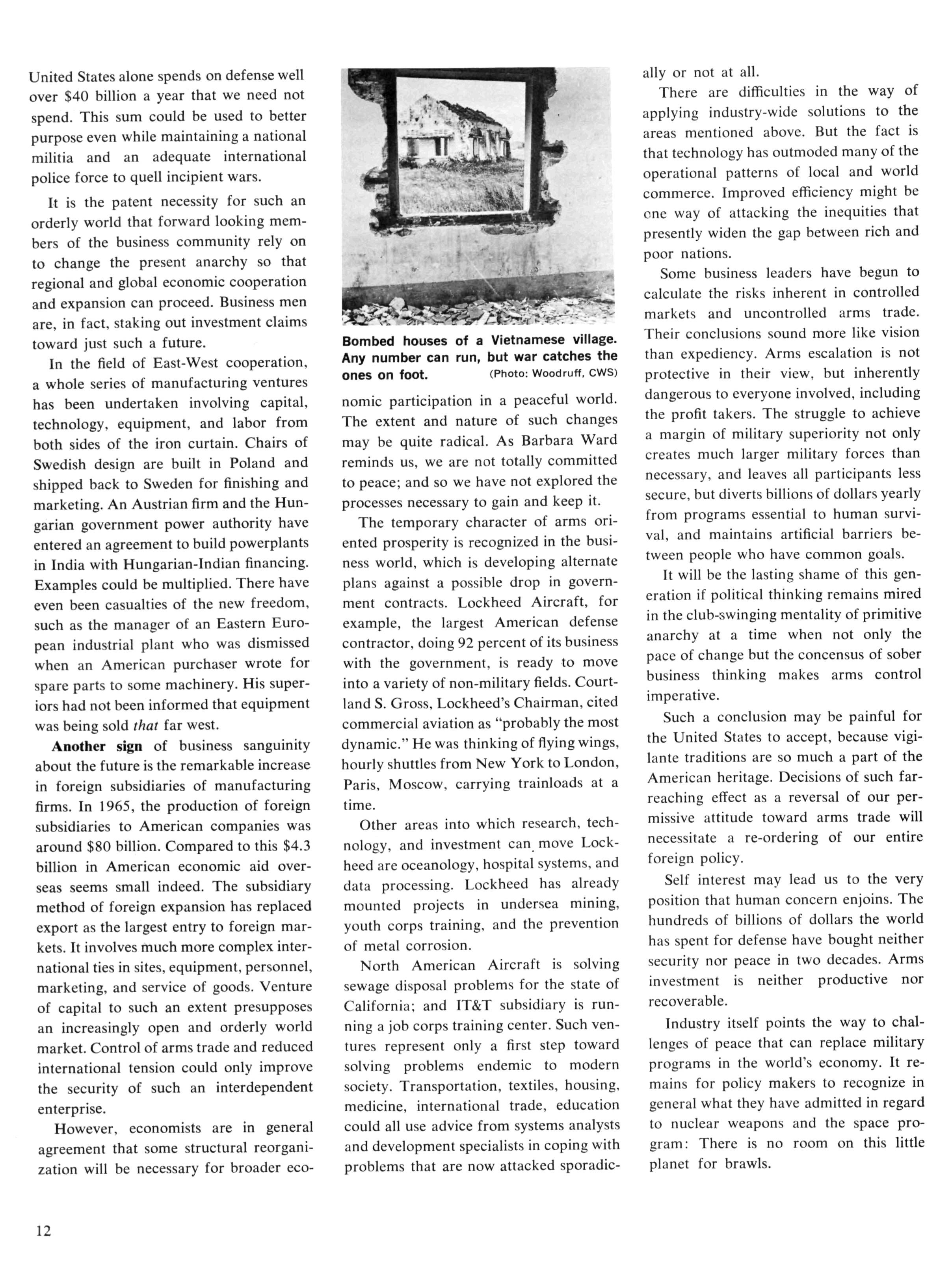
Bombed houses of a Vietnamese village
Any number can run, but war catches the ones On foot (Photo: Woodruff, CWS) nomic participation in a peaceful world
The extent and nature of such changes may be quite radical As Barbara Ward reminds us, we are not totally committed to peace; and so wehave not explored the processes necessary to gain and keep it.
The temporary character of arms oriented prosperity isrecognized in the business world, which is developing alternate plans against a possible drop in government contracts Lockheed Aircraft, for example, the largest American defense contractor, doing92percent of itsbusiness with the government, is ready to move into avariety of non-military fields. CourtlandS.Gross,Lockheed's Chairman, cited commercial aviation as"probably themost dynamic."Hewas thinkingof flyingwings, hourlyshuttles from New YorktoLondon, Paris, Moscow, carrying trainloads at a time
Other areas into which research, technology, and investment can move Lockheed areoceanology, hospitalsystems,and data processing Lockheed has already mounted projects in undersea mining, youth corps training, and the prevention of metal corrosion
North American Aircraft is solving sewage disposal problems for the state of California; and IT&T subsidiary is running ajobcorps training center Such ventures represent only a first step toward solving problems endemic to modern society Transportation, textiles, housing, medicine, international trade, education could all use advice from systems analysts and development specialists incoping with problems that are now attacked sporadic-
ally or not at all
There are difficulties in the way of applying industry-wide solutions to the areas mentioned above. But the fact is that technology hasoutmoded manyof the operational patterns of local and world commerce. Improved efficiency might be one way of attacking the inequities that presently widen the gap between rich and poor nations
Some business leaders have begun to calculate the risks inherent in controlled markets and uncontrolled arms trade Their conclusions sound more like vision than expediency Arms escalation is not protective in their view, but inherently dangerous toeveryone involved, including the profit takers The struggle to achieve a margin of military superiority not only creates much larger military forces than necessary, and leaves all participants less secure,butdivertsbillionsof dollars yearly from programs essential to human survival, and maintains artificial barriers between people who have common goals
It will be the lasting shame of this generation if political thinking remains mired intheclub-swinging mentality of primitive anarchy at a time when not only the pace of change but theconcensus of sober business thinking makes arms control imperative
Such a conclusion may be painful for the United States to accept, because vigilante traditions are so much a part of the American heritage. Decisions of such farreaching effect as a reversal of our permissive attitude toward arms trade will necessitate a re-ordering of our entire foreign policy
Self interest may lead us to the very position that human concern enjoins The hundreds of billions of dollars the world has spent for defense have bought neither security nor peace in two decades. Arms investment is neither productive nor recoverable.
Industry itself points the way to challenges of peace that can replace military programs in the world's economy. It remains for policy makers to recognize in general what they have admitted in regard to nuclear weapons and the space program: There is no room on this little planet for brawls
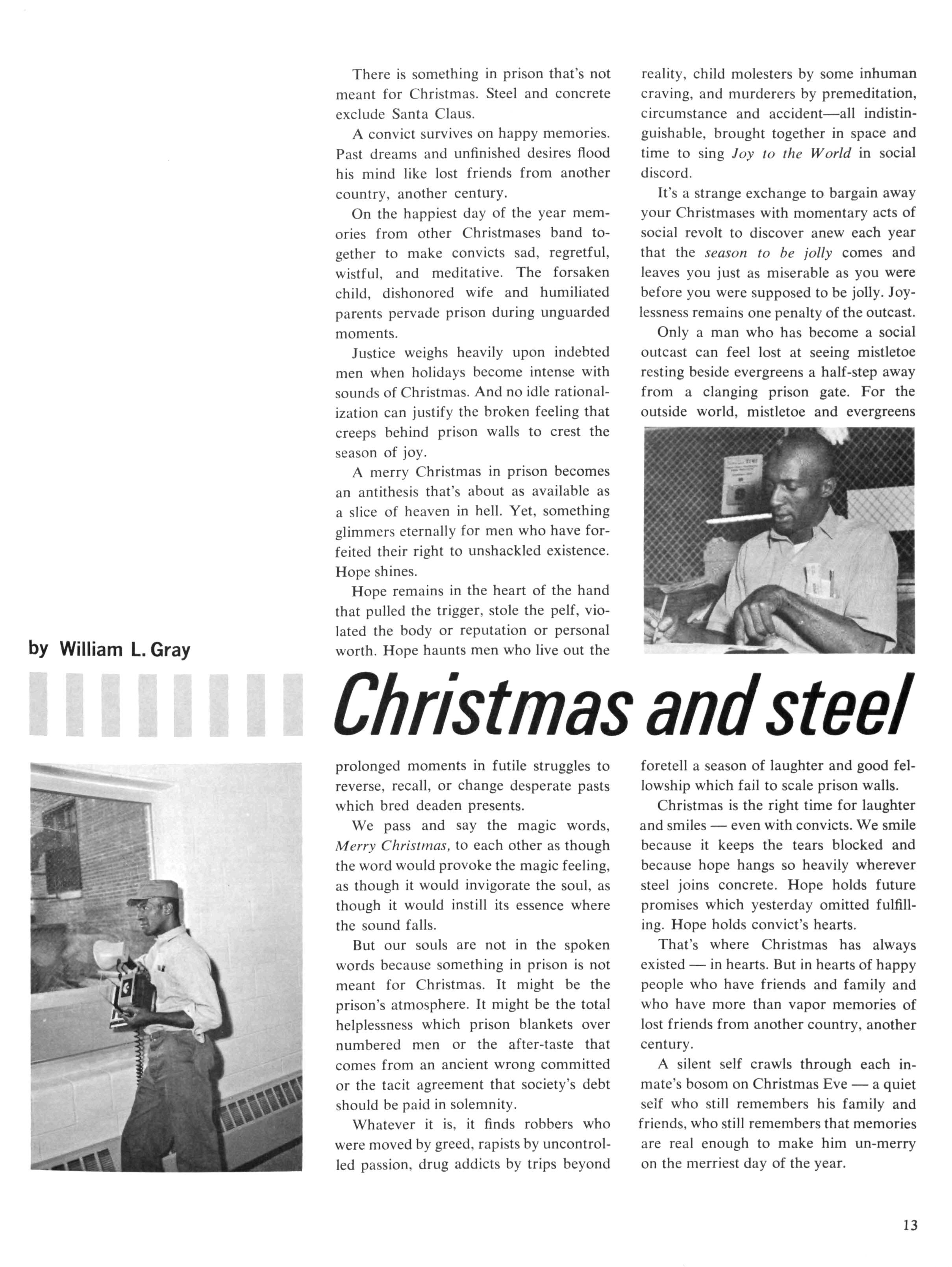
There is something in prison that's not meant for Christmas Steel and concrete exclude Santa Claus
A convict survives on happy memories. Past dreams and unfinished desires flood his mind like lost friends from another country, another century
On the happiest day of the year memories from other Christmases band together to make convicts sad, regretful, wistful, and meditative The forsaken child, dishonored wife and humiliated parents pervade prison during unguarded moments.
Justice weighs heavily upon indebted men when holidays become intense with soundsof Christmas And noidle rationalization can justify the broken feeling that creeps behind prison walls to crest the season of joy
A merry Christmas in prison becomes an antithesis that's about as available as a slice of heaven in hell Yet, something glimmers eternally for men who have forfeited their right to unshackled existence Hope shines.
Hope remains in the heart of the hand that pulled the trigger, stole the pelf, violated the body or reputation or personal worth. Hope haunts men who liveout the
reality, child molesters by some inhuman craving, and murderers by premeditation, circumstance and accident—all indistinguishable, brought together in space and time to sing Joy to the World in social discord
It's astrange exchange to bargain away your Christmases with momentary acts of social revolt to discover anew each year that the season to be jolly comes and leaves you just as miserable as you were before you were supposed tobe jolly Joylessnessremains onepenalty ofthe outcast
Only a man who has become a social outcast can feel lost at seeing mistletoe resting beside evergreens a half-step away from a clanging prison gate For the outside world, mistletoe and evergreens
Christmas andsteel
prolonged moments in futile struggles to reverse, recall, or change desperate pasts which bred deaden presents
We pass and say the magic words, Merry Christinas, to each other as though thewordwould provokethe magic feeling, as though it would invigorate the soul, as though it would instill its essence where the sound falls
But our souls are not in the spoken words because something in prison is not meant for Christmas It might be the prison's atmosphere It might be the total helplessness which prison blankets over numbered men or the after-taste that comes from an ancient wrong committed or the tacit agreement that society's debt should bepaid in solemnity
Whatever it is, it finds robbers who weremovedbygreed,rapistsby uncontrolled passion, drug addicts by trips beyond
foretell aseason of laughter and good fellowship which fail toscale prison walls Christmas isthe right time for laughter and smiles— evenwithconvicts We smile because it keeps the tears blocked and because hope hangs so heavily wherever steel joins concrete Hope holds future promises which yesterday omitted fulfilling Hope holds convict's hearts
That's where Christmas has always existed— inhearts Butinheartsof happy people who have friends and family and who have more than vapor memories of lostfriends from another country, another century
A silent self crawls through each inmate's bosom onChristmas Eve— aquiet self who still remembers his family and friends, whostill remembersthat memories are real enough to make him un-merry on the merriest day of the year.
The House of Alpha and the CHANGING
We pause in our varied activities to contemplate and prepare ourselves to live fully and courageously under the pressures of a deeply troubled world. We continue to foster "Love for all mankind" in a world where men still refuse to be thybrotherskeeper.Wecontinue toexhibit "Manly Deeds" in a society that now increasingly deplores any gestures that mightsymbolize orindicate traditionalism And, we stress "Scholarship" in a society that now bellows: "too much emphasis is being placed upon education."
Certainly, we are at the crossroads of our strivings! Will we live victoriously or die as an organization — without ammunition to combat this rapidly changing world, where our existence asa Fraternity is questioned by many! Certainly, this challenge causes us to ponder and take a careful re-evaluation of our objectives! Obsolescence can never be a byword of Alpha and we have repeatedly expressed our desires for creating new systems of service. Some of us, particularly undergraduates, shun not the principles upon which our great Fraternity stands, but we differ and come into conflict with the methods of implementing our aims! We must adjust ourselves to the changing timesand demands of this— amobile and vigorous society!— asociety that strongly questionseventhefoundations upon which we stand! For we face a populace that now increasingly challenges the objectives for the existence of fraternities."
Strongly adhering to cooperation, in-
itiative, manliness, scholarship, and secrecy as a Fraternity and individually as Brothers, Alpha can— in the midst of these changing times— be the light for all fraternities.
For us, the undergraduates — the infantry of the Fraternity — what adjustments must be considered to make Alpha Phi Alpha echo throughout the nation and universe?
Alpha must continue to strive for the best in life and seek the best men as brothers! We must demand scholarship collectively and individually— for Alpha does not, must not, and will not tolerate mediocrity
Our society demands quality! We must actively recruit new members and we cannot afford to let "the wheels of progress cease their turning." We must be steadfast in our purpose to strongly encourage others to strive for sholarship and to take full advantage of the numerous available job opportunities Our Pledging Programs must firmly instill the cardinal principles of our fraternity in complete harmony with these changing times We have a definite responsibility of taking a wanting soul, molding him into a better man, capable of acepting responsibility and meeting the challenges of this age I feel that there is a very definite need for us to return to the battlefields, to promote an incentive to study and achieve There remains a need for the re-emphasis of our old battle cry "Stay in High School—Go to College (with a new
twist)"!Let'sstimulate others,yes,to"Stay in High School," but to also "do something while there."
An industrialized and automated society demands standardization! Wemustseek to become, internally, administratively efficient! All talking and no follow-throughwith-action will never accomplish the job We must stop yapping and start communicating with each other and we must stop complaining and set-up and follow standards
Initiative tells me that "whenever in doubt — ask for guidance!" Collectively, we can make increasing demands of our National Headquarters for increased communication and direction Eventually, "something's got togive!"Standardization, as exemplified by the Roman Catholic Church, causes stability for generations to come! Being interracial since 1945, we must adheretostandardstoprovidea onenessasa Fraternity
We must be servants of all; we must show love for our fellowman This indicatesthat wemust roll upour shirtsleeves, put on the cloak of a layman and work for the betterment and good of the communities in which we live Alpha is and must always be concerned about the welfare of those around us.Having a genuine concern and interest in the welfare of our fellowman makes us stronger in the eyes of God. Alpha Outreach is an excellent opportunity for us to influence and guide the livesoftheseunderprivileged community boys We, as undergraduate brothers,
TIMES
By ANDREW VENABLE
scholars and firm in initiative, must tailor this national project to meet the needs of our campus locale!
Program diversification makes for a better and stronger Fraternity and causes us to advance in an age where retrogression can be too easily followed Our Chapter autonomy and uniqueness as individuals, is an asset that can be fully utilized, and its rewards will carry the name of Alpha Phi Alpha forward
All things can never be said We as individuals project the image of Alpha Phi Alpha Our aims as a Fraternity, our uniqueness collectively and as individuals, our discreteness in the transaction of our personal affairs, causes us to stand above the fog We undoubtedly do have a great mission:Wearepersonal ambassadors and wemust preach our gospel toevery corner of this nation. Because it isa living gospel that will resound into allcommunities and bring out not only the best in the community, but the best men of this era
We now live in an age where "homosexuality" is becoming widespread We must become more alert and very cautious toprevent this sexualism from permeating the House of Alpha!
We do not measure a man by the "width of hissmile, the cut of his clothes, of the amount of liquor he can consume." Rather, wemeasureaman byhisattitudes, purposes, and contributions he can make to society. In like manner, we measure a Fraternity In like manner, we must measure Alpha Phi Alpha!
Hull POWER AND THE UNIVERSITY
ByDR JAMES A NABRIT, JR
During the summer we witnessed an unceasing series of racial disturbances throughout the country. These disorders —call them by whatever name you will— resulted in large part from the historical treatment of Negroes inAmerica from the days the first African slaves were landed to the present time Slavery, by its very nature as an institution, divided people between the oppressors and those who were oppressed These distinctions have
usually tended to linger long after the institution itself has been abolished
More than one hundred years after the signing of the Emancipation Proclamation theNegropeople inAmerica, the descendentsof slaves,have not been ableto shake off completely the shackles of oppression Racialsegregation and discrimination continue to abound. They strike at Negroes in areas which are most critical in their lives, especially in matters related to em-
ployment, housing, and education As the white majority knows, neither the Negro minoritynoranyotherpeoplecan advance substantially unless genuine progress is made in these areas of life—not in just one area but in all three at once and at the same time Those who administer our programs of assistance overseas know this well
At the close of World War II, we instituted immediately a massive program of aid to the war-torn countries of western Europe Since that time, we have continued assistance invarious forms tocountries in Africa, Latin America, and Asia. Unfortunately, many of our country's leaders have not viewed the problems of these areas with urgency and interest as they did in the case of western Europe Our foreign aid program for the present fiscal year is substantially less than it has been in most recent years I make reference to this simply to suggest that there is something of a parallel with respect to theway inwhich many ofour countrymen viewthe plightof the developing countries and the situation of Negroes at home
There must be a deeper understanding among the American people that neither the employment of arms overseas nor the use of troops in the streets of American citiescan resolve issueswhich arenot military by nature Success obtained by force of arms can not bring answers to problems which are primarily social, economic, and political.
I cannot in honesty say that there is no understanding at all among the American people with regard to this essential fact. The very existence of programs of overseas assistance and of the various poverty programs at home indicates not only an awareness of the nature of these pressing matters but also demonstrates an effort, for which we must give credit, to bring about a satisfactory resolution of these problems But, generally speaking, all of these programs are inadequate to the accomplishment ofthetask These programs, both at home and abroad, have contributed to a revolution of rising expectations And theAmerican people have not shown the will to carry through to finalfruition theprogramswhichthey have only recently begun
I am sure that future scholars studying the history of our country will not fail to observe the military precociousness of the American people We are frequently engaged in military ventures, generally on thevictorious side. Insuch operations, our people show a spirit of tenaciousness and adetermination toendure thelossof blood and resources which inevitably accompanies a major war While these are, indeed, virtues in a hostile environment, I wish only to suggest that their application of non-military matters might more speedilybring about aremediation of the social, economic, and political ailments which afflict us
If we did not know it before, certainly experience should now teach us that a small doseof economic aid isnot sufficient treatment for a massive economic ailment This is as true for the starving millions abroad as it is for impoverished Negroes at home Nor will it suffice to improve the lives of a few. It is not enough, for example, to make it possible for a few Negroes toget abetter education, a better job, and a better home. These essential matters in life must be brought within the realm of possibility of the masses of the people
It is in the interest of all that an end be brought tothe perpetuation of the division of the world's people between the haves and have-nots and the oppressors and theoppressed Aworld inwhich every new-born child has a birthright which includes an equality of human dignity and an opportunity to share in the bounty which civilization affords must be the ultimate goal for all of us. Until the time that this objective is reached, we are condemned to a dismal future of struggle whose only end will be the destruction of all who remain
There is great diversity among us as to how we should approach the problems which hang heavily upon us at this hour With respect to the problems of race in America, there are those who, having grown tired of America's promises, and pessimistic about the prospects of genuine integration, now propose methods which would in effect enable the Negro people to go their own way Those who advocate this position include many who have
labored valiantly in the vineyard of civil rights and who have grown weary from what seems to be the futility of their efforts It is unfortunately true that they have not reaped the full harvest of their expectations The 1954 Supreme Court decisions banning segregation in public education are still resisted in many areas and there are more Negro children in segregated schools than ever before. Public accommodation laws make it possible to be admitted tohotels,restaurants, theatres and the like which were previously barred to Negroes, but this has little meaning to those who do not have the means of availing themselves of the opportunity Voter registration laws have been effective only after long,costly struggles fought through county by county and almost precinct by precinct
In the midst of affluence, the employment pattern of Negroes grows steadily worse Their prospects of decent housing and good education are equally grim. White people in the North who supported civil rights activists in the South become hostile as the civil rights movement reaches the edges of their own neighborhoods Poverty programs which once had at least token support become mired in the swampland of disapproval, neglect, and abandonment when it becomes clear that somany of thosewhowould behelped are Negroes and other racial minorities This is indeed a gloomy picture and has led to the disillusionment of many of the bright youngpeople intheNegro minority Itisnotunexpected that anew militancy has arisen among us, most especially among theyouth of today There isaspirit of revolt at work which will not be satisfieduntil aneworderhasbeen established The new militants will not accept token integration or government-sponsored programs which represent half-hearted approaches to the problems of our times. They are tired of studies into which the same data are poured and out of which come the same findings and the same recommendations It issometimessaid that the nature of the present is quite similar to the period of Reconstruction following the close of the Civil War when reaction set inand vigorouseffort wasmade toseparate Negroes completely from the mainstream of American life One of the prin-
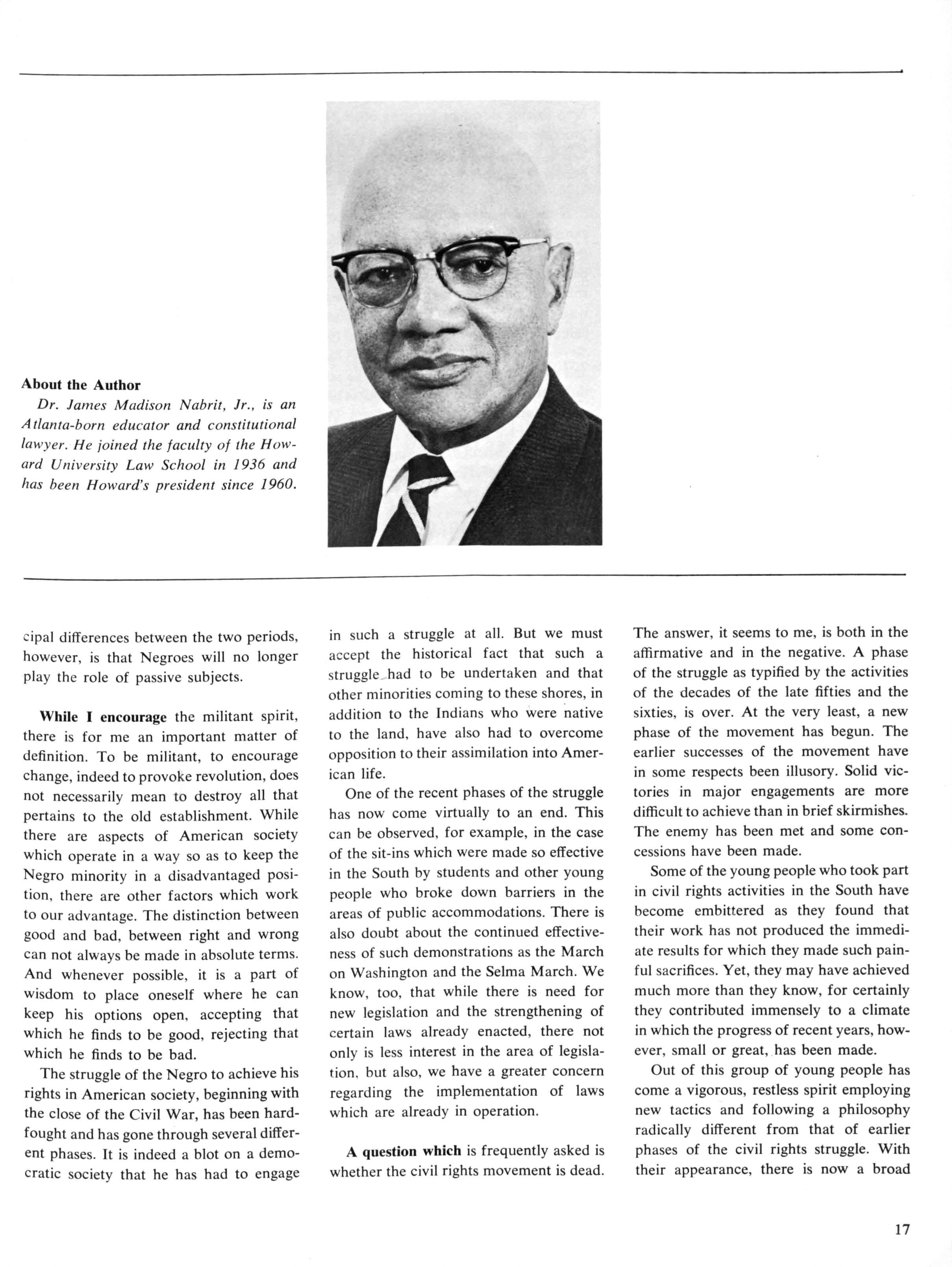
About the Author
Dr. James Madison Nabrit, Jr., is an Atlanta-born educator and constitutional lawyer. He joined the faculty of the Howard University Law School in 1936 and has been Howard's president since 1960.
cipal differences between the two periods, however, is that Negroes will no longer play the role of passive subjects
While I encourage the militant spirit, there is for me an important matter of definition. To be militant, to encourage change,indeedtoprovokerevolution, does not necessarily mean to destroy all that pertains to the old establishment While there are aspects of American society which operate in a way so as to keep the Negro minority in a disadvantaged position, there are other factors which work toour advantage The distinction between good and bad, between right and wrong can not alwaysbe made in absolute terms And whenever possible, it is a part of wisdom to place oneself where he can keep his options open, accepting that which he finds to be good, rejecting that which he finds to be bad.
The struggle of theNegrotoachievehis rights inAmerican society, beginning with the close of the Civil War, hasbeen hardfought andhasgonethrough several different phases It is indeed ablot on a democratic society that he has had to engage
in such a struggle at all But we must accept the historical fact that such a struggle had to be undertaken and that other minorities coming totheseshores,in addition to the Indians who were native to the land, have also had to overcome opposition totheir assimilation into American life
One of the recent phasesof the struggle has now come virtually to an end This can be observed, for example, in the case of the sit-inswhich were made so effective in the South by students and other young people who broke down barriers in the areas of public accommodations There is also doubt about the continued effectiveness of such demonstrations asthe March on Washington and the Selma March. We know, too, that while there is need for new legislation and the strengthening of certain laws already enacted, there not only is less interest in the area of legislation, but also, we have a greater concern regarding the implementation of laws which are already in operation
A question which isfrequently asked is whether the civil rightsmovement isdead
The answer, it seems to me, isboth in the affirmative and in the negative A phase of the struggle as typified by the activities of the decades of the late fifties and the sixties, is over At the very least, a new phase of the movement has begun The earlier successes of the movement have in some respects been illusory Solid victories in major engagements are more difficult toachievethan inbrief skirmishes The enemy has been met and some concessions have been made
Someoftheyoungpeoplewhotook part in civil rights activities in the South have become embittered as they found that their work has not produced the immediate resultsfor which they made such painful sacrifices. Yet,they may have achieved much more than they know, for certainly they contributed immensely to a climate inwhichthe progressof recentyears,however, small or great, has been made
Out of this group of young people has come avigorous, restless spirit employing new tactics and following a philosophy radically different from that of earlier phases of the civil rights struggle. With their appearance, there is now a broad
diversity among the organizations principally engaged in civil rights activities and there are deep differences of opinion regarding the future course of action This is not an altogether unanticipated or unhealthy turn of events The Negro people in America are not a monolithic group and likeother groupscontain within themselves a broad spectrum of philosophies and judgments.
I am glad to see the emphasis which is being placed upon the importance of Negroes discarding the feeling of inferiority which the psychology of oppression has imprinted upon so many of us Having pride and confidence inoneself isessential toself-delevelopment and advancement
It is necessary that we redouble our efforts to achieve our legitimate aspirations While we shall continue to have differences of views as to how we should proceed, letusseektoavoid bitterness and hatred both among ourselves and in our association with others Let us seek to avoid the excesses which have characterized some of those who have been among our oppressors. The cause of the Negro is justand hasastrong moral basiswhich we should endeavor to maintain untarnished
I call upon the university community to note one of the phenomena of our times Students and faculty insist rightfully upon all legal rights, freedom of speech, freedom of assembly, and due process; but as soon as they enjoy these rights, a few of them immediately seek to prevent others from enjoying these rights by every possiblemeans—including violence and other illegal actions Can the position that they take be accepted as permissible university policy?
Let us not be beguiled or misled; these persons do not seek the enjoyment of rights, they seek the excesses of brutal tacticsandthedestruction of the educative process. By their noise, their actions, and their trumpeting they receive attention beyond their deserts, they create anxieties beyond their ability to bring into realization the things feared and they seek to discredit and destroy allwhodonot blindly accept their gods This is not the climate of a university—in fact, these actions and threats directed against Negroes with whom some other Negroes do not agree
isof the essence not only of stupidity but of inevitableself-destruction Tospend our time tearing down or berating other Negroes or intimidating them is no gateway to the solution of the problems of the massesof Negroes
If the advocates of black power on our campuses really want tohelp thepeople in the ghetto, let them begin teaching the people in the ghetto how to make their shabby homes more inviting, how to cope with dirt and rats, how to market without being gouged with inflated prices and hidden interest charges, howto read and how and where to apply for ajob,how to pool their meager resources, their political possibilitiesand theircooperative efforts This is the positive step, not the negative one of posing, gesticulating, using profanity, downgrading everybody and everything I call upon the university to think upon these things But Icall upon the university itself todo something for thepeople inthe ghettoes in urban America We have been engaged in this on a broad scale but we have not scratched the surface. I also call upon students and faculty toengage inreal dialogue, not name-calling— in actually conferring, not inissuingultimata of either the far right or left Let us not think of theuniversity asperfect butas experimenting, testing, and probing for enlightment and guidance The young peoplewant discussion, not directives— and we should seek tobringthisabout Let us be straightforward with one another, let us hear all sides of the questions, let us sit down together and thrash them out in a constructive manner
Racism isbad no matter what its color
To show how trite and insincere its disciples are, every time certain of the advocates of Black Power are arrested, they generally use white lawyers Now I am not complaining about this. But how do they square this fact with their attacks on all whites as enemies? I am pointing out that it is absurd to think we do not need the aid and good-will of white Americans At the same time they say go out and kill all whites, they run to whites for protection How absurd can one get!
Ido not profess to be making an attack upon Black Power I am exercising my freedom of speech as a member of the
university community to point out that some of the things which effect our campuses, I think good and some I think bad Isay without reservation, that hatred and violence are the twin engines of destruction anywhere, but in a university community theyarecatastrophic and fatal The university cannot become partners with either racial hatred or violence But we can certainly discuss them freely. We do not need to be political or idealogical partners
At Howard I would like to see students and teachers work out courses which are of special interest to students We are prepared to receive and consider evaluations of courses and teachers by students if an acceptable framework canbeagreed upon We are prepared to modify rules affecting students and make such other changes at Howard asarewarranted IfIwere ayoung man in school today, I am sure I would be interested in the use of power, in the plight of the Negro masses, and I would in all probability be frustrated by the delays, rules and the practices of our generation This has occurred with a surprising consistency over the years. What we are now facing is the necessity of accommodatingourselves tothischanging scene At least let us meet and face the facts as men and women of intellect and good-will and who love Howard University. This is my hope and belief
There are many able young people at Howard who, I am sure, are destined for leadershiprolesinthiscontinuing struggle. Ihope that Howard will play amajor part inpreparing themfortheir responsibilities For the purpose of the university is to teach and to provide an intellectual atmosphere where scholars may engage in serious and reflective work
In order to achieve itspurpose, however, atrue university must not loseits objectivity. As an academic center, it must not allow itself to become a base of political power or be viewed as a prize to be won as a result of the activities of group contestants The experiences of universities which have been soused give testimony to the acadmeic ruins which must inevitably follow
AM Alpha*in*Action ^
Dr. Martin Luther King, Jr., of the Southern Christian Leadership Conference, and an Alpha, was awarded recently the Distinguished Service Award of the Philadelphia (Pa.) chapter's Intra-Fraternal Relations Committee...President of the Committee is Bro. Donald Thompson...Beta Pi Chapter at Lane College, Jackson, Tenn., held its annual smoker in October. President is Brother Charles Johnson, senior history major, of Trenton, Tenn. Editor to the Sphinx is Bro. Leon Freemon, another senior history major from Tennessee (Memphis)...Beta Pi has 16 members in the Sphinx Club.
Iota Lambda Chapter, Harve De Grace, Md., organized in 1966, recently held its first annual picnic at Flying Point Park, Edgewood, Md....Plans are being formulated by Gamma Gamma Lambda Chapter, Greenville, S.C., to host the Southern Regional Convention over next Easter weekend.
Bro. Otha N. Brown, Jr., was re-elected to the Common Council of Norwalk (Conn.) for a third term. He is the only Negro on the 17-member Council and the only member of his race with an elective office in Norwalk...Delta Nu Chapter at Maryland State College, Princess Anne, Md., has named Miss Joyce Pinder, of Vienna, Md., as its Queen for the 1967-'68 school year. She is a sophomore majoring in nursing.
Delta Nu also had nine probates to cross "the burning sands" last month, and about 15 young men entering the Sphinx Club...Chapter President is Bro. Herman Eure.
The Board of Directors of the Alpha Phi Alpha Education Foundation, Inc., met October 28. Bro. Thomas D. Pawley, III, is the director... Among items discussed were revision of the Foundation's constitution, a review of the (Oscar) Ritchie proposals on fund raising procedures and the maintenance of the scholarship-fellowship program... Suggestions are to make the scholarship-fellowship program more competitive, to increase the dollar amounts, and to reduce the number of recipients.
A new theme was also developed: Stay in High School, Go to College ...Bro. Morris M. Hatchett, a member of the Foundation, and Alpha's new General Counsel, observed that Alpha should project itself as a force to attract other funds...Feeling has been that Alpha's scholarship program provided little motivation because of the pittances granted in the past.
Alpha Eta Lambda Chapter, Houston, Texas, held its annual Alpha Round-Up on October 22, in the Castillian Room of the famous Shamrock Hilton Hotel. About 65 Brothers and their wives attended, along with several Probates...Chapter Brothers Asberry Butler, Vivian Chagois and James Race received awards for outstanding service and achievement... Delta Theta, undergraduate chapter at Texas Southern University, won a three-foot trophy for attaining the highest scholastic average for greek letter organizations on the campus.
The Eastern Region held its third all-staff conference on October 28 in Arlington, Va....General President Lionel Newsom and the newly appointed field secretary, Bro. Charles Williams, attended...The Eastern Regional Convention will be held in Wilmington, Del., May 5-6.
Mu Lambda Chapter, Washington, D.C., held its annual Founders' Day Observance at the Shoreham, December 10...Sen. Edward Brooke (another Alpha great) was the headliner...One of the outgrowths of Theta Rho Lambda Chapter, Arlington, Va., is the Northern Virginia Council of the National Panhellenic Council. There are now three Greek Letter organizations with membership. The regional council is a cooperating liaison organization which promotes cooperation among the fraternities and sororities of the Northern Virginia area.
Undergraduate Brothers of the Southwestern Region held an undergraduate conference last month at Langston University, to discuss the need for serious preparation for responsible and effective leadership...Bro. William Pryor, Gamma Chi Lambda Chapter, was re-elected executive secretary of the National Baptist Laymen...Bro. Dr. Irving E. Tompkins, also of Gamma Chi Lambda (San Francisco), died recently following a traffic accident. He was 38.
An undergraduate chapter, Zeta Zeta, has been established at the University of Oklahoma...This is the year of Life Memberships. Gamma Gamma Lambda, Greenville, S.C., has six Brothers who took out Life Memberships this year, bringing the chapter's total to nine.
ALPHA WORKSHOP
Laurence T. Young, Executive Secretary
The Constitution: The Constitutional Amendments adopted by the 61st Anniversary Convention have been duly approved by thechaptersof theFraternity inboth divisions—Undergraduate and Graduate—and became effective as of November 22 Two of the most important changes are: (1) That wherever in the Fraternity's Constitution and By-Laws theword "General" appears before theword "Secretary", theword "General" is deleted and in its stead the word "Executive" is inserted The Executive Secretary shall have full authority, within the policy guidelines approved by the General Convention and the Board of Directors, and within the approved budget and under the guidance and supervision of the General President — to implement fully and effectively the mandates and resolutions authorized and approved by the General Convention (2) The elected officers shall be a General President, five regional Vice-Presidents, a General Treasurer, and an Editor of the Sphinx.
EXPANSION OF GENERAL OFFICE
The Convention also approved the proposal of Hunt-Thurman Associates (architects) of Baton Rouge, Louisiana, for alterations and additions to the General Office Building, at 4432 South Parkway, Chicago, Illinois, and the acquisition of a piece of property adjoining the premises to the south, at 4434 South Parkway, Chicago, Illinois This piece of property is to be razed and prepared for parking (off street) facility, thusenhancingthevalueof theFraternity'soriginal investment. Purchase of this property has been effected, and an escrow agreement has been set up at the Chicago Title and Trust Company Completion of this operation is expected by Spring of 1968
REGIONAL CONVENTIONS:
Eastern Regional Convention
Wilmington, Delaware
April 5, 6, 1968 (Easter week-end)
Midwestern Regional Convention
Louisville, Kentucky
Southern Regional Convention
Greenville, South Carolina
April 26, 27, 1968
Honorary Life Member: The Board of Directors unanimously voted an Honorary Life Membership in Alpha Phi Alpha Fraternity to Brother Roscoe C Giles of Chicago, 2nd General President of the Fraternity (1910)
All men of Alpha, particularly our Life Members are distinguished but one of our latest distinguished Life Members is Brother Edward W Brooke, United States Senator, now Life Member No 491
Omega: Since the last General Convention, the following Brothers have passed into Omega Chapter: Brothers William Bass, Joel C. Cage, Goler L. Collins, Louis K. Downing, William DuBose, Benjamin B. Evans, William Hagins. Spencer T. Hardy, Josef P Harrison, W Norfleet Lowe, Rollie C McMahon, Edward L Patterson, Jr.; Lawrence P Schumake, Myron B Towns, Raymond L Veasley, Ray Washington, and Thomas W Young
Mail Balloting for General President: The General Office will prepare and mail ballots to all active brothers (asof November 15 1967) on April 1, 1968 These ballots will be voted and returned on or before August 1, 1968 to the Election Commission in a sealed, self addressed envelope, to the designated U.S. Post Office Box. Candidates are featured elsewhere in this issue
Sigma Lambda Celebration: General President Lionel H Newsom was guest of honor at Initiation ceremonies and Banquet together with Founders' Day celebration, sponsored by Sigma Lambda chapter. New Orleans, Louisiana, December 1-3. Also taking occasion to honor Brother Ernest N Morial, the newly elected representative to the Louisiana legislature
Newest Undergraduate Chapter: We welcome heartily our newest undergraduate chapter at the seat of the University of Oklahoma Norman Oklahoma Their chapter President, Brother Walter F Mosley writes: "The men of Zeta Zeta chapter of Alpha Phi Alpha take this opportunity to thank the General Office and all our Brothers who made it possible for us to be chartered With since gratitude and appreciation for the interest shown in us,we say thank you."
Midwestern Regional Directors' Meeting: Under the leadership of BrotherGusT Ridgel,Midwestern VicePresident, a meeting of State Directors was held at the General Office in Chicago, Saturday, November 25. Fourteen directors attended and developed a "hard hitting" program for the year, with some emphasis on the proper usage of the Notice of Initiation form, which is so frequently violated by most chapters
April 12, 13, 1968
Southwestern Regional Convention Lafayette, Louisiana April 5, 6, 1968 (Easter week-end)
Western Regional Convention
Sacramen to, Calif orn ia May 10,11, 1968
Grand Tax: Have you paid your Grand Tax to your Chapter —which chapter in turn will promptly remit same to the General Office? We gratefully acknowledge, with appreciation the response of the many chapters and brothers throughout the County, who have recognized November 15 as the dead line for paymeent of annual Grand Tax
The Ohio State University has announced graduate assistantships for men and women in student personnel work for 1968-69
If you would like to be a counselor of college students; an adviser to international students; adirector of residences; a dean of men or women; a dean of students, a director of housing; a student union director; a director of student activities; a director of financial aid or admissions—you will be interested in the Student Personnel Assistant Program of The Ohio State University
Generally the first year recipients of assistantships live and work with students asresidencehall assistants,group advisers, andcounselors Theywork about 20 hours a week under supervision of the directors of residence and the student personnel staff As staff members of the residence halls, thepeople selected for this program become active participants in The Ohio State University personnel program for students administered by Dr. John T. Bonner, Jr., Executive Dean of Student Relations; and Miss Ruth H Weimer and Mr Milton Overholt, Associate Deans of Students, in charge of programs and activities, and management.
2i
scThe academic program leading to the M.A or Ph.D degrees requires from 45 to 55 quarter hours for the master's and 90 hours beyond themaster's for the doctorate Athesisordissertation is required The student may register for a maximum of 12 hours each quarter Among the courses available to students in the student personnel field are: psychology of counseling with Dr Francis P Robinson; interaction of the student and the college environment and college administration with Dr CollinsBurnett; The Community Junior College with Dr. Burnett and Dr. Richard Frankie; administrative aspects of student personnel work with Dr Maude Stewart; psychological studyof individuals and groups with Dr Jean S Straub; Ecological psychology and student and environmental assessment with Dr W Bruce Walsh; laboratory in counseling with counseling psychology staff: counseling diagnostics with Dr Frank M Fletcher; student housing with Mrs Helen Raney: group process with Dr.C.Gratton Kemp; and special seminars providing study of current issues and theories
Each recipient of an assistantship must (1) hold a bachelor's degree from an accredited college. (2)present aBaverage
\ in undergraduate courses, (3)be accepted into the Graduate School and by an academic department, (4) have the requisite personal qualities. Only single students are eligible for resident assistantships Student personnel assistantships with relevant responsibilities and comparable compensation are available inthe Admissions Office with Dr Ted R Robinson; International Students' Office with Miss Ruth C Bailey; Registrar's Office with Dr Dean O Clark; Ohio Union with Dr Rod Swearingen Preference will be given to experienced students and to students working toward the Ph.D.degree.
Recipients receive room, board, and $115 a month during the first year—the equivalent of a graduate assistantship They will receive room, board, and $150 a month during the second year—the equivalent of a teaching assistantship Both in-state and out-of-state tuition fees are waived for recipients.
For further information write to: Dr. Jean S. Straub, Director, Student Personnel Assistant Program, 218 Pomerene Hall, 1760 Neil Avenue, The Ohio State University. Columbus, Ohio 43210.
Frank J Ellis ElmerC Collins
LeroyPatrick ErnestN.Morial
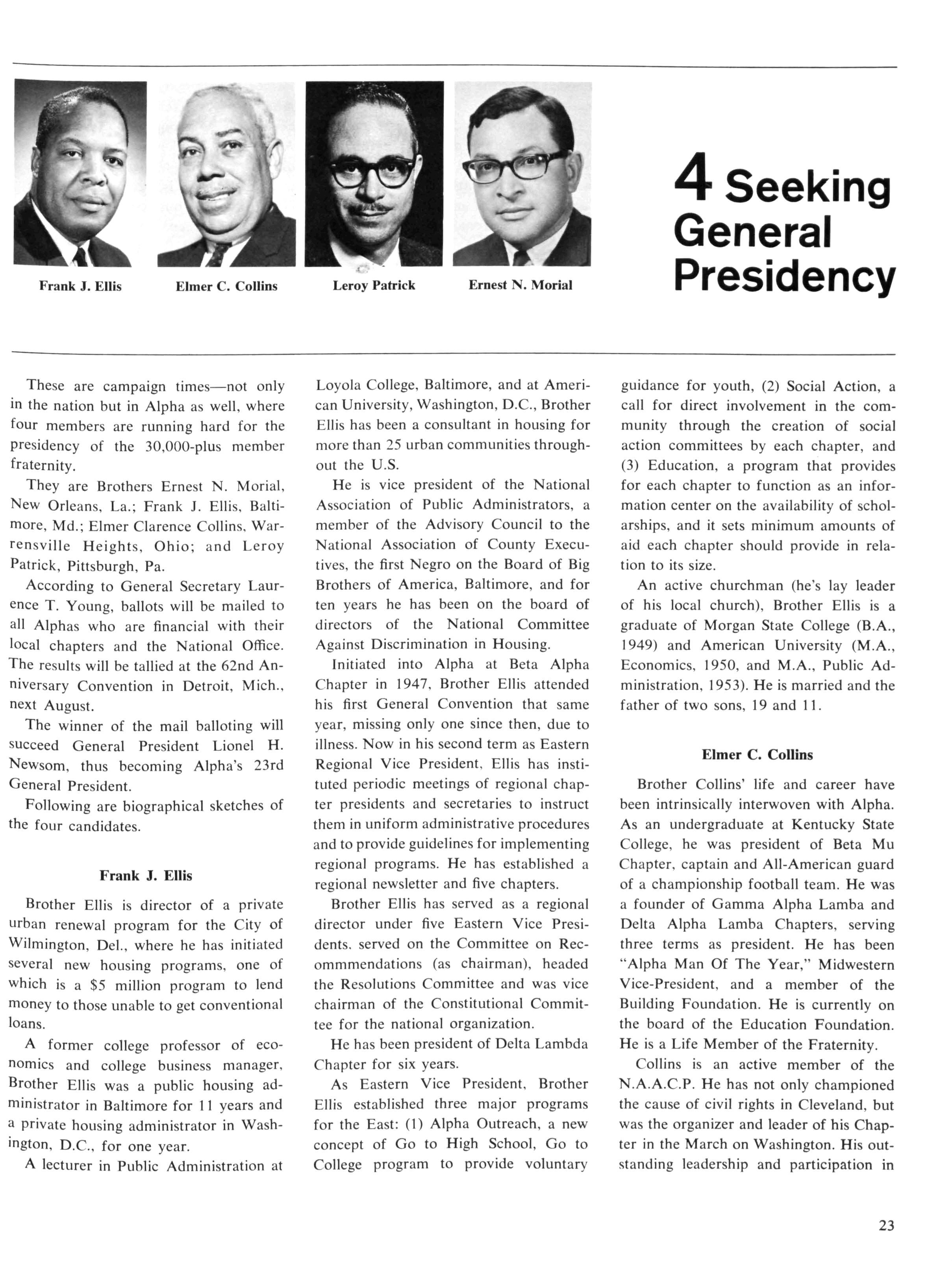
These are campaign times—not only in the nation but in Alpha as well, where four members are running hard for the presidency of the 30,000-plus member fraternity
They are Brothers Ernest N. Morial, New Orleans, La.; Frank J Ellis, Baltimore, Md.; Elmer Clarence Collins Warrensville Heights, Ohio; and Leroy Patrick, Pittsburgh, Pa
According to General Secretary Laurence T Young, ballots will be mailed to all Alphas who are financial with their local chapters and the National Office The results will be tallied at the 62nd Anniversary Convention in Detroit, Mich., next August
The winner of the mail balloting will succeed General President Lionel H. Newsom, thus becoming Alpha's 23rd General President.
Following are biographical sketches of the four candidates.
Frank J. Ellis
Brother Ellis is director of a private urban renewal program for the City of Wilmington, Del., where he has initiated several new housing programs, one of which is a $5 million program to lend money tothose unable to get conventional loans.
A former college professor of economics and college business manager, Brother Ellis was a public housing administrator in Baltimore for 11 years and a private housing administrator in Washington, D.C., for one year
A lecturer in Public Administration at
Loyola College, Baltimore, and at American University,Washington, D.C., Brother Ellis has been a consultant in housing for morethan 25urban communities throughout the U.S.
He is vice president of the National Association of Public Administrators, a member of the Advisory Council to the National Association of County Executives, the first Negro on the Board of Big Brothers of America, Baltimore, and for ten years he has been on the board of directors of the National Committee Against Discrimination in Housing
Initiated into Alpha at Beta Alpha Chapter in 1947, Brother Ellis attended his first General Convention that same year, missing only one since then, due to illness Now inhissecond term as Eastern Regional Vice President, Ellis has instituted periodic meetings of regional chapter presidents and secretaries to instruct them inuniform administrative procedures andtoprovideguidelinesfor implementing regional programs. He has established a regional newsletter and five chapters
Brother Ellis has served as a regional director under five Eastern Vice Presidents. served on the Committee on Recommmendations (as chairman), headed the Resolutions Committee and was vice chairman of the Constitutional Committee for the national organization.
He hasbeen president of Delta Lambda Chapter for six years.
As Eastern Vice President, Brother Ellis established three major programs for the East: (1) Alpha Outreach, a new concept of Go to High School, Go to College program to provide voluntary
4 Seeking General Presidency
guidance for youth, (2) Social Action, a call for direct involvement in the community through the creation of social action committees by each chapter, and (3) Education, a program that provides for each chapter to function as an information center on the availability of scholarships, and it sets minimum amounts of aid each chapter should provide in relation to its size
An active churchman (he's lay leader of his local church), Brother Ellis is a graduate of Morgan State College (B.A., 1949) and American University (M.A., Economics, 1950, and M.A., Public Administration, 1953).He ismarried and the father of two sons, 19 and 11
Elmer C. Collins
Brother Collins' life and career have been intrinsically interwoven with Alpha As an undergraduate at Kentucky State College, he was president of Beta Mu Chapter, captain and All-American guard of a championship football team He was a founder of Gamma Alpha Lamba and Delta Alpha Lamba Chapters, serving three terms as president. He has been "Alpha Man Of The Year," Midwestern Vice-President, and a member of the Building Foundation He is currently on the board of the Education Foundation. He is a Life Member of the Fraternity
Collins is an active member of the N.A.A.C.P He has not only championed the cause of civil rights in Cleveland, but was the organizer and leader of his Chapter in the March on Washington His outstanding leadership and participation in
the Hough and Glenville Community Councils were recognized by the Cleveland Board of Education in selecting him as Director of Training in Aim-Jobs, the largest and most comprehensive antipoverty program in Ohio.
Brother Collins is married to his collegeclassmate and has three children. His wife, Mary who never misses an Alpha convention, is a teacher in the Cleveland Public Schools.
"Al" believes that if Alpha Phi Alpha is to maintain and strengthen its leadership both on the college campus and in the community, it must mold its program to fit the changing mood of our times "Emphasis" he says, "must be placed at the grassroot level in order to satisfy the needs and challenges of discriminating youth."
A 1934 graduate of Kentucky State College (B.S., split major, Social Science and Physical Education), Brother Collins did graduate work at Western Reserve University, Cleveland, Ohio, and became the first Negro male to receive a Master's degree in Health and Physical Education
At Kentucky State he has been a director of out-of-school youth projects, football line coach, boxing coach and assistant dean of men Later with the Cleveland Board of Education, he has been a physical education teacher and coach atThomas A Edison School (1947'60), head of the Physical Education Department at Empire Junior High School (1960-'62), head of the Physical Education Department at John Hay School (1963-'66), and director of Extended School Services Program, Audubon Junior High School (March, 1966 to March 1967)
Leroy Patrick
Brother Leroy Patrick, a Presbyterian clergyman, is minister of Bethesda United Presbyterian Church and Director of Bethesda Church Community Center in Pittsburgh, Pa He graduated from Lincoln University, Pa., in 1939, received an M.A. in Social Theology from New York City's Union Theological Seminary in 1946, and that same year he was awarded the Doctor of Divinity degree at Lincoln University
Brother Patrick has been a member of
the Alpha Phi Alpha since 1936 and has attended 11 of the last 12 National Conventions.
Dr Patrick has received many awards and commendations during his career In 1953 he was selected by Time Magazine and the Greater Pittsburgh Chamber of Commerce as one of Pittsburgh's "100 Newsmakers of Tomorrow," and was cowinner of the James and Rachel Levinson Foundation Brotherhood Award
During 1951-1954, when Dr. Patrick first arrived in Pittsburgh, he led the fight, with the small youth group of his new church, to open up city and county swimming pools to Negroes The group was stoned, nearly drowned, and in one case assaulted at several of the city and county pools, but were successful in integrating the pools.
During 1954-1956 Dr. Patrick and a small band of intensely interested citizens almost single handedly saved the kindergartens from being abolished in Pittsburgh public schools by the State Legislature
Between 1952-1965 he was chairman of the Allegheny County Council on Civil Rights and is now a board member and he was also chairman of the NAACP Public Accommodations Committee which is responsible for opening bowling alleys and restaurants to Negroes
Dr. Patrick is minister of a progressive congregation of 460 members, with a full range of church and community activities He isdirector of the Bethesda Community Center which has an enrollment of over 1000 persons. The Bethesda Center employs 13 full-time paid and 20 part-time paid persons, along with 145 volunteers
The Center has opened a psychiatric unit in cooperation with the Offices of Economic Opportunity (Poverty Program) This unit has a psychiatrist social work consultant and four psychiatric social workers
Married tothe former Norma A Brandon of New York City, the Patricks have two sons, Stephen and Gregory.
Ernest
N. Morial
Brother Morial, a practicing attorney in New Orleans, La., is Life Member No 102 of Alpha and, apparently, the first Negro State Representative in Louisiana
in modern times In the last November Democratic primary he beat out three men in the race for a seat in the lower house He now runs unopposed in the April, 1968 election, with voters in his district more than 60 per cent Negro Brother Morial is a graduate of Xavier University (B.S.,Business Administration 1951)and Louisiana StateUniversity Law School (LL.B., 1954). A former U.S. Army Intelligence Corps officer, he was thefirstNegrograduate of Louisiana State Law School and the first Negro ever initiated into the Knights of Columbus in Louisiana.
A Life member of the NAACP, and a past president of the New Orleans chapter, Morial is a member of the Louisiana State Bar Association, American, National, and Southwest bar associations, the St. Thomas More Catholic Lawyers Association, Louis A Martinet Legal Society, New Orleans Notaries Association, Catholic Press Association, Federal Bar Association, the American Trial Lawyers Association, the Urban League, the Coordinating Council of Greater New Orleans, and the Community Relations Council.
Married to the former Sybil G Haydel, and father of four children, Brother Morial is admitted to practice before the U.S Supreme Court, Louisiana Supreme Court, U.S District Court, U.S Court of Appeals, and the Internal Revenue Service He is currently president of the New Orleans Legal Assistance Corporation that provides neighborhood legal services under the Office of Economic Opportunity.
He appears inthe 1965edition of "Outstanding Young Men of America" and "Who'sWho intheSouth and Southwest," 1967-'68
Brother Morial is a former member of the Board of Directors of Alpha Phi Alpha Building Foundation, Inc., and served as chariman of its Application Committee He is also a former member of the board of directors of the Urban League of Greater New Orleans; past general counsel of Apha, former business administration instructor at Xavier University and former instructor of Distributive Education in the Orleans Parish Public Schools.
An Alpha who is involved 'where the action is', Looks at America and doesn't like what he sees the Life of a great nation in peril. But, he says, its condition is not hopeless.
Who can save America?
During recent months, I have visited nearly every city in our nation in which a riot or a rebellion has occurred In every one of these cities there are cancerous socio-economic conditions which have been left unchecked for along time. Historically, we Americans have been a very optimistic people. We never cease to believe that God is on our side Because we carry his name on the face of our coins, we assume that we can carry Him in our pockets Our optimism is based on what we consider to be the historisity of a divine necessity But, to use the language of Sportin' Life in Porgy and Bess, "It ain't necessarily so"!
Something has begun to happen in our nation which leaves nodoubt, in my mind at least, that an advanced stage of social cancer now threatens the very life of the nation Now if you do not believe this, and if you feel that the majority of the American people do not really believe this,just remember that no cancer patient really wants to believe his doctor when he tells it to him "like it is." An ancient cynic once put itthisway, "Tell me happy stories, sing me a glad refrain; but spare me from the truth, I dare not risk the pain."
Well,the diagnosis of an illnessis, after all, an academic matter What about the cure? And before we focus on the cure. upon the surgeons and the operating table, there are two infectious myths which have infiltrated the operating room which need to be washed away before we can see clearly what really needs to be done
The first is that the nation cannot be saved, that the cancer has spread too far that America is doomed to a destiny of hell, that everything is all wrong and hopeless This pessimistic attitude needs
to be countered with expressions like the one Sargent Shriver used recently at a commencement address at Muelingburg College: "Instead of talking so much about what iswrong in a world which we did not make, let us begin to do all we can to do what is right in a world which we can make."
The second myth which must be destroyed is that the nation is not worth being saved, even if it were possible to save it This is the view which is held by most of those who would burn down cities, those who seek to take advantage of the legitimate hostility of the sons of poverty To all those who would teach and preach "burn, baby burn," we must vigorously proclaim, "build, baby build," reminding those who are cynical that Negro America and white America are now inextricably intertwined, and that we as Negroes cannot destroy America without destroying ourselves atthe same time. More than anything else, America means people; and people are always worth being saved—from prejudice, from bigotry, from ignorance, from poverty and oppression
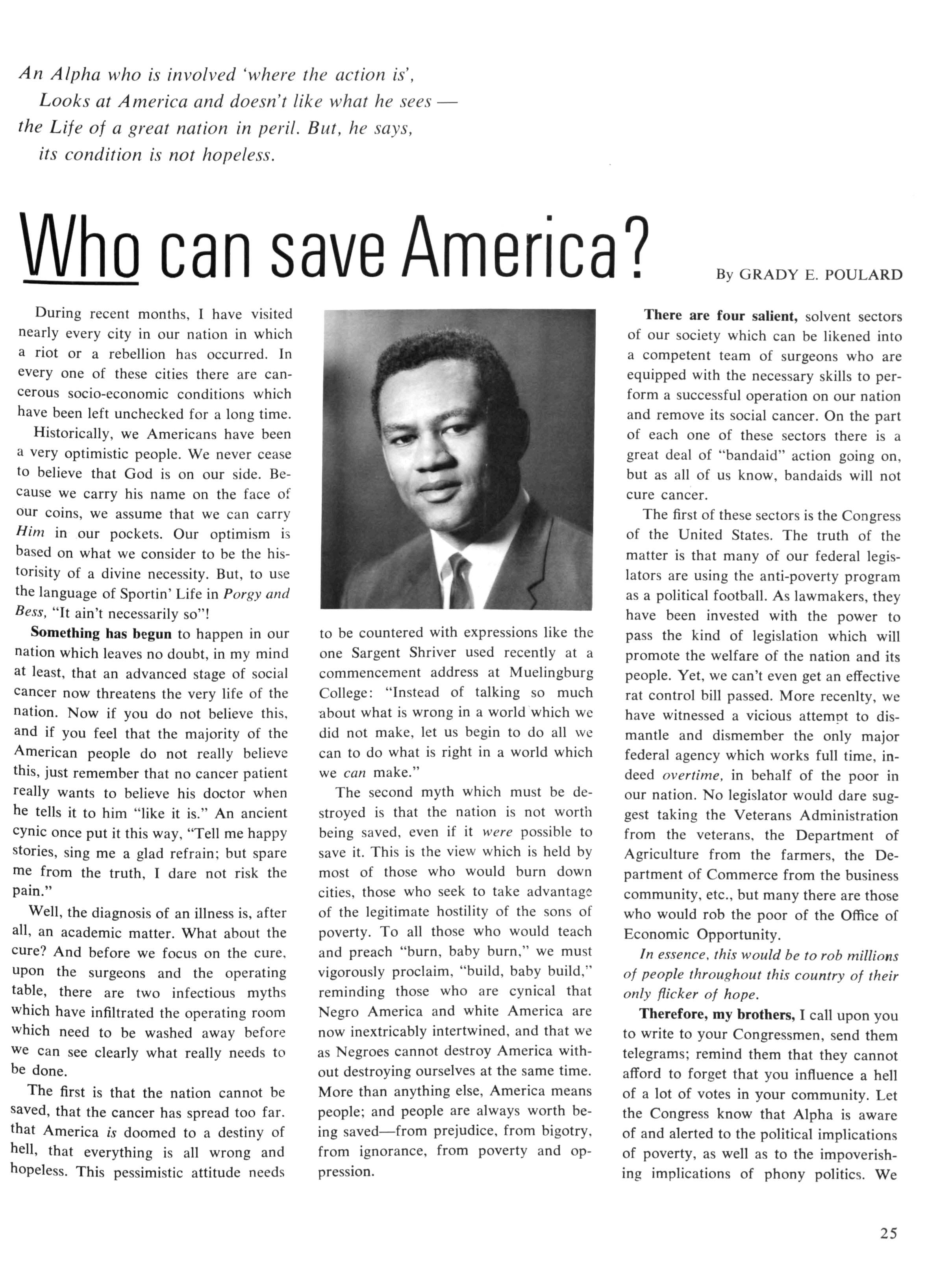
By GRADY E POULARD
There are four salient, solvent sectors of our society which can be likened into a competent team of surgeons who are equipped with the necessary skills to perform a successful operation on our nation and remove its social cancer On the part of each one of these sectors there is a great deal of "bandaid" action going on, but as all of us know, bandaids will not cure cancer
The first of thesesectorsisthe Congress of the United States The truth of the matter is that many of our federal legislators are using the anti-poverty program asa political football As lawmakers, they have been invested with the power to pass the kind of legislation which will promote the welfare of the nation and its people Yet, wecan't even get an effective rat control bill passed. More recenlty, we have witnessed a vicious attempt to dismantle and dismember the only major federal agency which works full time, indeed overtime, in behalf of the poor in our nation No legislator would dare suggest taking the Veterans Administration from the veterans, the Department of Agriculture from the farmers, the Department of Commerce from the business community, etc.,but many there are those who would rob the poor of the Office of Economic Opportunity
In essence, this would be to rob millions of people throughout this country of their only flicker of hope.
Therefore, my brothers, Icall upon you to write to your Congressmen, send them telegrams; remind them that they cannot afford to forget that you influence a hell of a lot of votes in your community Let the Congress know that Alpha is aware of and alerted to the political implications of poverty, as well as to the impoverishing implications of phony politics We
have the resources; we have the skill; and all we need is the will!
Another sector of our society which can do a great deal to save the nation is organized religion. And I think our churches would do well to recall those words of Emerson: "What you do speaks so loudly I cannot hear what you say." What is needed in our communities today, from the church, is a relevant concept of salvation To the man who is hungry it means bread; to the man who is suffering from anxiety, it means positive mental health; to unhappily married couples, it means either reconcilliation or amicable divorce; to a young girl with an unwanted pregnancy it means a legal abortion
I call upon all Alpha men who are churchmen to oppose any approach to religion that does not take the needs of the total person seriously If ever you should hear a clergyman tell a poor person to "pray harder and sacrifice a little more for the Lord," notice to see if the "Lord" might not indeed be a slick cat, wearing a silk suit, riding around in a Cadillac I call upon you not to support a church or a preacher who will not use the resources and facilities of the institution primarily for the "Salvation" of deprived humanity, those very persons who usually are not welcome in our plush, bourgeois, middle class settings Alpha men, demand that your ministers be loyal prophets in the tradition of the Nazarene (which they say they are), or demand that they leave the pulpit Begin to insist that your church and its leadership be genuine, relevant and honest, or that it not be at all! Be ashamed to be identified with a religious farce or a pious fraud Heaven must be created here on earth, where millions of people are caught in the hell of poverty and despair. The church can help with the job It has the resources, it has the skill; it needs more will!
Another sector of our society which can do a great deal to bring health to the nation is private industry Big corporations are making money hand over fist— the very rich getting much richer while the very poor, who must buy their products, aregetting much poorer As Michael Harrington points out in The Accidental
Century, the collective society about which Adam Smith once spoke is actually becoming an exclusive collective society of mammoth corporations
Some companies have patted themselves on the back for their "band aid" approach to the unemployment problem; namely—"on the job training." What unemployed men need is jobs! What heads of families need is a guaranteed income! Nothing less than this is going to give a man the kind of dignity which makes it irrational for him to steal, burn, loot, curse, and kill The unemployment problem in our nation could be solved in less than ayear ifprivate industry alone would seize the opportunity to make more human investments. One lesson, at least, has been taught us by the unrest in our cities this summer: the property of the rich is not safe aslong asthepoor are hopelessly frustrated and angry Private industry has the resources, ithas the skill;itonly needs the will!
Finally, I want to comment on what social and fraternal organizations can do; specifically, what Alpha can do
As Brother Martin Luther King often points out, most of the progress in the civil rights field during the past twelve years has benefited, primarily, the socalled "middle class Negro"— educationally, socially, and economically We have either escaped from the rural south or the city ghetto But while we have been doing better and better, thebrother inthe ghetto has been "getting it" worse and worse Not only is "white society" against him; his "middle class" black brothers don't want to be identified with him He embarrasses us; his language is bad, his clothings are too jivey, and he "don't carry himself well."
Well, let me ask you, my middle class brothers: How in the hell istheguy in the ghetto ever going to learn how to live, how to think, how to dress, how to speak, if somebody does not begin to love him as he is, and help him to see and achieve wider horizons What right do we "escapees" have to criticize those who have not yet succeeded in "escaping?" As a matter of fact, is it not true that in some instances we are the ones who are now "prisoners" and they are the ones who
are "free?"
Listen to these words which Mama speaks to her daughter Bennetta in the late Lorraine Hansberry's play, Raisin In the Sun: "Child, when do you think it is best to love somebody the most? When they done good, and made everybody happy? If that's what you think, child, then you ain't through learning yet. When you measure somebody child, measure them right, measure them right. Make sure you done taken into account all the hills and valleys they done come through before they done got where they is."
Our local chapters have the option of esoteric, decadent, irrelevant little cliques, "hung up"on business meetings, dues and the annual dance, or our chapters can begin to "swing" and go out in the community where the action is, where underprivileged people, black and white, need our time, our talents, our understanding, our acceptance, and, as we sing in the hymn, our manly deeds, our scholarship, and our love for all mankind.
Our national body has the option of going to a plush Detroit hotel next year, flooding the coffers of the "man" who literally owns the 20th century, financially, or, we can decide to dress in our tee shirts and our dungarees and meet in the ghetto and identify with (and patronize) our black brothers whom the 20th century isabout tocompletely bypass We can take the lead in this direction, and become the first major national organization to make such a dynamic witness of concern in behalf of the disinherited sons of poverty Can we be so bold, so daring, so innovative? Must we always do it the same way, in the same kind of place, year nfter year? Is there not now a rationale for change—at least for some new beginning in this direction in 1968? Can we begin to think in these terms now, while we have the best caliber of leadership in Lionel Newsome?
Today, the life of a great nation is in peril, but its condition is not hopeless Somehow, we must come to realize that we have "promises to keep, and miles to go before we sleep."
In the words of Lincoln: "The hour is late; the issue is clear; it is time for us to disenthrall ourselves."
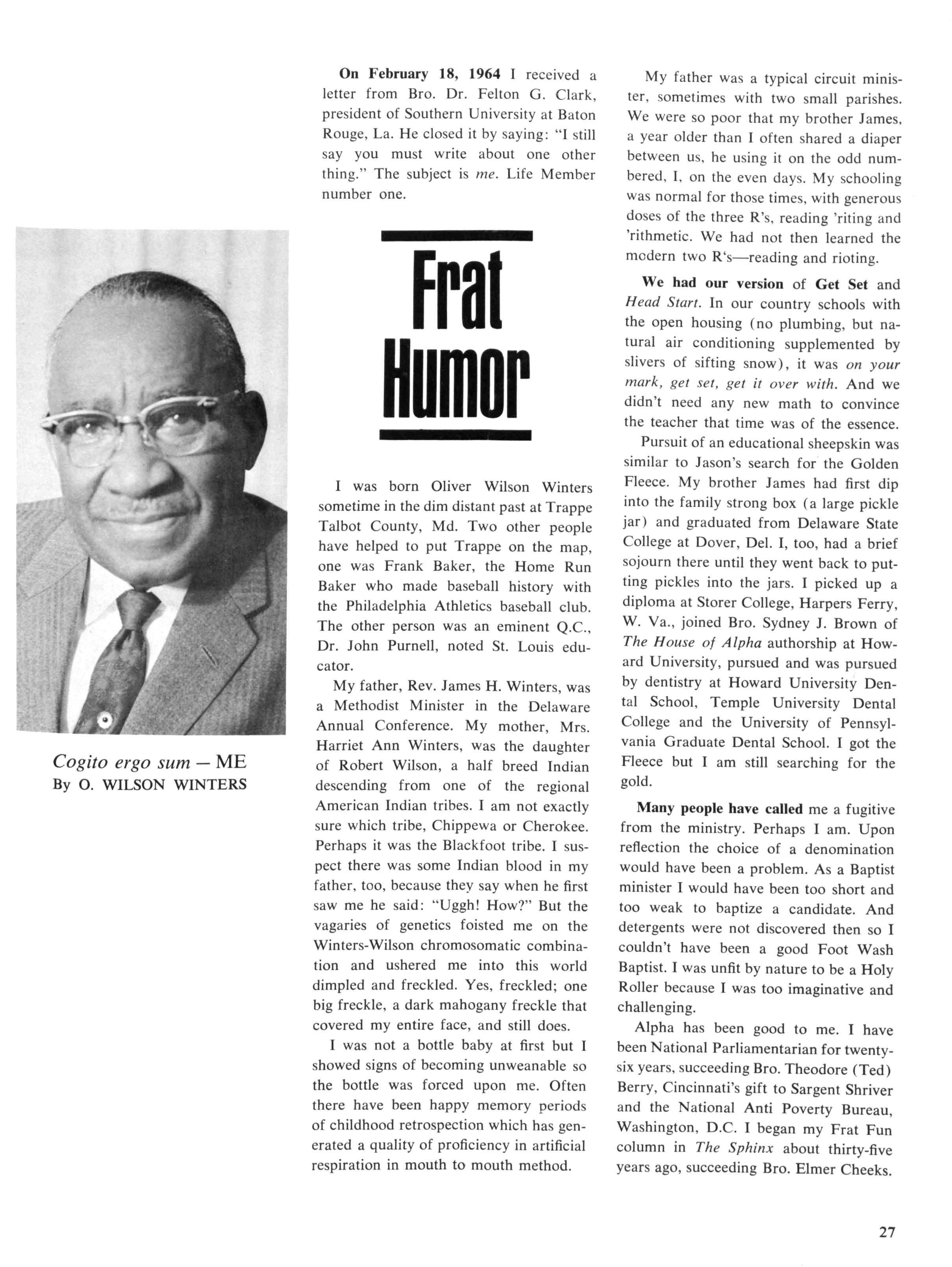
On February 18, 1964 I received a letter from Bro Dr Felton G Clark, president of Southern University at Baton Rouge, La He closed itby saying: "I still say you must write about one other thing." The subject is me. Life Member number one
Fral Humor
I was born Oliver Wilson Winters sometimeinthedimdistant past at Trappe Talbot County, Md Two other people have helped to put Trappe on the map, one was Frank Baker, the Home Run Baker who made baseball history with the Philadelphia Athletics baseball club. The other person was an eminent Q.C., Dr. John Purnell, noted St. Louis educator
My father, Rev.James H. Winters, was a Methodist Minister in the Delaware Annual Conference. My mother, Mrs. Harriet Ann Winters, was the daughter of Robert Wilson, a half breed Indian descending from one of the regional American Indian tribes I am not exactly sure which tribe, Chippewa or Cherokee Perhaps it was the Blackfoot tribe I suspect there was some Indian blood in my father, too, because they say when he first saw me he said: "Uggh! How?" But the vagaries of genetics foisted me on the Winters-Wilson chromosomatic combination and ushered me into this world dimpled and freckled. Yes, freckled; one big freckle, a dark mahogany freckle that covered my entire face, and still does. I was not a bottle baby at first but I showed signs of becoming unweanable so the bottle was forced upon me Often there have been happy memory periods of childhood retrospection which has generated a quality of proficiency in artificial respiration in mouth to mouth method
My father was a typical circuit minister, sometimes with two small parishes We were so poor that my brother James a year older than I often shared a diaper between us, he using it on the odd numbered, I, on the even days My schooling was normal for those times,with generous doses of the three R's, reading 'riting and 'rithmetic We had not then learned the modern two R's—reading and rioting.
We had our version of Get Set and Head Start. In our country schools with the open housing (no plumbing, but natural air conditioning supplemented by slivers of sifting snow), it was on your mark, get set, get it over with. And we didn't need any new math to convince the teacher that time was of the essence Pursuit of an educational sheepskin was similar to Jason's search for the Golden Fleece. My brother James had first dip into the family strong box (a large pickle jar) and graduated from Delaware State College at Dover, Del I, too, had a brief sojourn there until they went back to putting pickles into the jars I picked up a diploma at Storer College, Harpers Ferry, W Va., joined Bro Sydney J Brown of The House of Alpha authorship at Howard University, pursued and was pursued by dentistry at Howard University Dental School, Temple University Dental College and the University of Pennsylvania Graduate Dental School. I got the Fleece but I am still searching for the gold
Many people have called me a fugitive from the ministry Perhaps I am Upon reflection the choice of a denomination would have been a problem As a Baptist minister I would have been too short and too weak to baptize a candidate And detergents were not discovered then so I couldn't have been a good Foot Wash Baptist Iwas unfit by nature to be a Holy Roller because I was too imaginative and challenging
Alpha has been good to me I have beenNational Parliamentarian for twentysixyears,succeeding Bro Theodore (Ted) Berry, Cincinnati's gift to Sargent Shriver and the National Anti Poverty Bureau, Washington, D.C. I began my Frat Fun column in The Sphinx about thirty-five years ago,succeeding Bro. Elmer Cheeks.
In 1937, at the Convention at Xavier University in New Orleans, I was made Alpha's first Life Member after carrying a life insurance endowment policy made out to Alpha Phi Alpha for ten years
Humor is not necessarily indigenous Mine came out of deep travail and constant awareness of the humor that pervades our lives For instance, even sex is funny. We are amused at the male during the birth episode of his progeny, going through pseudo labor pains and other manifestations. When he gets old we speculate on his ability to "cut the mustard." When he dies we say he kicked the bucket." Humor for our columns come by whimsical impulses, incidental events and diligent anthologies, inspirations, and choice morsels referred by kindred minds like the Bros Rumford, Garvin, Buckner, the Jones Judges, Sidney and Billy and many others
My brother whose forte was music, band music, was naturally funny He was the true humorist, I was austere and lugubrious This antithesis prevailed throughout our childhood He was bright, effervescent and loquacious; I was dull, shy and laconic All day long he would be outside playing with the neighborhood boys. I was content to stay home playing with myself,orreadingvoraciously Now I often extract elements of mirth and humor from chance remarks overheard at conventions, faux pas, etc Brothers to whom we associate much dignity or serious mien furnish the media for much useful humor And it isat conventions that our exposure as a cynosure object because of the paradoxof frat fun imagery and parliamentary austerity has been most flattering A glance, a stare, a smile followed by a greeting is ample recompense for the many hours of midnight toil,such as I am now doing.
This tightrope type of writing which sometimes skims the fringes of editorial censorship permits occasional graffiti to peep out from the column just when the teenager gets The Sphinx which generally arrives before you get home However, an interrupted period of fun and humor
prevailed through the editorship of such patiently understanding and appreciative editors as Bros. Bernard Young, Reid Jackson, Arnett Lindsay, Lewis Swingler, Barton Beatty, Anderson Davis and George M Daniels
This column about Me isnot complete, and much about me is omitted because this is neither an autobiography nor an obituary. It is a recorded literary shadow of that which Bro Felton Clark has often suggested and urged
Alphabook Shelf
Nat's Unbosoming Literary, But...
To my own amazement here are excerpts culled from copiesof Sphinx Magazines dating back 35 years:
At St Louis a girl with big ideas, Tis sad to say drank too many beeahs; But the girl whose throat I'd liketo cut, Was the one who said, "I'd like to, but —"
As a literary novel based on historic fact, The Confessions of Nat Turner by William Styron (Random House) may be fine. He assuredly is to be commended for the impressive extension of a historic fragment into an imaginative narrative
The Siamese Twins spooned inthe dell, United they stood, united they fell.
And consider the array of modern-day topics which the novel includes: homosexuality; repressed desire of ablack buck for a young blond, blue-eyed Southern lass; and a black man so dedicated to religion that he believes he has received divine inspiration and a mandate to slay all the white folks so that his people can be free Stuff of which films are made, these days
Nat Turner led the famed slave revolt in Southampton County, Va., in 1831, which resulted in the death of about 60 white persons.
A convention floor, an hour or more With points of order and speeches galore
This scene I give so all can see May be fun for you but 'tis pain to me
In the year I became a Life Member novels hit the best seller list without any of the four letter words in their pages; young doctors were glad to make house calls day or night; "pansy" was the name of a flower and "fanny" was the name of a girl
Loyal Frat Fun and Frat Humor readers, this is enough about me from me —
For if you think my jokes are bad You'd quickly change your views
Could you compare the jokes you see With those I dared not use
Told through the eyes of Nat, "Confessions" fails to capture the degradation of slavery Nat comes off as a man of mixed emotions, unsure of himself most of the time He frequently quotes the Bible, perhaps at moments when Styron found it difficult to get inside the soul of a slave.
At times, Nat apologizes for the coarse slaves He vows to even kill children, when the time comes, but only succeeds in badly slaughtering one—the white girl he desired to love
Projected at a time when the nation still wrestles mightily with whether the "slaves" will go free, or fry, Styron's "Confessions" is not the most welcome book at this time. It does, however, make the reader most sympathetic to Nat and the slaves But Nat (like the masses of Negroes today) doesn't need sympathy. He, and they, need understanding And the latter desperately need help
Mrs Myrlie Evers poignantly recounts the life and times of her late husband, famed Medgar Evers, who gave his life to the cause of justice and freedom for Negroes in the State of Mississippi
In her book, For Us The Living, written with William Peters (Doubleday), Mrs Evers writes that she lived in fear most of the time. But it was fear for her husband and for her children
Medgar was mercillessly shot down in cold blood one night in 1963, when he was only steps away from his front door This writer knew Medgar well as a warm, indefatigable NAACP leader who walked through fields of fear every day of his life but who feared no man
Mrs Evers writes: "Somewhere in Mississippi lives the man who murdered my husband . . . imprisoned by the hate and fear that imprison so many white Mississippians and make so many Negro Mississippians still their slaves."
Medgar, like Nat, is gone But with us forever is the spirit which nurtured them and which now sustains the young people of this land
Speed Reading: A Way to Keep Abreast of the Times
Though Pressed
Among other recent publications: "Rivers of Blood, Years of Darkness," the anatomy of a race riot, by Robert Conot (Bantam Books) Advantage Ashe by Arthur Ashe, Jr., as told to Clifford George Gewecke Jr (Coward McCann Death At An Early Age by Jonathan-Kozol, (Houghton Mifflin), the destruction of the hearts and minds of Negro children in the Boston Public Schools . . . The Limits of Power (Holt, Rinehart Winston) by Eugene J McCarthy, TJ. S. Senator, America's role in the world The Advancing South: Manpower Prospects And Problems, Culture And Consciousness, perspectives in the social sciences, edited with introductions by Gloria B Levitas (George Braziller) The Sweet Flypaper of Life by Roy DeCarava and Langston Hughes, (Hill and Wang)
ART SEARS, JR
There isnothing like abook togiveone in-depth understanding of the issues of theday What withthe pushforcivil rights adding new facets by the minute, the continued emergence of underdeveloped landscontaining non-whitepersonsclosely allied tothe heritageof Negroes, and even the common, ordinary, everyday effort to keep abreast of new developments in a chosen field But how does one find the time to read the continuing rash of books and materials published?
One solution is provided by speed reading.
What is it? To provide a vest pocket definition, speed reading isa revolutionary, relatively new process by which one can read abook ormaterial of several hundred pages in minutes or in a pre-selected amount of time
Basically, speed reading teaches from thepremise that the human mind does not think in terms of "the's," "and's," and "but's"; therefore, why read that way? Speed reading proves, instead, that we think in concepts
Forexample,when onelooksathiswife, one'smind doesn't register the singleword "wife." But one thinks of "Margie," or "Bettie," or whatever the wife's name is Along with that thought is included the idea of who she is, what she is, why she is,howone feels about her atthe moment, and a myriad other sparks which together comprise the concept of the wife. Therefore, why burden oneself reading atasingle-word pace when wedon't think that way? Especially when we know that such words as "the," "and," and "but," are simply connectives which provide the
glue for the meat of whatever we read or think
It isnot easy to make such achange as speed readingdemands Butitcanbedone It requires perseverance, persistence and practice.
Ifyou'reoneofthosespecialistssooverburdened with "must" reading you can't find the time to relax with an entertaining book, speed reading would help you If your specialty requires a lot of reading, even though you are well-versed in your area, speed reading isfor you Orif you're oneof those personswho "eats up"books, speed reading can help you to "eat" at a much faster rate.
Take the Evelyn Wood Reading Dynamics Course This is the course which the late President John F Kennedy took to achieve his legendary rapid reading rates The course guarantees to increase your reading speed three times what it is when you begin. It makes no promise to do anything about changing your intelligence quotient (I. Q.). That is not its purpose
The Evelyn Wood course is great because,unlikethemanyotherspeed reading courses, itdoesnotuseamechanical pacer
Instead, the hand and fingers are the pacer. The hand, of course, is something one doesn't carry around, as it were It's a natural part of the body so you always have it with you A pacer helps guide the eye rapidly through large amounts of printed matter
Also,unlikeothercourses,Evelyn Wood involves the seeing of every word that isprinted ina book orother material read. It does not encourage skipping words but forces the eye to see everything that is printed on a page; thus, insuring that as one develops his skill, he does not change the meaning from itsoriginal intent Also, when one finishes reading, one can intelligently discuss the subject in depth
There are materials which one cannot read at rapid rates, such as poetry and plays, because they are highly structured
But there is much lighter reading and even classics which can be read rapidly In any event, you'll be better prepared to read some of the books which the Sphinx reviews
ART SEARS,
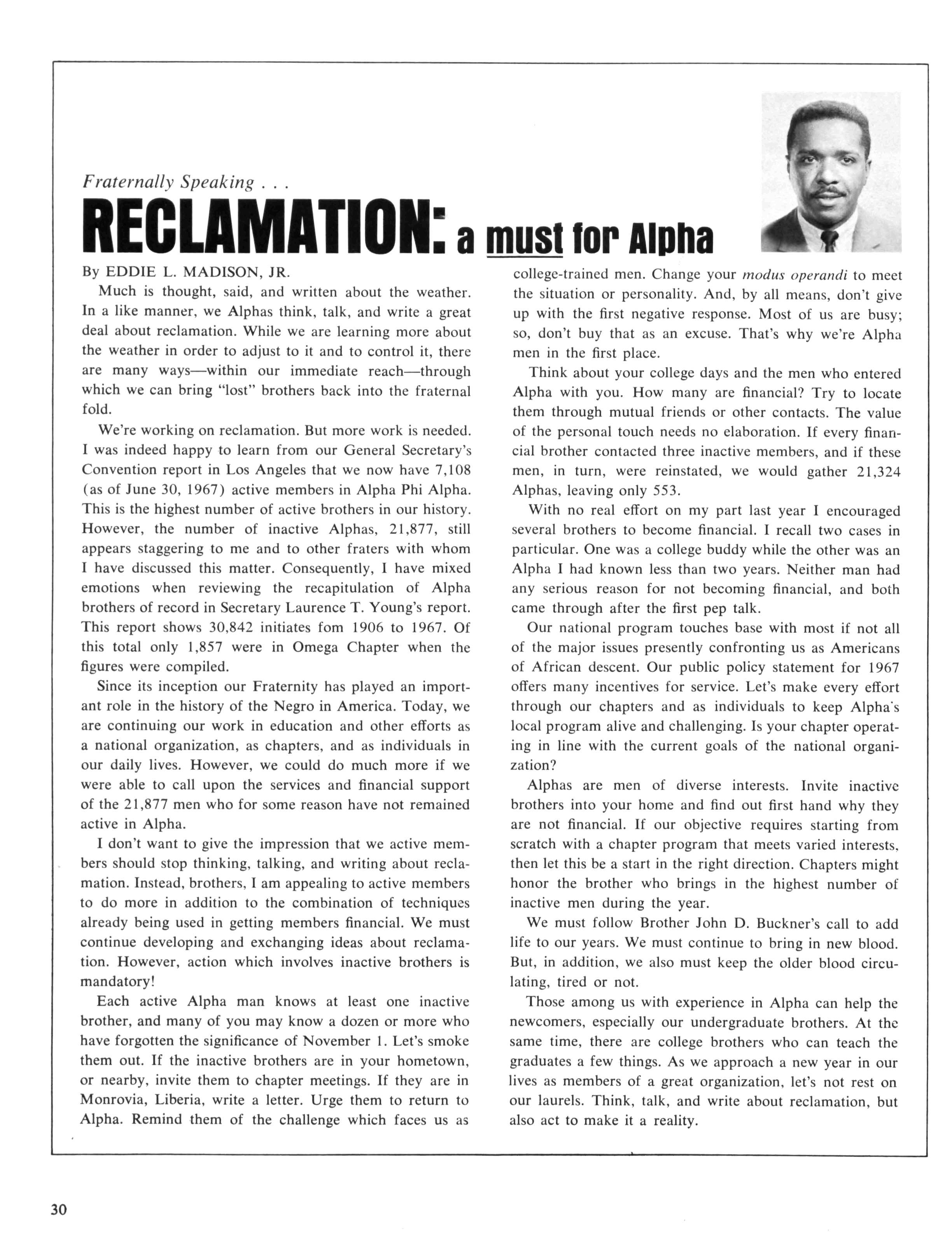
Fraternally Speaking . . .
RECLAMATION:a
By EDDIE L MADISON, JR
Much is thought, said, and written about the weather In a like manner, we Alphas think, talk, and write a great deal about reclamation While we are learning more about the weather in order to adjust to it and to control it, there are many ways—within our immediate reach—through which we can bring "lost" brothers back into the fraternal fold.
We're working on reclamation But more work is needed I was indeed happy to learn from our General Secretary's Convention report in Los Angeles that we now have 7,108 (as of June 30, 1967) active members in Alpha Phi Alpha This isthe highest number of active brothers in our history However, the number of inactive Alphas, 21,877, still appears staggering to me and to other fraters with whom I have discussed this matter Consequently, I have mixed emotions when reviewing the recapitulation of Alpha brothers of record in Secretary Laurence T Young's report This report shows 30,842 initiates fom 1906 to 1967. Of this total only 1,857 were in Omega Chapter when the figures were compiled
Since its inception our Fraternity has played an important role in the history of the Negro in America Today, we are continuing our work in education and other efforts as a national organization, as chapters, and as individuals in our daily lives However, we could do much more if we were able to call upon the services and financial support of the 21,877 men who for some reason have not remained active in Alpha
I don't want to give the impression that we active members should stop thinking, talking, and writing about reclamation. Instead, brothers, Iam appealing to active members to do more in addition to the combination of techniques already being used in getting members financial. We must continue developing and exchanging ideas about reclamation However, action which involves inactive brothers is mandatory!
Each active Alpha man knows at least one inactive brother, and many of you may know a dozen or more who have forgotten the significance of November 1 Let's smoke them out If the inactive brothers are in your hometown, or nearby, invite them to chapter meetings. If they are in Monrovia, Liberia, write a letter Urge them to return to Alpha Remind them of the challenge which faces us as
i must for Alpha 4
college-trained men Change your modus operandi to meet the situation or personality And, by all means, don't give up with the first negative response. Most of us are busy; so, don't buy that as an excuse That's why we're Alpha men in the first place
Think about your college days and the men who entered Alpha with you How many are financial? Try to locate them through mutual friends or other contacts. The value of the personal touch needs no elaboration If every financial brother contacted three inactive members, and if these men, in turn, were reinstated, we would gather 21,324 Alphas, leaving only 553
With no real effort on my part last year I encouraged several brothers to become financial. I recall two cases in particular One was a college buddy while the other was an Alpha I had known less than two years Neither man had any serious reason for not becoming financial, and both came through after the first pep talk
Our national program touches base with most if not all of the major issues presently confronting us as Americans of African descent Our public policy statement for 1967 offers many incentives for service. Let's make every effort through our chapters and as individuals to keep Alpha's local program alive and challenging Isyour chapter operating in line with the current goals of the national organization?
Alphas are men of diverse interests Invite inactive brothers into your home and find out first hand why they are not financial. If our objective requires starting from scratch with a chapter program that meets varied interests then let this be astart in the right direction Chapters might honor the brother who brings in the highest number of inactive men during the year
We must follow Brother John D Buckner's call to add life to our years We must continue to bring in new blood But, in addition, we also must keep the older blood circulating, tired or not
Those among us with experience in Alpha can help the newcomers, especially our undergraduate brothers At the same time, there are college brothers who can teach the graduates a few things As we approach a new year in our lives as members of a great organization, let's not rest on our laurels. Think, talk, and write about reclamation, but also act to make it a reality
Drop out of school now and that's what they'll call you all your
working life

Nobody looks down on a man with a good education People respect him They treat him right because they know he's got what it takes You know it. Everybody knows it. A good education always shows And so does a small education Which will you have?
Remember: respect is only one of the things a good education gets you It can also get you a good job. A good salary. And a real chance to enjoy more of the good things in life
Soif you're in schoolnow ... stay there! Learn all you can for as long as you can It can really make a diflFerence If you're out of school, don't give up. You can still get plenty of valuable training outside the classroom. And it's well worth the effort
For details, see the Youth Counselor at your State Employment Service Or visit a Youth Opportunity Center, which has been set up in many cities to help you
P.O. Box 285
Lincolnton Station New York, N. Y. 10037
Return Requested