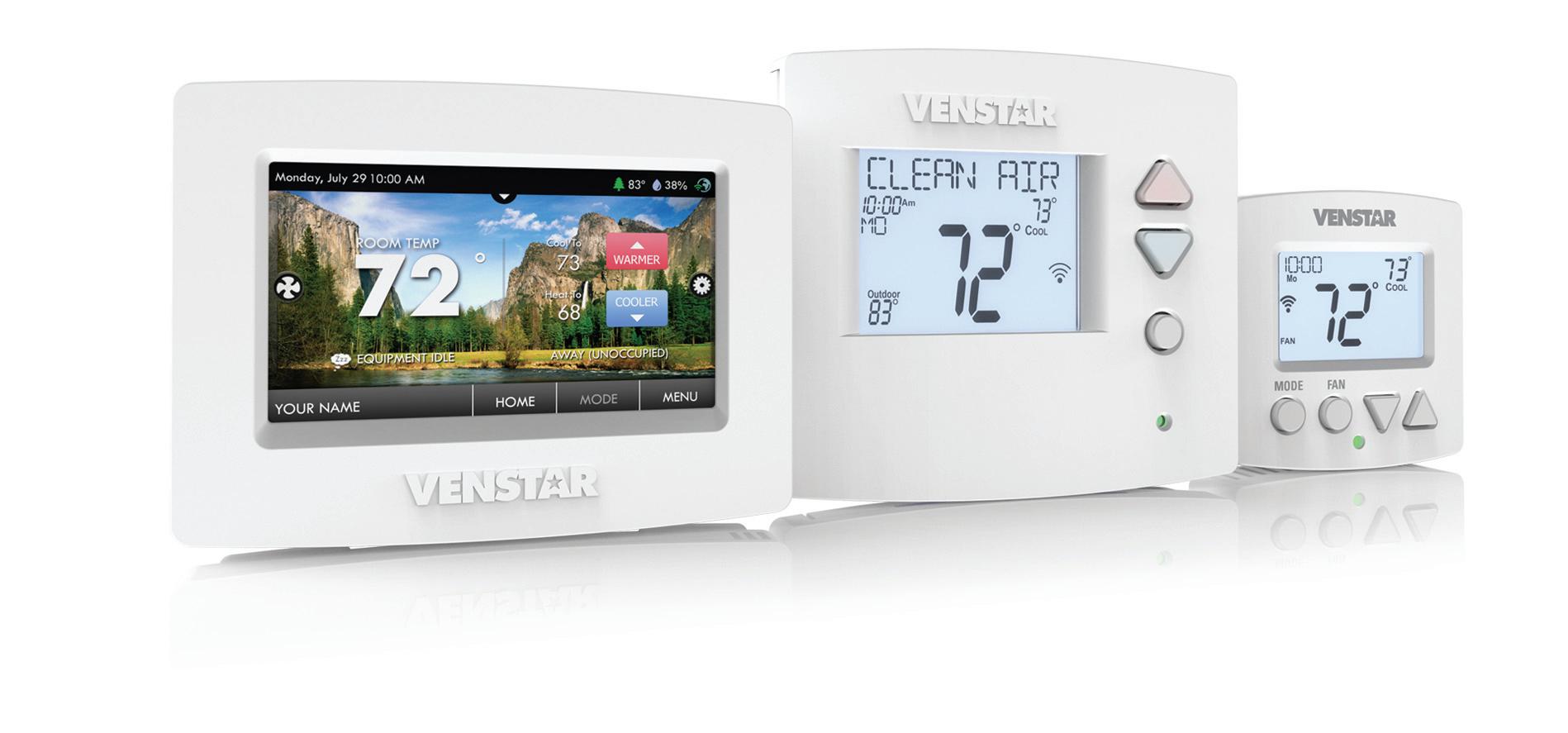
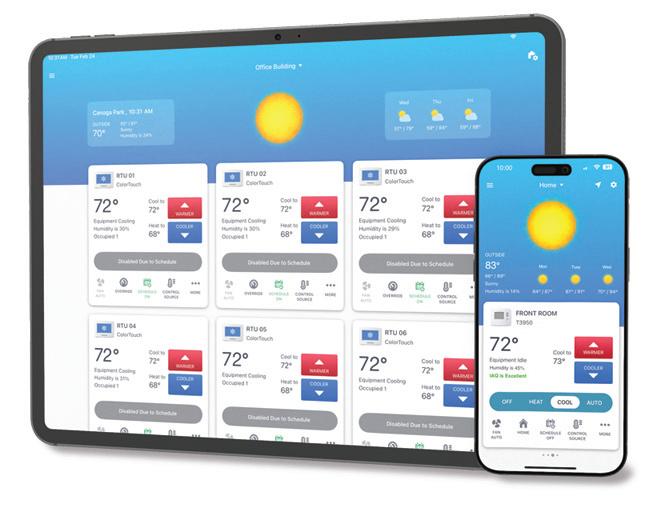
Remotely Manage HVAC Systems and Reduce Energy Usage With the Power of Skyport.TM
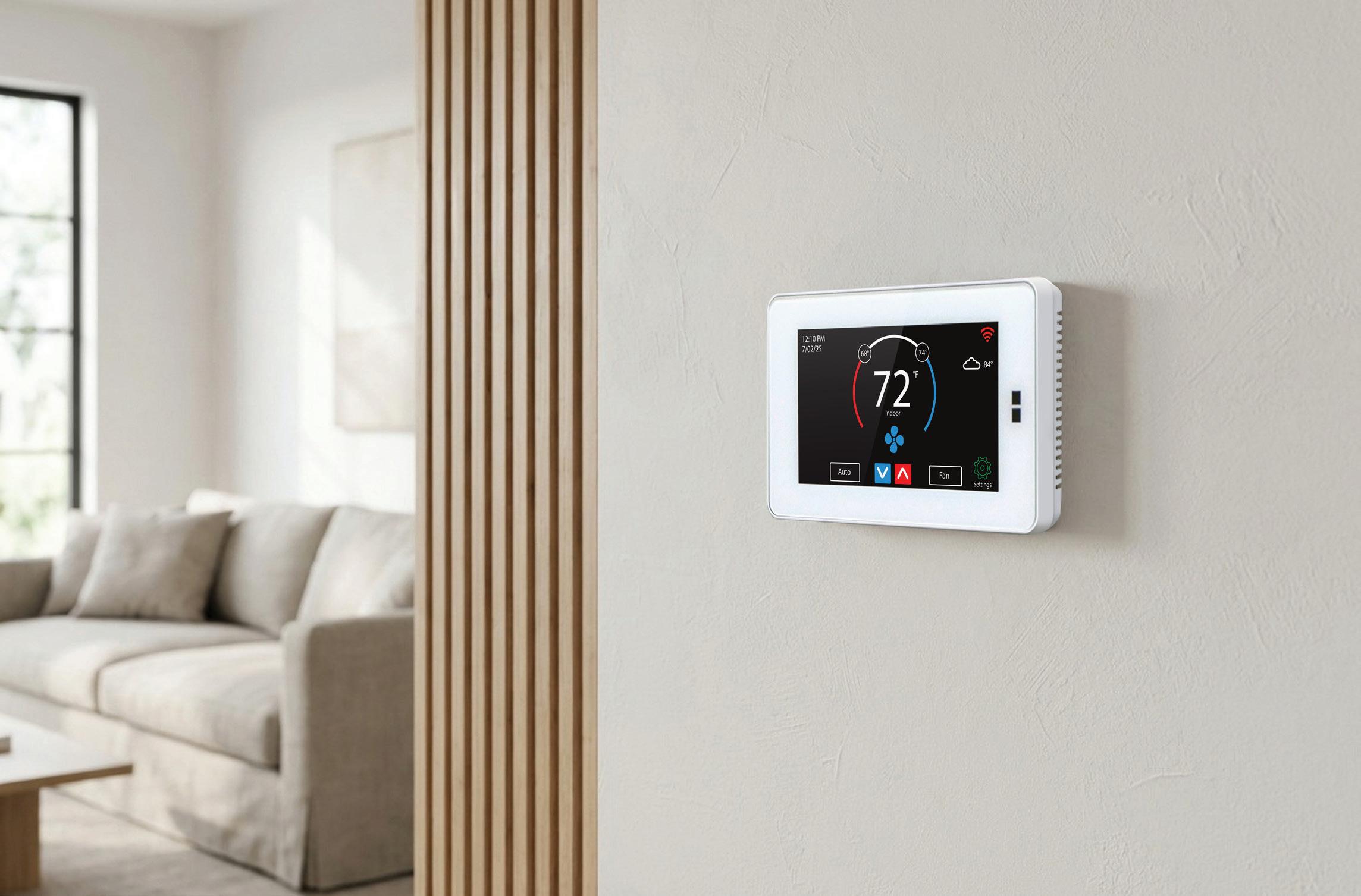
Skyport transforms Venstar thermostats into a centralized HVAC management platform, delivering real-time visibility and control across all locations from a single, intuitive dashboard. Monitor system performance, make instant adjustments, and respond to alerts before comfort issues escalate. From one thermostat to ten thousand, Skyport scales effortlessly, simplifying HVAC management.
• Instant System Visibility
• Real-Time Alerts
• Global Changes
• No Fees or Subscriptions
• Single Dashboard Control
• Fewer Truck Rolls, Faster Fixes
2026 COMMERCIAL COOLING GUIDE
Ray Isaac’s Hall of Fame induction reflects decades of values-driven leadership, growth, and industry impact.
Rooftop Heat Pump Demand Surges as Electrification Reshapes Commercial HVAC
Contractors must adapt to new sizing, electrical, and control requirements as rooftop heat pumps become mainstream.
Industry certifications can boost credibility and give HVAC contractors a competitive edge in a crowded market.
Learn how AHRI 1380 is redefining demand response and how it creates new opportunities for contractors to deliver smarter, connected solutions.
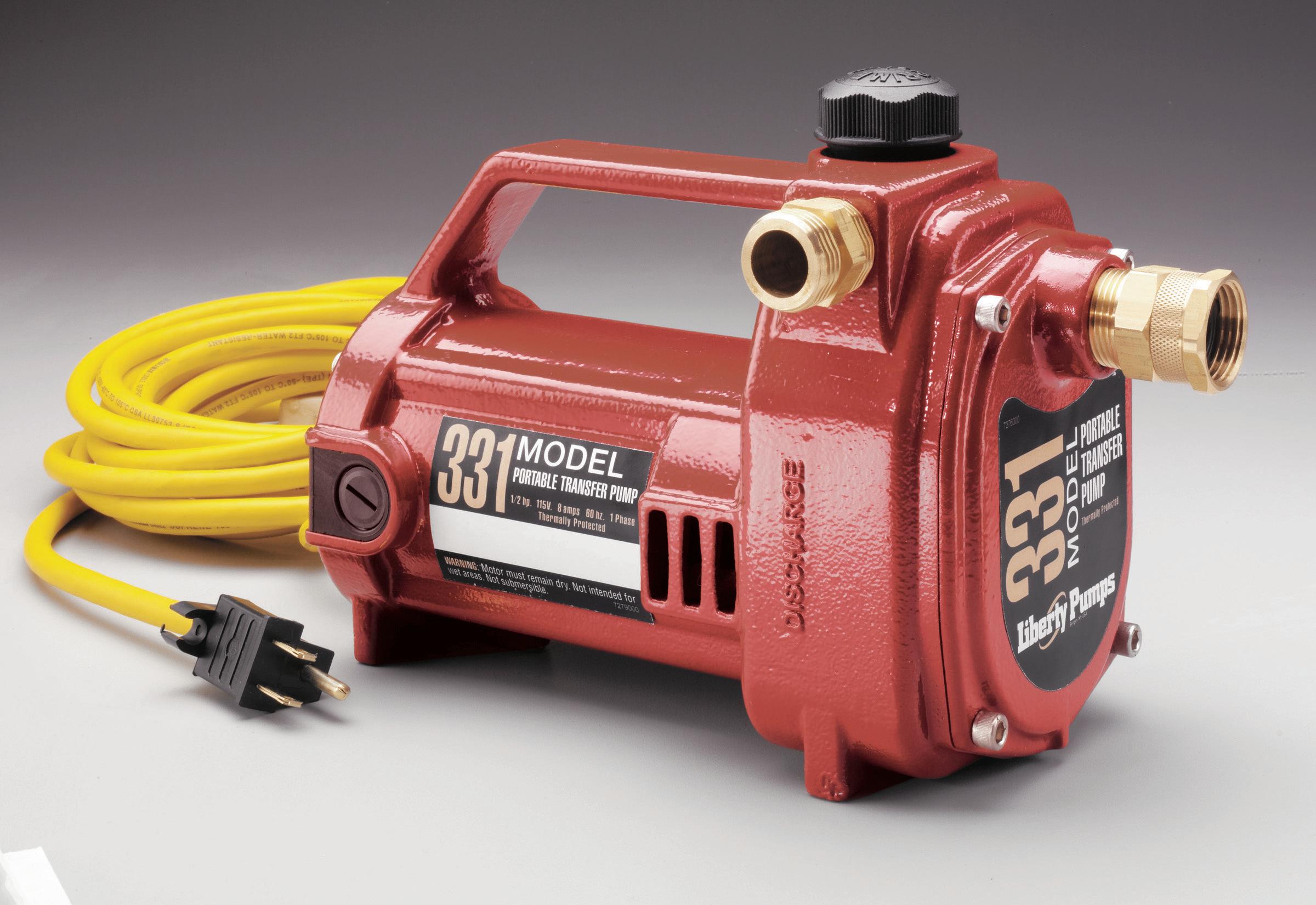
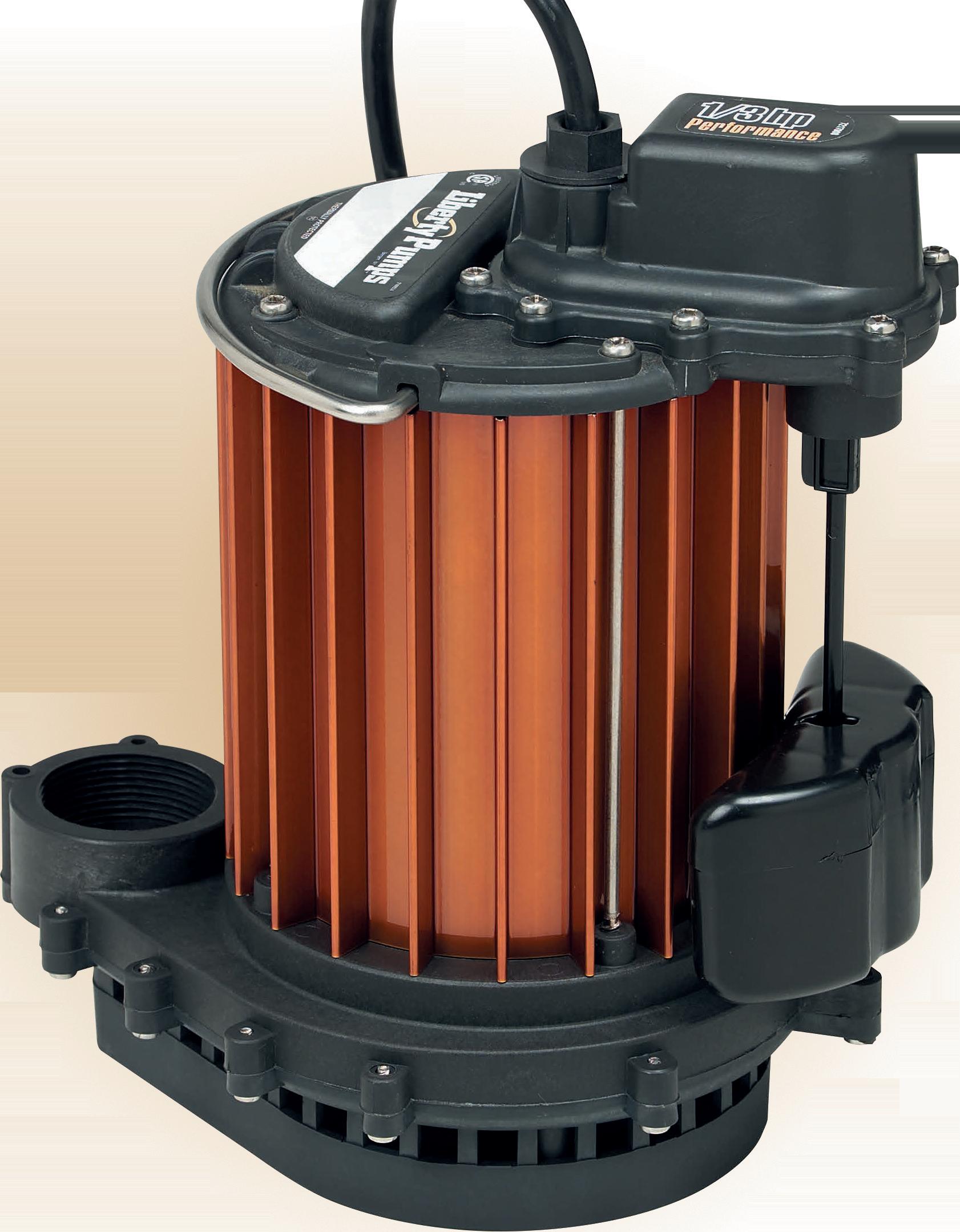
When you need to get the job done, Liberty’s 331 transfer pump is the benchmark for performance that battery powered pumps simply cannot match. With more flow, higher pumping head and the reliability of non-stop 1/2 hp, 115V performance, why settle for less?
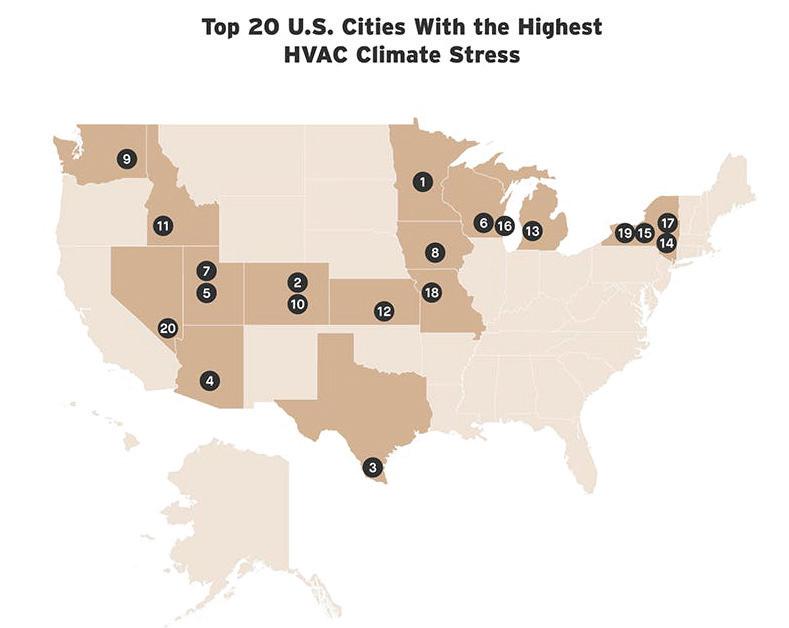
New HVAC Stress Report Highlights Top Service Demand Cities
Minneapolis, Denver, and McAllen, Texas, rank as the top three weather-stressed U.S. cities for HVAC systems, according to a new HVAC Stress Index that measured climatedriven equipment demand across 98 metro areas.
www.contractingbusiness.com/55371557
PODCASTS
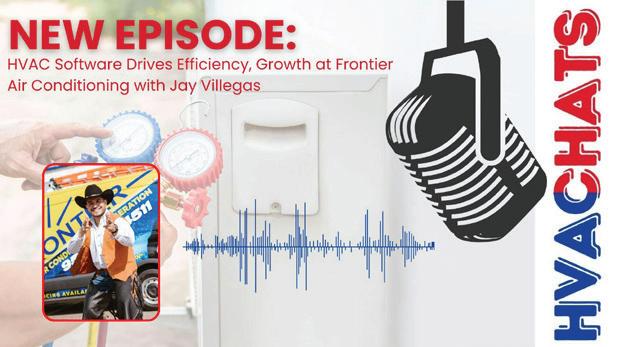
Software Drives Efficiency, Growth at Frontier Air Conditioning
Jay Villegas, vice president of Frontier Air Conditioning, shares insights on leveraging technology to drive business growth.
www.contractingbusiness.com/55366296
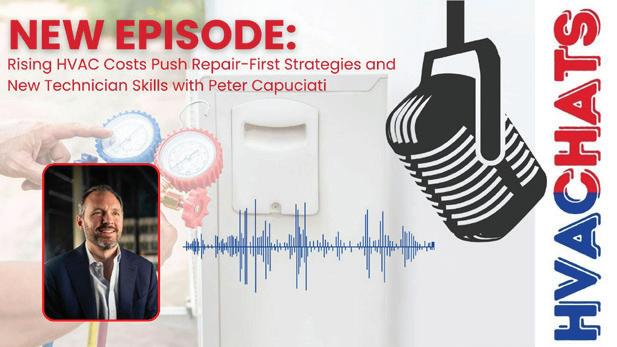
Rising HVAC Costs Push Repair-First Strategies & New Technician Skills
Bluon CEO Peter Capuciati discusses the shift from replacement-driven revenue to repair and retrofit strategies.
www.contractingbusiness.com/55369376
Defining a High-Performance Heat Pump Retrofit
HVAC contractors should shift from a component-focused mindset to a high-performance HVAC approach for heat pump retrofits.
www.contractingbusiness.com/ 55368900
Follow us on Twitter at @ContractingBiz , as well as our sister publications, @Contractormag, and @HPACEng. Retweet our up-to-date content, send comments, questions. Expand your world of engagement with us, at no extra charge! https://bit.ly/CBonLinkedin https://www.facebook.com/CBMag
VP/Market Leader—Buildings & Construction Group, Mike Hellmann
Audience Development Manager, James Marinaccio, jmarinaccio@endeavorb2b.com
Ad Services Manager, Deanna O’Byrne
CEO, Chris Ferrell COO, Patrick Rains
CDO, Jacquie Niemiec CALO, Tracy Kane
CMO, Amanda Landsaw
EVP Building & Construction Group, Chris Perrino
VP of Content Strategy— Buildings & Construction Group, Mike Eby
Contracting Business (USPS Permit 010-480, ISSN 0279-4071 print, ISSN 2771-652X online) is published monthly by Endeavor Business Media, LLC, 201 N. Main St., 5th Floor, Fort Atkinson, WI 53538. Periodicals postage paid at Fort Atkinson, WI, and additional mailing offices. POSTMASTER: Send address changes to Contracting Business , PO Box 3257, Northbrook, IL 60065-3257.
SUBSCRIPTIONS: Publisher reserves the right to reject non-qualified subscriptions. Subscription prices: U.S. ($ 105.00); Canada/Mexico ($ 137.50); All other countries ($ 157.50). All subscriptions are payable in U.S. funds. Send subscription inquiries to Contracting Business , PO Box 3257, Northbrook, IL 60065-3257. Customer service can be reached tollfree at 877-382-9187 or at contractingbusiness@ omeda.com for magazine subscription assistance or questions.
Printed in the USA. Copyright 2026 Endeavor Business Media, LLC. All rights reserved. No part of this publication may be reproduced or transmitted in any form or by any means, electronic or mechanical, including photocopies, recordings, or any information storage or retrieval system without permission from the publisher. Endeavor Business Media, LLC does not assume and hereby disclaims any liability to any person or company for any loss or damage caused by errors or omissions in the material herein, regardless of whether such errors result from negligence, accident, or any other cause whatsoever. The views and opinions in the articles herein are not to be taken as official expressions of the publishers, unless so stated. The publishers do not warrant either expressly or by implication, the factual accuracy of the articles herein, nor do they so warrant any views or opinions by the authors of said articles.
One of the most frequent topics that comes up during my conversations with HVAC contractors is how hard it is to find good people.
Earlier this year, Bring Back the Trades and F.W. Webb released a report revealing the projected skilled trades gap is 1.4 million unfilled jobs by 2030.
I kept this in mind when I attended Westie Magnuson’s breakout session at ACCA 2026 this past March. As Chief Culture Officer at HireAligned, he brought a different perspective on what recruiting should look like for modern-day contracting businesses.
“The pivot I made that was really helpful is to look at recruiting as sales,” he said. “We can’t treat it like HR paperwork.”
Speed to Lead
First of all, Magnuson emphasized that sales-driven recruiting starts with speed and meeting candidates where they are. He urged teams to adopt a “speed to lead” mindset for hiring, just as they would for a hot sales opportunity, with frequent checks on applicants and rapid follow-up.
workplace frustrations can instantly build trust and help uncover why a technician is exploring new opportunities.
Magnuson emphasized that compensation is only one part of the decision. Candidates often care just as much about health insurance, retirement matching, take-home vehicles, newer trucks, uniforms, tools, on-call schedules, weekend policies, and overall quality of life. “I’ve literally had someone come for an interview, want to see the truck, saw how nice it was, and asked when they could start. They didn’t even ask what we were going to pay them. You need to know all of their pain points and how to speak to them.”
Protect Culture, Hire Smart
While labor shortages often pressure companies to hire quickly, Magnuson said, too often, companies bring on someone they know may be a poor culture match simply because “the truck’s been empty too long” or revenue is being affected.
Texting is the most effective communication channel, according to Magnuson, who called it “the speediest, the quickest, the least invasive,” especially for in-demand technicians who are already working and unlikely to answer unknown calls or sift through voicemails.
Put One Person in Charge
Too often, contractors assign hiring to whoever has an opening, even though those managers were hired to run operations, improve revenue, and lead teams—not to become recruiters, Manguson said.
Instead of applicants receiving delayed or uneven communication from overloaded managers already “wearing two and a half hats,” one point person can track progress across departments and keep momentum moving. Magnuson also noted that phone screening stacks of applicants is draining, time-consuming work that distracts leaders from their core responsibilities. Because hiring can be the difference between stagnant growth and doubling revenue, he urged contractors to treat the recruiting role like any other revenue-driving position—with proper compensation, incentives, and measurable expectations.
Know Your Market
Magnuson also stressed that knowing a rival company’s recent pay-plan changes or
He also warned against overpaying new hires outside established compensation tiers or making special exceptions (like not joining the on-call rotation) to lure talent in the door. Those moves can damage morale, create resentment, and drive away reliable existing employees who feel undervalued.
Build a Bench
Magnuson encouraged contractors to “build a bench” by treating recruiting as an ongoing relationship strategy rather than something that starts only when an opening appears. Strong candidates who are not ready to move today may become future hires, so companies should stay in touch, follow up consistently, and maintain genuine relationships built on trust and transparency.
Magnuson shared that many of his best hires were “boomerangs”—candidates he had previously interviewed who later reached back out when they were ready for a change. “The last time I counted, I had 187 plumbers’ phone numbers saved in my phone. And I stay in touch with them.”
He also urged leaders to “ABR: always be recruiting,” promoting their company in everyday interactions and building a positive reputation in the community.
The overall lesson here is that the workforce shortage will not be solved overnight, but contractors who approach recruiting with the same discipline, urgency, and consistency they bring to sales and service will be far better positioned to grow.
EGIA EPIC 2026 Delivers Growth Strategies for HVAC Contractors
LAS VEGAS—EPIC 2026, the seventh annual conference in EGIA’s event series since launching in 2018, brought home service contractors from across North America for two days of education, networking, and business development. The event also attracted HVAC distributors, manufacturers, and other organizations serving the home service industry.
The conference opened with Ryan Leak’s keynote on personal and professional growth, emphasizing goal setting, self-awareness, leadership development, and building momentum through better decision-making. Closing keynote speaker James Clear reinforced the value of consistent incremental improvement, showing attendees how small operational and behavioral changes can compound into major business gains over time. Lori Greiner added an entrepreneurial perspective with strategies for innovation, differentiation, and scaling a business in a competitive market.
Breakout education centered heavily on revenue growth and profitability. Contractors learned how to create
standout customer experiences that drive referrals and repeat business, use menu pricing to improve close rates and average tickets, uncover hidden revenue leaks across call centers and field operations, and build scalable systems that create long-term wealth. Sessions also covered how to evaluate acquisitions and what buyers and investors prioritize when assessing contractor businesses.
A second major theme was marketing and lead generation. Attendees explored how AI is changing search behavior, why reputation management and local SEO are becoming more important, and how contractors can remain visible as consumers increasingly use conversational search tools. Other sessions focused on converting more leads through faster follow-up, multi-channel communication, and better booking systems.
The event also addressed workforce development and culture, with breakout sessions on pay-for-performance compensation models, recruiting and retaining top residential and commercial talent, and building high-performance company
cultures that support sustainable growth. Speakers shared data-backed hiring insights and strategies for becoming an employer of choice in a tight labor market.
Operational excellence was another key takeaway. Contractors learned how stronger call center management, dispatching, coaching systems, and accountability can improve sales performance and customer satisfaction. A pre-conference workshop also delivered a deep dive into service department operations, pricing, goal setting, and department profitability.
Finally, attendees gained forwardlooking market intelligence through sessions on EGIA’s latest HVAC contractor survey findings and a manufacturer panel discussing technology trends, dealer programs, connected equipment, artificial intelligence, and the capabilities contractors will need over the next three to five years.
Overall, the conference focused on helping contractors grow revenue, improve internal operations, adopt new technology, and prepare for the next phase of HVAC industry change.
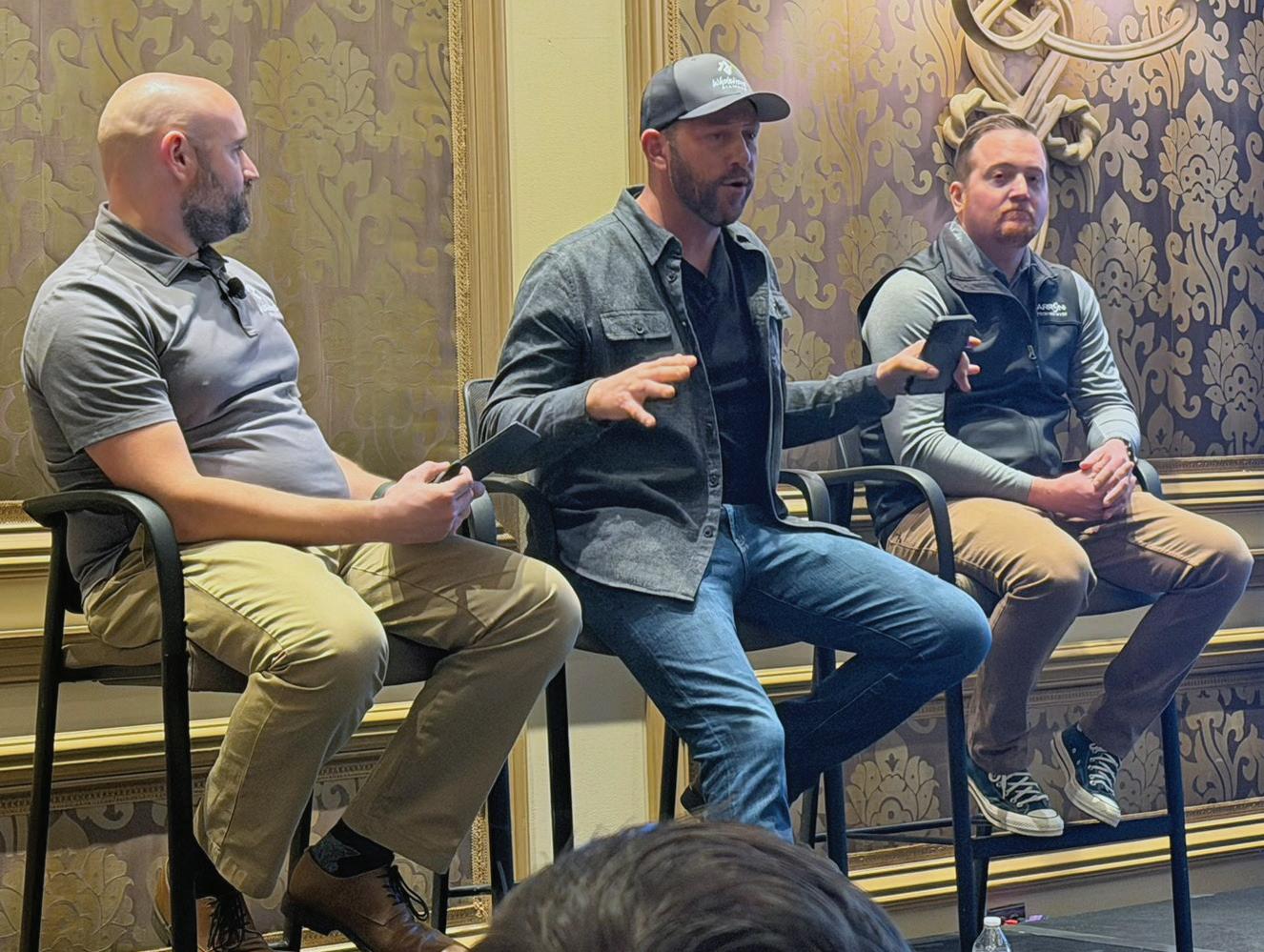
◀ A panel featuring Brad Barron (right), Dave Marrs (center), and Josh Burdick (left) explored how contractors can grow from a single-trade business into a multi-trade operation without acquisitions or outside investors. Using Barron Heating AC Electrical & Plumbing’s expansion into a $45 million company as a case study, the session covered using authentic video storytelling to build trust, generate leads, support recruiting, and drive long-term growth.
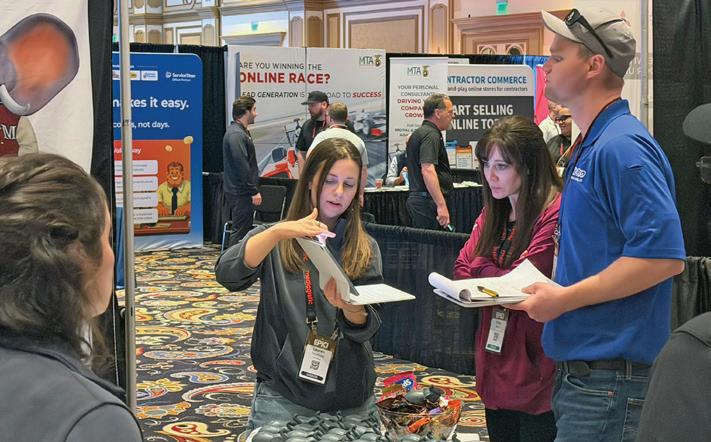
▲ EPIC 2026 attendees interact with vendors on the show floor.
▲ Ryan Leak’s keynote on personal and professional growth emphasized goal setting, self-awareness, leadership development, and building momentum through better decisionmaking.
ACCA 2026 Draws Record HVACR Contractor Attendance in Las Vegas
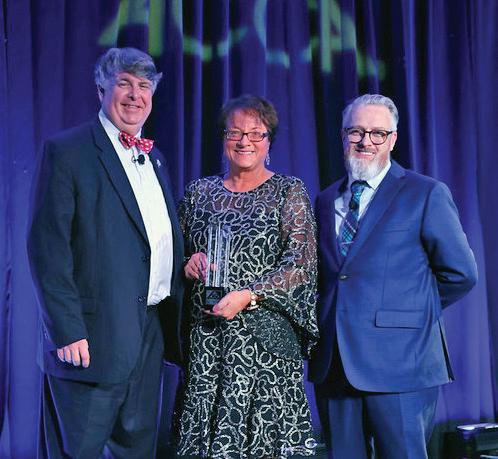
▲ Colony Air Conditioning & Heating, The Colony, Texas, was named ACCA’s 2026 Residential Contractor of the Year.
LAS VEGAS—Nearly 1,000 contractors and HVACR industry professionals gathered in Las Vegas for ACCA 2026. The four-day event, held March 15-18 at Caesars Palace, delivered record contractor attendance, according to ACCA. Industry leaders, vendors, and strategic partners from across the country also attended.
ACCA said the 2026 expo hall sold out in 2025 and generated a wait list of nearly 100
companies seeking exhibit space.
Educational sessions focused on operational challenges and growth opportunities for contractors. Topics included AI-powered call centers, lead generation, scaling operations, recruiting, employee retention, and technical training.
A special edition of Codes and Coffee LIVE offered attendees insights in major business pressures and opportunities fac-
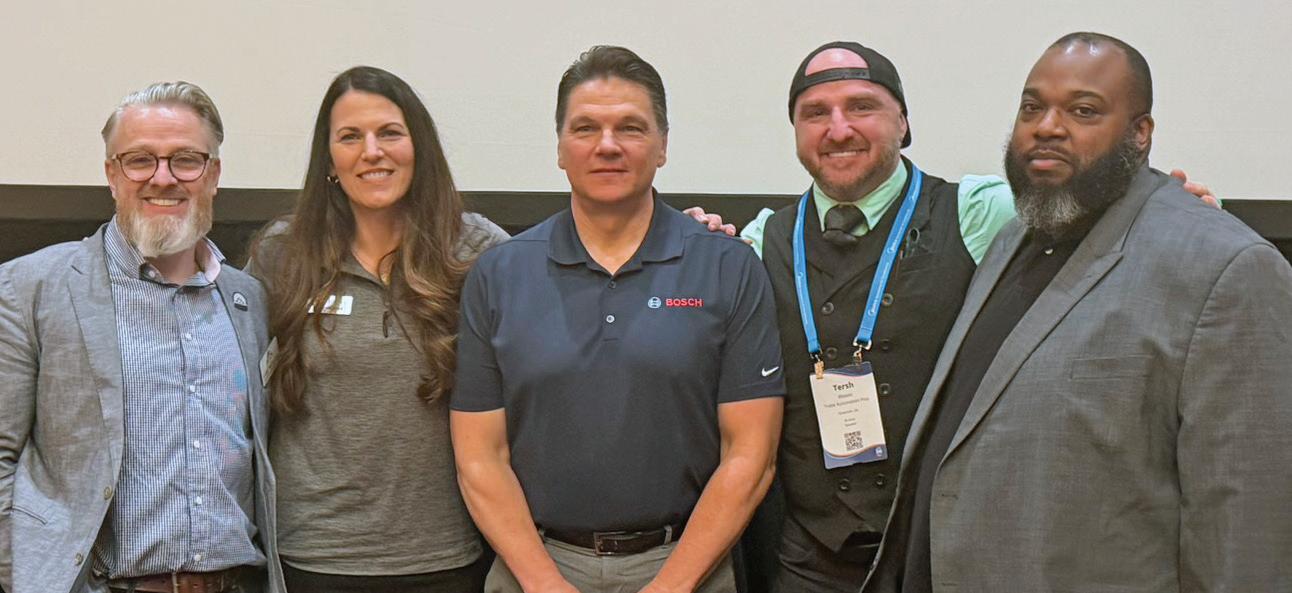
▲ ACCA 2026 Codes & Coffee Live Panel, from left to right: Eddie McFarlane, chief learning and development officer, Sila Services; Jennifer Butsch, senior director of regulatory affairs, Copeland; Chris Forth; vice president of regulatory, codes and environmental affairs, Johnson Controls; Tersh Blissett, co-founder and CEO, Trade Automation Pros; and Brynn Cooksey Sr, CEM, owner, Air Doctors Heating and Cooling and HVAC U (Building Scientists). The session was moderated by Wes Davis, director of technical services, and David Bixby, manager of codes for ACCA.
▶ Anthony Nash, network training manager at A-Gas, discussed the importance of responsible refrigerant recovery and reclamation at ACCA 2026. He noted that in 2024, only 11 million pounds of HFCs were reclaimed out of a 270-300 million pound annual demand in the U.S.
ing HVAC contractors, including affordability, regulation, energy efficiency, technology adoption, and workforce shortages.
A central theme was affordability, with the panel noting that inflation, tariffs, regulations, and rising equipment complexity are increasing system costs for both contractors and customers. They emphasized that while contractors cannot control external pricing pressures, they can improve internal
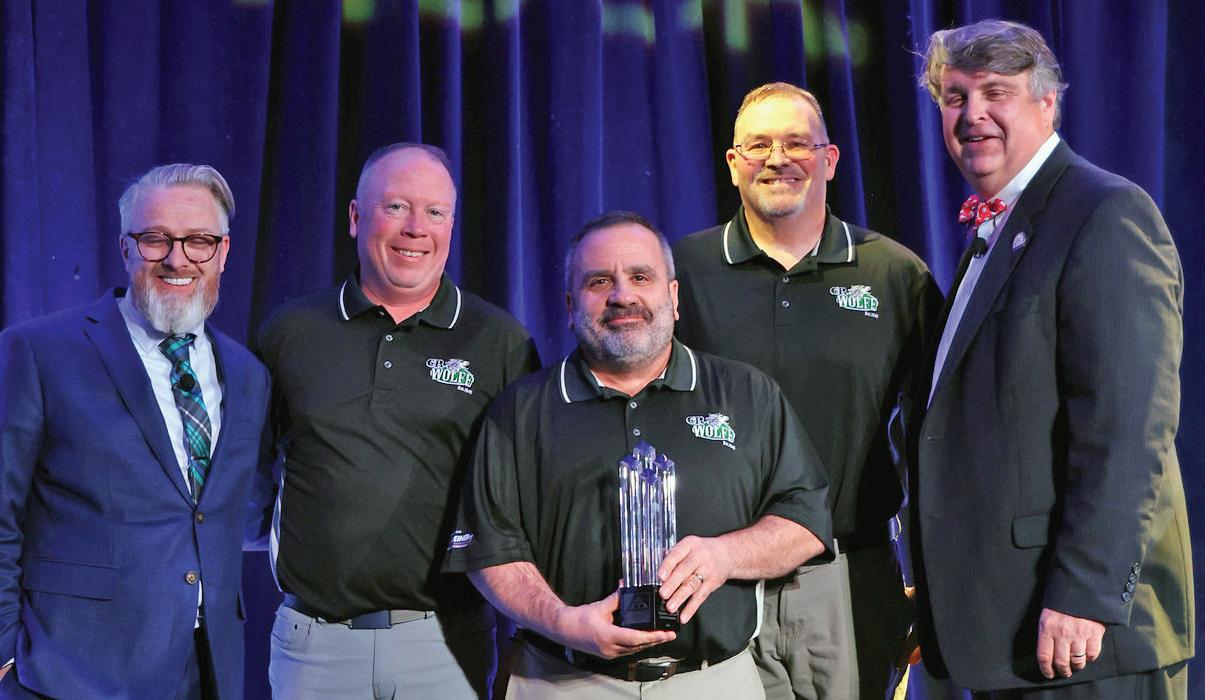
◀ C.R. Wolfe Heating Corp., Middletown, New York, was named ACCA’s 2026 Commercial Contractor of the Year.
business efficiency and educate customers on available rebates, financing, distributor incentives, and manufacturer programs.
“ACCA 2026 was everything we hoped it would be,” said Barton James, president and chief executive officer of ACCA, in a statement. He said contractor collaboration helps move the industry forward.
The conference also marked a leadership transition for ACCA’s Board of Directors. Kurt Hudson of LC Anderson, Inc. became board chair, succeeding Eddie McFarlane of Sila Services, LLC.
The new executive committee includes:
• Kurt Hudson, LC Anderson, board chair;
• Eddie McFarlane, Sila Services, immediate past chair;
• Matt Marsiglio, Flame Heating, Cooling, Plumbing, and Electrical, Senior vice chair;
• Tim Cropp, CroppMetcalfe, vice chair; and
• Vince Gillette, Gillette Air Conditioning Company, secretary/ treasurer.
ACCA also announced its 2026 award winners. Colony Air Conditioning & Heating of The Colony, Texas, received Residential Contractor of the Year honors. C.R. Wolfe Heating Corp of Middletown, New York, was named Commercial Contractor of the Year.
Looking ahead, ACCA said registration is open for ACCA 2027, scheduled for March 10-12, 2027, at Gaylord National Resort & Convention Center in National Harbor, Washington, D.C. Visit www.acca.org to register.
RectorSeal Acquires Duckt-Strip for Ductless HVAC Installations
HOUSTON —RectorSeal has acquired Duckt-Strip, a U.S.manufactured electrical cable designed for ductless HVAC system installations.
According to RectorSeal, the Duckt-Strip cable is engineered to simplify installation while meeting key safety and compliance requirements. The product features Rip-n-Strip technology, which integrates conductors into a single cable to support faster installation and reduce handling complexity for contractors.
The cable is designed to separate power and communication lines, helping minimize crosstalk that can impact ductless system performance. It is UL-listed and compliant with National Electrical Code Article 725.136, allowing for in-the-wall and through-the-wall applications.
RectorSeal stated that the acquisition aligns with its strategy to expand product offerings and strengthen its position in both established and emerging HVAC markets. The company plans to leverage its national distribution network to increase availability of the Duckt-Strip solution.
Jeff Underwood, president of RectorSeal, said the acquisition supports the company’s efforts to improve service levels and continue developing solutions for HVAC distributors and contractors.
Trane Opens 45,000-Square-Foot HVAC Training Center
DAVIDSON, North Carolina—Trane Technologies opened the Trane Advanced Technology Training Center, a 45,000-square-foot facility in Davidson, North Carolina, designed to expand hands-on training for commercial HVAC technicians.
Located at Trane Technologies’ North America headquarters, the site is intended to prepare technicians to work on increasingly connected, efficient, and complex building systems.
“The launch of the ATTC represents an important investment in the future of our industry,” said Holly Paeper, president, Commercial HVAC Americas, Trane Technologies. “As building systems become more connected, more efficient, and more sophisticated, the expertise required to service them continues to grow. This center empowers Trane’s technician network - the largest and most experienced in the world - to support these next-generation systems with confidence.”
According to Trane Technologies, the facility can train up to 4,500 students annually and deliver more than 100,000 training hours each year. Programs focus on commissioning, maintenance, repair, and optimization of commercial climate systems.
The center combines in-person laboratory instruction with digital learning modules, creating multiple training pathways for technicians at different career stages. The hybrid model is
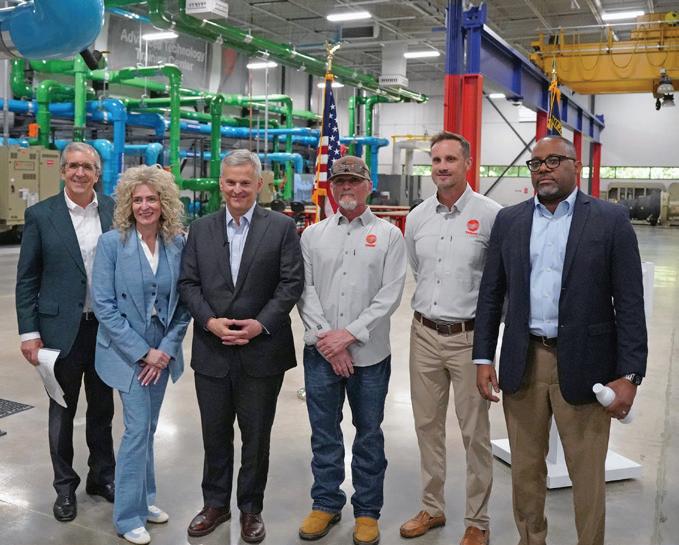
Technologies; Holly Paeper, president, Commercial HVAC Americas, Trane Technologies; Gov. Josh Stein (D-North Carolina); Jeff “Cledus” Payne, technician training leader, Trane Technologies; AJ Drury, digital training leader, Trane Technologies; Marlon Jones, technician experience leader, Trane Technologies, inside the Trane Advanced Technology Training Center (ATTC).
Technologies
designed to expand access to technical training across the United States while providing practical experience with newer HVAC technologies.
Trane said it invested more than $50 million during 2024 and 2025 in the new training center and an engineering and research lab for compressor development testing and full-scale chiller performance evaluation.
The company also said it expects to hire more than 1,000 additional technicians over the next 18 months. Its Trane Commercial HVAC Technician Apprenticeship Program, a four-year program accredited by the U.S. Department of Labor, has enrolled nearly 300 apprentices since launching in 2023.
Major HVAC Manufacturers Named in Price Fixing Lawsuit
DETROIT, Michigan—A class action complaint filed March 20, 2026, in the U.S. District Court for the Eastern District of Michigan alleges that major HVAC manufacturers conspired to fix equipment prices beginning in 2020.
The case, Berg v. Robert Bosch, names Bosch, Carrier, Trane, Lennox, Daikin, Rheem, and AAON as defendants who control over 90% of the market for HVAC equipment in the U.S. The lawsuit claims the defendants used coordinated price increases, information sharing, and “public signaling” to drive prices well above inflation and actual cost pressures.
The lawsuit argues that while the purchase of HVAC equipment is necessary, consumers and businesses have no ability to push back on soaring prices.
“We deny the allegations in the complaint and look forward to defending ourselves through the legal process. We take these matters seriously, but as this is ongoing litigation, we will not comment further at this time,” ” said K.D. Bryant, senior director of communications for Rheem Manufacturing.
Carrier issued the following statement: “We deny the baseless allegations in this lawsuit and will fight it vigorously. Carrier embraces competition and operates lawfully and with integrity. We have no further comments at this time.”
The litigation is expected to move through federal court, with potential implications for compliance standards and industry oversight.
From Left to Right: Dave Regnery, chair and CEO, Trane
Trane
A Legacy of Leadership and Integrity: Ray Isaac Joins HVAC Hall of Fame
Ray Isaac’s Hall of Fame induction reflects decades of valuesdriven leadership, growth, and industry impact.
As Ray Isaac is inducted into the 2026 Contracting Business HVAC Hall of Fame, the honor recognizes far more than a single career milestone—it celebrates a multigenerational legacy of leadership, integrity, and community impact.
As a third-generation leader of Isaac Heating & Air Conditioning, Ray Isaac helped transform a small, family-run business into a regional powerhouse while remaining grounded in the core values established by his grandfather. His journey reflects a rare balance of business success and humility, shaped not by the pursuit of accolades but by an unwavering commitment to people, culture, and doing the right thing.
Early Beginnings
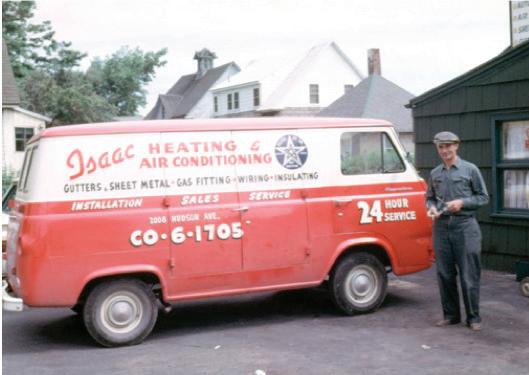
Ray Isaac traces the roots of Isaac Heating & Air Conditioning back to 1945, when his grandfather, George T. Isaac, left a union sheet metal job to start his own business despite having a young family to support. Originally named George T. Isaac Automatic Heating and Sheet Metal, the company focused on new home construction during the post–World War II housing boom, building a reputation on steady, disciplined growth rather than rapid expansion. He was also an early innovator in marketing, using branded service vehicles to promote the business, and was known for his creativity and entrepreneurial spirit, Ray Isaac notes.
After his grandfather’s passing in 1967, Ray Isaac’s father, Jim Isaac, took over the company alongside his brothers. Over time, ownership consolidated under Jim and one brother, and the business continued to grow. Ray Isaac himself entered the company at a young age, working in the field at 14 years old, and later balancing college with hands-on roles in the business. Eventually, Ray Isaac and his three brothers followed the same path as the previous generation, becoming co-owners and representing the third generation of leadership after purchasing the company in 2017. Under Ray Isaac’s leadership—beginning when he became general manager and vice president in 1996—the company experienced significant expansion, growing from roughly $6 million in revenue to nearly $70 million, building on the strong foundation established by prior generations.
Responsibility of a Name
Ray Isaac credits his father with instilling a strong sense of responsibility and work ethic from an early age by having him and his brothers start at the bottom and take on the toughest, least desirable jobs.
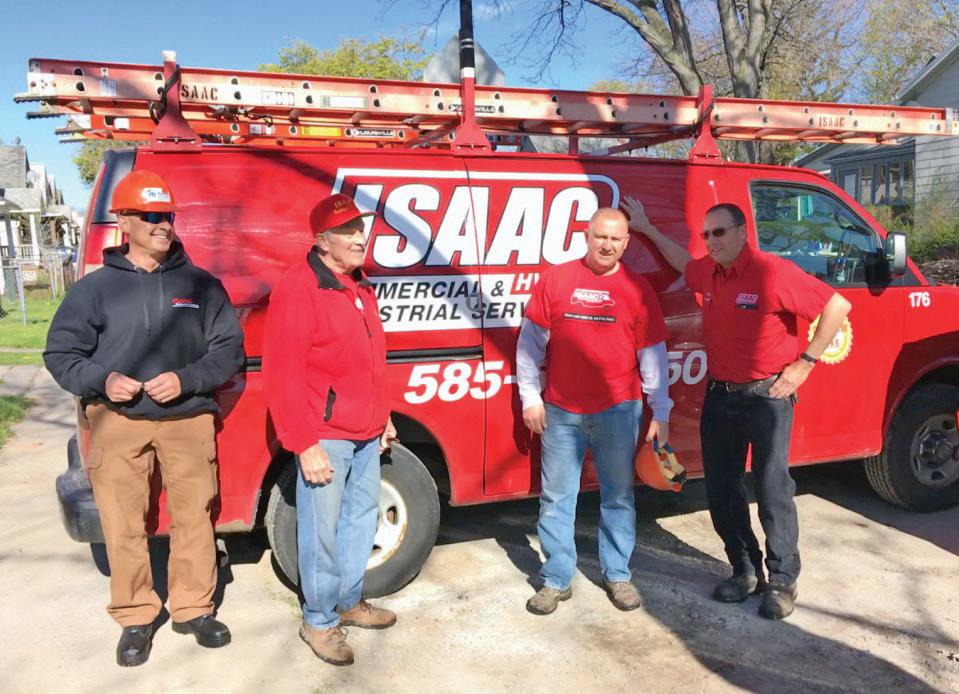
From Left to Right: Ken, Jim, Mike, and Dave Isaac at a Habitat for Humanity job. Jim Isaac installed the HVAC systems in over 100 houses for Habitat for Humanity over a 20-year span. He was recognized by ACCA with the Skip Snyder Award for his volunteerism.
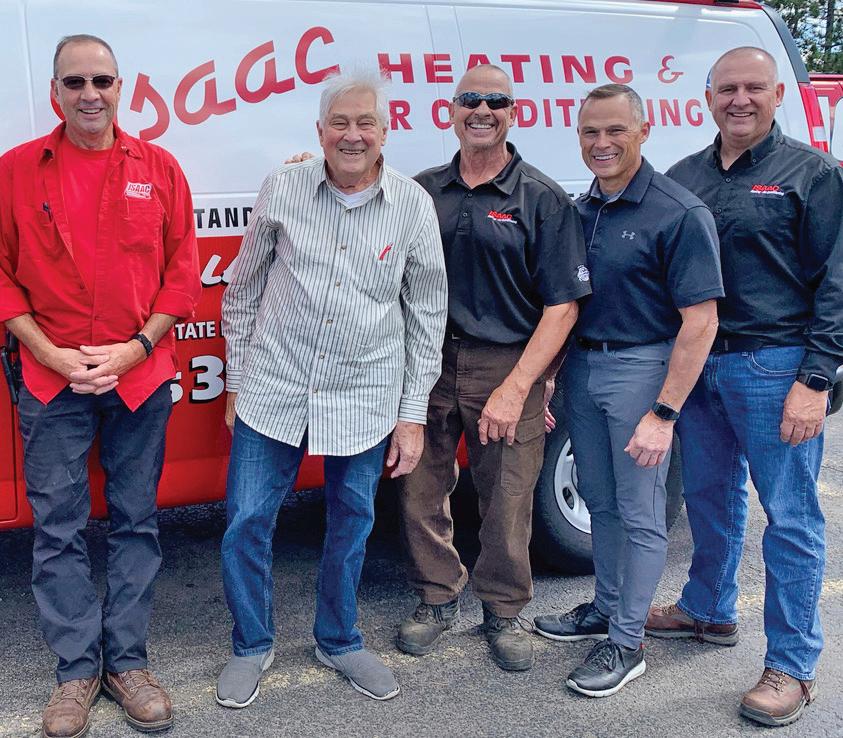
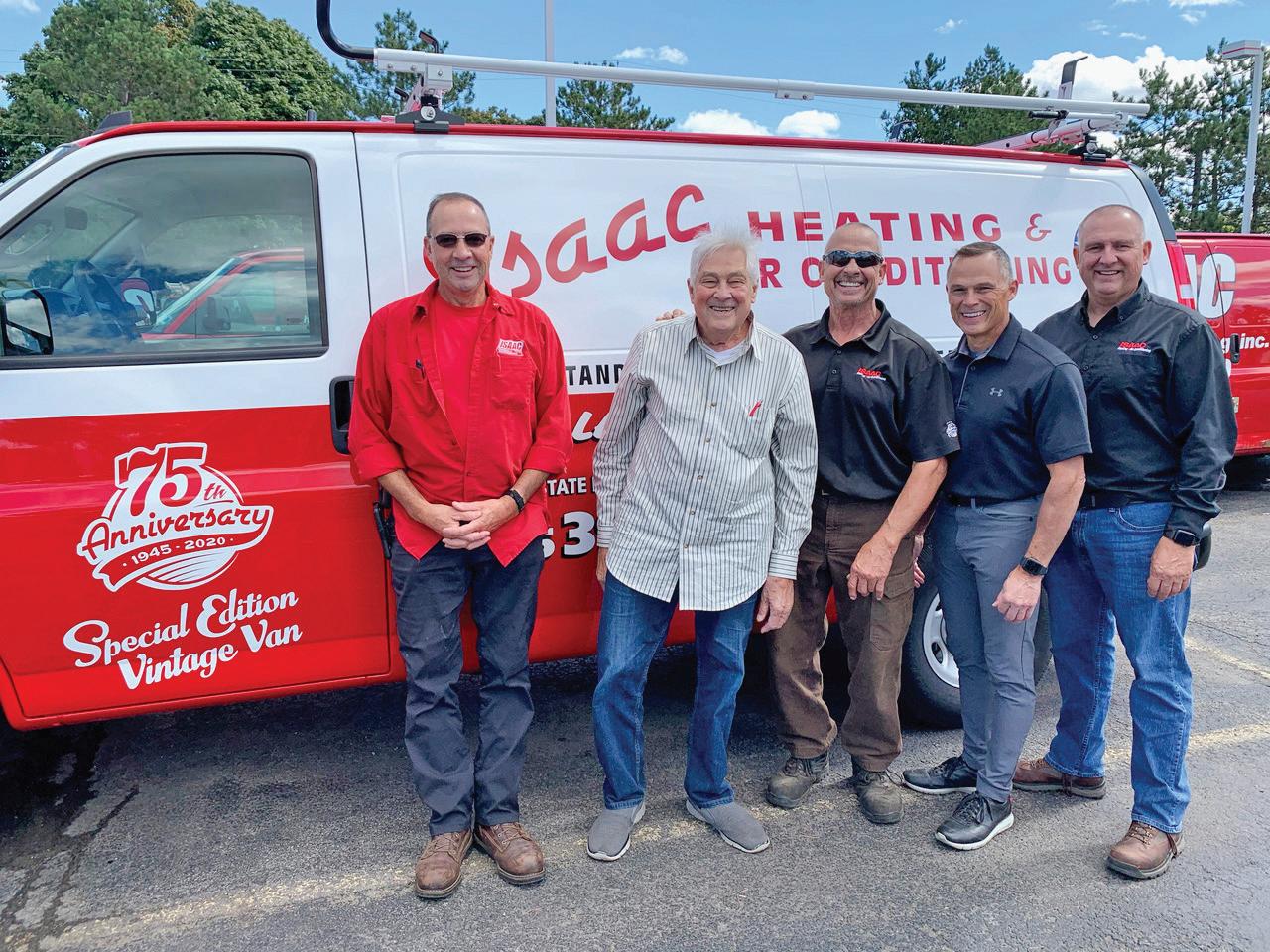
From Left to Right: Dave Isaac (brother), Jim Isaac, Ken Isaac (brother), Ray Isaac, and Mike Isaac (Ray’s twin brother).
George T. Isaac, founder of Isaac Heating & Air Conditioning, circa 1960.
Images courtesy of Ray Isaac
“He figured I couldn’t quit,” Ray Isaac says with a laugh.
Rather than granting privilege, his father emphasized that carrying the family name was an obligation—one that required accountability, integrity, and consistently upholding the company’s reputation in the community.
“My dad always said our last name was a responsibility—it’s a responsibility to have the same last name as the company. My grandfather, as I said, was inventive. He put his name on the business, and that was one of the most important, impactful things he did to signifiy we were going to run an ethical business. He signed his work every day by having his name on the company. You couldn’t run and hide from it—it’s not like ‘ABC Heating,’ where nobody knows who the owner is. In a small community like Rochester, it was pretty widely known that we owned the business. We always had to be on point, which was kind of tough as four boys growing up.”
Another principle instilled by his father was that compensation is based on performance, not position or lineage. “We weren’t all paid the same. Eventually, I was paid as president and CEO, but my one brother, David, who is probably the smartest in the group, was paid as a service technician.
This sets the stage for the rest of the employees in the company,” Ray Isaac notes.
Ray Isaac also reflects on how mentorship—from his father and industry peers from ACCA MIX Groups—helped guide his development, along with a pivotal realization that he could pursue his ambitions within the family business rather than outside it. That shift allowed him to avoid the “legacy trap” of entitlement and instead approach the business with ownership, innovation, and a commitment to growth.
Executing a Successful Exit
One of the most important things for a contracting business owner is planning the exit strategy. The next generation of Isaacs had no interest in the family business, so Ray Isaac and his brothers began looking at private equity partners.
“I think we did a really great job of scaring the hell out of them,” he says of the fourth-generation family members. “My one son is a dentist and a lieutenant in the Navy; my other son is in college and will probably be a pilot or maybe go into law enforcement. One of my nephews, Christopher, is still in the business—he’s an installer with us, but it would have been a difficult transition. The business had grown to a size where it would have been tough to acquire the financial resources.”
The sale, which took place in 2021, was a carefully planned, values-driven process centered on finding the right partner—not just the highest bidder, Ray Isaac stresses. After an extensive search, the company partnered with True Arc Partners, which
he says has exceeded expectations by supporting the family, employees, and community while avoiding the negative outcomes often associated with private equity.
Family alignment also played a critical role. The brothers had a long-standing agreement that any major decision—like selling the business—had to be unanimous, ensuring trust and preventing conflict. This approach helped them delay the sale when one brother wasn’t ready, ultimately leading to better timing and alignment.
Over time, Ray Isaac transitioned from CEO to executive vice president of industry relations, while his brothers eventually retired.
“They made up a title that makes me sound really important,” Ray Isaac says. “I define myself as the pure definition of irrelevant, but it is kind of nice. I’m having a blast. When you’re running a business, you get hammered with questions all day and every decision could have drastic consequences. Now, I get asked two questions: ‘Are you available,’ and ‘What do you think?’ I like that.”
Ray Isaac says that even though he’s no longer involved in day-to-day operations, he still feels a strong sense of responsibility to customers. When issues reach him directly, he steps in to ensure they’re addressed, maintaining the same level of accountability and care that defined his leadership.
He emphasizes that the sale didn’t fundamentally change the business—ownership shifted, but the company’s people, culture, and long-tenured employees remained intact. That continuity has reinforced confidence for both employees and customers.
Core Values Only Matter If You Live Them
Ray Isaac’s approach to running a successful HVAC company centers on culture, integrity, and people-first leadership. Rather than viewing competitors as threats, he saw them as partners in maintaining industry standards and customer trust—encouraging transparency by even directing customers to seek second opinions from trusted peers.
At the core of his philosophy is a steadfast commitment to clearly defined values that guide every decision, even when they may create a competitive disadvantage.
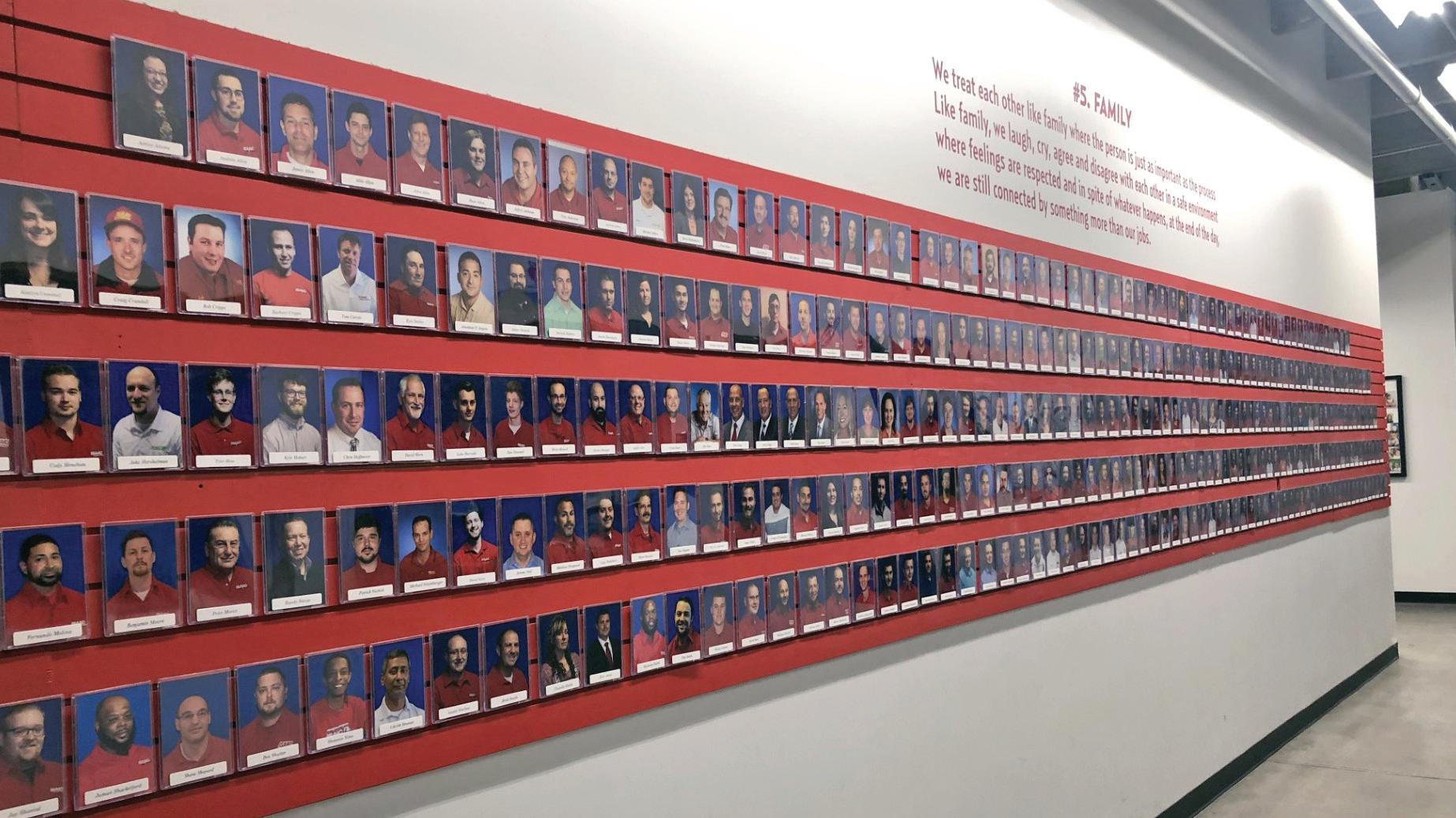
The Isaac Heating & Air Conditioning Employee Picture Board at the company headquarters in Rochester, New York.
Ray Isaac credits his father, Jim Isaac, with instilling a strong sense of responsibility and work ethic. Jim Isaac passed away in 2023.
“You have to walk the walk; you can’t just talk to talk,” Ray Isaac says. Ethics, in his view, come down to doing the right thing when no one is watching—whether that means replacing unseen subpar work or ensuring a repair is truly necessary.
Ray Isaac also notes that leadership is different from management, saying that while management focuses on processes and policies, leadership requires setting expectations, modeling behavior, and creating a culture rooted in safety, quality, and accountability. This includes a relentless pursuit of excellence—striving for perfection, even if it’s never fully achieved.
Isaac also developed a people-centric framework for business success. Growth and job satisfaction are equally critical, with expectations that employees execute, evolve in their roles, and genuinely enjoy their work.
He also stresses that employees don’t have to love the HVAC trade itself to build a fulfilling career—they can find meaning in the people they work with and the lifestyle the job supports. “I was always very open in saying that I don’t love heating and air conditioning—it wasn’t my joy. I love working with people. So through heating and air conditioning, through home services, I was able to meet a lot of people and enjoy that part of it. But it wasn’t like I was solving world hunger or creating world peace. I took a very different approach. And, I guess that was liberating for employees. I always tried to instill that people could have a wonderful career, love the people they work with, love being outside, and love all the things about it without necessarily loving heating and air conditioning.”
No Regrets
“We just celebrated 80 years in business last year, and it’s been a great ride,” Ray Isaac says. “There’s not one point that I can look back and say we made the wrong decision.”
He is humble about his career, noting that it’s been a group effort.
“Isaac has been tremendously successful, and I can’t take the credit for that,” he says. “It’s our team that has grown it even beyond what we thought was possible. And they’ve continued to grow these last five years. All you can do after you’re gone is
hope that you’ve made a positive influence on it. I’m at a place in my life where I’m happy and comfortable, and I can look back without any regrets.”
Reflecting on his HVAC Hall of Fame induction, Ray Isaac says, “It means I’m old. It’s nice to be recognized, but you don’t do what you do for the recognition. It is an honor, and I’m happy to be counted
amongst some of the greats.”
While honored by the recognition, Isaac views it not as a goal achieved, but as a meaningful acknowledgment of a career built on relationships, continuous learning, and doing the right thing. In the end, he says, it’s those connections—and the lives touched along the way—that matter most.
Next Level Comfort
Greenheck is leveraging decades of HVAC equipment engineering expertise to evolve commercial building comfort. With efficient, adaptable products like dedicated outdoor air systems, energy recovery ventilators, and our newest line of rooftop units, Greenheck is more than a fan company. We’re solving the ventilation challenges of today’s buildings, raising expectations to the next level.
LEARN MORE
2026 COMMERCIAL COOLING GUIDE HVAC Equipment Driving Performance and Savings
As commercial HVAC projects grow more complex and efficiency standards continue to evolve, contractors need access to the latest cooling technologies to stay competitive. Contracting Business’ 2026 Commercial Cooling Guide highlights the newest commercial cooling products entering the market, from advanced chillers and dual fuel rooftop systems to heat rejection solutions. Designed to deliver improved performance, energy savings, and simplified installation, these products reflect the industry’s ongoing push toward smarter, more sustainable HVAC systems. Scroll through the gallery to see the latest commercial HVAC products in the market.
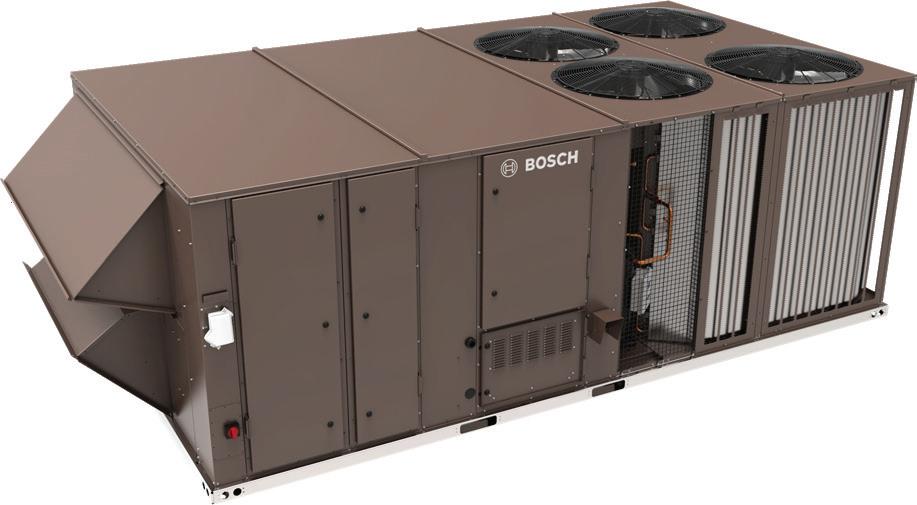
Bosch Home Comfort Group
The Bosch Choice Dual Fuel Rooftop Unit (RTU) combines a heat pump with a gas or propane furnace to deliver efficient,
year-round heating and cooling. Available in a 12.5-25-ton capacity range, units feature a direct-drive plenum fan that enhances efficiency, simplifies service, speeds commissioning, and expands airflow capability. Units are engineered with embedded intelligence and customizable settings can be programmed to the unique operational goals of a facility. The controls allow operators to set a balance point to determine the outside temperature at which the system will transition between heat pump and gas heat, which maximizes both comfort and efficiency.
Choice Dual Fuel RTUs also offer built-in reliability, including backup heat and an optional hot gas reheat (HGRH) to help control humidity. A dual-circuit refrigerant design ensures continued operation at up to 50% capacity in the event of a leak or compressor issue, minimizing downtime until the unit can be serviced.
Bosch Choice Dual Fuel RTUs are an ideal fit for offices, schools, medical and outpatient centers, and retail stores. www.bosch-homecomfort.com/us
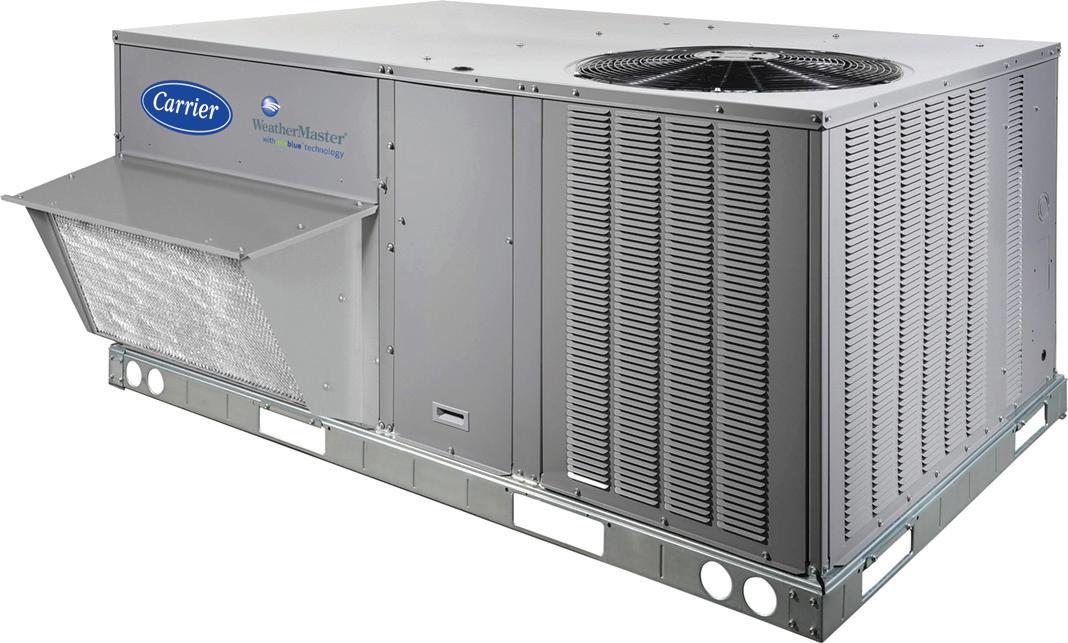
Carrier
The 48QE dual fuel units are available from 3-25 nominal tons. The new design utilizes the electric heat pump as the primary heating source in milder conditions and switches to a natural gas furnace for auxiliary heating when temperatures drop significantly. The hybrid system automatically selects the most
efficient heat source based on outdoor temperature to ensure occupant comfort.
48QE units can use both electric heat pump and gas heat simultaneously or switch between the two heating sources, helping to ensure optimal performance and lower energy consumption. Units can operate as a heat pump, hybrid heat unit, or as a gas heat unit. www.carrier.com/us/en
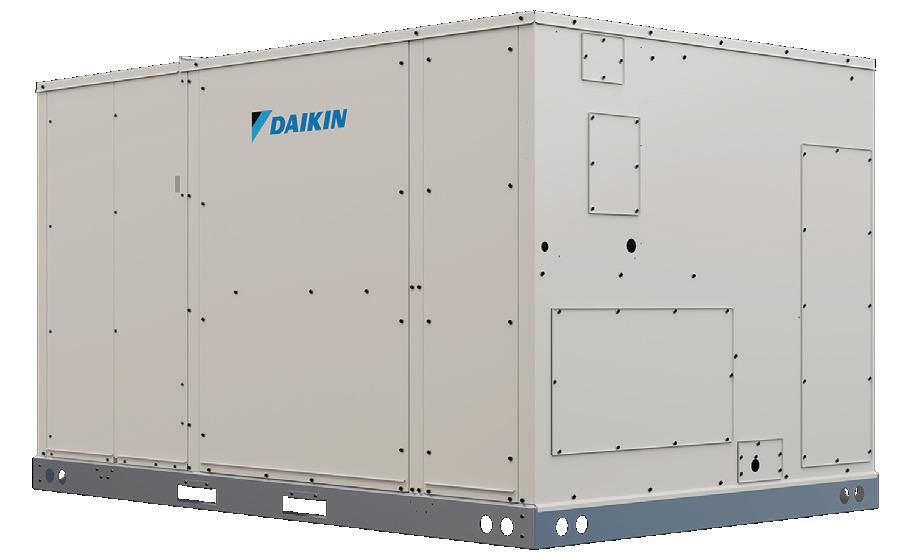
Daikin
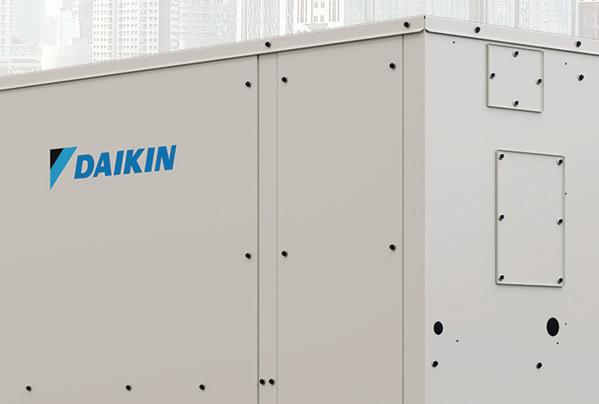
R-32 Daikin NEXIO MAX inverter packaged rooftop heat pumps deliver a sustainable solution and a flexible replacement for light commercial applications. Powered by low-GWP R-32, a direct-drive ECM motor, and Daikin’s variable-speed inverter technology, NEXIO Max maximizes energy savings through continuous operation instead of staged cycling. The inverter compressor with vapor injection delivers excellent capacity modulation and part-load efficiency, plus strong low-ambient heating performance. In colder conditions, heating capacity is maintained – ideal for electrification applications.
For improved comfort, humidity control, and efficiency, the standard single-zone VAV (SZVAV) brings fully modulating airflow with an ECM fan. It delivers up to 22 IEER, with up to 3.85 COP at 47° F and up to 2.5 COP at 17° F.
Daikin NEXIO Max fits common RTU footprints without a curb adapter. It maintains curb and duct compatibility to reduce installation cost and complexity. Commissioning is simplified with factory-wired, labeled connections. An open-access design provides faster servicing and reduced downtime. Integrated Power Protection (phase monitoring) helps prevent component damage, reduce downtime, and service issues, and improve system reliability.
With native BACnet Integration, NEXIO Max provides seamless connection to building management systems with real-time monitoring and control. It comes fully optimized with
Daikin controls, with support for third-party thermostats.
Inverter-driven compressors enable smooth, low-noise operation, while reduced cycling minimizes sound fluctuations. Direct-drive fans eliminate belt noise and reduce maintenance. For quieter performance, components are vibration-isolated. Available in 7.5– to 10 tons, up to 114,000 Btu/h. daikincomfort.com
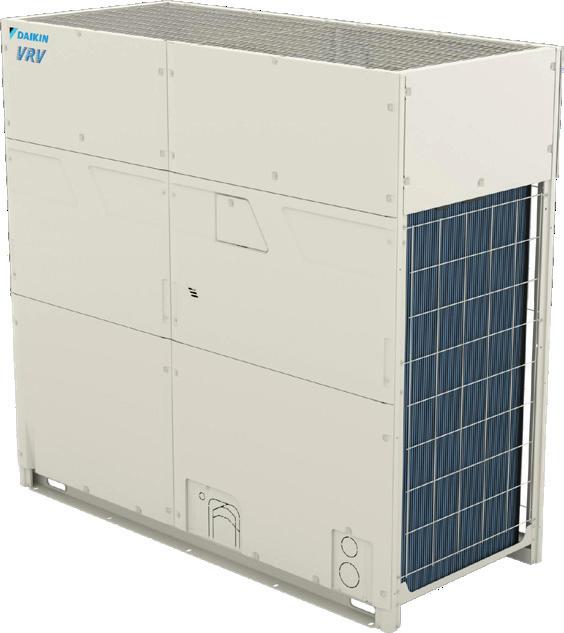
Daikin VRV
The new R-32 Daikin VRV EMERION heat pump and heat recovery models simplify installation, maintenance, and monitoring. Available from 6 to 40 tons, these redesigned systems help reduce installation and commissioning time using an auto address feature with D4 communications protocol (compared to previous R-410A systems). New D4 net provides larger data volume and faster communication speeds—up to 30 times faster, compared to D3 net, the company says.
A new remote option allows data retrieval and field-setting changes from anywhere—no room access needed. Store up to 40 minutes of operational data in the built-in recorder. A convenient dropdown, electrical box service window provides quick access to configuration buttons and a multi-functional display showing refrigerant pressures and temperatures. Mechanical, electrical, and airflow sections are quickly removed. VRV EMERION integrates seamlessly with the powerful Daikin HERO remote monitoring and diagnostics platform. Systems are future-proofed, offering connectivity to an ever-expanding catalogue of controls, ventilation, and indoor units.
Larger capacity single-module units dramatically reduce space required for mechanical equipment, while minimizing electrical and piping connections. Supports up to 361 ft. of vertical separation, with possibilities up to 720 ft. For phased installation or tenant fit-out, systems can be expanded from single- to dualmodule without changes to installed main pipe sizes.
Improved VRT technology delivers efficiencies up to 24.2 IEER and 3.80 COP, covering an expansive ambient temperature range, from -22° F to 122° F. Easy to reuse, reclaim, or recycle R-32, a lower-GWP refrigerant, improves efficiency and lowers systems charge compared to previous R-410A systems.
Inverter-driven, variable-speed scroll compressors run quietly, down to 58 dB(A). www.daikincomfort.com
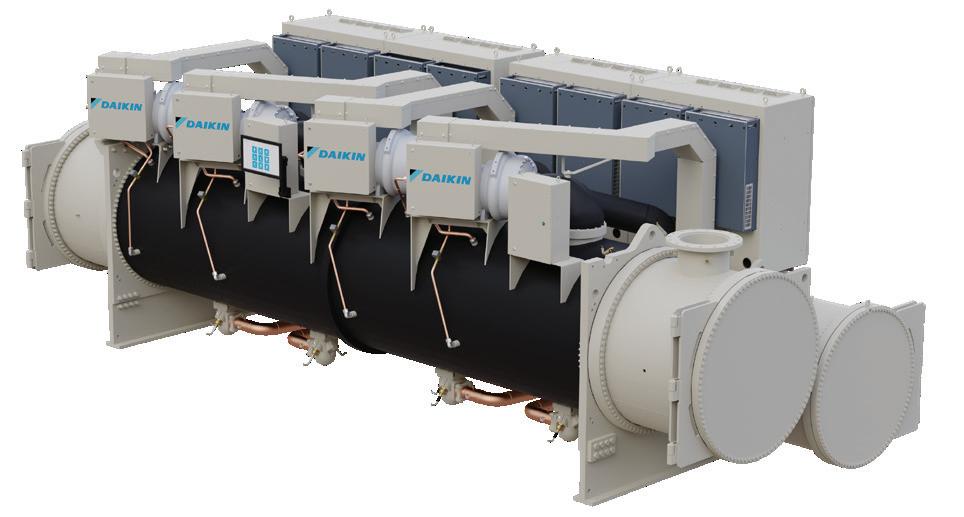
Daikin Applied
Daikin Applied’s Magnitude WME-C Quad is its largestcapacity water-cooled centrifugal chiller, delivering 2,000 to 3,000 tons of cooling for mission-critical indoor environments
like hyperscale data centers and large-scale comfort cooling applications. Paired with a low-GWP refrigerant, R-513A or R-515B, the WME-C Quad incorporates a dual-circuit series counter-flow design with four oil-free compressors, providing outstanding redundancy, turndown and efficient part-load operation.
The WME-C Quad supports condenser leaving water temperatures up to 130° F for heating applications and offers inverted operations designed to limit or eliminate the need for water-side economizers. The design can also limit or eliminate the need for chilled water storage for a simple system design. With up to 40% energy savings compared to traditional fixedspeed, oil-lubricated chillers, the WME-C Quad offers energy efficiency and low cost of ownership, the company says.
Key features include Daikin-exclusive RideThrough, which can maintain operation during short power outages, and RapidRestore, which can restart the chiller within 45 seconds after power loss, helping ensure continuous operation in critical facilities. Its combination of high capacity, compact footprint and flexible design makes it ideal for both retrofits and new construction. www.daikinapplied.com
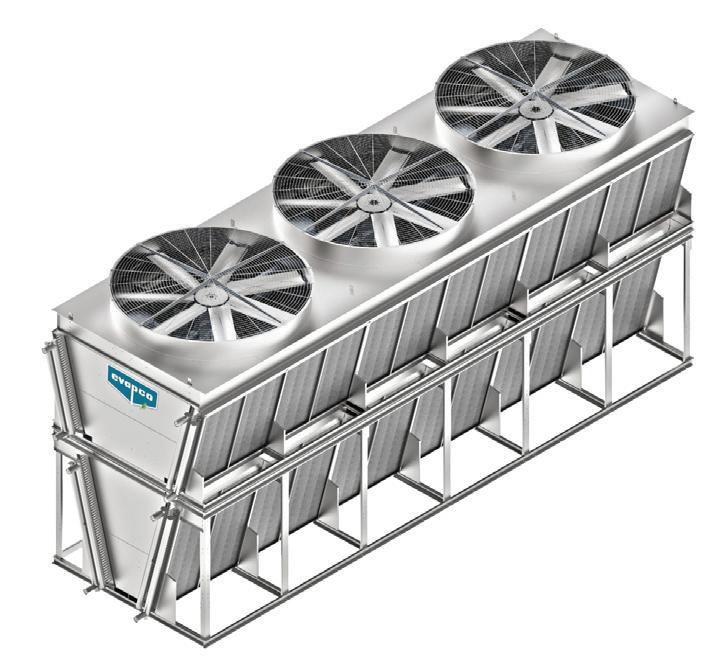
EVAPCO
The EVAPCO eco-Air APEX Dry Cooler is designed to deliver the highest heat rejection density, allowing large projects to operate with fewer units, a smaller installation footprint, and reduced piping and electrical connections. Its performance is independently certified, with all units meeting CTI Standard STD-201 and backed by EVAPCO’s exclusive 100% thermal performance guarantee. Built for superior durability and corrosion resistance, the system features high-grade Type 304L stainless steel tubing and heavy-gauge aluminum fins as standard, with coils manufactured in-house to ensure consistent quality.
and service platforms, and a single-point PLC/VFD control panel that is factory-wired for plug-and-play operation and faster commissioning. Maintenance is also streamlined, as the unit requires no water-related upkeep or treatment and includes oversized access doors and standard platforms to facilitate routine service. The eco-Air APEX is available for immediate specification and ordering through authorized EVAPCO representatives. www.evapco.com
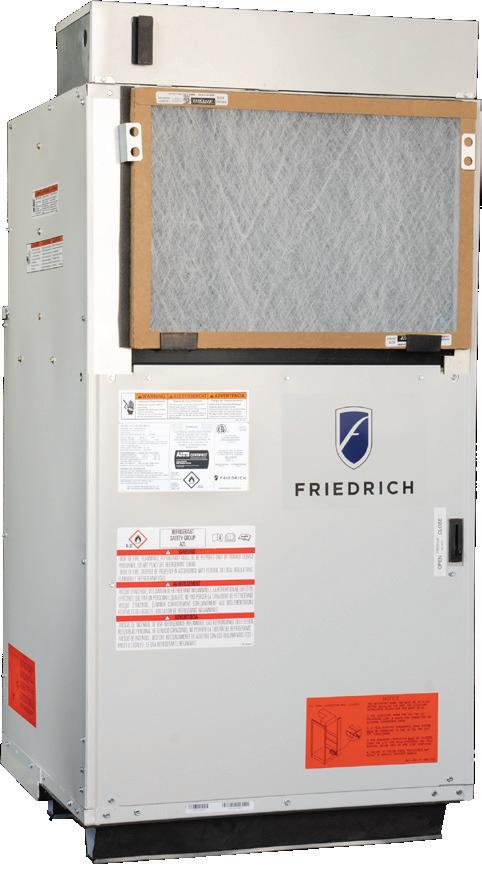
Friedrich Air Conditioning
The Friedrich Vert-IPak (Vertical Packaged Terminal Air Conditioner) offers HVAC professionals a streamlined, highperformance solution for conditioning suites, multi-family housing, and light commercial spaces without the limitations of traditional throughthe-wall units. Designed for closet or ducted installation, the Vert-I-Pak keeps equipment out of sight, delivering a cleaner aesthetic while improving occupant comfort.
Installation and startup are simplified through a threesegment shipping design, along with factory-mounted controls
Available in cooling capacities from 9,400 to 22,600 Btu, this single-package heat pump system is engineered for efficiency and quiet operation. A free-floating chassis, vibration-isolating components, and gasketed plenum design minimize sound transmission, making it ideal for hospitality and environments where noise control is critical.
The Vert-I-Pak supports environmental goals through heat pump operation down to 10° F, low ambient performance with active defrost, and reduced reliance on electric resistance heat. All models comply with A2L refrigerant standards, using R-32 for improved efficiency and a lower environmental impact. Contractors benefit from a fully packaged, precharged, and prewired system that simplifies installation, with flexible mounting from the front, left, or right side.
Advanced connectivity options include compatibility with wired or wireless thermostats and energy management systems featuring occupancy sensing, remote access, and BACnet integration. Additional durability features, such as Diamonblue corrosion protection and robust condensate management, enhance long-term reliability. Backed by a strong warranty and nationwide support network, the Vert-I-Pak delivers dependable performance with reduced lifecycle costs. www.friedrich.com
GE Air & Water Solutions
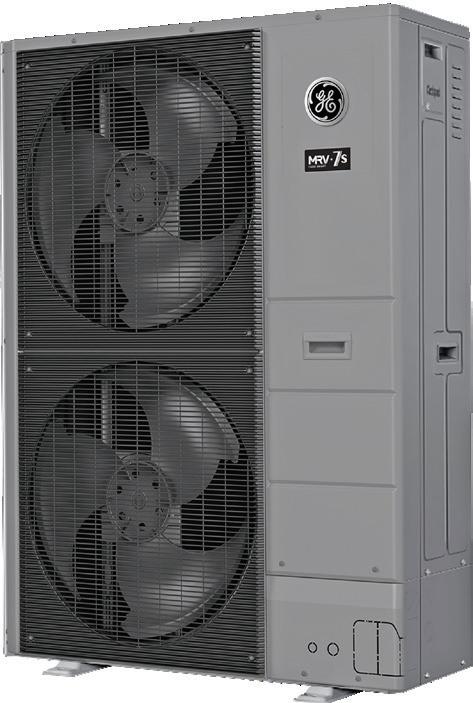
The MRV-7S from GE Appliances Air & Water Solutions is engineered to deliver high-performance, flexible commercial
cooling and heating in a diverse array of applications. The system maintains 100% heating capacity at 5° F, supporting reliable yearround comfort.
Designed with versatility in mind, MRV-7S is a single-phase module 3-5 tons, with flexible piping lengths compatible with multiple indoor unit styles. The system is well-suited for phased retrofits, mixed-use properties, and buildings with tight mechanical space constraints.
Installation is further streamlined through GE Appliances’ MRV-Link wireless communication network, which replaces traditional daisy-chain wiring between indoor units. By eliminating the need to run communication cables throughout the building, MRV-Link helps reduce labor time and simplifies future system modifications or expansions.
The MRV-7S uses R-32 refrigerant, supporting improved efficiency and a lower environmental impact compared to legacy refrigerants. As part of GE Appliances’ broader MRV-7 VRF platform, which includes 3-phase MRV-7, a modular and combined system capable of up to 38 tons of high-capacity units, the system provides contractors with a scalable, adaptable solution to address evolving project requirements while improving installation efficiency. www.geappliancesairandwater.com
GENERAL HVAC America
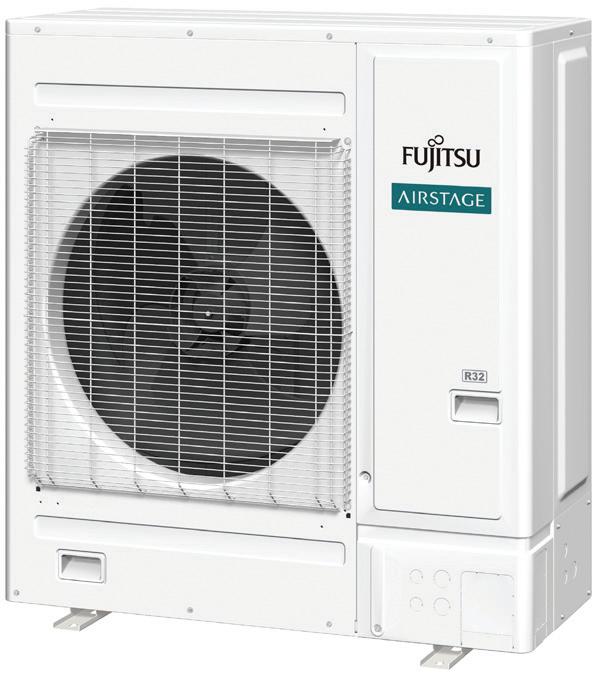
The AIRSTAGE J-7s light commercial VRF systems, by General HVAC Solutions America, Inc. (formerly Fujitsu General America, Inc.), are available in 2-, 3- and 4-ton models. Utilizing the low GWP R-32 refrigerant, the new models offer greater installation flexibility, improved efficiency, and more compact cabinets than Fujitsu’s previous single-phase offerings. Certified energy efficiency ratings reach up to 15.7 for EER2, 22.2 for SEER2, 11.3 for HSPF2, and 4.64 for COP2. Optimized for a wide range of climates, AIRSTAGE J-7s systems operate reliably in outdoor temperatures from -15° F to 70° F in heating mode, and 23° F to 122° F in cooling mode. A built-in base pan heater ensures reliable winter performance. Most models are
ENERGY STAR and ENERGY STAR Cold Climate certified. The new heat pumps feature a 16% smaller footprint than earlier models, reducing mechanical space constraints. A single outdoor unit supports up to 12 indoor units for versatile zoning. To support an extensive variety of system designs, the 4-ton unit allows a maximum total equivalent pipe length of 393 feet. A 50% to 130% system connection ratio on 3- and 4-ton models enhances load matching for varying project needs. Factory refrigerant charge is limited to 5.95 pounds across all models, simplifying regulatory compliance. Despite an impressive outdoor fan static pressure capability of 0.12” W.C., sound levels remain as low as 52 dB(A). www.general-hvac.com
Lennox
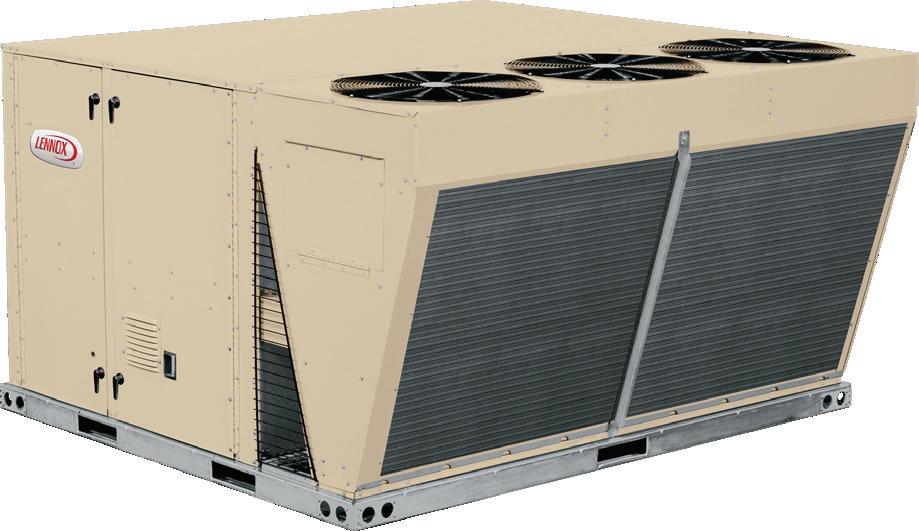
Strategos Variable Speed Heat Pump rooftop units combine advanced variable-speed technology with intelligent controls to provide a smarter, more sustainable approach to rooftop heating and cooling. By automatically adjusting capacity to match building demand, Strategos optimizes energy use, enhances comfort and helps lower total cost of ownership over the life of the equipment.
Built for a wide range of commercial applications— including schools, retail spaces, office buildings, warehouses
and healthcare facilities. Its retrofit-ready design features backwards electrical compatibility, reducing the need for extensive rewiring or infrastructure changes during installation. Flexible heating configurations, including heat pump and dual fuel options, allow the system to adapt to different building needs and climates while supporting the transition to electrified HVAC solutions.
Strategos delivers high efficiency with ratings up to 22.5 IEER and 17.0 SEER2, helping building owners reduce energy consumption and operating costs. Advanced system intelligence, including the Lennox CORE Control System and an intelligent defrost algorithm, ensures precise temperature control and consistent comfort across a wide range of conditions.
Technicians also benefit from enhanced serviceability. The CORE Controller and CORE Service App provide realtime system insights, including live temperature readings, unit status and system alerts, allowing faster diagnostics and quicker resolution without the need for additional tools. www.lennox.com/commercial
Mitsubishi Electric
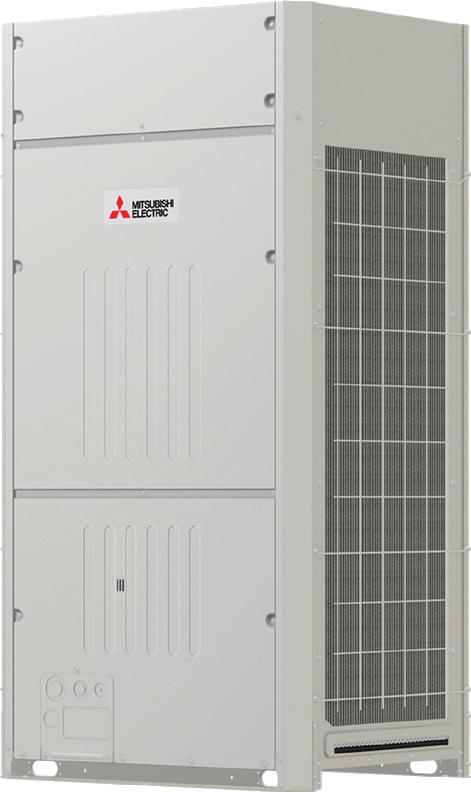
The PURY-HM outdoor unit from Mitsubishi Electric is a high efficiency CITY MULTI R2 Series heat recovery system designed to provide simultaneous heating and cooling for multi-zone commercial applications. When paired with Branch Circuit Controllers, the PURYHM enables precise delivery of hot gas for heating and liquid refrigerant for cooling through a shared two-pipe network, allowing each zone to operate independently based on demand. Available in a broad range of capacities, the PURY-HM supports scalable system design, efficient energy transfer between zones, and reliable year-round comfort for buildings with diverse and continuously changing load requirements.
Outdoor units are equipped with a new 3-way Vertical Flat Tube Heat Exchanger. This patented technology improves efficiency, reduces refrigerant charge, and improves serviceability. When switching from cooling to heating mode, there is no need to stop the compressor.
The outdoor unit’s scroll compressor has multiple discharge ports to enhance part-load efficiency and minimize overcompression loss. www.mitsubishicomfort.com/commercial
Rheem
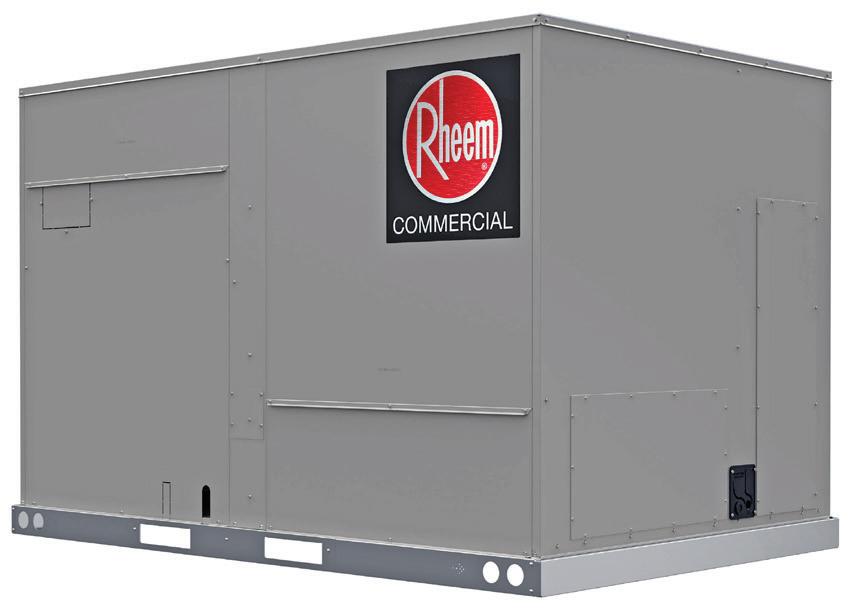
The Rheem Renaissance Commercial Classic Plus Packaged Heat Pump line delivers high-efficiency performance in 3- to 10 -ton capacities, combining intuitive design with advanced technology to meet the demands of today’s commercial applications. Designed for versatility, these units feature fieldconvertible airflow for both heating and cooling, making them well-suited for new construction and replacement projects across a wide range of commercial and industrial buildings.
Engineered to provide long-term value for both building owners and contractors, the lineup balances ease of installation, serviceability, reliability, and performance to drive
comfort and return on investment from day one. Units in the 3to 5 -ton range deliver up to 11 EER2, 16.1 SEER2, and 7.2 HSPF2, while 6.5 - to 10 -ton models achieve up to 12 EER, 17.6 IEER, and up to 3.6 COP at 47° F and 2.5 COP at 17° F.
With industry-standard footprints and connections, the units allow straightforward replacement without curb adapters, reducing installation time and cost. Features include up to three stages of cooling, four stages of heating, MicroChannel coils, and an advanced factory-configured unitary controller with LCD display that simplifies setup and commissioning. The controller supports fault detection and diagnostics, is BACnet MS/TP and IP native for seamless integration with third-party, cloud-based BAS systems, and integrates seamlessly with economizer and zone sensor control.
Built in Fort Smith, Arkansas, and available in early 2026, the line meets evolving efficiency codes—including California Title 24 (2025)—while delivering reliable comfort and a lower total cost of ownership. www.rheem.com
TRANE
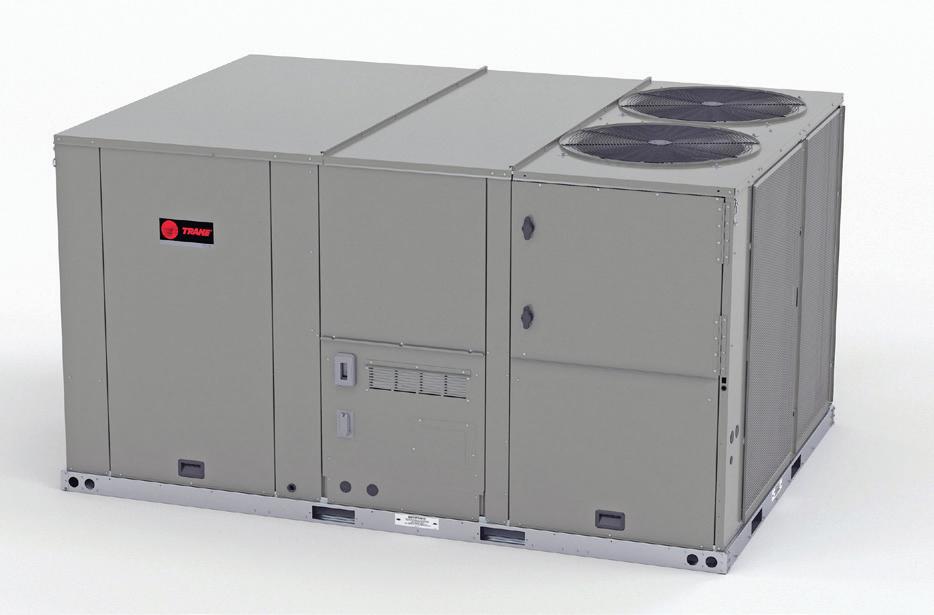
Trane Precedent Heat Pump Rooftop Units deliver dependable, energy-efficient comfort for light commercial buildings with flexible installation options. Available in capacities ranging from 3 to 25 tons, these packaged rooftop systems integrate heating, cooling, and ventilation in a compact, service-friendly design ideal for schools, retail spaces, offices, and other light commercial applications.
Precedent models are available as all-electric heat pumps or hybrid dual fuel configurations, giving building owners the flexibility to choose the solution that best matches their energy strategy, climate needs, and sustainability goals. Both standard efficiency and high efficiency tiers are offered, allowing customers to balance performance, operational cost, and regulatory requirements.
A wide range of factory-installed options and configurable controls allow users to tailor operation to specific application needs. Available enhancements include: modulating hot gas reheat, 10:1 modulating gas heat, single-zone and true multiple-zone VAV capabilities, power exhaust, economizers, advanced filtration, and other options. Precedent units are also compatible with modern building automation systems for smarter, data-driven performance.
A defining feature is the integration of the Symbio 700 controller, which provides advanced digital controls, remote monitoring, and service diagnostics. This enables improved system optimization, simplified commissioning, and enhanced lifecycle performance.
High demand Precedent models are stocked locally for same day pickup or fast shipment from more than 30 express warehouse locations. When a project requires a configured solution, customized Precedent units can ship in less than four weeks with standard delivery—or even faster with quick ship options, delivering units in two to three weeks. www.trane.com
YORK
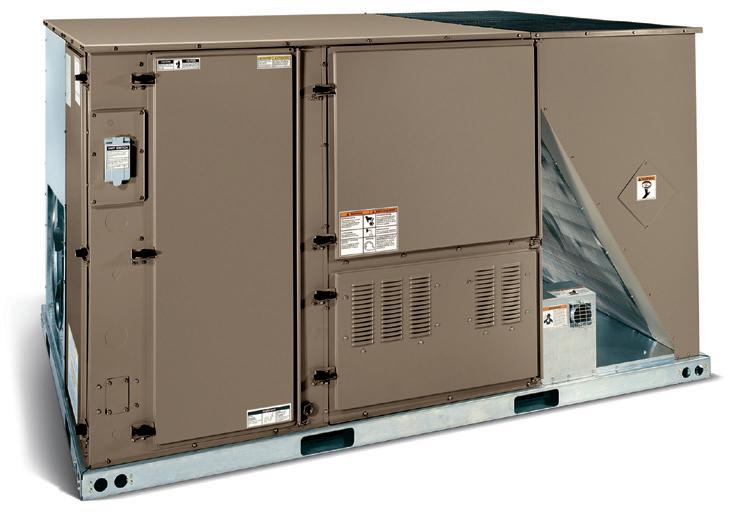
The YORK Sun Pro Dual Fuel Rooftop Unit (RTU) is available in a 6.5–12.5-ton capacity range and combines a heat pump with a gas or propane furnace to deliver efficient, year-round heating and cooling. Designed for a wide range of light commercial applications, it helps building owners in colder climates reduce utility costs and gas emissions while supporting long-term energy goals. Units are engineered with embedded intelligence and customizable settings can be programmed to the unique operational goals of a facility. The controls allow operators to set a balance point to determine the outside temperature at which the system will transition between heat pump and gas heat, which maximizes both comfort and efficiency.
Built for reliability, the unit includes backup heat and optional hot gas reheat (HGRH) to help control humidity. A dual-circuit refrigerant design ensures continued operation at up to 50% capacity in the event of a leak or compressor issue, minimizing downtime until the unit can be serviced.
The Pro model is designed for easy serviceability with a slide-out blower and hinged panels for tool-less access. The units also come fully factory-charged, wired, piped and tested for fast field installation, simplifying service and commissioning for technicians.
Pro Dual Fuel RTUs are an ideal fit for offices, schools, hospitals, retail centers, and hospitality spaces. YORK® Sun™ Pro Dual Fuel RTUs offer the perfect combination of serviceability, flexibility and efficiency to maximize value over the life of the unit. www.york.com
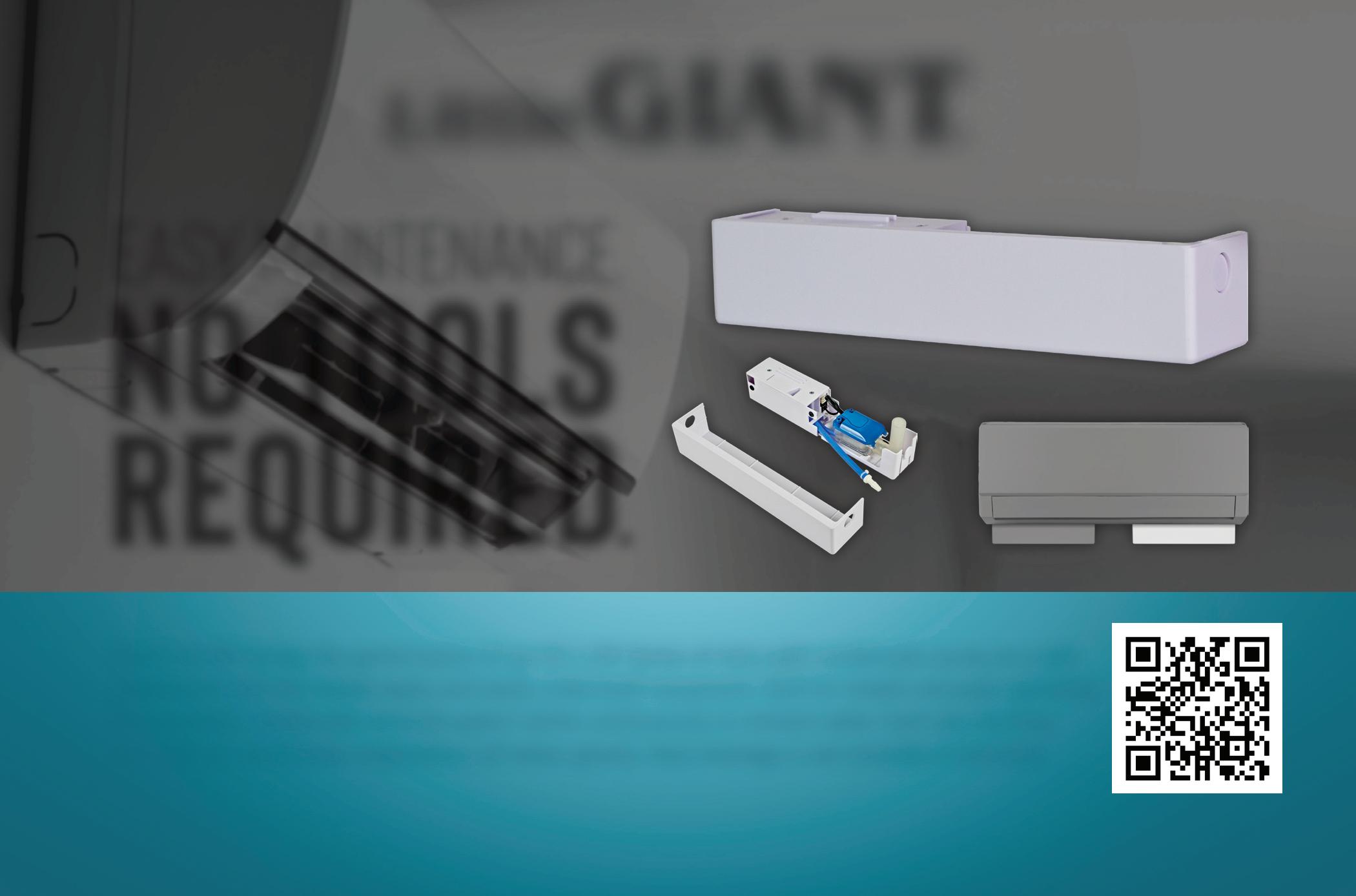
Easy Maintenance. Required. No Tools
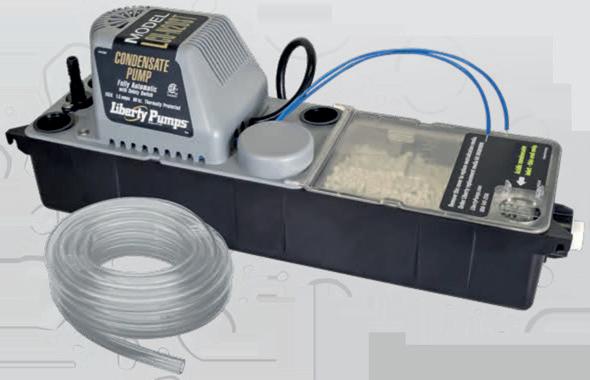
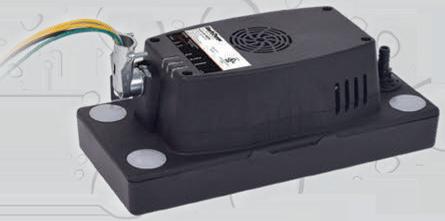
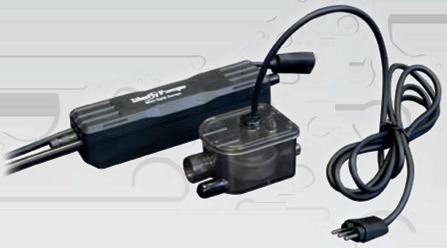
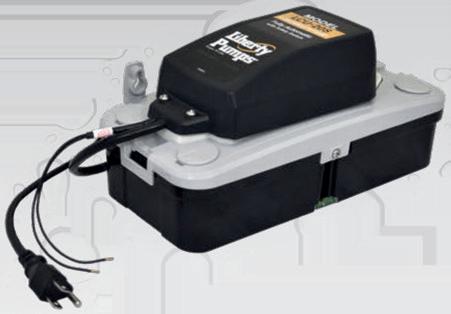
The EC-1U-DV brings the performance of our EC-1-DV Series of mini-split condensate pump to a slim undermount unit that installs easily and neatly underneath equipment. Built for reliable and quiet operation, the automatic condensate removal system works continuously to remove water from any ductless mini-split air conditioner evaporative coil when gravity-feed drainage is not possible or practical.
Rooftop Heat Pump Demand Surges as Electrification Reshapes Commercial HVAC
Contractors must adapt to new sizing, electrical, and control requirements as rooftop heat pumps become mainstream.
Rooftop heat pumps are gaining momentum across commercial and light commercial HVAC applications.
Advances in cold-climate performance, variable-speed technology, and integrated controls have made today’s rooftop units far more efficient and versatile than earlier generations, allowing them to reliably replace traditional gas-fired systems in a wider range of climates.
“Demand is increasing, driven by a combination of regulatory updates, efficiency standards, and the industry’s broader push toward more advanced, high-performing systems,” says Rosa Leal, director, commercial product strategy and experience, U.S. Air, Rheem North America. “In addition, building codes are incorporating and mandating the type of equipment used, like Title 24 in California.”
Carl Breczinski, light packaged rooftop portfolio leader for Trane Commercial, notes that demand for both traditional heat pumps and hybrid dual-fuel models continues to grow. “Many building owners are prioritizing sustainability and electrification, while regulatory changes are encouraging lower onsite emissions and reduced reliance on fossil fuels. Financial incentives and rebates are also helping offset upfront costs. At the same time,
Carrier has seen a clear increase in demand, which is why it is heavily investing in heat pump technology. Building owners are pursuing electrification in support of their sustainability goals and long-term operating cost stability, notes Christina Bullock, director of product management for Carrier. Carrier
heat pump technologies have advanced significantly, improving cold-weather performance and expanding the range of viable applications.”
Carrier has also seen a clear increase in demand for rooftop heat pumps, but there is also still hesitation in the market, based on performance on those coldest days, explains Christina Bullock, director of product management at Carrier.
“Other adoption barriers include electrical infrastructure limitations, higher upfront costs compared to a 100% gas rooftop unit, and a lack of contractor familiarity and training,” she says.
What Contractors Need to Know
One of the most important things HVAC contractors should be aware of is that heat pumps require different sizing logic, Bullock explains.
“For example, heat capacity matters more than the traditional cooling capacity and relies heavily on controls and sensors,” she says. “So weather conditions can also have a large impact on performance—things like wind, something that may not have been considered before, have an impact.”
Bullock says Carrier’s new rooftop and hybrid heat pump units
are designed as a natural evolution of its legacy platforms, allow ing contractors to work with familiar equipment.
According to Leal, heat pumps have three primary differences from traditional RTUs: heating source, electrical requirements, and system integrations.
“The heating source shifts from gas to an electric heat pump and how the unit works,” she explains. “Traditional RTUs use natural gas or electric resistance for heat, whereas a heat pump uses the refrigeration cycle to provide both heating and cooling. The electrical requirements will be higher, which is the biggest installation difference, as heat pumps require a greater electrical capacity. And heat pumps often feature more advanced, smart controls along with defrost cycles.”
Leal emphasizes that modern rooftop heat pumps are designed with footprints similar to traditional RTUs, making replacements more seamless when contractors are properly trained in system application and sizing. While installations involve some new con siderations, Leal says they become straightforward with train ing, and improved equipment design is making systems easier to install, service, and maintain overall.
Compared to traditional RTUs, rooftop heat pumps require more attention to the total cost of ownership, especially heating performance at various outdoor temperatures, Breczinski notes.
“Installations are generally not more complicated—they’re simply different,” he says. “The mechanical steps will feel familiar to anyone experienced with traditional RTUs, but rooftop heat pumps introduce several elements that require closer attention. Contractors need to account for full‑electric heating operation, understand defrost behavior, correctly configure auxiliary heat, and ensure the controls are set up to deliver the intended comfort, efficiency, and performance. When these factors are addressed upfront, installations are straightforward and predictable.”
In terms of maintenance for these systems, while the core maintenance tasks remain similar, there is a greater emphasis on consistency and adherence to recommended schedules, Leal explains.
“Skipping routine tasks, like filter replacements, or coil clean ing can significantly impact system performance over time,” she says. “Maintenance is best approached as scheduled and preven tative, with intervals tailored to the specific environment and application. Different operating conditions may require different frequencies, making a one size fits all approach less effective.”
The key difference, Breczinkski adds, is that because rooftop heat pumps rely on the refrigeration cycle year round, coil cleanli ness, airflow, and refrigerant performance have a greater impact on heating output. “Technicians also need to verify reversing valve operation, temperature sensors, and defrost sequences. Because the compressor runs in both heating and cooling seasons, regular performance checks become more important than with cooling‑only RTUs.”
Diagnostics, Remote Monitoring Becoming Standard
Onboard diagnostics and remote monitoring are increasingly important in helping contractors and facility managers take a more proactive approach to system performance and mainte nance, Leal explains. “By providing greater visibility into how
equipment is operating, these technologies can help identify potential issues earlier. This supports a broader industry shift toward preventative maintenance, where routine service and system insights help keep equipment running efficiently over time. It also allows contractors to be better prepared when ser vice is needed, improving overall response times and reducing unnecessary troubleshooting in the field.”
Bullock adds that this type of technology helps fill the knowl edge gap within the HVACR industry as the labor shortage persists.
“There’s a lot more parts changers than there are true trouble shooters,” she says. “We’re looking at how to expand our con nectivity across our platform so we can have those insights at the contractor’s fingertips. Because what really matters is ensur ing that, whether they’re in their office or their home, they can troubleshoot and identify what they need to do before they get to the site. That way, they’re spending less time and they can move to the next job quicker.”
Electrification Is Here—Get Ahead of It
Bullock’s advice for contractors in preparing for the future is simple: keep learning. “Solutions are evolving every day, and contractors must stay informed on that evolution. We’re here to help educate and drive that knowledge.”
Leal notes that contractors must have a strong foundation in installation best practices, combined with ongoing training in new technologies. “The skilled labor shortage remains one of the HVAC industry’s most urgent challenges in 2026 and beyond. Contractors that are finding ways to complete projects more ef ficiently while maintaining high quality standards, often with leaner teams, are increasing profitability and gaining a competi tive edge in winning new business.”
Breczinski agrees that contractors should continue learning and expanding their knowledge of today’s heat pump offerings, so that they can confidently discuss performance and application options with customers.
“Contractors who stand out in the coming years will understand how heat pumps interact with different building types—recog nizing where they’re a strong fit, how heating profiles vary, and when hybrid or dual‑fuel approaches make the most sense,” he says. “As equipment and controls platforms continue to advance, strong capabilities in system setup and integration will be in creasingly important. Just as critical is staying current on local regulations, incentives, and utility structures so contractors can guide customers through the evolving landscape of electrifica tion and help them choose the right solution for their building.”
Rooftop heat pumps are quickly becoming one of the most practical and scalable paths toward commercial building elec trification, Breczinski adds. “The technology is evolving fast, performance is improving across climate zones, and more cus tomers are factoring sustainability and long‑term operating costs into their decisions. Contractors who invest time today in under standing the systems, controls, and application considerations will be well‑positioned as trusted advisors. As more buildings transition toward electrified or hybrid heating strategies, skilled HVAC professionals will play a central role in delivering reliable, efficient, and future‑ready solutions.”
Certifications for Success
Industry certifications boost credibility and give HVAC contractors a competitive edge in a crowded market.
Skilled HVACR technicians, most employers would agree, are the key ingredient to running a successful contracting business. They keep customers, other employees, and themselves safe. They’re efficient. They are good at solving problems in the field, on their own. And, because they’re on the frontlines, they’re well-positioned to build client trust.
But finding skilled technicians, as most contractors would attest, is hard. In this climate, many businesses must train up their new (inexperienced) hires and accept that it will take some time before these individuals can achieve optimal performance. At the same time, it’s also necessary to ensure that seasoned techs continue to learn about the new developments and systems that apply to their trade. Earning—and maintaining—industry certifications is one way technicians and their employers may address these challenges. This can establish individual technicians and the businesses they represent as the go-to source of all things HVACR.
Certifications are also a good employee retention tool, argues John Lanier,
president at NATE (North American Technician Excellence), a non-profit technician certification body with headquarters in Arlington, Virginia.
“There is an expectation now, with the younger folks that are being hired, that there will be ongoing development opportunities,” Lanier says.
NATE Certification
NATE offers several different certifications to address technicians with varying degrees of knowledge and on-the-job experience.
Those new to the industry are directed toward the Ready-to-Work certificate, which covers basic safety best practices, HVAC concepts, and tools of the trade. Additionally, the HVAC Support Technician certificate is for those who have worked in the field for six months to a year.
Lanier notes that for HVAC contracting businesses, the Ready-to-Work certificate can serve as a job applicant screening tool. “If you have a couple of candidates and you aren’t sure which one to land on, give them this test [and] see who performs better on it, [and] who has a better understanding of the basics of the industry,” he explains.
Technicians seeking full-fledged NATE Certification can choose to pursue one of two “pathways” (or sets of exams). Those who opt for the traditional pathway are required to take a core exam as well as a specialty test of their choice. On the other hand, the Certified HVAC Professional (CHP-5) pathway comprises five different exams: HVAC Fundamentals, Comfort and Airflow, Electrical and Controls, Installation, and Service. These exams consist of 30 questions each.
Lanier explains that the CHP-5 pathway was designed to help techs focus their studies instead of preparing for an exam that covers all five topics in one shot. This lets technicians spend more time reviewing the course material they find most difficult (which, he says, is often Electrical and Controls).
“[They can] better prepare and have a greater likelihood of success on the exam,” Lanier said.
Technicians are NATE-certified once they pass the requisite exams, which they must take through an approved testing organization or remote, live online proctoring. To maintain their certification, techs must retest every two years or complete
16 hours of continuing education. NATE says that this keeps people up to date on the latest HVAC equipment, standards, and technologies.
While there are no prerequisites to fulfill prior to taking the exams, NATE recommends that technicians have two years of experience before pursuing certification. To prepare, techs combine what they learn on the job with formal training, which is often provided by their employers, as well as distributors and manufacturers. The NATE Training Academy is another resource that future test-takers may take advantage of.
Depending on the situation, individual technicians may invest in their own certification or share the fees with their employer. In many cases, Lanier says, it’s the contractor who foots the entire bill. He adds that some HVACR contracting businesses will only hire certified technicians, while others will offer a pay differential to those with certification.
According to research conducted by NATE and field service software developer XOi Technologies, headquartered in Nashville, Tennessee, NATE-certified techs completed 20.6% more jobs during peak season (in this case, during the months of June, July, and August 2024). Lanier emphasizes that this is great for both contractors and their customers.
“Wouldn’t you want to make sure you put the best possible team in the field?” Lanier challenged. “The contractor owns the business that they’ve put their blood, sweat, and tears into growing. But the technician who knocks on our front door is the business. From my perspective, you want to have the most highly trained, highly effective individual out there as the face of your business.”
Here are some other certifications that apply to HVACR technicians:
EPA Section 608
EPA Section 608 certification is mandated by the United States Environmental Protection Agency (EPA) regulations. There are four different certification exams, each tailored to the type of equipment the technician will install, service, or dispose of. Type I certification concerns small appliances; Type II is dedicated to the service and disposal of high or very
high-pressure appliances (with the exception of small appliances and motor vehicle air conditioners); and Type III focuses on the service and disposal of low-pressure appliances. As its title suggests, Universal certification is targeted at those who will be servicing equipment of all types.
The exams are proctored, and techs must complete them through a certifying body that has been approved by the EPA. Certification requirements don’t apply to apprentices if they are under constant supervision by a certified technician.
National Comfort Institute (NCI)
Based in Sheffield Lake, Ohio, the National Comfort Institute is a training and membership organization that serves HVAC and building performance contractors. Its High-Performance HVAC certifications are designed for residential and light commercial HVAC contractors, as well as energy raters and weatherization contractors. For plumbers charged with installing boilers and water heaters, Carbon Monoxide and Combustion Analyst training and certifications are available.
Among NCI’s residential certifications are Certified Residential Air Balancer; Certified Residential System Performance Specialist; Certified Carbon Monoxide and Combustion Analyst; Certified Duct System Optimization Specialist; and Certified Refrigerant-Side Performance Technician.
NCI’s commercial certifications include Certified Hydronic Balancing Technician; Certified Commercial Air Balancer; Certified Commercial System Performance Specialist; and Certified Economizer and Ventilation Specialist.
“The training and certifications progressively build on each other, allowing the professional to move up an education ladder,” explained Dominick Guarino, NCI president and CEO. “This body of training ultimately helps them test and improve the entire HVAC system, including equipment, and air and hydronic distribution systems.”
ESCO Institute
Based in Mount Prospect, Illinois, ESCO Institute offers what it calls “progressive levels of HVACR Certification.” These include EPA and employment-ready certifications (the latter of which is designed for
employers who need to test job candidates’ basic knowledge of HVACR principles). The organization also offers a host of professional certifications, including Combustion Analysis, Head Pump Installer, Light Commercial Refrigeration, and Residential Air Conditioning. Among its specialized certification offerings are A3 Refrigerants: Hydrocarbon Refrigerant Safety and Green Awareness.
ACCA
Air Conditioning Contractors of America (ACCA), based in Alexandria, Virginia, offers its QA and QI certification programs to both members and non-members. The QA Residential Service & Installation Certification is designed to help techs and contractors demonstrate to customers their compliance with HVAC installation best practices. The QI (Quality Installation) certificates are issued upon the completion of the job to confirm—to both the technician and the homeowner—that the systems were properly installed. There are two QI certificates: Verified Equipment Operation and Verified System Performance.
RSES
The Refrigeration Service Engineers Society (RSES), with headquarters in Schaumburg, Ill., provides a variety of certification programs, including Certificate Member (CM). It’s reputed to be a tough exam (around 30 percent of test-takers pass, according to the organization) and covers 18 topics, such as Commercial Refrigeration Load & Insulation, Refrigeration Evaporants, and Oils & Refrigerants. One must be an RSES member to take the exam and achieve a score of at least 70% to pass.
Needless to say, industry certifications are more than just credentials for HVAC contractors—they’re a strategic advantage. They signal a commitment to quality workmanship, ongoing education, and adherence to evolving standards, helping contractors differentiate their business in a crowded field.
Carolyn Heinze is a freelance journalist based in Paris. You may reach her at carolyn@ carolynheinze.com.
Demand Response 2.0: Understanding AHRI 1380 in HVAC
Learn how AHRI 1380 is redefining demand response and how it creates new opportunities for contractors to deliver smarter, connected solutions.
As utilities push for smarter energy management and grid stability, the HVAC industry is entering a new era of connected, responsive systems. The AHRI 1380 standard is at the center of this shift, establishing how variable-speed residential equipment can actively participate in demand response programs through verified load modulation and two-way communication. Contracting Business Head of Content Nicole Krawcke recently sat down with Ketan Namjoshi, product manager, residential controls and digital solutions, Bosch Home Comfort Group, to discuss the origins of AHRI 1380, its growing role in utility incentives, and what contractors need to know to stay competitive as demand response moves from optional to expected.
Ketan Namjoshi
split systems. Equipment must be able to receive and respond to utility signals using open protocols, primarily OpenADR 2.0b, with defined operating behaviors and homeowner overrides. The goal is to support localized electric grid stabilization while reducing utility bills for homeowners.
AHRI 1380 was published in 2019 and is currently voluntary, but utilities are increasingly using it to qualify equipment for participation in DR programs. For example, CEE Residential Electric HVAC Specifications implemented AHRI 1380 requirements on Jan. 1, 2026, for equipment to be eligible for CEE Tier 1 and Advanced Tier classifications that are often necessary for eligibility with many energy efficiency rebate and incentive programs.
CB: What exactly does AHRI 1380 require that traditional demand response programs do not?
CB: What is the background behind AHRI 1380?
KN: AHRI 1380 was developed as an industry guideline to define how variable-speed residential HVAC systems should operate within demand response (DR) utility programs. These programs help utility companies manage peak load demands by moving HVAC equipment beyond simple on/off cycling to verified load modulation.
The guideline applies to inverter-driven and two-stage air conditioners and heat pumps ≤65,000 Btu/h, including residential
KN: Traditional residential DR programs rely on thermostat setpoint offsets, but these methods often provide limited verification. AHRI 1380 requires measurable, modulated load response from variable capacity equipment. Systems must demonstrate how unit capacity was adjusted during a DR event which is accomplished by two-way communication and event acknowledgement. This is fundamentally different from legacy “cycling” programs. The intent is to ensure predictable grid response while maintaining occupant comfort.
CB: How are HVAC systems expected to “report back” under AHRI 1380? Are there specific protocols or data formats required?
KN: Under AHRI 1380, residential systems are expected to com municate using OpenADR 2.0 standardized messaging — typi cally 2.0b. OpenADR handles event signaling, acknowledgements, and reporting between utilities (VTN) and customer systems (VEN). AHRI 1380 does not mandate CTA‑2045 for HVAC sys tems; CTA‑2045 (EcoPort) is more common in water heaters and appliances. However, some residential HVAC ecosystems may use CTA‑2045 via external gateways as a transport layer feed ing OpenADR upstream. Reporting is usually cloud‑based and automated through HVAC OEM platforms.
CB: How does AHRI 1380 affect installation, commissioning, and maintenance workflows for contractors?
KN: For residential split systems, installers must ensure vari able capacity outdoor units, indoor blowers, and communicating thermostats are correctly paired. Commissioning now includes verifying OpenADR connectivity and DR modes, not just airflow and refrigerant charge. Poor connectivity can disqualify systems from DR‑based programs, making system connectivity and cloud registration and verification critical steps. Additionally, mainte nance must also include firmware updates and communication health checks.
CB: How do integrated controls help simplify compliance with AHRI 1380?
KN: Integrated manufacturer controls simplify AHRI 1380 compli ance by embedding OpenADR‑compatible logic directly into the system. This eliminates the need for external DR boxes that often cannot properly modulate inverter compressors. Integrated plat forms automatically manage event response, capacity ramping, and reporting. Compliance then becomes largely software‑driven. For contractors, setup is simpler and more repeatable. For home owners, this helps to ensure comfort is maintained.
CB: How do you see AHRI 1380 evolving over the next 3–5 years? Will contractors need to retrofit existing systems?
KN: AHRI 1380 is expected to become the default reference stan dard for residential variable capacity DR programs. OpenADR will remain the primary protocol, potentially evolving toward OpenADR 3.0 over time. New residential split systems will increas ingly ship DR‑ready, and utility providers will prioritize systems that can prove performance. Retrofits will focus on controls and connectivity, not full equipment replacement.
In the next year, AHRI expects to release an updated version of AHRI 1380 that will add more protocol alternatives and apply learnings from early adopters of AHRI 1380. These changes are intended to broaden the number of utility programs and systems capable of applying AHRI 1380 demand response. Over the next few years, there will likely be additional modifications with the
intent of increasing the options for utilities and manufacturers employing 1380 demand response.
AHRI 1380 compliance knowledge will become a practical skill, and contractors who build their knowledge base now will be better positioned as DR moves from optional to expected.
CB: Are manufacturers providing training or support specifi cally for contractors around AHRI 1380 compliance?
KN: Manufacturers are actively training contractors on vari able‑speed residential systems with DR‑ready controls. AHRI 1380 concepts are often embedded into controls systems, thermostats, and commissioning training. Support focuses on connectivity, DR configuration, and educating homeowners on utility enroll ment — although DR program enrollment must be initiated and completed by the homeowner.
CB: Are there opportunities for contractors to differentiate their services by offering AHRI 1380‑compliant systems?
KN: Understanding AHRI 1380, OpenADR, and variable ca pacity residential systems offers contractors a powerful op portunity to differentiate themselves as utility standards and homeowner preferences move toward widespread DR program participation. By strengthening their knowledge within the category, contractors are poised to offer grid‑ready installs that qualify for cost saving programs. While the 25C federal tax credit is no longer applicable in this context, incentives are offered at the local utility level and vary by region, creating an important advisory role for contractors, who can educate homeowners on available programs even though they can not enroll them directly. This not only allows homeowners to benefit from incentives, but it also creates opportunities for contractors to install premium equipment with service plans and connected‑home offerings.
In this way, AHRI 1380 compliance becomes a value proposi tion, not just a checkbox for compliance.
Fuel costs cannot always be reduced at the pump, but they can be better handled across the business.
HVAC Fleets Turn to Fuel Cards and Smarter Operations to Manage Rising Costs
Rising fuel prices are putting increasing pressure on HVAC contractors, particularly small and mid-sized businesses that rely on fleets to meet growing service demand. Simply put, the cost of keeping vehicles on the road is becoming harder to manage.
To offset this new challenge, many contractors are turning to a combination of fuel cards and operational improvements to regain control over one of their most unpredictable expenses. Fuel card programs are gaining traction as a practical way to improve visibility, capture per-gallon savings, and enforce spending controls, while also supporting broader efficiency strategies across the fleet.
As fuel prices remain unpredictable, HVAC businesses are under pressure to protect margins without passing costs on to customers. The shift reflects a broader realization: fuel costs cannot always be reduced at the pump, but they can be better handled across the business. In other words, without a strategy for fuel management, contractors are faced with margin erosion or the passing of too much additional cost on to their customers, reducing competitiveness in the market.
Fuel Costs Start with Visibility Gaps
Fuel-related expenses are often driven as much by operational blind spots as by price itself. Without clear insight into where, when, and how fuel is purchased, contractors can struggle to identify inefficiencies or control spending. Manual processes, such as out-of-pocket purchases and paper receipts, can obscure patterns and delay decision-making.
More structured approaches, particularly those built on a closed-loop network such as some fuel card options, help address this by centralizing transactions and creating a consistent, reliable stream of data across fuel purchases. A closedloop network is important because it connects transactions within a controlled ecosystem, improving visibility, consistency, and security. This helps reduce the risk of misuse, encourages more disciplined purchasing behavior, and enables more predictable pricing across approved locations.
“Now I can see all the fuel purchases in my monthly reports,” said Karen Scott, vice president of Associated HVAC, a WEX fuel card customer. “And since I get the reports, there are no more lost receipts, so I can keep track of fraud and personal use.”
Bringing Predictability to Fuel Spend
Fuel price uncertainty remains a constant issue, but contractors are finding ways to mitigate its impact.
Many fuel card programs now offer built-in savings mechanisms, including per-gallon rebates that can reach double-digit cents at participating locations and smaller rebates outside those networks. Annual savings that can add up to hundreds or more per vehicle, depending on usage, demonstrating that even modest discounts can add up significantly over time.
Network coverage also plays an important role. HVAC contractors should verify their card programs are accepted at multiple U.S. fuel stations, allowing drivers to fuel conveniently without detouring to specific locations. This helps reduce unnecessary mileage, which in turn lowers overall fuel use. Together, these features provide a degree of predictability in an otherwise volatile cost category.
Control and Security at the Transaction Level
In addition to savings, fuel cards are being used to introduce greater control over how fuel is purchased.
Fleet operators can typically set parameters around transaction and fuel volume limits, purchase amounts, and time-of-day or day-of-week restrictions.
Additional safeguards are available to protect against other types of fraud, which can cause an additional burden for fleets. Built-in controls help prevent unauthorized purchases before they happen, with features such as driver PINs or odometer readings to help ensure that fuel purchases are tied to legitimate business activity. Real-time alerts can also flag unusual transactions, allowing for faster intervention.
From Fuel Data to Cost Reduction
Access to data is only valuable if it drives action. Increasingly, HVAC contractors are adopting additional tools such as GPS Tracking and AI Video solutions to uncover inefficiencies that directly impact costs. According to the U.S. Department of Energy, real-time driver feedback and behavior monitoring can lower fuel use by 10 to 25%, and reduce wear and tear.
Common insights include vehicles with higherthan-average fuel consumption, inconsistent fueling locations or behaviors, and gaps between expected and actual mileage. With detailed reporting,
businesses can begin to optimize performance, whether by addressing driver habits, improving maintenance schedules, or reallocating workloads.
Over time, these incremental improvements can translate into meaningful savings across the fleet.
Pairing Fuel Management with Operational Efficiency
While fuel cards help manage purchasing and oversight, operational efficiency remains a critical lever in reducing total fuel spend.
Reducing miles driven per job is one of the most effective ways to control costs. HVAC contractors are increasingly focusing on:
• Route optimization to minimize drive time and fuel use;
• Smarter scheduling to reduce gaps between jobs; and
• Improving first-time fix rates to avoid repeat visits.
Digital fleet tools and telematics support these efforts by providing real-time visibility into technician activity, job status, and moving businesses away from emergency-only calls to predictable monthly income that makes fuel spend easier to manage.
One strategy for route optimization is servicing maintenance agreements in specific zip codes or towns. For companies with hundreds or thousands of maintenance agreements, per-trip savings can make a meaningful difference for the business.
Administrative Efficiency and Cost Control
Fuel management is not just about monitoring gallons used, it also affects back-office operations.
Traditional fuel purchasing often involves time-consuming administrative work, including receipt collection, expense reconciliation, and tax preparation. Fuel card programs streamline this process by consolidating transactions into a single invoice with categorized, exportable data.
For small business owners, this can reduce administrative burden while improving accuracy and audit readiness.
“The reports are great,” said Scott. “They list purchases by driver, so I can see when and how often they get fuel and the price they paid. This helps me budget for the expenses.”
Looking Ahead
Fuel management is becoming an increasingly strategic focus for HVAC businesses. Contractors who invest in visibility, controls, and efficiency are better positioned to navigate price unpredictability and maintain profitability.
In today’s environment, the most efficient HVAC fleets aren’t just reducing fuel costs, they’re redesigning how fuel is managed altogether.
Dylan Jones is senior vice president and general manager of Mobility Growth at WEX. For more information about WEX, visit www.wexcard. com/wex-edge.
SALES CONTACTS
SOUTH & WEST: SENIOR MANAGER, BUSINESS DEVELOPMENT
Randy Jeter
Office: 512-263-7280
Cell: 512-426-9145
Fax: 913-514-6628
rjeter@endeavorb2b.com
EAST COAST: SENIOR MANAGER, BUSINESS DEVELOPMENT
Brian Sack
Cell: 732-629-1949
bsack@endeavorb2b.com
ACCOUNT MANAGER MIDWEST
Bill Boyadjis
973-829-0648
bboyadjis@endeavorb2b.com
CLASSIFIEDS/INSIDE SALES: MEDIA ACCOUNT EXECUTIVE
Steve Suarez
Cell: 816-588-7372
Office: 941-259-0867
ssuarez@endeavorb2b.com
DIRECTOR OF SALES, BUILDINGS & CONSTRUCTION GROUP
Joe Agron
941-200-4778
jagron@endeavorb2b.com
5 Steps to Selling Your HVAC Business to a Key Employee or Family Member
Whether you’re selling to a stranger or your best friend, negotiations can become contentious. A business broker can help navigate the process.
For some owners, keeping the business in the family after they retire is an ideal outcome. Whether you’re selling to a family member who has worked in the business or a key employee, these five steps are key to a successful succession.
1. Get a Professional Valuation of Your Business
As a business owner, you may have ideas about how much your company is worth. You may be basing your estimate on what a competitor or friend sold a business for, or you may just be doing back-ofthe-envelope math based on sales. Either way, your family member or employee may have a different number in mind.
The only way to make sure everyone feels like the price is a fair one is to get a formal valuation from an independent third party. A broker will look at revenue and assets, but they’ll also consider things you may not realize affect the value of the business: customer concentration, the number of maintenance agreements you have, or the percentage of your sales that come from new construction. They’ll also take into account recent sales of comparable companies, which are an indicator of what buyers are willing to pay in the current market.
2. Talk With Your Successor
Once you have the valuation in hand, you can start a serious discussion about purchasing the business. Your family member or employee may have considerations they haven’t shared with you, or a different timeline than yours. They’ll definitely have a lot of questions, especially if they haven’t been privy to the full financial data up to this point. They may need time to think about their ultimate goals and discuss the plan with their family. The transition from worker to boss can be challenging, and helping them understand the realities of what’s involved is critical to making the decision to move forward.
3. Plan Ahead to Make Financing Easier for Your Successor
Most owners think employees can’t possibly afford to buy the company because they can’t meet the
SBA 20% down payment requirement. But selling to a partner may not require any out-of-pocket costs. So if you grant ownership as a partner to your successor, they may be able to buy you out without putting money down. There are stipulations, such as the length of time the employee has been a partner; the percentage of ownership must be consistent (or increase) for at least two years. The sale must also be structured as a stock sale rather than an asset sale.
4. Have a Clear Plan Defining Your Role
If you plan to stay on in the company after the sale, you’ll need well-defined constraints regarding your authority and responsibilities. It can be hard to give up being the boss, and even the best of relationships can become strained when there are conflicts in style or judgment. It’s a good idea to have a formal agreement that covers the timeline, the structure of your roles, and other details that should not be left to a simple handshake agreement.
If your successor isn’t licensed, you’ll need to make sure that happens as soon as possible (another reason to plan at least two years ahead.) Requirements for licensing vary by state, but a key employee will almost certainly have met the experience requirements. They will need to pass the exam so they can transition the company to work under their own license.
5. Hire a Business Intermediary
Whether you’re selling to a stranger or your best friend, negotiations can become contentious. A business broker can help both parties navigate the process, keep communication flowing, and help structure the deal so both you and your buyer are protected and get full value from the deal.
Selling to a family member or key employee can be a great option for many owners. Following these five steps will ensure that both you and your successor feel like you’ve made the right decision.
Patrick Lange is an experienced HVAC-specific business broker with Business Modification Group based in Madison, Florida. He has a unique background in financial planning and has even owned an HVAC business himself. This makes him well-suited to working with some of the country’s most successful HVAC business owners. He specializes in companies with $1-10 million dollars in revenue and maintains a network of buyers and sellers in the industry. He sells a record number of HVAC businesses every year.
SMART HVACR TEST TOOLS
How Software is Transforming Refrigeration Diagnostics
As HVACR systems grow more advanced and the industry grapples with an ongoing labor shortage, refrigeration test equipment is undergoing a significant transformation.
Contractors are no longer relying solely on standalone instruments—they’re turning to integrated, software-driven solutions that streamline diagnostics, verify performance, and support less-experienced technicians in the field. Contracting Business sat down with Tony Gonzalez, director of training at Fieldpiece Instruments, about the key design trends shaping today’s tools, how digitalization is improving jobsite accuracy and accountability, and what innovations contractors can expect in the years ahead.
CB: What are the biggest design trends currently shaping refrigeration test equipment?
TG: The move to smarter tools empowered by software solutions to take the measurement and drive it to verification, diagnosis, and commissioning. Software solutions are trending up as contractors are looking for ways to mitigate the skills gap and ensure good work is performed in the field.
CB: What feedback are you hearing most often from contractors that is driving product innovation?
TG: Most contractors are feeling the effect of the skills and labor gap in the industry. They are looking for training solutions, but also hardware and software solutions to help expedite the learning curve for the newer workforce out in the field. Also, they are looking for ways to verify the work that is currently being
done in the field to ensure all necessary tasks are completed and required tests are passed.
CB: How is the shift toward electrification and heat pumps impacting refrigeration testing needs?
TG: Modern equipment has much tighter refrigerant, airflow, and electrical requirements than older equipment. Meaning two things: one, the installer plays an even more critical role to ensure modern equipment is installed per manufacturer requirements; and two, the accuracy and reliability of test tools needs to keep up with equipment innovation. In addition, contractors are looking for solutions to verify good work is being performed in the field.
CB: What role are digitalization and smart diagnostics playing in nextgeneration test instruments?
TG: Digitization and smart tools are filling that need for verification that good work is being performed in the field. With the Job Link System, technicians document measurements and results of required tests performed in the field. At the end of the job, a professional report is generated to verify that all measurements were taken, tasks were performed, and completed.
CB: How are tools evolving to safely handle A2L and other mildly flammable refrigerants?
TG: Tools are verified to ensure they comply with A2L safety standards and mildly flammable requirements. Thankfully, mildly flammable A2L refrigerants are not that different from the existing A1 refrigerants, so the tools the technician uses don’t need to change all that much.
CB: Do you see tools playing a role in bridging the HVACR workforce skills gap?
TG: Yes…although proper training will have the most impact in bridging this gap, tools and software solutions will expedite the learning curve by making it easier and faster to take the necessary performance measurements and performing and completing required tests in the field.
CB: What innovations do you expect to see in refrigeration test equipment over the next 3–5 years?
TG: I expect to see software playing a larger role in testing, diagnosing, and predictive failure analysis of HVACR equipment. More tools that communicate with each other to streamline the work in the field and allow the technician to do their job more easily, faster, and better.
CB: What should contractors be looking for when investing in next-generation test tools today?
TG: Contractors should ensure the tools they use are compliant with updated industry safety regulations and are accurate and rugged enough to measure modern HVACR equipment and withstand increasingly adverse weather conditions in the field. They should look for software solutions to verify good work is performed in the field and streamline the back end of their business.
Tony Gonzalez Images: Fieldpiece
WHERE FACILITY CHALLENGES FIND SOLUTIONS
NORTHERN CALIFORNIA
NORTH TEXAS
August 19-20, 2026
Reno, NV
October 6-7, 2026
Santa Clara, CA
October 14-15, 2026
Irving, TX
Selling a business is likely the single biggest financial transaction in a business owner’s life.
13 Things
ANo One Tells You About Selling Your
Business
A co-founder and former CEO of Service Roundtable, Matt Michel was inducted into the Contracting Business HVAC Hall of Fame in 2015. He is now an author and rancher.
lot of contractors have sold their companies to private equity. More will join them over the next few years, and others will sell to family, employees, competitors, and other buyers. Nearly all will be selling a business for the first time. First-time sellers don’t know what they don’t know.
When researching to write the book, “The Business Exit Roller Coaster,” with M&A Advisor Brandon Jacob, we confidentially interviewed nearly 100 business owners who sold their companies. They told us things they haven’t shared with anyone else due to confidentiality and the desire to avoid admitting mistakes. Ask any owner who has sold his company, and the response will usually be all roses. The truth may actually differ. Here are a few findings we had as a result of the interviews.
1. Proactive Sellers are Happier
Businesses are sold proactively or reactively in response to a crisis, being money-whipped, or other reasons. Business owners who were proactive prepared their companies and themselves for the sale. As a result, they had a smoother process and were more satisfied at the end of the day.
2. This is Not a DIY Event
Selling a business is likely the single biggest financial transaction in a business owner’s life. It’s important, and he has no experience if it’s his first sale. Because they lack experience and because the transaction is not only financially significant but emotionally taxing, owners are likely to make mistakes that leave money on the table or could even blow up a deal. Owners who engaged representation, such as a broker, M&A Advisor, or investment bank, made few mistakes, sold for more money, and were emotionally happier than owners who took a DIY approach.
3. The LOI is Gain Without Pain
Getting to the letter of intent (LOI) is one of the happiest days in a transaction. There’s a negotiated agreement to sell the company for a set price. The owner is imagining the things he can do with the money, but has yet to face the agony of due diligence.
4. Due Diligence is a Corporate Proctology Exam
We only interviewed one business owner who was completely prepared for it. For the rest, it consisted of varying degrees of agony. The business owners who fared best brought their team into the process to assist with the burden.
5. Buyers Want to See Physical Offices Before the Purchase
This cannot always occur during operating hours, and buyers understand that. They are typically amenable to night or weekend visits.
6. Word of the Sale Will Likely Get Out
Employees will guess that the business is for sale. Someone will figure it out, or the information will leak. Owners should be prepared to address the potential for a sale or “recapitalization” with their team if it comes up.
7. Do Not Be Surprised by Betrayals
The sale of a business affects lots of stakeholders, including employees, vendors, and competitors. One or more of these might uncover the sale and use this information to damage the owner or short-circuit the transaction. Owners should not be surprised by betrayals and be prepared to move on, keeping the end in mind.
8. Closes are Anticlimactic — Funding is Not
After all of the build up, the close of the transaction is done over a phone call, Zoom call, or by email. Funding, however, is life-changing.
9. Close = Relief
The most common emotion after the transaction closes is relief. It’s relief that it closed, relief that personal notes for the business disappear, relief from employees and customers, relief from stress, relief from the potential for lawsuits, and more.
10. Expect to Stay, But Not For Long
Most business owners are expected to stay on for a period of time. Most do not last two years.
11. It’s Not Your Company
Buyers will inevitably make decisions that the former owners disagree with. They should remember that it’s not their company and take solace in their newly enhanced financial position.
12. Loss of Identity
Business owners struggle with the loss of identity when they eventually walk away. They need new purpose. Extroverts struggle more than introverts.
13. Regrets Have Limits
While the majority of business owners have regrets, none of the owners interviewed had so many regrets that they would give the money back for the business if given the opportunity. Regrets have limits.
Deep finned aluminum housing provides over 200% more efficient cooling than cast iron pump housings.
NEW INVERTER ROOFTOP SYSTEMS
INVERTER TECHNOLOGY
Variable-speed inverter compressor with vapor-injection technology helps deliver efficient operation and heating performance in low ambient conditions
ENERGY PERFORMANCE
Part-load efficiency up to 22 IEER helps manage operating costs while maintaining comfort
COMFORT CONTROL
Modulating compressor and indoor blower help regulate airflow, temperature, humidity, and comfort
SMART BUILDING INTEGRATION
Factory-integrated BACnet® connectivity and cloud-enabled services help simplify monitoring, control, and system optimization
APPLICATION FLEXIBILITY
Multi-zone Variable Air Volume (VAV) helps control airflow to meet varying needs of multiple zones monitoring , control, and system