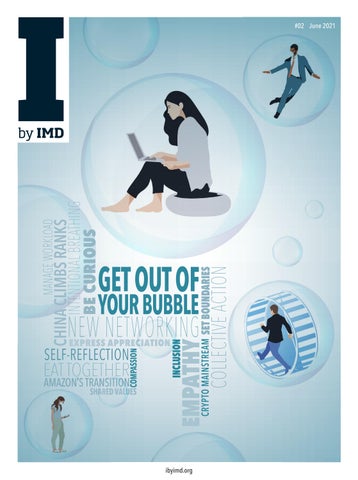
YOUR BUBBLE NEW NETWORKING COMPASSION
SELF-REFLECTION
EAT TOGETHER
AMAZON'S TRANSITION
SHARED VALUES
INCLUSION
EXPRESS APPRECIATION
COLLECTIVE ACTION
GET OUT OF
EMPATHY CRYPTO MAINSTREAM SET BOUNDARIES
MANAGE WORKLOAD
CHINA CLIMBS RANKS INTENTIONAL BREATHING BE CURIOUS
#02 June 2021
ibyimd.org ibyimd.org
21052 Dubai
21323 Grand Piano
10280 Flower Bouquet
LESS ACTION. M O R E S AT I S FA C T I O N . A D U LT S W E L C O M E
Experience LEGO ® Sets for Adults – rewarding and creatively challenging sets to suit all interests. LEGO.com/Adults
LEGO and the LEGO logo are trademarks of the LEGO Group. ©2021 The LEGO Group.
[ Foreword ]
Let’s face the future together
W
e don’t yet know all the ways in which the post-pandemic world will be different, but heightened awareness of the importance of mental health and wellbeing – not merely as societal challenges, but as a managerial imperative – are certain to be among them. “Wellbeing and mental health are far more of a social function than a set of solo acts,” writes Zoe Finch Totten in her article in this second issue of I by IMD. We spend more time at work than just about anywhere else – whether virtually or in person – and our work social context matters profoundly for our wellbeing.
Companies have taken notice. Anand Narasimhan surveys what organizations are doing to encourage wellbeing in their employees, noting that initiatives designed to improve work-life balance are estimated to cost $66bn a year, a figure that will only grow in the wake of the pandemic. Given what is at stake, how can we make that kind of investment most effective?
Illustration: Jörn Kaspuhl
To help, we have commissioned experts in management, health, corporate structure and even an adventurer to help analyze the problems we face right now and to sketch solutions. Alyson Meister and Dominik Breitinger offer a roadmap to avoid burnout. They guide us through the practical steps that can be taken - by individuals, team leaders and organizations – to restore harmony to the workplace. We also explore one paradox of the pandemic: that even those who have been successful in business during this period are suffering from lockdown fatigue. Merete Wedell-Wedellsborg
explores the phenomenon and offers guidance on how winners can return to top form. “The test of a civilization is the way that it cares for its helpless members,” the American novelist Pearl Buck once wrote. As some of us already enjoy the benefits of COVID-19 vaccines, largely because of where we happen to live, the question is what we do next. We won’t move clear of this pandemic until effective vaccines are available everywhere, to anyone, regardless of means. This pragmatic and deeply humanitarian insight has fueled AstraZeneca’s vaccine development efforts. Despite recent challenges, chronicled in this issue by Tobias Schlager, the company has not wavered from its commitment to supply vaccines at cost, charging less than a 10th the cost charged by its peers. AstraZeneca is symptomatic of another imperative as we march towards the post-pandemic world – that business needs to become more inclusive. Take inspiration from Alexis Nasard who tells IMD President Jean-François Manzoni: “I really believe in the virtues of inclusive capitalism; when shareholders, management, employees, communities, consumers, distributors and governments win together. It's much better for the environment, and it's much more sustainable economically.” As we look ahead, and reset for growth, let us leave no one behind.
David Bach, Dean of Innovation and Programs at IMD June 2021 • I by IMD 1
[ CONTENTS ]
24 [ Wellbeing at work ]
04 [ In good company ] Jerry Davis finds himself in bad company, asking whether some
From sleep pods to yoga and fitness trackers, the corporate world is investing billions of dollars in improving employees’ health and welfare, but organizations must take care to avoid accusations of “soul washing”, argues
06 [ Conversation piece ]
28 [ Wellbeing at work ]
business models are truly evil.
The aeronaut, environmentalist and psychiatrist Bertrand Piccard sees a chance for a global reset in the wake of the pandemic.
10 [ The number crunch ]
AstraZeneca faced a storm of negative publicity over its COVID-19 vaccine following reports of potentially fatal blood clots in rare cases. Tobias Schlager examines the data and explains what the company could have done to change the narrative.
Anand Narasimhan.
Success in business is normally an energizer, but even senior executives who have emerged triumphant from the pandemic have been left feeling gloomy. Merete Wedell-Wedellsborg suggests ways that they can recover their mojo.
28
Humans are social animals yet support for mental health focuses on the individual. Zoe Finch Totten argues that a radically different approach is needed to combat an increase in loneliness and isolation and a fall in productivity.
18 [ Wellbeing at work ]
Declining mental health is a global crisis. Alyson Meister and Dominik Breitinger offer practical guidance for individuals, team leaders and organizations on ways we can tackle it.
23 [ In the mind’s eye ] Regular columnist George Kohlrieser says that individuals
06 2 I by IMD • June 2021
must take responsibility for their personal troubles and not solely rely on the help of others.
34 31 [ The CEO interview ]
In an interview with Jean-François Manzoni, Alexis Nasard explains why he believes in the benefits of inclusive capitalism to create a society where everyone can be a winner.
34 [ Human resources ]
Former banker Jeroen Harderwijk runs a sustainable safari business in the Serengeti. He tells of his mission to empower the local community, particularly women.
38 [ New frontiers ]
Kholisile Khumalo has set up a scuba diving academy for young Black South Africans. The only problem is that many are scared of the water and can’t actually swim.
Photos: www.miklosszabo.com, Joel Saget/AFP via Getty Images, Mercedes Bailey (Asilia Africa), Kathleen Prior
12 [ Wellbeing at work ]
41 [ Office Life ]
Alyson Meister, in her regular column The Help Desk, uses the latest research
to help solve problems faced at work.
42 [ Managing change ]
12
From theaters to museums, cultural institutions have been hard hit by the COVID-19 pandemic. Michael Day conducted a wide range of interviews with cultural leaders to see how they coped.
46 [ Strategy briefing ]
The dramatic fall of the British supermarket giant Tesco should act as a warning for other customerfocused giants, including Amazon, write Charlie Dawson and Seán Meehan.
41
Illustration: Jörn Kaspuhl, Photos: Michele Crosera, Momo Productions via Getty Images, Steven Frink, Getty Images
42
48 [ The leading edge ]
Jeff Bezos is facing a tricky transition from CEO to Chairman of the Board at Amazon. Didier Cossin and Michael Watkins offer advice on how to avoid the pitfalls of such a move.
50 [ World view ]
China is the world’s second-biggest economy, but lags behind when it comes to business competitiveness. Arturo Bris explains why.
53 [ The business case ]
To avoid becoming obsolete, companies need a clear sustainability plan, write Knut Haanaes, Frédéric Dalsace and Jules Wurlod.
56 [ The forecaster ]
In his regular column, Howard Yu gazes into his crystal ball to identify four trends that are likely to outlast COVID-19.
31
38
60 [ Phil’s book club ]
62 [ Counterpoint ]
Phil Rosenzweig discusses books on
data gender bias and a memoir by Disney CEO Robert Iger in the first of a new series.
The current trend of banning art and books in the name of “correct thinking” is a crime against liberty, argues Josef Joffe June 2021 • I by IMD 3
[ In good company ]
Are some business models plain evil? Ransomware for profit, the opioid scandal, and children enticed into vaping. We need to find a way to stop businesses preying on humanity, argues Jerry Davis
DarkSide, the organization behind the hack, did not carry out the attack itself. Instead, it is a business service provider that creates tools for hackers that it makes available for a fee, a sort of Amazon Web Services for extortion. DarkSide's business model was immediately dubbed "ransomware-as-a-service" (RaaS), paralleling other new business models such as software-as-a-service (SaaS), platform-as-aservice (PaaS), and infrastructure-as-a-service (IaaS). Hacking an organization's servers and holding its data for ransom is not new, although it has become a much bigger business in recent years. But DarkSide stood out for what can only be called its professionalism. It has a help desk for its unwilling "customers" and a detailed interview process to screen its team members and business partners, with whom it splits the proceeds. To ensure that there is honor among thieves, members of the ransom-hacker community apparently rely on escrow accounts and an online "hacker court" to adjudicate business disputes. Moreover, DarkSide has a code of ethics: no hacks on hospitals, schools, or nonprofit organizations. It also claims to donate some of its profits to charity. In many ways it looks like any other contemporary business service provider. Indeed, some of the most troubling businesses have been among the most generous philanthropists. Tobacco vendors Phillip Morris and R J Reynolds were long-time patrons of the arts; the name 4 I by IMD • June 2021
Sackler graces countless art galleries, medical facilities, and research institutes around the world thanks to donations from the family whose business developed and marketed the highly addictive painkiller OxyContin, fueling the opioid crisis. This raises several questions. Are there business models in use that are intrinsically, well, evil? How would we recognize a company that had an intrinsically evil business model? (Let's call it an EBM.) Is there a clear dividing line between intrinsic and incidental evil? Are some economic systems more prone to EBMs? And is there any amount of "corporate social responsibility" that can absolve an EBM? Any kind of business can be subject to incidental evil. An enterprise might be in the business of providing delicious chocolate for children, or seafood-flavored food for kittens, and discover that the cacao farms at the start of their supply chain rely on child labor, or the shrimp in their cat food is harvested by enslaved workers. Of course, any responsible business in this situation would quickly move to eliminate such human rights abuses and take steps to ensure that their supplier labor practices meet the highest global standards. Here the problem is not the business model but its implementation. (Unless vending delicious empty calories somehow counts as being compromised.) And some evaluations of evil change over time. There are many businesses today that would have been regarded as immoral in previous times and places, such as growing and distributing cannabis or Grindr, the geosocial app for LGBTQ+ people. Likewise, there are businesses that were respectable in the past but troublesome today, such as tobacco. And there are surely current businesses that the future will regard as unconscionable, perhaps cattle production or air travel.
Illustration: Jörn Kaspuhl
A
ransomware attack that shut down a major US oil pipeline in May 2021 highlighted a surprising new business model: ransomware-as-a-service. The attack halted the operations of the Colonial Pipeline, a central supply route for the southeastern United States that provides nearly half of the East Coast's fuel needs.
In these cases, the business model might stay the same, but the moral tinge of the product or service changes.
the problems of people and planet [and] not to profit from producing problems for people or planet", that might help rule out EBMs.
But are there business models that not only have no redeeming features, but actually make the world worse, while still profiting their practitioners, such as extortion or ransom? How about websites that post names and mugshots harvested from police websites? There are several such sites online, and many of them have excellent search engine optimization, meaning that if you search someone's name online and they have a mugshot somewhere in their past, it appears high in the search results. Being arrested and having a mugshot taken does not mean that someone has been found guilty of a crime: consider mugshots of Martin Luther King Jr after his arrest at righteous protests. But prospective employers or dates may not make this fine distinction. The revenue model? Charge people to remove their mugshot from the site.
Declaring a purpose that meets these standards might help. Then again, we should never underestimate the sophistry of PR firms in coming up with a plausible-sounding purpose. Surely an opioid producer would state its purpose as "alleviating human suffering". A producer of hyper-processed foods that incline their consumers toward obesity and diabetes might choose "nourishing the world". A vaping company could go with "helping wean smokers off cigarettes". A social media company that hosts genocidal hate groups or insurrectionists? "Enabling people to build community."
What about pharmaceutical companies that market addictive opioids by persuading pliable physicians to prescribe them for off-label use? Companies adopted variants of this EBM, which has been largely responsible for an unprecedented decline in the life expectancy of Americans over the past generation. According to the New York Times, “Overdoses, fueled by opioids, are the leading cause of death for Americans under 50 years old — killing roughly 64,000 people last year, more than guns or car accidents.” Some entrants into this industry segment were very clear from the start that off-label uses of their highly addictive products were essential to their enterprise's profitability.
‘The profit motive, it seems, can often generate businesses that leave the world worse off’ Or consider vaping companies that market candy-flavored nicotine pods to teens and tweens by advertising on websites aimed at children. As I write, one in four high schoolers in the US has vaped in the past month, and one in 10 middle schoolers (children aged 11 to 13). One growth industry during the pandemic was the hosting of a web-based marketplace where students who don't want to study can find freelancers to complete their assignments and tests for them. This business model may be evil, or merely unethical, but it evidently is not illegal, as there are several competitors offering this service. There are, it seems, many kinds of business that are difficult to redeem. Several scholars associated with the British Academy, a fellowship across the humanities and social sciences, have proposed corporate purpose as a way to ensure that corporations are constitutionally bound to pursue human-serving ends. Optimistically, if corporations were required to declare a purpose, "to produce profitable solutions to
And even DarkSide is attentive to its reputation, claiming: "We are apolitical, we do not participate in geopolitics, do not need [sic] to tie us with a defined government and look for other our motives. Our goal is to make money, and not creating problems for society." By including this last clause, they would have met the British Academy’s definition of purpose. The profit motive, it seems, can often generate businesses that leave the world worse off. But are there some economic systems that are more fertile than others when it comes to EBMs? Is there an institutional terroir that is especially conducive to breeding monsters? Authorities investigating the Colonial hack are confident that DarkSide is a Russian organization, with no evident government connection. Prior instances of hacking-for-profit seem to be particularly prevalent in certain Eastern European settings. But if I had to name a country that seems to specialize in incubating morally troubling business models, there is a different place that stands out. In a recent article entitled Capitalism Needs to be Re-encapsulated, Amitai Etzioni, the Israeli-American sociologist, lays out the case: rapacious pharmaceutical companies that market their wares with abandon; badly run for-profit prisons, schools, and nursing homes; financial institutions that will securitize anything, including life insurance payoffs of the elderly and terminally ill. A veritable buffet of wrongdoing. Sound familiar? I’ll leave it to you to work out where these particular evils reside. ■
Jerry Davis is the Gilbert and Ruth Whitaker Professor of Business Administration and Professor of Sociology at the University of Michigan’s Ross School of Business and is a Fellow at Stanford University’s Center for Advanced Study in the Behavioral Sciences. He has published widely in management, sociology and finance and his current book project examines corporate power in the 21st century, and how to tame it.
June 2021 • I by IMD 5
[ Conversation Piece ]
Bertrand Piccard: ‘All the skills you need are inside of yourself’
6 I by IMD • June 2021
An adventurer’s advice? Don’t stress over things beyond your control
B
Aeronaut, environmentalist and psychiatrist Bertrand Piccard believes the COVID-19 crisis could be a chance to reset our priorities, leading to a more efficient, cleaner and fairer world. Interview by Alyson Meister
ertrand Piccard comes from one of the world’s foremost dynasties of adventurers: his grandfather Auguste invented the pressurized capsule to become the first man to reach the stratosphere and inspired the character of Professor Calculus in Tintin. His great uncle, Jean Felix, who built the first American stratospheric balloon, was the inspiration for the Star Trek character Jean-Luc Picard, captain of the fictional starship Enterprise. His father accomplished the deepest dive ever, reaching the bottom of the Mariana Trench, 11 kilometers below the surface. As a teen, Bertrand dreamed of one day boldly going where no one had gone before. Yet his ambitions were, for a time, grounded by a fear of heights that belied his ancestry. “I faced a big paradox,” he says. “I was dreaming of being an incredibly curious explorer, and on the other hand, I was afraid to even climb trees.”
Photo: Joel Saget/AFP via Getty Images
His remedy for acrophobia is not for the faint of heart: Piccard faced his fear by hang gliding, a high-adrenaline sport. For those who don’t know, pilots take flight in a foot-launched glider, fashioned from an aluminum or composite frame, topped with sailcloth for a wing. “It cured me completely,” Piccard says, explaining that it forced him to “be in the present moment” rather than projecting the fear of plunging to his death. “I was two or three thousand meters high in the sky, and I was feeling good,” he says, adding: “The only limitations you have are the ones you give yourself.” Now aged 63, the Swiss explorer, environmentalist and psychiatrist, who specializes in hypnosis, has notched up an impressive array of feats and learned lessons in leadership that will interest any business executive searching for a purpose beyond profit. Emulating his forebears, after hang-gliding the young Piccard took on ballooning (flying in a lighterthan-air fabric envelope, uplifted by buoyant gas) and, in March 1999, he circumnavigated the globe in 20 days non-stop with co-pilot Brian Jones.
The historic balloon flight, a world first, inspired Bertrand to initiate in 2002 the solar-powered airplane project called Solar Impulse. He and his colleague André Borschberg took turns in the single-seater cockpit to complete the first circumnavigation flight powered by renewable energy in July 2016. The 43,041km voyage took off from Abu Dhabi in March 2015. The journey, made up of 17 stages with various stops, took 16 months in total, enduring nearly 500 hours of flight time. But Piccard was loving it. “I never felt as well in my life as when I was alone in the cockpit of Solar Impulse in the middle of the night, thousands of kilometers from any possible rescue,” he says, explaining that “this is a moment you discover that all the skills you need are inside of yourself.” The flight has wider implications: Solar Impulse was hailed as a significant achievement for renewable energy that could transform the future of our world. “This airplane was the symbol of how we could behave without fossil fuel, how we could be more efficient, how we could be cleaner,” says Piccard, who has predicted that electric-powered flights could be available to the public as soon as 2026. Speaking after his groundbreaking flight, he also highlighted the gains in efficiency and weight-saving made in recent years by clean technologies. Solar Impulse is powered by 17,000 solar cells that are built into the enormous wings, spanning 72 meters, larger than a Boeing 747’s. The plane weighs only 2,300kg. During daylight, the cells charge the lithium batteries that drive the propellers at night. Piccard uses his career of being an explorer as a platform to promote his environmentalism. Four years ago, his Solar Impulse Foundation launched a goal to identify 1,000 clean and profitable solutions to the climate crisis. The aim is “to reconcile ecology and economy”, Piccard says, for the developed as well as the developing world. “A lot of these solutions allow the creation of local wealth, more social stability » June 2021 • I by IMD 7
[ Conversation Piece ]
and peace,” he says. “Wealth is something you have to grow, and not steal from others.” The 1,000 target has already been exceeded, and Piccard wants to present the solutions to world leaders and encourage governments to adopt more ambitious environmental goals. He reflects on concerns that politicians — and business leaders — are not matching their climate rhetoric with action. “It’s very nice to say they want to be carbon neutral in 2050,” he says, “but how do they do that? They don’t know. It took us four years to identify these solutions and now my goal is to offer them to decision makers.” In particular, he stresses the need to introduce regulation that boosts adoption of new clean tech, not only as solar and wind farms but also all the solutions to become more resource efficient. “Today the regulations still allow us to live in the past with wasting and polluting devices,” he says, with feeling. “It’s legal to pollute.” Such concerns have come into sharper focus during the COVID-19 outbreak, which he says forced people to reflect on society’s worst ills, including climate change, inequality and poverty. “I think we really deserve to be more humble because we have destroyed a big part of life on this planet.”
“We can use these trillions of dollars to … invest in clean mobility, on carbon-neutral buildings, on renewable energies and new industrial processes and ecological business opportunities,” he says. “And then the crisis will have been really useful. We will end up being a modern, clean and efficient society.” Businesses will not be let off the hook; the commercial sector is a significant contributor to climate change, while government policy directed at specific sectors could force companies to take action, both to mitigate the risks of climate change and to grasp the business opportunities being created. Piccard urges the next generation of leaders to create social, environmental and financial value. “What you do has to be useful for others,” he says. “The goal should be to reduce the suffering and the inequalities in this world. Not only because they are morally inacceptable but also because they are dangerous for the economy and the security of our society.” At a time when companies are facing pressure to do more than just generate profits for shareholders, many chief executives are trying to unearth their wider purpose. Where did Piccard find his? “When I was a child, the people I met had the purpose to explore, to discover, to go beyond the obvious, to do things that nobody had done before, and who accepted the risk of failure in order maybe to succeed.” 8 I by IMD • June 2021
High flier: the Breitling Orbiter 3 on its record-breaking trip
He met the American aviator Charles Lindbergh and many of the astronauts from the Apollo, Gemini and Mercury space programs because his father Jacques, a renowned oceanographer, had a collaboration with NASA. His upbringing distilled three values that have guided him through his dizzying career. “The first is curiosity because without it you try nothing new,” he says. “The second is perseverance, without which you don’t succeed in the new things you try. The third is respect because, if you don’t have that, your success will serve nothing.”
‘Wealth is something you have to grow, and not steal from others’ Yet Piccard actually started out as a psychiatrist focused on hypnosis. So he is keenly aware of the effects of coronavirus not just on environmental concerns, but on mental health around the globe. He says mankind tends to think we are “more powerful than nature” but the pandemic has exposed our fragility. A 2020 survey of 1,500 people from 46 countries found that overall, 85% of respondents thought their wellbeing had declined during the pandemic. Around four in 10 adults in the US reported symptoms of anxiety
Photo: Tim Ockenden, PA Images/via Getty Images, Fabrice Coffrini/AFP via Getty Images
Yet the explorer sees the pandemic as a chance to drive positive change. “We have a window of opportunity that is absolutely unique today,” he says, noting that governments were pledging vast sums to recovery packages that could shape the future of economies and societies.
Auguste Antoine Piccard (1884-1962) Bertrand’s grandfather was a physicist, inventor and explorer known for his record-breaking helium-filled balloon flights. He used the expeditions to study the Earth's upper atmosphere. He was also known for his invention of the first bathyscaphe, a selfpropelled deep-sea submersible, with which he made a number of unmanned dives in 1948.
Dynamic dynasty
Jacques Piccard (1922-2008) Bertrand’s father was an oceanographer and engineer, known for having developed underwater submarines for studying ocean currents. In the Challenger Deep, he and Lt Don Walsh of the US Navy were the first to explore the Mariana Trench in the North Pacific, the deepest region of any ocean. Bertrand Piccard (1958-) Along with Brian Jones, he was the first to complete a non-stop balloon flight around the globe in Breitling Orbiter 3. He was the initiator, chairman, and pilot, with André Borschberg, of Solar Impulse, the first successful round-the-world solar-powered flight. In 2012 Piccard was designated as a Champion of the Earth by the UN Environment Programme. He is the Founder and Chairman of the Solar Impulse Foundation. Piccard, right, and Solar Impulse CEO Andre Borschberg
or depression, up from one in 10 before COVID-19 struck. In Switzerland, instances of stress and depression have increased sharply too. Piccard says that stress is often caused by us when we desperately try to change things that are out of our control; acceptance is therefore important. He also advocates for reframing crises as opportunities for learning and growth, not threats. “If we understand that, maybe it’s a challenge to teach us to be a better person, to learn something, to find new ways of thinking, then there’s no reason for stress,” he says. “Then you’re in the process of learning. You’re in the process of exploration of life.” In companies today, there is often a tension between raising performance yet still taking care of the wellbeing of employees. Piccard says leaders need to consider whether they’re asking too much of their staff. Both coronavirus and arduous work hours are taking their toll on the world’s workforce. “We work as if there was no death, as if we were perpetual,” he points out. “But for what? We earn money but don’t learn what life has to teach us.” Purpose can be an important source of fuel; leaders need to give their staff a wider meaning to rally behind, he asserts. “What is clearly unacceptable today in our world is when you have to work like hell just for others … for the company, for the profit of the shareholders or the CEO. It’s a complete disbalance.” Piccard calls the “superficiality” of work “a disease”, and calls for far greater compassion for colleagues, wider society and the planet. He high-
lights purpose as a strong unifying force that will help teams overcome adversity. Indeed, he credits purpose with the success of Solar Impulse. “This is why the team was so dedicated and so enthusiastic,” says Piccard, adding that they truly believed “they were changing the world”. He also rubbishes the notion that purpose comes at the expense of prosperity: “It is proven that if you show kindness to your employees, to your suppliers, to your customers, you will make more profit,” Piccard says. “If you are a really good human being, working with good human beings, you can be much more successful.” The secret to being happy, in his view, is simply to do what makes us fulfilled, rather than what makes us rich. “What will make people feel good and well in their life, [not] bad and depressed, is this feeling of belonging to something bigger [than themselves],” he says, adding: “If we don’t put our life in a bigger context, we’re just working for nothing.” ■ Watch or listen to the full interview at ibyimd.org
Alyson Meister is a Professor of Leadership and Organizational Behavior at IMD Business School. Specializing in the development of globally oriented, adaptive and inclusive organizations, she has worked with thousands of executives, teams, and companies from professional services to industrial goods and technology. Her research has been widely published in management journals. In 2021 she was recognized as a Thinkers50 Radar thought leader. Follow her on Twitter: @alymeister
June 2021 • I by IMD 9
[ The number crunch ]
AstraZeneca and how to immunize against negative reactions
straZeneca arguably set out to create the one affordable vaccine that could practically be used around the world with low prices and a simplified, less demanding supply chain than other vaccines – a seemingly altruistic venture. And yet, that aspect of development has not dominated headlines or popular perception; instead, in Europe especially, sentiment has been measurably negative. Why did this storyline fail to float?
When the Obama White House proposed universal health care, Republicans won the communications game by saying the government would be able to “pull the plug on grandma”. Science and facts matter, but communication and reputation are crucial too. The moment the COVID-19 pandemic hit, companies scrambled to develop a vaccine. Vaccines are vital to suppress the pandemic, reach herd immunity and end lockdowns. Among the pioneers in this development have been AstraZeneca (in association with Oxford University), Pfizer (with BioNTech), and Moderna. Yet confidence in vaccines has been shaken by press reports about rare but potentially deadly blood clots, especially the Oxford/AstraZeneca shot, leading several countries – for example, Denmark – to suspend use of that company’s vaccine. The studies had not yet conclusively shown causality, but the seeds of doubt had been sown. How could vaccination companies have better handled loss of confidence in their vaccinations? To answer this question, we analyzed media reports about AstraZeneca, as well as social media sentiments (the emotions expressed) and the frequency of mentions. The order volume of AstraZeneca by far exceeded that of other manufacturers, while the news articles most commonly picked up Pfizer – but that could be because AstraZeneca was not taken up in the US. Unsurprisingly, people were discussing AstraZeneca more critically on Twitter when reports about the blood clots emerged. While this could cause long-term negative implications for the brand, there was no noticeable impact on the company’s share price. This might largely be due to the fact that AstraZeneca had already agreed contracts for its vaccine. With that said, such reports are likely to undermine people’s willingness to use the AstraZeneca/Oxford shot. So what led to the backlash against AstraZeneca, and the failure of the public service storyline? And what lessons can other organizations draw 10 I by IMD • June 2021
from the company’s communications over the past year? Big Pharma is generally mistrusted – people do not associate this industry with not-for-profit work. And the perils of the pandemic led to people being less concerned about the fate of the rest of the world than their own community, as we have seen with vaccine nationalism. Meanwhile, social media has become a conduit for vaccine hesitancy. That has forced Big Pharma to step up its efforts to communicate the message that vaccines are safe and effective. But serious blunders alongside the successes have highlighted important lessons in communication which are relevant to leaders in any economic sector. Indeed, frequent communication with stakeholders has become a hallmark of successful leadership through the crisis. Firms across sectors that face high-stakes communication should consider the following strategies:Evaluate the severity of the issue and proactively and transparently communicate it. Precisely quantifying the size of the issue is key to establishing trust in a vaccine. AstraZeneca was first required to analyze the frequency of blood clots as well as the potentially fatal consequences. A related point is the importance of transparency and the proactive communication of science-backed findings. This has become increasingly important in the light of the information overflow during the pandemic. Moderna, which also produces mRNA vaccines against COVID-19, engaged early on in generating press releases with data on the vaccine’s safety which were aimed at educating people in the hope that media outlets picked up that information. In addition, they collaborated with multiple media agencies to facilitate broad distribution of the vaccine’s characteristics. Such open and proactive communication likely supported people’s confidence in the company’s vaccine. Acknowledge mistakes, but put problems into perspective. When negative consequences become widely known, one common communication strategy is to only highlight the positive outcomes, but this first requires an acknowledgment of the negative impact. A calculation of the risk posed by the COVID-19 shot versus the illness is central to people’s vaccination decision and eventually the reputation of the pharma giants. The science says the severity of the illness may even offset relatively significant side effects induced by the vaccine. Companies would do well to follow the example of the British Medical Journal in
Graphics: IMD
A
A seemingly altruistic venture by the pharma giant badly misfired when reports of potentially fatal blood clots emerged. Tobias Schlager explains what needed to be done to rescue the company from the mire of bad publicity
Public sentiment measured on Twitter Black vertical lines mark reports about blood clots
Volume of buzz around AstraZeneca
Source: Meltwater and Tobias Schlager
its communication of the relative risks. The journal directly opposed the age-dependent risks of getting blood clots from the AstraZeneca vaccine with the risk of COVID-19 infection. BioNTech used a similar but less direct relative risk communication when it published potential side effects of its vaccines in its investor relations. Respond quickly to negative media reports. Fast responses can significantly reduce negative consequences. When British Airways faced a data breach in 2018, it responded quickly on social media to customer questions. This is said to have saved the company millions of pounds. Social media firestorms are often fueled by a lack of information (or an abundance of misinformation). Vaccine safety is a favorite target of the spreaders of fake news. All vaccine producers should have acted quickly to counter misinformation. These responses need to be carefully framed, consistent and contain evidence backed by science. In conclusion, As-
traZeneca aimed to produce an affordable COVID-19 vaccine – without making any significant profits. Recent reports about the vaccine’s side effects have shed a negative light on the company. In this situation, it is up to the company to efficiently respond, which requires transparent communication, opposing safety concerns to the vaccine’s benefits, and quickly responding to harmful information on social media. ■ Tobias Schlager is Assistant Professor of Marketing at HEC, University of Lausanne. His research focuses on consumer decision making in computer-mediated environments, with a focus on the consequences of novel phenomena such as gamification, social interactions, and virtual-mixed reality. He has served on the COVID-19 taskforce for the Vaud Canton in Switzerland.
June 2021 • I by IMD 11
[ Wellbeing at work ]
We’re social animals, it’s time bosses learned how to protect their flock Support for our mental wellbeing tends to focus on the individual, but that approach goes against our true nature and has led to an increase in loneliness and isolation, and a fall in productivity. Zoe Finch Totten explains why a different approach is needed
This goose has worked hard to befriend other creatures living nearby: from mallard ducks to wild turkeys to me, she greets us all with exuberant honks and rushes to meet us because she needs us to help her learn about her world. So powerful is her need for conditioning, she has adopted some behaviors of these other species. And when they or I am nearby, she often sleeps as she can safely let down her guard. Whether we realize it or not, we have created a world and organizational cultures in which every one of us is too much the lonely goose. By elevating our individuality, we are offloading and outsourcing fundamental human needs that cannot be met solely by individuals. Nowhere is this more apparent than in our approach to mental wellbeing. Individuals can find a range of support for their wellbeing, but most of the advice is about what they can do for themselves. But what about leadership, those who have responsibility for others and the authority to determine organizational mission, goals, strategies, and the policies and practices that are meant to turn values and vision into reality? The odds are that if you are such a person, you’re thinking about programs that your HR department could offer. These can be valuable but a much greater impact could be had by looking through a wider lens. Most organizational strategies no longer take into account that hu12 I by IMD • June 2021
mans are a social species rather than a conglomeration of individuals. We once got much of our subliminal and conscious conditioning about how to be human from our extended families and communities. But over the past several decades, the only places we regularly congregate in three dimensions are work or school (and for some houses of worship or social clubs). Given that employed people spend more time at work than anywhere else, and more time with colleagues and managers than with anyone else, organizations are now a primary socializing force, making one of the most influential and pervasive changes in our lives over the past 30 years yours to address. You, as organizational leaders, are the elders of today’s world. We depend on our groups to anchor us as individuals. Our groups signal what is valuable, dangerous or safe, health-supporting or health-depleting. They show us what is significant rather than a passing interference, and how to separate the truth from propaganda. Groups help us to create meaning and to define ourselves. Wellbeing and mental health are far more of a social function than a set of solo acts. It’s the conditioning by groups that creates the patterns by which most individuals live. Wellbeing and mental health programs tick and tie with management development programs which tick and tie with the creation of metrics for efficiency, productivity, and engagement, most of which reflect the modern illusion that individuals rather than groups have the greater agency to achieve impact. The unintended consequence of this is the intensification of individual feelings of loneliness, anxiety, and inadequacy, creating a cost borne not only by individuals but also by organizations and societies. Centralizing the value of the individual has not just undermined our human functionality and the long-term success of organizations, it »
Photo: Retrato número 36, Segundas Pieles Collection, photography: Miguel Vallinas Prieto
A
disabled goose lives in the pond behind my house. Geese, are instinctively primed to live in flocks. Because she cannot fly, this goose was left behind by her parents and six siblings last autumn when she was five months old. Observing how she has had to adapt to survive, not only from predators but as a goose without other geese as role models, is a constant reminder of why we humans are struggling right now: a singular life is an anxious life.
Modern office life has made many of us sad swans and lonely geese
June 2021 • I by IMD 13
[ Wellbeing at work ]
has also exacerbated racism and sexism by socializing our differences. The greatest opportunities for inclusivity of diverse peoples – which will serve to strengthen all manner of individual and organizational agility and achievement – rest upon the realization that we are all part of the same species. Even before the pandemic, many people felt lonely. In a study commissioned by the health insurer Cigna in 2019, 10,000 American adult workers were surveyed using the UCLA Loneliness Scale, and more than half of those reported feeling left out, poorly understood and lonely. This was true across generations, with those relying most heavily on social media feeling more isolated (we should not assume causality; their use of social media may be a response to feeling lonely rather than a cause of loneliness), and there is ample evidence that loneliness undermines physical health and decreases productivity. Lonely workers are twice as likely to miss work due to illness and five times as likely due to stress. Doug Nemecek, Chief Medical Officer for behavioral health at Cigna, told NPR, the American broadcaster, “In-person connections are what really matters. Sharing that time to have a meaningful interaction and a meaningful conversation, to share our lives with others, is important to help us mitigate and minimize loneliness.” Cigna estimated that loneliness could cost the US economy more than $406 billion a year. This is true of your future employees as well: the American College Health Association 2018 National College Health Assessment found 14 I by IMD • June 2021
And we ate together, like these workers at the Pirelli
that 63% of US college students reported overwhelming anxiety in the previous year, which negatively impacted academic performance. In 2020, a third of undergraduate, graduate and professional school students were found to have depression or anxiety or both based on a screening survey by the higher education consortium Student Experience in Research University: 35% were positive for major depressive disorder and 39% for generalized anxiety disorder. If you’re in a position of authority, you have a much greater ability to impact your employees’ wellbeing than you may realize. And good business depends more than ever on your doing so. Maria Montessori, the revolutionary physician-turned-educator, wrote: “The teacher’s first duty is to watch over the environment, and this takes precedence over all the rest. Its influence is indirect, but unless it is well done there will be no effective and permanent results of any kind; physical, intellectual or spiritual.” Substitute the word teacher for leader, understand that environment encompasses both the hard and softscapes of experience, and you can consider your new role in the lives of those who work in your organization. And don’t make the mistake of thinking that because these are human needs, this is an HR gig. It’s not. Human Resources has a partnering role, but traditional HR has served to ensure compliance with employment law and the attraction of talent through benefits packages rather than as the lead designer and developer of organizational culture.
Photos: Mario De Biasi\Archivio Mario De Biasi\Mondadori via Getty Images, Westend61, Getty Images
Where once we reaped the benefits of working together, as Pissarro shows...
xxxxxxxxxxxxx factory in the 1950s...
Now we all too often are left to work at home alone
While the pandemic has interrupted the three-dimensionality of work, school and clubs, and many organizations will utilize a hybrid model of site-based and remote gathering once the pandemic has abated, the impact of social conditioning will remain: the conditioning influence of those with whom we have a history of three-dimensional accountability and from whom we get support continues even when we engage virtually. The converse, however, is not nearly as true. As JPMorgan and Chase Chairman and CEO Jamie Dimon wrote in his annual letter to shareholders this year: "Performing jobs remotely is more successful when people know one another and already have a large body of existing work to do. It does not work as well when people don't know one another.” The opportunities to support wellbeing, mental health, and functionality are endless, essential and urgent. Where could you start?
Despite the broad acceptance that there are social determinants of health, most organizational cultures are unhealthy for body, mind and spirit. The challenge is to design and re-design by intention so that your cultural conditioning supports healthier norms. Be specific. Your efforts should apply to every stated value, and to every policy, practice, and program you offer; the day-in and day-out test of your success will be the degree to which normative behaviors reflect these efforts. Be persistent. This is dynamic work: because your workforce demograph-
ics and psychographics will continue to shift, and market and climate changes will continue to occur, you’ll need to actively seek new information and awareness with which to respond to these changes, from your own teams and from peers in other organizations and industries. Use eating occasions to serve up resilience
Consider under what circumstances your employees eat during the workday, regardless of whether they are working onsite or remotely, and how this occurs. All social species use eating occasions to engage, teach, and reinforce cultural norms through patterning, and positive conditioning. Opportunities abound if you choose to make use of them. Linda Hogan, award-winning poet, playwright, academic, environmentalist, and Writer in Residence for the Chickasaw Nation, writes of intentionally designed human interaction: “The intention of a ceremony is to put a person back together by restructuring the human mind…We make whole our broken-off pieces of self and world…The ceremony is a point of return. It takes us toward the place of balance, our place in the community of all things. It is an event that sets us back upright.” The pandemic has required us to use our resiliency and many organizations have added “resilience” to their goals and metrics. Resilience is understood as an adaptation to adversity, tragedy, and trauma. None of us would intentionally design such difficulty into organizational learning, but there is great value in intentionally designing in patterns that allow us to contend with the more ordinary changes we face in » June 2021 • I by IMD 15
[ Wellbeing at work ]
daily life – in our bodies, our feelings, our interactions with others, the weather – by conditioning us to recover our equilibrium. The more we can do so, the more resilient we are when adversity arises. Organizational culture can effectively use eating occasions as low-barrier opportunities to create patterns that set us “back upright”. In the midst of our harried and fragmented lives, in which we have to change our tempo and our focus many times in a single day, eating with others can serve as a recurring recalibration.
AN ADDITIONAL WAY: One organization with whom I work used pre-paid debit cards to invite staff to take lunch together as part of a multi-faceted approach to changing their culture to one in which their employees would experience greater engagement and support. Staff at different levels and in different roles were given these cards and asked to invite people to lunch, both people they knew and worked with and others more tangential to their roles. The goal was to initiate a pattern that could be sustained not by the free lunches but by the transformative experience of the group. Enlist peer groups to save time
It is shocking to most of us when, in the context of our relationships with close family and friends, we experience a disconnect from shared values and behaviors. And yet for many employees, these disconnects occur daily at work, undermining trust and accountability and stimulating stress and cynicism. They also cost incalculable time – time to offload the emotionality of being destabilized, time to recalibrate and time away from getting work done. Rarely is time for relationship management built into the workday. The assumption is that relationships between managers and reports and between staff members will exist in a steady functional state so long as the organization has clearly stated values, standards and performance metrics. Even service businesses, which in order to succeed must take great care in client relationship management, routinely and blindly ignore the equivalent and even greater need to manage the relationships between their own people. Blind assumptions are more potent than those we knowingly make, and this one can crush work-life “balance” and wellbeing: decisions that could be made in respectful but honest ways in meetings are instead made in slow and sloppy ways in real and virtual hallways, in ones and twos rather than among all stakeholders because the relationships are so fragile. ONE WAY: All organizations with which I’ve worked aim to increase trust and accountability and improve management capabilities by using out16 I by IMD • June 2021
"Quote quote Quote quote Quote quote Quote quote Quote quote Quote quote ” Women are the most instinctively engaged in social conditioning
‘There is no other way to get to accountability and trust that stick and stay stuck than through peer effort’ sourced learning and development courses, leadership development programs, and executive coaches. Like parenting books, the advice from these is mostly reasonable and right but, also like parenting books, it turns out to be aspirational, so unhooked is the guidance from the dynamism of reality. The expectation is that if we have the information, we’ll act accordingly and nothing more is needed – or, if more effort is required to solve the problem, the effort is directed at individuals rather than relationships. I worked with one company which attempted to approach employee wellbeing by designing an internal app with a range of smiley and frowny faces for employees to use daily as a prompt to check in with each other. Yet there was no awareness that any meaningful check-in requires time and presence of mind and organizational strategies and systems to address the challenges behind the frowny faces. A BETTER WAY: Instead, structure peer groups throughout the organization that can do the experiential (rather than solely intellectual) learning and conditioning together. Invite them to work together to study every aspect of the organization against its stated standards and values, to rewrite job descriptions to reflect the true (and collective) need for relationship management, and to selectively become trusted
Photo: Momo Productions, Getty Imgaes
ONE WAY: Technology companies are well-known for making extravagant food extravagantly available, as in, all day long. It’s not a surprise that they then face the challenge of having an employee population that overeats and suffers the consequences. Providing the food is easy, if you have the money, and it’s meant to offset the grueling hours and productivity metrics expected; providing an environment and culture that conditions more fully functional humans is where the work really lies.
these hormonal impulses by bringing into balance the “hyper-autonomy for men and hyper-relationship for women.” Persistent imbalance of any kind is problematic and because almost all systems and almost all technological development (and the funding behind it) reflect the instinctive dominance framework of men far more than they do the instinctive nurturance framework of women, the impacts of a dominance model are pervasive. This is the primary reason we have created a world and so many organizational cultures in which each of us is too much the lonely goose. ONE WAY: Attending to the numbers of women in the organization and in what roles at what levels is a powerful start.
Julius Schnoor is one of many artists to depict the nurturing role of mothers
facilitators at meetings whose knowledge of the organization can allow them to effectively support honest and efficient decision-making. There is no other way to get to accountability and trust that stick and stay stuck than through peer effort. Why? Because culture “is another inheritance mechanism, like genes”, Hal Whitehead of Dalhousie University, who studies culture in whales, said. "It’s another way that information can flow through a population.” But culture has distinct advantages over DNA when it comes to the pace and direction of information trafficking. Whereas genetic information can only move vertically, from parent to offspring, cultural information can flow vertically and horizontally: old to young, young to old, peer to peer, no bloodlines required.” Rebalance instinct to ensure impact
Modern cultures and economies reflect a dominance rather than a nurturance model. For social species, it is women and mothers who are most instinctively engaged in social conditioning, and yet they are few and far between in C-suites. The philosopher Ken Wilber introduces his book A Brief History of Everything with a discussion about the impact of distinctive hormonal instincts between men and women regardless of culture or gender identity. Of male hormones, he writes, “…it appears that testosterone basically has two, and only two, major drives: f--- it or kill it. And of female hormones and in particular, oxytocin: “the emotions are not f--- it or kill it, but continuously relate to it, carefully, diffusely, concernfully, tactiley.” In his view, the evolutionary imperative is to transcend
A RICHER WAY: Given that modern human cultures (and economies) the world over reflect a dominance model (male subjugates female, human subjugates nature), it is not enough to promote women as the rules of the “game” require that they work within this model. So how can you make it possible for women to use their instinctive nurturance to contribute to success and better balance systems and outcomes? Recruit more women into junior and mid-management roles. This will help eradicate invisible biases because, as Caroline Criado Perez says of her work on gender bias, “a lot of the male bias we come across shows they just forgot to factor women in because it was a male-biased team and they just sort of forgot we exist. It happens all the time by accident. And then there is simply just not knowing what women’s needs are.” This is why time for relationship management is rarely accounted for in considering workforce improvement efforts and metrics for impact. In order to create positive conditioning within your organization, you will need to solicit what has been subordinated for so long: the instinct for nurturant and relational systems that by their very nature include group-based experiential learning. Both genders and all gender identities apply here. Which brings us back to the use of peer groups: the only way to get at blind assumptions and invisible biases is by intentional, repetitive collective acknowledgment and effort. It’s easier to see what we can’t yet see if we are looking and listening together in environments tailored to radically promote inclusivity, protect psychological safety, and support innovative reframing. Use rigorously inclusive 360˚ performance reviews and staff surveys to adjust your strategies and policies based on what you learn (and keep learning). When the “I” in leadership acts with the knowledge that we are a social species rather than a conglomeration of individuals existing in individual vacuums of personal agency, the impacts are positive and lasting for individuals, organizations, and by ripple effect, all of us.■ Zoe Finch Totten is an executive consultant, entrepreneur, and behavior and organizational culture change expert. Daughter of a cultural anthropologist, she trained at Yale as a nurse-midwife, later founded The Full Yield, Inc, and is an Ashoka Fellow. She works with both multinational and startup companies looking to address human needs more effectively.
June 2021 • I by IMD 17
[ Wellbeing at work ]
Breathe in the A.I.R. Declining mental health is a global crisis, Alyson Meister and Dominik Breitinger explain how we can tackle it
C
losely trailing in the wake of the COVID-19 pandemic is a global mental health crisis. Declining mental health in the form of increased stress, anxiety, emotional exhaustion, depression, and burnout, not only infiltrate our minds, homes, and places of work, but have dire financial implications for organizations and economies alike.
It is no surprise that the World Health Organization has included mental health among its sustainable development goals; the organization reports that 25% of the population currently suffer from depression or anxiety, suicide is now the second leading cause of death among 15 to 29-year-olds, and up to 50% of chronic sick leave at work is due to mental-health related issues. In the UK, stress, depression or anxiety account for 44% of all work-related ill health cases and 54% of all working days lost due to ill health. Similar numbers and trends are being reported across all industrial economies. These already-alarming effects have been exacerbated due to the COVID-19 pandemic. During the pandemic, around four-in-10 adults (in the US) reported symptoms of anxiety or depressive disorder, up from one in 10 in 2019. In Switzerland, stress and depression have increased sharply across society since 2019. A recent global survey of 1,500 people from 46 countries shows that, overall, perceived wellbeing has declined by 85% in the past year, and people are experiencing increases in loneliness and isolation, as well as stress and job demands, resulting in growing disengagement at work. Further, these devastating effects are disproportionally felt by women and minorities, wreaking havoc on advances with respect to diversity and inclusion in organizations and leadership across the globe.
So where do we start? What can you do to address this? On the following pages, we offer three steps that you can take, the A.I.R. framework, as individuals and leaders in organizations to begin to acknowledge, investigate and respond to mental health issues at work. »
18 I by IMD • June 2021
Illustrations: Jörn Kaspuhl
This has resounding consequences not only for individuals themselves, but for employers, insurance providers, economies and nation states. Lost productivity due to mental illness in Europe totals $140 billion a year and is forecast to contribute to $16 trillion in lost output globally by 2030. However, on the positive side, the World Economic Forum estimates that for every $1 spent caring for people with mental health issues, $4 are returned to the economy. Declining mental health is an epidemic that we simply cannot ignore, and organizations and their leaders have a critical role to play.
June 2021 • I by IMD 19
[ Wellbeing at work ]
A
ACKNOWLEDGE
The stigma attached to stress and mental health, and the pervasive myth that leaders must always project strength and invulnerability can leave mental-health difficulties neglected, ignored or downplayed. Further, there remains a huge disconnect between employee and employer perspectives on mental health at work. But unfortunately, when left unacknowledged and unattended, ongoing chronic stress, anxiety, and the cycle of overwork, can ultimately lead to severe illnesses, sick leave, burnout, and turnover of your best employees. So, the first step is becoming aware of the tipping point – that point when moderate (and sometimes even motivating) levels of stress, become chronic and depleting. This involves both self-reflection and recognition of your own mental and physical state, and an exploration of the state of the team, and ultimately the organization. At the individual level, symptoms of worsening chronic stress can manifest in several ways. Sometimes, these signs slowly surface, so that they can even feel “normal” for quite some time. For example: • PHYSICAL SIGNS: rapid and irregular heartbeat, increased blood pressure, headache, stomach ache, change in appetite, panic attacks, fatigue, insomnia or interrupted sleep; • MENTAL AND EMOTIONAL SIGNS: irritability, sadness, helplessness, boredom, cynicism, resignation, “brain fog”, indecision, forgetfulness, and lack of focus; • BEHAVIORAL SIGNS: compulsive use of alcohol, stimulants or food to cope, change in behavioral patterns, more extreme and easily triggered fight or flight reactions, heightened sarcasm and criticism of others. You may also experience notable signs in yourself (and others) of burnout at work. The WHO highlights that those who are experiencing burnout suffer (a) ongoing feelings of energy depletion or exhaustion, (b) increased mental distance from their job, or feelings of negativism or cynicism related to their job, and (c) reduced professional efficacy at work (e.g., how satisfied you feel with even your most positive accomplishments). For example, in an interview, one senior investment banker mentioned “while I should be excited about my latest deal that I worked so hard for, these days I just can’t find the energy to even really care anymore.” Importantly, those at risk of burning out may be very committed top performers that remain silent about their struggle. While we all experience these symptoms and feelings towards our work at some point, if it is an ongoing and unrelentless experience, you’ll need to take action.
20 I by IMD • June 2021
I
INVESTIGATE
The most likely causes of chronic stress and burnout at work lie at the cultural and systemic level, not on the shoulders of those individuals experiencing it. Thus while it’s necessary to treat the symptoms of stress and burnout, as a leader it is critical to investigate the underlying root causes, so you can better address the cause, and ultimately the mental health needs of your team. What might some of these root causes be? Through decades of research, Maslach and Leiter highlight six predictors of workplace burnout: unmanageable workload; lack of a sense of control or authority over one’s own work and environment; insufficient rewards or appreciation for one’s contributions; lack of community or sense of inclusion and belonging; little perceived fairness in decision-making; and underlying employee values conflict with the organization. Adding to this, in a survey of 7,500 full-time employees, Gallup includes: lack of role clarity, and inadequate communication from senior management. The new normal of life during COVID-19 has clearly exacerbated some of these levers of stress and burnout, as well as triggering new ones. People are working longer hours, yet finding themselves less on top of things. Working hours alone have long been associated with declines in quality of sleep and mental health. In the era of the home office, it’s difficult to retain work-home boundaries, develop a sense of work community, or feel recognized for the hard work you’re doing. Further, this is exacerbated by the silent grief and ongoing uncertainty confronting many of us. Having surveyed over 300 executives at IMD over the past year, constant time pressure, lack of social-work interaction and blurred boundaries were the most commonly noted chronic stressors. As one executive mentioned: “I rallied all of my energy for the first year of COVID, but now, it feels I have nothing left to give; it’s relentless”.
R
RESPOND
While the situation is alarming, with awareness and action we can take collective action and turn a vicious cycle into a virtuous one. What can you do to confront chronic stress and pending burnout? Tied to some of the root causes you’ve identified for this, there are a few steps that you might take as an individual or a leader in an organization. Addressing stress and burnout requires a multi-faceted approach ‒ in reality, there will be a combination of these (see next page) that together can address this ongoing challenge. A failure to acknowledge the importance of mental health can hurt productivity, relationships, and ultimately the bottom line. Yet, this vicious cycle can be interrupted; with awareness, investigation and intentional response, we can support our people, organizations, and the broader community to thrive through the pandemic and beyond.
» June 2021 • I by IMD 21
[ Wellbeing at work ]
How to get the balance right... AS AN INDIVIDUAL
AS A LEADER
AS AN ORGANIZATION
Cultivate a stress mindset; when possible try to reframe stressful episodes as enhancing and positive; levels of stress can also prepare you for optimal performance.
1
As a leader, recognize the important role you play in the mental health of your employees. You are a role model (whether you like it or not). How do you lead? What do you celebrate? What do you role model? What conversations do you ignite and what kind of relationships do you develop? Reflect on how you are "being” at work, because people are watching.
1 Make a genuine, transparent and consistent commitment to mental health at work, develop and communicate a tangible strategy, and dedicate resources to this. How will you get started?
1
Identify a range of self-care tactics that work for you, which you can employ regularly. Reflect on your physiology and your mind-body connection. There are certain hormones that contribute to feelings of wellbeing that you might try to stimulate. The role of exercise, intentional breathing and sleep cannot be understated as well in self-regulation and restoration during times of stress.
2
Learn to recognize your own stress tipping point and early burnout indicators.
3
Explore the levers of burnout at work: do you feel the hours you are putting in are sustainable? Do you feel valued, appreciated, included? Do you consider your work meaningful and purposeful? Is there something you can do to move one of these needles?
4
Define and stick to your important boundaries and values – at work and offline, to realize all of your important identities that might have been relegated to the back-burner.
5
If you are comfortable, share your stress and burnout concerns with someone trusted in your organization – ideally your manager or an HR representative
6
If your mental health is already destabilized and overwhelming, consult a specialized physician for advice and guidance. Coaching or therapy can be highly supportive to prevent chronic stress becoming pathological.
7
22 I by IMD • June 2021
Cultivate your ability to show vulnerability, empathy, and compassion for others so as to build psychological safety, the foundations of effective teams and leadership.
2
Have the conversation and have candid check-ins regularly with your people: it is surprising what you can learn when you actually ask how others are feeling, and how their stress might be best addressed. Avoid making assumptions based on outward performance and appearance – acknowledge the individual cognitive behavioral diversity in action and reaction.
3
Explore the foundations of burnout in your team culture: are there small shifts you can make to make a difference when it comes to recognition, or perceived fairness? Workload management? Is it communication that your people need?
4
Support your people to manage their workload and time boundaries. Do others know what’s expected (and not expected) of them? Workload skyrocketed during times of COVID-19 among your most dedicated employees, but is not necessarily sustainable.
5
2 Through ongoing quantifiable pulsechecks, discover what is happening with your workforce. Identify (and address) early warning signs when it comes to the various systemic levers of burnout. If you track where you stand, you can also track positive change and what works; it won’t be the same for your entire workforce and different strategies can work for different groups. 3 Recognize and reward progress throughout the organization: how will managers be held accountable – and celebrated – for the culture they cultivate and role model in their teams, not just their team’s performance results? 4 Provide employees and managers with the training, tools, and support needed to identify and address mental health concerns in the workplace. What do you have available now? What resources can you consolidate and communicate? 5 Care for your culture: (how) do you value your employees? Do you notice and express appreciation for their individual contributions and whole identity? Who is considered to be a super employee/hero and why? What level of equity and inclusion do people feel across the business? An open, stigma-free culture about mental illness will manifest such spirit itself.
Alyson Meister is a Professor of Leadership and Organizational Behavior at IMD Business School. Her research has been widely published in management journals. In 2021 she was recognized as a Thinkers50 Radar thought leader. Dominik Breitinger is Head of Innovation and Partnerships at Enterprise for Society Center (E4S), created jointly by the University of Lausanne, EPFL and IMD. He has 15 years of cross-industry business experience, from managerial roles in strategy consulting and in international organizations (WEF, WBCSD).
[ In the mind's eye ]
Don't just leave it to others to look after your wellbeing By George Kohlrieser
M
ental and physical health are equally important. Yet how many of us give the former the attention it deserves? We all understand the importance of looking after our physical health, but it is harder to pick up on signs of stress and burnout and to accept that we have a problem.
About one in five people suffered from depression last year in the UK (double the year before), with the COVID-19 pandemic placing a strain on our lives. Data from the US Centers for Disease Control show that mental health among Americans worsened during the pandemic, as it did in many parts of the world. In China, nearly a third of the population reported moderate to severe anxiety symptoms. Google searches relating to suicide, insomnia, stress and anxiety increased in Latin America after lockdowns were imposed. Employers are rightly taking steps to support mental health at work, with some recognizing that it will pay dividends in the long run. Happiness is associated with higher productivity and employee engagement. But it is for us to take personal responsibility for our wellbeing. It’s all too easy to blame external factors (the stress of remote working, fear of infection and social isolation) for our problems, but in placing the duty of care on society or employers, we are shirking our responsibility, and making ourselves more vulnerable and helpless.
Illustration: Jörn Kaspuhl
Personal responsibility empowers us to take charge of our wellbeing. Mental health is dynamic and changeable. The key stressors include grief, loss (of structure, identity or control), change, negative relationships, isolation, and digital overload. Burnout (chronic, unmanaged workplace stress) is an increasingly salient factor. Alarmingly, suicide is now the 10th leading cause of death in the US where rates have risen 30% since 1999. In Japan, monthly suicide rates increased by 16% during the second wave of COVID-19 between July and October of last year. An 11% increase was reported in Thailand from 2019 to the end of 2020. There are reported increases in several European countries too. The focus should be on prevention as well as treat-
ment of mental health issues, to deal with the problems at source when they are more manageable and easier and less costly to treat. A clear sign of mental strain is choosing social isolation, along with emotional detachment, consistent negative relationships, hidden grief, and depression. Some experience paranoia, panic attacks, and even obsessive compulsive disorder (OCD). The tendency is for people to explain away the signs of strain (it’s just my personality, or it’s because of a work deadline), but it’s only through admitting we have a problem that the issues can be addressed. The stigma and discrimination attached to mental illness means many of us are reluctant to speak out. But we must be brave because being open and frank about our problems is an important step in overcoming them. Many employers are trying to smash the taboo by creating safe spaces in which employees can open up and seek support. It’s the duty of managers to identify when staff are suffering, and to help them find the right support, such as coaching or cognitive behavioral therapy (CBT). However, none of this will work without personal responsibility and the strength to seek support. Individuals can nurture their own wellbeing by ensuring that they take enough physical exercise, that they eat and sleep well, all with the goal of achieving a better work-life balance. It’s important to manage or stop negative relationships and to have a sense of meaning and purpose in our lives. Enjoyment in everyday activities can be found by setting clear goals, feeling a sense of control, receiving regular feedback, and tackling challenging tasks with complete focus. Wellbeing is always possible, even during a global health and economic emergency. ■ Dr George A. Kohlrieser is Distinguished Professor of Leadership and Organizational Behavior at IMD and Director of the High Performance Leadership Program.
June 2021 • I by IMD 23
[ Wellbeing at work ]
$66 billion burnout buster From sleep pods to yoga and fitness trackers, the corporate world is investing big in improving employees’ health and welfare, writes Anand Narasimhan
C
ompanies have massively expanded wellbeing programs offered to employees in recent years, and this is likely to gather pace in the wake of the COVID-19 pandemic. The Global Wellness Institute projects that the workplace wellness market will be worth $66bn within a year, up from $48bn in 2017. "There's a lot going on in this space and you're seeing different organizations come up with lots of different ideas,” says Brooke Finlayson, Chief Learning Officer at food multinational Mondelez.
24 I by IMD • June 2021
Wellbeing programs primarily focus on helping employees to look after their health and make them more resilient to workplace stress. There is an obvious business benefit in improved performance and productivity, but also in reduced absenteeism, improved staff retention and lower health insurance costs. The World Health Organization estimates that depression and anxiety cost the global economy $1tn annually in lost productivity. Taking care
Photo: Mike Clarke/AFP via Getty Images
Rest assured, there will be time to relax at work in a ‘sleep pod’, as adopted by Huffington Post and others
of employee wellbeing is no longer a luxury but a strategic necessity, according to Ally Fekaiki, founder of Juno, the wellbeing benefits company. Chris Tamdjidi, the Managing Director of leadership development company Awaris, says there has been a marked increase in depression and anxiety problems during the pandemic, although the impact has varied. "You have single mothers working from 4am to 6am to get stuff done before the children wake up, and then you have senior people who are in a beautiful house in the countryside," he says. “The percentage of senior people who feel that they're doing well is twice that of single mothers or single people." André Spicer, Professor of Organizational Behaviour at Bayes Business School at the University of London, says: "You would have hoped remote working would have made things better, because people have more control over their schedule and are at home, but there seems to be a lot of evidence suggesting that some aspects of wellbeing got worse." A health tracking poll from KFF (Kaiser Family Foundation), the US-based health policy analysis nonprofit, found that, during the pandemic, four in 10 adults in the US reported symptoms of anxiety or depressive disorder, up from one in 10 the year before. Many adults reported difficulty sleeping (36%) or eating (32%), a jump in alcohol and drug consumption (12%), and worsening chronic conditions (12%), which they attributed to stress over COVID-19. Young adults reported a rise in suicidal thoughts. Several large-scale studies in Europe and North America found a clear drop during this period in overall life satisfaction – in some cases by as much as 17%. So what are organizations doing to solve these challenges? I have looked at the world of corporate wellbeing programs from the following four angles: Initiatives
Until recently, companies might simply have provided health insurance, but many now offer a glittering array of wellbeing support schemes. Employee health continues to be the key area for such initiatives. Microsoft makes available help in the form of onsite healthcare or 24/7 online access to a doctor, health screenings, health coaching and support in giving up smoking. Mondelez provides lectures and workshops on nutrition, and healthy options in the company cafeteria. Companies including analytics specialist SAS to facilities provider Draper have set up physical training programs, ranging from onsite gyms and fitness classes to weight management programs and offsite gym memberships. In addition, they offer employee assistance programs for mental health, including counselling, stress management and meditation or mindfulness classes. In recent years, wellbeing initiatives have expanded beyond employee health. Some may have a direct impact on working life, through the facilities
4 ways to review
your company’s wellbeing program
1 Initiatives. Link your portfolio of wellbeing initiatives to company purpose and strategy. 2 Implementation. Determine the most effective means of delivering wellbeing programs to employees.
3 Impact. Keep track of how initiatives actually change employee wellbeing – what works, and what doesn’t. 4 Informed skepticism. Be aware of ethical concerns likely to be raised by your wellbeing initiatives, and be sensitive to overblown claims of impact.
provided (such as sleep pods at Huffington Post) and flexible worktime arrangements (for example, unlimited personal time off at Netflix and Kronos). Other initiatives may involve social activities aimed at building team spirit, such as workplace outings and parties for employees' families. Programs may be offered to support employees' personal and professional development: onsite classes, perhaps, an employee library, or access to a life coach. Help is increasingly offered in the lives of employees outside work, such as laundry and dry-cleaning services, grocery deliveries and access to financial advisors. Fidelity Investments is one example of a company supporting the charitable activities of employees, either through time off or donations. The mushrooming of wellbeing initiatives points to the need for joinedup thinking. In some cases, a long list of wellness benefits may represent little more than corporate branding or window dressing, with few people actually accessing the services on offer. "Some companies have an impressive list of initiatives, but when you ask about the usage, only one to three percent are using them, which means the culture doesn't allow you to use them," says Eivind Slaaen, Head of People and Culture Development at the toolmaking company Hilti. Also, different functions within companies – including employee welfare, compensations and benefits, and employee health and safety – have provided distinctive origins for wellbeing initiatives. Finlayson notes that Cadbury’s, which is now part of Mondelez, has a long history of employee welfare initiatives. Cadbury's built homes for its workers in the UK and had doctors' clinics at a number of its facilities. The increasing sophistication of employee-benefits providers has expanded the range of wellness initiatives offered. One solution to the initiative sprawl might be the appointment of a Chief Wellbeing Officer. At the accounting firm Deloitte, Jen Fischer, who has carried the title of US Chief Wellbeing Officer since 2015, aims to align employee performance with the company’s strategic direction. » June 2021 • I by IMD 25
[ Wellbeing at work ]
Implementation
Wellbeing initiatives can be delivered in various forms. Many companies provide employee assistance “in house” as discreet programs or initiatives integrated into work patterns. Yves Givel, Senior Vice President of Human Resources for Europe, Africa, the Middle East and Southwest Asia for Hyatt, introduced mindfulness and the concept of mindful leadership to the hotel group in 2018. He made the move after training as a teacher on the Search Inside Yourself program, which aims to develop skills in empathy, compassion and overall emotional intelligence. Over the past three years, he has run 17 mindful leadership programs for more than 500 leaders at Hyatt. Increasingly, companies are outsourcing wellness initiatives to employee benefits specialists such as Juno and Meet Ben. Such providers offer employers a wide range of personal development and wellness choices for their employees. And companies often also buy in technological solutions to offer to staff, with Headspace's mental health app and Fitbit's fitness tracker frequently cited as examples.
‘Some companies may engage in wellbeing without really believing in it – soul washing’ Toolmaker Hilti carries out many wellbeing initiatives in house, but it also makes use of partners when specialist support is needed. The firm has a well-established wellbeing program. An annual employee engagement survey is used to identify specific needs, and two-day seminars called Team Camps are then used to deliver initiatives tied to the overall business objectives of the company. Companies need to think ahead when they are planning wellbeing initiatives, particularly when they are looking for partners. Slaaen says it can take up to three years from starting discussions on a topic until the organization is ready to take it on.
and alignment: "I'm lucky that I work for an organization where prioritizing our own and others’ wellbeing is important." Companies that are committed to wellbeing will adopt a strategic approach, analyzing the specific needs of their workforce and deciding which interventions will best address these, based on hard evidence, says Tamdjidi. A successful wellbeing approach will also be coherent with the core values of the company and the business outcomes it is trying to achieve, he says. It is also vital to carry out proper assessments of the impact of interventions. "It's very important to do valid statistical assessments and not just look at the average change in particular values," he adds. Many experts argue that programs need to be voluntary to ensure success, because reluctant participants may be resentful and unlikely to buy into the initiative. "It's not something you can force. I was asked to teach in a company where two-thirds of the participants were forced into it, and it was terrible," says Givel. However, others say there may be a case for concentrating efforts on those who are harder to reach. "You also have to design wellbeing interventions for those who don't want interventions. Manufacturing workers are typically in the lowest 10 per cent of the population for mental health. Many companies won't really do interventions for people in manufacturing (…) but if that’s your biggest population, you’ll have a big impact if you improve their mental health,” says Tamdjidi. Informed skepticism
While corporate wellbeing initiatives may have benefits for both employers and employees, some observers also see potential problems, the most common criticism being that they act as a sticking plaster that doesn't address the underlying causes of workplace stress.
Impact
Moreover, some companies may engage in wellbeing for the wrong reasons, without really believing in it – “soul washing”, to coin a term. This happens when companies promote initiatives as evidence that they have wellbeing policies in place in the event of an employee legal challenge, particularly during the COVID-19 crisis, says Spicer. "Most organizations are saying 'OK, we realize you're stressed during the pandemic. Here's our wellbeing offer.' And most of the time that wellbeing offer is essentially an outsourced call centre where you can ring someone up, and maybe if you're lucky have a counselling conversation and some online videos."
Similarly, Hyatt has developed a wellbeing culture through its Feel, Fuel and Function framework, based around an alignment between the wellbeing of customers and employees. Givel says colleagues have been receptive to his mindfulness offering because of the company’s culture
Another concern is a blurring of the line between work and people's personal lives. "Clearly, we want companies who seek to look after their employees' wellbeing, but a boundary also needs to be drawn between your public life and your private life," says Spicer. Wellbeing programs also create a risk of a new form of discrimination in the workplace, based on health status, he says. And while it is perfectly fair for companies to want to improve employees' productivity, many interventions appear to have more to do with compliance with hitting certain health and fitness
The issue of resilience during the pandemic has opened the door to dialogue about employee mental health, a topic that was previously off-limits. "What is now transpiring is a lot of challenging conversations around mental health and in some cases post-traumatic stress disorder for people that needed to go to work during the pandemic," says Finlayson. So what ensures that wellbeing interventions work well, and what are the pitfalls to avoid? An important pre-condition is a corporate culture with wellbeing at its heart, such as Hilti's dual focus on care and performance, says Tamdjidi.
26 I by IMD • June 2021
The fitness tracker Fitbit, along with Headspace's mental health app, are often-used technological solutions to employee wellbeing
targets. "The danger really is that it becomes an additional source of stress for employees, so they start having to worry about not just how productive they're being at work but also, 'Am I exercising enough, if my boss is getting my metrics about how frequently I'm going to the gym?'. It extends work into the gym and into everyday life,” he says.
Photo: Tobias Schwarz/AFP via Getty Images
‘Programs need to be voluntary because reluctant participants are unlikely to buy into the initiative’ Moreover, the cost-benefit ratio of wellbeing investments may not be as favorable as many companies expect, because studies show that many workplace wellbeing interventions have relatively minor effects, and in some cases they can actually backfire, he adds. Spicer says mindfulness can help people to deal with personal anxiety and develop an ability to focus and concentrate, but its effects are more limited than often claimed. "It's not going to significantly shift the dial on employee wellbeing, nor is it going to make people massively more productive." The design of the workplace and the way work is organized can play a vital role, he adds. Stable work patterns can help greatly, because those with chaotic shift patterns, precarious jobs and short-term contracts are particularly prone to poor wellbeing. And signalling on the beginning and end of the working day can foster healthy working habits and ensure that boundaries between work and personal life are respected. "Many
managers are beginning to realize that they shouldn't be emailing their staff at 10 o'clock at night." The biggest determinant of satisfaction at work for many employees is the ability to make meaningful progress on an important task, says Spicer, so scheduling an hour or two each day where people can focus on such tasks can be invaluable. "This is one of the least costly and most effective interventions that employers can make to improve employee wellbeing." The expansion of corporate wellbeing programs is likely to be one major legacy of the pandemic. With its $66bn price tag, organizations want this investment to pay off. To ensure that it is a meaningful legacy, companies need to avoid “soul washing” and be thoughtful and sincere about the type of initiatives offered and how these are delivered to employees. The impact of wellbeing initiatives has to be calibrated to ensure their relevance, and an open dialogue with employees must be had when there are ethical concerns raised about their intentions. Whatever form it takes, constructive action is needed now if we are to avoid a mental health disaster. ■
Anand Narasimhan serves as Shell Professor of Global Leadership and Dean of Faculty and Research at IMD. He is an expert in leadership development for senior executive teams and boards, and his research focuses on institutional change, organization design, social networks and emotions in the workplace.
June 2021 • I by IMD 27
[ Wellbeing at work ]
Photo: xxxx Jörn Kaspuhl Illustration:
Why worry about the wellbeing of winners?
28 I by IMD • June 2021
Success in business is normally an energizer, but everything changed in this era of pandemic fatigue, writes Merete Wedell-Wedellsborg
T
he pandemic has created winners and losers. For obvious reasons, we tend to give attention to the wellbeing of those who have suffered the hard blows and think about how we can help them to recover.
But speaking with leaders from more than 25 global companies who have seen their businesses flourish and bloom reveals a striking pattern: leaders at winning companies report having deeply mixed emotions, feeling just as exhausted as their more unfortunate peers, and on top of that being puzzled by their reactions to their own flourishing during a period of great uncertainty. The usual psychological laws of winning seem to have been disrupted. Why are winning leaders not feeling grateful, accomplished and fired up right now?
First, there is survivors’ guilt: many leaders have a nagging feeling that their success is not earned, but endowed on them by random luck, and has come at the expense of other, less fortunate companies. Think of the massive shift in private consumption from travel and eating out to nesting, comfort eating and homemaking. If you happen to be in the business of selling home fitness equipment, you have not become a 25% better performer overnight. You just happened to be in the right place at the right time when the winds changed – and you and your team know it. Second, they are suffering from pandemic fatigue by association. Normally, success works like an energizer: winning triggers celebrations, creates economic surplus, stokes confidence and accelerates forward momentum for businesses and teams. But even successful leaders are subject to the now familiar scourge of pandemic fatigue, from Zoom exhaustion to more existential feelings of isolation and disconnection. It’s hard to feel that collective rush via Zoom, and it is even harder to find personal energy when your days lack variation and the gloom of the pandemic enters your life through the cracks. The “success breeds success” link seems to be broken. Third, they are seeing the shadow of the future: most companies set targets and measure and reward performance against last year. It is a behavior so entrenched in management systems and processes that it has become the framework for psychological self-evaluation even when it is obviously meaningless (2020 may be the worst baseline year in recent corporate history). Nevertheless, leaders fail to consider alternative ways of setting targets and rewarding performance. Psychologically, this creates disillusion, disenfranchisement, and distrust in leaders.
Leading a pandemic winner through the post-pandemic backlash will require a bit of counterintuitive adjustment to your mindset and stewardship. For some, demand drove a sense of purpose and engagement; but even in that frenzy, there was a need to maintain relationships. “We are a food company; when this started a year ago, we didn't know how the pandemic would affect our ability to provide enough food and keep our factories running,” said Pamay Bassey, Kraft Heinz Chief Learning and Diversity Officer, “but it became a rallying cry for the company and we even made sure that we kept the factories moving 24/7. “Our purpose ‘Let’s make life delicious’ really came alive. But it was also hectic with a new enterprise strategy, a business transformation and a cultural transformation. We have done well. But the backdrop is that right outside our doors, people and stakeholders were suffering, they were dying and we were still in fight or flight mode.” And, of course, this pace made even steady success take its toll. “Now the company is doing very well but the pain we are feeling is deep and the pace we have been running has been fast,” said Bassey. “We try to listen to each other and really take more time for one-to-one interaction, asking each other about other things than work and trying to set boundaries with our time.”
‘The pandemic has disrupted the link between what we do and the outcomes’
As most of the world turned to digital living and searching frantically for answers, Google saw usage and demand explode, but also saw its role in global society crystalize. Access to information became more important than ever to both leaders and to the public. However, leaders at Google soon realized that you could not deal with a crisis by relying on the energy surge of success alone. As Google’s President of Europe, Middle East and Africa Matt Brittin observed: "In an organization designed to encourage people and ideas to collide in physical spaces, unlocking energy and innovation, one of the hardest challenges was maintaining energy when we were permanently alone.” The suddenly solitary work space required a shift in approach. “I learned to start every meeting, whether internally or with customers and partners, by asking: what is something that gave you energy recently?” Sharing these experiences, Brittin said, “raised energy by giving us images of woodland walks, a stolen coffee in the sun, a moment of laughter, and a reminder to do these things ourselves. We found the need » June 2021 • I by IMD 29
[ Wellbeing at work ]
to more consciously renew the connection of work to personal purpose and also keep creating a bit of randomness.” Recalibrate responsibility
Many leaders are so used to attributing business progress to clever strategies, stellar execution and deft communication; but the pandemic has disrupted the link between what we do and the outcomes. Global consumer needs are so reshaped by the pandemic that a campaign that once yielded a mediocre return now explodes. Conversely, a product launch that would normally be an earth-shattering blockbuster now touches down on dry land, only because of the exceptional circumstances. As you plan and communicate, don’t fall prey to attribution bias – ascribing the success of your business to your own decisions and actions. Distinguish between the external factors that have supported your success and your own contribution. As one CEO remarked, “We won because we have been preparing for the pandemic for three years without really knowing it.” Separating luck from leadership builds credibility, releases tension and constructively challenges your team to come up with tactics to win in new ways.
‘Separating luck from leadership builds credibility, releases tension and constructively challenges your team to come up with tactics to win in new ways’
Rebalance empowerment
Leaders have become so accustomed to the dual practice of empowering individuals and teams and then holding them accountable for performance that they fail to consider when this approach flips from being motivating and invigorating to being crushing and paralyzing. If leaders delegate too much of the burden of future performance in times of excessive volatility, they put the wellbeing of the teams at risk. This is particularly salient in companies and cultures populated with “insecure overachievers”. As leaders, it is time to take a different approach to risk and reward. For starters, don’t define success in terms of outcomes but in terms of actions. Take some of the risk off the shoulders of your team members. Reward doing the right things and doing things right rather than turning your formal and informal reward and motivation systems into a game of post-pandemic roulette. Worrying about the wellbeing of winners may at first sound somewhat indulgent. But it is not. It is actually due diligence for executives and boards at companies that have weathered the crisis and even thrived during this period. Many of the 2020 pandemic losers will be fueled by the return to normality; many pandemic winners will see tailwinds turn into headwinds. The pandemic has taught us that psychological resilience comes from seeing setbacks as temporary, random and manageable. Leaders must be just as resilient when they consider their pandemic successes and see them as windfalls that can’t be sustained, but only used as springboards for reinvention and the next big move. ■
Rethink expectations
Nobody can really foresee what the infamous “new normal” will look like. Will we see a fast or dragged-out normalization? Will the shopping habits forged by the pandemic have changed for good or was it just a blip? We will see a lasting macroeconomic recovery boom followed by a sudden bust? As Danny Gilbert pointed out in his book, Stumbling on Happiness, we are notoriously bad at predicting what will make us happy, but nevertheless we plan ahead because there is a lot of wellbeing in taking control of our own destiny. Expectations are an inescapable fact of corporate and personal life and cannot be fully suspended. But we must break our habits and rethink expectations. Managing expectations will require psychological scenario planning – preparing for radically different situations, for example – and reconsidering benchmarks for success. And if you meet with success, this is not the time to drop agile crisis management mode. Instead, continue to update and realign expectations with colleagues and your organization, for example by reshuffling priorities, resetting targets and redistributing resources. 30 I by IMD • June 2021
Merete Wedell-Wedellsborg is Adjunct Professor at IMD. She is a clinical psychologist who specializes in organizational psychology. As an executive advisor, she has more than two decades of experience developing executive teams and leaders, and she runs her own business psychology practice with industry-leading clients in Europe and the US in the financial, pharmaceutical, consumer products and defense sectors, as well as family offices. Her professional and research interests include sustainable high performance, crisis management, ethical leadership, and creating strong bonds and shared identity in top teams.
[ The CEO interview ]
Why we must harness power of the collective Alexis Nasard extols the virtues of inclusive capitalism to create a society where everyone is a winner. Interview by Jean-François Manzoni
A
lexis Nasard has a dizzying CV. Originally from Lebanon, he studied engineering there before moving to the United States for an MBA. He cut his teeth at Procter & Gamble, the consumer goods bellwether, where he spent 17 years climbing up the corporate ladder in a number of marketing and general management roles. Then he spent six years at Heineken, the world’s second-biggest brewer, where he reached the position of Global
xxxxxxxx
Smart thinker: Alexis Nasard
Chief Marketing Officer and President of Western Europe. Nasard soared to a new career peak in 2016 when he became Chief Executive Officer at Bata, the world’s largest shoemaker. Then last year, he stepped down to become the CEO of Kantar, the market data business — only to exit the company after four months in the job. Nasard shared his key lessons in leadership in this wide-ranging interview touching on the virtues of inclusive capitalism, crisis management — and staying humble. » June 2021 • I by IMD 31
[ The CEO interview ]
IMD: How has your childhood shaped your outlook on life and business? ALEXIS NASARD: First of all, Lebanon is an extraordinarily diverse place,
whether it is mentalities, communities, styles, architecture. So it is a true cauldron of learning in that sense. The second thing is what I call the semicivil war from 1975 to 1990. That time was not easy. But it also inculcated in me the notion not to take anything for granted. When I went to the US and I heard of people taking one-year sabbaticals to find their inner soul — that was a bit outlandish for me. At that time, for me it was [about] survival, success, and elbowing your way through life. I still have some instincts that I maintain: I always have a very clear and acute consciousness of where my passport, my wallet and my keys are — because you never know when you have to hit the road. At the end of that so-called civil war, my family’s business went bankrupt. And to go from being a privileged kid to all of a sudden becoming a provider was quite formative for me. You moved from Lebanon to Berkeley, then after a short stint at Bechtel, you joined P&G. Tell us about the company and what you learned there.
There are three things that P&G will teach you better than anybody else. First of all, it teaches you sharpness of thinking. When I joined P&G I had to write a one-page memo about some consumer attitude research. My boss had me rewrite it 18 times. I hated his guts at that moment. But it is a school of incredible rigor. A number is a number. A date is a date. A delivery task is a delivery task. And everything has to tie in together. The second thing is brevity. Today, I sit at management meetings with PowerPoint decks of up to 220 slides. I find that an extraordinary waste of time. Generally speaking, when you are brief your thinking is sharpened before it even has the opportunity to be criticized. It’s more respectful of other people’s time, and it’s more productive in meetings. Last but not least is brand management. Most of the brands in P&G are in fairly unsexy categories, right? I mean, soap and detergents and diapers. It’s not easy to build brands in categories like that. It requires incredible discipline, and very robust IP, in terms of brand management development. That is why these brands endure. On these three things, I think P&G is pretty unbeatable. When does rigor stop and bureaucracy start?
There is sometimes a tendency towards narrow perfectionism, which sometimes becomes bureaucratic. Which, at that time, was a bit of a weakness of the company in the sense that things were sometimes slower than they needed to be. The hit rate [a measure of business performance] was always high, and the risk profile was very low, but it took time, and sometimes it gave competitors an advantage. So there is a balancing act. You spent five years at Heineken. Can you share some insights into the company?
When I was appointed President of [Western] Europe, the company had not grown its market share in the region for more than 10 years. We developed the new strategy to revive Europe, called “not an inch back”. I believe in the power of words and language, because when you run an organization of 32 I by IMD • June 2021
several thousand people, none of them will ever remember corporate platitudes. Colorful, accurate and representative words flow through an organization like olive oil — and they stick. We were much better brand managers than anybody else. We could build cool brands people remembered. And that’s something we drove hard. Because of the cost-cutting exercises before, people cut into marketing costs. That was a mistake. You don't cut into your competitive advantage. We also developed an innovation agenda. At the time I joined Heineken in 2010, the beer industry had an average innovation rate of 0.4% and Heineken had 1%. When I left, it was close to 15%. What’s beautiful about innovation is that everybody wins. You just enlarge the pie. The company also had a solid position in the on-trade [market] — bars, restaurants, hotels. And since these were complex to operate, for a long time they weren’t paid enough attention. Whereas in reality is there a better place to build brand equity than a fantastic restaurant or a cool bar, especially if you’re selling premium brands? So we doubled down on that. These three moves allowed us to regain the offensive in Europe and grow profitably after 10 years of decline.
‘Humility is very valuable because you are cognizant of your risks, your mistakes, and what you need to learn’ And then the opportunity to join Bata came up. What led you to accept this opportunity?
A mix of things. First of all, I love fashion, I love design. That’s the frivolous part in me. Second, I was always very intrigued by retail because, as a brand-builder, this is a dream to control the consumer experience entirely. The third thing is, I was ready to be CEO. What was the challenge, and the opportunity that you saw at Bata?
The company’s performance was flattish, and in some parts of the world, it was outright difficult, particularly Europe. I believe that the origin of your brand [its historical market] needs to remain healthy, because it’s a fundamental part of your brand equity. Your capital city needs to be spick and span, always. The second thing was that we were complete laggards in the digital revolution. Our omni-channel [platform] was in its early phases. It was very localized. There was no global platform. And it was not connected to the supply chain, nor the CRM [customer relationship management process]. And the ultimate triangle you want to have in vertical retail [designing, producing and selling your own products] is when you have your pipes connected: e-commerce, CRM, and supply chain. You led this global company during the COVID-19 crisis. What was the biggest challenge you faced?
Number one is cash. Cash is not sexy, but it's the lifeline of any business. We had to immediately create a “cash is king cabinet”. I was with the CFO and these
Face to face: Alexis Nasard explains his philosophy in an interview with Jean-François Manzoni, the President of IMD
guys every day looking at how we could optimize cash [flow]. The second [challenge] was [the] supply chain. China was problematic. How do we deviate the supply chain away from China? China was the first to [reopen after lockdown]. How do we recuperate the contracts without losing face with our suppliers? Third is safety measures. How do you reassure consumers that it’s safe to come and try our products? We never had to do things l like that [before]. Fourth is morale. When you’re not delivering good results, when many of us took a pay cut, how do you keep people positive, motivated and hopeful? Last but not least is internal communication. Lots of people are [happy] about Zoom. I am not like that. It has its positives, it meets some needs, but I don’t think it replaces face-to-face contact, unless you know the people you're dealing with, and you're managing a process that is familiar. It's much more formal, prone to misunderstandings and potential unnecessary conflicts. In late 2020, you agreed to join Kantar. Four months later, the mayonnaise didn’t take. What happened?
The job was not what they — nor I — thought it was going to be. It was different in nature. We, collectively, decided to call it a day — because it would be less consequential for myself and for the company if we made that decision earlier rather than doing it later. We're leaving on very good terms. Finally, how does the Alexis of 2021 compare to the Alexis of 1991?
I’ve always consciously worked on myself, until a point in time where I said I’m working too much on myself. Because if you do too much, you’re not authentic anymore. There is a fine line.
There are some things that stayed the same. I’m still curious. I’m still very eager to learn new things. I’m sociable, I like to meet people. I’ve never been serious or dull. Even if you're running a big company, that doesn't prevent you from having a little bit of fun. [But] I’ve become more intellectually humble. There is nothing wrong with confidence, but humility is very valuable because you are cognizant of your risks, your mistakes, and what you need to learn. The other thing I’ve learned over time is the power of collective success. I really believe in the virtues of inclusive capitalism; when shareholders, management, employees, communities, consumers, distributors and governments win together. It's much better for the environment, and it's much more sustainable economically. Will that belief influence the next step in your career?
In every way. Every crisis the world suffered from came from a lack of inclusive capitalism. Now I’m not promoting Trotskyism, but I think we have some way to go to create a society that is more equal than it has been. I believe in making the world a better place. ■
Jean-François Manzoni is the President of IMD, where he also serves as the Nestlé Professor. His research, teaching, and consulting activities are focused on leadership, the development of high-performance organizations and corporate governance. This interview is part of The CEO Interview series, which you can watch or listen to at ibyimd.org.
June 2021 • I by IMD 33
[ Human resources ]
Driving ambition: Jonesia 'Kazawadi' Dominic, above, is a guide at Asilia Africa’s Dunia safari camp, left and below, which tops TripAdvisor ratings
34 I by IMD • June 2021
Ahead of the game: safari adventure that empowers young African women
E
Jeroen Harderwijk tells how he left his job as an investment banker in Europe to set up Asilia Africa in the Serengeti, a ‘live’ experiment in developing a sustainable tourist business which has empowered the local community
ach year, deep in the Serengeti National Park, hordes of wildebeest, zebra and gazelles race for survival across the vast plains of eastern Africa. This “great migration” is one of nature’s most spectacular, but brutal, shows: a quarter of a million wildebeest perish every time, left to rot in the sun from starvation, thirst and exhaustion or torn apart by the big cats and crocodiles that lie in wait for easy prey in tall grass and murky river beds. In this live run of the survival of the fittest, only the most resourceful and resilient migrating herds make it out stronger.
Photos: Mercedes Bailey (Asilia Africa), Kathleen Prior
As vicious as it is majestic, the great migration is the mesmerising jewel in the crown of Africa’s safari industry. Visitors flock from around the world to witness the natural epic unfold at Asilia Africa’s Dunia safari camp, with its front row view across the Serengeti. But, for me and many of our customers, Dunia is not just a special place because of what you can see out there in the wild, but also because of the people inside. Dunia is the first fully women-run safari camp in Africa. Safari culture, for many years, was almost exclusively drenched in white machismo. Verity Williams, one of Africa’s first woman guides, started as secretary at safari company Ker & Downey in 1962. It took her 20 years to infiltrate the company’s male-dominated guiding fraternity. She recalls: “In the early 1980s I got my guide licences and asked Ker & Downey’s general manager for some safari guiding work. He said, 'What? You’re a woman!’ That was my red rag. My big break came when a friend needed another guide. He, I and the clients all survived. At the time there was only one other female guide I knew of, who always used to go on safari with her husband.’’ Verity’s daughter Julie was one of the original Asilia team, helping to build many of our Tanzanian properties. We wanted Asilia, the safari business we founded in 2004, to be different – a force for good that not only contributes financially but also in a progressive and sustainable way to the communities around us, including the empowerment of local women. However, this was an ongoing challenge. We had female guides who would complete the training, pass with flying colors, and would then be expected by their families to stay
home once they got married. This is the norm in Tanzania: the Convention on the Elimination of all Forms of Discrimination Against Women 2007 states that Tanzania’s “low education levels, lack of qualifications, and patriarchal attitudes limit women’s opportunity of being recruited and promoted”. We had made progress in integrating more women into our offices as well as certain roles in our safari camps, but the art of guiding was another story. Safari guiding is a highly skilled calling, dominated by men who have learned the intricacies of the trail over many years. As organizations often fall short when it comes to the greater representation of women at executive levels, our incremental attempts to integrate women as guides ran aground time and time again. Finally, frustrated but determined to stay true to our values, we went for the jugular and created an all-female camp. For many young women, and for their families, an all-women’s camp was a necessary step to help them feel confident and comfortable living in the bush, miles from home for months at a time. There was great skepticism from inside our company, within the industry and our communities, but within six months Dunia was topping the rankings for Serengeti camps on TripAdvisor and inspiring our whole ecosystem. Soon we were seeing all-women teams popping up all over the continent – from all-female flight teams to all-female ranger units. Our Dunia experiment shows that authentic purpose does not just have the power to make a positive impact on society, energize your team and change mindsets, but it also delivers tangible benefits for the business. Our guests loved it and wanted to tell the world about this unique camp and its ground-breaking women. In an industry so reliant on customer experience, our visitors could feel the impact that purpose in action had on our staff, filtering through to their own adventure. It’s had a wider impact too, helping to redraw the possibilities for women in rural Tanzania, with our male staff and community members now seeing a future career in guiding for their daughters, not just their sons. Should every organization set up an all-female operation to accelerate its own journey » June 2021 • I by IMD 35
[ Human resources ]
Happy together: the the women of Dunia. ‘We have a team of people for whom work is much more than just a job,’ says Harderwijk
We couldn’t help but see that Tanzania’s tourism sector was rich with safari and conservation expertise, but ill-equipped to meet the changing needs of international tourism and not quite living up to its promise in conservation or empowerment. So we devised an impact-focused business model that could be a sustainable force for good in the region by harnessing the expertise of existing operators, offering a better quality of service, engaging the local population, expanding and investing to protect vulnerable conservation areas off the traditional safari track, and delivering a return on investment for our initial angel investor backers. It was clear that this venture was not going to break any records for financial dividends. There are always going to be trade-offs when you want to build an atypical business model around the concept of purpose. But we knew it could hit a sweet spot between finance and impact – an increasingly important consideration for portfolio managers, investors and potential customers. Asilia grew from 120 people in 2004 to a pre-COVID-19 headcount of almost 1,000 people across 21 lodges in Kenya, Tanzania and Zanzibar, with offices in South Africa, the UK and the US. As the business model matured, longer-horizon-focused institutional investors came on board. This has helped us to expand into vital conservation areas that take time to cultivate as safari destinations and would have been at risk without intervention. 36 I by IMD • June 2021
‘We set out to inspire and elevate the people working for us, and their communities’ Jeroen Harderwijk
So how did we grow to reach the top of the TripAdvisor charts? How have we built an impact business that can attract significant funding to save endangered habitats? And, how can this story from the remote African bush translate into your own work? Within our original purpose to deploy capital as a force for good in Africa, empowering people is fundamental. We set out to inspire and elevate the people working for us, and their communities, safe in the knowledge that an engaged team and a supportive community would light a fire under our ambitions for the business and the region. This empowerment starts with training – and, for Asilia, it needs to. According to UNICEF, almost seven in every 10 children aged between 14 and 17 years in Tanzania are not enrolled in secondary education. The majority of women work in agriculture, most of them as unpaid family helpers. Where they are paid, on average, women earn around half as much as men. The skills required to deliver a world-class safari experience, from the myriad of logistics to guiding, are complex and scarce in Tanzania’s rural economy. So we train our staff on the job in the skills that they will need to help us and them succeed. In creating a close-knit culture of collective purpose, we wanted to recruit and grow more from within rather than having to source talent externally. This builds loyalty and shared purpose, while also opening up doors if staff do want to move on. Each
Photos: Mercedes Bailey (Asilia Africa)
towards real purpose and people empowerment? There are powerful lessons from our experiences that resonate beyond the wilderness of the Serengeti. The idea for Asilia – which means authentic or genuine in Swahili – came unplanned during a sabbatical from my former life as an investment banker in the Netherlands, as we set up an educational NGO in Arusha, my Tanzanian wife’s place of birth. As a white European man, I was well aware of the colonial legacy and the long history of an insufficient share of safari profits reaching local people. A drive to break this cycle has been behind each step of our staff development.
ID
Jonesia 'Kazawadi' Dominic: my life as a safari guide Why did you want to become a guide?
I have loved nature since I was a little kid. One day we went on safari and I was inspired by the guide. It made me realize that this is something that would make me close to nature where my heart belongs. How and when did you become a guide?
After completing my A-level secondary education, I joined the national college of tourism in Dar es Salaam for two years. I specialized in wildlife (flora and fauna) and was awarded a diploma. I became a guide
in 2012 at Tandala tented camp in southern Tanzania. I worked there for four years. It wasn’t easy; I had to become stronger, to muscle up and to trust myself. Asilia was my dream company, and in 2016 I was lucky enough to be chosen to work at Dunia, which is staffed by women. I trained and qualified as a guide. I still work there. What does it mean to you to work in a female-run camp?
It’s so great, I’ve learned a lot. Females are good leaders, especially when they are empowered and have a pure heart. Being with this tribe had made me work on my behavior so much, by improving the way I react and respond to certain situations through interactions with my colleagues.
And what does it mean to your family?
My family are super happy after seeing all that I have achieved. At first, they were not so pleased because they believed that when women were together they always ended up gossiping. Do you want to be a role model for other women?
Yes, I would love to make a difference and be remembered by future generations as an amazing role model. I have insipired a lot of women so far in my career by encouraging them to have confidence, to trust themselves, and to live out their dreams.
of our camps has online video training facilities where team members can spend as long as they want studying as part of a wider program of learning that includes assistant manager, guide and walking guide, chef and waiter/service vocational training. In the 2018/19 year, Asilia clocked nearly 80,000 hours of staff development and upskilling – or about 80 hours per person.
in leadership has served us well as we have navigated a spectrum of complexity, from diverse stakeholders to uncertain regulatory and fluid operational environments. It builds resilience and resourcefulness. When you are operating in the wilderness without the support mechanisms that exist elsewhere, a certain type of leadership evolves that is more centered, more open-minded and more pragmatic. It also prepares you for shocks.
Before COVID-19, about a third of our staff was local, while 99% of our headcount was African, with an ambition to hire a greater proportion from local communities in the future to enhance the multiplier effects of a shared purpose and destiny. One glaring gap has been guiding, where we often recruited from Zimbabwe or South Africa to meet demand. Since 2015, we have supported aspiring local men and women to realise their ambitions to become guides – creating the first in-house guide training program in Tanzania. When the system does not provide you with the skills you need, you have to bite the bullet and do it yourself. When your team feels empowered with a sense of great pride in their work and the impact it has on the world around them, it unleashes a lot of energy that feeds back into the business. We have aligned this purpose from our staff to our investors so that everyone is on the same page and our intentions are clear. This has removed the normal tension that exists between company employees and shareholders, where driving down wages can translate into higher financial returns.
COVID-19 has slashed our revenues by 85%. Mirroring the migrating beasts of the Serengeti, the safari industry is still navigating a precarious path. Since the start of the pandemic, many of the pre-crisis 1.6 million jobs have been lost in Kenya’s travel industry. Many safari companies just shut their doors and sent staff home to live off the land. We were not immune to the crisis, but kept the number of redundancies as low as possible, paying the remaining team a reduced salary and continuing to contribute to benefits such as healthcare. It has been a massive sacrifice by our team and for that I am hugely grateful. We have a team of people for whom work is much more than just a job, it’s a shared responsibility to empower communities, educate our guests and protect precious habitats for future generations.
We have made impact part of annual performance appraisals and ask what each individual has done to create positive impact through their work. We share the success stories, whether it’s reaching a training goal or protecting the environment, and we include impact in our reporting. We also take great care to assimilate team members with our family onboarding program, which is repeated once a year. Right from the start, crucially, we accepted that not everyone knew everything. We had hardened safari experts who lacked business acumen, and we had people like me who knew about banking but nothing about the bush. This humility
Bookings are already starting to return, in part thanks to the reputation we have built as a pioneer of purpose in the safari industry. A business built on authenticity and positive impact carries with it the resourcefulness and resilience not just to survive, but to emerge stronger from the wilderness. ■
Jeroen Harderwijk is Co-Founder and Managing Director of Asilia Africa (asiliaafrica.com), which runs 19 camps and lodges across Tanzania, Kenya and Zanzibar. He is also Founder and Director of the educational charity Kamitei Foundation. Before starting Asilia, he worked as a Director in Corporate Finance/M&A for ABN AMRO Bank.
June 2021 • I by IMD 37
[ New frontiers ]
In deep: a diving school for kids who can’t even swim Kholisile Khumalo wants young black South Africans to reach their full potential by conquering their fear of water. His scuba diving academy worked hard to stay afloat in the pandemic, but he is facing the future with confidence
I
admit setting up a scuba diving academy in a country where fewer than one in seven of the target population can even swim is a tall order. But the sea, and underwater life especially, have fascinated me since childhood. I was devastated when my parents in Bloemfontein, miles from the ocean, couldn’t afford the R300 ($20) for a school trip to the coast. Years later, I had my first experience underwater at a conference in Mauritius. As part of the social activities, delegates could participate in an underwater sea walk. Although it didn’t involve scuba diving, the experience blew me away. It was my eureka moment. I certainly would not have predicted that this would be the trigger for a journey that would see me creating and running a scuba diving academy teaching diving skills and creating job openings to underprivileged young Black South Africans. In the process, I would face massive challenges, including dealing with the government, tackling COVID-19, and trying to scale the business for even greater impact, as well as trying to focus on longer term strategy while running the daily business. For older Black people in South Africa, swimming was unfamiliar, almost alien. This was a white person’s sport. Under apartheid, only private schools, patronized by affluent whites, had their own pools. Few Black people learned to swim. Some were even superstitious about mythical forces underwater, called umamlambo. Accidents and drownings were commonplace. Less still did we know about scuba diving. While I was gripped by undersea exploration shows on television, I was clueless about life below the surface. For years I thought a camera was simply dropped into the ocean. My dream of communicating my passion for swimming and diving to others has accompanied me for almost the past decade. Despite the apparently unpropitious circumstances – let alone the havoc wreaked in my country by the COVID-19 pandemic – I remain convinced there is huge potential and scuba diving offers real opportunities for many of 38 I by IMD • June 2021
South Africa borders three oceans and has 2,500km of spectacular coastline
South Africa’s unemployed Black youths. Official estimates last year put unemployment for 15 to 24 year olds at more than 53%, and probably far higher in certain pockets. South Africa borders three oceans, the South Atlantic, the Southern and Indian Ocean. Between the Namibian border to the west and Mozambique to the east we have 2,500km of coastline – even more if our islands are included.
‘Diving was a white people’s pastime. It wasn’t easy to find trainers among the Black community, because there weren’t any’
Imagine the potential for recreational scuba diving, which today is restricted largely to affluent whites and tourists. South Africa’s Black middle classes have, at least until the pandemic, enjoyed rising disposable incomes. With more schools teaching pupils to swim, the potential is even greater. Call it vertical integration: swimming, scuba and travel. In addition, there is professional diving. Most South African divers are white and ageing. There is huge unmet demand for divers for tourism, oil and gas exploration, marine protection, aquaculture and marine transport and manufacturing. In 2012, I was working as a trainer for Telkom, the state telecommunications company. I had climbed the ladder since joining as an apprentice technician after high school in 1993, and had become a senior trainer.
Photos: Steven Frink, Getty Images (2), Mzansi SCUBA Diving Academy
I’d always had an entrepreneurial streak. That may have come from my mother and grandmother, who would send me to the market after school to sell surplus food and vegetables. Although I was comfortable and happy in corporate life, I’d always wanted to set up my own business. What is the point of staying in corporate life if you can own your own business? A scuba diving school would let me combine my two loves of swimming and entrepreneurship. In December 2014, I started working on my business plan. Of course, many of the unemployed youngsters I was targeting wouldn’t be able to pay for tuition. But I knew there was government support available for training, even in scuba diving. Another complication was that so few Black South Africans could swim. So our training had to start at the bottom, with the first eight weeks devoted to teaching basic swimming. Over the following months, I developed my proposals and costed them before sending them to the relevant government departments for grant funding. This was tough. There were various agencies with which to negotiate. I also faced major practical obstacles, some of which had to be overcome to secure international certification: we had no premises and no pool. And costs were rising steadily because of inflation. Fortunately, I had the support of the recreational diving industry and government agencies including the Unemployment Insurance Fund (UIF), Transport Education Training Authority (TETA), South African Maritime Safety Authority (SAMSA) and the South African International Maritime Academy (SAIMI). We had to be innovative, and that meant using municipal pools. Transport had to be arranged, often to inconvenient locations. Initially I couldn’t afford vehicles, so that was outsourced. Then there was accom-
Young divers must undergo rigorous training, top, before they have the freedom of the open water
modation. My plan envisaged teaching 100 students a year, drawn from the young unemployed, for eight-week courses in five groups of 20. As they needed accommodation, I had to acquire premises too, purchased partly from the proceeds of my pension scheme. The biggest challenge, though, was finding instructors. As I said, diving was a white people’s pastime. It wasn’t easy to find Black instructors, because there weren’t any! And while I’d qualified as an advanced diver, I wasn’t certified yet as an instructor, and in addition I felt I should concentrate on the business. » June 2021 • I by IMD 39
[ New frontiers ]
As managing director, I had to pay the bills, order equipment, plan and developing training programmes, oversee safety and monitor quality management, as well as observe compliance standards and pursue the general management of the company, while also looking for new opportunities and writing proposals. In the end, I hired two white instructors on 12-month contracts, with the hope they would train their own successors.
Rather than growing, revenues from government fell after our initial three-year deal, with shorter contracts and fewer students as state money became ever scarcer as the economy deteriorated. In 2014-16, when we had the three-year contract, we turned over R13m ($940,000). But after that, our turnover started declining and it became increasingly clear we needed to develop alternative revenue streams.
Our first contract was for three years. Of course, we had to start from scratch, because almost all our students had to learn to swim first. But once the diving bug bites, it doesn’t let go.
Then came the pandemic, and things hit rock bottom. Fortunately, our business was relatively flexible, as we could start or end courses quickly; but we carried significant costs. Climate is a major factor: in summer we can use outdoor pools, but in winter we rely on heated indoor facilities. So you have to plan very carefully when booking capacity. With COVID-19, the country went into lockdown and business dried up completely. For the whole of 2020 and so far in 2021, we haven’t had a single government contract.
Despite ups and downs, the business developed. We graduated between 24 and 28 divers a year, more than half of them girls, and most importantly with a 100% safety record. Typically, more than three quarters of graduates found jobs immediately: two recent graduates, for example, went to the Dubai Aquarium in Dubai Mall. Most common as employment was recreational diving, earning a respectable ZAR 8,000 (almost $600) a month, plus tips. Some progressed to becoming commercial divers after further training at partner schools, eventually earning ZAR 18,000 to 30,000 ($1,300-$1,700) a month. Our graduates have an excellent reputation among commercial diving schools. The main problem was that we were always dependent on government contracts. There were barely any private clients. But the trouble with government business is that everything’s so slow. Negotiations take ages and payment can be very protracted. Fortunately, I never experienced corruption – I was never asked to pay any bribes – perhaps because our funding involved three different state agencies at the same time. Soon. it became apparent that my biggest obstacle was scaling the business.
Despite that, I promised to keep on all our 11 staff – including my wife and myself – albeit on half pay. Fortunately, we had built up reserves, so it has been possible to keep the business ticking over. Clearly, we need to free ourselves as far as possible from government contracts and inflexible municipal pools. Therefore we have launched two strategies. First, we have negotiated access with Virgin Active, a private sector gym chain with its own heated indoor pools. We’re already working at the first Virgin Active pool. Second, we’re proposing to partner with schools that don’t have their own swimming pools. We offer to build them an outdoor pool and provide pupilsʼ tuition for a monthly fee. In return, we and the immediate community can use the pools after hours for our courses. We’ve signed our first school contract, though we’re waiting to raise funds to build the pool – which will take about three months.
Up to 28 divers a year, more than half of them girls, graduate each year from the academy
40 I by IMD • June 2021
Kholisile Khumalo is Founder and Managing Director of Mzansi Scuba Diving Academy. He spent the first part of his career as a technician at South Africa’s state-owned telecommunications company, Telkom, rising to be a specialist trainer for the group.
Photo: Mzansi SCUBA Diving Academy
In the longer term, my dream is to build our own facilities. That means a covered, heated Olympic-sized pool and premises for about 10 classrooms and offices. I appreciate that it’s very ambitious: the pool will cost around R16m ($1.2m). But you know, today, 27 years after apartheid and the transition to democracy, South Africa still hasn’t had a single Black Olympic swimmer. I’m 46 now and my hope is that within the next eight years we might be able to help train at least one child who qualifies to represent our country. ■
[ Office life ]
Connecting as digital “friends” with colleagues is increasingly prevalent. Research suggests that there are benefits in blurring our personal-professional boundaries – the more we know about one another, the more we can bond. That being said, while it’s generally recommended to bring as much of “your whole self” to work as possible, it is important to note that this poses some risk – this has been documented in particular for minorities – so should be done when you are feeling psychologically safe, with intention and strategically.
Forced time off
I manage an international team and I’m finding that my people are working, and in particular answering emails, around the clock. I often receive emails from one of my team members at midnight in her time zone. I have also noticed that people are just not booking vacation days – or they are working when they are officially on vacation. Should I get involved in managing the time of my employees? I’m sensing burnout looming.
The Help Desk Office life can be a source of conflict and emotional pain no matter where you are on the career ladder. Alyson Meister uses the latest research to help tackle any problems you may face Should I ‘friend’ my colleagues on Facebook?
We’re all working in a virtual world now, and I find that I’m getting more “friend” requests across various social media platforms from colleagues and clients, but also from my organization’s social media accounts. Do I have to “friend” these people? Should I?
Illustration: Jörn Kaspuhl
Social media is one of those topics that can divide a dinner party (particularly after Netflix’s The Social Dilemma), so there is no clear “right” answer to whether one should connect with colleagues, clients or organizations. What is most important is to intentionally set your own informed rules and boundaries, and actually follow through with them. Here are a few things to consider: first, determine why you are on social media. To socialize with friends? To keep in touch with long-lost colleagues? To develop client relationships? To disseminate (or sell) your work? All of the above? Armed with that knowledge, you can decide if you prefer to be a segmentor or an integrator. That is, whether you prefer to keep your professional life separate from your private life. If you’re not sure, ask yourself if you would be uncomfortable that your supervisor, client, or employee sees your latest vacation pictures or news of the birth of your first child. Perhaps you might prefer to curate different versions of yourself for different audiences. If so, chose intentionally which platforms to use to reveal each part of yourself.
The short answer is: yes. You should get involved because exhaustion and burnout are looming across the globe. People are working longer hours than ever before (up to 2.5 hours more per day in some countries), and are increasingly unable to set and adhere to boundaries between their personal and professional lives. Before getting involved, first reflect on what example you, as their manager, are setting. Are you sending emails at 9pm? Boasting about your Sunday schedule or how you’ll “always be available on email” while on holiday? Are you close to burning out yourself? Behavior and emotions are contagious, particularly if you’re the leader. You set the stage for what is and is not overtly acceptable – and what is and is not expected. You may be part of the problem. Second, if you are role modeling boundaries – taking time off and showing your team that it is OK to disconnect – it may be time to explicitly address this issue with them. Have a conversation about team culture – ask where are we now when it comes to our stress and energy levels? Where do we want to be? What kind of behaviors do we commit to, expect from each other, and celebrate? Are there some rules and boundaries that need to be fixed? You may need to enforce change. For example, Citibank recently banned Zoom meetings on Fridays. Sometimes it can be useful to decipher which “priorities” are actually urgent. Sometimes, it can be about determining who really needs to be in the virtual room, to free up time on calendars. If the team openly agrees to its norms and expectations, it’s easier to hold you and each other accountable and witness movement in the right direction. ■
Alyson Meister is a Professor of Leadership and Organizational Behavior at IMD Business School. Specializing in the development of globally oriented, adaptive and inclusive organizations, she has worked with thousands of executives, teams, and companies from professional services to industrial goods and technology. Her research has been widely published in management journals. In 2021 she was recognized as a Thinkers50 Radar thought leader. Follow her on Twitter: @alymeister
June 2021 • I by IMD 41
[ Managing change ]
How to navigate through a crisis Resilience Compassion
Collaboration
Clarity
Integrity
Decisiveness
42 I by IMD • June 2021
Illustration: Shutterstock
Networking
Flexibility
Leaders of theaters, galleries and museums have faced unprecedented challenges in the past year. Michael Day asked about the qualities needed to help them through.
L
eaders of cultural organizations have faced extraordinary difficulties in the face of the COVID-19 pandemic. As well as an existential threat, they have had to contend with re-framing strategy, managing personal insecurities and trying to communicate effectively without always knowing the answers.
In a series of interviews, I asked them what were the most important qualities needed to enable organizational survival. To ensure confidentiality, all the quotes are anonymized. Leaders make choices continuously (although by no means always self-consciously) about what they do every day and how they do it. The sum of these usually small choices creates an impression for their people of the kind of leader they are, and in turn determines whether or not they will be respected and followed. The pandemic brought an abnormal and acute set of pressures; in response, leaders have found certain behaviors or traits to be of greater importance in maintaining effectiveness. What are they? Six common and to some extent interlinked themes emerge. Resilience with stamina and courage are mentioned by more than a third of all respondents. Resilience is a key leadership trait, especially in times of crisis, and has been defined thus by experts George Kohlrieser and Anouk Lavoie Orlick: “Resilient leaders have the ability to sustain their energy level under pressure, to cope with disruptive changes and adapt. They bounce back from setbacks. They also overcome major difficulties without engaging in dysfunctional behavior or harming others.” (Resilient leadership: navigating the pressures of modern working life. www.imd-org.) My respondents talked about both being resilient and demonstrating it. One theater director said: “Resilience … no question. We’re on version eight of the Government’s Coronavirus Job Retention Scheme, version seven of our 2021-22 schedule, version 10 of our annual budget. Just leaning into the mental energy required to move alongside the changing pandemic landscape and try and get ahead of it requires bottomless resilience.” This crisis has exacted a personal toll on leaders. One said: “It has taken, and still does take, a huge amount of stamina to keep going when you are without the usual rewards of sharing your work with audiences”, while another observed: “There is a Groundhog Day element to this and
to pull yourself out of bed, make sense of what has happened and to lead the response with calm assurance day after day involves stamina.” A third spoke of “resilience, as in being able to adapt and respond to an uncertain, ever-changing context while maintaining clarity of direction and values. Bending, not breaking”. Resilience also proved to be an attribute admired in others. Speaking of his CEO, one senior director said he had “hugely admired both her kindness and utter steely determination to more than just endure this – she has played a constantly attacking game, even when this is exhausting.” Decisiveness with focus and speed are discussed by several respondents, all observing that across a choice of styles, the threats of the situation seemed to require this. One heritage leader noted that in normal times, he preferred to lead as much as possible through consensus and collaboration. “But, to be honest, this was not going well. Early in the crisis, I signalled that I would consciously be shifting to a more directive style and that I expected a far greater degree of compliance. This came from my reflection that a) in a crisis the decisive leader naturally emerges in any case (focused, assertive, analytical, problem solver), and b) at the same time people are willing to surrender some of their agency in favor of speed and clear direction.” A museum director drew on a cinematic metaphor to describe the state of her organization, talking about: "Learning how to cut through the noise – there's a go, go, go" [US Marine film voice] mood to this last year which is often not real. So I’ve worked on putting focused effort on the most important things, blocking out the rest (despite all the anxiety and clamoring around me) and having the confidence to know when to make a decision: quickly and decisively, or until the last possible moment available, or even not at all. I honestly think I learnt these skills as a child, playing hundreds of hours of board games with my siblings.”
‘I can look myself in the mirror despite the mistakes I made, and that matters’
A third simply said: “Strip out all the unnecessary stuff, create a rigid boundary and make clear decisions: Is it safe? Can we afford it? This will not be forever.” Integrity, clarity, transparency, honesty come together as a third set of traits, important in leadership at any time but especially now. One respondent said: “For me, integrity – using a personal compass to guide decisions large and small as well as to frame my behaviors. I can look myself in the mirror despite the mistakes I made, and that matters enormously.” These qualities were mentioned especially when people spoke of observed examples being set by others: “I admire those who have » June 2021 • I by IMD 43
[[ Xxxxx Managing ] change ]
The show must go on, whether playing to packed houses at La Fenice Opera House...
Knowing when and how to say the things that matter, however difficult, has been especially vital in inspiring respect. As one director said about his CEO: “I’ve particularly admired her courage and integrity – she has the broadest shoulders I’ve ever known in a leader and never shirks a responsibility or avoids a difficult conversation.” Others spoke of “being a tireless listener and clear communicator”, “humility” and “acknowledging how much learning is to be done”, while perhaps paradoxically, respect has grown for leaders “who have shown vulnerability, admitted weakness and embraced the awfulness of all this”. Flexibility and agility while staying true to core purpose and values have been critical to navigating the unpredictable and fast-changing context that the pandemic caused over the last year: “We’ve needed to be quick-thinking and adaptable . . . public health guidance was always changing and we needed to respond sometimes by flexing up as restrictions were lifted or flexing down as restrictions tightened. We also had to up-end long-established practices about how we worked.” There is a potential contradiction here between two typically important leadership dimensions – on the one hand, conviction and determination to hold course and be true to purpose and strategy while on the other, recognizing that leadership must work contextually and organizations 44 I by IMD • June 2021
must flex and adapt as the challenges change. “What I’ve admired in others is adaptability to the suspension of the usual rules and willingness to live with the uncertainties while still being able to make commitments where possible rather than just saying ‘we just don’t know yet’ to absolutely everything. It’s been important to emphasize what solid ground there is, which in reality is quite a lot, rather than focus on the obvious uncertainties.” Throughout these responses is the idea of being comfortable with ambiguity. As human beings, we tend to favor certainty and therefore expect our leaders to create it for us, yet the utter confusion caused by the pandemic has tended to leave questions mostly unresolved. So leaders and their organizations have needed to be constantly adaptable and to be as at ease as possible with unplanned rapid change. Collaboration and networking – just as we have seen wider society at its best when people have reached beyond their normal boundaries in the pandemic to offer support and forge new connections, so these actions have been noted in some leaders. They have been able to turn their minds outwards and make the most of “working collaboratively, with urgency” – while at the same time acting generously to other organizations and the whole cultural sector: “I have admired the capacity of others to continue to network widely and generously, which turned out to be important in offering mutual support between CEOs. Everyone’s experiences are broadly similar, it seems.” One CEO is commended for showing “real leadership through his personal conviction about our sector – through lobbying, bringing organizations together and information sharing”, while another “offered practical ideas and got people together with unerring but realistic levels of positivity”. For many cultural organizations, working collaboratively with their communities is at the heart of their purpose and they have found real opportunities, in the difficulties endured by local people, to act it out:
Photos: Michele Crosera (2)
walked the walk – directors who came back on site when we first reopened to role-model even though they could work from home; those who ensured staff had time off as promised and were clear about the boundaries of decisions which were consulted on, so I really knew what options there were and what options were absolute non-starters." Another said: ‘I most admire those who have been honest and explained that they’ve had to make a fast decision and their time was too limited to consult.”
...or when COVID-19 restrictions on public gatherings have enforced temporary closure
“I have aimed to give clarity that working to our strengths and values (positivity, social activism and creative risk-taking) for our community is more important than ever in a crisis, i.e., not being paralyzed by the size of the challenges or being overly cautious in response.” Compassion and empathy are highlighted repeatedly, through this time when real suffering has been close to everyone’s experience. These are not qualities that can be feigned – they must spring naturally from a genuinely-held care for each staff member and a desire to put this at the forefront of mutual survival. As one CEO told me: “You can’t say to your team ‘we’re all in the same boat’, because we’re not. We’re all in different boats – some are in good fettle while others are very leaky; some are working stupidly hard from home while others are on furlough; some have comfortable surroundings, others are home schooling, some don’t get on with their partners and so on. We’re all trying to navigate the same storm but in different boats. Therefore maximum empathy is needed and you must show it.” Others talked about “care – when decisions are made that affect people, they should be able to trust that their interests have been taken into account” and “compassion – has been absolutely vital in the incredible pressures that our staff have been under. They have required much more personal attention and reassurance that would ordinarily be necessary”. Finally, one director powerfully described it simply as being human. “I’m not sure this is a new thing but it reaffirms for me it’s the right thing. Accepting my dog thinks he is part of our finance committee, sharing struggles with the maths curriculum, setting poem challenges for the team, and joining cheese and wine zooms when I wanted a break from the laptop but the team wanted to see me. These have all made the difference. Everyone is having a tough time, some far worse than others. They’re all missing contact. The most important thing is doing the small stuff (posting a card, sending flowers following a loss); with the huge things
happening in the world and to my organization at the moment, these are things that can feel like fluff or a pain. They’re not though, they’re the glue holding the remote team together. When we have redundancies and restructures to manage, if we do the small acts properly, people are more willing to believe we take care of the big stuff too.” As I reflect on these testimonies, three things strike me. Firstly, the most effective leaders have been self-aware and thoughtful about the type of leadership their organizations have needed through the last year and have been constantly able to learn, adapt and choose the best response to each new challenge. Secondly, it has not been enough to think inwardly about the appropriate leadership response; for it to work, it has to be visible – your people must see you being resilient, acting decisively and with integrity, showing flexibility, collaborating and demonstrating compassion. And finally, while these experiences all come from one unprecedented year, it has been like an enormous universal laboratory for stress-testing organizations and helping their people to learn about prolonged crisis leadership. These are lessons that will be valuable long into whatever the future brings. ■ Michael Day was CEO of the United Kingdom’s Historic Royal Palaces from 2003 to 2017, where he led a programme of organizational transformation, including major projects at the Tower of London, Hampton Court Palace and Kensington Palace. A trustee of the National Trust and chair of The Royal Tennis Court, he was formerly chair of Battersea Arts Centre and a board member of the UK’s Cultural Leadership Programme. He has taught cultural leadership, governance and historic site interpretation around the world and was awarded an Honorary Doctorate by Kingston University in 2010 for his work in the heritage and museums sector. He was appointed Commander of the Royal Victorian Order by The Queen in 2015.
June 2021 • I by IMD 45
[ Strategy briefing ]
Tesco’s dramatic fall and how to avoid it Keeping the customer satisfied is key to creating a ‘super’ brand, but maintaining that success is notoriously difficult, argue Charlie Dawson and Seán Meehan
We have spent seven years researching why, having mastered this elusive way of doing things, Tesco fell so spectacularly from grace. Furthermore, our research suggests that Amazon will one day go the same way. The way people in a business do things comes down to the unspoken shared beliefs they have about success and how it is achieved. One set of beliefs is natural: the numbers matter; and targets, incentives and punishments are the route to hitting them. Less natural is the assumption that making things better for customers will also be good for the business. Investing in more checkout staff and checkouts means shorter queues, eventually customers notice, appreciate it and come back more often.
Bezos has not wavered in his customer-led commitment and Amazon’s expanding workforce learned from a continuous flow of moments of belief: 1 Amazon allowed other sellers to offer products on its Amazon Marketplace platform, in competition with its own offerings. 2 It decided to show all reviews, good or bad, alongside the products being sold. Knowing this could lead to loss of sales, it did it in the interest of building customer trust. 3 It has used data to help customers transparently, sharing the actions of others who looked at or bought the same item, rather than a more “black box” AI-style approach making predictions based on customers’ profiles. By insisting on customer obsession, Bezos ensures that Amazon remains as purposeful as it was at birth. Given the strength of these beliefs and of the organization’s performance, it’s hard to imagine what could go wrong. To help us foresee Amazon’s future, let’s look at Tesco.
The success that Amazon and Tesco have enjoyed comes from having this latter mindset. From the outset Jeff Bezos was fueled by a burning ambition “to create an enduring franchise that would reinvent what it means to serve customers by unlocking the internet’s power”. Success meant growth of customer numbers and revenue, the degree to which people chose to come back and buy again.
Its ethos was similar: understanding what customers value and finding new and better ways to create it. By putting customers first, it became an undisputed market leader. By 2012 Tesco had a 33% UK market; it was a grocer, general merchandiser, mobile phone network, bank and more, operating across 13 countries. Then, after more than 30 years of uninterrupted growth, the Tesco success story ended.
He could see that customers wanted a wide choice, low prices and fast delivery, and so he got the business to work relentlessly and innovatively at finding new and better ways to get these results. He kept on reinvesting. Amazon has never paid shareholders a dividend and for years the business didn’t turn a profit. Customer value came first, the rest would follow. These concrete actions where customers come first are examples of what we call “moments of belief”, signals to everyone involved that this is the way we do things around here.
In the UK, Tesco was being challenged by Aldi and Lidl. When you have 33% market share, any significant new competitive growth is going to hurt. Would Tesco see it early and respond with something that was better for customers? That would be the customer-led way, but by this point, the senior team was not in touch with the day-to-day reality of customers and had a great deal else on its plate. As the clouds gathered, and after a skiing accident that took a toll on his health, CEO Terry Leahy stood down in 2011. By then Tesco had become a large, complex organization
46 I by IMD • June 2021
Photo: OOdd Andersen/AFP via Getty Images
B
usinesses that understand what really matters to customers and then innovate on their behalf become leaders in their sectors and often beyond. They are not hemmed in by a product-based definition of what they do. In 30 years, Tesco went from being number three in the UK grocery market to being the third largest global retailer by doing business this way. With the same mindset, Amazon has gone from selling books to selling pretty much everything.
that was heavily reliant on its home market to finance its wider development. In the face of ferocious price competition, like-for-like domestic sales were on a downward trend, slowed only by increasingly generous, targeted offers to customers and funding from suppliers. To begin with, these actions closed a small gap between expectations and actual performance, but what started as small became bigger each quarter, and before long the business was pushing like hell to make the numbers. That’s the characteristic of an inside-out business. In pursuit of fresh momentum, Philip Clarke, Leahy’s successor, announced a £1 billion UK store makeover in October 2012, coupled with the training and deployment of extra staff. But these investments coincided with difficulties in the international business. Group profits dropped by 12%. From Leahy’s departure to the end of 2013, the business lost seven of its nine executive board directors with a total of more than 150 years of Tesco experience (and a great deal of shared belief in the way the business had succeeded). In 2014, Tesco reported its first profit decline in 20 years, a 3.7% reverse in like-for-like sales in the first quarter, two profit warnings, an admission that it had overstated half-year profits by £250 million, and later that it had suspended four senior executives. The loss that year amounted to £6.4 billion pre-tax. Since then, Tesco has consolidated, regained customer trust and market share, and is posting a healthy profit. While its partial recovery is admirable, it is a shadow of its former self. To characterize Tesco’s fall as attributable to managerial hubris is flawed. Tesco’s fall shows that even when outside-in beliefs are well established, they are never secure. Customer-led companies that endure understand that their unusual beliefs matter and they make this clear through their actions. Bezos talks about the vitality of “day one" and the dangers of “day two”. When he talks of day one, he means outside-in (Tesco at its best) and day two, inside-out (Tesco in decline). As he noted in his famous 2016 letter to shareholders: "Day two is stasis. Followed by irrelevance. Followed by excruciating, painful decline. Followed by death. And that is why it is always day one." Protecting the outside-in belief system is a leader’s most important responsibility. A company’s shared beliefs are constantly under attack from three different quarters: 1 The inside, as common sense and the natural way of seeing the world from behind an office desk every day attempt to reassert themselves. 2 The outside, as people who haven’t been part of the journey get into positions to apply control – they bring conventional, skeptical doubt and risk aversion into the mix. 3 The competition, as it keeps on improving and eventually throws up something better than the model used by whoever is market leader. They can combine, too – the first two factors take the edge off a compa-
‘The senior team was not in touch with the day-to-day reality of customers and had a great deal else on its plate’ ny’s customer-led zeal, prompting a defensive, protectionist response to the third, in place of previously confident customer innovation. This is what happened in the case of Tesco. To resist the constant threat to their beliefs, we found leaders of outside-in businesses doing three things: 1 Paying close conscious attention to the prevailing belief system as the critical success factor in the business. 2 Ensuring a continual flow of “moments of belief”, like continual small rocket boosts to maintain orbit despite the gravitational pull of inside-out forces. They can be small and local or larger and more widely visible, but each one is counterintuitive when viewed through a conventional inside-out lens. 3 Being boldest when challenged most and when it matters most. When a competitor or a new disruptor creates a better way of solving a customer’s problem, then the response needs to be to change the business model – at considerable pain, cost and risk, acting like a challenger – not to defend the status quo. Staying customer-led clearly requires work and the company board must play its role. Leadership changes present a risk. This is when the board must make and support appointments that protect outside-in beliefs. Amazon’s board has announced that Bezos will step away from being CEO to become executive chairman (see next page). He will be replaced by Andy Jassy, who has lived the Amazon shared beliefs since he joined in 1997. He has the responsibility of continuing and emphasizing the well-established “day one”. This looks to us to be as well conceived as such an adjustment can be. It avoids the risks associated with bringing in an outsider. Bezos agrees that outside-in shared beliefs are not natural. As he told the US program 60 Minutes in 2013: "Companies come and go. And the companies that are the shiniest and most important of any era, you wait a few decades and they're gone. "One day all customer-led businesses will become conventional at best and fail at worst. Perhaps counterintuitively, by having this honest view of Amazon’s eventual demise, we believe that the business has created the best possible conditions to avoid it. ■ Charlie Dawson is the founder of The Foundation, a London-based consultancy that helps organizations create customer-led success. Seán Meehan is the Martin Hilti Professor of Marketing and Change Management at IMD. Their book, The Customer Copernicus, is available from Routledge. thecustomercopernicus.com
June 2021 • I by IMD 47
[ The leading edge ]
Amazon’s prime movers face a tricky transition
A
Jeff Bezos will find the move from CEO to Chairman of the Board far from easy. Didier Cossin and Michael Watkins offer advice on avoiding the pitfalls
s Jeff Bezos is soon to learn, the qualities that make a great CEO do not necessarily make a great Chairman of the Board (hereafter Chair), even when a leader like Bezos has previously played both roles. As Andy Jassy takes the helm as CEO of Amazon, Bezos would do well to reflect on how focusing purely on being Chair is quite a different game.
For a start, it's not easy to give up the CEO role and focus exclusively on being Chair. Why? Because many CEOs struggle to stop wielding executive power and "over-manage" the new CEO, setting up potentially dysfunctional battles over influence and decision-making. This is not surprising, given that executive ability and the need to "run the show" is what gets CEOs to the top in the first place. That's why many corporate governance experts consider it inadvisable to move from CEO to non-executive Chair in the same company. However, some great Board Chairs (think of Peter Brabeck at Nestlé) have successfully navigated this transition. These leaders have the flexibility to shift roles and avoid falling into the control trap. Every executive becoming non-executive Chair needs to learn to let go while remaining ultimately responsible. This is, for example, something that Phil Knight struggled with in working with his first CEO at Nike, William Perez. He subsequently made it work with Mark Parker, who became the long-lasting CEO (and is now Chair). UNDERSTAND THE QUALITIES OF GREAT CHAIRS Moving from an executive to a governance role requires a different style altogether, one which allows for support, supervision, and co-creation while jointly setting high-level objectives. Based on our research and extensive experience, great Chairs are: Able to subordinate their egos. Effective Chairs accept that the CEO is the company's public face and are willing to cede the limelight to operate effectively in the background. Another reason why this is important is that Boards tend to work better when members feel that they are roughly on the same level. This means that effective chairs operate more as first-among-equals and less as "leader-in-charge." Graceful in the exercise of power. Effective Chairs have authority but rarely resort to using it. This is important because most legitimate 48 I by IMD • June 2021
authority comes from the Board as a body rather than from any individual. They act as agenda-setters, promotors of constructive dissent, builders of authentic consensus, and the voice of the Board, and not as authoritative leaders. Dedicated to ensuring success in the long run. They keep the management team focused on the one to five-year time frame, and the Board focused on the five to 10-year time frame or beyond. Some can even have a 25-year, cross-generational focus (for example, in family businesses and sovereign wealth funds). Stewards of their companies. Effective Chairs embody and defend the core values of their organizations. They set the tone on the Board, steer the development of the vision and strategic framework, shape the culture, and establish the constraints within which the CEO can operate. They thrive for continuous improvement and rejuvenation of skills on the Board and beyond to ensure adaptability and agility for long-term survival. Able to work in tandem with the CEO. They understand that the CEO and the Chair should be complementary roles, not competing ones. They establish boundaries (more and more in writing to ensure clarity) and empower the CEO and the management team to operate within them. They monitor the CEO's performance (at least via the appropriate committees) and act as a sounding board. Critically they foster the trust and rich communication required to make the role split work. MAKE THE RIGHT ROLE DECISIONS Chairs are, of course, not all alike, and neither are the circumstances they face. The implication is that the Chair needs to be thoughtful in deciding how to play the role. Three key decisions are whether to: Supervise or support. Of course, every Chair needs to monitor the CEO's performance through appropriate reporting, auditing, and supervision. But they need to explicitly decide whether, to what extent, and how they will provide support in the form of coaching and/or mentoring. Indeed, depending on the context the organization is in, simple, complex, or chaotic, and depending on the readiness and maturity of the CEO, the Chair needs to tune his or her role.
the CEO must have an excellent transition support process. This includes gaining alignment on roles, setting ground rules and operating principles (for example, concerning escalation and communication.) Get a mentor. If the CEO's job is lonely, the role of the Chair is lonelier still. By the nature of the role, the Chair cannot develop trusted-advisor relationships with members of the executive team or with key external advisors who work with the company. Advice from experienced Chairs is invaluable in helping to avoid common traps, make sound decisions, and navigate Board politics through the transition and beyond. Mentors need not come from within the same industry or region. Cultivate a network of advisors. Considering the small size of their team, the successful Chair relies on expert advice on board renewal, strategic reviews, M&A, and more. He or she is keenly aware of advisors' potential conflicts of interest and finds ways to manage them to serve the firm better. Great Chairs often rejuvenate their Board to ensure skills are fresh and focused. One Chair of a $200 billion+ company told one of us he was rotating the HR consultant for Board search every two to three years, as "the advisor very soon starts playing his own game in board nominations". Another chair recruited a famous investment bank solely to help with the mechanics of a successful $70 billion transaction but still used extensively the advice of a niche firm (fewer than 20 employees) with whom he had a trusted relationship.
Jeff Bezos needs to be aware of the pitfalls of his new role as Chair
Be passive or active. The relationship between the Chair and the CEO is quite different if the Chair enacts an active role in the company. Being active can mean representing the company in dealings with external stakeholders in ways that the CEO cannot, connecting with the parts of society that are less on the radar screen of the management team, or simply less reachable. Critically, however, it doesn't mean engaging as an immediate decision-maker.
Photo: Amazon
Focus more on the inside or the outside. Given limited time, where should the Chair focus his or her attention? If an internal strategy is well established, a restructuring is required, or a culture transformation underway, the Chair will focus more on internal issues, engaging in supervision or support depending on the need. In a well-aligned, finely tuned organization, the need to deal with external issues related to technology, regulation, political instability, and social transformation will lead the Chair to have more outside focus. MANAGE THE TRANSITION Like all challenging transitions, it's essential to get off to a strong start. Here are some things new Chairs can do that help: Require world-class transition support. To make the process of shifting roles as efficient and effective as possible, both the new Chair and
Get and stay educated. Board work is evolving rapidly, and new best practices are being developed almost daily. Excellent governance has become a competitive advantage, and investors look at it more and more as a differentiator. It's therefore essential for Chairs to stay current on the latest and best thinking on core topics. Ensure there is a best-in-class support system. The Board secretary has become a discrete but essential asset for large organizations. Rigorous, efficient Board processes have become critical to organizational resilience. Despite their relative isolation, Chairs must not be tempted by the do-it-alone syndrome. While your team has now extended far beyond the staff (and even beyond the Board members), the secretary is an excellent anchor to have within. Understanding and embracing the requisite leadership, making the right decisions about roles, and managing the transition well doesn't guarantee that a CEO will move successfully to Chair. Not doing so, however, is a recipe for needless struggle and perhaps even derailment. ■ Didier Cossin, Professor of Finance and Governance at IMD, is the Founder and Director of the IMD Global Board Center, the originator of the Four Pillars of Board Effectiveness methodology and an advocate of Stewardship. Michael Watkins is a Professor of Leadership and Organizational Change at IMD. He is the author of The First 90 Days, Master Your Next Move, Shaping the Game, and numerous other books and articles on successfully taking new roles.
June 2021 • I by IMD 49
[ World view ]
Why one day we may all follow the Chinese way Why is the second-largest economy only 16th in global competitiveness? Size and state dominance may still be partly to blame, writes Arturo Bris
The country’s rise has been attributed to several factors. After decades of poverty, political repression, and inefficiency of the public sector, in one sense, the only way was up. Also contributing to the Chinese miracle were the country’s large population and the related deep and powerful internal market. Some government decisions, such as significant investment in infrastructure and education, together with a more tolerant approach to private property and enterprise, have definitely contributed as well. However, there is still a long way to go. This year China ranks 16 out of 64 economies in the IMD World Competitiveness Ranking, up four points from last year. Our ranking combines statistical data in areas of economic performance, government and business efficiency, and infrastructure (two-thirds) and survey data (one third) to evaluate the performance of these 64 economies across the globe. China’s ranking often raises questions because it is not obvious why the second-largest economy in the world cannot yet be considered 50 I by IMD • June 2021
very competitive. At our center, we also rank Hong Kong and Taiwan. These economies with Chinese roots, but operating in different political and social environments, rank higher. Indeed, this year Hong Kong is ranked seven and Taiwan eight. One success factor is their small size, which allows them to implement effective policies, find the required social consensus, and specialize in technology and human capital. Another reason they are in the top 10 is that both Hong Kong and Taiwan have exploited the capitalist model of free enterprise, private property, and little intervention by the state in business. The model of the People’s Republic of China is quite different. Indeed, the Chinese business ecosystem is unique, with a much more proactive intervention of the state in the economy, but with a promotion of entrepreneurship and competition that is not characteristic of a typical socialist state. This design is attributed to Deng Xiaoping’s modernization strategy, but it is also the result of emergent decisions and changes implemented since the early 1980s when he allegedly declared: “To get rich is glorious." What China has achieved is a system in which the public sector is a relevant actor in the economy. The most striking aspect of the Chinese Third Way is its acceptance by society. In capitalist societies, the government is seen as providing support to businesses and passing regulation that promotes innovation and competition, at least in the most competitive ones, such as Switzerland and the US. However, in many free-market societies the government is seen as the enemy. For example, in our rankings we usually ask survey respondents to assess which (out of a
Illustration: Jörn Kaspuhl
C
hina’s achievements over the past 30 years have been impressive. The changes that the country has enjoyed, and the resulting increases in prosperity, have no historical reference of similar magnitude. Between 1990 and 2016, the number of people living under the poverty line of $1.90 per day fell from 750 million to 7.2 million (only 0.5% of the population). Today, 14 out of the 100 largest companies in the world by market capitalization, and 23 out of the 100 largest unicorns, are Chinese.
list of 15) are the key attractiveness indicators of their economy. In the 2021 rankings, only 2.9% of Hong Kong respondents, and 7.3% of Taiwanese mention the “competency of the government”. By contrast, respondents in the People’s Republic of China rank this at 32.6%, the highest-chosen indicator being the dynamism of the economy (selected by 62% of survey respondents).
Top 20 most competitive nations
In our survey indicator “adaptability of government policy” China ranks number three in the world. Taiwan is 10, Hong Kong is 23. Other top-ranked countries for adaptability of policy are the United Arab Emirates and Singapore, neither of which is a democracy. Adam Smith’s capitalist model rests on three pillars: perfect competition in which monopolies are viewed as bad; passive governments whose regulation provides guidelines only and whose main objective is to facilitate business; and shareholder value maximization, in which social objectives are not a goal but simply a means. This is not the case with the ecosystem in China. Rather than allowing businesses to freely operate within the parameters of its regulations, the Chinese government, instead, grants monopoly power to companies within an industry. That way, the government dominates a number of industries, for example, banking and technology, through state-owned enterprises. Only later on, once the industry is well established, is competition allowed. By then, market dominance rests already in the hands of a few companies.
‘What China has achieved is a system in which the public sector is a relevant actor in the economy’
Graphic: Theresa Schwietzer
The state dominance is formal, as in the case of the banking system, or implicit, as with the recent IPO (Initial Public Offering) of Alibaba — which was cancelled by the Shanghai Stock Exchange after Jack Ma criticized the government. Very often the state is also the largest customer, so corporate interests come second to the policy objectives of the government. In this peculiar economic model, there is a triangle between the state, companies, and the public. The state provides businesses with monopoly power, license to operate, financial resources, and subsidies; businesses provide services to customers; and customers, finally, support the state. The strength of the connection between the government and the businesses is, therefore, very strong in China, although the share of state-owned enterprises in industrial output has been dropping as the country has steadily allowed for more and more private enterprise. State-directed capitalism is closely related to a quasi-monopoly market structure that focuses on social monopolies and that some advanced Western economies have been moving toward, for example
Arrows and numbers in parentheses indicate change from 2020 ranking Source: IMD World Competitiveness Center
EDF in the French electricity sector, or British telecommunications. In such a model, governments assume a greater economic role by intervening in business. This involvement creates social pressure on corporations and, as a consequence, the public, corporations, and the government develop “shared value” objectives. In turn, companies expand their bound-» June 2021 • I by IMD 51
[ World view ]
Overall 2020
2021
20
16
Economic Performance 2020
2021
7
4
Government Efficiency 2020
2021
37
27
Business Efficiency 2020
2021
18
17
Infrastructure 2020
2021
22
18
aries – thus maximizing business sustainability and social welfare – and maintain their competitive position. A good illustration of such an ecosystem is the Chinese banking system. At the end of 2015, China was home to 12 joint-stock commercial banks, 133 city commercial banks, five private banks, 859 rural commercial banks, 71 rural cooperative banks, and 1,373 rural credit cooperatives. The number and size of players hides the fact that, originally, the Chinese financial system was created as a state monopoly. Only recently has the rapid rise of small- and medium-sized banks broken such a monopoly of large state-owned banks under the planned economy. From China’s only 52 I by IMD • June 2021
‘State-directed capitalism is closely related to a quasi-monopoly market structure that focuses on social monopolies’
The Chinese model should be examined carefully by other countries: the traditional competitiveness model that we have used for decades has found a successful alternative. Traditionally, we have seen the private sector pulling (innovation, entrepreneurship, investment in technology and talent), with the public sector following (providing support through education and health systems, investment in infrastructure, passing of business-friendly regulation). In Switzerland, the most competitive economy in this year’s rankings, the efficiency of the government is ranked higher than the efficiency of the private sector (number two and five respectively). In China, we see the opposite, with the government ranked 27 and the private sector 17. This is not what we would expect from a traditional socialist economy, but it may well be the model for many in the future. Of course there are problems in China, notably the deficient rule of law and significant corruption in the public sector. There are significant inequalities in income and access to education; lack of democracy hinders quality of life, pollution and environmental issues; furthermore, there is a lack of access to technology in remote areas. But China’s rapid rise means that it is destined to sit among the top 10 most competitive economies in the years to come. ■
Arturo Bris is a Professor of Finance and is Director of the IMD World Competitiveness Center. His research and consulting focus on the international aspects of financial regulation, banking and financial services, national competitiveness, the future of jobs, and fintech.
Graphic: Theresa Schwietzer
HOW CHINA RANKS
bank (the People’s Bank of China), the state transformed the banking industry, as part of China’s reform and opening-up agenda, in the late 1970s. The four major specialized banks, known as the Big Four — Agricultural Bank of China (ABC), Bank of China (BOC), Construction Bank of China (CCB), and Industrial and Commercial Bank of China (ICBC) — were either spun off from the monolithic Central Bank or were newly incorporated. Until recently, these four banks operated as monopolies in their customer segments. And even today they retain advantages with respect to other commercial banks (size, interest rate subsidies and loss-ratio guarantees) that make full, Western-style competition in the industry still unthinkable.
[ The business case ]
Not necessary to sacrifice doing well for doing good A robust business case for sustainability can mean increased company profits and the backing of all stakeholders, write Knut Haanaes, Frédéric Dalsace and Jules Wurlod
Photo: DigitalStorm, GettyImages
xxxxxx xxxxx xxxxxxxxx xxxxxxxxxxxx
T
oday the vast majority of companies cite climate change as a significant priority and pledges for carbon neutrality are mushrooming both at the industry and company level. But take a look at these facts: in 2016, 90% of executives saw sustainability as necessary, but only 60% of companies had a sustainability strategy, and only 25% had developed a clear business case for their sustainability efforts. Five years later, of companies committed to carbon neutrality, how many have a clear business case? Without one, their well-
Key to success: a sustainability business plan will benefit everyone
meant ambitions will flounder. With one, sustainability is transformed from an earnest but unfocused exercise in corporate social responsibility to business momentum. The business case is key to scale change. Think about your own boardroom: when sustainability initiatives yield extra profits, the trade-off between doing well and doing good disappears, and management, financial sponsors and customers will happily join forces to push the sustainability agenda. These forces are deeply rooted in the DNA of any market system, and are even required by companies » June 2021 • I by IMD 53
[ The business case ]
as part of meeting their fiduciary duties to shareholders. When sustainability yields profits, capitalism’s formidable forces are unleashed, and sustainability can scale. Beyond profits, the business case is also key for investors as it provides a credible picture of how a company’s sustainability strategy has added to performance, and therefore boosts not only the bottom line but also the share price and valuation.
Sustainable companies benefit from a higher brand value. A stronger brand is perceived positively by investors' What constitutes a robust business case in today’s environment? We believe that it must be three-fold: direct “accounting” impacts hitting the Profits & Losses head on; indirect impacts on the company’s performance; and transformational impacts ensuring that the company remains “future-proof”.
"It’s important to note that regulators increasingly ask companies to pay for their externalities (“negative impacts on the environment or society”), and what used to be in the sphere of risks now directly enters the P&L e.g. through taxation or cap-and-trade systems. As a result, airlines operating in Europe, for example, must account for the cost of their CO2 emissions, internalized through the EU-ETS cap-and-trade system. As a result, airlines, for example, must factor in the cost of their CO2 emissions, at a value of about 30 to 50 euros ($36.50 to $60.90) per ton in 2021 to date. Accounting for these externalities strengthens the busi54 I by IMD • June 2021
Scrap from smartphones and computers are sustainably recycled by Umicore
ness case, as sustainable initiatives reduce these recurring costs. Based on costs and benefits, profit-maximizing companies will allocate resources optimally and implement profitable sustainability initiatives. But not so fast: if sustainability initiatives directly and immediately pay off, what is all the fuss about? Why aren’t companies doing them anyway? The truth is that direct impacts on the bottom line are often not sufficient to generate a positive business case (this consensus is supported by a strong body of evidence dating back to the 1980s). For a positive business case, indirect impacts need to enter into play. One of them is employee value proposition. A sustainable vision and mission can galvanize your workforce, boosting engagement at work by 1.4x and satisfaction at work by 1.7x. This directly boosts productivity, reduces costly employee churn and helps in attracting talents, in particular millennials and Generation Z. Sustainable companies also benefit from a higher brand value. Beyond employees and customers, strong brands are also positively perceived by investors, creating intangible capital often translated into higher share prices. Additionally, transparent, sustainable practices across all operations can shield companies from scandals. Companies with “social capital” gained
Photo: Umicore
On the revenue side, sustainable companies can boost revenue through premium pricing and access to new customer segments at all ends of the income spectrum. Environmentally and socially aware consumers, inclusive of emerging customer demographics such as LOHAS (Lifestyles of Health and Sustainability) are typically willing to pay 15 to 30% more to sustainable companies (depending on the product type) and are also 64% more likely to recommend sustainable companies to friends. Serving Bottom-of-Pyramid (BOP) consumers with dedicated products and services can also increase volume. Commercial results for companies taking action can be stunning: Unilever, a leading fast-moving consumer goods company, announced in June, 2019, that its purpose-led Sustainable Living Brands were growing 69% faster than the rest of the business and delivered 75% of the company’s growth. On the cost side, operational efficiencies, or reductions in energy use or waste, have a direct benefit for the bottom line. Walmart, for example, aimed to double its logistics efficiency between 2005 and 2015. The end of 2014 saw fuel efficiency improved by approximately 87% compared to the 2005 baseline. This resulted in 15,000 metric tons of avoided CO2 emissions and savings of nearly $11 million.
through a track record of honest sustainability leadership are much more likely to be forgiven by customers. As recognized by leaders in the investor community (for example, think of the 2021 letter to CEOs from Larry Fink, CEO and Chairman of BlackRock), the line between sustainability risk and financial risk is gradually disappearing as companies become exposed to the scrutiny of civil society: if negative externalities are not directly paid through regulation, they will be paid in the form of increased risk of sustainability scandals.
of time. But will this be enough? The ability of the economic system to self-regulate through ESG is questioned by heavyweights in the financial system. Tariq Fancy, former Chief Investment Officer for sustainability at BlackRock, has poked holes in the very concept of ESG and highlighted the critical role of regulation to reach societal objectives as poised by the Sustainable Development Goals (SDGs) or the Paris agreement.
Finally, using sustainability as a lens for innovation helps a company to remain relevant in the long term, by properly accounting for emerging risks and opportunities that will become financially material one day. Umicore, global leader in the circular economy space, transformed from traditional mining to urban mining: instead of extracting resources from the ground, the company today sources materials from used IT equipment. The interesting part of this transformation is its timing: launched in the early 2000s, 10 years before the circular economy megatrend began to materialize.
‘Companies with social capital gained through a track record of honest sustainability leadership are much more likely to be forgiven by customers’
The challenge of indirect impacts is that they are, by nature, difficult to quantify and will thus tend to be overlooked or discounted. And this partly explains why companies struggle to identify and sell positive business cases for sustainability to their management and boards.
And the 2020 progress report on the UN SDGs (recognized as the universal framework for sustainability) goes in the same direction, as it warned that the world is off track to achieve most of these goals.
One thing is clear: the world is moving at a much quicker pace, and stakeholder expectations on sustainability are no exception. More than ever, firms must continuously adapt. The rules of the game are constantly evolving, with full transparency becoming the norm, often enforced by regulation (The European Union’s strengthening of the rules of Directive 2014/95/EU on non-financial reporting and the roll out of its EU Taxonomy Regulation 2020/852/EU are cases in point). Competitive peer pressure also plays a significant role, with companies being jostled towards sustainability. The biggest shift, however, is in Environmental, Social and Governance (ESG) reporting. Five leading standard-setters together with the World Economic Forum (WEF) are working towards universal metrics and methodologies to report all material societal impacts under the umbrella concept of ESG (the Climate Disclosure Standards Board, the Global Reporting Initiative, the International Integrated Reporting Council and the Sustainability Accounting Standards Board). Standardized metrics will mean companies will no longer be able to cherry-pick the impacts and externalities they wish to share. Invariably this shift will move sustainability from being a soft concept to one with clearly defined edges and very little wriggle room. Already, financial analysts are equipped with tools that compare sustainability performance across industries, or over a timeframe, and immediately reward or sanction sustainability performance. Moreover, technologies offer sophisticated algorithms that track complex ESG data to report a company’s true performance. With such scrutiny on the near horizon, a business’s material risks could change considerably in a very short space
Combine this with the election of US President Joe Biden and his prominent sustainability agenda, and we believe that today’s rules of the game are far from set in stone, and that regulation is poised to play an increasingly prominent role. As a result, companies need to remain agile, ready to adjust continuously in the face of a complex, high-paced environment. And this has concrete, deep implications for business operations, as companies now must prevent rigidification of capabilities, keep internal movement from the outside-in, legitimize exploration, marshal energies, all while ensuring a long-term vision and consistency. A clear business case accounting for direct and indirect impacts is a must-have for companies if they want to avoid becoming obsolete. But this is not enough: the sustainability megatrend, from its complexity, unpredictability, speed and far-reaching business implications, could be the ultimate test for corporate agility. Survivors, chin up, should take advantage of the scars left from the sustainability megatrend for future disruptions. ■
Knut Haanaes is the Lundin Chair Professor of Sustainability at IMD. He was until recently the Dean of the Global Leadership Institute at the World Economic Forum. Frédéric Dalsace is Professor of Marketing and Strategy at IMD. Dr Jules Wurlod is Director for ESG and Sustainability at GCA Altium.
June 2021 • I by IMD 55
[ The forecaster ]
From audio apps to food delivery, picking winners in era of change
E
very government wants the world back to normal. Businesses hope to reset for growth. As conditions continue to evolve rapidly, we must constantly update our mental models. The challenge for executives is to adjust without overcorrecting. The winners are “super forecasters” who consistently see things more accurately than the public. Super forecasters are not especially clever. Often, they are not even subject matter experts. But they are more open to contradictory evidence than their peers. They avoid seeking confirmation of their own opinions. They are more comfortable shifting positions. This fluid mindset is important as we navigate beyond the pandemic’s many changes. The only way to keep up is to keep an open mind. So let’s take a look at four areas that are affecting the way we work, play, and live right now.
Trend 1: Work anywhere culture is big; smart companies are remarkably simple
Some bosses still see working from home as a pure negative. Others argue that in-person presence – the serendipity of bumping into colleagues in hallways and around watercoolers – is key to fostering innovation and maintaining a company’s culture. There may be merit to these arguments. But the hard truth is that most people want their companies to offer flexibility. A survey by LiveCareer that polled more than 1,000 people revealed that 61% of workers said they would prefer that their companies make remote work permanent – indefinitely. That’s why Spotify, Twitter, Square, and Unilever have all announced that their employees can work from home forever. But remote work demands radical transparency. The best way is to simplify communication so to avoid getting burned out by email, Slack and WhatsApp. Think about this: having a zoom meeting to clarify an organization procedure would require a lot of coordination, let alone the actual meeting time. Then you have Wikipage where people can collectively document their knowledge for other users to search later.
56 I by IMD • June 2021
Illustration: Jörn Kaspuhl
Super forecasters see things more accurately than their peers. Keeping a fluid mindset is vital as we steer a course towards a postpandemic business landscape. Howard Yu gazes into his crystal ball to identify four trends that are likely to outlast COVID-19
The interesting aspect of the post-pandemic office won’t be who’s returning and who’s working remotely. It’s how we’ll change the way we interact.
Email recipients per email # email recipients 9.2 9.0
Email recipients per email
ment decisions. And the world’s largest completely remote company, Gitlab, is all about “documentation first”. Smart companies can be big. But to be agile in the remote work era, their communications need to be simple.
#8.8 email recipients
8.6 9.2 8.4 9.0 8.2 8.8 8.0 8.6 0 8.4 -8 -7 -6 -5 -4 -3 -2 -1
1
2
3
Lockdown 8.2 weeks before 8.0 Lockdown 0 source: DeFilipps et al. (2020) -8 -7 -6 -5 -4 -3 -2 -1 1 2 3
4
5
7
8
weeks after Lockdown 4
5
Lockdown
weeks before Lockdown
6
6
7
8
weeks after Lockdown
source: DeFilipps et al. (2020)
Trend 2: Cryptocurrencies go mainstream when payment is made easy There has been so much speculation around Bitcoin that it’s hard to imagine how the wild-swinging cryptocurrencies can transition into an orderly payment system. But payment companies are quietly gathering steam. They are working on everyday ways to bring crypto into order. When Visa announced a new payment infrastructure in March, it was designed to enable crypto-native companies to settle payments directly without conversion to real money. This is a big deal. In the past, companies such as Visa or PayPal already allowed people to buy coffee (a favorite example) using crypto. But what happens behind the scenes is an on-the-spot conversion from, say, Bitcoin, to real money to pay a merchant. Essentially, it’s only adding conversion functionality on top of the existing payment system.
Meetings per person each day # meetings
9.2 9.0
Meetings per person each day
‘Radical transparency is hardly a radical idea. Software programmers havebeen doing it for a long time under the framework of DevOps’
#8.8 meetings
8.6 9.2 8.4 9.0 8.2 8.8 8.0 8.6 0 8.4 -8 -7 -6 -5 -4 -3 -2 -1
1
Lockdown 8.2 weeks before 8.0 Lockdown 0 source: DeFilipps et al. (2020) -8 -7 -6 -5 -4 -3 -2 -1 1
Graphics: Theresa Schwietzer
weeks before Lockdown
Lockdown
2
3
4
5
6
7
8
weeks after Lockdown 2
3
4
5
6
7
8
weeks after Lockdown
This is different. Visa has worked with Cryto.com to create a form of direct crypto payment. It works like this: customers who have a payment wallet with Cryto.com can buy a coffee using the digital stablecoin USDC. This is a cryptocurrency based on the Ethereum blockchain, and it’s pegged to USD 1:1. Visa doesn’t convert it to anything. Instead, Visa moves the payment through a new network and clears the payment at Anchorage, the first federally chartered digital asset bank in the US.
Whatsource: we need is toet move away from high-effort communication towards DeFilipps al. (2020) low-effort coordination. The most elegant way to do this is to document everyone’s work automatically and make it searchable in real time. This way a large company can still have a single source of truth.
Without conversion, the transaction bypasses the entire traditional banking infrastructure. No more slow-moving payment through SWIFT with hefty transaction fees. The moment customers pay, merchants are paid directly via crypto. With traditional banking infrastructure, merchants received payment days later and had to pay transaction fees.
Radical transparency is hardly a radical idea. Software programmers have been doing it for a long time under the framework of DevOps. • March 2 IMD The hedge fund2021 Bridgewater has its own version applying to invest-
All these are far less glamorous than the stellar IPO of the crypto exchange Coinbase. But it’s the less noticeable projects that will bring crypto to the mainstream. » June 2021 • I by IMD 57
[ The forecaster ]
Trend 3: Online food delivery will stay, but the survivors will become super apps When people say the COVID-19 crisis is continuing to devastate the economy, that doesn’t apply to all sectors, nor the startup scene. Like many shifts in consumer behaviors, demand for online food delivery is unlikely to drop in the post-pandemic era. But here’s the problem: except for consumers, it’s a sector in which no one wins. Delivery platforms such as Deliveroo or Uber Eats typically charge a 15% to 30% commission on each order, but restaurants are subsisting on razor-thin margins (often less than 5%). Take the example of two Californian pizzerias that had once generated profits between $50,000 and $100,000; they started to lose as much as $40,000 annually once their customers shifted to delivery, the New York Times reported. The owner of a Chicago pizzeria pocketed only $376.50 from Grubhub after more than $1,000 in delivery orders, according to the Los Angeles Times.
Super apps vs. traditional apps
There are many reasons for this. The total food orders for each delivery are often cheaper. Most people don’t order fancy cocktails or champagne together with takeout; they buy booze at stores. Since the customers don’t see the servers, tips are less generous. Then there are the additional expenses for drivers and bikers. There’s no single cause for the bad economics. It’s death by a thousand cuts. Meanwhile, delivery platforms are seen by the public as interchangeable. You can’t tell the real difference when ordering from different platforms. The one differentiation is the number of restaurant listings, but then most restaurants would sign up for multiple platforms anyway. That leads to ruinous competition. There are too many players in a crowded space. Delivery platforms become big spenders on paid ads on Google and Facebook. They call it market investment, but they are merely buying temporary market shares. What we’re beginning to see is online food delivery companies becoming super apps. They branch out beyond the single function of bringing hot meals to houses. We have seen that with Meituan, operator of China’s largest food delivery and local services platform. Singapore’s Grab is offering everything from food and parcel delivery to hotel and airline bookings and access to financial and health services. This is also the logic of Uber. A ride-hailing service is easy to copy, but stitching Uber Eat and Uber Ride together can create higher customer stickiness. Becoming a super app is the new game in town.
Trend 4: Audio apps will be big, but Clubhouse’s format is not yet ready Before Clubhouse, there were podcasts. Before podcasts, there were radio talk shows. When screens are proliferating and screen time is lengthening, voice-only media fits well with our ever-growing multi-tasking lifestyle.
Audio apps are distinct. They can simply run in the background. I can listen to an audio book while grocery shopping or a podcast on Spotify while cycling. Not only are these apps less intrusive, they actually make mundane tasks more enjoyable. Waiting for the next train can feel productive when I’m listening to Think Again, by Adam Grant. That’s the allure of Clubhouse. When every app these days seems 58 I by IMD • June 2021
Graphics: Theresa Schwietzer
Like many of our readers, I have an iPad, an Apple Watch, a Kindle, a flat-screen TV, two laptops, and an iPhone. That is, by any measure, an excessive number of screens for one person. And all of my devices and apps are screaming for my attention. They demand my total focus, even if that’s only for a few minutes or seconds: the instant messaging, the text-based social-media feeds, the video- and photo-heavy apps.
Heavy users away from home Heavy users Listenlisten away from home HEAVY USERS
LIGHT USERS
76
109
130
108
INDEX
INDEX
INDEX
INDEX
At home
In transit
At Work
Other
128
90
69
81
INDEX
INDEX
INDEX
INDEX
Source: Nielsen Podcast Listener Buying Power Database
to promise an “immersive experience”, the “drop-in audio” social network is clever enough to focus on voice-only chat rooms. Community guidelines prohibit recording and transcription. Conversations on Clubhouse are therefore only available in real time. Being ephemeral adds further appeal, especially at a time when user privacy and data protection are coming to the forefront. But if Clubhouse is to become another billion-dollar business, or for any voice-only app to do so, it must resolve one missing link: organizing information.
‘What we see is the power of matchmaking when powered by artificial intelligence’
Google's search engine helps us locate the information we need. Amazon is powerful not because of its extensive selection, but because you can locate what you want quickly. Spotify is cool because it recommends new music that you may love. Netflix is (almost) addictive because it shows what you can’t stop watching. What we see here is the power of matchmaking when powered by artificial intelligence. What that means is for a voice-only app (and that includes Spotify’s podcasts), the biggest problem has not yet been solved. We need better AI that can digest human speech and then classify and score it autonomously. Whoever can go beyond granular recommendations based on genre, and offer them based on content and stylistic analy-
sis, will become the Google of voice apps. Is the technology there yet? Judging by the current performance of Alexa, Google Assistant, and Siri, I think there may still be some way to go. Now what about Clubhouse? Can it last, with its ephemeral proposition? It can, in theory. But it will involve quite a bit more work. And I am not sure if Clubhouse has deep enough pockets to fund such fundamental research and development. Still, one can imagine an AI machine that understands the real-time discussion inside the chatrooms. It’ll then label a speaker’s performance across multiple dimensions. Those will include subtleties like regional accents, political leaning, sentiment, pitch and tone, in addition to the speaker’s content. The more dimensions it scores, the more precisely it will be able to match a speaker’s quality, style, and topics with the listeners’ preferences. Of course, Clubhouse will never be able to give perfect recommendations, since nothing is pre-recorded. But that surprise element, while tightly controlled, will be its strongest appeal. Humans like surprises, just not too much. ■
Howard Yu is LEGO® Professor of Management and Innovation at IMD, where his research is focused on technological innovation, strategic transformation and change management. He is also Director of The Center for Future Readiness, which measures how prepared industries are for a reality of constant disruption. He is the author of the award-winning bestseller, LEAP: How to Thrive in a World Where Everything Can Be Copied.
June 2021 • I by IMD 59
[ Phil's Bookclub ]
Recognizing gender bias and lessons from the big screen From understanding the way data is created and interpreted in biased ways to navigating complex trade-offs as the CEO of one of the biggest names in showbusiness, Phil Rosenzweig helps executives embrace insights with his Book Club
Why? Because the information that is used to inform the design of cars, medical practice, software design and office building logistics is based on data that tend to focus on – and favor – men. From snow clearance to smartphones, in her book, Invisible Women: Exposing Data Bias in a World Designed for Men, Caroline Criado-Perez explores the ways data are used – often unconsciously – to the disadvantage of women across society. At one level, they raise basic questions of fairness and equity, but managers will also note a practical significance. When products and services are designed for what the author calls the “default male” -- treating men as the norm and women as a special case – we miss important opportunities to serve half the population. As well, many aspects of our workplace – from the way jobs are designed, to how we select employees, to how we appraise performance and promote them – are often skewed in favor of men, leading companies to lose talented employees. Welcome to Phil’s Book Club
It’s fine to read a short review, like this one, and glean a few examples of gender bias. Much better is to read a book in depth, so that you can gain 60 I by IMD • June 2021
the full scope and depth of a topic. For a book that is as important and as well-documented as Invisible Women, there’s really no substitute to it in full – to immersing yourself in the topic, and spending enough time with the subject – and the author – to absorb its full lessons. The aim of this Book Club is to create a space to explore important ideas with a depth that goes beyond reading an article or listening to a podcast. Our goal is to help managers digest what we read and think about how it impacts our attitudes, behaviors and lives. Translating the trade-offs of Disney’s CEO
Invisible Women was our book for May. We began the Club with The Ride of a Lifetime, Robert Iger's memoir of his 40 years in the entertainment industry, culminating in his stewardship of Disney, as CEO during the last 15 years of his career. As a personal narrative, Iger’s book is very different from Invisible Women, but in its own way a useful read for managers. One element of this book that proves particularly helpful for executives is the way that he places importance on the dilemmas of management. In business, there are few easy answers to straight-forward problems. Instead, there are dilemmas that require a careful assessment of various trade-offs. For example, how do we set high standards for excellence, but not intimidate people or make them feel inadequate? For Iger, navigating these dilemmas is a central aspect of effective leadership. Across two main themes – personal behavior and strategic action – his story presents many les-
Illustration: Jörn Kaspuhl
W
omen are 50% more likely than men to suffer serious injuries in a car crash and 50% more likely to be misdiagnosed after a heart attack. They are less likely to be understood by voice recognition software and more likely to feel cold in an office.
sons. For personal behavior, he emphasizes the importance of respect, taking responsibility, fairness and not compromising on values. It is easy to wonder: Did these personal factors drive his success? Or are they what we say about leaders who are successful? For strategic action, Iger promotes a willingness to take big bets, to act boldly, and to stress innovation. But a reader wonders whether these are meant to apply to all contexts, or whether there is something about media and entertainment, with its reliance on rapidly changing technology, and its blockbuster economics, that requires such an approach. Understanding the new Asian order
The next book on our list, to be discussed on 24 June, is Parag Khanna’s The Future is Asian: Global Order in the Twenty-First Century. All industries are affected by geopolitical and demographic forces, perhaps none of which is more important than the influence and rise of Asia – home to two-thirds of the world’s population, with rising productivity and consumption. Khanna’s in-depth, well-researched analysis offers the ideal platform for education, but also for sharing personal lessons and experiences about Asia. In July, we will turn our attention to Mariana Mazzucato’s important re-think on economics, The Value of Everything; Making and Taking in the Global Economy. In this book she posits that value extraction is more highly rewarded than value creation in modern capitalism.
‘It is important for executives to know how to get the most of their reading. Reading, after all, is a skill that can be honed for greater impact’
These four books – one a personal narrative by a highly successful executive, one focused on data bias, one about the most important current geopolitical trend, and a fourth that questions our very value system – are all worthy of your thoughtful consideration. By making the space to consider issues of data bias, value, geopolitical shifts and the ways in which our own behavior affects those we seek to inspire and direct, we will all expand our own horizons and change the way we operate. We invite you to take part – whether by reading the books and taking part in virtual discussions, by tuning into the live webinar each month, or by watching the recorded webinar at your convenience and reading the summary review. Whichever way you take part, you will benefit from a deep and broad consideration of issues vital to managers today. To sign up, visit ibyimd.org. ■
Powerful lessons: Invisible Women reshapes the way we view gender bias, while The Ride of a Lifetime charts the challenges faced by Disney CEO Robert Iger
Phil Rosenzweig has been Professor of Strategy and International Management at IMD since 1996. He directed IMD’s Executive MBA program for six years. He is the author of The Halo Effect … and the Eight Other Business Delusions that Deceive Managers (Free Press, 2007).
June 2021 • I by IMD 61
[ Counterpoint ]
Save your wrath: men may be monsters, but not their masterworks A 900-page life of Philip Roth has been withdrawn because of his biographer’s alleged sexual crimes, but banning art and books in the name of ‘correct thinking’ is a crime against liberty, writes Josef Joffe
Tempi passati. In our time, hardly a day goes by without publishers and Amazon banning books because of the author’s sexual crimes, proven or merely alleged. It’s death by exorcism – censorship imposed not by a Ministry of Truth, as in George Orwell’s 1984. We do it to ourselves in the name of goodness and correct thinking. The most recent case is Blake Bailey’s biography of Philip Roth, all 900 pages of it. W W Norton, one of the last independents on the market, canceled the work because two women had come forward with accusations of sexual assault committed decades ago. No due process needed; the charge was proof enough. So off to the shredder with the tome (although another small publishing house has since picked up the rights to the book). Last year, Hachette nixed Woody Allen’s autobiography Apropos of Nothing. His crime, allegedly committed 30 years ago, was sexual abuse of his adopted daughter Dylan, then aged seven. Endless investigations by prosecutors and clinical experts yielded nothing, and so the case was 62 I by IMD • June 2021
dropped. Yet for Hachette, victimology beat criminology. Out with the “monster,” as the New York Times once referred to Woody Allen. Which leads to the wider philosophical issue of art versus artist. Should we ban Allen’s oeuvre retroactively? Fifty-one films, six books, his legendary columns in the New Yorker. Add three Oscars for Annie Hall, Hannah and Her Sisters and Midnight in Paris. We would if character rather than creativity were the criterion. If so, the alleged criminal would be identical with his work, and so both must be ostracized. But how can books be culpable? Only people are. Let’s raise an apparently simpler issue. Unlike Bailey and Allen, Hollywood mogul Harvey Weinstein was not smeared, but duly tried and convicted in a court of law. He was guilty beyond reasonable doubt, and he got 23 years in prison. What is to be done to his legacy? Should such iconic movies as The English Patient or Shakespeare in Love be imprisoned as well? Should his many Academy Awards be melted down? The appropriate answer is this: men are guilty, not their masterpieces. Nor is this just a matter of MeToo and Woke. It’s an age-old conundrum, which, as the next cases show, was resolved in favor of the artist, evil as he may have been. Take the fabled sculptor Benvenuto Cellini, a towering figure of the Italian Renaissance. He was indeed a monster. He had bragged of three murders; he was charged with counterfeiting and child abuse. Yet Goethe was so enamored of Cellini that he published his autobiography in Germany, which is
Illustration: Jörn Kaspuhl
L
ong ago, when the humanities taught students to look at art from many angles and debate vigorously, we still had an iron rule drummed into our young minds: writer and work are apples and pears. Just as you cannot judge a book by its cover, you should not measure its worth by the yardstick of an author’s character, be it exemplary or execrable.
still on the shelves. We continue to admire his works in Florence and Madrid. Don’t killers deserve death? Not this one, thundered Pope Paul III. “Be it be known that men like Benvenuto are singular, not subject to the law!” Michelangelo had committed high treason when helping to fortify Florence against the army of Clement VII. Two henchmen were executed. But the Pope ordered to “treat him courteously” for he “adored his art more than anybody else”. Bernini, a giant of the Baroque, had hired thugs to maim a rival. Pope Urban VIII exculpates this “rare human being,” and a man of “sublime talent as if created by God”. We should thank Him for allowing us to gaze at Bernini’s masterworks in Rome’s Galleria Borghese many centuries later.
‘Sculptures, poems and films are not culpable, nor are chisels and pens murder weapons’ Let’s move on to Ezra Pound, a Mussolini fan and anti-Semite. Yet he influenced T S Eliot and Ernest Hemingway, and his Cantos are enshrined in the literary canon. Richard Wagner was a confirmed Jew hater who wrote anti-Semitic tracts. But they perform his Ring even in Israel. The point is: sculptures, poems, operas and films are not culpable, only flesh-and-blood humans are. Nor are chisels and pens murder weapons.
An exhaustive biography of Philip Roth was canceled by the publisher following allegations of sexual misconduct against the author Blake Bailey
Now to Gustave Flaubert. In 1857, he was indicted for the crime of writing a book. Madame Bovary is part of the world’s cultural patrimony. It is a story of Emma, an adulterous woman who out of sheer boredom sets out to betray her slow-witted husband. Flaubert was charged with advocating debauchery. He was let off the hook. The judges reasoned that he had penned nothing more than a novel dissecting French society and the persona of a wayward wife. Whatever the effects on the readers, the book as such could not be punished for moral corruption. Words are words, they do not pave the road to hell, no matter how much they anger us. Freedom of expression, in the arts as well as in politics, is sacred in a liberal democracy. Words are only culpable when they are designed to defame, instigate mayhem or overthrow a legitimate government. So let the critics have a field day with Bailey’s tome on Philip Roth, who, for all his brilliance, was not an exemplary character, either. But grant Bailey due process, an inviolable right of liberal democracy. If Bailey did the crime, he must do the time, as an American saying goes. But what Norton and Hachette did, and Amazon continues to do, is the opposite of justice. Though bearers of a proud tradition, Norton and Hachette incarcerated books that have no moral agency. Only men and women do. ■
Josef Joffe, a Distinguished Visiting Fellow of Stanford’s Hoover Institution, serves on the editorial council of Die Zeit. He is Professor of Practice at the Johns Hopkins School of International Studies
June 2021 • I by IMD 63
[ PREVIEW ]
Coming in September Sustain. Regenerate. Future-proof.
From supply chain transparency to business innovation to climate change, sustainability is mission critical. But how can we best frame the business case and opportunities related to climate change strategies? How can we deploy technology to reduce the usage and effects of fossil fuels? JOIN US IN SEPTEMBER as we explore the risks and rewards of integrating a truly sustainable agenda into each function of your organization, offering a tool kit for businesses as they approach the urgent need to innovate. In September you will also find regular features including The Help Desk, The Forecaster and In Good Company. JOIN US ONLINE at IbyIMD.org for daily updates including The CEO Interview podcast, learning exercises to help improve your leadership skills, and The Asia Hub, your insider’s guide to business in the region.
[ IMPRINT ] PUBLISHER
IMD Ch. de Bellerive 23, P.O. Box 915, CH-1001 Lausanne | Switzerland David Bach (Chair) IMD Professor of Strategy and Political Economy; Dean of Innovation and Programs Christine Batruch Senior Strategic Advisor, Lundin Energy; Board Member Josemaria Resources Inc Vincent Bieri Co-Founder Nexthink; Member of the Board of Advisors Trust Valley Jean-Philippe Bonardi Professor of Strategic Management and Dean at HEC Lausanne, University of Lausanne Stuart Crainer Thinkers50 Founder and author 64 I by IMD • June 2021
Michel Demaré Chairman of IMD; Supervisory Board Member at both Vodafone Group PLC and AstraZeneca PLC; Deputy Chairman of Louis Dreyfus Company Holdings B.V. Cynthia Hansen Head of Adecco Group Foundation and Social Innovation at the Adecco Group Josef Joffe Stanford Fellow and Co-Publisher of Die Zeit Ian Charles Stewart Executive in Residence, IMD; Main Board Director Trustee International Institute for Sustainable Development; Co-Founder of WiReD Magazine Su-Mei Thompson CEO at Media Trust
EDITORIAL
Delia Fischer Sally Peck Ken Toner ART DIRECTOR
Catharina De Gregorio PRINTING
IMD – Printshop
Send Letters to the Editor to: communications@imd.org
Photo: Peter Macdiarmid/Getty Images
EDITORIAL ADVISORY BOARD
Real Learning. Real Impact. One Click Away.
Experience IMD’s new liVe virtual programs. Featuring realtime interactive sessions delivered by IMD expert faculty, each liVe program is a powerful learning journey. Personalized for you and delivered via state-of-the-art technology. Learning has changed. So have we. imd.org/live
Can biology reverse disease and slow climate change? Science is unlocking big ideas in tiny places, like genes that can help stop disease and crop DNA that helps farmers fight climate change. It’s the Bio Revolution, one of the megatrends we’re investing in to help treat chronic human conditions, like a warming planet. To us, there’s nothing more valuable.
Gain more insights that matter at
Bayer.com/megatrends