2
A Story of Units®
Ten Tens TEACH ▸ Module 1 ▸ Place Value Concepts Through Metric Measurement and Data · Place Value, Counting, and Comparing Within 1,000
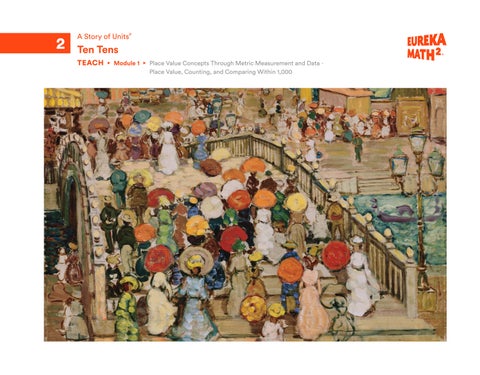
What does this painting have to do with math? The bold brushstrokes and vivid colors in Maurice Prendergast’s painting invite us to step inside this lively street scene in Venice, Italy. A group of ladies with parasols is crossing a bridge. Getting lost in a crowd can be intimidating, but as we learn about base ten, counting large numbers—of people, parasols, or anything— will be a breeze. On the cover Ponte della Paglia, 1898–1899; completed 1922 Maurice Prendergast, American, 1858–1924 Oil on canvas The Phillips Collection, Washington, DC, USA Maurice Prendergast (1858–1924), Ponte della Paglia, ca. 1898/ reworked 1922. Oil on canvas. The Phillips Collection, Washington, DC, USA. Acquired 1922.
Great Minds® is the creator of Eureka Math®, Wit & Wisdom®, Alexandria Plan™, and PhD Science®. Published by Great Minds PBC. greatminds.org © 2021 Great Minds PBC. All rights reserved. No part of this work may be reproduced or used in any form or by any means—graphic, electronic, or mechanical, including photocopying or information storage and retrieval systems—without written permission from the copyright holder. Where expressly indicated, teachers may copy pages solely for use by students in their classrooms. Printed in the USA B-Print 1 2 3 4 5 6 7 8 9 10 XXX 27 26 25 24 23 ISBN 978-1-64497-161-1
A Story of Units®
Ten Tens ▸ 2 TEACH Module
1 2 3 4 5 6
Place Value Concepts Through Metric Measurement and Data · Place Value, Counting, and Comparing Within 1,000
Addition and Subtraction Within 200
Shapes and Time with Fraction Concepts
Addition and Subtraction Within 1,000
Money, Data, and Customary Measurement
Multiplication and Division Foundations
Contents Part 1: Place Value Concepts Through Metric Measurement and Data Overview . . . . . . . . . . . . . . . . . . . . . . . . . . . . . . . . . . . . . . . . . . . . . . . . . . 6 Why. . . . . . . . . . . . . . . . . . . . . . . . . . . . . . . . . . . . . . . . . . . . . . . . . . . . . . . 10 Achievement Descriptors: Overview . . . . . . . . . . . . . . . . . . . . 13 Topic A . . . . . . . . . . . . . . . . . . . . . . . . . . . . . . . . . . . . . . . . . . . . . . . . . . . 15 Represent Data to Solve Problems Lesson 1 . . . . . . . . . . . . . . . . . . . . . . . . . . . . . . . . . . . . . . . . . . . . . . . . . . . . 18 Draw and label a picture graph to represent data.
Lesson 2 . . . . . . . . . . . . . . . . . . . . . . . . . . . . . . . . . . . . . . . . . . . . . . . . . . . 30 Draw and label a bar graph to represent data.
Lesson 3 . . . . . . . . . . . . . . . . . . . . . . . . . . . . . . . . . . . . . . . . . . . . . . . . . . . 42 Use information presented in a bar graph to solve put together and take apart problems.
Lesson 4 . . . . . . . . . . . . . . . . . . . . . . . . . . . . . . . . . . . . . . . . . . . . . . . . . . . 52 Use information presented in a bar graph to solve compare problems.
Lesson 8 . . . . . . . . . . . . . . . . . . . . . . . . . . . . . . . . . . . . . . . . . . . . . . . . . . 104 Make a meter stick and measure with various tools.
Lesson 9 . . . . . . . . . . . . . . . . . . . . . . . . . . . . . . . . . . . . . . . . . . . . . . . . . . 114 Relate 1 cm, 10 cm, and 100 cm.
Lesson 10. . . . . . . . . . . . . . . . . . . . . . . . . . . . . . . . . . . . . . . . . . . . . . . . . . 128 Reason about the relationship between the size of the unit and the number of units needed to measure.
Topic C . . . . . . . . . . . . . . . . . . . . . . . . . . . . . . . . . . . . . . . . . . . . . . . . . . 138 Estimate, Measure, and Compare Lengths Lesson 11 . . . . . . . . . . . . . . . . . . . . . . . . . . . . . . . . . . . . . . . . . . . . . . . . . . 142 Estimate and compare lengths.
Lesson 12 . . . . . . . . . . . . . . . . . . . . . . . . . . . . . . . . . . . . . . . . . . . . . . . . . . 154 Model and reason about the difference in length.
Lesson 13 . . . . . . . . . . . . . . . . . . . . . . . . . . . . . . . . . . . . . . . . . . . . . . . . . . 166 Estimate and measure height to model metric relationships.
Topic B. . . . . . . . . . . . . . . . . . . . . . . . . . . . . . . . . . . . . . . . . . . . . . . . . . . . 64 Metric Measurement and Concepts About the Ruler
Lesson 14 . . . . . . . . . . . . . . . . . . . . . . . . . . . . . . . . . . . . . . . . . . . . . . . . . . 178
Lesson 5 . . . . . . . . . . . . . . . . . . . . . . . . . . . . . . . . . . . . . . . . . . . . . . . . . . . 68
Topic D . . . . . . . . . . . . . . . . . . . . . . . . . . . . . . . . . . . . . . . . . . . . . . . . . . 189 Solve Compare Problems by Using the Ruler as a Number Line
Connect measurement to physical units by iterating a centimeter cube.
Lesson 6 . . . . . . . . . . . . . . . . . . . . . . . . . . . . . . . . . . . . . . . . . . . . . . . . . . . 80 Make a 10 cm ruler and measure objects.
Lesson 7. . . . . . . . . . . . . . . . . . . . . . . . . . . . . . . . . . . . . . . . . . . . . . . . . . . . 92 Measure lengths and relate 10 cm and 1 cm.
Represent and compare students’ heights.
Lesson 15 . . . . . . . . . . . . . . . . . . . . . . . . . . . . . . . . . . . . . . . . . . . . . . . . . . 192 Use a measuring tape as a number line to add efficiently.
Lesson 16 . . . . . . . . . . . . . . . . . . . . . . . . . . . . . . . . . . . . . . . . . . . . . . . . . . 204 Use a measuring tape as a number line to subtract efficiently.
2
Copyright © Great Minds PBC
EUREKA MATH2 2 ▸ M1
Lesson 17 . . . . . . . . . . . . . . . . . . . . . . . . . . . . . . . . . . . . . . . . . . . . . . . . . . 216 Represent and solve comparison problems by using measurement contexts.
Module Assessment (Part 1). . . . . . . . . . . . . . . . . . . . . . . . . . . . . 254 Resources
Lesson 18 . . . . . . . . . . . . . . . . . . . . . . . . . . . . . . . . . . . . . . . . . . . . . . . . . . 228
Standards. . . . . . . . . . . . . . . . . . . . . . . . . . . . . . . . . . . . . . . . . . . . . . . . . . 260
Solve compare with difference unknown word problems by using measurement contexts.
Achievement Descriptors: Proficiency Indicators. . . . . . . . . . . . . . . . 262
Lesson 19 . . . . . . . . . . . . . . . . . . . . . . . . . . . . . . . . . . . . . . . . . . . . . . . . . . 240
Observational Assessment Recording Sheet . . . . . . . . . . . . . . . . . . . . 268
Solve compare with difference unknown word problems in various contexts.
Sample Solutions . . . . . . . . . . . . . . . . . . . . . . . . . . . . . . . . . . . . . . . . . . . 270 Terminology. . . . . . . . . . . . . . . . . . . . . . . . . . . . . . . . . . . . . . . . . . . . . . . . 274 Math Past. . . . . . . . . . . . . . . . . . . . . . . . . . . . . . . . . . . . . . . . . . . . . . . . . . 276 Materials . . . . . . . . . . . . . . . . . . . . . . . . . . . . . . . . . . . . . . . . . . . . . . . . . . 278
Copyright © Great Minds PBC
3
EUREKA MATH2
2 ▸ M1
Part 2: Place Value, Counting, and Comparing Within 1,000 Overview . . . . . . . . . . . . . . . . . . . . . . . . . . . . . . . . . . . . . . . . . . . . . . . . 280 Why. . . . . . . . . . . . . . . . . . . . . . . . . . . . . . . . . . . . . . . . . . . . . . . . . . . . . . 284
Topic G . . . . . . . . . . . . . . . . . . . . . . . . . . . . . . . . . . . . . . . . . . . . . . . . . . 398 Model Base-Ten Numbers Within 1,000 with Money
Achievement Descriptors: Overview . . . . . . . . . . . . . . . . . . . 287
Lesson 28. . . . . . . . . . . . . . . . . . . . . . . . . . . . . . . . . . . . . . . . . . . . . . . . . . 400
Topic E . . . . . . . . . . . . . . . . . . . . . . . . . . . . . . . . . . . . . . . . . . . . . . . . . . 289 Understand Place Value Units
Lesson 29. . . . . . . . . . . . . . . . . . . . . . . . . . . . . . . . . . . . . . . . . . . . . . . . . . 416
Lesson 20 . . . . . . . . . . . . . . . . . . . . . . . . . . . . . . . . . . . . . . . . . . . . . . . . . 292 Count and bundle ones, tens, and hundreds to 1,000.
Lesson 21 . . . . . . . . . . . . . . . . . . . . . . . . . . . . . . . . . . . . . . . . . . . . . . . . . . 306
Use place value understanding to count and exchange $1, $10, and $100 bills. Count by $1, $10, and $100.
Lesson 30. . . . . . . . . . . . . . . . . . . . . . . . . . . . . . . . . . . . . . . . . . . . . . . . . . 430 Determine how many $10 bills are equal to $1,000.
Lesson 22 . . . . . . . . . . . . . . . . . . . . . . . . . . . . . . . . . . . . . . . . . . . . . . . . . 318
Topic H . . . . . . . . . . . . . . . . . . . . . . . . . . . . . . . . . . . . . . . . . . . . . . . . . . 443 Compose and Decompose with Place Value Disks
Use counting strategies to solve add to with change unknown word problems.
Lesson 31 . . . . . . . . . . . . . . . . . . . . . . . . . . . . . . . . . . . . . . . . . . . . . . . . . . 446
Count efficiently within 1,000 by using ones, tens, and hundreds.
Lesson 23 . . . . . . . . . . . . . . . . . . . . . . . . . . . . . . . . . . . . . . . . . . . . . . . . . 330 Organize, count, and record a collection of objects.
Count the total value of ones, tens, and hundreds with place value disks.
Lesson 32. . . . . . . . . . . . . . . . . . . . . . . . . . . . . . . . . . . . . . . . . . . . . . . . . . 458
Topic F . . . . . . . . . . . . . . . . . . . . . . . . . . . . . . . . . . . . . . . . . . . . . . . . . . 340 Express Three-Digit Numbers In Different Forms
Exchange 10 ones for 1 ten, 10 tens for 1 hundred, and 10 hundreds for 1 thousand.
Lesson 24. . . . . . . . . . . . . . . . . . . . . . . . . . . . . . . . . . . . . . . . . . . . . . . . . . 344
Model numbers with more than 9 ones or 9 tens.
Count up to 1,000 by using place value units.
Lesson 25. . . . . . . . . . . . . . . . . . . . . . . . . . . . . . . . . . . . . . . . . . . . . . . . . . 358
Lesson 33. . . . . . . . . . . . . . . . . . . . . . . . . . . . . . . . . . . . . . . . . . . . . . . . . . 472 Lesson 34. . . . . . . . . . . . . . . . . . . . . . . . . . . . . . . . . . . . . . . . . . . . . . . . . . 484 Problem solve in situations with more than 9 ones or 9 tens.
Write three-digit numbers in unit form and show the value that each digit represents.
Lesson 26. . . . . . . . . . . . . . . . . . . . . . . . . . . . . . . . . . . . . . . . . . . . . . . . . . 370 Write base-ten numbers in expanded form.
Lesson 27. . . . . . . . . . . . . . . . . . . . . . . . . . . . . . . . . . . . . . . . . . . . . . . . . . 384 Read, write, and relate base-ten numbers in all forms.
4
Copyright © Great Minds PBC
EUREKA MATH2 2 ▸ M1
Topic I . . . . . . . . . . . . . . . . . . . . . . . . . . . . . . . . . . . . . . . . . . . . . . . . . . . 497 Compare Two Three-Digit Numbers in Different Forms Lesson 35. . . . . . . . . . . . . . . . . . . . . . . . . . . . . . . . . . . . . . . . . . . . . . . . . . 500 Compare three-digit numbers by using >, =, and <.
Lesson 36. . . . . . . . . . . . . . . . . . . . . . . . . . . . . . . . . . . . . . . . . . . . . . . . . . 512 Apply place value understanding to compare by using >, =, and <.
Lesson 37. . . . . . . . . . . . . . . . . . . . . . . . . . . . . . . . . . . . . . . . . . . . . . . . . . 524 Organize, count, represent, and compare a collection of objects.
Lesson 38 (Optional). . . . . . . . . . . . . . . . . . . . . . . . . . . . . . . . . . . . . . . . . 536 Compare numbers in different forms.
Module Assessment (Part 2). . . . . . . . . . . . . . . . . . . . . . . . . . . . . 550 Resources Standards. . . . . . . . . . . . . . . . . . . . . . . . . . . . . . . . . . . . . . . . . . . . . . . . . . 554 Achievement Descriptors: Proficiency Indicators. . . . . . . . . . . . . . . . 556 Observational Assessment Recording Sheet . . . . . . . . . . . . . . . . . . . . 562 Sample Solutions . . . . . . . . . . . . . . . . . . . . . . . . . . . . . . . . . . . . . . . . . . . 564 Terminology. . . . . . . . . . . . . . . . . . . . . . . . . . . . . . . . . . . . . . . . . . . . . . . . 566 Materials . . . . . . . . . . . . . . . . . . . . . . . . . . . . . . . . . . . . . . . . . . . . . . . . . . 568 Works Cited. . . . . . . . . . . . . . . . . . . . . . . . . . . . . . . . . . . . . . . . . . . . . . . . 569 Credits. . . . . . . . . . . . . . . . . . . . . . . . . . . . . . . . . . . . . . . . . . . . . . . . . . . . 571 Acknowledgments. . . . . . . . . . . . . . . . . . . . . . . . . . . . . . . . . . . . . . . . . . 572
Copyright © Great Minds PBC
5
Before This Module Grade 1 Module 1 Students collect data by answering questions, sorting sets, and making observations. They create bar graphs, picture graphs, and tally charts to visually represent the data. As students count to find totals and visually compare quantities, they recognize that linear organizations are useful.
Grade 1 Module 4 Students explore indirect comparison, whereby the length of one object is used to compare two other objects, and they order objects by length. Students begin measuring with same-size standard units, centimeter cubes. They express the length of an object as the total number of centimeter cubes laid end to end. As students measure objects longer than 10 cm, they use 10 cm sticks and additional centimeter cubes and practice counting by tens and some ones. Students use measurement as a context for solving comparison problems.
Overview Part 1: Place Value Concepts Through Metric Measurement and Data Topic A Represent Data to Solve Problems In topic A, students mathematize their world by organizing categorical data on bar graphs. Students use a scale to help them track data without counting all. Then they use bar graphs to solve put together, take apart, and compare problems. Students may use counting, one-to-one matching, or addition and subtraction strategies to solve problems. Our Birthdays Spring
Summer
Fall
Winter
0
6
1
2
3
4
5
6 7
8
9 10 11
Copyright © Great Minds PBC
EUREKA MATH2 2 ▸ M1
Topic B Metric Measurement and Concepts About the Ruler Metric measurement lays the groundwork for place value understanding in topic B as students work with units of ones, tens, and hundreds. Students begin by using centimeter cubes to create a 10 cm ruler. Students come to understand that the numerals on a ruler represent the number of length units, or the distance, from zero. As the need arises to measure longer objects, students use ten 10 cm rulers to build a 100 cm tool, a meter stick. With a growing toolbox, students self-select appropriate measuring tools based on the size and shape of various objects. Students use the relationship between metric units to express measurements with different units, such as 105 cm and 1 m 5 cm.
Topic C Estimate, Measure, and Compare Lengths In topic C, students use measurement benchmarks to estimate the length of objects. They compare estimates with the actual measurements and model the difference in length by using a tape diagram. Students see that comparison problems can be solved with both addition and subtraction strategies—by adding or subtracting a part to make the tapes the same or by subtracting the matching part. They then apply this understanding to solving comparison problems in the context of height.
Copyright © Great Minds PBC
7
EUREKA MATH2
2 ▸ M1
Topic D Solve Compare Problems by Using the Ruler as a Number Line In Topic D, students draw on their understanding of length as they explore problem solving through linear models and measurement contexts. Students model adding and subtracting efficiently by getting to a benchmark number when they use a measuring tape as a number line. Students engage in the Read–Draw–Write routine and use a tape diagram to represent and solve compare with difference unknown word problems. Students share and compare solution strategies and notice that the same problem can be solved by using different operations and equations.
Beth’s Way -2
Lee’s Way -4
After This Module Grade 3 Module 2 Students estimate and measure weight and liquid volume. They explore the relationship between place value units by reasoning that there are 1,000 grams in 1 kilogram and 1,000 milliliters in 1 liter. Students apply their understanding of metric measurement as they represent word problems with a tape diagram and solve flexibly. In addition, students use their understanding of the number line to read vertical measurement scales. Finally, students represent data in scaled bar graphs and solve problems related to graphs.
Grade 3 Module 5
48 49 50 51 52 53 54
8
Students use the interval from 0 to 1 on the number line as the whole. They iterate fraction tiles to partition a number line into fractional units. Students count unit fractions and relate the placement of a fraction on the number line to its distance from 0. Then students apply their understanding of fractions on the number line to rulers and to the creation of line plots.
Copyright © Great Minds PBC
Why Part 1: Place Value Concepts Through Metric Measurement and Data Why does the year start with categorical data? During the first week of school, teachers and students spend time establishing a classroom community. By launching with categorical data, teachers can leverage getting-to-knowyou activities to generate student data, create graphs, and answer questions. Bar graphs provide students with a concrete and visual experience of comparison. Comparing categories on a bar graph sets up students for solving compare word problems by using a more abstract model, the tape diagram. Labeling the categories on a bar graph supports the practice of labeling tape diagrams, where students must visualize the amount or length. Students revisit strategies for answering questions by using bar graphs to solve word problems. When students count on, take away, or use matching to answer how many more or how many fewer questions, they may use simple addition or subtraction to solve, which is a precursor to work in topic D. Moreover, when students find the total number of data points, they combine up to four addends, which prepares them for solving put together problems with four 2-digit addends in module 2.
Counter Colors Yellow Red Green Blue
0 1 2 3 4 5 6 7 8 9 10 11 4 + 3 + 7 + 8 = 10 12 10 + 12 = 22
The linear nature of bar graphs also supports students in understanding measurement, and it helps them transition from work on the number path in kindergarten and grade 1 to work on the number line in grade 2. The count scale on a bar graph primes students for using the ruler as a number line to solve problems.
Why does the first module of the year emphasize measurement? After much consideration of our students’ learning, teachers’ input, and research on how students learn and how mathematical concepts progress, we decided it makes the most sense to include measurement in module 1. Why?
10
10 - 3 = 7
Copyright © Great Minds PBC
EUREKA MATH2 2 ▸ M1
1. One of the major areas of emphasis of grade 2 math standards, as noted by the content standards, is measurement. By focusing on the relationship between metric units, students begin to develop key place value understanding that is inherent in the base-ten number system; more specifically, that 10 smaller units make 1 of the next larger unit.
Beth and Kate measure the same desk.
Beth says the desk is 1 m 2 cm. Kate says it is 102 cm. Who is correct?
Metric Units Chart 100 cm (1 m)
10 cm
100
110
1 cm
2. When students begin the year with a concrete measurement experience that highlights the relationship between 100 cm, 10 cm, and 1 cm, they are able to work more flexibly and make explicit connections to place value units in module 1 part 2. 3. Once students have an understanding of the meaning of the spaces and tick marks on a ruler, they are ready to use the number line as a tool for solving addition and subtraction problems in topic D. After its introduction in this module, the number line becomes a reliable tool for students to use when solving problems throughout the year.
Why are so many different measuring tools used in topics B and C? Through the concrete experience of creating a ruler, rather than using a standard tool, students come to see that length is the number of same-size units from zero, as opposed to the number of tick marks. Students iterate a centimeter cube to create a 10 cm ruler. Then they iterate ten 10 cm rulers to create a meter stick. In doing so, students internalize the proportionality of units. This early experience of building measuring tools, rather than working with standard ones, lays the groundwork for deeper place value understanding when students compose and decompose units in module 1 part 2.
107
120
In addition, the double-sided meter stick, an innovative, new measuring tool in Eureka Math2, reinforces Say Ten counting and the base-ten structure of the number system. When students use this tool, they focus on units of ten, as opposed to each number. Students also notice relationships between units. For example, a student may correctly claim to be 120 cm tall, twelve 10 cm rulers tall, or 1 m two 10 cm rulers tall.
29
28
28
30
31
27
27
32
33
34
26
26
35
36
25
29
25
37
38
39 40
24
24
41
42
23
30
23
43 44 45 46
22
22
47
21
21
48 49
20
31
20
50
51
52
19
19
53
54
18
32
18
55
56
57
17
17
58
59 60
16
16
61
62
15
33
15
63 64 65 66
14
14
67
13
13
68 69
12
34
12
70
71
72
11
11
73
74
75
10
35
36
Copyright © Great Minds PBC
10
76
77
9
9
78
79
80
8
8
81
82
7
7
83
84
85
6
6
86
87
5
5
88
89 90
4
4
91
92
3
3
93
94 95
2
2
96
97
98 99 100
1
1
0
0
11
2 ▸ M1
EUREKA MATH2
Which word problem types, or addition and subtraction situations, are used in this module? The table shows examples of addition and subtraction situations.1 Darker shading in the table indicates the four kindergarten problem types. Students in grades 1 and 2 work with all problem types. Grade 2 students reach proficiency with the unshaded problem types. Grade 2 students are expected to master all addition and subtraction problem types by the end of the year. They revisit types that were introduced and mastered in kindergarten and grade 1. However, in grade 2, the problems are one- and two-step, and use numbers within 100 (not just within 20). Students use graphs to solve take from and put together/take apart problems in topic A. • Take from with result unknown: 6 red balloons pop. How many red balloons are there now? (Lesson 3) • Put together/take apart with total unknown: Up to four parts are given. No action joins or separates the parts. Instead, the parts may be distinguished by an attribute such as type, color, size, or location. How many balloons are there in all? (Lesson 3) • Compare with difference unknown: Two quantities are given and compared to find how many more or how many fewer. Ling’s plant is 64 cm tall. Alex’s plant is 39 cm tall. How much taller is Ling’s plant than Alex’s plant? (Lesson 18)
1
12
Common Core Standards Writing Team, Progressions for the Common Core (draft), Grades K–5, Counting and Cardinality & Operations and Algebraic Thinking, 9.
Copyright © Great Minds PBC
Achievement Descriptors: Overview Part 1: Place Value Concepts Through Metric Measurement and Data Achievement Descriptors (ADs) are standards-aligned descriptions that detail what students should know and be able to do based on the instruction. ADs are written by using portions of various standards to form a clear, concise description of the work covered in each module. Observational Assessment Recording Sheet
Each module has its own set of ADs, and the number of ADs varies by module. Taken together, the sets of module-level ADs describe what students should accomplish by the end of the year. ADs and their proficiency indicators support teachers with interpreting student work on • informal classroom observations (recording sheet provided in the module resources), • data from other lesson-embedded formative assessments, • Exit Tickets,
Student Name
Grade 2 Module 1
Part 1: Place Value Concepts Through Metric Measurement and Data Achievement Descriptors 2.Mod1.AD1
Measure lengths of objects by using metric units (centimeters and meters).
2.Mod1.AD2
Estimate lengths of objects by using metric units (centimeters and meters).
2.Mod1.AD3
Measure and find a difference in length by using metric units (centimeters and meters).
2.Mod1.AD4
Add or subtract within 100 to solve word problems involving length by using drawings and equations.
2.Mod1.AD5
Represent whole numbers within 100 on a number line.
2.Mod1.AD6
Represent sums within 100 by using a number line.
2.Mod1.AD7
Represent differences within 100 by using a number line.
2.Mod1.AD8
Draw and label picture and bar graphs to represent a data set with up to four categories.
2.Mod1.AD9
Solve addition, subtraction, and comparison problems by using information from a bar graph.
Dates and Details of Observations
PP Partially Proficient P Proficient HP Highly Proficient
Notes
• Topic Tickets, and • Module Assessments.
268
This page may be reproduced for classroom use only.
Copyright © Great Minds PBC
This module contains the nine ADs listed. 2.Mod1.AD1
2.Mod1.AD2
2.Mod1.AD3
Measure lengths of objects by using metric units (centimeters and meters).
Estimate lengths of objects by using metric units (centimeters and meters).
Measure and find a difference in length by using metric units (centimeters and meters).
2.MD.A.1
2.MD.A.3
2.MD.A.4
2.Mod1.AD4
2.Mod1.AD5
2.Mod1.AD6
Add or subtract within 100 to solve word problems involving length by using drawings and equations.
Represent whole numbers within 100 on a number line.
Represent sums within 100 by using a number line.
2.MD.B.5
Copyright © Great Minds PBC
2.MD.B.6
2.MD.B.6
13
EUREKA MATH2
2 ▸ M1
2.Mod1.AD7
2.Mod1.AD8
2.Mod1.AD9
Represent differences within 100 by using a number line.
Draw and label picture and bar graphs to represent a data set with up to four categories.
Solve addition, subtraction, and comparison problems by using information from a bar graph.
2.MD.B.6
2.MD.D.10
2.MD.D.10
The first page of each lesson identifies the ADs aligned with that lesson. Each AD may have up to three indicators, each aligned to a proficiency category (i.e., Partially Proficient, Proficient, Highly Proficient). While every AD has an indicator to describe Proficient performance, only select ADs have an indicator for Partially Proficient and/or Highly Proficient performance. An example of one of these ADs, along with its proficiency indicators, is shown here for reference. The complete set of this module’s ADs with proficiency indicators can be found in the Achievement Descriptors: Proficiency Indicators resource. • AD Code: The code indicates the grade level and the module number and then lists the ADs in no particular order. For example, the first AD for grade 2 module 1 part 1 is coded as 2.Mod1.AD1. • AD Language: The language is crafted from standards and concisely describes what will be assessed. • AD Indicators: The indicators describe the precise expectations of the AD for the given proficiency category. • Related Standard: This identifies the standard or parts of standards from the Common Core State Standards that the AD addresses.
Achievement Descriptors: Proficiency AD Indicators AD Code Grade.Module.AD# Language 2.Mod1.AD1 Measure lengths of objects by using metric units (centimeters and meters).
Related Standard
RELATED CCSSM
2.MD.A.1 Measure the length of an object by selecting and using appropriate tools such as rulers, yardsticks, meter sticks, and measuring tapes.
Partially Proficient
Proficient
Highly Proficient
Measure lengths of objects by using metric units (centimeters and meters) for objects that are easily measured with a ruler (e.g., flat and straight).
Measure lengths of objects by using metric units (centimeters and meters) for objects that require choosing an appropriate tool before measuring.
Measure the pencil with a 10 cm ruler.
Circle the best tool to measure the length around a ball. 10 cm ruler
The pencil is
cm long.
meter stick
AD Indicators
measuring tape
Use the tool to measure the length around a ball.
2.Mod1.AD2 Estimate lengths of objects by using metric units (centimeters and meters).
14
RELATED CCSSM
2.MD.A.3 Estimate lengths using units of inches, feet, centimeters, and meters.
Copyright © Great Minds PBC
Topic A Represent Data to Solve Problems Topic A channels the excitement of students as they enter grade 2 by mathematizing getting-to-know-you activities, which often include student interest surveys. Lesson 1 uses these activities to show students that math is a part of the world around them. As students express personal preferences and organize responses on a graph, they come to see how a graph can be used to organize data that would otherwise be difficult to visualize. As students transition to working with bar graphs, they represent data more abstractly by coloring spaces on a grid. Students use a scale to help them track data without always counting all. The scale is a bridge between the number path in kindergarten and grade 1 and the number line in grade 2. The scale also previews concepts about the ruler. For example, students learn that, on a bar graph, the space from the beginning of the bar to the first line represents a count of 1, just as they will learn that the space from 0 to 1 on the ruler is one length unit. In the last two lessons of this topic, students apply their knowledge of bar graphs to solve put together, take apart, and compare problems. Students may solve by counting all, by counting on, or by using simple addition or subtraction. Students answer questions such as, How many more worms than bees are at the park? When solving comparison problems, students determine how many more or fewer by comparing number or length. Students may use one-to-one matching to solve. Alternatively, they may add or subtract to make the bars equal in length. The visual nature of a bar graph sets the stage for using tape diagrams as a representational tool to solve word problems later in the module. Intentionally launching grade 2 with categorical data provides the opportunity throughout the year to use data contexts to give meaning to and support problem solving with addition and subtraction—the major work of grade 2.
Copyright © Great Minds PBC
15
EUREKA MATH2
2 ▸ M1 ▸ TA
Progression of Lessons Lesson 1 EUREKA MATH2
2 ▸ M1 ▸ TA ▸ Lesson 1
1
Draw and label a picture graph to Name represent data. Sample:
Lesson 2
Lesson 3
Draw and label a bar graph to represent data. EUREKA MATH2
2 ▸ M1 ▸ TA ▸ Lesson 2
Favorite Subject
Our Birthdays
Use information presented in a bar graph to solve put together and take apart problems. EUREKA MATH2
2 ▸ M1 ▸ TA ▸ Lesson 3
Name
Spring
✓ ✓ ✓
✓
✓
✓
✓
✓
✓ ✓
Reading Key:
✓ ✓
✓
✓
✓
✓
✓ ✓ ✓ ✓
Each ✓stands for 1 vote.
Writing
Math
Each symbol stands for 1 vote. Copyright © Great Minds PBC
✓
Balloons
Summer
Yellow
Fall
Red
Green
Winter
✓
0
1
2
3
4
5
6
7
8
9
10
11
The scale shows that each box stands Our Birthdays 1. What is the title of this graph? for 1 student’s birthday. 4
✓ ✓
2. How many seasons are there?
3. Which season has the most birthdays?
Science
4. Which season has the fewest birthdays?
Winter Fall
Blue
0
2
3
4
5
6
9
10
11
12
5
Now how many balloons are there in all?
Copyright © Great Minds PBC
8
2. 6 reda balloons pop. Write number sentence. How many red balloons are there now?
LESSON
7
30 there in all? How many balloons 1. How many balloons are there in all? are 30 Write a number sentence 8 + 11 + 9 + 2 = 30
24
I know that 8 + 2 = 10. I also know that 11 + 9 = 20, and 20 + 10 = 30. Copyright © Great Minds PBC
16
1
8 + 11 + 9 + 2 = 30
5
12
3
19
Copyright © Great Minds PBC
EUREKA MATH2 2 ▸ M1 ▸ TA
Lesson 4 Use information presented in a bar graph to solve compare problems. Farm Animals Goats Cows Pigs Hens 0 1 2 3 4 5 6 7 8 9 10 11 12 13
The bars help me see the difference and compare: There are 3 more pigs than cows.
Copyright © Great Minds PBC
17
1
LESSON 1
Draw and label a picture graph to represent data.
EUREKA MATH2
2 ▸ M1 ▸ TA ▸ Lesson 1
1
Name
Make a picture graph.
Animals We Like
Animals We Like Dogs
Cats Rabbits Fish
7
4
• Why are graphs useful?
✓
✓
✓ ✓
✓ ✓ ✓
✓
✓
✓
a data set with up to four categories. (2.MD.D.10)
✓
✓
✓
✓
✓
✓ ✓
Each ✓stands for 1 vote.
Dogs Key:
2.Mod1.AD8 Draw and label picture and bar graphs to represent
✓
✓
✓
Achievement Descriptor
✓ ✓
✓ ✓
Copyright © Great Minds PBC
Students vote on a personal favorite to generate data and make a class picture graph. They create a graph by using symbols to represent votes. Then students read and interpret picture graphs to answer questions. This lesson introduces the terms table, data, category, and key.
Key Question
8 5
Lesson at a Glance
Cats
Rabbits
Fish
9
Copyright © Great Minds PBC
EUREKA MATH2 2 ▸ M1 ▸ TA ▸ Lesson 1
Agenda
Materials
Lesson Preparation
Fluency 10 min
Teacher
Launch 10 min
• Chart paper (3)
• Create a blank table on chart paper with the title Favorite Subject. Label the four categories Reading, Writing, Math, and Science. (Favorite Subject is a suggested topic. Consider choosing a topic relevant to your students and adjusting materials accordingly.)
Learn 30 min • Make a Picture Graph • Use a Picture Graph to Answer Questions • Problem Set
Land 10 min
• Marker • Projection device* • Teach book* • Teacher computer or device*
Students • Sticky note • Dry-erase marker* • Personal whiteboard* • Personal whiteboard eraser* • Learn book* • Pencil*
• Create a blank graph on chart paper. Include lines for a title and categories to be filled in later with the class. The graph should match the graph from the classwork page. • Create a terminology chart to record new mathematical terms introduced throughout the lesson. This chart will be used in subsequent lessons.
* These materials are only listed in lesson 1. Ready these materials for every lesson in this module.
Copyright © Great Minds PBC
19
EUREKA MATH2
2 ▸ M1 ▸ TA ▸ Lesson 1
Fluency
10 35
Happy Counting by Ones Within 50
Teacher Note
Students visualize a5number line while counting aloud to build fluency counting within 1,000. Invite students to participate in Happy Counting. When I give this signal, count up. (Demonstrate.) When I give this signal, count down. (Demonstrate.) Let’s count by ones. The first number you say is 28. Ready?
Choose signals that you are comfortable with, such as thumbs-up and thumbs-down or two fingers pointing up and down. Show your signal and gesture up or down with each count. The goal is to be clear and crisp so that students count in unison. Avoid saying the numbers with the class; instead, listen for errors and hesitations.
Signal up or down accordingly for each count.
28
29
30
29
30
31
32
33
32
33
34
35
36
35
36
37
Continue counting by ones to 50, changing directions occasionally. Emphasize crossing over multiples of 10 and where students hesitate or count inaccurately.
Ready, Set, Add Students find the total and say an addition equation to maintain addition fluency within 10 from grade 1. Let’s play Ready, Set, Add. Have students form pairs and stand facing each other. Model the action: Make a fist, and shake it on each word as you say, “Ready, set, add.” At “add,” open your fist, and hold up any number of fingers.
20
Differentiation: Challenge Challenge students who demonstrate fluency adding within 10 to add within 20. Encourage each partner to use both hands to show a number.
Copyright © Great Minds PBC
EUREKA MATH2 2 ▸ M1 ▸ TA ▸ Lesson 1
Tell students that they will make the same motion. At “add” they will show their partner any number of fingers. Consider doing a practice round with students. Clarify the following directions: • To show zero, show a closed fist at “add.” • Try to use different numbers each time to surprise your partner. Each time partners show fingers, have them both say the total number of fingers. Then have each student say the addition equation, starting with the number of fingers on their own hand. See the sample dialogue under the photograph. Circulate as students play the game to ensure that each student is trying a variety of numbers.
Choral Response: Related Facts Within 20
Partners A and B: “6” Partner A: “4 + 2 = 6” Partner B: “2 + 4 = 6”
Students say a related addition equation to prepare for work with put together, take apart, and compare problems beginning in lesson 3. After asking each question, wait until most students raise their hands, and then signal for students to respond. Raise your hand when you know the answer to each question. Wait for my signal to say the answer. Display the number bond. A subtraction equation that matches this number bond is 10 – 8 = 2. (Gesture to the total and parts while saying the equation.) Display the equation: 10 – 8 = 2. What is a related addition equation, starting with 8? 8 + 2 = 10
Teacher Note Use hand signals to introduce a procedure for answering choral response questions. For example, cup your hand around your ear for listen, lift your finger to your temple for think, and raise your own hand to remind students to raise theirs. Teach the procedure by using general knowledge questions, such as the following:
10
• What grade are you in?
8
2
10 - 8 = 2 10 - 2 = 8
8 + 2 = 10 2 + 8 = 10
• What is the name of our school? • What is your teacher’s name?
Display the equation: 8 + 2 = 10. Copyright © Great Minds PBC
21
EUREKA MATH2
2 ▸ M1 ▸ TA ▸ Lesson 1
10 – 2 = 8 is another subtraction equation that matches this number bond. (Gesture to the total and parts while saying the equation.) Display the equation: 10 – 2 = 8.
Consider using strategic, flexible grouping throughout the module based on students’ mathematical and English language proficiency.
What is a related addition equation, starting with 2? 2 + 8 = 10 Display the equation: 2 + 8 = 10.
• Pair students who have different levels of mathematical proficiency.
Repeat the process with the following sequence:
7
Language Support
16
13
• Pair students who have different levels of English language proficiency.
12
5
2
10
6
9
4
6
6
7-5=2 7-2=5
5+2=7 2+5=7
16 - 10 = 6 16 - 6 = 10
10 + 6 = 16 6 + 10 = 16
13 - 9 = 4 13 - 4 = 9
9 + 4 = 13 4 + 9 = 13
12 - 6 = 6
6 + 6 = 12
• Join two pairs of students to form small groups of four. As applicable, complement any of these groupings by pairing students who speak the same native language.
10
Launch
10 30
Materials—T: Favorite Subject table, terminology chart, marker
Students generate10data by voting on a personal favorite.
Teacher Note
Gather students and invite them to participate in a fun getting-to-know-you activity. One way we can get to know each other is to ask questions and record the answers. For example, I could ask you to tell me your favorite subject—reading, writing, math, or science.
22
This lesson introduces four mathematical terms. Students will be expected to gesture to identify the terms by the end of the lesson. For example, students identify the meaning of the word key by pointing to the key on a picture graph. They will continue to hear and use these terms throughout the year. The term picture graph should be familiar from grade 1.
Copyright © Great Minds PBC
EUREKA MATH2 2 ▸ M1 ▸ TA ▸ Lesson 1
Display the Favorite Subject table. Introduce the terms table and category. This is a table. It lists the four subjects you can choose. Each subject is a category, or type of group. Vote by raising your hand when I call out your favorite subject. I’ll record the number of votes for each category on the table. Add the new terms table and category to the terminology chart you prepared in advance. Conduct the survey and record the counts for each category. Then introduce the new term data. The information we just recorded about our favorite subjects is called data. I wonder how many more students like math than writing. Add the term data to the terminology chart. Transition to the next segment by framing the work. Today, we will look at a way to show this data, or information, that makes it easier to answer that question. 10 10
Learn
Teacher Note The lesson uses the example Favorite Subject for the table and graph. Consider selecting another topic to align with student interest.
Language Support Support students’ language development by pointing out that table has multiple meanings. Point to a tabletop and say, “This is one kind of table. We can sit at a table when we eat lunch.” Then point to the chart and say, “This is another kind of table. We use it to show information.” The term key is introduced later in the lesson. Consider using a similar support as you introduce that term.
30 10
Make a Picture Graph Materials—T: Blank graph, Favorite Subject table; S: Sticky note
Students make picture graphs to represent data. Display the blank graph next to the Favorite Subject table. Guide the class to make a graph by using the data from the table. Leave space at the bottom to write in a key.
Copyright © Great Minds PBC
Teacher Note The data generated in the classroom will differ from the data displayed on the example. Use the data generated from students.
23
2 ▸ M1 ▸ TA ▸ Lesson 1
EUREKA MATH2
Let’s use the data from our table to make a graph. What title can we give our graph? Favorite Subject Let’s write the four categories from the table—Reading, Writing, Math, and Science— toward the bottom of the paper. Now let’s use a sticky note to represent your vote. Give each student a sticky note. Have students write their name or initials on the note and record their vote by placing the note directly above their favorite subject. Ensure that students arrange sticky notes in columns without gaps or overlaps.
24
Copyright © Great Minds PBC
EUREKA MATH2 2 ▸ M1 ▸ TA ▸ Lesson 1
Once all votes are recorded, have students think–pair–share to compare the table with the graph. What is the same and different about the table and the graph? The title is the same. They both show reading, writing, math, and science. The table shows numbers, but the graph shows sticky notes. Students may notice that the category counts are the same on both charts. If the category counts are different, encourage them to reason about why. Ask, “Did some people change their vote?”
UDL: Representation Consider providing additional clarification for terms by showing students a map with a key. Explain how a map key is used in the same way a graph key is used. Discuss how symbols make it easier for people to understand information. Graphs also use symbols to help people understand information.
We made a graph. A graph is another way to show data. You will see different kinds of graphs this year.
Key
On this graph, your sticky note represents, or stands for, your vote.
Flower Garden
Tree
Let’s make a key on the graph that shows what these sticky notes represent.
Pond
What does each sticky note represent?
Bench
1 vote Add the key to the bottom of the graph. Add the new term key to the terminology chart.
Slide Swings
Now that our graph is complete, what math questions can we ask about it? Which subject got the most votes?
Seesaw
Which subject got the fewest votes?
Path
How many people like math the most? Can we tell how many more students like math better than they like writing? How? Yes, I can count the extra sticky notes in the math category. Help students understand why the graph cannot answer a question such as: Why don’t people like writing as much as math? Tell students you want to save this data about their favorite subjects, but the sticky notes might fall off. Therefore, they will re-create this graph in their student book. When we copy the data into a new graph, the graph will have the same information, even if it doesn’t look exactly the same. Copyright © Great Minds PBC
25
EUREKA MATH2
2 ▸ M1 ▸ TA ▸ Lesson 1
Guide students to complete the graph. Begin by filling in the title, key, and categories. Review the terms symbol and picture graph that were introduced in grade 1. On our class graph, we used 1 sticky note to show 1 vote. A picture graph shows data by using symbols, or pictures.
EUREKA MATH2
2 ▸ M1 ▸ TA ▸ Lesson 1
1
Name
Sample:
Students may use words or an initial to label categories. For example, they may write the word Reading or the letter R.
Favorite Subject ✓ ✓
We can draw a symbol to stand for 1 vote. Let’s show 1 vote by making 1 symbol in 1 box on the graph.
✓
✓ ✓
✓
✓
✓
✓
✓
✓
✓
✓
✓
✓
Each ✓stands for 1 vote.
Reading
Writing
Key:
Labeling with initials prepares students to use initials when labeling tape diagrams in the next topic.
✓
✓
✓
✓
✓ ✓
✓
✓
Invite students to generate ideas about a symbol to draw in each box of the graph (e.g., circle, star, check mark, smiley face). The example uses check marks but consider allowing students to choose their own symbol.
Teacher Note
Math
✓
Science
5
Copyright © Great Minds PBC
Let’s use a check mark to show 1 vote on the graph. How many people voted for reading? 5 Find the reading category. Draw 5 check marks, 1 in each box, as symbols for each of our 5 votes. Model recording the total above the category as students do the same.
Favorite Subject
✓ ✓ ✓ ✓ ✓ ✓ ✓ ✓
Use a Picture Graph to Answer Questions
Math
Students interpret data presented in a picture graph to answer questions.
✓ ✓ ✓ ✓ ✓ ✓ Reading
2. How many subjects are on the graph? 3. Which subject has the most votes? 4. Which subject has the fewest votes? 6
LESSON
✓ ✓ ✓ ✓ ✓ ✓ ✓ ✓ ✓
✓ ✓
Key: Each ✓stands for 1 vote.
1. What is the title of this graph?
Direct students’ attention to the completed picture graph in their student book that shows how another class voted.
26
EUREKA MATH2
2 ▸ M1 ▸ TA ▸ Lesson 1
Have students work in pairs to graph the other three categories.
Promoting the Standards for Mathematical Practice
Writing
Science
Favorite Subject 4 Science Writing Copyright © Great Minds PBC
Students attend to precision (MP6) when they make and interpret a picture graph. In making the graph, students display precision by being careful to only draw one symbol in each box without skipping any boxes. In interpreting the graph, students are precise in determining what kinds of questions they can and cannot use the graph to answer. Ask the following questions to promote MP6: • What kinds of questions can we answer with this graph? • What kinds of questions can’t we answer with this graph?
Copyright © Great Minds PBC
EUREKA MATH2 2 ▸ M1 ▸ TA ▸ Lesson 1
Have students use the graph to answer the questions. If time permits, invite students to think of other questions they could answer by using this graph.
Problem Set Differentiate the set by selecting problems for students to finish independently within the timeframe. Problems are organized from simple to complex. 10 Help students recognize the words picture, graph, and title in print. Invite students to underline them as you read them aloud. 10
30
Land
10
Debrief 5 min Materials—T: Class-created picture graph, terminology chart
Objective: Draw and label a picture graph to represent data. Gather students near the class-created picture graph and have them think–pair–share about what they learned. What did we learn about our class from this graph? How did the graph help us learn it? We learned that a lot of us like math because math has the most votes. More people like science than like reading or writing. Science has more check marks than reading or writing. We learned that only a few people like writing. That category has the fewest sticky notes.
Copyright © Great Minds PBC
27
EUREKA MATH2
2 ▸ M1 ▸ TA ▸ Lesson 1
Display the terminology chart beside the class-created table and graph. Invite students to gesture to identify each new term. For example, have students identify the meaning of the word key by pointing to the key on the picture graph.
Close this segment with the following question: Why are graphs useful? They make it easy to see information. They make it easy to see which category has more or less. We can see how many more of something.
Exit Ticket 5 min
Language Support Consider providing visual support directly on the terminology chart by including images of a table and a picture graph that are labeled with the applicable terms to aid students in expressing their ideas.
Provide up to 5 minutes for students to complete the Exit Ticket. It is possible to gather formative data even if some students do not complete every problem. 28
Copyright © Great Minds PBC
EUREKA MATH2 2 ▸ M1 ▸ TA ▸ Lesson 1
Sample Solutions Expect to see varied solution paths. Accept accurate responses, reasonable explanations, and equivalent answers for all student work.
EUREKA MATH2
2 ▸ M1 ▸ TA ▸ Lesson 1
EUREKA MATH2
2 ▸ M1 ▸ TA ▸ Lesson 1
1
Name
Number of Books
1. Make a picture graph.
Pets We Like
Pets We Like Dogs
Cats Fish Lizards
9 8 3 4
✓
Copyright © Great Minds PBC
✓ ✓ ✓ ✓ ✓ ✓
✓ ✓ ✓ ✓ ✓
Hope
Ming
Kate
Kevin
✓
✓
✓
✓
✓
✓
✓
✓
✓
✓
✓
✓
✓
✓
✓
✓
✓
✓
2. What is the title of this graph?
✓
✓
✓
✓
3. How many people are there?
Dogs
Cats
Fish
Lizards
4. Who has the most books?
Key: Copyright © Great Minds PBC
✓ ✓ ✓ ✓ ✓ ✓ ✓ ✓ ✓ ✓
✓ ✓ ✓ ✓ ✓ ✓ ✓ ✓ ✓ ✓ ✓
Key: Each ✓stands for 1 book.
✓
Each ✓stands for 1 vote.
5. Who has the fewest books? 7
8
PROBLEM SET
Number of Books 4 Kevin Kate Copyright © Great Minds PBC
29
2
LESSON 2
Draw and label a bar graph to represent data.
EUREKA MATH2
2 ▸ M1 ▸ TA ▸ Lesson 2
2
Name
Make a bar graph.
Games We Like Tag
4
Kickball
7
Jump Rope
10
Hide and Seek
3
Lesson at a Glance Students compare data presented vertically and horizontally. They discover that the data stays the same even when the orientation changes. They record data on a bar graph with a scale. Then they use bar graphs to answer questions. This lesson introduces the terms bar graph and scale.
Key Questions • How are bar graphs similar to picture graphs? • How are bar graphs different from picture graphs?
Achievement Descriptor
Games We Like
2.Mod1.AD8 Draw and label picture and bar graphs to represent
a data set with up to four categories. (2.MD.D.10)
Tag Kickball Jump Rope Hide and Seek 0
Copyright © Great Minds PBC
1 2 3 4 5 6 7 8 9 10 11
15
Copyright © Great Minds PBC
EUREKA MATH2 2 ▸ M1 ▸ TA ▸ Lesson 2
Agenda
Materials
Lesson Preparation
Fluency 10 min
Teacher
Launch 5 min
• Terminology chart
• Save a few samples of student-created bar graphs from this lesson to use in topic B lesson 6. Take photos, prepare a space to store the work, or make note of which students’ books to use.
Learn 35 min • Make a Bar Graph
• Chart paper (2) • Marker
• Use a Bar Graph to Answer Questions
Students
• Problem Set
• None
Land 10 min
• Create a blank table on chart paper with the title Our Birthdays. Label the four categories Spring, Summer, Fall, and Winter. Consider listing the months included in each of those seasons. • Create a blank graph on chart paper. Include lines for a title and categories to be filled in later with the class. The graph should match the graph from the classwork page. • Continue to use the terminology chart created in lesson 1. Add new terms as they are introduced in this lesson.
Copyright © Great Minds PBC
31
EUREKA MATH2
2 ▸ M1 ▸ TA ▸ Lesson 2
Fluency
10 5
Happy Counting by Ones Within 100 Students visualize a35number line while counting aloud to build fluency counting within 1,000. 10
Invite students to participate in Happy Counting. When I give this signal, count up. (Demonstrate.) When I give this signal, count down. (Demonstrate.) Let’s count by ones. The first number you say is 67. Ready? Signal up or down accordingly for each count. Teacher Note
67
68
69
70
69
70
71
72
73
72
73
74
75
76
75
76
Continue counting by ones to 100, changing directions occasionally. Emphasize crossing over multiples of 10 and where students hesitate or count inaccurately.
Listen to student responses and be mindful of errors and hesitation and lack of full-class participation. If needed, adjust the tempo or adjust the sequence of numbers to within 50.
Ready, Set, Add Students find the total and say an addition equation to maintain addition fluency within 10 from grade 1. Let’s play Ready, Set, Add. Have students form pairs and stand facing each other. Model the action: Make a fist, and shake it on each word as you say, “Ready, set, add.” At “add,” open your fist, and hold up any number of fingers. Tell students that they will make the same motion. At “add” they will show their partner any number of fingers. Consider doing a practice round with students.
32
Copyright © Great Minds PBC
EUREKA MATH2 2 ▸ M1 ▸ TA ▸ Lesson 2
Clarify the following directions: • To show zero, show a closed fist at “add.” • Try to use different numbers each time to surprise your partner. Each time partners show fingers, have them both say the total number of fingers. Then have each student say the addition equation, starting with the number of fingers on their own hand. See the sample dialogue under the photograph. Circulate as students play the game to ensure that each student is trying a variety of numbers.
Choral Response: Related Facts Within 20
Partners A and B: “6” Partner A: “4 + 2 = 6” Partner B: “2 + 4 = 6”
Students say a related addition equation to prepare for work with put together, take apart, and compare problems beginning in lesson 3. After asking each question, wait until most students raise their hands, and then signal for students to respond. Raise your hand when you know the answer to each question. Wait for my signal to say the answer. Display the number bond. A subtraction equation that matches this number bond is 10 – 6 = 4. (Gesture to the total and parts while saying the equation.) Display the equation: 10 – 6 = 4.
10
What is a related addition equation, starting with 6? 6 + 4 = 10 Display the equation: 6 + 4 = 10.
Copyright © Great Minds PBC
6
4
10 - 6 = 4 10 - 4 = 6
6 + 4 = 10 4 + 6 = 10
33
EUREKA MATH2
2 ▸ M1 ▸ TA ▸ Lesson 2
10 – 4 = 6 is another subtraction equation that matches this number bond. (Gesture to the total and parts while saying the equation.) Display the equation: 10 – 4 = 6. What is a related addition equation, starting with 4? 4 + 6 = 10 Display the equation: 4 + 6 = 10. Repeat the process with the following sequence:
8
13
11
15
3
5
7
6
8
3
9
6
8-3=5 8-5=3
3+5=8 5+3=8
13 - 7 = 6 13 - 6 = 7
7 + 6 = 13 6 + 7 = 13
11 - 8 = 3 11 - 3 = 8
8 + 3 = 11 3 + 8 = 11
15 - 9 = 6 15 - 6 = 9
9 + 6 = 15 6 + 9 = 15
10
Launch
5 35
Materials—T: Terminology chart
Students discover 10 that the orientation and type of graph do not change the data. Display the vertical graph. How can you tell just by looking at the graph which category got the most votes? How can you tell which category got the fewest, or least, votes? You can look and see which one is the tallest and which one is the shortest. Math got the most because it’s the tallest. Writing got the least because it’s the shortest. 34
Favorite Subject
✓ ✓ ✓ ✓ ✓
Reading
✓ ✓ ✓ ✓
Writing
✓ ✓ ✓ ✓ ✓ ✓ ✓ ✓ ✓
Math
Teacher Note ✓ ✓ ✓ ✓ ✓ ✓
Science
Key: Each ✓ stands for 1 vote.
As students say which categories have the most and the fewest votes, help them distinguish between statements such as “Math has the most votes” and “Most people like math.” The latter is not true because the combined total for reading, writing, and science is greater than the number of votes for math.
Copyright © Great Minds PBC
EUREKA MATH2 2 ▸ M1 ▸ TA ▸ Lesson 2
Display the vertical and horizontal graphs side by side. What do you notice about these two graphs?
Favorite Subject
Favorite Subject
It’s the same graph, but one is standing up and the other is on its side.
✓ ✓ ✓ ✓ ✓
If no one mentions the position of the categories, call students’ attention to it.
✓ ✓ ✓ ✓
✓ ✓ ✓ ✓ ✓ ✓ ✓ ✓ ✓
✓ ✓ ✓ ✓ ✓ ✓
Writing Math Science
Key: Each ✓ stands for 1 vote.
Reading
The categories are in different places. Did the data, or information, change?
Writing
Math
✓ ✓ ✓ ✓ ✓
Reading
Science
✓ ✓ ✓ ✓
✓ ✓ ✓ ✓ ✓ ✓ ✓ ✓ ✓ ✓ ✓ ✓ ✓ ✓ ✓
Key: Each ✓ stands for 1 vote.
No. Both these graphs show the same data. One shows the data going side to side, and one shows the data up and down. The data did not change. (Gesture to each graph.) How can you tell which category has the most and which has the fewest votes on this graph? (Point to the graph with the data shown horizontally.) Math is still the most because it’s the longest. Writing has the fewest because it’s the shortest. Display the bar graph beside the horizontal picture graph. What do you notice about these two ways of showing this data?
Favorite Subject
Reading ✓ ✓ ✓ ✓ ✓ Writing ✓ ✓ ✓ ✓
Math ✓ ✓ ✓ ✓ ✓ ✓ ✓ ✓ ✓
Science ✓ ✓ ✓ ✓ ✓ ✓
Key: Each ✓stands for 1 vote.
Listen for or guide students to notice similarities and differences.
Favorite Subject Reading Writing Math Science 0
1
2 3 4 5 6 7 8 9 10 11
Point to the bar graph. This is another type of graph. It is called a bar graph.
UDL: Representation The shading between each category supports students in processing information. This separation makes each category easily visible and distinct. It also prevents the common error of not leaving space between the bars of the graph. This error, shown on the right, results in a graph that resembles a histogram. This graph is not a histogram because histograms display measurement data rather than categorical data. Animals at the Beach
Animals at the Beach
15 14 13 12 11 10 9 8 7 6 5 4 3 2 1 0
15 14 13 12 11 10 9 8 7 6 5 4 3 2 1 0 Seagulls
Clams
Starfish
Crabs
Seagulls Clams Starfish Crabs
Add the term bar graph to the terminology chart started in lesson 1. Then have students turn and talk about the following questions. Which graph do you think is easier to make? Why? Which graph do you think makes it easier to see totals? Why? Transition to the next segment by framing the work. In the last lesson, we made picture graphs. Today, we will collect some data about our class and make a bar graph to show the information. Copyright © Great Minds PBC
35
10 EUREKA MATH2
2 ▸ M1 ▸ TA ▸ Lesson 2 5
Learn
35 10
Make a Bar Graph Materials—T: Our Birthdays table, blank graph, marker, terminology chart
Students generate data about themselves and represent it on a bar graph. Display the Our Birthdays table and the prepared blank graph on chart paper. Then conduct a class survey about students’ birthday months.
Teacher Note Graphs are displayed both horizontally and vertically in the lesson to support students in generalizing graphs and noting that the information does not change when the orientation of the graph changes. Students are not expected to use the terms horizontal or vertical at this time. Those terms are introduced in module 3.
Language Support
Using the data from the table, guide students to complete the bar graph in their student book as you create the graph on chart paper. Begin by having them fill in the title and label the categories on the side. Have students label in the same order as the table, starting with Spring at the top. Before we show our data on a bar graph, we fill in the scale along the bottom of the graph. This helps make it easier to count the totals for each category.
Consider supporting the multiple meanings of the term scale by facilitating a class discussion with visuals or pictures. Ask students what other meanings of the word scale they are familiar with, besides the definition presented in this lesson. When students mention scales on a lizard, show a picture of a lizard and label its scales. Contrast this with an image of a graph with its scale labeled. Highlight for students that this lesson will focus on the mathematical meaning of the term scale.
Pause to fill in the scale as students do the same. Add the term scale to the terminology chart. Look at the numbers on the scale. What does this look like? The number path from first grade The numbers on a ruler 36
Copyright © Great Minds PBC
EUREKA MATH2 2 ▸ M1 ▸ TA ▸ Lesson 2
The numbers on the scale go in order, just as they do on a ruler or a number path.
Teacher Note
On this graph, the scale tells us that each box stands for 1 student’s birthday. How many boxes should we color in for the Spring category?
EUREKA MATH2
8 boxes
Sample:
2 ▸ M1 ▸ TA ▸ Lesson 2
2
Name
Our Birthdays
Spring
Yes, we color in 8 boxes to match the data from our table.
Summer Fall
Have students follow along on their graphs as you model the following procedure:
Winter 0
1
2 3 4 5 6 7 8 9 10 11
Promoting the Standards for Mathematical Practice
• Confirm which row to color by putting a finger on the category label and moving it across the row. • Put a finger at 8 on the scale. Slide it up to the appropriate row. Make a mark in that box to indicate where to stop coloring.
11
Copyright © Great Minds PBC
• Color in 8 boxes for the Spring category. Continue in this way to complete the graph.
EUREKA MATH2
2 ▸ M1 ▸ TA ▸ Lesson 2
Use a Bar Graph to Answer Questions
Just as we did with the picture graphs in lesson 1, we can use a bar graph to answer questions about data.
Our Birthdays
• Do you color the same number of boxes when you count each box and when you use just the scale? Why? • How do you know that using the scale to mark the last box you need to color will always give you the right number of boxes?
Spring
Summer
Fall
Winter
0
1
2
3
4
5
Direct students’ attention to the completed bar graph in their student book, which shows birthday data from another class.
4. Which season has the fewest birthdays?
LESSON
7
8
9
10
11
4
3. Which season has the most birthdays?
12
6
Our Birthdays
1. What is the title of this graph? 2. How many seasons are there?
Copyright © Great Minds PBC
Students look for and express regularity in repeated reasoning (MP8) when they recognize that they can use the scale to find the last box they need and color the row over to that box. Ask the following questions to promote MP8:
Select a few samples of student-created bar graphs for use in topic B lesson 6. Students will use the samples to make connections between a ruler and the scale on a bar graph.
Students interpret data presented in a bar graph to answer questions.
The data generated in the classroom will differ from the data provided in the example dialogue. Use the data generated from students.
Winter Fall
Copyright © Great Minds PBC
37
EUREKA MATH2
2 ▸ M1 ▸ TA ▸ Lesson 2
Guide students as they use the bar graph to answer the questions. If time permits, invite them to think of other questions they could answer by using this bar graph.
Problem Set Differentiate the10set by selecting problems for students to finish independently within the timeframe. Problems are organized from simple to complex. 5
35
Land
10
Debrief 5 min Materials—T: Terminology chart
Language Support As needed, use a simple graphic organizer to support students in comparing the different types of graphs.
Objective: Draw and label a bar graph to represent data. Gather students with their student books. What did we learn about our class today? How did the bar graph help us learn that information? We learned that only 2 people have a birthday in fall. Only 2 boxes are colored. Many of us have a birthday in winter. Winter has the longest bar. Have students turn and talk to revisit this question from Launch: Which graph makes it easier to see totals? This provides students with an opportunity to reflect on and revise their thinking, if needed. Consider also prompting them with the following questions: • Do picture graphs use symbols? • What type of graph uses a scale?
38
Copyright © Great Minds PBC
EUREKA MATH2 2 ▸ M1 ▸ TA ▸ Lesson 2
When you colored the boxes for each category, did you count each box, or did you use the scale? Which strategy do you like better? I counted each box, so I didn’t color too many. I liked doing it that way because I could be sure I had the right number of boxes. I put my finger on the number and went up to the right row. Then I colored that far over. It was faster for me that way. Post the terminology chart and display the slide of the picture graph and the bar graph from Launch. Ask students to think–pair–share to compare the two graphs. What are the different types of graphs you know? How are they similar and different? Use the words from the word chart in your response. Picture graphs and bar graphs both show data. One has symbols and one has bars. Only a bar graph has a scale with numbers. When you make a picture graph, you use a symbol for each vote.
Exit Ticket 5 min Provide up to 5 minutes for students to complete the Exit Ticket. It is possible to gather formative data even if some students do not complete every problem.
Copyright © Great Minds PBC
39
EUREKA MATH2
2 ▸ M1 ▸ TA ▸ Lesson 2
Sample Solutions Expect to see varied solution paths. Accept accurate responses, reasonable explanations, and equivalent answers for all student work.
EUREKA MATH2
2 ▸ M1 ▸ TA ▸ Lesson 2
EUREKA MATH2
2 ▸ M1 ▸ TA ▸ Lesson 2
2
Name
1. Make a bar graph.
Sports We Like Swimming
Fruit We Like Apples
Bananas
Grapes
Pears
5
8
7
4
Basketball
Soccer
Fruit We Like
Baseball
0
Apples Bananas
1
2
3
4
3. How many sports are on the graph? 4. Which sport got the most votes?
Pears 0
40
1
2 3 4 5 6 7 8 9 10 11
13
5. Which sport got the fewest votes?
14
PROBLEM SET
6
7
8
9
10
11
Sports We Like
2. What is the title of this graph?
Grapes
Copyright © Great Minds PBC
5
4 Soccer Baseball
Copyright © Great Minds PBC
Copyright © Great Minds PBC
3
LESSON 3
Use information presented in a bar graph to solve put together and take apart problems.
EUREKA MATH2
2 ▸ M1 ▸ TA ▸ Lesson 3
3
Name
Prizes
Lesson at a Glance Students use a set of sorted objects to make a bar graph. They use the graph to solve put together and take apart problems. The class discusses strategies and writes addition or subtraction number sentences to show their thinking.
Key Question
Cars
• How can a bar graph help us solve problems?
Pinwheels
Achievement Descriptors Balls
2.Mod1.AD8 Draw and label picture and bar graphs to represent
a data set with up to four categories. (2.MD.D.10) Teddy Bears
0
1
2
3
1. How many prizes are there in all? Write a number sentence.
4
5
6
7
8
9
10
11
2.Mod1.AD9 Solve addition, subtraction, and comparison problems
by using information from a bar graph. (2.MD.D.10)
18 3 + 4 + 6 + 5 = 18
2. Take away 2 of each prize. What is the new total?
Copyright © Great Minds PBC
10
21
Copyright © Great Minds PBC
EUREKA MATH2 2 ▸ M1 ▸ TA ▸ Lesson 3
Agenda
Materials
Lesson Preparation
Fluency 10 min
Teacher
Launch 5 min
• Resealable plastic bag
Gather 22 same-size counters (4 yellow, 3 red, 7 green, and 8 blue). Place counters in a clear bag. Counters can be cubes, teddy bears, or other readily available classroom materials.
Learn 35 min
• Counters (22)
• Solve Put Together Problems
Students
• Solve Take Apart Problems
• Eureka Math2 Numeral Cards (1 set per group)
• Problem Set
Land 10 min
Copyright © Great Minds PBC
43
2 ▸ M1 ▸ TA ▸ Lesson 3
Fluency
EUREKA MATH2
10 5
Choral Response: Disappearing Dots with Totals of 6 Students take away35from 6 and say a subtraction equation to maintain fluency with decompositions within 10 from grade 1. 10
After asking each question, wait until most students raise their hands, and then signal for students to respond. Raise your hand when you know the answer to each question. Wait for my signal to say the answer. Display the image of 6 dots. How many dots do you see? 6 Display 1 dot disappearing. How many dots went away? 1 How many dots are there now? 5 Display all 6 dots again. On my signal, say the subtraction equation starting with 6. 6–1=5
44
Copyright © Great Minds PBC
EUREKA MATH2 2 ▸ M1 ▸ TA ▸ Lesson 3
Repeat the process with the following sequence:
6-3=3
6-2=4
6-6=0
Numbers Up! Materials—S: Numeral Cards
Students find an unknown total or part to prepare for work with put together, take apart, and compare problems. Have students form groups of three. Assign roles: Player A is one part, player B is another part, and player C is the total. Distribute a set of cards to each group and have them play according to the following rules. Consider doing a practice round with students. • Players A and B each take a card and hold it on their own foreheads so they can’t see their own numbers. • Player C looks at both cards and says the total. • Players A and B find the number on their own card, based on the total and the other part.
Have students switch roles after a few rounds.
If the total is 8, and my partner has 3, I must have 5.
The total is 8.
Player C
Copyright © Great Minds PBC
By the end of grade 2, students are expected to fluently add and subtract within 20 using mental strategies. Mastery with this standard is not required this early in the school year. Consider varying the sets of cards to adjust the level of complexity, building up to the goal of addition and subtraction within 20. • Use cards 0–5 to provide practice with number bonds to 10.
• Player C confirms the two parts. Circulate as students play the game and provide support as needed.
Differentiation: Support
If the total is 8, and my partner has 5, I must have 3.
5
3
Player A
Player B
• Use cards 0–5 and 10 to provide practice with number bonds to 10 and 10+ facts.
45
2 ▸ M1 ▸ TA ▸ Lesson 3 10
Launch
EUREKA MATH2
5 35
Materials—T: Bag of counters
Students organize10 a set to find the total number of objects in a collection. Gather students and display the bag of counters. Ask students to think about how many counters are in the bag. Encourage number sense by asking the following questions: • What number would be too high? Too low? • What number would make a good guess? Record a few students’ estimates. Then sort the counters into piles by color. We can sort our counters by color. Can you tell how many now? There are 3 red and 4 yellow. There are too many blue and green ones to see how many. How can we make it easier to count each category? We can organize each color in a line. We can put them in rows. Organize counters in rows by color, including gaps in one of the rows with fewer counters. The row should appear to be longer. Which color has more? I know blue has more, but it looks like green has more because it’s longer. It is hard to tell because the blue and green counters aren’t lined up. 46
Copyright © Great Minds PBC
EUREKA MATH2 2 ▸ M1 ▸ TA ▸ Lesson 3
Then transition to the next segment by framing the work. Today, we will use a bar graph to organize our counters so we can solve problems about them. 10
Promoting the Standards for Mathematical Practice
5
Learn
35 10
Solve Put Together Problems Materials—T: Bag of counters
EUREKA MATH2
3
Name
Counter Colors
Students create a bar graph and use the data to solve put together problems.
Yellow Red Green
Direct students’ attention to the blank graph in their student books.
Use the following questions to promote MP2:
Blue 0
1
2 3 4 5 6 7 8 9 10 11
1. Which color do we have the most of?
What do we do first when we are making a graph?
2. Which color do we have the fewest of?
We need to fill in the title and the categories.
Blue Red
10; 3 + 7 = 10
17
Copyright © Great Minds PBC
4. How many yellow counters and blue counters are there?
12; 4 + 8 = 12
UDL: Representation
5. How many counters are there in all?
22; 7 + 3 + 4 + 8 = 22 6. Take away the red counters. What is the new total?
When students are ready, gather the class to discuss their answers. As students explain their thinking, represent it with number sentences as applicable. Have students do the same.
19; 22 – 3 = 19
As students verbally explain solution strategies and write number sentences, consider using counters to model. Invite a student to come forward and touch the counters as the class counts, or to manipulate counters to show different ways categories can be put together or taken apart.
7. Take away 1 counter of each color. What is the new total?
18; 22 – 4 = 18
For each problem, ask the following questions: • How do you know? • Can we write that as a number sentence? How? Copyright © Great Minds PBC
• What do the numbers in your number sentence represent?
EUREKA MATH2
2 ▸ M1 ▸ TA ▸ Lesson 3
Guide the class to decide on a title, such as Counter Colors. Fill in the categories and the scale. Then have students complete the graph and problems 1 through 5.
• How does the bar graph show the counters? • What does the bar graph tell you about the counters?
3. How many red counters and green counters are there?
We have to fill in the scale. Then we have to color the boxes to match the number of counters for each color.
2 ▸ M1 ▸ TA ▸ Lesson 3
Students reason abstractly and quantitatively (MP2) when they represent the counters with a bar graph, use the bar graph to solve problems, and then relate the solutions to those problems back to the counters. Using number sentences to show how they put groups together or removed groups to find the answer further advances students’ engagement with this MP.
18
LESSON
Copyright © Great Minds PBC
47
EUREKA MATH2
2 ▸ M1 ▸ TA ▸ Lesson 3
Invite students to think–pair–share about problem 5.
4 + 3 + 7 + 8 =
What was your strategy for finding the total? I counted all the boxes.
15
I added 8 and 7 first and got 15. Then I counted on 4 more. That’s 19. Then 3 more is 22.
15 + 4 = 19 19 + 3 = 22
I already knew there were 10 red and green and 12 yellow and blue. I put them together: 10 + 12 = 22.
4 + 3 + 7 + 8 =
Record or model various ways of solving. If time permits, return to students’ estimates from Launch to determine which, if any, were accurate.
10
UDL: Action & Expression
12 10 + 12 = 22
Solve Take Apart Problems Students use the data presented in a bar graph to solve take apart problems. Have students complete problems 6 and 7. Prompt students to solve problem 7 with the original data from the graph.
Support students as they practice by posting exemplars in the classroom. As students share their thinking, highlight efficient strategies that can advance thinking and help students develop the habit of looking for efficient ways to add or subtract. Regularly refer to and add to exemplars, recalling why each is efficient. Problem 5
When students are ready, gather the class to discuss their answers. As students explain their thinking, represent it with number sentences as applicable. Have students do the same. For each problem, ask the following questions:
10 3 + 4 + 8 + 7
• How do you know?
12
• Can we write that as a number sentence? How? Problem 7
Invite students to think–pair–share about problem 7.
22 - 2 = 20 20 - 2 = 18
What was your strategy for finding the new total? I can cover up the last box in each category and count the boxes again. I can take 1 away from each category to get 3, 2, 6, and 7. Then I find 7 + 3 and 6 + 2. I know 10 + 8 = 18.
48
10 + 12 = 22
4 - 1 = 3 3 - 1 = 2 7 - 1 = 6 8 - 1 = 7
8
10 10 + 8 = 18
Introducing strategies to find the total of several small numbers will support work in later modules when students add up to four two-digit numbers.
Copyright © Great Minds PBC
EUREKA MATH2 2 ▸ M1 ▸ TA ▸ Lesson 3
If we take away 1 from each category, that means we’re taking away 4. 22 – 4 = 18. Record or model various ways of solving. As needed, think aloud the idea that taking away 1 from each category means taking away a total of 4.
Problem Set Differentiate the10set by selecting problems for students to finish independently within the timeframe. Problems are organized from simple to complex. 5
35
Land
10
Differentiation: Challenge Promote critical thinking as students complete the Problem Set by asking the following questions: • What do you wonder about the data? • What other problems could you create about the balloon graph? • If you were going to survey your classmates and graph the data, what question would you ask? What categories would you use? What title?
Debrief 5 min Objective: Use information presented in a bar graph to solve put together and take apart problems. How can a bar graph help us solve problems? We can put some categories together. We can find the total of all the categories. We can take away a few and find a new total. Have students refer to problem 2 and think–pair–share about their solution. Listen as pairs discuss. Select a few students who solved it differently to share their thinking. I knew there were 30 at first. Since 6 popped, I wrote 30 – 6 = 24. After I took away 6 red ones, there were 5 left. Then I wrote 8 + 5 + 9 + 2. I combined 8 and 2 to make 10. Then 5 and 9 makes 14. I know 10 + 14 = 24.
Exit Ticket 5 min Provide up to 5 minutes for students to complete the Exit Ticket. It is possible to gather formative data even if some students do not complete every problem. Copyright © Great Minds PBC
49
EUREKA MATH2
2 ▸ M1 ▸ TA ▸ Lesson 3
Sample Solutions Expect to see varied solution paths. Accept accurate responses, reasonable explanations, and equivalent answers for all student work.
EUREKA MATH2
2 ▸ M1 ▸ TA ▸ Lesson 3
3
Name
Balloons Yellow
Red
Green
Blue
0
1
2
3
4
5
1. How many balloons are there in all? Write a number sentence
6
7
8
9
10
11
12
30 8 + 11 + 9 + 2 = 30
2. 6 red balloons pop. How many red balloons are there now? Now how many balloons are there in all? Copyright © Great Minds PBC
50
5 24 19
Copyright © Great Minds PBC
4
LESSON 4
Use information presented in a bar graph to solve compare problems.
EUREKA MATH2
2 ▸ M1 ▸ TA
A
Name
1. Make a bar graph.
Reptiles at the Zoo Snakes
Lizards
Turtles
Alligators
13
11
7
8
Lesson at a Glance Students represent data on a bar graph and use the graph to solve comparison problems that use the phrases how many more and how many fewer. Students find the difference between categories by matching and then counting the missing spaces or extra boxes in a row.
Key Question • How does a bar graph help us compare?
Reptiles at the Zoo
Achievement Descriptors
Snakes
2.Mod1.AD8 Draw and label picture and bar graphs to represent
a data set with up to four categories. (2.MD.D.10)
Lizards
2.Mod1.AD9 Solve addition, subtraction, and comparison problems
by using information from a bar graph. (2.MD.D.10)
Turtles Alligators 0 1 2 3 4 5 6 7 8 9 10 11 12 13 2. How many more snakes than lizards are at the zoo? 3. How many fewer turtles than lizards are at the zoo? Copyright © Great Minds PBC
2 4 27
Copyright © Great Minds PBC
EUREKA MATH2 2 ▸ M1 ▸ TA ▸ Lesson 4
Agenda
Materials
Lesson Preparation
Fluency 10 min
Teacher
Launch 5 min
• Comparison Statements (in the teacher edition)
• Prepare a bag of 38 color tiles or centimeter cubes (13 red, 7 blue, 10 yellow, and 8 green).
Learn 35 min • Use a Bar Graph to Solve Compare Problems • Generate and Solve Compare Problems
• Color tiles (38) • Chart paper (2) • Marker
• Problem Set
Students
Land 10 min
• Eureka Math2 Numeral Cards (1 set per group) • Unifix® Cube stick
• Prepare different Unifix Cube sticks, 1 per student. Each stick should vary in length and color with 10 or fewer cubes on each stick. • Create a chart with the following sentence frames: More There are more . There are more than . There are more than . Fewer There are fewer . There are fewer than . There are fewer than .
Copyright © Great Minds PBC
53
2 ▸ M1 ▸ TA ▸ Lesson 4
Fluency
EUREKA MATH2
10 5
Choral Response: Disappearing Dots with Totals of 7 Students take away35from 7 and say a subtraction equation to maintain fluency with decompositions within 10 from grade 1. 10
After asking each question, wait until most students raise their hands, and then signal for students to respond. Raise your hand when you know the answer to each question. Wait for my signal to say the answer. Display the image of 7 dots. How many dots do you see? 7 Display 2 dots disappearing. How many dots went away? 2 How many dots are there now? 5 Display all 7 dots again. On my signal, say the subtraction equation starting with 7. 7–2=5
54
Copyright © Great Minds PBC
EUREKA MATH2 2 ▸ M1 ▸ TA ▸ Lesson 4
Repeat the process with the following sequence:
7-5=2
7-3=4
7-4=3
7-7=0
Numbers Up! Materials—S: Numeral Cards
Students find an unknown total or part to prepare for work with put together, take apart, and compare problems. Have students form groups of three. Assign roles: Player A is one part, player B is another part, and player C is the total. Distribute a set of cards to each group and have them play according to the following rules. Consider doing a practice round with students. • Players A and B each take a card and hold it to their own foreheads so they can’t see their own numbers. • Player C looks at both cards and says the total. • Players A and B find the number on their own card based on the total and the other part. • Player C confirms the two parts. Circulate as students play the game and provide support as needed. Have students switch roles after a few rounds.
If the total is 8, and my partner has 3, I must have 5. The total is 8.
Player C
Copyright © Great Minds PBC
If the total is 8, and my partner has 5, I must have 3.
5
3
Player A
Player B
55
EUREKA MATH2
2 ▸ M1 ▸ TA ▸ Lesson 4 10
Launch
5 35
Materials—T: Comparison Statements; S: Unifix Cube stick
Partners compare 10 cube sticks and make a statement about the difference. Display the words more and fewer. Post the Comparison Statements where the class can see them.
fewer
more 2
Select a volunteer to help model a partner activity. Have the volunteer hold up a stick of 6 Unifix Cubes. Hold up a stick of 8 cubes but do not align the endpoints.
I have fewer cubes than you.
I have more cubes than you. I have
2 ▸ M1 ▸ TA ▸ Lesson 4 ▸ Comparison Statements
EUREKA MATH
EUREKA MATH2
2 ▸ M1 ▸ TA ▸ Lesson 4 ▸ Comparison Statements
I have
more cubes than you.
fewer cubes than you.
Copyright © Great Minds PBC
62
This page may be reproduced for classroom use only.
Gesture to each term on the slide as you ask the following questions: EM2_0201TE_A_L04_number_comparison_removable.indd 62
This page may be reproduced for classroom use only.
63
Copyright © Great Minds PBC
EM2_0201TE_A_L04_number_comparison_removable.indd 63
08/04/21 7:49 AM
08/04/21 7:49 AM
• Who has more cubes? Fewer cubes? Now align the endpoints of both sticks to facilitate comparison. Let’s compare the cube sticks to find the part that is different. I have 2 more cubes than you. (Gesture to the sentence frame.) How many fewer cubes do you have? (Gesture to the sentence frame.) I have 2 fewer cubes than you. Pair students. Distribute two cube sticks of different lengths and colors to each pair. Compare your cube stick with your partner’s by lining up the endpoints. Raise your hand if you have more cubes. Raise your hand if you have fewer cubes.
56
Copyright © Great Minds PBC
EUREKA MATH2 2 ▸ M1 ▸ TA ▸ Lesson 4
Compare your cubes to find how many more or how many fewer cubes you have. Remember to use the sentence frames for your response. Circulate to ensure that both students make the appropriate statements, expressing the complementary relationship between more than and fewer than. What if we can’t hold the items? Then how can we make a comparison? We can use a number sentence like 6 + 2 = 8 or 8 – 6 = 2. We could make a graph. Transition to the next segment by framing the work. Today, we will use a bar graph to compare data. 10 5
Learn
35 10
Use a Bar Graph to Solve Compare Problems EUREKA MATH2
2 ▸ M1 ▸ TA ▸ Lesson 4
Materials—T: Square tiles, sentence frames chart
4
Students use different strategies to compare data on a bar graph. Name Gather students and show different-colored square tiles in a pile. Display the Farm 1. Make a bar graph. Animals table. The table shows that there are goats, cows, pigs, and hens on a farm. Let’s make a bar graph to compare how many of each type of animal are on the farm.
Farm Animals
Goats
Cows
Pigs
Hens
13
7
10
8
Farm Animals Goats Cows
Copyright © Great Minds PBC
Pigs Hens
57
EUREKA MATH2
2 ▸ M1 ▸ TA ▸ Lesson 4
Let’s use these colored tiles to represent each animal. How can we organize the tiles to make a bar graph? We can put the tiles in four lines, like bars. We can use a different color for each kind of animal. We can make a group for each color. We can use tiles to count out the number for each animal in the table. Call on volunteers to organize the tiles in rows by color. Confirm each category total. Direct students’ attention to problem 1 in their student book. Guide students as they label the categories and scale. Then have them complete the Farm Animals graph.
EUREKA MATH2
2 ▸ M1 ▸ TA ▸ Lesson 4
4
Name
1. Make a bar graph.
Farm Animals Goats
Cows
Pigs
Hens
13
7
10
8
Farm Animals Goats Cows Pigs Hens 0 1 2 3 4 5 6 7 8 9 10 11 12 13 2. How many more pigs than hens are on the farm? 3. How many fewer cows than goats are on the farm? Copyright © Great Minds PBC
Have the class pause before continuing to problem 2. Tell students that mathematicians use graphs to answer questions. Invite them to do the same.
UDL: Representation
2 6 23
Consider having students use crayons the same colors as the tiles (red, blue, yellow, green) to emphasize the relationship between the concrete tiles and a pictorial bar graph.
Let’s compare the total number of pigs and cows. Are there more pigs or cows? (Gesture to the sentence frame.)
Differentiation: Support
There are more pigs than cows. How many more pigs than cows are there? How do you know? There are 3 more pigs than cows. I matched them up, 1 blue to 1 yellow. There are 3 more yellow tiles. Are there fewer pigs or cows? (Gesture to the sentence frame.) There are fewer cows.
58
A common student error is to color the wrong row. Have students put a finger between rows before coloring. Or, suggest that they put their finger on the label and move it across the row as they color. Another common student error is to color more than the total number of boxes for each category. Suggest that students put their finger on the total on the scale and slide it up to the appropriate row. They can put a mark in the box to signal where to stop coloring.
Copyright © Great Minds PBC
EUREKA MATH2 2 ▸ M1 ▸ TA ▸ Lesson 4
How many fewer cows than pigs are there? How do you know? There are 3 fewer cows than pigs. I can tell because it looks like 3 blue tiles are missing. Have students work with a partner to complete the remaining problem in their student book.
Generate and Solve Compare Problems Materials—T: Chart paper, marker
Students use the bar graph to create and solve additional comparison problems. Gather the class with their completed work. What other things could we use this graph to compare?
Promoting the Standards for Mathematical Practice As students answer comparison questions by using the bar graph, they look for and make use of structure (MP7). Ask the following questions to promote MP7: • How can matching tiles help you figure out how many more pigs than cows there are? • Can matching tiles help you compare other categories too? • How can looking for missing tiles help you figure out how many fewer cows than pigs there are?
We could compare hens and goats, cows and hens, or pigs and goats. Guide the class to generate comparison problems by using the phrases how many more or how many fewer. Record their ideas on the chart paper. Have students stand and find a new partner. Partner A is the teacher and partner B is the student. Partner A shares one of the recorded problems and Partner B uses their graph to solve. Have partners switch roles and repeat with a new comparison problem. Listen for strategies students use to compare, such as matching boxes, counting empty spaces, or counting extra boxes. These strategies are foundational to solving compare problems with a tape diagram in future lessons.
Problem Set
Differentiation: Challenge Students may use the comparison problems generated in the previous segment as a guide for writing their own problems for the Animals at the Beach graph in the Problem Set. Encourage students to use the phrases how many more and how many fewer in their questions.
Differentiate the set by selecting problems for students to finish independently within the timeframe. Problems are organized from simple to complex.
Copyright © Great Minds PBC
59
5 EUREKA MATH2
2 ▸ M1 ▸ TA ▸ Lesson 4 35
Land
10
Debrief 5 min Objective: Use information presented in a bar graph to solve compare problems. How is the work we did with the tiles similar to the strategies you used when you colored the graph? When you line up the tiles it looks like the bars on a graph. For both tiles and coloring, you have to count how many to make the total. You can match the color boxes on the graph to see how many more or less, just like you can match the tiles. Have students think–pair–share about the following question.
UDL: Action & Expression Consider supporting students in monitoring their own progress. After comparing solution strategies, encourage students to evaluate the success of their problem-solving approach by asking the following questions: • What strategies do I like to use when I’m using a bar graph to compare? • What new strategy could I try next time?
How does a bar graph help us compare? A bar graph helps you line up categories so you can see which ones have more. You can draw lines from one category to another to match boxes. You can count how many don’t have a match. If one bar is shorter, you can count the empty boxes. If one bar is longer, you can count the extra boxes.
Topic Ticket 5 min Provide up to 5 minutes for students to complete the Topic Ticket. It is possible to gather formative data even if some students do not complete every problem.
60
Copyright © Great Minds PBC
EUREKA MATH2 2 ▸ M1 ▸ TA ▸ Lesson 4
Sample Solutions Expect to see varied solution paths. Accept accurate responses, reasonable explanations, and equivalent answers for all student work.
EUREKA MATH2
2 ▸ M1 ▸ TA ▸ Lesson 4
4
Name
Animals at the Beach
15 14 13 12 11 10 9 8 7 6 5 4 3 2 1 0
Bugs at the Park Butterflies
Worms
Bees
Grasshoppers
0 1 2 3 4 5 6 7 8 9 10 11 12 13 14
1. How many more worms than bees are at the park?
2 5
2. How many more bees than grasshoppers are at the park? 3. How many fewer butterflies than bees are at the park?
EUREKA MATH2
2 ▸ M1 ▸ TA ▸ Lesson 4
Seagulls Clams
Starfish
Crabs
7 4. How many more starfish than clams are at the beach? 5. How many fewer seagulls than crabs are at the beach?
Copyright © Great Minds PBC
Copyright © Great Minds PBC
25
26
PROBLEM SET
5 7 Copyright © Great Minds PBC
61
EUREKA MATH2
2 ▸ M1 ▸ TA ▸ Lesson 4 ▸ Comparison Statements
I have more cubes than you. I have
62
more cubes than you.
This page may be reproduced for classroom use only.
Copyright © Great Minds PBC
EUREKA MATH2 2 ▸ M1 ▸ TA ▸ Lesson 4 ▸ Comparison Statements
I have fewer cubes than you. I have
Copyright © Great Minds PBC
fewer cubes than you.
This page may be reproduced for classroom use only.
63
Topic B Metric Measurement and Concepts About the Ruler Metric measurement is intrinsically related to place value understanding, as both systems include units of ones, tens, hundreds, and thousands. In topic B, students extend their grade 1 understanding of measurement skills and concepts. They begin this work with centimeter cubes, laying multiple cubes end to end to create their own numberless ruler. Through this concrete experience, students discover concepts about the ruler, including that no gaps or overlaps should appear between length units and the length units should be the same size. Students come to see that they are counting the number of length units, rather than tick marks, from the zero point. They also develop a proportional mental image of a unit of one. Next, students iterate a centimeter cube to create a 10 cm ruler. As they number each tick mark to create a more efficient tool, students make the connection between the numerals and the total number of length units. For example, a student might say, “The number 7 means that something is 7 length units from 0.” Even for students who have experience with using a ruler, these lessons deepen their understanding of the relationship between length and distance on a ruler. Students use their own 10 cm ruler to measure objects around the classroom that are shorter than and longer than 10 cm. As students measure by iterating a 10 cm ruler, they count by units of ten and some extra ones. These experiences help solidify the proportional mental image of a length unit of ten and lay foundational groundwork for place value understanding: Students see that, just as 10 ones make 1 ten, 10 centimeter cubes have the same length as one 10 cm ruler.
64
Copyright © Great Minds PBC
EUREKA MATH2 2 ▸ M1 ▸ TB
When students need to measure an object longer than 100 cm, such as a classroom rug, they use ten 10 cm rulers to build a meter stick. They alternate colors for each new unit of ten and check their final product for accuracy against a standard meter stick, adding tick marks but not numbers. Through guided discussion, students repeatedly reason that they can use 10 smaller units to make one larger unit. The meter sticks are numberless, so students operate by using the size of the units of one, ten, and hundred. This leads to their internalization of the sizes of these different units as well as to an understanding of how many ones are in a ten, how many tens are in a hundred, and generalizing how many hundreds are in a thousand—the perfect foundation for developing place value understanding.
With the meter stick and the measuring tape added to their repertoire, students select appropriate tools for measuring based on the size and shape of the object. Students use their growing understanding of the relationship between metric units to express measurements in multiple ways. The class creates a metric unit chart to record these related expressions. This early experience with reasoning about equivalence sets students up for success with place value concepts in module 1 part 2. The topic closes with a content-area connection as students measure with ancient Egyptian length units and notice similarities to the metric system. As students measure the same object with different-size length units, they see that the smaller the length unit, the more units are needed to measure. Note that measurement concepts and skills will be revisited in module 5 when students work with customary units.
Copyright © Great Minds PBC
cubit palm
65
EUREKA MATH2
2 ▸ M1 ▸ TB
Progression of Lessons Lesson 5
Lesson 6
Lesson 7
Connect measurement to physical units by iterating a centimeter cube.
Make a 10 cm ruler and measure objects.
Measure lengths and relate 10 cm and 1 cm.
27 cm 10 cm
I know that when I measure, I count the spaces, not the tick marks.
7 cm 10 cm
I can mark and move forward with 1 centimeter cube to make a 10 cm ruler.
Why can we say that Kate’s lizard is two 10 cm rulers and 7 centimeter cubes long, or 27 centimeter cubes long? I know because each 10 cm ruler is made up of 10 centimeter cubes, and 10 + 10 + 7 = 27.
66
Copyright © Great Minds PBC
EUREKA MATH2 2 ▸ M1 ▸ TB
Lesson 8
Lesson 9
Lesson 10
Make a meter stick and measure with various tools.
Relate 1 cm, 10 cm, and 100 cm.
Reason about the relationship between the size of the unit and the number of units needed to measure.
Beth and Kate measure the same desk.
Beth says the desk is 1 m 2 cm. Kate says it is 102 cm. 29
28
28
30
31
27
27
32
33
34
26
26
35
36
25
29
25
37
38
39 40
24
24
41
42
23
30
23
43 44 45 46
22
22
47
21
21
48 49
20
31
20
50
51
52
19
19
53
54
18
32
18
55
56
57
17
17
58
59 60
16
16
61
62
15
33
15
63 64 65 66
14
14
67
13
13
68 69
12
34
12
70
71
72
11
11
73
74
75
10
35
10
76
77
9
9
78
79
80
8
8
81
82
7
7
83
84
85
6
6
86
87
5
5
88
89 90
4
4
91
92
3
3
93 94 95
2
2
96
97
98 99 100
1
1
0
0
36
I know there are 10 centimeter cubes in a 10 cm ruler, and ten 10 cm rulers in 100 cm or 1 m. That means there are also 100 centimeter cubes in 1 m.
Who is correct?
Measurement Tools from Long Ago Digits Palm
Metric Units 100 cm (1 m)
10 cm
Cubit
1 cm
cubit
I can say 102 cm using different units. It’s 1 m 2 cm, or I can say it’s ten 10 cm units and 2 cm.
Copyright © Great Minds PBC
I know a smaller unit means it takes more of them to measure something. A bigger unit means I need fewer of them.
67
5
LESSON 5
Connect measurement to physical units by iterating a centimeter cube.
EUREKA MATH2
2 ▸ M1 ▸ TB ▸ Lesson 5
Name
5
Matt uses a centimeter cube to measure. He thinks the pencil is 12 centimeters long.
Lesson at a Glance Students experiment with two ways of making a ruler, which is introduced as a new measurement tool. They place centimeter cubes side by side and make a tick mark where each cube ends. Then students make another ruler by iterating 1 cube to learn that the length of an object is measured by the total number of length units. This lesson introduces the term tick mark.
Key Question • What do we count when we measure? Is Matt correct? Write how you know.
Achievement Descriptor
No, he made a mistake. He counted the tick marks. He should have counted the spaces. Sample:
Copyright © Great Minds PBC
2.Mod1.AD1 Measure lengths of objects by using metric units
(centimeters and meters). (2.MD.A.1)
31
Copyright © Great Minds PBC
EUREKA MATH2 2 ▸ M1 ▸ TB ▸ Lesson 5
Agenda
Materials
Lesson Preparation
Fluency 10 min
Teacher
Launch 10 min
• New pencil, unsharpened
• Consider writing the title What We Know About Measuring on chart paper in advance.
Learn 30 min • Make a Numberless Ruler • Iterate a Physical Unit • Problem Set
Land 10 min
• Centimeter cubes (20) • Chart paper • Markers • 8″ x 2″ strip of paper
• Measure and cut one 8″ x 2″ paper strip for each student. • Place centimeter cubes in bags.
Students • 8″ x 2″ strip of paper • Centimeter cubes (20) • Resealable plastic bag • New pencil, unsharpened
Copyright © Great Minds PBC
69
EUREKA MATH2
2 ▸ M1 ▸ TB ▸ Lesson 5
Fluency
10 10
Choral Response: Disappearing Dots with Totals of 8 Students take away30from 8 and say a subtraction equation to maintain fluency with decompositions within 10 from grade 1.
Teacher Note
10
After asking each question, wait until most students raise their hands, and then signal for students to respond. Raise your hand when you know the answer to each question. Wait for my signal to say the answer. Display the image of 8 dots. How many dots do you see? 8 Display 4 dots disappearing. How many dots went away?
Students need to maintain fluency with decompositions within 10 in order to use the make ten and take from ten strategies. These strategies are foundational to the standard algorithm for subtraction, which is introduced in module 3. Practice with decompositions within 10 also supports students in using related facts to enhance place value understanding in module 2. For example, if students know 7 is 5 and 2, then they will also know 7 tens is 5 tens and 2 tens.
4 How many dots are there now? 4 Display all 8 dots again. On my signal, say the subtraction equation starting with 8. Ready? 8–4=4
70
Copyright © Great Minds PBC
EUREKA MATH2 2 ▸ M1 ▸ TB ▸ Lesson 5
Repeat the process with the following sequence: Teacher Note Establish a signal (e.g., show me your boards) to introduce a procedure for showing Whiteboard Exchange responses.
8-2=6
8-4=4
8-6=2
Practice with basic questions until students are accustomed to the procedure.
Whiteboard Exchange: Related Facts Within 20
• What is your name?
Students complete a number bond and write equations to build addition and subtraction fluency within 20.
• How old are you?
Display the number bond. 10 is 1 and what number? Raise your hand when you know.
Establish a procedure for providing feedback on Whiteboard Exchanges. Consider circulating to give hand signals—thumbs-up or try again.
Wait until most students raise their hands, and then signal for students to respond. 9
Differentiation: Support
Display the completed number bond. Write the number bond. Then write two addition equations and two subtraction equations to match. Give students time to work. When most students are ready, signal for students to show their whiteboards. Provide immediate and specific feedback. If students need to revise, briefly return to validate their corrections. Display the sample equations.
10 1 1 + 9 = 10 9 + 1 = 10
9
If students need support with numbers greater than 10, consider providing a scaffold by preceding the number bonds in the sequence with the following:
10 - 1 = 9 10 - 9 = 1
3 1
5 1
6 1
Completing the number bond to show 3 is 1 and 2 will prepare students for 13 is 1 and 12.
Copyright © Great Minds PBC
71
EUREKA MATH2
2 ▸ M1 ▸ TB ▸ Lesson 5
Repeat the process with the following sequence:
13 1 1 + 12 = 13 12 + 1 = 13
15 12
1
13 - 1 = 12 13 - 12 = 1
1 + 14 = 15 14 + 1 = 15
16 14 15 - 1 = 14 15 - 14 = 1
1 1 + 15 = 16 15 + 1 = 16
20 15 16 - 1 = 15 16 - 15 = 1
1
19
1 + 19 = 20 20 - 1 = 19 19 + 1 = 20 20 - 19 = 1
10
Launch
10 30
Materials—T: Cubes, unsharpened pencil, chart paper, markers
Students measure 10 the same object twice and reason about good measuring practices. Gather students where everyone can see. Display a new, unsharpened pencil. I got a box for my new pencils, but they don’t fit. These pencils are longer than I thought! Show a handful of centimeter cubes. Ask students to think about how many cubes long the pencil is. Encourage number sense by asking the following questions. • What number would be too high? Too low? • What number would make a good guess? Let’s measure one of my pencils with cubes to see how long it is. Then I’ll know how long my pencil box should be when I trade it for a new one. Demonstrate incorrectly measuring the length of the pencil by showing gaps and overlaps. Do not start at the endpoint. Have the class chorally count the number of cubes.
72
Copyright © Great Minds PBC
EUREKA MATH2 2 ▸ M1 ▸ TB ▸ Lesson 5
Is the pencil 10 cubes long? No. It’s easy to make mistakes when we measure with cubes. Invite students to think–pair–share about the following question. As they share, record their thinking to begin a What We Know About Measuring chart.
• • • •
What is important to do when measuring the length of the pencil with cubes? Put the cubes next to each other so that they touch. You have to make sure the cubes are in a straight line beside the pencil. It’s important to start measuring at the end of the pencil. If needed, help students recall the familiar term endpoint. We begin measuring at the endpoint, or the very end of the object. Invite a student to measure the pencil with the cubes. Again, have the class chorally count the number of cubes. 1, 2, 3, 4, … , 19. How many cubes did we use to measure the length of the pencil? 19 cubes Each cube is 1 centimeter. In centimeters, how long is the pencil? 19 cm Have students turn and talk about why there was a difference between the first and second measurements. Transition to the next segment by framing the work. Today, we will make a measuring tool that makes it easier to be more precise than placing cubes.
Copyright © Great Minds PBC
73
10 EUREKA MATH2
2 ▸ M1 ▸ TB ▸ Lesson 5 10
Learn
30 10
Make a Numberless Ruler Materials—T/S: Cubes, paper strip, unsharpened pencil
Students lay standard length units end to end to make a numberless ruler. Distribute one paper strip and 20 cubes to each student. We’ll use centimeter cubes to make a ruler. Direct students to line up their cubes along the bottom edge of the paper strip, end to end. Guide them to draw a tick mark up from the end of each cube along the bottom of the paper. Students should draw the first mark at the end of the first cube. Ensure that students do not number the tick marks. Invite students to think–pair–share about what they notice about their numberless rulers.
UDL: Action & Expression Consider adapting the process for making the numberless ruler to reduce barriers posed by the motor demands of the task. For example, students might work in pairs to create rulers. Have one student hold the paper and the cubes while the other student makes tick marks. Then have partners switch tasks.
Language Support The marks have even spaces between them. There are no numbers on our ruler. The spaces are all the same size. Each space is 1 cm long.
Support the terms length unit and tick mark by posting a numberless ruler and labeling the space between each tick mark as the length unit and each pencil mark as the tick mark.
All the spaces on the ruler are the same size. We call each same-size space a length unit. The mark you make at the end of each cube is called a tick mark. Each tick mark shows where one length unit ends and the next one begins. Each tick mark represents a unit. Direct students to count each length unit by placing their finger in the space between the tick marks.
74
Copyright © Great Minds PBC
EUREKA MATH2 2 ▸ M1 ▸ TB ▸ Lesson 5
How many length units did you count? 20 Give each student a new, unsharpened pencil. Have them measure to confirm the length of the pencil by aligning the pencil with the endpoint of the numberless ruler. How long is the pencil? How do you know? It’s 19 cubes long. I pretended there were cubes on the ruler and counted them. It’s 19 length units. I counted 19 spaces. Emphasize that saying nineteen does not refer to just the nineteenth length unit. The first 19 tick marks show the distance covered by 19 length units. When we say nineteen, we refer to the distance covered by 19 length units.
Promoting the Standards for Mathematical Practice Students attend to precision (MP6) when they concentrate on creating same-size spaces on a unit ruler. Help students recognize that the distance between two tick marks is the same as the length of a centimeter cube and that they are counting length units, not tick marks. In later lessons, rulers show a tick mark for 0 and counting tick marks will result in an incorrect measurement.
Consider having students whisper-count and slide a finger 1 length unit at a time as they cover the distance of 19 length units. Whether we measure with centimeter cubes or with this ruler, the size of each length unit is the same. Have students put away all but one of their cubes.
Iterate One Physical Unit Materials—T/S: Cube, paper strip, unsharpened pencil, What We Know About Measurement chart
Teacher Note Numbering the ruler is intentionally omitted in this lesson so students realize the need for a numbered ruler, which they will make in the next lesson. It also allows time for students to focus on the meaning of the spaces.
Students iterate one physical unit by using the mark-and-move-forward technique. Gather students with their cubes. The size of our length unit stays the same, so we can measure by using just 1 unit. (Hold up 1 cube.) Invite students to think–pair–share about how they think they can measure the pencil with just 1 cube. We can put the cube down and then put our finger down to show where it ends. We can put a mark at the end, and then slide it and make another mark. Copyright © Great Minds PBC
75
EUREKA MATH2
2 ▸ M1 ▸ TB ▸ Lesson 5
Use the mark-and-move-forward technique to model measuring the pencil. Give students a clear view. Put the pencil directly below a paper strip so that the end of the paper aligns with the end of the pencil. I line up my cube with the end of my pencil and make a tick mark where the cube ends. Then I move my cube forward so that the beginning of the cube is directly on top of the tick mark. Now I mark where the cube ends again. This is called the mark-and-move-forward technique. Do not measure the entire length of the pencil. Pause and ask students what they notice. Support them in making connections to the What We Know About Measuring chart. What do you notice about how I measured with my centimeter cube? You didn’t leave any space between your pencil mark and the cube. When you moved the cube forward, you stopped when the side of the cube was right on the line. You used only 1 cube to make all the tick marks. What do you notice about the spaces between all the tick marks? They’re all the same size. The length unit is repeating. The space between each pair of tick marks is the same. What does the space between each pair of tick marks represent? 1 cm Direct students to turn over their paper strips from earlier in the lesson. Guide them to mark and move forward to create a numberless ruler that has 20 length units. Invite them to use their numberless rulers to see whether the pencil still measures 19 length units.
Differentiation: Support Emphasize counting spaces rather than tick marks to avoid any future misconceptions about counting the 0 tick mark as 1. Consider the following suggestions to help students understand that it is the spaces, or length units, that they count when measuring. • Place cubes in each space and count the cubes. • Move one cube from space to space while counting. • Sweep a finger from the beginning of the ruler to the first tick mark and count “1, 2, 3, … .” Continue counting in this way to the end of the ruler.
Teacher Note Repeatedly marking the end of one cube helps solidify the idea that the size of the cube is the repeating length unit. Students can then see measurement as an accumulation of repeated length units. In this lesson students are not expected to make completely accurate rulers. Instead, focus on showing them the need for accuracy when measuring.
Set aside a student-created numberless ruler to use in lesson 6.
76
Copyright © Great Minds PBC
EUREKA MATH2 2 ▸ M1 ▸ TB ▸ Lesson 5
Problem Set Materials—S: Cube Differentiate the set by selecting problems for students to finish independently within the timeframe. Problems are organized from simple to complex. Help students recognize the words centimeter, measure, length, and endpoint in print. Invite students to underline these words as you read them aloud. In problems 4–6, students self-select objects in the classroom to measure. Explain that the vertical line is the endpoint against which they should place their objects to begin measuring. Students are likely to self-select some objects that are not whole-centimeter lengths (e.g., 4.5 cm). To describe the lengths of these objects and avoid misconceptions about fractional units, encourage students to say any of the following: • The is almost
cm long.
• The is about
cm long.
• The is cm long and some more. • The is between and
Copyright © Great Minds PBC
cm long.
77
10 EUREKA MATH2
2 ▸ M1 ▸ TB ▸ Lesson 5 30
Land
10
Debrief 5 min Materials—T: Student-created numberless ruler, What We Know About Measuring chart, marker
Objective: Connect measurement to physical units by iterating a centimeter cube. Show a student-created ruler and invite students to think–pair–share about what they learned about rulers from making one. Add their ideas to the What We Know About Measuring chart.
Language Support Support student discourse during Debrief by providing students with sentence frames and terminology. For example, post the terms spaces, length units, tick marks, and centimeter cubes with a sentence frame.
What did you learn about rulers from making one?
I learned that .
I learned that you can keep using just 1 cube to make the marks on a ruler.
We count .
I learned that all the spaces on the ruler are the same size. What do we count when we measure?
I liked to measure with because .
We count centimeter cubes. We count length units. As needed, revoice responses by using the new term length unit. Think about the different ways we measured today—with many cubes in a line and with 1 cube. Which way of measuring did you like best? Why? I liked the cubes because it was easiest for me to put them in a line and count them. It was easy to line them up without gaps or overlaps. I liked to measure with mark and move forward because I only needed 1 cube.
Exit Ticket 5 min Provide up to 5 minutes for students to complete the Exit Ticket. It is possible to gather formative data even if some students do not complete every problem.
78
Copyright © Great Minds PBC
EUREKA MATH2 2 ▸ M1 ▸ TB ▸ Lesson 5
Sample Solutions Expect to see varied solution paths. Accept accurate responses, reasonable explanations, and equivalent answers for all student work.
EUREKA MATH2
2 ▸ M1 ▸ TB ▸ Lesson 5
5
Name
EUREKA MATH2
2 ▸ M1 ▸ TB ▸ Lesson 5
Pick an object. Use the line as an endpoint. Measure the object with a centimeter cube.
Use a centimeter cube to find the length.
4.
1.
glue stick
The The crayon is
7
centimeter cubes long.
is
9
centimeter cubes long.
5.
2.
The
The clothespin is
6
water bottle
is
16 centimeter cubes long.
is
19 centimeter cubes long.
6.
centimeter cubes long.
3. The
The marker is
book
12 centimeter cubes long.
Copyright © Great Minds PBC
Copyright © Great Minds PBC
29
30
PROBLEM SET
Copyright © Great Minds PBC
79
6
LESSON 6
Make a 10 cm ruler and measure objects.
EUREKA MATH2
2 ▸ M1 ▸ TB ▸ Lesson 6
Name
6
1. Circle the 10 cm ruler.
Lesson at a Glance Students apply the mark-and-move-forward technique to make and label a 10 cm ruler. They work in pairs to use this new, more efficient tool to measure objects in the classroom. The focus of the lesson is on clarifying the meanings of, and the relationship between, the spaces, numbers, and tick marks on a ruler.
Key Question • What do the numbers on a ruler tell us?
Achievement Descriptor 2.Mod1.AD1 Measure lengths of objects by using metric units
(centimeters and meters). (2.MD.A.1)
2. Write why some are not 10 cm rulers.
Some are not 10 cm rulers because there are not 10 equal spaces. Sample:
Copyright © Great Minds PBC
37
Copyright © Great Minds PBC
EUREKA MATH2 2 ▸ M1 ▸ TB ▸ Lesson 6
Agenda
Materials
Lesson Preparation
Fluency 10 min
Teacher
Launch 5 min
• 100-bead rekenrek
• Prepare to display a student-created numberless ruler and the What We Know About Measuring chart created in lesson 5.
Learn 30 min • Make a Ruler • Measure Objects • Problem Set
Land 15 min
• Student-created numberless ruler (2) • What We Know About Measuring chart • Classroom object • Centimeter cube • 10 cm card • Ruler
• Select a classroom object that measures 20 cm, such as a stapler. • Students will create their own 10 cm rulers that will be used in subsequent lessons.
Students • 10 cm card • Centimeter cube • Ruler
Copyright © Great Minds PBC
81
EUREKA MATH2
2 ▸ M1 ▸ TB ▸ Lesson 6
Fluency
10 5
Counting on the Rekenrek by Tens Within 50 30 Materials—T: Rekenrek
Students count by tens in standard form and the Say Ten way to maintain 15 an understanding of place value from grade 1. Show students the rekenrek. Start with all the beads to the right side. Say how many beads there are as I slide them over. Slide the top row of beads to the left side.
Teacher Note
10 Continue sliding 10 beads all at once to the left or to the right in the following sequence as students count:
20
30
20
10
20
30
20
Student View
30
40
50 Teacher Note
Slide all the beads back to the right side. Now let’s count the Say Ten way. Counting the Say Ten way sounds like this: ten, 2 ten, 3 ten, and so on. Say how many beads there are as I slide them over. Slide the top row of beads to the left side. Ten Continue sliding 10 beads all at once to the left or to the right in the following sequence as students count:
2 ten 82
3 ten
2 ten
Ten
2 ten
Take care to not count along with students. Students may learn to mimic the teacher rather than focus on number order.
3 ten
2 ten
3 ten
4 ten
5 ten
Counting the Say Ten way emphasizes the base ten structure of numbers and draws attention to the role of ten. For example, saying the number “12” as “ten 2” encourages students to think of 12 as ten and 2 ones. Likewise, saying the number “20” as “2 ten” encourages a strong connection to place value. If students need a more scaffolded approach to counting the Say Ten way on the rekenrek, start with counting from ten to ten 10 and then back down to ten.
Copyright © Great Minds PBC
EUREKA MATH2 2 ▸ M1 ▸ TB ▸ Lesson 6
Choral Response: Disappearing Dots with Totals of 9 Students take away from 9 and say a subtraction equation to maintain fluency with decompositions within 10 from grade 1. After asking each question, wait until most students raise their hands, and then signal for students to respond. Raise your hand when you know the answer to each question. Wait for my signal to say the answer. Display the image of 9 dots. How many dots do you see? 9 Display 1 dot disappearing. How many dots went away? 1 How many dots are there now? 8 Display all 9 dots again. On my signal, say the subtraction equation starting with 9. 9–1=8 Repeat the process with the following sequence:
9–3=6
Copyright © Great Minds PBC
9–6=3
9–2=7
83
EUREKA MATH2
2 ▸ M1 ▸ TB ▸ Lesson 6
Whiteboard Exchange: Related Facts Within 20 Students complete a number bond and write equations to build addition and subtraction fluency within 20. Display the number bond. 7 is 5 and what number? Raise your hand when you know. Wait until most students raise their hands, and then signal for students to respond. 2
7 5
2
5+2=7 2+5=7
Display the completed number bond.
7-5=2 7-2=5
Write the number bond. Then write two addition equations and two subtraction equations to match. Give students time to work. When most students are ready, signal for students to show their whiteboards. Provide immediate and specific feedback. If students need to revise, briefly return to validate their corrections. Display the sample equations. Repeat the process with the following sequence:
Differentiation: Support If students need support with numbers greater than 10, consider providing a scaffold by preceding the number bonds in the sequence with the following models:
8 17
18
19
20
5 12
5 13
5 14
5 15
5 + 12 = 17 12 + 5 = 17
84
17 - 5 = 12 5 + 13 = 18 17 - 12 = 5 13 + 5 = 18
18 - 5 = 13 5 + 14 = 19 18 - 13 = 5 14 + 5 = 19
19 - 5 = 14 5 + 15 = 20 20 - 5 = 15 19 - 14 = 5 15 + 5 = 20 20 - 15 = 5
5
9 5
Completing the number bond to show 8 is 5 and 3 will prepare students for 18 is 5 and 13.
Copyright © Great Minds PBC
EUREKA MATH2 2 ▸ M1 ▸ TB ▸ Lesson 6 10
Launch
5 30
Materials—T: What We Know About Measuring chart, student-created numberless ruler, classroom object, cube 15
Students reason about what makes a ruler an efficient measuring tool. Gather students and ask them to think– pair–share about what they count when they measure. When we measure, what are we counting? We are counting length units.
• • • •
We are counting how many centimeter cubes. Draw students’ attention to the What We Know About Measuring chart and help them recall key ideas about effective measurement practices. Hold up a student-created numberless ruler. How long was the ruler we made by using the mark-andmove-forward technique? It’s almost 20 cm. 20 cm Show the stapler or other classroom object. Call on a student volunteer to participate in a friendly measuring race. On the count of three, have the student measure the length of the stapler by using the numberless ruler. At the same time, use a centimeter cube to measure, dramatizing the inefficiency.
Copyright © Great Minds PBC
85
EUREKA MATH2
2 ▸ M1 ▸ TB ▸ Lesson 6
Which tool was more efficient for measuring, the numberless ruler or the centimeter cube? Why?
UDL: Engagement
The ruler, because you can tell right away that the stapler is close to 20 cm. With the ruler you don’t have to count every length unit. It’s easy to make mistakes with just 1 cube. You might have gaps. As needed, confirm the idea that a ruler helps us measure easily and accurately. Transition to the next segment by framing the work. Today, we will make a ruler with numbers so we have an even more efficient measuring tool. 10
Promote relevance by relating the numbered ruler to familiar situations in students’ lives. For example, prompt students about the following contexts: • How do you know if you’re tall enough to go on a roller coaster? • What can you do to find out how much taller you are since your last birthday?
5
Learn
30 15
Make a Ruler
Materials—T/S: 10 cm card, cube
Students iterate a centimeter cube to make and label a 10 cm ruler. Distribute a card and a cube to each student. Demonstrate how to use the centimeter cube to mark the first few tick marks. Watch how I use my centimeter cube to mark and measure centimeters onto my card. I line up the edge of my cube with the edge of the card. I make a mark where the cube ends. Then I move my cube forward so that the beginning of the cube is directly on top of the tick mark I just made. I mark where the cube ends again.
Differentiation: Support If students have difficulty understanding that each space on the ruler represents a length unit, consider having them draw an arrow from the beginning of the ruler to the first tick mark. Continue in this way to the end of the ruler. The act of drawing places the focus on distance and clarifies the relationship between the tick marks and the spaces. Provide additional support by giving students centimeter cubes so they can count and label simultaneously. This differentiation concretely shows the relationship between the tick marks, the cubes, and the labels.
Now you try marking the first 3 centimeters. 86
Copyright © Great Minds PBC
EUREKA MATH2 2 ▸ M1 ▸ TB ▸ Lesson 6
Circulate and check for precision. Ask students to continue to 10 cm independently. Have them compare their ruler with a partner’s ruler to check their work. Guide students in labeling the tick marks, beginning with 1. Point to the first tick mark. How many length units from the beginning of the ruler is this tick mark? 1 length unit Let’s label the first tick mark 1, to show that it is 1 length unit from the beginning of the ruler. Have students continue to label the tick marks. Students may notice that, although the card is 10 cm long, they are only able to label up to 9 tick marks. Invite the whole class to consider the placement of 0. Where do you think 0 would go on our ruler? I think it would go on the edge of the card, before 1. I think it would go at the beginning because there are no cubes there.
Promoting the Standards for Mathematical Practice When students reason about the meaning of numbers on the ruler and how the numbers are used, they are reasoning abstractly and quantitatively (MP2). Ask the following questions to promote MP2: • What do the numbers on the ruler tell you? • Suppose one end of an object lines up with the start of the ruler. What does it mean when the other end of the object is between 6 and 7? • What can we say if the other end of the object is closer to 6?
Display the picture of a variety of different rulers. Ask students to notice the different ways that each ruler shows or implies 0. Ask students to put a finger at 0 on their rulers. We need to be careful to count spaces, not tick marks, when we measure. Let’s practice counting the spaces on our rulers. Have students count the spaces up to 3. Then have students slide a finger up to the number 6 on their ruler. What does the number 6 tell us? It tells us that something is 6 cm cubes long. It tells us that we’re 6 spaces away from 0. Write 6 centimeters and 6 cm on the board. Help students connect the abbreviation cm with the word centimeters. Copyright © Great Minds PBC
Teacher Note A common misconception is that the numerals on a ruler represent tick marks rather than the distance from 0. The number 6 represents the total distance from 0, or 6 length units. If students count tick marks instead of length units when measuring, shift an object 1 unit to the right on the ruler and ask the following questions: • How long is the [object] now? • Did the number of length units change or stay the same?
87
EUREKA MATH2
2 ▸ M1 ▸ TB ▸ Lesson 6
Restate the idea that the numbers on a ruler tell the number of length units, or the distance, from 0. If 10 was written on the ruler, where would it go? Why? 10 would be all the way at the end because the ruler is 10 cm long.
Measure Objects Materials—S: 10 cm ruler
EUREKA MATH2
Students use their 10 cm rulers to measure objects shorter than 10 cm.
Name
Partner students and have them use their 10 cm rulers to measure five classroom objects, such as an eraser, a glue stick, a paper clip, a pair of scissors, and a crayon. Tell students to choose objects that are shorter than their rulers. Have students record their measurements in their student books. Save students’ 10 cm rulers for use throughout the topic.
Problem Set Differentiate the set by selecting problems for students to finish independently within the timeframe. Problems are organized from simple to complex.
2 ▸ M1 ▸ TB ▸ Lesson 6
6
Objects that are shorter than 10 cm: Sample: 1. The
2. The
3. The
4. The
5. The
Copyright © Great Minds PBC
eraser paper clip playing card red and yellow counter toy car
is
is
is
is
is
6 4 7 2 7
cm long.
cm long.
cm long.
cm long.
cm long.
33
Help students recognize the word ruler in print. Invite students to underline the word as you read it aloud.
88
Copyright © Great Minds PBC
5 EUREKA MATH2 2 ▸ M1 ▸ TB ▸ Lesson 6 30
Land
15
Debrief 10 min Materials—T/S: 10 cm ruler, ruler
Objective: Make a 10 cm ruler and measure objects Gather the class and have partners compare their answers to problem 2. Slightly different responses are likely, due to human error. Address the discrepancies by asking the following questions: What do the numbers on a ruler tell us? They tell us how long something that we’re measuring is. They tell us how many spaces we are away from the end of the ruler. If we all measured the same picture, why did we get slightly different answers? Maybe there was a tiny gap when I used the markand-move-forward technique. That would make the spaces bigger. Maybe there was a tiny overlap when I did mark-andmove-forward. That would make the spaces smaller. It’s hard to make sure all the spaces are exactly the same size. It’s helpful if our tools are all the same so that we can all find the same length when we measure something. Tools that are all the same are called standard tools. Using standard tools helps us understand each other’s measurements so that we can talk about our measurements and compare them.
Copyright © Great Minds PBC
89
2 ▸ M1 ▸ TB ▸ Lesson 6
EUREKA MATH2
Distribute a standard centimeter ruler to each student. Direct students to align their 10 cm ruler with the standard ruler to check their rulers for accuracy. Students that need to revise their work should flip their card over and use the standard ruler to create a more accurate 10 cm ruler.
Exit Ticket 5 min Provide up to 5 minutes for students to complete the Exit Ticket. It is possible to gather formative data even if some students do not complete every problem.
90
Copyright © Great Minds PBC
EUREKA MATH2 2 ▸ M1 ▸ TB ▸ Lesson 6
Sample Solutions Expect to see varied solution paths. Accept accurate responses, reasonable explanations, and equivalent answers for all student work.
EUREKA MATH2
2 ▸ M1 ▸ TB ▸ Lesson 6
6
Name
EUREKA MATH2
2 ▸ M1 ▸ TB ▸ Lesson 6
3. The pen is
16 cm long.
Use your 10 cm ruler to measure. Fill in the blanks. 1. The fish is
6
cm long.
4. The scissors are
2. The turtle is
9
Copyright © Great Minds PBC
Copyright © Great Minds PBC
18 cm long.
cm long.
35
36
PROBLEM SET
Copyright © Great Minds PBC
91
7
LESSON 7
Measure lengths and relate 10 cm and 1 cm.
EUREKA MATH2
2 ▸ M1 ▸ TB ▸ Lesson 7
7
Name
Each friend measures two ways. 1. Kevin’s boot is 23 cm long. He uses He uses
10 cm rulers and
Students put together several 10 cm rulers to measure the lengths of objects longer than 10 cm. With guidance, they reason about the relationship between a 10 cm ruler and a 1 cm cube. This lesson introduces the term support as an academic verb.
Key Question
23 1 cm cubes. 2
Lesson at a Glance
• What is the relationship between a 10 cm ruler and a 1 cm cube?
3
Achievement Descriptor
1 cm cubes.
2.Mod1.AD1 Measure lengths of objects by using metric units
(centimeters and meters). (2.MD.A.1)
2. Hope’s backpack is 37 cm long. She uses She uses
Copyright © Great Minds PBC
3
10 cm rulers and
7
1 cm cubes.
37 1 cm cubes.
43
Copyright © Great Minds PBC
EUREKA MATH2 2 ▸ M1 ▸ TB ▸ Lesson 7
Agenda
Materials
Lesson Preparation
Fluency 10 min
Teacher
Launch 10 min
• 100-bead rekenrek
• Gather five student-created 10 cm rulers from lesson 6. These will be used in subsequent lessons.
Learn 30 min • Measure Objects • Relate 10 cm and 1 cm • Problem Set
Land 10 min
Copyright © Great Minds PBC
• Student-created 10 cm rulers (5) • Centimeter cubes (3) • Classroom object
• Select a classroom object, such as a book, that measures longer than 10 cm.
Students • Student-created 10 cm ruler
93
EUREKA MATH2
2 ▸ M1 ▸ TB ▸ Lesson 7
Fluency
10 10
Counting on the Rekenrek by Tens Within 100 30 Materials—T: Rekenrek
Students count by tens in standard form and the Say Ten way to prepare for 10 recognizing that ten of a smaller unit make a larger unit. Show students the rekenrek. Start with 30 beads to the left side. How many beads? (Gesture to the 30 beads.) 30 Say how many beads there are as I slide them over. Slide 10 beads all at once to the left or to the right in the following sequence as students count:
40
50
60
70
60
70
Student View
80
90
100
90
Show 30 beads to the left side. Now, let’s count the Say Ten way. Counting the Say Ten way by tens sounds like this: 3 ten, 4 ten, 5 ten, and so on. How many beads? Say it the Say Ten way. (Gesture to the 30 beads.) 3 ten Say how many beads there are as I slide them over. Slide 10 beads all at once to the left or to the right in the following sequence as students count:
4 ten 94
5 ten
6 ten
7 ten
6 ten
7 ten
8 ten
9 ten
10 ten
9 ten Copyright © Great Minds PBC
EUREKA MATH2 2 ▸ M1 ▸ TB ▸ Lesson 7
Choral Response: Disappearing Dots with Totals of 10 Students take away from 10 and say a subtraction sentence to maintain fluency with decompositions within 10 from grade 1. After asking each question, wait until most students raise their hands, and then signal for students to respond. Raise your hand when you know the answer to each question. Wait for my signal to say the answer. Display the image of 10 dots. How many dots do you see? 10 Display 1 dot disappearing. How many dots went away? 1 How many dots are there now? 9 Display all 10 dots again. On my signal, say the subtraction equation starting with 10. 10 – 1 = 9
Copyright © Great Minds PBC
95
EUREKA MATH2
2 ▸ M1 ▸ TB ▸ Lesson 7
Repeat the process with the following sequence:
10 - 9 = 1
10 - 5 = 5
10 - 4 = 6
10 - 6 = 4
10 - 2 = 8
10 - 8 = 2
10 - 3 = 7
10 - 7 = 3
Choral Response: Put Together, Take Apart Students compose or decompose a two-digit number to build place value understanding. Display the whole number place value cards showing the expression 10 + 5.
1 0 + 5
What is 10 + 5? Raise your hand when you know. Wait until most students raise their hands, and then signal for students to respond.
1 05
15 Display the whole number place value cards composing 15. Repeat the process with the following sequence: 1 0 + 2
96
1 0 + 9
2 0 + 1
2 0 + 4
5 0 + 4
8 0 + 4
3 0 + 8
4 0 + 8
7 0 + 8
9 0 + 8
Copyright © Great Minds PBC
EUREKA MATH2 2 ▸ M1 ▸ TB ▸ Lesson 7
Display the whole number place value cards that show 13. This time, start with the total. First, take out the tens. Think about how many ones are left.
1 03
What is the addition expression that is equal to the total? Raise your hand when you know. Wait until most students raise their hands, and then signal for students to respond. 10 + 3
1 0 + 3
Display the whole number place value cards breaking apart into 10 + 3. Repeat the process with the following sequence:
1 07
1 01
1 06
1 08
2 08
7 08
1 04
3 04
9 04
10
Launch
10 30
Materials—T: 10 cm ruler, classroom object
Students reason about how to measure objects that are longer than their 10 given tool. Show a classroom object longer than 10 cm. Ask students to think about how many centimeters long it is. Hold up a 10 cm ruler as a point of reference. Encourage number sense by asking the following questions: • How long do you think this book is? • What number would be too high? Too low?
Copyright © Great Minds PBC
97
EUREKA MATH2
2 ▸ M1 ▸ TB ▸ Lesson 7
Support, or explain, your thinking using what you know. You can support your thinking by saying, “I know because … .” Let’s practice. The length has to be more than 10 cm. I know because the book is longer than the ruler. The length is probably more than 20 cm. I know because the book looks longer than two rulers. Have students think–pair–share about the following question: What ideas do you have for how we could measure this book? We could work with other people and put our rulers together. We could put together a ruler and some more centimeter cubes. We could mark and move forward with our 10 cm ruler.
Language Support This is the first time students use the term support as an academic verb. However, students have been explaining their thinking since prekindergarten. To prompt students to support their thinking, display this sentence frame: I know because … Give an example with relevant, mathematical details. For example, “I know because it’s longer than my 10 cm ruler.”
Transition to the next segment by framing the work. Today, we will put our 10 cm rulers together to measure the length of the book and other objects. 10 10
Learn
30 10
Measure Objects Materials—T: 10 cm rulers, classroom object; S: 10 cm ruler
Students combine tools to measure an object that is longer than 10 cm. Place three 10 cm rulers end to end to measure the book. Now, we can use our 10 cm ruler as a length unit.
98
Copyright © Great Minds PBC
EUREKA MATH2 2 ▸ M1 ▸ TB ▸ Lesson 7
Let’s count length units by tens and ones to find the length of the book. Point to each unit as students chorally count by tens and ones. 10, 20, (pause) 21, 22, 23, ... , 29 29 what? 29 cm Make groups of three students. Ask groups to self-select classroom objects that are longer than 10 cm to measure with their 10 cm rulers. Have them record the names of the objects and their measurements in their student books. Read the directions and the sentence frame in the student book aloud, or review words that may be difficult for students to read independently.
Relate 10 cm and 1 cm
Teacher Note For the purpose of classroom management, consider establishing parameters around the objects that students may select. Limit the range of measurements to greater than 10 cm and less than 30 cm. EUREKA MATH2
2 ▸ M1 ▸ TB ▸ Lesson 7
7
Name
Materials—T: 10 cm rulers, cubes
Students relate their 10 cm ruler to 1 cm. Display the feather interactive. Have students estimate the length. Enter student suggestions and measure. Repeat the process until the correct length is found. How long is the feather? 26 cm Have students think–pair–share about the following question. For each response, use the feather interactive to verify. What tools could we use to measure the feather? 26 cm cubes Two 10 cm rulers and 6 cm cubes One 10 cm ruler and 16 cm cubes
Copyright © Great Minds PBC
Objects that are longer than 10 cm: Sample: 1. The
2. The
3. The
4. The
5. The
poster pencil laptop pointer book
is
22 cm long.
is
14 cm long.
is
23 cm long.
is
52 cm long.
is
21 cm long.
Copyright © Great Minds PBC
39
UDL: Representation Presenting the information in the feather interactive enables students to see the relationship between 10 cm rulers and centimeter cubes. Ensure that students include the units in their responses.
99
EUREKA MATH2
2 ▸ M1 ▸ TB ▸ Lesson 7
Why do all these ways work? A 10 cm ruler is made up of 10 cm cubes. When we put two 10 cm rulers and 6 cm cubes together, they are the same length as 26 cm cubes put together. When we put one 10 cm ruler and 16 cm cubes together, we know there’s a 10 inside the 16, so that’s the same as two 10 cm rulers and 6 cm cubes.
Problem Set Differentiate the set by selecting problems for students to finish independently within the timeframe. Problems are organized from simple to complex. 10 The directions may be read aloud. Help students recognize the word correct in print. Invite students to underline it as you read it aloud. 10
30
Land
Promoting the Standards for Mathematical Practice Students look for and make use of structure (MP7) when they make the connection that one 10 cm ruler has the same length as ten 1 cm cubes. Students use this relationship to measure longer objects without having to count each centimeter individually. They understand that two 10 cm rulers and six 1 cm cubes, and 26 cm, represent the same length. The usefulness of this structure carries forward later in the year when students make similar connections between ones and tens to add and subtract efficiently.
10
Differentiation: Support
Debrief 5 min Objective: Measure lengths and relate 10 cm and 1 cm. Engage students in a think–pair–share about their solution to problem 1 using the following question. Why can we say that Kate’s lizard is two 10 cm rulers and 7 cm cubes long, or 27 cm cubes long? Remember to support your thinking by telling your partner how you know.
Continue to make measurement tools available for students who benefit from a more concrete experience.
27 cm 10 cm
7 cm 10 cm
I know because each 10 cm ruler is made up of 10 cm cubes. 10 + 10 + 7 = 27. I know because two 10 cm rulers is the same as 20 cm. 7 more centimeter cubes makes 27 cm.
100
Copyright © Great Minds PBC
EUREKA MATH2 2 ▸ M1 ▸ TB ▸ Lesson 7
Display the number bond to illustrate the idea that 27 cm is composed of two groups of 10 cm and 7 more centimeters. Consider sketching the corresponding measurement tool under each part of the number bond. How is a 1 cm cube related to a 10 cm ruler? Ten 1 cm cubes are the same length as one 10 cm ruler.
Differentiation: Challenge
10 ones is the same as 1 ten.
Exit Ticket 5 min
Students may be ready to consider how many more to reach the next ten. Have them think of 26 cm and whisper how many more to reach 30 cm, or three 10 cm rulers. Students may notice that just as 6 ones plus 4 ones make a new ten, 6 cm plus 4 cm make another 10 cm ruler.
Provide up to 5 minutes for students to complete the Exit Ticket. It is possible to gather formative data even if some students do not complete every problem.
Consider having students record their thinking as a number sentence: 26 + 4 = 30.
One 10 cm ruler has the same length as ten 1 cm cubes. If time allows, have students use their measurements of a classroom object to create a number bond that shows the parts and total.
Copyright © Great Minds PBC
101
EUREKA MATH2
2 ▸ M1 ▸ TB ▸ Lesson 7
Sample Solutions Expect to see varied solution paths. Accept accurate responses, reasonable explanations, and equivalent answers for all student work.
EUREKA MATH2
2 ▸ M1 ▸ TB ▸ Lesson 7
7
Name
EUREKA MATH2
2 ▸ M1 ▸ TB ▸ Lesson 7
4. Jade measures her belt. She uses five 10 cm rulers and four 1 cm cubes. Jade thinks her belt is 45 cm long.
Each friend measures two ways.
Is she correct?
Jade is not correct.
1. Kate’s lizard is 27 cm long. She uses She uses
27 1 cm cubes. 2
10 cm rulers and
7
1 cm cubes.
Show how you know.
2. Alex’s snake is 34 cm long. He uses He uses
34 1 cm cubes. 3
10 cm rulers and
10 4
1 cm cubes.
10
10
10
10
1 11 1
50 cm + 4 cm = 54 cm
3. Nick’s cat is 40 cm long. He uses He uses
Copyright © Great Minds PBC
102
4
10 cm rulers and
0
1 cm cubes.
40 1 cm cubes.
41
42
PROBLEM SET
Copyright © Great Minds PBC
Copyright © Great Minds PBC
8
LESSON 8
Make a meter stick and measure with various tools.
EUREKA MATH2
2 ▸ M1 ▸ TB ▸ Lesson 8
8
Name
Pam wants to make a meter stick. She has seven 10 cm rulers. How many more 10 cm rulers does Pam need?
Lesson at a Glance Students use 10 cm cards to make a meter stick and deepen their understanding of units within units. They discuss the size and shape of classroom objects and use what they notice to select appropriate measurement tools. This lesson introduces the term meter.
Key Questions • What is the same about making a meter stick, or 100 cm ruler, and a 10 cm ruler?
Show how you know.
10 20 30 40 50 60 70 80 90 100 Pam needs
3
• How does the size and shape of an object help you select the best measurement tool?
Achievement Descriptor
more 10 cm rulers to make a meter stick.
2.Mod1.AD1 Measure lengths of objects by using metric units
(centimeters and meters). (2.MD.A.1)
Copyright © Great Minds PBC
47
Copyright © Great Minds PBC
EUREKA MATH2 2 ▸ M1 ▸ TB ▸ Lesson 8
Agenda
Materials
Lesson Preparation
Fluency 5 min
Teacher
Launch 5 min
• Centimeter cubes (50)
• Make sure each student has the 10 cm ruler they made in lesson 6. These will be used in subsequent lessons.
Learn 40 min • Make a Meter Stick • Measure with Meters and Centimeters • Problem Set
Land 10 min
• Student-created 10 cm rulers (10) • Double-sided meter stick • Measuring tape
Students • Student-created 10 cm ruler • Blank 10 cm cards (15 per student pair) • Double-sided meter stick (1 per student pair)
• Assemble a stack of 15 blank 10 cm cards (5 white and 5 gray) for each student pair. Students will use the cards to make a meter stick. (Note: Although the final product only requires 10 cards per pair, a stack of 15 cards allows partners to test ideas.)
• Tape • Measuring tape
Copyright © Great Minds PBC
105
EUREKA MATH2
2 ▸ M1 ▸ TB ▸ Lesson 8
Fluency
5 5
Whiteboard Exchange: Related Facts Within 20 Students complete40 a number bond and write equations to build addition and subtraction fluency within 20. 10
Display the number bond. 10 is 9 and what number? Raise your hand when you know. Wait until most students raise their hands, and then signal for students to respond. 1 Display the completed number bond.
10 9 9 + 1 = 10 1 + 9 = 10
1 10 - 9 = 1 10 – 1 = 9
Write the number bond. Then write two addition equations and two subtraction equations to match. Give students time to work. When most students are ready, signal for students to show their whiteboards. Provide immediate and specific feedback. If students need to revise, briefly return to validate their corrections. Display the sample equations. Repeat the process with the following sequence:
10
10
10
10
5 5
6 4
7 3
8 2
5 + 5 = 10
106
10 - 5 = 5 6 + 4 = 10 4 + 6 = 10
10 - 6 = 4 7 + 3 = 10 10 - 4 = 6 3 + 7 = 10
10 - 7 = 3 8 + 2 = 10 10 - 3 = 7 2 + 8 = 10
10 - 8 = 2 10 - 2 = 8
Copyright © Great Minds PBC
EUREKA MATH2 2 ▸ M1 ▸ TB ▸ Lesson 8 5
Launch
5 40
Materials—T: Cubes, 10 cm ruler
Students reason about length units. 10 Gather students and share a scenario such as the following. Let’s pretend we need a new classroom rug. Before we can order it, we have to measure how long our current rug is so we know what size the new one should be. Call on two students to measure the length of the rug. Have one student begin to measure with centimeter cubes and the other measure with the 10 cm ruler. Stop them after a few iterations. Encourage the class to make a thoughtful guess about the rug’s length. Then ask the following questions.
Teacher Note
How many centimeter cubes do you think it takes to measure the length of the rug? More than 100 How many 10 cm rulers do you think it takes to measure the length of the rug? 20 Have students think–pair–share about which tool would be better for measuring the rug.
Students learn the term estimate in topic C. Encourage students to make a thoughtful guess by using what they know or observe as their peers begin to measure the rug. They should ask themselves, “What number makes sense?”
Which tool is better for measuring the rug, the centimeter cube or the 10 cm ruler? Support your thinking by telling your partner why. I think the ruler is better because the centimeter cube will take forever, and you might make mistakes. The rug is really big. The ruler is bigger than the cube, so I think it’s a better tool for measuring the rug. The 10 cm ruler is a better tool than the centimeter cube for measuring the rug because it is the longer length unit. But to measure something as big as this rug, wouldn’t it be nice to have an even longer length unit?
Copyright © Great Minds PBC
107
EUREKA MATH2
2 ▸ M1 ▸ TB ▸ Lesson 8
Transition to the next segment by framing the work. Today, we will make a tool that has an even longer length unit. Then we can choose the right tool for the objects we measure. 5 5
Learn
40 10
Make a Meter Stick Materials—T: Double-sided meter stick; S: 10 cm ruler, cards, tape, double-sided meter stick
Students use 10 cm rulers to make a meter stick. Hold up a double-sided meter stick (numberless side) and introduce the term meter.
Teacher Note The concept of a unit is fundamental to understanding measurement and our base-ten number system. As students work with a meter, they work with units of units. For example, they see that there are ten 10 cm rulers in 100 cm, or 1 m. Students also experience units of units of units. For example, since there are 10 cm cubes in a 10 cm ruler, and ten 10 cm rulers in 100 cm, there are 100 cm in a meter.
This is another measuring tool called a meter stick. Sometimes when we measure, we use a length unit called a meter. A meter is 100 cm. Make sure students have their 10 cm rulers. Activate prior knowledge by asking students how they used the centimeter cube to make the 10 cm ruler. Then invite a student to lay their 10 cm ruler on top of the first colored section of the meter stick. How long is this first length unit? 10 cm Have students think–pair–share about how many 10 cm rulers make a meter stick. How many 10 cm rulers do you think it takes to make a meter stick? To make the 10 cm ruler, we put together 10 cm cubes. To make a meter stick, I think we need to put together ten 10 cm rulers. I agree. It looks like we could fit ten 10 cm rulers on the meter stick. Pair students. Provide tape and cards for each pair to create a meter stick and test their ideas.
108
UDL: Action & Expression Support students in engaging in the planning process before beginning a task. Prior to sending partners off to work, ask them to think about and briefly discuss the following: • What is our task? • What is our plan? Direct students to use a visual signal, like thumbs-up, to indicate that they understand and have a plan for accomplishing the task. Set a timer for the task and post a reminder for students that they can practice measuring objects when they finish.
Copyright © Great Minds PBC
EUREKA MATH2 2 ▸ M1 ▸ TB ▸ Lesson 8
Demonstrate how to alternate card colors while making the meter stick. Alternating colors will help students see distinct units of 10. As partners make their meter sticks, offer the double-sided meter stick (numberless side) as a support if needed. Ask questions to assess or advance student thinking. • How many 10 cm rulers have you used so far? How many centimeter cubes make the same length? • How many more (or fewer) 10 cm rulers do you need to make 1 meter? Have pairs use the double-sided meter stick (numberless side) to check their tool as they finish. Direct them to revise their work as necessary. Then tell them to use the tick marks on the double-sided meter stick (numberless side) as a guide to draw tick marks on the 10 cm cards they used to build their meter stick. As students finish, invite them to measure classroom objects with their new tools.
Measure with Meters and Centimeters Materials—T: Double-sided meter stick, 10 cm rulers, cubes, measuring tape; S: Student-created meter stick
Students discuss different ways to measure an object and reason about units. Gather students on the rug with the student-created meter sticks. Invite students to think–pair–share to relate 1, 10, and 100 cm. How many 1 cm cubes are the same length as the meter stick? How can you be sure? 100. We used ten 10 cm rulers, so we can count the rulers by ten to be sure there are 100 cm. Use a double-sided meter stick (numberless side) to confirm. Point to each unit of 10 as students chorally count. 10, 20, 30, … , 80, 90, 100
Copyright © Great Minds PBC
Promoting the Standards for Mathematical Practice Students make progress toward using appropriate tools strategically as they reason about how they can use different tools to measure the rug (MP5). In the Problem Set, students will be asked to decide which tool makes the most sense for measuring various objects. Allowing students to think through how each of the different tools could be used to measure the rug will help them be strategic in their choice later.
109
EUREKA MATH2
2 ▸ M1 ▸ TB ▸ Lesson 8
Remind students about the rug they started to measure in the previous lesson segment. Now that we have this longer length unit, the meter, let’s use it to measure the rug. Have students chorally count by hundreds as you lay several double-sided meter sticks (numberless side) end to end to measure the rug. 1 meter is how many centimeters? 100 cm 2 meters is how many centimeters? 200 cm Pause when the remaining length is less than a meter. Have students think–pair–share about how to finish measuring the rug. How could we finish measuring the rug? You could put down another meter stick and just count the spaces until you’re at the end of the rug.
Teacher Note Listen carefully to how students say measurements with mixed units. Students should say the number without adding the word and between the units. For example, when students say 125 we expect them to say, “one hundred twenty-five.” Similarly, we expect students to say “3 meters 18 centimeters” instead of “3 meters and 18 centimeters.”
You could put down 10 cm rulers and centimeter cubes. You could put down centimeter cubes. Use one of the class’s suggestions to finish measuring the rug. Have students chorally count the units. How long is the rug? How do you know? It’s 3 m 18 cm. I know because there are 3 meter sticks, one 10 cm ruler, and 8 cm cubes. It’s 318 cm because 3 meter sticks means 300 cm, then there are 18 more cm. To plan for getting a new rug we measured straight across the current one to find the length. What if I want to buy a new baseball cap? Can I use the meter stick to measure around my head? No, your head is round. The meter stick doesn’t bend.
110
Teacher Note Grade 2 materials refer to a flexible ruler as a measuring tape. When speaking to students, consider using the more specific name meter tape to help them distinguish it from other types of tape measures that they may know.
Copyright © Great Minds PBC
EUREKA MATH2 2 ▸ M1 ▸ TB ▸ Lesson 8
Hold up the measuring tape. This is another measuring tool we call a measuring tape. We can use it to measure objects that are round. Before having students move on to the Problem Set, point out the various measurement tools available and encourage students to select the right tool for each object they will measure.
Language Support
Problem Set
Support students’ language development by pointing out that the word tape has multiple meanings. Point to the tape they used to make their meter sticks and say, “This is one kind of tape. We used it to stick our cards together.” Then hold up the measuring tape and say, “This is another kind of tape, a measuring tape. We use it to measure.”
Materials—S: Student-created meter stick, measuring tape, 10 cm ruler, cubes Differentiate the set by selecting problems for partners to finish independently within the timeframe. Problems are organized from simple to complex. Direct students to 5 work in pairs to complete the Problem Set. The directions may be read aloud. Help students recognize the words length and meter 5 in print. Invite students to underline them as you read them aloud. 40
Land
10
Debrief 5 min Materials—T: Cubes, double-sided meter stick, measuring tape, 10 cm ruler
Objective: Make a meter stick and measure with various tools. Gather students with their Problem Sets. Tell students to find a new partner, and give pairs a moment to talk about the objects they measured and the tools they selected. Then use the following question to begin a class discussion. How does the size and shape of an object help you select the best measurement tool? I can use a smaller tool like a centimeter cube or a 10 cm ruler to measure something small. To measure something big like the carpet, I can use a larger tool like a meter stick. To measure something round, I need to use a tool that bends like a measuring tape. Copyright © Great Minds PBC
111
2 ▸ M1 ▸ TB ▸ Lesson 8
EUREKA MATH2
Display the teacher interactive and use it to illustrate how 10 of a smaller unit can be put together to make a larger unit. Follow up the demonstration by inviting students to think– pair–share. What is the same about making a 10 cm ruler and a 100 cm ruler? You need ten 1 cm cubes to make a 10 cm ruler. You need ten 10 cm rulers to make a 100 cm ruler. We needed 10 smaller units to make both. If not already mentioned, emphasize that students have seen different ways to make a larger unit from 10 smaller units.
Exit Ticket 5 min Provide up to 5 minutes for students to complete the Exit Ticket. It is possible to gather formative data even if some students do not complete every problem.
112
Copyright © Great Minds PBC
EUREKA MATH2 2 ▸ M1 ▸ TB ▸ Lesson 8
Sample Solutions Expect to see varied solution paths. Accept accurate responses, reasonable explanations, and equivalent answers for all student work.
EUREKA MATH2
2 ▸ M1 ▸ TB ▸ Lesson 8
8
Name
Circle the tool you would use to measure each object.
1. Use these tools to measure.
2. The length of a bus 1 cm cube
Tools 29
28
28
30
31
32
33
27
27
34
26
26
35
36
25
29
25
37
38
39 40
24
24
41
23
30
23
42
43 44 45 46
22
22
47
21
21
48 49
20
31
20
50
51
52
19
19
53
54
18
32
18
55
56
57
17
17
58
59 60
16
16
61
62
15
33
15
63 64 65
14
14
66
67
13
13
68 69
12
34
12
70
71
72
73
74
11
11
75
10
35
10
36
meter stick
76
77
9
9
78
79
80
8
8
81
82
7
7
83
84
85
6
6
86
87
5
5
88
89 90
4
4
91
92
3
3
93 94 95
2
2
96
97
10 cm ruler
1 cm cube
Object
Length
Tools
Stapler
18 cm
10 cm ruler and cubes
Desk
44 cm
10 cm ruler
Cubby
24 cm
10 cm ruler
Math poster
86 cm
meter stick
Bulletin board
2 m 36 cm
meter stick
10 cm ruler
meter stick
meter tape
meter stick
meter tape
meter stick
meter tape
4. The length of a spoon 1 cm cube
10 cm ruler
5. The length around a globe 1 cm cube
Copyright © Great Minds PBC
meter tape
3. The length of a nail 1 cm cube
Copyright © Great Minds PBC
meter stick
98 99 100
1
1
10 cm ruler
0
0
EUREKA MATH2
2 ▸ M1 ▸ TB ▸ Lesson 8
45
46
PROBLEM SET
10 cm ruler
Copyright © Great Minds PBC
113
9
LESSON 9
Relate 1 cm, 10 cm, and 100 cm.
EUREKA MATH2
2 ▸ M1 ▸ TB
B
Name
Use your 10 cm ruler to measure. 1.
Lesson at a Glance Students reason about the relationship between metric units. Through problem solving, students discuss ways to express lengths in terms of different units: 1 m 25 cm, 125 cm, etc. Then students play a matching game where they find more than one way to express the same measurement.
Key Question The dog bone is
9
• How are 1 cm, 10 cm, and 100 cm related? cm long.
Achievement Descriptor This lesson is foundational to the work of 2.NBT.A.1. Its content is intended to serve as a formative assessment and is therefore not included on summative assessments in part 1 of this module.
Circle the tool you would use to measure each object.
2. The length of a truck 1 cm cube
10 cm ruler
meter stick
10 cm ruler
meter stick
3. The length of a book 1 cm cube
Copyright © Great Minds PBC
53
Copyright © Great Minds PBC
EUREKA MATH2 2 ▸ M1 ▸ TB ▸ Lesson 9
Agenda
Materials
Lesson Preparation
Fluency 10 min
Teacher
Launch 5 min
• Measurement tools
Learn 35 min
Students
• Prepare the Measurement Match-Up cards by copying and cutting them out. Consider copying on cardstock and laminating for durability.
• Relate Metric Units
• Measurement Match-Up cards (in the teacher edition)
• Measurement Unit Match-Up • Problem Set
Land 10 min
Copyright © Great Minds PBC
• Gather and make available a variety of measurement tools, including centimeter cubes, 10 cm rulers, and double-sided meter sticks.
115
EUREKA MATH2
2 ▸ M1 ▸ TB ▸ Lesson 9
Fluency
10 5
Happy Counting by Tens Within 100 Students visualize a35number line while counting aloud to build fluency with counting within 1,000. 10
Invite students to participate in Happy Counting. When I give this signal, count up. (Demonstrate.) When I give this signal, count down. (Demonstrate.) Let’s count by tens. The first number you say is 10. Ready? Signal up or down accordingly for each count.
10
20
30
20
30
40
50
60
50
60
50
60
70
80
90 100
Continue counting by tens within 100. Change directions occasionally, emphasizing where students hesitate or count inaccurately.
Choral Response: Put Together, Take Apart Students compose and decompose a two-digit number to build place value understanding. Display the whole number place value cards showing the expression 10 + 3.
1 0 + 3
What is 10 + 3? Raise your hand when you know. Wait until most students raise their hands, and then signal for students to respond. 13 Display the whole number place value cards composing 13. 116
1 03 Copyright © Great Minds PBC
EUREKA MATH2 2 ▸ M1 ▸ TB ▸ Lesson 9
Repeat the process with the following sequence:
1 0+5
1 0+7
20+5
20+9
50+4
60+2
80+8
40+7
70+6
90+ 1
Display the whole number place value cards that show 15. This time start with the total. First, take out the tens. Think about how many ones are left.
1 05
What is the addition expression that is equal to the total? Raise your hand when you know. Wait until most students raise their hands, and then signal for students to respond. 10 + 5
1 0 + 5
Display the whole number place value cards breaking apart into 10 + 5. Repeat the process with the following sequence:
1 08
1 02
1 07
2 05
2 08
8 06
5 02
9 02
1 01
Whiteboard Exchange: Related Facts Within 20 Students complete a number bond and write equations to build addition and subtraction fluency within 20. Display the number bond. 16 is 14 and what number? Raise your hand when you know. Wait until most students raise their hands, and then signal for students to respond. 2
Copyright © Great Minds PBC
117
EUREKA MATH2
2 ▸ M1 ▸ TB ▸ Lesson 9
Display the completed number bond. Write the number bond. Then write two addition equations and two subtraction equations to match.
16
Give students time to work. When most students are ready, signal for students to show their whiteboards. Provide immediate and specific feedback. If students need to revise, briefly return to validate their corrections.
14
2
14 + 2 = 16 16 - 14 = 2 2 + 14 = 16 16 - 2 = 14
Display the sample equations. Repeat the process with the following sequence:
18
19
16 2 16 + 2 = 18 2 + 16 = 18
12
17 2
18 - 16 = 2 17 + 2 = 19 18 - 2 = 16 2 + 17 = 19
13
10 2
19 - 17 = 2 10 + 2 = 12 19 - 2 = 17 2 + 10 = 12
11
12 - 10 = 2 11 + 2 = 13 12 - 2 = 10 2 + 11 = 13
2 13 - 11 = 2 13 - 2 = 11
10
Launch
Language Support
5 35
Students engage in a discussion about the relationships between units.
28
29
28
27
30
31
27
26
32
33
34
26
29
25
35
36
25
24
37
38
39 40
24
30
23
41
23
22
42
43 44 45 46
22
21
47
21
31
20
48 49
20
19
50
51
52
19
32
18
53
54
18
17
55
56
57
17
16
58
59 60
16
33
15
61
62
15
14
1 ten
63 64 65 66
14
13
67
13
34
12
68 69
12
35
36
118
11
70
71
72
11
Introduce the Which One Doesn’t Belong? routine. Ask student pairs to think of a category in which three of the items belong, but a fourth item does not.
10
73
74
75
10
9
76
77
9
8
78
79
80
8
7
81
82
7
6
83
84
85
6
5
86
87
5
4
88
89 90
4
3
91
92
3
2
93 94 95
2
1
96
97
98 99 100
1
0
0
10 students a quiet Display the picture. Give moment to study the item in each box.
10 cm
1 cm cube
The Which One Doesn’t Belong? routine promotes metacognition and mathematical discourse as students use precise language to compare different representations or examples. As the discussion unfolds, direct students’ attention to the Agree or Disagree section of the Talking Tool and encourage them to use the sentence starters to respond to classmates’ reasoning about which item doesn’t belong.
Copyright © Great Minds PBC
EUREKA MATH2 2 ▸ M1 ▸ TB ▸ Lesson 9
Invite pairs to explain their categories and to support their reasoning. Highlight responses that emphasize reasoning about the relationships between units. If they have not yet been discussed, invite students to think–pair–share about the following questions. 1 ten is not a measurement tool. It does not have a measurement unit like centimeter or meter. How could 1 ten belong? It’s 1 of something: 1 ten, 1 cm cube, 1 meter stick. It takes 10 ones to make 1 ten, just like it takes ten 1 cm cubes to make 10 cm. All the boxes are related because they show units. What is different about the centimeter cube? It’s the smallest one. We don’t have 10 of something smaller to make the centimeter cube. Transition to the next segment by framing the work. Today, we will use what we know about how units are related to show measurements in different ways.
Copyright © Great Minds PBC
Language Support Support the term related by connecting it to everyday language. Consider asking students, “What does it mean to be related to someone else?” Emphasize that it means we have a special connection, or relationship, with that person. Then point out that in math class, two mathematical things can be related to each other, and we are often trying to figure out what that relationship is.
119
10 EUREKA MATH2
2 ▸ M1 ▸ TB ▸ Lesson 9 5
Learn
35 10
Relate Metric Units Materials—T: Measurement tools
Students reason about expressing length measurements in terms of different units.
EUREKA MATH2
2 ▸ M1 ▸ TB ▸ Lesson 9
9
Name
Beth says the desk is 1 m 2 cm. Kate says it is 102 cm. Who is correct?
Have measurement tools available for students to use to support their reasoning about the relationship between units. Have students turn to the problems in their student book. Introduce m as the abbreviation for meter. Display problem 1. Beth and Kate measure the same desk. Beth says the desk is 1 m 2 cm. Kate says it is 102 cm. Who is correct?
UDL: Representation
1. Beth and Kate measure the same desk.
The Metric Units chart supports the understanding that 10 smaller units can be put together to make one larger unit. To highlight the relationships between units, the chart is labeled from left to right: 100 cm (1 m), 10 cm, 1 cm.
Metric Units 100 cm (1 m)
10 cm
1
1 cm
2 102 10
2
Sample: They are both correct. They both have 1 m and 2 more centimeters.
Copyright © Great Minds PBC
49
The structure of the chart intentionally anticipates work with place value units. In topic C, students relate metric units to hundreds, tens, and ones in preparation for exploring the base-ten number system in module 2.
Invite students to turn and talk about what information is known. Then direct students to record Beth and Kate’s measurements on the Metric Units chart in their books. Invite students to think–pair–share about the following questions. Who is correct, Beth or Kate? How do you know? They’re both right. I know because 1 m is the same as 100 cm. They both have 1 m and 2 more centimeters. How can we show 102 cm using different units? We could also use the 10 cm column on the chart. One meter is ten 10 cm rulers plus 2 cm.
Teacher Note Previous lessons refer to the 10 cm ruler as a larger length unit than a centimeter cube. If students reference a number of 10 cm rulers (e.g., ten 10 cm rulers), then revoice their answer as, “ten 10 cm units.” This helps them distinguish between tools and units.
Our 10 cm ruler is a length unit of 10 cm. 1 m is ten 10 cm units. Invite students to add their ideas to the chart in their books. 120
Copyright © Great Minds PBC
EUREKA MATH2 2 ▸ M1 ▸ TB ▸ Lesson 9
Present problem 2. Nate needs 1 m 25 cm of ribbon for an art project. The store only sells ribbon in centimeters. How many centimeters of ribbon should Nate buy?
2. Nate needs 1 m 25 cm of ribbon for an art project. The store only sells ribbon in centimeters. How much ribbon should Nate buy?
Metric Units 100 cm (1 m)
10 cm
1
Invite students to turn and talk about what information is known.
1 cm
25 12
5 125
1
How much ribbon should Nate buy? How do you know?
Sample:
He should buy 125 cm. I know because 1 m is 100 cm, and that plus 25 cm makes 125 cm. Challenge students to think of two ways to show 125 cm with different units and record it on their charts. Invite them to share.
EUREKA MATH2
2 ▸ M1 ▸ TB ▸ Lesson 9
50
LESSON
2
5
10
25
He should buy 125 cm.
Copyright © Great Minds PBC
How can we show 125 cm using different units? We could use twelve 10 cm units and 5 cm cubes. We could use ten 10 cm units and 25 cm cubes.
Measurement Unit Match-Up Materials—S: Measurement Match-Up card
Students find ways to express the same measurement using different units. Gather the class. Distribute a Measurement Match-Up card to each student. Ask students to stand and find a partner who has a card with the same measurement as they do but that is written differently. For example, if partner A’s card says 1 m, two 10 cm rulers, 3 cm cubes, then partner B’s card would say 123 cm. Once students have found their partners, direct pairs to sit together and show another way to write their measurement on a whiteboard.
Copyright © Great Minds PBC
Promoting the Standards for Mathematical Practice While students look for someone whose card shows the same measurement as theirs, they have the opportunity to construct viable arguments and critique the reasoning of others (MP3). Use the following questions to guide student discourse and promote MP3: • What questions can you ask your partner about their measurement to help you decide if it is the same as yours? • How did you decide your measurements are or are not the same? Tell your partner about your thinking.
121
2 ▸ M1 ▸ TB ▸ Lesson 9
EUREKA MATH2
Problem Set Differentiate the set by selecting problems for students to finish independently within the timeframe. Problems are organized from simple to complex. Help students recognize the words length, meter, and true in print. Invite students to underline them as you read them aloud. On the second page of the Problem Set, as needed, encourage students to use tools as support.
122
Copyright © Great Minds PBC
5 EUREKA MATH2 2 ▸ M1 ▸ TB ▸ Lesson 9 35
Land
10
Debrief 5 min Objective: Relate 1 cm, 10 cm, and 100 cm. Gather students with their Problem Sets. Direct students’ attention to the statements “1 cm is the same length as 1 m” and “1 m is the same length as 100 cm.” Have them think–pair–share about whether these statements are true and why. How did you decide if these statements are true? On the first one, they have the same number but different units, so that can’t be true. Just like 1 marker isn’t the same as 1 box of markers. The second one is true, though, because it takes 100 cm to make 1 bigger unit, the meter.
Differentiation: Challenge Challenge students to consider the following prompts: • How many meter sticks would you need to make the next larger unit? How do you know? • About how long do you think the next size unit would be?
Have students look at their responses to the next statement. How could your answer to the first statement help you with the next one, where there is no meter? I know that there are ten 10 cm rulers in a meter, so I added that to the eight 10 cm rulers I already had in the first problem. That makes 18. I thought about 100 cm and 80 cm, and that’s 180 cm. I can count 18 tens to get to 180. Let’s put all our learning together: How are 1 cm, 10 cm, and 100 cm related? You can put 10 of the smaller units together to make a bigger unit. You can find each of the smaller units inside the bigger units.
Topic Ticket 5 min Provide up to 5 minutes for students to complete the Topic Ticket. It is possible to gather formative data even if some students do not complete every problem.
Copyright © Great Minds PBC
123
EUREKA MATH2
2 ▸ M1 ▸ TB ▸ Lesson 9
Sample Solutions Expect to see varied solution paths. Accept accurate responses, reasonable explanations, and equivalent answers for all student work.
EUREKA MATH2
Name
2 ▸ M1 ▸ TB ▸ Lesson 9
9
2. The bed is 189 cm long. How can you make 189 cm with these units?
1. Circle the true statements.
1
1 cm is the same length as 1 m. 1 m is the same length as 100 cm.
1
2 cm is the same length as 200 m.
8
10 cm
9
1 cm
100 cm (1 m)
89 1 cm
How can you make 189 cm with these units?
18 10 cm
135 cm is the same length as 1 m 35 cm.
124
100 cm (1 m)
How can you make 189 cm with these units?
300 cm is the same length as 3 m.
Copyright © Great Minds PBC
EUREKA MATH2
2 ▸ M1 ▸ TB ▸ Lesson 9
51
52
PROBLEM SET
9
1 cm
Copyright © Great Minds PBC
Copyright © Great Minds PBC
EUREKA MATH2 2 ▸ M1 ▸ TB ▸ Lesson 9 ▸ Measurement Match-Up
Copyright © Great Minds PBC
1 m 27 cm
127 cm
2 m 71 cm
271 cm
1m seven 10 cm 2 cm
1 m 72 cm
1 m 52 cm
1m five 10 cm 2 cm
This page may be reproduced for classroom use only.
125
EUREKA MATH2
2 ▸ M1 ▸ TB ▸ Lesson 9 ▸ Measurement Match-Up
126
251 cm
2m five 10 cm 1 cm
5m two 10 cm 1 cm
5 m 21 cm
3 m 54 cm
354 cm
3 m 45 cm
3m four 10 cm 5 cm
This page may be reproduced for classroom use only.
Copyright © Great Minds PBC
EUREKA MATH2 2 ▸ M1 ▸ TB ▸ Lesson 9 ▸ Measurement Match-Up
Copyright © Great Minds PBC
4m five 10 cm 3 cm
453 cm
476 cm
4 m 76 cm
4m six 10 cm 7 cm
4 m 67 cm
674 cm
6 m 74 cm
This page may be reproduced for classroom use only.
127
10
LESSON 10
Reason about the relationship between the size of the unit and the number of units needed to measure.
EUREKA MATH2
2 ▸ M1 ▸ TB ▸ Lesson 10
10
Name
Lesson at a Glance Students measure with ancient Egyptian length units and notice similarities to the metric system—that larger units are composed of smaller units. When students measure the same object twice, they reason about the relationship between the size of the length unit and the number of units needed to measure.
Key Questions • What is the relationship between the size of the length unit and the number of units needed to measure? • When we record measurements, why is it important to include the number and the unit?
1. How long is the rug in cubits Cubit ?
2. How long is the rug in palms?
4
Achievement Descriptor cubits
This lesson is foundational to the work of 2.MD.A.2. Its content is intended to serve as a formative assessment and is therefore not included on summative assessments in part 1 of this module.
20 palms
3. Circle the true statement. It takes more cubits Cubit than palms to measure the length of the rug.
It takes more palms than cubits Cubit to measure the length of the rug.
Copyright © Great Minds PBC
59
Copyright © Great Minds PBC
EUREKA MATH2 2 ▸ M1 ▸ TB ▸ Lesson 10
Agenda
Materials
Lesson Preparation
Fluency 5 min
Teacher
Launch 15 min
• Measuring tape
Consider writing the title, Length of Desk, on chart paper in advance.
Learn 30 min • Compare Length Units
• Chart paper • Marker
• Measure the Length of an Object Twice
Students
• Problem Set
• Measuring tape
Land 10 min
Copyright © Great Minds PBC
129
EUREKA MATH2
2 ▸ M1 ▸ TB ▸ Lesson 10
Fluency
5 15
Happy Counting by Tens Within 150 Students visualize a30number line while counting aloud to build fluency counting within 1,000. 10
Invite students to participate in Happy Counting. When I give this signal, count up. (Demonstrate.) When I give this signal, count down. (Demonstrate.) Let’s count by tens. The first number you say is 80. Ready? Signal up or down accordingly for each count.
80
Teacher Note Consider beginning the activity by reciting the number word list from 100 to 150 by tens. This may help students avoid the common error of counting to the next hundred instead of the next ten when crossing 100.
90 100 90 100 110 100 110 100 90 100 110 120 130 140 150
Continue counting by tens within 150. Change directions occasionally, emphasizing crossing over 100 and where students hesitate or count inaccurately.
Add on the Measuring Tape Materials—S: Measuring tape
Students determine how many more centimeters are needed to make 100 cm to build an understanding of length units. Invite students to roll out the measuring tape to 1 m and lay it out in front of them. Consider displaying your own measuring tape as a model. After asking each question, provide think time and then signal for students to respond. Wait for my signal to say the answer to each question.
Teacher Note Help students manage the measuring tape by demonstrating how to keep the extra length rolled up. Consider spreading out students to give space for the activity.
Put your finger on 90 cm.
130
Copyright © Great Minds PBC
EUREKA MATH2 2 ▸ M1 ▸ TB ▸ Lesson 10
How many more centimeters to make 100 cm? 10 cm Slide your finger up to 100 cm while we say the addition equation, starting with 90 cm. Ready? 90 cm + 10 cm = 100 cm (Slides finger from 90 cm to 100 cm.) 100 cm is the same length as how many meters? 1m Repeat the process with the following sequence:
80 cm 50 cm 70 cm 10 cm
5
Launch
15 30
Students become familiar with ancient Egyptian measurement tools. 10 Activate prior knowledge by asking students what tools they use to measure length. Introduce the idea that people in Egypt long ago used different tools to measure length. Display the pictures of ancient Egypt to help establish a sense of place and historical context. Then show students where Egypt is on a map. Long ago, Egyptians measured length using a unit called a cubit.
Copyright © Great Minds PBC
131
EUREKA MATH2
2 ▸ M1 ▸ TB ▸ Lesson 10
Show the hieroglyphic for a cubit. What body part does this symbol look like?
Language Support
Cubit Hieroglyphic
An arm
Depending on region, students may have familiarity with the term palm in relation to palm trees. Support students’ language development by pointing out that palm has multiple meanings. Point to your palm and the image on the chart and say, “This is another type of palm. Long ago it was used as a measurement unit.”
It looks like your forearm. Touch your fingertips. Now, touch your elbow. Move your finger back and forth between your fingertips and your elbow. The length from the fingertips to the elbow is the length unit called a cubit. Use a similar process to introduce the ancient Egyptian measurement units of palm and digit. Display the picture of these units and help students see that a palm is the width of 4 fingers, and a digit is the width of one finger.
Cubit Palm
Consider using a similar support as you introduce the term digit. Hold up your finger and point to the chart and say, “Digit is another name for your finger.”
Display the table of ancient Egyptian units. Let’s practice. Show me your cubit. Show me your palm. Show me your digit. (Shows forearm, four fingers, and one finger respectively)
Palm
Digits
Practice a few more times, alternating playfully between units. Then select a student to measure a bulletin board in cubits, using the mark-and-move-forward technique. Ask the class to count along chorally. What number do you think I’ll get when I use my arm to measure the board in cubits? Students should respond with a number that is less than the student’s measurement.
132
UDL: Engagement Make real-world, historical connections between measurement tools and cultural practices in ancient Egypt. Spark curiosity and generate interest by asking the following questions: • What might Egyptians from long ago have needed to measure? • Why do you think the cubit, palm, and digit were useful measurement tools for Egyptians from long ago?
Copyright © Great Minds PBC
EUREKA MATH2 2 ▸ M1 ▸ TB ▸ Lesson 10
Why would the number be less? It’s less because your arm is longer than a student’s arm.
Measurement Tools from Long Ago Digits Palm
Cubit
Demonstrate measuring the board with a forearm to confirm student thinking. Then ask students to turn and talk. Do you think it takes more palms or more cubits to measure the board?
cubit
I think more palms because they are smaller. Transition to the next segment by framing the work. Today, we will measure the same objects using different length units and compare our measurements. 5
15
Learn
30 10
Compare Length Units Students analyze various length units to understand the relationship among them.
Differentiation: Challenge
Pair students. Continue to display the table of ancient Egyptian units. Let’s find out how many palms make 1 cubit. That’s hard to do by yourself. Your partner will help you use the mark-and-move-forward technique on your own arm. Partners can use their finger to mark where each palm unit ends. Choose a student to help demonstrate the mark-and-move-forward technique with their palm. Provide time for pairs to explore and record measurements in their student books. Repeat the process to have pairs find how many digits are the same length unit as one palm unit.
Copyright © Great Minds PBC
Invite students to apply knowledge of mental benchmarks. Consider asking the following questions: • Make a thoughtful guess: How many digits are in a cubit? • What did you use as your mental benchmark?
133
EUREKA MATH2
2 ▸ M1 ▸ TB ▸ Lesson 10
How many palms make 1 cubit? 5 and some more About 6 6 what? 6 palms How many digits are the same length unit as a palm unit? On the chart, it looks like 4 digits are the same length as 1 palm. If I put my four fingers over my palm, they cover it completely. They’re the same length. If I mark the endpoints of my palm on a piece of paper, I can fit my four fingers in the same space. Why is it important to include the unit when we show the measurement? It is important because we use different-size units, like centimeters, digits, and palms. If we just say 1, we don’t know the size of the unit. 1 digit is not the same length as 1 palm. I need to know the length unit to know the size. 5 cm is a lot smaller than 5 m. As time allows, ask students how many digit units make 2, 3, or 4 palm units. Encourage students to solve by counting all, adding, or counting by fours. Display the table of ancient Egyptian units with the Metric Units chart. Invite students to think–pair–share. What connections can you make between metric units and Egyptian units from long ago? 98 99 100
Cubit
Palm
Digits
97 96 93 94 95 75
76
9
77
78
79
8
80
81
7
82
83
84
6
85
86
5
87
88
4
89 90
91
3
92
0 1 2 3 4 5 6 7 8 9 10 cm
2
1 meter stick
10 cm ruler
1 cm cube
18
cubit
47
21
42
22
43 44 45 46
20
48 49
50
51
19
52
53
54
55
56
17
57
58
16
59 60
61
15
62
14
63 64 65
66
13
67
12
68 69
70
71
11
72
73
74
10
Example:
Example:
Example:
14
15
33
16
17
18
32
19
20
31
21
22
23
30
24
25
29
26
27
28
28
29
30
27
31
32
33
26
34
35
25
36
37
38
24
39 40
41
23
Let’s use some of these units to measure.
1 cm
1
You need a lot of little units to make a bigger unit. And you can break apart a big unit into a lot of little units.
10 cm
0
The digit is like a centimeter because it’s the smallest unit. The cubit is like the meter because it’s the biggest unit.
Measurement Tools from Long Ago
Metric Units
100 cm
12
13
34
134
Copyright © Great Minds PBC
EUREKA MATH2 2 ▸ M1 ▸ TB ▸ Lesson 10
Measure the Length of an Object Twice Materials—T: Length of Desk chart, marker
Students measure with two different units and compare. Ask students to measure their desks from side to side by using their cubit as the length unit. Then have them measure again by using their palm as the length unit. As they begin, help students remember what to do if the desk is not an exact number of length units. What could we do if the desk isn’t an exact number of cubits or palms? We can say about how many palms or cubits the desk is. Have students record each measurement in their student books. Invite a few students to share and record their ideas on the Length of Desk chart. Lead a class discussion about the measurements by asking questions: • Did you get the same measurements as your classmates? • Whose answers are correct? How do you know? • Why did you get different numbers when you measured in cubits than when you measured in palms? • Why is it important to include the unit in your answer?
Differentiation: Challenge Invite students who can count by fours to explore the relationship between the number of digits and the number of palms needed to measure their desk. Invite them to share with the class so that all may benefit from exposure to this multiplicative connection.
• Why does the size of the unit change the answer?
Problem Set Differentiate the set by selecting problems for students to finish independently within the timeframe. Problems are organized from simple to complex. As time allows, have students self-select and measure objects to complete problems 5 and 6.
Copyright © Great Minds PBC
135
15 2 ▸ M1 ▸ TB ▸ Lesson 10 30
Land
EUREKA MATH2
10
Debrief 5 min Materials—T: Length of Desk chart
Objective: Reason about the relationship between the size of the unit and the number of units needed to measure. Show the Length of Desk chart from Learn and ask the following questions to lead a class discussion. What do you notice about the measurements when we use our cubits versus when we use our palms? The number of palms is always greater. The number of cubits is always fewer. How does the size of the length unit change the number of units you need to measure? The smaller unit means it takes more of them to measure something. The bigger unit means you need fewer of them. When we record measurements, why is it important to include the number and the unit? If you just say 7, other people don’t know if you mean 7 cm, 7 m, 7 digits, or 7 bananas.
Promoting the Standards for Mathematical Practice When students notice the inverse relationship between the size of the length unit and the number of units needed to measure an object, they look for and express regularity in repeated reasoning (MP8). Understanding that this applies to cubits, palms, and digits as well as metric units shows that students are generalizing their understanding. Ask the following questions to promote MP8: • Would it take more palms or 10 cm rulers to measure your math book? • Would it take more cubits or meter sticks? • Would it take more centimeters or digits?
7 cm is not the same length as 7 m or 7 palms. Why is it helpful to measure with a standard tool like a ruler, a meter stick, or a meter tape? We can be sure our measurements are correct. My palm is a different size than my teacher’s. We need to use the same-size unit. My arm is shorter than my teacher’s arm.
Exit Ticket 5 min Provide up to 5 minutes for students to complete the Exit Ticket. It is possible to gather formative data even if some students do not complete every problem. 136
Copyright © Great Minds PBC
EUREKA MATH2 2 ▸ M1 ▸ TB ▸ Lesson 10
Sample Solutions Expect to see varied solution paths. Accept accurate responses, reasonable explanations, and equivalent answers for all student work.
EUREKA MATH2
2 ▸ M1 ▸ TB ▸ Lesson 10
10
Name
2 ▸ M1 ▸ TB ▸ Lesson 10
7. Circle the true statement. It will take more cubits Cubit than palms to measure the length of a car.
Measure with Cubit cubits. Then measure with palms.
Object
1. Bookshelf
2. Desk
3. Window
4. Door
EUREKA MATH2
Cubit Cubits
Palms
3
15
It will take more palms than cubits Cubit to measure the length of a car. 8. Write how you know.
I know because cubits are longer than palms. 2
10
4
20
2
10
5.
6.
Copyright © Great Minds PBC
Copyright © Great Minds PBC
57
58
PROBLEM SET
Copyright © Great Minds PBC
137
Topic C Estimate, Measure, and Compare Lengths Topic C builds upon the foundations laid in topic A by relating the use of tape diagrams to the use of bar graphs to solve compare problems. The bar graph gave students a visual experience of comparison, as well as strategies to solve the compare problem types, while providing early support for comparison language. Now, students use this prior learning to understand how the tape diagram can be used to represent comparison problems. In lesson 11, students watch a video to make sense of a situation that requires estimation. They learn that benchmark lengths, such as the width of their pinkie for a centimeter, can help them estimate the length of an object. They then compare estimates with actual lengths and model the difference in length by using a tape diagram. Using benchmarks with measurement builds toward the similar, but more abstract, concept of using benchmark numbers to add and subtract in upcoming topics. The term estimate is introduced in this lesson. Next, students use a tape diagram to reason about the difference in length of two objects. They learn that comparison problems can be solved with both addition and subtraction. Students compare estimates with actual measurements two ways, by adding or subtracting to make both tapes the same. This provides an opportunity to show the relationship between addition and subtraction and invites students to choose the strategy that makes sense to them. In lesson 13, students use what they have learned about measurement to estimate and then measure a friend’s height. They select appropriate tools and experiment with strategies for measuring. Then they learn that they can express a measurement in more than one way. For example, students know that a meter is 100 cm, so they know 125 cm can be expressed as 1 m 25 cm. This work will support their understanding in module 1 part 2 as students learn to use different place value units to show the same number.
138
125 cm 1m
25 cm
Copyright © Great Minds PBC
EUREKA MATH2 2 ▸ M1 ▸ TC
The topic concludes with students organizing themselves in height order as a context for comparison. Two student heights are selected, and the class draws tape diagrams to represent them. They discuss previously learned comparison strategies for finding the difference in length and apply those strategies to find the difference in height. Finally, they learn a new strategy of subtracting the matching part. This strategy is similar to the work they did in topic A with bar graphs, where they marked the matching parts and circled the part that was extra or different.
Topic A Topic C In topic D, students apply their understanding of the tape diagram as a tool to solve compare problems that involve measurement and nonmeasurement contexts.
Copyright © Great Minds PBC
139
EUREKA MATH2
2 ▸ M1 ▸ TC
Progression of Lessons Lesson 11
Lesson 12
Lesson 13
Estimate and compare lengths.
Model and reason about the difference in length.
Estimate and measure height to model metric relationships.
I can use a tape diagram to think about the difference in length.
I know 110 cm is the same as 1 m 10 cm.
“
”
? 3
4
5
6
7
8
9
10
11
35
2
36
I can use a benchmark to make an estimate that makes sense.
140
12
13
14
34
1
15
16
17
33
0
Copyright © Great Minds PBC
EUREKA MATH2 2 ▸ M1 ▸ TC
Lesson 14 Represent and compare students’ heights.
I can draw a tape diagram to compare heights and write a matching equation to find the difference.
Copyright © Great Minds PBC
141
11
LESSON 11
Estimate and compare lengths.
EUREKA MATH2
2 ▸ M1 ▸ TC ▸ Lesson 11
11
Name
About how long is each object? Circle your estimate. 1. A sneaker
2 cm
20 cm
Lesson at a Glance Students use benchmark lengths, such as the width of their pinkie, to estimate the lengths of objects. They compare estimates with actual measurements and model the difference in length by using a tape diagram. This lesson introduces the terms benchmark and estimate.
Key Questions 2. A pen
1 cm
3. A paper clip
10 cm
4 cm
• How can we tell if an estimate makes sense? • How do benchmarks help make better estimates?
40 cm
Achievement Descriptors
4. Ming estimates the length of his flashlight is about 15 cm.
2.Mod1.AD2 Estimate lengths of objects by using metric units
He measures and it is 11 cm.
(centimeters and meters). (2.MD.A.3)
Show the difference in length between Ming’s estimate and the measurement.
2.Mod1.AD3 Measure and find a difference in length by using metric
units (centimeters and meters). (2.MD.A.4)
Sample:
M E
The difference in length is Copyright © Great Minds PBC
11 + 4 = 15
11 15
4
cm. 63
Copyright © Great Minds PBC
EUREKA MATH2 2 ▸ M1 ▸ TC ▸ Lesson 11
Agenda
Materials
Lesson Preparation
Fluency 10 min
Teacher
None
Launch 5 min
• Glue stick
Learn 35 min • Make an Estimate • Compare Estimates and Measurements • Problem Set
Land 10 min
• 10 cm ruler • Centimeter cubes • Chart paper • Marker
Students • Measuring tape • Eureka Math2 Numeral Cards (1 set per group) • Ruler
Copyright © Great Minds PBC
143
EUREKA MATH2
2 ▸ M1 ▸ TC ▸ Lesson 11
Fluency
10 5
Add on the Measuring Tape Materials—S: Measuring 35 tape
Students determine how many more centimeters are needed to make 100 cm to 10 build an understanding of length units. Invite students to roll out the measuring tape to 1 m and lay it in front of them. Consider displaying your own measuring tape as a model. After asking each question, provide think time and then signal for students to respond. Wait for my signal to say the answer to each question. Put your finger on 10 cm. How many more centimeters to make 100 cm? 90 cm Slide your finger up to 100 cm while you say the addition equation, starting with 10 cm. Ready? 10 cm + 90 cm = 100 cm (Slides finger from 10 cm to 100 cm.) 100 cm is the same length as how many meters? 1m Repeat the process with the following sequence:
9 cm
144
11 cm
50 cm 49 cm
51 cm
Copyright © Great Minds PBC
EUREKA MATH2 2 ▸ M1 ▸ TC ▸ Lesson 11
Numbers Up! Materials—S: Numeral Cards
Students find an unknown total or part to prepare for work with comparison problems. Have students form groups of three. Assign roles: Player A is one part, player B is one part, and player C is the total. Distribute a set of cards to each group and have them play according to the following rules. Consider doing a practice round with students. • Players A and B each take a card and hold it on their own foreheads so they can’t see the number. • Player C looks at both cards and says the total. • Players A and B find the number on their own card, based on the total and the other part. • Player C confirms the two parts. Circulate as students play the game and provide support as needed.
Differentiation: Support Consider any of the following variations to the sets of cards to adjust the level of complexity, building up to the goal of addition and subtraction within 20: • Cards 0–5 provide practice with number bonds to 10. • Cards 0–5 and 10 provide practice with number bonds to 10 and 10+ facts.
Have students switch roles after a few rounds.
If the total is 8, and my partner has 3, I must have 5. The total is 8.
Player C
Copyright © Great Minds PBC
If the total is 8, and my partner has 5, I must have 3.
5
3
Player A
Player B
145
EUREKA MATH2
2 ▸ M1 ▸ TC ▸ Lesson 11 10
Launch
5 35
Students watch a video and make sense of a situation that requires estimation. 10 Gather the class to watch the video. Play part 1, which shows Ann at the pet store buying a bed for her dog, Max. She imagines her dog to estimate his size.
After students watch part 1, ask the following questions. What do you notice? She is thinking about her dog and deciding which bed is the right size.
UDL: Representation Presenting the dog bed situation in a video format supports students in understanding the problem context by removing barriers associated with written and spoken language.
She is using her arms to think about how long her dog is. Ann makes a mental picture of her dog, Max. That helps her make a thoughtful guess about his length. She uses the length between her hands as a benchmark to show her guess. What do you wonder? I wonder how long the dog beds are and if they’ll have the right size. Play part 2, which shows Ann comparing the length between her hands to the length of different beds. How does Ann use her mental picture to help her pick a bed? She thought about her dog and put her hands up to the beds to pick the right size. Invite students to think–pair–share about the following questions. Which bed makes the most sense for Max? Which bed would not make sense? Why? The little bed does not make sense because it’s much shorter than the length between her hands. The biggest bed makes the most sense. It is much longer than the space between her hands, so her dog would have room to stretch out. I think the medium-sized bed makes the most sense because it’s closest to the size between her hands.
146
Copyright © Great Minds PBC
EUREKA MATH2 2 ▸ M1 ▸ TC ▸ Lesson 11
Transition to the next segment by framing the work. Today, we will use benchmarks to make thoughtful guesses. Then we will measure and compare lengths. 10 5
Learn
Language Support 35 10
Make an Estimate Materials—T: Glue stick, 10 cm ruler, cube
Students identify a benchmark for 1 cm and use it to make reasonable estimates about length.
Create a chart to support the terms estimate and benchmark. Draw a picture of a student using their pinkie as a benchmark to estimate. Write the terms estimate and benchmark next to each picture. Keep the chart visible throughout the topic for students to reference.
Just like Ann in the video, mathematicians make estimates, or thoughtful guesses, about length.
“
Hold up a pinkie finger and gesture to the width. Have a centimeter cube ready for comparison.
”
?
Is the width of your pinkie about the same length as 1 cm, 10 cm, or 1 m? It’s about the same as 1 cm. (Hold up a centimeter cube.) The width of your pinkie is about the same length as a centimeter cube, so we can use it as a benchmark for 1 cm. A benchmark is something we can use to estimate the length of an object. Hold up a glue stick and ask students to think–pair–share about the following question. How could you use the width of your pinkie to estimate, or make a thoughtful guess about, the length of the glue stick? You could put the glue stick on the table and mark and move forward with your pinkie. You can hold your pinkie in the air and move it along the glue stick to see about how long the glue stick is.
Copyright © Great Minds PBC
Teacher Note In this lesson, students establish benchmarks to help them approximate measurements. Using benchmarks with measurement builds toward the similar, but more abstract, concept of using benchmark numbers to add and subtract in upcoming topics.
147
EUREKA MATH2
2 ▸ M1 ▸ TC ▸ Lesson 11
What are some estimates that do not make sense for the length of the glue stick? How do you know? 2 cm does not make sense. The glue stick would be more than 2 pinkies long. 50 cm does not make sense. When I hold up my pinkie and look at the glue stick, I can tell that it’s not 50 pinkies long. As needed, restate students’ thinking in terms of centimeters. What are some estimates that make sense for the length of the glue stick? How do you know? 5 cm makes sense because the glue stick looks like it’s about 5 pinkies long. I think it’s between 5 cm and 10 cm because when I hold up my pinkie, it looks like it’s more than 5 pinkies long but less than 10 pinkies long. Bring the class to consensus about a few reasonable estimates. Then call on a student to measure the actual length of the glue stick with a ruler. It will be about 8 cm long.
Promoting the Standards for Mathematical Practice Students construct viable arguments as they reason about making an estimate for the length of the glue stick and explain why their estimate makes sense (MP3). While students do not directly critique the reasoning of others (MP3), identifying estimates that do not make sense gives them practice with the skills needed to engage with this part of the MP. Identifying answers that do not make sense and explaining why builds students toward critiquing the reasoning of others.
Were our estimates about the length of the glue stick close? Yes. We were close! Estimates are close to the actual length, but not exactly the same. It is okay for an estimate to be a little more or a little less than the actual measurement.
Compare Estimates and Measurements
Teacher Note This lesson assumes a glue stick length of 8 cm. Change the actual measurement to match the length of the glue stick you are using.
Materials—T: Chart paper, marker
Students compare estimates with an actual measurement and reason about which estimate is more accurate. On chart paper, draw a tape to represent the actual measurement of the glue stick. Write the actual measurement inside the tape. To the side, label the tape M for measurement.
148
Copyright © Great Minds PBC
EUREKA MATH2 2 ▸ M1 ▸ TC ▸ Lesson 11
Select an estimate that does not make sense from the class discussion in the previous segment, such as 50 cm. Let’s draw a second tape right below the first so that we can compare our actual measurement to this estimate. Begin to draw slowly and encourage reasoning about the relationship between quantities. Ask students to say, “Stop!” when the tape that represents 50 cm is approximately six times longer than the tape showing the actual measurement.
UDL: Representation Consider showing students a bar graph to activate prior knowledge from topic A. Help students identify how the tape diagram is similar to and different from the bars on the graph.
EUREKA MATH2
2 ▸ M1 ▸ TA ▸ Lesson 3
3
Name
Write 50 cm inside the second tape. To the side, label the tape E for estimate. Repeat the process, this time using an estimate from the class discussion that does make sense, such as 9 cm.
Balloons Yellow
Red
Green
Blue
0
1
2
3
4
5
1. How many balloons are there in all? Write a number sentence
6
7
8
9
10
11
12
30 8 + 11 + 9 + 2 = 30
Teacher Note
2. 6 red balloons pop.
How many red balloons are there now?
5
Although students are encouraged to use Now how many balloons are there in all? 24 benchmarks to make estimates, they may 19 still share estimates that do not make sense. Use a tape diagram with two tapes to juxtapose an estimate that does not make sense with the actual measurement. When students visually analyze an estimate that does not make sense, it helps them develop an understanding of an estimate that does make sense.
Copyright © Great Minds PBC
Give students a moment to study each comparison, and then ask the following questions. Just by looking at the tapes, which estimate is closest to the actual measurement? 9 cm. That tape is just a little longer than the tape that shows the actual measurement. How do you know? 9 is only 1 more than 8. But 50 is a lot more than 8.
Copyright © Great Minds PBC
149
EUREKA MATH2
2 ▸ M1 ▸ TC ▸ Lesson 11
We could take 1 from 9 to make 8. There are two ways to find the difference between the estimated length and the actual measurement. We can think of a subtraction problem and count back from the total, or we can think of it as an unknown addend problem and count on from the part we know. What is the difference in length between the measurement and the estimate? 1 cm
Problem Set Materials—S: 10 cm ruler Differentiate the set by selecting problems for students to finish independently within the timeframe. Problems are organized from simple to complex. The directions may be read aloud. Help students recognize the words estimate, measure, and measurement in print. Invite students to underline them as you read them aloud.
Fluently adding and subtracting within 100 by using the relationship between addition and subtraction is part of the major work of grade 2. Helping students think of finding the difference both as a subtraction and as an unknown addend problem supports this work.
Language Support Help students distinguish between estimation and measurement by adding to the chart created previously in the lesson. Include pictures of measuring tools, icons, and terms associated with estimation and measurement.
“
”
? 0
1
2
3
4
5
6
7
8
9
36
150
10
11
35
We could add 1 to 8 to make 9.
Teacher Note
12
13
14
34
What could we do to make our estimate of 9 cm the same number as our actual measurement of 8 cm? What could we do to make our measurement the same number as our estimate?
15
16
17
33
Have students think–pair–share about the following questions.
Copyright © Great Minds PBC
5 EUREKA MATH2 2 ▸ M1 ▸ TC ▸ Lesson 11 35
Land
10
Debrief 5 min Objective: Estimate and compare lengths. Gather the class for discussion. Have students think–pair–share about the following questions. What are some ways to estimate? What are some ways to measure? To estimate, I think of a benchmark like the width of my pinkie. To measure, I use a centimeter cube. I use a mental picture of the 10 cm ruler to estimate and then decide if something is longer or shorter. For measuring, I use a centimeter cube, a ruler, or a meter stick. How do benchmarks help you make better estimates? If I know that the width of my pinkie is about 1 cm, I can measure an item with my pinkie and make an estimate that makes sense.
Language Support Distinguish between the two pronunciations for the term estimate, which is pronounced differently when used as a verb than when used as a noun. Read the two statements below with an overemphasis on the pronunciation of estimate in each. Encourage students to listen carefully. After each example, have students say the word to a partner. • I can estimate the length of my glue stick. • I use my pinkie finger to make an estimate.
How is estimating different from measuring? When you estimate, you think about a number that makes sense, or is close to the actual length. When you measure, you get the exact number, or length. What are some ways to tell if an estimate makes sense? When an estimate is close to the actual length it makes sense. You can see if the difference between the estimate and the actual measurement is small. You can make a tape diagram. If the estimate tape is just a little longer or a little shorter than the measurement tape, then your estimate makes sense.
Exit Ticket 5 min Provide up to 5 minutes for students to complete the Exit Ticket. It is possible to gather formative data even if some students do not complete every problem. Copyright © Great Minds PBC
151
EUREKA MATH2
2 ▸ M1 ▸ TC ▸ Lesson 11
Sample Solutions Expect to see varied solution paths. Accept accurate responses, reasonable explanations, and equivalent answers for all student work.
EUREKA MATH2
2 ▸ M1 ▸ TC ▸ Lesson 11
11
Name
EUREKA MATH2
2 ▸ M1 ▸ TC ▸ Lesson 11
4. Estimate the length of each object. Then measure.
Object
Estimate the length of each pencil. Then measure. 1.
A marker Estimate:
6
cm
Measurement:
8
cm
An eraser
2.
A crayon
Estimate: 10 cm
Estimate
Measurement
10 cm
14 cm
5 cm
6 cm
7 cm
9 cm
5. Pick one of the objects you measured.
Measurement: 12 cm
Show the difference in length between your estimate and the measurement. 3.
M Estimate:
5
cm
Measurement:
6
152
7
E
cm
7+ 2 =9 The difference in length is
Copyright © Great Minds PBC
9
61
62
PROBLEM SET
2
cm. Copyright © Great Minds PBC
Copyright © Great Minds PBC
12
LESSON 12
Model and reason about the difference in length.
EUREKA MATH2
2 ▸ M1 ▸ TC ▸ Lesson 12
12
Name
Measure the shell. Fill in the blank.
I estimate the shell is 5 cm long.
Lesson at a Glance Students use a tape diagram to compare an estimate with an actual measurement. They find the difference in length either by taking from the total length or by using the relationship between addition and subtraction to count on from the smaller length. Students write number sentences to match their models and reasoning. The term difference is introduced in this lesson.
Key Question Measurement:
8
• How does relating subtraction to addition help us find the difference in length?
cm
Achievement Descriptor Show the difference in length two ways. Write an equation for each way.
E M
5
2.Mod1.AD3 Measure and find a difference in length by using metric
units (centimeters and meters). (2.MD.A.4)
3
E 5 M 58
8
3 8
5+ 3 =8 The difference in length is Copyright © Great Minds PBC
8– 3 =5 3
cm. 69
Copyright © Great Minds PBC
EUREKA MATH2 2 ▸ M1 ▸ TC ▸ Lesson 12
Agenda
Materials
Lesson Preparation
Fluency 10 min
Teacher
None
Launch 10 min
• 100-bead rekenrek
Learn 30 min
Students
• Model and Compare
• Eureka Math2 Numeral Cards (1 set per group)
• Relate Subtraction to Addition to Find the Difference in Length
• Double-sided meter stick
• Subtract to Find the Difference in Length
• Centimeter cubes (10)
• Problem Set
• 10 cm ruler
Land 10 min
Copyright © Great Minds PBC
155
EUREKA MATH2
2 ▸ M1 ▸ TC ▸ Lesson 12
Fluency
10 10
Counting on the Rekenrek by Tens Within 100 30 Materials—T: Rekenrek
Students count on by tens to maintain understanding of the base ten structure 10 of numbers from grade 1. Show students the rekenrek. Start with 7 beads to the left side. How many beads? (Gesture to the 7 beads.) 7 Say how many beads there are as I slide them over. Slide over 10 more beads all at once as students count to 97. 17, 27, 37, 47, 57, 67, 77, 87, 97
Student View
Repeat the process as students count on by tens from 3 to 93, and then from 5 to 95. As students are ready, consider counting down or switching directions within each sequence. Invite play and promote focus by varying the pace or inserting dramatic pauses.
Numbers Up! Materials—S: Numeral Cards
Students find an unknown total or part to prepare for work with comparison problems. Have students form groups of three. Assign roles: Player A is one part, player B is one part, and player C is the total. Distribute a set of cards to each group and have them play according to the following rules. Consider doing a practice round with students.
156
Copyright © Great Minds PBC
EUREKA MATH2 2 ▸ M1 ▸ TC ▸ Lesson 12
• Players A and B each take a card and hold it on their own foreheads so they can’t see the number. • Player C looks at both cards and says the total. • Players A and B find the number on their own card, based on the total and the other part. • Player C confirms the two parts. Circulate as students play the game, and provide support as needed. Have students switch roles after a few rounds.
If the total is 8, and my partner has 3, I must have 5. The total is 8.
10
Launch
Player C
If the total is 8, and my partner has 5, I must have 3.
5
3
Player A
Player B
Teacher Note 10 30
Materials—S: Meter stick, 10 cm ruler, centimeter cubes
Students model an10estimate to compare with an actual measurement. Gather the class and display the picture of Imani’s kitten next to her dog. Invite students to think–pair–share about the following question. What is a reasonable estimate for Imani’s kitten’s length? How do you know? I think the kitten is about 30 cm long. The dog is about 100 cm, and the kitten looks a lot smaller. It’s not even half as big. I think the kitten is about 20 cm because the dog is about as long as a meter stick. The kitten looks like it could be the length of two 10 cm rulers.
Copyright © Great Minds PBC
Tape diagrams were introduced in grade 1 and revisited in lesson 11. However, it is still common for students to represent the problem with a direct model, such as measurement tools. Students are not yet expected to draw a tape diagram independently.
Teacher Note This lesson provides students with an opportunity to use their understanding of the relationship between addition and subtraction to find the difference in length. It invites students to choose the strategy that makes sense as they reason about comparison.
157
EUREKA MATH2
2 ▸ M1 ▸ TC ▸ Lesson 12
Record estimates. Have various measurement tools available for students to support their reasoning. I heard many estimates that were close to 20 centimeters. Reveal the kitten’s actual length. Imani’s mom says the kitten’s actual length is 16 cm. Have students show the estimate of the kitten’s length on the measurement tool by using their hands. Then have them adjust their hands to show the actual length, which is slightly less. Invite students to think–pair–share about the following questions.
UDL: Representation As students model length as the distance between their hands, they engage kinesthetically with the mathematics. The small adjustment that occurs as they shift from the length of their estimate to the actual length of the kitten helps them reason about the difference in length. It also prepares students to draw reasonable tape diagrams to represent each length.
Was our estimate reasonable? How do you know? Yes, our estimate was close. I barely moved my hands to show how long the kitten really is. It was reasonable because 16 is only 4 away from 20. When we ask ourselves, “How close was our estimate to the measurement?” we are finding the difference in length. Transition to the next segment by framing the work. Today, we will look at some ways we can find the difference between our estimate and the actual length of the kitten.
158
Copyright © Great Minds PBC
10 EUREKA MATH2 2 ▸ M1 ▸ TC ▸ Lesson 12 10
Learn
30 10
Model and Compare Students represent the difference in length between their estimate and the measurement by using a tape diagram. Let’s draw a tape diagram to show our estimate for Imani’s kitten’s length. What was our estimate? 20 cm We are going to use this tape diagram to help us find the difference in length, so we aren’t going to include the units in our tapes. We will include the unit—centimeters—in our answer statement.
Teacher Note When students are using tape diagrams only to represent measurements and not as a model to help them solve a problem, they should include the unit in the tape.
Draw and label a tape to represent the estimate. Invite students to do the same. Now, let’s draw a second tape to show the measurement. What is the kitten’s actual length? 16 cm Draw and label a second tape to represent the actual measurement of the kitten’s length.
When students use tape diagrams to help them make sense of a problem and solve it, they will not include the units in the tape diagram.
Invite students to turn and talk about the following questions: • Which tape shows an estimate of the kitten’s length? • Which tape shows the actual length of the kitten? • How are the two tapes different? When we find what is different between the length of the kitten and our estimate of the kitten’s length, we are finding the difference in length.
Copyright © Great Minds PBC
159
EUREKA MATH2
2 ▸ M1 ▸ TC ▸ Lesson 12
Relate Subtraction to Addition to Find the Difference in Length Students find the difference in length by adding to make both tape diagrams the same. Direct students to use their tape diagram to find the difference in length. Invite students to think–pair–share about the following question. How did you find the difference between Imani’s estimate and the measurement? I know 4 more than 16 is 20. 20 take away 4 is 16.
Language Support When introducing the term difference, gesture to the tape diagram model and point to the difference in length between the estimate and the actual length. Consider creating another tape diagram model and annotate with the term difference for students to reference.
Highlight thinking that emphasizes adding to the smaller number to make the totals the same. I heard someone say 4 more than 16 is 20. Let’s show that thinking on our tape diagram. Extend the tape that represents 16 centimeters by drawing dashes to outline a unit of 4. Consider using a different-color marker. Write a 4 inside the new part. The modified M tape should be the same length as the E tape. Have students say and write the addition equation, 16 + 4 = 20. Invite students to think–pair–share about the following questions.
Promoting the Standards for Mathematical Practice
In the tape diagram, it’s the little box we added that shows the measurement.
Students use tape diagrams to model with mathematics (MP4). Prompting students to show their thinking by annotating their diagrams encourages strong modeling practices.
In the number sentence, it’s the number 4.
The following questions promote MP4:
Where do you see the difference in length in the tape diagram? Where do you see the difference in the number sentence?
Direct students to underline the unknown, or the number that answers the question. What is the difference in length in centimeters between Imani’s estimate and the actual length? The difference in length is 4 cm. 160
• Where do you see the difference in length on your tape diagram? • How can you show the part you need to add or take away on your tape diagram?
Copyright © Great Minds PBC
EUREKA MATH2 2 ▸ M1 ▸ TC ▸ Lesson 12
Write the answer statement under the equation and direct students to do the same: The difference in length is 4 cm.
Subtract to Find the Difference in Length Students find the difference in length by subtracting to make both tapes the same. Highlight subtracting from the larger number to make the totals the same. Model drawing and labeling the two tapes again. I heard someone say 20 take away 4 is 16. Let’s show that thinking on our tape diagram. Direct students to the longer tape. How can I show taking away 4 from 20? You can cross part of it off. You can put an X through the part that’s sticking out. You want me to cut this longer tape into two parts, 16 and 4. Ask students to think–pair–share about the following question. How can I tell which piece represents 16 and which represents 4? 16 is much bigger than 4. Most of the tape is 16. A little part is 4. The tape for the measurement shows 16. The part of this tape that matches would be 16 too. The tape for the measurement shows 16. Let’s draw a line from that tape to show the parts in this tape. Partition the tape by drawing dashes that extend up from the right side of the M tape through the E tape. Consider using a different-color marker.
Copyright © Great Minds PBC
161
EUREKA MATH2
2 ▸ M1 ▸ TC ▸ Lesson 12
(Point to the larger part of the longer tape diagram.) This tape is labeled 20. Is this part really 20?
Differentiation: Support
No, it’s 16. Revise the tape diagram by crossing off the 20 and writing 16. Then draw arms that encompass the total tape, labeling it 20. (Point to the smaller part.) What should we write to label this part? 4 Write 4 inside the smaller part.
Give students opportunities to make decisions and defend their reasoning rather than relying on the teacher for validation. For example, if students share an equation that does not match the strategy or model, such as 20 – 16 = , probe deeper. • Does this equation match how we are thinking about finding the difference in length? How do you know?
Have students say and write the matching subtraction equation, 20 – 4 = 16. Invite students to turn and talk about the following questions. Where do you see the difference in length in the tape diagram? Where do you see it in the number sentence? Direct students to underline the unknown, or the number that answers the question. What is the difference in length between Imani’s estimate and the kitten’s actual length? The difference in length is 4 cm.
Problem Set Differentiate the set by selecting problems for students to finish independently within the timeframe. Problems are organized from simple to complex. The directions may be read aloud. Help students recognize the words difference and equation in print. Invite students to underline the words as you read them aloud.
162
Copyright © Great Minds PBC
10 EUREKA MATH2 2 ▸ M1 ▸ TC ▸ Lesson 12 30
Land
10
Debrief 5 min Objective: Model and reason about the difference in length. Gather students with the Problem Set. Lead a discussion by asking the following question. How does relating subtraction to addition help us find the difference in length? If we think about getting from the smaller number to the bigger number, we can add. We can subtract if we want to make the bigger number the same as the smaller number. Have students circle the strategy that they prefer on the Problem Set. Then invite students to share about the following question. As you worked on the Problem Set, which strategy worked best for you? It’s easier for me to add on. For problem 2, I know that 10 + 3 = 13, so I know the difference in length is 3 cm.
UDL: Action & Expression Support students in monitoring their own progress. When students are asked to think about the strategy that works best for them, they have the opportunity to reflect on how their thinking about comparison has grown. Ask the following questions to support self-evaluation: • What worked well today? • What will I do differently next time?
For problem 1, I can just subtract, because I know my facts. So 12 – 2 = 10. The difference in length is 2 cm.
Exit Ticket 5 min Provide up to 5 minutes for students to complete the Exit Ticket. It is possible to gather formative data even if some students do not complete every problem.
Copyright © Great Minds PBC
163
EUREKA MATH2
2 ▸ M1 ▸ TC ▸ Lesson 12
Sample Solutions Expect to see varied solution paths. Accept accurate responses, reasonable explanations, and equivalent answers for all student work.
EUREKA MATH2
2 ▸ M1 ▸ TC ▸ Lesson 12
12
Name
3. Measure the object. Fill in the blank.
I estimate it is 10 cm long.
1. Measure the object. Fill in the blank.
I estimate it is 10 cm long.
12 cm
Measurement:
Measurement:
10
M
2
12
10 + 2 = 12 The difference in length is Copyright © Great Minds PBC
164
E
10
M
10 12 12
E M
2
10
3
E M
13
3
13 - 3 = 10
10 + 3 = 13 The difference in length is
cm. 65
10 10 13 13
12 - 2 = 10 2
13 cm
4. Show the difference in length two ways. Write an equation for each way.
2. Show the difference in length two ways. Write an equation for each way.
E
EUREKA MATH2
2 ▸ M1 ▸ TC ▸ Lesson 12
66
PROBLEM SET
3
cm. Copyright © Great Minds PBC
Copyright © Great Minds PBC
EUREKA MATH2 2 ▸ M1 ▸ TC ▸ Lesson 12
EUREKA MATH2
2 ▸ M1 ▸ TC ▸ Lesson 12
5. Pick two objects to measure. Show the difference in length. Write an equation.
marker
12
crayon
8
4
8 + 4 = 12 The difference in length is
Copyright © Great Minds PBC
Copyright © Great Minds PBC
4
cm.
PROBLEM SET
67
165
13
LESSON 13
Estimate and measure height to model metric relationships.
EUREKA MATH2
2 ▸ M1 ▸ TC ▸ Lesson 13
13
Name
1. Pam is 142 cm tall. How many of each do you need?
1
meter sticks
4
10 cm rulers
2
centimeter cubes
Lesson at a Glance Students estimate and then measure a partner’s height. They select appropriate tools and experiment with strategies for measuring. Students express measurements in centimeters, and then in meters and centimeters. They use a tape diagram to model the relationships between units.
Key Questions • How can we express a measurement in more than one way? • What is the relationship between measurement tools and units?
Achievement Descriptors
2. Write another way to measure Pam’s height.
2.Mod1.AD1 Measure lengths of objects by using metric units
0
meter sticks
14 10 cm rulers
2
(centimeters and meters). (2.MD.A.1)
centimeter cubes
2.Mod1.AD2 Estimate lengths of objects by using metric units
(centimeters and meters). (2.MD.A.3)
Copyright © Great Minds PBC
75
Copyright © Great Minds PBC
EUREKA MATH2 2 ▸ M1 ▸ TC ▸ Lesson 13
Agenda
Materials
Lesson Preparation
Fluency 10 min
Teacher
Launch 5 min
• Double-sided meter stick
• Create a three-column chart. Write the title How Tall Are You? and label columns Student, Height (cm), and Height (m/cm).
Learn 35 min • Estimate and Measure Height in Centimeters • Express Heights in Meters and Centimeters
• Chart paper • Marker
Students • Measuring tape
• Problem Set
• Double-sided meter stick (1 per student pair)
Land 10 min
• 10 cm ruler
• Have a variety of measurement tools available for students to self-select. Include centimeter cubes, 10 cm rulers, meter sticks, and measuring tapes. • Consider placing centimeter cubes in buckets or bags for students to access if needed.
• Centimeter cubes
Copyright © Great Minds PBC
167
EUREKA MATH2
2 ▸ M1 ▸ TC ▸ Lesson 13
Fluency
10 5
Choral Response: Commutative Property 35 Students say an addition equation by using the commutative property to maintain the use of the property as a strategy for addition from grade 1. 10
Display 13 + 1 = .
What is the total? Raise your hand when you know.
Language Support
Wait until most students raise their hands, and then signal for students to respond.
13 + 1 =
Display the total: 14. If we change the order of the parts, or addends, does the total change? (Point to the addends and the total.) Whisper your idea to your partner. Provide time for students to share with their partner. When I give the signal, change the order of the addends and say the equation.
13 + 1 = 14 1 + 13 = 14
1 + 13 = 14 Display the equation with the order of the addends changed.
Students are familiar with the term addend from grade 1. Consider reviewing the meaning of the term by asking students the question, “Who remembers what we call numbers that we add together?” Consider displaying the following support for students to independently use the term addend. +
=
Addend Addend Total
Repeat the process with the following sequence:
25 + 1
168
38 + 1
44 + 1
57 + 1
62 + 1
79 + 1
86 + 1
Copyright © Great Minds PBC
EUREKA MATH2 2 ▸ M1 ▸ TC ▸ Lesson 13
5-Groups: Partners to 10 Students say a partner to 10 and an addition equation to maintain fluency with partners to 10 from grade 1. After asking each question, wait until most students raise their hands, and then signal for students to respond. Raise your hand when you know the answer to each question. Wait for my signal to say the answer. Display the 5-group card that shows 9. How many dots? 9 How many more dots to make 10? 1 Display the 5-group card filled to 10. When I give the signal, say the addition equation starting with 9. 9 + 1 = 10
9 + 1 = 10
Display the equation. Repeat the process with the following sequence:
1 + 9 = 10
5 + 5 = 10
6 + 4 = 10
8 + 2 = 10
3 + 7 = 10
0 + 10 = 10
Copyright © Great Minds PBC
4 + 6 = 10
169
EUREKA MATH2
2 ▸ M1 ▸ TC ▸ Lesson 13
Add on the Measuring Tape Materials—S: Measuring tape
Students add 10 cm to a measurement to build an understanding of length units. Invite students to roll out the measuring tape to 2 m and lay it in front of them. Consider displaying your own measuring tape as a model. After asking each question, provide think time and then signal for students to respond. Wait for my signal to say the answer to each question. Put your finger on 30 cm. What is 10 more centimeters? 40 cm Slide your finger up to 40 cm while you say the addition equation, starting with 30 cm. Ready? 30 cm + 10 cm = 40 cm (Slides finger from 30 cm to 40 cm.) Repeat the process with the following sequence:
45 cm
51 cm
63 cm 76 cm 87 cm 98 cm
As students are ready, advance to adding 20 cm.
170
Copyright © Great Minds PBC
EUREKA MATH2 2 ▸ M1 ▸ TC ▸ Lesson 13 10
Launch
5 35
Students reason about height and effective measuring practices. Display the picture of10the child measuring her height. What do you notice? I notice that the girl is almost to 100. She’s holding her hand near 110. What do you wonder?
Language Support
I wonder why she has her hand near 110. I wonder if this is at the doctor’s office. I wonder if she thinks she’s as tall as she has her hand. In the previous lesson, you learned about length, or how long something is. The word height is used to talk about how tall something is.
Height should be a familiar term from grade 1. To support understanding, consider using a visual and connecting the initial sounds in length and long, and height and high.
Ask students to think–pair–share about the following questions.
Length
Can we be sure about the girl’s height? Why or why not? No, she’s not standing up straight. She’s looking up, and her head is tilted. No, she might be standing on her tiptoes. What information is missing from this picture that would help us be sure about the girl’s height?
Height
No, we don’t know if her feet are lined up with 0 or if maybe she is standing on a stool.
It is missing the length unit. We don’t know if it is centimeters or some other length unit. You can’t see where her head comes to. She needs to stand straight so you can mark the ruler at the top of her head. We can’t see her feet. Her feet should be at 0, and she needs to be standing flat on her feet. Transition to the next segment by framing the work. Today, we will use what we have learned about measurement to estimate and measure each other’s height. Copyright © Great Minds PBC
171
10 EUREKA MATH2
2 ▸ M1 ▸ TC ▸ Lesson 13 5
Learn
Promoting the Standards for Mathematical Practice
35 10
Estimate and Measure Height in Centimeters Materials—T: Meter stick, chart paper, marker; S: Measuring tools
Partners estimate and measure each other’s height. Activate prior knowledge about estimating. Help students recall that the width of a pinkie is about the same length as 1 cm and that it can be used as a benchmark for estimating that length unit. Introduce a benchmark for the meter. Direct students’ attention to a classroom door.
Use the following questions to promote MP5:
The distance between the floor and the doorknob is about 1 meter.
• How did you choose how many meter sticks, 10 cm rulers, and centimeter cubes to use to measure your partner’s height?
Hold a meter stick, numberless side up, to the door to demonstrate. The distance between the floor and the doorknob can be a benchmark for 1 m.
• Why is it hard to measure your partner’s height while they are standing up? What would help make measuring easier for you?
Invite students to think–pair–share about the following question. If the distance from the floor to the doorknob is about 1 m, about how tall is the whole door? I think the door is a little taller than 2 m. It looks like 2 m and a few 10 cm rulers.
Students use appropriate tools strategically (MP5) when they measure their partner’s height. Not only do they need to choose their tools carefully, but they need to strategize to find an effective way to measure height, such as having their partner lie on the floor. Allow for experimentation and productive struggle as students determine the best way to measure height.
EUREKA MATH2
2 ▸ M1 ▸ TC ▸ Lesson 13
13
Name
UDL: Engagement
Friend’s Name:
Pair students. Have them estimate the height of their partner and record it in their student books. Direct students to select a combination of measuring tools to measure their partner’s actual height.
1. Estimate your friend’s height. Then measure it.
Measurement
2. How many of each did you use? meter sticks
Copyright © Great Minds PBC
172
After students estimate, consider setting a one- or two-minute timer so all partners can share their ideas about which measurement tools to use before beginning to work. Model productive discourse by using the Share Your Thinking section of the Talking Tool: “I think because . What do you think?”
My Friend’s Height Estimate
10 cm rulers
centimeter cubes
71
Copyright © Great Minds PBC
EUREKA MATH2 2 ▸ M1 ▸ TC ▸ Lesson 13
Express Heights in Meters and Centimeters
Teacher Note
Materials—T: How Tall Are You? chart, markers
Students represent and express measurements in terms of meters and centimeters. Refer students to the How Tall Are You? chart.
?
Invite students to share their measurements, and then record each student’s name and height, in centimeters only, on the chart. Select one student’s measurement from the chart. Kate’s height is 125 cm.
Have a measuring tape available to verify measurements that sound unreasonable. In these cases, be prepared to address discrepancies between students’ work and what you record on the chart. Reassure students that inaccuracies may not be the fault of either partner. Subtle movement or uneven flooring can cause measurements to be off by 1 cm or more. Assure students that as long as they have followed the measuring rules of no gaps, no overlaps, and endpoints aligned, they have measured correctly.
Draw a tape diagram and label it 125 cm. Is Kate taller or shorter than 1 m? How do you know? She is taller than 1 m. A meter is only 100 cm. Under the first tape, draw a second, shorter tape to represent 1 m. Encourage students to reason about the size of the second tape in relation to the first tape by drawing slowly and having students call out when to stop. Label the second tape 1 m. Kate is taller than 1 m. She is 1 m and how many centimeters? 25 cm Draw another part on the end of the second tape to make it the same length as the first tape. Consider using a different color marker. Label the part 25 cm. Then record Kate’s height on the class chart in terms of meters and centimeters. Now, it’s your turn. Draw a tape diagram on your whiteboard to show your height in centimeters, and in meters and centimeters.
UDL: Representation Consider providing a concrete experience by laying the meter stick in a place where it is visible. Have a student place 10 cm rulers alongside the meter stick as they count in unit form, “1 ten, 2 tens, … , 10 tens.” Then ask the following questions: • What is the same as ten 10 cm rulers? • What is the same as 100 cm? Continue to count in unit form, “1 m 10 cm, 1 m 20 cm, 1 m 21 cm, … , 1 m 25 cm.”
When students are finished, have them add their height to the chart in meters and centimeters, or record it for them. Ask students who finish quickly to add a third tape to their tape diagrams that shows how many 10 cm rulers and centimeter cubes they would need to measure their height.
Copyright © Great Minds PBC
173
EUREKA MATH2
2 ▸ M1 ▸ TC ▸ Lesson 13
Problem Set Differentiate the set by selecting problems for students to finish within the timeframe. Problems are organized from simple to complex. Help students recognize the word height in print. Invite students to underline the word as you read it aloud.
Differentiation: Challenge Problem 2 asks students to generate different ways to show 118 cm by using different measurement tools. Provide a challenge by asking the following questions: • Can you measure Ling’s height if you only have nine 10 cm rulers? What if you only have 8? • If you have nine 10 cm rulers, how many centimeter cubes do you need? What if you have eight 10 cm rulers? • What patterns do you notice?
174
Copyright © Great Minds PBC
5 EUREKA MATH2 2 ▸ M1 ▸ TC ▸ Lesson 13 35
Land
10
Debrief 5 min Objective: Estimate and measure height to model metric relationships. Gather the class with their Problem Sets. Use the following questions to facilitate discussion. How tall is Lan? 130 cm 1 m 30 cm Emphasize that we can express a measurement in more than one way. Are Jill and Lan the same height? How do you know? No. Lan is taller because his height is 1 m 30 cm and Jill’s height is 1 m 3 cm. No. Jill is shorter because she is 103 cm tall and Lan is 130 cm tall. What is the relationship between the measurement tools and units? I know a meter is 100 cm. You get 100 cm if you put ten 10 cm rulers together. If I have seven 10 cm rulers, I know it’s 70 cm because I can count by tens. A 10 cm ruler is the same as 10 centimeter cubes lined up. Facilitate student-to-student discourse. As ideas are shared, ask the class whether they agree or disagree with those ideas and why. Encourage students to use the Talking Tool. What do you know about centimeters and meters that you didn’t know before? I know that 100 cm is the same as 1 m. I know that 125 cm is the same as 1 m 25 cm. I know that you can say a measurement using different units.
Exit Ticket 5 min
UDL: Action & Expression Support students to self-monitor their progress by asking questions to guide reflection. Asking students what they understand about measurement now that they did not understand before gives them the opportunity to reflect on how their understanding has grown over time.
Provide up to 5 minutes for students to complete the Exit Ticket. It is possible to gather formative data even if some students do not complete every problem.
Copyright © Great Minds PBC
175
EUREKA MATH2
2 ▸ M1 ▸ TC ▸ Lesson 13
Sample Solutions Expect to see varied solution paths. Accept accurate responses, reasonable explanations, and equivalent answers for all student work.
EUREKA MATH2
2 ▸ M1 ▸ TC ▸ Lesson 13
EUREKA MATH2
2 ▸ M1 ▸ TC ▸ Lesson 13
13
Name
1. How tall is each friend?
Friend
9 10 cm rulers
Height
7 centimeter cubes
Height (in centimeters)
97 cm
Tam 1 meter stick 2 10 cm rulers
123 cm
3 centimeter cubes
13 10 cm rulers
130 cm
Jack Lan
1 meter stick 4 10 cm rulers
140 cm
2. Ling is 118 cm tall. Write all the ways you can show 118 cm.
Hope
1 meter stick 3 centimeter cubes
Meter Sticks
10 cm Rulers
Centimeter Cubes
1 1
1
8 18 18 8 118
10 11
103 cm
Jill
Copyright © Great Minds PBC
176
73
74
PROBLEM SET
Copyright © Great Minds PBC
Copyright © Great Minds PBC
14
LESSON 14
Represent and compare students’ heights.
EUREKA MATH2
2 ▸ M1 ▸ TC
C
Name
Measure the length.
Lesson at a Glance The class compares two students’ heights, given in centimeters. Students use a tape diagram to represent and find the difference in height, and then write an addition or subtraction equation to match their drawing.
Key Questions • What does it mean to find the difference in height? • How does a tape diagram help us compare? 1. The fork is 2. The spoon is
7
Achievement Descriptor
cm.
8
2.Mod1.AD3 Measure and find a difference in length by using metric
cm.
units (centimeters and meters). (2.MD.A.4)
3. What is the difference in length? Show how you know.
F S
The difference in length is Copyright © Great Minds PBC
7 8 7+1=8
1
1
cm. 79
Copyright © Great Minds PBC
EUREKA MATH2 2 ▸ M1 ▸ TC ▸ Lesson 14
Agenda
Materials
Lesson Preparation
Fluency 10 min
Teacher
Launch 5 min
• Measuring tapes (2)
Learn 35 min
Students
• Have a variety of measurement tools available for students to self-select. Include centimeter cubes, 10 cm rulers, meter sticks, and measuring tapes.
• Represent and Compare Heights
• Measuring tape
• Find the Difference in Height
• 10 cm ruler
• Problem Set
• Centimeter cubes (10)
• Consider preparing the sentence frame: How much taller is than ?
Land 10 min
Copyright © Great Minds PBC
179
EUREKA MATH2
2 ▸ M1 ▸ TC ▸ Lesson 14
Fluency
10 5
Choral Response: Commutative Property 35 Students say an addition equation by using the commutative property to maintain the use of the property as a strategy for addition from grade 1. 10
Display 15 + 2 = .
What is the total? Raise your hand when you know. Wait until most students raise their hands, and then signal for students to respond. Display the total: 17.
15 + 2 =
If we change the order of the parts, or addends, does the total change? (Point to the addends and the total.) Whisper your idea to your partner. Provide time for students to share with their partner. When I give the signal, change the order of the addends and say the equation. 2 + 15 = 17 Display the equation with the order of the addends changed.
15 + 2 = 17 2 + 15 = 17
Repeat the process with the following sequence:
23 + 2 32 + 2 54 + 2 87 + 2 78 + 2 98 + 2
180
Copyright © Great Minds PBC
EUREKA MATH2 2 ▸ M1 ▸ TC ▸ Lesson 14
5-Groups: Partners to 10 Students say a partner to 10 and an addition equation to maintain fluency with partners to 10 from grade 1. After asking each question, wait until most students raise their hands, and then signal for students to respond. Raise your hand when you know the answer to each question. Wait for my signal to say the answer. Display the 5-group card that shows 8. How many dots? 8 How many more dots to make 10? 2
8 + 2 = 10
Display the 5-group card filled to 10. When I give the signal, say the addition equation starting with 8. 8 + 2 = 10 Display the equation. Repeat the process with the following sequence:
2 + 8 = 10
3 + 7 = 10
7 + 3 = 10
1 + 9 = 10
10 + 0 = 10
6 + 4 = 10
Copyright © Great Minds PBC
4 + 6 = 10
181
EUREKA MATH2
2 ▸ M1 ▸ TC ▸ Lesson 14
Subtract on the Measuring Tape Materials—S: Measuring tape
Students subtract 10 cm from a measurement to build an understanding of length units. Invite students to roll out the measuring tape to 1 m and lay it in front of them. Consider displaying your own measuring tape as a model. After asking each question, provide think time and then signal for students to respond. Wait for my signal to say the answer to each question. Put your finger on 30 cm. What is 10 fewer cm? 20 cm Slide your finger down to 20 cm while you say the subtraction equation, starting with 30 cm. Ready? 30 cm – 10 cm = 20 cm (Slides finger from 30 cm to 20 cm.) Repeat the process with the following sequence:
45 cm
52 cm
64 cm
74 cm
82 cm
99 cm
As students are ready, advance to subtracting 20 cm.
182
Copyright © Great Minds PBC
EUREKA MATH2 2 ▸ M1 ▸ TC ▸ Lesson 14 10
Launch
5 35
Students organize themselves in height order as a context for comparison. 10 is school picture day and the photographer needs our help. We Imagine that today need to organize our class in height order from shortest to tallest.
Challenge students to order themselves in a straight line without talking. Give them about 3 minutes to complete the activity. Once students are in line, check the order for accuracy. Select two students whose heights are within the same ten centimeters (e.g., between 120 cm and 130 cm) to stand shoulder to shoulder. As needed, refer to the chart of students’ heights from lesson 13. Invite students to think–pair–share about the following question. What comparison questions can we ask about Ana and King by using the words taller and shorter? Who is taller, Ana or King? How much taller is Ana than King? How much shorter is King than Ana? Display the sentence frame: How much taller is than ? Transition to the next segment by framing the work. Today, we will draw a tape diagram to find the difference between heights.
Copyright © Great Minds PBC
183
10 2 ▸ M1 ▸ TC ▸ Lesson 14 5
Learn
EUREKA MATH2
35 10
Represent and Compare Heights Materials—T: Measuring tapes
Students represent and compare heights by using a tape diagram. Gather students. Give a measuring tape to each of the two students selected in Launch. Have students remain standing and use the measuring tape to find each other’s height and record it (e.g., 128 cm and 123 cm). Assist as needed. We can’t draw people that are 128 cm and 123 cm tall. But we can represent their heights. Draw two stick figures side by side to represent the two students, and then have students do the same on their personal whiteboards. Watch as I use these stick figures to draw a tape diagram. My tapes will represent the heights of our friends, Ana and King. Draw a rectangle around the taller stick figure to make a vertical tape. How many centimeters tall is Ana? 128 cm Write 128 cm inside the tape. Then label the tape with the student’s initial, A. Follow the same process with the shorter stick figure and label the tape with the student’s initial, K. Have students think–pair–share about the following question.
184
Copyright © Great Minds PBC
EUREKA MATH2 2 ▸ M1 ▸ TC ▸ Lesson 14
Where do you see the difference in height? The difference in height is the extra space between their heads. It’s the part where they are not the same. When we made graphs, we could show the same data on a vertical or horizontal bar graph. (Gesture up and down, and then side to side to clarify the terms.) The information stayed the same when we turned the bars. Imagine these tapes turning so they are horizontal, or side to side. Keep that picture in your mind. Have students draw the tapes horizontally, this time without using stick figures. Guide students to begin drawing each tape on the left side of their whiteboards. Point out that this end of the tape represents the student’s feet. Highlight the importance of lining up endpoints when comparing. As students draw, circulate to check that they have one tape slightly shorter than the other. Invite students to compare their tape diagram with a partner’s tape diagram to check for accuracy.
Promoting the Standards for Mathematical Practice Students reason abstractly and quantitatively (MP2) when they use tape diagrams to find the difference between the heights of their classmates. The tape diagram allows students to decontextualize the heights numerically while maintaining the sense that they are working with measurements. Encouraging students to voice their answer in a sentence, “Ana is 5 cm taller than King,” helps them recontextualize the numbers.
Find the Difference in Height Materials—S: Measuring tape, 10 cm ruler, centimeter cubes
Students use drawings and measurement tools to find the difference in height.
UDL: Action & Expression
What strategies have you used to find the difference in length? We added to the smaller number to make it the same as the larger number. We took away from the larger number to make it the same as the smaller number. Direct students to show the difference in height, write a matching number sentence, and answer the question by using the posted sentence frame. Provide measuring tapes, 10 cm rulers, and centimeter cubes for student use. Invite students to think–pair–share about their solution strategies.
Copyright © Great Minds PBC
Have students connect their concrete representations to the tape diagram by asking the following questions: • How could you represent your work with the measuring tape and centimeter cubes on the tape diagram? • How is the tape diagram similar to the measuring tape?
185
EUREKA MATH2
2 ▸ M1 ▸ TC ▸ Lesson 14
How did you find the unknown, or the difference in height? I started at 123 and put 5 extra centimeter cubes on the measuring tape until I got to 128 cm. I used a measuring tape. I pretended I was cutting off the part between 123 cm and 128 cm. That’s 5 cm. I just used my fingers to count on from 123. 123, 124, 125, … , until I got to 128 cm. (Tracks on fingers.) Who used the relationship between addition and subtraction to find the difference in height? Tell us about your equation. I added on 5 to get to 128, so I wrote 123 + 5 = 128. Who thought about using subtraction to find the difference in height? Tell us about your equation. I counted back 5 from 128 to get to 123, so I wrote 128 – 5 = 123. Direct students to underline the unknown, or the number that answers the question. Some of you added an extra part to solve, and others subtracted a part to solve. Now, I’m going to share another way you can find the difference: You can subtract the matching part too. Show the tape with the vertical line drawn and cross out the matching parts of both tapes. We can write an equation to show subtracting the matching part: 128 – 123 = 5. Direct students to the original question and ask them to answer in a complete sentence. Emphasize the importance of including the units.
186
Differentiation: Support Support students with the strategies and tape diagrams used for solving comparison problems by making connections to the familiar number bond model.
128 123
5
Present the number bond model. Have students find each referent from the problem in both the number bond and the tape diagram and state if the number is a part or the whole.
Copyright © Great Minds PBC
EUREKA MATH2 2 ▸ M1 ▸ TC ▸ Lesson 14
Let’s return to our question: How much taller is Ana than King? Ana is 5 cm taller than King. Model adding the answer statement under the tape diagram and direct students to do the same.
Problem Set Differentiate the set by selecting problems for students to finish independently within 10 the timeframe. Problems are organized from simple to complex. The directions may be read aloud. 5
35
Land
10
Debrief 5 min Objective: Represent and compare students’ heights. What does it mean to find the difference in height? It means finding the part that’s not the same. It means finding the part that will make them the same height. Select a problem from the Problem Set. Have students think–pair–share about the tape diagram and matching number sentences for the selected problem. How does the tape diagram help you compare to find the difference in height? It shows who is taller or shorter. The extra part is the difference in height. I counted on from the shorter tape to make it the same length as the longer tape. Today, I learned you can cross out the matching part and figure out what’s left.
Topic Ticket 5 min Provide up to 5 minutes for students to complete the Topic Ticket. It is possible to gather formative data even if some students do not complete every problem. Copyright © Great Minds PBC
187
EUREKA MATH2
2 ▸ M1 ▸ TC ▸ Lesson 14
Sample Solutions Expect to see varied solution paths. Accept accurate responses, reasonable explanations, and equivalent answers for all student work.
EUREKA MATH2
2 ▸ M1 ▸ TC ▸ Lesson 14
14
Name
2. Nate and Alex have different heights. Nate is 158 cm tall.
1. Jade and Beth have different heights.
Alex is 152 cm tall.
Jade is 129 cm tall. Beth is 126 cm tall.
Show the difference in height two ways. Write an equation for each way.
Show the difference in height two ways. Write an equation for each way.
N
158
A
152
J
129 126 129
3 B
126
129
J B
126
126 + 3 = 129
3
Copyright © Great Minds PBC
6
N
158 152 158
A
152
152 + 6 = 158
129 – 3 = 126
The difference in height is
The difference in height is 3 cm .
188
EUREKA MATH2
2 ▸ M1 ▸ TC ▸ Lesson 14
77
78
PROBLEM SET
6
158 – 6 = 152 6 cm .
Copyright © Great Minds PBC
Copyright © Great Minds PBC
Topic D Solve Compare Problems by Using the Ruler as a Number Line Topic D lessons draw upon students’ understanding of length. These lessons provide students with opportunities to explore problem solving through linear models and measurement contexts. Early in the topic, students model adding and subtracting efficiently when they use a measuring tape as a number line. They recognize the efficiency of getting to a benchmark number on the number line. This primes students for adding and subtracting two- and three-digit numbers by getting to a benchmark number in module 2. In this topic, students become reacquainted with the Read–Draw–Write routine introduced in grade 1. Students reason about the use of a tape diagram to represent word problems. They solve compare with difference unknown measurement problems by using their understanding of the ruler as a number line. Flexibility is encouraged, and students are invited to solve in a way that makes sense to them. After solving the problem by adding or subtracting, students compare and connect solution strategies. They notice that the same problem can be solved with different equations and with unknowns in different positions. Through class discussions, students see the relationship between addition and subtraction.
M
50 + 10
A
31
?
Problems intentionally use benchmark numbers, and numbers 1 more or 1 less, so students can see or imagine distance on a ruler or number line.
Copyright © Great Minds PBC
189
EUREKA MATH2
2 ▸ M1 ▸ TD
Progression of Lessons Lesson 15
Lesson 16
Lesson 17
Use a measuring tape as a number line to add efficiently.
Use a measuring tape as a number line to subtract efficiently.
Represent and solve comparison problems by using measurement contexts.
Lee’s Way
100
107 110
120
I can add 14 cm to 107 cm more efficiently by using 110 and 120 as benchmark numbers.
48 49 50 51 52 53 54 Beth subtracted 6 from 54 by starting at 54 and thinking about a close benchmark number, 50. She took away 4 all at once to get to 50, and then she subtracted 2 more to get to 48.
190
I solved the car problem by adding 3 to 87 to get to 90 because it’s a benchmark number. Then it was easy to add 5 more and get 95. Altogether, I added on 8.
Copyright © Great Minds PBC
EUREKA MATH2 2 ▸ M1 ▸ TD
Lesson 18
Lesson 19
Solve compare with difference unknown word problems by using measurement contexts.
Solve compare with difference unknown word problems in various contexts.
86
87
88
89
90 91
92
I can figure out how much taller Nate is than Ling by counting back on the measuring tape. I put my finger on 91 cm. Then I count back 4 spaces to 87 cm. I drew a tape diagram to find the difference in length between Ann’s ribbon and Ming’s ribbon. First, I added on 9 to get to 40. Then, I added on 10 more to get to 50.
Copyright © Great Minds PBC
191
15
LESSON 15
Use a measuring tape as a number line to add efficiently.
EUREKA MATH2
2 ▸ M1 ▸ TD ▸ Lesson 15
15
Name
Use the number line to add.
79 + 4 = 83 +1
70
79 80
Lesson at a Glance Students use linear models, such as a measuring tape and a number line, to add efficiently. They recognize the efficiency of getting to a benchmark number. The terms benchmark number and number line are introduced in this lesson.
Key Question
+3
83
• How can we use benchmark numbers and a number line to add efficiently?
90
Achievement Descriptors 2.Mod1.AD5 Represent whole numbers within 100 on a number line. (2.MD.B.6)
2.Mod1.AD6 Represent sums within 100 by using a number line. (2.MD.B.6)
Copyright © Great Minds PBC
85
Copyright © Great Minds PBC
EUREKA MATH2 2 ▸ M1 ▸ TD ▸ Lesson 15
Agenda
Materials
Lesson Preparation
Fluency 5 min
Teacher
Launch 5 min
• Double-sided meter sticks (2)
• Prepare a piece of chart paper in landscape orientation to make a Number Line Chart. Draw a number line with tick marks from 100 to 123. Only label tick marks at 100, 110, and 120.
Learn 40 min • Model Addition on a Number Line
• Chart paper (2) • Marker
• Get to a Benchmark Number
Students
• Problem Set
• Measuring tape
Land 10 min
• Number Line (in the student book)
• Create a two-column chart to record addition strategies. As new addition strategies are introduced in this lesson and in subsequent lessons, add them to the chart. • Consider whether to remove the Number Line from student books and place inside personal whiteboards in advance or have students prepare them during the lesson.
Copyright © Great Minds PBC
193
EUREKA MATH2
2 ▸ M1 ▸ TD ▸ Lesson 15
Fluency
5 5
Counting on a Meter Stick by Tens Within 120 40 Materials—T: Meter sticks
Students count by tens and relate the count to metric units to prepare for 10 recognizing benchmark numbers and using a measuring tape as a number line. Hold a meter stick horizontally, with the centimeter side facing the class. Let’s use the meter stick to count by tens. When we get to 100 cm, I will ask a volunteer to hold another meter stick. Watch me as I point to the meter stick as you count out loud. The first measurement you say is 70 cm. Ready? Point to the meter stick as students count by tens from 70 cm to 120 cm.
Teacher Note
70 cm, 80 cm, 90 cm, 100 cm, 110 cm, 120 cm
17
18
19
20
21
22
23
24
25
26
27
28
29
30
31
32
33
34
35
36
110 cm, 100 cm, 90 cm, 80 cm, 70 cm
58
59 60
16
57
61
62
15
56
63 64 65 66
14
55
67
13
54
68 69
12
53
70
71
72
11
52
73
74
75
10
51
76
77
9
50
78
79
80
8
48 49
81
82
7
47
83
84
85
6
43 44 45 46
86
87
5
42
88
89 90
4
41
91
92
3
39 40
93 94 95
2
38
96
97
98 99 100
1
37
0
36
0
1
2
3
4
5
6
7
8
9
36
35
10
11
35
34
12
13
14
34
33
15
16
33
32
17
18
19
32
31
20
21
31
30
22
23
24
30
29
25
26
29
28
27
28
29
28
27
30
31
27
26
32
33
34
26
25
35
36
25
24
37
38
39 40
24
23
41
23
22
42
43 44 45 46
22
21
47
21
20
48 49
20
19
50
51
52
19
18
53
54
18
17
55
56
57
17
16
58
59 60
16
15
61
62
15
14
63 64 65 66
14
13
67
13
12
68 69
12
11
70
71
72
11
10
73
74
75
10
9
76
77
9
8
78
79
80
8
7
81
82
7
6
83
84
85
6
5
86
87
5
4
88
89 90
4
3
91
92
3
2
93 94 95
2
1
96
97
98 99 100
1
0
0
Switch directions and have students count back down by tens to 70 cm.
The purpose of this activity is not necessarily to see and say the numbers on the meter stick, but rather to focus on directionality and the physicality of crossing 100 cm by using the concrete representation of 2 meter sticks.
Let’s count again, but this time when you get to 100 cm, say 1 meter. Ready? Point to the meter stick as students count by tens from 70 cm to 120 cm, and then back down to 70 cm.
194
Copyright © Great Minds PBC
EUREKA MATH2 2 ▸ M1 ▸ TD ▸ Lesson 15
Continue the process with the following sequence:
80 cm 90 cm
1m
110 cm 120 cm 110 cm
1m
90 cm
1m
90 cm
Offer more practice counting by tens on the meter stick, emphasizing crossing over 1 meter.
Choral Response: Make the Next Ten Students identify the next ten, and how many more to make the next ten, to prepare to work on the number line. After asking each question, wait until most students raise their hands, and then signal for students to respond. Raise your hand when you know the answer to each question. Wait for my signal to say the answer. My number is 9. What’s the next ten?
Differentiation: Support
10 How many more do you need to make 10?
Consider providing access to a meter stick for students who may benefit from using it to identify the next ten.
1 My number is 29. What’s the next ten? 30 How many more do you need to make 30? 1 Continue the process with the following sequence:
59
Copyright © Great Minds PBC
89
8
38
68
98
195
EUREKA MATH2
2 ▸ M1 ▸ TD ▸ Lesson 15 5
Launch
5 40
Students share strategies for determining height. Gather students and 10 display the picture that shows the girl’s height being measured. What do you notice? What do you wonder? I notice the girl is lying down next to a meter stick. I wonder how tall she is. I wonder if she is taller than me. This is Beth. How tall is Beth? How do you know? I think she is 107 cm tall. I counted by tens to 100 cm and then added 7 cm more. 1 m 7 cm. I see a full meter stick and then 7 cm from the 10 cm ruler.
UDL: Engagement This situation promotes relevance as students engage in a familiar context from the previous topic, measuring height. Although students are working with larger numbers in this lesson, the familiar context promotes accessibility.
Invite students to think–pair–share about the following question. Some students used ten as part of their strategy for finding Beth’s height. Why is using ten a helpful strategy to find Beth’s height? The meter stick changes color every 10 cm, and it’s easy for me to count by tens. The meter stick is made up of tens, so it makes sense to count by tens. Chorally count by tens to 100, and then count by ones to 107. Confirm Beth’s height as 107 cm. Write 107 cm and 1 m 7 cm. Ask students to say 1 m when they reach 100 cm and chorally count by tens again to 100. After they say “1 meter,” continue counting by ones to 107. Transition to the next segment by framing the work. Today, we will use our measuring tapes and the idea of getting to a ten to add efficiently. 196
Copyright © Great Minds PBC
5 EUREKA MATH2 2 ▸ M1 ▸ TD ▸ Lesson 15 5
Learn
40 10
Model Addition on a Number Line Materials—T: Number Line Chart; S: Measuring tape
Students use the measuring tape as a number line to add efficiently. We will use our measuring tapes as a number line to help solve this problem. Display the Number Line Chart and gesture to the numbers and the equal-length units. A number line is a straight line with numbers and tick marks showing equal-length units. Display and chorally read the word problem with the class. When Beth started kindergarten, she was 107 cm tall. Now Beth is 14 cm taller. How tall is Beth now? Invite students to make sense of the problem by asking the following questions. • What is the problem about? • What is the question asking? Direct students to point on their measuring tape to show where 107 cm is. Have students add by using a finger to make hops on the measuring tape. Circulate as students work and observe the strategies they use.
Differentiation: Support If students initially count by ones on the measuring tape, consider asking the following questions to advance student thinking: • Is there a more efficient way to add 14? • Do we always have to count by ones? • Is 107 close to a ten? Is that helpful?
Copyright © Great Minds PBC
197
EUREKA MATH2
2 ▸ M1 ▸ TD ▸ Lesson 15
Display the prepared number line and invite students to relate the measuring tape to the number line by asking the following question.
100
110
120
What is similar about the measuring tape and the number line?
Teacher Note
They both have numbers in order. They both have tick marks with same-size spaces between them. Invite a student to locate and label 107 on the number line. Demonstrate drawing 14 hops by ones with a colored marker to show that Beth grew 14 cm. Direct students to show the hops with a finger on their measuring tapes. Invite students to think–pair–share about the following question. Is there a more efficient way that we could add 14? We could add 10 first and then add 4 more.
In lesson 11, students learned the term benchmark in a measurement context. They used the width of their pinkie as a benchmark for 1 cm. In today’s lesson and in subsequent lessons, students learn that numbers can be benchmarks. Students can get to a benchmark number to add efficiently. For example, to add 38 + 7, they can add 2 to get to the benchmark number 40, and then add 5 more.
We could get to the next ten, 110, first and then count on. We can use 110 and 120 as benchmark numbers to find the answer. A benchmark number is a number that helps us add or subtract efficiently. Let’s use the next ten as a benchmark number.
40
50
60
Put your finger on 107. What’s the next ten? 110 How many do you need to get to 110? 3
Language Support Consider listing the benchmark numbers students use as they add (e.g., 110, 120). At the end of the segment, return to the list and ask students, “What do you notice about the benchmark numbers we used today?” Encourage students to use the term in their response: “I notice that benchmark numbers .”
198
Copyright © Great Minds PBC
EUREKA MATH2 2 ▸ M1 ▸ TD ▸ Lesson 15
Draw a hop to 110 and label it +3 as students show the hop on their measuring tapes.
100
107
110
120 Language Support
We’ve already hopped 3. What could we do next? We hop 11 more.
Over the remainder of the lesson, as students use benchmark numbers to add efficiently, consider circling them on the number line and labeling them with the term benchmark number. Use this process to highlight that the benchmark number changes with each new problem.
We hop 10 more, and then 1 more. Make one big hop from 110 to 120 on the number line and label it +10. Then make one small hop from 120 to 121 and label it +1. Direct students to show the hops with a finger on their measuring tapes. Do our hops show that Beth has grown 14 cm? How do you know? Yes, because 3 + 10 + 1 = 14.
Promoting the Standards for Mathematical Practice
Let’s answer the question in a complete sentence. How tall is Beth now? Beth is 121 cm tall. Now, let’s find out if getting to a benchmark number is helpful for other problems.
Students use benchmark numbers to add efficiently on a number line.
40
81
Copyright © Great Minds PBC
50
60
Ask the following questions to promote MP7: 2 ▸ M1 ▸ TD ▸ Lesson 15 ▸ Number Line
Direct students to remove the Number Line from their books and insert it into their whiteboards. Display 39 + 7.
EUREKA MATH2
Materials—S: Number Line
Copyright © Great Minds PBC
Get to a Benchmark Number
When students use benchmark numbers to add more efficiently, they look for and make use of structure (MP7). Breaking an addend into two parts—the amount needed to get to a benchmark number and the amount left over—shows that students see the structure and understand how to make use of it.
• How do benchmark numbers help you add? • Could you use benchmark numbers to help you subtract? How?
199
EUREKA MATH2
2 ▸ M1 ▸ TD ▸ Lesson 15
Let’s try using a benchmark number to add efficiently on your number line. Put your finger on 39 and label it. (Label 39 on the number line.) What benchmark number is close to 39? 40 What should we add to get to 40? 1 Draw a hop to 40 and label it +1 as students do the same. We’ve already added 1, so now what do we do? We hop 6 more times. Why do we need to add 6? We have to add 7, and we already added 1. One and six make 7.
Differentiation: Challenge Encourage students to notice patterns and generalize findings by presenting the following expressions: 38 + 6
58 + 5
48 + 7
68 + 8
Ask questions such as: • What is similar about each of these problems? • Can you write another problem that goes with this set?
Should we make 6 little hops of 1, or can we make 1 big hop of 6? We can make one big hop of 6. It is easy to add 6 to 40. 40 + 6 = 46. Draw a big hop from 40 to 46 and label it +6 as students do the same. Invite students to turn and talk about how they used benchmark numbers to add on their number lines. Repeat the process with the following problems. • 48 + 7 • 49 + 5 Invite students to practice using a benchmark number to add with the following problems. • 45 + 6 • 58 + 5
UDL: Action & Expression As students work on the Problem Set, support them in monitoring their own progress. Consider using one of the following prompts to encourage self-reflection: • Is this strategy working? • Is there a more efficient way to add?
200
Copyright © Great Minds PBC
EUREKA MATH2 2 ▸ M1 ▸ TD ▸ Lesson 15
Problem Set
5
Differentiate the set by selecting problems for students to finish independently within the timeframe. Problems are organized from simple to complex. 5
40
Land
10
Debrief 5 min
Teacher Note
Objective: Use a measuring tape as a number line to add efficiently. Gather students with their Problem Set. Facilitate a discussion about how benchmark numbers and the number line help them to add efficiently. Direct students to 38 + 7 and invite them to think–pair–share about the following question.
+2
30
38
+5
40
45
50
Consider creating an addition strategies chart that students can refer to as they problem solve. This chart serves two distinct but equally important purposes. First, it serves as a visual reference that tracks the addition strategies students learn over the course of the year. It also prompts students to develop the habit of analyzing the numbers in a problem before deciding on a strategy. Consider giving the chart a title that emphasizes this second purpose of analyzing numbers before deciding on a strategy, such as:
How did using a benchmark number and a number line help you add 38 + 7?
• Take Time to Make Sense, or
The number line helped because I could hop and not lose my place.
• Be a Number Detective.
The number line helped me find a benchmark number. I used 40 as a benchmark number. 40 is 2 more than 38, and then I just had to add 5 more to 40. Once I got to 40, I could add 40 and 5 easily. Display the equations and number bonds. Ask students to relate their work with benchmark numbers to the number bonds.
Copyright © Great Minds PBC
38 + 7 = 45
38 + 2 + 5 107 110
2
5
120
40 + 5 = 45 201
2 ▸ M1 ▸ TD ▸ Lesson 15
EUREKA MATH2
How can we relate today’s work with these two models? The number bond shows how you can break apart 7 into 2 and 5. I can see how 38 and 2 make 40. That’s a benchmark number. Then you can add the other part, which is 5. When you know how much you need to get to the benchmark, you know the other part you still have to add to get to the answer. The number bond shows those two parts.
Exit Ticket 5 min Provide up to 5 minutes for students to complete the Exit Ticket. It is possible to gather formative data even if some students do not complete every problem.
202
Copyright © Great Minds PBC
EUREKA MATH2 2 ▸ M1 ▸ TD ▸ Lesson 15
Sample Solutions Expect to see varied solution paths. Accept accurate responses, reasonable explanations, and equivalent answers for all student work.
EUREKA MATH2
2 ▸ M1 ▸ TD ▸ Lesson 15
15
Name
EUREKA MATH2
2 ▸ M1 ▸ TD ▸ Lesson 15
3. 29 + 5 =
34 +1
1. Write the numbers on the number line.
50
45
40
45
49
49 50
58
58
20
29 30
4. 38 + 7 =
50
+2
Copyright © Great Minds PBC
Copyright © Great Minds PBC
55
+3
60
30 63
40
45
63 +5
34
60
Use the number line to add. 2. 55 + 8 =
+4
38
+5
40
45
50
70
83
84
PROBLEM SET
Copyright © Great Minds PBC
203
16
LESSON 16
Use a measuring tape as a number line to subtract efficiently.
EUREKA MATH2
2 ▸ M1 ▸ TD ▸ Lesson 16
16
Name
Use the number line to subtract.
Students model subtracting efficiently on a linear model, such as a measuring tape or a number line. They recognize the efficiency of getting to a benchmark number.
Key Question
63 – 8 = 55 -5
50
Lesson at a Glance
55
• How can benchmark numbers and the number line be used to subtract efficiently?
-3
60
63
70
Achievement Descriptors 2.Mod1.AD5 Represent whole numbers within 100 on a number line. (2.MD.B.6)
2.Mod1.AD7 Represent differences within 100 by using a number line. (2.MD.B.6)
Copyright © Great Minds PBC
89
Copyright © Great Minds PBC
EUREKA MATH2 2 ▸ M1 ▸ TD ▸ Lesson 16
Agenda
Materials
Lesson Preparation
Fluency 10 min
Teacher
None
Launch 10 min
• Double-sided meter sticks (2)
Learn 30 min
• Chart paper
• Model Subtraction on the Number Line
Students
• Share, Compare, and Connect
• Measuring tape (1 per student pair)
• Problem Set
Land 10 min
Copyright © Great Minds PBC
205
EUREKA MATH2
2 ▸ M1 ▸ TD ▸ Lesson 16
Fluency
10 10
Ready, Set, Add
30 and say an addition equation or related subtraction Students find the total equation to build addition and subtraction fluency within 20. 10
Let’s play Ready, Set, Add. Today, we will use both hands. Have students form pairs and stand facing each other. Model the action: Make two fists and shake them on each word as you say, “Ready, set, add.” At “add,” open one or both fists and hold up any number of fingers. Tell students that they will make the same motion. At “add,” they will show their partner any number of fingers. Consider doing a practice round with students. Clarify the following directions. • To show zero, show closed fists at “add.” • Try to use different numbers each time to surprise your partner.
Partners A and B: “10” Partner A: “6 + 4 = 10” Partner B: “10 - 4 = 6”
Each time partners show fingers, have them both say the total number of fingers. Then have partner A say an addition equation to represent the fingers shown, followed by partner B saying a related subtraction equation. See the sample dialogue under the photograph. Switch roles after each round. Circulate as students play the game to ensure that each student is trying a variety of numbers.
206
Copyright © Great Minds PBC
EUREKA MATH2 2 ▸ M1 ▸ TD ▸ Lesson 16
Counting on the Meter Stick by Tens Within 150 Materials—T: Meter sticks
Students count by tens and relate the count to metric units to develop familiarity with benchmark numbers and using the measuring tape as a number line. Hold one meter stick horizontally, with the centimeter side facing the class. Let’s use the meter stick to count by tens. When we get to 100 cm, or 1 m, I will ask a volunteer to hold another meter stick. Watch me as I point to the meter stick as you count out loud. The first measurement you say is 80 cm. When we get to 100 cm, say 1 meter. Ready? Point to the meter stick as students count by tens from 80 cm to 150 cm. 80 cm, 90 cm, 1 m, 110 cm, 120 cm, 130 cm, 140 cm, 150 cm
58
59 60
16
57
61
62
15
56
63 64 65 66
14
17
55
67
13
54
68 69
12
18
53
70
71
72
11
52
73
74
75
10
19
51
76
77
9
50
78
79
80
8
48 49
81
82
7
20
47
83
84
85
6
21
43 44 45 46
86
87
5
22
42
88
89 90
4
41
91
92
93 94 95
3
23
39 40
2
24
38
96
97
98 99 100
1
37
0
36
0
1
2
3
4
5
6
7
8
9
36
25
35
10
11
35
34
12
13
14
34
26
33
15
16
33
32
17
18
19
32
31
20
21
31
27
30
22
23
24
30
29
25
26
29
28
28
27
28
29
28
27
30
31
27
26
32
33
34
26
29
25
35
36
25
24
37
38
39 40
24
30
23
41
23
22
42
43 44 45 46
22
21
47
21
31
20
48 49
20
19
50
51
52
19
32
18
53
54
18
17
55
56
57
17
16
58
59 60
16
33
15
61
62
15
14
63 64 65 66
14
13
67
13
34
12
68 69
12
11
70
71
72
11
35
10
73
74
75
10
9
76
77
9
8
78
79
80
8
7
81
82
7
6
83
84
85
6
5
86
87
5
4
88
89 90
4
3
91
92
93 94 95
3
2
2
1
96
97
98 99 100
1
0
0
36
Switch directions and have students count back down by tens to 80 cm. 140 cm, 130 cm, 120 cm, 110 cm, 1 m, 90 cm, 80 cm Continue the process with the following sequence:
90 cm
1m
110 cm 120 cm 110 cm
1m
90 cm
1m
110 cm 120 cm
Offer more practice counting by tens on the meter stick, emphasizing crossing over 1 meter.
Copyright © Great Minds PBC
207
EUREKA MATH2
2 ▸ M1 ▸ TD ▸ Lesson 16
Choral Response: Make the Next Ten Students identify the next ten, and how many more to make the next ten, to prepare to work on the number line. After asking each question, wait until most students raise their hands, and then signal for students to respond. Raise your hand when you know the answer to each question. Wait for my signal to say the answer. My number is 7. What’s the next ten? 10 How many more do you need to make 10? 3 My number is 27. What’s the next ten? 30 How many more do you need to make 30? 3 Continue the process with the following sequence:
57
208
87
6
36
76
96
Copyright © Great Minds PBC
EUREKA MATH2 2 ▸ M1 ▸ TD ▸ Lesson 16 10
Launch
10 30
Students reason about subtraction strategies and establish a need for an efficient subtraction strategy, such as getting to a benchmark number. 10
What is 76 – 2? 74 How do you know? I counted back 2. Let’s try another problem. What is 76 – 8?
Teacher Note The intent of Launch is to establish the need for a reliable and efficient subtraction strategy. Emphasis is placed on the inefficiency and inaccuracy of counting back since it is easy to make errors when counting back beyond 1 to 2 digits.
Invite students to write their answers on their personal whiteboards. Signal students to show their answers when nearly all students have finished. I see 72, 68, 84, 69, and 67. Why do you think there are so many different answers? I counted back and lost track. Maybe we subtracted the wrong amount. I added when I should have subtracted. If students do not show a variety of answers, highlight the difference between the two problems and why counting back was not an efficient strategy for both. Why did counting back feel like an efficient strategy for 76 – 2 but not for 76 – 8? It was easy for me to keep track of counting back 2, but it was hard to keep track of counting back 8. For 76 – 2, I just found the basic fact 6 – 2 = 4, and the 7 tens did not change. But it doesn’t really help to find 6 – 8 for 76 – 8. Counting back may be a strategy we consider using when subtracting smaller numbers such as 2 or 3. But we need a more efficient strategy when subtracting larger numbers. Is there a benchmark number we can get to that will help us subtract efficiently? Yes. We can use 70.
Copyright © Great Minds PBC
209
EUREKA MATH2
2 ▸ M1 ▸ TD ▸ Lesson 16
Transition to the next segment by framing the work. Let’s use a measuring tape and a number line to show how we can get to a benchmark number to subtract. 10 10
Learn
30 10
Model Subtraction on the Number Line Materials—S: Measuring tape
Students use benchmark numbers to subtract efficiently.
UDL: Action & Expression
Partner students and distribute a measuring tape to each student pair. Let’s take another look at 76 – 8. We can subtract by getting to a benchmark number. Put your finger on 76. What’s a benchmark number that can help you subtract from 76? 70 How much do we need to subtract from 76 to get to 70? 6 Have students move a finger to 70 in one motion. We’ve already subtracted, or taken away, 6, so now what do we need to do? We need to take away 8. We need to take away 2 more because 6 and 2 make 8. We have to count back 2 more because you need to take away 8 in all.
Consider supporting students with strategizing. While circulating, ask students questions that help them break the problem into manageable steps. For example, for 35 – 7, consider asking the following questions: • Where are you going to start? • What is a benchmark number that can help you? • How many do you need to subtract to get to 30? • Now, how many more do you still need to subtract?
The measuring tape helped us keep track. We can see that 76 – 8 = 68. Have students think–pair–share about how they can use 70 as a benchmark number to help them subtract.
210
Copyright © Great Minds PBC
EUREKA MATH2 2 ▸ M1 ▸ TD ▸ Lesson 16
I can just take away the 6 ones in 76 to get to 70, a benchmark number. Then I just take away 2 more because I need to take away 8 in all. I can take away 6 all at once without counting back to each number. Then I can take away 2 more to subtract 8 in all. Invite students to work with a partner to practice getting to a benchmark number on their measuring tapes. As students work, direct them to the Share Your Thinking section of the Talking Tool to explain how they used benchmark numbers to help them find the answer efficiently. Use the following expressions for student practice: • 35 – 7
Differentiation: Support To help solidify the concept of getting to a benchmark number, provide an entry point to the problem. For example, have students find 35 – 5 before finding 35 – 7.
Differentiation: Challenge
• 46 – 8 • 54 – 6 Select two or three pairs of students to share their work for 54 – 6 in the next segment. Purposefully choose work that allows for rich discussion about applying learned subtraction strategies to solve the problem. The work chosen should highlight one strategy showing counting back by ones and another showing use of the benchmark number.
Share, Compare, and Connect
Encourage students to look for and express regularity in repeated reasoning by presenting the following expressions: 35 – 6
87 – 8
42 – 3
95 – 6
Ask questions such as the following:
Materials—S: Measuring tape
• What do you notice about the difference in these problems? What is happening?
Students reason about subtracting by using benchmark numbers on the number line.
• Can you write another similar problem that would go with this set?
Gather the class to view and discuss the selected work samples. Invite each selected pair to share their work with the class.
Teacher Note The digital interactive Subtracting on the Number Line helps students see that using benchmark numbers to count back is a more efficient strategy than counting back by ones. Consider using the interactive during the lesson to support the discussion.
Copyright © Great Minds PBC
211
EUREKA MATH2
2 ▸ M1 ▸ TD ▸ Lesson 16
Display the number line showing Beth’s and Lee’s work.
Beth’s work
Invite partners to think–pair–share about what they notice and wonder about Beth’s and Lee’s strategies to find 54 – 6. I noticed that both ways of hopping on the number line show subtracting 6. You get 48 both ways.
-2
Lee's work -4
48 49 50 51 52 53 54
I noticed that Lee hopped to each number. Beth only hopped to 50 and then to 48. I wonder why Beth made fewer hops. Invite students to think–pair–share about the steps Beth took to solve the problem. Highlight responses that describe how Beth used a benchmark number to subtract efficiently. First, she started at 54 and thought about a close benchmark, 50. Next, she took away 4 all at once to get to 50. Then she subtracted 2 more and got to 48. Display the equations and number bond. Invite students to think–pair–share about how subtracting by using a benchmark number and number line relates to the equations and number bond. Beth showed 54 – 4 = 50 on the number line by making a hop and labeling it –4. I see 54 – 4 = 50 written under the number bond. Beth subtracted 4 on the number line and then subtracted 2. The number bond shows 6 decomposed into 4 and 2.
54 - 6 = 48 4 2 54 - 4 = 50 50 - 2 = 48
I can see how you can subtract 4 first to get to 50 and then subtract 2 more to get to 48. Write 64 – 7 = ____.
212
Copyright © Great Minds PBC
EUREKA MATH2 2 ▸ M1 ▸ TD ▸ Lesson 16
Invite students to work with a partner to show how to use benchmark numbers to subtract on the number line. Have one partner narrate the steps as the other partner moves a finger along the number line, and then switch roles.
Problem Set Differentiate the set by selecting problems for students to finish independently within the timeframe. Problems are organized from simple to complex. 10 Help students recognize the word subtract in print. Invite students to underline it as you read it aloud. 10
30
Land
10
Debrief 5 min Objective: Use a measuring tape as a number line to subtract efficiently. Gather students with their Problem Sets. Facilitate a discussion about how benchmark numbers and the number line help them to subtract efficiently. Invite students to think– pair–share about the following questions. Refer students to 75 – 6 in their books. Display the number line. What do you notice about this work? What do you wonder? I notice that they counted back 6 by ones. I wonder why they made all small hops.
69 70 71 72 73 74 75
I notice that they didn’t get to a benchmark number. I wonder why there is not one big jump of 5 from 75 to 70.
Copyright © Great Minds PBC
Promoting the Standards for Mathematical Practice As students progress from counting back by ones to using benchmark numbers to subtract, they are reasoning abstractly and quantitatively (MP2). Help students who are not using benchmark numbers recognize how their strategy relates to using benchmark numbers. This will encourage them to develop flexible and efficient problem-solving strategies. The questions in Land promote this mathematical practice by encouraging students to connect and compare the strategies.
213
EUREKA MATH2
2 ▸ M1 ▸ TD ▸ Lesson 16
How could this student subtract more efficiently on the number line? They could have looked for a close benchmark number when they counted back, which is 70. They could have subtracted 5 all at once by making a big hop to 70. Once they got to 70, they could have subtracted 1 to take away 6 in all. How do benchmark numbers and the number line help you subtract efficiently? Benchmark numbers help me think about a problem by using numbers that are easier for me to subtract.
Teacher Note Consider creating a subtraction strategies chart similar to the addition strategies chart created in lesson 15. This chart will help students keep track of subtraction strategies while also prompting them to remember to think about the numbers in a problem before deciding on a strategy.
Using benchmark numbers helps me think about problems in a different way. I can look at the numbers and get to a benchmark number and then subtract the rest. It makes subtracting easier because I can subtract to get to a ten and subtract from a ten by using facts I know.
Exit Ticket 5 min Provide up to 5 minutes for students to complete the Exit Ticket. It is possible to gather formative data even if some students do not complete every problem. 48 49 50 51 52 53 54
214
Copyright © Great Minds PBC
EUREKA MATH2 2 ▸ M1 ▸ TD ▸ Lesson 16
Sample Solutions Expect to see varied solution paths. Accept accurate responses, reasonable explanations, and equivalent answers for all student work.
EUREKA MATH2
2 ▸ M1 ▸ TD ▸ Lesson 16
16
Name
EUREKA MATH2
2 ▸ M1 ▸ TD ▸ Lesson 16
3.
75 – 6 = 69 -1
Use the number line to subtract. 1. 68 – 8 =
60
60
-5
69 70
75
80
-8
50
60
68
70
4. 77 – 9 = 2. 68 – 9 =
68
-1
50
Copyright © Great Minds PBC
Copyright © Great Minds PBC
-7
-2
59
59 60
-8
60 68
68
70
77
80
70
87
88
PROBLEM SET
Copyright © Great Minds PBC
215
17
LESSON 17
Represent and solve comparison problems by using measurement contexts.
EUREKA MATH2
2 ▸ M1 ▸ TD ▸ Lesson 17
17
Name
Jill thinks the yellow pencil is 17 cm longer than the blue crayon. Sample:
Lesson at a Glance Students reason about how tape diagrams and number lines can be used to represent comparison problems. They compare and connect solution strategies, focusing on the efficiency of using benchmark numbers to add or subtract.
Key Questions
7 cm
• How can number lines and tape diagrams be used to represent and solve comparison problems?
?
• How can the same problem be solved with different equations?
Achievement Descriptors 10 cm
7 cm
2.Mod1.AD4 Add or subtract within 100 to solve word problems
involving length by using drawings and equations. (2.MD.B.5)
10 - 3 = 7
2.Mod1.AD6 Represent sums within 100 by using a number line.
Is Jill correct? Write how you know.
(2.MD.B.6)
Jill is not correct. I know because she added the lengths of the crayon and pencil together. She could have counted back from 10 to 7 to find out how much longer the pencil is than the crayon. The pencil is 3 cm longer. Sample:
Copyright © Great Minds PBC
2.Mod1.AD7 Represent differences within 100 by using a number line. (2.MD.B.6)
93
Copyright © Great Minds PBC
EUREKA MATH2 2 ▸ M1 ▸ TD ▸ Lesson 17
Agenda
Materials
Lesson Preparation
Fluency 10 min
Teacher
None
Launch 5 min
• 100-bead rekenrek
Learn 35 min
Students
• Represent and Solve a Comparison Problem
• None
• Share, Compare, and Connect • Problem Set
Land 10 min
Copyright © Great Minds PBC
217
EUREKA MATH2
2 ▸ M1 ▸ TD ▸ Lesson 17
Fluency
10 5
Counting on the Rekenrek by Tens Within 30 Materials—T: Rekenrek35
Students count on by tens to maintain understanding 10 of the base-ten structure of numbers from grade 1. Show students the rekenrek. Start with 3 beads to the left side. How many beads? (Gesture to the 3 beads.) 3 Student View
Say how many beads there are as I slide them over.
Slide 10 beads all at once to the left or to the right in the following sequence as students count:
13
3
13
23
13
23
13
3
13
Repeat the process with the following sequences:
5
15
5
15
25
15
25
15
5
7
17
7
17
27
17
27
17
7
Invite play and promote focus by varying the pace or inserting dramatic pauses.
218
Copyright © Great Minds PBC
EUREKA MATH2 2 ▸ M1 ▸ TD ▸ Lesson 17
Ready, Set, Add Students find the total and say an addition equation or related subtraction equation to build addition and subtraction fluency within 20. Let’s play Ready, Set, Add. Today, we will use both hands. Have students form pairs and stand facing each other. Model the action: Make two fists and shake them on each word as you say, “Ready, set, add.” At “add,” open one or both fists and hold up any number of fingers. Tell students that they will make the same motion. At “add” they will show their partner any number of fingers. Consider doing a practice round with students. Clarify the following directions. • To show zero, show closed fists at “add.” • Try to use different numbers each time to surprise your partner.
Partners A and B: “10” Partner A: “6 + 4 = 10” Partner B: “10 - 4 = 6”
Each time partners show fingers, have them both say the total number of fingers. Then have partner A say an addition equation to represent the fingers shown, followed by partner B saying a related subtraction equation. See the sample dialogue under the photograph. Switch roles after each round. Circulate as students play the game to ensure that each student is trying a variety of numbers.
Choral Response: Make the Next Ten Students identify the next ten and how many more to make the next ten to prepare to work on the number line. After asking each question, wait until most students raise their hands, and then signal for students to respond. Raise your hand when you know the answer to each question. Wait for my signal to say the answer. Copyright © Great Minds PBC
219
EUREKA MATH2
2 ▸ M1 ▸ TD ▸ Lesson 17
My number is 9. What’s the next ten? 10 How many more do you need to make 10? 1 My number is 39. What’s the next ten? 40 How many more do you need to make 40? 1 Continue the process with the following sequence:
8
58
7
47
6
86
78
17
26
97
10
Launch
5 35
Students watch and discuss a comparison situation. Gather the class and10 set the context for the Toy Car Race video. Tell students that the video shows two children racing two toy cars. Play part 1. Invite students to turn and talk to retell the story. Listen for and revoice key information, such as the blue car stopping at 95 cm and the green car stopping at 87 cm. What do you think the child is wondering? How much farther did the blue car go? What’s the difference between how far each car goes? How much farther does the green car need to go to catch up to the blue car?
220
Teacher Note Comparison word problems are some of the most difficult types that students encounter in grade 2. When presented, students often scan for numbers and key words that may lead to the incorrect operation. This misconception can lead to students missing the opportunity to engage in reasoning. This word problem, presented as a video, allows students to focus on reasoning and problemsolving skills.
Copyright © Great Minds PBC
EUREKA MATH2 2 ▸ M1 ▸ TD ▸ Lesson 17
Acknowledge reasonable responses. If students do not mention comparing how much farther the blue car went than the green car, initiate comparison thinking with a wonder statement. I wonder how much farther the blue car went than the green car. Transition to the next segment by framing the work. Today, we will draw a model to represent the comparison situation and solve the problem. 10
UDL: Representation Presenting the comparison situation in a video format supports students in understanding the context of the problem by removing barriers associated with written and spoken language.
5
Learn
35
Promoting the Standards for Mathematical Practice
10
Represent and Solve a Comparison Problem Students reason about how to represent and solve a comparison problem. What can we draw to represent the situation we saw in the video? We could draw a line to show how far the blue car went and another line to show how far the green car went.
Students use appropriate tools strategically when they use benchmark numbers instead of counting on or back by ones on the meter tape (MP5).
We could draw a tape diagram like when we compared our heights.
Encouraging students to consider this strategy in a concrete setting with manageable numbers such as this will help them employ it on their own later in the year in more complicated settings.
We’ve been learning strategies to add and subtract efficiently on the number line. Let’s combine your ideas to solve this problem.
UDL: Representation
We could use a number line to show how far each car went.
Play part 2. The question we want to answer is: How much farther did the blue car go than the green car?
Consider recreating the scenario from the video in your classroom to support students in reasoning about the comparison situation.
Where can we see the unknown? It’s the space between where the blue car stopped and where the green car stopped. It’s the length of the extra tape sticking out. It’s the difference between how far each car went. Copyright © Great Minds PBC
221
EUREKA MATH2
2 ▸ M1 ▸ TD ▸ Lesson 17
Play part 3 of the video to confirm student responses. The tape diagram helps us see how the distances are related, but it doesn’t give us the answer.
Language Support
How can we use the number line to find the difference between how far the blue car went and how far the green car went? We can count the spaces between 87 and 95. We can count on from 87 up to 95. We can count back from 95 to 87. Give students a minute of silent think time to solve. Encourage students to solve in more than one way. Have students give a silent signal to indicate they are finished. Invite students to share their thinking with a partner. Circulate and observe student strategies. Select two or three students to share in the next segment. Look for work samples that help emphasize the efficiency of using benchmark numbers to add and subtract on the number line. Use a Benchmark Number to Count On
Count On
80
90
100
80
90
100
80
90
• How is the tape shown in the video similar to a tape diagram?
Use a Benchmark Number to Count Back
Count Back
+3 +5
The term tape is a multiple-meaning word. Provide support by gesturing to the tape diagram and pairing it with the respective term. Support students to make the connection between the actual measuring tape and the model by asking the following question:
-3 -5
100
80
90
100
Share, Compare, and Connect Students share solution strategies and reason about their connections. Gather the class and invite the students you identified in the previous segment to share their solution strategies one at a time. As each student shares, ask questions to elicit their thinking and to clarify the strategy used to represent the problem. Ask the class questions to make connections between the different strategies and their own work. Encourage students to ask questions of their own.
222
Differentiation: Support Consider providing access to measuring tapes for students who may benefit from using the tool to add on the number line.
Copyright © Great Minds PBC
EUREKA MATH2 2 ▸ M1 ▸ TD ▸ Lesson 17
Count On (Jack’s Way) and Use a Benchmark Number to Count On (Kevin’s Way) After briefly reviewing the student solution strategy of counting on without a benchmark number (Jack’s way), ask the following questions to emphasize the efficiency of using benchmark numbers to add on the number line (Kevin’s way). Kevin, you counted on but in a different way. Tell us what you did. I used 90 as a benchmark number by adding 3. Then it was easy to add 5 more and get 95. What number sentence matches Kevin’s strategy? (Record as students respond.)
Count On (Jack’s Way)
80
90
100
87 + 3 + 5 = 95 How much did Kevin add altogether? 8 Where do you see the 8 on the number line and in the number sentence?
Use a Benchmark Number to Count On (Kevin’s Way) +3 +5
80
90
100
You can see the hop of 3 and the hop of 5 on the number line. 3 and 5 make 8. Let’s return to our question: How much farther did the blue car go than the green car? Answer the question with a complete sentence.
Teacher Note The sample student work shows common responses. Look for similar work from your students and encourage authentic classroom conversations about the key concepts. If your students do not produce similar work, choose one or two pieces of their work to share, and highlight how it shows movement toward the goal of this lesson. Then select one work sample from the lesson that works best to advance student thinking. Consider presenting the work by saying, “This is how another student solved the problem. What do you think this student did?”
Language Support Consider having the Talking Tool available to assist students when asking and answering questions.
The blue car went 8 cm farther than the green car. Invite students to turn and talk about similarities and differences between the two strategies.
Use a Benchmark Number to Count Back (Pam’s Way) and Count Back (Ann’s Way) Pam, what did you do to solve? I took away 5 to get to 90. But I needed to take away 8, so I had to take away 3 more. Briefly discuss the student solution strategy of counting back without a benchmark number (Ann’s way) and invite students to turn and talk about similarities and differences between the two strategies.
Copyright © Great Minds PBC
223
EUREKA MATH2
2 ▸ M1 ▸ TD ▸ Lesson 17
Advance the discussion to focus on how Pam got to the benchmark number first by using 95 – 5 = 90.
Use a Benchmark Number to Count Back (Pam’s Way) -3 -5
Write the equation and number bond. Ask students to make connections between the models. Here is another way to show Pam’s thinking. Do you see the strategy of getting to a benchmark number? Where? How? Yes, the number bond shows how you can break apart 8 into 5 and 3, so you can get to 90 first. I can see how you can subtract 5 first to get to 90, and then subtract 3 more to get to 87.
80
90
100
Count Back (Ann’s Way)
80
90
100
If not already mentioned, write the matching number sentences under the number bond and highlight removing the 8 in chunks—first 5, then 3. Let’s return to our question: How much farther did the blue car go than the green car? Answer the question with a complete sentence. The blue car went 8 cm farther than the green car. Play the last segment of the video. Invite students to turn and talk about something new they learned from someone else or a strategy they might want to try next time.
Teacher Note The digital interactive Subtracting on the Number Line with Benchmark Numbers helps students visualize benchmark numbers on a number line to efficiently count back. Consider using the interactive during the lesson or allowing students to experiment with the tool individually.
Problem Set Differentiate the set by selecting problems for students to finish independently within the timeframe. Problems are organized from simple to complex. Help students recognize the words farther and equation in print. Invite students to underline the words as you read them aloud.
224
Copyright © Great Minds PBC
5 EUREKA MATH2 2 ▸ M1 ▸ TD ▸ Lesson 17 35
Land
10
Debrief 5 min Objective: Represent and solve comparison problems by using measurement contexts. Use the following prompts to facilitate a discussion about ways to represent and solve comparison problems. How can number lines and tape diagrams be used to represent, or show, and solve comparison problems? The tape diagram shows the problem and helps me figure out what I need to do to solve it. I can make jumps up or back on the number line to show addition or subtraction. How can you solve the same comparison problem by using different equations? I can count on, which means I’m adding. Or I can count back, which means I’m subtracting. I can add 87 and 8. Or I can add 87 and 3 and 5. Either way, I get the same answer.
Exit Ticket 5 min Provide up to 5 minutes for students to complete the Exit Ticket. It is possible to gather formative data even if some students do not complete every problem. Help students recognize the word correct in print. Invite students to underline the word as you read it aloud.
Copyright © Great Minds PBC
225
EUREKA MATH2
2 ▸ M1 ▸ TD ▸ Lesson 17
Sample Solutions Expect to see varied solution paths. Accept accurate responses, reasonable explanations, and equivalent answers for all student work.
EUREKA MATH2
2 ▸ M1 ▸ TD ▸ Lesson 17
17
Name
EUREKA MATH2
2 ▸ M1 ▸ TD ▸ Lesson 17
2. How much farther does the big frog jump than the little frog?
1. How much farther does the red plane go than the blue plane?
141 cm
?
79 cm
128 cm
90 cm
78
79
80
8
77
81
82
7
9
76
83
84
85
6
75
86
87
5
74
88
89
90
4
10
73
91
92
93
3
72
94
95
96
2
71
97
98
1
11
70
99
100
0
69
- 10
-2
12
120
128
130
-1
140 141
141 - 13 = 128
79 + 11 = 90
Write an equation. The red plane goes blue plane.
Copyright © Great Minds PBC
226
11 cm
Write an equation.
farther than the
The big frog jumps 91
92
PROBLEM SET
141 - 13 = 128 13 cm
farther than the little frog. Copyright © Great Minds PBC
Copyright © Great Minds PBC
18
LESSON 18
Solve compare with difference unknown word problems by using measurement contexts.
EUREKA MATH2
2 ▸ M1 ▸ TD ▸ Lesson 18
18
Lesson at a Glance
The necklace is 35 cm long. The bracelet is 19 cm long.
Students solve compare with difference unknown measurement problems by using their understanding of the ruler as a number line. After students represent and solve independently, they compare and make connections among two or three strategies. A range of understanding is expected and can advance thinking toward more abstract representations of finding the difference.
How much longer is the necklace than the bracelet?
Key Questions
Name
Read
• What measurement tools or models can help us solve a compare problem?
Draw
• Why can we use addition or subtraction to solve a compare problem?
Achievement Descriptors 2.Mod1.AD4 Add or subtract within 100 to solve word problems
involving length by using drawings and equations. (2.MD.B.5) 2.Mod1.AD6 Represent sums within 100 by using a number line. (2.MD.B.6)
Sample:
Write
2.Mod1.AD7 Represent differences within 100 by using a number line.
35 – 16 = 19 The necklace is Copyright © Great Minds PBC
(2.MD.B.6)
16 cm longer than the bracelet. 97
Copyright © Great Minds PBC
EUREKA MATH2 2 ▸ M1 ▸ TD ▸ Lesson 18
Agenda
Materials
Lesson Preparation
Fluency 10 min
Teacher
Launch 5 min
• 100-bead rekenrek
Learn 35 min
Students
Have various measurement tools available for students to self-select, such as measuring tapes, cubes, and double-sided meter sticks.
• How Much Taller?
• Ruler
• Share, Compare, and Connect
• Measuring tape
• Problem Set
• Measurement tools
Land 10 min
Copyright © Great Minds PBC
229
EUREKA MATH2
2 ▸ M1 ▸ TD ▸ Lesson 18
Fluency
10 5
Whiteboard Exchange: Bar Graphs 35 Students answer questions about a bar graph to build proficiency with interpreting data from topic A.
Teacher Note
10
After each prompt for a written response, give students time to work. When most students are ready, signal for students to show their whiteboards. Provide immediate and specific feedback. If students need to revise, briefly return to validate their corrections. Display the bar graph. This bar graph shows the number of bugs found in the park. What is the title of the bar graph?
Bugs in the Park
Bugs in the Park How many bees are in the park?
Support students in connecting the bar graph image (without shading) with the bar graphs they saw and created in topic A. There, the space between bars on the graph was shaded to make each category easily visible and distinct. From this lesson onward, this scaffold will be removed.
Grasshoppers
3
Bees
How many grasshoppers are in the park?
Spiders
9 How many bugs are in the park in all?
Butterflies
0 1 2 3 4 5 6 7 8 9 10 11 12 13 14
32 How many spiders and bees are in the park? 15 3 butterflies fly away. How many butterflies are still in the park? 5 4 grasshoppers hop away. How many grasshoppers are still in the park? 5 230
Copyright © Great Minds PBC
EUREKA MATH2 2 ▸ M1 ▸ TD ▸ Lesson 18
Counting on the Rekenrek by Tens Within 50 Materials—T: Rekenrek
Students count on by tens to maintain understanding of the base-ten structure of numbers from grade 1. Show students the rekenrek. Start with 23 beads to the left side. How many beads? (Gesture to the 23 beads.) 23 Say how many beads there are as I slide them over. Slide 10 beads all at once to the left or to the right as students count in the following sequence:
33
23
33
43
33
Student View
43
33
23
33
Repeat the process with the following sequences:
25
35
25
35
45
35
45
35
25
27
37
27
37
47
37
47
37
27
Invite play and promote focus by varying the pace or inserting dramatic pauses.
Add and Subtract on the Ruler Materials—S: Ruler
Students solve related addition and subtraction facts on the ruler to develop fluency by using either operation when solving compare with difference unknown measurement problems. Copyright © Great Minds PBC
231
EUREKA MATH2
2 ▸ M1 ▸ TD ▸ Lesson 18
Invite students to place their rulers in front of them. Consider displaying your own ruler as a model. After asking each question, provide think time and then signal for students to respond. Wait for my signal to say the answer to each question. Put your finger on 10. What is 3 more than 10? 13 Slide your finger up to 13 while you say the addition equation, starting with 10. Ready? 10 + 3 = 13 Put your finger on 3. What is 10 more than 3? 13 Slide your finger up to 13 while you say the addition equation, starting with 3. Ready? 3 + 10 = 13 Put your finger on 13. What is 3 less than 13? 10 Slide your finger down to 10 while you say the subtraction equation, starting with 13. Ready? 13 – 3 = 10 Put your finger on 13. What is 10 less than 13? 3 Slide your finger down to 3 while you say the subtraction equation, starting with 13. Ready? 13 – 10 = 3 Repeat the process with the following sequences:
9+6
232
6 + 9 15 - 6
15 - 9
3+8
8+3
11 - 3
11 - 8
Copyright © Great Minds PBC
EUREKA MATH2 2 ▸ M1 ▸ TD ▸ Lesson 18 10
Launch
5 35
Students reason about a compare with difference unknown problem. Gather the class and10 display the problem. Nate is 91 cm tall. Ling is 87 cm tall. How much taller is Nate than Ling? Use the Math Chat routine to engage students in mathematical discourse. Give students a minute of silent think time to make sense of the important information in the problem. Prompt students to consider the following information. • Who is the story about? • What is the story about?
UDL: Action & Expression Consider providing time for students to reflect on how the Math Chat routine supported their understanding of the context in the problem. Display sentence frames for partners to discuss. • The story is about ____. • The question is asking ____. • We are trying to find out ____.
• What are we trying to find out? Have students give a silent signal to indicate they are finished. Invite students to discuss their thinking with a partner. Circulate and listen as they talk, and identify a few students to share their thinking. Then facilitate a class discussion. Invite students to share their thinking with the whole group. What was the story about? Nate and Ling. Nate is taller than Ling. The story is about 2 boys’ heights. It’s about two kids and how tall they are. Nate is 91 cm tall and Ling is 87 cm tall. What is the question asking? How much taller is Nate than Ling? Transition to the next segment by framing the work. Today, we will use what we know about measurement to represent this problem and to find the difference between Nate’s height and Ling’s height.
Copyright © Great Minds PBC
233
10 EUREKA MATH2
2 ▸ M1 ▸ TD ▸ Lesson 18 5
Learn
Teacher Note
35 10
How Much Taller? Materials—S: Measurement tools
Students represent and solve a compare with difference unknown problem with a length context. Have students think–pair–share about how they can represent the problem from Launch. I can make part of a number line. I can draw a tape diagram. Prompt students to solve the problem independently by choosing from the measurement tools provided. Regardless of the measurement tool they select, encourage students to record their strategy. Have students reread to check that their drawings represent the information from the problem. Circulate and observe student work. Select a few students to share their strategies in the next segment. Look for work samples that help advance student understanding toward more abstract representations of finding the difference.
Count Back: Measuring Tape
86
87
3
88
2
89
1
90 91
91 - 4 = 87
Read the problem all the way through. Then reread a chunk at a time. As you reread, ask yourself, “Can I draw something?” Then ask, “What can I draw?” Draw to represent the problem as you reread. Add to or revise your drawing as you uncover new information or discover what is unknown.
I can use a measuring tape.
4
Students should be familiar with the Read– Draw–Write (RDW) routine from grade 1. Help students recall this process by calling out each component as you model problem solving.
92
Count On to Make the Same: Tape Diagram
N
91
L
87 87 + 4 = 91
When you finish rereading and drawing, ask yourself, “What does my drawing show?” Let your drawing help you find a way to solve. Write a number sentence to represent your thinking. Write a statement that answers the original question.
UDL: Action & Expression Providing access to measurement tools supports students in expressing learning in flexible ways. Help students connect concrete tools with more abstract drawings by asking questions.
?
• Can you draw a tape diagram that shows the difference in height you see on the meter stick? How long would the first tape be? The second tape? • How can you use the measuring tape to help you draw your tape diagram?
234
Copyright © Great Minds PBC
EUREKA MATH2 2 ▸ M1 ▸ TD ▸ Lesson 18
Share, Compare, and Connect
Promoting the Standards for Mathematical Practice
Materials—S: Measuring tape
Students share and compare solution strategies and make connections between them. Gather the class and invite the students identified in the previous segment to share their work one at a time. Purposefully order shared student work so that it shows a progression of thinking. The first strategy should be accessible to all students. As each student shares, ask questions to elicit their thinking, clarify the strategy, and make connections between different strategies.
Ask the following questions to promote MP5:
Count Back: Measuring Tape (Beth’s Way) 4
Beth, how did you figure out how much taller Nate is than Ling? I found 91 cm on the measuring tape and counted back 4 to 87 cm.
3
2
• Why did you choose to represent the problem that way? Did it work well?
1
• What other tools might be useful? Why? Ask the following questions to promote MP2:
86
87
Why did Beth stop at 87 cm? That’s how tall Ling is.
88
89
90 91
92
91 - 4 = 87
I can find 91 cm on the measuring tape. (Point and count back.) 91, 90, 89, 88, 87. That’s 5 numbers. Why isn’t the answer 5 cm? You really count the spaces between the numbers. Count the hops, not the tick marks. You can only fit 4 centimeter cubes between those numbers. Beth used the measuring tape like a number line. So the difference in height is the distance between 91 cm and 87 cm. Direct the class to count back from 91 to 87 on the measuring tape. Did anyone else count back but show the problem a different way? I counted back on my fingers. (Extends 4 fingers.) I wrote 90, 89, 88, 87. My drawing shows a tape diagram with 91 and 87. I counted back 4 to make the two bars the same. Invite a student to demonstrate and explain how they solved the problem by using a tape diagram. Copyright © Great Minds PBC
When students choose how they will represent the height problem, they use appropriate tools strategically (MP5). Then students use their representation to reason abstractly and quantitatively (MP2) when they solve the problem, giving their answer as a complete sentence.
• What does each symbol you used mean in the problem? • Does your answer make sense for this problem?
Teacher Note The samples of student work and student thinking anticipate the most common responses. Look for similar work within your classroom to create parallel, authentic conversations about the key concepts. If students do not produce similar work, choose one or two pieces of their work to share and highlight how it shows movement toward the goal of this lesson. Then select one sample work from the lesson that would best advance student thinking.
235
EUREKA MATH2
2 ▸ M1 ▸ TD ▸ Lesson 18
Count On to Make the Same: Tape Diagram (Nick’s Way) Nick drew a tape diagram. Nick, tell us what strategy you used to solve. I saw that Ling was 87 cm tall. I knew I could count on to make the number the same as Nate’s height. Prompt the class to count on from 87 to 91 on their fingers. Students may notice that when they add 3 more fingers, they get to a ten.
Teacher Note
N
91
L
87
?
87 + 4 = 91
Invite students to think–pair–share about the two strategies. How is Nick’s strategy to solve the problem different from Beth’s strategy?
The strategies that students select will progress over time. Students often begin by directly modeling the situation with concrete materials, such as a measuring tape, before moving to the tape diagram or more abstract equations. To help students record counting up or back, encourage them to use their fingers to track the numbers as they say the count sequence.
Nick added on 4 to get 91, and Beth counted back 4 from 91 and got to 87. Nick added on to the shorter tape to make the numbers equal.
89 91
88 87
90
Record the two equations side by side: 91 – 4 = 87 and 87 + 4 = 91. For each equation, highlight the position of the unknown by using a different color. Refer back to the word problem. Have students answer the question in a complete sentence. How much taller is Nate than Ling? Remember to include units in your response. Nate is 4 cm taller than Ling. What if I asked, “How much shorter than Nate is Ling?” It’s the same answer. You’re still finding the difference in their heights. Ling is 4 cm shorter than Nate, and Nate is 4 cm taller than Ling. As time permits, use a similar sequence to solve the following word problem. Mrs. King has 24 students get in a line. Mr. Webb has 19 students get in a line. How many more students are in Mrs. King’s line?
Problem Set Differentiate the set by selecting problems for students to finish independently within the timeframe. Problems are organized from simple to complex.
236
Copyright © Great Minds PBC
5 EUREKA MATH2 2 ▸ M1 ▸ TD ▸ Lesson 18 35
Land
10
Debrief 5 min Objective: Solve compare with difference unknown word problems by using measurement contexts. Gather students with their Problem Sets. Invite students to think–pair–share to compare their drawings. What models did you use to solve the first problem? My drawing shows a number line. My drawing shows a tape diagram—one for Tam and one for Lee. What strategy did you use and what equation did you write? I started at 18 and counted on, so I wrote 18 + 24 = 42. I started at 42 and counted back, so I wrote 42 – 24 = 18. Record all valid equations and underline the unknown number in each. Is it possible to use addition or subtraction to solve problems where we are comparing? Yes. Did you hear a strategy today that you’d like to try next time? Yes, I would like to try counting on. It is easier for me to add than subtract. Yes, I would like to try to count back to find my answer.
Exit Ticket 5 min Provide up to 5 minutes for students to complete the Exit Ticket. It is possible to gather formative data even if some students do not complete every problem.
Copyright © Great Minds PBC
237
EUREKA MATH2
2 ▸ M1 ▸ TD ▸ Lesson 18
Sample Solutions Expect to see varied solution paths. Accept accurate responses, reasonable explanations, and equivalent answers for all student work.
EUREKA MATH2
2 ▸ M1 ▸ TD ▸ Lesson 18
18
Name
2 ▸ M1 ▸ TD ▸ Lesson 18
EUREKA MATH2
Read Ling’s plant is 64 cm tall. Alex’s plant is 39 cm tall.
Read
How much taller is Ling’s plant than Alex’s plant?
Tam rides 42 miles on the bus. Lee rides 18 miles on the bus.
Draw
How many more miles does Tam ride than Lee? Draw
Write
Write
42 — 24 = 18 Tam rides
24
Copyright © Great Minds PBC
238
64 – 25 = 39
more miles than Lee.
Ling’s plant is 95
96
25 cm taller than Alex’s plant.
PROBLEM SET
Copyright © Great Minds PBC
Copyright © Great Minds PBC
19
LESSON 19
Solve compare with difference unknown word problems in various contexts.
EUREKA MATH2
2 ▸ M1 ▸ TD
D
Name
1. Use the number line to subtract.
Students use benchmark numbers to visualize distance on a ruler or a number line. After students represent and solve, they compare and make connections among two or three strategies.
Key Question
65 – 6 = 59 -1
50
Lesson at a Glance
59 60
• What measurement tools or models can we use to help us solve a compare problem?
-5
65
70
Achievement Descriptors 2.Mod1.AD4 Add or subtract within 100 to solve word problems
involving length by using drawings and equations. (2.MD.B.5) 2.Mod1.AD6 Represent sums within 100 by using a number line. (2.MD.B.6)
2.Mod1.AD7 Represent differences within 100 by using a number line. (2.MD.B.6)
Copyright © Great Minds PBC
101
Copyright © Great Minds PBC
EUREKA MATH2 2 ▸ M1 ▸ TD ▸ Lesson 19
Agenda
Materials
Lesson Preparation
Fluency 10 min
Teacher
Launch 5 min
• 100-bead rekenrek
Learn 35 min
Students
Have various measurement tools available for students to self-select, such as measuring tapes, cubes, and double-sided meter sticks.
• Compare with Difference Unknown Problem
• Ruler
• Share, Compare, and Connect
• Measurement tools
• Measuring tape
• Problem Set
Land 10 min
Copyright © Great Minds PBC
241
EUREKA MATH2
2 ▸ M1 ▸ TD ▸ Lesson 19
Fluency
10 5
Whiteboard Exchange: Bar Graphs 35 Students answer questions about a bar graph to build proficiency with interpreting data from topic A. 10
After each prompt for a written response, give students time to work. When most students are ready, signal for students to show their whiteboards. Provide immediate and specific feedback. If students need to revise, briefly return to validate their corrections. Display the bar graph. This bar graph shows the number of bugs found in the park. How many spiders are in the park?
Bugs in the Park
12 How many butterflies are in the park? 8 How many more spiders than butterflies are in the park? 4 How many more spiders than bees are in the park?
Grasshoppers
Bees
Spiders
Butterflies
0 1 2 3 4 5 6 7 8 9 10 11 12 13 14
9 How many more butterflies than bees are in the park? 5 How many fewer bees than grasshoppers are in the park? 6 How many fewer grasshoppers than spiders are in the park? 3 242
Copyright © Great Minds PBC
EUREKA MATH2 2 ▸ M1 ▸ TD ▸ Lesson 19
Counting on the Rekenrek by Tens Within 100 Materials—T: Rekenrek
Students count on by tens to maintain understanding of the base-ten structure of numbers from grade 1. Show students the rekenrek. Start with 53 beads to the left side.
SLIDE
How many beads? (Gesture to the 53 beads.) 53 Say how many beads there are as I slide them over.
Teacher Note When the first row is used to show the 3 ones in 53, students only see 4 rows that start with red beads instead of 5. If students make errors, consider showing the 3 ones on the row following the 5 tens to retain the color change at 50 and to improve accuracy.
Slide 10 beads all at once to the left or to the right as students count in the following sequence:
63
73
63
53
63
73
63
53
63
Repeat the process with the following sequences:
55
65
55
65
75
65
75
65
55
57
67
57
67
77
67
77
67
57
Invite play and promote focus by varying the pace or inserting dramatic pauses.
Add and Subtract on the Ruler Materials—S: Ruler
Students solve related addition and subtraction facts on the ruler to develop fluency by using either operation when solving compare with difference unknown measurement problems.
Copyright © Great Minds PBC
243
EUREKA MATH2
2 ▸ M1 ▸ TD ▸ Lesson 19
Invite students to place their rulers in front of them. Consider displaying your own ruler as a model. After asking each question, provide think time and then signal for students to respond. Wait for my signal to say the answer to each question. Put your finger on 9. What is 4 more than 9? 13 Slide your finger up to 13 while you say the addition equation starting with 9. Ready? 9 + 4 = 13 Put your finger on 4. What is 9 more than 4? 13 Slide your finger up to 13 while you say the addition equation starting with 4. Ready? 4 + 9 = 13 Put your finger on 13. What is 4 less than 13? 9 Slide your finger down to 9 while you say the subtraction equation starting with 13. Ready? 13 – 4 = 9 Put your finger on 13. What is 9 less than 13? 4 Slide your finger down to 4 while you say the subtraction equation starting with 13. Ready? 13 – 9 = 4 Repeat the process with the following sequences:
8+5
244
5+8
13 - 5
13 - 8
9+2
2+9
11 - 2
11 - 9
Copyright © Great Minds PBC
EUREKA MATH2 2 ▸ M1 ▸ TD ▸ Lesson 19 10
Launch
5 35
Students reason about a compare with difference unknown problem. Gather the class and10 display the problem. Ming’s ribbon is 50 cm long. Ann’s ribbon is 31 cm long. How many fewer centimeters is Ann’s ribbon than Ming’s ribbon? Read the problem chorally and use the Math Chat routine to engage students in mathematical discourse. Give students a minute of silent think time to reason about the important information in the problem. Prompt students to think about the following information. • Who is the story about? • What is the story about? • What are we trying to find out? Have students give a silent signal to indicate they are finished. Have students discuss their thinking with a partner. Circulate and listen as they talk. Identify a few students to share their thinking. Then facilitate a class discussion. Invite students to share their thinking with the whole group and record their reasoning. What is the problem about? The problem is about Ming and Ann. They are comparing how long their ribbons are. Ming’s ribbon is longer than Ann’s ribbon. Ming’s ribbon is 50 cm and Ann’s ribbon is 31 cm. We need to find out how much shorter Ann’s ribbon is than Ming’s. Ann’s ribbon has fewer centimeters than Ming’s because it is shorter. We need to know how many fewer centimeters Ann’s ribbon has than Ming’s ribbon.
Copyright © Great Minds PBC
245
2 ▸ M1 ▸ TD ▸ Lesson 19
EUREKA MATH2
Transition to the next segment by framing the work. Let’s use what we know about measurement to represent this problem and find the difference. 10 5
Learn
35 10
Compare with Difference Unknown Problem Materials—S: Measurement tools
Students use important information to represent and solve a compare with difference unknown problem. How can you represent the information in the problem? I can draw a number line. I can use a measuring tape. I can draw a tape diagram. I can write an equation. Prompt students to solve the problem independently by choosing from the measurement tools provided. Regardless of their choice, encourage students to record their strategy. Circulate and observe student work. Select a few students to share their strategies in the next segment. Look for work samples that help advance student understanding toward more abstract representations of finding the difference.
246
Promoting the Standards for Mathematical Practice When students solve comparison problems, they make sense of problems and persevere in solving them (MP1). In measurement problems, models such as the measuring tape and tape diagram help students represent the problem more concretely. Ask the following questions to promote MP1: • What are some things you could try to start solving the problem? • Does your drawing make sense with the problem?
Copyright © Great Minds PBC
EUREKA MATH2 2 ▸ M1 ▸ TD ▸ Lesson 19
Count On by Ones and Ten: Number Line
Count Back to Benchmark Numbers and Adjust: Measuring Tape - 10
31
40 9 + 10 = 19
50
- 10
50 - 20 = 30 50 - 19 = 31
Count Up to Benchmark Numbers: Tape Diagram
M
50
A
31
?
31 + 9 = 40 40 + 10 = 50 31 + 19 = 50
Share, Compare, and Connect Materials– S: Measuring tape
Students share and compare solution strategies and make connections between them. Gather the class and invite the students identified in the previous segment to share their work one at a time. Purposefully order shared student work so that it shows a progression of thinking. The first strategy should be accessible to all students. As each student shares, ask questions to elicit thinking, clarify the strategy, and make connections between different strategies.
Count On by Ones and Ten: Number Line (Alex’s Way) Alex, how did you use a number line to find how many fewer centimeters Ann’s ribbon has? I started at 31. I made 9 little hops up to 40 and then 1 big hop up to 50.
Copyright © Great Minds PBC
Language Support
31
40 9 + 10 = 19
50
(Count up by ones to 40 and then by ten.)
Encourage students to utilize the Share your Thinking section of the Talking Tool to increase engagement and to promote student discourse.
247
EUREKA MATH2
2 ▸ M1 ▸ TD ▸ Lesson 19
Why do you think Alex makes one big hop from 40 to 50?
Differentiation: Support
Those are benchmark numbers. So that he didn’t have to count more ones. It’s faster to count by tens. He knew that 40 and 10 more makes 50. Alex’s number line reminds me of a meter stick. The difference in length is the distance between 50 cm and 31 cm. Prompt students to count on from 31 to 50 by ones and tens on their measuring tapes.
If drawing a number line of reasonable size and proportion is difficult, have students use the measuring tape as a guide. • First, lay the measuring tape flat so that the 30–50 cm segment is on the paper.
Then invite another student to demonstrate how they used a measuring tape or number line to count back by using benchmarks.
• Next, make tick marks above 30 cm and 50 cm on the measuring tape and label them.
Count Back to Benchmark Numbers and Adjust: Measuring Tape (Tam’s Way)
• Last, connect the tick marks with a horizontal line and place arrows at both ends, forming a number line.
Tam, you used the measuring tape to solve. What did you draw? First, I pretended that 31 was 30 because that’s an easier number for me. I started at 50 and counted back to 40, then to 30.
- 10
- 10
50 - 20 = 30 50 - 19 = 31
Did you count back by ones? No, I counted back by tens: 40, 30. (Points to hops.) I used the benchmark numbers.
The measuring tape fits precisely along the number line, so students can continue to refer to it, with reasonable accuracy, to plot additional numbers as needed.
30
40
50
Why did you take away 19, and not 20, at the end? 31 is one space closer to 50, so I only had to take away 19, not 20, to get to 31. Invite students to think–pair–share about how the two strategies are the same or different. They both used benchmark numbers. They both found the distance between 31 and 50 to get the answer. Tam counted back and Alex counted on. Alex added 9 and 10. Tam subtracted 20 first but really subtracted 19.
248
Copyright © Great Minds PBC
EUREKA MATH2 2 ▸ M1 ▸ TD ▸ Lesson 19
Count Up to Benchmark Numbers: Tape Diagram (Jade’s Way) Jade, can you tell us about your drawing? I drew a tape diagram to show Ming’s and Ann’s ribbons. Then I put a question mark to show the part I needed to find. How did you solve? I tried to make the two tapes the same length by adding on to Ann’s ribbon. First, I added on 9 to get to 40. Then I added on 10 more to get to 50. Which other strategy is like this one? It’s like Alex’s way because he counted on, too.
M
50
A
31
?
31 + 9 = 40 40 + 10 = 50 31 + 19 = 50
Alex also added 9 and then 10. What equation can both Alex and Jade write to show their thinking? 31 + 19 = 50 Use the picture to highlight the connection between measurement contexts and the tape diagram.
M
50 + 10
A
Copyright © Great Minds PBC
31
?
249
EUREKA MATH2
2 ▸ M1 ▸ TD ▸ Lesson 19
Invite students to think–pair–share about the following questions. The question is: How many fewer centimeters is Ann’s ribbon than Ming’s ribbon? Why did Jade and Alex add to find the answer? They added because Ann has less. You can count up to find out how many less. They added to find out how many more centimeters Ming’s ribbon has. It is a way to find how far apart the numbers are on the ruler. Counting on is easier for me than counting back. We can use any one of these strategies to answer the question: How many fewer centimeters is Ann’s ribbon? Answer in a complete sentence. Ann’s ribbon is 19 cm fewer than Ming’s ribbon.
Problem Set Differentiate the set by selecting problems for students to finish independently within the timeframe. Problems are organized from simple to complex.
250
Language Support Fewer than comparison statements are linguistically and conceptually more challenging than more than statements. Provide sentence frames to support students with the relationship between more and fewer in comparison situations: If Ann’s ribbon is 19 cm fewer than Ming’s ribbon, it also means that Ming’s ribbon is 19 cm more than Ann’s ribbon. • Ann’s ribbon is cm fewer than Ming’s ribbon. • Ming’s ribbon is cm more than Ann’s ribbon.
Copyright © Great Minds PBC
5 EUREKA MATH2 2 ▸ M1 ▸ TD ▸ Lesson 19 35
Land
10
Debrief 5 min Objective: Solve compare with difference unknown word problems in various contexts. Gather students with their problem sets. Refer students to problem 1. Have students find a partner who solved the problem a different way. Invite partners to turn and talk about their strategies. After partners share, gather the class and pose the following questions. What helped you solve the problem?
UDL: Action & Expression As students talk with partners who solved in a different way, circulate and promote reflection by asking questions. • What worked well? • Why did you ?
I drew a number line from 40 to 65 and counted up using benchmark numbers. I drew a tape diagram for Hope and Sal. Then I counted on to make the tapes the same length. I used a measuring tape to find out how many spaces are between 40 and 65. I can count by fives and by tens. What strategy did you hear today that you are going to try next time? I am going to draw my own number line and make bigger hops. I am going to count back to a benchmark number.
Topic Ticket 5 min Provide up to 5 minutes for students to complete the Topic Ticket. It is possible to gather formative data even if some students do not complete every problem.
Copyright © Great Minds PBC
251
EUREKA MATH2
2 ▸ M1 ▸ TD ▸ Lesson 19
Sample Solutions Expect to see varied solution paths. Accept accurate responses, reasonable explanations, and equivalent answers for all student work.
EUREKA MATH2
2 ▸ M1 ▸ TD ▸ Lesson 19
19
Name
EUREKA MATH2
2 ▸ M1 ▸ TD ▸ Lesson 19
Read Kate has 40 pennies. Jack has 27 pennies.
Read How many fewer pennies does Jack have than Kate?
Sal jumps rope 65 times. Hope jumps rope 40 times. How many more times does Sal jump rope than Hope?
Draw
Draw
Write
Write
27 + 13 = 40
40 + 25 = 65 Sal jumps rope Copyright © Great Minds PBC
252
25
Jack has
more times than Hope. 99
100
13
PROBLEM SET
fewer pennies than Kate. Copyright © Great Minds PBC
Copyright © Great Minds PBC
This page may be reproduced for classroom use only.
254
Copyright © Great Minds PBC
Name
stands for
5
2
Key: Each
Birds
Frogs
3
Bees
.
Animals at the Park
1. Make a picture graph.
Module Assessment
4
Dogs
EUREKA MATH2 2 ▸ M1 ▸ Module Assessment
This page may be reproduced for classroom use only.
255
Copyright © Great Minds PBC
5. Take away 1 of each animal. How many are there now?
4. How many more dogs are there than frogs?
3. How many animals are there in all?
0
2. Make a bar graph.
EUREKA MATH2 2 ▸ M1 ▸ Module Assessment
This page may be reproduced for classroom use only.
256
Copyright © Great Minds PBC
cm.
7. The crayon is about
cm.
cm.
The difference in length is
cm.
10. What is the difference in length? Show how you know.
9. The crayon is
8. The pencil is
Now measure each object.
cm.
6. The pencil is about
Estimate the length of each object.
EUREKA MATH2 2 ▸ M1 ▸ Module Assessment
This page may be reproduced for classroom use only.
257
Copyright © Great Minds PBC
15. 33 – 4 =
26 27 28 29 30
44 45 46 47 48 49
21 22 23 24
14. 49 + 7 =
41 42
32 33 34 35 36
38 39 40
51 52 53 54 55 56 57 58 59
Then use the number line to add or subtract.
Fill in the missing numbers.
10 cm ruler meter stick measuring tape
13. The length of a pen
10 cm ruler meter stick measuring tape
12. The length around a ball
10 cm ruler meter stick measuring tape
11. The height of a man
Circle the best tool to measure.
EUREKA MATH2 2 ▸ M1 ▸ Module Assessment
This page may be reproduced for classroom use only.
258
Copyright © Great Minds PBC
16.
The car is
Write
Draw
cm shorter than the truck.
How much shorter is the car than the truck?
The truck is 27 cm long. The car is 21 cm long.
Read
EUREKA MATH2 2 ▸ M1 ▸ Module Assessment
Standards Content Standards Measure and estimate lengths in standard units. 2.MD.A.1 Measure the length of an object by selecting and using appropriate tools such as rulers, yardsticks, meter sticks, and measuring tapes. 2.MD.A.3
Estimate lengths using units of inches, feet, centimeters, and meters.
2.MD.A.4 Measure to determine how much longer one object is than another, expressing the length difference in terms of a standard length unit. Relate addition and subtraction to length. 2.MD.B.5 Use addition and subtraction within 100 to solve word problems involving lengths that are given in the same units, e.g., by using drawings (such as drawings of rulers) and equations with a symbol for the unknown number to represent the problem. 2.MD.B.6 Represent whole numbers as lengths from 0 on a number line diagram with equally spaced points corresponding to the numbers 0, 1, 2, ..., and represent whole-number sums and differences within 100 on a number line diagram. Represent and interpret data. 2.MD.D.10 Draw a picture graph and a bar graph (with single-unit scale) to represent a data set with up to four categories. Solve simple put-together, take-apart, and compare problems1 using information presented in a bar graph.
1
See [CCSSM] Glossary, Table 1.
260
Copyright © Great Minds PBC
EUREKA MATH2 2 ▸ M1
Standards for Mathematical Practice MP1
Make sense of problems and persevere in solving them.
MP2
Reason abstractly and quantitatively.
MP3
Construct viable arguments and critique the reasoning of others.
MP4
Model with mathematics.
MP5
Use appropriate tools strategically.
MP6
Attend to precision.
MP7
Look for and make use of structure.
MP8
Look for and express regularity in repeated reasoning.
Copyright © Great Minds PBC
261
Achievement Descriptors: Proficiency Indicators 2.Mod1.AD1 Measure lengths of objects by using metric units (centimeters and meters). RELATED CCSSM
2.MD.A.1 Measure the length of an object by selecting and using appropriate tools such as rulers, yardsticks, meter sticks, and measuring tapes.
Partially Proficient
Proficient
Measure lengths of objects by using metric units (centimeters and meters) for objects that are easily measured with a ruler (e.g., flat and straight).
Measure lengths of objects by using metric units (centimeters and meters) for objects that require choosing an appropriate tool before measuring.
Measure the pencil with a 10 cm ruler.
Circle the best tool to measure the length around a ball.
The pencil is
Use the tool to measure the length around a ball.
Highly Proficient
10 cm ruler meter stick measuring tape cm long.
2.Mod1.AD2 Estimate lengths of objects by using metric units (centimeters and meters). RELATED CCSSM
2.MD.A.3 Estimate lengths using units of inches, feet, centimeters, and meters.
Partially Proficient Estimate lengths of objects by identifying the correct metric unit (centimeters or meters). Circle the unit. meters The door is 2 tall.
Proficient
Highly Proficient
Estimate lengths of objects by using an appropriate benchmark to identify a reasonable quantity in units of centimeters or meters. Choose a benchmark and use it to estimate the length of each object.
centimeters
262
The crayon is about
cm long.
The pencil is about
cm long.
Copyright © Great Minds PBC
EUREKA MATH2 2 ▸ M1
2.Mod1.AD3 Measure and find a difference in length by using metric units (centimeters and meters). RELATED CCSSM
2.MD.A.4 Measure to determine how much longer one object is than another, expressing the length difference in terms of a standard length unit.
Partially Proficient
Proficient
Find a difference in length when lengths are given in metric units (visually or numerically).
Measure to find a difference in length by using metric units (centimeters and meters).
Ling measures the pencil and the crayon.
Measure each object.
Highly Proficient
15 cm 8 cm What is the difference in length? Show how you know.
What is the difference in length? Show how you know.
The difference in length is cm.
The difference in length is cm.
2.Mod1.AD4 Add or subtract within 100 to solve word problems involving length by using drawings and equations. RELATED CCSSM
2.MD.B.5 Use addition and subtraction within 100 to solve word problems involving lengths that are given in the same units, e.g. by using drawings (such as drawings of rulers) and equations with a symbol for the unknown number to represent the problem.
Partially Proficient Add or subtract within 20 to solve word problems involving length by using drawings and equations.
Proficient Add or subtract within 100 to solve word problems involving length by using drawings and equations.
Read
Read
Kate’s lizard is 8 cm long.
A big frog hops 52 cm.
Alex’s snake is 11 cm long.
A small frog hops 39 cm.
What is the total length of Kate’s lizard and Alex’s snake?
How many total centimeters do the frogs hop?
Draw
Draw
Write
Write
The total length is cm.
The frogs hop total centimeters.
Copyright © Great Minds PBC
Highly Proficient
263
EUREKA MATH2
2 ▸ M1
2.Mod1.AD5 Represent whole numbers within 100 on a number line. RELATED CCSSM
2.MD.B.6 Represent whole numbers as lengths from 0 on a number line diagram with equally spaced points corresponding to the numbers 0, 1, 2, …, and represent whole-number sums and differences within 100 on a number line diagram.
Partially Proficient
Proficient
Highly Proficient
Represent whole numbers within 100 on a number line. 41 42
44 45 46 47 48 49
51 52 53 54 55 56 57 58 59
Fill in the missing numbers.
2.Mod1.AD6 Represent sums within 100 by using a number line. RELATED CCSSM
2.MD.B.6 Represent whole numbers as lengths from 0 on a number line diagram with equally spaced points corresponding to the numbers 0, 1, 2, …, and represent whole-number sums and differences within 100 on a number line diagram.
Partially Proficient
Proficient
Highly Proficient
Represent sums within 100 by using a number path.
Represent sums within 100 by using a number line.
Use the number path to add.
Use the number line to add.
Represent sums within 100 in more than one way by using a number line.
61 62 63 64 65 66 67 68 69 70 71 72 73 74 75 76 77 78 79 80 68 + 7 =
50
58 + 7 =
60
Use the number line to add. 70
50
60
70
58 + 7 = Show another way to use the number line to add. 50
60
70
58 + 7 =
264
Copyright © Great Minds PBC
EUREKA MATH2 2 ▸ M1
2.Mod1.AD7 Represent differences within 100 by using a number line. RELATED CCSSM
2.MD.B.6 Represent whole numbers as lengths from 0 on a number line diagram with equally spaced points corresponding to the numbers 0, 1, 2, …, and represent whole-number sums and differences within 100 on a number line diagram.
Partially Proficient
Proficient
Highly Proficient
Represent differences within 100 by using a number path.
Represent differences within 100 by using a number line.
Represent differences within 100 in more than one way by using a number line.
Use the number path to subtract.
Use the number line to subtract.
Use the number line to subtract.
61 62 63 64 65 66 67 68 69 70 71 72 73 74 75 76 77 78 79 80 72 – 6 =
50
62 – 6 =
60
70
50
60
70
62 – 6 = Show another way to use the number line to subtract. 50
60
70
62 – 6 =
Copyright © Great Minds PBC
265
EUREKA MATH2
2 ▸ M1
2.Mod1.AD8 Draw and label picture and bar graphs to represent a data set with up to four categories. RELATED CCSSM
2.MD.D.10 Draw a picture graph and a bar graph (with single-unit scale) to represent a data set with up to four categories. Solve simple put-together, take-apart, and compare problems1 using information presented in a bar graph. See [CCSSM] Glossary, Table 1.
1
Partially Proficient
Proficient
Draw and label picture and bar graphs to represent a data set with up to three categories.
Draw and label picture and bar graphs to represent a data set with up to four categories.
Make a picture graph.
Make a bar graph.
Pets We Like Dogs Cats Fish
Fruit We Like
9
Apples 5
Bananas 8
Grapes 7
Pears 4
8 3
Key:
266
Highly Proficient
0
Copyright © Great Minds PBC
EUREKA MATH2 2 ▸ M1
2.Mod1.AD9 Solve addition, subtraction, and comparison problems by using information from a bar graph. RELATED CCSSM
2.MD.D.10 Draw a picture graph and a bar graph (with single-unit scale) to represent a data set with up to four categories. Solve simple put-together, take-apart, and compare problems2 using information presented in a bar graph. See [CCSSM] Glossary, Table 1.
2
Partially Proficient
Proficient
Solve addition, subtraction, and comparison problems by using information from a bar graph with up to three categories.
Solve addition, subtraction, and comparison problems by using information from a bar graph with up to four categories.
Our Birthdays
Highly Proficient
Our Birthdays
Spring
Spring
Summer
Summer
Fall
Fall
0
1
2
3
4
5
6
7
8
9
10
How many birthdays are in spring or summer? How many fewer birthdays are in fall than spring?
11 Winter
0
1
2
3
4
5
6
7
8
9
10
11
How many birthdays are in spring or summer? How many more birthdays are in winter than fall?
Copyright © Great Minds PBC
267
Observational Assessment Recording Sheet Student Name
Grade 2 Module 1
Part 1: Place Value Concepts Through Metric Measurement and Data Achievement Descriptors 2.Mod1.AD1
Measure lengths of objects by using metric units (centimeters and meters).
2.Mod1.AD2
Estimate lengths of objects by using metric units (centimeters and meters).
2.Mod1.AD3
Measure and find a difference in length by using metric units (centimeters and meters).
2.Mod1.AD4
Add or subtract within 100 to solve word problems involving length by using drawings and equations.
2.Mod1.AD5
Represent whole numbers within 100 on a number line.
2.Mod1.AD6
Represent sums within 100 by using a number line.
2.Mod1.AD7
Represent differences within 100 by using a number line.
2.Mod1.AD8
Draw and label picture and bar graphs to represent a data set with up to four categories.
2.Mod1.AD9
Solve addition, subtraction, and comparison problems by using information from a bar graph. PP Partially Proficient
Notes
268
Dates and Details of Observations
This page may be reproduced for classroom use only.
P Proficient
HP Highly Proficient
Copyright © Great Minds PBC
EUREKA MATH2 2 ▸ M1 ▸ Observational Assessment Recording Sheet
Module Achievement Descriptors and Content Standards by Lesson ● Focus content ○ Supplemental content Lessons Topic A
Topic B
Topic C
Topic D
Achievement Descriptor
Aligned CCSSM
2.Mod1.AD1
2.MD.A.1
2.Mod1.AD2
2.MD.A.3
●
2.Mod1.AD3
2.MD.A.4
● ●
2.Mod1.AD4
2.MD.B.5
2.Mod1.AD5
2.MD.B.6
● ● ○
2.Mod1.AD6
2.MD.B.6
●
2.Mod1.AD7
2.MD.B.6
2.Mod1.AD8
2.MD.D.10
● ● ● ●
2.Mod1.AD9
2.MD.D.10
● ●
Copyright © Great Minds PBC
1
2
3
4
5
6
7
8
9
10
11
12
● ● ● ●
13
14
15
16
17
18
19
● ● ● ● ● ●
● ● ● ● ● ● ●
This page may be reproduced for classroom use only.
269
Sample Solutions Expect to see varied solution paths. Accept accurate responses, reasonable explanations, and equivalent answers for all student work.
EUREKA MATH2
EUREKA MATH2
2 ▸ M1 ▸ Module Assessment
Module Assessment
2 ▸ M1 ▸ Module Assessment
2. Make a bar graph. Name
Frogs
1. Make a picture graph.
Animals at the Park
Birds Frogs
Birds
Bees
Dogs
2
5
3
4
Bees Dogs
Animals at the Park
✓
✓
Frogs Key: Each
✓
✓
Birds
Bees
✓
✓
✓
✓
stands for
✓
1 animal
.
✓ ✓
✓ ✓
Dogs
Copyright © Great Minds PBC
Copyright © Great Minds PBC
270
✓
This page may be reproduced for classroom use only.
This page may be reproduced for classroom use only.
254
✓
0
1
2 3 4 5 6 7 8 9 10
3. How many animals are there in all?
14
4. How many more dogs are there than frogs?
2
5. Take away 1 of each animal. How many are there now?
10
255
Copyright © Great Minds PBC
EUREKA MATH2 2 ▸ M1
EUREKA MATH2
EUREKA MATH2
2 ▸ M1 ▸ Module Assessment
Estimate the length of each object.
2 ▸ M1 ▸ Module Assessment
Circle the best tool to measure. 11. The height of a man 10 cm ruler
10 cm ruler
6. The pencil is about 10 cm.
7
10 cm ruler
cm.
cm.
10. What is the difference in length? Show how you know. Sample:
12 8
12
The difference in length is
Copyright © Great Minds PBC
?
4
cm.
Copyright © Great Minds PBC
Copyright © Great Minds PBC
8
This page may be reproduced for classroom use only.
This page may be reproduced for classroom use only.
256
measuring tape
meter stick
measuring tape
Fill in the missing numbers.
8. The pencil is 12 cm.
8
meter stick
13. The length of a pen
Now measure each object.
9. The crayon is
measuring tape
12. The length around a ball
Sample:
7. The crayon is about
meter stick
257
Then use the number line to add or subtract. Sample: +6
+1
41 42 43 44 45 46 47 48 49 50 51 52 53 54 55 56 57 58 59 60 14. 49 + 7 =
56
Sample: -1
-3
21 22 23 24 25 26 27 28 29 30 31 32 33 34 35 36 37 38 39 40 15. 33 – 4 =
29
271
EUREKA MATH2
2 ▸ M1
EUREKA MATH2
16.
2 ▸ M1 ▸ Module Assessment
Read The truck is 27 cm long. The car is 21 cm long. How much shorter is the car than the truck? Draw
This page may be reproduced for classroom use only. Copyright © Great Minds PBC
Write
27 – 21 = 6 The car is
6
cm shorter than the truck.
258
272
Copyright © Great Minds PBC
Terminology The following terms are critical to the work of grade 2 module 1 part 1. This resource groups terms into categories called New, Familiar, and Academic Verbs. The lessons in this module incorporate terminology with the expectation that students work toward applying it during discussions and in writing. Items in the New category are discipline-specific words that are introduced to students in this module. These items include the definition, description, or illustration as it is presented to students. At times, this resource also includes italicized language for teachers that expands on the wording used with students.
category A group of people or things sharing something in common (Lesson 1) data A set of facts or pieces of information (Lesson 1) difference The amount or distance between two numbers or lengths (Lesson 12) As an example:
Items in the Familiar category are discipline-specific words introduced in prior modules or in previous grade levels. Items in the Academic Verbs category are high-utility terms that are used across disciplines. These terms come from a list of academic verbs that the curriculum strategically introduces at this grade level.
New bar graph A graph where the value of each category is represented by rectangular bars (Lesson 2) benchmark A reference against which something can be measured or compared (Lesson 11)
estimate A thoughtful guess (Lesson 11) key The part of the graph that shows the value of a unit (Lesson 1) meter A length equal to 100 centimeters (Lesson 8) number line A straight line with numbers and tick marks showing equal length units (Lesson 15)
benchmark number A number used to help add or subtract efficiently (Lesson 15)
274
Copyright © Great Minds PBC
EUREKA MATH2 2 ▸ M1
scale The number line used to indicate the value of a unit (Lesson 2) In grade 2, the scale on a graph counts by 1. table A chart that shows information (Lesson 1)
how many more length length unit measure
tick mark A mark that represents a length unit (Lesson 5)
more than
Familiar
picture graph
centimeter compare endpoint equation expression fewer than fewest graph height
most
related represent shorter symbol taller total unknown
Academic Verb support
how many fewer
Copyright © Great Minds PBC
275
Math Past Cubits and Other Handy Measures What is a cubit? How can a cubit be used as a standard length? How long is a cubit in modern units? If you ask your students what they know about Egypt, they may have heard of pyramids, mummies, and pharaohs. But have they heard of cubits? Measure the length of a moderately large object in the classroom, such as the whiteboard, but don’t measure it in feet or yards or inches. Instead, measure it in cubits, as shown in this picture.
cubit
Cubits were made the standard unit of length in ancient Egypt. Egyptian symbols are called hieroglyphics. This is the hieroglyph for a cubit.
Ask your students whether they think this looks like a forearm. It is supposed to! For everyday work, an Egyptian could just lay his forearm down on whatever he was measuring to mark off a cubit, just as you and your students did. The nice thing about a cubit is that most people have one with them! A cubit is great for measuring a whiteboard, but it is too long for measuring a whiteboard eraser. To build their walls and pyramids, the Egyptians needed to make lots of bricks, some of which are about the same size as whiteboard erasers. In order to measure them, the Egyptians used their palm.
First, invite one or more students to measure the object using their cubit by just giving the number of whole cubits that fit. Then measure it again by using your cubit. Have students notice that the numbers are different and explain why. Taller people tend to have longer cubits, so your cubit is probably longer than most of your students’ cubits. Ask your students whether they think all grown-ups have exactly the same length cubits. Students have probably noticed that adults aren’t all the same size. They may realize that even a “grown-up cubit” isn’t a set length. It depends on whose cubit is used!
cubit
palm 276
Copyright © Great Minds PBC
EUREKA MATH2 2 ▸ M1
The Egyptians found that about 7 palms fit in one cubit. And, just as most people have a cubit with them all the time, most people have a palm too. Try another measuring activity. Have a student use masking tape to mark off one palm on your desk. Then mark another palm next to it, and another and another, until 7 palms are marked off. How does the total length of 7 student palms compare to the student’s cubit? For most people, it’s pretty close! This system—where people use their own cubits and palms— works fairly well for rough measuring. But for official jobs such as surveying land or constructing buildings, Egyptian workers needed a standard-size cubit. They needed to know that if one person built one side of a boat 10 cubits long and someone else built the other side 10 cubits long, the sides of the boat would match up! So the Egyptians created standard cubit “rulers.” They were made of wood, stone, or metal.
This is a very fancy gold cubit ruler. It was a gift from Pharaoh Amenhotep II to his chief builder, Kha. It is almost 3,500 years old!
But for his official work, Kha needed a cubit ruler that he could carry around easily. That fancy gold ruler would stick way out of his pocket, if he even had pockets! Instead, he used this one—it might be the world’s first folding ruler! It even came with a leather carrying pouch.
Copyright © Great Minds PBC
With everyone’s forearm being slightly different, how did the Egyptians decide on exactly how long a cubit ruler should be? We aren’t sure, but it seems likely that one of the pharaohs said, “Here—make my forearm the official royal cubit.” Then cubit rulers were all made that length. Chief Builder Kha’s royal cubit measures almost 53 centimeters in length. That works out to nearly 21 inches. That means the standard-size palm measures about 3 inches. Suppose you wanted to measure the width of the cap of a whiteboard marker. The palm is too big for that job! The Egyptians probably needed to measure small things too, such as beans. So they divided a palm into 4 smaller pieces. Ask students to guess what the pieces were called. Surprise! They were called digits. Digits is another word for fingers, so if you guessed fingers, you were right! A digit measures about 3 fourths of an inch. And, just like the cubit and palm, most people have digits with them. (You knew we were going to say that, right?) Below is an image of a different ancient cubit ruler. Show students that the lines that run across the top and down the angled side are spaced 1 digit, or finger, apart. Have them count the number of finger-widths along the length of the ruler. There should be 28 of them.
Conclude with a measuring activity that involves fingers. How about finding the thickness of students’ Eureka Math Learn books?
277
Materials The following materials are needed to implement this module. The suggested quantities are based on a class of 24 students and one teacher. 1
100-bead demonstration rekenrek
25
Pencils
25
8″ x 2″ strips of paper
25
Pencils, unsharpened
1
Centimeter cubes, set of 500
25
Personal whiteboards
14
Chart paper, sheets
25
Personal whiteboard erasers
1
Color tiles, plastic, set of 400
1
Projection device
25
Dry-erase markers
24
Resealable plastic bags
1
Eureka Math2™ 10 cm cards, set of 300
24
Sticky notes
1
Eureka Math2™ Double-Sided Meter Stick, set of 12
12
Student computers or devices
24
Eureka Math2™ measuring tape
1
Tape, roll
8
Eureka Math2™ Numeral Cards, set of 12
1
Teach book
1
Glue stick
1
Teacher computer or device
24
Learn books
1
Unifix® Cubes, set of 1,000
1
Marker
24
Wood rulers, inch and metric
Visit http://eurmath.link/materials to learn more.
278
Copyright © Great Minds PBC
Before This Module
Overview
Grade 1 Module 6 Part 2
Part 2: Place Value, Counting, and Comparing Within 1,000
Students extend their understanding of tens and ones to addition and subtraction within 100. Students count numbers to 120 on the number path and write numbers in different forms, paying special attention to repeating place value patterns in the numerals. They add pairs of two-digit numbers in which the ones digits sometimes have a sum greater than 10. Students record their work with drawings and methods based on place value.
Topic E Understand Place Value Units Students expand on their understanding of units by bundling ones, tens, and hundreds up to 1,000 with craft sticks. This topic builds on previous work with counting continuous measurement units in module 1 part 1. Unlike metric units, however, these bundles are discrete sets. One unit can be grabbed and counted: “1 hundred, 2 hundreds, 3 hundreds, ….” As students bundle 10 ones, then 10 tens, and then 10 hundreds, they repeatedly reason that 10 smaller place value units can be used to make 1 of the next larger place value unit. Students use concrete bundles and drawings to count efficiently by getting to benchmark numbers, to solve add to with change unknown word problems, and to count a collection of objects by using tools and strategies of their choice.
Topic F Express Three-Digit Numbers in Different Forms Students use the structure of the base-ten place value system to represent counts, first with bundles and sticks and then with digits. They see that a digit’s place tells what unit it represents and its value. As they count, students recognize each instance where bundling occurs. As 10 ones are bundled to make 1 ten and 10 tens are bundled to make 1 hundred, students see that the larger unit is placed directly to the left of the smaller unit. 280
100
110 120
121 122 123 124
Copyright © Great Minds PBC
EUREKA MATH2 2 ▸ M1
In addition, students think flexibly about numbers as they read, write, and relate numbers in unit, standard, expanded, and word forms. They discover that when a number is written in unit or expanded form, they can change the order of place value units and the total value stays the same.
Standard Form
124
Word Form
one hundred twenty-four
Unit Form
1 hundred 2 tens 4 ones
Expanded Form
100 + 4 + 20
Topic G Model Base-Ten Numbers Within 1,000 with Money Instruction moves from physical bundles that show the proportionality of units to real-world, nonproportional models: $1, $10, and $100 bills. Students make connections between bills and their corresponding place value units. First, as students count bills, they see that 10 one-dollar bills can be exchanged for 1 ten-dollar bill, 10 ten-dollar bills can be exchanged for 1 hundred-dollar bill, and so on. Second, students show multiple ways of representing the same total value. Finally, students use their prior knowledge of benchmark numbers to skip-count on an open number line. For example, they may skip-count from 776 to 900.
Grade 2 students explore units within units within units when they persevere to answer the question, “How many $10 bills are in $1,000?” Students notice that 1 thousand is composed of 10 hundreds and each of those hundreds is composed of 10 tens.
Copyright © Great Minds PBC
281
EUREKA MATH2
2 ▸ M1
Topic H
After This Module
Compose and Decompose with Place Value Disks Students advance to modeling numbers with another abstract, nonproportional model—place value disks. They count by ones, tens, and hundreds with place value disks and drawings, relating their representations to bundles and bills.
Grade 3 Module 1 100s
10s
1s
As they did in previous topics, students exchange, bundle, or trade 10 of a smaller unit for 1 of the next larger value unit. They also see that they can 2 hundreds 4 tens 17 ones rename numbers with more than 9 ones or 9 tens 2 hundreds 5 tens 7 ones by using different place value units and unit form. Just as students can rename numbers by composing a new unit, they can rename by decomposing 1 larger value unit for 10 smaller value units. This awareness and flexibility lays the groundwork for students as they compose and decompose units to add and subtract in module 2.
Topic I Compare Two Three-Digit Numbers in Different Forms Finally, students compare two three-digit numbers 100s 10s 1s 100s 10s 1s by using place value drawings and comparison 8 2 4 2 4 8 statements with the symbols >, =, and <. They come to see how the place of a digit affects its value in a given number. When students compare numbers with the same three digits, such as 824 and 248, they may say, “I know that 824 is greater than 248, because in 824, the value of the 8 is 800.” Students advance to comparing numbers with more than 9 hundreds, 9 tens, or 9 ones in unit form, such as 1 hundred 3 tens 2 ones and 13 tens 2 ones.
>
Students extend their understanding of a unit beyond place value units. Students skip-count rows, or units, in an array as a strategy for multiplication. They use the language of equal groups and unit form to demonstrate their understanding of factors. For example, students may refer to 3 groups of four or 3 fours.
Grade 3 Module 2 Grade 3 builds on familiar place value concepts to explore weight and liquid volume and to develop fluency in addition and subtraction within 1,000. As they did in grade 2, students compose and decompose metric units through concrete experiences. Students bundle 1-gram interlocking cubes to compose benchmark weights of 1, 10, 100, and 1,000 grams. They also decompose 1 liter and relate this to decomposing 1 thousand. By repeatedly pouring 100 milliliters of water into a beaker, students create a vertical number line. This new perspective on a familiar tool helps students round numbers and then estimate sums and differences.
This module ends with an opportunity to gather formative assessment data as students use place value structure and understanding to organize, count, represent, and compare a collection of objects. 282
Copyright © Great Minds PBC
Why Part 2: Place Value, Counting, and Comparing Within 1,000 Why does this module begin with bundling craft sticks? Why not use place value blocks? At the end of the school year, if you ask grade 2 students to recall one of their favorite math lessons in Eureka Math2, inevitably someone will exclaim, “The day you dumped 1,000 sticks out on the floor!” Not only is it fun to count and bundle sticks, but this concrete experience supports students as they extend their grade 1 place value understanding. Craft sticks—rather than place value blocks—are the model of choice because sticks are groupable. Place value blocks are a pregrouped model, meaning that students do not have the hands-on experience of composing or decomposing a new unit. With craft sticks, however, students physically grab and bundle 10 of a unit to make the next larger value unit: 1 ten, 1 hundred, and 1 thousand.
Why does this module use so many place value models? The three representations—bundles, dollar bills, and disks—play an important role in students’ internalization of the value of each unit. Students begin with craft stick bundles. As they physically bundle 10 smaller units, students repeatedly form a new place value unit. Craft sticks are a groupable, proportional model that helps students understand that the relative size of units increases from right to left. Next, students work with a naturally engaging, real-world, pregrouped place value model— money. The action of exchanging 10 ten-dollar bills for 1 hundred-dollar bill is similar to bundling craft sticks. However, with money, students actually trade 10 bills of a smaller value for 1 bill of a larger value. Unlike craft stick bundles, bills are nonproportional—a bundle of 10 one-dollar bills can only be distinguished from a bundle of 10 ten-dollar bills by looking at the value represented on each bill.
284
100
10
1
Copyright © Great Minds PBC
EUREKA MATH2 2 ▸ M1
Finally, place value disks offer another nonproportional, pregrouped model that deepens student understanding of the cyclical nature of the base-ten system. Students use these place value disks and then drawings to add and subtract in module 2. Work with these disks spans grade 2 through grade 5, when students use them to model and operate with whole numbers and decimals.
Why does this module use both unlabeled charts and labeled place value charts? An unlabeled chart is used with bundles, money, and place value disks. For each of these models, the value of the unit is clearly labeled or is evident by size. Placing a tens disk in a column labeled tens may cause confusion and be misinterpreted as 10 tens. A place value chart labeled with hundreds, tens, and ones is used when students begin to make place value drawings. Without a labeled place value chart, the unlabeled drawings could represent any number. The labeled place value chart indicates the value of each column, giving meaning to the place value drawing.
Why does this module place so much emphasis on unit form? How does the study of unit form affect later learning? From their early mathematical experiences through grade 5, students learn that units can be counted: 3 apples, 3 ones, 3 centimeters, 3 hundreds, 3 fives, 3 sixths, and so on.
100s
10s
1s
Throughout this module, students use unit form to think flexibly about numbers and the meaning of place value units. For example, 124 can be represented in unit form as 1 hundred 11 tens 14 ones 2 tens 4 ones, 11 tens 14 ones, or 12 tens 4 ones. Unit form helps determine the value of a digit. When students work with numbers in unit form, they must attend to how many of each place value unit are represented, especially when they work with more than 9 of a given unit.
Copyright © Great Minds PBC
285
EUREKA MATH2
2 ▸ M1
Expressing numbers in unit form has advantages for operating on numbers in grade 2 module 2 and beyond. • Adding like units. Students may use unit form to add like units. For example, when students add 58 and 65, they may add 5 tens and 6 tens to make 11 tens, or 110; then add 8 ones and 5 ones to make 13 ones, or 13; and then add the two parts: 110 + 13 = 123.
100s
10s
1s
12 tens
4 ones
• Renaming a total. Students may use unit form when they rename a total to subtract. For example, when students subtract 58 from 96, they may decompose a ten and rename 9 tens 6 ones as 8 tens 16 ones. Unit form plays a foundational role in work with number relationships, operations, and place value understanding and is therefore a critical element of grade 2.
Which word problem types, or addition and subtraction situations, are focused on in module 1 part 2? The table shows examples of addition and subtraction situations.1 Darker shading in the table indicates the four kindergarten problem types. Students in grades 1 and 2 work with all problem types. Grade 2 students reach proficiency with the unshaded problem types. Grade 2 students are expected to master all addition and subtraction problem types by the end of the year.2 They revisit types that were introduced and mastered in kindergarten and grade 1. However, in grade 2, the problems are one- and two-step, and use numbers within 100 (not just within 20). • Add to with change unknown: One part and the total are given. An action joins the known part and the unknown part to form the total. Ming bikes 64 miles. He wants to bike 100 miles. How many more miles should Ming bike? (lesson 22) 1 2
Common Core Standards Writing Team, Progressions for the Common Core (draft), Grades K–5, Counting and Cardinality & Operations and Algebraic Thinking, 9. These word problem types come from Progressions for the Common Core State Standards in Mathematics, Operations and Algebraic Thinking Progression, and an explanation and example of some types are included here. See the table for examples. Darker shading indicates the four Kindergarten problem subtypes. Grade 1 and 2 students work with all subtypes and variants. Unshaded (white) problems are the four difficult subtypes or variants that students should work with in Grade 1 but need not master until Grade 2.
286
Copyright © Great Minds PBC
Achievement Descriptors: Overview Part 2: Place Value, Counting, and Comparing Within 1,000 Achievement Descriptors (ADs) are standards-aligned descriptions that detail what students should know and be able to do based on the instruction. ADs are written by using portions of various standards to form a clear, concise description of the work covered in each module. Each module has its own set of ADs, and the number of ADs varies by module. Taken together, the sets of module-level ADs describe what students should accomplish by the end of the year. ADs and their proficiency indicators support teachers with interpreting student work on • informal classroom observations (recording sheet provided in the module resources), • data from other lesson-embedded formative assessments,
Observational Assessment Recording Sheet Student Name
Grade 2 Module 1
Part 2: Place Value, Counting, and Comparing Within 1,000 Achievement Descriptors 2.Mod1.AD10
Represent and solve one-step grade K and grade 1 addition and subtraction word problem types within 100 by using drawings and equations with a symbol for the unknown.
2.Mod1.AD11
Write a three-digit number in unit form to show that each digit represents an amount of hundreds, tens, and ones and that the numbers 100, 200, 300, 400, 500, 600, 700, 800, and 900 refer to 1, 2, 3, 4, 5, 6, 7, 8, or 9 hundreds (0 tens 0 ones).
2.Mod1.AD12
Show that 100 can be thought of as a bundle of 10 tens—called a hundred.
2.Mod1.AD13
Count forward by ones, tens, and hundreds within 1,000, starting at any number.
2.Mod1.AD14
Count backward by ones, tens, and hundreds within 1,000, starting at any number.
2.Mod1.AD15
Read and write numbers to 1,000 by using base-ten numerals, word form, and expanded form.
2.Mod1.AD16
Compare 2 three-digit numbers by using >, =, and < symbols.
Dates and Details of Observations
PP Partially Proficient
Notes
P Proficient
HP Highly Proficient
• Exit Tickets, • Topic Tickets, and • Module Assessments.
562
This page may be reproduced for classroom use only.
Copyright © Great Minds PBC
This module contains the seven ADs listed. 2.Mod1.AD10
2.Mod1.AD11
2.Mod1.AD12
Represent and solve one-step grade K and grade 1 addition and subtraction word problem types within 100 by using drawings and equations with a symbol for the unknown.
Write a three-digit number in unit form to show that each digit represents an amount of hundreds, tens, and ones and that the numbers 100, 200, 300, 400, 500, 600, 700, 800, and 900 refer to 1, 2, 3, 4, 5, 6, 7, 8, or 9 hundreds (0 tens 0 ones).
Show that 100 can be thought of as a bundle of 10 tens—called a hundred.
2.OA.A.1
2.NBT.A.1, 2.NBT.A.1.b
2.NBT.A.1.a
2.Mod1.AD13 Count forward by ones, tens, and hundreds within 1,000, starting at any number. 2.NBT.A.2
Copyright © Great Minds PBC
2.Mod1.AD14 Count backward by ones, tens, and hundreds within 1,000, starting at any number. 2.NBT.A.2
2.Mod1.AD15 Read and write numbers to 1,000 by using base-ten numerals, word form, and expanded form. 2.NBT.A.3
287
EUREKA MATH2
2 ▸ M1
2.Mod1.AD16 Compare 2 three-digit numbers by using >, =, and < symbols. 2.NBT.A.4
The first page of each lesson identifies the ADs aligned with that lesson. Each AD may have up to three indicators, each aligned EUREKA MATH2 to a proficiency category (i.e., Partially Proficient, Proficient, Highly Proficient). While every AD has an indicator to describe Proficient performance, only select ADs have an indicator for Partially Proficient and/or Highly Proficient performance.
2 ▸ M1
2.Mod1.AD14 Count backward by ones, tens, and hundreds within 1,000, starting at any number.
An example of one of these ADs, along with its proficiency indicators, is shown here for reference. The complete set of this module’s ADs with proficiency RELATED CCSSM indicators can be found in the Achievement Descriptors: Proficiency Indicators resource. 2.NBT.A.2 Count within 1000; skip-count by 5s, 10s, and 100s.
ADs have the following parts: Partially Proficient
Proficient
Highly Proficient
• AD Code: The code indicates the grade level and the module number and then lists the ADs in no particular order. For example, the first Count backward by ones, tens, or hundreds within Count backward by ones, tens, and hundreds within AD forstarting grade module part 2 is coded as starting 2.Mod1.AD10. 1,000, from2 any number and1without 1,000, at any number, switching units to switching units (e.g., only counting by ones, tens, or
get to a target number.
hundreds). • AD Language: The language is crafted Count from standards and concisely describes what will be assessed. by ones, tens, and hundreds from 463 to 241. Count backward from 463 to 450.
- 10 - 100 -of 100 1 - 1 - 10expectations • AD Indicators: The indicators describe the-precise the AD for the given proficiency category. 463,, 462 463 462,, 461 461,, 460 460,, 459 459,, 458 458,, 457 457,,
• Related This identifies the standard or parts of standards from the Common Core State Standards that the AD addresses. 456,, 455 456 455,, Standard: 454,, 453 454 453,, 452 452, , 451 451, , 450 241 242 243
253
263
AD Code Grade.Module.AD#
363
463
AD Language
2.Mod1.AD15 Read and write numbers to 1,000 by using base-ten numerals, word form, and expanded form.
Related Standard
RELATED CCSSM
2.NBT.A.3 Read and write numbers to 1000 using base-ten numerals, number names, and expanded form.
Partially Proficient
Proficient
Read and write numbers to 1,000 by using base-ten numerals.
Read and write numbers to 1,000 by using word form and expanded form.
Write the number in standard form.
Write the number in these forms.
_____________
Word form: _________
Highly Proficient
AD Indicators
Expanded form: ________
288 560
Copyright © Great Minds PBC
Copyright © Great Minds PBC
Topic E Understand Place Value Units Topic E builds on previous work with counting. Just as students counted by 1 cm and 10 cm length units in module 1 part 1, they now skip-count by using bundles of craft sticks to represent units of tens and hundreds. Students work together and rise to the challenge of counting a pile of 1,200 craft sticks efficiently. Students notice that bundles of ten make it easier to count and to keep track of how many are in the pile. As students bundle ones, then tens, and then hundreds, they repeatedly reason that 10 of a smaller unit can be used to make 1 of the next larger unit. Through this concrete, engaging experience, students recognize that 1 hundred is equal to both 100 ones and 10 tens. Likewise, 1 thousand is equal to both 100 tens and 10 hundreds. Students represent a count within 1,000 by drawing sticks and bundles of tens and hundreds. They start counting by ones and tens (e.g., from 37 to 120) and progress to counting by ones, tens, and hundreds (e.g., from 387 to 500). Students make connections to prior learning as they recognize that tens and hundreds can be benchmark numbers, helping them count efficiently. In topic D, students used benchmark numbers to add and subtract efficiently on the number line. Now, students apply their understanding of benchmark numbers to count place value units efficiently. Students then apply their new counting strategies to solve add to with change unknown word problems, such as, “Ming biked 64 miles. He wants to bike 100 miles. How many more miles should Ming bike?” While counting, students think in terms of getting to a ten or a hundred. They also identify whether ones, tens, or hundreds are the appropriate unit to count efficiently and effectively. Making this determination requires knowing and understanding the structures of 10 and 100. This topic closes with a lesson that invites partners to count and record a collection of objects by using tools and strategies of their choice. Through comparing and connecting counting strategies, students recognize the value of organizing objects into groups to count efficiently.
Copyright © Great Minds PBC
38 39 40 50 60 70 80 90 100
37
100 64
64
36
65 66 67 68 69 70
80
90
100
30 + 6 = 36 Ming should bike 36 more miles.
289
EUREKA MATH2
2 ▸ M1 ▸ TE
Progression of Lessons Lesson 20
Lesson 21
Lesson 22
Count and bundle ones, tens, and hundreds to 1,000.
Count efficiently within 1,000 by using ones, tens, and hundreds.
Use counting strategies to solve add to with change unknown word problems. 100 64
?
+ 6 + 10
I can bundle 10 tens to make a new unit, a hundred.
290
I can count by ones to get to 80. Then I can count by tens to get to 120.
64 70
+ 10
+ 10 100
Ming should bike 36 more miles.
I can start at one part, 64, and count up by ones to 70. Then I can count by tens to get to the total, 100. I counted 36 in all.
Copyright © Great Minds PBC
EUREKA MATH2 2 ▸ M1 ▸ TE
Lesson 23 Organize, count, and record a collection of objects.
I put 10 buttons in 5-groups and counted by tens and ones to find the total, 119.
Copyright © Great Minds PBC
291
20
LESSON 20
Count and bundle ones, tens, and hundreds to 1,000.
EUREKA MATH2
2 ▸ M1 ▸ TE ▸ Lesson 20
20
Name
Use the units to fill in the blanks. ten
thousand
hundred
Lesson at a Glance Students work together to count 1,200 craft sticks efficiently. They bundle ones, then tens, and then hundreds, and they recognize that 10 of a smaller unit makes 1 of the next larger unit, thus reinforcing the cyclical nature of the base-ten system. This lesson introduces the units hundred and thousand and the term value.
Key Question 10 ones = 1
• What do you notice repeating as we bundle units to make 1 ten, 1 hundred, and 1 thousand?
ten
Achievement Descriptor 2.Mod1.AD12 Show that 100 can be thought of as a bundle of
10 tens—called a hundred. (2.NBT.A.1.a)
10 tens = 1
10 hundreds = 1 Copyright © Great Minds PBC
hundred
thousand 105
Copyright © Great Minds PBC
EUREKA MATH2 2 ▸ M1 ▸ TE ▸ Lesson 20
Agenda
Materials
Lesson Preparation
Fluency 10 min
Teacher
Launch 5 min
• Craft sticks (1,200)
• Prepare a pile of regular-sized rubber bands (for tens), a pile of medium to large rubber bands (for hundreds), and an extra-large rubber band (for a thousand).
Learn 35 min • Count and Bundle Ones to Make Tens • Count and Bundle Tens to Make Hundreds • Count and Bundle Hundreds to Make a Thousand
• Regular-sized rubber bands (120) • Medium to large rubber bands (12) • Extra-large rubber band
Students
• Keep all bundled craft sticks for use in subsequent lessons.
• Measuring tape
• Problem Set
Land 10 min
Copyright © Great Minds PBC
293
2 ▸ M1 ▸ TE ▸ Lesson 20
Fluency
EUREKA MATH2
10 5
Add on the Measuring Tape 35 tape Materials—S: Measuring
Students add 10 more to a measurement and say the addition equation 10 to maintain place value understanding and addition fluency from grade 1. After asking each question, provide think time, and then signal for students to respond. Wait for my signal to say the answer to each question. Put your finger on 15 cm. What is 10 more centimeters? 25 cm Slide your finger up to 25 cm while you say the addition equation, starting with 15 cm. Ready? 15 cm + 10 cm = 25 cm (Slides finger from 15 cm to 25 cm.) Repeat the process with the following sequence:
35 cm 55 cm 18 cm 38 cm 68 cm 14 cm 34 cm 74 cm 13 cm 43 cm 12 cm 82 cm
11 cm
Counting the Math Way to 10 Students construct a number line with their fingers while counting aloud to maintain strategies for addition and subtraction from grade 1. Let’s count the math way.
294
Copyright © Great Minds PBC
EUREKA MATH2 2 ▸ M1 ▸ TE ▸ Lesson 20
Face students and direct them to mirror you. Show a fist with your right hand, palm facing out. Show me your left hand. Make a fist like me. That’s zero. Now, raise your right pinkie. Show me your left pinkie. That’s 1.
Teacher Note
Student View of Your Hand
0
1
2
3
4
5
Student View of Student’s Hand
Whether students are looking at their own hands or your hands, they will see a left-to-right progression. The progression from one finger to the next mimics the number path, and eventually, the number line. The progression will appear in reverse to you.
Let’s put up the very next finger. Raise your right ring finger. Students raise their left ring finger. UDL: Action & Expression
That’s 2. Put up the next finger. That’s 3. Close it up! (Closes hand) Now that students understand the routine, switch to having them say the count as they show their fingers. Guide students to continue counting the math way to 10, and then back down to zero.
Consider offering students the option to lay their hands on the desk or floor to minimize fine motor demands. The flat surface can make it easier for students to use their fingers, as it helps them hold out the fingers they want raised and keep the others tucked under.
Student View of Your Hands
6
Copyright © Great Minds PBC
7
8
9
10
Student View of Student’s Hands
295
EUREKA MATH2
2 ▸ M1 ▸ TE ▸ Lesson 20
Choral Response: Make 10 and Make 100 Students say how many more ones make 1 ten or how many more tens make 1 hundred to develop place value understanding within 1,000. After asking each question, wait until most students raise their hands, and then signal for students to respond. Raise your hand when you know the answer to each question. Wait for my signal to say the answer. Include the unit. Display: 9 ones and one make 1 ten. 9 ones and how many ones make 1 ten? 1 one Display the completed sentence. When I give the signal, read the whole sentence, filling in the blank. Ready? 9 ones and 1 one make 1 ten. Display: 9 tens and ten make 1 hundred. 9 tens and how many tens make 1 hundred?
9 ones and
1
one make 1 ten.
9 tens and
1
ten make 1 hundred.
1 ten Display the completed sentence. When I give the signal, read the whole sentence, filling in the blank. Ready? 9 tens and 1 ten make 1 hundred.
296
Copyright © Great Minds PBC
EUREKA MATH2 2 ▸ M1 ▸ TE ▸ Lesson 20
Repeat the process with the following sequence:
1 one and
9
ones 8 ones and
2
ones 2 ones and
8
ones 5 ones and
5
ones
1 ten and
9
tens 8 tens and
2
tens 2 tens and
8
tens 5 tens and
5
tens
6 ones and
4
ones 4 ones and
6
ones 7 ones and
3
ones 3 ones and
7
ones
6 tens and
4
tens 4 tens and
6
tens 7 tens and
3
tens 3 tens and
7
tens
10
Launch
5 35
Materials—T: Craft sticks
Students reason about efficient ways to count 10 a large quantity in preparation for counting beyond 1,000. Gather students in a central area of the room where all students have access to the lesson materials. Display the sticks in a pile. Think about how many sticks are in this pile. Whisper an estimate, or a thoughtful guess, to a partner.
Copyright © Great Minds PBC
297
EUREKA MATH2
2 ▸ M1 ▸ TE ▸ Lesson 20
Invite a few students to share their estimates with the class. What can we do to count these sticks more efficiently? We can make groups that are easier to count. Tens are easy to count. We can count by tens. Invite students to think–pair–share about how groups of ten will make counting more efficient. Tens are more efficient than counting by ones. It would take forever to count by ones. Transition to the next segment by framing the work. Today, we will count and make bundles, or groups of ten, to find out how many craft sticks we have. 10 5
Learn
35 10
Count and Bundle Ones to Make Tens Materials—T/S: Craft sticks, rubber bands
Students count and bundle 10 ones as 1 ten to develop place value understanding. Show me your fingers. (Hold up and wiggle 10 fingers as students do the same.) Let’s give each finger a value of 1. The value is what it’s worth, or what it stands for.
Language Support Provide visual support for the term value. Write the word value. Below it, draw a bundle of sticks and write the following sentence: One bundle of 10 sticks has a value of 10.
Count with me. (Count the math way, beginning with the right pinkie. Students begin with their left pinkie.) 1, 2, 3, … , 10
298
Copyright © Great Minds PBC
EUREKA MATH2 2 ▸ M1 ▸ TE ▸ Lesson 20
At 10, loudly clap hands together and lace fingers, and have students do the same. What do 10 ones make? 1 ten Demonstrate how to count the sticks one at a time as students count chorally the math way. At 10, bundle the 10 sticks with a rubber band. Direct students to clasp hands together to show making a new unit of ten. Hold up the bundle of 10 sticks and direct students to say, “10 ones make 1 ten.” Count the sticks by one. Let’s call the sticks ones. Each time you count 10 ones, bundle them with a rubber band to make a new unit of ten and say, “10 ones make 1 ten.”
Differentiation: Support To help keep track of the count and ensure accuracy, have students arrange the sticks in a 5-group formation first and then bundle them. This structure will help students recognize what is needed to complete the group of ten, making the next larger unit. In future lessons, students will use this structure to compose a ten on the place value chart.
Distribute rubber bands and have students work in groups of three to make bundles of 10. Circulate and consider asking the following questions: • How many ones do you have? • How many more ones do you need to make 1 ten? Give students approximately 8 minutes to bundle ones to make as many tens as possible, setting any remaining ones to the side. I see many groups have extra ones left over. This group has 3 ones. What can we add to 3 ones to make 10 ones, or 1 ten? 7 ones Direct students to pass the needed ones to make a new unit of ten. Let’s say that by using unit language: “3 ones and 7 ones make 1 ten.” 3 ones and 7 ones make 1 ten. Repeat the process of making as many units of ten as possible with the remaining ones.
Copyright © Great Minds PBC
299
EUREKA MATH2
2 ▸ M1 ▸ TE ▸ Lesson 20
Count and Bundle Tens to Make Hundreds Materials—T/S: Craft sticks, rubber bands
Students count and bundle 10 tens as 1 hundred to develop place value understanding. Now, we can count by tens. Let’s show that with our fingers first. Give each finger a value of 10. Count with me. (Count the math way, beginning with the right pinkie. Students begin with their left pinkie.) 10, 20, 30, … , 100 At 100, loudly clap hands together and lace fingers, as students do the same. 10 tens can be bundled to make 1 hundred. Hundreds are the next larger place value unit after tens. What do 10 tens make? 1 hundred Demonstrate how to count and bundle tens as students count chorally the math way. At 100, bundle the tens with a rubber band. Direct students to clasp hands together to make a new unit. (Hold up the bundle of 10 tens.) Say this with me, “10 tens make 1 hundred.”
Differentiation: Challenge If extra bundles of ten total more than 10 tens, consider asking questions to support students in thinking about the meaning of, for example, 12 tens. • Is there a hundred inside these 12 tens? How do you know? • How can you use what you know about centimeters and meters to figure out the value of 12 tens?
10 tens make 1 hundred. (Clasps hands.) Each time you count 10 tens, bundle them with a rubber band to make a new unit and say, “10 tens make 1 hundred.”
300
Language Support To support student understanding of the terms hundred and thousand, consider writing 100 and 1,000 and the words one hundred and one thousand in a central location next to a picture of 10 bundles of 10 and 10 bundles of 100 for students to refer to.
Copyright © Great Minds PBC
EUREKA MATH2 2 ▸ M1 ▸ TE ▸ Lesson 20
Give students approximately 5 minutes to bundle the hundreds, setting any extra tens to the side. Tell the group to your right how many you have of each unit—ones, tens, and hundreds.
Teacher Note
Repeat the process of making new units, this time making hundreds with any leftover tens. Kevin’s group has 6 extra tens. What can we add to 6 tens to make 10 tens, or 1 hundred? 4 tens Have students pass the needed bundles of ten to make a new unit, a hundred. Let’s say that by using unit language: “6 tens and 4 tens make 1 hundred.”
From this point forward, hold students accountable for using precise language when speaking of ones, tens, and hundreds. This awareness of units and attention to precision will deepen students’ understanding of place value and help them avoid errors when adding and subtracting.
6 tens and 4 tens make 1 hundred. Repeat the process of making hundreds with all the extra tens.
Count and Bundle Hundreds to Make a Thousand Materials—T/S: Craft sticks, rubber bands
Students count and bundle 10 hundreds as 1 thousand to develop place value understanding.
UDL: Representation Create and post a chart for students to refer to throughout the topic that shows the following pattern: 10 of a smaller unit make 1 of the next larger unit.
How many ones did it take to make a ten? 10 ones How many tens did it take to make a hundred? 10 tens Invite students to think–pair–share about how many hundreds they think it will take to make a thousand. 10 hundreds, because the numbers always go 1, 2, 3, 4, 5, 6, 7, 8, 9, 10, and then we get a new unit.
Copyright © Great Minds PBC
After the class reaches 1,000 and the new unit is bundled, introduce the chart. Support students in making connections from their concrete experience to the representation on the chart.
301
EUREKA MATH2
2 ▸ M1 ▸ TE ▸ Lesson 20
It will take 10 hundreds, because we always make one bigger group out of 10 smaller groups. 10 hundreds can be bundled to make 1 thousand. Thousands are the next larger place value unit after hundreds. Direct students to confirm by counting by hundreds the math way and clasp hands when they reach 1 thousand. Invite groups, one at a time, to place their hundreds in a central location as the class counts by hundreds. 100, 200, 300, … , 1,000 When the class reaches 1,000, bundle the new unit. Ten hundreds make the next larger unit, a thousand. (Gesture to the bundle of the new unit, 1,000.) Point to each additional hundred and guide students to count. 1 thousand 1 hundred, 1 thousand 2 hundreds Demonstrate how to draw ones and bundles of tens and hundreds for the Problem Set.
Problem Set Differentiate the set by selecting problems for students to finish independently within the timeframe. Problems are organized from simple to complex.
Teacher Note To support student understanding of the structure of the base-ten system, count beyond 1,000 so students can observe how the pattern continues. This is analogous to the grade 1 content standard that addresses counting beyond 100 to 120.
UDL: Action & Expression To help students acclimate to the mechanics of drawing models of ones, tens, and hundreds and gain a sense of proportionality, provide time to practice. Prior to the modeling task, engage students in a kinesthetic activity by inviting them to draw bundles and sticks in the air with large motor movements. Then have students trace over the pictures of each bundle and stick pictured in the corner of the Problem Set.
For problems 1–4, say the following numbers as students draw hundreds, tens, and ones: 135, 247, 318, 104. Highlight student work that reveals a deeper understanding of place value: • Drawing a labeled hundreds place value chart • Writing the number in expanded form • Circling the total number of tens • Representing the count with the arrow way
302
This practice supports students in gaining a sense of proportionality and enables them to focus their attention on place value concepts during the modeling task. Alternatively, consider providing precut copies of bundles and sticks. Then have students select the bundles and sticks that represent the problem. Copyright © Great Minds PBC
EUREKA MATH2 2 ▸ M1 ▸ TE ▸ Lesson 20
Consider displaying work in an accessible spot in the classroom.
hundreds
tens
ones
3
1
8
100 + 100 + 100 + 10 + 8 = 318 318
Copyright © Great Minds PBC
300 + 10 + 8 = 318 318
+ 100
100
+ 100
200
+ 10
300
+ 8
310
318
303
5 EUREKA MATH2
2 ▸ M1 ▸ TE ▸ Lesson 20 35
Land
10
Debrief 5 min Objective: Count and bundle ones, tens, and hundreds to 1,000. Facilitate a discussion about the process of counting and bundling to 1,000.
Promoting the Standards for Mathematical Practice
How many ones did it take to make a ten? 10 ones How many tens did it take to make a hundred? 10 tens How many hundreds did it take to make a thousand? 10 hundreds
Students look for and express regularity in repeated reasoning (MP8) when they recognize that they form a new place value unit if they bundle 10 smaller units together. Look for students to generalize the pattern independent of specific place values.
What did you notice repeating as we bundled units of ten, hundred, and thousand? We bundled 10 every time.
Teacher Note
You need 10 of a unit to make another unit. Do 10 hundreds make 1 ten? No, you have to start with the smaller units: 10 smaller units make a bigger one. No, it’s the opposite: 10 tens make 1 hundred. Many of you noticed the pattern: 10 of a smaller unit make 1 of the next larger unit. Invite students to think–pair–share about how ones, tens, and hundreds are like the measurement units they learned about.
Students may overgeneralize their understanding of creating place value units by bundling 10 smaller units to all types of units. Clarify that 10 smaller place value units make a new place value unit, but the number of units needed to make the next larger unit changes based on what the unit is. Provide an example, such as 60 minutes making 1 hour or 4 quarters making 1 dollar.
The centimeter cube is like one of the sticks. We know 10 tens make 1 hundred, just like there are ten 10 cm rulers in 1 meter. We can count tens to get to 1 hundred, and then we can count the hundreds.
Exit Ticket 5 min Provide up to 5 minutes for students to complete the Exit Ticket. It is possible to gather formative data even if some students do not complete every problem. 304
Language Support To support language production during the discussion at the end of Land, consider displaying bundles and sticks beside measurement tools from module 1. Copyright © Great Minds PBC
EUREKA MATH2 2 ▸ M1 ▸ TE ▸ Lesson 20
Sample Solutions Expect to see varied solution paths. Accept accurate responses, reasonable explanations, and equivalent answers for all student work.
EUREKA MATH2
2 ▸ M1 ▸ TE ▸ Lesson 20
20
Name
EUREKA MATH2
2 ▸ M1 ▸ TE ▸ Lesson 20
Fill in the blanks to match the picture. 5.
Draw hundreds, tens, and ones.
1.
1
2.
hundred
3
tens
2
ones
6.
3 3.
4.
hundreds
2
tens
1
one
7.
2 Copyright © Great Minds PBC
Copyright © Great Minds PBC
103
104
PROBLEM SET
hundreds
1
ten
3
ones
Copyright © Great Minds PBC
305
21
LESSON 21
Count efficiently within 1,000 by using ones, tens, and hundreds.
EUREKA MATH2
2 ▸ M1 ▸ TE ▸ Lesson 21
21
Name
Draw units to count from 376 to 600.
Lesson at a Glance Students use sticks and bundles of ten to count within 200. They represent a count within 1,000 by drawing sticks and bundles of tens and hundreds. Students make connections to prior learning as they recognize that tens and hundreds can be benchmark numbers, helping them count efficiently.
Key Question
376
• How do place value units help us count efficiently?
Achievement Descriptor 2.Mod1.AD13 Count forward by ones, tens, and hundreds within
377 378 379 380 390 400 500 600
Copyright © Great Minds PBC
1,000, starting at any number. (2.NBT.A.2)
109
Copyright © Great Minds PBC
EUREKA MATH2 2 ▸ M1 ▸ TE ▸ Lesson 21
Agenda
Materials
Lesson Preparation
Fluency 10 min
Teacher
Launch 5 min
• Craft stick bundles
Learn 35 min
Students
• Gather 10 bundles of 100, 12 bundles of 10, and 12 single craft sticks for demonstration.
• Count Efficiently by Ones and Tens
• Measuring tape
• Represent a Count Within 1,000
• Craft stick bundles
• Gather 11 bundles of 10 and 10 single craft sticks for each student pair.
• Problem Set
Land 10 min
Copyright © Great Minds PBC
307
2 ▸ M1 ▸ TE ▸ Lesson 21
Fluency
EUREKA MATH2
10 5
Subtract on the Measuring Tape 35 tape Materials—S: Measuring
Students subtract 10 from a measurement and say the subtraction equation 10 to maintain place value understanding and subtraction fluency from grade 1. After asking each question, provide think time, and then signal for students to respond. Wait for my signal to say the answer to each question. Put your finger on 91 cm. What is 10 fewer centimeters? 81 cm Slide your finger down to 81 cm while you say the subtraction equation, starting with 91 cm. Ready? 91 cm – 10 cm = 81 cm (Slides finger from 91 cm to 81 cm.) Repeat the process with the following sequence:
71 cm
41 cm 86 cm 56 cm 36 cm 67 cm 47 cm 27 cm 78 cm 18 cm
21 cm
81 cm
11 cm
Choral Response: Make the Next Ten Students say how many more ones make a given number of tens to develop place value understanding within 1,000. After asking each question, wait until most students raise their hands, and then signal for students to respond.
308
Copyright © Great Minds PBC
EUREKA MATH2 2 ▸ M1 ▸ TE ▸ Lesson 21
Raise your hand when you know the answer to each question. Wait for my signal to say the answer. Remember to say the units. Display: 9 ones and one make 1 ten. 9 ones and how many ones make 1 ten? 1 one Display the completed sentence. When I give the signal, read the whole sentence, filling in the blank. Ready? 9 ones and 1 one make 1 ten. Display: 19 ones and one make 2 tens. 19 ones and how many ones make 2 tens?
9 ones and
1
one make 1 ten.
19 ones and
1
one make 2 tens.
29 ones and
1
one make 3 tens.
59 ones and
1
one make 6 tens.
1 one Display the completed sentence. When I give the signal, read the whole sentence, filling in the blank. Ready? 19 ones and 1 one make 2 tens. Continue with 29 ones and one make 3 tens, and 59 ones and one make 6 tens. Repeat the process with the following sequence:
8 ones and 2 ones 18 ones and 2 ones 38 ones and 2 ones
Copyright © Great Minds PBC
7 ones and 3 ones 17 ones and 3 ones 47 ones and 3 ones
6 ones and 4 ones 16 ones and 4 ones 76 ones and 4 ones
1 one and 9 ones 21 ones and 9 ones
2 ones and 8 ones 82 ones and 8 ones
309
EUREKA MATH2
2 ▸ M1 ▸ TE ▸ Lesson 21
Counting with Ones, Tens, and Hundreds Materials—T: Craft stick bundles
Students count by ones, tens, or hundreds to build fluency counting within 1,000 and develop place value understanding. Show the bundle of 100 sticks. How many sticks are in this bundle? 100 Watch closely and keep counting on. Show the 1 stick on each count as students count from 100 to 112.
100
101 102 103 104 105 106 107 108 109 110
111
112
Repeat the process, showing the bundle of 10 sticks on each count as students count from 100 to 220 by tens.
100
310
110 120 130 140 150 160 170 180 190 200 210 220
Copyright © Great Minds PBC
EUREKA MATH2 2 ▸ M1 ▸ TE ▸ Lesson 21
Repeat the process again, showing the bundle of 100 sticks on each count as students count from 100 to 1,000 by hundreds.
100 200 300 400 500 600 700 800 900 1,000 10
Launch
5 35
Materials—T: Craft stick bundles
Students compare10two ways of counting and reason about efficiency. Show 37 with 3 bundles of ten and 7 craft sticks, or ones. Let’s have a race! We will count from 37 to 100.
In module 1 part 1, students used benchmark numbers to add and subtract efficiently on the number line. In this lesson, students relate their understanding of benchmark numbers to place value units to help them count efficiently within 1,000.
Select a student to race with you. You count by ones and tens, and I will count by ones. Let’s use the sticks and bundles of tens to show our counts. Start at 37. Ready, set, count!
Teacher Note
37
38 39 40 50 60 70 80 90 100
Place one stick down for each count by ones. 38, 39, 40, 41, 42, 43, … (Stop counting once the student reaches 100.) (Places one stick down for each count by ones and a bundle for each count by ten.) 37, 38, 39, 40, 50, 60, … , 100
Copyright © Great Minds PBC
311
EUREKA MATH2
2 ▸ M1 ▸ TE ▸ Lesson 21
Invite students to think–pair–share about who counted more efficiently and how they know. Peter did. He used a benchmark number, 40, and then he counted by tens. He counted by ones and tens, but you only counted by ones. Transition to the next segment by framing the work. Today, we will use ones, tens, and hundreds to help us count efficiently. 10 5
Learn
35 10
Count Efficiently by Ones and Tens Materials—S: Craft stick bundles
Students use ones, tens, and hundreds to count from 37 to 100 and then from 75 to 120. Pair students and explain their roles to repeat the count from 37 to 100: • Partner A uses sticks and bundles—ones and tens—to show the starting number. • Partner B uses sticks and bundles—ones and tens—to continue the count to reach a given total. Partner A, model the number 37. Whisper–count as you show each bundle and stick. I’ll draw your sticks as you count.
Teacher Note Drawing ones in the 5-group structure helps students easily see how many more to make the next ten. This reduces errors and helps students attend to precision. 5-groups also prevent the need for recounting and enable students to subitize.
While partner A models, draw a representation of the count. (Places a bundle down for each count by tens and one stick for each count by ones.) 10, 20, 30, 31, 32, 33, 34, 35, 36, 37
312
Copyright © Great Minds PBC
EUREKA MATH2 2 ▸ M1 ▸ TE ▸ Lesson 21
Box and label the starting number, 37. What is the next ten after 37? 40
38
Partner B, use ones as you whisper-count to 40. (Draw to show the same.)
39
40
(Places one stick down for each count by ones.) 38, 39, 40 Which unit should we use to count easily to 100, ones or tens? Tens Partner B, add tens as you whisper-count to 100. (Draw to show the same.) (Places one bundle down for each count by tens.) 50, 60, 70, 80, 90, 100
38
39
40 50
60
70
80
90
100
Direct the class to chorally count on from 37. Write each number as students count. Underline 40, to signify it as a benchmark number. Invite students to think–pair–share about why it was helpful to get to 40. It’s a benchmark number, so now we can count up by tens easily. We skip-counted by tens after we got to 40. We could count on by a bigger unit and get to a bigger number. Direct partners to switch roles for the second count: Count from 75 to 120. While partners model, draw a representation of the count. Encourage students to whisper-count as they model 75.
Copyright © Great Minds PBC
313
EUREKA MATH2
2 ▸ M1 ▸ TE ▸ Lesson 21
Consider asking the following questions to advance students toward the objective: • What is the next ten, after 75? 80 • Which unit can we count by to reach 80? Ones • Which unit can we count by to reach 120? Tens
80
90
100
110
120 Promoting the Standards for Mathematical Practice
Invite students to think–pair–share about why it was helpful to get to the benchmark number, 80. Once we got to 80, we could start counting by tens to get to 120.
Represent a Count Within 1,000 Students draw ones, tens, and hundreds to represent a count from 48 to 300. Direct students to draw bundles on their personal whiteboards to count from 48 to 300. Encourage students to whisper-count as they draw 48. Consider asking the following questions: • What is the next ten after 48? • Which unit can we count by to reach 50? • Which unit can we count by to reach 300?
314
Students model with mathematics (MP4) when they use drawings to represent ones, tens, and hundreds. These drawings give students a great opportunity to recognize the importance of modeling with mathematics, since it would be time-consuming to accurately draw all 100 ones that make a hundred. Ask the following questions to promote MP4: • How did you draw ones, tens, and hundreds? How do you know which is which? • How is your drawing of a hundred different from a bundle of 100 sticks? How is it the same?
Copyright © Great Minds PBC
EUREKA MATH2 2 ▸ M1 ▸ TE ▸ Lesson 21
Count along slowly so students stay together as they draw, count, and label up to 100. 60, 70, 80, 90, 100 We’re at 100, and we need to get to 300. We could keep counting by tens, but is there a faster, more efficient way? We can count by hundreds. Hundreds are a bigger unit than tens, so it will be faster. Once we reach 100, we can switch to counting by hundreds. 100 is a benchmark number. Direct students to draw, count, and label hundreds. 200, 300 Underline the benchmark numbers, 50 and 100, as students do the same.
Differentiation: Support Students may conclude that the next benchmark number is 100 since they stop counting at 300. Validate their thinking in reaching a benchmark number. Consider using the following tools to illustrate proximity to benchmark numbers: • Show 48 on the rekenrek to prompt students to reach an easier benchmark number, 50. • Point to 48 on a measuring tape and draw students’ attention to the distance to 50 versus 100.
Problem Set Differentiate the10set by selecting problems for students to finish independently within the timeframe. Problems are organized from simple to complex. 5
35
Land
Differentiation: Challenge Some students may readily see other ways to count on from 50, such as 50, 150, 250, 260, 270, 280, 290, 300. If time allows, invite these students to share their thinking.
10
Debrief 5 min Objective: Count efficiently within 1,000 by using ones, tens, and hundreds. Gather students and invite them to think–pair–share about the following questions. How do place value units, such as ones, tens, and hundreds, help us count efficiently? We can get to a ten or a hundred and then count on by bigger units. We can count by whatever unit helps us count faster.
Copyright © Great Minds PBC
315
2 ▸ M1 ▸ TE ▸ Lesson 21
EUREKA MATH2
What connections can you make between counting by using ones, tens, and hundreds, and adding on the number line? Adding is like counting on. We used benchmark numbers, like tens and hundreds, to make it easier. We got to a ten when we added on the number line, and today we got to a ten or a hundred to count on. That made it easier to count.
Exit Ticket 5 min Provide up to 5 minutes for students to complete the Exit Ticket. It is possible to gather formative data even if some students do not complete every problem.
316
Copyright © Great Minds PBC
EUREKA MATH2 2 ▸ M1 ▸ TE ▸ Lesson 21
Sample Solutions Expect to see varied solution paths. Accept accurate responses, reasonable explanations, and equivalent answers for all student work.
EUREKA MATH2
2 ▸ M1 ▸ TE ▸ Lesson 21
21
Name
EUREKA MATH2
2 ▸ M1 ▸ TE ▸ Lesson 21
3. Draw units to count from 387 to 500.
1. Draw units to count from 28 to 100.
387 29 30 40 50 60 388 389 390 400 500 28
70 80 90 100 4. Draw units to count from 95 to 320.
2. Draw units to count from 154 to 200.
155 156 157 158 159 160
154
Copyright © Great Minds PBC
Copyright © Great Minds PBC
95
170 180 190 200
96 97 98 99 100 200 300 310 320 107
108
PROBLEM SET
Copyright © Great Minds PBC
317
22
LESSON 22
Use counting strategies to solve add to with change unknown word problems.
EUREKA MATH2
2 ▸ M1 ▸ TE
E
Name
1. Count from 136 to 400. Draw ones, tens, and hundreds.
Lesson at a Glance Students engage in a choral count by tens and notice place value patterns. They use place value units to solve an add to with change unknown problem. Students share their work and make connections among different representations.
Key Question • How can counting by place value units help solve problems?
Achievement Descriptors 136
2.Mod1.AD10 Represent and solve one-step grade K and grade 1
Sample:
addition and subtraction word problem types within 100 by using drawings and equations with a symbol for the unknown. (2.OA.A.1) 2.Mod1.AD13 Count forward by ones, tens, and hundreds within
137 138 139 140 150 160 170 180
1,000, starting at any number. (2.NBT.A.2)
190 200 300 400
Copyright © Great Minds PBC
115
Copyright © Great Minds PBC
EUREKA MATH2 2 ▸ M1 ▸ TE ▸ Lesson 22
Agenda
Materials
Lesson Preparation
Fluency 5 min
Teacher
Launch 10 min
• Craft stick bundles
Gather 10 bundles of 100, 12 bundles of 10, and 12 single craft sticks.
Learn 35 min • Count by Ones, Tens, and Hundreds Within 1,000 • Represent and Solve an Add to with Change Unknown Word Problem
• Chart paper • Marker
Students • None
• Problem Set
Land 10 min
Copyright © Great Minds PBC
319
EUREKA MATH2
2 ▸ M1 ▸ TE ▸ Lesson 22
Fluency
5 10
Counting the Math Way Within 10 Students construct35 a number line with their fingers while counting aloud to maintain strategies for addition and subtraction from grade 1.
Teacher Note
10
Show the math way on your own fingers while students count, but do not count aloud.
In this lesson, counting the math way becomes more complex because students are switching directions during the count instead of just counting up and back. By counting up and down, switching directions frequently, students internalize the number line.
Let’s count the math way. Face the students and direct them to mirror you. Have students count the math way from 0 to 10, then back down from 10 to 0.
0
1
2
3
4
5
6
7
8
9
10
Watch closely and count out loud. Ready? Have students count the math way with the following sequence, modeling the math way on your fingers:
0
1
2
3
2
3
4
5
6
5
6
7
8
7
8
9
10
9
10
9
Teacher Note Keep the pace slow but steady. Remember to listen to student responses and to be mindful of errors, hesitation, and lack of full-class participation. If needed, adjust the tempo or the sequence of numbers.
Continue counting the math way within 10. Change directions occasionally, emphasizing crossing over 5 and where students hesitate or count inaccurately.
320
Copyright © Great Minds PBC
EUREKA MATH2 2 ▸ M1 ▸ TE ▸ Lesson 22
Counting with Ones, Tens, and Hundreds Materials—T: Craft stick bundles
Students count by ones, tens, or hundreds to build fluency counting within 1,000 and develop place value understanding. Show a bundle of 100 sticks. How many sticks are in this bundle? 100 Show two bundles of 100 sticks. How many sticks are in these two bundles? 200 Watch closely and keep counting on. Show the 1 stick on each count as students count from 200 to 212.
200
201 202 203 204 205 206 207 208 209 210 211
212
Repeat the process, showing the bundle of 10 sticks on each count as students count from 200 to 320 by tens.
200
Copyright © Great Minds PBC
210 220 230 240 250 260 270 280 290 300 310 320
321
EUREKA MATH2
2 ▸ M1 ▸ TE ▸ Lesson 22
Repeat the process again, showing a bundle of 100 sticks on each count as students count from 200 to 1,000 by hundreds.
200
300 400 500 600 700 800 900 1,000
5
Launch
10
Teacher Note
35
Recording choral counts on chart paper allows students to revisit previous counts. Students may look for additional patterns, confirm how to write certain numbers, or simply enjoy recounting a particular count.
Materials—T: Chart paper, marker
Students chorally count by tens and notice patterns. 10 Gather the class and present chart paper in a landscape orientation. Write 0 in the first column of the paper. Take a moment to think about what the next few numbers will be if we chorally count by tens. Give me a thumbs-up when you are ready. Guide the class to count as one unified voice. Encourage students to watch the marker carefully, without counting too quickly or slowly, as the count is recorded. Direct students to begin counting by tens. Record up to 90 in the first row, leaving ample space around each number to record patterns and connections that students notice. Starting on the left side of the paper, begin a second row with 100.
Teacher Note Planning how to record the choral count is essential to drawing out patterns and big ideas. Choral counts may be recorded in different ways to support students in thinking flexibly about the repeating patterns and to highlight specific concepts. This choral count by tens supports students’ understanding of place value. It anticipates work counting up by ones, tens, and hundreds.
322
Copyright © Great Minds PBC
EUREKA MATH2 2 ▸ M1 ▸ TE ▸ Lesson 22
Continue to record the count up to 290. Consider a few of these strategic options: • Pause after 100, or at other moments when students may incorrectly jump to the next hundred rather than the next ten, e.g., saying “100, 200” rather than “100, 110.” • Pause after 150, or at other moments when students have seen enough numbers to reveal the pattern. Draw a line directly below 70. Have students predict, or think about, the number that should go on the line. • Encourage students to defend their reasoning with place value language. • Pause after 290 and draw a line directly below it. Again, have students reason about the number that should go on the line. Consider using any combination of the following questions to facilitate discussion and to elicit student observations. Use different-colored markers to highlight features of the base-ten number system.
Teacher Note Students may notice some of the following patterns: • As you move down the columns, the numbers increase by 100. • As you move down the columns, the digits in the tens and ones places stay the same. • As you move across each row, the number of tens increases by 1.
• What do you notice? • What is changing in the count? What is staying the same?
Teacher Note
• Is that happening anywhere else? • If we keep going, what do you think will happen?
Encourage students to use precise unit language as they notice patterns and share their thinking. For example, if a student says, “I notice that all the numbers in the last column have a 9 in the middle,” consider asking questions to assess and advance understanding. • What does the 9 stand for? 9 ones? 9 tens?
Invite students to turn and talk about the different patterns they see in the skip-count. Transition to the next segment by framing the work. Today, we will continue to count by place value units—ones, tens, and hundreds—to solve problems efficiently.
Copyright © Great Minds PBC
• What do you notice about the total number of tens in each number as you move down the column? Consider asking students to revoice the patterns in their own words, e.g., “She noticed that every number in the last column has 9 tens in the tens place.”
323
5 EUREKA MATH2
2 ▸ M1 ▸ TE ▸ Lesson 22 10
Learn
35 10
Count by Ones, Tens, and Hundreds Within 1,000 Materials—T: Craft stick bundles
Students use place value units to count efficiently within 1,000.
90
100
200
300
UDL: Action & Expression Support students in strategizing by prompting them to pause and think before counting by a new unit. When students reach a benchmark number, call attention to a change in the count, e.g., “Here comes a ten (or hundred). Let’s stop and think.”
310 320 330 340
Let’s count efficiently from 90 to 340. Display 9 bundles of ten. I’ll model while you count. Display bundles of hundreds and tens as students continue counting. 90, 100, 200, 300, 310, 320, 330, 340 Now, let’s count down from 340 to 90.
UDL: Representation Present the information in another format by offering the concrete bundles of sticks for students to manipulate while counting. Students may also draw pictorial models of counts on their whiteboards.
Remove bundles as students count down. 340, 330, 320, 310, 300, 200, 100, 90 Invite students to think–pair–share about the units and the benchmark numbers that were used to count.
324
Copyright © Great Minds PBC
EUREKA MATH2 2 ▸ M1 ▸ TE ▸ Lesson 22
We counted with tens and hundreds. We added 1 ten to get to the benchmark 100. Then we kept counting by hundreds to 300. After that, we added more tens to get to 340. Repeat the process of counting up and back while adding or removing bundles with the following sequences: • 264 to 610 • 375 to 503
Alter counting sequences for students who need support changing units when counting. Consider starting with a familiar, consistent number, such as 100, and using fewer units to count. • Count from 100 to 180 by tens
Let’s count another sequence, but this time we will record the units. Draw, box, and label 160 on your whiteboard.
160
Let’s count efficiently from 160 to 312. What unit should we start counting by?
• Count from 100 to 250 by hundreds and tens • Count from 100 to 237 by hundreds, tens, and ones Increase complexity by altering the order of units counted as students are ready.
We should count by tens. Why should we count by tens?
Differentiation: Support
170 180 190 200 300 310 311 312
Counting by ones would take a long time. There are a lot of ones between 160 and 312. We can count by tens until we reach the benchmark number 200 and then count by hundreds. Draw bundles of ten and count from 160 to 200 with me.
• Count from 90 to 240 by hundreds and tens • Count from 90 to 217 by hundreds, tens, and ones • Count from 88 to 243 by hundreds, tens, and ones
160, 170, 180, 190, 200 What unit can we count by now? Hundreds Can we count by only hundreds to 312? No. We have to stop counting by hundreds at 300 and then count 1 ten and 2 ones. Direct students to draw and record the count from 200 to 312. Invite students to think– pair–share about another way to count from 160 to 312 by using ones, tens, and hundreds. Encourage students to draw units to count on their whiteboards.
Copyright © Great Minds PBC
325
EUREKA MATH2
2 ▸ M1 ▸ TE ▸ Lesson 22
We can count by hundreds first to get to 260, and then we can count by tens 5 times to get to 310. To get to 312, we count by ones 2 times. Invite student to turn and talk about how the two methods are similar and how they are different.
160
Direct students to draw units to count from 698 to 742. Have students think–pair–share about how using place value units helped them count efficiently. Using place value units helped me count efficiently. Counting by tens and hundreds is much easier than counting by ones.
UDL: Action & Expression
260 270 280 290 300 310 311 312
The units helped me find benchmark numbers that I could use to count more efficiently.
To support students in expressing learning in flexible ways, provide access to manipulatives, such as measurement tools and bundles. Some students may benefit from using these concrete tools while others may be comfortable using only numbers to solve.
Represent and Solve an Add to with Change Unknown Word Problem Students apply place value understanding to solve an add to with change unknown word problem. Direct students to the problem in their books. Chorally read the problem with the class:
Promoting the Standards for Mathematical Practice
Direct the class to use the Read–Draw–Write process to solve the problem.
As students solve add to with change unknown word problems by deciding what to draw to represent the problem, choosing a counting strategy, and adjusting as needed, they make sense of problems and persevere in solving them (MP1).
Invite students to think–pair–share about what they could draw to represent the problem.
Ask the following questions to promote MP1:
Ming biked 64 miles. He wants to bike 100 miles. How many more miles should Ming bike?
We can draw 6 bundles of tens and 4 ones to show 64. We can draw a tape diagram to show 64 as the part and 100 as the total. Circulate and observe as students work. Select a few students to share their work. Look for examples to highlight multiple solution strategies, including using place value units to count on. As students share their strategies, ask them to explain their rationale. 326
• How does your drawing match the situation? • Is your counting strategy working? Is there something else you could try to count more efficiently?
Copyright © Great Minds PBC
EUREKA MATH2 2 ▸ M1 ▸ TE ▸ Lesson 22
The student work samples shown demonstrate several possible solution strategies.
100
100
100 64
EUREKA MATH2
64
36
2 ▸ M1 ▸ TE ▸ Lesson 22
22
Name
Read
64
?
?
Ming biked 64 miles. He wants to bike 100 miles. How many more miles should Ming bike? Draw
64 + 6 + 10 65 66 67 68 69 70
80
90 100
30 + 6 = 36 Ming should bike 36 more miles.
+ 10
64 70
+ 10 100
Ming should bike 36 more miles.
+6
+ 30
64 70 64 + 36 = 100
100
Sample:
Write
64 + 36 = 100
Ming should bike 36 more miles.
Ming should bike
36
more miles.
Copyright © Great Minds PBC
Consider asking these or similar questions to connect the representations: • Where do you see 64 in each representation? 36? The total? • When did you change units? Why? • Where do you see a benchmark number? • How does your drawing match the situation? As time permits, invite students to work with a partner to solve the following problem: Alex’s cat is 26 cm tall. His dog is 59 cm taller than his cat. How tall is Alex’s dog?
111
Differentiation: Challenge When students finish the word problem, invite them to solve another way. • Add more tens first (64, 74, 84, 94, …) • Alternate between tens and ones (64, 65, 75, 76, 86, …) Follow up by asking students to explain the reasons these counts are more challenging.
Problem Set Differentiate the set by selecting problems for students to finish independently within the timeframe. Problems are organized from simple to complex.
Copyright © Great Minds PBC
327
10 2 ▸ M1 ▸ TE ▸ Lesson 22 35
Land
EUREKA MATH2
10
Debrief 5 min Objective: Use counting strategies to solve add to with change unknown word problems. Gather students with their Problem Sets and have them turn and talk to compare their solutions to problem 1. How did counting strategies help you solve problem 1? It was like counting with bundles. I started at 73 and added ones until I got to 80. Then I counted by tens. I used partners to ten. I know 73 + 7 = 80. Then I jumped up 40 on the number line to 120. I know 40 and 7 is 47. What does 47 represent in the problem? It represents how many more cupcakes Tam needs to bake. Refer students to their number sentences. Which part of your number sentence shows how much you counted on? It’s the number 47, the unknown part.
Topic Ticket 5 min Provide up to 5 minutes for students to complete the Topic Ticket. It is possible to gather formative data even if some students do not complete every problem.
328
Copyright © Great Minds PBC
EUREKA MATH2 2 ▸ M1 ▸ TE ▸ Lesson 22
Sample Solutions Expect to see varied solution paths. Accept accurate responses, reasonable explanations, and equivalent answers for all student work.
EUREKA MATH2
2 ▸ M1 ▸ TE ▸ Lesson 22
22
Name
EUREKA MATH2
2 ▸ M1 ▸ TE ▸ Lesson 22
2.
Read Tam made 73 cupcakes.
1. Draw units to count from 428 to 630.
She needs 120 cupcakes. How many more cupcakes does Tam need? Draw
428
429 430 440 450 460 470 480 490 500
600 610 620 630
Write
73 + 47 = 120 Tam needs Copyright © Great Minds PBC
Copyright © Great Minds PBC
113
114
47
PROBLEM SET
more cupcakes. Copyright © Great Minds PBC
329
23
LESSON 23
Organize, count, and represent a collection of objects. Lesson at a Glance This student-driven lesson invites partners to count and record a collection of objects by using tools and strategies of their choice. Through comparing and connecting strategies, students recognize the value of organizing objects into groups to count efficiently. Due to the time needed to count collections, the Fluency component, Problem Set, and Exit Ticket are not included in this lesson. Use student recordings to analyze their work.
Key Questions • How does grouping help us count more efficiently? • How did you use place value to help you count?
Achievement Descriptors 2.Mod1.AD12 Show that 100 can be thought of as a bundle of 10 tens—called a hundred. (2.NBT.A.1.a)
2.Mod1.AD13 Count forward by ones, tens, and hundreds within 1,000, starting at any
number. (2.NBT.A.2) 2.Mod1.AD15 Read and write numbers to 1,000 by using base-ten numerals, word form,
and expanded form. (2.NBT.A.3)
Copyright © Great Minds PBC
EUREKA MATH2 2 ▸ M1 ▸ TE ▸ Lesson 23
Agenda
Materials
Lesson Preparation
Launch 10 min
Teacher
Learn 45 min
• Chart paper
• Set aside an orange, blue, green, and purple marker.
• Organize, Count, and Record
• Markers (4)
• Share, Compare, and Connect
Students
Land 5 min
• Counting collection (1 per student pair) • Organizing tools • Recording Sheet (in the student book)
• Count, bag, and prepare to distribute counting collections. Place each counting collection in a bag or small box. Each collection should have between 120 and 300 items. • Select tools that students can use to organize their count, such as hundreds charts, cups, bags, or rubber bands. • Consider whether to remove the Recording Sheet from each student book in advance or have students remove them during the lesson.
Copyright © Great Minds PBC
331
EUREKA MATH2
2 ▸ M1 ▸ TE ▸ Lesson 23
Launch
10 45
Materials—T: Chart paper, markers
Students count chorally by tens beyond 100 and explore place value patterns. 5 Display chart paper in a portrait orientation. Introduce the choral count. We are going to count by tens beginning with the number 10. Take a quiet moment to think about what the next few numbers will be. Give me a thumbs-up when you are ready. Emphasize the importance of the class counting with a unified voice. Encourage students to watch as you record the numbers to avoid counting too quickly or slowly. Direct students to begin counting by tens. Continue to record the count up to 130. Consider the following strategic options: • Pause after 130. Draw a line directly underneath. Have students predict, or think about, what number goes on the line and give their reasons. • Pause after 190. Draw a line directly underneath. Have students predict what number goes on the line and explain their thinking. • Pause after 210. Draw a line five rows below 210. Again, have students predict what number goes on the line and explain why.
Teacher Note Planning whether to record the choral count with chart paper in a portrait or landscape orientation is essential to drawing out patterns and big ideas. Choral counts may be recorded in columns or in rows, depending on the ideas you wish to highlight.
Teacher Note This choral count by tens supports student understanding of place value and primes students to consider efficient ways to organize and count their collections. The patterns highlighted during the choral count will support student accuracy in the following ways as they organize and count their collections: • Keep track of the count sequence • Skip-count by a unit (e.g., tens)
• Pause after 260. Draw a blank line four rows below 260. Follow the procedure above.
• Choose a method of recording (e.g., the arrow way)
• Stop the count at 300.
• For example: 150 → 160 → 170
After recording the choral count, invite students to share what they notice. Use differentcolored markers to highlight patterns on the chart. Consider using any combination of the following questions to facilitate discussion: 332
Copyright © Great Minds PBC
EUREKA MATH2 2 ▸ M1 ▸ TE ▸ Lesson 23
• What do you notice? • What is changing in the count? What is staying the same? • Is that happening anywhere else? • If we keep going, what do you think will happen? Transition to the next segment by framing the work. Today, you will use what you know about counting efficiently to count a collection of objects.
10
Learn
45 5
Organize, Count, and Record Materials—T: Counting collection; S: Counting collection, organizing tools, Recording Sheet
Partners organize and count a collection and record their process. Gather students and show a counting collection. Explain that students will choose a similar set of objects to organize, count, record, and share.
Teacher Note To visually orient students to the procedure of counting a collection, consider making and displaying a chart.
We will ... Choose a 1 collection.
Partner students and briefly orient them to the procedure of counting a collection. Work with your partner to count and organize the items in your collection. First, make an estimate, or a good guess, of how many objects are in your collection. Then make a plan for how you will count your collection.
2
Make a
3 plan and
12
8
1, 2, 3, 4, …
count.
Once you count and find the total, show how you counted on your Recording Sheet. Invite partners to choose their counting collection. As you circulate, notice how students organize, count, and record.
Make a good guess.
4
Record the collection.
our 5 Share work.
Copyright © Great Minds PBC
333
EUREKA MATH2
2 ▸ M1 ▸ TE ▸ Lesson 23
Use the following questions and prompts to assess and advance student thinking: • What is your plan? Show or tell me how you are counting. • How are you keeping track of what you already counted and what you still need to count? • What can you write or draw to show how you counted your collection? Select a few student pairs to share their work in the next segment. Look for samples that demonstrate accurate ways to track the count, such as organizing in 5-group rows or putting equal groups in cups. Take photographs to project, if possible. If not, set aside work for sharing. If time allows, consider having students take a brief gallery walk to observe each other’s organizing and recording strategies. Group and Count by Tens, Draw Each Object
Group and Count by Tens, Draw Tens in 5-Groups
Group and Count by Twenties
UDL: Action & Expression Support students in monitoring their progress. In the beginning, some students may start counting without having a plan. Guide them toward self-monitoring, reflection, and the idea of efficiency by asking probing questions. • If a student is losing track of the count, ask, “How are you keeping track of the count?” to prompt them toward making a plan. • If a student is counting by ones, ask, “Can you make bigger groups to make counting more efficient?” • If a student is grouping by color or size rather than by number, ask, “What number could you count by that would help you find the total?”
Promoting the Standards for Mathematical Practice
Share, Compare, and Connect Students discuss and compare strategies for organizing, recording, and counting. Gather the class to view and discuss the selected work samples. Invite each selected pair to share their recordings along with their collection or a photograph of their collection.
334
In this lesson, students have an opportunity to count a large collection of objects, possibly larger than any collection they have counted before. As they work to complete this task, students make sense of problems and persevere in solving them (MP1). Students have the opportunity to apply the tools covered in this topic to solve a new and difficult problem. Encourage students to make sense of and solve the problem by using tens and hundreds to help organize and count their collections.
Copyright © Great Minds PBC
EUREKA MATH2 2 ▸ M1 ▸ TE ▸ Lesson 23
After each pair shares, invite students to turn and talk about some of the following questions: • What do you notice about this work? What do you wonder? • How is this counting strategy and drawing similar to or different from the strategy and drawing you used? • What is another way we could count to find the total? • How else could you record the count? • Could you make an even bigger group to make counting more efficient? The following dialogue uses sample student work to illustrate a sample discussion.
Group and Count by Tens, Draw Each Object (Alex and Hope’s Way) How did you count your collection? We put 10 buttons in 5-groups and then we counted by tens because it looked like a ten-frame.
Teacher Note The samples of student work and student thinking in this lesson anticipate common responses. Look for similar work within your classroom to create parallel, authentic conversations. If your students do not produce similar work, choose one to share and highlight how it shows movement toward the goal of this lesson. Then select a work sample from the lesson that best advances student thinking. Consider presenting the work by saying, “This is how another student counted the collection. What do you think this student did?”
How does their number sentence match the way they counted? They added all the groups of 10 together, plus the group of 9 buttons. The total was 119.
Teacher Note
1 1 1 1 1 1 1 1 1 1 10
1 1 1 1 1 1 1 1 1 1 10
1 1 1 1 1 1 1 1 1 1 10
Consider the following suggestions to make student collections visible for sharing:
1 1 1 1 1 1 1 1 1 1 10
1 1 1 1 1 1 1 1 1 1 10
1 1 1 1 1 1 1 1 1 1 10
• Have students gather around the collection.
1 1 1 1 1 1 1 1 1 1 10
1 1 1 1 1 1 1 1 1 1 10
1 1 1 1 1 1 1 1 1 1 10
1 1 1 1 1 1 1 1 1 1 10
1 1 1 1 1 1 1 1 1 1 10
1 1 1 1 1 1 1 1 1 9
• Take a picture of the work and project it. • Use a portable document camera to project the work.
10 + 10 + 10 + 10 + 10 + 10 + 10 + 10 + 10 + 10 + 10 + 9 = 119
Copyright © Great Minds PBC
335
EUREKA MATH2
2 ▸ M1 ▸ TE ▸ Lesson 23
Group and Count by Tens, Draw Tens in 5-Groups (Nate and Jade’s Way)
Teacher Note
By looking at their recording, can you tell how they counted? They counted by tens. I can tell because they wrote 10 in each box. Invite the pair to confirm or correct responses and then briefly demonstrate their strategy. What do you notice about the way they organized their recording? They made 5-group rows.
• Does your drawing match how you counted?
It’s easier to skip-count to find the total. If you put 2 rows together, you can count by hundreds. hundreds
tens
ones
3
1
2
10
10
10
10
10
10
10
10
10
10
10
10
10
10
10
10
10
10
10
10
10
10
10
10
10
10
10
10
10
10
10
50
Consider asking the following questions to advance student thinking about the connections between the grouping strategy and the pictorial representation:
+ 50
100
+ 100
200
+ 100
300
+ 10
Group and Count by Twenties (Beth and Ann’s Way) How did you find the total? We counted by twenties, and then we added on a ten. Why did you decide to count that way?
310
+2
312
• Is there a simpler drawing you could have made to show how you grouped and counted by tens?
Teacher Note Students may incorrectly write 50 + 50 = 100 + 100 = 200, etc., to record a string of thinking. Direct student focus on the meaning of the equal sign by prompting them to consider whether these expressions have the same value. “Is 50 + 50 equal to 100 + 100?” Utilize this opportunity to prompt students to recall the arrow way from grade 1 as an accurate way to notate thinking.
50
+ 50
100
+ 100
200
We know how to count by twos, so we decided to count by twenties. It was faster than counting by tens.
336
Copyright © Great Minds PBC
EUREKA MATH2 2 ▸ M1 ▸ TE ▸ Lesson 23
Does anyone see an even larger group, or unit, in their drawing?
UDL: Action & Expression
If you put the top row together, it makes 100. They drew a bundle of 100.
Reserve time for the class to engage in discussion after partners complete the selfreflection question on the Recording Sheet. Development of metacognitive strategies may support students in understanding how they best learn and help them to self-monitor their progress.
I can see a 1 in the hundreds place on the place value chart. Consider asking the following question to advance student thinking. What number sentence could you write to show how you counted? We could write 20 + 20 + 20 + 20 + 20 + 20 + 20 + 10 = 150. We could also write 100 + 10 + 10 + 10 + 10 + 10 = 150. 20
20
20
20
20
20
40
60
80
100
20
20
10
120
140
150 100
110
hundreds
tens
ones
1
5
0
120
130 140
150
Direct students to turn and talk to their partner about how their strategy is similar to or different from Beth and Ann’s strategy. Direct students to clean up their collections. Then collect written representations to review as formative assessment after the lesson.
Copyright © Great Minds PBC
337
10 EUREKA MATH2
2 ▸ M1 ▸ TE ▸ Lesson 23 45
Land
5
Debrief 5 min Objective: Organize, count, and represent a collection of objects. Use the following questions to facilitate a discussion about how grouping can help students to count more efficiently. What were you successful with when counting? I counted higher than I’ve ever counted before. I started to count by ones, but my partner helped me count by tens.
Language Support To support students with rephrasing how grouping by larger units can help them to count more efficiently, direct them to use the Say It Again section of the Talking Tool.
I organized my beads in cups to keep them from rolling away, and then we counted by tens. If you were to count your collection again, would you count by the same units? I think I would try to make bigger groups. I want to try to count by twenties. Next time, I’ll group by tens, but then I want to group them into hundreds. How does grouping by larger units help you count? It’s faster than counting by ones. I know how many I have by looking at my cups. I put 10 in each cup, so I know 5 cups means I have 50 beads. It helps you keep track of what you’re counting, so you can count faster.
338
Copyright © Great Minds PBC
Topic F Express Three-Digit Numbers in Different Forms In topic F, instruction moves from physical bundles that show the proportionality of the units to nonproportional place value disks and numerals on the place value chart. Students count up on the place value chart and see movement from right to left as the numbers increase. Prior to this topic, students used the measuring tape as a number line, seeing the movement from left to right as the numbers increased. Repeated experiences by using the number line and the place value chart will enable students to move fluidly between both models as they deepen their understanding of numbers. The topic also builds upon prior work with metric measurement units. Just as students expressed, for example, 124 cm as 1 meter stick two 10 cm rulers 4 centimeter cubes, now they express the number 124 as 1 hundred 2 tens 4 ones. The topic opens with students representing a count, first with bundles and sticks and then with digits. They notice patterns and structures of the base-ten system as they represent counts on the place value chart and recognize each point where bundling occurs. Students begin attending to precision as they state how many of each unit value there are in a number, gaining understanding of why a digit’s place is important. Over the course of this topic, students learn to read and write numbers in various forms. They use the number bond, with which they are familiar from kindergarten and grade 1, to show the values of the hundreds, tens, and ones digits in a number, and they record the numbers in unit form and expanded form. Students discover that when a number is written in unit form, the order of the units does not change the total value. Also, when a number is written in expanded form, the order of the addends does not change the total value. Through these experiences, students see that place value gives meaning to numbers.
340
Copyright © Great Minds PBC
EUREKA MATH2 2 ▸ M1 ▸ TF
The topic concludes with students relating numbers in all forms. Standard Form
Word Form
Unit Form
Expanded Form
135
one hundred thirty-five
1 hundred 3 tens 5 ones
13 tens 5 ones
100 + 30 + 5
30 + 5 + 100
5 + 100 + 30
351
three hundred fifty-one
3 hundreds 5 tens 1 one
35 tens 1 one
300 + 50 + 1
50 + 1 + 300
1 + 300 + 50
513
five hundred thirteen
5 hundreds 1 ten 3 ones
51 tens 3 ones
500 + 10 + 3
10 + 3 + 500
3 + 500 + 10
The ability to think flexibly about numbers and the meaning of place value units provides a strong foundation for the understanding of all operations with base-ten whole numbers. It also supports the understanding of place value’s extension into decimal fractions and operations.
Copyright © Great Minds PBC
341
EUREKA MATH2
2 ▸ M1 ▸ TF
Progression of Lessons Lesson 24
Lesson 25
Lesson 26
Count up to 1,000 by using place value units.
Write three-digit numbers in unit form and show the value that each digit represents.
Write base-ten numbers in expanded form.
hundreds
tens
ones
6 4 2 hundreds
100
110 120
121 122 123 124
I can count within 1,000, and I understand that a digit’s place tells me what unit it represents.
342
tens
ones
2 6 4
hundreds
tens
ones
2 0 6 hundreds
tens
1
ones
6 4 0
I can read and write numbers in expanded form, and I know the order of the units does not change the total value.
I know that in the number 642, the value of the 6 is 600. I know that in the number 206, the value of the 6 is 6.
Copyright © Great Minds PBC
EUREKA MATH2 2 ▸ M1 ▸ TF
Lesson 27 Read, write, and relate base-ten numbers in all forms.
two hundred thirteen
3 + 10 + 200
21 tens 3 ones
I can read and write numbers in different forms, and I understand how the different forms are related.
Copyright © Great Minds PBC
343
24
LESSON 24
Count up to 1,000 by using place value units.
EUREKA MATH2
2 ▸ M1 ▸ TF ▸ Lesson 24
24
Name
Count from 668 to 900. Sample:
hundreds
tens
ones
6 6 6 6 6 7 8 9
6 6 7 8 9 0 0 0
8 9 0 0 0 0 0 0
Lesson at a Glance Students represent a count on a chart, first with bundles and sticks and then with digits. They connect the placement of a digit with the unit it represents. Students apply prior knowledge of benchmark numbers to count efficiently, record each change numerically on the chart, and notice patterns. The term digit is introduced in this lesson.
Key Questions • Why is a digit’s place important? • How does place value language help us communicate clearly about math?
Achievement Descriptors 2.Mod1.AD11 Write a three-digit number in unit form to show that
each digit represents an amount of hundreds, tens, and ones and that the numbers 100, 200, 300, 400, 500, 600, 700, 800, and 900 refer to 1, 2, 3, 4, 5, 6, 7, 8, or 9 hundreds (0 tens 0 ones). (2.NBT.A.1, 2.NBT.A.1.b)
2.Mod1.AD13 Count forward by ones, tens, and hundreds within
1,000, starting at any number. (2.NBT.A.2)
Copyright © Great Minds PBC
123
Copyright © Great Minds PBC
EUREKA MATH2 2 ▸ M1 ▸ TF ▸ Lesson 24
Agenda
Materials
Lesson Preparation
Fluency 10 min
Teacher
Launch 5 min
• Match: Totals Within 50 cards (in the teacher edition)
• Copy, cut, and place sets of Match: Totals Within 50 cards into envelopes.
Learn 35 min • Count Place Value Units • Count and Record Place Value Units • Problem Set
Land 10 min
• Envelopes (12) • Craft stick bundles • Craft sticks (124) • Regular-sized rubber bands (13) • Medium to large rubber band (1) • Boxes (3) • Sticky notes
• Gather 10 bundles of 100, 10 bundles of 10, and 10 single craft sticks. • Gather 3 small boxes such as shoebox lids and label them 100s, 10s, and 1s. • Tear out the Place Value Recording Sheet from student books. Consider whether to prepare this material in advance or have students remove it during the lesson.
Students • Match: Totals Within 50 cards (1 set per student pair) • Place Value Recording Sheet (in the student book)
Copyright © Great Minds PBC
345
EUREKA MATH2
2 ▸ M1 ▸ TF ▸ Lesson 24
Fluency
10 5
Match: Totals Within 50 35 Materials—S: Match: Totals Within 50 cards
Students identify number bonds with the same total to maintain addition within 10 100 from grade 1. Have students form pairs. Distribute a set of cards to each pair and have them play according to the following rules. Consider doing a practice round with students. • Lay out cards faceup. • Match cards that show two number bonds that have the same total. Use paper or a personal whiteboard to find the total as needed.
27
7
14
20
25
3
18
10
• Place each set of matched cards side by side. • Continue until all cards are matched. Circulate as students play the game and provide support as needed.
Counting with Ones, Tens, and Hundreds Materials—T: Craft stick bundles
Students count by ones, tens, or hundreds to build fluency counting within 1,000 and develop place value understanding. Let’s use ones, tens, and hundreds to count from 54 to 600. We’ll start at 54. What benchmark number could we get to first? 60 What unit should we use to get there? Ones Watch closely and count on. 346
Copyright © Great Minds PBC
EUREKA MATH2 2 ▸ M1 ▸ TF ▸ Lesson 24
Show the 1 stick on each count as students count from 54 to 60. We are at 60. We need to count to 600. What benchmark number could we get to now?
54
100
55 56 57 58
59 60
60
70
90
300
400
What unit should we use to get there? Tens Watch closely and count on. Show the bundle of 10 sticks on each count as students count from 60 to 100 by tens. Now, we are at 100. We need to count to 600. What unit should we use to get there? Hundreds
80
100
Watch closely and count on. Show the bundle of 100 sticks on each count as students count from 100 to 600 by hundreds.
100
Copyright © Great Minds PBC
200
500
600
347
EUREKA MATH2
2 ▸ M1 ▸ TF ▸ Lesson 24 10
Launch
5
35value understanding to notice and analyze patterns. Students use place
Write 13 and 31.
10
Read the numbers. Thirteen and thirty-one How are the numbers different? The 3 and the 1 are switched around. 31 is more than 13. They both have a 1 and a 3, but they’re in different places. The numbers 13 and 31 each have two digits, 1 and 3. 0, 1, 2, 3, 4, 5, 6, 7, 8, and 9 are all digits. We use digits to write numbers. Write the word digit. Revisit the initial questions and have students revoice their thoughts with precision by using the term digit.
Language Support In a previous lesson, students learned about the ancient Egyptian measurement unit called a digit. Students may be aware that digit is another word for finger. Address multiple meanings of the word digit by providing a visual support for the definition presented in this lesson. Explain that the location of the digit determines the value.
Digit 0, 1, 2, 3, 4, 5, 6, 7, 8, 9 are digits. We use them to write numbers. 13 and 31 both have two digits: 1 and 3
Invite students to turn and talk about the greatest two- and three-digit numbers they can write. Transition to the next segment by framing the work. Today, we will count and find out why the placement of a digit is important. 10 5
Learn
35
13
31
10
Count Place Value Units Materials—T: Craft sticks, boxes, rubber bands, sticky notes
Students count from 0 to 124 by using the units ones, tens, and hundreds. Display the boxes and refer students to the labels on each box. 348
Copyright © Great Minds PBC
EUREKA MATH2 2 ▸ M1 ▸ TF ▸ Lesson 24
What place value unit does each stick represent? (Hold up a handful of individual craft sticks.) Ones Look at the boxes. Do you see a box for the ones? Yes, there’s a box labeled ones. Count the ones as I put them in the ones box. Ready? 1 one, 2 ones, 3 ones, … , 9 ones Invite students to think–pair–share about what will happen if 1 more one is added. You can bundle them and make a ten. You can make a ten. Bundle 10 ones with a rubber band to make 1 ten. Where can I place the bundle? In the tens box How many tens do we have? 1 ten How many ones do we have? 0 ones left over Invite students to think–pair–share about where the ones went. You bundled the ones to make a ten. They make a ten now, so they go in the tens box. Continue the process of counting and bundling to 100, pausing to note the composition of a new unit and its corresponding place in the boxes. Now, let’s count to 124 by using hundreds, tens, and ones. (Point to each unit.) 100, 110, 120, 121, 122, 123, 124 Let’s use our boxes to help us write the number 124. Copyright © Great Minds PBC
100
110 120
121 122 123 124 349
EUREKA MATH2
2 ▸ M1 ▸ TF ▸ Lesson 24
How many hundreds are in the hundreds box? 1 Place a card or sticky note with the digit 1 in the hundreds box. Repeat the process with the digits 2 and 4. We just used boxes to organize our bundles and sticks. What we put in each box, each place, has a value.
100
110 120
121 122 123 124
The place of each digit tells us what unit they represent—hundreds, tens, or ones. The digit 1 is in the hundreds place, so its value is 100. The digit 2 is in the tens place, so its value is 20. The digit 4 is in the ones place, so its value is 4.
Count and Record Place Value Units Materials—T: Craft stick bundles, boxes; S: Place Value Recording Sheet
Students record the count from 476 to 600 represented as bundles on a place value chart. Direct students to remove the Place Value Recording Sheet from their books and insert it into their whiteboards. Tell students this is called a place value chart because it helps us see and keep track of place value units. Invite students to turn and talk about how the place value chart is like the boxes. The chart can show how we record the changes as we count. Let’s count from 476 to 600 by using the boxes. (Model 476 by using the boxes and bundles.) Direct students to 476 and ask how many hundreds, tens, and ones are in each place. Prompt students to name the units. 4 hundreds 7 tens 6 ones Have students record the digit 4 in the hundreds place on their place value chart. Ask how many tens and ones are in each place. Record the corresponding digits on the place value chart. 350
Teacher Note The digital interactive Place Value with Sticks helps students count and record place value units. Consider using the interactive during the lesson while displaying the craft stick bundles or allowing students to experiment with the tool individually.
Promoting the Standards for Mathematical Practice When students record a count that is represented with boxes and bundles on a place value chart, they are looking for and making use of structure (MP7). Ask the following questions to promote MP7: • How is the place value chart like the boxes? • Why is the order of digits on the place value chart important?
Copyright © Great Minds PBC
EUREKA MATH2 2 ▸ M1 ▸ TF ▸ Lesson 24
Let’s use ones, tens, and hundreds to count from 476 to 600. What benchmark number are we close to? Whisper it to your partner.
UDL: Representation
480 What units should we count by to get there? Ones Invite students to count as you place the ones in the ones box. 476, 477, 478, 479, 480 Direct students to whisper–count as they record each number on the place value chart.
Consider highlighting patterns and structure. When analyzing the count on the place value chart, have students draw horizontal marks to track the shifts from adding ones to adding tens to adding hundreds. Ask whether they can spot each point where bundling occurred. hundreds
tens
ones
What can I do with these 10 ones?
4
7
6
You can bundle them to make 1 ten.
4
7
7
4
7
8
4
7
9
4
8
0
4
9
0
5
0
0
6
0
0
Bundle 10 ones to make 1 ten while students model the count the math way, to replicate the action of bundling. Now, we have 480. What benchmark number are we close to? 500 What unit should we count by? Tens Direct students to count as you place the tens in the tens box. 480, 490, 500 Have students whisper–count as they record each number on the place value chart. Invite students to say the final step, “Place a hundred in the hundreds box to reach 600,” and record. If students would benefit from more practice with counting and recording, consider progressing through the following counts as time permits: • 170 to 430 • 187 to 222
Copyright © Great Minds PBC
351
2 ▸ M1 ▸ TF ▸ Lesson 24
EUREKA MATH2
Problem Set Differentiate the set by selecting problems for students to finish independently within the timeframe. Problems are organized from simple to complex. Help students recognize the word hundreds in print. Invite students to underline it as you read it aloud. Ample rows are provided on the place value charts in the Problem Set. Students will not use all of the rows for all of the problems.
352
Copyright © Great Minds PBC
5 EUREKA MATH2 2 ▸ M1 ▸ TF ▸ Lesson 24 35
Land
10
Debrief 5 min Objective: Count up to 1,000 by using place value units. Every time we bundled to make a new unit, what happened in the boxes? The bundle moved over to the next place, a larger unit. And then there were no more sticks in the place right before it, the smaller unit. If there’s ten of a smaller unit, you can bundle it to make one of a larger unit. What did you notice about the digits on the place value chart? When you are counting by ones, only the digit in the ones place changes, until you make a new unit. The same thing happens with the tens and the hundreds. When the digit 9 is in a place, it’s a signal that you are about to get to a benchmark number.
UDL: Action & Expression Support students in monitoring their own progress. Pair students and have them revisit the question from Launch: What is the greatest three-digit number you can write? Consider asking questions such as the following: • Did your answer change? Why? • What new understanding did you use to answer the question?
So then, what is the largest digit you could write in the hundreds, tens, or ones place? 9 What is the greatest three-digit number you could write? 999 What is the smallest three-digit number you could write?
Differentiation: Support
100
Exit Ticket 5 min Provide up to 5 minutes for students to complete the Exit Ticket. It is possible to gather formative data even if some students do not complete every problem.
Encourage students to take risks by utilizing the Place Value Chart Recording Sheet to determine the largest and smallest threedigit numbers. They can make multiple attempts and erase with ease, which will motivate them to persevere through this challenging question. All students will benefit from the discussion even if they are not able to produce the correct result.
Copyright © Great Minds PBC
353
EUREKA MATH2
2 ▸ M1 ▸ TF ▸ Lesson 24
Sample Solutions Expect to see varied solution paths. Accept accurate responses, reasonable explanations, and equivalent answers for all student work.
EUREKA MATH2
2 ▸ M1 ▸ TF ▸ Fluency Match Cards Solutions
29 23
19
33 31
13
47 42 28
tens
ones
7 8 9 0 0 0 0 0 0 0
1 1 1 2 3 4 5 5
8 8 9 0 0 0 0 1
8 9 0 0 0 0 0 0
1 2
4 4 4 5 6 7 8 9 0 0
10
14
46
20 46
8
26
45 36
hundreds
34 7
38
ones
30
18
34 27
tens
28 3
20 45
9
15
30
Copyright © Great Minds PBC
354
2. Count from 188 to 510.
hundreds 20
17
24
1. Count from 47 to 200.
47 5
25
10 33
2
2 ▸ M1 ▸ TF ▸ Lesson 24
Name
29 6
EUREKA MATH2
121
Copyright © Great Minds PBC
EUREKA MATH2 2 ▸ M1 ▸ TF ▸ Lesson 24
EUREKA MATH2
2 ▸ M1 ▸ TF ▸ Lesson 24
3. Count from 389 to 801.
4. Count from 170 to 430.
hundreds
tens
ones
hundreds
tens
ones
3 3 4 5 6 7 8 8
8 9 0 0 0 0 0 0
9 0 0 0 0 0 0 1
1 1 1 2 3 4 4 4 4
7 8 9 0 0 0 1 2 3
0 0 0 0 0 0 0 0 0
122
PROBLEM SET
Copyright © Great Minds PBC
Copyright © Great Minds PBC
355
This page may be reproduced for classroom use only.
18 3 25
30 17 5 42
20 2 31
13
10 6 23
19 356
10
EUREKA MATH2
2 ▸ M1 ▸ TF ▸ Lesson 24 ▸ Match: Totals Within 50
Copyright © Great Minds PBC
Copyright © Great Minds PBC
30 15 9 36
20 8 38
26
7 27
14
20
EUREKA MATH2 2 ▸ M1 ▸ TF ▸ Lesson 24 ▸ Match: Totals Within 50
This page may be reproduced for classroom use only.
357
25
LESSON 25
Write three-digit numbers in unit form and show the value that each digit represents.
EUREKA MATH2
2 ▸ M1 ▸ TF ▸ Lesson 25
25
Name
1. Show the hundreds, tens, and ones.
567
Lesson at a Glance Students express numbers in unit form and use whole number place value cards to show the value that each digit represents. They use number bonds to decompose numbers into place value units. Students see that place value gives meaning to numbers. The terms standard form and unit form are introduced in this lesson.
Key Question 500
7
• What does unit form tell us about a number?
60
Achievement Descriptor 2.Mod1.AD11 Write a three-digit number in unit form to show that
each digit represents an amount of hundreds, tens, and ones and that the numbers 100, 200, 300, 400, 500, 600, 700, 800, and 900 refer to 1, 2, 3, 4, 5, 6, 7, 8, or 9 hundreds (0 tens 0 ones). (2.NBT.A.1,
2. Write 905 in unit form.
9 hundreds 0 tens 5 ones
Copyright © Great Minds PBC
2.NBT.A.1.b)
131
Copyright © Great Minds PBC
EUREKA MATH2 2 ▸ M1 ▸ TF ▸ Lesson 25
Agenda
Materials
Lesson Preparation
Fluency 10 min
Teacher
Launch 5 min
• Craft stick bundles
• Consider tearing out the Tens and Ones removable from each student book and placing them in personal whiteboards.
Learn 35 min • Unit Form
• Boxes (3) • Whole number place value cards
• Show the Value Each Digit Represents
Students
• Problem Set
• Tens and Ones removable (in the student book)
Land 10 min
Copyright © Great Minds PBC
• Gather 10 bundles of 100, 10 bundles of 10, and 10 single craft sticks, and three shoebox lids labeled 100s, 10s, and 1s.
• Whole number place value cards
359
EUREKA MATH2
2 ▸ M1 ▸ TF ▸ Lesson 25
Fluency
10 5
Counting the Math Way Within 10 Students construct35 a number line with their fingers while counting aloud to maintain strategies for adding and subtracting from grade 1. 10
Show the math way on your own fingers while students count, but do not count aloud. Let’s count the math way. Face students and direct them to mirror you. Have students count the math way from 0 to 10 and then back down from 10 to 0.
0
1
2
3
4
5
6
7
8
9
10
Watch closely and count out loud. Ready? Have students count the math way with the following sequence, modeling the math way on your fingers:
0
1
2
3
2
3
4
5
6
5
6
7
8
7
8
9
10
9
10
9
Teacher Note Keep the pace slow but steady. Remember to listen to student responses and be mindful of errors, hesitation, and lack of full-class participation. If needed, adjust the tempo or sequence of numbers.
Continue counting the math way within 10. Change directions occasionally, emphasizing crossing over 5 and where students hesitate or count inaccurately.
360
Copyright © Great Minds PBC
EUREKA MATH2 2 ▸ M1 ▸ TF ▸ Lesson 25
Take Away All at Once Students model related subtraction equations with their fingers to maintain the take from the ones strategy from grade 1 and prepare for similar work in module 2. Show me 4. Take away 2 all at once.
4-2=2
Show me 4. When I give the signal, say the subtraction equation starting with 4. Ready? 4–2=2 With your partner, show me 14 as 1 ten 4 ones. Take away 2 all at once.
14 - 2 = 12
Show me 14 as 1 ten 4 ones. When I give the signal, say the subtraction equation starting with 14. Ready? 14 – 2 = 12
Repeat the process with the following sequence, with partners taking turns showing the ten:
6-2
16 - 2
8-5
18 - 5
9-6
19 - 6
9-9
19 - 9
Whiteboard Exchange: Tens and Ones with Place Value Cards Materials—S: Tens and Ones removable
Students decompose a two-digit number into tens and ones to prepare for similar work within 1,000. Make sure each student has a personal whiteboard with a Tens and Ones removable inside. Copyright © Great Minds PBC
361
EUREKA MATH2
2 ▸ M1 ▸ TF ▸ Lesson 25
After each prompt for a written response, give students time to work. When most students are ready, signal for students to show their whiteboards. Provide immediate and specific feedback. If students need to revise, briefly return to validate their corrections. Display the whole number place value cards showing 14.
1 4
Write the total, 14, in the number bond. Fill in the parts of the number bond to show the value of each digit in 14. Display the completed number bond.
10
4
1 tens
4 ones
Fill in the blanks to represent the parts in the number bond. Differentiation: Support
Display the completed blanks: 1 ten 4 ones. Since we only have 1 ten, we need to cross off the s. Repeat the process with the following sequence:
2 04 7 04 1 06 3 06 8 06 2 05 4 05 5 05 6 01 9 02
Provide a set of whole number place value cards for students who need support decomposing two-digit numbers. Students can separate the cards and see the tens and ones before recording on their whiteboards.
10
Launch
5
35 Students reason about how the unit affects the value of a number.
Display the picture of the bananas. 10
Kate has 4 bunches of bananas. Sal has 6 bananas. Sal says he has more fruit than Kate.
Kate Sal
Invite students to think–pair–share about if they agree or disagree with Sal and why. I disagree with Sal. 6 is more than 4, but Kate has 4 bunches, not 4 bananas, so Kate has more. 362
UDL: Representation The visuals present the information to support comprehension. The pictures are relatable, real-life examples that encourage students to attend to the meaning of the size of the units.
Copyright © Great Minds PBC
EUREKA MATH2 2 ▸ M1 ▸ TF ▸ Lesson 25
I disagree because Kate doesn’t have 4 bananas. She has 4 bunches, and a bunch is more than one. A bunch is a larger unit, just like a ten is a larger unit than a one. If time allows, display the other pictures of bunches and singular items. Invite students to turn and talk about what they notice about the units in the pictures. I heard some students say that each collection has single items and groups, or bundles, of items. What is the difference between 2 cherries and 2 groups of cherries? The groups have more cherries. So, is 2 always the same as 2? No. 2 groups of cherries is not the same as 2 cherries. No. It depends on the unit. 2 of what? The size of the unit is important. Transition to the next segment by framing the work. Today, we will explore how the units change the meaning, or value, when we talk about numbers.
Copyright © Great Minds PBC
363
10 EUREKA MATH2
2 ▸ M1 ▸ TF ▸ Lesson 25 5
Learn Unit Form
35 10
Materials—T: Craft stick bundles, boxes, whole number place value cards; S: Whole number place value cards
Students express numbers in unit form and show the value that each digit represents. Gather students and place 2 hundreds bundles, 4 tens bundles, and 3 individual sticks in the boxes. How many of each unit do you see—from largest to smallest? 2 hundreds 4 tens 3 ones
Language Support
What number does that represent? 243 When a number is written by using only digits and no units, it is called standard form. It is the standard, or most common, way to show numbers. Write the following term and example: Standard form: 243. Show 243 with place value cards. Pull the cards apart to show the value that each digit represents. Push them back together so students see how the values comprise one number. Then have students do the same.
When using the terms standard form and unit form, consider referring to a terminology chart and providing examples.
2 4 3
Hold up 2 hundreds bundles. Which of your cards shows this number of sticks? (Holds up 200 card)
364
Copyright © Great Minds PBC
EUREKA MATH2 2 ▸ M1 ▸ TF ▸ Lesson 25
Hold up 4 tens bundles. Which of your cards shows this number of sticks? (Holds up 40 card) Which has a greater value, 2 hundreds or 4 tens? 2 hundreds Tell me the number of each unit. (Point to each box.) 2 hundreds 4 tens 3 ones Write the following term and example: Unit form: 2 hundreds 4 tens 3 ones. Numbers can also be written with their unit. This written notation is called unit form.
Differentiation: Challenge Challenge students to consider different ways to express 243 in unit form. Add ideas to the terminology chart as appropriate. • 24 tens 3 ones • 2 hundreds 43 ones • 243 ones • 14 tens 103 ones Ask students, “Are there any other ways? How do you know that you have them all?”
What if we had 4 tens 3 ones 2 hundreds? What number does that represent? It’s still 243. Rearrange the boxes so that students see that 3 ones 4 tens 2 hundreds represents the same total. When numbers are written in unit form, we can rearrange the order without changing the value.
Teacher Note Students have been exposed to number bonds that have more than two parts since kindergarten and to equations with more than two addends since grade 1.
Invite students to think–pair–share about why unit form can be rearranged without changing the value but the digits in standard form cannot.
Mona’s Way
Unit form shows the unit, or value, of each digit, so it does not matter how you arrange them. 3
3
3
3
6
Kindergarten
3 + 7 + 6 = 16 10 + 6 = 16
Repeat the process with the following suggested sequence: 351, 252, 104.
Copyright © Great Minds PBC
9
9
Unit form is like the place value bundles—each bundle shows the value. If you rearrange the digits in standard form, you change the value. I know 432 is not the same as 243.
Sophie’s Way
Grade 1
365
EUREKA MATH2
2 ▸ M1 ▸ TF ▸ Lesson 25
Model each number in the boxes as students do the following: • Represent each number with whole number place value cards. • Whisper the number in standard form. • Whisper the number in unit form to a partner.
Show the Value Each Digit Represents Students use a number bond to show the value that the hundreds, tens, and ones digits represent. Write the following numbers, one at a time, for students to record as the total in a number bond: 144, 444, 250, and 205. In a whisper voice, say the number in standard form. Draw a number bond to show the value that each digit represents, just like we showed with our whole number place value cards.
Teacher Note The suggested sequence includes numbers that repeat a digit and those with zeros. In many examples, the numbers have digits that are smaller in the hundreds place than in the tens or the ones place. While circulating, consider asking the following questions: • For 144 and 444: Which represents a greater value, this 4 or this 4? • For 250: Which digit represents the greater value, the digit 2 or the digit 5? • For 205: What is the meaning of the 0? Why does your number bond only have two parts?
If students finish quickly, have them write the number in unit form. Consider using place value cards to confirm the value that each digit represents.
Promoting the Standards for Mathematical Practice
Problem Set Differentiate the set by selecting problems for students to finish independently within the timeframe. Problems are organized from simple to complex.
Students are making use of structure (MP7) when they compare the standard form with the unit form of a number.
Help students recognize the word hundreds and the term unit form in print. Invite students to underline them as you read them aloud.
Ask the following questions to promote MP7: • What is another way we could represent 144? • How can what you know about place value help you decompose 444 into place value units?
366
Copyright © Great Minds PBC
5 EUREKA MATH2 2 ▸ M1 ▸ TF ▸ Lesson 25 35
Land
10
Debrief 5 min Objective: Write three-digit numbers in unit form and show the value that each digit represents. Display the picture of place value charts and facilitate a discussion about the values of digits in a number. Ask what value the digit 6 represents in each number. Direct students to answer in a complete sentence by using the following sentence frame: In the number ___, the value of ___ is ___.
hundreds
tens
ones
6 4 2 hundreds
tens
ones
2 6 4
hundreds
tens
ones
2 0 6 hundreds
tens
ones
6 4 0
In the number 642, the value of 6 is 600. In the number 206, the value of 6 is 6.
UDL: Engagement Promote the importance of value by making real-world connections. Emphasize the importance of understanding the units when reading numbers in standard form. Share that precision is important and that carelessness can sometimes lead to dangerous mistakes. For example, in 1999, NASA lost millions of dollars when the Mars Climate Orbiter disappeared in space due to use of the wrong units!
What is the same and different about 642 and 264 in standard form? They have the same digits. In 264, the 4 means there are 4 ones, so it has the value 4. In 642, the 4 means there are 4 tens, so it has the value 40. What does unit form tell us about a number? It tells us how much each digit is worth. A 6 could mean different amounts depending on its unit. It tells us how many of each place value unit.
Exit Ticket 5 min Provide up to 5 minutes for students to complete the Exit Ticket. It is possible to gather formative data even if some students do not complete every problem.
Copyright © Great Minds PBC
367
EUREKA MATH2
2 ▸ M1 ▸ TF ▸ Lesson 25
Sample Solutions Expect to see varied solution paths. Accept accurate responses, reasonable explanations, and equivalent answers for all student work.
EUREKA MATH2
2 ▸ M1 ▸ TF ▸ Lesson 25
25
Name
EUREKA MATH2
2 ▸ M1 ▸ TF ▸ Lesson 25
3. Jill has $250 in $100 and $10 bills. How many $100 and $10 bills could Jill have?
Show the hundreds, tens, and ones. Show one way.
Then write the unit form. 1. 416
100 100
10 10 10 10 10 2 hundreds 5 tens
416 400
6 10
Unit form:
4
hundreds
2. 641
1
ten
6
ones
641 600
2 5
1
$100 bills $10 bills
40
Unit form:
Copyright © Great Minds PBC
368
6 hundreds 4 tens 1 one 127
128
PROBLEM SET
Copyright © Great Minds PBC
Copyright © Great Minds PBC
EUREKA MATH2 2 ▸ M1 ▸ TF ▸ Lesson 25
EUREKA MATH2
2 ▸ M1 ▸ TF ▸ Lesson 25
4. Matt has $250 in $10 bills. How many $10 bills does Matt have? Show how you know.
10 10 10
10 10 10
Matt has
10 10 10 10
25 tens 10 10 10 10 10 10
10 10 10
10 10 10
10 10 10
25 $10 bills.
Copyright © Great Minds PBC
Copyright © Great Minds PBC
PROBLEM SET
129
369
26
LESSON 26
Write base-ten numbers in expanded form.
EUREKA MATH2
2 ▸ M1 ▸ TF ▸ Lesson 26
26
Name
1. Write in standard form.
10 + 10 + 1 + 1 + 100 + 100 + 100 = 322
Lesson at a Glance Students count by hundreds, tens, and ones, leading them to represent a number in expanded form. Students realize, by way of the commutative property, that they can change the order of place value units and the total value stays the same. The term expanded form is introduced in this lesson.
400 + 70 + 6 = 476
Key Question
9 + 700 = 709
• Does the order of units matter when a number is written in expanded form?
Achievement Descriptor 2.Mod1.AD15 Read and write numbers to 1,000 by using base-ten
numerals, word form, and expanded form. (2.NBT.A.3)
2. Write in expanded form.
435 =
400 + 30 + 5
340 =
300 + 40
Copyright © Great Minds PBC
137
Copyright © Great Minds PBC
EUREKA MATH2 2 ▸ M1 ▸ TF ▸ Lesson 26
Agenda
Materials
Lesson Preparation
Fluency 10 min
Teacher
Launch 5 min
• Craft stick bundles
• Gather 10 bundles of 100, 10 bundles of 10, and 10 single craft sticks.
Learn 35 min • Expanded Form in Unit Order
• Boxes (3) • Whole number place value cards
• Expanded Form Out of Unit Order
Students
• Problem Set
• Hundreds, Tens, and Ones removable (in the student book)
Land 10 min
Copyright © Great Minds PBC
• Consider tearing out the Hundreds, Tens, and Ones removable from each student book and placing them in personal whiteboards.
• Whole number place value cards
371
EUREKA MATH2
2 ▸ M1 ▸ TF ▸ Lesson 26
Fluency
10 5
Take Away All at Once Students model subtraction equations with their fingers to maintain the take 35 from the ones and take from the tens strategies from grade 1 and prepare for similar work in module 2. 10 With your partner, show me 14 as 1 ten 4 ones. Take away 3 all at once. Show me 14 as 1 ten 4 ones.
14 - 3 = 11
When I give the signal, say the subtraction equation starting with 14. Ready? 14 – 3 = 11 Repeat the process with 14 – 4. With your partner, show me 14 as 1 ten 4 ones. Let’s take away 5 all at once. Will we take from the ten or the 4 ones? Raise your hand when you know. The ten Let’s unbundle the ten into 10 ones. Show me 14 as 10 ones and 4 ones. Take away 5 all at once. Show me 14 as 10 ones and 4 ones. When I give the signal, say the subtraction equation starting with 14. Ready?
14 - 5 = 9
14 – 5 = 9
372
Copyright © Great Minds PBC
EUREKA MATH2 2 ▸ M1 ▸ TF ▸ Lesson 26
Repeat the process with the following sequence, with partners taking turns showing the ten:
14 - 8
16 - 6
16 - 7
16 - 9
13 - 4
13 - 5
13 - 9
12 - 4
15 - 8
Counting with Ones, Tens, and Hundreds Materials—T: Craft sticks
Students count by ones, tens, or hundreds to build fluency counting within 1,000 and develop place value understanding. Let’s use ones, tens, and hundreds to count from 134 to 700. We’ll start at 134. What benchmark number could we get to first? 140 What unit should we use to get there? Ones Watch closely and count on. Show the 1 stick on each count as students count from 134 to 140.
134
135
136
137
138
139
140
We are at 140. We need to count to 700.
Copyright © Great Minds PBC
373
EUREKA MATH2
2 ▸ M1 ▸ TF ▸ Lesson 26
What benchmark number could we get to now? 200 What unit should we use to get there? Tens Watch closely and count on. Show the bundle of 10 sticks on each count as students count from 140 to 200 by tens.
140
150
160
170
180
190 200
Now we are at 200. We need to count to 700. What unit should we use to get there? Hundreds Watch closely and count on. Show the bundle of 100 sticks on each count as students count from 200 to 700 by hundreds.
200
374
300
400
500
600
700
Copyright © Great Minds PBC
EUREKA MATH2 2 ▸ M1 ▸ TF ▸ Lesson 26
Whiteboard Exchange: Hundreds, Tens, and Ones with Place Value Cards Materials—S: Hundreds, Tens, and Ones removable
Students decompose a three-digit number into hundreds, tens, and ones to develop place value understanding within 1,000. Make sure students have a personal whiteboard with a Hundreds, Tens, and Ones removable inside. After each prompt for a written response, give students time to work. When most students are ready, signal for students to show their whiteboards. Provide immediate and specific feedback. If students need to revise, briefly return to validate their corrections. Display the whole number place value cards showing 124.
1
2
4
100
20
4
hundreds
2
Write the total, 124, in the number bond. Fill in the parts of the number bond to show the value of each digit in 124. Show the completed number bond. Fill in the blanks to represent the parts in the number bond. Show the completed blanks: 1 hundred 2 tens 4 ones.
1
tens
4
ones
Since we only have 1 hundred, we need to cross off the s.
Copyright © Great Minds PBC
375
EUREKA MATH2
2 ▸ M1 ▸ TF ▸ Lesson 26
Repeat the process with the following sequence:
1 2 08
2 2 08
2 5 08
2 5 09
3 5 09
3 6 07
4 1 07
6 1 05
5 4 05
5 2 04
10
Launch
5
Students use place35value understanding and mental math strategies to find the total. 10
Gather students and display the following expression: 7 + 30 + 60 + 3.
Teacher Note
Use the Math Chat routine to engage students in mathematical discourse. Give students a minute of silent think time to solve mentally. Have students give a silent signal to indicate they are finished. Have students discuss their thinking with a partner. As students discuss, listen for thinking that includes any of the following ideas: adding like place value units, adding in any order, grouping in a way that makes an easier problem, or any combination of these ideas. I wanted to add the tens first. I know 30 + 60 = 90. Then 90 + 7 = 97 and 3 more makes 100. I found 7 + 30 = 37. Then you can add the 3 to get to 40. I know 60 + 40 = 100. I added 7 and 3 first since they make ten. Next, I added 10 and 30 to make 40. Then 40 + 60 = 100. Then facilitate a brief discussion. Invite students to share their thinking with the whole group and record their reasoning.
376
The selected expression, 7 + 30 + 60 + 3, encourages students to apply their understanding of the properties of operations from grade 1. • Commutative property: Adding in any order. For example, if 2 + 6 = 8 is known, then 6 + 2 = 8 is also known. • Associative property: Grouping addends to make an easier problem. For example, to find 2 + 6 + 4, the second two numbers can be added together to make ten. So, 2 + 6 + 4 = 2 + 10 = 12. • Using the student-friendly language “any order, any grouping” combines both of these properties.
Copyright © Great Minds PBC
EUREKA MATH2 2 ▸ M1 ▸ TF ▸ Lesson 26
Highlight that the order of the units did not affect the total. Celebrate that there are many ways to add. Transition to the next segment by framing the work. Today, we will see if the order of the units matters when we represent numbers in a new form. 10 5
Learn
35 10
Expanded Form in Unit Order Materials—T: Craft stick bundles, boxes; S: Whole number place value cards
Students read and write numbers in expanded form in unit order. Write 352 and model it with bundles in the box. Turn and whisper the number in unit form to a partner. 3 hundreds 5 tens 2 ones Record each place value unit numerically in a single horizontal line. Consider using different-colored markers to emphasize the different units.
Point to each unit as students count up chorally to 352. Pause briefly at the change in units.
Language Support To support the new term expanded form, consider emphasizing the meaning of the term expanded as demonstrated by stretching a rubber band. Make connections to writing a number sentence that stretches out a three-digit number by showing the total value of each unit. Emphasize that it is still the same rubber band—or number—just shown differently.
100, 200, 300, (pauses), 310, 320, 330, 340, 350, (pauses), 351, 352
Copyright © Great Minds PBC
377
EUREKA MATH2
2 ▸ M1 ▸ TF ▸ Lesson 26
Insert addition symbols to make an expression.
1
Invite students to think–pair–share about how the addition expression represents 352. You are adding 3 hundreds, 5 tens, and 2 ones. That’s 352. It’s like taking the number and stretching it out by adding all the hundreds, all the tens, and all the ones. What is the total value of the hundreds? 300
Differentiation: Challenge Consider challenging partners by asking how many ways they can pull apart the whole number place value cards to create different number sentences that equal 352. 350 + 2 = 352 300 + 52 = 352 Advance thinking by asking students if they could write the addends in a different order. Does 2 plus 350 equal 352?
What is the total value of the tens? 50 What is the total value of the ones? 2 Record the total of each unit below. What addition equation shows adding the values of the digits? 300 + 50 + 2 = 352 Write the following term and example: Expanded form: 300 + 50 + 2.
When we write a number as an addition expression where each addend represents the value of a digit, it is called expanded form. It helps us to see the value of each place. Direct students to show 352 with their cards. Pull your cards apart so we can see the value of each place. What do you notice? It looks just like the expanded form. If you add plus signs, you could turn it into an addition expression. 378
Language Support If a terminology chart was created in lesson 25, consider adding the term expanded form, with an example, for students to refer to throughout the lesson.
Copyright © Great Minds PBC
EUREKA MATH2 2 ▸ M1 ▸ TF ▸ Lesson 26
Invite students to whisper each number in standard and unit form to their partner. Then direct students to write the following pairs of numbers in expanded form, separating the total value of each unit: • 231, 312 • 403, 340
Expanded Form Out of Unit Order Materials—T: Craft stick bundles, boxes, place value cards
Students read and write numbers in expanded form when units are not in order from greatest to least. Keep the bundles in boxes but shift the hundreds to the end. Record the new number sentence numerically in a single horizontal line.
1
Teacher Note The suggested pairs are intentionally selected to include the same digits with different values. Have students show both equations on their whiteboards before erasing the pair. This allows for students to compare the place and value of different digits.
200 + 30 + 1 = 231 300 + 10 + 2 = 312
What is the total value of the tens? 50 What is the total value of the ones? 2 What is the total value of the hundreds? 300 Record the total of each unit below. What addition sentence adds up the total value of each unit? 50 + 2 + 300 = 352 Invite students to think–pair–share about how 50 + 2 + 300 represents 352. There are still the same number of hundreds, tens, and ones, just in a different order. Copyright © Great Minds PBC
379
EUREKA MATH2
2 ▸ M1 ▸ TF ▸ Lesson 26
The number sentence is switched around, but you are adding the same amounts. Direct students to complete each equation on their whiteboards: • 2 + 30 + 100 = ____ • 30 + 100 + 2 = ____ Show 132 with place value cards. Once pulled apart, change the order of the units and confirm that the total value stays the same.
Problem Set Differentiate the set by selecting problems for students to finish independently within the timeframe. Problems are organized from simple to complex. Help students recognize the terms expanded form and standard form in print. Invite students to underline the terms as you read them aloud.
UDL: Action & Expression Support students in expressing learning in flexible ways. As students are working through the Problem Set, provide access to concrete materials such as place value bundles or metric measuring tools. The concrete representation often triggers use of unit language and bolsters confidence.
Promoting the Standards for Mathematical Practice When students rewrite a number given in expanded form in standard form (and vice versa), they look for and make use of structure (MP7). Students use this structure to recognize a number written in expanded form even if the parts are written in a different order. Ask the following questions to promote MP7: • How are standard form and expanded form related? • Does the order make a difference in standard form? In expanded form?
380
Copyright © Great Minds PBC
5 EUREKA MATH2 2 ▸ M1 ▸ TF ▸ Lesson 26 35
Land
10
Debrief 5 min Objective: Write base-ten numbers in expanded form. Initiate a class discussion by using the following prompts. Encourage students to restate their classmates’ responses in their own words. Refer students to problem 4 on their Problem Set. What is the same and different about the equations? In the first one, the units were in order from greatest to least, but in the second one the units were all mixed up. Even though the units are in a different order, the total is still the same, 257. When we are writing in expanded form, does the order of the units matter? Does it affect the total value? No, as long as the number of hundreds, tens, and ones doesn’t change, you can write the parts in any order. When you are adding, the order of the parts doesn’t change the total. You have discovered that expanded form is another way to represent a number, and the order of the units does not change the total value.
Exit Ticket 5 min Provide up to 5 minutes for students to complete the Exit Ticket. It is possible to gather formative data even if some students do not complete every problem.
Copyright © Great Minds PBC
381
EUREKA MATH2
2 ▸ M1 ▸ TF ▸ Lesson 26
Sample Solutions Expect to see varied solution paths. Accept accurate responses, reasonable explanations, and equivalent answers for all student work.
EUREKA MATH2
2 ▸ M1 ▸ TF ▸ Lesson 26
26
Name
1. 527 =
752 =
Write in standard form. 4. 200 + 50 + 7 =
Write in expanded form.
500 + 20 + 7
50 + 7 + 200 =
210 =
200 + 1
100 + 3 + 20 =
750 =
Copyright © Great Minds PBC
382
257
231 123
200 + 10 6. 700 + 5 =
3. 507 =
257
700 + 50 + 2 5. 1 + 200 + 30 =
2. 201 =
EUREKA MATH2
2 ▸ M1 ▸ TF ▸ Lesson 26
500 + 7
70 + 500 =
705 570
700 + 50
135
136
PROBLEM SET
Copyright © Great Minds PBC
Copyright © Great Minds PBC
27
LESSON 27
Read, write, and relate base-ten numbers in all forms.
EUREKA MATH2
2 ▸ M1 ▸ TF
F
Name
Lesson at a Glance Students relate numbers in standard, unit, word, and expanded form and determine that they have the same value. They notice and apply patterns when they write numbers in word form. The term word form is introduced in this lesson.
Key Questions • How can numbers be read and written in different ways? • How are different forms of a number related?
Achievement Descriptors Write the number in these forms. 1. Standard form: 2. Word form: 3. Unit form: 4. Expanded form:
Copyright © Great Minds PBC
2.Mod1.AD11 Write a three-digit number in unit form to show that
817
each digit represents an amount of hundreds, tens, and ones and that the numbers 100, 200, 300, 400, 500, 600, 700, 800, and 900 refer to 1, 2, 3, 4, 5, 6, 7, 8, or 9 hundreds (0 tens 0 ones). (2.NBT.A.1,
eight hundred seventeen
2.NBT.A.1.b)
8 hundreds 1 ten 7 ones
2.Mod1.AD15 Read and write numbers to 1,000 by using base-ten
800 + 10 + 7
numerals, word form, and expanded form. (2.NBT.A.3)
147
Copyright © Great Minds PBC
EUREKA MATH2 2 ▸ M1 ▸ TF ▸ Lesson 27
Agenda
Materials
Lesson Preparation
Fluency 15 min
Teacher
Launch 5 min
• Number Forms cards (in the teacher edition)
• Consider tearing out the Sprint pages in advance of the lesson.
Learn 30 min • Different Forms, Same Value • Numbers in Word Form • Problem Set
Land 10 min
Students • Count by Ones, Tens, and Hundreds Sprint (in the student book) • Numbers in Word Form (in the student book)
• Consider whether to remove Numbers in Word Form from each student book in advance or have students remove it during the lesson. • Copy and cut out one set of Number Forms cards.
• Number Forms cards
Copyright © Great Minds PBC
385
EUREKA MATH2
2 ▸ M1 ▸ TF ▸ Lesson 27
Fluency
15 5
Sprint: Count by Ones, Tens, and Hundreds Materials—S: Count by 30Ones, Tens, and Hundreds Sprint
Students count by ones, tens, or hundreds to build fluency counting within EUREKA MATH 10 1,000 and develop place value understanding. 2 ▸ M1 ▸ TF ▸ Lesson 27 ▸ Sprint ▸ Count by Ones, Tens, and Hundreds 2
Sprint Have students read the instructions and complete the sample problems.
This may be the first instance where students encounter the word unknown in print. Help students recognize the word unknown. Invite them to underline it as you read it aloud.
Write the unknown number. 1. 2, 3, 4, 2. 12, 13, 14, 3. 20, 30, 40, 4. 120, 130, 140,
Teacher Note
5 15 50 150
Direct students to Sprint A. Frame the task. I do not expect you to finish. Do as many problems as you can, your personal best. Take your mark. Get set. Think! Time students for 1 minute on Sprint A. Stop! Underline the last problem you did. I’m going to read the answers. As I read the answers, call out “Yes!” and mark your answer if you got it correct. Read the answers to Sprint A quickly and energetically. Count the number you got correct and write the number at the top of the page. This is your personal goal for Sprint B.
Copyright © Great Minds PBC
386
139
Copyright © Great Minds PBC
EUREKA MATH2 2 ▸ M1 ▸ TF ▸ Lesson 27
Celebrate students’ effort and success. Provide about 2 minutes to allow students to analyze and discuss patterns in Sprint A. Lead students in one fast-paced and one slow-paced counting activity, each with a stretch or physical movement. Point to the number you got correct on Sprint A. Remember this is your personal goal for Sprint B. Direct students to Sprint B.
Teacher Note Consider asking the following questions to discuss the patterns in Sprint A: • What do you notice about problems 1–4? 9–12? • What patterns do you notice in problems 1–8?
Take your mark. Get set. Improve! Time students for 1 minute on Sprint B. Stop! Underline the last problem you did. I’m going to read the answers. As I read the answers, call out “Yes!” and mark your answer if you got it correct. Read the answers to Sprint B quickly and energetically. Count the number you got correct and write the number at the top of the page. Stand if you got more correct on Sprint B. Celebrate students’ improvement.
Copyright © Great Minds PBC
Teacher Note Count forward by tens from 100 to 200 for the fast-paced counting activity. Count backward by tens from 200 to 100 for the slow-paced counting activity.
387
EUREKA MATH2
2 ▸ M1 ▸ TF ▸ Lesson 27 15
Launch
5 30
Students use place value understanding to reason about numbers in various forms. 10
Introduce the Which One Doesn’t Belong? routine. Display the four boxes and invite students to study them.
two hundred thirteen
3 + 10 + 200
21 tens 3 ones
Promoting the Standards for Mathematical Practice Students construct viable arguments and critique the reasoning of others (MP3) as they reason about whether different written forms of the number have the same value. Students are explicitly asked to provide reasoning for their response and explain it to their classmates. At the same time, they have an opportunity to analyze and critique their classmates’ reasoning. Ask the following questions to promote MP3: • What questions can you ask about your classmates’ thinking?
Give students a quiet minute to find a category in which three of the items belong, but a fourth item does not. When time is up, invite students to explain their chosen categories and to justify why one item does not fit.
• What don’t you understand about your classmates’ thinking?
Language Support
Highlight responses that emphasize reasoning about base-ten numbers in various forms. Ask questions that invite students to use precise language, make connections, and ask questions of their own. Sample questions: Which one does not belong? The bundles showing 312 doesn’t belong because it’s not the same value as the others. 21 tens 3 ones doesn’t belong because it only tells how many tens and ones, not hundreds. 388
Add to the sentence starters from the Agree or Disagree section of the Talking Tool to encourage students to agree and disagree in a productive manner. • I agree that ____ doesn’t belong because … • I disagree. I think ____ doesn’t belong because …
Copyright © Great Minds PBC
EUREKA MATH2 2 ▸ M1 ▸ TF ▸ Lesson 27
3 + 10 + 200 does not belong because it is the only expression. It has numbers and symbols. Two hundred thirteen doesn’t belong because you can’t tell that there are tens in this number. The other boxes show tens in numbers, words, or pictures. Do all of the boxes show the same number in a different way? No. The bundles show 312 and the other boxes are different forms of 213. 3 + 10 + 200 almost looks like 312. It’s expanded form out of order. Invite students to turn and talk about the different forms used to represent numbers in the boxes. I heard students say expanded form, unit form, and modeling with bundles. It sounds like many were unsure of the name of the form in the first box.
Language Support If a terminology chart was created in lesson 25, consider adding the term word form with an example for students to refer to throughout the lesson.
Introduce the term word form. When a number is written with all words, it is called word form. Transition to the next segment by framing the work. Today, we will look carefully at how the different forms of the same number are related.
Copyright © Great Minds PBC
389
15 EUREKA MATH2
2 ▸ M1 ▸ TF ▸ Lesson 27 5
Learn
Language Support
30 10
Numbers in Word Form Materials—S: Numbers in Word Form
Students read and write numbers in word form. Direct students to remove Numbers in Word Form from their books. Give them a moment to preview the chart. What do you notice about the numbers written in word form? What do you wonder? I notice that four has a u in it, but forty doesn’t. Why? I notice that most of the numbers in the second column say teen except 11 and 12. I wonder why we don’t say eleventeen or twoteen. All of the tens from twenty to ninety end with –ty. Write 81 in standard form and direct students to read the number aloud. Ask them to write the number in word form on their personal whiteboards. Refer students to the chart for spelling.
EUREKA MATH2
2 ▸ M1 ▸ TF ▸ Lesson 27 ▸ Numbers in Word Form
1
one
11
eleven
10
ten
2
two
12
twelve
20
twenty
3
three
13
thirteen
30
thirty
4
four
14
fourteen
40
forty
5
five
15
fifteen
50
fifty
6
six
16
sixteen
60
sixty
7
seven
17
seventeen
70
seventy
8
eight
18
eighteen
80
eighty
9
nine
19
nineteen
90
ninety
10
ten
20
twenty
100 one hundred
Copyright © Great Minds PBC
Consider highlighting the following English language convention for representing numbers in word form: When a three-digit number is written or said, do not include the word and. For example, write or say one hundred sixteen, not one hundred and sixteen.
Language Support
143
How did you know how to write 81? I wrote 81 the way we said it. I used the chart to help me spell eighty and then wrote one. We write numbers in word form the same way we would read a number. When we write numbers with separate words for tens and ones, we need to add a little dash between the tens and ones. The little dash is called a hyphen.
Students may confuse teen numbers with numbers ending in –ty since the endings sound so similar (e.g., fifteen and fifty). Consider modeling each number with bundles of sticks or place value disks and in unit form to support students in seeing the difference in quantity. Encourage students to practice the pronunciation of each word form by overemphasizing the final syllable in each word as they point to the standard form.
Fifteen
15
Fifty
50
Write eighty-one in word form. Direct students to add the hyphen to the word form on their whiteboards.
390
Copyright © Great Minds PBC
EUREKA MATH2 2 ▸ M1 ▸ TF ▸ Lesson 27
Invite students to think–pair–share about why a hyphen is not used when writing teen numbers. The teen numbers are one word, not two. Write 715 in standard form and direct students to read the number aloud. Ask them to write the number in word form on their whiteboards. Repeat the process with the following sequence of numbers: • 305, three hundred five • 350, three hundred fifty • 315, three hundred fifteen • 449, four hundred forty-nine • 777, seven hundred seventy-seven
Different Forms, Same Value
Differentiation: Support
Materials—S: Number Forms card
Students relate numbers in different forms and determine that they have the same value.
13 tens
Distribute a Number Forms card to each student.
5 ones
30 + 5 +
100
one hundred thirty-five
Look at your card. Walk around the room and find a few classmates who have the same number in a different form.
Consider prompting students to rewrite the number on their card in standard form before the activity. Highlight the ease in finding classmates holding a card with the same value when all numbers are written in the same form.
Direct students to refer to the Numbers in Word Form chart, as needed. As students find their group, have them sit together. Circulate as students work and provide support as needed. Avoid confirming whether groups are correct and instead prompt students to use place value language to explain why they belong in the same group. Invite groups to think–pair–share about the following question. How do the different representations of the numbers relate to each other? For 135, we all have 100 on our card, some in words and some in numbers. For 351, we all have 5 tens, or fifty.
Copyright © Great Minds PBC
UDL: Engagement Consider modeling how to help classmates revise their thinking if they do not agree that numbers are the same. Discuss how to provide a supportive prompt such as the following when errors occur: Let’s look at the numbers we both have in the ones place. Are these the same?
391
EUREKA MATH2
2 ▸ M1 ▸ TF ▸ Lesson 27
513 has 3 ones. The only one that’s a little different is five hundred thirteen because you put the 10 and 3 together to say thirteen. How does each form help us to see place value units and know the value of a number? In standard form, the order the digits are written in helps us think about the place value units. I think about where the digits would go on the place value chart and how I would read the number. Word form is standard form written in words. Unit form tells us the units. We say how many hundreds, tens, and ones there are in a number.
Differentiation: Challenge Consider challenging students by placing the following cards side by side and asking if they have the same value: • Five hundred thirteen, 3 + 500 + 10 • 513, 13 tens 5 ones • 513, 5 + 100 + 30
As time permits, invite groups to think of how many ways they can write or say the following sequence of numbers: • 15 tens 4 ones • Two hundred three • 621 Invite students to think–pair–share about why place value units are important. They tell you what each digit means. You might be talking about 3 tens or 3 hundreds, and those are different amounts. Place value units help us know the value of the digits.
Problem Set Differentiate the set by selecting problems for students to finish independently within the timeframe. Problems are organized from simple to complex. Help students recognize the terms word form, unit form, and expanded form in print. Invite students to underline them as you read them aloud.
392
Copyright © Great Minds PBC
5 EUREKA MATH2 2 ▸ M1 ▸ TF ▸ Lesson 27 30
Land
10
Debrief 5 min Objective: Read, write, and relate base-ten numbers in all forms. Gather the class and facilitate a discussion about how numbers can be represented in different forms. How can numbers be represented in different ways? Numbers can be modeled with bundles. Numbers can be written in standard, expanded, unit, and word form. Numbers can be renamed in different ways, like 145 can be 14 tens 5 ones or 145 ones. How are different forms of a number related? All of the forms use place value units but in different ways. They all help us know the value of a number.
Topic Ticket 5 min Provide up to 5 minutes for students to complete the Topic Ticket. It is possible to gather formative data even if some students do not complete every problem.
Copyright © Great Minds PBC
393
EUREKA MATH2
2 ▸ M1 ▸ TF ▸ Lesson 27
Sample Solutions Expect to see varied solution paths. Accept accurate responses, reasonable explanations, and equivalent answers for all student work.
EUREKA MATH2
2 ▸ M1 ▸ TF ▸ Lesson 27 ▸ Sprint ▸ Count by Ones, Tens, and Hundreds
A
B
Number Correct:
2. 10, 11, 12, 3. 110, 111, 112, 4. 210, 211, 212, 5. 4, 5, 6, 6. 14, 15, 16, 7. 114, 115, 116, 8. 214, 215, 216, 9. 0, 10, 20, 10. 100, 110, 120, 11. 200, 210, 220, 12. 300, 310, 320, 13. 40, 50, 60, 14. 140, 150, 160, 15. 240, 250, 260, 140
394
Number Correct:
Write the unknown number.
Write the unknown number. 1. 0, 1, 2,
EUREKA MATH2
2 ▸ M1 ▸ TF ▸ Lesson 27 ▸ Sprint ▸ Count by Ones, Tens, and Hundreds
3 13 113 213 7 17 117 217 30 130 230 330 70 170 270
16. 1, 2, 3, 17. 10, 20, 30, 18. 11, 21, 31, 19. 111, 121, 131, 20. 5, 6, 7, 21. 50, 60, 70, 22. 51, 61, 71, 23. 151, 161, 171, 24. 2, 3, 4, 25. 20, 30, 40, 26. 200, 300, 400, 27. 3, 4, 5, 28. 30, 40, 50, 29. 300, 400, 500, 30. 700, 800, 900,
4 40 41 141 8 80 81 181 5 50 500 6 60 600 1,000 Copyright © Great Minds PBC
1. 1, 2, 3, 2. 11, 12, 13, 3. 111, 112, 113, 4. 211, 212, 213, 5. 5, 6, 7, 6. 15, 16, 17, 7. 115, 116, 117, 8. 215, 216, 217, 9. 10, 20, 30, 10. 110, 120, 130, 11. 210, 220, 230, 12. 310, 320, 330, 13. 50, 60, 70, 14. 150, 160, 170, 15. 250, 260, 270, 142
4 14 114 214 8 18 118 218 40 140 240 340 80 180 280
16. 2, 3, 4, 17. 20, 30, 40, 18. 21, 31, 41, 19. 121, 131, 141, 20. 6, 7, 8, 21. 60, 70, 80, 22. 61, 71, 81, 23. 161, 171, 181, 24. 3, 4, 5, 25. 30, 40, 50, 26. 300, 400, 500, 27. 4, 5, 6, 28. 40, 50, 60, 29. 400, 500, 600, 30. 700, 800, 900,
5 50 51 151 9 90 91 191 6 60 600 7 70 700 1,000 Copyright © Great Minds PBC
Copyright © Great Minds PBC
EUREKA MATH2 2 ▸ M1 ▸ TF ▸ Lesson 27
EUREKA MATH2
2 ▸ M1 ▸ TF ▸ Lesson 27
27
Name
2. Write 549 in these forms. Word form:
1. Write the number in word form. Use the word bank. fifteen
three hundred eighteen
two hundred forty
twelve
EUREKA MATH2
2 ▸ M1 ▸ TF ▸ Lesson 27
eight hundred four
Unit form:
five hundred forty-nine 5 hundreds 4 tens 9 ones
three hundred eighty-five
500 + 40 + 9
Expanded form:
385
three hundred eighty-five
12
twelve
318
three hundred eighteen
240
two hundred forty
Word form:
804
eight hundred four
Unit form:
15
fifteen
Copyright © Great Minds PBC
Copyright © Great Minds PBC
3. Write 612 in these forms.
Expanded form:
145
146
PROBLEM SET
six hundred twelve 6 hundreds 1 ten 2 ones 600 + 10 + 2
Copyright © Great Minds PBC
395
EUREKA MATH2
2 ▸ M1 ▸ TF ▸ Lesson 27 ▸ Number Forms
396
one hundred thirty-five
13 tens 5 ones
30 + 5 + 100
three hundred fifty-one
35 tens 1 one
50 + 1 + 300
five hundred thirteen
51 tens 3 ones
10 + 3 + 500
1 hundred 3 tens 5 ones
100 + 30 + 5
5 + 100 + 30
3 hundreds 5 tens 1 one
300 + 50 + 1
1 + 300 + 50
This page may be reproduced for classroom use only.
Copyright © Great Minds PBC
EUREKA MATH2 2 ▸ M1 ▸ TF ▸ Lesson 27 ▸ Number Forms
5 hundreds 1 ten 3 ones
500 + 10 + 3
3 + 500 + 10
one hundred thirteen
11 tens 3 ones
10 + 3 + 100
three hundred fifteen
31 tens 5 ones
10 + 5 + 300
5 hundreds 3 tens 1 one
five hundred thirty-one
500 + 30 + 1
Copyright © Great Minds PBC
This page may be reproduced for classroom use only.
397
Topic G Model Base-Ten Numbers Within 1,000 with Money Students deepen their place value understanding as they count $1, $10, and $100 bills, exchanging 10 bills of a smaller value unit for 1 bill of the next higher value unit. This action of exchanging dollar bills echoes the bundling of craft sticks in topic E. In contrast to craft stick bundles, dollar bills are a nonproportional yet real-world model. Students see that bills appear identical aside from their printed labels. As students progress to drawing bills, they show multiple ways of representing the same total value and reason about equivalence. This is a key grade 2 understanding. Students learn that they can use various tools to count by place value units. For example, after they model counting from $776 to $900, they skip-count by ones, tens, and hundreds on an open number line. In doing so, students make connections between base-ten numerals and corresponding equivalent denominations of $1, $10, and $100 bills. Just as students use benchmark numbers to skip-count by different place value units on the number line, they count by different denominations when counting up by using dollar bills.
Finally, students persevere to answer a challenging question: How many $10 bills are in $1,000? Students connect various representations and strategies as they apply their understanding of units within units. In the next topic, students advance to another nonproportional mathematical model, place value disks, to deepen their understanding that 10 smaller units make 1 unit of the next higher value. (Note that the $1,000 bill is no longer in circulation.)
398
Copyright © Great Minds PBC
EUREKA MATH2 2 ▸ M1 ▸ TG
Progression of Lessons Lesson 28
Lesson 29
Lesson 30
Use place value understanding to count and exchange $1, $10, and $100 bills.
Count by $1, $10, and $100.
Determine how many $10 bills are equal to $1,000.
$
$
+ +
+
+
$
How many $10 bills make $1,000? Show how you know.
$
=
$
=
$
=
$
$
$
$
$
$
$
$
$
$
$
$
$
$
$
I can show $150 with 1 hundreddollar bill and 5 ten-dollar bills. I can exchange 1 hundred-dollar bill for 10 ten-dollar bills. 15 ten-dollar bills are also equal to $150.
Copyright © Great Minds PBC
I counted on the open number line by tens and hundreds. Then I added 35 more at the end.
= = = = = = =
Write a solution statement. $
My drawing shows that I counted by hundreds up to 1,000. I know that each hundred is 10 tens, and then I added all the tens.
399
28
LESSON 28
Use place value understanding to count and exchange $1, $10, and $100 bills.
EUREKA MATH2
2 ▸ M1 ▸ TG ▸ Lesson 28
28
Name
1. Draw bills for $103. Draw two ways. Sample:
1 1 1
100
Lesson at a Glance Students use place value units to count $1, $10, and $100 bills. They exchange 10 bills of a smaller value for 1 bill of the next larger value unit. Students show multiple ways of representing the same total value. This lesson introduces the term exchange.
Key Question • How are dollar bills related to place value units?
Achievement Descriptors 2.Mod1.AD11 Write a three-digit number in unit form to show that
each digit represents an amount of hundreds, tens, and ones and that the numbers 100, 200, 300, 400, 500, 600, 700, 800, and 900 refer to 1, 2, 3, 4, 5, 6, 7, 8, or 9 hundreds (0 tens 0 ones). (2.NBT.A.1, 2.NBT.A.1.b)
10 10 10 10 10
Copyright © Great Minds PBC
10 10 10 10 10
1 1 1
2.Mod1.AD12 Show that 100 can be thought of as a bundle of
10 tens—called a hundred. (2.NBT.A.1.a)
161
Copyright © Great Minds PBC
EUREKA MATH2 2 ▸ M1 ▸ TG ▸ Lesson 28
Agenda
Materials
Lesson Preparation
Fluency 10 min
Teacher
Launch 5 min
• Number Forms cards (in the teacher edition)
• Make copies of the Number Forms cards. Cut apart and place one set in an envelope for each student pair. (Consider copying each set onto a different-color paper or cardstock.)
Learn 35 min • Count and Exchange Bills • Draw to Represent Bills • Problem Set
Land 10 min
• Envelopes (12) • Craft stick bundles • Plastic bags (24)
Students • Number Forms cards (1 set per student pair) • Unlabeled Chart (in the student book) • Money Tool Kit (in the student book)
• Gather one bundle of 100 craft sticks, one bundle of 10 craft sticks, and one single craft stick. • Tear out the Unlabeled Chart from the student books and place them inside personal whiteboards. Consider whether to prepare this material in advance or have students assemble it during the lesson. • Prepare Money Tool Kits for each student. Tear out the money from the student books and cut out each bill. Place 20 one-dollar bills, 20 ten-dollar bills, and 20 hundred-dollar bills in each plastic bag. Save for use in future lessons.
Copyright © Great Minds PBC
401
EUREKA MATH2
2 ▸ M1 ▸ TG ▸ Lesson 28
Fluency
10 5
Sort: Number Forms Materials—S: Number 35 Forms cards
Students sort number cards by value to build fluency with forms of numbers 10 from topic F. Have students form pairs. Distribute a set of Number Forms cards to each student pair. Have student pairs sort cards by using the following procedure. Consider doing a practice round.
Differentiation: Challenge
128
1 hundred 2 tens 8 ones
100 + 20 + 8
1 hundred 6 tens 7 ones
100 + 60 + 7
one hundred sixty-seven
• Lay out all the cards faceup. • Sort cards that have the same value into a row. • Continue until all cards are sorted.
Provide sticky notes to student pairs who finish early. Challenge them to add the missing number form to each row of cards. For example, since 128 is not shown in word form, students can write the word form for 128 on a sticky note and add it to the sort.
128
1 hundred 2 tens 8 ones
100 + 20 + 8
one hundred twentyeight
1 hundred 6 tens 7 ones
100 + 60 + 7
one hundred sixty-seven
167
Circulate as students work and provide support as needed.
Counting with Ones, Tens, and Hundreds Materials—T: Craft stick bundles
Students count by ones, tens, or hundreds to build fluency counting within 1,000 and build place value understanding. Let’s use ones, tens, and hundreds to count from 60 to 607. We’ll start at 60. What benchmark number could we get to first? 100 What unit should we use to get there? Tens Watch closely and count on.
60
70
80
90
100
Show a bundle of 10 sticks on each count as students count from 60 to 100 by tens. 402
Copyright © Great Minds PBC
EUREKA MATH2 2 ▸ M1 ▸ TG ▸ Lesson 28
Continue the process with the following sequence:
100 - 600
600 - 607
10
Launch
5 35
Students analyze and reason about related place value representations.
25
26
29
24
27
28
29
28
30
23
30
31
27
22
32
33
34
26
21
35
36
25
31
32
CM
37
38
39 40
41
24
20
1 2 3 4 5 6 7 8 9 CM 1 2 3 4 5 6 7 8 9
42
23
19
CM
43 44 45 46
22
18
47
21
17
48 49
20
16
50
51
52
19
33
15
53
54
18
14
55
56
57
17
13
58
59 60
61
16
34
12
1 2 3 4 5 6 7 8 9 CM 1 2 3 4 5 6 7 8 9
62
15
11
35
1 2 3 4 5 6 7 8 9
CM
63 64 65 66
14
36
CM
67
13
10
68 69
70
71
12
9
1 2 3 4 5 6 7 8 9
72
11
8
CM
73
74
75
10
7
76
77
9
6
78
79
80
81
8
5
1 2 3 4 5 6 7 8 9
82
83
7
4
CM
84
85
6
3
86
87
5
2
88
89 90
1 2 3 4 5 6 7 8 9
D
When time is up, invite students to explain their chosen categories and to justify why one item does not fit. Highlight responses that emphasize reasoning about how smaller units can be composed into a larger unit.
91
4
1
1 2 3 4 5 6 7 8 9
92
3
CM
CM
93 94 95
2
0
C
Teacher Note
B 96
97
98 99 100
1
Give students one minute to find a category in which three of the items belong, but a fourth item does not.
A
0
Introduce the Which 10 One Doesn’t Belong? routine. Display the picture and invite students to study each box.
1 2 3 4 5 6 7 8 9
Consider allowing flexibility in the structure of the routine by challenging students to think about how two items belong and two do not or about how all of the items belong. • A and B do not belong because they show metric units. • They all belong because they show how smaller units can be composed into a larger unit, just in different ways.
Ask questions that invite students to use precise language, make connections, and ask questions of their own. Which one does not belong? A does not belong because the donuts are not math tools. B does not belong because it is the only picture that shows 10 tens make 1 hundred, and the other pictures show 10 ones make 1 ten.
Copyright © Great Minds PBC
403
EUREKA MATH2
2 ▸ M1 ▸ TG ▸ Lesson 28
C does not belong because the hands can be bundled without any other material. D does not belong because you have to make an exchange instead of bundling. You trade 10 one-dollar bills for 1 ten-dollar bill. Look at all the boxes. What is similar about the number of objects? They all show 10 of something and 1 of something else. They all show 10 of a smaller unit and 1 of a larger unit. The representations show the relationships between the place value units ones, tens, and hundreds. Transition to the next segment by framing the work. Today, we will use what we know about place value units to count $1, $10, and 10 $100 bills. 5
Learn
35 10
Count and Exchange Bills Materials—S: Unlabeled Chart, Money Tool Kit
Students use place value understanding to count and exchange bills up to $124. Pair students and designate each student as partner A or partner B. Distribute a chart and a Money Tool Kit to each pair. Direct partner A to count by ones and place one-dollar bills in the first column of the chart until they reach 10 one-dollar bills. What can we do with 10 one-dollar bills? You can trade 10 one-dollar bills for 1 ten-dollar bill. We can put the ten-dollar bill in the next column. Another way to say that we switched 10 ones for 1 ten is exchange. When you trade one thing for another that has equal value, that’s called exchange. 404
Teacher Note The action of exchanging dollar bills is intentionally similar to the bundling of craft sticks, but it advances students to a pregrouped, nonproportional, real-world model, money. In this lesson, students exchange 10 bills for 1 bill of a higher value unit. In the next topic, students experience another nonproportional mathematical model, place value disks, to deepen their understanding of the cyclical nature of the base-ten system— that 10 smaller units make 1 unit of the next higher value.
Language Support This is the first use of the term exchange. Support student understanding by revoicing it as a way to trade. If students need additional support, consider sharing a common use of the word, such as exchanging, or trading, baseball cards with a friend.
Copyright © Great Minds PBC
EUREKA MATH2 2 ▸ M1 ▸ TG ▸ Lesson 28
Let’s use that new word together. Repeat after me, “I can exchange 10 one-dollar bills for 1 ten-dollar bill.” I can exchange 10 one-dollar bills for 1 ten-dollar bill. Direct partner B to remove the 10 one-dollar bills from the chart and place the $10 bill in the second column of the chart. Have partners take turns counting 10 one-dollar bills and exchanging them for 1 ten-dollar bill on the chart until they reach $100. Each time you counted 10 ones you exchanged them for 1 ten. How many $10 bills are on your chart?
Differentiation: Challenge If students count up to 124 with ease by repeatedly exchanging units, have them complete one of the following tasks: • Count back down to zero by removing $100, $10, or $1 bills. • Start at $200 and count down to $124. • Shuffle the bills, so the units are not in order from least to greatest.
10 ten-dollar bills What can we do with 10 ten-dollar bills? We can exchange 10 ten-dollar bills for 1 hundred-dollar bill. Where do you think we should put the $100 bill? In the column next to where the tens were What do you notice about how we organized the units on the chart? Use place value language and point to the chart as you share your thinking. The place value units go from largest to smallest, hundreds, tens, and then ones, as we go this way. (Gesturing from left to right.) The place value units go from smallest to largest, ones, tens, and then hundreds as we go this way. (Gesturing from right to left.) What pattern keeps repeating as we move up the chart, from the smallest unit to the largest unit? We keep exchanging 10 smaller units to make a new larger unit. I see that 10 ones make 1 ten and 10 tens make 1 hundred. 10 smaller units make 1 of the next larger unit. Copyright © Great Minds PBC
Differentiation: Challenge Extend student thinking by asking partners to represent 124 in different ways by unbundling one or more place value units. Consider creating a list of all the ways they have unbundled and discuss patterns with the class. 124 = 1 hundred 2 tens 4 ones 124 = 1 hundred 1 ten 14 ones 124 = 1 hundred 24 ones 124 = 12 tens 4 ones 124 = 11 tens 14 ones 124 = 10 tens 24 ones
405
EUREKA MATH2
2 ▸ M1 ▸ TG ▸ Lesson 28
Invite students to think–pair–share about how counting up to $124 with bills is different than counting up to 124 with craft sticks. We bundled the sticks, but with bills, we exchanged 10 ones for 1 ten. We had to exchange 10 bills for a higher value bill. It’s like trading 10 small things for 1 big thing. With sticks, we kept the sticks and the size of the bundle got bigger. With money, we got a new bill with a different value on it.
Draw to Represent Bills Materials—S: Unlabeled Chart
Promoting the Standards for Mathematical Practice Students communicate precisely to others (MP6) when they express a number and specify the units of that form. Look for students to be able to express the monetary unit values with the numbers as they make exchanges for larger units and communicate with others. If students do not state the appropriate units, prompt them with questions such as “10 tens make 1 what? 1 unit?”
Students represent the same total value more than one way. Represent a $100 bill on the chart without the dollar symbol. Invite students to think–pair–share about how they can show $100 with only $10 bills and $1 bills.
Differentiation: Support
We can draw 100 one-dollar bills. We can draw 10 ten-dollar bills. We can draw 9 ten-dollar bills and 10 one-dollar bills. Direct students to represent $100 two different ways on their charts without using any $100 bills.
If students would benefit from more practice exchanging units with a concrete support, consider continuing to use dollar bills instead of moving to drawing to represent bills during this segment of Learn.
Circulate and observe student work. Provide support as needed. Select a few students to share their thinking. Purposely choose work that allows for rich discussion and shows examples of various ways to rename place value units. Ask students to place a check mark next to the way that uses the fewest bills.
406
Copyright © Great Minds PBC
EUREKA MATH2 2 ▸ M1 ▸ TG ▸ Lesson 28
Let’s count each set of bills to show that they equal $100. Count the 10 ten-dollar bills with me. 10, 20, 30, 40, 50, 60, 70, 80, 90, 100 Count the 9 tens and 10 ones with me. Start with the largest unit.
10
10
10
10
10
10
10
10
10
10
UDL: Representation Consider having students divide their charts horizontally into two sections so they can easily refer to the original drawing while finding another way to represent the same total value. Because the original drawing is preserved, they won’t have to rely on memory.
10, 20, 30, 40, 50, 60, 70, 80, 90, 91, 92, … , 98, 99, 100 Ask students to place a check mark next to the way that uses the fewest bills. What was exchanged when 9 ten-dollar bills and 10 one-dollar bills were used to show $100? 1 ten-dollar bill was exchanged for 10 one-dollar bills.
10
10
1
1
10
10
1
1
10
10
1
1
10
10
1
1
1
1
10
10 10 10 10 10
10 10 10 10 10
10 10 10 10 10
10 10 10 10
1 1 1 1 1
1 1 1 1 1
When there are more than nine bills of the same denomination, students may find it helpful to circle ten bills, signifying the composition of a new unit. Doing so enables them to find the total value efficiently.
Copyright © Great Minds PBC
407
EUREKA MATH2
2 ▸ M1 ▸ TG ▸ Lesson 28
Invite partners to show $150 and then $115 two different ways. Encourage students to describe how they exchanged units to show different ways to represent each amount by using the following sentence frames: • I exchanged 10 bills for 1 bill. • I exchanged 1 bill for 10 bills.
Problem Set Differentiate the10set by selecting problems for students to finish independently within the timeframe. Problems are organized from simple to complex. 5
35
Land
10
Debrief 5 min Objective: Use place value understanding to count and exchange $1, $10, and $100 bills.
Language Support Note the linguistic similarities between $150 and $115. The number words fifteen and fifty sound alike but have different values. Both numbers use some of the same digits but in different places. Consider using the following ways to highlight their differences: • Model each amount with concrete representations, such as bundles of sticks or place value disks. • Draw pictorial models, such as a number bond, to support students in seeing each number’s value. • Revisit the number word list to clarify the differences in word form. Prompt students to write each number in different forms, such as unit, expanded, and word form.
Gather students and facilitate a discussion about how bills can be used to represent place value units. Display craft stick bundles of units—hundred, ten, and one—beside $100, $10, and $1 bills. Invite students to think–pair–share about how the bundles and dollar bills are alike and different. The bundles are different sizes, so you can tell which unit is bigger. The bills are all the same size. Bills have the value written on them, but bundles don’t.
408
Copyright © Great Minds PBC
EUREKA MATH2 2 ▸ M1 ▸ TG ▸ Lesson 28
They both help us learn about place value units, but you can’t buy things with bundles. You can make a ten or a hundred with both of them, but when you use bills you have to exchange instead of bundle. How are dollar bills related to place value units? Dollar bills come in place value amounts like 1, 10, and 100. I can have one bill like I can have one of a place value unit: 1 one, 1 ten, or 1 hundred. Dollar bills have different values just like place value units have different values. How are $240 and $204 similar? They both have $200 and they both include the same digits, 2, 4, and 0. Compare their value. Would you rather have $240 or $204? (Write each amount.) I’d rather have $240 so I can buy more things. I know $240 is more because the 4 is in the tens place, so its value is $40, not $4.
Exit Ticket 5 min Provide up to 5 minutes for students to complete the Exit Ticket. It is possible to gather formative data even if some students do not complete every problem.
Copyright © Great Minds PBC
409
EUREKA MATH2
2 ▸ M1 ▸ TG ▸ Lesson 28
Sample Solutions Expect to see varied solution paths. Accept accurate responses, reasonable explanations, and equivalent answers for all student work.
EUREKA MATH2
2 ▸ M1 ▸ TF ▸ Fluency Number Forms Solutions
100 + 20 + 8
113
1 hundred 1 ten 3 ones
one hundred thirteen
159
one hundred fifty-nine
100 + 50 + 9
1 hundred 6 tens 7 ones
one hundred sixty-seven
100 + 60 + 7
140
1 hundred 4 tens
100 + 40
104
1 hundred 4 ones
one hundred four
131
one hundred thirty-one
100 + 30 + 1
Copyright © Great Minds PBC
410
2 ▸ M1 ▸ TG ▸ Lesson 28
28
Name
1 hundred 2 tens 8 ones
128
EUREKA MATH2
1. Draw bills for $240.
100 100
10 10
10 10
2. Draw bills for $203.
100 100
433
Copyright © Great Minds PBC
1 1
1
159
Copyright © Great Minds PBC
EUREKA MATH2 2 ▸ M1 ▸ TG ▸ Lesson 28
EUREKA MATH2
2 ▸ M1 ▸ TG ▸ Lesson 28
3. Draw bills for $243. Draw two ways.
160
100 100
10 10
10 10
1 1
100 100
10 10
10
1 1 1 1 1
PROBLEM SET
Copyright © Great Minds PBC
1
1 1 1 1 1
1 1 1
Copyright © Great Minds PBC
411
2 ▸ M1 ▸ TG ▸ Lesson 28 ▸ Number Forms
412
EUREKA MATH2
128
1 hundred 2 tens 8 ones
100 + 20 + 8
one hundred thirteen
113
1 hundred 1 ten 3 ones
100 + 50 + 9
one hundred fifty-nine
This page may be reproduced for classroom use only.
Copyright © Great Minds PBC
EUREKA MATH2 2 ▸ M1 ▸ TG ▸ Lesson 28 ▸ Number Forms
Copyright © Great Minds PBC
159
1 hundred 6 tens 7 ones
100 + 60 + 7
one hundred sixty-seven
140
1 hundred 4 tens
100 + 40
one hundred four
This page may be reproduced for classroom use only.
413
EUREKA MATH2
2 ▸ M1 ▸ TG ▸ Lesson 28 ▸ Number Forms
104
1 hundred 4 ones
100 + 30 + 1
one hundred thirty-one
131
414
This page may be reproduced for classroom use only.
Copyright © Great Minds PBC
29
LESSON 29
Count by $1, $10, and $100.
EUREKA MATH2
2 ▸ M1 ▸ TG ▸ Lesson 29
29
Name
Count by ones, tens, and hundreds. 1. 280 to 435 Sample:
+ 10 + 10
+ 100
280 290 300
Lesson at a Glance Students count by $1, $10, and $100 bills and model their count on an open number line. They make connections to patterns in the skip-count.
Key Question • What tools can we use to count by place value units?
+ 10 + 10 + 10 + 1 + 1 + 1 + 1 + 1
Achievement Descriptors
400 410 420430 431 432 433 434 435
2.Mod1.AD13 Count forward by ones, tens, and hundreds within
1,000, starting at any number. (2.NBT.A.2) 2.Mod1.AD14 Count backward by ones, tens, and hundreds within
1,000, starting at any number. (2.NBT.A.2)
2. 524 to 213
213
- 100
- 10
-1 214
Copyright © Great Minds PBC
224
- 100 324
- 100 424
524
171
Copyright © Great Minds PBC
EUREKA MATH2 2 ▸ M1 ▸ TG ▸ Lesson 29
Agenda
Materials
Lesson Preparation
Fluency 10 min
Teacher
Launch 10 min
• Craft stick bundles
• Consider whether to remove the Number Line from each student book and place inside personal whiteboards in advance or have students prepare them during the lesson.
Learn 30 min • Count by $1, $10, and $100
• Chart paper • Markers (3)
• Skip-Count on the Open Number Line
Students
• Problem Set
• Number Line (in the student book)
Land 10 min
• Unlabeled Chart (in the student book) • Money Tool Kit (1 per student pair)
• Gather one bundle of 100, one bundle of 10, and one single craft stick. • Display a piece of chart paper in landscape orientation with 9 lightly drawn vertical lines to create 10 evenly spaced columns. • Tear out the Unlabeled Chart from the student books and place inside personal whiteboards. Consider whether to prepare this material in advance or have students prepare them during the lesson.
Copyright © Great Minds PBC
417
EUREKA MATH2
2 ▸ M1 ▸ TG ▸ Lesson 29
Fluency
10 10
Number Line Hop: Add by Using Benchmark Numbers Materials—S: Number30 Line
Students model addition on a number line by using benchmark numbers to build 10 fluency with the skill from topic D.
Teacher Note
Make sure all students have a personal whiteboard with a Number Line inside.
Although making 10 individual hops will result in the correct answer, encourage students to use their number line efficiently by making only two hops. Likewise, if students make only one hop, validate their response while also emphasizing the strategy of getting to the benchmark number on the first hop.
Display the number line with starting tick mark 60 and ending tick mark 80 and the equation 65 + 10 = ? Write the equation. Let’s add by getting to a benchmark number. Put your finger on 65. What benchmark number should we get to first? Raise your hand when you know. Wait until most students raise their hands, and then signal for students to respond. 70
Differentiation: Support
Display the first hop to 70. Start at 65 and add 10 by making two hops on your number line. Draw and label your hops, and then complete the equation. Give students time to work. When most students are ready, signal for students to show their whiteboards. Provide immediate and specific feedback. If students need to revise, briefly return to validate their corrections. Display the number line with the labeled hops and then the completed equation.
60
Encourage students to make a number bond if they need support with making the correct hops.
65 + 10 = 75
65 + 10 = ?
+5 +5
5 5
70
+5
80
60
418
70
80
Copyright © Great Minds PBC
EUREKA MATH2 2 ▸ M1 ▸ TG ▸ Lesson 29
Repeat the process with the following sequence:
60
69 + 5 = 74
67 + 8 = 75
63 + 9 = 72
+1+4
+3 +5
+7 +2
70
80
60
70
80
60
70
80
Counting with Ones, Tens, and Hundreds Materials—T: Craft stick bundles
Students count by ones, tens, or hundreds to build fluency counting within 1,000 and build place value understanding. Let’s use ones, tens, and hundreds to count from 70 to 534. We will start at 70. What benchmark number could we get to first? 100 What unit should we use to get there? Tens Watch closely and count on. Show the bundle of 10 sticks on each count as students count from 70 to 100 by tens.
70
Copyright © Great Minds PBC
80
90 100
419
EUREKA MATH2
2 ▸ M1 ▸ TG ▸ Lesson 29
Continue the process with the following sequence:
Differentiation: Support
100 - 500
500 - 530
530 - 534 Provide whole number place value cards for students who need support writing expanded form.
Whiteboard Exchange: Expanded Form Students write a three-digit number in expanded form to build fluency with the skill from topic F.
Teacher Note
Display the whole number place value cards showing 228. Write the number in expanded form. Give students time to work. When most students are ready, signal for students to show their whiteboards. Provide immediate and specific feedback. If students need to revise, briefly return to validate their corrections.
2 2 08
200 + 50 200 + 50 + 0
Display the answer: 200 + 20 + 8. Repeat the process with the following sequence:
3 6 07
420
4 1 07
6 1 05
5 4 05
2 0 0 + 2 0 + 8
1 1 02
When writing expanded form, students may or may not include the zero as a placeholder for the ones in the number 250 or the tens in the number 504.
2 5 0
Including a zero is acceptable and should be validated as a correct response. As students’ understanding of expanded form increases, they may realize the zero is not necessary and can be encouraged to leave it out.
5 0 04
Copyright © Great Minds PBC
EUREKA MATH2 2 ▸ M1 ▸ TG ▸ Lesson 29 10
Launch
10 30
Materials—T: Chart paper, markers
Students choral count by ones from 776 to 800 and notice patterns. 10 Gather the class and display chart paper in a landscape orientation. Invite students to chorally count by ones starting at 776. Write 776 in the sixth column of the first row. Take a quiet moment to think about what the next few numbers will be. Give me a thumbs-up when you are ready. Guide the class to count as one unified voice. Encourage students to watch the marker carefully so that they do not count too quickly or slowly. Direct students to begin counting by ones. Record up to 780 in the first row, leaving ample space around each number to record patterns and connections students notice. Starting on the left side of the paper, begin a second row with 781. Continue to record the count up to 800. Consider pausing at a few of the following strategic moments: • Pause after 779, or at other moments when crossing tens (e.g., 789, 799). • Pause after 789. Draw a box directly below 780. Have students predict what number should go in the box and explain their reasoning. After recording the choral count, invite students to share what they notice. Use different-colored markers to highlight features
Copyright © Great Minds PBC
Teacher Note Planning how to record the choral count is essential to drawing out patterns and big ideas. Choral counts may be recorded in columns or in rows, depending upon the ideas you wish to highlight. This choral count by ones supports students’ understanding of place value and resembles movement on the hundreds chart. It anticipates work counting up by $1, $10, and $100 in Learn. Students later revisit the choral count and make connections to counting on the number line.
Promoting the Standards for Mathematical Practice Students look for and express regularity in repeated reasoning when they use their experience with the choral count to fill in numbers other than the next number in the counting sequence (MP8). Students also look for and express patterns they see in the parts of the choral count they have already completed, such as the fact that numbers in the same column have the same digit in the ones place. This activity helps students express their intuitive understanding of place value.
421
EUREKA MATH2
2 ▸ M1 ▸ TG ▸ Lesson 29
on the chart. Consider using any combination of the following questions to facilitate discussion and elicit student observations: • What do you notice? • What is changing in the count? What is staying the same? • Is that happening anywhere else?
Teacher Note Students may notice some of the following patterns:
• If we keep going, what do you think will happen?
• As you move across the rows, the numbers increase by 1.
Invite students to turn and talk about how they might count from 776 to 800 more efficiently.
• As you move down the columns, the digits in the ones place stay the same.
Transition to the next segment by framing the work.
• As you move down the columns, the number of tens increase by 1.
Today, we will use dollar bills to count by ones, tens, and hundreds and record the count on a number line. 10 10
Learn
30 10
Count by $1, $10, and $100 Materials—T: Choral count chart; S: Unlabeled Chart, Money Tool Kit
Students count from $776 to $900 by using dollar bills. Direct students to remove the Unlabeled Chart from their books and insert it into their whiteboard. Invite partners to model $776 on their charts with $1, $10, and $100 bills. Count up from $776 to $900 on your chart with $1, $10, and $100 bills. Be sure to use all three units: ones, tens, and hundreds.
422
Copyright © Great Minds PBC
EUREKA MATH2 2 ▸ M1 ▸ TG ▸ Lesson 29
Use the Math Chat routine to engage students in mathematical discourse. Give partners two minutes of quiet time to count. Have partners give a silent signal to indicate they are finished. Circulate as students work and observe the strategies they use. Identify a few student pairs to share their thinking. Purposefully choose work that allows for rich discussion about strategies students chose and their reasoning for those choices. Then facilitate a class discussion. Invite students to share their thinking with the whole group. As students discuss, highlight thinking that shows different ways to count on by using ones, tens, and hundreds and benchmark numbers. • Count A: 776 → 777, 778, 779, 780, 790, 800, 900 • Count B: 776 → 876, 886, 896, 897, 898, 899, 900 • Count C: 776 → 876, 877, 878, 879, 880, 890, 900
Skip-Count on the Open Number Line Materials—T: Markers
UDL: Representation
Students skip-count by ones, tens, and hundreds on the open number line. Draw an open number line as students do the same on their whiteboards. One way to record our count is with an open number line. It is called an open number line because there are no tick marks on the open number line before we start working. It is a blank number line. Let’s record count A together. What did we count by first? Ones. We started at 776 and went 777, 778, 779, 780. (Raises one finger for each count.)
Highlight counting patterns on the open number line. Consider color-coding the hops by ones, tens, and hundreds to draw attention to the change in the skip-count. If possible, anticipate connections to the choral count from Launch by using the same color markers to highlight counting by ones and tens.
Draw and label the tick marks from 776 to 780. Direct students to do the same. How many ones did we count? 4 ones
Copyright © Great Minds PBC
423
EUREKA MATH2
2 ▸ M1 ▸ TG ▸ Lesson 29
Draw a hop from 776 to 780, label it 4 ones, and direct students to do the same.
Differentiation: Support
What did we count by next?
When asked, “How many ones did we count?” some students may incorrectly respond, “5.” Use this common error as an opportunity to revisit the connection between distance and length units. Consider the following sequence to support students:
Tens. We counted up to 790, then to 800.
• Draw and label an open number line.
Draw and label the tick marks for 790 and 800, and direct students to do the same. How many tens did we count? 2 tens Draw 2 hops, label them 2 tens, and direct students to do the same. Invite students to think–pair–share about why they didn’t continue counting by ones at 780.
• Place 4 centimeter cubes end to end between 776 and 780. • Consider using 10 cm rulers and 100 cm rulers to model the distance between the remaining benchmarks.
Teacher Note
We used 780 as a benchmark number. It’s easy to count by tens from 780 to 800. It is easier to count 2 tens than 20 ones. What did we count by next? Hundreds. We counted 1 hundred from 800 to 900. Draw and label the tick mark at 900 and the last hop 1 hundred, and direct students to do the same. Invite students to think–pair–share about why they didn’t continue counting by tens at 800. We used 800 as a benchmark number. It’s easy to count by hundreds from 800 to 900. It is easier to count 1 hundred than 10 tens.
424
In this lesson, the open number line is introduced as a method to record student thinking when counting by place value units. The use of the open number line is modeled with the drawing of individual tick marks for each count of ones, tens, or hundreds to highlight the unit and the count. As work with the open number line progresses to work with larger counts and finding solutions for addition and subtraction problems students are not expected to draw each individual tick mark. The expectation is that students will use the open number line as a way to record their thinking and demonstrate their understanding of counting efficiently by using place value units and finding solutions to addition and subtraction problems, not as a precise representation of a traditional number line. Copyright © Great Minds PBC
EUREKA MATH2 2 ▸ M1 ▸ TG ▸ Lesson 29
How does the open number line show how we counted from 776 to 900? You can see how we counted by ones, tens, and hundreds. It shows the benchmark numbers that we used to count.
Refer students to the choral count chart. Consider highlighting the count from 776 to 800 while students share their connections to support students in seeing the 4 ones and 2 tens.
Differentiation: Support
What connections can you make between patterns you noticed in the count and counting up on the open number line? In the last column of the choral count, it went 780, 790, 800. We counted up 20 just like we did on the open number line. The last column on our chart had benchmark numbers too. We had to add 4 ones to get from 776 to 780. Then we could have counted up by tens to get to 800 faster. Repeat the process to count back from 800 to 562.
Problem Set Differentiate the set by selecting problems for students to finish independently within the timeframe. Problems are organized from simple to complex.
Copyright © Great Minds PBC
Support students with the Problem Set by using bundles on the unlabeled chart. For problem 1, consider using the following sequence: • Begin with 70. Ask, “Which unit can you count by to reach 300—ones, tens, or hundreds?” • Add tens or hundreds to the chart and quietly count on, e.g., “80, 90, 100 …” or “170, 270 …” • Pause if a change of unit is necessary or more efficient. Ask, “Is there a different unit you could count by now?” • Count the total value of ones, tens, and hundreds on the chart. Then make a connection between each unit and hops on the open number line.
425
10 EUREKA MATH2
2 ▸ M1 ▸ TG ▸ Lesson 29 30
Land
10
Debrief 5 min Objective: Count by $1, $10, and $100. Initiate a class discussion by using the following prompts. Encourage students to restate a classmate’s response in their own words. Select a problem from the Problem Set and have partners share and compare their counting strategies on the open number line. Circulate and listen. Select a pair who counted differently to share their strategies. How were your counting strategies different? I started with hundreds and she started with ones. We started with different units. How were your counting strategies the same?
UDL: Action & Expression After partners compare their counting strategies on the open number line, encourage students to monitor their own progress by evaluating the success of their own approach. • Did I show my thinking on the open number line? • Did my strategy work? • Will I use the same strategy to solve a similar problem next time? Why?
We both counted the same number of hundreds, tens, and ones. We both counted hundreds, tens, and ones. What models and tools did you use today to count by place value units? We skip-counted on the open number line. We used money and the chart.
Exit Ticket 5 min Provide up to 5 minutes for students to complete the Exit Ticket. It is possible to gather formative data even if some students do not complete every problem.
426
Copyright © Great Minds PBC
EUREKA MATH2 2 ▸ M1 ▸ TG ▸ Lesson 29
Sample Solutions Expect to see varied solution paths. Accept accurate responses, reasonable explanations, and equivalent answers for all student work.
EUREKA MATH2
2 ▸ M1 ▸ TG ▸ Lesson 29
29
Name
3. 160 to 700
+ 10 + 10 + 10 + 10
Count by ones, tens, and hundreds. 1. 70 to 300
+ 10 + 10 + 10 70 80 90 100
+ 100
+ 100
160 170 180 190 200
+ 100 200
EUREKA MATH2
2 ▸ M1 ▸ TG ▸ Lesson 29
+ 100
300
+ 100
400
+ 100
500
+ 100
600
700
300
4. 68 to 200 2. 300 to 450
+ 100
+ 1 + 1 + 10 + 10 + 10 + 10 + 10 + 10 + 10 + 10 68 69 70 80 90 100
300
Copyright © Great Minds PBC
Copyright © Great Minds PBC
+ 100 200
400 410 420 430 440 450
157
158
PROBLEM SET
Copyright © Great Minds PBC
427
EUREKA MATH2
2 ▸ M1 ▸ TG ▸ Lesson 29
EUREKA MATH2
2 ▸ M1 ▸ TG ▸ Lesson 29
EUREKA MATH2
2 ▸ M1 ▸ TG ▸ Lesson 29
7. 982 to 739
5. 200 to 84
- 100
- 1 - 1 - 1 - 1 - 1 - 1 - 10 84 85 86 87 88 89 90 100
- 100
- 1 - 1 - 1 - 10 - 10 - 10 - 10 200
739 740 741 742
752
762
772
782
- 100 882
982
6. 425 to 200
- 100 200
Copyright © Great Minds PBC
428
- 100 300
- 10 - 10 400
410
-1 -1 -1 -1 -1 420 421 422 423 424 425
PROBLEM SET
159
160
PROBLEM SET
Copyright © Great Minds PBC
Copyright © Great Minds PBC
30
LESSON 30
Determine how many $10 bills are equal to $1,000.
EUREKA MATH2
2 ▸ M1 ▸ TG
G
Name
1. Draw bills for $354. Sample:
100 100 100
10 10 10
1 1
10 10
Lesson at a Glance Students watch a video and select various tools and strategies to find how many $10 bills are in $1,000. They compare solution strategies and make connections among representations and strategies.
Key Question
1 1
• How do smaller place value units make up larger place value units?
Achievement Descriptors 2.Mod1.AD11 Write a three-digit number in unit form to show that
each digit represents an amount of hundreds, tens, and ones and that the numbers 100, 200, 300, 400, 500, 600, 700, 800, and 900 refer to 1, 2, 3, 4, 5, 6, 7, 8, or 9 hundreds (0 tens 0 ones). (2.NBT.A.1,
2. Count by ones, tens, and hundreds on the open number line. Sample:
2.NBT.A.1.b)
657 to 900
2.Mod1.AD12 Show that 100 can be thought of as a bundle of
657 658 659 660
670
680
690
700
800
10 tens—called a hundred. (2.NBT.A.1.a)
900
2.Mod1.AD13 Count forward by ones, tens, and hundreds within
1,000, starting at any number. (2.NBT.A.2)
Copyright © Great Minds PBC
181
Copyright © Great Minds PBC
EUREKA MATH2 2 ▸ M1 ▸ TG ▸ Lesson 30
Agenda
Materials
Lesson Preparation
Fluency 10 min
Teacher
Launch 5 min
None
Learn 35 min
Students
• Represent and Solve a Money Problem
• Number Line (in the student book)
Consider whether to remove the Number Line from each student book and place inside personal whiteboards in advance or have students prepare them during the lesson.
• Share, Compare, and Connect • Problem Set
Land 10 min
Copyright © Great Minds PBC
431
EUREKA MATH2
2 ▸ M1 ▸ TG ▸ Lesson 30
Fluency
10 5
Number Line Hop: Subtract by Using Benchmark Numbers Materials—S: Number 35 Line
Students model subtraction on a number line using benchmark numbers to build 10 fluency with the skill from topic D. Make sure students have a personal whiteboard with a Number Line inside. Display the number line with a starting tick mark 60 and an ending tick mark 80 and the equation 75 – 10 = ?
75 - 10 = 65
Write the equation. Let’s subtract by getting to a benchmark number. Put your finger on 75.
-5
60
-5
70
80
What benchmark number should we get to first? Raise your hand when you know. Wait until most students raise their hands, and then signal for students to respond. 70 Display the first hop to 70.
Differentiation: Support Encourage students to draw a number bond if they need support with making the correct hops.
Start at 75 and subtract 10 using two hops on your number line. Draw and label your hops, and then complete the equation.
75 - 10 = ? 5 5
Give students time to work. When most students are ready, signal for students to show their whiteboards. Provide immediate and specific feedback. If students need to revise, briefly return to validate their corrections.
-5
Display the number line with the labeled hops and then the completed equation.
60
432
70
80
Copyright © Great Minds PBC
EUREKA MATH2 2 ▸ M1 ▸ TG ▸ Lesson 30
Repeat the process with the following sequence:
75 - 6 = 69
71 - 5 = 66
78 - 9 = 69
-1 -5
-4 -1
-1
60
70
80
60
70
80
60
70
-8
80
Happy Counting by Ones Within 130 Students visualize a number line while counting aloud to build fluency counting within 1,000. Invite students to participate in Happy Counting. When I give this signal, count up. (Demonstrate.) When I give this signal, count down. (Demonstrate.) Let’s count by ones. The first number you say is 95. Ready? Signal up or down accordingly for each count.
95
96
97
98
99 100 99 100 101 102 103 102 103 104 105 106
Continue counting by ones to 130. Change directions occasionally, emphasizing crossing over multiples of 10 and where students hesitate or count inaccurately.
Whiteboard Exchange: Standard Form Students write a three-digit number in standard form to build fluency with the skill from topic F. Display the whole number place value cards showing 200 + 20 + 8.
2 0 0 + 2 0 + 8
Write the number in standard form. Copyright © Great Minds PBC
433
EUREKA MATH2
2 ▸ M1 ▸ TG ▸ Lesson 30
Give students time to work. When most students are ready, signal for students to show their whiteboards. Provide immediate and specific feedback. If students need to revise, briefly return to validate their corrections. Display the answer: 228.
2 2 08
Repeat the process with the following sequence:
3 0 0 + 6 0 + 7 4 0 0 + 1 0 + 7 6 0 0 + 1 0 + 5 5 0 0 + 4 0 + 5
1 0 0 + 1 0 + 2
2 0 0 + 5 0
5 0 0 + 4
10
Launch
5 35
Students watch, discuss, and model a place value problem. Gather the class and10 set the context for the Lucky Day video. Tell students that the video shows a boy who experiences a lucky day. Play the Lucky Day video, which shows a boy finding $10 on a snowy day and feeling lucky. Then the boy finds $1,000 in an old trunk in his attic and wonders how many friends he can give $10. Invite students to turn and talk about what happened in the video. Play the video again before asking the following questions. What made the boy’s day lucky? He found money in the snow.
UDL: Representation Presenting the $1,000 situation in a video format supports students in understanding the problem context by removing barriers associated with written and spoken language.
He found even more money in the attic.
434
Copyright © Great Minds PBC
EUREKA MATH2 2 ▸ M1 ▸ TG ▸ Lesson 30
What do you think the boy wants to figure out at the end? He wants to figure out how to share the money with his friends. He wants to figure out how many people he can give $10. What important math information do we know from the video? We know the boy found a $10 bill in the snow. We know that he found $1,000 in a trunk in the attic. We know that he wants to give his friends $10 each. If students do not mention it, consider drawing their attention to key information, such as the boy found $1,000 and he wants to give his friends each a $10 bill. If the boy found $1,000 in $10 bills and he wants to give $10 to each of his friends, what does he need to figure out? He needs to figure out how many $10 bills there are in $1,000. He needs to count how many $10 bills he has. Transition to the next segment by framing the work. Today, we will find how many $10 bills are equal in value to $1,000. 10 5
Learn
35 10
Represent and Solve a Money Problem Students select appropriate models and strategies to determine how many tens are in a thousand. Direct students to the problem in their books. Invite students to think–pair–share about how to represent the problem. Consider charting their ideas.
Copyright © Great Minds PBC
UDL: Action & Expression Students need time to develop the discipline and stamina to work on one problem for an extended period of time. Support students in planning and strategizing. Remind students that this one problem is intended to take about 10 minutes to solve. Project a countdown timer and check in periodically. Emphasize the importance of engaging in the problem-solving process over just arriving at a solution. If students are unable to complete the task in the time allotted, share that mathematicians sometimes take days, months, or even years to answer one question!
435
EUREKA MATH2
2 ▸ M1 ▸ TG ▸ Lesson 30
What tools or drawings could be used to solve this problem?
UDL: Engagement
We could use bundles of 10 craft sticks. We could use $10 bills. We could draw bundles of tens. We could count by tens to 1,000. Direct students to work independently to represent and solve the problem. Prompt students to record their strategies, even if they solve with a concrete model. For example, if a student uses bundles of craft sticks to model, they should draw how they counted their bundles. Circulate and observe student strategies. Select two or three strategies to share in the next segment. Look for work samples that show various models, numbers, or words. Draw Hundreds
Find a More Efficient Strategy
How many $10 bills make $1,000?
How many $10 bills make $1,000?
How many $10 bills make $1,000?
How many $10 bills make $1,000?
Show how you know.
Show how you know.
Show how you know.
Show how you know.
Draw Tens
100
500
900
200
600
300
700
1,000
Write a solution statement. There are 100 tens in 1,000.
400
800
100 tens
10 tens =
100
10 tens =
200
10 tens =
300
10 tens =
400
10 tens =
500
10 tens =
600
10 tens =
700
10 tens =
800
10 tens =
900
10 tens =
1,000
100 = 10 tens 1,000 = 100 tens Write a solution statement. 100 ten-dollar bills make $1,000.
1 ten
2 tens 3 tens 4 tens 5 tens 6 tens 7 tens
10
10
10
10
10
10
10
8 tens 9 tens 10 tens 11 tens 12 tens 13 tens 14 tens 15 tens
10 10 10 10 10 10 10 10
Reason Abstractly
I know 10 tens are in a hundred and 10 hundreds in 1,000 then I know there are 100 tens in 1,000.
• Use what we know to figure out what we don’t know. For example: “I don’t know how many $10 bills are in $1,000, but I know how many $10 bills are in $100. I’m going to start there.” • Use self-talk with statements such as, “I can do this!” • Have a growth mindset. Instead of thinking, “I don’t get it,” think “I don’t get it YET!” • Pause to take deep breaths and calm down before working again.
16 tens 17 tens 18 tens 19 tens 20 tens
10 10 10 10 10 10 tens 20 tens 30 tens 40 tens 50 tens
100
100
100
100
100
60 tens 70 tens 80 tens 90 tens 100 tens
100
100
100
100
100
Write a solution statement. 100 ten-dollar bills make $1,000.
UDL: Action & Expression
Write a solution statement. 100 ten-dollar bills make $1,000.
If time permits, consider facilitating a gallery walk. Provide instructions on how students should rotate through the room (e.g., wait for a signal to move on to another display; move clockwise around the room).
436
Facilitate personal coping skills and strategies by reminding students that when we struggle and make mistakes, we are learning. Discuss strategies for dealing with frustration and persevering.
Consider making available the tools and materials students used in previous lessons, such as bundles of craft sticks, bills, and measuring tapes. This allows students to express learning in flexible ways.
Copyright © Great Minds PBC
EUREKA MATH2 2 ▸ M1 ▸ TG ▸ Lesson 30
Provide time for students to rotate through the displays. It is not necessary for every student to view and interact with every display. Gather the class and invite students to share similarities and differences they noticed about the displays.
Promoting the Standards for Mathematical Practice
Share, Compare, and Connect
Students make sense of problems and persevere in solving them (MP1) as they try to find a way to solve the $1,000 problem.
Students discuss and reason about representations and solution strategies. Gather the class and invite the students you identified in the previous segment to share their work one at a time. As each student shares, ask questions to elicit their thinking, clarify the strategy, and make connections between different strategies. Invite students to make connections between the different solutions and their own work.
Draw Tens (Jack’s Way) Class, what do you notice about the way Jack solved? He drew bundles of tens like $10 bills.
How many $10 bills make $1,000?
He circled 10 tens to show the hundreds.
Show how you know.
Some students will struggle to make sense of the problem and find an entry point, feeling like they don’t know where to start. Encourage them to try whatever comes to them. “Go for it!” or “See if it works.” Help students notice whether their work has gone off track. Remind them that mathematicians learn from their mistakes and show perseverance by changing course if necessary. Ask which tools they could use to help them keep track of their work.
What did Jack do to make his drawing easy to understand? He circled groups of ten. It’s easy to count 10 bigger groups. He drew his bundles of ten in 5-groups to stay organized. He labeled the bigger groups, like 100, 200, 300, … , up to 1,000.
100
200
300
400
500
600
700
800
900
1,000
Language Support
Jack, how did you find the answer? I found out how many tens were in 1,000 by thinking about how many tens are in 100. There are 10 tens in 100, 20 tens in 200, 30 tens in 300, and so on. I kept counting up to 1,000. There are 100 tens! Ask the class to confirm that there are 100 ten-dollar bills in $1,000.
Write a solution statement. There are 100 tens in 1,000.
Prompt students to use the Talking Tool to increase engagement and promote studentto-student discourse. Consider suggesting the following sentence starters: • My drawing shows …. • Why did you …?
Copyright © Great Minds PBC
437
EUREKA MATH2
2 ▸ M1 ▸ TG ▸ Lesson 30
Draw Hundreds (Ann’s Way) Ann, what does your drawing show?
How many $10 bills make $1,000?
My drawing shows a bigger bundle of 100 first. I counted by hundreds up to 1,000. Invite students to think–pair–share about how the numbers and symbols in Ann’s solution show how she solved.
100 tens
She wrote that each hundred was 10 tens and she added up all the tens. She counted by tens 10 times to get 100 tens.
Find a More Efficient Strategy (Tim’s Way)
UDL: Action & Expression
Show how you know.
10 tens =
100
10 tens =
200
10 tens =
300
10 tens =
400
10 tens =
500
10 tens =
600
10 tens =
700
10 tens =
800
10 tens =
900
10 tens =
1,000
Ask questions to support students in reflecting on their ability to persevere and deal with frustration. • Did you struggle at any point in today’s lesson? How did you handle it?
100 = 10 tens 1,000 = 100 tens Write a solution statement. 100 ten-dollar bills make $1,000.
Tim, tell us about why you crossed out all those tens. I started drawing tens so I could count them, 1 ten, 2 tens, and so on. But when I got to 20 tens, I realized I was running out of room. I decided it would be faster to count the tens inside the hundreds. So, I started drawing hundreds and then labeled the tens in each hundred. Sometimes we need to change our strategy to a more efficient strategy. Tim’s crossed out tens show how he persevered and did not give up. Invite students to think–pair–share about what is the same in all the solution strategies they saw today. They all show tens, hundreds, and a thousand.
• Did you erase or cross out one approach or try another one? What did you learn? Consider sharing work that shows how a student abandoned one approach and successfully tried another. This is an opportunity to celebrate perseverance and send a powerful message to try something different instead of giving up.
How many $10 bills make $1,000? Show how you know. 1 ten
2 tens 3 tens 4 tens 5 tens 6 tens 7 tens
10
10
10
10
10
10
10
8 tens 9 tens 10 tens 11 tens 12 tens 13 tens 14 tens 15 tens
10 10 10 10 10 10 10 10 16 tens 17 tens 18 tens 19 tens 20 tens
10 10 10 10 10 10 tens 20 tens 30 tens 40 tens 50 tens
100
100
100
100
100
60 tens 70 tens 80 tens 90 tens 100 tens
100
100
100
100
100
They all made groups of ten: 10 tens or 10 hundreds. They all show that it takes 10 smaller units to make 1 of the next bigger unit.
Write a solution statement. 100 ten-dollar bills make $1,000.
Problem Set Differentiate the set by selecting problems for students to finish independently within the timeframe. Problems are organized from simple to complex.
438
Copyright © Great Minds PBC
5 EUREKA MATH2 2 ▸ M1 ▸ TG ▸ Lesson 30 35
Land
10
Debrief 5 min Objective: Determine how many $10 bills are equal to $1,000. Initiate a class discussion using the following prompts. To support this discussion, invite students to refer to the problem in their books. How do smaller place value units make up larger place value units? Smaller units can be combined to make 1 of the next larger unit. I know 10 ones make 1 ten, 10 tens make 1 hundred, and 10 hundreds make 1 thousand. Which strategies made the most sense to you? Why? It made sense to me to start with tens because that’s how much money the boy wants to give to each person. Then I circled 10 tens to make a hundred. I started with $1,000 and broke it into 10 hundreds and then broke each hundred into 10 tens. What is one thing you learned today that you would like to try next time? I learned to start by drawing what I know. I’d like to try writing numbers instead of drawing pictures next time. I learned that you can solve one problem lots of ways. Next time, I’m going to try two different ways and see if I get the same answer. I learned that I might start solving one way but then see there’s a better way, and it’s okay to switch.
Topic Ticket 5 min Provide up to 5 minutes for students to complete the Topic Ticket. It is possible to gather formative data even if some students do not complete every problem.
Copyright © Great Minds PBC
439
EUREKA MATH2
2 ▸ M1 ▸ TG ▸ Lesson 30
Sample Solutions Expect to see varied solution paths. Accept accurate responses, reasonable explanations, and equivalent answers for all student work.
EUREKA MATH2
2 ▸ M1 ▸ TG ▸ Lesson 30
30
Name
2. How many more $10 bills make $1,000? Show how you know.
1. How many more $100 bills make $1,000? Show how you know.
$100
$100
$100
$100
$100
$100
$100
$100
$100
$100
$100
$100
$100
$100
$100
$100
100
1
10 10 10 10
10 10 10 10
10
10
$100
$100
10 more $10 bills make $1,000.
more $100 bill makes $1,000.
Copyright © Great Minds PBC
440
EUREKA MATH2
2 ▸ M1 ▸ TG ▸ Lesson 30
177
178
PROBLEM SET
Copyright © Great Minds PBC
Copyright © Great Minds PBC
EUREKA MATH2 2 ▸ M1 ▸ TG ▸ Lesson 30
EUREKA MATH2
2 ▸ M1 ▸ TG ▸ Lesson 30
4. How many more $10 bills make $1,000?
3. How many more $100 bills make $1,000?
Show how you know.
Show how you know.
$100 $100 $100 $100 $100
5
$100
100 100 100 100 100
$100 $100 $100
Copyright © Great Minds PBC
100 = 10 tens
10 + 10 + 10 + 10 + 10 = 50
100 = 10 tens 100 = 10 tens 100 = 10 tens 100 = 10 tens
$100
50 more $10 bills make $1,000.
more $100 bills make $1,000.
Copyright © Great Minds PBC
EUREKA MATH2
2 ▸ M1 ▸ TG ▸ Lesson 30
PROBLEM SET
179
180
PROBLEM SET
Copyright © Great Minds PBC
441
Topic H Compose and Decompose with Place Value Disks In topic H, students transition to modeling numbers with the more abstract place value disks, which are used through grade 5, to model very large and very small numbers. In this topic, students count by ones, tens, and hundreds with place value disks, just as they did with bundles and bills. The three representations—bundles, bills, and disks—each play an important role in students’ deep internalization of the meaning of each unit. These lessons emphasize the value that the digits represent based on their position in the numeral. Students see, for example, that while 117 and 171 have the same digits, the 7 represents a different value in each case and is represented differently. Similar to their work with craft sticks and dollar bills, students bundle or exchange 10 of a smaller value unit for 1 of the next larger value unit. Along with the act of exchanging, students see that they can rename numbers with more than 9 ones or 9 tens by using different place value units and unit form. For example, students see that 2 hundreds 4 tens 17 ones is equivalent to 2 hundreds 5 tens 7 ones. At the conclusion of topic H, students are well prepared for composing and decomposing units to add and subtract in modules 2 and 4.
Copyright © Great Minds PBC
100
100s
10
10s
1
1s
443
EUREKA MATH2
2 ▸ M1 ▸ TH
Progression of Lessons Lesson 31
Lesson 32
Lesson 33
Count the total value of ones, tens, and hundreds with place value disks.
Exchange 10 ones for 1 ten, 10 tens for 1 hundred, and 10 hundreds for 1 thousand.
Model numbers with more than 9 ones or 9 tens.
100
10
100
1 1 1
1
1
1
I can show 117 with place value disks. My partner shows 171. I have 7 ones in the ones place. My partner has 7 tens in the tens place.
444
100s
10s
1s
1 10
1
10
1
10
10
1
10
10
1
10
10
1
I can add 4 ones disks to make a ten. Now I have 190. Then I can add 1 more tens disk to make 10 tens. I can exchange 10 tens disks for 1 hundreds disk.
1
My place value drawing shows 317 with hundreds, tens, and ones. If I only draw with hundreds and ones, I can rename 1 ten as 10 ones. I know 3 hundreds 17 ones is also 317.
Copyright © Great Minds PBC
EUREKA MATH2 2 ▸ M1 ▸ TH
Lesson 34 Problem solve in situations with more than 9 ones or 9 tens.
100s
10s
1s
I can circle 10 ones to show that I bundled them to make 1 ten. I can rename 2 hundreds 4 tens 17 ones as 2 hundreds 5 tens 7 ones.
Copyright © Great Minds PBC
445
31
LESSON 31
Count the total value of ones, tens, and hundreds with place value disks.
EUREKA MATH2
2 ▸ M1 ▸ TH ▸ Lesson 31
31
Name
Write the number in expanded form. Then write it in standard form.
100
1
100
1
100
1
Lesson at a Glance Students are introduced to ones, tens, and hundreds place value disks, which they use to represent three-digit numbers. They relate their representations to place value bundles and $1, $10, and $100 bills.
Key Question • What models can we use to represent a number?
Achievement Descriptors 2.Mod1.AD11 Write a three-digit number in unit form to show that
each digit represents an amount of hundreds, tens, and ones and that the numbers 100, 200, 300, 400, 500, 600, 700, 800, and 900 refer to 1, 2, 3, 4, 5, 6, 7, 8, or 9 hundreds (0 tens 0 ones). (2.NBT.A.1,
1 1
2.NBT.A.1.b)
Expanded form: Standard form:
Copyright © Great Minds PBC
2.Mod1.AD15 Read and write numbers to 1,000 by using base-ten
300 + 5 305
numerals, word form, and expanded form. (2.NBT.A.3)
191
Copyright © Great Minds PBC
EUREKA MATH2 2 ▸ M1 ▸ TH ▸ Lesson 31
Agenda
Materials
Lesson Preparation
Fluency 10 min
Teacher
Launch 10 min
• Chart paper
• Consider whether to remove the Unlabeled Chart from student books and place inside personal whiteboards in advance or have students prepare them during the lesson.
Learn 30 min • Represent Numbers with Place Value Disks
• Unlabeled Chart (digital download) • Place value disks set • Craft stick bundles
• Problem Solving with Place Value Understanding
• Money tool kit
• Problem Set
• Unlabeled Chart (in the student book)
Land 10 min
• Sticky note
Students
• Place value disks set
Copyright © Great Minds PBC
• Prepare a chart titled How Many Ways. Write 236 in the center of the chart. • Prepare the Unlabeled Chart for demonstration. • Gather one bundle of 100 and one bundle of 10 craft sticks.
447
2 ▸ M1 ▸ TH ▸ Lesson 31
Fluency
EUREKA MATH2
10 10
Happy Counting by Ones Within 230 Students visualize a30number line while counting aloud to build fluency counting within 1,000. 10
Invite students to participate in Happy Counting. When I give this signal, count up. (Demonstrate.) When I give this signal, count down. (Demonstrate.) Let’s count by ones. The first number you say is 195. Ready? Signal up or down accordingly for each count.
195 196 197 198 199 200 199 200 201 202 203 202 203 204 205 206 Continue counting by ones to 230. Change directions occasionally, emphasizing crossing 100 and crossing over multiples of 10 and where students hesitate or count inaccurately.
5-Groups to 10 Students recognize a group of dots to build fluency with subitizing quantities shown with vertical 5-groups and prepare for similar work with place value disks. Display the picture of the vertical 5-group that shows 3. How many dots? Raise your hand when you know. Wait until most students raise their hands, and then signal for students to respond. 3
448
Copyright © Great Minds PBC
EUREKA MATH2 2 ▸ M1 ▸ TH ▸ Lesson 31
Repeat the process with the following sequence:
4
5
6
5
7
8
10
9
6
8
7
9
Whiteboard Exchange: Model Numbers with Money Materials—S: Unlabeled Chart
Students draw to represent bills to model a three-digit amount, say the amount in unit form, and write the amount in expanded form to build fluency with forms of numbers from topic F. Make sure students have a personal whiteboard with an Unlabeled Chart inside. After each prompt for a written response, give students time to work. When most students are ready, signal for students to show their whiteboards. Provide immediate and specific feedback. If students need to revise, briefly return to validate their corrections. Display the chart with $124 shown at the top. Draw bills on your chart to show $124. Display the completed chart. On my signal, say the amount in unit form. Ready?
$124 100
10
10
1 1
1 1
1 hundred 2 tens 4 ones Display the amount in unit form.
1 hundred 2 tens 4 ones $100 + $20 + $4
Write the amount in expanded form. Display the amount in expanded form: $100 + $20 + $4.
Copyright © Great Minds PBC
449
EUREKA MATH2
2 ▸ M1 ▸ TH ▸ Lesson 31
Repeat the process with the following sequence:
$213
$341
$230
$210
$302
$201
Keep the Unlabeled Charts out for use in Learn.
10
Launch
10 30
Materials—T: How Many Ways chart; S: Sticky note
Students share different ways of representing a three-digit number. 10 Present the How Many Ways chart and distribute one sticky note to each student. We have been representing numbers in many different ways by using place value understanding. Let’s show some different ways we can show 236. Direct students to think about another way they could show 236. Ask students to write or to draw their representation on a sticky note. As students work, circulate and observe the strategies they use. Students may use the following sharing strategies: • Drawings (e.g., bundles, bills) • Expanded form (e.g., 200 + 30 + 6, 30 + 6 + 200) • Unit form (e.g., 23 tens 6 ones, 2 hundreds 3 tens 6 ones) • Word form (two hundred thirty-six) • Expressions (e.g., 240 – 4, 100 + 100 + 10 + 10 + 10 + 1 + 1 + 1 + 1 + 1 + 1) Invite students to place their sticky notes on the How Many Ways chart and to share their representations with the class. Select a few representations to compare.
450
Copyright © Great Minds PBC
EUREKA MATH2 2 ▸ M1 ▸ TH ▸ Lesson 31
Invite students to think–pair–share about how the various ways are alike and different. They’re all alike because they all equal 236. They’re all different because we used different ways to make the number. We used expanded form, we used unit form, and we drew bundles to show the same amount. We wrote the same number with different units, like 23 tens 6 ones is the same as 2 hundreds 3 tens 6 ones. Transition to the next segment by framing the work. Today, we will look at another way to represent place value.
UDL: Representation
10 10
Learn
30 10
Represent Numbers with Place Value Disks Materials—T/S: Unlabeled Chart, place value disks
Students build numbers with place value disks and relate the representations to bundles and bills. Here is another representation we can use to show 236.
Like dollar bills, place value disks are the same size but have different values. Support the processing of information by helping students to conceptualize the value of each disk. Consider asking students to visualize a group of small objects beneath each disk, such as 10 pencil dots under each tens disk or 100 tiny pencil dots under each hundreds disk.
Promoting the Standards for Mathematical Practice
Show a ones disk, a tens disk, and a hundreds disk. These are called place value disks. Each disk shows their value, similar to the bills we used. We can use disks to represent numbers with the place value units hundreds, tens, and ones. How could we show 236 with the fewest number of place value disks? You could use 2 hundreds disks, 3 tens disks, and 6 ones disks.
Copyright © Great Minds PBC
Students communicate precisely to others (MP6) when they express a number and specify the units. Look for students to express the unit value with the number when communicating with others. If students are not stating the units, prompt them with questions such as, “Two what? Two chairs?”
451
EUREKA MATH2
2 ▸ M1 ▸ TH ▸ Lesson 31
Display 236 on the Unlabeled Chart. Invite students to think–pair–share about how organizing disks in 5-groups is helpful.
100
10
1
100
10
1
10
1
5-groups help us count quickly. If the disks were scattered it would be hard to keep track of our count.
Teacher Note
1 1
1
When disks are in 5-groups, we can see how many disks there are without counting. Make sure students have a personal whiteboard with an Unlabeled Chart inside. Now, use your place value disks to show me this number. (Write 13.)
The suggested sequence provides an opportunity to emphasize the value the digits represent. Students see that while 117 and 171 have the same digits, the 7 represents a different value in each case and is represented differently. When students whisper the number in unit form, they further attend to the meaning of the digits, e.g., “117 is 1 hundred 1 ten 7 ones.”
Whisper the number in unit form and then in standard form. 1 ten 3 ones, 13
UDL: Representation
Pair students and repeat the process with the following sequence. Direct partner A to build the first number in each set with disks on their chart while partner B builds the second number in each set. • 117, 171 • 280, 208 • 199, 119
100
10
100
1
10
1
10
1
10
1
1
10
1
10
10 10 As students work, circulate 1 1 and observe the strategies they use. After each set of numbers is built, consider facilitating a discussion with the following questions:
Consider displaying previously used representations along with the place value disks to support students in comparing the similarities and differences among the models. For example, bundles are not labeled with their values, like bills and disks are. Bills and disks are the same size for hundreds, tens, and ones. But the size of bundles represents their value (bundles of hundreds are bigger than tens, tens are bigger than ones, etc.).
• Do both numbers have the same digits? How do you know? • Do both numbers have the same value? How do you know? • How do the place value disks and the chart help you see the value of each number? • How are the place value disks and unit form related?
100
452
10
1
Copyright © Great Minds PBC
EUREKA MATH2 2 ▸ M1 ▸ TH ▸ Lesson 31
Invite students to think–pair–share about how place value disks are similar to and different from craft stick bundles and dollar bills. The disks and bills have 1, 10, or 100 on them, so you know what they are worth—the bundles don’t.
The unlabeled chart helps students collect and organize their ideas. Consider inviting a student to model a think-aloud of the process they used to keep track of their ideas. While it is not required that students record their ideas in a systematic manner, this problem presents an opportunity for all students to develop the habit of planning and strategizing and of noticing patterns.
They all have hundreds, tens, and ones, but the bundles get bigger with bigger units.
Problem Solving with Place Value Understanding Materials—S: Place value disks
Students complete an open-ended task to recognize the relationship between value and place. Direct students to turn to the problem in their books. Consider reading the problem aloud or helping students to recognize the phrase place value in print. Invite students to underline it as you read it aloud. Jade has 5 place value disks. What numbers can she make with all 5 disks? Give students two minutes to find as many possibilities as they can and to record their thinking. There are many correct answers. Encourage students to draw, write, or use disks to show their ideas.
EUREKA MATH2
2 ▸ M1 ▸ TH ▸ Lesson 31
31
Name
Jade has 5 place value disks. What numbers can she make with all 5 disks? Sample:
1
1
1
1
1
=5
10
10
10
10
10
= 50
100
100
100
100
100
= 500
10
1
1
1
1
= 14
100
10
1
1
1
= 113
100
100
100
100
10
= 410
100
1
1
1
1
= 104
Circulate and identify a few students to share their thinking. Purposefully choose work that allows for rich discussion about how place value disks help them solve. Allow a few minutes for students to share. Use the following questions to facilitate a class discussion: Copyright © Great Minds PBC
• How did you start? • How did you keep track of your ideas? How did you stay organized? • What is the smallest number you can make?
UDL: Action & Expression
Differentiation: Challenge
175
Promote critical thinking by asking the following questions: • How can you organize your ideas so that you do not miss any numbers? • Do you notice any patterns in your chart? How can you describe the patterns? • Do you have all the possibilities? How do you know?
• What is the largest number you can make?
Copyright © Great Minds PBC
453
EUREKA MATH2
2 ▸ M1 ▸ TH ▸ Lesson 31
Invite students to share their solutions. There are 21 different numbers that can be modeled with all 5 disks. The smallest number is 5 and the largest is 500. It is not necessary to exhaust all possible combinations. If interest remains high, suggest students explore remaining combinations at another time. Invite students to turn and talk about how place value helped them figure out different numbers Jade could make by using all 5 disks.
Problem Set Differentiate the10set by selecting problems for students to finish independently within the timeframe. Problems are organized from simple to complex. 10
30
Land
10
Debrief 5 min Materials— T: Craft stick bundles, money tool kit; S: Place value disks
Objective: Count the total value of ones, tens, and hundreds with place value disks. Gather students and direct them to the Problem Set and their place value disks. Prompt students to recall three different models they have used to represent numbers. What models can we use to represent numbers? Bundles of sticks, dollar bills, place value disks Now, I will hold up a bundle of sticks or dollar bills to represent a specific unit. Then you show me the same unit by using one of your place value disks. Hold up a bundle of 100 craft sticks. (Shows a hundreds disk)
454
UDL: Representation Consider revisiting the How Many Ways chart created in Launch as an opportunity for students to apply the new representation— place value disks. Direct students to think about the different ways 236 can be represented with place value disks. Invite two or three students to draw their disk representations on sticky notes and add them to the chart.
Copyright © Great Minds PBC
EUREKA MATH2 2 ▸ M1 ▸ TH ▸ Lesson 31
Hold up a bundle of 10 craft sticks. (Shows a tens disk) Hold up 1 one-dollar bill. (Shows a ones disk) Hold up 10 one-dollar bills. (Shows a tens disk) Hold up 10 ten-dollar bills. (Shows a hundreds disk) Hold up 9 ten-dollar bills and 10 one-dollar bills. (Shows a hundreds disk) Invite students to turn and talk about how they can use place value language to compare problems 1 and 2.
Exit Ticket 5 min Provide up to 5 minutes for students to complete the Exit Ticket. It is possible to gather formative data even if some students do not complete every problem.
Copyright © Great Minds PBC
455
EUREKA MATH2
2 ▸ M1 ▸ TH ▸ Lesson 31
Sample Solutions Expect to see varied solution paths. Accept accurate responses, reasonable explanations, and equivalent answers for all student work.
EUREKA MATH2
2 ▸ M1 ▸ TH ▸ Lesson 31
31
Name
2.
Write the number in expanded form. Then write it in standard form. 1.
100
10
100
10
100
10
10
1
10
1
10
10
10
1
10
10
1
1
1
1
Expanded form: Standard form:
Expanded form: Standard form:
Copyright © Great Minds PBC
456
EUREKA MATH2
2 ▸ M1 ▸ TH ▸ Lesson 31
300 + 70 370
30 + 7 37
187
188
PROBLEM SET
Copyright © Great Minds PBC
Copyright © Great Minds PBC
EUREKA MATH2 2 ▸ M1 ▸ TH ▸ Lesson 31
EUREKA MATH2
2 ▸ M1 ▸ TH ▸ Lesson 31
3.
EUREKA MATH2
2 ▸ M1 ▸ TH ▸ Lesson 31
4.
1
100
10
1
10
1
100
10
1
1
10
10
1
100
10
1
1
10
10
10
1
1
10
10
10
1
1
100
10
100
10
100 100 100
100
Expanded form: Standard form:
Copyright © Great Minds PBC
Copyright © Great Minds PBC
600 + 90 + 3 693
PROBLEM SET
Expanded form: Standard form:
189
190
PROBLEM SET
10
300 + 60 + 9 369
Copyright © Great Minds PBC
457
32
LESSON 32
Exchange 10 ones for 1 ten, 10 tens for 1 hundred, and 10 hundreds for 1 thousand.
EUREKA MATH2
2 ▸ M1 ▸ TH ▸ Lesson 32
32
Name
100
10
100
10
Lesson at a Glance Students use place value disks to count on within 1,000. They exchange 10 of a smaller value unit for 1 of the next larger value unit. Then students use their place value understanding to represent and solve a word problem.
Key Question • How do we know when to make a new unit?
10
Achievement Descriptors 10
2.Mod1.AD11 Write a three-digit number in unit form to show that
each digit represents an amount of hundreds, tens, and ones and that the numbers 100, 200, 300, 400, 500, 600, 700, 800, and 900 refer to 1, 2, 3, 4, 5, 6, 7, 8, or 9 hundreds (0 tens 0 ones). (2.NBT.A.1, How many more tens make a new hundred? What is the new number?
Copyright © Great Minds PBC
6
2.NBT.A.1.b)
tens
2.Mod1.AD12 Show that 100 can be thought of as a bundle of
300
10 tens—called a hundred. (2.NBT.A.1.a)
201
Copyright © Great Minds PBC
EUREKA MATH2 2 ▸ M1 ▸ TH ▸ Lesson 32
Agenda
Materials
Lesson Preparation
Fluency 10 min
Teacher
Launch 5 min
• Craft stick bundles
• Gather one bundle of 100 craft sticks, one bundle of 10 craft sticks, and one single craft stick.
Learn 35 min • Exchange Place Value Units
• Unlabeled Chart (digital download) • Place value disks set
• Count On by Using Place Value Disks
Students
• Apply Place Value Understanding
• Unlabeled Chart (in the student book)
• Problem Set
• Place value disks set
Land 10 min
Copyright © Great Minds PBC
• Tear out the Unlabeled Chart from student books and place inside personal whiteboards. Consider whether to prepare this material in advance or have students assemble it during the lesson. • Prepare two copies of the Unlabeled Chart for demonstration.
459
EUREKA MATH2
2 ▸ M1 ▸ TH ▸ Lesson 32
Fluency
10 5
Whiteboard Exchange: 10 and 100 More Students identify a35 number modeled with place value disks and determine 10 and 100 more to build place value understanding. 10
Display the number 100 represented with place value disks on the chart. What number is represented with place value disks? Raise your hand when you know. Wait until most students raise their hands, and then signal for students to respond. 100 Write an equation to show 10 more than 100. Give students time to work. When most students are ready, signal for students to show their whiteboards. Provide immediate and specific feedback. If students need to revise, briefly return to validate their corrections.
100 + 10 = 110 10 more than 100 is 110 . 100
10
Display the sample equation and then the statement 10 more than _____ is _____ . When I give the signal, say the complete statement. Ready? 10 more than 100 is 110. Display the completed statement and then the tens disk added to the 1 hundred. Display the next chart, showing 100 with place value disks. Write an equation to show 100 more than 100. Display the sample equation and then the statement 100 more than _____ is _____ .
460
100 + 100 = 200 100 more than 100 is 200 . 100 100
Copyright © Great Minds PBC
EUREKA MATH2 2 ▸ M1 ▸ TH ▸ Lesson 32
When I give the signal, say the complete statement. Ready? 100 more than 100 is 200. Display the completed statement and then an additional hundreds disk. Repeat the process with the following sequence:
136
107
190
Counting with Ones, Tens, and Hundreds Materials—T: Craft stick bundles
Students count by ones, tens, or hundreds to build fluency counting within 1,000 and build place value understanding. Let’s use ones, tens, and hundreds to count from 194 to 760. We’ll start at 194. What benchmark number could we get to first? 200 What unit should we use to get there? Ones Watch closely and count on. Show the ones stick on each count as students count from 194 to 200 by ones.
194 195 196 197 198 199 200
Copyright © Great Minds PBC
461
EUREKA MATH2
2 ▸ M1 ▸ TH ▸ Lesson 32
Continue the process with the following sequence:
200 - 700
700 - 760
5-Groups to 10 Students recognize a group of place value disks to build fluency with subitizing quantities shown with vertical 5-groups. After asking each question, wait until most students raise their hands, and then signal for students to respond. Raise your hand when you know the answer to each question. Wait for my signal to say the answer.
1 1
Display the picture of the vertical 5-group that shows 5 ones.
1
How many ones are there?
1
5
1
How many more ones make 10? 5 Repeat the process with the following sequence:
9
8
1
7
6
10
7
5
4
3
1
1
1
1
1
1
1
1
1
1
1
1
1
1
1
1
1
1
1
1
1
1
1
1
1
1
1
1
1
1
1
1
1
1
1
1
1
1
1
1
1
1
1
1
1
1
1
1
1
1
1
1
1
1
1
1
1
462
1
2
6
8
1
1
1
1
1
1
1
1
1
1
1
1
1
1
1
1
Copyright © Great Minds PBC
EUREKA MATH2 2 ▸ M1 ▸ TH ▸ Lesson 32 10
Launch
5
35 Students analyze related place value expressions and representations.
Introduce the Which One Doesn’t Belong? routine. Display the picture of the place value 10 models and expressions and invite students to study each box.
100
100
100
30 tens
Give students one minute to find a category in which three of the items belong but a fourth item does not. When time is up, invite students to explain their chosen categories and to justify why one item does not fit. Highlight responses that emphasize reasoning about place value. Ask questions that invite students to use precise language, make connections, and ask questions of their own. Which one does not belong? The bundles do not belong. It is the only model that has different sizes for hundreds, tens, and ones. The bills do not belong. It uses the most items to represent 300. It has 1 hundred-dollar bill and 20 ten-dollar bills.
Copyright © Great Minds PBC
Teacher Note Consider allowing flexibility in the structure of the routine by challenging students to think about how two items belong and two do not or about how all items belong. The bills and disks don’t belong because they are the only models that have their value on them. They all belong because they all represent 300, just in different ways.
463
2 ▸ M1 ▸ TH ▸ Lesson 32
EUREKA MATH2
The place value disks do not belong. It represents 300 with the fewest items: 3 hundreds disks. The unit form doesn’t belong. It is the only representation of 300 that is not a model. What place value units do the bundles show? The bundles show 2 hundreds and 10 tens. What can we do to the bundles to show 3 hundreds like the place value disks do? We can bundle the 10 tens to make 1 hundred. Then we would have 3 bundles of 1 hundred. What can we do to the bills to show $300 by using fewer bills? We can exchange 20 ten-dollar bills for 2 hundred-dollar bills. Then we would have 3 hundred-dollar bills. Transition to the next segment by framing the work. Today, we will see if we can always exchange 10 of a smaller value unit for 1 of the next larger value unit. 10 5
Learn
35 10
Exchange Place Value Units Materials—T: Unlabeled Chart, place value disks
Students recognize the efficiency of exchanging 10 of a smaller value unit for 1 of the next larger value unit. Gather students and display an Unlabeled Chart with 14 ones disks. What do you notice? There are 14 ones disks. There’s a lot to count. You are showing the number 14. 464
Copyright © Great Minds PBC
EUREKA MATH2 2 ▸ M1 ▸ TH ▸ Lesson 32
When we counted with our sticks and bills, what did we do every time we had 10 of a unit? We bundled them together to make a new, larger value unit. We exchanged 10 bills for one of the next larger bill. Display a second Unlabeled Chart.
1
1
1
1
1
1
1
1
1
1
What can we exchange to show a new unit of ten? We can exchange 10 ones disks for 1 tens disk.
1
We could show 1 tens disk and 4 ones disks.
1
Display 14 with 1 tens disk and 4 ones disks.
1
Which way of showing 14 is more efficient? Why? The second way—you already know there is a ten. Ten and 4 more is 14. Repeat the process with 14 tens. Invite students to turn and talk about how they would show 24 tens on the chart by using the fewest number of place value disks.
Copyright © Great Minds PBC
When students arrange place value disks in 5-group columns, they can efficiently see how many there are without having to count. Students may prefer to start placing their disks at the bottom and work upward, like a tree growing. Or they might start at the top and then continue down and around, forming a U-shape. Either method will work, assuming the result is a 5-group arrangement.
1
What is another way to show 14 with place value disks?
The second way, because we used fewer disks.
Teacher Note
10
1 1 1
Promoting the Standards for Mathematical Practice Students look for and make use of structure (MP7) when they use the 5-group column arrangement to discern how many more are needed to make the next place value unit. Students are attending to the base-ten system when they notice that the form of the 5-group columns is rotated to appear as the 5-group rows from kindergarten.
1
465
EUREKA MATH2
2 ▸ M1 ▸ TH ▸ Lesson 32
Count On by Using Place Value Disks
UDL: Representation
Materials—T/S: Unlabeled Chart, place value disks
Students recognize the structure of the base-ten system while counting place value disks on an unlabeled chart. Show 186 with place value disks on your chart. Be sure to show your units in 5-group columns. Display 186 with place value disks on the Unlabeled Chart.
100
Let’s count to 300 by ones. How many more ones do I need to make a ten? 4 ones How did you know that? I know 4 + 6 = 10.
10
1
10
1
10
10
1
10
10
1
10
10
1
Engage students in a kinesthetic activity. As students exchange 10 ones for 1 ten, have them wiggle their fingers for ones and clasp them together to show a new unit of 1 ten. Likewise, when students exchange 10 tens for 1 hundred, have them give each finger a value of ten, and clasp them together to show a new unit of 1 hundred.
1
I can see that you need 4 more ones to make a ten. Arranging the disks in 5-group columns helps us see what we need to make a ten. Let’s whisper-count as we count on by ones. (Place 4 ones disks on the chart while whisper–counting.) (Whispers.) 187, 188, 189, 190 What can we do now? Exchange 10 ones for 1 ten. Direct students to exchange 10 ones for 1 ten and to continue counting on by ones from 190 to 300. Circulate and observe student work. Prompt students to reason about when to make an exchange by asking the following questions: • What number are you on? How many hundreds, tens, and ones are in your number? • How many more do you need to make the next larger value unit?
466
Copyright © Great Minds PBC
EUREKA MATH2 2 ▸ M1 ▸ TH ▸ Lesson 32
Invite students to turn and talk about how they knew when to exchange 10 smaller value units for 1 of the next larger value unit.
Apply Place Value Understanding Students apply place value understanding to represent and solve a word problem. Direct students to the problem in their books and chorally read the problem with the class.
EUREKA MATH2
2 ▸ M1 ▸ TH ▸ Lesson 32
32
Name
Beth has 124 cookies. She can put 10 cookies in a pack.
Read Beth has 124 cookies. She can put 10 cookies in a pack.
1. 2.
How many packs can Beth fill? How many more cookies does she need to fill a new pack?
1. How many packs can Beth fill? 2. How many more cookies does she need to fill a new pack? Draw Sample:
Direct students to work with a partner and to use the Read–Draw–Write process to solve the problem. Provide partners time to work. As partners work, circulate and observe the models used to represent the problems. Select partners to share their work. Invite partners to share their representations and strategies by asking the following questions:
10
10
10
10
10
10
10
10
10
10
10
10
12 tens = 120
4 + 6 = 10
Write Beth can fill She needs
12 packs. 6
Copyright © Great Minds PBC
more cookies. 185
• What information does the problem give us? • What does the first question ask? • What did you draw to represent the situation? • How did you solve the problem? • What solution statement did you write to answer the question?
Problem Set Differentiate the set by selecting problems for students to finish independently within the timeframe. Problems are organized from simple to complex.
Copyright © Great Minds PBC
467
5 2 ▸ M1 ▸ TH ▸ Lesson 32 35
Land
EUREKA MATH2
10
Debrief 5 min Objective: Exchange 10 ones for 1 ten, 10 tens for 1 hundred, and 10 hundreds for 1 thousand. Gather students and present student solution strategies from the cookie problem in Learn. Confirm that the correct answer to the first question is 12 packages of ten, or 12 tens. How many ones make 1 ten? 10 ones How many tens make 1 hundred? 10 tens How do we know when to make a new unit? When we have 10 smaller value units, we can make 1 of the next larger value unit. How is counting place value disks similar to and different from counting craft sticks or dollar bills? The disks are similar to the bills because we need to exchange smaller value units for a larger value unit. The disks are different from the sticks. When we have 10 sticks, we bundle them with a rubber band to make 1 ten, but we have to exchange disks. The ones, tens, and hundreds disks are the same size and show their value. The bundles of sticks for ones, tens, and hundreds are different sizes.
Exit Ticket 5 min Provide up to 5 minutes for students to complete the Exit Ticket. It is possible to gather formative data even if some students do not complete every problem.
468
Copyright © Great Minds PBC
EUREKA MATH2 2 ▸ M1 ▸ TH ▸ Lesson 32
Sample Solutions Expect to see varied solution paths. Accept accurate responses, reasonable explanations, and equivalent answers for all student work.
EUREKA MATH2
2 ▸ M1 ▸ TH ▸ Lesson 32
32
Name
EUREKA MATH2
2 ▸ M1 ▸ TH ▸ Lesson 32
2.
1.
100
10
100
10
1
100
10
100
10
1
100
10
10
1
10
1
1
1
1
10
How many more tens make a new hundred? How many more ones make a new ten? What is the new number?
Copyright © Great Minds PBC
Copyright © Great Minds PBC
3
What is the new number?
ones
6
tens
400
250
187
188
PROBLEM SET
Copyright © Great Minds PBC
469
EUREKA MATH2
2 ▸ M1 ▸ TH ▸ Lesson 32
EUREKA MATH2
2 ▸ M1 ▸ TH ▸ Lesson 32
3.
EUREKA MATH2
2 ▸ M1 ▸ TH ▸ Lesson 32
4.
100
1
100
100
1
100
100
1
100
1
100
How many more ones make a ten? What is the new number?
Copyright © Great Minds PBC
470
6
ones
How many more hundreds make a thousand?
510
What is the new number?
PROBLEM SET
189
190
PROBLEM SET
8
hundreds
1,000
Copyright © Great Minds PBC
Copyright © Great Minds PBC
33
LESSON 33
Model numbers with more than 9 ones or 9 tens.
EUREKA MATH2
2 ▸ M1 ▸ TH ▸ Lesson 33
33
Name
100s
10s
Write 682 with hundreds, tens, and ones. 2.
Beth draws 241 with hundreds, tens, and ones.
EUREKA MATH2
2 ▸ M1 ▸ TH ▸ Lesson 33
6
hundreds
8
tens
2
ones
1s 3.
4.
68 tens
2
6
82 ones
hundreds
ones
1. Draw 241 with only tens and ones. 100s
Copyright © Great Minds PBC
10s
1s
211
212
EXIT TICKET
Copyright © Great Minds PBC
Copyright © Great Minds PBC
EUREKA MATH2 2 ▸ M1 ▸ TH ▸ Lesson 33
Lesson at a Glance Students use place value models to rename numbers using various place value units. They transition from modeling with place value disks to drawing on the place value chart. Students describe the renaming by using unit form. The term rename is introduced in this lesson.
Key Question • What units can you use to represent a three-digit number?
Achievement Descriptor 2.Mod1.AD11 Write a three-digit number in unit form to show that each digit represents
an amount of hundreds, tens, and ones and that the numbers 100, 200, 300, 400, 500, 600, 700, 800, and 900 refer to 1, 2, 3, 4, 5, 6, 7, 8, or 9 hundreds (0 tens 0 ones). (2.NBT.A.1, 2.NBT.A.1.b)
Agenda
Materials
Lesson Preparation
Fluency 10 min
Teacher
Launch 5 min
• Place Value Chart (digital download)
Tear out the Unlabeled Chart and Place Value Chart from student books and place them back-to-back in personal whiteboards. Consider whether to prepare this material in advance or to have students prepare it during the lesson.
Learn 35 min
• Place value disks set
• Same Number, Different Disks
Students
• Draw on the Place Value Chart
• Unlabeled Chart (in the student book)
• Problem Set
• Place value disks set
Land 10 min
Copyright © Great Minds PBC
• Place Value Chart (in the student book)
473
EUREKA MATH2
2 ▸ M1 ▸ TH ▸ Lesson 33
Fluency
10 5
Whiteboard Exchange: 10 and 100 Less Students identify a35 number modeled with place value disks and determine 10 and 100 less to build place value understanding. 10
Display the number 110 represented with place value disks on the chart. What number is represented with place value disks? Raise your hand when you know. Wait until most students raise their hands, and then signal for students to respond. 110 Write an equation to show 10 less than 110. Give students time to work. When most students are ready, signal for students to show their whiteboards. Provide immediate and specific feedback. If students need to revise, briefly return to validate their corrections.
110 - 10 = 100 10 less than 110 is 100 . 100
Display the sample equation and then the statement 10 less than is . When I give the signal, say the complete statement. Ready? 10 less than 110 is 100. Display the completed statement and then the tens disk removed. Display the next chart, showing 110 with place value disks. Write an equation to show 100 less than 110. Display the sample equation and then the statement 100 less than is .
110 - 100 = 10 100 less than 110 is 10 . 100 10
When I give the signal, say the complete statement. Ready? 100 less than 110 is 10. 474
Copyright © Great Minds PBC
EUREKA MATH2 2 ▸ M1 ▸ TH ▸ Lesson 33
Display the completed statement and then the hundreds disk removed. Repeat the process with the following sequence:
240
215
208
Whiteboard Exchange: Model Numbers with Place Value Disks Materials—S: Unlabeled Chart, place value disks
Students use place value disks to model a three-digit number and write the value in standard and expanded form to build fluency with forms of numbers from topic F. Make sure students have a personal whiteboard with an Unlabeled Chart inside. Distribute bags of place value disks to each student. After each prompt for a written response, give students time to work. Circulate to provide immediate and specific feedback. If students need to revise, briefly return to validate their corrections. When most students are ready, signal for students to read their answer. Display the chart and the number 3 hundreds 6 tens 5 ones. Use your place value disks to show 3 hundreds 6 tens 5 ones. Arrange them in 5-groups. Display the completed chart. Write the value in standard form. Display the value: 365. Write the number in expanded form. Display the number in expanded form: 300 + 60 + 5.
Copyright © Great Minds PBC
3 hundreds 6 tens 5 ones 100
10
1
100
10
1
100
10
1
10 10
1 10
365 300 + 60 + 5
1
Teacher Note Students’ classroom experience has focused on units that require 10 smaller value units to make the next larger value unit, yet students have life experience with units such as time units where 10 smaller value units do not create the next larger value unit. Consider having examples of units that do not follow the place value structure of 10 smaller value units making the next larger value unit, such as clocks or inch rulers.
475
EUREKA MATH2
2 ▸ M1 ▸ TH ▸ Lesson 33
Repeat the process with the following sequence:
4 hundreds 7 tens 6 ones
6 hundreds 9 tens 1 one
7 hundreds 1 ten
9 hundreds 7 ones
8 hundreds 5 tens
Keep the Unlabeled Charts and place value disks out for use in Learn.
10
Launch
5 35
Students reason about place value patterns and determine if they apply to other units. 10
Present the following statement: 10 smaller units make 1 of the next larger unit. Use the Always Sometimes Never routine to engage students in constructing meaning and discussing their ideas. Give students four minutes of silent think time to evaluate whether the statement is always, sometimes, or never true. Have students discuss their thinking with a partner. Circulate and listen as they talk. Identify a few students to share their thinking. Then facilitate a class discussion. Invite students to share their thinking with the whole group. Encourage them to provide examples and nonexamples to support their claims. Conclude by coming to the consensus that the statement is sometimes true—10 smaller units make 1 of the next larger unit.
Teacher Note Students transition from using place value disks to drawing on the place value chart in the next segment. Because the place value drawing is not labeled as the disks are, the place value chart needs column headings to identify the value of each drawing. 100
10
1
100
1
100 100 100
100s
10s
1s
Transition to the next segment by framing the work. Today, we will see how we can represent, or show, numbers with more than 9 ones or 9 tens.
476
If a disk is incorrectly placed on a labeled place value chart, it will represent a different quantity. For example, 2 hundreds disks placed in the column labeled 100s has a value of 200 hundreds, or 20,000.
Copyright © Great Minds PBC
10 EUREKA MATH2 2 ▸ M1 ▸ TH ▸ Lesson 33 5
Learn
35 10
Same Number, Different Disks Materials—S: Unlabeled Chart, place value disks
Students model numbers with different units and count to verify an equal value. Pair students and direct partners to show 140 with any combination of tens disks and ones disks. It may be necessary for students to share disks, depending on the number of each unit they choose. As partners work, circulate and observe the representations and strategies they use. Select a few partners who modeled different ways to share their work. How did you show 140? 14 tens
10
10
10
10
Let’s count to make sure it is 140. Since they used tens, what unit should we count by?
10
10
10
10
10
10
Tens Invite students to count chorally to check that the total value remains the same. Point to each disk as students count. 10, 20, 30, 40, 50, 60, 70, 80, 90, 100, 110, 120, 130, 140
Promoting the Standards for Mathematical Practice Students use appropriate tools strategically (MP5) when they select their own solution strategies and decide how to model their thinking. Ask the following questions to promote MP5: • How did you decide which disks to use to model each number? • Why did you choose to exchange 10 ones disks for 1 tens disk?
10 10 10 10
What is the value of 14 tens? 140 Write 140 = 14 tens.
Differentiation: Support Consider supporting students in recognizing the value of each unit by drawing labeled place value disks. Draw the value first and then make a circle around the number to form a disk.
Ask questions that prompt students to make connections between different representations. You may also want to encourage students to ask questions of their own. • How is your work like the work your classmates shared? How is your work different? • How could you change your work so that it matches your partner’s work?
Copyright © Great Minds PBC
477
EUREKA MATH2
2 ▸ M1 ▸ TH ▸ Lesson 33
• How did you show 140 using only tens and ones? Why?
Promoting the Standards for Mathematical Practice
• How does counting help us check that all our representations show a value of 140? Repeat the process with student work showing tens and ones.
Students look for and make use of structure (MP7) as they decide how to model numbers with more than 9 ones or 9 tens.
Draw on the Place Value Chart Materials—T/S: Place Value Chart
Ask the following questions to promote MP7:
Students draw equivalent values by exchanging 1 larger value unit with 10 smaller value units and 10 smaller value units for 1 larger value unit.
• What’s another way you can use different place value units to show the same number?
Instead of using place value disks, you can draw units on a place value chart. You can draw dots that are smaller than the disks, so you have enough space to draw 5-groups.
• How does what you know about place value units help you make a drawing using fewer units?
Draw 3 hundreds like this. (Demonstrate.) Invite students to think–pair–share about how they know what unit the drawing represents. The chart has labels: 100s, 10s, and 1s. The three dots in the hundreds place represent 300. Let’s continue drawing to show 317. How many tens should we draw in the tens place?
Language Support
1 ten Draw 1 ten as students do the same.
100s
How many ones should we draw in the ones place?
10s
1s
Support students in naming the place value units on the chart by writing the unit names and numbers above the corresponding columns.
7 ones Draw the 7 ones like this. (Demonstrate.) Invite students to turn and talk about how they would draw 317 using only hundreds and ones. How can we show 317 if we only draw hundreds and ones? We can draw 3 hundreds 17 ones.
478
Copyright © Great Minds PBC
EUREKA MATH2 2 ▸ M1 ▸ TH ▸ Lesson 33
What happened to the 1 ten?
Language Support
We unbundled the ten. We renamed the ten as 10 ones. What do we have to do to our drawing to show 317 using only hundreds and ones?
100s
10s
1s
Erase 1 ten and draw 10 ones. Erase 1 ten and draw 10 ones as students do the same. Invite students to count chorally to check that the total value remains the same. Point to each unit as students count. 100, 200, 300, 301, 302, 303, 304, 305, 306, 307, 308, 309, 310, 311, 312, 313, 314, 315, 316, 317 Write 3 hundreds 1 ten 7 ones = 3 hundreds 17 ones. When we make an exchange or unbundle a ten, the total stays the same. Then we give it a new name—we rename it with a different unit. Invite students to think–pair–share about why the statement is true. If you count the value of the two drawings, you get the same total. 300 stays the same, and the 17 ones is made up of 1 ten 7 ones.
The terms exchange, unbundle, and rename are used to describe the composition, the decomposition, or both the composition and the decomposition of one unit to another. Although the terms can be used flexibly and often interchangeably, exchange tends to be used when students use concrete place value disks and physically exchange 1 of a larger value unit for 10 of a smaller value unit or 10 of a smaller value unit for 1 of a larger value unit. It is also used as an auditory cue to remind students of the removal and placement of the units. The term unbundle helps students think about what happens when a larger value unit is exchanged for a smaller value unit. The term rename is used to indicate that part of a number is being described in different units. Consider supporting the terms exchange, unbundle, and rename by writing labeled examples of each as they come up in the lesson.
We can represent numbers with more than 9 of a unit by unbundling a larger value unit. Pair students and designate each student as partner A or partner B. Direct partners to draw on their place value charts to represent the specified number in two different ways. Write the following: 134 = hundreds tens ones 134 = tens ones
Copyright © Great Minds PBC
479
EUREKA MATH2
2 ▸ M1 ▸ TH ▸ Lesson 33
Direct partner A to draw 134 using hundreds, tens, and ones and partner B to draw 134 using only tens and ones. Ask students to compare each other’s drawing, count the units on each drawing to ensure their values are the same, and verbally complete the statement. As students work, circulate and ensure they are drawing units in the appropriate place value column. Repeat the process with the following sequence: 312 using hundreds, tens, and ones
312 using only hundreds and ones
104 using only tens and ones
104 using only hundreds and ones
Problem Set
UDL: Representation Consider displaying a visual that shows equivalent values in different unit forms. Annotate to show that three-digit numbers can have more than 9 ones or 9 tens, 10 of which can be bundled and renamed as 1 of a larger value unit. For example, 134 could be modeled as 1 hundred 3 tens 4 ones or 13 tens 4 ones. 100s
10s
1s
100s
10s
1s
Differentiate the set by selecting problems for students to finish independently within the timeframe. Problems are organized from simple to complex. Invite students to whisper-count as they draw on the place value chart to show each number.
480
Copyright © Great Minds PBC
5 EUREKA MATH2 2 ▸ M1 ▸ TH ▸ Lesson 33 35
Land
10
Debrief 5 min Objective: Model numbers with more than 9 ones or 9 tens. Initiate a class discussion using the prompts below. Encourage students to restate their classmates’ responses in their own words. What units can you use to represent a three-digit number? We can use hundreds, tens, and ones to show a three-digit number. We can use tens and ones, or even just ones, to represent a three-digit number. We can make a three-digit number with one, two, or three place value units. We just have to think about how we want to bundle or unbundle units to show it. Display the two place value drawings. Ask students to think–pair–share about how they know if the values of the place value drawings are equal.
100s
10s
1s
Differentiation: Challenge Consider displaying more abstract representations instead of place value drawings. Interpreting unit form prompts students to mentally exchange 10 of a smaller value unit for 1 of the next larger value unit.
11 tens 14 ones
12 tens 4 ones
If you bundle 10 ones of the 14 ones and rename it as 1 ten, you have 12 tens 4 ones. So they are equal.
UDL: Action & Expression
They are equal. If you unbundle 1 ten from the 12 tens and rename it as 10 ones, then you can add it to the 4 ones. Then you have 11 tens 14 ones.
Consider reserving time for students to reflect on their overall experience modeling numbers when there are more than 9 ones or 9 tens.
They all equal 124.
100s
11 tens
14 ones
10s
1s
Exit Ticket 5 min
• Was I sure that I modeled the same number? How did I know? • What is still confusing? What can I do to help myself?
Provide up to 5 minutes for students to complete the Exit Ticket. It is possible to gather formative data even if some students do not complete every problem.
12 tens Copyright © Great Minds PBC
• What did I do well today?
4 ones 481
EUREKA MATH2
2 ▸ M1 ▸ TH ▸ Lesson 33
Sample Solutions Expect to see varied solution paths. Accept accurate responses, reasonable explanations, and equivalent answers for all student work.
EUREKA MATH2
2 ▸ M1 ▸ TH ▸ Lesson 33
33
Name
EUREKA MATH2
2 ▸ M1 ▸ TH ▸ Lesson 33
2. Draw 315 with hundreds, tens, and ones. 100s
10s
1s
1. Draw 18 with hundreds, tens, and ones. 100s
10s
1s
Draw 315 with only hundreds and ones. 100s
10s
1s
Draw 18 with only ones. 100s
Copyright © Great Minds PBC
482
10s
1s
207
208
PROBLEM SET
Copyright © Great Minds PBC
Copyright © Great Minds PBC
EUREKA MATH2 2 ▸ M1 ▸ TH ▸ Lesson 33
EUREKA MATH2
2 ▸ M1 ▸ TH ▸ Lesson 33
3. Draw 206 with hundreds and ones. 100s
10s
1s
Draw 206 with only tens and ones. 100s
Copyright © Great Minds PBC
Copyright © Great Minds PBC
10s
1s
PROBLEM SET
209
483
34
LESSON 34
Problem solve in situations with more than 9 ones or 9 tens.
EUREKA MATH2
2 ▸ M1 ▸ TH
H
Name
Is this true? 4 hundreds 19 tens 3 ones = 5 hundreds 9 tens 3 ones Circle Yes or No.
Yes
Lesson at a Glance Students draw on the place value chart to represent numbers and rename numbers with more than 9 ones or 9 tens. They reason about how to rename numbers in unit form without drawing on a place value chart.
Key Question
No
• What can you do when there are more than 9 of a unit?
Show how you know.
Achievement Descriptors 100s
10s
1s
2.Mod1.AD11 Write a three-digit number in unit form to show that
each digit represents an amount of hundreds, tens, and ones and that the numbers 100, 200, 300, 400, 500, 600, 700, 800, and 900 refer to 1, 2, 3, 4, 5, 6, 7, 8, or 9 hundreds (0 tens 0 ones). (2.NBT.A.1, 2.NBT.A.1.b)
2.Mod1.AD12 Show that 100 can be thought of as a bundle of
10 tens—called a hundred. (2.NBT.A.1.a)
Copyright © Great Minds PBC
223
Copyright © Great Minds PBC
EUREKA MATH2 2 ▸ M1 ▸ TH ▸ Lesson 34
Agenda
Materials
Lesson Preparation
Fluency 15 min
Teacher
Launch 5 min
• Place Value Chart (digital download)
Learn 30 min
Students
• Consider tearing out the Sprint pages from student books in advance of the lesson.
• More Than 9 Ones
• Expanded Form to Standard Form Sprint (in the student book)
• More Than 9 Tens • Problem Set
Land 10 min
• Place Value Chart (in the student book)
• Tear out the Place Value Chart from student books and place them inside personal whiteboards. Consider whether to prepare this material in advance or to have students assemble it during the lesson. • Prepare the Place Value Chart for demonstration.
Copyright © Great Minds PBC
485
EUREKA MATH2
2 ▸ M1 ▸ TH ▸ Lesson 34
Fluency
15 5
Sprint: Expanded Form to Standard Form 30 Form to Standard Form Sprint Materials—S: Expanded
Students write a number given in expanded form in standard form to build 10 EUREKA MATH 2 ▸ M1 ▸ TH ▸ Lesson 34 ▸ Sprint ▸ Expanded Form to Standard Form fluency with forms of numbers from topic F. 2
Have students read the instructions and complete the sample problems. Sprint Write the number in standard form. 1.
50 + 6
2.
300 + 50 + 6
56 356
Direct students to Sprint A. Frame the task. I do not expect you to finish. Do as many problems as you can, your personal best. Take your mark. Get set. Think! Time students for 1 minute on Sprint A. Stop! Underline the last problem you did. I’m going to read the answers. As I read the answers, call out “Yes!” and mark your answer if you got it correct. Read the answers to Sprint A quickly and energetically. Count the number you got correct and write the number at the top of the page. This is your personal goal for Sprint B. Celebrate students’ effort and success. Provide about 2 minutes to allow students to analyze and discuss patterns in Sprint A.
Copyright © Great Minds PBC
486
203
Copyright © Great Minds PBC
EUREKA MATH2 2 ▸ M1 ▸ TH ▸ Lesson 34
Lead students in one fast-paced and one slow-paced counting activity, each with a stretch or physical movement. Point to the number you got correct on Sprint A. Remember this is your personal goal for Sprint B. Direct students to Sprint B. Take your mark. Get set. Improve! Time students for 1 minute on Sprint B.
Teacher Note Consider asking the following questions to discuss the patterns in Sprint A: • What do you notice about problems 1–3? 4–6? • How do problems 1–8 compare to problems 9–15?
Stop! Underline the last problem you did. I’m going to read the answers. As I read the answers, call out “Yes!” and mark your answer if you got it correct.
Teacher Note
Read the answers to Sprint B quickly and energetically. Count the number you got correct and write the number at the top of the page. Stand if you got more correct on Sprint B. Celebrate students’ improvement.
Count forward by tens from 150 to 250 for the fast-paced counting activity. Count backward by tens from 250 to 150 for the slow-paced counting activity.
15
Launch
5 30
Students study place value representations to determine their equivalence. 10 Use the Numbered Heads routine. Organize students into groups of three and assign each student a number, 1 through 3.
Copyright © Great Minds PBC
487
EUREKA MATH2
2 ▸ M1 ▸ TH ▸ Lesson 34
Display the three place value drawings and read the following statement: The three representations all show a total value of .
B
A
Promoting the Standards for Mathematical Practice
C
100s
10s
1s
100s
10s
1s
100s
10s
1s
2 hundreds
17 tens
4 ones
3 hundreds
7 tens
4 ones
3 hundreds
6 tens
14 ones
Give groups two minutes to study the place value drawings and to complete the statement. Remind students that any one of them could be the spokesperson for the group, so they should be prepared to answer. Groups should be prepared to share the following information: • What they noticed about the place value units in each drawing • How thinking about the place value units helped them figure out the value of the drawings • How unit form helped them compare similarities and differences among the representations Call a number 1 through 3. Have students assigned to that number share their group’s findings.
As students reason about showing numbers by using different place value chart representations, they are constructing viable arguments and justifying their reasoning to others (MP3). Students are explicitly asked to construct an argument for their answer.
UDL: Engagement As you circulate, consider looking for opportunities to provide feedback on students’ effort and place value understanding. • I notice your drawing represents the problem so far. This will help you see the renaming. • I see you working hard to include important details. It makes it easier to see the larger value unit renamed as 10 smaller value units when you circle them.
Invite students to turn and talk about how they used what they know about place value units to find the value of the drawings. Transition to the next segment by framing the work. Today, we will see how we can rename numbers in unit form to find out if two numbers have the same value.
488
Copyright © Great Minds PBC
15 EUREKA MATH2 2 ▸ M1 ▸ TH ▸ Lesson 34 5
Learn
30 10
More Than 9 Ones Materials—T/S: Place Value Chart
Students determine whether unit forms are equivalent in situations involving more than 9 ones. Display the numbers in unit form.
2 hundreds 5 tens 7 ones 2 hundreds 4 tens 17 ones
Differentiation: Support Consider offering materials such as craft stick bundles and dollar bills to students who may benefit from a more concrete experience. Encourage students to use their models to explain their thinking.
How can you check to see if the two numbers have the same value? We can draw the units on our place value chart and then count to find the total value. Do you need to draw both numbers on a place value chart to figure out their value? No. I know 2 hundreds 5 tens 7 ones is the same as 257. No. I think we should just draw the second number because it has more than 10 ones. No. I can figure out the value of each number in my head. Let’s draw to show the second number, 2 hundreds 4 tens 17 ones, on the place value chart.
100s
10s
1s
Draw 2 hundreds 4 tens 17 ones on the place value chart as students do the same. Write the unit form below the chart.
Copyright © Great Minds PBC
489
EUREKA MATH2
2 ▸ M1 ▸ TH ▸ Lesson 34
What do you notice? There are more than 10 ones. 17 ones is the same as 1 ten 7 ones. You could bundle 10 ones and rename it as 1 ten. Let’s circle the 10 ones to show that we bundled them and draw an arrow to the tens place to show that we renamed the 10 ones as 1 ten.
100s
10s
1s
Circle 10 ones and draw an arrow to show 1 ten as students do the same. How will the unit form change to show that we renamed 10 ones as 1 ten? Now the unit form should be 2 hundreds 5 tens 7 ones. Write the unit form below the chart. Invite students to turn and talk about why 2 hundreds 4 tens 17 ones has the same value as 2 hundreds 5 tens 7 ones. Can we rename units without a place value chart? How? Yes. We just need to remember that 10 smaller value units are the same as 1 of the next larger value unit. Yes. We can bundle or unbundle units in our heads. Direct students to work with a partner to rename 10 ones as 1 ten in unit form without drawing on the place value chart. 5 hundreds 4 tens 12 ones
3 hundreds 2 tens 17 ones
5 hundreds tens ones
3 hundreds tens ones
Select a student work sample to display and use it to lead a discussion about how knowing 10 ones is 1 ten helps to rename units mentally.
490
Differentiation: Support Support students in seeing the decomposition of a number with more than 10 ones by using a visual, such as a number bond. Write like units (ones) inside the total and parts of the number bond and record the renaming in unit form below each part.
17 ones 10 ones
7 ones
1 ten
7 ones
Copyright © Great Minds PBC
EUREKA MATH2 2 ▸ M1 ▸ TH ▸ Lesson 34
More than 9 Tens Students determine whether unit forms are equivalent in situations involving more than 9 tens. What do you think will happen when there are more than 9 tens? You’ll make a new hundred. You’ll add the new hundred to the hundreds place. Write 1 hundred 13 tens 3 ones as students do the same. What do you notice? 10 tens make 1 hundred. 13 tens is 130, so you can give the hundred to the hundreds place and keep the 30. Invite students to think–pair–share about how knowing 10 tens is the same value as 1 hundred helps to rename using the fewest units. I think about the units on the place value chart in my head, and I know if I have 10 tens, then I can rename it as 1 hundred. In unit form, that means I subtract 10 tens but add 1 hundred. If I know 10 tens is 1 hundred, then I can rename 13 tens as 1 hundred 3 tens. Now, all I have to do is add that to the units I already have. So 1 hundred 13 tens 3 ones is equal to 2 hundreds 3 tens 3 ones. Direct students to work with a partner to rename 10 tens as 1 hundred in unit form without drawing on the place value chart. 3 hundreds 16 tens 2 ones
8 hundreds 18 tens 9 ones
hundreds tens 2 ones
hundreds tens 9 ones
Invite students to share how they renamed. Invite students to turn and talk about how they know when they can rename units.
Copyright © Great Minds PBC
Differentiation: Challenge Consider extending student thinking by providing an opportunity for students to reason about how to rename more than once, with a sequence such as the following: 1 hundred 14 tens 14 ones 1 hundred 14 tens 24 ones 14 hundreds 14 tens 24 ones
491
EUREKA MATH2
2 ▸ M1 ▸ TH ▸ Lesson 34
Problem Set Differentiate the set by selecting problems for students to finish independently within the timeframe. Problems are organized from simple to complex. 15 Help students recognize the terms place value chart and rename in print. Invite students to underline them as you read them aloud. 5
30
Land
10
Debrief 5 min Objective: Problem solve in situations with more than 9 ones or 9 tens. What can you do when there are more than 9 of a place value unit? When there are more than 9 of a place value unit, we can rename. We can rename 10 smaller place value units for 1 of the next larger place value unit. Did the place value drawings help you today? How? Yes. They helped me see that there are so many ways to show a number. Yes. It helps you see when you can rename units. I know if I draw more than ten of a unit on the chart, then I can rename.
Topic Ticket 5 min
UDL: Action & Expression Consider asking students to reflect on their learning experiences with place value and to share what they know. Highlight responses that mention the following: • Three-digit numbers can be made of different place value units. • You can show numbers in different ways. • You can have more than 9 units, and 10 of a smaller value unit make 1 of the next larger value unit.
Provide up to 5 minutes for students to complete the Topic Ticket. It is possible to gather formative data even if some students do not complete every problem.
492
Copyright © Great Minds PBC
EUREKA MATH2 2 ▸ M1 ▸ TH ▸ Lesson 34
Sample Solutions Expect to see varied solution paths. Accept accurate responses, reasonable explanations, and equivalent answers for all student work.
EUREKA MATH2
2 ▸ M1 ▸ TH ▸ Lesson 34 ▸ Sprint ▸ Expanded Form to Standard Form
A
B
Number Correct:
30 + 1
2.
30 + 2
3.
30 + 3
4.
30 + 8
5.
40 + 8
6.
50 + 8
7.
70 + 7
8.
90 + 9
9.
200 + 30 + 1
10.
200 + 30 + 2
11.
200 + 30 + 3
12.
200 + 30 + 8
13.
400 + 30 + 8
14.
600 + 30 + 8
15.
600 + 40 + 8
204
Copyright © Great Minds PBC
31 32 33 38 48 58 77 99 231 232 233 238 438 638 648
Number Correct:
Write the number in standard form.
Write the number in standard form. 1.
EUREKA MATH2
2 ▸ M1 ▸ TH ▸ Lesson 34 ▸ Sprint ▸ Expanded Form to Standard Form
16.
400 + 50
17.
500 + 60
18.
600 + 70
19.
800 + 90
20.
400 + 1
21.
500 + 2
22.
600 + 3
23.
800 + 9
24.
400 + 40 + 7
25.
400 + 7
26.
600 + 60 + 2
27.
600 + 2
28.
2 + 600
29.
2 + 40 + 600
30.
30 + 8 + 500
450 560 670 890 401 502 603 809 447 407 662 602 602 642 538
Copyright © Great Minds PBC
1.
20 + 1
2.
20 + 2
3.
20 + 3
4.
20 + 9
5.
30 + 9
6.
40 + 9
7.
60 + 6
8.
80 + 8
9.
100 + 30 + 1
10.
100 + 30 + 2
11.
100 + 30 + 3
12.
100 + 30 + 8
13.
300 + 30 + 8
14.
500 + 30 + 8
15.
500 + 40 + 8
206
21 22 23 29 39 49 66 88 131 132 133 138 338 538 548
16.
300 + 40
17.
400 + 50
18.
500 + 60
19.
700 + 80
20.
300 + 1
21.
400 + 2
22.
500 + 3
23.
700 + 8
24.
300 + 30 + 6
25.
300 + 6
26.
500 + 50 + 3
27.
500 + 3
28.
3 + 500
29.
3 + 40 + 500
30.
20 + 7 + 400
340 450 560 780 301 402 503 708 336 306 553 503 503 543 427
Copyright © Great Minds PBC
493
EUREKA MATH2
2 ▸ M1 ▸ TH ▸ Lesson 34
EUREKA MATH2
2 ▸ M1 ▸ TH ▸ Lesson 34
34
Name
EUREKA MATH2
2 ▸ M1 ▸ TH ▸ Lesson 34
2. Draw on the place value chart. Rename 10 ones as 1 ten.
326
1. Draw on the place value chart. 100s
10s
1s
3 hundreds
1 ten
16 ones
198 100s
Copyright © Great Minds PBC
494
10s
1s
1 hundred
8 tens
18 ones
100s
10s
1s
1 hundred
9 tens
8 ones
Then write in unit form.
3
207
208
hundreds
PROBLEM SET
2
tens
6
ones
Copyright © Great Minds PBC
Copyright © Great Minds PBC
EUREKA MATH2 2 ▸ M1 ▸ TH ▸ Lesson 34
EUREKA MATH2
2 ▸ M1 ▸ TH ▸ Lesson 34
3. Draw on the place value chart. Then write in standard form. Circle the numbers that are equal. 100s
10s
3 hundreds
14 tens
1s
100s
10s
2 ones
3 hundreds
4 tens
442
Standard form :
100s
10s
4 hundreds
4 tens
Standard form :
Copyright © Great Minds PBC
Copyright © Great Minds PBC
2 ones
442
100s
10s
4 hundreds
4 tens
Standard form :
12 ones
352
Standard form :
1s
1s
1s
12 ones
452
PROBLEM SET
221
495
Topic I Compare Two Three-Digit Numbers in Different Forms In this final topic, students compare two three-digit numbers by using drawings on a place value chart. Students use place value understanding to reason about why one number is greater than or less than another number. Then they write abstract comparison statements by using the >, =, or < symbols. Students learn how the place of a digit affects its value in a given number. When students compare numbers with the same three digits, such as 824 and 248, they may say, “I know that 824 is greater than 248, because 824 has 8 hundreds.” They may also communicate precisely by saying, “In the number 824, the value of the digit 8 is 800.”
100s
10s
1s
8
2
4
>
100s
10s
1s
2
4
8
Students advance to comparing three-digit numbers with more than 9 hundreds, 9 tens, or 9 ones, such as 1 hundred 3 tens 2 ones and 13 tens 2 ones. Students compare these numbers in unit form by making place value drawings and renaming the numbers in standard form. This module culminates with an opportunity to gather formative assessment data as students count a collection of objects. After organizing, counting, and representing their collections, students use place value understanding to compare them by using the >, =, and < symbols. Finally, students connect their counting and estimating experiences to Maurice Prendergast’s classic painting, Ponte della Paglia. Lesson 38 is an optional lesson in which students compare up to 3 three-digit numbers in various forms and then order them from least to greatest. This lesson extends the learning of greater than and less than to ordering numbers, which is a natural progression for students when they begin to compare more than two numbers. Just as in grade 1, students build on their experience with greater than and less than and apply their understanding to addition and subtraction in module 2.
Copyright © Great Minds PBC
Maurice Prendergast, 1858–1924, Ponte della Paglia, ca. 1898/reworked 1922. Oil on canvas. The Phillips Collection, Washington, DC, USA. Acquired 1922.
497
EUREKA MATH2
2 ▸ M1 ▸ TI
Progression of Lessons Lesson 35
Lesson 36
Lesson 37
Compare three-digit numbers by using >, =, and <.
Apply place value understanding to compare by using >, =, and <.
Organize, count, represent, and compare a collection of objects.
100s
10s
100s
1s
10s
1s
100s
10s
1s
100s
10s
1s
< = >
606 and 660 both have a 6 in the hundreds place, but I know that 606 is less than 660. I see that 606 has 0 tens in the tens place and 660 has 6 tens in the tens place. I could also think 60 tens is less than 66 tens.
498
5 hundreds 2 tens 11 ones is equal to 5 hundreds 31 ones. I know that both numbers are 531. I know that 2 tens 11 ones is the same as 3 tens 1 one, which is the same as 31 ones.
We know that 179 is greater than 109 because 17 groups of ten is more than 10 groups of ten.
Copyright © Great Minds PBC
EUREKA MATH2 2 ▸ M1 ▸ TI
Lesson 38 (Optional) Compare numbers in different forms.
75
5 tens 4 ones
forty-two
40 + 9
I can order these numbers from least to greatest: forty-two, 40 + 9, 5 tens 4 ones, 75.
Copyright © Great Minds PBC
499
35
LESSON 35
Compare three-digit numbers by using >, =, and <.
EUREKA MATH2
2 ▸ M1 ▸ TI ▸ Lesson 35
35
Name
Draw each number on the place value chart.
606 10s
• How does place value help us compare?
660 1s
100s
10s
1s
Achievement Descriptor
< = >
Copyright © Great Minds PBC
Students compare three-digit numbers by using drawings on a place value chart. They write comparison statements by using the symbols >, =, or <.
Key Question
Then circle >, =, or < to compare.
100s
Lesson at a Glance
2.Mod1.AD16 Compare 2 three-digit numbers by using >, =, and <
symbols. (2.NBT.A.4)
231
Copyright © Great Minds PBC
EUREKA MATH2 2 ▸ M1 ▸ TI ▸ Lesson 35
Agenda
Materials
Lesson Preparation
Fluency 10 min
Teacher
Launch 5 min
• Place Value Chart (digital download)
Learn 35 min
Students
• Compare Pictorially with Place Value Drawings
• Place Value Chart (in the student book)
• Tear out the Place Value Charts from the student books and place them inside personal whiteboards. Consider whether to prepare this material in advance or have students assemble it during the lesson.
• Compare with Drawings and Symbols • Problem Set
• Prepare the Place Value Chart for demonstration.
Land 10 min
Copyright © Great Minds PBC
501
2 ▸ M1 ▸ TI ▸ Lesson 35
Fluency
EUREKA MATH2
10 5
Happy Counting by Ones Within 330 Students visualize a35number line while counting aloud to build fluency counting within 1,000. 10
Invite students to participate in Happy Counting. When I give this signal, count up. (Demonstrate.) When I give this signal, count down. (Demonstrate.) Let’s count by ones. The first number you say is 295. Ready? Signal up or down accordingly for each count.
295 296 297 298 299 300 299 300 301 302 303 302 303 304 305 306 Continue counting by ones to 330. Change directions occasionally, emphasizing crossing over multiples of 10 and where students hesitate or count inaccurately.
5-Groups of Ones, Tens, or Hundreds Students recognize a 5-group and say the value to develop fluency with subitizing quantities shown with 5-groups and comparing three-digit numbers. After asking each question, wait until most students raise their hands, and then signal for students to respond. Raise your hand when you know the answer to each question. Wait for my signal to say the answer.
502
Copyright © Great Minds PBC
EUREKA MATH2 2 ▸ M1 ▸ TI ▸ Lesson 35
Display the chart that shows 3 ones. 1
How many ones?
1
3
1
What is the value of 3 ones? 3 Display the chart that shows 3 tens. How many tens?
10
3
10
What is the value of 3 tens?
10
30 Continue the process with the following sequence:
3 hundreds
4 ones
4 tens
4 hundreds
6 ones
6 tens
6 hundreds
8 ones
8 tens
8 hundreds
Whiteboard Exchange: Compare Numbers Students compare numbers less than 100 by using symbols to prepare for similar work with three-digit numbers beginning in lesson 36. Display the numbers 34 and 28. Write a number sentence by using the greater than, equal to, or less than symbol to compare the two numbers. Give students time to work. When most students are ready, signal for students to show their whiteboards. Provide immediate and specific feedback. If students need to revise, briefly return to validate their corrections.
Copyright © Great Minds PBC
Language Support Consider displaying sentence frames to support students with using comparison symbols and language.
>
is greater than
.
<
is less than
=
is equal to
. .
503
EUREKA MATH2
2 ▸ M1 ▸ TI ▸ Lesson 35
Display the number sentence: 34 > 28. When I give the signal, say the number sentence starting with 34. Ready? 34 is greater than 28. When I give the signal, say the number sentence starting with 28. Ready?
Teacher Note
34 > 28
28 is less than 34.
Students may hesitate when saying the number sentence starting with the number on the right. Consider using your finger to point to the 28, then slide it to the left as students say the inequality.
Repeat the process with the following sequence:
9 < 19
25 < 52
47 = 47
68 > 61
80 > 7 tens
54 < 90 + 3
85 > sixty-nine
3 tens 8 ones = 30 + 8
10
Launch
5 35
Students analyze a set of numbers and engage in a discussion about place value. Introduce the Which 10 One Doesn’t Belong? routine. Display the picture and invite students to study each number. Give students one minute to find a category in which three of the numbers belong, but a fourth number does not. When time is up, invite students to explain their chosen categories and to justify why one number does not fit.
85
108
88
8
Highlight responses that emphasize reasoning about place value.
504
Copyright © Great Minds PBC
EUREKA MATH2 2 ▸ M1 ▸ TI ▸ Lesson 35
Ask questions that invite students to use precise language, make connections, and ask questions of their own. Which one does not belong? Why?
Language Support Support students in sharing thoughts and ideas with precise place value language by revoicing vague statements. For example, if a student says, “All the numbers have 8,” revoice by saying, “All the numbers have the digit 8.”
108 doesn’t belong, because it’s the only number with 1 hundred. 85 doesn’t belong, because it doesn’t have an 8 in the ones place. 88 doesn’t belong, because it is the only number that has the digit 8 twice. 8 doesn’t belong, because it doesn’t have any tens. Transition to the next segment by framing the work. Today, we will see how we can use place value to compare numbers. 10 5
Learn
35 10
Compare Pictorially with Place Value Drawings Materials—T/S: Place Value Chart
100s
10s
1s
100s
10s
1s
Students compare three-digit numbers by using drawings on a place value chart. Direct students to remove the Place Value Chart from their books and insert it into their whiteboards. Draw 74 on the place value chart as 7 tens 4 ones, as students do the same. Invite students to turn and talk about what change they can make to their place value drawing to show 174. Draw 1 dot in the hundreds place on the chart, as students do the same.
Copyright © Great Minds PBC
505
EUREKA MATH2
2 ▸ M1 ▸ TI ▸ Lesson 35
Which number is greater, or larger, 74 or 174? 174 Which number is less, or smaller, 74 or 174? 74 Display the two comparison statements and read them chorally with the class.
is greater than
.
is less than
.
Use the comparison statements to compare 174 and 74. 174 is greater than 74. 74 is less than 174. Invite students to think–pair–share about how they can use place value language to explain that 174 is greater than 74. 174 is 100 more than 74. 174 has 17 tens, and 74 only has 7 tens. 174 has a digit in the hundreds place, and 74 doesn’t. To compare numbers, we can look at the value of the first digit. 174 has three digits, and 74 has two digits. (Gesture to the place value charts.)
100s
10s
1s
100s
10s
1s
The value of the first digit in 174 is 100. The value of the first digit in 74 is 70. 100 is greater than 70, so 174 is greater than 74. Repeat the process to have students draw 105 on the place value chart and then add 3 tens to show 135. Which number is greater, or larger, 105 or 135? 135 Which number is less, or smaller, 105 or 135? 105
506
Copyright © Great Minds PBC
EUREKA MATH2 2 ▸ M1 ▸ TI ▸ Lesson 35
Use the comparison statements to compare 105 and 135. 135 is greater than 105.
Differentiation: Support
105 is less than 135. Invite students to think–pair–share about how they know 105 is less than 135 by using place value language. I added 3 tens to 105 to show 135, so 135 is larger. The hundreds are the same, so I look at the tens—105 has fewer tens. 105 has 10 tens, and 135 has 13 tens. To compare numbers, look at the digits in the greatest place value first. Both numbers have 1 hundred, so you need to look at the next largest unit, the tens, to compare.
When explaining how they know that 105 is less than 135, students will often say that “105 has zero tens” and “135 has 3 tens.” Clarify that 105 has zero tens in the tens place and 135 has 3 tens in the tens place. Consider asking students to rename each number in unit form by using only tens and ones. Support students with recognizing that 135 has 13 tens by asking, “How many tens are in 100? 110?”
Invite students to turn and talk about the different ways they compared numbers.
Compare with Drawings and Symbols Students compare three-digit numbers by using place value drawings and the >, =, and < symbols. Direct students to the first two place value charts in their books and have them draw to represent 349 and 329. Invite students to think–pair–share about which number is greater than and which number is less than the other number. 349 is greater than 329 because 349 has 2 more tens than 329.
UDL: Representation Consider presenting the meaning of the >, =, and < symbols in another format, such as acting out a scenario and connecting it to the abstract symbols. For example, measure the height of a student against a wall and use comparison statements to describe the student’s height and the height of the wall.
They both have 3 hundreds, but 329 is smaller because it has fewer tens. Instead of writing the terms greater than and less than, we can use symbols that represent the words.
Copyright © Great Minds PBC
507
EUREKA MATH2
2 ▸ M1 ▸ TI ▸ Lesson 35
Display the symbols.
is greater than
.
>
is less than
.
<
This is the greater than symbol. (Point to the symbol.) This is the less than symbol. (Point to the symbol.) You read the statement the same way with the symbol as you would if the words were there. Have students compare 349 and 329 and write a comparison statement by using symbols. Invite students to share their answers with the class. 349 is greater than 329. We can write 349 > 329. 329 is less than 349. We can write 329 < 349.
UDL: Action & Expression Consider creating an anchor chart for the class to reference that supports the meaning of the comparison symbols. 35 > 24 > Is greater than, is more than 24 < 35 < Is less than, is fewer than 24 = 2 tens 4 ones = Is equal to, is the same as
Direct students to the next two place value charts and have them draw to represent 932 and 934. Both numbers have the same digit in the hundreds and tens place, so where can you look to compare them? In the ones place Which number is less? 932 Compare 932 and 934 and write a comparison statement by using symbols. Invite students to turn and talk about the meaning of the two comparison symbols.
Problem Set Differentiate the set by selecting problems for students to finish independently within the timeframe. Problems are organized from simple to complex. Help students recognize the words compare, greater, and equal in print. Invite students to underline the words as you read them aloud.
508
Promoting the Standards for Mathematical Practice Students communicate precisely with others (MP6) when they explain their reasoning and use the units of a number and the place values in their drawing to explain their choice of comparison symbols. Ask the following question to promote MP6: • When you are comparing numbers to decide which one is greater, which place value do you look to first?
Copyright © Great Minds PBC
5 EUREKA MATH2 2 ▸ M1 ▸ TI ▸ Lesson 35 35
Land
10
Debrief 5 min Objective: Compare three-digit numbers by using >, =, and <. Write the numbers 527 and 537. Use the following prompts to guide a discussion about comparing numbers. What steps do you take to compare these numbers? First, I look at the hundreds place—they both have 5 hundreds. I look at the hundreds place first, then tens, then ones. I see that both numbers have 5 hundreds, so I look at the tens place next. I know that 2 tens is less than 3 tens, so 527 is less than 537. How does place value help you compare numbers? A number with three digits is always more than a number with two digits, because three digits means hundreds. You could have a number like 97 that looks greater because 9 and 7 are larger numbers than 0, 1, and 2, but it’s still less than 102 because 102 has 1 hundred and 97 has no hundreds. You have to look at the place each digit is in.
Language Support To support students with using precise mathematical language, restate student responses that include the everyday words larger and smaller to use the mathematical words greater than and less than. Emphasize that the everyday words larger and smaller are appropriately used when referencing the size of the place value unit. For example, when comparing 345 and 782, the hundreds are the larger unit, so the number with 7 hundreds has to be the greatest. That is 782.
Exit Ticket 5 min Provide up to 5 minutes for students to complete the Exit Ticket. It is possible to gather formative data even if some students do not complete every problem.
Copyright © Great Minds PBC
509
EUREKA MATH2
2 ▸ M1 ▸ TI ▸ Lesson 35
Sample Solutions Expect to see varied solution paths. Accept accurate responses, reasonable explanations, and equivalent answers for all student work.
EUREKA MATH2
2 ▸ M1 ▸ TI ▸ Lesson 35
35
Name
EUREKA MATH2
2 ▸ M1 ▸ TI ▸ Lesson 35
241
3.
100s
Draw each number on the place value chart.
10s
251 1s
is greater than
100s
10s
1s
> = <
is equal to
Then circle >, =, or < to compare. 1.
is less than
97 100s
10s
200 1s
is greater than
100s
10s
1s
> = <
is equal to is less than
Write >, =, or < to compare.
227
2.
100s
10s
127 1s
is greater than
100s
10s
1s
> = <
is equal to
4. 245
> 99
5. 899
< 900
6. 181
> 159
7. 419
= four hundred nineteen
is less than
Copyright © Great Minds PBC
510
229
230
PROBLEM SET
Copyright © Great Minds PBC
Copyright © Great Minds PBC
36
LESSON 36
Apply place value understanding to compare by using >, =, and <.
EUREKA MATH2
2 ▸ M1 ▸ TI ▸ Lesson 36
36
Name
Write >, =, or < to compare. Then show how you know.
5 hundreds 2 tens 11 ones
= 5 hundreds 31 ones
Sample:
100s
10s
1s
100s
10s
Lesson at a Glance Students compare numbers with the same three digits on a place value chart and write comparison statements by using the symbols >, =, or <. They recognize how the place of a digit affects its total value.
Key Questions
1s
• How do digits and their places help us compare? • How can we compare numbers when there is more than 9 of a unit?
Achievement Descriptor
531
Copyright © Great Minds PBC
2.Mod1.AD16 Compare 2 three-digit numbers by using >, =, and <
531
symbols. (2.NBT.A.4)
237
Copyright © Great Minds PBC
EUREKA MATH2 2 ▸ M1 ▸ TI ▸ Lesson 36
Agenda
Materials
Lesson Preparation
Fluency 10 min
Teacher
Launch 5 min
• Craft stick bundles
• Gather a bundle of 100, a bundle of 10, and a single craft stick.
Learn 35 min
Students
• Compare Numbers with the Same Digits
• Place Value Chart (in the student book)
• More than 9 of a Unit
• Sticky note (1 per student pair)
• Same Digits, Different Value • Problem Set
• Tear out the Place Value Charts from the student books and place them inside personal whiteboards. Consider whether to prepare this material in advance or have students assemble it during the lesson.
Land 10 min
Copyright © Great Minds PBC
513
EUREKA MATH2
2 ▸ M1 ▸ TI ▸ Lesson 36
Fluency
10 5
Counting with Ones, Tens, and Hundreds 35 bundles Materials—T: Craft stick
Students count by ones, tens, or hundreds to build fluency counting within 10 1,000 and build place value understanding. Let’s use ones, tens, and hundreds to count from 392 to 987. We’ll start at 392. What benchmark number could we get to first? 400 What unit should we use to get there? Ones Watch closely and count on. Show the 1 stick on each count as students count from 392 to 400 by ones.
392 393 394 395 396 397 398 399 400 Continue the process with the following sequence:
400 – 900
514
900 – 980
980 – 987
Copyright © Great Minds PBC
EUREKA MATH2 2 ▸ M1 ▸ TI ▸ Lesson 36
5-Groups of Ones, Tens, or Hundreds Students recognize a 5-group and say the value to develop fluency with subitizing quantities shown with 5-groups and comparing three-digit numbers. After asking each question, wait until most students raise their hands, and then signal for students to respond. Raise your hand when you know the answer to each question. Wait for my signal to say the answer. Display the place value chart that shows 2 ones.
100s
10s
1s
100s
10s
1s
How many ones? 2 What is the value of 2 ones? 2 Display the place value chart that shows 2 tens. How many tens? 2 What is the value of 2 tens? 20 Continue the process with the following sequence:
2 hundreds
5 ones
5 tens
5 hundreds
7 ones
7 tens
7 hundreds
9 ones
9 tens
9 hundreds
Copyright © Great Minds PBC
515
EUREKA MATH2
2 ▸ M1 ▸ TI ▸ Lesson 36
Whiteboard Exchange: Compare Numbers Students identify three-digit numbers shown with place value drawings, then use a symbol to compare the numbers to develop fluency with comparing three-digit numbers. Display the place value charts that show 154 and 278. After asking each question, wait until most students raise their hands, and then signal for students to respond. Raise your hand when you know the answer to each question. Wait for my signal to say the answer. What number is represented on this place value chart? (Gesture to the place value chart on the left.) 154
154 100s
10s
278 1s
100s
10s
1s
Display the answer. What number is represented on this place value chart? (Gesture to the place value chart on the right.)
154 < 278
278 Display the answer. Write a number sentence by using the greater than, equal to, or less than symbol to compare the two numbers. Give students time to work. When most students are ready, signal for students to show their whiteboards. Provide immediate and specific feedback. If students need to revise, briefly return to validate their corrections. Display the number sentence: 154 < 278. Repeat the process with the following sequence:
162 = 162 516
231 > 213 300 > 299 375 > 349 521 > 512 763 < 765 Copyright © Great Minds PBC
EUREKA MATH2 2 ▸ M1 ▸ TI ▸ Lesson 36 10
Launch
5 35
Students choose from two options and justify their reasoning. Display the contents 10 of the two wallets. Invite students the think–pair–share about what they notice and wonder.
Wallet 1
Wallet 2
I notice both wallets have 10 bills. Both wallets have 7 of one kind of bill and 3 of another. I notice both wallets have $100 bills. Wallet 1 has $10 bills but no $1s, and Wallet 2 has $1s but no $10s. I wonder how much money is in the wallets. I wonder why the wallets have so much money! Ask students which wallet they would rather have and why. I’d rather have Wallet 2 because it has 7 hundred-dollar bills. Wallet 1 only has 3 hundred-dollar bills, so it must be worth less. I would rather have Wallet 2 because it has $703 and Wallet 1 only has $370. Wallet 1 has $370 and Wallet 2 has $703. Both of these amounts have the digits 0, 3, and 7, but the value of each digit is different. Why? The digits have different values because 7 ten-dollar bills is $70 and 7 hundred-dollar bills is $700. Also 3 one-dollar bills doesn’t have the same value as 3 hundred-dollar bills. Transition to the next segment by framing the work. Today, we will use our place value understanding to compare numbers.
Copyright © Great Minds PBC
517
10 EUREKA MATH2
2 ▸ M1 ▸ TI ▸ Lesson 36 5
Learn
35 10
Compare Numbers with the Same Digits Materials—S: Place Value Chart, sticky note
Students use place value understanding to compare numbers that have the same digits. Pair students and designate each student as partner A or partner B. Direct partners to remove the Place Value Chart from their books and insert it into their whiteboards. Distribute one sticky note per student pair. Have one student label the sticky note with > on the front and = on the back. Demonstrate how to make the greater than and less than symbols by rotating the sticky note. Partner A, write this number on your place value chart: 824.
Differentiation: Support If students would benefit from a visual representation, consider having them draw on the place value chart to model the number. Some students may need the comparison process broken down a bit more:
Partner B, write this number on your place value chart: 248.
• Look at the hundreds place: Is the number of hundreds the same or different?
With your partner, decide which comparison symbol to use. Put the symbol between your place value charts to make a true comparison statement.
• If it’s different, do we need to look any further?
Use place value language to explain which comparison symbol you used.
• If it’s the same, where should we look next?
We used the greater than symbol. Both numbers have the digits 2, 4, 8, but they’re in different places. We know 8 hundreds is greater than 2 hundreds.
• Repeat the process of comparing each unit until a determination can be made.
100s
8
10s
2
1s
4
100s
>
10s
1s Differentiation: Challenge
2
4
8
What place value unit did you look at to compare?
If students can compare numbers with ease, add variety by providing the numbers in different forms: expanded form, unit form, word form. For example, compare 27 tens 3 ones and 200 + 3.
We started by looking at the hundreds because it’s the largest unit. We know 8 hundreds is greater than 2 hundreds, so we knew: 824 > 248. 518
Copyright © Great Minds PBC
EUREKA MATH2 2 ▸ M1 ▸ TI ▸ Lesson 36
Invite students to think–pair–share about a less than statement to compare 824 and 248. 248 is less than 824. Repeat the process with the following pairs of numbers: • 241 and 412 • 643 and 634 • 776 and 779 Invite students to turn and talk about the difference between the digits in a number and the value of each digit.
More than 9 of a Unit Materials—S: Place Value Chart, sticky note
Students use place value drawings to compare numbers with more than 9 hundreds, 9 tens, or 9 ones. Write: 99 and 10 tens. Partner A, draw on the place value chart to show 99. Promoting the Standards for Mathematical Practice
Partner B, draw on the place value chart to show 10 tens. With your partner, decide which comparison symbol to use. Put the symbol between your place value charts to make a true comparison statement.
100s
10s
100s
1s
<
Copyright © Great Minds PBC
10s
1s
Students look for and express regularity in repeated reasoning (MP8) when they recognize and use different number forms to express which number is greater. Look for students to attend to place values as they turn and talk to justify how they compared numbers with greater than 9 of a unit.
519
EUREKA MATH2
2 ▸ M1 ▸ TI ▸ Lesson 36
Use place value language to explain which comparison symbol you used. At first, it looked like 99 was greater because 9 ones is greater than 0 ones. But then we compared the tens and saw that 10 tens is greater than 9 tens. I could tell before we started drawing. 10 tens has to be greater, because it’s the same as 100 and 100 is more than 99. Give a comparison statement that uses greater than to compare the two numbers. 10 tens is greater than 99. Give a comparison statement that uses less than. 99 is less than 10 tens. Repeat the process with the following pairs of numbers. Invite students to change unit form to standard form before drawing on the place value chart and comparing. • 15 tens 2 ones and 10 tens 2 ones • 1 hundred 4 tens and 1 hundred 4 ones • 1 hundred 3 tens 2 ones and 13 tens 2 ones
Teacher Note Encourage students to self-select how they demonstrate place value understanding to compare. They may draw or write the digits on the place value chart or they may prefer to rename numbers in standard form without the place value chart.
• 1 hundred 9 tens 9 ones and 20 tens • 68 tens and 6 hundreds 80 ones Invite students to turn and talk about how comparing numbers in unit form is different from comparing numbers in standard form.
Same Digits, Different Value Materials—S: Place Value Chart
Students list all possible numbers by using the same three digits and observe how the total value changes. Use the digits 3, 4, and 5 to make as many three-digit numbers as you can. Have students play according to the following rules. Consider doing a practice round.
Differentiation: Support Consider providing a Place Value Recording Sheet from lesson 24 to support students in keeping track of the numbers they list. hundreds
tens
ones
3
4
5
4
5
3
5
3
4
3
5
4
*5
4
3
4
3
5
• Use all three digits. • Do not use a digit more than once in each number.
520
Copyright © Great Minds PBC
EUREKA MATH2 2 ▸ M1 ▸ TI ▸ Lesson 36
• Circle the smallest number. • Star the greatest number. Direct students to track the numbers they create on the place value chart in their whiteboards. Circulate during the activity to ensure that students are creating an accurate list of all possibilities. Give students time to work. When most students are ready, signal for them to show their whiteboards. Provide immediate and specific feedback. If students need to revise, briefly return to validate their corrections. Repeat with the following sets of digits: • 6, 7, 8 • 5, 2, 6
Differentiation: Support Support students with creating three-digit numbers by using the digits 1, 0, and 3. Consider posing the following questions as students begin working: • What do you notice about these digits? • Zero is the smallest digit of those listed in the set. Where did you place the smallest digit to make the smallest possible number? The largest possible number? • Can we start a number with zero? Does starting a number with zero change the number’s value?
• 1, 0, 3 Invite students to turn and talk about how the location of a digit changes its value.
Problem Set Differentiate the set by selecting problems for students to finish independently within the timeframe. Problems are organized from simple to complex.
Differentiation: Support If students have difficulty visually discriminating between commonly reversed digits, such as 6 and 9, provide time for students to identify and highlight specific digits prior to beginning the Problem Set. For example, if the digit 6 is perceived as a 9, have students find and highlight each 6 in advance.
Copyright © Great Minds PBC
521
5 EUREKA MATH2
2 ▸ M1 ▸ TI ▸ Lesson 36 35
Land
10
Debrief 5 min Objective: Apply place value understanding to compare by using >, =, and <. Facilitate a class discussion about how the value of a digit is used when making comparison statements. How do digits and their places in a number help us compare two numbers? The place a digit is in tells its value. For example, a 6 in the tens place is greater than a 6 in the ones place. The value of 4 in the tens place is 40, but in the hundreds place its value is greater, or 400. How can we compare numbers when there is more than 9 of a unit? We can draw on the place value chart and look to see which number has more of the largest unit.
UDL: Action & Expression Provide time for students to self-reflect on their overall experience comparing numbers by using symbols. • What did I learn about comparing numbers? • What is still hard or confusing for me? What can I do to help myself? • How am I improving? Model the reflective process by thinking aloud or by inviting a student to think aloud for their peers. Be sure to work with the student in advance to ensure they are prepared to model reflective thinking.
We can rename the numbers in unit form and then compare. We can rename it in the largest unit and then compare.
Exit Ticket 5 min Provide up to 5 minutes for students to complete the Exit Ticket. It is possible to gather formative data even if some students do not complete every problem.
522
Copyright © Great Minds PBC
EUREKA MATH2 2 ▸ M1 ▸ TI ▸ Lesson 36
Sample Solutions Expect to see varied solution paths. Accept accurate responses, reasonable explanations, and equivalent answers for all student work.
EUREKA MATH2
2 ▸ M1 ▸ TI ▸ Lesson 36
36
Name
1. 312
> 213
2. 123
< 231
3. 321
> 312
Write >, =, or < to compare.
< nine hundred eighty
5. 908
Write >, =, or < to compare.
6. 4 tens 20 ones 7. 671
> 5 tens
= 70 + 600 + 1
8. five hundred twenty-one 9. Lan writes Sal writes
4. Draw each number on the place value chart.
1s
4 hundreds 27 ones Copyright © Great Minds PBC
Copyright © Great Minds PBC
42 tens < 390. 42 tens > 390.
100s
4 hundreds 27 ones 10s
= 5 hundreds 2 tens 1 one
Who is correct? Show how you know.
Then write >, =, or < to compare.
100s
EUREKA MATH2
2 ▸ M1 ▸ TI ▸ Lesson 36
10s
1s
100s
10s
1s
472 100s
10s
1s
420
< 472
390 Sal is correct.
235
236
PROBLEM SET
Copyright © Great Minds PBC
523
37
LESSON 37
Organize, count, represent, and compare a collection of objects.
EUREKA MATH2
2 ▸ M1 ▸ TI
I
Name
Write >, =, or <.
Show how you know. 1. 3 hundreds 1 ten 16 ones
100s
10s
1s
< 2 hundreds 13 tens 1 one 100s
10s
1s
Lesson at a Glance This lesson provides an opportunity to gather formative assessment data as students work with counting collections. Students decide how to organize, count, and represent a collection of objects. Then they use place value understanding to compare their collection with the collection of another pair of students by using >, =, and < symbols. Due to the time needed to count collections, the Fluency component, Problem Set, and Exit Ticket are not included in this lesson. Use classroom observations and student recordings to analyze student thinking. The Topic Ticket for this topic is placed after this lesson because the following lesson is optional.
Key Questions
326
• How can we use what we know about place value units to organize and count?
331
• How can we use place value understanding to compare collections?
Achievement Descriptors 2.Mod1.AD13 Count forward by ones, tens, and hundreds within
1,000, starting at any number. (2.NBT.A.2) 2.Mod1.AD16 Compare 2 three-digit numbers by using >, =, and <
symbols. (2.NBT.A.4)
Copyright © Great Minds PBC
241
Copyright © Great Minds PBC
EUREKA MATH2 2 ▸ M1 ▸ TI ▸ Lesson 37
Agenda
Materials
Lesson Preparation
Launch 10 min
Teacher
Learn 40 min
• None
• Organize, Count, and Record
Students
• Compare with >, =, or <
• Counting collection (1 per student pair)
• Prepare a collection of objects (per student pair) in a bag or small box. Collections should have between 250 and 500 items, such as cubes, pennies, or craft sticks.
• Share, Compare, and Connect
• Organizing tools
Land 10 min
• Recording Sheet (in the student book)
• Provide tools for students to use to organize their counts, such as cups, bags, or rubber bands. • Tear out the Recording Sheet from the student books. Consider whether to prepare this material in advance or have students remove it during the lesson.
Copyright © Great Minds PBC
525
EUREKA MATH2
2 ▸ M1 ▸ TI ▸ Lesson 37
Launch
10 40
Students compare two collections and prepare to count and compare one of their own. 10
Gather students and display the two pictures of counting collections. Display the pictures for 10–15 seconds so students are not able to count.
Teacher Note This Launch prepares students to think about organization and comparison in anticipation of counting and comparing a collection of their own.
Which collection has more? How do you know? I think collection B has more because there are more cups. It’s hard to tell without counting. I think collection A has more because there are more in each cup. Display the picture again. Invite students to think–pair–share about what they notice and wonder about the two collections. I notice the tipped-over cups show how many cubes are in each cup. I thought the collection with more cups had more cubes, but then I noticed the other collection has more cubes in each cup. 526
Copyright © Great Minds PBC
EUREKA MATH2 2 ▸ M1 ▸ TI ▸ Lesson 37
(Gesture to collection A.) This collection is organized by tens. Let’s count by tens. 10, 20, 30, … , 100, 110, 111, 112, 113 (Gesture to collection B.) This collection is organized by fives. Let’s count by fives. 5, 10, 15, … , 100, 105, 110, 111, 112, 113 Ask students for a comparison statement to compare the collections and record it. 113 = 113 Which way of organizing is more efficient? Why? Groups of 10 are more efficient. In collection B, there are smaller groups, so there are more cups and it took longer to count. Putting 10 objects in each cup means you can count by tens. Counting by tens is faster than counting by fives. When you count by tens, you have fewer groups to count and you don’t need as many cups. Transition to the next segment by framing the work. Today, we will use what we know about place value to count and compare collections.
10
Learn
40 10
Organize, Count, and Record Materials—S: Counting collection, organizing tools, Recording Sheet
Partners organize and count a collection and record their process. Partner students and direct them to the Recording Sheet in their books. Briefly orient students to the materials and procedure for counting collections. Then invite students to begin counting their collections.
Copyright © Great Minds PBC
527
2 ▸ M1 ▸ TI ▸ Lesson 37
EUREKA MATH2
As partners work, circulate and notice how they organize, count, and record.
528
Copyright © Great Minds PBC
EUREKA MATH2 2 ▸ M1 ▸ TI ▸ Lesson 37
Use the following questions and prompts to assess and advance student thinking: • Show or tell me what you are doing. • How are you keeping track of what you already counted and what you still need to count? • What can you write or draw to show how you counted? • Can you put smaller groups/units together to make an even larger unit? How? Select a few student pairs to share their work in the next segment. If possible, take pictures to project. Or, if time allows, consider having students take a brief gallery walk to observe each other’s organizing and recording strategies.
UDL: Action & Expression Support students in monitoring their progress as they organize and count collections. Encourage them to ask themselves the following questions: • Is this strategy working? • Is there anything I can do differently?
Look for and select samples that demonstrate the following possible organizational and counting strategies: • Accurate ways to track the count, such as organizing in rows or putting equal groups in cups • Making bundles of tens or hundreds • Multiple ways of recording the count, such as skip-counting by a unit, drawing objects, or writing a number sentence
Compare with >, =, or <
• Hide your recording sheet.
Students use place value understanding to compare totals.
• Look at both collections.
Once most students have counted and recorded their collection, display the steps to compare counting collections. Tell students that there is another step—comparison. Once you and your partner record how you counted your collection, compare your total with the total from another pair of students.
Copyright © Great Minds PBC
• Who has more? How do you know? • Show the total you recorded.
• Compare totals.
Differentiation: Support One common student error is to skip a number in the recorded count sequence. While circulating, ask students to count their collection for you. Then reference their recording and ask, “Does this count match what you said?”
• Which one is greater? Which one is less? • Compare with >, =, or < and record. • Tell how you compared.
529
EUREKA MATH2
2 ▸ M1 ▸ TI ▸ Lesson 37
Review the steps to compare work, and then invite students to begin. Circulate as students compare totals. Consider asking questions such as the following: • Check your comparison statements. Do you agree that each one is true? Why? • How can you use the words digit and value to explain your number sentence? • How did you use place value understanding to compare your totals?
Share, Compare, and Connect Students discuss strategies for organizing and counting and use place value understanding to compare totals. Gather the class to view and discuss the selected work samples. Invite each group to share how they organized, counted, represented, and compared their collections. Ask each group some of the following questions: • Could you tell which collection had more just by looking? Why?
Teacher Note The samples of student work and student thinking in this lesson anticipate common responses. Look for similar work within your classroom to create parallel, authentic conversations. If your students do not produce similar work, choose one piece of theirs to share. Highlight how it shows movement toward the goal of this lesson. Then select a work sample from the lesson that best advances student thinking. Consider presenting the work by saying, “This is how another student counted the collection. What do you think this student did?”
• How can you use place value to explain your comparison statement? After each group shares, invite students to turn and talk about the following questions: • How is this counting strategy and drawing similar to or different from the strategy and drawing you used? • What is another way you could count to find the total? • What other relationships, or connections, do you see in this work? The following dialogue illustrates a sample discussion.
Promoting the Standards for Mathematical Practice When students organize, count, and represent a large collection of objects they make sense of problems and persevere in solving them (MP1). Ask the following questions to promote MP1: • How can you use what you know about place value units to start organizing and counting your collection? • Is there a way of organizing that is more efficient?
530
Copyright © Great Minds PBC
EUREKA MATH2 2 ▸ M1 ▸ TI ▸ Lesson 37
Lines and Groups of Ten Invite partners to share. How did you know the totals? We counted by tens. Tell us how you compared the totals using place value. Both numbers have 1 hundred, so we looked at the tens place. We know 7 tens is greater than 0 tens so 179 is greater than 109. 17 tens is more than 10 tens. Ask the class to raise their hand if they grouped and counted by tens.
Groups of Ten in Cups and Piles Invite partners to share. Could you tell which collection had more just by looking? No. The cups and piles of buttons were spread all over the table. It looked like there were about the same number of groups in each collection, but we couldn’t tell for sure. Invite students to think about the pictures they compared at the beginning of the lesson. If the collections were organized the same way, how would it help us compare? If both collections were put in rows, it would be easier to see if they have the same number of groups. How did you compare your totals using place value? We knew right away that 313 was more because 313 has 3 hundreds and 256 has 2 hundreds. Copyright © Great Minds PBC
531
2 ▸ M1 ▸ TI ▸ Lesson 37
EUREKA MATH2
Group and Count by Tens, Group by Tens and Hundreds, and Count by Hundreds
Class, can you figure out how these groups used place value understanding to organize and count efficiently? They made groups of ten, then they made groups of 10 tens to make hundreds. Then they counted by hundreds. Invite each pair to confirm or correct the responses. Then ask them to share how their totals compare. Tell us how you compared your totals. 409 and 420 both have 4 hundreds, so we looked at the tens place. 409 has 0 tens and 420 has 2 tens, so 420 is greater. Class, do you agree or disagree that 409 has no tens? I agree that there are no tens in the tens place. I disagree because there are 40 tens in 409. Invite students to turn and talk about how they could make this set of collections equal. As time allows, consider inviting students to take a brief gallery walk to observe each other’s organizing and recording strategies and comparison statements.
532
Copyright © Great Minds PBC
10 EUREKA MATH2 2 ▸ M1 ▸ TI ▸ Lesson 37 40
Land
10
Debrief 10 min Objective: Organize, count, represent, and compare collections of objects. Display the painting Ponte della Paglia, by Maurice Prendergast.
Many of Prendergast’s paintings are of crowds of people in parks, at beaches, or on bridges. Women are frequently painted carrying colorful parasols.
This painting is called Ponte della Paglia. The artist who painted it is Maurice Prendergast. It is one of many paintings he made of bridges in Venice, Italy. Use the following questions to help students engage with the art: • What do you notice in the painting? • What do you wonder? Prompt students to think about the painting in terms of their experience with the counting collections. Ask them to look for collections they might count in this painting. What are some things we might count in this painting?
Maurice Prendergast, 1858–1924, Ponte della Paglia, ca. 1898/reworked 1922. Oil on canvas. The Phillips Collection, Washington, DC, USA. Acquired 1922.
We could count how many people or how many colors. We could count the umbrellas or the buildings. Can we count the exact number of people in this painting? Why? No, because you can’t see them all. Some of them are really tiny. Some of them are too far away or they’re too close together.
Copyright © Great Minds PBC
Teacher Note
As time allows, encourage students to notice the artist’s intentional use of color to create a sense of balance in the piece. Notice that the peach, orange, and white cobblestones in the foreground at the start of the bridge are referenced at the other end of the bridge in the colors of the parasols and dresses. This color pattern continues to draw the eye toward the middle distance and background, where bits of peach, orange, and white can be seen in the awnings to the left, the sails of the boats to the right, and the white siding of the middle bridge. Prendergast also references the colors of the Italian flag. In this painting, the flag waves off-center in the middle distance. On the left side of the painting, the eye may be drawn to the green roof. On the right side of the painting is a red roof. In between, the eye may catch both the white of a woman’s dress on the first bridge and the white siding of the middle bridge.
533
2 ▸ M1 ▸ TI ▸ Lesson 37
EUREKA MATH2
How can making groups help us estimate the number of people in the painting? We could see if there are groups of ten. Invite students to turn and talk to estimate how many people are in the painting.
Topic Ticket 5 min Provide up to 5 minutes for students to complete the Topic Ticket. It is possible to gather formative data even if some students do not complete every problem.
534
Copyright © Great Minds PBC
38
LESSON 38
Compare numbers in different forms. (Optional)
EUREKA MATH2
2 ▸ M1 ▸ TI ▸ Lesson 38
38
Name
Is this true?
9 hundreds 27 ones = 20 + 900 + 7
Students apply their comparison and place value skills to order more than two numbers in different forms. They rename numbers in standard form as a strategy to help them compare.
Key Question • How does renaming numbers in standard form help compare numbers?
Yes. Show how you know. Sample:
Lesson at a Glance
Achievement Descriptors
20 + 900 + 7 = 927
2.Mod1.AD15 Read and write numbers to 1,000 by using base-ten
100s
numerals, word form, and expanded form. (2.NBT.A.3)
10s
1s
2.Mod1.AD16 Compare 2 three-digit numbers by using >, =, and <
symbols. (2.NBT.A.4)
9
Copyright © Great Minds PBC
2
7
247
Copyright © Great Minds PBC
EUREKA MATH2 2 ▸ M1 ▸ TI ▸ Lesson 38
Agenda
Materials
Lesson Preparation
Fluency 10 min
Teacher
Launch 5 min
• Number Forms cards (in the teacher edition)
Make copies of the Number Forms cards. Cut apart and place one set in an envelope for each student pair. (Consider copying each set onto a different color paper or cardstock.)
Learn 35 min • Compare and Order Three Numbers • Compare and Order Different Number Forms • Problem Set
• Envelopes (12)
Students • Number Forms cards (1 set per student pair)
Land 10 min
Copyright © Great Minds PBC
537
2 ▸ M1 ▸ TI ▸ Lesson 38
Fluency
EUREKA MATH2
10 5
Happy Counting by Ones Within 330 Students visualize a35number line while counting aloud to build fluency counting within 1,000. 10
Invite students to participate in Happy Counting. When I give this signal, count up. (Demonstrate.) When I give this signal, count down. (Demonstrate.) Let’s count by ones. The first number you say is 295. Ready? Signal up or down accordingly for each count.
295 296 297 298 299 300 299 300 301 302 303 302 303 304 305 306 Continue counting by ones to 330. Change directions occasionally, emphasizing crossing over multiples of 10 and where students hesitate or count inaccurately.
538
Copyright © Great Minds PBC
EUREKA MATH2 2 ▸ M1 ▸ TI ▸ Lesson 38
Sort: Number Forms
Differentiation: Challenge
Materials—S: Number Forms cards
Students sort number cards by value to build fluency with forms of numbers from topic F. Have students form pairs. Distribute a set of Number Forms cards to each student pair. Have them sort the cards by using the following procedure. Consider doing a practice round with students.
Provide sticky notes to student pairs who finish early. Challenge them to add the missing form to each row of cards. For example, since 116 is not shown in word form, students will write the word form for 116 on a sticky note and add it to the sort.
• Lay out all the cards faceup. • Sort cards that have the same value into a row. • Continue until all cards are sorted.
116
1 hundred 1 ten 6 ones
100 + 10 + 6
123
1 hundred 2 tens 3 ones
one hundred twenty-three
116
1 hundred 1 ten 6 ones
100 + 10 + 6
one hundred sixteen
123
1 hundred 2 tens 3 ones
one hundred twenty-three
100 + 20 + 3
Circulate as students work and provide support as needed.
Copyright © Great Minds PBC
539
EUREKA MATH2
2 ▸ M1 ▸ TI ▸ Lesson 38 10
Launch
5 35
Students will compare sets of crayons in different forms. 10 of the crayon boxes. Display the first picture
A.
Which set has the most crayons? Set A has the most because it has 64 crayons. Set B has 50 crayons and set C only has 35 crayons.
64
B.
What makes it hard to tell which has the most? Are they the same unit? Each box has a different number of crayons. They are not the same unit.
Display the next picture to show totals in each set.
Yes. It is easier to see the value of each set. I do not have to count. Yes. When the totals are in standard form, it’s easier to compare. I can look at the digit in the largest place to compare. We can show numbers in standard form to help us compare.
10
10
10
10
5
5
5
5
5
5
5
C.
There are more boxes in set C, but there are fewer crayons in each box.
Let’s look at the totals. Does seeing the totals in standard form help you compare? How?
10
A. 64
64
B. 10
10
10
10
10
5
5
5
5
5
5
5
C.
Transition to the next segment by framing the work. Today, we will rename numbers in standard form to help us compare.
540
50
35
Copyright © Great Minds PBC
10 EUREKA MATH2 2 ▸ M1 ▸ TI ▸ Lesson 38 5
Learn
35 10
Compare and Order Three Numbers Use place value drawings to compare and order numbers in different forms.
Promoting the Standards for Mathematical Practice
Organize students into groups of three and assign each student a letter A through C.
Partner A, draw to show 2 hundreds 12 tens on your place value chart.
Students look for and make use of structure (MP7) when they compare numbers in different forms.
Partner B, draw to show 21 tens 12 ones on your place value chart.
Ask the following question to promote MP7:
Partner C, draw to show 1 hundred 12 tens on your place value chart.
• Why is it important to put numbers in standard form before comparing?
Direct students to draw a place value chart on their personal whiteboards.
Have students give a silent signal to indicate when they are finished drawing. Let’s compare the three numbers. Can you easily see which is the least and which is the greatest? No. We cannot just look at the digit in the largest place to compare. There are a lot of each unit. No. We need to bundle smaller units and rename them as a larger unit. Provide time for students to bundle smaller units and write their number in standard form. Display the comparison boxes. Let’s put the numbers in order, starting with the least, or smallest. Notice how least starts with an L and sounds like less.
Least
Greatest
The greatest, or largest, number will go in the last box. Invite groups to order the numbers from least to greatest and arrange their whiteboards to match the boxes. Which number is the least? 220 Copyright © Great Minds PBC
541
EUREKA MATH2
2 ▸ M1 ▸ TI ▸ Lesson 38
Write 220 in the box labeled Least.
UDL: Action & Expression
Which number is the greatest? 320
Least
Write 320 in the box labeled Greatest. There is one number left. Where does that go?
Greatest
Support students in engaging in the planning process before beginning a task. Direct students to think about and briefly discuss the following questions: • What is our task?
222 goes in the middle, because it comes between 220 and 320.
• What is our plan?
What strategy helps you order the numbers? First, we rename the numbers as standard form. Then we find the least and the greatest. Last, we put the number that is left in the middle. How is the place value chart helpful? Does it help you compare? The place value chart helps us see when there is more than 10 of a unit, so we can make one more of the next larger unit.
UDL: Action & Expression
It helps us rename numbers in unit form as standard form.
Consider providing a template to scaffold practice as students build fluency with comparing numbers in different forms.
The place value chart helps us rename so we can compare. Repeat the process by using the following suggested sequences: Order
Partner A
Partner B
Partner C
Greatest to least
7 + 300 + 30
4 hundreds 32 tens
five hundred thirty-three
Least to greatest
6 tens 12 ones 3 hundreds
6 + 400 + 30
35 tens 7 ones
Greatest to least
30 tens + 7 tens
45 tens + 8 tens
3 ones 57 tens
5 + 300 + 30
50 + 3 + 300
five hundred thirty-three
standard
standard
standard
335
353
533
353
335
G 533
L
Invite students to turn and talk about when it is efficient to use a drawing on the place value chart and when it is not.
542
Copyright © Great Minds PBC
EUREKA MATH2 2 ▸ M1 ▸ TI ▸ Lesson 38
Compare and Order Different Number Forms Write numbers in standard form, unit form, word form, and expanded form. Then compare and order. Direct students to think of a two-digit number and not to reveal the number to their group. Display the list of assigned roles. Write your number in your assigned form on your whiteboard.
Student A: unit form Student B: word form Student C: expanded form
Invite students to arrange their boards in order from least to greatest and stand when everyone is in agreement.
UDL: Action & Expression To assist students with writing a number in word form, consider providing a Numbers in Word Form chart from lesson 27 as a guide for students to reference.
Circulate and offer specific feedback. Then prompt students to complete the process again with a three-digit number. Offer ample opportunities to begin with greatest and least. Consider having students change letter assignments to practice writing numbers in other forms.
Problem Set Differentiate the set by selecting problems for students to finish independently within the timeframe. Problems are organized from simple to complex. Help students recognize the words greatest and least in print. Invite students to underline them as you read them aloud.
Copyright © Great Minds PBC
543
5 EUREKA MATH2
2 ▸ M1 ▸ TI ▸ Lesson 38 35
Land
10
Debrief 5 min Objective: Compare numbers in different forms. Initiate a class discussion by using the prompts below. Encourage students to restate their classmates’ responses in their own words. Display the comparison statement.
22 tens 3 ones = 2 + 30 + 200
What do you notice and wonder? I notice the numbers are in different forms. One is in unit form and the other is in expanded form. I notice both numbers have the digits 2, 2, and 3. I wonder if they are equal. Is this a true comparison statement? How do you know? No, it is not a true statement. I know 22 tens 3 ones is 223 and 2 + 30 + 200 = 232. No. I know 223 is less than 232. What did you do to figure out whether the statement is true? I renamed each number in standard form. How does renaming numbers in standard form help compare numbers? It is easier to compare numbers in standard form because I can look at the digit in the largest place to compare. It is harder to compare numbers when they are in different forms. Standard form helps me see the value of each number.
Exit Ticket 5 min Provide up to 5 minutes for students to complete the Exit Ticket. It is possible to gather formative data even if some students do not complete every problem.
544
Copyright © Great Minds PBC
EUREKA MATH2 2 ▸ M1 ▸ TI ▸ Lesson 38
Sample Solutions Expect to see varied solution paths. Accept accurate responses, reasonable explanations, and equivalent answers for all student work.
EUREKA MATH2
2 ▸ M1 ▸ TI ▸ Lesson 38 ▸ Fluency Number Forms Cards Set B Solutions
EUREKA MATH2
2 ▸ M1 ▸ TI ▸ Lesson 38
38
Name
116
1 hundred 1 ten 6 ones
100 + 10 + 6
Write the numbers from least to greatest. Use standard form. 1. 647
123
1 hundred 2 tens 3 ones
one hundred twenty-three
158
one hundred fifty-eight
100 + 50 + 8
1 hundred 6 tens 1 one
one hundred sixty-one
100 + 1 + 60
147
1 hundred 4 tens 7 ones
100 + 40 + 7
103
1 hundred 3 ones
one hundred three
130
one hundred thirty
100 + 30
384
480
908
4 hundreds 8 ones
384 , 647 , 908
408 , 418 , 480
3. 763
4. 200 + 3 + 90
6 + 300 + 70
three hundred ninety-two
six hundred thirty-seven
2 hundreds 39 ones
376 , 637 , 763
239 , 293 , 392
Copyright © Great Minds PBC
Copyright © Great Minds PBC
2. 4 hundreds 18 ones
243
545
EUREKA MATH2
2 ▸ M1 ▸ TI ▸ Lesson 38
`
EUREKA MATH2
2 ▸ M1 ▸ TI ▸ Lesson 38
Write the numbers from greatest to least. Use standard form. 5. 475
EUREKA MATH2
2 ▸ M1 ▸ TI ▸ Lesson 38
Write >, =, or < to compare.
6. 56 tens 3 ones
704
635
574
536
704 , 574 , 475
635 , 563 , 536
9. 800
> 799
10. two hundred six
= 6 + 200
11. 45 tens + 6 ones
< six hundred thirty
12. 92 ones 7 hundreds 7. 1 hundred 9 ones
8. 60 + 300 + 5
13. Is this true?
9 + 10 + 100
six hundred five
191
63 tens 5 ones
191 , 119 , 109
< 2 + 70 + 900 > 927
2 hundreds 3 tens 12 ones = 200 + 30 + 2
No.
635 , 605 , 365 Show how you know.
200 + 30 + 2 = 232 2 hundreds = 200 3 tens = 30 42 12 ones = 12 244
546
PROBLEM SET
Copyright © Great Minds PBC
Copyright © Great Minds PBC
242
PROBLEM SET
245
Copyright © Great Minds PBC
EUREKA MATH2 2 ▸ M1 ▸ TI ▸ Lesson 38 ▸ Number Forms
116
1 hundred 1 ten 6 ones
100 + 10 + 6
123
1 hundred 2 tens 3 ones
one hundred twenty-three
158
one hundred fifty-eight
100 + 50 + 8
1 hundred 6 tens 1 one
one hundred sixty-one
100 + 1 + 60
Copyright © Great Minds PBC
This page may be reproduced for classroom use only.
547
EUREKA MATH2
2 ▸ M1 ▸ TI ▸ Lesson 38 ▸ Number Forms
548
147
1 hundred 4 tens 7 ones
100 + 40 + 7
103
one hundred three
1 hundred 3 ones
130
one hundred thirty
100 + 30
This page may be reproduced for classroom use only.
Copyright © Great Minds PBC
This page may be reproduced for classroom use only.
550
Copyright © Great Minds PBC
Name
2.
1.
10s
Expanded form:
Unit form:
Word form:
Standard form:
100s
Expanded form:
Unit form:
Word form:
Standard form:
1s
Write the number in these forms.
Module Assessment
EUREKA MATH2 2 ▸ M1 ▸ Module Assessment
This page may be reproduced for classroom use only.
551
Copyright © Great Minds PBC
4. From 450 to 295
3. From 138 to 400
Count by ones, tens, and hundreds.
EUREKA MATH2 2 ▸ M1 ▸ Module Assessment
This page may be reproduced for classroom use only.
552
Copyright © Great Minds PBC
423
1s
100s
4 tens
six hundred forty
20 tens 9 ones _____ 290
90 + 800 + 1 9. 3 tens 17 ones
8. 891
7. 6 hundreds 4 ones
6. 324
Write >, =, or <.
100s
20 tens 9 ones 10s
Then write >, =, or <.
5. Show the numbers on the place value chart.
290 10s
1s
EUREKA MATH2 2 ▸ M1 ▸ Module Assessment
This page may be reproduced for classroom use only.
553
Copyright © Great Minds PBC
10.
Jade needs $
Write
Draw
more for a bike.
How much more money does Jade need?
She needs $100 for a bike.
Jade has $44.
Read
EUREKA MATH2 2 ▸ M1 ▸ Module Assessment
Standards Module Content Standards Represent and solve problems involving addition and subtraction. 2.OA.A.1 Use addition and subtraction within 100 to solve one- and two-step word problems involving situations of adding to, taking from, putting together, taking apart, and comparing, with unknowns in all positions, e.g., by using drawings and equations with a symbol for the unknown number to represent the problem.1 Understand place value. 2.NBT.A.1 Understand that the three digits of a three-digit number represent amounts of hundreds, tens, and ones; e.g., 706 equals 7 hundreds, 0 tens, and 6 ones. Understand the following as special cases: a. 100 can be thought of as a bundle of ten tens—called a “hundred.” b. The numbers 100, 200, 300, 400, 500, 600, 700, 800, 900 refer to one, two, three, four, five, six, seven, eight, or nine hundreds (and 0 tens and 0 ones). 2.NBT.A.2 Count within 1000; skip-count by 5s, 10s, and 100s. 2.NBT.A.3 Read and write numbers to 1000 using base-ten numerals, number names, and expanded form. 2.NBT.A.4 Compare two three-digit numbers based on meanings of the hundreds, tens, and ones digits, using >, =, and < symbols to record the results of comparisons.
1
See [CCSSM] Glossary, Table 1.
554
Copyright © Great Minds PBC
EUREKA MATH2 2 ▸ M1
Standards for Mathematical Practice MP1
Make sense of problems and persevere in solving them.
MP2
Reason abstractly and quantitatively.
MP3
Construct viable arguments and critique the reasoning of others.
MP4
Model with mathematics.
MP5
Use appropriate tools strategically.
MP6
Attend to precision.
MP7
Look for and make use of structure.
MP8
Look for and express regularity in repeated reasoning.
Copyright © Great Minds PBC
555
Achievement Descriptors: Proficiency Indicators 2.Mod1.AD10 Represent and solve one-step grade K and grade 1 addition and subtraction word problem types within 100 by using drawings and equations with a symbol for the unknown. RELATED CCSSM
2.OA.A.1 Use addition and subtraction within 100 to solve one- and two-step word problems involving situations of adding to, taking from, putting together, taking apart, and comparing, with unknowns in all positions, e.g., by using drawings and equations with a symbol for the unknown number to represent the problem.1 See [CCSSM] Glossary, Table 1.
1
Partially Proficient
Proficient Represent and solve one-step kindergarten and grade 1 addition and subtraction word problem types1 within 100 by using drawings and equations with a symbol for the unknown.
Highly Proficient
Read Jade has 46 tickets. She gets 12 more tickets. How many tickets does Jade have?
Draw
Write
Jade has
1
tickets.
Common Core Standards Writing Team, Progressions for the Common Core, 2011–2015.
556
Copyright © Great Minds PBC
EUREKA MATH2 2 ▸ M1
2.Mod1.AD11 Write a three-digit number in unit form to show that each digit represents an amount of hundreds, tens, and
ones and that the numbers 100, 200, 300, 400, 500, 600, 700, 800, and 900 refer to 1, 2, 3, 4, 5, 6, 7, 8, or 9 hundreds (0 tens 0 ones). RELATED CCSSM
2.NBT.A.1 Understand that the three digits of a three-digit number represent amounts of hundreds, tens, and ones; e.g., 706 equals 7 hundreds, 0 tens, and 6 ones. Understand the following as special cases: 2.NBT.A.1.b The numbers 100, 200, 300, 400, 500, 600, 700, 800, and 900 refer to one, two, three, four, five, six, seven, eight, or nine hundreds (and 0 tens and 0 ones).
Partially Proficient
Proficient
Represent a three-digit number with objects or drawings to show that each digit represents an amount of hundreds, tens, and ones and that the numbers 100, 200, 300, 400, 500, 600, 700, 800, and 900 refer to 1, 2, 3, 4, 5, 6, 7, 8, or 9 hundreds (0 tens 0 ones).
Write a three-digit number in unit form to show that each digit represents an amount of hundreds, tens, and ones and that the numbers 100, 200, 300, 400, 500, 600, 700, 800, and 900 refer to 1, 2, 3, 4, 5, 6, 7, 8, or 9 hundreds (0 tens 0 ones).
Draw to show 256.
Copyright © Great Minds PBC
Highly Proficient
Write 256 in unit form.
2 hundreds 5 tens 6 ones
557
EUREKA MATH2
2 ▸ M1
2.Mod1.AD12 Show that 100 can be thought of as a bundle of 10 tens—called a hundred. RELATED CCSSM
2.NBT.A.1.a 100 can be thought of as a bundle of ten tens—called a “hundred.”
Partially Proficient
Proficient
Highly Proficient
Show that 100 can be thought of as a bundle of 10 tens—called a hundred.
Use the place value chart to show that 13 tens 5 ones = 1 hundred 3 tens 5 ones
100s
558
10s
1s
Copyright © Great Minds PBC
EUREKA MATH2 2 ▸ M1
2.Mod1.AD13 Count forward by ones, tens, and hundreds within 1,000, starting at any number. RELATED CCSSM
2.NBT.A.2 Count within 1000; skip-count by 5s, 10s, and 100s.
Partially Proficient Count forward by ones, tens, or hundreds within 1,000, starting at any number and without switching units (e.g., only counting by ones, tens, or hundreds). Count from 138 to 150.
Proficient
Highly Proficient
Count forward by ones, tens, and hundreds within 1,000, starting at any number, switching units to get to a target number. Count by ones, tens, and hundreds from 126 to 500.
138, 139 138, 139,, 140 140,, 141 141,, 142 142,, 143 143,, 144 144,, 145 145,, 146,, 147 146 147,, 148 148,, 149 149,, 150 126
127 128 129 130 140
180
190
200
150
300
160
170
400
500
Copyright © Great Minds PBC
559
EUREKA MATH2
2 ▸ M1
2.Mod1.AD14 Count backward by ones, tens, and hundreds within 1,000, starting at any number. RELATED CCSSM
2.NBT.A.2 Count within 1000; skip-count by 5s, 10s, and 100s.
Partially Proficient
Proficient
Count backward by ones, tens, or hundreds within 1,000, starting from any number and without switching units (e.g., only counting by ones, tens, or hundreds).
Count backward by ones, tens, and hundreds within 1,000, starting at any number, switching units to get to a target number.
Count backward from 463 to 450.
463, 462 463, 462,, 461 461,, 460 460,, 459 459,, 458 458,, 457 457,, 456,, 455 456 455,, 454 454,, 453 453,, 452 452,, 451 451,, 450
Highly Proficient
Count by ones, tens, and hundreds from 463 to 241.
- 1 - 1 - 10 - 10 241 242 243
253
- 100
263
- 100 363
463
2.Mod1.AD15 Read and write numbers to 1,000 by using base-ten numerals, word form, and expanded form. RELATED CCSSM
2.NBT.A.3 Read and write numbers to 1000 using base-ten numerals, number names, and expanded form.
Partially Proficient
Proficient
Read and write numbers to 1,000 by using base-ten numerals.
Read and write numbers to 1,000 by using word form and expanded form.
Write the number in standard form.
Write the number in these forms.
_____________
Word form: _________
560
Highly Proficient
Expanded form: ________
Copyright © Great Minds PBC
EUREKA MATH2 2 ▸ M1
2.Mod1.AD16 Compare 2 three-digit numbers by using >, =, and < symbols. RELATED CCSSM
2.NBT.A.4 Compare two three-digit numbers based on meanings of the hundreds, tens, and ones digits, using >, =, and < symbols to record the results of comparisons.
Partially Proficient
Proficient
Compare 2 two-digit numbers by using >, =, and < symbols.
Compare 2 three-digit numbers by using >, =, and < symbols.
Write >, =, or <.
Write >, =, or <.
65 ___ 58
382 ___ 561
5 tens 4 ones ___ 8 tens 2 ones
8 hundreds 3 tens ___ eight hundred three
Copyright © Great Minds PBC
Highly Proficient
561
Observational Assessment Recording Sheet Student Name
Grade 2 Module 1
Part 2: Place Value, Counting, and Comparing Within 1,000 Achievement Descriptors 2.Mod1.AD10
Represent and solve one-step grade K and grade 1 addition and subtraction word problem types within 100 by using drawings and equations with a symbol for the unknown.
2.Mod1.AD11
Write a three-digit number in unit form to show that each digit represents an amount of hundreds, tens, and ones and that the numbers 100, 200, 300, 400, 500, 600, 700, 800, and 900 refer to 1, 2, 3, 4, 5, 6, 7, 8, or 9 hundreds (0 tens 0 ones).
2.Mod1.AD12
Show that 100 can be thought of as a bundle of 10 tens—called a hundred.
2.Mod1.AD13
Count forward by ones, tens, and hundreds within 1,000, starting at any number.
2.Mod1.AD14
Count backward by ones, tens, and hundreds within 1,000, starting at any number.
2.Mod1.AD15
Read and write numbers to 1,000 by using base-ten numerals, word form, and expanded form.
2.Mod1.AD16
Compare 2 three-digit numbers by using >, =, and < symbols. PP Partially Proficient
Notes
562
Dates and Details of Observations
This page may be reproduced for classroom use only.
P Proficient
HP Highly Proficient
Copyright © Great Minds PBC
EUREKA MATH2 2 ▸ M1 ▸ Observational Assessment Recording Sheet
Module Achievement Descriptors and Content Standards by Lesson ● Focus content ○ Supplemental content Lesson Topic E
Topic F
Achievement Descriptor
Aligned CCSSM
2.Mod1.AD10
2.OA.A.1
2.Mod1.AD11
2.NBT.A.1 2.NBT.A.1.b
○
○ ● ●
2.Mod1.AD12
2.NBT.A.1.a
●
● ○
2.Mod1.AD13
2.NBT.A.2
○ ● ● ● ●
2.Mod1.AD14
2.NBT.A.2
2.Mod1.AD15
2.NBT.A.3
2.Mod1.AD16
2.NBT.A.4
Copyright © Great Minds PBC
20 21
Topic G
Topic H
22 23 24 25 26 27 28 29 30 31
Topic I
32 33 34 35 36 37 38
● ● ●
● ● ● ● ●
●
●
○
● ○ ●
○ ● ●
○
●
● ○ ○
●
○ ● ●
●
● ● ● ● ●
This page may be reproduced for classroom use only.
563
Sample Solutions Expect to see varied solution paths. Accept accurate responses, reasonable explanations, and equivalent answers for all student work.
EUREKA MATH2
EUREKA MATH2
2 ▸ M1 ▸ Module Assessment
2 ▸ M1 ▸ Module Assessment
Count by ones, tens, and hundreds.
Module Assessment
Name
3. From 138 to 400
Write the number in these forms. 1.
138
Standard form: Word form: Unit form:
180
190
200
1s
118
one hundred eighteen 1 hundred 18 ones
Expanded form:
100 + 18
4. From 450 to 295 - 100
- 10
-1 -1 -1 -1 -1 295 296 297 298 299 300
400
- 10 410
- 10 420
- 10 430
- 10 440
450
Copyright © Great Minds PBC
Copyright © Great Minds PBC
564
Unit form:
400
170
300 + 10
10s
Standard form: Word form:
300
160
3 hundreds 1 ten This page may be reproduced for classroom use only.
This page may be reproduced for classroom use only.
550
100s
150
three hundred ten
Expanded form: 2.
310
139 140
551
Copyright © Great Minds PBC
EUREKA MATH2 2 ▸ M1
EUREKA MATH2
EUREKA MATH2
2 ▸ M1 ▸ Module Assessment
10.
5. Show the numbers on the place value chart.
2 ▸ M1 ▸ Module Assessment
Read Jade has $44.
Then write >, =, or <.
She needs $100 for a bike. How much more money does Jade need?
100s
20 tens 9 ones 10s
1s
100s
290 10s
Draw
1s
< 290 20 tens 9 ones _____
6. 324
<
423
7. 6 hundreds 4 ones
=
six hundred forty
90 + 800 + 1
9. 3 tens 17 ones
552
Copyright © Great Minds PBC
>
4 tens
Copyright © Great Minds PBC
Copyright © Great Minds PBC
8. 891
<
This page may be reproduced for classroom use only.
This page may be reproduced for classroom use only.
Write >, =, or <.
Write
44 + 56 = 100 Jade needs $
56 more for a bike.
553
565
Terminology The following terms are critical to the work of grade 2 module 1 part 2. This resource groups terms into categories called New, Familiar, and Academic Verbs. The lessons in this module incorporate terminology with the expectation that students work toward applying it during discussions and in writing. Items in the New category are discipline-specific words that are introduced to students in this module. These items include the definition, description, or illustration as it is presented to students. At times, this resource also includes italicized language for teachers that expands on the wording used with students. Items in the Familiar category are discipline-specific words introduced in prior modules or in previous grade levels. Items in the Academic Verbs category are high-utility terms that are used across disciplines. These terms come from a list of academic verbs that the curriculum strategically introduces at this grade level.
New digit Any numeral, 0–9, used to write numbers (Lesson 24) expanded form A number written as an addition expression where each addend represents the value of a digit (Lesson 26) hundred The next larger unit after tens. 10 tens make 1 hundred. (Lesson 20)
566
rename To group and exchange units for larger or smaller units, keeping the total the same. The new grouping would be called by a new name. (Lesson 33) 130 can be renamed as 12 tens 10 ones. standard form A number written with digits, or numerals, only; the most common way numbers are written (Lesson 25) thousand The next larger unit after hundreds. 10 hundreds make 1 thousand. (Lesson 20) unit form A number presented in terms of place value units (Lesson 25) 3 hundreds 4 tens 8 ones or 34 tens 8 ones value What something is worth or represents (Lesson 20) word form A number written with words only (Lesson 27)
Familiar altogether bundling compare
Copyright © Great Minds PBC
EUREKA MATH2 2 ▸ M1
efficient
one
equal to
place value
equation
related
estimate
represent
expression
symbol
fewer than
ten
greater than
unit
grouping
>, =, <
how many fewer how many more less than
Academic Verbs exchange
more than number sentence
Copyright © Great Minds PBC
567
Materials The following materials are needed to implement this module. The suggested quantities are based on a class of 24 students and one teacher.
3
Boxes
24
Highlighters
1
Chart paper, tablet
24
Learn books
24
Colored pencils
9
Markers
1
Computer with internet access
150
Paper, blank sheets
2
Craft sticks, wood, packages of 1,000
25
Pencils
25
Dry-erase markers
25
Personal whiteboards
12
Envelopes
25
Personal whiteboard erasers
24
Eureka Math2™ measuring tapes
1
Projection device
25
Eureka Math2™ place value disks sets, ones to thousands
48
Resealable bags, small
150
Rubber bands
144
Sticky notes
1
Teach book
1 Eureka Math2™ whole number place value cards, demonstration set 12
Eureka Math2™ whole number place value cards, student sets
Visit http://eurmath.link/materials to learn more. Please see lessons 23 and 37 for a list of organizational tools (hundreds charts, cups, bags, rubber bands, etc.) suggested for the counting collection.
568
Copyright © Great Minds PBC
Works Cited Carpenter, Thomas P., Megan L. Franke, Linda Levi. Thinking Mathematically: Integrating Arithmetic and Algebra in Elementary School. Portsmouth, NH: Heinemann, 2003.
Hattie, John, Douglas Fisher, and Nancy Frey. Visible Learning for Mathematics: What Works Best to Optimize Student Learning. Thousand Oaks, CA: Corwin Mathematics, 2017.
Carpenter, Thomas P., Megan L. Franke, Nicholas C. Johnson, Angela C. Turrou, Anita A. Wager. Young Children’s Mathematics: Cognitively Guided Instruction in Early Childhood Education. Portsmouth, NH: Heinemann, 2017.
Hirsch, Antoine P. “Ancient Egyptian Cubits—Origin and Evolution.” PhD diss., University of Toronto, 2013. https://tspace .library.utoronto.ca/bitstream/1807/35848/10/Hirsch _Antoine_P_201306_PhD_thesis.pdf.
CAST. Universal Design for Learning Guidelines version 2.2. Retrieved from http://udlguidelines.cast.org, 2018.
Kelemanik, Grace, Amy Lucenta, and Susan Janssen Creighton. Routines for Reasoning: Fostering the Mathematical Practices in All Students. Portsmouth, NH: Heinemann, 2016.
Common Core Standards Writing Team. Progressions for the Common Core State Standards in Mathematics. Tucson, AZ: Institute for Mathematics and Education, University of Arizona, 2011–2015. https://www.math.arizona .edu/~ime/progressions/. Danielson, Christopher. How Many?: A Counting Book: Teacher’s Guide. Portland, ME: Stenhouse, 2018. Danielson, Christopher. Which One Doesn’t Belong?: A Teacher’s Guide. Portland, ME: Stenhouse, 2016. Danielson, Christopher. Which One Doesn’t Belong?: Playing with Shapes. Watertown, MA: Charlesbridge, 2019. Empson, Susan B. and Linda Levi. Extending Children’s Mathematics: Fractions and Decimals. Portsmouth, NH: Heinemann, 2011. Franke, Megan L., Elham Kazemi, and Angela Chan Turrou (Ed.). Choral Counting and Counting Collections: Transforming the PreK-5 Math Classroom. Portsmouth, NH: Stenhouse, 2018.
Copyright © Great Minds PBC
Ma, Liping. Knowing and Teaching Elementary Mathematics: Teachers’ Understanding of Fundamental Mathematics in China and the United States. New York, NY: Routledge, 2010. Moyer, Ernest. n.d. “Egyptian cubit rods and cubits.” Egypt Origins. Accessed March 20, 2020. http://www.egyptorigins.org /cubitrodsa.htm. National Governors Association Center for Best Practices, Council of Chief State School Officers (NGA Center and CCSSO). Common Core State Standards for Mathematics. Washington, DC: National Governors Association Center for Best Practices, Council of Chief State School Officers, 2010. National Research Council. Adding It Up: Helping Children Learn Mathematics. Washington, DC: The National Academies Press, 2001.
569
2 ▸ M1
O’Connor, John J. and Edmund F. Robertson. “The history of measurement.” St. Andrews, Scotland: School of Mathematics and Statistics, University of St. Andrews, 2003. http://mathshistory.st-andrews.ac.uk/HistTopics /Measurement.html. Parker, Thomas and Scott Baldridge. Elementary Mathematics for Teachers. Portland, OR: Sefton-Ash, 2004. Shumway, Jessica F. Number Sense Routines: Building Mathematical Understanding Every Day in Grades 3–5. Portland, ME: Stenhouse Publishing, 2018. Smith, Margaret, DeAnn Huinker, and Victoria Bill. Taking Action: Implementing Effective Mathematics Teaching Practices. Reston, VA: National Council of Teachers of Mathematics, 2017. Smith, Margaret S. and Mary K. Stein. 5 Practices for Orchestrating Productive Mathematics Discussions, 2nd Edition. Reston, VA: National Council of Teachers of Mathematics, 2018.
570
EUREKA MATH2
Smith, Margaret S., Victoria Bill, and Miriam Gamoran Sherin. The 5 Practices in Practice: Successfully Orchestrating Mathematics Discussions in Your Elementary Classroom, 2nd Edition. Jointly published by Thousand Oaks, CA: Corwin Mathematics and Reston, VA: National Council of Teachers of Mathematics, 2018. Van de Walle, John A., Karen S. Karp, Louann H. Levin, and Jennifer M. Bay-Williams. Teaching Student-Centered Mathematics. Vol. II: Grades 3–5, 3rd Ed. New York: Pearson, 2018. Van de Walle, John A. Elementary and Middle School Mathematics: Teaching Developmentally. New York: Pearson, 2004. Zwiers, Jeff, Jack Dieckmann, Sara Rutherford-Quach, Vinci Daro, Renae Skarin, Steven Weiss, and James Malamut. Principles for the design of mathematics curricula: Promoting language and content development. Retrieved from Stanford University, UL/SCALE https://ell.stanford .edu/content/mathematics-resources-additional -resources, 2017.
Copyright © Great Minds PBC
Credits Great Minds® has made every effort to obtain permission for the reprinting of all copyrighted material. If any owner of copyrighted material is not acknowledged herein, please contact Great Minds for proper acknowledgment in all future editions and reprints of this module. Common Core State Standards for Mathematics © Copyright 2010 National Governors Association Center for Best Practices and Council of Chief State School Officers. All rights reserved. All United States currency images Courtesy the United States Mint and the National Numismatic Collection, National Museum of American History. For a complete list of credits, visit http://eurmath.link/media-credits.
The Phillips Collection, Washington, DC, USA. Acquired 1922.; page 87, (composite image) Dragance137/Shutterstock, ivn3da/ Shutterstock.com, SmileStudio/Shutterstock.com; page 131, (from top left) givaga/Shutterstock.com, Yezepchyk Oleksandr/ Shutterstock.com, matrioshka/Shutterstock.com, Cvijovic Zarko/ Shutterstock.com, Mio Buono/Shutterstock.com; pages 132, 133, 134, Julenochek/Shutterstock.com; pages 140, 171, New Africa/Shutterstock.com; page 157, PK-Photos/E+/Getty Images; page 196, Klaus Vedfelt/DigitalVision/Getty Images; pages 226, (composite image) Africa Studio/Shutterstock.com, Olga Kovalenko/Shutterstock.com; page 277, DEA/G DAGLI ORTI/ age fotostock, World History Archive/Ann Ronan Collection/age fotostock; All other images are the property of Great Minds.
Cover, pages 497, 533, Maurice Prendergast, 1858–1924, Ponte della Paglia, ca. 1898/reworked 1922. Oil on canvas.
Copyright © Great Minds PBC
571
Acknowledgments Beth Barnes, Dawn Burns, Karla Childs, Mary Christensen-Cooper, Hazel Coltharp, Cheri DeBusk, Stephanie DeGiulio, Jill Diniz, Brittany duPont, Lacy Endo-Peery, Krysta Gibbs, Melanie Gutierrez, Torrie K. Guzzetta, Eddie Hampton, Andrea Hart, Sara Hunt, Rachel Hylton, Travis Jones, Jennifer Koepp Neeley, Liz Krisher, Leticia Lemus, Marie Libassi-Behr, Ben McCarty, Cristina Metcalf, Ashley Meyer, Bruce Myers, Marya Myers, Maximilian Peiler-Burrows, Marlene Pineda, Carolyn Potts, Meri Robie-Craven, Colleen Sheeron-Laurie, Robyn Sorenson, Tara Stewart, Theresa Streeter, James Tanton, Julia Tessler, Philippa Walker, Rachael Waltke, Lisa Watts Lawton, MaryJo Wieland Trevor Barnes, Brianna Bemel, Adam Cardais, Christina Cooper, Natasha Curtis, Jessica Dahl, Brandon Dawley, Delsena Draper,
572
Sandy Engelman, Tamara Estrada, Soudea Forbes, Jen Forbus, Reba Frederics, Liz Gabbard, Diana Ghazzawi, Lisa Giddens-White, Laurie Gonsoulin, Nathan Hall, Cassie Hart, Marcela Hernandez, Rachel Hirsh, Abbi Hoerst, Libby Howard, Amy Kanjuka, Ashley Kelley, Lisa King, Sarah Kopec, Drew Krepp, Crystal Love, Maya Márquez, Siena Mazero, Cindy Medici, Ivonne Mercado, Sandra Mercado, Brian Methe, Patricia Mickelberry, Mary-Lise Nazaire, Corinne Newbegin, Max Oosterbaan, Tamara Otto, Christine Palmtag, Andy Peterson, Lizette Porras, Karen Rollhauser, Neela Roy, Gina Schenck, Amy Schoon, Aaron Shields, Leigh Sterten, Mary Sudul, Lisa Sweeney, Samuel Weyand, Dave White, Charmaine Whitman, Nicole Williams, Glenda Wisenburn-Burke, Howard Yaffe
Copyright © Great Minds PBC
Exponentially Better Knowledge2 In our tradition of supporting teachers with everything they need to build student knowledge of mathematics deeply and coherently, Eureka Math2 provides tailored collections of videos and recommendations to serve new and experienced teachers alike. Digital2 With a seamlessly integrated digital experience, Eureka Math2 includes hundreds of clever illustrations, compelling videos, and digital interactives to spark discourse and wonder in your classroom. Accessible2 Created with all readers in mind, Eureka Math2 has been carefully designed to ensure struggling readers can access lessons, word problems, and more. Joy2 Together with your students, you will fall in love with math all over again—or for the first time—with Eureka Math2. What does this painting have to do with math? The bold brushstrokes and vivid colors in Maurice Prendergast’s painting invite us to step inside this lively street scene in Venice, Italy. A group of ladies with parasols is crossing a bridge. Getting lost in a crowd can be intimidating, but as we learn about base ten, counting large numbers—of people, parasols, or anything—will be a breeze. On the cover Ponte della Paglia, 1898–1899; completed 1922 Maurice Prendergast, American, 1858–1924 Oil on canvas The Phillips Collection, Washington, DC, USA Maurice Prendergast (1858–1924), Ponte della Paglia, ca. 1898/ reworked 1922. Oil on canvas. The Phillips Collection, Washington, DC, USA. Acquired 1922.
ISBN 978-1-64497-161-1
9
781644 971611
Module 1 Place Value Concepts Through Metric Measurement and Data • Place Value, Counting, and Comparing Within 1,000 Module 2 Addition and Subtraction Within 200 Module 3 Shapes and Time with Fraction Concepts Module 4 Addition and Subtraction Within 1,000 Module 5 Money, Data, and Customary Measurement Module 6 Multiplication and Division Foundations