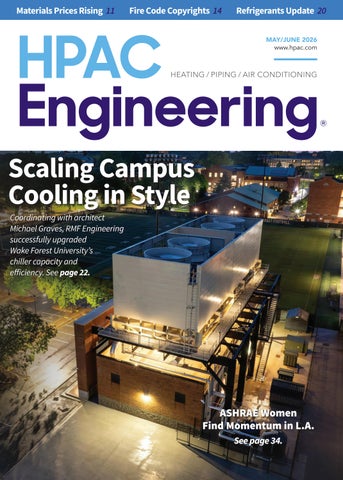
Scaling Campus Cooling in Style
Coordinating with architect Michael Graves, RMF Engineering successfully upgraded Wake Forest University’s chiller capacity and efficiency. See page 22.
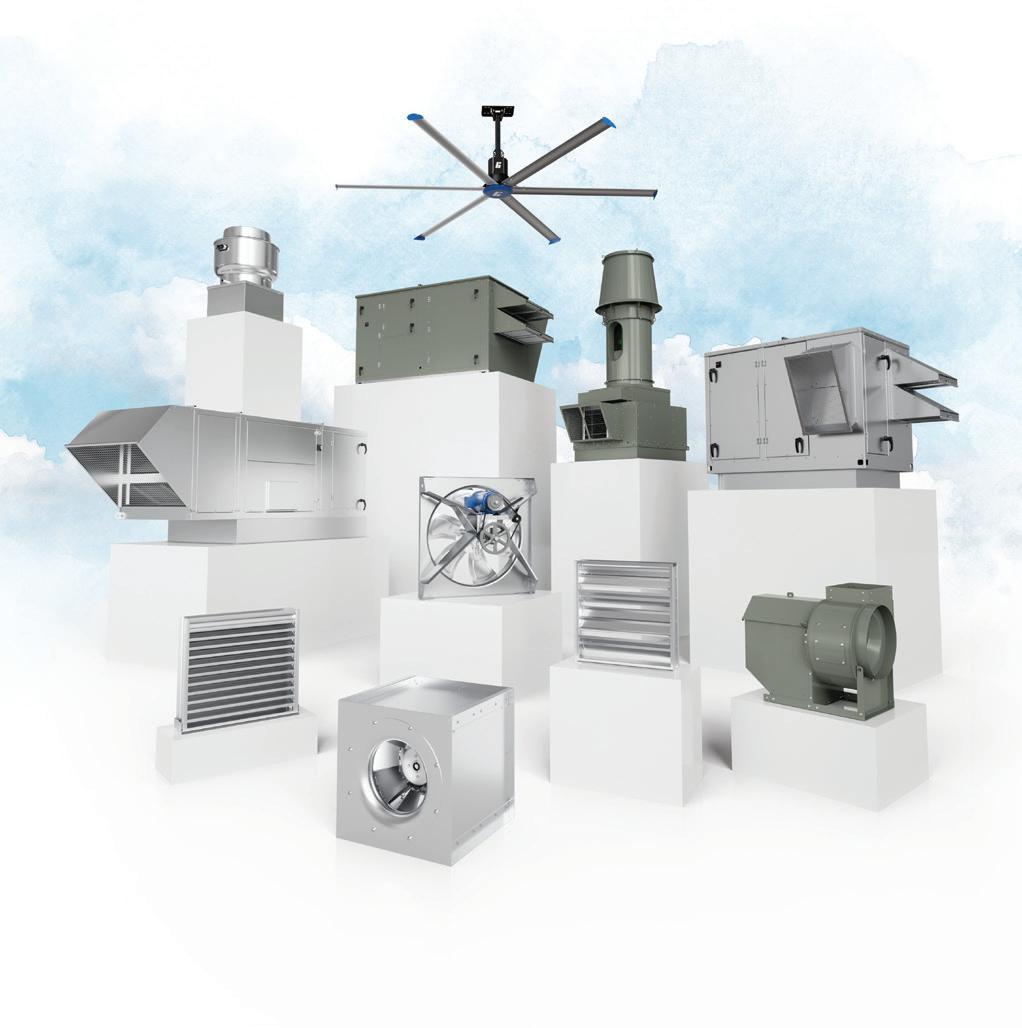
The Fan Energy Index (FEI) helps you find high-performing fans that protect your intended design in the field. That’s why Greenheck’s eCAPS® online product selection program includes FEI. This simple but powerful metric leads the way to fans that have lower operating costs, quieter sound, and a more flexible operating range.
Enter a few project requirements and eCAPS will find and rank the fans that align best with your desired performance, features, and technology.
Compare FEI metrics sideby-side with sound levels, performance, first cost, and operating cost data.
Create schedules incorporating FEI, share code-compliant product cut sheets, and download AutoCAD® and Revit® drawings.





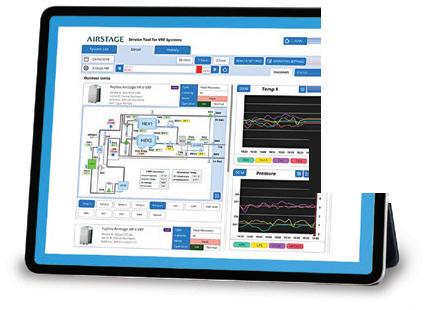
Experience the benefits of an innovative virtual Building Management System with Fujitsu AIRSTAGE Cloud.



Don’t let upfront costs stretch your budget to the max. Fujitsu’s innovative AIRSTAGE Cloud virtual BMS, coupled with AIRSTAGE VRF products, allows facilities managers to install, control, troubleshoot, and reduce energy costs – all from a simple online platform. With an ROI in months, not years, you’ll see immediate benefits. Moreover, our full line of AIRSTAGE VRF solutions - backed by 45 years of HVAC expertise - delivers more flexibility, power and comfort in less space. Reach new heights of performance and efficiency without sticking your neck out…Fujitsu AIRSTAGE Cloud. Visit airstagecloud.com
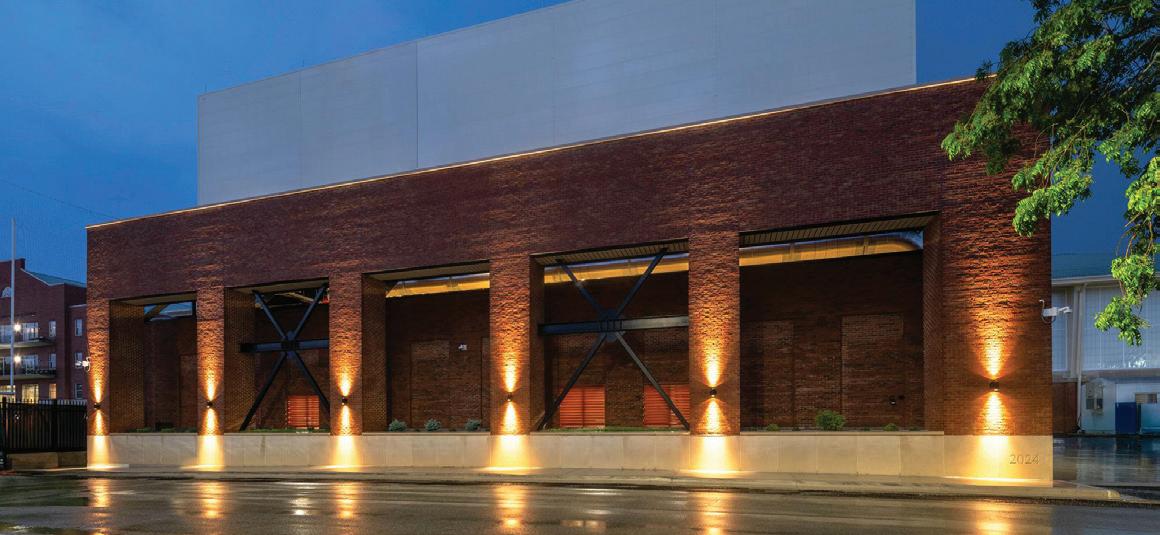
COVER STORY: Scaling Campus Cooling in Style at Wake Forest
Collaborating with architect Michael Graves on a tight footprint, RMF Engineering successfully upgraded the University’s chiller capacity and efficiency.
By Chase Davis
14 NFPA Backs ‘Pro Codes Act’ to Preserve Standards Copyright Protection
Backed by ASHRAE and ICC, fire protection advocacy group urges Congress to safeguard codes licensing system in the interest of public safety.
17 New Study First to Measure BACnet Impact on Global CO₂ Reduction
University of New Hampshire research found that BACnet-enabled building automation systems have mitigated 1.4 billion tons of CO₂ since 1995.
20 What the Commercial VRF Low GWP A2L Refrigerant Shift Really Means
As regulations phase out R-410A refrigerants, HVACR firms must adapt through updated training, code compliance, and effective communication with clients.
By David Archer
BOILER SYSTEMS ENGINEERING
At its annual meeting in Denver, the National Board of Boiler and Pressure Vessel Inspectors stressed safety and leadership.
How AI Is Rebuilding Engineering from the Inside Out
The ACEC Research Institute’s new report concludes that most successful engineering firms will use ongoing wave of new tech to enhance workers, not eliminate them.
11 BLS: Materials Prices Climbed Again in April
Still fueled by rising petroleum costs and tariffs on iron and steel imports, construction input prices have surged 6.2% this year, alone.
12 Study: Just 10% of A/E Firms Project Growth in 2026
Deltek surveyed 896 firms, found increasing pressure to increase both efficiency and security with emerging technologies.
13 Littleton to Retire as ASHRAE Executive Vice President
After more than two decades of guiding the Society’s growth, Jeff Littleton will step down as EVP in early 2027. A search for his replacement is now being planned.

DEPARTMENTS
Editor’s Notes
Celebrating 250 Years of ‘US’ By Rob McManamy
New Products
Industry Perspectives
Second Women’s Symposium Builds on Momentum By Nancy
Kohout
HPAC Engineering (USPS Permit 464-930, ISSN 0039-0895 print, ISSN 1930-8957 online) is published 6x a year (Jan/Feb, Mar/Apr, May/Jun, Jul/Aug, Sep/Oct, Nov/Dec) by Endeavor Business Media, LLC. 201 N Main St 5th Floor, Fort Atkinson, WI 53538. Periodicals postage paid at Fort Atkinson, WI, and additional mailing offices. POSTMASTER: Send address changes to HPAC Engineering, PO Box 3257, Northbrook, IL 60065-3257. SUBSCRIPTIONS: Publisher reserves the right to reject non-qualified subscriptions. Subscription prices: U.S. ($ 111.25); Canada/Mexico ($123.75); All other countries ($148.75). All subscriptions are payable in U.S. funds. Send subscription inquiries to HPAC Engineering, PO Box 3257, Northbrook, IL 60065-3257. Customer service can be reached toll-free at 877-382-9187 or at HPACengineering@omeda.com for magazine subscription assistance or questions.
Printed in the USA. Copyright 2026 Endeavor Business Media, LLC. All rights reserved. No part of this publication may be reproduced or transmitted in any form or by any means, electronic or mechanical, including photocopies, recordings, or any information storage or retrieval system without permission from the publisher. Endeavor Business Media, LLC does not assume and hereby disclaims any liability to any person or company for any loss or damage caused by errors or omissions in the material herein, regardless of whether such errors result from negligence, accident, or any other cause whatsoever. The views and opinions in the articles herein are not to be taken as official expressions of the publishers, unless so stated. The publishers do not warrant either expressly or by implication, the factual accuracy of the articles herein, nor do they so warrant any views or opinions by the authors of said articles.


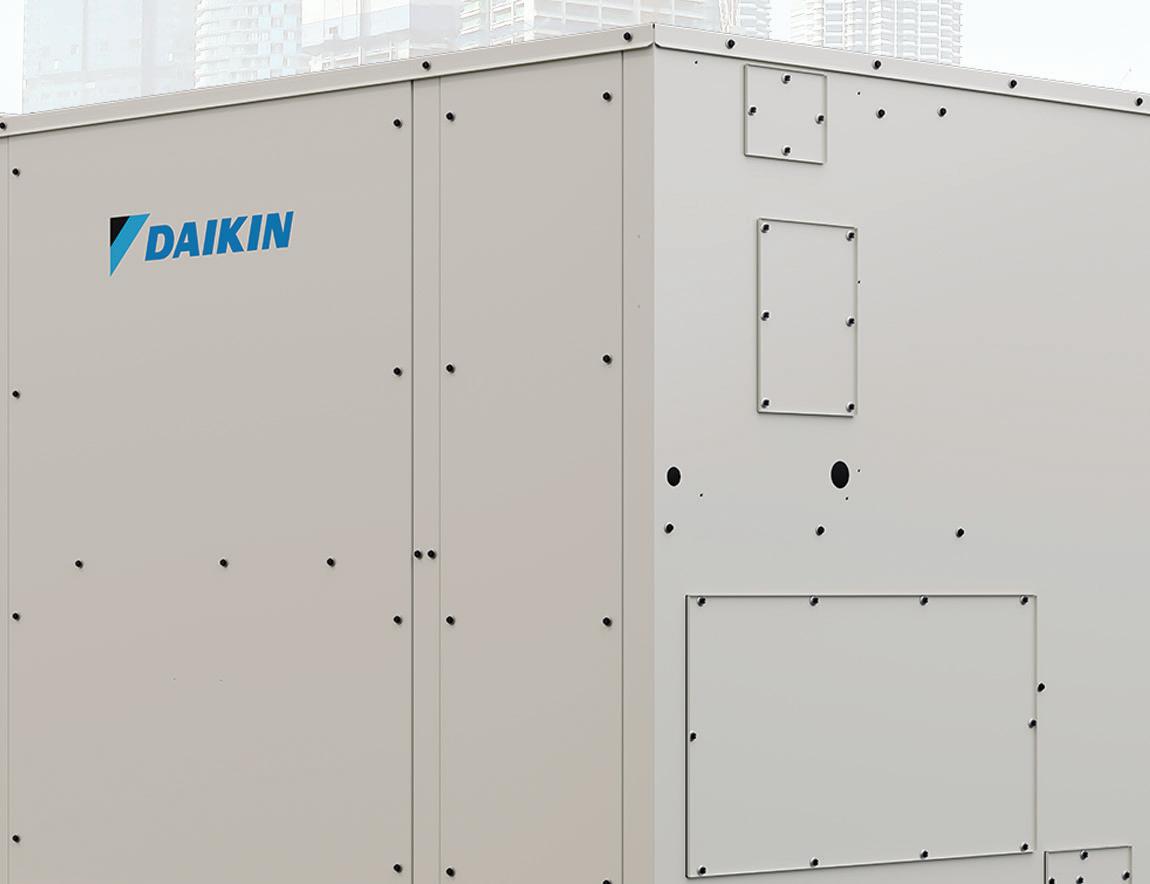
NEW INVERTER HEAT PUMP ROOFTOP SYSTEMS
SUSTAINABILITY, ELECTRIFICATION, AND EFFICIENCY READY!
INVERTER TECHNOLOGY
Variable-speed inverter compressor with vapor-injection technology helps deliver efficient operation and heating performance in low ambient conditions
ENERGY PERFORMANCE
Part-load efficiency up to 22 IEER helps manage operating costs while maintaining comfort
COMFORT CONTROL
Modulating compressor and indoor blower help regulate airflow, temperature, humidity, and comfort
SMART BUILDING INTEGRATION




Factory-integrated BACnet® connectivity and cloud-enabled services help simplify monitoring, control, and system optimization

APPLICATION FLEXIBILITY


Multi-zone Variable Air Volume (VAV) helps control airflow to meet varying needs of multiple zones monitoring , control, and system

BACnet® is a trademark of ASHRAE








MEMBERS ONLY PODCASTS
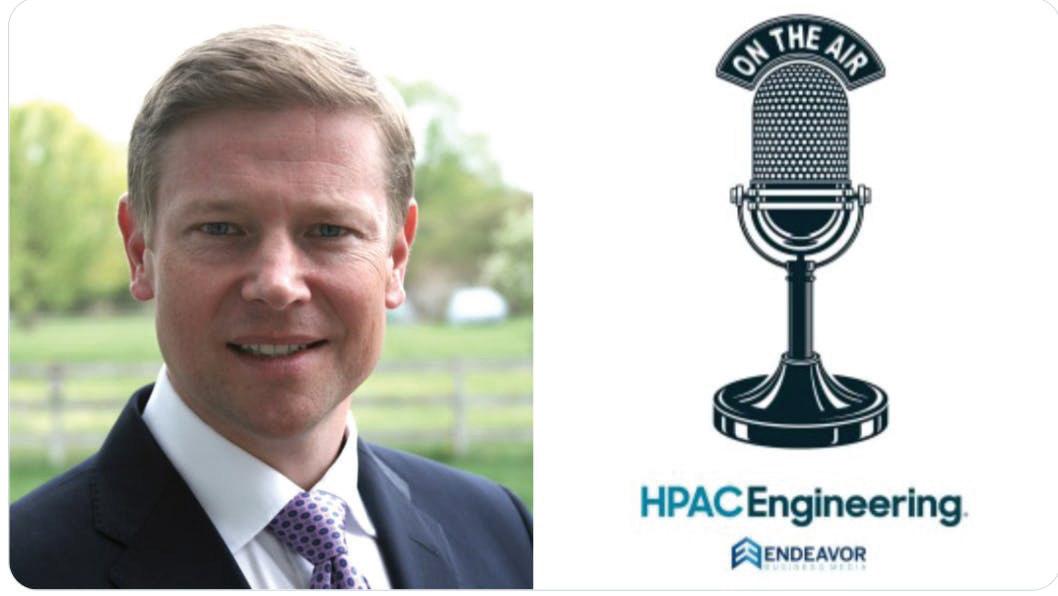
Healthier Buildings Pulse Check, with IWBI’s Jason Hartke
Despite headwinds, healthy buildings advocates like the International WELL Building Institute are still riding postpandemic momentum to push for IAQ steps that will even boost occupant productivity. www.hpac.com/55361112
EDITORIAL OFFICE
8001 Lincoln Ave. • Suite 720 Skokie, IL 60077 www.hpac.com
MEMBERS ONLY WEBINARS

Ethics in Engineering: Case Studies in HVACR
ON DEMAND: Recorded April 28, this webinar tests your “Ethics IQ” with real-world dilemmas faced on HVACR projects. Participants examine how ethical decisions can often depend on context. www.hpac.com/55364113
MEMBERS ONLY EXCLUSIVES
Looking Back at Ten Years of Clark’s Remarks
From climate change and sea level rise to decarbonization and regulatory upheaval, our sustainability columnist reflects on a stormy decade. www.hpac.com/21270656

FEELING SOCIAL?

EXECUTIVE TEAM : CHRIS FERRELL : PATRICK RAINS : JACQUIE NIEMIEC : TRACY KANE : AMANDA LANDSAW
EVP, BUILDING & CONSTRUCTION GROUP: CHRIS PERRINO
EDITORIAL CONTACTS
MIKE EBY
VP of Content Strategy, Building & Construction Group meby@endeavorb2b.com
ROB MCMANAMY
Editor-in-Chief rmcmanamy@endeavorb2b.com
DAVID ECKHART Art Director deckhart@endeavorb2b.com
SALES CONTACTS
MIDWEST BILL BOYADJIS 973-829-0648 bboyadjis@endeavorb2b.com
SOUTH & WEST
HPAC 2026: Our May Quiz!
RANDY JETER 512-263-7280 • Fax: 913-514-6628 rjeter@endeavorb2b.com WEST ELLYN FISHMAN 949-239-6030 efishman@endeavorb2b.com
ACCOUNT MANAGER STEVE SUAREZ 941-259-0867 ssuarez@endeavorb2b.com
DIRECTOR OF SALES JOE AGRON 941-200-4778 jagron@endeavorb2b.com
LIST RENTAL SMART REACH sr-assets@endeavorb2b.com effective
*EMERGENCY!* As the National Fire Protection Association meets this June in Las Vegas for its annual convention, dive into the alarming history of building fire prevention and suppression. Answer five questions for a chance to win a $25 gift card! www.hpac.com/55374330 Copyright
PRODUCTION AND CIRCULATION
RITA FITZGERALD Senior Production Manager rfitzgerald@endeavorb2b.com
MELISSA MENG Ad Services Manager mmeng@endeavorb2b.com
JAMES MARINACCIO Audience Marketing Manager jmarinaccio@endeavorb2b.com
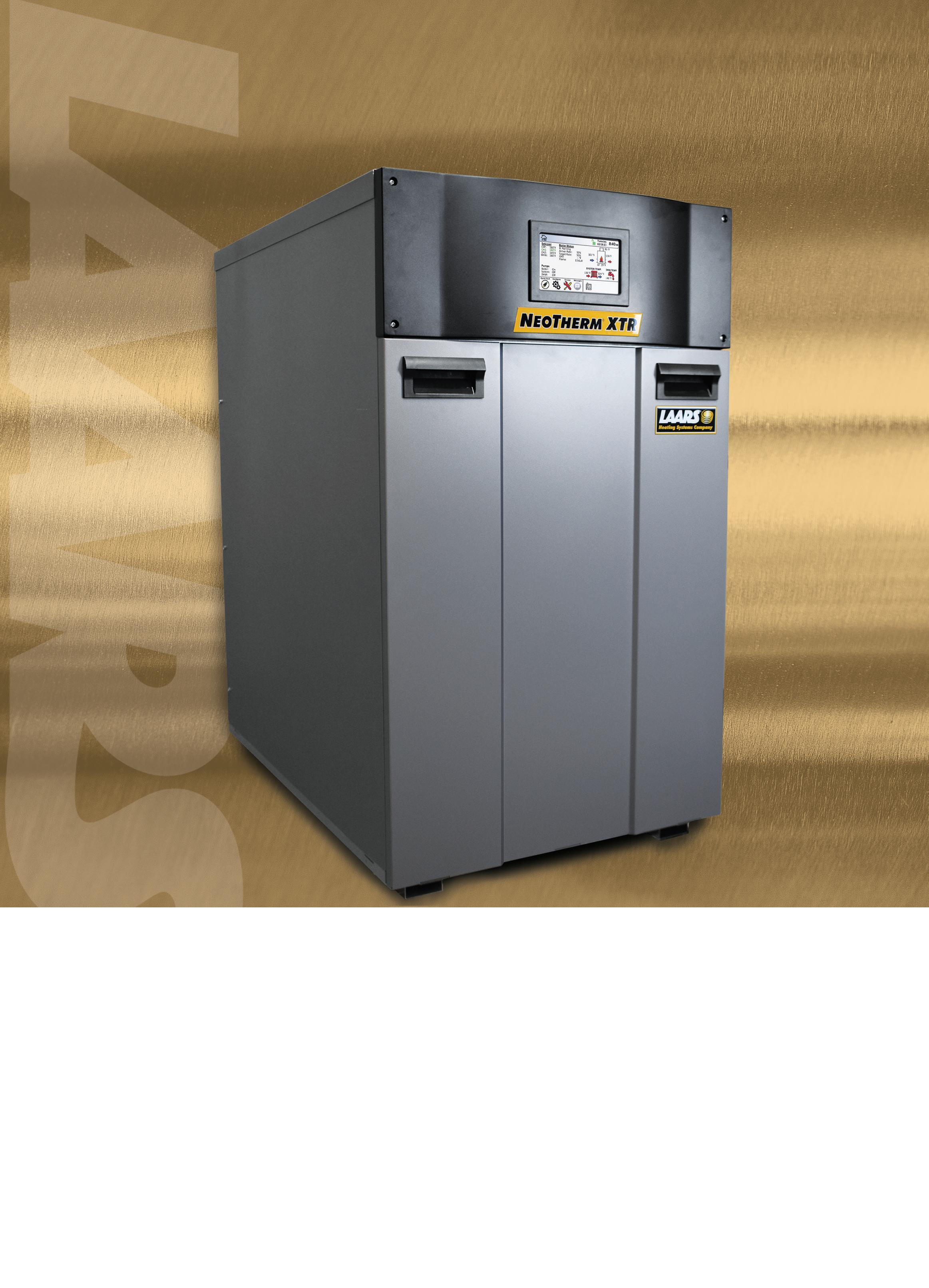
6 MODELS FROM 399-1500 MBH
Efficient: 96% thermal efficiency, 10:1 turndown, low-pressure drop stainless steel heat exchanger
Versatile: Cascade up to 8 units, common vent multiple units, and vent up to 150 equivalent ft.
Intelligent: Powerful Laars Linc® touch screen control, VARI-PRIME® Boiler Pump Flow Control and BMS compatibility LEARN MORE




Celebrating 250 Years of ‘US’
As our nation prepares to celebrate its 250th birthday, I am struck by the emotion I have been feeling this year about the American Experiment. Just the history that I personally have lived through and witnessed in the last seven decades humbles me and inspires me about our collective ability to surmount unprecedented challenges. And it underscores the inescapable duty we still have to engineer a better future for our children.
And our industry is rising to the moment.
For what it’s worth, I have always been a history buff, and I can remember watching the Moon landing when I was just seven years old. For the Bicentennial, my family went to see ‘1776’ on Broadway, and my oldest brother took me out of school on my birthday for a field trip to Gettysburg. Like him, I later attended the University of Virginia and ever since, have felt a kinship with Thomas Jefferson. Arguably, the most important thing I learned there was the concept of trust and personal responsibility, embodied by the student honor code.
Even after I started writing about engineering, I continued to cross paths with history. In 1995, I reported from Oklahoma City on engineering efforts to keep the stricken remains of the Murrah Federal Building from collapsing on search and rescue workers. Six years later, I was in Washington DC on 9/11, and a month after that, at Ground Zero in NYC to write on the structural wreckage of the World Trade Center. In the years since, as a citizen, I attended the frigid Presidential Inauguration on the National Mall in 2009, and like all of you, I experienced the world-shaking Coronavirus pandemic in 2020, and witnessed the domestic political upheaval of the uncivil years that have followed.
Yet, through it all, I have continued to find hope and purpose in this industry’s unshakeable focus on solving urgent problems, and in our fellow citizens who have continued to push us toward what Mr. Lincoln called “our better angels.” Those groups came together again in May at a Congressional briefing on
Capitol Hill organized by the International WELL Building Institute (IWBI) and With Honor, an organization dedicated to fighting political polarization by supporting military veterans from BOTH parties in Congress who have pledged “to serve with integrity, civility, and courage.”
As summarized by IWBI’s Jason Hartke, our guest on April’s edition of HPAC On The Air, the event was entitled Built to Defend: Unlocking the Role of Buildings in America’s Biosecurity Strategy. It focused “on the growing recognition that the indoor environments where people spend most of their time can help protect health, strengthen readiness and improve national resilience in the face of evolving biological threats.”
One key speaker was HPAC Editorial Advisory Board member Dr. William Bahnfleth, a longtime Penn State engineering professor, former national president of ASHRAE, and chair of the Society’s Epidemic Task Force during the pandemic. “What we learned is that planning is important and preparation is even more important,” he said. As a result, “we are moving into risk-based standards for building design, and ASHRAE Standard 241 is the first standard I know of for buildings that addresses airborne infection transmission based on quantitative risk assessment.”
The opportunity now, Bahnfleth added, is to combine proven interventions like ventilation, filtration, pressurization, ultraviolet germicidal irradiation and other technologies, with sensors and controls. “If we can integrate sensors with real-time building controls to quantitatively reduce risk, that will be a very important change,” he said. Indeed, it will. But whether we plan to improve biosecurity, cybersecurity, indoor air quality, energy efficiency, or sustainability, all with the emerging assistance of artificial intelligence (wanted or not), the path to success will always require collaboration.
Let us all remember that as we prepare for America’s birthday party. E pluribus unum. The more intelligent and courageous guests we have at the table, the better our chances of celebrating the next 250 years.
ADVISORY BOARD:
William P. Bahnfleth,
The Pennsylvania State
David W. Bearg, PE Life Energy Associates
Lawrence (Larry) Clark, QCxP, GGP, LEED AP+ Sustainable Performance
Kenneth M. Elovitz, PE, Esq. Energy Economics Inc.
Charles E. Gulledge III, PE, HBDP, LEED AP, FASHRAE
Elise Kiland, PE, YEA
Nancy Kohout, PE, LEED AP
Stephanie Taylor, MD,
Ginger Scoggins, PE, CEM, CxA, LEED AP, FASHRAE Engineered Designs Inc.
James P. Waltz, PE, Michael K. West, PhD, PE Advantek Consulting
D. Yogi Goswami, PhD, PE
Gerald J. Williams, PE, 8760 Engineering LLC

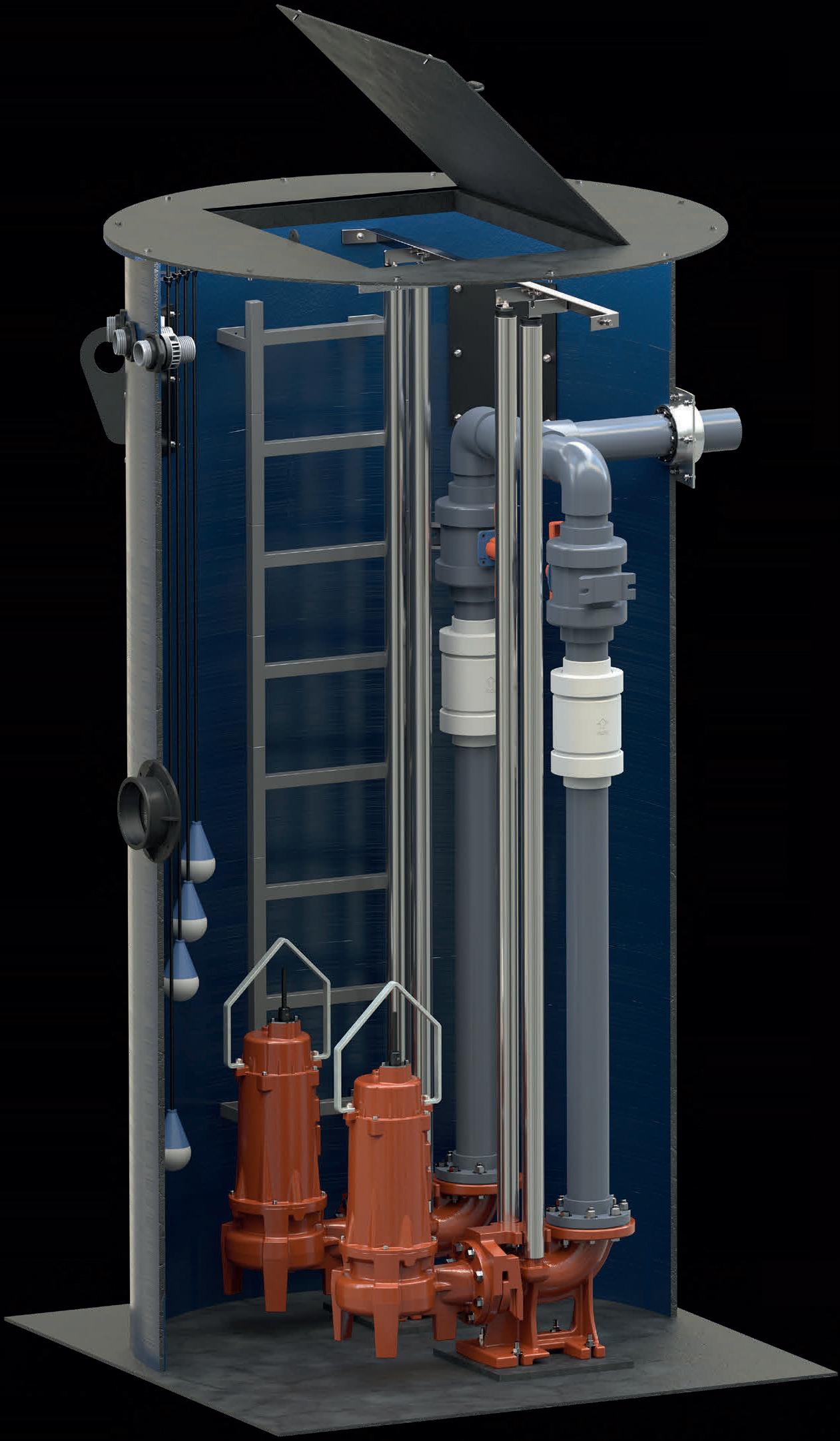
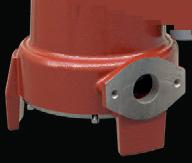
Engineered Pump Systems
Grinder Systems
Solids Handling Systems
Effluent Systems
Simplex • Duplex
Triplex • Quadplex
Order a Liberty EPS and you’ll get the assurance of the complete system arriving to the job-site with factory matched components – pump, panel, basin, internal piping, guide rails, floatsall from one source. With an almost unlimited number of basin and panel options - we can customize a system for your specific application. Need it fast?
Specify a pre-designed system from Liberty! Pre-designed systems are available and ready to ship in 24 hours. Consult factory for more information on our pre-designed packages.
Explosion-proof models available for hazardous locations!
How AI Is Rebuilding Engineering from the Inside Out
The ACEC Research Institute’s new report concludes that most successful engineering firms will use ongoing wave of new tech to enhance workers, not eliminate them.

Artificial intelligence is fundamentally changing how engineering work gets done, while demand for infrastructure surges and the talent pipeline continues to contract. In the midst of disruption, one thing remains constant: the irreplaceable role of the engineer.
A new report from the ACEC Research Institute takes on all three forces at once — concluding from the data that the firms who thrive in the future won’t be those that replace their people with technology, but those that unleash the full potential of their engineers through it.
Redefining the Firm: Talent, Technology, and Transformation is being unveiled at the ACEC Annual Convention and Legislative Summit. The findings are being presented on the main stage before an audience of engineering firm leaders from across the country.
“The greatest risk facing engineering firms today is not that AI replaces engineers,” said Steve Lefton, chair of the ACEC Research Institute. “It’s that our firms fail to harness the value created by AI. This report gives ACEC member
firms the strategic roadmap they need to make sure that doesn’t happen.”
The Next Chapter in an Ongoing Story
This report is the third in the ACEC Research Institute’s Firm of the Future series — a body of research that has been systematically mapping the forces reshaping the engineering profession and providing engineering firm leaders with the insights they need to stay ahead of a rapidly changing industry.
The series launched with The Role of Artificial Intelligence in the Engineering Industry (May 2025), which documented how AI is amplifying — not replacing — engineering capacity. That was followed by The Workforce of the Future (October 2025), which examined the structural talent deficit now facing the profession, driven by demographics, declining graduate numbers, and immigration constraints.
This new report takes the critical next step: What does the convergence of these forces mean for the design of the firm itself? The answer, drawn from in-depth interviews with senior leaders at Arcadis, AtkinsRéalis,
Autodesk, Bentley Systems, BST Global, Esri, Mott MacDonald, NVIDIA, Stantec, WSP, and others, is both urgent and clarifying.
“We are entering an era of abundant intelligence, where digital labor expands what engineering firms can design, deliver, and manage,” said Mike Walsh, CEO of Tomorrow and author of the study. “The next generation of firms will be built around this reality—reimagining work, orchestrating human and machine intelligence, and creating value across the systems that shape the built environment.”
What the Research Found
The report identifies six structural ideas, organized around three themes, that define the successful engineering firm of the future:
Reconfiguring the Work. AI won’t shrink engineering teams; it will make them dramatically more capable. Engineers are evolving from producers of individual solutions into designers of intelligent systems — defining the objectives and constraints that guide AI tools to explore thousands of design possibilities at once.
Reinventing the Firm. Data is emerging as the engineering industry’s most underutilized strategic asset. Firms that put their project data to work, rather than letting it sit in archives, will build a competitive advantage that grows stronger over time. Those that don’t tap into their data risk becoming dependent on outside platforms that capture that value instead. AI systems are becoming powerful tools in the hands of engineers — expanding what they can analyze, explore, and deliver without replacing the human judgment that infrastructure decisions demand.
Redefining the Industry. Infrastructure is no longer a static product. Sensors, digital twins, and connected platforms are already transforming physical assets into continuous sources of performance data, pulling engineering firms beyond project delivery into longterm lifecycle partnerships.
And on the horizon, a new class of AI-native engineering firms is
beginning to emerge, built from the ground up around digital systems rather than retrofitted with them.
The report also delivers a practical six-point strategic roadmap for ACEC member firms — covering data strategy, workflow redesign, hybrid talent development, lifecycle service expansion, industry collaboration, and the governance of a growing digital workforce.
About the ACEC Research Institute
The ACEC Research Institute is the independent research arm of the American Council of Engineering Companies (ACEC). Its mission is to fund and deliver research to equip the engineering industry with actionable intelligence on the issues critical to its success. Learn more at www.acecresearchinstitute.org.
BLS: Materials Prices Climbed Again in April
Still fueled by rising petroleum costs and tariffs on iron and steel imports, construction input prices have surged 6.2% this year, alone.
Construction input prices increased 1.7% in April compared to the previous month, according to an Associated Builders and Contractors analysis of U.S. Bureau of Labor Statistics Producer Price Index data released today. Nonresidential construction input prices increased 1.8% for the month.
Overall construction input prices are 7.0% higher than one year ago, while nonresidential construction input prices are 7.4% higher. Prices increased in all three energy subcategories last month. Crude petroleum prices increased 11.3%, while unprocessed energy materials and natural gas prices were up 9.2% and 4.9%, respectively, in April.
“Construction input prices surged again in April,” said ABC Chief Economist Anirban Basu. “Input prices have now risen more during the first four months of 2026 (6.2%) than over the prior three years (4.8%). While much of the recent rise can be traced to soaring oil prices, escalation was widespread in April, with tariff-affected materials like iron and steel posting particularly large price increases.
“In addition to the direct impact of this reemerging materials price escalation, too-hot inflation data coupled
Source: U.S. Bureau of Labor Statistics
with upbeat labor market indicators suggest that the Federal Reserve is unlikely to cut rates this year,” said Basu. “While contractors remain busy,
according to ABC’s Construction Backlog Indicator, these cost pressures will likely weigh on construction activity over the coming months.”
Producer Price Index: April 2026
Study: Just 10% of A/E Firms Project Growth in 2026
Deltek surveyed 896 firms, found increasing pressure to increase both efficiency and security with emerging technologies.
Deltek® this May released the 47th Annual Deltek Clarity Architecture & Engineering Industry Study, which focuses on how A&E firms operate across the full lifecycle of winning and delivering projects. Conducted in collaboration with the American Council of Engineering Companies (ACEC), the American Institute of Architects (AIA), and the Society for Marketing Professional Services, the new report surveyed 896 companies and spanned 1,237 participants across the U.S. and Canada. It found that only 10% of A&E firms project revenue growth in 2026. Despite stable demand in 2025, firms are facing increasing pressure to execute work efficiently in the face of growing hidden challenges.

• Firms are forecasting 9.5% net revenue growth in 2026, and backlogs are softening from recent highs;
• Firms reported staff growth of only 1.2%, combined with a persistent high staff turnover rate above 13%;
“In the A&E industry, firms are still optimistic, but the focus has shifted from growth to cost control and improving margins. Firms are facing increased constraints around talent, capacity, and profitability,” said Megan Miller, Senior Director, A&E Industry Insights Lead at Deltek. “What we’re seeing is a shift from growth at all costs to more disciplined, performance-driven operations. Leading firms will need to focus on surfacing better data, embedding AI directly into delivery workflows, and bringing discipline to how they manage and measure project performance.”
Demand is Steady, But Constrained by Delivery Capacity
According to the Deltek study, A&E firms are planning for growth, yet capacity and productivity pressures are shaping execution. Additionally, talent and productivity pressures are tightening. Limited workforce growth and high employee turnover are constraining scale, underscoring the need for better visibility into project performance throughout the project so firms can adjust as needed. The survey found:
• Firms reported strong financials, but are showing signs of softening, with utilization declining to just under 60% and operating profit falling to 16.7%.
AI Adoption is Accelerating, But Its Impact Remains Inconsistent
The AI opportunity for A&E firms is shifting from experimenting broadly to operating with intent: clear use cases, integration, and measurable objectives. When thinking about AI, firms are looking for better data, faster decisions, and improved predictability, but some core processes remain manual. Specifically...
• Adoption of AI for A&E firms has risen from 53% to 70% year-over-year, and generative AI usage specifically rose from 64% to 78%;
• However, only 38% of respondents reported measurable positive business impact tied to AI use.
• 39% said it’s too early to see AI-driven benefits or that they’re still piloting the technology, but a majority (59%) agree that successful AI implementation will create a significant competitive advantage and could expand service offerings.
Digital transformation urgency is rising, alongside cyber risk. Firms recognize the competitive stakes but still face practical barriers to operationalizing new technology.
• 93% reported experiencing a cyber attack attempt in the past three years, with 1 in 5 firms reporting a successful attack that resulted in financial or reputational damage;
• 42% believklhheports
The Deltek Clarity studies include detailed benchmarking data, longitudinal trend analysis, and industry-specific guidance across workforce, technology, security, and business
development. Download the full reports and explore educational webinars at the Deltek Clarity Hub.
About Deltek
Deltek is the intelligent platform that powers the project lifecycle—from ERP and accounting to project bidding, planning, delivery, and analysis. Trusted by 30,000 organizations across government contracting, aerospace and defense, architecture and engineering, construction, and consulting, Deltek delivers the speed, clarity, and control project-based businesses need to win more, deliver better, and grow. Learn more at www.deltek.com.
Littleton to Retire as ASHRAE Executive Vice President
After more than two decades of guiding the Society’s growth, Jeff Littleton will step down as EVP in early 2027. A search for his replacement is now being planned.
ASHRAE this spring announced that Jeff Littleton will retire as Executive Vice President in early 2027. Littleton has served as ASHRAE’s chief staff officer since 2004, overseeing a period of sustained organizational growth, global expansion, and increased technical impact.
During his tenure, ASHRAE strengthened its position as a worldwide authority in building technology, sustainability and the development of critical standards for the built environment. Littleton also successfully led the Society through the challenges of the COVID-19 pandemic, maintaining consistent operational continuity through one of the most disruptive economic and societal periods in world history.
“Jeff’s leadership has played a central role in navigating ASHRAE through decades of industry evolution, while advancing our global mission to serve humanity,” said 2025-26 ASHRAE President Bill McQuade , PE, CDP, Fellow ASHRAE, LEED AP. “His steady guidance and strategic vision has helped to ensure that ASHRAE remains a trusted resource and leader in the building services industry. We are grateful for his service and the strong foundation he leaves for the future.”
Littleton’s legacy is defined by a focus on organizational alignment, collaboration between staff and volunteer leadership and continued advancement of ASHRAE’s technical and educational programs. Among his many accomplishments, Littleton was instrumental in supporting the Society’s landmark selection, renovation and relocation to its net-zero energy global headquarters building in Peachtree Corners, GA, in 2024.
The ASHRAE Board of Directors has established a
selection committee to guide the search for the Society’s next Executive Vice President. ASHRAE will share additional details regarding the leadership transition in the coming months.

NFPA Backs ‘Pro Codes Act’ to Preserve Standards Copyright Protection
Backed by ASHRAE and ICC, fire protection advocacy group urges Congress to safeguard codes licensing system in the interest of public safety.
The National Fire Protection Association® (NFPA®), a self-funded nonprofit that develops over 300 fire, life, and electrical safety standards, praised the U.S. House Judiciary Subcommittee on Courts, Intellectual Property, Artificial Intelligence, and the Internet, for holding an April 22nd hearing on the bipartisan Protecting and Enhancing Public Access to Codes (Pro Codes) Act (H.R. 4072).
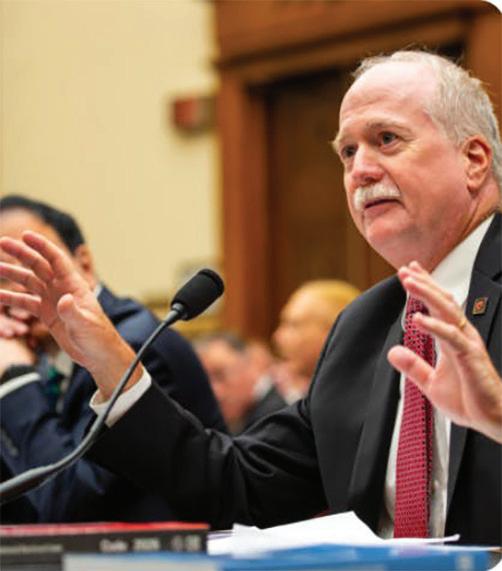
NFPA President and CEO Jim Pauley (above) testified before the Subcommittee in support of the legislation.
“Every year, the standards developed by NFPA and organizations like us prevent tragedies that no one will ever hear about — the fires that don’t start, the buildings that don’t collapse, the families that come home safe,” said Pauley in his testimony. “That’s what this system produces. And that’s what we stand to lose if Congress doesn’t act.”
Pauley also spoke to the urgency of the issue: “The need for this system is not diminishing — it’s accelerating. From devastating wildfires to new risks from lithium-ion batteries, NFPA is developing standards to address
challenges that didn’t exist a decade ago. But that work only continues if it can be funded. And if copyright protection is weakened or lost, the funding disappears — and with it, the system that has made Americans safer for more than a century.”
The House bill was introduced by Subcommittee Chairman Darrell Issa (R-CA) and Rep. Deborah Ross (D-NC). In March, a Senate version (S. 4145) was introduced by Senators Chris Coons (D-DE), John Cornyn (R-TX), Thom Tillis (R-NC), and Mazie Hirono (D-HI).
“We’re grateful to Chairman Issa and Ranking Member Johnson for this hearing, which confirmed the urgent need for the bipartisan Pro Codes Act. And we want to thank Chairman Issa and Rep. Ross for their tireless efforts to preserve the extraordinary public-private partnerships that have protected Americans for more than a century,” said Pauley. “During the hearing we made clear why Pro Codes is needed, and we look forward to its consideration by the full committee.”
Pauley’s full testimony can be found at NFPA.org.
What’s at Issue?
For nearly 130 years, safety standards developed by independent nonprofit organizations like NFPA have protected people and property. These safety standards have dramatically reduced dangers like fire incidents and deaths and helped our communities better prepare for threats like active shooters.
Independently developed standards are so valuable that government entities often choose to incorporate them by reference into laws and regulations. This is a clear public benefit. In fact, for decades, the federal government has directed federal entities to use voluntary consensus standards whenever possible to eliminate costs to government, improve efficiency, and promote long-term growth for U.S. enterprises.
But this time-tested system is under threat from special interests and forprofit companies who wrongly argue that standards incorporated by reference into laws forfeit their copyright protection. Copyright protection incentivizes innovation and supports standards development organizations, helping ensure the United States remains the world leader in safety.
NFPA and other standards development organizations (SDOs) fund their work by publishing, selling, and licensing copyrighted standards to professionals who use them in the course of their business and licensees who make software and other business solutions that incorporate those standards.
Foreign actors and for-profit businesses that did nothing to contribute to the creation of standards are trying to profit by exploiting them. The result is that standards development organizations lose their funding sources
that the standard is available for free viewing on a publicly accessible website.
This solution will enable the American people to access codes and standards that affect their daily lives at no cost, while preserving the efficient, effective,
If copyright protection is weakened or lost, the funding disappears — and with it, the system that has made Americans safer for more than a century.
—Jim Pauley, NFPA President and CEO
from legitimate professionals and businesses – which means there are not funds to invest in updated standards, or the educational and research efforts they support.
The Pro Codes Act reaffirms that standards maintain their copyright protection when governments incorporate them by reference into laws and regulations. It also encourages greater transparency for the public, while protecting the ability of groups like NFPA to continue their important work. For more information about the Pro Codes Act, visit DontChanceSafety.org.
Engineering Groups Split on Need for Legislation
Last summer, after the bill was first introduced, ASHRAE joined NFPA and 17 other trade groups, including the International Code Council (ICC), the American Institute of Steel Construction, and the American Hospital Association, in writing a letter to the House Judiciary Committee.
Sent July 30, 2025, it stated:
The passage of the bipartisan Pro Codes Act will ensure the continued production of high quality standards and codes that are integral to the functioning of American society. H.R. 4072 clarifies that a standard does not lose its copyright protection by being incorporated by reference into a law or regulation, provided
and self-funded public-private standards development system.
Just a month earlier, however, seven industry groups including the American Society of Mechanical Engineers (ASME) voiced vigorous opposition. In its own June 26th letter to the House Judiciary Committee, the group wrote:
Rather than advancing that mission, this bill threatens to upend a finely balanced, time-tested system by imposing ill-fitting mandates that have not been subject to expert testimony, stakeholder vetting, or rigorous committee analysis. Alarmingly, the bill is tailored to address the concerns of a narrow subset of SDO entities while penalizing the broader SDO community— the vast majority of whom do not seek to codify their technical standards into law but whose work is nonetheless essential to national infrastructure, industry, and innovation.
Importantly, there is a consensus within the standards community in opposition to this bill. Leading organizations that form the backbone of America’s standards infrastructure have now all gone on record opposing the Pro Codes Act, including ASME, the Institute of Electrical and Electronics Engineers (IEEE), ASTM International, SAE International, the American Welding Society (AWS), the National Board of Boiler and Pressure Vessel Inspectors (NBBI), and the North American Energy Standards Board (NAESB).
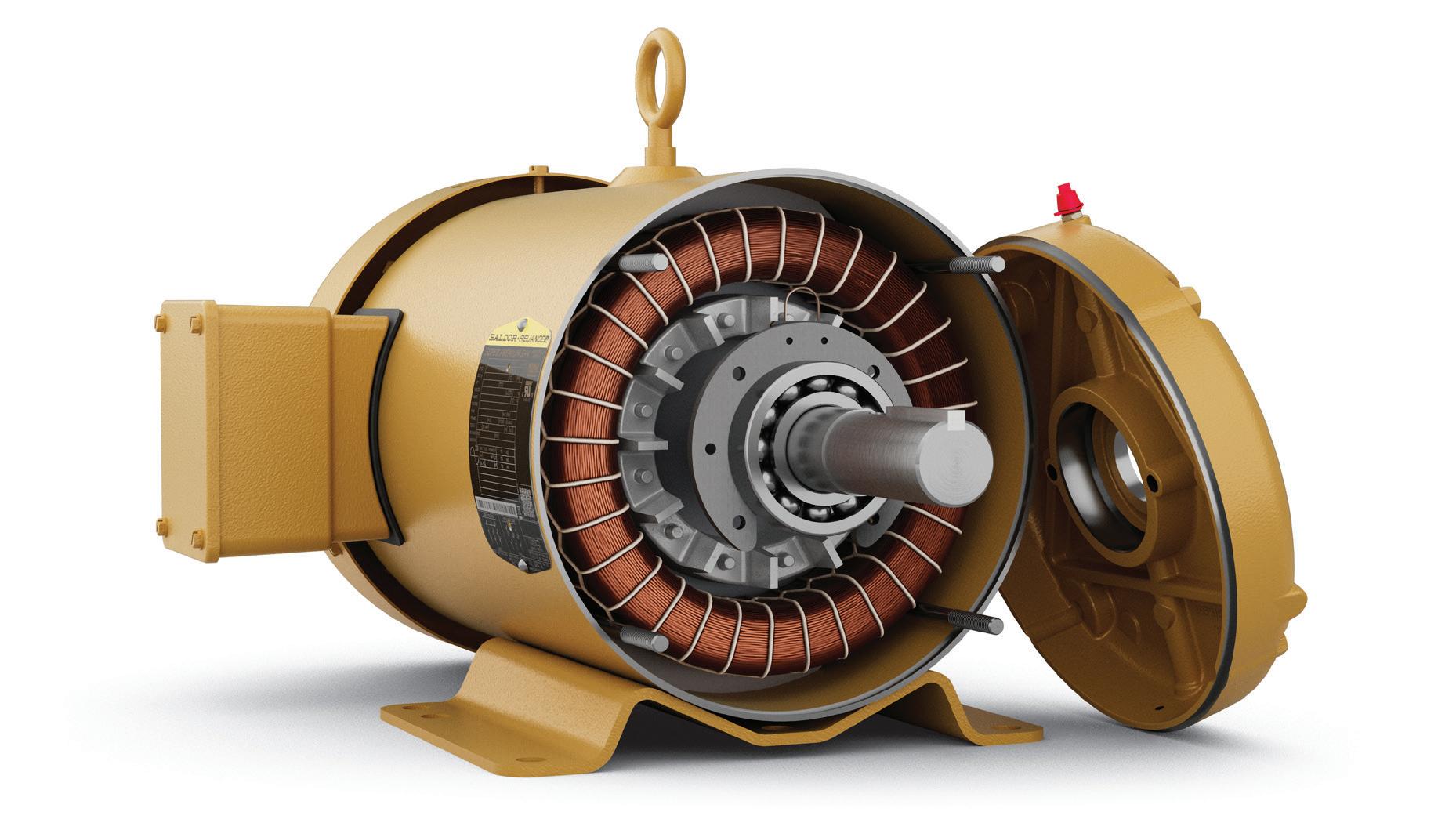
EXCELLENCE ON REPEAT Reliable performance for HVAC systems
ABB Baldor-Reliance® SP4 HVAC motors deliver NEMA Premium® 4 efficiency with internal shaft grounding protection designed for today’s VFD-driven HVAC systems, helping reduce energy costs, protect motor bearings and minimize unplanned downtime.
Built for reliable operation in air handlers, pumps, cooling towers, and fan applications, SP4 HVAC motors help keep buildings comfortable, efficient and continuously running.
Because dependable cooling demands Excellence on Repeat. Learn more via the QR code. Scan the QR code to learn more.
New Study First to Measure BACnet Impact on Global CO₂ Reduction
University of New Hampshire research found that BACnet-enabled building automation systems have mitigated 1.4 billion tons of CO₂ since 1995.
Agroundbreaking new study from the University of New Hampshire (UNH), for the first time, has quantified the global climate impact of BACnet®, ASHRAE announced this spring.
BACnet is the global data communication protocol for Building Automation and Control networks. Developed under the auspices of ASHRAE, it allows building systems including heating, ventilation, airconditioning, lighting, life-safety and other systems to communicate and cooperate, driving the efficiency of the modern built environment.
The UNH study reveals that BACnet-enabled building automation systems have mitigated 1.4 billion tons of CO₂ since 1995. This is equivalent to removing 300 million cars from the road for one year or offsetting the entire annual emissions of Japan. The research highlights BACnet’s role as a catalyst for smart building adoption worldwide.
“This study clearly shows the power of smart buildings and the critical role BACnet plays in reducing global carbon emissions,” said 2025-26 ASHRAE President Bill McQuade, P.E., CDP, Fellow ASHRAE, LEED AP. “For nearly three decades, BACnet’s open, interoperable framework has enabled building owners and operators to optimize energy use, improve efficiency and deliver measurable climate impact. ASHRAE is proud that our standards

and technologies are helping drive the transition to a low-carbon future, proving that the built environment can be a true leader in sustainability.”
Looking ahead, projections indicate that BACnet systems could help avoid 2.06 billion tons of CO₂ by 2030, underscoring the critical role of smart, connected building technologies in achieving global sustainability goals.
Written by assistant professors Fei Han and Weiwei Mo of the UNH Department of Civil and Environmental Engineering, the 22-page study is available for download at the ASHRAE Free Resources page: ashrae. org/freeresources. For BACnet technical resources, visit ashrae.org/bacnet.
About BACnet International
BACnet International is an industry association that facilitates the successful use of the BACnet protocol in building automation and control systems through interoperability testing, educational programs and promotional activities. BACnet International oversees operation of the BACnet Testing Laboratories (BTL) and maintains a global listing of tested products database. The BACnet standard was developed by ASHRAE and has been made publicly available so that manufacturers can create interoperable systems of products. BACnet International complements the work of the ASHRAE standards committee and BACnet-related

Global: 1,401 Mt
Globally, BACnet-based BAS mitigated an estimated 1,401 million tons of CO₂e between 1995 and 2025.
interest groups worldwide. BACnet International members include building owners, consulting engineers, and facility managers, as well as companies involved in the design, manufacture, installation, commissioning, and maintenance of control equipment that uses BACnet for communication.
RESEARCH CONCLUSIONS
The study provided a multi-region, cohort-based assessment of long-term carbon mitigation from commercial BAS. By integrating BACnet-based BAS adoption dynamics with regional energy use patterns and carbon-intensity trajectories, analysis quantified both historical and near-future mitigation impacts at a global scale. Several key conclusions emerged:
1. BAS with BACnet protocol adoption generated substantial cumulative carbon mitigation. Globally, BACnetbased BAS mitigated an estimated 1,401 million tons of CO₂e between 1995 and 2025. With continued adoption through 2030, global cumulative mitigation is projected to reach 2,065 million tons, highlighting the long-term climate value of automated building control. BACnet’s role as an open, non-proprietary communication protocol in commercial buildings has been central to enabling this global scale of automation.
2. Regional mitigation patterns reflect differences in climate, building energy use, and fuel mix. In the U.S., mitigation is dominated by electricity savings because of high cooling, light-
BAS savings consistently declined over time due to sensor drift, overrides, and operational changes. And although system replacement restored energy efficiency, continuing grid decar-
As BAS become more interconnected through BACnet, opportunities increase for centralized monitoring, advanced analytics, and automated fault detection.
ing, and plug loads, combined with historically carbon-intensive grids. In contrast, Europe and Canada exhibit comparable or greater mitigation from natural gas, driven by colder climates, long heating seasons, and extensive use of gas-based HVAC systems.
3. Annual mitigation increased as BACnet-based BAS cohorts accumulate, but the pace of growth slowed after the mid-2010s because electricity grids decarbonized, reducing the CO₂e avoided per kilowatt-hour saved. In contrast, mitigation from natural-gas savings remained strong since the carbon intensity for natural gas remained largely unchanged over time.
4. Cohort-level dynamics revealed both performance decay and lower post-replacement peaks. BACnet-based
bonization led to reduced carbon benefits in later years. These dynamics highlight the importance of BAS maintenance in sustaining long-term carbon mitigation. As BAS become more interconnected through BACnet, opportunities increase for centralized monitoring, advanced analytics, and automated fault detection—tools that can help maintain savings and slow performance decay over time.
To view the entire study, visit: www. ashrae.org/technical-resources/freeresources.
This information is taken from ASHRAE press releases and the original research conducted at the University of New Hampshire’s College of Engineering and Physical Sciences.
You’re





Explore the latest plumbing products, services, and design techniques
Engage in technical education sessions designed to advance your career
Solve challenges directly with technical experts on the show floor
Connect with thousands of industry professionals from around the world





























What the Commercial VRF Low GWP A2L Refrigerant Shift Really Means
As regulations phase out R-410A refrigerants, HVACR firms must adapt through updated training, code compliance, and effective communication with clients.
By DAVID ARCHER, PE, LEED AP, Vice President, Commercial Business, METUS
This article was first published by ContractingBusiness.com.
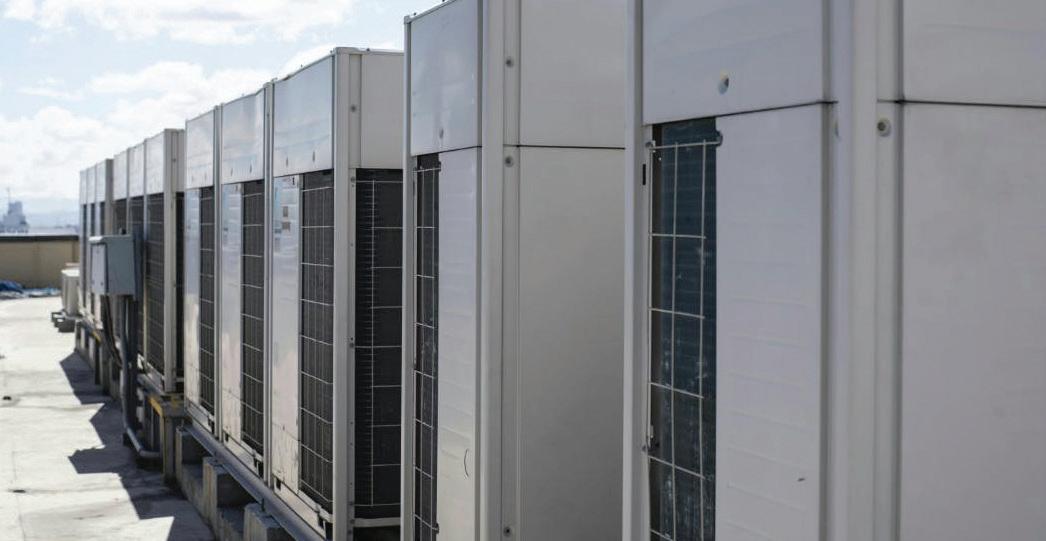
The commercial HVACR industry has entered a pivotal change. As of Jan. 1, 2026, manufacturers are no longer be able to produce or import commercial variable refrigerant flow (VRF) equipment using R-410A refrigerant. Instead, systems have shifted to lower-global warming potential (GWP) alternatives such as
R-32, in line with global environmental goals to reduce the climate impact of HVAC systems.
This change raises several key questions for contractors and building engineers, including how to manage day-to-day operations, pre-existing projects, and customer communications. With the right planning and supplier coordination, firms can keep projects moving and customers confident.
What’s Driving the Shift
The transition to low-GWP refrigerants is part of a broader strategy to
phase down refrigerants with high GWP and adopt options that balance performance, safety, and regulatory compliance. R-410A, the previous industry standard VRF refrigerant, has a GWP of 2088. In comparison, R-32 has a significantly lower GWP of 675. This shift to low-GWP refrigerants began with residential systems and many commercial systems. Now, commercial projects using VRF equipment are following suit.
The core goal is straightforward: reduce emissions while maintaining or even improving system efficiency and customer comfort.
The author is VP of Commercial Business for METUS, where he sets the strategy for the manufacturer’s commercial line, including regional business units and vertical markets. He is a licensed professional engineer and a LEED Accredited Professional.
Understanding the Deadline
One of the biggest misconceptions is that Jan. 1, represents a “hard stop” for installing equipment that uses R-410A refrigerant. In reality, the regulation prohibits only the manufacture and import of new R-410A VRF equipment after that date. To ease the transition for contractors, a one-year sell-through period extends to Dec. 31, 2026.
That means in most areas of the country, HVAC contractors can still install and support R-410A VRF systems during the commercial VRF transition year — at least until the end of 2026. Warranties remain valid, replacement parts will be available, and manufacturers are planning their inventory strategies to ensure that equipment supply is available throughout the overlap period.
Navigating Supply with Confidence
Contractors may be wondering how the refrigerant transition will impact availability. While past supply disruptions raised valid concerns, many of those challenges were tied to cylinder shortages, not refrigerant production itself.
As larger commercial projects necessitate specific equipment submittal and approval processes, preordering can be difficult. Commercial equipment is often shipped directly to the jobsite instead of into distribution warehouses, making frequent communication with distributors and manufacturers a must-have.
Proactive project planning gives contractors more choice and control, ensuring they can select the refrigerant path that best fits the job. The earlier the engagement, the more flexibility and confidence they’ll have to deliver for their customers.
Revamping Training and Code Updates
The refrigerant shift also introduces code changes. Because R-32 is classified as a low GWP A2L refrigerant, contractors may need to integrate safety
sensors and, in some cases, additional ventilation into building designs.
Fortunately, training resources are becoming widely available. Manufacturers, distributors, and service groups across the industry are developing and providing education for contractors,
leak detection sensors that can isolate affected zones, reduce refrigerant loss, and keep systems running while repairs are made. These sensors can save costs by preventing full refrigerant loss and extending equipment life. By detecting the location of refrigerant
The refrigerant shift also introduces code changes. Because R-32 is classified as a low GWP A2L refrigerant, firms may need to integrate safety sensors and additional ventilation into building designs.
engineers, and architects. Investing in such training ensures safe installation practices and compliance with transportation and storage requirements for multiple refrigerants.
For instance, many providers offer education and training on the refrigerant change, including installation training for contractors and building construction learning for engineers and architects. It is important to ensure engineers and architects understand how to design buildings with the new refrigerant in mind. For instance, VRF applications are expected to shift toward a greater number of smaller systems rather than fewer larger ones. This approach offers several advantages, including reduced refrigerant volumes per system, smaller and more contained zones, and generally easier installation.
Communicating with Customers
When talking to customers, contractors should consider framing the transition as a positive step forward. A few points to highlight include:
• R-410A systems remain viable. Equipment installed in 2025 or 2026 will continue to be supported with warranties, replacement parts, and service for at least 10 years;
• New R-32 refrigerants can bring reliability and safety benefits. R-32 A2L systems come with built-in
leaks and isolating them, the system helps minimize downtime and allows for faster repairs;
• Efficiency upgrades add value. Alongside refrigerant changes, manufacturers have introduced coil redesigns, improved heating and cooling performance, and longer component durability. These updates deliver tangible operational and cost benefits over time.
Taking Practical Steps Now
What should firms do now to best prepare?
1. Plan ahead with distributors. Secure project timelines early and confirm equipment availability months in advance;
2. Stock knowledge, not just parts. Ensure staff are trained on installation practices, refrigerant handling, and code compliance;
3. Educate customers. Reassure them about R-410A VRF system viability while highlighting the benefits of new refrigerant technologies;
4. Stay flexible. Expect some overlap where certain equipment is only available in one refrigerant type. Being adaptable will keep projects moving.
Leaning into the commercial VRF refrigerant change now will set the stage for you to enjoy long-term success and deliver quality customer satisfaction.
Scaling Campus Cooling in Style at Wake Forest
Collaborating with architect Michael Graves on a tight footprint, RMF Engineering successfully upgraded the University’s chiller capacity and efficiency.
By CHASE DAVIS, PE, CEM, Mechanical Engineer, Project Manager, RMF Engineering
Located in Winston-Salem NC, Wake Forest University (WFU) experiences a temperate climate with four distinct seasons, requiring energy and HVAC capabilities adjustable to a variety of conditions to serve the over 9,000 students and faculty housed on campus.
As the University grew and those needs evolved, RMF Engineering was engaged to upgrade the campus’ South Chiller Plant, which operates as part of its robust district chilled water system alongside the 2,400-ton-capacity North Plant, which was renovated in 2019. While upgrading the campus systems, a primary goal was to minimize disruption to campus life and programming as much as possible. To navigate this priority, the new construction was
built up rather than out, utilizing existing square footage by placing the new chillers on top of the existing plant. This strategic approach minimized the required real estate for the project while expanding cooling capacity, creating essential resiliency efficiency improvements to WFU’s main campus.
Chilled Water for a Growing Campus WFU began its initiative to optimize
Based in Raleigh NC, Chase Davis, PE, CEM, is a Mechanical Engineer and Project Manager at RMF Engineering based. As part of RMF’s utility infrastructure group, his experience includes the analysis, design and construction administration of steam, heating water, chilled water and emergency power generation systems in various campus environments. He has provided services for university, healthcare, industrial and municipal clients.
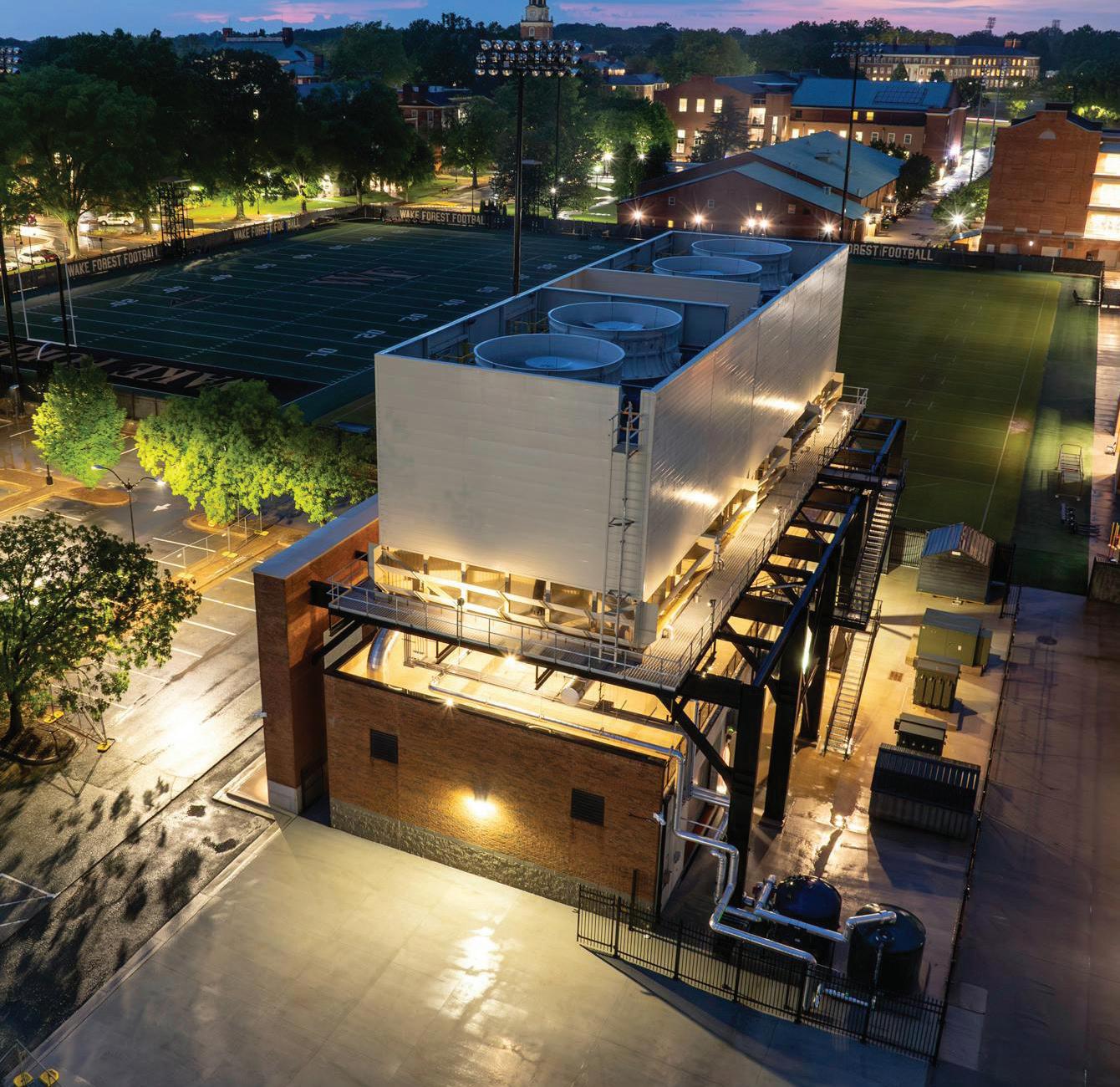
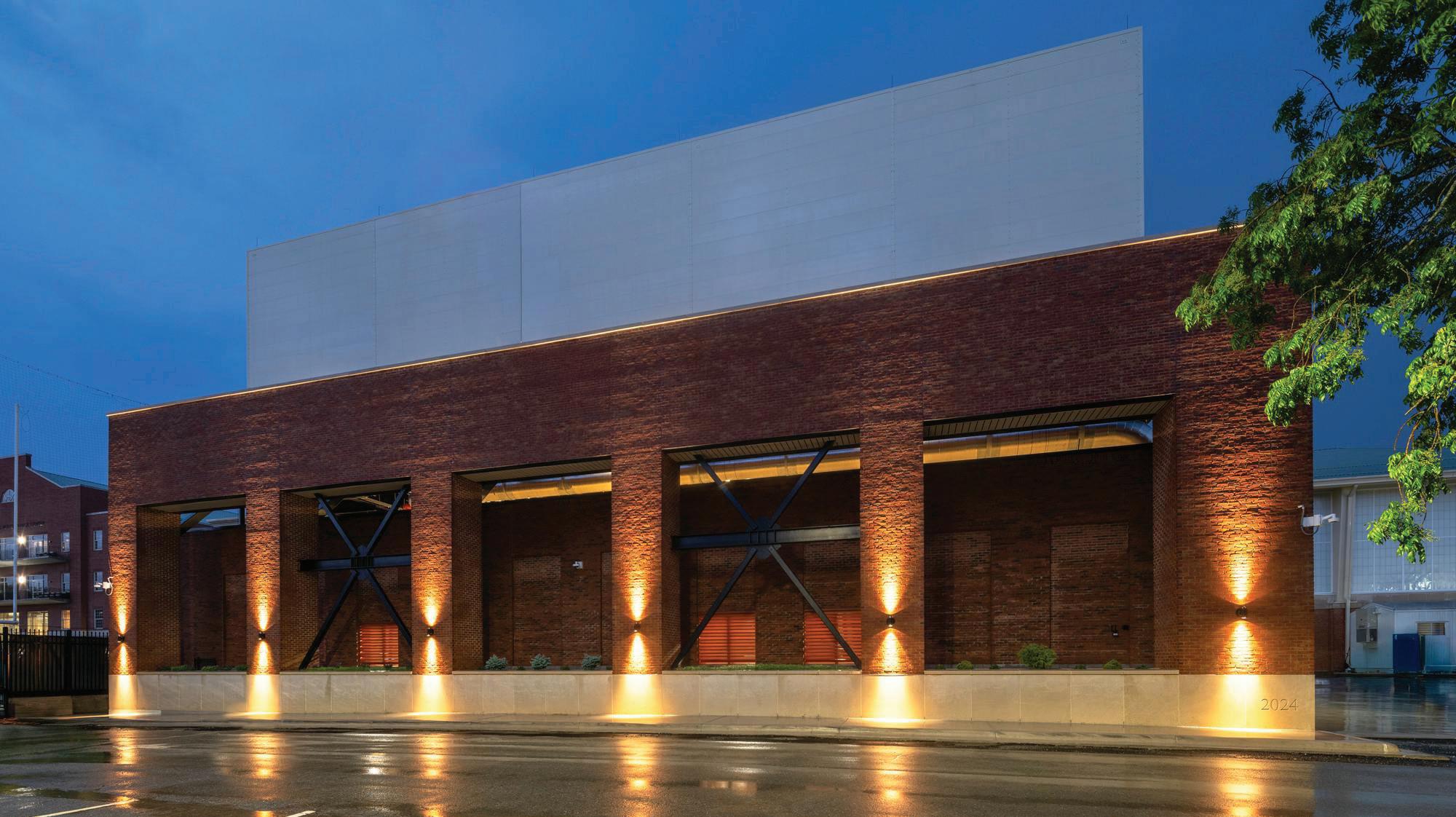
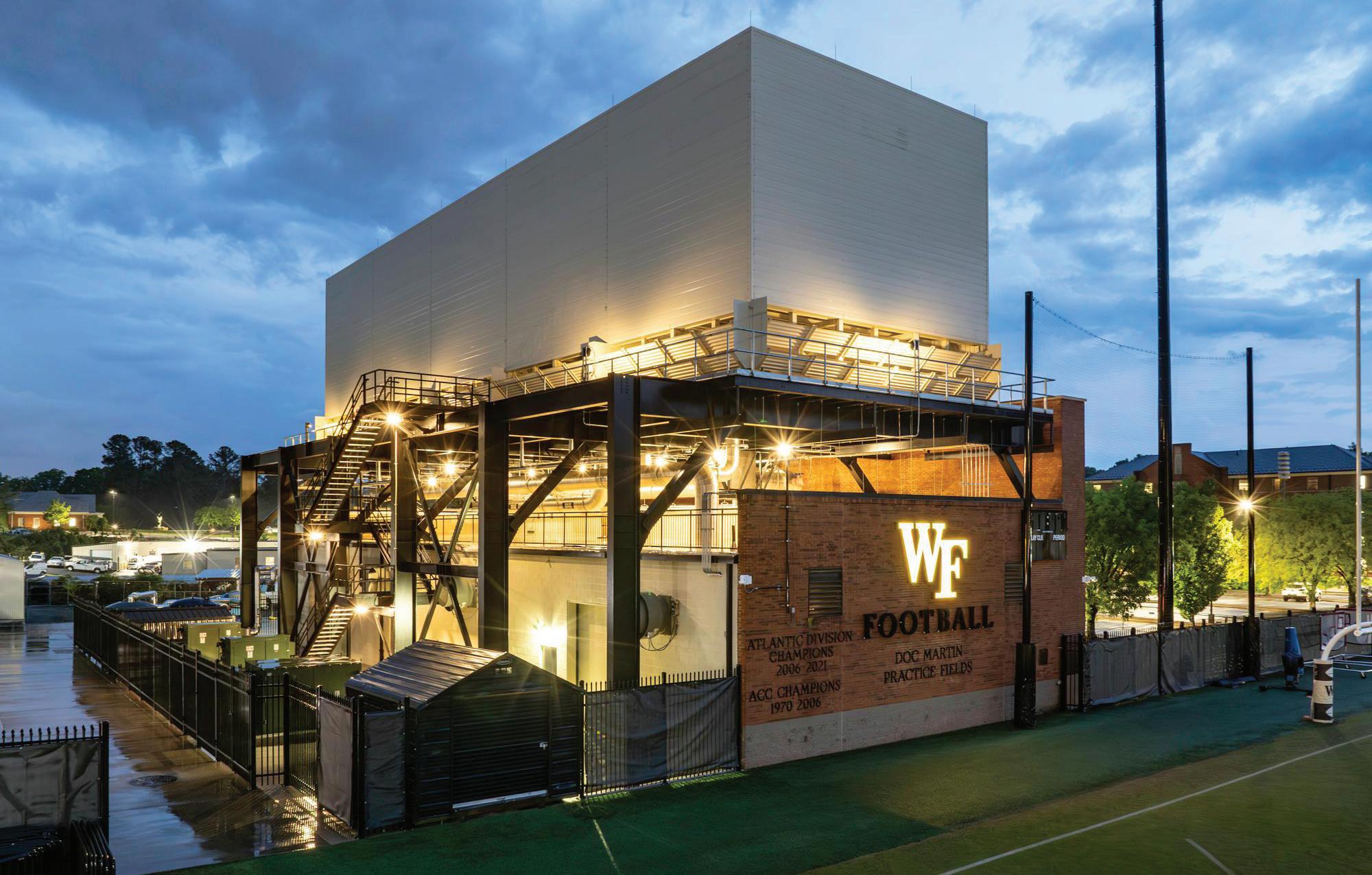
The custom towers sit on top of the new superstructure spanning over the existing plant, which is sheathed in brick to blend with nearby buildings.
RMF / WFU / Peter Brentlinger
chilled water systems in 2015, with the South Plant expansion marking a significant milestone in this undertaking. This latest advancement signifies the successful upgrade and optimization of the entirety of its chilled water generation system, a decade in the making.
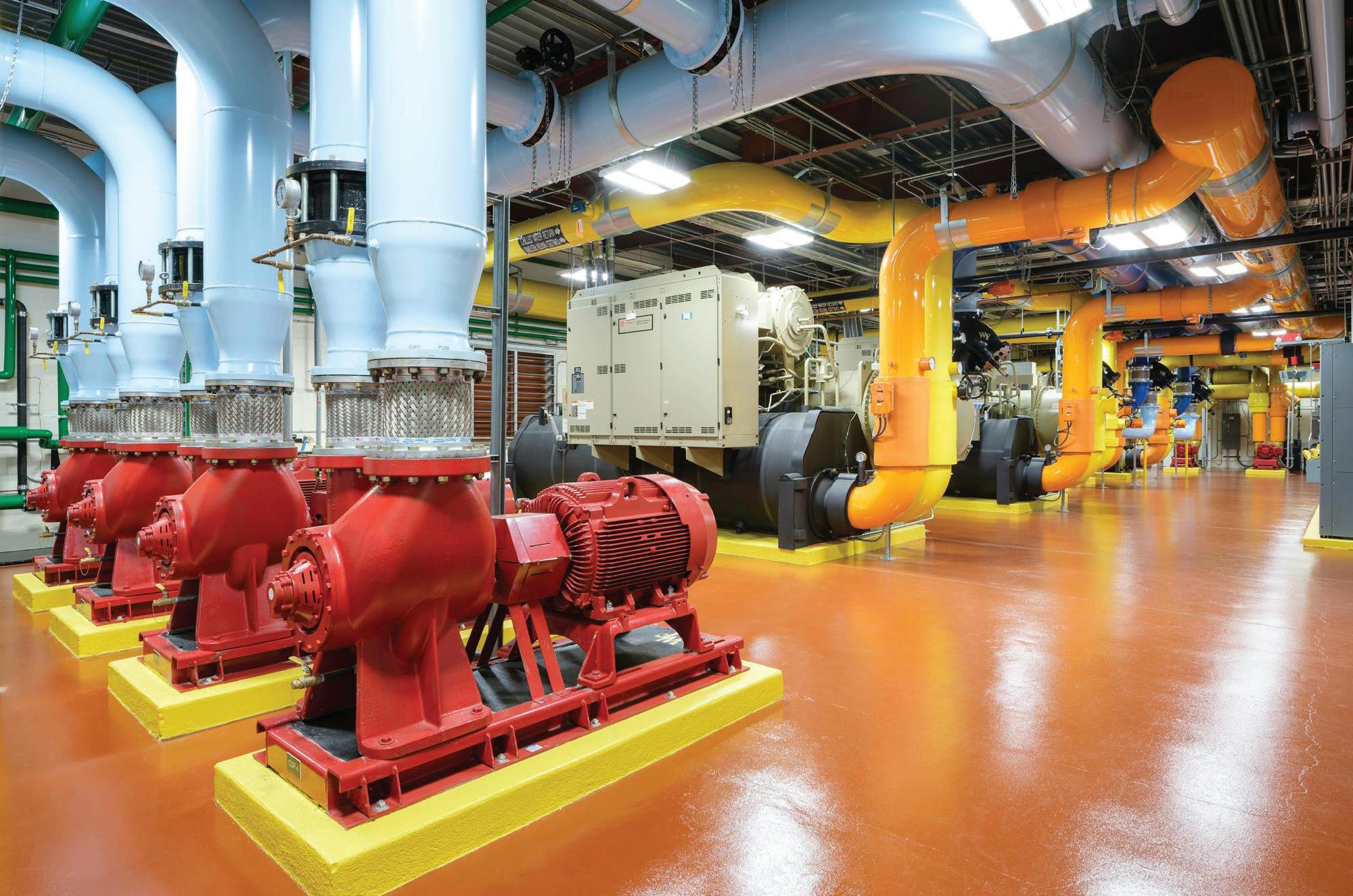
The South Plant’s existing controls became limited in performance due to the aging equipment, requiring the careful evaluation and replacement of these pieces to bring it back to peak performance. The expansion comprises four new custom towers, condenser water pumps, and piping, as well as the replacement of two 600-ton chillers with two 1,200-ton chillers, operating alongside two other existing 1,200ton chillers. This effort increased the plant’s capacity by 33% from 3,600 to 4,800 total tons, further enhancing its operational capacity to meet the changing needs of the campus population.
A critical component of the process was engaging WFU’s primary chiller plant operator from the onset.
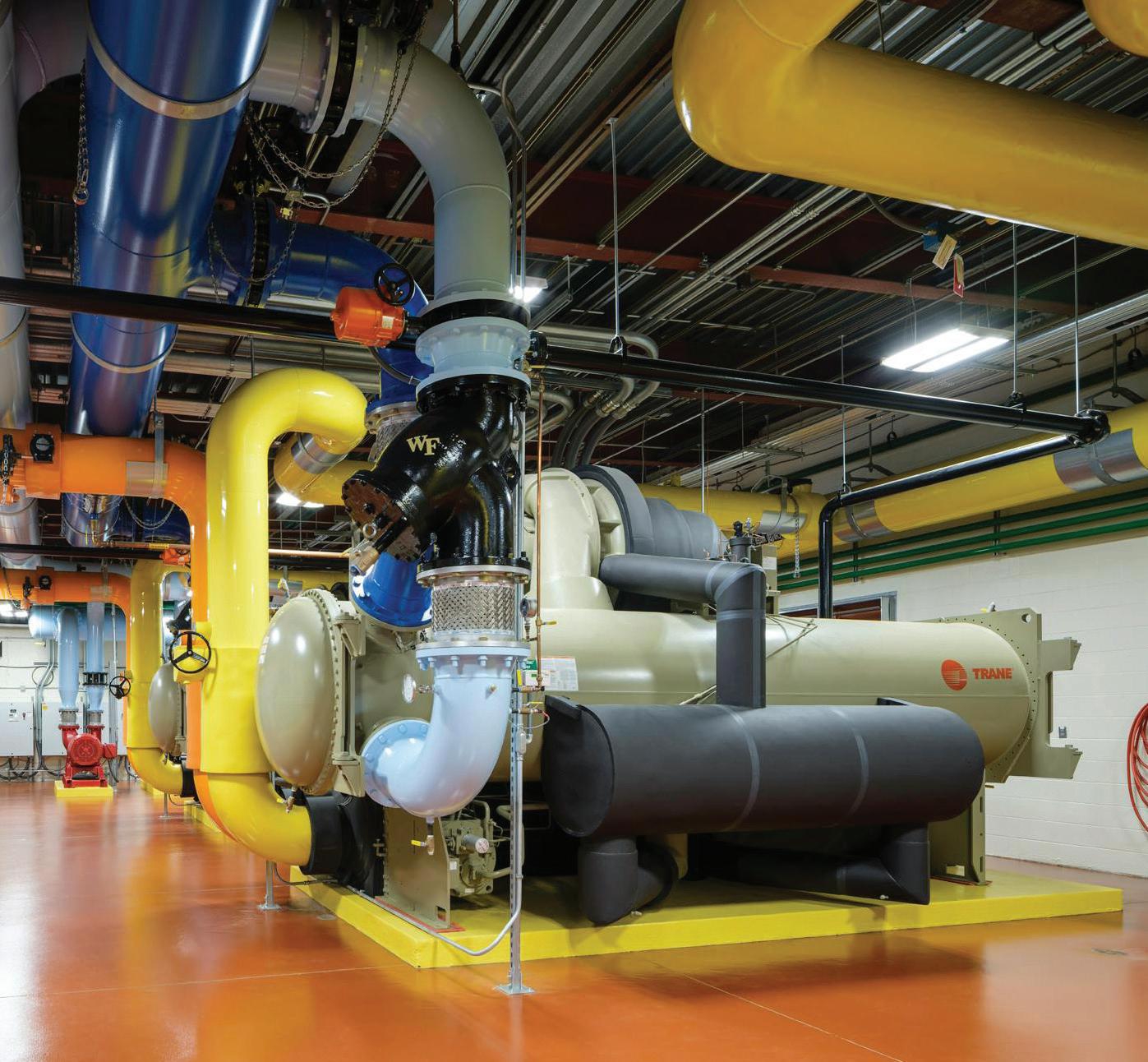
In the event of an outage, the plant is designed to remain partially operational, even if one of its two 2,500 KV transformers goes offline.
Two existing 600-ton chillers and two 1,200-ton chillers were replaced, increasing the plant's capacity by 33% to 4,800 total tons.
RMF / WFU / Peter Brentlinger
RMF / WFU / Peter Brentlinger
This relationship provided a firsthand operations perspective that influenced the design for the better, creating a result that met both the needs of the university as well as those who will operate and maintain the equipment day-to-day. These professionals have the ability to think ahead, understanding what’s plausible for application, maintenance, and evolution and, in turn, promoting the longevity and efficiency of operations.
Electrical Design Fit for Any Occasion
In conjunction with these upgrades to chilled water, the project also encompassed the redesign of the entire plant power feed. The South Plant is the larger of the two plants located on WFU’s campus, underscoring its importance especially during peak summertime electric and cooling times; the North Plant features 2,400 tons, but can only carry the campus for about half the year.
Due to the South Plant’s relocation and capacity increase, the medium voltage switch and transformers needed to be upsized to accommodate this change. The team was challenged by the locations of the footings for the large superstructure columns in the path of the existing duct bank to the plant, requiring the medium voltage rework be the first phase of the project. The new pad mounted switch and two 2,500 kVA transformers were the first items to be procured and installed as a result.
Emergency contingency planning was front-of-mind throughout the engineering design of the project, especially given the scale of operations and sheer amount of people relying on the safety and dependability of the system. The plant is strategically designed to be at least partially operational in the event that one of its two 2,500 kVA transformers goes offline, maintaining 2,400 tons of cooling to the campus. This purposeful approach ensures that the proper infrastructure is in place to
cause little to no interruption to service under a variety of conditions.
Optimizing Operations Within a Constrictive Footprint
As mentioned, the project implemented an innovative design solution by building vertically to maximize the potential of the allotted square footage while minimizing interruptions caused to the campus during construction—which wasn’t originally a part of the plan.
Due in part to the plant’s location, a feasibility study concluded that designing the towers to sit on a new steel superstructure spanning over the existing plant was the best path forward. This configuration addressed WFU’s operational needs and also provided added benefits in real estate savings and aesthetics.
The superstructure is sheathed in brick to blend in with nearby buildings, a result of the close collaboration between RMF and Michael Graves,
Attention to aesthetic detail was critical in successfully teaming the utility plant with the new athletics facilities, executed seamlessly by leveraging Michael Graves’s familiarity with the campus.
RMF / WFU
/ Peter Brentlinger
who served as the architect for the project. The vertical tower seamlessly blends into the aesthetic language of the campus through an architecturally driven approach to sightlines and materiality. The team used fiberglass reinforced polymer (FRP) to enable the selection of custom colors, creating a precise match to the adjacent building.
Structural coordination posed a significant challenge to the project, as constructing a sizable steel superstructure around and over the building in coordination with the cooling towers required a carefully balanced approach. Though the engineering of the project largely focused on mechanical-electrical, considerable structural planning was implemented from the inception of the design through construction.
Large columns facing outward to campus had to be symmetrical and aligned with the key tower load point
and equipment access paths, while 40-in-deep horizontal beams needed to be high enough to allow access to large piping hidden from view under the tower. They also had to avoid a noticeable gap between the existing building and new structure. RMF’s in-house structural engineering team worked with Graves to incorporate the look into the design when cross bracing was needed between the columns, which added even more character to the building.
Setting the Stage for Long-Term Success
By autumn of 2025, the incorporation of the new variable speed chillers, variable flow condenser water, and custom towers had yielded reductions during peak summer operations amounting to 0.2 kW/ton, well over $100K every year in savings. Further reductions are
anticipated as the plant’s variable speed equipment enables further optimization through the off-peak seasons.
All told, the mechanical and electrical expansion of WFU’s South Chiller Plant emphasizes the importance of advanced planning and collaboration between engineering teams and all other project partners, from architects and designers to university operations personnel. Throughout each phase of the project, the highly integrated team remained rooted in WFU’s commitment to resilience, efficiency and positive campus impact.
With an enhanced understanding of each component’s impact and operations, the project efficiently meets the requirements of campus aesthetics, power, and maintenance. This nuanced strategy facilitates not only its successful execution, but its longevity as a reliable resource well into the future.
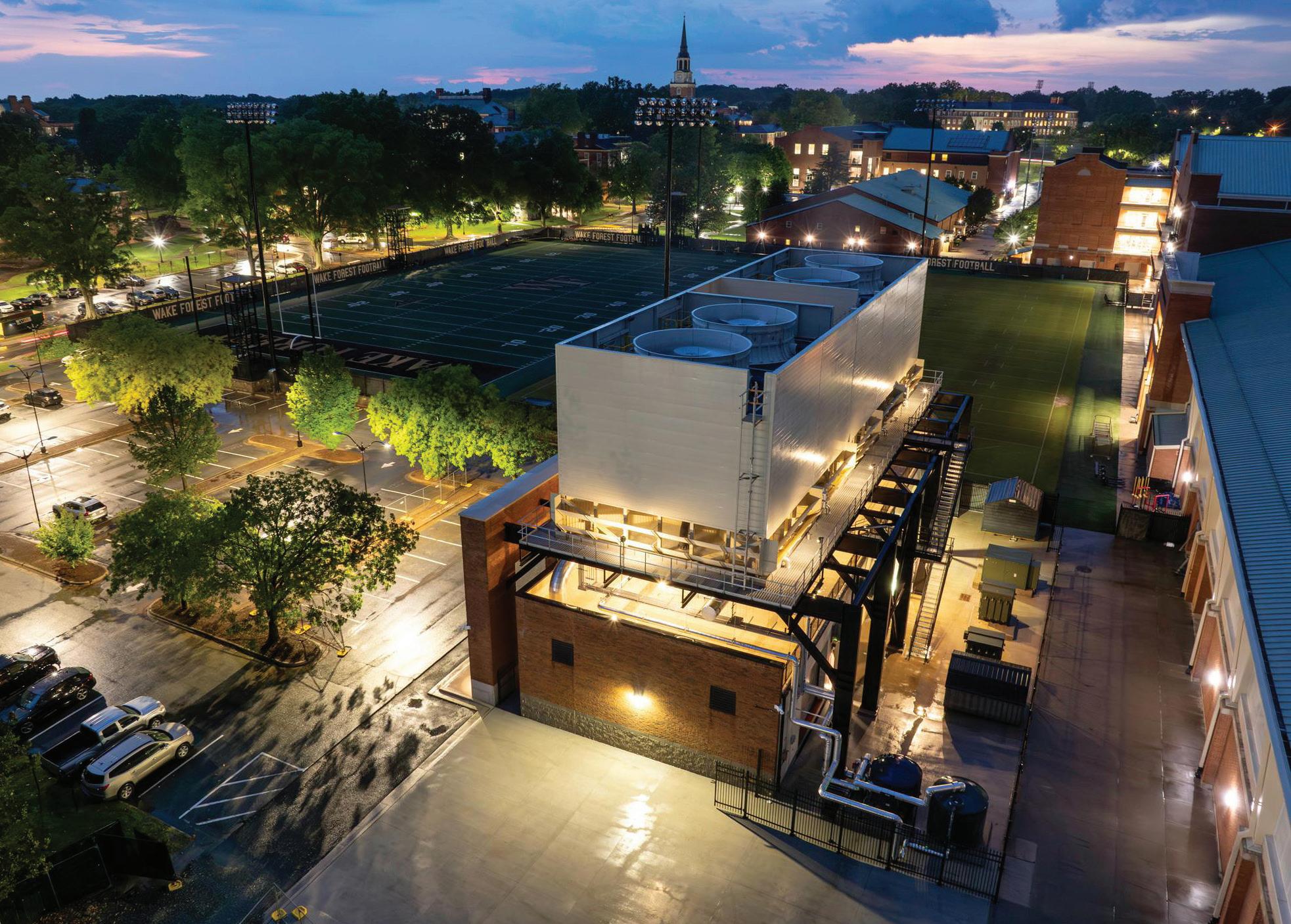
Through a thoughtful approach to architecture and materiality, the structure seamlessly blends into the design language and sightlines of the scenic Winston-Salem campus.
RMF / WFU / Peter Brentlinger
NBBI Honors Burpee, Reelects Creaser as Board Chair
At its annual meeting in Denver, the National Board of Boiler and Pressure Vessel Inspectors stressed safety and leadership.
When John Burpee learned he had been selected as the 34th recipient of the National Board of Boiler and Pressure Vessel Inspectors’ highest honor, the 2026 C.O. Myers Safety Award, his reaction was immediate.
“I was shocked, quite honestly,” he said. “I’ve always considered that award to be something at the end of a career.”
That humility has defined a career spanning more than 25 years in boiler and pressure vessel safety. Named after National Board founder C.O. Myers , the award recognizes
individuals whose contributions have had a lasting impact on industry safety, placing Burpee among what he calls “legends.”
“Personally, I’ve always felt like I was just doing my job,” said Burpee, a U.S. Navy veteran who is the 34th recipient of the award, honored May 13 at the NBBI General Meeting in Denver.
Executive Director Joel Amato said of John during the presentation, “It’s difficult to express the impact John has made on NBBI, the state of Maine, and me. … And through his work on the Board of Trustees, John helped shape the National Board’s activities and initiatives in profound and lasting ways.”
Burpee began his inspection career with HSB in 1994 and became Maine’s chief boiler inspector in 1999. He inherited a program that had been without leadership or technical staff for more than a year and rebuilt it into a stable, self-sustaining operation.
“That’s probably what I’m most proud of,” he said. “Taking a program that was neglected and making it viable and making it self-sustaining.”
Among his many accomplishments was helping guide the adoption of updated regulations, including the 2023 National Board Inspection Code and ASME codes – a process that took nearly two decades.
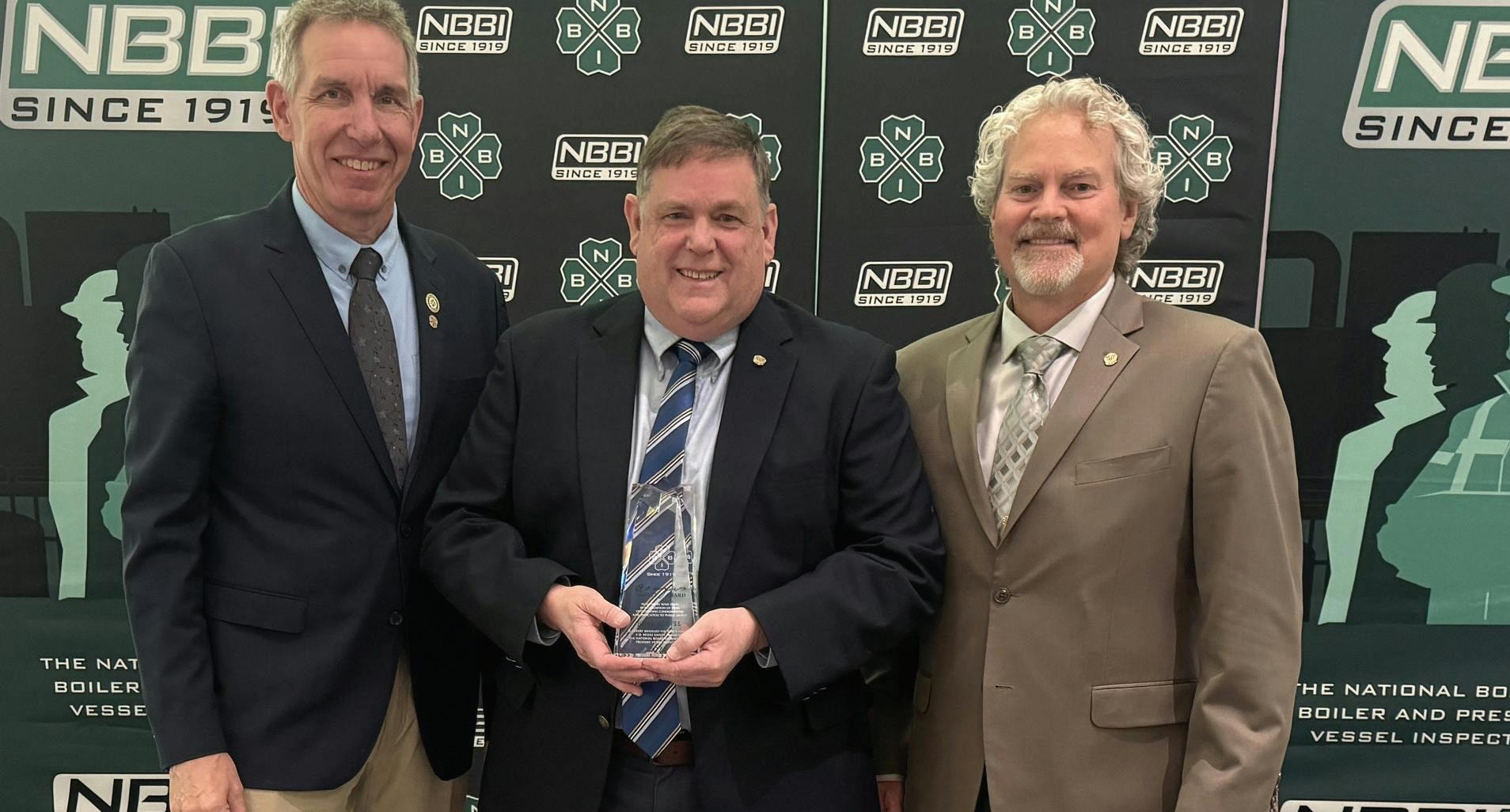
John Burpee was honored during the banquet as the 34th recipient of the C.O. Myers Safety Award, the National Board’s highest honor. He was presented with the award by Eben Creaser (left) and Joel Amato.
“It took a long time to move that forward,” he said, “but getting it across the finish line was significant.”
Throughout his career, Burpee remained deeply involved with the National Board. He served on the Board of Trustees, including terms as Member at Large (2010 to 2014), Chair (2014 to 2017), and First Vice Chair (2019 to 2025).
That experience broadened his role from technical expert to industry leader.
“You realize people are listening,” he said. “You’re helping shape the direction of the organization.”
Now serving as a jurisdictional liaison, he continues to support members across North America. For Burpee, the importance of the work has always come down to one thing: public safety.
“You’re protecting people who don’t even know they need to be protected,” he said. “It’s about making sure nothing happens.”
For those who nominated him, Burpee’s impact is anything but quiet.
“His knowledge, experience, and dedication have been a steadfast pillar to the National Board organization,” said Illinois Chief Inspector Patrick Polick, one of five individuals to nominate Burpee for the award. “There is no candidate more worthy of this recognition.”
In his nomination, Louisiana Chief Rhett Termini said Burpee’s “leadership skills, along with his extensive knowledge, experience, and passion, are an example to us all.”
Still, Burpee remains characteristically modest. “I’ve just been doing what needed to be done,” he said.
Board of Trustees
Elected in Denver
On May 12th at the Members Meeting in Denver, Eben Creaser was reelected as Chair of the NBBI Board of Trustees (BOT). Creaser, who represents the province of New Brunswick, had been Acting Chair since last September. Prior to that, he had been First Vice Chair, after serving three terms
as a Member at Large. He has been a member since 2009.
In addition, elections were held for four other BOT seats:
Tom Clark, who represents the state of Oregon, was elected as 2nd Vice Chair. Clark has been a National Board member since 2019. He most recently served as a Member at Large.
Mike Carlson, who represents the state of Washington, was reelected as a Member at Large. Carlson, who has been an NBBI member since 2020, was elected at the 2024 October Members’ Meeting to fill an unexpired term.
Pat Polick, who represents the state of Illinois, was elected as a Member at Large. Polick has been a member since 2019.
Bill Ross , who represents the commonwealth of Pennsylvania, was elected as a Member at Large. Ross has been a National Board member since 2019. He had served an unexpired term since being elected at the 2025 October Members’ Meeting to fill an unexpired term.
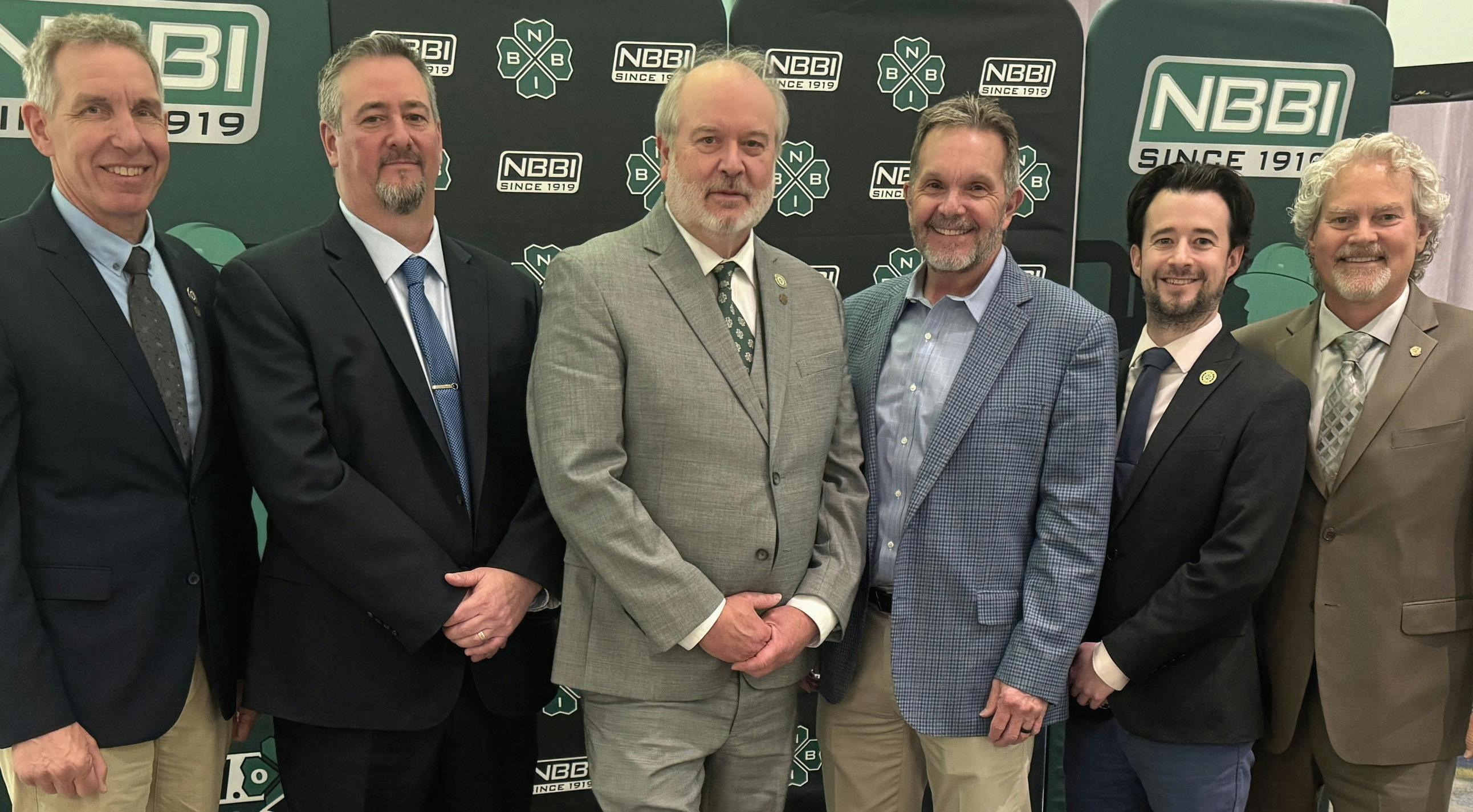
From left to right: NBBI Board of Trustees Chair Eben Creaser, Pat Polick, Mike Carlson, Bill Ross, Tom Clark, and NBBI Executive Director Joel Amato. NBBI
WHERE FACILITY CHALLENGES FIND SOLUTIONS
NORTHERN CALIFORNIA
NORTH TEXAS
August 19-20, 2026
Reno, NV
October 6-7, 2026
Santa Clara, CA
October 14-15, 2026
Irving, TX














NEW PRODUCTS
Tranquility SB Series With Hot Gas Reheat Option
The Tranquility SB Series with hot gas reheat option from ClimateMaster allows the water-source heat pump to effectively manage latent loads without overcooling occupied spaces. Additionally, the standard vFlow modulating water valve maintains head pressure for enhanced reheat capacity on colder building loops. By reheating air using recovered heat from the refrigeration cycle, the system improves moisture removal while minimizing energy consumption. It includes dual refrigeration circuits, microprocessor controls, a galvanized-steel cabinet, variable-speed EC plenum fans and an epoxy-coated drain pan to ensure long-term durability and reliable operation. ClimateMaster
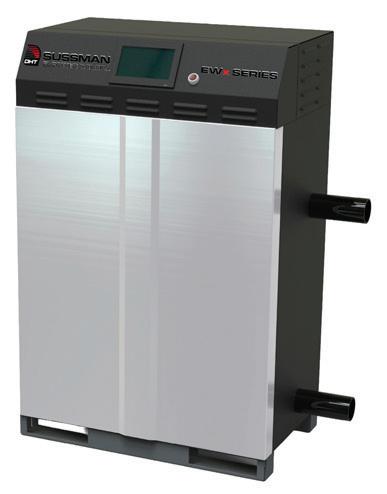
EWx Series Boiler Model Expansion
Sussman Electric Boilers expands its EWx Series of boilers to include three intermediate sizes: 45kW, 75kW and 105kW. The expanded line enables facilities planners to meet precise load requirements without over-sizing equipment. Each unit easily passes through a standard 36-in. doorway, requires minimal side clearance and allows front service access. All new models feature advanced digital feed-forward controls with a 7-in. touchscreen, plus standard BACnet and Modbus for seamless integration into building management systems.
Sussman Electric Boilers
TEC4000S Series Thermostat
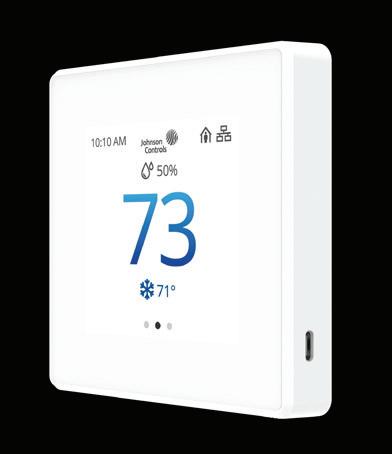
Johnson Controls introduces the TEC4000S Series thermostat targets single-zone commercial applications from 300 to 3,000 sq. ft., including offices, hotels, retail stores, managed condos and K–12 schools. This model features seven HVAC control applications, and a two-SKU lineup designed to streamline selection and inventory management. It features a 4-in. color touch display and a simplified navigation structure. It incorporates high contrast visuals, large text and direct access to frequently used functions. With preset configuration profiles and USBbased cloning, setup time can be reduced by up to 80%.
Johnson Controls

Polaris Compression Connector Portfolio
NSI expands its Polaris Compression Connector portfolio to include a wider variety of both copper and aluminum long-barrel compression connectors. They streamline electrical installations and ensure optimal performance inside panels, enclosures and other confined spaces. Compatible with more than 35 major crimp tools and come with clearly legible size markings to save installers time. Available in sizes up to 1000 MCM, the new configurations include inspection window options and narrow tang designs to support high-capacity applications and installations with limited space.
NSI
Model RT-20 Rooftop Unit
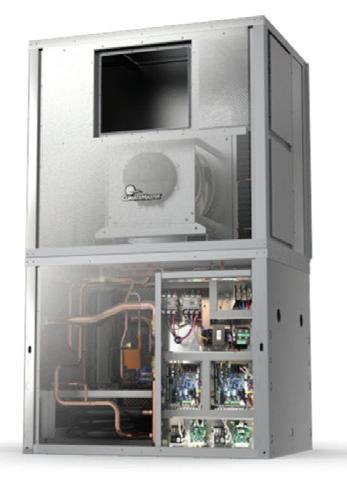
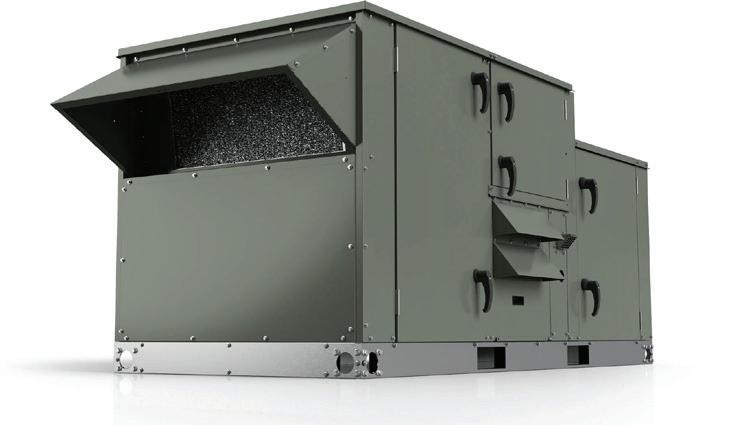
Greenheck expands its rooftop unit line with the addition of its smallest unit, Model RT-20 — delivering 3 to 5 tons of packaged DX cooling, 500 to 2,000 cfm of airflow and up to 175 mbh of indirect gas heating. Inverter scroll compressors maximize efficiency at part-load conditions, and modulating indirect gas furnaces offer tighter temperature control. Direct-drive supply and exhaust fans offer a wide performance range and standard modulation capabilities for VAV systems. EC fan motors on condenser fans modulate to save energy by controlling head pressure. Greenheck
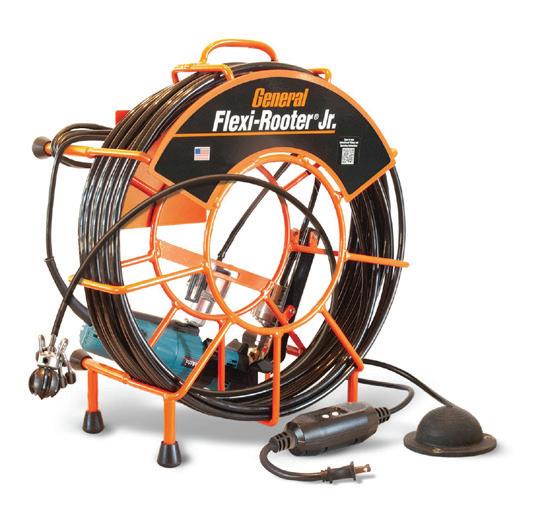
Flexi-Rooter Junior Drain Cleaner
General Pipe Cleaners introduces the Flexi-Rooter Junior, a compact, versatile system designed to quickly and efficiently clear small line clogs. It weighs 20 lb. yet holds 50 ft. of 1/4-in. flexible shaft to easily clear 1 1/4-in. through 3-in. drain lines up to 50 ft. long. The stronger, stiffer, flexible shaft with an enhanced sheath makes it flexible enough to navigate tighter bends. The air-actuated foot pedal allows operators to adjust speed from 0 to 2400 rpm, keeping both hands free to safely guide the flexible shaft into the line. The two-part cleaning array combines ClogChopper cutters with hardened-steel chain cutters.
General Pipe Cleaners
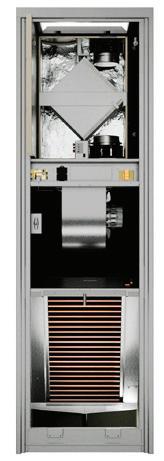
Integrated ERV System
International Environmental Corp. launches its integrated energy-recovery ventilation system, a new enhancement to its MPY vertical stack fan-coil line. It optimizes indoor air quality, reduces energy consumption and simplifies installation, all within a compact, concealed design ideal for multi-unit buildings and spacesensitive environments. Delivering year-round comfort and performance, the system recovers up to 80% of exhausted energy in the form of heat and humidity. The design ensures that fresh, filtered air is supplied without mixing airstreams or transferring pollutants, maintaining high indoor air quality for building occupants.
International Environmental Corp.
Heat₂O Heat Pump Water Heater
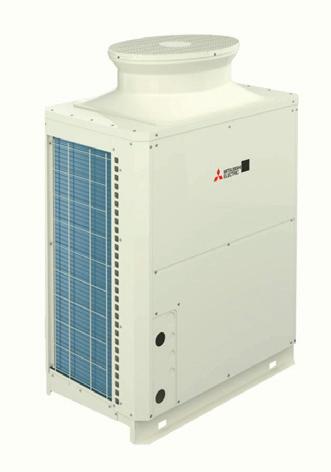
The Heat₂O heat pump water heater from Mitsubishi Electric is an all-electric, zero-emissions heat pump water heater designed to produce high volume domestic hot water for any size commercial application in any climate. It uses a natural CO2 refrigerant with a global warming potential of one and an ozone depletion potential of zero. The patented twisted spiral gas cooler is at the heart of the unit. Three connected refrigerant pipes are wound around a twisted water pipe, maximizing heat transfer. The continuous spiral grooves enhance water turbulence and reduce pressure loss in the heat exchanger, ensuring efficient operation.
METUS
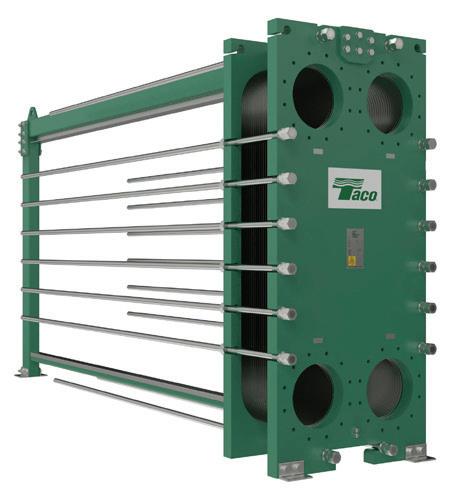
PS/PA Plate-and-Frame Heat Exchangers
PS/PA plate-and-frame heat exchangers from Taco are custom-designed and assembled to specification. They are available in a broad range of connection sizes, from 1 in. to 20 in., and in a wide range of materials to fit various applications. The ASME-certified heat exchangers offer standard working pressures/design temperatures of 150 or 300 psi and 284° F, with higher working pressure and design temperature limits available upon request. The line provides a high degree of flexibility in materials, including corrosion-resistant 304/316 stainless steel and titanium heat-transfer plates, enabling specifiers to meet a range of application requirements.
Taco Comfort Solutions
Regent Commercial Tankless Water Heater
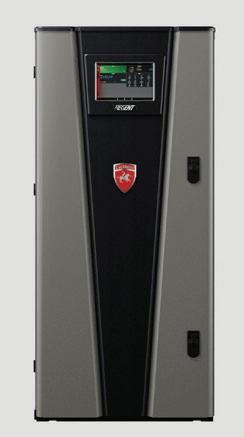
The Regent commercial tankless water heater from Lochinvar is designed to deliver ultra-high efficiency and dependable operation. Available in three models ranging from 500,000 to 1,000,000 BTU/hr. Each unit achieves a thermal efficiency of up to 97% and features a turndown ratio of up to 25:1. RealTime O2 Trim technology uses feedforward and feedback data for automatic combustion trimming. Further responsiveness is provided by an Ultrasonic Flow Sensor, which detects flow changes instantly. It features a single water-tube, stainless-steel heat exchanger and an internal circulating pump to maintain high-velocity flow.
Lochinvar
NEW PRODUCTS
SMART MULTI 5 Ton Hyper-Heating INVERTER Outdoor Unit
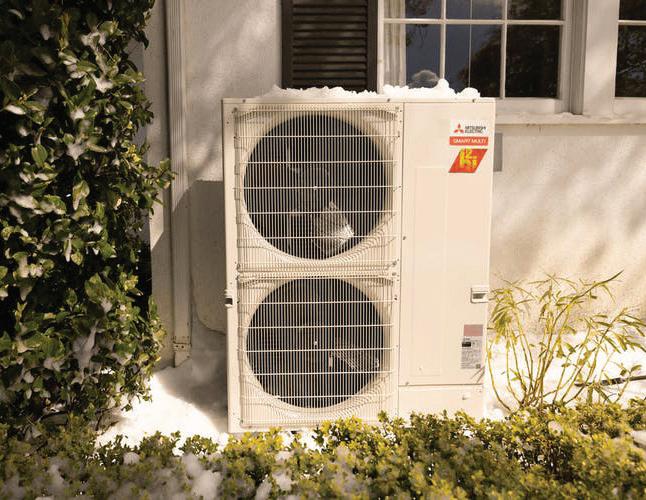
Mitsubishi Electric Trane HVAC US (METUS) introduces the SMART MULTI 5-ton Hyper-Heating INVERTER outdoor unit. Designed with a low-GWP refrigerant, the unit incorporates built-in safety features, including shut-off valves that meet A2L and UL requirements. Indoor unit versatility is a key advantage of the system, supporting multi-zone configurations and connecting to multiple indoor units to deliver personalized comfort across multiple spaces. All system combinations are Energy Star Cold Climateand NEEP-certified. METUS













BY NANCY KOHOUT, PE, PRINCIPAL
Second Women’s Symposium Builds on Momentum
Inspired by each other’s energy and challenges, some 300 ASHRAE engineers met in L.A. this spring to learn how their contributions are improving this industry.
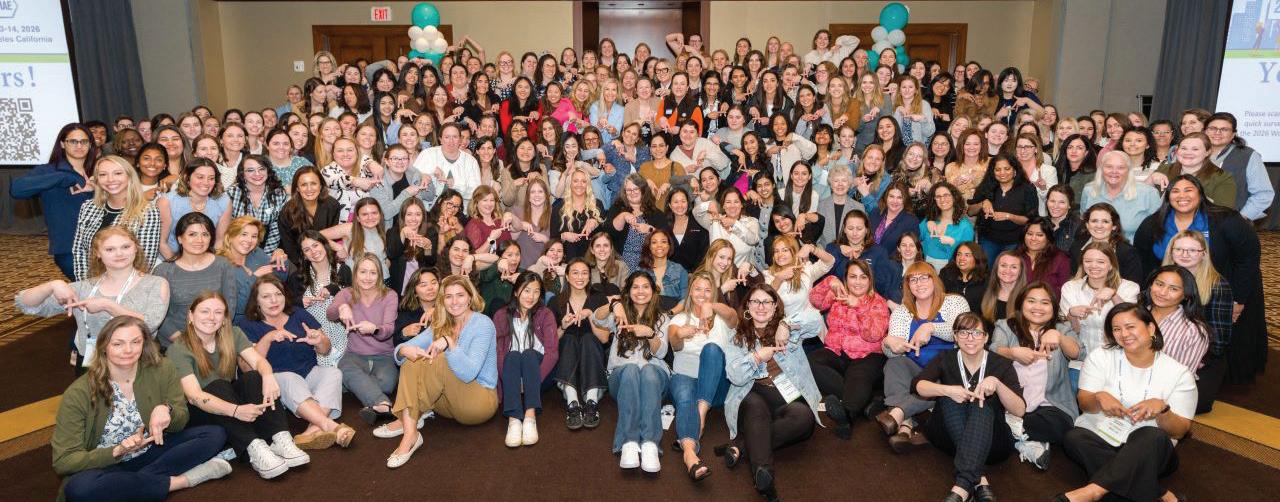
The 2nd Women in ASHRAE Leadership Symposium in Los Angeles was a remarkable event, bringing together nearly 300 women from the HVACR industry for two impactful days. Founded and chaired by Karine LeBlanc and myself, the meeting aimed to connect and empower women, enhancing leadership and representation within ASHRAE and beyond, building on the momentum from Chicago in 2024.
The event began with a welcome reception and a rejuvenating yoga, creating an energetic and positive atmosphere. Attendees engaged in sessions that blended technical insights with opportunities for personal and professional growth. The atmosphere was invigorating, with participants eager to absorb knowledge and share their own experiences.
Three keynote speakers captivated the crowd.
Dr. Gail Brager from UC Berkeley discussed researchinformed design for people and the planet, highlighting the importance of sustainability. Amy Marks, SVP of Innovation at Compass Datacenters, delved into the question of whether innovators are born or made. And Dr. Sara Safari, an activist and author, shared her gripping survival story from an earthquake on Mt. Everest, challenging everyone to overcome their own “Everest” challenges.
The symposium placed a strong emphasis on support and networking. Participants exchanged experiences, offered
guidance, and celebrated each other’s achievements, forming meaningful relationships sure to last. The conference underscored the importance of representation and the pivotal role of women in shaping the HVACR industry. The presence of leaders like Sarah Maston, ASHRAE presidentelect, served as a testament to the progress being made.
A standout feature of the event was the breakfast roundtable discussions. They sparked lively debates and generated fresh ideas, fostering an environment of collaboration and innovation. Attendees appreciated the opportunity to engage in deep conversations about common challenges.
As the symposium concluded, there was a palpable sense of empowerment and inspiration. Attendees were eager to continue the dialogue and nurture the connections made. Plans are already underway for the next symposium in Baltimore on April 11-13, 2027, which will be chaired by Tiffany Abruzzo and Jennifer Leach.
The 2026 Women in ASHRAE Leadership Symposium was not just a meeting but the continuation of a movement. A celebration of leadership, connection, and empowerment, it reaffirmed the vital role of women in this industry, inspiring all to strive for greater representation and influence.
The momentum promises to drive meaningful change, as women engineers continue to grow their impact with mutual support, armed with new insights and strengthened bonds.
A member of HPAC Engineering’s Editorial Advisory Board, Nancy Kohout, PE, LEED AP, is dedicated to advancing decarbonization and high‑performance building systems. As a Principal Mechanical Engineer at Buro Happold, she drives innovative engineering strategies that elevate sustainability and accelerate progress toward low‑carbon futures. She is cur rently Illinois ASHRAE President, and serves nationally on ASHRAE’s Center of Excellence for Building Decarbonization.





















Fresh air for the spaces that never stop.