SPECIAL ISSUE: Process Industries in the Middle East
Special Issue October 2026 www.process-worldwide.com/middleeast
Beyond Oil:
Where the Action is Back to the future: The Middle East, cradle of human civilisation, has become one of the most exciting hubs for downstream industries. Lets take a closer look at recent projects and future developments!
Artificial Intelligence
Circularity
Special: Pharma & Biotech
Revolutionizing Adnoc: With the Power of AI
Beyond Plastics: The Rise of Circular Oil
Local Production to Global Standards
Editor’s Page
Back to the Future T
he Middle East is back on the global map — no longer content with being the global supplier of raw feedstocks and energy, the region ramps up downstream capacities. PROCESS has been accompanying this journey for quite some time now — I fondly remember a business trip to the region that took me from aluminum smelters via chemical production to water desalination plant projects. Feedstock, energy, talents: The Middle East has it all (see p. 8). So its no wonder that the leading global trade fair for chemistry and the chemical industry, ACHEMA, has set its sights on the region. With ACHEMA Middle East, the organizers hope to establish a new strategic flagship event for the process industry in the titular region.
Of course, we also cannot ignore the elephant in the room: war and blockades have seen value chains stretched to the breaking point, as well as feedstock and energy prices skyrocketing. Infrastructure and production sites have come under fire. And ACHEMA Middle East has been postponed until 2027 (more on p. 30) — most certainly a wise decision. We are certainly looking forward to seeing you in Riyadh! Until then, we have gathered some of the most exciting stories, trends, and developments from AI to pharma production to get you hyped. The ancient cradle of civilizations is making its big return on the global stage and invites the world to join the journey into the future.
Dominik Stephan Editor
PROCESS Middle East | 2026
3
Contents
October
Special Issue Middle East | 2026 · www.process-worldwide.com/middleeast
Across the Middle East dedicated policies are encouraging the use of clean, sustainable technologies. Page 8
Engineering & Asset-Lifecycle Policies & Initiatives
8
It’s All Happening in the Middle East Instrumentation, Control & Automation Energy
10 Revolutionizing Adnoc through the Power of AI Market Insights
12 Smart Technologies for Plant Operations Mechanical & Thermal Processing Decarbonization
14 Can We Achieve Zero Routine Flaring by 2030? H2 Engineering & Green Technology Smart Solutions
16 It’s All About Technology!
4 PROCESS Middle East | 2026
Oil and gas companies in the Gulf are incorparating smart technologies to optimzie their operations. Page 16
Market Insight
18 Beyond Oil: The Rise of the Plastics Circular Economy Sustainable Transformation
20 Three Core Decarbonization Projects Special: Pharma & Biotech Intelligent Technologies
22 Is Next-Gen Tech Reshaping Pharma Manufacturing? Supply Security in Tableting
24 Local Production, Global Standard Laboratory & Analytical Technology ERP-System
28 ERP Changeover from Lab to Production Interview
30 “Bringing the Process Industry Ecosystem Together”
Special: Pharma & Biotech When tableting tools are manufactured closer to the market, supply chains can respond more quickly. With a new production site in Pune, India, Fette Compacting is moving closer to this goal. Page 21
Further Sections
3 Editor’s Page 6
Global Spotlight
32 Product News 34 Imprint
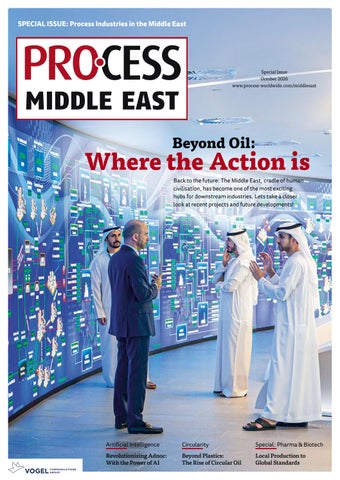
Things to know about the cover The Abu Dhabi National Oil Company has a major goal: it aims to become the world’s most AI-driven energy company. You can find out more about the AI tools the company is set to introduce on page 10.
PROCESS Middle East | 2026
5
Business & Economics
Grafik: © great19 – stockadobe.com
Global Spotlight More news: www.process-worldwide.com/news
REFINERY & ENERGY
US-Saudi Consortium to Finalize Site for Refinery and Energy Export
ENGINEERING
TRANSPORT LOGISTICS
Source: Mera Oil
Left to right: Lakshmi Narayanan, Vice Chair of Patel Family Office; Marc W. Gunderson, Founder of MWG Enterprises; and Abdulmalik Alqahtani, Group Chief Executive Officer of AHQ Group.
MWG Enterprises, the Fort Worth-based energy development company; Patel Family Office, the third-generation global family office; and PWS, an associate company of one of Saudi Arabia’s longest-established industrial groups AHQ Group, have together launched Mera Oil, a US-Saudi private consortium, and entered the final stage of selecting a host for their planned five-billion-dollar integrated refinery and energy export corridor. After three years of evaluating locations across the Gulf, the Mera Oil consortium has narrowed the site selection process to three GCC locations outside the Strait of Hormuz. Discussions with the candidate locations have progressed over the past two years and are approaching a deci-
sion point, with a preferred host expected to be confirmed by the end of 2026. While discussions with the three shortlisted locations have reached an advanced stage, the consortium remains open to a decisively superior proposition from another qualifying GCC jurisdiction capable of meeting the project’s route-resilience, infrastructure and development timetable requirements before a final host is selected. The planned development centres on a 200,000-barrel-per-day integrated refinery linked to deepwater port infrastructure, large-scale storage of crude and refined products, and marine export facilities. The project is designed to provide a route-resilient export platform with direct access to international shipping lanes. (dpo)
KBR Wins Contract for Libyan Refinery Project
Mammoet Completes Record Module Loadout for Major Gas Project at Khalifa Port, UAE
KBR, a provider of science, technology and engineering solutions, has been awarded a contract by Zallaf Exploration, Production and Refining of Oil and Gas Company to provide project management and technical services for the South Refinery Project in Ubari, Southwest Libya. KBR will provide contract management, project management and supporting technical services throughout the EPC phases of the project. This work is expected to be executed over a 50-month period. The South Refinery Project aligns with KBR’s long-standing commitment to advancing vital oil and gas infrastructure in Libya. “As an American company with a long and proud history in Libya, we are pleased to support this strategically important project,” said Jay Ibrahim, President, KBR Sustainable Technology Solutions. (dpo)
Mammoet achieved a significant milestone by completing the weighing, transport, and loadout of 24 PAU and PAR modules for a leading gas development project in the region. This also included a process gas cooling module which weighed 2,464 tons, measured 38 meters long, 23 meters wide and 32 meters high. Fabricated by Quality International FZC, one of the leading fabrication and assembly yards in the UAE, the modules were loaded out at Khalifa Port, Abu Dhabi Ports’ flagship deepwater multi-purpose port. Achieving this milestone required seamless coordination with port operations, including adjustments to infrastructure to handle oversized cargo. The modules were moved from the fabrication yard at Khalifa Port South Quay to the adjacent quayside, covering approximately 2.5 kilometers, be-
6 PROCESS Middle East | 2026
Source: Mammoet
fore being loaded out and shipped in four consignments. Mammoet’s scope included weighing the modules. For transport and loadout, Mammoet deployed 120 axle lines of self-propelled modular transporters (SPMT) and four power pack units. (dpo)
The heaviest and tallest unit — a Process Gas Cooling Module — weighed 2,464 tons and measured 38 meters in length, 23 meters in width, and 32 meters in height.
Business & Economics
PVC PRECURSORS
Source: Adnoc
Ta’ziz to Supply UAE-Made Chemicals to India
Signing of the agreements in the presence of His Excellency Dr. Sultan Ahmed Al Jaber, UAE Minister of Industry and Advanced Technology (centre).
Ta’ziz has signed two product sale agreement term sheets with The Sanmar Group, an indian producer of polyvinyl chloride (PVC) and specialty chemicals, for the supply of key petrochemical feedstocks. Under the terms of the long-term agreements, which
are up to 10 years, Ta’ziz will supply Sanmar with over 350,000 tonnes of ethylene dichloride (EDC) and vinyl chloride monomer (VCM) per year. These materials will be produced at the Ta’ziz Chemicals Industrial Zone in Al Ruwais Industrial City, Al Dhafra region, Abu Dhabi, marking the first time either chemical has been exported from the UAE. VCM and EDC are critical raw materials in the production of PVC and will support Sanmar’s production sites in Port Said, Egypt and Cuddalore, India. Through this initiative, Ta’ziz is boosting the production of UAE-made chemicals and enhancing the competitiveness of the country’s chemicals sector. (dpo)
COLORS AND COATINGS
Launch of New Color Blending Unit in Dubai Earlier this year, Akzonobel Aerospace Coatings was preparing to commission a new color blending and distribution facility in Dubai, UAE. The strategic location of the new site will strengthen Akzonobel’s ability to support commercial aviation operators, MROs, OEMs, and industry partners across the region, with locally blended and stocked coatings solutions tailored to individual customer requirements. The facility, which is set to serve as a regional hub for the Middle East, is scheduled to commence operations in the second quarter of 2026. From Dubai, Akzonobel will offer local blending of Aerobase, Aerodur 3001 and Eclipse colors, as well as streamlined access to primers, topcoats and thinners held in stock. Color blending at the facility will be supported by automated and precision control processes to ensure repeatable, reliable color accuracy in line with the standards applied across Akzonobel’s global network. (dpo)
Engineering & Asset-Lifecycle
With significant investments into clean, sustainable and smart technologies, the Middle East is all set to transform like never before.
POLICIES & INITIATIVES
It’s All Happening in the Dedicated policies and initiatives encouraging the use of clean, sustainable and smart technologies are already being implemented across the Middle East. These revolutionary changes are all set to empower the region.
C
WRITTEN BY
Ahlam Rais Freelance Editor PROCESS Worldwide
hange is inevitable and no other region in the world can show this better than the Middle East. With significant investments into clean, sustainable and smart technologies, the region is all set to transform like never before. Some of the countries in the region have even established dedicated policies and undertaken initiatives for accelerating the adoption of these innovations. Showcasing a positive economic outlook for the region, the World Bank in a press release in October 2025 stated that the latest World Bank economic report on the Middle East, North Africa, Afghanistan & Pakistan (MENAAP) points to an improved economic outlook for the region, with expected growth reaching 2.8 percent in 2025 and 3.3 percent in 2026. However, global uncertainty, trade policy shifts, and continued conflict and displacement all pose possible risks. 1. The UAE: Although smaller in size as compared to other countries in the region, the UAE (United Arab Emirates) has become a powerhouse in the Middle East. The incorporation and promotion of next-gen technologies like Artificial Intelligence (AI) to optimize its industrial operations as well as the increasing use of carbon capture technologies to produce low-carbon fuels has made it possible for the petite country to attract eyeballs from across the globe. The Gulf nation’s numerous policies and initiatives towards clean, sustainable and smart technologies have to be given due credit for this.
8 PROCESS Middle East | 2026
In 2017, the “UAE Energy Strategy 2050” was announced, which intends to establish a sustainable energy future by aiming for 50 percent clean energy in the mix by 2050, reducing carbon emissions by 70 percent, and boosting energy efficiency by 40 percent. In addition to this, the “UAE Net Zero by 2050 Strategic Initiative” was launched in 2021 wherein the country committed to net-zero emissions by 2050. The UAE’s Net Zero 2050 Strategy which was announced in 2023 builds upon the UAE Net Zero by 2050 Strategic Initiative and offers a comprehensive as well as actionable plan to achieve the 2050 goal. The official platform of the UAE Government mentions that the Strategy aims to enhance efficiency, expand the utilization of renewable energies and employ carbon capture technologies.
Putting Hydrogen on the Map Next, the UAE’s Science, Technology & Innovation (STI) Policy 2024 was introduced with an intention to diversify the beyond oil, and achieve global competitiveness by focusing on sectors such as energy transition, health, food/ water security, digital tech and advanced materials. Lastly, the UAE’s National Hydrogen Strategy aims to make the country one of the leading global producers and exporters of low-carbon hydrogen. 2. Saudi Arabia: One of the strongest regional players, Saudi Arabia has established policies along with numerous
Engineering & Asset-Lifecycle
Source: Adobe Stock
4
3
Middle East initiatives to promote the use of sustainable and smart technologies. The ambitious “Saudi Vision 2030” program was launched in 2016 and is being led by Crown Prince Mohammed bin Salman. This national strategic framework aims to reduce oil dependency, diversify the economy, and socially transform the Kingdom for a sustainable future. In 2021, the “Saudi Green Initiative” (SGI) was introduced. SGI is a key part of “Saudi Vision 2030” and one of the core goals of this initiative is emission reduction. The initiative also aims to accelerate the green transition and be a global leader in the implementation of the circular carbon economy approach. In addition to this, 85+ initiatives under SGI have been deployed in the country which includes increasing the capacity share of renewable energy for electricity generation in Saudi’s energy mix to 50 percent as well as becoming a key producer and exporter of clean and green hydrogen globally. Another important component of Vision 2030 is the “Digital Transformation” policy which encourages the use of Artificial Intelligence. 3. Egypt: Egypt, known as “Land of the Pharaohs”, is another crucial player in the Middle East. In terms of clean and sustainable technologies, the nation intends to significantly expand its solar and wind capacity. According to a news published by Egypt’s official State Information Service, the country aims to increase the share of renewables in the national energy mix to over 42 percent by 2030, as a first step toward reaching 60 percent by 2040, in line with the latest updates to the National Energy Strategy.
Diversifying the Energy Landscape Next, the country has come up with a “National Low-Carbon Hydrogen Strategy” which aims to diversify sources of clean and sustainable energy, reduce carbon emissions, and fulfill its international commitments to combat cli-
Source: © IBEX.Media - stock.adobe.com
2
1
1. United Arab Emirates, 2. Saudi Arabia, 3. Egypt, 4. Türkiye
mate change. In addition to this, the “National Green Hydrogen Strategy” which is in line with Egypt’s ambitious “Vision 2030” aims to produce green hydrogen by 2040. According to the official website of Egypt’s State Information Service, the Strategy outlines several key goals, including producing 5.8 million tons of green hydrogen annually, capturing 5–8 percent of the global hydrogen market, contributing to climate goals by reducing carbon emissions by 40 million tons per year, creating around 100,000 jobs and increasing GDP by 10–18 billion dollars. 4. Türkiye: Another major player in the region is Türkiye (formerly Turkey). The country is committed to achieving net zero emissions by 2053 and aims to slash greenhouse gas emissions by 41 percent by 2030 as well as peak its emissions in 2038 in order to accomplish its net zero goals. Türkiye’s renewable energy policy focuses on increasing the share of renewables in electricity generation to over 60 percent by 2035. Related initiatives such as Implemented Renewable Energy Sources Support Mechanism (Yekdem) and Yeka (Renewable Energy Resource Areas) are encouraging investment in wind and solar. The country aims for 120 GW of wind and solar capacity by 2035. Apart from this, Türkiye’s National Hydrogen Strategy was launched in 2023, focusing on green hydrogen. It has set a goal to achieve 2 GW of electrolyzer capacity by 2030, rising to 70 GW by 2053. With an aim to decarbonize hardto-abate industries, the country has developed a national CCUS (Carbon Capture, Utilization, and Storage) roadmap. Lastly, the Türkiye National Artificial Intelligence Strategy from 2021 aimed to ensure that the country be ranked among the top 20 countries in international AI indices. With so much happening in the Middle East, the region is going all in to make sure that it excels in clean, sustainable and smart technologies as it’s fully aware that if it doesn’t make these timely changes, it will be left out. (dst) PROCESS Middle East | 2026
9
Instrumentation, Control & Automation
ENERGY
Revolutionizing Adnoc through the Power of AI Abu Dhabi National Oil Company (Adnoc) has a big plan: To become the most AI-enabled energy company in the world. And it has the means: More than 200 AI tools that monitor the performance of critical equipment, reduce operational downtime, enhance efficiency and predict emission sources.
A WRITTEN BY
Ahlam Rais Freelance Editor PROCESS Worldwide
rtificial intelligence and generative AI may be the most important technology of any lifetime,” stated Marc Benioff, CEO and co-founder of Salesforce, a global leader in CRM and cloud computing software. Industry leaders must adapt to this technology or they will perish. In this scenario, Abu Dhabi National Oil Company (Adnoc) has taken on the challenge of becoming the most AI-enabled energy company in the world! “We are on course to make Adnoc the most AI-enabled energy company in the world,” said His Excellency Dr. Sultan Ahmed Al Jaber, UAE Minister of Industry and Advanced Technology, Adnoc Managing Director and Group CEO, at Ceraweek 2025 in Texas. This audacious statement comes with significant responsibilities and Adnoc is going all out to make sure that its AI ambition becomes a reality soon.
10 PROCESS Middle East | 2026
On inquiring about the firm’s current progress, a company spokesperson said, “We are deploying AI and other advanced technologies from the control room to the boardroom with more than 200 AI tools and 60 robotic applications to optimize performance, unlock value, lower emissions and make faster decisions. Many of our AI solutions are built in-house and have already delivered real-world impact, reducing unplanned plant shutdowns by 50 percent and improving the safety of our people by 30 percent.”
Exploring the AI Tools Neuron 5 is an AI-enabled process optimization technology developed by Adnoc in collaboration with AIQ, an advanced technology innovator in the UAE and a joint
Instrumentation, Control & Automation
PROCESS TIP
be incorporated across all Adnoc facilities across thousands of critical pieces of equipment. Energyai is another solution by Adnoc and AIQ in partnership with G42, an Emirati AI development holding company, and Microsoft. Claimed to be the world’s first-of-its-kind custom-built agentic AI solution for global energy transformation, Energyai will make use of large language models and specialized AI agents. In addition to this, Emission X is an AI-tool that has been specifically developed for Adnoc by AIQ. With an aim to assist Adnoc in achieving its Net Zero goals by 2045, the tool utilizes real-time and historical operational data to predict emission sources up to five years in advance which enables operators to take preventative and timely action. Next, the Centralized Predictive Analytics and Diagnostics (CPAD) program is an AI-powered platform introduced by Adnoc that makes use of real-time data to predict equipment failures, reduce unplanned maintenance and improve asset reliability which ultimately leads to lower energy consumption and emissions. These innovations — from Neuron 5 to Energyai, Emission X, and CPAD — are more than tools; they represent Adnoc’s bold blueprint for the future. By embedding artificial intelligence across every layer of its operations, the company is steadily advancing toward its audacious goal of becoming the most AI-enabled energy company in the world, while setting a global benchmark for energy transformation. (dst)
venture between Adnoc and Presight – the region’s leading international big data analytics company and Aveva. The technology is capable of autonomously monitoring the performance of critical equipment, enabling process optimization and preventative maintenance, decreasing operational downtime, improving efficiency and significantly reducing the need for time-consuming manual inspections. Neuron 5 uses advanced AI models and deep learning algorithms to predict maintenance needs and monitor equipment performance by interpreting data, such as pressure, temperature and vibration, received from sensors on critical equipment. The AI-enabled process optimization technology was first deployed at Adnoc Onshore’s Northeast Bab (NEB) field and Adnoc Gas’ Taweelah gas compression plant and is now expected to
Source: Powering Possible Report 2025 by Adnoc and Microsoft
Source: Adnoc
Discover the latest engineering projects in our monthly “Top 10 Engineering Projects” special on www.processworldwide.com!
PROCESS Middle East | 2026
11
Instrumentation, Control & Automation
MARKET INSIGHTS
Smart Technologies for
Plant Operations
Known for its massive oil and natural gas reserves, the Gulf region is a critical global energy supplier. Regional players are actively adopting some of the most innovative technologies to monitor the performance of critical equipment, enhance plant efficiency and production, and even slash operational downtime across its numerous plants in the region.
W VERFASST VON
Ahlam Rais Freelance Editor PROCESS Worldwide
e are on course to make Adnoc the most AI enabled energy company in the world,” shared His Excellency Dr. Sultan Ahmed Al Jaber, UAE Minister of Industry and Advanced Technology, Adnoc Managing Director and Group CEO, Chairman of Masdar and Executive Chairman of XRG at this year’s Ceraweek event, an annual conference for the energy industry which was held in Texas, USA. This bold statement made by the dignitary turned heads of global industry leaders from across the energy sector. The race to integrate Artificial Intelligence (AI) across the energy industry has begun and the United Arab Emirates (UAE) has no plans to be left behind. In fact, Adnoc (Abu Dhabi National Oil Company) which is a state-owned oil company and one of the world’s largest energy companies by reserves and production has already integrated AI com-
prehensively across its operations right from exploration to refining to logistics and strategic decision making.
Discover AI in action In 2024, Adnoc initially deployed an AI-enabled process optimization technology (Neuron 5) at Adnoc Onshore’s Northeast Bab field and Adnoc Gas’ Taweelah gas compression plant. The smart technology was able to autonomously monitor the performance of critical equipment which helped in preventative maintenance, process optimization, boosting efficiency, slashing operational downtime, and reducing the need for time-consuming manual inspections. According to a press release by the company, the technology has the potential to cut the number of unplanned shutdowns by 50 percent and en-
Instrumentation, Control & Automation
hance planned maintenance intervals across operations by 20 percent. Next, Adnoc’s most talked about project — the Ruwais LNG plant which is claimed to be the first LNG facility in the Middle East and Africa region to run entirely on clean energy is all set to be one of the lowest-carbon intensity LNG projects in the world. Located in the Al Ruwais Industrial City, Abu Dhabi, the project is expected to make use of advanced technologies such as AI to enhance safety, operational efficiency, and emissions performance. The project’s total capacity will be 9.6 million tonnes per annum and is scheduled to be completed in 2028. Apart from the UAE, other countries in the Middle East are also actively adopting artificial intelligence. For instance, Qatar’s Pearl GTL (gas to liquids) plant in Ras Laffan, Qatar which is the world’s largest gas-to-liquids plant makes use of over 45 4IR (Fourth Industrial Revolution) solutions including AI for structural integrity. With the help of these next-gen solutions, the plant was able to increase the site throughput by 9 percent, improve reliability to 99 percent, cut emissions by 7 percent and extend equipment life by up to 50 percent within a period of five years. The Qatar Energy and Shell joint venture project (Qatar Energy, a state-owned petroleum company of Qatar and Shell, a British multinational oil and gas firm) was recently praised by the World Economic Forum’s Global Lighthouse Network which recognizes companies that have achieved exceptional impact on productivity and sustainability, enabled by digital transformation.
Enter the Digital Twin
Source: © Muhammad - stock.adobe.com
Apart from AI, the Digital Twin technology is another vital innovation that is being explored and utilized by numerous projects in the region. The Dubai-based company Emirates Global Aluminium (EGA) has incorporated the digital twin technology in its Al Taweelah alumina refinery in Abu Dhabi, UAE. The firm opted to use the
technology when the facility was still under construction, the digital twin offered detailed insights on how the plant will function once fully complete. This helped EGA to develop an operating strategy even before the unit commenced production. Post the development of the plant, the technology is being utilized as a testing and training platform for its employees from various departments.
The race to integrate Artificial Intelligence across the energy industry has begun and the United Arab Emirates has no plans to be left behind. In addition to this, one of the biggest desalination plants in the Middle East is making use of the digital twin technology to examine, optimize and enhance plant productivity. Siemens, a German multinational technology conglomerate focused on industrial automation and digitalization, has developed a digital twin for the project which proves beneficial for detecting faults early on and slashing operating times. According to a press release by Siemens, there are two sides to the Digital Twin, one related to the actual engineering design and the other related to the control system, in which different technologies like virtual reality, augmented reality, and the Internet of Things or Machine Learning converge.
Augmented Reality Meets Physical Assets Immersive technologies such as Augmented Reality (AR) have become popular across industrial plants in recent years. AR is an interactive experience in which computer-generated content is superimposed on the real-environment in real time. The technology can be used via head-mounted displays, smart glasses, head-up display and handheld devices. Saudi Aramco, a state-owned petroleum and natural gas company of Saudi Arabia, is one of the early adopters of AR. For instance, the oil & gas major’s Uthmaniyah Gas Plant (UGP) which is claimed to be one of the world’s largest gas processing plants not only uses advanced analytics, artificial intelligence solutions and drones but also makes use of wearable technologies such as digital helmets that are integrated with AR. Augmented Reality proves useful for technical maintenance staff and engineers as plant maintenance and training activities can be carried out with ease. The use of drones and wearable technologies to inspect pipelines and machinery has helped cut inspection time by 90 percent in this industrial facility, shares the company on its website. Saudi Aramco’s UGP project was also recognized by the World Economic Forum as a “Lighthouse” manufacturing facility, a leader in technology applications of the Fourth Industrial Revolution in 2019. In the next few years, many more industrial plants in the region will adopt numerous advanced smart technologies for their plant operations and maintenance. Looks like this is just the beginning of a new smart tech era for the region. (dst) PROCESS Middle East | 2026
13
Mechanical & Thermal Processing
DECARBONIZATION
Can We Achieve Zero
Routine Flaring by 2030? In 2015, the World Bank and the United Nations launched the “Zero Routine Flaring” initiative with an aim to end the practice of routine gas flaring at oil production sites across the globe, no later than 2030. Today, after 11 years of the initiative, where do we stand?
R
outine gas flaring is a widespread practice at oil production sites worldwide, as it is the cheapest option for producers to dispose of the natural gas produced alongside oil during extraction. But this process is not sustainable as it impacts human health, accelerates climate change, and releases carbon dioxide (CO2) as well as unburned methane — as flares do not always burn at 100 percent efficiency — directly into the atmosphere. Apart from this, routine flaring also wastes a valuable energy resource that could otherwise be captured, monetized, or used to deliver energy to different energy-deprived regions of the world.
draws on satellite data to monitor flaring volumes and tracks progress toward the “Zero Routine Flaring by 2030” (ZRF) initiative. The Report shares that global gas flaring increased from 157 bcm in 2024 to 167 bcm in 2025, a 6 percent increase, the highest level since 2019 and the third consecutive annual increase, while oil production grew by only 3.3 percent, meaning flaring rose at a faster rate than output. The World Bank’s ZRF initiative has been endorsed by 37 governments, 60 oil companies, and 15 development institutions. In terms of the “worst perform-
Tracking the progress in 2026 WRITTEN BY
Ahlam Rais
Source: © JAYDA RIN - stock.adobe.com
Freelance Editor PROCESS worldwide
The recent Global Gas Flaring Tracker Report published by the World Bank’s Global Flaring and Methane Reduction Partnership (GFMR) in June 2026
14 PROCESS Middle East | 2026
Mechanical & Thermal Processing
ing” countries, the Global Gas Flaring Tracker Report mentions that Russia, a signatory of the initiative, is the world’s largest flaring country and responsible for 18 percent of global volumes flared. The country increased flaring by 9 percent despite flat oil production — a significant deterioration. Additionally, over 60 percent of the global increase in flaring occurred in just three countries — Russia, Mexico, and Iran — whose combined 6.0 bcm rise was nearly 3 times the total reductions achieved by all countries that cut their flaring in 2025, states the Report. Not every country is moving in the wrong direction, though — the USA and Kazakhstan show that steep cuts are achievable within the current timeline. The Report highlights that the USA achieved the largest absolute reduction of any country, driven primarily by the completion of the Matterhorn Express pipeline in the Permian Basin. Flaring dropped by 7 percent while flaring intensity dropped by 10 percent. It continues to state that Kazakhstan reduced flaring by 16 percent in 2025 through regulatory enforcement and infrastructure investment, bringing total volumes down 87 percent since 2012 — one of the most sustained improvement records among major producing nations. While national performance depends heavily on regulation and pipeline infrastructure, some of the initiative’s corporate signatories are showing what’s achievable at the operator level.
Noteworthy companies in the spotlight There are 60 oil companies that have endorsed the “Zero Routine Flaring by 2030” initiative. One of them being the British multinational oil and gas company Shell. The firm has claimed that it has reached its target of eliminating routine gas flaring from its upstream-operated assets in 2025, five years ahead of the World Bank’s ZRF initiative deadline. Another prominent example is Saudi Aramco (Saudi Arabian Oil Company). The state-owned oil and natural gas company of Saudi Arabia, and one of the largest and most profitable companies in the world has been adopting flaring reduction technologies and programs for the past 40 years via its Master Gas System to reduce flaring in its operations. The Master Gas System is a massive integrated network of pipelines and processing plants built to capture associated gas produced during oil extraction — which was burned off or flared — and turns it into clean fuel and chemical feedstock for domestic power and industry. Saudi Aramco joined the “Zero Routine Flaring by 2030” initiative only in 2019. The firm reported that in the first half of 2019, its flaring was less than 1 percent of its total raw gas production.
The company is also actively investing in advanced technologies such as carbon capture, utilization, and storage (CCUS) to lower emissions. The firm has also established a Fourth Industrial Revolution Center that monitors all the company’s operations, including flaring in real-time, according to a press release by Saudi Aramco. Another company that is doing impressive work is Adnoc (Abu Dhabi National Oil Company). The stateowned oil and gas group of Abu Dhabi, UAE, is deploying technologies, adopting operational solutions, and developing gas infrastructure with an aim to reduce gas flaring. According to its own “Sustainability Report 2025 — Delivering Responsibly”, by 2025, the company deployed a total of 50 flare gas recovery systems across its asset base, enabling the avoidance of approximately 36 billion cubic feet (bcf) of routine flaring across Adnoc’s operations. The Report further mentions that in 2025, Adnoc implemented targeted flare gas recovery initiatives across key assets to reduce routine flaring and enhance operational efficiency, including the integration of Habshan 3 flaring into the existing recovery system at the Habshan Complex, recovering approximately 547.5 mmscf and avoiding associated emissions while strengthening asset performance. The firm also deployed a gas compression solution at Umm Al Dalkh, enabling early avoidance of up to more than 1,240 mmscf of routine flaring and supporting future integrated gas utilization, adds the Report. These examples show that progress is possible. However, the global data reveals a system moving in the wrong direction, with flaring outpacing oil production growth. The gap between committed nations and actual performance, particularly among the largest flarers, suggests that voluntary pledges alone are insufficient without stronger enforcement and infrastructure investment.
PROCESS TIP Is oil & gas your core business? Then discover insightful articles and the latest market developments at www. process-worldwide.com/ oil-gas/ to further advance your professional expertise.
Where does this leave the 2030 target? With just four years remaining until the 2030 deadline, achieving Zero Routine Flaring at scale looks increasingly unlikely. What is achievable, however, is meaningful reduction — if laggard countries adopt the regulatory rigor of Kazakhstan and the pipeline investments seen in the US Permian Basin. The initiative’s real value now may lie less in hitting 2030 and more in sustaining momentum beyond it. (wüh)
PROCESS Middle East | 2026
15
Source: © ChaoticDesignStudio - stock.adobe.com
H2 Engineering & Green Technology
SMART SOLUTIONS
It’s All About Technology! Oil and gas companies in the Gulf are incorporating the latest technologies to optimize and decarbonize their operations. Right from the Middle East’s first quantum computer for industrial applications to Artificial Intelligence, firms in Saudi Arabia, the United Arab Emirates, and Qatar are actively adopting advanced solutions to remain the world’s energy powerhouse while engineering a low carbon future. 16 PROCESS Middle East | 2026
H2 Engineering & Green Technology
T
UAE: AI and Robotics Improve Efficiency and Safety
he oil and gas industry is not going anywhere, at least not anytime soon. With numerous industries dependent on this fossil-fuel sector, the oil and gas industry is under immense pressure to optimize as well as decarbonize its operations. Geographically, the Middle East dominates the world energy markets, and the oil and gas companies in the region, especially the Gulf, are now incorporating next-gen and advanced technologies to enhance efficiency, reduce carbon footprints, and align with global sustainability mandates.
Saudi Arabia: AI, Drones, and Robots Optimize Plant Operations In Saudi Arabia, Aramco, one of the world’s largest integrated energy and chemicals companies, is making use of drones, robots, and Artificial Intelligence (AI) in its plant operations. For instance, Aramco’s Abqaiq plants which is one of the largest crude stabilization plants in the world utilizes robots, drones and AI to carry out routine operations at the plant as well as the automatic adjustment of the oil stabilization process which helps in slashing CO2 emissions at the plant. In addition to this, the Saudi major deployed an AI solution by Yokogawa Electric Corporation at its Fadhili Gas Plant in 2025. The technology aims at automating and improving acid gas removal (AGR) operations at the facility. In fact, it has already exceeded expectations — demonstrating a 10 to 15 percent reduction in amine and steam usage, around a 5 percent reduction in power usage, improved process stability, and a decrease in required operator manual interventions, shares the company website. Recently, Aramco in collaboration with Pasqal, a global leader in neutral-atom quantum computing, have introduced the country’s and the Middle East’s first quantum computer for industrial applications. The supercomputer can be used across numerous industries, such as energy, materials, and industrial sectors. According to a press release by Aramco, the system is installed at Aramco’s data center and can control 200 qubits arranged in programmable two-dimensional arrays, offering a platform suitable for exploring advanced quantum algorithms and real-world use cases relevant to industrial operations. The solution is in line with Aramco’s strategy of leveraging advanced digital technologies to enhance operational efficiency, accelerate innovation, and create long-term value. The Jubail Carbon Capture and Storage (CCS) project is also making headlines. Claimed to be one of the largest CCS hubs in the world, the project is owned by Aramco (60 percent); Linde (20 percent), one of the world’s leading industrial gases and engineering company; and SLB (20 percent), a firm specialized in technology and services for the energy industry. The Carbon Capture technology is expected to capture 9 million metric tons of CO2 annually from three Aramco gas plants and other industrial sources in the first phase. The captured CO2 will then be transported through a pipeline network and stored underground in a saline aquifer sink. The project aims at supporting Aramco’s goal of achieving net-zero Scope 1 and Scope 2 greenhouse gas emissions by 2050 and is scheduled to be complete by the year 2027.
WRITTEN BY
Ahlam Rais Freelance Editor PROCESS Worldwide
In the United Arab Emirates (UAE), Abu Dhabi National Oil Company (Adnoc) has adopted the Artificial Intelligence (AI) technology with an aim to become the most AI-enabled energy company in the world. The firm currently deploys more than 200 AI tools to autonomously monitor the performance of critical equipment, reduce operational downtime, enhance efficiency, and predict emission sources — empowering smarter decision making. Apart from this, it also makes use of 60 robotic applications to optimize performance, unlock value, lower emissions, and make faster decisions. “Many of our AI solutions are built in-house and have already delivered real-world impact, reducing unplanned plant shutdowns by 50 percent and improving the safety of our people by 30 percent,” shared a company spokesperson (see article on page 12). The firm also utilizes a smart helmet. Equipped with AI-powered sensors, the smart helmet is being used to advance real-time monitoring and safeguard its workers. The innovative solution boasts of monitoring critical parameters such as body temperature, fatigue levels, and PPE compliance. Apart from this, Adnoc has also deployed a heavy-duty inspector robot at its Taweelah Gas Compression Plant in the UAE. Equipped with advanced sensors such as 3D Lidar (Light Detection and Ranging) technology and thermal cameras with 360-degree visibility, the robot is capable of conducting on-site autonomous inspections in hazardous environments. It also enables engineers to identify potential gas leaks, unusual hotspots, and other hazards.
Qatar: Combining Carbon Capture Technology with Industry 4.0 Technologies In Qatar, the state-owned national oil and gas corporation Qatar Energy has plans to adopt the carbon capture technology for developing a mega carbon capture and sequestration (CCS) project which is expected to capture and sequester up to 4.1 million tons of CO2 per annum from the company’s existing LNG production facilities in Ras Laffan Industrial City. The project is claimed to be one of the world’s largest of its kind once complete. The South Korean construction and engineering company Samsung C&T Corporation has been awarded an EPC (Engineering, Procurement and Construction) contract for the project. Next, the Pearl GTL (gas to liquids) plant (a joint venture project between Qatar Energy and Shell) in Ras Laffan, which is claimed to be the world’s largest gasto-liquids plant makes, use of over 45 4IR (Fourth Industrial Revolution) solutions, including AI for structural integrity. The result: The plant was able to increase the site throughput by 9 percent, improve reliability to 99 percent, cut emissions by 7 percent, and extend equipment life by up to 50 percent within a period of five years. Gulf oil and gas companies are embedding advanced technologies to optimize operations and cut emissions. These initiatives demonstrate a clear commitment to balancing energy leadership with sustainability, positioning the region as a global hub for next-generation, low-carbon solutions. (dpo) PROCESS Middle East | 2026
17
H2 Engineering & Green Technology
MARKET INSIGHT
Beyond Oil: The Rise of the Plastics Circular Economy
With an aim to diversify from oil & gas — the gold of the Middle East — toward sustainability, the region is undergoing a bold and transformational shift. The plastics circular economy is one such initiative steadily gaining momentum across the Gulf.
P
lastics, plastics and more plastics! The world is struggling with the problem of plastic pollution and the CO2 emissions that come along with it. Today, most plastics are derived from fossil fuels, which contribute to CO2 emissions during their lifecycle, and
18 PROCESS Middle East | 2026
are not easily recyclable, causing them to end up in landfills and polluting our oceans. This is where the “plastics circular economy” comes in: Unlike the traditional linear model of “take-makedispose” model, a circular approach is a closed loop sys-
H2 Engineering & Green Technology
tem which reduces waste by reusing materials, promotes sustainable design for longevity and recycles even hard-to-recycle plastics to produce new virgin plastic products. In short, the plastics circular economy relies on a combination of recycling technologies, including mechanical, dissolution, and chemical recycling. Mechanical recycling is the most widely used process and involves the processes of collection and sorting, cleaning, shredding/grinding and melting as well as remolding. This traditional process produces new products with the help of physical reprocessing of plastic waste but does not change the chemical structure of the material unlike chemical recycling. On the other hand, chemical recycling helps to reduce CO2 emissions, establish a circular economy and also to recycle mixed plastics that are difficult to recycle with mechanical recycling. Advanced recycling or chemical recycling makes use of different technologies such as pyrolysis, gasification, hydro-cracking, depolymerization to convert waste plastic or used plastic into raw materials which can then be used to produce new virgin plastic products without comprising on the quality. Geographically Europe and East Asia (notably Japan and South Korea) are spearheading this transition — but how will the Middle East, with its deep ties to hydrocarbons, embrace the plastics circular economy?
Source: © Anastasiia - stock.adobe.com
What’s Happening in the Middle East? The Kingdom of Saudi Arabia, the United Arab Emirates (UAE) and Türkiye are three core countries in the region that are actively incorporating the plastics circular economy with the assistance of the chemical recycling technology. While the other countries such as Bahrain, Egypt, Iran, Iraq, Kuwait, Oman and Qatar, are more focused on the mechanical recycling technology. The Kingdom of Saudi Arabia: Home to Saudi Aramco, the world’s largest integrated oil and gas company, the country is a vital heavyweight in the Middle East. It’s ambitious Saudi Vision 2030 program was launched in 2016 which aims to diversify away from oil and gas and focus on sustainability. Within this, the plastics circular economy is being advanced primarily through industrial initiatives supporting the broader sustainability goals of Vision 2030. For instance, Sabic (Saudi Basic Industries Corporation) which is primarily owned by Saudi Aramco claims to be the first petrochemical company in the world to scale-up high-quality processes for the chemical recycling of used mixed plastic back to the original polymer for commercial application. Sabic makes use of advanced recycling (pyrolysis) to convert hard-to-recycle plastics into pyrolysis oil in order to create certified circular polymers. In 2021, Sabic entered into a MOU with Saudi Investment Recycling Company (SIRC), a wholly owned subsidiary of the Public Investment Fund (PIF), which was created to lead Saudi Arabia’s circular economy. Under the terms of the MOU, Sabic will help SIRC to develop its first chemical recycling plant, designed to convert mixed plastic waste into recycled feedstock. In addition to this, in 2023, Sabic collaborated with Total Energies, the French multinational integrated energy company to successfully process oil from plastic waste for the first time in the Middle East and North Africa in order to produce certified circular polymers. At
National Strategies like Türkiye’s Circular Economy Strategy and Action Plan (UDESEP) specifically target the transition from a linear to a circular economy.
the Satorp refinery in Jubail, jointly operated by Aramco and Total Energies, the oil was processed and subsequently supplied to Petrokemya, a Sabic affiliate, where it was used as feedstock to produce certified circular polymers.
Plastics to Liquid and Zero Waste The UAE: The United Arab Emirates has established the “UAE Circular Economy Policy” and one of the main aims of this policy is to promote a circular economy as well as encourage sustainable consumption and production patterns that reduce environmental stress. In 2022, the development of a chemical recycling plant was announced in Dubai. The main stakeholders of the project are Dubal Holding, a Dubai-based investment company; BASF, the German chemicals major and Quantafuel, a Norwegian firm specializing in chemical recycling. The plastic-to-liquid (PtL) plant is expected to have a capacity of 80,000 tonnes per year and according to the latest update, the project has entered the Front-End Engineering and Design (Feed) stage, but its timeline remains uncertain due to the UK recycling firm Viridor’s takeover of Quantafuel. Türkiye (formerly Turkey): Türkiye’s National Circular Economy Strategy and Action Plan (UDESEP) for 2024– 2028 was specifically created to help the country transition from a linear to a circular model. With the aim of supporting net-zero emissions by 2053, the Strategy mainly focuses on sustainable product design, waste prevention, and increased recycling, closely linked with the national Zero Waste program initiated in 2017. In line with this national policy, Biotrend Energy, one of the pioneers of the integrated waste management industry in Türkiye is all set to develop Türkiye’s first commercial-scale advanced chemical recycling project. Located in the İzmir region, the project will comprise of two parallel 30,000-metric-ton modular units which has the capacity to process 60,000 metric tons of mixed waste plastics into recycled polymer feedstock per year. Both the units are expected to start up in 2025. The momentum in the chemical recycling space across the Middle East has only just begun, and it is only a matter of time before the region sees a surge of new plants — transforming its recycling landscape and establishing a truly complete plastics circular economy that sets a global benchmark. (dst)
WRITTEN BY
Ahlam Rais Freelance Editor PROCESS Worldwide
PROCESS Middle East | 2026
19
H2 Engineering & Green Technology
SUSTAINABLE TRANSFORMATION
Three Core
Decarbonization Projects Many countries across the globe are fast-tracking decarbonization projects to achieve net-zero emissions by 2050, in line with the Paris Agreement’s goal of limiting global warming to 1.5 °C. The Kingdom of Saudi Arabia stands out as it builds mega projects that are set to become landmark examples of sustainable transformation.
S
WRITTEN BY
Ahlam Rais Freelance Editor PROCESS worldwide
Neom: A Floating Green Hydrogen Plant The Neom development includes Oxagon, a planned floating industrial city that will host one of the world’s largest green hydrogen plants. Neom Green Hydrogen Company, a joint venture between Air Products, Acwa Power, and Neom, is developing the facility. The fivebillion-US-dollar plant is designed to produce up to 600 tonnes of hydrogen per day, which will be converted into approximately 1.2 million tonnes of green ammonia annually for export and use in transport. Air Products is the exclusive offtaker. The integrated system will use more than four GW of renewable power, including over 250 wind turbines with a combined capacity of approximately 1.6 GW and more than five million solar panels, providing around 2.2 GW of photovoltaic generation. Electrolysers totaling approximately 2.2 GW will split water into hydrogen and oxygen. Air Products holds an engineering, procurement, and construction (EPC) contract worth 6.7 billion US-dollars. Construction is more than 80 percent complete. Once operational, the plant is expected to avoid up to five million tonnes of CO2 emissions per year.
Yanbu Green Hydrogen Hub Saudi Arabia also plans the Yanbu Green Hydrogen Hub in Yanbu Industrial City on the Red Sea coast. A key Vision 2030 project, it is
20 PROCESS Middle East | 2026
reportedly twice the size of Neom’s green hydrogen plant. The hub is expected to produce up to 400,000 tonnes of green hydrogen annually for conversion into green ammonia. For the first phase, Acwa Power has partnered with EnBW, a major German energy company. The fully integrated facility will include renewable power generation, an export terminal, and four GW of electrolysis capacity supplied by solar and wind farms. Desalination plants will supply water for electrolysis and ammonia production. Topsoe has been selected as the ammonia technology licensor. Its dynamic ammonia technology is expected to avoid around 1.7 million tonnes of CO2 annually compared with conventional ammonia production from natural gas. Tecnicas Reunidas and Sinopec have been awarded a front-end engineering design (FEED) contract. Topsoe will provide engineering, equipment, and catalysts. Larsen & Toubro (L&T) has signed a memorandum of understanding with Acwa Power covering potential cooperation in renewable energy, grid infrastructure, and EPC activities. Operations are scheduled to begin in 2030.
Jubail: A Carbon-Management Network
Oxagon will host one of the world’s largest green hydrogen plants.
The Jubail Carbon Capture and Storage (CCS) project is intended to become one of the world’s largest CCS hubs. It is owned by Aramco, Linde, and SLB, which hold stakes of 60, 20, and 20 percent, respectively. During its first phase, the hub is expected to capture nine million tonnes of CO2 annually from three Aramco gas plants and other industrial sources. The captured CO2 will be transported through a pipeline network and stored underground in a saline aquifer sink. In 2025, L&T secured an EPC contract for the first phase. The Jubail CCS hub will also support Aramco’s goal of achieving net-zero Scope 1 and Scope 2 greenhouse gas emissions by 2050. Completion is scheduled for 2027. (sju)
Source: © Corona Borealis - stock.adobe.com
audi Arabia is investing heavily in large-scale projects to support its economic diversification and decarbonization. Under its Vision 2030 strategy, the Kingdom is expanding into tourism, technology, and industry while reducing its dependence on oil. A key element of this transformation is the Saudi Green Initiative (SGI), launched in 2021. It aims to reduce emissions, increase renewable energy generation, and protect natural ecosystems. Major projects include the Neom green hydrogen plant, the planned Yanbu Green Hydrogen Hub, and the Jubail Carbon Capture and Storage (CCS) project.
&
Local Manufacturing, Global Standard
When tableting tools are manufactured closer to the market, supply chains can respond more quickly. With a new production site in Pune, India, Fette Compacting is bringing punches and dies closer to one of the pharmaceutical industry’s fastest-growing markets. A Special from
Special: Pharma & Biotech
Source: © Thachakrit - stock.adobe.com
The pharmaceutical industry is adopting next-gen technologies such as AI, digital twins, supercomputers, and quantum computing to enhance production processes, efficiency and even transform the future of drug development.
INTELLIGENT TECHNOLOGIES
Is Next-Gen Tech Reshaping Pharma Manufacturing? Pharmaceutical manufacturing is entering a digital era: AI, digital twins, supercomputers and quantum computing are opening up new possibilities for research, development and manufacturing. Best-practice examples from Sanofi, Siemens, Eli Lilly and Qubit Pharmaceuticals illustrate where this transformation could lead.
S
mart technology dominates today’s world, both in the industry and in everyday life. Even highly regulated sectors such as pharmaceuticals are adopting next-generation technologies such as artificial intelligence (AI), digital twins, supercomputers, and quantum computing. Their aim is to enhance production processes, improve efficiency and even transform the future of drug development. “At a practical level, these technologies change how decisions are made,” says Andrew Whytock, Head of Thought Leadership and Market Development, Life Sciences Segment at Siemens. “They help pharma companies act faster and with greater confidence, based on real operational data. Digital twins and simulation allow teams to design, test and refine processes before execution. That reduces risk and shortens time
22 PROCESS Middle East | 2026
to market.” AI builds on these capabilities by turning data into predictive insight and supporting real-time optimization on the shopfloor. “For example, it can detect process drift before it affects quality”, Whytock explains. “None of this works without good data. When data is clean, contextualized and usable, and combined with high-performance computing, companies can solve more complex problems at speed. The result is better quality, greater flexibility and more reliable right-firsttime manufacturing.”
AI Across the Entire Value Chain French pharmaceutical company Sanofi aims to become the first pharma company to scale AI across its opera-
Special: Pharma & Biotech
cals, it could accelerate the development of new therapeutics while reducing the time and cost associated with conventional drug discovery. More accurate molecular simulations could reduce the need for the costly laboratory experimentation in the early stages of molecule development. By predicting the behaviour of potential drug candidates before chemical synthesis, the technology may help researchers identify the most promising compounds more efficiently.
tions. At the heart of this ambition is Plai, an AI-driven app that enables real-time, reactive data interactions and provides access to information across the company’s global activities — from research and development to manufacturing and business analysis. According to a Sanofi press release, the app is helping teams rethink how clinical trials are conducted. It has also supported company’s biopharma supply chain to predict 80 percent of low-inventory positions, allowing teams to take mitigating action to secure supply more quickly than before. The company is using AI to accelerate drug discovery, redesign clinical trials, and improve production and distribution of medicines and vaccines.
Faster Access to Better Therapies The pharmaceutical industry is at the beginning of a digital transformation. AI, digital twins, supercomputers and quantum models are moving the sector beyond conventional processes towards predictive, connected and adaptive manufacturing. Their impact will depend on more than computing power alone. Reliable data, robust models, validated processes and a clear regulatory framework will be essential if these technologies are to deliver their full potential. Used effectively, however, they can help accelerate drug development, strengthen compliance, improve manufacturing performance and bring better therapies to patients more quickly. (sju)
Digital Twins Reduce Waste and Experiments
Supercomputer Powers an AI Factory for Drug Discovery In 2025, pharmaceutical company Eli Lilly announced a partnership with US-based technology firm NVIDIA to develop what the companies describe as one of the most powerful supercomputers for the pharmaceutical industry. A press release by the company states that the supercomputer will power an AI factory — a specialized computing infrastructure that manages the entire AI lifecycle, from data ingestion and model training to fine-tuning and high-volume inference. The supercomputer is claimed to be the world’s first NVIDIA “DGX Superpod” with DGX B300 systems. It is powered by more than 1,000 B300 GPUs (graphics processing unit) connected through a unified networking fabric. With this infrastructure, scientists are able to train AI models using data from millions of experiments. This could significantly expand the scale and sophistication of drug discovery by allowing researchers to analyse more potential compounds and test hypotheses more rapidly.
Quantum AI Predicts the Behaviour of Drug Candidates The world’s most advanced quantum AI model was introduced in 2025 by Qubit Pharmaceuticals, a deep-tech company specialising in the discovery of new drug candidates. Developed in collaboration with Sorbonne University in France, the quantum AI model is capable of simulating molecular behavior with high precision and computational speed. According to Qubit Pharmaceuti-
WRITTEN BY
Ahlam Rais Freelance Editor PROCESS worldwide
INTERVIEW Andrew Whytock, Head of Thought Leadership and Market Development, Siemens Source: Siemens
In 2020, Siemens collaborated with Atos, a global provider of digital transformation services, to develop a digital twin solution for the pharmaceutical industry called the Process Digital Twin. Leveraging the Internet of Things (IoT), AI, and advanced analytics, the solution is designed to increase efficiency and flexibility in pharmaceutical manufacturing. The solution is intended to support more sustainable process development by reducing overall experimentation time and material waste. It can also help manufacturers maintain consistent quality and move towards quality-by-design models in which products are designed to be right the first time, according to a Siemens press release. The solution introduces advanced measures to strengthen process quality and ensure reliability.
Pharma Transformation Starts with Proof Why are pharma manufacturers hesitant to move away from legacy processes, and what could change that? The hesitation is understandable. Change brings operational and regulatory risk. AI can uncover knowledge held in legacy systems, while advanced modelling and digital twins let manufacturers explore options and understand impact before making changes at scale. The key is to start small, demonstrate value in areas such as yield, cycle time or deviation management, and build from there. What is the most pressing manufacturing challenge today? Scaling from development to commercial production without compromising quality or compliance. Tech transfer — especially between scales or sites — remains a bottleneck. The bigger obstacle is often not a lack of technology, but fragmented data. When companies can connect and contextualize data across the lifecycle, digital twins can support process development and transfer, while AI can provide insights in GMP environments. Where is pharma manufacturing headed next? We are already moving from connected operations towards more predictive ones. AI, digital twins and advanced computing will become less isolated and more embedded across the lifecycle. That is particularly important for cell and gene therapies, which demand flexibility. With a stronger data foundation, manufacturers can move beyond pilots to consistent deployment at scale — and ultimately bring therapies to patients faster.
PROCESS Middle East | 2026
23
Source: Fette Compacting
Special: Pharma & Biotech
24 PROCESS Middle East | 2026
Special: Pharma & Biotech
SUPPLY SECURITY IN TABLETING
Local Production,
Global Standard
Global pharmaceutical production depends on reliable supply — not least for manufacturing tools. To meet this demand, Fette Compacting is establishing a new production site in Pune, India, at the heart of one of the pharmaceutical industry’s fastest-growing markets.
A
tablet press can only produce as reliably as the tooling fitted to it. If punches or dies are unavailable, damaged, or delivered late, production may come to a standstill — even when the press itself is fully operational. For pharmaceutical manufacturers, the availability of these comparatively small components can therefore have a major impact on supply security, production planning, and delivery performance. This challenge is becoming more pronounced as pharmaceutical production expands in emerging markets and procurement teams diversify their supply chains. Short delivery routes, local availability, and consistent quality are gaining importance. Fette Compacting is responding to this development with a new production site for punches and dies in the western Indian industrial city of Pune. The facility combines local manufacturing with the same production and quality standards that apply at the company’s headquarters in Schwarzenbek, Germany.
India ranks among the world’s most important pharmaceutical manufacturing hubs. The country serves a strong domestic market while exporting a significant share of its pharmaceutical products to highly regulated markets. At the same time, India is becoming an increasingly important source of tableting tools for emerging markets in Africa, Latin America, and the Middle East. Many governments in these regions are actively promoting local pharmaceutical production. International procurement teams are also diversifying their supply chains to reduce geopolitical dependencies and limit the impact of disruptions in individual regions. India benefits from this development and is positioning itself as an alternative hub for global pharmaceutical sourcing.
Shorter Routes Create Faster Responses For pharmaceutical manufacturers, this trend creates clear requirements: reliable supply chains, suitable production solutions, and partners who understand regional conditions. In price-sensitive markets, local access to
Source: Fette Compacting
India Arises as Pharma Hub
manufacturing resources can directly affect competitiveness and supply security. The investment forms part of the corporate strategy “Together — from lab to production”. With this approach, Fette Compacting aims to support customers throughout the entire product lifecycle, from early development to commercial manufacturing. That promise also applies to tableting tools: Punches and dies form the interface between the tablet press and the product. Their design and condition influence quality, process stability, and production efficiency.
At the start of production, approximately 20 employees will work at the Pune facility.
PROCESS Middle East | 2026
25
Special: Pharma & Biotech
ence on the overall process, however, is far greater. Punch geometry, dimensional accuracy, surface quality, and material properties all affect critical tablet characteristics, which include tablet weight, hardness, thickness, appearance, and dimensional consistency. The tools also influence ejection forces, sticking and picking behavior, tool life, and the stability of the overall production process. Reliable access to precisely manufactured punches and dies therefore contributes directly to reproducible tablet production.
Source: Fette Compacting
Manufacturing on a Proven Foundation
Precision qualitycontrol equipment is used to measure and calibrate the punch tools and dies.
The Pune site will supply customers in India, other Asian markets, and export-oriented emerging markets in the region. Local production should shorten delivery routes and improve supply reliability. It will also allow the company to respond more quickly to regional requirements, including regulatory, documentation, and service needs. The company expects to start production in the fourth quarter of 2026.
Why Tableting Tools Matter Tableting tools such as punches and dies may appear small compared with the tablet press itself. Their influ-
Pune is one of India’s major industrial centers and combines a specialized supplier network with well-developed logistics. It also lies close to important pharmaceutical hubs in western India. Fette Compacting is establishing the new facility on the existing campus of the LMT Group. The medium-sized, family-owned group brings together several specialized business areas, including Fette Compacting, a global supplier of tablet presses, and LMT Tools, a manufacturer of precision tools for industrial machining. The Pune campus has been producing precision tools since 2013. Its existing infrastructure, experienced specialists, and established local suppliers provide a solid foundation for the new production facility. The manufacturing area covers approximately 1,000 square meters and houses 25 state-of-the-art production machines that cover all relevant machining and finishing processes, including turning, milling, grinding, wire erosion, polishing, embossing, and quality inspection. The machines have already been commissioned, and the team has also completed initial validation batches successfully. Further test runs are preparing the site for stable serial production. At the start of production, approximately 20 employees will work at the Pune facility. The
PROCESS INFO
Bild: Fette Compacting
India’s Pharmaceutical Industry on the Rise
Tableting tools can be equipped with different coatings and customized to meet customer requirements.
26 PROCESS Middle East | 2026
India combines a large domestic pharmaceutical market with a strongly export-oriented industry. Generics account for a significant share of the country’s pharmaceutical output. A growing population, rising healthcare expenditure, and an expanding middle class are driving demand. At the same time, the Indian government is promoting local pharmaceutical manufacturing and improving access to affordable medicines. According to Statista Market Insights, market revenue increased from approximately 7.57 Million US dollars in 2016 to around 13.48 Million in 2025. It is expected to reach approximately 17.45 Million US dollars by 2030. India is therefore not only an important sales market but also an increasingly relevant production and export hub for the global pharmaceutical industry.
new team combines local production expertise with the technical and quality requirements of Fette Compacting’s global tooling organization.
Two Sites Make One Network The existing tableting tools production at the headquarters in Schwarzenbek near Hamburg, Germany, will be complemented by Pune. The two locations will operate as parts of one global network, with clearly allocated responsibilities. Schwarzenbek remains the center for specialized high-end production, advanced technologies, and product innovation. Pune will focus on the serial production of punches and dies in the standard EU1" and EU19 sizes for customers in Asia and neighboring markets. This division of tasks aims to create advantages for both sites. Pune can supply the steadily growing demand for standard tools in India and surrounding markets without relying on deliveries from Europe. Customers benefit from shorter routes, improved availability, and faster response times. At the same time, the focus on standard production in Pune allows Schwarzenbek to use its capacity for more complex custom solutions, specialized tools, and development projects.
WRITTEN BY
Source:Fette Compoacting
Special: Pharma & Biotech
Sarah Junker Editor (Trainee) PROCESS
Precision in every detail: High-quality punches and dies are essential for reliable and efficient tablet production.
Joint Training Creates a Common Manufacturing Language A global manufacturing network only works if all sites apply the same technical and quality requirements: Every tool produced in Pune is subject to identical manufacturing, testing, and quality standards as a tableting tool from Schwarzenbek. This is made possible by the direct knowledge transfer between the two locations. Production specialists from India completed several weeks of practical training at the Schwarzenbek site. Designed as a practical qualification rather than a purely theoretical introduction, the program enabled the future Pune team to work through the relevant production steps directly on the machines used in daily manufacturing. Alongside experienced colleagues, they gained technical skills and a more profound process understanding of how individual process parameters affect the final tool. The training covered not only machining but also inspection, documentation, handling, and the assessment of tool quality. This direct experience is intended to establish a common manufacturing language between the two sites from the outset.
After the opening at the end of 2026, the company plans to expand manufacturing capacity in Pune step by step. Fette Compacting aims to strengthen its support for pharmaceutical manufacturers in a region that continues to gain importance in global drug production. Combining regional availability with globally consistent standards, a manufacturing network is created designed to meet both the local and international requirements of the pharmaceutical industry. (sju)
This close collaboration will continue during commissioning and production ramp-up. The Pune site will operate as an extension of the Business Unit Tableting Tools in Schwarzenbek and work closely with the team in Germany. Experts from Schwarzenbek will support commissioning and production ramp-up on site in India. They will help establish critical manufacturing steps, qualify processes, and ensure that local partners meet the required specifications. This cooperation is designed as a continuous exchange rather than a one-time transfer of knowledge. The teams will continue to share experience and coordinate closely as production volumes increase and new requirements emerge.
Source: Fette Compacting
Regional Availability With Consistent Standards
A punch-and-die tooling set for a tablet press consists of an upper punch, a lower punch, and a die with an oval cavity.
PROCESS Middle East | 2026
27
Laboratory & Analytical Technology
ERP-SYSTEM
ERP Changeover from
Lab to Production
A strategic realignment prompted an IT overhaul at a contract manufacturer of cosmetics. With SAP no longer an attractive ERP option, the company needed a replacement quickly. It found one in Microsoft Dynamics 365 Business Central and a solutions provider with industry experience.
G The team at Glanzer cosmetic engineering quickly got to grips with Dynamics 365 Business Central.
lanzer cosmetic engineering has a history spanning more than 90 years producing household chemicals from cleaning agents via biocides to cosmetics. Its production processes are highly complex: every day, carefully calibrated and strictly controlled formulations are filled into thousands of tubes, jars and bottles on more than ten production lines. The company is IFS HPC-certified. Many of its products are on-trend cosmetics for international brands or private-label ranges for major retail chains. “We used to make the same shower gel with an identical formulation for 15 years,” says Sigrid Glanzer, CEO of Glanzer cosmet-
28 PROCESS Middle East | 2026
ic engineering. “Today, some of our products have life cycles of less than a year.”
An ERP Changeover Against the Clock A product contains an average of 35 components, placing considerable demands on production, quality control and procurement. Unstable supply chains add to the pressure on the industry. Implementing a new ERP system while operations continued was therefore far from straightforward: any prolonged downtime would have affected the entire production operation. But after be-
Laboratory & Analytical Technology
coming independent of its former shareholder, the company also faced a firm deadline for retiring its existing SAP system.
That left just under six months until go-live. “I used AI to help me look for a suitable partner,” Glanzer recalls. Her main criteria were local presence, industry expertise, manufacturing know-how and value for money. She ultimately chose Cosmo Consult and Microsoft Dynamics 365 Business Central. “I wanted a solutions provider that really understands our business model, with people I can trust,” Sigrid Glanzer emphasizes. Microsoft’s cloud technology aligned with the cosmetics manufacturer’s IT strategy. It was clear, however, that the standard system alone would not cover every process. From the outset, Cosmo Consult focused on tailored adaptations, close collaboration and transparency. “Sometimes the initial answer was that something couldn’t be done. A week later, the consultants would come back with a suitable solution after all,” says Glanzer. Alongside numerous custom workflows, the Cosmo Process Manufacturing industry solution provided essential capabilities such as batch management, production planning and quality management for the cosmetics, pharmaceutical and food industries — a solid foundation for fully digital processes.
Go-Live in Seven Months To meet the tight schedule, the project team initially focused on the most important production processes: a
Source: Glanzer cosmetic engineering
Wanted: A Partner Who Understands
With streamlined processes and a high level of automation, Dynamics 365 Business Central lightens the workload for the Glanzer Cosmetic Engineering team.
“I wanted a solutions provider that really understands our business model, with people I can trust. The concise training sessions and intuitive interface helped everyone find their feet quickly.” Sigrid Glanzer, CEO, Glanzer cosmetic engineering summer kickoff, the first integration test in October and go-live at the turn of the year. The team used the holiday production break to switch over critical processes. Further refinements followed: the project team improved workflows by digitizing phases of the process and automating individual steps. It also made minor adjustments to automated invoice processing and real-time reporting with Microsoft Power BI.
Source: Glanzer cosmetic engineering
A New Glow for the Processes Today, 45 employees use Microsoft Dynamics 365 Business Central. Key users from across the departments were involved from the start, making the transition noticeably easier. “The concise COSMO College training sessions and intuitive interface helped everyone find their feet quickly,” says Glanzer. Further training and workshops — including sessions on Copilot in Business Central — also helped the team adapt to the new system. Collaborative support, tailored processes, intelligent automation instead of SAP transaction codes, and effective change management: with this formula, the company is ready to develop innovative new products. (dst) PROCESS Middle East | 2026
29
Laboratory & Analytical Technology
INTERVIEW
Bringing the Process Industry Ecosystem Together
Source: © Surachetsh - stock.adobe.com
Back on track: Achema Middle East will take place for the first time from October 11–13, 2027, at Riyadh, Saudi Arabia, bringing together the global process industry in a rapidly growing market. Show Manager Alesya Deyanova explains how the event combines international expertise with regional focus.
Achema Middle East brings together decision-makers from all over the world and provides a platform for experts in the global process industry.
O
riginally planned for this year but postponed following a strategic review of market conditions, the inaugural edition remains optimistic and eager about bringing the global process and life sciences industries together on a common platform in the Gulf region. The three-day event will focus on process equipment, automation and laboratory technology, pharma, biotech, hydrogen, clean energy and plant engineering. Alesya Deyanova shares her views on the relevance of the trade show in the region and elaborates on the different segments of the event. The Achema is known as one of the world’s leading platforms for the process and life science industries. Next year, Achema Middle East is all set to launch in Saudi Arabia for the very first time. What are the core reasons behind bringing the event to the Middle East?
30 PROCESS Middle East | 2026
Timing is important: Saudi Arabia and the wider Middle East are going through a major phase of industrial expansion, localization and investment, particularly across chemicals, pharmaceuticals, biotechnology, energy, water and advanced manufacturing. This creates a clear need for a platform that brings global process-industry expertise closer to the projects and decision makers shaping this growth. Achema Middle East does exactly that. It brings more than a century of Achema knowledge and international reach into a market where new capacity is being built and technology choices are being made now. Riyadh is also a natural base given the Kingdom’s industrial ambitions under Vision 2030 and the National Industrial Strategy. The objective is not simply to replicate Achema in another market, but to create a regional hub that responds to the Middle East’s own industrial priorities while connecting them with global innovation.
Laboratory & Analytical Technology
Under the patronage of the Saudi Ministry of Industry and Mineral Resources, Achema Middle East is being organized by Messe Frankfurt in partnership with Dechema. What can global exhibitors as well as visitors expect from the trade show? Both exhibitors and visitors can expect a highly focused platform that brings together business, technology and knowledge exchange across the full process-industry value chain. The inaugural edition is expected to welcome more than 300 exhibitors, 12,000 visitors and 180 speakers, covering ten product groups from process equipment, automation and laboratory technology to pharma, biotech, hydrogen, clean energy and plant engineering. Beyond the exhibition floor, the programme will include Innovation Conferences spanning six key pillars of the process industry, alongside a high-level, invite-only Leadership Summit bringing together government, policymakers and industrial leaders. For exhibitors, the value lies in direct access to manufacturers, EPCs, procurement teams, technical specialists, decision makers and potential partners. For visitors, it offers an opportunity to see new technologies, understand market priorities and engage with companies shaping the region’s next phase of industrial growth.
Source: Copyright: Marc Jacquemin | www.marc-jacquemin.com
According to you, what is the main highlight of Achema Middle East? For me, the real highlight is the breadth of the event and the fact that it brings the process industry ecosystem together rather than looking at individual sectors in isolation. A pharmaceutical manufacturer, an EPC contractor, an automation specialist, a laboratory technology provider and a hydrogen company may operate in very different areas, but many of the challenges they face are increasingly connected — from efficiency and digitalization to safety, sustainability and scaling production. Achema Middle East creates a setting where the different parts of the industry can meet. Ten product groups cover the industry value chain, complemented by an Innovation Conference spanning key themes across process, pharma, laboratory, digital, green and energy. Together with the Leadership Summit and access to senior industry decision makers, this combination of technology, knowledge and business opportunity is what I believe will distinguish the Middle East edition.
WRITTEN BY
Ahlam Rais Freelance Editor PROCESS worldwide
How different is the Middle East market compared to other markets? How can the trade show help global companies to expand their reach and forge new partnerships in the region? The Middle East is distinctive because much of the opportunity is being created through major industrial investment, localization and the development of new value chains. In Saudi Arabia especially, companies are not simply looking for equipment suppliers; there is growing demand for technology partners, engineering expertise, local capability and relationships that can support projects over the long term. That changes how international companies need to approach the market. Achema Middle East can help shorten that learning curve by putting global suppliers directly in front of project owners, manufacturers, EPCs, engineers, procurement teams and potential local partners. It also gives companies a clearer view of where demand is moving, from petrochemicals and pharmaceuticals to hydrogen, automation and cleaner production. In today’s stressful and changing global economy, what is your message to the process and life science industries across the globe? Periods of uncertainty are precisely when the process industries need to keep investing in capability and innovation. Companies everywhere are dealing with pressure on costs, supply chains, energy, regulation and competitiveness, but standing still is rarely a viable response. The technologies being developed across process engineering, automation, biotechnology, laboratory science, energy efficiency and decarbonization can help industries to become more resilient as well as more productive. At the same time, no market can address these challenges in isolation. We need stronger technical exchange, more collaboration between industry and research, and partnerships that connect global expertise with local requirements. That is where events such as Achema Middle East have an important role to play: They create a place for the industry to exchange knowledge, explore new technologies and, most importantly, build the partnerships needed to respond to change. The global economy may be evolving quickly, but the need for safer, smarter and more efficient industrial production is only becoming more important. (dpo)
“We are looking forward to welcoming the global process industry community to Riyadh and creating a strong new meeting point for international expertise, regional opportunity and long-term business partnerships.” Alesya Deyanova, Show Manager of Achema Middle East at Messe Frankfurt Middle East
PROCESS Middle East | 2026
31
Product News
NEW SOLUTIONS
SEALINGS
Laser Perforated Filter Elements Enhance Filtration Efficiency
Eaton is expanding its portfolio for mechanically cleaned filters with laser-perforated filter elements that enable highly precise and efficient filtration. These filter elements are particularly suited for applications where soft, gel-like, or fibrous particles occur — particle types that were previously difficult to separate using conventional filter elements such as wedge wire or fine mesh screens. With this advanced manufacturing process, the firm can provide filter elements that deliver higher efficiency and more uniform particle retention compared to conventional wedge wire profiles or elements made of sintered fine mesh — while maintaining durability and long service life, adds the company. The filter elements are compatible with all Eaton DCF, MCF, and MCS series filters and are available globally in filtration ratings from 100 to 380 µm. www.eaton.com
Source: EagleBurgmann
Shaft seals are constantly subjected to forces of varying intensity. Many lip seals reach their limits under these conditions, leading to wear, contamination caused by leakage, or seal failure. To counter these effects, the sealing specialists at EagleBurgmann designed their SeccoLip lip seal to address these challenges by combining the operating principle of a shaft-sealing lip with the reliability and safety of a mechanical seal. Its patented combination of a PTFE sealing lip and a sliding component features a special compensation mechanism that reliably accommodates shaft deflection, company speakers state. The new SeccoLipR takes this concept a step further: a metal shield protects the lip
seals behind it from abrasive media, preventing seal damage and the resulting leakage. A second PTFE lip seals against the atmosphere, making the SeccoLipR suitable for vacuum applications as well. www.eagleburgmann.com
ACTUATORS
Electric Actuators for up to SIL 3
Source: Auma
Source: Eaton
Effective Protection Against Particle Ingress
With the SIL version of the Tigron actuator, Auma presents an explosion-proof electric actuator for the highest safety requirements up to SIL 3. Up to four different safety functions can be configured within the same device, with the priority being freely defin-
able. Additional parameters such as the type of shutdown, torque, and overload protection of the safety functions can also be customized, the company states in a press release. Thanks to a pulsing function, the Tigron SIL can decelerate its movement shortly before reaching the end position, effectively preventing pressure surges in the pipeline. According to the company, the new actuator offers solutions for complex requirements in safety-related systems. The certification includes the safety functions Safe ESD Open and Safe ESD Closed, each with and without the pulsing function, Safe Stop, and Safe End Position Feedback Open and Closed. www.auma.com
ARTIFICIAL INTELLIGENCE
Source: Aramco
Emerson Deploys AI-Driven Optimization Solution for Aramco
32 PROCESS Middle East | 2026
Emerson has announced the successful deployment of an AI-driven optimization solution for Aramco. The collaboration commenced with the integration of Emerson’s Aspen Hybrid Models into Aramco’s existing refinery planning framework, resulting in the creation of one of the world’s largest multi-site, multi-period optimization models. By combining first-principles models, deep domain expertise, and purpose-built industrial AI, Aspen Hybrid Models capture nonlinear relationships in yield and quality responses, significantly enhancing the accuracy of refinery planning models. The deployment has achieved yield and quality prediction accuracy of up to 98.5 percent in key refinery units, company speakers state.
Aramco is using Aspen Hybrid Models, deployed in Emerson’s Aspentech Performance Engineering and Manufacturing and Supply Chain product suites. As a result, Aramco was able to create highly accurate nonlinear optimizations using thousands of converged simulation cases. The approach provides Aramco with a scalable, robust tool for its global refinery planning. These hybrid AI models have been implemented in Continuous Catalyst Regeneration (CCR) and Platformer Units, where they are enabling a more precise feedstock blending, minimizing gaps between planning and execution, and improving the accuracy of margin forecasting. www.emerson.com
Product News
RADAR TRANSMITTER
Ametek Level Measurement Solutions (LMS), a business of Ametek, has expanded its Magnetrol branded Pulsar Model R80 by introducing a newly developed solids-measurement antenna. This update enables the existing 80 GHz FMCW radar platform to perform reliably in demanding bulk solids applications. The new Pulsar Model R80 solids antenna delivers improved measurement capability through its high-frequency signal, narrow beam angle, and advanced configuration software, shares the company. It measures low-dielectric materials and maintains stable performance in environments with dust, vapor, or uneven surface profiles created during filling or emptying. Customers working with those often-diffi-
cult solids applications require a stable, accurate measurement technology. The Pulsar Model R80 transmitter is designed to make commissioning straightforward while providing consistent performance across a wide range of industrial environments, explains the firm. Key Features of the Pulsar Model R80 include an 80 GHz FMCW signal with narrow beam angles and a measuring range up to 60 meters (or 200 feet). A swivel-mount flange allows for accurate alignment while the transmitter head can be replaced without breaking the process seal. The unit is SIL 2 suitable with 92.3 percent SFF and approvedb y the FCC, ETSI, and ISED for both “In Tank” and “Out of Tank” installations. www.ametek-measurement.com
Source: Ametek
Simplifying Bulk Solids Measurement
INDUSTRY INSIGHT
How is the Iran-US War Impacting the Oil & Gas, Petrochemicals Industry?
Source: © FOYSAL - stock.adobe.com
On February 28, 2026 the Iran-US war began, triggering the most severe supply shock n the global oil and gas market in recent times. The Gulf countries supply a substantial portion of the world’s energy, and with the closure of the Strait of Hormuz and multiple attacks on its energy infrastructure, industry majors in the region have suspended exports of oil and gas as well as petrochemicals under force majeure. On March 2, Iran blocked the Strait of Hormuz — a crucial waterway that connects the Persian Gulf to the Gulf of Oman and the Arabian Sea. This is the primary export route for the oil and gas producing nations in the region — Iran, Iraq, Kuwait, Saudi Arabia, Bahrain, Qatar, and the UAE. According to the
International Energy Agency (IEA), an average of 20 million barrels per day of crude oil and oil products were shipped through the Strait in 2025. Around 25 percent of the world’s seaborne oil trade and almost 20 percent of global LNG exports transits the Strait, making it the single most critical chokepoint for global energy. The closure has severely disrupted oil and gas flows, removing millions of barrels per day from global markets and halting LNG shipments — cutting off key supplies to Asia and Europe. The immediate impact of this move was clearly visible as global oil & gas prices started climbing. In the Middle East, Kuwait’s national state-owned oil company Kuwait Petroleum Corporation declared force
majeure on March 7, 2026 and cut down its crude oil production owing to the blockage of the Strait. Similarly, Iraq declared force majeure on all oil fields operated by foreign companies due to the blockage. Exports of petrochemicals and petrochemical feedstocks from the region have also been affected. For instance, Sabic, one of the world’s largest petrochemical manufacturers, announced force majeure on March 26 on multiple petrochemicals such as methanol, styrene monomer, ethylene glycols and ethanol amines as it’s unable to transit through the Strait of Hormuz. This has significantly impacted its supply of petrochemicals to Europe and Asia. Apart from this, Iran has attacked energy infrastructure in the Gulf region: For example, Qatar Energy, the world’s largest LNG producer, announced that two of its liquefied natural gas (LNG) producing trains — train 4 and train 6 — at the Ras Laffan Industrial City, which together total 12.8 million tons per annum (MTPA) of production, were damaged by the attack. Qatar supplies 20 percent of the world’s LNG and the Ras Laffan Industrial City is the country’s main site for LNG production. With the attack, Qatar’s LNG export capacity has been slashed by approximately 17 percent. His Excellency Saad Sherida Al-Kaabi, the Minister of State for Energy Affairs, the President and CEO of Qatar Energy, in a company release said, “The damage sustained by the LNG facilities will take between three to five years to repair. The impact is on China, South Korea, Italy and Belgium. This means that we will be compelled to declare force majeure for up to five years on some long-term LNG contracts.” The company expects damages to cost about 20 billion dollars a year in lost revenue. www.qatarenergy.qa
PROCESS Middle East | 2026
33
Product News
IMPRINT GAS ANALYSIS SYSTEM
Reader Service process.de/hilfe or an e-mail to vertrieb@vogel.de with Subject “PROCESS”. Please include your customer number from the address label: *CS-1234567*
Editorial service Editorial enquiries: Phone +49 931 418-2333 fachmedien@vogel.de Editor-in-Chief: B.A. Wolfgang Ernhofer (wer), V.i.S.d.P. Editors: Sarah Junker (sju) Doris Popp (dpo) B.Eng. Dominik Stephan (dst) Manja Wühr (wüh) Freelance Editors: Ahlam Rais (ars), Phone +91 22 256 444 69 Alexander Stark (ast) Conceptual Design & Layout: Alexandra Geißner Spellings, names of firms and products:: In general we follow the recommendations in Duden. Legal disclaimer: The content of individual articles is the responsibility of the authors named and does not necessarily reflect the opinion of editorial staff. Although all published material is checked carefully, no liability can be accepted for possible inaccuracies. No part of this publication can be reproduced in any form or, with the help of electronic systems, processed, copied or distributed, without express written permission.
Continuous VOC Monitoring Proampac Advanced Coatings invested in a new Regenerative Thermal Oxidizer (RTO) in 2025. The RTO destroys VOCs, air pollutants and odors through high-temperature oxidation and is continuously monitored using a Signal Group VOC analyzer to optimize performance, provide early warnings and support regulatory compliance. The company finds the analyzer as essential. Real-time data supports effective process control and allows the firm to verify that emissions are being correctly abated. That gives the company the confidence that it will meet emissions limits when regulatory testing is carried out. An integrated monitoring and alarm provides staff with real-time displays, historical data and automated alerts. The system also confirms correct operation and calibration of both the analyzer and the heated sample line, adds the firm. According to the company, continuous VOC monitoring allows it to identify potential problems early and address them before they escalate. It gives the firm confidence that compliance monitoring will meet permit requirements, while providing reassurance to the regulator. Following more than 20 years of reliable service from its first Signal Group analyzer, PAC selected Signal once again when upgrading its monitoring system for the new RTO. The original instrument has been replaced with an Mcerts-approved Solar Cemnex continuous FID analyzer, installed at the base of the RTO exhaust stack. Signal Group also supplied the heated sample line. Source: Signal Group
www.process-worldwide.com/middleeast
www.signal-group.com
Sales
Order Management: ordermanagement@vogel.de
Vogel Communications Group GmbH & Co. KG Max-Planck-Str. 7/9, 97082 Würzburg, Germany Phone +49 931 418-0 www.vogel.com Register court: Würzburg District Court Commercial Register No.: HRA 245 VAT identification number: DE 169343403 General partner: Vogel Communications Group Verwaltungs GmbH Register court: Würzburg District Court Commercial Register No.: HRB 10 Managing Directors: Matthias Bauer (Chairman) Dennis Hirthammer Print: Vogel Druck und Medienservice GmbH Leibnizstraße 5, 97204 Höchberg, Germany Printed on PEFC-certified paper Printed with mineral oil-free inks Questions about product safety: produktsicherheit@vogel.de Copyright: Vogel Communications Group GmbH & Co. KG
PROCESS GAS APPLICATIONS
Compressor Specialist taps into Process Gas Process gas compressors are essential to many industrial processes and must meet demanding requirements for availability, efficiency and process stability. As an experienced industry partner, Aerzen has a thorough understanding of the challenges specific to each application and provides customer-specific solutions for virtually all gases, applications and sectors. The newly established Aerzen Process Gas GmbH is a wholly owned subsidiary of Aerzen and specializes in conveying and compressing process gases. It supports plant operators and plant manufacturers with tailored engineering and delivers process gas solutions for industrial applications — from compressor technology to turnkey plant systems. Aerzen is confident that the integration of Emmerthaler Apparatebau and GPE Turbo will broaden its range of services and deepen its technology and systems expertise. According to the company, their expertise and innovative capabilities reduce the complexity of interfaces, enable end-to-end delivery of complex plant solutions and shorten project lead times. The portfolio includes rotary lobe, screw and turbo technology for the chemical and petrochemical industries, refineries, steelworks, power generation and industrial gas production. Whether it’s blowers, compressors or turbochargers, modifications and accessories, the manufacture of reservoirs, piping and silencers or packages: Aerzen Process Gas aims to offer all of these from a single source, company speakers explain.
Source: Aerzen
Director Commercial: Max Stern sales@vogel.de
www.aerzen.com
34 PROCESS Middle East | 2026