Cutting-Edge Collision Repair Technical Insights
16 SPECIAL SECTION:
WELDING TECHNIQUES FOR BETTER REPAIRS
28
HOW ADAS IMPACTS REFINISHING
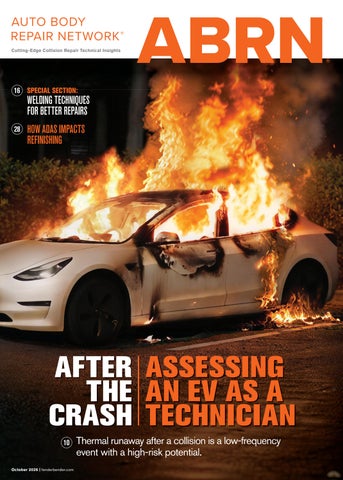
AFTER ASSESSING THE AN EV AS A CRASH TECHNICIAN 10
Thermal runaway after a collision is a low-frequency event with a high-risk potential.
October 2026 | fenderbender.com
2610ABRN_01_Cover.indd 1
9/16/26 1:29 PM
New cred. New customers. When you join the Ford Certified Collision Network (FCCN), you’ll be recognized by Ford, customers, and insurance companies as someone who offers the highest standards in Ford and Lincoln repairs. That puts you into a referral stream for new customers from our digital properties and call center. It also gets you access to not only the right parts but exclusive Ford procedures, training, and support. What’s more, you’ll be included in the Ford Pro™ Fleet and Commercial certified shop list. Take word-of-mouth referrals to the next level by joining the FCCN today.
Learn more about FCCN.
Message and data rates may apply.
2610ABRN_02_05_TOC.indd 2 2607FB_Ford.indd 1
9/16/26 1:29 PM 6/8/26 9:00 AM
OCTOBER 2026
Talk Shop Anytime
VOL. 65, NO. 3 // FENDERBENDER.COM
CUTTING-EDGE COLLISION REPAIR TECHNICAL INSIGHTS
10
TECHNICAL
10 AFTER THE CRASH: ASSESSING AN EV AS A TECHNICIAN
Thermal runaway after a collision is a low-frequency event with a high-risk potential. A technician’s safety comes down to a disciplined process for isolating and handling the vehicle. BY PAUL BOSTEL
16 IMPROVING WELD QUALITY:
KEY ADJUSTMENTS IN TECHNIQUE FOR BETTER REPAIRS Critical corrections help improve weld quality and repair safety.
16
BY RYAN MARRINAN
20 THE ABCS OF WELDING
Learn about MIG/MAG welding fundamentals, material considerations, and safety protocols to ensure strong, reliable repairs in the collision industry, with insights into OEM standards and equipment setup. BY TOBY CHESS
28 ADAS AND THE IMPACT ON REFINISHING Following proper refinishing procedures is imperative to retain ADAS functionality.
28
BY TROY KNOPIK
Cover photo by Adam Avant / Shutterstock; modified by Jennifer Dakas / Shutterstock AI F E N D E R B E N D E R .C O M
9:00 AM
2610ABRN_02_05_TOC.indd 3
O C TO B E R 2 0 26 3
9/16/26 1:31 PM
IN EVERY ISSUE FENDERBENDER . COM Endeavor Business Media, LLC 30 Burton Hills Blvd, Ste. 185, Nashville, TN 37215 Phone: 800-547-7377
06 06 INDUSTRY NEWS
ESTIMATING TIP – CCCONE WEB – WELDED SEAMS & WELD ZONE REPAIR AND REFINISH PPG INTRODUCES QUICKLINE WATERBORNE REFINISHING SYSTEM IN NORTH AMERICA I-CAR TO RAISE PRICE FOR SELECT TRAINING PRODUCTS BY 5% STARTING JANUARY 2027 COMPLETE SURVEY AND GET A FREE ASE CONNECTS MEMBERSHIP
EDITORIAL STAFF CHRIS JONES GROUP EDITORIAL DIRECTOR christopherj@endeavorb2b.com
SALES STAFF ANDREW JOHNSON PUBLISHER ajohnson@endeavorb2b.com
JAY SICHT EDITOR-IN-CHIEF jsicht@endeavorb2b.com
MATTIE GORMAN-GREUEL SALES DIRECTOR mgorman@endeavorb2b.com
PETER SPOTTS ASSOCIATE EDITOR pspotts@endeavorb2b.com
CORTNI JONES DIRECTOR OF BUSINESS DEVELOPMENT cjones@endeavorb2b.com
JENNIFER DAKAS ART DIRECTOR
Account Executives:
CONTRIBUTORS PAUL BOSTEL, TOBY CHESS, TROY KNOPIK, RYAN MARRINAN ENDEAVOR BUSINESS MEDIA CEO — CHRIS FERRELL COO — PATRICK RAINS
31 COLLISION PRODUCT GUIDE
CDO — JACQUIE NIEMIEC
34 AD INDEX
CMO — AMANDA LANDSAW
CALO — TRACY KANE EVP TRANSPORTATION GROUP — CHRIS MESSER VP OF CONTENT STRATEGY, TRANSPORTATION GROUP — JOSH FISHER
WEB EXCLUSIVES
BUSINESS STAFF MICHAEL WILLINS BUSINESS DEVELOPMENT DIRECTOR, MOTOR AGE TRAINING SHEILA WARD PRODUCTION MANAGER JENNIFER GEORGE AD SERVICES MANAGER TRACY SKALLMAN AUDIENCE DEVELOPMENT MANAGER
MARIANNE DYAL mdyal@endeavorb2b.com CHAD HJELLMING chjellming@endeavorb2b.com DIANE JOHNSTON djohnston@endeavorb2b.com LISA MEND lmend@endeavorb2b.com
N P B
Bu dec fas cen tha
KYLE SHAW kshaw@endeavorb2b.com SEAN THORNTON sthornton@endeavorb2b.com
su
JAMES HWANG
Inside Sales & Brand Manager, ASE Study Guides
jhwang@endeavorb2b.com REPRINT SERVICES reprints@endeavorb2b.com. CUSTOMER SERVICE Subscription Customer Service 877-498-4668 customerservice@ABRN.com PO Box 3257 Northbrook IL 60065-3257
JILLENE WILLIAMS SALES COORDINATOR
ADDRESSING THE TECHNICIAN PIPELINE
In this panel from the recent ASE Instructor Training Conference, four industry leaders dig into real-world strategies for recruiting, training, and retaining the next generation of techs. Moderated by Chris Messer, executive VP of Transportation at EndeavorB2B, the discussion’s panelists include Jaime Angell, senior director of Apprenticeships and Transitional Programs at Caliber Collision; Brian LaCroix, Automotive Technology instructor at Capital Region BOCES Career & Technical School; Jake Sorenson, shop manager of McNeil’s Auto Care; and Larry Tuttle, service director of Don McGill Toyota. HTTPS://BIT.LY/4RIN7CE?R=QR
ABRN is published 4 times yearly (March, June, October, December) by Endeavor Business Media, LLC. 30 Burton Hills Blvd, Ste. 185, Nashville, TN 37215. Customer service can be reached toll-free at 877-498-4668 or at customerservice@ABRN.com for magazine subscription assistance or questions. Printed in the USA. Copyright 2026 Endeavor Business Media, LLC. All rights reserved. No part of this publication may be reproduced or transmitted in any form or by any means, electronic or mechanical, including photocopies, recordings, or any information storage or retrieval system without permission from the publisher. Endeavor Business Media, LLC does not assume and hereby disclaims any liability to any person or company for any loss or damage caused by errors or omissions in the material herein, regardless of whether such errors result from negligence, accident, or any other cause whatsoever. The views and opinions in the articles herein are not to be taken as official expressions of the publishers, unless so stated. The publishers do not warrant either expressly or by implication, the factual accuracy of the articles herein, nor do they so warrant any views or opinions by the authors of said articles. Endeavor Business Media provides certain customer contact data (such as customers’ names, addresses, phone numbers, and e-mail addresses) to third parties who wish to promote relevant products, services, and other opportunities that may be of interest to you. If you do not want Endeavor Business Media to make your contact information available to third parties for marketing purposes, simply call toll-free 877-498-4668 or email customerservice@ABRN.com and a customer service representative will assist you in removing your name from Endeavor Business Media’s lists. ABRN does not verify any claims or other information appearing in any of the advertisements contained in the publication, and cannot take responsibility for any losses or other damages incurred by readers in reliance of such content. ABRN welcomes unsolicited articles manuscripts, photographs, illustrations and other materials but cannot be held responsible for their safekeeping or return.
Lea 4 OCTOBER 2026
2610ABRN_02_05_TOC.indd 4
9/16/26 1:31 PM
2610AB
New finish. Proven expertise. Bolder ambition. Built on the heritage of BASF Coatings, Surventis brings decades of expertise together with the freedom to move faster and think bigger. Science-driven, passion-led, and centered on your challenges, we deliver surface solutions that perform, inspire, and create lasting value.
surventiscoatings.com
Learn more
2610ABRN_02_05_TOC.indd 5 2610ABRN_BASF.indd 1
9/16/26 1:32 PM 8/25/26 11:25 AM
INDUSTRY NEWS REPAIR PLANNING/ESTIMATING
ESTIMATING TIP – CCCONE WEB – WELDED SEAMS & WELD ZONE REPAIR AND REFINISH Society of Collision Repair Specialists shares The Database Enhancement Gateway Inquiry 41711, which elaborates on replacement quarter panel welded seams and adjacent panel weld zone repair & refinish. “After review, the published Quarter Panel replacement and sectioning estimated work times include grinding, filling, and smoothing the welded seams of the replacement panel up to a 150-grit finish as outlined in the Guide to Estimating. However, they do not include repair or refinishing of adjacent panel weld zones resulting from normal cut-
ting, welding, or grinding procedures. Any repair or refinish operations required to restore adjacent attaching panels affected by the replacement process should be determined through an on-the-spot evaluation, as the extent of the weld zone and resulting damage can vary based on the vehicle configuration and repair technique used.” The estimating databases are intended for use as a guide only. The auto body professional performing the repair is in a position to thoroughly inspect, diagnose, and identify the methodology and cost of the vehicle damage repair.
SOCIETY OF COLLISION REPAIR SPECIALISTS
The DEG is created and funded by the Alliance of Automotive Service Providers and Society of Collision Repair Specialists, whose primary goal is to improve the quality, accuracy, and standardization of collision repair estimates. View this tip and others on the DEG website at degweb.org/estimating-tips.
REFINISHING
PPG INTRODUCES QUICKLINE WATERBORNE REFINISHING SYSTEM IN NORTH AMERICA PPG has launched the PPG Quickline waterborne refinish system. According to a news release, the new portfolio of basecoats, undercoats, clearcoats, toners and ancillary products are designed to help collision repair shops consistently achieve high-quality finishes across a wide range of application conditions. The PPG Quickline refinish system offers a complete line of toners, undercoats, and clearcoats designed to meet the needs of today’s body shops. “Not all body shops operate under ideal conditions, but they all need to deliver quality repairs consistently,” said Brian Osterried, PPG collision operational product manager, Automotive Refinish. “The PPG Quickline system is designed to help shops achieve reliable results in a variety of environments while balancing performance, productivity and affordability. It gives them a
PPG
practical, high-value solution backed by PPG’s industry-leading support and color technology.” Key benefits of the system include: • Color Capability: Quality colormatching, supported by a comprehensive toner portfolio and PPG digital color tools, helps technicians achieve accurate OEM color matches while improving efficiency. • Productivity: Fast flash times, efficient blending characteristics, good metallic control, and quick clearcoat curing help reduce repair cycle times and increase throughput.
Anti-settle technology minimizes pigment separation and promotes consistent color accuracy. • Easy Application: Designed for smooth sprayability, good atomization, and uniform metallic orientation, the system enables painters of all experience levels to achieve consistent results. • Value: Providing the right balance of quality and affordability, the system delivers dependable durability, consistent results, and long-term value. • Sustainability: Waterborne basecoat technology offers reduced VOC emissions while maintaining excellent coverage and finish quality. The PPG Quickline waterborne refinish system is backed by PPG’s technical training, color support resources, business development programs, and distributor network in the U.S. and Canada.
6 OCTOBER 2026
2610ABRN_06_09_News.indd 6
9/16/26 1:33 PM
2610AB
2610ABRN_06_09_News.indd 7 2610ABRN_Autel.indd 1
9/16/26 1:33 PM 9/1/26 11:38 AM
INDUSTRY NEWS
TRAINING
I-CAR TO RAISE PRICE FOR SELECT TRAINING PRODUCTS BY 5% STARTING JANUARY 2027 I-CAR will implement a 5% price increase for select training products and services starting in January 2027, according to I-CAR. Current pricing will remain in effect through Dec. 31, providing time to prepare and budget for the change. Access to previously purchased training courses will remain available for completion as long as the course remains active in the I-CAR catalog. I-CAR said it has worked to maintain stable pricing while vehicle technology advanced rapidly, and expanded offerings and invested in training, technology, curriculum enhancements, and
new programming. During this same period, marked by significant inflation, materials, labor, and delivery costs have increased significantly. I-CAR said the pricing adjustment will ensure that it can continue to deliver high-quality training, technical resources and expertise, industry programming, and workforce development initiatives that help the industry keep pace with rapidly evolving vehicle technology. The 5% price adjustment will affect the following training products and services: • Professional Development Program (ProLevel) online curriculum
I-CAR
• Vehicle and Technology Specific Training courses
• Welding Training and Certification and Recertification
• Hands-On Skills Development courses
• In-Shop Knowledge Assessment • Get to Gold Class package • Collision Repair Subscription (upon renewal) If an organization anticipates handson training, welding certification, rolebased training, or other learning needs, I-CAR recommends scheduling and purchasing training before the updated pricing takes effect.
TECHNICIAN SUPPORT
COMPLETE SURVEY AND GET A FREE ASE CONNECTS MEMBERSHIP ASE Connects (formerly WrenchWay) is offering free ASE Connects memberships through the end of the year to any shop or dealership that completes the required sections of its Industry Data Exchange, covering technician pay, benefits and company policies, according to a news release. To qualify, shops and dealerships sign up for ASE Connects at no cost and no credit card required, then complete the anonymous technician pay, benefits, and policy survey that feeds into the Industry Data Exchange. The survey takes about 10-15 minutes to complete, and all submitted information is aggregated and kept strictly anonymous before it becomes part of the dataset.
ASE CONNECTS
Shops that complete the survey receive full access to ASE Connects through the end of 2026 which includes: • Industry Data Exchange • School Assist • Members-only content • Student profiles (launching this fall) “Every shop that contributes data makes the entire exchange more accurate for everyone in it,” said Dave Johnson, president and CEO of ASE.
M
E
“This is the kind of industry-wide effort that only works if enough shops participate, and giving shops free access removes the biggest reason they might sit on the sidelines.” ASE Connects has positioned the Industry Data Exchange as the first tool of its kind built specifically for the automotive, diesel and collision industries by combining self-reported data with comparisons by location, shop type and industry that update as more shops join. Shops interested in the free membership offer can sign up at wrenchway. com/solutions/shops/free-trial/ and complete the required Industry Data Exchange sections to activate full access by Dec. 31.
8 OCTOBER 2026
2610ABRN_06_09_News.indd 8
9/16/26 1:33 PM
2506AB
A X A LTA C O AT I N G S Y S T E M S
Cromax EZ ®
WATERBORNE
MADE
EASY With a waterborne basecoat that’s easy to mix, match and apply and that uses the same coat flash application you’ve already perfected, Cromax® EZ makes an exceptional finish feel effortless. Discover how easy an outstanding finish can be. axalta.us/ez
Copyright © 2025 Axalta Coating Systems, LLC and all affiliates. All rights reserved.
2610ABRN_06_09_News.indd 9 2506ABRN_Axalta.indd 1
9/16/26 1:33 PM 4/16/25 10:22 AM
AFTER THE CRASH: THERMAL RUNAWAY AFTER A COLLISION IS A LOW-FREQUENCY EVENT WITH A HIGH-RISK POTENTIAL. A TECHNICIAN’S SAFETY COMES DOWN TO A DISCIPLINED PROCESS FOR ISOLATING AND HANDLING THE VEHICLE. ARTICLE AND PHOTOGRAPHY BY PAUL BOSTEL
ASSESSING AN EV AS A TECHNICIAN
I
n May of 2011, the National Highway Traffic Safety Administration (NHTSA) ran a side-pole crash test on a Chevy Volt at a test facility located in Wisconsin. After the test, it was moved to a back lot and left there. About three weeks later, it caught fire and took several nearby vehicles with it. The impact had ruptured a coolant line, and coolant had gotten into the pack. That coolant is conductive at the voltages a charged pack carries, and GM and its contractor pointed to the potential for dendritic growth, conductive filaments building inside the cells and shorting them over time. The coolant intrusion was itself a possible cause of thermal runaway, but it wasn’t identified at the time of the test,
10 OCTOBER 2026
2610ABRN_10_15_After_the_Crash_v2.indd 10
9/16/26 1:34 PM
TECHNICAL
THIS IS A 4-GAS MONITOR typically used in the fire service for atmosphere monitoring. This monitors for the lower explosive limit (LEL) of natural gas, carbon monoxide (CO), oxygen (O2), and hydrogen sulfide (H2S), commonly referred to as sewer gas. THIS MUSTANG MACH-E had sustained some abrasion damage to the battery pack; the vehicle was initially quarantined, and battery data was trended over several days. Ultimately, the damage was determined to be cosmetic based on Ford’s High Voltage Battery Minor Damage Inspection guide.
so the vehicle sat for weeks with a charged, compromised pack and the problem built until the pack went into runaway. That tells you most of what you’re dealing with when an EV comes in from a serious collision; the hazard doesn’t always make itself obvious. Thermal runaway after a collision is a low-frequency event, and you can work on a lot of these vehicles and never see one, but when it happens, the consequence is a technician getting hurt or killed if proper precautions and checks aren’t performed. That is why the safe approach is to treat each of these vehicles the same careful way from the moment it arrives, because a consistent process is what keeps a tech safe and protects life and property. A tech should be trained to work on EVs before handling one of these at all; nothing here substitutes for that, and the high-voltage and chemical hazards aren’t something an untrained tech can always recognize. A vehicle earns this handling in two cases: a collision severe enough to worry about the pack’s stability — even with no visible damage, since the battery is part of the structure that took the hit — or direct damage to the pack, which should have you on alert right away. Your safety doesn’t come from stopping a runaway, because once a pack is headed that way, there is usually no stopping it. It comes from how you handle the vehicle: isolating it, keeping your distance, watching it, and taking the stored energy down where you safely can to lower the risk.
The detection advice that gets passed around doesn’t fit a shop There’s information circulating about catching a runaway event early, some of it from fire-service training, and it doesn’t hold up in a shop setting. The one I hear often is monitoring for carbon monoxide (CO), based on the idea that a pack heading into trouble gives off CO, and watching for it buys early warning. The problem is that a collision shop already has CO coming from several places: running internal combustion engines or a furnace or shop heater that has fallen out of repair. A CO detector is often too blunt of an instrument to identify the source. It tells you CO is present and roughly how much, but the reading can’t separate a battery from the exhaust or the heater. On top of that, the detector most shops have isn’t sensitive or fast enough to give the early warning the advice promises, the way a multi-gas air monitor in trained hands might. Reading an air monitor correctly and acting on its information is a skill of its own, one that a tech generally won’t have experience with. CO monitoring fits the fire service, where responders are right at the vehicle with the right gear and the training to use it, none of which describes a tech in a body shop. The tool a shop is more likely to have is a thermal imager, and it may be able to identify a pack starting to heat up. But the caveats are heavy enough that you can’t lean on it. Depending on how the pack is built, heat in the cells may F E N D E R B E N D E R .C O M
2610ABRN_10_15_After_the_Crash_v2.indd 11
OCTOBER 2026 11
9/16/26 1:34 PM
TECHNICAL
SOME MANUFACTURERS make it easier than others to confirm the coolant level in the bottle, but always take the time to confirm the level during your assessment.
take a while to reach the surface where the camera reads it, so by the time it shows, you may be further along than the image suggests. Reading it correctly also takes training. In the fire service, firefighters have locked onto the center spot temperature and missed higher readings elsewhere in the frame, a discipline issue an untrained tech also faces. Getting a reading means being near the vehicle, the last place you want to be if it goes, with no gear protecting you there, nothing for thermal protection, nothing for your lungs if it vents. If you use a thermal imager, keep reads short, look at the whole frame, not just the spot temp, and listen. A pack in trouble will potentially make noise before anything shows on the camera. Hissing or popping doesn’t always mean the battery pack has vented, but it’s a clear warning that something is going wrong inside, and the move is to evacuate the area right away. On the camera itself, the most important thing is that a clean image doesn’t mean the vehicle is safe, because covers and pack construction can hide what’s happening inside. Every reading is a snapshot of something potentially still developing, and a measurement today can’t account for what the pack does next week.
THE TOP PHOTO is to help orient the images from the thermal imaging camera. You will notice that there is a lot of red, and this may appear to highlight areas of concern, but with this camera the spectrum of colors automatically adapts to the lowest and highest read temperatures. This doesn’t automatically mean that there are temperatures present that indicate excessive heat. Some cameras like this will have a spot temp in the center and then will indicate highest and lowest read temperatures. It is imperative as a tech to understand how the tool is used and what the tool is telling you.
What you can check Start with an exterior inspection before you power anything up. Check the front coolers for damage and look for fluid leaks that say the vehicle may not be able to regulate pack temperature. Don’t forget to check the coolant bottle. It’s easy to overlook, and it keys off the failure that burned the Volt. If the bottle is empty and you can’t find an external leak to account for where the coolant went, assume it went into the pack. Coolant inside the pack is a path to a short and a fire, so a dry bottle with
no external leak raises your concern rather than lowers it. Reading anything electronic, though, depends on the low-voltage (LV) system being alive, and after a crash that isn’t a given. If the airbags went off, the pyro-fuse likely fired with them and isolated the high-voltage (HV) system, which drops your shock risk but can take the 12-volt system down with it as it is no longer being supported. With the low side dead, nothing comes up; the cluster won’t light and a scan tool has nothing to talk
12 OCTOBER 2026
2610ABRN_10_15_After_the_Crash_v2.indd 12
9/16/26 1:34 PM
TECHNICAL
to. It is extremely important to follow OEM service procedures when supporting the LV. It is also worth mentioning that isolating the HV system doesn’t necessarily remove the potential of thermal runaway if a cell is damaged. With the LV side up, the cluster may be giving you thermal system or highvoltage warnings that point right at the pack. The next step is to hook up a scan tool and pull codes. Look for anything that flags the battery management system, a module or battery fault, or a thermal problem within the battery pack. From there, go to live data, and see if there are PIDs related to temperature and/or battery voltages. For temperature, a pack that’s warm but holding is different from one that’s climbing. A pack that is climbing in temperature is potentially an emergency. When it comes to module voltage, some imbalance is normal. What to watch for is a module that drops and won’t recover; an unrecoverable drop is the sign of a short, and a shorting module is a source of heat. The key to this data is to trend it over time and make sure the information is documented so that you can clearly see changes that may be occurring. The emergency response guide (ERG) for that vehicle is worth having in hand. It’s written mostly for first
responders, so not all of it is aimed at you, but it can have guidance on when to disconnect the HV battery based on the damage, isolation distance, and hold time. It’s not the only source; it is also important to refer to the OEM service information, too, both for han-
dling a collision-damaged vehicle and for the info related to any codes you pulled. When you’re past what is covered by those sources of information or past your training, contact the manufacturer or a dealer service center for additional guidance.
WHILE THE DAMAGE may not look too significant at first glance, it did involve the coolers on this R1T. Initial checks revealed that the cooling system was drained F E N D E R B E N D E R .C O M 2610ABRN_HunterEngineering.indd 1 2610ABRN_10_15_After_the_Crash_v2.indd 13
OCTOBER 2026 13 9/1/26 9:53 AM 9/16/26 1:34 PM
TECHNICAL
The quarantine is the part that keeps you safe
SOME SHOPS may have a Class D fire extinguisher, and it should be noted as a reminder that these are only for fires involving metals. It is easy to associate lithiumion with lithium as a metal. A Class D fire extinguisher will not be effective in extinguishment; it is always best to evacuate the area.
All that feeds how you isolate and hold the vehicle, and that works regardless of what the tools showed. Distance comes first. NHTSA’s guidance is not to store a severely damaged lithium-ion vehicle inside a structure or within 50 feet of any structure, vehicle, or combustibles. Most shops don’t have 50 feet of open space, which is the real-world problem with the recommended distance. If you use a structure for isolation, it must be non-combustible and ventilated. A venting pack puts out flammable gas, and in a sealed or poorly vented space, that gas builds until something ignites it. Then you have a deflagration. Then you hold the vehicle. Twenty-four hours is often cited, but it’s a floor, not a finish line. What ends the quarantine, for me, is the evidence. If I haven’t found damage compromising the pack and everything I’ve logged and trended shows no sign of instability, I’m comfortable calling it good. Where it can be done safely, take energy out of the pack. The air transport regulations cap lithium-ion at around 30 percent state of charge to ship, specifically because lowering the charge reduces thermal runaway potential. As of 2026, that limit reaches battery-powered vehicles shipped by air, where it used to apply only to loose batteries. The same logic applies to a vehicle in quarantine: bring the HV pack down toward 30 percent if you safely can, and you’ve taken energy out of the hazard. The caveat is “safely.” Actively discharging a pack, which you think may be damaged, isn’t always wise or possible, and it puts you back at the vehicle. It’s a call you make case by case.
One more thing, and it runs against instinct. If you see the signs of a pack going into runaway, or hear that venting sound, the reaction might be to grab a fire extinguisher. With a battery pack involved, that’s wrong, and it can get you hurt. A dry chemical extinguisher might knock down the fire for a second, but a pack in runaway is generating its own heat as cells fail one after another inside the enclosure. And burning lithium-ion cells create their own oxygen, so smothering it does nothing and the fire will come right back. A fire blanket has the same problem and a worse one. It’s meant to contain the spread, not stop the pack, and to place it you’d walk up to a venting, off-gassing battery with no thermal or respiratory protection. Even the fire department mostly cools and contains these rather than extinguishes. If the people who do this for a living are managing it rather than beating it, a tech has no business engaging it. If the vehicle catches fire and that involves the battery pack, don’t attempt to push it out of the building. Get yourself and everyone else out, and stay upwind of the smoke, because the smoke is a hazard on its own. Lithium-ion combustion puts out a lot of toxic materials, including hydrogen fluoride, and hydrogen fluoride that’s inhaled turns into hydrofluoric acid in the moisture in your lungs, a serious medi-
THIS IS AN EXAMPLE OF SOME OF THE WARNINGS that may appear on the dash. While this warning doesn’t necessarily mean there’s an immediate danger, it should direct the tech to dig deeper and gather more data before deciding to proceed forward with repairs versus quarantining the vehicle.
A WAY TO BRING THE STATE OF CHARGE (SOC) down without special equipment is by setting the HVAC in opposing directions. Depending on the SOC, this can take some time. Reminder: Only go through the process of discharging the battery if it is safe to do so.
If there is a runaway event, do not try to fight it
14 OCTOBER 2026
2610ABRN_10_15_After_the_Crash_v2.indd 14
9/16/26 1:34 PM
2610AB
TECHNICAL
cal problem that goes well beyond ordinary smoke irritation. That’s why staying out of the plume matters as much as staying away from the flame. Then call the fire department, because they’re the only ones with what it takes to deal with it.
Train for what you’re using, and know your limits Underneath all of this is training. A tech should be trained in EVs before taking this on, and it goes for the tools, too. Whether it’s the thermal imager, the scan tool, or a gas monitor someone hands you, it’s only an asset if you’re trained on it. The other piece is knowing your limits, so that when a vehicle is past what you can safely handle, you stop and bring in the manufacturer or the fire department. None of this stands still, either. Chemistry and pack design keep changing, and what’s a concern now may not be later. Manufacturers continue to improve monitoring strategies, and through data collection advances in prognostics, early detection of runaway potential could allow for intervention before it happens. Which brings it back to that Volt: it came through the crash
2610ABRN_10_15_After_the_Crash_v2.indd 15 2610ABRN_Telwin.indd 1
SCAN THE QR CODE TO SHARE THIS ARTICLE AND READ RELATED ARTICLES ONLINE
test, sat charged with coolant in the pack, and failed three weeks after the test, burning next to several other vehicles. You’ll likely never see a battery pack go into runaway in your career. Still, technician safety begins with handling the vehicle safely, and that starts with identifying the damage that’s a concern, fluid leaks, dash alerts and warnings, the DTCs behind them, and finally the vehicle’s live data. PAUL BOSTEL is a seasoned leader with a rare blend of expertise in both advanced automotive technology and fire service operations. With over 20 years in the automotive industry, he is recognized as one of fewer than 2,300 ASE World Class-certified technicians. Paul is director of Advanced Vehicle Technology for Quality Collision Group, where he applies his analytical precision and strategic mindset to elevate operational performance and repair standards.
9/16/26 9/14/26 1:34 9:50PM AM
TECHNICAL
IMPROVING WELD QUALITY:
KEY ADJUSTMENTS IN TECHNIQUE FOR BETTER REPAIRS
CRITICAL CORRECTIONS HELP IMPROVE WELD QUALITY AND REPAIR SAFETY. BY RYAN MARRINAN
W
elding has been around for generations, and throughout my career I have seen its methods, equipment, processes, and techniques continue to evolve. Advances in technology have played a major role. But so have changes in structural design and the alloys we join. Together, these developments have led to important improvements in the field. One area that is still often overlooked, however, is technique. Technique has a major impact on both the welder and the quality of the weld itself. As an administrator of the I-CAR Steel MAG Welding Certification test at the 3M Skills Development Center, I regularly see common mistakes that lead to poor weld quality and failed tests. What surprises me most is how often, after I coach someone on a correction, I hear the same response: “No one has ever shown me that.” When I break welding down to its fundamentals, a good weld requires two things: penetration and fusion. A weld does not need to look like a perfect stack of dimes to be sound. While appearance may be visually pleasing, some of the bestlooking welds fail because they lack penetration into the lower panel, resulting in a cold break or a weld that peels off during
destructive testing. Another common failure comes from a lack of fusion on the top plate, which in some cases is also described as a penetration issue, depending on the weld type. One of my biggest frustrations is seeing technicians put marks or arrows on their welding machine because “that’s where it welds best.” To me, that is a clear sign that many of the vehicles they weld may not be repaired correctly. Many replacement panels require welds that also demand machine adjustments to control heat, avoid damaging the substrate, and still achieve proper penetration. A single machine setting for every weld, marked on the machine as the “best” setting, is usually too hot for most repairs and can damage the panels being repaired or replaced. As OEMs publish more detailed repair procedures, they include recommended equipment, settings, specifications, and parameters for the welds on their vehicles. Those settings matter, but they are not the only variables that need to be adjusted. In my experience, there are three major corrections that can dramatically improve weld quality without changing the machine itself. Instead, they require adjusting the welder: standoff distance, travel direction, and torch
16 OCTOBER 2026
2610ABRN_16_19_ImprovingWeld.indd 16
9/16/26 1:35 PM
3M AUTOMOTIVE AFTERMARKET DIVISION
angle. These are the most commonly overlooked factors, and they are also the corrections I provide most often in training. Standoff distance, or the distance between the contact tip and the work surface, has several effects on the weld. The farther away I hold the torch, the less penetration I get and the taller the weld becomes. If someone says, “I get plenty of penetration and I don’t get that close,” my first thought is that the machine is probably set too high. A typical recommendation is to stay about 10 mm to 15 mm from the surface while welding and, just as importantly, to follow the shape or curve of the panel so that the distance stays consistent throughout the weld. Any change in that distance affects penetration, height, and width in real time. This is also one of the easiest ways for a technician to improve weld quality without touching the machine. It becomes even more important when transitioning from horizontal to vertical or overhead welds. The distance may need to change slightly to accommodate wire-speed variation caused by liner friction and gravity. In overhead welding, technicians often struggle to see the weld and instinctively move the torch farther away for visibility. Unfortunately, that
THERE ARE THREE MAJOR CORRECTIONS THAT CAN DRAMATICALLY IMPROVE WELD QUALITY WITHOUT CHANGING THE MACHINE ITSELF. INSTEAD, THEY REQUIRE ADJUSTING THE WELDER: STANDOFF DISTANCE, TRAVEL DIRECTION, AND TORCH ANGLE. reduces penetration, increases weld height, and decreases weld width. This is the most common failure I see during welding certification testing. The correction I give most often is simple: move closer without changing the machine settings. Time after time, that one adjustment turns failed welds into passing welds because it increases the penetration and reduces the weld height. Standoff distance also affects shielding gas performance. It influences the gas’ ability to protect the weld zone, keep contaminants out, and help cool the weld to reduce the risk of cracking in and around the weld after completion. If I see a technician using a very high gas flow rate, it is often a sign F E N D E R B E N D E R .C O M
2610ABRN_16_19_ImprovingWeld.indd 17
OCTOBER 2026 17
9/16/26 1:35 PM
TECHNICAL
3M AUTOMOTIVE AFTERMARKET DIVISION
that the standoff distance is too great. On the other hand, if the torch is too close and the gas flow is still too high, it can negatively affect the weld puddle. I have seen excessive gas flow disturb the puddle and even create porosity because of turbulence at the weld surface. The third correction I focus on – torch angle – is closely tied to the second correction, travel direction. Torch angle is simply the direction in which I hold the torch while welding. The key principle is this: wherever the wire is pointing, that is where most of the heat is going. If the wire points to the left because that makes it easier to see the weld, then the left side of the root gap or plug weld will receive more heat and more penetration than the right side, and vice versa. That imbalance becomes a major factor in weld consistency and quality. Travel direction is still widely debated, and it always makes for an interesting class discussion. The three methods people usually mention are push, pull, and perpendicular. Like many others, I was originally taught to pull when making a stitch weld or continuous weld. On steel, there is still debate about which method is best in every situation. On aluminum, however, pushing is the correct method for a proper weld. When I push the weld forward, I move the heat ahead of the weld puddle. That allows me to use a lower, cooler machine setting without sacrificing penetration. On aluminum, this helps preheat the material, which is essential because aluminum dissipates heat very quickly. Pushing also keeps the shielding gas moving forward to protect the weld and helps remove very fine contaminants that may remain even after proper cleaning. With today’s mixed alloys and the forming processes used to create high-strength steel structures, push welding can also help control heat and reduce the risk of substrate damage during the repair. That said, many technicians still use the pull method successfully. Pulling can produce quality welds, but it is important to understand that the heat is then concentrated behind the arc, heating the area that has already been welded. Changing from push to pull often requires additional adjustments, including machine settings, to avoid excessive penetration, excess heat, or warping. Both push and pull are common for open butt welds or butt welds with backing. However, when it comes to plug welds, in my professional opinion, there is only one acceptable method: perpendicular. I use a perpendicular approach for much of my welding, but it is especially important for plug welds because I need the heat directed straight into the bottom panel to achieve fast, proper penetration. If the torch is angled and the wire points toward the top plate, I may see weld failure on one side during destructive testing. Keeping the torch at 90 degrees during plug welding also
A SINGLE SETTING for every weld, marked on the machine as the “best” setting, is usually too hot for most repairs and can damage the panels being repaired or replaced.
helps control the puddle, maintain a cleaner weld zone, and allow post-flow shielding gas to cool the weld properly before moving to the next one. Welding is one of the most critical parts of the repair process, and it has a direct effect on how a vehicle will perform in a future collision. Most vehicles today require recalibration after repairs are completed, and I ask every class the same question: “During recalibration, where is the oops button?” When recalibration is performed, the vehicle’s systems are being reset to say everything is properly repaired and ready for the next collision event. But there is no place to enter, “I overheated the panels during welding, so adjust the airbag timing,” or “My welder was not set correctly for that steel, so penetration may be too high or too low.” There is no oops button. That is why welding technique matters so much. The machine matters. The OEM procedure matters. But the technician’s control of distance, direction, and angle often makes the difference between a weld that only looks acceptable and one that is structurally sound. In my experience, improving those fundamentals is where real welding quality begins. SCAN THE QR CODE TO SHARE THIS ARTICLE AND READ RELATED ARTICLES ONLINE
RYAN MARRINAN is a senior application engineer, training and education, for 3M’s Automotive Aftermarket Division, supporting global fillers, adhesives, coatings, and sealers. Prior to moving into a full-time role with 3M, Ryan served as a collision repair technician for 20 years and during that time, as an independent consultant for 3M’s Automotive Aftermarket Division for 15 years. During his time as a technician, Ryan specialized in heavy collision and structural repairs, as well as glue pulling and paintless dent repair. Ryan is an I-CAR-certified technician with vast experience and understanding of OEM repair requirements and procedures.
18 OCTOBER 2026
2610ABRN_16_19_ImprovingWeld.indd 18
9/16/26 1:35 PM
2610AB
2610ABRN_16_19_ImprovingWeld.indd 19 2610ABRN_SnapOnEquipment_CarOLiner.indd 1
9/16/26 1:35 PM 9/8/26 9:21 AM
TECHNICAL
THE
ABC
S OF
WELDING LEARN ABOUT MIG/MAG WELDING FUNDAMENTALS, MATERIAL CONSIDERATIONS, AND SAFETY PROTOCOLS TO ENSURE STRONG, RELIABLE REPAIRS IN THE COLLISION INDUSTRY, WITH INSIGHTS INTO OEM STANDARDS AND EQUIPMENT SETUP. BY TOBY CHESS
T
his past January at the Collision Industry Conference in Palm Springs, California, the Repair Process and Procedures Committee presentation dealt with the state of welding in the collision industry. They looked at the OEM certification programs, I-CAR’s welding qualification tests and equipment. Due to time constraints, they could not get into the real nitty gritty of welding. This article will give you and your techs a better insight into the welding process. Before I start the discussion, please take this test. The picture depicts a “B” pillar on a 2021 Honda Accord that needs to be repaired or replaced. Pick the best option. (1) Honda’s Body Repair News September 2025 version 7’s manual welding and sectioning guidelines advises the following:
A. Use of heat during body straightening and repair When you are doing body straightening and repair procedures, follow these guidelines: Never use open flame to heat body panels. However, the use of induction heaters, copper stamp or heat guns is acceptable up to 1100 F (600°C). 1
A: 2" above the "D" ring B: 3" below the "D" ring C: Section at the narrowest section of the part
D: Monitor heat and pull to original shape
TOBY CHESS
20 OCTOBER 2026
2610ABRN_20_27_ABCs_Welding.indd 20
9/16/26 1:38 PM
TECHNICAL
B. Approved welding methods
floor and roof reinforcements, and door instruction beams. Let’s see what happens when the Honda rocker MAG butt welding is an approved repair method for steel reinforcement is MIG-welded. parts up to and including 780 MPa. I took a sample from a Honda rocker To minimize the heat-affected zone, reinforcement (1500 MPa) to test how butt welds on 780 MPa steel must be welding would affect the strength. Honda done as quickly as possible while mainstates that there is no MIG/MAG welding taining adequate penetration. MAG plug on 1500 MPa parts except where a MIG welding is allowed on 1,500 MPa (hot plug weld is required. stamp) steel parts in select locations only 2 I got a reading of 45 HRC scale, which as specified in the model specific body reis 1480 MPa. I cut a slit in the reinforcepair manual. Welding instructions must ment and removed a sample to test its be followed exactly as specified to ensure strength before it was welded. (2) adequate weld strength. The correct repair option for this test is I welded the slit using stitch welds, 3 to replace the entire “B” pillar with a new not a continuous weld that would proOEM part as per repair procedures from duce more heat than stitch welding Honda. Next, I want to explain the reason (temperature at the weld site is approxiWHY. mately 2000 degrees F). (3) There are three major categories of The HRC reading was 20, but the test steel utilized on today’s vehicles, which chart for the anvil and diamond indenter are mild steels, high strength steels (energy starts at 24. (4) To get a correct reading, I absorbing), and ultra-high strength steels would have needed a different anvil and (energy transfer). Steel’s tensile strength is indenter, which I do not have. The read4 measured in MPa or megapascals, which ing of 24 translates into an MPa reading TOBY CHESS indicates how much force it can withstand of 515 MPa. High strength steel starts at before failing. 1 MPa equals 145 psi (pounds per square about 300 MPa. The MPa reading on a welded part was inch). Mild steels go up to about 270 MPa, high strength probably around the 300 MPa range. Being around the steels up to 700 MP,a and ultra-high strength steels mild steel range at the welded area, another impact at that (UHSS) start around 900 MPa. UHSS parts are found in location would most likely cause the part to fail that could “A” and “B” pillar reinforcements, rocker reinforcements, result in serious injury or even death.
5
MIG Welding
Machine-fed wire rod
Inert gas supply Contact tube Gas nozzle Molten weld pool Base Metal
Arc Shielding gas Weld Metal Ground Cable
Power source
F E N D E R B E N D E R .C O M
2610ABRN_20_27_ABCs_Welding.indd 21
PHOTO COURTESY OF FRACTORY.COM
You will see the terms MIG and MAG welding. MIG welding stands for metal inert gas, and MAG stands for metal active gas. In the collision repair industry, a MIG welder is utilized using either argon/carbon dioxide (steel) or 100% argon (sluminum and MIG brazing). Let’s see how a MIG welder works. (5) Take a look at a battery. If you take the two battery jumper cables, attach them to the battery and touch them together, you will get sparks. If you hold the cables together, they will fuse. A MIG weld works on the same principle. The electrode wire is positive and the ground clamp is negative. And when the wire comes in contact with the base metal (now negative), an arc will form and the heats up the metal to around 2000 degrees F in the case of steel (known as a short arc transfer). The filler wire
Electrode Cable
C. MIG welder basics
OCTOBER 2026 21
9/16/26 1:38 PM
TECHNICAL
9
8
15-25 CFH or cubic feet per hour
POWERWELD
HARRIS WELDING SUPPLIES
I have always upgraded my welders to a flow meter, which is easier to read and adjust. In the 20 years I have been doing the I-CAR welding tests, only two have lost the pressure cover. When welding aluminum, you want 25 to 40 CFH, which is needed for proper arc cleaning action. (8)
The welding wire widely used is ER70S6 for steel. (9) Aluminum wire should be 4043, 4145, 5554, or 5356. MIG brazing calls for CuSi.3 and CuSi.A wire. Always consult the OEM repair information to determine the wire it calls for. For example, Honda states that ER70S-6 wire has a minimum tensile strength of 70 psi (483 MPa). This wire can be used when welding up to 440 MPa steel parts. When welding parts with high-strength steel of 590 MPa and higher, a high-strength welding wire must be used (see the web site for recommended wire).
FORNEY INDUSTRIES
liquefies and mixes with the liquefied base metal, and both flow together (this is known as a fusion weld). Once it cools down, there will be a solid weld. Before moving into the theory, I want to go over the parts of the welder, starting with the welding torch. The nozzle directs Nozzle the shielding gas into the Tip Holder weld puddle and helps 6 protect it from contamiSwan nation (water, oxygen, and nitrogen). The conConnector tact tip transfers electricity from swan to filler wire. (6) The diffuser disTOBY CHESS tributes the shielding gas to the weld site. Note: Always check that the contact tip is tight and the holes in the diffuser are open. Also make sure that the wire and contact tip are the same diameter (aluminum is the exception). The shielding gas for steel 7 is a mixture of 75% argon and 25% CO2 (carbon dioxide). (7) Honda states the following in their repair manual: “The preferred shielding TOBY CHESS gas is C20. A mixture of 80% argon (Ar) and 20% carbon dioxide (CO2), C20 produces a more stable arc, less weld spatter, and better weld quality/ appearance. C25 shielding gas, a mixture of 75% argon (Ar) and 25% carbon dioxide (CO2), is also acceptable. These are considered active gases because CO2 undergoes a limited reaction with the molten weld pool.”
10
MILLER ELECTRIC
TOBY CHESS
Do you know what a synergic welder is? A synergic welding machines has the ability to automatically set welding parameters based on factors such as wire type, diameter, and shielding gas. (10) This is achieved by using a single knob to select the desired current intensity, wire feed speed, or plate thickness. In other words, you set the type of welding desired, the gas, and wire type. You then set the machine to the thickness of the metal, and the computer will set the amperage and wire speed for those parameters. For the welders that are not synergic, there is usually a chart on the inside access panel that will give the technician a starting point. Let’s see how this works. The Millermatic 211 works on 120 or 220 volts. I will use 220 volts for this example. The wire for steel is ER70S6, wire diameter is .030 (.8MM), and the gas is argon and CO2. You find the line of steel diameter wire and move to the column that reads 18 gauge (1.2MM). The reading 4/50. 4 is the voltage and 50 is the wire speed. Set your welder, make a test weld, 11 and adjust accordingly. Before welding, you need to check your extension cord. A broken or missing ground on an extension cord is an OSHA violation and could cost you $1,500.00. (11) IRON FORGE TOOLS
22 OCTOBER 2026
2610ABRN_20_27_ABCs_Welding.indd 22
9/16/26 1:38 PM
2610AB
NOVEMBER 3–6
LAS VEGAS, NV
REAL INNOVATION
WHERE THE FUTURE OF AUTOMOTIVE IS DISCOVERED.
REGISTER NOW!
HAPPENING #IRL 2026 S E M A S H O W. C O M
2610ABRN_20_27_ABCs_Welding.indd 23 2610ABRN_SEMA.indd 1
9/16/26 1:38 PM 8/18/26 1:17 PM
TECHNICAL
12 Cord Length
25FT
50FT
100FT
Light Duty – 16 Gauge
13 AMPS
13 AMPS
10 AMPS
Medium Duty – 14 Gauge
15 AMPS
15 AMPS
13 AMPS
Heavy Duty – 12 Gauge
15 AMPS
15 AMPS
15 AMPS
Extra Heavy – 10 Gauge
20AMPS
20 AMPS
20 AMPS
Most welders using 120 volts will max out at about 20 amps. The best choice for an extension cord is 10-gauge and no longer than 50 feet. 12-gauge works most of the time, but keep the length to a max of 50 feet. 14-gauge ex-
D. Let’s talk science
TOBY CHESS
Water boils at 212 degrees F, and the temperature at the weld site is approximately 2000 degrees. Oxygen and nitrogen, along with water hitting 2000 degrees, will “explode” out of the weld site. Knowing these facts, let’s discuss gun travel angle. A shielding gas is used to keep the molten weld pool from being exposed to the oxygen, hydrogen, and nitrogen in the air around 16 the weld. Problems will occur from the reaction of these elements in the weld pool, including excessive spatter, and holes in the weld 90 degrees horizontal bead, known as porosity, that results in weaker welds. The correct travel angle is 10 to 15 degrees from vertical or horizontal. (16) Any angle larger will allow oxygen, water, and nitrogen to enter 45 degrees from horizontal the weld site and produce a poor weld. A quick discussion is also necessary. You cannot see electricity, so we will use water instead. Both operate using the same principles. 10-15 degrees from horizontal
tension cord will restrict the necessary amperage to produce a good weld. (12) Here are some products that will improve the welding process: • MIG pliers (13) • Welding screens and blankets (14) • Extra consumables (15) 13
14
LINCOLN ELECTRIC
15
ULINE
VANES ELECTRIC
Electricity employs amps and volts, and water uses volume and pressure. Water volume equates to amps with electricity, and water pressure equals volts with electricity. (17) If you hook up a TOBY CHESS 10-foot hose to a hose bib and turn it on, you will have goodwater pressure and volume. Hook up a 100-foot hose, and the volume and pressure will drop. The same holds true with electricity; the longer the run from the electrical source, the more will be the voltage and amps drops, and that affects the welding process. Remember that the contact tip in the torch is where the 18 wire “picks up” the electricity. The disNozzle tance from the end of the nozzle to the Contact metal surface is tip known as “stickStick-out out.” 17
Stick-out Electrode stick-out is the length of wire HOBART BROTHERS coming out of the contact tip of the welding gun. (18) It affects the amount of amperage at the weld site. It is easier to use the tip of the nozzle for reference. Steel stick-out is 6-7mm, aluminum 10-12mm and MIG braze 15-17mm. When welding steel, too long of a stick-out produces a cold weld and too short, a very hot weld. We have looked at two welding
24 OCTOBER 2026
2610ABRN_20_27_ABCs_Welding.indd 24
9/16/26 1:38 PM
2512AB 2512AB
BE THE FIRST TO KNOW Get the latest collision repair news straight to your inbox!
SCAN THE QR CODE TO SUBSCRIBE
fenderbender.com 2610ABRN_20_27_ABCs_Welding.indd 25 2512ABRN_House_Subscribe.indd 1 1 2512ABRN_House_Subscribe.indd
9/16/26 1:38 PM 10/28/25 9:35 AM
TECHNICAL
parameters — gun angle and stick-out — with work angle the being the last I want to discuss. Work angle is where you point the gun. It can range from 45 degrees to 90 degrees, depending on what is being welded. The root of the 19 weld is where you want the fusion to take place. (19) Lap joint When welding HOBART BROTHERS an overlap joint on today’s vehicles, a work angle of 60 to 70 degrees is used. On truck frames, 45 degrees is probably the most utilized. (20) Now, let’s have one last discussion on the difference between pushing the puddle and dragging the puddle. 20 Too much angle
Not enough angle
45 degrees
TOBY CHESS
The welding puddle is pushed ahead of the torch when pushing, and pulled behind it when dragging. (21) The difference in direction can impact penetration depth and width. Pushing is better for thinner materials and dragging for thicker materials. Pushing the puddle will produce a weld with deeper penetration and dragging will result in better side penetration. It should be noted that when welding aluminum and MIG braze, we only push. Let’s look at a couple of welds that are performed at an I-CAR steel welding test. 21
Push technique
Pull technique
10°
22
TOBY CHESS
The plug weld This plug weld passed all the visual parameters and destructive tests. (22) When pulled apart, 23 the plug weld left a hole in the top coupon, which indicates there was no weld penetration to the top coupon (the diameter did not meet the 8 mm minimum). (23) To pass the destructive test, the plug weld needs to remove metal from the bottom piece of sheet metal TOBY CHESS (the minimum tearout is a 5 mm hole). This weld failed the de24 structive test because there was also no penetration to the bottom coupon even though the weld passed the visual inspection for size (the weld did fill the 8 TOBY CHESS mm hole completely). (24) Butt weld
25 Root gap
10°
TOBY CHESS
The open butt joint Travel direction
Side view
Travel direction
Side view
Flat, even weld profile, light penetration
Narrower and higher weld profile, more penetration UNIMIG
This weld is performed with a work angle of 90 degrees, (25) and the weld should look the same on front and backside of the panel. (26)
26 Front
Back TOBY CHESS
26 OCTOBER 2026
2610ABRN_20_27_ABCs_Welding.indd 26
9/16/26 1:38 PM
TECHNICAL
27
TOBY CHESS
I want to repeat myself about checking the welder before you start welding. • Check the plug on the machine and extension cord • Check the welding gauge • Check the nozzle, diffuser, and contact tip • Check the settings on the welder • Check OEM welding procedures for the vehicle that is being welded • Make a practice weld and conduct a destructive test. (27)
E. Personal protective equipment for welding The most important part of the welding 28 process is the safety of your technicians. OSHA PPE required welding regs: 1910.134(a)(2) A respirator shall be provided to each employee when such equipment is necessary to protect the health of such employee. The employer shall provide the respirators which are applicable and suitable for the purpose intended. The employer shall be MILLER ELECTRIC responsible for the establishment and maintenance of a respiratory protection program, which shall include the requirements outlined in paragraph (c) of this section. The program shall cover each employee required by this section to use a respirator. 1910.252(b)(2)(i)(C) All operators and attendants of resistance welding or resistance brazing equipment shall use transparent face shields or goggles, depending on the particular job, to protect their faces or eyes, as required 29 1910.252(b)(3) Protective clothing - General requirements. Employees exposed to the hazards created by welding, cutting, or brazing operations shall be protected by personal protective equipment in accordance with the requirements of § 1910.132 of this part. Appropriate proBLACK STALLION tective clothing required for any welding
SCAN THE QR CODE TO SHARE THIS ARTICLE AND READ RELATED ARTICLES ONLINE
operation will vary with the size, nature and location of the work to be performed. 30 1910.134(e)(1) General. The employer shall provide a medical evaluation to determine the employee’s ability to use a respirator, before the employee is fit tested or required to use the respirator in the workplace. The 3M employer may discontinue an employee’s medical evaluations when the employee is no longer required to use a respirator. OSHA 1910.134(f )(2) explicitly states fit testing must be conducted “at least annually 31 thereafter.” Wear a good auto darkening with a welding helmet with a sensitivity setting. (28) (Set for shade 10). It should have an attachment method for a magnifier lens. Wear gloves designed for MIG welding. (29) Wear a particulate respirator. (30) Wear a quality welding jacket (31), safety glasses, hearing protecMILLER ELECTRIC tion, and sturdy shoes and pants.
A Hall of Eagles recipient, TOBY CHESS is known throughout the collision repair industry for his training for I-CAR and SCRS, and technical presentations at CIC meetings. He estimates he’s taught more than 7,000 hands-on I-CAR welding classes, plus 15,000 other live classes in multiple states. An advocate for body shops and their consumers, Toby has been awarded the SCRS Lifetime Achievement and Industry Achievement Awards, Collision Industry Individual Service Award, Humanitarian Award, and the ABRN Leadership award. F E N D E R B E N D E R .C O M
2610ABRN_20_27_ABCs_Welding.indd 27
OCTOBER 2026 27
9/16/26 1:39 PM
TECHNICAL
ADAS AND THE IMPACT ON
REFINISHING
FOLLOWING PROPER REFINISHING PROCEDURES IS IMPERATIVE TO RETAIN ADAS FUNCTIONALITY. BY TROY KNOPIK
A
dvanced driver assistance systems are now integrated into most modern vehicles, with complexity varying by make and model. Early versions of these technologies began with systems such as anti-lock braking systems and traction control, both of which were designed to improve vehicle stability, braking performance and driver safety.
Today’s vehicles use a combination of radar, cameras, sensors, and drivermonitoring technologies to support safe vehicle operation and help prevent collisions, and following proper refinishing procedures is imperative to retain this functionality. The function of ADAS is straightforward. These systems are designed to protect the driver and others on the
Absorption (as low as possible)
Radar Sensor
Transmission (as high as possible) Reflection (as low as possible)
SURVENTIS
Plastic Substrate Paint Layers BESIDES METALLIC PIGMENTS, other factors which can influence radar waves are the type of bumper material, thickness of bumper substrate,the bumper’s geometry and angle positioning of the sensor, and film thickness of the coatings.
road by reducing the likelihood of accidents. What started with basic collision avoidance has grown into systems that assist with adaptive cruise control, lane departure warnings, parking assistance and in some cases even driverless parking features. Some of the most advanced systems monitor not only the road day or night, but also the driver inside the vehicle. Driver monitoring is becoming increasingly important, especially as distractions continue to grow. These systems can detect an inattentive or drowsy driver and alert them to refocus on the road. ADAS will likely continue to evolve to support a safer and more reliable driving experience. Collision repair centers have a responsibility to return vehicles to customers not only in pre accident appearance but also in pre-accident functionality and safety. That includes the proper operation of ADAS features. Today, drivers rely on these systems and trust the information they provide. This is why they must be always restored back to OEM specifications. The driver getting the vehicle back assumes it will perform to the same level of safety and functionality it had before the accident. How is this accomplished with the highest level of confidence? The repair process should begin with pre-repair
28 OCTOBER 2026
2610ABRN_28_30_ADAS_refinishing.indd 28
9/16/26 1:41 PM
Long-Range Radar
• Adaptive Cruise Control
LIDAR
Short/Medium-Range Radar • Cross Traffic Alert • Rear Collision Warning
Ultrasound
• Emergency Braking • Pedestrian Detection • Collision Avoidance
Park Assist/ Surround View
• Park Assist
Cameras
Surround View
• Traffic Sign Recognition • Lane Departure Warning • Park Assist • Surround View
Park Assist Rear Collision Warning
Traffic Sign Recognition Lane Departure Warning Park Assist Cross Traffic Alert
Surround View Park Assist
Adaptive Cruise Control SAFELITE
Emergency Braking Pedestrian Detection Collision Avoidance
THIS GRAPHIC shows the variety of ADAS sensors installed on today’s vehicles.
Scenario A
Scenario B
Detection distance
Detection distance
Stopping distance
Stopping distance
dB] radar transmission through 100% [0 correctly refinished bumper cover
dB] radar transmission through 80% [-1 incorrectly refinished bumper cover
THE CORRECTLY REFINISHED bumper in scenario A allows enough signal to be transmitted to allow for the pedestrian to be detected in time for the driver to brake. In scenario B, an incorrect repair results in a signal loss and a potential collision.
concealed components. This is where the OEM repair procedure becomes critical on whether the bumper can be repaired or replaced. This document should be very clear in what will need to be done to bring it back in line with OEM specifications. The sensors front or rear in many cases cannot simply be repainted without consideration. These sensors emit a signal to detect objects and alert the driver. The repair procedure will clarify what is allowed during the
paint process. In some cases, a special paint formulation must be used along with a specific number of coats to avoid interfering with the radar signal passing through the sensor area. Paint companies may have special formulas designed for this purpose, often using a reduced amount of aluminum flake. In some cases, you need to replace the cover completely with no repair allowed. The repair of a bumper cover is a common area requiring careful conF E N D E R B E N D E R .C O M
2610ABRN_28_30_ADAS_refinishing.indd 29
AXALTA
and post-repair scan to identify any ADAS-related faults and confirm that systems are functioning properly once repairs are complete. The shop should download the OEM repair procedure for the damaged area of the vehicle every time, making sure they have the correct model, make and year. A 2016 Honda Civic may look the same as a 2017 Honda Civic, for example, but that doesn’t mean the repair procedure is the same. So, never assume. These repair procedures should be included in the file of the repair documents. The responsibility and liability for the work performed remains with the repair facility after the repair is complete. Documentation is the key to ensuring the shop is protected in the event of another collision. One area that requires close attention is bumper repairs. Most vehicles today have sensors in the front and rear bumpers. Higher end vehicles use sensors hidden behind the bumper or a combination of visible and
OCTOBER 2026 2 9
9/16/26 1:41 PM
TECHNICAL
sideration toward ADAS. The bumper cover either has surface-mounted sensors or ones behind the cover that are not visible. The OEM repair procedure will inform you what repair is acceptable. A good example of this is BMW. They have bumper covers that do not allow any repair at all due to the sensors being located behind the cover. In addition, Ford has a published statement allowing limited repair of their covers depending on the number of mils (thickness of the paint in thousandths of an inch) in an area that may prevent the sensor from reading the environment properly. These covers cannot be repaired if they exceed the maximum millage allowance and therefore, they must be replaced. To ensure a proper and safe repair, always ensure you check the OEM repair procedures. Calibration of the ADAS system is the final check to confirm the vehicle
SCAN THE QR CODE TO SHARE THIS ARTICLE AND READ RELATED ARTICLES ONLINE
has been returned to its pre-accident condition and is safe to drive. The calibration process has two methods or a combination of both. A static calibration is performed while the vehicle is stationary. This can be completed by a mobile operation with the calibration done at the repair facility or offsite. This will include special tools and equipment and software specific to that individual vehicle. When performed correctly, it helps return the system to OEM specifications.
WHEN SEARCHING for a color using PPG’s PaintManager XI software, if a radarcapable match is available, it will be displayed on the results screen.
Select Variant
Back
Related Colors
Chip Decks List
Change Quality
Formula Header Quality: CROMAX PRO WBC Color: WHITE
Manufacturer: TOYOTA Manufacturer Code: 007
Year(s): 71-76
Variants
AXALTA
Image
Formula / Variant
PCP
Radar Cost Code / RX Date
34849 / A
1 / 2012
Standard #
Additional information
874925
WHEN RADAR APPROVED PAINT is chosen in Axalta’s ColorNet, it will also display a pop-up message that will read: “This formula was created to facilitate radar transmission.”
This is followed by a 20 – 30-minute road test under a variety of driving conditions. A dynamic calibration requires the vehicle to be driven for as much time as required to reset the system. There is a specific procedure for this that clearly documents what is required. This calibration also addresses software to the specific vehicle. Many of these dynamic calibrations are necessary due to the use of cameras all around the car. Cameras are located throughout the vehicle, including the windshield, mirrors and body panels. These components work together and need to be in sync for the vehicle to operate safely and as intended. Calibration is likely one of the most important parts of the repair process. OEMs do a great job of outlining the requirements to calibrate the vehicle correctly. This is not a gray area in the repair process. Collision repair centers must always obtain the proper OEM repair procedures and follow them completely. The safety of the driver, the public and the integrity of the repair all rely on the shop completing this process correctly. The calibration step can seem complex at first, but taking the guesswork out of it starts with downloading the proper repair procedure. Today’s drivers trust and rely on these ADAS systems, so by following OEM calibration procedures completely, collision repair centers help ensure the vehicle is returned to the customer safely, correctly repaired, and with the ADAS systems functioning as intended. TROY KNOPIK is a lead refinish trainer at 3M Collision’s Skills Development Center. Troy has been in the collision industry for over 35 years. He spent 25 years as a production painter before becoming a paint manufacturer representative for BASF. He trains painters across the country on all aspects of the collision repair process.
30 OCTOBER 2026
2610ABRN_28_30_ADAS_refinishing.indd 30
9/16/26 1:41 PM
COLLISION PRODUCT GUIDE ALL-IN-ONE SOLUTION FOR COSMETIC DENT REPAIR The Car-O-Liner Cosmetic Dent Repair Workstation, No. CDR1, is designed as an all-in-one solution for light cosmetic dent repair. The CDR1 is a versatile, value-packed repair cart that enables technicians to efficiently perform professional repairs on small to medium autobody damage. www.fenderbender.com/55398237
EIGHT CRITICAL MAINTENANCE FUNCTIONS The Matco Tools Heavy Duty Diagnostic Tool, No. MDMAXCRHD, is an Android-based diagnostic solution built for autmotive technicians and the commercial vehicle DIY market. Designed to help technicians handle demanding heavy duty service work, deliver comprehensive full-system diagnostics with the ability to read and clear codes and access live data streams across all major systems. With coverage for more than 50 commercial vehicle models, the MDMAXCRHD gives technicians the broad vehicle support they need in one platform. It also includes eight critical maintenance functions such as DPF, Urea, Oil Reset, and more. www.fenderbender.com/55398925
POWERED BY 0.5 HP MOTOR Built on a 90+ year U.S. legacy, the Forney X-Series delivers proven performance with modern simplicity. Featuring TruSet MIG and flux-cored capabilities, adjustable Arc Force for stick, and clear LED displays, these machines are designed for ease and reliability. The lineup spans versatile welders and plasma cutting solutions, offering dealers a complete, easy-tosupport category. Backed by a three-year warranty, this family of welders and plasma cutters drives dependable results and strong sales across multiple markets.
The Carlyle Tools 8-pc Paint Removal Air Tool Kit, No. CPTPRMBK, is powered by a rugged 0.5 HP motor with double planetary gears, this tool provides increased torque for tough jobs. The rear exhaust keeps airflow away from the user’s work area for a cleaner workspace. Designed with a comfort cushion grip to reduce vibration and user fatigue.
www.fenderbender.com/55398268
www.fenderbender.com/55397973
DESIGNED FOR EASE AND RELIABILITY
FEATURES UNDER-WHEEL LIGHT The Maverick Pro from Hunter Engineering features an ergonomic pick-and-place wheel lift capable of lifting and tilting heavy assemblies and 19.5s up to 175 lbs in one smooth motion. The lift holds position while elevated and lowers automatically. The Pro’s underwheel light illuminates the lower roller and bottom bead during mount/demount. The light activates during lower roller operation and includes a customizable time for automatic shut-off. Hydraulic controls combine low-speed functionality with on-demand acceleration, allowing technicians to control the tire-changing process. Additional features include a leverless head, automatic tools-clear functionality, and an InflationStation that fills tires to the desired pressure automatically. www.fenderbender.com/55398930
F E N D E R B E N D E R .C O M
2610ABRN_31_36_Products.indd 31
O C TO B E R 2 0 26 31
9/16/26 1:41 PM
COLLISION PRODUCT GUIDE ADJUSTABLE BEAM WIDTH UP TO 12” The Killer Tools 1500W Industrial Laser Cleaner, No. ART4100C, delivers non-abrasive removal of rust, paint, and oils. Its adjustable beam width of up to 12” allows for rapid large-area coverage or precision detail work without damaging underlying surfaces. Engineered for efficiency, this 220V unit features multiple beam settings for optimal performance on steel and composites. The non-contact process eliminates consumables and minimizes cleanup time. Complete with safety glasses and four lenses. www.fenderbender.com/55398256
FEATURE SPRING-ACTUATED DELIVERY MECHANISM
DELIVERS TARGETED INVISIBLE HEAT The Inductor LIL-AL Attachment, No. U-611, from Induction Innovations is an accessory for use with the Inductor Pro-Max and Inductor Max. It delivers precise, targeted Invisible Heat for aluminum repairs. Designed to support pre-annealing and aluminum PDR, it also makes removing vinyl graphics, body trim, and spray-on bed liners fast and clean.
The Dent Fix Equipment Speed Key Loader for MAXI, No. DF‑503WKSL, features a spring-actuated delivery mechanism, enabling quick and consistent welding of repair keys. Designed for seamless integration with all MAXI Steel Dent Repair Station configurations, it enhances workflow efficiency in professional body shop environments. Built for durability and consistent performance, the DF-503WKSL integrates into any high volume body shop workflow. www.fenderbender.com/55389288
www.fenderbender.com/55398227
ERGONOMIC GRIP AND 11-SPEED CONTROL DIAL The FLEX Power Tools 120V Brushless Random Orbital Polisher, No. FC3321-Z, removes material with constant speed technology for additional power that can maintain high RPMs under pressure, delivering up to 4,350 RPM and 8,700 OPM. Its optimized gear head reduces high-frequency noise and vibration control reduces fatigue. The polisher features a lightweight body with an ergonomic grip plus an 11-speed control dial with a variable speed trigger for ultimate control. The package includes the FLEX polisher along with a 5” backing plate and 6” backing plate. It’s protected by a oneyear limited warranty.
DESIGNED TO BE COMBINED WITH SERVICE PIT
www.fenderbender.com/55398244
www.fenderbender.com/55398257
The JOSAM Frame Press is designed to make heavy duty frame straightening easier and more efficient. Featuring a wide range of durable equipment and accessories, the Frame Press is founded on the principle of I-beams cast in the shop floor. Combined with the optional JOSAM service pit.
32 OCTOBER 2026
2610ABRN_31_36_Products.indd 32
9/16/26 1:41 PM
COLLISION PRODUCT GUIDE
2-IN-1 RANDOM ORBITAL SANDER The Mirka DEROS II 5650X is a 2-in-1 random orbital sander that allows users to work with both 5” and 6” abrasives using a single tool. Designed to deliver greater flexibility without compromising performance, the DEROS II 5650X comes equipped with both a standard 6” 130g backing pad and a 5” weighted 130g backing pad, enabling users to quickly adapt the tool to different sanding applications. The weighted 5” pad maintains the sander’s balance and performance, ensuring smooth, consistent operation when switching between pad sizes. Features a lightweight, ergonomic design, low vibration, and a brushless motor. www.fenderbender.com/55397715
9,000-LB CAPACITY The Apex by BendPak Two-post Floorplate Car Lift, No. AL9LC, is engineered for shops and garages that need professional lifting capability in low-ceiling environments. Featuring dual symmetric and asymmetric arm configurations, long-reach telescoping arms, and a rugged chain-over lifting system, the AL9LC delivers stable performance for a wide range of vehicles. With a 9,000-lb lifting capacity, the lift is built to handle a variety of vehicles from low-slung sports cars to full-size pickups. Triple-telescoping front arms and dual-stage extended arms provide enhanced reach. Automatic arm restraints secure the lift arms in place when the vehicle is raised. www.fenderbender.com/55397718
FEATURES RETRACTABLE ALLOY STEEL BLADE
The SUNEX Tools 0.5HP Surface Blaster Kit, No. SX9203, features a Planetary Gear System that delivers increased torque and extends the tool’s life. This kit accepts 6” wheels with its protective guard. The 180-degree rotating handle allows for increased access and control in tight, awkward, or multi-angle configurations. The complete surface removal system effectively removes rust, paint, adhesives, pinstripes, and more. Includes five versatile wheels, an adjustable power regulator, a lightweight composite body at 2.7 lbs, an ergonomic overmold grip, and a safety lock-off trigger.
The Snap-on Retractable Clip Removal Tool, No. PBFT50R, keeps technicians moving through trim work by reducing interruptions, tool switching, and clip damage. Designed as an always-accessible, multipurpose solution, its dual-tip blade fits common plastic rivet and clip styles used across vehicle interiors and underbody panels, reducing the need for additional tools. The retractable alloy steel blade deploys with a slide lever and stores inside a durable anodized aluminum case when not in use. This design protects the blade and allows technicians to carry the tool comfortably in a pocket or on a belt for quick access.
www.fenderbender.com/55398229
www.fenderbender.com/55398222
180-DEGREE ROTATING HANDLE
F E N D E R B E N D E R .C O M
2610ABRN_31_36_Products.indd 33
O C TO B E R 2 0 26 3 3
9/16/26 1:41 PM
COLLISION PRODUCT GUIDE WIND RESISTANT TURBO TORCH FLAME The Big Buddy Turbo Flame Torch from Blazer Products delivers a 2,500 degree F butane blue wind resistant turbo torch flame. It features a lightweight design at just 7 oz and 7” tall, with an outer finish available in a wide range of colors. This tool is ideal for soldering, heat shrink tubing, activating caulking and adhesives, and more. www.fenderbender.com/55403178
FEATURES AUTO-DARKENING FILTER The ESAB Sentinel A70 PRO Helmet is a flip-automatic welding helmet and features advanced optics, integrated lighting, and Bluetooth connectivity. This advanced helmet offers superior protection, comfort, and productivity. Features a 4.65” by 3.58” flip-up auto-darkening filter (ADF) with EN ISO V1 (1/1/1/1) optical classification. Premium features include an integrated worklight, external controls for lens shade and Grind Mode, advanced internal digital controls, a rechargeable LiPo battery, and more. The headgear design distributes the weight for all-day comfort. www.fenderbender.com/55403184
AD INDEX
FULLY LINED TOP AND BOTTOM TRAYS
TELWIN .........................................................................................................................................................15
The K-Tool International 1-Drawer Service Tool Carts, Nos. KTI75105GB and KTI75105GY, feature 1-drawer, 2-shelf configurations. The carts are built with durable construction for rugged shop environments. The large, fully lined top and bottom storage trays provides space to organize tools, while the fully lined drawer with lock securely stores tools when not in use. Four casters allow for steady, quick movement, while two wheel locks keep the cart from rolling. Tool cart is rated to hold 285 lbs. Available in two colors: Gray (KTI75105GY) and Gray Blue (KTI75105GB).
TEXA USA .....................................................................................................................................................36
www.fenderbender.com/55403175
ADVERTISER
PAGE #
AUTEL US ....................................................................................................................................................... 7 AXALTA COATING SYSTEMS ......................................................................................................................... 9 BASF COATINGS ............................................................................................................................................ 5 MOTOR AGE TRAINING ...............................................................................................................................35 FORD MOTOR COMPANY .............................................................................................................................. 2 HUNTER ENGINEERING ..............................................................................................................................13 SEMA ............................................................................................................................................................23 SNAP-ON EQUIPMENT ................................................................................................................................19
34 OCTOBER 2026
2610ABRN_31_36_Products.indd 34
9/16/26 1:41 PM
2606AB
#1 TRUSTED SOURCE FOR ASE TEST PREP
YOU PASS OR YOU DON’T PAY! THANKS TO OUR TRAINING SUPPORTERS PLATINUM LEVEL
GOLD LEVEL
SILVER LEVEL
www.PassTheASE.com 2610ABRN_31_36_Products.indd 3 2606ABRN_House_MAT_REV.indd 1
9/16/26 1:43 PM 5/7/26 4:51 PM
2610ABRN_31_36_Products.indd 4 2610ABRN_Texa.indd 1
9/16/26 1:43 PM 9/9/26 11:57 AM