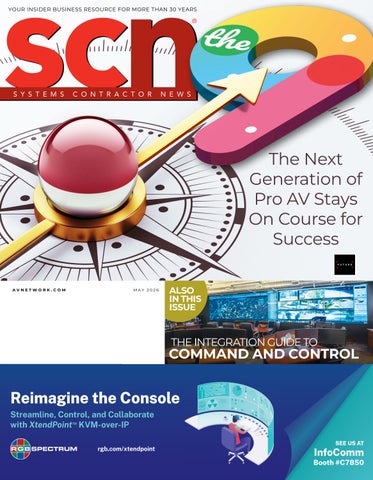
Learn what manufacturers, distributors, and integrators have been recognized for excellent service.
The Integration Guide to Command and Control
16 A Centralized Approach
Real-time crime centers streamline police surveillance—with an assist from Pro AV gear—for faster response times.
By Michael Grotticelli
Technology
30 Tech Perspectives
Collaboration hardware manufacturers have gone from rivals to roommates and back again.
By David J. Danto
SYSTEMS CHECK
J. PESCATORE
Can You Please Keep It Down?
When I started the fifth grade, my elementary school moved from its old facility (which has since been listed on the National Register of Historic Places) to a brand-new structure about two miles away. Apparently, the architects failed to put on their listening ears when designing this structure. It incorporated fancy new ideas at the time, including retractable accordion walls that could turn four regular-sized classrooms into one big classroom.
In theory, this meant classrooms could be combined for lessons and special presentations. In reality, it just meant that concrete walls were replaced by accordion walls with limited acoustic insulation. Not the prudent choice for children outgrowing their afternoon naps and hopped up on half-pints of chocolate milk.
The school library was located roughly in the center of the building between the two main hallways. Back then, libraries were all about embracing the quiet. So, the designers of my school decided to create a library with half walls open to the major traffic areas within the educational institution.
Yes, you read that correctly. If you wanted to lose yourself in the adventures of The Five Chinese Brothers or Tales of a Fourth Grade Nothing, your imagination would have to contend with various classes of students walking by for things like lunch or physical education.
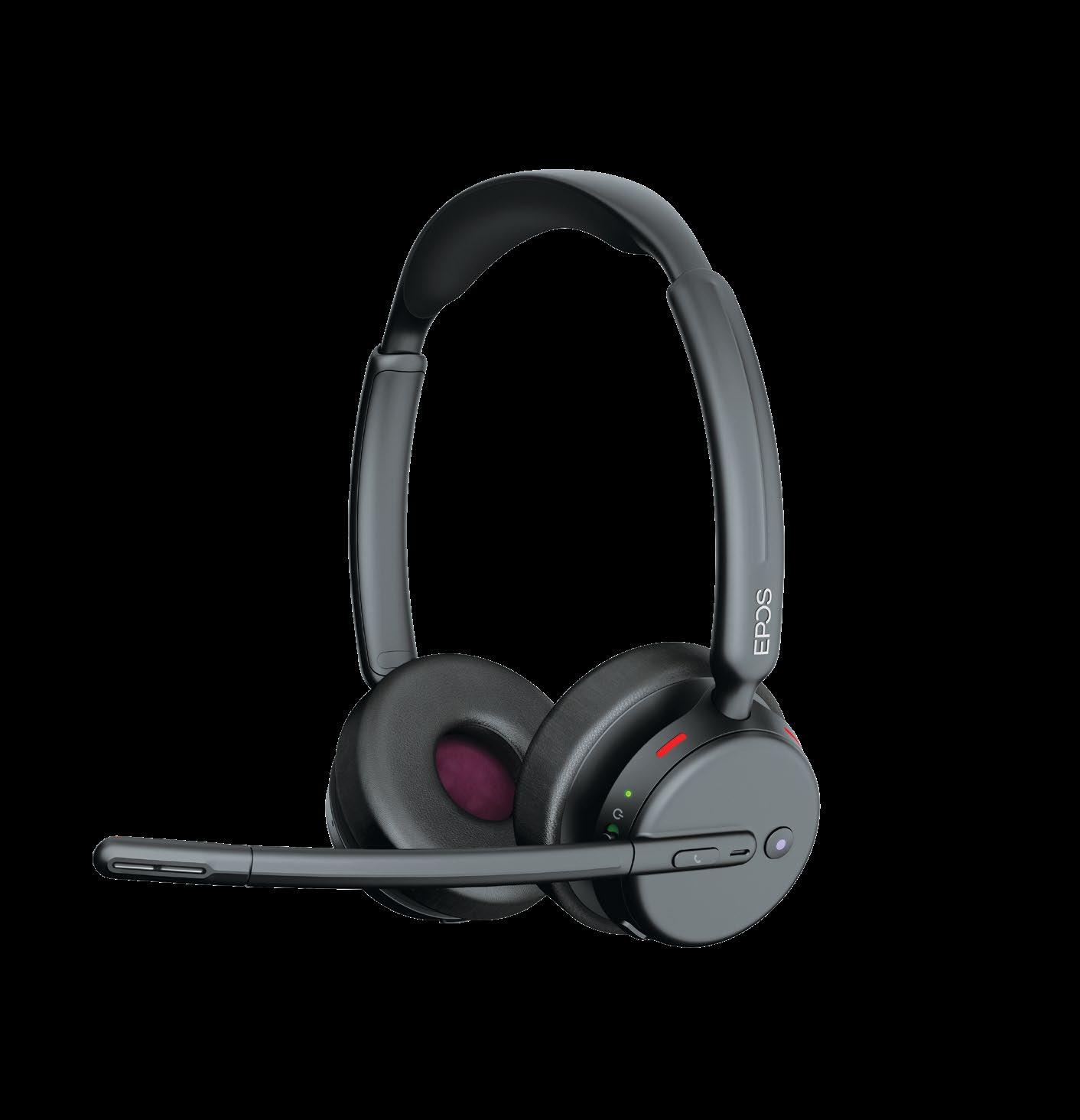
I literally read and write for a living, so I work better when it’s quiet. Fast forward to my early days in trade publishing, I worked in an office with an open floorplan and sat in a cubicle. Nothing wrong with that, unless you didn’t want to hear every conversation, keystroke, chair creak, paper shuffle, pen tap, drawer close, or water cooler gurgle. Recently, EPOS shared results from its exclusive online customer survey. It found that “noisy open plan office distractions” are the top concern for professionals, and minimizing those distractions is a top priority. Office distractions aren’t the only concern; EPOS also found respondents were concerned with microphone performance (31%), active noise cancellation (21%), and managing noise levels (14%). The research came on the heels of last fall’s introduction of its IMPACT 500 on-ear Bluetooth headset, which has features designed to improve focus and reduce listening fatigue.
Of course, it’s not just about investing in equipment—it’s about investing in the right equipment. For example, whether it’s for phone calls or listening to music while I cook dinner, I use a bone conduction headset. It’s lightweight and the open-ear design is ideal for my home use. That said, I would not be tempted to bring them to work in our company’s New York office, because they don’t isolate me from office noise.
Even though it’s not a work environment, we can look to my daughter’s dance competitions to illustrate the importance of ANC. For those of you who aren’t “dance dads” like me or fellow SCN staff member Wayne Cavadi, there are a few universal truths associated with these things. At the top of the list: No matter what organization produces the event or what facility hosts the event, the music is always way too loud.
It’s an unsuitable use case for bone conduction, but my earbuds with adaptive ANC shine. I can still hear the music and announcements (no ANC is that good), but I don’t come home with a splitting headache. Bonus: In a darkened high school auditorium or community arts center, they aren’t terribly conspicuous.
Whether you’re dealing with cubicles, accordion walls, or just an active office environment, leaping out of your seat to deliver the loudest “Shhhh!” on record won’t solve your noise problems at work. Thankfully, there’s plenty of technology out there to help stop the noise. Find what form factor fits you best and rediscover your concentration.
CONTENT
Content Director Mark J. Pescatore, Ph.D. mark.pescatore@futurenet.com
Senior Content Manager Wayne Cavadi
Contributors Erin Budnik, James Careless, Joseph Cornwall, David J. Danto, Michael Grotticelli, Jennifer Guhl, Carolyn Heinze Art Editors
Rob Crossland, Sam Richwood
Production Managers Nicole Schilling, Heather Tatrow
ADVERTISING SALES
Managing Vice President of Sales, B2B Tech
Adam Goldstein, adam.goldstein@futurenet.com, 212-378-0465
Sales John Casey, john.casey@futurenet.com, 845-678-3839
To subscribe, change your address, or check on your current account status, go to avnetwork.com and click on About Us, email futureplc@computerfulfillment. com, call 888-266-5828, or write P.O. Box 254, Lowell, MA 01853.
LICENSING/REPRINTS/PERMISSIONS
SCN is available for licensing. Contact the Licensing team to discuss partnership opportunities. Head of Print Licensing Rachel Shaw licensing@futurenet.com
MANAGEMENT
SVP, MD, B2B Amanda Dawrman-Allen VP, Market Lead Carmel King MD, Content, AV Anthony Savona Global Head of Sales, Future B2B Tom Sikes Managing VP of Sales, B2B Tech Adam Goldstein VP, Global Head of
FORTÉ Research Dives into AI, Collaboration Spaces
By Wayne Cavadi
Today’s collaboration spaces seem to be evolving at a lightning-quick pace—and it has not been an easy task to keep both remote and in-person employees happy. As Keith Yandell, EVP of innovation, FORTÉ, explained, there has been a consistent market disconnect, leading companies to struggle with delivering reliable and dependable meeting experiences.
That disconnect is what prompted FORTÉ to commission a proprietary digital survey last November to understand the current state and future direction of meeting room and collaboration space technology, with a heavy focus on AI solutions in the conference room. The State of Modern Collaboration Spaces report (available for download on FORTÉ’s website) compiled the insights of 512 U.S.-based C-level and AV/IT leaders who contribute to decisions about meeting room and collaboration space technology within their organizations.
AI-enabled collaboration is no longer a trend or differentiator; AI is becoming a collaboration standard, and it is doing so much sooner than later.
Yandell spoke to three of the six key findings that stood out in the report.
Reliability is the biggest barrier to productive meetings. “Nearly half of respondents cited technology not working properly as the top reason meetings fail,” Yandell said. “Fixing failure points delivers greater value than adding more tech features.”
AI investment is shifting toward operational intelligence. “IT leaders are reframing AI’s role, prioritizing AI capabilities that work in the background to prevent failures, monitor room health, and reduce manual IT intervention,” he noted. “AI is increasingly viewed as operational infrastructure.”
Apogee Insight Acquires PMA Research
In March, Apogee Insight announced its acquisition of PMA Research, an authority in professional video projector and display market intelligence. The existing PMA team will remain in place, including regional staff in Japan and Taiwan, ensuring uninterrupted service for clients.
What was discovered was that AI-enabled collaboration is very prevalent in modern meeting spaces; however, problems still arise. “While AI-enabled collaboration tools are widely deployed, meetings still fail too often due to reliability issues, join friction, and reactive support,” Yandell said. “This was a trend that FORTÉ saw repeatedly across customer engagements and support data. Organizations are investing more and upgrading more frequently yet are still struggling to deliver dependable meeting experiences.”
The report also revealed that, despite AI being arguably the biggest buzzword in Pro AV for years, there are still reservations in full AI adoption. However,
Meeting room failures are an IT efficiency problem. “Leaders estimate IT teams could reclaim an average of 52 hours per month if meeting room issues were eliminated,” Yandell explained. “Reactive troubleshooting is a recurring drain on IT resources. Proactive monitoring affords more time for higher-value initiatives.”
Yandell concluded that AI can do much for collaboration spaces of the future, but the foundation must come first. “Success will come from environments that detect issues before meetings start, reducing human and IT intervention,” he said. “Aside from management, collaboration itself is heading toward a reality where AI is an active participant. The key to success will rely on user adoption and meeting spaces that foster co-creation between human and machine.”
CTI Announces Two Acquisitions
CTI has acquired Streamline Solutions of Seattle and Nomad AV Systems of Eden Prairie, MN. Streamline Solutions brings a 17-year history of low-voltage AV design and integration to CTI’s Seattle office. Nomad strengthens CTI’s Justice Division with courtroom AV integration expertise that began with innovative mobile solutions
used daily in courts across the United States, and later expanded to include full AV design and integration services.
CTI serves customers across the United States and worldwide as a member of the PSNI Global Alliance. The company has been growing in recent years, with three acquisitions in 2024 and another three in 2025.
PMA Research traces its origins to Pacific Media Associates, founded by Dr. Bill Coggshall, whose pioneering work established tracking and analyzing the global projector market. The company was renamed PMA Research in 2013 when Nick Rogers assumed leadership following Dr. Coggshall’s retirement. With Rogers now retiring, Apogee Insight has acquired the organization, including its extensive historical datasets, experienced research team, and its portfolio of industry reports and services.
The acquisition will allow the organization to extend its coverage beyond displays and into adjacent and emerging categories. Apogee Insight founders Lee Dodson and Sean Wargo will direct the organization forward, expanding the research portfolio while investing in modern analytics technologies and additional proprietary data sources to support the evolving display market. Dodson will serve as COO and Wargo will serve as chief analytics officer of PMA Research.
“PMA Research has earned its reputation over decades as the definitive source of display market intelligence,” said Dodson. “Our priority is to preserve that legacy and build on it—expanding the scope of research, strengthening the data foundation, and giving our clients deeper insight into a display market that continues to evolve.”
Keith Yandell
Buffalo’s UB Stadium Gets Overdue AV Overhaul
By Wayne Cavadi
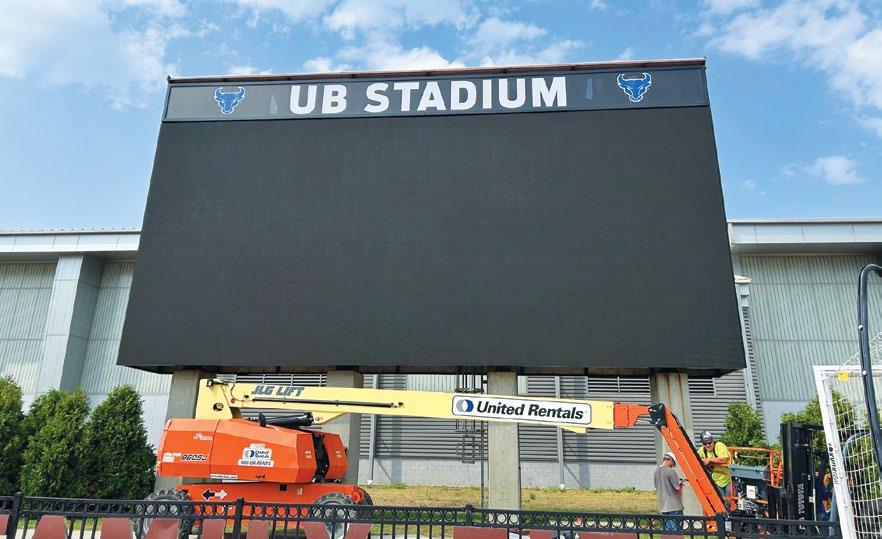
UB Stadium is home to the University of Buffalo Bulls football team, as well as the track and field and women’s soccer teams. Built in 1993, the stadium holds roughly 30,000 Bulls fans and spectators, and was used for the closing ceremonies for the 1993 World University Games as well as the 1998 men’s and women’s NCAA Division I outdoor track and field championships.
Being that the original scoreboard was installed for those championships, and upgraded to video for the 2006-07 season, it was time for a new look for the Bulls’ gameday experience. Though the old videoboard had what Matt Walfrand, associate athletic director broadcasting, called an “awesome run,” the Bulls gameday staff was still operating 4:3 SD content.
The new Daktronics scoreboard, installed by Daktronics itself, was completed in September 2025, but according to Walfrand, it was quite the grind to get to the finish line in time for college football season. The dismantling of the original board began on July 28, with a deadline of Sept. 6 for the Bulls football home opener against Saint Francis. “[Piros Signs and Daktronics] worked fast,” Walfrand said. “I’m not sure if I’ve seen something like this done in that time frame before.”
The new 14.4x14.4-foot videoboard, which features a 10.1mm pixel pitch, was installed in the north end zone next to the Murchie Family Fieldhouse. It can be used for any event that is held at the stadium; however, since its debut, it has only been used for sports.
The new videoboard was only half the battle, as it required a full control room rehab as well. Applied
Video Technologies was the integrator for the control room update.
“The equipment we were using for the old board was not going to cut it with the new one, so all that needed to be updated,” Walfrand explained. “We now have a combination of Ross production equipment in the control room with Daktronics Show Control.”
UB Stadium also enhanced the audio for the gameday experience with a new sound system featuring Fulcrum Acoustic equipment, which will also benefit concerts or other performances that may come through Buffalo. “We did something completely different with the install of our audio equipment as well,” Walfrand said. “We took the normal line array and pushed it across the top to maximize the video area. There was a lot of back and forth about what that was going to do with the audio quality, but it worked out and everything sounds great.
“Everyone was excited about the videoboard, but what I have received the most excitement about from the administration is the upgraded audio system. We only had one working horn by the end of 2024—the difference is immense and honestly just sounds amazing.”
It was a time crunch, but UB Stadium had a new Daktronics videoboard and much more ready for the 2025 college football season.
March: Healthy Demand Despite Increasing Costs
By Erin Budnik
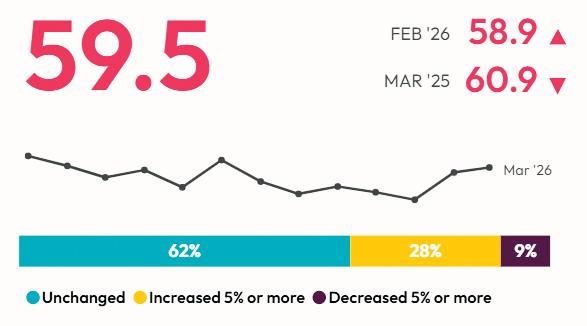
The AV Sales Index (AVI-S) for March increased slightly to 59.5, showing consistency with March 2025. This figure suggests that the underlying demand remains healthy despite the political situation and rising cost concerns.
The most common theme for March by far is increasing costs (21%), including higher prices for AV equipment, components, fuel, shipping, energy, and labor. Many survey respondents explicitly cite inflation, tariffs, and vendor price increases as directly squeezing margins, delaying purchases, or forcing project scaling and longer replacement cycles. Even organizations reporting stable demand note that profitability and budgeting are under pressure.
“Construction projects have dropped off significantly, which is greatly impacting potential projects. It has also resulted in a more competitive bidding space which is driving down potential project margins,” shared an AV integrator in North America.
“Economic conditions affecting our industry are experienced by all of us. Rising fuel costs impact
shipping, fleet operation, and personal expense budgets. Equipment and material costs affected by tariffs remain in flux, while our distributors and manufacturers do all that they can to support business opportunities,” shared an AV integrator in Asia-Pacific.
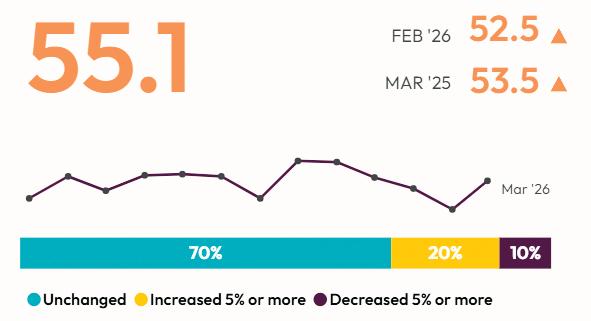
The March AV Employment Index (AVI-E) increased from 52.5 to 55.1 in March. The U.S. labor market rebounded in March 2026, adding jobs at a pace well above expectations after a weak February. However, underlying conditions remain subdued, with slow hiring, easing wage growth, and a shrinking labor force signaling a low hire, low fire environment rather than renewed expansion.
The Pro AV Business Index report is derived from a monthly survey of the AVIXA Insights Community, a research community of industry members that tracks business trends in commercial AV. The report comprises two diffusion indexes: the AV Sales Index (AVI-S) and the AV Employment Index (AVI-E). In each case, an index above 50 indicates an increase in sales or employment activity. For more information about joining the AVIXA Insights Community, visit www. avixa.org/AVIP.
Erin Budnik is the manager of market insight for AVIXA.
SCN Announces 2026 Stellar Service Awards
Yes, there are plenty of awards in the Pro AV industry, but there’s something unique about the SCN Stellar Service Awards. The program provides an opportunity to recognize and truly appreciate the manufacturers, distributors, and integrators that deliver excellent service. This year we received more than 1,500 votes from our readers across eight award categories, which tells us these awards mean a lot to you as well. Thank you for being a part of our awards program—now, let’s celebrate exceptional service.
Best Commissioning/Deployment
Platinum: Shure x Savannah Bananas
In the fast-paced world of Banana Ball, there are no second chances. For the Savannah Bananas, the goal isn’t just to capture the game, it’s to bring viewers closer to the experience than ever before. Working alongside the Bananas broadcast team, Shure deployed the DCA901 Digital Array Microphone to meet a uniquely demanding commissioning challenge: capture player reactions, dugout chatter, crowd energy, and on-field moments across the entire stadium without disrupting gameplay or adding complexity. Installed at first base, third base, and center field, each array delivers multiple steerable pickup zones through a single Dante connection, streamlining setup while expanding what can be captured. The result is a more lively, dynamic, and immersive broadcast. Engineers can adapt coverage in real time as the action shifts, while mixers gain precise control over a fuller, more detailed soundscape.
Gold: Biamp Workplace
Silver: Sharp Pro AV Managed Services
Best Design Services/Tools
Platinum: Crestron Electronics Design Ideas
Crestron’s Design Ideas tool redefines the way room solutions are planned, specified, and delivered. This intuitive online tool empowers customers to quickly discover proven, ready-to-deploy designs for the most common room types and technologies, ensuring successful outcomes across projects of any scale. With just a few clicks, users can download comprehensive documentation, including AutoCAD drawings and simplified Adobe PDF bubble diagrams, to support faster, more accurate planning. Design Ideas goes beyond inspiration: Users can seamlessly request Crestron proposals directly from their selected room designs, streamlining the path from concept to execution while reducing friction in the design-toquote process. Backed by Crestron Sales Support Services, customers gain direct access to a team of design engineers and specialists who provide expert guidance on system design, pricing, competitive analysis, and technical inquiries.
Gold: Legrand | AV Chief TiLED Design Tool
Silver: Sennheiser Wireless Planner
Best
Online Training
Platinum: Synergetic Audio Concepts SynAudCon Online Audio Training
SynAudCon is celebrating 53 years of providing training to the audio industry. SynAudCon training is unique because it teaches the principles. Methods will change, but principles never do. SynAudCon has trained thousands of audio practitioners worldwide. The principles taught have been implemented and tested on tens of thousands of sound systems.
SynAudCon offers 12 online courses that serve all levels of expertise and cover a wide range of topics. Training is developed by Pat Brown, a businessman/ engineer who makes the training visual by using animations, analogies, interactive calculators, demonstrations and real-life scenarios.
Gold: Extron Institute
Silver: AVIXA On-Demand Training
Best Project Management Tools
Platinum: D-Tools Cloud
Launched in 2018, web-based D-Tools Cloud is the go-to project management solution for commercial AV integrators worldwide. It includes a full project management suite that seamlessly oversees projects from beginning to end, ensuring jobs are delivered on time and on budget. Project workflows covered include change orders, tasks, and scheduling both in office and in the field via a native mobile app. Its latest innovation is embedded AI for product search and writing SOWs. D-Tools Cloud provides multiple layers of support, including an embedded, intelligent in-app chat and dedicated Help Center, Knowledge Base, and Video Library on the website.
Gold: Legrand | AV RackLink Cloud
Silver: ProjX360
Best Sales Operation
Platinum: Extron Sales Operation
Extron’s Sales Operation is built on a simple but powerful commitment: knowledgeable, responsive, and human support, every time. When customers contact Extron, they are greeted by an experienced professional who understands AV technology and is ready to help, not an automated system. Extron’s international Sales Support Team ensures that expert assistance is always close at hand, no matter where customers are located. From selecting the right AV solution to navigating technical requirements or placing an order, the team provides timely, accurate, and personalized guidance throughout the process. By combining deep product knowledge with a service first mindset, Extron’s Sales Operation delivers an exceptional customer experience that supports long term success.
Gold: Shure Sales
Silver: SoundPro
Best Supporting Content
Platinum: Almo Pro AV E4 Experience
Manifested 17 years ago by Almo Pro AV to bring the industry together in a more localized fashion, the E4 Experience has become a true AV industry icon. Designed as a complement to larger, often cost-prohibitive trade shows, the E4 Experience delivers a wildly successful and repeatable model: a free, full-day event that visits four major U.S. cities annually, connecting manufacturers and integrators through hands-on product access, education, and meaningful networking. The E4 Experience continues to grow year-over-year, with the 2026 season projected to be another record-breaker in terms of exhibitor and integrator attendance.
Gold: Shure Tech Pubs
Silver: Extron Insider
Best Tech Support
Platinum: ViewSonic Field Solutions
The ViewSonic Field Solutions Team demonstrates what support means in today’s Pro AV environment: knowledgeable and accessible. The team is filled with experts who deliver answers when and where customers need them. Comprised of CTS-certified professionals, the Field Solutions Team brings technical know-how of the products, from dvLED and interactive flat panels to Microsoft Teams Rooms and commercial displays. The team provides hands-on, proactive support across the project lifecycle. From presales engineering and onsite assessments to detailed consultation calls, they help reduce risk, avoid design issues, and move forward with confidence.
Gold: WyreStorm Technologies Technical Team
Silver: Crestron Electronics True Blue
Best Value-Added Services
Platinum: Zones Specialized Business Practices
Zones is a global technology solutions and services company that helps organizations solve complex IT challenges. Zones provides four specialized business practices. Its Cloud and Data Center delivers public, private, and hybrid cloud infrastructure and managed services. For the Digital Workplace, Zones designs and manages workplace technology ecosystems that support hybrid workforces through unified communication, device management, and AI-driven automation. Its Networking business builds secure, cost-effective network environments supported by experts who monitor performance, manage compliance, and optimize operational efficiency. And its Security specialization provides advanced cybersecurity solutions to help enterprises stay resilient and protected.
Gold: Almo Pro AV LinkLab
Silver: Sharp Pro AV Managed Services
Every year, the editorial team at SCN celebrates some of our industry’s younger contributors. This year’s collection of overachievers is no different. We’ve got folks who get their hands dirty in the field, create new tools for Pro AV workflows, develop new processes and procedures, provide marketing and educational support, and sell, sell, sell. No matter their niche, all of them are staying on course to improve Pro AV.
Ben Dandola-Grubb
Title: VP of Technical Integration Company: Verrex Location: Mountainside, NJ
Overtime: Dandola-Grubb plays trumpet in the 70-piece Raritan Valley Symphonic Band, and his Wednesday night practices give him a chance to escape and just focus on music. Apart from music, he enjoys playing with LEGO with his kids or on his own, recreating castles that have always fascinated him.
Why You Need to Know Him:
He has spent the past two decades at Verrex, completing more than $80 million in projects as a project engineer. He has utilized this experience to influence internal strategy and operations.
Ben Dandola-Grubb never thought he’d make a career in the AV industry, but like many others, his curiosity and eagerness to learn led him to discover something unexpected. “My college degree is in electrical engineering, and while I figured I’d do something engineering related as a career, I didn’t know it would be AV,” he said.
During college, he borrowed a projector weekly for big-screen movie nights—that was pretty much the extent of his AV experience. But after graduation, as he explored different job options, he developed an interest in the systems and technologies that shape modern communication environments.
In 2005, his interest motivated him to proactively reach out to Verrex, even though they were advertising a receptionist position, and he secured the role of assistant project engineer, beginning his two-decade career with the company. Dandola-Grubb has grown alongside Verrex, earning his CTS certification within his first year with the company, and quickly taking on more complex projects.
“I was assigned my first $1 million-plus designbuild project as a solo project engineer in 2007,” he recalled. “The main architect on that construction project gave me a run for my money the entire time, since I was the 25-year-old kid handling a complex project.”
As the company expanded globally, DandolaGrubb supported their growth by helping them complete $25 million in international projects, and he continued his leadership role as director of global
engineering services and assistant VP of engineering, where he fostered collaboration between sales and operations. Now, as VP of technical integration, Dandola-Grubb focuses on shaping Verrex’s future rather than managing individual projects.
“While I still interface with clients regularly, I’m focusing on the evolution of internal processes to improve efficiency, both pre and post-sales, and on creating workflows for potential new business lines, as technologies are advancing faster than ever,” he said.
Danndola-Grubb has a unique ability to blend extensive technical expertise with strong interpersonal skills, describing himself as the nerdy backroom engineer and the most polished salesperson. He also maintains a calm, solutionsoriented mindset and values listening and collaboration. No matter the pressure, he finds solutions to every proble
“Ben is the kind of leader every organization hopes to develop—technically sharp, collaborative, and deeply passionate in delivering results for clients and internal teams alike,” said Bill Chamberlin, president of Verrex. “As he continues to take on larger initiatives, what stands out most is his ability to bring people together to solve complex challenges.”
By Jennifer Guhl
Jonathan Goris
Title: Service and Field Support Technician Company: Metinteractive
Location: Connecticut Overtime: Goris is a self-proclaimed TV junkie who also likes to solve puzzles to decompress from the Pro AV grind.
Why You Need to Know Him
In his early 30s, he started all over from scratch, and in a short time has become successful in the field and beloved by his colleagues.
“I didn’t want to live in fear.”
Meet Jonathan Goris, whose story is quite unlike many in the Pro AV universe. While it is not shocking he wound up in the industry, how he got here is a story of chance taking, resilience, and elasticity … and never living in fear of going for it.
Goris was a curious kid, a curiosity he maintains to this day. “One of the things my mother hates about me is I do not quit researching something,” Goris said laughing. “She’ll ask me a question, and then say, ‘All right, that’s it.’ No, I [keep going] and need to know the right answer.”
He was a tinkerer from a young age, always pulling things apart to figure out how they worked. As he got older, technology was something he truly enjoyed, although he admits he never thought of it as a career path. “If we got a new soundbar or something for the house, I’d be the one setting it
up,” Goris said. “It was just something that I naturally took hold of.”
He didn’t really have a direction as to where his life was going to take him. Goris had steady work, driving for his family’s heating oil business in New York City (which his father still owns and operates), until that renowned New York traffic finally caught up with him. “One day I decided I couldn’t stomach this anymore,” he recalled. “I told my dad I was going back to school. I needed to finish.”
Even that was an adventure with several twists and turns for the curious Goris. He started by working on an accounting degree and switched to cybersecurity. He moved to Connecticut and was working for a telecommunications company when Metinteractive came calling. It was an opportunity to get out from behind the desk and get back out there. Two weeks later, he started with Metinteractive, and three-and-a-half years later, he’s a trusted technician.
Goris embodies the spirit of what Metinteractive stands for: a real “figure-outer” who combines
Andrew Harris
Title: Senior Manager of Business Operations Company: TRITECH Communications
Location: Woburn, MA Overtime: He loves anything outdoorsy or related to art and music, including attending concerts, playing disc golf, and going on various outdoor adventures with his girlfriend and their dog. But he also spent an entire year taking professional wrestling classes to help prepare for local wrestling shows.
Why You Need to Know Him
He focuses on streamlining operations to achieve greater business efficiencies. He credits his experience in project management and the support of mentors for shaping the professional he is today.
Andrew Harris has always been fascinated by how all the pieces come together to help an organization function properly. Starting as an intern and now leading a team focused on enterprise systems and process innovation, Harris discovered a drive to improve how organizations operate—and then got the opportunity to do just that.
“I believe that my passion for learning, gravitation toward problem solving, and ability to see the big picture make me a strong leader in the AV industry,” he added.
He began his career after graduating from UMass Lowell in 2015 by securing an operations internship at HB Communications, where he gained hands-on experience in field support, warehousing, and
administration. “I attribute my success today to exposure to different areas of the field as an intern,” Harris said.
He quickly excelled and moved into a project management role the same year. Within three years, he was promoted to senior project manager, overseeing a large portfolio of construction projects.
In 2019, he took on a new position with Diversified, offering him the chance to lead large-scale projects across the country.
In 2021, he joined TRITECH Communications and shifted his career from project management to operations improvement. As the AV operations manager for its Boston location, Harris supervised engineers, project managers, warehouse staff, and interns, and focused on process improvements and client management.
Later, Harris implemented a new ERP system to manage TRITECH’s core business processes, which ultimately shaped his current role and provided
technical depth, composure under pressure, and strong client stewardship. He’s now NovaStar and LED certified, and has worked on some of Metinteractive’s biggest projects including the Brooklyn Public Library, the University of Connecticut, and People’s Bank Arena—partly because of his skills, and partly because he values the relationship with the customers so highly.
So, when did it click? “I can’t pinpoint any one project; I mean, this company, we’re always doing something insane,” Goris said laughing. “I went from a person that didn’t know a single thing about AV technology, and I’ve progressed over the years. When I decided to make this move, I decided to tell myself that I had nowhere to go back to. So, I made sure that I pushed myself every day to do better, be better.”
Goris’ climb up the Pro AV ladder was not your typical path. He turned no knowledge of the industry into something very successful in which he is now very passionate.
When he thinks of the future of Pro AV, he has advice for those that maybe don’t know where they are headed just yet. “Never quit,” he said. “There is a world beyond the four walls that you live in. Out of everything in my story, fear is only a construct of your own insecurities. You have to overcome it; just don’t let it control what you do.”.
By Wayne Cavadi
insights and process improvement recommendations to streamline service offerings for clients and improve efficiency across the business. His current role as senior manager of business operations within TRITECH’s Business Operations and Systems Technology (BOST) group allows him to oversee and enhance the ERP system, as well as develop custom workflows and reporting tools. It positions him at the crossroads of operations and IT, enabling him to promote data-driven decision-making across the organization.
“After several successful years as a project manager, Andrew’s process-oriented thinking has enabled him to successfully lead a team of developers and business analysts,” said William Ehlinger, SVP at TRITECH Communications. “Together, they have developed a business operations system designed to help TRITECH achieve optimal scalability for the future.”
Looking to the future, Harris aims to stay ahead of technological change, especially AI, and to better support business operations by leveraging it to increase employee productivity and help TRITECH remain competitive in a rapidly changing landscape. “I take great pride in seeing the beneficial impact of new process implementation,” he said. “My favorite part about the AV industry is that it is ever-changing and each day presents new challenges and opportunities.”
By Jennifer Guhl
Kiel Hillier
Why You Need to Know Him:
Hillier has more than 20 years of experience with sales, distribution, integrators, and manufacturers … and hasn’t even turned 39 yet.
Been there, done that.
If there is a slogan for the career of Kiel Hillier, it’s just that. In his more than two-decade journey, he has worked in distribution, with integrators, in vendor roles, and now as a director. “I’ve literally done every area of AV,” he said laughing.
In his youth, he tried to keep up with all the latest technology that any child of the 90s would love, including a Nintendo 64 and a DJ deck. However, growing up in the U.K., at 16 he had a choice to make: more school or start his career. “At 17, I walked through the door of a technology distributor and decided I wanted to sell technology instead,” he said.
And the AV industry has been his home for 21 years and counting.
He began in tech sales, working for companies like Computer 2000 (which later became TD
SYNNEX) and then TD Maverick, where his focus shifted from IT sales to AV. From there, he joined a local technology integrator before moving to Hitachi to try the manufacturer side of the business. Then, he joined Stampede, where he entered management.
There were several other roles in between, even a return to sales with ViewSonic, but he realized that was no longer his passion. Luckily, Zones came calling, and he’s been aligning his experience to build the EMEA team since September.
Hillier has had his hands in every area of Pro AV and spent meaningful time in each. “I’ve spent six or seven years with an integrator, three or four years with manufacturers, around 10 years in distribution,” he recalled. “That’s enough time to actually learn and understand how each part of the ecosystem works.”
With his hands on so much so quickly, his favorite experience is developing something. “I like taking something and having the ability to put my own stamp on it,” he said.
That’s exactly what he is doing now at Zones.
Noah Johnson
have a love of travel. He also is a car-driving enthusiast.
Why You Need to Know Him:
Johnson founded Iris, a cloud-native platform for professional camera control. Since Audinate acquired the company, he now leads the Iris business unit and helps shape video product strategy across the Dante platform.
Noah Johnson has had quite a ride up the Pro AV ladder in a short time. From his earliest business venture with LiveControl to Iris and to its eventual acquisition by Audinate, Johnson has been helping to build cloud-native software that is revolutionizing camera control in remote and live production.
From a young age, Johnson was always an entrepreneur. He started companies as soon as he was able, with a little company in high school and then creating a SaaS business in college that aggregated events for campuses.
He transitioned into the Pro AV world with LiveControl, which still operates today. LiveControl installed PTZ cameras into different venues like live music, education, and worship environments;
instead of bringing a full crew in each time, a remote operator and Johnson’s LiveControl team would handle full camera control, as well as live switching and production.
Which led to Iris. Johnson was just 29 when he started Iris, which he said was enabling a consumerfacing version of camera control that was rebuilt from the ground up. “It’s essentially an operating system for cameras,” said Johnson. “Think about getting into a car with CarPlay, it takes over the screen and lets you use apps like Spotify or Apple Maps in a really intuitive way. Iris works the same way for cameras.”
Johnson first met with Audinate at IBC, shortly after his honeymoon began (which he joked did not go over well with his new bride at the time). “At first we were talking about how we might integrate,” Johnson said. “It turned out there were a few areas where our products fit together quite naturally. It wasn’t something I expected, but the partnership evolved organically from there.”
The rest, as they say, is history. Well, perhaps
He’s helping develop the EMEA channel, supporting the growth across the region, while also contributing globally through social media platforms, video content, and customer engagement messaging. “I want to be part of something, rather than just keeping the engine running,” he added.
What has kept Hillier from contemplating a career switch? In short, relationships, trade shows, and a “whole mess of cool stuff. A lot of the time, it’s been the people. There’s also the opportunity to be part of something genuinely exciting,” he reflected.
A self-confessed AV geek, Hillier believes the Pro AV industry thrives on experience and demonstration. “Audiovisual needs to be seen and heard,” he said. “We need to show people what’s possible.”
Hillier has plenty of advice for the next generation of Pro AV. In fact, he feels the industry can do more to nurture young talent, starting with mentorship.
“Find a good mentor,” he advised. “When I first started, there were people who genuinely wanted me to succeed. I wouldn’t be where I am today without that support. Personal ambition can take you so far, but if there are barriers at every step, it’s easy to lose momentum. Find someone who will go to battle for you, who wants to see you do well.”
By Wayne Cavadi
not yet, but with Iris and Audinate as one, the AV world is getting a taste of what the two are capable of doing together. Now, Johnson has transitioned from CEO to VP of video applications. His day-to-day has changed a bit, but it keeps him very busy.
“On one side, I think about products holistically across various different verticals that we’re working on at Audinate,” Johnson explained. “But my main day-to-day is GM of the Iris business unit. So, I’m thinking about a lot of the same things that I was before: How do we drive OEM growth? How do we drive revenue? How do we improve the product and our strategy? But it’s different in that I have access to resources and knowledge and deep insights into the industry that I simply did not have before.”
It didn’t take long for Johnson to experience what many aspire to call an entire career. That is not lost on him, and he imparts this wisdom to the future of Pro AV.
“Start by solving the first problem,” Johnson advised. “It’s just about starting. I think that’s really important. I also wouldn’t be afraid to be different. If you have an idea—that usually stems from some type of problem or insight that you have, and that means more people have it. Pull on that thread, voice your opinion, and follow that, because being different is actually good.”
By Wayne Cavadi
Title: VP of Video Applications Company: Audinate Location: New York, NY Overtime: While he loves the museums and live music New York City has to offer, Johnson and his wife are adventurers who
Title: Director of Global Marketing Company: Zones Location: U.K. Overtime: When Hillier isn’t working, he enjoys spending time with his wife and kids, as well as supporting Manchester United.
Overtime: As a mother of three very young children, her free time is limited. But when she does get a break from a full-time career and parenthood, she takes to Lake Austin for kayaking and paddleboarding.
Why You Need to Know Her
As a senior account manager for Forté, Landkammer recently helped win a multimillion dollar contract for her company. But she doesn’t take all the credit: “I think the win boiled down to relationships, trust, and really a team effort of selling,” she said. Today, the Pro AV industry is evolving, and Sara Landkammer is keeping pace with this change. This is why she is helping with Forté’s push into IT convergence, Microsoft solutions, and managed services.
According to Landkammer, being fired from her first post-college job led to her highly successful sales career in Pro AV. “I can thank the partner at a firm in Dallas I worked for as an admin assistant for about a year for firing me from that position, because I would not be where I am today,” she joked. “I quickly learned that sitting behind a desk was not the life I wanted to live.”
A wise family friend suggested that her outgoing personality would be a natural fit for sales.
Landkammer took that advice to heart, applying it the hard way by beginning her sales career cold-selling T1 internet lines.
“I was out pounding the street, hitting doors of small businesses, collecting business cards, turning around and calling on those folks the next day to try and sell them a T1 for their dentist office on the corner,” she recalled. “I did that for a few years and learned how to sell the hard way with a rotating ZIP code of an unlimited number of doors to hit every day from eight to five.”
Surviving and thriving through such a grueling grassroots experience prepared Landkammer for selling a portfolio of IT services including phone systems, contact centers, and, finally, Pro AV products. It also gave her a deep appreciation for the fundamentals of sales, which remains a human-based profession.
Matt McClain
Title: VP of Marketing Company: Key Code Media Location: Los Angeles Overtime: When not living and breathing his digital marketing campaigns, he is an extremely active outdoorsman who scales walls in Yosemite Valley and hikes long alpine routes like Mount Whitney.
Why You Need to Know Him:
As the VP of marketing for Key Code Media, McClain is redefining how the Pro AV industry connects with its clients.
Having deduced that traditional trade shows are becoming more expensive while drawing fewer qualified attendees, Matt McClain has successfully shifted his company’s promotional focus toward digital-first, educational marketing. “We’re at this point where we need to educate and we need to come to you in a convenient manner,” he said.
The results speak for themselves: By launching early-to-market initiatives like the Broadcast2Post podcast and the original PostNAB Roadshow, he has helped Key Code Media grow from a $30 million post-production integrator into a $100 million AV and broadcast powerhouse with around 200 employees.
McClain’s Pro AV career began shortly after college when he became executive assistant to Key Code Media’s founder, Mike Cavanagh. Even in that entry-level position, he was immersed in the company’s marketing efforts. “From Day One, I was involved in the grunt work of operating marketing
events and trade shows for the company,” he recalled.
That early exposure to marketing fueled McClain’s passion for AV technology and the highprofile manufacturers behind it. “I got to be honest, I am a sucker for brands,” he said. “I kind of geeked out at the chance to work with these brands that I’d grown up with and known—and actually throw successful business-to-business events with.”
This enthusiasm motivated McClain to co-found the industry’s first PostNAB Roadshow. Now in its 12th year, the successful roadshow takes about 40 manufacturers on a multi-city tour immediately following the massive NAB Show in Las Vegas.
He left Key Code Media for a time to work as a marketing manager for the former production rental giant VER. While there, he executed a rebrand that drove a 30% increase in business.
Matt McClain’s work ethic and integrity are legendary. Consider this: On his final day at Key Code, he was still recording videos and running a pre-NAB panel discussion past 10:00 p.m.
“I am one of those crazy people that just works
“I’m very old-fashioned when it comes to my own selling technique,” she said. “I still believe a handshake goes a long way. I think that the tools being developed through the usage of AI are going to be instrumental in our industry for those that learn how to embrace it and utilize it, but I also still think that looking someone in the eye and doing business across the table from another person goes a long way.”
Today, Landkammer applies her sales expertise to generating new business for FORTÉ. But her focus has largely shifted to supporting clients after the initial sale while mentoring the next generation of AV professionals.
“There’s not any point in climbing to the top if you don’t bring others with you, right?” she said. “Bringing others with you along your journey is just prepping the way for the next future of AV sellers to become even better at what they do.”
Looking ahead, Landkammer remains ambitious. “I’m hopeful that I will continue to climb the ladder here,” she said. “Those that have guided me along my path today, hopefully, will be the ones that promote me in the future.”
By James Careless
long days, late hours,” McClain said. “I feel really passionate about my company, about this industry, and trying to hopefully do good work that doesn’t come off as salesy or marketing—but really is a leadership position where we’re helping the community just better understand technology.”
Lured back to Key Code Media in 2018 as director of marketing, McClain got into digital outreach. “I very quickly launched the Broadcast2Post podcast in 2018, when everyone else got into podcasts in 2020,” he said. Today, the channel boasts 6,000 YouTube subscribers and draws thousands of live attendees each year.
Looking ahead, McClain remains fascinated by Pro AV’s ongoing evolution. He loves the fact that it’s “constantly changing and that I’m always having to constantly learn.”
As for the rest of his career? McClain recently completed the buildout of a dedicated podcast studio at Key Code’s headquarters, and he is exploring ways to expand the Broadcast2Post podcast to weekly programming, bringing even more industry leaders into the conversation.
He is also focused on staying at the forefront of AI in media and marketing, developing educational resources for the industry—while building internal workflows that leverage AI tools to drive efficiency, scale content production, and enhance team performance.
By James Careless
Gisela Ramirez
Title: Southeast Territory Sales Manager Company: Almo Pro AV Location: Coral Springs, FL Overtime: She’s happiest when she’s outdoors with her family. When not working, she’s most likely cooking, listening to worship music (or jazz or bossa nova), looking for birds (a new passion), or trying to start a new hobby.
Why You Need to Know Her:
Why wouldn’t you want to know somebody who says helping others is one of their biggest sources of inspiration? “I’ve grown into a season where mentoring others matters deeply to me,” she said. “This industry gave me room to grow, and I feel a responsibility to create that same space for others coming up behind me.”
Like many members of this industry, Gisela Ramirez didn’t dream about becoming an AV professional when she grew up. Instead, she’d envisioned a career in criminal justice.
“I was always a crime junkie, and so growing up I wanted to be Olivia Benson,” Ramirez explained, referring to the character played by Mariska Hargitay on the long-running television series, Law & Order: Special Victims Unit. However, as life would have it, Ramirez was introduced to Pro AV early in her career and, 14 years later, she’s still at it.
What drove her into the industry, she said, was the “opportunity to build something real.”
At Almo Pro AV, Ramirez was charged with developing the company’s Latin American division from the ground up. (She is fluent in English, Portuguese, and Spanish.) She says the experience shaped her.
“There’s something incredibly powerful about creating structure where there wasn’t one before, building relationships across countries, and seeing it grow into something sustainable,” Ramirez said. “Pro AV sits at the intersection of technology and people. I love that. It’s strategic, it’s relational, and it constantly evolves.”
As does Ramirez. Currently, she’s overseeing the development of Almo Pro AV’s new territory in the Southeastern United States.
One of the biggest lessons Ramirez has learned, thanks to these experiences, is that you can be confident while practicing humility. “You can know your value and still stay open to growth,” she explained. Ramirez cautions people against drawing motivation from job titles and encourages them to examine how they can make a difference instead.
Haley Lind Tuohy
Title: AV Sales Strategist/Account Manager Company: Solutionz Location: New York, NY Overtime: She practices Brazilian Jiu Jitsu anywhere between four and eight hours a week. She also assists with a kids’ class on weekends.
Why You Need to Know Her:
Because she’s got guts! She took a two-month career break to do a solo backpacking trip across Asia.
Haley Lind Tuohy had the courage to include her backpacking trip under the “experience” section of her LinkedIn profile—a bold move in a country whose culture, while obsessed with personal development, can be wary of those who take extended breaks from work to travel the world. “In my job, I was used to being a leader—I was very proactive,” she explained. “In this case, I was intentional about how I behaved and how I acted, but I got to be like a passenger and a witness to the beautiful people and things around me.”
While she may have been a passenger, Tuohy wasn’t passive. She gained new perspective on audio on her trip. “Audio is different around the world,” she offered. “What people prefer and what they want to hear is different.”
She noticed that the restaurants sounded different to the ones back home. She learned about loudspeaker brands she’d never come across before. And she observed how work culture changes from
region to region.
“The differences between Taiwan and Vietnam, from what I witnessed, is drastic,” Tuohy said. “You can see how different work cultures impact people, and as different as these cultures are, you can learn something from each of them.”
As Tuohy puts it, she somewhat fell into Pro AV and somewhat didn’t. She started playing drums when she was 10 years old and stuck with it throughout her teens and 20s. She went to SUNY Oneonta to study business and discovered the school also offered a minor in audio production. “The audio production side of things opened my mind to a whole new world,” she recalled.
After college, Tuohy went to work at Sennheiser, where she started out serving clients that oversaw audio production on Broadway. After a couple of years, the manufacturer offered her a national role in Pro AV sales. While she thought she’d spend her entire career in live sound, she couldn’t turn down the opportunity.
“I was in my early 20s at that time, and I had seen very little of the United States or the world,” Tuohy said. “I was so excited that I could have a national job.”
Teaching—and continuing to remain teachable, no matter how experienced one may be—is what Ramirez believes will keep pushing this industry forward. “We need to focus on developing people as much as we focus on technology,” she advised. “Innovation is critical, but if we don’t invest in mentorship, education, and building clear paths for the next generation, we limit our own future.”
Clients can also benefit from education, and AV pros should be conscious of how they communicate about technology. “We need to simplify the conversation,” Ramirez said. “Clients are overwhelmed. The companies that will win long term are the ones that can translate complexity into clarity.”
Word has it that Ramirez, known for her outgoing personality, hugs and kisses every customer. Without a doubt, people are her favorite part of this job. “This industry is filled with smart, driven, and genuinely good humans,” she said. “I love walking into events and feeling like I’m seeing extended family.”
Ramirez also enjoys immense satisfaction from all the behind-the-scenes work involved in realizing a successful project, such as resolving complicated supply chain issues or helping an integrator through a challenge. “[I like] being an extension of my customers’ success,” she added. “Anytime they have a win, it’s a win for me.”
By Carolyn Heinze
At HARMAN International, Tuohy moved into sales management, also in Pro AV. She spent almost four years managing teams, a role she loved, but at some point began to miss frontline sales. She was also curious about what it would be like to work in Pro AV integration. When a position became available at Solutionz, Tuohy grabbed it.
“Integration is so exciting and fast-paced,” Tuohy said. “I get to serve so many different people from different backgrounds, and that’s exciting for me.”
At the industry level, Tuohy is co-lead (with Maura Fitzgerald, regional account manager at display technology manufacturer Planar) of the North Jersey/ NYC chapter of the AVIXA Women’s Council. The group holds networking events and focuses on connecting women of all races, ethnicities, and backgrounds with employment opportunities.
For those who are considering a career in Pro AV, Tuohy said that if you’re interested, there’s a job for you in this industry. “If you like working with your hands, there are a lot of jobs for you. If you like traveling and talking to people, you could be in sales,” she offered. “If you have an MBA and you want to be a VP of an organization, there’s a role for that, whether it be in manufacturing, integration, or consulting. If you’re interested, there’s something for you, I promise.”
By Carolyn Heinze
COMMAND AND CONTROL
A Centralized Approach
Real-time crime centers streamline police surveillance for faster response times.
By Michael Grotticelli
In an ongoing effort to improve situational awareness during active incidents, accelerate emergency response, and strengthen investigative capabilities, a growing number of law enforcement agencies across the United States are investing in real-time crime centers (RTCCs). These centralized operations hubs, now serving communities ranging from large metropolitan areas to small municipalities, are redefining how police departments manage information, coordinate resources, and respond to unfolding events.
Regardless of size or budget, the core mission of every RTCC remains the same: Improve public safety by reducing response times, increasing operational efficiency, and enabling officers to make better informed decisions in real time. According to the
National Real Time Crime Center Association, more than 300 RTCCs are currently in operation nationwide, with a reported 148% increase in adoption of centralized monitoring technologies between 2020-2024.
At its core, an RTCC is a centralized, technologydriven hub within a police department that aggregates and analyzes live data feeds to provide immediate, actionable intelligence to officers in the field. These feeds typically include surveillance cameras, 911 call data, license plate readers (LPRs), body-worn cameras, drone footage, and other sensor-based systems. In many cases, this information can be shared across jurisdictions or accessed remotely, extending the reach of the center well beyond a single physical location.
By consolidating disparate sources of data into a single operational picture, RTCCs allow analysts and dispatchers to monitor incidents as they unfold,
identify suspects more quickly, and relay critical information directly to responding officers. This real-time visibility has proven invaluable during high-risk incidents, major crimes, and large-scale public events, where seconds can make a measurable difference.
Big City Benchmark
One of the earliest and most advanced examples of an RTCC is operated by the New York City Police Department. Launched in 2005, the city’s multimillion dollar RTCC was among the first of its kind in the nation and remains a benchmark for large-scale deployments.
Operating 24/7, the center provides data-driven support to officers across all 77 precincts serving a population of approximately 8.5 million residents. Thousands of surveillance cameras feed into the system, along with facial recognition tools, LPRs,
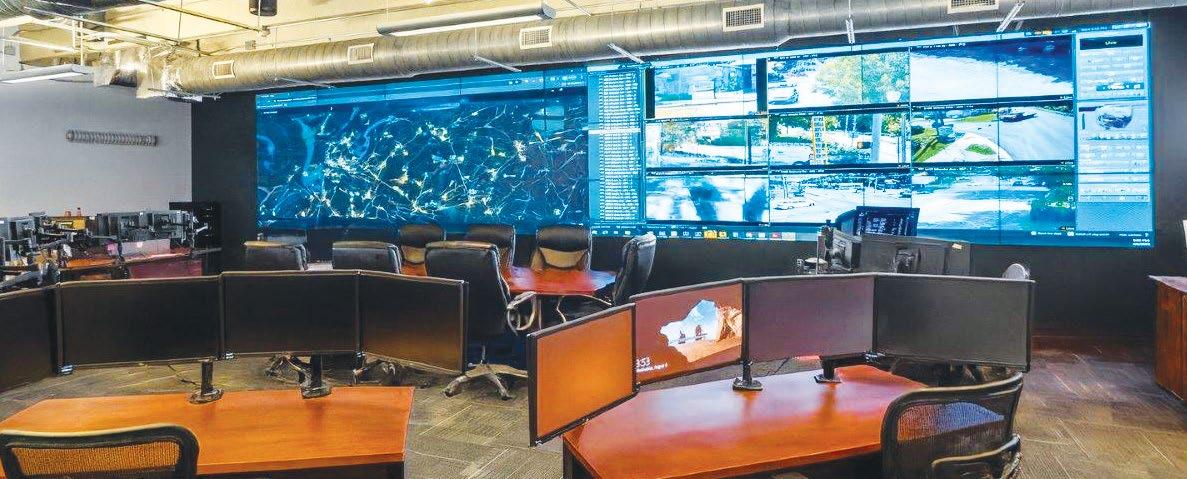
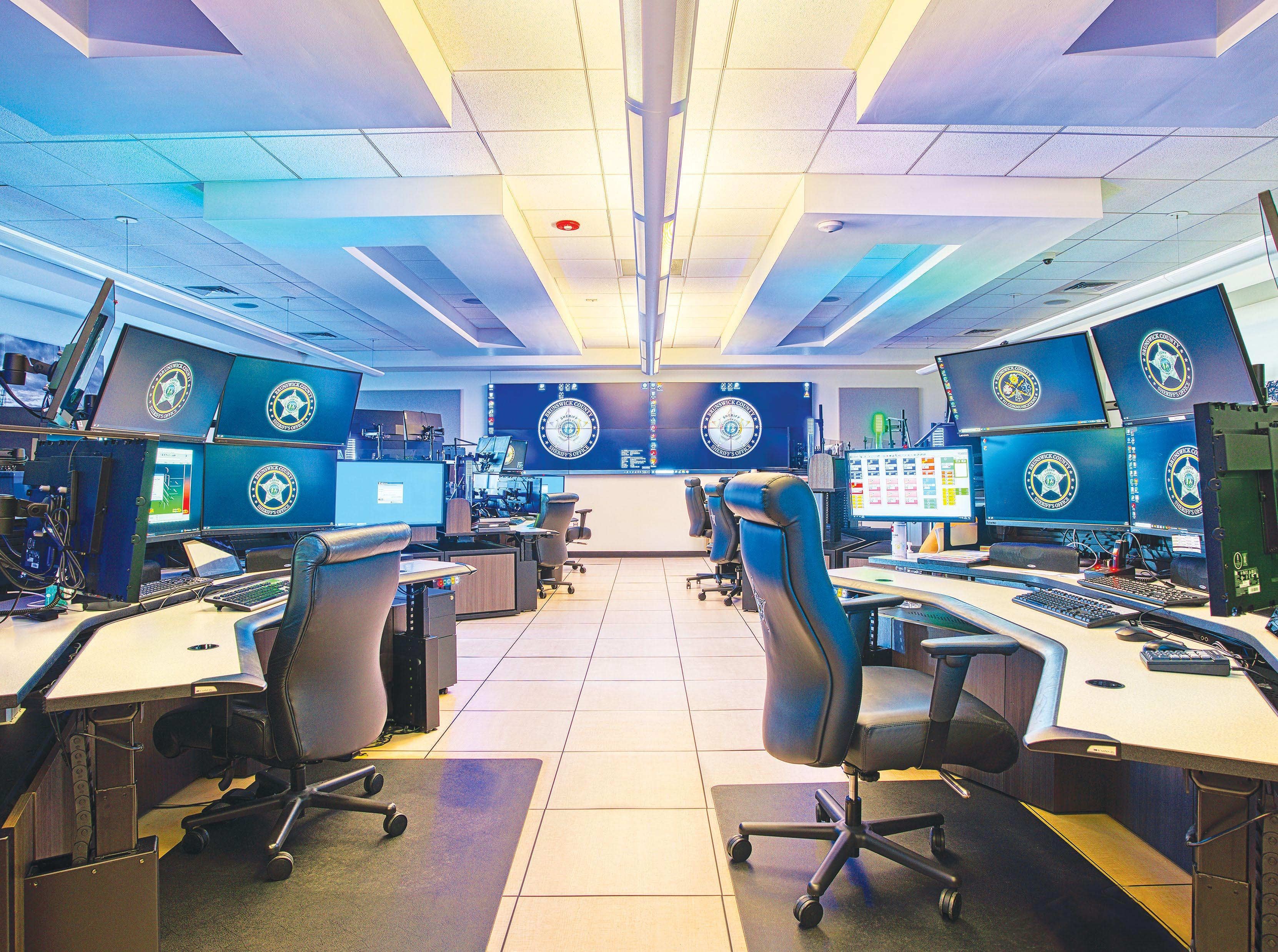
The Brunswick County Sheriff’s Office transformed its call center into a modern RTCC.
How to Build a Command Center: Video
Wall Technology, Integration & Best Practices
PRODUCT MARKETING MANAGER HAIVISION
What You’ll Learn:
• How to approach command center planning as a complete system, not a collection of parts
• Which technology and design decisions have the biggest long-term impact
• How integrators, vendors, and end users collaborate during successful projects
• Common planning and integration mistakes that lead to costly redesigns
• How to future-proof your command center without over-engineering it
• The core technologies behind RTCCs, RTICs, SOCs, NOCs, EOCs, and other modern operation centers
Dustin Bilthouse
DIRECTOR OF PARTNER ALLIANCES HAIVISION
GUEST SPEAKER
Lt. Sean Riley
ASSISTANT DIRECTOR PUBLIC SAFETY CONSTANT TECHNOLOGIES, INC.
Rowan Trouncer
VIDEO ON DEMAND
SCAN TO WATCH
INTEGRATION GUIDE COMMAND AND CONTROL
gunshot detection sensors, and social media analysis platforms. Together, these technologies enable analysts to generate instant intelligence for detectives and officers at crime scenes.
A key component of the NYC RTCC is the Domain Awareness System (DAS), a Microsoft-developed platform that integrates CCTV cameras, radiological sensors, and other data sources into a unified interface. DAS applies artificial intelligence to tasks such as facial recognition, predictive analytics, and gunshot detection—using acoustic sensors commonly known as ShotSpotter—to help locate incidents quickly and accurately. Officers in the field can access DAS and 911 data through handheld devices, ensuring that intelligence reaches decision makers without delay.
Smaller Success
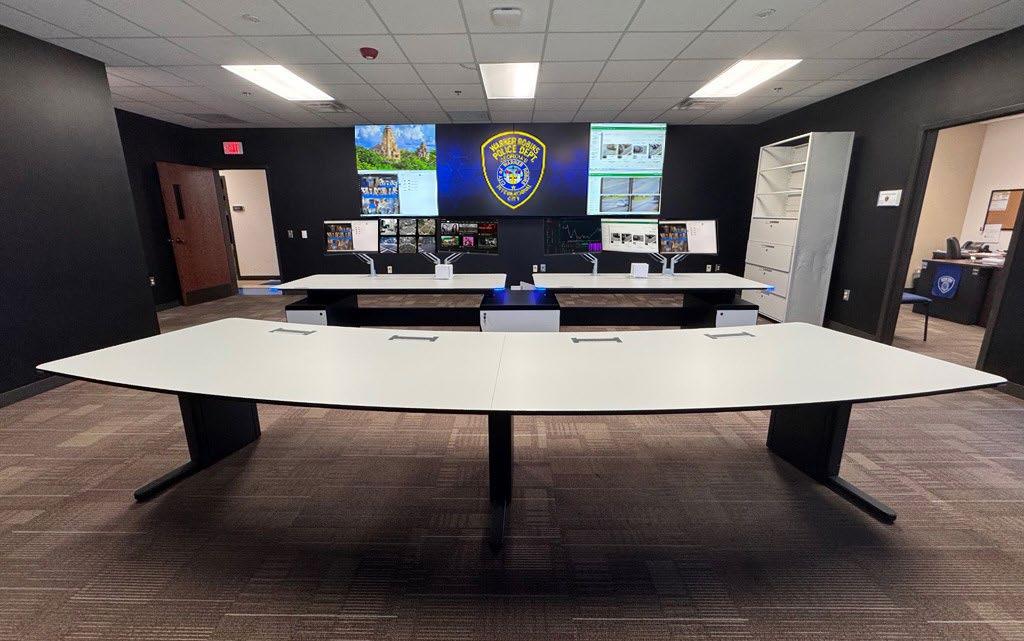
At the opposite end of the spectrum is the Warner Robins Police Department in Georgia, which serves a community of approximately 90,000 residents. The city unveiled its own RTCC at the Law Enforcement Center, creating a modern hub for technology-driven policing tailored to a midsized municipality.
Staffed by two to three personnel from 7 a.m. to 10 p.m. each day, the 900-square-foot center integrates live traffic cameras, LPRs, public safety databases, and communication systems to support coordinated responses to incidents as they occur.
“We looked at how we could improve our operations,” said Captain Eric Gossman. “And we identified a shortcoming of utilizing technology to improve our workflow.”
Inspired by a visit to Georgia Tech’s operations center, Gossman recognized the potential of centralized monitoring to transform how the department handled critical situations. The department partnered with Solutionz, under the supervision of senior account manager Heather Kireta, to bring the concept to life.
The project involved approximately $257,000 in
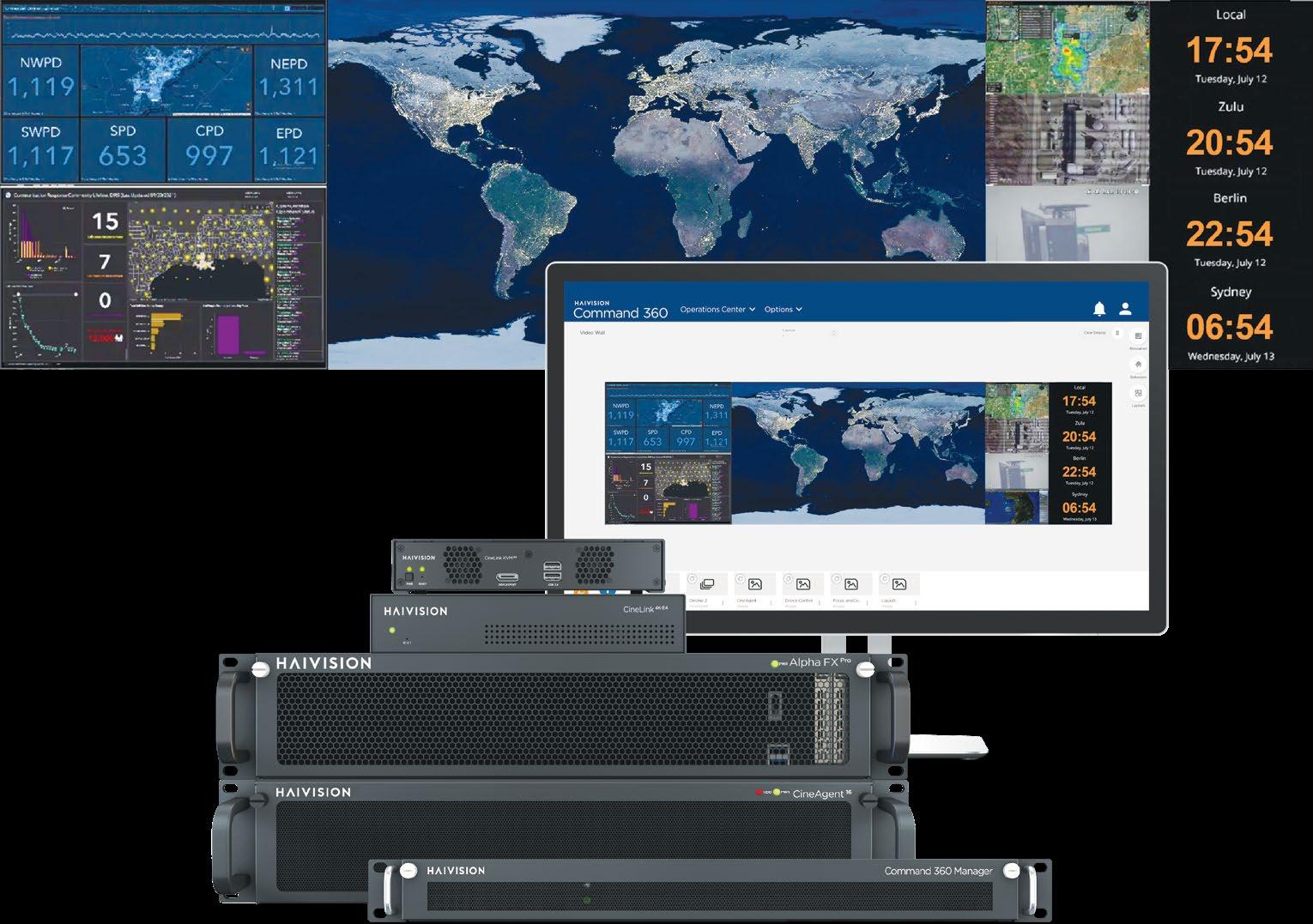
renovations and technology upgrades, including the installation of Haivision Command 360 video wall solution featuring a large, central LG LCD display. Two staffed workstations equipped with desktop monitors sit in front of the wall, and multiple BYOD inputs are available for flexibility.
“With the Haivision system we can view up to 16 4K streams of highresolution video at the same time,” Gossman explained. “At a desktop, I might only be able to monitor two streams. This allows us to see everything at once. For an agency of our size, it’s perfect.”
Measurable Improvements
Since the RTCC became operational, Warner Robins has seen measurable improvements in response times and officer safety. By providing officers with greater awareness of what they may encounter before arriving on scene, the center has helped reduce uncertainty during critical calls.
“We’ve had two homicides that the center helped close that might not have been resolved as quickly otherwise,” Gossman said. “We’re now looking to integrate Drone as First Responder (DFR) technology, which will be operated from this center. At that point, we’ll be running 24/7.”
According to Kireta, once the project was approved, implementation took approximately three months after construction was completed. The scope included running nearly 2,000 feet of Cat 6 cabling to connect the RTCC to the department’s central IT closet, installing the video wall, and deploying two 24/7-rated desks provided by Fountainhead Control Rooms, with fully networked personal computers and videoconferencing capabilities.
“The department wanted multiple wall displays where operators could view different content simultaneously,” Kireta explained. “We designed a system that brought all those feeds together and significantly improved their ability to respond to incidents.”
The Haivision Command 360 platform’s software and hardware components can connect to cable TV boxes, encoders, decoders, and other sources, allowing disparate feeds to be managed through a single interface. Operators can drag, drop, and manipulate content on the video wall with ease, while built-in KVM functionality enables seamless control of multiple systems. LG LCD displays with ultra-thin bezels were selected to create a clean, continuous video wall appearance.
Integration and Infrastructure
As RTCC adoption accelerates, manufacturers of control room technologies are developing solutions specifically designed to meet the needs of public safety environments. For example, RGB Spectrum offers a portfolio of multiview and control technologies tailored to operations centers. According to Dan Marcus, VP of business development, the RTCC market has expanded far beyond its early adopters.
“It used to be that large cities were the first to deploy crime centers,” Marcus said. “Now we’re seeing them everywhere. They’re evolving alongside technologies like drones, wearable cameras, and mobile devices that support first responders.”
RGB’s offerings include the Zio video over IP platform, video wall processors, KVM over IP systems, and its IPX Flyaway Kit for portable command and control applications. What differentiates the company’s approach, Marcus explained, is tight integration.
“The multiview processor is part of the matrix,” he explained. “There aren’t external boxes converting IP streams back into HDMI. It’s a hybrid IP solution that can also accept baseband inputs, with all processing handled within the Zio platform.”
This hybrid approach allows operators to manage multiple local inputs with minimal latency, an essential requirement for realtime monitoring of video sources at different resolutions. “A lot of times, it’s a tradeoff between fidelity and latency,” Marcus added. “Lower latency generally requires more bandwidth, so agencies must decide how important video quality is to their mission.”
Redundancy and Reliability
Another major player in the RTCC space is Extron. In 2025, the company worked with systems integrator North Carolina Sound to upgrade the Brunswick County Sheriff’s Office Communications Center in Bolivia, NC. The project transformed an existing call center into a modern RTCC serving as the primary link between the public and emergency services.
While the original AV system was functional, it lacked redundancy, meaning a single component failure could bring operations to a halt. The upgraded system was designed to deliver optimal signal integrity, true redundancy, and fail-safe operation for the center’s 911 workstations, centralized dispatch system, and specialized communications equipment. Operators manage emergency calls through a
The Warner Robins Police Department’s RTCC can view up to 16 4K sources simultaneously on its LCD video wall.
INTEGRATION GUIDE COMMAND AND CONTROL
computer-aided dispatch system, with sources displayed on a Planar Clarity G2 video wall, individual workstations, and an adjacent conference room. Extron’s XTP modular matrix system provides centralized switching and distribution, while the NAV Pro AV over IP system links the 911 center with a conference room and a backup emergency operations center.
“The key to an efficient control room workflow is the harmonious integration of every system element,” said Joe da Silva, Extron VP of marketing. “Our goal is always to ensure a flawless operational experience for the end user.”
Monitoring the Situation
Modern RTCCs centers are typically built around a combination of dvLED and LCD video wall systems, which are supported by large-format displays and operator desktop monitors. Touch-enabled displays that support interactive workflows, annotation, and real-time collaboration are also widely used at operator positions to enhance control, navigation, and user interaction with critical systems.
“Direct-view LED is rapidly becoming the preferred solution for primary visualization walls due to its seamless design, high brightness, and scalability,” said Greg Fechner, sales director for state
and local government at Planar. “These attributes allow agencies to display multiple data sources clearly across large environments where visibility from any position in the room is critical. LCD video walls remain a strong option, particularly in applications requiring very high pixel density or where budget considerations are a factor.”
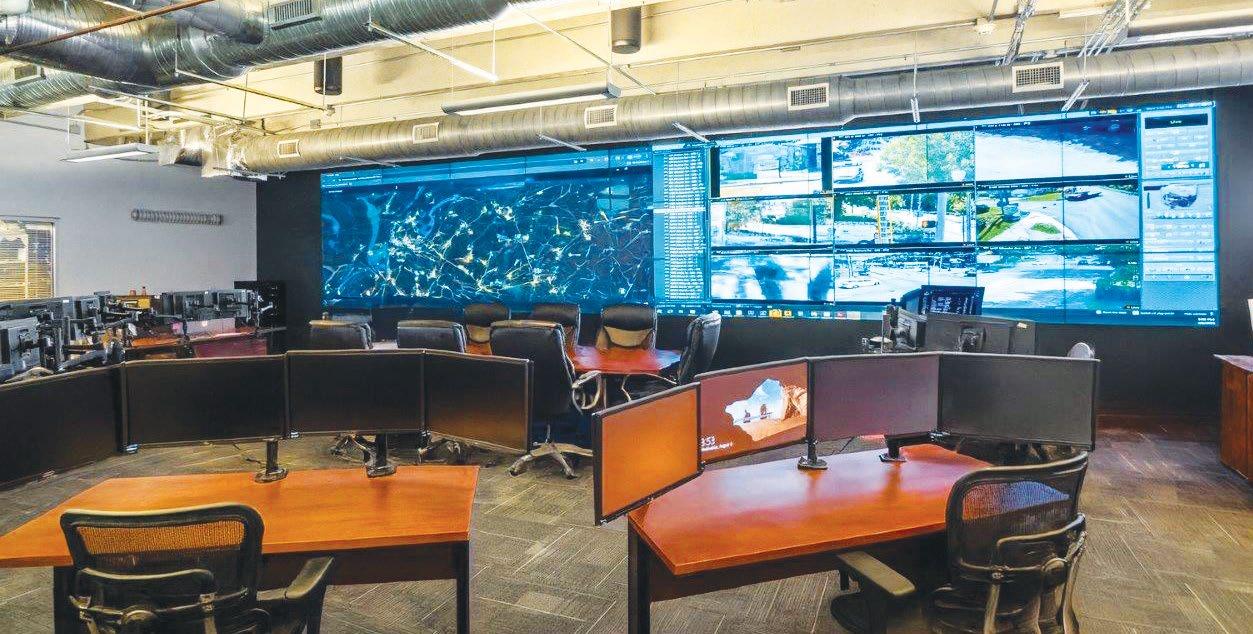
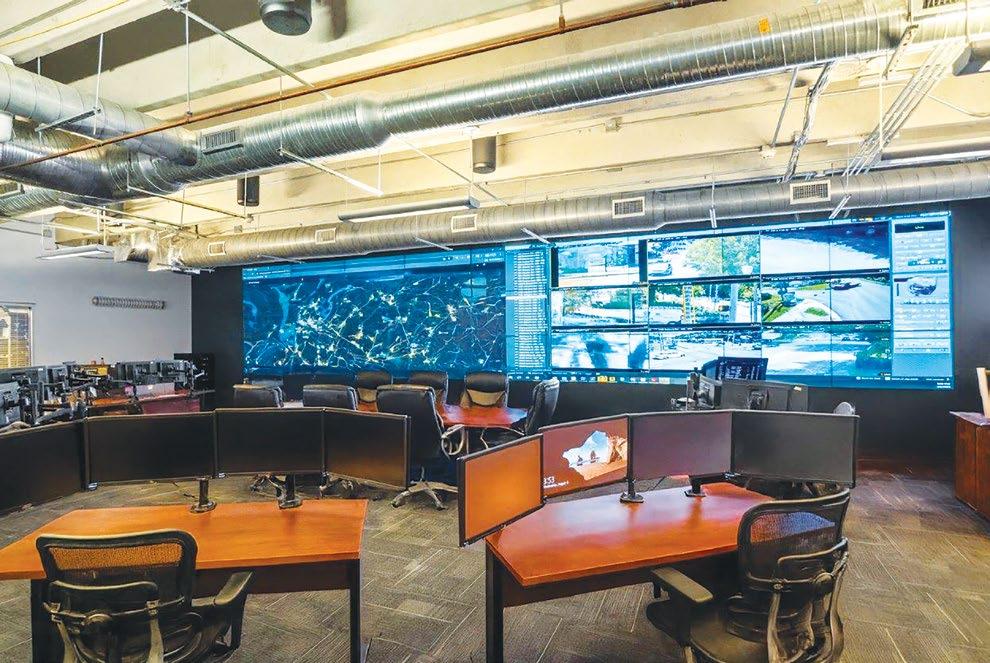
Since its inception, the Chattanooga Police Department (CPD) Real Time Intelligence Center (RTIC) has used Planar’s Clarity Matrix LCD video wall system. As the number of integrated camera systems grew, and additional technologies and data sources were added, the department upgraded to a nearly 36x7-foot Clarity Matrix G3.
The system serves as the central visualization platform, supporting monitoring of thousands of live camera feeds. This includes fixed cameras, body cameras, and other real-time data sources, providing officers and analysts with a unified operational picture. When an incident is not in progress, the video wall serves as a collaborative tool that supports CPD’s ongoing intelligence work.
“At the end of the day, command centers require a complete ecosystem of display technologies that perform without compromise,” said Fechner. “Planar delivers that ecosystem with the reliability, clarity, and long-term support these mission-critical
environments demand, while also helping agencies standardize on a single manufacturer to simplify deployment, streamline support, and ensure consistency across their operations.”
Whether deployed in a city of millions or a town of fewer than 100,000 residents, RTCCs have proven their value for modern policing. As AI, facial recognition, drones, and predictive analytics continue to mature, these centers will become even more capable and effective.
At Warner Robins, the results are already clear. “We always try to stay one step ahead of criminals,” Gossman said. “This crime center has helped reduce our response-to-call times and close cases faster. It’s been a big win for our department—and I’m sure for many others across the country as well.”
The video wall in Chattanooga Police Department’s Real Time Intelligence Center can support thousands of live camera feeds during an incident or be used as a collaborative tool for ongoing intelligence work.
INTEGRATION GUIDE COMMAND AND CONTROL
At Issue
What are the most important Pro AV elements to consider when equipping a command and control room?
Stavros Theodoridis Business Development Manager, Control Systems, Adder
In modern command and control rooms, Pro AV decisions must prioritize operational clarity, responsiveness, and long-term resilience.
High-performance IP KVM sits centrally in a control room, enabling seamless, real-time access to critical systems while maintaining flexible workflows. While seamless video wall integrations are a vital component to visualize and share complex data across teams, intuitive user interfaces and ergonomic design are equally as important to support fast decision-making under pressure. Security is non-negotiable, with encrypted transmission and controlled access prioritized. These key considerations ensure scalable control rooms can evolve while maintaining continuous mission-critical performance with limited distractions for the operators.
Mark Bohs
Director of Sales, The Americas, Datapath
Security, scalability, and connectivity are fundamental elements of command and control rooms. As sites grow more connected, systems must protect sensitive data while enabling operators to work efficiently. Enterprise-grade encryption, robust user rights management, and secure multi-site connectivity help ensure that only authorized personnel can access critical sources, even across dispersed locations. Misconfigured networks or systems can introduce latency, operational delays, or security gaps. Equipping a command and control room with a smart, scalable control room platform allows operators to access, control, and share multiple data sources at once, making it easier for teams to work together in real time without compromising security.
Scott Norder
COO, RGB Spectrum
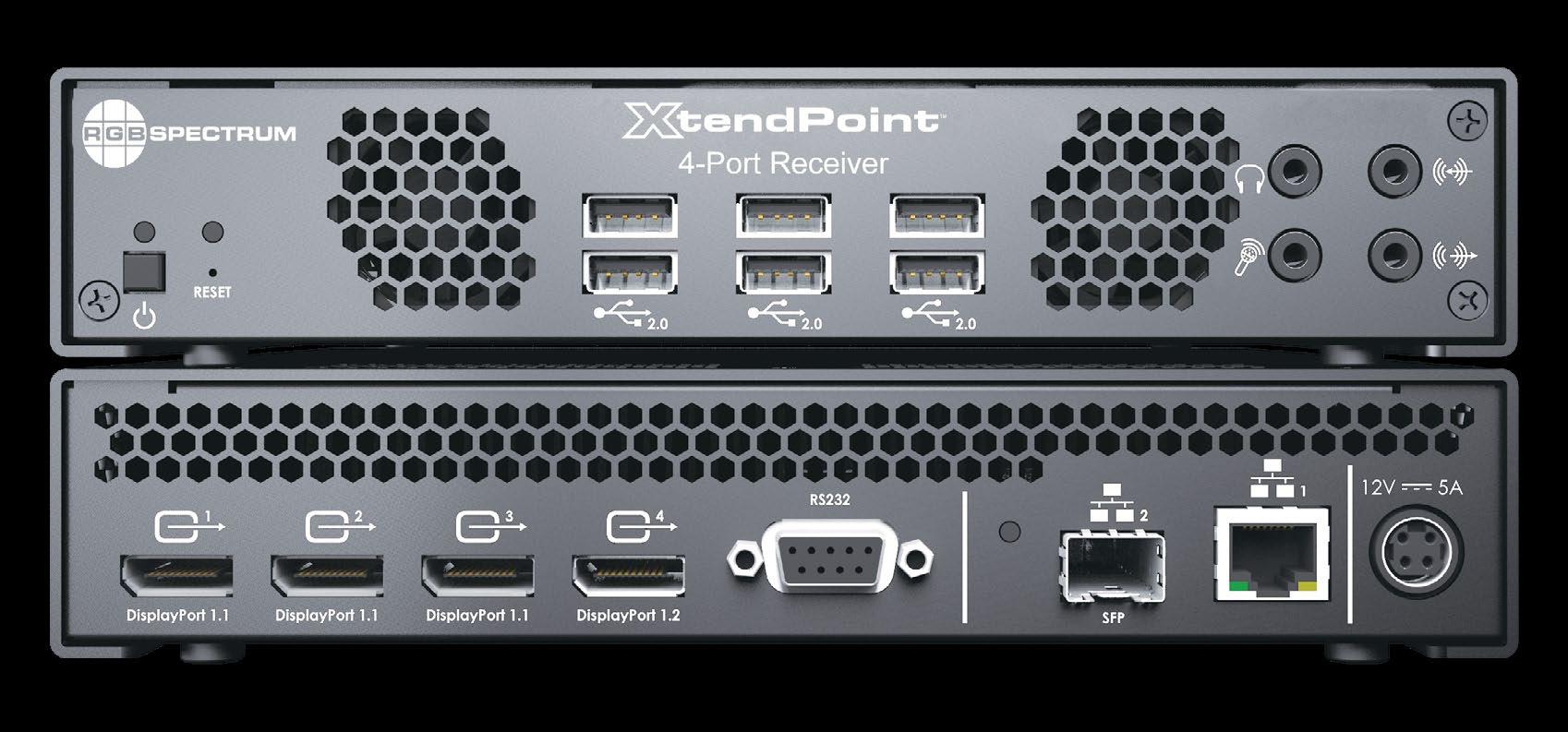
RGB Spectrum’s approach to command and control rooms centers on delivering integrated, operator-focused Pro AV solutions that improve performance and decision making. High-performance Zio video wall processors create a clear, real-time common operating picture, while XtendPoint KVM-over-IP enables seamless control of
multiple systems from a single interface. This simplifies workflows, reduces cognitive load, and enhances efficiency. By moving computing off the desk, RGB Spectrum’s solutions also reduce noise and improve physical security. Flexible system configuration allows operators to instantly adapt to changing situations, while integrated distribution ensures the right information is visible where it’s needed. The result is a streamlined environment that enables better decisions, faster.
Anna Kozel
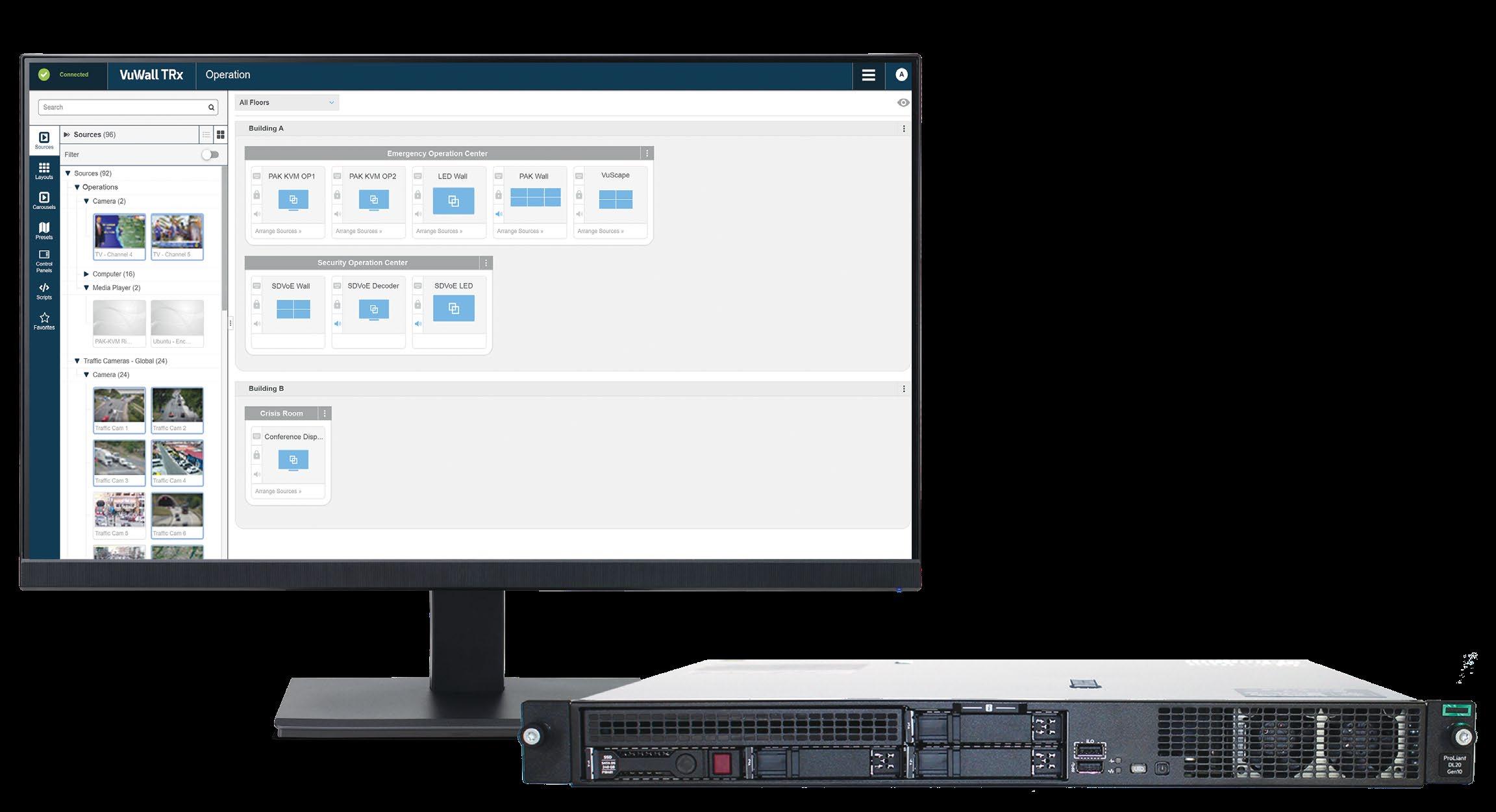
Vice President of Marketing, VuWall | G&D
When equipping a command and control room, the top Pro AV priorities are interoperability, reliability, intuitive control, and scalability. These environments depend on multiple systems and continuous information flow, so the technology must function as one unified platform that supports fast, informed decision-making. Success is not defined by the video wall alone, but by how easily operators can access, manage, and share content across any display and workstation. Just as importantly, the infrastructure must be secure, resilient, and flexible enough to adapt as operational needs evolve.
Alberto Reyes
General Manager of U.S. Government Division, Planar
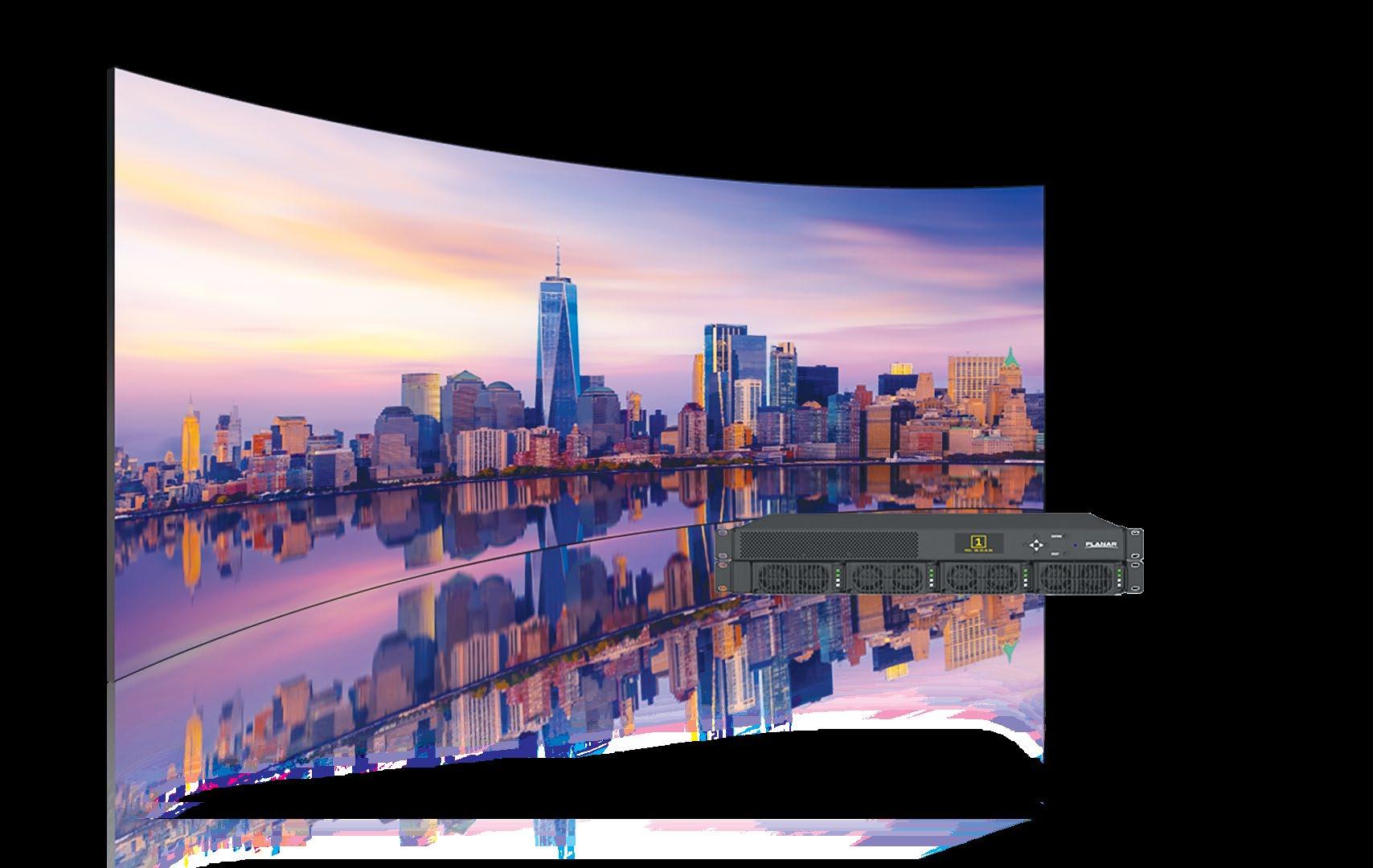
Starting with displays, consider a solution that offers a wide range of pixel pitches or one that’s most appropriate for your use case. Pixel pitch will help guide your viewing distance and ensure that data is readable from any point in the room. Keep in mind that anti-glare features and exceptional LED seam or LCD tiling quality will help deliver sharp, vivid imagery, while 24x7 use and reliability will help prevent points of failure when mission-critical performance matters most. Visualization elements ranging from operator and wall alignment to mission-based layouts and consistent fonts and colors are also key for enhancing display and overall command center operations.
David Anderson
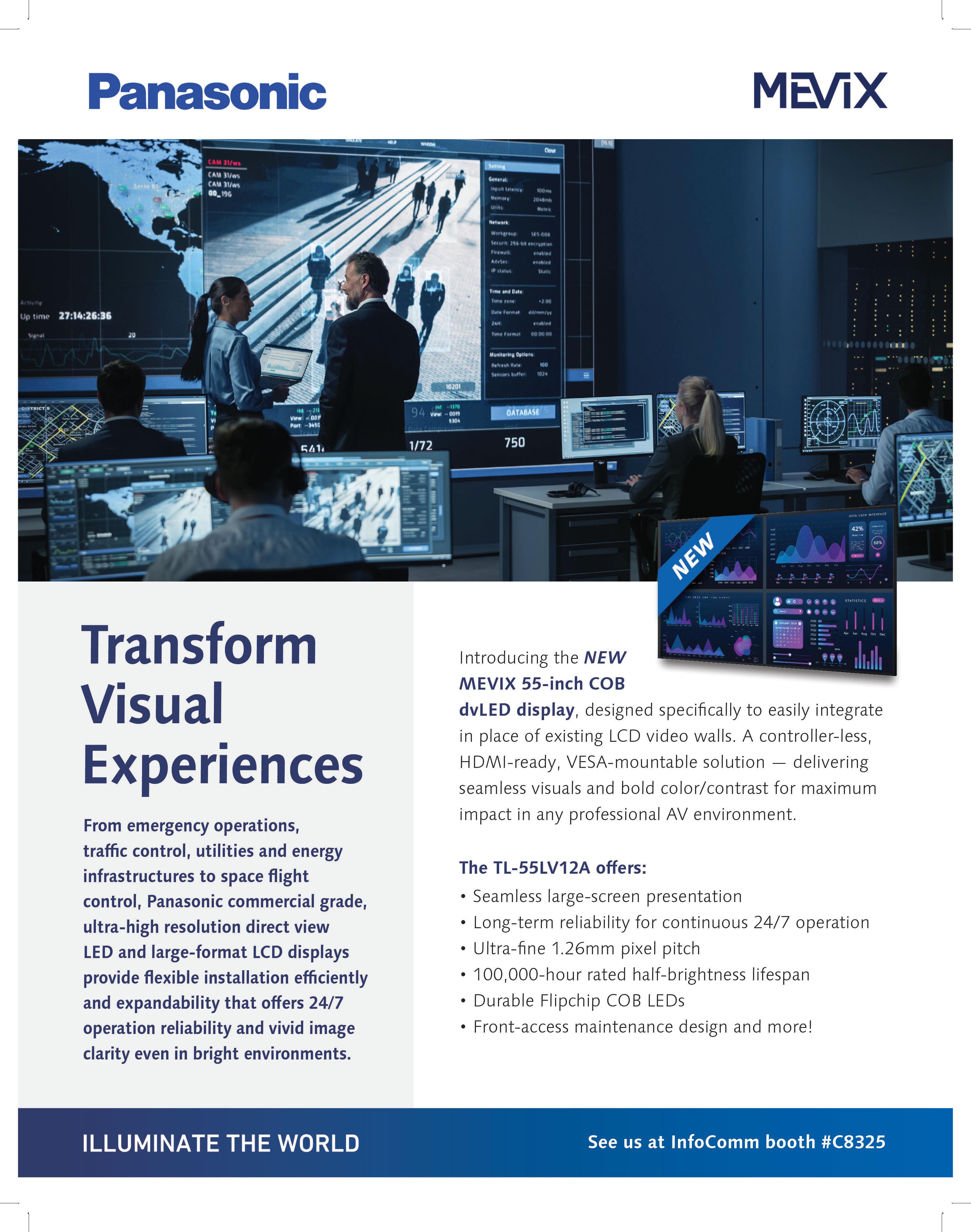
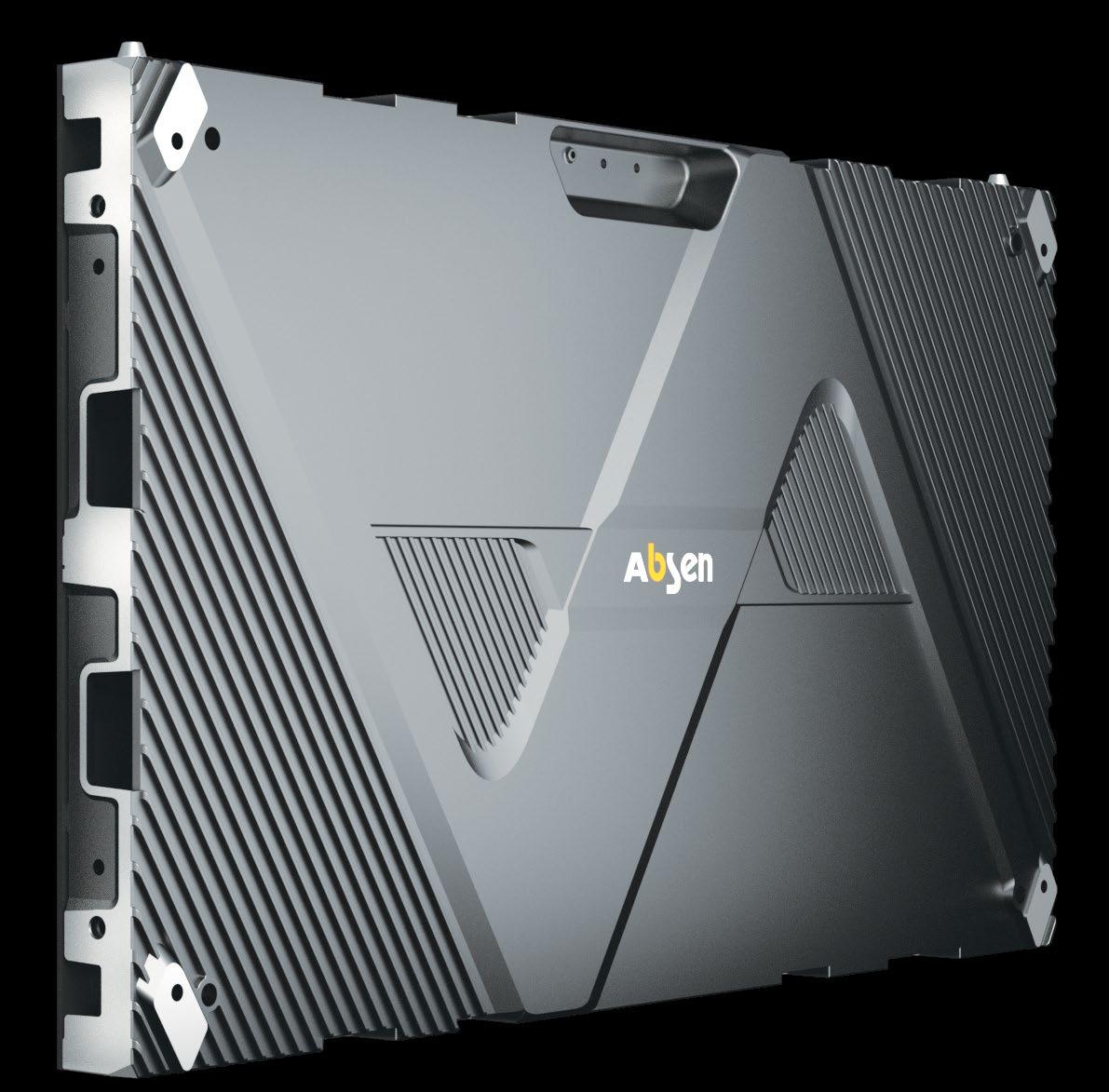
Channel Manager, Absen Command and control rooms come down to three priorities: reliability, visibility, and integration. These environments run 24/7, so systems need to support continuous operation with minimal downtime and straightforward serviceability. At the same time, operators rely on a display platform that can bring multiple sources into a clear, unified view, making it easier to interpret information and act quickly. Just as important, everything has to work together. AV systems should align with existing IT infrastructure, control platforms, and workflows,
allowing teams to manage complexity today while staying flexible enough to scale and evolve over time.
Jason Karol
Key Account Manager–Federal & DOD, Panasonic
Projector & Display Americas
When equipping a command and control room, flexibility, and image quality are key AV priorities. Can operators access the information and visuals they need efficiently? Are those visuals clear and easy to update? In control rooms where speed, adaptability, and customization are essential, displays must deliver high-quality visuals so everyone present can easily view content regardless of where they are sitting. Consistent uptime also ensures that critical information stays visible for extended periods of time. Finally, flexible displays with remote management capabilities support a seamless operational experience in any type of room.
Kevin Quinn
Solution Architect–Partners and Alliances, Haivision
I always start with the ergonomics in the room but rarely stop with them. Floorplans, consoles, sightlines, acoustics, and lighting create a foundation for the command center space, but they don't automatically guarantee success for the organization using it. Technology selection should be secondary to understanding or establishing an operational workflow with your end user. The resulting design should enable operators to hit the ground running with flexibility to tailor a workflow as the command center evolves. Touchpoints at 30, 60, and 90 days allow the end user to focus on their mission instead of using the technology.
Catherine Koutsaris
Product Marketing Manager, Matrox Video
The most important Pro AV elements in a command and control room are reliability, responsiveness, image clarity, security, and scalability. Operators depend on lowlatency video and KVM performance to make real-time decisions, while high-resolution visuals ensure accurate interpretation of complex data. Secure architectures, often with centralized computers and strict access control, are critical for sensitive environments. Interoperability through open standards like IPMX, SMPTE ST 2110, and NMOS enables flexible, multi-vendor ecosystems. Finally, resilient system design with redundancy and 24/7 uptime ensures continuous operation and supports efficient workflows and shared situational awareness.
INTEGRATION GUIDE COMMAND AND CONTROL
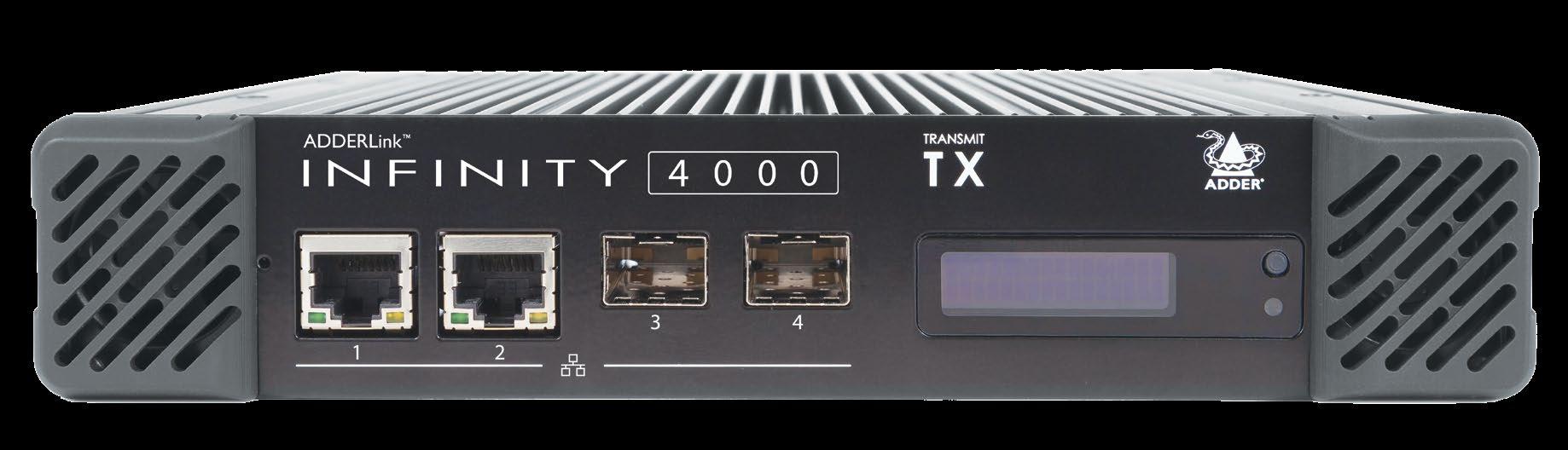
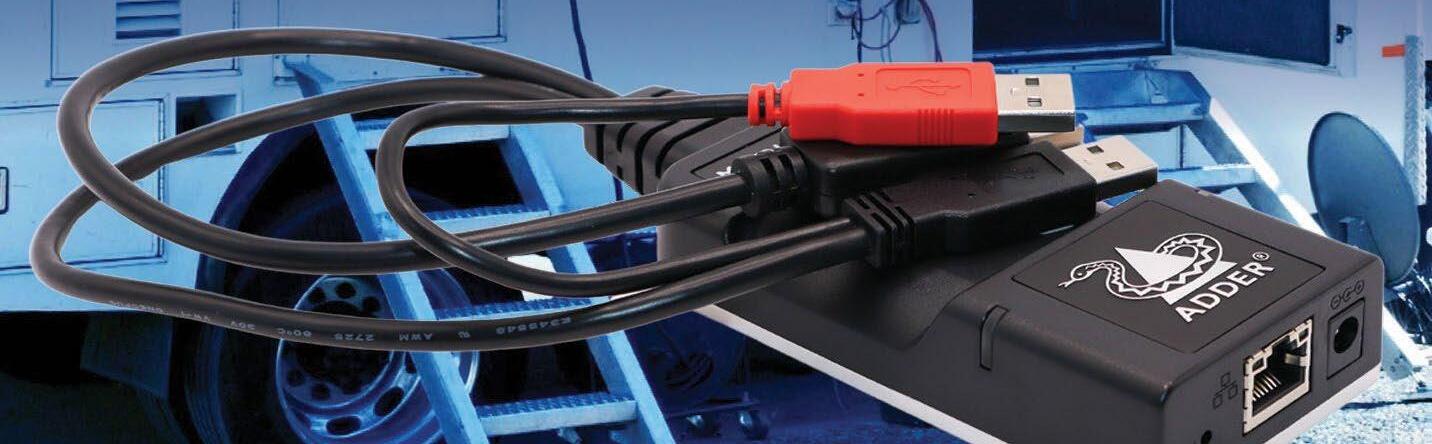
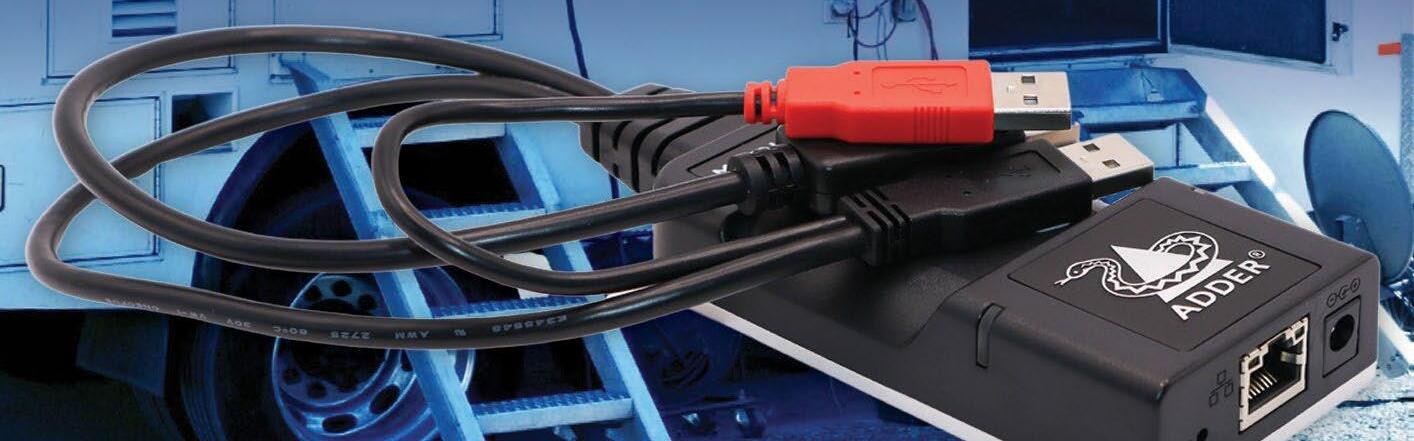
Adder ADDERLink INFINITY
The ADDERLink INFINITY range is designed to enhance operational effectiveness, improve collaboration, and streamline IT workflows in mission-critical environments. This high-performance IP KVM range enables real-time, pixel-perfect access to systems anywhere on the network and anywhere in the world. The scalable architecture supports seamless expansion, while robust encryption ensures secure operation. With intuitive control and minimal latency, the ADDERLink INFINITY range empowers control rooms to operate efficiently, adapt quickly, and maintain continuous performance.
Matrox Video Matrox Avio 2
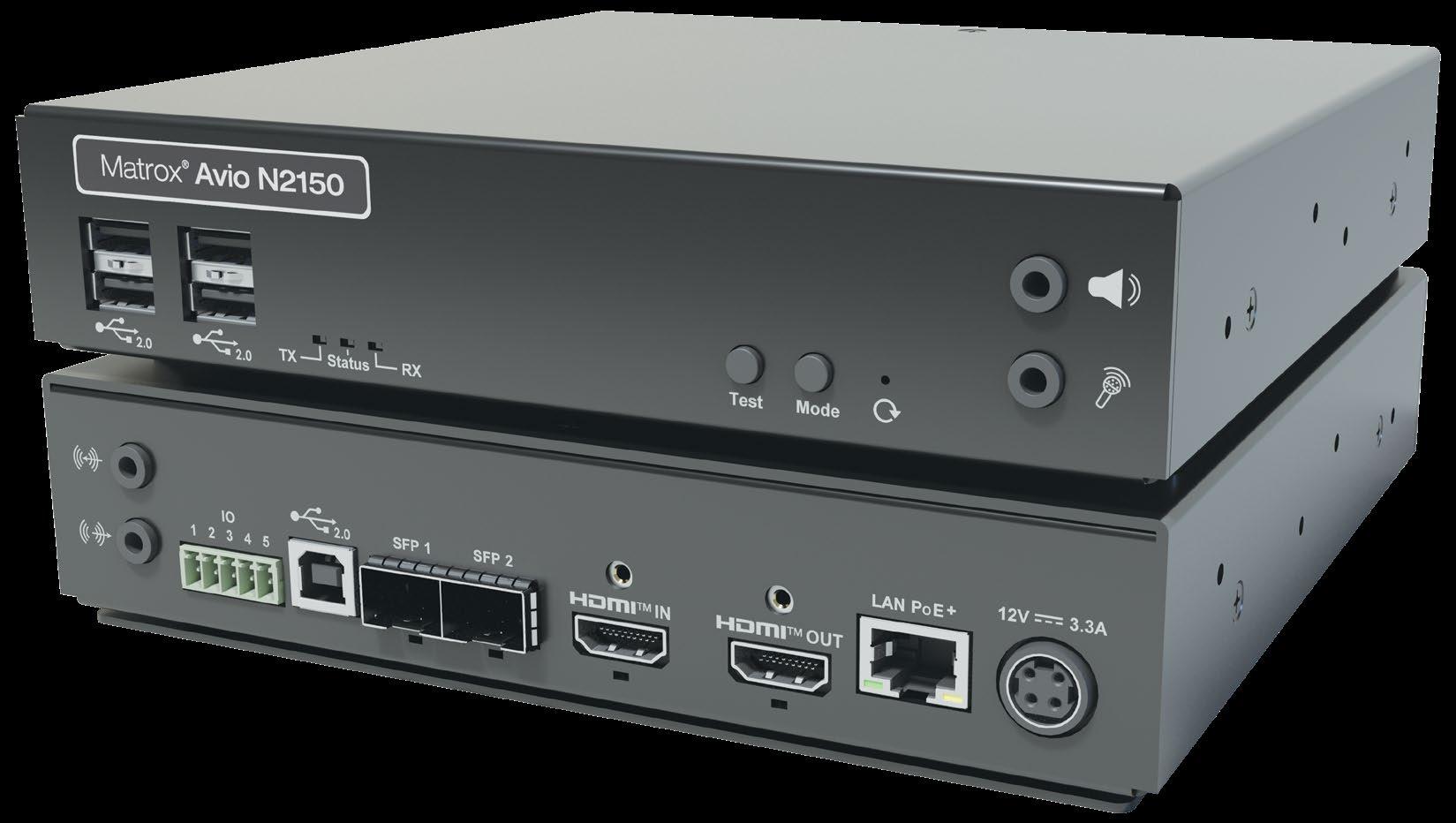
Matrox Avio 2 is an IPMX/ST 2110-based IP KVM extender, delivering secure, real-time remote access with uncompromised image quality. Supporting up to 5K, Avio 2 enables centralized computing with seamless user experiences across control rooms and distributed environments. Built on open standards, it ensures interoperability and scalability, while AES 128-bit encryption and Active Directory integration protect critical data. With flexible fiber or copper deployment, fanless design, and power redundancy, Avio 2 is engineered for mission-critical reliability.
RGB Spectrum
XtendPoint KVM-over-IP XtendPoint KVM-over-IP streamlines command and control operations by enabling operators to manage multiple systems from a single keyboard and mouse, reducing clutter and cognitive load. Supporting multi-source viewing on highresolution displays, it improves situational awareness and response speed, while features like KlickSimple enable intuitive, seamless control across systems. Its scalable IP architecture allows access to local and remote sources, with distributed operation eliminating single points of failure.
VuWall | G&D TRx
VuWall’s TRx centralized video wall and KVM management platform enables organizations to visualize, control, and distribute content across displays and operator workstations from a single, intuitive interface. Built for mission-critical environments, it interoperates with a wide range of AV and control systems, including native integrations with Genetec, Milestone, and Q-SYS, while also managing G&D KVM systems and other connected devices within one secure, scalable ecosystem that simplifies operations, enhances situational awareness, and accelerates response times.
Planar DirectLight Slim Series
Featuring an ultra-thin, narrow width form factor, the Planar DirectLight Slim Series accommodates curved and space-constrained applications such as control rooms. Models feature MicroLED technology and are available in 0.9, 1.2, 1.5, and 1.8mm pixel pitches with a maximum brightness of 1,600 nits and a unique 4:9 aspect ratio to support deployment versatility and vibrant viewing experiences. Customers also benefit from an installation depth of less than 2 inches, delivering minimal color shift compared to other LED displays.
INTEGRATION GUIDE COMMAND AND CONTROL
Haivision Command 360
Haivision Command 360 is a complete video wall solution for situational awareness and real-time decision making in mission-critical environments. Command 360 enables government organizations, public safety teams, and enterprises to securely visualize and dynamically respond to urgent situations such as military operations, public emergencies, and cybersecurity breaches faster than ever before.
Absen KLCOB V2 Series
The KLCOB V2 Series is a COB MicroLED platform built for command and control environments, offering fine pixel pitches down to 0.7mm, 15,000:1 contrast, HDR support, and a 3,840 Hz refresh rate for stable, high-detail visualization. Its flip-chip, common cathode design improves heat dissipation and efficiency, while a non-glare black coating enhances contrast and reduces eye strain. Front serviceability and redundant power and signal backup support reliable 24/7 operation.
Panasonic Projector & Display Americas developed the MEVIX TL-55LV12A LED display to give control rooms a flexible, reliable option to support high visibility in bright environments. Designed to easily integrate in place of existing LCD video walls, it features a bezel-less design and wide color gamut. Plus, it has the flexibility to combine with other units for an immersive, high-quality visual experience. Its controller-free setup with HDMI-only operation supports ease of use.
Datapath Aetria
Datapath’s Aetria platform is an integrated control room solution designed to manage, control, and share visual data across video walls, workstations, and connected spaces. The latest Aetria update introduces secure multi-site connectivity via the Secure Streaming Gateway (SSG), enabling real-time source monitoring and sharing between geographically separate control rooms. AES-encrypted links and user rights management ensure only authorized operators can access shared content, enhancing situational awareness and collaboration across dispersed operations.
The Bundling Conundrum
Collaboration hardware manufacturers have gone from rivals to roommates and back again.
By David J. Danto
If you grew up in Pro AV, you grew up on “best in breed.” The craft was picking the right display, switcher, DSP, mics, and camera, then knitting it together with equal parts engineering and stubbornness. Integrators built their reputations on knowing what played nicely together—and how to make mixed gear act like it came from one factory. But the room didn’t really exist until a control system made it behave. Companies like Crestron and AMX weren’t accessories. They were the glue that turned a pile of parts into a single experience by handling power, switching, macros, UI, timing, and edge cases. That’s where bundling enters the story, because the old way came with a ritual we all treated as normal: staging.
From Custom to Repeatable SKUs
In the classic model, you staged the first room somewhere just to prove it actually worked. You confirmed that “Start Meeting” woke everything up in the right order, switched correctly, unmuted, and behaved predictably. Then you tweaked timing and
logic, chased interop weirdness, and only after it was stable did you clone it across multiple locations.
This is something bundling is meant to replace. A modern bundle, done well, removes much of that burden. It is essentially staging performed in advance by the manufacturer(s), with interop testing, firmware alignment, and support playbooks sorted out before the kit ever hits a quote.
Bundles don’t eliminate commissioning, acoustics, mounting constraints, or network policy. But they can remove a big chunk of the “will these pieces behave together at all?” anxiety that used to consume days of staging time.
First came “good enough” off the shelf. Meeting rooms that once justified racks and touchpanels became a videobar, display, and cable. Standards improved. USB got easier. Customers got less tolerant of custom complexity.
Then, the market leaned hard into “single throat to choke.” One manufacturer, one stack, one support path. At scale, the appeal is obvious: fewer variables, fewer escalations, fewer finger-pointing calls.
Now, we’re in the next phase: bundling. And bundling has two distinct flavors that are easy to mix up.
Single Manufacturer Options
Bundling is not always a multi-vendor handshake. Sometimes a single manufacturer “bundles” its own products by creating a named room kit built from its own catalog or “room builder” software. It becomes a SKU, a recipe, and a supportable configuration. That brings genuine value, because it reduces decision fatigue and creates repeatable deployments.
There’s also a legitimate argument for choosing suppliers with a complete breadth of solutions. If you’re standardizing across
dozens or hundreds of rooms, fewer vendors usually mean a shorter blame chain when something breaks. A concrete example is Cisco’s direction in room systems. Cisco has increasingly connected codecs, cameras, microphones, and other room peripherals over Cat6, so the same cable can carry PoE, data, and control. When a design leans into an end-to-end ecosystem like that, cabling and integration can get dramatically simpler. You avoid piles of interface boxes that convert one thing into another, and every converter is a potential point of failure and a troubleshooting dead end.
Multi-Vendor Acceleration
The more nuanced flavor of bundling is multi-vendor: two (or more) manufacturers packaging a mixed solution and getting it validated, certified, and marketed as a cohesive kit. That’s the “rivals to roommates” story, because it forces competitors into something that looks a lot like cooperation. Multivendor bundles are the alternative path to single suppliers, as they try to deliver some of the single supplier benefits without forcing a single vendor stack.
This type of bundling is a response to pressure from multiple directions. Portfolio gaps are real. Certification has become a gate, especially in the Teams Rooms world, where a known configuration can reduce perceived risk and simplify procurement.
Support costs are a hidden driver, too: More permutations create more tickets, and bundles reduce the matrix. Bundles also help revenue and channel mechanics by cleaning up SKUs, simplifying quoting, and reducing competitive leakage.
Multi-vendor bundling is like best in breed wearing a safety helmet. Traditional best in breed puts validation burden on the integrator. Bundles shift some of that burden upstream. It’s the vendor saying, “We tested these together, we’ll stand behind the combination.”
There’s a clear uptick in multi-vendor collaboration bundles compared to even the recent past.
One example is Barco pairing ClickShare Hub with Sennheiser videobars as a Microsoft Teams Rooms certified bundle. A critical detail: This is Barco’s first certified videobar partner bundle for ClickShare Hub, not the end of the road. Barco has already signaled it’s working with additional videobar manufacturers on other partner bundles expected to become certified as well.
Another recent example is Jabra extending the multi-camera capabilities on its Android videobars by bundling with the Huddly Crew system. It’s not just a bundle for procurement. It’s a path for videobarcentric rooms to grow up into larger, more dynamic spaces without forcing a full rip-and-replace into traditional codec architectures.
Even display manufacturers have been getting into the bundling game, with LG packaging its displays with Jabra videobars as Teams certified “Express Install” kits.
Frenemies Break Bundles
Sometimes, however, multi-vendor bundles can work against the companies putting them together. A familiar pattern goes like this: A vendor has an incomplete room story, so it bundles with a partner to fill a gap. The kit gets marketed and pitched as stable. Then the vendor releases a product that directly competes with the partner’s contribution.
That’s when the customer asks: “So, what does that say about the bundle you sold me last year?”
There are many current examples of this pattern. Neat bundled its videobars with Shure ceiling microphones to modularly scale into larger-space designs. That partnership made sense. But now that Shure has introduced its own videobar that competes more directly with Neat in overlapping room categories, it’s fair to wonder how long the Shure–Neat bundle will last.
For any bundle, the question to ask is whether it survives new competition between the partners. Technically, probably. Whether such bundles survive commercially and politically is the real question.
When yesterday’s partner becomes today’s competitor, relationships can fracture over account control, deal registration, channel incentives, certification priority, roadmap alignment, and who gets top billing. That’s the real risk behind any bundled solution.
Bundles are often born out of necessity. They can be undone by strategy. And when a partnership breaks, the collateral damage isn’t just a discontinued SKU. It’s confusion in the field, uncertainty for integrators, and customers wondering whether they standardized on something that will become “legacy” sooner than planned.
Don’t Bungle Your Bundle
For the foreseeable future, you should expect more bundling, not less. Not just videobar plus display kits, but room outcomes packaged as repeatable SKUs: small room, medium room, training room, divisible room, BYOD room. But all bundles are not created equal.
The first thing to watch is whether bundling keeps shifting from one-off marketing announcements into ongoing certification programs. If vendors can turn these into repeatable, validated combinations, the “bundle” stops being a kit and starts looking more like a platform strategy.
Second, take note how quickly bundles change as product roadmaps shift. Today’s perfect pairing can get awkward the moment one partner releases a product that overlaps with the other partner’s “role” in the bundle. Even if the technology still works, the go-to-market math can change overnight.
Next, watch which bundles become defaults in the channel. When distributors, resellers, and integrators start quoting the same combinations over and over, those pairings become market signals—about demand,
portfolio gaps, and sometimes which companies are getting unusually comfortable living together.
Finally, keep an eye on the breakups. The most revealing moments in this trend may not be the bundle announcements, but the quiet disappearance of a bundle that used to be featured, certified, and promoted. In a
world of frenemies, the roommate arrangement can work beautifully, until one of them decides the apartment would be better without the other.
David J. Danto is the principal analyst with TalkingPointz and director of emerging technology for the IMCCA.
TECHNOLOGY NEW PRODUCTS
Legrand | AV OFRBC-4
The 4-foot, Wiremold overfloor raceway base and cover (OFRBC-4) is a new addition to the OFR Series that
delivers safe, organized power, data, and AV distribution in a more versatile, logistics-friendly length. Maintaining the ultra-low, ADA-compliant profile and four-channel capacity that define the OFR platform, the OFRBC-4 is designed to reduce costs, eliminate on-site cutting, and support modern
“room-in-a-box” AV deployment models. The system installs directly over existing floor coverings without coring or trenching, and separates power, data, and AV pathways within four dedicated channels. It features a durable aluminum base with a black powder-coated steel cover, as well as a tamper-resistant design suited for high-traffic environments.
Marshall Electronics
CV356-10X
Featuring a 10x optical (12x digital) zoom and flexible 3G-SDI and HDMI
simultaneous outputs, the new CV356-10X Full HD compact camera is ideal for various Pro AV and broadcast applications that require unobtrusive positioning. A threaded ring adapter is included, which allows users to easily attach any 49mm close-up lens or ND filter for greater versatility. Plus, an integrated audio input enables embedding audio directly into the video output for streamlined production workflows. A breakout cable with a compact joystick allows for quick and convenient access to the on-screen display (OSD) menu. With auto settings that track environmental fluctuations, as well as long-distance remote adjust and match settings, the CV356-10X is especially useful when the camera is out of reach.
Audinate Dante Director Professional
Dante Director Professional is a comprehensive, web-based software solution designed for remote management of any size AV installation, from 50 devices to many thousands distributed globally. It addresses the growing challenge of maintaining distributed AV infrastructure at scale by providing centralized monitoring, management, and security authentication capabilities. A web-based dashboard provides real-time visibility into device status, network performance, and system health across all sites, enabling IT teams to proactively identify and resolve issues before they impact users. Single Sign-On (SSO) authentication and role-based access controls protect against unauthorized routing and ensure only authorized personnel can make network changes. API and webhook capabilities allow Dante Director Professional to integrate with existing IT support ticketing systems and monitoring platforms, streamlining incident response workflows.
Professional B140M
The B140M generative amplifier—the first product from the Moodsonic and Bluesound Professional partnership—brings intelligent, adaptive soundscaping to commercial audio systems. Designed as a compact, PoE powered, plenum-rated amplifier, the B140M combines Moodsonic’s intelligent soundscaping and sensing platform with Bluesound Professional’s decentralized audio management platform, BluOS, to deliver networked audio streaming, advanced processing, and multichannel amplification in a single device. Featuring one BluOS zone with four channels of amplification, the B140M enables scalable, modular deployment of sensor-adaptive, biophilic soundscapes across commercial environments. With support for low impedance and 70V/100V speaker systems, the B140M delivers an all-in-one solution for deploying generative soundscapes without the need to assemble multiple devices. Built-in local music storage eliminates the need for an external NAS.
NEW PRODUCTS TECHNOLOGY
Extron SW2 HD 8K
The SW2 HD 8K is a two-input HDMI switcher with analog audio de-embedding. The compact switcher delivers high-performance video and flexible audio integration for a wide range of AV environments. The switcher supports video resolutions up to 8K, including 21:9 and 5K ultra-wide aspect ratio content, for next-generation AV systems. In addition to the HDMI output, an analog audio output provides extracted stereo HDMI signals to feed a sound system or other audio equipment. To enhance and simplify integration, the SW2 HD 8K provides a range of integrator friendly features: automatic input cable equalization, user selectable HDCP authorization, and multiple control options. The HDMI output can power external peripheral devices, such as active HDMI cables to support signal transmission over longer cable runs. The SW2 HD 8K is an ideal fit for Microsoft Teams Front Row applications, immersive presentations, and collaboration spaces.
CONNECTORS & ADAPTORS FIBER CABLES
Sharp P Series
The Sharp P Series of LCD laser projectors, including the XP-P621U-W and XP-P701U-W models, deliver premier entry installation solutions for corporate and higher education settings. With manual horizontal and vertical lens shift, 1.6x zoom lens, and HDBaseT input, the projectors simplify complex installations and reduce time and cost for integrators. The ability to transmit audio, video, network, and control signals over a single cable further streamlines setup. Additionally, tilt-free and roll-free capabilities unlock possibilities for creative applications, including floor, ceiling, and portrait projection. The P Series delivers WUXGA resolution, 4K UHD signal support, advanced scaling with 21:9 compatibility, and up to 7,000 lumens of brightness. Other features include a 20,000-hour laser light source and Sharp’s sealed cooling system for a filter-free design. The new series completes the transition of NEC installation projectors to the Sharp brand.
FLYPACKS & ROAD CASES
By Joseph Cornwall
WThe Expertise Trap
AI is a force multiplier, not a shortcut.
alk through the floor of any trade show today, or flip the pages of a trade journal, and you will find that “AI” has become the AV industry’s most pervasive marketing adjective. It is touted as a panacea for our industry’s most chronic ailments.
There is a seductive premise taking root in the C-suites of global integration and AV manufacturing firms: If AI can draft a scope of work (SOW), generate a Python script in seconds, or write grammatically correct marketing copy, we can finally decouple our growth from the scarcity of senior engineering talent. We can, supposedly, hire novices and use AI to “level them up” to expert status instantly.
This is a strategic error. AI is a revolutionary tool for efficiency, but its value is directly proportional to the user’s existing expertise. When an AV firm uses AI as a substitute for experience rather than an enhancement of it, they are accumulating “competency debt” that eventually comes due in the form of system failures, truck rolls, and tarnished reputations.
Spot the Difference
To understand the risk, we must first distinguish between the two types of AI currently reshaping our industry. The first is what we might call deterministic AI algorithms. This is the “black box” technology we’ve used for years: acoustic echo cancellation (AEC) in a DSP, auto-framing logic in a 4K camera, or background noise suppression in Microsoft Teams. These are narrow systems trained for specific tasks. They require configuration, not prompting. They are highly reliable because they don’t “think;” instead, they filter based on set parameters.
The second, and more volatile, species is the Large Language Model (LLM), driven by neural network computational systems like GPT-4, Claude, or Gemini. Unlike the narrow algorithms in our hardware, an LLM is a probabilistic engine. It doesn’t follow a hard-coded logic tree of “If X, then Y.” Instead, it predicts the next most likely “token” in a sequence based on vast amounts of training data. However, because it relies on probability rather than physical reality, it lacks an inherent compass for technical truth.
The difference between an expert and a novice is most visible in the “prompting gap.” In the era of GenAI, your domain vocabulary is your programming language.
When an entry-level technician asks an AI to “write a scope of work for a 10-person conference room,” the AI provides a beautifully formatted, professional-sounding document. To the novice, it looks perfect. But to the veteran, it may be a liability. It might omit EDID management, ignore heat load calculations for the rack, or fail to specify the PoE+ requirements for the network switch.
Contrast this with the expert’s prompt: “Draft a SOW for a high-impact boardroom using a Q-SYS Core 110f, Shure MXA920 arrays, and a Dante-backed network. Ensure the commissioning section includes speech privacy testing, 802.1X authentication protocols, and AES67 stream verification.”
The expert isn’t just chatting with a bot—they are applying technical guardrails. AI is used to skip the “blank page” phase, achieving a 30% productivity gain while maintaining 100% technical accuracy. The novice, lacking that vocabulary, accepts a “hallucination” as a standard.
AI is a revolutionary tool for efficiency, but its value is directly proportional to the user’s existing expertise.
A Lack of Trust
The greatest danger in the novice-plus-AI model is what researchers call the “trust trap.” LLMs are designed to be helpful and confident, even when they are fundamentally wrong. In a technical field like Pro AV, this leads to plausible nonsense.
An AI might confidently provide a string of API commands for a control processor that looks syntactically correct but contains a command that does not exist in the current firmware version. The expert sees this and thinks, “That command doesn’t exist in this API; I need to verify the documentation.”
The novice sees this and thinks, “The AI gave me the code, so it must be the solution.”
Without the internal filter of years spent in equipment racks, the novice cannot distinguish between a brilliant shortcut and a hallucination. They treat the AI as a senior mentor—an infallible source of truth—when the expert knows it should be
treated as a junior assistant whose work must be carefully graded.
This isn’t just theory: Recent data confirms the emergence of an “efficiency dividend.” Top-tier professionals using AI see an average 25% increase in speed for complex tasks. These figures are based on a landmark 2023–2024 study conducted by Harvard Business School in collaboration with Boston Consulting Group (BCG), as well as a 2025 global productivity survey by SAP.
However, 2025 benchmarks from firms like Vectara show that for specialized technical tasks, LLMs still hallucinate at rates between 15% and 35%, incurring an “accuracy tax.” In an industry where a single transposed IP address or an under-powered PoE port can cause a system-wide blackout, a 35% error rate is not an acceptable trade-off for speed. While a novice might appear 40% more productive on paper by generating documents quickly, the likelihood of them introducing a critical error into a system design is nearly 20 percentage points higher than an expert using the same tool.
Empower Your A-Team
For the principal of an AV firm, the takeaway is clear: Do not use AI to make your C-Team look like your A-Team. Instead, use it to empower your A-Team and allow them to realize their world-class skills while simultaneously delivering astonishing productivity. To ensure future success, firms should be funding AI training for their most experienced and qualified team members, because they are the only ones who can spot the 20% of the output that will break the system.
When a novice relies on AI to bridge their lack of experience, they may be gaining speed, but they are also accelerating their arrival at a wrong conclusion. Ensure your new hires master the essentials of AV; you can’t vet a machine’s logic if you haven’t yet mastered the fundamentals yourself.
As we move deeper into 2026, the gap between the firms that use AI to enhance expertise and those that use it to hide a lack of expertise will widen. The former will see unprecedented productivity gains and scale, while the latter will find themselves explaining to a client why their AI-designed boardroom is dead on arrival.
Efficiency is the byproduct of AI, but judgment remains the unique product of the human professional. Firms that forget this may find their reputations “hallucinated” away.
Technology evangelist Joseph D. Cornwall has been part of the AVIXA faculty since 2010 and was named a member of the SCN Hall of Fame in 2024. Contact him at AV_Educator@outlook.com.