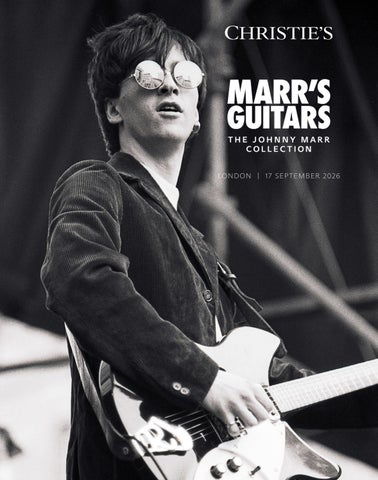
LO N DON | 1 7 S EPTE MBE R 2026
AUCTION Thursday 17 September 2026 at 2.00pm 8 King Street, St. James’s London SW1Y 6QT VIEWING Wednesday Thursday Friday Saturday Sunday Monday Tuesday Wednesday Thursday
9 September 10 September 11 September 12 September 13 September 14 September 15 September 16 September 17 September
10.00am - 5.00pm 10.00am - 3.00pm 10.00am - 5.00pm 12.00pm - 5.00pm 12.00pm - 5.00pm 10.00am - 5.00pm 10.00am - 5.00pm 10.00am - 5.00pm 10.00am - 2.00pm
AUCTIONEERS Yü-Ge Wang, Eugenio Donadoni, Natalia Voinova
AUCTION CODE AND NUMBER In sending absentee bids or making enquiries, this sale should be referred to as MARR-24434 ABSENTEE AND TELEPHONE BIDS Tel: +44 (0)20 7389 2658 Fax: +44 (0)20 7930 8870 CONDITIONS OF SALE The sale of each lot is subject to the Conditions of Sale, Important Notices and Explanation of Cataloguing Practice which appear at the end of the catalogue and are set out online, with other important sale information at christies.com. On occasion, Christie’s or a third party has a financial or other interest in a lot and such interest shall be identified with a symbol on christies. com or with a saleroom announcement. For the most up to date sale information for a lot, please see the full lot description, which can be accessed through the sale landing page on christies.com. BUYER’S PREMIUM In addition to the hammer price, a Buyer’s Premium (plus VAT) is payable. Other taxes and/or an Artist Resale Royalty fee are also payable if the lot has a tax or λ symbol. Check Section D of the Conditions of Sale at the back of this catalogue.
CONTENTS
ACKNOWLEDGEMENTS Christie’s specialists would like to thank the following for their contributions and assistance in preparing this catalogue: Haaris Ali (Fender), Mat Bancroft, Patrick Bryan, Walter Carter, Sam Corbett, Simon Crompton-Reid, Danjaq, LLC and Metro-Goldwyn-Mayer Studios Inc., Dr. Decibel (Celestion Speakers), Michael Dickinson (C.F. Martin & Co.), Seymour W. Duncan, Mark Farrington (Christie’s Photographer), Todd Fath, John Featherstone, James Field, Richard Friedman, Anaïs Gallagher, Noel Gallagher, Roger Giffin, Pat Graham, Bill Henderson (Christie’s Photographer), Richard Henry, Phil Jamison (Matchless Amplifiers), Mitsue Kakuta, Martin Kelly, Jenny Leask, Julio Leipnitz (Christie’s Photographer), Sean Mandrake, Angie Marr, Johnny Marr, Nile Marr, Sonny Marr, Brian Message, Tim Mills (Bare Knuckle Pickups), Justin Norvell (Fender), Ed O’Brien/Radiohead, John Page, Chris Pearce, Jo Power (BMG), Daniel Savastano (The Smiths Museum), Sitcom Soldiers, Michael Spencer Jones, Aly Stevenson, Thames & Hudson, The Cribs/PIAS, Chris Vinnicombe (Gibson), Will Waghorn, Robert Wells (Knight Guitars), Lawrence Wexer, Brett (Mesa Boogie Customer Service), Tod (Ibanez Customer Service) FRONT COVER: Lot 5 (Johnny Marr performing at GLC “Jobs for a Change” Festival, Jubilee Gardens, London, 10 June 1984 © PAUL RIDER / CAMERA PRESS) INSIDE FRONT COVER: Lot 102 (Photo by Pat Graham) PAGE 1: Lot 5 PAGE 2: Johnny Marr backstage at the University of East Anglia, Norwich, 14 February 1984 © PAUL SLATTERY / CAMERA PRESS
RESERVES Lots with a low estimate of £1,000 or less will be sold subject to no reserve and are denoted by • POST-SALE STORAGE Please note that all lots not collected by 5pm on the day of the sale will, at our option, be removed to off-site storage following the auction. Please see page 325 for details of Storage and Collection arrangements.
CHARITY LOTS 100% of the hammer price for select lots in this auction will be split equally between The Guide Dogs for the Blind Association and The National Autistic Society, UK registered charities (charity numbers 209617 and 269425).
SPECIAL NOTICES Guitars, amps and cabs (Instruments) are composite Instruments fabricated with multiple interchangeable parts and components. These include but are not limited to necks, frets, tuners, pickguards, knobs, switches, pickups, and potentiometers. The Instruments in this sale have been used by Johnny Marr as tools of the trade for a professional musician. They have often been altered to fit Johnny Marr’s needs as an artist. These alterations may include changes to the original manufacturer’s parts and finishes. Each lot is sold “as is”. Neither Christie’s or the Seller warrant that any Instrument exists in its original state or that any alterations noted in any Condition Report are final. Please see the Conditions of Sale, which can be accessed through the sale landing page on christies.com, for more information. No copyright, design rights or any other intellectual property rights (whether registered or unregistered) in the lot(s) shall pass to you, your successors or assigns. You warrant for the benefit of Johnny Marr (The Seller) that you will not use, or permit the lot(s) to be used, in any manner that suggests any endorsement by the Seller or their successors or assigns, in each case without the prior written permission of the Seller or their successors or assigns to the rights in their name and image, as applicable. Every effort has been made to contact the photographers and copyright holders of all images reproduced in this catalogue. Please contact Christie’s with any further information.
PAGE 7: Lot 108 ENDPAPERS: The The Versus The World tour, 1990. Photo courtesy of Johnny Marr BACK COVER: Johnny Marr performing at Old Trafford Cricket Ground, Manchester, 25 September 2021 © Alamy
5
SPECIALISTS AND SERVICES FOR THIS AUCTION
Amelia Walker
Kerry Keane
Zita Gibson
Sarah Tennant
Head of Sale Specialist, Head of Private & Iconic Collections awalker@christies.com +44 (0)20 7389 2085
Head of Business Development, EAV & Collection Sales, EMEA zgibson@christies.com +44 (0)20 7389 2488
International Consultant Musical Instruments
Caitlin Graham
International Consultant, Rock & Pop Culture
Venetia Jolly
Senior Sale Coordinator & Cataloguer, Private & Iconic Collections vjolly@christies.com +44 (0)20 7389 2443
Business Director, EAV & Collection Sales stennant@christies.com + 44(0)20 7389 2981
PRIVATE & ICONIC COLLECTIONS LONDON
Elizabeth Comba
Specialist, Private & Iconic Collections ecomba@christies.com +44 (0)20 7389 2254
Mary Gatenby
Junior Specialist, Private & Iconic Collections MGatenby@christies.com +44 (0)20 7389 2595
ENQUIRIES For general enquiries about this auction, please email: MarrsGuitars@christies.com.
6
Adrian Hume-Sayer
Specialist, Private & Iconic Collections ahume-sayer@christies.com +44 (0)20 7389 2696
POST-SALE SERVICES Nick Meyer Post-Sale Coordinator Payment, Shipping, and Collection Tel: +44 (0)20 7752 3200 Fax: +44 (0)20 7752 3300 Email: PostSaleUK@christies.com
Olivia Melvin-Farr
Senior Sale Coordinator & Cataloguer, Private & Iconic Collections owilson@christies.com +44 (0)20 7752 3383
Benedict Winter
Specialist, Private & Iconic Collections bwinter@christies.com +44 (0)20 7389 2203
ABSENTEE AND TELEPHONE BIDS Tel: +44 (0)20 7389 2658 Fax: +44 (0)20 7930 8870 AUCTION RESULTS Tel: +44 (0)20 7839 9060
Charlotte Young
Specialist, Private & Iconic Collections cyoung@christies.com +44 (0)20 7389 2730
CLIENT SERVICES Tel: +44 (0)20 7839 9060 Fax: +44 (0)20 7389 2869 Email: info@christies.com BUYING AT CHRISTIE’S For an overview of the process, see the Buying at Christie’s section. christies.com
I wanted a guitar when I was a little boy. I was five years old when I got my first one, and I still remember that guitar to this day. From then on, my focus was on getting a better one, and then a better one after that, not just because I loved guitars, but because I thought the better my guitar was, the better my life would be. As crazy as that sounds, what’s even crazier is that it seems to have worked out that way. I can’t imagine life any other way. My professional career started out like every other guitar player’s: you scrape together enough money to buy the best instrument you can afford, and if you’re lucky enough to get a break, you buy a better one to take you further on your journey. I used to believe, and still do, that guitars have songs in them. Fortunately for me I was often right. With every step, I upgraded and hunted down the guitars I dreamed would make both me and the band, better. At the time, I didn’t think of it as building a collection. Over the years, as I met and worked with fellow guitar obsessives, opportunities arose for me to acquire some of my dream instruments. I put them all to work, whatever band or project I was involved with at the time: from the early excitement of The Smiths, through the experimentation of Electronic, and on to the albums I made as a member of The The, Modest Mouse and The Cribs. The unique qualities of these guitars helped me evolve as a musician, bringing new sounds and techniques to recording sessions with artists such as Pet Shop Boys, Talking Heads and Oasis, as well as to the film soundtracks I’ve worked on with Hans Zimmer, including Inception and the Bond film No Time To Die.
More than forty years after I began assembling this collection, I published a book called Marr’s Guitars. It was a real labour of love and gave me the perfect excuse to bring all of these instruments together, photograph them and tell their stories. It allowed me to revisit songs written, shows performed, and unforgettable moments shared with remarkable people in studios and on stages around the world. The book’s success took me on the road for a series of events where I brought some of the best-known guitars with me, sharing the songs and stories behind them with live audiences. Each evening felt like both a tribute to the instruments and a celebration of what they’ve meant, not only to me, but also to the people who have grown up seeing and hearing what we created together. I wasn’t looking for it, but the experience turned out to be surprisingly cathartic. So much so that when I returned home and it was time for these beautiful instruments to go back into storage, I couldn’t imagine them being put away and left unplayed. These are musical instruments. They were made to make music. And so to today, and to Christie’s. It’s both poignant and exciting for me to be letting these guitars go to new homes and new people who will love them as much as I have. I hope they bring as much joy, inspiration and fun as they have brought me, and perhaps some good luck too.
9
Johnny Marr is without question the most influential guitarist of his generation. A musician and songwriter with a unique, melodic style whose influence is almost impossible to overstate. Whilst most guitar heroes are known for dazzling solos or flamboyant stage performances Marr has built his reputation on something altogether different: taste, innovation and an uncanny ability to make the guitar shine whilst playing for the song. Born in Manchester on 31 October 1963, Johnny’s parents had emigrated to the UK from County Kildare in Ireland only a few years earlier. Marr received his first guitar aged just five, a small wooden acoustic “from a shop that sold mops, buckets and brooms. My parents say that whenever they tried to walk past the shop, I was glued to the window and my mother had to pull me along. My mates were running around playing Johnny Marr and Andy Rourke in 1978 and 1980. Photos courtesy of Johnny Marr
cowboys and I carried my little wooden guitar around, the way they carried toy guns and bows and arrows. It really was like my best friend.” As a youngster growing up in Ardwick during the late 1960s and early ‘70s Johnny was mesmerised by pop music that blasted from the radio and television in the family home. “There was a connection with music, because our house was full of it” says Marr. “As well as the parties and get-togethers we had in our house with aunties, uncles and my little cousins, my parents were also going out to the Irish clubs.”
Johnny Marr photographed by Andy Rourke in 1978. Photo courtesy of Johnny Marr
10
Following a move to Wythenshawe, a few miles south of Manchester’s city centre, Johnny was becoming obsessed with the guitar, drawing inspiration from
an eclectic array of axe wielding heroes including Marc Bolan, Mick Ronson, Tony Hicks, Rory Gallagher, James Williamson and Bert Jansch. By fusing these disparate styles together, he was gradually finding his feet, learning and developing his own sound whilst sitting in with local bands. The advent of punk rock was not wasted on Johnny whose first live concert was watching Manchester band Slaughter and the Dogs in 1976. By 1980 he had formed his own group with close friend Andy Rourke on bass and as a statement of intent purchased his first Gibson, a brand new Les Paul Standard which he played through a powerful Fender Twin Reverb amplifier. Recalling this period Johnny says: “I started building a repertoire and developing my own style, even though I wasn’t totally aware I was doing it. I just wanted to have my own thing that wasn’t copying anyone else.”
Early promotional shoot of The Smiths, 1984. Photo by Eric Watson © Eugene and Willa Watson
Soon after Marr entered an intense phase of experimentation. Returning to his parents’ home and turning his childhood bedroom into a studio come laboratory where he layered rhythms, chord structures and intricate guitar parts using a simple TEAC cassette machine (lot 3). “I completely isolated myself. There was just me, my girlfriend Angie and the black Les Paul. I took all these concepts I had and just did it all on the guitar.” In May 1982, whilst still only 18, Marr met and began writing songs with Manchester born singer and lyricist Stephen Patrick Morrissey. Widely regarded as one of the greatest songwriting partnerships of all time, Morrissey and Marr soon named themselves The Smiths and after recruiting Andy Rourke on bass and Mike Joyce on drums they signed to Rough Trade Records in early 1983.
Early singles like ‘Hand In Glove’, ‘This Charming Man’ and ‘Heaven Knows I’m Miserable Now’ sounded like nothing that had come before. Chiming, uplifting, melancholic songs that resonated with the times. Music that sounds as relevant today as it did forty plus years ago. The Smiths made a huge cultural impact at an important moment in British history and stood out in a sea of bland early ‘80s pop. Central to their sound was Marr’s guitar playing, at odds with contemporary synth pop, but fresher and more exciting than anything else around. Above all else Marr looked the part and exuded cool on TV appearances that quickly crowned him a guitar hero for a new generation. New sounds required new guitars. First a Gretsch Super Axe (lot 2) followed by Johnny’s iconic Jetglo Rickenbacker 330 (lot 5) which was used to startling effect on ‘This Charming Man’, ‘What Difference Does
11
During their brief five-year existence The Smiths recorded and released 17 singles (14 of which topped the UK independent singles chart), 4 studio LPs, a live album plus a seminal collection of BBC sessions entitled Hatful Of Hollow. Marr quit the band - aged just 23 - on the eve of their final LP release Strangeways Here We Come in September 1987, but within days of the news breaking had received a call from Chrissie Hynde asking if he would join her band The Pretenders for a forthcoming tour supporting U2 across America. Johnny Marr and Matt Johnson on top of the World Trade Center, New York, 1989. Photo by Angie Marr
It Make’, ‘Still Ill’ and many others as Marr perfected his arpeggio chord picking style. Johnny has never considered guitars as simply tools of his trade. Instrument choices are made carefully and concisely, selecting guitars that not only speak to his keen aesthetic sense but those that suit his style of playing at a given time. Marr has often stated that certain instruments arrived with songs within them that were waiting to be unlocked and set free. This was certainly the case with his famous cherry red 1960 Gibson ES-355 (lot 7) that was gifted to him by Sire Records boss Seymour Stein in January 1984. Within minutes of receiving the guitar Marr had composed the music for ‘Heaven Knows I’m Miserable Now’ followed quickly by ‘Girl Afraid’. Similarly, his 1971 Martin D-28 (lot 21) acoustic which inspired the songs ‘There Is A Light That Never Goes Out’ and ‘Cemetry Gates’. Marr’s taste in guitars is as broad as his musical interests and with The Smiths’ success came a steady flow of new arrivals to inspire and encourage the young songwriter. By 1985 The Smiths were one of the biggest bands in the UK with their second LP Meat Is Murder hitting the number one spot on the national charts. But although the band’s cult status and popularity has grown over the intervening decades, their career was to be short-lived.
12
In 1988 Johnny joined his friend Matt Johnson - who he’d met prior to forming The Smiths - in his group The The to record the albums Mind Bomb and Dusk plus subsequent touring. It was during this time that he and New Order frontman Bernard Sumner hatched plans for a techno-dance Supergroup which they named Electronic. The band’s 1989 debut
Promotional photo of Johnny Marr and Bernard Sumner for Electronic’s debut album, 1991 © Todd Fath
single ‘Getting Away With It’ was co-written with Neil Tennant and became an independent number one upon release. “To Bernard’s credit he made me play more guitar with the band than I had originally intended which is kind of mad now that I think of it” recalled Marr when discussing the group’s second single ‘Get The Message’ which also hit number one on the UK indie charts. As the 1990s arrived Johnny had earned a reputation as an important session musician and co-writer with credits that today include Talking Heads, Bryan Ferry, Pet Shop Boys, Gorillaz, Beck, Franz Ferdinand, Billie Eilish, Oasis and Hans Zimmer. The Britpop explosion of the mid-90s owed an enormous debt to The Smiths’ songwriting and Marr’s guitar innovations with Noel Gallagher, Graham Coxon, John Squire, Bernard Butler, Ed O’Brien, Jonny Greenwood and countless others acknowledging his importance. Beyond the UK Marr’s influence can be heard in American indie rock, dream pop, alternative and modern postpunk bands. Artists including The Killers, Death Cab for Cutie, Interpol and The War On Drugs have incorporated aspects of his melodic guitar style into their own music.
The Healers, Manchester 2002 © Jon Shard
The new millennium saw Johnny form The Healers around a nucleus of himself - taking on lead vocal duties for the first time - Zak Starkey on drums and Alonza Bevan on bass guitar and keyboards. The group’s excellent 2003 debut album Boomslang proved to be a vital stepping-stone towards Marr’s solo career which was set to flourish a decade later. In 2005 Johnny received a call out of the blue from Modest Mouse frontman Isaac Brock cheekily asking if he would consider joining his band. “I’m the same person I was when I was fifteen” said Marr, “so jumping on a plane and going to Portland is the grown-up version of me getting on a bus to Whalley Range to play with Sister Ray. So I said yes.” Johnny’s four-year stint with Modest Mouse between 2006-2009 would prove pivotal for a number of reasons. Firstly, it involved moving his family to set up a new home in the United States. It offered Johnny a new lease of life, a fresh
Johnny Marr with Modest Mouse members Tom Peloso, Joe Plumber, Jeremiah Green, Eric Judy and Isaac Brock, on the back steps at the Ryman Theater (Grand Ole Opry), Nashville, TN, 22 August 2007. Photo by Pat Graham
13
and exciting musical outlet, one that would result in a massive hit single ‘Dashboard’ and his first US number one album We Were Dead Before the Ship Even Sank. Not only that but Johnny’s first meeting with Brock led to the discovery of a guitar that had been hiding in plain sight all his life, an instrument that would change the course of his musical journey the Fender Jaguar. Marr: “I said to myself. ‘This Jaguar is making me play like me.’ It was like. ‘Where have you been all my life?’ That moment kicked off a whole new phase in my life, and it was all triggered by a riff. Whenever we started playing ‘Dashboard’ it felt to me like the Jag was the star.” Since acquiring his first Jaguar from Brock back in 2005 Marr has gone on to become the musician most associated with this iconic Fender model and is rarely seen without a Jag on stage or in the studio. In 2012 Fender honoured Johnny’s patronage with the release of his own signature model.
Promotional photo of The Cribs for Ignore the Ignorant, 2009 © [PIAS]
14
Ever keen on perfecting his sound and playing technique, Marr had worked closely with the UK’s finest guitar technician and luthier Bill Puplett since the early 90s. Together Bill and Johnny had made changes and refinements to Marr’s instruments for years but when the idea of a signature Jaguar was tabled Johnny immediately knew he wanted to create something special. A guitar tailored to his own requirements but one he hoped would inspire others. Work began as early as 2008 on a series of prototypes (lot 82) and test bed guitars where ideas were trailed and tested. A new bridge was developed along with a vibrato arm that held its position when out of play. The defining feature though was a completely redesigned pick-up and switching system that brought the Jag into the 21st Century without losing any of its original character. Developed by Marr with the able assistance of Bill Puplett the Johnny Marr Signature Jaguar has gone on to be a bestseller for Fender and a must-have for countless young guitarists around the world. Johnny
Johnny Marr and his band, James Doviak, Jack Mitchell and Iwan Gronow, with Nile Marr, A Night With The Johnny Marr Orchestra, The Warehouse, Aviva Studios, Manchester, 8 December 2023 © Riaz Gomez
remains actively involved in the model’s ongoing evolution, creating special one-off instruments in unique finishes and a recent 3-pickup Signature Special (lot 111). Following his time with Modest Mouse Marr joined UK indie-rock band The Cribs to record and tour their top 10 LP Ignore The Ignorant. Once again, his Fender Jaguar was central to proceedings but during his time with The Cribs Johnny had begun work on what would become his first solo album. Time spent with Modest Mouse and The Cribs had reinvigorated Marr as a writer, performer and producer and in 2013 he released his debut solo album The Messenger. Marr emerged as a confident, charismatic and commanding frontman. “In many ways, it feels like all the various bands and projects I’ve been involved with over the years were steps I needed to take varied and important ones - to get where I am now” claimed the singer in his book Marr’s Guitars. Whilst Rolling Stone magazine went on to state that with The Messenger Johnny had ‘finally made the solid solo debut he should have recorded a quarter-century ago’. Stand out singles like ‘Upstarts’ and ‘New Town Velocity’ became radio hits that led to sold out tours
around the world. Three more UK top 10 albums Playland (2014), Call the Comet (2018) and Fever Dreams Pts 1-4 (2022) - cemented Johnny as an important solo artist and it’s now hard to imagine a time when he wasn’t centre stage. Today Marr’s influence can be heard across alternative rock, indie music and contemporary guitar pop. He has co-composed and contributed to several Hans Zimmer film scores including Inception and The Amazing SpiderMan 2 and was the featured guitarist on Billie Eilish’s Oscar winning James Bond theme for No Time To Die. As successive generations discover The Smiths anew Marr himself continues to produce relevant music that refuses to rely on past achievements. He retains an enthusiasm, skill and passion for songwriting that is evidenced on his latest LP The Age Of Everything. Christie’s sale of Marr’s Guitars in September 2026 should be seen as a celebration of one of the UK’s finest and most loved guitarists. Johnny’s decision to part with many of the most prized instruments he has used over his illustrious career illustrates a musician moving forward, constantly evolving and not wanting to hold onto the past. Martin Kelly July 2026 15
The Messenger (2013), photo by Mat Bancroft; Playland (2014), photo by Jon Shard; Call The Comet (2018), photo by Niall Lea; Fever Dreams Pts. 1-4 (2022), photo by Niall Lea; The Age Of Everything (2026), photo by Andrew Cotterill; all courtesy of Johnny Marr/BMG
1
LEARN MORE
A SOLID-BODY ELECTRIC GUITAR, LES PAUL STANDARD GIBSON INCORPORATED, KALAMAZOO, MICHIGAN, 1980 The logo Gibson inlaid at the headstock and silkscreened Les Paul / MODEL, engraved Standard on the truss rod cover, stamped 82750673 on the reverse, the mahogany body with three-piece maple cap, the laminated maple neck with bound East Indian rosewood fingerboard and pearloid block inlay, of black finish, together with a hardshell case Length of body: 17¿ in. (43.5 cm.) £5,000-8,000
US$6,800-11,000 €5,900-9,400
LITERATURE:
J. Marr, Set The Boy Free, Century, London, 2016, pp. 91-92, illus. photo section 1, p. 5. J. Marr, Marr’s Guitars, Thames & Hudson, London, 2023, pp. 10-11, 45.
- JOHNNY MARR, MARR’S GUITARS, 2023
18
In addition to the hammer price, a Buyer’s Premium (plus VAT) is payable. Other taxes and/or an Artist Resale Royalty fee are also payable if the lot has a tax or λ symbol. Check Section D of the Conditions of Sale at the back of this catalogue.
Johnny Marr at his parents’ home in Wythenshawe, Manchester, 1981. Photo by Angie Marr
In conversation with author Martin Kelly for Marr’s Guitars, Marr laid out why his first serious guitar simply had to be a Les Paul: I loved all guitars but started getting together my own taste, my own individuality, aged around fourteen or fifteen, and that coincided with punk. I always wanted a Les Paul, which went back to liking Marc Bolan. He really put it into my mind that the Les Paul was the most desirable guitar. But then a lot of the punk guitar players that I started to see were also playing Les Pauls… Eventually, I got together enough money to buy a sunburst Satellite Les Paul copy. That did me for a couple of years, and I started to get good on that. [It] was as close as I could get to James Williamson's 1973 Les Paul Custom. After hearing Raw Power by Iggy and the Stooges, and with my love of Marc Bolan, no other guitar was going to compete with a Les Paul. Marr went on to chronicle his history with this guitar: The first guitar in [Marr’s Guitars] is my black Les Paul Standard and I got it when I was seventeen. I was with my girlfriend Angie, who's now my wife, and we'd got into the habit of going down to the King's Road in London and buying clothes wholesale, then bringing them back to Manchester and selling them to our mates. Eventually, the two of us saved enough money to buy a second-hand Les Paul Standard and a Fender Twin Reverb amp (lot 6). That was the first guitar I ever bought from A1 Repairs in Manchester. I would end up buying quite a few important ones from that shop over the years. My best pal for a long time was Andy Rourke, who later became the bass player in The Smiths, and me and Andy would jam for hours. Me getting the black Les Paul coincided with Andy switching to bass, and I was coming up with a
lot of ideas for songs and riffs… I formed my own band, with Andy on bass, and we were doing a lot of power pop stuff… That was my apprenticeship as a writer and a guitar player, playing other people's songs. It was a good learning experience. I think I did have a feeling that I was onto something, Marr continued. I remember having that feeling because I told all my mates, “I'm disappearing for a bit”. And I had a year zero, where I completely isolated myself. There was just me and Angie and the black Les Paul, and I went back to my parents' house and back to the drawing board. I treated my bedroom, my record player and my Fender Twin Reverb like a laboratory. I used a TEAC tape machine, which you could overdub on by just plugging into the front of it. I took all these concepts that I had and just did it all on the guitar, with no drum machine or effects. If I wanted to put a beat down, I would do it by scratching rhythm on the strings. That would give me my drum sound… I started experimenting, trying to find what I was feeling like, and those experiments turned into the early Smiths songs. Marr would eventually trade his 1980 Les Paul Standard for a Gretsch Super Axe (see next lot) when he formed The Smiths in 1982. Some forty years later, guitar technician Richard Henry discovered an identical 1980 Les Paul Standard in a Southport record shop less than fifty miles outside Manchester that appeared to match photographs he had seen of Marr’s first Les Paul. Marr positively identified the guitar as the same much-loved Les Paul he had owned while honing his craft in the early 1980s and bought it back for its sentimental value.
19
Johnny Marr performing at The Electric Ballroom, Camden, London, 1983 © PAUL SLATTERY / CAMERA PRESS
2
LEARN MORE
A SEMI-HOLLOW-BODY ELECTRIC GUITAR, ATKINS SUPER AXE, MODEL 7680 THE FRED GRETSCH MANUFACTURING COMPANY, BOONEVILLE, ARKANSAS, 1977 The logo GRETSCH inlaid at the headstock, labelled internally MODEL NO. 7680 / SERIAL NO. 10-8333 / MADE IN U.S.A., the body of laminated maple, the two-piece laminated neck of maple with bound ebony fingerboard and block pearl inlay, of Cherry Red finish, together with a hardshell case stencilled in white The Smiths Length of body: 17¬ in. (44.8 cm.) £20,000-30,000
US$28,000-41,000 €24,000-35,000
EXHIBITED:
Manchester, The John Rylands Library, Collection: Launching the British Pop Archive, 19 May 2022 - 15 January 2023.
20
LITERATURE:
G. Twigg, ‘Johnny Marr’, Guitarist, vol. 1, no. 9, February 1985, pp. 55-56. H. Wylie, ‘Johnny Marr: Beyond The Smiths’, Total Guitar, Issue 6, May 1995, pp. 37-43. M. Leonard, ‘This Chiming Man’, The Guitar Magazine, January 1997, pp. 24-33. B. Cleveland, ‘Healer’s Touch: Johnny Marr’s Magic Fingers’, Guitar Player, February 2003, pp. 68-78. P. Slattery, The Smiths: The Early Years, London, 2007, illus. pp. 10, 45-46, 49, J. Marr, Set The Boy Free, Century, London, 2016, pp. 103, 137-8. R. Brakes, 'Marr's Guitars', Guitarist, Issue 434, July 2018, illus. p. 80. M. Kelly, P. Kelly, Rickenbacker: Pioneers of the Electric Guitar, London, 2021, p. 313. J. Marr, interviewed by D. Steinhardt and M. Taylor, 'Johnny Marr Talks Guitars & A Life In Music', posted on 20 October 2023 by That Pedal Show, YouTube. https://www.youtube.com/watch?v=NjY2O92ByNw&t=3129s. J. Marr, Marr’s Guitars, Thames & Hudson, London, 2023, pp. 12-15, 112-113, 130-135, 285. J. Marr, 'Johnny Marr: Marr's Guitars', posted 15 January 2024 by Thames & Hudson, YouTube. https://www.youtube.com/watch?v=JLVD1eg8RIk.
In addition to the hammer price, a Buyer’s Premium (plus VAT) is payable. Other taxes and/or an Artist Resale Royalty fee are also payable if the lot has a tax or λ symbol. Check Section D of the Conditions of Sale at the back of this catalogue.
- JOHNNY MARR, MARR’S GUITARS, 2023
In early 1982, Johnny Marr returned to A1 Repairs in Manchester to trade his Les Paul Standard (see previous lot) for this 1977 Gretsch Super Axe. Co-designed by Chet Atkins, the Super Axe featured built-in compression and phaser circuits, each with their own on/ off switch. It has a solid body in the old conventional Gretsch shape with one cutaway and it's really thin...they're good guitars to play and not that expensive either, Marr told Guitarist in 1985. As this was the sole electric guitar that he owned for the first twelve months of The Smiths’ career, there is no doubt that Marr used this Super Axe for all of the early writing sessions with Morrissey that would shape the band’s debut album and played it exclusively throughout the band’s early gigs as they were first starting out and beginning to gain a following. Speaking to author Martin Kelly for Marr’s Guitars, Marr explained what drew him to the Gretsch: Just before forming the band, I traded in my black Les Paul for a Gretsch Super Axe, because I wanted a Gretsch and that model was the one I could afford. I wanted something a bit more fifties, because an aspect of being a guitar player and a guitar obsessive is a guitar's associations… Before the 1980s, the Les Paul had influenced a lot of punk players because of three people: Mick Ronson first and foremost, Pete Townshend and Paul Kossoff. They had all been associated with the Les Paul, but by 1979, 1980, 1981 when I was starting out, there was a new wave coming. A lot of guitarists of my age were starting to get interested in Gretsches and 1950s guitars… it was almost like the Gibson Les Paul and Fender Stratocaster fell out of favour after the 1970s, and guitarists my age wanted something different. FORMING THE SMITHS Having split with prior band Freak Party, the seventeen-year-old Marr was lodging with ‘80s TV presenter Shelley Rohde at her home in Bowdon and working at Manchester’s hip new store X-Clothes. Every spare moment was spent honing his craft, working out short compositions on the Super Axe and experimenting with overdubs on his TEAC cassette machine (lot 3). I’d work on a chord sequence until I was happy with it and then record a second guitar part on top, recalled Marr in his 2016 autobiography. I would then bounce the two tracks together and experiment with putting more guitars on. I could build up the tracks by bouncing and overdubbing and create my own wall of sound… Eventually I started to get a collection of instrumental pieces together and I ended up with quite a few ideas for songs. When the time came to put a new band together, Marr identified Steven Morrissey – whom he had met once before at a Patti Smith gig some years previously – as the only good vocalist around and was inspired to track him down, ultimately turning up on his doorstep in late May 1982 to invite him to form a band. Their historic songwriting partnership would begin mere days later when the pair agreed to meet in Marr’s attic bedroom in Bowdon to try working on some songs together.
story appearing in my eyes and my mind. I followed the momentum as my guitar delivered the music under the voice, and the song was suddenly all there, a song that didn’t sound like anyone else and didn’t feel like anyone else, a song about the Moors murderers. I didn’t know what to make of it. All I knew was how it felt, and it felt strangely true… Apart from the surprise of being presented with such unexpected words, there was one sentiment about coming from the north in that second song that caught my attention more than anything else, and it defined an aspect of us from that first day of us working together. It said to me, “We do things differently”. THE SMITHS’ FIRST DEMO RECORDING AND FIRST PUBLIC PERFORMANCE With Dale Hibbert on bass and Simon Wolstencroft on drums, The Smiths recorded ‘The Hand That Rocks the Cradle’ and ‘Suffer Little Children’ for their first demo at Manchester’s Decibel Studios in August 1982. Drummer Mike Joyce had replaced Wolstencroft by the time the new band gave their first public performance as a support act for Blue Rondo à la Turk during a student music and fashion show at The Ritz in Manchester on 4 October 1982. We’d decided that at the Ritz we’d play ‘Suffer Little Children’, ‘The Hand That Rocks the Cradle’ and a new one we’d written, called ‘Handsome Devil’, wrote Marr. We also planned to do a song by the girl group The Cookies, called ‘I Want a Boy for My Birthday’… I ascended the stairs to the stage for the very first show by The Smiths and my first official engagement as a professional musician. Thwang! What the …? A wave of cold dread rushed through me as I realised I’d banged the headstock of my guitar against the wall. It was a sign, it had to be, the moment was too significant; it meant that either all my dreams and life’s work thus far were about to expire in the next critical minute, or I had just exorcised all the bad luck I had accrued over my eighteen years with one divine bang of my Gretsch. I held the pick and looked out into the spotlight. My left hand formed the G6 chord that opened the first song and … strum … strum … it was … half and half – not totally perfect and glorious, but not too imperfect and disastrous for me not to be able to guide it and live with. Maybe it was symbolic.
Morrissey came over in the afternoon, wrote Marr. It was another beautiful day, and through the open window we could hear the sound of the schoolkids playing. Morrissey took out some more lyrics for me to work on. As I took the pages I saw the title ‘The Hand That Rocks the Cradle’, and without thinking about it I started playing a chord change along the lines of the Patti Smith song ‘Kimberly’. It seemed to scan right with the words and suggested a bass line, which I played at the same time. I continued to play, and then Morrissey started singing the words, and within a few minutes the tune was born. After laughing a lot and rehearsing it a couple more times, I recorded what we had on my tape machine, then I overdubbed a ringing guitar line on top, and my new partner and I had our first song. It felt like an important moment… I looked at the next lot of lyrics, for a song called ‘Suffer Little Children’, and as I sat cross-legged on the floor with my guitar and the two sheets of paper at my feet, I pressed ‘record’. As I looked down at the words again, my hands started to play a tune. Something was happening; the song was coming through the ether. I kept going with the verse and Morrissey started singing along, the words and
23
SONGWRITING PROCESS AND TUNING UP A STEP It was the only date that Hibbert would play with the band before being replaced with Marr’s schoolfriend Andy Rourke on bass, thereby cementing the core line-up of The Smiths. EMI had showed enough interest in the band to cover the cost of a second demo at Drone Studios in Chorlton in December 1982, before ultimately turning them down. Morrissey and I had been writing with a passion, recalled Marr, and we had enough money from EMI to record three songs: ‘Handsome Devil’, ‘Miserable Lie’ and a new one called ‘What Difference Does It Make?’ The duo swiftly established a songwriting process whereby Marr would first write the music and hand over to Morrissey to then write the lyrics to fit. New songs usually started with me recording the music on to a cassette and then giving it to Morrissey to write his lyrics and vocal lines, which he would complete within a day or two, recounts Marr. Other times we would get together at my place and sit face to face, about three feet away from each other, while I played my new tune into a tape recorder that was balanced between my knees… There was nothing that could compare to having a new song; it was always the best thing. But we were pragmatic and well aware that we had to keep them coming and make them better, not only for the band’s career but to prove something to ourselves as writers. Marr got into the habit of tuning this guitar up a step to accommodate Morrissey’s baritone. I wanted to make the sound different, Marr explained to Total Guitar in 1995. Added to that, Morrissey’s voice was so low – so a strange thing went on in most of the early Smiths’ songs. I used to tune up to F#, Andy used to tune down to D… Between the bass and the guitar, you’d get some strange stuff going on. But I snapped too many strings that way. I had this old Gretsch Duo Jet [sic], but I was always snapping strings on it and I didn’t have another guitar. So I went back to conventional tuning and used a capo. I just thought it’d be more interesting. Speaking to The Guitar Magazine in 1997, Marr added: I was writing on my Gretsch Super Axe, which just sounded better tuned up. Interviewed for Guitar Player in 2003, Marr elaborated: It didn’t sound good at concert pitch, so I tuned up a whole step… I wrote the band’s initial songs like that, and to an extent, the tuning dictated where Morrissey was coming from on the first album. But when we got a record deal I could afford a capo. THE HAÇIENDA The Smiths played their second show at Manchester’s Manhattan Sound on 25 January 1983. We played the same set as we had at the Ritz, recalled Marr, but added ‘What Difference Does It Make?’ and a couple of other new ones, including the first of our sad and pretty compositions, called ‘What Do You See in Him?’, which I loved. It was a big moment for the band when they secured a slot supporting the Factory Records band 52nd Street at Manchester’s famous Haçienda club for their third ever gig on 4 February 1983. The place was so cavernous and boomy it felt like we were playing to just a handful of our friends in a big concrete room, which turned out to be exactly what it was. The show was professionally recorded by Claude Bessy for IKON but never commercially released, remaining largely unseen until bootlegs surfaced on YouTube in the late 2000s. The gig was also notable for the live debut of the band’s future single ‘Hand In Glove’, as well as the songs ‘Jeane’ and ‘Miserable Lie’. The band debuted another new song ‘Accept Yourself’ when they opened for Richard Hell & the Voidoids at Manchester’s Rafters on 21 February 1983. It was cool to be playing with someone whose records I’d admired, wrote Marr, and I considered the show to be our first real test in front of a non-partisan crowd. We had to stop the set as I broke a string, and because I didn’t have a back-up guitar I had to go through what seemed like a lifetime changing the string onstage while the band waited.
HAND IN GLOVE While Marr first struck upon the riff that would become ‘Hand In Glove’ on an old acoustic guitar he’d left at his parents’ house, he would develop the song on the Super Axe before the band next got together to rehearse at their manager Joe Moss’ Crazy Face factory on Portland Street. I was eager to show Mike and Andy the new song and we had it sounding good straight away. Morrissey then took the mic and held a sheet of paper, we all went into the song for the first time together, and bang! It was called ‘Hand in Glove’ and it was the best thing we’d done. The spirit in the singing was the same as the spirit in the guitar. The song defined us and described the devotion and solidarity of a powerful friendship. It was a declaration and our manifesto. The words were perfect, the music was perfect, my life was perfect. With the band unanimous that the song was their best yet, Moss stepped up to fund the professional recording of ‘Hand In Glove’ with a one-day session at Stockport’s Strawberry Studios on 27 February 1983. When the moment finally came to make my first record, wrote Marr, it was like stepping up to destiny. We saw the red light and dived into the first take, and then did a second, more confident take. It was sounding good to us already and we were enjoying the experience. By the third take, we had upped the feeling even more. Our nervousness meant that we’d played the song slightly fast, but it turned out to be a good thing as it gave the performance an impatience and enthusiasm. We captured a rush: take three could be the record… I set about finishing the track by doubling the electric guitar and then overdubbing an acoustic twice on the right-hand side. Mike played a tambourine part and then Morrissey recorded a ghostly backing vocal. It was inspired. As we were mixing the song, I wondered if there was something we needed to announce the start of the record, a kind of finishing touch. I took out the harmonica, asked everyone to bear with me in case it didn’t work, and I came up with a phrase in the corridor on my way into the live room. I recorded the harmonica and I’d made my first record. When it was done, I went outside and the mood of the record was all there in the street. It sounded like it was from the mist of the north and from somewhere in the past. It sounded like the future too. While the band wracked their brains for how best to secure the release of their new record, they booked their first London appearance at the Rock Garden in Covent Garden on 23 March 1983. The Rock Garden was a little brick basement that sounded like a tin can and had the appropriate no-frills ambience referred to as ‘throw and go’, recalled Marr. We clambered up to the tiny high stage and played a spirited set to not many people, which because we felt on trial brought out a defiance in us that we would learn to call upon in the future. The audience liked us enough to call us back for an encore, which was a first for us and made the gig feel like a victory. With his mind set on independent record label Rough Trade, Marr turned up at their London office in mid-April 1983 and successfully persuaded founder Geoff Travis to release ‘Hand In Glove’ as a single. With a live recording of ‘Handsome Devil’ from the Haçienda show on the B-side, ‘Hand In Glove’ was released as The Smiths’ debut single on 13 May 1983, reaching number three on the UK Indie Chart and leading to their first major live reviews in the music press. I had fantasised about having my own single from the age of 11, 12, Marr told Record Collector in 2018, so for me it was the pinnacle of a very unusual journey, because I had started it so early. That the sound of that single was appreciated by people was amazing… I felt like it had a magic in the sound; it’s a strange sounding record, it’s got a mist, a haze in it. Reviewing their show at The Venue in London, NME’s Barney Hoskyns described ‘Hand In Glove’ as one of the year's few masterpieces, a thing of beauty and a joy forever.
Opposite: Photo by Pat Graham
25
FIRST JOHN PEEL SESSION The band caught the attention of John Peel's producer, who invited the band to record a session for Peel’s BBC Radio 1 show on 18 May for broadcast on 31 May 1983. Marr recalled their first of many Peel sessions: Once we had recorded the main take of a song to our satisfaction with the basic guitar, bass, drums and vocal tracks, Morrissey would then re-record his vocal quite quickly, and when that was done I would go through the drum track to make sure it was right, so Andy could then work on the bass if we wanted to change or refine anything. After this, the recording became fun for me. We knew we had the foundations of the music right, so I could then devise whatever guitar overdubs were needed and experiment with ideas, using the different techniques I was learning along the way. The 18 May session, which featured the songs ‘What Difference Does It Make?’, ‘Miserable Lie’, ‘Reel Around the Fountain’, and ‘Handsome Devil’, was posthumously released as an EP The Peel Sessions in 1988.
The Smiths signed a full record contract with Rough Trade and plans were set in motion to begin recording their debut album in July 1983, with Troy Tate of the Teardrop Explodes brought in to produce. Known as the “Pablo Cuckoo Tape”, a leaked rehearsal tape featuring nine of the best songs the band had developed thus far was recorded in May 1983 so that Tate would have something to work with ahead of the planned album sessions. The catalogue of songs that had been written on the Gretsch Super Axe since Marr first linked up with Morrissey in late May 1982 included: The Hand That Rocks The Cradle Suffer Little Children Handsome Devil Miserable Lie What Difference Does It Make? Wonderful Woman These Things Take Time Reel Around The Fountain I Don’t Owe You Anything Hand In Glove Jeane Accept Yourself You’ve Got Everything Now A flurry of gigs followed in the wake of the modest success of the single release, as The Smiths began to build up a following over the spring/ summer of 1983. The Smiths’ performances that are known to have taken place over the twelve-month period that Marr exclusively played this Gretsch Super Axe include: The Ritz, Manchester, 4 October 1982 Manhattan Sound, Manchester, 25 January 1983 The Haçienda, Manchester, 4 February 1983 Tower Ballroom, Birmingham, 9 February 1983 Rafters, Manchester, 21 February 1983 Rock Garden, London, 23 March 1983 University of London Union, London, 6 May 1983 Electric Ballroom, London, 21 May 1983 Park Pavilion, Cannock, 2 June 1983 Fighting Cocks, Birmingham, 3 June 1983 Brixton Ace, London, 4 June 1983 Photographer Paul Slattery shot several superb images of Marr playing the Super Axe at both ULU and the Electric Ballroom in London in May 1983. The guitarist looked really cool in his shades, and his sound was amazing, the best guitar sound I'd heard in years, wrote Slattery in 2007 photo book The Smiths: The Early Years. Recalling the latter gig, he added: The Smiths were supporting The Fall at the Electric Ballroom... Towards the end of the gig, the crowd had realised how good The Smiths were even though most of them had gone along to see The Fall. The Smiths knew this and it pushed them up a gear.
Photo by Pat Graham
26
It’s believed that The Smiths’ performance at the Brixton Ace on 4 June 1983 was the last live appearance of the Super Axe. By the time that The Smiths returned to play the Brixton Ace on 29 June, Marr had acquired his famous Rickenbacker 330 and effectively retired the Super Axe from use, as he told Guitarist in 2018: I’ve kept it in exactly the same condition it was in at the last Smiths gig I used it for.
3
LEARN MORE
A SIMUL-SYNC STEREO CASSETTE DECK, A-108 SYNC BY TEAC, TOKYO, JAPAN, CIRCA 1980 Serial no. 17554 6¿ x 16¿ x 10¬ in. (15.5 x 41 x 27 cm.) £1,000-1,500
US$1,400-2,000 €1,200-1,800
LITERATURE:
G. Twigg, ‘Johnny Marr’, Guitarist, February 1985, p. 55. J. Marr, Set The Boy Free, London, 2016, pp. 103, 205. R. Brakes, 'Marr's Guitars', Guitarist, Issue 434, July 2018, illus. p. 82. J. Marr, Marr’s Guitars, London, 2023, pp. 45, 113. J. Marr, interviewed by D. Steinhardt and M. Taylor, 'Johnny Marr Talks Guitars & A Life In Music', posted on 20 October 2023 by That Pedal Show, YouTube. https://www.youtube.com/watch?v=NjY2O92ByNw&t=3129s.
Johnny Marr acquired this TEAC cassette machine in 1980, at a critical time when he was developing the skills that would set him apart as a uniquely imaginative songwriter and player, as well as allowing him to hone his recording techniques. Recounting this period to guitar expert Martin Kelly, Marr explained: I had a year zero, where I completely isolated myself. There was just me and Angie and the black Les Paul, and I went back to my parents' house and back to the drawing board. I - JOHNNY MARR, MARR’S GUITARS, 2023
28
In addition to the hammer price, a Buyer’s Premium (plus VAT) is payable. Other taxes and/or an Artist Resale Royalty fee are also payable if the lot has a tax or λ symbol. Check Section D of the Conditions of Sale at the back of this catalogue.
treated my bedroom, my record player and my Fender Twin Reverb like a laboratory. I used a TEAC tape machine, which you could overdub on by just plugging into the front of it. I took all these concepts that I had and just did it all on the guitar, with no drum machine or effects. If I wanted to put a beat down, I would do it by scratching rhythm on the strings. That would give me my drum sound. Then I got a Boss Flanger pedal. I started experimenting, trying to find what I was feeling like, and those experiments turned into the early Smiths songs. In his autobiography, Marr recalled using the tape machine to develop what would become his signature technique of layering multiple guitar parts: I’d recently traded my Les Paul for a red Gretsch Super Axe and [used] a Teac cassette machine that had an overdub facility. I’d work on a chord sequence until I was happy with it and then record a second guitar part on top. I would then bounce the two tracks together and experiment with putting more guitars on. I could build up the tracks by bouncing and overdubbing and create my own wall of sound. Eventually I had a lot of tapes of chord patterns and riffs done entirely with guitars, and Ollie [May, his housemate at Shelley Rohde’s house in Bowdon] and I would listen to them over and over. It was great to have the freedom to work on things, and I really liked having my own domain… I had my little three-track [sic] cassette machine that enabled me to put down an idea and then layer a riff over the top, and I became quite good at coming up with things that sounded full without it needing much else besides the guitar. It was while living at Shelley Rohde’s house in Bowdon that Johnny Marr would meet Steven Morrissey, on 31 May 1982, where the tape machine in his attic bedroom would be a crucial element in the early development of their intensely creative song-writing partnership. Our second meeting was in my room at Shelley’s… Morrissey took out some more lyrics for me to work on. As I took the pages I saw the title ‘The Hand That Rocks the Cradle’, and without thinking about it I started playing a chord change along the lines of the Patti Smith song ‘Kimberly’. It seemed to scan right with the words and suggested a bass line, which I played at the same time. I continued to play, and then Morrissey started singing the words, and within a few minutes the tune was born. After laughing a lot and rehearsing it a couple more times, I recorded what we had on my tape machine, then I overdubbed a ringing guitar line on top, and my new partner and I had our first song.
The TEAC tape machine helped set the template for Marr and Morrissey’s song-writing method in The Smiths, as Marr recalled in Set The Boy Free: New songs usually started with me recording the music onto a cassette and then giving it to Morrissey to write his lyrics and vocal lines, which he would complete within a day or two. Other times we would get together at my place and sit face to face, about three feet away from each other, while I played my new tune into a tape recorder that was balanced between my knees. All the early Smiths demos, including all the songs on their eponymous first album, were developed and recorded in this way, including their second single, ‘This Charming Man’, as Marr told Martin Kelly: I played these chords, the underlying chords, into my TEAC and I went G G G G G G G D, A minor, C D G. That was the bed of ‘This Charming Man’, and I pressed stop, and then I rewound it. I went to do the overdub and I just did that riff, straight away, on top of it. The Smiths’ song-writing process was explained by Morrissey when interviewed by the BBC on 12 February 1985, the day after the release of their second studio album, Meat Is Murder: Johnny puts the music down on a cassette, with guitar, and he gives me the cassette, and I live with the cassette for a few days, and I just wheedle words into the cassette. By then the TEAC had been upgraded, likely when the band had moved to London in the summer of 1984 on the back of the enormous success of their first album. Specifically recounting a remarkably prolific weekend in June 1984 when he wrote what would become ‘William, It Was Really Nothing’, ‘Please Please Please Let Me Get What I Want’ and ‘How Soon Is Now?’, Marr recalled: Angie had gone back to Manchester for the weekend and the band had a rare couple of days off, so I found myself alone in the flat. I’d upgraded my early Teac cassette recorder for a four-track Tascam Portastudio and a Roland Dramatix drum machine. I decided that after I’d demoed the next A-side I would try to come up with the B-side and then the extra track for the 12-inch while I had the opportunity. In an interview for Guitarist magazine in February 1985, Marr told Geoff Twigg: Considering he [Morrissey] doesn’t play any instrument (and he's so against playing an instrument, he really does consider his forte to be vocals), he's got an amazing sense of melody and adventure. When we write, I normally take along the complete backing track which I put together on a Portastudio. I used to have a TEAC two-track with Simul-Sync and I did it on that but now I can put four tracks down.
4
LEARN MORE
JOHNNY MARR’S HARMONICAS HOHNER, GERMANY, 1980S A composite set comprising seven black Pro Harps, three in B, one in C, two in E and one in G, and five chrome Blues Harps, one in A with timber front, the others with black fronts including one in C, two in D and one in F; all contained in a black plastic Hohner hardshell case Each: 4 in. (10 cm.) long The case: 12º x 8 x 3º in. (31 x 20 x 8.5 cm.) (12) £1,000-1,500
US$1,400-2,000 €1,200-1,800
The harmonica has featured in Johnny Marr’s life since childhood, with his uncle Pat Murphy and father both adept players and showing the young Johnny how to pick out the notes of their favourite rock n’ roll tunes. In his late teens Marr decided to take up the instrument with more determination, describing in his 2016 autobiography how Angie getting the car coincided with me reacquainting myself with the harmonica. The Beetle was the only place I could practise without driving everyone mad, and she had to put up with me blowing harp along to a tape of the Stones’ second album wherever we went. It was great for us to finally be mobile as we could see each other more, and I started getting good enough on harmonica to decide that it should feature in whatever group I put together next.
30
Embracing this resolution when The Smiths came to record their debut single, ‘Hand In Glove’ at Strawberry Studios in Stockport, in February 1983, Marr’s overdubbed harmonica added a final flourish, anchoring the song over the guitars and drums. Recounting the band’s first studio experience, Marr recalled: Our nervousness meant that we’d played the song slightly fast, but it turned out to be a good thing as it gave the performance an impatience and enthusiasm… I set about finishing the track by doubling the electric guitar and then overdubbing an acoustic twice on the right-hand side. Mike played a tambourine part and then Morrissey recorded a ghostly backing vocal. It was inspired. As we were mixing the song, I wondered if there was something we needed to announce the start of the record, a kind of finishing touch. I took out the harmonica, asked everyone to bear with me in case it didn’t work, and I came up with a phrase in the corridor on my way into the live room. I recorded the harmonica and I’d made my first record. Marr would employ the harmonica sporadically with The Smiths. It can be heard on a version of ‘Still Ill’ recorded during their second John Peel session at Maida Vale Studios, London, on 14 September 1983, which was later released on the compilation album Hatful Of Hollow (1984). His layered soulful harmonica features on the track ‘Wonderful Woman’, the B-side to ‘This Charming Man’ (released 31 October 1983), as well as at the end of ‘I Won't Share You’, the final track off their fourth studio album Strangeways, Here We Come (1987). Marr recounted the inclusion of harmonica on The Smiths' 1986 single 'Ask', in a 1990 feature for Guitar Player: I'm also vamping on a G harmonica through a Urei Boom Box, an early-'70s piece of
In addition to the hammer price, a Buyer’s Premium (plus VAT) is payable. Other taxes and/or an Artist Resale Royalty fee are also payable if the lot has a tax or λ symbol. Check Section D of the Conditions of Sale at the back of this catalogue.
outboard gear that we also used a lot on guitars, as well. It's like one of those vulgar "loudness" buttons on a hi-fi. It pushes things slightly out of phase, but gives them a bottomy, dense sound. In a rare, early collaboration, Marr added harmonica to Everything But The Girl’s 1984 single ‘Native Land’, also appearing in the official music video in trademark round mirrored sunglasses. Marr’s collaboration with Matt Johnson in The The featured some of his finest harmonica, including ‘The Beat(en) Generation’ from the 1989 album Mind Bomb. His mastery of the instrument was on display for fans during The The’s first live studio appearance on the BBC as a band of four, including James Eller and David Palmer alongside Johnson and Marr, where they performed ‘The Beat(en) Generation’ on Top Of The Pops on 30 March 1989. Marr added harmonica to the second album they recorded together, Dusk (1993), lending a gritty distorted refrain to ‘Dogs Of Lust’, a soaring soulful solo in ‘Love Is Stronger Than Death’ and the uplifting intro and solo to ‘Slow Emotion Replay’. He recounted: It was always creatively intense in The The, but the atmosphere in the studio when we made this album was especially poignant and affecting, and I sometimes found myself having to leave the studio for a while because I was overwhelmed. The song that was the most powerful and emotive of all, and which I think is one of the greatest songs of all time, is ‘Love Is Stronger Than Death’, with its opening line “Me and my friend were walking in the cold light of mourning”, which described Matt and I walking through London after Eugene died. As the track went along and I listened to Matt singing, I played the harmonica with tears streaming down my face. There were other moments on Dusk that were totally The The, and which only that band could do. ‘Dogs of Lust’, ‘Helpline Operator’ and ‘This Is the Night’ all conjured up the restless nocturnal life I’d known with Matt in London and New York, and ‘Slow Emotion Replay’ was so pretty that on the take I sang an impromptu harmony down my harmonica mic just because I was so happy when we were doing it. I love the record. It captured a spirit that I share with Matt, and ‘Slow Emotion Replay’ has some of my favourite The The lyrics. Speaking to Martin Kelly for Marr’s Guitars, he explained: A song like ‘Slow Emotion Replay’ has the arpeggio hook, which brought a sort of joy and an uplifting vibe to an already lovely track. When I came up with the part, I was playing my feelings in the moment. That’s what’s so great about music. I’m not sitting back thinking, ‘What would be clever?’ It was a very happy time and I loved the song. When I recorded the harmonica part, I was so happy hearing the playback that I started singing down the harmonica mic – which I had no business doing, but it stayed on the record. Other notable appearances of Johnny Marr’s harmonica playing include Electronic’s single ‘Vivid’, from their 1999 album Twisted Tenderness, which features magnificent harmonica throughout and regularly included a solo during the outro for live performances of the song. He played harmonica on his friend Kirsty MacColl's version of 'Complainte Pour Ste. Catherine', released as a bonus track on the CD version of her 1989 album Kite. Marr contributed harmonica parts for the recording of his hero Bert Jansch’s 2000 album Crimson Moon, for the track ‘The River Bank’. Jane Birkin's 2006 album Fictions featured Marr's guitar on five tracks, including a cover of the 1985 Kate Bush song 'Mother Stands For Comfort', for which he also recorded harmonica parts. Regularly sharing the stage and studio with Neil Tennant and Pet Shop Boys, Marr swapped his guitar for harmonica on two tracks off their tenth album Yes (2009) – ‘Beautiful People’ and ‘Pandemonium’. And in one of his most recent collaborations with Noel Gallagher, Marr recorded harmonica and guitar for the single ‘If Love Is The Law’, released in September 2018 and included on Noel Gallagher’s High Flying Birds’ third studio album Who Built The Moon (2017).
Johnny Marr during recording of The The’s ‘Dogs Of Lust’ video, London, 1993 © Lawrence Watson
5
LEARN MORE
A SEMI-HOLLOW-BODY ELECTRIC GUITAR, AR, MODEL 330, JETGLO RICKENBACKER INCORPORATED, SANTA ANA, CALIFORNIA,, 1982 The logo RICKENBACKER and MADE IN U.S.A. / MODEL 330 applied to the truss rod cover, stamped at the input jack cover VI / 2485, with chambered maple body, the laminated maple neck with padouk fingerboard, together with a hardshell case stencilled in white with image of Johnny ohnny Marr and The Smiths Length of body: 142 in. (36 cm.) £60,000-80,000
US$82,000-110,000 000-110,000 €71,000-94,000 000-94,000
LITERATURE:
The Smiths, performer, Riverside, directed by David G. Croft, series es 3, episode 10, broadcast 7 November 1983, BBC Two, UK. The Smiths, The Smiths - This Charming Man (Official Music Video), o), recorded 24 November 1983, posted 6 February 2014 by The Smiths, YouTube. ube. https:// www.youtube.com/watch?v=cJRP3LRcUFg. The Smiths, performer, The Old Grey Whistle Test, ‘The Smiths: Whistle histle Test on the Road’, series 14, episode 4, directed by Tom Corcoran, broadcast adcast 9 December 1983, BBC Two, UK. The Smiths, performer, Oxford Road Show, broadcast 10 Februaryy 1984, BBC Two, UK. G. Twigg, ‘Johnny Marr’, Guitarist, vol. 1, no. 9, February 1985, pp. 53-56. Oasis, Supersonic, Creation Records, 1994, illus. cover, back cover. P. Slattery, The Smiths: The Early Years, London, 2007, illus. pp. 66, 6, 70, 74-77, 87-90, 102-104. J. Marr, interviewed, The Story of the Guitar, directed by Roger Parsons, rsons, episode 3, broadcast 19 October 2008, BBC One, UK. Electronic, ‘Electronic – Vivid’, official music video, recorded 1999,, posted 27 February 2009 by electronicofficial, YouTube. https://www.youtube.com/ tube.com/ watch?v=g9dXWgYKutY. J. Marr, Set The Boy Free, Century, London, 2016, p. 179, illus. photo to section 2, p. 4. R. Brakes, ‘Marr’s Guitars’, Guitarist, issue 434, July 2018, illus. p. 80. M. Kelly and P. Kelly, Rickenbacker: Pioneers of the Electric Guitar,r, London, 2021, pp. 312-313. J. Marr, interviewed by D. Steinhardt and M. Taylor, ‘Johnny Marr Talks Guitars & A Life In Music’, posted 20 October 2023 by That Pedal Show, YouTube. ouTube. https://www.youtube.com/watch?v=NjY2O92ByNw&t=3129s. J. Marr, Marr’s Guitars, Thames & Hudson, London, 2023, pp. 16-23, 23, 130-135. N. Gallagher, interviewed by Daniel Steinhardt and Mick Taylor, ‘The he Noel Gallagher Guitars & Gear Interview’, posted 7 June 2023 by That Pedal edal Show, YouTube. https://www.youtube.com/watch?v=oS6lMx8uxFQ. A. Daly, ‘Johnny Marr on the most prized guitars in his collection – and why they might not be what you expect’, Guitar World, 28 February 2024. 24. https:// www.guitarworld.com/features/johnny-marr-a-life-in-guitars. J. Marr, ‘Johnny Marr: Marr’s Guitars’, posted 15 January 2024 by Thames & Hudson, YouTube. https://www.youtube.com/watch?v=JLVD1eg8RIk. RIk.
Previous pages: Photos by Pat Graham Opposite: Johnny Marr at GLC “Jobs for a Change” Festival, Jubilee Gardens, s, London, 10 June 1984 © PAUL RIDER / CAMERA PRESS
35
Johnny Marr performing (with lots 5 and 6) at Moles, Bath, 16 September 1983 © Martin Whitehead
- JOHNNY MARR, MARR’S GUITARS, 2023
JOHNNY MARR’S LEGENDARY 1982 RICKENBACKER 330 – THE SOUND OF THE SMITHS’ DEBUT ALBUM AND 'THIS CHARMING MAN' With a handful of gigs under their belt and momentum building for the band in the run up to the release of The Smiths’ debut single ‘Hand In Glove’ in mid-May 1983, Marr was in dire need of a backup for his Gretsch Super Axe (lot 2). In 2016 autobiography Set The Boy Free Marr relates an unfortunate incident during an early opening for Richard Hell at Manchester’s Rafters where he had to stop the set to replace a broken string on stage as the band waited. As soon as he received his first publishing advance for the single, Marr set out to A1 Repairs in Manchester in around June 1983 and selected a new Rickenbacker 330 in Jetglo. I got it when The Smiths started taking off, Marr told Guitar World in 2024. It was the first “Does this mean I’ve made it?” thing I got. Before that, I had been playing a Gretsch Super Axe and constantly snapping strings because I was tuned up a whole step. I was forever snapping strings, so when the band got a deal, I got the Rickenbacker to be my ‘backup guitar’, but that [soon] changed because it was better than my ‘main guitar’ [laughs]. Marr’s choice of instrument was a considered one, designed to prevent his slipping into old blues-rock clichés and instead steer his songwriting in a more melodic and chordal direction. I bought the Rickenbacker because I loved the look of it, writes Marr, and also because I knew it would make me play in a way that would be good for my writing. Some guitars [like the Gibson Les Paul] are designed to be as easy to play as possible and are great for a rock approach, but as 36
much as I liked the Les Paul, I was aware that it might influence my style in the wrong way. The Rickenbacker would make it more difficult to fall into an automatic rock technique, and from a sound point of view it wouldn’t be bluesy. Marr found that the Rickenbacker suited him perfectly, pointing him away from anything too blues-rock based and bringing new aspects of his playing to the fore. My sound became even clearer and I ended up playing a lot of chord shapes and arpeggios, just because of the way Rickenbackers are, he told Rickenbacker expert Martin Kelly in 2021. It became my main guitar for the first few Smiths tours. My whole style and sound came together from getting that black Ricky. It was a part of the band's identity, and even though I started using different guitars later on, the black Rickenbacker 330 was the guitar I was most associated with until I started using Fender Jaguars in 2005. The Rickenbacker was first seen when The Smiths played the Brixton Ace in London on 29 June 1983. Incredibly, a 14-minute video and audio bootleg of this show exists thanks to Steve Catterall of Soundsville International, standing as a visual record of Marr’s first performance with this legendary guitar. From that first show, the Rickenbacker immediately supplanted the Super Axe to become Marr’s main guitar, used exclusively for all live performances as the band toured the club and university circuit up and down the country for the remainder of the year, whilst the Super Axe was relegated to a backup. Of particular note, The Smiths’ show at The Assembly Rooms in Derby on 6 December 1983 was recorded for a BBC The Old Grey Whistle Test special “Whistle Test on the Road”, broadcast on 9 December 1983. ‘THIS CHARMING MAN’ With The Smiths signed up to record their second session for John Peel’s BBC Radio One show on 14 September 1983, Marr set himself the task of coming up with a handful of new songs in the week prior and reportedly wrote the melody for one of the band’s most immaculate
pop singles in under twenty minutes. Having the sessions booked gave me an impetus to come up with songs quickly, wrote Marr, and one morning I woke up with an idea to do something that sounded optimistic. I’d noticed that our label mates Aztec Camera were getting a lot of radio airplay, and I wondered if it might be because their songs were more breezy and upbeat. The sun was coming through the window, and I picked up my guitar [this Rickenbacker] and strummed a chord sequence that conjured the feeling I was trying to evoke. After a minute of playing, another sequence appeared under my fingers from nowhere, and after following that for a while I had what I thought was a song. Without needing to refine it, I recorded what I had on to my machine and then I overdubbed the first thing that came to me. Listening back, I thought the tune had a good feeling that seemed to come from out of the air, and I brought the cassette into Joe’s office and gave it to Morrissey. We rehearsed it a few days later and it was immediately great fun to play, and then Morrissey sang his vocal line and the song became ‘This Charming Man’. When music is effortless, no matter how complex or emotional, there’s something so right when you’re making it. When a group of individuals are working instinctively and intricately, thinking within milliseconds of each other, it’s as close to real magic as you can get. Written the same day, Marr used the Rickenbacker to record both ‘Still Ill’ and ‘This Charming Man’, along with the songs ‘Back To The Old House’ and ‘This Night Has Opened My Eyes’, at London’s Maida Vale Studio Four on 14 September 1983 for broadcast on the John Peel Show the following week. Based on the Peel performance, it was agreed that the band should record ‘This Charming Man’ as their second single. Laid down at Strawberry Studios in Stockport after an initial ‘London Version’ was unsuccessful, Marr used this Rickenbacker to double track the lead guitar riff on a 1954 Telecaster, creating the chiming sound that would serve as most people’s first introduction to The Smiths. Marr overdubbed up to fifteen guitar tracks, including crashing chords from two electrics and two acoustics, a backwards countermelody on a 12-string Rickenbacker, and high ringing harmonics at the end of each chorus. When the sessions for ‘This Charming Man’ were finally being completed, I sat behind the console and listened to our new single in awe, writes Marr. The approach to the guitars was really innovative, and I dubbed it the Guitarchestra. Released in October 1983, ‘This Charming Man’ was widely praised in both the music and mainstream press, with Robert Palmer of The New York Times describing the song as sparkling, soaring, superlative pop-rock. Emerging from his Rickenbacker, the sound of ‘This Charming Man’ was the best representation of the jangly guitar sound that Marr became best known for. Writing in his 2016 autobiography, Marr reflects: The release of ‘This Charming Man’ in October changed my life and the life of everybody else in The Smiths. The record quickly went into the national charts, and suddenly we were known not just in the music press but in the suburbs and schools. Speaking to Martin Kelly for Marr’s Guitars, Marr notes that the song just came out of the sky really. So, it was a really lucky one… I'm in that rare club of people who have songs that people want to talk about forty years later. It's an amazing thing. With Marr wielding this Rickenbacker, The Smiths made their television debut on British music television show The Tube on 4 November 1983 with a mimed performance of ‘This Charming Man’ in a flower-strewn rehearsal room, which has since been repurposed as the band’s official music
Johnny Marr performing at Provinssirock Festival, Finland, 3 June 1984 © Mika Junna
Johnny Marr and Andy Rourke performing at GLC “Jobs for a Change” Festival, Jubilee Gardens, London, 10 June 1984. Photo by Angie Marr
37
Johnny Marr at Nevern Square, Earl’s Court, summer 1984. Photo by Angie Marr
video for the song. A similarly flower-strewn mimed performance in a disused power station swiftly followed on BBC Two’s Riverside on 7 November 1983. Although Marr borrowed Phil Manzanera’s Fireglo 12-string for their big Top of the Pops debut on 24 November, Marr was reunited with his own Jetglo Rickenbacker when the band made their triumphant return to the Haçienda in Manchester that evening after their introduction to the nation on the BBC. The Haçienda was overrun with people, recounts Marr. We couldn’t get the cars near the building, and when we stopped to get out, swarms of fans rushed at us, screaming and grabbing… Tony Wilson led us to the stage with a camera broadcasting our arrival on to the video screens while the audience welcomed us as homecoming heroes. The place was totally heaving with bodies, some around the amps and some lying across the stage monitors. It was all such an incredible contrast to the scene only ten months before, when we’d walked on to the stage to a smattering of applause from a handful of our friends. A Soundsville International bootleg recording of the full celebratory show is available. DEBUT ALBUM AND TOUR, 1984 After signing a full record contract with Rough Trade following the successful release of 'Hand In Glove', The Smiths had thrown themselves into recording their first album at Elephant Studios in East London in July-August 1983, with Troy Tate of the Teardrop Explodes brought in to produce. The Rickenbacker served as Marr’s primary electric guitar for the Troy Tate sessions, which were ultimately shelved when the final mix was deemed unsatisfactory for release. The only recording to survive untouched from these sessions was the planned B-side ‘Jeane’, which would be approved for release as the B-side to ‘This Charming Man’. The Smiths re-recorded their first album across Matrix Studios in London and Pluto Studios in Manchester with producer John Porter in September-October 1983 between dates on their national tour. With only his Gretsch Super Axe as a backup, the producer’s ’54 Tele and a borrowed Rickenbacker 12-string in the studio, the Rickenbacker served as Marr's main guitar during the recording and is heard across the whole debut album, with the exception of ‘Hand In Glove’ which had been recorded prior to the guitar’s arrival. Speaking to Martin Kelly in 2021, Marr notes: You hear the sound of that guitar best on 38
‘What Difference Does It Make'. The whole of that track is all about the Rickenbacker. Most unusually for Marr, he showcased only one guitar on 'What Difference...', playing the Rickenbacker for all the guitar parts and double-tracking the riff. Released as a single ahead of the album release in January 1984, ‘What Difference Does It Make' was the band’s biggest hit to date, peaking at No.12 on the UK singles chart. The sound of the Rickenbacker shaped the album and is otherwise most notably heard on ‘Still Ill’, ‘Pretty Girls Make Graves’, and ‘Reel Around The Fountain’. Released in February 1984, the self-titled album reached number two on the UK Albums Chart and has since been recognised as a landmark debut. In support of the album, Marr played the Rickenbacker when The Smiths performed ‘What Difference Does It Make’ on the BBC’s Oxford Road Show on 10 February 1984. Marr used the Rickenbacker throughout The Smiths Tour of UK and Europe served from 31 January to 23 June 1984 in support of their debut album. Surviving photographs and bootleg recordings suggest that Marr's Gibson ES-355 (lot 7) may have served as the main guitar for the majority of the set on the first leg of the tour through to 20 March, until he reverted to the Rickenbacker as his main stage guitar on the second leg from 21 April, with the ES-355 brought on for 'Barbarism Begins At Home'. Notable appearances include: Hammersmith Palais on 12 March, where the band were joined by Sandie Shaw for ‘I Don’t Owe You Anything’; Markthalle in Hamburg on 4 May, which was filmed and broadcast on German television show Rockpalast; L’Eldorado in Paris on 9 May, which was filmed for French television show Les Enfants Du Rock, the GLC "Jobs For A Change" Festival at Jubilee Gardens, London, on 10 June, and of course Glastonbury Festival on 23 June 1984. Whilst The Smiths’ inclusion in the lineup was seen as a marked departure from the mellow folk and blues acts that regular festival-goers had come to expect, their lively set would ultimately win over the Glasto crowd and lead to a full-on stage invasion - the only time that the Pyramid stage has ever been stormed en masse. Much later the consensus in the media was that The Smiths’ set at Glastonbury was a turning point in the history of the festival and helped usher in a new era. HATFUL OF HOLLOW When the band assembled at Jam Studios in London’s Finsbury Park in July 1984 to record their next single and B-sides, Marr used
39
the Rickenbacker to record the arpeggios on ‘William, It Was Really Nothing’, which would be double tracked by a trebly Epiphone Coronet (lot 14). ‘William, It Was Really Nothing’ was released on 20 August 1984, reaching No. 17 on the UK singles chart, and has since been named by Rolling Stone as one of the 500 Greatest Songs of All Time. It was later included on the band’s 1984 compilation album Hatful of Hollow, which consisted mainly of tracks recorded for BBC Radio 1 sessions with John Peel and David Jensen. It’s likely that three of the four BBC Radio 1 sessions featured on the album were recorded on this Rickenbacker. The Smiths toured the album in Ireland from 11 November, including two shows at Dublin’s SFX Centre, before closing with a show at the Parc des Expositions in Paris on 1 December 1984. By this time, Marr had acquired his 1984 Les Paul (lot 20), which featured heavily on the tour alongside the Rickenbacker.
Again’, as Marr told Guitar Player’s Joe Gore in 1990: I wanted something that was a rush all the way through, without a distinct middle eight as such. I thought the guitar breaks should be percussive, not too pretty or chordaI. I wanted a cheap, Les Paul sort of sound… On the first of the two breaks, I'm playing slide through an AMS harmonizer, really high. For the second one, I used a Gibson Les Paul Black Beauty and a Rickenbacker together, playing a regular Em shape, but it's sampled and triggered off the snare drum roll. Along with Marr’s Giffin Tele, second guitarist Craig Gannon used this Rickenbacker as one of his main guitars throughout The Queen Is Dead Tour from July to October 1986. Gannon played the Rickenbacker for ‘There Is A Light That Never Goes Out’ when he made his first public appearance with The Smiths on BBC’s The Old Grey Whistle Test on 20 May 1986.
Interviewed for Guitarist magazine just after the tour in early 1985, Marr revealed I really wanted to change guitars on the last tour we did, just because I thought the Johnny Marr fans would like to see me playing a different guitar. In rehearsals I did the songs on the Telecaster and the 12 string, but in the end I ended up playing the Rickenbacker because it's just got so much more power to it and a really thick bottom range, as well as obviously having the jangly sound. Divulging the details of his guitar collection for the feature, Marr noted I've got my old faithful which is my Rickenbacker 330; a 6 string, with a Bigsby. I find that this one is the workhorse, it's the one that I use on most of the numbers live and in rehearsals. When the group first started off I had the [Super Axe], and when we’d made enough money for me to buy another guitar, I bought my Rickenbacker 330.
‘Cemetry Gates’ would later be released as the B-side to 1986 single ‘Ask’, which also featured the Rickenbacker, as Marr told Gore: I play the G-Am-C-D progression on a Rickenbacker 330. Marr recalls that the Rickenbacker was one of the many guitars overdubbed on ‘Stop Me If You Think You’ve Heard This One Before’, recorded at Wool Hall Studios, Bath, between March-April 1987 for The Smiths’ fourth and final studio album Strangeways, Here We Come. Interviewed by BAM around this time in 1987, Marr claimed I have a procedure I use: I use a Rickenbacker somewhere along the way on virtually every track. I've tried to get away from it, but when I hear the track, there's always a big hole where I want the Rickenbacker to be.
THE QUEEN IS DEAD AND STRANGEWAYS, HERE WE COME The Rickenbacker featured again on The Smiths’ third studio album The Queen Is Dead, recorded between RAK Studios in London and Jacobs Studios in Surrey from September-November 1985. Marr used the Rickenbacker to record the ethereal lead guitar on ‘Never Had No One Ever’, the electric layer on the acoustic-led ‘Cemetry Gates’ and the jangly top line on the chorus of ‘Frankly, Mr. Shankly’. The Rickenbacker also double-tracked the Les Paul on ‘Bigmouth Strikes
40
ELECTRONIC Marr linked up with New Order’s Bernard Sumner to form the alternative dance supergroup Electronic in late 1987 following the breakup of The Smiths. Marr would consciously put the Rickenbacker to one side somewhat during this period, as he told Gore: I was getting a little tired of the things I was coming up with on it. About ‘86 I got really into the Les Paul and rediscovered Peter Green. I tried to play less chordally, a little more solo-notey. However, collaborator Bernard Sumner had no such qualms when he employed Marr’s Rickenbacker on the song ‘Tighten Up’. Tighten Up' was one that we wrote and recorded
Outtake from the cover shoot for Oasis’s debut single ‘Supersonic’, Monnow Valley Studios, Wales. Photo © Michael Spencer Jones
sat face to face, Marr told Kelly, Bernard playing my black Smiths Rickenbacker and me playing lan Curtis's Vox Phantom. We nailed that song really quickly. The song was released in the US as a promo single from the band’s 1991 debut album Electronic. Marr had re-embraced the Rickenbacker by the time the duo recorded Electronic’s third album Twisted Tenderness in 1999, deliberately enlisting the guitar to write and record the album’s lead single ‘Vivid’. With this new album I've gone back to a few guitars that were my mainstays when I was in The Smiths, Marr told Total Guitar in 1995. Like my Gretsch 6120… And my Rickenbacker 330 - I've got back into that. I went through my gear a few weeks ago, just testing out sounds. Pretty much by accident I ended up using most of the guitars that I'd used in The Smiths. When asked whether that was because they were the most familiar, Marr responded No, just because they sound great. In line with the recording, Marr played the Rickenbacker in the official music video for the single.
attempt in Monnow Valley, Wales – and I had an Epiphone Les Paul right, because I couldn't afford a real one… anyway so I'd known Johnny Marr for a few years at this point, maybe two or three years, and he sent some guitars down to record… I'll never forget it, he just sends this black and white Rickenbacker right, that's just in a shitty case, and I'm looking at it and I know it's… I'm going, “surely he's not fucking mad enough to send down the Smiths guitar to a load of scallies from a council estate in South Manchester?” Turns out he is that mad. Although ultimately not used on the final album recording, the Rickenbacker was captured in the studio as part of the cover shoot for Oasis’ 1994 debut single ‘Supersonic’, shot at Monnow Valley Studios in January 1994 by photographer Michael Spencer Jones. In the final cover art, the Rickenbacker is seen laid on the floor behind Liam Gallagher amongst other guitars and recording equipment, while the back cover featured the same studio scene without the band.
DEFINITELY MAYBE In between Electronic album recordings, Marr famously loaned this Rickenbacker to Noel Gallagher in January 1994 for Oasis’ Definitely Maybe recording sessions at Monnow Valley Studios in Monmouthshire, Wales. Gallagher confirmed the tale when he appeared on Daniel Steinhardt and Mick Taylor’s YouTube series That Pedal Show in June 2023. So we’re recording ‘Definitely Maybe’ – the first
Marr has continued to return to this Rickenbacker throughout his career. Of his solo recordings, the guitar is best heard on the song ‘This Tension’ on 2014 album Playland. Marr was last seen with the Rickenbacker when he picked out the riffs to ‘Accept Yourself’ and ‘This Charming Man’ during his appearance on Steinhardt and Taylor’s That Pedal Show in October 2023. See lots 6, 8, and 15 for additional images of this lot. 41
6
LEARN MORE
A GUITAR AMPLIFIER, TWIN REVERB FENDER ELECTRIC INSTRUMENT COMPANY, FULLERTON, CALIFORNIA, 1976 The logo Fender applied to the grille cover, TWIN / REVERB and FENDER MUSICAL INSTRUMENTS applied to the front control panel, FENDER MUSICAL INSTRUMENTS CBS MUSICAL INSTRUMENTS, FULLERTON CALIFORNIA marked to the rear chassis panel, the chassis panel stamped A607356, T-5 and HUM BALANCE, the transformer stamped FENDER / 022889 / EIA-606-647 20 in. (51 cm.) high; 26¿ in. (66.4 cm.) wide; 9√ in. (25 cm.) deep £3,000-5,000
US$4,100-6,800 €3,600-5,900
LITERATURE:
The Smiths, performer, The Tube, series 2, episode 21, directed by Gavin Taylor, broadcast 16 March 1984, Channel 4, UK. G. Twigg, ‘Johnny Marr’, Guitarist, February 1985, pp. 53-56. J. Gore, ‘Johnny Marr’, Guitar Player, January 1990, pp. 68-81. J. Marr, Set The Boy Free, Century, London, 2016, pp. 198-215. R. Brakes, 'Marr's Guitars', Guitarist, Issue 434, July 2018, p. 81. J. Marr, Marr’s Guitars, Thames & Hudson, London, 2023, pp. 10, 12, 17, 45, 60, 64. J. Marr, 'Johnny Marr: Marr's Guitars', posted 15 January 2024 by Thames & Hudson, YouTube. https://www.youtube.com/watch?v=JLVD1eg8RIk.
42
JOHNNY MARR’S 1976 "SILVERFACE" FENDER TWIN REVERB, USED WITH THE SMITHS FROM 1982-1987 After scraping by for around three years with a second-hand Falcon Fifteen amp he’d bought from his schoolfriend Billy Duffy in 1977, the seventeen-year-old Johnny Marr bought his first serious amplifier from A1 Repairs in Manchester circa 1980. In conversation with author Martin Kelly for Marr’s Guitars, Marr recalled I was with my girlfriend Angie, who's now my wife, and we'd got into the habit of going down to the King's Road in London and buying clothes wholesale, then bringing them back to Manchester and selling them to our mates. Eventually, the two of us saved enough money to buy a second-hand Les Paul Standard and a Fender Twin Reverb amp [the present lot]. Marr explained his choice to Ultimate Guitar’s Steve Rosen: I was a Les Paul freak, because everybody in the UK was, and in the new wave days over here it was all about Les Pauls into Fender Twins. After initially forming the band Freak Party with schoolfriend and future Smiths’ bassist Andy Rourke, Marr took a step back to basics with a “year zero”. There was just me and Angie and the black Les Paul, Marr told Kelly. I treated my bedroom, my record player and my Fender Twin Reverb like a laboratory… I started experimenting, trying to find what I was feeling like, and those experiments turned into the early Smiths songs.
In addition to the hammer price, a Buyer’s Premium (plus VAT) is payable. Other taxes and/or an Artist Resale Royalty fee are also payable if the lot has a tax or λ symbol. Check Section D of the Conditions of Sale at the back of this catalogue.
By late May 1982, Marr had traded his Les Paul for a Gretsch Super Axe (lot 2) and invited Steven Morrissey to form a band. As Marr’s only amplifier at this time, the Twin Reverb would become a crucial piece of equipment as the pair assembled the band and began playing their first gigs as The Smiths. Marr would use the Twin Reverb to record the first Smiths’ demo ‘The Hand That Rocks the Cradle’ and ‘Suffer Little Children’ in August 1982 and for the fledgling band’s first public performance during a student music and fashion show at The Ritz in Manchester on 4 October 1982. Marr would rely solely on this Twin Reverb for another two years until he acquired his Roland JC-120 in May 1984. Although photographs and recordings are few and far between, we can assume that Marr used the Twin Reverb for almost every Smiths performance until early May 1984. Their third ever gig at Manchester’s famous Haçienda club on 4 February 1983 was notable for the live debut of the band’s future single ‘Hand In Glove’. Marr would use the 1976 Twin Reverb to record the single some three weeks later during a one-day session at Stockport’s Strawberry Studios on 27 February 1983. Following the successful single release of ‘Hand In Glove’ in May 1983, the band embarked on a national tour through to the end of the year as they built a following. By the beginning of June, Marr had acquired his Rickenbacker 330, which he would play through the Twin Reverb at every show from then on. The Reverb can be seen behind Marr in the live recording of their first headlining show at The Haçienda on 6 July 1983. After signing with independent label Rough Trade, The Smiths set to recording their first album. Marr would use the Twin Reverb extensively throughout the shelved Troy Tate sessions in JulyAugust 1983 and the final album sessions with producer John Porter that September. Most notably, perhaps, Marr used this amp to record the singles ‘This Charming Man’, ‘What Difference Does It Make’, and ‘Heaven Knows I'm Miserable Now’, which went on to reach numbers 25, 12 and 10 on the UK Singles Chart respectively. Presumably, Marr also used the Twin Reverb to record The Smiths’ various sessions for John Peel’s BBC Radio 1 show which took place from May 1983 onwards. After the eponymous debut album reached number two on the UK Albums Chart upon release in February 1984, the band made several television appearances in support of the record, including a live performance of ‘Hand In Glove’, ‘Still Ill’ and ‘Barbarism Begins At Home’ on Channel 4’s The Tube on 16 March 1984, which prominently featured the present amp. After he acquired a Roland JC-120 in May 1984, Marr would alternate between the two amps on the 1984 tour, telling Guitarist’s Geoff Twigg: I used either one or the other depending on what sounded good in the sound check, adding My Fender was out of action for quite a long time and I couldn't afford to get it fixed; so I only had the Roland. By the time The Smiths performed at the Parc Des Expositions in Paris on 1 December 1984, Marr had begun using the Twin Reverb and the JC-120 in parallel, a setup he would utilise throughout the Meat Is Murder Tour from February to October 1985. With my amp set up, he told Twigg, the Rickenbacker's just perfect as it goes through a Fender twin and a JC120. The Fender twin has got loads of power and that handles the bottom to mid range. The Fender has also got the best reverb, so I just let the Roland handle the top end most of the time; it's a dream and sounds great. It's something that I wanted to get together for a long while… The amps are both miked up and DId into the PA system, so there's loads of signal going through to the desk and I'm monitoring on the actual amp. Very rarely do I have any coming through my actual front wedges or the side monitors.
Johnny Marr performing (with lots 5, 6 and 7) live on the Channel 4 music show The Tube, Newcastle upon Tyne, 16 March 1984. Photo by Peter Cronin/Redferns via Getty Images
It appears that on the US leg of the tour, an additional JC-120 and Twin Reverb were added to the rig to bolster the sound. The set list for the tour regularly included the band’s 1984 B-side ‘How Soon Is Now?’, which was incredibly difficult to reproduce live because of the two completely separate guitar parts that couldn’t be played at the same time. Marr’s solution was to use a digital delay line, telling Twigg I just sent the effect straight through the Fender twin… and put straight guitar through the Roland… I had to send the signal through the Fender twin because of the vibrato. The only difficulty with using vibrato all the way through a song is that you've got to really get it in time and Mike the drummer has got to ride the beat… It doesn't sound exactly the same live as it does on record but it is still as powerful and still as atmospheric so I'm really pleased with it. Marr used the same Meat Is Murder Tour setup on the first leg of UK/Ireland pre-release shows for The Queen Is Dead in early 1986, until he retired the Twin Reverb from tour use in favour of a Fender Bassman and Mesa Boogie for The Queen Is Dead Tour. Beyond its extensive live use from 1982-1986, Marr confirms that this 1976 Fender Twin Reverb was used during the recording of all four of The Smiths’ studio albums, as well as numerous singles and B-sides from 1983-1987, making this the only piece of equipment in Marr’s arsenal to span the entire Smiths’ career. See lot 20 for additional images of this lot.
43
7
LEARN MORE
A SEMI-HOLLOW-BODY ELECTRIC GUITAR, ES355 TDSV GIBSON INCORPORATED, KALAMAZOO, MICHIGAN, 1959-60 The logo Gibson inlaid at the headstock, the truss rod cover engraved STEREO, labelled internally Style ES-355 / Gibson GUITAR T / Number A 32530 is hereby / GUARANTEED / against faulty workmanship and materials / Gibson INC. / KALAMAZOO, MICHIGAN / U.S.A., ink stamped internally STEREO at the label edge and S606 21 to the back, the body of laminated maple, the mahogany neck with bound ebony fingerboard and pearl block inlay, of Cherry Red finish, fitted with a Bigsby tailpiece, together with a hardshell case, additional mono wiring harness with potentiometers and a stereo input jack, a black and white photograph of Johnny Marr backstage at the University of East Anglia, Norwich, 1984 [printed later], signed and dated by photographer Paul Slattery, and an original copy of the 16 February 2013 issue of NME, featuring this guitar on the cover The guitar (length of body): 18º in. (46.3 cm.) The photograph: 20 in. (50.8 cm.) x 16 in. (40.6 cm.) (3) £100,000-150,000
US$140,000-200,000 €120,000-180,000
LITERATURE:
The Smiths, ‘The Smiths - What Difference Does It Make? (Live on Top of the Pops, 1984), recorded 26 January 1984, posted 20 January 2021, by The Smiths, YouTube. https://www.youtube.com/watch?v=9Y6UyQClEj0. The Smiths, performer, Y.E.S., broadcast 6 February 1984, BBC North West, UK. The Smiths, performer, The Tube, broadcast 16 March 1984, Channel 4, UK. The Smiths, performer, Elektron Pop, 18 March 1984, VH1, Belgium. The Smiths, performer, Ear Say, broadcast 31 March 1984, Channel 4, UK. The Smiths, performer, Data Run, broadcast 7 April 1984, ITV, UK. The Smiths with Sandie Shaw, performer, Top of the Pops, broadcast 26 April 1984, BBC One, UK. G. Twigg, ‘Johnny Marr’, Guitarist, February 1985, pp. 53-56. The Smiths, ‘The Smiths - How Soon is Now? (Live on Top of The Pops '85)’, recorded 14 February 1985, posted 10 April 2020, by The Smiths, YouTube. https://www.youtube.com/watch?v=Svhiw-XK3aU. The Pretenders, Windows of the World, official music video, directed by Tony Van Den Ende, Polydor, 1988. P. Slattery, The Smiths: The Early Years, London, 2007, illus. pp. 66, 70, 74-77, 87-80, 102-104. The Smiths, The Sound of The Smiths, Warner Music, 2008, illus. cover. P. Graham, Instrument, San Francisco, 2011, illus. cover, pp. 48-49. Johnny Marr, ‘Song Stories - The Smiths, 'Heaven Knows I'm Miserable Now’, posted 13 February 2013, by NME, YouTube. https://www.youtube.com/ watch?v=DX0fX47rQMc&t=1s. B. Nicolson, ‘Heaven Knows He’s Godlike Now’, NME, 16 February 2013, illus. cover, p. 18., 19, 21, 22, 24. J. Marr, Set The Boy Free, Century, London, 2016, Photo section 2, p. 3. R. Brakes, 'Marr's Guitars', Guitarist, Issue 434, July 2018, illus. p. 77. J. Marr, interviewed by D. Steinhardt and M. Taylor, 'Johnny Marr Talks Guitars & A Life In Music', posted on 20 October 2023 by That Pedal Show, YouTube. https://www.youtube.com/watch?v=NjY2O92ByNw&t=3129s. H. Levin, ‘Six Strings & Feeling: Inside Johnny Marr’s Famous Riffs & Guitar Legacy’, Grammy.com, 3 November 2023. https://www.grammy.com/news/ johnny-marr-interview-riffs-the-smiths-guitar-legacy/. J. Marr, Marr’s Guitars, Thames & Hudson, London, 2023, pp. 24-27, 130-135. J. Marr, 'Johnny Marr: Marr's Guitars', posted 15 January 2024 by Thames & Hudson, YouTube. https://www.youtube.com/watch?v=JLVD1eg8RIk.
Previous pages: Photos by Pat Graham Opposite: Johnny Marr backstage at the University of East Anglia, Norwich, 14 February 1984. Photo by Paul Slattery (this signed and dated print is included in the lot)
47
Sire Records co-founder Seymour Stein purchased this Cherry Red 1960 Gibson ES-355 for Johnny Marr at We Buy Guitars on Manhattan’s famous “Music Row” on 2 January 1984. Recalling the moment he first saw the guitar, Marr told us: We traipsed across there in the snow and as the shops were closing, I saw this guitar in the window of the shop. It just glowed and spoke to me – it was like love at first sight. I noodled around on it in the shop, and I just thought it was the most beautiful thing I've ever seen. From then on, this guitar never really left my hands. It was the most expensive guitar that I had owned at that point. I wrote quite a few songs on it and started gigging with it. Along with the Rickenbacker, it became one of my main guitars throughout 1984. I fell in love with it. ‘HEAVEN KNOWS I’M MISERABLE NOW / GIRL AFRAID’ I went straight from the shop to the Iroquois Hotel, Marr told us, a few blocks down, and opened the case. And without even sitting down or without even having a guitar strap, I just played this… [plays riff] and started writing the song immediately on it, which became ‘Heaven Knows I'm Measurable Now’. It took me 15 minutes, something like that. Got all the parts for it. The song just wrote itself immediately, and I thought, well, this is working out pretty well. Recounting the tale on Daniel Steinhardt and Mick Taylor’s YouTube series That Pedal Show in 2023, Marr admitted In all honesty, I wasn't aware that I even knew those chords, it wasn't like I could go “oh yeah, a guitar teacher taught me about those major sevenths”. Marr has noted that some instruments come with songs in them and this ES-355 was one of them. Interviewed by the Grammy organisation’s Harry Levin in 2023, Marr elaborated on the communication that happened between himself and this guitar: In some ways it's not esoteric or cosmic, and in some ways it is. The ways that it isn't esoteric or cosmic is that it felt quite like a jazz guitar under my left hand the way the neck is shaped. And it's from 1960, so it's essentially a 1950’s kind of instrument, and it feels expensive because it is expensive. It's beautifully made. All of these things are quite tactile under your fingers. It doesn't make you want to shred. It feels sophisticated. So the chords in ‘Heaven Knows I'm Miserable Now’ are very sophisticated, particularly for a 20-year-old boy from Manchester. So maybe subconsciously the idea of this expensive, sophisticated, well made, beautiful luxury instrument made me play those expensive, sophisticated chord changes. On a more esoteric and cosmic take, it may be just as simple as that the guitar had been used to playing those kind of chords. Whichever musician had it from all the way through the 1960s, someone else in the 1970s, had maybe put a lot of good feeling into that guitar. On the rare occasions when I've loaned my guitars to people who don't take care of them, they definitely come back with the wrong feeling. Now that might be flipped back again away from the cosmic. That might be because the guitar’s a machine. When it's been loved and cared for, and nice music's been played on it, it gets used to it. I should say it's a machine that vibrates and resonates. That's the nature of it. It's wood and wire. [But] there are many musicians who will tell you that if they're lucky enough to own a few different instruments, they inspire you to find that moment and come up with a song, or they just… deliver it to you right under your fingers. - JOHNNY MARR, MARR’S GUITARS, 2023
48
Johnny Marr and Andy Rourke performing at Hammersmith Palais, 12 March 1984 © Andrew Catlin
Speaking to Guitarist in 2009, Marr maintained Different guitars give you a different frame of mind before you even start to play. My approach on a 355 would be different to a Rickenbacker, for sure. I just have this idea of [the 355] being more jazzy. ‘Heaven Knows I’m Miserable Now’ is a good example – it was written on my red 355 and starts with those jazzy sevenths. By the time you get to the chorus, [however,] it’s got all those ringing arpeggios. So it took me all of two minutes to revert to type! Divulging his songwriting process for NME Song Stories, Marr continued: The next thing I played on it was a riff that went… [plays riff] and I was just riffing on that, really – maybe because it looked like a rock and roll guitar – which I imagined as a piano song, and that turned into ‘Girl Afraid’. Referencing the snappy intro to ‘Girl Afraid’ in the Thames & Hudson promo video for Marr’s Guitars, Marr admitted I do have this thing about “you are what you play” and I was very hyperactive, still kind of am in a way, but that is a hyperactive guitar riff… written by hyperactive person. He went on to acknowledge that Getting a guitar like this… did up my game as a player, because you want to be good enough to play that guitar – like the intro of ‘Girl Afraid’.
Marr completed and demoed both songs the moment the band got back from America, but it wasn’t until March 1984 when, hot on the heels of the release of their debut album that February, The Smiths assembled at Island Records' Fallout Shelter studios to record ‘Heaven Knows I’m Miserable Now’ and its B-side ‘Girl Afraid’ for their next single. Marr recorded the main body of the guitar on the 355 as written and layered overdubs with his Giffin Telecaster (lot 10). Marr’s upbeat melody served as a sublime counter to Morrissey’s “miserabilist” anti-work lyrics. Speaking to Guitarist in 1985, Marr revealed how ‘Girl Afraid’ developed in the studio: When I wrote the song I was conscious that it should have a fast New Orleans piano part. It turned into a Kinks-style, real 60's erratic drum beat bop. Marr enlisted the Telecaster to lay down the B-side, including its lightning-fingered intro. Released on 21 May 1984, ‘Heaven Knows I’m Miserable Now’ became the band's first top ten single on the UK Singles Chart and was later included along with its B-side on The Smiths’ 1984 compilation album Hatful of Hollow.
49
TELEVISION APPEARANCES Evidently Marr loved the look of this guitar as he selected it for significantly more television appearances than any other guitar in his collection. The guitar was first seen on 26 January 1984 when The Smiths appeared on BBC’s Top of the Pops for a mimed performance of ‘What Difference Does It Make?’. Eight further appearances followed including: the BBC North West television show Y.E.S. on 6 February 1984, performing ‘What Difference Does It Make?’ and ‘This Night Has Opened My Eyes’; Top of the Pops on 9 February 1984 for a repeat performance of ‘What Difference Does It Make?’; Channel 4’s The Tube on 16 March 1984, performing ‘Barbarism Begins At Home’ on the 355; the VH1 Belgium music television show Elektron Pop on 18 March 1984 for a mimed performance of ‘What Difference Does It Make?’; Channel 4’s Ear Say on 31 March 1984 for a mimed performance of the as yet unreleased ‘Heaven Knows I'm Miserable Now’ and ‘Hand In Glove’ with Sandie Shaw; the ITV children’s television show Datarun, performing an acoustic version of ‘This Charming Man’ on the 355 with kids chanting in; Top of the Pops on 26 April 1984 for a mimed performance of ‘Hand In Glove’ with Sandie Shaw; and Top of the Pops on 14 February 1985 for ‘How Soon Is Now?’ These television appearances had a big influence on the future generation of British indie rock guitarists, as both Noel Gallagher and Suede’s Bernard Butler went on to use Gibson ES-355s in their own bands after seeing Marr playing his Cherry Red 355 on TV. Speaking to Mojo magazine in 2013, Gallagher declared The fact I still play a red Gibson 355 says a lot, ‘cause that's what Johnny played when The Smiths did ‘What difference does it make’ on Top of The Pops, in a turtleneck, with a Brian Jones bowl cut. I bought the turtleneck from Marks & Spencer and thought "That's it, all I have to do now is become brilliant.”
Johnny Marr backstage at Breekend Festival, Belgium, 22 April 1984. Photo by Angie Marr
Around the same time, in February-March 1984, Marr also used the Cherry Red 355 to record a cover version of The Smiths’ first single ‘Hand In Glove’ with Sixties pop icon Sandie Shaw taking on the Morrissey role. I remember [producer] John and I going bananas on that track, Marr told Smiths’ biographer Simon Goddard, because it had about 15 or 16 guitar tracks on it and it only sounded like eight! I loved it because playing in a different key meant I could play some different riffs, different pitches. I loved the fact that the group’s identity had expanded. It was a thing that couldn’t be pigeon-holed. People like Smash Hits and Radio 1 suddenly had to view us in a slightly different way. Released as a single in April 1984, the recording became Shaw's first hit in a decade when it reached number 27 on the UK Singles Chart.
50
THE SMITHS TOUR Marr used the 355 for live performances throughout The Smiths Tour of UK and Europe from 31 January to 23 June 1984 in support of their debut album. Surviving photographs of the tour and a bootleg video recording from the show at Sheffield City Hall on 19 March suggest that the guitar may have served as Marr’s main guitar for the majority of the set on the first leg of the tour through to 20 March, whilst evidence indicates that he reverted to the Rickenbacker as his main stage guitar on the second leg, using the 355 for performances of ‘Barbarism Begins At Home’. Notable appearances include: Hammersmith Palais on 12 March, where the band were joined by Sandie Shaw for ‘I Don’t Owe You Anything’; Manchester’s Free Trade Hall on 13 March, where Marr’s soundcheck on this guitar was filmed for the ITV television show Datarun; Markthalle in Hamburg on 4 May, which was filmed and broadcast on German television show Rockpalast; and L’Eldorado in Paris on 9 May, which was partially filmed for French television show Les Enfants Du Rock, including ‘Barbarism Begins At Home’ on this guitar. Photographer Paul Slattery captured several spectacular shots of Marr with this guitar at the UEA show in Norwich on 14 February, one of which is included in the lot. After having performed the funk-inspired ‘Barbarism Begins At Home’ as part of their set for almost a year since its first appearance on the set list in December 1983, The Smiths finally recorded the song for their 1985 album Meat Is Murder at Amazon Studios in Liverpool in October-November 1984. Having regularly performed the funky six-minute epic on the 355 on tour, Marr laid down the album version on this guitar too.
Official music video for The Pretenders’ ‘Windows Of The World’, London, 1988 © Lawrence Lawry
THE PRETENDERS Marr later used the ES-355 with The Pretenders when he became a member of the band for a short time in the aftermath of The Smiths, when the Pretenders’ guitar player, Robbie McIntosh, left the band mid-tour. In conversation with Martin Kelly for Marr’s Guitars, Marr recalled: Someone from The Pretenders' office sent me a message saying, The Pretenders want to continue with the U2 tour and they need someone who can stand in. How about it? … It was an amazing opportunity and a challenge, and just one of those things that happened in my life that was both pretty abstract and quite a big deal when I look back on it. Marr stayed on when the band returned to London, where they went into the studio in 1988 to record two songs for the soundtrack to the film 1969. Marr used this guitar to record the six-string part on the band’s cover of the Burt Bacharach song ‘Windows of the World’ and to shoot the official music video for the song. Writing in his 2016 autobiography, he reflected: It turned out to be a perfect document of how The Pretenders sounded with me in the band.
52
Almost immediately after acquiring the 355, Marr changed the input jack to a mono jack when he realised the guitar wasn’t sounding right on tour. Speaking to Guitarist in 1985, Marr indicates that even after the modification he would put it through a Boss equaliser to give it some boost. In 1992, expert luthier and guitar technician Bill Puplett replaced the whole wiring harness with the present harness. Marr told us: When I've been asked which out of all my guitars is the main go-to, there's two that come to mind really, because they were pivotal in my career, I think, and became really well known and associated with me. One is this red 355 that I got in 1984 in The Smiths days, and the other, which has been on more records I've made than any of the others, is the red Les Paul (lot 20). These two are the ones that I sort of gulp when I think I'm really going to let them go, but I've been playing my signature Jaguars for a long time now. And I think I’ve had some good use out of this one. See lots 6, 8, and 20 for additional images of this lot.
Opposite: Photo by Pat Graham
Johnny Marr performing (with lots 5, 7 and 8) at L’Eldorado Theatre, Paris, 9 May 1984
8
LEARN MORE
A GUITAR AMPLIFIER, JAZZ CHORUS, JC-120 ROLAND, JAPAN AND UNITED KINGDOM, 1984
LITERATURE:
The Roland nameplate and logo applied to the grille cover, JAZZ CHORUS-120 and the Roland logo applied to the front control panel, a Roland Electronics (UK) Ltd. plaque stamped AC 240, Hz 400 VA, model JC-120 and serial number 437049 applied to the rear chassis panel, the cabinet stamped internally 8BB2C1B and 14 117 89 24 in. (61 cm.) high; 29√ in. (76 cm.) wide; 9√ in. (25 cm.) deep £2,000-3,000
54
US$2,800-4,100 €2,400-3,500
G. Twigg, ‘Johnny Marr’, Guitarist, February 1985, pp. 53-56. The Smiths, performer, The Old Grey Whistle Test, series 17, episode 6, directed by May Miller, broadcast on 20 May 1986, BBC Two. The Smiths, performer, The Tube, ‘Euro-Tube’ special, directed by Gavin Taylor, broadcast 5 July 1986, Channel 4, UK. The Smiths, performer, The Tube, series 5, episode 22, directed by Gavin Taylor, broadcast 10 April 1987, Channel 4, UK. J. Gore, ‘Johnny Marr’, Guitar Player, January 1990, pp. 68-81. J. Marr, interviewed by G. Lenaire, BOSS Tone Radio, podcast, edition 39, ‘Johnny Marr’, BOSS U.S., 11 February 2014. https://podcasts.apple.com/ca/ podcast/boss-tone-radio/id129952112. R. Brakes, 'Marr's Guitars', Guitarist, Issue 434, July 2018, illus. p. 82. R. Brakes, ‘Johnny Marr: “The guitar helps you stamp your own identity – on your band and ultimately on the world… I love that”’, Guitar World, 21 April 2022. https://www.guitarworld.com/features/johnny-marr-fever-dreamspts-1-4. C. Saufley, ‘Fever Dreams of the Brilliant Mister Marr’, Premier Guitar, 24 June 2022. https://www.premierguitar.com/artists/guitarists/johnny-marr. J. Marr, Marr’s Guitars, Thames & Hudson, London, 2023, p. 46. J. Marr, 'Johnny Marr: Marr's Guitars', posted 15 January 2024 by Thames & Hudson, YouTube. https://www.youtube.com/watch?v=JLVD1eg8RIk.
In addition to the hammer price, a Buyer’s Premium (plus VAT) is payable. Other taxes and/or an Artist Resale Royalty fee are also payable if the lot has a tax or λ symbol. Check Section D of the Conditions of Sale at the back of this catalogue.
Seeking a clean, powerful tone, Johnny Marr purchased this Roland JC-120 Jazz Chorus amplifier as new in spring 1984 during The Smiths’ first major tour and came to rely on it as an essential component of his live rig throughout the band’s short reign, using it for almost every live performance from May 1984 to April 1987. Interviewed for the BOSS Tone Radio podcast in 2014, Marr delved into the various considerations that led him to the JC-120 when the band were starting out: I came out at a time when there were a lot of no-no’s in guitar culture. It’s gone down as being post-punk, but it was actually the birth of what has come to be known as indie rock now. And with that there were some musical politics, throwing away everything that had happened in the previous generations of rock culture, which was a lot of distortion, bluesy playing, extended solos, fast solos, and effects. All of those things were considered passé and somewhat outdated in the culture that I came out of. I was trying to still have that love [of guitar
history] and bring guitar culture forward – not completely annihilate it and be anarchic, but be of my time. And so a lot of my sound came out of that. There was not a lot of distortion, there was certainly not extended solos, there was not a lot of effects, and it was certainly not bluesy. And the Roland JC-120 was a brand-new innovation [at the time]. To use a Roland amp was very unusual and exciting and a lot of people did it. I got one as soon as I could afford one. I had a Fender Twin [lot 6], but the next thing I got was a JC-120, and those two amps fired together were really quite amazing. That was a big part of my sound, you know, that clean, chorus-y sound. It’s not really a surprise that your gear dictates the way you play, and so I was fortunate. The interesting thing is that now – many, many, many years later – kids still ask me about playing the JC-120. They like that sound. I’ve had quite a few people really geeking out over the JC-120.
The JC-120 was first seen when The Smiths played their first show in Germany at the Markthalle in Hamburg on 4 May 1984, which was broadcast on German television show Rockpalast. The Hamburg show saw Marr stack two Roland JC-120s together, which was not a setup he would regularly repeat. It's probable that this was his main JC-120 for live use, whilst the backup is easily distinguished by its lack of logo on the grille cover. Speaking to Guitarist’s Geoff Twigg in 1985, Marr explained that he would alternate between the JC-120 and his Fender Twin Reverb on the 1984 tour, noting I used either one or the other depending on what sounded good in the sound check… My Fender was out of action for quite a long time and I couldn't afford to get it fixed; so I only had the Roland. Notable gigs which saw Marr use the JC-120 as his sole stage amp during this period include: - L’Eldorado, Paris, France, 9 May 1984, which was broadcast on French television show Les Enfants Du Rock on 18 May 1984 - Provinssirock Festival, Törnävä, Seinäjoki, Finland, 3 June 1984 - GLC "Jobs For A Change" Festival, Jubilee Gardens, London, 10 June 1984 - Glastonbury Festival, Glastonbury, Somerset, 23 June 1984 By the time The Smiths performed at the Parc Des Expositions in Paris on 1 December 1984, Marr had begun using the JC-120 and the Twin Reverb in parallel, a setup he would utilise throughout the Meat Is Murder Tour from February to October 1985. With my amp set up, he told Twigg, the Rickenbacker's just perfect as it goes through a Fender twin and a JC120. The Fender twin has got loads of power and that handles the bottom to mid range. The Fender has also got the best reverb, so I just let the Roland handle the top end most of the time; it's a dream and sounds great. It's something that I wanted to get together for a long while… The amps are both miked up and DId into the PA system, so there's loads of signal going through to the desk and I'm monitoring on the actual amp. Very rarely do I have any coming through my actual front wedges or the side monitors. It appears that
56
on the US leg of the tour, an additional JC-120 and Twin Reverb were added to the rig to bolster the sound. The set list for the tour regularly included the band’s 1984 B-side ‘How Soon Is Now?’, which was incredibly difficult to reproduce live because of the two distinct guitars Marr used on the track. Marr’s solution was to use a digital delay line, telling Twigg I just sent the effect straight through the Fender twin… and put straight guitar through the Roland. I just stuck a slide on and it worked. For The Queen Is Dead Tour in 1986, Marr would daisy chain at least three amps together. From the outset of the tour the setup would include the JC-120 with a 1960s Fender Bassman and a Mesa Boogie, as seen at the Greater Manchester Exhibition Centre on 19 July 1986, until he swapped out the Bassman for another Mesa Boogie on the final UK leg of the tour that October. He upped the stakes for The Smiths’ final show at the Brixton Academy in London on 12 December 1986, with two stacked JC-120s, a Twin Reverb and two Mesa Boogies. Notable television appearances with the JC-120 included live performances of the singles ‘Bigmouth Strikes Again’ on BBC’s The Old Grey Whistle Test on 20 May 1986, ‘Panic’ on the Channel 4 special Euro-Tube, broadcast on 5 July 1986, and ‘Sheila Take A Bow’ on Channel 4’s The Tube on 10 April 1987, the latter of which would turn out to be The Smiths’ last ever performance in front of a live audience. Marr has returned to the Roland JC-120 in recent years as he reembraced his signature Smiths-era sound as a solo artist, specifically using it for songs such as ‘Ariel’ on his 2022 solo studio album Fever Dreams Pts 1-4. For this album, I also dug out my old Roland JC-120 Jazz Chorus amp, he told Guitar World in 2022. Transistor amps have a sonic presence that puts the sound right in your face. It’s sort of an Ennio Morricone sound… Mic'ing up a Roland JC-120 is very pleasing. The chorus sound is incredible. See lots 5, 10, 15, 22, and 104 for additional images of this lot.
•9
LEARN MORE
THE SMITHS: A BPI SALES AWARD FOR THE SMITHS A BPI certified 'gold' sales award presented to Johnny Marr to recognise sales in the United Kingdom of more than 100,000 copies of the 1984 Rough Trade album The Smiths 20 x 16º in. (50.8 x 41.3 cm.) framed £1,000-1,500
US$1,400-2,000 €1,200-1,800
100% of the hammer price for this lot will be split equally between The Guide Dogs for the Blind Association and The National Autistic Society, UK registered charities (charity numbers 209617 and 269425).
57
- HANS ZIMMER
Johnny Marr performing (with lots 8 and 10) at GLC “Jobs for a Change” Festival, Jubilee Gardens, London, 10 June 1984 © Oscar Bailey
10
LEARN MORE
A SOLID-BODY ELECTRIC GUITAR, IN THE MANNER OF A TELECASTER CUSTOM GIFFIN GUITARS, LONDON, UNITED KINGDOM, EARLY 1980S The decal Fender / TELECASTER applied at the headstock, the backplate with Fender 'F' logo, the neck foot stamped Giffin Guitars, the body of mahogany with bird’s-eye maple veneer in a green sunburst finish, the bird's-eye maple neck with black dot markers, fitted with a Bare Knuckle 'Juggernaut' humbucking pickup at the neck and a single-coil Telecaster-style pickup at the bridge, the bridge and control cavity cover made of brass, together with a hardshell case, the original Mighty Mite 'reverse zebra' humbucking pickup and an original copy of Guitarist magazine, February 1985, featuring this guitar on the cover Length of body: 15æ in. (40 cm.) (2) £20,000-30,000
US$28,000-41,000 €24,000-35,000
LITERATURE:
‘The Smiths - Heaven Knows I'm Miserable Now (Official Music Video)’, recorded on 31 May 1984 for BBC’s Top of the Pops, posted on 6 February 2014 by The Smiths, YouTube. https://www.youtube.com/watch?v=TjPhzgxe3L0. ‘The Smiths: The Making of "Meat Is Murder"’, recorded in late 1984 for BBC’s The Old Grey Whistle Test, posted on 11 February 2020 by The Smiths, YouTube. https://www.youtube.com/watch?v=NCbTTlrf9b4.
G. Twigg, ‘Johnny Marr’, Guitarist, vol. 1, no. 9, February 1985, ill. cover, pp. 55-56. The Smiths, performer, The Tube, series 4, episode 3, recorded 25 Sep 1985, broadcast 25 October 1985, Channel 4, UK. The Smiths, performer, The Tube, ‘Euro-Tube’ special, directed by Gavin Taylor, broadcast 5 July 1986, Channel 4, UK. J. Horsley, ‘Johnny Marr: “The first time I ever used a Tele was the day I recorded This Charming Man”’, Total Guitar, April 2021, p. 34. J. Marr, Set The Boy Free, Century, London, 2016, Photo section 2, p. 3. J. Horsley, ‘Johnny Marr: “The first time I ever used a Tele was the day I recorded This Charming Man”’, Total Guitar, April 2021. J. Marr, interviewed by D. Steinhardt and M. Taylor, 'Johnny Marr Talks Guitars & A Life In Music', posted on 20 October 2023 by That Pedal Show, YouTube. https://www.youtube.com/watch?v=NjY2O92ByNw&t=3129s. J. Marr, Marr’s Guitars, Thames & Hudson, London, 2023, pp. 28-33, 130-135. J. Marr, 'Johnny Marr: Marr's Guitars', posted 15 January 2024 by Thames & Hudson, YouTube. https://www.youtube.com/watch?v=JLVD1eg8RIk. J. Marr, interviewed by Tim Scott, ‘Johnny Marr takes us through his favourite guitars over the last 40 years’, broadcast 12 December 2024, ITV News. https://www.itv.com/watch/news/johnny-marr-takes-us-through-his-favouriteguitars/bvwkpxg.
Previous pages: Photos by Pat Graham
60
In addition to the hammer price, a Buyer’s Premium (plus VAT) is payable. Other taxes and/or an Artist Resale Royalty fee are also payable if the lot has a tax or λ symbol. Check Section D of the Conditions of Sale at the back of this catalogue.
- JOHNNY MARR, MARR’S GUITARS, 2023
JOHNNY MARR’S CUSTOM GIFFIN TELECASTER – HIS GO-TO RHYTHM GUITAR 1984-1985 Johnny Marr first played a Fender Telecaster in late 1983, when he borrowed producer John Porter’s 1955 butterscotch Tele during the recording of The Smiths’ self-titled debut album. Porter had purchased the guitar from Pete Townshend’s guitar tech Alan Rogan and had it refurbished by British luthier Roger Giffin. Interviewed for Vintage Guitar Magazine in August 2008, Porter recalled: When I was working with the Smiths, Johnny only had two guitars - a Rickenbacker and a Gretsch Super Chet, I believe. It was a bit limited; to my ear we needed a good Tele. I brought in the refin, and Johnny really loved it. Speaking to Jonathan Horsley for Total Guitar in April 2021, Marr elaborated: The first time I ever used a Telecaster was the day I recorded ‘This Charming Man’. The sound of that intro was always assumed that it was a Rickenbacker because that is what I was most known for at the time, but it is actually – mostly – a ’54 Tele, maybe ’53, that belonged to the producer, tracked with a Rickenbacker, so it is quite an interesting sound… The combination of that '50s Tele sound and the Rickenbacker was perfect for what I was looking for… Quite quickly, I was lucky enough to acquire a few different guitars, but I made it my business to get a Tele… My wife, who was then my girlfriend, very kindly wanted to get me a gift and the great Alan Rogan tipped her off to this one-off that Roger Giffin had made. Luthier Roger Giffin produced hand-built guitars for the British rock and roll elite in the 1970s and 80s until he moved to the US to run the Gibson Custom Shop in 1988. Similar custom Telecasters were built for the likes of Pete Townshend and Joe Walsh. Giffin recalls that he custom-built this green sunburst Telecaster style guitar with brass hardware and “reverse zebra” humbucker for one of his clients in the early 1980s and indicates that Rogan must have negotiated the sale of this guitar directly from its original owner to Angie Marr. The previous owner had customised the guitar with an additional toggle switch to split the coil, allowing the player to select both coils of the humbucker, the top coil only, or both coils “out of phase”. A lot of people remember [this guitar] because it is very distinctive-looking, Marr told Horsley, but Alan recommended it to me because it sounded very unusual… It has a very distinctive sound, adding It weighs an absolute ton, and it has a lot of brass on it. I was only a little slip of a thing when I got it [laughs], so I could only play two songs with it before I had to go and lie down. Marr told us: It was the first time that myself and my then girlfriend, my wife Angie, felt like we’d ever made any money. I turned up at a Smiths session, and she’d gone behind my back and acquired it for me. So there’s a sentimental value there, and the guitar was so pretty as well. The Smiths were very prolific making singles at that time, so it’s on a lot of those records, that run of singles that we had, like ‘Heaven Knows I’m Miserable Now’ and ‘William, It Was Really Nothing’. It does quite an unusual job because Telecasters are very practical guitars. There’s not a lot that can go wrong in the mid. Typically they don’t have tremolo bars or anything like that, so they’re very reliable. Being so solid because of all the brass, it feels like you’ve got a connection to the 50s, but it operates like an industrial machine. The Tele became Marr’s studio workhorse for laying down distinctive rhythm tracks that would set the stage for layering different sounds and textures on top. Marr detailed this layered recording process in Marr’s Guitars, explaining: Over the years I've developed a style of recording using multilayered guitar parts. It's a technique I started in my bedroom at my parents' house where I would record a part… and then build up a backing track with a lot of overdubs that all worked together… During the 1980s, as I made more albums and acquired different guitars, I was able to refine this approach. It's the thing I love to do and I named the process 'the Guitarchestra'. ‘HEAVEN KNOWS I’M MISERABLE NOW’ Marr was in possession of the Roger Giffin Telecaster by March 1984 when, hot on the heels of the release of their debut album that February, the Smiths assembled at Island Records' Fallout Shelter studios to record their next single ‘Heaven Knows I’m Miserable Now’.
Johnny Marr pictured with his Roger Giffin Telecaster on the cover of Guitarist magazine, vol. 1, no. 9, February 1985 (a copy of which is included in this lot)
Having written the song on his Gibson ES-355 (lot 7) during a moment of divine inspiration in a New York hotel room that January, Marr laid down the main body of the guitar on the 355 and layered overdubs with the Giffin Tele. Marr’s upbeat melody served as a sublime counter to Morrissey’s “miserabilist” anti-work lyrics. Marr then recorded the single's B-side 'Girl Afraid' on the Telecaster, including the song's lightning-fingered intro. Speaking to Guitarist in 1985, Marr revealed how 'Girl Afraid' developed in the studio: When I wrote the song I was conscious that it should have a fast New Orleans piano part. It turned into a Kinks-style, real 60's erratic drum beat bop. Released on 21 May 1984, ‘Heaven Knows I’m Miserable Now’ became the band's first top ten single on the UK Singles Chart and was later included, along with B-side ‘Girl Afraid’, on the band’s 1984 compilation album Hatful of Hollow. Marr made a memorable first appearance on stage with the custom green Tele when the Smiths debuted the soon-to-be-hit single with a mimed performance on BBC’s Top of the Pops on 31 May 1984, which performance has since been repurposed as the band’s official music video for the song. To swiftly follow-up the chart success of ‘Heaven Knows...’, Marr famously wrote the music for the band's next single ‘William, It Was Really Nothing’ over the course of an incredibly productive four-day period in June 1984 that also saw him come up with the perennial fan favourites ‘How Soon Is Now?’ and ‘Please Please Please Let Me Get What I Want’ for the B-sides. Whilst Marr would use his Gibson J-160 (lot 12) for the main acoustic rhythm laid down at London’s Jam Studios that July, he enlisted the Giffin Tele to deliver the high fast top line in the chorus that was then flipped backwards on the outro. MEAT IS MURDER The Giffin Tele was a key component in shaping the sound of The Smiths' second album Meat Is Murder, recorded at Liverpool’s Amazon Studios in October-November 1984, featuring on album opener ‘The Headmaster Ritual’, its pro-vegetarian title track, and the rockabilly inspired ‘Nowhere Fast’. Unusually for Marr, ‘The Headmaster Ritual’ had developed over the course of a year, with the nuts and bolts coming together during the shelved Troy Tate sessions for the band’s first album, until it began to take a more definitive shape in early 1984. It's in
Photos by Pat Graham
While the propulsive guitar on ‘Nowhere Fast’ was predominantly accomplished on the Casino, the Tele can be heard on the rhythm backing track. A mock recording session for ‘Nowhere Fast’ was filmed by the BBC while the band were putting the finishing touches to the album at Fallout Shelter in late 1984 for a segment on the making of the album that would be broadcast on British music television show The Old Grey Whistle Test on 12 February 1985. Marr is seen running through the guitar part on the Giffin Tele while Morrisey mimes the vocals. Released on 11 February 1985, Meat Is Murder became the band's only studio album to reach number one on the UK Albums Chart.
Still from The Old Grey Whistle Test, filmed in late 1984, broadcast on 12 February 1985 © BBC Motion Gallery/Getty Images
an open-D tuning with a capo at the 2nd fret, Marr told Guitar Player in 1990. I fancied the idea of a strange Joni Mitchell tuning, and the actual progression is like what she would have done had she been an MC5 fan or a punk rocker. Marr cites ‘The Headmaster Ritual’, which was heavily overdubbed, as a prime example of his trademark layering technique. It was a very exciting period for me, Marr told Leonard, realising I could hijack 16 tracks all for myself. Unravelling the song’s intricate layers, Marr told us that he used the Giffin Tele for the main guitar part in open-D tuning and his 1984 Les Paul (lot 20) for the top line melody: Layering was a big part of what I was known for from the outset and what I'm still into now, really. A good example of that is what I did on this guitar for Headmaster Ritual. The main body of the guitar goes like this [plays riff] in this open tuning style, which this guitar – being a Telecaster – is very, very useful for because they're very reliable and solid. So I put that main guitar down there, and then I used [the Les Paul] in a regular tuning [plays melody]. It was a personal triumph for Marr, as he told Record Collector in 1992: 'The Headmaster Ritual' was a favourite of mine for a long time just because I'm really pleased with the guitars on it and the strange tuning. Marr still remembers being blown away by this song in the studio and having a sense that The Smiths were charting new musical territory beyond anything their contemporaries were doing at the time. Speaking to Paste magazine in 2023, Marr maintained his otherworldly affinity for the song: When we did [‘The Headmaster Ritual’], it was not only the music I wanted to make as an individual and as a writer but, when I was working on [that song] in the studio, I genuinely thought “No one can touch this, no one else is doing anything like this” … I liked other bands, I liked New Order a lot and I really respected The Cure. I wasn’t really competitive, but I thought [that song was] particularly unique. It’s very, very practical, this guitar, Marr informed us. It was great for putting in tunings, because it was so robust. I wrote the song ‘Meat Is Murder’ on it, which is in a tuning. And I recorded ‘The Headmaster Ritual’ on it as well, which is also in a tuning. Recalling the development of ‘Meat Is Murder’, Marr told Goddard: That was a riff I’d been playing around with for a few days before. Really nasty, in open D. Marr elaborated in his autobiography: Experimenting with guitar tunings that steered me into a heavy mood, I eventually came up with some chord sequences. I thought about how horror films sometimes use a plaintive nursery-rhyme motif to convey a sense of dread, or threat to innocence, and I found a few notes on the piano that suited it perfectly. I was essentially composing a soundtrack for the horror that an innocent animal experienced.
In support of the album release, Marr was featured on the front cover of the February 1985 issue of Guitarist magazine with the green Giffin ‘Telecaster’. When interviewed about his burgeoning guitar collection by Guitarist’s Geoff Twigg, Marr listed a Telecaster, made by Roger Giffin, which is a phenomenal guitar, and went on to compare his Tele to his Rickenbackers: I would like to get away from playing Rickenbackers so much. When you stick your left hand round a Rickenbacker you tend to play it in a certain way – well, I do… [but] when I pick up my Telecaster it’s like the difference between Roger McGuinn and Albert Lee. With the Tele you really notice the flat neck, whereas the action on the Rickenbacker is high. MEAT IS MURDER TOUR Whilst Marr opted not to bring the Giffin Tele on the first three legs of the Meat Is Murder Tour due to its hefty weight, he did take advantage of a short seven-date run in Scotland at the end of the tour from 22 September to 1 October 1985 to showcase the guitar, using it for performances of ‘Stretch Out And Wait’ and ‘Meat Is Murder’. The 25 September show at Glasgow’s Barrowlands was filmed for Channel 4’s The Tube and brief excerpts including the band’s performance of ‘Meat Is Murder’ (featuring this guitar) were spliced into a special report on The Smiths’ Scottish tour broadcast on 25 October 1985. Additionally, Marr is seen playing the Tele for ‘Stretch Out And Wait’ in a 30-minute bootleg recording of the 22 September show at Irvine’s Magnum Leisure Centre made by Steve Catterall of Soundsville International. The following year, Marr played ‘Stretch Out And Wait’ and ‘Meat Is Murder’ on the Tele for the encore of The Smiths’ headline set at the Liverpool City Council benefit With Love From Manchester at the Royal Court Theatre, Liverpool, on 8 February 1986, as seen in photographs by Steve Double. It’s probable that Marr played the Tele on the same two numbers at the handful of Irish shows that rounded out the Meat Is Murder Tour in midFebruary 1986. Second guitarist Craig Gannon began using Marr’s Giffin Tele when he joined the band for The Queen Is Dead Tour. He was seen playing the green Tele for The Smiths’ performance of ‘Panic’ on Channel 4’s summer special Euro-tube on 5 July 1986 and used it throughout the subsequent tour until he left the band before The Smiths’ final show at Brixton Academy that December. By spring 1987, Marr had acquired a 1960s Telecaster with similar humbucker modification (lot 46), which evidently became his preferred Tele for some time in the aftermath of The Smiths. At some point in the 2000s, Marr asked luthier and guitar technician Bill Puplett to change the neck pickup to a Bare Knuckle Juggernaut, however the guitar’s original Smiths-era “reverse zebra” humbucker was retained and is included in the lot. Marr was last seen playing this guitar on stage at the Royal Northern College of Music in Manchester, the Barbican in London, and Birmingham Town Hall during his UK book tour for autobiography Set The Boy Free in November and December 2016. More recently, Marr performed the intro to ‘The Headmaster Ritual’ on the Giffin Tele during promotional interviews for his 2023 book Marr’s Guitars with Daniel Steinhardt and Mick Taylor’s YouTube series That Pedal Show and ITV News. See lot 20 for additional images of this lot. 65
•11
LEARN MORE
THE SMITHS: A EUROPEAN CONCERT POSTER, 1984 A rare concert poster for a performance by The Smiths at Rote Fabrik, Zurich, Switzerland, on Tuesday 24 April 1984 23 x 16.5 in. (58.6 x 42 cm.) £600-800
US$820-1,100 €710-940
100% of the hammer price for this lot will be split equally between The Guide Dogs for the Blind Association and The National Autistic Society, UK registered charities (charity numbers 209617 and 269425).
67
Johnny Marr at Nevern Square, Earl’s Court, London, 1984. Photo by Angie Marr
~12
LEARN MORE
A HOLLOW-BODY ACOUSTIC-ELECTRIC GUITAR, J-160E GIBSON INCORPORATED, KALAMAZOO, MICHIGAN, 1963 The logo Gibson inlaid at the headstock, stamped 148820 to the reverse, stamped internally J160E, the body with laminated spruce top, the back and sides of mahogany, the mahogany neck with bound Brazilian rosewood fingerboard and pearloid inlay, of Sunburst finish, fitted with a single-coil pickup and a tone and volume control, together with a hardshell case and an original copy of Guitarist magazine, February 1985, featuring this guitar Length of body: 203 in. (51.7 cm.) £20,000-30,000
US$28,000-41,000 €24,000-35,000
LITERATURE:
G. Twigg, ‘Johnny Marr’, Guitarist, February 1985, illus. pp. 53-54. J. Marr, Set The Boy Free, Century, London, 2016, pp. 201-202, photo section 3, p. 5. R. Brakes, 'Marr's Guitars', Guitarist, Issue 434, July 2018, illus. p. 80. J. Marr, Marr’s Guitars, Thames & Hudson, London, 2023, pp. 34-37, 113, 130135, 285. M. Mitchell, ‘Johnny Marr: A Life Told Through Guitars’, Paste, 17 October 2023. https://www.pastemagazine.com/music/johnny-marr/johnny-marr-october2023-interview. J. Marr, 'Johnny Marr: Marr's Guitars', posted 15 January 2024 by Thames & Hudson, YouTube. https://www.youtube.com/watch?v=JLVD1eg8RIk.
13 NO LOT 68
In addition to the hammer price, a Buyer’s Premium (plus VAT) is payable. Other taxes and/or an Artist Resale Royalty fee are also payable if the lot has a tax or λ symbol. Check Section D of the Conditions of Sale at the back of this catalogue.
- JOHNNY MARR, MARR’S GUITARS, 2023
Johnny Marr purchased this Gibson J-160E at Andy’s Guitar Centre on Denmark Street not long after The Smiths first moved to London in early 1984. Writing in his 2016 autobiography Set The Boy Free, Marr remembers: I moved into a second-floor flat in Earls Court with Angie… Our flat quickly became the full-time hang-out and HQ for the band, and for me it was a sanctuary where I could write songs, listen to music, and hide away from the day-to-day business that I wanted to get away from… Getting into the charts and making some money meant the band could all indulge ourselves a bit, and I discovered the guitar shops in west London. I had dragged the rest of the band into my beat group period by continuously viewing a Beatles documentary that had become available on VHS and obsessing over a Hollies Greatest Hits album, and it inspired me to buy an old Gibson J-160 acoustic like the ones used by both bands. Morrissey, meanwhile, had been devouring Herman’s Hermits songs, which also featured the Gibson J-160, so I took that as an omen and it made the guitar an absolute must-have. Marr made his first and only public appearance with this guitar on the ‘Charlie’s Bus’ segment of the British children’s television show SPLAT on ITV’s TV-am in June 1984. After taking a bus ride to Kew Gardens, The Smiths settle on the grass amongst a group of schoolchildren to enjoy an impromptu acoustic performance of their 1983 B-side ‘Jeane’ by 60s pop singer Sandie Shaw, accompanied by Marr on the Gibson J-160E.
working on it for a while it felt complete. The Smiths hadn’t had such a short song before, around two minutes. I liked the fact that Buzzcocks singles were short, so two minutes ten seconds it would stay. I approached the B-side completely differently. I’d been living in London for six months and I was missing Manchester and I hadn’t seen my family for a while. Thinking about my family made me remember a song that my mother liked, and I strummed around the chords and tapped into a feeling of melancholy until I had channelled the right spirit and came up with a very pretty tune and the B-side was done. After completing the two songs by Saturday, I hung around the flat on the Sunday, listening to what I’d done and thinking about writing the third track for the 12-inch. I thought that because the A-side was short and fast and the B-side was short and waltzy, I should try to write something long with some kind of a groove… Then I took the cassette of the three songs round to Morrissey’s, having written ‘Fast’, ‘Irish Waltz’ and ‘Swampy’ on it. He worked on it for a few days, and when he’d finished the lyrics the songs became ‘William, It Was Really Nothing’, ‘Please, Please, Please, Let Me Get What I Want’ and ‘How Soon Is Now?’
Johnny Marr pictured in Guitarist magazine, vol. 1, no. 9, February 1985 (a copy of which is included in this lot)
To swiftly follow-up the chart success of their May 1984 single ‘Heaven Knows I'm Miserable Now’, Marr wrote the single ‘William, It Was Really Nothing’ and its B-side ‘Please Please Please Let Me Get What I Want’ on this guitar over an incredibly productive four-day period in June 1984 that also saw him come up with perennial fan favourite ‘How Soon Is Now?’ on his Epiphone Casino (lot 15). Marr went on to reveal how the three songs came about: One day, I was playing my Gibson acoustic on the mattress in the back of the van, on our way up to a gig, when
70
a riff appeared, inspired by the speed and momentum of the journey. I played it over the next few days and it developed into a song that I thought would be good for the next single. Angie had gone back to Manchester for the weekend and the band had a rare couple of days off, so I found myself alone in the flat… I decided that after I’d demoed the next A side I would try to come up with the B-side and then the extra track for the 12-inch while I had the opportunity. The A-side was fun to put down. It was a fast rush of a tune done on the acoustic, and after
When the band assembled at Jam Studios in London’s Finsbury Park to lay down the three new songs in July 1984, Marr recorded both ‘William, It Was Really Nothing’ and ‘Please Please Please Let Me Get What I Want’ on the Gibson J-160E, with the addition of mandolin for the instrumental section on the latter. ‘William, It Was Really Nothing’ came together quickly, Marr notes, while ‘Please, Please, Please, Let Me Get What I Want’ was a matter of capturing the poignancy of the song without adding too much. ‘William, It Was Really Nothing’ was released on 20 August 1984, reaching No. 17 on the UK singles chart, and has since been named by Rolling Stone as one of the 500 Greatest Songs of All Time. The Dream Academy's cover version of the B-side ‘Please Please Please Let Me Get What I Want’, famously soundtracked the museum sequence of the 1986 John Hughes teen comedy classic Ferris Bueller’s Day Off, while the original also featured on the acclaimed soundtrack for the Hughes’ written/produced teen drama Pretty In Pink that same year. Asked to interrogate the enduring cultural ubiquity of The Smiths’ back catalogue for Stereogum in 2021, Marr mused There was always more going on in that band in the culture than just the music… There was gender politics in there, there was ideological politics in there, there was politics politics in there, there was subversion in there. We kind of built all these elements in and poured petrol on it, and the important thing, I guess, is the songs kept getting better and better… the material stands up. I think
there’s a reason why ‘Please Please Please…’ or ‘There Is A Light…’ are revered. I genuinely think there’s a component that I’m not able to put my finger on… [But] not only do I not know, I don’t want to know. It was intense enough for me carrying that chord change around, that string line. That was enough for me. A shelved seven-minute version of the acoustic-led ‘Rusholme Ruffians’ was also recorded on the J-160E during the Jam sessions in July 1984, before the definitive album version was laid down on the D-28 during the album sessions that October. Later that summer, Marr once again picked up the J-160E at his Earl's Court flat and was inspired to write the song ‘Well I Wonder’. I wrote it from scratch and made a demo with Andy [Rourke] on acoustic in one afternoon, he told biographer Simon Goddard in 2004. I
had a theme knocking around subconsciously that just worked with acoustic. Marr's then girlfriend Angie happened to capture a candid snapshot of Marr demoing the track on the Gibson acoustic that day. I know I'm demoing 'Well I Wonder', Marr told us, because Andy's in the background and he was just about to get his idea for the bassline, which is so beautiful. It was one of the rare occasions that Andy was there in the moment to work with me on the demo. Marr would ultimately use his Martin D-28 (lot 21) to record the song for the band's 1985 album Meat Is Murder at Liverpool's Amazon Studios that October. To promote the release of Meat Is Murder, Marr was photographed with this guitar for a feature in the February 1985 issue of Guitarist magazine. Though the J-160E was ultimately supplanted by the Martin D-28 as Marr’s preferred acoustic in around September 1984,
there is no doubt that the intensely creative summer that Marr spent with this guitar yielded a handful of The Smiths’ best-loved songs. Interviewed for Paste magazine in 2023, Marr reflected on his early acquisition of this guitar: I think, when you’re younger, it’s totally fine to be attracted to things mostly because of the way they look and the association. I got that 160E entirely because I had seen footage of John Lennon playing it, and the Hollies… I think, whether you’re young or not, you go, “That’s a fucking cool guitar.” That’s usually the criteria for most boys and girls who want to buy a guitar; they see Kurt Cobain or Alex Turner or Nick Zinner or me and they just go, “That’s fucking cool, I want one of those if I can ever afford it.” When I got the chance to be able to buy this stuff, I went for it.
~14
LEARN MORE
A SOLID-BODY ELECTRIC GUITAR, CORONET EPIPHONE INCORPORATED, KALAMAZOO, MICHIGAN, 1962 The logo Epiphone silkscreened at the headstock, stamped 49281 on the reverse, the 'E' logo applied on the pickguard, the body and neck of mahogany, the fingerboard of Brazilian rosewood with pearloid dot inlay, of Cherry Red finish, together with an original semi-hard 'chipboard' case Length of body: 13 in. (33 cm.) £10,000-15,000
US$14,000-20,000 €12,000-18,000
LITERATURE:
J. Gore, ‘Johnny Marr’, Guitar Player, January 1990, pp. 68-81. M. Leonard, ‘This Chiming Man’, The Guitar Magazine, January 1997, pp. 24-33. D. Von Bader, ‘Johnny Marr’s Mancunian Charm’, Premier Guitar, September 2018, pp. 54-61. R. Brakes, 'Marr's Guitars', Guitarist, Issue 434, July 2018, illus. p. 80. J. Marr, Marr’s Guitars, Thames & Hudson, London, 2023, pp. 38-39, 135, 285.
Johnny Marr acquired this 1962 Epiphone Coronet from John Entwistle via well-known British guitar tech Alan Rogan while he was living in Earls Court in mid-1984. In conversation with Martin Kelly for Marr’s Guitars, Marr explained: Around this time, when The Smiths started to have a run of hits… I became friends with a guy called Alan Rogan, who is sadly no longer with us. He was the guitar tech for Pete Townshend, and he'd also looked after Keith Richards, Eric Clapton and George Harrison among many other people over the years. Alan was one of the most respected guitar experts there'll ever be, and because he was working for The Who I got a few guitars from John Entwistle. Speaking to Premier Guitar in 2018, Marr elaborated: John knew that Alan was doing some work with me and Alan guided me towards it and thought I should have some guitars. Alan pretty much marched me ’round to John’s and made me buy them!
First used in July 1984 to double the Rickenbacker arpeggios on The Smiths’ 1984 single ‘William, It Was Really Nothing’, the Epiphone Coronet became Marr’s go-to studio guitar for Nashville tuning, primarily used for doubling and layering when he wanted to add a bright, trebly tone to a track. It's a good tuning for coming up with new stuff, Marr told The Guitar Magazine’s Michael Leonard in 1997, cause you kind of feel like you're playing backwards. Interviewed by Joe Gore for Guitar Player in 1990, Marr revealed: I use Nashville tuning all the time. I've got an Epiphone Coronet with one pickup, and I string it with the high strings from a 12-string set. It's a really zingy, trebly guitar. Marr further detailed his layered recording process in Marr’s Guitars, explaining: Over the years I've developed a style of recording using multilayered guitar parts. It's a technique I started in my bedroom at my parents' house where I would record a part onto a TEAC cassette machine (lot 3) and then build up a backing track with a lot of overdubs that all worked together. Back then I only had the one guitar so it wasn't easy to make all the layers sound very distinct. During the 1980s, as I made more albums and acquired different guitars, I was able to refine this approach. It's the thing I love to do and I named the process 'the Guitarchestra'. A key player in Marr’s ‘Guitarchestra’, the Coronet was tracked alongside two Rickenbackers on the 1986 B-side ‘The Draize Train’ and overdubbed on the aborted single A-side 'You Just Haven't Earned It Yet Baby', which was ultimately released on the band’s 1987 compilation albums The World Won’t Listen and Louder Than Bombs. Conversely, the Coronet is perhaps best heard as the shimmering lead guitar on ‘Half A Person’, which Rolling Stone’s Rob Sheffield calls a fragile shiver of a song, and ranks as the second best song in the entire Smiths’ catalogue. Originally written in October 1986 as the intended B-side to 'You Just Haven't Earned It Yet Baby', ‘Half A Person’ was eventually released as the B-side to ‘Shoplifters of the World Unite’ in January 1987. Marr has continued to utilise the Coronet’s trebly tones in his solo work, most notably on the lead single and title track of his 2013 debut solo album The Messenger.
Previous pages: Photos by Pat Graham
74
In addition to the hammer price, a Buyer’s Premium (plus VAT) is payable. Other taxes and/or an Artist Resale Royalty fee are also payable if the lot has a tax or λ symbol. Check Section D of the Conditions of Sale at the back of this catalogue.
- JOHNNY MARR, 2026
- JOHNNY MARR, MARR’S GUITARS, 2023
~15
LEARN MORE
A HOLLOW-BODY ELECTRIC GUITAR, E-230 TD CASINO EPIPHONE INCORPORATED, KALAMAZOO, MICHIGAN, 1963 The logo Epiphone inlaid at the headstock, 140534 stamped to the reverse, labelled internally STYLE E230TD / EPIPHONE Casino / NO. 140534 / EPIPHONE, inc. / KALAMAZOO, MICHIGAN / guarantee / void if number / is defaced, the 'E' logo applied on the pickguard, the body of laminated maple, the mahogany neck with bound Brazilian rosewood fingerboard and pearloid parallelogram inlay, fitted with a Bigsby tailpiece, of Sunburst and walnut finish, together with a hardshell case, with typewritten paper tag EPIPHONE CASINO (BIGSBY) : S/BURST / JM. Length of back: 18¬ in. (47.3 cm.) £20,000-30,000
US$28,000-41,000 €24,000-35,000
LITERATURE:
G. Twigg, ‘Johnny Marr’, Guitarist, February 1985, pp. 53-56. J. Gore, ‘Johnny Marr’, Guitar Player, January 1990, pp. 68-81. P. Slattery, The Smiths: The Early Years, London, 2007, illus. p. 118. J. Marr, Set The Boy Free, Century, London, 2016, pp. 198-215., illus. photo section 2, p. 4. R. Brakes, 'Marr's Guitars', Guitarist, Issue 434, July 2018, illus. p. 81. C. Gill, ‘The secrets behind Johnny Marr's tone on The Smiths' How Soon Is Now?’, Guitar World, 25 March 2020. https://www.guitarworld.com/features/ the-secrets-behind-johnny-marrs-tone-on-the-smiths-how-soon-is-now. T. Bacon, ‘Johnny Marr on the Most Important Guitars of His Career’, Reverb, 21 April 2022. https://reverb.com/uk/news/johnny-marr-on-the-mostimportant-guitars-of-his-career. J. Marr, Marr’s Guitars, Thames & Hudson, London, 2023, pp. 60-65, 113, 285. J. Marr, 'Johnny Marr: Marr's Guitars', posted 15 January 2024 by Thames & Hudson, YouTube. https://www.youtube.com/watch?v=JLVD1eg8RIk.
Previous pages: Photos by Pat Graham Opposite: Johnny Marr at Nevern Square, Earl’s Court, London, 1984. Photo by Angie Marr
78
In addition to the hammer price, a Buyer’s Premium (plus VAT) is payable. Other taxes and/or an Artist Resale Royalty fee are also payable if the lot has a tax or λ symbol. Check Section D of the Conditions of Sale at the back of this catalogue.
79
WRITING ‘HOW SOON IS NOW?’ Marr went on to reveal how the three songs came about: [I had developed] a song that I thought would be good for the next single. Angie had gone back to Manchester for the weekend and the band had a rare couple of days off, so I found myself alone in the flat. I’d upgraded my early Teac cassette recorder (lot 3) for a four-track Tascam Portastudio and a Roland Drumatix drum machine. I decided that after I’d demoed the next A-side I would try to come up with the B-side and then the extra track for the 12-inch while I had the opportunity. The A-side was fun to put down. It was a fast rush of a tune done on the acoustic, and after working on it for a while it felt complete… [I remembered] a song that my mother liked, and I strummed around the chords and tapped into a feeling of melancholy until I had channelled the right spirit and came up with a very pretty tune and the B-side was done.
Johnny Marr performing at the Opera House, Blackpool Winter Gardens, 20 June 1984. Photo by Angie Marr
JOHNNY MARR’S 1963 EPIPHONE CASINO, USED TO RECORD THE TREMOLO RIFF ON ‘HOW SOON IS NOW?’ Johnny Marr purchased this 1963 Epiphone Casino from Andy's Guitar Workshop on Denmark Street not long after The Smiths first moved to London in early 1984. Writing in his 2016 autobiography Set The Boy Free, Marr remembers: I moved into a second-floor flat in Earl’s Court with Angie… Our flat quickly became the full-time hang-out and HQ for the band, and for me it was a sanctuary where I could write songs, listen to music, and hide away from the day-to-day business that I wanted to get away from… Getting into the charts and making some money meant the band could all indulge ourselves a bit, and I discovered the guitar shops in west London. I had dragged the rest of the band into my beat group period by continuously viewing a Beatles documentary that had become available on VHS and obsessing over a Hollies Greatest Hits album, and it inspired me to buy an old Gibson J-160 acoustic like the ones used by both bands… [and a 1963] Epiphone Casino, the same guitar that Keith Richards used on the classic Stones singles. Marr told us: It seemed like there were a lot of really great guitar players in the early to mid-60s who were using the Epiphone Casino. It was uncanny that all those bands that I liked – the Beatles, Keith Richards, the Hollies – were all using one of these, so I thought, well… I'm going to have to get an older one. The idea was that I would write some songs that were like the Hollies or the Beatles, and in fact, I didn't write anything of the sort. To swiftly follow-up the chart success of The Smiths’ May 1984 single ‘Heaven Knows I'm Miserable Now’, Marr set out to demo a new single and write its two B-sides over what would turn out to be an incredibly productive four-day period in June 1984. Having already worked up a song for the A-side that would become ‘William, It Was Really Nothing’, he would lay down the demo and write its first B-side ‘Please Please Please Let Me Get What I Want’ with his new Gibson J-160E (lot 12), and afterwards enlist the Epiphone Casino to come up with the 12-inch B-side that would become the band’s most recognisable recording, ‘How Soon Is Now?’
80
After completing the two songs by Saturday, recalls Marr, I hung around the flat on the Sunday, listening to what I’d done and thinking about writing the third track for the 12-inch. I thought that because the A-side was short and fast and the B-side was short and waltzy, I should try to write something long with some kind of a groove. I rolled a joint, plugged in my new Epiphone Casino and started playing a rhythm. I’d been a long-time fan of The Gun Club and I liked their style of swampy blues, and with that in my mind I kicked around a trancey kind of riff that after a while morphed into a slowed-down Bohannon. As I went around and around, the tune started to get psychedelic in my headphones and I knew I was on to something. I programmed a simple beat on the drum machine and recorded the hypnotic rhythm guitar, and then came up with a two-note phrase that I put on top. What I’d done was nothing like the other two songs, and nothing like anything the band had done before either… I took the cassette of the three songs round to Morrissey’s, having written ‘Fast’, ‘Irish Waltz’ and ‘Swampy’ on it. He worked on it for a few days, and when he’d finished the lyrics the songs became ‘William, It Was Really Nothing’, ‘Please, Please, Please, Let Me Get What I Want’ and ‘How Soon Is Now?’ RECORDING ‘HOW SOON IS NOW?’ When the band assembled at Jam Studios in London’s Finsbury Park to lay down the three new songs with producer John Porter in July 1984, Marr recorded the A-side and B-side of the single on the J-160 before commencing work on ‘How Soon Is Now?’ with his 1963 Epiphone Casino. We recorded the backing track as a three-piece, writes Marr, and we spent a couple of hours playing alongside a LinnDrum drum machine in the background to get the feel right. My basic guitar track was done on the Epiphone Casino without any effects. The rhythm was steady and catchy, but I was worried that the song might not turn out as I hoped, as I thought that we’d lost the hypnotic quality and psychedelic atmosphere that I’d liked on the demo. It was a long instrumental track when Morrissey came in to do his vocal… I turned to Mike and Andy, who were sitting at the back of the studio, and we all knew we had a great track in the making… It was already late when I started doing my guitar overdubs, and as I listened I was still bothered that something was missing. Since I was very young I’d loved the sound of tremolo… and for years I’d been looking for an opportunity to feature it somehow. I knew immediately that the effect would work, and we decided to take what I’d already played from the tape and send it out through the tremolo on my [Fender Twin Reverb] amp (lot 16). It sounded like a good idea, Marr told us, and then John suggested that instead of using one Fender Twin amp we could use two for stereo, one left and one right [each equipped with a tremolo switch]. John and I went out into the live room to manually control the speed of the tremolos for them to stay in perfect time with the track. We crouched in front of the two Fenders, John on the right side and me on the left.
The engineer fed the straight guitar track through the amps, and we turned them up, really, really loud. It was a mighty sound, and the song was becoming everything it should be. It took us a long time to get the whole thing done, as every time one of the amps went out of sync we’d have to go back a few seconds and drop in. Marr then layered a howling two-note slide on top of the tremolo riff with a Telecaster and improvised a wild lead solo on his white Strat (lot 23) to finish it off. By the early hours of the morning, Marr recalls, the song took on a life of its own and the whole building was pulsing. Somewhat hidden away upon its original release as the 12-inch B-side to ‘William, It Was Really Nothing’ in August 1984, ‘How Soon Is Now?’ began infiltrating the mainstream when it was featured on the 1984 compilation album Hatful of Hollow and the US edition of Meat Is Murder in February 1985. Although irked by the song’s inclusion on the US release, Marr admits that ‘How Soon Is Now?’ became a big alternative song and introduced a whole generation of American music fans to our new album and to the rest of The Smiths’ music after that. Belatedly released as a UK single in 1985, ‘How Soon Is Now?’ has since been recognised as a modern masterpiece, consistently ranked among the greatest songs of all time. This sounds incredibly egotistical, Marr confessed to Guitar Player in 1990, but I wanted [to write] an intro that was almost as potent as ‘Layla’ – when that song plays in a club or a pub, everyone knows what it is instantly. "How Soon Is Now' is certainly one of the most identifiable songs I've done, and it's the track most people talk to me about. GLASTONBURY FESTIVAL, 1984 In between writing and recording ‘How Soon Is Now?’, Marr enlisted the Epiphone Casino when The Smiths played a historic set at Glastonbury Festival on 23 June 1984. Initially reluctant to participate in a relic from the hippy era, the band were persuaded by the festival’s political agenda and allegiance to the CND anti-nuclear campaign. Whilst their inclusion in the lineup was seen as a marked departure from the mellow folk and blues acts that regular festival-goers had come to expect, their lively set would ultimately win over the Glasto crowd and lead to a full-on stage invasion - the only time that the Pyramid stage has ever been stormed en masse. We started our set to a half-empty field, but it soon started to fill up, recalls Marr. After playing a few songs to a crowd seeing us for the first time, it occurred to me again just how different we were from most of the music that was around. In those surroundings we suddenly seemed very fast and very intense, and a lot of our songs were quite short. Glastonbury was our first experience of playing across a huge divide between the band and the audience, but it didn’t deter one young fan, who took it upon himself to scale the steep iron barrier and invade the stage… Admiring his guile, I moved in to help him up… and before anyone could do anything about it there was a whole mob dancing with us. We finished playing and left the stage having showed Glastonbury what we were about. Much later the consensus in the media was that The Smiths’ set at Glastonbury was a
The famous stage invasion during The Smiths’ Glastonbury Festival debut, 23 June 1984 (showing lots 8 and 15). Photos by Angie Marr, courtesy of Thames & Hudson
82
turning point in the history of the festival and helped usher in a new era. Festival organiser Michael Eavis similarly asserts that The Smiths’ 1984 appearance changed the face of the festival. When they started playing people started rushing towards the stage, recalled Eavis for BBC’s 6 Music in 2009. Morrissey was actually beckoning them up onstage and when I saw that, I knew then the whole thing had changed into something else. There was no place for the Santana audience any longer, we'd gone into pop. Marr is seen wielding the Casino in photographer Paul Slattery’s shots of the band in the dressing room before going on stage, one of which features on the gatefold sleeve of 1984 compilation Hatful of Hollow. Photographs indicate that Marr used the Casino on the band’s opening and closing numbers ‘Nowhere Fast’ and ‘Hand In Glove’, the latter of which reportedly set off the mid-performance stage rush. ‘NOWHERE FAST’ Marr wrote the music for ‘Nowhere Fast’ on the Epiphone Casino at his Earl’s Court apartment around the same time that he wrote ‘William, It Was Really Nothing’ in June 1984. Speaking to guitar historian Tony Bacon in 2022, Marr noted that the Casino's Bigsby vibrato inspired a very ‘50s kind of thing. Driven by a rollicking American railroad rhythm on the Casino, the definitive studio version of the song was recorded at Liverpool’s Amazon Studios that October as the opener for side two of The Smiths’ second studio album Meat Is Murder, which would be released in February 1985. I was trying to draw on American music in a way that had been forgotten, Marr told author Daniel Rachel in 2013. [I had a] very deliberate and keen interest in finding rhythms that other bands around me were not using, that I liked hearing my parents play: Eddie Cochran; Elvis Presley; and because I was such a Stones nut, Bo Diddley. I always was obsessed by that beat. ‘Nowhere Fast’ has that rockabilly rhythm. Reflecting on the process of writing Marr’s Guitars and, more recently, preparing his collection for auction, Marr told us: One of the first guitars I pulled out was the Epiphone Casino, and when I stood up with it and held it, I felt exactly the way I felt when I first bought it, and when I used it on ‘How Soon Is Now?’ and on ‘Nowhere Fast’. I was transported right back to that time. It really does put me back in that place: who I was, what I’ve done on that particular guitar. Over the years, I’ve been invited to play ‘How Soon Is Now?’ with a few different musicians, and it’s always a very challenging song to do right, technically. My own solo band do it better than it’s ever been done live, but it’s a tricky one to pull off. But when I plugged that Epiphone Casino in, it sounded exactly like ‘How Soon Is Now?’, because the right guitar has an absolute voice and a character, in the same way as people do. If this guitar has a voice, it is of course the instantly recognisable tremolo pulse from ‘How Soon Is Now?’ Speaking to Stereogum in 2021, Marr mused: The sound that was going around my head that night – I thought it was the greatest thing I’d ever heard. I’m glad that all these years later, the sound of it blows people away.
83
16
LEARN MORE
A GUITAR AMPLIFIER, TWIN REVERB FENDER ELECTRIC INSTRUMENT COMPANY, FULLERTON, CALIFORNIA, 1965 The logo Fender applied to the grille cover, Twin / Reverb-Amp, FENDER ELECT. INST. CO. and DESIGN & CIRCUITS / PATENTED 42-1 applied to the front control panel, FENDER ELECT. INST. CO / FULLERTON, CALIF. / MADE IN U.S.A. marked to the rear chassis panel, the chassis panel stamped A 01154, the cabinet labelled internally "Model TWIN REVERB-AMP. AB763" / Production #1 with date code stamp OC 20Ω in. (52 cm.) high; 26º in. (16.6 cm.) wide; 9¬ in. (24.5 cm.) deep £2,000-3,000
84
US$2,800-4,100 €2,400-3,500
LITERATURE:
J. Gore, ‘Johnny Marr’, Guitar Player, January 1990, pp. 68-81. H. Yates, ‘Johnny Marr’, Total Guitar, October 2010, pp. 28-33. J. Marr, Set The Boy Free, Century, London, 2016, pp. 198-215. R. Brakes, 'Marr's Guitars', Guitarist, Issue 434, July 2018, p. 81. D. Von Bader, ‘Johnny Marr’s Mancunian Charm’, Premier Guitar, September 2018, pp. 54-61. C. Gill, ‘The secrets behind Johnny Marr's tone on The Smiths' How Soon Is Now?’, Guitar World, 25 March 2020. https://www.guitarworld.com/features/ the-secrets-behind-johnny-marrs-tone-on-the-smiths-how-soon-is-now. J. Marr, Marr’s Guitars, Thames & Hudson, London, 2023, pp. 104, 153. J. Marr, 'Johnny Marr: Marr's Guitars', posted 15 January 2024 by Thames & Hudson, YouTube. https://www.youtube.com/watch?v=JLVD1eg8RIk.
In addition to the hammer price, a Buyer’s Premium (plus VAT) is payable. Other taxes and/or an Artist Resale Royalty fee are also payable if the lot has a tax or λ symbol. Check Section D of the Conditions of Sale at the back of this catalogue.
JOHNNY MARR’S 1965 “BLACKFACE” TWIN REVERB, USED TO ACHIEVE THE TREMOLO EFFECT ON ‘HOW SOON IS NOW?’ Johnny Marr acquired this 1965 Fender Twin Reverb from The Who bassist John Entwistle via famed British guitar tech Alan Rogan in 1984. Speaking to Premier Guitar in 2018, Marr explained how the deal with Entwistle came about: We have a mutual friend in Alan Rogan, who is the Who’s guitar tech. John knew that Alan was doing some work with me and Alan guided me towards it and thought I should have some guitars. Alan pretty much marched me round to John’s and made me buy them! He also made me buy my vintage Fender amps that I still use to this day. Marr used this amp during the recording of The Smiths’ studio albums The Queen Is Dead, 1986, and Strangeways, Here We Come, 1987, as well as various singles and B-sides over this period. Speaking to The Guitar Magazine in 1997, Marr lists this amp amongst his favourites and reports my Blackface Twin was used from The Queen Is Dead onwards. According to Marr, this was one of two Fender Twins used to achieve the tremolo effect on one of The Smiths’ most enduring masterworks ‘How Soon Is Now?’, recorded at Jam Studios in London in July 1984 (see footnote to lot 15). Interviewed by Guitar Player in 1990, Marr acknowledged: The vibrato sound is fucking incredible, and it took a long time. Marr told us: I put down the rhythm track on an Epiphone Casino through a Fender Twin Reverb without vibrato. Then we played the track back through two old Twins [each equipped with a tremolo switch], one on each side. We had to keep the amps vibratoing in time to the track and each other, so we had to keep stopping and starting the track, recording it in 10-second bursts. Marr’s labour of love in the recording studio delivered what Guitarist’s Rod Brakes has described as one of the most instantly recognisable and inspired examples of amp tremolo in recorded history. Alongside his Roland JC-120 and Fender Pro (lots 8 and 48), this Twin Reverb can be seen behind Marr during The Smiths’ live performance of their latest single ‘Sheila Take A Bow’ and previous single ‘Shoplifters of the World Unite’ on the Channel 4 music television programme The Tube in Newcastle upon Tyne on 10 April 1987. It would turn out to be The Smiths’ last ever performance in front of a live audience. This amp has remained a favourite throughout Marr’s career, from The Smiths era through to his more recent solo recordings. When asked to identify the gear that appeared on his third solo studio album Call The Comet for Premier Guitar in 2018, Marr revealed I used the amps that I've had and used forever: a 1965 Fender Deluxe Reverb… and a blackface 1960s Fender Twin Reverb that I've used on almost every record I've done.
85
17
LEARN MORE
A GUITAR AMPLIFIER, CONCERT AMP FENDER ELECTRIC INSTRUMENT COMPANY, FULLERTON, CALIFORNIA, CIRCA 1964 The logo Fender applied to the grille cover, Concert / -Amp, FENDER ELECTRIC INSTRUMENT. CO and DESIGN & CIRCUITS / PATENTED 52 applied to the front control panel, labelled FENDER ELECTRIC / INSTRUMENT CO. / FULLERTON, CALIF. / MADE IN U.S.A. marked to the rear chassis panel, the chassis panel stamped A 06607, the cabinet labelled internally Model "CONCERT-AMP. AB763" / PRODUCTION 11. 25º in. (64.1 cm.) high; 24 in. (61 cm.) wide; 9Ω in. (24.1 cm.) deep £2,000-3,000
US$2,800-4,100 €2,400-3,500
LITERATURE:
B. Cleveland, ‘Healer’s Touch: Johnny Marr’s Magic Fingers’, Guitar Player, February 2003, pp. 68-78. H. Yates, ‘This Charming Man’, Guitarist, September 2009, illus. pp. 40-41. J. Marr, Marr’s Guitars, Thames & Hudson, London, 2023, p. 84. J. Marr, 'Johnny Marr: Marr's Guitars', posted 15 January 2024 by Thames & Hudson, YouTube. https://www.youtube.com/watch?v=JLVD1eg8RIk.
86
Johnny Marr used this 1960s Fender Concert amplifier in the studio with The Smiths. When Marr stepped into the role of frontman for the first time with The Healers, the Fender Concert was one of the main amps employed to record the band’s 2003 album Boomslang. When asked by Guitar Player which guitar and amp combination he had used to get the gorgeous clean tone on the album track ‘Something to Shout About’, Marr revealed: I used a ’63 Gibson ES-335, a Matchless DC-30, and a ‘60s Fender Concert with a tiny hint of vibrato on… I was really happy with the way it turned out. Marr was photographed perching next to this Fender Concert in his studio for a feature in the February 2009 issue of Guitarist magazine.
In addition to the hammer price, a Buyer’s Premium (plus VAT) is payable. Other taxes and/or an Artist Resale Royalty fee are also payable if the lot has a tax or λ symbol. Check Section D of the Conditions of Sale at the back of this catalogue.
•18
LEARN MORE
THE SMITHS: A BPI SALES AWARD FOR HATFUL OF HOLLOW A BPI certified 'gold' sales award presented to Johnny Marr to recognise sales in the United Kingdom of more than 100,000 copies of the 1984 Rough Trade album Hatful of Hollow 20 x 16º in. (50.8 x 41.3 cm.) framed £1,000-1,500
US$1,400-2,000 €1,200-1,800
100% of the hammer price for this lot will be split equally between The Guide Dogs for the Blind Association and The National Autistic Society, UK registered charities (charity numbers 209617 and 269425).
88
In addition to the hammer price, a Buyer’s Premium (plus VAT) is payable. Other taxes and/or an Artist Resale Royalty fee are also payable if the lot has a tax or λ symbol. Check Section D of the Conditions of Sale at the back of this catalogue.
•19
LEARN MORE
THE SMITHS: A BPI SALES AWARD FOR HATFUL OF HOLLOW A BPI certified 'platinum' sales award presented to Johnny Marr to recognise sales in the United Kingdom of more than 300,000 copies of the 1984 Rough Trade album Hatful of Hollow 20 x 16º in. (50.8 x 41.3 cm.) framed £1,000-1,500
US$1,400-2,000 €1,200-1,800
100% of the hammer price for this lot will be split equally between The Guide Dogs for the Blind Association and The National Autistic Society, UK registered charities (charity numbers 209617 and 269425).
89
- JOHNNY MARR, MARR’S GUITARS, 2023
20
LEARN MORE
A SOLID-BODY ELECTRIC GUITAR, LES PAUL STANDARD GIBSON INCORPORATED, NASHVILLE, TENNESSEE, 1984 The logo Gibson inlaid at the headstock and marked Les Paul / MODEL, engraved Standard on the truss rod cover, stamped 82264538 / MADE IN / U.S.A. on the reverse, the body of mahogany with three-piece unfigured maple cap, the mahogany neck with bound East Indian rosewood fingerboard and pearloid inlay, of Cherry Red finish, fitted with Seymour Duncan Alnico 2 Pro humbucking pickups and a Bigsby B5, together with a Gen 1 Gibson Protector Chainsaw hardshell case, the original Gibson humbucking pickups, and a black and white photograph of Johnny Marr during The Smiths' soundcheck at the Parc des Expositions, Paris, 1 December 1984 [printed later], signed and dated by photographer Paul Slattery The guitar (length of body): 17¿ in. (43.5 cm.) The photograph: 20 in. (50.8 cm.) x 16 in. (40.6 cm.) (5) £80,000-120,000
US$110,000-160,000 €94,000-140,000
LITERATURE:
The Smiths, ‘The Smiths - The Boy With The Thorn In His Side (Official Music Video)’, recorded 10 October for Top of the Pops, posted 6 February 2014, by The Smiths, YouTube. https://youtu.be/qdOHP jMzY8s?si=ChhJvEA9IFpUx6NW. The Smiths, performer, The Old Grey Whistle Test, series 17, episode 6, directed by May Miller, broadcast on 20 May 1986, BBC Two. The Smiths, performer, The Tube, ‘Euro-Tube’ special, directed by Gavin Taylor, broadcast 5 July 1986, Channel 4, UK. The The, ‘The The - Dogs Of Lust (Extended Version)’, official music video, directed by Tim Pope, recorded 1993, posted 25 October 2009. https://www.youtube.com/watch?v=-1NreF_nzQU. P. Slattery, The Smiths: The Early Years, London, 2007, illus. pp. 129, 132, 134-135, 140, 143, 148. P. Stanton, dir., ‘The Cribs - Secrets Saved (A Visual Record)’, recorded 2009, posted 31 October 2014 by The Cribs, YouTube. https://www.youtube.com/watch?v=HY0oGry45S8. J. Marr, Set The Boy Free, Century, London, 2016, illus. photo section 2, pp. 5, 8, photo section 3, p. 2. R. Brakes, 'Marr's Guitars', Guitarist, Issue 434, July 2018, illus. p. 79. T. Bacon, ‘Johnny Marr on the Most Important Guitars of His Career’, Reverb, 21 April 2022. https://reverb.com/uk/news/johnny-marr-on-the-most-important-guitars-of-his-career. R. Brakes, ‘Johnny Marr: “The guitar helps you stamp your own identity – on your band and ultimately on the world… I love that”’, Guitar World, 21 April 2022. https://www.guitarworld. com/features/johnny-marr-fever-dreams-pts-1-4. Noel Gallagher, ‘Noel Gallagher's High Flying Birds - 'The Making Of Council Skies' [Part 2]’, directed by Noel Gallagher, recorded February 2022, posted 18 June 2024, by Noel Gallagher, YouTube. https://www.youtube.com/watch?v=MCNNTwTnC5A. J. Marr, interviewed by D. Steinhardt and M. Taylor, 'Johnny Marr Talks Guitars & A Life In Music', posted on 20 October 2023 by That Pedal Show, YouTube. https://www.youtube.com/ watch?v=NjY2O92ByNw&t=3129s. J. Marr, Marr’s Guitars, Thames & Hudson, London, 2023, pp. 46-55, 114, 285.
Previous pages: Photos by Pat Graham Opposite: Johnny Marr during soundcheck at the Parc des Expositions, Paris, 1 December 1984. Photo signed and dated by Paul Slattery (this signed and dated print is included in the lot)
93
JOHNNY MARR’S 1984 “MEAT IS MURDER” LES PAUL Built at Gibson’s Nashville Factory in August 1984, Marr purchased this Cherry Red Les Paul Standard from A1 Repairs in Manchester circa September 1984 as The Smiths prepared to enter the studio to record their second solo studio album Meat Is Murder. Although he would later modify the tailpiece, pickups and pots, the guitar was stock at the time of purchase with standard Gibson humbuckers. I was looking for a harder sound for the Meat Is Murder album, Marr told The Mail on Sunday in 2009, and I tried a few different guitars before coming around to the Les Paul. There are a lot of traditional rock cliches associated with this make of guitar, so I had to work past that. A former Les Paul devotee in teen homage to musical hero Marc Bolan, Marr had traded his first Les Paul Custom for a Gretsch mere months before forming The Smiths in line with a general post-punk rejection of 1970s blues-rock culture among young British guitarists at the time. Before I formed the band I was a Les Paul freak, Marr told Steve Rosen for Ultimate Guitar in 2012, because everybody in the UK was, and in the new wave days over here it was all about Les Pauls into Fender Twins. Quite quickly I wanted to return to the Les Paul, but I was playing clean sounds… songs like ‘The Headmaster Ritual’, ‘Meat is Murder’ and those kinds of things were clean Les Pauls, which most players know have a much more jazzy, different sort of aspect to them. Marr’s preoccupation as a guitar player, however, has always been about layering different sounds, rather than becoming associated with one particular guitar. He told us: I pretty quickly learned that different guitars did different things… When I was just starting out in the industry, I owned a guitar and a backup – the Rickenbacker and the Gretsch – and then went for an acoustic straight away, so it gives you some variety of sound. But then I would want a Les Paul, because that would have a heavier sound. And then I needed a Strat. So, as time went on, whatever money I was making, the first thing I would do was buy a guitar, but I would be buying each different guitar to do the job of layering… I used them all to create this wall of sound, really, and they did actually do that.
Johnny Marr performing (with lots 6 and 20) at Portsmouth Guildhall, 3 March 1985 (showing the guitar before the Bigsby was fitted) © Mitsue Kakuta
Still from ‘The Boy With The Thorn In His Side’ performance, Top of the Pops, London, 10 October 1985 © BBC Motion Gallery/Getty Images
94
MEAT IS MURDER This 1984 Les Paul is all over the Meat Is Murder album and I used it on tour all the time, Marr told us. It crops up everywhere, and it surprises people, because when people assume that a ringing, clean, jangly sound is happening, they think it's a Rickenbacker. The clean Les Paul would play a key role in shaping the sound of the album as it came together across Amazon Studios in Liverpool and Ridge Farm Studios in Surrey from October-November 1984, with Marr acting as producer and Stephen Street as engineer. As well as album opener ‘The Headmaster Ritual’, Marr would use the Les Paul to write and record ‘I Want The One I Can’t Have’, ‘What She Said’, and ‘That Joke Isn’t Funny Anymore’. Unusually for Marr, ‘The Headmaster Ritual’ had developed over the course of a year, with the nuts and bolts coming together during the shelved Troy Tate sessions for the band’s first album, until it began to take a more definitive shape in early 1984. I wrote "The Headmaster Ritual" on acoustic, Marr told Guitar Player in 1990. It's in an open-D tuning with a capo at the 2nd fret. I fancied the idea of a strange Joni Mitchell tuning, and the actual progression is like what she would have done had she been an MC5 fan or a punk rocker. Speaking to Another Man magazine in 2018, Marr continued: I knew The Smiths’ song ‘The Headmaster Ritual’ was a happening piece of music, and was quite inspired, but, because I’d been playing it on an acoustic guitar for months, I just couldn’t get away from it sounding like Joni Mitchell. But when we came to make the Meat is Murder record, and I had the red Les Paul, I kind of put that in the tune and it then sounded like a Smiths song, and it all came together.
Marr cites ‘The Headmaster Ritual’, which was heavily overdubbed, as a prime example of his trademark layering technique. After the main body of the guitar was laid down on his Roger Giffin Telecaster in open-D tuning (lot 10), Marr overdubbed several layers of guitar including two tracks of Martin D-28 (lot 21) and a top line melody on this Les Paul. Layering was a big part of what I was known for from the outset and what I'm still into now, really, he notes. A good example of that is what I did on this guitar for ‘Headmaster Ritual’. The main body of the guitar goes like this [plays riff on the Telecaster] in this open tuning style. So I put that main guitar down there, and then I used this [Les Paul] in a regular tuning [plays melody]. I would never have come up with that top line on ‘Headmaster Ritual’ had I not picked up this particular guitar. It's just something about the way it makes me play. Most people would assume that when they hear those guitar parts, that they're all done on the Rickenbacker because of the sort of sound of it in the chime, and also because they saw me on television using the Rickenbacker. But in fact, from 1985 onwards, a lot of that sound and that approach was this red Les Paul. The song was a personal triumph for Marr, as he told Record Collector in 1992: 'The Headmaster Ritual' was a favourite of mine for a long time just because I'm really pleased with the guitars on it and the strange tuning. Speaking to The Guitar Magazine in 1997, Marr enthused I really like ‘That Joke Isn't Funny Anymore’, and ‘The Headmaster Ritual’, as guitar pieces they took me a long time to do, and songs like that don't come around that often. Marr still remembers being blown away by both songs in the studio and having a sense that The Smiths were charting new musical territory beyond anything their contemporaries were doing at the time. Speaking to Paste magazine in 2023, Marr maintained his otherworldly affinity for the two songs: When we did [‘That Joke Isn’t Funny Anymore’] and [‘The Headmaster Ritual’], it was not only the music I wanted to make as an individual and as a writer but, when I was working on those songs in the studio, I genuinely thought “No one can touch this, no one else is doing anything like this.” I’ve always got stuck on [‘That Joke Isn’t Funny Anymore’] because it’s just so dramatic and quite pretty. And I liked other bands, I liked New Order a lot and I really respected The Cure. I wasn’t really competitive, but I thought that those songs were particularly unique. Released on 11 February 1985, Meat Is Murder became the band's only studio album to reach number one on the UK Albums Chart. HATFUL OF HOLLOW AND MEAT IS MURDER TOURS The 1984 Les Paul was first seen on The Smiths’ short Hatful Of Hollow Tour of Ireland from 11-22 November, which included two shows at Dublin’s SFX Centre and closed with a final date at the Parc Des Expositions in Paris on 1 December 1984. Bootleg video recording from the Paris show indicates that Marr used his new Les Paul for the majority of the set, including ‘What She Said’, ‘Nowhere Fast’, ‘How Soon Is Now?’, ‘This Charming Man’, and ‘Still Ill’. Photographer Paul Slattery captured several superb photographs of Marr with the Cherry Red Les Paul at the Paris show, one of which is included in the lot. The guitar was next seen during an interview segment with Tony Wilson for British regional news service ITV News Granada Reports, filmed during rehearsals for The Smiths’ upcoming Meat Is Murder Tour on 21 February 1985, during which Marr talks through his guitar influences and demonstrates on the Les Paul. The Les Paul formed part of Marr’s arsenal throughout The Smiths’ Meat Is Murder Tour from 27 February to 1 October 1985, used for performances of ‘The Headmaster Ritual’, as seen in footage from the show at Paseo De Camoens in Madrid on 18 May 1985, which was filmed for broadcast on Spanish television channel TVE. Inspired by Neil Young’s “Old Black” Les Paul, it’s believed that Marr retrofitted the Bigsby vibrato at some point between the North American leg of the tour, which closed on 29 June, and the seven-date Scottish leg which kicked off on 22 September 1985. Speaking to guitar 96
historian Tony Bacon in 2022, Marr explained: Like a lot of guitar players, the look is very important, and I like the look of a Bigsby on a Les Paul. It’s quite unusual. I won’t lie: a lot of it was about how it looked. I’d written the song ‘Nowhere Fast’ on an Epiphone Casino with a Bigsby for a very ‘50s kind of thing… I didn’t want to take it out on the road, so I just thought well, I’ve got this new Les Paul, so I’ll put a Bigsby on that and be able to play ‘Nowhere Fast’ and a few of the other twangy things. That was my logic. The Bigsby was evident when The Smiths appeared on Top of the Pops for a mimed performance of their latest single ‘The Boy with the Thorn in His Side’ on 10 October 1985, which the band have since repurposed as their official music video for the song. Considering Marr’s logic behind the Bigsby, it seems probable that he used the Les Paul to perform ‘Nowhere Fast’ during The Smiths’ headline set at the Liverpool City Council benefit With Love From Manchester at the Royal Court Theatre, Liverpool, on 8 February 1986, as well as the handful of Irish shows that rounded out the Meat Is Murder Tour in mid-February 1986, of which there are a sprinkling of photographs that confirm the guitar was seen on stage. Marr next enlisted the guitar for a performance of the band’s new single ‘Bigmouth Strikes Again’ on the BBC music television programme The Old Grey Whistle Test on 20 May 1986, followed by another just over six weeks later when The Smiths performed their latest single ‘Panic’ alongside album track ‘There Is a Light That Never Goes Out’ on a special five-hour episode of Channel 4’s The Tube, “Euro-Tube”, broadcast around Europe on 5 July 1986. THE QUEEN IS DEAD TOUR Whilst Marr chiefly used his 1978 Les Paul Custom during the recording of the band’s third studio album The Queen Is Dead, the present Les Paul was one of three that rotated regularly throughout the set list on the subsequent tour from 16 July to 12 December 1986. Marr generally used this 1984 Les Paul with Bigsby for performances of ‘The Queen Is Dead’, ‘I Want The One I Can’t Have’, ‘Rusholme Ruffians’, ‘Shakespeare’s Sister’, ‘What She Said’, ‘London’, ‘How Soon Is Now?’, and ‘Still Ill’. Several Video8 bootleg recordings were made by Steve Catterall of Soundsville International when he unofficially toured with the band during the second UK leg of the tour in October 1986. At the close of The Queen Is Dead Tour, The Smiths played what would end up being their last ever live concert together for Artists Against Apartheid at the Brixton Academy in London on 12 December 1986. By chance, it was the 1984 Les Paul that Marr played on the last song The Smiths played together in concert, which was fittingly their debut single ‘Hand In Glove’. THE PRETENDERS Marr later used the 1984 Les Paul with The Pretenders when he became a member of the band for a short time in the aftermath of The Smiths when their guitarist Robbie McIntosh left the band mid-tour. In conversation with Martin Kelly for Marr’s Guitars, Marr recalled: Someone from The Pretenders' office sent me a message saying, The Pretenders want to continue with the U2 tour and they need someone who can stand in. How about it? … It was an amazing opportunity and a challenge, and just one of those things that happened in my life that was both pretty abstract and quite a big deal when I look back on it. Marr stayed on when the band returned to London, where they went into the studio in 1988 to record two songs for the soundtrack to the film 1969, which would be released as the 1988 single ‘Windows Of The World’. Marr used this guitar to record the B-side ‘1969’. Writing in his 2016 autobiography, Marr reflected: It turned out to be a perfect document of how The Pretenders sounded with me in the band. MODIFICATIONS In 1989, Marr commissioned expert luthier and guitar technician Bill Puplett to replace the original Gibson humbuckers with a set of Seymour Duncan Alnico 2 Pro “zebra” humbucking pickups and to add a coil-tap activated by push-pull pots, which Marr would utilise when
Opposite: Soundcheck (lots 7, 10, 20), Eden Court Theatre, Inverness, 1 October 1985. Photo by Angie Marr
doubling-up arpeggios. Marr told Bacon that while the usual method is to double with a different guitar for textural and sonic variation, this modified Les Paul allows him to stick with the same guitar and simply flick the coil-tap to dial in a different tone. The guitar was first seen with its new pickups in promo shots of Marr with The Cult’s Billy Duffy for their collaboration on the Ennio Morricone cover ‘The Good, the Bad and the Ugly’ for the 1992 charity compilation album Ruby Trax – The NME's Roaring Forty. THE THE AND ELECTRONIC The Les Paul remained a favourite when Marr joined Matt Johnson’s The The alongside forming the alternative dance supergroup Electronic with New Order’s Bernard Sumner in the late 1980s. Marr used this guitar to record The The songs ‘Dogs of Lust’ and ‘Slow Emotion Replay’, which would be released as the first and second singles from the band’s 1993 album Dusk. Marr also plays this Les Paul in the official music video for ‘Dogs of Lust’. Marr told Kelly A song like ‘Slow Emotion Replay' has the arpeggio hook, which brought a sort of joy and an uplifting vibe to an already lovely track. When I came up with the part, I was playing my feelings in the moment… It was a very happy time and I loved the song… Playing in The The was a pioneering time for me as a guitar player. Among numerous recording sessions with Electronic, the Les Paul is notably heard on the song ‘Twisted Tenderness’, the title track of the group’s 1999 studio album of the same name. Marr reports that longtime collaborator Bernard Sumner also borrowed this guitar to record the riff on New Order’s 1993 hit single ‘Regret’, which was released as the lead single from their 1993 album Republic and has since become one of their most iconic songs. THE CRIBS Marr brought the Les Paul to Seedy Underbelly Studios in Los Angeles in March 2009 to record the 2009 album Ignore The Ignorant with British indie rock group The Cribs, of which he was an official member from 2008-2011. He used the Les Paul on the album’s second single ‘We Share The Same Skies’, which was released on 6 November 2009. Marr told Bacon that he came up with the riff on a Jazzmaster but cut it on the Les Paul, adding The band were excited that it was a very typical ‘me’ kind of riff, so I just thought OK, I’ll make it sound like
Stills from The The’s ‘Dogs Of Lust’ video, London, 1993 © Lawrence Watson
I’m supposed to sound [and] recorded it on the Les Paul. There’s a documentary online about the making of that album, and you can see me using that guitar quite a lot. Marr is also seen recording the song ‘Cheat On me’ on this guitar in said documentary Secrets Saved, which was included with the deluxe album box set The Roses Edition. SOLO CAREER AND COLLABORATIONS The Cherry Red Les Paul has remained one of Marr’s all-time favourite studio guitars throughout his career and into his solo era, featuring on every solo studio album from 2013-2026. Of particular note, Marr used the Les Paul to record the song ‘Generate! Generate!’ on debut solo album The Messenger in 2013 and to lay down the riff on ‘Bug’ on 2018 solo album Call The Comet. When interviewed by Guitar World about the gear used on his 2022 solo album Fever Dreams Pts 1-4, Marr noted I also used my Smiths 1980s red Les Paul with the Bigsby. That’s always on the records. That’s been on more records than any other guitar, including Meat Is Murder. I use that a lot to play clean arpeggios and to double [track] the Jag. It adds a real creaminess. Marr picked out the riffs to New Order’s ‘Regret’ and The Smiths’ ‘That Joke Isn’t Funny Anymore’ on this 1984 Les Paul during an interview about his guitar collection with Daniel Steinhardt and Mick Taylor for their YouTube series That Pedal Show in October 2023 and declared: this is the one that I'd run into a burning building for. In 2022, Marr collaborated with Noel Gallagher, using this 1984 Les Paul to contribute guitar parts for the songs ‘Pretty Boy’ and ‘Council Skies’ on the 2023 Noel Gallagher’s High Flying Birds album Council Skies. Speaking to NME in 2023, Gallagher enthused For the three tracks that he plays on, I had the idea that Johnny would be able to play something great on it – I could just hear it and knew it. With ‘Pretty Boy’, it’s so linear and gets to that point where it just motors along. He’s the G.O.A.T.! He elevates my songs. Marr is seen working on the title track ‘Council Skies’ in the four-part docuseries ‘‘The Making of Council Skies’ on Noel Gallagher’s YouTube channel. After Marr joined Franz Ferdinand on stage to perform their new album track ‘Build It Up’ for Amazon Music’s City Sessions in 2025, the collaboration was so successful that the band subsequently recorded a new studio version of ‘Build It Up’ featuring Marr on this 1984 Les Paul for single release. Frontman
Still from ‘Noel Gallagher’s High Flying Birds - ‘The Making Of Council Skies’ [Part 2]’, June 2024. Courtesy of Anaïs and Noel Gallagher
Alex Kapranos stated: Johnny is an inspiration. Literally. I sat in my bedroom as a teenager trying to work out how to play his melodies. To hear his distinctive playing on our song is glorious. He’s elevated it in that way only he can. Evidently, this guitar has remained in action right up to the moment Marr sent it to Christie’s for auction. Most recently, Marr used the Les Paul to record the tracks ‘The Empty Dream Machine’, ‘The Plastic Guru’, ‘Casablanca’, and ‘The Sweet Prince’ as one of the featured collaborators on Gorillaz’ 2026 album The Mountain. The treasured Les Paul even features on Marr’s as yet unreleased fifth solo studio album Age of Everything and will be heard on the track ‘It’s Time’, as well as the recently released lead single ‘Spin’. In February 2025, Gibson
released a super limited edition run of 20 Les Pauls based on this very Bigsby-equipped '84 Les Paul Standard, with all proceeds going to the Teenage Cancer Trust. When I've been asked which out of all my guitars is the main go-to, reflects Marr, there's two that come to mind really, because they were pivotal in my career, I think, and became really well known and associated with me. One is the red 355 that I got in 1984 in The Smiths’ days (lot 7), and the other, which has been on more records I've made than any of the others, is the red Les Paul. These two are the ones that I sort of gulp when I think I'm really going to let them go, but I've been playing my signature Jaguars for a long time now. And I think I’ve had some pretty good use out of this one. See lots 22 and 36 for additional images of this lot.
21
LEARN MORE
AN ACOUSTIC GUITAR, D-28 C.F. MARTIN AND COMPANY, NAZARETH, PENNSYLVANIA, 1971 The logo C F Martin & Co. / EST. 1833 applied at the headstock, stamped internally D-28 / 286524 and C.F.MARTIN & CO. / NAZARETH, PA. / MADE IN U.S.A., the body with top of spruce, the back and sides of East Indian rosewood, the neck of mahogany with ebony fingerboard and later diamond and snowflake abalone inlay, together with a hardshell case Length of body: 20 in. (50.9 cm.) £30,000-50,000
US$41,000-68,000 €36,000-59,000
LITERATURE:
M. Leonard, ‘This Chiming Man’, The Guitar Magazine, January 1997, pp. 24-33. J. Marr, Set The Boy Free, Century, London, 2016, pp. 232-3, illus. photo section 3, pp. 4-5. J. Marr, Marr’s Guitars, Thames & Hudson, London, 2023, pp. 56-59, 233, 285. Johnny Marr, ‘Meet the M-6 and M-7 Johnny Marr Guitars’, posted 30 October 2024, by Martin Guitar, YouTube. https://www.youtube.com/watch?v=j3S1gKIeA0. J. Gardner, ‘Johnny Marr on signature guitars, the power of acoustic and his new seven-string model’, Guitar.com, 31 January 2025. https://guitar.com/features/ interviews/johnny-marr-interview-martin-m-7-m-6/. H. Yates, ‘Johnny Marr on creating his 7-string Martin acoustic, his disdain for satin necks, and why the Smiths were really a folk band’, Guitar World, 19 February 2025. https://www.guitarworld.com/artists/guitarists/johnny-marrmartin-m-7-signature-acoustic.
JOHNNY MARR’S 1971 MARTIN D-28 – HIS MAIN WRITING AND RECORDING ACOUSTIC WITH THE SMITHS 1984-1986 It was only when Johnny Marr sat down to consider which songs he had recorded on this 1971 Martin D-28 for the purposes of this auction that he realised quite how many significant Smiths songs the cherished acoustic had left its mark on, making it almost certainly the one guitar that he played on more Smiths songs than any other. Marr records that this Martin D-28 can be heard on: The Headmaster Ritual Rusholme Ruffians I Want The One I Can't Have That Joke Isn't Funny Anymore What She Said Meat Is Murder I Know It's Over Frankly, Mr Shankly Never Had No One Ever Cemetry Gates Bigmouth Strikes Again The Boy With The Thorn In His Side Vicar In A Tutu There Is a Light That Never Goes Out Some Girls Are Bigger Than Others Half A Person Sheila Take A Bow Half A Person Panic Ask Oscillate Wildly Stretch Out And Wait You Just Haven't Earned It Yet Baby Money Changes Everything
100
In addition to the hammer price, a Buyer’s Premium (plus VAT) is payable. Other taxes and/or an Artist Resale Royalty fee are also payable if the lot has a tax or λ symbol. Check Section D of the Conditions of Sale at the back of this catalogue.
- JOHNNY MARR, MARR’S GUITARS, 2023
Like many musicians, Marr first learnt to play guitar on an acoustic – a decent enough model that his parents bought for the guitar-obsessed young Marr at eight years old. Unlike many of his contemporaries, however, Marr had no interest in abandoning the acoustic as soon as he could upgrade to an electric, believing that a serious guitarist should be able to deliver on both the acoustic and electric guitar. Interviewed for Fender in 2016, he observed: The people I looked up to that played seriously – people like Rory Gallagher and Bert Jansch and even Neil Young or Jimmy Page – those guys were great rock guitar players but they always could deliver on an acoustic. Growing up immersed in the sounds of 60s rock ‘n’ roll, the young Marr found himself most drawn to the acoustic recordings of Eddie Cochran and The Everly Brothers. I was hooked on what Don Everly did on ‘Wake Up Little Susie’ and those early Everlys records, he told Guitar World’s Henry Yates in 2025, And the acoustic overdubs on ‘C’mon Everybody’ by Eddie Cochran, before going on to cite the later acoustic influence of the Stooges, Nils Lofgren and even The Who. By studying those records closely, writes Marr in his 2016 autobiography, he picked up incidental things about arrangements and production, and noticed that different instruments would come in and out for effect or that a vocal line would be doubled with a guitar or organ to make it stronger. Marr recollects that instead of focusing solely on what the guitars were doing I would try to play what I was hearing on the whole record, giving me an accidental ‘oneman band’ approach. It was this effort to reproduce every part of the record that would develop into Marr’s trademark layering technique, which would see him regularly doubling acoustics and electrics on the same track. Marr carried this dedication to the acoustic guitar through into The Smiths, resolving to integrate prominent and layered acoustic depth into the band’s sound. I was determined that this aspect of the band was going to get noticed, he told Yates. I was so proud for us to be an all-out guitar band, that I didn’t want to be polite about those things. The songs I’ve mentioned – the Everlys, Eddie Cochran, etc. – were in the rear-view mirror in the culture of the early ’80s. But not in mine. So it was my agenda to push that.
Johnny Marr, mid-1980s. Photo by Pat Bellis. Photo by Pat Bellis, courtesy of Johnny Marr
There was never any question that Martin would be his brand of choice. I always just took it for granted that I was going to play dreadnoughts if I was lucky enough to be able to, Marr told Guitar.com in 2025. Because growing up liking Neil Young, and the sound of Stephen Stills’ guitar playing, and Joni Mitchell, those three… I was all in on dreadnoughts. It was the influence of these 70s players that led him straight to the Martin D-28. I was always into D-28s – from before I could get one, really. A lot of my heroes were playing them and I thought they were dead cool, he told Yates, adding I don’t go for lots of pearl and fancy designs. I like things that feel a little more pragmatic and straightforward. So the D-28 appealed to me on that level [too]. With recording sessions for The Smiths’ second album on the horizon, Marr had initially arranged to hire this 1971 Martin D-28 from musical equipment hire specialist Phil Harris in late summer 1984, however the hire soon became a purchase when he fell in love with the guitar. Marr told us: I couldn't actually afford to buy this guitar when I first acquired it, so I rented it, but after renting it for one day for a session, I told the rental company that they had to sell it to me because there was just something magic about this guitar. It immediately went on everything I was working on at the time, like ‘Well I Wonder’ on The Smiths’ second album, and then pretty much everything from then on. MEAT IS MURDER The Martin D-28 immediately supplanted the Gibson J-160E (lot 12) as Marr’s main six-string acoustic and would see heavy use during the recording of The Smiths’ second studio album Meat Is Murder at Amazon Studios in Liverpool and Ridge Farm Studios in Surrey from October-November 1984. Marr told us: As soon as I put an acoustic on a track, it sounds like a Smiths song, so the D-28 went on everything. Whilst Marr had been inspired to write and demo ‘Well I Wonder’ on the J-160E at his Earl’s Court apartment earlier that summer, he would ultimately enlist the Martin D-28 in the studio to record the song. Similarly, while a shelved seven-minute version of the acoustic-led ‘Rusholme Ruffians’ had been recorded on the J-160E at London’s Jam Studios that July and simplified for a John Peel session in August, the definitive album version was laid down on the D-28. Marr cites album opener ‘The Headmaster Ritual’, which was heavily overdubbed, as a prime example of his trademark layering technique. I wrote 'The Headmaster Ritual' on acoustic, Marr told Guitar Player in 102
1990. It's in an open-D tuning with a capo at the 2nd fret. I fancied the idea of a strange Joni Mitchell tuning, and the actual progression is like what she would have done had she been an MC5 fan or a punk rocker. After the main body of the guitar was laid down on the Giffin Tele (lot 10), Marr overdubbed several guitars including two tracks of D-28 and a Les Paul top line melody. It was a personal triumph for Marr, as he told Record Collector in 1992: 'The Headmaster Ritual' was a favourite of mine for a long time just because I'm really pleased with the guitars on it and the strange tuning. The Martin would also supply the acoustic rhythm on ‘I Want The One I Can’t Have’, ‘That Joke Isn’t Funny Anymore’, ‘What She Said’, and the album’s title track ‘Meat Is Murder’. Released on 11 February 1985, Meat Is Murder became the band's only studio album to reach number one on the UK Albums Chart. THE QUEEN IS DEAD When the band returned to the studio, the 1971 Martin D-28 was used extensively to write and record The Smiths’ third studio album The Queen Is Dead, widely hailed as their masterpiece. I knew that the next album had to be the best I could possibly do, wrote Marr. The stakes had got higher, and greatness was a possibility for the band if we were prepared to go for it. I stood and thought about it, and then I said to myself, “You’re going to have to dig deep, whatever it takes.” Largely recorded across RAK Studios in London and Jacobs Studios in Surrey between September-November 1985, Marr recalls that the D-28 was featured fairly prominently on every single song on the album other than the title track. Marr famously wrote the music for ‘I Know It’s Over’, ‘Frankly, Mr. Shankly’ and the anthemic ‘There Is a Light That Never Goes Out’ back-to-back on this Martin D-28 in under twelve minutes during one extraordinarily productive evening in late summer 1985: Morrissey came over to my house one night, Marr remembers. We decamped to a room on our own and I picked up my Martin acoustic. I was ready to play him the songs I’d been working on, and as usual we sat just a couple of feet away from each other, with me on a chair and him on the edge of the coffee table. There was the customary sense of anticipation as I hit the ‘record’ button on the cassette machine on my knees and started strumming a tune. It was a waltzy ballad that was tentative in the verse and then kicked into a dramatic chorus, building in intensity as it went along. There was a lot of promise in the tune,
Photos by Pat Graham
The Smiths at Wool Hall Studios, 1987. Photo by Angie Marr
and we knew it would be good for the new album. I’d been playing the next one for just a few days: it had a breezy minor chord pattern that went to an uplifting chorus, and I’d inserted a rhythmic skip from The Velvet Underground for some mischief, as they’d copied it from the Stones. At first I thought the song might be a B-side because it came to me so easily, but as I played it there was something certain about it, an indefinable quality that comes out of nowhere. We were getting the feeling that we had something good. Then I threw down a third tune, just because we were on a roll. It was in total contrast to the others and sounded like Sandie Shaw or an eccentric vaudevillian romp. I drove Morrissey back to his place with the cassette of the three songs that would become ‘I Know It’s Over’, ‘There Is a Light That Never Goes Out’ and ‘Frankly, Mr Shankly’. We didn’t waste any time waiting to record new songs, and the first sessions for The Queen Is Dead album were booked for Studio Three at RAK studios in St John’s Wood. Marr would use this same D-28 to record ‘There Is a Light That Never Goes Out’ during those preliminary album recording sessions at RAK in early September 1985. One morning we came together to record the new one we’d just written, ‘There Is a Light That Never Goes Out’, writes Marr. I decided to record it using the Martin acoustic I’d written it on, so as to capture the breezy quality, and I ran through the chords with Andy and Mike, who were hearing it for the first time, while [engineer] Stephen Street made some adjustments to the sound. The music came together quickly, which is usually the sign of a good song. It was always an important moment for me when we were putting down something new, but with ‘There Is a Light’ it was obvious that we might have some magic, and it felt like the music was playing itself. All my expectations were surpassed though when Morrissey got behind the microphone and we played the song as a band for the first time. Every line was perfect as the words and the music carried us along 104
on our own new anthem. We were high with it, and after just a few takes we had one of our best ever songs, and something that felt at the time like pop music and beyond. The band completed the recording that November at Jacobs Studios in Farnham, Surrey, where Morrissey re-recorded his vocals and Marr added a flute melody. I went on to add some flute overdub and strings and a couple of extra guitars, but really, the essence and the spirit of it was captured straight away, Marr told NME in 2007. I have a version of that take with just the three instruments and the voice on it – it absolutely holds up as a beautiful moment in time. The Smiths were all in love with the sound that we were making. We loved it as much as everyone else, but we were lucky to be the ones playing it. Marr used the D-28 to record the propulsive acoustic rhythm on the Stones-esque ‘Bigmouth Strikes Again’, which would be released as the second single from the album in May 1986. I was trying to write my ‘Jumping Jack Flash’, he told Guitar Player in 1990. I wanted something that was a rush all the way through, without a distinct middle eight as such. The main [acoustic] riff is based on an Am shape, with a capo at the 4th fret. I buried this one little guitar part in just the right place, so it sounds like overtones of the main part, but it's really there. Referencing his mission to feature acoustics with attitude on The Smiths’ records, Marr singled out the prominent acoustic at the start of ‘Bigmouth…’, emphasising to Yates that at the time… no-one else was doing that, even after I’d been doing it for a few years. One of the last songs to be recorded for the album, ‘Cemetry Gates’ was only developed into a song when Morrissey by chance heard Marr playing around with the Kinks-inspired tune while tuning up in his kitchen. I did this in my kitchen with Morrissey, Marr told NME in 2006. When I played it, I wasn’t sure about it – but that’s one example
of how a partnership works. Because Morrissey loved it, and it came so effortlessly and easy. Marr laid down the track’s bouncy acoustic with this D-28. It’s all the best elements of The Smiths, reflected engineer Stephen Street in 2006. It’s delicate, but it’s still got power. The song would be released as the B-side to the single ‘Ask’ in October 1986. Despite a seven-month delay due to a legal dispute with Rough Trade, The Queen Is Dead was finally released on 16 June 1986 to universal acclaim, spending 22 weeks on the UK Albums Chart and peaking at number two. NME named it the Greatest Album of All Time in 2003, while Rolling Stone have since ranked the album 113th on its 2020-updated list of the 500 Greatest Albums of All Time. Although not selected for single release at the time, ‘There Is a Light That Never Goes Out’ became the second Smiths’ song to top BBC Radio 1 DJ John Peel's Festive Fifty poll. Widely considered to be one of the band’s finest, Rolling Stone’s Rob Sheffield named it the number one Smiths’ song and their most beloved standard. Speaking to Select in 1993, Marr commented on the song's enduring popularity: I didn't realise that 'There Is a Light’ was going to be an anthem but when we first played it I thought it was the best song I'd ever heard. NON-ALBUM SINGLES AND B-SIDES Other notable recordings include the fluttering double tracked D-28 on 1985 B-side 'Stretch Out And Wait' and the acoustic rhythm on ‘Half A Person’, which Sheffield calls a fragile shiver of a song and ranks as the second best in the Smiths’ catalogue. Originally written in October 1986 as the intended B-side to 'You Just Haven't Earned It Yet Baby', ‘Half A Person’ was eventually released as the B-side to ‘Shoplifters of the World Unite’ in January 1987. Interviewed by Daniel Rachel for his 2013 book Isle of Noises, Marr offered a glimpse into the writing process: The morning we were supposed to do the B-side [Morrissey] said, “What are we going to do?” I picked up the guitar and said,
“Maybe it should go like this?’ and he hummed the melody whilst I found some chords. It was done in like four minutes. We did it that one time because the tape was rolling in the next room and we hadn’t come up with something. It was just a necessity… I put it down and the band learned it, he took the cassette away and the next morning all the words were written. We were pretty prolific. Marr recalls that he used the Martin D-28 to record acoustic elements on the following nonalbum singles and B-sides: 1986 singles ‘Panic’ and 'Ask’; aborted 1986 single ‘You Just Haven’t Earned It Yet Baby’; 1987 single 'Sheila Take A Bow'; and instrumental B-sides 'Oscillate Wildly', ‘Money Changes Everything’ and ‘The Draize Train’. Marr relied on the D-28 as his primary six-string acoustic until around 1993, when he began to get into Martin D-35s with Electronic and the Pet Shop Boys. I also used a D-41 on Strangeways, Here We Come, so I would flip between that and the D-28, he told Yates. The guitar has remained a trusty studio favourite, heard on more recent solo recordings such as ‘European Me’ on Marr’s 2013 solo debut The Messenger. In Marr’s Guitars, Marr highlights that a dedication to acoustic guitar has remained a key thread running through his career, telling author Martin Kelly: Reviews of my solo records sometimes say they can hear bits of Electronic, The Smiths, The The or whoever, and that's fine. It's a compliment and makes sense. I haven't dropped the acoustic techniques I was using in The Smiths. If you listen to something like ‘European Me’ or ‘New Town Velocity’ off The Messenger album, you hear all that. When reflecting on his long history with Martin in 2024, Marr made clear that his vintage Martins remain working instruments: They are elite instruments and they are very beautiful things – like all guitar players, we can almost fetishise these things – but they are the tools of my trade really… The one thing that it's not about is being a collector, it's about being a guitar player.
Still from ‘Johnny Marr: Marr’s Guitars,’ YouTube, January 2024 © Thames & Hudson
105
- JOHNNY MARR, MARR’S GUITARS, 2023
108
In addition to the hammer price, a Buyer’s Premium (plus VAT) is payable. Other taxes and/or an Artist Resale Royalty fee are also payable if the lot has a tax or λ symbol. Check Section D of the Conditions of Sale at the back of this catalogue.
Johnny Marr performing (with lots 8 and 22), at the Royal Theatre, Detroit, Michigan, 8 June 1985. Photo by Cindy Gomez, courtesy of The Smiths Museum
22
LEARN MORE
AN ACOUSTIC-ELECTRIC GUITAR, LEGEND, MODEL 1867 OVATION INSTRUMENTS INCORPORATED, BLOOMFIELD, CONNECTICUT, 1985 The logo Ovation applied at the headstock, labelled internally Ovation / A KAMAN / MUSIC / PRODUCT / MADE IN U.S.A. / MODEL NO. 1867 / Legend and OVATION / 336054, the body with spruce top, the laminated neck of mahogany, maple and walnut with bound ebony fingerboard and pearloid dot and diamond inlay, fitted with a bridge pickup and active electronics with 'on board' controls, of Sunburst finish, together with an original moulded case applied with small initial stickers J M above a case latch Length of body: 20º in. (51.4 cm.) £5,000-8,000
US$6,800-11,000 €5,900-9,400
LITERATURE:
J. Marr, Set The Boy Free, Century, London, 2016, Photo section 2, p. 5, p. 223. J. Marr, Marr’s Guitars, Thames & Hudson, London, 2023, pp. 40-41.
When the 1984 B-side ‘Please Please Please Let Me Get What I Want’ and Meat Is Murder album track ‘Rusholme Ruffians’ were first added to The Smiths’ live set in September 1984, it was necessary to add an acoustic guitar to The Smiths’ touring arsenal. Like many professional
Previous page (left): Photo by Pat Graham Following page: Soundcheck before The Smiths’ show at Irvine Meadows Amphitheatre, California, 29 June 1985 (showing lots 20, 22 and 23 on stands). Photo by John Featherstone, courtesy of Johnny Marr
musicians of the 70s and 80s who preferred not to take their more valuable vintage acoustics on the road, Marr turned to Ovations for touring due to their built-in electronics and sturdiness. After first hiring an Ovation Glen Campbell during the Hatful of Hollow Tour in late 1984, Marr purchased two Ovation Legends ahead of The Smiths’ 1985 tour – one black and one Sunburst. Marr used the Ovations for performances of ‘Rusholme Ruffians’ throughout the 1985 Meat Is Murder Tour from 27 February to 1 October 1985, and for around ten performances of ‘Please Please Please Let Me Get What I Want’ when it was added to the set during the North American leg of the tour. I loved the shows on The Smiths’ first American tour, Marr recalled in his 2016 autobiography. We were into another new phase of the band, and I felt genuine appreciation for what we were about. When we played to American kids we arrived fully formed, and they loved the fact that we were so different from all the other bands. Morrissey would whip up the crowd from the first word, and I would back him up while keeping up the intensity with Mike and Andy. Our audience understood that we were a new kind of guitar band with new values, and that we were more than ready to actually rock out. Marr can be seen playing the Sunburst Ovation for ‘Rusholme Ruffians’ in surviving footage from the show at Paseo De Camoens in Madrid on 18 May 1985, which was originally filmed for broadcast on Spanish television channel TVE 2. ‘Rusholme Ruffians’ was paired in a medley with two verses of Elvis Presley’s ‘(Marie’s the Name) His Latest Flame’ during the final leg of the tour in Scotland from 22 September to 1 October 1985. At some point during the Meat Is Murder Tour, the black Ovation disappeared and was presumed stolen.
~23
LEARN MORE
A COMPOSITE SOLID-BODY ELECTRIC GUITAR, STRATOCASTER FENDER ELECTRIC INSTRUMENT COMPANY, FULLERTON, CALIFORNIA, THE BODY CIRCA 1962, THE NECK 1963 The decal logo Fender STRATOCASTER / WITH SYNCHRONIZED TREMOLO / PAT 2,573,254 2,741,146 2,960,900 and ORIGINAL / Contour / Body / Pat Pend at the headstock, the neckplate stamped 70012, the body of alder, the maple neck with Brazilian rosewood fingerboard and clay dot inlay, of a later white finish, together with a Fender hardshell case of the period, tremolo bar, a later replacement pickguard (as pictured in Marr's Guitars), and a souvenir poster of The Smiths on BBC's Oxford Road Show in 1985, featuring this guitar Length of guitar body: 15¬ in. (39.7 cm.) (3) £30,000-50,000
US$41,000-68,000 €36,000-59,000
LITERATURE:
The Smiths, performer, Oxford Road Show, series 5, episode 7, produced by Peter Hamilton, broadcast 22 February 1985, BBC Two. Bryan Ferry, ‘Bryan Ferry – The Right Stuff (Official HD Video)’, recorded September 1987, posted 26 February 2010, by Bryan Ferry, YouTube. https:// www.youtube.com/watch?v=eW2cNGs5wnk J. Gore, ‘Johnny Marr’, Guitar Player, January 1990, pp. 68-81. P. Trynka, ‘Marr Talks Guitar’, The Guitar Magazine, June 1991, pp. 16-20. M. Leonard, ‘This Chiming Man’, The Guitar Magazine, January 1997, pp. 24-33. D. Von Bader, ‘Johnny Marr’s Mancunian Charm’, Premier Guitar, September 2018, pp. 54-61. T. Bacon, ‘Johnny Marr on the Most Important Guitars of His Career’, Reverb, 21 April 2022. https://reverb.com/uk/news/johnny-marr-on-the-most-importantguitars-of-his-career. J. Marr, Marr’s Guitars, Thames & Hudson, London, 2023, pp. 66-71, 130-135. J. Marr, 'Johnny Marr: Marr's Guitars', posted 15 January 2024 by Thames & Hudson, YouTube. https://www.youtube.com/watch?v=JLVD1eg8RIk.
- JOHNNY MARR, 2026
112
In addition to the hammer price, a Buyer’s Premium (plus VAT) is payable. Other taxes and/or an Artist Resale Royalty fee are also payable if the lot has a tax or λ symbol. Check Section D of the Conditions of Sale at the back of this catalogue.
Johnny Marr performing on Oxford Road Show, 22 February 1985. Photo by Kevin Cummins via Getty Images
Johnny Marr purchased this early 1960s Fender Stratocaster from A1 Repairs in Manchester in mid-1984. Formerly owned by Gary Shaughnessy from the eight-piece Manchester soul group Sweet Sensation, the guitar had been modified in the 1970s with a 5-way pickup selector switch and an additional 5-way switch mounted in parallel, the latter of which had apparently been disabled prior to Marr’s ownership. The appeal of this particular Strat was no doubt tied to the influence of Marr’s first musical hero Marc Bolan, who he remembered playing a white Strat. However, Marr’s preoccupation as a guitar player has always been about layering different sounds, rather than becoming associated with one particular guitar. Marr told us: I pretty quickly learned, just by using my ears really, that different guitars did different things. So, almost straight out the gate on Smiths records, I was borrowing guitars from other musicians to work with the guitar that I owned. When I was just starting out in the industry, I owned a guitar and a backup – the Rickenbacker and the Gretsch – and then went for an acoustic straight away, so it gives you some variety of sound. But then I would want a Les Paul, because that would have a heavier sound. And then I needed a Strat. So, as time went on, whatever money I was making, the first thing I would do was buy a guitar, but I would be buying each different guitar to do the job of layering. So, in terms of my evolution in the Smiths, as soon as I could do it, I got a Strat, and that made me play differently. Things like ‘The Boy With The Thorn In His Side’ and ‘Shakespeare's Sister’. I used them all to create this wall of sound, really, and they did actually do that.
Previous page: Photos by Pat Graham (top, below right)
‘HOW SOON IS NOW?’ The Strat made it straight onto a record when Marr employed it to record the lead solo on perennial fan favourite ‘How Soon Is Now?’ at London’s Jam Studios in July 1984. Marr worked into the night to perfect a pulsing tremolo effect on the basic rhythm track he’d recorded with his Epiphone Casino (lot 15) before layering a howling two-note slide on top of the tremolo riff with a Telecaster. Marr recounted the session in his 2016 autobiography: It was around three in the morning and the rest of the band had gone, leaving me and John to the Guitarchestra [overdubs]… Occasionally, if you’re lucky, your work takes on a life of its own and pulls you along with it… ‘How Soon Is Now?’ took on a life of its own at around five in the morning… it sounded so good that I plugged in a white Stratocaster and improvised a wild lead solo to finish it off. Somewhat hidden away upon its original release as the 12-inch B-side to ‘William…’ in August 1984, ‘How Soon Is Now?’ began infiltrating the mainstream when it was featured on the 1984 compilation album Hatful of Hollow and has since been recognised as a modern masterpiece, consistently ranked among the greatest songs of all time. When the Smiths assembled to record their second studio album Meat Is Murder at Liverpool’s Amazon Studios in October-November 1984, Marr used the white Strat for the muted electric guitar line on the acoustic-led ‘Well I Wonder’. Interviewed for Uncut in 2008, Marr recalled: I remember the start of the record because I moved back to Manchester very deliberately – to get the atmosphere right for the instrumental tracks I was writing. And that worked out immediately because ‘Well I Wonder’ came out of that, with the rain and everything. When we did it we knew it would be popular because it had that real sense of yearning in it. 11 3
‘SHAKESPEARE’S SISTER’ After completing work on Meat Is Murder, The Smiths returned to the studio in January 1985 to record their next single. The R&B and rockabilly inspired ‘Shakespeare’s Sister’ was put together by Marr and Morrissey on the way down to Ridge Farm Studios in Surrey. I was trying to draw on American music in a way that had been forgotten, Marr told author Daniel Rachel in 2013. [I had a] very deliberate and keen interest in finding rhythms that other bands around me were not using, that I liked hearing my parents play: Eddie Cochran; Elvis Presley; and because I was such a Stones nut, Bo Diddley. I always was obsessed by that beat. 'Nowhere Fast' has that rockabilly rhythm and 'Shakespeare's Sister' was written entirely from that rhythm; some idea of a fucked-up Johnny Cash on drugs. It sounds half like that. Marr used the white Strat to record the song’s lead guitar line, with considerable use of slide and wah wah. I copped [that] from [George] Harrison, Marr revealed to Total Guitar in 1995. That’s still really my favourite sound for a lead break. I used it loads on Shakespeare’s Sister. Interviewed by Smiths’ biographer Simon Goddard in 2004, Marr admits: I loved it. To me it had everything, those Stones echoes, exactly the feeling of 'Have You Seen Your Mother Baby?' Quite audacious and a little bit satanic. There was some weird stuff in there. Marr made his first stage appearance with the white Strat when The Smiths debuted ‘Shakespeare’s Sister’ with a mimed performance on BBC Two’s Oxford Road Show on 22 February 1985, which they
A poster of The Smiths performing on Oxford Road Show, 22 February 1985 (included in this lot)
followed up with ‘The Headmaster Ritual’. The Strat was first seen on television the day before the Oxford Road Show, during an interview segment with Tony Wilson for British regional news service ITV News Granada Reports, filmed during rehearsals for The Smiths’ upcoming Meat Is Murder Tour on 21 February 1985. Marr brought the Strat on the first three legs of the Meat Is Murder Tour spanning the UK, Europe and North America from 27 February to 29 June 1985, likely for performances of ‘Shakespeare’s Sister’. Photographer Andrew Catlin shot Marr on the Strat during the band’s show at the Oxford Apollo on 18 March 1985. Smiths’ lighting engineer John Featherstone captured a shot of Marr’s guitar line-up on stage during the US leg of the tour (see page 110). ‘THE BOY WITH THE THORN IN HIS SIDE’ Marr fully embraced the Stratocaster sound for the first time on a Smiths record when the band entered Manchester’s Drone Studios in August 1985 to record ‘The Boy With The Thorn In His Side’. Marr had written the song on this Strat during the UK leg of the Meat Is Murder Tour in spring 1985 and had already begun rehearsing the instrumental track during soundchecks. This Strat made me play in a slightly different way, Marr told guitar historian Tony Bacon in 2022. When I wrote ‘Boy With The Thorn’, I really brought out that top-line melody – and because I was playing a Strat, I put more reverb on it. Speaking to Guitar Player’s Joe Gore in 1990, Marr revealed that he had hoped to achieve a twangy Hank Marvin sound from the Strat, but that it ended up sounding quite highlify. Marr maintained that any highlife influence was unintentional, telling Goddard: There was no other way of playing that tune. I just wanted that melody out of it and we did a really good job. It was just a chord change that I was kicking around at home and I was imagining a tune on top of it. It wasn't until we got the bass and drums behind it that I could play the topline. It just made me feel good. Speaking to The Guitar Magazine’s Michael Leonard in 1997, however, Marr enthusiastically confirmed a Nile Rogers influence: the rhythm part from verse two onwards - that chick-a-chick part - it's pure Nile Rogers. Interviewed by NME to celebrate 20 years of The Queen Is Dead in 2006, Marr reflected on the recording session: When we did it I was elated. We did this in a little 16-track demo studio in Manchester, which proves the point you don’t need a lot of technology to do something pretty good. It’s the song and the emotion inside that matters. Released as a single on 16 September 1985, the track was later reworked for inclusion on The Smiths’ third studio album The Queen Is Dead.
Johnny Marr performing at De Montfort Hall, Leicester, 1 April 1985. Photo by Sally Featherstone
114
BRYAN FERRY At the tail end of recording sessions for The Queen Is Dead, Marr used the Strat to record the instrumental B-side ‘Money Changes Everything’ at London’s Wessex Studios in December 1985. The track showcased
Marr’s mastery of the Strat with its thumb-picked false harmonics, volume swells and bends. [False Harmonics is] a steel player's technique, he told Leonard. You touch the strings with a right-hand finger an octave higher than where you're fretting and then pluck the string with your thumb. Marr also employed the technique of swelling up and then engaging the whammy bar at the same time, he told Bacon. I guess some people might think that’s Hendrix-y, but to me its best proponent is Jeff Beck. And I used to do that on quite a lot of records… picking the harmonics with the volume down, swelling it up, and then doing the bend… The intro to ‘Money Changes Everything’ is the thumb-pick, strumming the chord, swelling it up, then hitting a little bit with the tremolo arm, with loads of delay on. So the Strat did facilitate a technique, and it brought music out. I wasn’t imposing my music on the guitar; the guitar was bringing out things. It was bringing out tunes, really. The track was later reworked with lyrics and recorded by Bryan Ferry in collaboration with Marr in June 1986 for release as ‘The Right Stuff’ on Ferry’s 1987 album Bête Noire. I got an invitation to record from Bryan Ferry, who had been one of my favourite artists ever since I’d bought Roxy records in the glam days, wrote Marr in his 2016 autobiography. He’d heard an instrumental Smiths B-side and wanted to write with me. I was honoured to be asked, and I went over to AIR Studios on Oxford Street. Marr used this same Strat to record the Bryan Ferry version, telling Gore: The bass track and the Roland drum machine pattern had already been put down, so it was the first session where I did purely overdubs. Marr reflected: Working with Bryan Ferry was a great experience. There was a sense of discovery in his sessions, and at the age of twenty-two I was writing with one of my favourite ever singers. By the time the single was released in October 1987, The Smiths would have broken up. THE QUEEN IS DEAD TOUR This Strat formed a key part of Marr’s arsenal for The Queen Is Dead Tour, variously used for performances of ‘The Boy With The Thorn In His Side’, ‘Vicar in a Tutu’, ‘I Know It’s Over’, ‘Cemetry Gates’, ‘Ask’, ‘Money Changes Everything’ and ‘The Draize Train’ throughout the tour from 16 July at Glasgow’s Barrowlands to 12 December 1986 at the Brixton Academy in London, which would turn out to be The Smiths’ last ever live performance. Several Video8 bootleg recordings were made by Steve Catterall of Soundsville International when he unofficially toured with the band during the second UK leg of the tour in October 1986. The show at the National Ballroom in Kilburn, London, on 23 October 1986 was recorded for broadcast on BBC Radio 1 and later released as the 1988 live album Rank. Footage of the band’s performance of ‘Ask’ at the Kilburn show, featuring Marr on the white Strat, was issued for a 1988 promo video for Rank, directed by Peter Fowler. ‘SHOPLIFTERS OF THE WORLD UNITE’ Mere weeks before The Smiths’ Anti-Apartheid benefit show at London’s Brixton Academy, which would mark the end of The Queen Is Dead Tour as well as the last live appearance of the band, Marr enlisted the modified white Strat to record the lead guitar and solo/ break on The Smiths’ next single ‘Shoplifters of the World Unite’, which was the first to be produced solely by Marr, at London’s Trident Studios in late November 1986. That was the first time I used harmonised layering, Marr told Gore. People have said it sounds like Brian May, but I was thinking of stacked Roy Buchanans. Marr also emphasised Nils Lofgren’s influence, telling Leonard: You can hear [his] influence on me in the solo… That's all done with false harmonics… Lofgren had this really melodic lead style, as opposed to a modal, bluesy style… He played across relative minors a lot of the time, which meant he could play a really poignant melody even in the middle of a straight-ahead rock track, and that was something that really interested me… [as] I was desperate not to play boogie or blues leads.
Johnny Marr performing at the Apollo Theatre, Oxford, 18 March 1985 © Andrew Catlin
Marr confirmed his use of wah-wah on the track, telling Gore: I approach it like a tone pot. I find myself keeping my foot on it all the time, just letting it out slowly without thinking about it too much. Also, you can leave it on, opened slightly, without even touching it – that gives you a completely different tonal range. The ‘Shoplifters’ break was the first time that I really discovered that. And if the filter is open in just the right place, you can get a harmonic to sing like a bird. More generally, Marr acknowledged an affinity for the Stratocaster’s master volume control: I nearly always keep my little finger on the volume pot, so if I hear the glimmer of something really interesting, I turn the volume right up; if it's not happening, I turn it down and try to find another note. I don't use a volume pedal – it's all volume knob. That's inspired by Roy Buchanan, Nils Lofgren, and Jeff Beck. Released as a non-album single in January 1987, ‘Shoplifters of the World Unite’ was a critical and commercial success, reaching number 12 in the UK singles chart, and has since been rated among the band’s best songs. REFINISH TO BLACK As Marr had loved the original slab board neck that was still at the time united with the present body, it was discussed that he should have copies of that favourite neck made, either with the intention of using them with one or two of the various vintage Strats he had by that time acquired or as a backup for that favourite neck, which was perhaps becoming a little knackered from extensive tour use. It’s believed that at some point in 1987, guitar tech Alan Rogan – acting as Marr’s agent – arranged for luthier Roger Giffin to make several copies of the favoured slab board neck and delivered said neck to Giffin’s workshop
11 5
Johnny Marr playing this Strat after it had been refinished black, on set for the music video for Bryan Ferry’s ‘The Right Stuff’, Paris, September 1987 © Andre Csillag
for duplication. For whatever reason, the original slab board neck was never reunited with this guitar and its current whereabouts remain unknown. The Giffin copies, however, did materialise. Around the same time, Marr commissioned luthier Bill Puplett to refinish the body in black. The refinished guitar was fitted with EMG pickups and an unknown neck – probably one of the Giffin copies. Around this time, Marr also began replacing the volume pots on his Strats with larger vintage style Precision bass knobs as he found that he could get a better grip on them for volume swells. It was in this state that the Strat was next seen when Marr travelled to Paris in September 1987 to shoot the official music video for ‘The Right Stuff’ with Bryan Ferry. Although Marr and his guitar were only glimpsed in the video, set photographer Andre Csillag captured several great shots of Marr with the black Strat. The guitar remained easily identifiable thanks to its double switch modification. TALKING HEADS Marr went straight from the set of ‘The Right Stuff’ into the studio to collaborate with American new wave band Talking Heads on their 1988 album Naked. Talking Heads invited me to record with them for their new album in Paris, Marr recalled in his 2016 autobiography. They had a few songs already down for me to play on… They’d been such an important band to my generation and had managed to pull off the rare feat of being one of the biggest bands in the world while still maintaining their artistic integrity. I knew their stuff inside out, and I was flattered and excited to be asked to make a contribution to one of their records… Steve Lillywhite, who was producing the album, was in the control room when I arrived to start recording, and it was 116
good to have someone there who I knew. I wanted to get straight into playing and I got my sound going quickly, using a Fender Strat for a suitably funky Talking Heads approach, and told him to roll the tape. Marr used this Strat to record the song ‘Ruby Dear’ and ‘Mommy Daddy You and I’ during the Paris sessions. The Talking Heads called me in specifically because the song ‘Ruby Dear’ had a Bo Diddley groove – that's incredibly flattering, he remarked to Gore. ‘Ruby Dear’ was recorded live, Marr continued, with the original four members and me on guitar. I hadn’t recorded live with anyone other than The Smiths before. It was a learning curve, and as a learning curve goes, Talking Heads was a good way to start. The refinished Strat remained a favourite when Marr joined Matt Johnson’s The The and formed the alternative dance supergroup Electronic with New Order’s Bernard Sumner in 1988. A 1991 feature in The Guitar Magazine listed Marr’s main gear during this period: Main guitars for The The are Strats, including a midnight blue American Standard, and a JM Custom, which was a white ’63 Strat, now in black with Bill Lawrence blade pickups. Around the same time, Marr found himself in the studio with this Strat, contributing to a session with London based dance act Stex for their 1990 single ‘Still Feel The Rain’. I was in a rehearsal room in London and Stex's manager – Stevo from Some Bizzare – dragged me into a session, Marr told Uncut in 2022. He said, “Play!” I stood on the studio floor and the riff was the first thing I thought of. Through the control room window, I could see all these people, dressed up, grooving around. It was like being in Sly And The Family Stone for the afternoon.
At some point in the late 2000s, Marr commissioned Puplett to restore the Strat back to a white finish, refit the 1960s pickups that were used in the guitar during the Smiths era, and unite the body with a suitable early 1960s neck. The present composite Strat, therefore, comprises an associated 1963 neck with the original circa 1962 body. A replacement pickguard was made for the guitar around the time that photographer Pat Graham shot Marr’s collection for Marr’s Guitars and is pictured on the guitar in the book. The original pickguard has since been restored to the guitar.
When asked about the many iconic guitars from his past by Premier Guitar magazine in 2018, Marr reported that he still had all the old favourites including a white ’63 Fender Strat from those days, and noted: All of those guitars had a real direct effect on my songwriting back then, simply because it was so incredible to me that I was able to own each one of them. I had been so broke as a kid that I wrote a whole load of songs as soon as I got one of those guitars, and that was a rule I had for myself to justify buying one. See lot 22 for additional images of this lot.
•24
LEARN MORE
THE SMITHS: A UK CONCERT POSTER, 1985 A UK concert poster for a performance by The Smiths, with support from James, at the Chippenham Goldiggers, Chippenham, on Wednesday 27 February 1985 30 x 20 in. (76.2 x 50.8 cm.) £600-800
US$820-1,100 €710-940
100% of the hammer price for this lot will be split equally between The Guide Dogs for the Blind Association and The National Autistic Society, UK registered charities (charity numbers 209617 and 269425).
118
In addition to the hammer price, a Buyer’s Premium (plus VAT) is payable. Other taxes and/or an Artist Resale Royalty fee are also payable if the lot has a tax or λ symbol. Check Section D of the Conditions of Sale at the back of this catalogue.
•25
LEARN MORE
THE SMITHS: A UK CONCERT POSTER, 1985 A UK concert poster for a performance by The Smiths, with support from James, at the Portsmouth Guildhall, Portsmouth, on Sunday 2 March 1985 30 x 20 in. (76.2 x 50.8 cm.) £600-800
US$820-1,100 €710-940
100% of the hammer price for this lot will be split equally between The Guide Dogs for the Blind Association and The National Autistic Society, UK registered charities (charity numbers 209617 and 269425).
•26
LEARN MORE
THE SMITHS: A UK CONCERT POSTER, 1985 A UK concert poster for a performance by The Smiths, with support from James, at The Hexagon, Reading, on Monday 4 March 1985 30 x 20 in. (76.2 x 50.8 cm.) £600-800
US$820-1,100 €710-940
100% of the hammer price for this lot will be split equally between The Guide Dogs for the Blind Association and The National Autistic Society, UK registered charities (charity numbers 209617 and 269425).
•27
LEARN MORE
THE SMITHS: A UK CONCERT POSTER, 1985 A UK concert poster for a performance by The Smiths, with support from James, at the Ipswich Gaumont, Ipswich, on Monday 11 March 1985 30 x 20 in. (76.2 x 50.8 cm.) £600-800
US$820-1,100 €710-940
100% of the hammer price for this lot will be split equally between The Guide Dogs for the Blind Association and The National Autistic Society, UK registered charities (charity numbers 209617 and 269425).
•28
LEARN MORE
THE SMITHS: A UK CONCERT POSTER, 1985 A UK concert poster for a performance by The Smiths, with support from James, at the Nottingham Royal Centre, Nottingham, on Tuesday 12 March 1985 30 x 20 in. (76.2 x 50.8 cm.) £600-800
US$820-1,100 €710-940
100% of the hammer price for this lot will be split equally between The Guide Dogs for the Blind Association and The National Autistic Society, UK registered charities (charity numbers 209617 and 269425).
120
In addition to the hammer price, a Buyer’s Premium (plus VAT) is payable. Other taxes and/or an Artist Resale Royalty fee are also payable if the lot has a tax or λ symbol. Check Section D of the Conditions of Sale at the back of this catalogue.
•29
LEARN MORE
THE SMITHS: A UK CONCERT POSTER, 1985 A UK concert poster for a performance by The Smiths, with support from James, at the Victoria Hall, Hanley, on Saturday 16 March 1985 30 x 20 in. (76.2 x 50.8 cm.) £600-800
US$820-1,100 €710-940
100% of the hammer price for this lot will be split equally between The Guide Dogs for the Blind Association and The National Autistic Society, UK registered charities (charity numbers 209617 and 269425).
•30
LEARN MORE
THE SMITHS: A UK CONCERT POSTER, 1985 A UK concert poster for a performance by The Smiths, with support from James, at the De Montfort Hall, Leicester, on Monday 1 April 1985 30 x 20 in. (76.2 x 50.8 cm.) £600-800
US$820-1,100 €710-940
100% of the hammer price for this lot will be split equally between The Guide Dogs for the Blind Association and The National Autistic Society, UK registered charities (charity numbers 209617 and 269425).
121
•31
LEARN MORE
THE SMITHS: A BPI SALES AWARD FOR MEAT IS MURDER A BPI certified 'gold' sales award presented to Johnny Marr to recognise sales in the United Kingdom of more than 100,000 copies of the 1985 Rough Trade album Meat Is Murder 20 x 16º in. (50.8 x 41.3 cm.) framed £1,000-1,500
US$1,400-2,000 €1,200-1,800
100% of the hammer price for this lot will be split equally between The Guide Dogs for the Blind Association and The National Autistic Society, UK registered charities (charity numbers 209617 and 269425).
122
In addition to the hammer price, a Buyer’s Premium (plus VAT) is payable. Other taxes and/or an Artist Resale Royalty fee are also payable if the lot has a tax or λ symbol. Check Section D of the Conditions of Sale at the back of this catalogue.
•32
LEARN MORE
THE SMITHS: A UK CONCERT POSTER, 1985 A rare concert poster for a performance by The Smiths at the Clickimin Centre, Lerwick, Shetland Islands, on Saturday 28 September 1985, as part of their seven-date tour of Scotland from 22 September - 1 October 1985 15 x 20¡ in. (38.2 x 51.7 cm.) £2,000-3,000
US$2,800-4,100 €2,400-3,500
100% of the hammer price for this lot will be split equally between The Guide Dogs for the Blind Association and The National Autistic Society, UK registered charities (charity numbers 209617 and 269425).
123
~33
LEARN MORE
A HOLLOW-BODY ELECTRIC GUITAR, ES-295 GIBSON INCORPORATED, KALAMAZOO, MICHIGAN, 1952 The logo Gibson inlaid at the headstock, labelled internally Style ES-295 / Gibson GUITAR / Number A12411 is hereby / GUARANTEED / against faulty workmanship and materials. / GIBSON, Inc. / KALAMAZOO, MICH. / U.S.A., ink stamped internally Z2666 18, the body of laminated maple, the mahogany neck with bound Brazilian rosewood fingerboard and pearloid parallelogram inlay, of all gold finish, together with a hardshell case and guitar pick Length of body: 20º in. (51.4 cm.) £20,000-30,000
US$28,000-41,000 €24,000-35,000
LITERATURE:
The Smiths, ‘The Boy With The Thorn In His Side’, directed by Ken O’Neill, September 1985, promotional music video. https://www.youtube.com/ watch?v=wbPj559BJ7I. R. Brakes, 'Marr's Guitars', Guitarist, Issue 434, July 2018, illus. p. 78. J. Marr, Marr’s Guitars, Thames & Hudson, London, 2023, pp. 72-75. J. Marr, 'Johnny Marr: Marr's Guitars', posted 15 January 2024 by Thames & Hudson, YouTube. https://www.youtube.com/watch?v=JLVD1eg8RIk.
- JOHNNY MARR, MARR’S GUITARS, 2023
Previous pages: Photos by Pat Graham
126
In addition to the hammer price, a Buyer’s Premium (plus VAT) is payable. Other taxes and/or an Artist Resale Royalty fee are also payable if the lot has a tax or λ symbol. Check Section D of the Conditions of Sale at the back of this catalogue.
Still from ‘The Boy With The Thorn In His Side’ music video, 1985 © Warner Music Group
Johnny Marr purchased this Gibson ES-295 when he was living in Earl’s Court, London, in 1984, and used it during the recording of The Smiths' third studio album The Queen Is Dead, the bulk of which was recorded between RAK Studios in London and Jacobs Studios in Farnham, from August to December 1985. Marr told us that the ES-295 was definitely around during the ‘The Queen Is Dead’ and specified that it was used to write 'Vicar in a Tutu’, which will be no surprise to anyone because it’s a very rockabilly sort of song. Although the album’s lead single ‘The Boy With The Thorn In His Side’ was recorded on his 1960s white Strat (lot 23), Marr opted to strum the ES-295 in the promotional music video, which was filmed during the album sessions at RAK Studios in September 1985. Released on 16 September 1985, it was the first single by the Smiths to be accompanied by a promotional music video. Delayed by a dispute with the band’s label Rough Trade, The Queen Is Dead was eventually released on 16 June 1986 to much critical and commercial success, spending 22 weeks on the UK Albums Chart and peaking at number two.
Still from ‘The Boy With The Thorn In His Side’ music video, 1985 © Warner Music Group
128
Still from the ‘Panic’ music video, 1986 © Warner Music Group
34
LEARN MORE
A HOLLOW-BODY ELECTRIC GUITAR, CHET ATKINS 6120 FRED GRETSCH MANUFACTURING, BROOKLYN, NEW YORK, 1960 The logo GRETSCH inlaid at the headstock with horseshoe inlay, labelled internally THE FRED. / GRESTCH / MFG. CO. / 60 Broadway / Brooklyn (11), N.Y. / MODEL 6120 / SERIAL NO. 38802 / Musical Instrument Makers Since 1883, the body and neck of laminated maple with walnut centre strip, the bound ebony fingerboard with white pearl thumbprint inlay, fitted with a Bigsby tailpiece, together with an original Gretsch hardshell case Length of body: 206 in. (52.5 cm.) £20,000-30,000
US$28,000-41,000 €24,000-35,000
LITERATURE:
The Smiths, ‘The Smiths - Panic (Official Music Video)’, directed by Derek Jarman, recorded on 2 August 1986, posted on 6 February 2014 by The Smiths, YouTube. https://www.youtube.com/watch?v=wMykYSQaG_c. H. Wylie, ‘Johnny Marr: Beyond The Smiths’, Total Guitar, Issue 6, May 1995, pp. 37-43. M. Leonard, ‘This Chiming Man’, The Guitar Magazine, January 1997, pp. 24-33. J. Matera, ‘Johnny Marr’, Total Guitar, February 2003, pp. 34-36. S. Rosen, ‘Johnny Marr On Fender Signature Guitar: 'It Was Such A Privilege', Ultimate Guitar, 31 January 2012. https://www.ultimate-guitar.com/news/ interviews/johnny_marr_on_fender_signature_guitar_it_was_such_a_privilege. html. B. Duffy and J. Marr, interviewed by M. Peek, ‘Billy & Johnny’, BillyDuffy.com, February 2013. https://www.billyduffy.com/stories/billy-and-johnny/. C. Saufley, ‘Fever Dreams of the Brilliant Mister Marr’, Premier Guitar, 24 June 2022. https://www.premierguitar.com/artists/guitarists/johnny-marr. R. Brakes, 'Marr's Guitars', Guitarist, Issue 434, July 2018, illus. p. 79. J. Marr, Marr’s Guitars, Thames & Hudson, London, 2023, pp. 76-77, 285.
130
- JOHNNY MARR, MARR’S GUITARS, 2023
In addition to the hammer price, a Buyer’s Premium (plus VAT) is payable. Other taxes and/or an Artist Resale Royalty fee are also payable if the lot has a tax or λ symbol. Check Section D of the Conditions of Sale at the back of this catalogue.
This guitar pictured behind John Entwistle’s left shoulder, amongst his guitar collection, photographed for Record Mirror, 12 December 1977 © Alamy
Johnny Marr acquired this 1960 Gretsch 6120 from John Entwistle via guitar tech Alan Rogan in 1984. In conversation with Martin Kelly for Marr’s Guitars, Marr explained: [Rogan] was the guitar tech for Pete Townshend, and he'd also looked after Keith Richards, Eric Clapton and George Harrison among many other people over the years. Alan was one of the most respected guitar experts there'll ever be, and because he was working for The Who I got a few guitars from John Entwistle. Speaking to Premier Guitar in 2018, Marr elaborated: John knew that Alan was doing some work with me and Alan guided me towards it and thought I should have some guitars. Alan pretty much marched me ’round to John’s and made me buy them! …The main one for me was the mid-’60s Gretsch 6120 that I believe was on the wall in that famous scene in [1979 rockumentary] The Kids Are Alright, where [Entwistle] walks down the stairs and has all the guitars on the wall… That one is a really radical guitar, so beautiful. Who bassist John Entwistle owned several Gretsch 6120s in the late 1970s and early 80s. This particular 6120, with its visible corner chips to the pickup surrounds, can be seen in several photographs of Entwistle proudly showing off his guitar collection for Record Mirror in December 1977.
132
The guitar immediately became a favourite and a mainstay in the studio, popping up on records throughout Marr’s career from The Smiths to Electronic to his more recent soundtrack and solo work. In early 1985, the 6120 first inspired Marr to write the Smiths’ song ‘Stretch Out and Wait’, which was released as the B-side to ‘Shakespeare’s Sister’ in March 1985. Marr would record the song on his Martin D-28 mere hours later, with probable minor overdubs on the 6120. Marr next used the 6120 to record one of the multiple guitar parts on the band’s intentionally upbeat ‘Ask’, which was mixed by Steve Lillywhite for release as a single in October 1986 and later included on the compilations The World Won't Listen and Louder Than Bombs. On 2 December 1986, Marr used the Gretsch to record the song ‘Is It Really So Strange?’ for The Smiths’ last John Peel Session at the BBC. The Peel Session version was later released as the B-side to the single ‘Sheila Take a Bow’ on 13 April 1987. [For] the BBC John Peel Sessions… you had to come out with four finished songs in about eight hours that were gonna be broadcast, Marr told Steven Rosen for Ultimate Guitar in 2012. I kind of got my production skills together at those John Peel sessions because the rest of the bandmembers just looked at the BBC guy with a grumpy face behind the board and they looked at me and said, “Johnny get your wheels on”. Following the release of The Smiths’
Still from the ‘Panic’ music video, 1986 © Warner Music Group
third studio album The Queen Is Dead in June 1986, Marr played this 6120 – tuned to open G – for performances of ‘Meat Is Murder’ on the North American and UK legs of The Queen Is Dead Tour, from 30 July to 30 October 1986. Amateur fan footage from several of the October 1986 shows is available on YouTube. Perhaps most notably, Marr is seen playing this guitar in the promotional music video for the band’s 1986 single ‘Panic’, which was shot during the sound check for their show at the Congress Centre in Ottawa, Canada, on 2 August 1986. The wacky filters applied by director Derek Jarman made the Gretsch appear bright blue in the video rather than orange. After a period exploring the full range of electronics, sequencers and samplers following the breakup of The Smiths, Marr and collaborator Bernard Sumner consciously included more guitars on their second album as dance-rock duo Electronic with Raise The Pressure, released in July 1996. With this new album I’ve gone back to a few guitars that were my mainstays when I was in The Smiths, Marr told Total Guitar in 1995. Like my Gretsch 6120, which is the best Gretsch I’ve ever played. Interviewed for The Guitar Magazine in 1997, Marr continued to rave about the Gretsch: Over the last two years, I've been experimenting with everything I've got and I've come back to the same old guitars - not because of nostalgia, simply cause they're fantastic. My Gretsch 6120 is great, even people who own other ones say mine is the best they've ever played. At some point in the mid-1990s, Marr loaned the guitar to The Cult’s Billy Duffy. Beggars Banquet asked me to make some demos but all of my equipment was in the States, Duffy told Mick Peek in 2013. Johnny kindly lent me a couple of his 1950s Gretsch’s which were incredible. One of which was a 6120 which would have to be my favourite guitar of his that he owns.
134
After forming The Healers in 2000, Marr enlisted the Gretsch on the group’s 2003 studio album Boomslang, telling Total Guitar: I always find space on a record somewhere for my Gretsch 6120. When he stepped into his solo era in the 2010s, Marr continued to turn to this guitar when searching for a certain sound in the studio. Speaking to Premier Guitar in 2022, Marr confirmed that the Gretsch 6120 was used on his fourth solo studio album Fever Dreams Pts 1-4 and revealed: For whammy-stuff and dive bombs, I’ll often use a Gretsch 6120 from the Smiths days. Marr has also employed the 6120 in his movie soundtrack work with Oscar-winning composer Hans Zimmer, which began with their collaboration on the score for 2010 Christopher Nolan film Inception. The Gretsch can be heard on the score for 2014’s The Amazing Spider-Man 2, which Marr co-wrote with Zimmer as a member of The Magnificent Six. I found and still find now that it's usually just a small number of fabulous amplifiers and classic, great guitars that all have their own sort of character, Marr tells Rosen. Lucky for me, old guitars weren't called vintage guitars in those days... There was only a few of us sort of young bands into old guitars. Between the Ricky (lot 5) and the old Tele (lot 10), the Les Paul (lot 20) and Gretsch (the present lot), I was able to get a lot of different clean tones. What can I say, I was lucky enough to get my hand on a few very great instruments. See lot 35 for additional images of this lot.
Opposite: Photo by Pat Graham
Johnny Marr performing (with lots 34 and 35) at the Kilburn National Ballroom, London, 23 October 1986. Photo by Chris John, courtesy of The Smiths Museum
35
LEARN MORE
A GUITAR AMPLIFIER, MARK I MESA BOOGIE, LAGUNITAS, CALIFORNIA, CIRCA 1978 The Boogie nameplate applied to the grille cover, MESA/Boogie Ltd. applied to the front control panel, the residual imprint of the serial number A1184 applied to the rear chassis panel, the panel with further sticker reading 3A GRNDSLAVELINE PRES REV SPKRS 17.5 in. (44.5 cm.) high; 19 in. (48.3 cm.) wide; 9º in. (23.5 cm.) deep £2,000-3,000
US$2,800-4,100 €2,400-3,500
LITERATURE:
The Smiths, performer, The Old Grey Whistle Test, series 17, episode 6, directed by May Miller, broadcast on 20 May 1986, BBC Two. P. Trynka, ‘Marr Talks Guitar’, The Guitar Magazine, June 1991, pp. 16-20.
136
Johnny Marr purchased this 1970s Mesa Boogie Mark I amplifier in 1985, followed soon after by a brand-new Mark III model, and used the two amps both live and in the studio with The Smiths from 1985 to 1987. Interviewed for a feature in The Guitar Magazine in 1991, Marr provided a list of his equipment as follows: By the mid ‘80s the armoury included… a tweed 4x10 Fender Bassman combo, a Pro 15 combo, Boogie Mk 1 and 3 combos, two JC120s, and a black face twin. Along with the Roland JC-120 and Fender Bassman (lots 6 and 36), this Mesa Boogie Mark I was seen behind Marr during the band’s performance of their new single ‘Bigmouth Strikes Again’ and album track ‘Vicar in a Tutu’ on the BBC music television programme The Old Grey Whistle Test on 20 May 1986. In combination with the Mark III and Roland JC-120, Marr used this Mark I for live performances throughout The Smiths’ Queen Is Dead Tour from 31 January 1986 to 12 December 1986. Although nobody knew it at the time, the final date of the tour at London’s Brixton Academy would turn out to be the band’s last ever live show.
In addition to the hammer price, a Buyer’s Premium (plus VAT) is payable. Other taxes and/or an Artist Resale Royalty fee are also payable if the lot has a tax or λ symbol. Check Section D of the Conditions of Sale at the back of this catalogue.
Johnny Marr performing on The Old Grey Whistle Test, 20 May 1986 (playing lot 20 and with lots 36, 8 and 35 behind) © BBC Motion Gallery/Getty Images
36
LEARN MORE
A GUITAR AMPLIFIER, BASSMAN, 5F6-A FENDER ELECTRIC INSTRUMENT COMPANY, FULLERTON, CALIFORNIA, 1958 The Fender Bassman nameplate applied to the upper front panel, the chassis panel stamped BM01398, the cabinet labelled internally GZ.34.6L6QC.12AX7 and "Bassman" Amplifier / Model 5F6-A Production 29 and stamped HL 23º in. (59 cm.) high; 23Ω in. (59.5 cm.) wide; 9º in. (23.5 cm.) deep £2,000-3,000
US$2,800-4,100 €2,400-3,500
LITERATURE:
The Smiths, performer, The Old Grey Whistle Test, series 17, episode 6, directed by May Miller, broadcast on 20 May 1986, BBC Two. The Smiths, performer, The Tube, ‘Euro-Tube’ special, directed by Gavin Taylor, broadcast 5 July 1986, Channel 4, UK. J. Gore, ‘Johnny Marr’, Guitar Player, January 1990, pp. 68-81. B. Cleveland, ‘Healer’s Touch: Johnny Marr’s Magic Fingers’, Guitar Player, February 2003, pp. 68-78. R. Brakes, 'Marr's Guitars', Guitarist, Issue 434, July 2018, illus. pp. 77-81. D. Von Bader, ‘Johnny Marr’s Mancunian Charm’, Premier Guitar, September 2018, pp. 54-61. C. Saufley, ‘Fever Dreams of the Brilliant Mister Marr’, Premier Guitar, 24 June 2022. https://www.premierguitar.com/artists/guitarists/johnny-marr. J. Marr, Marr’s Guitars, Thames & Hudson, London, 2023, illus. pp. 72, 79, 152, 245, 250, 258. J. Marr, 'Johnny Marr: Marr's Guitars', posted 15 January 2024 by Thames & Hudson, YouTube. https://www.youtube.com/watch?v=JLVD1eg8RIk.
138
Johnny Marr acquired this 1950s Fender Bassman from The Who bassist John Entwistle via famed British guitar tech Alan Rogan in the mid-1980s. Speaking to Premier Guitar in 2018, Marr confirmed that the Fender Bassman was among the equipment acquired from Entwistle and explained how the deal came about: We have a mutual friend in Alan Rogan, who is the Who’s guitar tech. John knew that Alan was doing some work with me and Alan guided me towards it and thought I should have some guitars. Alan pretty much marched me round to John’s and made me buy them! He also made me buy my vintage Fender amps that I still use to this day. Marr used the 1950s Bassman during the recording of The Smiths’ studio albums The Queen Is Dead, 1986, and Strangeways, Here We Come, 1987, as well as for occasional one-off live performances. Together with the Roland JC-120 and Mesa Boogie Mark I (lots 6 and 35), this Fender Bassman was seen in use behind Marr during The Smiths’ live performance of their new single ‘Bigmouth Strikes Again’ and album track ‘Vicar in a Tutu’ on the BBC music television programme The Old Grey Whistle Test on 20 May 1986. Just over six weeks later, Marr used the same amplifier line-up when The Smiths performed their new single ‘Panic’ and album track ‘There Is a Light That Never Goes Out’ on a special five-hour episode of Channel 4’s The Tube, “Euro-Tube”, which was broadcast around Europe on 5 July 1986. The performance was particularly memorable for the addition of
In addition to the hammer price, a Buyer’s Premium (plus VAT) is payable. Other taxes and/or an Artist Resale Royalty fee are also payable if the lot has a tax or λ symbol. Check Section D of the Conditions of Sale at the back of this catalogue.
the young schoolboy who joined the band on stage to sing the refrain “Hang the DJ” alongside Morrissey. Two weeks later, Marr opted for the same amplifier trio once again when The Smiths co-headlined the Festival of the Tenth Summer with New Order, to celebrate ten years of punk at the Greater Manchester Exhibition Centre on 19 July 1986, as seen in photographs by Ian Tilton. The Fender Bassman has remained a studio favourite throughout Marr’s career. When interviewed by Guitar Player during the period that he was a member of both The The and Electronic, Marr revealed: At my studio, I've got a Roland JC-120 amp... and an old Fender Bassman, which I really like for soloing and practicing. He went on to reflect on his previous preference for vintage equipment: The Smiths were quite a purist group, and I was a great believer in traditionalism. Just plugging a Gibson ES-335 into my trusty Fender Bassman or Twin Reverb was romantic. The Bassman was still a studio staple when Marr stepped into the role of frontman for the first time and recorded the 2003 studio album Boomslang with The Healers. When asked how he had obtained the fuzzy sounds on the album, he told Guitar Player in 2003: Sometimes I got overdrive out of a really cranked-up Fender Bassman with a ’57 Les Paul (lot 75). Interviewed by Premier Guitar in 2018 about the making of his third solo studio album Call The Comet, Marr
revealed that his studio set up consisted of the amps that I've had and used forever and listed my old tweed Bassman from the '50s, before specifying that this amp was used on the album track ‘Hey Angel’: The main rhythm guitar on there is a 1973 Les Paul Custom (lot 99), like the one James Williamson used in the Stooges. That guitar was running through a Fender Bassman cranked up very hot. Marr evidently relied on the Bassman right up until the 2022 release of his last album Fever Dreams Pts 1-4, as he informed Premier Guitar that he used a lot of the same amps I’ve had since The Smiths and cited the occasional use of a Bassman. Speaking to Steve Rosen for Ultimate Guitar in 2012, Marr reflected: I found and still find now that it's usually just a small number of fabulous amplifiers and classic, great guitars that all have their own sort of character. This was a long time before modelling amps, boutique amps and even digital recording and digital shaping and plug-ins and all those things that can really give you so many shades of tone… Between the Ricky and the old Tele, the Les Paul and Gretsch, I was able to get a lot of different clean tones. What can I say, I was lucky enough to get my hand on a few very great instruments. And really, primarily, through great Fender amps.
- JOHNNY MARR, MARR’S GUITARS, 2023
37
LEARN MORE
A COMPOSITE SOLID-BODY ELECTRIC GUITAR, STRATOCASTER FENDER ELECTRIC INSTRUMENT COMPANY, FULLERTON, CALIFORNIA, THE BODY 1965, THE NECK 1957 The decal logo Fender STRATOCASTER / WITH SYNCHRONIZED TREMOLO and ORIGINAL / Contour / Body / Pat. Pend. at the headstock, the neckplate stamped 66072, the body of alder, the bird's-eye maple neck with black dot markers, of Sunburst finish, inscribed in pencil within the tremolo cavity 12/65, the pickups and potentiometers dating to 1965, together with a left-handed Fender hardshell case Length of body: 15Ω in. (39.5 cm.) £30,000-50,000
US$41,000-68,000 €36,000-59,000
LITERATURE:
C. Darling, ‘Marr Needs Guitars’, BAM, 3 July 1987, pp. 18-21. D. Von Bader, ‘Johnny Marr’s Mancunian Charm’, Premier Guitar, September 2018, pp. 54-61. J. Marr, Marr’s Guitars, Thames & Hudson, London, 2023, pp. 90-93, 130-135.
Opposite: Johnny Marr performing at Irvine Meadows Amphitheatre, Irvine, California, 28 August 1986 © Nalinee Darmrong
Johnny Marr performing at The Sands Centre, Carlisle, 13 October 1986. Photo by Jenny Leask, courtesy of The Smiths Museum
After Johnny Marr acquired his first Stratocaster in late summer 1984 (see footnote to lot 23), the Strat quickly became an essential tool in his “Guitarchestra” for the particular sounds and tones it allowed him to access. The Strat did facilitate a technique, and it brought music out, he told guitar historian Tony Bacon in 2022. I wasn’t imposing my music on the guitar; the guitar was bringing out things. It was bringing out tunes, really. Marr would specifically turn to a Strat for a twangy Hank Marvin sound, for Nils Lofgreninspired false harmonics, volume swells and bends à la Jeff Beck, or a Nile Rogers style funky rhythm. By this time a major Strat convert, Marr would jump at the chance when he was offered a handful of 1960s Strats by The Who bassist John Entwistle via famed guitar tech Alan Rogan in mid-1985. This composite Fender Stratocaster with 1965 sunburst body and 1957 bird’s-eye maple neck was one of three 1960s sunburst Strats purchased from Entwistle at that time. Speaking to Premier Guitar in 2018, Marr confirmed that a couple of sunburst 1963 [sic] Strats were among the collection of guitars that he acquired from Entwistle and explained how the deal came about: We have a mutual friend in Alan Rogan, who is the Who’s guitar tech. John knew that Alan was doing some work with me and Alan guided me towards it and thought I should have some guitars. Alan pretty much marched me round to John’s and made me buy them! Marr would enlist this sunburst Strat in the studio to record the crystalline melody on ‘Some Girls Are Bigger Than Others’ and the layered high 'sprang' chords on the acousticled fan favourite ‘There Is a Light That Never Goes Out’ for The Smiths’ third studio album The Queen Is Dead at RAK Studios in London and Jacobs Studios in Farnham, Surrey, between September-November 1985. Some things just drop out of the heavens and ‘Some Girls…’ was one of them, Marr told biographer Simon Goddard in 2014. Interviewed by NME to celebrate 20 years of The Queen Is Dead in 2006, Marr demonstrated his fondness for ‘Some Girls Are Bigger Than Others’ when he revealed that his guitar part is the only guitar part I still play on the guitar. It’s a beautiful piece of music. A similar divine inspiration struck when Marr famously wrote the music for ‘There Is a Light That Never Goes Out’ along with ‘I Know It’s Over’ and ‘Frankly, Mr. Shankly’ back-toback on his Martin D-28 (lot 21) in under twelve minutes during one extraordinarily productive evening in late summer 1985. Writing in his 2016 autobiography, Marr recalled that the music came together quickly, which is usually the sign of a good song. It was always an important moment for me when we were putting down something new, but with ‘There Is a Light’ it was obvious that we might have some magic, and it felt like the music was playing itself… We were high with it, and after just a few takes we had one of our best ever songs, and something that felt at the time like pop music and beyond. Following a seven-month delay due to a legal dispute with Rough Trade, The Queen Is Dead was released on 16 June 1986 to universal acclaim, spending 22 weeks on the UK Albums Chart and peaking at number two.
Johnny Marr performing at Brixton Academy, London, 24 October 1986. Photo by Lucette Andrew James, courtesy of The Smiths Museum
142
Along with his three Les Pauls and Gretsch 6120, Marr bought two Stratocasters on The Queen Is Dead Tour – his early 1960s white Strat (lot 23) for Strat-led numbers in standard tuning and this sunburst Strat for use with a capo for performances of ‘Frankly, Mr Shankly’, and ‘There Is A Light That Never Goes Out’, as well as the first and last ever live performance of ‘Some Girls Are Bigger Than Others’ on the final date of the tour, which featured an extra third
Johnny Marr, January 1987. Photo by Jo Novak, courtesy of Johnny Marr
verse not included on the album version. This sunburst Strat was the dedicated capo Strat for the North American and second UK legs of the tour, which kicked off at the Centennial Hall in London, Ontario, on 30 July and closed at the Brixton Academy in London on 12 December 1986, which would turn out to be The Smiths’ last ever live concert. With the exception of the aborted Preston Guildhall show, the Smiths’ enduring standard ‘There Is A Light That Never Goes Out’ would be played on every date. Several Video8 bootleg recordings were made by Steve Catterall of Soundsville International when he unofficially toured with the band during the second UK leg of the tour in October 1986. The show at the National Ballroom in Kilburn, London, on 23 October 1986 was recorded for broadcast on BBC Radio 1 and later released as the 1988 live album Rank. Interviewed for BAM some six months after the tour, Marr confirmed that his collection included 1963 and 1965 Fender Stratocasters and revealed at the moment, I’m searching the new Fenders for one that is as good as the old ones, because I really like Strats.
During the recording of Strangeways, Here We Come in 1987, Marr took a knife to this Strat, scraping the original sunburst finish from the body in an attempt to relic the guitar in the style of Rory Gallagher’s legendary 1961 Strat. Publicity portraits shot by Jo Novak around this time show Marr with the distressed Strat. Unhappy with the results, Marr commissioned restorer Clive Brown to rectify and refine the Gallagher-inspired relic job in the late 1980s. At this point, the bird’seye maple neck was switched to Marr’s 1960s Lake Placid Blue Strat (lot 45) and an unknown rosewood neck fitted to the present body in its place, where it remained until the present maple neck was reinstated in the early 2010s. Marr ultimately gave up on the Gallagher relic at some point in the early 2010s and commissioned expert luthier Bill Puplett to restore the guitar to its original condition with a near mint refinish, at which time the body was reunited with its Smiths-era maple neck.
14 3
38
LEARN MORE
A GUITAR AMPLIFIER, SUPER ECHO TWIN, MODEL ET-2 AMPEG COMPANY INCORPORATED, LINDEN, NEW JERSEY, 1963 The Ampeg nameplate applied to the upper front panel, The / Ampeg / Co., inc / SUPER ECHO TWIN / MODEL ET-2 applied to the control panel, stamped internally with serial number 305484 18æ in. (47.5 cm.) high; 26√ in. (68.2 cm.) wide; 10¡ in. (26.4 cm.) deep £1,000-1,500
US$1,400-2,000 €1,200-1,800
LITERATURE:
J. Matera, ‘Johnny Marr’, Total Guitar, February 2003, pp. 34-36. J. Marr, 'Johnny Marr: Marr's Guitars', posted 15 January 2024 by Thames & Hudson, YouTube. https://www.youtube.com/watch?v=JLVD1eg8RIk.
Johnny Marr acquired this 1963 Ampeg Super Echo Twin in the 1990s and used it in the studio with Electronic, on the albums Raise The Pressure and Twisted Tenderness. He later used this amp with The Healers, telling Total Guitar in 2003 that An early '60's Ampeg appears on one or two things on 2003 album Boomslang.
144
In addition to the hammer price, a Buyer’s Premium (plus VAT) is payable. Other taxes and/or an Artist Resale Royalty fee are also payable if the lot has a tax or λ symbol. Check Section D of the Conditions of Sale at the back of this catalogue.
•39
LEARN MORE
THE SMITHS: A BPI SALES AWARD FOR THE QUEEN IS DEAD A BPI certified 'silver' sales award presented to Johnny Marr to recognise sales in the United Kingdom of more than 60,000 copies of the 1986 Rough Trade album The Queen Is Dead 20 x 16º in. (50.8 x 41.3 cm.) framed £1,000-1,500
US$1,400-2,000 €1,200-1,800
100% of the hammer price for this lot will be split equally between The Guide Dogs for the Blind Association and The National Autistic Society, UK registered charities (charity numbers 209617 and 269425).
14 5
Johnny Marr performing at the Festival di Primavera, recorded February 1987, broadcasted 10 March 1987, televised 10 March 1987 © Alamy
40
LEARN MORE
A HOLLOW-BODY ELECTRIC GUITAR, COUNTRY CLUB, MODEL 6192 FRED GRETSCH MANUFACTURING, BROOKLYN, NEW YORK, 1965
LITERATURE:
The logo GRETSCH inlaid at the headstock, labelled internally THE FRED. / GRESTCH / MFG. CO. / 60 Broadway / Brooklyn (11), N.Y. / MODEL NO. / SERIAL NO. 70955 / Musical Instrument Makers Since 1883, with spruce top, the neck, back and sides of maple, the multi-bound ebony fingerboard with ivoroid thumbprint inlay, of Tobacco Burst finish, fitted with a Bigsby tailpiece, together with a Gretsch hardshell case Length of body: 20æ in. (53 cm.)
The Smiths, performer, Top of the Pops, produced by Stanley Appel, broadcast 5 February 1987, BBC One. https://www.youtube.com/watch?v=lJRN76hxFz0. The Smiths, performer, Megamix, produced and directed by Declan Lowney, recorded 13 February 1987, broadcast 27 February 1987, RTÉ. https://www.rte. ie/archives/2022/0227/1280970-the-smiths-on-megamix/. J. Marr, Marr’s Guitars, Thames & Hudson, London, 2023, pp. 94-95, 130-135, 285.
£10,000-15,000
146
US$14,000-20,000 €12,000-18,000
In addition to the hammer price, a Buyer’s Premium (plus VAT) is payable. Other taxes and/or an Artist Resale Royalty fee are also payable if the lot has a tax or λ symbol. Check Section D of the Conditions of Sale at the back of this catalogue.
Johnny Marr during recording of RTÉ Television’s Megamix, 13 February 1987 © RTÉ Archives
Johnny Marr acquired this 1965 Gretsch Country Club in late 1986 from The Who bassist John Entwistle via guitar tech Alan Rogan. In conversation with Martin Kelly for Marr’s Guitars, Marr recalled: Around [the] time when The Smiths started to have a run of hits 1985, I guess - I became friends with a guy called Alan Rogan, who is sadly no longer with us. He was the guitar tech for Pete Townshend, and he'd also looked after Keith Richards, Eric Clapton and George Harrison among many other people over the years. Alan was one of the most respected guitar experts there'll ever be, and because he was working for The Who I got a few guitars from John Entwistle. Marr used the Country Club to record the main rhythm part on The Smiths’ glam-tinged single ‘Shoplifters of the World Unite’, which was the first to be produced solely by Marr, at London’s Trident Studios in 148
November 1986. Following the single’s release on 26 January 1987, Marr used the Country Club for a handful of mimed television appearances in support of the record that February, including a performance on Top of the Pops on 5 February 1987 that has since been repurposed as The Smiths’ official music video for the song. The band next appeared at the Sanremo Festival in Liguria, Italy, on 7 February 1987, where they recorded a set of five songs for broadcast on the Italian channel RAI, as well as a second performance of ‘Shoplifters…’ for broadcast as part of the Primavera Festival on 10 March 1987 on Italia Uno, before hopping over to Ireland to perform the new single at Dublin’s Cathedral Club on 13 February 1987 for broadcast on the RTÉ television show Megamix on 27 February 1987. These would turn out to be some of the band’s last public appearances before their split that August.
~41
LEARN MORE
A SOLID-BODY 6-STRING ELECTRIC BASS GUITAR, BASS VI FENDER ELECTRIC INSTRUMENT COMPANY, FULLERTON, CALIFORNIA, 1962 The decal logo Fender VI / ELECTRIC BASS GUITAR / DES 186,326 PAT 2,960,900 / 2,972,923 at the headstock, the neckplate stamped 76058, the body of alder, the maple neck with Brazilian rosewood fingerboard and clay dot inlay, of Sunburst finish, together with an original Fender hardshell case and tremolo bar Length of body: 18Ω in. (47 cm.) £18,000-25,000
US$25,000-34,000 €22,000-29,000
LITERATURE:
M. Leonard, ‘This Chiming Man’, The Guitar Magazine, January 1997, pp. 24-33. P. Stanton, dir., ‘The Cribs - Secrets Saved (A Visual Record)’, recorded 2009, posted 31 October 2014 by The Cribs, YouTube. https://www.youtube.com/ watch?v=HY0oGry45S8. J. Marr, Marr’s Guitars, Thames & Hudson, London, 2023, pp. 100-101.
150
In addition to the hammer price, a Buyer’s Premium (plus VAT) is payable. Other taxes and/or an Artist Resale Royalty fee are also payable if the lot has a tax or λ symbol. Check Section D of the Conditions of Sale at the back of this catalogue.
- JOHNNY MARR, MARR’S GUITARS, 2023
Johnny Marr acquired this 1962 Fender VI in the mid-1980s from The Who bassist John Entwistle via guitar tech Alan Rogan. In conversation with Martin Kelly for Marr’s Guitars, Marr recalled: Around [the] time when The Smiths started to have a run of hits - 1985, I guess - I became friends with a guy called Alan Rogan, who is sadly no longer with us. He was the guitar tech for Pete Townshend, and he'd also looked after Keith Richards, Eric Clapton and George Harrison among many other people over the years. Alan was one of the most respected guitar experts there'll ever be, and because he was working for The Who I got a few guitars from John Entwistle. Marr told us that he kept the guitar tuned to ADGBEA, explaining: John Entwistle taught me always, always tune it a fifth across, so the bottom string is A. There’s a lot of guitarists that make the mistake of just thinking it’s like a six-string bass and tuning it to EADGBE, when in fact you need to tune it like a baritone. The Bass VI became a useful tool in Marr’s songwriting arsenal and would be called into use in the studio throughout his career, from The Smiths to The Cribs. During the recording of The Smiths’ fourth and final studio album Strangeways, Here We Come at Wool Hall Studios in Bath in spring 1987, bassist Andy Rourke used this Bass VI to record the bass part on the song ‘Death At One’s Elbow’. When Marr joined forces with Matt Johnson in The The after the dissolution of The Smiths, he used the Bass VI to record the bass part on the song ‘Helpline Operator’ on their 1993 album Dusk. In his 2016 autobiography, Marr called Dusk… one of the best things I’ve ever done and noted that, along with ‘Dogs of Lust’ and ‘This Is The Night’, the song ‘Helpline Operator’ conjured up the restless nocturnal life I’d known with Matt in London and New York. Interviewed for The Guitar Magazine in January 1997, Marr divulged that Over the last two years, I've been experimenting with everything I've got and I've come back to the same old guitars - not because of nostalgia, simply 'cos they're fantastic, and listed his favourite guitars, adding Another guitar I really like is a Fender Bass VI baritone guitar, which is interesting, even though it's only really got one sound. Still a go-to instrument some twelve years later, Marr brought the Bass VI to Seedy Underbelly Studios in Los Angeles in March 2009 to record the 2009 album Ignore The Ignorant with The Cribs. According to Marr, brothers Ryan and Gary Jarman got really into writing on the Bass VI during the sessions and ended up using it to record a couple of tracks. Bassist Gary used the Bass VI on the song ‘Save Your Secrets’, while guitarist Ryan used it on ‘Stick To Yr Guns’. Marr is seen playing the Bass VI in Secrets Saved, the 2009 video documentary of the recording of the album that was included with the deluxe album box set The Roses Edition.
Opposite: Photo by Pat Graham
Johnny Marr and Andy Rourke recording ‘Death At One’s Elbow’, The Wool Hall, Beckington, Somerset, 1987. Photo by Angie Marr
Still from The Cribs - Secrets Saved (A Visual Record), YouTube, 2009. Courtesy of The Cribs
15 3
~42
LEARN MORE
A SOLID-BODY 12-STRING ELECTRIC GUITAR, FIREBIRD V-12 GIBSON INCORPORATED, KALAMAZOO, MICHIGAN, 1965 The logo Gibson inlaid at the headstock, stamped 518376 on the reverse, the 'non-reverse' body of mahogany with sunburst finish, the mahogany neck with Brazilian rosewood fingerboard and pearloid dot inlay, together with a hardshell case Length of body: 19æ in. (50 cm.) £6,000-8,000
US$8,200-11,000 €7,100-9,400
LITERATURE:
J. Marr, Marr’s Guitars, Thames & Hudson, London, 2023, pp. 108109.
Johnny Marr acquired this 1960s non-reverse Gibson Firebird V-12 from The Who bassist John Entwistle in 1988 via Pete Townshend’s guitar tech Alan Rogan and kept it for occasional studio use. In conversation with Martin Kelly for Marr’s Guitars, Marr recalled: Around [the] time when The Smiths started to have a run of hits - 1985, I guess - I became friends with a guy called Alan Rogan, who is sadly no longer with us… Alan was one of the most respected guitar experts there'll ever be, and because he was working for The Who I got a few guitars from John Entwistle.
Opposite: Photo by Pat Graham
Johnny Marr performing with Marianne Faithfull at the Concert for Linda benefit tribute, Royal Albert Hall, London, 10 April 1999. Photo by Dave Benett via Getty Images
43
LEARN MORE
AN ACOUSTIC GUITAR, D 12-28 C.F. MARTIN AND COMPANY, NAZARETH, PENNSYLVANIA, 1976 The logo C F Martin & Co. / EST. 1833 applied at the headstock, stamped internally D 12-28 / 381839 and C.F.MARTIN & CO. NAZARETH, PA. / MADE IN U.S.A., the top of Sitka spruce, the back, sides and bridge of East Indian rosewood, the mahogany neck with ebony fingerboard and pearl dot inlay, fitted with a Mike Vanden Mimesis sound hole pickup, together with an original hardshell case Length of body: 20 in. (50.7 cm.) £4,000-6,000
US$5,500-8,100 €4,700-7,000
LITERATURE:
J. Matera, ‘Johnny Marr’, Total Guitar, February 2003, pp. 34-36. J. Marr, Set The Boy Free, Century, London, 2016, p. 299. C. Saufley, ‘Fever Dreams of the Brilliant Mister Marr’, Premier Guitar, 24 June 2022. https://www.premierguitar.com/artists/guitarists/johnny-marr. J. Marr, Marr’s Guitars, Thames & Hudson, London, 2023, pp. 110-111, 130-135, 230-231. Johnny Marr, ‘Meet the M-6 and M-7 Johnny Marr Guitars’, posted 30 October 2024, by Martin Guitar, YouTube. https://www.youtube.com/watch?v=j3S1gKIeA0. H. Yates, ‘Johnny Marr on creating his 7-string Martin acoustic, his disdain for satin necks, and why the Smiths were really a folk band’, Guitar World, 19 February 2025. https://www.guitarworld.com/artists/guitarists/johnny-marrmartin-m-7-signature-acoustic.
156
- JOHNNY MARR, MARR’S GUITARS, 2023
In addition to the hammer price, a Buyer’s Premium (plus VAT) is payable. Other taxes and/or an Artist Resale Royalty fee are also payable if the lot has a tax or λ symbol. Check Section D of the Conditions of Sale at the back of this catalogue.
Marr’s gravitation towards the acoustic 12-string was tied up with an early conviction that a serious guitarist should be proficient on both the acoustic and electric guitar. Marr told us: To me, acoustic guitars are 50% of the guitar world. Once I got the notion as a youngster that to be a “proper guitarist” you need to be good on the acoustic, that almost became somewhat of a rule for me personally. That was completely in line with my early heroes being Rory Gallagher and Keith Richards, and from then Bert Jansch. I sort of remember Keith Richards saying that if you can’t play acoustic, you’re only half a guitar player. I like to keep that as a rule. From a technical point of view, I go through periods at home where I restrict myself to just playing 12-string because it just makes you a better player. When I get a few days into that, it feels like it’s the greatest sound in the world and nothing can beat it. Marr was first drawn to the 12-string acoustic as a young teen when he got into folk rock supergroup Crosby, Stills, Nash & Young. I discovered David Crosby because of CSNY, and that was where I learnt about fitting a few different guitars together, Marr told guitar historian Tony Bacon in 2009. My first practical experience of that would have been listening to David Crosby – his solo record and the stuff he did with CSNY – and he would play acoustic 12-string. Me and my friends went through a phase of learning how to sing harmony and getting into that kind of music… That’s when I discovered that some guitar players will avoid [12-strings]. As you can imagine, for a 15, 16-year-old, they were quite an elusive item. Me and my mates would get together with a bunch of crappy acoustics and start playing some songs, and after a few numbers the 12-string would get passed around. I didn’t mind letting someone use my Eko and I’d get on the 12-string. That’s where I learned how to get comfortable with the 12-string… You have to apply yourself, to play it… There are plenty of things that a rock guitar player can’t do readily on a 12-string that I actually think is one of the benefits of the 12-string, because it stops you just going into those automatic clichés. Soon after acquiring his first Martin six-string (lot 21), Johnny Marr purchased this 1976 Martin D12-28 12-string at Vintage and Rare Guitars in Earl’s Court, London, in late summer 1984. Back then, me and my girlfriend, now wife, had an apartment [in Earl’s Court], and every bit of money I got that I could spend on a guitar, I did, Marr told Forbes in 2023. Next thing, I had two, three, then seven. The Smiths records sounded like I was getting even more because there'd be a 12-string acoustic on there, then a cool sounding six string acoustic, then a rockabilly sound would come in. Then I would get a 12-string electric—because I didn't have one of those! Then the group sound expanded a bit again… All the guitars were an inspiration going into my writing. The Martin D12-28 became Marr’s chief acoustic 12-string for the next forty years, used throughout his career with The Smiths, Electronic, The Healers, and into his solo era. Marr made a conscious effort to feature prominent and layered acoustics as part of The Smiths’ sound. I was determined that this aspect of the band was going to get noticed, he told Henry Yates for Guitar World in 2025. I was so proud for us to be an all-out guitar band, that I didn’t want to be polite about those things... so it was my agenda to push that. He went on to single out the distinctive 12-string acoustic on the start of ‘Bigmouth Strikes Again’, say, and ‘Unhappy Birthday’, emphasising that at the time… no-one else was doing that, even after I’d been doing it for a few years. Recorded in September 1985, the Martin D12-28 provided the propulsive acoustic rhythm on the Stones-esque ‘Bigmouth Strikes Again’, which would be released as the second single from The Smiths’ third studio album The Queen Is Dead in May 1986. I was trying to write my ‘Jumping Jack Flash’, Marr told Guitar Player in 1990. I wanted something that was a rush all the way through, without a distinct middle eight as such. Marr double
tracked his D-28 six and 12-strings for the main acoustic rhythm part on ‘Half A Person’, which Rolling Stone’s Rob Sheffield calls a fragile shiver of a song, and ranks as the second best song in the entire Smiths’ catalogue. Originally written in October 1986 as the intended B-side to 'You Just Haven't Earned It Yet Baby', ‘Half A Person’ was eventually released as the B-side to ‘Shoplifters of the World Unite’ in January 1987. This D-28 12-string is perhaps best heard doubled (one on the right side and one on the left) on the acoustic-led ‘Unhappy Birthday’, recorded in spring 1987 for the band’s fourth and final studio album Strangeways, Here We Come. The latter track is a prime example of Marr’s ‘one-man band’ approach, which sees him trying to play the whole song, a cross between rhythm and top lines. You can do that on a 12-string, Marr tells Yates, but you have to apply yourself and you need a big breakfast. It’s not for the faint-hearted. I’m really glad I persevered when I was younger and it didn’t alienate me too much, because I know a few players who just don’t want to know. When Marr formed the alternative dance supergroup Electronic with New Order’s Bernard Sumner in late 1987 following the breakup of The Smiths, he began blending synthesisers and technology with more minimal guitars. Yet this Martin 12-string was key to the success of 1991 single ‘Get The Message’, which Marr highlights as the standout track from the band’s self-titled debut album and one of the best songs he’s ever written. In his 2016 autobiography, Marr recalled the writing process: I found myself messing around one sunny afternoon with a bass sound I’d sampled off an old soul record. I was playing around with it and came up with something that sounded really good. I programmed a drumbeat, and with the rhythm track happening it sounded perfect already and I knew exactly what the guitar should be. I played some chords on a twelve-string acoustic and added a string arrangement, and before I knew it I had an instrumental track that was unlike anything I’d done or heard before. In conversation with author Martin Kelly for Marr’s Guitars, Marr called it guitar pop made at a time when pop music didn’t have guitars and explained: With 'Get The Message', I was trying to be like The Family Stand's 'Ghetto Heaven'. Before I added the acoustic 12-string, it still worked as a track, like Soul II Soul or something, but adding the guitar really gave it something. Re-examining the album 30 years on for Music Radar, Marr said of ‘Get The Message’: It sounds like a magical song. It did from the moment I wrote the music for it… I just really think it was a great listen – still do. I play it in my live set to this day – I realised that no other band sounded like it before. Particularly New Order and The Smiths. The D-28 12-string also featured heavily on the intro and outro of Blind Faith cover ‘Can’t Find My Way Home’, recorded for Electronic’s third studio album Twisted Tenderness in 1999. Shortly after the formation of his first solo band The Healers, Marr made a rare stage appearance with his Martin 12-string to accompany Marianne Faithfull in a performance of her 1964 hit ‘As Tears Go By’ at the Concert for Linda benefit tribute for Linda McCartney at the Royal Albert Hall on 10 April 1999. The guitar was then featured on the song 'You Are The Magic' on The Healers’ 2003 studio album Boomslang. Around the same time, Marr played the D12-28 on American singersongwriter Lisa Germano’s song ‘Paper Doll’ for her 2003 album Lullaby for Liquid Pig. This Martin 12-string remained a trusty studio staple as Marr emerged into his solo era in the 2010s. When itemising the guitars used on his fourth solo studio album Fever Dreams Pts 1-4 for Premier Guitar in 2022, Marr listed the Martin D12-28 I’ve used since the Smiths. The 12-string is clearly heard on the songs 'Human', 'Counter Clock World' and 'Ariel'. When reflecting on his long history with Martin in 2024, Marr made clear that his vintage Martins remain working instruments: They are elite instruments and they are very beautiful things – like all guitar players, we can almost fetishise these things – but they are the tools of my trade really… The one thing that it's not about is being a collector, it's about being a guitar player.
15 9
~44
LEARN MORE
A SOLID-BODY ELECTRIC GUITAR, STRATOCASTER FENDER ELECTRIC INSTRUMENT COMPANY, FULLERTON, CALIFORNIA, 1964 The decal logo Fender STRATOCASTER / WITH SYNCHRONIZED TREMOLO / PAT. 2,573,254 2,741,146 2,960,900 and ORIGINAL / Contour / Body / Pat. Pend. at the headstock, the neckplate stamped L46396, the body of alder, the maple neck with Brazilian rosewood fingerboard and clay dot inlay, of Sunburst finish, together with a hardshell case Length of body: 15æ in. (40 cm.) £30,000-50,000
US$41,000-68,000 €36,000-59,000
LITERATURE:
D. Von Bader, ‘Johnny Marr’s Mancunian Charm’, Premier Guitar, September 2018, pp. 54-61. J. Marr, Marr’s Guitars, Thames & Hudson, London, 2023, pp. 104-107.
After Johnny Marr acquired his first Stratocaster in late summer 1984 (see footnote to lot 23), the Strat quickly became an essential tool in his “Guitarchestra” for the particular sounds and tones it allowed him to access. The Strat did facilitate a technique, and it brought music out, he told guitar historian Tony Bacon in 2022. I wasn’t imposing my music on the guitar; the guitar was bringing out things. It was bringing out tunes, really. Marr would specifically turn to a Strat for a twangy Hank Marvin sound, for Nils Lofgren-inspired false harmonics, volume swells and bends à la Jeff Beck, or a Nile Rogers style funky rhythm. By this time a major Strat convert, Marr would jump at the chance when he was offered a handful of 1960s Strats by The Who bassist John Entwistle via famed guitar tech Alan Rogan in mid-1985. This 1964 Fender Stratocaster was one of three 1960s sunburst Strats purchased from Entwistle at that time. Speaking to Premier Guitar in 2018, Marr confirmed that a couple of sunburst 1963 [sic] Strats were among the collection of guitars that he acquired from Entwistle and explained how the deal came about: We have a mutual friend in Alan Rogan, who is the Who’s guitar tech. John knew that Alan was doing some work with me and Alan guided me towards it and thought I should have some guitars. Alan pretty much marched me round to John’s and made me buy them!
160
In addition to the hammer price, a Buyer’s Premium (plus VAT) is payable. Other taxes and/or an Artist Resale Royalty fee are also payable if the lot has a tax or λ symbol. Check Section D of the Conditions of Sale at the back of this catalogue.
While other vintage Strats in Marr’s arsenal were subject to the occasional neck swap and the inevitable wear and tear associated with extensive use on tour, both this guitar and a 1965 sunburst Strat (that Marr would later sell to Noel Gallagher, see Marr’s Guitars p. 104) were reserved for studio use only and therefore survive in very fresh original condition. Marr would enlist this 1964 sunburst Strat in the studio to record the counterpoint guitar melody on ‘Frankly, Mr Shankly’ and ‘I Know It’s Over’, as well as the electric sparkles on ‘Cemetry Gates’ for The Smiths’ third studio album The Queen Is Dead at RAK Studios in London and Jacobs Studios in Farnham, Surrey, between September-November 1985. Marr famously wrote the music for ‘Frankly, Mr. Shankly’ and ‘I Know It’s Over’ along with ‘There Is a Light That Never Goes Out’ back-to-back on his Martin D-28 (lot 21) in under twelve minutes during one extraordinarily productive evening in late summer 1985. Writing in his 2016 autobiography, Marr called ‘I Know It’s Over’ a waltzy ballad that was tentative in the verse and then kicked into a dramatic chorus, building in intensity as it went along. When combined with Morrissey’s spectacular vocals, the almost 6-minute song stands out as an enduring showcase of the band’s virtuosity, ranked by Rolling Stone’s Rob Sheffield as the third best song in the entire Smiths’ catalogue. ‘Frankly, Mr Shankly’, wrote Marr, was in total contrast to the others and sounded like Sandie Shaw or an eccentric vaudevillian romp. Interviewed by NME to celebrate 20
years of The Queen Is Dead in 2006, Marr explained that Being in The Smiths was half being a rock’n’roll band, and half being a ‘60’s movie. We completely drenched ourselves in those influences, and this song really has that atmosphere to it. One of the last songs to be recorded during the sessions, ‘Cemetry Gates’ was only developed into a song when Morrissey by chance heard Marr playing around with the Kinksinspired tune while tuning up in his kitchen. I did this in my kitchen with Morrissey, Marr told NME in 2006. When I played it, I wasn’t sure about it – but that’s one example of how a partnership works. Because Morrissey loved it, and it came so effortlessly and easy. The song would be released as the B-side to the single ‘Ask’ in October 1986. Speaking to Guitar Player in 1990, Marr reflected on the album: The Queen Is Dead is certainly the best LP we made, the most focused from start to finish. It was a dark point in my life, but creatively, it made for something really brilliant. I try to take care of myself and live in the real world, but some of my best work has been produced when I wasn't in the real world. Pop music isn't worth killing yourself for, but when you do something extra-special, it's almost worth it. Following a seven-month delay due to a legal dispute with Rough Trade, The Queen Is Dead was eventually released on 16 June 1986 to universal acclaim, spending 22 weeks on the UK Albums Chart and peaking at number two.
~45
LEARN MORE
A COMPOSITE SOLID-BODY ELECTRIC GUITAR, STRATOCASTER FENDER ELECTRIC INSTRUMENT COMPANY, FULLERTON, CALIFORNIA, THE BODY 1963, THE NECK 1965 The decal logo Fender STRATOCASTER / WITH SYNCHRONIZED TREMOLO / PAT 2,573,254 2,741,146 2,960,900 3,143,028 and ORIGINAL / Contour / Body / Pat Pen at the headstock, the neckplate stamped L18065, the body of alder, the maple neck with Brazilian rosewood fingerboard and white dot inlay, of Lake Placid Blue finish, fitted with a tremolo bar, together with a Fender hardshell case and a copy of Guitar Player magazine, January 1990, featuring Johnny Marr with this guitar on the cover Length of body: 15æ in. (40 cm.) (2) £40,000-60,000
US$55,000-81,000 €47,000-70,000
LITERATURE:
J. Gore, ‘Johnny Marr’, Guitar Player, January 1990, illus. cover, pp. 4, 69, 80. D. Von Bader, ‘Johnny Marr’s Mancunian Charm’, Premier Guitar, September 2018, p. 61. J. Marr, Marr’s Guitars, Thames & Hudson, London, 2023, pp. 116-117, 130-135, 285.
Johnny Marr acquired this 1960s Lake Placid Blue Stratocaster in the mid-1980s from The Who bassist John Entwistle via guitar tech Alan Rogan. In conversation with Martin Kelly for Marr’s Guitars, Marr recalled: Around [the] time when The Smiths started to have a run of hits - 1985, I guess - I became friends with a guy called Alan Rogan, who is sadly no longer with us. He was the guitar tech for Pete Townshend, and he'd also looked after Keith Richards, Eric Clapton and George Harrison among many other people over the years. Alan was one of the most respected guitar experts there'll ever be, and because he was working for The Who I got a few guitars from John Entwistle. Speaking to Premier Guitar in 2018, Marr confirmed that his 60’s Lake Placid Blue Strat was among the handful of guitars that he purchased from Entwistle and explained how the deal came about: John knew that Alan was doing some work with me and Alan guided me towards it and thought I should have some guitars. Alan pretty much marched me round to John’s and made me buy them!
Johnny Marr pictured on the cover of Guitar Player (January 1990), Roland Gardens, London (a copy of which is included in this lot)
Marr used the Lake Placid Blue Strat to record the solo on ‘Paint a Vulgar Picture’ for The Smiths’ fourth and final studio album Strangeways, Here We Come. Recorded between March-April 1987 at Wool Hall Studios in Bath, it was notable as his first proper solo on a Smiths’ record. As Marr recounted in his 2016 autobiography, he went into the making of the Strangeways, Here We Come album with an agenda to use fewer overdubs and not fill up all the space in the sound. Interviewed for Guitar Player in 1990, Marr recalled: I was getting a little tired of the things I was coming up with on [the Rickenbacker]. About '86, I got really into the Les Paul and rediscovered Peter Green. I tried to play less chordally, a little more solo-notey. But the solo on ‘Paint A Vulgar Picture’ was done on a Strat. Asked how it felt to play a regular single-note solo after becoming known as the man who never soloed, Marr replied: I was really pleased that the first solo as such on a Smiths record was one you could sing… I like improvisation in the right place, but I find most solos corny. That "now I'm gonna solo my ass off " attitude is the equivalent of someone just being a loudmouth and talking rubbish. Speaking to Michael Leonard for The Guitar Magazine in 1997, Marr joked that the solo was a big deal… I had to make everyone leave the studio, bring in a few candles… no, not really. The song just suited it. I always thought that if you played a guitar solo it should be something people could whistle. While the sessions started smoothly, relations in the band began to deteriorate while making the album, and by the time Strangeways… was released by Rough Trade in September 1987, The Smiths had broken up. At some point in the late 1980s, Marr switched the original rosewood neck from this guitar with the 1957 bird's-eye maple neck from his 1963 Sunburst Strat (lot 37), as he thought the Lake Placid Blue would look better with a maple neck. In late 1989, Marr was photographed with the maple neck iteration of the Lake Placid Blue Strat for a cover feature in the January 1990 issue of Guitar Player magazine. When Marr asked luthier Bill Puplett to restore the Sunburst Strat to its Smiths-era configuration and appearance at some point in the 2010s, Puplett swapped the maple neck back to the Sunburst Strat and fitted the present 1965 rosewood neck to this guitar. Marr later loaned the guitar to Alex Kapranos of Franz Ferdinand, who confirmed that both he and Nick McCarthy used the Lake Placid Blue Strat on the 2015 album FFS, which Franz Ferdinand recorded as a supergroup with American art pop duo Sparks under the name FFS.
Johnny Marr for Guitar Player (January 1990), Roland Gardens, London. Photo by Todd Fath, courtesy of Johnny Marr
164
Opposite: Photo by Pat Graham
Johnny Marr pictured with his Telecaster and his Fender Twin and Pro Amps (see the following two lots), Bowdon, Cheshire, summer 1987. Photo by Angie Marr
46
LEARN MORE
A COMPOSITE SOLID-BODY ELECTRIC GUITAR, TELECASTER FENDER ELECTRIC INSTRUMENT COMPANY, FULLERTON, CALIFORNIA, 1967 AND LATER The decal logo Fender / TELECASTER / PAT. 2,573,254 3,143,028 applied at the headstock, the neckplate with Fender 'F' logo and stamped 205962, the neck foot stamped 3 SEP 67 B, the body of ash, the maple neck with East Indian rosewood fingerboard and pearloid dot inlay, of black finish, fitted with two Seymour Duncan humbucking pickups, the reverse of the body with the illegible remains of a signed inscription by Patti Smith, together with a hardshell case Length of body: 15æ in. (40 cm.) £15,000-25,000
US$21,000-34,000 €18,000-29,000
LITERATURE:
J. Matera, ‘Johnny Marr’, Total Guitar, February 2003, pp. 34-36. J. Horsley, ‘Johnny Marr: “The first time I ever used a Tele was the day I recorded This Charming Man”’, Total Guitar, April 2021, p. 34. J. Marr, Marr’s Guitars, Thames & Hudson, London, 2023, pp. 118-121.
166
Johnny Marr was first introduced to the Fender Telecaster during the recording of The Smiths’ self-titled debut album in late 1983, when he borrowed producer John Porter’s 1950s Tele to track the Rickenbacker on ‘This Charming Man’. That was my first experience with a Tele, Marr told Jonathan Horsley for Total Guitar in April 2021. It really suited my super-clean sound. But it still had plenty of attitude. The combination of that '50s Tele sound and the Rickenbacker was perfect for what I was looking for… I made it my business to get a Tele. Marr acquired his distinctive green Roger Giffin Telecaster (lot 10) as a gift from then girlfriend Angie in early 1984. It’s very, very practical, that guitar but it weighs an absolute ton, Marr told us. And I was such a little fella. I mean, I’m still not such a big dude now, but I was so tiny back then. I could only ever play it for three songs in a row live, and then someone would have to come and relieve me of it. Whilst the
In addition to the hammer price, a Buyer’s Premium (plus VAT) is payable. Other taxes and/or an Artist Resale Royalty fee are also payable if the lot has a tax or λ symbol. Check Section D of the Conditions of Sale at the back of this catalogue.
- JOHNNY MARR, MARR’S GUITARS, 2023
trusty Giffin Tele was used extensively in the studio, its hefty weight made it somewhat impractical for regular stage use, so Marr enlisted famed guitar tech Alan Rogan to source him another. The green one I used mostly on Meat Is Murder, Marr told Horsley. I guess by the time of the last [Smiths] album, I acquired a mid-’60s Tele which had been customised with a humbucker in the neck position. While the serial number on the neckplate led Marr to assume that the Telecaster Rogan supplied was mid 1960s, we have established that the neckplate is not original and the guitar is composite, with a late 1970s body and a 1967 neck. In addition to the humbucker modification, the guitar had been fitted with an extra toggle switch enabling the player to split the rails or play in parallel polarity. Marr was in possession of the present Telecaster by spring 1987 and immediately swapped out the pickups for higher output Seymour Duncan humbuckers that would deliver a heavier tone for lead as well as rhythm. Whilst The Smiths had recently wrapped recording on their fourth – and would be final – studio album Strangeways, Here We Come, they would return to the studio once more to record the two B-sides for their forthcoming single ‘Girlfriend In A Coma’. Marr consequently used the new Tele on the last ever Smiths’ recording ‘I Keep Mine Hidden’ and the infamous Cilla Black cover ‘Work is a Four Letter Word’ when they were both laid down at Firehouse Studios in Streatham in May 1987. Marr announced that he was leaving the band that August and recalls that he played this Tele for his first postSmiths gig when he snuck out onstage unannounced in Brixton one night with A Certain Ratio to play the Haçienda classic ‘Shack Up’.
Johnny Marr on stage with A Certain Ratio at at The Fridge, Brixton, 27 August 1987. Photo courtesy of Johnny Marr
In the aftermath of The Smiths, the Telecaster would see regular studio use when Marr linked up with New Order’s Bernard Sumner in 1989 to form the alternative dance supergroup Electronic, blending guitars, synthesisers and other studio wizardry to explore new ground in guitar driven synth-pop. Marr also used this Telecaster on the Billy Bragg songs ‘Cindy of a Thousand Lives’ and ‘Sexuality’ (the latter cowritten by Marr) when he co-produced several tracks on Bragg’s 1991 album Don't Try This at Home. Marr went on to use the customised Telecaster when he emerged as a frontman for the first time with The Healers in 1999, telling Total Guitar’s Joe Matera that a '65 Fender Telecaster which is fitted with a humbucker formed part of his arsenal during the recording of 2003 album Boomslang. The Tele made a notable stage appearance when Marr played a short set with The Healers at Patti Smith’s Meltdown Festival at the Royal Festival Hall in London on 24 June 2005. Patti Smith had invited me to play at the Meltdown Festival she was curating in London, wrote Marr. She’d been an inspiration since the night I stood at the front of the stage at the Apollo as a fourteen-year-old boy. I got to the Royal Festival Hall with my band and I was introduced to Roy Harper, who was also on the bill… During the soundcheck, Patti’s guitar player and band leader Lenny Kaye suggested that he and Patti and Roy join me in my encore. Patti came to the stage to say hello, and I thanked her for filling up my mind with Radio Ethiopia in the mornings before I went to school and I told her how she’d been a connection between me and Morrissey when I formed The Smiths. She was happy to hear about it and told me she was pleased how things had turned out, and when it came to the encore I played a Strawbs song called ‘Lay Down’, with Patti Smith singing on my mic on one side of me and Roy Harper singing on the other, and I wondered what I’d done for things to have gone so right. Circulating bootleg footage confirms that Marr certainly played the Tele for The Smiths’ classic ‘Please Please Please Let Me Get What I Want’. As Marr notes above, Patti Smith signed and inscribed the reverse of Marr’s Telecaster after the show, however the inscription has worn away with use over the years so that only the word “the” remains legible.
Johnny Marr performing at Patti Smith’s Meltdown Festival, Royal Festival Hall, London, 24 June 2005 © Nickie Divine
168
Opposite: Johnny Marr (with lots 46 and 107), Manchester, 2007 © Jon Shard
47
LEARN MORE
A GUITAR AMPLIFIER, TWIN-AMP, 6G8-A FENDER ELECTRIC INSTRUMENT COMPANY, FULLERTON, CALIFORNIA, CIRCA 1961 The logo Fender applied to the grille cover, Twin-Amp, FENDER ELECTRIC INSTRUMENT CO. and DESIGN & CIRCUITS / PAT. PEND. applied to the front control panel, FENDER ELECTRIC INSTRUMENT CO. / Fullerton, California marked to the rear chassis panel, the chassis panel stamped 00186, the cabinet labelled internally "TWIN-AMP" Amplifier / Model 6G8 Production 6 and inscribed in pencil A 19Ω in. (49.5 cm.) high; 28 in. (71.1 cm.) wide; 9√ in. (25 cm.) deep £3,000-5,000
US$4,100-6,800 €3,600-5,900
LITERATURE:
R. Brakes, ‘Johnny Marr: “The guitar helps you stamp your own identity – on your band and ultimately on the world… I love that”’, Guitar World, 21 April 2022. https://www.guitarworld.com/features/johnny-marr-fever-dreamspts-1-4. J. Marr, Marr’s Guitars, Thames & Hudson, London, 2023, pp. 24, 100. J. Marr, 'Johnny Marr: Marr's Guitars', posted 15 January 2024 by Thames & Hudson, YouTube. https://www.youtube.com/watch?v=JLVD1eg8RIk.
170
Johnny Marr acquired this 1960s Fender Twin from The Who bassist John Entwistle via famed British guitar tech Alan Rogan in 1984 (see footnote to lot 16). He used this amp during the recording of The Smiths’ studio albums The Queen Is Dead, 1986, and Strangeways, Here We Come in 1987, as well as singles and B-sides, and for occasional live performances. Marr has continued to turn to this vintage amp throughout his career when searching for a specific sound. When listing the gear used on his 2022 solo studio album Fever Dreams Pts 1-4 for Guitar World in 2022, Marr added: I also used an early 60s Fender Twin and a late 60s Marshall Plexi. Speaking to Steve Rosen for Ultimate Guitar in 2012, Marr reflected: I found and still find now that it's usually just a small number of fabulous amplifiers and classic, great guitars that all have their own sort of character... I was lucky enough to get my hand on a few very great instruments. And really, primarily, through great Fender amps. See lot 46 for additional images of this lot.
In addition to the hammer price, a Buyer’s Premium (plus VAT) is payable. Other taxes and/or an Artist Resale Royalty fee are also payable if the lot has a tax or λ symbol. Check Section D of the Conditions of Sale at the back of this catalogue.
48
LEARN MORE
A GUITAR AMPLIFIER, PRO AMP, 6G5 FENDER ELECTRIC INSTRUMENT COMPANY, FULLERTON, CALIFORNIA, 1960 The logo Fender applied to the grille cover and handle, Pro / -Amp, FENDER ELECT. INST. CO. and DESIGN & CIRCUITS / PAT. PEND. applied to the front control panel, FENDER ELECTRIC INSTRUMENT CO. / Fullerton, California marked to the rear chassis panel, the chassis panel stamped 01866, the cabinet labelled internally "Pro-Amp" Amplifier / Model 6G5 Production 9. The auto transformer inscribed in pen 300W 110V 20Ω in. (52 cm.) high; 24 in. (61 cm.) wide; 9Ω in. (24 cm.) deep £2,000-3,000
US$2,800-4,100 €2,400-3,500
LITERATURE:
The Smiths, performer, The Tube, series 5, episode 22, directed by Gavin Taylor, broadcast 10 April 1987, Channel 4, UK. M. Leonard, ‘This Chiming Man’, The Guitar Magazine, January 1997, pp. 24-33. J. Marr, Marr’s Guitars, Thames & Hudson, London, 2023, pp. 76, 90, 97.
Johnny Marr acquired this 1960 Fender Pro from The Who bassist John Entwistle via famed British guitar tech Alan Rogan in 1984 (see footnote to lot 16). He used this amp during the recording of The Smiths’ studio albums Meat Is Murder, 1985, The Queen Is Dead, 1986, and Strangeways, Here We Come, 1987, as well as numerous singles and
B-sides over this period. Along with his “blackface” Twin Reverb and Roland JC-120 (lots 16 and 8), this Fender Pro is clearly seen behind Marr during The Smiths’ live performance of their new single ‘Sheila Take A Bow’ and previous single ‘Shoplifters of the World Unite’ on the Channel 4 music television programme The Tube in Newcastle upon Tyne on 10 April 1987. It would turn out to be The Smiths’ last ever performance in front of a live audience. Marr would later use the Fender Pro with the alternative dance supergroup Electronic, formed with New Order’s Bernard Sumner in 1988. When listing the gear he had used on Electronic’s second studio album Raise The Pressure for The Guitar Magazine in 1997, Marr added: I also used a Fender Pro a lot - that was also on a lot of the early Smiths records… you can hear the Pro really well on New Order's ‘Regret’ - Bernard (Sumner) borrowed my Les Paul (lot 20) and Pro for that. Speaking to Steve Rosen for Ultimate Guitar in 2012, Marr reflected: I found and still find now that it's usually just a small number of fabulous amplifiers and classic, great guitars that all have their own sort of character... I was lucky enough to get my hand on a few very great instruments. And really, primarily, through great Fender amps. See lot 46 for additional images of this lot.
49
LEARN MORE
A REVOX B77 MKII REEL-TO-REEL TWO-TRACK TAPE RECORDER REVOX, SWITZERLAND, CIRCA 1982 Serial no. 154001, with carrying-handle 16¿ x 17æ x 6º in. (41 x 45 x 16 cm.) £500-800
US$680-1,100 €590-940
Johnny Marr used this Revox B77 reel-to-reel tape recorder in his home studio to bounce down demos and check monitor mixes for The Smiths’ fourth studio album Strangeways, Here We Come (1987).
173
50
•50
50
50
•51
LEARN MORE
THE SMITHS: THREE UK PROMOTIONAL POSTERS, 1980S Three Rough Trade promotional posters for the albums The Smiths, 1984, Meat Is Murder, 1985, and Strangeways, Here We Come, 1987 The largest 23Ω x 13Ω in. (59.7 x 34.3 cm.) £1,500-2,500
LEARN MORE
THE SMITHS: SIX UK PROMOTIONAL POSTERS, 1980S (3)
US$2,100-3,400 €1,800-2,900
100% of the hammer price for this lot will be split equally between The Guide Dogs for the Blind Association and The National Autistic Society, UK registered charities (charity numbers 209617 and 269425).
Six Rough Trade promotional posters for the singles 'Hand In Glove', 1983, 'William, It Was Really Nothing', 1984, 'How Soon Is Now?', 1985, 'That Joke Isn't Funny Anymore', 1985, 'Bigmouth Strikes Again', 1986, and 'Girlfriend In A Coma', 1987 Each approx. 23Ω x 11Ω in. (59.1 x 29.2 cm.), except William, It Was Really Nothing, 21 x 14 in. (53.3 x 35.6 cm.) (6) £1,000-1,500
US$1,400-2,000 €1,200-1,800
100% of the hammer price for this lot will be split equally between The Guide Dogs for the Blind Association and The National Autistic Society, UK registered charities (charity numbers 209617 and 269425).
174
In addition to the hammer price, a Buyer’s Premium (plus VAT) is payable. Other taxes and/or an Artist Resale Royalty fee are also payable if the lot has a tax or λ symbol. Check Section D of the Conditions of Sale at the back of this catalogue.
51
51
51
51
51
51
•52
LEARN MORE
THE SMITHS: A BPI SALES AWARD FOR STRANGEWAYS, HERE WE COME A BPI certified 'gold' sales award presented to Johnny Marr to recognise sales in the United Kingdom of more than 100,000 copies of the 1987 Rough Trade album Strangeways, Here We Come 20 x 16º in. (50.8 x 41.3 cm.) framed £1,000-1,500
US$1,400-2,000 €1,200-1,800
100% of the hammer price for this lot will be split equally between The Guide Dogs for the Blind Association and The National Autistic Society, UK registered charities (charity numbers 209617 and 269425).
176
In addition to the hammer price, a Buyer’s Premium (plus VAT) is payable. Other taxes and/or an Artist Resale Royalty fee are also payable if the lot has a tax or λ symbol. Check Section D of the Conditions of Sale at the back of this catalogue.
•53
LEARN MORE
THE SMITHS: AN RIAA SALES AWARD FOR LOUDER THAN BOMBS An RIAA certified 'gold' sales award presented to Johnny Marr to recognise sales of more than 500,000 copies of the 1987 Sire Records album Louder Than Bombs 208 x 17 in. (53.2 x 43 cm.) framed £1,000-1,500
US$1,400-2,000 €1,200-1,800
100% of the hammer price for this lot will be split equally between The Guide Dogs for the Blind Association and The National Autistic Society, UK registered charities (charity numbers 209617 and 269425).
177
•54
LEARN MORE
THE SMITHS: A BPI SALES AWARD FOR RANK A BPI certified 'gold' sales award presented to Johnny Marr to recognise sales in the United Kingdom of more than 100,000 copies of the 1988 Rough Trade album Rank 20 x 16º in. (50.8 x 41.3 cm.) framed £1,000-1,500
US$1,400-2,000 €1,200-1,800
100% of the hammer price for this lot will be split equally between The Guide Dogs for the Blind Association and The National Autistic Society, UK registered charities (charity numbers 209617 and 269425).
178
In addition to the hammer price, a Buyer’s Premium (plus VAT) is payable. Other taxes and/or an Artist Resale Royalty fee are also payable if the lot has a tax or λ symbol. Check Section D of the Conditions of Sale at the back of this catalogue.
•55
LEARN MORE
BRYAN FERRY: A BPI SALES AWARD FOR BÊTE NOIRE A BPI certified 'gold' sales award presented to Johnny Marr to recognise sales in the United Kingdom of more than 100,000 copies of the 1987 Virgin album Bête Noire 20 x 16º in. (50.8 x 41.3 cm.) framed £800-1,200
US$1,100-1,600 €940-1,400
100% of the hammer price for this lot will be split equally between The Guide Dogs for the Blind Association and The National Autistic Society, UK registered charities (charity numbers 209617 and 269425).
179
- JOHNNY MARR, 2026
~56
LEARN MORE
A SEMI-HOLLOW-BODY 12-STRING ELECTRIC GUITAR, ES-335 TDC-12 GIBSON INCORPORATED, KALAMAZOO, MICHIGAN, CIRCA 1967 The logo Gibson inlaid at the headstock, stamped 878208 on the reverse, labelled internally Style GUITAR / Gibson ES.335 TDC / Number 878208 is hereby / GUARANTEED / against faulty workmanship and materials. / UNION MADE Gibson INC. / KALAMAZOO, MICHIGAN, / U.S.A., the body of laminated maple, the mahogany neck with bound Brazilian rosewood fingerboard and pearloid block inlay, of Cherry Red finish, together with a hardshell case stencilled in red The PRETENDERS Length of body: 18º in. (46.3 cm.) £10,000-15,000
US$14,000-20,000 €12,000-18,000
LITERATURE:
T. Powers, ‘The World According to Gibson’, Melody Maker, 2 February 1994, p. 47. J. Marr, Marr’s Guitars, Thames & Hudson, London, 2023, pp. 114, 122, 285.
18 1
Chrissie Hynde of The Pretenders performing with this guitar at the Hollywood Rock Festival, Brazil, January 1988 © Folhapress
Johnny Marr acquired this Cherry Red Gibson ES-335 12-string through British guitar tech Alan Rogan around the time that he left The Smiths in mid-1987 and brought it on tour with The Pretenders when they supported U2 for a string of US dates at the tail end of The Joshua Tree Tour in November 1987. In conversation with author Martin Kelly for Marr’s Guitars, Marr explained how he became a member of the band for a short time: The Pretenders had been supporting U2, who were promoting The Joshua Tree with a huge tour of North America. There was a short break before the last leg, when their guitar player, Robbie McIntosh, left the band. Someone from The Pretenders' office sent me a message saying, The Pretenders want to continue with the U2 tour and they need someone who can stand in. How about it? The first show was about a week after I got the call. I was living in South Kensington and was dealing with the end of The Smiths. The idea of escaping to the USA to play guitar with The Pretenders sounded like a perfect solution at the time, so I said yes… It was an amazing opportunity and a challenge, and just one of those things that happened in my life that was both pretty abstract and quite a big deal when I look back on it.
182
Marr stayed on to play a couple of South American dates with The Pretenders when they headlined the Hollywood Rock festival at Praça da Apoteose in Rio de Janeiro and Estádio do Morumbi in São Paolo on 6 and 13 January 1988, respectively. A highlight of the set was when Chrissie Hynde played this 335 12-string on stage to perform the band’s 1982 hit single ‘Back on the Chain Gang’. The festival was filmed for broadcast on Brazilian television channel Rede Globo. With no further live shows on the horizon, Marr and the band returned to London, where they went into the studio to record two songs for the soundtrack to the film 1969. Marr used this guitar to record the 12-string part on a cover of the Burt Bacharach song ‘Windows of the World’. Writing in his 2016 autobiography, he reflected: It turned out to be a perfect document of how The Pretenders sounded with me in the band. Cited in Melody Maker in July 1994 for a piece celebrating Gibson’s 100th birthday, Marr raved: People always go on about Rickenbacker 12-strings, but my Gibson 12-string is about the best-sounding one I’ve ever played. It’s a cherry red ES-335-12 – they’re really rare guitars, they only made a few hundred of them.
Opposite: Johnny Marr pictured with this guitar, circa 1990. Photo by Kevin Cummins via Getty Images
Still from ‘Hi Hello’ video, Rochdale and Manchester, 2018. Courtesy of Sitcom Soldiers
~57
LEARN MORE
A SEMI-HOLLOW-BODY 12-STRING ELECTRIC GUITAR, ES-335 TD-12 GIBSON INCORPORATED, KALAMAZOO, MICHIGAN, 1965 The logo Gibson inlaid at the headstock, stamped 346460 on the reverse, labelled internally Style GUITAR / Gibson ES335 TD.12 / Number 346460 is hereby / GUARANTEED / against faulty workmanship and materials. / UNION MADE Gibson INC. / KALAMAZOO, MICHIGAN, / U.S.A., the body of laminated maple, the mahogany neck with bound Brazilian rosewood fingerboard and pearloid block inlay, of custom black finish, together with an original hardshell case Length of body: 15 in. (38.2 cm.) £8,000-12,000
US$11,000-16,000 €9,400-14,000
LITERATURE:
Johnny Marr, ‘Johnny Marr - Hi Hello - Official Music Video’, directed by Johnny Marr and Mat Bancroft, posted 11 May 2018 by Johnny Marr, YouTube. https://www.youtube.com/watch?v=vT_IlY0A4_0&t=8s. J. Marr, Marr’s Guitars, Thames & Hudson, London, 2023, pp. 122-123, 285.
184
Marr acquired three 1960s Gibson ES-335 12-strings in Sunburst, Cherry and a custom black finish via legendary guitar tech and sometime guitar dealer Alan Rogan in the mid to late 1980s. Marr used the black 335 12-string to record the shimmering lead single ‘Hi Hello’ on his third solo studio album Call The Comet. Released ahead of the album on 11 May 2018, the haunting melody conjured elements of Marr’s Smiths-era sound. ‘Hi Hello’ is a title that I've had for a while, Marr told Uncut magazine in 2018. When I did the string part, I was aware that it sounded like... The Smiths. I don't do that very often. I'm usually hellbent on trying not to repeat myself. But if, after 30-odd years, I play a phrase that reminds me of one of my old songs, I'm not going to flagellate myself over it. The 12-string features in the official music video for ‘Hi Hello’, which saw Marr strumming the guitar from the bandstand at Broadfield Park in Rochdale. Like the song, the video needed to be natural, Marr told Billboard in 2018. So we went to the park, I took my guitar and it all came together on a nice Spring morning.
In addition to the hammer price, a Buyer’s Premium (plus VAT) is payable. Other taxes and/or an Artist Resale Royalty fee are also payable if the lot has a tax or λ symbol. Check Section D of the Conditions of Sale at the back of this catalogue.
- JOHNNY MARR, MARR’S GUITARS, 2023
58
LEARN MORE
A SEMI-HOLLOW-BODY ELECTRIC GUITAR, MODEL 335, MAPLEGLO RICKENBACKER INCORPORATED, SANTA ANA, CALIFORNIA, 1966 The logo RICKENBACKER and MADE IN U.S.A. applied to the truss rod cover, stamped at the input jack cover FL / 4248, the chambered body of maple, the laminated maple neck with padouk fingerboard and clay dot markers, fitted with a tremolo bar, together with a hardshell case Length of body: 142 in. (36 cm.) £6,000-8,000
US$8,200-11,000 €7,100-9,400
LITERATURE:
J. Gore, ‘Johnny Marr’, Guitar Player, January 1990, pp. 68-81.
Johnny Marr purchased this 1966 Rickenbacker 335 on Sunset Boulevard in Los Angeles during The The Versus The World Tour in August 1989. Marr used the guitar live on stage with The The in the early 1990s and in the studio with The Healers in the early 2000s. Whilst Marr named his Gun Metal Blue Strat (lot 60) as his main guitar with The The in a January 1990 interview for Guitar Player, he added: My other favourite guitars are a red '59 Gibson ES-355, a '59 sunburst Les Paul, a custom green quilted-maple Telecaster, and three Rickenbackers – my first 330, an amazing '66 wood-grain 330 (the present lot), and a 12-string that used to belong to Pete Townshend.
18 7
59
LEARN MORE
A SEMI-HOLLOW-BODY ELECTRIC GUITAR, PROTOTYPE CUSTOM ROADSTAR MADE FOR CHARLIE BURCHILL IBANEZ, NAGOYA, JAPAN, AND HOSHINO, BENSALEM, PENNSYLVANIA, 1985 The logo Ibanez applied at the headstock, the neckplate stamped with 'Ibanez' logo and G853727 / MADE IN JAPAN, the inlaid pearl panel at the 21st fret engraved C. BURCHILL, labelled internally Ibanez / CUSTOM BUILT FOR / Charlie Burchill / by / Mace Bailey / Leon Reddell / HOSHINO (U.S.A.) INC. / BENSALEM, PA., the body of mahogany, the maple neck with walnut 'skunk stripe' and synthetic black dot inlay, of Burst Pearl finish, together with a hardshell case bearing a label inscribed IBANEZ - (CUSTOM) C. BIRCHILL [sic] Length of body: 14√ in. (37.8 cm) £1,500-2,500
US$2,100-3,400 €1,800-2,900
Simple Minds guitarist Charlie Burchill gifted this custom Ibanez to Johnny Marr when The Pretenders and Simple Minds co-headlined Brazil’s Hollywood Rock festival in January 1988. According to Marr, the guitar was an early prototype for an intended signature model that never went into production. Burchill played a later iteration of this custom model during Simple Minds’ 1986 tour, including at the historic Nelson Mandela 70th Birthday Tribute at Wembley Stadium on 11 June 1988, when Marr joined the band on stage for their cover of Eddie Cochran’s ‘Summertime Blues’. Speaking to International Musician & Recording World magazine in May 1986, Burchill said of his custom Ibanez: It is perfect for me. I was a Strat fan for years… but Ibanez make their guitars a million times better. They're really innovative and technically they are great guitars, like the intonation is perfect… The guitar's got incredible options of pickups: two single coils and a humbucker, which splits so you can have the lot on or you can have two single coils and a humbucker, or three single coils, or the front with a humbucker. It's great. You can touch a button and it's there. [There is a] switch selector which gives you all the different combinations of pickups. You use it like a regular five position switch and then when you want, you just punch [the master button] and you've already preset the combination of pickups that you want. So for something really heavy you've got all three on and then you just punch [another button] and you're away into the lead mode, then back out [by punching the master again] and you're into your out of phase for rhythm. 100% of the hammer price for this lot will be split equally between The Guide Dogs for the Blind Association and The National Autistic Society, UK registered charities (charity numbers 209617 and 269425).
188
In addition to the hammer price, a Buyer’s Premium (plus VAT) is payable. Other taxes and/or an Artist Resale Royalty fee are also payable if the lot has a tax or λ symbol. Check Section D of the Conditions of Sale at the back of this catalogue.
- JOHNNY MARR, 2026
60
LEARN MORE
A SOLID-BODY ELECTRIC GUITAR, STRATOCASTER FENDER MUSICAL INSTRUMENTS CORPORATION, CORONA, CALIFORNIA, 1987 The decal logo Fender / STRATOCASTER / SERIAL NUMBER E 301671 / MADE IN U.S.A. applied at the headstock, the neckplate with 'Fender' logo, the body of alder, the maple neck with East Indian rosewood fingerboard and clay dot inlay, of Gun Metal Blue finish, fitted with a tremolo bar, together with a Fender hardshell case Length of body: 15¬ in. (39.7 cm.) £8,000-12,000
US$11,000-16,000 €9,400-14,000
LITERATURE:
J. Gore, ‘Johnny Marr’, Guitar Player, January 1990, pp. 68-81. P. Trynka, ‘Marr Talks Guitar’, The Guitar Magazine, June 1991, pp. 16-20, illus. cover. Electronic, ‘Electronic - Disappointed (BBC Top Of The Pops 1992)’, recorded 2 July 1992, posted 21 September 2023, by electronicofficial, YouTube. https:// www.youtube.com/watch?v=pXdm_g2z6Lo. M. Leonard, ‘This Chiming Man’, The Guitar Magazine, January 1997, pp. 24-33. J. Marr, Marr’s Guitars, Thames & Hudson, London, 2023, pp. 136-137.
190
In addition to the hammer price, a Buyer’s Premium (plus VAT) is payable. Other taxes and/or an Artist Resale Royalty fee are also payable if the lot has a tax or λ symbol. Check Section D of the Conditions of Sale at the back of this catalogue.
Johnny Marr performing at the Casino de Paris, 18 September 1989 © Kevin Cummins via Getty Images
THE THE After touring with The Pretenders for a short time following the breakup of The Smiths, Marr began collaborating with post-punk singer-songwriter Matt Johnson in 1988, forming a new group under Johnson’s The The moniker, which had been operating as a solo project for some time. I'd actually met Matt Johnson before The Smiths, Marr told The Guitar Magazine’s Michael Leonard in 1997, it was just finances and geography that kept us apart… He was the only other person I knew playing in a similar sort of style as me… The way we got together was amazing synchronicity… I really wanted to play with [drummer] David Palmer and [bassist] James Eller and I talked about putting a band together with them, but at the same time Matt talked to each of us individually about playing with The The – and hey presto, we all joined The The. It was perfect for me in many ways, because it allowed me to continue to be a musician and do something intense, but to stay completely away from the media hullabaloo that was going on around The Smiths' split. Speaking to BAM the previous year, Marr had revealed his interest in the new American Standard Stratocaster models that were being produced at Fender post-CBS: At the moment, I'm searching the new Fenders for one that is as good as the old ones because I really like Strats. Marr began working with Fender’s UK rep Tom Nolan, who presented him with this Gun Metal Blue 1987 American Standard Strat when Marr signed up as their youngest endorsee artist in 1988, marking the start of a long relationship with Fender that would lead to the successful launch of the Johnny Marr Signature Jaguar in 2012.
This Strat became his main guitar with The The until the arrival of an Arctic White 1988 American Standard ahead of the band’s world tour in 1989. My main guitar with The The is a standard gun-metal blue Fender Stratocaster, Marr told Guitar Player’s Joe Gore in 1990. It's an absolutely fantastic guitar with a really beautiful zing to it. The new Fenders are really good. Marr switched the standard volume control for a knurled brass Precision bass knob, telling Gore: On all my guitars, I change the volume pot for an old-style Precision bass knob because they're bigger and you can get a better grip on them. On tour, I put a couple of rubber bands around it for when my hands get wet. Interviewed for Total Guitar in 2003, Marr elaborated: With The The I was doing a lot of swells and I was paranoid about not getting them right, so l wanted something nice and big that I wouldn’t have any problems grabbing in the dark - and it worked. I was using Strats at that time because with The The, and to an extent with The Pretenders as well, I was having to get a lot of sounds. With The The, we were recreating ten years of Matt putting weird instruments through weird effects at four in the morning. A decade later, he wouldn't be able to remember exactly what he did, but I was expected to be able to reproduce it! I figured that you could probably make a Strat sound like another guitar, but you can't make another guitar sound like a Strat. Marr would ultimately record two albums with The The before leaving the group in 1994. The first, Mind Bomb, was released in May 1989 and debuted at No. 4 in the UK Albums Chart. A second, Dusk, followed in 1993, debuting at No. 2 in the UK and producing three top 40 singles. This was Marr's main Strat throughout the recording of Mind Bomb, used on all but two tracks (‘The Beat(en) Generation' and 'Kingdom 191
of Rain'). Usually, I find that the false harmonics I use just ring truer on a Strat, he explained to Gore. Marr went on to highlight the song ‘Beyond Love’ as particularly memorable: [it] has a passionate, intense erotic feel, and there was plenty of room for some really nice noises, wails, and atmospheres. It's my favourite bit of volume-knob work – I think I got it right that time. I played a harmonic D at the 7th fret of the G string on a new stock Strat, then, without a whammy bar attached, I pressed down on the bridge, raising it. The sounds at the end are harmonics, swelled up with the volume knob, and with the echo kicked in. Speaking to The Guitar Magazine’s Paul Trynka in 1991, Marr revealed: There are a lot of things on [Mind Bomb] that people think are synthesisers or samplers, but they’re guitars. I started to get into textures and noises in a way I hadn't really explored before. There's a lot of effects there, like the [Nils] Lofgren thing of moving harmonics using a thumb pick. Marr used a thumb-pick for the harmonics when he recorded the single ‘Jealous of Youth’ on this guitar. I did [that] quite a bit on ‘Jealous Of Youth’, which has all these bell sounds, he told guitar historian Tony Bacon in 2022. Rather than do it as an octave thing, I was ignoring the left hand and – not exactly tapping – I was picking out the octave harmonic by using the thumb-pick. ‘Jealous of Youth’ was released in February 1990 and later included on the 1991 studio EP Shades of Blue and the 1993 US compilation Solitude. The band embarked on a mammoth 12-month The The Versus The World Tour from July 1989 to July 1990. I decided it was time to concentrate on playing just one guitar onstage through an entire set and letting technology do the rest of the work, Marr told Leonard. To me, that was a logical step. In the Smiths I used to take 14 guitars out on the road; in The The I'd just take two Strats… my rack cost more than the entire guitar collection! But it was all about playing, which was great. Limited photographs indicate that Marr would switch between this Gun Metal Blue, the Arctic White, and an Olympic White Strat on the 1989 legs of the tour, but by the time the band played three nights at the Royal Albert Hall in London at the end of the tour, he was seen playing the white Strats for the majority of the set. Matt really wanted me to get into melodic, atmospheric orchestration, which worked particularly well live, Marr continued. By the time I'd done 50 gigs I was really adept at the harmonic stuff - hitting a couple of false harmonics on a chord, then swelling the volume up on the guitar with wah, then pushing down on the Strat's bridge for a weird divebombing effect. Other people have done that, but not with chords. In conversation with author Martin Kelly for Marr’s Guitars, Marr reflected: Playing in The The was a pioneering time for me as a guitar player. I didn't feel like I was any less involved in The The than I was in The Smiths, believe it or not. It was just that my role was different, and I welcomed that role because it actually made me a better guitar player… The The was the band that I would have been in around 1982 had I not started The Smiths. ELECTRONIC Alongside recording with The The, Marr linked up with New Order’s Bernard Sumner in 1989 to form the alternative dance supergroup Electronic, blending guitars, synthesisers and other studio wizardry to explore new ground in guitar driven synth-pop. We'd get together in my home studio a few nights a week every week, and nine years later we were still writing together, Marr told Kelly. I was keen on working with synthesizers and technology and was getting very interested in them as part of my development… We were both at a point in our lives where we wanted to go for something new, and the touchstones for both me and I think Bernard were David Byrne and Brian Eno - the idea of collaboration and using the studio as an instrument… We didn't think about being ‘ex-Smiths’ and ‘ex-New Order’ either, but we were constantly being reminded of that wherever we went. When [we]
Opposite: Photo by Pat Graham
got together… 'rave' hadn't happened yet and the word 'Madchester' was still a few years away. House music was just about to be a thing in everyone's lives… I was in The The at the time, and Bernard was taking a break from New Order. So, I sort of had two day jobs but it worked out fine… [We] didn't know that this tsunami of a new movement was coming along behind us… I was twenty-four at the time, and there was a total revolution going on in my hometown. Electronic's first album coincided with that. Since Electronic I've pretty much reverted to the guitars I was using a couple of years ago, Marr told Trynka, two '63 Strats and a modern US Standard Strat which is really good. According to Marr, the Gun Metal Strat was used to record Electronic’s first release – the hit Pet Shop Boys’ collaboration ‘Getting Away With It’. Released in December 1989, the catchy pop single hit the UK top 20 and remains Electronic’s most successful release to date. ‘Getting Away With It’ happened because Pet Shop Boys and Bernard and I had some mutual friends, Marr told Music Radar in 2021. And the word kind of got around that Bernard was doing something aside from New Order, and he was doing it with me… I’ve always tried to arrive at any kind of collaboration not empty-handed… We needed something to start with, so I wrote the chorus, this chunk of music… which became the chorus of ‘Getting Away With It’. I think Neil [Tennant] very quickly had the lyrical hook, and he was going to go away and write the words. So within probably about 20 minutes, we started working on it. And then Bernard came up with the verse chords, and I remember Chris [Lowe] doing the bassline, and then Neil arranging it… and so all four of us just really kind of got in with the ingredients and we had this backing track. And then we all went out to the Haçienda, as you as do. The song has since become a staple of Marr’s live set. Marr recalls that this guitar was also used to record the song ‘Idiot Country’ on Electronic’s 1991 debut album and their 1992 single ‘Disappointed’ featuring the Pet Shop Boys’ Neil Tennant. The latter became an international dance hit for Electronic, reaching the top ten on the US Billboard dance charts and peaking at number six on the UK singles chart. Marr played this Gun Metal Blue Strat when Electronic appeared on BBC’s Top of the Pops to support the single release with a mimed performance of ‘Disappointed’ on 2 July 1992. SESSIONS Outside of his work with Electronic and The The, Marr collaborated with singer-songwriter Kirsty MacColl, playing this Strat on the Kinks’ cover ‘Days’ for her 1989 album Kite, and the songs ‘Walking Down Madison’ and ‘Children of the Revolution’, both of which Marr co-wrote with MacColl, for her 1991 album Electric Landlady. Writing in his 2016 autobiography, Marr recalled: I’d written an instrumental track and sent it to Kirsty to get her opinion on it. She called me back the next day and said, “I’ve written a vocal on it and it’s a single”. We did the song, which was called ‘Walking Down Madison’, and it became a hit. The other sessions I did at that time were with Pet Shop Boys, continued Marr. I always looked forward to them, and I never knew what I’d be called on to play. Sometimes the records would be symphonic and orchestral, and sometimes they would be hi-tech crafted pop… Neil and Chris are never short of ideas, and I’ve ended up employing a lot of different guitar styles. I’ve played on more Pet Shop Boys songs than any other musician, my favourite song being ‘This Must Be the Place’, from the album Behaviour, but there have been so many good ones. Marr used this Strat on his favourite Pet Shop Boys song ‘This Must Be The Place I Waited Years To Leave’ as well as ‘My October Symphony’ for the 1990 Pet Shop Boys album Behaviour. I learned so much during that period, Marr told Paste magazine in 2023, playing with Pet Shop Boys on their records and working with Bernard, that has really made me able to make records on my own now. I mean, completely on my own. I wanted to learn how to write those kinds of hits.
193
61
LEARN MORE
A SOLID-BODY ELECTRIC 12-STRING GUITAR, STRATOCASTER XII FENDER MUSICAL INSTRUMENT CORPORATION, JAPAN, CIRCA 1988 The logo Fender STRATOCASTER XII applied at the headstock, MADE IN JAPAN / SERIAL NUMBER E830082 applied at the base of the neck, the 'Fender' F logo stamped at the neckplate, the basswood body with Black finish, the maple neck with East Indian rosewood fingerboard and pearloid inlay, together with a Fender hardshell case Length of body: 15Ω in. (39.5 cm.) £2,000-3,000
US$2,800-4,100 €2,400-3,500
Johnny Marr, along with Electronic bandmate Bernard Sumner and record producer Steven Hague, each received one of the newly introduced Stratocaster XII models as a gift from Fender in the late 1980s. The Stratocaster XII saw regular use with Electronic and the Pet Shop Boys throughout the 1990s and Marr specifically recalls using this guitar to record electric 12-string parts on the Electronic singles ‘Disappointed’ (1992) featuring Pet Shop Boys’ Neil Tennant and ‘For You’ (1996), as well as the song ‘Up Against It’ on the Pet Shop Boys 1996 album Bilingual. My sessions with the Pet Shop Boys have been concentrated affairs and have always been inspiring, wrote Marr in his 2016 autobiography. Neil and Chris are never short of ideas, and I’ve ended up employing a lot of different guitar styles. I’ve played on more Pet Shop Boys songs than any other musician, my favourite song being ‘This Must Be the Place’, from the album Behaviour, but there have been so many good ones, and when I’ve worked with them I’ve always felt a sense of occasion. Remixed by Steven Hague for single release, Disappointed became an international dance hit for Electronic, reaching the top ten on the US Billboard dance charts and peaking at number six on the UK singles chart.
194
In addition to the hammer price, a Buyer’s Premium (plus VAT) is payable. Other taxes and/or an Artist Resale Royalty fee are also payable if the lot has a tax or λ symbol. Check Section D of the Conditions of Sale at the back of this catalogue.
~62
LEARN MORE
A SOLID-BODY ELECTRIC GUITAR, LES PAUL SPECIAL GIBSON INCORPORATED, KALAMAZOO, MICHIGAN, 1960 The logo Gibson inlaid at the headstock and silkscreened Les Paul / SPECIAL, engraved Standard on the truss rod cover, ink stamped 0 2049 on the reverse, the body of mahogany, the mahogany neck with bound Brazilian rosewood fingerboard and pearloid dot inlay, of 'TV Yellow' finish, together with a Gibson hardshell case Length of body: 14 in. (35.5 cm.) £8,000-12,000
US$11,000-16,000 €9,400-14,000
LITERATURE:
H. Wylie, ‘Johnny Marr: Beyond The Smiths’, Total Guitar, Issue 6, May 1995, pp. 37-43. Electronic, performer, Later... with Jools Holland, series 8 episode 7, directed by Janet Fraser Crook, broadcast 30 November 1996, BBC Two. P. Stanton, dir., ‘The Cribs - Secrets Saved (A Visual Record)’, recorded 2009, posted 31 October 2014 by The Cribs, YouTube. https://www. youtube.com/watch?v=HY0oGry45S8. J. Marr, Marr’s Guitars, Thames & Hudson, London, 2023, pp. 142143, 285.
Opposite: Photo by Pat Graham (top)
197
Still from The Cribs - Secrets Saved (A Visual Record), YouTube, 2009. Courtesy of The Cribs
Johnny Marr acquired this 1960 Gibson Les Paul Special in the mid to late 1980s through well-known guitar tech Alan Rogan and used it extensively in the studio with Electronic, the synth pop supergroup he formed with New Order’s Bernard Sumner in 1988. Most notably, the guitar can be heard on the song ‘Second Nature’, which was released on 3 February 1997 as the third single from Electronic’s 1996 album Raise The Pressure, as well as album track 'Out Of My League'. Speaking to The Guitar Magazine in 1997, Marr said of the album: I think it's really soulful. Songs like ‘Second Nature’, ‘Visit Me’ and ‘Dark Angel’ are upbeat, poignant, melodic, sad – you're not sure whether they're happy or sad. That's the kind of song I like. I don't know if I'll ever get away from writing songs like it. Although Electronic did not tour the album, Marr played the Les Paul Special for a live performance of ‘Second Nature’ and ‘Out Of My League’ on the BBC television show Later With Jools Holland on 30 November 1996. This guitar was also set up on stage when Marr appeared on the Channel 4 television show TFI Friday on 13 December 1996 and 7 February 1997. Some twelve years later, Marr brought the Les Paul Special to Seedy Underbelly Studios in Los Angeles in March 2009 to record the 2009 album Ignore The Ignorant with British indie rock group The Cribs, of which he was an official member from 2008-2011. He used the Les Paul Special on the title track ‘Ignore The Ignorant’, as well as the album’s lead single ‘Cheat On Me’, which was released on 31 August 2009. Both Marr and fellow Cribs' guitarist Ryan Jarman are seen playing this guitar in Secrets Saved, a video documentary of the recording of the album that was included with the deluxe album box set The Roses Edition. Johnny Marr performing on Later with Jools Holland, London, 30 November 1996 © BBC Motion Gallery/Getty Images
198
See lot 93 for additional images of this lot.
•63
LEARN MORE
ELECTRONIC: A BPI SALES AWARD FOR ELECTRONIC A BPI certified 'gold' sales award presented to Johnny Marr to recognise sales in the United Kingdom of more than 100,000 copies of the 1991 Factory album Electronic 20 x 16º in. (50.8 x 41.3 cm.) framed £800-1,200
US$1,100-1,600 €940-1,400
100% of the hammer price for this lot will be split equally between The Guide Dogs for the Blind Association and The National Autistic Society, UK registered charities (charity numbers 209617 and 269425).
199
64
LEARN MORE
A SOLID-BODY ELECTRIC GUITAR, LES PAUL CUSTOM GIBSON INCORPORATED, KALAMAZOO, MICHIGAN, 1960 The logo Gibson inlaid at the headstock, engraved Les Paul / CUSTOM on the truss rod cover, ink stamped 0 0828 on the reverse, the body of mahogany, the mahogany neck with bound ebony fingerboard and pearl block inlay, of black finish, together with an embroidered strap and a hardshell case bearing a label inscribed 3 PICKUP LPC and a sticker for Pete’s Guitar, Minnesota Length of body: 17¿ in. (43.5 cm.) £60,000-80,000
US$82,000-110,000 €71,000-94,000
LITERATURE:
F. Skinner, dir., ‘Johnny Marr & The Healers - The Last Ride (Official Video)’, recorded 2001, posted 20 September 2024 by Johnny Marr, YouTube. https:// www.youtube.com/watch?v=CABO1LixCVA. J. Marr, Marr’s Guitars, Thames & Hudson, London, 2023, pp. 113, 140-141.
Johnny Marr, Crazy Face Factory, Manchester, June 2023. Photo courtesy of Johnny Marr
Johnny Marr acquired this 1960 Les Paul Custom in the mid to late 1990s from Pete’s Guitar in Saint Paul, Minnesota, via noted guitar tech Alan Rogan. In conversation with Martin Kelly for Marr’s Guitars, Marr recalled: Around [the] time when The Smiths started to have a run of hits - 1985, I guess - I became friends with a guy called Alan Rogan, who is sadly no longer with us. He was the guitar tech for Pete Townshend, and he'd also looked after Keith Richards, Eric Clapton and George Harrison among many other people over the years. Alan was one of the most respected guitar experts there'll ever be, and because he was working for The Who I got a few guitars from John Entwistle. Alan also found me my three pickup Les Paul Custom in Minneapolis, after calling me saying, “Listen, you're going to love this guitar, I think you should get it.” Marr used the Les Paul Custom to record the tracks ‘Make It Happen’, ‘Haze’ and ‘When She’s Gone’ on Electronic’s third studio album Twisted Tenderness, released in April 1999. The album was recorded as a more traditional four-piece, with official members Marr and Bernard Sumner joined by Doves frontman Jimi Goodwin on bass and Black
Grape drummer Ged Lynch, and saw Marr refocus on the guitar after embracing the full range of electronics, sequencers and samplers on the band’s first two albums. We just went as far down the line, or I had gone as far down the line as I had wanted to go with that exploration of technology and unusual (for me) methods of making records, Marr told CheckOut in 2000. On Twisted Tenderness I just fell in love with the guitar again, and the songs were written, without exception, on guitar. ‘Make It Happen’ was released as the second single from the album in June 1999. Itching to get back out on the road and play live, Marr assembled The Healers in 2000 with himself as frontman, drummer Zak Starkey, exKula Shaker bassist Alonza Bevan, percussionist Liz Bonney, guitarist Adam Gray, and Lee Spencer on synthesisers. Marr used this Les Paul Custom to record parts for the song ‘InBetweens’ on what would be the group’s only album Boomslang, released in February 2003. Played by second guitarist Adam Gray, the guitar can be seen in the official music video for the band’s 2001 single ‘The Last Ride’.
Previous pages: Photos by Pat Graham (left: top, below right; right)
202
In addition to the hammer price, a Buyer’s Premium (plus VAT) is payable. Other taxes and/or an Artist Resale Royalty fee are also payable if the lot has a tax or λ symbol. Check Section D of the Conditions of Sale at the back of this catalogue.
Johnny Marr for The Guitar Magazine, Mayfair Studios, London, 29 October 1996 © James Cumpsty
~65
LEARN MORE
A SEMI-HOLLOW-BODY ELECTRIC GUITAR, ES345 TD STEREO GIBSON INCORPORATED, KALAMAZOO, MICHIGAN, CIRCA 1965 The logo Gibson inlaid at the headstock, engraved STEREO on the truss rod cover, stamped 38106 on the reverse, labelled internally Style GUITAR / Gibson ES 345 TD / Number 38106 is hereby / GUARANTEED / against faulty workmanship and materials. / UNION MADE / Gibson INC. / KALAMAZOO, MICHIGAN. / U.S.A. and inscribed ROGER OVERTON (?) inside the treble side f-hole, the body of laminated maple, the mahogany neck with bound Brazilian rosewood fingerboard and pearloid split parallelogram inlay, of Sunburst finish, together with a hardshell case Length of body: 18º in. (46.4 cm.) £10,000-15,000
204
US$14,000-20,000 €12,000-18,000
LITERATURE:
M. Leonard, ‘This Chiming Man’, The Guitar Magazine, January 1997, illus. cover, pp. 24-26, 30, 32.
Purchased from New Kings Road Vintage Guitar Emporium in 1996, Marr used this Gibson ES-345 extensively in the studio to write and demo new material for Electronic’s third and final studio album Twisted Tenderness through the mid to late 90s. Marr was photographed with the guitar at London’s Mayfair Studios in October 1996 for a cover feature in the January 1997 issue of The Guitar Magazine. As part of the feature, interviewer Michael Leonard notes that Although Marr used a red Gibson ES355 throughout his time with The Smiths, his Gibson ES345 is a more current favourite. The guitar remains a favourite some thirty years later, as Marr told us: I really, really, really love that guitar, and I played it a lot.
In addition to the hammer price, a Buyer’s Premium (plus VAT) is payable. Other taxes and/or an Artist Resale Royalty fee are also payable if the lot has a tax or λ symbol. Check Section D of the Conditions of Sale at the back of this catalogue.
(Detail lot 65)
(Detail lot 66)
- JOHNNY MARR, 2026
~66
LEARN MORE
A HOLLOW-BODY ELECTRIC GUITAR, ES350 TDN GIBSON INCORPORATED, KALAMAZOO, MICHIGAN, 1962 The logo Gibson inlaid at the headstock, stamped 52163 to the reverse, labelled internally Style ES-350 / Gibson GUITAR TD / Number 52168 is hereby / GUARANTEED / against faulty workmanship and materials / Gibson INC. / KALAMAZOO MICHIGAN, U.S.A., the body of laminated maple, the maple neck with bound Brazilian rosewood fingerboard and split-block parallelogram pearl inlay, of natural blonde finish, together with an original Gibson hardshell case Length of body: 21 in. (53.2 cm.) £15,000-25,000
US$21,000-34,000 €18,000-29,000
LITERATURE:
J. Marr, Marr’s Guitars, Thames & Hudson, London, 2023, p. 152.
Johnny Marr purchased this guitar from New Kings Road Vintage Guitar Emporium in 1992 and kept it for everyday home use.
207
67
LEARN MORE
A SEMI-HOLLOW-BODY DOUBLENECK ELECTRIC GUITAR, 362/12-6, FIREGLO RICKENBACKER INCORPORATED, SANTA ANA, CALIFORNIA, 1976 The logo RICKENBACKER and MADE IN U.S.A. applied to both truss rod covers, RICK-O-SOUND applied to the input jack plate, stamped PJ and 6920 at the input jack cover, the chambered body of maple, each laminated maple neck with padouk fingerboard and pearloid inlay, together with a hardshell case bearing a label inscribed RICK. DOUBLE NECK Length of body: 14¿ in. (35.8 cm.) £6,000-8,000
US$8,200-11,000 €7,100-9,400
LITERATURE:
J. Marr, interviewed by T. Bacon, ‘Johnny Marr Interview’, 17 August 2009. http://tonybacon.co.uk/johnny-marr-interview/. J. Marr, Marr’s Guitars, Thames & Hudson, London, 2023, p. 172.
Johnny Marr purchased this Rickenbacker doubleneck from Pete’s Guitar in Saint Paul, Minnesota, in the early 1990s and used it on Electronic’s third studio album Twisted Tenderness, released in April 1999. Interviewed by guitar historian Tony Bacon in 2009 for the Rickenbacker Electric 12-String book, Marr proclaimed: Double-necks sound incredible, because you have all of that body mass. A giant table-top. One of the best double-necks I’ve ever heard is a Rickenbacker. It’s just god-damned unwieldy.
208
68
LEARN MORE
A SEMI-HOLLOW-BODY ELECTRIC GUITAR, MODEL 330, FIREGLO RICKENBACKER INCORPORATED, SANTA ANA, CALIFORNIA, 1986 The logo RICKENBACKER and MADE IN U.S.A. applied to the truss rod cover, stamped ZG / 1699 at the input jack cover, the chambered body of maple, the laminated maple and walnut neck with padouk fingerboard and pearloid dot inlay, together with a hardshell case Length of body: 142 in. (36 cm.) £3,000-5,000
US$4,100-6,800 €3,600-5,900
Johnny Marr acquired this Fireglo model from Richard Henry Guitars in the late 1990s as a backup for his main Rickenbacker 330. Tracked with 6-string and 12-string acoustics, this guitar can be heard on the song ‘Counter Clock World’ on Marr’s 2022 studio album Fever Dreams Pts 1-4.
209
- JOHNNY MARR, MARR’S GUITARS, 2023
69
LEARN MORE
A HOLLOW-BODY ELECTRIC GUITAR, CHET ATKINS, 6120 THE FRED GRETSCH MANUFACTURING COMPANY, BROOKLYN, NEW YORK, 1964 The logo GRETSCH inlaid at the headstock with horseshoe, stamped 79389 at the headstock end, the body and neck of laminated maple with walnut centre seam and later cut out f-holes, the bound ebony fingerboard with white pearl thumbprint inlay, fitted with a Bigsby tailpiece and internal 'ghost' pickup, together with an original Gretsch hardshell case applied with a J sticker and bearing a label inscribed JOHNNY M Length of body: 21 in. (53.3 cm.) £4,000-6,000
US$5,500-8,100 €4,700-7,000
LITERATURE:
P. Casserly, dir., 7 Worlds Collide - Neil Finn & Friends Live at the St James, EMI Records Ltd., 2001 [DVD]. P. Casserly, dir., ‘Neil Finn & Friends - Driving Me Mad (live, 2001)’, recorded April 2001, posted 31 January 2022 by Neil Finn, YouTube. https://www.youtube.com/watch?v=RVoNbOJpIYU. J. Marr, Marr’s Guitars, Thames & Hudson, London, 2023, pp. 176177.
210
In addition to the hammer price, a Buyer’s Premium (plus VAT) is payable. Other taxes and/or an Artist Resale Royalty fee are also payable if the lot has a tax or λ symbol. Check Section D of the Conditions of Sale at the back of this catalogue.
Johnny Marr (with lot 69) performing with Neil Finn at the Shepherd’s Bush Empire, London, 3 May 2001. Photo by Carey Brandon/Redferns/Hulton Archive via Getty Images
Johnny Marr purchased this 1964 Gretsch 6120 from New Kings Road Vintage Guitar Emporium in the late 1990s and commissioned luthier Bill Puplett to rout out the f-holes and fit a Ghost Acousti-Phonic Modular Pickup System beneath the bridge, which enabled him to achieve an authentic acoustic tone from the guitar. At the invitation of singer-songwriter Neil Finn, Marr brought the Gretsch 6120 to New Zealand for a series of five shows with a supergroup of musicians billed as Neil Finn & Friends at the St James Theatre in Auckland, New Zealand, from 2 – 6 April 2001. In the band with [Radiohead’s] Ed O’Brien and Phil Selway were my friend Sebastian Steinberg from Soul Coughing, a songwriter and singer who I loved called Lisa Germano, and Neil’s long-time friend Eddie Vedder from Pearl Jam, recounts Marr in his 2016 autobiography. The shows were sold out and due to start three days later, and Neil let it slip that we would be playing around twenty-eight songs and also filming the gigs. We rehearsed each day for around twelve hours… everybody involved had to be on exactly the same wavelength to make it all work. It was ambitious,
but Neil’s so good up front that with the right intention and some luck it promised to be a pretty special event. Marr played the 6120 for the Neil Finn songs ‘Private Universe’, ‘Driving Me Mad’, and ‘Suffer Never’ during both the rehearsals and live shows. A shot of Marr on stage with the 6120 is featured on the cover for the 2001 live album and DVD 7 Worlds Collide - Neil Finn & Friends Live at the St James. Finn said of the project: The idea was to put on a special event here in Auckland, a series of shows, something out of the ordinary in my hometown. I thought it might be possible to bring together an unusual line-up of musicians from different bands. All people I have got to know over the years and whose music I admire. We could rehearse a set, become a band, play a few shows and then break up before anything went wrong… We had to discover what we could become given only a few days and the combined will to make it sound good. Four days later we were on stage at the St James for five concerts which turned out to be one of the most extraordinary events of my life.
211
212
Johnny Marr with The Healers at Sala Arena, Madrid, 25 March 2003. Photo by Carlos Muina via Getty Images
70
LEARN MORE
A GUITAR AMPLIFIER, DC-30 MATCHLESS AMPLIFIERS, LOS ANGELES, CALIFORNIA, 1998 The Matchless nameplate applied to the grille cover, MATCHLESS AMPLIFER COMPANY MADE IN U.S.A. marked to the rear chassis panel, labelled internally MATCHLESS / AMPLIFIER COMPANY / Made in U.S.A. / Model: D/C-30 / Serial No: M5854, with various stickers applied to the front control panel and an image of the Hindu deity Ganesha taped to the grille cover 21º in. (54 cm.) high; 27 in. (68.6 cm.) wide; 10¬ in. (27 cm.) deep £1,500-2,500
US$2,100-3,400 €1,800-2,900
LITERATURE:
J. Matera, ‘Johnny Marr’, Total Guitar, February 2003, pp. 34-36. B. Cleveland, ‘Healer’s Touch: Johnny Marr’s Magic Fingers’, Guitar Player, February 2003, pp. 68-78.
Johnny Marr acquired this Matchless DC-30 amplifier in the late 1990s and used it in the studio with Electronic, Pet Shop Boys and The Healers. Marr also used it on stage when The Healers supported Oasis in June and July 2000, as well as later when touring The Healers' 2003 album Boomslang. When asked by Guitar Player in 2003 how he had achieved the fuzzy sound on Boomslang, Marr explained: Sometimes I got overdrive out of a really cranked-up Fender Bassman with a ’57 Les Paul, but those sounds were mostly an Ibanez Tube Screamer through a beefed-up Matchless DC-30 combined with an old Fender Deluxe. Marr went on to explain specifically how he had achieved the gorgeous clean tone on album track ‘Something to Shout About’: I used a ’63 Gibson ES-335, a Matchless DC-30, and a ‘60s Fender Concert with a tiny hint of vibrato on… I was really happy with the way it turned out. Marr also used the Matchless DC-30 for live performances with The Healers, telling Total Guitar in 2003 that the gear he used on Boomslang was the same amp set-up that I use live, which mostly consists of a Matchless DC30 and a Fender Deluxe. Marr can be seen playing through this amp in photographs from The Healers’ show at the Sala Arena in Madrid on 25 March 2003.
213
71
LEARN MORE
A SOLID-BODY ELECTRIC GUITAR, MADE FOR JOHNNY MARR IN THE STYLE OF A GIBSON 'SG' GORDON WELLS AND THE GIBSON CUSTOM SHOP, 2000 The logo Gibson with 'crown' device inlaid at the headstock, the one-piece solid maple body with irregular flame, fitted with two humbucking pickups, the three-piece laminated maple neck with walnut strings, the bound East Indian rosewood fingerboard with trapezoid inlay, with clear finish, together with a Gibson Artist Series hardshell case and Levy's strap Length of body: 15¿ in. (38.4 cm.) £6,000-8,000
US$8,200-11,000 €7,100-9,400
LITERATURE:
T. Bacon, ‘Johnny Marr on the Most Important Guitars of His Career’, Reverb, 21 April 2022. https://reverb.com/uk/news/johnny-marr-on-the-most-importantguitars-of-his-career. J. Marr, Marr’s Guitars, Thames & Hudson, London, 2023, pp. 164-165.
214
In addition to the hammer price, a Buyer’s Premium (plus VAT) is payable. Other taxes and/or an Artist Resale Royalty fee are also payable if the lot has a tax or λ symbol. Check Section D of the Conditions of Sale at the back of this catalogue.
Inspired by Mick Taylor and Pete Townshend, Johnny Marr first acquired a 1964 Cherry Red Gibson SG when he formed The Healers in 1999. Interviewed by guitar historian Tony Bacon in 2022, Marr explained his obsession with the SG at that time: I began to get into the sound of John Mayall’s records, but not with Eric Clapton – I liked Mick Taylor on records like ‘Bare Wires’. Also, I got into what Pete Townshend was doing on ‘Who’s Next’ and his live stuff around then, like the Isle of Wight concert. At the time, I just thought it was the best guitar playing that I was hearing – and Mick Taylor and Townshend were both playing SGs… It sounded dark, but not quite as dark as a Les Paul, this dark kind of sexy blues sound to it. Marr went on to reveal why the SG model served him so well as he stepped into the role of frontman for the first time: It was a good guitar to front a band with. A Les Paul would have given me too much to take care of down there. The SG sat better on me, a little bit higher, so I didn’t feel like I was looking down – I was able to sing. Some guitars just aren’t frontman-friendly. And with the SG, I could play these big kind of clanging rhythms, and then switch to lead lines, which is what I needed in The Healers. Having fallen in love with his Cherry Red SG, Marr decided he would like a non-figured blonde maple version. Alan Rogan asked Pat Foley of the Gibson Custom Shop if they could make one for Marr, copying
the exact specifications of his 1964 guitar. To save time and avoid Marr having to give up his vintage SG for too long or send it to the Custom Shop in America to be copied, Foley subcontracted Gordon Wells of Knight Guitars to make an exact clone copy of the body and neck in solid maple, which Wells then fitted with Gibson hardware and electronics, before being delivered to Marr in a Gibson Artist Series case. The timing of this commission was fortuitous as it occurred just prior to The Healers' fateful final night of their tour in September 2000, at the Scala in London, where Marr's beloved Cherry Red SG was stolen. Marr played the blonde SG just over two weeks later when he performed on the John Lennon tribute show Shine On for Channel 4’s John Lennon Night to mark the 60th anniversary of Lennon’s birth, which was recorded at Air Studios in London on 22 September for broadcast on 30 September 2000. Marr performed ‘Tomorrow Never Knows’ with Noel Gallagher, Gem and Cornershop, before closing the show with ‘All You Need Is Love’ as part of an ensemble that included Gallagher, Ronnie Wood, Stereophonics’ frontman Kelly Jones, and Irish singer-songwriter Róisín Murphy. By the time Marr performed at Neil Finn’s 7 World’s Collide shows in Auckland in April 2001, he had acquired another Cherry Red SG, which became his main guitar with The Healers.
215
Johnny Marr performing live at KBCO Studio C, Boulder, Colorado, 5 May 2003. Photo by Tim Jackson/WireImage via Getty Images
72
LEARN MORE
AN ACOUSTIC GUITAR, D-35 C.F. MARTIN AND COMPANY, NAZARETH, PENNSYLVANIA, 1971 The logo C F Martin & Co. / EST. 1833 applied at the headstock, stamped internally D-35 / 274718 and C.F.MARTIN & CO. NAZARETH, PA. / MADE IN U.S.A., the spruce top with East Indian rosewood back and sides, the mahogany neck with bound ebony fingerboard and pearl eye dot markers, of natural finish, together with a hardshell case Length of body: 20 in. (51 cm.) £6,000-8,000
216
US$8,200-11,000 €7,100-9,400
LITERATURE:
Bernard Butler, Bert Jansch and Jonny Marr, performers, Later… with Jools Holland, series 15, episode 6, directed by Janet Fraser Crook, broadcast 20 May 2000, BBC Two. Johnny Marr, ‘Johnny Marr - Down On The Corner [Official Music Video]’, recorded 2003, posted 5 January 2011 by Johnny Marr, YouTube. https://www. youtube.com/watch?v=2VSc3lrc0io. Johnny Marr, Bert Jansch et. al, performers, BBC Four Sessions, 2003 season, episode 7, recorded 24 October 2003, broadcast 21 November 2003, BBC Four. https://www.bbc.co.uk/programmes/b0074pq4. J. Marr, Set The Boy Free, Century, London, 2016, Photo section 4, p. 1. J. Marr, Marr’s Guitars, Thames & Hudson, London, 2023, pp. 167-169. H. Yates, ‘Johnny Marr on creating his 7-string Martin acoustic, his disdain for satin necks, and why the Smiths were really a folk band’, Guitar World, 19 February 2025. https://www.guitarworld.com/artists/guitarists/johnny-marrmartin-m-7-signature-acoustic.
- JOHNNY MARR, MARR’S GUITARS, 2023
Bernard Butler, Bert Jansch and Johnny Marr performing on Later With Jools Holland, London, 20 May 2000 © Andre Csillag
Johnny Marr purchased this 1971 Martin D-35 at Fat Rick’s Guitar Emporium in around 1993 and used it extensively throughout the 1990s and early 2000s with alternative dance supergroup Electronic, formed in 1988 with New Order’s Bernard Sumner, and his first solo band The Healers. Interviewed last year for Guitar World about his long history with Martin acoustics, Marr told Henry Yates: [The D-28] was my main six-string until the early ’90s, when I got into D-35s with Electronic and Pet Shop Boys. I guess I just fancied a change. The present D-35 can be heard throughout the latter two Electronic albums Raise The Pressure (1996) and Twisted Tenderness (1999), including the hit singles ‘Forbidden City’ (1996), ‘For You’ (1996), ‘Second Nature’ (1997), and ‘Vivid (1999). Marr and Sumner had taken a back-to-basics approach on their third and final album Twisted Tenderness in particular, writing much of the album on acoustic guitar. We wanted the making of the third album to be different, wrote Marr in the liner notes to the band’s 2006 “Best Of” compilation, so we decided to write very quickly and with guitars… There was a freedom and spirit in those songs that we managed to capture pretty well. Marr adds that Electronic were always in pursuit of the upbeat beautiful track. Elaborating in a 2006 interview with BBC Manchester, Marr explained: That pursuit of the beautiful track is what was going on 95 percent of the time without either of us discussing it… [but] more importantly, we were looking for a great intro riff or an outro that made you want to play the track again. Those were our concerns on a daily basis. Marr notes that this D-35 can be heard to great effect on the Pet Shop Boys B-side ‘Decadence (Unplugged Mix)’, found on CD2 of their 1994 single Liberation. Interviewed by Jon Savage for the liner notes of the Pet Shop Boys B-sides compilation Alternative, Neil Tennant revealed: Chris [Lowe] had this idea of doing a song based on a sample of the first two bars of “I say a little prayer” by Aretha Franklin. We wrote it and then took the sample out… Johnny Marr plays guitar on it. The playing is fantastic; at the start it sounds just like a Smiths kind of thing. Lowe added: A classic Pet Shop Boys B-side arrangement: Johnny Marr, a string arrangement, several mixes, and cost a fortune. After forming The Healers in 2000, Marr used this guitar to write and record the song ‘Down On The Corner’, which was released as the second single from the group’s 2003 studio album Boomslang. Marr 218
also played the D-35 in the official music video for the song, filmed in one take by Eric Tu at the Viper Room on Sunset Strip in 2003. On the final North American leg of the Boomslang Tour from 27 April to 25 May 2003, Marr used the 1971 D-35 for promotional radio appearances in support of the album, which included being photographed with the guitar for a promo shoot at KBCO Radio in Boulder, Colorado, on 5 May 2003. In between touring with The Healers, Marr played this D-35 when he contributed to the tracks ‘The River Bank’ and ‘Fool’s Mate’ on Scottish folk musician Bert Jansch’s 2000 album Crimson Moon, recorded at Jansch’s home studio in late 1999-early 2000. Marr first appeared on stage with the guitar when he and ex-Suede guitarist Bernard Butler accompanied Jansch in a performance of his album track ‘River Bank’ on BBC Two’s Later… with Jools Holland on 20 May 2000. The performance was later included in the BBC Four compilation programme Acoustic at the BBC, first broadcast on 2 September 2011. In honour of Jansch’s 60th birthday, Marr made a special guest appearance at his career retrospective concert at LSO St Luke's in East London on 24 October 2003, enlisting the D-35 to accompany Jansch on five songs including ‘The River Bank’ and ‘Fool’s Mate’. The concert was recorded for the 2003 season of BBC Four Sessions and broadcast on 21 November 2003. Marr made another guest appearance with Jansch for Patti Smith’s Meltdown Festival at the Royal Festival Hall in London on 24 June 2005, accompanying Jansch on the D-35 for the songs ‘Pretty Saro’ and ‘Pretty Polly’. In conversation with Martin Kelly for Marr’s Guitars, Marr reflected: Studying [Bert’s] playing when I was a kid came in handy when we got to play together, whether it was in his front room, in my kitchen or onstage at the Royal Festival Hall - especially when he went completely off script and started improvising… We never talked about it, but we felt that playing together should be like a conversation. He was a man of few words, but we used to do all our communicating on the guitar. I'd go round to his place in Kilburn and have a cup of tea, get the biscuits out, and… then we'd get the two acoustics out and play for about two hours. While no recordings exist of their sessions together, Marr acknowledges that it was the best guitar playing he’s ever done. Opposite: Bert Jansch with Johnny Marr, Kilburn, London, 2000. Photo by Loren Jansch, used by permission of J K Kidson/Loren Jansch estate
73
LEARN MORE
AN ACOUSTIC GUITAR, D-35 C.F. MARTIN AND COMPANY, NAZARETH, PENNSYLVANIA, 1975 The logo C F Martin & Co. / EST. 1833 applied at the headstock, stamped internally D-35 / 362616 and C.F. MARTIN & CO. / NAZARETH, PA. / MADE IN U.S.A., the spruce top with shaded finish, with East Indian rosewood back and sides, the mahogany neck with bound ebony fingerboard and pearl dot markers, together with a Martin hardshell case applied with various airline labels, an embroidered Souldier strap and two personalised Ernie Ball picks branded JOHNNY Length of body: 20 in. (50.8 cm.) £5,000-7,000
US$6,800-9,500 €5,900-8,200
LITERATURE:
J. Matera, ‘Johnny Marr’, Total Guitar, February 2003, pp. 34-36. H. Yates, ‘Johnny Marr on creating his 7-string Martin acoustic, his disdain for satin necks, and why the Smiths were really a folk band’, Guitar World, 19 February 2025. https://www.guitarworld.com/artists/guitarists/johnny-marrmartin-m-7-signature-acoustic.
Johnny Marr purchased this rare 1975 Martin D-35 with shaded top and gold-plated tuners at New Kings Road Vintage Guitar Emporium in around 1994 and used it often in the studio throughout the 1990s and early 2000s. Interviewed last year for Guitar World about his long history with Martin acoustics, Marr told Henry Yates: [The D-28] was my main six-string until the early ’90s, when I got into D-35s with Electronic and Pet Shop Boys. I guess I just fancied a change. The guitar saw heavy use on the road as a tour bus and dressing room guitar when Marr was touring around the world with The Healers from 2000-2003 and – together with lot 72 – formed a key part of his arsenal during the recording of the band’s 2003 album Boomslang. I used a lot of Martin D-35s [on Boomslang], since I've got a couple that sound quite different from each other, Marr informed Total Guitar in 2003. This D-35 can be heard prominently on the 2003 single ‘Bangin’ On’ and was used to record acoustic elements of the tracks ‘Another Day’, ‘Need It’, and ‘Caught Up’. Notably, ‘Bangin' On’ and ‘Caught Up’, along with 2001 single ‘The Last Ride’, comprised the primary soundtrack for Michael Kors’ Fall-Winter 2003-04 runway show during New York Fashion Week in February 2003. The workshop records at C.F Martin and Company indicate that this D-35 was built along with twenty-four other Dreadnoughts of the same model. Interestingly, the Martin “build sheets” do not record a shaded (sunburst) finish on the top nor gold-plated Grover Rotomatic tuning machines on any of the D-35s from this batch. The standard tuners in 1975 would have been nickel-plated Rotomatics. As the Martin Custom Shop was not officially launched until 1979, there is speculation that this D-35 varied from the standard natural finish and nickel-plated hardware as a special request for a Martin customer.
220
In addition to the hammer price, a Buyer’s Premium (plus VAT) is payable. Other taxes and/or an Artist Resale Royalty fee are also payable if the lot has a tax or λ symbol. Check Section D of the Conditions of Sale at the back of this catalogue.
- JOHNNY MARR, MARR’S GUITARS, 2023
74
LEARN MORE
A SEMI-HOLLOW-BODY 12-STRING ELECTRIC GUITAR, 370/12RM ROGER MCGUINN LIMITED EDITION, JETGLO RICKENBACKER INCORPORATED, SANTA ANA, CALIFORNIA, 1989 The logo RICKENBACKER and MADE IN U.S.A. applied to the truss rod cover, RICK-O-SOUND applied to the input jack plate, stamped I2 and 6944 at the input jack cover, the chambered body of maple, the laminated maple neck with padouk fingerboard and pearloid inlay, together with an original Rickenbacker hardshell case stencilled JOHNNY and applied with various airline labels Length of body: 14º in. (36.3 cm.) £6,000-8,000
US$8,200-11,000 €7,100-9,400
LITERATURE:
M. Fritch, ‘A Conversation With Johnny Marr’, Magnet, 15 December 2002. https://magnetmagazine.com/2002/12/15/qa-with-johnny-marr/. Z. Starkey (@therealzakstarkey), ‘Johnny Marr & The Healers ‘You Are The Magic’ Troubador LA 2003’, Instagram, 4 July 2003. https://www.instagram. com/reel/DaXR33Sz3hC/. Modest Mouse, ‘Modest Mouse - Missed the Boat (Official Music Video)’, directed by Christopher Mills and Walter Robot, posted 3 October 2009, by Modest Mouse, YouTube. https://www.youtube.com/watch?v=JP_jaogKAdM. Modest Mouse, ‘Modest Mouse - Missed the Boat (Pepsi Smash on Yahoo! Music 2007)’, recorded 2007, posted 18 March 2002, by Modest Mouse, YouTube. https://www.youtube.com/watch?v=OeGGCLGqhFg. T. Bacon, Rickenbacker Electric 12-String, London, 2010, pp. 106, 120-124, illus. pp. 98, 122. P. Stanton, dir., ‘The Cribs - Secrets Saved (A Visual Record)’, recorded 2009, posted 31 October 2014, by The Cribs, YouTube. https://www.youtube.com/ watch?v=HY0oGry45S8. J. Marr, Set The Boy Free, Century, London, 2016, pp. 383-384. Johnny Marr, ‘Johnny Marr - The Making of The Album’, produced and directed by Kristina Fleischer and Duane Fernandez, posted 9 August 2018, by Johnny Marr, YouTube. https://www.youtube.com/watch?v=rz4YenJjC3s. J. Marr, Marr’s Guitars, Thames & Hudson, London, 2023, pp. 170-173.
223
Johnny Marr performing at Melkweg, Amsterdam, 31 March 2003. Photo by Peter Pakvis/Redferns via Getty Images
Already a Rickenbacker 6-string player, having acquired his famous 330 in late 1982, Johnny Marr first borrowed a Rickenbacker 12-string from Roxy Music’s Phil Manzanera for The Smiths’ Top of the Pops debut in 1983 and afterwards purchased one of his own from John Entwistle in the mid-1980s. Along with the Rickenbacker 330, the Rickenbacker 12 became strongly associated with Marr’s signature sound and was used extensively in the studio from The Queen Is Dead onwards. Having largely set his trademark Rickenbackers aside in the wake of The Smiths’ 1987 breakup, Marr came across this Roger McGuinn signature model Rickenbacker 12-string at Guitar Center in Los Angeles in 2000, around the time that he was emerging as a frontman for the first time with The Healers. Many had accused Marr of sounding like The Byrds’ Roger McGuinn when The Smiths’ first records came out. Up until that point, I knew a fair bit about The Byrds, but I wasn’t trying to ape them by any means, Marr told guitar historian Tony Bacon in 2009. I went back and got into them and investigated. That was when that term [jingle-jangle Johnny] started to be used, which I’ve never been able to entirely shake off. Actually, I don’t mind it so much now – I quite like it. Interviewed by Matthew Fritch for Magnet magazine in 2002, Marr revealed: I’ve started playing the 12-string Rickenbacker again. Someone passed me one in a shop and it just sounded like me. I went, “Ok. Guilty”. That memorable encounter with this very 12-string Rickenbacker was the spark that led Marr to embrace his signature sound again. I was going to make a record that was gonna be not layered and straight ahead, he told Fritch. When [The Healers] formed, I was listening to a lot of John Mayall. Very sparse blues rock, really. Once the record started to develop, I realized that I had an agenda and I just fucking dropped it. Layering guitars might not be de rigeur, but it’s what I do, it’s what gives me a buzz and therefore it’s genuine. I had to tell myself, “C’mon, Johnny, make the assumption that your audience want you to sound like you. It’s been quite a long time.” 224
Marr used the guitar extensively with The Healers over the next three years, most notably on the song ‘Down On The Corner’, which was released as the second single from the group’s 2003 studio album Boomslang. Marr used the guitar when he promoted the single with a live performance on the CBS late-night talk show The Late Late Show with Craig Kilborn in Los Angeles on 10 February 2003. Layered with an acoustic 12-string, the Rickenbacker 12-string is also heard on the album track ‘You Are The Magic’, which was originally recorded as a psychedelic seventy-minute “aural movie” before it was cut down to just over seven minutes for the album release. Interviewed by Tony Bacon for the Rickenbacker Electric 12-String book in 2009, Marr revealed that he would pull this guitar back to an 11-string, removing the octave string from the G pair, which he found helped the clarity and intonation of that string for soloing and improved the overall sound of the guitar. On ‘Magic’ I run the 12-string clean through a Fender Deluxe, so it sounds like a hot acoustic, and throughout the track it gets hotter and hotter, he told Bacon. That’s the sound I really like and come back to more and more. I find with those gentle intros that the 12-string acoustic isn’t enough on its own, but the electric if it’s amped up can be too much – so I end up getting a compromise between the two of them. It’s a sound that’s pleasing to me, that cross between an electric and an acoustic. Marr continued to play the McGuinn 370/12 for live performances of ‘Down On The Corner’ and ‘You Are The Magic’ throughout The Healers’ Boomslang Tour from 15 January to 25 May 2003. The band’s performance at the Troubadour club in Los Angeles on 3 February 2003 was recorded for a planned DVD release that has yet to materialise, although drummer Zak Starkey recently shared the footage of ‘You Are The Magic’ on his social channels. A bootleg recording of the band’s performance at Shinjuku Liquid Room in Tokyo on 1 March 2003, which was filmed for the Japanese television programme Our Favourite Shop, can currently be found circulating on YouTube. In late 2004 or
Johnny Marr performing with R.E.M., Madison Square Garden, New York, 19 June 2008 © Chris Sikich
early 2005, Marr used the McGuinn 370/12 when he guested on the recording of ‘The House I Grew Up In’ for the second album to be released by former Nine Inch Nails drummer Chris Vrenna under the name Tweaker, 2 a.m. Wakeup Call. While the Fender Jaguar became the star player when Marr joined American indie rock band Modest Mouse in 2005, he brought the McGuinn 370/12 along to Mississippi’s Sweet Tea Studio when the band assembled to work on their next album together in summer 2006. Marr used the Rickenbacker 12-string to record the song ‘Missed The Boat’, which would ultimately be released as the second single from We Were Dead Before the Ship Even Sank on 1 May 2007. In addition to playing this guitar in the official music video for the song, Marr enlisted the Rickenbacker for a couple of live performances to promote the single on US late-night talk shows CBS’ The Late Late Show with Craig Ferguson on 16 May 2007, and NBC’s Late Night with Conan O`Brien on 7 August 2007, as well as an exclusive performance for Pepsi Smash on Yahoo! Music. We Were Dead Before the Ship Even Sank was released on 20 March 2007 and debuted at number one on the US Billboard charts, giving Marr his first number one record in America. Marr continued to use the Rickenbacker for performances of ‘Missed The Boat’ throughout the band’s epic 20-month We Were Dead Before The Ship Even Sank Tour from 5 November 2006 to 4 July 2008. When Modest Mouse linked up with R.E.M. to serve as their support act on the final North American leg of the tour, Marr regularly joined the alt rock legends on stage with his Rickenbacker 370/12 from around 29 May to 21 June 2008. Peter Buck from REM and I were already friendly, having hung out together in Portland, records Marr in his 2016 autobiography. I saw him holding his set list one day, and I grabbed a pen and wrote ‘Fall on Me’ on it because it was my favourite REM song. The band added it to their set, and they asked me to play it with them every night in the encore.
In need of a break from touring and itching to get back to the studio, Marr returned to the UK and began working with British indie rock group The Cribs. What began as a four-day session to record an EP morphed into Marr co-writing The Cribs’ fourth album Ignore The Ignorant and a three-year stint in the band. The McGuinn Rickenbacker 370/12 was among the arsenal of instruments that Marr used to record the album at Seedy Underbelly Studios in Los Angeles in spring/summer 2009. Marr is seen recording the song ‘Victim Of Mass Production’ on the Rickenbacker 12-string in Secrets Saved, a video documentary of the recording of the album that was included with the deluxe album box set The Roses Edition. The 370/12 has since remained one of Marr’s go-to guitars for 12-string sounds on his solo recordings, first showing up on the song ‘This Tension’ on 2014’s Playland. Used to record the songs ‘Day In Day Out’ and ‘A Different Gun’ on his 2018 solo studio album Call The Comet, the guitar features in the promotional video The Making of The Album, released on Marr’s social channels in August 2018. Marr was later photographed with the Rickenbacker 12-string at his Crazy Face Factory studio the following year while working on new material for his next album. The 370/12 would ultimately be heard on the tracks ‘Ariel’, Human’ and ‘Counter Clock World’ on Marr’s 2022 solo album Fever Dreams Pts 1-4. Rickenbacker launched the 370/12RM Roger McGuinn Limited Edition in January 1988 at the Winter NAMM show. The model featured an active circuit to faithfully reproduce the sound of the original Byrds’ records and a revolutionary 12 saddle bridge, allowing for perfect intonation up the neck. Of the limited run of 1000, only 250 were produced in this Jetglo finish.
225
~75
LEARN MORE
A SOLID-BODY ELECTRIC GUITAR, LES PAUL GOLD TOP GIBSON INCORPORATED, KALAMAZOO, MICHIGAN, 1957 The logo Gibson inlaid at the headstock and silkscreened Les Paul / MODEL, ink stamped 7 0331 on the reverse, the mahogany body with maple cap, the mahogany neck with bound Brazilian rosewood fingerboard and ivoroid trapezoid inlay, with 'Gold Top' finish, restorations, together with a tweed hardshell case Length of body: 17º in. (43.9 cm.) £40,000-60,000
US$55,000-81,000 €47,000-70,000
LITERATURE:
J. Marr, Marr’s Guitars, Thames & Hudson, London, 2023, pp. 146-151.
Johnny Marr performing at Meltdown Festival, Royal Festival Hall, London, 24 June 2005 © Nickie Divine
Ed O’Brien recording In Rainbows at Halswell House, Somerset, 2006. Photo courtesy of Radiohead
228
Johnny Marr purchased this 1957 Gibson Les Paul Gold Top from British recording engineer Paul Wright in the late 1990s, as he was really into Free guitarist Paul Kossoff at the time. After Marr formed The Healers in 2000, he used the Gold Top to record parts for the songs ‘InBetweens’, ‘Caught Up’, and ‘Long Gone’ on their 2003 studio album Boomslang. Marr played the Gold Top on stage when he performed the Jackson C. Frank song 'My Name Is Carnival' as part of a short set with The Healers at Patti Smith’s Meltdown Festival at the Royal Festival Hall in London on 24 June 2005. After he had become friendly with Radiohead’s Ed O'Brien following Neil Finn’s 7 Worlds Collide shows in Auckland in 2001, Marr offered to loan the band some guitars ahead of the recording sessions for their 2007 album In Rainbows. Knowing that they didn’t have a Les Paul, he sent over this Gold Top, along with an SG and a Strat. It’s great having a friend like Johnny because you can talk about the universe but you can also talk about Fender Deluxe Reverbs and Gibsons 335s – everything as important as the rest. Radiohead were embarking on making ‘In Rainbows’ in 2006 and I phoned Johnny and said, “I think we’ve got a good album here”. Johnny said, “Do you want to borrow any of my guitars?” and at that stage our guitars were really quite limited; Thom didn’t have any and Jonny [Greenwood] had been getting into modular synths, and I think Johnny [Marr] said, “I have an idea of what I’ll send down”. He had his tech deliver the 1957 Les Paul Gold Top, a 1964 SG and a 1964 white Fender Stratocaster and he said “This is ‘The Boy With The Thorn In His Side’ Strat”. We had really no idea about vintage guitars. I was trying this 1957 Les Paul thinking, “Oh my god, this is the most extraordinary guitar I’ve ever played – I need to get one of these”. There were two sessions for ‘In Rainbows’, and these three guitars were part of the arsenal for the sessions. ‘Bodysnatchers’ was one of the first songs we recorded, with the five of us playing live, pretty gnarly, like a nest of angry guitars, and I’m pretty certain I played the Les Paul on that. I’d never played a guitar like the Les Paul – there’s something about the neck on that, the classic Gibson 1957 neck, this beautiful solid piece of wood and the age and tone and resonance, and it looked incredible. At the second sessions, we were all suddenly like: Oh my god, these vintage guitars have an incredible sound to them – not only have they got the provenance of Johnny and what he played on them, but in themselves they were amazing guitars. I remember I went to a guitar store in Bath and I ended up buying a 1964 Epiphone Casino that became part of my arsenal. And so, in a way, Johnny lending us these vintage guitars opened the door to us appreciating the sound and understanding the vintage guitar. How great is that – we are all huge Johnny Marr fans, and I felt he was sort of like a big brother watching over me. I remember we finished mixing it, and I drove up that night from Oxfordshire to Manchester because
Previous pages: Photos by Pat Graham
- JOHNNY MARR, MARR’S GUITARS, 2023
I was so proud of this record, and I wanted him to hear it because Johnny is one of the most supportive people you will ever meet in life and was so supportive of Radiohead. When you have the blessing of Johnny, it means a lot. You get Johnny Marr giving you the thumbs up, saying you guys are great. You know it’s a big deal lending someone your guitars; there’s a lot of trust. You can’t quantify how important those gestures are, but they actually mean a lot, and I don’t think it’s any coincidence that him lending us those guitars was part of making, for me, what is one of my favourite Radiohead albums – it’s one I really love. ED O’BRIEN, MARR’S GUITARS, 2023 After releasing his first solo album The Messenger in 2013, Marr enlisted the Les Paul Gold Top for a heavier sound on his 2014 followup album Playland. I kind of felt instinctively that we were going to go in a little more of a stronger kind of direction musically, he told Donald Gibson for Write on Music in 2014. The drums were going to be louder and… I wouldn’t say bombastic, but I just knew that [from] the way we were playing live it was going to be a little harder sounding - along the same lines, but harder. The Gold Top can be heard on the title track ‘Playland’ and euphoric album opener ‘Back in the Box’. The song is really a celebration of those moments in life when maybe you just want to punch the air, he told Gibson. I thought that was a good balance, really, and a good way to start off a record. I think when music does that it’s the greatest thing. The Gold Top came into play once again on Marr’s 2018 solo studio album Call The Comet, when he used it to record the backwards solo on the song ‘Hey Angel’.
229
76
LEARN MORE
A SOLID-BODY ELECTRIC GUITAR, CUSTOM SHOP TELECASTER, ‘63 RELIC FENDER ELECTRIC INSTRUMENT COMPANY, FULLERTON, CALIFORNIA, 2004 The decal logo Fender / "TELECASTER" applied at the headstock, the neckplate stamped R17662, the body of ash, the maple neck with East Indian rosewood fingerboard and clay dot inlay, of Vintage Blonde finish, together with a Fender Custom Shop hardshell case and strap Length of body: 15æ in. (40.1 cm.) £3,000-5,000
US$4,100-6,800 €3,600-5,900
LITERATURE:
J. Horsley, ‘Johnny Marr: “I like synths but they don’t come anywhere near the fun you can have with a guitar, in every aspect”’, Music Radar, 1 April 2022. https://www.musicradar.com/news/johnny-marr-fever-dreams-interview. J. Marr, Marr’s Guitars, Thames & Hudson, London, 2023, pp. 178-179, 285.
Johnny Marr received this Vintage Blonde ‘63 Telecaster Relic from Fender in 2005, after initially spotting the guitar in a Fender magazine advert and asking them to track one down. Marr told us: I really wanted one of these ’63 reissues, and the only one still available at Fender was the one that had been in the advert, so they gave me that one! I then had Tim [Mills] at Bare Knuckle change the pickups - a Bare Knuckle Country Boy at the bridge and a Yardbird at the neck – and then I put the black guard on. I wanted it to be like a punky kind of a guitar. Bare Knuckle's Tim Mills recalls that the decision was made to go with a Country Boy bridge as it's powered by Alnico 3 magnets which deliver a very pure, clean tone - something that's very much a hallmark of Johnny's sound. The combination of the Country Boy bridge with an Alnico 4 powered Yardbird neck produces a unique tone in the middle position. Marr continued: That was the start of the sound that I was looking for… the start of the sound that I heard in my head that eventually ended up being part of the Signature Jaguar sound. I didn’t know it at the time, but when I came to make the [Johnny Marr Signature] Jaguar and I was trying to explain to Tim what I wanted from the pickups, he said “Well, what about the Yardbird pickup that you’ve got in the neck of your Telecaster, why don’t we do something that sounds like that?” So, one of the reasons why my [Signature] Jag sounds the way it does is the sort of lineage coming from this Telecaster. I wanted it to sound like a cross between PJ Harvey and the Clash. Speaking to Jonathan Horsley for Music Radar in 2022, Marr elaborated on the punky sound that he was searching for with this Telecaster and, ultimately, with his Signature Jaguar: Obviously, there are a lot of things you can say about Telecasters, about their functionality, about the simplicity of them, the fact that like a lot of great things they got the design right straight out of the gate. The lack of unnecessary switches, options, means that they are very practical. Fewer things can go wrong on the road or onstage. They do the job very well. All of those things are part of the Telecaster’s story. But for me, if you are talking about tonality, what I was looking for from my Jag – which I wanted to bring from my Telecaster world – was from Joe Strummer, and I think that he had something going on in the Clash records which wasn’t about rockabilly or that classic kind of piercing, very present, clean, focused sound; it was that clang. That was what I wanted from the Yardbird pickup that Tim was doing at Bare Knuckle that went into my early 2000s custom ‘60s reissue… That was really important for me, that punky sound. I wanted that from a Tele. I had that association with Teles that I knew was not necessarily the thing that is usually talked about. There are a few good examples of punky Telecasters. I guess there is a no nonsense, stripped-down, to-the-point functionality about them which suits that attitude. 230
In addition to the hammer price, a Buyer’s Premium (plus VAT) is payable. Other taxes and/or an Artist Resale Royalty fee are also payable if the lot has a tax or λ symbol. Check Section D of the Conditions of Sale at the back of this catalogue.
Johnny Marr and Andy Rourke performing at the Manchester vs. Cancer benefit concert, MEN Arena, 28 January 2006 © Alamy
Notably, Marr played this ’63 Telecaster when he reunited on stage with his old friend and ex-Smiths’ bandmate Andy Rourke to play the Smiths’ classic ‘How Soon Is Now?’ together at the Manchester vs. Cancer benefit concert at Manchester's MEN Arena on 28 January 2006. Writing in his 2016 autobiography, Marr recalled: [Andy] was putting a big concert together to raise money for the Christie cancer treatment hospital in Manchester, and he invited me to join the bill… New Order were also playing, and I agreed to appear and asked Andy to come onstage to do a song with me. I put a version of The Healers together… and we did a set of some new solo songs I’d written and also a couple of Smiths songs. When it came to ‘How Soon Is Now?’, I introduced Andy onstage. It was the first time we’d played together since the final Smiths show in Brixton, and everybody in the place went wild. I was playing with my friend who I’d been in bands with since we were schoolboys… It was a good moment for us and a good moment for Smiths fans, and it put things behind us in the best way we knew how. A shot of Marr with the Blonde Tele, captured by famed music photographer Mick Rock, would later be used for a 2006 promotional campaign to celebrate the 60th anniversary of Fender. While the Telecaster was largely laid aside for a time when Marr joined the American indie rock band Modest Mouse (he found it necessary to switch almost exclusively to the Fender Jaguar when he realised his Telecaster wasn’t going to cut it against Brock’s staggeringly loud Fender Super Six Reverb amplifiers), the guitar became a studio staple when Marr stepped into his solo era in the 2010s. The ’63 Tele can be heard on ‘Easy Money’, the lead single from Marr’s second studio album Playland (2014), the tracks ‘Rise’ and ‘Bug’ on third studio album Call The Comet (2018), and the songs ‘God’s Gift’ and ‘Hideaway Girl’ on fourth studio album Fever Dreams Pts 1-4 (2022).
‘Happy Birthday Fender’ 60th anniversary Fender advert, Urbis, Manchester, 2006 © Fender® / Mick Rock
231
77
LEARN MORE
A SEMI-HOLLOW-BODY ELECTRIC GUITAR, MODEL 330-12, JETGLO RICKENBACKER INCORPORATED, SANTA ANA, CALIFORNIA, 1986 The logo RICKENBACKER and MADE IN U.S.A. applied to the truss rod cover, stamped ZD/ 0993 to the input jack cover, the chambered body of maple, the laminated maple and walnut neck with padouk fingerboard and pearloid dot inlay, together with a hardshell case Length of body: 142 in. (36 cm.) £4,000-6,000
US$5,500-8,100 €4,700-7,000
Johnny Marr acquired this Rickenbacker 12-string from Richard Henry Guitars in the late 1990s and kept it for occasional studio use.
~78
LEARN MORE
AN ACOUSTIC GUITAR, L-00 GIBSON INCORPORATED, KALAMAZOO, MICHIGAN, 1932 The logo Gibson silkscreened at the headstock, MADE IN THE U.S.A. stamped on the reverse, labelled internally MADE IN U.S.A. / BY GIBSON, INC. / KALAMAZOO, MICH. and ink stamped at the neck block 168, the top of spruce, the back and sides of mahogany, the mahogany neck with Brazilian rosewood fingerboard and pearl dot inlay, of black finish, together with a hardshell case Length of body: 19¡ in. (49.2 cm.) £3,000-5,000
US$4,100-6,800 €3,600-5,900
LITERATURE:
J. Marr, Marr’s Guitars, Thames & Hudson, London, 2023, p. 225.
Johnny Marr purchased this 1932 Gibson L-00 from Angel Music on Denmark Street, London, in the early 2000s and brought it on the 2003 Boomslang Tour with The Healers to write songs on the road. Marr told us: It’s an amazing blues guitar.
233
~79
LEARN MORE
AN ACOUSTIC ARCH-TOP GUITAR, L-7 GIBSON INCORPORATED, KALAMAZOO, MICHIGAN, 1945 The logo Gibson inlaid at the headstock, labelled internally Gibson GUITAR Style L7 / Number 98349 is hereby / GUARANTEED / against faulty workmanship and materials. Should / this instrument, with proper care and usage, prove de- / fective, we agree to repair it free of charge at our / factory, or to replace it with another of the same value. / GIBSON, Inc. / KALAMAZOO / MICHIGAN, U.S.A. and faintly ink-stamped ?25?-20, the top of spruce, the back and sides of maple, the two-piece laminated maple neck with Brazilian rosewood fingerboard and split parallelogram pearl inlay, of black finish, fitted with a truss rod, together with a Lifton hardshell case of the period Length of body: 208 in. (53.2 cm.) £5,000-7,000
US$6,800-9,500 €5,900-8,200
LITERATURE:
J. Marr, Marr’s Guitars, Thames & Hudson, London, 2023, pp. 226227.
Johnny Marr acquired this 1945 Gibson L-7 from ATB Guitars in Wiltshire in 2021 and kept it for occasional studio use. Marr told us that he collected these vintage Gibson acoustics with the intention of playing them when he becomes a proper old geezer, retired guitarist.
234
In addition to the hammer price, a Buyer’s Premium (plus VAT) is payable. Other taxes and/or an Artist Resale Royalty fee are also payable if the lot has a tax or λ symbol. Check Section D of the Conditions of Sale at the back of this catalogue.
- JOHNNY MARR, MARR’S GUITARS, 2023
80
LEARN MORE
A SOLID-BODY ELECTRIC GUITAR, CUSTOM SHOP JAZZMASTER FENDER MUSICAL INSTRUMENTS CORPORATION, CORONA, CALIFORNIA, 2006 The logo Fender JAZZMASTER / WITH SYNCHRONIZED FLOATING TREMOLO / PAT. 2,573,254, 2,960,900 2,817,261 2,972,923 DES.186,826 / and OFFSET / Contour / Body / PAT PENDING at the headstock, Dennis Galuszka and Custom Shop logo applied to the reverse, the neckplate stamped 312130 and with Fender Custom Shop logo, the body of alder with light brown stain, the maple neck with East Indian rosewood fingerboard and clay dot inlay, fitted with a tremolo bar, later fitted with Gretsch Filter'Tron pickups, together with an SKB hardshell case and the original single-coil pickups Length of body: 17¡ in. (44.2 cm.) (3) £4,000-6,000
US$5,500-8,100 €4,700-7,000
LITERATURE:
J. Marr, Marr’s Guitars, Thames & Hudson, London, 2023, pp. 184-185, 232.
236
In addition to the hammer price, a Buyer’s Premium (plus VAT) is payable. Other taxes and/or an Artist Resale Royalty fee are also payable if the lot has a tax or λ symbol. Check Section D of the Conditions of Sale at the back of this catalogue.
Johnny Marr was invited to join American indie rock band Modest Mouse by frontman Isaac Brock in 2005. It was on their first night jamming together in Portland, Oregon, that Marr had what he describes as a life-changing moment when he picked up Brock’s 1965 Fender Jaguar. In conversation with Martin Kelly for Marr’s Guitars, Marr recalled: Within a moment of playing that Jaguar, I'd recognized that something big was going on for me and it wasn't just happenstance… It was like, where have you been all my life? That moment kicked off a new phase in my life. In his 2016 autobiography Set The Boy Free, Marr explained: I had found a guitar that not only suited me perfectly but did the job of several guitars, and which was also taking me into new territory, in much the same way as the Rickenbacker had done in The Smiths. I became obsessed with Jaguars and also Jazzmasters, and I used them exclusively on the [Modest Mouse] album. Inspired by his newfound love for Jaguars and Jazzmasters, Marr commissioned Master Builder Dennis Galuszka at the Fender Custom Shop to build him a Jazzmaster with the wiring of a Jaguar, which he refers to as a “Jagmaster”. When the band decamped to Mississippi’s Sweet Tea Studio in summer 2006 to record the album that they had been working on since Marr had first arrived in Portland, he found that the guitar’s original P90 pickups sounded too new and replaced them with Gretsch Filter'Trons. Marr told us: For me, that guitar epitomises the Portland scene that I found myself in with Modest Mouse in 2005-2010. Offset, pimped out. The first thing I did on that guitar was a song called ‘People as Places as People’ by Modest Mouse and it’s a really good riff, a killer riff. The custom ‘Jagmaster’ can also be heard on the tracks ‘Fire It Up’ and ‘Missed The Boat’. The finished album We Were Dead Before the Ship Even Sank debuted at number one on the US Billboard charts, giving Marr his first number one record in America. [It] felt like a victory for alternative music, he told Kelly. Marr used the ‘Jagmaster’ for live performances of ‘People as Places as People’ on the first few legs of the band’s mammoth We Were Dead Before the Ship Even Sank Tour, from 5 November 2006 to 16 May 2007.
Johnny Marr performing at Nokia Theatre, New York, 2007. Photo courtesy of Johnny Marr
237
- JOHNNY MARR, MARR’S GUITARS, 2023
81
LEARN MORE
A COMPOSITE SOLID-BODY ELECTRIC GUITAR, JAZZMASTER FENDER ELECTRIC INSTRUMENT COMPANY, FULLERTON, CALIFORNIA, THE BODY CIRCA 1963, WITH LATER NECK The logo Fender, JAZZMASTER and WITH SYNCHRONIZED FLOATING TREMOLO / PAT. 2,573,254, 2,960,900 2,817,261 2,972,923 3,143,028 2,741,146 / DES. 186,826 / and OFFSET / Contour / Body / PAT. PENDING at the headstock, the possibly earlier neckplate stamped 76840, the body of alder, the later maple neck with East Indian rosewood fingerboard and clay dot inlay, of later 'Inca Silver' finish, together with a Fender hardshell case and tremolo bar, and a copy of the May 2018 issue of Uncut magazine, featuring this guitar Length of body: 17¡ in. (44.2 cm.) (2) £10,000-15,000
US$14,000-20,000 €12,000-18,000
LITERATURE:
H. Yates, ‘This Charming Man’, Guitarist, September 2009, pp. 36-41, illus. p. 38. P. Graham, Modest Mouse: 1992-2010, New York, 2014, illus. D. Cavanagh, ‘Johnny Marr: “We’re Going To Need Music More Than Ever”’, Uncut, May 2018, illus. p. 57. C. Saufley, ‘Fever Dreams of the Brilliant Mister Marr’, Premier Guitar, 24 June 2022. https://www.premierguitar.com/artists/guitarists/johnny-marr. R. Brakes, 'Marr's Guitars', Guitarist, Issue 434, July 2018, illus. p. 79. J. Marr, Marr’s Guitars, Thames & Hudson, London, 2023, pp. 187, 285.
Johnny Marr purchased this circa 1963 Fender Jazzmaster in 2008 during a period of intense touring with American indie rock band Modest Mouse. He had become obsessed with 1960s Jaguars and Jazzmasters after first playing frontman Isaac Brock’s 1965 Jaguar in 2005 (see footnote to lot 80) and was consequently in a phase of buying up good vintage examples whenever they crossed his path. When Marr acquired this particular Jazzmaster, the body had been stripped to a natural finish. He commissioned restorer Clive Brown to refinish the body in ‘Inca Silver’, after which it quickly became one of his 238
Soundcheck, Rostraver Ice Garden, Pennsylvania, 30 June 2008. Photo by Pat Graham
favourite guitars. It appears that Marr took possession of the refinished Jazzmaster at the tail end of the band’s epic 20-month We Were Dead Before the Ship Even Sank Tour, as it was first seen in several snapshots by tour photographer Pat Graham, captured during soundcheck at the Rostraver Ice Garden, Pennsylvania, on 30 June 2008. Four days later, Marr was photographed playing the guitar on the final date of the tour at Rothbury Music Festival in Michigan on 4 July 2008. In need of a break from touring and itching to get back to the studio, Marr returned to the UK and began working with British indie rock group The Cribs. What began as a four-day session to record an EP morphed into Marr co-writing The Cribs’ fourth album Ignore The Ignorant and a three-year stint in the band. The 1963 Jazzmaster was among the arsenal of instruments that Marr used to record the album at Seedy Underbelly Studios in Los Angeles in spring/summer 2009. To promote the release of Ignore The Ignorant, Marr was photographed with this Jazzmaster for a feature in the September 2009 issue of Guitarist magazine, telling journalist Henry Yates that he had used Jaguars, Rickenbackers, [and] some Jazzmasters on the album. The guitar has been a staple in the studio over the years as Marr advanced into his solo era, from solo debut The Messenger in 2013 to his fourth solo album Fever Dreams Pts 1-4 in 2022. Speaking to Premier Guitar to promote the release of Fever Dreams Pts 1-4 in 2022, Marr disclosed: A lot of my gear for this record was really deliberately selected, and I really honed in on a few things. I’ve got two 1973 Les Paul Customs I used for some of the darker sounds… I played my signature Jaguar quite a lot… There’s a couple Yamaha SG-1000s and an SG-700 on the record… [and] I used my ’63 Jazzmaster too. Evidently still a favourite, Marr once again strapped on the ‘Inca Silver’ Jazzmaster in January 2018 for a photo shoot with Niall Lea, featured in the May 2018 issue of Uncut magazine. Marr told us that in early 2026, he swapped the original neck of this guitar with another 1960s Jazzmaster that remains in his collection and has since used this composite guitar to record the song ‘Just Once More’ for his fifth solo studio album, which is set for release on 2 October 2026.
Johnny Marr performing at Rothbury Music Festival, Michigan, 4 July 2008. Photo by C Flanigan via Getty Images
239
~82
LEARN MORE
A COMPOSITE SOLID-BODY ELECTRIC GUITAR, PROTOTYPE #2 FOR THE JOHNNY MARR SIGNATURE JAGUAR JOHNNY MARR, BILL PUPLETT AND FENDER MUSICAL INSTRUMENT CORPORATION, CIRCA 2010 AND EARLIER The 'transitional' style logo Fender JAGUAR / DES. 186,826 PAT. 2,960,900 2,972,923 & PAT.PEND and OFFSET / Contour / Body at the headstock, the foot of the neck stamped 1MAR65B, the neckplate stamped V184906, the body of alder, the maple neck with Brazilian rosewood fingerboard and pearloid dot inlay, of 'Olympic White' finish, the headstock later customised with shamrock and "J" stickers, fitted with a tremolo bar, together with a Fender hardshell case bearing a label inscribed WHITE SIG. PROTO (PUPLITT), and a copy of the February 2012 issue of Guitarist magazine in which Marr and Puplett discuss the development of the Johnny Marr Signature Jaguar Length of body: 17¿ in. (43.5 cm.) (2) £20,000-30,000
US$28,000-41,000 €24,000-35,000
LITERATURE:
The Cribs, ‘The Cribs – Housewife’, official music video, posted 8 August 2010, by Wichita Recordings, YouTube. https://www.youtube.com/watch?v=LKciOAX Mxk0&list=RDLKciOAXMxk0&start_radio=1. The Cribs, ‘The Cribs Lollapalooza 2010’, recorded 8 August 2010, posted 12 August 2010, by Rolling Stone, YouTube. https://www.youtube.com/ watch?v=6fOGmX2WIGg. H. Yates, ‘Johnny Marr’, Total Guitar, issue 206, October 2010, pp. 28-33. Johnny Marr, ‘Fender Johnny Marr Jaguar Signature Model | Fender’, posted 2 January 2012, by Fender, YouTube. https://www.youtube.com/ watch?v=sPoUB9qBdg4. S. Rosen, ‘Johnny Marr On Fender Signature Guitar: 'It Was Such A Privilege', Ultimate Guitar, 31 January 2012. https://www.ultimate-guitar.com/news/ interviews/johnny_marr_on_fender_signature_guitar_it_was_such_a_privilege. html. C. Vinnicombe, ‘Top Cat’, Guitarist, February 2012, pp. 47-52. D. Burrluck, ‘Johnny’s Jaguar’, Guitarist, February 2012, p. 54-55. D. Burrluck, ‘Repairing The Past’, Guitarist, February 2012, p. 56. H. Hewitt, ‘Papa’s Got A Brand New Jag’, Guitar & Bass, March 2012 p. 37. J. Marr, Set The Boy Free, Century, London, 2016, p. 374. ‘Johnny Marr – The melodic genius speaks to G&B’, Guitar & Bass, February 2017. https://guitar.com/features/interviews/johnny-marr/. T. Bacon, ‘Johnny Marr on the Most Important Guitars of His Career’, Reverb, 21 April 2022. https://reverb.com/uk/news/johnny-marr-on-the-most-importantguitars-of-his-career. J. Marr (@officialjohnnymarr), ‘“It was the start of my soundtrack career with Hans Zimmer which still goes on to this day”’, Facebook, 15 November 2023. https://www.facebook.com/reel/892494952593512. J. Marr, Marr’s Guitars, Thames & Hudson, London, 2023, pp. 200.
Opposite: Johnny Marr performing at Reading Festival, 28 August 2010. Photo by Will Ireland/Future via Getty Images
24 0
In addition to the hammer price, a Buyer’s Premium (plus VAT) is payable. Other taxes and/or an Artist Resale Royalty fee are also payable if the lot has a tax or λ symbol. Check Section D of the Conditions of Sale at the back of this catalogue.
Johnny Marr’s relationship with the Fender Jaguar began some twenty years ago when Marr was invited to join American indie rock band Modest Mouse by frontman Isaac Brock in August 2005. It was on their first night jamming together in Portland, Oregon, that Marr had what he describes as a life-changing moment when he picked up Brock’s 1965 Jaguar. Myself and Isaac Brock were playing at deafeningly high volumes at 1:00 a.m. in Portland and my Telecaster wasn't doing what I needed at that moment, Marr told Steve Rosen for Ultimate Guitar in 2012. I cast my eye around and saw this beat up black '63 [sic] Jag that was stashed in the corner and just pulled it out of the rack and plugged it in and we wrote the song “Dashboard’ for Modest Mouse and that was the start of the [Jaguar] journey. In conversation with author Martin Kelly for Marr’s Guitars, Marr recalled: Within a moment of playing that Jaguar, I'd recognized that something big was going on for me and it wasn't just happenstance… It was like, where have you been all my life? That moment kicked off a new phase in my life. In his 2016 autobiography Set The Boy Free, Marr explained: I had found a guitar that not only suited me perfectly but did the job of several guitars, and which was also taking me into new territory, in much the same way as the Rickenbacker had done in The Smiths. Marr became obsessed with Jaguars and Jazzmasters, buying up numerous vintage examples in addition to the precious 1965 model he had procured from Brock, and using them almost exclusively for the next three years as he toured and recorded with Modest Mouse. It was while recording the band’s 2007 album We Were Dead Before The Ship Even Sank that Marr first had the idea to build his own Jaguar and wasted no time in enlisting legendary British luthier Bill Puplett, his go-to guitar sage and technician of more than twenty years, to help with the project. A couple of my friends had guitars that didn't come off the conveyor belt at the airport, Marr told Total Guitar’s Henry Yates in 2010. I realised I'd be heartbroken if these guitars went missing. So, I got the idea of working with Bill on a Jaguar that was mainly an
242
off-the-peg guitar, that would work after Bill had set it up. But I was sorely, sorely mistaken because we'd say, well, what about the pickups, the switches, the pots... not to mention the big mission – the bridge! Playing arenas across the US up to five nights a week, Marr was in the perfect position to road test over a dozen vintage Jags over the course of the band’s epic 20-month tour, working out what he did and didn’t like about each guitar and feeding his suggestions and frustrations back to Puplett at his north-west London workshop. At some point during the tour, Fender got wind of the project and offered to develop it as a signature guitar. What we agreed was that I would make this guitar – with a fair amount of obsessive-compulsive disorder – and then deliver it to them as my perfect Jag, Marr told guitar historian Tony Bacon in 2022. They said, “Great, you do that, and we’ll just make it.” PROTOTYPE #1 With Fender on board to provide parts as required, Puplett’s first working prototype made it into Marr’s hands around the time that he returned to Manchester and began working with UK indie rock group The Cribs after the mammoth Modest Mouse tour drew to a close in July 2008. Having become friendly with the band’s bassist Gary Jarman in Portland, Marr had begun playing casually with The Cribs in early 2008 with the intention of writing a few songs together for an EP. The four-day EP session would morph into Marr co-writing The Cribs’ fourth album Ignore The Ignorant and lead to a three-year stint in the band. It was during their performance at Leeds Festival on 22 August 2008 that Marr was introduced as a member of the band for the first time and first seen on stage with a working prototype. At this point, many of Marr’s suggested modifications had already been implemented by Puplett and would be refined further over the next two years of extensive use on stage and in the studio with The Cribs. It’s a hybrid of all the good bits of my old Jags, Marr told Yates. The really important thing is that I love the Jag as it was, and I think it's perfection, which is kind of an interesting place to start. In spite of that, there are a
number of unwanted conditions that don't cut it night after night. For instance, the individual pickup on/off switches: if ever there was an unwanted condition on an electric guitar, it's being able to switch it off! … I want to beat the naysayers, Marr admits. A few of my mates run a mile as soon as they see [a Jaguar]. I almost feel a duty to correct as much as I can without changing what I love about it. BODY AND NECK The starting point for the development of Marr’s perfect Jag was Fender's American Vintage '62 Jaguar body, which Marr and Puplett reshaped with a more generous cutaway and forearm contour to sit more comfortably against the player’s body. The longer rear scoop was copied from Marr’s 1963 Lake Placid Blue Jaguar, while the front chamfer was copied from a 1954 Strat. You know how it gets very thin on that bass-side edge – we've gone in that direction, but not quite that thin, Puplett told Guitarist’s Dave Burrluck in 2012. Marr was mindful that the neck profile should suit not only him, but a wider spectrum of players, including those who might have traditionally found the Jaguar neck too skinny. After trying numerous vintage neck profiles, Marr kept coming back to a fuller 1965 neck that he'd been given by a friend who had heard of his growing reputation as a “Jag freak”. It’s slightly more substantial than the regular ’62 or ’63 neck, which I think is going to please people who don’t get on with the small necks on the Jags, Marr told Yates. Speaking to Guitarist in 2012, Marr recounts: By this time, we had a working prototype guitar, with a '62 reissue body. I usually play 63 necks and that was the first time l made this conscious shift to the idea of the guitar evolving from less than an entirely authentic ‘63 or ‘62 Jag. Evidently, Marr settled on this 1965 neck reasonably early in the development process as it was seen with the first prototype body from August 2008 onwards. By 2009, the headstock would display a tiny shamrock and 'J' for 'Johnny' sticker. This favoured 1965 neck would ultimately be transferred onto the second Puplett prototype (the present lot) in around July 2010 when it would supersede the first.
BRIDGE AND TREMOLO An early modification, which Marr had successfully made to several of his vintage Jags, was to replace the original threaded saddles with heavier Mustang bridge saddles to stop the strings slipping out. Puplett then sought the expertise of engineer John Moore to assist with a redesign of the notoriously problematic Jaguar bridge, which would often self-adjust with heavy tremolo use, reducing string height over time. One of the great things about the Jag is the sound and the tremolo unit, Marr told Guitar & Bass Magazine’s Hayden Hewitt in 2012, but all the vibration makes the screws actually turn themselves round. I went through all the old wives’ tales. I put Locktite on, but the vibrations were so strong that the screws still turned round. I even tried nail polish, all of that. Then I'd get to a soundcheck after a dozen shows, try my pedals and say “what's that sound?” It was like digital distortion, and it was always because the bridge had dropped down. Puplett explains: This is to do with using a Jaguar with light strings, not the heavier gauge it was designed for. You didn't get the same problem back then because the bridge was under much more pressure, he told Burrluck. But with lighter strings, these height adjustment screws start to work loose. They vibrate. So after a little experimentation we ended with John Moore's design, which adds nylon inserts. The legs of the bridge are changed and it's got beefier screws so there's more mass, and the inserts make it almost impossible for the screws to work loose. But it still gives the same rocking motion on the vibrato, as is on the original. Another John Moore design eliminated any play in the tremolo with a nylon bushing to hold the bar firmly in place. It's still a push-fit, Puplett told Burrluck, but it's gripping all of the end of the arm, not just the bottom, so the vibrato action is a lot more responsive, there's tension for the swing but no play at all. It's actually now more Bigsbylike and with good pitch return. Speaking to Hewitt in 2012, Marr adds: As soon as you touch it, it responds, and it also doesn't move around because we added a plastic sleeve inside. You think you'd come up with that in seconds, but no, it took 18 months. We tried all sorts of screws and bolts and all manner of locking systems on there, and it was only by going through all these 'almost right' systems we eventually came up with the solution of having the arm fitted into the bushing.
243
SWITCHING AND PICKUPS One of the most critical mods for Marr was simplifying the guitar’s switching system. Normally on an old Jag you have three switches [on the upper treble bout], he told Hewitt. Two of them switch the pickups on, and one is a high-pass filter. Now, crucially, those two also switch the pickups off, so when you're playing in a band like The Cribs and there's a lot of rhythm playing going on and the other guitarist is leaning on you… it means the guitar can just switch off. To elucidate, Marr told us: In the late 50s and particularly the early 60s, a lot of the radio bands that would play with orchestras were in studios that were built near power lines. So, if you were sat there on a live broadcast with an orchestra and you weren’t going to come in on your Jaguar or your Gretsch until bar 124, you didn’t want your guitar buzzing, so you switched the pickups off because there weren’t mute pedals. But for an indie rock guitar player in 2025 or, indeed, a grunge guitar player in 1993, you end up having to put duct tape over those annoying switches, because when you’re grunging out, it’s so easy to switch the guitar off. So that was one of the very first things that I changed. When first seen on stage in August 2008, the first prototype still bore its stock three switch lead circuit controls, but it wasn’t long before Puplett suggested replacing the former with a single four-way Telecaster style switchblade, allowing the player to select either the bridge pickup, both pickups in parallel, the neck pickup, or both pickups in series, the latter acting like a giant humbucker, with a darker tone than usually heard from a Jaguar. I’m often changing pickup position in the middle of songs, Marr told Yates, and [previously] you’d actually have to do two actions to switch one pickup off and the other one on. So I’ve got a four-way Telecaster switch, and what the extra fourth position does is give me the opportunity to put both pickups in series. I was working on [the signature model] every day and I would have a prototype we thought was right, Marr told Hewitt. I used [the first prototype] on the Inception soundtrack [in early 2010], when normally the situation would call for an SG sound or a 335 sound, and I would pull out my white Jag and you could see the engineer thinking “That guitar is not going to do the job,” and I [would think] “Hang on a minute!” [To combat such prior assumptions], I decided we need this to have a series position and a humbucking position... A little bit of me wanted to take on board criticisms of the guitar from naysayers and see if l could fix them – like people assuming [Jaguars] are too bright. The pickups are darker sounding, but still a Jag. Not wanting to lose the hi-pass filter, Marr and Puplett ditched the arcane rhythm circuit instead and relocated the hi-pass filter to the upper bass bout where the rhythm/lead circuit selector was previously located. The fourth position being an “in series” position meant that I no longer had the hi-pass filter down here, and I use the hi-pass filter a lot, Marr explains in Fender’s introductory video for the Johnny Marr signature Jaguar in 2012. I think it's one of the best things about the Jaguar. So, the regular old tone switch, the circuit switch, now becomes a hi-pass filter. Bare Knuckle Pickups founder Tim Mills custom wound the pickups to replicate those found on Marr’s 1962 Jag. Out of the four or five Jaguars that I own I've got a '62 Jaguar that has a killer dark sound, Marr told Burrluck. There's never any problem with Jags being bright, and it wasn't that these were duller, but they are darker, almost like it had spring reverb on it – like a garage-rock sound, more middly, darker low-mids. It took several attempts to achieve the exact sound Marr was searching for. We got the bridge pickup sounding right after about five goes, Puplett recalled. Tim was winding them exactly like the originals, just varying the winding. We had a lot more trouble with the neck pickup... I think we had about eight or nine sets before we found a balance between the bridge and neck.
PROTOTYPE #2 Marr continued to use and test the first prototype extensively until mid-2010, when further modifications were made to the switching and pickups on a second prototype body built from a 2008 American Vintage '62 Jaguar (the present lot). This second prototype body was similarly contoured, refinished and customised by Bill Puplett to reproduce all of the modifications that had been made successfully on the first, before further refinements were made. The original Jaguar pickups are opposite polarity, north and south, Puplett told Burrluck, but we found that when you put opposite polarity pickups in series, it sounds too woolly. If you put them both in the same polarity, and this is something we went over with Tim Mills, the series sound is a lot more usable. So that's what we went with. Marr elaborates in the Fender introductory video: It changes the sound quite a lot. Normally on guitars, for noise reduction… the polarities of both pickups go in a different direction. We figured that for my guitar we should do it the same as was on a Telecaster, which is that the polarity of the magnets go in the same direction. And in effect, what that does, is it means that the string isn't being pulled in two different directions, and it actually makes the guitar sound more focused, and clearer, even acoustically. Switching the pickups to the same polarity, however, created a new problem, Puplett explained: the series sound was [now] too over the top for Johnny, too much bottom-end. So that's when we added the second hi-pass filter. On the first prototype, the redundant volume and tone wheels of the Jag’s old rhythm circuit had been retained on the guitar for aesthetic purposes. Thanks to Cribs’ drummer Ross Jarman, who questioned why anyone would buy an instrument with a knob that didn’t do anything, the two wheels were discarded in favour of a single switch for the second hi-pass filter. I wanted to keep the aesthetic the same as the [original] guitar that I loved, Marr explains in the Fender promo, but get rid of some of the things that I didn’t need and therefore feel like most modern guitar players don't need… I wanted to keep [the chrome control plate on the upper horn] but get rid of the tone circuit… [and yet] still have that kind of two switch thing like the old Jag. And a solution presented itself after a lot of head scratching. I mean, over months and months. Because I put this in series position (and the reason for the in series position was to shut the naysayers up who just think that Jags are all about being bright), the in series position was in fact almost too dark at one point. So, I've [now] got a second filter, and that switch works when you're in the [series] position (and that becomes a big giant humbucking pickup) – you've still got the hi-pass filter, but there's a further filter that slims it out somewhat. Perhaps due to a mid-performance incident at one of the summer festivals that year, the two upper bass bout switches were recessed to prevent accidental switching when playing. Presumably for speed, Puplett cut custom control plates for both the four-way selector switch and hi-pass filters from mirrored acrylic rather than the chrome that would ultimately adorn the production model. The selector blade was upgraded with a chrome barrel switch tip. Marr’s preferred 1965 neck was swapped to the second prototype body (the present lot) and the guitar was delivered to Marr ahead of The Cribs performance at T in the Park festival in Kinross, Scotland, on 11 July 2010. Speaking to Burrluck in 2012, Marr recalled: When the guitar came back to me after the polarities had been changed, I was playing it in the dressing room before a festival gig and the guitar sounded different, it's subtle, but it's more in focus. Evidently Puplett and Moore were still testing tremolo systems at this point, as an unusual design can be seen in shots from The Cribs’ performances at various festivals that August. No doubt this was the trem that Marr referenced when he told Bacon: We tried locking trems, angled trems, and one time with The Cribs, I was out on stage, looked down at the latest modified trem, and I thought: “Why have I got a Victorian tap on my guitar?"
245
Hans Zimmer and Johnny Marr performing after the Inception premiere, El Capitan Theatre, Los Angeles, California, 13 July 2010. Photo by WireImage via Getty Images
After debuting the second prototype at T in the Park, Marr was evidently so satisfied with the new model that he went on to use it for a career highlight performance with an orchestra at the Inception premiere in Los Angeles only two days later on 13 July 2010, having recorded the score with Oscar-winning film composer Hans Zimmer earlier that year. The inception premiere was mad, Marr reflects in a 2013 Facebook short, because I played T in the Park with The Cribs the night before I travelled, so I went straight from the stage after the Cribs set and got on the plane… It was the premiere of the movie, and then everyone who was at the premiere went across the road from the Chinese Theatre into this venue, but they didn't know that we were behind the curtain… I think it might be the first time I played with an orchestra, but because the guitar is the featured instrument on the Inception soundtrack, I was involved quite a bit. It was a big moment, you know… it was kind of an amazing night. It was the start of my soundtrack career with Hans Zimmer, which still goes on to this day. Back in the UK, Marr used this guitar to film The Cribs’ official music video for their surprise one-off single, ‘Housewife’, for release on 9 August 2010. Marr continued to road test the second prototype for the remainder of The Cribs summer festival tour, which included Spain’s Benicàssim on 17 July, Japan’s Fuji Rock Festival on 30 July, Chicago’s Lollapalooza on 8 August, and Leeds and Reading on 27 and 29 August 2010, the latter of which was broadcast live by the BBC. Reading Festival would turn out to be Marr’s final performance with The Cribs, as he would leave the band the following April to focus on the solo material that would become his 2013 solo debut.
24 6
After four years of touring, testing and refining, Marr was finally satisfied that he had built the perfect Jaguar. This the instrument I've been using for the last few years almost exclusively, Marr proclaims in the Fender promo, and the reason I've been using it exclusively is to try and road test it in almost every situation, because I figured that if I'm going to put my name on a guitar and work with Fender on building an instrument, I just wanted it to be as good as it can be. Presumably, the tremolo design was finalised and the approved second prototype delivered to Fender in late 2010 for exact reproduction as the Johnny Marr Signature Jaguar, which would be released in 2012. By the time I’d finished it, wrote Marr in 2016, my signature Jaguar had evolved into what I consider to be perfection, and it was only then that I gave it to Fender to remake it faithfully so that every one with my name on is identical to mine. I became obsessive about getting the guitar right, Marr told Kelly, but it paid off in the end. I see it as an honour having your name on a guitar, like Chet Atkins or Les Paul. I know that there are lots of signature models out there these days, but I took mine very seriously…. We changed almost everything there is to change on the Jaguar, except the headstock and machine heads. The sound ended up as a culmination of almost everything I do on records. We made it so it rings out like a Rickenbacker or a clean Gibson Les Paul, and chimes like a Gretsch. Essentially, it sounds like three of my old guitars all at once. I'm able to do it all with my one guitar. Interviewed for Guitar & Bass magazine in 2017, Marr acknowledged: Having my own guitar with Fender is one of the things I’m most proud of. I’d put it up there with the top three things in my career that I’m most proud of, without a doubt. It might even be the thing I’m most proud of in my career. Opposite: Johnny Marr performing at Lollapalooza, Grant Park, Chicago, Illinois, 8 August 2010. Photo by Tim Mosenfelder/Corbis via Getty Images
Johnny Marr performing with Ronnie Wood at the NME Awards, London, 27 February 2013 © Alamy
83
LEARN MORE
A SOLID-BODY ELECTRIC GUITAR, JOHNNY MARR SIGNATURE JAGUAR FENDER MUSICAL INSTRUMENTS CORPORATION, CORONA, CALIFORNIA, 2012 The 'transitional' style logo Fender JAGUAR at the headstock, the neckplate stamped V202051, the body of alder, the maple neck with East Indian rosewood fingerboard and white dot inlay, of Olympic White finish, the reverse later applied with three ink transfers depicting British writer and philosopher Aldous Huxley, Marcel Duchamp’s Bicycle Wheel and the Chrysler Building, fitted with a tremolo bar, together with a Fender hardshell case Length of body: 17¿ in. (43.5 cm.) £10,000-15,000
US$14,000-20,000 €12,000-18,000
LITERATURE:
Johnny Marr, performer, Late Night With Jimmy Fallon, directed by Dan Opsal, broadcast 15 November 2013, NBC. Johnny Marr, ‘Johnny Marr & Justin Young (The Vaccines) - I Fought The Law (Live at the NME Awards, 2013)’, recorded 27 February 2013, posted 28 February 2013, by NME, YouTube. https://www.youtube.com/ watch?v=95w2csbgD98.
250
Johnny Marr and Ronnie Wood, ‘Johnny Marr & Ronnie Wood - 'How Soon Is Now?' - NME Awards 2013’, recorded 27 February 2013, posted 28 February 2013, by NME, YouTube. https://www.youtube.com/watch?v=XDSrUY98kyg. Johnny Marr, ‘Johnny Marr performing "New Town Velocity" Live at KCRW's Apogee Sessions’, recorded 4 November 2013, posted 18 November 2013, by KCRW, YouTube. https://www.youtube.com/watch?v=3oi6CswD9Nc&t=74s. Johnny Marr, ‘Johnny Marr | Live From The Hospital Club | Fender’, posted 29 May 2014, by Fender, YouTube. https://www.youtube.com/ watch?v=9nCms4nqGnQ&t=17s. J. Marr, Marr’s Guitars, Thames & Hudson, London, 2023, pp. 202-205, 207, 285. J. Marr, interviewed by D. Steinhardt and M. Taylor, 'Johnny Marr Talks Guitars & A Life In Music', posted on 20 October 2023 by That Pedal Show, YouTube. https://www.youtube.com/watch?v=NjY2O92ByNw&t=3129s.
In addition to the hammer price, a Buyer’s Premium (plus VAT) is payable. Other taxes and/or an Artist Resale Royalty fee are also payable if the lot has a tax or λ symbol. Check Section D of the Conditions of Sale at the back of this catalogue.
- JOHNNY MARR, 2026
The culmination of an intensive four-year passion project to build the “perfect” Jaguar (see footnote to previous lot), which saw Marr and master guitar technician Bill Puplett make multiple modifications and refinements to the Jaguar’s original design that would be road-tested across literally hundreds of live shows, Marr’s final prototype for the Johnny Marr Signature Jaguar was submitted to Fender for their exact reproduction circa late 2010 and slated for commercial release in early 2012. It’s believed that Fender first provided Marr with a small number of pre-production prototypes in early October 2011 in order to prepare exclusive promotional features ahead of the release, one of which Marr would gift to his son Nile, whilst another would be presented to his namesake Nile Rodgers the following June. The present guitar was among the first few production models sent to Marr when Fender finally released the Johnny Marr Signature Jaguar in January 2012. Making this signature Jaguar has been a four year journey, said Marr upon release. I've taken all the aspects of the guitar in every direction I could, to improve it without losing the classic features that I liked from the original design. It's been a labour of love and obsession, and a privilege. I've used it for everything I've done since I started making it. It's my perfect guitar. In line with Marr’s original prototype, the Johnny Marr Signature Jaguar featured custom-wound Bare Knuckle Johnny Marr single-coil neck and bridge pickups, a custom-shaped maple neck based on Marr’s 1965 Jaguar neck, with a vintage-style truss rod and Marr’s signature on the headstock, a four-way pickup selector switch mounted to the lower horn (allowing the player to select either bridge, neck, bridge and neck in parallel, or bridge and neck in series), two upper horn slide switches for hi-pass filters (which Fender named ‘universal bright’ and ‘pickup switch position four bright’), a Jaguar bridge with Mustang saddles and nylon bridge post inserts for improved stability, and a vintage-style floating tremolo tailpiece. The absolute main criteria for me doing a guitar with Fender is that anyone can go into the shop and come out with one that’s exactly the same as the guitar I play. That had to be the case, Marr told Guitar & Bass magazine in 2012. Fender were absolutely true to their word, he acknowledged to guitar historian Tony Bacon. They even let me outsource the pickups and have them made by Bare Knuckle in the UK. They made it so that every one of my signature Jags is exactly the same as mine. And it’s been very, very successful, which makes me really proud.
Opposite: Photo by Pat Graham
Johnny Marr performing at Deer Shed Festival, UK, 26 July 2014. Photo by Kate Costain, courtesy of Johnny Marr
From first release, the Signature Jaguar was available in Olympic White and a burnt orange finish that Marr named Metallic KO. I always loved white on white Fender guitars, wrote Marr for Fender’s promotional booklet. White guards on ‘Olympic White’ bodies. It’s also the colour of the main Jag I’ve used for the last few years. Although he wasn’t necessarily aware of it at the time, the preference for a “white on white” finish had been inspired by one of his childhood heroes. Marr told us: When I think back to my influences, the first person I ever wanted to be was Marc Bolan from T-Rex, and that showed up when I put out my first signature Jag in 2012. It was only afterwards I realised that that's why I was so attracted to putting out a white and off-white guitar, because I always remember Bolan playing a white Strat. One of the first things Marr did before using the present guitar was to remove his signature decal from the headstock, observing to Bacon: There’s something just a bit too vain about that. It’s probable that this guitar saw significant use during the recording of Marr’s debut solo album The Messenger over the course of 2012, as indicated by the visible wear to the body when it was first seen on stage in February 2013. Marr specifically recalls recording the songs ‘The Right Thing Right’, ‘European Me’, ‘Lockdown’, and ‘New Town Velocity’ on one of his white Signature Jaguars, but as there were at least two of these white Jags in regular use at the time, it’s impossible to pin down exactly which one. Marr had first started writing the material for The Messenger while touring with The Cribs in 2010, inspired by his experiences on the
253
Two days after the release of his long-awaited solo debut, Marr was presented with NME’s Godlike Genius Award at the Troxy in London on 27 February 2013. After picking up the award, Marr strapped on this guitar to play a six-song set that featured guest appearances from The Vaccines’ Justin Young on a cover of The Crickets’ ‘I Fought The Law’, and the Rolling Stones’ Ronnie Wood on The Smiths’ classic ‘How Soon Is Now?’ Whilst Marr favoured one of his prototype Jags on the first few legs of The Messenger Tour from March to September 2013, he switched to this signature model as his main guitar for a further round of tour dates across the UK and US from 4 October to 26 November 2013, which included performances at London’s Roundhouse on 18 October and The Fillmore in San Francisco on 1 November 2013. My gigs were a rousing affair from the off, writes Marr in his 2016 autobiography. The album was a hit, and me and my band played all the new stuff as well as my favourites from the past. All the solo songs worked live, which meant that when it came to playing songs by The Smiths or Electronic I felt I’d represented my current direction well enough, and playing the old songs became a celebration and gave the crowd something they knew and loved. Following two nights of back-to-back shows in Los Angeles, Marr performed an intimate set for KCRW FM at producer Bob Clearmountain’s Apogee Studio on 4 November 2013. Recorded highlights, including Marr’s performance of ‘New Town Velocity’ on this guitar, were broadcast via their website on 18 November 2013. While in New York, Marr appeared on NBC’s Late Night with Jimmy Fallon on 15 November 2013, wielding this Jag for a performance of the album track ‘Generate! Generate!’, as well as a webonly bonus performance of The Smiths’ ‘Please Please Please Let Me Get What I Want’.
Johnny Marr backstage at the Cambridge Corn Exchange, UK, 21 October 2014. Photo by Aly Stevenson
road. There was an overriding aesthetic to these things I was coming up with, which made it seem like they should all be a part of a record, Marr told Stereogum in late 2012. I habitually think like a band animal, probably because I've been doing this now since I was literally 14, so I assumed that I'd put a group together and off we'd go, but within a few weeks of making demos by myself it became clear that I was already just making the record [solo]. Speaking to Q magazine in 2016, Marr reflected: I think I just got old enough to be a frontman. I didn’t know what I wanted to sing about before. When the time did come to put a band together, Marr enlisted co-producer James Doviak on second guitar and keyboards, and invited Iwan Gronow and Jack Mitchell, who he had produced when they were in the band Haven, to play bass and drums. When we went out, Marr continued, I wanted us to be the best live band in the world, which seems like an incredibly juvenile ambition, but why not? The same four-piece line-up forms Marr’s band to this day.
254
The reverse of the body was customised with an Aldous Huxley transfer by fans Aly Stevenson and Ory Englander during Marr’s brief tour of Australia from 30 December 2013 to 7 January 2014. The transfer of the Chrysler Building was added during the UK leg of the Playland Tour in October 2014 and the image of Marcel Duchamp’s Bicycle Wheel in Liverpool in early 2015. It’s probable that Marr wrote and recorded some of Playland on this guitar, as he writes: Travelling and working so much inspired me, and before I finished touring with The Messenger, I was making another album, called Playland. I would write songs on the road and then record them in between dates. In May 2014, Marr filmed an exclusive four-set performance at The Hospital Club in London for Fender Films, playing this white Jag for the songs ‘Sun and Moon’, ‘Lockdown’ and ‘I Want the Heartbeat’. After enlisting this guitar for one-off shows at Leeds’ Brudenell Social Club on 24 March and Deer Shed Festival at Baldersbey Park on 26 July, Marr would effectively switch to playing his Sherwood Green Signature Jaguar (lot 87) as his main guitar from August 2014 as he began to promote his forthcoming second album Playland. Marr was last seen with this Jag when he appeared on Daniel Steinhardt and Mick Taylor’s YouTube series That Pedal Show in October 2023, during which he demonstrated the features of the Signature model on this guitar and picked out the riffs from both the Cribs’ ‘We Share The Same Skies’ and solo single ‘New Town Velocity’. While Fender would release the popular model in several limited edition colours over the years, the original Johnny Marr Signature Jaguar in Olympic White has remained in continuous production since its release, becoming one of Fender’s best-selling signature models. When it finally became available, wrote Marr in 2016, the Fender Johnny Marr Jaguar received the award for Best International Instrument, and that felt like a real achievement.
Opposite: Johnny Marr performing at Brudenell Social Club, Leeds, 24 March 2014 © Marc McGarraghy
255
84
LEARN MORE
A SOLID-BODY ELECTRIC GUITAR, S-1 GIBSON INCORPORATED, KALAMAZOO, MICHIGAN, 1976 The logo Gibson applied at the headstock, engraved S-1 on the truss rod cover, stamped S-1 / MADE IN U.S.A / 00177533 on the reverse, the three-piece body of ash, the two-piece lap-jointed neck of maple with East Indian rosewood fingerboard and pearl dot inlay, of Tobacco Sunburst finish, together with a Gator hardshell case Length of body: 17º in. (43.8 cm.) £2,000-3,000
US$2,800-4,100 €2,400-3,500
LITERATURE:
J. Marr, Marr’s Guitars, Thames & Hudson, London, 2023, p. 153.
Johnny Marr acquired this Gibson S-1 in the late 2000s and first used it to record parts for the songs ‘Sun & Moon’ and ‘The Crack Up’ on his debut solo studio album The Messenger, released in February 2013. Marr returned to the S-1 when recording his 2014 studio album Playland, employing the guitar on the songs ‘Boys Get Straight’, ‘Speak Out Reach Out’, and ‘Dynamo’, the latter of which was released as a 7” single. Designed by Bill Lawrence, the S-1’s three single-coil pickups were controlled with a four-position pickup/phase selector switch plus a bypass switch that shut off everything but the lead pickup, allowing for a wide range of distinctive tones.
Opposite: Photo by Pat Graham (top)
257
- JOHNNY MARR, MARR’S GUITARS, 2023
85
LEARN MORE
A SOLID-BODY ELECTRIC GUITAR, JOHNNY MARR SIGNATURE JAGUAR FENDER MUSICAL INSTRUMENTS CORPORATION, CORONA, CALIFORNIA, 2012 The 'transitional' style logo Fender JAGUAR / DES. 186,826 PAT. 2,960,900 2,972,923 & PAT. PEND at the headstock, the neckplate stamped V204834, the body of alder, the maple neck with East Indian rosewood fingerboard and white dot inlay, the custom selector switch engraved N and S with custom Metallic KO finish, fitted with a tremolo bar, together with a Fender hardshell case, leather strap and a copy of the December 2013 issue of GQ magazine featuring this guitar Length of body: 17¡ in. (44.2 cm.) (2) £6,000-8,000
US$8,200-11,000 €7,100-9,400
LITERATURE:
Johnny Marr, ‘Song Stories - Johnny Marr, ‘Upstarts’’, recorded January 2013, posted 13 February 2013, by NME, YouTube. D. Jones, ed., ‘Savile Row is Rock ‘n’ Roll, GQ magazine, 25th Anniversary Special Issue, December 2013, illus. pp. 260-261. Fontaines DC, ‘Fontaines D.C. - Boys in the Better Land (Glastonbury 2019)’, recorded 28 June 2019, posted 25 June 2020, by BBC Music, YouTube. https:// www.youtube.com/watch?v=xYnLQhrz92w. R. Brakes, ‘The rise, fall and rediscovery of the Fender Jaguar’, Guitar World, 28 August 2020. https://www.guitarworld.com/features/the-rise-fall-andrediscovery-of-the-fender-jaguar. Franz Ferdinand, ‘Franz Ferdinand - Build It Up featuring Johnny Marr (City Sessions - Amazon Music Live)’, recorded 18 January 2025, posted 25 March 2025, by Franz Ferdinand, YouTube. https://www.youtube.com/ watch?v=6KuT1KCd09o. J. Marr, Marr’s Guitars, Thames & Hudson, London, 2023, pp. 208, 233.
Opposite: Johnny Marr for GQ’s 25th Anniversary Issue, December 2013 © John Wright
258
In addition to the hammer price, a Buyer’s Premium (plus VAT) is payable. Other taxes and/or an Artist Resale Royalty fee are also payable if the lot has a tax or λ symbol. Check Section D of the Conditions of Sale at the back of this catalogue.
Johnny Marr performing at Aviva Studios, Manchester, 18 January 2025 © Ben Whitehurst
The culmination of Marr’s obsessive four-year journey to develop the “perfect” Jaguar, Fender debuted the Johnny Marr Signature Jaguar at NAMM in January 2012 (see footnotes to lots 82 and 83). From first release, the signature Jaguar was available in Olympic White and a burnt orange finish that Marr named Metallic KO (for ‘Kandy Orange’). Marr told us: I have a 1960s Candy Apple Red Jaguar that had a very oxidised finish making it look almost like a burnt orange on the back. I sent it to Fender in 2011 and asked them to make the second signature Jag the same colour. The name was coined by my friend Martin Kelly after the album by Iggy and The Stooges. Speaking to Guitar World in 2020, author Kelly explained: I got to name a Fender colour, Metallic KO – which I’m very proud of! Fender made Johnny a prototype that was the colour of a Candy Apple Red guitar he had that had faded out to a kind of orange colour. He said, “I don’t know what to call it,” and I said, “In the 60s, they always had the word ‘metallic’ within the colour name – like Lake Placid Blue Metallic, Candy Apple Red Metallic and so on – so why not call it Metallic KO, after The Stooges album?” We understand that Marr has owned and used only two Metallic KO Jaguars since 2012 – the prototype, which he sold circa 2018, and this production model Metallic KO, which he received from Fender a few months after the release of the Johnny Marr Signature Jaguar in around April 2012. Luthier Bill Puplett, who had been entrusted with the care and repair of Marr’s guitars since the late 80s, arranged for the chrome selector switch plate to be engraved with the initials “N” and “S” for Marr’s children Nile and Sonny. 260
Marr was first seen with this Metallic KO Signature Jaguar in January 2013 during a cover shoot with photographer David Edwards for the February 2013 issue of NME magazine, which would name him as the 2013 recipient of the NME Godlike Genius Award. During the shoot, Marr also filmed a short feature for NME’s Song Stories series, telling the story behind his new single ‘Upstarts’ and demonstrating parts of the song on this guitar. This Metallic KO was most likely the backup for Marr’s Olympic White Jag at the NME awards ceremony at the Troxy in London on 27 February 2013, as he was photographed with the guitar backstage before the show. Marr used this guitar for one or two songs on the setlist on the first three dates of The Messenger Tour, including for ‘Generate! Generate!’ and ‘I Want the Heartbeat’ at the Brudenell Social Club in Leeds on 7 March and for ‘Say Demesne’ at 53 Degrees in Preston on 8 March 2013. From 10 March onwards, he switched to using the prototype Metallic KO on those numbers for the remainder of the tour. In late 2013, Marr was photographed with this guitar for a feature on The Ultimate 100 Moments of Man that defined the last quarter century for the December 2013 25th Anniversary Special Issue of GQ magazine. In 2019, Marr loaned the Metallic KO to Conor Curley of Irish rock band Fontaines D.C. for their first Glastonbury appearance. Marr told us: They flew in and could only bring one guitar with them, so I loaned him the NS Metallic KO. Riding high on the success of their debut
Fontaines D.C. guitarist Carlos O’Connell performing with the guitar at Glastonbury Festival, 29 June 2019 © Simon Crompton-Reid via Wikimedia
album Dogrel, released that April, Fontaines played four times over the weekend, taking up a last-minute slot on the John Peel stage when Sam Fender pulled out. Available photographs and footage confirm that Curley played this guitar for the band’s Glastonbury debut on the John Peel stage on 28 June, which was broadcast live by the BBC, as well as their late-night slot at the Rabbit Hole on 1 July, whereas Carlos O’Connell adopted Marr's Metallic KO throughout their set at William’s Green on 29 June 2019. Both guitarists have since been seen playing their own Johnny Marr Signature Jags. That’s pretty much all I use live, Curley told Guitar.com in 2020, adding It’s such an amazing piece of equipment. More recently, Marr enlisted this Metallic KO Jag when he joined Franz Ferdinand on stage to perform their new album track ‘Build It Up’ and hit single ‘Do You Want To’, before signing off with the Smiths’ classic ‘Bigmouth Strikes Again’ during their 60-minute set at Aviva Studios in Manchester for Amazon Music’s City Sessions on 18 January 2025, which was streamed live on Prime Video. The collaboration was so successful that the band subsequently recorded a new studio version of ‘Build It Up’ featuring Marr on guitar for single release. Frontman Alex Kapranos stated: Johnny is an inspiration. Literally. I sat in my bedroom as a teenager trying to work out how to play his melodies. To hear his distinctive playing on our song is glorious. He’s elevated it in that way only he can.
261
86
LEARN MORE
A SOLID-BODY ELECTRIC GUITAR, CUSTOM JOHNNY MARR SIGNATURE JAGUAR FENDER MUSICAL INSTRUMENTS CORPORATION, CORONA, CALIFORNIA, 2013 The 'transitional' style logo Fender JAGUAR / DES.186,826 PAT. 2,960,900 2,972,923 & PAT.PEND at the headstock, the neckplate stamped V209050, later applied reflective adhesive lettering reading GENERATE applied to the top, the body of alder, the maple neck with East Indian rosewood fingerboard and white dot inlay, of Candy Apple Red finish, fitted with a tremolo bar, together with a Fender hardshell case applied with Johnny Fuckin Marr and Spirit Power Tour stickers, and leather strap Length of body: 17¿ in. (43.5 cm.) £4,000-6,000
US$5,500-8,100 €4,700-7,000
LITERATURE:
‘Amazing Spider-Man 2 Featurette: Scoring Spidey with Pharrell & Hans Zimmer’, posted 12 April 2014, by Sony Pictures Entertainment, YouTube. https://www.youtube.com/watch?v=2qU3PXcuykU. ‘Inside Hans Zimmer’s Amazing Spider-Man 2 Score’, edited by Chris George, posted 2 May 2014, by Vanity Fair, YouTube. https://www.youtube.com/ watch?v=8Q7C1ajvEcs.
Johnny Marr, Crazy Face Factory, 2024. Photo courtesy of Johnny Marr
Following the four-year development and successful release of the Fender Johnny Marr Signature Jaguar in January 2012 (see footnotes to lot 82 and 83), Fender built three custom colour variants for Johnny in June 2013. Intended for use on the festival circuit that summer, the three one-off signature Jags were finished in Fender’s Sonic Blue, Sherwood Green and Candy Apple Red. In keeping with the titular superhero’s famous bright red and blue costume, Marr enlisted the Candy Apple Red Jaguar, along with his trusty Gibson EDS-1275 double-neck, on the soundtrack for Marc Webb’s The Amazing Spider-Man 2 in early 2014. Following their successful collaboration on the score for Christopher Nolan's Inception in 2010, Oscar-winning Film composer Hans Zimmer brought Marr on board to co-write The Amazing Spider-Man 2 score as a member of the supergroup The Magnificent Six, along with Pharrell Williams, Michael Einziger, Junkie XL, Andrew Kawczynski, and Steve Mazzaro. Hans and I got together, reveals Marr in a 2014 promotional featurette for the film and I think he registered a sort of level of excitement from me because, as a kid, that was my favourite superhero bar none. There’s a sort of mischievous quality, I think, to Spider-Man, and a sort of hyperactivity that appealed to me as a kid and still appeals to me now. Zimmer adds I didn’t pick [The Magnificent Six] because they’re
famous, I picked them because they’re very good, and they’re very good because they’re collaborative. They understand storytelling. The storytelling aspect is really important, and this bunch… I mean, you try to hold them back. Marr is seen playing the Candy Apple Red Jaguar in various behind the scenes footage filmed by Columbia Pictures for promotional features ahead of the film’s release. When the soundtrack was released alongside the film in April 2014, Zimmer told the press: When we came together to form a band to create the music of this film, we did the opposite of what composers usually do – we wrote songs, and from the songs came the themes. We embraced a rock-androll ethos on this movie, and it paid off. At some point after the soundtrack recording, the “Generate” decal was applied to the guitar in reference to the song ‘Generate! Generate!’ from Marr’s 2013 debut solo album The Messenger, which has become a staple of his live shows. Marr recalls that he used this guitar for a handful of live performances on The Messenger Tour in 2013-2014 and the Playland Tour in 2015, although no photographs have yet come to light. Studio photographs show Marr with this guitar during early sessions for his fourth solo studio album Fever Dreams Pts 1-4 in 20202021 and again during rehearsals for the Spirit Power Tour in 2024.
263
Johnny Marr performing at the Barclaycard British Summer Time Hyde Park, London, 26 June 2015 © Alamy
87
LEARN MORE
A SOLID-BODY ELECTRIC GUITAR, CUSTOM JOHNNY MARR SIGNATURE JAGUAR FENDER MUSICAL INSTRUMENTS CORPORATION, CORONA, CALIFORNIA, 2013 The 'transitional' style logo Fender JAGUAR / DES. 186,826 PAT. 2,960,900 2,972,923 & PAT.PEND at the headstock, the neckplate stamped V1316595, the body of alder, the maple neck with East Indian rosewood fingerboard and white dot inlay, of Sherwood Green finish, together with a Hiscox hardshell case and tremolo bar Length of body: 17¡ in. (44.2 cm.) £8,000-12,000
US$11,000-16,000 €9,400-14,000
LITERATURE:
Johnny Marr, ‘Johnny Marr performing "How Soon Is Now?" Live at KCRW's Apogee Sessions’, recorded by Bob Clearmountain on 4 November 2013, posted on 18 November 2013, by KCRW, YouTube. https://www.youtube.com/ watch?v=bB5bSZmuP90. Johnny Marr, ‘Johnny Marr - Getting Away With It (6 Music Live October 2014)’, directed by Tom George, posted 7 October 2014, by BBC Radio 6 Music, YouTube. https://www.youtube.com/watch?v=u9zU6WkBpIM. Johnny Marr, ‘Johnny Marr - Easy Money [Official Music Video]’, directed by David Barnes, posted 15 August 2014, by Johnny Marr, YouTube. https://www.youtube.com/ watch?v=9_P5iSG_APE. Johnny Marr, ‘Johnny Marr "Please Please Please Let Me Get What I Want (Live)" [Official Audio]’, recorded 24 October 2014, posted 19 April 2015, by Johnny Marr, YouTube. https://www.youtube.com/watch?v=H19jUMv4Pmg. Johnny Marr, ‘Saturday Sessions: "Generate! Generate!" by Johnny Marr’, recorded 15 November 2014, posted 16 November 2014, by CBS Mornings, YouTube. https://www. youtube.com/watch?v=azVM0ZvRMo8. Johnny Marr, ‘Johnny Marr - Candidate [Official Music Video]’, directed by Subset, posted 17 June 2015, by Johnny Marr, YouTube. https://www.youtube.com/ watch?v=1nr9OxMDE68. Uncut, May 2018, illus. cover. D. Von Bader, ‘Johnny Marr’s Mancunian Charm’, Premier Guitar, September 2018, illus. cover, pp. 55, 62. J. Marr, Marr’s Guitars, Thames & Hudson, London, 2023, pp. 209-211, 233, 285.
Following the four-year development and successful release of the Fender Johnny Marr Signature Jaguar in January 2012 (see footnotes to lot 82 and 83), Fender built three custom colour variants for Johnny in June 2013. Intended for use on the festival circuit that summer, the three one-off signature Jags were finished in Fender’s Sonic Blue, Sherwood Green and Candy Apple Red. After Marr removed his signature from the headstock, the Sherwood Green Signature Jaguar became a favourite and was used extensively on tour from November 2013 to March 2016. An appropriate and deliberate choice for a show on the Emerald Isle, Marr was first seen playing the Sherwood Green Jag at the Electric Picnic festival at Stradbally Hall Estate near Dublin on 1 September 2013. Marr then brought this guitar on the second US leg of The Messenger Tour from 1 to 26 November 2013 and used it regularly for Smiths and Electronic numbers, including for a memorable performance of ‘How Soon Is Now?’ with old friend and ex-Smiths’ bassist Andy Rourke at Webster Hall in New York on 16 November 2013. It became something of a tradition that whenever I played in New York Andy Rourke would come onstage and play a couple of Smiths songs, recounts Marr in his 2016 autobiography. It’s always a special thing for us. There’s something that happens when we play together that works exactly the same as it did in when we were in The Smiths. Another notable performance of ‘How Soon Is Now?’ was recorded by producer Bob Clearmountain as part of an intimate set at his Apogee Studio in Los Angeles on 4 November and the footage broadcast by KCRW FM on their website on 18 November 2013. Travelling and working so much inspired me, writes Marr, and before I finished touring with The Messenger I was making another album, called Playland. I would write songs on the road and then record them in between dates. It was on the road between Los Angeles and Austin in early November 2013 that Marr wrote and recorded ‘Easy Money’ on the Sherwood Green
265
Jag at the back of the tour bus. On that song the record was literally recorded on the back lounge of the bus, except for drums of course, Marr told Donald Gibson of Write on Music in 2014. I went in the studio to make the record and I just could never beat what I’d done on the bus, the guitars and the vocals. All the singing is what I did at two-thirty in the morning on the way to El Paso. I had to keep getting the bus driver to stop so I didn’t get the sound of the bus on the vocal track. It’s got that enthusiasm of when you just write something and it’s all new and you think it’s the greatest thing. ‘Easy Money’ was released as the lead single from Marr’s second solo studio album Playland in June 2014 and would turn out to be one of his most successful. The official music video, which sees Marr perform with this guitar at a Blackpool amusement arcade, has been viewed almost 3 million times on YouTube, making it Marr’s most viewed solo music video to date. Back in Manchester, Marr would also lay down the album’s shimmering third single ‘Candidate’ on the favoured Sherwood Green, as seen in the song’s official music video shot at the recording studio. Ahead of the album release, Marr made several notable appearances with this guitar. On 24 April 2014, Marr performed with Hans Zimmer and soundtrack supergroup The Magnificent Six at the afterparty of The Amazing Spider-Man 2 premiere in New York City, having written and recorded the score together some months before. The following evening, he appeared on NBC’s The Tonight Show Starring Jimmy Fallon to perform the film’s closing theme ‘It’s On Again’ with Alicia Keys, Kendrick Lamar and Hans Zimmer. From the date that Marr began including Playland material in his set at Camp Bestival on 1 August 2014, the Sherwood Green Signature Jaguar effectively superseded his Olympic White models (see lot 83) and became his main stage guitar. As a precursor to the football season, lifelong Man City fan Marr strapped on the Sherwood Green to headline the Man City FC Season Launch Party – City Live – at Manchester Central on 14 August 2014. To coincide with the release of Playland on 6 October 2014, Marr and his guitar kicked off the fifth season of the BBC’s 6 Music Live at Maida Vale Studios with a seven-song live set that included new releases ‘Easy Money’ and ‘Candidate’, alongside The Smiths’ classic ‘Still Ill’ and an updated arrangement of Electronic’s Getting Away With It’, the latter of which can currently be found on BBC Radio 6 Music’s YouTube channel. Following the release of Playland, which would become his second Top 10 solo album, Marr set out on the first few legs of a worldwide Playland Tour, which kicked off in Lincoln, UK, on 13 October and ran through to 4 December 2014 in Calgary, Canada. Throughout the tour, Marr’s Sherwood Green Jag served as his primary guitar for the main set, after which he would switch to his custom Black on Black Jag (lot 88) for the encore. Highlights of the UK leg included his largest London solo headline show to date at the O2 Academy Brixton on 23 October and an eagerly awaited homecoming show at the O2 Apollo in Manchester on 25 October 2014. When I got to Manchester on the Playland tour, I played at the Apollo, Marr recalled in his 2016 autobiography. It had been a dream of [my manager] Joe’s that I should play there, as he knew all about my history with the place as a boy and because we’d never done it with The Smiths… As I walked off the stage I went over to him and he hugged me and said, “Well done, Johnny … not bad for a kid with a guitar”. The Manchester Apollo, Glasgow Academy and Brixton Academy shows were recorded for the live album Adrenalin Baby, which would be released in October 2015. To launch the North American leg of the tour and promote the album release, Marr appeared on NBC’s The Tonight Show Starring Jimmy Fallon on 11 November 2014, wielding the Sherwood Green Jag to perform his single ‘Easy Money’ and The Smiths’ ‘Stop Me If You Think You’ve Heard This One Before’, and followed up with an appearance on CBS This Morning: Saturday to perform the album track ‘Generate! Generate!’ on 16 November 2014. A cover of the 1993 Depeche Mode classic ‘I Feel You’, which Marr first began playing in his dressing room on the US leg of the Playland Tour, was later recorded on this guitar 266
and released for Record Store Day on 18 April 2015. I’ve surprised myself that it sounded so like me and my band, he commented on release. When you cover a song you have to bring something of yourself to it. I was playing it on tour, just in my dressing room, and it sounded good, and then I started to sing it and we worked it up in a soundcheck and played it immediately in the encore that night… I was invited to do something for Record Store Day and it was a really good fit. The song turned out surprisingly well. The B-side was a hauntingly beautiful live rendition of The Smiths’ ‘Please Please Please Let Me Get What I Want’, which had been recorded – on this guitar – at the Manchester Apollo show on 25 October. Amid a busy touring schedule over the course of 2014, Marr found time for a handful of collaborations, enlisting the Sherwood Green signature Jag to record the song ‘Soldier of Fortune’ on Bryan Ferry’s 2014 album Avonmore, as well as the track ‘Heisenberg’ on Chris Spedding’s 2015 album Joyland. Notably, Marr used this guitar when he collaborated with Noel Gallagher’s High Flying Birds on ‘The Ballad of the Mighty I’, released on 13 January 2015 as the second single from the band's second studio album, Chasing Yesterday. When he unveiled the music video in January 2015, Gallagher revealed: I tried to get [Marr] to play on the last album but it never happened. So when I put this track together and knew he would be perfect for it I called him and asked if I could send him the rough mix. He said: “No, I don’t want to hear it. I’m just going to react to it on the day.” He didn’t even want any pointers. Well, that was brave of him. He just arrived with two guitars and a bag of effects pedals. And I have to say, he’s unbelievable. He’s way up there, on another level to the rest of us. The result is a burst of energy that helped make ‘Mighty I’ one of the best songs I’ve ever written. The pair performed the track together publicly for the first time when Marr joined Gallagher on stage with this guitar during the encore of the High Flying Birds show at Manchester Arena on 9 March 2015. Later that month, Marr played a handful of warm up shows in the north of England from 19 to 26 March before supporting Paul Weller at the Royal Albert Hall in London for the Teenage Cancer Trust on 27 March 2015. From 15 June to 30 July 2015, Marr set out to play a series of rescheduled shows for the penultimate leg of the Playland Tour, hitting South America, Australia and Japan. By this time, Marr was using the favoured Sherwood Green Jag as his main guitar for the entire set, only subbing in a Metallic KO occasionally when he played ‘The Messenger’. A series of summer festivals were slotted in between the re-scheduled tour dates, including two huge summer shows supporting The Who at British Summer Time in London’s Hyde Park on 26 June and Noel Gallagher’s High Flying Birds at Summer In The City at Manchester’s Castlefield Bowl on 11 July 2015. In support of Adrenaline Baby, Marr announced a final run of UK headline shows from 18 September to 22 October 2015 to round out the re-scheduled Playland Tour and closed the year with a one-off homecoming show supporting Noel Gallagher’s High Flying Birds at Manchester’s O2 Apollo on 2 December 2015 as part of the Radio X Road Trip. He continued to favour the Sherwood Green Jag during a short California Jam Tour from 28 February to 8 March 2016 in support of the live album. While the guitar was then retired from touring, it’s probable that it remained in regular studio use during the writing and recording of Marr’s third solo album Call The Comet, until he acquired his custom Comet Sparkle Jaguar in late 2017. Marr’s last known stage appearance with the Sherwood Green Jag saw him join the Pet Shop Boys for an orchestral performance with the Royal Philharmonic Concert Orchestra at London's Royal Albert Hall on 2 April 2017 to benefit the Teenage Cancer Trust. Inspired by Marr’s much loved custom model, a special limited edition production run of the Johnny Marr Signature Jaguar in Sherwood Green was released by Fender in September 2014. One of the most popular of the custom colour series, notes Marr. They are now very collectible. Opposite: Johnny Marr for Premier Guitar magazine, Crazy Face Factory, September 2018 © Niall Lea
88
LEARN MORE
A SOLID-BODY ELECTRIC GUITAR, JOHNNY MARR SIGNATURE JAGUAR FENDER MUSICAL INSTRUMENTS CORPORATION, CORONA, CALIFORNIA, 2012 The 'transitional' style logo Fender JAGUAR / DES 186,826 PAT... at the headstock, the neckplate stamped V202055, the body of alder, the maple neck with East Indian rosewood fingerboard and white dot inlay, of a later custom black finish applied with three silver star stickers to the lower treble bout, together with a Fender hardshell case, tremolo bar and leather strap Length of body: 17¡ in. (44.2 cm.) £8,000-12,000
US$11,000-16,000 €9,400-14,000
LITERATURE:
Johnny Marr, ‘Johnny Marr - 'I Feel You' Live’, recorded at the Starlite Room in Edmonton, Canada on 3 December 2014, posted 17 April 2015, by Johnny Marr, YouTube. https://www.youtube.com/watch?v=1KZ1oKrn_nE. Johnny Marr, ‘Johnny Marr - I Feel You’, official music video, directed by David Barnes, posted 17 March 2015, by Johnny Marr, YouTube. https://www.youtube. com/watch?v=3h_w-O9CkKA. J. Marr, Marr’s Guitars, Thames & Hudson, London, 2023, pp. 213-215.
Opposite: Noel Gallagher and Johnny Marr performing at Brixton Academy, London, 6 September 2016 © Sharon Latham
269
Following the four-year development and successful release of the Fender Johnny Marr Signature Jaguar in January 2012 (see footnote to lots 82 and 83), Fender supplied this Signature Jaguar to Johnny Marr in its stock Olympic White finish in early 2012. When Marr had the idea to create a Black on Black variant of his Signature Jag, he asked expert luthier Bill Puplett to refinish the body in black and fit a black pickguard in preparation for his forthcoming Playland Tour. After Puplett delivered the refinished Black on Black Jag, Marr went on to use it as his second guitar throughout his 2014 Playland Tour, which kicked off on 13 October in Lincoln, UK, and ran through to 4 December 2014 in Calgary, Canada. Whilst Marr’s Sherwood Green Signature Jaguar (previous lot) served as his primary guitar for the main set, Marr used the custom Black on Black Jag for the open D tuning on ‘The Headmaster Ritual’ and would again switch to the Black on Black for the full encore, which varied from night to night but might include The Smiths’ numbers ‘Still Ill’, ‘How Soon Is Now?’ or ‘There Is a Light That Never Goes Out’, the Iggy Pop cover ‘Lust For Life’, the Bobby Fuller Four cover 'I Fought The Law', the album tracks ‘Dynamo’ or ‘Word Starts Attack’, or the Depeche Mode cover ‘I Feel You’, which was added to the set list towards the end of the tour. Noel Gallagher made a surprise guest appearance during the encore of Marr’s largest London solo show to date at the O2 Academy Brixton on 23 October 2014. The pair performed the Iggy Pop cover ‘Lust for Life’ and The Smiths’ ‘How Soon Is Now?’ together. Gallagher had offered to join Johnny on stage to thank him for playing on his record ‘Ballad of the Mighty I’ but later revealed that he was suffering from a severe hangover on the night: I don’t think I’ve ever been so fucking hungover onstage in all my life. I was getting a back rub from his wife about two minutes before going onstage. If somebody had come up to me and said, “You don’t have to do this” I would have been, like, “Fucking, yes”. It was my wife’s birthday the night before and we’d smashed the arse out of it. I forgot I was playing with him. I promised him because he played on my record. He said, “Get up and do ‘How Soon Is Now’” and then he drops another song on me on the day. But I did it because I’m a fucking trooper. A highlight of the tour was Marr’s homecoming show at the O2 Apollo in Manchester on 25 October 2014, which was recorded along with the Glasgow Academy and Brixton Academy shows for the live album Adrenalin Baby, which would be released in October 2015.
270
A cover of the 1993 Depeche Mode classic ‘I Feel You’, which Marr first began playing in his dressing room on the US leg of the Playland Tour, was added to the set list in early December ahead of the show at the Top Hat Lounge in Missoula, Montana. When he returned to the UK in December 2014, Marr found time to revisit the song and decided to release his cover version for Record Store Day on 18 April 2015. I’ve surprised myself that it sounded so like me and my band, he commented on release. When you cover a song you have to bring something of yourself to it. I was playing it on tour, just in my dressing room, and it sounded good, and then I started to sing it and we worked it up in a soundcheck and played it immediately in the encore that night… I was invited to do something for Record Store Day and it was a really good fit. The song turned out surprisingly well. While Marr used his Sherwood Green Signature Jag to record the song, he opted to play the sleeker, sexier, Black on Black Jag in the official music video. All evidence suggests that Marr applied the three silver star stickers to the lower treble bout of the guitar just before that video shoot in midFebruary 2015. The guitar was next seen on 10 July 2016 when Marr joined Alex Turner, Miles Kane, James Ford, and Zach Dawes of The Last Shadow Puppets on stage to lend his guitar expertise on their Smiths’ cover ‘Last Night I Dreamt That Somebody Loved Me’ and 'Totally Wired' during their shows at Manchester’s Castlefield Bowl and Alexandra Palace. Following Noel Gallagher’s guest appearance at his Brixton Academy show in 2014, Marr returned the favour when he joined Gallagher on stage for the final date of the High Flying Birds’ Chasing Yesterday Tour at the same venue on 6 September 2016. After welcoming Marr on stage to play the fucking guitar like ringing a bell, the pair performed Oasis’ ‘Champagne Supernova’, which featured a rare minute-long solo by Marr, and their 2015 collaboration ‘Ballad of the Mighty I’. To promote the US release of his autobiography Set The Boy Free, Marr brought the Black on Black Jag to play a few riffs here and there on a brief US book tour from 15 to 19 November 2016. The guitar was last seen on stage when Marr performed with son Nile and his band Man Made at The Night And Day Café in Manchester on 30 December 2016. Inspired by Marr’s custom refin, Fender released a special limited edition production run of the Black on Black Johnny Marr Signature Jaguar in July 2016. It’s the new version of my guitar, Marr said of the release. The black beauty rock n roll machine.
Opposite: Photos by Pat Graham
89
LEARN MORE
A SOLID-BODY ELECTRIC GUITAR, SG1300-24 YAMAHA CORPORATION, HAMAMATSU, JAPAN, 1984 The logo YAMAHA inlaid at the headstock, engraved SG1300-24 on the truss rod cover, stamped 128357 / MADE IN JAPAN on the reverse, the through-neck construction of laminated maple and mahogany with three-piece maple cap, the ebony fingerboard with split trapezoid pearl inlay, of Cherry Sunburst finish, together with a hardshell case previously owned by Michael Bruce signed in pen Michael / Bruce and Alice Cooper Group and with various labels and stickers, and an embroidered Souldier guitar strap Length of body: 16Ω in. (42 cm.) £3,000-5,000
US$4,100-6,800 €3,600-5,900
LITERATURE:
- JOHNNY MARR, MARR’S GUITARS, 2023
R. Brakes, ‘Johnny Marr: “The guitar helps you stamp your own identity – on your band and ultimately on the world… I love that”’, Guitar World, 21 April 2022. https://www.guitarworld.com/features/ johnny-marr-fever-dreams-pts-1-4. J. Marr, Marr’s Guitars, Thames & Hudson, London, 2023, p. 113. 100% of the hammer price for this lot will be split equally between The Guide Dogs for the Blind Association and The National Autistic Society, UK registered charities (charity numbers 209617 and 269425).
Still from ‘Johnny Marr: Marr’s Guitars,’ YouTube, January 2024 © Thames & Hudson
Inspired by the guitarists of the late 70s art-rock movement, Johnny Marr began hunting down Yamaha SGs around the time that he released his first solo studio album The Messenger in 2013. In conversation with Martin Kelly for Marr’s Guitars, Marr reflects that when he was first starting out, the new wave guitarists his age were all playing Yamaha SG-100s, a new guitar that I disliked at the time, before acknowledging I've got a bunch of them now - amazing instruments. Speaking to Rod Brakes for Guitar World in 2022, Marr elaborated: The Yamaha SGs are really great instruments to play. Around the time I left school in 1980, a lot of the innovative players had switched to the [Yamaha] SG, most notably John McGeoch [of Siouxsie And The Banshees]. Andy Partridge was playing one in XTC for a while. Stuart Adamson was playing one with Skids. And also [Be-Bop Deluxe founder] Bill Nelson, who was very important to my generation. As good as those players were, when I left school, I wanted to do something of my own. Vintage guitars were the holy grail for me. So, I sidestepped the Yamaha. My thing with The Smiths was about Gretsches and Strats and Rickenbackers. [Longtime collaborator] Doviak and I decided to track Yamaha SGs down about ten years ago. They do the thing a Les Paul does, but with a different kind of articulation. And those pickups are a little more hi-fi. They’re a good alternative to a Les Paul. And they were beautifully made. They make me play in a very precise way.
With the help of Richard Henry Guitars, Marr assembled a collection of three SG-1000s, two SG-1300s and one SG-700, all of which he employed on his studio recordings from 2014’s Playland onwards. Marr told us: People think the guitars on my solo records are mostly the Signature Jags, but they’re mostly Les Paul Customs and Yamaha SGs. Marr used this Cherry Sunburst SG-1300 to record the song ’25 Hours’ on his second solo studio album Playland, released in October 2014. Marr told us: That part on ’25 Hours’ is one of my favourite things I’ve ever played, and I would not have played it had it not been on one of those guitars, because I was inspired by Ultravox. Midge Ure was known to use a Cherry Sunburst SG-2000 in the early days of Ultravox. Marr has said that the song is about his childhood realisation that making music could be his escape from the life that was laid out in front of him. I just kind of made a pact with myself when I was nine, ten, eleven, that [the guitar] was my greatest companion and it was my doorway out of not just my social situation but out of these regular three dimensions, he told Donald Gibson for Write on Music in 2014. My relationship with the guitar is sometimes otherworldly. I talk about that in the song ‘25 Hours’ – “this door really goes somewhere”. That’s kind of what I’m talking about, my relationship with the guitar, with art and pop culture. Guitar is my vehicle for that.
273
90
LEARN MORE
A SOLID-BODY ELECTRIC GUITAR, SG-1000N YAMAHA CORPORATION, HAMAMATSU, JAPAN, 1983 The logo YAMAHA inlaid at the headstock, engraved SG1000N on the truss rod cover, 110972 / stamped MADE IN JAPAN on the reverse, the mahogany body with maple cap top, the three-piece laminated maple neck with East Indian rosewood fingerboard and split trapezoid pearl inlay, of Indigo Blue finish, together with an original Yamaha hardshell case applied with Johnny Fuckin Marr and Spirit Power Tour stickers Length of body: 16¬ in. (42.2 cm.) £3,000-5,000
US$4,100-6,800 €3,600-5,900
LITERATURE:
R. Brakes, ‘Johnny Marr: “The guitar helps you stamp your own identity – on your band and ultimately on the world… I love that”’, Guitar World, 21 April 2022. https://www.guitarworld.com/features/johnny-marr-fever-dreamspts-1-4. J. Marr, Marr’s Guitars, Thames & Hudson, London, 2023, pp. 113, 234-235.
Inspired by the guitarists of the late 70s art-rock movement, Johnny Marr began hunting down Yamaha SGs around the time that he released his first solo studio album The Messenger in 2013 (see footnote to lot 89). With the help of Richard Henry Guitars, Marr assembled a collection of three SG-1000s, two SG-1300s and one SG-700, all of which he employed in his studio recordings from 2014’s Playland onwards. Marr told us: People think the guitars on my solo records are mostly the Signature Jags, but they’re mostly Les Paul Customs and Yamaha SGs. Marr regularly turned to this Indigo Blue SG-1000 during the recording of his 2018 solo studio album Call The Comet. The guitar can be heard on the tracks ‘My Eternal’, ‘Spiral Cities’ and ‘Walk Into The Sea’. 100% of the hammer price for this lot will be split equally between The Guide Dogs for the Blind Association and The National Autistic Society, UK registered charities (charity numbers 209617 and 269425).
274
In addition to the hammer price, a Buyer’s Premium (plus VAT) is payable. Other taxes and/or an Artist Resale Royalty fee are also payable if the lot has a tax or λ symbol. Check Section D of the Conditions of Sale at the back of this catalogue.
91
LEARN MORE
A SOLID-BODY ELECTRIC GUITAR, SG-1300 YAMAHA CORPORATION, HAMAMATSU, JAPAN, 1983 The logo YAMAHA inlaid at the headstock, engraved SG 1300 on the truss rod cover, stamped 122940 / MADE IN JAPAN on the reverse, the throughneck construction of laminated maple and mahogany with three-piece maple cap, the ebony fingerboard with split trapezoid pearl inlay, Cherry Red finish, together with an original Yamaha soft case Length of body: 16Ω in. (42 cm.) £3,000-5,000
US$4,100-6,800 €3,600-5,900
LITERATURE:
R. Brakes, ‘Johnny Marr: “The guitar helps you stamp your own identity – on your band and ultimately on the world… I love that”’, Guitar World, 21 April 2022. https://www.guitarworld.com/features/johnny-marr-fever-dreams-pts-14.J. Marr, Marr’s Guitars, Thames & Hudson, London, 2023, pp. 113, 234-235.
Inspired by the guitarists of the late 70s art-rock movement, Johnny Marr began hunting down Yamaha SGs around the time that he released his first solo studio album The Messenger in 2013 (see footnote to lot 89). With the help of Richard Henry Guitars, Marr assembled a collection of three SG-1000s, two SG-1300s and one SG-700, all of which he employed in his studio recordings from 2014’s Playland onwards. Marr told us: People think the guitars on my solo records are mostly the Signature Jags, but they’re mostly Les Paul Customs and Yamaha SGs. Marr brought this Cherry Red SG-1300 on the road as a tour bus guitar on his 2013 The Messenger Tour and 2014-2015 Playland Tour, using it to write several songs for his 2014 album Playland and 2018 album Call The Comet. In the studio, Marr used the guitar to record the song ‘Dynamo’ on Playland. 100% of the hammer price for this lot will be split equally between The Guide Dogs for the Blind Association and The National Autistic Society, UK registered charities (charity numbers 209617 and 269425).
276
In addition to the hammer price, a Buyer’s Premium (plus VAT) is payable. Other taxes and/or an Artist Resale Royalty fee are also payable if the lot has a tax or λ symbol. Check Section D of the Conditions of Sale at the back of this catalogue.
Johnny Marr (showing lot 107 behind), Crazy Face Factory, 2024. Photo courtesy of Johnny Marr
92
LEARN MORE
A SOLID-BODY ELECTRIC GUITAR, SG-700 YAMAHA CORPORATION, HAMAMATSU, JAPAN, 1977 The logo YAMAHA inlaid at the headstock, engraved SG700 on the truss rod cover, stamped 001573 / MADE IN JAPAN on the reverse, the mahogany body with maple top, the mahogany neck with East Indian rosewood fingerboard and split trapezoid pearl inlay, of walnut-colour finish, together with an original Yamaha hardshell case Length of body: 16Ω in. (42 cm.) £3,000-5,000
US$4,100-6,800 €3,600-5,900
LITERATURE:
R. Brakes, ‘Johnny Marr: “The guitar helps you stamp your own identity – on your band and ultimately on the world… I love that”’, Guitar World, 21 April 2022. https://www.guitarworld.com/features/johnny-marr-fever-dreamspts-1-4. J. Marr, Marr’s Guitars, Thames & Hudson, London, 2023, pp. 113, 234-235.
Inspired by the guitarists of the late 70s art-rock movement, Johnny Marr began hunting down Yamaha SGs around the time that he released his first solo studio album The Messenger in 2013 (see footnote to lot 89). With the help of Richard Henry Guitars, Marr assembled a collection of three SG-1000s, two SG-1300s and one SG-700, all of which he employed in his studio recordings from 2014’s Playland onwards. Marr told us: People think the guitars on my solo records are mostly the Signature Jags, but they’re mostly Les Paul Customs and Yamaha SGs. Marr used this SG-700 to record the songs ‘Back in the Box’ on his 2014 studio album Playland and ‘Jeopardy’, originally released as the vinyl B-side to his 2018 single ‘Hi Hello’. In a 2020 Q&A with Classic Pop magazine, Marr called ‘Jeopardy’ one of the coolest songs I’ve ever made and declared it glam for the new century – you can hear the 12-year-old me in ‘Jeopardy’. 100% of the hammer price for this lot will be split equally between The Guide Dogs for the Blind Association and The National Autistic Society, UK registered charities (charity numbers 209617 and 269425).
277
Johnny Marr with lots 62 and 93 in his home studio, circa 2015. Photo by Richard Henry
93
LEARN MORE
A SOLID-BODY ELECTRIC GUITAR, SG-1000 YAMAHA CORPORATION, HAMAMATSU, JAPAN, 1983 The logo YAMAHA inlaid at the headstock, engraved SG1000 on the truss rod cover, stamped 097514 / MADE IN JAPAN on the reverse, the mahogany body with maple cap top, the three-piece laminated maple neck with East Indian rosewood fingerboard and split trapezoid pearl inlay, of Brown Sunburst finish, together with an original Yamaha hardshell case Length of body: 16¬ in. (42.2 cm.) £3,000-5,000
US$4,100-6,800 €3,600-5,900
LITERATURE:
R. Brakes, ‘Johnny Marr: “The guitar helps you stamp your own identity – on your band and ultimately on the world… I love that”’, Guitar World, 21 April 2022. https://www.guitarworld.com/features/johnny-marr-fever-dreamspts-1-4. J. Marr, Marr’s Guitars, Thames & Hudson, London, 2023, pp. 113, 234-235.
Inspired by the guitarists of the late 70s art-rock movement, Johnny Marr began hunting down Yamaha SGs around the time that he released his first solo studio album The Messenger in 2013 (see footnote to lot 89). With the help of Richard Henry Guitars, Marr assembled a collection of three SG-1000s, two SG-1300s and one SG-700, all of which he employed on his studio recordings from 2014’s Playland onwards. Marr told us: People think the guitars on my solo records are mostly the Signature Jags, but they’re mostly Les Paul Customs and Yamaha SGs. Marr used this brown Sunburst SG-1000 when he reunited with The The to record their first single in 15 years, ‘We Can’t Stop What’s Coming’. Released in 2017, the song paid tribute to Matt Johnson’s late brother Andrew, who had designed many of the band’s record sleeves, and was also featured in Johanna St Michaels’ 2017 Matt Johnson documentary The Inertia Variations. 100% of the hammer price for this lot will be split equally between The Guide Dogs for the Blind Association and The National Autistic Society, UK registered charities (charity numbers 209617 and 269425).
279
- JOHNNY MARR, MARR’S GUITARS, 2023
94
LEARN MORE
A SOLID-BODY ELECTRIC GUITAR, STRATOCASTER FENDER ELECTRIC INSTRUMENT COMPANY, FULLERTON, CALIFORNIA, CIRCA 1978 The logo Fender STRATOCASTER / SERIAL NUMBER S 892232 MADE IN U.S.A. applied at the headstock, the neckplate with 'Fender' F logo and stamped FENDER MICRO-NECK-ADJUST PAT. 3550496, the body of alder, the maple neck with East Indian rosewood fingerboard and pearloid dot inlay, of black finish, the guitar later modified with nine pickups, together with a Schecter hardshell case Length of body: 15æ in. (40 cm.) £7,000-10,000
US$9,500-14,000 €8,200-12,000
LITERATURE:
H. Wylie, ‘Johnny Marr: Beyond The Smiths’, Total Guitar, Issue 6, May 1995, pp. 37-43. M. Leonard, ‘This Chiming Man’, The Guitar Magazine, January 1997, pp. 24-33. Johnny Marr, ‘Johnny Marr - Spirit Power and Soul (Official Video)’, posted 31 August 2021 by Johnny Marr, YouTube. https://www.youtube.com/ watch?v=qeqBn3BAMag. J. Marr, interviewed by D. Steinhardt and M. Taylor, 'Johnny Marr Talks Guitars & A Life In Music', posted on 20 October 2023 by That Pedal Show, YouTube. https://www.youtube.com/watch?v=NjY2O92ByNw&t=3129s. J. Marr, Marr’s Guitars, Thames & Hudson, London, 2023, pp. 156-159. Noel Gallagher, interviewed for ‘Icons: Noel Gallagher of Oasis’, directed by Brigid O’Connell, posted 24 August 2023, by Gibson TV, YouTube. https://www. youtube.com/watch?v=wepYti4JiCA.
Opposite: Photo by Pat Graham
280
In addition to the hammer price, a Buyer’s Premium (plus VAT) is payable. Other taxes and/or an Artist Resale Royalty fee are also payable if the lot has a tax or λ symbol. Check Section D of the Conditions of Sale at the back of this catalogue.
In a 2023 interview for Gibson TV’s Icons series, Noel Gallagher hilariously recounts the May 1993 trip to Doncaster’s Music Ground that led to Johnny Marr discovering this nine pickup Stratocaster, mere days after Marr first called him out of the blue when he was handed an early Oasis demo tape: We ended up going for a drink in this pub down by the canal with Johnny Marr from The Smiths, and in he walks, Johnny Marr, and I'm just a fucking lad right… We were talking about guitars… and he's like “Where d’you get ‘em from?” I was like “Oh… there's this place in Doncaster called Music Ground,” and he’d never heard of it… He said, “Could you take us there?” And I was like “Yeah, what are you doing tomorrow?” …So we go to Doncaster, we go to Music Ground and Johnny’s like a kid in a… this one in Doncaster was a mad vintage guitar shop, they're not the same anymore, it was like an Aladdin's cave. So we go in the front door and Johnny says “Right, okay, I need to go and eat first before I shop,” so we go to a sandwich shop and he says to me, “A bit of advice… before you go guitar shopping, don't do it on an empty stomach,” and I was like [whispers] “okay,” and we went and had a sandwich and a cup of tea in a café, and then he went and bought a Stratocaster with fucking nine pickups in it, right? But I’ve still only known this guy two days, right, he's like a poster from my bedroom wall that’s come to life, and he's got this black Strat with nine pickups and he's saying “Do you think it's a bit mad?”, and I'm like “Yeah, it's mad as fuck, yeah”. Explaining the mechanics of the guitar’s nine pickups and eighteen toggle switches, Marr told us: It sounds amazing, this guitar. Obviously, you can switch each pickup on or off, but just to add absolute torture to your guitar tech you can also switch each pickup either in or out of phase. I need a calculator to work out the permutations. Marr first put the unique instrument to use on Electronic’s second studio album Raise The Pressure, which he and Bernard Sumner co-wrote with Kraftwerk’s Karl Bartos and recorded at Marr’s home studio in Manchester over a couple of years from 1994-1996. I used it on the rhythm outro of Electronic's ‘Out Of My League’, Marr told The Guitar Magazine in 1997. I figured it would give some really strange harmonics. Marr remembered the guitar some 25 years later when messing around in the studio, pulled it out, and found that it inspired him to write electro banger ‘Spirit Power And Soul’, which became the opening track and lead single on his 2022 album Fever Dreams Pts 1-4. Marr told us: I wanted to write an electro-pop song for my next album, and it turned out to be the first song I wrote for Fever Dreams. That’s why it’s track one. [Longtime collaborator] James Doviak had a sequencer groove going, and I got him to put it out through the PA. I just stood in front of these speakers and just kept moving all the switches with a tremolo on my amp, until I got this tone that I liked. And then I ended up playing this pattern that we copied for the sequencer, which, because it was so harmonic, started sounding not quite like a synthesizer, but more like a Moog than a guitar. Once I had that rhythm, I then flipped a few more switches and I came up with the riff on top, which is a bit like an epic standing-on-a-mountain riff. It’s like something from The Avengers. Marr turned a few heads when he also appeared with the wacky nine pickup Strat in the official music video for the song, which became one of the best-selling vinyl singles of 2021.
Opposite (top): Still from Johnny Marr’s music video for ‘Spirit Power and Soul’, Manchester, 2021. Courtesy of Sitcom Soldiers
283
95
LEARN MORE
A SEMI-SOLID-BODY ELECTRIC GUITAR, MODEL 330, JETGLO RICKENBACKER INCORPORATED, SANTA ANA, CALIFORNIA, 1986 The logo RICKENBACKER and MADE IN U.S.A. applied to the truss rod cover, stamped ZL / 3284 at the input jack cover, the chambered body of maple, the laminated maple neck with padouk fingerboard and clay dot inlay, together with a hardshell case Length of body: 142 in. (36 cm.) £3,000-5,000
US$4,100-6,800 €3,600-5,900
Johnny Marr acquired this 1986 Rickenbacker 330 as a backup in 2014 and used it during soundchecks.
284
In addition to the hammer price, a Buyer’s Premium (plus VAT) is payable. Other taxes and/or an Artist Resale Royalty fee are also payable if the lot has a tax or λ symbol. Check Section D of the Conditions of Sale at the back of this catalogue.
Johnny Marr with Reeves Gabrels, 13 July 2019. Photo courtesy of Johnny Marr
96
LEARN MORE
A SEMI-HOLLOW-BODY ELECTRIC GUITAR, REEVES GABRELS SPACEHAWK MIRR MUSIC CO., SOUTH KOREA FOR REVEREND GUITARS, TOLEDO, OHIO, 2016 The logo REVEREND / R applied at the headstock, Reeves Gabrels and Designed & Setup by Reverend Guitars, USA / Proudly Crafted by Mirr Music Limited, Korea applied to the reverse, further inscribed ZG with an arrow and #25539 in silver pen, the chambered korina body with solid maple top, the three-piece neck of korina with bound ebony fingerboard and synthetic dot inlay, of Purple Burst finish, fitted with a B50 Bigsby tailpiece, together with a Hiscox hardshell case and metal guitar slide Length of body: 17 in. (43.2 cm.) £1,000-1,500
US$1,400-2,000 €1,200-1,800
American guitarist Reeves Gabrels gifted this guitar to Johnny Marr in July 2019. Reeves designed the signature guitar with Reverend’s Joe Naylor after joining The Cure in 2012.
100% of the hammer price for this lot will be split equally between The Guide Dogs for the Blind Association and The National Autistic Society, UK registered charities (charity numbers 209617 and 269425).
285
97
LEARN MORE
AN ACOUSTIC-ELECTRIC 12-STRING GUITAR, STANDARD BALLADEER, MODEL 2751AX OVATION INSTRUMENTS INCORPORATED, SOUTH KOREA, CIRCA 2017 The logo Ovation applied at the headstock, Crafted in / Korea applied to the reverse, labelled internally MADE IN KOREA / Ovation / STANDARD BALLADEER / 2751AX / OVBLSTSBK2751AX, the top of spruce, the laminated mahogany and maple neck with bound ebony fingerboard and pearloid dot and diamond inlay, together with a Ritter gig bag and strap Length of body: 20º in. (51.4 cm.) £1,000-1,500
US$1,400-2,000 €1,200-1,800
Johnny Marr acquired this guitar from Rich Tone Music in Sheffield in the late 2010s and kept it for occasional studio use.
100% of the hammer price for this lot will be split equally between The Guide Dogs for the Blind Association and The National Autistic Society, UK registered charities (charity numbers 209617 and 269425).
286
In addition to the hammer price, a Buyer’s Premium (plus VAT) is payable. Other taxes and/or an Artist Resale Royalty fee are also payable if the lot has a tax or λ symbol. Check Section D of the Conditions of Sale at the back of this catalogue.
98
LEARN MORE
A SOLID-BODY ELECTRIC GUITAR, THE EDGE SIGNATURE STRATOCASTER FENDER ELECTRIC INSTRUMENT COMPANY, CORONA, CALIFORNIA, 2016 The logo Fender STRATOCASTER with The Edge signature applied at the headstock, SERIAL NUMBER / US15077074 applied to the reverse, the neckplate stamped with 'Fender' logo and CORONA, / CALIFORNIA, the body of alder, the maple neck with black dot markers, of Black finish, together with a Fender hardshell case, tremolo bar and leather strap Length of body: 17¡ in. (44.2 cm.) £2,000-3,000
US$2,800-4,100 €2,400-3,500
A signature model based on the U2 guitarist’s 1973 black Strat, this guitar was a gift from the Edge. The Edge Signature Stratocaster and the limited edition Black on Black version of the Johnny Marr Signature Jaguar were released simultaneously by Fender in October 2016.
100% of the hammer price for this lot will be split equally between The Guide Dogs for the Blind Association and The National Autistic Society, UK registered charities (charity numbers 209617 and 269425).
287
99
LEARN MORE
A SOLID-BODY ELECTRIC GUITAR, LES PAUL CUSTOM GIBSON INCORPORATED, KALAMAZOO, MICHIGAN, 1974 The logo Gibson inlaid at the headstock, engraved Les Paul / CUSTOM on the truss rod cover, stamped 204871 / MADE IN / U.S.A. on the reverse, the three-piece sandwiched mahogany body with three-piece maple cap, the three-piece laminated mahogany neck with bound ebony fingerboard and pearl block inlay, of Sunburst finish, signed in black felt pen by Duff McKagan, Dave Kushner and Matt Sorum of Velvet Revolver on the reverse of the body circa 2008, together with a hardshell case Length of body: 17¡ in. (44 cm.) £8,000-12,000
US$11,000-16,000 €9,400-14,000
LITERATURE:
D. Von Bader, ‘Johnny Marr’s Mancunian Charm’, Premier Guitar, September 2018, p. 58. R. Brakes, ‘Johnny Marr: “The guitar helps you stamp your own identity – on your band and ultimately on the world… I love that”’, Guitar World, 21 April 2022. https://www.guitarworld.com/features/johnny-marr-fever-dreamspts-1-4. C. Saufley, ‘Fever Dreams of the Brilliant Mister Marr’, 24 June 2022. https:// www.premierguitar.com/artists/guitarists/johnny-marr. J. Marr, Marr’s Guitars, Thames & Hudson, London, 2023, pp. 233, 236-237, 285.
- JOHNNY MARR, MARR’S GUITARS, 2023
James Williamson famously recorded the pioneering 1973 proto-punk album Raw Power with Iggy and the Stooges on his 1969 Sunburst Les Paul Custom known as “Leopard Lady”. Williamson’s aggressive guitar playing on the record was a major influence on the young Marr, who was inspired to scrape together the money to buy a second-hand Les Paul Standard at the age of seventeen (lot 1). In conversation with Martin Kelly for Marr’s Guitars, Marr recalled that after hearing Raw Power by Iggy and the Stooges… no other guitar was going to compete with a Les Paul. Although he would go on to trade the Les Paul Standard for a Gretsch when he started The Smiths and would become best known for the jangly tones of his Rickenbacker, Marr was drawn back to the heavier sound of the Les Paul Standard when The Smiths came to record their second studio album Meat Is Murder in 1984, and was soon seen using a black 1978 Les Paul Custom extensively on the band’s 1985 and 1986 tours.
When speaking to Premier Guitar to promote the release of his third solo studio album Call The Comet in September 2018, Marr confirmed that this guitar was used to record the song ‘Hey Angel’: The main rhythm guitar on [‘Hey Angel’] is a 1973 [sic] Les Paul Custom, like the one James Williamson used in the Stooges. That guitar was running through a Fender Bassman [lot 36] cranked up very hot. The solo and lead parts were done with the Carl Martin Plexi Tone pedal, which is a great-sounding thing! On that track, I didn't layer the guitar because sometimes when you track a thick barre-chord rhythm part, you can make it sound more conventional or too polished if you're not careful, which can go against your intention to make it heavier. A good example is what Mick Ronson used to do with Bowie when he would try to ape Jeff Beck's 1960s Yardbirds style, and I've often intentionally left just one raw, in-your-face Gibson sound on a track in that style. The guitar was also used to record the album’s opening track ‘Rise’.
After famously gifting that guitar to an emerging Noel Gallagher in 1994, Marr returned to the Les Paul Custom later in his solo career, acquiring this Raw Power inspired Sunburst model from Richard Henry Guitars in 2017, along with a backup Custom in a black finish (lot 110), which became some of his go-to guitars when recording his two most recent solo albums. While Marr has primarily used his Signature Jaguars on stage since their release in 2012, he explained to Kelly that In the studio, I still mix it up a lot and pull out different guitars that make me do different things. The Les Paul Customs have been a big part of my last two solo albums. Elaborating, Marr told us: People think the guitars on my solo records are mostly the Signature Jags, but they’re mostly Les Paul Customs and Yamaha SGs.
Following the release of his fourth solo studio album Fever Dreams Pts 1-4 in 2022, Marr told Premier Guitar: A lot of my gear for this record was really deliberately selected, and I really honed in on a few things. I’ve got two 1973 [sic] Les Paul Customs I used for some of the darker sounds. You hear that on ‘Receiver.’ I ran those through my old MXR Flanger and either my Marshall Plexi or my HH transistor combo. Those things were part of the stylistic structure I wanted to maintain. Marr confirms that the Sunburst Les Paul Custom was the one used on 'Receiver'. Marr also used the Sunburst Custom to write and record the riff for the album’s second single ‘Tenement Time’, as he explained to Guitar World in 2022: I use a couple of ’73 [sic] Les Paul Customs for that kind of glam thing. You can hear that on ‘Tenement Time’ particularly. I always have the Jag in there somewhere. But the Les Paul made me come up with the riff for that song. It’s a very glam rock kind of song.
288
In addition to the hammer price, a Buyer’s Premium (plus VAT) is payable. Other taxes and/or an Artist Resale Royalty fee are also payable if the lot has a tax or λ symbol. Check Section D of the Conditions of Sale at the back of this catalogue.
- JOHNNY MARR, MARR’S GUITARS, 2023
100
LEARN MORE
A SOLID-BODY ELECTRIC GUITAR, ARTIST SERIES, J MASCIS JAZZMASTER FENDER MUSICAL INSTRUMENTS CORPORATION, JAPAN, 2007 The logo Fender JAZZMASTER / WITH SYNCHRONIZED FLOATING TREMOLO and OFFSET / Contour / Body / PATENTED applied at the headstock, J Mascis signature to the reverse, Crafted in Japan / SERIAL NUMBER S 050471 applied at the neck heel, the body of basswood, the maple neck with East Indian rosewood fingerboard and pearloid dot inlay, of Purple Sparkle finish, fitted with a tremolo bar, together with a Fender hardshell case with various airline tags and Fender strap Length of body: 17¡ in. (44.2 cm.) £3,000-5,000
US$4,100-6,800 €3,600-5,900
LITERATURE:
J. Marr, Marr’s Guitars, Thames & Hudson, London, 2023, p. 186.
J Mascis gifted this guitar to Johnny Marr following his special guest appearance with Dinosaur Jr. at Terminal 5, New York City, on 1 December 2012, to celebrate the 25th anniversary of their 1987 album You’re Living All Over Me. Some years later, Marr played this guitar when he joined longtime collaborator Hans Zimmer and his 36-piece orchestra, which included his son Nile Marr, on stage at New York’s Radio City Music Hall on 26 July 2017 to perform the numbers ‘Journey To The Line’ from The Thin Red Line and ‘My Enemy/Paranoia’ from The Amazing Spider-Man 2, as well as an epic Inception medley for the encore. Marr played a key role in recording Zimmer’s score for the 2010 Christopher Nolan film Inception and was credited as a co-writer on the score for 2014’s The Amazing Spider-Man 2 as a member of The Magnificent Six. 100% of the hammer price for this lot will be split equally between The Guide Dogs for the Blind Association and The National Autistic Society, UK registered charities (charity numbers 209617 and 269425).
Johnny Marr performing at Radio City Music Hall, New York, 26 July 2017 © Toby Tenenbaum
290
In addition to the hammer price, a Buyer’s Premium (plus VAT) is payable. Other taxes and/or an Artist Resale Royalty fee are also payable if the lot has a tax or λ symbol. Check Section D of the Conditions of Sale at the back of this catalogue.
101
LEARN MORE
A SOLID-BODY ELECTRIC GUITAR, LIMITED EDITION JOHNNY MARR SIGNATURE JAGUAR FENDER MUSICAL INSTRUMENTS CORPORATION, CORONA, CALIFORNIA, 2018 The 'transitional' style logo Fender JAGUAR / DES. 186,826 PAT. 2,960,900 2,972,923 & PAT.PEND and Johnny Marr signature at the headstock, the neckplate stamped V212217, the body of alder, the maple neck with East Indian rosewood fingerboard and white dot inlay, of Lake Placid Blue finish, fitted with a tremolo bar, together with a Fender hardshell case and leather strap Length of body: 17¿ in. (43.5 cm.) £3,000-5,000
US$4,100-6,800 €3,600-5,900
In the years since the successful development and release of the Fender Johnny Marr Signature Jaguar in January 2012 (see footnotes to lot 82 and 83), Fender have created a number of one-off and custom colour variants for Marr, a handful of which were later developed for release as special limited edition production runs of the Johnny Marr Signature Jaguar. On Marr’s request, Fender built him a one-off Lake Placid Blue variant of his signature Jaguar in 2017, based on a favourite 1963 Lake Placid Blue Jag that he had used with Modest Mouse and The Cribs in 2007-2008. I’ve been after a blue one forever, Marr told presenter Shaun Keaveney at the Great Escape Festival in 2018 as he showed off the guitar. I’m not into collecting tons and tons of colours but I just really wanted a blue one… so this is my new baby really. To coincide with the release of Marr’s third solo studio album Call The Comet in June 2018, Fender released a limited production run of Marr’s vintage-inspired Lake Placid Blue variant. This is one of the production models that Fender sent to Marr for his personal use from the limited run of approximately 500.
102
LEARN MORE
A SOLID-BODY ELECTRIC GUITAR, CUSTOM JOHNNY MARR SIGNATURE JAGUAR FENDER MUSICAL INSTRUMENTS CORPORATION, CORONA, CALIFORNIA, 2017 The 'transitional' style logo Fender JAGUAR / DES. 186,826 PAT. 2,960,900 2,972,923 & PAT.PEND at the headstock, the neckplate stamped V210532, the body of alder, the maple neck with East Indian rosewood fingerboard and white dot inlay, of a custom Comet Sparkle finish, fitted with a tremolo bar, together with a Fender hardshell case and a copy of the July 2018 issue of Guitarist magazine, featuring this guitar on the cover Length of body: 17¿ in. (43.5 cm.) £8,000-12,000
US$11,000-16,000 €9,400-14,000
LITERATURE:
Johnny Marr, ‘Johnny Marr - Walk Into The Sea - Official Music Video [HD]’, directed by Mat Bancroft and Johnny Marr, posted 1 June 2018, by Johnny Marr, YouTube. https:// www.youtube.com/watch?v=upGAJlhGWt4. R. Brakes, 'Johnny Marr', Guitarist, Issue 434, July 2018, illus. cover, 69, 71. Johnny Marr, ‘Johnny Marr - Spiral Cities - Official Music Video [HD]’, directed by Mat Bancroft and Johnny Marr, posted 20 October 2018, by Johnny Marr, YouTube. https:// www.youtube.com/watch?v=7PoMZDrl-js. The Killers feat. Johnny Marr, ‘The Killers - This Charming Man (feat. Johnny Marr) (Glastonbury 2019)’, recorded X June 2019, posted 30 June 2019, by BBC Music, YouTube. https://www.youtube.com/watch?v=VQnZTJny_b8. The Killers feat. Johnny Marr, ‘The Killers - Mr Brightside | Glastonbury 2019’, recorded X June 2019, posted 30 June 2019, posted 30 June 2019, by BBC Music, YouTube. https:// www.youtube.com/watch?v=QVlfINuDdKE. Johnny Marr, ‘Johnny Marr - Bigmouth Strikes Again | Glastonbury 2019’, recorded 29 June 2019, posted 30 June 2019, by BBC Music, YouTube. https://www.youtube.com/ watch?v=9L9o4gug1Zc. Billie Eilish feat. Finneas, Johnny Marr and Hans Zimmer, ‘Billie Eilish - No Time To Die (Live From The BRIT Awards, London)’, recorded 18 February 2020, posted 19 February 2020, by Billie Eilish, YouTube. https://www.youtube.com/watch?v=2I1ZU5g1QNo. J. Marr, Marr’s Guitars, Thames & Hudson, London, 2023, pp. 233, 278-283.
- JOHNNY MARR, 2026 Previous page: Photo by Pat Graham Opposite: Johnny Marr performing at Glastonbury Festival, 29 June 2019 © Alamy
295
Johnny Marr performing with The Killers at Glastonbury Festival, 29 June 2019. Photo by Matt Cardy via Getty Images
The sublime culmination of the four-year development and successful rollout of the Fender Johnny Marr Signature Jaguar (see footnote to lots 82 and 83), this custom Comet Sparkle Signature Jaguar has perhaps become the instrument most immediately associated with Marr in his solo era. With the intention of introducing a new custom colour concept with every album, Marr mulled it over while recording his third solo studio album Call The Comet and came up with the idea to create a yellow sparkle Jag as a tribute to Joan Didion, inspired by the iconic photographs of Didion in her yellow Corvette Stingray. Marr told us: They were making it when I got a call from Neil Whitcher at Fender saying, “we’re about to put the yellow over the sparkle but you might want to see how it looks as it’s really nice without it”. I saw a picture and thought it looked great. I knew the album was going to be “Call The Comet” and it would be my main guitar during that whole touring period, hence the name ‘Comet Sparkle’. Finished in a vintage white with silver and gold sparkle, the nitrocellulose lacquer has aged beautifully with time. The guitar arrived with Marr in mid to late 2017 and was swiftly set up in line with his preferences for immediate use in the studio. Speaking to Premier Guitar in 2018, Marr revealed his preferred set up at this time: I find you absolutely have to have .011s on a Jag. No question on that! Guitarists that are used to playing with 010s on other guitars will find a Jag with .011s will behave in a way they understand. I personally set up my Jags so they have a little bit of fight in them. I won't say high action, but they're certainly not set up for fast shredding, and that gives it some real punch when you're playing rhythm, and some real wallop and bottom end. I have a little shim that I put in the neck that's .6 mm, and I find the neck angle is crucial on Jaguars, more so than almost any other guitar. The neck angle and the string break across the bridge really needs to be fine-tuned, but I've got it down now, between myself and my tech. It's all about string tension with them. CALL THE COMET Marr used his new Comet Sparkle Jag to record the Call The Comet’s lead single ‘The Tracers’, as well as the songs ‘A Different Gun’ and ‘Spiral Cities’, which would become the album’s third single. Speaking to Music Radar’s Rod Brakes about Call The Comet in 2018, Marr revealed I wanted to make a modern rock record… I just walked
into this place with one song written, which was ‘Spiral Cities’, and I just fell into trying to find this feeling of contemporary rock music. Running through the record was a plea for an alternative society. I had the title [‘The Tracers’] for a while and it suggested an otherworldly kind of being, Marr told NME in 2018. The idea of the song is that the Earth is looking towards alternative intelligence to help us out from the malaise or dilemma that we may find ourselves in… I was writing ‘The Tracers’ over the period of a week or so, and this phrase ‘Call The Comet’ came from my subconscious as a kind of plea. This sounds highfalutin, but it’s a call for something to come and help us because materialism isn’t working, capitalism isn’t working, religion isn’t working, politics isn’t working. Released on 15 June 2018, the critically acclaimed Call The Comet became Marr’s third UK Top Ten album. CALL THE COMET TOUR The guitar was first seen in April 2018 when Marr was photographed for a cover feature in the July 2018 issue of Guitarist magazine to promote the forthcoming album. The guitar made its first appearance on stage when Marr kicked off a series of exclusive album launch shows in Europe and North America with an intimate gig at the Button Factory in Dublin on 21 May 2018. Marr played the guitar throughout the three-week launch tour, which included a show at New York’s Gramercy Theatre on 31 May, before closing in Seattle on 7 June 2018. Marr performed a short set with this guitar after he received the Lifetime Achievement Award at the GQ Men of the Year Awards at The Tate Modern in London on 5 September 2018. Naturally, Marr used the Comet Sparkle almost exclusively throughout the Call The Comet Tour, which kicked off at Nashville’s Cannery Ballroom in the US on 15 September and wrapped up at EartH in London on 9 December 2018. Pearl Jam’s Eddie Vedder joined Marr on stage to perform The Smiths’ ‘There Is A Light That Never Goes Out’ during Marr’s show at the Ohana Festival in Dana Point, California on 28 September. Following the success of the tour, Marr returned to the US for another coast-to-coast leg, from 1-21 May 2019, before heading into a packed summer festival season across the UK and Europe that included sets at London’s All Points East on 25 May, Tramlines in Sheffield on 20 July, Rock en Seine in Paris on 23 August, and Electric Picnic near Dublin on 1 September.
Recording the ‘James Bond Theme’ for the No Time To Die soundtrack, 2020. NO TIME TO DIE © 2021 Danjaq, LLC and Metro-Goldwyn-Mayer Studios Inc. All Rights Reserved.
GLASTONBURY FESTIVAL 2019 The highlight of the festival season was Marr’s triumphant set at Glastonbury Festival on 29 June 2019 – 35 years after he first performed there with The Smiths – which saw him treat the crowd to Smiths’ favourites ‘Bigmouth Strikes Again’ and ‘How Soon Is Now?’, before closing with a rousing rendition of ‘There Is A Light That Never Goes Out’ that erupted into a rapturous mass singalong as Marr’s Comet Sparkle Jag shimmered in the stage lights. Later that same evening, Marr made a legendary guest appearance on stage with The Killers to close their headline set with The Smiths’ ‘This Charming
Man’ and the band’s own megahit ‘Mr. Brightside’. That was a nice moment, reflects Marr. I’d not met or played with The Killers before, so it was a matter of going into the dressing room just before they went on. I played my set with my band earlier in the day and then I went across to the Pyramid Stage – we’re all stood in a circle in the dressing room and just played ‘This Charming Man’ through, not plugged in or anything. It hadn’t really occurred to me that there was going to be like 140,000 people watching or anything, I just went “alright, here it goes!” And I had never played Mr. Brightside before, so I learnt that in the dressing room. I mean obviously I know the song, but we just ran
Johnny Marr, Billie Eilish and Finneas O’Connell performing at The BRIT Awards, The O2 Arena, London, 18 February 2020 © Alamy
it down once and I said “right, see you out there, have a good time”. Going into Mr. Brightside was quite a moment really, it’s a moment to remember. You know you’ve seen it on television when you look out at Glastonbury on the Saturday night from the Pyramid Stage and you see all the fires and campfires and the flags and all that… well when you’re on the stage, that’s all you can see as far as the eye can see, and Mr. Brightside’s a bit of a banger so it was fun, yeah, it was a fun moment. And it was the start of playing quite a lot on stage with The Killers because we then went on tour around America… so it was a good job I learnt the chords to Mr. Brightside.
for quite a long time and that guitar became synonymous with the Call the Comet tour, plus I’d played it on the theme song for the Bond film, so I thought, “It’s been three and a half years. It’s done loads of touring and then the Bond theme, so it’s time for a change.” The Fever Dreams record and tour felt like a different period in my life, so when I’m playing and I’m looking down and having this relationship with my instrument, I don’t want it to put my head back a few years. I think all guitarists are a bit like this; every few years, you want to mix it up. The difference is, though, that my signature Jag is perfection for me as an instrument. So, right now, I’m simply changing the colour.
JAMES BOND NO TIME TO DIE In early 2020, regular collaborator Hans Zimmer asked Marr to play guitar on the score for the 25th James Bond film No Time To Die (2021). While the majority of the score was recorded with his Gibson doubleneck (next lot), Marr played Monty Norman’s famous ‘James Bond Theme’ on this guitar. Speaking to Stereogum in 2021, Marr recalled: Hans called me up late on a Saturday night. He said, "I’ve got two questions. One, should I do the Bond movie? And two, would you play guitar on it." So the first one, as a friend, I was like, “Well, yeah, I think you should Hans.” The second question, friendship had nothing to do with it. Yeah, I’m all over it. It’s funny man. The only time it ever occurred to me to play the thing from James Bond was probably when I was nine years of age and just playing guitar for the first time. Like most people playing guitar for the first time, that's the tune you try and play. Almost 50 years later, in front of an orchestra, it suddenly becomes probably the hardest guitar part you’re ever going to play. While Marr was working on the score for Bond, Zimmer asked him if he would play on a new original theme for Top Gun Maverick (2022) that he had produced for the film’s February 2022 trailer. I think there was some issue with how the theme was sounding, Marr told Variety in 2022, and I was around and I have a guitar. It really was as simple as that… I was presented with the thing and they wanted me to make it sound epic. I was like, sure, okay, I can do that! Although Marr recorded his guitar part on the Billie Eilish title song ‘No Time To Die’ with his doubleneck, he played the Comet Sparkle Jag when he performed the song with Eilish, Finneas, Zimmer and a full orchestra at the Brit Awards in London on 18 February 2020.
Whilst Marr played the Fever Dream Yellow Jag for some years, he was ultimately drawn back to the Comet Sparkle in late 2023 when he performed two one-off shows with a 30-piece orchestra to inaugurate the Warehouse space at Aviva Studios in Manchester. Billed A Night with the Johnny Marr Orchestra, the two shows on 7 and 8 December 2023 celebrated ten years since the release of Marr’s solo debut with a career-spanning set. The following spring, Marr played the Comet Sparkle for the majority of the dates on his Spirit Power Tour from 2-14 April 2024 in support of his ‘best of’ album Spirit Power: The Best Of Johnny Marr. The Comet Sparkle was back in favour as Marr’s main stage guitar for a flurry of summer 2024 festival dates including the Isle of Wight Festival on 21 June, The Big Feastival on 25 August, and two co-headlining shows with The Charlatans at Forest Live and Scarborough Open Air Theatre on 28 and 29 June 2024, which saw The Charlatans’ Tim Burgess join Marr on stage to perform Electronic’s ‘Getting Away With It’.
The Brits performance would be Marr’s last appearance with the Comet Sparkle for almost three years, as he transitioned into his Fever Dream Yellow era (lot 108) to coincide with the 2022 release of his fourth solo studio album Fever Dreams Pts 1-4. In conversation with author Martin Kelly for Marr’s Guitars, Marr explained the custom colour change: I’m not adding a new colour for commercial purposes, or to make them more collectable; it’s just part of what happens. When I feel like it’s time to have a new colour, then I’ll do it. With the most recent, Fever Dreams Yellow, I’d been touring with the Comet Sparkle
Having sparkled on stage with Marr throughout countless live shows 2018-2024, the Comet Sparkle has joined the illustrious ranks of the Rickenbacker and Les Paul as one of Marr’s most immediately recognisable instruments and remains one of Marr’s all-time favourite guitars. When asked by Guitar World whether the Jaguar carries the same cachet as some of his older Smiths-era guitars, Marr declared: Oh, there’s no competition when it comes to that. No guitar will ever come close to the Jag because I’ve played it exclusively for years. I’ve had these moments with the Jag, like doing the [James] Bond thing with Billie Eilish, the Inception thing, and playing Glastonbury. When I had 60,000 people singing ‘There Is a Light That Never Goes Out’ back at me… I’ll never forget that because it was so brilliant. As for the older guitars, I became famous for using those through photographs from the ’80s, and they were close to me. But nothing comes close to the journey I’ve had with the Jag. Forbes journalist Derek Scancarelli suggested in 2023 that if the apocalypse were to hit, this Comet Sparkle Jaguar is the guitar that Marr would take into a doomsday bunker. It was designed for me, responded Marr. I wouldn't change one thing. For me, it's perfection. That's the bar I've got to beat if I'm going to beat anything.
Johnny Marr rehearsing the No Time To Die soundtrack, Soho, 2020. Photo by Angie Marr
103
LEARN MORE
A SOLID-BODY DOUBLENECK ELECTRIC GUITAR, EDS-1275 GIBSON GUITAR CORPORATION, NASHVILLE, TENNESSEE, 1993 Both headstocks inlaid with the logo Gibson, stamped 93033326 / MADE IN / U.S.A. on the back of the six-string headstock, the body of mahogany, each mahogany neck with bound East Indian rosewood fingerboard and pearl split-block parallelogram inlay, of Cherry Red finish, together with a Gibson hardshell case Length of body: 17æ in. (45 cm.) £5,000-7,000
US$6,800-9,500 €5,900-8,200
LITERATURE:
J. Horsley, ‘Johnny Marr: “I like synths but they don’t come anywhere near the fun you can have with a guitar, in every aspect”’, Music Radar, 1 April 2022. https://www.musicradar.com/news/johnny-marr-fever-dreams-interview. R. Brakes, ‘Johnny Marr: “The guitar helps you stamp your own identity – on your band and ultimately on the world… I love that”’, Guitar World, 21 April 2022. https://www.guitarworld.com/features/johnny-marr-fever-dreamspts-1-4. J. Bosso, ‘Johnny Marr: “If there’s a room full of guitar players, I’m the last to leave, man. I’m just as hooked as everybody else, and I have been since I was 5 or 6”’, Guitar World, 28 July 2022. https://www.guitarworld.com/features/ johnny-marr-fever-dreams-cribs-smiths. J. Marr, Marr’s Guitars, Thames & Hudson, London, 2023, pp. 270-271, 285.
300
- JOHNNY MARR, 2026
Johnny Marr discovered the Gibson EDS-1275 doubleneck by accident while working on the score for Christopher Nolan’s Inception with Oscar-winning film composer Hans Zimmer in 2010. Interviewed by Joe Bosso for Guitar World in 2022, Marr recalled: It started with the movie Inception. It would be 3:30 in the morning, and I’d be jet-lagged and driving engineers mad while we were making a movie about people putting themselves to sleep. I realized the sound I was chasing was this distorted harmonic 12-string. And the only one that was in the building belonged to another composer. It was this funky old EDS-1275. I started using it, and I realized that it’s the best goddamn electric
In addition to the hammer price, a Buyer’s Premium (plus VAT) is payable. Other taxes and/or an Artist Resale Royalty fee are also payable if the lot has a tax or λ symbol. Check Section D of the Conditions of Sale at the back of this catalogue.
12-string sound. Speaking to Guitar World’s Rod Brakes that same year, Marr explained what he particularly loved about the 12-string tone on the Gibson doubleneck: The combination of the [shallow] SG depth, that larger width, and the humbucker sound all adds up to a darker, deeper picture. It darkens that 12-string top-end chime up in a really good way. Also, you can leave the other unused half of the guitar ringing out in an open tuning, which sometimes works well at high volume. When Zimmer asked Marr to work with him again on the soundtrack to The Amazing Spider-Man 2, Marr set out to acquire his own Gibson EDS-1275 ahead of commencing work on the project and purchased this 1993 Cherry Red model from a dealer in Tokyo in 2013. Marr co-wrote the score with Zimmer as a member of the supergroup The Magnificent Six, which featured Marr, Pharrell Williams, Michael Einziger, Junkie XL, Andrew Kawczynski, and Steve Mazzaro. When the soundtrack was released alongside the film in 2014, Zimmer told the press: When we came together to form a band to create the music of this film, we did the opposite of what composers usually do – we wrote songs, and from the songs came the themes. We embraced a rock-and-roll ethos on this movie, and it paid off. Marr’s Gibson doubleneck can be heard throughout the soundtrack, including on ‘The Electro Suite’. The doubleneck continued to play a central role on Marr’s subsequent soundtrack collaborations with Hans Zimmer, for 2015 American drama Freeheld and 2021 James Bond film No Time To Die. Speaking to Music Radar in 2022, Marr revealed: I have been using the 12-string a lot, like the electric 12-string on Inception. Most of the stuff I have been doing on the new Bond film are these really bugged-out noises that we all know about but that just cannot be done the same way on a synthesizer because it is to do with wires. It is to do with steel and wire and the microphonic nature of pickups, and spring reverbs, and that’s even before they are manipulated. Notably, Marr used the doubleneck to record the title song ‘No Time To Die’ with Billie Eilish, which went on to win the Academy Award for Best Original Song in 2022. Speaking to Stereogum in 2021, Marr revealed that Eilish rumours began circulating early on in the process: Straightaway I was hearing it and was like "That’s a fucking great idea man." Because I imagined what it might be like. I felt there’d be some interesting sonics in it, and it’d be modern, and it’d have a femininity to it. I’d seen a couple Billie shows, and I was really interested in Finneas' process. When I heard the song, I was like, "This is a no brainer, this is great." Because it's a Bond film, there was a lot of debate and discussion about the orchestration. Ultimately, though, for my part, I had to do very little [rather] than do too much. I did play a bit more than what ended up on the record, and it was reduce, reduce, reduce, because the power is in the composition and Billie's delivery, really. Not surprisingly, it should sound like a Billie Eilish track… The power of that song is in its subtlety… I had little to do with it besides a few guitar licks. After acquiring this guitar in 2013, the doubleneck quickly became Marr’s go-to electric 12-string for solo recordings too, used on 2018 solo album Call The Comet and 2022’s Fever Dreams Pts 1-4. When listing the key guitars on the latter record for Music Radar, Marr confirmed: for the 12-strings I used the 1275 double-neck because it is the best electric 12-string sound.
301
Johnny Marr performing with Suede at Audley End, Essex, 1 August 2024 © Raphael Pour-Hashemi via Wikimedia
104
LEARN MORE
A SOLID-BODY ELECTRIC GUITAR, JOHNNY MARR SIGNATURE JAGUAR FENDER MUSICAL INSTRUMENTS CORPORATION, CORONA, CALIFORNIA, 2013 The 'transitional' style logo Fender JAGUAR / DES.186,826 PAT. 2,960,900 2,972,923 & PAT.PEND and Johnny Marr signature at the headstock, the neckplate stamped V208919, the body of alder, the maple neck with East Indian rosewood fingerboard and white dot inlay, of a later custom 'Reverse Comet Sparkle' finish, together with a Fender hardshell case, tremolo bar and leather strap Length of body: 17¿ in. (43.5 cm.) £4,000-6,000
US$5,500-8,100 €4,700-7,000
Fender supplied this Signature Jaguar to Johnny Marr in its stock Olympic White finish in early 2013. Following the production of his custom Comet Sparkle Signature Jaguar to coincide with the release of his third solo studio album Call The Comet in 2018 (lot 102), Marr commissioned Michael Eastwood of British guitar builders Brian Eastwood Guitars to refinish this guitar in a custom ‘Reverse Comet Sparkle’ finish in 2020. Marr played the ‘Reverse Comet’ during his set at the Heritage Live festival in the grounds of the Audley End Estate near Saffron Walden, Essex, on 1 August 2024, including for The Smiths’ songs ‘This Charming Man’ and ‘Panic’.
Opposite:Johnny Marr with lot 8 and lot 104, Crazy Face Factory, January 2018. Photo by Niall Lea
303
Johnny Marr performing with Suede at Audley End, Essex, 1 August 2024. Photo by 2024 © Will Waghorn
105
LEARN MORE
A SOLID-BODY ELECTRIC GUITAR, CUSTOM JOHNNY MARR SIGNATURE JAGUAR FENDER MUSICAL INSTRUMENTS CORPORATION, CORONA, CALIFORNIA, 2012 The 'transitional' style logo Fender JAGUAR / DES.186,826 PAT. 2,960,900 2,972,923 & PAT.PEND at the headstock, the neckplate stamped V208521, the body of alder, the maple neck with East Indian rosewood fingerboard and white dot inlay, of Firemist Gold finish, fitted with a tremolo bar, together with a Fender hardshell case and leather strap Length of body: 17¿ in. (43.5 cm.) £4,000-6,000
US$5,500-8,100 €4,700-7,000
Following the four-year development and successful release of the Fender Johnny Marr Signature Jaguar in January 2012 (see footnotes to lot 82 and 83), Fender refinished a stock Olympic White Signature Jaguar in this custom colour variant for Marr circa 2014. Marr played this guitar during his set at the Heritage Live festival in the grounds of the Audley End Estate in Saffron Walden, Essex, on 1 August 2024, including for The Smiths’ songs ‘How Soon Is Now?’ and ‘There Is a Light That Never Goes Out’. At some point after the show, the guitar’s original neck was switched with the neck from another of Marr’s signature models.
304
In addition to the hammer price, a Buyer’s Premium (plus VAT) is payable. Other taxes and/or an Artist Resale Royalty fee are also payable if the lot has a tax or λ symbol. Check Section D of the Conditions of Sale at the back of this catalogue.
Johnny Marr performing with Jimi Goodwin (playing lot 106) at the Albert Hall, Manchester, 5 September 2019. Photo by Ian Corbidge
106
LEARN MORE
AN ACOUSTIC-ELECTRIC 12-STRING GUITAR, SMOKEHOUSE SERIES AUSTIN AUDEN MUSICAL INSTRUMENT COMPANY, CHINA AND HIGHAM FERRERS, UNITED KINGDOM, 2019 The logo AUDEN applied at the headstock, stamped AUDEN and labelled A. AUDEN / Austin / 1925006 / Designed & assembled in the UK internally, the top of spruce with mahogany back and sides, the mahogany neck with ebony fingerboard and pearloid dot inlay, of matte black finish, fitted internally with a bridge pickup pre-amp, together with an original Auden hardshell case Length of body: 20¿ in. (51 cm.) £1,500-2,500
US$2,100-3,400 €1,800-2,900
Johnny Marr acquired this Austin 12-string directly from Auden in 2019. Doves’ frontman Jimi Goodwin, who played bass on Electronic’s third album Twisted Tenderness, accompanied Marr on this guitar when he appeared as a special guest on the final night of the Call The Comet Tour at Manchester’s Albert Hall on 5 September 2019 to perform The Smiths’ songs ‘Please Please Please Let Me Get What I Want’ and ‘There Is a Light That Never Goes Out’. Marr kept the guitar for occasional studio use and later collaborated with Auden to create his own signature JM Black Series Austin 6-string and 12-string guitars in 2021. Speaking to Guitar World in 2022, Marr enthused: There’s this company in the U.K. called Auden that makes these beautiful 12-strings, all handmade.
305
107
LEARN MORE
A DUAL SHOWMAN AMPLIFIER HEAD AND 2 X 15 SPEAKER CABINET FENDER MUSICAL INSTRUMENTS COMPANY, FULLERTON, CALIFORNIA, THE AMP 1967, THE SPEAKER 1965 The amp with the logo Fender applied to the grille cover, Showman / -Amp, FENDER MUSICAL INSTRUMENTS and DESIGN & CIRCUITS / PATENTED 54-1 applied to the front control panel, FENDER MUSICAL INSTRUMENTS SANTA ANA, CALIF. / MADE IN U.S.A. marked to the rear chassis panel, the amp head cabinet labelled internally Model "SHOWMAN-AMP. AB763" bearing the stamp Q D, the cabinet with logo Fender applied to the grille cover, with tolex covering The amplifier: 8 in. (20.3cm.) high; 24 in. (60.8 cm.) wide; 9Ω in. (24 cm.) deep The cabinet: 23æ in. (60.5 cm.) high; 35√ in. (91 cm.) wide; 11¡ in. (29 cm.) deep (2) £2,000-3,000
US$2,800-4,100 €2,400-3,500
LITERATURE:
J. Marr, Marr’s Guitars, Thames & Hudson, London, 2023, pp. 66, 95, 116, 141, 182, 184, 186-188, 190, 222, 236, 239.
306
Johnny Marr acquired this Fender Dual Showman amp and cabinet through well-known British guitar tech Alan Rogan in the late 1980s. In conversation with Martin Kelly for Marr’s Guitars, Marr explained: Around this time [while he was living in Earls Court in mid-1984], when The Smiths started to have a run of hits… I became friends with a guy called Alan Rogan, who is sadly no longer with us. He was the guitar tech for Pete Townshend, and he'd also looked after Keith Richards, Eric Clapton and George Harrison among many other people over the years. Alan was one of the most respected guitar experts there'll ever be. Between 1987 and circa 1990, Rogan worked for the Rolling Stones, resulting in him coming into possession of various pieces of their old gear, some of which he offered to Marr. It is possible that this composite pairing of 1967 Fender Dual Showman amp and 1965 speaker cabinet were formerly owned and used by Brian Jones. As Andy Babiuk chronicled in Rolling Stones Gear, Brian Jones and Keith Richards each bought new Fender ‘Dual’ Showman blackface amps (without the word ‘dual’ on the faceplate) and cabinets in 1965, which were shipped back to England from Los Angeles. Having used Fender amps on their first two US tours and recording sessions at Chess and RCA studios, these amps became their main stage and studio amps, replacing their Vox AC30s. The amps were fitted with red variable voltage-regulator switches, which meant they could be used in any country (a feature not present on this amp). In 1967, Brian Jones then acquired another pair of Showman amps and cabs, with the cabinets of this pairing being slightly wider than the amp heads, and with the Fender logo of the cabinets readable in the vertical position as opposed to the horizontal positioning of the 1965 speakers. His new amps and
In addition to the hammer price, a Buyer’s Premium (plus VAT) is payable. Other taxes and/or an Artist Resale Royalty fee are also payable if the lot has a tax or λ symbol. Check Section D of the Conditions of Sale at the back of this catalogue.
wider cabs were used for the Rolling Stones Rock and Roll Circus, filmed in December 1968, with one visibly having the ‘Dual Showman’ to the faceplate (differentiating it from his and Keith’s 1965 amps) and one with ‘Showman’ logo, in the style of the present amp. It is possible that the amp Rogan acquired for Johnny Marr was one of these, paired with Brian’s earlier cabinet, however, a lack of records of serial numbers, and the fact that this would have been new when first used and visible, with therefore no visible wear in photos and footage to which to compare the present amp and cab, make it difficult to be certain.
Johnny Marr during the cover shoot for Fever Dreams Pts1 1-4, Crazy Face Factory, 2022. Photo by Niall Lea
The Dual Showman amp has been a mainstay of Johnny Marr’s studio for almost 40 years. Speaking to Guitar Player in January 1990, he talked through his amp set-up: At my studio, I’ve got a Roland JC-120 amp, one of the new Fender Twins (they sound great when they’re turned up), a Fender Showman, and an old Fender Bassman, which I really like for soloing and practicing. Marr was photographed by Niall Lea for the cover of his 2022 album Fever Dreams Pts. 1-4, in a pared back Crazy Face Factory, with this amp and cab combo and one of his black Signature Jaguars. See lot 46 for additional images of this lot.
- JOHNNY MARR, MARR’S GUITARS, 2023
108
LEARN MORE
A SOLID-BODY ELECTRIC GUITAR, JOHNNY MARR SIGNATURE JAGUAR FENDER MUSICAL INSTRUMENTS CORPORATION, CORONA, CALIFORNIA, 2021 The 'transitional' style logo Fender JAGUAR / DES.186,826 PAT. 2,960,900 2,972,923 & PAT.PEND at the headstock, the neckplate stamped V2095956, the body of alder, the maple neck with East Indian rosewood fingerboard and white dot inlay, with later custom 'Fever Dream Yellow' finish, fitted with a tremolo bar, together with a Fender hardshell case, bridge cover and leather strap Length of body: 17¿ in. (43.5 cm.) £8,000-12,000
US$11,000-16,000 €9,400-14,000
LITERATURE:
Johnny Marr, ‘How Soon Is Now - Johnny Marr Live At The Crazy Face Factory’, posted 4 November 2021, by Johnny Marr, YouTube. https://www.youtube.com/watch?v=mY8eKQFyRJk. Johnny Marr, ‘Johnny Marr - Tenement Time (Official Video)’, official music video, posted 8 November 2021, by Johnny Marr, YouTube. https://www. youtube.com/watch?v=mlHfRwGZ9H0. Johnny Marr, ‘Johnny Marr - Night and Day (Official Video)’, official music video, posted 10 January 2022, by Johnny Marr, YouTube. https://www.youtube.com/ watch?v=xuOocn__zVo. Johnny Marr, ‘Johnny Marr - Sensory Street (Live)’, posted 2 February 2022, by Johnny Marr, YouTube. https://www.youtube.com/watch?v=uD-RzMtPmnM Johnny Marr, ‘Johnny Marr - There Is A Light That Never Goes Out (6 Music Festival 2022)’, recorded 3 April 2022, posted 4 April 2022, by BBC Music, YouTube. https://www.youtube.com/watch?v=-gLwu7p1vWY. J. Marr, Marr’s Guitars, Thames & Hudson, London, 2023, pp. 272-275.
Following the four-year development and successful release of the Fender Johnny Marr Signature Jaguar in January 2012 (see footnote to lots 82 and 83), Fender supplied this Signature Jaguar to Johnny Marr in its stock Olympic White finish in March 2021. When Marr came up with the concept for a new yellow colour variant of his Signature Jag while working on his fourth solo studio album, he commissioned Michael Eastwood of British guitar builders Brian Eastwood Guitars to refinish the stock Olympic White Jag in a custom ‘Fever Dream Yellow’ finish in preparation for the anticipated live dates in support of the album. Marr told us: The ‘Fever Dream Yellow’ came about when I was making the Fever Dreams album and thinking about the touring when it came out. The idea was to come up with a colour that in my mind might’ve been done by an amateur guitarist somewhere in America in the mid 1970’s when Strats were starting to be heavily customised. As far as I know, there was no existing Fender colour that was exactly like this at the time (Graffiti Yellow is different) so I got my friend Michael
Opposite (bottom): Photo by Pat Graham
308
In addition to the hammer price, a Buyer’s Premium (plus VAT) is payable. Other taxes and/or an Artist Resale Royalty fee are also payable if the lot has a tax or λ symbol. Check Section D of the Conditions of Sale at the back of this catalogue.
Johnny Marr and Andy Rourke on stage at Madison Square Garden, New York, 30 September 2022 © Riaz Gomez
Eastwood to refinish one of my existing Jags and then Fender copied it faithfully for the limited edition. It took quite a few samples being sent back and forward to get it correct. In conversation with author Martin Kelly for Marr’s Guitars, Marr explained the custom colour change: When it came to the colour of the [Signature] Jag, the first ones were either Olympic White or Metallic KO… [and] then I did a Sherwood Green, which was really popular. I’m not adding a new colour for commercial purposes, or to make them more collectable; it’s just part of what happens. When I feel like it’s time to have a new colour, then I’ll do it. With the most recent, Fever Dreams Yellow, I’d been touring with the Comet Sparkle (lot 102) for quite a long time and that guitar became synonymous with the Call the Comet tour, plus I’d played it on the theme song for the Bond film, so I thought, “It’s been three and a half years. It’s done loads of touring and then the Bond theme, so it’s time for a change.” The Fever Dreams record and tour felt like a different period in my life, so when I’m playing and I’m looking down and having this relationship with my instrument, I don’t want it to put my head back a few years. I think all guitarists are a bit like this; every few years, you want to mix it up. The difference is, though, that my signature Jag is perfection for me as an instrument. So, right now, I’m simply changing the colour. Evidently Marr took possession of the refinished yellow Jaguar while still working on the new album, which took shape over the extended pandemic lockdown from early 2020 to summer 2021. The entire record was demoed and programmed with me playing everything on it, he told Premier Guitar in 2022. Then the band came in [post-lockdown] to make it sound more like “us” as a band. When asked about the guitars used on the new album, Marr told Guitar World’s Rod Brakes: I used the new Jaguar a lot, of course. On receipt, the guitar became one of his go-to Signature Jags for the album, used to record the songs
‘Sensory Street’, ‘Night and Day’, ‘Lightning People’, ‘All These Days’ and ‘Rubicon’. I suppose I’ve got to album four now and without being particularly conscious of it I just dropped [any limiting parameters], which is why there is a song like ‘Lightning People’ on it, Marr told Music Radar in 2022. That song has Simone [Butler] from Primal Scream. It has choir backing vocals. There are still no hip-hop loops per se, or strings, but I definitely expanded… To be honest, when I was writing I just thought, “This is going to sound good, fuck it.” Marr debuted the Fever Dream Yellow Jag along with his new material when he kicked off a short run of intimate UK dates at Leeds Stylus on 20 September 2021 in the run up to a huge homecoming show supporting The Courteneers at Manchester’s Old Trafford Cricket Ground on 25 September 2021. From its first appearance on stage, Marr would play the Fever Dream Jag almost exclusively for the next three years, only switching it out on specific songs for his Lake Placid Blue sustainer Jag. These days, I quite like the fact I don't really change guitars much onstage, Marr told Kelly. There are a couple of songs where I've got the sustainers going, because that sound has become a thing in my songs over the past few years. In the studio, I still mix it up a lot and pull out different guitars that make me do different things… [But] if I'm going to guest onstage with someone like Primal Scream or Alicia Keys, I'm always going on with my signature Jag. That says it all really. Alongside the October 2021 announcement of his forthcoming double album Fever Dreams Pts 1-4, Marr announced a global livestream event Live At The Crazy Face Factory set to stream from 10-14 November 2021, offering fans the chance to virtually step inside his custom-built Crazy Face Factory studio for a set of full-band live performances from across his career. Marr played the Fever Dream Yellow Jag throughout the live set, much of which is now available to view on Marr’s YouTube
channel. Released on 25 February 2022, the critically acclaimed Fever Dreams Pts 1-4 reached number four in the UK Albums Chart, his highest position yet for a solo release. Marr also played the Fever Dream Yellow Jaguar in the official music videos for the singles ‘Tenement Time’ and ‘Night and Day’, released in November 2021 and January 2022 respectively. A short run of live warm up shows followed in early April before Marr headlined the BBC 6 Music Festival at Cardiff University on 3 April 2022 and joined Blondie as the special guest on their Against The Odds UK arena tour from 22 April to 7 May 2022. Marr opened for Pearl Jam at British Summer Time Hyde Park in London on 9 July 2022 before heading across the pond to join The Killers on tour. Following a surprise guest appearance on stage with The Killers to close their headline set at Glastonbury in June 2019, Marr was invited to support The Killers on the North American leg of their Imploding The Mirage Tour from 19 August to 12 October 2022. At almost every show on the tour, Marr joined the band on stage during their encore to play a Smiths song on either this Fever Dream Yellow Jag or his Rickenbacker 340 (next lot), before closing with ‘Mr. Brightside’. When the tour landed at New York’s Madison Square Garden on 30 September, Marr welcomed old schoolfriend and ex-Smiths bassist Andy Rourke on stage for the final two songs of his set to perform the Smiths’ standards ‘There Is A Light That Never Goes Out’ and ‘How Soon Is Now?’, with Marr on the Fever Dream Jag. It became something of a tradition that whenever I played in New York Andy Rourke would come onstage and play a couple of Smiths songs, wrote Marr in his 2016 autobiography. It’s always a special thing for us. There’s something that happens when we play together that works exactly the same as it did in when we were in The Smiths. Back in the UK, Marr continued to favour the Fever Dream Jag throughout a summer headline tour from 17 July to 25 August 2023 alongside various summer festivals including South Facing Festival in support of Noel Gallagher’s High Flying Birds at Crystal Palace Bowl on 28 July and Electric Picnic near Dublin on 2 September 2023. Marr would switch back to the Comet Sparkle for a short time during his greatest hits Spirit Power Tour in support of the “best of” album Spirit Power: The Best of Johnny Marr from 2-14 April 2024, only appearing with the Fever Dream Yellow Jag for the dates in Glasgow and Liverpool on 4 and 6 April respectively. However, the yellow Jag was back in favour when Marr set out on a co-headlining US tour with fellow Manchester musicians James from 17 September to 18 October 2024, during which James’ frontman Tim Booth would regularly join Marr on stage for the encore performance of Iggy Pop’s ‘The Passenger’. By 2025, Marr had begun favouring his new Signature Special Jaguar with lipstick pickups as his main stage guitar. Inspired by Marr’s coveted custom refin, a special limited edition production run of the Johnny Marr Signature Jaguar in Fever Dream Yellow was released by Fender in October 2022.
Opposite: Johnny Marr performing at Old Trafford Cricket Ground, Manchester, 25 September 2021 © Alamy
- JOHNNY MARR, MARR’S GUITARS, 2023
312
In addition to the hammer price, a Buyer’s Premium (plus VAT) is payable. Other taxes and/or an Artist Resale Royalty fee are also payable if the lot has a tax or λ symbol. Check Section D of the Conditions of Sale at the back of this catalogue.
Johnny Marr performing with The Killers on their Imploding The Mirage Tour, 2022 © Rob Loud
109
LEARN MORE
A SEMI-HOLLOW-BODY ELECTRIC GUITAR, MODEL 340, JETGLO RICKENBACKER INCORPORATED, SANTA ANA, CALIFORNIA,1984 The logo RICKENBACKER and MADE IN U.S.A. applied to the truss rod cover, XD / 0404 stamped to the input jack cover, the chambered body of maple, the laminated maple neck with padouk fingerboard and white dot inlay, together with a hardshell case Length of body: 14º in. (36.3 cm.) £3,000-5,000
US$4,100-6,800 €3,600-5,900
LITERATURE:
J. Marr, Marr’s Guitars, Thames & Hudson, London, 2023, pp. 276-277.
Following a surprise guest appearance on stage with The Killers to close their headline set at Glastonbury in June 2019 with a rendition of The Smiths’ ‘This Charming Man’ and the band’s own megahit ‘Mr. Brightside’, Marr was invited to support The Killers on the North American leg of their Imploding The Mirage Tour from 19 August to 12 October 2022. At almost every show on the tour, Marr joined the band during their encore to play a Smiths song on either this Rickenbacker 340 or his Fever Dream Yellow Signature Jaguar (lot 108), before closing with 'Mr. Brightside'. Smiths songs performed over the course of the tour were ‘There Is a Light That Never Goes Out’, ‘Stop Me If You Think You’ve Heard This One Before’, ‘What She Said’, ‘Please Please Please Let Me Get What I Want’, ‘This Charming Man’ and ‘You Just Haven't Earned It Yet, Baby’.
31 3
Johnny Marr performing with The Pretenders and Dave Grohl at Glastonbury Festival, 2023 © Alamy
110
LEARN MORE
A SOLID-BODY ELECTRIC GUITAR, LES PAUL CUSTOM GIBSON INCORPORATED, KALAMAZOO, MICHIGAN, 1973 The logo Gibson inlaid at the headstock, engraved Les Paul / CUSTOM on the truss rod cover, stamped 125272 / MADE IN / U.S.A. on the reverse, the sandwiched body of mahogany, the three-piece laminated maple neck with bound ebony fingerboard and pearl block inlay, of black finish, together with a Gibson Artist Series hardshell case bearing a label inscribed 73 BLACK LP CUSTOM Length of body: 17¡ in. (44 cm.) £8,000-12,000
314
US$11,000-16,000 €9,400-14,000
LITERATURE:
D. Von Bader, ‘Johnny Marr’s Mancunian Charm’, Premier Guitar, September 2018, p. 58. R. Brakes, ‘Johnny Marr: “The guitar helps you stamp your own identity – on your band and ultimately on the world… I love that”’, Guitar World, 21 April 2022. https://www.guitarworld.com/features/johnny-marr-fever-dreamspts-1-4. C. Saufley, ‘Fever Dreams of the Brilliant Mister Marr’, 24 June 2022. https:// www.premierguitar.com/artists/guitarists/johnny-marr. ‘Pretenders - Tattooed Love Boys (ft. Johnny Marr & Dave Grohl) | Glastonbury 2023’, recorded and posted on 24 June 2023, by BBC Music, YouTube. https:// www.youtube.com/watch?v=3IMwmTLkq1g. J. Marr (@johnnymarr_official), ‘Reflecting on Glastonbury 2023 with The Pretenders, Chrissie Hynde, and Dave Grohl’, posted on 15 May 2024, TikTok. https://www.tiktok.com/@johnnymarr_official/video/7369268330454207777. J. Marr, Marr’s Guitars, Thames & Hudson, London, 2023, pp. 233, 238-239.
In addition to the hammer price, a Buyer’s Premium (plus VAT) is payable. Other taxes and/or an Artist Resale Royalty fee are also payable if the lot has a tax or λ symbol. Check Section D of the Conditions of Sale at the back of this catalogue.
- JOHNNY MARR, MARR’S GUITARS, 2023
Seeking a heavier sound in the style of proto-punk guitarist James Williamson of Iggy and the Stooges, Johnny Marr acquired this black 1973 Les Paul Custom from Richard Henry Guitars in 2016 as an alternative to his 1974 Sunburst model (see footnote to lot 99), both of which became go-to guitars during the recording of 2018’s Call The Comet and 2022’s Fever Dreams Pts 1-4. While Marr has primarily played his Signature Jaguars on stage since their release in 2012, he explained to Martin Kelly that In the studio, I still mix it up a lot and pull out different guitars that make me do different things. The Les Paul Customs have been a big part of my last two solo albums. Following the release of his fourth solo studio album Fever Dreams Pts 1-4 in 2022, Marr told Premier Guitar: A lot of my gear for this record was really deliberately selected, and I really honed in on a few things. I’ve got two 1973 Les Paul Customs I used for some of the darker sounds... I ran those through my old MXR Flanger and either my Marshall Plexi or my HH transistor combo. Those things were part of the stylistic structure I wanted to maintain. The black Les Paul Custom can be heard on the tracks 'The Tracers' and 'Actor Attractor' on Call The Comet, and 'The Speed of Love' and 'All These Days' on Fever Dreams Pts 1-4. Most notably, Marr played this 1973 Les Paul Custom when he joined The Pretenders on stage for the second half of their set at Glastonbury Festival on 24 June 2023 to perform six fan favourites including ‘Back on the Chain Gang’, ‘Don’t Get Me Wrong’, and ‘I’ll Stand By You’. My favourite thing about Glastonbury over the years is seeing my guitar heroes, Hynde said as she introduced Marr to the stage. Assembling something of a supergroup, Chrissie Hynde also brought out Dave Grohl as a surprise guest to play the drums on ‘Tattooed Love Boys’. Marr reflected on the guest appearance in a 2024 TikTok short: I was in the Pretenders as a member of the band between 88 and 89 for a couple of years… and Chrissie and I have stayed good friends. We were hanging out earlier in the year and she just said to me why don’t you get up with me and play at Glastonbury… Playing a song with The Pretenders turned into two songs and then that turned into four songs and in the end it turned into six songs, one of which involved Dave Grohl, which was a nice moment. It’s a lovely thing for me because… years before that I’d been in the band, and I’d played those songs, so it was a nice kind of loop round to being with old friends and playing music that I know and love.
31 5
111
LEARN MORE
A SOLID-BODY ELECTRIC GUITAR, LIMITED EDITION JOHNNY MARR SIGNATURE SPECIAL JAGUAR FENDER MUSICAL INSTRUMENTS CORPORATION, CORONA, CALIFORNIA, 2025 The 'transitional' style logo Fender JAGUAR / DES.186,826 PAT. 2,960,900 2,972,923 & PAT.PEND and Johnny Marr signature applied at the headstock, the neckplate stamped V2558411, the body of alder, the maple neck with East Indian rosewood fingerboard and white dot inlay, of black finish, fitted with Lipstick pickups and tremolo bar, together with a Fender certificate of authenticity, Fender hardshell case and leather strap Length of body: 17¿ in. (43.5 cm.) £3,000-5,000
316
US$4,100-6,800 €3,600-5,900
In addition to the hammer price, a Buyer’s Premium (plus VAT) is payable. Other taxes and/or an Artist Resale Royalty fee are also payable if the lot has a tax or λ symbol. Check Section D of the Conditions of Sale at the back of this catalogue.
With this new model, I wanted to create an instrument that feels classic but also pushes players to explore new tones and possibilities. Fender has once again brought that vision to life in a way that I didn’t think could be possible until now. From my work with The Cribs playing gritty in your face indie, to the cinematic soundscapes I crafted with Hans Zimmer, the Jaguar has been an incredible asset in helping me expand my sound, no matter the genre or the occasion. Johnny Marr, the official Fender Press Release for the Limited Edition Signature Jaguar Special, 11 November 2025. Released in November 2025, the Limited Edition Johnny Marr Signature Special Jaguar is the most recent electric guitar model to officially bear Johnny Marr's name and the newest chapter in his long-standing collaboration with Fender. Building on the success of the 2012 Johnny Marr Signature Jaguar, the model reflects Marr’s continued commitment to pushing the limits of both the Fender Jaguar and his own sound. While retaining the classic Jaguar silhouette of its predecessor, the Signature Special introduced several significant innovations, most notably a completely revised pickup and wiring configuration. The two traditional Bare Knuckle single-coil pickups were replaced by three custom Kent Armstrong Lipstick single-coils. These are controlled via an elaborate switching system comprising a four-position blade selector and three slide-switch options, offering unprecedented tonal range, generated through entirely passive electronics. Interviewed by Janelle Borg for Guitar World in 2025, Marr described this wiring system as his proudest achievement of the project. Additional refinements included an enhanced neck profile inspired by
Marr’s prized 1965 Fender Jaguar, a custom Jaguar bridge with Mustang saddles, a vintage-style floating tremolo system, and a modern 9.5-inch fingerboard radius. As Marr explained to Borg, these changes were not intended to improve the Jaguar, but to offer an “alternative” to it. The model also marks the final project Marr developed with his longtime collaborator and trusted luthier Bill Puplett, a “genius” whom he credited in the same interview with proposing the use of Lipstick pickups and helping devise the instrument’s innovative three-pickup configuration. As such, the Signature Special stands not only as a bold reimagining of the Jaguar, but also as a fitting final collaboration between Marr and one of his closest creative partners. Discussing the model’s development in a promotional interview with Fender in 2025, Marr explained that he wanted to create an instrument he could imagine in indie band rehearsal rooms across the country: I wanted to work for people who play that kind of music like me. Marr himself road-tested the design, taking a prototype on tour with Gorillaz and Franz Ferdinand. His ambition was to broaden the Jaguar’s tonal range without sacrificing the character that defined his original signature model. The result was a guitar capable of producing thicker, higher-gain tones rarely associated with a Jaguar. Marr told Borg: it sounds very much like a Stratocaster, which means that when you play at high gain, it almost does a kind of blues rock sound, which is unusual from a Jag, because a Jaguar is notoriously difficult to get a decent rock sound out of. I wouldn't say it’s for metal or for shredding, but you never know! Maybe I'll do a third one that you can shred on.
- JOHNNY MARR, GUITAR WORLD, 2025
112
LEARN MORE
AN ACOUSTIC GUITAR, CUSTOM SHOP SEVEN-STRING DREADNOUGHT FOR JOHNNY MARR C.F. MARTIN AND COMPANY, NAZARETH, PENNSYLVANIA, 2024 The logo C F Martin & Co. / EST. 1833 applied at the headstock, stamped internally C F Martin & Co. / EST. 1833 / Custom Shop 2844392 and C.F. MARTIN & Co / NAZARETH, PA. and Crafted in Nazareth, PA USA / of materials sourced around the world, the top of spruce, the back and sides of East Indian rosewood, the mahogany neck with ebony fingerboard and pearl dot inlay, fitted with an LR Baggs Anthem internal pickup, together with an original Martin hardshell case and embroidered Martin strap Length of body: 20 in. (50.9 cm.) £5,000-7,000
US$6,800-9,500 €5,900-8,200
In keeping with his long history with Martin guitars, dating back to 1984 when he acquired his D-28 (lot 21), Johnny Marr partnered with Martin in 2024 to release two new models - the M-6 & M-7 Johnny Marr Custom Artist editions. Their collaboration evolved organically after Fred Greene, Vice President of Product Management at C.F. Martin & Co., approached Marr to develop an artist signature model, as Marr explained in a Martin Guitar promotional video: We just had a discussion, an enthusiastic discussion about guitars - about Martins, of course - and all the different models. We weren't sitting over a bunch of photographs; it was just two guitar freaks talking. He later told Gardner that the process felt like magicking up all my favourite bits and going, "Really? Is that allowed? Would that work?". The seed of the idea for a seven-string acoustic had been sewn by Marr's long-time collaborator and luthier Bill Puplett, who had told him of a 1960s blues guitarist in Soho who played a sevenstring acoustic. Resisting the temptation to recreate his cherished
318
In addition to the hammer price, a Buyer’s Premium (plus VAT) is payable. Other taxes and/or an Artist Resale Royalty fee are also payable if the lot has a tax or λ symbol. Check Section D of the Conditions of Sale at the back of this catalogue.
Johnny Marr performing at X-tra, Zurich, 5 November 2025 © Gaelle Beri
D-28 – as Marr told Josh Gardner of Guitar.com in 2025: There's no point in me just making another D-28 because the D-28s are perfect! – Marr settled on the Grand Auditorium proportions of a 0000-sized model. The resulting instrument was a combination of Marr's favourite Martin features: the three-piece back of a D-35 with the broad lower bout of a dreadnought and an additional octave G string, sharing a bridge pin with the standard G string in order to achieve the signature Johnny Marr jangle. Marr explained to Henry Yates of Guitar World that he wanted to create a tighter, more rock-and-roll-oriented acoustic, remarking I think it's the closest that Martin has got to those rock 'n' roll records that usually have J-200s on. Externally, Marr looked to the Martins of the 70s, specifying a fauxtortoiseshell pickguard, ebony fingerboard and gloss-finished mahogany neck. Internally, however, the M-7 would be thoroughly modern, equipped with LR Baggs Anthem electronics which combine an undersaddle pickup with an internal microphone system, allowing the guitar's natural acoustic tones and character to be faithfully reproduced in both live and studio settings. Together these features reflect Marr’s desire to pack his many layered studio and stage sounds into a single, highly playable acoustic instrument.
Once Marr had shared all his ideas for the seven-string with Martin, the Custom Shop put them together and built the present guitar for him to try. Evidently a successful experiment, the final M-7 Johnny Marr Artist Edition was released on 30 October 2024. This guitar has toured extensively with Marr since then, alongside another which was likely the first prototype sent by Martin to him, and is now his main performance acoustic. This guitar made appearances on stage during both his US and European Tours of 2025, including at the Capitol Theater in Port Chester, New York, on 26 September and at CBGB, New York, on 27 September. Footage of his European shows last year and photos captured by tour photographer Gaëlle Beri show the guitar was brought out in Lille, Paris, Utrecht, Copenhagen, Zurich and Milan between 21 October - 6 November, for renditions of Marr's 2023 single 'Somewhere' and the Smiths' 'Please Please Please Let Me Get What I Want'. Reflecting on the self-described one-man band approach to playing, Marr clarified in the Martin Guitar video: All of these things that I do on record using a few guitars, I've [now] got in the one guitar that I can carry around with me, and if I go play with a pal or go and guest with someone, I sound like me.
END OF SALE
31 9
CONDITIONS OF SALE • BUYING AT CHRISTIE’S CONDITIONS OF SALE These Conditions of Sale and the Important Notices and Explanation of Cataloguing Practice set out the terms on which we offer the lots listed in this catalogue for sale. By registering to bid and/or by bidding at auction you agree to these terms, so you should read them carefully before doing so. You will find a glossary at the end explaining the meaning of the words and expressions coloured in bold. As well as these Conditions of Sale, lots in which we offer Non-Fungible Tokens for sale are governed by the Additional Conditions of Sale – Non-Fungible Tokens, which can be found at Appendix A to these Conditions of Sale. For the sale of Non-Fungible Tokens, to the extent there is a conflict between the “London Conditions of Sale Buying at Christie’s” and “Additional Conditions of Sale – Non-Fungible Tokens”, the latter controls. Unless we own a lot ( symbol), Christie’s acts as agent for the seller. This means that we are providing services to the seller to help them sell their lot and that Christie’s is concluding the contract for the sale of the lot on behalf of the seller. When Christie’s is the agent of the seller, the contract of sale which is created by any successful bid by you for a lot will be directly between you and the seller, and not between you and Christie’s. A • BEFORE THE SALE 1 • DESCRIPTION OF LOTS (a) Certain words used in the catalogue description have special meanings. You can find details of these on the page headed ‘Important Notices and Explanation of Cataloguing Practice’ which forms part of these terms. You can find a key to the Symbols found next to certain catalogue entries under the section of the catalogue called ‘Symbols Used in this Catalogue’. (b) Our description of any lot in the catalogue, any condition report and any other statement made by us (whether orally or in writing) about any lot, including about its nature or condition, artist, period, materials, approximate dimensions or provenance are our opinion and not to be relied upon as a statement of fact. We do not carry out in-depth research of the sort carried out by professional historians and scholars. All dimensions and weights are approximate only. 2 • OUR RESPONSIBILITY FOR OUR DESCRIPTION OF LOTS We do not provide any guarantee in relation to the nature of a lot apart from our authenticity warranty contained in paragraph E2 and to the extent provided in paragraph I below. 3 • CONDITION (a) The condition of lots sold in our auctions can vary widely due to factors such as age, previous damage, restoration, repair and wear and tear. Their nature means that they will rarely be in perfect condition. Lots are sold ‘as is’, in the condition they are in at the time of the sale, without any representation or warranty or assumption of liability of any kind as to condition by Christie’s or by the seller. (b) Any reference to condition in a catalogue entry or in a condition report will not amount to a full description of condition, and images may not show a lot clearly. Colours and shades may look different in print or on screen to how they look on physical inspection. Condition reports may be available to help you evaluate the condition of a lot. Condition reports are provided free of charge as a convenience to our buyers and are for guidance only. They offer our opinion but they may not refer to all faults, inherent defects, restoration, alteration or adaptation because our staff are not professional restorers or conservators. For that reason they are not an alternative to examining a lot in person or taking your own professional advice. It is your responsibility to ensure that you have requested, received and considered any condition report. 4 • VIEWING LOTS PRE-AUCTION (a) If you are planning to bid on a lot, you should inspect it personally or through a knowledgeable representative before you make a bid to make sure that you accept the description and its condition. We recommend you get your own advice from a restorer or other professional adviser. (b) Pre-auction viewings are open to the public free of charge. Our specialists may be available to answer questions at pre-auction viewings or by appointment. 5 • ESTIMATES Estimates are based on the condition, rarity, quality and provenance of the lots and on prices recently paid at auction for similar property. Estimates can change. Neither you, nor anyone else, may rely on any estimates as a prediction or guarantee of the actual selling price of a lot or its value for any other purpose. Estimates do not include the buyer’s premium or any applicable taxes. 6 • WITHDRAWAL Christie’s may, at its option, withdraw any lot at any time prior to or during the sale of the lot. Christie’s has no liability to you for any decision to withdraw. 7 • JEWELLERY (a) Coloured gemstones (such as rubies, sapphires and emeralds) may have been treated to improve their look, through methods such as heating and oiling. These methods are accepted by the international jewellery trade but may make the gemstone less strong and/or require special care over time. (b) It will not be apparent to us whether a diamond is naturally or synthetically formed unless it has been tested by a gemmological laboratory. Where the diamond has been tested, a gemmological report will be available. (c) All types of gemstones may have been improved by some method. You may request a gemmological report for any item which does not have a report if the request is made to us at least three weeks before the date of the auction and you pay the fee for the report. (d) Certain weights in the catalogue description are provided for guidance purposes only as they have been estimated through measurement and, as such, should not be relied upon as exact. (e) We do not obtain a gemmological report for every gemstone sold in our auctions. Where we do get gemmological reports from internationally accepted gemmological laboratories, such reports will
32 0
be described in the catalogue. Reports from American gemmological laboratories will describe any improvement or treatment to the gemstone. Reports from European gemmological laboratories will describe any improvement or treatment only if we request that they do so, but will confirm when no improvement or treatment has been made. Because of differences in approach and technology, laboratories may not agree whether a particular gemstone has been treated, the amount of treatment or whether treatment is permanent. The gemmological laboratories will only report on the improvements or treatments known to the laboratories at the date of the report. We do not guarantee nor are we responsible for any report or certificate from a gemmological laboratory that may accompany a lot. (f) For jewellery sales, estimates are based on the information in any gemmological report or, if no report is available, assume that the gemstones may have been treated or enhanced. 8 • WATCHES & CLOCKS (a) Almost all clocks and watches are repaired in their lifetime and may include parts which are not original. We do not give a warranty that any individual component part of any watch or clock is authentic. Watchbands described as ‘associated’ are not part of the original watch and may not be authentic. Any presentation box that accompanies the lot may not be the original “fitted box”. Clocks may be sold without pendulums, weights or keys. (b) As collectors’ watches and clocks often have very fine and complex mechanisms, you are responsible for any general service, change of battery or further repair work that may be necessary. We do not give a warranty that any watch or clock is in good working order or whether it can be accepted for service or services by its manufacturer. Certificates are not available unless described in the catalogue. (c) Most watches have been opened to find out the type and quality of movement. For that reason, watches with water resistant cases may not be waterproof and we recommend you have them checked by a competent watchmaker before use. Important information about the sale, transport and shipping of watches and watchbands can be found in paragraph H2(g). B • REGISTERING TO BID 1 • NEW BIDDERS (a) If this is your first time bidding at Christie’s or you are a returning bidder who has not bought anything from any of our salerooms within the last two years you must register at least 48 hours before an auction to give us enough time to process and approve your registration. We may, at our option, decline to permit you to register as a bidder. You will be asked for the following: (i) for individuals: Photo identification (driving licence, national identity card or passport) and, if not shown on the ID document, proof of your current address (for example, a current utility bill or bank statement). (ii) for corporate clients: Your Certificate of Incorporation or equivalent document(s) showing your name and registered address together with documentary proof of directors and beneficial owners; and (iii) for trusts, partnerships, offshore companies and other business structures, please contact us in advance to discuss our requirements. (b) We may also ask you to give us a financial reference and/or a deposit as a condition of allowing you to bid. For help, please contact our Credit Department on +44 (0)20 7839 9060. 2 • RETURNING BIDDERS We may at our option ask you for current identification as described in paragraph B1(a) above, a financial reference or a deposit as a condition of allowing you to bid. If you have not bought anything from any of our salerooms in the last two years or if you want to spend more than on previous occasions, please contact our Credit Department on +44 (0)20 7839 9060. 3 • IF YOU FAIL TO PROVIDE THE RIGHT DOCUMENTS If in our opinion you do not satisfy our bidder identification and registration procedures including, but not limited to completing any anti-money laundering and/or anti-terrorism financing checks we may require to our satisfaction, we may refuse to register you to bid, and if you make a successful bid, we may cancel the contract for sale between you and the seller. 4 • BIDDING ON BEHALF OF ANOTHER PERSON (a) As authorised bidder. If you are bidding on behalf of another person who will pay Christie’s directly, that person will need to complete the registration requirements above before you can bid, and supply a signed letter authorising you to bid for them. (b) As agent for a principal: If you register in your own name but are acting as agent for someone else (the “ultimate buyer(s)”) who will put you in funds before you pay us, you accept personal liability to pay the purchase price and all other sums due. We will require you to disclose the identity of the ultimate buyer(s) and may require you to provide documents to verify their identity in accordance with paragraph E3(b). 5 • BIDDING IN PERSON If you wish to bid in the saleroom you must register for a numbered bidding paddle at least 30 minutes before the auction. You may register online at www.christies.com or in person. For help, please contact the Credit Department on +44 (0)20 7839 9060. 6 • BIDDING SERVICES The bidding services described below are a free service offered as a convenience to our clients and Christie’s is not responsible for any error (human or otherwise), omission or breakdown in providing these services. (a) Phone Bids Your request for this service must be made no later than 24 hours prior to the auction. We will accept bids by telephone for lots only if our staff are available to take the bids. If you need to bid in a language other than in English, you must arrange this well before the auction. We may record telephone bids. By bidding on the telephone, you are agreeing to us recording your conversations. You also agree that your telephone bids are governed by these Conditions of Sale. (b) Internet Bids on Christie’s LIVE™ For certain auctions we will accept bids over the Internet. For more
information, please visit www.christies.com/register-and-bid. As well as these Conditions of Sale, internet bids are governed by the Christie’s LIVE™ Terms of Use which are available at www.christies. com/christies-live-terms. c) Written Bids You can find a Written Bid Form at any Christie’s office or by choosing the sale and viewing the lots online at www.christies. com. We must receive your completed Written Bid at least 24 hours before the auction. Bids must be placed in the currency of the saleroom. The auctioneer will take reasonable steps to carry out written bids at the lowest possible price, taking into account the reserve. If you make a written bid on a lot which does not have a reserve and there is no higher bid than yours, we will bid on your behalf at around 50% of the low estimate or, if lower, the amount of your bid. If we receive written bids on a lot for identical amounts, and at the auction these are the highest bids on the lot, we will sell the lot to the bidder whose written bid we received first. C • CONDUCTING THE SALE 1 • WHO CAN ENTER THE AUCTION We may, at our option, refuse admission to our premises or decline to permit participation in any auction or to reject any bid. 2 • RESERVES Unless otherwise indicated, all lots are subject to a reserve. We identify lots that are offered without reserve with the symbol • next to the lot number. The reserve cannot be more than the lot’s low estimate, unless the lot is subject to a third party guarantee and the irrevocable bid exceeds the printed low estimate. In that case, the reserve will be set at the amount of the irrevocable bid. Lots which are subject to a third party guarantee arrangement are identified with the symbol º♦ on christies.com. 3 • AUCTIONEER’S DISCRETION The auctioneer can at their sole option: (a) refuse any bid; (b) move the bidding backwards or forwards in any way they may decide, or change the order of the lots; (c) withdraw any lot; (d) divide any lot or combine any two or more lots; (e) reopen or continue the bidding even after the hammer has fallen; and (f) in the case of error or dispute related to bidding and whether during or after the auction, to continue the bidding, determine the successful bidder, cancel the sale of the lot, or reoffer and resell any lot. If you believe that the auctioneer has accepted the successful bid in error, you must provide a written notice detailing your claim within 3 business days of the date of the auction. The auctioneer will consider such claim in good faith. If the auctioneer, in the exercise of their discretion under this paragraph, decides after the auction is complete, to cancel the sale of a lot, or reoffer and resell a lot, they will notify the successful bidder no later than by the end of the 7th calendar day following the date of the auction. The auctioneer’s decision in exercise of this discretion is final. This paragraph does not in any way prejudice Christie’s ability to cancel the sale of a lot under any other applicable provision of these Conditions of Sale, including the rights of cancellation set forth in section B(3), E(2)(i), F(4) and J(1). 4 • BIDDING The auctioneer accepts bids from: (a) bidders in the saleroom; (b) telephone bidders, and internet bidders through ‘Christie’s LIVE™ (as shown above in Section B6); and (c) written bids (also known as absentee bids or commission bids) left with us by a bidder before the auction. 5 • BIDDING ON BEHALF OF THE SELLER The auctioneer may, at their sole option, bid on behalf of the seller up to but not including the amount of the reserve either by making consecutive bids or by making bids in response to other bidders. The auctioneer will not identify these as bids made on behalf of the seller and will not make any bid on behalf of the seller at or above the reserve. If lots are offered without reserve, the auctioneer will generally decide to open the bidding at 50% of the low estimate for the lot. If no bid is made at that level, the auctioneer may decide to go backwards at their sole option until a bid is made, and then continue up from that amount. In the event that there are no bids on a lot, the auctioneer may deem such lot unsold. 6 • BID INCREMENTS Bidding generally starts below the low estimate and increases in steps (bid increments). The auctioneer will decide at their sole option where the bidding should start and the bid increments. 7 • CURRENCY CONVERTER The saleroom video screens (and Christies LIVE™) may show bids in some other major currencies as well as sterling. Any conversion is for guidance only and we cannot be bound by any rate of exchange used. Christie’s is not responsible for any error (human or otherwise), omission or breakdown in providing these services. 8 • SUCCESSFUL BIDS Unless the auctioneer decides to use their discretion as set out in paragraph C3 above, when the auctioneer’s hammer strikes, we have accepted the last bid. This means a contract for sale has been formed between the seller and the successful bidder. We will issue an invoice only to the registered bidder who made the successful bid. While we send out invoices by post and/or email after the auction, we do not accept responsibility for telling you whether or not your bid was successful. If you have bid by written bid, you should contact us by telephone or in person as soon as possible after the auction to get details of the outcome of your bid to avoid having to pay unnecessary storage charges. 9 • LOCAL BIDDING LAWS You agree that when bidding in any of our sales that you will strictly comply with all local laws and regulations in force at the time of the sale for the relevant sale site.
D • THE BUYER’S PREMIUM, TAXES AND ARTIST’S RESALE ROYALTY 1 • THE BUYER’S PREMIUM In addition to the hammer price, the successful bidder agrees to pay us a buyer’s premium on the hammer price of each lot sold. On all lots we charge 28% of the hammer price up to and including £1,500,000, 22% on that part of the hammer price over £1,500,000 and up to and including £6,000,000, and 15% of that part of the hammer price above £6,000,000. VAT will be added to the buyer’s premium and is payable by you. For lots offered under the VAT Margin Scheme or Temporary Admission VAT rules, the VAT may not be shown separately on our invoice because of tax laws. You may be eligible to have a VAT refund in certain circumstances if the lot is exported. Please see the “VAT refunds: what can I reclaim?” section of ‘VAT Symbols and Explanation’ for further information. 2 • TAXES The successful bidder is responsible for all applicable tax including any VAT, GST, sales or compensating use tax or equivalent tax wherever such taxes may arise on the hammer price and the buyer’s premium. VAT charges and refunds depend on the particular circumstances of the buyer. It is the buyer’s responsibility to ascertain and pay all taxes due. VAT is payable on the buyer’s premium and, for some lots, VAT is payable on the hammer price. Following the departure of the UK from the EU (Brexit), UK VAT and Customs rules will apply only. For lots Christie’s ships or delivers to the United States, sales or use tax may be due on the hammer price, buyer’s premium and/or any other charges related to the lot, regardless of the nationality or citizenship of the purchaser. Christie’s will collect sales tax where legally required. The applicable sales tax rate will be determined based upon the state, county, or locale to which the lot will be shipped or delivered. Successful bidders claiming an exemption from sales tax must provide appropriate documentation to Christie’s prior to the release of the lot. For shipments/deliveries to those states for which Christie’s is not required to collect sales tax, a successful bidder may be required to remit use tax to that state’s taxing authorities. Christie’s recommends you obtain your own independent tax advice with further questions. For lots Christie’s ships or delivers to Jersey (Channel Islands), GST at a rate of 5% will be due on the hammer price, buyer’s premium, freight charges (as set out on your Shipping Quote Acceptance Form) and any applicable customs duty. Christie’s will collect GST from you, where legally required to do so. For lots purchased by a successful bidder with a registered address in India and who has bid via Christie’s LIVE™, an Indian Equalisation Levy Tax at a rate of 2% will be due on the hammer price and buyer’s premium (exclusive of any applicable VAT). Christie’s will collect the Indian Equalisation Levy Tax from you, where required to do so. 3 • ARTIST’S RESALE ROYALTY In certain countries, local laws entitle the artist or the artist’s estate to a royalty known as ‘artist’s resale right’ when any lot created by the artist is sold. We identify these lots with the λ symbol next to the lot number. If these laws apply to a lot, you must pay us an extra amount equal to the royalty. We will pay the royalty to the appropriate authority on the seller’s behalf. The artist’s resale royalty applies if the hammer price of the lot is 1,000 GBP or more if located in the United Kingdom at the time of sale. The total royalty for any lot cannot be more than 12,500 GBP. We work out the amount owed as follows: Royalty for the portion of the hammer price (in Pounds Sterling) 4% up to 50,000 3% between 50,000.01 and 200,000 1% between 200,000.01 and 350,000 0.50% between 350,000.01 and 500,000 over 500,000, the lower of 0.25% and 12,500 GBP. E • WARRANTIES 1 • SELLER’S WARRANTIES For each lot, the seller gives a warranty that the seller: (a) is the owner of the lot or a joint owner of the lot acting with the permission of the other co-owners or, if the seller is not the owner or a joint owner of the lot, has the permission of the owner to sell the lot, or the right to do so in law; and (b) has the right to transfer ownership of the lot to the buyer without any restrictions or claims by anyone else. If one or more of the above warranties are incorrect, the seller shall not have to pay more than the purchase price (as defined in paragraph F1(a) below) paid by you to us. The seller will not be responsible to you for any reason for loss of profits or business, expected savings, loss of opportunity or interest, costs, damages, other damages or expenses. The seller gives no warranty in relation to any lot other than as set out above and, as far as the seller is allowed by law, all warranties from the seller to you, and all other obligations upon the seller which may be added to this agreement by law, are excluded. 2 • OUR AUTHENTICITY WARRANTY We warrant, subject to the terms below, that the lots in our sales are authentic (our ‘authenticity warranty’). If, within five years of the date of the auction, you give notice to us that your lot is not authentic, subject to the terms below, we will refund the purchase price paid by you. The meaning of authentic can be found in the glossary at the end of these Conditions of Sale. The terms of the authenticity warranty are as follows: (a) It will be honoured for claims notified within a period of five years from the date of the auction. After such time, we will not be obligated to honour the authenticity warranty. (b) It is given only for information shown in UPPERCASE type in the first line of the catalogue description (the ‘Heading’). It does not apply to any information other than in the Heading even if shown in UPPERCASE type. (c) The authenticity warranty does not apply to any Heading or part of a Heading which is qualified. Qualified means limited by a clarification in a lot’s catalogue description or by the use in a Heading of one of the terms listed in the section titled Qualified Headings on the page of the catalogue headed ‘Important Notices and Explanation of Cataloguing Practice’. For example, use of the term ‘ATTRIBUTED TO…’ in a Heading means that the lot is in Christie’s opinion probably a work by the named artist but no warranty is provided that the lot is the work of the named artist. Please read the full list of Qualified Headings and a lot’s full catalogue description before bidding. (d) The authenticity warranty applies to the Heading as amended by any Saleroom notice.
(e) The authenticity warranty does not apply where scholarship has developed since the auction leading to a change in generally accepted opinion. Further, it does not apply if the Heading either matched the generally accepted opinion of experts at the date of the sale or drew attention to any conflict of opinion. (f) The authenticity warranty does not apply if the lot can only be shown not to be authentic by a scientific process which, on the date we published the catalogue, was not available or generally accepted for use, or which was unreasonably expensive or impractical, or which was likely to have damaged the lot. (g) The benefit of the authenticity warranty is only available to the original buyer shown on the invoice for the lot issued at the time of the sale and only if, on the date of the notice of claim, the original buyer is the full owner of the lot and the lot is free from any claim, interest or restriction by anyone else. The benefit of this authenticity warranty may not be transferred to anyone else. (h) In order to claim under the authenticity warranty, you must: (i) give us written notice of your claim within five years of the date of the auction. We may require full details and supporting evidence of any such claim; (ii) at Christie’s option, we may require you to provide the written opinions of two recognised experts in the field of the lot mutually agreed by you and us in advance confirming that the lot is not authentic. If we have any doubts, we reserve the right to obtain additional opinions at our expense; and (iii) return the lot at your expense to the saleroom from which you bought it in the condition it was in at the time of sale. (i) Your only right under this authenticity warranty is to cancel the sale and receive a refund of the purchase price paid by you to us. We will not, in any circumstances, be required to pay you more than the purchase price nor will we be liable for any loss of profits or business, loss of opportunity or value, expected savings or interest, costs, damages, other damages or expenses. (j) Books. Where the lot is a book, we give an additional warranty for 14 days from the date of the sale that if on collation any lot is defective in text or illustration, we will refund your purchase price, subject to the following terms: (i) This additional warranty does not apply to: (a) the absence of blanks, half titles, tissue guards or advertisements, damage in respect of bindings, stains, spotting, marginal tears or other defects not affecting completeness of the text or illustration; (b) drawings, autographs, letters or manuscripts, signed photographs, music, atlases, maps or periodicals; (c) books not identified by title; (d) lots sold without a printed estimate; (e) books which are described in the catalogue as sold not subject to return; or (f) defects stated in any condition report or announced at the time of sale. (ii) To make a claim under this paragraph you must give written details of the defect and return the lot to the sale room at which you bought it in the same condition as at the time of sale, within 14 days of the date of the sale. (K) South East Asian Modern and Contemporary Art and Chinese Calligraphy and Painting. In these categories, the authenticity warranty does not apply because current scholarship does not permit the making of definitive statements. Christie’s does, however, agree to cancel a sale in either of these two categories of art where it has been proven the lot is a forgery. Christie’s will refund to the original buyer the purchase price in accordance with the terms of Christie’s authenticity warranty, provided that the original buyer notifies us with full supporting evidence documenting the forgery claim within twelve (12) months of the date of the auction. Such evidence must be satisfactory to us that the lot is a forgery in accordance with paragraph E2(h)(ii) above and the lot must be returned to us in accordance with E2h(iii) above. Paragraphs E2(b), (c), (d), (e), (f) and (g) and (i) also apply to a claim under these categories. (l) Chinese, Japanese and Korean artefacts (excluding Chinese, Japanese and Korean calligraphy, paintings, prints, drawings and jewellery). In these categories, paragraph E2 (b) – (e) above shall be amended so that where no maker or artist is identified, the authenticity warranty is given not only for the Heading but also for information regarding date or period shown in UPPERCASE type in the second line of the catalogue description (the “SubHeading”). Accordingly, all references to the Heading in paragraph E2 (b) – (e) above shall be read as references to both the Heading and the SubHeading. 3 • YOUR WARRANTIES (a) You warrant that the funds used for settlement are not connected with any criminal activity, including tax evasion, and you are neither under investigation, nor have you been charged with or convicted of money laundering, terrorist activities or other crimes. (b) Where you are bidding as agent on behalf of any ultimate buyer(s) who will put you in funds before you pay Christie’s for the lot(s), you warrant that: (i) you have conducted appropriate customer due diligence on the ultimate buyer(s) and have complied with all applicable anti-money laundering, counter terrorist financing and sanctions laws; (ii) you will disclose to us the identity of the ultimate buyer(s) (including any officers and beneficial owner(s) of the ultimate buyer(s) and any persons acting on its behalf) and on our request, provide documents to verify their identity; (iii) the arrangements between you and the ultimate buyer(s) in relation to the lot or otherwise do not, in whole or in part, facilitate tax crimes; (iv) you do not know, and have no reason to suspect that the ultimate buyer(s) (or its officers, beneficial owners or any persons acting on its behalf) are on a sanctions list, are under investigation for, charged with or convicted of money laundering, terrorist activities or other crimes, or that the funds used for settlement are connected with the proceeds of any criminal activity, including tax evasion; and (v) where you are a regulated person who is supervised for anti-money laundering purposes under the laws of the EEA or another jurisdiction with requirements equivalent to the EU 4th Money Laundering Directive, and we do not request documents to verify the ultimate buyer’s identity at the time of registration, you consent to us relying on your due diligence on the ultimate buyer, and will retain their identification and verification documents for a period of not less than 5 years from the date of the transaction. You will make such documentation available for immediate inspection on our request.
F • PAYMENT 1 • HOW TO PAY (a) Immediately following the auction, you must pay the purchase price being: (i) the hammer price; and (ii) the buyer’s premium; and (iii) any amounts due under section D3 above; and (iv) any duties, goods, sales, use, compensating or service tax or VAT. Payment is due no later than by the end of the seventh calendar day following the date of the auction, or no later than 24 hours after we issue you with an invoice in the case of payment made in cryptocurrency, as the case may be (the ‘due date’). (b) We will only accept payment from the registered bidder. Once issued, we cannot change the buyer’s name on an invoice or re-issue the invoice in a different name. You must pay immediately even if you want to export the lot and you need an export licence. (c) You must pay for lots bought at Christie’s in the United Kingdom in the currency stated on the invoice in one of the following ways: (i) Wire transfer You must make payments to: Lloyds Bank Plc, City Office, PO Box 217, 72 Lombard Street, London EC3P 3BT. Account number: 00172710, sort code: 30-00-02 Swift code: LOYDGB2LCTY. IBAN (international bank account number): GB81 LOYD 3000 0200 1727 10. (ii) Credit Card We accept most major credit cards subject to certain conditions. You may make payment via credit card in person. You may also make a ‘cardholder not present’ (CNP) payment by calling Christie’s Post-Sale Services Department on +44 (0)20 7752 3200 or for some sales, by logging into your MyChristie’s account by going to: www.christies. com/mychristies. Details of the conditions and restrictions applicable to credit card payments are available from our Post-Sale Services Department, whose details are set out in paragraph (e) below. If you pay for your purchase using a credit card issued outside the region of the sale, depending on the type of credit card and account you hold, the payment may incur a cross-border transaction fee. If you think this may apply to, you, please check with your credit card issuer before making the payment. Please note that for sales that permit online payment, certain transactions will be ineligible for credit card payment. (iii) Cash We do not accept cash in England. (iv) Banker’s draft You must make these payable to Christie’s and there may be conditions. (v) Cheque You must make cheques payable to Christie’s. Cheques must be from accounts in pounds sterling (GBP) from a United Kingdom bank. (vi) Cryptocurrency With the exception of clients resident in Mainland China, payment for a lot marked with the symbol may be made in a cryptocurrency or cryptocurrencies of our choosing. Such cryptocurrency payments must be made in accordance with the Terms for Payment by Buyers in Cryptocurrency set out at Appendix B in these Conditions of Sale. (d) You must quote the sale number, lot number(s), your invoice number and Christie’s client account number when making a payment. All payments sent by post must be sent to: Christie’s, Cashiers Department, 8 King Street, St James’s, London, SW1Y 6QT. (e) For more information please contact our Post-Sale Service Department by phone on +44 (0)20 7752 3200 or fax on +44 (0)20 752 3300. 2 • TRANSFERRING OWNERSHIP TO YOU You will not own the lot and ownership of the lot will not pass to you until we have received full and clear payment of the purchase price, even in circumstances where we have released the lot to the buyer. 3 • TRANSFERRING RISK TO YOU The risk in and responsibility for the lot will transfer to you from whichever is the earlier of the following: (a) When you collect the lot; or (b) At the end of the 30th day following the date of the auction or, if earlier, the date the lot is taken into care by a third-party warehouse as set out on the page headed ‘Storage and Collection’, unless we have agreed otherwise with you in writing. 4 • WHAT HAPPENS IF YOU DO NOT PAY (a) If you fail to pay us the purchase price in full by the due date, we will be entitled to do one or more of the following (as well as enforce our rights under paragraph F5 and any other rights or remedies we have by law): (i) to charge interest from the due date at a rate of 5% a year above the UK Lloyds Bank base rate from time to time on the unpaid amount due; (ii) we can cancel the sale of the lot. If we do this, we may sell the lot again, publicly or privately on such terms we shall think necessary or appropriate, in which case you must pay us any shortfall between the purchase price and the proceeds from the resale. You must also pay all costs, expenses, losses, damages and legal fees we have to pay or may suffer and any shortfall in the seller’s commission on the resale; (iii) we can pay the seller an amount up to the net proceeds payable in respect of the amount bid by your default in which case you acknowledge and understand that Christie’s will have all of the rights of the seller to pursue you for such amounts; (iv) we can hold you legally responsible for the purchase price and may begin legal proceedings to recover it together with other losses, interest, legal fees and costs as far as we are allowed by law; (v) we can take what you owe us from any amounts which we or any company in the Christie’s Group may owe you (including any deposit or other part-payment which you have paid to us); (vi) we can, at our option, reveal your identity and contact details to the seller; (vii) we can reject at any future auction any bids made by or on behalf of the buyer or to obtain a deposit from the buyer before accepting any bids; (viii) to exercise all the rights and remedies of a person holding security over any property in our possession owned by you, whether by way of pledge, security interest or in any other way as permitted by the law of the place where such property is located. You will be deemed to have granted such security to us and we may retain such property as collateral security for your obligations to us; and (ix) we can take any other action we see necessary or appropriate.
321
(b) If you owe money to us or to another Christie’s Group company, we can use any amount you do pay, including any deposit or other partpayment you have made to us, or which we owe you, to pay off any amount you owe to us or another Christie’s Group company for any transaction. (c) If you make payment in full after the due date, and we choose to accept such payment we may charge you storage and transport costs from the date that is ninety (90) calendar days following the auction in accordance with paragraphs Gc and Gd. 5 • KEEPING YOUR PROPERTY If you owe money to us or to another Christie’s Group company, as well as the rights set out in F4 above, we can use or deal with any of your property we hold or which is held by another Christie’s Group company in any way we are allowed to by law. We will only release your property to you after you pay us or the relevant Christie’s Group company in full for what you owe. However, if we choose, we can also sell your property in any way we think appropriate. We will use the proceeds of the sale against any amounts you owe us and we will pay any amount left from that sale to you. If there is a shortfall, you must pay us any difference between the amount we have received from the sale and the amount you owe us. G • COLLECTION AND STORAGE (a) You must collect purchased lots within thirty (30) days from the auction (but note that lots will not be released to you until you have made full and clear payment of all amounts due to us). (b) If you do not collect any lot within ninety (90) days following the auction we can, at our option: (i) charge you storage costs at the rates set out at www.christies.com/ en/help/buying-guide/storage-fees. (ii) move the lot to another Christie’s location or an affiliate or third party warehouse and charge you transport costs and administration fees for doing so and you will be subject to the third party storage warehouse’s standard terms and to pay for their standard fees and costs.use’s standard terms and to pay for their standard fees and costs. (iii) sell the lot in any commercially reasonable way we think appropriate. (c) The Storage Conditions which can be found at www.christies.com/en/ help/buying-guide/storage-conditions will apply. (d) Nothing in this paragraph is intended to limit our rights under paragraph F4. H • TRANSPORT AND SHIPPING 1 • TRANSPORT AND SHIPPING We will enclose a transport and shipping form with each invoice sent to you. You must make all transport and shipping arrangements. However, we can arrange to pack, transport and ship your property if you ask us to and pay the costs of doing so. We recommend that you ask us for an estimate, especially for any large items or items of high value that need professional packing before you bid. We may also suggest other handlers, packers, transporters or experts if you ask us to do so. For more information, please contact Christie’s Art Transport on +44 (0)20 7839 9060. See the information set out at www.christies.com/ shipping or contact us at arttransportlondon@christies.com. We will take reasonable care when we are handling, packing, transporting and shipping a lot. However, if we recommend another company for any of these purposes, we are not responsible for their acts, failure to act or neglect. 2 • EXPORT AND IMPORT Any lot sold at auction may be affected by laws on exports from the country in which it is sold and the import restrictions of other countries. Many countries require a declaration of export for property leaving the country and/or an import declaration on entry of property into the country. Local laws may prevent you from importing a lot or may prevent you selling a lot in the country you import it into. We will not be obliged to cancel your purchase and refund the purchase price if your lot may not be exported, imported or it is seized for any reason by a government authority. It is your responsibility to determine and satisfy the requirements of any applicable laws or regulations relating to the export or import of any lot you purchase. (a) You alone are responsible for getting advice about and meeting the requirements of any laws or regulations which apply to exporting or importing any lot prior to bidding. If you are refused a licence or there is a delay in getting one, you must still pay us in full for the lot. We may be able to help you apply for the appropriate licences if you ask us to and pay our fee for doing so. However, we cannot guarantee that you will get one. For more information, please contact Christie’s Art Transport Department on +44 (0)20 7839 9060. See the information set out at www.christies.com/shipping or contact us at arttransport_ london@ christies.com. (b) You alone are responsible for any applicable taxes, tariffs or other government-imposed charges relating to the export or import of the lot. If Christie’s exports or imports the lot on your behalf, and if Christie’s pays these applicable taxes, tariffs or other governmentimposed charges, you agree to refund that amount to Christie’s. (c) Lots made of protected species Lots made of or including (regardless of the percentage) endangered and other protected species of wildlife are marked with the symbol ~ in the catalogue. This material includes, among other things, ivory, tortoiseshell, crocodile skin, rhinoceros horn, whalebone, certain species of coral, and Brazilian rosewood. You should check the relevant customs laws and regulations before bidding on any lot containing wildlife material if you plan to export the lot from the country in which the lot is sold and import it into another country as a licence may be required. In some cases, the lot can only be shipped with an independent scientific confirmation of species and/or age, and you will need to obtain these at your own cost. Several countries have imposed restrictions on dealing in elephant ivory, ranging from a total ban on importing African elephant ivory in the United States to importing, exporting and selling under strict measures in other countries. The UK and EU have both implemented regulations on selling, exporting and importing elephant ivory. In our London sales, lots made of or including elephant ivory material are marked with the symbol and are offered with the benefit of being registered as ‘exempt’ in accordance with the UK Ivory Act. Handbags containing endangered or protected species material are marked with the symbol ≈ and further information can be found in paragraph H2(h) below. We will not be obliged to cancel your purchase and refund the purchase price if your lot may not be exported, imported or it is seized for any reason by a government authority. It is your responsibility to determine and satisfy the requirements of any applicable laws or regulations relating to the export or import of property containing such protected or regulated material.
32 2
(d) Lots of Iranian origin As a convenience to buyers, Christie’s indicates under the title of a lot if the lot originates from Iran (Persia). Some countries prohibit or restrict the purchase and/or import of Iranian-origin property. It is your responsibility to ensure you do not bid on or import a lot in contravention of any sanctions, trade embargoes or other laws that apply to you. For example, the USA prohibits dealings in and import of Iranian-origin “works of conventional craftsmanship” (such as carpets, textiles, decorative objects, and scientific instruments) without an appropriate licence. Christie’s has a general OFAC licence which, subject to compliance with certain conditions, may enable a buyer to import this type of lot into the USA. If you use Christie’s general OFAC licence for this purpose, you agree to comply with the licence conditions and provide Christie’s with all relevant information. You also acknowledge that Christie’s will disclose your personal information and your use of the licence to OFAC. (e) Gold Gold of less than 18ct does not qualify in all countries as ‘gold’ and may be refused import into those countries as ‘gold’. (f) Jewellery over 50 years old Under current laws, jewellery over 50 years old which is worth £39,219 or more will require an export licence which we can apply for on your behalf. It may take up to eight weeks to obtain the export jewellery licence. (g) Watches Many of the watches offered for sale in this catalogue are pictured with straps made of endangered or protected animal materials such as alligator or crocodile. These lots are marked with the symbol ψ in the catalogue. These endangered species straps are shown for display purposes only and are not for sale. Christie’s will remove and retain the strap prior to shipment from the sale site. At some sale sites, Christie’s may, at its discretion, make the displayed endangered species strap available to the buyer of the lot free of charge if collected in person from the sale site within one year of the date of the sale. Please check with the department for details on a particular lot. For all symbols and other markings referred to in paragraph H2, please note that lots are marked as a convenience to you, but we do not accept liability for errors or for failing to mark lots. (h) Handbags A lot marked with the symbol ≈ next to the lot number includes endangered or protected species material and is subject to CITES regulations. This lot may only be shipped to an address within the country of the sale site or personally picked up from our saleroom. The term “hardware” refers to the metallic parts of the handbag, such as the buckle hardware, base studs, lock and keys and/or strap, which are plated with a coloured finish (e.g. gold, silver, palladium). The terms “Gold Hardware”, “Silver Hardware”, “Palladium Hardware”, etc. refer to the tone or colour of the hardware and not the actual material used. If the handbag incorporates solid metal hardware, this will be referenced in the catalogue description. For all symbols and other markings referred to in paragraph H2, please note that lots are marked as a convenience to you, but we do not accept liability for errors or for failing to mark lots. For the most up to date sale information for a lot, please see the full lot description, which can be accessed through the sale landing page on christies.com I • OUR LIABILITY TO YOU (a) We give no warranty in relation to any statement made, or information given, by us or our representatives or employees, about any lot other than as set out in the authenticity warranty and, as far as we are allowed by law, all warranties and other terms which may be added to this agreement by law are excluded. The seller’s warranties contained in paragraph E1 are their own and we do not have any liability to you in relation to those warranties. (b) (i) We are not responsible to you for any reason (whether for breaking this agreement or any other matter relating to your purchase of, or bid for, any lot) other than in the event of fraud or fraudulent misrepresentation by us or other than as expressly set out in these Conditions of Sale; or (ii) we do not give any representation, warranty or guarantee or assume any liability of any kind in respect of any lot with regard to merchantability, fitness for a particular purpose, description, size, quality, condition, attribution, authenticity, rarity, importance, medium, provenance, exhibition history, literature, or historical relevance. Except as required by local law, any warranty of any kind is excluded by this paragraph. (c) In particular, please be aware that our written and telephone bidding services, Christie’s LIVE™, condition reports, currency converter and saleroom video screens are free services and we are not responsible to you for any error (human or otherwise), omission or breakdown in these services. (d) We have no responsibility to any person other than a buyer in connection with the purchase of any lot. (e) If, in spite of the terms in paragraphs (a) to (d) or E2(i) above, we are found to be liable to you for any reason, we shall not have to pay more than the purchase price paid by you to us. We will not be responsible to you for any reason for loss of profits or business, loss of opportunity or value, expected savings or interest, costs, damages, or expenses. J • OTHER TERMS 1 • OUR ABILITY TO CANCEL In addition to the other rights of cancellation contained in this agreement, we can cancel a sale of a lot if: (i) any of your warranties in paragraph E3 are not correct; (ii) we reasonably believe that completing the transaction is or may be unlawful; or (iii) we reasonably believe that the sale places us or the seller under any liability to anyone else or may damage our reputation. 2 • RECORDINGS We may videotape and record proceedings at any auction. We will keep any personal information confidential, except to the extent disclosure is required by law. However, we may, through this process, use or share these recordings with another Christie’s Group company and marketing partners to analyse our customers and to help us to tailor our services for buyers. If you do not want to be videotaped, you may make arrangements to make a telephone or written bid or bid on Christie’s LIVE™ instead. Unless we agree otherwise in writing, you may not videotape or record proceedings at any auction.
3 • COPYRIGHT We own the copyright in all images, illustrations and written material produced by or for us relating to a lot (including the contents of our catalogues unless otherwise noted in the catalogue). You cannot use them without our prior written permission. We do not offer any guarantee that you will gain any copyright or other reproduction rights to the lot. 4 • ENFORCING THIS AGREEMENT If a court finds that any part of this agreement is not valid or is illegal or impossible to enforce, that part of the agreement will be treated as being deleted and the rest of this agreement will not be affected. 5 • TRANSFERRING YOUR RIGHTS AND RESPONSIBILITIES You may not grant a security over or transfer your rights or responsibilities under these terms on the contract of sale with the buyer unless we have given our written permission. This agreement will be binding on your successors or estate and anyone who takes over your rights and responsibilities. 6 • TRANSLATIONS If we have provided a translation of this agreement, we will use this original version in deciding any issues or disputes which arise under this agreement. 7 • PERSONAL INFORMATION We will hold and process your personal information and may pass it to another Christie’s Group company for use as described in, and in line with, our privacy notice at www.christies.com/about-us/contact/ privacy and if you are a resident of California you can see a copy of our California Consumer Privacy Act statement at https://www.christies. com/about-us/contact/ccpa. 8 • WAIVER No failure or delay to exercise any right or remedy provided under these Conditions of Sale shall constitute a waiver of that or any other right or remedy, nor shall it prevent or restrict the further exercise of that or any other right or remedy. No single or partial exercise of such right or remedy shall prevent or restrict the further exercise of that or any other right or remedy. 9 • LAW AND DISPUTES This agreement, and any contractual or non-contractual dispute arising out of or in connection with this agreement, will be governed by English law. Before either you or we start any court proceedings and if you and we agree, you and we will try to settle the dispute by mediation in accordance with the CEDR Model Mediation Procedure. If the dispute is not settled by mediation, you agree for our benefit that the dispute will be referred to and dealt with exclusively in the English courts; however, we will have the right to bring proceedings against you in any other court. 10 •REPORTING ON WWW.CHRISTIES.COM Details of all lots sold by us, including catalogue descriptions and prices, may be reported on www.christies.com. Sales totals are hammer price plus buyer’s premium and do not reflect costs, financing fees, or application of buyer’s or seller’s credits. We regret that we cannot agree to requests to remove these details from www.christies.com. K • GLOSSARY auctioneer: the individual auctioneer and/or Christie’s. authentic: a genuine example, rather than a copy or forgery of: (i) the work of a particular artist, author or manufacturer, if the lot is described in the Heading as the work of that artist, author or manufacturer; (ii) a work created within a particular period or culture, if the lot is described in the Heading as a work created during that period or culture; (iii) a work for a particular origin source if the lot is described in the Heading as being of that origin or source; or (iv) in the case of gems, a work which is made of a particular material, if the lot is described in the Heading as being made of that material. authenticity warranty: the guarantee we give in this agreement that a lot is authentic as set out in section E2 of this agreement. buyer’s premium: the charge the buyer pays us along with the hammer price. catalogue description: the description of a lot in the catalogue for the auction, as amended by any saleroom notice. Christie’s Group: Christie’s International Plc, its subsidiaries and other companies within its corporate group. condition: the physical condition of a lot. due date: has the meaning given to it in paragraph F1(a). estimate: the price range included in the catalogue or any saleroom notice within which we believe a lot may sell. Low estimate means the lower figure in the range and high estimate means the higher figure. The mid estimate is the midpoint between the two. hammer price: the amount of the highest bid the auctioneer accepts for the sale of a lot. Heading: has the meaning given to it in paragraph E2. SubHeading: has the meaning given to it in paragraph E2. lot: an item to be offered at auction (or two or more items to be offered at auction as a group). other damages: any special, consequential, incidental or indirect damages of any kind or any damages which fall within the meaning of ‘special’, ‘incidental’ or ‘consequential’ under local law. purchase price: has the meaning given to it in paragraph F1(a). provenance: the ownership history of a lot. qualified: has the meaning given to it in paragraph E2 and Qualified Headings means the section headed Qualified Headings on the page of the catalogue headed ‘Important Notices and Explanation of Cataloguing Practice’. reserve: the confidential amount below which we will not sell a lot. saleroom notice: a written notice posted next to the lot in the saleroom and on www.christies.com, which is also read to prospective telephone bidders and notified to clients who have left commission bids, or an announcement made by the auctioneer either at the beginning of the sale, or before a particular lot is auctioned. UPPER CASE type: means having all capital letters. warranty: a statement or representation in which the person making it guarantees that the facts set out in it are correct.
03/03/2026
VAT SYMBOLS AND EXPLANATION (FOR ALL LOTS EXCLUDING NFTS) IMPORTANT NOTICE: The VAT liability in force on the date of the sale will be the rules under which we invoice you. You can find the meanings of words in bold on this page in the glossary section of the Conditions of Sale.
VAT PAYABLE
Symbol No Symbol
† θ
We will use the VAT Margin Scheme in accordance with Section 50A of the VAT Act 1994 & SI VAT (Special Provisions) Order 1995. No VAT will be charged on the hammer price. VAT at 20% will be added to the buyer’s premium but will not be shown separately on our invoice. We will invoice under standard VAT rules and VAT will be charged at 20% on both the hammer price and buyer’s premium and shown separately on our invoice. For qualifying books only, no VAT is payable on the hammer price or the buyer’s premium.
*
These lots have been imported from outside the UK for sale and placed under the Temporary Admission regime. Import VAT is payable at 5% on the hammer price. VAT at 20% will be added to the buyer’s premium but will not be shown separately on our invoice.
Ω
These lots have been imported from outside the UK for sale and placed under the Temporary Admission regime. Customs Duty as applicable will be added to the hammer price and Import VAT at 20% will be charged on the Duty Inclusive hammer price. VAT at 20% will be added to the buyer’s premium but will not be shown separately on our invoice.
α
The VAT treatment will depend on whether you have registered to bid with a UK address or non-UK address: • If you register to bid with an address within the UK you will be invoiced under the VAT Margin Scheme (see No Symbol above). • If you register to bid with an address outside of the UK you will be invoiced under standard VAT rules (see † symbol above)
‡
For wine offered ‘in bond’ only. If you choose to buy the wine in bond no Excise Duty or Clearance VAT will be charged on the hammer. If you choose to buy the wine out of bond Excise Duty as applicable will be added to the hammer price and Clearance VAT at 20% will be charged on the Duty inclusive hammer price. Whether you buy the wine in bond or out of bond, 20% VAT will be added to the buyer’s premium and shown on the invoice.
VAT refunds: what can I reclaim?
If you meet ALL of the conditions in notes 1 to 3 below we will refund the following tax charges:
Non-UK buyer
No symbol
† and α ‡ (wine only) * and Ω 1.
We CANNOT offer refunds of VAT amounts or Import VAT to buyers who do not meet all applicable conditions in full. If you are unsure whether you will be entitled to a refund, please contact Client Services at the address below before you bid. 2. No VAT amounts or Import VAT will be refunded where the total refund is under £100. 3. To receive a refund of VAT amounts/ Import VAT (as applicable) a non-UK buyer must: a)
have registered to bid with an address outside of the UK; and
b)
provide immediate proof of correct export out of the UK within the
We will refund the VAT amount in the buyer’s premium.
We will refund the VAT charged on the hammer price. VAT on the buyer’s premium can only be refunded if you are an overseas business. The VAT amount in the buyer’s premium cannot be refunded to non-trade clients.
No Excise Duty or Clearance VAT will be charged on the hammer price providing you export the wine while ‘in bond’ directly outside the UK using an Excise authorised shipper. VAT on the buyer’s premium can only be refunded if you are an overseas business. The VAT amount in the buyer’s premium cannot be refunded to non-trade clients.
We will refund the Import VAT charged on the hammer price and the VAT amount in the buyer’s premium.
required time frames of 90 days from the date of the sale. Lots purchased with the * and Ω symbol must be exported via a ‘controlled export’. 4. Details of the documents which you must provide to us to show satisfactory proof of export/ shipping are available from our VAT team at the address below. We charge a processing fee of £35.00 per invoice to check shipping/ export documents. We will waive this processing fee if you appoint Christie’s Shipping Department to arrange your export/shipping.
5.
Following the UK’s departure from the EU (Brexit), private buyers will only be able to secure VAT-free invoicing and/or VAT refunds if they instruct Christie’s or a third party commercial shipper to export out of the UK on their behalf.
6. Private buyers who choose to export their purchased lots from the UK hand carry will now be charged VAT at the applicable rate and will not be able to claim a VAT refund. 7. If you appoint Christie’s Art Transport or one of our authorised shippers to arrange your export/shipping we will issue you with an export invoice with the applicable VAT or duties cancelled as outlined above. If you
later cancel or change the shipment in a manner that infringes the rules outlined above we will issue a revised invoice charging you all applicable taxes/charges. If you export via a third party commercial shipper, you must provide us with sufficient proof of export in order for us to cancel the applicable VAT or duties outlined above.
9. All reinvoicing requests, corrections, or other VAT adjustments must be received within four years from the date of sale. If you have any questions about VAT refunds please contact Christie’s Client Services on info@christies.com Tel: +44 (0)20 7389 2886. Fax: +44 (0)20 7839 1611.
8. If you ask us to re-invoice you under normal UK VAT rules (as if the lot had been sold with a † symbol) instead of under the Margin Scheme the lot may become ineligible to be resold using the Margin Schemes. You should take professional advice if you are unsure how this may affect you.
COPYRIGHT NOTICE No part of this catalogue may be reproduced, stored in a retrieval system or transmitted by any form or by any means, electronic, mechanical, photocopying, recording or otherwise, without the prior written permission of Christie’s. © COPYRIGHT, CHRISTIE, MANSON & WOODS LTD. (2026)
17/09/25
323
EXPLANATION OF SYMBOLS The meaning of words coloured in bold in this section can be found in paragraph K, Glossary, of the section of the catalogue headed ‘Conditions of Sale’. º
Christie’s has provided a minimum price guarantee and has a direct financial interest in the lot. See Important Notices and Explanation of Cataloguing Practice in the Conditions of Sale for further information.
º♦
λ
Artist’s Resale Right. See paragraph D3 of the Conditions of Sale for further information.
•
Lot offered without reserve.
Christie’s has provided a minimum price guarantee and has a direct financial interest in this lot. Christie’s has financed all or a part of such interest through a third party. Such third parties generally benefit financially if a guaranteed lot is sold. See the Important Notices in the Conditions of Sale for further information.
∼
⇔
Handbag lot incorporates material from endangered species. International shipping restrictions apply. See paragraph H2 of the Conditions of Sale for further information.
A party has provided Christie’s with a bid to cover all or part of Christie’s financial interest in the lot and may benefit financially from such bid. See the Important Notices in the Conditions of Sale for further information.
Christie’s has a financial interest in the lot. See Important Notices in the Conditions of Sale for further information
¤
A party with a direct or indirect interest in the lot who may have knowledge of the lot’s reserve or other material information may be bidding on the lot.
Lot is a Non Fungible Token (NFT). Please see Appendix A – Additional Conditions of Sale – Non- Fungible Tokens in the Conditions of Sale for further information.
Lot incorporates material from endangered species which could result in export restrictions. See paragraph H2(c) of the Conditions of Sale for further information.
Lot contains both a Non Fungible Token (NFT) and a physical work of art. Please see Appendix A – Additional Conditions of Sale – Non-Fungible Tokens in the Conditions of Sale for further information.
Lot incorporates elephant ivory material. See paragraph H2 of the Conditions of Sale for further information.
With the exception of clients resident in Mainland China, you may elect to make payment of the purchase price for the lot via a digital wallet in the name of the registered bidder, which must be maintained with one of the following: Coinbase Custody Trust; Coinbase, Inc.; Fidelity Digital Assets Services, LLC; Gemini Trust Company, LLC; or Paxos Trust Company, LLC. Please see the lot notice and Appendix B – Terms for Payment by Buyers in Cryptocurrency in the Conditions of Sale for further requirements and information.
ψ
†
≈
Lot incorporates material from endangered species which is shown for display purposes only and is not for sale. See paragraph H2(h) of the Conditions of Sale for further information.
, Ɵ, *, Ω, α, ‡
See VAT Symbols and Explanation in the Conditions of Sale for further information. See Storage and Collection Page.
Please note that lots are marked as a convenience to you and we shall not be liable for any errors in, or failure to, mark a lot. For the most up to date sale information for a lot, please see the full lot description, which can be accessed through the sale landing page on christies.com.
IMPORTANT NOTICES CHRISTIE’S INTEREST IN PROPERTY CONSIGNED FOR AUCTION Property in which Christie’s has an ownership or financial interest From time to time, Christie’s may offer a lot in which Christie’s has an ownership interest or a financial interest. Such lot is identified in the catalogue with the symbol Δ next to its lot number. Where Christie’s has an ownership or financial interest in every lot in the catalogue, Christie’s will not designate each lot with a symbol, but will state its interest in the front of the catalogue.
lot identified as being subject to a third party guarantee you should always ask your agent to confirm whether or not they have a financial interest in relation to the lot. ⇔ Financial Interest/Irrevocable bids Where Christie’s has a financial interest in a lot, Christie’s is at risk of making a loss if the lot fails to sell. As such, Christie’s may share that risk with a third party who agrees, prior to the auction, to place an irrevocable written bid on the lot and may receive compensation from Christie’s. Christie’s requires the bidding party to disclose to anyone they are advising of their financial interest in the lot.
º Minimum Price Guarantees On occasion, Christie’s has a direct financial interest in the outcome of the sale of certain lots consigned for sale. This will usually be where it has guaranteed to the Seller that whatever the outcome of the auction, the Seller will receive a minimum sale price for the lot. This is known as a minimum price guarantee. Where Christie’s holds such financial interest, we identify such lots with the symbol ° next to the lot number.
Bidding by parties with an interest When a party with a direct or indirect interest in the lot who may have knowledge of the lot’s reserve or other material information may be bidding on the lot, we will mark the lot with this symbol ¤. This interest can include beneficiaries of an estate that consigned the lot or a joint owner of a lot. Any interested party that successfully bids on a lot must comply with Christie’s Conditions of Sale, including paying the lot’s full buyer’s premium plus applicable taxes.
º♦ Third Party Guarantees/Irrevocable bids Where Christie’s has provided a Minimum Price Guarantee, it is at risk of making a loss, which can be significant if the lot fails to sell. Christie’s therefore sometimes chooses to share that risk with a third party who agrees, prior to the auction, to place an irrevocable written bid on the lot. If there are no other higher bids, the third party commits to buy the lot at the level of their irrevocable written bid. In doing so, the third party takes on all or part of the risk of the lot not being sold. Lots which are subject to a third party guarantee arrangement are identified in the catalogue with the symbol º♦. In most cases, Christie’s compensates the third party in exchange for accepting this risk. Where the third party is the successful bidder, the third party’s remuneration is based on a fixed financing fee. If the third party is not the successful bidder, the remuneration may either be based on a fixed fee or an amount calculated against the final hammer price. The third party may also bid for the lot above the irrevocable written bid. Third party guarantors are required by us to disclose to anyone they are advising their financial interest in any lots they are guaranteeing. However, for the avoidance of any doubt, if you are advised by or bidding through an agent on a
Post-catalogue notifications If Christie’s enters into an arrangement or becomes aware of bidding that would have required a catalogue symbol, we will notify you by updating christies.com with the relevant information (time permitting) or otherwise by a pre-sale or prelot announcement.
Δ
324
Other Arrangements Christie’s may enter into other arrangements not involving bids. These include arrangements where Christie’s has advanced money to consignors or prospective purchasers or where Christie’s has shared the risk of a guarantee with a partner without the partner being required to place an irrevocable written bid or otherwise participating in the bidding on the lot. Because such arrangements are unrelated to the bidding process they are not marked with a symbol in the catalogue. Please see: www.christies.com/financial-interest/ for a more detailed explanation of minimum price guarantees and third party financing arrangements.
EXPLANATION OF CATALOGUING PRACTICE Terms used in a catalogue or lot description have the meanings ascribed to them below. Please note that all statements in a catalogue or lot description as to authorship are made subject to the provisions of the Conditions of Sale, including the authenticity warranty. Our use of these expressions does not take account of the condition of the lot or of the extent of any restoration. Written condition reports are usually available on request. A term and its definition listed under ‘Qualified Headings’ is a qualified statement as to authorship. While the use of this term is based upon careful study and represents the opinion of specialists, Christie’s and the consignor assume no risk, liability and responsibility for the authenticity of authorship of any lot in this catalogue described by this term, and the authenticity warranty shall not be available with respect to lots described using this term.
PICTURES, DRAWINGS, PRINTS, MINIATURES AND SCULPTURE Name(s) or Recognised Designation of an artist without any qualification: in Christie’s opinion a work by the artist. QUALIFIED HEADINGS “Attributed to…”: in Christie’s qualified opinion probably a work by the artist in whole or in part. “Studio of …”/“Workshop of …”: in Christie’s qualified opinion a work executed in the studio or workshop of the artist, possibly under their supervision. “Circle of …”: in Christie’s qualified opinion a work of the period of the artist and showing their influence. “Follower of …”: in Christie’s qualified opinion a work executed in the artist’s style but not necessarily by a pupil. “Manner of …”: in Christie’s qualified opinion a work executed in the artist’s style but of a later date. “After …”: in Christie’s qualified opinion a copy (of any date) of a work of the artist. “Signed …”/“Dated …”/ “Inscribed …”: in Christie’s qualified opinion the work has been signed/dated/inscribed by the artist. “With signature …”/“With date …”/ “With inscription …”: in Christie’s qualified opinion the signature/ date/inscription appears to be by a hand other than that of the artist. The date given for Old Master, Modern and Contemporary Prints is the date (or approximate date when prefixed with ‘circa’) on which the matrix was worked and not necessarily the date when the impression was printed or published.
17/09/25
STORAGE AND COLLECTION COLLECTION LOCATION AND TERMS Specified lots (sold and unsold) marked with a filled square ( ) not collected from Christie’s, 8 King Street, London SW1Y 6QT by 5.00pm on the day of the sale will, at our option, be removed to Crozier Park Royal (details below). Christie’s will inform you if the lot has been sent offsite.
COLLECTION AND CONTACT DETAILS Lots will only be released on payment of all charges due and on production of a Collection Form from Christie’s. Charges may be paid in advance or at the time of collection. We may charge fees for storage if your lot is not collected within thirty days from the sale. Please see paragraph G of the Conditions of Sale for further detail.
If the lot is transferred to Crozier Park Royal, it will be available for collection from 12.00pm on the second business day following the sale.
Tel: +44 (0)20 7839 9060 Email: cscollectionsuk@christies.com
Please call Christie’s Client Service 24 hours in advance to book a collection time at Crozier Park Royal. All collections from Crozier Park Royal will be by prebooked appointment only.
SHIPPING AND DELIVERY Christie’s Post-Sale Service can organise local deliveries or international freight. Please contact them on +44 (0)20 7752 3200 or PostSaleUK@christies.com.
CROZIER PARK ROYAL Unit 7, Central Park Central Way London NW10 7FY Vehicle access via Central Way only, off Acton Lane. COLLECTION FROM CROZIER PARK ROYAL Please note that the opening hours for Crozier Park Royal are Monday to Friday 8.30am to 4.30pm and lots transferred are not available for collection at weekends.
Tel: +44 (0)20 7839 9060 Email: cscollectionsuk@christies.com. If the lot remains at Christie’s, 8 King Street, it will be available for collection on any working day (not weekends) from 9.00am to 5.00pm.
Identity Verification Anti-money laundering regulations require Christie’s and other art businesses to verify the identity of all clients. To register as a new client, you will need to provide the following documents, or if you are an existing client, you will be prompted to provide any outstanding documents the next time you transact.
Private Individuals
Organisations
• A copy of your passport or other government-issued photo ID. • Proof of your residential address (such as a bank statement or utility bill) dated within the last three months.
• Formal documents showing the company’s incorporation, its registered office and business address, and its officers, members and ultimate beneficial owners. • A passport or other government issued photo ID for each beneficial owner and authorised user.
Please upload your documents through your christies.com account: click ‘My Account’ followed by ‘Complete Profile’. For alternative ways to provide your documents, please contact info@christies.com.
Please contact info@christies.com to set up your organisation account.
325
Our Sustainability Pledge Christie’s is printing fewer catalogues as our business and client needs evolve. When we do print, we uphold the highest sustainable standards. Our catalogues are printed on fully recycled paper, with vegetable-based ink and biodegradable laminates.
‘Five years ago we made a decision to create a more sustainable future for Christie’s. With a 69% reduction in our carbon emissions since 2019, we have shown it is possible and in doing so have driven change in the art market. Art is a source of personal joy and enrichment and that should not come at the expense of the environment.’ Bonnie Brennan Chief Executive Officer
Scan to learn more about our sustainability goals and projects
VINCENT VAN GOGH (1853-1890) Coin de jardin avec papillons Price realised: $33,185,000 Christie’s New York, May 2024
To opt out of receiving future Christie’s catalogues, please email info@christies.com
GCC 20 24
INDEX
A Ampeg, 38 Auden, 106 Awards, 9, 18, 19, 31, 39, 52, 53, 54, 55, 63 E Epiphone, 14, 15 F Fender,23, 37, 41, 44, 45, 46, 60, 61, 76, 80, 81, 82, 83, 85, 86, 87, 88, 94, 98, 100, 101, 102, 104, 105, 108, 111 Fender Amps, 8, 16, 17, 36, 47, 48, 107
P Posters, 11, 24, 25, 26, 27, 28, 29, 30, 32, 50, 51 R Reverend, 96 Revox, 49 Rickenbacker, 5, 58, 67, 68, 74, 77, 95, 109 Roland, 6 T TEAC, 3 Y Yamaha, 89, 90, 91, 92, 93
G Gibson, 1, 7, 12, 20, 33, 42, 56, 57, 62, 64, 65, 66, 71, 75, 78, 79, 84, 99, 103, 110 Giffin, 10 Gretsch, 2, 34, 40, 69 H Hohner, 4 I Ibanez, 59 M Martin, 21, 43, 72, 73, 112 Matchless, 70 Mesa Boogie, 35 O Ovation, 22, 97
327
BIBLIOGRAPHY
BOOKS Bacon, T., Rickenbacker Electric 12-String, London, 2010. Graham, P., Modest Mouse: 1992-2010, New York, 2014. Kelly, M., Kelly, P., Rickenbacker: Pioneers of the Electric Guitar, London, 2021. Marr, J., Marr’s Guitars, Thames & Hudson, London, 2023. Marr, J., Set The Boy Free, Century, London, 2016. MAGAZINES AND JOURNALS Brakes, R., ‘Marr’s Guitars’, Guitarist, Issue 434, July 2018, pp. 77-82. Burrluck, D., ‘Johnny’s Jaguar’, Guitarist, February 2012, pp. 54-55. Burrluck, D., ‘Repairing The Past’, Guitarist, February 2012, p. 56. Cavanagh, D., ‘Johnny Marr: “We’re Going To Need Music More Than Ever”’, Uncut, May 2018, illus. p.57. Cleveland, B., ‘Healer’s Touch: Johnny Marr’s Magic Fingers’, Guitar Player, February 2003, pp. 68-78. Gore, J., ‘Johnny Marr’, Guitar Player, January 1990, illus. cover, pp. 4, 68-81. Hewitt, H., ‘Papa’s Got A Brand New Jag’, Guitar & Bass, March 2012, p. 37. Horsley, J., ‘Johnny Marr: “The first time I ever used a Tele was the day I recorded This Charming Man”’, Total Guitar, April 2021. Leonard, M., ‘This Chiming Man’, The Guitar Magazine, January 1997, illus. cover, pp. 24-33. Matera, J., ‘Johnny Marr’, Total Guitar, February 2003, pp. 34-36. Powers, T., ‘The World According to Gibson’, Melody Maker, 2 February 1994, p. 47. Trynka, P., ‘Marr Talks Guitar’, The Guitar Magazine, June 1991, pp. 16-20. Twigg, G., ‘Johnny Marr’, Guitarist, vol. 1, no. 9, February 1985, illus. cover, pp. 53-56. Uncredited writer, ‘The Ultimate 100 Moments of Man’, GQ magazine, 25th Anniversary Special Issue, December 2013. Vinnicombe, C., ‘Top Cat’, Guitarist, February 2012, pp. 47-52. Von Bader, D., ‘Johnny Marr’s Mancunian Charm’, Premier Guitar, September 2018, illus. cover, pp. 54-62. Wylie, H., ‘Johnny Marr: Beyond The Smiths’, Total Guitar, Issue 6, May 1995, pp. 37-43. Yates, H., ‘Johnny Marr’, Total Guitar, Issue 206, October 2010, pp. 28-33. Yates, H., ‘This Charming Man’, Guitarist, September 2009, pp. 36-41. WEBSITES Bacon, T., ‘Johnny Marr on the Most Important Guitars of His Career’, Reverb, 21 April 2022. https://reverb.com/uk/news/johnny-marr-on-themost-important guitars-of-his-career. Bosso, J., ‘Johnny Marr: “If there’s a room full of guitar players, I’m the last to leave, man. I’m just as hooked as everybody else, and I have been since I was 5 or 6”’, Guitar World, 28 July 2022. https://www. guitarworld.com/ features/johnny-marr-fever-dreams-cribs-smiths. Brakes, R., ‘Johnny Marr: “The guitar helps you stamp your own identity – on your band and ultimately on the world… I love that”’, Guitar World, 21 April 2022. https://www.guitarworld.com/features/johnny-marr-feverdreams pts-1-4. Brakes, R., ‘The rise, fall and rediscovery of the Fender Jaguar’, Guitar World, 28 August 2020. https://www.guitarworld.com/features/the-risefall-and rediscovery-of-the-fender-jaguar. Cox, T., ed., Smiths on Guitar, www.smithsonguitar.com. Daigle, S., ed., Passions Just Like Mine, passionsjustlikemine.com. Duffy, B., and Marr, J., interviewed by M. Peek, ‘Billy & Johnny’, BillyDuffy. com, February 2013. https://www.billyduffy.com/stories/billy-and-johnny/. Fritch, M., ‘A Conversation With Johnny Marr’, Magnet, 15 December 2002. https:// magnetmagazine.com/2002/12/15/qa-with-johnny-marr/. Gardner, J., ‘Johnny Marr on signature guitars, the power of acoustic and his new seven-string model’, Guitar.com, 31 January 2025. https://guitar. com/features/interviews/johnny-marr-interview-martin-m-7-m-6/.
32 8
Gill, C., ‘The secrets behind Johnny Marr’s tone on The Smiths’ How Soon Is Now?’, Guitar World, 25 March 2020. https://www.guitarworld.com/ features/ the-secrets-behind-johnny-marrs-tone-on-the-smiths-how-soonis-now. Horsley, J., ‘Johnny Marr: “I like synths but they don’t come anywhere near the fun you can have with a guitar, in every aspect”’, Music Radar, 1 April 2022. https://www.musicradar.com/news/johnny-marr-fever-dreamsinterview. Marr, J., interviewed by Tim Scott, ‘Johnny Marr takes us through his favourite guitars over the last 40 years’, broadcast 12 December 2024, ITV News. https://www.itv.com/watch/news/johnny-marr-takes-us-throughhis-favourite guitars/bvwkpxg. Rosen, S., ‘Johnny Marr On Fender Signature Guitar: ‘It Was Such A Privilege’, Ultimate Guitar, 31 January 2012. https://www.ultimate-guitar.com/news/ interviews/ johnnymarronfendersignatureguitaritwassuchaprivilege. html. Saufley, C., ‘Fever Dreams of the Brilliant Mister Marr’, Premier Guitar, 24 June 2022. https://www.premierguitar.com/artists/guitarists/johnny-marr. Uncredited writer, ‘Johnny Marr – The melodic genius speaks to G&B’, Guitar & Bass, February 2017. https://guitar.com/features/interviews/ johnny-marr/. Yates, H., ‘Johnny Marr on creating his 7-string Martin acoustic, his disdain for satin necks, and why the Smiths were really a folk band’, Guitar World, 19 February 2025. https://www.guitarworld.com/artists/guitarists/ johnny-marr martin-m-7-signature acoustic. MULTIMEDIA ‘The Smiths: The Making of “Meat Is Murder”’, recorded in late 1984 for BBC’s The Old Grey Whistle Test, posted on 11 February 2020 by The Smiths, YouTube. https://www.youtube.com/watch?v=NCbTTlrf9b4. P. Casserly, dir., 7 Worlds Collide - Neil Finn & Friends Live at the St James, EMI Records Ltd., 2001 [DVD]. Z. Starkey, (@therealzakstarkey), ‘Johnny Marr & The Healers ‘You Are The Magic’ Troubador LA 2003’, Instagram, 4 July 2003. https://www. instagram.com/reel/ DaXR33Sz3hC/. P. Stanton, dir., ‘The Cribs - Secrets Saved (A Visual Record)’, recorded 2009, posted 31 October 2014 by The Cribs, YouTube. https://www.youtube. com/ watch?v=HY0oGry45S8. Johnny Marr, ‘Fender Johnny Marr Jaguar Signature Model | Fender’, posted 2 January 2012, by Fender, YouTube. https://www.youtube.com/ watch?v=sPoUB9qBdg4. Johnny Marr, ‘Song Stories - Johnny Marr, ‘Upstarts’’, recorded January 2013, posted 13 February 2013, by NME, YouTube. https://www.youtube. com/watch?v=aoa9mJMfytM. ‘Amazing Spider-Man 2 Featurette: Scoring Spidey with Pharrell & Hans Zimmer’, posted 12 April 2014, by Sony Pictures Entertainment, YouTube. https://www.youtube.com/watch?v=2qU3PXcuykU. ‘Inside Hans Zimmer’s Amazing Spider-Man 2 Score’, edited by Chris George, posted 2 May 2014, by Vanity Fair, YouTube. https://www.youtube. com/ watch?v=8Q7C1ajvEcs. Johnny Marr, ‘Johnny Marr - The Making of The Album’, produced and directed by Kristina Fleischer and Duane Fernandez, posted 9 August 2018, by Johnny Marr, YouTube. https://www. youtube.com/watch?v=rz4YenJjC3s. Noel Gallagher, interviewed for ‘Icons: Noel Gallagher of Oasis’, directed by Brigid O’Connell, posted 24 August 2023, by Gibson TV, YouTube. https://www. youtube.com/watch?v=wepYti4JiCA. Johnny Marr, interviewed by D. Steinhardt and M. Taylor, ‘Johnny Marr Talks Guitars & A Life In Music’, posted on 20 October 2023 by That Pedal Show, YouTube. https://www.youtube.com/ watch?v=NjY2O92ByNw&t=3129s. J. Marr (@officialjohnnymarr), ‘“It was the start of my soundtrack career with Hans Zimmer which still goes on to this day”’, Facebook, 15 November 2023. https://www.facebook.com/reel/892494952593512.
Johnny Marr, ‘Johnny Marr: Marr’s Guitars’, posted 15 January 2024 by Thames & Hudson, YouTube. https://www.youtube.com/ watch?v=JLVD1eg8RIk. J. Marr (@johnnymarrofficial), ‘Reflecting on Glastonbury 2023 with The Pretenders, Chrissie Hynde, and Dave Grohl’, posted on 15 May 2024, TikTok. https://www.tiktok.com/@johnnymarrofficial/ video/7369268330454207777. Johnny Marr, interviewed by Martin Guitar, ‘Meet the M-6 and M-7 Johnny Marr Guitars’, posted on 30 October 2024 by Martin Guitar, YouTube. https://www.youtube.com/watch?v=j3S1gK-IeA0. MUSIC VIDEOS ‘The Smiths - Heaven Knows I’m Miserable Now (Official Music Video)’, recorded on 31 May 1984 for BBC’s Top of the Pops, posted on 6 February 2014 by The Smiths, YouTube. https://www.youtube.com/ watch?v=TjPhzgxe3L0. The Smiths, ‘The Boy with the Thorn in His Side’, directed by Ken O’Neill, September 1985, Promotional Music Video. https://www.youtube.com/ watch?v=wbPj559BJ7I. The Smiths, ‘The Smiths - Panic (Official Music Video)’, directed by Derek Jarman, recorded on 2 August 1986, posted on 6 February 2014 by The Smiths, YouTube. https://www.youtube.com/watch?v=wMykYSQaGc. F. Skinner, dir., ‘Johnny Marr & The Healers - The Last Ride (Official Video)’, recorded 2001, posted 20 September 2024 by Johnny Marr, YouTube. https:// www.youtube.com/watch?v=CABO1LixCVA. Johnny Marr, ‘Johnny Marr - Down On The Corner [Official Music Video]’, recorded 2003, posted 5 January 2011 by Johnny Marr, YouTube. https:// www.youtube.com/watch?v=2VSc3lrc0io. Modest Mouse, ‘Modest Mouse - Missed the Boat (Official Music Video)’, directed by Christopher Mills and Walter Robot, posted 3 October 2009, by Modest Mouse, YouTube. https://www.youtube.com/ watch?v=JPjaogKAdM. The Cribs, ‘The Cribs – Housewife’, Official Music Video, posted 8 August 2010, by Wichita Recordings, YouTube. https://www.youtube.com/ watch?v=LKciOAX Mxk0&list=RDLKciOAXMxk0&startradio=1. Johnny Marr, ‘Johnny Marr - Easy Money [Official Music Video]’, directed by David Barnes, posted 15 August 2014, by Johnny Marr, YouTube. https:// www.youtube.com/watch?v=9P5iSGAPE. Johnny Marr, ‘Johnny Marr - I Feel You’, Official Music Video, directed by David Barnes, posted 17 March 2015, by Johnny Marr, YouTube. https:// www.youtube. com/watch?v=3hw-O9CkKA. Johnny Marr, ‘Johnny Marr - Candidate [Official Music Video]’, directed by Subset, posted 17 June 2015, by Johnny Marr, YouTube. https://www. youtube.com/watch?v=1nr9OxMDE68. Johnny Marr, ‘Johnny Marr - Hi Hello - Official Music Video’, directed by Johnny Marr and Mat Bancroft, posted 11 May 2018 by Johnny Marr, YouTube. https://www.youtube.com/watch?v=vTIlY0A40&t=8s. Johnny Marr, ‘Johnny Marr - Spirit Power and Soul (Official Video)’, posted 31 August 2021 by Johnny Marr, YouTube. https://www.youtube.com/ watch?v=qeqBn3BAMag. PERFORMANCES The Smiths, performer, The Old Grey Whistle Test, series 17, episode 6, directed by May Miller, broadcast on 20 May 1986, BBC Two. The Smiths, performer, The Tube, ‘Euro-Tube’ special, directed by Gavin Taylor, broadcast 5 July 1986, Channel 4, UK. The Smiths, performer, Top of the Pops, produced by Stanley Appel, broadcast 5 February 1987, BBC One. https://www.youtube.com/ watch?v=lJRN76hxFz0. The Smiths, performer, Megamix, produced and directed by Declan Lowney, recorded 13 February 1987, broadcast 27 February 1987, RTÉ. https://www.rte. ie/archives/2022/0227/1280970-the-smiths-on-megamix/. The Smiths, performer, The Tube, series 5, episode 22, directed by Gavin Taylor, broadcast 10 April 1987, Channel 4, UK.
Electronic, performer, Later... with Jools Holland, series 8 episode 7, directed by Janet Fraser Crook, broadcast 30 November 1996, BBC Two. Bernard Butler, Bert Jansch and Jonny Marr, performers, Later… with Jools Holland, series 15, episode 6, directed by Janet Fraser Crook, broadcast 20 May 2000, BBC Two. P. Casserly, dir., ‘Neil Finn & Friends - Driving Me Mad (live, 2001)’, recorded April 2001, posted 31 January 2022 by Neil Finn, YouTube. https:// www.youtube.com/watch?v=RVoNbOJpIYU. Johnny Marr, Bert Jansch et. al, performers, BBC Four Sessions, 2003 season, episode 7, recorded 24 October 2003, broadcast 21 November 2003, BBC Four. https://www.bbc.co.uk/programmes/b0074pq4. Modest Mouse, ‘Modest Mouse - Missed the Boat (Pepsi Smash on Yahoo! Music 2007)’, recorded 2007, posted 18 March 2022, by Modest Mouse, YouTube. https://www.youtube.com/watch?v=OeGGCLGqhFg. The Cribs, ‘The Cribs Lollapalooza 2010’, recorded 8 August 2010, posted 12 August 2010, by Rolling Stone, YouTube. https://www.youtube.com/ watch?v=6fOGmX2WIGg. Johnny Marr and Ronnie Wood, ‘Johnny Marr & Ronnie Wood - ‘How Soon Is Now?’ - NME Awards 2013’, recorded 27 February 2013, posted 28 February 2013, by NME, YouTube. https://www.youtube.com/ watch?v=XDSrUY98kyg. Johnny Marr, ‘Johnny Marr & Justin Young (The Vaccines) - I Fought The Law (Live at the NME Awards, 2013)’, recorded 27 February 2013, 252 posted 28 February 2013, by NME, YouTube. https://www.youtube.com/ watch?v=95w2csbgD98. Johnny Marr, ‘Johnny Marr performing “How Soon Is Now?” Live at KCRW’s Apogee Sessions’, recorded by Bob Clearmountain on 4 November 2013, posted on 18 November 2013, by KCRW, YouTube. https://www. youtube.com/watch?v=bB5bSZmuP90. Johnny Marr, ‘Johnny Marr performing “New Town Velocity” Live at KCRW’s Apogee Sessions’, recorded 4 November 2013, posted 18 November 2013, by KCRW, YouTube. https://www.youtube.com/ watch?v=3oi6CswD9Nc&t=74s. Johnny Marr, performer, Late Night With Jimmy Fallon, directed by Dan Opsal, broadcast 15 November 2013, NBC. Johnny Marr, ‘Johnny Marr | Live From The Hospital Club | Fender’, posted 29 May 2014, by Fender, YouTube. https://www.youtube.com/ watch?v=9nCms4nqGnQ&t=17s. Johnny Marr, ‘Johnny Marr - Getting Away With It (6 Music Live October 2014)’, directed by Tom George, posted 7 October 2014, by BBC Radio 6 Music, YouTube. https://www.youtube.com/watch?v=u9zU6WkBpIM. Johnny Marr, ‘Johnny Marr “Please Please Please Let Me Get What I Want (Live)” [Official Audio]’, recorded 24 October 2014, posted 19 April 2015, by Johnny Marr, YouTube. https://www.youtube.com/ watch?v=H19jUMv4Pmg. Johnny Marr, ‘Saturday Sessions: “Generate! Generate!” by Johnny Marr’, recorded 15 November 2014, posted 16 November 2014, by CBS Mornings, YouTube. https://www.youtube.com/watch?v=azVM0ZvRMo8. Johnny Marr, ‘Johnny Marr - ‘I Feel You’ Live’, recorded at the Starlite Room in Edmonton, Canada on 3 December 2014, posted 17 April 2015, by Johnny Marr, YouTube. https://www.youtube.com/watch?v=1KZ1oKrnnE. Fontaines DC, ‘Fontaines D.C. - Boys in the Better Land (Glastonbury 2019)’, recorded 28 June 2019, posted 25 June 2020, by BBC Music, YouTube. https:// www.youtube.com/watch?v=xYnLQhrz92w. ‘Pretenders - Tattooed Love Boys (ft. Johnny Marr & Dave Grohl) | Glastonbury 2023’, recorded and posted on 24 June 2023, by BBC Music, YouTube. https:// www.youtube.com/watch?v=3IMwmTLkq1g. Franz Ferdinand, ‘Franz Ferdinand - Build It Up featuring Johnny Marr (City Sessions - Amazon Music Live)’, recorded 18 January 2025, posted 25 March 2025, by Franz Ferdinand, YouTube. https://www.youtube.com/ watch?v=6KuT1KCd09o.
329
330
8 K ING ST R EET
ST. JAME S ’ S
LO N D O N
S W 1Y 6 QT