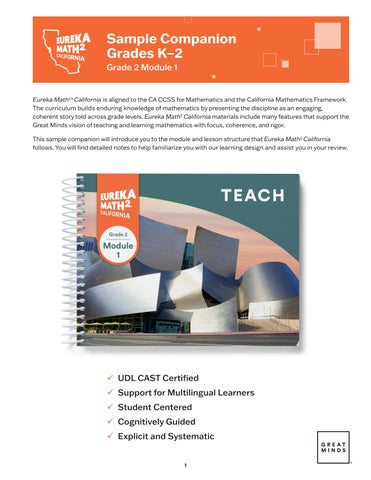
Sample Companion Grades K–2 Grade 2 Module 1
Eureka Math2 ® California is aligned to the CA CCSS for Mathematics and the California Mathematics Framework. The curriculum builds enduring knowledge of mathematics by presenting the discipline as an engaging, coherent story told across grade levels. Eureka Math2 California materials include many features that support the Great Minds vision of teaching and learning mathematics with focus, coherence, and rigor. This sample companion will introduce you to the module and lesson structure that Eureka Math2 California follows. You will find detailed notes to help familiarize you with our learning design and assist you in your review.
9 UDL CAST Certified 9 Support for Multilingual Learners 9 Student Centered 9 Cognitively Guided 9 Explicit and Systematic 1
Module 1 Overview
1
Part 1: Place Value Concepts Through Metric Measurement and Data 2
Coherence: Before This Module Grade 1 Module 1 Students collect data by answering questions, sorting sets, and making observations. They create bar graphs, picture graphs, and tally charts to visually represent the data. As students count to find totals and visually compare quantities, they recognize that linear organizations are useful.
Grade 1 Module 4 Students explore indirect comparison, whereby the length of one object is used to compare two other objects, and they order objects by length. Students begin measuring with same-size standard units, centimeter cubes. They express the length of an object as the total number of centimeter cubes laid end to end. As students measure objects longer than 10 cm, they use 10 cm sticks and additional centimeter cubes and practice counting by tens and some ones. Students use measurement as a context for solving comparison problems.
2
Coherence: After This Module Students estimate and measure weight and liquid volume. They explore the relationship between place value units by reasoning that there are 1,000 grams in 1 kilogram and 1,000 milliliters in 1 liter. Students apply their understanding of metric measurement as they represent word problems with a tape diagram and solve flexibly. In addition, students use their understanding of the number line to read vertical measurement scales. Finally, students represent data in scaled bar graphs and solve problems related to graphs.
16
1
EUREKA MATH2 California
© Great Minds PBC
Grade 3 Module 2
Grade 2 ▸ Module 1
The Module Overview sets the stage for success
2
• revealing the coherent, logical progression of mathematical concepts and practices in the module,
The Before This Module and After This Module sections • articulate the connections between the content of the module and the concepts of the big ideas across the mathematical learning journey and
• providing clear explanations and visual examples of mathematical concepts and models, and
• explain the role of the grade-level concepts within the larger context of the curriculum.
• illustrating at a glance the emphasis on mathematical investigations to address the big ideas of the grade.
2
TOPIC B
LESSON
7
Measure lengths and relate 10 cm and 1 cm.
can measure lengths in more than one “ Iway by using 10 centimeter rulers and 1 centimeter cubes.”
1
Standards California Content Standard • 2.MD.A.1
Language Objectives
Standards for Mathematical Practice
• Orally explain that one 10 cm ruler has the same length as ten 1 cm cubes. • Orally justify statements about the relationship between different measurement units.
2
3
Key Question • What is the relationship between a 10 cm ruler and a 1 cm cube?
• SMP.7
Achievement Descriptor • 2.Mod1.AD1: Measure lengths of objects by using metric units (centimeters and meters). (2.MD.A.1)
Big Ideas Measure and Compare Objects
© Great Minds PBC
Problem Solving with Measure
112
1
EUREKA MATH2 California
Grade 2 ▸ Module 1 ▸ Topic B ▸ Lesson 7
Language Objectives provide a specific language goal alongside the math goal, ensuring students develop the vocabulary and syntax needed to discuss complex concepts. These objectives are designed to ensure mathematical content and English Language development (ELD) grow together.
3
2
Key Questions help teachers quickly identify and focus on key learning in the lesson.
3
Achievement Descriptors show connections between content objectives and grade-level standards that focus on measurable student outcomes, tailored to enhance learning.
1
Lesson at a Glance Students put together several 10 cm rulers to measure the lengths of objects longer than 10 cm. With guidance, they reason about the relationship between a 10 cm ruler and a 1 cm cube. This lesson introduces the term support as an academic verb.
2
3
Agenda
3
Materials
Fluency 10 min
Teacher
Launch 10 min
• 100-bead rekenrek • Student-created 10 cm rulers (5)
Learn 30 min
• Centimeter cubes (3)
Measure Objects • Relate 10 cm and 1 cm • Problem Set
• Classroom object
Lesson Preparation • Gather five student-created 10 cm rulers from lesson 6. These will be used in subsequent lessons. • Select a classroom object, such as a book, that measures longer than 10 cm.
Students • Student-created 10 cm ruler
© Great Minds PBC
Land 10 min
EUREKA MATH2 California
1
The Lesson at a Glance provides a snapshot of the lesson.
2
The Agenda
Grade 2 ▸ Module 1 ▸ Topic B ▸ Lesson 7
• Uses a consistent structure—Fluency, Launch, Learn, Land—to create a predictable lesson flow. • Suggests pacing that balances emphasis on conceptual understanding, procedural fluency, and application. 3
Materials and Lesson Preparation save teachers time and ensure smooth lesson execution.
4
113
1
Fluency
10
Counting on the Rekenrek by Tens Within 100 Materials—T: Rekenrek
Students count by tens in standard form and the Say Ten way to prepare for recognizing that ten of a smaller unit make a larger unit. Show students the rekenrek. Start with 30 beads to the left side. How many beads? (Gesture to the 30 beads.) 30 Say how many beads there are as I slide them over. Slide 10 beads all at once to the left or to the right in the following sequence as students count:
40
50
60
70
60
70
80
Student View
90
100
90
Slide 10 beads all at once to the left or to the right in the following sequence as students count:
4 ten 114
1
5 ten
6 ten
EUREKA MATH2 California
7 ten
6 ten
7 ten
8 ten
9 ten
10 ten
9 ten
© Great Minds PBC
Show 30 beads to the left side. Now, let’s count the Say Ten way. Counting the Say Ten way by tens sounds like this: 3 ten, 4 ten, 5 ten, and so on. How many beads? Say it the Say Ten way. (Gesture to the 30 beads.) 3 ten Say how many beads there are as I slide them over.
Grade 2 ▸ Module 1 ▸ Topic B ▸ Lesson 7
Explicit instruction and structured guidance leads teachers through the lesson, promoting effective delivery and student comprehension.
Fluency activities prepare students for the daily learning by • offering distributed practice of skills and concepts – preparing students for new conceptual understanding – building fluency with recently introduced material – maintaining skills or concepts from previous topics, modules, or grades • including predictable, repeated routines that build in rigor.
5
1
Choral Response: Disappearing Dots with Totals of 10 Students take away from 10 and say a subtraction sentence to maintain fluency with decompositions within 10 from grade 1. After asking each question, wait until most students raise their hands, and then signal for students to respond. Raise your hand when you know the answer to each question. Wait for my signal to say the answer. Display the image of 10 dots. How many dots do you see? 10 Display 1 dot disappearing. How many dots went away? 1 How many dots are there now? 9
© Great Minds PBC
Display all 10 dots again. On my signal, say the subtraction equation starting with 10. 10 – 1 = 9
EUREKA MATH2 California
1
Grade 2 ▸ Module 1 ▸ Topic B ▸ Lesson 7
Choral Response activities promote equity. • Daily fluency activities intentionally repeat formats in the lower grades to help students focus on the math, not the process. • Fluency activities also often give students different ways to express what they know (e.g., show with hands, write, and speak).
6
115
Repeat the process with the following sequence:
1 10 - 9 = 1
10 - 5 = 5
10 - 4 = 6
10 - 6 = 4
10 - 2 = 8
10 - 8 = 2
10 - 3 = 7
10 - 7 = 3
Choral Response: Put Together, Take Apart Students compose or decompose a two-digit number to build place value understanding.
1 0 + 5
Display the whole number place value cards showing the expression 10 + 5. What is 10 + 5? Raise your hand when you know. Wait until most students raise their hands, and then signal for students to respond. 15
Repeat the process with the following sequence:
1 0 + 2
116
1
1 0 + 9
2 0 + 1
EUREKA MATH2 California
2 0 + 4
5 0 + 4
8 0 + 4
3 0 + 8
4 0 + 8
7 0 + 8
9 0 + 8
© Great Minds PBC
1 05
Display the whole number place value cards composing 15.
Grade 2 ▸ Module 1 ▸ Topic B ▸ Lesson 7
Sequences are designed to progress from simple to more complex. The sequence includes less complex problems at regular intervals to build confidence and keep students engaged in the activity.
Explicit instruction and structured guidance leads teachers through the lesson, promoting effective delivery and student comprehension.
7
Display the whole number place value cards that show 13. This time, start with the total. First, take out the tens. Think about how many ones are left. What is the addition expression that is equal to the total? Raise your hand when you know.
1 03
Wait until most students raise their hands, and then signal for students to respond. 10 + 3
Display the whole number place value cards breaking apart into 10 + 3.
1 0 + 3
Repeat the process with the following sequence:
1 07
1
1 01
Launch
1 06
10
1 08
2 08
7 08
1 04
3 04
9 04
10
Materials—T: 10 cm ruler, classroom object
30
Students reason about how to measure objects that are longer than their given tool.
© Great Minds PBC
10
Show a classroom object longer than 10 cm. Ask students to think about how many centimeters long it is. Hold up a 10 cm ruler as a point of reference. Encourage number sense by asking the following questions: • How long do you think this book is?
2
• What number would be too high? Too low?
EUREKA MATH2 California
1
2
Launch engages students in the lesson with various approaches:
Grade 2 ▸ Module 1 ▸ Topic B ▸ Lesson 7
117
Conjectures • Students ask questions and share conjectures throughout lessons, developing sound reasoning and challenging assumptions.
• Low-floor, high-ceiling activities that activate prior knowledge and create access points for all learners. • Real-world examples and data as a means to spark inquiry and apply mathematical concepts. • Rich student discourse through routines like think–pair–share. • A goal for the day’s learning.
8
1 Support, or explain, your thinking using what you know. You can support your thinking by saying, “I know because … .” Let’s practice. The length has to be more than 10 cm. I know because the book is longer than the ruler. The length is probably more than 20 cm. I know because the book looks longer than two rulers.
2
Have students Think–Pair–Share about the following question: What ideas do you have for how we could measure this book? We could work with other people and put our rulers together. We could put together a ruler and some more centimeter cubes. We could mark and move forward with our 10 cm ruler.
Transition to the next segment by framing the work. 10 our 10 cm rulers together to measure the length of the book and Today, we will put other objects.
Multilingual Learner Support This is the first time students use the term support as an academic verb. However, students have been explaining their thinking since prekindergarten. To prompt students to support their thinking, display this sentence frame: I know because … Give an example with relevant, mathematical details. For example, “I know because it’s longer than my 10 cm ruler.”
10
3
Learn
30
Measure Objects 10 Materials—T: 10 cm rulers, classroom object; S: 10 cm ruler
Students combine tools to measure an object that is longer than 10 cm.
118
1
2
EUREKA MATH2 California
© Great Minds PBC
Place three 10 cm rulers end to end to measure the book.
Grade 2 ▸ Module 1 ▸ Topic B ▸ Lesson 7
3
Multilingual Learner Support notes address possible language issues that may interfere with engagement of math content and include strategies for supporting English learners.
Learn is where concepts are developed. • Lessons use progressions of concrete representations, pictorial representations, and symbolic representations to develop understanding.
Mathematical Language
• Each Learn segment builds on the concepts introduced and explained in the last segment to develop a deep understanding of the day’s learning.
• Strategic support for academic verbs gives students a clear purpose for using mathematical language in their conjectures.
Engaging Tasks
• Students experience modeled mathspecific terms and sentence frames to use during student-to-student discourse.
• Students engage with the same content in various ways, ensuring access and allowing for strategic differentiation. • Teachers monitor student conversations to determine which students will share each strategy, building a coherent mathematical story. 9
Now, we can use our 10 cm ruler as a length unit. Let’s count length units by tens and ones to find the length of the book.
1
Teacher Note
Point to each unit as students chorally count by tens and ones. 10, 20, (pause) 21, 22, 23, ... , 29 29 what? 29 cm
For the purpose of classroom management, consider establishing parameters around the objects that students may select. Limit the range of measurements to greater than 10 cm and less than 30 cm.
Make groups of three students. Ask groups to self-select classroom objects that are longer than 10 cm to measure with their 10 cm rulers. Have them record the names of the objects and their measurements in their student books. Read the directions and the sentence frame in the student book aloud, or review words that may be difficult for students to read independently.
TOPIC B Name
LESSON
7
LESSON Lesson
Relate 10 cm and 1 cm
I can measure lengths in more than one way by using 10 centimeter rulers and 1 centimeter cubes.
California CCSS-M
2.MD.A.1
Use your ruler to measure objects longer than 10 cm. Fill in the blanks.
Materials—T: 10 cm rulers, cubes
Sample:
1. The
Students relate their 10 cm ruler to 1 cm.
2. The
3. The
Display the feather interactive. Have students estimate the length. Enter student suggestions and measure. Repeat the process until the correct length is found. How long is the feather? 26 cm
© Great Minds PBC
4. The
Have students Think–Pair–Share about the following question. For each response, use the feather interactive to verify. What tools could we use to measure the feather? 26 cm cubes Two 10 cm rulers and 6 cm cubes One 10 cm ruler and 16 cm cubes
© Great Minds PBC
1
3
Teacher Notes are educative point-of-use guidance to help teachers elevate their instruction.
laptop pointer book
is
is
22 cm long. 14
cm long.
is
23 cm long.
is
52 cm long.
is
21
cm long.
Grade 2 ▸ Module 1 ▸ Topic B ▸ Lesson 7
47
Universal Design for Learning: Representation
3
Presenting the information in the feather interactive enables students to see the relationship between 10 cm rulers and centimeter cubes. Ensure that students include the units in their responses.
Grade 2 ▸ Module 1 ▸ Topic B ▸ Lesson 7
119
Digital Interactives • bring mathematics to life • allow students to experiment with and visualize mathematical concepts
• May support lesson implementation. • Explain pedagogical choices. • Give background information. • Help identify common misconceptions. • Offer point-of-use professional development. 2
pencil
EUREKA MATH2 California
2
EUREKA MATH2 California
5. The
poster
Universal Design for Learning notes contain culturally responsive suggestions and proactive scaffolds for grade-level work to meet student needs.
10
Why do all these ways work? A 10 cm ruler is made up of 10 cm cubes. When we put two 10 cm rulers and 6 cm cubes together, they are the same length as 26 cm cubes put together. When we put one 10 cm ruler and 16 cm cubes together, we know there’s a 10 inside the 16, so that’s the same as two 10 cm rulers and 6 cm cubes.
2
Problem Set Lesson
10Problem set
Exit Ticket
Differentiate the set by selecting problems for students to finish independently within the timeframe. Problems are organized from simple to complex. Sample solutions are at the end of this lesson.5 The directions may be read aloud. Help students recognize the word correct in print. Invite Spiral Review Self Reflection Removables students to underline it as you read it aloud.
35
Land Family Math
Practice Partner
Practice
Promoting the Standards for Mathematical Practice Students look for and make use of structure (SMP.7) when they make the connection that one 10 cm ruler has the same length as ten 1 cm cubes. Students use this relationship to measure longer objects without having to count each centimeter individually. They understand that two 10 cm rulers and six 1 cm cubes, and 26 cm, represent the same length. The usefulness of this structure carries forward later in the year when students make similar connections between ones and tens to add and subtract efficiently.
10 At Home
1
Remember
Debrief 5 min Objective: Measure lengths and relate 10 cm and 1 cm.
120
1
EUREKA MATH2 California
27 cm 10 cm
7 cm 10 cm
Continue to make measurement tools available for students who benefit from a more concrete experience.
Grade 2 ▸ Module 1 ▸ Topic B ▸ Lesson 7
3
Standards for Mathematical Practice are embedded throughout the curriculum, but they are highlighted where there is deliberate practice.
Students cement their learning in Land, where they • consolidate thinking through elaborative why and how questions that prioritize reasoning and justification and
• Students use and develop academic language while engaging in the mathematical practices.
• engage in rigorous thinking, draw conclusions from their work, make deep connections among mathematical ideas, and encode information into long-term memory.
• Teacher-to-student and student-tostudent interactions model the intent of the mathematical practices. 2
Differentiation: Support
© Great Minds PBC
3
Engage students in a California Think–element Pair–Share about their solution to problem 1 using the following question. Why can we say that Kate’s lizard is two 10 cm rulers and 7 cm cubes long, or 27 cm cubes long? Remember to support your thinking by telling your partner how you know. I know because each 10 cm ruler is made up of 10 cm cubes. 10 + 10 + 7 = 27. I know because two 10 cm rulers is the same as 20 cm. 7 more centimeter cubes makes 27 cm.
The Problem Set includes a suite of problems organized from simple to complex for easy differentiation. • Extends and reinforces classroom instruction • Supports conceptual understanding • Develops procedural fluency over time 11
Display the number bond to illustrate the idea that 27 cm is composed of two groups of 10 cm and 7 more centimeters. Consider sketching the corresponding measurement tool under each part of the number bond. How is a 1 cm cube related to a 10 cm ruler? Ten 1 cm cubes are the same length as one 10 cm ruler. 10 ones is the same as 1 ten. One 10 cm ruler has the same length as ten 1 cm cubes. If time allows, have students use their measurements of a classroom object to create a number bond that shows the parts and total.
2
Exit Ticket Lesson
1
5 min Exit Ticket
Problem set
Direct students to the Self-Reflection on the back of the Exit Ticket. Have them read the I can statement to reflect on their learning in this lesson. Invite them to circle the choice that best matches their agreement with the statement. After they complete the Exit Ticket, consider having students confirm whether they still agree with their selection.
Self Reflection
Family Math
Removables
Spiral Review
Provide up to 5 minutes for students to complete the Exit Ticket. It is possible to gather formative data even if some students do not complete every problem. Sample solutions are at the end of this lesson.
At Home
Practice Partner
Practice
Differentiation: Challenge Students may be ready to consider how many more to reach the next ten. Have them think of 26 cm and whisper how many more to reach 30 cm, or three 10 cm rulers. Students may notice that just as 6 ones plus 4 ones make a new ten, 6 cm plus 4 cm make another 10 cm ruler. Consider having students record their thinking as a number sentence: 26 + 4 = 30.
Remember
© Great Minds PBC
California element
EUREKA MATH2 California
1
2
Differentiation: Challenge notes provide adaptable strategies for various learning levels to ensure all students are challenged appropriately.
12
Grade 2 ▸ Module 1 ▸ Topic B ▸ Lesson 7
121
An Exit Ticket concludes the lesson, providing a daily formative assessment.
Sample Solutions Expect to see varied solution paths. Accept accurate responses, reasonable explanations, and equivalent answers for all student work.
TOPIC B Name
LESSON
PROBLEM SET Problem Set I can measure lengths in more than
one way by using 10 centimeter rulers and 1 centimeter cubes.
7
4. Jade measures her belt. She uses five 10 cm rulers and four 1 cm cubes.
California CCSS-M
2.MD.A.1
Jade thinks her belt is 45 cm long. Is she correct?
Each friend measures two ways.
Jade is not correct.
1. Kate’s lizard is 27 cm long.
She uses She uses
27 1 cm cubes. 2
10 cm rulers and
7
1 cm cubes. Show how you know.
2. Alex’s snake is 34 cm long.
He uses He uses
1
34 1 cm cubes. 3
10 cm rulers and
4
10
10
10
10
10
1 11 1
50 cm + 4 cm = 54 cm
1 cm cubes.
4
10 cm rulers and
EUREKA MATH2 California
122
0
1 cm cubes.
40 1 cm cubes.
EUREKA MATH2 California
Grade 2 ▸ Module 1 ▸ Topic B ▸ Lesson 7
49
50
EUREKA MATH2 California
G2 ▸ M1 ▸ TB ▸ L7 ▸ PROBLEM SET
Grade 2 ▸ Module 1 ▸ Topic B ▸ Lesson 7
1
Sample Solutions • Go beyond an answer key to include examples and representations of possible student strategies to help teachers orient to analyzing student work. • Provide a starting point for teachers to elicit, make sense of, and respond to student thinking.
13
© Great Minds PBC
He uses He uses
© Great Minds PBC
© Great Minds PBC
3. Nick’s cat is 40 cm long.
Observational Assessment Recording Sheet Grade 2 Module 1
1
Student Name
Part 1: Place Value Concepts Through Metric Measurement and Data Standards
Achievement Descriptors
Dates and Details of Observations
2.Mod1.AD1 Measure lengths of objects by using
2.MD.A.1
metric units (centimeters and meters).
2.MD.A.3
2.Mod1.AD2 Estimate lengths of objects by using metric units (centimeters and meters).
2.MD.A.4
2.Mod1.AD3 Measure and find a difference in length by using metric units (centimeters and meters).
2.MD.B.5
2.Mod1.AD4 Add or subtract within 100 to solve word problems involving length by using drawings and equations.
2.MD.B.6
2.Mod1.AD5 Represent whole numbers within 100 on a number line.
2.MD.B.6
2.Mod1.AD6 Represent sums within 100 by using a
2.MD.B.6
2.Mod1.AD7 Represent differences within 100 by
2.MD.D.10
2.Mod1.AD1 Measure lengths of objects by using metric units (centimeters and meters). 2.Mod1.AD8 Draw and label picture and bar graphs
308
using a number line.
to represent a data set with up to four categories.RELATED CA CCSSM
2.Mod1.AD9 Solve addition, subtraction, and
2.MD.A.1 Measure the length of an object by selecting and using appropriate tools such as rulers, yardsticks, meter sticks, and measuring tapes.
Partially Proficient comparison problems by using information from a bar graph. Measure lengths of objects by using metric
EUREKA MATH2 California
Proficient
© Great Minds PBC
2.MD.D.10
Achievement Descriptors Proficiency Indicators 2
number line.
Highly Proficient
Measure lengths of objects by using metric units (centimeters and meters) for objects that units (centimeters and meters) for objects that are easily measured with ruler (e.g., flat and P Proficient require choosing an Proficient appropriate tool before PPa Partially Proficient HP Highly straight). measuring.
Grade 2 ▸ Module 1
Measure the pencil with a 10 cm ruler. Circle the best tool to measure the length This page may be reproduced for classroom use only. around a ball. 10 cm ruler meter stick measuring tape Use the tool to measure the length The pencil is cm long. around a ball.
2.Mod1.AD2 Estimate lengths of objects by using metric units (centimeters and meters). RELATED CA CCSSM 2.MD.A.3 Estimate lengths using units of inches, feet, centimeters, and meters.
Partially Proficient
Proficient
Estimate lengths of objects by identifying the correct metric unit (centimeters or meters). Circle the unit. meters
Choose a benchmark and use it to estimate the length of each object.
tall.
centimeters
The crayon is about The pencil is about
302
1
EUREKA MATH2 California
Multiple methods of assessment* are woven throughout the curriculum.
cm long. cm long.
© Great Minds PBC
The door is 2
Highly Proficient
Estimate lengths of objects by using an appropriate benchmark to identify a reasonable quantity in units of centimeters or meters.
Grade 2 ▸ Module 1
2
• Observational Assessment Recording Sheets provide a short qualitative checklist that captures student progress.
• Proficiency Indicators help teachers see what proficiency looks like for a particular Achievement Descriptor and standard.
*Assessments available for download in the Eureka Math2 California digital experience. 14
1 MODULE
5
MODULE ASSESSMENT
+
=
+
=
This page may be reproduced for classroom use only.
2
-
TOPIC A
TOPIC TICKET Exit Ticket
Circle.
=
-
MODULE 4
Name
The parrot is
shorter
than the flamingo.
taller
=
Draw or write to put the fence, flamingo, and parrot in order
© Great Minds PBC
Sample Solutions Module Assessment from shortest to tallest. 3
4
2. Use cubes or 10-centimeter sticks and cubes to measure.
Name
EUREKA MATH2 California
358
Grade K ▸ Module 5
EUREKA MATH2 California
The dog is
shorter
This page may be reproduced for classroom use only.
This page may be reproduced for classroom use only.
1. Circle. than the girl.
taller Draw or write to order the bench, girl, and dog from shortest to tallest. Sample:
025-026_EM2CA26B_SELG1_A_M4L03_topic_ticket_173245.indd 25
9
13
centimeters
© Great Minds PBC
© Great Minds PBC
9
centimeters
<
EUREKA MATH2 California
240
EUREKA MATH2 California
13
centimeters
G1 ▸ M4 ▸ MODULE ASSESSMENT 4
Grade 1 ▸ Module 4
Grade K • Observational Assessment Recording Sheets provide teachers with daily and weekly formative snapshots to measure what students have learned and are able to do. 1
27/11/25 12:46 PM
centimeters
235
Grade 1 ▸ Module 4
25
Write >, =, or < to compare the lengths.
234 EUREKA MATH2 California
Grade 1 ▸ Module 4 ▸ Topic A ▸ Lesson 3
© Great Minds PBC
MODULE ASSESSMENT Exit Ticket
© Great Minds PBC
The digital platform provides access to digital quizzes and assessments as well as extra downloadable print versions. Expect to see varied solution paths. Accept accurate responses, reasonable explanations, and equivalent answers for all student work.
• Module Assessments* are interview assessments that assess proficiency with the major concepts and skills taught in the module. These don’t include the “typical” item types since they are interview-style.
Grades 1 and 2 2
• Exit Tickets, Topic Tickets, and Observational Assessment Recording Sheets* provide teachers with daily and weekly formative snapshots to measure what students have learned and are able to do.
1
• Module Assessments* assess proficiency with the major concepts and skills taught in the module and include a variety of item types, including selected response, constructed response, and open-ended questions.
3
• Every Topic and Module Assessment has a Scoring Guide that shows the alignment between each item and an Achievement Descriptor and a Proficiency Indicator. The scoring guide tells how many points are possible for each item or part of an item.
*Assessments available for download in the Eureka Math2 California digital experience. 15
Performance Assessment
LEVEL 2
Farmers Market Agenda • Build Context | 5 min • Assessment | 20 min
Name
• Close Assessment | 5 min Farmers Market
Materials and Preparation
Tam and Bob pack boxes of fruit to take to a farmers market.
• None
Each box holds one type of fruit. A box can hold
Mathematical Practices in Action
100 strawberries, 10 apples, or 1 watermelon.
Students are likely to demonstrate evidence of the following MPs as they complete the assessment.
Part A Tam packs 2 boxes of strawberries, 0 boxes of apples, and
• Students reason abstractly and quantitatively (MP�) as they use equations or pictorial models to find the total pieces of fruit.
6 boxes of watermelons. How many total pieces of fruit does Tam pack?
• Students look for and make use of structure (MP�) as they decompose ��� into place value units.
Part B Bob packs 125 pieces of fruit. He needs to use fewer than 100 boxes. How could he pack the fruit in the boxes? Part C How many pieces of fruit do Tam and Bob pack altogether? Show and tell how you know.
PERFORMANCE ASSESSMENT | © 2025 Great Minds PBC
2 | Farmers Market
1
PERFORMANCE ASSESSMENT | © 2025 Great Minds PBC
2 | Farmers Market
Performance Assessments* are open-ended or open-middle real-world problems that invite students to demonstrate their math skills in a knowledge-rich context. • They integrate mathematics content and the language needed to participate in the Standards for Mathematical Practice. • A rubric offers suggestions for using assessment data to inform instructional decisions to support students’ consistent progress toward meeting or exceeding state standards. • The Plan–Check–Reflect tool in Performance Assessments gives students an opportunity for self-reflection and self-evaluation.
*Assessments available for download in the Eureka Math2 California digital experience. 16
1
Data Talks* • Engage students in conversations around real-world contexts and data and spark inquiry. • Support with suggested learning scaffolds at just the right moment. • Cover common topics in science and humanities building knowledge and connecting learning across subject areas. • Often align with the Environmental Principles and Concepts, connecting mathematics to familiar topics to make the knowledge sticky.
*Data Talks available for download in the Eureka Math2 California digital experience. 17
Digital Tools that Enhance and Streamline instruction
Digital Manipulatives Manipulatives allow students to create visuals, manipulate models, and develop mathematical thinking using digital versions of many of the physical manipulatives. Teachers can also use these tools to display and demonstrate mathematical concepts during class.
Context Videos Context videos help students see math in the real world and are accessible to all students, including multilingual learners. When available, videos can be accessed in the Eureka Math2 digital experience.
How-to Videos Short videos that support Great Minds educators as they learn about implementation basics, math content, and instructional routines.
© 2026 Great Minds PBC | 033026
18