ADVERTISING
ESPN GOES LIVE TO HELP CENTURY 21 SELL PROGRAMMING
NEW REBOOTS REQUIRE RELEVANCE STREAMING
NBA DEAL IS SLAM DUNK FOR VERIZON FIBER NET
PLUS
WOMEN IN THE GAME: MAKING SPORTS STRIDES
E L B A P P O T S UN
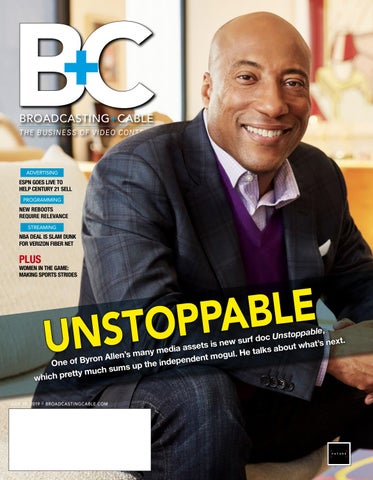
pable, p o t s n U urf doc s w next. e n ’s t s i a h s t w e t s edia as lks abou m a t y n e a H . m l u nt mog e on Allen’s r d y n e B p f e o d e On up the in s m u s h tty muc e r p h c i h w JULY 15, 2019
BROADCASTINGCABLE.COM
ADVERTISING
PROGRAMMING
CONTENTS
STREAMING July 15, 2019
Volume 149 Number 7
WATCH THIS It is “Sharkfest” on National Geographic, and Man vs. Shark goes down Wednesday. Marine biologist JEREMIAH SULLIVAN develops an armored suit to go
Man vs. Shark
nose-to-nose with a shark. Also on Wednesday, Suits spinoff Pearson starts on USA. Appointed as the mayor’s fixer, disbarred uber-lawyer Jessica Pearson finds herself tied up in a crooked new world. GINA TORRES stars. Friday, the fifth season of Killjoys starts on Syfy. It’s about a trio of hardliving bounty hunters who work in a four-planet-and-moon system known as the Quad. Also on Friday,
8
COVER STORY
Byron Allen stepped onto some of television’s biggest stages as a teen-age standup comic, but these days the Entertainment Studios founder, chairman and CEO plays an even bigger role at the center of a growing independent media empire.
DEPARTMENTS
By Michael Malone
10
Cover: Entertainment Studios; On this page: National Geographic/Devon Massyn; Ian Watson/Killjoys IV Productions Limited/SYFY; Netflix (2)
Killjoys
it’s the fourth season of football series All or Nothing on Amazon. The CAROLINA PANTHERS star, and JON HAMM narrates. Finally, a new batch of Comedians in Cars Getting Coffee goes live on Netflix that day. JERRY SEINFELD’s guests include SETH ROGEN, RICKY GERVAIS, MARTIN SHORT and — some Buckwheat with your coffee? — EDDIE MURPHY.
Byron Allen in his office at Entertainment Studios headquarters in Century City, Calif.
PECIAL REPORT: S WOMEN IN THE GAME
The 2019 B&C Women in the Game — a group of 10 leading executives from across the TV sports business — note that progress has been made toward gender equity in their space, but they still see quite a bit of ground left to cover. By Stuart Miller
20 PROGRAMMING STRATEGY
Rebooting a TV series in 2019 is about more than just bringing back well-known characters — what’s key is mixing familiar elements with timely ideas.
4 Lead-In 18 Platforms 19 Connections 22 Programming Strategy 21 Local News 22 Currency 24 Distribution 26 Washington Watch 28 Schmooze 30 Data Mine 32 Editorial 34 The Five Spot
By Michael Malone
NOW ON BROADCASTINGCABLE.COM ... Don’t miss the July edition of the Busted Pilot podcast, featuring B&C’s Kent Gibbons and Michael Malone as they talk about the summer of soccer and Ann Curry in Chasing the Cure. To listen, go to broadcastingcable.com/July15. Stranger Things 3 broke the SVOD viewership record for its premiere, according to Nielsen. For more on the series, which dropped on Netflix July 4, go to broadcastingcable.com/July15.
Comedians in Cars Getting Coffee Stranger Things 3
Jeopardy! powerhouse James Holzhauer and Emma Boettcher, the woman who defeated him, will return to the game show for the upcoming Tournament of Champions. For more, go to broadcastingcable.com/July15.
Vol. 149 No. 7 July 15, 2019. B&C Broadcasting & Cable (ISSN 1068-6827) (USPS 066-000) is published monthly with additional issues in January, April and Oct. by Future US, Inc., 11 West 42nd Street, 15th Floor, New York, NY 10036. Periodicals postage paid at New York, NY, and additional mailing offices. POSTMASTER: Please send address changes to B&C Broadcasting & Cable, P.O. Box 8688, Lowell, MA 01853-8688. Printed in U.S.A. © Future US, Inc. All Rights Reserved.
BROADCASTINGCABLE.COM
JULY 15, 2019
3
LEAD-IN
ADVERTISING
PROGRAMMING
STREAMING
AT&T Lawsuit vs. Consultant Is New Weapon in Retrans Wars Max Retrans accused of misusing trade secrets By Jon Lafayette In its lawsuit, AT&T claims Max Retrans’s use of trade secrets is resulting in delays in retrans negotiations, leading to AT&T losing subscribers. AT&T will also be harmed by Max Retrans’s “misappropriation of trade secrets by paying higher retransmission consent fees,” the suit said. Despite Lammers’s background, Max Retrans is not involved in Nexstar’s carriage dispute with AT&T, which has resulted in a week-plus blackout of about 120 stations and an increasingly acrimonious war of words that has attracted the interest of elected officials. In a statement, Nexstar accused AT&T of a “misinformation campaign,” insisting that it offered the telco a 30-day extension that was rejected. Nexstar also said it has renewed more than 390 distribution agreements with cable providers over the past 20 months. “In contrast, following its 2015 acquisition by AT&T, DirecTV has been routinely involved in disputes with content providers,” Nexstar said, adding, “a little more than a year after putting DirecTV together with Time Warner, AT&T appears intent on using its new market power to prioritize its own content at the expense of consumers, and insisting on unreasonable terms that are inconsistent with the market.” Nexstar’s extension was conditioned on getting retroactively paid a new, higher rate, AT&T said. “AT&T has been ready to negotiate since Nexstar removed its stations more than a week ago,” the company said. “As we enter the second week of their blackout of our customers [at press time], Nexstar has canceled our scheduled meeting for Friday [July 12] and it now has been rescheduled for Saturday [July 13].”
FCC Loosens the Lid on KidVid Critics say online video is hardly safe alternative By John Eggerton
T
HE FCC IS allowing broadcasters to offload some of their educational/informational children’s programming to multicast channels and will let them pre-empt E/I programming for local sports and specials, not just news, citing the proliferation of alternative platforms for kid-friendly video, including online. But opponents say the internet is hardly a safe video haven for kids and the old rules were hardly a burden. It is the first major revamp of the rules governing educational and informational (E/I) content since they were adopted almost a quarter-century ago. FCC chairman Ajit Pai signaled that the rules were being dislodged from regulatory amber to meet a marketplace brimful of content for children on multiple platforms. FCC Republicans say the “modest” rule revamp,
4
JULY 15, 2019
BROADCASTINGCABLE.COM
spearheaded by commissioner Michael O’Rielly, was just a way to give broadcasters more programming flexibility while preserving the basic mandate for the dwindling number of kids who still favor broadcast educational kids’ fare over the wealth of it elsewhere, including online. The revamp was called “modest” because while the FCC initially considered lifting the three-hourper-week E/I requirement, it did not, and it continues to require most content to air on the primary channel. And while the FCC will now allow for more unscheduled, short-form E/I programming, the majority of such content must still be weekly,
Howard Stirk Holdings owner Armstrong Williams accused AT&T of using litigation to intimidate broadcasters.
regularly scheduled and at least a half-hour in length. Democrats, including those in Congress, and kids’ TV advocates were still crying foul, including citing an issue much in the news. That would be criticism of edge providers for collecting kids’ personal data or delivering inappropriate content, or arguing they are not bound by statutory kids’ privacy protections. Broadcasters would have preferred even more deregulation from the FCC, but sounded happy with what they got. There was even something for cable operators. While O’Rielly said the revamp did not achieve the procedural “simplificaPai tion” he had sought, it does decrease the frequency with which cable operators have to collect and post KidVid certifications from programmers they carry, a deregulatory move celebrated by ACA Connects, which represents smaller, independent operators.
Gage Skidmomre
T
HE RETRANSMISSION-CONSENT WARS are intensifying with the war of words between AT&T and Nexstar Media Group heating up and with AT&T launching a legal battle against Max Retrans, a consulting firm that works with smaller station groups and is headed by former Nexstar chief operating officer Duane Lammers, known as The Hammer. In a lawsuit filed in federal court in St. Louis, AT&T charges that Max Retrans is using confidential data from negotiations with individual station groups to get higher fees for its other client groups despite a nondisclosure agreement. AT&T is seeking damages based on how much more money it is paying stations in retrans fees, because Max Retrans is leveraging what it knows about AT&T’s contracts with other broadcasters. Lammers did not respond to a request for comment, but passed the request along to Armstrong Williams, owner of Howard Stirk Holdings, one of the small broadcasters working with Max Retrans. Stirk was also among a number of broadcasters currently blacked out on AT&T’s DirecTV satellite platform that was named in an earlier lawsuit by AT&T, which charges the station groups have not been negotiating in good faith. Williams accused AT&T of wrongfully using litigation as a weapon “to intimidate broadcasters and their agents from negotiating fair and market-based retransmission rates.” AT&T is using its power as a gatekeeper against stations to limit viewer choice, Williams added. In the case of WEYI, Flint, Michigan, and WWMB, Florence, South Carolina, it’s stifling some of the handful of African-American-owned stations in the country. “AT&T should stop throwing tantrums and trying to bully broadcasters and their agents, like Max Retrans, and instead return to the negotiating table and behave like adults,” Williams said.
LEAD-IN
ADVERTISING
PROGRAMMING
STREAMING
+ Fates & Fortunes Rip Torn in 2005
“Worked with Rip Torn. So funny, original and intense. Favorite line of his from ‘Larry Sanders’: You’re like a Greek God, Larry. Part man, part desk!” — Rob Lowe, sharing news of the death of actor Rip Torn. Torn, who had small-screen roles in The Larry Sanders Show, 30 Rock and Will & Grace, was 88. He also starred in movies such as Men in Black, Dodgeball and Eulogy.
THE WATCHMAN
Senior content producer Michael Malone’s look at the programming scene
Sweetbitter’s Sophomore Season, Suits Spins Off, HBO Unmasks Jihadi John SEASON TWO OF Sweetbitter has arrived on Starz. It’s about Tess, who leaves her small town and lands a job at a fancy New York restaurant. Executive producer/ showrunner Stuart Zicherman said season two was liberating after season one’s six-episode run. “It takes a little time to find the essence of your show,” he said. “We’re excited to get a chance to expand.” Stephanie Danler’s Sweetbitter
Sweetbitter
6
JULY 15, 2019
novel takes place over the course of a year, and season two breaks from the book a bit. Zicherman’s highlights include Sandra Bernhard turning up as the restaurant’s absentee owner, Maddie, and a bunch of restaurant staffers heading out to see the band Interpol — in 2006. Zicherman does not miss his work in the restaurant world. He toiled in a Wyoming resort town, where his chatty nature did not work for him as a server. “I was a terrible waiter,” he said. “I ended up being a good busboy.” Also going through a career change is Jessica Pearson of Suits. Spinoff Pearson, which sees the character, played by Gina Torres, as a mayor’s
BROADCASTINGCABLE.COM
fixer in Chicago, premieres on USA Network July 17. Exec producer/showrunner Daniel Arkin described Suits as blue sky, and Pearson as a bit more gray. “We like to say it has the Pearson DNA of Suits, but it’s a different child,” he said. “It’s meant to be a little more rough around the edges.” Pearson, and Torres, have their fans at USA. “Bonnie Hammer has always loved Gina the actress and Pearson the character,” said Arkin. Real-life news pops up in Pearson, whether it’s racial injustice or police scandals. But the show is hardly ripped from the headlines. “We don’t do topic of the week,” Arkin said. The issues are touched on, he added, “but Pearson is always character-driven.”
1
2
3
HBO showcases an intriguing character on Unmasking Jihadi John: Anatomy of a Terrorist, about London-reared ISIS terrorist Mohammed Emwazi that premieres July 31. The film debuted in the U.K. on the same night as the Game of Thrones finale, and executive producer Jane Root said it held its own. “The mystery of who this man is really captivates people,” she said. The film looks at James Foley, the American journalist beheaded by Emwazi in 2014. Foley’s remarkably composed mother speaks in Unmasking Jihadi John. Root calls her “an astounding interview.” Unmasking Jihadi John depicts an awkward kid and how he ends up as a murderous terrorist. It also shows the aggression with which U.K. law enforcement went after the young man. “I hope it provokes a discussion about how the secret services work and how these terrorists can be combated,” Root said.
L Toby/WENN Via Wikimedia Commons
1) SHEA SORENSON is joining KVOA Tucson, Arizona’s Tucson Today as meteorologist/ weather anchor. Most recently, Sorenson served as evening meteorologist at WATE in Knoxville, Tennessee. The NBC affiliate airs Tucson Today weekdays from 5 a.m. to 7 a.m. History has named ADAM FRATTO VP of scripted programming. Fratto, who joins the network from Reel One Entertainment, will oversee development and production of the network’s scripted fare and will work on projects for A+E Studios. A+E Networks has promoted 2) PATRICK VIEN to group managing director, international, where he will be responsible for A+E’s international portfolio and businesses. Vien had been co-executive managing director. Vien’s co-executive managing director, EDWARD SABIN, has left the company. Comedy Central has upped SARAH BABINEAU and JONAS LARSEN to co-heads of original content. They will oversee all comedy content across the network’s platforms, with Babineau spearheading scripted shows and Larsen managing unscripted programs. Both executives previously managed the network’s talent and development teams. 3) RYAN BLOOD has joined Disney and ESPN Media Networks as VP of affiliate sales. Blood had been with Verizon Communications’s Fios TV, where he was director of content strategy and programming acquisitions. In his new role, he will lead the sales team that works with distributors. Discovery has named PAUL REHRIG general manager of Eurosport Digital. Rehrig heads to Eurosport from AMC Networks, where he was executive VP of digital and business development. As GM, he will oversee Eurosport’s digital direct-toconsumer products,which includes the brand’s app and Eurosport Player. ZAMIR AHMED has been promoted to VP of media relations for the National Association of Broadcasters. Ahmed, who previously was director of media relations, will serve as an occasional spokesperson for the organization with the press and will shape the NAB’s messaging. NCC Media has tapped FRANK LAPLACA as senior VP or corporate development and ARI TURNER as senior VP of sales operations. LaPlaca, who joined NCC last May from GroupM, will report to CEO Nicolle Pangis. Turner, who had been a VP at AT&T’s Xandr, will report to president Andrew Ward.
COVER STORY
Byron Allen Is Not Kidding Around He stepped onto big stages as a teen, and now sets his sights on expanding his empire By Michael Malone michael.malone@futurenet.com | @BCMikeMalone
WHY THIS MATTERS Byron Allen, best known as a stand-up comic, has made a low-key transition into a bona fide independent TV industry mogul.
8
JULY 15, 2019
B
YRON ALLEN is one of the busiest people in show business. But Allen — the founder, chairman and CEO of Entertainment Studios, who has made the unique transformation from on-air personality to media magnate — is keeping his cool. Chatting in a conference room in his headquarters in Century City, the wall behind him covered with Andy Warhol paintings, he’s philosophical about his shift to moguldom. “I learned early on that for me, it wasn’t show business,” Allen said. “It was business show.” Indeed, business comes first. Allen took a giant step toward amassing an empire in March 2018, when he acquired The Weather Channel for $300 million. He’s hardly slowed down. In May alone, Allen emerged as an equity partner in Sinclair Broadcast Group’s deal to acquire 21 regional sports networks from The Walt Disney Co. for just shy of $10 billion, days before he acquired four TV stations
BROADCASTINGCABLE.COM
Local Is Focal The acquisition included streaming service Local Now, which Allen is extremely bullish on. Local Now provides news, weather, sports and traffic, targeting specific ZIP codes, in real time. Allen plans to add movies, series and concerts to the platform. Discussing Local Now at the NAB Show in April, Allen called it “an unstoppable beast.” The ad-supported video-on-demand platform has already hit 1 billion viewed minutes, Allen said, and over 1.5 million people have downloaded Local Now despite minimal marketing. Allen said he could sell Local Now for more than he paid for Weather Channel. It’s gotten the attention of Bill Hague, executive VP at consultancy Magid. “I think they’re onto something,” he said. “Local Now is an innovative, entrepreneurial approach to weather content that is addressable.” The deal with Sinclair for the Disney RSNs, spun off from Disney’s 21st Century Fox acquisition, will see Entertainment Studios provide content for the networks. Allen has known the Sinclair folks for decades, selling them syndicated shows. He has major plans in local television. The Bayou City deal includes a pair of affiliated stations in Evansville, Indiana, and two more in Lafayette, Louisiana. “It’s a great way for us to start our journey in the broadcast-network affiliate business,” he said. “We’re very enthusiastic about the Big Four network affiliates. We plan to be aggressive in that space. Our goal is to buy as many as we can.” The Bayou City seller was DuJuan McCoy, meaning the already paltry group of African-American station owners stayed flat with
Entertainment Studios (2); Jimmie Walker
Byron Allen built Entertainment Studios from a small syndicator into a major independent industry force.
for $165 million from Bayou City Broadcasting. Allen does not appear to be finished acquiring. A sports franchise may happen. “I’d love to take a good look at a basketball team, an NFL team,” he said. “That would be a lot of fun.” Despite being the rare independent owner of major media holdings, Allen remains something of a low-key figure in Hollywood. Entertainment execs note his growing portfolio and Wikipedia entry, but many say they don’t know Allen all that well. “He is one of the hardest working persons in entertainment,” said Dave Smith, CEO of consultancy SmithGeiger. “He is present at any industry gathering, setting up meetings, pitching his projects and just being present. He never has disappeared or given up, always creating and always pitching something.” Allen shared his plans for growing his assets from company headquarters. Dressed casually in a collared shirt and slacks, he was effusive, apologizing a half-dozen times for being tardy. He grabbed The Weather Channel from Blackstone Group, Bain Capital and Comcast, a pact that did not include weather.com. In June, Verizon Communications agreed to carry the network on Fios TV after a four-year impasse. “They were my first phone call when we bought The Weather Channel,” Allen said. “I went right to the top of the house.” The Fios addition means The Weather Channel’s subscriber base now stands at 78.2 million in July, down 1.9% from a year ago, while other cable services are down an average of 5%, according to Nielsen and Weather Channel. Tom O’Brien, former Nexstar Media Group executive VP, was named Weather Channel president in February. Allen calls the network “a phenomenal business” in the unique position of saving lives in an era where extreme weather is hardly a rarity. “For that to be in the hands of an independent, and the fact that this network really does help protect and save lives and property, that’s a huge responsibility,” Allen said. “We don’t take it lightly.” Some wondered about the lofty price tag, but the numbers worked for Allen. “I think he sees things that other people don’t see,” said Arnie Kleiner, retired KABC Los Angeles president/general manager. “He sees opportunity.”
ADVERTISING
Allen’s purchase. Another African-American owner, Armstrong Williams, thinks the stations will benefit from the new owner. “When you sit with Byron, you’re not sitting with a comedian,” Williams said. “You’re sitting with a serial entrepreneur.” Williams calls Allen a marketing genius with “personality galore,” and a set of brass knuckles to boot. “I don’t always understand how he does it, but he does it,” he said. Allen’s other holdings include a batch of TV networks, including Comedy.tv and Justice Central; syndicated shows such as America’s Court and Comics Unleashed, which Allen hosts; and a motion-picture division that includes shark thriller 47 Meters Down and surf picture Bethany Hamilton: Unstoppable. On Oct. 29, Allen will be inducted into the B&C Hall of Fame. Pitching Jokes Beats Pitching Newspapers A sign next to the Entertainment Studios elevators reads: “Mediocrity or greatness is simply a decision. Choose greatness!” Allen’s showbiz background is uncommon. Relocating to Los Angeles’ Miracle Mile neighborhood after his birth in Detroit, Allen’s mother worked at NBC, and he hung out at
(Clockwise, from l.): The on-themove Byron Allen on a NATPE panel with FTI Consulting’s Dan Punt; alongside the rapper, actor and producer Common; and in the writers’ room as a teen with David Letterman (l.) and Jimmie Walker (c.).
the network’s headquarters frequently, watching shows tape and chatting up Johnny Carson in the parking lot. “I’d say, ‘Hello, Mr. Carson, you had a great show last night,’ and he’d say, ‘Thank you, Byron,’ ” he related. Allen began doing standup at 13 or 14, he said, and parlayed that to a spot in comedian Jimmie Walker’s writers’ room, where he pitched jokes alongside young comics Jay Leno and David Letterman. Allen got $25 for every joke that was accepted, proudly showing off a framed check from Walker that he keeps in his office. It paid a lot better than delivering the Los Angeles Herald Examiner. “I was getting half a penny a paper,” Allen said. “I had to throw two papers to make a penny.” Leno laughed as he recalled those days in Walker’s writers’ room. The comics would sometimes give Allen a ride, Leno said, so he wouldn’t have to ride his bike. “To me, he’ll always be 15 years old, sitting around the table, pitching jokes, eating chips and drinking soda,” Leno said. “When he bought Weather Channel, it just
PROGRAMMING
made me laugh. Byron has done tremendously well.” Allen used his connection to Carson, and rich standup experience despite his age, to perform on The Tonight Show at age 18. The blazer he wore that night in 1979 is framed and hangs on his office wall. Allen mentioned his mother Carolyn taking him to buy it, Allen praying her credit card would work. “I was very comfortable on The Tonight Show stage, because I’d been there hundreds of times watching,” he said. Weeks later, Allen was tapped to co-host Real People on NBC. Dick Robertson, former president of Warner Bros. Domestic Television Distribution, recalls taking Real People into syndication in the early ’80s, and Allen asking if he could come along to NATPE. “He just had a natural curiosity about how the television business worked,” Robertson said. Allen proudly noted that he’s attended 38 consecutive NATPE shows. “I may be the Cal Ripken of NATPE,” he quipped. Kleiner refers to Allen as a “one-man band” in the early days, producing shows, hosting them and selling advertising, along with his mother, from his dining room table. The shows weren’t Wheel of Fortune and Jeopardy!, but Allen always found buyers. “You did business with Byron because you liked to,” Kleiner said. “You had to fill your time with something, so you may as well do it with someone you like.” Full-Court Press These days, Allen is consumed with a lawsuit against Comcast. In June, the Supreme Court agreed to decide whether Comcast can be sued for racial discrimination. Allen has said that Comcast refused programming from Entertainment Studios because its owner is African American. Comcast countered that it supports diverse programming, and that the decision to not carry Entertainment Studios networks was a business one. “The industry is spending approximately $70 billion a year [on cable networks], and of that $70 billion, pretty much zero is going to African-American-owned media,” Allen said. “That’s something that needs to be course-corrected.” Allen had previously levied lawsuits against AT&T and Charter Communications, alleging racial discrimination. He said companies could’ve avoided court had they been more open. “If they simply sat down and talked with me, I think this issue could’ve been resolved,” he said. “You don’t need to hide behind your lawyers. Just be a man and be respectful and treat me the way you want to be treated. Just sit down.” Whatever free time Allen has, he enjoys spending with family, including children ages 10, 9 and 6. The kids don’t allow him to watch much television. “Dealing with Comcast and Charter and the Supreme Court is easier than dealing with my kids over the remote control,” he said. Between his work on television years ago and in television these days, Allen has pretty much done it all in entertainment. But a few role models help him rise out of bed each morning. “Every day, I’m chasing Bob Iger and Rupert Murdoch. They’re the best. They inspire me,” he said. “I love what they do. I love how they do it. So I’m chasing two of the best.”
STREAMING
“The industry is spending approximately $70 billion a year [on cable networks], and of that $70 billion, pretty much zero is going to AfricanAmericanowned media,” Allen said. “That’s something that needs to be coursecorrected.” — Byron Allen, founder, chairman and CEO, Entertainment Studios
BROADCASTINGCABLE.COM
JULY 15, 2019
9
SPECIAL REPORT
ADVERTISING
PROGRAMMING
STREAMING
Women in the Game
Gaining Ground on a Field That’s Still Open Women TV-sports execs make progress toward parity, but see much more territory to cover By Stuart Miller grammers, compared to a news division, said NBC Regional Sports Networks chief financial officer Nicolina O’Rorke. It’s still a “maledominated ecosystem,” she said, but it seems that executives are aware of the need to diversify and to create a pipeline for the future. “A lot of good things have happened in the last 12 to 24 months, but overall the momentum for women seeking leadership roles at [the biggest companies] has somewhat stalled,” said Stacey Allaster, chief executive, professional tennis at the United States Tennis Association. Added Gentile: “The women may not be in the top jobs, but there are more women in senior executive roles, in decision-making jobs. At ESPN, the head of marketing, the head of legal and the head of production are all women. That changes the conversation.”
Stacey Allaster
Women are succeeding in sports on the field — like the World Cup-winning U.S. soccer team — and behind the scenes.
WHY THIS MATTERS The 2019 B&C Women in the Game have achieved a great deal in a wide array of TV sports-related disciplines.
10
JULY 15, 2019
W
HEN THE GLASS is at that proverbial halfway point, there are some who see the full part and some who see the empty part. For women in the sports and media businesses, though, it seems the key is to see both: to note all the progress that has been made in recent years without losing sight of all the work that remains to be done. The executives honored as this year’s B&C Women in the Game have achieved a great deal at a wide range of jobs and companies, but many of them share that bifurcated viewpoint — that awareness of both the full and empty parts of the glass — especially since the #MeToo and #TimesUp movements have sparked a push for more equality across the board. “I’m not naive,” Laura Gentile, senior VP of marketing at ESPN, said. “We still have a long way to go, but we’re talking about issues much more openly.” Added Hannah Brown, chief strategy officer of fuboTV: “It’s a male-dominated world and I’d be lying if I didn’t say there are challenges every day, but I’ve always been treated as an equal.” “We’ve seen dramatic improvement across both sports business and media business — there are more women at the negotiating Allaster table now,” Claudia Teran, executive VP and corporate general counsel at Fox Corp. and general counsel at Fox Sports, said. “There are still rooms where I’m the only woman, but much fewer. Companies, teams, leagues making different decisions, though, still has a way to go.” There is still a noticeable difference in the number of women in the halls and boardrooms of sports pro-
BROADCASTINGCABLE.COM
KEY STATS: Stacey Allaster works with the USTA board and pro tennis staff on improving professional tennis in the U.S. She sets the strategic vision for the division, from oversight of the U.S. Open to the U.S. Open Series, the Davis Cup and Fed Cup to smaller tournaments. VARSITY STATUS: Allaster spent nearly 10 years at the Women’s Tennis Association, first as president and as chairman and CEO. Over her six years in the latter role, she generated about $1 billion in revenue. She built the WTA’s presence around the world, especially in Asia, and oversaw its 10-year, $525 million media agreement with Perform Group to establish WTA Media, the largest live media rights and production venture in women’s sports history. She was part of the push for equal prize money at the French Open and Wimbledon. Before the WTA, Allaster spent nearly 15 years at Tennis Canada, where she was VP of sales and marketing and served as tournament director of the Canadian Open in Toronto (now the Rogers Cup), making her the only woman director in the nine-tournament ATP Masters Series at that time. IN HER OWN WORDS: “I’m working on how to grow the U.S. Open. Our two pillars are domestic and international. On the domestic side, we have the U.S. Open Fan Week. The event is three weeks, with the qualifying tournament the week before. That whole week is free. … Last year, we moved our Legends event there and got top players to commit to one public practice we could promote, and began marketing it. If we can see attendance in the grandstand get to a million fans that week over the next three years, then we can have a conversation with our commercial partners. Our international strategy is in its infancy, but we are doing work to understand which key markets our partners might want to activate their rights in and how that might translate into broadcast, digital, OTT, as part of a long-term strategy.”
Maddie Meyer - FIFA/FIFA via Getty Images
Chief Executive, Professional Tennis United States Tennis Association
SPECIAL REPORT
ADVERTISING
PROGRAMMING
STREAMING
Women in the Game
Chief Strategy Officer, fuboTV KEY STATS: Hannah Brown handles all strategic development and execution as fuboTV accelerates its sports-first cable replacement business in the U.S. and enters new territories internationally. She is focused on acquiring high-quality customers, developing fuboTV’s app marketing and branding and getting the virtual multichannel video programming distributor onto more platforms while adding content like FX Plus and AMC Premiere. She recently negotiated a marketing partnership with fantasy sports firm FanDuel. VARSITY STATUS: Prior to fuboTV, Brown was most recently senior VP, corporate development at Relevent Sports Group, but her main calling card is her decade at satellite-TV provider Sky, where, among other things, she headed business development and led investments and partnerships with startups and emerging sports businesses. (She made Sky an early fuboTV investor and was appointed as a board observer.) She started her career as a chartered accountant at KPMG. She also was long-listed for both the 2012 and 2016 South African Olympic teams in eventing, an equestrian competition. IN HER OWN WORDS: “I’m a strong team player and I pick things up quickly, and I’m practical and Gentile find ways to make things happen. It’s been a career of unplanned development. Every 18 months I find myself in a new role, but I’m always interested in the mechanics of each area. This business moves at pace so there’s not time for anyone to get their feet under them. “At Sky, I started in finance but in areas other than sports before I moved into sports rights. They said, ‘You have no experience in sports, but we think you’ll like it.’ I think coming at it from a different perspective stood me in good stead. Now with fubo, I have a huge amount of experience, so while there are nuances to learn I was able to hit the ground running.”
Brown
Cathy Engelbert Commissioner, WNBA
Engelbert
12
JULY 15, 2019
KEY STATS: On July 17, Cathy Engelbert will become the first commissioner of the WNBA (previous leaders of the NBAaffiliated league were titled president). She plans to meet with “everyone in the WNBA ecosystem, from players to owners to fans” to see what’s working and what isn’t, and then to use that to improve the fan experience and the player experience while growing revenue. She also hopes to boost the brand and improve the league’s visibility. VARSITY STATUS: Engelbert had been CEO of Deloitte, the first woman ever to lead a Big Four professional-services firm in the U.S., since 2015. Revenue grew more than 30% during her tenure, thanks to her focus on emerging technologies (blockchain, robotics and cloud). She also emphasized Deloitte’s more than 100,000 employees with initiatives like a 16-week family leave policy. Englebert was with Deloitte for 33 years, the last 21 as a partner. Engelbert was also the first woman to chair the Catalyst Board, a global nonprofit organization that promotes inclusive workplaces for women, and was the first woman chair of
BROADCASTINGCABLE.COM
the Center for Audit Quality Governing Board. At Lehigh University, Engelbert played for and was a captain of both the basketball and lacrosse teams. She was coached by basketball hall of famer Muffet McGraw. Her father, Kurt, played basketball at Saint Joseph’s University in Philadelphia. IN HER OWN WORDS: “I was in the corporate world for 33 years, but there’s no better place to do something different and this offers a leadership platform. My passion for sports makes it a really good fit. The WNBA is an incredible brand and has a social voice on diversity and inclusion. I want to increase the power of brand and raise the visibility of the league. Sports builds confidence in women and girls. “I am more into leadership than titles, but changing the WNBA job from president to commissioner is an important symbol for women’s sports. It is a statement that this is a major league that has been around for two decades and has earned a seat at the table.”
Laura Gentile Senior VP of Marketing, ESPN KEY STATS: Laura Gentile was named senior VP of marketing last September. She oversees development and management of all aspects of ESPN’s brand across all media. She is focusing on strengthening the brand with a new round of “This Is SportsCenter” spots and other marketing plans to get the company to “puff out its chest with a bit more confidence,” while also putting more teeth behind marketing toward younger consumers, women and Hispanics. VARSITY STATUS: Gentile has been with ESPN since 2003, after serving as a senior partner at ad agency Ogilvy & Mather Worldwide. She started in consumer marketing at ESPN, then became VP and chief of staff, working directly with then-ESPN president George Bodenheimer. In 2010, she helped launch espnW, the company’s first dedicated business built to serve women, and then became senior VP, espnW and Women’s Initiatives. She later served as senior VP, business operations and content strategy. At Duke University, Gentile was both all-ACC and All-America in field hockey and was a two-time team captain, leading the Blue Devils to their first NCAA Tournament appearance. She was named to the ACC’s 50th Anniversary field hockey team. IN HER OWN WORDS: “As an athlete, I was goal-oriented and was always about the next mark. It gave me ambition and a work ethic and the desire to be a great teammate. As a captain I always focused on communication. After business school, I made a conscious decision to get away from sports for a bit because I felt defined by being an athlete, but later I came to ESPN. “Being able to start a business at ESPN, particularly one focused on women, was a dream come true. When I was young and playing sports with boys people sometimes looked at me a little sideways, so shining a spotlight on women athletes with espnW was a big step for the company and the industry.”
Kelli Masters Founder, CEO and Chief Player Agent KMM Sports KEY STATS: Kelli Masters has built up a full-service sports management company, which now represents 24 athletes, including
Elizabeth Fisher/CBS; Michael Parmelee/FX; Brownie Harris/Hulu
Hannah Brown
SPECIAL REPORT
ADVERTISING
PROGRAMMING
STREAMING
Masters
Meyer
14
JULY 15, 2019
a dozen active NFL players. Masters founded her essential to have diversified social media content. We are moving own agency, Kelli Masters Management, in 2005 from just being an influencer network to becoming a media brand in Oklahoma City. She has represented more in our own right, with original media series. We want to get more professional athletes than any other woman advertisers interested in these series and in our Snapchat channel, and has served as an agent and contract which has had 300% growth in 10 months.” adviser to players in every NFL Draft since 2006. She has also represented athletes in the MLB Draft and the Olympics. In 2010, Nicolina O’Rorke she was the first woman to represent a Chief Financial Officer, NBC Sports Regional Networks top-five pick in the NFL Draft (defensive tackle Gerald McCoy, drafted third overall KEY STATS: Nicolina O’Rorke has been CFO for the NBC by the Tampa Bay Buccaneers and now with regional sports networks since 2015, overseeing strategy and the Carolina Panthers). financial operations for the nine regional sports networks in top VARSITY STATUS: Masters has remained of markets nationwide. She is a board member at five of those RSNs, counsel at the firm of Fellers, Snider, Blankenship, which are joint ventures with professional sports teams spanning Bailey & Tippens, which she joined in 2000. She was the NBA, MLB and NHL. named Miss Oklahoma for 1997 and won awards for talent and VARSITY STATUS: O’Rorke had been chief financial officer for community service at the Miss America pageant. Masters is also NBC News, in charge of finance for an adjunct professor at Oklahoma City University and Oklahoma all NBC News broadcasts and Christian University, teaching sports law. platforms. That came after a IN HER OWN WORDS: “This was not my intended career stint as CFO for MSNBC path. I was a lawyer in litigation practice working with nonand Newsgathering. She profits when an NFL player starting a foundation needed earlier worked in various an attorney. It opened my eyes to the world of professionfinance positions within al athletes and what they needed in terms of guidance the NBCUniversal Cable and someone to advocate for them. Entertainment Group, “Becoming an NFL agent is tough, especially as an including on the acquiindependent and not just for women, but there was sition and integration of O’Rorke definitely pushback. The most was from agents, but I was Oxygen Media. She had told to my face by parents and coaches: ‘We think you’re begun her career in investqualified but we’re not comfortable with it. It’s not normal.’ ment banking at Donald“The NFL was the last frontier of a testosterone-filled good son, Lufkin & Jenrette. ol’ boy network. I feel like great progress has been made. Women O’Rorke co-leads the now are getting opportunities in coaching and scouting, too. NBC Sports Group Women’s NetThere’s still unfairness, but there’s more respect. I didn’t think work@NBCUniversal, an employee about being a pioneer then, but I do feel responsibility now for resource group dedicated to fostering women’s professional and others and I have an open door and open phone call policy for personal development within the company. women looking to get into the field.” IN HER OWN WORDS: “Working at NBC Sports is a culmination of all my experiences back to my days in investment banking. I’ve done acquisitions and deal work at NBC, spending a lot of time on evaluation and analytics of purchases, and then, Alison Meyer at NBC News, I got a crash course in production. Sports is a VP of Marketing, Whistle combination of all that, with the rights deals and the production, but with added layers. This is more externally facing because I’m KEY STATS: Alison Meyer joined Whistle Sports also working with the teams and leagues. Every skill I’ve picked in February as the company seeks to expand up over time is used in this role. into original entertainment, rebranding itself “I got involved in the Women’s Network because I’ve been at from Whistle Sports to Whistle and adding NBC for 14 years and I have two children so I thought I could original scripted and unscripted content. give back by talking to women about the balance between family Meyer leads partnership marketing for the and career, providing a level of experience and knowledge about company’s slate of originals and branded creating your own path.” content and reports to Whistle president and chief operating officer Michael Cohen. VARSITY STATUS: Meyer joined Refinery29 in 2012 as a brand manager and Jennifer Sabatelle rose to director of brand experiences and then Senior VP, Communications, CBS Sports VP, marketing solutions and client services before leaving for Whistle. At Refinery29, Meyer KEY STATS: Jennifer Sabatelle supervises media relations efforts built the company’s global branded content business, and strategy for CBS Sports and CBS Sports Network, including with projects like “Power Faces,” an award-winning original corporate communications, social media and the promotion of all branded video series created with CoverGirl. personalities and programming. This year, she oversaw a yearlong IN HER OWN WORDS: “I’m so excited to be at a fast-growing promotion for Super Bowl LIII that included broadcast, cable, preand innovative company again. It’s a great opportunity to learn mium TV and digital platforms across CBS. She previously oversaw and grow. They have refined research and insights and my skill is promotion of the landmark Super Bowl 50, featuring shows from figuring out how to leverage that to create value for advertisers. As nine CBS divisions with week-long, around-the-clock coverage much time as is spent on traditional sports being consumed live, from the San Francisco Bay Area. She also led the promotion of young men are spending that same time on social media, so it’s a comprehensive redesign of the CBS Sports logo, implementing BROADCASTINGCABLE.COM
Elizabeth Fisher/CBS; Michael Parmelee/FX; Brownie Harris/Hulu
Women in the Game
SPECIAL REPORT
ADVERTISING
PROGRAMMING
STREAMING
Women in the Game
Claudia Teran Executive VP, Corporate General Counsel, Fox Corp., and General Counsel, Fox Sports
Teran
16
JULY 15, 2019
KEY STATS: Claudia Teran oversees the business and legal affairs team responsible for Fox Sports, among other duties. This includes the Fox network’s sports division; national cable networks FS1 and FS2; Fox Soccer Plus; Fox Deportes; Big Ten Network; and Fox Sports Digital. Her team is responsible for the rights acquisitions of national professional sports (including NFL, MLB, NBA and NHL), as well as international sports properties including the FIFA World Cup. She was lead legal adviser in Fox’s winning 2018 and 2022 World Cup bids and was crucial in the negotiations that extended the rights to the Women’s World Cup through 2026. Teran has advised on the expansion within Fox Sports’ international investments in Latin America, Brazil and Asia. On June 27, she added entertainment unit responsibilities as executive VP and corporate general counsel for parent Fox Corp., succeeding the departed Rita Tuzon. VARSITY STATUS: Prior to her current role, Teran was executive VP, business and legal affairs, for Fox Networks Group. Her responsibilities included licensing, distribution, production, marBROADCASTINGCABLE.COM
keting, affiliate relations and transactional guidance for several divisions, including corporate and digital media as well as several cable networks and the Fox Hispanic Media businesses. Before joining Fox, she was a transactional attorney at Sidley Austin. IN HER OWN WORDS: “I don’t have to be in on everything, so I go deep in places where I’m most needed. But also, I don’t sleep a lot. I’m known for sending emails at 3 in the morning. “At my law firm, I became the point person for problems: even if I was not the right person I was a starting point for finding the answers. That is true at Fox, too. A lot of my job now is sitting in with different teams here and strategizing about the future of the business. Every two or three years, this universe has changed but I can always roll with the punches. “Negotiating sports deals is the most fun you can have while practicing law. The FIFA deal was a total game-changer. “In 2014, I got promoted when I was about to have my first kid. That was a huge vote of confidence for me, but also for women here. I’ve had women who are lawyers here and other executives bring it up. It sent a message.”
Lori York TV and Sports Crossover Agent Creative Artists Agency (CAA) KEY STATS: Lori York’s client roster includes Aaron Rodgers, Paul George, Chris Paul, Dwayne Wade, J.J. Watt, Cristiano Ronaldo and Daniel Ricciardo, among others. She helped Paul create his Oh Dipp Entertainment production company and set up a deal for it to develop and produce series and other content. She devised the chance for Paul, Wade and another client, Carmelo Anthony, to executive produce and host Sports and Society, a roundtable discussion examining cultural issues outside of basketball. She negotiated the deal for Wade’s production company with Imagine Documentaries on a documentary about his life and career. She also sold a three-part documentary series to ESPN that followed Paul George in NBA free agency in the 2018 offseason. York brokered a deal for J.J. Watt to co-host Ultimate Tag for Fox alongside his brothers T.J. Watt and Derek Watt. VARSITY STATUS: York joined CAA in 2016 after five years at ICM Partners, where she was a partner in the Alternative Television department. Before ICM she was a television packaging agent at N.S. Bienstock for six years; she was also a development executive at Spike TV. IN HER OWN WORDS: “I was looking for new opportunities and thought it was intriguing to come to work in sports. We had incredible clients, but packaging with production companies was not much of a priority in the day-to-day business. I help athletes figure out their overall strategies. I wasn’t intimidated by the athletes — I know this field and love to explain it to them. They are super-excited to have someone helping them. You dig into their interests outside of sports and they get really engaged. And my 8-year-old son can’t believe that J.J. Watt and Chris Paul are texting his mom to ask advice. “I know what they want and I bring opportunities to them but it’s always a dialogue. Even if it’s a ‘no,’ I learn more about them. I learned that Aaron Rodgers was interested in the environment and nature and that he had just visited the Dalai Lama and gone to Africa, so knowing that is insightful and gives great guidance about what to bring to him in the next six months.”
CAA
Sabatelle
a new on-air look for CBS Sports and CBS Sports Network. Sabatelle also executed the media plan for CBS’s NFL Thursday Night Football package from 2014 through 2017. VARSITY STATUS: After a stint at Grey Advertising, Sabatelle joined the NFL as a broadcast assistant, working as a liaison between the league and the teams. She joined CBS Sports in 2000 as coordinator of programming and marketing, coordinating more than 600 hours of content per year. She moved into communications in 2002 and, after rising to manager, advanced to director, communications by 2007. She was responsible for all college-related properties, including the NCAA Division I Men’s Basketball Championship, as well as publicity for the CBS College Sports Network. She also worked with Showtime Sports on promotion for Inside the NFL. Sabatelle planned and coordinated media strategy for the rebranding of CSTV to CBS College Sports in 2008 and of CBS College to CBS Sports Network in 2011. In 2010, Sabatelle became VP and the following year helped guide the media strategy for the new NCAA men’s basketball tournament partnership between CBS and Turner Sports. IN HER OWN WORDS: “My father was a high school athletic director on Long Island and sports was a big part of our lives. When I was 10 I watched Georgetown against North Carolina with Michael Jordan in the NCAA Finals on CBS and said to my parents, ‘I want to work at CBS Sports.’ … I wanted to be onair then, but that changed in college. “Before I got a job at the NFL, I didn’t know the York leagues had broadcast departments. I thought that was a pretty good job, but then going to CBS was even better. I worked in programming and then took a chance in moving to communications. I never anticipated I’d be running the department. It was a welcoming environment and I was given room to grow. [CBS Sports chairman] Sean McManus was a great mentor and half his management staff is women.”
PLATFORMS
ADVERTISING
PROGRAMMING
STREAMING
Verizon Fiber Gives NBA a Video Assist Telco inks deal to provide 1080p link to league’s arenas By Daniel Frankel daniel.frankel@futurenet.com | @dannyfrankel Verizon’s fiber network will link up all 29 of the NBA’s arenas, including the Chesapeake Energy Arena in Oklahoma City, pictured during a Thunder-Golden State Warriors game last season.
A
WHY THIS MATTERS It’s showtime for Verizon’s fiber network, thanks to a pact to link the NBA’s 29 arenas to deliver 1080p video.
S IT CONTINUES on an ambitious fiber buildout to densify current LTE 4G services and enable emerging 5G ones, Verizon Communications is coming up with what you might call, in basketball parlance, some easy baskets in transition. The No. 1 U.S. wireless company is currently touting a new agreement with the NBA in which it will supply a 100 Gigabit-persecond fiber network connecting all 29 of the pro hoops league’s
arenas to its centralized broadcast hub. The new network will enable the NBA to provide 1080p video resolution for all its broadcasts, supporting up to 30 new cameras that will be installed in the league’s arenas. Each NBA arena will be connected with two diversely routed 100-Gbps fiber circuits, increasing the league’s network bandwidth by tenfold and delivering full redundancies. Each arena will be connected to network hubs in Newark, New Jersey, and Atlanta. Verizon Wavelength Services will manage the fiber network, but the video distribution will be a managed service overseen by Verizon Digital Media Services. The latter will also operate a dedicated virtual network in Dulles, Virginia, which will monitor video traffic across the network. Verizon said the project will be completed in latter 2020, around the time the 2020-21 NBA season tips off. Certainly, Verizon’s extensive 5G fiber buildout isn’t cheap. In 2017, for instance, it signed a $1.1 billion fiber and hardware purchase agreement with Corning to embark on the task. Also in 2017, Verizon agreed to pay Prysmian Group $300 million to provide additional fiber to the buildout. The NBA deal has nothing to do with 5G. “But we can leverage a lot of that buildout with fiber-based services to enterprise customers like the NBA,” Tony Recine, senior VP and head of commercial management and customer experience at Verizon Enterprise Solutions, said.
FOR THE FAST-CHANGING cable access technology business, it was not an easy first quarter. Revenue was sluggish for every major vendor, as operators held off on orders while mulling big moves into new technologies like CCAP virtualization and Distributed Access Architecture. Nowhere was the anxiety more thick than in the San Jose, California, headquarters of Harmonic. It had been nearly three years since Comcast signed a warrant agreement with Harmonic, based on its virtual Converged Cable Access Platform software product, CableOS. Harmonic revenue was down 11.1% in Q1, and Comcast was still only in trials with CableOS. Could the operator be kicking the tires on another vCCAP product that Harmonic didn’t even know about, as one investment analyst hinted? All that speculation has been put to rest with a Harmonic 8-K filing to the SEC revealing a four-year, $175 million order from Comcast for CableOS. Under the agreement, the No. 1 U.S. cable operator will pay Harmonic $50 million in 2019, the first year of the deal.
18
JULY 15, 2019
BROADCASTINGCABLE.COM
The $1.5 billion global cable access technology market has long been dominated by Arris (now owned by CommScope) and Cisco Systems. But the cable industry is now looking to virtualize expensive, power-hungry, proprietary hardware appliances, replacing them with off-the-shelf x86 servers that — using products like CableOS — virtualize network functions in the form of discrete, software-based microservices. Incumbents Arris, Cisco and Casa Systems are fast moving to virtualization themselves, but insurgents like Harmonic and Nokia are looking to seize on the disruption to grab market share. “Clear progress here for Harmonic,” tweeted Dell’Oro Group analyst Jeff Heynen. “No matter how you slice it, that’s $175 million from Comcast over the next four years that isn’t going to Arris and Cisco.” The Comcast deal was clearly good news for Harmonic, which saw its stock price shoot up nearly 5% in the immediate aftermath of the 8-K filing.
And it wasn’t bad news for Comcast. In 2016, Comcast secured the right to purchase 7.83 million shares of Harmonic at an exercise price of $4.76 a share—a nice price, considering the tech vendor is currently trading at around $7.50 a share. Harmonic deemed all of Comcast’s warrant shares fully vested and exercisable after the deal. Does the agreement portend an immediate uptick in cable access revenues, which were collectively down 38% in the first quarter, according to Dell’Oro? Maybe. Maybe not. The shift to virtualized CCAP is occurring as operators simultaneously mull shifts to network designs that decentralize architecture (aka DAA). Full Duplex DOCSIS and other so-called 10G initiative are also being considered. According to Heynen, operators continue to “push off” new capacity purchases while they determine how to move forward with distributed access architectures. — DF
Joshua Gateley/ESPN Images
Comcast Backs Harmonic’s CableOS With $175M Deal
ADVERTISING
PROGRAMMING
“We clearly see the competition coming. We want to keep our leadership position in this space.” —Charlie Nooney, chairman and CEO of MobiTV, which makes turnkey IP video systems for cable companies, on the company’s recent $50 million funding round.
CONNECTIONS
STREAMING
VOICES: ITERATIONS
AT&T Isn’t Even Getting a Useful Brand From DirecTV Deal THESE DAYS, before any company launches one of the myriad new streaming ventures, you can pretty much guess that it’ll end with a “plus” or a “go” — or a “now.” Of course, the surprising part of AT&T’s latest monikers is the utter lack of the name “DirecTV.” HBO Max, the name of the company’s upcoming subscription video-on-demand platform, will borrow the branding of a tried and true WarnerMedia asset — one that already has an SVOD user Daniel Frankel base of 8 million customers through HBO Now. Meanwhile, screen grabs of internal AT&T communications, recently intercepted by website TheLayoff, reveal that the wireless giant is calling its upcoming premium thin-client pay TV service “AT&T TV.” Meanwhile, AT&T chairman and CEO Randall Stephenson said last month that virtual multichannel video programming distributor DirecTV Now will “eventually” be merged into HBO Max. Meanwhile, AT&T mobility and entertainment president David Christopher, speaking last month at an investment bank conference in London, said DirecTV Now would be downsized to a “thin” service targeting the company’s 170 million mobile connections. “We have emphasized [DirecTV Now] slightly less than we did when it first launched because we are focused more on other elements of the portfolio,” Christopher said. For those keeping score on AT&T’s 2015 purchase of DirecTV, all I can say is that $67.1 billion doesn’t buy you as much brand equity as it used to. For more from this blog, go to broadcastingcable.com/July15.
NUMBER
32%
The share of Netflix users who would consider switching to an ad-supported tier if it provided a lower monthly price point, per a recent survey of 1,292 Netflix subscribers conducted by The Diffusion Group.
VIDEOPHILE
OTT Has Surpassed DVR Usage in the U.S., Comscore Says MORE THAN 64 MILLION U.S. homes now use an over-thetop device, up 7% in one year. That’s one of the key takeaways from Comscore’s latest State of OTT presentation, which polled the consumption habits of more than 10,000 Americans in March. In fact, Comscore declares early in its report that OTT is now “mainstream.” Notably, there are now nearly as many OTT households in the U.S. as there are those using digital video recorders — Comscore said there were about 69.9 million U.S. homes with DVRs in March, up slightly from March 2018. OTT usage continues to surpass that of DVRs — in March, U.S. consumers watched about 5.5 billion hours of OTT video vs. around 4.6 billion hours of DVR TV. Another interesting tidbit from Comscore’s presentation: Smart TVs are now the fastest-growing delivery mechanisms for OTT video, increasing penetration into U.S. homes by 23% to 29.8 million from March 2018 to March 2019. Over that span, streaming boxes and sticks increased their infiltration by 9%, to 36.7 million. — Daniel Frankel
BROADCASTINGCABLE.COM
JULY 15, 2019
19
PROGRAMMING STRATEGY
ADVERTISING
PROGRAMMING
STREAMING
Reboots Require Relevance Trotting out familiar characters may not be enough for a show to survive in 2019 By Michael Malone michael.malone@futurenet.com | @BCMikeMalone
WHY THIS MATTERS Viewers want a mix of the familiar and the timely in today’s TV offerings.
T
HE REBOOT TREND has been going on for years, long enough that a revamped version of the strategy behind them has emerged. Whereas the initial group may have been happy just to dust off characters who were intimately familiar to viewers, the latest redux shows push uber-relevant themes as well as fresh storytelling. “The shows that are successful are the ones that figure out why they resonated in the era when they first ran,” said Mary Dalton, professor of communication at Wake Forest University, “and adjust in one way or another to be relevant today.” Amy Lippman and Chris Keyser created Party of Five, which aired on Fox 1994 to 2000. It centered on five children left on their own after their parents are killed in a drunk-driving accident. Lippman said they had considered bringing the show back for years. Only when she saw page-one stories of immigrant families torn up by deportation did she envision the new Party of Five. “We weren’t interested in going back and telling the same story 25 years later,” she said. “We began to see families dealing with many of the same issues our initial family dealt with.” The reboot, about five children getting by after their parents are deported, looks to premiere on Freeform in 2020. “The immigrant storyline is a way of reimagining the show that makes sense,” Dalton said. “That may have some relevance.” Beverly Hills, 902.0 Fox’s reboot of Beverly Hills, 90210, called BH90210, begins Aug. 7. It brings together castmates Jason Priestley, Shannen Doherty, Jennie Garth, Ian Ziering,
20
JULY 15, 2019
BROADCASTINGCABLE.COM
One Season at a Time Recent reboots include Will & Grace on NBC, Murphy Brown on CBS, Dynasty on The CW and Roseanne on ABC. One Day at a Time ran for three seasons on Netflix before it was cancelled in March. Amidst an outcry among viewers, Pop TV grabbed the show for season four. The comedy, a rethink of Norman Lear’s series about a divorced mother, her daughters and her mustachioed building superintendent that ran from 1975 to 1984, depicts an Army veteran raising a Cuban-American family. Brad Schwartz, Pop TV president, described it as a “culturally significant series that deals with important themes one minute while making you laugh the next.” In a world with so many original series, programmers love reboots for offering a known quantity amidst so much unfamiliar stuff. The current reboot load is lighter than it was in recent years, and these days revived shows do better with timely themes. Reboots “just can’t seem nostalgic,” Party of Five’s Lippman said. “They need to stand on their own in Fox reboot BH90210 will reunite grown-up original a way.” cast members from the 1990s teen drama.
Freeform/Vu Ong; Shane Harvey/FOX
Freefom’s Party of Five reboot rethinks the family separation issue and stars (from l.): Niko Guardado, Brandon Larracuente, Elle Paris Legaspi and Emily Tosta.
Gabrielle Carteris, Brian Austin Green and Tori Spelling. Beverly Hills, 90210 aired on Fox from 1990 to 2000. “90210 is obviously a part of the DNA of our network, just a part of our history,” said Michael Thorn, Fox entertainment president. The producers are trying a unique method of storytelling in the remake. The cast members play what Fox calls “heightened versions of themselves.” Thorn said the show will offer a taste of the actors’ real lives, with some fiction tossed in. “It’s a really unique take on a reboot,” he said. Fox is on board for six episodes. Dalton suspects BH will poke fun at the reboot trend itself. “If they can do something that feels fresh and original, they may stake out a different sort of space,” she said. Charter’s Spectrum Originals has grabbed Mad About You, which ran on NBC from 1992 to 1999. Paul Reiser and Helen Hunt are on board for the remake. Sony Pictures Television will produce and Peter Tolan will run the show. Katherine Pope, head of original content at Spectrum Originals, said when the project was announced that the characters will “explore modern marriage through the eyes of two people who have just become empty-nesters.” Spectrum Originals would not comment. As the competition heats up among both cable providers and OTT platforms, Charter’s originals strategy is bold. Its first original series, LA’s Finest, debuted in May. “Having exclusive content for their subscribers is a very smart impulse,” said Evan Shapiro, National Lampoon president and former chief of cable networks Pivot, IFC and SundanceTV.
ADVERTISING
PROGRAMMING
LOCAL NEWS
STREAMING
Arch Rivals in St. Louis Market with three robust news players energized by Stanley Cup championship By Michael Malone michael.malone@futurenet.com | @BCMikeMalone
T
HE HOCKEY TEAM IN St. Louis has been around for 50-plus seasons, but the Blues’ Stanley Cup victory in June was the team’s first ever. That went over as a big, big deal in market No. 21. More than a half million people turned up for the celebratory parade, which stretched from Enterprise Center to the Gateway Arch. “It was nutso,” Mike Murphy, VP and general manager at KMOV, said. “It was probably the best thing the city has seen in 10 years.” The team’s uphill climb to the title really resonated in St. Louis. On Jan. 3, the Blues had the worst record of any NHL team. Five months later they were hoisting the Stanley Cup. “Their coach told the players to keep their heads down and keep moving forward,” Alicia Elsner, president and general manager at KSDK, said. “St. Louis is all about working hard and making sacrifices.” Three-Way Battle in News The Gateway City has an exceptional three-way local news battle. Fox-aligned KTVI, which Nexstar Media Group will take over from Tribune Media, is the leader, with Meredith’s CBS-affiliated KMOV and Tegna’s NBC outlet KSDK real players in news, too. Nexstar will also acquire The CW affiliate KPLR; KTVI and KPLR keep the market informed with lots and lots of news. “It’s an awesome news market; KMOV, KSDK and KTVI are on fire,” said Bill Hague, Frank N. Magid Associates executive VP. “They’re all pushing each other to be better.” St. Louis native Kurt Krueger was named general manager of KTVI and KPLR in February, following the retirement of longtime GM Spencer Koch last fall. Krueger joined KTVI as director of sales in 1998. Krueger would not comment on the stations. Sinclair Broadcast Group has ABC affiliate KDNL, which does not do local news. General manager Tom Tipton would not comment either.
Art Holliday (l.) and Mike Bush of KSDK set the stage from a St. Louis Blues postseason game en route to the team’s championship.
In the 6 a.m. race in June, KTVI easily won the viewers 25-54 and households contests. KTVI grabbed 5 p.m. in 25-54, while KSDK edged out KMOV in households. KTVI won 6 p.m. in 25-54, while KSDK again got by KMOV in households. At 10 p.m., KTVI took the 25-54 battle with a 2.9, ahead of KMOV’s 1.6 and
Courtney Bryant and Steve Savard serve up the news in St. Louis for Meredith’s KMOV.
KSDK’s 1.4. In households, KMOV did an 8.1, better than KSDK’s 4.8 and KTVI’s 4.7. The stations are hustling to get ahead. KMOV has the Surprise Squad, a mobile band of do-gooders helping those who need it. The concept came from Meredith’s KVVU Las Vegas. Segments, which go to air once or twice a month, include the Surprise Squad turning up at a grocery store and helping people pay for groceries. “They reach out to people who need help,” Murphy said. “It’s been very well-received.” KSDK takes pride in its “professional” on-air look, according to Elsner, and rich anchor tenure. “We have names and faces that people recognize,” she added. “People that have committed their careers to St. Louis.” In the fall, KSDK will premiere Project 5, which will see five charities targeted by the station, which deploys a “5 On Your Side” tagline. The charities will be profiled, and KSDK staffers will volunteer with them. KSDK has a new director of sales in James Grilli, formerly the GM at WKEF Dayton, Ohio, and is on the hunt for a director of content. KMOV has a big-city news director in Scott Diener, formerly of KCBS Los Angeles. “He has lots of energy and lots of good ideas,” Murphy said. “He knows how to tackle the big news, the big stories.”
WHY THIS MATTERS Three stations are in a hot battle for ratings points in news, and one affiliate doesn’t do local news.
Economy Is Good, Crime Is an Issue The St. Louis economy is in decent shape. The stations benefited from major political spending last year, and enjoy television’s elevated state in St. Louis. Crime remains an issue in the market. As one resident puts it, “We’re not Chicago, but then again, we’re not Des Moines.” A headline on the KTVI website after a July 4 holiday weekend that featured numerous shootings read, “Officials to Hold Press Conference After Most Violent Weekend in St. Louis This Year.” Still, the market derives boundless joy from its NHL championship. Said Elsner, “This city is bursting with pride.”
BROADCASTINGCABLE.COM
JULY 15, 2019
21
CURRENCY
ADVERTISING
PROGRAMMING
STREAMING
Selling Homes Now a Mayne Event for ESPN Century 21 generates leads from live commercial on SportsCenter By Jon Lafayette jon.lafayette@futurenet.com | @jlafayette
Century 21 spots on SportsCenter focus on a specific property up for sale.
WHY THIS MATTERS TV networks are looking for creative ways to make commercials stand out and produce measurable results.
E
SPN SPORTSCENTER ANCHOR Kenny Mayne isn’t a real estate agent, but he’s playing one on TV. Mayne will be appearing in a series of five unique commercials for Century 21. They’re unique because they are airing live and focus on a single property being sold by the real estate chain. The first ad in the series aired last month during the 11 p.m. edition of SportsCenter. Mayne appeared with a real Century 21 agent, Kevin Mills, and they showed off a three-bedroom, two-bath home at 2000 Chattooga Court in Myrtle Beach, South Carolina, listed for $279,500. “We’ve sold many things on SportsCenter, but never before have we tried to sell a house on live TV. That’s what’s going on here,” Mayne said. The anchor pointed out the home’s gas fireplace. “You could play Wiffle ball in there,” he noted. The other ads will air in the coming weeks. The campaign comes at a time when advertisers are looking for more ways to make their TV commercials stand out, as well as for ways to measure the impact they’re having.
In the first few days of the campaign, Century 21 got more than 100 phone call leads for the house. Disney Ad Sales did a study with research company EDO — cofounded by actor Edward Norton — that measures how effective commercials are at generating searches and found that the live ad was 72% better at driving inquiries. EDO also found that it would have taken 1.7 ads in other ABC/ESPN programming to generate the same amount of search volume as the single live ad. “Being able to put our agents’ listings on live national TV is a first-ever of its kind for both Century 21 and ESPN and really helps us show our relentless approach to push our industry forward and stand out from the competition,” Century 21 chief marketing officer Cara Whitley said. Going live was a risk Century 21 was willing to take, Whitley said. “The real-time feedback and awareness for our agents’ listings we hope to gain with these live spots is what makes it so appealing to us. Being able to immediately generate hundreds of thousands of media impressions instantly makes it a risk worth taking.” So far, the client is happy with the results, including the phone calls and the exposure its agent received as a result of the commercial. “Those types of results are anything but typical and serve as a perfect example of how our agents are truly relentless in their approach to getting the best possible outcome for their clients,” Whitley said. Mayne was a natural choice as pitchman. For years, he’s made sometimes profane appearances at ESPN upfronts and this year he took part in Disney TV’s presentation to advertisers. “Mayne told the audience that he was game to do just about anything for our clients. He’s a favorite to collaborate with and works alongside our teams — and clients — to refine some of the programs he’s part of,” said Andrew Messina, senior VP, retail & apparel and travel, Disney Advertising Sales. Messina said Disney has been “pushing the boundaries with brand integrations and experimenting with varied commercial formats more and more” under Disney Ad Sales president Rita Ferro. “Every time we complete a program with a client, we’re eager to identify the next opportunity to outdo ourselves,” he said.
Speciale Out as AT&T Shakes Up WarnerMedia Ad Sales MORE LONGTIME TURNER executives are leaving WarnerMedia as AT&T continues to remake the media company it acquired when it bought Time Warner. Top ad sales executives led by president Donna Speciale departed, along with executive VP’s Frank Sgrizzi and Dan Riess, both of whom had been with Turner for more than 20 years. AT&T wants to maximize its ad revenue by having its cable networks work closely with Xandr, the division that uses data from AT&T customers to target advertising and already sells commercials for DirecTV. Turner has effectively been eliminated since
22 JULY
15, 2019
BROADCASTINGCABLE.COM
being folded into WarnerMedia, headed by former AT&T executive John Stankey. Gerhard Zeiler, who was named chief revenue officer for WarnerMedia after the departures of Turner CEO John Martin and president David Levy, will be interim president of ad sales, replacing Speciale. “Everyone understands how much the industry is transforming and that we need to change to enable us Speciale to stay at the top and lead
the industry,” Zeiler said in a staff memo. The top execs named to report to Zeiller are Amit Chaturvedi, Katrina Cukaj and Joe Hogan. A number of other positions in the ad sales operation were also eliminated in the restructuring. “I know that change can be challenging. But remember: Change is also an opportunity, and our ambition is big. We are strengthening our core business, driving new revenue streams, and reshaping the corporate structure – all at the same time,” Zeiler said in his memo. — JL
DISTRIBUTION
ADVERTISING
NBCU Looks to Lock Down Lockup in Syndication
Some 30 stations from nine groups join in August test By Paige Albiniak palbiniak@gmail.com | @PaigeA
NBCUniversal hopes Lockup will capture viewer attention in syndication as it has on both MSNBC and Netflix.
WHY THIS MATTERS Less is much more as TV stations look for ways to draw viewers without spending too much money.
W
ITH THE SYNDICATED version of NBCUniversal’s Dateline clicking for stations, the media conglomerate is back out this summer with another true-crime-type show drawn from its archives: Lockup, which has aired for years on MSNBC and, more recently, successfully on Netflix. “We are always looking for creative ways to introduce our work to new audiences,” Andy Cashman, executive producer, Peacock Productions, said. “In Lockup, we have a show that we know audiences have responded to for more than 15 years.” The show will air in a three-week test on some 30 stations covering 45% of the U.S. starting Aug. 5 and running through Aug. 23. Stations from the Fox Television Stations, Sinclair Broadcast Group, Cox Media Group, Tegna, Meredith, Tribune Broadcasting, CBS Television Stations, Nexstar Media Group and Weigel Broadcasting groups will try it out. Should Lockup find its way into national syndication after this test, NBCU will offer it as an all-barter one-hour strip, meaning that no cash will change hands and stations will keep the local advertising revenue while NBCU sells the national inventory. “Stations need utility shows that they don’t have to spend cash on,” said Sean O’Boyle, executive VP and general sales manager, NBCUniversal Domestic Television Distribution. Serving for Duopoly Markets With more than one Fox-owned or managed station in several markets, “we have to be creative about how we get product,” Fox Television Stations executive VP, programming Frank Cicha said. “Ratings-wise, some of these duopoly stations are struggling. We have to think of new ways to bring fresher product to them.” Fox will air Lockup on duopoly stations in six markets in various dayparts: WWOR New York at noon; KTTV Los Angeles at 3 p.m.; WPWR Chicago at midnight; KTXH Houston at 5 p.m.; KUTP Phoenix at 11 p.m.; and WMYT Charlotte, N.C., at 2 p.m.. Fox was among the station groups that gave a test run to a syndicated version of NBC’s long-running newsmagazine, Dateline,
24
JULY 15, 2019
BROADCASTINGCABLE.COM
PROGRAMMING
STREAMING
three summers ago. That test worked well enough that the show launched in national syndication two years ago with nearly all of the stations going on to take the show, O’Boyle said. Dateline is still going strong today both in syndication and in a weekly two-hour block on Fox-owned MyNet. Cumulatively, the show is averaging a 1.3 season-to-date household rating for its Mondaythrough-Friday syndication run, according to Nielsen, and it’s been renewed for a third season. Lockup is a docu-reality series that captures the lives of inmates serving time in prison. It currently airs only on weekend late nights on MSNBC and is available to stream on Netflix. With more than 15 years of production behind it, NBCU already has more than 200 high-definition episodes in the can, Cashman said. The show appeals as much to men as it does to women and squarely targets the demographic of adults 25-54, potentially making it a good lead-out for stations’ local news programs. “It plays more like a procedural because there’s storytelling behind this,” O’Boyle said. “It feels like a subdivision of the crime category, of shows like Cops and Live PD. In those, you are watching the perp getting arrested. In Lockup, you are watching criminals behind bars living their lives.” While Lockup episodes don’t need a ton of editing to bring the show to syndication, some tweaking has taken place. “For each broadcast syndication airing, episodes need to be thoroughly fact-checked to make sure that all content still holds true,” Cashman said. “We update things like inmate status and relevant legal information. Our team is checking every detail.” Each episode must also be checked to ensure it meets broadcast content standards and usually has to be cut for time. Branding is one objection that studios have been overcoming as syndication has changed in the age of streaming. Dateline and Lockup are both strong NBC brands, but when they come to syndication, groups like Fox have gotten less worried about those implications. “Why is it any different than airing The Big Bang Theory, which is a huge CBS brand, on your stations?” Cicha said. “[That preexisting branding] doesn’t mean [a show] can’t run on stations and be successful.” Summer of Tests for Fox The Fox Television Stations have been deep in tests all summer, which is how Cicha has planned it, having said he would like to be testing shows year-round so his stations always have fresh product on hand. Moreover, the Fox-owned stations have much more space available than traditional broadcast affiliates because Fox primetime only airs two hours a night and Fox provides no daytime programming on a network level. So far this summer, Fox has tested talker RuPaul from Warner Bros.’s first-run production arm, Telepictures. Coming up, it’s going to give comedy game show Punchline another try, starting July 15. Fox first tested Punchline two years ago, but this time around it’s going to test the concept with a new host, Reba’s Melissa Peterman, and fewer comedians, with only two comics on each side competing to provide the funniest punchline based off of the news of the day. Starting Aug. 12, Fox stations in several markets will test Jerry O, starring Jerry O’Connell and co-produced by Funny or Die and Lionsgate-owned Debmar-Mercury. The talk show will air in Wendy Williams time periods while that show is on summer hiatus. Just like for broadcast networks, viewers tend to tune out repeats, so Cicha’s goal is to keep as much of Fox stations’ first-run programming in original episodes as much as possible. “I think [this model] is positive for everyone, not just our stations,” Cicha said. “Everyone is going to have to think creatively — and, more important, aggressively — on this.”
WASHINGTON WATCH
ADVERTISING
PROGRAMMING
STREAMING
Hill, Tech, ACA Converge Over C-Band Auction FCC must make big decision on direction of 5G makeover By John Eggerton john.eggerton@futurenet.com | @eggerton
T
HE FCC’S SEARCH FOR a blueprint for migrating C-band spectrum to 5G has WHY THIS drawn a crowd, with new proposals from MATTERS Capitol Hill and a coalition of cable broadband The FCC faces heavy operators and competitive carriers, as technolpressure from the Trump ogy and public-interest groups push hard for no administration to free up international satellite “giveaways.” The uniting spectrum to roll out advanced principle is that the regulator should auction the 5G wireless service. spectrum rather than let satellite carriers strike deals for it. The FCC is under pressure from the White House to make sure the United States is the leader in 5G spectrum by next year. The idea is to free up as much of the C-band satellite spectrum (3.7 Gigahertz to 4.2 GHz) as possible for terrestrial wireless. Since that bandwidth is currently used by cable operators and broadcasters to get networks from programmers to their viewers and content from remote locations to studios, it must also do so while protecting that programming from interference. One big issue is whether to have the FCC auction the spectrum, or to let the international satellite services companies that control the licenses strike marketplace deals with wireless carriers. The first would put more money into the Treasury, money that could go for deploying rural broadband. Backers of that approach say that should be a priority if one of the avowed goals of freeing up spectrum for 5G (and it is) is closing the rural digital divide. The second could possibly speed A new C-band bill from Rep. Doris Matsui (Dthe spectrum to market. Calif.) would put satellite carriers’ share of the proceeds of an auction of C-band spectrum on Big Tech Backs Auction a sliding scale, based on how much spectrum could be freed up: High-tech companies, public-interest groups and others favor an FCC auction 0% if less than 100 MHz is cleared over private-market deals for the spec10% if 100 MHz but less than 200 MHz trum, valued at between $10 billion and 35% if 200 MHz but less than 300 MHz $30 billion, they noted. The tech-backed Open Technology 75% if 300 MHz but less than 400 MHz Institute (OTI) has said the FCC doesn’t 90% if 400 MHz but less than 500 MHz have the authority to approve a private 100% if 500 MHz* is cleared auction of the spectrum anyway, so the *500 MHz represents all of the spectrum point should be moot. SOURCE: Wireless Investment Now in 5G Act “The FCC lacks legal authority to allow a private auction and windfall to satellite companies that never paid for spectrum,” said Michael Calabrese, director of the Wireless Future Program at OTI, part of a coalition pushing for the FCC auction. But supporters of a marketplace approach, including the C-Band Alliance of satellite carriers that would strike those deals, have said the FCC can and should let the marketplace decide, as it were. They argue an auction would take years to get the spectrum to wireless carriers, while they could get the process going within months. Rep. Doris Matsui (D-Calif.), co-chair of the Congressional Spectrum Caucus, has released a draft bill that would have the FCC auction the spectrum, but with tweaks to try and please both sides. There has been some hesitancy to engage the issue on the Hill and Matsui is hoping to change that with a discussion draft that
C-Band Price Points
26
JULY 15, 2019
BROADCASTINGCABLE.COM
she hopes could gain some industry traction and then more Hill support. Broadcasters could be a harder group to publicly get on board. They are happy with the possibility of their own payout and the bill’s language about doing no harm to incumbents, but to the degree that it incentivizes more spectrum to be cleared more quickly, that raises fears about interference — always a big issue with stations. Matsui Floats a Compromise Matsui’s Wireless Investment Now in Matsui (WIN) 5G Act would have the FCC auction the spectrum, but put it on the clock. Satellite operators would receive an escalating cut of the auction proceeds based on how much of the spectrum could be freed up. (See box.) The plan would cover the transition costs of incumbent cable operators and broadcasters, plus at least potentially give them a cut of the auction proceeds above those transition costs, with the remainder of the auction proceeds going to a new rural broadband fund. The bill tries to incentivize freeing up as much spectrum as possible. Not only does it not cap the amount of spectrum freed up at 200 MHz, as satellite carriers have proposed, it requires the parties to free up as much spectrum as practicable, including all if that were possible. But it also says that the amount cleared is limited to what will do no harm to incumbent users. Satellite operators’ cut of the auction proceeds would increase as the more spectrum that could be freed up. The bill would also free up more funds for R&D into federal spectrum repurposing, including agencies operating on the 3.45-3.55 GHz band. If that band can be repurposed, the bill directs the FCC to auction it by 2025 and reallocate it for commercial use by 2026. Instead, smaller, independent cable operators (ACA Connects) and competitive carriers (the Competitive Carriers Association) have joined with Charter Communications to offer up their own proposal for clearing a bunch — 370 MHz at least — of C-band spectrum. The proposal: • “Frees up at least 370 MHz (and likely more) of the C-band spectrum on a nationwide basis and on an expedited time frame; • “Makes whole all incumbents — including the satellite industry, its customers, and earth station users — and provides all of these stakeholders with long-term certain protection for existing services; • “Contributes to the goal of building fiber to provide highspeed broadband in unserved or underserved rural areas; • “Ensures a transparent FCC-led auction that will ensure the public receives all spectrum sale proceeds (expected to be in the billions) beyond what is required to reimburse costs and incentivize current users; and • “Creates 100,000 ‘direct’ jobs and as many as another 100,000 ‘indirect’ jobs in communities across the country.” While smaller operators are on board, NCTA-The Internet & Television Association (though Charter is a member) was not part of the filing and had no comment on that or the Matsui proposal.
SCHMOOZE
2
+ On the Scene 1) Buy-side execs (l. to r.): Brad Geving of Tatari, Will Batson of Hudson MX and Kathy Doyle of Magna Global with interviewer Mike Shields of Shields Strategic Consulting during the Closing Keynote Conversation at the B&C/Multichannel News Programmatic TV Summit in New York. 2) (From l.): Matt Bostock, Lake 5 Media; Jill Josephson, Transform; Jo Kinsella, TVSquared; and Jessica Hindlian, LiveRamp; during the panel discussion, “Data Meets Inventory: New Wine in Old Wineskins?. 3) Tim Hanlon, founder and CEO of The Vertere Group, welcomes attendees to the Programmatic TV Summit, held June 24 at The Stewart Hotel New York. 4) Xandr’s Matt Van Houten (l.), VP, head of product development, and Lindsay Van Kirk, VP, product manager, take part in the Summit’s Opening Keynote Conversation. 5) Gerard Broussard, principal and research analyst at Pre-Meditated Media/eMarketer, offers up a State of the State Overview on TV Automation. 6) “OpenAP 2.0” keynote speakers (from l.): Denise Colella, NBCUniversal; Amarachi Miller, Viacom; and Dan Callahan, Fox. 7) (From l.): Eric Bauza, voice of “Splinter” and narrator; Rob Paulsen, co-executive producer; and Andy Suriano, character designer; at the Paley Center for Media’s Teenage Mutant Ninja Turtles 35th-anniversary salute in Beverly Hills, Calif. 8) Bas Alberts (l.) and Johan Nel of Amsterdam-based agency DutchToast with the Promax Award for Global Excellence Agency of the Year. 9) (From l.): Steve Kazanijan, president and CEO, Promax, Cleo Wade and Common at the 2019 Promax Conference in Los Angeles. 10) At the Paley Center for Media’s “Women Writers of Late Night” event in New York (l. to r.): Karen Chee, Allison Hord, Dina Gusovsky, Jenny Hagel, and Seth Meyers of NBC’s Late Night With Seth Meyers. 11) At a taping of Ovation TV’s Inside the Actors Studio in New York (l. to r.): Noah Doyle, founder, North Fork TV Festival; James Burrows; Kelsey Grammer; and John Malkin, EVP, content distribution, Ovation. 12) Marketers from CNN Worldwide were honored as Promax’s Global Excellence Marketing Team of the Year (l. to r.): Pierre Meilhan, Sean Houston, Yonathan Gebreyes, Jeff Mielcarz, Dan Brown, Rick Lewchuk, Leah Hall, Brandon Campbell, Margaret Anthony and Whit Friese.
3
4
6 5
26
JULY 15, 2019
BROADCASTINGCABLE.COM
Mark Reinertson (6); Brian To/Paley Center for Media; Monica Schipper/Getty Images for Ovation TV
1
ADVERTISING
7
PROGRAMMING
STREAMING
10
SEND HIGH-RESOLUTION PICTURES, with captions and credits, promptly after an event to bcart@futurenet.com. Please include a daytime phone number. FOR MORE PHOTOS, log on to broadcastingcable.com/July15.
11
8
9
12
BROADCASTINGCABLE.COM
JULY 15, 2019
27
DATA MINE
ADVERTISING
PROGRAMMING
STREAMING
Who’s Spending What Where BIG SPENDERS
Brands ranked by the greatest increase in TV spend (July 1-7)
MOST-SEEN TV ADS
Brands ranked by TV ad impressions (July 1-7)
1. JCPenney Spend Increase:
1. Liberty Mutual TV Ad Impressions: 952M
203% Est. TV Spend: $3.3M Spend Within Industry: 14% Top Networks: CBS, NBC, ABC
Est. TV Spend: $10.1M Attention Score: 84.08 Top Show: SportsCenter
2. Downy Spend Increase:
2. The Home Depot TV Ad Impressions: 799M
168% Est. TV Spend: $3.3M Spend Within Industry: 26% Top Networks: ABC, NBC, Comedy Central
Est. TV Spend: $6.4M Attention Score: 92.23 Top Show: Fixer Upper
3. Aflac Spend Increase:
3. GEICO TV Ad Impressions: 794M
115% Est. TV Spend: $2.4M Spend Within Industry: 38% Top Networks: ABC, E!, Fox
Est. TV Spend: $15.3M Attention Score: 92.93 Top Show: SportsCenter
4. Trintellix Spend Increase:
4. Lowe’s TV Ad Impressions: 747M
104% Est. TV Spend: $2.1M Spend Within Industry: 49% Top Networks: ABC, CBS, Food Network
Est. TV Spend: $7.9M Attention Score: 89.36 Top Show: Fixer Upper
5. Apple AirPods Spend Increase:
5. Macy’s TV Ad Impressions: 742M
101% Est. TV Spend: $3.9M Spend Within Industry: 42% Top Networks: Fox, ESPN, NBC
Est. TV Spend: $7.5M Attention Score: 95.30 Top Show: Good Morning America
PROMO MOJO
Our exclusive weekly ranking of the programming that networks are promoting most heavily (July 1-7)
1. Snowfall, FX TV Ad Impressions: 396,720,787 Total TV ad impressions within all U.S. households including national linear (live and time-shifted), VOD plus OTT and local.
Est. Media Value: $4,522,933 Est. media value of in-network promos
Attention Index: 95
2. Dr. Pimple Popper, TLC TV Ad Impressions Est. Media Value Attention Index
334,645,932 $1,641,633 127
3. Love Island, CBS TV Ad Impressions Est. Media Value Attention Index
328,977,444 $6,763,096 42
4. The Movies, CNN TV Ad Impressions Est. Media Value Attention Index
315,141,502 $2,043,259 129
On the strength of 396.7 million TV ad impressions, FX’s promo for crime drama Snowfall takes first place, moving up from fourth. Also rising (swelling?): TLC’s Dr. Pimple Popper, now in second place (up from fifth). A promo for Love Island (CBS) slips a notch to third, while CNN documentary miniseries The Movies debuts in fourth. And the previous chart-topper, the promo for Food Network’s Chopped Junior, closes out the ranking. Notably, The Movies earns the ranking’s highest iSpot Attention Index number (129), interrupted 29% less often than the average promo (interruptions include changing the channel, pulling up the guide, fast-forwarding or turning off the TV). Data provided by
30
JULY 15, 2019
BROADCASTINGCABLE.COM
5. Chopped Junior, Food Network TV Ad Impressions 300,670,310 Est. Media Value $1,528,548 Attention Index 107
Ray Mickshaw/FX
5% more interruptions than average
BROADCASTING+CABLE THE BUSINESS OF VIDEO CONTENT
PERSPECTIVES
ADVERTISING
PROGRAMMING
STREAMING
BROADCASTING+CABLE THE BUSINESS OF VIDEO CONTENT
WWW.BROADCASTINGCABLE.COM
FOLLOW US twitter.com/bcbeat www.facebook.com/BroadcastingandCable
BROADCASTING+CABLE
What the Digital TV Transition Taught Us
THE BUSINESS OF VIDEO CONTENT
CONTENT VP/Global Editor-In-Chief Bill Gannon, william.gannon@futurenet.com Content Director Kent Gibbons, kent.gibbons@futurenet.com Content Manager Michael Demenchuk, michael.demenchuk@futurenet.com Senior Content Producer – Washington John S. Eggerton, john.eggerton@futurenet.com Senior Content Producer – Programming Michael Malone, michael.malone@futurenet.com Senior Content Producer – Technology Daniel Frankel, daniel.frankel@futurenet.com Senior Content Producer ‑ Business Jon Lafayette, jon.lafayette@futurenet.com Senior Content Producer R. Thomas Umstead, thomas.umstead@futurenet.com Senior Content Producer Mike Farrell, michael.farrell@futurenet.com Content Engagement Manager Jessika Walsten, jessika.walsten@futurenet.com Contributor Paige Albiniak Production Manager Heather Tatrow Managing Design Director Nicole Cobban Senior Design Director Rosanna Bulian
By Gary Shapiro and Gordon Smith
T
EN YEARS AGO, America said goodbye to an old era in TV technology and went all in on a new form of broadcasting. On June 12, 2009, the federal government discontinued analog broadcasting and TV stations across the country began transmitting solely in digital format — the birth of high-definition television (HDTV). We’re now ready for the latest improvement in the TV evolution — broadcasting technology that delivers Ultra HDTV video, customizable audio, improved reception and interactive features via an over-the-air signal. And looking back at the original digital transition offers a clear roadmap to success. The transition took over 20 years, proving the benefits of government and the private sector working together — a victory for our sectors’ companies, the federal agencies that work with us and, ultimately, consumers. But it all could have gone spectacularly wrong. Japan had been studying HDTV since the 1970s and was ready to begin analog satellite, but not digital, HDTV broadcasting by the end of the ’80s. Not wanting to be left behind, in 1987 the FCC began working with U.S. industry leaders, forming the FCC Advisory Committee on Advanced Television Service (ACATS) to explore how our country could spearhead the next wave of TV innovation. Through an ongoing, candid conversation with consumers, government leaders and innovators, ACATS — and the industry’s standards-setting organization, the Advanced Television Systems Committee (ATSC) — in 1995 set a standard for digital broadcasting that became the envy of the world, with HDTV as its centerpiece. Our success was a groundbreaking change: It delivered captivating broadcast imagery, enabled exponential possibilities for content creators in Hollywood and beyond and proved our future was digital, not analog. Yet none of this could have happened without trust and collaboration from all parties. In an increasingly divisive political climate, though, building and sustaining that kind of momentum seems nothing short of miraculous. Yet it’s what we need to maintain our country’s global innovation leadership. Today’s cutting-edge technologies — from virtual reality to Ultra HDTV, artificial intelligence to robotics — hold far more transformative potential. If we want to harness these technologies to change our lives for the better, we must find common ground again. Three key elements stand out from our digital television success: • The first was its strong, thoughtful leadership model. As head of the ACATS, former FCC chairman Richard Wiley prioritized the need to establish consensus, listening carefully to all parties and “translating” concerns and ideas. He condensed what he’d heard into digestible pieces, so federal policymakers were updated about private-sector companies but not inundated with details. • Second, we established clear, shared goals. The simplicity of our goal — build a system better than Japan’s and better suited to the lives of U.S. consumers — belied its complexity. But our goal was so simple that it gave us flexibility to build a quality system, adjusting as the technology evolved. Clarity and agility were crucial. • Third, we prepared Americans for the transition. We crafted extensive messaging, explaining how this technology made it as easy as possible for consumers to get more channels, better picture and better sound. And we explained to policymakers how digital TV would transform the media industry and strengthen the job market. These factors might seem obvious, but in the whirlwind of disruptive ideas and the noise of partisan squabbling, it’s easy for the obvious to be overlooked. Paradoxically, implementing the next round of cutting-edge technology on a national scale — whether that’s the next generation of digital television, debuting soon, or a game-changer such as self-driving vehicles — requires a return to the basics: consensus in leadership, clarity in goals, communication to consumers. As the 2020 campaign begins and leaders ponder their policy priorities beyond the next election, we urge them to look to our past successes. Only by building on these — the public and private sectors working together toward a common goal — can we lay a sure foundation for the innovation of the future.
Gary Shapiro is president and CEO of the Consumer Technology Association. Gordon Smith is president and CEO of the National Association of Broadcasters.
32
JULY 15, 2019
BROADCASTINGCABLE.COM
ADVERTISING SALES Ad Director Paul Mauriello, paul.mauriello@futurenet.com SUBSCRIBER CUSTOMER SERVICE To subscribe, change your address, or check on your current account status, go to www.broadcastingcable.com and click on About Us, email futureplc@computerfulfillment.com, call 888-266-5828, or write P.O. Box 8688, Lowell, MA 01853.
Shapiro
LICENSING/REPRINTS/PERMISSIONS Broadcasting and Cable is available for licensing. Contact the Licensing team to discuss partnership opportunities. Head of Print Licensing Rachel Shaw licensing@futurenet.com MANAGEMENT Managing Director/Senior Vice President Christine Shaw VP/Market Leader Randi Schatz, randi.schatz@futurenet.com Chief Revenue Officer Luke Edson Chief Marketing Officer Wendy Lissau Head of Production U.S. & U.K. Mark Constance
Smith
FUTURE US, INC. 11 West 42nd Street, 15th Floor, New York, NY 10036-8002 All contents © 2019 Future US, Inc. or published under licence. All rights reserved. No part of this magazine may be used, stored, transmitted or reproduced in any way without the prior written permission of the publisher. Future Publishing Limited (company number 2008885) is registered in England and Wales. Registered office: Quay House, The Ambury, Bath BA1 1UA. All information contained in this publication is for information only and is, as far as we are aware, correct at the time of going to press. Future cannot accept any responsibility for errors or inaccuracies in such information. You are advised to contact manufacturers and retailers directly with regard to the price of products/services referred to in this publication. Apps and websites mentioned in this publication are not under our control. We are not responsible for their contents or any other changes or updates to them. This magazine is fully independent and not affiliated in any way with the companies mentioned herein. If you submit material to us, you warrant that you own the material and/or have the necessary rights/permissions to supply the material and you automatically grant Future and its licensees a licence to publish your submission in whole or in part in any/all issues and/or editions of publications, in any format published worldwide and on associated websites, social media channels and associated products. Any material you submit is sent at your own risk and, although every care is taken, neither Future nor its employees, agents, subcontractors or licensees shall be liable for loss or damage. We assume all unsolicited material is for publication unless otherwise stated, and reserve the right to edit, amend, adapt all submissions.
Future plc is a public company quoted on the London Stock Exchange (symbol: FUTR) www.futureplc.com
Chief executive Zillah Byng-Thorne Non-executive chairman Richard Huntingford Chief financial officer Penny Ladkin-Brand Tel +44 (0)1225 442 244
THE FIVE SPOT
ADVERTISING
PROGRAMMING
STREAMING
Lynnwood A. Bibbens CEO, Co-Founder, Reach TV IF YOU’RE WATCHING TV at the airport, on a screen that you didn’t bring with you, odds are it’s CNN near a gate or Reach TV if you’re in a restaurant or store. The CEO of Reach TV is Lynnwood Bibbens, who owned and worked at several companies in the computer hardware space before launching this one, with media entrepreneur and chief creative officer Ron Bloom, in 2016. The ad-supported service — programmed like a TV network except with most shows only six to 10 minutes long — says it’s in 51 top airports in the U.S. and Canada and is relaunching into 1 million
hotel rooms in August. Some shows are produced in the Reach Studios in Los Angeles. Some come from partnerships with outlets such as A+E Networks, Bloomberg, Hearst, Overtime, NBPA and Stadium, among many others. Bibbens spoke about the business with B&C content director Kent Gibbons. What is Reach TV’s business model, and why airports? Our business model is to entertain travelers. Only positive content — to make the viewing experience laid back. The revenue model is mostly ad-supported. Airports came about because as you look at all the places in the world — we said how do we put our network where people already are? How do we go where the people are and then deliver them something unique? When you look at the airports, it’s the one place with a captive audience that’s predicted to double over the next 10 years. What genres or shows do you see working best? Genres jump, right? Certain times of the year, especially now, there’s a partnership we did with DraftKings for fantasy sports. You find out that 83% of millennials that travel, they search for fantasy. That’s a popular show. And then of course there’s the food and destination kind of content, like we did a show co-produced with The Hollywood Reporter called Where Hollywood Eats. Extremely popular. And the great part about knowing our demographics and having audience data, we found out that we have the highest-indexing network of people that have second homes. So we co-produced a show with Ben Silverman and Howard Owens of Propagate and A+E Networks. They did a limited series [Working The Room] and we took those same three limited series and made them 12 on Reach TV.
34
JULY 15, 2019
BROADCASTINGCABLE.COM
Reach TV CEO and co-founder Lynnwood A. Bibbens pursues “captive” audiences with shows like food and travel series Lost In Taste (l.).
Bonus Five What are your favorite TV shows? Ballers, Billions, Real Housewives of Beverly Hills, Below Deck, Power. Favorite apps? Yahoo Finance, Uber, Tidal, Instagram, text (I consider this an app). Favorite podcasts? The Breakfast Club, tied with Bill Simmons What books are on your nightstand? Camino Island by John Grisham; Connected to Goodness by David Meltzer; The Bible Memorable meal? Omar at Vaucluse in New York. Caviar, whole fish, drinks, Opus One wine, and it was my wife’s birthday.
Will Reach TV expand beyond airports and hotels? Yes, we will morph into the entertainment network for people on the go! The minute you leave your home, you must have your Reach TV. Is there a key to success for short-form content? We believe so. The most important thing is, ‘Great stories.’ The second is something we built Reach TV around: ‘Content Is King, but Distribution Is Emperor.’ At Reach TV, we’re adding great stories to the one short-form linear TV network whose audience will double in the next 10 years as it has in the last 10 years. Is audience measurement or attribution a problem? The great part about the airport is, if somebody ever questions the number of people, all you have to do is go to the next number, which is how much revenue they generate. Look at our airports that we’re in right now. They generate over $800 million a month just in the concessionaires. Our job is to entertain people so they can buy one more beer. One more beer for 50 million people. That’s a lot of money.
9000