Strategies and Inspiration for Collision Repair Success
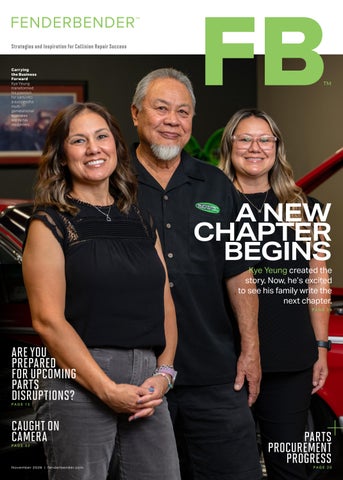
Carrying the Business Forward Kye Yeung transformed his passion for cars into a successful multigenerational business led by his daughters.
A NEW CHAPTER BEGINS
Kye Yeung created the story. Now, he’s excited to see his family write the next chapter.
PAG E 26
ARE YOU PREPARED FOR UPCOMING PARTS DISRUPTIONS?
PAG E 15
CAUGHT ON CAMERA
PAG E 32
November 2026 | fenderbender.com
PARTS PROCUREMENT PROGRESS
PAG E 20
Ev
Access Shipping Info & Reprint Invoices: All your order and billing details in one place.
View Credits: Easily see account activity and available credits.
Kg
Track Your Orders: Get real-time updates on every order you place.
FR
Faster, Easier Ordering: Place orders in just a few clicks with our streamlined interface.
AT ORM AR 0 G INFONT 3 RE or 1114 Lbs.
New Dashboard is available on our WEBSITE & MOBILE APP
ADIN
visit our website at www.AutoDataLabels.com | email us at labels@AutoDataLabels.com
.A.
FOR ADDITIONAL INFORMATION ABOUT AUTO DATA LABELS:
AVERTISSEMENT
Before working under cab engage prop support.
N U.S
SCAN THE QR CODE TO GET STARTED NOW!
coussin gonflable latéral. Voir le manuel du conducteur pour de plus amples renseignements.
Falling cab may injure o r kill.
O ION C EMISS
Order History: Quickly search past purchases and reorders.
POUR ÉVITER DES BLESSURES GRAVES OU MORTELLES:
SION N EMIS MATIO e ICLE OR lin VEHROL INF Fuel: Gaso T CON
AUTO DATA LABELS HAS THE LABELS YOU NEED, WHEN YOU NEED THEM! 15 : 20 IER2 fied tions LDV / T EV quali gula to re / stds: PC / UL s orms : Conf EPA clas ss / stds 11 1.2L U.S. ornia cla XV01.80 05 Calif p: FGM XR00958 D: I I Grou : FGM C, OB Evap HO2S/TW SFI/
N
Stay clear of raised cab.
G 5LB WITH TIRESS RIM LD SL PSI CO 5 Pa/3 TOR AL MO 5 F001883 BOVE. T0
505 LO 3 RS AND TOTAL er exceed OWNE TIRE CAPACITY argo should nev PRESSURE SEE NUAL FOR A c E M i d L R n TING IONA 4ps nts a LD TI T 4 I O SE A D C cupa D c A o ION kpa ht of si RMAT weig 303 44p ined INFO SIZE comb kpa si The 303 17 44p a /70R TIRE 3kp 265 0 7 3 T P 0R1 G FRON P265/7 RIN 17 CTU /70R UFA REAR N A 265 8LB L R M E P 266 ICAB OTO ⁄ 04 SPAR A M . 02 RR PPL , A Y O T , I N C 6 8 L B A L L AU M P EERC T B EFF E 6 : TO KY V . B Y T U C R 2 T O T Y, M F D K E NWR FO R M S S A F ES I N N A BSOS . C RD HOW PA GA N F LE ICLE A C O I D C LB VEH V E HS T A NU R E S0 0 0 233 LE 00 CT R 4 HIC TOR N GVW S V E M O N T I ON U F A 0 0 0 0 THI ERAL REVE MA 0000 FED FT P E OF 0000 08 A THE DAT PGK .A. THE -- C E U . S 30L IN ACVMADE 3 LA4 1E Q2 ⁄ ⁄ U24 R : 4 01A C ⁄ T⁄ T M : -A
B 3U51 F05
G RNIN DEATH:
WAINJURY OeRdoor. US st th that t. in ERIO s OID S an agat cover loymen not le se sea ag dep r not uide air banual fo ockwsner’s mtion. ENT e o forma SSEM I S T E ore in AVEDRES BLESESSU: R la porte. e LL R ÉVITE MORTE s contr e POUARVES OU puyez poauvre-siègment du GR us ap un c éploie •NNe’uvtiolizeuzt pbalosquebrleleladtéraul.cteur po.ur • qui pe in gonfla du cond nements couss manuel s renseig Voirplelus ample de
block side air bag deployment. See owner’s manual for more information.
LE : VEHIC ions ulat reg with rds. s to LDVFuel: states standa form T2B4 Con le in ions A: r sa miss . EP II ot fo rnia e U.S OBD N FED fornia: Califo i S Cal -HO2 S/WR /HO2 p: GFM 1 u TWC -Gro XR0 2.3L p: GFM Eva
Crush Hazard.
DS0: C: 13 TR SPBR AXLE5 V D 4 UTC
REPLACEMENT LABELS!
2 MATIO INFOR T 2 REAR lbs. A D IN G FRON kg or 776 ND LO 4 352 ’S TIRE A TOTAL ver exceed WNER R ld ne Y EE O S E R PACIT cargo shou AL FO d NG CA RESSU MANU IONAL SEATI cupants an TIRE P T c SI COLD ADDI ATION ht of o , 35 P d weig 0 kPa ORM
APP STORE
Do not paint o ver this label. Replace if damaged or lost.
WARNING
SRS SIDE AIRBAG
vous appuyez pas contre la porte. •Ne pas un couvre-siège •N’utilizez qui peut bloquer le déploiement du
Do not ride on forklift.
SERIOUS INJURY OR DEATH: COUSSIN GONFLABLE LATÉRAL TODoAVOID • not lean against the door. (SRS) •Do not use seat covers that
WARNING
WARNING
LKQ B2B WEB PORTAL
GOOGLE PLAY
DOWNLOAD ON THE
DOWNLOAD ON THE
YOUR SINGLE SOURCE FOR ALL
CONTENTS
NOVEMBER 1 1 . 2 6
|
V O L U M E
2 8
FEATURE
|
N U M B E R
1 1
PROFILE
20 PARTS PROCUREMENT PROGRESS
26 A NEW CHAPTER BEGINS
Accessing OEM parts is easier than ever with the latest tools.
Kye Yeung created the story. Now, he’s excited to see his family write the next chapter.
BY TIM SRAMCIK
BY LINDSEY GAINER
FenderBender (USPS Permit 25614), (ISSN 1937-7150 print) is published monthly by Endeavor Business Media, LLC. 201 N Main St 5th Floor Fort Atkinson, WI 53538. Periodicals postage paid at Fort Atkinson, WI, and additional mailing offices. POSTMASTER: Send address changes to FenderBender, PO Box 3257, Northbrook, IL 60065-3257. SUBSCRIPTIONS: Publisher reserves the right to reject non-qualified subscriptions. Subscription prices: U.S. ($95 per year). All subscriptions are payable in U.S. funds. Send subscription inquiries to FenderBender, PO Box 3257, Northbrook, IL 60065-3257. Customer service can be reached toll-free at 877.498.4668 or at customerservice@fenderbender.com for magazine subscription assistance or questions. Printed in the USA. Copyright 2026 Endeavor Business Media, LLC. All rights reserved. No part of this publication may be reproduced or transmitted in any form or by any means, electronic or mechanical, including photocopies, recordings, or any information storage or retrieval system without permission from the publisher. Endeavor Business Media, LLC does not assume and hereby disclaims any liability to any person or company for any loss or damage caused by errors or omissions in the material herein, regardless of whether such errors result from negligence, accident, or any other cause whatsoever. The views and opinions in the articles herein are not to be taken as official expressions of the publishers, unless so stated. The publishers do not warrant either expressly or by implication, the factual accuracy of the articles herein, nor do they so warrant any views or opinions by the authors of said articles.
November 2026
3
fenderbender.com
CONTENTS
NOVEMBER
STARTER
07
DRIVER’S SEAT Adapting to an AI-driven world
08
PAST THE PAGE
Should you consider adding fleet work?
QUICK FIX
10
BREAKDOWN
Four fixes for why your shop isn’t growing
13
NUMBERS
Do you use solvent-based or waterborne paint?
12
LIGHT HITS
The latest stories from around the industry
15
Q&A
Are parts disruptions coming?
15
STRATEGY
COLUMNS
18
32
SHOP PROFITS
CASE STUDY
Dash cams: protecting privacy and legal exposure
Uncovering productivity killers
36
COLLISION COURSE
BY G REG LOB S IG E R
40
HUMAN RESOURCES
Balancing your workload and budget
Build a loyal, highperforming team
BY TIFFANY ME NE FE E
42
ON THE BUSINESS
Save money with segregated depreciation BY MIK E ANDE RSON
32
November 2026
4
fenderbender.com
New cred. New customers. When you join the Ford Certified Collision Network (FCCN), you’ll be recognized by Ford, customers, and insurance companies as someone who offers the highest standards in Ford and Lincoln repairs. That puts you into a referral stream for new customers from our digital properties and call center. It also gets you access to not only the right parts but exclusive Ford procedures, training, and support. What’s more, you’ll be included in the Ford Pro™ Fleet and Commercial certified shop list. Take word-of-mouth referrals to the next level by joining the FCCN today.
Learn more about FCCN.
Message and data rates may apply.
CONTENTS
ONLINE EXTRAS
CL ICK ON THE L OGO BEL OW F OR PRODUC T INF ORMATION
Autel
Auto Data Labels
Axalta Coating Systems
Buy Auto Supply
Car-O-Liner
Ford Motor Company
Motor Age Training
LKQ Refinish
PartsTrader
Refinish
Your trusted partner for all your refinishing needs!
ProColor Collision USA
• • • • • • • •
Abrasives Aerosols Bed Liners Body Fillers & Putties Buffing SATA USA Inc. Clears & Primers Cleaners & Solvents Compounds & Polishes
Refinish FOLLOW US!
• • • • • • •
Detailing Masking Painting Supplies Safety & PPE Products Sealers & Adhesives Clothes, Wipes & Rags Tools & Equipment
Telwin
Scan here to view the LKQ Refinish Catalog
©2024 LKQ Corporation | Visit Us at LKQCorp.com & LKQ-Refinish.com
2504FB_LKQRefinish_REV.indd 1
November 2026
3/3/25 3:46 PM
6
fenderbender.com
DRIVER’S SEAT
EDITORIAL
Chris Jones VSRG Editorial Director Jay Sicht Editor-in-Chief Peter Spotts Associate Editor Kacey Frederick Assistant Editor Emily Kline Special Projects Editor Leah Marxhausen Special Projects Editor Drew Bryant Contributing Writer Tiffany Menefee Contributing Writer Greg Lobsiger Contributing Writer Lindsey Gainer Contributing Writer Todd Kortemeier Contributing Writer Steve Trapp Contributing Writer Carol Badaracco Padgett Contributing Writer Tim Sramcik Contributing Writer
EDITORIAL ADVISORY BOARD
Jordan Beshears Steve’s Auto Body Sheryl Driggers Collision Advice Stan Medina Certified Collision Works Jason Mundy Mundy’s Collision Center
SALES
Andrew Johnson Publisher ajohnson@endeavorb2b.com Mattie Gorman-Greuel Associate Sales Director Cortni Jones Director of Business Development Marianne Dyal Account Executive (National Accounts) mdyal@endeavorb2b.com Chad Hjellming Account Executive (National Accounts) chjellming@endeavorb2b.com Diane Johnston Account Executive (National Accounts) djohnston@endeavorb2b.com Lisa Mend Account Executive (National Accounts) lmend@endeavorb2b.com Kyle Shaw Account Executive (National Accounts) kshaw@endeavorb2b.com Sean Thornton Account Executive (National Accounts) sthornton@endeavorb2b.com
ART AND PRODUCTION
Mariah Straub Production Manager Jen George Ad Services Manager Mitch Bradford Art Director
ENDEAVOR BUSINESS MEDIA, LLC
CEO Chris Ferrell COO Patrick Rains CDO Jacquie Niemiec CALO Tracy Kane CMO Amanda Landsaw EVP Transportation Chris Messer EVP Endeavor Business Intelligence Paul Mattioli VP of Content Strategy, Transportation Group Josh Fisher
SUB SCRIPTION S
Send address changes and subscription inquiries to: FenderBender PO Box 3257 Northbrook, IL 60065-3257 Subscription Customer Service: 877.498.4668 customerservice@fenderbender.com
LET TE RS TO THE E DITOR editor@fenderbender.com
Opinions expressed in FenderBender are not necessarily those of Endeavor Business Media, and Endeavor Business Media does not accept responsibility for advertising content.
November 2026
FROM FEAR TO FAMILIARITY:
INTEGRATING AI INTO DAILY BUSINESS OPERATIONS AI-driven tools are innovating estimating, parts procurement, and insurer communications.
" Y O U R W O R L D F R I G H T E N S and confuses
me." You may recognize that phrase from the late Phil Hartman's portrayal of "Unfrozen Caveman Lawyer," a character he portrayed from 1991 to 1996 on Saturday Night Live, who after 100,000 years of suspended animation, ended up as an articulate and successful courtroom attorney. I chuckle to myself and think of this phrase often when I read or hear about the latest technological innovation powered by artificial intelligence. But whether you welcome change or, like me, you've been dragged kicking and screaming to embrace it, AI is here to stay. And although like many I am uncertain of whose job is or isn't safe — and to what degree — a change in AI and increased automation may bring, I now use at least some form of AI almost daily, whether it's to transcribe an interview, summarize a meeting, organize notes, or for quick searches. I must also mention that our company, EndeavorB2B, has strict rules about the use of AI in actual reporting/writing or photo-editing, and we'll notate that when that happens. Perhaps you're already using agentic AI, such as through Body Shop Booster, to serve as your first point of contact, especially after hours. Or maybe you're using a tool such as CCC's Jump Start to help triage the damage before you write a thorough repair plan. Just as Chat GPT or its large language model competitors can help with mundane tasks, innovators today are showing collision repairers how AI and other
7
"smart" technologies can help with parts procurement, as shown by Tim Sramcik's article in this issue including CCC, OEC, and PartsTrader. In that same feature "package," my discussion with Partly's CEO shows how the company's AI-powered Interpreter can assist with everything from blueprinting and supplement creation to parts basket optimization, photo annotation, and insurer communications. If you haven't checked it out yet, dip your toe in the water and see a demo for yourself. And I promise the future will be just a little less frightening and confusing.
JAY SICHT
EDITOR-IN-CHIEF
jsicht@endeavorb2b.com
fenderbender.com
VIDEOS
PA ST T H E PAGE
|
PODCASTS
|
WEBINARS
|
NEWS
SHOULD YOU CONSIDER FLEET WORK? Discover how AI-dispatched fleet work can fill bays during slow times, offering high-volume, fast-paced repair opportunities for service shops. DURING SLOW TIMES, one possible solution to filling bays is fleet work. Whether you service a fleet of rental cars, last-mile delivery trucks, the local HVAC company, or a trucking company, they can be a source of lower-margin-but-high-volume, fast-production work. ServiceUp Chief Operating Officer Andy Klobnock joins CollisionCast to talk about the nuances of fleet work and how his company’s platform directly sends repair jobs to the shops and manages all customer communications, including coordinating vehicle drop-offs and pick-ups.
Find CollisionCast on your favorite podcast platform or scan the QR code.
Visit FenderBender.com/news for daily updates from around the collision repair industry.
@fenderbendermag
November 2026
fenderbender.com/linkedin
8
fenderbender.com
fenderbender.com
AAAAAAAE ´´ EFFFCCEECC CCCC CEEEEFFED AAAAA CEEEEE! roper repair procedures put safe vehicles back on the road
ECAA -CCDE EE EAAA E
Visit CAR-O-LINER.COM to learn more. Call for a quote: (800) 521-9696
ADOBE STOCK 1066245908
Q U I C K
F I X
BREAKDOWN
FOUR FIXES FOR WHY YOUR SHOP ISN’T GROWING
Micki Woods shares how shops can help secure more business opportunities. Improvements can begin immediately with a seven-day audit. By PETER SPOTTS
M O R E T H A N 1 00 AT T E N D E E S of the Women’s Industry Network’s recent virtual conference identified in a poll the biggest reason their shop isn’t growing, and customer experience claimed the top response. What Micki Woods referred to as the “growth chain” moves customers through the entire repair process from acquisition to referral. It requires shops to be found, trusted, reached, scheduled, delighted, and shared. The owner of Micki Woods Marketing said shops have five areas where small leaks can occur – visibility, conversion, phone, experience, and reputation. “I am really proud of you guys that you’re able to mark [customer experience issues],” Woods said. “I work with a lot of shops… And most shop owners, that’s one of the ones that they’ll say, ‘Oh, customer experience is great. Everybody loves working with us.’ It’s tough for shops to actually diagnose that this is a true issue.”
November 2026
Woods examined four fixes for where breaks in the growth chain occur to help attendees identify where they’re churning business opportunities: 1. Show up where people look 2. Reviews are not vanity 3. Answer the phone like it matters 4. Create moments worth talking about
Fix #1: Show Up Where People Look Woods said shops often think they know where people look for shops, such as referrals from insurance companies. However, even if the insurer recommends a shop, customers will still use Google to research. “They’re going to Google, so how are you showing up on Google?” Woods asked. “They are looking for the quickest person to find, and they want to see some good reviews.” Getting to the top of Google requires investment in paid ads. Potential custom-
10
ers don’t scroll through multiple pages; they call the shops that appear at the top of the page. But paid ads aren’t successful just because they generate clicks or calls. “You also want to be making sure you’re booking appointments…people are over 50% more likely to show up to your shop if they have an appointment,” Woods said. “You also want to be tracking your missed calls because oftentimes you’re pumping money into paid ads and you’re not answering every phone call; those are lost opportunities.” Google has free business profiles that show up when someone clicks on a business on the Maps page. Woods emphasized the importance of every shop having one and ensuring the information is correct. “This is not optional to be here,” she said. “You guys need to position yourself on Google; Google is the number one search engine in the world. Maximize this free listing.”
fenderbender.com
NEWS
Google profiles should include: • Categories: Make sure primary and secondary descriptions match what you sell. • Photos: Fresh, real photos build trust faster than stock-looking content. • Services: List collision, body repair, paint, ADAS, and specialty services. • Hours: Wrong hours create friction before the first call. • Reviews: Reviews help customers feel safe choosing you. “You can tell them all the things in the world, but if you show photos of your shop, if you show pictures of people smiling and helping out another customer, they are emotional,” Woods said. “This is one of those things where it’s worth the money to have a photographer come in and get really good photos of your shop and of your people and then your estimators are already taking the before pictures.”
Fix #2: Reviews Are Not Vanity Reviews are not a testament of the body shop’s work, but of its customer service. Shops should make sure customers are leaving reviews. When a customer is happy with their repair, ask them to leave a review. Shops can also make a QR code they can scan to leave a Google review. Third-party programs, such as Podium and Birdeye, can connect to CCC One and automatically send a customer a text after the repair order is closed to encourage the customer to leave a review. AI is also picking up on reviews, and Woods said Google rewards businesses with current reviews or businesses that respond to reviews. When a shop gets a review, a manager or owner should try to write a quick, short response.
Fix #3: Answer the Phone Like it Matters Woods said her agency listens to every phone call for shops they run paid ads for. They’re able to identify issues for shops because the shop isn’t listening to its own calls. What people think is happening on calls often is not.
November 2026
“You wouldn’t believe how I will talk with an owner before we work with them, and they’ll say, ‘Oh, my CSR, she’s great. She can close anything,” Woods said. “I’m like, well, she might have been able to close it if she asked the person’s name. She might have been able to close it if she scheduled somebody. She might have been able to close if she had a little compassion and heard their story.” Remind anyone answering the phone that they are there to take care of the customer, but it starts with answering the phone. Woods said 20-60% of phone calls, on average, will hang up if they get an automated system. “You don’t know how many people are hanging up on that because you guys don’t see those numbers,” Woods said. “We track phone calls, we record phone calls, and we send those missed calls to our clients and it’s anywhere from 20 to 60% of total volume coming in and those are just the ones we’re tracking … We’ve got these AI calls that will call us or AI agents that will answer the phone – so many hang ups. Use it when you need to. If nobody else can get to the phone, use the AI agent. It can be helpful when you need it.” Customer experience is part of marketing. People remember how a shop made them feel, which is crucial because people make decisions more often based on their feelings than data. Shops should strive for: • Speed: Fast answer, fast next step. • Certainty: Explain processes before the customer panics. • Care: Use names, be human. • Control: Provide updates before the customer has to chase you.
Fix #4: Create Moments Worth Talking About If a shop isn’t standing out for the right reasons, another one will or it could stand out for the wrong reasons. Before the repair starts, Woods said shops can stand out be speaking to people plainly; avoid technical jargon. During the repair,
11
|
IDEAS
|
PEOPLE
|
TRENDS
proactive updates – even a “no update” update – leave a positive impression. “They’d rather deal with somebody in a company who will take the time to spend the time with them so that they feel cared for,” Woods said. When the repair is finished, thank them during pick up and walk them to the car. After they leave, follow up a few days later to make sure everything is going well. “[I] went and worked full time for a body shop. The only time we would ever check in on customers is if they brought their car back,” Woods said. “So, when they brought their car back, because it was a redo, once they left, I would check in with production [that] the customer had picked up. About three to five days later, I would call personally and say, ‘Hey, I know you had to have your car come back in. How’s everything going now?’ They were shocked that I called to check in on them … It was a differentiator for that shop at that time.” Woods left attendees with a seven-day shop growth audit they could take back to their shops and start working on: 1. Search your top keywords from a phone or get in touch with Micki. 2. Check Google Business Profile services, categories, photos, and hours. 3. Listen to 20 phone calls and note what happened. 4. Check missed calls and speed to call back. 5. Review ads calls: which calls were qualified? Which showed? Which closed? 6. Evaluate request timing 7. Rank issues. Pick the first fix and assign an owner “Figure out where you’re at and then figure out how you’re going to get visible on Google, but that’s where [customers] are, folks. That’s where they’re going,” Woods said. “Then you want to be chosen. So, it’s important that you’ve got reviews... You want to be reachable. Answer your phone and then be memorable. Find a way to make yourself memorable.”
fenderbender.com
QUICK FIX
LIGHT HITS
CARSTAR SPONSORS FUN RUN FOR SCHOOL PROGRAMS
CARSTAR Northwest and CARSTAR Silver Hammer sponsored the Picotte Elementary School Fun Run in Omaha, Nebraska, on Sept. 18. The annual event, organized by the Picotte Elementary PTA, brought together students, families, staff, and local businesses to support educational programs and school initiatives. The event raised more than $30,000 to help provide classroom parties, staff appreciation efforts, the One School/One Book program, field trip transportation, teacher grants, and a new outdoor educational learning space for students.
FIX AUTO LAKESIDE SUPPORTS COMMUNITY AS EVENT SPONSOR OF LAKESIDE SUMMER STAMPEDE RODEO
Fix Auto Lakeside’s sponsorship of the Lakeside Summer Stampede Rodeo,
November 2026 2409FB_BuyAutoSupply.indd 1
which showcased local traditions and entertainment while providing an opportunity for community members to connect and celebrate. Attendees heard a live announcement recognizing Fix Auto Lakeside’s commitment to serving the community and the shop was additionally featured in the official rodeo program distributed throughout the event.
MICHIGAN AUTO BODY ASSOCIATION LAUNCHES TO GIVE COLLISION REPAIRERS A VOICE
The Michigan Auto Body Association (MABA) announced its official founding as a statewide professional association representing collision repair shops across Michigan, and its affiliation with the Society of Collision Repair Specialists (SCRS) as an Affiliate Association. MABA was formed to fill a void its founders say has existed in Michigan
12
for years. When the state’s last collision repair association ceased operating, the industry lost what founding board members describe as the “eyes and ears of the industr y” — a loss felt most acutely on legislative issues affecting shops and the consumers they serve. That gap became increasingly clear to MABA’s founders through conversations with peers at industry events across the country, where the value of a unified, organized voice at the state capitol was reinforced again and again. MABA’s early legislative priorities include fair and transparent practices, stronger anti-steering protections for consumers, proper reimbursement for OEM-required repair procedures, and enforcement mechanisms for unfair claims practices — priorities modeled in part on laws already in place in Rhode Island, home to one of the country’s most effective state-level collision repair associations.
fenderbender.com 6/20/24 2:51 PM
NUMBERS
DO YOU USE SOLVENT-BASED OR WATERBORNE PAINT?
A S R E P O R T E D B Y S H O P O W N E R S and operators in this year's FenderBender Industry Survey, the percentage of shops using only solvent-based paint remained flat compared to 2025. But the number of those surveyed reporting using both solvent-based and waterborne paint increased by nine percent this year, suggesting these shops are performing more fleet, industrial, or non-automotive refinishing.
Do you prefer solvent-based or waterborne paint?
2024
2025
Solvent-based
Waterborne
2026
Both
All New jet X Special Editions Basecoat and Clearcoat Available for a limited time
MADE FOR EACH OTHER. AND MADE FOR YOU The new Special Editions of the jet X: basecoat EDITION and clearcoat EDITION. Both spray guns combine the proven performance of the jet X with exclusive designs that make their intended use instantly recognizable. They also feature new technical updates now incorporated across the entire jet X lineup. INFO www.sata.com/basecoat-edition INFO www.sata.com/clearcoat-edition
SATA USA Inc.
Phone: 800-533-8016 E-mail: satajet@satausa.com www.satausa.com
QUICK FIX
Q&A
ARE YOU PREPARED FOR UPCOMING PARTS DISRUPTIONS?
PartsTrader’s Greg Horn and Mitchell’s Ryan Mandell discuss the current state of parts availability and upcoming factors for which shops must be ready. By PETER SPOTTS
WITH ECONOMIC AND TARIFF turbulence looming on the horizon, collision repair shops face increasing difficulties with parts availability, delivery, and supply chain-chain disruptions. Greg Horn, chief industry relations officer at PartsTrader, and Ryan Mandell, vice president of strategy and market intelligence for Mitchell’s Auto Physical Damage division, keep a close eye on the status of parts. Short-term, shops might have to deal with increasing parts costs. However, say the spokesmen for the two Enlyte companies, the outcome of trade war threats with Canada and other economic factors could leave shops facing significant inventory and supply chain issues as the calendar turns to 2027. Horn and Mandell talked to FenderBender about the current state of the parts market, what developments they’re expecting to see in the short-term, and what shops need to do to prepare for more disruption in the coming months.
Q: How are current supply chain disruptions affecting cycle times, rental expenses, and repair throughput?
RM: When we look at overall keys-to-keys and cycle times, we don’t see a ton of disruption right now. We are not seeing a lot. If you look at Enterprise’s Length of Rental data, if you look at our keys-to-keys data, cycle times continue to gradually improve from where they were during kind
November 2026
of the peak of supply chain disruption in 2022 and 2023. So, I think what we expect is that we’re going to be coming into a season of potential disruption. If I were to make a recommendation to shops, it’s really starting to think about what your parts supply chain looks like for your actual business. How do you start to build in some contingencies if there are some significant delays, if there are back orders? What does your repair strategy look like? Are you preparing techs to, are you upping their training regimen to be able to repair some of these newer materials in case you’re not able to get a part for three weeks?... I think that’s a very real possibility we could be entering into; I don’t know if it’s to the same degree that we saw during COVID, but I think that could be a measure of that that’s to come. GH: I’d agree with Ryan’s assessment that we’re going to see a disruption in both OE and likely aftermarket. As we see the rise in diesel prices topping $6 a gallon, I think you’re going to look at suppliers wanting to do more milk runs that make sense, that squeeze every efficiency out of a gallon of diesel. The interesting thing, when we saw a bunch of back orders during the first six months of COVID, we had some of our customers, both repairs and insurance carriers say, “Hey, we can’t find this part.” And, you know, it was interesting because the shop was used to calling my guy at the
15
Greg Horn
Chief Industry Relations Officer PartsTrader
Ryan Mandell
Vice President of Strategy & Market Intelligence Mitchell’s Auto Physical Damage division
fenderbender.com
QUICK FIX
dealer, right? That dealer was calling that parts distribution center, and they said that we don’t have it. We’re [PartsTrader] putting it out on a nationwide search. So, we’re hitting every dealer and their parts department that may have it on the shelf and we were able to get a lot of vehicles repaired doing just that. I was in Puerto Rico in the spring of last year. We were touring a big body shop, and we found a GMC pickup that could not be returned to the customer. I looked at the layer of dust and I’m like, this has got to be out. They said, yeah, this is one of our key customers and policyholders and we can’t get the delivery back. He’s out of rent-a-car. I said, well, what are you missing? He said it’s a seatbelt sensor. So, we put it out. He goes, you know, it’s been back ordered for a couple of months and it was because he was going to that PDC in the southeast. We actually found it at a GMC dealer in Denver, Colorado; had it [shipped] overnight to the body shop and the customer got their car back that next day.
Q: You both mentioned we’re going to see a disruption coming up. Is it mainly the fact of the rising cost of diesel fuel and the transportation challenges that’s going to pose or are there other issues... are there any part shortages or other factors that are also adding to this?
RM: So, I think the transportation cost, the logistics cost, is a big part of it. But I think there’s also a variable that’s at play in terms of where manufacturing is going to be taking place. How are the geographic centers of manufacturing changing as a result of this tariff policy? You’ve seen billions of dollars of investments taking place in domestic manufacturing centers for many of the major OEMs, and I think that’s all good for the domestic economy here in the United States. But what that does is you start to create pockets where there’s no overlap that’s created between the old center of manufacturing and the new one. If you used to make a bumper
November 2026
cover in Mexico City and now you make it in Birmingham, Alabama, hopefully you can shut down Mexico City on Tuesday and, on Wednesday, Birmingham is able to provide the same bumper cover with no delays. That’s not always the case. Additionally, moving that manufacturing domestically adds an additional cost to those parts because of the higher labor costs here. I think you’re probably going to see additional changes in terms of where parts are being manufactured because of the most recent tariff news associated with Canada. It affects a smaller portion of parts, notably than some of the other centers of manufacturing. GH: I think that the biggest thing to watch in my mind is what’s going to happen between these trade discussions with Canada and the United States. For 27 states, their biggest export partner is Canada, and we see a lot of manufacturing done along the border between Canada and the U.S., and that’s going to potentially suffer. Then, you go back to a previous tariff decision and lawsuit that Detroit Axle filed against the International Trade Commission. The administration had eliminated the de minimis exemption for goods under $800, and Detroit Axle said, “This is killing us; this is killing our business.” They went all the way up to the U.S. Court of International Trade. They ruled in favor of the administration, and you see that in response, Detroit Axle shut down the retail store in the Detroit area and they’ve laid off over 100 people. So, that’s one of those unintended consequences that we just have to kind of look at and see if we can see anything trend-wise that’ll happen over the next six months or so.
Q: Are there any specific parts that are more at risk of potentially going through inventory availability difficulties than others? GH: I think one of the first things, because of the size, is stamping. If you’re stamping sheet metal in Mexico,
16
for example, and then you move it to Birmingham, as in Ryan’s example, you’ve got to literally physically move that stamp. They’re not going to invest in a second stamping mold for each of these parts; it would be far too expensive. RM: Yeah, and I would agree with that. I mean, there’s definitely a lot more kind of just the logistics involved with some of those larger stamping operations. I think the other aspect that you could look to potentially be plastic parts. I only say that just because plastic parts were a little bit more reliant on global suppliers for raw materials as opposed to sheet metal. The auto industry typically prefers domestic sheet metal because of the more rigid quality control standards we have here in the United States, but plastic is not that way. Most of that raw material comes from China.
Q: How long do you think it will take to feel the tariff and economical affects?
GH: There are a lot of unknowns. We really must watch what happens with Canada. If the threat – the administration said that they wanted to ban purchases of Bombardier jets out of Canada – there are a lot of jobs in Kansas that rely on that. As a retaliation, [Canadian Prime Minister] Mark Carney has said, “We’re going to put tariffs on a ton of American goods in addition to what we already have.” In response to that, it’s like this tennis game back and forth, the [Trump] administration said, well, then we’ll put a tariff on Canadian-produced automobiles. Well, that’s the RAV4, the Civic, the CRV, the Pacifica, the Silverado, and Sierra. That’s some high-volume popular American cars, and the threat is to put a full 50% tariff on the vehicle. I doubt that would happen, but I don’t have a good track record predicting what the administration will ultimately do. RM: I think probably the nearer-term impact that we see is from pricing. I think that’s something that will be reflected, or we’ve
fenderbender.com
already seen some of it because of the tariff policy, more with some manufacturers than others. But I think the actual disruption piece, the availability challenges, are probably something that’s more six months-plus. Because really what you’re looking for is when do these manufacturing sites come online for these companies? I think that’s really more of a 2027 piece of the roadmap there.
Q: So how are shops dealing with the short-term financial parts challenges? GH: From my perspective, if they’re using PartsTrader, they’re getting just about eight quotes back per part. That includes delivery days in that quote. So, they can make pretty informed decisions. They see what their profit is going to be. They see it, the insurance company that receives that, and they see the delivery days and part type in the case of aftermarket and recycled. RM: I think the other thing to keep in mind is that shops need to just be very aware of how some of these increased prices will affect these borderline total loss vehicles and understand we’re already in an ecosystem where we see higher total loss frequency and that is cutting into some of the shop volume that they would normally be seeing. If I’m a shop, I’m thinking very seriously about “How do I handle these borderline total losses?” We’re talking about economic borderline total losses. We’re not talking about anything structural or stuff like that; nothing safety-related. If the customer really wants to keep their car, how do I make sure that can happen safely and cost effectively? And just knowing that I’ve got these, I have parts that are going to be more expensive. So, what other decisions do I have to make on this repair to ensure that I’m able to keep this job in my repair ecosystem?
Q: Looking ahead at some of these potential changes that we’ve been discussing, how can shops start trying to prepare or plan for potential long-term effects we’ve discussed?
November 2026
RM: I think as part of that, it’s expanding your supply chain footprint. To me, it’s growing the relationships you have with different suppliers. I know having managed shops, you get kind of singlethreaded sometimes through the suppliers that you work with all the time. And you almost get this tunnel vision to where like, oh, well, if my dealer doesn’t have it, aftermarket vendor A, recycled vendor A, if they don’t have it, then I’m out of luck. To me, that really just sets yourself up for these delays that you actually have more control over than you think. Greg gave the example of finding this seat belt sensor in Denver for a shop in Puerto Rico. I mean, that’s a great example. These parts exist. They are out there. It’s just a matter of having a process to find and acquire those parts. Now is the time to start putting some of those things in place and building some of those relationships, not just with different OEM providers with different dealers, but alternate providers, too. GH: When a shop writes an estimate with, say, 10 parts needing to be replaced and they upload the estimate to the PartsTrader marketplace for quote, all 10 parts would be seen by recyclers, even if there was no Hollander interchange number. Other parts systems have key disadvantages. The shop must select that is a part they want to find a recycled part for in the compare box. If the shop estimator doesn’t think there is an alternative, he may elect just to keep the part as new OEM. Additionally, in most other parts systems, the OEM part that is selected to find an alternative must have a Hollander Interchange number associated with it to search the recyclers inventory system. So, if there’s something that doesn’t carry a Hollander number, you may be able to find it [in PartsTrader].
Q: If you were talking to a shop today, what would you tell them are kind of the most important parts trends that you’re observing right now, that this is what you need to be watching out for the most?
17
GH: I think it really is paying attention to when the part can be delivered. You’ve scheduled your job, so you need to make sure that your parts at your optimal selection are going to be there. That’s why we track those median delivery days to sort of give people a heads-up on anything that could potentially be a delay by part type overall and just being presented with a lot of options versus contacting your guy for recycled parts or the one aftermarket vendor or your one new OE dealer parts department. It’s just getting more selection. RM: I kind of alluded to this at the beginning, but par t of this is also the abilit y of technicians to repair damaged par ts and to understand the trend in the automotive industr y has been toward lighter weight substrates, which are more dif ficult to repair [because they] have patterns of damage that may not be conducive to repair. But I think we must make sure that we haven’t gotten into a pattern of, “ Well, if it’s aluminum and it’s damaged, we replace it.” So, par t of that is making sure the technicians have the training, have the appropriate tools, have the appropriate clean room set up to be able to repair those materials and the understanding, doing a full analysis of the pattern of damage to decide, “Hey, is this something that actually needs to be repaired? Is it absolutely necessar y that we replace this?” Because there are other benefits to repairing more par ts as well. And that’s improved profitabilit y, even if the par t’s available next day... And I think we’re seeing that reflected in our industr y data, where we’ve seen the percentage of par ts being repaired increase by multiple percentage points year over year, which is not something we’ve seen in the last 20 years. So that’s a market shif t by the MSOs, I believe, because of this focus on profitabilit y and ef ficiency. And I think shops that embrace that are going to be even more insulated from any coming disruptions.
fenderbender.com
COLUMNS
SHOP PROFITS
Uncovering the Invisible Productivity-Killer in Your Business
Implement visual management strategies and set boundaries to protect your employees’ focused work time and enhance your overall business success. ments. It doesn’t matter whether that comes to gross profit, net profit, hours per day, cars per day and especially employee productivity. Many times, owners/managers get so caught up in the day-to-day that we don’t take time to just stop and observe our employees. We’re paying them for their time to work inside our businesses. It’s basically my money = your time. Let’s just do some math here to understand time. With 365 days in a year X 24 hours per day, that equals 8,760 hours per year. Otherwise, whether your 10 years old or 90 years old, every human being on the planet has the same amount of time per year. No one gets more and no one gets less. Same goes for our employees, each have 8,760. Now granted, we don’t get all their time, just the time they’re at work. So, do they spend 30%, 35% or even 40% of the 8,760 available hours at work? Let’s put a pencil to it! 40 hours per week X 49 weeks per year (deducted two weeks for vacation and another week for paid holidays) = 1,952 hours at work per year. 1,952 / 8,760 = 22.3%. Wait a minute: you’re telling me the average worker who works 40 hours per week only spends 22.3% of their available time per year at work? Yep! Otherwise, our employees have 77.7% of their time available to themselves. Of course, there is sleeping, getting ready for work, the commute, etc., but it’s still THEIR time, not mine. If the average employee only spends 22.3% of their time per year at work, this makes productivity paramount! There is a nearly invisible time killer that robs owners/managers of over 1/3 (three hours) on average per day of each employee’s productivity. I am not talking about bathroom breaks, either. This bandit is in the form of interruptions and distractions. Dr. Gloria Mark, a professor at the University of California, Irvine, has done extensive research on the effects of interruptions/distractions on productivity. Dr. Mark found that the average worker is distracted every 11 minutes and takes over 23 minutes to fully recover from a distraction. For easy figures, let’s say for every $100,000 in payroll that you pay out every year, you’re paying $37,500 in lost productivity due to distractions! Don’t believe me? HAHA. Let’s use psychologist Yana Weinstein’s simple test and I DARE you to do this test with your employees as a group:
November 2026
• Find a volunteer. Then with the timer on your phone, have the volunteer count from 1-26. How many seconds did it take? Write down the time. • Next, do the same with them reciting the alphabet (A,B,C,D, etc.). How many seconds did that take? Write down that time. • Now, time them switching back and forth between the two activities — in other words, “1-A, 2-B, 3-C” etc. How many seconds did that take? Write down the time. If there were no cost to task-switching, it should take you exactly double the amount of time to do the switching activity. I suspect you’ll find it takes them much more than double the time. So, where are all these distractions coming from? In the world of lean manufacturing, little is written about interruptions/distractions. Why? It’s just a given that if you have systems like standardized work and visual management in place, employees can be much more productive. Take this simple example of a technician interrupting a manager multiple times with “Where’s the next car to work on? Where’s the keys? Where’s the keys to the car in front of it? Where’s the parts? Where’s the work order? Are we fixing the dent in the blend panel?” Not only do interruptions cost valuable workers time, but they are even much more costly than that. Studies have proven over and over that interruptions double errors. Did you get that? We make twice as many mistakes when we’re interrupted. On top of that, they lead to exhaustion, burnout and ultimately, employee turnover. Outside employees interrupting each other, how about cell phones! I still allow cell phones in my shops, and all are used every day with the estimating software. So, I encourage you to get a dry erase board and draw out something like a vertical thermometer. Then graduate it down 100%, 75%, 50%, 25% and 0%. Then show the employees how they spend less than 23% of their time per year at work. Making it visual this way is a real eyeopener for them. They can see that their friends and family have over 77% of their available time per year for texts, phone calls etc. I just told my staff, we’re at work and unless it’s an emergency. Tell your families, “Please leave me alone; I am trying to make us a living here!”
18
GREG LOBSIGER
JOSIE SMITH PHOTOGRAPHY
As a business owner, I like making improve-
Greg Lobsiger has owned Loren’s Body Shop in Bluffton, Indiana, for over 23 years. He has been a member of Mike Anderson’s groups for ten years and had extensive lean manufacturing training.
EMAIL:
greg@lorensbodyshop.com
ARCHIVE:
fenderbender.com/lobsiger
fenderbender.com
The Tech-Driven Collision Advantage Identify & Diagnose
Align & Calibrate
Discover the Autel Diagnostic Advantage autel.cc/collision-simplified
Report & Document
IA1000AST
Automated ADAS Calibration & Wheel Alignment System including All Systems ADAS Target Package Keep More of the Repair In-House Autel connects the collision repair workflow from vehicle check-in through final delivery. Identify repair requirements earlier and complete advanced diagnostics, wheel alignment, and ADAS calibration in-house. Access OEM services via Remote Expert and send reports directly to CCC ONE—helping reduce supplements, streamline documentation, improve efficiency, and keep more work in your shop.
Autel Academy Training autel.us/academy
Web: autel.us Social: @auteltools
Support: 1.855.288.3587 ussupport@autel.com
Powered by the Ultra S2 Advanced Diagnostics Tablet
FEATURE
PARTS PROCUREMENT PROGRESS Accessing OEM parts is easier than ever with the latest procurement tools. By TIM SRAMCIK November 2026
|
A D O B E S T O C K 3 0 6 12 9 5 9 9
20
fenderbender.com
TIME FLIES. In the repair industry, entire eras marked by market and operational challenges can slip into memory in what often feels like seconds. Just over a decade ago, shops were struggling mightily understanding aluminum and OEM certification. The fundamental process of accessing parts, especially OEM versions, was unwieldly — usually performed manually with telephones and fax machines, and often a fistful of antacids and a prayer that the best parts mix would arrive on time and in proper shape. A decade later, it’s a new world. Today, vendors provide procurement options offering electronic solutions that can order the right parts almost immediately and feature a host of other evolving benefits designed to increase efficiency and profits. A task that once took hours per job now can be performed efficiently and accurately in mere minutes, saving shops time and revenue lost to incorrect orders and other missteps. Here’s a brief look at several of the most popular procurement platforms, the operating philosophies that guide them, and their individual perks. Each is cloudbased, operates across Web-bases (computers, tablets, and smartphones), and utilizes VIN-scrubbing capabilities.
November 2026
CCC ONE: The Evolution of Supplier Relationships In 2013, CCC launched its e-commerce parts platform within CCC ONE, shifting pricing and inventory lookup from manual searches of sometimes out-of-date catalogs to accurate, electronically generate data delivered at the front end of the estimating process. Vice President of Product Management Sean Fitzgerald says the platform is built on relationships, connecting collision repairers directly to a network of 7,000 preferred suppliers across OEM dealers, aftermarket vendors and recyclers. CCC ONE integrates quoting, electronic ordering, electronic invoicing, reconciliation, and accounting exports into a single continuous workflow without requiring rekeying or secondary system logins. The platform’s architecture maintains a single shared record among shops, insurers, and suppliers. Price changes, superseded parts, and estimate supplements update instantly across all parties without requiring phone calls. Fitzgerald says the system integrates with virtually every major vehicle manufacturer for promotional programs and dealer network ordering. In place of traditional dealer conquest programs, CCC ONE displays promotionally priced OEM parts upfront directly inside the estimating interface as parts are selected.
21
PROMO This view shows promotional-priced parts available within CCC ONE for a shop to select and add to an estimate as repair needs are being decided. COURTESY OF CCC
While CCC itself is an information provider, its procurement tools are engineered to function identically regardless of where an estimate originates. The platform imports estimates from other major information providers so shops follow a single ordering process. CCC maintains dedicated internal teams to manage supplier onboarding and maintain direct system integrations. Fitzgerald says the platform provides additional benefits such as artificial intelligence upgrades that permit shops to scan paper delivery invoices with a mobile application that matches line items to the repair order and reconciles prices instantly, flagging discrepancies on the spot. Upcoming AI developments will allow shop management to establish custom parts sourcing rules and automatically enforce them across every repair order. Fitzgerald notes CCC ONE can boost shop revenues by preventing bottom-line financial leaks caused by incorrect parts, restock fees on returns, uncredited core charges, unbilled
fenderbender.com
FEATURE
freight costs, and parts ordered but omitted from final repair orders. He says placing orders electronically through the system reduces parts returns by 16 percent. Parts quoting and electronic ordering capabilities are included in the standard CCC ONE subscription at no additional charge across all 30,000 shops on the platform. The platform is designed to handle main routine parts volume without requiring a secondary procurement system, though shops may occasionally use direct phone calls for specialty or rare local parts.
OEC: Dual Platform Design OE Connection (OEC) offers two main ecommerce solutions: CollisionLink and OPSTrax. CollisionLink, of course, is the longtime f lagship, OEM-only collision platform with over 20 manufacturer pricing programs, serving 10,000 dealers and 16,000 shops. It’s designed for shops focused on OEM parts or seeking competitive OEM pricing. RepairLink, also from OEC, is the mechanical parts version of CollisionLink. Shops often use both to cover any parts needing repaired. Both are free.
OPS - OVERALL PARTS SOLUTIONS General Manager and Vice President of Collision eCommerce Chris Smart explains that OEC acquired OPSTrax in late 2021 to serve a segment — primarily MSOs — need-
November 2026
ing an all-part-type procurement platform. OPSTrax uses business rules and automation to deliver scale and consistency when ordering all types of parts (OEM, aftermarket and salvage). Like CCC ONE, both platforms leverage direct buyer-supplier relationships. The systems import estimates and identify parts. OPSTrax uses business rules to route orders to specific suppliers based on price, delivery, and other factors. CollisionLink highlights promotional OEM parts and lets dealers offer competitive pricing to convert non-OEM parts to OEM. Smart says OPS Trax is especially beneficial for MSOs because it enables consistent, scalable procurement strategies and better forecasting. (CollisionLink is engineered for organizations of any size, including singlesite operations, focused on competitive OEM pricing.) OPSTrax’s core advantage, Smart says, is rules-driven automation that aligns procurement with a shop’s strategy (for example, by part type, price, or delivery). It’s also an end-to-end management tool for invoice reconciliation, credits/returns, and delivery visibility that he says can save significant time and costs. OEC works with all major OEMs and holds agreements with most, managing their marketing and conquest programs. Its platforms integrate with dealer management systems (DMS) and shop systems like
22
ALL-PART-TYPE PROCUREMENT OPSTrax uses business rules and automation to deliver scale and consistency when ordering all types of parts (OEM, aftermarket and salvage). COURTESY OF OEC
Mitchell and ProfitNet to pull estimates and push POs/invoices. To complement both platforms, OEC offers RepairLogic for OEM repair procedures, Estimate IQ to ensure complete/accurate estimates for carrier payment, and a certification network to manage OEM shop certification programs. Down the road, Fitzgerald says that OEC aims to integrate automation wherever possible to ease the manual workload of all its partners. The base version is free for shops to order parts. Premium offerings — such as rulesbased automation for MSOs — are available via subscription. Suppliers pay software as a service (SaaS) fees.
PartsTrader: The Online Parts Marketplace What if shops could post their parts need per invoice on an interface that provided live bidding for the best prices for OEM, aftermarket,
fenderbender.com
How Partly Aims to Streamline Collision Repair Using AI Assistance
Designed for collision repair, the AI platform helps estimators by identifying missed operations, annotating photos, and facilitating insurer communication. B y JAY S I C H T
If you spend much time online, you know that artificial intelligence is an ever-increasing presence in our daily lives. Maybe you even use it to organize your grocery list or visualize rearranging your living room. What if AI could also help reduce the workload of damage assessment and parts ordering? Think of Partly’s Interpreter as the Chat GPT of automotive repair. It’s a repairspecific AI model to help collision repair shops improve estimate accuracy, reduce administrative work, and make better parts procurement decisions. Rather than replacing parts platforms, Partly works alongside them and analyzes estimates, OEM repair procedures, vehicle build data, and shop preferences to identify missed operations, parts, and documentation requirements. It works with all software, with no integration required. Partly Co-founder and CEO Levi Fawcett says the platform can assist with everything from blueprinting and supplement creation to parts basket optimization, photo annotation, and insurer communications. He emphasized that the system is trained by a large team of engineers and experienced estimators, incorporates current OEM information, and is designed to provide transparent, evidence-based recommendations while leaving final decisions to repair professionals. Early beta users are reporting reductions in research time, administrative workload, and cycle times. Built for Collision Repair Unlike general-purpose AI tools, Partly’s platform has been trained exclusively on repair-related tasks. November 2026
“If you’ve used something like ChatGPT, or you’ve seen one of those AI summaries on Google, those are models that are trained to be good at everything,” Fawcett says. “They’re very general models, whereas we train a model to be very, very good at just repair.” The company employs more than 100 people dedicated to building and refining the model, including engineers, AI researchers, and experienced collision repair estimators. “We’re not just some tech nerds who are coming up with ideas in isolation,” he says. “We have real estimators who have been doing this for most of their lives who are helping make sure that the model’s doing the right things.” The goal, Fawcett says, is to create a system that understands the complexities of vehicle repair, from build-specific parts and OEM procedures to common estimating oversights and procurement challenges. For example, a front bumper may vary based on trim level, production date, ADAS equipment, or market-specific options. Ordering the wrong component can create delays, returns, supplements, and longer cycle times. Interpreter analyzes vehicle data, estimate information, OEM documentation, and historical trends to identify potential mistakes before they occur. Shop personnel can talk to it as if it were a team member, giving it instructions in plain language – even shop jargon – to assist with writing an email to an insurance adjuster with documentation. “The model will highlight the damaged area, it will annotate the images, it will explain all the things you could add or maybe the things that were missed off the original estimate and you should consider in your supplement,” Fawcett says. “And then you 23
“Give it tasks you hate” Partly says its assistant brings in dedicated agents for specific jobs, taking repetitive work off your plate. 1. Instruct your assistant 2. An agent gets to work 3. Review the results
copy and paste that into your email. There are actually hundreds of these tasks it can do.” The user can take a photo on his or her phone and plug it into the app to help determine if, for example, how likely it is that the radiator needs to be replaced given the visible damage. Optimizing the Parts Basket And for each job, the model can help select the most appropriate parts source. “They would ask the model, ‘What’s the best basket for the job I’m doing?’ And the model can figure that out based on the insurance carrier rules or based on your preferences: ‘I really prefer OEM parts.’ Or, ‘I don’t like working with this supplier; I really like working with these suppliers. The model will take that into account.” Subscription cost for the shop is $300 to $500 per month, depending on shop size. And if you’re concerned about AI taking over your shop, you needn’t worry, Fawcett says. “The model is very accurate. [But] we give everyone controls so they can allow it to do more or less of the work. You can configure it to ask questions every time and not do anything without asking, or you can configure it to be a lot more autonomous.” fenderbender.com
FEATURE
and salvage parts and their delivery options? That’s the idea behind PartsTrader. Vice President of Sales Enablement Greg Horn explains PartsTrader operates as an open marketplace with blind bidding, averaging roughly 7.93 bids per part. Shops export estimates from CCC ONE, Mitchell, and Audatex into the system. Dealers and suppliers then place their best offers without seeing competitors, creating “competitive tension” that can lower OEM pricing through dealer-todealer competition, netting better deals than typical price matches. Quotations include delivery timelines, allowing shops to align parts arrival with repair plans. Shops can select slightly cheaper parts with longer lead times if they match repair duration, or pay more for faster delivery when schedule demands, improving throughput and customer satisfaction. PartsTrader also offers other cost savings features, supporting OEM conquest and discount documentation. The system displays the aftermarket “bogey” price that dealers can match for conquest programs, producing a compliant, digital paper trail that can be submitted
November 2026
within dealer systems. Horn says this streamlines discount validation and avoids manual photocopying/scanning, easing administrative burdens for OE parts departments. After selecting parts and suppliers, PartsTrader exports back into the estimate with line and labor corrections and relevant information. PartsTrader works with most OEMs, apart from some exotics and Tesla, which Horn says restricts its parts ecosystem, with only an occasional small, recycled presence. Horn says the system also works with insurer rules. When an insurance client is involved, PartsTrader enforces the specific carrier’s parts policy. Shops see only compliant parts based on carrier rules (for example, CAPA/non-CAPA, or acceptable non-standard parts such as salvage), preventing inadvertent policy violations during ordering. At the same time, PartsTrader blocks insurers’ view of a shop’s buy price or profit margin — only the list price used on estimates — ensuring commercial privacy. PartsTrader is free to shops. Its revenue is generated by charging suppliers a percentage of successful sales.
24
ONLINE BIDDING PartsTrader provides an online bidding marketplace that allows shops to choose OEM and other parts based on factors like price and delivery time. COURTESY OF PARTSTRADER
Exploring the Procurement Universe Apart from shops that occupy a very specific niche with a small set of dedicated suppliers, every operator could see benefits using these or similar e-commerce platforms. With price points accessible to even the most modest of shops, OEM procurement tools provide opportunities to build efficiency and boost shop profits by removing sometimes tedious and frequently labor-intensive tasks. The main questions shops need to ask are what system(s) are right for them. Begin with the information noted here and reach out to vendors to see what platform(s) would work best for your shop. Over the next decade, you might wonder how you ever did business without them.
fenderbender.com
Efficient, Accurate, Intelligent Parts Management is Here. And It’s Orderly™. Take the complexity out of parts procurement with Orderly™ by PartsTrader®, the next-gen AI-powered platform. Built with repairer inputs, Orderly seamlessly integrates with your existing estimating software and connects every shop with a trusted network of preferred and verified parts providers, while ensuring compliance through integrated DRP guidelines. This user-friendly platform streamlines workflows, reduces cycle times, boosts margins, and offers transparency at every step. It’s the future of parts management. And it’s Orderly. To learn more or request a demo, visit myorderly.com.
Learn More
myorderly.com
A NEW CHAPTER BEGINS
PROFILE
KYE YEUNG
created the story. Now, he’s excited to see his family write the next chapter.
By LINDSEY GAINER /// P h o t o g r a p h y M A R I O F I M B R E Z / VA L L E Y OA K D E S I G N
November 2026
26
fenderbender.com
Wearing Many Hats Daughters Nichole Hubbard and Jennifer Yeung have worked in the business for over 20 years and are experts in every facet of the business.
November 2026
27
fenderbender.com
PROFILE
T
he reasons owners choose to open a shop are as varied as the individuals themselves. Some grow up in the industry. Some want to work for themselves or employ others. And some — like Kye Yeung — just love cars. “I was the kid drawing cars on anything I could get my hands on,” says the founder of European Motor Car Works in Costa Mesa, California. “It’s truly been a lifelong passion for me.” Sixty-some years later, he finds himself looking back on a highly successful career that’s spanned the continuum of body work — from restoring cars for the Pebble Beach Concours to high-end, luxury collision jobs — Yeung’s done it all. And he couldn’t be prouder that his daughters and son-in-law are now carrying the business forward as he transitions into retirement. “What’s so cool about all of this is that I created this story that’s unfinished, and they get to write the next chapter.”
A Natural Talent It’s true; Yeung loves cars. But most of all, he loves British cars. Yeung was born a British citizen in Hong Kong in 1955, when it was a British colony. He became a U.S. citizen before coming to California in 1960 with his family. And his commitment to the cars he shares a heritage with has never wavered — even in a time when they were underperforming. “When I first started the business in the mid ‘70s, you could flip through the Yellow Pages and everybody was doing German, Japanese, Italian, American cars…but no one did British cars. Mainly, I must say, because they were junky back then. They leaked oil, they never ran…but that was my heritage, and that’s what I stuck with.” Reminiscing about those early days, Yeung remembers the struggle well. As the oldest in an Asian-American immigrant family, he explained, there was an innate expectation that he’d do something “substantial in education” — perhaps become an attorney or a doctor. “And here I am, I just want to do cars, right?” he chuckled.
November 2026
Yeung obliged his parents’ wishes and began pursuing an architecture degree in college, but then came a class that would change the course of his life drastically. “I loved hot rods, and I wanted to flare the back fenders of my car...so I enrolled in a community college auto body course.” The instructor immediately saw Yeung’s potential and encouraged him to seriously consider something he’d never considered before: turning his passion for cars into a career. At 18, he started buying and selling British cars and got a part-time job in a body shop while attending school in the evenings. When it all became too much, Yeung was forced to quit the shop. But customers kept seeking him out to finish their cars. In that moment, he had a difficult choice to make: defy his parents’ wishes to pursue his passion…or quit. Ultimately, it was Yeung’s soon-to-be father-in-law — who he calls his mentor and motivation to persevere — who encouraged him to chase his dream. And so in 1975 — with $2,500 in his pocket from the sale of his 1959 190SL Mercedes — Yeung rented an industrial space and bought the essential equipment he’d need to start what would blossom into a generational business with a team of more than 20 employees. He remembers his first big job well — a Rolls Royce restoration for a local British restaurateur, who’d found the car as a survivor in the desert. Around that same time, a couple writers took an interest in what Yeung was doing and the rest, as they say, is history. “Suddenly here I am, 20 years old, fixing cars, and people are asking me to help them enter their vehicles in shows.”
“The British Guy” As Yeung’s reputation grew, he became known as “the British guy” — a moniker that opened some very important doors for him, namely with Jaguar and Aston Martin…two of European Motor Car Works’ hallmark OEMs. “In the mid ‘80s, we caught the eye of Bauer Jaguar and partnered with them to do all their collision repairs. In time, other dealerships started referring their work to us as well, and before we knew it, collision repairs were outnumbering restorations.”
28
Yeung’s wife, Brenda, joined the business during that era as well, and has always been a “great support,” working for years alongside her husband before retiring to care for their grandchildren. In 2000, the shop was nominated to participate in both the Jaguar and Aston Martin structural repair programs, necessitating a move to their third facility — the largest yet. “I started in a 1,600 sq. ft. shop in 1975, moved to a 5,000 sq. ft. shop two years later, then expanded that shop to 9,000 sq. ft. in 1980. We completely outgrew that and built a 16,000 sq. ft. facility that opened in 2003. And now we operate in our state-of-the art 34,000 sq. ft. Facility, which we opened in 2017.” Amid securing that new location in the early 2000s, Aston Martin contacted Yeung in their global search for shops that could repair the soon-to-be released Vanquish…and they liked what they saw. Yeung secured the partnership, and, he says, “that’s how this whole thing really started to evolve” from a shop that specialized in restorations to a shop that focuses solely on OEM repairs. European Motor Car Works has since added Land Rover, British racing/sports cars, and EVs — including Lucid and Rivian — to its lineup as well. Keeping the certification portfolio tight — and focusing on high-end vehicles — is European Motor Car Works’ sweet spot. While there was a time Yeung ran two separate shops — one high-end, and one for all other cars (because the difference in labor rate was substantial) — it didn’t prove sustainable. “In the end, we couldn’t compete with the MSOs repairing the regular vehicles. I quickly found it wasn’t for me. I’m the old-school guy who just wants to have a hands-on approach
fenderbender.com
to everything; I want to focus on what we’re specialists at repairing.” Interestingly, Yeung shares, one of the most effective marketing strategies he’s employed over the years has been buying a vehicle in every brand the shop works on. “When I tell people I own these cars…it wins us the customer almost every time. I obviously get a lot of enjoyment out of it as well, being a car-crazy person who loves these brands!” The OEM certification model has certainly paid off for him, but before investing in certifications Yeung cautions other owners to ensure they have a “culture of retention” firmly in place. “The certification process is so expensive that there’s no ROI in it if your employees are revolving.” “Certifications don’t make you a craftsman — it’s just a piece of paper. Equipment doesn’t make you a craftsman, either — they’re just tools. The knowledge, pride, and responsibility that goes into proper repairs is what makes a craftsman. And we’ve never stopped being craftsmen. Technology has changed the way we repair cars, but it’s never changed our standards. We combine that old-school craftsmanship with today’s engineering and OEM procedures.” The entire team operates with that mentality, and many — who Yeung developed from apprentices — have been there over 20 years. Shared responsibility is a pillar of the shop, too — every technician is cross-trained and touches every repair.
The Changing of the Guard There was a time, Yeung admits, when he struggled to take a step back after wearing every hat in the business for decades — he
November 2026
Old-School Craftsmanship Technology has changed how cars are repaired, but it hasn’t changed the shop’s quality standards quality.
painted every single car that came through the shop for the first 35 years, after all. “That was our calling card, for a long time — it’s like going to your favorite restaurant where the owner is the chef!” When he fell seriously ill with SARS, however, he had no choice but to allow his team to take over for weeks as he recovered…which turned out to be a blessing in disguise. “I used to think to myself, ‘How can I ever participate in industry events when I’m a key employee here? But then I got sick, and it was like God’s way of telling me, ‘Hey, you know what…it’s time to step back and let the team
29
I created for you take over.’ It was a turning point in my career, for sure.” With his newfound freedom, Yeung became active in the Society of Collision Repair Specialists, and he was honored to be able to take the place of his dear friend, March Taylor, on the SCRS board when he passed away. He also later went on to serve as chairman from 2017-2019. “The network I’ve built through SCRS, I can’t ever express how grateful I am for the inspiration, friendships, and business advice I’ve benefited from over the years because of this group of top-tier professionals.”
fenderbender.com
PROFILE
“Body Shops as Structural Laboratories” As car technology continues to advance, Yeung sees the need for greater care needed to provide a safe, proper repair.
A “trainer at heart,” Yeung currently cochairs the Repairs and Procedures committee, still as thankful as ever for the opportunity to give back to the industry he’s become a staple in. “I have all this knowledge that I’ve shared in the shop every day with my employees, but now I’m able to share it with the industry… and that’s a really, really cool thing.” One key piece of advice he’d give every owner? Diversify your investments. “Set aside money for retirement and invest outside the business. You should have a financial advisor, an attorney, and an accountant. Having that backup plan allows you to be more selective in the work you take on and focus on what’s most profitable for you.” A man of deep faith, Yeung’s Christian values inform not only the way he and his family run the shop, but the way in which they interact with customers and aim to contribute to the greater good as well. “When I received the March Taylor Kīnā’ole Award several years back, that was a full circle moment for me,” says Yeung humbly. “It was really the highlight for me of my industry involvement.” Kīnā’ole — a Hawaiian concept that means “doing the right thing, in the right way, at the right time, in the right place, to the right person, for the right reason, with the right feeling…the first time,” is the embodiment of the driving force behind the Yeung family’s operations. “Our shop’s ethos is fourfold: act with integrity, be a good steward of what you’ve been given, treat employees and customers
November 2026
fairly, and serve (rather than take) from the industry.” “We genuinely care about our customers,” say Kye’s daughters, Nichole Hubbard and Jennifer Yeung, who have worked in the business for over 20 years. “We lose sleep at night if a customer isn’t happy!” Just like their dad, the duo has become well accustomed to wearing many hats in the shop — from estimating to the full array of front office operations, they’re experts in every facet of the business. And Kye couldn’t be prouder. “I have this beautiful memory of the girls when they were little — every Saturday morning, they’d come in and jump on the bed, the ‘Saturday morning bed pile,’ we’d call it. It was a feeling of peace and unconditional love…this aura that just solidifies that you’re stronger as a family.” That, says Kye, is exactly the feeling he’s had ever since his daughters joined him in the business. “It’s hard to explain, but we’re just stronger as a family — and they feel the same way.” Nichole’s husband, Mike Hubbard, has been an integral member of the team for a long time, too. “He’s our boy wonder,” Kye says, and is a huge asset in the foreman / head mechanic position. Jennifer’s son, Connor Kelly, now also works for the business as a body tech. Kye — who says he only comes in these days for “something like a McLaren or an Aston Martin” — has zero concerns about fully retiring someday. “We were nominated for Lucid’s Body Shop of the Year in the Western region last year, and I had absolutely nothing to do with that. It
30
really solidified that we have an amazing team, and they know what they’re doing.” The family’s plan for the future, they say, is simple: evolve with the industry, but keep the core values intact that have kept the business successful for over 50 years. As car technology continues to advance, Kye sees body shops becoming “structural laboratories” — every car will require thorough research, diagnostics, and material acquisition to ensure a safe, proper repair. “We’re talking about technology that can harm people if not repaired properly,” he says, and every shop must ensure that their processes protect not only them, but most importantly the driver of the vehicle. The family acknowledges that AI will play a major — although yet undefined — role in operations, too. While it can certainly make life easier — providing a “second opinion” of sorts and safety net around OEM guidelines and repair procedures, “it can’t replace experience and common sense,” Nichole says. “The technology should help the people doing the job, not replace them.” No matter what the future holds, though, the family will face it as they always have — together — building on the foundation and reputation Yeung laid over the last 50+ years. “We are so thankful he’s given us the opportunity to continue his legacy,” Yeung’s daughters say. “We’re proud of where we came from, proud of what our dad built, and we just hope to do a good job carrying it forward for the next generation.”
fenderbender.com
You are the PRO. We rally around you.
A proven business model for over 20 years, ProColor Collision is growing! Independent body shop owners driving their business forward are choosing ProColor. Standardized operations, management tools and consolidated technology solutions improve performance. The ProColor team of industry professionals are dedicated to performance excellence offering the sales, operational and marketing support needed to take business to the next level. ProColor Collision is committed to helping shop owners grow their business locally while leveraging established relationships with global insurers, suppliers, and fleet companies.
The ProColor PROcess is a winning formula.
Find out more at procolor.com
ProColor Collision USA LLC, 650 Pelham Blvd, Suite 100, St. Paul, MN 55114 ® Registered Trademark of Mondofix Inc. MN File No.11345 This advertisement is not an offering. An offering can only be made by a prospectus filed first with the Department of Law of the State of New York. Such filing does not constitute approval by the Department of Law.
S T R A T E G Y
ID 171180127 © DIMARIK16 | DREAMSTIME.COM
CASE STUDY
CAUGHT ON CAMERA
From employee privacy concerns to customer disputes, onboard recording technology creates new risks. Here’s how repairers can stay protected with the right policies and documentation.
A S V E H I C L E S C O N T I N U E their evolution into rolling computers, collision repair shops are facing a new challenge. Dash cams and other vehicle data collection tools are creating legal and operational concerns that many shops haven’t fully addressed.
By NOAH BROWN
November 2026
32
fenderbender.com
LEARN
Sean Preston, founder and managing attorney of Coverall Law, says that while dash cams used to be a novelty a decade ago, they’ve become increasingly common today. To make matters more complicated, too, many modern vehicles come equipped with on-board recording capabilities that extend far beyond a windshield-mounted camera. “I was throwing a football around with my 7-year-old out behind our offices at Coverall Law and ended up hitting a Tesla,” Preston says. “Those vehicles commonly have a feature that records different events that happen in their immediate proximity. And so as I was making sure we didn’t scuff it up — it wasn’t a hard hit — I found myself apologizing to a completely unoccupied Tesla.” While that may be a funny story by itself, it brings up a very serious topic: What happens when one of those vehicles and its many recording systems comes into your shop? As vehicles become increasingly technologically advanced and the amount of data that they’re able to capture grows exponentially, Preston says it’s essential for shops to have a policy about dash cams and other recording equipment. “There’s a lot of liability that goes into working on a vehicle, driving the vehicles, making sure that everything is repaired to procedure,” he says, “and we don’t expect consumers to fully understand all our procedures. Because of that, I just see so many little problems that come up when those cameras are rolling throughout there.”
The Problem First and foremost, the most obvious concern surrounding dash cams in your shop is privacy. If a customer drops off a vehicle with an active dash cam or onboard recording system, that device may continue capturing video, audio and other data throughout the repair process. Suddenly, employees who never agreed to be recorded could find themselves on camera. “It’s just not appropriate to have that recorded the entire time that the vehicle is in there,” Preston says. “You have other
November 2026
customers’ vehicles. You have your own employees. Private conversations and daily operations could all be documented without your knowledge. The issue becomes even more complicated when recording systems offer live-view functionality. Some customers can remotely access their vehicle’s cameras through mobile apps, giving them a real-time window into the shop floor. That creates both privacy and liability concerns. Even when nothing improper occurs, footage can create misunderstandings. Video clips viewed without context can lead customers to draw inaccurate conclusions about the repair process.
“WE DON’T EXPECT CONSUMERS TO FULLY UNDERSTAND ALL OUR PROCEDURES. I SEE MANY LITTLE PROBLEMS WHEN THOSE CAMERAS ARE ROLLING.” —Sean Preston, Founder and Managing Attorney, Coverall Law
For example, a vehicle sitting untouched for three days could have a perfectly reasonable explanation. But a customer monitoring footage remotely may not see it that way. As state privacy laws continue evolving, and as more vehicles collect and store personal information, the risks associated with unmanaged recording devices and vehicle data will only continue to grow.
The Solution Fortunately, Preston says the solution to these problems isn’t complicated. Coverall Law recommends a three-part approach built around protection, process and payment.
33
|
GROW
|
WORK SMARTER
The first step is ensuring that a shop’s repair authorization documents include language addressing vehicle technology and recording devices. Under many state laws, repairers need customer authorization before performing work on a vehicle. Preston believes that authorization should extend beyond repairs alone. “We want to make sure you’re covered for being able to disconnect that camera and that recording,” he says. Rather than creating a separate standalone dash cam agreement, Preston generally recommends incorporating the language into existing repair authorization forms. “The issue that comes with a separate agreement is now you’ve got seven different agreements, 13 pages, and your customer feels like they’re taking out a second mortgage on their house,” Preston says. “We want as smooth a process as possible.” The second step involves creating a clear internal procedure. Documentation alone isn’t enough if employees aren’t consistently following a process. Preston recommends that shops routinely disable aftermarket dash cams and related recording systems whenever appropriate during the repair process. Just as technicians disconnect batteries, remove trim components or perform other necessary operations, handling recording devices should become part of a standardized workflow. More importantly, staff should understand exactly how to discuss the policy with customers. “No surprises,” Preston says. “Customers don’t want surprises.” Rather than burying the information in fine print, Preston encourages estimator and front-office staff to proactively explain the policy during vehicle intake. A simple conversation can prevent future misunderstandings. Preston recommends developing a consistent script and training employees to use it every time. “Review it with your staff,” he says. “Do a quick role play, even if you feel like a dork doing it.”
fenderbender.com
STRATEGY
TOA55 / ISTOCK / GETTY IMAGES PLUS
Consistency becomes particularly important if a dispute ever arises. “If there’s ever an issue where somebody was mad or something did have to go in front of court,” Preston says, “you need to be protected by the documentation and the contract, but also by your policies and procedures.” The third component is ensuring shops are compensated for the work involved. Disconnecting and managing on-board technology requires time and labor. Preston compares it to other operations shops routinely bill for. “Anything that you’ve got to do or undo on a vehicle that you wouldn’t have had to do if the vehicle didn’t come in,” Preston says, “those are the kind of things that you need to be compensated for.”
The Aftermath When shops implement these procedures, the most immediate benefit is clarity. Customers understand from day one what will happen to their vehicle and why. Having crystal clear paperwork and procedures doesn’t mean all customer
November 2026
agreement with a customer, you’ll be able to reliably lean on your processes as a defense.”
“YOU NEED TO BE PROTECTED BY THE DOCUMENTATION AND THE CONTRACT, BUT ALSO BY YOUR POLICIES AND PROCEDURES.” —Sean Preston, Founder and Managing Attorney, Coverall Law
complaints will disappear, but that consistency can be invaluable when responding to customer complaints, insurance disputes or potential legal challenges. “The good news is you’ve got absolute access to the file,” Preston says. “If you document everything you do and have a written
34
The Takeaway Dash cams and onboard recording systems are only going to get more popular as video and audio recording devices become cheaper and more reliable. That means collision repairers need to treat them like any other repair-related process. For Preston, the formula is straightforward: Start by ensuring repair authorizations address vehicle data and recording systems, establish a standard procedure for handling those devices during repairs and communicate the policy upfront so customers understand what to expect. Finally, and most importantly, own the customer relationship. “When you’re intaking that customer, be upfront,” Preston says. “’If you have any questions, we are here to help.’” In an industry already navigating evolving privacy expectations and growing legal exposure, proactive communication and thorough documentation will be the simplest tools shops have available.
fenderbender.com
#1 TRUSTED SOURCE FOR ASE TEST PREP
YOU PASS OR YOU DON’T PAY! THANKS TO OUR TRAINING SUPPORTERS PLATINUM LEVEL
GOLD LEVEL
SILVER LEVEL
www.PassTheASE.com
STRATEGY
83316049 © BOYGOINTER | DREAMSTIME.COM
HUMAN RESOURCES
BECOME THE SHOP NO ONE WANTS TO LEAVE
Learn how to build a loyal, high-performing team. By SHERYL DRIGGERS , DR. PAUL WHITE
November 2026
36
ONE OF THE greatest threats to retaining a new technician may already be working in your shop. Leaders can spend months searching for an experienced technician, make a competitive offer, and feel relieved when that person finally accepts, only to lose the new employee because the existing team made becoming part of the team unnecessarily difficult.
fenderbender.com
About the authors:
I recently watched this happen when an experienced technician joined a collision center that genuinely needed his skills. Instead of being welcomed, he encountered negativity from several technicians already working there. They did not help him understand how work moved through the shop, include him in the group, or give him a genuine opportunity to become part of the team. Eventually, he chose to leave. The shop had recruited the kind of technician our industry continually says we cannot find, but recruiting him was only the beginning. Shop leaders commonly ask whether a new employee will fit with the existing team. But we also need to ask whether the existing team is healthy enough to welcome a good employee and give that person a fair opportunity to succeed. We cannot continue talking about how difficult talented people are to find without examining the environments we are asking them to join.
Loyalty Has Become More Personal Employee loyalty to a company is largely a thing of the past. Decades ago, retirement plans and long-term benefits often encouraged employees to remain with one organization throughout much of their career. Benefits now move more easily with employees, and younger workers often view changing companies as a normal part of career advancement. Leaders are learning that they can no longer assume that a company name, steady paycheck, or years of service will create loyalty. Employees today are more likely to develop loyalty through personal relationships. They may become loyal to an owner or manager who knows them, believes in them, and follows through on commitments. They also become connected to coworkers who support them and make difficult days more manageable. Those relationships give people a reason to remain when another employer offers more money or promises a better opportunity.
November 2026
Retention Begins Before Someone Resigns Employees always begin thinking about leaving before they submit a resignation. As those thoughts become more frequent, frustrations that once seemed manageable begin to feel larger, disappointing experiences return to mind, and another workplace begins to look more attractive. The belief that the grass will be greener somewhere else can gain momentum even when the employee knows very little about the other environment. Disengagement often begins during this period. A previously involved team member may become quieter in meetings, stop offering ideas, show less initiative, or speak more negatively about the shop. Those changes do not automatically mean someone plans to leave, but they give a leader a reason to become curious and start a conversation. A leader might say, “I have noticed that you seem less engaged than usual, and I want to understand what has changed for you. Is something happening here that we need to address?” The leader must then listen without immediately becoming defensive or trying to solve the concern before understanding the full situation. Leaders cannot prevent every departure, because family needs, relocation, career changes, and personal circumstances will always inf luence employment decisions. However, they can address many workplace concerns before disappointment becomes disconnection and disconnection becomes resignation.
Help People Become Part of the Team A healthy onboarding process is more than completing paperwork, reviewing safety requirements, and giving a brief explanation of the technician’s responsibilities. New employees need help understanding how work moves through the shop, what repair quality looks like, how the quality control process works, where tools and
37
Sheryl Driggers is a seasoned entrepreneur, leadership coach, and keynote speaker with 24 years of experience in the collision repair industry. She co-founded and grew a three-location repair business in Tallahassee, Florida, before selling it in 2021. Today, Sheryl partners with Collision Advice and serves shops nationwide, helping leaders elevate both customer and employee experiences. She is certified with the John Maxwell Team, Appreciation at Work, Maxwell DISC, and The Working Genius, equipping organizations to build high-performing teams, strengthen culture, and deliver extraordinary customer care.
Dr. Paul White is a psychologist who “makes work relationships work.” Coauthor of the best-selling The 5 Languages of Appreciation in the Workplace (over 600,000 copies sold in 25 languages), he has developed tools to communicate authentic appreciation, leading to lower staff turnover, increased employee engagement, and higher productivity. His online assessment at https://mbainventory.com/#, available in multiple languages, has been taken by 450,000 employees. Dr. White has spoken around the world, and his expertise has been requested by MercedesBenz, Ford Motor Company, Caterpillar, and Bridgestone Tires. He has been interviewed by the BBC News, the New York Times, Forbes, and Fortune.
COURTESY OF SHERYL DRIGGERS COURTESY OF DR. PAUL WHITE
fenderbender.com
STRATEGY
equipment are located, and who to approach when questions arise. A key step in successfully onboarding a new team member involves leaders preparing the current team before someone arrives and establishing the expectation that everyone shares responsibility for helping a new team member understand the shop’s processes and workf low. Assigning a respected coworker can create an immediate point of connection, but leaders should not assume that assigning a mentor guarantees success. Conversations during the first several months should include more than productivity and technical progress. Leaders need to check in occasionally to see whether the employee feels welcomed, knows where to go for help, and is developing trusting relationships with coworkers. Leaders must also pay attention to how established employees respond when someone new joins the team. A new technician may bring different methods, deeper experience, or questions about processes others have followed for years. Existing team members may interpret those differences as criticism or competition. Healthy leaders address those concerns directly and make clear that exclusion, hostility, and withholding information will not be accepted. Culture is what team members experience every day when they walk into the shop. The people they work beside inf luence what they begin to believe is normal and acceptable. When their daily circle demonstrates ownership, respect, a willingness to learn, and a commitment to high standards, those behaviors strengthen the entire team. Conversely, leaders shape retention by addressing unhealthy behavior before that behavior damages trust and pushes good people away. When daily interactions are characterized by insecurities, blame, resistance, shortcuts, and negativity, those behaviors can quickly become part of the culture.
Create Leadership Worth Staying For Healthy leadership creates conditions where people can perform well and continue growing. Employees are more likely to remain where expectations are clear,
November 2026
commitments are honored, and accountability is fair. High performers want dependable coworkers, honest feedback, and confidence that poor behavior will be addressed. Confusion, inconsistent standards, and unresolved conf lict gradually weaken trust, even when compensation remains competitive. Research has demonstrated that most employees leave a job because of the workplace culture, not solely for more pay.
LEADERS CAN NO LONGER ASSUME THAT A COMPANY NAME, STEADY PAYCHECK, OR YEARS OF SERVICE WILL CREATE LOYALTY.
Employees also need evidence that leaders care about their development, not only their current production. Growth may include advanced technical training, certifications, mentoring opportunities, stronger business knowledge, or preparation for leadership. Not every employee wants a management position, but most people want to know that their work is helping them increase their income potential and that someone sees potential beyond today’s responsibilities.
Communicate Appreciation That People Can Receive Feeling appreciated contributes to job satisfaction and connection. Appreciation communicates that both the person and the person’s contribution matter, while recognition generally focuses on performance and results. Healthy workplaces need both, but an employee who receives attention only after exceptional production may conclude that their value to the shop depends solely on their output.
38
For appreciation to have the intended impact, the message must be specific, personal, and authentic. A leader might praise a technician who paused when something did not look right, researched the procedure, and made sure the repair was completed correctly. But how the message is delivered will differ across employees, one employee may value a private conversation with the supervisor, while another team member may appreciate acknowledgment during a morning meeting. Leaders should learn what communicates value to each team member rather than relying on the approach they personally prefer. Appreciation should also move between coworkers rather than coming only from the owner or manager. When coworkers notice one another’s effort and offer support during demanding days, appreciation strengthens the relationships that make a team more difficult to leave.
Build a Shop People Choose Again No leader can create a shop where every employee will stay forever, and retaining someone who consistently harms the team should never become the goal. But leaders can create a workplace where good employees do not leave on a whim, where people trust leadership, feel connected to coworkers, understand what strong performance requires, and see opportunities to grow. Recruiting alone will never solve the workforce challenges facing collision repair. Our first focus must be retaining the talented people already in our shops by investing in their growth and making sure they feel valued, respected, and appreciated. This is especially important for veteran technicians who may have contributed to the business for years without consistently experiencing that kind of support. From there, leaders can build a strategy of continuous recruiting, recognizing that the greater responsibility begins after someone arrives. We must create teams that welcome people, develop their abilities, value their contributions, and give them compelling reasons to choose the shop again each day. Visit www.appreciationatwork.com and explore the Motivating by Appreciation Inventory, which identifies the specific ways people feel appreciated.
fenderbender.com
Don’t Miss an Issue—
Renew Your FREE FenderBender Subscription FenderBender is delivered free to qualified collision repair professionals— USPS periodicals rules require us to update subscriber records regularly. If you haven’t renewed recently, please take a moment to confirm your information. It keeps your issues coming without interruption.
RENEW/UPDATE YOUR SUBSCRIPTION
Prefer to renew by phone? Call 877-498-4668 (Customer Service) Mon–Fri, 8:00 AM–5:00 PM CST
NEW SUBSCRIPTION
fenderbender.com/subscribe
COLUMNS
COLLISION COURSE
‘Just Hire Someone!’ (With What Money?) Learn actionable advice on making incremental adjustments to enhance productivity and profitability in your small collision repair business. have probably heard this advice more times than you can count. “You need a parts person.” “You need a production manager.” “You need someone handling customer updates.” And my personal favorite: “You need to stop working in your business and start working on your business.” That all sounds wonderful. Who is paying for it? Let’s be honest. Most of us understand that having the right people in the right positions would make our shops run better. We are not sitting around thinking our estimator should do six jobs because that sounds fun. We are trying to balance what the business needs with what the business can consistently afford. Payroll comes every week. Insurance approvals and payments do not always cooperate with that schedule. In a previous column, I wrote about money we were losing through our parts process. One estimator was handling supplements, negotiations, parts ordering, and returns. As business increased, that arrangement stopped working the way I needed it to. I still believe parts needs clear ownership. But I also understand that the manager reading that advice is thinking, “Tiffany, I agree. Now tell me where another salary is supposed to come from.” That is a fair question. Hiring means more than covering an hourly wage. There is training, payroll expense, supervision, and the time it takes for someone to become productive. Meanwhile, somebody still has to do the work. Before we add another person, we need to understand what we are actually asking that person to fix. “Everybody is overwhelmed” may be true, but it is not a job description. Spend a week paying attention to where the day goes. Is your estimator writing estimates or chasing return credits? Is your office answering customer questions – or calling vendors about missing deliveries? Are technicians waiting because nobody has checked whether all the parts
November 2026
arrived? Write it down. Even the little things. Especially the little things. Then ask which responsibilities require that employee’s knowledge and which could be handled by someone else with clear instructions. An experienced estimator’s time has value. So does a technician’s. We can be trying so hard to avoid another payroll expense that we overlook the time we are wasting that could be costing us just as much. That does not automatically mean hiring a full-time manager tomorrow. Maybe the first step is part-time administrative help. Maybe it is moving one responsibility to an existing employee who actually has room for it. Maybe it is giving someone a protected hour each day to handle returns without answering every phone call. But please do not confuse rearranging responsibilities with piling more work on your most dependable employee. You know the one. The person who always figures it out, stays late, and says, “I’ll take care of it.” Their willingness does not mean their capacity is unlimited. Whatever arrangement you choose, name the person responsible, explain what completion looks like, and decide who covers the task when they are absent. “We all handle it” sounds cooperative until everyone assumes somebody else made the call. Also, run the numbers honestly. What is the current problem costing in missed credits, delays, overtime, or lost estimating time? What would help cost? What work would that help free your existing team to complete? Sometimes that comparison supports hiring. Sometimes it tells you to improve the process first. I am not suggesting we can organize our way out of every staffing shortage. There comes a point when the workload requires another person. But small shops deserve advice that acknowledges the space between needing help and being able to afford it. We can start by taking one responsibility off an overloaded employee, giving it clear ownership, and checking whether the change works. That is progress a small shop can actually use.
40
TIFFANY MENEFEE
has more than 20 years experience in the insurance business and now runs a collision repair shop in El Paso, Texas.
JOE GRETO
If you own a small collision repair shop, you
EMAIL:
tiffany@prontobodyshop.com
ARCHIVE:
fenderbender.com/menefee
fenderbender.com
COLLISIONCAST
CollisionCast is the premier collision repair industry podcast, helping shop owners and operators improve their businesses with real-world solutions to common problems, delivered by leading industry experts and elite shop leaders.
fenderbender.com/podcasts
COLUMNS
ON THE BUSINESS
Cost Segregation: An Often-Overlooked Tax Strategy for Collision Repair Shops Are there tax savings hiding inside your building? As collision repair businesses look for ways to protect profitability in a challenging market, one often-overlooked opportunity may be hiding in their real estate. A cost segregation study can help shop owners accelerate depreciation, reduce taxable income and improve cash flow. Most commercial buildings are depreciated over 39 years. But a cost segregation study breaks down the building into individual components and identifies assets that qualify for shorter depreciation schedules, which are typically five, seven, or 15 years. Items such as flooring, specialty lighting, signage, electrical infrastructure, site improvements, and other shop-related assets may qualify for accelerated depreciation. When I built my second shop in 2002, a cost segregation study allowed me to accelerate approximately $900,000 in depreciation from a project that cost about $4 million. Because of that, I was able to take larger tax deductions earlier in the life of the building, which gave me immediate cash flow benefits. And this strategy can also benefit a variety of income-producing properties, including rental real estate and other commercial buildings. For additional background for this column, I reached out to Eric Hencken, who used to be my GEICO appraiser when I owned Wagon Work Collision. He’s the co-founder and managing director of Porto Leone Consulting, and cost segregation services are one of his firm’s specialties. Collision repair facilities are often strong candidates, Eric said, because they contain many specialized components beyond the building shell itself. Qualifying assets can include specialty lighting, removable partitions, electrical systems feeding shop equipment, air lines, specialty exhaust systems, garage door openers and other operational infrastructure. Site improvements such as paving, sidewalks, curbing, fencing, and parking lot lighting may also qualify for shorter depreciation schedules. What a Study Includes A cost segregation study typically involves reviewing construction or purchase records, examining building plans, conducting a site visit, and documenting qualifying assets. Using video
November 2026
conferencing technology, Eric said, many studies can now be completed through a virtual walkthrough. The final report allocates assets into appropriate depreciation categories and is designed to comply with IRS audit guidelines. Eric also recently completed a study on a collision repair facility purchased for $2 million. After removing $400,000 attributed to non-depreciable land, the remaining $1.6 million basis was analyzed. The study moved 22% of the property into five-year assets and another 8% into 15-year assets, reclassifying approximately $475,000 into shorter depreciation schedules. At a 35% tax rate, the estimated tax benefit was roughly $165,000. There are, however, important considerations. Eric stressed that property owners should work closely with their CPA or tax advisor before moving forward. While accelerated depreciation can provide significant near-term tax savings, owners should understand the depreciation recapture rules that may apply when a property is sold. Although his firm’s staff are cost segregation experts, they work with the shop’s accountant or tax advisor to plan for the shop’s individual circumstances. The timing of a study also matters. Ideally, a cost segregation study is completed when a building is first placed into service. However, Eric noted that many owners who purchased or built facilities several years ago may still qualify. Through IRS Form 3115, taxpayers can often catch up on missed depreciation benefits from prior years. Another common misconception involves land. Land itself is not depreciable and must be separated from the building’s basis before a cost segregation analysis can be performed. Land improvements, however, such as paving and fencing, may still qualify for accelerated depreciation. For me, the larger issue is awareness. Many shop owners simply do not know the strategy exists, and many accountants focus primarily on tax preparation rather than proactive tax planning. As shops continue looking for ways to strengthen cash f low, cost segregation may be one of the most valuable financial tools you are not currently using. For owners who have built, purchased or expanded a facility, it may be worth asking a simple question: Are there tax savings hiding inside your building?
42
M I K E A N D E R S O N is
president of Collision Advice and provides training and consulting for all collision repair stakeholders. He leverages his life experiences, OEM certification training, and former multi-shop ownership to deliver high-quality and customized services that meet the needs and challenges of the collision industry.
EMAIL:
mike@collisionadvice.com
ARCHIVE:
fenderbender.com/Mike-Anderson
fenderbender.com
Refinish
We’re More Than A Supplier. With reporting tools, inventory management, process analysis, flexible ordering, digital color match expertise, and technical resources, our team provides the support you need to reach your goals. We’re a partner committed to helping your business succeed.
Learn More!
Call Today! (866) LKQ-CORP | (866) 557-2677 Order online at portal.lkqcorp.com
AXALTA COATING SYSTEMS
Take productivity and appearance to the next level with the Spies Hecker Refinish System
=
+ Surfacer and Clearcoat
Basecoat
The new Spies Hecker Speed-TEC Fast Cure Low Energy (FCLE) Repair System is an advanced surfacer and clearcoat system engineered for bodyshops that demand maximum productivity, superior performance, and measurable energy savings. When paired with Spies Hecker Hi-TEC basecoat, the complete Spies Hecker system unlocks its full potential - enabling a complete refinish process in as little as 30 minutes.
Copyright © 2026 Axalta Coating Systems. All rights reserved.
A complete refinish process In just 30 minutes
See how Axalta is redefining the future of refinish at: spieshecker.com/FCLE
KEEP MORE OF
EVERY SALE
Reduce your credit card processing fees SWITCH NOW! get a FREE * TERMINAL Accept EMV/NFC (Apple Pay, etc.)
Smart Terminal
Online Payment Gateways Available
Next Day Funding
“We were losing thousands of dollars every year in hidden processing fees. The transition was seamless and we saw savings in the first month.”
Standard Terminal
PRICING PROGRAM 1
PRICING PROGRAM 2
Rates as Low as
Accept Credit Cards Without Paying Processing Fees*
0.05%
*
OR
Edge program only from North is a true dual pricing program combining Flat Rate Pricing with Cash Discount.
Wholesale Pricing
No setup fees
Payment Links available
Chip card & contactless payment acceptance (Apple Pay, etc.)
$295 towards any early termination fees**
Seamless integration with your current POS system** One-time & recurring invoices that you can upload in bulk**
COMPATIBLE with GAS CARDS
A secure online merchant portal
Wright Express Fleet Cards Voyager and More...
Access to multiple online payment gateways Free printer paper, & more*
SAVE MONEY using a Direct Processor!
Go North. Call Today nynorth.com ©2026 North is a registered DBA of NorthAB, LLC. All rights reserved. NorthAB, LLC is a registered ISO of BMO Harris Bank N.A., Chicago, IL, Citizens Bank N.A., Providence, RI, The Bancorp Bank, Philadelphia, PA, and FFB Bank, Fresno, CA. *Merchant Classification restrictions apply. Dual signage pricing required. Other fees may apply. Contact North for more details. **Some restrictions apply. Merchant agreement required. Hardware is free for use while processing and must be returned upon termination of merchant agreement. Other fees may apply. Contact 866.481.4604 for details.
2610FB_NABancard_Outsert.indd 1
8/25/26 9:09 AM