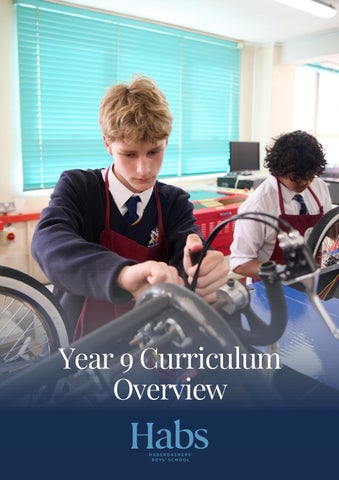
Year 9 Curriculum Overview
Habs Boys | Curriculum Booklet
Contents
Academic Foreword Wellbeing and PSHE Habits
1
2
3
Subjects Art
4
Biology
8
Chemistry
11
Computer Science
14
Design Technology
17
Drama
20
English
24
French
27
Geography
30
German
33
History
36
Latin
38
Mathematics
42
Music
46
Physics
49
Physical Education
52
Spanish
56
Theology and Philosophy
59
Habs Boys | Curriculum Booklet
Academic Foreword This booklet outlines the curriculum that your child will study this year in each subject, allowing you to support them further at home. If you have any concerns or questions, do please contact your child's tutor in the first instance. MR MIKE BRENNAN Deputy Head - Academic
Year 9 is an exciting year for all students. It is the first year of the Upper School, and students are enjoying both the freedom and the responsibility that this brings. It is also the first year where they have chosen several of the subjects that they are studying, and I am sure they will enjoy the increased curriculum time this affords in these subjects. From September 2026 we have strengthened every subject's curriculum to develop our Habits more deliberately, and this booklet reflects that change throughout. These Habits describe the dispositions pupils need to flourish academically, professionally and personally, and they matter more than ever as students approach their GCSE choices this year.
1
The world of work is changing rapidly, shaped by artificial intelligence, economic uncertainty and new technologies; universities and employers alike consistently emphasise that strong qualifications must be matched by resilience, initiative, independent judgement, collaboration and clear communication. Each subject in this booklet sets out how its curriculum builds these Habits ensuring students are prepared not only for GCSE study and beyond, but for a full and impactful life outside the classroom. There is a suggested further reading list at the end of each curriculum summary, provided as an indication of what students might like to read to extend their knowledge further still.
This year, students will also have the opportunity to research independently and present on a question of their choosing, as part of our Keith Dawson Independent Learning Project; more information will follow later this term. During this year, each student will make their GCSE choices. You will receive a detailed guide before the Year 9 Parents' Evening, with all necessary details explained closer to the time. As you will see from this booklet, the Year 9 programme of study is full and enriching, with more activities and interests to explore. I wish all students every success this year, and look forward to seeing you at the Year 9 Parents' Evening. I wish them every success.
Habs Boys | Curriculum Booklet
Wellbeing and PSHE
Your child will receive weekly PSHE education (Personal, Social, Health and Economic Education) lessons with their Form tutors during morning tutor time.
2
This will continue from Year 7 to Year 11 and consists of combining our bespoke curriculum modules and resources for themed weeks or special topics. Workshops with specialist speakers are organised for all year groups at different times through the year, focusing on ageappropriate issues such as e-safety, physical health, mental health and relationships. Talks and/or workshops are also delivered to parents.
Our school is a ‘Tooled Up Education’ school. This means, in addition to all that we do at school to help pupils, we also care about supporting parents and families. Please use the link to register your free account and gain access to the digital hub of evidence-based resources covering: mental health, digital life, aspiration, learning, family life and relationships.
Habs Boys | Curriculum Booklet
Habits defines what we stand for and provides the foundation for everything our students achieve. They enhance academic performance, shape character and enrich life beyond the classroom.
By grounding our four core values in 12 practical Habits, we ensure that our students develop the mindset and skills to flourish in all areas of school life and far beyond.
3
Habs Boys | Curriculum Booklet
Art Mission Statement Grow and prepare.
HABITS IN ART
Ambition
Curiosity
Courage
Community
4
• Resilience • Continuous Learning • Initiative
Students begin to work with the independence expected at GCSE, taking ownership of their ideas from initial research through to final outcome. Through experimentation, refinement and responding to feedback, they develop resilience and learn the value of continuous improvement. Making decisions about their own creative direction encourages initiative and confidence as young artists.
• Open-mindedness • Critical Thinking • Creativity
Through the themes of Identity and Exploration and Discovery, students explore a wide range of artists, ideas and creative approaches. They consider different perspectives, while artist research and experimentation strengthen their critical thinking and creativity. As students investigate and interpret their chosen themes, they learn how personal ideas can be developed into meaningful responses.
• Integrity • Leadership • Risk-taking
Students are encouraged to take creative risks to develop personal responses. Through these risks and decisions, they learn to trust their own ideas and judgement. As they explore personal and complex concepts, students develop the courage to communicate meaningful ideas visually.
• Collaboration • Care • Social Responsibility
Students learn that art does not exist in isolation. Studying diverse artists, cultures and perspectives, they develop an appreciation of how ideas are shaped by the world around us. By sharing their work, discussing ideas and engaging with the work of others, students develop collaboration, care and respect for different viewpoints.
Habs Boys | Curriculum Booklet
Art Curriculum Overview
Autumn Term
Spring Term
Summer Term
Students respond to the theme of Identity, using it as a starting point to develop ambitious, personal work.
Both projects are blended during this term. Each sustained project will take one and a half terms. This is to ensure that the best quality of work can be produced in preparation for their GCSE's.
In GCSE Art, students are challenged to see the creative process as a journey of exploration and discovery. Rather than beginning with a fixed idea of what their final piece will become, they are encouraged to investigate widely, experiment boldly and allow their work to develop through curiosity, risk-taking and reflection.
Through investigations, pupils explore artists and photographers who explore, culture, memory, place, belonging, symbolism and personal experience. They record ideas and observations through drawing, photography, annotation and visual experimentation, building a body of work. Students are encouraged to take creative risks, refine their ideas through purposeful exploration of media, materials, techniques and processes, and push their work to a high standard. Each student develops an independent response, working with increasing confidence, scale and ambition. The project culminates in an original final outcome that realises their intentions and demonstrates a confident understanding of visual language.
5
The theme 'Exploration and Discovery’ invites students to explore unfamiliar places, hidden details, personal journeys, scientific imagery, natural forms, maps, memory, identity, transformation and the unknown. Through drawing, photography, artist research and experimentation, each student builds a body of work that records not only what they have seen, but how their ideas have changed. This project encourages students to think ambitiously and work beyond the scale of a sketchbook. They are pushed to test new media, work with independence and make brave creative decisions. The project culminates in a highly personal and original final outcome, celebrating each student’s ability to question, investigate and discover new possibilities through art.
Habs Boys | Curriculum Booklet
Art Signature Project: Exploration and Discovery
This title/prompt is to really encourage students to think independently and to choose artists through sustained investigations into the theme. It is designed to spark innovative thoughts and ideas after the project 'Identity' which very much focuses on 'within’.
Working increasingly like GCSE artists, students research artists, experiment with materials and refine ideas through an iterative creative process.
Scholarship and Enrichment • Tate Modern • V&A Museum • Hayward Gallery • Victoria Miro Collection • National Portrait Gallery
6
Through personal enquiry, reflection and making, students learn to communicate meaningful ideas and create informed responses. This project prepares them for GCSE and beyond.
Habs Boys | Curriculum Booklet
7
Habs Boys | Curriculum Booklet
Biology Mission Statement In Year 9, students begin their IGCSE Biology course, taking on a serious body of scientific knowledge and the skills to use it. It is where curiosity becomes expertise, and where students start to think and work like the scientists they are becoming.
HABITS IN BIOLOGY
Ambition
Curiosity
Courage
Community
8
• Resilience • Continuous Learning • Initiative
Students build resilience by reworking enzyme experiments that rarely succeed first time and by treating each assessment as feedback rather than a verdict. Continuous learning becomes essential as they consolidate a growing body of knowledge across the year, while initiative shows in how they take ownership of their own revision and investigations.
• Open-mindedness • Critical Thinking • Creativity
IGCSE Biology rewards reasoning, not just recall. Students think critically to interpret the data from their own experiments and explain how a structure suits its function, stay open-minded as evidence refines their ideas, and use creativity when planning investigations and explaining complex processes clearly.
• Integrity • Leadership • Risk-taking
Honest, accurate work matters more than ever now that results build real understanding. Students show integrity by recording the data they actually obtain rather than the result they expected, take the risk of attempting demanding application questions, and develop leadership through the roles they take in group practicals.
• Collaboration • Care • Social Responsibility
Much of the course is practical and collaborative, with students sharing equipment, roles and results in the lab. Care shows in the maturity they bring to the human reproduction topic and the respect they show during practical work, while social responsibility runs through the study of diet, health and the living world.
Habs Boys | Curriculum Booklet
Biology Curriculum Overview
Autumn Term
Spring Term
Summer Term
Cells and the Chemistry of Life
Digestion and Plant Reproduction
Human Reproduction and Photosynthesis
Year 9 opens with the foundations of biology: the characteristics shared by all living things, the structure of plant and animal cells, and the use of the microscope to see them. Students survey the variety of life, from eukaryotes to bacteria and pathogens, before turning to the biological molecules that make up our food.
Students study how the human digestive system breaks food down, the enzymes that drive the process, and how the small intestine is adapted to absorb the products.
The course moves on to reproduction in humans, covering the reproductive systems, fertilisation and pregnancy, and the hormones of the menstrual cycle and puberty, all taught with maturity.
This leads into a rich run of practical work on diet, energy and enzymes, including testing foods for the nutrients they contain.
9
They then turn to reproduction in plants, examining how flowers are adapted for pollination, how fertilisation leads to seeds and fruit, and the conditions seeds need to germinate, with practical investigations throughout.
After the school examinations, students study nutrition in plants, investigating the structure of the leaf, the process of photosynthesis, and the factors that affect its rate through experiments such as testing a leaf for starch and measuring oxygen production in pondweed.
Habs Boys | Curriculum Booklet
Biology Signature Project: Science of Food and Body
A highlight of Year 9 is the run of hands-on practicals at the heart of the food, digestion and enzymes topic.
Students set fire to a cheesy snack to measure the energy locked inside it, run chemical tests to reveal the sugars, starch, protein and fat hidden in everyday foods, and investigate how enzymes, the body's own
catalysts, speed up or grind to a halt as conditions change.
It is messy, surprising and genuinely experimental: students plan their own approach, take their own measurements and puzzle over results that do not always behave.
More than anything, it is where the science of food and the body comes alive on the bench, and where students start to feel like real investigators.
Scholarship and Enrichment In Year 9, students are offered more formal academic challenge as they prepare for GCSE-level thinking. They are encouraged to engage actively with biological reading beyond the classroom, including ageappropriate articles, scientific news, and natural history writing, developing the ability to interpret new information, question sources and connect ideas to their growing subject knowledge. They may be entered for the UK Biology Competitions Biology Challenge, which is open to Year 9 and Year 10 students in England and Wales and consists of two online multiplechoice papers.
10
The competition rewards not only curriculum knowledge but also wider biological awareness gained through reading, watching natural history programmes, following biological news and noticing local flora and fauna. Year 9 students may also enter MiSAC, the Microbiology in Schools Advisory Committee competition, which uses curriculum-linked microbiology themes to promote independent research, scientific literacy, and creative communication.
Alongside these, students continue to have access to departmental competitions such as the Wildlife Documentary Competition, 30 Days Wild photography challenge, Big Schools’ Birdwatch, and UK Butterflies photography competition, BioArtAttack and the Nancy Rothwell Prize, allowing them to combine academic stretch with ecological awareness, creativity, and independent interest in the living world.
Habs Boys | Curriculum Booklet
Chemistry Mission Statement The Year 9 Chemistry programme provides a rigorous introduction to the IGCSE curriculum, developing a secure understanding of key concepts including kinetic theory, atomic structure and bonding, the mole concept, and the periodic table. Students are encouraged to think critically, appreciate the historical and experimental development of chemical ideas, and recognise the relevance of chemistry in understanding the world around them. HABITS IN CHEMISTRY
Ambition
Curiosity
Courage
Community
11
• Resilience • Continuous Learning • Initiative
Students cultivate resilience through practical investigation, learning to refine techniques, interpret anomalous results and persevere when outcomes differ from expectations. They are encouraged to think deeply and make connections across topics, developing a coherent understanding of atomic structure, bonding, the periodic table and quantitative chemistry. Through independent revision, wider reading and engagement with chemistry beyond the curriculum, students demonstrate initiative, intellectual curiosity and a genuine enthusiasm for scientific discovery.
• Open-mindedness • Critical Thinking • Creativity
IGCSE Chemistry rewards understanding and application, not simply memorisation. Students think critically when interpreting data, identifying patterns and using evidence to explain chemical phenomena. They remain open-minded as scientific models and theories are refined through evidence, and use creativity when designing investigations, solving problems and communicating complex ideas clearly.
• Integrity • Leadership • Risk-taking
Accurate and honest scientific work is fundamental to chemistry. Students demonstrate integrity by recording observations and results objectively, even when they differ from predictions. They show the confidence to tackle challenging calculations and unfamiliar application questions, while leadership develops through collaboration and responsibility during practical work.
• Collaboration • Care • Social Responsibility
Chemistry is a practical and collaborative subject in which students learn to work safely and effectively with others in the laboratory. Care is shown through responsible use of equipment and respect for health and safety procedures. Social responsibility is developed through consideration of chemistry's role in addressing global challenges such as sustainable energy, environmental protection, resource management and the development of new materials.
Habs Boys | Curriculum Booklet
Chemistry Curriculum Overview
Autumn Term
Spring Term
Summer Term
Students begin by exploring kinetic theory and the particle model, developing an understanding of how particles behave in solids, liquids and gases.
Students will develop an understanding of metallic bonding, structure and properties, exploring how the arrangement of particles and bonding in metals gives rise to characteristic physical properties such as conductivity, strength and malleability.
Students will take part in a structured revision programme for two weeks during the first part of the term, preparing for their endof-year examinations before the May half-term.
They will investigate diffusion, solubility, and heating and cooling curves, using these concepts to explain changes of state and temperature changes in pure substances. Building on prior learning, students will recap atomic structure, including the roles of protons, neutrons and electrons, before studying electronic structure and the arrangement of electrons in atoms. They will then learn how ions are formed and examine ionic bonding, structure and properties, linking the structure of ionic compounds to their characteristic physical properties such as melting point, conductivity and solubility.
12
They will study the reactions and trends within Groups I and II, identifying patterns in reactivity and explaining these trends using their knowledge of atomic structure. Students will also learn about covalent bonding and simple molecular structures, linking the nature of covalent bonds to the properties of substances. In addition, they will investigate the halogens in Group VII, examining their reactions and trends and comparing their behaviour across the group.
Throughout the unit, students will apply their understanding of bonding and structure to explain the physical and chemical properties of a range of substances.
Following the examinations, students will review their performance through feedback and reflection activities, helping them to identify strengths and areas for improvement. In the second half of the term, students will study covalent bonding and giant covalent structures, exploring how bonding and structure influence the properties of substances. They will also develop their quantitative chemistry skills through topics including the conservation of mass, empirical formulae, formula determination, mass balance calculations, and reacting mass calculations, applying these concepts to chemical equations and a range of calculation-based problems.
Habs Boys | Curriculum Booklet
Chemistry Signature Project: Prediction, Experimentation and Analysis A highlight of Year 9 Chemistry is the range of practical investigations that bring key IGCSE Chemistry concepts to life. Students use flame tests to identify elements, explore patterns in the Periodic Table, model atomic bonding, and begin applying the mole concept.
Through prediction, experimentation and analysis, they learn to connect abstract chemical ideas with real evidence, developing the curiosity and skills of young chemists.
Scholarship and Enrichment In Year 9, students are offered greater academic challenge as they begin to develop the knowledge, skills and independence required for IGCSE Chemistry. They are encouraged to engage actively with chemistry beyond the classroom through ageappropriate scientific articles, popular science publications, and chemistry-related news stories.
13
Through this wider reading, pupils develop their ability to interpret scientific information, evaluate evidence, and make connections between chemistry and real-world applications. Pupils may be entered for the UK Chemistry Olympiad Junior Challenge (where available) or other age-appropriate chemistry competitions and quizzes that encourage problem-solving and the application of chemical knowledge in unfamiliar contexts.
These challenges reward not only curriculum understanding but also wider scientific awareness, logical thinking, and intellectual curiosity. Year 9 students are also encouraged to undertake independent research into contemporary topics such as sustainable materials, renewable energy, green chemistry, pharmaceuticals, space chemistry, and the role of chemistry in addressing global challenges.
Habs Boys | Curriculum Booklet
Computer Science Mission Statement To prepare students to engage critically and creatively with technologies shaping the modern world, building the knowledge, confidence and independence needed for further study in Computer Science.
HABITS IN COMPUTER SCIENCE
Ambition
Curiosity
Courage
Community
14
• Resilience • Continuous Learning • Initiative
Year 9 asks students to work at a level increasingly close to GCSE Computer Science. Programming develops to include loops, lists and functions, while web development requires students to combine several technologies into a coherent product. Students are expected to debug more independently, organise larger solutions and use what they have learned previously to tackle unfamiliar problems.
• Open-mindedness • Critical Thinking • Creativity
Students investigate some of the most important questions in contemporary computing: Artificial Intelligence introduces machine learning and encourages them to consider both what intelligence systems can do and the limitations and ethical questions that accompany them. Cybersecurity, hardware and web development similarly require students to move beyond simply using technology and instead question how systems operate, fail, and how they can be designed more effectively.
• Integrity • Leadership • Risk-taking
Students are encouraged to form and defend reasoned opinions about issues including artificial intelligence, privacy, cybersecurity and the responsible use of data. Programming and web development require intellectual risk-taking as students create increasingly individual solutions, while testing an evaluation demand honesty about what does and does not work. Students develop confidence in presenting technical ideas and helping others solve problems.
• Collaboration • Care • Social Responsibility
Students are increasingly aware that computing has consequences beyond the classroom. Their work on computer crime, data protection, copyright, privacy and AI ethics encourages them to consider the responsibilities of those who design and use technology. Collaborative problem-solving and peer evaluation also reinforce the idea that successful computing requires communication, respect and consideration of the people for whom systems are built.
Habs Boys | Curriculum Booklet
Computer Science Curriculum Overview
Autumn Term
Spring Term
Summer Term
Year 9 begins by strengthening students Python programming and problem-solving skills. Building on earlier programming experience, students work with iteration, including FOR and WHILE loops, lists and functions with and without parameters. Greater emphasis is placed on modular programming, efficient solutions and the ability to solve unfamiliar problems independently.
Students investigate computer crime, cybersecurity and the legal and ethical responsibilities associated with using technology. Topics include hacking, phishing, identity theft, data harvesting, privacy, copyright, the computer misses act, data protection and GDPR.
Students continue to develop their web development skills further, creating structured, multi-page websites using HTML and CSS. They consider navigation, layout, consistent styling, images text and usability with an external CSS file allowing a common design to be maintained across the site.
The curriculum then moves into Input and Output Devices including sensors, scanners, actuators and the different forms of data that computer systems can capture and produce. As this hardware learning develops, students are introduced to HTML and CSS and begin applying their technical knowledge through web development.
The Year 9 Signature Project continue through this work. Students build pages explaining input and output technologies studied within the hardware unit, bringing together subject knowledge and practical web-development skills into single project. More advanced students can extend their sites using JavaScript and web forms.
This is where the Year 9 Signature Project - Computer Hardware and Web Development begins to emerge. Students use the content from their Input and Output Devices learning as the subject matter for the website they are developing. The two strands run alongside one another: students deepen their understanding of hardware while simultaneously learning how to communicate that knowledge through a digital product.
Students also complete their departmental end-of-year assessment to consolidate programming and problemsolving skills. By the end of Year 9, they have experienced Computer Science as a connected discipline: programming, hardware network, cybersecurity, Artificial Intelligence and web technologies all contribute to an understanding of how modern digital systems are designed built and used.
Students then study Artificial Intelligence, examining what AI is, how it has developed and how machine learning allows students to recognise patterns and make decisions from data. Practical activities include exploring applications such as image recognition, chatbots and analysis of text reviews. Alongside successful ideas, students consider the ethical implications of AI and begin to evaluate both the opportunities and limitations of increasingly intelligent systems.
15
Habs Boys | Curriculum Booklet
Computer Science Signature Project: Computer Hardware and Web Development The signature project brings together two areas of curriculum: computer hardware and web development. Students design and build a multi-page website that communicates their understanding of computer input and output devices while demonstrating their ability to create a coherent digital product using HTML and CSS.
Students consider navigation, images, text, layout and consistency across other pages, with an external CSS file used to maintain a common visual style. The project therefore asks students to do more than recall technical knowledge: they must organise it, communicate it clearly and make thoughtful design decisions about how another person will interact with their website.
More ambitious students can extend their sites by investigating JavaScript and creating an interactive web form. The finished project provides a bridge between computer science theory and practical software development and gives students a substantial piece of work through which to demonstrate technical knowledge, creativity and independent problem-solving.
Scholarship and Enrichment In Computer Science, learning goes beyond simply knowing how to use a particular programming language or piece of software we encourage students to ask deeper questions: How does a computer work? How does information travel across the Internet? Why are some algorithms better than others? How can machine learn from data? What makes a digital system secure, reliable and responsible. Students who enjoy computer science are encouraged to extend themselves through programming, wider reading online courses independent projects and participating Co-curricular Clubs.
16
Recommended reading/links • Elements of AI university of Helsinki- accessible study of artificial intelligence and machine learning https://www.elementsofai.com/ • Harvard CS50- introduction to computer science- challenging wider study of computing programming, algorithms and computing https://cs50.harvard.edu • MDN learn web developmentextension work in HTML, CSS and web development https://developer.mozilla.org/enUS/docs/learn_web_development
Habs Boys | Curriculum Booklet
Design Technology Mission Statement We want every student to leave Design Technology able to think for themselves. They learn to draw on maths, science, and art together, not as separate subjects, and to use that knowledge to design things that work, that last, and that are made with the world in mind.
HABITS IN DESIGN TECHNOLOGY
Ambition
Curiosity
Courage
Community
17
• Resilience • Continuous Learning • Initiative
Design Technology cultivates resilience through iterative failure cycles; students prototype, test, and redesign in a process that mirrors Schön's reflective practitioner model, where learning emerges not from instruction but from the critical examination of practice.
• Open-mindedness • Critical Thinking • Creativity
Creativity is treated as a skill that can be taught and practised; through structured brainstorming, sketching multiple ideas before committing to one, students develop the confidence to think originally and the judgement to know when an idea needs rethinking.
• Integrity • Leadership • Risk-taking
Risk-taking goes hand in hand with innovation. We show students it takes courage to develop as a designer, including taking charge of your own creative headspace without losing sight of the moral compass we must hold for our environment, and the role designers play within it.
• Collaboration • Care • Social Responsibility
Design Technology is rarely a solitary pursuit. Students work in teams and learn to value contributions that differ from their own. When projects are rooted in real problems: sustainable materials, inclusive design, local community need - Care and social responsibility follow naturally, with students designing for someone, not making with no direction.
Habs Boys | Curriculum Booklet
Design Technology Curriculum Overview
Autumn Term
Spring Term
Summer Term
Bluetooth Speaker
Wooden Jewellery Box
OnShape Masterclass
Each project has 5 core elements that students focus and develop throughout Year 9; Drawing, Designing, CAD Modelling, Manufacturing and Reflection. This starts with the Bluetooth Speaker Project.
This project scaffolds on the prerequisite knowledge of resistant materials, and to build up this knowledge through workshop psychomotor skills and advancing their joinery techniques.
This project is to consolidate student learning on CAD programs during Year 7 and 8. It then opens into a CAD style masterclass module where students are introduced to more advanced.
Pewter Casted Ring
Resistant Materials Theory
Taking elements from their research in the mini-NEA; students focus on their own anthropometric data, rather than a client or a stakeholder.
Final instalment of the academic year is to capture all the workshop endeavours from the last two terms and now align it with theory understanding. Having experiences with some of the theory they are covering first hand, helps students digest the information and find links across more STEM based subjects.
Alongside building independence in the workshop, students develop psychomotor skills and competency on machines including the pillar drill, centre lathe, laser cutter and multiple hand tools. Throughout, there is many stages in which students will have to troubleshoot individual problems to overcome and then work together as a design team at other stages. Mini Non-Examination Assessment (NEA) Moving from the manufacturing heavy project, students then are exposed to a new style of project that imitates what they will face if they take Design Technology at GCSE level. This gives students a great opportunity to explore this subject in a different light prior to their GCSE options. The mini-NEA project is, in the name, a smaller version of the Year 10/11 task of being given a contextual challenge, finding a problem and then developing a product-based solution.
18
They also get an introduction into negative and positive mould making that they can see being used first hand as they create bespoke jewellery.
Habs Boys | Curriculum Booklet
Design Technology Signature Project: Mini NEA (Non-Examination Assessment) This is an integral part of our Year 9 curriculum to align students with the toolkit they will require to tackle Design Technology at GCSE level. Students dive deep into their first contextual challenge, where they are exploring opportunities and problems that can occur within 'working and studying from home'.
As they go through the six-week project, they follow the iterative design process that is seen in industry; this is a cyclic method of prototyping, testing, analysing, and refining a product or system based on user feedback.
Scholarship and Enrichment
• Design Museum, London • New Designers Showcase • Made in Brunel Showcase • Extensive Co-curricular opportunities such as VEX Robotics, STEM Racing, Greenpower, Arkwright, FIRST Robotics, CANSAT, Safecracking
19
Students learn to lean into their curiosity through prototyping and research while also building empathy for people around them when collaborating with their stakeholder or client.
Habs Boys | Curriculum Booklet
Drama Mission Statement Students continue to develop the ensemble and performance skills introduced in Year 7 and Year 8 with more focus on the interpretation of script when creating meaning for an audience. Students will experience more advanced rehearsal and performance techniques, start to learn the basics of lighting and sound design and develop awareness of different stage spaces.
HABITS IN DRAMA
Ambition
• Resilience • Continuous Learning • Initiative
Within the context of clear boundaries, students are encouraged to make bold , playful choices and learn to be comfortable with making mistakes. They are encouraged to take risks in order to explore, test and refine creative ideas.
Curiosity
• Open-mindedness • Critical Thinking • Creativity
Students are encouraged to observe and notice with close attention to detail and then be open to wondering how ideas can be developed and how meaning can be conveyed to an audience.
Courage
• Integrity • Leadership • Risk-taking
Community
• Collaboration • Care • Social Responsibility
20
Students learn to offer and accept ideas. We build a safe, supportive environment for students to take risks and move outside their comfort zone.
Students develop listening skills, generosity and awareness of other people in the space and learn that the most important thing is their contribution the collective effort and the shared goal.
Habs Boys | Curriculum Booklet
Drama Curriculum Overview
Autumn Term
Spring Term
Summer Term
Students will explore:
The Page to Stage Project
Food Banks - Devised Piece applying Brechtian Devices
•
Status levels
•
How to make clear vocal and physical choices to convey status.
•
Different Stage Spaces – end on, thrust, traverse, in the round, promenade immersive
•
•
Performance and design opportunities and challenges with each type of space
How the stage space affects the relationship between audience and performer
Students then apply this learning to a very short piece of script and learn •
•
how choices about non-verbal communication, vocal delivery and use of space can shape meaning for an audience
how to give and respond to feedback after "Work In Progress" showings.
Students are introduced to the basics of Lighting and Sound Design.
Students experience a piece of Live Theatre (A Christmas Carol at the Old Vic) and analyse the lighting design.
21
Students form a theatre company and stage a short scene from a Shakespeare play. Skills developed: •
Analysis of text
•
Making clear choices to create meaning for an audience
•
Taking risks in order to generate and develop creative ideas
•
A playful approach in the context of discipline and clear boundaries.
•
Lighting Skills – type of lantern; intensity; colour; gobos; angle; transitions
•
•
Students will be introduced to the devices and methodology of Berold Brecht and will create a short piece to raise awareness of food poverty, developing their performance and design skills. Reference will be made to the Ken Loach film, I Daniel Blake
Students will explore disruptive devices like: •
Montage/ ironic juxtaposition
•
Direct address
Sound Skills – direction; volume; manipulation of sound; transitions; soundscaping; spot effects
•
Multi-rolling
•
Third person address
•
Rehearsal Techniques –Exploring Intentions; Entrances and exits; Proxemics; Last word Repeat; Mapping; Ghosting the Lines; Status
Use of narration
•
Use of signs/ placards
•
Use of statistics
•
Music and songs
•
Gestus
•
Visible transitions/ scene changes
•
Verbatim Theatre
•
Defining dramatic aims and intentions
•
Giving feedback
•
Responding to feedback
•
Evaluating creative work
Habs Boys | Curriculum Booklet
Drama Signature Project: The Page to Stage
In the late Spring/ early Summer Term, students in groups form a theatre company and stage a short scene from a Shakespeare play. Each student contributes as a performer, lighting designer or sound designer. Students must explore the scene closely before agreeing on their own interpretation of the text and their own production and design concept.
During the rehearsal process, they are introduced to design and performance skills and techniques and are encouraged to explore, test and refine their creative ideas with regular "Work in Progress"performances to their peers and teacher. Students learn to give and respond to feedback with precision, to set clear targets and to see that the creative process involves this cycle of
Scholarship and Enrichment All students are encouraged to take part in the broad Cocurricular Drama programme including major productions, drama clubs, House events and backstage opportunities. Students are also encouraged to be an engaged and active audience, exposing them to a wide range of theatre and performance within school and professionally, in order to broaden and develop their creative and critical thinking beyond the classroom.
22
Drama scholars are expected to act as role models and leaders, broaden their own interests and experiences about drama within and outside of school and contribute positively wherever possible to the wider drama programme.
exploration, testing, revising and refining. The piece is performed in the Lime Tree Studio to invited classes. Students are assessed on their contribution to the process, their contribution to the final performance and their written evaluation of the final performance.
Habs Boys | Curriculum Booklet
23
Habs Boys | Curriculum Booklet
English Mission Statement We want our English curriculum to be boundless. We strive to give young people the opportunities, experiences, knowledge, skills and analytical tools to speak, write and read confidently and fluently. We want them to see language and literature as a path to achievement, intellectual vitality, self-discovery and a source of lifelong joy. Over the course of year 9, students will study a range of increasingly challenging and adult texts in readiness for GCSE study. HABITS IN ENGLISH
Ambition
Curiosity
Courage
Community
24
• Resilience • Continuous Learning • Initiative
We demonstrate resilience when diving into complex, ambiguous texts, rich vocabulary, and diverse literary traditions, showing continuous learning as we refine our analytical and communication skills over time. We show initiative by independently driving our own interpretations, reading between the lines, and actively pursuing independent reading to expand our worldviews.
• Open-mindedness • Critical Thinking • Creativity
We approach English with open-mindedness, stepping into the shoes of characters from various eras, cultures, and contexts. We use critical thinking to deconstruct an author's craft and creativity to respond to literature - whether by crafting original poetry, reimagining narratives from alternative perspectives, or breathing new life into classic texts through world-building and adaptation.
• Integrity • Leadership • Risk-taking
We demonstrate courage and risk-taking by finding our own vocal identity, experimenting with bold rhetorical devices, and sharing original creative writing. We show leadership in oracy by anchoring group discussions, presenting structured arguments with integrity, and honouring the power of language to advocate for others.
• Collaboration • Care • Social Responsibility
We develop collaboration and oracy through vibrant class debates, dramatic performances, and collaborative literary analysis where every voice is heard and valued. We show care and social responsibility by analyzing how literature reflects realworld injustices, using our words empathetically, and understanding how stories shape our shared human experience.
Habs Boys | Curriculum Booklet
English Curriculum Overview
Autumn Term
Spring Term
Summer Term
Full Shakespeare play:
• Prose – novel and short stories and Modern Drama incorporating creative writing.
• Passage analysis - teaching the craft of close reading / writing in the style of…
• Landmark pieces of work (curiosity; creativity; openmindedness; original ideas; courage; risk-taking; new perspectives) Creative Writing.
• Poetry unit - either a Poet or a selection of poetry.
• Othello; Hamlet; The Tempest; King Lear; Antony & Cleopatra; Measure for Measure; Henry V; Julius Caesar; Coriolanus.
• Non-Fiction Unit / Persuasive writing / Speeches / Newspaper articles / argument / opinion. • Class readers for timetabled library lesson. Can be small group readers.
• Landmark pieces of work (ambition: opportunity; independent thinking) Shakespeare essay: passagebased leading to whole play.
25
• Landmark pieces of work (curiosity; critical thinking; continuous learning; synoptic skills; reasoning skills) Passage analysis essay or a focus on poetic form.
Habs Boys | Curriculum Booklet
English Signature Project: Poetry by Heart
All students will learn a poem by heart from a selection provided by the English department. This will be performed in front of their class and the best selected to enter a schoolwide competition.
Scholarship and Enrichment To be an excellent writer, you need to be an excellent reader. All students should be reading for pleasure for at least thirty minutes every day, accessing a range of increasingly challenging novels and nonfiction as they progress through the school. Reading lists are available from the library and suggestions are readily available from English teachers.
26
Habs Boys | Curriculum Booklet
French Mission Statement We aim to continue to develop students’ linguistic awareness, and to encourage enthusiasm for various aspects of culture and civilisation. In addition, we aspire to develop the ability to communicate proficiently in the target language, both orally and in writing, and to develop good working habits and study skills. We also want to extend students intellectually, and support students of all abilities to enable them fully to realise their potential.
HABITS IN FRENCH Making mistakes; desirable difficulty; student-led learning / independent expression; building confidence / learning by reviewing mistakes.
Ambition
• Resilience • Continuous Learning • Initiative
Curiosity
• Open-mindedness • Critical Thinking • Creativity
Exposure to new cultures, perspectives and ways of thinking; encouraging pupils to express themselves in creative ways; analysing grammar to help them spot patterns in language.
Courage
• Integrity • Leadership • Risk-taking
Students have enhanced cultural sensitivity. They are encouraged to take risks with language and step outside comfort zones; engaging with different cultures fosters integrity.
Community
27
• Collaboration • Care • Social Responsibility
Students are encouraged to learn collaboratively e.g. through peer assessment and group work. Language learning helps pupils develop the social awareness and responsibility to contribute positively to their communities, thereby becoming true global citizens.
Habs Boys | Curriculum Booklet
French Curriculum Overview
Autumn Term
Spring Term
Summer Term
• Free Time and activities
• Future plans-in the near future and later in life
• How to improve things e.g. the environment
• Music and culture
• The Francophone world and its traditions
• Describing your friends and family and talking about relationships • Celebrations –at home and around the world
28
• Describing life in the past e.g. at your primary school
Habs Boys | Curriculum Booklet
French Signature Project: Introduction to Linguistics
In Year 9, students in all Modern Languages follow an Introduction to Linguistics course in the second half of the Autumn Term. Using materials published by the UK Linguistics Olympiad organisation, they work through practice problems with their teachers and independently, learning to spot patterns in unfamiliar languages which will be useful to them in
their language study in Year 9 and at GCSE. They then enter the UK Linguistics Olympiad at either Foundation or Intermediate level.
Scholarship and Enrichment • Reading and analysing French poems and songs • The study of a French film • Looking at diversity in the French-speaking world
• French exchange programme
29
Habs Boys | Curriculum Booklet
Geography Mission Statement The Year 9 Geography course is a contemporary and challenging course which seeks to explore some of the major global challenges of the 21st century: development, climate change and the geography of health and disease. After the Spring half-term, pupils then begin the GCSE Geography course.
HABITS IN GEOGRAPHY
Ambition
Curiosity
Courage
Community
30
• Resilience • Continuous Learning • Initiative
Students develop resilience when grappling with complex geographical issues such as climate change, global development and shifting patterns of global power, recognising that there are often no simple answers. Through continuous learning and initiative, they build connections between topics, independently explore case studies and use evidence to understand how places and people are shaped by global processes.
• Open-mindedness • Critical Thinking • Creativity
Students demonstrate open-mindedness by considering a range of perspectives on climate change, development, migration and geopolitics, recognising that different groups may experience issues in different ways. They use critical thinking and creativity to question stereotypes, challenge the ‘single story’ of places and develop informed geographical arguments based on evidence.
• Integrity • Leadership • Risk-taking
Students show integrity by evaluating sources critically, using evidence fairly and engaging respectfully with differing viewpoints on global issues. They develop leadership and risk-taking through debates, enquiries and the Model United Nations conference, confidently sharing ideas and proposing solutions to geographical challenges.
• Collaboration • Care • Social Responsibility
Students develop collaboration by working with their peers to investigate issues such as climate change, development and inequality, learning from a range of experiences and perspectives. They demonstrate care and social responsibility by exploring how decisions made at local, national and global scales affect vulnerable communities and by considering how sustainable development can improve lives around the world.
Habs Boys | Curriculum Booklet
Geography Curriculum Overview
Autumn Term
Spring Term
Summer Term
Students will explore the changing geography of global power. They will investigate how a ‘single story’ can create stereotypes and misconceptions before examining the factors that influence superpower status, including trade, colonialism, neocolonialism and the rise of the BRICS nations. Students will consider why some countries become powerful, how influence can change over time, and the extent to which neocolonialism remains evident today.
Students will investigate the global challenge of climate change, exploring its causes, impacts and possible solutions.
Students will begin a GCSE-style study of social development, examining how and why levels of development vary around the world. They will explore measures of development such as health, education and gender equality, as well as the concept of the development continuum.
Through the Prisoners of Geography unit, based on selected chapters from Tim Marshall’s book, students will explore how physical geography shapes geopolitics and future opportunities in regions such as Russia and Africa. Skills developed include map interpretation, analysis of geographical evidence, evaluating different viewpoints, and constructing extended written arguments. Assessments include an enquiry into neocolonialism and an 8-mark question on whether countries are truly prisoners of geography.
31
Through a Model United Nations (MUN) style conference, students will represent countries at different levels of development and debate how climate change should be addressed. They will develop an understanding of why different nations have different priorities and why reaching international agreements can be difficult. Students will learn to evaluate a range of viewpoints, analyse evidence, communicate ideas effectively and make informed judgements about complex global issues. The unit concludes with a written assessment based on the themes and discussions from the conference.
Students will investigate population change, including birth and death rates and population pyramids, before considering challenges facing South Asia and Sub-Saharan Africa, such as child labour, girls’ education, migration, refugees and asylum seekers.
Skills developed include interpreting data, analysing population structures, evaluating solutions to global challenges and applying geographical knowledge to real-world issues. Students will gain a deeper understanding of the social factors that influence quality of life and development across the world.
Habs Boys | Curriculum Booklet
Geography Signature Project: Climate Change
In Year 9 Geography, students take part in an extended project focused on the issues and solutions surrounding climate change. The unit culminates in a simulated international Climate Change Conference, where students take on the role of different countries and debate their priorities, responsibilities, and responses to global climate challenges. Following the conference, students produce a newspaper article that reports on the discussions,
summarises key arguments, and explains why reaching international agreement is difficult due to differing economic, political, and environmental priorities between countries. The final articles are then displayed to celebrate student work. Throughout the project, students develop important habits including initiative, critical thinking, leadership, collaboration, and resilience.
Scholarship and Enrichment • Geography Society • Young Geographer of the Year • Habs Geographical Magazine
Further reading • 'Prisoners of Geography’ by Tim Marshall • 'Africa is not a Country’ by Dipo Faloyin
• 'Factfullness' by Hans Rosling
32
They also build key geographical skills such as evaluating multiple viewpoints, constructing balanced arguments, interpreting complex global issues, synthesising information from different sources, and communicating ideas clearly in extended written form.
Habs Boys | Curriculum Booklet
German Mission Statement We aim to continue to develop students’ linguistic awareness, and to encourage enthusiasm for various aspects of culture and civilisation. In addition, we aspire to develop the ability to communicate proficiently in the target language, both orally and in writing, and to develop good working habits and study skills. We also want to extend students intellectually, and support students of all abilities to enable them fully to realise their potential.
HABITS IN GERMAN Making mistakes; desirable difficulty; student-led learning / independent expression; building confidence / learning by reviewing mistakes.
Ambition
• Resilience • Continuous Learning • Initiative
Curiosity
• Open-mindedness • Critical Thinking • Creativity
Exposure to new cultures, perspectives and ways of thinking; encouraging pupils to express themselves in creative ways; analysing grammar to help them spot patterns in language.
Courage
• Integrity • Leadership • Risk-taking
Students have enhanced cultural sensitivity. They are encouraged to take risks with language and step outside comfort zones; engaging with different cultures fosters integrity.
Community
33
• Collaboration • Care • Social Responsibility
Students are encouraged to learn collaboratively e.g. through peer assessment and group work. Language learning helps students develop the social awareness and responsibility to contribute positively to their communities, thereby becoming true global citizens.
Habs Boys | Curriculum Booklet
German Curriculum Overview
Autumn Term
Spring Term
Summer Term
• Im Urlaub – talking about a past holiday using the perfect tense with haben and sein as well as key imperfects. Using a range of conjunctions to add complexity.
• Das Alltagsleben – using separable and reflexive verbs to talk about daily routines and household chores. Making plans and giving excuses.
• Virtuelle und reelle Welt – talking about TV and film, music, internet and social media. Giving opinions and justifications.
• Mein Zuhause – describing your house and hometown using the past, present and future tenses. Understanding and giving directions.
34
• Meine Klamotten – discussing shopping for clothes, personal style, shopping habits and special occasions.
Habs Boys | Curriculum Booklet
German Signature Project: Introduction to Linguistics In Year 9, students in all Modern Languages follow an Introduction to Linguistics course in the second half of the Autumn Term. Using materials published by the UK Linguistics Olympiad organisation, they work through practice problems with their teachers and independently, learning to spot patterns in unfamiliar languages which will be useful to them in
their language study in Year 9 and at GCSE. They then enter the UK Linguistics Olympiad at either Foundation or Intermediate level.
Scholarship and Enrichment • German-speaking countries and communities worldwide: Students broaden their understanding of German beyond Germany, Austria and Switzerland by exploring German-speaking countries, regions and communities around the world, developing an appreciation of the global reach and diversity of the German language and culture. • Exploring German music and musicians: Students are exposed to a range of German-language music, genres and musicians, culminating in a cultural challenge in which they research a German band or artist and present their findings to others.
• Independent German Reading: Regular fiction and non-fiction reading provides opportunities to encounter German beyond the textbook, develop independent reading strategies, expand vocabulary and discuss themes and opinions arising from what pupils have read. 35
• German Film Study: Students explore German history, society and culture through cinema, while gaining sustained exposure to authentic spoken German and developing their ability to express and justify opinions about film. • Munich Exchange Programme: Students have the opportunity to take part in the Munich Exchange Programme, experiencing German family and school life first-hand, developing their intercultural understanding and using their German independently in authentic everyday situations.
Habs Boys | Curriculum Booklet
History Mission Statement The Year 9 curriculum challenges students to become analytical global citizens by interrogating the defining conflicts, revolutions and civil rights movements of the modern era, empowering them to interpret the systemic forces that govern our 21st-century world.
HABITS IN HISTORY
Ambition
Curiosity
Courage
Community
36
• Resilience • Continuous Learning • Initiative
Students channel their academic ambition by engaging with the geopolitical shifts of a century of revolutions. They demonstrate initiative and resilience when evaluating source materials and deconstructing historical perspectives to grasp the continuous lessons of modern conflicts.
• Open-mindedness • Critical Thinking • Creativity
Students apply advanced critical thinking and structural analysis to evaluate historical objectivity. They maintain open-mindedness while examining propaganda and contrasting narratives, using creativity to formulate arguments regarding modern civil rights.
• Integrity • Leadership • Risk-taking
Students show historical courage and unwavering academic integrity when evaluating emotionally demanding themes like the Holocaust. They demonstrate deep empathy and leadership as they debate structural injustices and analyse the harrowing personal testaments of human survival.
• Collaboration • Care • Social Responsibility
Students examine the global ties that bind modern communities, investigating decolonisation, post-1945 migration and social justice. Working with collaboration and mutual care, they build a strong sense of social responsibility by evaluating how changing communities push for structural reform.
Habs Boys | Curriculum Booklet
History Curriculum Overview
Autumn Term
Spring Term
Summer Term
Students investigate the global military and political transformations of the early 20th century, starting with the Western Front of the First World War.
Students confront some of the most critical and ethically profound periods of modern history, studying the causes, execution and global memory of the Holocaust. They examine the progressive restriction of rights, state-sponsored propaganda and personal testaments of survival.
Students study the socio-political struggles that reshaped global human rights in the post-war era. They evaluate the American Civil Rights Movement between 1950 and 1965, dissecting the structural challenges, legislative breakthroughs and communityled campaigns for racial justice.
Concurrently, students work on their Signature Project on Decolonisation, tracing the dismantling of the British Empire and the emergence of independent post-colonial states across Africa and Asia.
Finally, students examine post1945 migration patterns to Britain, analysing the push-and-pull factors, cultural contributions, and evolving legislative landscapes that continue to shape contemporary, multicultural British society.
They analyse the tactical causes of stalemate, the lived reality of trench warfare, industrialised weapons, and battlefield medicine. Following this, students chart the collapse of the Romanov Empire and the rise of the USSR, evaluating the 1917 revolutions, the Russian Civil War and the leadership of Lenin and Stalin.
37
Habs Boys | Curriculum Booklet
History Signature Project: Collapse of the British Empire In Year 9 History, students investigate the complex collapse and dismantling of the British Empire in the 20th century with an extended essay. Students research the decolonisation of a specific country that matches their own interests, developing critical research skills and academic study habits by reading challenging historical literature and synthesising complex historical arguments about the past.
This project encourages students to take risks as independent scholars, strengthening their ability to analyse contrasting primary sources and to evaluate the works of historians. Cultivating essential oracy skills, students then present their findings confidently to an audience.
Scholarship and Enrichment • Imperial War Museum (London) The Western Front Exhibition and Holocaust Galleries. • ‘The Russian Revolution: A Very Short Introduction’ by S.A. Smith • ‘Maus’ by Art Spiegelman
38
• The Black Cultural Archives (Brixton) • Witness History (BBC World Service Podcast) – YearRound: Firsthand Accounts of Global Decolonisation and Modern Turning Points.
The final research pieces will be displayed at a school exhibition to which we hope to invite parents, celebrating the students' academic growth and historical insights.
Habs Boys | Curriculum Booklet
Latin Mission Statement The Year 9 Latin curriculum consolidates students' command of an inflected language, extending their grasp of participles, the subjunctive and the passive voice. Students develop critical insight into Roman religion, military life and society through primary sources and translation.
HABITS IN LATIN
Ambition
Curiosity
Courage
Community
39
• Resilience • Continuous Learning • Initiative
Students build resilience by consolidating a year of complex grammar, from participles to the subjunctive mood, ahead of school examination week. They take the initiative to commit new constructions to memory, continuously extending their command of Latin as clauses grow more intricate.
• Open-mindedness • Critical Thinking • Creativity
Students develop open-mindedness by exploring Roman religion, magic and the curse tablets known as defixiones, alongside the structure of Roman society. They apply critical thinking to weigh historical evidence, using creativity to construct nuanced translations of complex sentences.
• Integrity • Leadership • Risk-taking
Students develop academic integrity by translating indirect questions and commands accurately rather than guessing at meaning. They take risks as young linguists, tackling increasingly complex clauses under exam conditions, and build leadership by supporting peers through revision.
• Collaboration • Care • Social Responsibility
Latin remains collaborative as studentswork together to translate demanding texts and revise as a class. By studying the structure of Roman society and the career of army officers such as Agricola, they discover how communities were organised, developing social responsibility as they compare hierarchies.
Habs Boys | Curriculum Booklet
Latin Curriculum Overview
Autumn Term
Spring Term
Summer Term
Students explore the baths at Aquae Sulis and the practice of magic through curse tablets known as defixiones, alongside the Roman religion that shaped daily life.
Students study the structure of the Roman army through senior officers and the career of Agricola, alongside the design of the legionary fortress. Grammatically, they learn to translate purpose and result clauses, gerundives of obligation and indirect commands, extending their understanding of the ablative case to its full range of uses.
Students evaluate historical evidence for the Roman world before consolidating a year of grammar, revising noun cases, adjectives, comparatives, superlatives and pronouns, including relative pronouns.
Grammatically, they master the perfect passive and active participles, before studying the partitive and descriptive genitive and the endings of neuter nouns. The term turns to travel and communication across the empire and the structure of the legionary soldier and auxiliaries, while students learn to translate 'cum' with the subjunctive, indirect questions, and the conjugations of the imperfect and pluperfect subjunctive.
40
The term closes with expressions of time, and pupils continue to build fluency with increasingly complex sentences.
They bring together their knowledge of participles and the subjunctive ahead of school examination week. The term concludes with an introduction to the passive voice, recognising present and imperfect passive endings, and a study of the structure of Roman society.
Habs Boys | Curriculum Booklet
Latin Signature Project: Roman Curses In Year 9 Latin, students investigate the curse tablets, or defixiones, left by Romans at sites such as Aquae Sulis, uncovered through archaeological evidence. They research the language and formulae used to curse thieves and rivals, before designing and inscribing their own defixio in Latin, addressed to a fictional wrongdoer.
This project develops habits of creativity and critical thinking as students weigh the reliability of fragmentary archaeological evidence and apply new vocabulary to an authentic ancient genre. Students take risks by presenting their tablet to the class and explaining their translation choices, defending them under questioning from their peers.
Scholarship and Enrichment Suggested Reading • Living and Cursing in the Roman West: Curse Tablets and Society: Stuart McKie • Curse Tablets and Binding Spells from the Ancient World: John G. Gager • The Interactive Online Database (Roman Inscriptions of Britain):Tab.Sulis 5. Curse tablet | Roman Inscriptions of Britain https://romaninscriptionsofb ritain.org/inscriptions/TabSul is5
41
• Roman Bath Discovered Barry Cunliffe • Roman Bath: A New History and Archaeology of Aquae Sulis by Peter Davebport https://www.amazon.co.uk/s /ref=dp_byline_sr_book_1?i e=UTF8&fieldauthor=Peter+Davebport&te xt=Peter+Davebport&sort=r elevancerank&searchalias=books-uk
• Roman Britain: A Very Short Introduction by Peter Salway:
They build confidence in independent research and structured argument. The project culminates in a class exhibition of 'Roman Curses', celebrating an intimate and often surprising insight into the everyday grievances of Roman Britain.
Habs Boys | Curriculum Booklet
Mathematics Mission Statement Our Year 9 curriculum embodies ambition and courage as students begin their GCSE studies. We empower them to apply their problem-solving skills with confidence, think abstractly, and approach complex mathematics with independence and determination.
HABITS IN MATHEMATICS
Ambition
• Resilience • Continuous Learning • Initiative
We embed independence and ambition as students engage with GCSE mathematics. They apply established problem-solving strategies to more abstract and demanding content with increasing confidence.
Curiosity
• Open-mindedness • Critical Thinking • Creativity
We refine students’ ability to think critically and flexibly, applying mathematics across different topics and contexts. They develop assurance in choosing efficient methods and justifying their reasoning.
Courage
• Integrity • Leadership • Risk-taking
We encourage precision and ownership in mathematical work, supporting students to approach complex problems with confidence. They become more willing to take on challenge and learn from errors.
Community
• Collaboration • Care • Social Responsibility
We promote purposeful collaboration and discussion, recognising its role in deepening mathematical understanding. Students contribute positively, valuing accuracy, clarity, and shared progress.
42
Habs Boys | Curriculum Booklet
Mathematics Curriculum Overview
Autumn Term
Spring Term
Algebra 1
Algebra 2
Shape and Space 2
• Simplifying algebraic expressions
• Simplifying algebraic fractions
• Pythagoras’ theorem
• Solving equations with roots and powers
• Circle theorems
• Positive integer indices
Algebra 3
• Simplifying algebraic expressions with brackets • Solving equations Shape and Space 1
• Triangles, quadrilaterals, polygons • Constructions • Similar triangles • Loci Sets
• Set notation
• Linear inequalities Graphs 2
• Straight line graphs • Sketching straight line graphs • Simultaneous equations Project : Assault Course
• Simple factorising • Simplifying fractions • Equations with fractions
• Simultaneous equations Graphs 3
• Distance-time graphs • Speed-time graphs
Shape and Space 3
• Venn diagrams
• Tangent ratio
Number 2
• Calculating angle
• Standard form with positive indices
Handling Data 2
• Standard form with negative indices
• Frequency tables • Discrete data
• Calculating with standard form
• Calculating sides
• Continuous data Number 4
• Compound percentages • Inverse percentages
Project : Artemis II 43
Habs Boys | Curriculum Booklet
Mathematics Curriculum Overview
Summer Term Algebra 4
Graphs 5
• Using formulae
• Representing inequalities graphically
• Change of subject
• Further formulae
• Perpendicular lines
Graphs 4 • Quadratic graphs
• Using Pythagoras’ theorem
• Midpoints
• Solution of quadratic equations
Handling Data 4
Shape and Space 4
• Experimental probability
• Sine and cosine rations
• Calculating sides • Calculating angles
Number 5 • Calculations • Estimating
• Rounding, upper and lower bounds Algebra 5 • Multiplying brackets
• Factorising quadratic expressions • Solving quadratic equations by factorisation • Problems leading to quadratic equations
44
• Probability – single events • Theoretical probability Project : Desmos Art
Habs Boys | Curriculum Booklet
Mathematics Signature Projects: Autumn Term – Habs North Drive Assault Course Design: The students will design an assault course, carefully managing budget, available space, and the impact on the existing environment. They will apply their knowledge of loci, construction, and budgeting to create a practical design, while developing creativity, collaboration, and critical thinking skills.
Spring Term – Artemis II:
Summer Term – Desmos Art:
Students will use real recorded data to explore the travel path of Artemis II on a lunar flyby. They will extend their understanding by modelling and predicting the movements of planets, applying travel graphs and data analysis in a real-life context, while developing creativity, collaboration, and critical thinking skills.
Students will create an electronic art piece using their knowledge of line and quadratic graphs, inequalities, and by extending their understanding through exploring equations of circles and graph transformations, while developing creativity, collaboration, and critical thinking skills.
Scholarship and Enrichment • Maths Club • Maths Society • UKMT Maths Challenges and follow on rounds Suggested further reading • Art of Problem Solving Series: AoPS: The Basics, AoPS: And Beyond, AoPS Introduction to Algebra, AoPS Introduction to Geometry, AoPS Introduction to Number Theory, AoPS Introduction to Counting and Probability • A prime puzzle, The Backbone of Pascal's Triangle, New Problems in Euclidean Geometry
45
• UKMT handbooks: First Steps for Problem Solvers, A Problem Solver's Handbook, A Mathematical Olympiad Primer (2nd Edition), A Mathematical Olympiad Companion, Introduction to Combinatorics, Introduction to Inequalities, Introduction to Number Theory, Plane Euclidean Geometry • UKMT Pathways: The Geometry of the Triangle, Crossing the Bridge
Habs Boys | Curriculum Booklet
Music Mission Statement In Year 9 Music, we aim to develop increasingly independent, rounded and versatile musicians. Students learn through performing, composing, listening and appraising, developing musicianship, creativity and critical thinking. Our curriculum builds on their previous musical experiences while introducing increasingly complex traditions, styles and perspectives, encouraging them to make informed musical choices and engage critically with music in its cultural context.
HABITS IN MUSIC • Resilience • Continuous Learning • Initiative
Students develop through purposeful preparation for performance and refining their compositions, responding to feedback and taking increasing responsibility for the quality of their work.
Curiosity
• Open-mindedness • Critical Thinking • Creativity
Students are encouraged to explore the wider musical world, seeking out new and unfamiliar music, traditions and perspectives. This musical exploration informs the planning of their own creative work and the increasingly independent choices they make.
Courage
• Integrity • Leadership • Risk-taking
Community
• Collaboration • Care • Social Responsibility
Ambition
46
Performing, improvising and composing encourage pupils to commit to ideas, share their work and take creative risks. Regular reflection on experiences, practice and feedback helps them evaluate their progress and act independently on next steps. Musicking is an inherently social activity. Through making music together, pupils develop their ability to lead others, respond sensitively and work effectively as part of a team.
Habs Boys | Curriculum Booklet
Music Curriculum Overview
Autumn Term Across Year 9, students revisit and extend musical ideas through increasingly sophisticated contexts, applying their developing knowledge and musicianship with greater independence. Music for Stage and Screen Students begin with Musical Theatre, exploring how music for the stage has developed from earlier theatrical traditions to the present day. Through listening, comparison and a shared performance of ‘Alexander Hamilton’ from Hamilton, they consider how melody, harmony, rhythm, texture, instrumentation and structure contribute to character, drama and storytelling.
They then move to Film Music, exploring how composers shape narrative and audience response through themes, harmony, texture, rhythm and instrumentation. Students compose an original score for a film clip, using techniques including leitmotif, thematic transformation, cueing and hit points. 47
Spring Term WCT: 19th to 20th Centuries
Music from the Americas
Students continue the chronological journey through Western art music with Romantic Music, exploring musical language and context through chamber performance. They develop their understanding of expression, programme music, musical identity, chromatic harmony and instrumental colour.
Students explore selected Caribbean musical traditions and the cultural influences that shaped them. Through listening, performing and composing, they encounter calypso, reggae and soca before creating an original song using characteristic rhythm, harmony, bass, melody and structure.
They then encounter contrasting approaches in 20th Century Music. Through performing and composing, students investigate how minimalist composers develop small musical ideas through repetition, layering and gradual change, before encountering serialism and experimental music
The year concludes with Brazilian Music, exploring samba-reggae and samba batucada through practical ensemble work. Students develop pulse, interlocking rhythms, breaks, cueing and musical leadership in smaller samba ensembles before encountering bossa nova as a contrasting Brazilian style.
Habs Boys | Curriculum Booklet
Music Habits and Musicianship: Positive habits are fundamental to musicianship. Across the year, students prepare and work as a team when performing; plan and refine when composing; and explore new music and reflect on their experiences, feedback and practice.
By Year 9, students are increasingly expected to take ownership of these processes and make independent musical decisions.
Scholarship and Enrichment All students are encouraged to take part in the school’s broad Co-curricular Music programme, delivered in partnership with Performance Music. Ensembles, choirs, concerts, workshops, trips and specialist tuition provide opportunities to broaden experience and develop musicianship beyond the classroom.
48
Music Scholars are expected to act as musical role models, broaden their interests, knowledge and experience, and contribute positively to the musical life of the school. They also follow a personalised programme coordinated through Performance Music, including specialist support, wider musical opportunities and leadership.
Habs Boys | Curriculum Booklet
Physics Mission Statement Physics encourages students to move beyond describing phenomena and towards explaining and predicting them using scientific principles, models and mathematical relationships. In Year 9, students deepen their understanding of mechanics, electricity, waves and optics while developing greater confidence with practical investigation, quantitative analysis and scientific reasoning. Through experimentation, modelling and critical evaluation of evidence, students learn to apply physics to increasingly complex situations and appreciate its role in modern technology and society.
HABITS IN PHYSICS
Ambition
Curiosity
Courage
Community
49
• Resilience • Continuous Learning • Initiative
• Open-mindedness • Critical Thinking • Creativity
• Integrity • Leadership • Risk-taking
• Collaboration • Care • Social Responsibility
•
Applying mathematical relationships confidently to solve increasingly challenging problems.
•
Demonstrating resilience when analysing complex data and experimental results.
•
Taking responsibility for developing scientific accuracy, precision and independence.
•
Exploring how physics explains both everyday experiences and advanced technologies.
•
Asking probing questions and seeking evidence-based explanations.
•
Making connections between different areas of physics to develop a deeper understanding.
•
Testing ideas critically and refining explanations in light of evidence.
•
Showing integrity by evaluating data objectively and acknowledging uncertainty.
•
Demonstrating confidence when communicating scientific reasoning and defending conclusions.
•
Collaborating effectively during practical investigations and extended projects.
•
Working safely and responsibly with specialist laboratory equipment.
•
Engaging respectfully with different viewpoints when discussing scientific ideas and evidence.
Habs Boys | Curriculum Booklet
Physics Curriculum Overview
A Flexible Physics Curriculum
Electricity
Year 9 Physics is delivered through a carousel model. Students study the same core areas of physics during the year, but not necessarily in the same order. This approach allows all classes to gain experience with a wide range of specialist apparatus, datalogging equipment and practical investigations.
Students build on their earlier study of circuits by exploring current, voltage and resistance in greater depth.
Whilst the sequence of topics may vary, all students complete the same curriculum and develop the same scientific knowledge, practical skills and analytical thinking.
Mechanics Students develop a more quantitative understanding of forces and motion through the study of weight, gravitational field strength, energy transfers, work done and power.
They apply mathematical relationships to explain how energy is stored, transferred and conserved in physical systems.
50
They investigate electrical power, mains electricity and electrical safety, whilst developing confidence in analysing and calculating the behaviour of more complex circuits.
Geometric Optics Students investigate the behaviour of light through reflection, refraction, dispersion and total internal reflection. They use ray diagrams to explain optical phenomena and study applications including lenses, optical fibres and communication technologies.
Sound and Waves Students develop a broader understanding of wave behaviour, including wave properties, wave calculations, sound transmission and diffraction. They investigate how waves transfer energy and information, and use experimental techniques to measure and analyse wave phenomena.
Advanced Practical Investigation Throughout the year, students undertake increasingly sophisticated practical work using datalogging equipment, digital instrumentation and quantitative analysis. Greater emphasis is placed on experimental design, graphing, interpretation of data and evaluation of evidence, preparing students for GCSE-style scientific enquiry.
Habs Boys | Curriculum Booklet
Physics Signature Project: Stopping Distance Investigation Students investigate the factors that affect stopping distance by measuring the braking distances of moving trolleys using light gates and electronic timing equipment. Drawing upon their studies of work, motion and energy, students collect and analyse quantitative data to explore the relationship between speed, kinetic energy and braking distance.
Students apply their findings to real-world contexts, including vehicle safety, stopping distances, the Highway Code and the legal responsibilities of road users. The project introduces concepts that are developed further within the IGCSE Physics course, whilst encouraging students to consider how scientific evidence informs safe and responsible decision-making.
Scholarship and Enrichment Students can extend their interest in physics through Physics Society, Engineering Society and Space Club. Opportunities include contributing to Scope, the school’s annual science and technology journal, and participating in projects such as the UK CanSat Competition.
These activities encourage independent scholarship, creativity, leadership and engagement with physics beyond the classroom.
51
Through the investigation, students demonstrate curiosity by questioning assumptions, courage by evaluating evidence objectively, and community by considering how scientific understanding contributes to the safety and wellbeing of others.
Habs Boys | Curriculum Booklet
Physical Education Mission Statement To help every student flourish through movement, sport and challenge. Active People – Good People – Ambitious People
HABITS IN PHYSICAL EDUCATION
Ambition
Curiosity
Courage
Community
52
• Resilience • Continuous Learning • Initiative
PE develops resilience by encouraging students to persevere through challenges and setbacks. Continuous learning is promoted through feedback, reflection, and skill development. Initiative is strengthened as students make decisions, solve problems independently, and take responsibility for improving their own and their team's performance.
• Open-mindedness • Critical Thinking • Creativity
PE develops open-mindedness by exposing students to different activities, perspectives, and approaches to performance. Critical thinking is strengthened through evaluating tactics, analysing performance, and making informed decisions. Creativity is encouraged as students adapt strategies, solve movement challenges, and explore innovative ways to achieve success.
• Integrity • Leadership • Risk-taking
PE develops integrity by encouraging honesty, fairness, and respect for rules, opponents, and officials. Leadership is fostered through teamwork, communication, and the opportunity to guide and support others. Risk-taking is encouraged as students step outside their comfort zones, embrace new challenges, and learn from both success and failure.
• Collaboration • Care • Social Responsibility
PE develops collaboration through teamwork, communication, and working towards shared goals. Care is fostered by supporting others, showing empathy, and promoting wellbeing within a positive sporting environment. Social responsibility is encouraged as students demonstrate respect, contribute positively to their community, and recognise the impact of their actions on others.
Habs Boys | Curriculum Booklet
Physical Education Curriculum Overview
In Year 9 students are introduced to skills and fitness development. The programme is taught in mixed ability form groups on a rotating carousel. FUNCTIONAL MOVEMENT
In the Functional Movement module, students learn and apply key movement patterns including the hinge, squat, push, pull, brace, and rotate. By developing these fundamental movements, students improve movement efficiency, body control, and coordination, providing a foundation for greater physical literacy and success across all physical activities. AQUATICS In the Aquatics module, students build their aquatic competence across a range of swimming strokes, developing confidence, control, and efficiency in the water. They also learn essential water safety skills through activities such as treading water and participate in aquatic games, including water polo, helping to develop teamwork, decision-making, and lifelong confidence in aquatic environments.
53
GAMEPLAY
SUMMER TERM
In the Gameplay module, students develop fundamental game skills through catch and throw activities. They learn how to use space effectively, work collaboratively as a team, and make decisions in dynamic game situations. Students then apply their understanding by designing their own games, promoting creativity, teamwork, and a deeper understanding of gameplay concepts.
Our Summer Term options are currently under review. Alongside an additional Aquatics rotation, students will be offered a Net and Racket Games pathway, where they will develop the fundamental skills, tactics, and movement patterns common to a range of net and racket sports. Through engaging and progressively challenging activities, students will build confidence, coordination, and game understanding, further enhancing their physical literacy and enjoyment of physical activity
ATHLETIC DEVELOPMENT
In the Athletic Development module, students develop the fundamental physical qualities that underpin success in sport and physical activity. Through learning about power and plyometrics, core strength, acceleration and deceleration, agility, change of direction, coordination, and multidirectional movement, students build a strong foundation for improved physical literacy, enhanced athletic performance, and lifelong participation in physical activity.
Habs Boys | Curriculum Booklet
Physical Education Signature Project: Our Signature Project is delivered through the Cocurricular and Games programme, where students are challenged to apply the physical literacy they develop through PE in authentic and increasingly demanding contexts.
Through participation in a wide range of sports, fixtures, sports tours, and inter-house competitions, students develop confidence, competence, and character while testing and extending their physical, social, and emotional capabilities.
Scholarship and Enrichment PE provides one of the school’s most extensive Co-curricular enrichment programmes, with over 20 physical activity options available to students of all abilities before school, at lunchtime, and after school throughout the week. Opportunities are further enhanced through Saturday fixtures, sports tours, and competitive events, enabling students to develop skills, pursue their interests, and engage more deeply with physical activity beyond the curriculum.
54
These experiences reinforce the learning from PE and promote a lifelong engagement with physical activity and sport.
Habs Boys | Curriculum Booklet
55
Habs Boys | Curriculum Booklet
Spanish Mission Statement We aim to continue to develop students’ linguistic awareness, and to encourage enthusiasm for various aspects of culture and civilisation. In addition, we aspire to develop the ability to communicate proficiently in the target language, both orally and in writing, and to develop good working habits and study skills. We also want to extend students intellectually, and support students of all abilities to enable them fully to realise their potential.
HABITS IN SPANISH
Ambition
• Resilience • Continuous Learning • Initiative
Making mistakes; desirable difficulty; student-led learning / independent expression; building confidence / learning by reviewing mistakes.
Curiosity
• Open-mindedness • Critical Thinking • Creativity
Exposure to new cultures, perspectives and ways of thinking; encouraging students to express themselves in creative ways; analysing grammar to help them spot patterns in language.
Courage
• Integrity • Leadership • Risk-taking
Students have enhanced cultural sensitivity. They are encouraged to take risks with language and step outside comfort zones; engaging with different cultures fosters integrity.
• Collaboration • Care • Social Responsibility
Students are encouraged to learn collaboratively eg through peer assessment and group work. Language learning helps students develop the social awareness and responsibility to contribute positively to their communities, thereby becoming true global citizens.
Community
56
Habs Boys | Curriculum Booklet
Spanish Curriculum Overview
Autumn Term
Spring Term
Summer Term
• Talking about likes and dislikes
• Discussing healthy diet
• Buying souvenirs
• Describing your week in three tenses
• Daily routine
• Plans for the holidays
• Future jobs
• Illnesses
• Expressions with TENER
• Fairtrade and description of town
• Use of the superlative
• Revision of past and simple future tenses • Introduction of the preterite tense • Use of impersonal verbs
57
• Reflexive and stem changing verbs • Modal verbs: poder / deber
• Imperfect tense
• Summer Vlog project
Habs Boys | Curriculum Booklet
Spanish Signature Project: Introduction to Linguistics In Year 9, students in all Modern Languages follow an Introduction to Linguistics course in the second half of the Autumn Term. Using materials published by the UK Linguistics Olympiad organisation, they work through practice problems with their teachers and independently, learning to spot patterns in unfamiliar languages
which will be useful to them in their language study in Year 9 and at GCSE. They then enter the UK Linguistics Olympiad at either Foundation or Intermediate level.
Scholarship and Enrichment • Develop students’ geographical and cultural awareness through exploration of Spain and the wider Spanishspeaking world and exploration of such aspects as traditional cuisine, famous monuments, festivals and cities ( including the signature project ) • Develop an understanding of Spanish phonics and accurate pronunciation through dedicated phonics work and performance of a Christmas song. • Exposure to authentic Spanish through song, and audio-visual material such as the film Zipe Zape. • Provide opportunities to apply new language creatively through creating a rap or short drama sketches.
58
• Independent extension through online platforms such as languagesonline, languagenut and quizlet allowing pupils to consolidate and extend vocabulary, grammar and phonics beyond the classroom. • Study trip to Valencia including language tuition and cultural visits.
• More able students are encouraged to recognise and explore the structures underlying Spanish and deduce rules for themselves from patterns.
Habs Boys | Curriculum Booklet
Theology and Philosophy Mission Statement The course is centred on an investigation of what it means to be human and builds upon the worldviews approach developed in the earlier years. It is designed to enable pupils to critically evaluate influential ideas held within main philosophy branches, exploring questions of beingness, self and our relationships with others. In so doing, students are encouraged to cultivate and articulate their individual worldviews.
HABITS IN THEOLOGY AND PHILOSOPHY
Ambition
Curiosity
Courage
Community
59
• Resilience • Continuous Learning • Initiative
Students develop resilience and initiative by analysing the plausibility of competing philosophical arguments from the perspective of their own truth claims. With the central theme for the year being an enquiry into human nature, students will learn to see all branches of philosophy as engaging and thoughtprovoking responses to the essential question: who am I?
• Open-mindedness • Critical Thinking • Creativity
Genuine engagement with worldview questions is intrinsically founded upon an open-minded and critical approach. Opportunities for creative means to present understanding form an important element of the curriculum and include dialogic, visual and digital assignments.
• Integrity • Leadership • Risk-taking
Students develop academic integrity and leadership by exploring, challenging and defending the ideas of key philosophers. The discursive heart of the Theology and Philosophy classroom encourages students to ‘take risks’ with sharing insights and hearing those that are different from their own.
• Collaboration • Care • Social Responsibility
By cultivating a ‘community of enquiry’, the Theology and Philosophy classroom becomes a dynamic space in which students learn to exchange ideas freely, conscientiously and responsibly. Students collaborate in think, pair, share activities and specifically through group work, such as ‘philosothons’ and the ‘Zombie’ project.
Habs Boys | Curriculum Booklet
Theology and Philosophy Curriculum Overview
Autumn Term
Spring Term
Summer Term
We start with an exploration of the concept of personhood as the underlying criteria for membership of our moral community (including a consideration of vampires and animals too).
We begin the term exploring some of the traditional arguments for the existence of God, including: the Cosmological, Teleological and the Moral Arguments. Students learn to critically analyse the strengths and weaknesses of each argument for the existence of God, ultimately determining if any / all are successful in proving God’s existence.
The term commences with an exploration of key Epistemological questions, examining how knowledge is derived through both rational and empirical means.
Building on that, students examine different conceptions of morality and to what extent we have a duty to be ‘good’. Students learn to critically assess arguments for different conceptions of personhood, e.g. those of Mary Anne Warren and Martha Nussbaum, as well as evaluate the strengths and weaknesses of Ethical Egoism, Kantian Deontology and Utilitarianism. In the second half of the term, students apply the concepts explored above to a range of Social Justice issues including wealth, gender and transhumanism. Students learn how different scholars have addressed contemporary issues of inequality, critically assess them, and form their own contextualised views as to how we ought to shape a more just society.
60
Students go on to study ideas within Atheism, including:, Humanism; Feuerbach; Marx; Sartre; and the Problem of Evil. Students will learn to critically evaluate the effectiveness and truth of these concepts.
Students continue with an introduction to Metaphysics and the Philosophy of Mind. Students will critically assess the arguments for both determinism and libertarianism, and how they impact on our notions of morality and ultimately what it means to be human. Students examine the complex nature of mind through thought experience such as Jackson’s ‘Mary the Colour Scientist’, Nagel’s ‘What is it like to be a bat?’ and Chalmers’ ‘Philosophical Zombies’. We end the year exploring different ways in which worldviews are presented in books and movies and how they impact our own.
Habs Boys | Curriculum Booklet
Theology and Philosophy Signature Project: The Zombie Project This is an inquiry-based exploration of key debates in the Philosophy of Mind, in which students critically assess arguments for physicalism and dualism while investigating contentious philosophical issues such as solipsism and the existence of qualia.
Through the analysis of influential thought experiments, including the ’Turing Test’, Searle’s ‘Chinese Room’, Nagel’s ’What Is It Like to Be a Bat?’ and Jackson’s ‘Mary Argument’, students evaluate competing explanations of consciousness and personal experience. Working collaboratively, students are encouraged to develop their own lines of
Scholarship and Enrichment • Veritas (T&P Journal)
Recommended reading
• T&P Society a.k.a. The Lunchtime Lyceum
• ‘The Philosophy Book’ by Buckingham, W. • ‘Dialogues with Children’ by Matthews, G. • ‘The If Odyssey’ by Worley, P.
61
enquiry, construct and critique arguments, and engage with complex abstract concepts. The project fosters essential skills in cooperation, initiative, creative thinking and critical analysis, empowering students to take ownership of their learning and determine the direction of their philosophical investigations.