SCIENCE LOGBOOK
MODULE 1
Earth Features
4
LEVEL
Great Minds® is the creator of Eureka Math®, Wit & Wisdom®, Alexandria Plan™, and PhD Science™. Copyright © 2019 Great Minds®. Published by Great Minds. greatminds.org ISBN 978-1-64054-661-5 10
9
8 7
6 5
v1.0 Printed in the USA
4 3
2
1
LEVEL 4 MODULE 1
Earth Features
Contents Module Question Log ������������������������������������������������������������������������������� 1 Lesson 1 Activity Guide: Notice and Wonder ��������������������������������������������� 3 Lesson 2 Activity Guide: Grand Canyon Model ����������������������������������������� 5 Lesson 3 Activity Guide: Rock Layers ������������������������������������������������������� 7 Lesson 4 Activity Guide: Layer Formation ���������������������������������������������� 11 Lesson 5 Activity Guide A: Changes in the Grand Canyon over Time ������ 13 Lesson 5 Activity Guide B: Conceptual Checkpoint �������������������������������� 15 Lesson 6 Activity Guide: Material Interaction Stations ���������������������������� 17 Lesson 7 Activity Guide: Analyzing and Interpreting Observations ���������� 23 Lesson 8 Activity Guide: Prepare Stream Table Landscape ��������������������� 25 Lesson 9 Activity Guide A: Stream Table Investigations �������������������������� 27
Copyright © 2019 Great Minds®
iii
Level 4 ▸ Module 1 ▸ Contents
PhD SCIENCE™
Lesson 9 Activity Guide B: Frayer Model ������������������������������������������������ 35 Lesson 10 Activity Guide: Rates of Erosion Investigation ������������������������ 37 Lesson 11 Activity Guide A: Weathering and Erosion Comparison Chart ��������������������������������������������������������������������������������� 41 Lesson 11 Activity Guide B: Conceptual Checkpoint �������������������������������� 43 Lesson 12 Activity Guide: Engineering Design Process ��������������������������� 45 Lesson 13 Activity Guide: Engineering Challenge ����������������������������������� 47 Lesson 16 Activity Guide: Engineering Challenge Rubric ������������������������ 57 Lesson 18 Activity Guide A: Canyon Formation Claim ���������������������������� 59 Lesson 18 Activity Guide B: Canyon Features Comparison Chart ����������� 61 Lesson 18 Activity Guide C: Interpreting a World Relief Map ������������������ 63 Lesson 18 Activity Guide D: Natural Features Organizer ������������������������ 65 Lesson 19 Activity Guide A: Earth’s Features ����������������������������������������� 67 Lesson 19 Activity Guide B: Analyzing Maps ������������������������������������������ 69 Lesson 20 Activity Guide: Conceptual Checkpoint ���������������������������������� 71 Lesson 21 Activity Guide A: Colorado River System Map ������������������������ 73 Lesson 21 Activity Guide B: Model the Colorado River ���������������������������� 75 Lesson 22 Activity Guide A: Effects of a Dam on a River Investigation ������������������������������������������������������������������������������������������ 77 Lesson 22 Activity Guide B: Claim, Evidence, and Reasoning ����������������� 79 Lesson 22 Activity Guide C: The Colorado River System ������������������������� 81
iv
Copyright © 2019 Great Minds®
PhD SCIENCE™
Level 4 ▸ Module 1 ▸ Contents
Lesson 23 Activity Guide A: Reasons for Building Dams �������������������������� 83 Lesson 23 Activity Guide B: Connect–Extend–Question �������������������������� 85 Lesson 23 Activity Guide C: Energy Production �������������������������������������� 87 Lesson 24 Activity Guide A: Energy Resources ��������������������������������������� 91 Lesson 24 Activity Guide B: Resource Types ������������������������������������������ 93 Lesson 24 Activity Guide C: Conceptual Checkpoint ������������������������������ 95 Lesson 25 Activity Guide A: Key Terms about Earth’s Features and Processes ������������������������������������������������������������������������� 97 Lesson 25 Activity Guide B: Formation of the Grand Canyon’s Features ������������������������������������������������������������������������������� 101 Lesson 25 Activity Guide C: Collaborative Conversation Strategies ������� 103 Bibliography ���������������������������������������������������������������������������������������� 107 Credits ������������������������������������������������������������������������������������������������ 108 Acknowledgments �������������������������������������������������������������������������������� 109
Copyright © 2019 Great Minds®
v
PhD SCIENCE™
Name:
Level 4 ▸ Module 1 ▸ Module Question Log
Date:
LEVEL 4 MODULE 1
Module Question Log As your class agrees on the Essential Question and Phenomenon Questions, record them here.
Copyright © 2019 Great Minds®
1
Level 4 ▸ Module 1 ▸ Module Question Log
2
PhD SCIENCE™
Copyright © 2019 Great Minds®
PhD SCIENCE™
Level 4 ▸ Module 1 ▸ Lesson 1 ▸ Activity Guide
Name:
Date:
LESSON 1 ACTIVITY GUIDE
Notice and Wonder Powell’s Expedition Record what you notice and wonder. Image
I Notice
I Wonder
1
2
3
Copyright © 2019 Great Minds®
3
Level 4 ▸ Module 1 ▸ Lesson 1 ▸ Activity Guide
PhD SCIENCE™
Present-Day Grand Canyon Photographs Record what you notice and wonder. Image
I Notice
I Wonder
1
2
3
4
5
4
Copyright © 2019 Great Minds®
PhD SCIENCE™
Name:
Level 4 ▸ Module 1 ▸ Lesson 2 ▸ Activity Guide
Date:
LESSON 2 ACTIVITY GUIDE
Grand Canyon Model Draw a model that includes the key features of the Grand Canyon.
Provide an explanation for your model.
Copyright © 2019 Great Minds®
5
Level 4 ▸ Module 1 ▸ Lesson 2 ▸ Activity Guide
PhD SCIENCE™
Compare your model to a classmate’s. Record similarities and differences between your models. Similarities
6
Differences
Copyright © 2019 Great Minds®
PhD SCIENCE™
Name:
Level 4 ▸ Module 1 ▸ Lesson 3 ▸ Activity Guide
Date:
LESSON 3 ACTIVITY GUIDE
Rock Layers
Trace and label the Grand Canyon layers after your class discussion.
Copyright © 2019 Great Minds®
7
Level 4 ▸ Module 1 ▸ Lesson 3 ▸ Activity Guide
PhD SCIENCE™
Use the Grand Canyon Fossil Guide reading to complete the table.
Layer
8
Fossils Present
What type of environment do you think the fossilized organisms lived in?
Provide evidence to support your thinking.
Copyright © 2019 Great Minds®
PhD SCIENCE™
Layer
Level 4 ▸ Module 1 ▸ Lesson 3 ▸ Activity Guide
Fossils Present
Copyright © 2019 Great Minds®
What type of environment do you think the fossilized organisms lived in?
Provide evidence to support your thinking.
9
Level 4 ▸ Module 1 ▸ Lesson 3 ▸ Activity Guide
PhD SCIENCE™
What does the rock layer you were assigned reveal about the landscape?
10
Copyright © 2019 Great Minds®
PhD SCIENCE™
Name:
Level 4 ▸ Module 1 ▸ Lesson 4 ▸ Activity Guide
Date:
LESSON 4 ACTIVITY GUIDE
Layer Formation What layer formed first? (In other words, which is the oldest layer?) What layer formed last? (In other words, which is the youngest layer?)
What evidence helps support or refute your claim about which layer is the oldest and which layer is the youngest?
Copyright © 2019 Great Minds®
11
Level 4 ▸ Module 1 ▸ Lesson 4 ▸ Activity Guide
PhD SCIENCE™
Explain what the fossils in different rock layers indicate about those rock layers.
12
Copyright © 2019 Great Minds®
PhD SCIENCE™
Name:
Level 4 ▸ Module 1 ▸ Lesson 5 ▸ Activity Guide A
Date:
LESSON 5 ACTIVITY GUIDE A
Changes in the Grand Canyon over Time Draw or describe how the environment of the Grand Canyon has changed over time.
Copyright © 2019 Great Minds®
13
PhD SCIENCE™
Level 4 ▸ Module 1 ▸ Lesson 5 ▸ Activity Guide B
Name:
Date:
LESSON 5 ACTIVITY GUIDE B
Conceptual Checkpoint
Layer 1 Layer 2
Layer 3
Dicynodont, lungfish, and conifer fossils were found in this layer. Fossils of ferns, winged insects, and mammal-like reptiles were found in this layer. Brachiopod, coral, and mollusk fossils were found in this layer.
Respond to the question posed by your teacher.
Copyright © 2019 Great Minds®
15
Level 4 ▸ Module 1 ▸ Lesson 5 ▸ Activity Guide B
16
PhD SCIENCE™
Copyright © 2019 Great Minds®
PhD SCIENCE™
Name:
Level 4 ▸ Module 1 ▸ Lesson 6 ▸ Activity Guide
Date:
LESSON 6 ACTIVITY GUIDE
Material Interaction Stations Write an initial explanation about what might have caused the holes and cracks in the rock wall to form.
Record the investigation purpose statement.
Copyright © 2019 Great Minds®
17
Level 4 ▸ Module 1 ▸ Lesson 6 ▸ Activity Guide
PhD SCIENCE™
Water Station Record your observations. Materials Material that creates the force
Material that represents rock
Cause How did the materials interact?
Effect 1. H ow did the interaction change the material that represents rock? 2. H ow did changing the interaction change what you observed?
18
Copyright © 2019 Great Minds®
PhD SCIENCE™
Level 4 ▸ Module 1 ▸ Lesson 6 ▸ Activity Guide
Ice Station Record your observations. Materials Material that creates the force
Material that represents rock
Cause How did the materials interact?
Effect 1. H ow did the interaction change the material that represents rock? 2. H ow did changing the interaction change what you observed?
Copyright © 2019 Great Minds®
19
Level 4 ▸ Module 1 ▸ Lesson 6 ▸ Activity Guide
PhD SCIENCE™
Air Station Record your observations. Materials Material that creates the force
Material that represents rock
Cause How did the materials interact?
Effect 1. H ow did the interaction change the material that represents rock? 2. H ow did changing the interaction change what you observed?
20
Copyright © 2019 Great Minds®
PhD SCIENCE™
Level 4 ▸ Module 1 ▸ Lesson 6 ▸ Activity Guide
Plant Station Record your observations. Materials Material that creates the force
Material that represents rock
Cause How did the materials interact?
Effect 1. H ow did the interaction change the material that represents rock? 2. H ow did changing the interaction change what you observed?
Copyright © 2019 Great Minds®
21
Level 4 ▸ Module 1 ▸ Lesson 6 ▸ Activity Guide
PhD SCIENCE™
How did the interaction of one material with another during this investigation help you understand the effects materials might have on rocks?
22
Copyright © 2019 Great Minds®
PhD SCIENCE™
Name:
Level 4 ▸ Module 1 ▸ Lesson 7 ▸ Activity Guide
Date:
LESSON 7 ACTIVITY GUIDE
Analyzing and Interpreting Observations What changes did you observe when the materials at each station interacted? Did you notice any patterns in how the materials changed?
What did you notice when the interactions changed (e.g., when you blew harder on the shaving foam)? Did you notice any patterns?
Write an explanation to describe what causes rock to break. Use evidence to support your explanation.
Copyright © 2019 Great Minds®
23
Level 4 ▸ Module 1 ▸ Lesson 7 ▸ Activity Guide
PhD SCIENCE™
Weathering Model Draw a model that shows how weathering might have caused the holes and cracks in the rock around Deer Creek Falls.
Provide an explanation for your model.
24
Copyright © 2019 Great Minds®
PhD SCIENCE™
Level 4 ▸ Module 1 ▸ Lesson 8 ▸ Activity Guide
Name:
Date:
Group:
LESSON 8 ACTIVITY GUIDE
Prepare Stream Table Landscape Follow these steps to set up your stream table landscape. Step 1: Position a plastic container with a hole (the stream bed table) as shown. Place a rubber stopper in the drain hole. You will build your landscape in the end of the container that is opposite to the drain hole.
Landscape
Drain
Step 2: Use a 9-ounce plastic cup to add 7 cups full of soil to the landscape area of the stream bed table. If available, also add leaves, grass, pebbles, or sticks.
Copyright © 2019 Great Minds®
25
Level 4 ▸ Module 1 ▸ Lesson 8 ▸ Activity Guide
PhD SCIENCE™
Step 3: Use the plastic cup to add 2 cups full of sand to the landscape area of the stream bed table. Then, use your hands to mix the soil and sand.
Step 4: Create an incline in the soil and sand mixture to improve water flow in the landscape. The soil should not touch the drain hole. If needed, push the soil away from the hole.
26
Copyright © 2019 Great Minds®
PhD SCIENCE™
Name:
Level 4 ▸ Module 1 ▸ Lesson 9 ▸ Activity Guide A
Date:
Group:
LESSON 9 ACTIVITY GUIDE A
Stream Table Investigations Question Identify the question you are investigating.
Stream Table Setup Follow these directions to set up your stream table. If you have any questions, ask your teacher before starting your first investigation. Step 1: Add pebbles, rocks, and grass to the upstream part of the soil on the stream table.
Step 2: Position the stream bed table so the drain hole hangs over the edge of the table. Place another container, such as a bucket, under the hole to catch water and soil. Step 3: Remove the rubber stopper from the stream bed table when you are ready to begin your first investigation. Copyright © 2019 Great Minds®
27
Level 4 ▸ Module 1 ▸ Lesson 9 ▸ Activity Guide A
PhD SCIENCE™
Investigation 1 Put on your goggles. In your group, take turns using new straws to blow air down into the stream table. Test these three conditions: ■■ One hard, short breath ■■ One light, continuous breath until you run out of air ■■ One strong, continuous breath until you run out of air. If needed, replace the soil, pebbles, rocks, and grass between testing each condition. Let each team member test each condition. Record your observations.
Hard, Short Breath
Light, Continuous Breath
Strong, Continuous Breath
What natural process in the Grand Canyon could your breath represent?
28
Copyright © 2019 Great Minds®
PhD SCIENCE™
Level 4 ▸ Module 1 ▸ Lesson 9 ▸ Activity Guide A
What do you notice about the way the materials move with the different conditions?
Investigation 2 Part 1: Replace the soil, pebbles, rocks, and grass at the upstream end of your stream table. Get an ice cube from your teacher. The ice cube represents a glacier in the model. Glaciers are large masses of ice that can move slowly over an area. In some areas, glaciers grow larger or smaller based on seasonal temperature changes. Place the ice cube at the upstream end of your stream table. Gently push the ice cube all the way down the stream table. Record your observations.
Copyright © 2019 Great Minds®
29
Level 4 ▸ Module 1 ▸ Lesson 9 ▸ Activity Guide A
PhD SCIENCE™
What do you notice about the way the materials move when you push the ice cube down the stream table?
Part 2: Replace the soil, pebbles, rocks, and grass at the upstream end of your stream table. Get a plastic cup with several small holes in the bottom from your teacher. Use your hand to plug the bottom of the cup while you fill the cup with water. Hold the cup over the stream table at the upstream end and allow it to drain. Fill the cup again and repeat three more times. Record your observations.
What natural process in the Grand Canyon could the water from the cup with small holes represent?
30
Copyright © 2019 Great Minds®
PhD SCIENCE™
Level 4 ▸ Module 1 ▸ Lesson 9 ▸ Activity Guide A
What do you notice about the way the materials move when the water falls through the small holes onto the stream table?
Part 3: Replace the soil, pebbles, rocks, and grass at the upstream end of your stream table. Get a plastic cup with one hole from your teacher. Use the fastener to attach the cup to the bin at the upstream end of your stream table. Have one team member plug the hole with his finger. Have another team member carefully fill the cup with water. Have the team member remove his finger from the hole to let the water flow out of the cup. Record your observations.
Copyright © 2019 Great Minds®
31
Level 4 ▸ Module 1 ▸ Lesson 9 ▸ Activity Guide A
PhD SCIENCE™
What natural process could the water from the cup with one hole represent?
What do you notice about the way the materials move when the water falls from the cup with one hole onto the stream table?
How is this similar to and different from what you observed in Part 2?
32
Copyright © 2019 Great Minds®
PhD SCIENCE™
Level 4 ▸ Module 1 ▸ Lesson 9 ▸ Activity Guide A
Investigation 3 What do you notice about the weathered material in the photographs your teacher provided? Record your observations. Figure 1
Figure 2
Figure 3
What may have caused the events that left the rocks in their current positions?
Copyright © 2019 Great Minds®
33
Level 4 ▸ Module 1 ▸ Lesson 9 ▸ Activity Guide A
PhD SCIENCE™
Conclusion What similarities do you notice about all three investigations? Use your data to draw a conclusion.
34
Copyright © 2019 Great Minds®
PhD SCIENCE™
Level 4 ▸ Module 1 ▸ Lesson 9 ▸ Activity Guide B
Name:
Date:
LESSON 9 ACTIVITY GUIDE B
Frayer Model Definition
Characteristics
Erosion
Examples Copyright © 2019 Great Minds®
Nonexamples 35
PhD SCIENCE™
Level 4 ▸ Module 1 ▸ Lesson 10 ▸ Activity Guide
Name:
Date:
Group:
LESSON 10 ACTIVITY GUIDE
Rates of Erosion Investigation Brainstorm: Record ways in which erosion can occur quickly and ways in which erosion can occur slowly. Erosion can occur quickly when …
Erosion can occur slowly when …
Question: Identify the question you are investigating.
Make a Claim: Identify your group’s claim.
Copyright © 2019 Great Minds®
37
Level 4 ▸ Module 1 ▸ Lesson 10 ▸ Activity Guide
PhD SCIENCE™
Plan: Record your investigation plan. Work with your group to develop an investigation plan to answer the question and test your claim. You may use your stream table and other objects in the classroom. Be sure to discuss why your investigation plan is fair and reliable.
Revise your plan based on what you notice during the Gallery Walk. Have your teacher approve your investigation plan. ____ Teacher’s Initials
38
Copyright © 2019 Great Minds®
PhD SCIENCE™
Level 4 ▸ Module 1 ▸ Lesson 10 ▸ Activity Guide
Collect Data: Record the data you collect. Trial 1
Copyright © 2019 Great Minds®
Trial 2
Trial 3
39
Level 4 ▸ Module 1 ▸ Lesson 10 ▸ Activity Guide
PhD SCIENCE™
Draw a Conclusion: Use your data to draw a conclusion. Write a statement to support or refute your claim. Be sure to use evidence from your investigation.
40
Copyright © 2019 Great Minds®
PhD SCIENCE™
Level 4 ▸ Module 1 ▸ Lesson 11 ▸ Activity Guide A
Name:
Date:
LESSON 11 ACTIVITY GUIDE A
Weathering and Erosion Comparison Chart Complete the comparison chart. What is similar between weathering and erosion?
What is different between weathering and erosion? Weathering
Copyright © 2019 Great Minds®
Erosion
41
PhD SCIENCE™
Name:
Level 4 ▸ Module 1 ▸ Lesson 11 ▸ Activity Guide B
Date:
LESSON 11 ACTIVITY GUIDE B
Conceptual Checkpoint Respond to the question posed by your teacher.
Copyright © 2019 Great Minds®
43
PhD SCIENCE™
Level 4 ▸ Module 1 ▸ Lesson 12 ▸ Activity Guide
Name:
Date:
LESSON 12 ACTIVITY GUIDE
Engineering Design Process Identify criteria and constraints
Define the problem
Ask
Research Brainstorm solutions
Imagine
Select a solution
Gather materials
Redesign
Plan
Generate detailed design
Improve
Create Receive feedback
Build a prototype
Test and evaluate
Share
Copyright © 2019 Great Minds®
45
PhD SCIENCE™
Level 4 ▸ Module 1 ▸ Lesson 13 ▸ Activity Guide
Name:
Date:
Group:
LESSON 13 ACTIVITY GUIDE
Engineering Challenge Ask: Define the problem. Identify the criteria and constraints. Problem: Criteria
Copyright © 2019 Great Minds®
Constraints
47
Level 4 ▸ Module 1 ▸ Lesson 13 ▸ Activity Guide
PhD SCIENCE™
Imagine: Research. Brainstorm solutions. Select a solution. Brainstorm and record ideas with your group.
48
Copyright © 2019 Great Minds®
PhD SCIENCE™
Level 4 ▸ Module 1 ▸ Lesson 13 ▸ Activity Guide
Plan: Gather materials. Generate a detailed design. Create a diagram of your design. In the diagram, label all materials you will need to build your prototype.
What materials will you need to build your prototype?
Copyright © 2019 Great Minds®
49
Level 4 ▸ Module 1 ▸ Lesson 13 ▸ Activity Guide
PhD SCIENCE™
Create: Build a prototype. Test and evaluate. Work with your group to build an initial version of your prototype (Version 1). Test how it works under a specific condition and record your evaluation below. Under which condition did you choose to test your prototype?
What works well?
What needs improvement?
50
Copyright © 2019 Great Minds®
PhD SCIENCE™
Level 4 ▸ Module 1 ▸ Lesson 13 ▸ Activity Guide
Test this version of your prototype under two other conditions and record your results. Test Condition
What works well?
What needs improvement?
Improve: Redesign. Work with your group to plan improvements for a new version (Version 2) of your prototype. What will you change? How do you predict those changes will affect your prototype?
Copyright © 2019 Great Minds®
51
Level 4 ▸ Module 1 ▸ Lesson 13 ▸ Activity Guide
PhD SCIENCE™
Build and test Version 2 of your prototype. As needed, continue making improvements by redesigning and testing updated versions. Version 2 Test Condition
What works well?
What needs improvement?
What will you change for the next version?
52
Copyright © 2019 Great Minds®
PhD SCIENCE™
Level 4 ▸ Module 1 ▸ Lesson 13 ▸ Activity Guide
Version 3 (Optional) Test Condition
What works well?
What needs improvement?
What will you change for the next version?
Copyright © 2019 Great Minds®
53
Level 4 ▸ Module 1 ▸ Lesson 13 ▸ Activity Guide
PhD SCIENCE™
Share: Receive feedback. How can you share what you created and learned? Work with your group to plan your presentation. Include details from your Activity Guide, including your final diagram and your prototype.
54
Copyright © 2019 Great Minds®
PhD SCIENCE™
Level 4 ▸ Module 1 ▸ Lesson 13 ▸ Activity Guide
Final Diagram: Create a final diagram of your design to share during your presentation. In the diagram, label the parts of the design that protect the house or prevent erosion.
Copyright © 2019 Great Minds®
55
PhD SCIENCE™
Level 4 ▸ Module 1 ▸ Lesson 16 ▸ Activity Guide
Name:
Date:
Group:
LESSON 16 ACTIVITY GUIDE
Engineering Challenge Rubric Your presentation should answer these questions or meet the criteria listed.
1 (Does Not Yet Meet Expectations)
2 (Partially Meets Expectations)
3 (Meets Expectations)
What materials did you use to reduce erosion? Why did you choose those materials?
Does not state materials used to reduce erosion
States materials used to reduce erosion
Accurately states materials used to reduce erosion and explains decision with scientific reasoning
Where did the greatest amount of erosion occur? How do you know?
Does not accurately state or label locations of erosion
Accurately states and labels locations of erosion
Accurately states and labels locations of erosion and explains reasoning
Copyright © 2019 Great Minds®
57
Level 4 ▸ Module 1 ▸ Lesson 16 ▸ Activity Guide
58
PhD SCIENCE™
Your presentation should answer these questions or meet the criteria listed.
1 (Does Not Yet Meet Expectations)
2 (Partially Meets Expectations)
3 (Meets Expectations)
Was your device successful under all conditions? How do you know?
Does not accurately state test results for all conditions
Accurately states test results for all conditions
Accurately states test results for all conditions and explains reasoning
What changes did you make to your prototype after testing? Why did you make those changes?
Does not state changes
States changes but provides an incomplete explanation or no explanation
States changes and explains with scientific reasoning and evidence from test results
All group members play a role in the presentation.
Information presented by only a few group members
Information presented by most group members
Information presented by all group members
Copyright © 2019 Great Minds®
PhD SCIENCE™
Level 4 ▸ Module 1 ▸ Lesson 18 ▸ Activity Guide A
Name:
Date:
LESSON 18 ACTIVITY GUIDE A
Canyon Formation Claim Develop a claim. Brainstorm investigation ideas to help you evaluate your claim. Then add evidence that supports or refutes your claim as you investigate your ideas. Canyon Formation How do natural features and processes affect canyon formation? Claim
Investigation Ideas
Evidence
Copyright © 2019 Great Minds®
59
PhD SCIENCE™
Level 4 ▸ Module 1 ▸ Lesson 18 ▸ Activity Guide B
Name:
Date:
LESSON 18 ACTIVITY GUIDE B
Canyon Features Comparison Chart Complete the comparison chart. What is similar about all four canyons?
What is different about the four canyons? Yarlung Zangbo Grand Canyon, Tibet
Copyright © 2019 Great Minds®
Colca Canyon, Peru
Fish River Canyon, Namibia
Grand Canyon, United States
61
PhD SCIENCE™
Level 4 ▸ Module 1 ▸ Lesson 18 ▸ Activity Guide C
Name:
Date:
LESSON 18 ACTIVITY GUIDE C
Interpreting a World Relief Map Follow along with your teacher as you mark the items below on your world relief map. ■■ Use a bright color to draw a dot where you live. Label the dot with your city and state names. ■■ Label north, south, east, and west on the top, bottom, and sides of the map. ■■ Use a different color to circle the mountains that are on continents.
Copyright © 2019 Great Minds®
63
PhD SCIENCE™
Level 4 ▸ Module 1 ▸ Lesson 18 ▸ Activity Guide D
Name:
Date:
LESSON 18 ACTIVITY GUIDE D
Natural Features Organizer What Earth features and processes are near canyons?
How could these features be related to canyon formation?
Copyright © 2019 Great Minds®
65
PhD SCIENCE™
Name:
Level 4 ▸ Module 1 ▸ Lesson 19 ▸ Activity Guide A
Date:
LESSON 19 ACTIVITY GUIDE A
Earth’s Features What do you notice in the first photograph?
What do you notice in the second photograph?
What processes do you think may have caused the features we see in the two photographs?
Copyright © 2019 Great Minds®
67
PhD SCIENCE™
Name:
Level 4 ▸ Module 1 ▸ Lesson 19 ▸ Activity Guide B
Date:
LESSON 19 ACTIVITY GUIDE B
Analyzing Maps What do you notice about the location of earthquakes, mountains, and canyons?
What do you notice about earthquake location and the region where you live?
Copyright © 2019 Great Minds®
69
Level 4 ▸ Module 1 ▸ Lesson 19 ▸ Activity Guide B
PhD SCIENCE™
What do you notice about the location of volcanoes, earthquakes, mountains, and canyons?
What do you notice about volcano location and the region where you live?
70
Copyright © 2019 Great Minds®
PhD SCIENCE™
Name:
Level 4 ▸ Module 1 ▸ Lesson 20 ▸ Activity Guide
Date:
LESSON 20 ACTIVITY GUIDE
Conceptual Checkpoint
Respond to the question posed by your teacher.
Copyright © 2019 Great Minds®
71
Level 4 ▸ Module 1 ▸ Lesson 20 ▸ Activity Guide
72
PhD SCIENCE™
Copyright © 2019 Great Minds®
PhD SCIENCE™
Name:
Level 4 ▸ Module 1 ▸ Lesson 21 ▸ Activity Guide A
Date:
LESSON 21 ACTIVITY GUIDE A
Colorado River System Map Pre-1903 Map
Copyright © 2019 Great Minds®
73
Level 4 ▸ Module 1 ▸ Lesson 21 ▸ Activity Guide A
PhD SCIENCE™
Make a prediction about how adding a dam would change the river system.
74
Copyright © 2019 Great Minds®
PhD SCIENCE™
Level 4 ▸ Module 1 ▸ Lesson 21 ▸ Activity Guide B
Name:
Date:
LESSON 21 ACTIVITY GUIDE B
Model the Colorado River Follow these steps to model the Colorado River. Step 1: Set up the stream table following your teacher's instructions. Step 2: Fill a 9-ounce plastic cup with water. Step 3: Locate the end of the model river bed where the soil is highest. Slowly pour water onto this end of the river bed until a model river forms. Step 4: Refill the plastic cup and continue to pour water until your teacher says to stop. Step 5: Record your observations using words and drawings. Observations Notes
Copyright © 2019 Great Minds®
Drawings
75
PhD SCIENCE™
Level 4 ▸ Module 1 ▸ Lesson 22 ▸ Activity Guide A
Name:
Date:
LESSON 22 ACTIVITY GUIDE A
Effects of a Dam on a River Investigation Follow these steps to model the effects of a dam on a river. Step 1: Set up the stream table the same way you did to model the Colorado River. Step 2: Fill a 9-ounce plastic cup with water. Step 3: Choose a location along the river for the dam. At this location, push a small amount of clay onto the bottom of the riverbed. Secure the plastic rectangular dam (with the hole at the bottom) using the clay and the soil mixture. Pour a small amount of water near the dam to make sure the dam keeps some of the water from leaving the stream table. Step 4: Locate the end of the model riverbed where the soil is highest. Slowly pour water onto this end of the riverbed until a model river forms. Step 5: Refill the plastic cup and continue to pour water until your teacher says to stop. Step 6: Observe what happens to the water and soil. Step 7: On the next page, record your observations using words and drawings.
Copyright © 2019 Great Minds®
77
Level 4 ▸ Module 1 ▸ Lesson 22 ▸ Activity Guide A
PhD SCIENCE™
Observations Notes
78
Drawings
Copyright © 2019 Great Minds®
PhD SCIENCE™
Level 4 ▸ Module 1 ▸ Lesson 22 ▸ Activity Guide B
Name:
Date:
LESSON 22 ACTIVITY GUIDE B
Claim, Evidence, and Reasoning Claim: Develop a claim about the Phenomenon Question How do dams affect the environment?
Evidence List the evidence you have to support your claim.
Copyright © 2019 Great Minds®
Reasoning Justify why this evidence supports your claim.
79
PhD SCIENCE™
Level 4 ▸ Module 1 ▸ Lesson 22 ▸ Activity Guide C
Name:
Date:
LESSON 22 ACTIVITY GUIDE C
The Colorado River System Complete the comparison chart. What is similar between the two maps?
What is different between the two maps? Pre-1903 Map
Copyright © 2019 Great Minds®
Present-Day Map
81
PhD SCIENCE™
Name:
Level 4 ▸ Module 1 ▸ Lesson 23 ▸ Activity Guide A
Date:
LESSON 23 ACTIVITY GUIDE A
Reasons for Building Dams Why do people build dams? Read each statement below. Identify the statements that describe reasons for building a dam. Write an X next to each. _____ recreational use (swimming, boating)
_____ slow down fast rivers
_____ trap fish in a lake for food
_____ slow down erosion
_____ collect drinking water
_____ prevent flooding
_____ make a wall to keep people out
_____ produce electricity
Why did you select those statements? Explain your reasoning.
Copyright © 2019 Great Minds®
83
PhD SCIENCE™
Name:
Level 4 ▸ Module 1 ▸ Lesson 23 ▸ Activity Guide B
Date:
LESSON 23 ACTIVITY GUIDE B
Connect–Extend–Question During and after reading, record your connections, extensions, and questions. Text: Connect: How does this information connect to what you know?
Extend: How does this information extend your knowledge?
Question: What questions do you wonder?
Copyright © 2019 Great Minds®
85
PhD SCIENCE™
Level 4 ▸ Module 1 ▸ Lesson 23 ▸ Activity Guide C
Name:
Date:
LESSON 23 ACTIVITY GUIDE C
Energy Production These tables provide information about two dams on the Colorado River. Use the tables to answer the questions that follow. Table 1: Number of people provided energy by Glen Canyon and Hoover Dams Glen Canyon Dam
Hoover Dam
Number of People Using the Energy Dams Produce
1.63 million
1.3 million
States the Energy Produced Serves
AZ, CO, NE, NV, NM, UT, WY
AZ, CA, NV
Table 2: Number of people per state as of 2016 State
Number of People (as of 2016 US Census)
Arizona (AZ)
6.93 million
California (CA)
39.25 million
Colorado (CO)
5.54 million
Nebraska (NE)
1.91 million
Nevada (NV)
2.94 million
New Mexico (NM)
2.08 million
Utah (UT)
3.05 million
Wyoming (WY)
0.59 million
Copyright © 2019 Great Minds®
87
Level 4 ▸ Module 1 ▸ Lesson 23 ▸ Activity Guide C
PhD SCIENCE™
How many people are provided with energy from the Glen Canyon and Hoover Dams combined?
How does this compare with the total number of people living within the states that get energy from the Glen Canyon and Hoover Dams?
88
Copyright © 2019 Great Minds®
PhD SCIENCE™
Level 4 ▸ Module 1 ▸ Lesson 23 ▸ Activity Guide C
What other ways do you think the people living in these states get energy?
If the dams aren’t providing enough energy for all the people living in these states, why do you think the dams were built?
Copyright © 2019 Great Minds®
89
PhD SCIENCE™
Level 4 ▸ Module 1 ▸ Lesson 24 ▸ Activity Guide A
Name:
Date:
LESSON 24 ACTIVITY GUIDE A
Energy Resources After each group has shared information about their resource, identify similarities and differences among all the resources. Similarities
Copyright © 2019 Great Minds®
Differences
91
Level 4 ▸ Module 1 ▸ Lesson 24 ▸ Activity Guide A
PhD SCIENCE™
Categorize the energy resources in three different ways. For each, label the categories and list the resources in each category. 1
2
3
92
Copyright © 2019 Great Minds®
PhD SCIENCE™
Level 4 ▸ Module 1 ▸ Lesson 24 ▸ Activity Guide B
Name:
Date:
LESSON 24 ACTIVITY GUIDE B
Resource Types Identify which resources are renewable and which resources are nonrenewable. Renewable
Nonrenewable
How are all the resources similar?
Copyright © 2019 Great Minds®
93
PhD SCIENCE™
Name:
Level 4 ▸ Module 1 ▸ Lesson 24 ▸ Activity Guide C
Date:
LESSON 24 ACTIVITY GUIDE C
Conceptual Checkpoint Respond to the question posed by your teacher.
Copyright © 2019 Great Minds®
95
PhD SCIENCE™
Level 4 ▸ Module 1 ▸ Lesson 25 ▸ Activity Guide A
Name:
Date:
LESSON 25 ACTIVITY GUIDE A
Key Terms about Earth’s Features and Processes Cut out the key terms about Earth’s features and processes.
Dam
Erosion
Feature
Rock layer
Mountain range
Nonrenewable resource
Rate of erosion
Relief map
Renewable resource
Sediment
Weathering
Copyright © 2019 Great Minds®
97
PhD SCIENCE™
Level 4 ▸ Module 1 ▸ Lesson 25 ▸ Activity Guide A
Map Create a relationship map in the space below. Arrange the terms, draw arrows (or other symbols), and write words to show the relationship between the terms. Glue the terms to the paper once you have finalized your map.
Copyright © 2019 Great Minds®
99
PhD SCIENCE™
Name:
Level 4 ▸ Module 1 ▸ Lesson 25 ▸ Activity Guide B
Date:
LESSON 25 ACTIVITY GUIDE B
Formation of the Grand Canyon’s Features Essential Question: How did the Grand Canyon’s features form?
Copyright © 2019 Great Minds®
101
PhD SCIENCE™
Name:
Level 4 ▸ Module 1 ▸ Lesson 25 ▸ Activity Guide C
Date:
LESSON 25 ACTIVITY GUIDE C
Collaborative Conversation Strategies Choose one or two strategies with sample sentence frames that you want to use in the Socratic Seminar. Circle them or cut them out. Make a connection between ideas.
Explain your thinking. I think that because _____.
That idea relates to _____.
Add to what someone else says. I agree with _____, and I’d like to add _____. I like that idea because _____.
Copyright © 2019 Great Minds®
Offer an example to support your own or someone else’s idea. An example of that would be _____.
103
PhD SCIENCE™
Give a different viewpoint.
Level 4 ▸ Module 1 ▸ Lesson 25 ▸ Activity Guide C
Ask a question to clarify someone else’s idea.
I politely disagree with _____ because _____.
I have a question about _____.
That’s a good point, but I think _____.
In other words, are you saying _____?
Refocus the conversation on the question or purpose.
Elaborate on an idea to explain why it is important.
I’d like to go back to what _____ was saying about _____.
That idea is important because _____.
Let’s go back to the question (or idea) that _____.
Encourage someone to tell more about his or her ideas.
Summarize the conversation. So, the big idea seems to be _____.
It is an interesting idea that _____. Can you say more about that?
Copyright © 2019 Great Minds®
So, what can we conclude from _____?
105
PhD SCIENCE™
Level 4 ▸ Module 1 ▸ Bibliography
Bibliography Bureau of Reclamation, US Department of the Interior (DOI). 2017a. “Glen Canyon Unit.” Reclamation: Upper Colorado Region. https://www.usbr.gov/uc/rm/crsp/gc/. Bureau of Reclamation, US Department of the Interior (DOI). 2017b. “Hoover Dam.” Reclamation: Lower Colorado Region. https://www.usbr.gov/lc/hooverdam/faqs/powerfaq.html.
Copyright © 2019 Great Minds®
107
Level 4 ▸ Module 1 ▸ Credits
PhD SCIENCE™
Credits Great Minds® has made every effort to obtain permission for the reprinting of all copyrighted material. If any owner of copyrighted material is not acknowledged herein, please contact Great Minds for proper acknowledgment in all future editions and reprints of this module. Page 7, prochasson frederic/Shutterstock.com; page 63, Modified, original image courtesy NOAA; page 71, AridOcean/Shutterstock.com; page 73, Courtesy US Geological Survey/Fort Collins Science Center All other images are the property of Great Minds.
108
Copyright © 2019 Great Minds®
Level 4 ▸ Module 1 ▸ Acknowledgments
PhD SCIENCE™
Acknowledgments Great Minds Staff The following writers, editors, reviewers, and support staff contributed to the development of this curriculum: Kelly Alsup, Peggy Archambault, Brian Aycock, Robin Blackshire, David Blair, Thomas Brasdefer, Sharon Buckby, Adrienne Burgess, Adam Cardais, Lauren Chapalee, Christina Cooper, Jessica Dahl, Laurie Delgatto-Whitten, Jill Diniz, Soudea Forbes, Sarah Francis, Liz Gabbard, Laurie Gonsoulin, Pamela Goodner, Margaret Goodner, Kristen Gray, Nathan Hall, Libby Howard, Daniel Hoyt, Ben Hutchins, Anne Ireland, Rebecca Johnson, Mary Jones, Andrew Krepp, Chloe Lewelling, Scott Loper, Crystal Love, Maya Marquez, Siena Mazero, Stacie McClintock, Cindy Medici, Patricia Mickelberry, Lynne Munson, Marya Myers, Tamara Otto, Sarah Oyler, Meagan Palamara, Andy Peterson, Eden Plantz, Judy Plazyk, Brianna Reilly, Kristen Riedel, Neela Roy, Kim Rudolph, Michelle Schaut, Amy Schoon, Colleen Sheeron, Aaron Shields, Rachel Stack, Isaac Stauffer, Leigh Sterten, Annie Tete, Melissa Thompson, Nicole Vick, Amanda Vitello, Todd Ware, Samuel Weyand, Amy Wierzbicki, Nicole Williams, Erin Wilson, and Cat Zarate
Colleagues and Contributors We are grateful for the many educators, writers, and subject-matter experts who made this program possible. Cindy Abel, Nina Barcelli, Emily Beaver, Ranell Blue, Andrew Chen, Jason Crean, Arthur Eisenkraft, Lily Eisermann, Carolyn Findler, Jill Henry, Fran Hess, Mandy Hockenbrock, Brenna Leveille, Fred Myers, Jim O’Malley, Kristin Rademaker, Vicki Saxton, Stephanie Schoembs, Ed Six, Mike Taglienti, Juliana Texley, Elizabeth Thompson, Kelsey Toomey, Meg Van Dyke, and Jason Zimba
Pilot Program Contributors The following contributors provided invaluable insight and guidance for PhD Science: ▪▪ Champlain Elementary • Burlington, VT
▪▪ JI Watson Elementary • Iowa, LA
▪▪ Country Heights Elementary • Owensboro, KY
▪▪ Lakewood Elementary School • Paris, TN
▪▪ Edison Elementary • Morton Grove, IL
▪▪ Oak View Elementary • Bolingbrook, IL
▪▪ Foothill Knolls STEM Academy • Upland, CA
▪▪ Propel Montour • Pittsburgh, PA
▪▪ FT Burns Elementary • Owensboro, KY
▪▪ Propel Pitcairn • Pitcairn, PA
▪▪ Harrelson School • Puryear, TN
▪▪ RC Hill Elementary • Romeoville, IL
▪▪ Henry School • Henry, TN
▪▪ STEM3 Academy • North Hollywood, CA
▪▪ Irene King Elementary • Romeoville, IL
▪▪ Taylor Park School • Freeport, IL
▪▪ Jamie McGee Elementary • Bolingbrook, IL
▪▪ TH Watkins Elementary • Lake Charles, LA
Copyright © 2019 Great Minds®
109
SCIENCE LOGBOOK
How did the Grand Canyon’s features form? Journey with one of the canyon’s first explorers, John Wesley Powell, through this fascinating geological chasm. Examine rock layers and the fossils within and learn what they reveal about Earth’s past. Scientists make precise observations, study the past, and question deeply as they try to explain how or why phenomena occur. As you build scientific knowledge about Earth, energy, sensing the environment, and light, ask yourself How does my new knowledge help me understand the science behind these phenomena?
LEVEL 4 MODULES 1. Earth Features
3. Sense and Response
2. Sense and Response
4. Light
Great Minds® brings teachers and scholars together to craft exemplary instructional materials that inspire joy in teaching and learning. PhD Science®, Eureka Math®, and our English curriculum Wit & Wisdom® all give teachers what they need to take students beyond rote learning to provide a deeper, more complete understanding of the sciences, mathematics, and the humanities.
MODULE 1
Earth Features
4
LEVEL
ON THE COVER
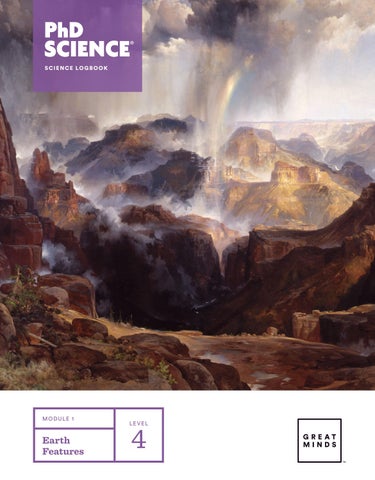
The Chasm of the Colorado, 1873–1874 Thomas Moran, American, 1837–1926 Oil on canvas Smithsonian American Art Museum, Washington, DC, USA Smithsonian American Art Museum, lent by the Department of the Interior Museum Photo credit: Smithsonian American Art Museum, Washington, DC/Art Resource, NY