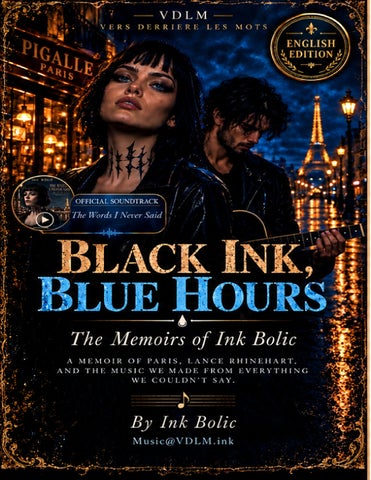
BLACK INK, BLUE HOURS The Memoirs of Ink Bolic Ink Bolic VDLM — Vers Derrière Les Mots
Contents Prologue — The Man Who Played Until the Room Went Quiet Chapter One — Belleville Doesn't Raise Innocent Girls Chapter Two — The Things a House Doesn't Say Chapter Three — The Girl Who Sang Too Loud Chapter Four — What We Choose to Keep Chapter Five — The Space Between Two Notes Chapter Six — The Room Beneath the Noise Chapter Seven — The First Thing We Let Go Chapter Eight — The Names We Give the Darkness Chapter Nine — The First Song That Knew Too Much Chapter Ten — A Room Full of Ghosts Chapter Eleven — The People Who Heard Us Chapter Twelve — What the Night Took Chapter Thirteen — The Sound of Staying Chapter Fourteen — The Things We Couldn't Put in a Song Chapter Fifteen — The Night I Wasn't There Chapter Sixteen — The Song We Didn't Release Chapter Seventeen — The Face Behind the Voice Chapter Eighteen — The Weight of a Name Chapter Nineteen — A Song Is Not a Promise
Chapter Twenty — The Machine and the Breath Chapter Twenty-One — The Cost of Being Heard Chapter Twenty-Two — The Years That Did Not Announce Themselves Chapter Twenty-Three — What We Refused to Sell Chapter Twenty-Four — Audience Without Ownership Chapter Twenty-Five — Black Ink, Blue Hours Chapter Twenty-Six — The Melody That Was Never Finished THE MUSIC BEHIND BLACK INK, BLUE HOURS DISCOVER VERS DERRIÈRE LES MOTS QR guide — Scan the soundtrack QR guide — More music and a thank-you QR guide — Discover VDLM Acknowledgments About the Author Cover text Back cover
Copyright Copyright © 2026 Lance Rhinehart. All rights reserved. No part of this book may be reproduced, stored in a retrieval system, or transmitted in any form or by any means, electronic, mechanical, photocopying, recording, or otherwise, without express written permission of the publisher. Cover design by Lance A.R. Rhinehart VDLM — Vers Derrière Les Mots
Dedication To Lance, my love. For the songs we made, the words we swallowed, and the years that taught us how to hear one another. You came into my life like rain over Paris, one December evening— unexpected, impossible to ignore, leaving the streets shining and my world forever changed. Some meetings change a life. Some people arrive without promising to stay, yet somehow become part of every melody, every unfinished sentence, every tomorrow we once thought we would face alone. For the nights beneath the lights of Pigalle, for the cigarettes burning too slowly, the coffee growing cold, the guitars left beside the window, and all those moments when I had no words, but you understood me anyway. Thank you for the music. Thank you for your patience. Thank you for seeing the woman behind the voice, even when I could barely recognize her myself. This book carries the pieces of me that music alone could never hold, the memories that time softened but never stole, and the parts of us that no distance, no silence, no passing year could ever make ordinary. Some songs never end. They simply change their language, their season, their heart. And if these pages have taught me anything, it is that love does not always need a grand declaration. Sometimes it is simply the hand that stays, the melody that returns, the quiet I’m here when the world becomes too loud. To you, for the words, for the music, for everything we never knew how to say. Always. — Ink Bolic
Epigraph There are words the heart keeps, and songs that time cannot finish. — Ink Bolic
PROLOGUE The Man Who Played Until the Room Went Quiet Paris, December 2010 The first time I saw Lance Rhinehart, he was playing as if the song had done something unforgivable to him. It was raining in Pigalle. The kind of rain that makes Paris look less like a postcard and more like a city that has forgotten to sleep. Water shone on the pavement beneath the lamps. People moved past one another with their collars raised and their faces arranged into expressions that meant: don't ask me anything tonight. I had ducked into the room to get out of the weather. I told myself that was the only reason I stayed. I had always been good at finding the practical reason for a choice that frightened me. The room was warmer than the street. My coat was soaked at the shoulders. I could stand near the wall and leave whenever I wanted. These were facts, and facts were useful because they kept desire from having to identify itself. I watched the exits before I watched the people. I noticed who was drunk, who was bored, and who seemed to want company but would resent being offered it. I called this intuition. Sometimes it was. Sometimes it was fear with better manners. Lance sat with an acoustic guitar resting against his body. His dark hair fell across one eye. He played a progression, stopped, and played it again. He wasn't showing off. He wasn't even really performing. He was listening for something in the spaces between the notes, something that kept refusing to arrive. I watched him for longer than I meant to. “Tu fais toujours ça?” I asked.
He looked up. “Ça quoi?” “Tu joues comme si t'essayais de te souvenir d'un truc que t'as jamais connu.” You play as if you're trying to remember something you've never known. He studied me. Then he said, “Maybe that's what I'm doing.” He did not ask me to explain myself. That was irritating. I had offered him an observation sharp enough to invite either an argument or a compliment, and he had given me neither. His fingers rested on the strings. I could hear the room again: a chair scraping, somebody clearing a throat, rain finding a metal surface outside. “Does it bother you?” he asked. “What?” “That it doesn't finish.” I looked at the guitar because looking at him seemed to have become part of the question. “It bothers me when something pretends to.” He nodded, not as if I had said something clever, but as if I had answered. I was used to making a sentence do two jobs: say what I meant, and arrange the face of the person hearing it. His face remained his own. I had not yet decided whether I liked that. I could still have gone. I mention this because afterward it became tempting to make the meeting sound inevitable. Nothing in that room prevented me from returning to the rain. I stayed long enough to become interested in what he might say next, then blamed the weather for my lack of discipline. I should have left then. I had a talent for recognizing doors and an even greater talent for refusing to walk through them. But there was something in the unfinished melody that felt familiar—not because I'd heard it before, but because I knew the feeling of reaching for a thing you couldn't name. We spoke about music. Not the polished kind that filled cafés and shop windows, but the kind that made a person feel exposed. Music that didn't hide the bruise beneath the sleeve. “La musique qui saigne,” I said.
The music that bleeds. Lance repeated the phrase quietly, as though testing its weight. “La musique qui saigne.” Outside, the rain kept falling. Somewhere in the city, a train crossed a bridge. Inside that room, a melody waited for us to become brave enough to finish it. I didn't know his history. He didn't know mine. We had no reason to trust each other, and no sensible reason to begin. But I remember the exact moment I understood that I would come back. It wasn't when he played something beautiful. It was when he stopped playing, looked at the unfinished song, and didn't pretend it was finished.
CHAPTER ONE Belleville Doesn't Raise Innocent Girls Paris, childhood I was born in Paris on January 4, 1989, but the city on my birth certificate was not the city that raised me. My world was Belleville: steep streets, small shops, old façades, voices tumbling out of open windows, and the constant feeling that every life was happening beside another life I would never fully understand. Our apartment always smelled faintly of coffee, cooking oil, and whatever my mother had decided could be made to last another day. In winter, the windows collected condensation. In summer, the rooms held the heat long after sunset, and the street below continued talking until somebody finally shut a window. My mother, Élise, could make a little go a long way. She knew how to stretch a meal, how to spot a lie, and how to keep moving when stopping would mean feeling too much. She had once sung in cabarets. I knew this mostly through photographs and the occasional story she told when she was in the right mood. In the pictures, she looked like someone who expected the world to make room for her. The woman who stood at our stove looked as though she had learned to make room for herself wherever she could find it. I didn't understand the difference then. I only knew that my mother had a voice she rarely used for herself. Mathieu, my older brother, used his voice for practically everything. He sang badly on purpose, argued with the radio, and considered any silence lasting longer than a minute an invitation to make a remark. He
called me petite catastrophe because, according to him, I could turn a glass of water into a family emergency. One afternoon, I knocked a glass off the kitchen table. It shattered against the floor. I stood perfectly still, staring at the pieces. My first thought wasn't that the glass was broken. It was that my mother would be angry, and I would have to work out how angry before deciding what to do with my hands. Mathieu appeared in the doorway with a piece of bread in his mouth. “Impressive,” he said. “Shut up.” “Was it an accident, or are you beginning a collection?” I looked at him with enough hatred to make him grin. He took the bread from his mouth. “Don't move. There might be little pieces.” “I know.” “Then stop looking as if you've murdered someone.” I wanted to hit him. I also wanted him to stay. Those two feelings often arrived together in childhood. I didn't know how to explain that I could resent his teasing and still feel safer when he was in the room. I only knew that when he left, I noticed. He fetched the broom. I crouched beside the table and began picking up the larger pieces, carefully, one at a time. “You don't have to do that,” he said. “I broke it.” “Yes. The glass has accepted responsibility.” I threw a piece of bread at him. He caught it, laughed, and handed me the dustpan. I held the dustpan too high. He lowered it with two fingers, swept the last pieces toward it, and waited while I tried again. I wanted to tell him I knew how to do it. I wanted him to keep his hand there until I did. “You're supervising,” I said. “Badly. You should complain.”
I pressed the edge flat against the floor. A bright grain of glass resisted the broom, then disappeared into the little heap. For a moment I was absorbed in getting that one thing right. I forgot to listen for my mother. When I remembered, the silence had changed: it was no longer a silence I had to fill with an explanation. There was still a broken glass. Somebody would still notice it was missing. Mathieu had not made those facts disappear, and he had certainly not made me a more graceful child. He had made room for the work of clearing up. I could be clumsy in front of him without having to become only the clumsy one. I would not have said any of that. I gave him the dustpan with the solemn irritation of someone conferring a very minor honor. He accepted it without bowing. That was another thing I loved about him and would have denied if asked. That was Mathieu. He could make a joke out of almost anything, but he knew when to stop. He never asked me to explain why I had gone quiet. Sometimes he simply sat beside me until I became myself again. I thought everyone knew how to do that. I was wrong about a great many things. My father, Marcus Bolic, was an American jazz drummer who disappeared when I was three. He left a note: “Désolé, gamine.” Sorry, kid. For years, I imagined that the brevity of the message concealed something important. Perhaps there had been a longer explanation that my mother had destroyed. Perhaps the words were a code I would understand when I grew older. Children can turn almost anything into a promise if the alternative is admitting that an adult has left without providing a reason. I asked my mother about him once while she was folding laundry. “Did he love me?” She stopped folding for a moment. “Of course he liked you.” “That isn't what I asked.”
She looked at me then, and I remember feeling proud of myself for having caught the distinction. I also remember wishing I hadn't. “He was your father,” she said. It wasn't an answer. I knew that even then. I waited for her to offer another one. She folded the shirt, aligned its sleeves, and placed it on the pile. I hated her a little for stopping there. I hated myself more for wanting her to say something that might make his leaving less real. I didn't tell her either thing. I went to my room and wrote a sentence in a school notebook: People leave when they have somewhere better to be. It was a terrible sentence. It was also the first sentence I remember writing because I wanted it to hurt. Mathieu found it several days later. He had been looking for a pen. At least, that was his explanation. He was never especially convincing when he lied, but he had the advantage of being charming enough that people often let him continue. He read the line. I lunged for the notebook. “Give it back.” He held it out of reach. “This is miserable.” “Give it back!” “Not the feeling. The sentence.” I stopped. He lowered the notebook and handed it to me. He didn't ask whether it was about our father. He didn't tell me that I was too young to understand. He didn't say that everything would be fine. He only tapped the page. “Write what happened,” he said. “Not what you think it proves.” I stared at him. “What does that even mean?”
“It means your sentence is trying to be clever instead of telling the truth.” “It's my notebook.” “Tragically, yes.” I threw the notebook at him. He ducked, and it struck the door. We both started laughing. I laughed so hard that my stomach hurt, then felt embarrassed by the sound of it. I snatched the notebook from the floor and locked myself in the bathroom, where I sat on the closed toilet lid and tried to decide whether I was angry or happy. I had no idea that I would spend years doing the same thing in more expensive rooms. Mathieu introduced me to Billie Holiday around that time. He played the records as though he had personally discovered her and expected me to be grateful for the privilege. He would point out a phrase, a hesitation, the way a note seemed to carry a second meaning beneath the first. “Listen to that,” he would say. “I am listening.” “No, you're waiting for the song to do something.” I would roll my eyes. He would start the track again. I didn't always understand what he heard. I understood that he wanted me to listen more closely, and that his enthusiasm made me curious even when I pretended otherwise. Sometimes, when he left the room, I would play the record again by myself. I never admitted that to him. At school, I was quieter than I was at home. I knew how to answer questions, complete assignments, and make myself seem more confident than I felt. I watched other girls exchange secrets in the corridors and wondered how they knew which truths were safe to tell. They could confess a crush without behaving as though they had handed someone a weapon.
They could be embarrassed without treating embarrassment as a permanent condition. I admired them. I also judged them. I told myself they were careless. The truth was that I envied their ability to be careless without feeling that something terrible might follow. I learned to watch people because watching felt safer than asking. I noticed a hand tightening around a cup, a laugh arriving too late, the way a person could say “I'm fine” and make the words sound like a locked door. If my mother's footsteps changed pace, I listened. If a cupboard shut harder than usual, I tried to work out what it meant. Adults called me observant. I accepted the compliment because it sounded better than saying that I was always preparing for something I could not name. Attention gave me the feeling of being ready. It also made rest difficult. Even on an ordinary afternoon, some part of me kept watch while the rest tried to be a child. I began to sing when I was alone. Not beautifully. Not at first. I sang fragments of songs I had heard at home, melodies I made up and forgot, and little phrases that embarrassed me as soon as I recognized them as mine. Sometimes I sang into the sleeve of my jumper, which did absolutely nothing to improve the sound but gave me the illusion of privacy. If footsteps approached, I stopped. If someone asked whether I had been singing, I said no. This was not because I believed my voice was terrible. That would have been easier to admit. I was afraid that someone might like it. If they liked it, they might ask me to sing again. They might watch me. They might decide what kind of person I was from a sound I had never learned to control. And if they didn't like it, I would have to carry the knowledge that I had wanted something and failed to get it. So I made certain that nobody could tell me.
I called that caution. Later, I would call it independence. I was very good at choosing names that made fear sound respectable. Belleville did not make me innocent. It made me attentive. The neighborhood taught me that tenderness often arrived wearing practical clothes, that people could love one another deeply without finding the correct words, and that a person could be both generous and cruel before breakfast. It also taught me that everyone had a private life, even the people who seemed to have nothing to hide. I did not know what to do with that knowledge. I collected it instead. I collected voices, expressions, scraps of conversation, the way Mathieu laughed when he was trying not to show that something had hurt him. I collected my mother's rare moments of singing, usually when she thought nobody was paying attention. I collected the phrases people used when they wanted to end a conversation without admitting they were ending it. I thought that if I remembered enough, I might eventually understand everything. I would later discover that memory is not the same thing as understanding, and that knowing how to describe a feeling does not mean you know how to live with it. But that was later. When I was a child, I still believed that if I watched carefully enough, I could prepare myself for whatever happened next. I had not yet learned that some things happen without warning, that love does not make people permanent, or that a voice can be both the most private part of you and the first thing the world asks you to give away. For the moment, I was a girl in Belleville with a notebook, an older brother who annoyed me on purpose, a mother who sometimes sang while she worked, and a voice I was determined to keep to myself. I didn't know how long I would be able to keep it there. I only knew that, when the apartment was empty, I sang.
Young Ink listens to a record with her older brother Mathieu.
CHAPTER TWO The Things a House Doesn't Say Paris, early adolescence Our home was not silent, but the most important things were rarely said aloud. There was always something making noise. The pipes knocked inside the walls. Buses groaned along the street below our windows, and the neighbors argued as if the thin plaster between our apartments were nothing more than a suggestion. Someone was always dragging a chair across a floor, playing music too loudly, or calling to a person who was already in the room. When my mother cooked, she sometimes left the television on in the background. She claimed she liked the company, though I suspected she simply preferred a little noise to the thoughts that arrived when the apartment was quiet. I knew the sounds of our home well enough to recognize when something had changed. I could tell how my mother was feeling by the way she put her keys on the table. If she dropped them into the bowl beside the door, she was exhausted and wanted to be left alone. If she placed them carefully beside it, she was thinking about something. If she forgot the bowl altogether and carried them into the kitchen, I knew she was distracted. Mathieu had his own signals. When he was in a good mood, he sang whatever was playing on the radio, usually with the confidence of someone who had never once considered whether he could actually sing. When he was worried, he became unusually quiet. When he was angry, he cleaned things that did not need cleaning.
I learned these details without trying. I paid attention because paying attention made life easier. If I could recognize a bad mood before it became an argument, I could stay out of its way. If I could tell that my mother had had a difficult day, I could make myself useful before she needed to ask. At the time, I thought this was simply what families did. My mother, Élise, had a talent for making limited things last. She could turn a few ingredients into a meal that fed three people, repair a loose button while holding a conversation, and stretch the last coins in her purse until the next payment arrived. She was practical in ways that sometimes seemed almost miraculous to me. If something broke, she examined it before deciding it was beyond repair. If someone disappointed her, she allowed herself one evening of anger and then returned to whatever needed doing. I admired her efficiency. I also feared the exhaustion beneath it. She had once sung in cabarets. I knew this, but I did not know everything about that part of her life. The past appeared in fragments: a photograph tucked into a drawer, a name mentioned by someone who had known her before I was born, a story that stopped just when I wanted it to become interesting. Sometimes, while she cooked, I watched her hands and tried to imagine them holding a microphone instead of a wooden spoon. “Were you nervous when you sang?” I asked her once. She glanced at me. “Of course.” “You don't look nervous doing anything.” “That is because you have never seen me try to repair the washing machine.” I laughed. She turned back to the stove, but I stayed where I was. “What did it feel like?” I asked. “What did what feel like?” “Singing. In the cabarets.”
For a moment, she seemed to be somewhere else. Her knife rested against the cutting board, and the expression on her face became difficult to read. “It felt like being allowed to be someone else for a little while,” she said. I waited for her to explain. Instead, she picked up the knife and continued cutting. I wanted to ask whether she missed it. I wanted to know why she had stopped, whether she had chosen to leave that life or whether something had taken it away from her. But I had already learned that an answer could close a conversation rather than open one. I nodded as though she had told me everything I needed to know. That evening, I went to bed thinking about the idea of being someone else. It seemed like a useful possibility. My father was another subject that rarely stayed open for long. Marcus Bolic was an American jazz drummer. He had disappeared from our lives when I was three, leaving behind a short note: Désolé, gamine. Sorry, kid. I was too young to remember him clearly. What I knew came from what remained: his name, his profession, the note, and the fact that my mother had continued raising two children without him. I sometimes imagined that if I could collect enough details, I could build a picture of him that felt real. I wanted to know whether he had been funny, whether he had a temper, whether he was the kind of man who made promises easily. I wondered what his hands looked like when he played the drums. I wondered whether I had inherited anything from him besides a surname. Most of all, I wondered how someone could leave a child and reduce the explanation to two words. I did not ask my mother these questions often. I could tell that the subject hurt her, though I could not tell whether the pain came from losing
him, from what he had done, or from the years she had spent trying to make his absence irrelevant to our lives. When I did ask, her answers were usually brief. “He was a musician,” she told me once. “I know.” “He could be charming.” “Was he nice?” She stopped what she was doing. “That is not always the same question, Ink.” I thought about that for a long time. It was one of the first adult answers I received that did not resolve anything. I wanted a simple verdict. I wanted my father to be either good or bad, someone I could miss without feeling foolish or reject without feeling guilty. My mother offered me neither permission nor prohibition. She left the question where it was. I resented her for that sometimes. I understand now that she may not have known what else to give me. Mathieu rarely discussed our father. He had been old enough to remember more than I did, but he never seemed interested in helping me reconstruct a man who had chosen to disappear. When I asked him once whether we looked like Marcus, he examined my face with theatrical seriousness. “You have his dramatic tendencies,” he announced. “You don't know that.” “I know you.” “That isn't the same thing.” “It is, unfortunately, more than enough.” I threw a cushion at him. He caught it and put it behind his head. “Ask Maman if you want the official family history,” he said. “I'm not opening an archive.” I was irritated by his refusal to take the question seriously. Then I noticed that he had stopped smiling.
“Do you remember him?” I asked. Mathieu looked toward the television. “Some things.” “What things?” He took a breath, as if deciding how much to tell me. “I remember that he played drums. I remember Maman being different when he was around. And I remember that people can be talented and still make a mess of their lives.” “That doesn't tell me anything about him.” “No,” he said. “It doesn't.” I waited. Mathieu looked back at me. “You don't have to turn him into a mystery just because he left without explaining himself.” I wanted to argue. I wanted to tell him that it was easy for him to say, because at least he had memories. Instead, I looked down at the cushion in my lap. He nudged my foot with his. “Come on, petite catastrophe. Help me find something to eat.” It was his way of ending the conversation without pretending the conversation had been pointless. Mathieu had a particular talent for making difficult things survivable. He could be impatient, sarcastic, and maddeningly certain that he understood the world better than anyone else in it. He also knew when to stop teasing. He could recognize the moment when a joke had done its work and another would only cause damage. I did not always appreciate that quality. I was young enough to believe that love should look like agreement, that being understood meant someone would give me the answer I wanted. Mathieu did not always agree with me, and he rarely supplied the answer I expected. He did, however, return when he said he would. He listened when I spoke. If I asked him to keep something private, he usually did. Those things mattered more than I knew.
He called me petite catastrophe because I had a habit of turning small inconveniences into personal disasters. A broken pencil could ruin an afternoon. A bad mark at school could convince me that my future had collapsed. If I made a mistake in front of someone, I would replay it so often that the original event became almost irrelevant. “You know,” Mathieu told me one afternoon, “most people forget what you did five minutes after you do it.” “Not if it was embarrassing.” “Especially if it was embarrassing. They're busy remembering their own disasters.” “You make everything sound easy.” “No. I make it sound like something you can survive.” I hated how reasonable that was. Mathieu kept playing Billie Holiday without making a ceremony of it. He played her records at home and insisted that I listen properly instead of treating music as background noise. “Don't just hear the words,” he said one evening, leaning over the record player. “Listen to what happens to the voice.” “What am I supposed to hear?” “That's the point. You have to listen.” He lowered the needle again. Billie Holiday's voice entered the room, carrying a sadness that did not seem to ask anyone's permission. It was not polished in the way I expected a singer to sound. There were rough edges, pauses that seemed almost too long, and moments when a note felt as though it might break apart before reaching the end. I sat on the floor beside the sofa. “Is she sad?” I asked. Mathieu shrugged. “Sometimes.” “How can you tell?” He looked at me as if the answer should have been obvious. “Listen to her.”
So I did. I listened to the way a word could seem ordinary at first and then change because of how she sang it. I listened to the spaces between the notes. I listened to the places where her voice seemed to hold something back. When the song ended, Mathieu did not immediately put on another record. “Well?” he asked. I searched for an answer. “It sounds like she knows something.” “About what?” “I don't know.” He smiled. “Good. You were listening.” I wanted him to tell me what I had missed. Instead, he left me with the music and went to find something to eat. That became part of the pleasure. I could listen to a song without needing to solve it. I could return to it and hear something different. The feeling did not have to become a lesson, and I did not have to explain why it had reached me. Not understanding every word was one kind of freedom. Wanting to understand was another. After he had gone, I began trying to catch the words as well as the voice. I wrote down what I thought I heard, leaving gaps rather than making the sentence sound more certain than I was. Sometimes I asked Mathieu. When he knew, he told me; when he didn't, we had to look. I disliked discovering that my private revelation could depend on the dull work of finding a verb. The records gave me a reason to learn, not a miraculous command of English. That came unevenly, over years: reading with a dictionary beside me, listening again without the melody to carry the meaning, staying in awkward conversations long enough to ask somebody to repeat a sentence. I could remember a sung phrase perfectly and still answer an ordinary question badly. There was no dignity in the distinction. It was useful all the same.
English belonged to my father in a way that made me suspicious of wanting it. He had left before he could teach me much of anything. I did not want a language to become another method of waiting for him. Yet the woman on Mathieu's record asked nothing about Marcus Bolic. Her voice could reach me without explaining his absence. I began to understand that I could take something from that music without taking him back. I began to notice music everywhere. In the rhythm of footsteps on the stairs. In the uneven hum of an old refrigerator. In the way a bus engine changed pitch as it climbed the street. Sometimes I heard a melody in my head and tried to follow it, only to lose it when I reached for a pencil. I began keeping a notebook devoted to songs. At first, it was nothing important. I wrote down fragments of lyrics, phrases I liked, and ideas for songs I was not yet capable of composing. Then I started filling the margins with things that had nothing to do with music: arguments I wished I had won, questions I was afraid to ask, descriptions of people I wanted to understand. The notebook became a place where I could be less careful. I wrote things that sounded ridiculous when I read them aloud. I wrote sentences so earnest that I crossed them out immediately. I wrote about wanting to be noticed, then about being terrified of attention. I wrote about my father, then scratched out his name. I wrote about my mother and felt guilty afterward, as though a private frustration were a betrayal. Sometimes I wrote a line that seemed to capture exactly what I felt. By the next morning, I hated it. I kept writing anyway. Some evenings I read a page as though I were the person who might discover it. Would my mother recognize herself in the woman I had been angry with? Would she stop at the anger and never reach the sentence after it? I began adding explanations in the margin. She was tired. I knew she was tired. I had been unfair. By the time I finished defending her, I could hardly find what I had wanted to say.
Then I became angry about having defended her in a notebook she had not asked to read. I crossed out the explanation and felt disloyal again. The page grew darker without becoming clearer. I was beginning to need a place where two things could be true without one being made to apologize for the other. I could love my mother and want her to notice me differently. I could understand why she was tired and still wish, selfishly, that understanding would earn me an evening when she wasn't. At school I could usually find a sentence that kept a conversation moving. On paper, with nobody waiting for me to finish, I discovered how much I left out to achieve that ease. Sometimes I stopped in the middle of a line and let the unfinished complaint stay there. It looked worse than a lyric. It was considerably more difficult to sing. The notebook lived beneath folded clothes in my drawer. I checked that it was hidden whenever I finished using it. I had no particular reason to believe anyone would search for it, but the thought of someone reading those pages made my skin tighten. My family knew me well. That was part of the problem. I could survive a stranger misunderstanding me. I did not know what I would do if someone who loved me saw the things I could barely admit to myself. One afternoon, Mathieu found another of my private pages. I came home and discovered him sitting on my bed, the notebook open across his knees. He was reading with an expression of exaggerated seriousness, his lips moving slightly as he followed the lines. My stomach dropped. “Give it back.” He looked up. “Hello to you, too.” “Mathieu. Give it back.” He held the notebook still. “Is this a poem?” “No.”
“An important government document?” I crossed the room and reached for it. He gave it to me immediately. I snatched it from his hands and pressed it against my chest. “Did you read everything?” “No.” “You're lying.” “Only a little.” “I'm going to kill you.” “Not before dinner, I hope. Maman made lentils.” I wanted to stay angry. I had imagined this moment often enough to know exactly how it was supposed to go. He would laugh at me, I would yell at him, and the private things I had written would become a new source of jokes. But he did not laugh at the words themselves. He pointed at the page. “You crossed out the better sentence.” I stared at him. “The one underneath,” he said. “It's more honest.” “You don't even know what it's about.” “No. But I know when you're trying to make something sound clever instead of saying what you mean.” I looked down at the page. He was right, which made me dislike the observation even more. “You shouldn't have read it.” “I know.” He said it without defending himself. That surprised me. I had prepared arguments for why he was wrong, but he had already admitted the one thing I needed him to understand. “You won't tell anyone?” “No.” “Not even Maman?” “Not even Maman.”
I watched his face, looking for the joke that might come afterward. It did not arrive. Then he stood, ruffled my hair, and headed for the door. “Mathieu?” He turned. “Do you really think the second sentence is better?” He considered the question. “I think it's yours.” He left before I could ask him to explain. I sat on the bed for a long time afterward, reading the two sentences. The first was more elegant. The second was clumsy and direct. I had crossed it out because it exposed too much. Mathieu had noticed. He had also returned the notebook, promised to keep the contents private, and left me alone with my own words. I did not understand how rare that could be: someone seeing an embarrassing part of you and deciding not to use it to make you smaller. My mother had her own way of offering space. Sometimes she found me humming in the kitchen. I would be standing beside her while she chopped vegetables or folded laundry, barely aware that a melody had escaped me. As soon as I noticed, I would stop. “Why did you stop?” she asked me once. “I wasn't singing.” She raised an eyebrow. “I was humming.” “Ah. A completely different profession.” “Maman.” She smiled and returned to her work. She never demanded that I sing properly. She did not tell me to stand up straight or open my mouth wider. She did not announce that I had a beautiful voice and ask me to repeat the melody for someone else. She let the sound exist without making it an event.
I loved her for that. I also found it confusing. I had begun to believe that if I revealed something fragile, someone would immediately want to examine it, name it, improve it, or show it to another person. My mother could hear me without making my voice into a subject. When I sang, I could stop whenever I wanted. That small freedom mattered more than I knew. At school, I was not especially good at explaining myself. I could be sharp when I was embarrassed and distant when I wanted someone to come closer. I sometimes mistook kindness for pity and teasing for rejection. If someone asked whether I was all right, I answered too quickly. If they did not ask, I assumed they had noticed something wrong and decided it was not worth their trouble. I watched other girls talk freely about their crushes, their families, and their plans for the weekend. They seemed able to say I want without immediately preparing an argument for why they were allowed to want it. I envied that ease. I also judged it. It was easier to believe they were careless than to admit I was frightened. At home, I became useful. I helped with the dishes. I kept track of school assignments. I learned when my mother was too tired for another question and when Mathieu's mood could be improved by food. I tried to make myself easy to live with, as if love were a household expense and I could lower the cost by requiring less. Nobody had asked me to do this. My mother did not tell me to take up less space. Mathieu did not ask me to stop needing things. I had drawn my own conclusions from the ordinary strain of our lives and mistaken them for rules. By thirteen, I had begun to confuse being undemanding with being safe to love. I could not have explained that sentence then. I might have laughed at anyone who said it to me and accused them of being melodramatic. But I
was already learning to hide my needs beneath competence. I wanted reassurance and behaved as if I needed nothing. I wanted someone to notice when I was hurting and made myself difficult to read. I wanted to be understood without having to risk the humiliation of explaining myself. It was an impossible arrangement, but it gave me a sense of control. Then, in 2002, Mathieu died in a motorcycle crash on the périphérique. He was seventeen. I was thirteen. There is no sentence that can make that information gentle. I can write around it, describe the apartment, the weather, the ordinary objects that remained where they had always been. I can tell you what I remember about the days afterward. None of those details can make the fact itself easier to hold. I remember the house continuing. A chair scraped across the floor. Water ran through the pipes. Someone moved in the apartment next door. A door opened and closed. The world did not stop to acknowledge that the person who had made so many of our ordinary sounds meaningful would never make them again. My mother kept moving because the day refused to stop for any of us. There were things to do that could not be postponed indefinitely. Objects to put away. Meals to prepare, even when eating seemed like an activity belonging to other people. I watched her hands. I did not know what to say to her. I was afraid of making her cry, although she had every right to cry. I was afraid that if I began crying myself, I would not be able to stop. I was afraid that the wrong sentence might make the loss more real than it already was. So I did what I had learned to do. I tried to be useful. I answered when spoken to. I helped when I could. I put things away. I watched my mother and waited for instructions, as though grief were a
difficult household task and there might be some small job that would make it easier for her to finish the day. At night, I listened for Mathieu. Not deliberately, at first. My mind simply expected him. A noise from the hall could make me turn my head. A familiar rhythm in another room could catch my attention before I remembered. Sometimes I would begin to think of something I wanted to tell him, and for a few seconds the thought would feel entirely ordinary. Then I would remember. The second loss came every time the first expectation failed. I knew he was gone. I did not believe he would walk through the door. But knowledge and habit did not disappear together. My mind could accept a fact long before the rest of me learned how to live inside it. I missed the way he interrupted songs to point out something I had overlooked. I missed his irritating certainty that he knew which line mattered most. I missed being able to tell him something ridiculous without first deciding whether it was worth saying. I missed the person I had been when he was there to receive all those small pieces of me. That was something I could not have explained to anyone. I was not only grieving Mathieu. I was grieving the conversations that would never happen, the jokes that had not yet been invented, the future versions of us that would never have the chance to meet. For a long time, I thought being strong meant not adding to my mother's pain. I thought loving someone meant managing my own feelings quietly enough that they would not become another burden for the people who were still with me. I was wrong, though I would need years to understand how. The notebook remained in my drawer. I wrote in it less often for a while, then began again. Some pages held anger. Some held sentences I could barely bear to read the next morning. Sometimes I wrote a line that
reminded me of Mathieu and closed the book so quickly that the cover slapped against my fingers. I did not show those pages to my mother. I did not show them to anyone. But I kept singing. Not always loudly. Not always well. Sometimes only a few notes while I stood at the sink, or a melody under my breath as I walked home from school. Music could enter a room without demanding that I explain why I was sad. It could give shape to a feeling without insisting that I make a decision about it. I did not yet know what I wanted to become. I only knew that there were things inside me that did not disappear when I refused to speak about them. Years later, I would meet a man with a guitar and an unfinished melody, and I would recognize something familiar in the way he listened. I would mistake parts of that recognition for safety, and parts of it for love. I would learn, slowly and not always gracefully, that being heard was not the same as being understood—and that neither one gave another person the right to decide what I should feel. At thirteen, I knew none of that. I knew only the kitchen, my mother's hands, Mathieu's empty place, and the notebook hidden beneath my clothes. I knew that I could want someone to notice me and still be terrified of what might happen if they did. Our house had taught me how to read what people left unsaid. It would take much longer to learn that I was allowed to speak.
CHAPTER THREE The Girl Who Sang Too Loud Paris, 2004 I was fifteen the first time I sang in a bar. I chose “La Vie en Rose,” which was either an act of courage or a failure of imagination. It was an almost absurdly tender song for a girl who had learned to treat tenderness as a trick of the light, something beautiful that appeared briefly before the room returned to its ordinary shape. I knew the melody from my mother, from old recordings, from the fragments of songs that had survived in our apartment long after the people who first sang them had disappeared from our lives. I knew where to breathe. I knew which notes I could reach. I knew the words well enough to pretend they had never frightened me. What I did not know was how to stand in front of strangers and let them see what the song did to me. The bar was somewhere in Paris where the streets seemed to narrow after dark, folding the noise of traffic into the low murmur of people who had nowhere urgent to be. I remember the room more clearly than I remember the address. The walls were dark, the lights amber, and the air carried the smell of old wood, spilled wine, cigarette smoke caught in coats, and the faint metallic odor of the microphone. Someone had taped a cable to the floor with silver gaffer tape. Behind the counter, glasses knocked together whenever the bartender reached for another bottle. A man near the window laughed too loudly at something his friend had said. Two women shared a cigarette outside the open door, their conversation rising and falling with the passing traffic. Everyone seemed to know how to occupy their own body.
I envied them for that. I stood near the edge of the room with my hands folded into the sleeves of my black sweater. I had chosen it because it hid my wrists and made me feel as if I could retreat inside myself without anyone noticing. My hair kept falling across my face. Every few minutes, I pushed it back, only to have it fall forward again. I had the ridiculous impression that the room was waiting for me to make one wrong movement so it could decide I did not belong there. My mother had brought me. She was the reason I had agreed to come, though I had insisted that the decision had been mine alone. Élise had not begged, pleaded, or delivered one of her solemn speeches about following a dream. She had simply mentioned that a small bar was giving young singers a chance to perform, then left the information on the kitchen table beside the bread and a list of things we needed from the grocer. She knew better than to make an invitation sound like a test. For three days, I had walked past that piece of paper without touching it. On the fourth, I had folded it and put it in my pocket. Now, standing in the bar, I wished I had left it there. “You don't have to do it,” my mother said. She was beside me, wearing a dark coat and the expression she used when she wanted me to understand that a choice was mine without having to defend it. She had tied her hair back, but a few strands had escaped around her face. Under the amber light, she looked younger than she did at home, though perhaps I only saw her differently because she was somewhere music belonged. “I know.” “I'm not going to be disappointed if you decide not to sing.” “I know that, too.” She studied me for a moment. “Then why do you look as though someone has sentenced you?” “Because someone has.” “Who?”
I looked toward the little stage. She followed my gaze. “Ah. A very severe judge.” “Don't.” “I haven't said anything.” “You're smiling.” “I am allowed to smile.” “Not at me.” That made her smile more, and I hated how close I came to laughing. It was one of her gifts, irritating and necessary: she could loosen the knot in a room without pretending there had never been one. She touched my elbow, briefly. “You can leave whenever you like, Ink. You can sing one line and stop. You can forget the words. You can sound terrible. The world will continue.” “That is not reassuring.” “It wasn't meant to be. It is simply true.” I looked at her then. She had once sung in cabarets, long before I was old enough to understand that a person could be one thing in public and another at home. I knew the outline of that life, but not its details. Sometimes I imagined her under a spotlight, her face lifted toward a room full of strangers, her voice carrying a confidence she seemed reluctant to claim in daylight. “Were you frightened?” I asked. “When I sang?” “When people listened.” Her expression changed, though not enough for anyone else to notice. “Sometimes,” she said. “What did you do?” “I sang anyway.” I wanted a better answer. I wanted her to explain the precise mechanism by which fear became manageable, or to offer me some small secret she had carried away from the stage and kept for the day I needed it. Instead, she looked toward the microphone and then back at me.
“You don't have to be fearless,” she said. “You only have to decide whether the song matters enough to be frightened for.” It sounded like something an adult said when she had forgotten how difficult being fifteen could be. I nodded as if I understood. I didn't. I studied her mouth instead of the microphone. It was the same mouth that told me to eat before the food went cold. I wanted the woman from the photographs to emerge and demonstrate something: where to put a hand, how to make a room wait, what to do with the shame of wanting it to wait. But my mother remained beside me in her ordinary clothes. Whatever she had learned on those stages had not made her into someone who could sing in my place. I thought that unfair. Then I was ashamed of thinking it unfair. She had brought me here; she had given me permission to leave; I was still searching for a way to make her responsible for the part that belonged to me. She glanced toward the stage. I followed her gaze and found nothing transformed. The microphone was still too high for somebody, too low for somebody else. There were marks on the floor where people had stood before me. I had wanted a sign that I was ready. All I could see was a space I would soon be expected to occupy. Later I could give that an elegant meaning. At fifteen, I was mainly hoping the person before me was in no hurry. Before I went on, I had already planned my escape. I knew which hallway led to the street. I had counted the steps from the bar to the door. I had prepared several explanations for leaving early, each one more casual than the last. I could say I felt sick. I could blame the microphone. I could claim the room was too crowded or that the song no longer suited me. If I left before my name was called, perhaps no one would remember that I had been there. The most humiliating part was that I wanted them to remember.
I wanted the people in that room to turn toward me. I wanted the bartender to stop polishing a glass. I wanted the conversations to fall away. I wanted a stranger to hear my voice and feel something move inside them, even if they could not explain what it was. At the same time, I resented them for having the power to look at me. I had not yet learned that wanting to be seen and being comfortable with attention were two entirely different things. At fifteen, I thought the contradiction meant there was something wrong with me. I wanted to step into the light and punish it for illuminating me. When the person before me finished, the room applauded politely. He thanked everyone, adjusted the strap of his guitar, and returned to his friends. The small stage seemed even smaller after he left. A man with a clipboard glanced in my direction. “Ink?” For one ridiculous second, I considered pretending there had been a mistake. Ink was a name someone else might have. Ink was a name I could leave behind. I could become a girl who had come to listen, a girl who had accompanied her mother, a girl who had never wanted anything from anyone. My mother did not push me forward. She did not whisper encouragement or call my name again. She simply waited. That was what finally made me move. I walked to the stage with my arms held too stiffly at my sides. The microphone stood in its metal cradle, tilted toward an audience that had not asked to become one. I adjusted it once, then again, although the height was already right. The man at the sound desk asked if I was ready. “No,” I said. He laughed, thinking I was joking. I wasn't. The first note arrived before I was prepared for it. I had imagined that singing would feel like speaking, only with more melody. Instead, the sound seemed to begin somewhere below my ribs and travel through me
without asking permission. My voice came out too hard. I pushed the first line as if volume could make up for fear, as if I could force the song to become convincing before anyone had time to decide whether I was. I heard the strain in it. I heard the girl trying to sound older, steadier, more certain than she was. My instinct was to correct everything. I wanted to control the breath, polish the note, make the words behave. I wanted to sound like the singer I thought I ought to be: graceful, composed, untouched by the fact that there were strangers sitting a few feet away. Then I reached the next phrase and lost my breath. For a moment, I could hear nothing but the small, ugly panic inside my own head. I closed my eyes. I stopped trying to make the song beautiful. I let the note shake. I let the breath arrive late. I allowed the words to carry the feeling I had been trying to keep out of them. I sang the line as if it belonged to someone who had no time left to make it pretty. The melody gave my fear somewhere to stand. I did not become a different person. My hands were still cold. My shoulders were still tight. I could feel the microphone trembling slightly beneath my fingers, or perhaps it was my fingers trembling against the metal. But the song had begun to move through me, and for the first time that evening I stopped watching myself from the outside. I was not asking whether I looked frightened. I was frightened. I was singing. For a few minutes, those facts were allowed to exist together. The room changed, though not in any dramatic way. Nobody dropped a glass. Nobody stood up halfway through the song to applaud. No miraculous silence descended over Paris. A man near the back continued turning a ring around his finger. Someone shifted a chair. Behind the counter, the bartender set down a glass more carefully than before.
But a few conversations faded. A woman near the window turned toward the stage. The man who had laughed so loudly earlier leaned back and listened. I felt the difference before I opened my eyes. They were listening—not to a performance of confidence, but to the thing underneath it. That was the part I had not prepared for. I had expected to be judged. I had not expected to be received. There was a moment near the end when my voice grew stronger, not because I had forced it, but because I no longer had enough attention left to be afraid of every note. I sang the final phrase and let it settle where it wanted to settle. When the last sound faded, I stood still, unsure whether I was meant to bow, speak, or disappear. Then the applause began. It was modest and uneven, a handful of people bringing their hands together in a small room. Someone called, “Bravo.” The woman near the window smiled at me. The bartender lifted his chin in acknowledgment before returning to his work. Nothing in the world had changed. I had changed enough to notice. I said thank you, though my voice sounded strange after the song. I stepped away from the microphone and nearly caught my foot on the taped cable. The man with the clipboard smiled and said I had done well. I could not tell whether he meant it or whether he said the same thing to everyone, so I thanked him, too. Then I went into the hallway and cried. I cried with the furious embarrassment of someone who had managed to do the very thing she wanted and was now forced to live with having done it. My face was hot. My nose was running. I pressed the heels of my hands against my eyes and tried to stop, which only made it worse. Then I laughed at myself for crying, which made me cry harder.
The hallway smelled of damp coats and cleaning fluid. A stack of empty beer crates stood beside the back door. Somewhere inside the bar, another singer was beginning a song, and the first few notes came through the wall in a muffled, distant way. I could hear the room returning to itself without me. I had wanted the performance to be over. Now that it was, I felt strangely abandoned by it. My mother was waiting outside when I came out. The evening air had cooled, and the pavement shone beneath the streetlights. She had not followed me into the hallway. She had given me the dignity of being alone, then waited where I would find her. She looked at my face. “Alors?” “I sang.” “And people listened.” I nodded. “Ça t'a plu?” “I don't know.” “That's allowed,” she said. We started walking. For several minutes, we said nothing. Paris moved around us in its ordinary nighttime rhythm: a bus sighed at the curb, a scooter cut between two cars, a couple argued softly beneath an awning. Somewhere above us, a window was open, and music spilled into the street from an apartment I would never see. I kept replaying the performance, but not in the order it had happened. I returned to the first note, to the instant when my voice had sounded too loud and too exposed. Then I returned to the middle, when I had closed my eyes and stopped trying to repair myself. I remembered the woman's face near the window. I remembered the applause, the small and imperfect proof that the song had reached somebody.
Most of all, I remembered the feeling of being present in my own body without having to apologize for taking up space. My mother glanced at me as we crossed the street. “You seemed lighter when you sang,” she said. I wanted to ask what she meant. I wanted to tell her that I had felt terrified, that I had nearly run, that the applause had made me want to hide all over again. I wanted to ask whether she had seen the parts of me I had tried to disguise, whether the song had revealed too much, whether she was proud of me or merely relieved that I had finished. Instead, I slipped my hands into my sleeves. “Maybe,” I said. She accepted the answer. That was one of the things she understood about me: if she pulled too hard on a feeling, I would close around it. She had learned to leave a little room between her questions and my answers. Sometimes I mistook that room for distance. Later, I would understand it as a form of care. At home, the apartment looked exactly as it had that morning. The kitchen light was still too bright. A dish towel hung crookedly from the oven handle. There was a cup in the sink that someone had forgotten to wash. The ordinary details offended me a little. I had gone out and done something that felt enormous, and the world had failed to rearrange itself around the fact. My mother made tea. I sat at the kitchen table and watched steam curl from the cup. “Do you think I was any good?” I asked. She placed the sugar bowl between us. “I think you sang honestly.” “That isn't the same thing.” “No,” she said. “It isn't.” I looked at her, waiting for the compliment she had deliberately withheld.
“You can learn technique,” she continued. “You can learn how to use your breath, how to protect your voice, how to stand so you aren't fighting your own body. You can learn all kinds of things. But you cannot force honesty into a song after the fact.” “So I was good?” A corner of her mouth lifted. “You were fifteen, and you sang in front of strangers even though you were frightened. I think that is enough for one evening.” I wanted her to say I was gifted. I wanted her to tell me that I had been born for this, that the fear was merely the price of something extraordinary. I wanted a future promised to me in a sentence, something I could carry into the next room and use whenever doubt returned. Instead, she gave me the truth without decoration. It irritated me. It also stayed with me. That night, I lay awake and listened to the building settle. Pipes knocked behind the walls. A neighbor dragged a chair across the floor above us. A car passed in the street, its tires whispering over damp pavement. I could still feel the microphone beneath my fingers. I could still hear the first note, too forceful, followed by the breath I had failed to control. I kept returning to the moment I had closed my eyes. There was something dangerous about it. I had found a way to make myself audible, and some part of me had immediately begun to imagine what might happen if I did it again. What if I sang in another room? What if I wrote something of my own? What if I let someone hear a song that had no borrowed melody to protect me? The questions excited me. They frightened me more. I began to understand that singing would not make me fearless. It would give me a place to take my fear, and perhaps a way to transform it into something another person could recognize. That was not the same as being healed. I was still the girl who wanted to be noticed and resented the
attention when it arrived. I still mistook curiosity for judgment and praise for a promise I would have to keep. After that night, I sang whenever I could find a room that would let me. Sometimes it was a bar with a microphone and a handful of people who had come for reasons unrelated to me. Sometimes it was a rehearsal space that smelled of dust and warm electrical equipment. Sometimes it was our kitchen, when my mother was occupied with something else and I could pretend she wasn't listening. I sang quietly when I wanted to disappear and too loudly when I wanted to prove I could not be ignored. I learned how quickly a room could become a mirror. Part of me wanted to sing harder so the listeners would stay; another part wanted to punish them for looking. If someone praised me, I searched their face for the hidden condition. If someone looked away, I assumed I had failed. I did not yet understand that an audience could listen without claiming ownership of what it heard. I only knew that, for a few minutes at a time, I could stop obeying my fear. There were days when I hated the sound of my own voice. There were days when I sang the same phrase until my throat grew tired, convinced that if I repeated it enough, I could remove whatever in me sounded young, uncertain, or too eager. I wanted control. I wanted a voice that could reveal everything without exposing anything. I wanted to make art out of my private feelings while keeping the person who felt them safely out of reach. I would spend years discovering that no singer could make such a bargain. But at fifteen, I had only begun. The first performance did not make me a singer. It did not give me a future, and it did not settle the argument I carried inside myself about whether I deserved to be heard. What it gave me was smaller and more difficult to dismiss: a memory of standing in a room full of strangers, feeling my fear rise, and singing anyway. I carried that memory home.
I carried it into every room where I later had to decide whether to speak, whether to stay, whether to let another person see the part of me that had not yet learned how to be brave. For a long time, I thought the girl who sang too loudly was the girl who could not control herself. I understand her differently now. She was fifteen. She was frightened. She wanted the world to leave her alone, and she wanted the world to turn toward her. She had no language for the contradiction, so she gave it a melody and hoped the notes would hold what she could not. That night, they did. Not forever. Not perfectly. Long enough for me to hear myself.
CHAPTER FOUR What We Choose to Keep Paris, 2008 By nineteen, I had begun to confuse being guarded with being strong. I thought that if I could explain every feeling before anyone saw it, then nobody would be able to surprise me with my own heart. I tried to become the sort of person who always had a reason for what she did, a sensible explanation for every silence, a convincing answer ready whenever someone came too close to a question I had not yet learned how to answer honestly. If I was unhappy, I made myself useful. If I was frightened, I made a plan. If I wanted something badly enough to risk disappointment, I tried to convince myself I had never wanted it in the first place. It was an exhausting way to live, although exhaustion had become so familiar that I mistook it for discipline. My mother noticed before I did. One evening in early autumn, I was standing at the kitchen table, rearranging a pile of papers that did not need rearranging. I had made three lists that afternoon: things to buy, things to finish, things I could no longer afford to postpone. The lists had begun to overlap. I had crossed out the same item twice and rewritten it beneath a different heading, as though the problem might become manageable if I could only find the correct place to put it. Outside, rain tapped against the window. The radiator made its old, uneven noises. My mother was preparing dinner, moving between the stove
and the sink with the familiar economy of someone who had spent years learning how to make a small kitchen accommodate an entire family. She watched me for a while before speaking. “You don't have to make yourself useful every time you're unhappy.” I kept my eyes on the papers. “I wasn't doing anything.” “You were making a list.” “Lists are useful.” “Sometimes.” I drew a line beneath a word I had already underlined. “Sometimes they're a place to hide,” she added. I wanted to argue. I wanted to tell her that being organized was not a moral failure, that someone had to remember the groceries and the appointments and the small obligations that accumulated around a life. I wanted to ask why she always seemed to recognize what I was doing when I had taken such care to make it look like something else. Instead, I stared at the page until the words blurred. My mother turned off the stove and came to stand beside me. “Qu'est-ce qui se passe, Ink?” Nothing, I nearly said. Nothing was the answer I gave when the truth seemed too untidy to offer someone else. Nothing was convenient. Nothing required no explanation and invited no further questions. But she was standing close enough that I could smell the soap on her hands, and I was tired of defending a version of myself who never needed anything. “I don't know,” I said. It came out more sharply than I intended. She nodded as though I had given her a perfectly reasonable answer. “Tu n'es pas obligée de tout comprendre pour être honnête.” You don't have to understand everything to be honest. I looked away. “I hate that.”
“I know.” “You always say things like that as if they're simple.” “They aren't simple.” “Then why do you say them so simply?” She considered the question. My mother never rushed to fill a silence merely because it had appeared. She allowed a thought to remain unfinished until it had either found its shape or admitted that it had none. “Because if I make everything sound difficult,” she said at last, “you'll think you need to solve it before you're allowed to feel it.” I had no answer for that. She returned to the stove, and I gathered the papers into a single pile. For a moment, I considered putting them away. Instead, I left them on the table and helped her set out the plates. It was a small thing, but I remember it. At nineteen, I was still learning that not every uncomfortable feeling required an immediate response. Some things could be left unfinished without becoming disasters. Some questions could remain open overnight. Sometimes the bravest thing I could do was stop trying to turn myself into a problem with a solution. I did not become good at it all at once. I simply began to notice how often I tried. By then, I had also begun to understand the difference between the face I showed people and the person who lived behind it. The face was composed. It could be dryly funny, dismissive, even a little difficult when I wanted to keep a conversation at a safe distance. It knew how to leave a room without appearing hurt. It could accept a compliment with a shrug and disguise disappointment as indifference. The person behind it was less manageable. She wanted to be chosen without having to ask. She wanted to be loved without being studied. She wanted someone to notice when she was struggling, but she dreaded the moment that person might ask her to explain why. She could spend an entire evening wishing somebody would reach for her, then become suspicious the instant they did.
I had inherited no simple rule for what to do with those contradictions. My father had left before I was old enough to understand what leaving meant. Mathieu was gone. My mother remained, but her love could not answer every question I carried, and she had never pretended it could. I was beginning to see that people could love you and still fail to make the world feel safe. That realization hurt more than I expected. It also freed me from the childish belief that if I could become good enough, quiet enough, easy enough to love, nobody would ever leave. I was nineteen. I knew better in theory. In practice, I still tried to earn my place in other people's lives. The idea for the tattoo came to me gradually, although the decision itself felt sudden. I had seen tattoos on musicians, on women waiting at bus stops, on men leaning outside cafés with cigarettes between their fingers. Some were elaborate, some careless, some so faded they seemed to have been absorbed into the skin. I was drawn to the ones that looked as though they belonged to the person wearing them rather than to whatever fashion had briefly made them desirable. I did not want a quotation. I did not want a name. I did not want a symbol whose meaning depended on another person recognizing it. I wanted something that could remain mine even when nobody understood it. For weeks, I carried the idea around without acting on it. I sketched in the margins of my notebook, drawing stems and sharp little curves, crossing them out, beginning again. At first, the designs looked too decorative. Then they became too aggressive. I kept trying to make the thorn into something it was not. I did not want a flower. A flower suggested a softness I had never quite trusted. I did not want a weapon, either. I had spent enough of my life believing that strength meant preparing myself to fight.
What interested me was the space between those two things. A thorn belonged to a living plant. It could protect something delicate, but it could also hurt the hand that reached for it. It was neither entirely beautiful nor entirely cruel. Its purpose depended, in part, on where you stood and how you approached it. That seemed closer to the truth I was trying to express. The design became a slender thorned vine winding around my throat, drawn in fine geometric lines. The curves followed the shape of my neck; the sharper angles gave the pattern a deliberate structure. It looked organic without appearing accidental, as though something wild had agreed, for once, to observe a few boundaries. I liked that contradiction. The page was soft where I had rubbed at it. I tilted it and saw the marks beneath the marks, all the little corrections that would not exist on skin in quite the same forgiving way. For a moment I wanted someone to approve the drawing before I had to admit how much I liked it. I could imagine the questions. What does it mean? Why there? Won't you regret it? I was capable of supplying all three voices myself and answering each with a speech sufficiently reasonable to make the decision sound accidental. The more carefully I defended it, the farther I moved from the uncomplicated fact that I wanted it. I put the pencil down. Without my hand over the drawing, the line looked quieter. It did not resemble my brother, my father, or any sentence my mother had ever said. I felt a brief, disloyal relief at that. There would be parts of my body which did not have to explain my family. Then I wondered whether that, too, was an explanation. I almost laughed. I could make a private choice exhausting before anyone else had even heard about it. I left the page open anyway. For once I wanted to look at something I had made before deciding how to defend it. I also liked the location. The throat was an intimate place. It held the pulse, the breath, the fragile mechanics of speech. It was where my voice began, where every song had
to pass through the body before it could reach another person. I had spent years trying to control what came out of me, and now I wanted to place a permanent mark around the very part of myself I had worked so hard to restrain. I did not think of it as a declaration of independence. That would have been too grand, too clean, too much like a story told afterward by someone who wanted every decision to appear inevitable. It was smaller than that. I wanted one thing I had chosen without asking whether the choice would make me easier to love. I wanted a mark that did not depend on anyone else staying or leaving. I wanted to look at my own skin and know that, whatever else had happened to me, I had participated in deciding what came next. That was enough of a reason. The tattoo artist worked in a small studio that smelled of disinfectant, paper, and the faint, persistent odor of ink. The room was brighter than I expected. A lamp stood beside the chair, its light directed toward the work area. There were framed designs on the wall, shelves of supplies, and a mirror that caught the room from an angle I found unflattering. I had spent the journey there telling myself that the appointment was ordinary. People got tattoos every day. They sat in chairs, discussed designs, endured some discomfort, and went home. There was no reason for me to turn it into a private ceremony. Still, when the artist asked me to confirm the placement, I hesitated. “Are you sure you want it here?” he asked. I looked at the drawing. The vine curved around the throat without closing into a complete circle. One section followed the line beneath my jaw; another descended toward my collarbone. The thorns were small, almost delicate, but their points were unmistakable. “Yes,” I said.
He studied the design again. “It will be visible.” “I know.” “You won't be able to cover it with a bracelet or a sleeve.” “I know.” He looked at me, perhaps waiting for a more elaborate explanation. When none came, he nodded and began preparing the stencil. I was grateful he did not ask me what it meant. I had learned to distrust the question What does it mean? People often asked it as if every private decision owed them a translation. They wanted a story that could be understood quickly, a neat explanation they could carry away and repeat. I did not have one. I had several feelings, none of them complete, and the stubborn certainty that the design belonged on my skin. That was all I could offer. When he placed the stencil against my neck, I watched in the mirror as the image settled into place. The lines followed the movement of my throat. I swallowed, and the little thorns seemed to shift with me. For a moment, I almost asked him to move it. Not because I disliked it, but because seeing the design on my body made the decision real in a way the sketches never had. On paper, I could change my mind. I could close the notebook and return to being the girl who was still considering something. Here, the shape was no longer an idea. It was a possibility waiting for me to accept it. The artist handed me a mirror. I turned my head to the left, then to the right. “What do you think?” he asked. I looked at the vine. “I think it's mine.” He smiled faintly. “Good answer.” Then he asked me to sit back. The machine began with a high, steady buzz.
I had expected the pain to be worse. It was sharp, certainly, and at times it seemed to travel farther than the needle itself, sending a bright little sting beneath my jaw or toward the hollow at the base of my throat. I gripped the edge of the chair and concentrated on the practical details: the sound of the machine, the artist's hands, the pressure of my shoulders against the upholstery, the rhythm of my breathing. Physical pain had boundaries. It began here and moved there. It sharpened, held for a moment, then eased. I could follow it. I could tell myself when it would stop, or at least understand that the sensation belonged to a particular action taking place in a particular part of my body. The fear I carried was less cooperative. It could appear during an ordinary conversation. It could turn a delayed reply into a story about being forgotten. It could make a kind gesture feel like the beginning of an obligation. It could take a person who had done nothing wrong and place them in the position of having to prove, over and over, that they did not intend to hurt me. I could not control the people who had gone from my life. I could not return to the years before my father's absence became part of our family history. I could not bring Mathieu back, no matter how often I found myself imagining what he might have said about the person I was becoming. But I could make a choice about what happened to my own skin. There was comfort in that, though not the kind I had imagined. The tattoo did not erase the past. It did not make me more deserving of love or less vulnerable to disappointment. It could not protect me from a future I had not yet met. It simply required me to remain present while a decision became permanent. At one point, the artist paused to wipe away the excess ink. I opened my eyes and looked at the ceiling. “Doing all right?” he asked. “Yes.”
“Want a break?” I considered saying no because I wanted to prove I could endure it. The answer was ready on my tongue before I had even thought about the question. Then I remembered my mother's voice in the kitchen: You don't have to make yourself useful every time you're unhappy. This was not exactly the same thing. But I recognized the impulse beneath my answer. I wanted to turn discomfort into a performance, to make endurance another way of earning approval. “Actually,” I said, “a minute would be nice.” He nodded and set the machine aside. I sat up carefully and rolled my shoulders. The room was quiet except for the distant traffic beyond the walls. I drank some water, breathed, and allowed myself to admit that I was nervous. Nothing terrible happened. The artist did not lose respect for me. The decision did not become less meaningful. The pause did not undo the work already completed. When I was ready, we continued. By the time he finished, the skin around my throat was tender and slightly swollen. He cleaned the area, explained how to care for the tattoo, and reminded me to follow the aftercare instructions. I listened carefully, asking questions about washing, healing, and what I should avoid in the coming days. The practical instructions were oddly reassuring. There were things to do, things not to do, signs to watch for. The body would need time. The mark would settle. I could take care of it without pretending that taking care of it meant I had understood every reason I wanted it. Outside, the air felt colder against my neck. I walked slowly, conscious of the tenderness beneath the protective covering. The city looked exactly as it had before I entered the studio: buses pushing through traffic, people carrying groceries, a man arguing with
someone over the telephone, a woman hurrying along the pavement with one hand raised to keep her hair out of her face. I had expected to feel transformed. Instead, I felt unusually aware of my own body. I could feel the collar of my coat near my throat. I noticed the movement of my jaw when I spoke to the woman at the bakery. I became conscious of swallowing, breathing, turning my head. The tattoo had made an ordinary part of me newly visible, and I kept remembering it was there. For the first few days, I checked it in every mirror I passed. I examined the lines in the bathroom, beneath the kitchen light, near the window where the daylight was softer. I turned my head and watched the vine move with the muscles beneath my skin. Sometimes it looked delicate. Sometimes severe. Sometimes I thought it made me appear older, and sometimes I thought it revealed exactly how young I still was. I tried different angles, as though the right view might explain what the choice had meant. It never did. The mark was real. The explanation remained uncertain. For once, I let both facts stand. When my mother first saw it, she stopped in the middle of a sentence. I had come into the kitchen to get a glass of water, wearing a loose shirt with the collar sitting low enough to reveal the design. She was sorting the post. Her eyes moved from my face to my throat, then back again. “You did it,” she said. “I did.” She put the letters down. “Does it hurt?” “A little.” “Have you been looking after it properly?” “Yes, Maman.” “I am asking because I care, not because I think you're incapable of washing yourself.”
“I didn't say you were.” “You made that face.” “What face?” “The one that says you've already prepared an argument.” I reached for the glass. She stepped closer, but she did not touch the tattoo. She examined the pattern with a seriousness that made me feel unexpectedly shy. “It's beautiful,” she said. I had prepared myself for disapproval. I had prepared a defense about my age, my body, my right to make decisions. I had imagined explaining the design until she either understood it or stopped asking questions. Her approval left me with nothing to fight. “You don't think it's too much?” “Too much for whom?” I looked down at my glass. “I don't know.” She tilted her head, studying the lines. “It suits you.” I was relieved, and the relief embarrassed me. I had told myself I was doing this for myself, that I did not need anyone's permission or approval. Yet some small, stubborn part of me had been waiting for my mother's face to tell me whether I had made a terrible mistake. She seemed to understand. “You know,” she said, “you don't have to prove that a choice belongs to you by refusing to care what anyone thinks of it.” I stared at her. “That sounds suspiciously like another one of your sayings.” “Then perhaps you should start listening.” I laughed, and she smiled. After a moment, she asked, “Why a thorn?” I touched the edge of the covering lightly, careful not to disturb it. “I don't know how to explain it.”
“Then don't explain it yet.” “I thought you'd want to know.” “I would like to know. That doesn't mean you have to give me an answer before you have one.” She returned to the letters, leaving me with my water and the strange sensation of having been allowed to keep something private without having to defend my right to keep it. I stood there for another minute, watching her sort the post into neat piles. Then I leaned down and kissed her cheek before carrying my glass to my room. The tattoo healed gradually. The tenderness faded, the redness diminished, and the lines settled into the shape I had chosen. I followed the care instructions, resisted the temptation to touch it constantly, and learned to live with the fact that it was there. People noticed it, of course. Some looked openly. Others tried to pretend they had not. A few asked what it represented. When I said it was a thorned vine, they often waited for me to continue, as though I had left out the most important part. Sometimes I told them it was a design I liked. Sometimes I said it reminded me that protection could hurt. Sometimes I shrugged. I began to understand that I did not owe every curious person the same version of my story. A private meaning did not become less real because I could not explain it to a stranger over coffee. I could let someone see the tattoo without handing them the key to every feeling that had led me to it. That distinction mattered to me. For years, I had treated being understood as something I had to earn by providing enough information. I explained my moods before anyone could misunderstand them. I made jokes before anyone could ask whether I was hurt. I tried to make my needs sound reasonable, small, and easy to accommodate. If I could present the right explanation, I thought, perhaps I could prevent someone from deciding that I was too difficult to keep.
The tattoo gave me no magical protection against that habit. I still did it. I still caught myself composing speeches in my head for conversations that had not happened. I still turned uncertainty into a list of possible mistakes I might have made. But now there was a small, permanent reminder at my throat that not everything about me had to be offered up for judgment. I could make a choice because I wanted to make it. I could let the reason remain unfinished. And I could be responsible for what I chose without pretending I had become invulnerable. That last lesson took longer. There were evenings when I stood in front of the mirror and traced the shape of the vine with my eyes. I thought about how much of my life had been organized around what I could not keep: a father who had disappeared before I knew him properly, a brother whose absence had altered the shape of our home, the people who had drifted away, the promises that had seemed solid until someone stopped making an effort to honor them. I had spent years measuring myself against those departures. I had wondered what might have happened if I had been easier to love, easier to understand, less demanding, less frightened, less myself. The questions had never made the past more generous. They had only made the present harder to inhabit. The thorn did not answer them. It was not a memorial to my father or my brother, and I did not want to turn it into a symbol that carried every sorrow I had ever known. It belonged to a different part of me: the part that wanted to make a decision without asking the past to approve it. I could not choose who stayed. I could choose what I carried forward. There were things I wanted to keep that had nothing to do with pain. My mother's voice drifting from the kitchen while she cooked. The warmth of a cup held between both hands. The particular way a song could change when I stopped trying to make every note perfect. The memory of standing on a
small stage at fifteen and discovering, to my surprise, that I could be frightened and present at the same time. I wanted to keep the parts of myself that had survived without becoming cruel. I wanted to keep my curiosity, even when it made me vulnerable. I wanted to keep the capacity to be moved by a melody, by a sentence, by a stranger's expression when a song reached somewhere they had not expected. I wanted to keep the possibility that intimacy could be something other than a bargain in which one person gave up their boundaries to persuade another to stay. I did not know how to accomplish all of that. I was only beginning to understand that keeping something and controlling it were not the same. A memory could remain without being replayed every day. Love could matter even when it could not be restored to its original form. A person could leave an imprint on your life without being granted permanent authority over what you became afterward. I was nineteen, and these ideas came to me unevenly. I understood them on one afternoon and forgot them by the following morning. I could feel independent one day and desperately uncertain the next. I could look at the tattoo and believe I had made a brave decision, then spend an entire evening wondering whether I had only found a more visible way to hide. Perhaps both things were true. I no longer needed the answer to be simple. That night, after my mother had gone to bed, I took out my notebook. The apartment was quiet except for the refrigerator humming in the kitchen and the occasional sound of a car passing below the window. I sat at my desk with the notebook open in front of me. The skin around my throat had stopped aching, but I could still feel the tattoo whenever I swallowed. I had spent the day thinking about what the design meant, trying to find a sentence that would explain it without making it sound like a declaration intended for an audience.
I wrote several lines and crossed them out. I wrote that I wanted to be strong. I crossed it out because I did not know what strength meant. I wrote that I wanted to stop being afraid. I crossed that out because it was not true. I was afraid of too many things to pretend otherwise, and I had begun to suspect that fear was not always the enemy I had made it out to be. I wrote that I wanted to belong to myself. I left that sentence on the page for a while. Then I turned to a clean line and wrote: Some things are not meant to save us. Some things are meant to remind us that we were here. I read it once, then again. It did not explain the tattoo. It did not explain my family, or the losses that had shaped me, or the ways I still tried to make myself indispensable whenever I felt uncertain of my place in someone's life. It did not need to. For once, I did not cross the sentence out because it was too revealing. I did not soften it into something more elegant or less personal. I let it remain exactly as I had written it, imperfect and honest. I closed the notebook and set it beside the bed. Before turning off the light, I went to the mirror one last time. The thorned vine followed the line of my throat, its fine angles resting against my skin. I looked at it without trying to decide whether it made me stronger, braver, or more interesting. It was a mark I had chosen. That was enough. I would learn later how many different meanings a sentence could acquire as a life moved around it, how something written in one season could return years afterward carrying the weight of everything that had happened in between. But that night, I was not thinking about the future.
I was nineteen. I was still learning what belonged to me. I was beginning to understand that I could honor what I had lost without building the rest of my life around the shape of its absence. I could keep the memory without keeping the punishment. I could carry the past without asking it to choose my future. And I could let one small, permanent thing belong to me without demanding that it explain everything else. The thorn stayed where I had placed it. The questions stayed with me. For the first time, I did not need one to disappear for the other to be true.
CHAPTER FIVE The Space Between Two Notes Paris, December 2010 After that first rainy night in Pigalle, I told myself I would not go looking for Lance. At the time, Lance was visiting Paris while completing his engineering degree in Boston. I hadn't yet learned to measure our friendship in departures and return flights; we were still naïve enough to believe that a notebook and an unfinished melody could wait patiently for the person on the other side of an ocean. I made the decision with the stern confidence of someone who already knew she would disobey it. There was a particular kind of dishonesty I had perfected by then. It required no elaborate lies, no dramatic declarations, no convincing anyone else of anything. I merely had to change the name of a feeling before it could become a responsibility. Wanting became curiosity. Missing someone became noticing their absence. Jealousy became an objection to someone’s taste in women, music, or conversation. Hope became a possibility I was considering in the abstract. If I chose the right words, I could stand beside almost any feeling without admitting that it had entered me. I had spent years learning how to leave myself a back door. Lance had given me a song that was not finished, a few conversations I could not quite stop replaying, and the deeply inconvenient impression that he had listened to me without immediately deciding what kind of woman I was. It should not have mattered.
We had met on a rainy evening in Pigalle, in a place where people came and went, where conversations were interrupted by music and the clatter of glasses, where a person could spend two hours beside someone and still know almost nothing about him. I did not know what he did when he was alone. I did not know whether he was kind when he was tired, whether he could apologize without being cornered into it, whether his interest in me would survive the discovery that I was not always interesting. I knew only that he had played a melody and left it unfinished. And that I had wanted to hear the rest. For several days, I found reasons to be nearby. I told myself I wanted to hear whether he had changed the progression. That was plausible; I was genuinely curious about the song. I also wanted to know whether he would remember me, and that was a more dangerous question. Remembering could be a courtesy. It could mean that I had said something amusing enough to survive an evening. It could mean nothing beyond the ordinary generosity of a person who paid attention. But I had always been suspicious of being remembered. It made me feel visible in a way I could not control. If someone remembered a detail about me, I wanted to know why. If they asked a question I had not expected, I began searching for the motive behind it. I could spend an entire conversation hoping to be understood and the walk home wondering what I had accidentally revealed. I was afraid I would not matter to Lance. I was equally afraid that I might. The city helped me pretend otherwise. Paris is a master of plausible coincidence. There is always another street to cross, another café you have not tried, another room where someone might be playing. A person can construct an entire pursuit out of ordinary errands and still arrive at the end of the day convinced that nothing was planned.
I took a longer route home one evening. I stopped for a coffee I did not particularly want. I passed a doorway and slowed down because I heard a guitar, then continued walking when I realized it was not his. The ridiculous part was that I knew what I was doing. I was not deceiving myself particularly well. I was simply reluctant to admit that I had begun arranging my days around the possibility of seeing someone who had made no promise to return. There is a peculiar vulnerability in wanting to be chosen by a person who has not yet been asked to choose you. You cannot accuse him of disappointing you. He has done nothing wrong. He has not promised to call, to stay, to remember, or to become the person you have begun imagining in the quiet hours after a conversation. You have no claim on his time, no right to demand an explanation for his absence. And yet you can still be hurt. The hurt is almost embarrassing because it seems to have no official cause. You cannot point to a betrayal. You cannot quote a promise. You have merely begun to hope, and now you must live with the knowledge that hope can make an ordinary Tuesday feel like a verdict. I knew all of this. I went looking for him anyway. The second time we met, I had rehearsed a casual greeting on the walk over. By the time I reached the place, I had discarded it in favor of something more indifferent. Then I saw him, and both versions disappeared. He was sitting with his guitar, his coat thrown over the back of a chair. There was a notebook open beside him and a glass of water he had apparently forgotten to drink. His hair was still damp from the weather. He looked up when I entered, and his expression changed just enough for me to notice. His right hand stayed on the strings, keeping them quiet. I noticed that hand before I managed to look properly at his face: the short nails, the thumb holding the pick, the ease with which he stopped a sound. I had
arrived with an opinion about a chord. Suddenly I also had opinions about his mouth, none of them useful to the song. He moved the glass away from the notebook. I resented how quickly a place at his table had become something I wanted. He had done nothing except look pleased to see me. I was supplying the rest, enthusiastically, like an idiot. Not surprise exactly. Recognition. “You came back,” he said. I took off my coat. “I was in the neighborhood.” He glanced toward the window. Rain slid down the glass in thin, uneven lines. “Of course you were.” “Don't look so pleased with yourself.” “I wasn't aware I was.” “You have a very expressive face for someone who claims not to be doing anything.” He laughed and shifted his guitar aside to make room for me. It was a small gesture. I noticed it anyway. I sat down and tried not to look at the notebook. “How's the song?” I asked. “Uncooperative.” “Maybe it has good instincts.” “I was thinking the same thing about you.” I should have disliked him for that. Instead, I smiled before I could stop myself. He picked up the guitar and played the progression. It was the same melody I remembered from the first evening, but one of the chords had changed. The alteration was subtle. It softened the movement into the final phrase and gave the melody somewhere
comfortable to land. The first version had seemed to hesitate at the edge of a decision. This one arrived, settled itself, and stayed there. He finished and looked at me. “Well?” I considered lying. “It sounds better,” I said. His eyebrows rose. “But?” “But I don't like it.” He put his hand over the strings to silence them. “You've managed to contradict yourself in under five seconds.” “I contain multitudes.” “You contain objections.” “You asked for an opinion.” “I asked whether you liked it.” “Those aren't the same question.” He leaned back in his chair, watching me with an expression I could not quite read. “Tell me what's wrong with it.” I pointed toward the guitar. “You've made the ending too comfortable.” “The ending is supposed to resolve.” “Why?” “Because the song has to end.” “That doesn't mean it has to pretend everything is settled.” For a moment, he said nothing. Then he looked down at his guitar and played the last few bars again. This time, he stopped before the final chord, leaving the melody suspended in the room. I felt the difference immediately. “There,” I said. “There what?”
“That.” He looked up. “You're going to have to be more specific.” I hated how much I liked being challenged by someone who did not seem interested in humiliating me. I was accustomed to arguments becoming contests in which somebody had to win. Lance seemed willing to stay inside a disagreement until it revealed something neither of us had noticed at the beginning. It made me want to be more honest. It also made me want to be very careful. “I don't think the song knows how to finish yet,” I said. “The new chord tells the listener everything is all right. But the melody doesn't sound all right. It sounds like someone trying to convince himself that he can go home now.” Lance's expression changed. Not dramatically. He did not suddenly confess that the song was about some devastating private experience. He did not turn my observation into an opportunity to tell me how much pain he carried. He simply looked at the page, then at the guitar, as if I had pointed out a problem he had been hearing but had not known how to describe. “That might be what I'm doing,” he said. “What?” “Trying to get home.” I waited. He turned the pick between his fingers. “I've been working on this for weeks. Every time I get close to the ending, I start changing things. I make it more complicated, then I simplify it. I move the chords around. I tell myself I'm looking for the right arrangement.” “And you're not?” “I don't know.” He gave a small, frustrated laugh. “Maybe I'm just avoiding the part where I have to decide what the song is.”
I recognized that impulse so quickly that I looked away. There it was: the familiar instinct to keep something unfinished because the moment it became complete, it could be judged. While a song remained a possibility, it could still become extraordinary. It could still surprise you. It could still be the thing you had imagined in the first place. A finished song had to stand on its own. So did a finished sentence. So did a decision. So did a person who had stopped explaining what she might become and allowed someone else to see what she was. “You could leave it unfinished,” I said. He looked at me. “Forever?” “If necessary.” “That seems impractical.” “Most things worth doing are.” He laughed again, but this time he kept his eyes on me. “You really don't like endings, do you?” I wanted to tell him that I had no objection to endings when I was the one choosing them. I wanted to explain that there was a difference between something ending naturally and someone leaving before you had understood that they were capable of going. Instead, I said, “I don't like being told what an ending means.” He seemed to consider that. Then he played the progression again, stopping at the unresolved chord. Neither of us spoke for a while. The silence was not uncomfortable, exactly. It was simply unfamiliar. I did not have to fill it with a joke or an explanation. Lance did not appear to be waiting for me to become easier to understand. Eventually, he turned the notebook toward me. “Write something,” he said. I stared at the page. “What?”
“A line. A phrase. Something that belongs here.” “You don't even know what the song is about.” “Neither do you.” “That's an excellent reason not to write anything.” “It's an excellent reason to find out.” I looked at him, trying to determine whether he was serious. He was. I took the pen. For several minutes, I wrote nothing. My hand hovered above the paper while a dozen possible lines arranged themselves in my head. They were clever enough, polished enough, and almost entirely useless. I could already hear how they would sound if I read them aloud. I could imagine which words Lance might admire and which ones would make him tilt his head in that attentive way of his. I was writing for his reaction before I had written a single word. The realization irritated me. I put the pen down, closed my eyes for a moment, and tried to remember what I had actually felt when he played the first version of the song. Not what I had thought it meant. Not what it reminded me of in a way I could explain. Just the feeling itself: the melody leaning forward, the chord that never arrived, the strange sensation of standing outside a door without knowing whether you wanted it to open. I picked up the pen again. I keep the light on for a room I no longer live in. I stared at the sentence. It was too personal. It was also true. My first instinct was to cross it out. Lance had not read it yet. I could still replace it with something more elegant, something that offered the shape of a feeling without exposing the feeling itself. I could turn it into a metaphor about distance, a line about rain, something that sounded as if it belonged to a song rather than to a girl
who still carried parts of her childhood into rooms where they no longer belonged. My hand moved toward the page. “Don't,” Lance said. I froze. He had not leaned over to read the line. He had been watching my hand. “I haven't even shown you.” “You were about to cross it out.” “You don't know that.” “No,” he said. “But I know that look.” I looked down at the sentence. “You don't know me well enough to know my looks.” “Probably not.” He said it without defensiveness, and that made it harder to dismiss him. Then he added, “But you wrote something, and before you've even decided whether it's good, you're trying to take it back.” I hated the accuracy of that. I hated it because he had noticed the thing I was doing, and because some part of me had wanted him to notice. I wanted to be seen, but I resented the person who managed to see me before I could control the view. I put the pen down. “Maybe it's a bad line.” “Then we'll find out.” “Maybe I don't want you to read it.” “Then you don't have to show me.” I looked at him. He was not reaching for the notebook. He was not trying to persuade me. He had given me the choice and seemed prepared to let it remain mine. I turned the page toward him. He read the sentence once. Then he read it again, more quietly. He did not tell me it was beautiful. He did not ask who the room belonged to.
He did not offer me an interpretation of my own life. Instead, he picked up his guitar and played the unresolved progression. The melody moved beneath the sentence, and when he reached the place where the final chord should have been, he stopped. The room I no longer lived in. The light I had kept on. I felt something tighten in my chest. “That could work,” he said. I swallowed. “It's only a line.” “Most songs start that way.” “You say that as if you've never written a bad one.” “I've written enough bad ones to know when a line gives me somewhere to go.” He tapped the page with one finger. “This gives me somewhere to go.” I looked away before he could see what that meant to me. It was a small exchange. Nothing had been promised. We had not discussed the future, the nature of our relationship, or whether either of us intended to return the following week. He had not told me I was talented in a way that would require me to believe him. I had not told him that his song had stayed with me longer than I wanted to admit. We had made a line fit a melody. And somehow that felt more intimate than a compliment. A few evenings later, while Lance was changing a guitar string, I put on the recording Mathieu used to make me hear twice. I meant to listen. Then I began singing quietly with it, following a breath I knew better than I knew the words I used to explain myself. The little winding sound stopped. Until then, Lance had heard me speak English, and had seen me put a line of it on a page. He had not heard me sing it. “What?” I asked.
“You let the word go before you'd finished correcting it.” “You think I sound untidy.” “I think you forgot to check.” I reached toward the music, then left it playing. Billie Holiday was taking her time. I was annoyed to discover that being listened to could feel different in a language I had once used to keep things at a distance. “How did you learn French?” I asked. It seemed fair that he should have to explain something now. “Badly, at first.” “I can believe that.” He smiled at the string stretched between his hands. “Poems. Baudelaire, then Verlaine. I wanted to know what I was missing when somebody read them aloud.” He had gone back and forth between the page, a dictionary and recordings of readings, trying the sounds until they stopped being merely sounds. Understanding a poem had not taught him to follow a conversation that changed direction halfway through. For that, he said, he had needed people, repetition, and the willingness to look less intelligent than he hoped he was. “So you came to Paris because of a book?” “Not instead of music,” he said. “I wanted to make things. Hear something I wasn't already expecting. The books were part of what drew me here, not the whole journey.” “And did Paris live up to them?” “Paris was busy being Paris.” He bent over the guitar again. An American had found something worth staying with inside sentences I had sometimes hurried past. I could have made a joke about that. Instead, I listened to the new string settle while the recording continued, each sound slightly wrong until somebody gave it time. We began exchanging fragments after that.
A melody from him, a line from me. A phrase in English, an answer in French. Sometimes we sat together for an hour and made almost nothing. Sometimes one of us arrived with a thought that had been following us all day, and the other helped it become something neither of us could have made alone. We did not call it a project. Naming something too early made it feel as though we had promised it a future. Lance had his own habits of avoidance. I learned that he could spend hours adjusting a guitar part that already worked, only to abandon it because it had begun to sound too much like something he had heard before. He was impatient with his own limitations and surprisingly patient with other people's mistakes. When a recording sounded wrong, he listened to it repeatedly, not to punish himself but to determine where the feeling had been lost. He wanted the music to be honest. He also wanted it to be good, and the difference between those two ambitions troubled him more than he liked to admit. There were evenings when he became so frustrated with a passage that he would stop playing, put the guitar down, and walk to the other side of the room. He would return a few minutes later and try again, sometimes making the same mistake with greater determination. I recognized the behavior because I had my own version of it. When a lyric would not work, I rewrote it until the original feeling had disappeared beneath the improvements. When I could not find the right note, I sometimes sang more softly, as though reducing the volume would make the failure less obvious. We were both capable of turning a creative difficulty into a judgment about ourselves. The difference was that Lance occasionally knew when to stop. “Leave it,” he told me one night after I had rewritten the same four lines for nearly an hour.
“They're not right.” “They're not getting any better.” “That doesn't mean they can't.” “No. It means you're tired.” “I can still think when I'm tired.” “I'm sure you can. I don't think you're being very kind to the song, though.” I looked at him sharply. He lifted both hands. “I'm not saying it's finished. I'm saying you might be trying to force it into saying something you haven't figured out yet.” I wanted to argue. I wanted to defend the revisions, to explain the precise difference between the second line and the fourth, to prove that I had a reason for every change. Instead, I read the lines again. He was right. The original version had been clumsy but alive. My revisions had made it cleaner and less personal. I had removed the part that embarrassed me and replaced it with words that sounded as if they had been written by someone who knew exactly what she meant. I closed the notebook. “Fine.” “Fine?” “Don't make a moment out of it.” “I wouldn't dare.” I threw a folded piece of paper at him. He caught it against his chest and laughed. It was ridiculous how much I enjoyed making him laugh. His shoulders loosened. The concentration that usually held him slightly apart from the room gave way to something warmer and less guarded. Not because laughter meant that he liked me, although I was not immune to the pleasure of that possibility. I liked the way his face changed when he
forgot to monitor it. I wanted to be the reason for that change again. Preferably the only reason, which was an ugly little ambition to have about a man I barely knew. I could hear myself becoming unreasonable and still wanted another laugh. The guitar was on his knee; I watched the corner of his mouth instead. Then he bent over the page and marked the place where the rhythm still failed. My line, naturally. I had come close to giving him credit for being agreeable. He saved me the trouble. For a few seconds, he looked like a person who had forgotten what he was trying to prove. I wondered what it would take for me to feel that unobserved. I also wondered whether I would recognize it if I did. There were other things I learned about him. Lance did not always know how to ask for help. He could discuss a difficult chord with astonishing precision and then struggle to say that he had had a bad day. He disliked being treated as if his ambitions were a charming hobby. He wanted to make music that could stand in a room without an explanation, music that did not need to be introduced by a paragraph about what he had intended to express. He was also capable of being stubborn in ways that had nothing to do with artistic integrity. Once, after spending most of an evening arguing that a song needed a rougher sound, he refused to admit that he had simply become attached to the first version he had recorded. I told him this. He told me I was confusing preference with fear. I told him he was confusing stubbornness with vision. We did not speak for the rest of the walk to the Métro. I expected him to make a joke before we separated. He expected, perhaps, that I would soften my criticism with a reassurance that it had not been personal. Neither of us did.
I went home angry. The following afternoon, I found a message from him. It was brief. He had listened to the recording again. I had been right about the sound, he wrote, although he still thought I was wrong about why he had resisted changing it. I read the message three times. Then I laughed, because it was so perfectly him to concede the point without surrendering the entire argument. I wrote back that he was probably right about my interpretation. He answered that he would try not to let it go to his head. It was not a grand reconciliation. Nobody made a speech. There was no sudden revelation that we were unusually mature people who could navigate disagreement without getting hurt. We had simply allowed a disagreement to remain a disagreement. We had been irritated with each other and had not turned that irritation into a prediction about what the other person would eventually do. We had gone home separately, considered what had happened, and returned to the conversation without requiring it to prove that our connection was secure. I did not know how important that would become to me. At the time, I only knew that I had expected him to disappear for a while. He hadn't. I began noticing when he wasn't there. At first, the awareness was almost physical. I would enter a room and register the empty chair before I had taken off my coat. I would hear someone playing a guitar and glance toward the sound. I would think of a phrase I wanted to show him, then feel annoyed with myself for saving it. I noticed the particular way he listened, with his head slightly tilted and his fingers moving against his knee as if the rhythm continued even when the sound stopped. He did not always look directly at me. Sometimes he stared at the notebook while I spoke, or watched the movement of people outside the
window. At first, I mistook this for distraction. Then I realized he could repeat a phrase I had spoken twenty minutes earlier, including the word I had changed at the last moment. He was listening. Not performing the appearance of listening. Not waiting for his turn to speak. He was following the thought beneath my words, even when I had not followed it myself. It unsettled me. When someone pays attention to you, you begin to discover how much of your life is spent preparing to be misunderstood. You explain before you have been questioned. You soften the statement before anyone has objected. You laugh at your own discomfort to reassure the other person that nothing serious is happening. With Lance, I sometimes reached the end of a sentence and realized I had not performed any of those little acts of preparation. Then I would notice, and the performance would begin again. One evening, I was trying to explain why a particular lyric bothered me. The words were technically correct, but the feeling was wrong. I had described the problem three different ways and was beginning to lose patience with myself. “It's like...” I started. I stopped. Lance waited. “It's like I'm saying the thing I think I'm supposed to feel instead of the thing I actually feel.” He nodded. “Then write the second one.” “I don't know what it is.” “Neither do I.” I looked at him. He shrugged. “We can find out.”
I had expected advice. Perhaps an example. A suggestion about changing the tense or removing a word. Instead, he offered me the possibility of not knowing something in front of another person without having to apologize for it. I wrote a new version. It was less elegant than the first. It was also better. I did not tell him how much I appreciated that. I was afraid that gratitude would make the moment larger than it needed to be, and I did not yet know how to accept kindness without wondering what shape it might take later. So I complained about the rhyme. He complained about the melody. We kept working. The first time he asked me about my family, I nearly ended the conversation. We were sitting in a small room after an evening of writing. The guitar rested against the wall, and the notebook lay open between us. We had been talking about songs that sounded different depending on when you heard them. I mentioned a melody Mathieu used to play for me, then stopped because I had not intended to say his name. Lance did not react immediately. He did not ask who Mathieu was in the bright, eager way people sometimes do when they sense that a personal story might be available. He let the name remain in the room. After a while, he asked, “Your brother?” I nodded. “Was he a musician?” “He liked music.” I heard the thinness of my answer and hated it. Lance looked at the guitar leaning against the wall. “That isn't quite the same thing.” “No.”
“Did he play?” “He showed me things. Songs. Ways of listening.” I could have stopped there. It was enough information for a polite conversation. I had learned how to give people small portions of the truth, carefully cut so that nothing sharp could reach them. But Lance did not move on immediately, and I found myself saying more. “He used to tell me that the important part of a song wasn't always the note you heard. Sometimes it was what happened just before it. The breath. The hesitation. The little moment when the singer was deciding whether to go through with it.” Lance looked at me. “That sounds like a musician.” “He wasn't a professional.” “I didn't say he was.” I looked down at the notebook. The room had become too quiet. I could feel the old instinct rising inside me: close the subject, make a joke, turn the conversation toward something that could not hurt me. I was already constructing a sentence about how long ago it had been, how life went on, how people learned to live with things. Lance spoke before I could use it. “You don't have to tell me more.” I looked up. He was not saying it because he was bored. He was not retreating from the conversation because grief had made it inconvenient. He was telling me that the story belonged to me, and that I could decide whether to open it. I swallowed. “He died when I was thirteen.” The words sounded strangely ordinary. I had spent years learning to carry them without allowing them to change the atmosphere around me. I had learned how to say them quickly, how to
avoid the details, how to move toward a subject that did not require another person to decide what expression to wear. Lance did not tell me he was sorry immediately. He looked at me, and something in his face softened. Then he said, “You must miss him.” It was not an ingenious observation. It was not a sentence I would have written in a notebook and underlined. It was true. The simplicity of it nearly undid me. I turned toward the window. “Sometimes,” I said. It was a lie, and we both knew it. I missed Mathieu when I woke up. I missed him when something funny happened and I had the reflex to save it for later. I missed him when I heard a song he would have loved, when I made a decision he would have questioned, when I caught myself doing something he had taught me and realized there would be no opportunity to tell him. I missed the future I had assumed would include him. The ordinary arguments. The phone calls. The way he might have reacted to the woman I was becoming. The possibility that he would have disliked some of my choices and understood others before I had learned how to explain them. I missed having someone who knew the person I had been before I began trying so hard to become someone else. But I did not know how to say all of that without making the conversation feel like a burden I had placed in Lance's hands. So I said, “He would have liked your guitar.” Lance glanced at it. “I'll take that as a compliment.” “It is.” He nodded, accepting the answer without pretending it was the whole story. Then he asked me about the melody Mathieu had played.
I tried to remember it. I could summon the shape of the tune but not all the notes. I hummed the part I knew, stopping whenever my memory faltered. Lance picked up the guitar and tried to follow me. We got it wrong several times. We laughed once when the progression took an absurd turn, then started again. For a few minutes, grief did not disappear. It simply had something to do. The memory was no longer a locked room I had to guard. It was a melody passing between two people, incomplete and imperfect, but alive enough to be heard. I did not thank Lance for that, either. I was beginning to understand that some of the most important things between people happen before either of them knows how to name them. There were nights when I went home and wondered whether I was becoming careless. I had started looking forward to his messages. I knew how he took his coffee, which strings he preferred, how he tapped out a rhythm when he was thinking. I knew that he sometimes went quiet when he was frustrated, not because he wanted someone to pursue him but because he needed to hear his own thoughts before he could explain them. I knew that when he was genuinely excited about a musical idea, he spoke faster and became less aware of his surroundings. He would play the same passage repeatedly, changing one small detail each time, until I could no longer tell whether I was listening to a new version or to the gradual revelation of the original. I knew he could be impatient with himself and unexpectedly gentle with a song that had not yet found its form. I knew enough to begin missing him. I did not know enough to trust him. Those were separate things, and I was learning that they could coexist. Trust, for me, had always seemed like a decision made in a single moment. Either you trusted someone or you did not. Either you allowed
them in or you kept them out. I had thought that if I were sensible, I would know which choice was correct before I made it. But Lance did not arrive with a certificate proving he was safe. He could not promise that he would never disappoint me. I could not know whether his feelings would deepen, fade, or change into something neither of us expected. I could not guarantee that the person I was beginning to know would remain the same when circumstances became difficult. He could not offer certainty. Neither could I. All we had were the small things that happened between us. A message answered. A melody remembered. A disagreement that did not end the conversation. A question asked without pressure. A difficult truth allowed to stand without being transformed into advice. They were not guarantees. They were, however, real. I began to wonder whether trust was less like opening a door and more like noticing, over time, that you no longer checked the lock every time someone moved in the next room. The thought frightened me enough that I tried to dismiss it. Then I went back the following evening. One night in December, the weather turned bitterly cold. Rain had given way to a fine, persistent damp that settled into my coat and made the streets shine beneath the lamps. I arrived later than usual, my fingers stiff and my mood already poor. Lance was in the middle of recording a guitar part. He stopped when he saw me. “Bad day?” “Terrible.” “Do you want to talk about it?” “No.” “All right.” He turned back to the guitar.
I stood there, waiting. It took me a moment to realize that he had meant it. He was not going to ask again in five minutes. He was not going to treat my refusal as a puzzle or a challenge. He had offered me the chance to speak, and when I declined, he had accepted the answer. I had said no with the part of me that wanted privacy. Another part had expected him to hear the sentence underneath it: ask better, wait longer, notice that I have brought this bad mood all the way here instead of taking it home. I had not spoken that sentence. It was outrageous how quickly I could resent him for failing to answer it. The guitar sounded smaller now that he was playing for the recording again. I watched his hand move, looking for impatience. If I found it, I could be injured instead of embarrassed. He adjusted a finger and tried the phrase again. The music declined to provide evidence. I wanted to sit down. I wanted him to make sitting down into an invitation. It occurred to me, unhelpfully, that I could manage a chair without being persuaded into one. For a moment I let myself remain between those impulses. He had not abandoned the conversation; I had declined it. He was still there. The room still had somewhere for me to be. That should have made everything simple. It made taking off my coat feel like the first honest answer I had given him that evening. I took off my coat. “What are you recording?” He glanced at me. “I thought you didn't want to talk.” “Music isn't talking.” “That's an ambitious claim from a woman who argues with chords.” I pulled out a chair. “Play it.” He did.
The guitar part was sparse, built around a pattern that repeated with small variations. There was a low note that seemed to arrive a fraction too late, followed by a brief gap before the next phrase. The recording was rough. I could hear the movement of his fingers against the strings, the slight scrape of the pick, a faint sound in the room behind the instrument. He stopped. “I hate the gap,” he said. “Why?” “Because it sounds accidental.” “Is it?” He looked at the recording equipment. “Not anymore.” I smiled. “Then perhaps it sounds human.” He gave me a look. “You've become very generous with my mistakes.” “Don't get used to it.” He played the passage again, leaving the gap exactly where it was. I listened with my eyes closed. The space between the notes seemed to carry more feeling than the notes themselves. It held the small uncertainty of someone waiting for a response, the breath taken before a difficult sentence, the moment when a person could still pretend they had not decided to speak. I thought of all the things I had left unsaid in my life, and how often I had mistaken the absence of words for the absence of feeling. When the recording ended, I opened my eyes. “Keep it,” I said. “You're sure?” “No.” He laughed. “But keep it anyway.” He saved the recording.
It was such a small act that I almost missed its significance. He did not ask me to explain why the gap mattered. He did not insist that the music had to be finished that night. He simply preserved the imperfect version, allowing it to exist alongside the possibility of something better. I looked at the notebook on the table. For years, I had treated unfinished things as evidence that I had failed. An unresolved conversation meant I had not found the right words. An uncertain feeling meant I had not understood myself. A relationship without a name meant I had not worked out what it was supposed to become. Lance was teaching me, without knowing it, that incompleteness could be a condition of life rather than a defect in it. A song could remain unfinished because it was still changing. A person could be uncertain because she was still learning. A feeling could be real before it had become a promise. I wondered whether I could allow myself that much room. We began to write together more deliberately after that, although neither of us announced the change. I would bring a page of lyrics, and Lance would find a melody hiding somewhere in the rhythm of the words. He would play a progression, and I would tell him where the harmony made the feeling too easy. Sometimes we disagreed for an hour and left with nothing. Sometimes one small alteration opened a path through a song that had been resisting us for days. There was no reliable formula. That was part of what made it difficult. I liked knowing what was expected of me. I liked a clear beginning, a clear task, a result I could measure. Collaboration offered none of those things consistently. I could arrive with a lyric I believed in and watch it fall apart when paired with the wrong melody. I could hear something beautiful in Lance's playing and discover that my words only made it smaller. There were evenings when I resented the process. There were also evenings when he would play something I had never imagined, and I would feel the strange, almost painful pleasure of
recognizing a feeling I had not known how to express until someone else had given it a sound. That was new to me. I had thought that being understood meant finding the right words to explain myself. I had not understood that another person could help me discover what I meant without taking ownership of it. Lance never treated the songs as mine simply because I had written the lyrics, or his simply because he had found the melody. He argued for what he believed would serve the music. I argued for what I believed the words needed. Sometimes one of us changed our mind. Sometimes neither did, and the song waited. We learned to recognize when we were protecting an idea because it mattered and when we were protecting it because we were afraid to let it change. We did not always get it right. Once, I rewrote a verse after Lance had spent an entire evening building the arrangement around it. I arrived the following day with a new version and began reading it aloud before he had finished his coffee. He listened. Then he set the cup down. “You changed everything.” “I changed four lines.” “You changed the reason I wrote the music.” “The old lines weren't true.” “You told me they were.” “I thought they were.” He leaned back and looked at the ceiling. I could feel my defenses assembling themselves. I wanted to tell him that a lyric belonged to the person who had written it, that I was allowed to change my mind, that the purpose of making art was not to protect somebody else's investment. All of those things were true.
They were not the whole truth. I had changed the verse because I had grown uncomfortable with what it revealed. Rather than tell Lance that, I had arrived with a replacement and expected him to adapt. I had treated the song as if it were mine to control simply because I was frightened of what we had made together. “I should have told you,” I said. He looked at me. “Yes.” “I didn't want to explain why.” “That's different from not needing to.” I stared at the page. He was right, and I disliked the fact that he was right. It would have been easier if he had accused me of something unreasonable. Then I could have defended myself and left without examining the part of me that had created the problem. Instead, I had to sit there and acknowledge that I had made a choice that affected both of us. I told him why I had changed the lines. Not everything. I still did not know how to offer someone the entire interior of my life without fearing that I would regret it. But I told him enough: the verse had begun to sound too much like something I was actually feeling, and I had tried to make it less exposed. Lance listened. Then he picked up the guitar. “Let's try both versions,” he said. We did. The original was rougher, more direct. The revised version was more polished, but the feeling had moved farther away. We played each one several times, and eventually I understood that I had not improved the verse. I had simply made it easier for myself to sing. We kept the original.
I went home that night with an uncomfortable sense of having been seen and an even more uncomfortable awareness that I had not been punished for it. I had admitted that I was afraid. The song had survived. So had we. I cannot tell you the precise moment when Lance became someone I looked for rather than someone I happened to encounter. There was no announcement, no sudden transformation that divided my life into a before and an after. There was only a gradual accumulation of small expectations. I began saving things to tell him. A strange phrase overheard on the Métro. A melody that had followed me through the afternoon. A line in a book that irritated me because it seemed almost right. I would find myself forming an opinion and wondering what he would say, not because I needed him to agree but because I wanted to hear the shape the thought might take in his mind. I began to recognize his handwriting on a page before I had read the words. I could tell when he was about to play something new because his fingers became still for a moment before moving into the first chord. I learned that when he was deeply concentrated, he sometimes forgot to eat, and that he became quietly irritable when he realized it. He learned things about me, too. He knew that I sang differently when I was embarrassed by a lyric. He knew that I became sarcastic when I was worried and excessively reasonable when I wanted something I was afraid to ask for. He knew that I could argue for an hour about a song and then struggle to say whether I was sad. He noticed when I changed a word and pretended I had not. He noticed when I arrived carrying a difficult day and tried to leave it outside the room.
Sometimes he said nothing. Sometimes he asked a question. Sometimes he made tea and set it beside me without interrupting whatever I was trying to write. He did not always get it right. Neither did I. There were moments when I mistook his need for space as a sign that he had lost interest. There were moments when he mistook my silence for a request to be left alone. We were learning each other without a map, and we had not yet developed the confidence to admit how often we were guessing. But we kept returning. I began to understand that returning was not the same as promising to stay forever. It was a choice made in the present, without a guarantee about the shape of the future. That mattered more than I wanted it to. A promise could be spoken beautifully and still be broken. A declaration could make you feel safe for an evening and leave you alone with its absence the following week. I had learned that much before I met Lance. What I had not learned was how to receive something smaller without dismissing it for failing to be permanent. He returned to the song. I returned to the room. We returned to the conversation after an argument, to the melody after a bad recording, to a line that had seemed impossible the night before. No one swore that we would never disappoint each other. We simply continued. One evening, we were sitting beside each other with the notebook open between us. The song had changed considerably. The original progression remained, but the melody had grown more complicated, and we had found a way to let the final phrase fall away without giving it the comfort of a complete resolution. I read the lyrics aloud. When I reached the last line, Lance played the chord beneath it.
The sound lingered. I felt the familiar impulse to explain what I had meant, to tell him why the line mattered, to offer him the context that would make it easier to understand. I resisted. For a few seconds, we listened to the room after the guitar had stopped. Then Lance said, “I think that's it.” I looked at the page. “It's not finished.” “No,” he said. “But I think that's it for tonight.” I smiled. He closed the notebook, and his hand rested on the cover for a moment before he moved it away. There was nothing extraordinary about the gesture. We were tired. The room was cold. We had spent hours trying to make a song tell the truth without explaining it to death. Yet I felt an unexpected tenderness toward the unfinished thing between us. Not because I knew what it would become. Because I didn't. I had spent so much of my life trying to protect myself from uncertainty that I had forgotten how much of living required it. Every meaningful decision opened onto a future I could not inspect in advance. Every person I allowed close to me acquired the ability to disappoint me, not because they were cruel but because they were human, with a life and a will that did not belong to me. Love, if that was what this was becoming, would not change those facts. I did not know yet whether I could bear that kind of openness. I did not know whether Lance would remain beside me when the songs became difficult, when our ambitions collided, when the parts of ourselves that we found charming at a distance became harder to live with up close.
I did not know whether I would be brave enough to let him see the less polished parts of me without trying to manage his reaction. But I knew I wanted to find out. That was not a promise. It was a beginning. When we finally left, the rain had stopped. The pavement shone beneath the streetlights, and the air smelled of wet stone and the cold metal of the Métro entrance. We walked together for a while, talking about an arrangement we had not yet solved. At the corner where our routes divided, we stopped. “Tomorrow?” Lance asked. He said it casually, as though he were asking whether I wanted another coffee. I could have made a joke. I could have pretended to consult my schedule. I could have given him an answer that preserved the illusion that I was deciding whether I wanted to see him, rather than deciding whether I was willing to let him know that I did. Instead, I said, “Tomorrow.” He smiled. Then he went one way, and I went the other. I walked home with my hands in my coat pockets, thinking about the song, about the unfinished chord, about the strange relief of not having to turn every feeling into an explanation before I could allow myself to experience it. I was still afraid. I still wanted to know what he thought of me. I still wondered whether I had said too much, whether I had made myself too available, whether the ordinary warmth of our conversations meant more to me than it did to him. I had not become a woman who could walk into uncertainty without looking for the nearest exit. But I had begun to recognize the moment when fear asked me to leave something I wanted.
And, for the first time in a long while, I was considering the possibility of staying. Not forever. Not without doubt. Just long enough to hear what came next. That night, before I went to sleep, I opened my notebook and found the line I had written during our first real exchange. I keep the light on for a room I no longer live in. I had written it as if the room were somewhere I had been unable to leave, as if keeping the light on were proof that some part of me remained trapped in the past. Now I wondered whether the line meant something else. Perhaps the light was not only for the person I had been. Perhaps it was for the part of me that still wanted to enter a room without knowing exactly what would happen once I was inside. The part that wanted to make music with another person, to argue about a chord, to be surprised by a melody, to risk writing something honest and allow it to remain on the page long enough for someone else to hear it. I could not decide whether that interpretation was true. For once, I did not cross anything out. I closed the notebook and turned off the lamp. Somewhere across Paris, Lance was probably still awake, perhaps listening to the recording we had made, perhaps trying to find a better ending, perhaps simply sitting with his guitar and the unfinished work of becoming the musician he wanted to be. I did not know what he was thinking. I did not need to invent an answer. Tomorrow, we would meet again. There would be more music, more disagreements, more things we could not explain. There would be moments when I would mistake uncertainty for danger and moments when he would have to remind me that a question did not always require an immediate answer.
We would make mistakes. We would make songs. And somewhere in the space between the note that had been played and the one that had not yet arrived, I would begin to discover a kind of closeness I had never learned how to ask for. Not the promise that no one would leave. Not the guarantee that nothing would hurt. Something quieter, and perhaps more difficult. The willingness to return while the ending was still unknown.
Ink sings quietly while Lance pauses changing an acoustic-guitar string.
CHAPTER SIX The Room Beneath the Noise Paris, January 2011 The room we found in the eighteenth arrondissement was not romantic. The studio became our Paris address before it could become Lance's everyday address. He still had university work to finish in Boston. In those first months, he came when he could, sent recordings when he couldn't, and left me notes I pretended not to reread. We built the room together without yet being able to inhabit it together every day. It was cold, cramped, and full of equipment that looked as if it had survived several decades of bad decisions. The walls held the smell of dust and old wiring. A chair scraped loudly across the floor. The radiator worked when it felt like it, and the window rattled whenever a bus passed outside. The first time Lance opened the door, a light flickered overhead. He looked at me. I looked at him. “It's charming,” I said. “It's affordable.” “Those are not the same thing.” “Neither are charming and functional. We're clearly not here for either.” I laughed, and he smiled as though he had been waiting to see whether I would. We loved it almost immediately. Not because it was beautiful. It wasn't. Not because it made us feel successful. There was nothing about the room that suggested success, unless success meant finding a place where the ceiling didn't leak directly onto the microphone stand.
We loved it because we could make noise there without having to explain ourselves. There was enough room for a guitar, a microphone, a small keyboard, a secondhand computer, and two people who did not yet know how to disagree without making the disagreement personal. Cables crossed the floor in dangerous little loops. The desk had a burn mark near one corner. One of the speakers produced a faint hiss even when nothing was playing. The room was not safe in any grand sense. The wiring was unreliable, the radiator made noises like an old man objecting to the weather, and the walls offered no protection from the traffic outside. But the room had one quality I had rarely trusted in people: it made no claim to be better than it was. It was cold. It was cramped. It needed work. Nothing about it asked us to pretend otherwise. I think that was why I felt comfortable there before I felt comfortable anywhere else. We began bringing things in slowly. Lance carried his guitar and the small keyboard. I brought notebooks, loose pages, a microphone I had borrowed, and a blanket that smelled faintly of my mother's laundry detergent. We found two mismatched mugs in a cupboard and decided they belonged to the room. Lance brought a lamp that leaned slightly to the left. I brought a tin of tea. Within a week, the place had begun to acquire the disorganized intimacy of somewhere people actually used. My handwriting appeared on scraps of paper. Lance's chord progressions appeared on the backs of receipts. Half-finished lyrics accumulated beside empty coffee cups. There were lists of things we needed to buy, things we had forgotten to buy, and things we had agreed we needed but neither of us wanted to spend money on. We were not a band yet. We were not even certain what we were making.
We had songs that seemed to belong together and songs that fought against the idea. We had melodies that worked in English but sounded awkward in French, and French verses whose natural rhythm seemed to resist every arrangement Lance tried. We had more questions than equipment and more ambition than experience. Still, every time I entered that room, I felt the same small movement inside me. Possibility. I distrusted it immediately. Possibility had a way of making the future look more generous than it was. It encouraged you to imagine the finished album, the crowded room, the audience singing a line you had written in a moment when you could barely stand to hear your own voice. It made the work ahead look like a staircase rather than a series of uncertain steps. I knew better than to believe in any of that. But I kept coming back. *** Our first serious argument in the room was about a French verse. Lance thought the melody wanted fewer syllables. I thought the fewer syllables made the lyric too neat, too easily understood. He said the line was getting in its own way. I told him that maybe the way was the point. We went around in circles for nearly an hour. He played the passage. I sang it. He removed a word. I put it back. He changed the rhythm. I changed the line break. Every adjustment made the verse technically cleaner and emotionally less recognizable to me. Beside the verse lay an English version we had tried to make say precisely the same thing. One French line left a chair beside a door: La chaise est restée près de la porte. Under it, Lance had written, The chair has stayed beside the door. Nothing was missing. I sang the English over his guitar and heard every object accounted for, every feeling absent.
“That's what it says,” I told him. “I know.” He tried moving the weight from chair to stayed. The sentence became more insistent without becoming more alive. I went back to the French, adding the words I thought would restore what the other language had lost. Now that version would not breathe either. We had made two correct accounts of a room neither voice could enter. “You're asking the melody to carry too much,” he said. “And you're asking the words to behave.” “I'm asking them to leave room for the music.” “They're already leaving room.” “Where?” “In the places you keep trying to fill.” He put the guitar down. “Listen to it without defending it for five minutes.” The sentence struck harder than it should have. I stared at him. “I'm not defending it.” “Then sing it the way I wrote it.” “I did.” “You sang it like you were proving a point.” “Maybe your arrangement needs a point.” His jaw tightened. Mine did, too. It was a ridiculous argument about a few syllables. We both knew that. Neither of us was willing to acknowledge it because the verse had stopped being only a verse. For Lance, the arrangement mattered. He wanted the music to breathe, to carry an emotion without dragging it toward a conclusion. He was trying to develop a sound that could belong to him rather than echo every musician he admired. Every choice mattered because he was afraid that if he allowed
himself to become careless, he would wake up one day making music that sounded competent and meant nothing. For me, the words mattered because they were the part I could control. I could change a line until it said what I needed it to say. I could choose how much to reveal, which detail to leave out, where to let the listener come close and where to close the door. The lyric was a place where I could decide what happened to my feelings. Lance was asking me to surrender some of that control. I heard his musical argument. What I felt was the familiar terror of being asked to give something away before I knew what would happen to it. I picked up my coat. “Where are you going?” he asked. “Out.” He looked as if he wanted to say something, then reconsidered. “All right.” I hated that answer. I wanted him to stop me, though I would have resented him if he had. I wanted him to insist that the argument mattered, that I mattered, that he wasn't going to let me walk away simply because I had become difficult. At the same time, I wanted him to leave me alone. I wanted two contradictory things and expected him to guess which one would hurt me less. He did not follow me. I walked through the streets with my hands shoved into my pockets, rehearsing better versions of the argument. I was good at winning arguments after the other person had gone home. By the time I reached the next intersection, I had constructed a brilliant explanation of why the lyric needed every syllable. By the time I reached the Métro, I had found three more reasons why Lance was wrong. Somewhere between stations, I began to hear the verse as he had played it.
The melody was crowded. Not because the words were bad, but because I had forced every part of the feeling into the same small space. I had made the line explain itself, then explain the explanation. I knew exactly why I had done it. The verse was about something I did not want to admit directly. I had packed it with words because I was afraid of what might remain if I removed them. I could not control the silence after the lyric. I could not control what someone might hear there. And I could not bear the thought that Lance might hear something I had not intended to give him. By the time I returned, the room had gone cold. He was sitting with the guitar across his knees, working through a different passage. He looked up when the door opened. I stood there with my coat still on. “I changed the verse,” I said. “Okay.” “I think you were right about the melody.” “Okay.” “You could at least look pleased.” “I am pleased. I'm trying not to make you angry about it.” I stared at him. Then, against my will, I laughed. It was a small laugh, half irritation and half relief. He smiled, but he did not turn the moment into a victory. He did not remind me that he had been right. He did not ask why I had needed to leave before I could hear him. I took off my coat. We returned to the verse. This time, I removed the words I had been protecting. The line became shorter. It also became more exposed. I sang it once. Lance played beneath it.
The melody had room to move now, and the feeling I had tried to control was suddenly present without my having to explain it. I stopped singing. He let the last note fade. “That's it,” he said. I looked down at the page. “It's not perfect.” “No.” “You could pretend.” “I could. But then you'd know I was lying.” I smiled despite myself. We kept the breaths. We kept the room tone. We left space where the performance seemed to need a moment to think. Only then did we turn back to the English page. I sang the shortened French verse again. In the space I had stopped filling, Lance tried an answer instead of the sentence beneath it: I still leave room when I come in. He waited after still, then let the last words find their own way into the bar. “You haven't mentioned the chair.” “You already did.” We tried it again. The French left the place empty; the English brought somebody through the door. I wanted to hear what happened when the voices met, not decide which one had explained the room properly. We had already begun writing together. This was the first time our failure to make one language obey the other gave us something we wanted to keep. He had learned French because he loved what poets could do with longing. I had learned to love English through a woman named Billie Holiday, who could make three ordinary words sound like the end of the world. He thought French made sadness beautiful. I thought English gave sadness permission to be ugly. Somewhere between those two beliefs, we began writing songs. We weren't translating each other.
We were answering each other. I was beginning to learn that he was not asking me to give up the words. He was asking me to trust what happened when I stopped trying to control every part of them. *** There were things I did not tell Lance about that afternoon. I did not tell him that when I walked out, I had felt the old panic of someone who believed a disagreement was the first sound of a door closing. I did not tell him that I had spent years treating conflict as an emergency. If someone disagreed with me, I searched for the hidden accusation. If their voice changed, I began preparing my defense. If a conversation became difficult, I tried to determine whether I should leave before the other person decided I was too much trouble. It had seemed safer to be the one who walked away. If I left first, I could tell myself I had chosen the distance. I could turn rejection into independence and disappointment into proof that I had never needed anything from anyone. The trouble was that I had begun using the same strategy with people who were not trying to abandon me. Lance had disagreed with a verse. I had heard the possibility of losing him. I was ashamed of that, though I did not yet understand how to change it. He did not make the discovery for me. He could not have. He had his own fears, his own pride, his own reasons for sometimes retreating into the music instead of explaining what was happening inside him. But he had allowed me to return without making my return humiliating. That mattered. He had not demanded an apology large enough to put me in my place. He had not pretended the argument had never happened. He had simply waited for the work to become possible again.
Once again, I began to understand that reconciliation did not have to involve one person winning and the other surrendering. Sometimes it meant both people returning to the table with enough humility to hear the thing they had missed. It was a small lesson. I would have to learn it many times. *** We started recording rough versions of the songs. The process was less glamorous than I had imagined. The microphone picked up every movement in the room. The computer slowed down when we tried to run too many tracks. Sometimes we spent an entire evening adjusting a sound that disappeared when we played the recording through different speakers. Lance could become intensely focused, his whole attention narrowing to a single detail. He would replay a passage until I could no longer hear the music without hearing the mistake he was trying to fix. I learned to recognize when he had stopped listening to the song and started listening only for what was wrong with it. “You're doing it again,” I told him one night. “Doing what?” “Trying to punish the recording until it apologizes.” He leaned back and rubbed both hands over his face. “I know what it's supposed to sound like.” “That's the problem.” He looked at me through his fingers. “Would you like to elaborate?” “No. I think that sentence should sit with you for a while.” He threw a pencil at me. It missed by several feet. I laughed so hard that I had to put down my notebook.
The pencil remained on the floor, absurdly far from its intended target. He was usually so particular about where things belonged. I wanted to remember that this, too, was a result of his judgment. My laugh came out ugly on the next breath. Too much air, not enough control. I heard it and reached automatically for the little correction I made whenever a sound escaped me: lower the volume, put a hand near the mouth, become the sort of woman whose pleasure did not inconvenience the room. Then another laugh got in the way. For several seconds I could not improve myself. My notebook lay open where I had put it down, full of instructions about how the voice ought to behave. None of them had anything useful to say about this. I was not falling in love with a perfect musician. He had just failed to hit a stationary person with a pencil. What unsettled me was the appetite I had for this particular failure, for being the person who had seen him make it. I wanted a private stock of things nobody could hear in the songs. I had not yet admitted how much of him I was already keeping. He watched me, shaking his head. “What?” “Nothing.” “Lance.” “You look different when you forget you're supposed to be impressive.” The laughter stopped. He seemed to realize that he had said something more personal than he intended. His expression changed, and for a second I saw the uncertainty beneath his usual composure. I liked it. That was the unpleasant truth: I liked discovering that I could unsettle him too. His fingers rested beside the controls instead of moving them. I wanted him to leave his hand there long enough for me to touch it; I wanted to ask him a cruelly precise question and see whether he would blush. Neither impulse made me especially proud. The pencil lay a few steps away, a spectacularly failed weapon. I got up to fetch it and set it beside the controls. He looked up at me, and for once I
had no useful remark ready. I could have made a joke. I could have asked him what he meant, forcing him to explain the observation until it became less dangerous. I could have pretended not to care. Instead, I looked down at my notebook. “I'm not trying to be impressive.” “I know.” I glanced at him. He was looking at the recording screen again. “I think you just forget sometimes that you don't have to earn your place in every room.” I went very still. There are sentences that hurt because they are cruel, and sentences that hurt because they find something you have been working very hard not to see. This was the second kind. I wanted to ask him what he had noticed. I wanted to know how much he had understood about me, whether he had seen the way I changed my voice around certain people, the way I made myself useful when I was unsure of my place, the way I sometimes offered more than anyone had asked for because I was afraid that simply being there would not be enough. But I was frightened of his answer. So I picked up the notebook. “Play the recording again,” I said. He did. It was not the same as answering him. It was not even close. But he let me return to the music, and I was grateful for that. *** The more we worked together, the more the room began to reveal what we were like when nobody else was watching.
Lance was generous with ideas and protective of the work. He could spend an hour helping me find a melody for a line he had not written, then become impossible to reason with when I suggested changing a guitar part he had been developing for days. I could be patient with his creative uncertainty and ruthless with his hesitation. I wanted him to take risks, to stop hiding behind technical perfection, to trust his instincts. Yet when he questioned a lyric I had written, I sometimes treated the question as a judgment on the person who had written it. We were not naturally easy together. We were interested in one another enough to keep trying. That distinction mattered. I had spent too much of my life imagining that the right relationship would be the one in which I never had to feel defensive, never had to explain myself, never had to confront the possibility that I had been wrong. I was beginning to suspect that closeness was not the absence of friction. Perhaps it was the ability to remain present when the friction appeared. That did not mean accepting cruelty. It did not mean staying in every argument or forgiving everything. It meant learning to tell the difference between a person trying to diminish you and a person asking you to reconsider something you had made. Lance was not always right. Neither was I. But in that room, we were beginning to discover that being wrong did not have to mean being rejected. Sometimes it meant the song could become better. Sometimes it meant we had to go home, sleep, and try again in the morning. Sometimes it meant admitting that the person sitting across from us had noticed something we had been too frightened to hear. ***
There were quieter moments, too. One evening, the radiator stopped working completely. Lance spent ten minutes trying to convince it to cooperate, then declared it a lost cause. We sat on the floor with our backs against the wall, wrapped in our coats, drinking tea that had gone lukewarm. I was tired enough to stop pretending I wasn't. My head rested against the wall, my knees drawn up beneath my coat. Lance sat beside me, close enough that our shoulders touched whenever either of us moved. We had been talking about a song, but the conversation had drifted away from the work. He told me about the first time he had played something he had written for another person, how he had spent the entire performance watching the listener's face instead of trusting the music. “What happened?” I asked. “She said it was good.” “That sounds promising.” “She said it in the same voice people use when they don't want to hurt your feelings.” I laughed softly. “And you believed her?” “Of course I believed her. I wanted her to be telling the truth.” There was no self-pity in the way he said it. He seemed almost amused by his younger self, though not unkindly. “I still do that sometimes,” he admitted. “I listen to what people say about the music, then spend the next three days trying to work out what they actually meant.” I turned my head toward him. “You care what they think.” “I care whether the music reaches them. That's not quite the same thing.” “No?” “No.” He considered it. “I want to know whether I've made something real enough for someone else to recognize. I don't want to spend my life
making things that only make sense to me.” I understood that more than I wanted to. For all my fear of being seen, I wanted my songs to reach people. I wanted someone I had never met to hear a line and recognize a feeling they had never managed to explain. I wanted the music to travel farther than I could, to enter rooms where I would never stand, and make a little space for somebody who thought they were alone. I was afraid of exposure. I was also afraid of remaining unheard. “I think that's why I keep changing the lyrics,” I said. “I'm trying to make sure nobody can misunderstand me.” Lance turned toward me. “You can't guarantee that.” “I know.” “Even if you explain everything?” “Especially then.” He smiled. For a while, we listened to the traffic outside. Then he said, “Maybe the point isn't to make everyone understand.” “What is it, then?” “To make something honest enough that the right person can find themselves in it.” I looked at him. “That sounds suspiciously like something you should put in a song.” “Don't steal it.” “I was thinking of improving it.” He laughed, and I leaned my head back against the wall. Our shoulders were still touching. Neither of us moved away. It was not a declaration. It was not a scene I would have admitted was romantic if someone had asked me about it the following morning. We were
cold, tired, and surrounded by cables. There was tea in mismatched mugs and a keyboard we had not used that evening. But I remember the warmth of his shoulder through the fabric of my coat. I remember how little effort it took not to move. For someone who had spent years making sure she could leave at any moment, the absence of an urge to escape felt almost startling. I let my shoulder remain against his. He did not turn it into something else. We sat there until the cold finally drove us back to work. *** The name appeared on a piece of paper between us near the end of January. We had been trying to decide how to describe what we were doing. We needed a name for the project, something we could write on files and folders, something that would make the collection of songs feel like more than a temporary arrangement between two people who happened to work well together. Lance had written several suggestions. I had rejected most of them. One sounded like a perfume. Another sounded like a band that would wear matching clothes and insist they were being ironic. A third was so serious that I suspected it had been invented by someone who had never laughed in his life. “You're impossible,” he said. “You asked for my opinion.” “I asked for help.” “You should have been more specific.” He pushed the paper toward me. “Fine. You do it.” I took the pen.
For a few minutes, I watched the blank space beneath his suggestions. I thought about the songs we had made, about the lines that could not quite explain themselves, about the things people carried beneath ordinary conversations. I thought about the way words could hide a feeling and reveal it at the same time. I wrote: Vers Derrière Les Mots. Lance read it aloud. “Vers Derrière Les Mots.” He pronounced the words slowly, considering their rhythm. “Too long?” I asked. “Maybe.” “Too strange?” “Probably.” I waited. He read it again. “But I remember it,” he said. I looked at the name. There was something right about it, though I could not have explained exactly why. It did not claim that we had answers. It did not promise that the music would be beautiful or that the songs would make sense to everyone who heard them. It pointed toward what remained beneath the language, the feeling that survived after the words had done their best. It sounded like something we could grow into. “VDLM,” Lance said, writing the initials beneath the name. “That looks like an administrative department.” “Every great artistic movement needs a little administration.” “You can handle that part.” “I was afraid you'd say that.” I laughed. He drew a box around the letters, then tapped the paper with his pen. “So that's us?”
I looked at him. The question was casual, but I felt its weight. Us. A name made the thing more real. It meant that we were no longer simply two people exchanging fragments in a cold room. We were building something that could exist outside the hours we spent together. Something that might require decisions, compromise, patience, money, time, and the willingness to continue when the first excitement had worn off. It meant we would have to let the work become larger than either of us. I was frightened by how much I wanted that. “That's the name,” I said. Lance watched me for a moment, then nodded. “All right.” He did not ask me to promise anything beyond that. We wrote the name on the folder containing our first recordings. Then we went back to work. That was how VDLM began—not with a business plan, not with a vision statement, but with two people who had found a room where they could disagree and still come back the next day. *** By the end of the month, I had started thinking of the room as a place I belonged. I did not say that aloud. I was not ready to hear myself make such a claim. But I noticed the change in the way I entered. I no longer paused at the door to determine what kind of evening awaited me. I put my coat where it belonged. I reached for the kettle. I knew which cable had to be moved before we could open the desk drawer and which switch needed to be pressed twice before the speaker would cooperate. The room had become familiar.
So had Lance. I knew the sound of his footsteps in the corridor. I knew the way he frowned when he was trying to hear a harmony in his head. I knew that he rubbed his thumb across the side of his index finger when he was nervous, a small movement he seemed unaware of making. I knew that he sometimes wanted company without conversation, and that I could sit beside him without being required to make myself useful. He knew when I was pretending to be fine. He had learned that I became quieter when something mattered to me, not louder. He knew that if I asked him to listen to a lyric twice, the second version was probably the one I was afraid to sing. He knew that I could talk about a difficult feeling for an hour as long as I did not have to say the simplest sentence at its center. We were becoming familiar with each other's defenses. That did not mean we knew what to do with them. There were still moments when I wanted to run. There were still times when his questions made me feel exposed, or when his silence left too much room for my imagination to become unkind. I still caught myself measuring the distance between us, trying to determine whether I was giving more than I was receiving. I did not know how to stop doing that all at once. But I had begun to notice it. And sometimes, noticing was enough to keep me from turning fear into a decision. One evening, after we had finished a rough recording, Lance sat back and closed his eyes. The track played quietly through the speakers. My voice was rough in places. His guitar slipped slightly out of time in the second verse. The final chord faded into a small, uneven silence. Neither of us spoke. Then he opened his eyes. “It's not bad,” he said. I smiled.
“That's the most romantic thing you've ever said to me.” He looked at me, caught off guard. The words had escaped before I had considered what they might mean. For one suspended moment, I felt the familiar panic rise: I had said too much. I had made a joke that might not be understood as a joke. I had revealed that the possibility of romance was already somewhere in my thoughts. I began to reach for a correction. Lance smiled first. “I'm saving the really romantic things for when the radiator works.” I laughed, relief arriving so quickly that it almost hurt. “Then I'll try not to hold my breath.” “You should. It could be a long wait.” He turned back to the recording, but the smile remained at the corner of his mouth. I looked down at my hands. We had not confessed anything. We had not crossed a boundary or agreed on what existed between us. Yet something had shifted. A possibility had entered the room and neither of us had immediately tried to remove it. For me, that was its own kind of courage. Not the courage to declare a feeling before I understood it. The courage to let it exist without denying it. I did not know what would happen between Lance and me. I did not know whether our work would become the thing we imagined, whether we would learn to live with the differences that made our music interesting, or whether our private closeness would eventually ask more of us than either of us knew how to give. I knew only that I wanted to return. To the songs. To the room. To the person who could disagree with me, make me laugh, and leave enough space for me to discover what I actually meant.
That night, when I left the eighteenth arrondissement, I paused at the bottom of the stairs and looked back toward the closed door. There was no light coming through the gap. For once, I did not need to see it to know what waited on the other side. I pulled my coat tighter and stepped into the cold. The city was still loud. The traffic still moved through the streets. People hurried past with their collars raised, carrying their own private weather beneath their clothes. But somewhere beneath all that noise, we had begun to make something. A song. A name. A room where neither of us had to be finished before we were allowed to belong. And I was beginning to understand that sometimes the most intimate thing another person can offer you is not a promise to stay. It is a place where you can return as you are—and find that the work, the conversation, and the possibility of being known are still waiting for you.
Ink and Lance try musical phrases in two languages at their work table.
CHAPTER SEVEN The First Thing We Let Go Paris, spring 2011 In the hours before our first small performance, I kept imagining the moment when the room would turn toward me. Even then, Lance was still finishing his studies in Boston. Our rehearsals had to fit around flights, assignments, and the improbable calendars of two people who were determined to make music together before they lived in the same city full-time. His graduation that year would eventually make our days in Paris less provisional. The fear was not simply that I might sing badly. Bad singing was survivable; I could blame the monitors, the arrangement, or the lack of rehearsal. What frightened me was the possibility that I might sing honestly and still be misunderstood—or that someone would recognize a feeling I had not intended to reveal. I had spent years guarding the difference between what I felt and what I allowed another person to see. I could turn pain into a lyric, give it a melody, and place it carefully between two chords. I could even sing about things I would never have admitted in conversation. But I had always kept a small part of myself standing outside the song, watching to see who might come too close. A song could narrow that distance before I was ready. That afternoon, Lance found me sitting on the floor of our little studio, surrounded by crumpled lyric sheets. I had crossed out the same line so many times that the paper had begun to tear. “You know,” he said from the doorway, “most people rehearse by singing the song.”
“Most people aren't trying to make it worse.” “Ah. So that's what you're doing.” I gave him a look. He crossed the room and crouched beside me. His hair fell into his eyes, and he pushed it back with the heel of his hand. He had been wearing the same black shirt for two days, though I suspected he owned several identical ones and considered that a perfectly respectable wardrobe. “What's wrong with it?” he asked. “The second verse.” “What about it?” “It sounds like I'm asking for something.” He glanced at the page. “You are asking for something.” “Thank you, Lance. Your insight continues to astound me.” “You're welcome.” I tried not to smile. He sat down beside me, his shoulder pressing against mine as he leaned over the lyrics. “What's so terrible about asking?” I watched my own handwriting rather than his face. “People hear what they want to hear.” “Sometimes.” “And sometimes they decide you've asked for more than you meant to.” “Sometimes.” I turned toward him. “You're not helping.” “I know.” He took the page from my hands, but only after I let go of it. “Maybe the problem isn't that the song asks for something,” he said. “Maybe it's that you're trying to make sure nobody can tell.” For a moment, I wanted to argue. I wanted to tell him that he didn't understand what it meant to be a woman whose feelings had so often been treated as either an inconvenience or an invitation. I wanted to explain that
wanting something was dangerous when you had no guarantee that the person receiving your desire would treat it gently. Instead, I took the page back. “Maybe we should rehearse.” “Excellent idea.” “And maybe you should stop psychoanalyzing me before lunch.” “It's nearly four.” “Then you're even more annoying than I thought.” He laughed, and I felt something inside me loosen. Not disappear. Just loosen. That was how most things changed between us. Not through grand declarations, but through small moments when I expected to be cornered and discovered I still had room to move. We rehearsed until the light faded from the window. We checked the cables, packed the equipment, and argued about whether the second song needed a longer introduction. Lance wanted to leave it spare. I wanted a few more bars to settle my nerves. He eventually agreed to the extra bars, though he insisted they were for the music rather than for me. I let him keep that fiction. Sometimes kindness was easier to accept when nobody called it kindness. Our first small performance took place in a room that smelled of beer, damp coats, and overheated cables. It was not a proper concert venue. There was no stage worth mentioning, only a slightly raised platform at one end of the room, and the microphone stand leaned enough to make me suspect it had already witnessed several disasters. A few people sat near the front. Others stood along the walls, talking quietly while someone adjusted the sound system. I remember counting the faces. I remember telling myself not to count the faces.
I remember Lance checking his guitar cable twice, then a third time, even though I had watched him check it already. “You're nervous,” I said. He looked up. “I'm being thorough.” “Of course.” “You're nervous, too.” “I'm being observant.” “Then observe this.” He held up the cable. “It's connected.” “Miraculous.” He smiled, but when he looked away, I noticed the way his fingers tightened briefly around the connector. That mattered to me. His fear did not make him less capable. It did not make him less of himself. He could be frightened and still step forward. He could doubt the music and still choose to play it. I had been treating fear as if it were a verdict. Perhaps it was only a feeling. When we finally walked toward the front of the room, my legs felt strangely detached from the rest of me. I could hear the scrape of a chair, a burst of laughter near the bar, the faint buzz of the microphone. The ordinary noises seemed impossibly loud. Then Lance began to play. The first notes gave me somewhere to stand. I sang the opening line, and my voice came out smaller than it had in the studio. For half a second, I wanted to stop. I could feel every person in front of me, every possible judgment, every imagined misunderstanding. Then I heard Lance beneath me. He was not looking at me. He was concentrating on the guitar, his head slightly bowed, allowing the arrangement to carry its share of the song. He wasn't trying to rescue me from the performance. He was simply there, doing his part. So I did mine.
By the second verse, my voice had settled. The room seemed to move farther away. I stopped thinking about my hands and began thinking about the words. I sang the lines as we had written them, leaving the spaces where we had fought to leave them, allowing the melody to breathe without rushing to fill every silence. For a few minutes, I forgot to protect myself. When the song ended, nobody spoke for a second. That second seemed longer than the entire performance. Then someone applauded. Others joined in. The sound was modest, a little uneven, but real. I looked at Lance. He gave me a small nod, the kind that said he knew exactly how much it had cost me to get through the song and would not embarrass me by announcing it to the room. I loved him a little for that. I did not yet call it love. I barely allowed myself to think of it as attraction. But there are moments when the heart begins making decisions long before the mind has approved the paperwork. We played another song. Then another. We made mistakes. Lance entered half a beat too early in one passage, and I nearly laughed during a line that was supposed to sound devastating. The microphone squealed once. Someone near the back continued talking through the quietest part of the final song. It was not a perfect performance. It was ours. And when it ended, I found myself wanting to do it again. The woman approached us while people were beginning to stack chairs. She was perhaps in her thirties, though I couldn't have said for certain. She wore a dark coat and held a glass in one hand. She seemed uncertain about interrupting us, and I almost mistook her hesitation for a complaint. “I wanted to tell you something,” she said.
Lance set his guitar down. “Of course.” She looked at me. “That song reminded me of someone I've lost.” I felt my face change before I could prevent it. She continued quietly. “Someone I can't speak to anymore.” She did not explain the loss. She didn't have to. There was no dramatic story, no list of circumstances, no request that I understand. She simply stood there and told me that something we had made in our little room had met her somewhere private. I felt the old impulse to apologize. We had written the song from our own confusion, and now it had touched a grief that did not belong to us. I worried that we had taken something we didn't understand and made it beautiful. I worried that the beauty might make the pain look simpler than it was. “I'm sorry,” I said. She gave me a small, almost puzzled smile. “You don't have to be.” “I just—” “I wanted you to know.” She thanked us, then left us standing among the folding chairs and empty glasses. I watched her go. The room was slowly emptying. Someone had begun sweeping the floor. A man at the bar was stacking bottles into a crate. The ordinary business of ending the evening continued around me, but I could not return to it. I had spent so much of my life afraid of being misunderstood that I had never properly considered what might happen if someone understood something I had not meant to reveal. It was not necessarily a violation. It was not necessarily a mistake.
It was simply the unpredictable life of a thing once it had left my hands. Later, while we packed the equipment, I told Lance I wasn't sure I wanted to perform the song again. He listened without interrupting. He coiled a cable and set it beside the case before answering. “The song can belong to her and mean something else to somebody else.” “That sounds convenient.” “It is convenient,” he admitted. “But it can also be true.” I looked at the dark room around us. People were stacking chairs. The floor shone beneath the harsh overhead lights. “I want to make music that means something to somebody,” I said. Lance nodded. “Then we have to let it leave the room.” I wanted to tell him that it was easy for him to say. That he had not stood there feeling a stranger's grief settle over a song he had helped create. That I was frightened of being responsible for something I could not control. But he had not asked me to carry that woman's loss. He had not claimed we had helped her, healed her, or changed her life. He was asking me to accept something less grand and more difficult. The song had reached her. That was all. And perhaps that was enough. I didn't stop being afraid. I only began to understand that keeping a song private forever was not the only way to protect its honesty. The woman had not asked me to carry her loss. She had told me the song had met her there. A song could accompany someone without becoming their cure, and I could care about a listener without making myself responsible for the whole of their life. I repeated that thought to myself while we carried the equipment outside. I was still trying to believe it when we reached the street.
Outside, the equipment became equipment again. Things had handles, awkward corners, weights which had seemed entirely different before the performance. The night air found the damp places beneath my coat. I was suddenly aware that I had a body which would want sleep whether or not my mind had finished being exceptional. Lance was a few steps ahead. I could have caught up. Instead I said, “Slow down.” He looked back, then shortened his stride. No question about what was wrong. No assumption that the evening had gone badly because I had asked for a different pace. I disliked how much I noticed. An ordinary request should not have needed a witness inside my head announcing that it had been allowed. But there she was, dutifully recording the evidence while the woman doing the walking tried to enjoy the quieter street. “Better?” he asked. “Less irritating.” “High praise.” I looked at his hand around the handle of the guitar case. I wanted to touch it and did not. For now it was doing necessary work, and I could walk beside him without manufacturing a reason for either of us to put anything down. The wanting could come with us. It did not have to decide the route. We returned to the studio later that evening. The performance had left me strangely awake. My body was exhausted, but my mind kept replaying the night: the faces, the first note, the woman's voice, Lance's quiet nod when the applause began. I had wanted to be heard. Now that I had been heard, I didn't know what to do with the feeling. Lance set the guitar case against the wall and shrugged off his coat. “You did well tonight,” he said. I busied myself with the kettle. “Don't.” “Don't what?”
“Make it sound like a school recital.” He watched me fill the kettle. “I wasn't going to give you a certificate.” “Good. I would have had to frame it.” He laughed softly. Then he came closer. “I mean it, Ink.” There was no teasing in his voice now. I turned, and the look on his face made it difficult to hide behind another joke. “I was scared,” I admitted. “I know.” “No, I mean really scared. Before we started, I wanted to disappear. And when that woman spoke to me afterward, I wanted to disappear again.” He leaned back against the counter. “Because she was upset?” “Because she wasn't. Because she was kind, and I still felt as if I'd done something wrong.” I rubbed my hands together, though they weren't cold. “I don't know how to let people take something from me without feeling as if I've given them too much.” Lance considered that. “Maybe you don't have to give them everything.” I looked at him. “Maybe you can give them the song,” he continued, “and keep the parts of yourself that aren't ready to go with it.” I wanted to believe him. I wanted to ask how he knew the difference. How he could stand in front of a room full of people and offer them something personal without feeling that they had gained the right to the rest of him. Instead, I asked, “Is that what you do?” He looked away for a moment. “Not always.”
The honesty of the answer settled between us. He wasn't pretending to have solved the problem. He wasn't standing on the other side of some emotional mountain, waiting for me to catch up. He was learning too. “I get scared that the music won't mean anything,” he said. “That I'll spend years trying to make something and, in the end, it'll only sound like someone trying to make something.” I smiled faintly. “That is a very specific fear.” “It's a very specific profession.” “And what do you do when you feel like that?” “Usually, I become unbearable.” “You're already quite talented at that.” “Thank you.” We smiled at each other, but neither of us looked away immediately. The air between us changed. It wasn't dramatic. No music swelled, no sudden certainty arrived to tell me what I was supposed to do. I simply became aware of him in a different way: the tiredness in his face, the loose strand of hair near his temple, the way his attention had settled entirely on me. I knew he was aware of me too. For weeks, I had been treating the attraction between us like a dangerous object left on a table. I could see it. I could move around it. I could pretend it belonged to someone else. But it was there. “Can I ask you something?” he said. “You can ask.” “Do you ever get tired of being the person who has to be fine?” The question went through me so cleanly that I couldn't make a joke out of it. “Yes,” I said. My voice was barely more than a whisper.
“I'm tired of it all the time.” He stepped closer, slowly enough that I could have moved away. I didn't. His hand rose, then paused near my cheek. “Can I?” I nodded, then found my voice. “Yes.” He touched my face with a tenderness that made me more nervous than any argument we had ever had. His thumb brushed my cheek. I could feel the warmth of his hand, the slight roughness at the base of his fingers, the careful restraint in the way he waited to see what I would do. I leaned into him. That was my answer. When he kissed me, it was gentle at first, almost questioning. I had imagined kissing him more times than I wanted to admit, but imagination had never included the startling reality of being close enough to feel his breath catch when I touched his shoulder. I kissed him back. The second kiss was less uncertain. My hand moved to the back of his neck, and he drew me closer, stopping for the smallest moment when I shifted between us. “Still okay?” he murmured. “Yes,” I said, and pulled him back toward me. I had spent years believing intimacy would make me feel exposed in the same way a stage did. That being wanted would mean being examined, that allowing someone close would give them the power to decide whether I was worth staying for. But Lance wasn't studying me. He was kissing me. There was a difference, and my body understood it before my thoughts could catch up.
I slid my fingers into his hair. He smiled against my mouth, and I drew back just enough to look at him. “What?” I asked. “Nothing.” “Lance.” “I've wanted to do that for a while.” The admission was so simple that I almost laughed. “How long?” “Long enough that I'm not going to give you a number. You'll use it against me.” “I absolutely will.” He kissed me again before I could continue. I forgot the kettle. I forgot the cold room, the recording equipment, the woman who had spoken to us, and the song waiting on the computer. For a little while, I forgot to observe myself from a distance. I wasn't the singer who had to make the performance work. I wasn't the daughter who had learned to be useful, the girl who had turned her feelings into something she could manage, or the woman who always needed to know where the nearest exit was. I was Ink. I wanted him. And I was allowed to want him without turning that desire into a promise about the rest of my life. When he drew back, his forehead rested against mine. “We don't have to do anything you're not ready for,” he said. I knew what he meant. I also knew that I didn't want him to mistake my fear for refusal, or my caution for a lack of desire. “I know.” I touched his face. “I want this. I want you. I'm just trying not to turn it into something I have to understand before I can feel it.” His expression softened.
“Then we don't have to understand it tonight.” I kissed him again. This time, I was the one who reached for him first. We moved away from the counter, bumping into the desk on the way. A pencil rolled onto the floor. Somewhere behind us, the kettle clicked off with a sharp, accusing sound. I laughed against his mouth. “The tea,” I whispered. “Let it suffer.” “You're very careless with tea.” “I have other priorities.” “Clearly.” He kissed the corner of my mouth, then my cheek, and I felt myself smiling in a way I rarely permitted when anyone was looking. I pulled him closer by the front of his shirt. He held me as though he wanted me near but had no intention of making the decision for me. That mattered more than I could explain. I had known men who treated a woman's hesitation as a challenge to overcome. Lance treated mine as something worth listening to. He didn't make me prove my desire by ignoring my uncertainty. He gave me room to decide, and the room made me want to come closer. When we finally left the studio, the streets were quiet and the night air had turned sharp. We walked to his apartment without rushing. Our hands brushed a few times before he offered me his. I took it. Neither of us tried to define what had happened. I was grateful for that. I had spent so much of my life believing that a feeling became dangerous the moment it acquired a name. For once, I wanted to let an experience exist before I turned it into a question. At his apartment, we stood in the hallway for a moment, still holding hands. The guitar case made the passage narrower. He set it against the wall
carefully, with the same attention he had given it before the show. I wanted that attention. I also wanted to be above wanting it. The second wish was doing very badly. “You can stay,” he said. Then, after a pause, “If you want to.” “Do you want me to?” “Yes.” He had said it without making the answer pretty. His thumb moved against mine, then stopped. He looked as nervous as he had over the guitar cable at the venue. I had spent so much time imagining him in charge of this moment that his uncertainty almost made me laugh. “You could have mentioned it,” I said. “You were quite busy objecting to me.” “I can do both.” “I’m beginning to understand that.” I kissed him before I could improve my answer. His free hand settled at my waist. I caught the front of his shirt and felt him draw a breath against my mouth; the knowledge that I could interrupt him so easily went straight to my head. Here was something I wanted without a metaphor to make it respectable. He drew back a little. I disliked the distance at once. “What?” “Nothing. I’m trying to take my shoes off.” I looked down. He was standing on one heel, still holding my hand. I laughed, and he did too, briefly embarrassed. We managed the shoes badly. Mine ended up beneath the edge of his coat; I would spend part of the morning looking for one of them. When he straightened, I touched his cheek. The stubble was rough beneath my thumb. I had imagined his face close to mine often enough to feel that I should know what to do with it. Instead I stood there, suddenly shy, while he waited. “I do want to stay,” I said. “All right.”
“You don’t have to say it like we’re confirming a session.” His mouth moved into a smile, then lost it. “I want you here, Ink. I’m trying not to make a mess of asking.” That was worse, in the best possible way. I could have managed a man who knew every answer. I knew how to argue with one. I had less practice with a man who wanted something and let me see the risk of wanting it. I drew him back toward me. This kiss was slower. For once I wasn't preparing the next thing I would say. I felt the warmth of his neck beneath my hand, the small adjustment he made when I stepped closer, the pause in which either of us could have stopped. I wanted the pause as much as what followed it. He was waiting for me to meet him, and I did. Later, at the bedroom doorway, my courage faltered. An absurd calculation started up: how I would sound tomorrow, whether he would look away when I arrived at the studio, whether I could still call a guitar part wrong after this. I had brought the entire fucking future into a room barely large enough for the two of us. “Wait,” I said. He stopped. His hand loosened around mine. “Do you want to go?” “No. I want to stop thinking.” “I can’t do that for you.” I looked at him. He wasn't smiling now, and I was grateful. It would have been easy to promise me oblivion. I might even have believed him until morning. “I know,” I said. “Just give me a minute.” He stayed beside me. The pipes knocked somewhere beyond the wall. His thumb had stopped moving; he was waiting, as plainly nervous as I was. I let the room become a room again. “Kiss me,” I said at last. He did. I pulled him nearer, and this time he let me feel how much he had wanted to. We went to bed without solving anything. There were words when we needed them, a pause when I needed one, and laughter when our
carefulness made us clumsy. I could ask for more closeness. I could ask him to slow down. He listened, and I learned that listening to him mattered just as much. The night moved beyond the parts I want to put on a page. What I remember most clearly is the relief of no longer having to be impressive, and the less comfortable discovery that I wanted him to remember every second. I was capable of generosity and greed in the space of a breath. The rest of the night belonged to us, away from the studio, away from the music, away from the version of myself that was always preparing to explain what I felt. We took our time. We checked in with each other, sometimes with words, sometimes with a pause that allowed either of us to change our mind. There was nervous laughter and the awkwardness of two people who had spent so long imagining a possibility that neither knew exactly how to enter it. There was tenderness, too, and desire that grew more confident as I stopped trying to watch myself from the outside. I had expected intimacy to feel like surrender. Instead, it felt like a series of choices I was free to keep making. When I touched him, he responded to me rather than to some imagined version of what I should be. When I grew quiet, he asked whether I was all right. When I told him I was, he believed me without making me prove it. And when I needed a moment to breathe, he held me without turning the pause into disappointment. We did not become fearless that night. We became honest about wanting each other. When the room grew quiet, I found his hand beneath the blanket. There was no applause to interpret, no recording to play back. I had stayed because I wanted to. He was beside me because he did too. For that night, I let those be separate choices. Later, lying beside him in the dark, I listened to the unfamiliar sounds of his apartment: the distant traffic, the old pipes, his breathing gradually settling into sleep.
I was tired in a way that had nothing to do with the performance. Lance's hand rested loosely against mine beneath the blanket. I could have moved away. I could have made some excuse to go home, restoring the distance before morning could complicate anything. Instead, I turned toward him. He stirred. “Everything okay?” he murmured. “Yes.” I hesitated, then added, “I just don't want you to think this means I suddenly know how to do all of this.” He opened his eyes enough to look at me. “Good,” he said sleepily. “Because I don't know either.” I laughed softly. He drew me closer, leaving me room to settle where I wanted. I rested my head against his chest and listened to his heartbeat beneath my ear. For once, I did not search the moment for a warning. I let it be what it was. Morning arrived without offering any answers. The light came through his curtains in a pale, indifferent strip. Somewhere outside, a delivery truck reversed with a series of electronic beeps. My body was warm beneath the blanket, and Lance was still asleep beside me, one arm bent awkwardly beneath the pillow. I watched him for a few moments. There was something almost disarming about seeing him without the concentration he brought to the studio. No guitar in his hands. No arrangement to defend. No carefully considered answer waiting behind his teeth. He looked younger in sleep, less certain, and entirely human. I wondered whether I had looked different to him the night before. The thought made me want to hide beneath the blanket. When he woke, he found me staring at the ceiling. “Morning,” he said, his voice rough with sleep. “Debatable.”
He smiled. “Regretting it?” The question was quiet. He didn't disguise the possibility that the answer might hurt. I turned toward him. “No.” His shoulders relaxed a little. “Good.” I studied his face. “Are you?” “No.” We lay there, both of us apparently unwilling to be the first to make the morning ordinary. Finally, I said, “I don't know what happens now.” Lance rubbed a hand over his face. “Neither do I.” “That's reassuring.” “I thought so.” I nudged him with my knee. He caught my hand and kissed my knuckles, an unassuming gesture that made my chest ache more than the kisses of the night before. “We can go back to the studio,” he said. “We can make terrible coffee. We can argue about a guitar part. We can figure things out as we go.” “And if we get it wrong?” “We probably will.” I stared at him. “You're terrible at reassurance.” “I could tell you that everything will be perfect.” “Please don't.” “Then I'm doing my best.” I laughed and moved closer.
What I felt for him had not become simpler overnight. If anything, it had become more frightening, because now there was something real to lose. Desire had crossed the distance between us, and I could no longer pretend it was merely an interesting possibility. But I had learned something I did not want to forget. I could want someone without handing them responsibility for my entire life. I could let another person touch me without giving up the right to say yes, no, or not yet. I could be vulnerable without promising to remain vulnerable forever. And I could enjoy what had happened without demanding that it guarantee what came next. We dressed slowly, stopping once to kiss in the middle of an ordinary conversation about where I had left my shoes. It was so unremarkable that I almost loved it more than the night itself. Outside, Paris was already moving. We walked toward the métro together, our shoulders brushing as we descended the stairs. At the entrance, Lance squeezed my hand before letting it go. “I'll see you later?” he asked. “Yes.” This time, the word did not feel like a contract. It felt like a choice. At the studio, the song was still waiting for us. The computer screen glowed in the dim room. The unfinished recording sat exactly where we had left it, with its uneven guitar, its imperfect vocal, and the breath before the second verse. Lance set down his bag and looked at me. “Ready?” I thought of the woman who had approached us after the performance. I thought of the way she had carried her grief without asking us to repair it. I
thought of the night before, of the quiet permission to want someone without knowing how the story would end. “No,” I said. He nodded. “Me neither.” Then he reached for the guitar. I stood beside the microphone. When the first notes began, I took a breath and let it go. I sang the song again. I didn't sing it without fear. I didn't sing it as someone who had suddenly learned how to trust the world. I sang it as a woman who had begun to understand that honesty was not the same as giving everything away. The song could leave the room. The listener could find something of her own inside it. Lance could stand beside me without becoming responsible for every fear I carried. And I could want him without knowing whether wanting him would eventually break my heart. That morning, none of those uncertainties disappeared. But I no longer needed them to disappear before I could begin. Perhaps that was the first thing we let go. Not our caution. Not our histories. Not the parts of ourselves that still needed time. We let go of the demand that everything be certain before we allowed it to be real. And somewhere between the first note and the last, I began to understand that a song, a love, or even a life did not have to promise to save us. Sometimes it only had to meet us where we were. And give us the courage to stay long enough to hear what came next.
Lance pauses with an open hand near Ink’s cheek while she chooses to draw closer.
At Lance’s apartment, Ink and Lance pause close together before their first night.
CHAPTER EIGHT The Names We Give the Darkness Friday, July 22, 2011 — Paris, Eighteenth Arrondissement | Ink, age 22 The trouble with letting someone hear your real voice is that eventually they learn what you sound like when you're lying. Lance learned mine through recordings. Not the obvious lies. Those were easy. The cheerful ça va when I was furious, the casual nothing's wrong when something had lodged beneath my ribs and begun sharpening its edges. Anyone could learn those. A bartender could learn those. A man standing behind me in a queue could recognize them if he'd lived long enough with a woman who believed that admitting a feeling gave it permission to exist. No. Lance learned the smaller lies. The breath I took when I was preparing to disagree with him. The little delay before I said I liked a mix. The extra brightness I put into a vocal when the lyric frightened me. The way I sang a difficult line as if I could bully the feeling into submission by delivering it perfectly. Those were the things a microphone kept. Those were the things I couldn't stand him noticing. It was nearly midnight when I recorded the take I wanted to destroy. The studio window had gone black, reflecting the room back at us in layers: the mixing desk, the microphone stand, Lance sitting with one hand resting near the controls. Outside, Paris was still warm from the day, but the rain had begun again, tapping against the glass with an irritating persistence. The air inside smelled of heated dust, coffee, and the faint chemical sweetness of the cleaning fluid we'd used on the microphone. My throat felt raw.
I'd recorded the verse six times. The seventh take had been the best. Naturally, I hated it. I stood inside the booth wearing a black sleeveless top and an old pair of jeans, one hand pressed against the headphones. My hair had come loose around my face. A strand kept catching against the corner of my mouth, and every time I moved it away I became conscious of the camera-like stillness of the microphone waiting in front of me. I could see Lance through the glass. He wasn't looking at me. He was watching the levels on the screen, his head tilted slightly, listening to the recording as it played back through his headphones. I knew the expression now. He had found something. I felt the certainty before he even reached for the talkback button. “Let's hear that once more.” I pressed my lips together. “We've heard it.” “I know.” “Then why do we need to hear it again?” “Because I want to make sure.” I laughed without humor. “You've heard it seven times.” “Eight, if you count the one you stopped halfway through.” “Don't count my mistakes.” “That's the entire point of recording.” I stared at him through the glass. He lifted one eyebrow. I hated him a little for being right. “Play it,” I said. The recording began.
My voice emerged from the monitors, close and uncomfortably clear. The French consonants caught in places where I had wanted them smooth. I could hear the breath before the second verse, a small intake that made the beginning of the line sound less like a performance than a decision I had not quite managed to make. Then came the note I'd been fighting all evening. It trembled. Barely. A fractional instability beneath the pitch, a tiny failure of the voice to maintain the polished surface I'd been trying to construct. I felt my stomach tighten. Stop. Cut it. Record it again. I could fix that note. I knew exactly how. I would take more breath, stand a little straighter, loosen my jaw, and approach the phrase with the controlled precision I'd spent years trying to develop. I could remove the tremor. I could give the line a cleaner edge. I could make it sound as though I had never been frightened while singing it. The recording ended. I opened the booth door. “Again.” Lance took off his headphones. “Why?” “Because it's not right.” He leaned back in his chair. “What isn't right?” “The consonants. The breath. That note in the second verse.” “Which note?” I stared at him.
He was asking because he wanted me to specify the problem. That was reasonable. He was producing the session, helping me build the arrangement, trying to understand what I wanted. I knew all of that. I still heard the question as a challenge. “The note that breaks.” “It doesn't break.” “It wobbles.” “It's human.” “Oh, fuck off.” His mouth twitched. I hated the fact that he found me funny when I was angry. I wanted my anger to be taken seriously, not softened into an amusing feature of my personality. “You can't just call every mistake human,” I said. “I don't.” “You do when you like the mistake.” The trouble was that I liked some of his mistakes too. I liked the breath he took before contradicting me, the extra half-second in which I could see him deciding whether a point was worth the argument. I had no difficulty believing those small failures of smoothness belonged to him. My own were apparently faults in the equipment. I looked through the glass at the microphone. From here it seemed patient, an innocent object waiting for the humans to finish blaming each other for what it had heard. I could sing the line again. I could probably make the note steadier. I was less certain that I could make it steadier without also making the whole phrase stand back from what it meant. That uncertainty did not make him right about everything. I needed to remember this before I turned one useful opinion into a general license to decide for me. I also needed to stop pretending he had asked for that license.
He was still looking at me, waiting for a musical answer. I wanted to give him one sharp enough to restore the balance between us. I wanted him to find me beautiful. I was furious that the second wish had entered a conversation where the first ought to have been sufficient. “Then perhaps I like this one.” I put my hands on my hips. He looked at me for a moment, then turned back toward the screen. “Listen to the line again.” “I've listened to it.” “Listen without deciding what you're going to fix.” There it was. That quiet, maddening way he had of making a reasonable suggestion sound like an accusation. I wanted to tell him that he didn't understand what it was like to have a voice that betrayed you in front of other people. Lance could retreat into his guitar. He could make himself useful behind the arrangement, behind the levels, behind the practical work of recording. His voice mattered, but mine was the part people tended to describe as intimate, vulnerable, exposed. They heard me. They decided what they had heard. And I was expected to stand there and let them. I knew that wasn't Lance's fault. I wanted him to take responsibility for it anyway. “You get to decide what your guitar sounds like,” I said. “You can change a note until it behaves. You can bury a bad take beneath another track and nobody has to know it happened.” He looked at me. “And you can't?” “Not in the same way.” “Why?” “Because it's my voice.” He considered that.
Then he said, “Exactly.” I waited for him to explain. He didn't. I could feel my temper gathering itself around the silence. I wanted to shake an answer loose from him, to make him acknowledge that my voice wasn't merely another track he could adjust. It was the part of me people would listen to when I wasn't there, the part they'd carry into their rooms and attach to whatever they needed to feel. He seemed to understand that already. Which meant I had nothing to force him to understand. I looked away first. “Play it again,” I said. He did. This time, I tried to listen. The recording was less than four minutes long. It felt longer because I knew every place where I had failed to control it. I heard the slight roughness in the first line. I heard a consonant arrive too sharply. I heard myself take the breath I'd been trying to hide, then continue into the second verse with a note that wasn't as stable as the one I'd imagined singing. But beneath those imperfections was something I hadn't been able to manufacture in the other takes. The voice sounded as though it belonged to a person standing in a room. Not a singer demonstrating that she could control her voice. Not a woman presenting a carefully measured version of vulnerability. Someone had begun to say something before deciding whether she was prepared to finish it. That was why Lance liked it. I knew it before he spoke. “Keep it,” he said. I looked at him. “It's not clean.”
“It's clear.” The sentence struck me harder than it should have. I wanted to argue that clarity and cleanliness were not the same thing. That a performance could be clear without being good, that a mistake could communicate something by accident, that we shouldn't pretend every unpolished sound was automatically more authentic than a carefully made one. All of that was true. It was also irrelevant. He wasn't telling me that imperfections were inherently beautiful. He was telling me that this particular imperfection belonged to the performance. He had heard the part I was trying to remove. And he thought it was worth keeping. I stood behind his chair and listened to the take a third time. My voice filled the room, French syllables moving through the arrangement while his guitar sat beneath them, dark and restrained. The English phrase he'd sung as a guide vocal earlier in the week had helped me find the rhythm, but the finished line belonged to me. The two languages occupied different spaces in the song without trying to translate each other. French stayed close to the body. English gave the feeling a little distance. Neither was a confession by itself. Neither was more honest than the other. They were simply two ways of approaching something that refused to sit still. I understood the music. I wasn't sure I understood myself. “Fine,” I said. Lance glanced back. “Fine?” “Keep it.” He smiled and reached for the mouse.
I should have felt relieved. Instead, I felt exposed. There was no pleasure in being told that the part of myself I disliked was the part someone else found convincing. It meant that my judgment was not the only one that mattered, which was an obvious fact I had somehow managed to make personal. I watched him save the take. He named the file, added it to the session, and moved on to the next track. I remained standing behind him. He had stopped listening to my voice. I wanted him to listen again. That was the moment I understood how quickly approval could become a problem. I had fought to have the take rejected because I wanted to control how it sounded. When he accepted it, I wanted him to keep demonstrating that he'd chosen correctly. I wanted the decision to mean something about me. I wanted his attention to stay where it had been. I wanted, absurdly, to be the one thing in the room he didn't move past. Instead, he began adjusting the guitar levels. I watched the little markers on the screen move beneath his hand. “Are you going to do that all night?” I asked. “Probably.” “Romantic.” He glanced up. “Do you want me to stop?” I should have said yes. I should have told him I was tired, that the session could wait, that we could leave the rest for tomorrow. Instead, I said, “No.” He nodded and returned to the mix.
I sat on the sofa in the corner, pulled my knees beneath me, and watched him work. The monitors glowed blue in the dim room. Rain moved down the glass. A low electrical hum settled into the silence between tracks. Lance was somewhere else now, inside the music. I knew that place existed. I had spent enough hours watching him work to recognize the difference between the man who was listening to me and the man who was listening to a mix. His posture changed slightly. His attention narrowed. He became quieter, not because he was withdrawing from me, but because he had found a problem he wanted to solve. I could respect that. I could even admire it. I could also hate how easily his attention moved away from me when the work asked for it. The guitar had done nothing wrong. It was still my rival. I must have fallen asleep sometime after one. I remember telling myself I would rest my eyes for a few minutes. I remember the rough texture of the sofa against my cheek, the faint smell of fabric that had absorbed years of cigarette smoke, and Lance moving a chair somewhere behind me. I remember deciding I would get up as soon as he finished the next section. Then the room disappeared. When I woke, the monitor was dark. The lamp on the table was still on, casting a small pool of light across a notebook and the cables coiled beside it. My neck hurt. My mouth tasted of coffee. For several seconds, I didn't know what time it was or why I was lying on a sofa in a studio in the eighteenth arrondissement. Then I felt the coat. Lance's charcoal coat had been draped over me.
It covered my shoulders and most of my legs. One sleeve had slipped onto the floor. The lining was warm against my skin, and the collar smelled faintly of rain, clean fabric, and the soap he used. I lifted my head. He was sitting at the table, making notes beneath the light of the lamp. His shirt sleeves were pushed to his elbows. His guitar rested against the wall beside him, and a half-empty mug sat near his hand. He had changed nothing about the room to make it more comfortable. He hadn't woken me or carried me somewhere else. He'd simply put his coat over me and continued working. The kindness was so ordinary that I didn't know what to do with it. “You could have woken me,” I said. He looked up. “You looked like you needed sleep.” I pulled the coat closer around my shoulders. For one dangerous second, I wanted to ask how long he'd been watching me sleep. The question formed before I could stop it. Had he looked over to check whether I was cold? Had he stood beside the sofa before deciding to cover me? Had he hesitated? Had he considered waking me and then changed his mind? I wanted the details. I wanted to know exactly when he'd noticed I was asleep, exactly when he'd decided to give me his coat, exactly how much attention he had spent on me while I wasn't awake to notice. It was an absurd question to want answered about an act of kindness. He had put a coat over me. That was what mattered. Not the sequence of his thoughts. Not whether he'd felt tenderness or simple concern. Not whether he had done it because I was cold, because he liked me, because he didn't want to disturb me, or because he would have done the same for anyone who had fallen asleep in his studio.
I wanted the gesture to tell me something about my place in his life. It couldn't. Not by itself. I knew that. I also knew I would remember the coat. I sat up, gathering the fabric around me. The room was cold now that the monitors had been switched off. My fingers felt stiff, and a crease from the sofa cushion had marked my cheek. Lance watched me rub at it. “Comfortable?” “Like a corpse.” “That good?” “Better than the sofa at your place, probably.” “My sofa is excellent.” “Your sofa has the structural integrity of wet bread.” “It hasn’t collapsed under you yet,” he said. “Give it time.” “You’re a harsh judge of furniture.” “Only furniture that deserves it.” He laughed. I wanted his hands off that fucking pencil. Not because the notes were unimportant. I knew exactly why he was making them: tomorrow he would want to remember what the guitar had done beneath the last line, and neither of us trusted memory with a useful chord. I admired his concentration. I wanted to interrupt it with my mouth. Since the spring, desire had acquired a memory. I knew the small breath he took when I kissed the corner of his mouth, the roughness along his jaw after a day in the studio, the way his hand could rest at my waist without deciding where I should go. Knowing these things had not made me less susceptible to him. It had made the distance between his chair and my sofa obnoxiously precise. I wanted to be close enough to touch his face.
The desire was sudden, simple, and entirely inconvenient. I wanted to cross the room, stand between his knees, and kiss him. I wanted to put my hands against his shoulders and feel the warmth beneath his shirt. I wanted to see whether the patience he brought to a guitar would survive the confusion of wanting a person. Then I wanted to stay exactly where I was, wearing his coat, because the gesture had given me something I was afraid to disturb. He turned a page. That was apparently a thing a man could do while I was having a crisis about his wrists. “Do you hate the arrangement that much?” he asked, without looking up. “I’m not thinking about the arrangement.” He stopped writing. When he looked at me, the amusement in his face made me want to hide inside the coat and bite him, which seemed an unnecessarily complicated response to a perfectly ordinary question. “Come here, then,” he said. I went because I wanted to. The coat slipped from one shoulder as I crossed the room. He put the pencil down before reaching for me, and that small surrender of his attention was almost worse than being ignored. I rested my hand against his cheek and kissed him. He turned toward me properly; his thumb moved once at my waist. For a few seconds, there was no recorded version of my voice between us, no take to approve. Just his mouth, warm from the tea I hadn’t seen him make, and the ridiculous care I took not to stand on the cable beside his chair. When I drew back, he let me. “You’re standing on my notes.” I looked down. One page had slid beneath my heel. “They needed editing.” He laughed and bent to rescue them. I returned to the sofa wearing his coat. He picked up the pencil again. I disliked how quickly he could return to work. I liked that there was work worth returning to, a part of him that did not organize itself around keeping me pleased. Both feelings settled under the coat with me.
The lining had warmed against my skin. I held the collar near my throat and let myself enjoy it without asking the fabric to explain what we were. I looked down at the coat's sleeve, at the worn stitching near the cuff, at a small pale mark on the fabric that I couldn't identify. I held the collar against my throat. The garment smelled like him. I knew how ridiculous that was. A coat was a coat. It would have smelled the same whether he'd put it over me out of affection, concern, or simple good manners. But the body does not wait for the mind to complete its analysis. It recognizes warmth, scent, proximity. It remembers the shape of being looked after before it knows what to call the experience. I felt cared for. I also wanted to keep the feeling. Those were different things. I was beginning to understand that I had a habit of taking the first and trying to turn it into the second. Lance put the notes aside and reached for his guitar. “You want to hear something?” I looked up. “What?” “The new arrangement.” I could have said I was tired. I could have told him I was going home, that the coat had warmed me enough, that I'd see him tomorrow. Instead, I nodded. He began playing quietly, testing the progression we'd been working on. The melody moved through the room without the monitors, bare except for the strings and the small sounds his fingers made against them. I remained under his coat. The music was different without the recording equipment. The guitar had no digital space around it, no carefully balanced vocal, no room tone
preserved to make the performance feel inhabited. It was simply Lance sitting at a table in the dark, playing something that was still becoming itself. I listened to his hands. The left moved along the fretboard. The right made a small adjustment near the bridge. He paused, tried the phrase again, and changed one note. I knew the pattern. I had seen him do it dozens of times. The small repetition. The hesitation before a change. The private decision that something wasn't right, followed by another attempt. I found it comforting. I also found myself wondering whether he'd ever play that way when I wasn't there. Of course he would. He had a life beyond our sessions. He had rooms I had never entered, habits I hadn't witnessed, thoughts that didn't require my participation. His music existed before I knew him. It would continue whenever he walked away from the studio. I respected that. I did not like how little control I had over it. There is a humiliating kind of jealousy that arises not because somebody has chosen another person over you, but because they have chosen something that doesn't need you at all. I felt it watching him play. The guitar didn't need to understand him. It didn't need to guess why he had gone quiet or wonder whether his expression meant he was angry. It didn't need reassurance. It didn't ask him to explain the difference between wanting to be alone and wanting someone to notice he had become silent. It simply waited for his hands. I wanted to be that easy to return to. I also wanted to be impossible to leave. The two desires were not as compatible as I wished.
Lance finished the phrase and looked at me. “What do you think?” I thought about telling him I liked it. I thought about telling him the third chord was wrong. I thought about saying that I liked watching him play when he wasn't trying to demonstrate anything, when he was simply listening for the next note. Instead, I said, “It's better.” He smiled. “High praise.” “Don't let it go to your head.” “Too late.” He played it again. I pulled the coat closer around myself and listened. For a few minutes, I let the music be enough. Not because I had stopped wanting anything from him. Because I was tired enough to stop asking the wanting to justify itself. We left the studio shortly after two in the morning. Lance locked the door while I stood on the landing wearing my coat over his coat, which made him laugh when he turned around. “You've stolen my outer layer.” “You gave it to me.” “I gave it to you temporarily.” “Should have read the contract.” He held out his hand. I looked at it, then at him. He was smiling, but not insistently. He wasn't asking for affection. He was waiting for the coat. I took it off and handed it back. The loss of its warmth was immediate. I resented that too.
He slipped it on and checked the lock one more time. Then we walked down the stairs and out into the Paris night. The rain had stopped, leaving the pavement slick beneath the streetlights. A taxi passed at the far end of the street. Somewhere, a shutter rolled down with a heavy metallic clatter. The city had quieted into the strange hour when everything seemed abandoned but nothing was actually asleep. We walked together toward the Métro. I wanted to ask whether he had enjoyed working with me that night. I wanted to know whether he thought the vocal take was good, whether he'd been glad I had fallen asleep rather than stayed awake arguing about the mix. I wanted to hear him say that he had put the coat over me because he cared. I could have asked. I didn't. Instead, I watched the way he moved beside me. The slight shift of his shoulders beneath the charcoal fabric. His hand brushing against the guitar case. His gaze moving toward a passing car, then back to the pavement. I was collecting evidence again. Not evidence of wrongdoing. Not yet evidence of anything at all. I was trying to understand the shape of his attention, the circumstances in which he offered it, the ways it moved and returned. I wanted to know when his mind had left the music and when it had come back to me. I wanted to be able to recognize the difference before it mattered. Instead, I watched his hand brush the guitar case. The same hand that had rested at my waist was carrying something he loved before he knew me. I could be jealous of a guitar. There was no need to dignify the condition with a theory. He shifted the case away from a puddle, and I stepped around it with him. At the Métro entrance, he stopped. “Tomorrow?” he asked.
I nodded. “Tomorrow.” He smiled and went down the stairs. I remained at street level for a moment, watching the entrance after he had disappeared. Then I turned toward home. The city was quiet around me. I could hear my own footsteps, the faint rush of traffic, the distant movement of a train beneath the streets. I thought about the recording. The tremor in my voice. The breath before the second verse. The way Lance had heard something worth keeping in the part I wanted to erase. I thought about the coat. The warmth. The scent. The fact that he had let me sleep without requiring me to acknowledge the kindness while it was happening. Those were two different moments. I was already trying to make them into one story. A man who valued my voice. A man who noticed when I was cold. A man who could listen to something I disliked about myself and call it clear. It was tempting to turn those observations into a conclusion about what I meant to him. I didn't. Not explicitly. I simply carried them home and placed them beside the other small things I had begun to keep: the sound of his laugh, the way he tilted his head when he listened, the name he had remembered, the unfinished melody he had played in Pigalle. A collection of moments. A private archive. Nothing sinister in that, not by itself.
The danger would come later, if I began to treat the collection as proof of something he had never promised. That night, I told myself I was not yet doing that. I was only twenty-two, walking through the wet streets of Paris, thinking about a voice I'd nearly erased and a coat I'd returned. I wanted to believe that the things a person noticed about you were the things that mattered. I wanted to believe that being cared for once meant you might be cared for again. I wanted the next session to arrive. When I reached my apartment, I set my notebook on the kitchen table and left it closed. My fingers still held the faint smell of his coat. I could have written something sharp about wanting a man who insisted on having a life while I was in the room. I was not ready to give the feeling a sentence. I made tea, listened to the rain against the window, and let the next session remain only a date on the calendar. Tomorrow we would have to listen to the take again. He might still like the note I wanted to fix. I might still want to kiss him when he annoyed me. For that night, I let those possibilities remain separate. At the time, I called that restraint. Later, I would understand it as delay.
Ink wakes beneath Lance’s coat while he works at a separate table.
CHAPTER NINE The First Song That Knew Too Much Sunday, October 9, 2011 — Paris, Eighteenth Arrondissement | Ink, age 22 I knew how to recognize a departure before it happened. That was what I told myself, anyway. A change in someone's voice. A pause where an answer should have been. The fraction of a second between a question and the expression that came afterward. People thought leaving began with suitcases, arguments, doors slamming hard enough to make the walls tremble. They imagined a departure as an event, something with a beginning they could point to and a date they could write down. I thought leaving began much earlier. It began when a person stopped telling you the insignificant things. It began when they looked at the clock while you were speaking, then pretended they hadn't. When their hand withdrew from yours without quite breaking contact, as if their body had made a decision their mouth wasn't ready to announce. When they became careful with you. Carefulness frightened me more than cruelty. Cruelty at least admitted there was something to fight. Carefulness could pass for kindness until you realized someone had started preparing you for their absence. I didn't know when I had begun collecting these signs. I only knew that I collected them everywhere. On the Métro, in cafés, in conversations with people whose names I forgot almost immediately. I noticed who turned their body toward an open door. Who checked their phone while promising they were listening. Who said we should do this again with the polished sincerity of a person returning a borrowed object.
I noticed all of it. And because noticing had once been useful, I had mistaken it for protection. That autumn, the habit began following me into the studio. The sentence appeared in my notebook on a Sunday afternoon. I know the sound of you leaving before you move. I wrote it quickly, almost carelessly, as though speed could prove I hadn't been thinking about it. The words sat on the page with an unpleasant kind of confidence. I read them once. Then I crossed them out. I drew the pen through the sentence hard enough to score the paper. For a moment, the ink looked like a closed mouth. Better. There were plenty of things I could write songs about. Desire, loneliness, bad decisions, the ordinary humiliations of being alive in a body that wanted things it couldn't reasonably expect to receive. I could write about a woman waiting at a station. I could write about a telephone that never rang. I could give a feeling to a fictional person and then observe her from a safe distance, admiring the mess she'd made of herself. I was good at that kind of distance. It was one of the reasons I wrote. The sentence on the page did not offer me any. It had no metaphor to hide behind, no invented city, no unnamed character whose pain I could claim as mine only when it suited me. It described a particular kind of knowledge. The sort acquired by waiting for people to change their minds. I knew that knowledge intimately. I did not like seeing it in my handwriting. I turned the page and tried to work on another lyric. Something about night, or the river, or the color of light in a room after everyone had gone.
Something atmospheric and sufficiently vague that nobody could accuse me of telling the truth. Ten minutes later, I returned to the sentence. I wrote it beneath the first version. Not because it was beautiful. Because it was still true. That distinction would become one of the more expensive lessons of my life. Lance noticed the page at the studio. He didn't reach for it. He didn't read it aloud at first. He simply glanced down when I set the notebook beside the microphone, and his attention paused on the crossed-out words. I saw the pause. Of course I did. I could have closed the notebook. I could have placed my hand over the sentence and made a joke about my handwriting. I could have taken the page away and reminded him that a notebook was a private place, not an invitation to examine the machinery. Instead, I left it there. Part of me wanted him to read it. That was the humiliating thing about wanting to be understood: the desire often survived even when the possibility of being understood frightened you. I wanted him to see the sentence and recognize something. I wanted him not to recognize too much. I wanted to remain mysterious while being read correctly. People who had never been inside my head might call that contradictory. I would have called it having standards. Lance looked at the line again. “Why did you cross it out?” I felt my body prepare before my mind had chosen an answer. My shoulders tightened. My fingers curled around the edge of the table. I found
myself irritated with the room, the microphone, the cheap chair scraping the floor somewhere behind us. Anything to avoid acknowledging that he'd asked a simple question and I was experiencing it as a hand at my throat. “Because it's dramatic.” He considered the sentence. “Is it untrue?” I hated him for that. Not because it was cruel. It wasn't. His voice was quiet, almost absent of judgment. He sounded as though he genuinely wanted to know whether the words were accurate. That made it worse. A cruel question would have given me something to push against. I could have accused him of being invasive, told him to mind his business, made him regret the decision to look at the page. I could have turned the conversation into a fight and walked away believing I'd defended something important. But he had asked whether the sentence was true. The question went through every escape route I had prepared. I looked down at the notebook. “It's a lyric.” “That wasn't what I asked.” “You're very annoying.” “I've been told.” I glanced at him, hoping to find amusement. There was some, but not enough to rescue me. He wasn't demanding an answer. He was giving me the space to tell the truth and leaving the decision in my hands. I would have preferred a demand. Demands were easier. You could submit or refuse. You could assign blame. You could turn the exchange into a story in which somebody was
clearly wrong. This was more difficult. I didn't answer him. He let the silence stand. I told myself I was grateful. I also wanted him to keep asking. We started building the song that evening. The melody was quiet and stubborn. It resisted the first arrangement I tried, then the second. Each time I made the lyric more abstract, Lance asked me to come back to something concrete. Lance played the melody once without me. At the place where I had crossed out the sentence, he stopped the chord short instead of allowing it to ring. “That sounds like you’ve forgotten the rest,” I said. “I haven’t decided whether there is a rest.” I disliked the gap. Then I tried the line over it and found myself taking a breath I had not planned. Each time I made the lyric more abstract, he returned to that break in the guitar. A step toward a door. A pause before an answer. He wanted the listener to hear a person deciding whether to go. The familiar movement of a person shifting their weight when they had already decided to go. I kept trying to move the song into the clouds. He kept making a space I had to stand in. “It's too specific,” I said. “What's wrong with specific?” “People will know what it means.” “Will they?” “They'll think they know.” He nodded, as if this distinction mattered. I wanted him to argue with me. I wanted him to say that nobody would know anything, that a song belonged to whoever heard it, that I could write
the most revealing sentence in the world and still keep my life private. He said none of those things. Instead, he asked me to sing the verse again. I did. The lyric came out stiff, my vowels too carefully arranged around the rhythm. I heard myself smoothing the rough edges, and I knew he could hear it too. He stopped the recording. “You're hiding behind the melody.” “I'm singing the melody.” “You're singing around the words.” “Maybe the words deserve some privacy.” “Maybe.” That caught me off guard. He wasn't trying to win. He wasn't determined to pull some confession out of me so he could congratulate himself for having understood me. He was willing to leave the question unanswered. I hated how much I liked that about him. “Try it without protecting the line,” he said. “And what if I don't want to?” “Then we make a different song.” I stared at him. He meant it. He wasn't going to force me to reveal anything. The choice remained mine, which meant I couldn't blame him for whatever happened if I made it. For a second I wanted him to insist. I could have refused a demand with conviction. I knew how to become articulate in defense of a boundary. His willingness to make another song left me with a much less impressive problem: perhaps I wanted this one, and was frightened of hearing myself choose it. The crossed-out line was still legible. I had not destroyed it; I had drawn enough ink across it to make a gesture of having destroyed it. Even my
refusals sometimes left instructions for how to read beneath them. I rubbed a finger along the edge of the page. There was no way to record every possible meaning of a sentence and choose the harmless one afterward. Somebody could hear an accusation where I meant a fear. Lance could hear something I had not intended to offer him. I would have to survive the difference without pretending he had forced the words out of me. I did not suddenly become eager. I was irritated, thirsty, and aware of the ridiculous amount of time one line could consume. But beneath the irritation was a small, unmistakable wish to hear what the song would do if I stopped interrupting it. That wish, at least, was mine. I returned to the microphone. I sang the verse again. This time I didn't soften the consonants. I let the words land where they wanted to land. I stopped trying to make the melody beautiful enough to excuse the feeling underneath it. The recording ended. Neither of us spoke immediately. I heard the line in the silence afterward, still present even when the sound was gone. I wanted to take it back. I wanted to sing it once more. “Better,” Lance said. I pulled off the headphones. “You're enjoying this.” “Not particularly.” “Liar.” He smiled a little. “Maybe the person isn't the dangerous part,” he said. I looked at him. “What is?” “Knowing you care whether someone stays.”
For a moment I couldn't hear the room. The fluorescent light above the mixing desk buzzed faintly. Rain moved against the window. Somewhere beyond the door, a pipe knocked inside the wall. The world continued. I did not. He had spoken about the song. I knew that. He could have been describing the character in the lyric, or the difficulty of writing something honest, or the ordinary vulnerability that comes with wanting another person. He had not said my name. He had not said his. There was no accusation in his expression. No sly satisfaction. He did not look at me as though he had discovered some private truth I had hoped to conceal. Still, I felt caught. Because the dangerous part was not that someone might leave. It was that I might care. It was that caring would make every ordinary moment available for interpretation. A delayed reply could become a warning. A change of plans could become a verdict. Silence could turn into an empty room in which my imagination was free to furnish every corner with evidence. If I cared enough, I could make a life out of predicting the end of it. I could spend so much time anticipating loss that I would fail to notice what was actually there. I knew all this in theory. I had never been particularly good at allowing theory to interfere with my habits. “That's a depressing thing to say,” I told him. “It's an honest thing to say.” “Those aren't mutually exclusive.” “No.”
He looked toward the mixing desk. I waited for him to add something. A qualification, perhaps. Some indication of what he meant, how much he'd thought about it, whether he was speaking from experience. I wanted to know whether the sentence applied to him too. I wanted to ask who he had cared about enough to fear losing, and whether he recognized any part of himself in the lyric. I could have asked. Instead, I watched him adjust the levels. I made a note in my head: He understands the song. Then, without permission, another note appeared beneath it. He understands me. The second statement was far less defensible. I kept it anyway. We recorded the final version late that night. The lights were low, and the rain had grown heavier. Water traced uneven paths down the window, catching the occasional flash of a passing car. The room smelled of warm electronics and the coffee Lance had forgotten beside the desk. I sang the vocal without looking at him. That was easier. When I looked at Lance, I became conscious of the distance between us. The space where his attention rested when he was listening. The fact that he could hear a change in my breathing and yet I had no way of knowing what the change meant to him. So I looked at the microphone. I sang the words. I let them be specific. When the take ended, I stood in the booth with my headphones still on and waited for the sound of his voice through the talkback. Nothing came immediately. My pulse quickened.
There were a dozen innocent reasons for the delay. He might have been listening to the last second of the recording. He might have been checking the waveform. He might have noticed something in the guitar track and wanted to compare it. My mind began arranging those possibilities into a hierarchy of danger. He didn't like it. He thought the lyric was embarrassing. He had finally heard too much. He was reconsidering the entire project, and perhaps me with it. It took him less than ten seconds to press the button. “Let's keep that one.” I closed my eyes. Relief arrived so quickly that I felt ashamed of it. He had approved a recording. That was all. It should not have mattered so much. I had been making music long before I met him; I'd sung in rooms where nobody knew my name, to audiences who wouldn't have recognized me the next day. I had survived disinterest, criticism, bad sound systems, and the particular indignity of hearing my own voice come back through a speaker that made it sound as though someone else had borrowed it. I was capable of surviving one man's disagreement with a vocal take. But the relief wasn't entirely about the song. He had heard what I was trying to say, and he had stayed in the room. For that night, the two facts seemed inseparable. I stepped out of the booth. Lance had already begun saving the track. He gave it a filename, added it to the session, and reached for his notebook. The moment was over. Mine continued. I watched him work, searching for some sign that the song had altered the air between us. He seemed much as he had before: focused, a little tired, rubbing his thumb along the edge of a pencil while he considered the next part of the arrangement.
I wanted him to look up. I wanted him to say something else. I wanted him to acknowledge that we had made a song about caring whether someone stayed, and that this was an uncomfortable thing to make with a person whose absence could already affect the weather inside my body. He didn't. Perhaps he had nothing more to say. Perhaps he was giving me the privacy I'd pretended to want. Perhaps, for him, it was just a song. I knew these were all possible explanations. I also knew which one I preferred. On the way home, I tried to determine whether I'd made a mistake. Not a musical mistake. The recording was good. I could admit that much, even to myself. The mistake was allowing the song to become so specific. I'd taken something I usually kept unspoken and placed it in front of another person. I'd let him hear the machinery of my fear. I'd given him a sentence that might have meant nothing to him and allowed it to become important to me. I could imagine a future version of myself regretting that decision. She would remember the studio and the rain. She would remember Lance's face when he'd asked whether the lyric was true. She would replay the conversation, looking for the first moment she'd revealed too much. She would want to go back and choose a safer line. A cleverer line. A line about darkness that didn't point toward a particular door. I knew her well. She was already waiting for me in the future, carrying a list of everything I should have done differently. I tried to tell her to be quiet. She never listened.
By the time I reached my apartment, I had begun constructing a defense. The song was fiction. The language was metaphorical. Any resemblance between its narrator and the person singing it was inevitable, since all writers borrowed from their own experiences. Every statement was technically true. Together, they formed a very elegant lie. I took off my shoes and went to the kitchen. The apartment was cold. I filled a glass with water and drank half of it standing beside the sink, looking at the dark window over the counter. My reflection looked tired. I thought of calling Lance. I had no reason to call him. We had finished the session. We would see each other again. There was nothing to clarify and nothing that required his attention at that hour. I still wanted to hear his voice. I wanted to ask whether he was home, whether he'd liked the final mix, whether the conversation about the lyric had meant anything beyond the work. I wanted to create a reason for him to answer. The realization embarrassed me enough that I put my phone down. This was the part I didn't like to examine: how quickly attention could become a substance I wanted more of. How easily a person could move from being someone I enjoyed to someone whose responses I began measuring. How a small kindness could become a reference point, a standard against which every later silence was judged. It wasn't love. I knew that. It wasn't yet anything with a name I trusted. It was a kind of hunger, and hunger had never made me particularly wise. I returned to the notebook.
The original sentence was still there, crossed out and rewritten, the paper rough beneath the ink. I know the sound of you leaving before you move. I could imagine how it would sound when strangers heard it. They might think it was romantic. They might hear devotion, intimacy, the special knowledge of a person who knew another person so well that a departure became audible before it occurred. They might think the narrator was attentive. Perceptive. Deeply in love. They would not hear the exhausting part. They would not hear the hours spent watching someone breathe, waiting for a change. They would not hear the way affection could turn into a surveillance system if fear was allowed to run it. They would not know that the narrator might be hearing an ending that had not begun. I put the pen to the page and considered crossing the line out again. Instead, I drew a small mark beside it. Not a checkmark. Not a heart. Just a mark to tell myself I had noticed. Then I closed the notebook. I didn't tell Lance what I had understood that night. I didn't tell him that his question had followed me home, or that I had begun wondering how much of what I called intuition was actually fear wearing a more respectable coat. I didn't tell him that sometimes I watched people so carefully because I believed the watching could protect me from being surprised. And I certainly didn't tell him the worst part. That I was not only afraid of losing people. I was afraid of how much I might want them once I knew they could leave.
Because then I would have to admit that I couldn't control the outcome by understanding every gesture. I couldn't make someone stay by detecting the precise moment they began to consider leaving. I couldn't turn attention into a contract, or memory into a guarantee. Knowing the sound of a person leaving did not mean I could stop them. It did not mean they were leaving at all. I understood the distinction. The phone lay within reach. I left it there. I was still learning how to live inside it. The song remained on the hard drive. My voice, preserved in a room we'd left hours earlier, continued to say the words with a certainty I did not possess in ordinary life. I found that both comforting and unnerving. The recording couldn't change its mind. It couldn't wake one morning and decide the evening had meant less than I thought. It couldn't become distant, distracted, or tired of explaining itself. It would always sound exactly as it had sounded that night. It would always be there when I pressed play. A song was a beautiful thing to keep. A person was not a song. I knew that too. But when I lay in bed, listening to the rain moving along the windowsill, I thought about the studio and the way Lance had let the silence stand after he asked his question. I thought about how he had listened without demanding an answer. I thought about the possibility that he had understood something and chosen not to use it against me. Then I thought about the next session. I imagined arriving early. I imagined finding him already there, his guitar resting against the table, his attention turning toward me when the door opened. I imagined him looking up.
I imagined being relieved. And somewhere beneath those ordinary hopes, quieter and more difficult to admit, I imagined the day he might not look up at all. I could hear it already. That was the problem. I kept mistaking the sound in my head for a sound in the room.
Ink returns to the microphone by choice; Lance listens without directing her.
CHAPTER TEN A Room Full of Ghosts Saturday, November 26, 2011 — Paris, Eighteenth Arrondissement | Ink, age 22 There are things you can survive while they're happening that will destroy you when you hear them again. I discovered this in a cold studio in Paris, sitting beside Lance with a pair of headphones in my lap and a history of our mistakes waiting on a hard drive. We had decided to listen to everything. Every recording we had made since the beginning. Every rough vocal, every guitar that entered too early, every half-finished arrangement we'd abandoned because one of us had decided it wasn't worth saving. All of it, in chronological order. Lance sorted the recordings by date. The list shifted on the screen: rough vocals, abandoned arrangements, guitar parts we had kept because neither of us could bear to play them again. “Everything?” I asked. “You said everything.” Lance called it taking stock. I called it a terrible idea. “You suggested it,” he reminded me. “I suggested reviewing the recordings. I didn't suggest an archaeological excavation of our collective humiliation.” “That's what reviewing means.” “Not in civilized countries.” He smiled and reached for the keyboard.
Outside, rain darkened the window. Inside, the radiator made a clicking sound that suggested it was considering retirement. A paper cup of coffee stood beside my notebook, cold enough that I could no longer remember whether I'd put sugar in it. The mixing desk cast a low blue light across Lance's face. He looked happy. Not extravagantly happy. Lance was rarely extravagant about anything that could be accomplished with a practical decision and the correct cable. But there was something almost boyish in his expression as he moved through the directory of recordings. I recognized that look. He had found a problem he could approach without having to talk about himself. Music was kind to him that way. It gave him something to do with his hands when the world became difficult to explain. I understood the appeal. I also knew what was waiting in those files. The first version of us. Before the performances. Before strangers began telling us what our songs meant to them. Before our name started feeling like something we had a responsibility to protect. Before I had learned that a person could become part of your daily life so gradually that you couldn't remember when you'd stopped imagining the future without them. I sat back and folded my arms. “Go on, then.” Lance clicked the first recording. And there we were. The earliest tracks were rough enough to make me laugh. A guitar entered a fraction too early. A lyric changed halfway through a take because I'd apparently decided that a different word was better without
telling anyone. The arrangement collapsed at a point where we had both been too stubborn to admit that we were arguing about different things. Then my voice came through the speakers. “Stop. Stop. Stop.” A few seconds of silence. The guitar continued playing. “Lance.” More guitar. “Lance, I'm serious.” “I know,” his recorded voice replied. Then he played the phrase one more time. In the present, Lance started laughing. I turned toward him. “You did that deliberately.” “I was trying to understand the rhythm.” “You were trying to make me homicidal.” “Did it work?” “You're alive, aren't you?” “That's not a no.” I threw a folded piece of paper at him. He caught it against his chest, bowed as though accepting an award, and resumed the recording. I laughed too. There was something almost indecent about hearing our old voices. The irritation in mine seemed larger than I remembered, sharper at the edges. I could hear how desperately I wanted the music to obey me, how quickly frustration took over when a sound refused to become what I had imagined. I had thought I was being exacting. I had thought exacting was another word for serious. Listening again, I heard a young woman who was terrified of wasting time because she didn't believe she had much of it to waste. She was trying to make the song work before anyone had the chance to decide it wasn't worth hearing.
She sounded exhausted. I wanted to defend her. I wanted to tell her that the guitar could enter a second too early and nobody would die. That the wrong word might lead somewhere better. That a song wasn't a witness giving testimony under interrogation, and she didn't have to force it to admit everything it knew. But she couldn't hear me. She was trapped in the recording, still arguing with a man who would eventually become so familiar to her that she'd recognize his footsteps before he reached a door. I glanced at Lance. He was watching the screen, smiling at something in the waveform. The past version of him was still playing. Neither of us could reach them. That should have been obvious. It wasn't. We moved through the recordings one by one. The early sessions were full of interruptions. I stopped to change a word. Lance stopped to adjust a guitar part. Sometimes we both stopped at once and then argued about who had done it first. We had been making music, but we had also been learning the unpleasant business of allowing another person to hear an unfinished thought. The distinction mattered. I could write something alone and hate it in private. I could cross out a line, ruin a page, abandon a melody, or decide that the entire afternoon had produced nothing worth keeping. When Lance was in the room, the process became more dangerous. He could hear what I hadn't intended to reveal. He could disagree with a line before I'd admitted to myself that I cared about it. He could suggest changing a melody and accidentally make me feel as if he'd reached inside my chest and rearranged something. I could
become furious over four syllables when the real problem was that his opinion mattered to me. In the recordings, I could hear those reactions before I understood them. A little silence after he offered a suggestion. My breath. His voice, careful but not quite cautious. My own, getting colder. Then the argument. I had remembered the arguments as moments when we failed to understand each other. Some of them had been exactly that. Others sounded different now. I could hear him trying to explain himself without humiliating me. I could hear myself mistaking patience for condescension, then growing angrier because I had no good reason to be angry. We were not always kind. We were not always fair. And yet, after the arguments, there was nearly always another recording. Another attempt. A new file with a different ending. A guitar part played more slowly. A phrase stripped of unnecessary words. A silence left where we'd previously tried to fill it. We kept returning. At the time, I had thought that persistence was evidence of our commitment to the music. Listening again, I wondered whether the music had also given us a place to practice staying. It was easier to return to a difficult song than to say, I don't know why that upset me so much. It was easier to argue about a chord than to admit that the opinion of another person had acquired the power to wound you. Music gave us a language for the things we could not yet discuss.
It also gave us an excuse not to discuss them. Both things were true. I was beginning to suspect that the most important things in our lives would often arrive that way: useful and dangerous, intimate and deniable, offering us a way forward while allowing us to pretend we hadn't been afraid. Lance paused the playback. “Tea?” I looked at him. “What?” “You've stopped breathing like a normal person.” “I've always breathed like this.” “I know. It's one of your more alarming qualities.” I rolled my eyes. He stood and went to the little counter at the back of the studio. I watched him fill the kettle, find two cups, and look into the cupboard as if a better selection might somehow have appeared since the last time he opened it. The ordinary movement of him helped. For a moment, I was not a woman listening to the preserved history of a relationship she couldn't yet define. I was simply tired, cold, and sitting in a studio with someone who knew how I took my tea. That was enough to bring me back into the room. It was also the sort of thing my mind would later be tempted to turn into evidence. I was learning to recognize the temptation. I had not yet learned to leave it alone. The recording that made me cry wasn't particularly beautiful. That was what surprised me. I'd expected the emotional damage to arrive through a song we'd polished until every instrument occupied its proper place, through one of
those performances that made me feel exposed even when I was the only person listening. Instead, it was one of our earliest recordings. The sound was thin. The balance was bad. The guitar sat too close to the vocal, and somewhere in the background was a mechanical hum we hadn't managed to remove. My voice was tight in the first verse. I could hear myself reaching for a degree of control the song did not require. Lance had been listening without speaking. I had been doing the same. Then, somewhere after the second verse, I heard a small sound from the past. A breath that arrived too early. A pause that wasn't quite intentional. My voice searching for the next word, finding it, and continuing. Nothing happened. No revelation. No perfect note. No sudden transformation from an inexperienced singer into the woman I had imagined becoming. The recording went on. When it ended, tears had begun moving down my face. I looked at the screen, confused and more than a little offended by my own reaction. Lance turned toward me. His expression changed immediately. “Is it that bad?” I laughed, but the sound broke in the middle. “No.” He waited. I wiped my face with the heel of my hand. “That's the problem.” He looked back at the screen, as if the recording might explain what I couldn't.
I wanted to tell him that the sound was unbearable because I could hear how hard we had been trying. Not how hard we were working. There was a difference. I could hear the strain we had mistaken for meaning. I could hear us pressing at every emotion until it became impossible to ignore, as though a feeling that arrived quietly couldn't possibly be important. We were so afraid of making something ordinary that we had made everything difficult. Every note had to prove itself. Every lyric had to justify the wound that produced it. Every silence had to be intentional, because an unplanned silence might reveal that we had nothing left to say. We had been trying to make music that meant something to somebody. We had not yet learned that meaning couldn't be bullied into existence. The young woman in the recording was trying to sound fearless. She didn't sound fearless. She sounded like me. That was what hurt. I had spent so much of my life treating fear as a flaw I could eliminate through effort. If I practiced enough, prepared enough, paid attention to every possible failure, I could eventually reach a point where nothing surprised me and nobody could catch me unprepared. I had believed the same thing about singing. The right technique would make the voice obedient. The right lyric would make the feeling intelligible. The right arrangement would prevent anyone from misunderstanding what we meant. Listening to that early recording, I could hear the impossibility of the project. I could hear a person trying to make herself safe by becoming impossible to criticize. I wanted to put my arms around her.
I wanted to tell her she didn't have to earn the right to be heard by exhausting herself first. Instead, I sat beside Lance and cried over a recording neither of us could change. He didn't tell me to calm down. He didn't ask what was wrong again. He simply remained there while the tears passed through me. I was grateful. I was embarrassed. I wanted to remember that he had seen me cry. Then I wanted to forget that he had seen me cry. I wanted the moment to belong to us, and I wanted it to remain mine. There were too many wants in that small room. They crowded together until I could no longer tell which one I was supposed to honor. So I said nothing. Lance reached for his cup of tea. He had forgotten to put sugar in it. “Shit,” he muttered. The words were so ordinary that I started laughing. He looked at me. “What?” “Nothing.” “You're crying and laughing at the same time. I feel I deserve some explanation.” “You forgot the sugar.” He looked down at his cup. “That's devastating.” “It really is.” He lifted the cup again, considered it, and set it down. His expression suggested that somebody ought to be held accountable. I wiped beneath one eye with the heel of my hand and laughed harder.
I had been so busy feeling exposed that I had forgotten exposure was not the only thing happening. He was drinking bad tea. The chair was uncomfortable. The recordings were still there, full of people who had once believed a second take might solve everything. The room could contain my grief without reorganizing itself around it. That was different from indifference. I knew indifference; I had spent enough time trying to provoke it into another shape. Lance had stayed close enough to notice my crying and remained sufficiently himself to swear at a cup. I did not have to choose between being taken seriously and being allowed to laugh. I wanted to touch his wrist. Then I wanted to make a remark instead, something that would let me acknowledge what he had done without calling it anything. I was still sorting those impulses when he looked back at me. His face had returned to its familiar, mildly offended patience. I could have kissed him for that. I could also have told him where the sugar was. “I'm not sure our friendship can survive this.” The word friendship caught me in an unexpected place. Not because it was wrong. Because it was safe. It was a word we could use without explaining anything else. A word that let us sit beside each other at two in the morning, listen to our mistakes, and talk about tea rather than the feelings that had made the room difficult to inhabit. I loved the safety of it. I resented the safety of it. I had no idea what I wanted us to call what was happening between us, and I suspected that naming it too early would either reduce it or frighten it away. So I laughed with him. We let the word stand. We listened to the next recording. Then the next.
At some point, Lance leaned back in his chair and rubbed his eyes. “We should alphabetize our heartbreak,” he said. I turned toward him. “What?” “Our recordings. We could organize them by the emotional damage they contain.” “That's a terrible idea.” “Fear. Regret. Sexual tension.” I stared at him. He looked delighted with himself. “You're not putting sexual tension in a spreadsheet.” “Why not? It would be efficient.” “Do you hear yourself?” “Constantly. It's exhausting.” I laughed again, more easily this time. “Animals don't alphabetize their heartbreak,” he added. I looked at him for a moment. Then I laughed so hard that I had to cover my face. It wasn't just the sentence. It was the ridiculousness of hearing him say it with complete seriousness, as if he had discovered a basic law of nature that the rest of us had somehow overlooked. It was also the relief. For hours, the recordings had made us confront the versions of ourselves we'd been trying to outgrow. His joke brought us back to the present, to the two people who could hear all those mistakes and still sit together without needing to fix them. I watched him smile at the sound of my laughter. I wanted to keep that too. There it was again. The instinct to collect. A sentence. An expression. A moment that felt important enough to preserve.
I had thought of memory as something passive, a room full of objects you visited when the present became unbearable. But memory was more active than that. It selected. It arranged. It decided which details to carry forward and which to leave behind. I could already feel myself choosing what this night would mean. The recordings would become proof that we had changed. The laughter would become proof that we were comfortable with each other. The tears would become proof that the music mattered. The way Lance had stayed beside me would become proof of something else, though I couldn't yet say what. I could turn the evening into a story in which every detail pointed in the same direction. I could make the past behave. The realization sobered me. The recordings had shown me how much we had changed, but they had also shown me how little we understood while we were changing. We had made choices whose meanings would only become visible much later. We had hurt each other without intending to. We had been generous without knowing it mattered. We had not been building toward a predetermined conclusion. We had been living. That was messier than a story. It was also more honest. Near the end of the night, we reached a recording from a session I barely remembered. I heard my younger voice make a sharp objection. Then Lance offered a suggestion. I started to argue, stopped halfway through the first sentence, and tried the line again. The second attempt was better. I could hear it. So could he. Neither of us said anything.
The recording continued, and we moved into the next section without stopping to celebrate the improvement. I found that more moving than any of the obvious successes. There was no grand realization in the recording. No admission that one of us had been wrong. No apology. We had simply adjusted, listened, and continued. The moment had been so small that I had forgotten it. Now I could hear it preserved between two other ordinary moments. That was when I began to understand what the recordings were actually keeping. Not the songs alone. Not the polished performances, or the lyrics we had decided deserved to survive. They were preserving our methods of becoming. The way we learned to disagree. The way we learned to listen. The way we sometimes mistook resistance for conviction, and how, occasionally, we managed to recognize the difference before it damaged the work. Every recording contained a version of us that had existed for a few hours and then disappeared. The voices remained. We did not. I thought about all the things I had forgotten because I hadn't recognized their importance at the time. The exact shape of an early melody. A particular argument. The sound of Lance laughing before he'd learned to anticipate my reaction. My own voice before I had started judging it against the woman I wanted it to become. I had assumed that if a moment mattered, I would remember it. The hard drive proved otherwise. Some of the most important moments had been accidental. They had survived because a machine was running, because neither of us had thought
to press stop, because someone had left a recording on while we argued about something that seemed urgent and turned out to be unimportant. A machine had kept what we had not known to save. Lance was listening with his head slightly tilted, one hand on the table. I almost asked whether the past meant as much to him as it did to me. There was a faint line between his eyebrows that appeared whenever he concentrated. I wondered what he heard in the old recordings. Whether he missed the people we had been. Whether he felt embarrassed by them, or protective of them. Whether he could hear the same changes I could, or whether he was simply pleased that the music had grown more assured. I wanted to ask. Then I recognized the question beneath the question. I wanted to know whether the past meant as much to him as it did to me. I wanted confirmation that I wasn't alone in assigning weight to what we had made together. But there was no reason to believe we had to experience the same recording in the same way for it to matter to both of us. I let the question pass. It wasn't an act of courage. Not exactly. It was simply a moment when I chose to remain curious rather than force an answer. For me, that was progress. Instead, I asked, “Which one makes you wince?” He looked at me, then back at the screen. “The ones where I keep playing after you tell me to stop.” I had been prepared for a complaint about the sound. “Why did you?” “Sometimes I thought I was about to find the phrase. If I stopped, I’d lose it.” “You could have written it down.”
“That would have involved admitting I hadn’t found it yet.” I looked at him. He rubbed the side of his thumb along the table, listening to the guitar on the old recording. “I kept thinking the next pass would make it obvious,” he said. “Sometimes it was just me playing over you.” There was no grand apology in the room, and I did not need to turn his admission into one. He had heard something I hadn’t been listening for: the difference between pursuing an idea and insisting that everyone else wait while he pursued it. We could hear different things in the same file. It could matter to both of us without proving that our memories matched. “That chord is still wrong,” I said. “I know.” He let the recording continue. When we finally stopped, the room felt different. The rain had eased. The radiator had gone quiet. The blue light of the mixing desk reflected faintly in the window, overlaying our figures on the darkness outside. Lance closed the directory. For a moment, the screen displayed the list of files: names, dates, numbers, the untidy record of our attempts. Then he shut it down. The room went dim. I could still hear the recordings in my head. My own voice telling him to stop. His guitar continuing for one more beat. The early takes in which we had tried so hard to sound as though we knew what we were doing. The later ones, where we had begun to leave a little space around the words. We couldn't rescue the people we had been. We could not go back and make them less frightened, less defensive, less determined to turn every feeling into proof that they were capable of creating something worthwhile.
We couldn't tell them what we knew now. We could only listen. And perhaps listening was its own kind of tenderness. Not forgiveness exactly. Not approval. Just the willingness to let a past version of yourself exist without demanding that she become somebody else before you can bear to look at her. I had rarely offered myself that kindness. It was easier to criticize the woman in the recording than to admit she had done the best she could with what she understood. Easier to call her dramatic, controlling, impatient, frightened. Easier to imagine that the person I was becoming had somehow escaped her, rather than been built from all the things she had survived. But she had been me. The girl who counted exits. The young woman who distrusted permanence and then marked her skin with something meant to remain. The singer who wanted to be heard and feared what hearing might cost her. The woman who had met Lance in a rainy room in Pigalle and begun, without understanding the consequences, to let another person influence what she made. None of them had disappeared. They had simply become harder to recognize. Lance stood and gathered the empty cups. “You all right?” he asked. I thought about giving him the easy answer. Then I looked at the dark monitor, where our reflections had replaced the waveforms. “Yeah,” I said. “I think so.” He nodded. He didn't ask me to explain.
We put the room back in order. He coiled a cable while I gathered the notebooks. We checked that the equipment was off and nothing had been left behind. Once we were on the landing, he locked the studio door. Ordinary things. Necessary things. By the time we stepped into the stairwell, I had begun to feel the night settling into memory. Already, I knew which details I would keep. His joke about alphabetizing our heartbreak. The recording that had made me cry. The quiet way he had waited for me to recover. I knew I would remember those moments. I didn't yet know what I would forget. On the walk home, Paris moved around us in a wash of wet pavement and reflected light. We were tired enough that neither of us tried to fill the silence. Lance walked beside me with his hands in his coat pockets, occasionally glancing toward the road when a car passed. The old recording stayed with me: my voice saying stop, his guitar trying once more. I had remembered the argument. He remembered the phrase he had been afraid to lose. Neither memory explained the whole evening. Together, they made it harder to pretend we had always known what we were doing. The archive had kept the attempts, including the ones neither of us would have chosen as evidence of improvement. I thought about the versions of us preserved in those recordings. They had believed they were making songs. They had not known they were leaving evidence of how they had loved the work, how they had failed each other, how they had tried again. I had listened to the past and heard a story of improvement. That wasn't entirely wrong. But it was incomplete. We had become better musicians. We had become more patient with each other. We had learned that a pause did not always need filling, that an
imperfect take could contain something a flawless one could not, that a disagreement did not have to end a collaboration. Yet the recordings hadn't shown me two people steadily advancing toward wisdom. They had shown me two people making the same mistakes in different forms, sometimes recognizing them, sometimes repeating them, sometimes finding a better way entirely by accident. That was what made the archive feel alive. The past wasn't a line we'd left behind. It was a room we could reenter, full of versions of ourselves who had been there before we knew what the room would become. I looked at Lance. He caught me looking. “What?” “Nothing.” He narrowed his eyes. “That means something.” “It means nothing.” “Your face disagrees.” “My face is entitled to its own opinions.” “Clearly.” I smiled. He shook his head, amused, and kept walking. I let the exchange remain what it was. A small joke between two tired people heading home after a long night. I didn't ask what he was thinking. I didn't decide what his smile meant. I simply walked beside him. For that stretch of wet Paris pavement, I managed to do something that had always seemed harder than it should have been. I let a moment happen without immediately trying to preserve it.
I did not succeed perfectly. My mind still reached for details, still wanted to pin down the sound of his voice and the shape of the evening before they could disappear. But I could feel the impulse now. I could recognize the difference between remembering something and trying to make it impossible to lose. One was an act of attention. The other was fear. I was not free of either. I was only beginning to learn their names. And when we reached the Métro entrance, when Lance turned toward me and said he'd see me at the next session, I let the words remain ordinary. “See you,” I answered. He smiled and went down the stairs. I watched him disappear, then turned toward home. Behind me, the city continued without asking to be remembered. Inside a dark studio, our recordings remained on a hard drive, preserving voices that would never sound exactly that way again. The ghosts were safe. For once, I understood that saving them did not mean I had to bring them everywhere with me. I could leave the room. I could let the past keep its own shape. And I could return to it when I needed to listen—not to prove that we had always been moving toward something inevitable, but to remember that we had been there at all. Trying. Failing. Making something. Coming back.
CHAPTER ELEVEN The People Who Heard Us Tuesday, May 15, 2012 — Paris, Eighteenth Arrondissement | Ink, age 23 The first stranger who wrote to us about their grief did it in three sentences. No introduction. No explanation of who they were or how long they'd been listening. No photograph to help me imagine the face behind the words. Just a message saying that one of our songs reminded them of someone they could no longer speak to. I read it standing in the kitchen with the refrigerator open. Cold air spilled over my feet. Somewhere in the apartment, a pipe knocked inside the wall. I'd gone looking for milk, forgotten why I'd opened the refrigerator, and found myself holding the handle while those three sentences rearranged the morning. I read the message again. Then a third time. I looked toward the window, as if the person who'd written it might somehow be standing on the street below, waiting for me to understand what they'd given me. Of course they weren't. They were somewhere else, living a life I knew nothing about. Perhaps it was early where they were. Perhaps it was late. Perhaps they'd been alone when the song reached them, or perhaps they'd been sitting beside someone who had no idea that an absence was taking place inside them. I didn't know. The not knowing bothered me. I wanted details, not because I was entitled to them, but because I wanted to respond correctly. I wanted to imagine the shape of the loss well
enough to avoid pressing a thumb against a bruise. I wanted to know whether the person they'd lost had died, disappeared, become unreachable, or remained alive somewhere beyond the boundaries of their life. I wanted to understand what could no longer speak to meant. The phrase allowed for too many kinds of pain. My imagination began supplying them. I shut the refrigerator. The milk was still on the shelf. I had forgotten to take it out. I stood in the kitchen, holding my phone, with the strange sensation that a door had opened somewhere and I was expected to walk through it. I had made songs in small rooms in Paris with a man who could turn a disagreement about four syllables into a philosophical crisis. We had argued over arrangements, recorded mistakes, started over, and spent long nights trying to discover whether a feeling could survive being translated into sound. We had let the music leave the room. Now it had arrived in a life I could not see. And someone was telling me it had mattered. I should have felt proud. I did. I also felt responsible. That was where the trouble began. I sat at the kitchen table and began writing a reply. Thank you for telling us. I'm glad the song could be there for you. I read it. Deleted it. I'm so sorry for your loss. I hope the music has brought you some comfort. I stopped at your loss. What loss? I had already decided there was a death, although the message hadn't said so. I'd taken a stranger's careful sentence and begun filling in the
spaces with my own assumptions. I was writing to the person I'd imagined rather than the person who had actually contacted me. I deleted that version too. For several minutes, I watched the empty message field. I could feel the familiar pressure building—the belief that there must be a correct response somewhere, a precise arrangement of words that would offer comfort without making promises I couldn't keep. I wanted to find it. I wanted to prove that the person had not made a mistake by speaking to me. The phone felt unusually heavy in my hand. I wasn't a therapist. I wasn't a priest. I wasn't a person who knew what happened after death, or how a family survived silence, or whether the people we missed were ever aware of how insistently we continued to miss them. I was a woman in Paris who wrote songs. That fact should have been enough to limit my responsibilities. Instead, I began making a list of everything I might owe. I owed the person a thoughtful reply. I owed them sensitivity. I owed them a version of myself who would not turn their grief into a story about how meaningful our music had become. I owed them enough attention to ensure that the song had not harmed them, enough kindness to make the contact worthwhile, enough care to justify whatever feeling had led them to write. The list grew longer with every attempt to make it reasonable. I knew how to do this. I had been doing it since childhood. Someone entered a room carrying an emotion they could not explain, and I began searching for the right thing to do with it. I watched their face. I adjusted my voice. I tried to determine whether silence would be kinder than a question, whether a joke would help, whether I should offer something practical or leave them alone.
I called it paying attention. Sometimes it was. Sometimes it was fear with good manners. I was afraid of causing pain by choosing the wrong words. I was afraid of failing someone who had offered me a small piece of their life without asking for anything extravagant in return. And beneath those fears was another, less flattering one. I wanted to be good at this. I wanted the stranger to read my reply and feel that they had been understood. I wanted the message to become a small, successful exchange in which the right words arrived at the right time and nobody was left carrying more hurt than before. I wanted to help. I also wanted to know that I had helped. Those were not the same desire, and I did not like seeing them together. Even here, alone in the kitchen, I was waiting to be told I had done it correctly. Eventually, I wrote something simple. I thanked the person for telling us. I said I was sorry they were carrying that absence. I read it once. I changed nothing. Then I pressed send. The message disappeared into the ordinary machinery of a phone, joining thousands of other sentences traveling through invisible systems between people who might never meet. I set the phone down. The room looked exactly as it had a moment before. The radiator clicked. A car passed outside. Someone in the neighboring apartment opened a cupboard and shut it again. Nothing in the world had announced that a stranger had trusted me with their grief.
I sat at the table for another ten minutes. I wondered whether my reply had helped. Then I wondered whether they were waiting for another message. Then I began composing a second one in my head. I stopped myself. It was already happening. I had received three sentences and was trying to build a room large enough to hold everything I imagined they meant. I had not even finished my coffee. Lance found me in the studio that afternoon, sitting at the table with my phone beside an open notebook. He had a guitar case in one hand and a paper bag in the other. He put both down, looked at me, then looked at the phone. “Bad news?” “No.” He waited. I hated how easily he could recognize the difference between a true answer and an answer intended to close a subject. “Someone wrote to us,” I said. “About the music?” I nodded and handed him the phone. He read the message, then the reply I had sent. For a moment he kept the phone in his hand. His expression had hardly changed. “I’m glad they found it,” he said. He read the stranger’s last sentence again before setting the phone carefully on the table. He handled it as though it were something that might break if handled carelessly. “You can't carry every message home,” he said. I looked at him. “I know.”
“Do you?” There was no cruelty in the question. That was almost worse. I drew a line beneath a word in my notebook, although I wasn't reading it. “It's not like that.” “Like what?” “I'm not trying to save anybody.” He leaned one hip against the table. “I didn't say you were.” “You implied it.” “I said you can't carry every message home.” “That sounds like the same thing.” “It really doesn't.” I closed the notebook. He was being reasonable, which made me want to be unreasonable enough for both of us. “Someone took the time to tell us that the song meant something to them,” I said. “They didn't have to do that.” “No.” “And I don't want to treat it like an ordinary message.” “I don't think you are.” “Then what are we arguing about?” He considered that for a moment. “Are we arguing?” I stared at him. He raised his hands slightly. “I'm asking.” “You have a terrible way of asking questions.” “I've heard.” I nearly smiled. Instead, I looked down at the phone. The message was still there.
The stranger had not asked for advice. They had not asked me to write back, explain the song, or offer anything beyond what I'd already sent. They had simply wanted us to know that something we'd made had met them in a place we hadn't intended to visit. I understood that. I also understood how little it changed the fact that the person was carrying something difficult. I wanted to help with the difficulty. Lance seemed to understand the impulse without sharing the assumption that it was mine to satisfy. I could feel a second reply assembling itself, although the first had already been sent. I would say something warmer. More precise. I would find the sentence that made the stranger feel less alone and made me feel less useless. I knew enough about writing to disguise the second motive inside the first. There was no cruelty in wanting an answer. There was, however, a small indignity in making someone who had written about an absence responsible for assuring me that I had been kind. I did not enjoy discovering that I could turn another person's vulnerability into an examination I needed to pass. The screen gave me almost nothing to work with. Three sentences. No room, no face, no account of what happened after the song ended. My imagination kept furnishing the missing spaces, and then I worried about the person I had furnished them for. I could exhaust myself caring for a life I had partly invented. Lance was standing beside the real table. The phone was on it. I looked from one to the other, embarrassed by the practical simplicity of the distinction. I could want the stranger to be all right without requiring them to come back and tell me they were. I could know that and still keep listening for the phone. “A song can be with someone during a difficult night,” he said. “That doesn't mean the person who wrote it has to save them.” I looked at him.
“What if the song makes something worse?” “Then that matters.” “What if we get it wrong?” “We will sometimes.” His answer was so immediate that I felt a flare of anger. “How comforting.” “I'm not trying to comfort you.” “I noticed.” “I'm trying to tell you that caring isn't the same as being responsible for every outcome.” I looked away. He picked up the paper bag he'd brought and began taking things out: coffee, two sandwiches, a packet of biscuits he had no doubt purchased because he knew I would forget to eat if I became occupied with a problem. The ordinary tenderness of the gesture made me angrier than his words. It was easy for him to say that we couldn't carry every message home. Lance had a remarkable ability to separate the work from the rest of the world. He could read a letter, understand its importance, and return to the practical requirements of making music without absorbing the entire life behind it. I admired that ability. Sometimes I resented it. I thought he was less affected by other people's pain than I was. I thought he could set it aside because he had not noticed as much, had not understood as deeply, had not let the details settle into his body. That was an unfair interpretation. I knew it even as I formed it. He was not less compassionate because he understood that compassion had limits. He was simply unwilling to pretend that suffering became manageable when another person agreed to feel some of it. Still, I wanted him to be wrong.
If caring meant being responsible, then I could turn my sensitivity into a task. I could answer every message, remember every stranger, and make certain that nobody who came to our music left feeling unattended. It would be exhausting. But exhaustion was familiar. I knew how to turn it into evidence that I had done enough. The alternative was harder. I would have to accept that I could care about someone whose life I knew nothing about and still be unable to change what they were experiencing. I would have to let the song be useful without making it a promise. I would have to let a stranger carry their own grief, even if the music had helped them name it. I didn't know how to do that without feeling as though I were abandoning them. Lance opened one of the sandwiches and pushed it toward me. “Eat something.” “I hate you.” “I know.” I took the sandwich. He sat across from me. We ate in silence, and for a little while I let the conversation end without forcing it to become a resolution. It wasn't acceptance. It was only lunch. Sometimes that was where learning had to begin. After that first message, I became more aware of the people on the other side of the songs. Not because there were suddenly crowds waiting for us. We were not famous in any ordinary sense. There were no photographers outside the studio, no strangers recognizing us at every corner, no reason to believe that the world had begun paying attention to our lives.
The messages arrived privately. One person wrote about a song that had accompanied a difficult night. Another described what a lyric had brought back to them. Someone else told us that a melody had reminded them of a person they could no longer speak to. They were different lives, different kinds of loss, different reasons for listening. They had one thing in common. Each person had found something of their own inside work we had made for reasons that were not theirs. That was the remarkable part. We had written songs in a cramped room, with rain on the window and too much coffee cooling beside the mixing desk. We had argued over language and arrangement, worried about what to keep, and tried not to polish a feeling until it lost the irregular shape that made it recognizable. The work had come from our lives. It was now entering other people's lives. I had spent hours asking whether a breath belonged in an arrangement. Somewhere else, somebody had heard that breath beside a memory we would never know. I had imagined listeners as an audience. Faces in a room. People standing near the back of a small venue, looking toward a stage, deciding whether the music deserved their attention. I had not fully imagined the private listener. Someone in a kitchen at two in the morning. Someone on a train, wearing headphones to keep the world out. Someone sitting beside an empty chair. Someone listening alone because there were feelings they could not yet explain to another person. I would never see most of those rooms. I would never know what the music sounded like against their lives, what memory it interrupted, what fear it softened, what pain it gave a name.
I could not know whether the song helped for a minute or a month. I couldn't know whether the listener returned to it because it brought comfort or because it allowed them to approach something they were not ready to face directly. I wanted to know. The desire was almost physical. I wanted access to the other side of every message, to the hours before it was written and the hours afterward. I wanted to understand the circumstances that made someone reach for a song, then decide to tell the person who sang it what had happened. I wanted the complete story. But the messages were not invitations to enter every room. They were moments of contact. Small offerings from people who retained the right to remain strangers. I had to learn to respect that. We replied when we could. We read what people chose to share. We tried not to make assumptions about their lives, and we tried not to treat gratitude as a contract. The boundary was simple to describe. Living inside it was not. Every message seemed to leave a small trace behind. I would be working on a lyric and remember something a listener had written. I would hear an old recording and imagine the person who had found comfort in it. Sometimes I would reach for my phone without knowing whether I intended to check for new messages or simply reassure myself that the ones I'd answered had gone somewhere. I began to understand why Lance was careful. The work could travel farther than our knowledge of the people it reached. That was part of what we wanted. It was also a form of helplessness.
We had made the music. We had offered it. Beyond that, the lives it entered belonged to the people living them. I could not control what the songs meant. I could not control who needed them. I could not control what happened when the music ended. And I could not make myself responsible for every feeling that found its way back to us. Knowing those things did not make the work less meaningful. It made the meaning less obedient. That frightened me. It was also why the music had to leave the room. I could answer the words someone offered me. I could not answer the whole life I imagined behind them. One evening, several weeks later, I sat alone in the studio after Lance had gone to get dinner. The room was quiet except for the equipment hum and the distant movement of traffic outside. I had been reading correspondence, answering what I could, and leaving the rest for another day. A message remained open on the screen. I had read it twice. The person had written about a song that had reached them during a period of grief. They had not asked for anything. They hadn't even asked us to reply. They only wanted to tell us that the music had been there. I read the final sentence again. Then I closed the message. Not because it was unimportant. Because I had read it, and I wanted to let the person's words remain theirs. I sat back. For a few minutes, I didn't move. I felt the old urge to reopen the message, to search for a detail I'd missed, to imagine the person reading our reply and decide whether it would be
enough. My mind began constructing possibilities with its usual efficiency. Perhaps they were still struggling. Perhaps they were waiting for more. Perhaps our silence would be interpreted as indifference. Perhaps I should have said something different. I caught the thoughts beginning to form and watched them without following them. The person had told us what they wanted us to know. I did not know the rest. I was not entitled to it. And the absence of information was not an emergency. I repeated those facts silently, not because they were comforting, but because they were true. Then I returned to the work. I opened the session we'd been editing and listened to a section of the arrangement. A guitar entered. The vocal followed. Somewhere between the two, a small space remained that we had once tried to fill. I listened to it twice. We had decided to leave the space. It didn't need another sound. I thought about the people who listened to our music in rooms we would never enter. I thought about the lives I would never understand, the grief I could not repair, the moments when a song might be useful without becoming a solution. I thought about how strange it was to make something so personal and then release it into a world that would not preserve its meaning intact. Perhaps the listeners would misunderstand the song. Perhaps they would understand something we had missed. Perhaps both things could happen at once. I had wanted our music to mean something to somebody. I had not fully understood that meaning would require me to surrender control over what we made.
I couldn't decide what a stranger heard. I could only decide whether the work was honest when it left our hands. The rest belonged to the people who received it. I sat there until Lance returned with dinner, and when he asked whether I had made progress, I told him I thought I had. He looked at the screen. “On the mix?” “On me.” He considered that. “Dangerous project.” “Extremely.” He put the food on the table and kissed the top of my head. The gesture was brief and unremarkable, the kind of affection that could have disappeared into the evening without either of us noticing. I noticed. Of course I did. For once, I tried not to turn the moment into evidence of anything beyond itself. He had come back. I was glad. We ate dinner in the studio and talked about the arrangement, the next session, the practical things that required our attention. The messages remained where I'd left them, waiting for another day. I didn't open them again. Not that evening. Years later, I would understand that the first stranger had not handed me their grief. They had offered me a glimpse of it. There was a difference. The message had not made me responsible for their life. It had shown me that something we'd created had found a place in it. The song had
accompanied them through an experience I could not know, and they had decided to tell us. That was already a meaningful exchange. I had nearly made it heavier by insisting that meaning required me to do more. I had nearly turned gratitude into obligation, concern into a promise, attention into a form of ownership. I had wanted to become indispensable to people I had never met. Not because I believed I was extraordinary. Because I was frightened by the idea that someone could suffer beyond my reach and still deserve my care. I was learning that they could. I was learning that the world did not become less cruel when I made myself miserable in response to it. My exhaustion did not repair another person's loss. My worry did not guarantee a better outcome. My ability to imagine pain did not mean I understood it. There was humility in that realization. There was also grief. I would never know most of the people who listened to our songs. I would never be able to thank each of them properly, or understand what they had heard, or discover how the music had changed as it moved through their lives. I would never be able to follow every song to the end of its journey. That was the price of allowing it to travel. But the alternative was not acceptable. We could have kept everything private. We could have made music only for ourselves, protecting every unfinished lyric from interpretation and every vulnerable recording from the possibility of being misunderstood. Nothing would have reached the people I imagined: a stranger in a kitchen, somebody on a train, a woman sitting alone beside an empty chair, a person who needed a song not to fix their grief but to keep them company while they carried it.
The work would have remained safe. It would also have remained in the room. We had not made VDLM so that nothing could touch it. We had made it because we wanted the music to reach somebody. The messages frightened me because they showed that it was happening. They reminded me that a song could travel farther than the people who wrote it, that a lyric could become meaningful in a life we had never imagined, that the private thing we made together could be received by someone else without ever becoming ours to control. I could care about those people. I could answer when I had something honest to say. I could listen. And I could let the rest remain beyond my reach. That was not indifference. It was a boundary I needed to learn if I wanted to keep making music without allowing every life it touched to become another life I felt compelled to carry. I didn't learn it all at once. I still read some messages too many times. I still caught myself imagining the person behind the words, trying to arrange their circumstances into something I could understand. I still sometimes wanted to offer more than anyone had asked of me. But I began to recognize the difference between being moved by another person's pain and claiming a duty to resolve it. I began to understand that music could accompany someone without promising to save them. And slowly, imperfectly, I learned to let a message end. I still read some messages too often. I still wanted to offer more than anybody had asked. But, on some evenings, I could close the message and return to the song. The stranger had written to tell us that one of our songs reminded them of someone they could no longer speak to.
I had thanked them. I had told them I was sorry they were carrying that absence. I could not make the absence smaller. I could not know what happened next. But the song had reached them. For a while, in a life I would never see, something we had made in a small room in Paris had been there. I began to understand that this was enough to matter. It did not have to become a promise. It did not have to become mine.
CHAPTER TWELVE What the Night Took Tuesday, November 20, 2012 — Paris, Eighteenth Arrondissement | Ink, age 23 The frightening thing about loving someone is how quickly an ordinary disagreement can begin speaking in the voice of every person who ever left you. It doesn't announce itself. It borrows the argument's clothes. It uses the exact words being spoken, the coffee cooling beside the mixing desk, the bad fluorescent light, the unfinished track looping through the monitors. It waits until you're already angry, then quietly changes the subject. Suddenly, you aren't arguing about music. You're arguing with a closed door. You're standing in a childhood kitchen, listening for footsteps. You're thirteen again, waiting for someone to explain why a person who belonged to your life can become a person you will never see again. You're twenty-three, sitting in a studio with a man you trust, and some frightened, unreasonable part of you has decided that if he walks out of the room, you have lost more than an argument. I knew how to recognize those feelings. I did not always recognize when they were lying about the present. The track sounded beautiful. That was the problem. Lance had softened the arrangement, pulled back the guitar, and cleaned up the transition into the second verse. The vocal sat comfortably in the
mix. Every instrument knew where it belonged. Nothing pushed too hard. Nothing threatened to spill over the edge. It was a good piece of work. I wanted to throw something at it. I sat in the chair beside the mixing desk, arms folded, listening to the playback for the fourth time. The room was cold enough that my fingertips had begun to stiffen. A paper cup stood near Lance's elbow. The rain had started sometime after sunset, and its thin, persistent tapping made the silence between the speakers feel smaller than it was. The song ended. Lance glanced at me. “Well?” I stared at the screen. “You've taken the teeth out of it.” He rested his hands on the desk. “I've made the arrangement less crowded.” “You've made it safe.” “It's not safe. It's controlled.” “That's a very convenient distinction.” His expression shifted. Not anger yet. Something more tired. “Which part do you think is missing?” I almost answered him. There were specific things I could have named: a roughness in the transition, a pause we'd originally left alone, the tension between the vocal and the guitar that made the earlier version feel as if both instruments were struggling to say something at the same time. But the words wouldn't come out cleanly because the problem had stopped being entirely musical. The earlier version had hurt. I hadn't admitted that to myself. I'd told Lance the track was honest, that the discomfort was necessary, that a song shouldn't resolve too neatly when the feeling underneath it remained unsettled.
All of that was true. There was something else I hadn't wanted to examine. The earlier version sounded like the inside of my head. It was crowded and difficult, full of impulses contradicting one another. It had rough edges I could not smooth without losing the sensation that something important might happen. When I listened to it, I recognized myself. The new version was better arranged. It was also calmer. And some small, ugly part of me heard that calm as a refusal to acknowledge what had hurt. I wanted the song to remain wounded because I knew how to recognize a wound. I knew what to do with bleeding things. I could listen to them, study them, write about them, make them beautiful enough that people might mistake the beauty for healing. What I didn't know how to do was stand in front of something that had begun to feel better without wondering whether the improvement meant the original pain had been imaginary. Lance waited for my answer. I said, “The part that matters.” He leaned back. “That isn't an answer.” “It's the answer I'm giving you.” “Then we're going to have a difficult time fixing it.” I turned toward him. “Maybe it doesn't need fixing.” “Maybe it does.” “Maybe you're so determined to make everything work that you've forgotten what the song is supposed to say.” His jaw tightened. There. I'd found something sharp enough to hurt him.
I knew it as soon as the words left my mouth. The sentence had not arrived through careful judgment. It had arrived through the sudden, furious need to make him feel the same uncertainty I was feeling. I could have stopped. I didn't. “You keep doing this,” I said. “You take something uncomfortable and make it easier to listen to. You sand down every edge until the thing can't cut anyone.” “That's not what I'm doing.” “Then what are you doing?” “Trying to finish the song.” The simplicity of the answer made me angrier. “Not every song needs to be finished.” “No. But this one needs to become what it is instead of staying whatever you were feeling when you wrote it.” I looked at him. For one moment, the room seemed to lose all its ordinary proportions. The mixing desk was too large. The walls were too close. His voice had become the sound of someone standing on the opposite side of a door I had not realized I'd been holding shut. I heard his sentence as a declaration that my feelings were temporary, that what I had put into the track was only raw material for a better version. He might have meant that the arrangement could serve the feeling better. I was no longer listening carefully enough to find out. Not then. “I think you’re confusing discomfort with truth,” he said. I hadn't used those words. I hated him for finding them anyway. “Maybe you're confusing control with honesty.” He looked down at the console. The silence afterward was not dramatic. No one slammed a fist on the table. No instrument fell to the floor. There was only the low electrical hum
of the room and the rain against the window. Lance closed the session. “I need to go.” I felt the words before I understood them. Not the meaning. The sensation. A tightness behind the ribs. Heat rising along my neck. My mind moving faster than the conversation had any right to require. He was going. He was angry. He was leaving the room because of something I had said. All of those things could be true without meaning what I feared they meant. I knew that. I hated how little knowing helped. “Fine,” I said. He looked at me once more. “I'll come back tomorrow.” He picked up his coat and left. The door closed behind him with a small, ordinary click. I remained in my chair, staring at the darkened screen. For several seconds, I couldn't hear anything except the sentence repeating in my head. I'll come back tomorrow. It should have been reassuring. Instead, my mind began searching it for weaknesses. He hadn't said he'd be here at nine. He hadn't said we would finish the track. He hadn't said he wasn't angry anymore. He hadn't said that the argument had changed nothing between us. He had only said he would come back. I wanted him to promise more. I wanted him to promise the exact thing I had no right to demand: that no disagreement could make him reconsider the life we were building, that no
ugly sentence could drive him away, that the relationship beneath the music was sturdy enough to survive the times when the music became a battlefield. I wanted certainty. And because I couldn't have certainty, I began treating an unfinished conversation as a warning. The studio felt different without him. I had spent years working alone before VDLM, and I knew how to occupy an empty room. I knew how to listen to a track without another person's opinion changing its shape. I knew how to sit with an unfinished lyric until the words either revealed something useful or became unbearable enough to abandon. But I'd grown accustomed to Lance being there. His guitar case near the wall. His notes beside mine. The coffee he forgot to drink. The small sounds he made when he was thinking. I had become so familiar with those things that their absence seemed louder than the room itself. I hated that. I hated that someone could become part of the architecture of your day without asking permission, then leave a space behind them when they went. I walked to the mixing desk and reopened the session. The track appeared on the screen. I pressed play. It sounded beautiful. I listened again. Now I could hear what Lance had done. The arrangement had more room. The vocal no longer fought with the guitar at the transition. The second verse arrived with a clarity the earlier version lacked. He hadn't erased the feeling. He had changed its shape. I sat down.
The realization should have brought relief. Instead, it left me with the unpleasant possibility that I had made the argument about something the music couldn't solve. I listened to the earlier version. There it was: the tension, the roughness, the part that sounded as if it might fall apart if I touched it too confidently. I loved that version. I loved it because it resembled the state in which I had written it. It still contained all the urgency of the original feeling. It hadn't been asked to live beyond the moment that produced it. But a song had to live beyond its moment. That was the entire point of recording it. The work could change. It could become clearer, more spacious, less desperate. It could tell the truth about an emotion without preserving the exact distress in which the emotion had first appeared. I understood that when I was thinking about music. I understood it much less readily when I was thinking about myself. If the track could become less wounded without becoming dishonest, then perhaps pain wasn't the only evidence that something mattered. Perhaps I could care deeply about a person without spending every hour afraid of losing him. Perhaps an argument could end without requiring a verdict on the relationship. Perhaps Lance could leave for one night because he was angry, tired, or simply unwilling to continue a conversation that had stopped being useful. Perhaps he could return the next day without having to prove that the night apart had meant nothing. I sat in front of the console and tried to let those possibilities exist. They did not feel natural. They felt like standing on a staircase in the dark, unsure whether the next step was where my foot expected it to be. I reached for my notebook.
For a long time, I wrote nothing. Then a sentence appeared. I don't know how to ask you to stay without making it sound like a demand. I stared at it. The words were more honest than anything I'd said during the argument. They were also more frightening. Because they admitted that underneath my criticism of the arrangement was a fear I had not wanted Lance to see. I had been asking him to preserve the rawness of the track, but I had also been asking him to preserve a particular version of our lives: the one in which the feelings were still unresolved, the danger still audible, the outcome not yet secure. If he changed the song, perhaps I feared he would change the relationship too. If he stopped fighting for the rough edges, perhaps he would stop fighting for me. It was irrational. It was not entirely conscious. And it was mine. I crossed out the sentence. Then I wrote it again beneath the first version. I did not send it to him. I didn't know how. That night, my apartment was too quiet. I made tea and forgot to drink it. I turned on a lamp, then switched it off because the light made the room feel staged. I walked from the kitchen to the bedroom and back again, checking my phone with the kind of frequency that would have embarrassed me if I had been willing to examine it honestly. There was no new message. I told myself that was reasonable. Lance had gone home. He had not promised to write. There was no practical reason to expect communication
after an argument that had ended with a clear plan to continue working the next day. I knew every fact. I was still building a catastrophe out of the silence. My mind returned to the people I had lost, because minds are cruelly efficient at finding old evidence for new fears. Marcus had disappeared when I was three. The details of him were thinner than the details of his absence. I knew about the note, the American jazz drummer, the life I might have known if he'd stayed. I had spent years trying not to turn an absence into a personality, trying not to invent a father from the shape of what he had failed to provide. Mathieu had been different. Mathieu had been here. He had taught me to love Billie Holiday. He had made me laugh. He had called me petite catastrophe and made the phrase sound like a nickname rather than a warning. He had been seventeen when a motorcycle accident on the périphérique ended his life in 2002. He had not chosen to leave me. I knew that too. But grief does not always respect the distinction between a departure and a disappearance. It remembers the empty place. It remembers the moment when the world continued while someone you loved did not. I had been thirteen when Mathieu died. Thirteen is old enough to understand that someone is gone and young enough to believe, in the private parts of the mind, that perhaps you should have noticed something sooner. Perhaps you should have called him. Perhaps you should have said something different the last time you spoke. Perhaps there was a moment when a different choice could have altered the whole world. I had carried no rational responsibility for his death. I had carried the helplessness anyway.
And now, at twenty-three, I was sitting in an apartment trying to work out whether Lance's departure from a studio meant something I had no evidence to support. The losses were not the same. I knew that. Lance was alive. He had told me he would come back. We were arguing about a track, not saying goodbye. But some part of me seemed unable to believe that knowing the difference made me safe from fear. I could not negotiate with the dead. I could not repair the past. I could not ask Mathieu to come back the next day and explain what had happened, and why, and whether he'd understood how much of my life would continue to be shaped by his absence. Lance was alive. Lance could answer a question. Lance could tell me when I had hurt him. Lance could return to the studio and disagree with me again. I should have found that reassuring. Instead, I was beginning to understand how frightening it was to love someone whose choices remained his own. A living person could say no. A living person could become angry. A living person could hear what you said and decide that it hurt. A living person could leave a room and come back the next day without having to explain every minute in between. I wanted a guarantee that his freedom would never become my loss. There was no guarantee to give. I sat at the kitchen table and looked at the sentence in my notebook. I don't know how to ask you to stay without making it sound like a demand. It was not a solution.
It was only the first time I'd managed to state the problem without disguising it as a criticism of someone else's work. For that night, it was enough to know which problem I was actually facing. Lance returned the following morning with coffee. I saw him through the studio window before he opened the door. His hair was damp from the rain, and he held two cups in one hand while trying to find his keys with the other. The sight of him produced such a rush of relief that I became immediately angry with myself. I did not want him to have that much power over my nervous system. I did not want his presence to feel like a verdict. I wanted to be the kind of woman who could argue with someone she loved and continue with her day. I wanted to be reasonable, independent, untroubled by the ordinary uncertainties of being close to another person. I wanted a great many things that morning. Most of them were attempts to avoid the simple fact that I had missed him. He came inside and placed one cup on the table in front of me. “Coffee.” “I can see that.” “I was worried you might have forgotten what it was.” “I'm sorry you had to come all this way to educate me.” He gave me a tired smile. We stood there for a moment, holding the remains of the previous night's argument between us. Neither of us looked triumphant. Neither of us seemed particularly interested in finding out who had been right. “I shouldn't have said that,” I told him. He looked at me.
“Which part?” I could have made a joke. I could have said all of it, then smiled as though I were exaggerating. I could have let the apology become another performance in which I made myself charming enough that neither of us had to sit with the discomfort. Instead, I said, “That you don't care about what the song means.” He nodded slowly. “I shouldn't have said you were confusing discomfort with truth.” I looked down at my cup. “Were you wrong?” He considered the question. “Not entirely.” I laughed once, without much humor. “Of course not.” “But I said it like I knew exactly what was happening in your head.” That made me look at him. He held my gaze. “I didn't,” he said. “I knew what I was hearing in the track. I didn't know everything else.” There was something almost unbearable about being offered that distinction. He was not agreeing with me to make the morning easier. He was not denying his own judgment or pretending the argument had been meaningless. He was acknowledging that he had reached beyond the work and made a conclusion about me. He was also leaving room for me to do the same. I took a breath. “I was afraid you were trying to erase something.” “From the song?” I shook my head. He waited. I could have left the answer there.
I could have let the question remain about music because the alternative required me to say something that felt humiliatingly simple. Finally, I said, “I don't know.” It wasn't the whole truth. It was the beginning of one. There were several more impressive answers available. I could have explained the arrangement in language precise enough to make the argument sound entirely professional. I could have gone further and explained myself so thoroughly that he would have had no decent way to remain angry. I knew the attraction of both performances. What I had not yet said was that I had wanted to hurt him back. Not throughout the evening. Not with every sentence. But there had been a moment when I saw a remark land and felt the mean relief of no longer being the only person in the room who looked wounded. Admitting that did not make the musical disagreement imaginary. I still heard something missing in the track. I wanted to be able to defend it without dragging the rest of him into the witness box. I wanted him to believe my ear, and I was frightened that apologizing would sound like withdrawing the evidence. I looked at his hands instead of the screen. They were not doing anything to the song. For once there was no fader whose position I could contest, no audible change behind which I could hide the difference between what had hurt and what I had done with the hurt. I could begin there, even if I could not say it all in the correct order. Lance pulled out the chair beside me and sat down. We talked for a while without looking at the mixing desk. I told him I had been afraid that the track was becoming too polished to contain what I'd felt when I wrote it. He told me he had been trying to make room for the vocal, not remove its meaning. I told him that sometimes, when he changed something I had struggled to write, I felt as if he were dismissing the struggle itself. He listened.
Then he said, “I can't preserve every feeling exactly as it was when you first had it.” I looked at him. “I know.” “Do you?” I almost smiled. “That's a terrible question.” “It's a useful one.” I took another sip of coffee. He continued carefully. “The song can keep what happened without having to remain inside the worst part of it forever.” I looked toward the screen. The track was still waiting for us. I thought of the early recordings, the imperfect takes, the nights when we had mistaken strain for seriousness because we didn't yet understand that a feeling could survive being handled gently. I thought about how often I had trusted pain because it was familiar. And I thought about how easy it had become to treat Lance's attention as a kind of shelter I could lose at any moment. I did not tell him everything. I could not. But I turned toward him and said, “Sometimes I don't know how to ask you to stay without making it sound like a demand.” The sentence sat between us. He looked at me for a long moment. Then he put his hand over mine. “You can ask,” he said. “I just need you to let me answer.” I felt my throat tighten. There was no grand promise in his words. He had not said he would never leave. He had not promised to remain available whenever I became frightened. He had not taken responsibility for making my fear disappear. He had offered me something less dramatic and more difficult.
The possibility of asking for what I needed without deciding in advance what the answer had to be. I looked down at his hand. My first instinct was to hold on so tightly that he could not move. I did not. I let his hand rest over mine. For a little while, neither of us spoke. The coffee cooled. Rain traced the window. The studio waited for us to return to work. Nothing had been permanently solved. That was the part I would have struggled to accept the day before. Now, sitting beside him, I began to understand that a conversation did not have to produce certainty in order to change something. We had named a fear. We had admitted to hurting each other. We had returned to the same room with a little more information than we'd possessed when we left it. Perhaps that was what staying looked like when it was real. Not the absence of departures. The willingness to return without pretending nothing had happened. We listened to the track again. Lance played the version he'd been working on before the argument. I heard the space he'd created in the arrangement, the way the vocal could emerge without competing with the guitar, the quieter transition into the second verse. I still missed something from the earlier version. But I could hear that he had not erased the feeling. He had given it a different place to live. “Can we bring a little of the roughness back here?” I asked, pointing toward the transition. He listened. “Yes.” “And leave this breath?” He replayed the phrase.
“Yes.” I waited for him to add a qualification, to remind me that the arrangement needed structure, that the track would never work if we treated every imperfection as sacred. He didn't. He simply made the adjustment. We sat together while the new version played. It wasn't identical to the recording I had loved the night before. It wasn't supposed to be. The song had moved through an argument and emerged with a few changes, some useful and some not. We were still deciding what it needed to become. For once, I didn't interpret that uncertainty as a threat. I listened to the music. I listened to Lance's guitar. I listened to my own voice moving through the arrangement, not untouched by what had happened, but no longer required to preserve the exact shape of the wound. I thought of Mathieu, and how I could never return to a conversation with him and alter what had been said. I thought of Marcus, the father whose absence had remained more vivid than any reliable account of his presence. I thought of my mother, Élise, and the way she had allowed me to hum in the kitchen without turning the melody into a demand. I had inherited different kinds of silence from the people who raised me. Some silences had meant love. Some had meant fear. Some had meant that the person I wanted to hear from would never answer. I had spent years learning to tell them apart. I was not finished. But Lance was sitting beside me, adjusting the mix, and the silence between us did not require me to solve it. It could simply exist.
When the song ended, he looked at me. “Well?” I listened to the last trace of the recording fade. “It's better.” He smiled. “High praise.” “Don't get used to it.” “Too late.” I shook my head, and he laughed. The sound loosened something in me. Not everything. Enough. He was still capable of getting the song wrong. So was I. The relief came from being able to say where, to point at a transition instead of making the whole room answer for my fear. I had once believed that if I could understand a person well enough, I could prepare myself for losing them. I could study the small changes, recognize the beginnings of distance, and find the correct response before the situation became irreversible. I could become so attentive that nothing would surprise me. The belief had made me perceptive. It had also made me tired. I could not read Lance's mind. I could not turn every silence into a reliable signal. I could not guarantee that love would protect us from arguments, mistakes, changing circumstances, or the ordinary fact that two people could want different things at the same time. I could not keep him by anticipating every possible reason he might leave. And I could not prevent grief by refusing to become attached. Mathieu's death had taught me that the world could change without asking permission. Marcus's disappearance had taught me that a person could become a mystery before a child was old enough to understand what
a mystery was. My mother had taught me, through a thousand practical acts of care, that love could exist without being declared. Lance was teaching me something else. That another person could disagree with me and still return. That an argument could hurt without becoming an ending. That a song could change without betraying the feeling that had created it. That I could ask someone to stay without making staying the only acceptable answer. I knew these things intellectually. I was beginning, slowly, to discover what they felt like. I had spent years trying to prepare for loss by noticing everything. Now his hand was back on the controls. There would be another change to hear, another chance to disagree. I did not know how to trust that every day. That afternoon, I could keep listening. We worked through the afternoon. We argued about one guitar line and laughed about another. At some point, Lance changed a small detail without telling me, and I caught it immediately. He looked at me. “What?” “You changed it.” “I did.” “Without asking.” “I was hoping you wouldn't notice.” “Amateur.” He laughed. I listened to the track again, then nodded. “Keep it.” He looked almost surprised. I felt a small, private satisfaction at being able to say the words without pretending I had never wanted to resist them.
The song was still ours. The argument was still part of the day. Neither had to erase the other. When we finally stopped working, the evening had begun to darken beyond the window. The lights in the neighboring buildings came on one by one, and the rain settled into a steady hush. Lance gathered his notes. I closed my notebook, leaving the crossed-out sentence inside. I don't know how to ask you to stay without making it sound like a demand. I did not tear out the page. I did not rewrite it as a lyric. I let it remain a record of a moment when I had almost mistaken my fear for the truth. Then I stood, and we left the studio together. He locked the door. I waited beside him on the landing. For a moment, I felt the old impulse to ask whether he was coming back tomorrow, whether we were all right, whether the argument had changed anything I couldn't see. I let the questions pass. Not because they were foolish. Because I didn't need every answer tonight. We went down the stairs and out into the wet Paris streets, walking side by side beneath the streetlights. The fear had not disappeared. It had simply become a feeling I could carry without asking it to predict the future. And for the first time in a long time, I understood that staying was not something I could force another person to do. It was something we would have to keep choosing. One ordinary day at a time.
CHAPTER THIRTEEN The Sound of Staying Saturday, June 15, 2013 — Paris, Eighteenth Arrondissement I used to think staying would make a sound. A key turning in a lock. Footsteps returning along a corridor. A telephone ringing at the exact moment I had convinced myself it wouldn't. Something unmistakable, something I could hear and recognize without having to argue with myself about what it meant. I wanted love to have an audible signature. I wanted to know it by the first note. Instead, it sounded like Lance asking whether I wanted coffee. Like his guitar case hitting the floor beside the table. Like a chair scraping across the studio, followed by a muttered curse because one of its legs had caught on a cable again. Like the same man returning to the same room after a disagreement, carrying the same battered guitar, with no guarantee that we would agree about anything once he sat down. It wasn't the sound I had imagined. It was becoming the sound I trusted. That frightened me more than I wanted to admit. By the summer of 2013, we had become better at knowing when a song was lying. Not necessarily lying about an event. Music could be fictional, abstract, even deliberately obscure, and still tell the truth about the person who made it. The dishonesty came when we tried too hard to demonstrate an emotion instead of allowing it to exist.
We had learned the difference between a line that needed another word and one that needed the courage to end. We had learned that a guitar could be too beautiful for the feeling it was supposed to carry. We had learned that my voice did not always need another voice answering it. That last lesson was the one I resisted. I was sitting beside Lance in the studio, listening to the end of a song we had been shaping for several days. The arrangement was spare. The guitar moved beneath my vocal without crowding it, and the melody returned to the same unsettled place each time, as though circling something it could recognize but not approach directly. The song was about presence and unreachability. About sitting beside someone and still failing to reach them. About the strange loneliness of being near enough to hear another person's breathing but unable to know what was happening behind their eyes. I knew that loneliness well enough to write it from memory. I knew, too, how tempting it was to make the song more dramatic than the feeling deserved. The final section played through the monitors. My voice held the line. Then it ended. Silence. I leaned forward. “I want another vocal there.” Lance kept listening to the last trace of the recording. “Where?” “At the end. A second voice underneath mine, then the two parts together.” He turned toward me. “Why?”
“Because it needs something.” “What does it need?” I hated that question. He had a way of taking an instinct I considered perfectly legitimate and asking me to show my work. “More depth.” “Does it lack depth?” “Don't do that.” “Do what?” “Make me prove every feeling I have.” He looked at me for a moment. Then he turned back to the console. “Play it again.” I crossed my arms. He replayed the ending. I listened for the emptiness I'd heard before, the exposed little stretch after the last syllable. I imagined Lance's voice coming in beneath mine, a low English phrase meeting my French at the point where the melody began to fade. Two voices. One feeling. A meeting place. It seemed obvious to me. Except that, as the recording played, I began to hear what the second vocal would do. It would explain the silence. It would turn the distance between the last word and the end of the song into a place where the listener could comfortably stand. The second voice would offer reassurance that the first had not provided. It would transform uncertainty into an exchange, loneliness into dialogue. It would make the ending easier. I didn't necessarily want it to be easy.
I wanted the song to sound as though somebody could reach toward another person and still be unable to close the distance. I knew how to sing that feeling. I wasn't sure I knew how to leave it alone. The track ended again. Lance took off his headphones. “The first voice is already telling the truth.” I looked at the screen. “You don't think it needs an answer?” “Not every question needs to sound like a conversation.” “And if the listener thinks something is missing?” “They might.” He shrugged. “That's different from something actually being missing.” I stared at him. He was right often enough to be deeply inconvenient. I wanted to argue, partly because I could still hear the possibility of the second vocal in my head, and partly because I had become accustomed to treating my first resistance as evidence that something important was at stake. But there was another possibility. Perhaps I wanted another voice because I disliked the feeling of a single voice reaching the end of its sentence without knowing whether anyone had received it. Perhaps the arrangement wasn't the real problem. Perhaps I was asking the music to demonstrate a kind of reassurance I was still learning to accept in life. I looked at Lance. He was waiting, not impatiently, not with the expression of a man who had won an argument, but with the simple expectation that I might want to listen again.
It occurred to me that he wasn't trying to take anything away from the song. He was asking me to trust what was already there. “Fine,” I said. His mouth twitched. “Fine?” “Don't make me regret agreeing with you.” “I wouldn't dream of it.” “You would. You'd put it in the arrangement.” He laughed. I did too, although I wasn't entirely certain what had become funny. We shut down the monitors and walked out into the rain. The streets around Pigalle shone beneath the lamps; the cafés were thinning out, chairs stacked on tables, waiters wiping the last rings of wine from the wood. We found a small place still serving food. The soup was too salty, the bread was hard at the edges, and Lance stole the last piece from my plate after announcing that he wasn't hungry. “You're a thief,” I told him. “I'm a producer. I recognize unused material.” “You recognize an opportunity to be irritating.” “It's one of my more consistent talents.” For a while, we talked about ordinary things. An amp that had started humming for no obvious reason. A bill I'd forgotten to pay. A singer Lance had heard on the radio whose phrasing he admired but whose production made him want to dismantle the speakers. We disagreed about whether the woman at the next table was on a date or interviewing someone for a job. We were both wrong; she was meeting her sister. It should have been nothing. That was why I remembered it. There was a crumb on his sleeve. I brushed it off and left my fingers there a moment longer than the work required. He looked down at my hand, then up at me. “Unused material?” he asked.
“I'm checking the quality of the production.” “And?” “Inconsistent.” He smiled, but did not make me account for the hand. I took it back when I wanted to. That ease was still capable of surprising me. We could have gone on talking about the bill I had forgotten, or the terrible speakers, and the touch would not have needed to become a new subject. I had once imagined that knowing a person well meant becoming able to predict him. Here he was, familiar enough for me to steal a small moment of his warmth, still thinking something I could not hear. I wondered whether he was tired, whether he liked the soup, whether he was remembering the ending we had left alone. None of those possibilities required an immediate answer. I liked him at this table. Not the man I could extract from a guitar part, not the patient figure I sometimes assembled when I wanted an excuse to need him. This man, capable of stealing bread and admiring another singer and having a thought that did not include me. It was an inconveniently large number of things to like about somebody. Outside, the rain had softened to a mist. We walked toward my apartment without discussing where we were going. At the door, I searched for my keys while Lance stood close behind me, his coat damp at the shoulders. When I finally opened it, he waited for me to step inside first. The apartment was cold. I switched on the small lamp by the sofa, and its light caught the stack of books on the floor, the chipped bowl full of guitar picks, the mug I'd left beside the sink that morning. Nothing in the room had been arranged to impress anyone. I liked that about it. The place was allowed to be a place. “You can have tea,” I said. “Is that an invitation or a warning?” “Both.” He took off his coat. I put water on to boil. We stood in the kitchen while the pipes made their familiar little complaints, discussing whether the song
needed a bridge. The kettle clicked off. I reached for two cups at once, knocked one against the tap, and swore. Lance laughed. Not at me exactly, but near enough. “Don't,” I said. “I'm not saying anything.” “Your face is.” He took the cups from me and set them on the counter. “Your face has been saying things to me for years. I thought we'd agreed not to complain about it.” I looked at him. The joke left an opening, and neither of us rushed to close it. We had kissed before. Not often, and never casually enough that I could pretend it had been an accident. Each time, one of us had found a reason to stop before the moment required an answer. Work needed finishing. A train had to be caught. One of us was tired, frightened, or suddenly interested in the precise dimensions of the room. That night, Lance didn't look away. “Tell me to go,” he said quietly, “if you want me to.” I could have. The words were available. So was the door. I knew the difference between being cornered and being given a choice, and he had left me one. I reached for the front of his shirt and kissed him. His hand rested at my waist. I knew that touch now; I could lean into it or step back. I touched his cheek, felt the roughness along his jaw, and kissed him again. Familiarity had made some things easier. Saying what I wanted was not yet one of them. The second kiss was less careful. The third was not a question at all. We moved through the apartment without turning the night into a declaration. A sleeve caught on the corner of the sofa. I laughed against his mouth; he muttered something unflattering about the furniture. We paused once when I looked at him and found him watching me with an attention that was almost difficult to bear.
“What?” I whispered. “Nothing.” “Liar.” “I'm trying not to ruin it by explaining.” I understood that. I pulled him closer. Later, the room was dark except for the streetlight leaking around the curtains. His shirt lay beside the bed; my hair stuck to the back of my neck. The rain had stopped. Every now and then a car moved along the street, passing its light across the ceiling and leaving us in darkness again. He touched his thumb to the inside of my wrist, where my pulse kept giving me away. “You're thinking,” he said. “It's a terrible habit.” “I've noticed.” I wanted to ask what this night meant. I wanted him to ask me first. We knew how to be together; I was less sure how to let another night matter without turning it into a claim on the next one. I was frightened of the way a night could become a claim if we were not careful. I did not want to turn the thing between us into another obligation we had to maintain perfectly. Instead, I laid my head against his shoulder. He kissed my forehead and let the conversation end there. In the morning, we woke to the smell of rain coming through the old window frame and a delivery truck rattling somewhere below. Lance lay on his back, one hand over his eyes, as if the daylight had personally offended him. “Your pipes are criminal,” he said. “It’s the building. Don’t accuse my plumbing of independent thought.” “They knock all night.” “They have a lot on their minds.” He lowered his hand and smiled. His hair was flattened on one side. There was a crease across his cheek from the pillow, and he looked younger
in a way that made me feel unexpectedly protective. I made coffee. The first cup was weak; the second was too strong. We drank both standing at the kitchen counter. Lance used the last heel of bread to wipe up a smear of butter and insisted this was a perfectly respectable breakfast. We didn't discuss the night directly. We discussed the mix, the weather, whether I had enough coffee for the afternoon, and what time we should meet at the studio. “Two-thirty?” he asked. “Two-thirty.” He put his coat on by the door. For a moment I thought he might kiss me again. Instead, he pressed his mouth to my temple, then stepped into the hall. “I'll see you there.” “Yes.” The door shut. I stood with my hand on the latch, listening to his steps descend the stairs. I was relieved that he had left without demanding a definition. I was disappointed that he had left without one. Both feelings were true, and neither made me generous. I washed the cups, though one of them was still half full. I opened the notebook on the table and wrote a line before I had time to improve it: Staying is not the same as promising never to leave. I underlined it once, then shut the notebook. After Lance left that morning, I thought about my mother. Élise had sung in cabarets before the years of tobacco, alcohol, and long nights wore down the life she had once known. I had grown up with the knowledge that singing belonged to her history, too, though I had spent more time understanding what she survived than imagining what she had felt while she was performing. There had been a woman beneath the practical tenderness I remembered. A woman who had stood in front of audiences. A woman who had known what it was to have a room listening.
Sometimes I wondered whether she had learned to protect herself by separating the voice people wanted to hear from the person who had to live afterward. I had spent years doing something similar. Onstage, I could make an emotion intelligible. I could give the audience a melody, a breath, a word held just long enough to make the feeling appear deliberate. I could choose where the voice broke and where it recovered. Offstage, I was much less fluent. I could sing about wanting someone to stay and still be afraid to ask the person beside me to remain in the room. I could write about longing with extraordinary precision and become ridiculous when Lance took too long to answer a question. I could recognize every tremor in my recorded voice and remain uncertain what I needed from the man listening to it. Perhaps my mother understood that contradiction. Perhaps she had never needed to explain it to me. I remembered her letting me hum in the kitchen when I was younger. She hadn't turned the sound into a performance. She hadn't demanded that I sing properly, or asked whether I intended to do anything with it. She let the melody exist while she chopped vegetables or folded laundry. At the time, I had thought she was simply leaving me alone. Years later, I understood that she had been giving me a kind of attention I didn't know how to ask for. She heard me. She didn't claim me. I wondered how much of the voice I had become came from learning, so early, that singing could be a way to be present without making myself available for inspection. I also wondered how much had come from watching a woman who once performed for strangers and then returned to a life where survival demanded more of her than the stage ever could. I did not have answers.
I had fragments: my mother's name, the history of cabarets, the smoke and alcohol that belonged to the biography I knew, the practical ways she had cared for us, and the private melodies I had heard before I understood what an inheritance was. I carried those fragments into the afternoon. They were not enough to explain me. They were enough to make me curious. At two-thirty that afternoon, Lance was already at the studio when I arrived. He had opened the session and was listening to the guitar track. A notebook lay beside his elbow. His coffee stood close enough to the controls that I immediately began calculating how likely he was to knock it over. “You're going to spill that,” I said. He looked at the cup. “Good morning to you too.” “I'm serious.” “You're always serious about coffee.” “Coffee is serious.” He moved the cup. I set my bag down, took off my coat, and sat beside him. The track was waiting. Neither of us mentioned the previous day's argument. We didn't need to pretend it hadn't happened, but we didn't have to turn it into the subject of every conversation, either. That was still new to me. When I was younger, silence had often seemed like a room where an unanswered question could grow until it occupied everything. I had learned to read expressions, listen for changes in tone, and search for clues about what people were withholding. I had become good at noticing. I had become less good at leaving things alone.
With Lance, I was slowly learning that a quiet afternoon could simply be a quiet afternoon. He could be concentrating on a guitar without withdrawing from me, thinking about an arrangement without secretly reconsidering our lives. I wanted to trust that. I wanted to trust him. Those were different things, and I was trying to learn the distance between them. He replayed the end of the song. The vocal came through the speakers, close and exposed. My voice reached the final phrase, held the note, and let it go. Then nothing. I listened. The silence seemed longer than it had the day before. Not emptier. Longer. As if the song had continued after the sound stopped. I thought about Mathieu. He had been the person who first taught me to listen to Billie Holiday. I couldn't remember every conversation we had about music, but I remembered the feeling of being introduced to a voice by someone who believed it was worth hearing. He hadn't needed to explain everything. He had given me something to listen to, then allowed me to decide what it meant. The music had continued after him. That was a fact I had never known how to hold without feeling both grateful and angry. There were songs I could hear now that he would never hear with me. There were years of my life he would never know about, rooms he would never enter, people he would never meet. I could not make the absence smaller by arranging it more beautifully.
I could not add another voice to the ending of my life and pretend it was the same as having him here. But I could let the music he had given me remain. I could allow a voice to continue without requiring the person who introduced me to it to stand beside me forever. I sat very still while the last of the recording faded. Lance glanced at me. “What do you think?” I looked at the screen. “Leave it.” He smiled. No triumph. No speech. Just a small nod as he saved the session. I felt something loosen inside me. Not the grief. Not the fear. The need to turn every absence into a problem that had to be solved before I could continue. For once, I could hear a silence without rushing to fill it. We spent the rest of the afternoon working through the arrangement. I wanted to change one word. Lance thought the original was better. We argued for three minutes, listened to both versions, and chose the original. It was almost disappointingly straightforward. I had grown accustomed to the notion that a meaningful decision ought to hurt a little. That the important things in life announced themselves through conflict, uncertainty, and the feeling that something precious might be taken away. But the choice was simple. The word worked. We kept it. Then we moved on.
I watched Lance adjust the levels and thought about how much I was still learning from the ordinary parts of being with him. Not from declarations. Not from moments that could be framed and remembered as turning points. From the quiet repetition of work. From having a disagreement without needing to make it a test. From hearing him say no and discovering that the world did not collapse. From learning that I could change my mind without losing my dignity, and that he could disagree with me without withdrawing his affection. We were not learning how to stay forever. We were learning how to stay for the length of the conversation in front of us. That was a smaller promise. It was also one we could actually keep. At some point, Lance reached for his guitar and played a short phrase that wasn't part of the session. I looked up. “What was that?” “Nothing.” “That's not an answer.” He smiled. “An idea.” “Is it a good idea?” “Ask me in an hour.” I rolled my eyes. He played the phrase again, changing the final note. I listened. The melody didn't resolve. It simply turned back toward its beginning, as though it were willing to remain unfinished until we knew what it needed. I recognized the feeling. For once, I didn't try to name it for him. I let him play.
That night, walking home, I remembered him at the kitchen counter with the badly made coffee. His hair flattened on one side, his certainty that a heel of bread and butter counted as breakfast. I thought about the difference between a voice that stays and a person who stays. A recording could preserve a voice exactly as it had sounded. The breath, the tremor, the slight roughness at the edge of a word. The voice could remain available long after the person had left the room. It was comforting to think about. It was also dangerous. A recording could not change its mind. It could not become angry or tired or ask for space. It could not disagree with the person listening, because the moment had already happened and could not be negotiated with. A living person was different. Lance could hear me and still have his own interpretation. He could love the song and disagree with the way I wanted to finish it. He could return the next morning without promising that he would never leave a room again. I wanted the permanence of a recording from someone who was alive. I wanted the freedom of a living person without the uncertainty that freedom required. I wanted the impossible combination of a voice that never changed and a person who could keep choosing me. But love wasn't a file saved to a hard drive. It was an exchange that had to remain open. It was the willingness to let another person speak, even when their answer wasn't the one you wanted. It was being heard without being possessed, and being close without requiring every silence to become a declaration. I thought about my mother, who had let me hum without turning the sound into an event.
I thought about Mathieu, who had given me a singer to love and left me with music that could outlive our conversations. I thought about Lance, waiting beside me while I learned that an ending did not always need another voice. Perhaps all three had taught me something about presence. Perhaps I had simply become old enough to hear it. He had played me an unfinished phrase instead. I had let him leave it unfinished. When I reached home, I left my notebook in my bag. I filled the kettle and stood at the counter while it began to whisper. I did not need a sentence to preserve the evening. There would be other fears. Other arguments. Other moments when I would mistake uncertainty for danger and need to learn the distinction all over again. I was not cured of anything. I was not suddenly secure. I was simply beginning to recognize that I did not have to make every feeling into evidence. I could experience fear without treating it as a prediction. I could miss someone without deciding that the missing meant they were already gone. I could love a person without making him responsible for every absence that had come before him. Outside, Paris settled into the wet hush of another night. Somewhere in the apartment, a pipe knocked once. A car passed. The refrigerator hummed. Ordinary sounds. Nothing promised. Nothing ending. I thought of the last note of our song, and the silence we'd chosen to leave after it.
For the first time, the silence didn't feel like something waiting to be answered. It felt like room. Room for the voice that had spoken. Room for the person who had listened. Room for whatever came next. And I let it stay that way.
Ink and Lance listen to the space after the last vocal line.
CHAPTER FOURTEEN The Things We Couldn't Put in a Song Paris, 2013 Later that year, at 2:37 one afternoon, I arrived at the studio carrying two coffees and a paper bag that had begun to leak butter onto my fingers. Lance was already there. His coat hung over the back of the chair, his guitar was plugged in, and the mix we'd abandoned the previous evening was open on the screen. A fresh track had appeared beneath the guitar stems. He'd been working on it long enough to label it “maybe bass,” which was how I knew he had been avoiding whatever had kept him awake. “You're early,” I said. “I couldn't sleep.” “That isn't the same as being early.” “It is if you arrive before the person you're waiting for.” I set one coffee beside him. “I wasn't aware you were waiting.” He looked at the cup. “You're very generous for somebody who's late.” “Seven minutes.” “Seven meaningful minutes.” I handed him the paper bag. “Eat something before you become unbearable.” “I was unbearable before breakfast.” “That explains a lot.” We settled at the desk. The studio looked much the same as it always did: cables curling beneath the table, a stack of lyric sheets weighted by a broken hard drive, a faint patch of damp on the wall near the window. My eyes went to the screen before I could stop them. The song had changed.
Lance had pulled the guitar back, softened the low end, and left more space before the vocal entered. “You worked on it.” “Only a little.” “You said you couldn't sleep.” “I couldn't.” “So you came here.” He shrugged. “It was either this or reorganize the kitchen cupboards.” I smiled, then looked down at the notes in my hand. I'd been writing on the Métro. One line had survived the journey, though I wasn't sure I wanted it to. “You leave the door open, then blame me for the weather.” I read it aloud. Lance stopped chewing. “That's good,” he said. “It's not a lyric yet.” “It knows where it wants to go.” I placed the paper beside the keyboard. “It's too obvious.” “Maybe.” “You don't agree?” “I think you're asking the line to do two jobs. It's a good image, and it's also an accusation.” “Perhaps I have an accusation.” “Perhaps.” He wiped his fingers on a napkin. “Is it about the song?” I gave him a look. He held up both hands. “I'm asking because we're working on a song.” “You're asking because you want to know if it's about last night.” “Yes,” he said. “I do.” The room felt suddenly too warm. I took off my coat and draped it over the chair, then moved a pencil from one side of the desk to the other. I disliked how ordinary the gesture looked beside what I was trying not to say.
“I don’t know why last night feels different,” I said. “We don't have to name it before we've had lunch.” “That's convenient.” “It's practical.” “Everything is practical when you don't want to talk.” He leaned back, his expression tightening. “And everything becomes a test when you're afraid of the answer.” I flinched. He saw it. For a moment, neither of us moved. “That's not fair,” I said. “No,” he answered. “It isn't.” His willingness to admit it took some of the fight out of me. We had been close before. What unsettled me was that familiarity had not made me casual about him. I could still invite him nearer and resent him for noticing I wanted it. I looked at the line again. It was not only about him. It was about the way I could invite somebody close and then treat the evidence of their closeness as a threat. “I don’t want this to get into every song,” I said. Lance rubbed his thumb against the edge of the desk. “Neither do I.” “What if it does?” “Some of it already has.” I stared at him. He sighed. “I don’t mean everything has to be about us. But pretending none of it happened isn’t much of a way to write, either. And we’d be terrible at pretending.” “You're terrible at plenty of things.” “I know. I'm trying to focus on the ones where I have potential.” I laughed, against my will. The pressure in the room eased enough for us to look at the lyric again. “You leave the door open, then blame me for the weather,” I read. “It's too much like a verdict,” he said. “Who leaves the door open? Who wants somebody to come in? Who gets to complain when it rains?”
“That's why it's interesting.” “It's interesting because you can blame both people.” “Maybe both people deserve it.” “Maybe. But what if the song isn't about blame?” I sat with that for a moment. The phrase had felt powerful on the train because it made my fear sound like a clever accusation. Now, in the studio, I could hear the trick in it. If I blamed him for leaving the door open, I wouldn't have to admit that I had been watching for him to come through it. I crossed out the line. Lance didn't celebrate. He reached for his guitar and played the progression again, slower this time. I tried the words over it, changing the stress, letting the French shape of the melody tug at the English image until the phrase lost its sharpest edge. “I leave the light on, then pretend I didn't wait,” I sang. The last word fell slightly behind the beat. Lance let it stay there. We played it again. “That’s closer,” he said. “I hate that you're right.” “I try to make it occasional.” We spent the next two hours building the song around the line. The guitar remained spare, but Lance added a low synth pulse that gave the verse a nervous motion. I wanted another harmony beneath the final phrase. He thought it made the vocal too self-conscious. We argued, recorded both versions, and listened until neither of us could remember which one we had preferred first. Near five, we stopped for sandwiches from the place around the corner. We ate sitting on the floor because the only clean surface near the desk was occupied by a pile of equipment manuals. Lance got mustard on his thumb. I laughed at him, then managed to drop half my sandwich into my lap. “Elegant,” he said. “Shut up.”
He passed me a napkin. Our fingers brushed. Neither of us made a performance of it, which somehow made it harder to ignore. I used the napkin to rescue what could be rescued. He looked away with the exaggerated discretion of somebody who had already enjoyed the accident sufficiently. “Very kind,” I said. “I'm trying.” “Try less visibly.” The line we had written was still in my head. I leave the light on, then pretend I didn't wait. I could sing it without flinching now; apparently I could not eat a sandwich beside him without searching for evidence that he wanted the afternoon to continue. There was something deeply unfair about becoming more honest in a song than in the room where I made it. His knee was near mine. I could have leaned against it. I knew how the contact would feel, and familiarity made the wish less dramatic, not less strong. I wanted the ordinary continuation: another meal, another argument about something too small to damage us, a reason not to put on my coat yet. Then I grew suspicious of the wish. Was I enjoying him or arranging a test he had not agreed to take? I did not know. I folded the used napkin into a square, as though tidiness might improve the question, and let my knee remain where it was. The afternoon went on. We finished the mix enough to leave it alone, saved the session in three places, and wrote down what still needed attention. Outside, the light had gone flat and blue. The window held a reflection of the room: two tired people, two mugs, a guitar, and the lines of a song sitting open between them. Lance shut down the monitors. “Come back to my place?” he asked. “I'll make something that's less likely to burn.” The offer was ordinary. That was what made it dangerous. I wanted to say yes. I wanted to stay with him in the language of small things—dinner,
a film neither of us would finish, the awkwardness of deciding who slept where —until the night before became something we didn't have to discuss. But I knew I was still looking for a guarantee he hadn't offered. “Not tonight,” I said. “I want to be alone.” He nodded. There was disappointment in his face, but not punishment. “All right.” “You're not angry?” “I'm allowed to be disappointed without making it your problem.” I looked at him, trying to decide whether I could trust a sentence that reasonable. He picked up his coat. At the door, he turned and kissed my cheek. It was gentle, brief, and free of any demand that I turn it into more. “See you tomorrow,” he said. “Tomorrow.” I watched him go down the stairs, then returned to the studio and checked that the session had saved. The new lyric remained on the screen, the last word slightly behind the beat. I had told him I wanted to be alone. That was true. I had not told him that I was afraid of how much I wanted him to ask me to stay anyway. I wasn't sure whether that made my answer a lie, or simply the part of the truth I could manage that afternoon.
Ink brings two coffees and a paper bag to the studio; Lance receives it with a tired smile.
CHAPTER FIFTEEN THE NIGHT I WASN'T THERE Paris, November 2013
LANCE — The Last Place to Look The first time I lost someone I loved, I was sixteen years old. Nine years later, I was twenty-five, sitting in a Paris apartment with a cup of cold coffee in my hand, listening to a radio. I heard a stranger describe a woman, and for a moment the years between that room and the hospital ceased to exist. In between, I'd crossed an ocean more than once. I'd earned a university degree, learned another language, filled notebooks with poems nobody wanted to read, and fallen in love with a woman whose silence could frighten me more than anything she might have said. I'd also found something I hadn't expected to have again. A family. I suppose that's why I remember the smallest details of that night. The ring the coffee left on my desk. The sound of rain against the window. The exact position of the hands on the clock. The last thing Ink said before I walked out of the studio. And a stranger's voice, arriving through a radio speaker, describing a woman he couldn't identify. I have spent years wondering whether there was a moment when the night might have gone differently. One sentence I might have swallowed. One telephone call she might have answered. One door I might have opened sooner.
I used to believe the terrible things in life announced themselves. That they arrived with a warning, some small change in the air, a hesitation in another person's voice. But sometimes the world looks exactly the same one second before it breaks you. Sometimes there's just rain on the window. And someone you love standing beside a piano. ••• We'd been working for nearly six hours. The studio in the eighteenth arrondissement was cold enough that Ink had kept her coat on until the equipment warmed the room. By evening, the windows had misted over, and the air smelled of coffee, dust, and the faint electrical warmth of machines that had been running too long. There was a notebook beside the piano. Three pens. A cigarette she'd lit and forgotten. And a French verse we'd been arguing about since four o'clock. I thought the verse was beautiful. That, apparently, was the problem. “Play it again,” she said. I looked at the screen. “Ink, we've played it fourteen times.” “Then you know where the button is.” I pressed the space bar. Her voice entered softly over the guitar. She stopped me before the second line. “Non.” I looked at her. “What now?” “The breath.” “What about it?” “You cleaned it.” “I removed the noise around it.” “You removed the hesitation.”
I leaned back. “It was a bad recording.” “It was an honest recording.” “Those aren't mutually exclusive.” She closed her eyes. I knew that expression. It meant she was trying very hard not to tell me exactly how stupid she thought I was. Usually, I found it charming. That night, I'd already spent six hours being charmingly stupid, and my patience was wearing thin. “Ink, listen to me.” She opened her eyes. “Je t'écoute.” I'm listening. “We can put the breath back.” “That's not the point.” “Then tell me what the point is.” She looked down at her notebook. For a moment, I thought she wasn't going to answer. Then she said, “You keep trying to make it beautiful.” I frowned. “It is beautiful.” “Voilà.” “What?” “That's exactly the problem.” I turned toward her. I wanted to understand. I genuinely did. But understanding Ink had become one of the strangest experiences of my life. I could follow the meaning of almost every French word she spoke. I'd studied the grammar, the literature, the subtle ways a sentence could change meaning depending on where a person placed the emphasis. And still, there were moments when she'd say something perfectly ordinary and I'd realize there was another entire conversation happening underneath it. “Why is that a problem?” I asked. “Because not everything painful needs to sound beautiful.” I looked at the track. “I didn't make it less painful.” “You made it easier to listen to.” “Isn't that part of writing a song?”
She shook her head. “Pas toujours.” Not always. We were tired. Both of us. We had reached that dangerous point where the thing we were arguing about had become less important than winning. “Well, forgive me for trying to make the music sound good.” She looked up. “That's not what I said.” “It's what you're implying.” “No, Lance. It's what you're choosing to hear.” I felt something tighten behind my ribs. There was a moment when I could have stopped. I knew it. I could have stood up, gone to her, put my hands on her shoulders, and told her I was sorry for being impatient. Instead, I heard myself say, “Not everything has to become a fucking tragedy, Ink.” The room went quiet. She stopped moving. It was a terrible kind of stillness. Not anger yet. Something beneath anger. Something wounded enough that it hadn't decided how to defend itself. “C'est vraiment ce que tu penses?” Is that really what you think? I knew immediately. I'd hurt her. “No.” She stared at me. “No?” “Ink, I didn't mean—” “Then why did you say it?” I opened my mouth. Nothing useful came. Because I was tired. Because I was frustrated. Because I loved her and sometimes didn't know how to help her without making her feel as though I were trying to change her. Because the very thing I admired most about her—the refusal to turn pain into something dishonest—could make a simple afternoon feel like walking through a room filled with broken glass. But those weren't excuses. And I couldn't put any of them into a sentence that wouldn't hurt her again. So I said nothing. She looked away. “D'accord.”
All right. I hated the way she said it. Quiet. Final. As though she'd learned something about me she'd suspected for a long time. “Ink.” “Non. C'est bon.” She closed the notebook. “Je suis fatiguée.” I'm tired. “So am I.” “Alors rentre.” Then go home. I stood. Part of me wanted her to stop me. Part of me wanted to stop myself. Instead, I took my jacket from the chair. At the door, I turned. She was sitting at the piano, looking at the closed notebook. “I love you,” I said. Her shoulders moved slightly. “I know.” I waited. She didn't say it back. For one foolish second, I became angry about that too. Then she whispered, “Bonne nuit, Lance.” Goodnight. I left. The latch clicked behind me. An ordinary sound. A tiny piece of metal falling into place. I would remember it for years. ••• By the time I reached my apartment, I was sorry. Not the convenient kind of sorry that arrives when an argument ends and you simply want the unpleasantness to stop. I was ashamed. I'd taken something Ink trusted me enough to show me and made her feel foolish for caring about it. I'd accused her of turning pain into tragedy because I hadn't known what to do with the pain myself. I made coffee. Opened my notebook. Tried to write an apology. Je suis désolé.
I'm sorry. Too small. Je ne voulais pas te faire mal. I didn't mean to hurt you. True. Not enough. I stared at the words. Then crossed them out. I'd spent years learning to write French poetry, but sometimes the simplest English sentence remained impossible. I was sorry. I loved her. I wanted her to come home. There. Three sentences. No flowers. No clever imagery. No metaphor about rain. I could have called. Instead, I sat beside the window, letting my pride disguise itself as giving her space. ••• My apartment had become a peculiar marriage of two obsessions: poetry and engineering. There were books stacked on the floor, under the desk, beside the bed. Baudelaire, Verlaine, Rimbaud, and enough battered dictionaries to make Ink wonder whether I was planning to build furniture from them. On the desk stood my computer, a couple of handheld transceivers, a shortwave receiver, an old CB radio I hadn't finished repairing, and a scanner that I'd brought over from the States. The cables were everywhere. Ink called them mes petites machines à parler. My little talking machines. She said it with the affectionate irritation of a woman who had accepted that the man she loved sometimes became more excited about a new antenna than about a perfectly good bottle of wine. I'd always loved radio. As a boy, I was fascinated by the idea that someone could speak into a small plastic box and be heard miles away. Walkie-talkies. CB radios. Amateur radio. Later, computers and networking. The invisible systems that allowed people to find one another across impossible distances.
I'd taken things apart to understand them. Built things that rarely worked the first time. Stayed awake far too late trying to understand why a signal was disappearing somewhere between one device and another. By the time I entered Boston University, computer engineering felt like the natural continuation of that fascination. I studied electronic systems, networking, telecommunications, and the complicated ways information moved through the world. I loved engineering. I still do. I liked problems that had causes. A failed connection. A broken component. A frequency that wouldn't propagate as expected. Something you could investigate. Something you could fix. It was reassuring to believe that the world was made of systems you could understand if you were patient enough. But I had another obsession. One that had begun before university. Before Ink. Before I'd ever imagined Paris might become home. French poetry. I loved how the language could make sorrow sound almost elegant. Baudelaire's flowers, beautiful and decaying. Verlaine's musical sentences. Rimbaud's strange, furious images. I loved the way French could approach grief without naming it directly. Perhaps because English had already given me too many words I didn't want to hear again. Cancer. Hospice. Life support. Death. French let me place those things at a distance. Turn them into flowers. Rain. Empty streets. An open window. A beautiful sentence could hold something I couldn't bear to touch. That was why I came back to France. Not only for poetry. But because the first time I'd fallen in love with the language, my mother had still been alive. And some part of me had never stopped trying to return to that version of the world. •••
My scanner was running quietly beside the desk. I called it my police scanner out of habit, although the Paris police network wasn't something an ordinary receiver could monitor. Their operational communications were secured. I mostly used the equipment for permitted listening, and I kept a bank of local amateur frequencies programmed alongside other receivable channels. That evening, it had stopped on a conversation between radio amateurs. Two men talking in French. At first, I barely listened. Something about the rain. The traffic. An accident near the Seine. I picked up my coffee. Then heard one of them say, “Une jeune femme…” A young woman. The speaker had apparently witnessed part of a road accident and contacted emergency services. The ambulance had already left. He was telling another operator why he'd been delayed getting home. I looked toward the speaker. “Cheveux noirs. Plutôt courts…” Black hair. Rather short. There are thousands of women in Paris with short black hair. I knew that. “Un manteau noir, je crois…” A black coat, I think. I lowered the cup. The man's voice crackled. “Et elle avait un tatouage dans le cou. Un genre de motif tribal.” A tattoo on her neck. Some kind of tribal pattern. I choked. The coffee went down the wrong way. I bent forward, coughing so hard that the cup struck the desk and spilled across my notebook. For several seconds, I couldn't catch my breath. When I looked up, the radio was still talking. I turned up the volume. Short black hair. Black coat. A tribal neck tattoo. Ink's tattoo was a pattern of black thorns across her throat. Tribal wasn't the word I would have used. But I heard a stranger trying to describe dark
shapes on a woman's neck, not somebody who knew what he was looking at. I stared at the speaker. My mind began arguing with itself. It wasn't her. It couldn't be. It could be anybody. Thousands of women. Millions of people. The witness had said he couldn't see clearly. It was raining. He might have been mistaken. I understood uncertainty. I understood probabilities. But there are moments when the mind stops calculating the likelihood of something happening and begins calculating what it will cost if it has. I waited for an opening in the radio conversation. Then, using my amateur equipment and following the ordinary identification procedure, I asked the witness whether the tattoo had been black. “Oui. Des lignes noires. Peut-être géométriques.” Yes. Black lines. Perhaps geometric. I felt my fingers go cold. “Vous avez vu son visage?” Did you see her face? “Pas bien. Il pleuvait.” Not clearly. It was raining. “Est-ce qu'elle parlait?” Was she speaking? “Je ne sais pas.” I swallowed. “Est-ce qu'elle était vivante quand l'ambulance est partie?” Was she alive when the ambulance left? A pause. Then: “Je suis désolé. Je ne peux pas vous dire.” I'm sorry. I can't tell you. I remember those words. Not because they confirmed anything. Because they confirmed nothing. I thanked the man. Ended the exchange. And called Ink. Straight to voicemail. I called again. Nothing.
I looked at the spilled coffee. At the black ink spreading across the page. At the radio. And thought: Please, God. Not again. ••• In 2004, I was sixteen years old. My mother had breast cancer. I knew that. I knew she was very sick. People had told me. But knowing the words and believing what they meant were two entirely different things. I was in France when I was told I needed to come home. I'd been there for about two weeks. I was furious. That's a difficult thing to admit now. But I was. I was sixteen, full of the stupid certainty that my plans mattered more than anything adults were trying to tell me. I knew my mother was dying. At least, I said I knew. But some part of me didn't believe it. Not really. My mother had always been there. I couldn't imagine a world in which she simply stopped existing. I thought she would recover. I thought everybody was frightened. I thought I'd go home, discover things weren't as bad as they sounded, and eventually return to France. I loved France. The buildings. The streets. The strange feeling that everything had a history older than anything I knew. I loved that street signs were mounted against the buildings. I'd learned to look up for them, while tourists stood on corners trying to find signs that weren't there. Perhaps that's why people kept mistaking me for French. Strangers asked me for directions. People spoke to me as though I understood every word. At the Paris airport, a French attendant approached and began speaking so quickly that the sentence seemed to arrive without spaces. I stared at her. “I don't know,” I said in English. She stopped. Then switched languages. “What do you mean you don't know what plane you're going on?”
I remember the absurdity of it. She thought I couldn't remember my flight. I simply hadn't understood what she'd asked. For a second, I almost laughed. I remember thinking that one day I'd come back and speak French so well nobody would ever have to switch to English for me again. And I remember being angry that I was leaving. My mother was dying, and I was angry that my trip had been interrupted. That is one of the things I've spent years wishing I could change. ••• My grandfather picked me up at the airport in the States. We drove to Johns Hopkins, where my mother was. She'd travelled north from Florida in an RV. I remember talk of treatments in Florida and things insurance wouldn't cover: how strong they were, how expensive, how different from the usual treatment. I cannot put those conversations in a reliable order now. For years, I wondered whether part of the decision had concerned her fear of losing her hair. But I was sixteen. I didn't understand everything being discussed. And memory has a way of making half-heard explanations seem more certain than they were. What I know is that my mother was trying to live. She was trying to stay. And when we reached Johns Hopkins, I was still behaving like a boy who believed the world owed him more time. My grandfather went upstairs first. I stayed outside to smoke a cigarette. I don't remember exactly how long. Long enough to delay the moment when I'd have to walk into her room. Eventually, I went inside. I remember reaching the doorway. My mother was in bed, hugging my grandfather. My stepfather stood near the window. Two doctors were speaking to him. I remember the light against the glass. The ordinary arrangement of people. And how, for one terrible second, I thought my mother looked all right. She was sitting up. Talking. Reaching toward my grandfather. She looked like my mother. I thought perhaps everyone had exaggerated.
Then she turned toward the doorway. And saw me. Her face changed. I cannot remember ever seeing my mother cry the way she cried when she saw me standing there. Not before that moment. I didn't understand why. I thought she was happy I'd come home. I thought I'd surprised her. I didn't understand what the doctors were telling my stepfather, or what people meant when they spoke about the cancer spreading. I didn't understand what hospice meant. I thought hospice meant special treatment. Doctors and nurses coming to the house while she recovered. Better care. Something hopeful. I was sixteen. And I didn't understand that the adults in that room were no longer preparing for my mother to get better. They were preparing for her to die. ••• A week or two later, perhaps less—I cannot remember exactly—there was a meeting. My stepfather. My mother's twin sister. My grandfather. And me. The doctors explained there was nothing more they could do. I remember conversations about severe anemia, treatment, and cancer spreading through her body and reaching her brain. I cannot reconstruct the exact medical sequence now. I remember the conclusion. There was nothing else they could do to save her. They were going to withdraw life support. Someone called it pulling the plug. I hated that phrase. I still do. It made the whole thing sound mechanical. As though the person who had carried me, fed me, taught me to walk, and spent sixteen years loving me could somehow be reduced to a machine somebody was going to switch off. They told us nine o'clock. Nine that evening. I remember that number. Nine. People eat dinner at nine. Watch television. Kiss their children goodnight. Set alarms for the morning. And we were sitting in a hospital discussing nine o'clock as though it were the end of the world.
Everyone was crying. I wasn't. I remember that. I hated myself for it. I thought something must be wrong with me. My mother was dying. Everybody seemed to understand what that meant. And there I was, sitting quietly, almost detached, wondering why I couldn't feel what everyone else appeared to be feeling. I was angry with myself. For not crying. For being confused. For having complained about coming home from France. For all the stupid arguments. All the ordinary teenage cruelty. The moments I'd made her life harder. I didn't understand shock. I didn't understand that sometimes the mind goes quiet because what is happening is too enormous to hold. I thought I was a bad son. ••• One of the nurses told me that my mother was sedated. She had a breathing tube down her throat. She couldn't answer me. But the nurse said she might still be able to hear. I could talk to her. Tell her things. I nodded. I didn't know what to say. What do you say to your mother when you're sixteen and someone has told you she is going to die? Do you apologize? Do you tell her you love her? Do you ask her to forgive you? Do you pretend everything is normal? I didn't know. So I waited. I waited until everyone had left the room. Until there were no doctors. No relatives. Nobody watching me. Just my mother. And me. ••• She looked like a sleeping angel. I know how sentimental that sounds. I know hospitals aren't beautiful places. But that's how I remember her. Her face. Her closed eyes. The familiar shape of her hands. The woman who had once bent down to tie my shoes and who'd probably spent half my childhood telling me to stop doing something stupid.
I stood beside the bed. The machines made their small, steady sounds. I could hear the breathing equipment. I looked at her hand. Then I slid mine underneath it. Carefully. As though even touching her might hurt. Her hand rested against mine. And suddenly I remembered being little. Four years old. Maybe five. I'd asked her a question. “Mom, when are you going to die?” I don't remember why I asked. Children sometimes approach the most terrible subjects with the casual curiosity of someone asking what time dinner will be ready. I remember her smiling. Looking down at me. And saying: “Never, sweetie. Mothers live forever.” I believed her. Completely. Why wouldn't I? She was my mother. When you're four, a promise from your mother feels stronger than anything the universe might have planned. And now, at sixteen, I was standing beside her hospital bed, holding her hand, remembering that promise. “Mom?” She didn't move. “Do you remember when I was little?” I looked at her face. “When I asked you when you were going to die?” My voice began to shake. “You smiled at me.” I tried to smile too. “And you said never.” The machines continued. “You told me mothers live forever.” I swallowed. “You promised.” That was when I began crying. Not in the conference room. Not in front of the doctors. Not while everybody had been explaining what nine o'clock meant. There. Alone with her. Holding her hand.
I cried like the little boy who had believed that his mother's promises were stronger than death. “You promised me, Mom.” I couldn't stop. “You said you weren't going to die.” I wanted her to open her eyes. I wanted her to squeeze my hand. Some tiny movement I could carry out of that room as proof that the doctors were wrong. Nothing happened. So I began bargaining. “I'll be better, Mom.” I held her hand. “I promise.” I told her I'd listen. I'd stop arguing. I'd stop being such a pain. I'd be good. I'd become whatever kind of son she needed me to be if she'd only come back. At sixteen, I thought perhaps my behavior mattered. That maybe the world had been keeping some terrible account of every time I'd talked back, every time I'd made her worry, every time I'd been selfish. And perhaps if I promised to change, something would change in return. “Please, Mom.” I leaned closer. “I'll be better.” I waited. Nothing. I wanted to crawl into that hospital bed and become four years old again. Small enough for her to hold. Young enough to believe a promise was enough. I couldn't bear the thought of leaving her. And yet eventually I knew I had to leave the room. I looked at her face. Her hand resting against mine. And I said the last words I remember saying to her. “I'm still here.” Three words. I don't know whether she heard them. I hope she did. I hope some part of her knew that her son had come home. That I'd stopped
being angry. That I was frightened. That I loved her. I hope she knew I was still there. ••• I remember seven forty-five. The time has stayed with me. I went outside to smoke. My stepfather had the same idea. When I saw him, my first thought was ridiculous. Shit. He's going to catch me smoking. My mother was dying upstairs. And I was still worried about getting caught with a cigarette. Then I saw his face. He was crying. He took out a cigarette of his own. Lit it. And stood beside me. For a while, neither of us said anything. Then he looked at me. “I don't know what to do.” I remember those words. He was the adult. My stepfather. The person who was supposed to have answers when I didn't. And he was asking me. A sixteen-year-old boy. “I don't know what to do.” I didn't know either. I wanted to say something wise. Something comforting. Something that would make the evening less terrible. I had nothing. I was still trying to understand how my mother could be dying when every part of me insisted she was supposed to live forever. He asked me what I thought. What he should do. I remember staring at him. I didn't understand that the adults could be as helpless as I was. Perhaps more helpless. Because they understood what was happening. And I was still waiting for somebody to come through the doors and tell us there had been a mistake. Eventually, my stepfather finished his cigarette. Went back inside. I stayed. I smoked another. Perhaps more than one. I can't remember. I remember lingering. Not wanting to go back upstairs. Not wanting to face what was waiting in that room. I told myself I had time. They'd said nine. It wasn't nine. Not yet.
••• Then somebody came running. I can't remember who. That part of my memory is missing. I remember the urgency. The sound of someone calling my name. And the words. “Lance, you better hurry!” Something had happened. I thought they must have begun already. I looked at the time. It wasn't even eight thirty. But they said nine. I remember thinking that. With absolute disbelief. They said nine. I flicked away the cigarette. And ran. I don't remember whether I took the stairs or the elevator. I remember wanting the distance between myself and her room to disappear. I remember trying to get there before something became true. And I remember reaching the doorway. My mother was lying there. Like an angel. The breathing tube had been removed from her mouth. People were around her bed. I wanted to push past them. Reach her. Take her hand. Tell her I loved her. Tell her I was back. Then I saw the heart monitor. It was turned off. And something inside me failed. I couldn't understand what I was seeing. The tube was gone. The monitor was off. Everyone was there. And my mother was lying so terribly still. They had told us nine. I had believed I had time. I was sixteen. I had reached the doorway. And I couldn't cross the last few feet. I turned around. And walked away. I never saw my mother alive again. ••• There are regrets that soften with age. And then there are moments that remain suspended inside you, unchanged by every year that passes.
That doorway was mine. For years I wished I'd pushed past everybody. Reached her. Taken her hand. Held her. Told her I loved her one last time. Instead, I turned away. I know now that I was a frightened boy facing something unbearable. I know there was no perfect way for a sixteen-year-old to respond to that moment. But knowing that has never completely silenced the wish. I still wish I'd held her. Still wish I'd said it again. Still wish I'd understood how little time remained. My mother had chosen to donate her body to breast cancer research. Afterward, I understood the generosity of that. Even in death, she was trying to help somebody else. But I was sixteen. And there was no grave I could visit. No place that felt like hers. No headstone to stand beside. Nothing I could look at and say, “Mom, I'm here.” It was as though she had simply disappeared. For years, I could still hear her voice. Not as something supernatural. As memory. Sometimes so clearly that I'd turn toward another room before remembering. The way she said my name. The irritation when I'd done something stupid. The laughter. The little ordinary sounds of a woman who had once filled every part of my life. And each time, the memory would vanish into the same silence. I was nobody's responsibility anymore. That was how it felt. There were still people around me. My grandfather. My stepfather. Other family. But the person who had made belonging feel unconditional was gone. I was sixteen. And I felt on my own. ••• I carried that feeling through the rest of my teenage years. Through university. Through graduation. Through the decision to return to France.
I graduated from Boston University in 2011. By then I'd already met Ink during an earlier visit to Paris, before finishing my degree. A rainy night in Pigalle in December 2010. A girl who listened to my guitar as though it had offended her personally. A voice that carried enough sorrow to make me forget whatever I'd been playing. I was still dividing my life between Boston and France then. After graduation, I returned to Paris to build something more permanent. I came back with my degree. My guitar. My radio equipment. My books. My ridiculous French poems. And no mother waiting at the airport to ask whether I'd arrived safely. Then slowly, almost without noticing, I found a place where someone cared whether I came home. Ink. And through Ink, Élise. ••• Élise didn't become my family through some grand declaration. She simply began including me. Another plate at the table. A chair moved closer to the heater. A warning that I should eat before drinking another coffee. A complaint about my smoking. A lecture about wearing a warmer jacket. She called me mon garçon. My boy. The first time she said it, I nearly cried. I didn't tell her why. I simply smiled and helped with the dishes. She had lost Mathieu, her son. I knew that. A motorcycle accident in 2002. Seventeen years old. I had seen the photographs. The places in the apartment where his presence remained even though he didn't. The small hesitations in Élise's voice when something reminded her of him. She knew what it meant to lose someone. I knew what it meant to be left behind. We didn't discuss those things every time we sat together. We didn't need to.
Sometimes she'd touch my cheek before I left. Sometimes I'd repair something in her kitchen. Sometimes she'd make too much food and insist I take it home. And gradually, without either of us naming it, she became the closest thing I had to a mother. Ink and Élise became my family. The people I wanted to tell when something good happened. The people whose voices I wanted to hear when something went wrong. The people who made a city across an ocean feel like home. And now I was sitting beside a radio, unable to reach one of them. I called Ink again. Nothing. ••• I went back to the studio. Empty. Her notebook was gone. Her coat was gone. I went to her apartment. Knocked. Waited. Knocked again. No answer. I called people who might know where she'd gone. Nobody had heard from her. I walked through the rain, checking the cafés she liked. Every darkhaired woman beneath a streetlamp made my heart move before my eyes could correct it. I called again. Voicemail. Again. Nothing. I could have gone to the hospitals. I knew that. But I couldn't make myself do it. I knew how irrational that was. I knew the injured woman might be there. But Johns Hopkins had returned to me with such terrible clarity that I couldn't bear walking into another hospital corridor. I couldn't bear another doorway. Another room where someone would look at me and expect me to understand that the world had ended. Instead, I kept looking in places where Ink might still be alive and angry with me. The studio. Her apartment. The cafés. The wet streets. I would have given anything to hear her answer the telephone and tell me to go fuck myself. Anything.
••• By three in the morning, the rain had soaked through my coat. I stopped beneath an awning, staring at my telephone. I called again. Voicemail. “Ink.” I tried to speak normally. “It's me.” A long silence. “I'm sorry about the fight.” I swallowed. “I don't care about the song.” I looked toward the river. “I don't care if you're angry.” My voice broke. “Just tell me you're safe.” I took a breath. “Please.” Another breath. “Je t'en prie, mon amour.” Please, my love. And then I said something I hadn't meant to say. “I'm still here.” The words left my mouth before I realized what I'd done. And suddenly I was back at Johns Hopkins. Holding my mother's hand. Promising to be better. Begging her to stay. I remembered the breathing tube. The turned-off monitor. The cigarette outside. The terrible thought that I'd had more time. And I began crying. Standing in the rain. Where anybody could see. I wasn't crying quietly this time. I wasn't hiding in a hospital room. I was twenty-five years old, standing in Paris, crying like the sixteen-year-old boy who had never stopped wishing he could have one more moment with his mother. And I kept thinking: Why does everything I reach for slip through my fingers? My mother. My childhood. The family I'd wanted. And now Ink. I had crossed an ocean to find somewhere I could become somebody. And the world seemed to be preparing to take away the only people who
had made that place feel like home. Then I remembered Élise. Ink's mother. Her apartment in Belleville. It was the last place I hadn't looked. I started walking. ••• The stairwell was quiet when I arrived. I stood outside Élise's door for a long time. I tried to prepare myself. If Ink was there, I would apologize. I would hold her. I wouldn't care about the argument. I wouldn't care about the song. I would simply be grateful. And if she wasn't there—I couldn't finish that thought. I rang the bell. Footsteps approached. The lock turned. Élise opened the door in her dressing gown. “Lance?” She looked at my face. My wet clothes. My shaking hands. “Mon garçon, qu'est-ce qui se passe?” My boy, what's happening? I tried to speak. Nothing came. Then I managed: “Est-ce qu'Ink est ici?” Is Ink here? She frowned. “Non, mon chéri. Pourquoi?” No, darling. Why? For a moment, I couldn't hear anything. “Are you sure?” She looked confused. “Je ne l'ai pas vue.” I haven't seen her. My last hope disappeared. I looked past her into the hallway. Quiet. Dark. No Ink. No angry voice telling me to stop being dramatic. Nothing. Élise touched my arm. “Lance?”
"There was an accident," I said. "A woman near the river. Short black hair. A tattoo." Élise stared at me. "What tattoo?" "The witness said a tribal pattern. Black lines. I don't know if it was her." "Which hospital?" "I don't know. I heard a man on the radio. He hadn't seen her face clearly." "Have you called Ink?" "She isn't answering. I've been to the studio. Her apartment. I can't find her." Her fingers tightened on my arm. "Then call again. We have to find out where the ambulance went." I nodded, but could not make my hand move toward the telephone. I had imagined another hospital doorway so many times that night. Now I was standing in hers. I tried to say that the witness might be wrong. That there was still hope. Nothing sounded as certain as she needed it to be. "I think I've lost her," I whispered. Élise began crying. And in that moment, I remembered Mathieu. Her son. The boy she'd already lost. "I'm sorry." I stepped back. "I shouldn't have come here like this. I don't know anything. I just—" She took my face between her hands. "Regarde-moi." Look at me. I tried. But the tears came. She pulled me into her arms. I held her and felt her shaking against me. I put one hand against the back of her head, the way my mother used to hold me when I was little. “Je suis là,” I whispered. I'm here. Élise held me more tightly. “On ne sait pas encore.” We don't know yet.
I nodded. But I was thinking about what might happen if the worst was true. The funeral. The empty apartment. The photographs. The little ordinary things Ink had left behind. I thought about Élise returning to this home after losing another child. I thought about how I had once come home from France and discovered that my mother was dying, and how afterward the world had simply gone on without her. I couldn't let that happen to Élise. Not alone. I made a decision. If Ink was gone, I would stay. I would help Élise. Visit her. Buy groceries. Fix things around the apartment. Make sure she ate. Listen when she wanted to talk about Mathieu. Listen when she wanted to talk about Ink. Sit beside her when she didn't want to say anything. I would not let her become a woman whose children existed only in photographs and memories. I would not disappear simply because the person who had brought me into her life was gone. Because she was my family too. I lowered my head against her shoulder. “Vous ne serez pas seule.” You won't be alone. She lifted her face. “What?” I took her hands. “Quoi qu'il arrive.” Whatever happens. She began crying harder. I kissed her forehead. “I mean it.” ••• A door opened down the hallway. Neither of us turned. I was still holding Élise while she cried. There was a faint sound of bare feet against the floor. Then a sleepy voice.
“Maman… y a encore de l'eau?” Mum… is there any water left? I stopped breathing. For a moment, I thought I'd imagined it. After my mother died, I'd sometimes heard her voice in another room. Memory could sound so real that I'd turn my head before remembering. I thought this was another cruel trick of grief. Then I heard footsteps. Slow. Uneven. Coming toward the kitchen. I turned. And there she was. ••• Ink walked past us. Not looking at us. Not even realizing we were there. Barefoot. Her short black hair sticking up in every direction. An oversized shirt hanging loosely from her shoulders. Her eyes barely open. And a piece of bread between her teeth. She looked like somebody who had been dragged out of a dream. She shuffled past the hallway toward the kitchen, one hand rubbing her forehead. For a moment, I genuinely believed I was seeing a ghost. The woman I'd spent the night searching for. The woman I'd imagined lying on a hospital bed. The woman I'd begun preparing myself to live without. And there she was. Walking past us with bread in her mouth. Looking for water. Alive. So impossibly alive. I could see her breathing. The slight movement of her shoulders. The familiar line of her neck. The black tattoo. Everything. She stopped. Turned. Looked at us. Took the bread from her mouth. “Pourquoi vous pleurez?” Why are you crying?
I couldn't speak. Élise lifted her head from my shoulder. Saw her daughter. And made a sound I will never forget. Ink frowned. “Maman?” I took a step toward her. My knees nearly gave way. “Ink?” She blinked. “Ben oui. C'est moi.” Well, yes. It's me. She looked at my wet clothes. My face. Her crying mother. “Lance… qu'est-ce que tu fais ici?” What are you doing here? I tried to answer. Nothing came. Then I whispered: “C'est toi…” It's you. She looked confused. Then frightened. I crossed the hallway. The bread fell from her hand. I pulled her into my arms. And everything I'd been holding together came apart. ••• I held her too tightly. I know that. She made a startled sound. “Lance, doucement…” Gently. I loosened my grip. But I couldn't let go. Not yet. I had spent hours imagining that I would never feel her again. Her hair against my cheek. Her arms around me. Her breathing. God. Her breathing. I began crying against her neck. She went still. Then wrapped her arms around me. “Mon cœur…” I couldn't answer. She touched the back of my head. “Lance, regarde-moi.” Look at me.
I pulled back. She was frightened now. Not because she understood. Because she could see what had happened to me. I touched her face. Her neck. The black lines of her tattoo. I needed to make sure she was real. “I thought…” My voice failed. I tried again. “Je te croyais morte.” I thought you were dead. She stared at me. Behind us, Élise began crying again. Ink looked from her mother to me. “What?” I couldn't explain. Not yet. I just held her. And whispered the words I'd once said to my mother. “I'm still here.” Ink put her hands against my cheeks. Looked straight into my eyes. And answered: “Moi aussi, mon amour.” Me too, my love. •••
INK — The Hours Nobody Knew About I should explain where I was. I was asleep in my childhood bedroom. I had no idea where Lance was or what he was remembering. I'd left the studio after our argument. I was angry. Hurt. Exhausted. And I wanted somewhere I could stop being a woman who knew how to turn every feeling into a song. I wanted my mother. I wanted the apartment where I'd grown up. The room where nobody expected me to be clever or mysterious or interesting. I wanted to be somebody's daughter.
I stopped at a shop and bought wine. I drank more than I should have. By the time I reached my mother's building, I was tired, a little drunk, and enormously sorry for myself. I let myself in with my old key. My mother was sleeping. I didn't wake her. I went to the kitchen. Found some bread. Poured myself water. Then went into my old bedroom. I meant to sit down for a little while. Perhaps write Lance an apology. Perhaps cry. Perhaps decide that everything was his fault after all. Instead, I fell asleep. My telephone was switched off. My mother never heard me come home. And the entire night passed without my knowing that anything had happened. ••• I woke thirsty. Terribly thirsty. My mouth tasted of wine and sleep. My head hurt. For a moment, I didn't know where I was. Then I recognized the room. The wardrobe. The curtains. The old mark beside the doorway where Mathieu had once knocked over a chair. My brother. I looked at the mark for a moment. Then reached for the piece of bread I'd left beside the bed. I put it between my teeth. And went looking for water. I wasn't thinking about Mathieu. I wasn't thinking about Lance. I wasn't thinking about anything particularly important. I was thirsty. That was all. I heard voices in the hallway. My mother's. A man's. Crying. I came out of the bedroom. Walked past them. And asked whether there was any water left. I didn't even look at their faces properly. Not until I heard Lance say my name. Then I turned. And saw him. ••• I have never seen a human face look the way Lance's looked that morning. I hope I never do again.
There was terror in it. Relief. Disbelief. A kind of grief that hadn't yet realized it was allowed to stop. He looked at me as though I had returned from somewhere nobody was supposed to return from. Then he crossed the room. And held me. He was shaking. I felt it in his hands. His shoulders. His breathing. I had known Lance angry. Happy. Frustrated. Tender. I'd heard his voice break inside songs. But I had never felt him cry like that. I didn't know what to do. So I held him. When he whispered that he'd thought I was dead, I felt something inside me go very quiet. My mother explained. The accident. The short black hair. The tattoo. The radio. The unanswered calls. And suddenly the night I'd slept through became the worst night of somebody else's life. ••• My mother made coffee. Lance sat at the kitchen table. He looked exhausted. Older. As though he'd spent the entire night carrying something too heavy to put down. She placed a towel around his shoulders. Then stroked his hair. He leaned toward her hand. Just slightly. And I understood something I'd never fully understood before. He needed my mother. Not merely because she was kind to him. Because she had become his. I watched him close his eyes beneath her hand. And understood that he had found something in our little family that no degree, poem, or journey could give him. A place where he was somebody's son again. ••• “Maman?”
She turned. Her eyes were swollen. I wanted to apologize. To explain why I'd come home without waking her. But then she looked toward the hallway. At the little piece of bread I'd dropped. She stood. Picked it up. And began crying again. I frowned. “Maman?” She held the bread between her fingers. Then whispered: “Mathieu…” My brother. Of course. I remembered him appearing in doorways when we were children with bread in his mouth because he was too busy talking, arguing, or being deliberately unbearable to eat properly. I remembered laughing at him. Telling him to stop. The way he'd grin and do it again simply because he knew it annoyed me. It was such a small memory. One I'd never thought to tell Lance. I don't think I'd even realized how much of it remained inside me. But my mother remembered. She looked at the bread. Then at me. “Tu faisais exactement comme lui.” You were doing exactly what he used to do. I began crying. Not because the bread mattered. Because it didn't. Because grief sometimes hides in the least important things. A gesture. A habit. The way someone stands in a doorway. The way somebody holds a piece of bread without thinking. My mother had already lost Mathieu. For several terrible minutes, she had believed she might have lost me too. And then I'd walked past her looking exactly like the boy she still missed. I went to her. She held me. And for a while, we cried together. Lance sat quietly at the table. He didn't understand the memory. Not yet. He knew Mathieu had died. But he didn't know about the bread. That belonged to my mother and me. To our childhood. To the little ordinary things grief refuses to surrender. Later, I told him. But not then. Then, he simply let us hold each other.
••• When my mother finally went to prepare breakfast, I sat beside Lance. He looked at me. I took his hand. “I'm sorry.” He shook his head. “You didn't know.” “I should have answered.” “You didn't know about the accident.” “No.” He looked toward the window. For a while, neither of us spoke. Then he said: “When I heard that description on the radio, I was sixteen again.” I waited. “I was back at Johns Hopkins.” My heart tightened. He looked at me. “I remembered standing in the doorway and seeing my mother cry.” I squeezed his hand. “I remembered not understanding why.” He swallowed. “And all I could think was that I was going to be too late again.” I leaned toward him. He closed his eyes. “I couldn't do it twice, Ink.” I put my arms around him. He rested his forehead against my shoulder. “I couldn't.” And I held him. Not because I could fix what had happened. Because I finally understood how much of his past had been standing beside us all along. ••• Later, I asked him what he'd said to my mother before I appeared. He looked away.
“Nothing important.” I knew him well enough to recognize that lie. “Lance.” He sighed. “I told her I wouldn't leave her alone.” I stared at him. “What?” He rubbed his face. “I thought… if something had happened to you…” He stopped. I waited. “I couldn't let her go through that by herself.” My throat tightened. He looked embarrassed. “She's already lost Mathieu.” I nodded. “And I know what happens after everybody goes home.” His voice was quiet. “The house gets quiet.” I began crying. He looked alarmed. “Ink—” “No.” I shook my head. “Please. Just…” I tried to breathe. “You thought I was dead.” He nodded. “And you were thinking about my mother?” He looked at me as though the answer were obvious. “Of course.” Of course. Two words. No poetry. No melody. No grand declaration. Just a man who had lost his mother, found another family, and decided that even if he lost the woman he loved, he would not abandon the mother who had welcomed him. I think that was the moment I fell in love with him all over again. Not because he had searched for me. But because his love had reached beyond me. Because he understood that loving someone meant caring about what happened to the people they left behind. Because he'd made a promise I was
never supposed to hear. A promise he'd been prepared to keep whether I was alive or not. ••• We left after sunrise. My head still hurt. My hair was a disaster. Lance looked exhausted. At the door, my mother kissed him on the forehead. “Tu sais que tu peux revenir quand tu veux.” You know you can come back whenever you want. He nodded. She touched his cheek. “Tu es mon garçon aussi.” You're my boy too. I saw his eyes fill. He couldn't answer immediately. Then he whispered: “Merci, Élise.” She held him once more. And I understood that something had changed between them. Or perhaps nothing had changed. Perhaps they'd finally said aloud what had been true for years. ••• Outside, Paris was waking. People were carrying groceries. Opening shops. Waiting for buses. The rain had stopped. I took Lance's hand. He looked at me. “What?” “Nothing.” He frowned. “Ink.” I smiled. “Je t'aime.” He stopped walking. Looked at me. Then pulled me into his arms. We stood there for a while. Neither of us speaking. Eventually, he began laughing. I pulled back. “What?” He shook his head. “The bread.”
I groaned. “Lance.” “You walked out eating bread.” “I was thirsty.” “That doesn't explain the bread.” “I was hungry too.” He stared at me. Then laughed harder. And suddenly I was laughing. Crying. Laughing again. Because sometimes relief is too large to fit inside one emotion. Sometimes the body simply does whatever it can to survive the return of happiness. ••• There are things I used to believe about love. That it was best expressed in songs. In poetry. In beautiful gestures. In the little moments that could be described afterward as romantic. I still believe in those things. But I know something else now. Sometimes love is a frightened man choking on cold coffee because a voice on the radio has described a woman who might be the person he cannot bear to lose. Sometimes it is walking through Paris in the rain, afraid to enter a hospital because you have already stood in one doorway too many. Sometimes it is holding a mother who has already buried a child. Sometimes it is a promise made quietly in a hallway, when there is no audience and no possibility of being thanked. And sometimes it is a woman walking half asleep toward a kitchen, bread between her teeth, completely unaware that she has just given two people their lives back. But this time, the story ended differently. The person he loved was still alive. The mother he had found was still holding him. And the little family he'd built in Paris had survived the night. He had crossed an ocean to learn my language. That night, I discovered he would have crossed the whole city just to hear me breathe.
But the most extraordinary thing he did wasn't searching for me. It was what he decided to do when he believed the search might be over. He would have stayed with my mother even if I never breathed again. And perhaps that is the truest thing I can tell you about Lance Rhinehart. Not that he wrote beautiful songs. Not that he loved French poetry. Not that he understood computers and radio frequencies and the invisible networks connecting distant voices. But that after spending so much of his life without a family, he became the kind of man who would not willingly leave somebody else to face that loneliness alone. ••• That morning, we went home. We didn't write a song. We didn't discuss the argument. We didn't try to make the night into something beautiful. We simply lay together. Lance closed his eyes. I put my hand against his chest. And listened to his heartbeat. For years, he had carried the memory of a woman crying when she saw him standing in a hospital doorway. That morning, he had seen another woman crying. Then he'd seen me walk out of a bedroom. Alive. And for once, he had arrived in time. I kissed his forehead. “Dors, mon amour.” Sleep, my love. His breathing slowed. Eventually, he fell asleep. I stayed awake. Listening. Not to the city. Not to the radio. Not to the music we'd left unfinished. To him. Breathing. And somewhere across Paris, my mother was clearing three breakfast plates from her kitchen table. Three plates. Three cups. Three people who had survived the night. And in the cupboard, beside all the ordinary things she had kept through years of grief, there was still enough bread for tomorrow.
In Élise’s hallway, Lance cries against Ink’s neck and she holds him, after her safe return is revealed.
CHAPTER SIXTEEN The Song We Didn't Release Paris, winter 2014 The first time I heard Ne Dors Pas through the studio monitors, I thought somebody had left a window open. Not literally. The windows were sealed against the cold, their old frames swollen with rain, and the radiator beneath them had been knocking for three days without producing much heat. But there was something in the recording that felt exposed to the weather. A thin, persistent draft. A sound that had slipped through a crack nobody knew how to find. My voice came through the speakers before I was ready for it. Ne dors pas. Don't sleep. The words were almost a whisper. I'd recorded them late one night in November, alone in the booth, wearing Lance's old black sweater because I'd arrived without a coat thick enough for the temperature. I remembered the wool scratching my chin. I remembered the small red light above the door. I remembered thinking that if I sang quietly enough, the song might not count as saying anything. That was the first lie. The second was that I could listen to it later without remembering why I'd written it. Lance sat at the mixing desk with one ankle resting on the opposite knee. He'd been adjusting the same section for ten minutes, moving the vocal a fraction forward, then back, as if the right position might make the song less dangerous.
Outside, a scooter passed through the wet street with a sound like paper being torn. “Again?” he asked. I looked at the waveform on the screen. A small mountain range of sound. My breaths marked out in pale spikes. The places where I'd swallowed words were visible if you knew what to look for. “No.” He took his hand off the mouse. The silence after the music stopped was worse. The monitors gave a little electrical hiss, and somewhere behind us the computer fan spun with the tired persistence of an insect. Lance turned in his chair. “You asked me to bring up the session.” “I know what I asked.” “Okay.” He said it carefully. Not defensively. That made me dislike him for half a second, which was unfair and therefore entirely consistent with my character. I stood beside the desk, arms crossed beneath my ribs. I hadn't slept much. My hair still smelled faintly of the smoke from the café where I'd waited for him that morning, though I hadn't smoked anything. Paris had a way of making everything smell borrowed: cigarettes from strangers, frying oil from the corner shop, damp wool from the Métro, somebody else's dinner clinging to your clothes. On the screen, the session was named NDPS_MASTER_04. Four versions. Four attempts to make the same thing tolerable. “What happened to three?” I asked. “You said the piano sounded sentimental.” “It did.” “You said the guitar sounded like a man apologizing in a railway station.” “It did that too.” “And you liked the fourth.”
“I liked the first thirty seconds.” “You asked me to finish it.” “I changed my mind.” He leaned back. “You can do that.” I hated how easily he said it. As if changing my mind were a door I could walk through without leaving part of myself caught in the frame. I pointed at the screen. “Delete it.” His expression altered, but only slightly. The muscles around his mouth tightened. He looked at the session again instead of at me. “The mix?” “The song.” “All the takes?” “Yes.” “The vocal comps, the roughs, the alternate arrangement?” “Lance.” “I'm asking what you mean.” “And I'm telling you.” He rubbed a hand over his face. There was a faint red mark on his cheek from his headphones. He'd been in the studio since early morning, wearing the same faded shirt I'd seen him in the night before. A mug stood near his elbow, a brown ring of coffee drying inside it. Beside the mug lay a torn piece of paper covered in his small, slanted handwriting. He looked tired. Not poetically tired, not the kind of tired people photograph in black and white. His eyes were irritated, his hair needed washing, and he had a tiny cut on one knuckle that had probably come from opening a stubborn equipment case. “I don't want to erase the session because you're having a bad morning,” he said. The room changed around that sentence. I stared at him. “That's what you think this is?” “I think you haven't slept.”
“Neither have you.” “No.” “And that makes you the reasonable one?” “No,” he said. “It makes us two idiots in a freezing room.” I nearly laughed. The sound rose in my throat and died there. He turned away from me, not to punish me, but because he seemed to be choosing his next words with more care than I could bear. “I don't think the song is bad,” he said. “I didn't ask you.” “I know.” “I don't want your opinion of it.” “Then what do you want from me?” The question was quiet. No accusation. No cleverness. Just a man who had been trying to understand the assignment and had finally admitted he didn't know what it was. I looked at the waveform again. I'd written the first lines in the bathroom of my apartment, sitting on the closed toilet lid because the bedroom was too cold and the pipes behind the sink gave off a little heat. It had been past two in the morning. The neighbor upstairs was dragging furniture across the floor—or perhaps simply walking with the heavy, inconsiderate steps of a person who had never considered that other people might be trying to survive the night. I'd written about the fear of watching someone become unreachable while they were still standing beside you. About the way a body could be present and a person could already be gone. About wanting someone to stay awake because sleep felt too much like surrender. It wasn't a love song. Not exactly. It was a song about what love could make a person ask for when she was frightened enough to stop pretending she was generous. I had given the words to Lance because I trusted him with sound. That was different from trusting him with what the words meant. Or so I'd told myself.
He had taken the song seriously. He'd built an arrangement around the spaces between my phrases: a low guitar line, a pulse of brushed percussion, a note from an old keyboard that hung in the air longer than seemed physically possible. He'd left the breaths in. He'd refused to make my voice prettier. When I heard the result, I'd recognized myself. That was the problem. “It's too close,” I said. Lance watched me. “To what?” “Don't.” “I need to know what you're asking me to do.” “No, you want to know why.” “Yes,” he said. “I do.” I turned toward him. “Not everything I write has to become a conversation with you.” His face went still. The words had been aimed at a truth, but I'd sharpened them into something else. I saw that immediately. I also saw that he knew it, and the knowledge made me want to take the sentence back before it could settle between us. He didn't give me the opportunity. “I'm not asking you to explain the lyrics,” he said. “I'm asking whether you want the song gone because it doesn't belong in the world, or because you don't want it to exist anywhere you might have to hear it.” I looked at the floor. A cable ran beneath the desk, curled into a black loop. There was a piece of silver tape stuck to my boot from the last time we'd set up microphones. I picked at it with my thumbnail. “I want it gone.” “That isn't the same answer.” “It's the one I have.” He let out a slow breath and looked at the screen.
For a moment I thought he would argue. He could be stubborn in ways that made me want to throw things: a cable, a mug, the entire expensive desk if I could lift it. He could defend a sound for three hours because he believed the bass was half a decibel too low. He could hear a flaw in a recording that nobody else would ever notice. But he didn't touch the mouse. “Do you want it gone forever,” he asked, “or do you want it private?” I wanted to tell him those were the same thing. They weren't, and we both knew it. Forever was a clean word. A slammed door. A body of evidence thrown into a fire. Private was messier. Private meant the song could remain somewhere, waiting. It meant I might return to it one day, or I might never have the courage. It meant the recording could exist without becoming an object for other people to interpret, review, praise, misunderstand, or attach to a version of me I hadn't agreed to become. I imagined someone listening to it in a bedroom in Lyon or London or some town I'd never visit. Someone pausing the track at the line where my voice broke slightly. Someone writing that they understood me. The thought made my skin crawl. They could understand the song. They could love it. They could hear something of themselves in it. But I didn't want a stranger to be handed the key to a room I had barely managed to enter myself. “I don't want anyone hearing it,” I said. “Okay.” “Not as a bonus track. Not on a collection. Not because someone thinks it would make a release more interesting.” “Okay.” “And not later, when we've forgotten why.” He nodded once. “Then we don't release it.” The simplicity of the answer irritated me almost as much as it relieved me.
“You're not going to tell me we're wasting something?” “I think it's a good song.” “That's not what I asked.” “I know.” He rested both hands on the desk. “I also think you get to decide what happens to your voice.” The sentence landed somewhere I hadn't prepared to defend. I looked away first. He opened the project settings, but didn't make any changes. “We can archive the session. Restricted folder. No exports in the release directory. I'll keep the original takes with the project files, and we can make a note that it isn't cleared for release.” “Who can access it?” “Us.” “Just us?” “Just us.” I hesitated. “And if you leave the project?” He looked at me then. Really looked. His eyes were tired, but the tiredness had made him less guarded. “Then we'll decide what happens to it if that ever happens.” I almost told him that was a useless answer. That everything could be promised while the future was still imaginary. That I didn't want a plan for a hypothetical ending; I wanted a guarantee that neither of us would become a stranger who could use what we'd once known about each other. But I was tired of making him answer for every possible version of the future. So I said, “Fine.” He clicked into the session settings. We moved the project into a private archive and marked it NOT FOR RELEASE. Lance made a second backup on a drive that he labeled with the date and the project code, not the title. The working files remained intact: the dry vocal, the processed vocal, the alternate takes, the guitar tracks, the
piano we both hated, and the silence at the end where I’d stayed in the booth after I had stopped singing. He didn't delete anything. Neither did I. When he finished, he turned the monitor toward me. “Is that enough?” I studied the screen. The song was still there. It hadn't become smaller because we'd hidden it. It hadn't become harmless because we'd agreed not to share it. But there was a difference between keeping something and offering it. “Yes,” I said. Lance nodded and closed the settings window. We didn't hug. We didn't make a speech about trust. He didn't tell me the song would be waiting whenever I was ready, and I didn't thank him for understanding something I hadn't managed to explain. He went to the kitchenette to find coffee that was probably older than the argument. I heard the tap run, a cupboard open, the clatter of a spoon against ceramic. Then he called, “Do you want one?” “No.” A pause. “I'm making two.” “Then why ask?” “Because I'm trying to develop manners.” I smiled despite myself. When he returned, he put a mug beside me. The coffee smelled burnt and tasted worse. I drank it anyway, holding the heat between my hands. He could accept a very difficult no and be inconvenient about a very simple one. I looked into the coffee. It offered no defense. I could leave it undrunk; nobody would publish it against my wishes. The thought almost made me smile. I had arrived prepared to make every object in the room testify about whether I could trust him. Now there
was a mug, a man, and a decision already made. I did not need to conduct a second trial because the relief had failed to arrive on schedule. I wanted to thank him, then resented the idea of thanking someone for respecting a limit. Then I resented my own resentment. He had not asked me to be grateful. It was possible to appreciate what he had done without agreeing that he had granted me something which should not have been mine. His hand moved toward the other work on the desk. I watched it without stopping him. Another song could occupy the afternoon. The one we had put away would not become more private if I spent the next hour guarding its absence. I could keep it and make something else. I could drink terrible coffee and dislike it without making the dislike stand for him. For a while, we worked on something else. It was an acoustic sketch we'd begun the previous week, a song with no title and a melody that refused to resolve. Lance played guitar while I sat on the floor beside the radiator, tapping a rhythm against my knee. He kept rushing the final bar. I kept telling him so. “It's not rushing,” he said. “You're anticipating the change.” “That's called playing.” “That's called being impatient with a chord.” “Some chords deserve it.” I threw a balled-up page of lyrics at him. He caught it against his chest, looked down at the paper, and continued playing with the expression of a man who had won a small and meaningless war. By late afternoon, the light outside had thinned to a dirty blue. The window reflected the room back at us: the desk, the cables, the two mugs, Lance's hunched shoulders, my bare feet tucked beneath my chair. We had spent hours together without mentioning the archived song again. I should have felt better.
Instead, I felt the strange aftershock of having been allowed to keep something. I'd expected resistance. I'd prepared for an argument, and when the argument didn't come, I had nothing to do with all the anger I'd brought into the room. I watched Lance rewind the same passage and try the guitar part again. There were things about him I could make into evidence against him if I wanted. His silences. His habit of disappearing into a mix when a conversation became difficult. The way he sometimes treated a practical solution as if it could repair an emotional injury. He could be controlling about the work and maddeningly passive about everything outside it. There were also things I could not make fit the story I told myself when I was afraid. He had heard me ask for something difficult and had not turned it into a test of his love. He had not demanded to be thanked. He had not tried to save the song from me. I wondered what I would do with that knowledge. Whether I'd keep it safe or eventually use it against him the next time I needed to prove that nobody could be trusted. The thought was ugly. It was also honest. When we finally packed up, Lance coiled the guitar cable while I shut down the monitors. He checked that the archive drive was disconnected before slipping it into the drawer beneath the desk. Then he locked the drawer and put the key in his pocket. “I'm going to get something to eat,” he said. “There's a place on Rue des Martyrs that does soup until late.” “I have food at home.” “What kind?” “Food.” “Convincing.” “I have bread.”
“That's an ingredient, not a meal.” “I also have mustard.” He gave me a look. “A feast.” I almost said yes. The idea of walking with him through the cold, finding a small table, watching him complain about the soup while eating all of it, appealed to the part of me that wanted ordinary things. A warm room. A meal. Someone sitting opposite me without asking me to explain the contents of my own head. But I knew that if I went, I might let the relief of the afternoon turn into a promise neither of us had actually made. “I'll go home,” I said. “All right.” He didn't look disappointed, or he was good enough at hiding it that I couldn't use it against him. At the door, he paused to pull his scarf through the collar of his coat. His hair fell across his forehead, and he pushed it back with the heel of his hand. “It's a good song, Ink.” I tightened my grip on my bag. “Don't.” “I'm not saying we should release it.” “Then what are you saying?” He seemed to consider the question. “That you made something true.” For a moment, the hallway was so quiet I could hear the radiator ticking behind the studio wall. I wanted to tell him that truth was not always a gift. Sometimes it was a thing you dragged into the light and then spent the rest of your life trying to cover again. Sometimes it was only a moment's honesty, preserved in a recording by someone who had no idea what the future would make of it. Instead, I said, “Good night, Lance.” “Good night.”
He left first. I waited until his footsteps had disappeared down the stairs before locking the studio door. Outside, the rain had turned finer, almost invisible beneath the streetlights. Cars passed along the wet road, their tires hissing against the pavement. A woman stood beneath the awning of the bakery, speaking into her phone with the impatient intimacy of someone arguing with a person she loved. I walked home alone. In my apartment, I ate bread standing at the kitchen counter. I washed the plate immediately, though I usually left dishes until morning. Then I sat on the edge of the bed and listened to the building settle around me. The song was not in my possession in the way a letter or a photograph might be. It lived in a folder I could not access without making a deliberate choice. Lance had honored the boundary, and now the next part belonged to me: not to open the folder just to test whether it was still there, not to turn privacy into another kind of obsession. I switched off the lamp. For a few minutes, I lay awake listening to the rain. I thought of my voice held inside the archive, a version of me preserved at the exact moment I had stopped pretending I wasn't afraid. No audience. No explanation. No promise that one day I would be brave enough to listen again. I had spent so much of my life believing that if something mattered, I had to either destroy it or surrender it. That night, for the first time, I considered a third possibility. I could keep it. Not because I was ashamed of it. Not because Lance had convinced me it was worth saving. Not because I wanted to leave a secret behind for some future version of myself to discover. I could keep it because it was mine. And when the thought came, it was not a revelation. It was small and unsteady, like a candle protected by two hands against the wind.
I let it remain small. Outside, Paris carried on without us. The last Métro trains moved beneath the streets. Someone laughed in the apartment next door. A truck rattled over a seam in the road, and the sound faded into the wet dark. I closed my eyes. There were still things I wanted from Lance that I couldn't ask for without making them sound like demands. There were things he wanted from me that I understood only when he stopped asking. We would keep making music. We would fight over arrangements, over lyrics, over what a silence meant and whether it needed to be filled. We would sometimes mistake being understood for being safe. Tomorrow, there would be another song. Tonight, there was this one, and the boundary we had chosen around it. I told myself that putting Ne Dors Pas away meant I had taken control of it. That a locked folder was a kind of protection, that privacy could keep a moment from changing into something else. I didn't yet understand that songs don't stay the same just because the recordings do. The voice in that file would always be mine, caught in one winter night before either of us knew what the years would ask us to become. Lance had preserved the breaths between the words, the slight fracture in my voice, the silence after the final note. He'd kept the parts I would have cut if I'd been brave enough to listen like a producer instead of the woman who had sung them. One day, I would remember that silence differently. I couldn't know that then. I couldn't know how a song could wait without waiting, how something buried could still shape the ground above it. I only knew that I didn't want anyone else to hear me that way—not even someone who loved me. Especially someone who loved me. The recording would keep the same breaths, the same fracture in my voice. I would not always be the woman listening to it tonight.
The locked archive settled who could hear the song. It could not settle what I would hear in it. I turned onto my side and pulled the blanket to my chin. Somewhere across Paris, Lance was probably still awake. I imagined him at his kitchen table, turning a mug between his hands, or staring at the ceiling with the same stubborn refusal to sleep that had given the song its name. I didn't call him. He didn't call me. We let the night keep what belonged to it. In the studio, Ne Dors Pas rested in a locked archive. It would never be released. No one would discover it on a playlist or use it to decide who I was. It would not become a rumor, a bonus track, a confession disguised as art. That was the agreement. Lance had promised he would never share the recording without my consent. He did not bargain with the boundary or treat it as a temporary fear to be overcome. He simply kept it. I believed an agreement could make a thing harmless. I was young enough to believe that if we never opened the file, the moment inside it would stay where we'd left it. I didn't understand yet that the past doesn't need an audience to become important. Sometimes all it needs is to survive.
CHAPTER SEVENTEEN The Face Behind the Voice Paris, 2015 The first person who told me I sounded broken had never heard me laugh. I found that out on a Thursday night in March, sitting cross-legged on the floor of my apartment with a cold plate of pasta beside my knee and my laptop balanced on a cushion. The radiator had stopped working again. I was wearing two pairs of socks and one of Lance’s old T-shirts, the black one with a bleach mark near the collar, and I had been telling myself for forty minutes that I was checking the page for practical reasons. A link was broken. That was all. Someone had written to say one of our tracks ended too abruptly on the player. I wanted to check the upload, verify the file, and get back to the guitar part waiting on my desk. Instead, I had opened the comments. The first few were about the music. Someone liked the guitar tone. Someone else thought the French vocal sat too far back in the mix. A listener in Belgium had asked whether Lance played the guitar on the recording or whether we'd used a session musician. One person had written, in English that sounded translated from another language, I don't understand the words but I understand the feeling. That one I read twice. Then the comments changed. Who is the woman singing? Is Ink Bolic her real name? Why is she always hidden? She sounds like someone who has been abandoned.
I frowned at the screen. The pasta had hardened on the plate. Outside, a delivery van reversed into the narrow street with a sequence of beeps that sounded comically cheerful against the rain. Another comment appeared beneath the others. There must be a terrible story behind that voice. I read it again. There must be. As if pain were a technical requirement. As if a woman couldn't sing softly unless somebody had hurt her badly enough to justify it. I clicked on the person's profile. A photograph of a smiling couple on a beach. Sunlight, bare shoulders, two drinks held up toward the camera. The man had written about football, a television series, and a restaurant that had disappointed him. There was nothing in his profile suggesting a particular cruelty or insight. He looked ordinary. That annoyed me more than if he'd looked like a villain. I returned to the comment box. I typed: You don't know anything about me. Then I deleted it. I typed: It's music. You don't need a tragic biography to listen to it. Deleted that too. The cursor blinked in the empty field. I hated the stranger for reducing me to a wound. I hated myself for wanting to make him understand. Most of all, I hated the fact that he had managed to make me feel that there was something I needed to defend. I wasn't sure which of those feelings belonged to him and which had been waiting for an excuse. The next comment called me mysterious. I nearly threw the laptop across the room. Mysterious was what people called a woman when they wanted access but didn't want to admit they were asking for it. It made a habit sound like an invitation. I had spent years learning when to speak, when to hold back,
when to leave a room before my face gave away what my mouth was refusing to say. None of that had been arranged for an audience. And yet I had put my voice online. I had let people listen to it in their bedrooms, on trains, at work, in kitchens while they waited for water to boil. I had sent a small private thing into a public world and somehow expected the world to handle it with clean hands. The hypocrisy wasn't lost on me. I closed the page. Then opened it again. By midnight, I'd read every comment beneath three songs and half the comments beneath a video Lance had uploaded six weeks earlier. The video showed nothing more revealing than a guitar leaning against the wall, a microphone stand, and the reflection of a streetlight in the studio window. You couldn't see either of us clearly. Still, someone had enlarged the thumbnail and tried to work out the shape of my face in the glass. They had guessed wrong. I was relieved, then disappointed. I put the laptop on the floor and pressed both hands to my eyes. The apartment smelled of cold pasta, damp fabric, and the cigarette smoke that had drifted through the window earlier when someone downstairs was standing beneath the awning. My phone vibrated on the table. A message from Lance. You awake? I stared at it for a while before answering. No. His reply came almost immediately. Good. I'll tell you tomorrow what happened at the studio. I laughed, a small involuntary sound. What happened? The amp made a noise like a dying duck.
That sounds serious. It was French. It had a lot to say. I could hear his voice in the stupid little message. The dry timing. The deliberate underplaying of anything that might otherwise sound like concern. I typed, I'm fine. I looked at the words. Then I erased them and wrote, Having a weird night. He didn't answer for several minutes. I imagined him reading it at the other end of Paris, perhaps in his kitchen, perhaps already in bed with one arm over his eyes. He rarely used the phone when he was in the middle of a mix. Once, he'd ignored three calls from me because he was trying to decide whether a snare needed more room. I'd called him a selfish bastard when he finally answered. He'd agreed that it was possible, then asked what was wrong. His response arrived. Want me to come over? I nearly said yes. Instead, I wrote, Tomorrow. Okay. Don't stay up reading things that make you hate people. I looked at the open laptop. Too late. Then hate them tomorrow. You need sleep. I turned the phone facedown. I did not sleep. The following afternoon, I went to the studio early enough to catch Lance eating a croissant over the mixing desk. He had placed a folded newspaper beneath it, but the butter was already soaking through the paper. One sleeve of his dark sweater had been pushed to his elbow. His headphones rested around his neck, and a guitar sat across his knees while he listened to a rough vocal take through one earbud. He glanced up when I came in.
“You look terrible.” “Good afternoon to you too.” “I was going to say you look tired, but terrible felt more honest.” “You've got crumbs on the desk.” “I'm making a contribution to the room's acoustics.” “That's butter.” “Low-frequency butter.” I dropped my bag beside the chair. For a few minutes, the studio gave us the mercy of ordinary work. Lance played me a guitar figure he'd been building for an unfinished track. It had a thin, bright edge that I liked, something almost new-wave in the rhythm, with a darker note underneath that stopped it from becoming cheerful. I sang a possible melody in French. He answered it with a few words in English, not yet a lyric so much as a shape his mouth preferred. We went back and forth until the phrase began to sound as though it had always belonged to both languages. Then Lance stopped playing. “Did you see the comments?” I looked at him. “Which ones?” “The ones you were reading at one in the morning.” “How do you know I was reading comments at one in the morning?” “You messaged me that you were having a weird night. You don't generally call a broken guitar string a weird night.” “I could start.” “You should. It would make me feel less informed.” I took off my coat and hung it over the back of the chair. “People are asking who I am.” “They've been asking for a while.” “They're asking as if I've done something wrong by not telling them.” Lance set the guitar aside. “What exactly did they say?”
I recited a few of the comments. Not all of them. I left out the one about my voice sounding abandoned, because repeating it aloud would have given it a kind of legitimacy. I told him about the person who had decided there must be a terrible story behind the music. Lance's expression hardened. “That's a stupid thing to say.” “I know.” “You don't need to keep reading it.” “I know that too.” He waited. I hated him for waiting. It made me feel like a child who had announced she knew better while continuing to do the thing. “I want to know what they hear,” I said. “They hear the songs.” “That isn't an answer.” “It's the answer I've got.” He stood, took his mug from the desk, and went to the little counter near the sink. The kettle was furred with limescale. He filled it, switched it on, then looked over his shoulder. “Do you want tea?” “No.” “I'm making some.” “You ask questions like a man who doesn't understand the purpose of questions.” “It's a character flaw.” “It's several.” “I'm ambitious.” I smiled, but the feeling didn't stay. He leaned against the counter while the kettle heated. “Ink, what do you want them to say?” I folded my arms. “Something accurate.”
“About what?” “Me.” He looked at me for a long moment. The kettle began to rattle behind him. “That seems difficult,” he said. “Don't do that.” “Do what?” “Make it sound simple because you don't know what to say.” “I'm not making it sound simple.” “You always do this. You reduce everything to one practical sentence and then act as if the sentence has solved the problem.” “Sometimes the practical sentence is all that's available.” “Well, I don't want the practical sentence.” “I gathered that.” His bluntness scraped against me. I wanted him to reach across the room and tell me I was extraordinary. That no stranger's opinion could touch me, that the voice they'd heard was only a fraction of the person standing in front of him. I wanted him to be angry on my behalf in precisely the right way, with precisely the right degree of understanding. I hadn't asked him for any of that. Instead, I said, “Easy for you. They can’t hear your voice and decide you must be some damaged woman waiting for a man to save her.” His eyebrows rose. “No,” he said. “They can hear my voice and decide I'm a miserable English bastard who plays guitar in a dark room because he can't communicate with other human beings.” “Do they say that?” “Not in those exact words.” “What do they say?” “That I sound depressed. That the songs are too dark. That the guitar is muddy. One person said I play like I'm afraid of the drums.” I stared at him.
“That's ridiculous.” “Thank you.” “Your guitar doesn't sound afraid of the drums.” “That's going on the website.” I laughed before I could stop myself. He smiled. Then the smile faded, not because the moment was ruined but because there was still something waiting between us. “The difference,” he said, “is that I don't spend an hour clicking on the profiles of people who think I'm depressed.” “I didn't spend an hour.” “Forty-five minutes?” I looked at the floor. “Something like that.” “Ink.” “Don't say my name like that.” “Like what?” “Like you know me.” He went quiet. The kettle clicked off. Neither of us moved to pour the water. It was a cruel sentence, and I knew it as soon as I'd said it. I watched it reach him. A small tightening around the eyes, a shift of weight from one foot to the other. He didn't defend himself. Somehow, that was worse. “I don't know everything about you,” he said. “I never claimed to.” I wanted to apologize. I also wanted to hold onto my anger because apologizing would mean admitting how much the strangers had got under my skin. He poured the water into two mugs anyway. “What do you want to tell people?” he asked. I folded my arms. “Nothing about my life.” “Then don't.” “What about the music?”
“Tell them about the music.” “And if they ask what the lyrics mean?” “Sometimes tell them. Sometimes don't. You wrote them. You're allowed to decide.” “And if they say that means I'm hiding something?” “Then they'll be wrong.” He handed me a mug. I took it, careful not to touch his fingers. “But we're putting our work out there,” I said. “It's not unreasonable for people to want to know something about the people who made it.” “No. It's not unreasonable to be curious.” He blew on his tea. “It's also not a contract.” I looked at him. “We're not anonymous,” he continued. “We've got names on the page. Our music has a sound, a history, a place it came from. We can talk about that. We can tell people what we were trying to make. We can show them how the songs are built if we want.” “And the rest?” “The rest isn't a promotional strategy.” I sat with that. On the desk, a rough arrangement was still open on the screen. Tracks ran across it in rows: two guitars, a low synth, percussion, my guide vocal, Lance's scratch vocal beneath it. Nothing particularly glamorous. The entire sound depended on details no listener would ever think to ask about: the way he'd moved a breath forward by a few milliseconds, the note I'd sung slightly flat because the coffee had been terrible, the cheap microphone that softened the high end in a way we couldn't quite reproduce with the better one. We had made a world out of imperfect equipment and long evenings. We had never needed to explain all of it for the music to be real. But that didn't mean the music could explain us. “I don't want to turn into an idea,” I said. Lance rested his mug on the counter.
“You already are an idea to some people.” I felt the sting of it. He continued before I could answer. “So am I. So is this project. People fill in the gaps. They do it with films, with books, with strangers on the Métro. We can't stop them imagining things.” “Then what can we stop?” “What we give them.” His answer was too clean. I wanted to complicate it until it hurt less. “What if refusing to answer makes us look false? What if people think we invented this darkness because it's a sound we thought would sell?” “Then we show them the work.” “How?” “We make more of it. We don't need to put our worst day on the internet to prove we meant a song.” I looked down into the tea. The surface had a thin skin forming already. He was right, but not in the way I wanted him to be. It wasn't that listeners were wrong to look for meaning. The music invited meaning. I'd sung in a language some of them didn't speak, and they'd stayed for the sound. I'd written words that concealed as much as they revealed. I'd left silences long enough for other people to step into them. I couldn't resent them for entering the room I'd built. I could resent being told I owed them the rest of the house. “There's a message,” I said. “Someone wants us to do a little interview. Questions about our backgrounds, how we met, what our relationship is, what the songs are really about.” Lance winced. “What kind of site?” “Independent music blog. Small. I think the person genuinely likes the tracks.” “That's good.” “You say that as if you haven't heard the questions.” “Have you read them?”
I pulled out my phone and opened the message. He leaned closer, and we read through it together. Where did Ink's melancholy come from? How much of the music is autobiographical? Does Lance act as a counterweight to Ink's more fragile personality? At that one, Lance made a small, involuntary sound. “What?” I asked. “Fragile personality.” “I know.” “Should I answer that one?” “No.” “I'd like to.” “You'd make it worse.” “Probably.” I scrolled farther. Are you romantically involved, and does that intimacy influence the songwriting? I locked my phone. There it was. The thing beneath the rest. The part of our lives I could barely look at directly when we were alone, presented as a question on somebody else's list. Our intimacy, treated as an explanation that might make the songs more interesting. I could imagine the little paragraph they would make of the answer. His guitar, my wounds, the attractive explanation that reduced every decision in the arrangement to something that had happened between our bodies. I wanted them to hear the work we had done while tired, bored, amused, disagreeing about a frequency neither of us could name without playing it again. I wanted them to believe the music had required attention, not merely an interesting woman to suffer near a microphone. And then, beneath that legitimate anger, another wish moved. I wanted someone to understand how much he mattered without being allowed to tell
me what that meant. I wanted recognition with no risk of interpretation. Presented plainly, the request was not entirely reasonable. The locked screen showed me my own faint reflection. I looked severe. That would be useful if I needed to pretend the whole difficulty belonged to the interviewer. Lance could answer for his work. I could answer for mine. Somewhere between those two honest permissions was the part of our life neither of us could hand over alone. I did not want to make him keep it private merely because I was afraid. I wanted to ask what he wanted kept, too. Lance watched my face. “We don't have to do it,” he said. “I know.” “We could answer the questions about the music and decline the personal ones.” “Would that look evasive?” “Probably.” I stared at him. He shrugged. “People can think whatever they like. If we try to control every impression, we'll spend our lives doing nothing else.” I took a sip of tea. It had gone bitter. “What would you say about the songs?” He glanced at the open project on the monitor. “That we like music that doesn't sit still. That your French vocal can be close enough to feel like someone's speaking to you, and then the guitars can come in and turn the room into something much larger. That I like building atmosphere, but atmosphere is useless if there's no human being inside it.” I looked at him. “That's annoyingly good.” “I'm full of surprises.” “What would you say about me?” He didn't answer immediately.
The pause felt different from the ones I’d been fighting since I arrived. He wasn’t searching for the perfect phrase. He seemed to be deciding how much of his own perception he had the right to offer. “I'd say you're a singer who knows exactly when a note is lying,” he said. “And you sometimes make people work harder than necessary to find out what you actually want.” I stared at him. “That second part is not for the interview.” “It's my private review.” “You're a bastard.” “I've had that feedback.” I laughed again, and this time it lasted long enough to alter the room. He smiled into his mug. Then, more quietly, he added, “I'd say you don't sound fragile to me.” I looked away. “What do I sound like?” “Like you're there.” The answer was so plain that I couldn't find a way to fight it. We spent another hour working on the unfinished track. We argued over the bass, over whether the English line needed to arrive before or after my French phrase, over a cymbal pattern that Lance insisted sounded restrained and I thought sounded like a nervous waiter dropping cutlery. When we finally made a version we could both live with, the window had turned black. The city reflected itself against the glass: the desk, our shoulders, a slice of the guitar hanging on the wall. From somewhere below came the scrape of a metal shutter and a man calling good night to someone across the street. Lance saved the project and reached for his jacket. “What are you going to do about the interview?” he asked. “I don't know.” “That's allowed.” “You stole that from my mother.”
“I'll credit her.” I gathered my notebook and put it in my bag. There were lyrics inside it I'd never shown him, not because they were more revealing than the songs we recorded but because I hadn't decided what they were for. I wanted to keep a place where a sentence could exist without becoming a possible lyric, a possible post, a possible explanation. At the door, I took out my phone again. The message from the blog was still open. I began typing a reply. Thank you for listening to our music. We'd be happy to talk about the project, the writing, and the recording process. We're less comfortable discussing private relationships or treating the songs as evidence of particular events in our lives. I paused, reread it, and added: We hope that's understandable. I almost deleted the last sentence. It sounded apologetic. It also sounded like me. I sent the message before I could revise myself into silence. Lance glanced over. “Done?” “Done.” “How do you feel?” “Like I might throw up.” “Good. That's how I feel after every mix.” “That explains the coffee.” “Nothing explains the coffee.” We walked out together. The rain had stopped, leaving the pavement slick and black. On the corner, a man was stacking chairs inside a café, lifting them onto the tables with a tired, practiced motion. A bus groaned at the traffic light. Two girls passed us speaking rapid French, one of them laughing so hard she had to stop walking.
Lance and I went in the opposite direction without discussing where we were headed. For a little while, I let myself be ordinary. I complained about the cold. He complained about the price of groceries. We argued about whether the bakery near my apartment made better bread than the one near his. I told him his scarf looked like something an exhausted magician would wear. He said my boots were making a sound like a small animal trapped in a drain. At the Métro entrance, we stopped. “Are you coming by tomorrow?” he asked. “For the mix?” “For the mix,” he said, with the faintest trace of a smile. “Yes.” “Good.” He could have kissed me. I could have asked him to. Instead, we stood beneath the station sign while people flowed around us, each of us waiting for the other to make some ordinary decision about the next day. Then he touched my elbow, briefly, and left. I watched him disappear down the steps. I thought about the comments again. They were still there. The stranger who had decided I was broken had not been corrected by my refusal to answer. He probably hadn't even noticed it. The people who wanted a tragic history would keep looking for one. They would listen to my French and translate the feeling into whatever language they already understood. Some would hear longing. Some would hear grief. Some would hear a woman who needed saving. They were allowed to hear what they heard. They were not allowed to turn their interpretation into my biography. I had answered the person who had actually asked us a question. For tonight, I could let that be the extent of my work. I descended into the station. The tiled walls shone under the fluorescent lights. A train arrived, pushing warm air ahead of it, and I stepped inside.
In the window, my reflection appeared over the dark tunnel. For a moment, I looked like a stranger sitting opposite me: black hair, tired eyes, mouth set in a line that might have meant sadness or impatience or nothing more than a long day. I tried to see what a listener might see. A face. A singer. A woman who had chosen a name that wasn't the one her mother had given her, then put that name beside another man's on a page strangers could visit. A voice in French, answered by a voice in English. Two people making songs in Paris, surrounded by cables, old walls, and the occasional failure of cheap equipment. That was true. It wasn't all of me. It wasn't all of him. It wasn't all of us. The train carried me deeper beneath the city. I rested my forehead against the cool glass and watched the lights repeat themselves in the window. I had spent years trying to make my voice intimate enough for someone to hear what I couldn't say aloud. It had never occurred to me that the same intimacy might make people believe they were entitled to an answer. I understood the mistake now, though understanding did not make me immune to it. I would read the comments again. I would wonder what people meant when they said they felt close to me. I would sometimes mistake their attention for affection and their indifference for rejection. There would be nights when I wanted to disappear and mornings when I wanted everyone to notice. I was not above any of it. But there was a difference between being heard and being handed over. I could sing as softly as I wanted. I could let a breath tremble at the edge of a note, leave a lyric unfinished, or switch into French because English had carried me as far as it could. I could make a song that sounded like an open door and still decide who was allowed to cross the threshold.
The music could be intimate without me being available. I repeated that sentence to myself as the train passed through the dark. Not like a rule. Not yet. More like a note I wanted to learn how to hold.
CHAPTER EIGHTEEN The Weight of a Name Paris, 2016 The first time someone recognized our music in public, I was trying to decide whether six euros was too much for a bag of apples. It was a Tuesday morning in March. The greengrocer on Rue de Belleville had set the fruit out in shallow wooden crates beneath a striped awning, and the rain had left everything looking bruised: the pavement, the cardboard boxes, the man's fingers as he sorted through a crate of pears. I had a canvas bag over my shoulder, my notebook in my coat pocket, and a headache from staying up too late with a guitar part that refused to become interesting. A song was playing from a radio behind the counter. At first, I didn't recognize it. The music was coming through a small speaker with too much treble, half-buried beneath the traffic and the clatter of a delivery being unloaded across the street. Then Lance's guitar entered, that slightly impatient figure he used when he wanted a melody to keep walking instead of settling down. Après Minuit. Our song. I turned toward the speaker. The greengrocer was weighing oranges for an elderly woman. A delivery man leaned against a wall, smoking. A child in a yellow raincoat was trying to pull a glove off with his teeth. Nobody appeared to be listening. That should have comforted me. Instead, I felt an odd little surge of pride, followed by something close to grief. The recording had escaped the
room where we made it. It was moving through the world without us, doing an ordinary job in an ordinary morning. A woman beside the apples began humming along. She knew the melody. She didn't know I was standing beside her. When the vocal entered, she lifted her head slightly, listening more carefully. Then she looked at me. “Pardon,” she said. “Do you know this group?” I considered lying. “Perhaps.” She smiled. “Vers Derrière Les Mots. VDLM. I found them last year. I listen when I can't sleep.” I moved one of the apples from one hand to the other. “Do you like them?” “Very much.” “What do you like?” She seemed surprised that I had asked. She thought for a moment. “The voice,” she said. “And the guitar. It's as if they're having an argument, but they don't want the music to end.” I laughed. “That sounds about right.” She looked pleased with herself, as if she'd solved something. Then she paid for her apples and left, carrying the bag against her hip. I stood beside the crates for another minute. There was something intimate about being recognized by someone who didn't recognize me. She had heard my voice without knowing what my face looked like. She had built an attachment to the music without needing to attach it to a person. For once, I was grateful for the distance. I had a moment in which I could still call after her. The possibility was small and shamefully bright. I could explain who I was, give her the pleasure of surprise, receive whatever expression followed. It would not
necessarily have been unkind. I could have made the whole exchange sound generous when I told it later. But she had finished buying her apples. Her morning was already continuing. I watched the space where she had stood and felt the ridiculous sting of not being the most important part of a conversation about my own voice. The apple in my hand was cool and firm. I put it back, then picked it up again. There was something reassuringly indecisive about the gesture. A few moments earlier, the song had been travelling through a speaker without consulting me. Now I could not settle on a piece of fruit. I wanted to tell Lance exactly what she had said about the guitar and the voice arguing. I wanted to leave out the part where I had nearly announced myself. Then I wanted to include it, because he would recognize the vanity and probably be irritatingly fond of me anyway. That was the conversation I looked forward to: not an audience discovering me, but a man who knew me being allowed to hear what I would prefer to improve. I bought the apples. They cost six euros and twenty cents. I still thought it was too much. When I told Lance about the encounter that evening, he said, “You should have given her your autograph.” “I was buying fruit.” “You could have signed an apple.” “Your brain is a hostile place.” “It has excellent acoustics.” He was seated at the kitchen table, surrounded by printouts, a laptop, and two cables that had no business being in the kitchen. A pot of water was heating on the stove. He had promised to make dinner, a commitment I regarded with the cautious optimism one might reserve for a man who had previously set fire to garlic. “What did she say?” he asked. I repeated the woman's description of the music. He smiled into his coffee.
“An argument that doesn't want to end.” “Don't look so pleased. She could have been insulting us.” “She wasn't.” “You don't know that.” “I know what our guitar sounds like when it's arguing with your voice.” I put the apples on the table and began unloading my bag. It was one of the things I loved about working with Lance. He could make an observation that felt almost tender and then ruin it by explaining himself. He didn't know when to stop. Sometimes I suspected that his need to finish a thought was a form of self-defense. Still, I found myself thinking about the woman as I took out my notebook. She had heard something we hadn't deliberately put there. Or perhaps we had put it there without realizing. That was the trouble with music. Once another person heard it, the artist's intention became only one part of the story. Spring gave way to summer, and the city continued doing what it did best: changing without asking permission. The trees along the boulevards filled in. The little cafés put more tables outside. Tourists stopped in the middle of sidewalks to consult maps while the rest of us tried to get past them. Our radiator finally stopped knocking, only to be replaced by a leak beneath the kitchen sink. VDLM continued in the same uneven way. We recorded when we could, mixed when we had the patience, and argued over the small decisions that eventually became the sound of the project. Some tracks leaned toward acoustic guitar and close, almost whispered vocals. Others grew stranger: a low electronic pulse beneath a new-wave rhythm, a distorted guitar line Lance insisted needed to sound as if it were coming from another room, my French vocal cutting across his English phrase before either one could settle into a comfortable place. We began to receive more messages. Most were about the songs. Some came from people who wanted to know how we'd recorded a particular sound or whether we planned to play live. Others wanted to know where we
lived, how long we'd known each other, and whether the tension they heard in the music came from tension between us. I answered a few. Lance answered more. We disagreed about what counted as harmless information. He thought a photograph outside the studio was simply a photograph. I thought it might become the image someone used to explain every song we ever made. Neither of us changed the other's mind. By autumn, the name VDLM no longer felt like something we had written on a scrap of paper and forgotten. It had begun to follow us into rooms where we hadn't expected it. Someone mentioned it at a café. A musician we barely knew asked whether we were planning a release. A stranger sent us a long message describing a song as the soundtrack to a relationship we'd never experienced. I tried not to read every word. I did not always succeed. By October, a description appeared on a small independent music site. Lance found it late one night while I was washing dishes. He brought the laptop into the kitchen with the expression of a man carrying either good news or a small electrical fire. “You should read this.” “I've just washed a plate. Give me a minute.” “It's about us.” I dried my hands. “That's usually how electrical fires begin.” He ignored me and turned the screen around. The article began well enough. The writer described VDLM as an independent bilingual music project working between French and English, acoustic songwriting and atmospheric alternative music. They mentioned the way my voice moved from intimacy into something more severe, and how Lance's guitar arrangements gave the songs room to become larger without drowning the vocals.
They had listened carefully. I could tell. Then came the part that made my jaw tighten. The writer described us as two wounded souls in a collision of romantic darkness, an artistic experiment in intimacy and emotional distance. They had interpreted the French lyrics as evidence of my secrecy and Lance's English verses as proof of his difficulty with emotional expression. According to the article, our music emerged from an unnamed tragedy shared between us. I scrolled back up. “Unnamed tragedy,” I said. Lance pulled out a chair. “Apparently we've had one.” “Must have happened while I was buying apples.” He laughed, then stopped when he saw my face. I read the piece again. It wasn't stupidly written. That would have been easier. The author was perceptive about the sound, careful about the arrangements, and generous about the songs. They had noticed how we used room noise, how my voice sometimes arrived almost dry and close to the microphone, how his guitar could make a simple chord sound as if it had been recorded at the end of a tunnel. They had also decided who we were. The article had made our musical contrast into a psychological diagnosis. French was supposed to represent my guardedness; English, Lance's distance. The gaps between our lyrics became evidence of a romance too damaged to be spoken about directly. It was almost convincing. That was the worst part. “They've made us sound like a concept,” I said. Lance leaned back in his chair. “It's a good concept.” I stared at him. “I'm joking.” “Are you?”
“Partly.” He took the laptop back and read another paragraph. The corner of his mouth twitched. “'A haunting interplay between two wounded souls.'” “Stop.” “'A secret language of longing.'” “Lance.” “'The dark cathedral of modern intimacy.'” I snatched a dish towel from the counter and threw it at him. He caught it against his face. “That's fair,” he said. I laughed, but only for a second. The article bothered me because the writer hadn't invented everything. We were private. We were drawn to dark sounds, strange harmonies, and lyrics that rarely explained themselves. We had made intimate music, and our relationship had undoubtedly shaped it. Pretending otherwise would have been another kind of performance. But there was a difference between saying that our lives influenced our songs and saying the songs proved something definitive about our lives. The article had made the difference disappear. “People like a story,” Lance said. “The music gives them one, and then they build the rest.” “You sound as if you're defending them.” “I'm explaining them.” “There's a distinction?” He rubbed his thumb along the edge of the laptop. “Sometimes.” I pulled out the chair opposite him and sat. “What happens when they start believing it? That I'm the damaged one and you're the cold one. That every French line is a confession and every English line is an apology.” “Then they'll have misunderstood us.”
“And we do nothing?” “What do you want to do? Write a correction explaining that you're not always sad and I'm perfectly capable of being an idiot for reasons unrelated to emotional repression?” “I'd read that article.” “I've got a few drafts.” I looked at him across the table. He was serious beneath the joke. I could see it in the way he kept returning to the screen, rereading sentences that had initially amused him. He liked the attention more than I did. He wanted the work to be heard, and when somebody heard it closely enough to describe the choices we'd made, part of him was grateful. I understood that. I was grateful too. But appreciation had its own appetite. Once somebody began telling the story of your work, there was a temptation to help them tell it better. You could correct an exaggeration, supply a detail, explain how a song began. The next question would follow naturally. Then another. Before long, you'd be offering pieces of your life not because you wanted them shared, but because the conversation had made refusal feel impolite. I'd done it before. I could feel how easily I'd do it again. “What if we make the music too difficult to understand?” I asked. Lance frowned. “What?” “What if the project is so ambiguous that people have no choice but to invent a mythology around it? Maybe we're responsible for some of this.” He studied me. “Do you want to make clearer music?” “No.” “Do you want to explain every lyric?” “No.” “Do you want me to stop singing in English?”
“No. Jesus, Lance.” “I'm trying to establish the parameters of our crisis.” I rubbed my forehead. “I want people to understand that the music isn't a psychological test.” “Then we should tell them what it is.” “And what is it?” He looked toward the living room, where the guitar stood against the wall beside a stack of books and an amp we had never quite found a place for. “I don't know yet,” he said. It was such an unsatisfactory answer that I believed him. The water on the stove began to boil over. Neither of us noticed until it hissed against the burner. “Your dinner,” I said. Lance stood abruptly. “Shit.” He hurried to the stove, and I heard him mutter an insult at the pot. The smell of starchy water filled the kitchen. I started laughing. He turned to look at me, holding a wooden spoon in one hand. “What's funny?” “Nothing.” “Your face says otherwise.” “Our dark cathedral of modern intimacy is burning pasta.” He looked at the pot. “It's a metaphor.” “For what?” “Being misunderstood.” “It's a metaphor for you not watching the stove.” He threw the dish towel at me. We ate slightly overcooked pasta with sauce from a jar. Neither of us mentioned the article for the rest of the meal, but I knew it had settled into
the room. It would be there tomorrow, and the day after, not as a crisis but as one more small adjustment to the life we were trying to make. A name could be a way of finding your people. It could also be a place where strangers put you when they didn't know what else to do with you. We did not issue a statement or try to correct every person who wrote about us. We added a plain description of VDLM to the places where listeners found the music: two people, two languages, and a collaboration built through recording, disagreement, revision, and return. It was less romantic than the stories people preferred. That was part of why I trusted it. When someone asked whether a lyric was autobiographical, we answered honestly when we could and declined when we couldn't. When people asked about our relationship, we stopped treating the question as an accusation that required a defense. We did not owe every stranger a complete explanation of the work or of the lives that had shaped it. I still worried that a boundary might look like secrecy. Lance reminded me that a boundary could also be a way to remain present—to keep making music without turning every private moment into supporting evidence. I did not accept the idea all at once. I accepted it in pieces, usually after an argument, sometimes after a long walk, and occasionally because he was right in a way I found personally inconvenient. By winter, the name we had written on a scrap of paper could travel farther than we could follow. It had acquired weight. We would have to learn how to carry it without letting it tell us who to be.
CHAPTER NINETEEN A Song Is Not a Promise Paris, 2017 The trouble with making music out of your life is that eventually your life begins to resemble the music. You become suspicious of quiet evenings because quiet evenings have produced good songs before. You remember a sentence someone said to you and wonder whether it belongs in a verse. One night in 2017, after a long recording session, I was standing at the sink, washing a mug that didn't need washing. The water was too hot. I kept my fingers beneath it anyway. “Are you happy?” Lance asked. By then, we had learned to recognize the moment when an ordinary feeling became material. A sentence could become a verse; beneath the first sting of an argument, some small and shameful part of my mind could already be arranging it into a chorus. We had also learned that recognizing it did not make us immune to using it. I hated that part of myself. I hated it most when it was right. “That's a very large question for half past two.” “It's a small question.” “Only if you don't answer it.” He waited. I turned off the tap. “I don't know.” “Okay.” I looked at him. “That's all?”
“What do you want me to say?” “I don't know. Something.” He pulled out a chair and sat down. He looked exhausted. There was a red mark across his cheek from where he'd rested his face against his hand earlier. The sight of it made me feel tender toward him, which annoyed me because tenderness was often the first thing I used to avoid the truth. “I'm happy when we're making music,” I said. “And when we're not?” I dried the mug slowly. “Sometimes I don't know what we're doing.” I heard how that could sound and almost repaired it before he had time to receive it. We, I could explain, meant the work. Or the hours. Or the way every unremarkable evening seemed to need a reason for having taken place. I could make the sentence sufficiently technical to keep it from touching us. But I had meant us too. Not that I wanted a different man in the kitchen. I wanted to know whether I could stand in this kitchen with the man I loved and have nothing worth recording happen. Whether I could be happy badly: distractedly, without a beautiful account of it, without turning the happiness into evidence that I had finally earned it. My mother had once sung in public and then continued living a life I knew mostly through its practical demands. I had spent years wondering what the stage had taken from her. Less often had I wondered what she had kept by becoming unavailable to it. I did not know the answer. I had no right to borrow her life as a warning for mine. The mug was dry. I went on holding it. There was no useful sound left in the gesture, nothing to listen for except the answer I had not yet let him give. He nodded. I waited for him to defend us. To say that we were fine, that we had survived worse, that the work mattered, that the uncertainty was simply the price of making something honest.
He said none of those things. Instead, he asked, “Do you want to stop?” The question landed between us with the terrible clarity of a glass breaking. “No.” “Do you want to change something?” I stared at the mug. “Yes.” “What?” I wanted to say everything. I wanted to say nothing. I wanted him to understand the exact shape of the ache without making me draw it for him. I wanted to be loved without having to become legible. But that was not a reasonable thing to ask of another person. “I want us to have a life that doesn't always become a song,” I said. Lance lowered his eyes. For a moment, I thought I had hurt him. Then he said, “Me too.” That was how the conversation ended: not with a solution, but with the discovery that we had been standing on opposite sides of the same fear. We began to make rules. No recording an argument simply because the words sounded good. No turning a private confession into a lyric without asking. No using the work to settle something we had been too frightened to discuss directly. The rules were imperfect. Sometimes we forgot them. Sometimes we disagreed about whether a line was a confession or simply a line. Sometimes the music exposed something one of us had not yet understood about the other. But we tried. Trying, I learned, was not a lesser form of love. It was the part that remained after the beautiful certainty had worn off. That autumn, we returned to an unfinished song from years earlier.
The file had been sitting on a hard drive under a name so unhelpful that neither of us remembered what it was until Lance opened it by accident. The recording was rough. My voice was thinner than I remembered, more defensive. Lance's guitar wandered in places, as if he were searching for a road in the dark. We listened without speaking. At the end, the track continued for several seconds after the last note. There was a chair moving somewhere in the room. A breath. Then my younger voice, barely audible, saying something that sounded like, “No, leave it.” Lance paused the recording. “Do you remember that?” “No.” He replayed it. My voice again: “No, leave it.” Then a small laugh. His, I thought. Or mine. It was impossible to tell. I sat very still. I remembered the session then—not the exact words, but the feeling of it. We had been arguing about the ending. I had wanted to cut the silence after the final chord. Lance had insisted it was part of the performance. I had told him the silence sounded empty. He had asked whether I was sure. I had said, “No, leave it.” At the time, I meant the recording. Listening years later, I could hear another meaning in the sentence. Not because it had secretly been a message to Lance, or because the universe had arranged the moment for a future audience. It was simpler than that. I had been learning, without realizing it, how to let a thing remain unfinished. “It's strange,” I said. “What is?”
“How much of us is in these recordings that we didn't mean to put there.” Lance rested his hands on his knees. “That's why we have to be careful.” I looked at him. He wasn't saying the recordings were dangerous. He wasn't asking me to erase them. He was reminding me that accidents could be intimate, too, and that intimacy did not cancel the need for consent. We kept the file. We did not release it. For a while, I thought that was the end of the story. An old recording found, listened to, understood, and placed back where it belonged. But a few weeks later, Lance brought it up again. “I've been thinking about the song,” he said. “Which song?” “The unfinished one.” “Of course you have.” He smiled faintly. “I don't think we need to finish it.” “That's a radical artistic position.” “I've been told I'm a radical man.” “You've been told by whom?” “Myself, mostly.” I laughed. He did too, and the sound relieved something in me. Then he became serious. “I think we keep trying to make the ending say what we couldn't say at the time.” I knew what he meant. We had always been tempted by resolution. Not the obvious kind, not a triumphant final chorus or a dramatic change of key, but the subtler promise that if we found the right last line, the experience itself would settle into place. That a song could take confusion and return it to us as meaning.
Sometimes it could. Sometimes it merely made the confusion easier to carry. “Maybe it doesn't have an ending,” I said. “Maybe.” “Maybe it just stops.” He nodded toward the speakers. “Then let it stop.” We listened once more. The guitar wandered. My voice arrived, uncertain and close. We heard the old room around us, the small movements, the faint electrical hiss beneath the performance. And then the song ended—not with a final statement, but with the sound of us being there. I found that I preferred it. Afterward, we went out for coffee. Paris was cold, the sky the color of wet concrete. We walked without discussing the recording. At a crossing, Lance reached for my hand, then paused as if giving me time to decide. I took it. His fingers were cold. We continued walking. There was no music in that moment, unless you counted the traffic and the wind moving through the bare branches above the pavement. There was no hidden audience. No recording light. No sentence waiting to be saved. There was only the ordinary, difficult fact of being beside another person. I had spent years thinking that love, if it was real, should feel like a promise. But promises belonged to the future, and the future was a country neither of us had ever managed to visit in advance. What I trusted, slowly, was something smaller. The hand that stayed in mine until we reached the other side of the street. The coffee he remembered I liked.
The message sent after an argument, not to win it but to say, “I'm home. We can talk tomorrow.” The willingness to return to a difficult conversation without pretending it had never happened. These things were not songs. They were the life that made the songs possible. And for the first time, I understood that VDLM did not need to turn every beautiful moment into evidence of its own existence. Some moments could simply belong to us.
Ink holds a dry mug in their kitchen while Lance sits and listens to what she wants to change.
CHAPTER TWENTY The Machine and the Breath Paris, later Time did not arrive with a clean break between the world we had known and the world that followed. It arrived through screens that grew brighter, tools that grew faster, and possibilities that appeared before we had decided whether we wanted them. The first time someone suggested that technology might help us make music in ways we had never imagined, I reacted as though they had proposed replacing the Seine with a photograph of water. I was not proud of that reaction. I had spent years defending imperfections: the slight instability in a vocal, the breath before a difficult phrase, the guitar string that buzzed because the instrument was old and the room was cold. I had come to associate the human with the flawed, and the flawed with the true. It was a comforting belief. It was also too simple. A machine could produce something clumsy. A person could produce something sterile. A computer could help someone discover a beautiful harmony, just as a human producer could bury a good song beneath a hundred clever decisions. The question was never whether a tool was pure. The question was what we asked it to do—and whether we were willing to tell the truth about the answer. Lance approached the subject more cautiously than I did. He liked understanding how things worked. He could spend an hour adjusting a
small technical detail and emerge from the process looking pleased with the world. I, meanwhile, had a talent for distrusting anything that seemed too pleased with itself. One evening, he showed me a new arrangement idea. The underlying composition was ours: a few chords, a melody we had been turning over for weeks, a lyric that refused to settle. The tool had helped us explore possible textures and harmonic directions. I listened. The result was beautiful. That was the problem. It was so smooth that I couldn't find a place to enter it. Every transition seemed to know where it was going. Every sound arrived with the confidence of something that had never been afraid. “It's good,” Lance said. “It is.” “You sound disappointed.” “I'm trying to work out where I am in it.” He leaned toward the speakers and listened again. The arrangement swelled gently beneath the vocal guide. It was elegant, balanced, emotionally persuasive. It also made me feel like a guest in my own song. “Maybe we're used to hearing the room,” I said. “What do you mean?” “The room tells us where the music is struggling. The breath tells us where the singer is struggling. This doesn't struggle anywhere.” He thought about that. “Maybe we can bring some of that back.” I looked at him. “Can we?” “Why not?”
“Because if we add a little noise just to make it sound human, that's another kind of lie.” He went quiet. I knew I had hit something important because he didn't immediately answer. The uncomfortable part was that I had enjoyed the smoothness before I objected to it. My voice seemed to belong to a woman who had slept, who knew when to enter, who had never tried to make an entire life safer by getting one note right. I could have listened to that woman for a long time. I might have mistaken liking her for having made something honest. I tapped the rhythm on my knee. Without the arrangement around it, the movement was plain. There was one place I always wanted to wait before the next phrase. In the polished version, the music arrived there confidently, leaving me no reason to hesitate. “There,” I said, and tapped it again. Lance listened to my hand instead of the speakers. “The space before it?” “I think so.” I was grateful that he did not make my uncertainty into a principle. We could try a different space without declaring war on every sound we had just heard. He had liked something in the arrangement. I had too. We would have to be specific about what we meant to keep, which was less satisfying than condemning the whole thing and considerably more work. We listened to the arrangement again. Then we stripped it down. We returned to the guitar, the original melody, the voice recorded late at night when I was tired enough to stop performing confidence. The song changed. Not because the technology had failed us, or because the original recording was morally superior. It changed because we finally understood what we wanted the song to carry. The tool had helped us discover possibilities. It had not decided which possibilities mattered.
That distinction became central to how we worked. We experimented. We kept what served the song and discarded what did not. Sometimes a technical process opened a door we would not have found on our own. Sometimes the most useful thing it did was show us what we didn't want. And when technology contributed meaningfully to a piece, we became more careful about describing the process honestly. I did not want to build a reputation on a false story of solitary genius. I did not want listeners to believe that every sound had come directly from a hand, a throat, or a room if that wasn't what had happened. Neither did Lance. “People don't need a lecture every time we release something,” he said one night. “No.” “But they shouldn't have to guess what we did.” “No.” He smiled. “Look at us agreeing. We should record this.” “Don't you dare.” He laughed, and I heard something in it that the machines had never been able to provide: the history of a person laughing with me. The old arguments, the nights we had nearly given up, the small jokes that survived everything because they had never needed to be made important. We could have tried to reproduce that laugh. We could have analyzed its pitch, its timing, its texture. We could have built something that sounded remarkably similar. But similarity was not the same as the event. The laugh mattered because Lance had laughed. Because I had said something stupid. Because the room had been cold, and the coffee had gone bad, and neither of us had known how to solve the song. The sound was only the surface. The life beneath it was not a file we could export. I began to see that our old motto had acquired another meaning.
La musique qui saigne. The music that bleeds. For years, I had understood the phrase as a defense of emotional honesty. We would not smooth the pain out of a song just because pain made people uncomfortable. We would let the difficult parts remain audible. Now I understood that bleeding was not the same as suffering, and suffering was not a guarantee of truth. A song did not need to hurt its maker in order to matter. A voice did not need to break in order to be honest. A tool did not make a work false simply by helping to create it. What mattered was whether we were hiding from the choices we had made. The technology would continue to change. It would become easier to generate sounds, explore arrangements, transform performances, and move from an idea to a polished result in less time than we had once needed to make a cup of coffee. Some of that would be extraordinary. Some of it would be careless. We would have to decide, over and over, what we believed. There was no single rule that could make the decisions for us. Only attention. Only judgment. Only the willingness to say: this part came from me; this part came from Lance; this part emerged through a tool; this part we don't fully understand yet. I found that last admission especially difficult. I had spent my life trying to make uncertainty sound beautiful. It was harder to let uncertainty remain plain. One night, after another long session, Lance saved the project and turned off the speakers. The apartment became quiet. The city continued outside, indifferent and alive. “Do you think the music will change beyond recognition?” he asked. “Probably.” “And us?”
I looked at him. “We already have.” He considered that, then nodded. It was true. We were not the people who had first met in Pigalle. We had learned new methods, lost old certainties, and discovered that the things we once considered essential were sometimes only habits wearing the clothes of principles. But there were still certain things I wanted to protect. The right to say no. The right to leave a song unfinished. The right to keep a private recording private. The right to describe our work honestly, even when the honest description was less romantic than the story someone wanted to hear. And the right to remain human without having to prove it through damage. I turned off the last lamp. In the dark, Lance said, “You know what I miss?” “What?” “The first room.” I knew exactly which one he meant. The room beneath the noise. The old equipment. The cold floor. The melody that had not yet become a song, and the name we had written down because neither of us could think of anything better. “I miss it too,” I said. “Do you think we could find it again?” I listened to the rain. “No,” I said. “But we can remember what we were trying to do there.” He didn't answer. He didn't need to. Rain sounded against the window. In the dark, I could hear him breathing beside me.
For once, the silence was not something either of us had to turn into music. It was enough to sit inside it together.
CHAPTER TWENTY-ONE The Cost of Being Heard Paris, years later There is a difference between being known and being recognized. Recognition is efficient. It arrives with a photograph, a line of text, a stranger's certainty that they have found the correct shape for you. Being known takes longer. It requires the same person to return after the first impression has worn off, and to keep returning after you have disappointed them in ordinary ways. By the time VDLM had acquired a life outside the rooms where we made it, I had grown fluent in recognition and almost illiterate in being known. It was not that nobody tried. They tried with letters written carefully enough to feel like confessions. They tried with interpretations that were intelligent, sometimes generous, sometimes so precise they made me feel observed through glass. They tried by quoting our songs back to us as if the songs were the only language we spoke. What they wanted, often, was not us. They wanted the feeling the music had given them, and they wanted a human face to attach to that feeling so it would not float free. I understood the impulse. I had spent my own life attaching feelings to faces. Still, there were nights when I closed the door and stood in the hallway of our building with my keys in my hand and thought: if I disappear now, the songs will continue without me, and the continuation will be called evidence.
Lance noticed the change before I named it. We were walking home from a small venue in the 11th. The show had gone well enough. The room had been quiet in the way that means people are listening rather than waiting for the next event. Someone had cried during “Là Où Nous Restons,” which always made me feel both responsible and slightly accused. Afterward, a woman had waited by the side door with a notebook pressed to her chest. She had asked me whether a particular line was about my mother. I had said I didn't remember writing it that way. She had looked disappointed, then grateful, then disappointed again, as if honesty had failed to complete the story she needed. On the walk home, Lance said, “You're quieter than usual.” “I'm always quiet.” “Not this kind.” I watched the wet pavement take our reflections and break them. “I keep thinking about the name,” I said. “VDLM?” “No. My name. The one people say when they mean the voice.” He understood. I had heard the woman say my name by the side door and turned before I decided whether I wanted to. That was what stayed with me. My body had supplied a small obedience which the rest of me was still negotiating. I could decline the question; I could not take back the first movement of my head. She had not been cruel. She had held her notebook carefully and waited until there was room to ask. I had recognized the look of someone hoping another person would confirm a private understanding. Once, in front of a record playing in Belleville, I had wanted a singer to know what I had heard in her voice. I could remember that longing without agreeing to become its answer. “I keep thinking I should have said it better,” I told him. “Which part?” “The part where I didn't know.”
He looked toward the street, giving the question a moment rather than giving me a verdict. I was glad. I did not want him to tell me I had handled it perfectly. I wanted room to regret the woman's disappointment without using the regret as a reason to invent a more satisfying story about my mother. There is a moment when your own name begins to behave like a public object. It still belongs to you, but it also belongs to the places where it has been repeated without your consent. People can say it with affection, with possession, with the confidence of someone who has never had to stand in a kitchen at three in the morning and wonder whether the next take will expose too much. “You can stop answering,” Lance said. “And then what?” “Then they talk to the silence.” “They hate silence.” “They only hate it when they think it is a withholding.” I looked at him. His dark hair fell across one eye the way it always had. The years had not corrected that. They had only made the tiredness around his eyes more permanent, as if fatigue had finally decided to stay. “Do you ever wish we had chosen a different name?” I asked. “For the project?” “For everything.” He considered it. “No,” he said. “I wish we had known what a name costs.” The cost was not fame, exactly. We were not the kind of artists who filled arenas or learned how to smile on cue. The cost was subtler. It was the slow conversion of private weather into public climate. It was the way a song could travel farther than the life that made it and return with strangers' fingerprints on it. It was the temptation, after enough years, to protect the work by becoming less available to the life. That winter, we received an invitation to speak about our process at a small conference on music and technology. Lance wanted to go. I did not.
We compromised by agreeing to go and saying almost nothing personal. The room was bright in a way studios never are. People took notes as if notes could prevent misunderstanding. Someone asked whether artificial tools threatened authenticity. Someone else asked whether bilingual songs diluted emotional clarity. A man in the third row asked whether we still believed in “la musique qui saigne.” The phrase, spoken by a stranger with academic carefulness, sounded like a quotation of a quotation. I waited for Lance. He leaned toward the microphone. “We believe in attention,” he said. “The rest is vocabulary.” There was a polite silence, then a few nods, as if vocabulary were a subject people preferred to technology. Before we moved on, I went back to the question about the two languages. The person who had asked it raised a hand again. “I only mean, isn't one language a clearer way in for somebody who doesn't speak both?” There was no contempt in the question. That made it harder to dismiss. “Sometimes,” I said. “Understanding every word was never the point. Feeling something was.” “We can give people the words,” Lance added. “The other voice doesn't have to repeat them.” I tapped the two rhythms against my leg, one phrase ending where the other needed to begin. I remembered how lifeless we had sounded when we agreed with ourselves in two languages. The questioner nodded, still thinking. I preferred that to applause. We had not persuaded the whole room, and had not needed to invent a room that would be easy to persuade. Afterward, in the corridor, a young musician stopped us. She was nervous in the precise way of someone who has practiced courage. She said our records had kept her company through a year she could not describe without sounding dramatic. She asked nothing about our relationship. She asked only whether we still left mistakes in the final mixes. “When they are true,” I said.
She smiled, then looked down at her hands. “I keep polishing everything until it dies,” she said. I recognized the confession. I had made versions of it to myself for years. “Then stop earlier,” I said. “Before it becomes impressive.” She laughed once, surprised, as if no one had ever given her permission to stop. Walking back into the evening, I felt something shift—not relief, not triumph, only a quieter kind of responsibility. The songs had not merely left the room. They had become rooms other people entered when their own rooms were unlivable. That was not a crime. It was also not nothing. Lance took my hand without asking first. I did not pull away. “You're thinking about Belleville,” he said. “How do you know?” “You get a certain face when you remember the streets that raised you.” He was right. I had been thinking of my mother's practical tenderness, of Mathieu's ability to read a silence, of the girl who sang only when footsteps were far enough away. That girl had wanted to be heard without being claimed. She had not known that the two desires would eventually have to negotiate with each other for the rest of her life. At home, the apartment smelled of cold air and old paper. Lance made coffee. I sat at the table with a notebook open to a blank page. For a long time I wrote nothing. Then I wrote a single line and crossed it out. Then I wrote it again and left it. The line was not a lyric. It was a sentence I needed to see outside my body: Being heard is not the same as being finished. Lance read it upside down from across the table. “Is that for a song?” “No.” “Good.”
He said it without irony. He understood that some sentences are ruined by melody. Later that night, we listened to an old recording of “Dans le Bleu.” The tape had a soft hiss that modern tools could have erased completely. We left it. In the middle of the second verse, my younger voice hesitated on a word, then recovered. The hesitation sounded like a person deciding whether to continue. I closed my eyes. Outside, rain began again—not the dramatic rain of stories, just the ordinary Paris rain that finds every unsealed edge. Somewhere in the building, a door closed. The radiator knocked once, as if reminding us it was still trying. “Do you think they understand us?” Lance asked. “Who?” “The people who listen.” I thought of the woman with the notebook. The young musician who polished until the life left the work. The man who had spoken our motto as if it were a theory. The thousands of rooms I would never enter, where our songs were becoming someone else's private weather. “I think they understand what they need,” I said. “That may be enough.” “And us?” “We still have to live here.” He smiled, small and tired. “Here” meant the apartment, the city, the years, the unfinished songs, the careful honesty, the name that had grown heavier than the paper it was first written on. It also meant the space between us—the one we had protected, damaged, repaired, and continued to inhabit without ever fully mapping it. I turned the recording off before the final fade. For a moment, the silence felt unfinished. Then it settled, the way rain settles into a city that has learned to expect it.
Lance did not ask me to explain. I did not offer an explanation. We sat with the cost of being heard, and with the quieter fact that we were still here to pay it—not as symbols, not as a sentence someone else could complete, but as two people who had once walked into a room in Pigalle and decided not to leave the unfinished melody alone. The night continued. So did we.
Ink and Lance listen to a nervous young musician in the conference corridor.
CHAPTER TWENTY-TWO The Years That Did Not Announce Themselves Paris Time did not arrive as an event. I noticed the years in the way a guitar case closed, and in a jacket that no longer fit as it had when we'd bought it secondhand near Barbès. Sometimes an old song caught me by surprise. I recognized not the melody but the person who had sung it—younger, more frightened, more certain that fear was a form of integrity. Years passed without asking permission. We did not mark them with announcements. There were no statements about reinvention, no carefully timed photographs of a new beginning. We simply continued: recording when the work asked to be recorded, declining when it did not, walking the same routes through the city until the routes themselves became a kind of memory we could inhabit with our bodies. Lance’s hair still fell across one eye. Mine remained short, dark, cut close enough that strangers still mistook severity for mystery. We looked, from a distance, like people who had refused to update themselves. Up close, the refusal was less romantic. It was simply the shape that time had taken when we were busy paying attention to other things. One afternoon, after a night of poor sleep and too much rain against the windows, I dreamed Mathieu came to the apartment with a bag of groceries. He carried the particular quiet of someone who had learned not to ask too many questions at once. In the dream he was seventeen again, his face unchanged by the years that had passed without him. He set the bag on the counter and looked around as if checking whether the rooms still belonged to the sister he remembered.
“You two still live like students,” he said. “We are not students,” I said. “I know. That’s what makes it strange.” He stayed for coffee. We talked about our mother, about the small repairs she insisted on doing herself, about a neighbor in Belleville who still asked after me as if I were sixteen and late coming home. Mathieu did not mention the music unless I did. That was one of his oldest kindnesses. He understood that some parts of a life become less available the more they are treated as news. When I woke, there was no grocery bag on the counter, and the apartment was quiet in the present-tense way of quiet rooms. For a few seconds I resented the ordinary light for proving that the visit had not happened. Then I was grateful for the dream, which had given me a conversation without asking me to mistake it for a miracle. I told Lance about it over coffee. “He loved you without needing the legend,” Lance said. “Yes.” “That’s rare.” “It is.” I repeated the remark about living like students and heard myself laugh. It was a little startling to find something funny still available inside the loss. I had become careful with Mathieu in ways he would probably have found unbearable. Every remembered kindness polished; every joke required to prove how much I missed him. The dream had allowed him to be irritating. I was grateful for that, too. Lance listened while I tried to explain the difference. I wanted him to know my brother and resented the impossibility before he could do anything about it. There was no version of this conversation in which I could hand over enough details to make up for the years they had never shared. I did not have to make Lance fail because the task was impossible. What hurt was not simply that Mathieu had remained seventeen. I had continued becoming a sister he had not had time to know. Some mornings I
mistook that distance for disloyalty, as if loving him required me to stay recognizable to the boy he had been. In the dream he had complained about the apartment. He had not asked me to become thirteen again. I held the cup until its warmth stopped being noticeable. There was no lesson from him to pass on, no blessing to assign to a man who had not given one. There had been a dream, and then this morning, with somebody willing to hear about it. I stood at the window for a while. The street below was ordinary: a delivery bike, a woman pulling a cart of bottles, the late light turning the wet stone the color of old brass. I thought of Belleville—not as nostalgia, but as a system of education. It had taught me that people survive by noticing, not by declaring. That tenderness often arrived wearing practical clothes. That a life could be full without being explained. The songs had taught other people other lessons. Sometimes those lessons contradicted ours. We had learned to live with that contradiction without pretending it was always beautiful. That year we returned, carefully, to an unfinished sketch we had once called “Before You Turn Away.” The file had survived several hard drives and one near-loss when Lance’s laptop refused to start on a Tuesday that felt, for no good reason, apocalyptic. The sketch was sparse: fingerpicked guitar, a low male voice testing a phrase in English, my French answering from a greater distance than I remembered intending. We listened to “Before You Turn Away.” “Ne Dors Pas” was a different recording and remained private. “It still wants something,” Lance said. “It wants us to stop trying to make it resolve.” He smiled. “Then let’s refuse to resolve it.” We recorded a new version that ended mid-thought. Not as a trick. As an accurate description of how certain feelings behave when you try to hold them still. We left the chair scrape. We left the breath. We left a second of room tone that modern tools could have cleaned into nothing.
When we mixed it, Lance asked whether we should say anything about the process. “Only what is true,” I said. “Which is?” “That some of the possibilities came through machines, and the decisions came through us, and the ending is unfinished because the feeling was unfinished.” He nodded. “That will disappoint people who want purity.” “Purity was never our religion.” “No,” he said. “Attention was.” We released the song without a campaign. It found its listeners the way our work had always found them: sideways, privately, in the hours when people were not performing their lives for anyone else. A week later, someone wrote that the song felt like being left alone in a room with a person who trusted you enough not to entertain you. I read the sentence twice. Then I closed the laptop. It was the closest a stranger had come, in a long time, to describing what we had actually been trying to do.
Ink and Lance listen back to an unfinished musical sketch in their working room.
CHAPTER TWENTY-THREE What We Refused to Sell Paris There are forms of success that look, from the outside, like arrival. From the inside, they often look like a series of doors you are invited to walk through, each one promising ease, scale, permanence—and each one requiring, as the price of entry, a small piece of the thing you cannot replace. We were offered larger stages. We declined most of them. We were offered a documentary. We said no. We were offered a carefully branded “intimate” livestream from our studio. I laughed, then apologized for laughing, then said no again more politely. Lance was better at the politeness. I was better at the no. Between us, we protected a perimeter that was invisible to almost everyone and essential to us. One evening, an old acquaintance from the early years came to dinner. He had become successful in the way the industry recognizes: visible, fluent, permanently available. He spoke about strategy with the affection other people reserve for instruments. He meant well. That was what made it difficult. “You could be much bigger,” he said. “We know,” Lance said. “Then why aren’t you?” I refilled his glass so I would not have to answer immediately. Finally I said, “Because bigger is not the same as deeper, and we only have so much of ourselves to spend.”
He looked at me as if I had quoted a poem at a business meeting. “That’s beautiful,” he said. “But beauty doesn’t pay rent.” “Neither does disappearing inside other people’s expectations,” I said. After he left, the apartment felt too quiet. Lance washed the dishes. I dried them. The domestic rhythm steadied something that conversation had disturbed. “Do you ever wonder if we’re wrong?” he asked. “Every week.” “And?” “And then I remember the first room. And the cold floor. And the fact that we named ourselves after what sits behind language, not in front of it.” He set a plate in the rack. “Vers Derrière Les Mots.” “Yes.” “It still holds.” “It holds because we keep choosing it.” He reached for another plate. I waited to take it, then realized I had been waiting for him to agree with me again. “There are rooms I'd still like to play,” he said. “I know.” I did know. I did not always behave as though knowing counted. “Not because they're bigger.” I took the plate. “Because the monitors might work?” “That would be an extravagance.” I laughed, and he smiled without withdrawing what he had said. He was allowed to want a better sound, a different room, an evening in which the practical work did not begin with discovering what had broken. Refusing to sell our life did not oblige him to remain grateful for every inconvenience in it. I had answered our guest partly because I believed the answer and partly because I wanted the conversation to stop before it made Lance want
something I was afraid to offer. Those motives had occupied the same sentence. Nobody at the table had been required to separate them for me. “Tell me about the rooms,” I said. I did not mean yes to an offer we had already declined. I meant that I could listen before deciding his wish was the beginning of an argument. He dried his hands, and I set the plate down where it belonged. That night I could not sleep. I sat at the table with the thorn around my throat, its geometric linework faintly visible in the dark window’s reflection. The tattoo had long since stopped being a decision. It had become a fact, like the color of my eyes, like the way my voice lowered when I was tired of performing strength. I thought about privacy—not as secrecy, but as the right to have an interior that is not automatically convertible into content. We still had private recordings. Files that would never be released. Arguments captured by accident. Laughter that belonged to no audience. A version of “Your Hand In Mine” recorded the night after a fight, when neither of us could look at the other and still, somehow, could sing. Those files were not unfinished art. They were evidence of a life that had not consented to become product. Lance found me still awake near dawn. “Come to bed,” he said. “In a minute.” He waited, then sat across from me. “What are you protecting tonight?” I almost said everything. Instead I said, “The part of us that does not improve with an audience.” He reached across the table and touched the back of my hand with two fingers, lightly, as if testing whether the gesture was welcome. It was. “Then we keep it,” he said.
Lance passes a washed plate to Ink in their kitchen as their conversation continues.
CHAPTER TWENTY-FOUR Audience Without Ownership Paris / elsewhere The strangest part of a long career—if what we had could be called a career without insulting the word—was discovering that our music had continued living in places we would never see. A nurse wrote that she played “Après Minuit” on night shifts because the song did not demand cheerfulness from exhausted people. A man in another country said “J’Aurais Dû Te Le Dire” had given him the courage to apologize to his brother, not because the lyric was advice, but because it refused to pretend apology was simple. Someone sent a photograph of a handwritten translation of “Dans le Bleu” taped above a desk. The translation was imperfect. That was why I trusted it. I did not answer every message. I could not. But I read enough of them to understand that the work had become larger than our intentions without becoming independent of our responsibility. Lance handled the practical side better than I did. He could sort through correspondence without letting every sentence enter his bloodstream. I absorbed too much. That had always been my talent and my liability. One night he found me sitting on the floor with my back against the radiator, a letter open on my knees. “Bad?” he asked. “Not bad. Heavy.” He sat beside me. The letter was from a woman who said our songs had accompanied her through the death of someone she loved. She did not ask for a reply. She
only wanted us to know that the music had not fixed anything and had still mattered. I folded the paper carefully. “I never wanted to become a soundtrack for grief,” I said. “You didn’t choose that. She did.” “Still.” “Still,” he agreed. We sat there while the radiator clicked through its uneven conversation with the pipes. I thought of the early years, when we had worried that no one would hear us. Now I understood that being heard by the right people at the wrong scale could be its own kind of loneliness. The fold had softened beneath my thumb. I kept going over it, making the paper obey a small, useless instruction. Years earlier I would have opened a reply before I knew what I wanted to say. Tonight I had not reached for anything to write with. It did not mean I cared less. I had stopped believing that the quickest visible response was necessarily the kindest one. She had told us what the songs had done beside her loss. I could receive that without asking her to endure an account of mine. Mathieu came to mind, of course. He did not become an explanation I owed her. I could recognize the shape of missing someone and still know nothing about the person she missed. That distance was not a failure of empathy. It was one of the few things I could refuse to falsify. Beside me, Lance shifted his weight. I heard his sleeve move against the radiator and was briefly, fiercely glad of the unremarkable sound. Then I felt guilty for being glad while holding somebody else's grief. I let the guilt arrive without letting it push him out of the space beside me. There was room for the letter. There was also room for the person who had come to sit beside me. “Do you think we owe them more of ourselves?” I asked. “I think we owe them honesty about the work. Not unlimited access to the life.”
“And if the life is the work?” He turned his head toward me. “Then we still get to decide which doors stay closed.” I rested my temple against his shoulder for a moment—an uncharacteristic public gesture even in private, which is how I knew I was tired. “All right,” I said. The next week we played a small show in a room that reminded me, faintly, of the first places. No spectacle. No confetti of meaning. Just bodies in a space, listening. Before we began, Lance looked at me the way he had in the cold studio in the 18th when neither of us knew whether the song would hold. I nodded. We played “Après Minuit.” We played “Tu Restes Là.” We played “I’m Here Now (I’ll Remember You)” slower than the recording, as if speed itself might be a form of lying. Between songs, I said almost nothing. The silence in the room was not empty. It had texture. It could be warm, embarrassed, grateful, or simply present. Afterward, no one asked me if I was in love with Lance. For once, the question seemed to understand it did not need an answer to remain true in its own register. Walking home through streets still wet from earlier rain, I felt a rare alignment: the work, the life, and the city occupying the same hour without arguing. “That was good,” Lance said. “Yes.” “Not because it was perfect.” “Because it was ours,” I said. He glanced at me. “And theirs, a little.” “A little,” I allowed.
We had finally learned the difference between offering a song and surrendering a self.
CHAPTER TWENTY-FIVE Black Ink, Blue Hours Paris I did not set out to write a memoir. I set out to understand why certain rooms still followed me through years that had no interest in being remembered cleanly. The title came late, the way true titles often do—not as branding, but as recognition. Black ink: the permanent mark of what has been written, sung, said, refused. The tattoo. The notebooks. The lyrics that survived revision and the ones that did not. The contracts we never signed. The private files we never released. The name Vers Derrière Les Mots, written once on scrap paper and then carried like a responsibility. Blue hours: the in-between times when the city softens and a person can hear herself think without the day’s performance still running. The hour after a show, walking home. The hour before dawn when a mix finally tells the truth. The hour in which Lance and I first learned that silence could be shared without being solved. Those hours were never dramatic enough for posters. They were the real material. One late evening, near the end of a winter that had lasted longer than the calendar admitted, we went back to Pigalle. Not as pilgrimage. As weather. It was raining in the same ordinary way it had rained the first night— water shining on the pavement beneath the lamps, people moving with collars raised, faces arranged into expressions that meant: don’t ask me anything tonight.
We did not go into the old room. I did not know if it still existed in any form that would survive recognition. Some places are safer as memory. We stood under an awning and listened to the city. Lance’s hands were in the pockets of his charcoal coat. My black coat was damp at the shoulders. We looked, I suppose, like two people waiting for a taxi that was not coming. “Do you remember what you said to me?” he asked. “Which time?” “The first time. About the way I played.” I remembered. “Tu joues comme si t’essayais de te souvenir d’un truc que t’as jamais connu.” He nodded. “You were right.” “I was guessing.” “You were listening.” A bus passed, throwing a brief sheet of light across the wet street. In that light I saw us not as the public version of VDLM, not as a mythology of wounded souls, not as an argument about technology or authenticity, but as what we had always been at the center: two people trying to make unfinished feelings bearable without lying about their unfinishedness. “Are you glad we began?” I asked. He took a long time to answer, which I preferred to a quick yes. “Yes,” he said. “Even the parts that cost.” “Especially those?” “No. Not especially. But including them.” I smiled despite myself. For years I had wanted an answer which would make everything fit: the bad nights necessary to the good ones, the fear useful because somebody had finally stayed. He had given me something less convenient. There were things we had hurt each other by doing. Loving him did not oblige me to preserve the hurt as proof that the love was serious.
“You make it difficult to tell a neat story,” I said. “You don't usually complain about that.” “I'm considering a change of character.” He looked at me. “I'd miss the present one.” I moved closer beneath the awning. His coat was cold against my wrist, and the rain had caught in his hair. I knew the shape of his mouth before he smiled. Knowing did not save me from wanting to be nearer to it. I kissed him, briefly, with no audience worth inventing afterward. When I stepped back, he was still looking at me in the ordinary way that could undo a whole evening of my composure. We had not become uncomplicated. I could still want more than a person could promise. But I no longer needed to call every bad year a gift in order to be glad he was here. The rain could remain rain. I could be a woman who had chosen to kiss him there. We walked without a destination. Paris does not require one. The streets reorganize longing into motion and call it enough. At a crossing near a shuttered café, Lance reached for my hand and did not pause this time. I took it. His fingers were cold. Mine were too. The cold was shared, which made it almost warm. “What happens to the music now?” he asked. “It continues. Or it rests. Or it becomes someone else’s blue hour.” “And us?” I looked at him fully—messy dark hair, angular tired eyes, the face I had watched change without ever becoming a stranger. “We already have,” I said, echoing an older night. Then, because repetition can be a form of revision, I added: “And we are still here.” He understood the difference. Near home, I stopped under a streetlamp and looked up. The rain had thinned into a mist that made the light soft, almost forgiving. I thought of my mother stretching a meal, of Mathieu reading silences, of the girl in Belleville who sang only when she believed no one was claiming her. I
thought of every take we had kept because it breathed, and every take we had discarded because it only performed breathing. I thought of the motto. La musique qui saigne. Not because pain is proof. Because refusal to sanitize what is true is a kind of respect—for the listener, for the song, for the life that has to continue after the last note. Inside the apartment, we did not turn on all the lamps. One was enough. Lance set his guitar case down with the care of someone greeting an old friend. I filled a glass of water and left it untouched on the table, a small unfinished gesture in a life full of them. “Will you write it?” he asked. “Write what?” “This. The rooms. The years. The things we couldn’t say except by singing around them.” I almost said no out of habit. Then I said, “Yes.” “As fiction?” “As the truest arrangement I can stand to make public.” He nodded, satisfied with the precision. “What will you call it?” I looked at the window, at the blue-dark of the hour, at the black lines of the city written in rain. “Black Ink, Blue Hours.” He repeated the title quietly, testing its weight the way he had once tested a French phrase in a room beneath the noise. “Yes,” he said. “That sounds like us.”
CHAPTER TWENTY-SIX The Melody That Was Never Finished Paris, now If you are looking for a final revelation, you will be disappointed. I have none to offer that would not cheapen the years. What I have is continuity. We still work when the work is honest. We still stop when continuing would require a performance of pain we do not feel, or a concealment of process we do not respect. Tools have changed. Rooms have changed. The city has changed around us in the way cities do—by replacing what it can and leaving the rest to those who remember. Lance still plays as if he is listening for something that keeps refusing to arrive. I still sing as if the silence afterward matters as much as the note. Some nights we argue about a snare that sounds too proud of itself. Some nights we cook badly and laugh at the evidence. Some nights we sit without music and discover that the old fear—that silence must be converted into art in order to justify itself—has loosened its hold. We are not cured of anything. We are practiced. There is a difference, and it is the difference on which a life can be built. I still have days when a closed door sounds too much like a departure, when a silence in the wrong moment wakes an old suspicion, when I begin arranging a feeling into a verse before I have allowed myself to feel it. Old instincts do not retire because a person has written a good sentence about them. The change is smaller: I can sometimes recognize fear as a feeling instead of treating it as a forecast. I can miss someone without deciding
they have already gone. I can let a difficult conversation wait until we are both able to have it, rather than force it to become proof of something permanent. Lance and I still get the timing wrong. We can turn a disagreement about a guitar part into a referendum on our entire history if we are tired enough. But we have become better at returning—not to pretend nothing happened, and not to demand a grand apology that lets one of us win, but to find out what was actually hurt. A pause can be a pause. A no can be a no to the arrangement, not to the person. We keep choosing each other in the length of the conversation in front of us. It is smaller than forever. It is also something we can honestly promise. We have also learned not to ask the work to justify every wound. Some nights the music asks for our attention, and we give it. Other nights we close the session, eat something badly prepared, complain about cables, or sit on the sofa while the room makes its ordinary noises. We do not have to turn every grief into material to prove that it mattered. Survival did not obligate us to keep suffering for the sake of a song. On one ordinary evening, Lance spent twenty minutes trying to repair a cable that was not broken. “Have you considered the cable might be innocent?” I asked. “Have you considered being supportive?” “I'm supporting its right to a fair trial.” He looked at me, then laughed. The sound was unguarded and familiar. For a few seconds I felt affection without checking it for danger. That was how I knew something had changed—not because I felt permanently safe, but because I had forgotten to test the safety of the moment. Today I walked alone through Belleville. The steep streets still performed their old work of making every step a decision. A shop radio leaked a song I did not recognize. A child ran past with a baguette longer than her arm. Somewhere a window opened and a voice called a name that was not mine. I felt, not nostalgia, but belonging without ownership—the original lesson of these streets.
I stopped at a railing and looked out across the jumbled roofs. Then I took out my phone and, against my own long habit, recorded a voice note for no one. “I was born in Paris on January 4, 1989,” I said. “I met a man with a guitar in the rain in December 2010. We made a name for the place behind the words. We made songs that bled without requiring us to destroy ourselves for the privilege. We were heard. We were misunderstood. We were loved in ways that had nothing to do with us and everything to do with what people needed. We kept something private. We told the truth when we could stand it. We are still here.” I stopped the recording. I did not send it. I did not delete it. My thumb stayed near the screen. I knew where I would breathe if I recorded it again, which words I would make less solemn, where I would try to sound as though I had not noticed the sound of my own voice. I could improve the message until the woman at the railing disappeared behind the woman who knew how to tell it. There were things I had not named. I could not do justice to an absence merely by giving every person their proper place in a short account. I did not have to summon my whole family onto a pavement in order to prove that I still carried them. A voice came from another window. Not for me. The small indifference of that fact was pleasant. I put the phone away without checking whether I had sounded happy enough. I would listen to myself again; I knew that. I would find a sentence too polished, another not polished enough. Keeping the recording was not a vow to become a woman who no longer judged herself. It was permission for this one imperfect account to exist before the judgment was finished. I could walk home with it still taking up space on the phone, beside useful messages and things I had forgotten to erase.
Some messages are complete when they have been spoken once to the air. Earlier this evening, I put on the old Billie Holiday recording. Not the piece of vinyl itself, not a relic I had managed to carry unharmed through every room, but the performance Mathieu had taught me to listen to. Lance stopped beside the table for a moment, then went back to the cable he was convinced needed repairing. I could still hear the places where I used to sing over her, impatient to prove that I had understood. Now I let the voice keep its own time. I could remember Mathieu without asking the recording to return him to me. The song ended. From the other room, Lance said something about the cable. I answered before I had found an elegant way to say it.
Tonight Lance is in the other room adjusting a cable that does not need adjusting. This is how he thinks. I am at the table with black ink on my
fingers from a pen that has leaked again, as pens do when you ask them to carry more than ink. The window holds the last of the blue hour. Soon it will be full night, then another morning, then another sequence of ordinary decisions that will never appear in anyone’s mythology of us. That is fine. That is better than fine. If there is an ending to this book, let it be this: We did not finish the melody. We learned how to live beside it. We learned that a song can stop without being resolved, that a love can continue without being simplified, that a name can be carried without being sold, and that the rain in Pigalle—whether remembered or falling again— does not need to become a symbol in order to matter. It only needs to be noticed by someone who has decided not to look away.
Lance appears in the doorway. “Are you coming?” he asks. “Where?” “Nowhere. Just here.” I cap the pen. I close the notebook. I stand. Behind me, on the table, the page is still slightly wet where the ink has not dried. It will dry. It will remain. It will not explain everything. It does not have to. Outside, Paris continues—indifferent, alive, full of people carrying things they cannot afford to put down. Inside, we turn toward each other in the quiet. For once, the silence is not something either of us has to turn into music. It is enough. It has always been enough.
We just needed the years to believe it.
THE MUSIC BEHIND BLACK INK, BLUE HOURS La musique derrière les mots Some things in these pages began as sound before I could give them words. These recordings sit beside the book, not in place of it. The story is complete without them. The six companion-soundtrack slots are listed below. Après Minuit has two authorized recordings within Track 4. The wider VDLM catalog and the thank-you message are separate companion destinations. 1.
The Words I Never Said / Les Mots Que Je N’ai Jamais Dits The Words I Never Said / Les Mots Que Je N’ai Jamais Dits
I'm Ink Bolic
2. I'm Ink Bolic 3.
La musique qui saigne La musique qui saigne
4.
Après Minuit Après Minuit (Spoken Acoustic Version) Après Minuit (Radio Edit)
5.
The Ghost Was Me The Ghost Was Me
6.
The Light We Couldn't See The Light We Couldn't See
Cover links VDLM — La musique qui saigne Official soundtrack — The Words I Never Said Official VDLM music hub Black Ink, Blue Hours — table of contents
DISCOVER VERS DERRIÈRE LES MOTS Découvrez notre musique YouTube — Official Releases Apple Music Spotify TikTok Facebook Official VDLM Music Hub A Thank-You Message from Ink & Lance
Back-cover links Official VDLM music hub Vers Derrière Les Mots — official releases
QR guide — Scan the soundtrack Scan a code with another device, or select the code or its text link. These optional external destinations require an internet connection.
Track 1 - The Words I Never Said / Les Mots Que Je N’ai Jamais Dits
Approved YouTube recording; link includes the 7:33 timestamp. Open link https://www.youtube.com/watch?v=p-ZvAFCuSic&t=453s
Track 2 - I'm Ink Bolic
Approved YouTube recording. Open link https://www.youtube.com/watch?v=dO6GzsuqziQ
Track 3 - La musique qui saigne
Approved YouTube recording. Open link https://www.youtube.com/watch?v=SxtpBvyVGGM
Track 4A - Après Minuit (Spoken Acoustic Version)
Approved YouTube recording. Open link https://www.youtube.com/watch? v=pUBv7DF4hx4&list=OLAK5uy_nDgs0BfJktCyG1vipf3xjLMkhhQMy6 ZnI
Track 4B - Après Minuit (Radio Edit)
Approved YouTube recording. Open link https://www.youtube.com/watch?v=wzsH8NA55i0&list=OLAK5uy_npQVmRogpwfAjnLFGCRf6D80y5-7THU0
The contents and chapter links remain inside this book; no public web address has been invented for them.
QR guide — More music and a thank-you Scan a code with another device, or select the code or its text link. These optional external destinations require an internet connection.
Track 5 - The Ghost Was Me
Approved YouTube recording. Open link https://www.youtube.com/watch? v=zNmeNWb91Fo&list=OLAK5uy_kPWyg6CiGkS4kGXoUAASRyqzs0o RH4XHk&index=10
Track 6 - The Light We Couldn't See
Approved YouTube recording. Open link https://www.youtube.com/watch? v=3rBMLGIgfEU&list=OLAK5uy_kPWyg6CiGkS4kGXoUAASRyqzs0o RH4XHk&index=12
Official soundtrack - cover link
The cover’s approved soundtrack destination, without a timestamp. Open link https://www.youtube.com/watch?v=p-ZvAFCuSic
A Thank-You Message from Ink & Lance
The approved companion thank-you video. Open link https://www.youtube.com/watch? v=hmhkBVlkMUk&list=OLAK5uy_lC06rrxnbCSzY5h4RYirALaC0Ot7w1z8
The contents and chapter links remain inside this book; no public web address has been invented for them.
QR guide — Discover VDLM Scan a code with another device, or select the code or its text link. These optional external destinations require an internet connection.
YouTube - official releases
The approved VDLM YouTube channel. Open link https://www.youtube.com/channel/UCJ-YBAz_2FVOs8IWgNEW_Kw
Apple Music
VDLM’s approved artist-page link. Open link https://music.apple.com/us/artist/vers-derri%C3%A8re-lesmots/1896211572?ls
Spotify
VDLM’s approved artist-page link. Open link https://open.spotify.com/artist/26Jp7si5J8OLDODrFNObxf? si=Pdt5QnkrTqyZ_j6vuc1jEg
TikTok
The author-approved TikTok destination. Open link https://www.tiktok.com/t/ZP9FDjsttu9Aq-vLJQk/
The author-approved Facebook destination. Open link https://www.facebook.com/LRHINEHART0724/
Official VDLM music hub
The approved HyperFollow music hub. Open link https://hyperfollow.com/VersDerrireLesMots
The contents and chapter links remain inside this book; no public web address has been invented for them.
Acknowledgments Some stories take years to find their words. Others wait for the right person to listen. This book grew out of music, memory, difficult conversations, and the moments that remain with us long after the last note fades. To everyone who offered patience, kindness, encouragement, or a little light along the way: thank you. Every act of understanding matters more than words can easily express. To the people who believe that a song can hold what ordinary conversation cannot, this book is for you, too. Thank you to those who listen beyond the words, who leave room for memory and understand that some melodies live on long after their final note. With gratitude, — Ink Bolic
About the Author Ink Bolic is a French singer and songwriter raised in Belleville, Paris. Born on January 4, 1989, she grew up surrounded by music and shaped by the complicated bonds between family, memory, love, and loss. Her musical world blends alternative rock, new wave, indie, dark pop, cinematic textures, and intimate acoustic expression. Moving between French and English, her work explores the feelings that are hardest to say aloud and the melodies that remain when words fall short. BLACK INK, BLUE HOURS: The Memoirs of Ink Bolic brings together a deeply personal account of music, Paris, and the years that transform the people we become.
Cover text Front cover VDLM VERS DERRIÈRE LES MOTS ENGLISH EDITION BLACK INK, BLUE HOURS The Memoirs of Ink Bolic A MEMOIR OF PARIS, LANCE RHINEHART, AND THE MUSIC WE MADE FROM EVERYTHING WE COULDN’T SAY. By Ink Bolic OFFICIAL SOUNDTRACK The Words I Never Said Music@VDLM.ink
Back cover - English Black Ink, Blue Hours is a raw and intimate memoir by Ink Bolic, a journey through love, loss, art, and the nights in between. From the rain-soaked streets of Paris to the quiet corners of the heart, this is the story of how two lost souls — Ink and Lance — turned their pain into music, their silence into words, and their broken moments into something beautiful. A memoir of Paris, Lance Rhinehart, and the music we made from everything we couldn’t say. Vers Derrière Les Mots (VDLM) More than a story, this book is part of a larger world. Vers Derrière Les Mots is the music project born from these same nights, where English and French meet, and the words become songs.
Music@VDLM.ink. Vers Derrière Les Mots.
Quatrième de couverture - français Black Ink, Blue Hours est un mémoire brut et intime écrit par Ink Bolic, un voyage à travers l’amour, la perte, l’art et les nuits qui nous séparent. Des rues trempées de Paris aux recoins silencieux du cœur, voici l’histoire de deux âmes égarées — Ink et Lance — qui ont transformé leur douleur en musique, leurs silences en mots, et leurs fragments brisés en quelque chose de beau. Un mémoire de Paris, Lance Rhinehart, et de la musique que nous avons créée à partir de tout ce que nous ne pouvions pas dire. Vers Derrière Les Mots (VDLM) Plus qu’une histoire, ce livre fait partie d’un monde plus vaste. Vers Derrière Les Mots est le projet musical né de ces mêmes nuits, où l’anglais et le français se rencontrent, et où les mots deviennent chansons. Music@VDLM.ink. Vers Derrière Les Mots.