
NEPALESE ARTIST FOR THE TIBETAN MARKET
13 th /14 th CENTURY
161/2 in. (42 cm.) high
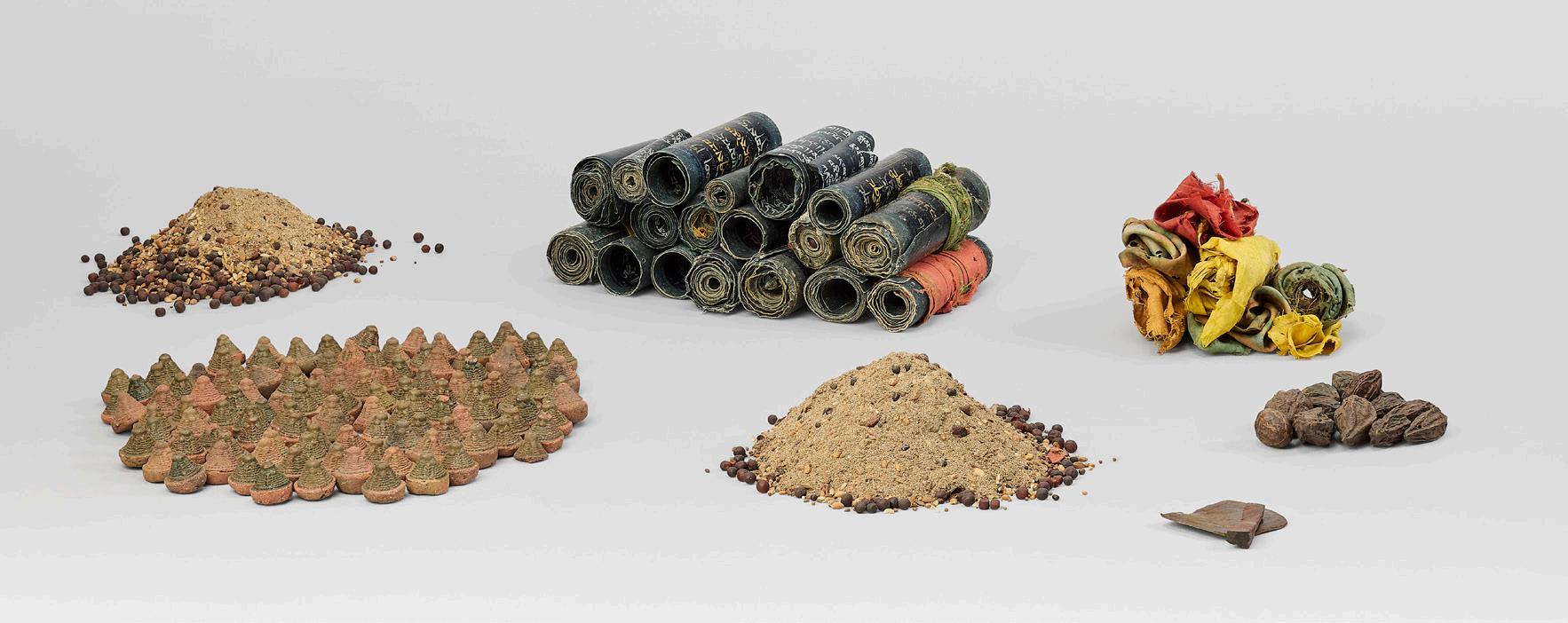
Base with rectangular cavity at base of spine: consecration contents of multiple Tibetan manuscripts, clay stupa offerings, seeds, shell, cloth and wood
provenance
Sotheby’s, London, 3-4 July, 1978, lot 430 Private Collection, acquired from the above
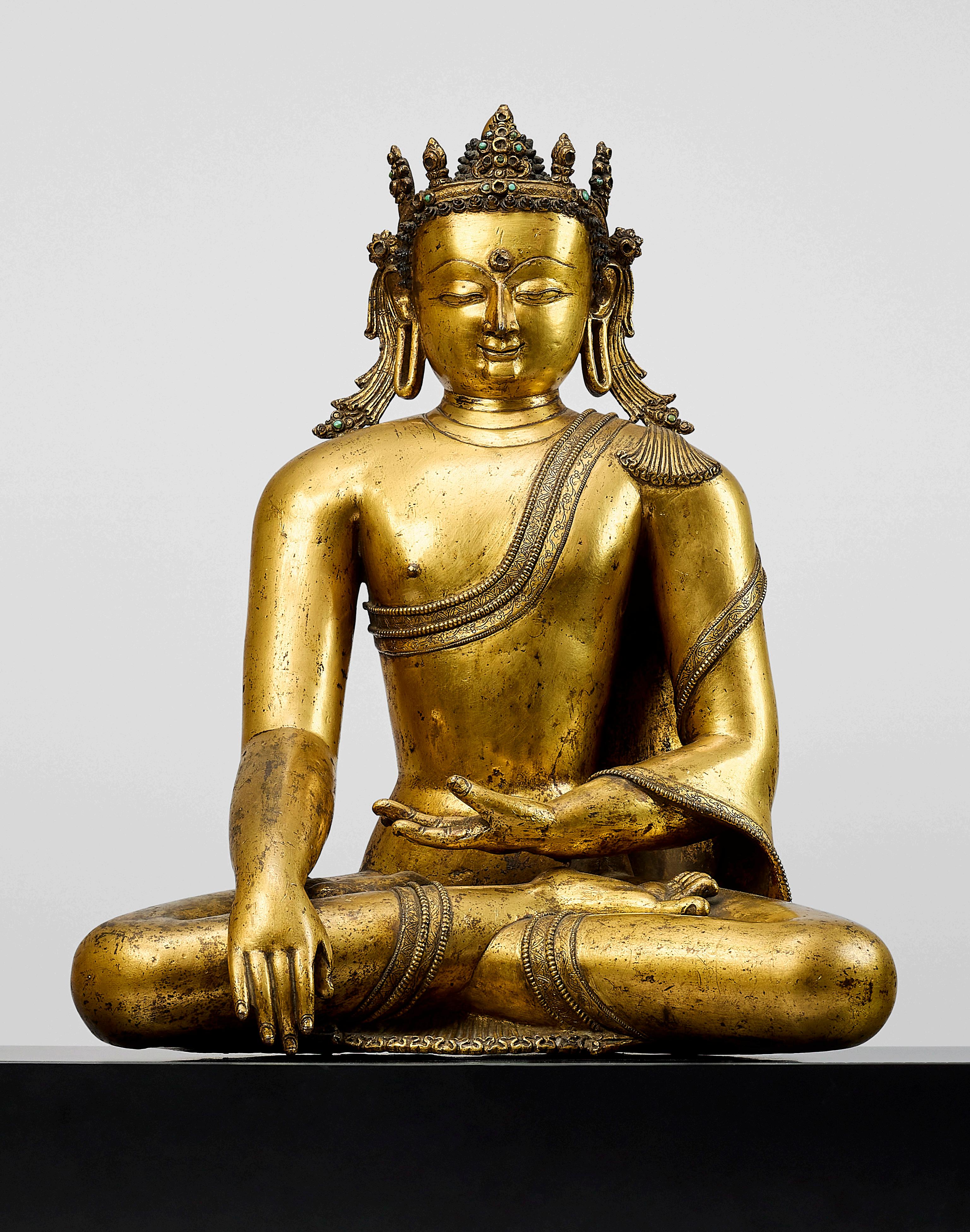
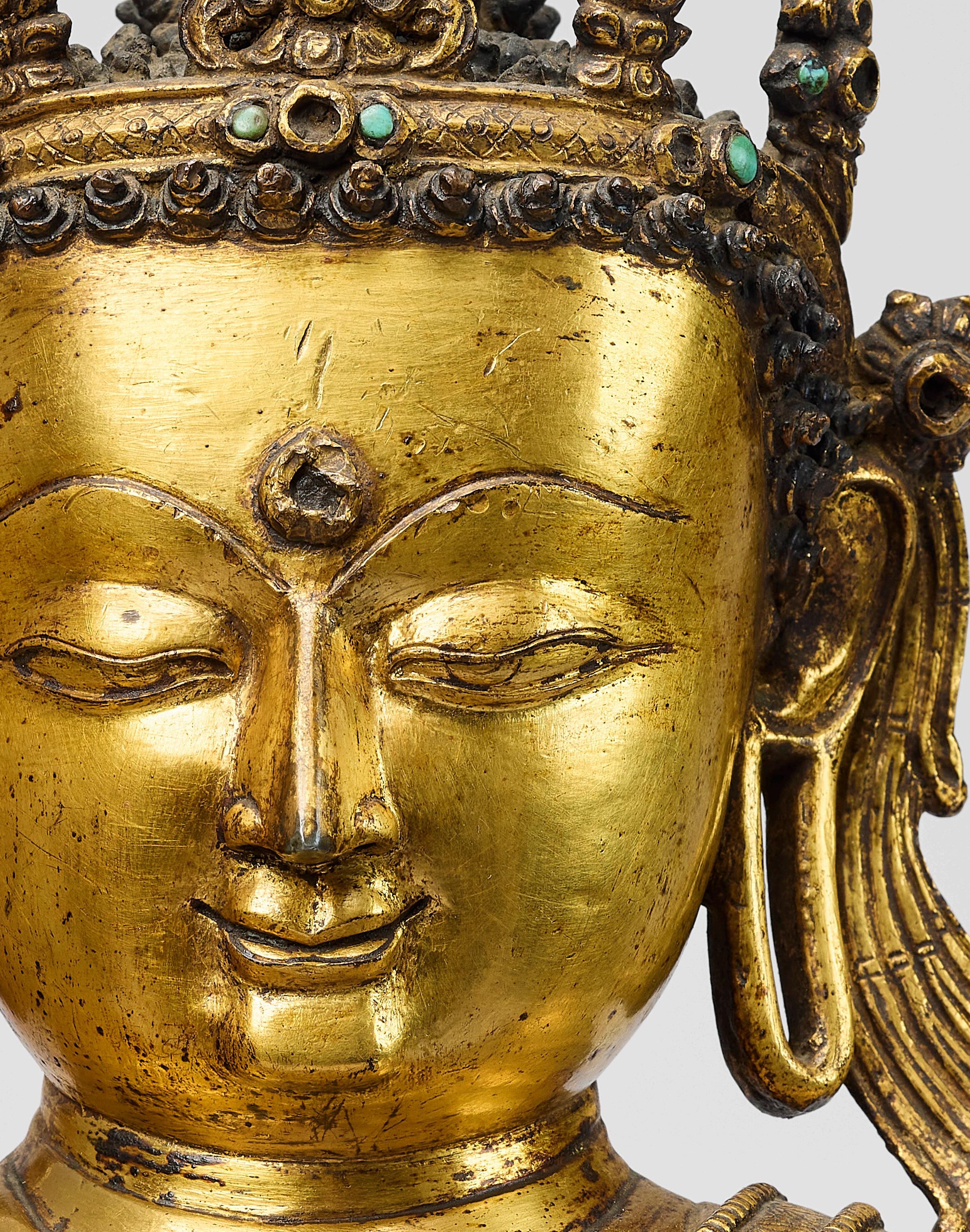
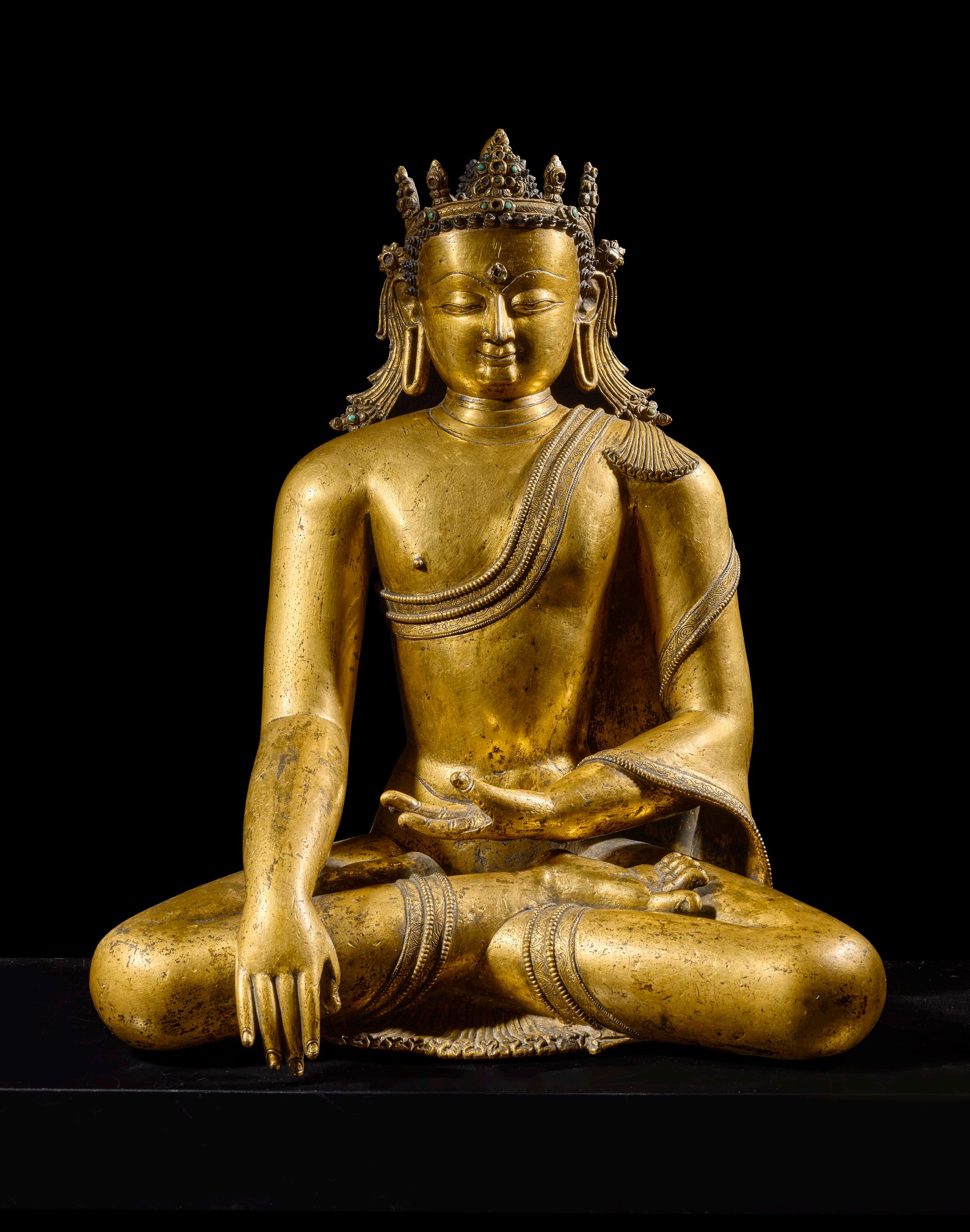
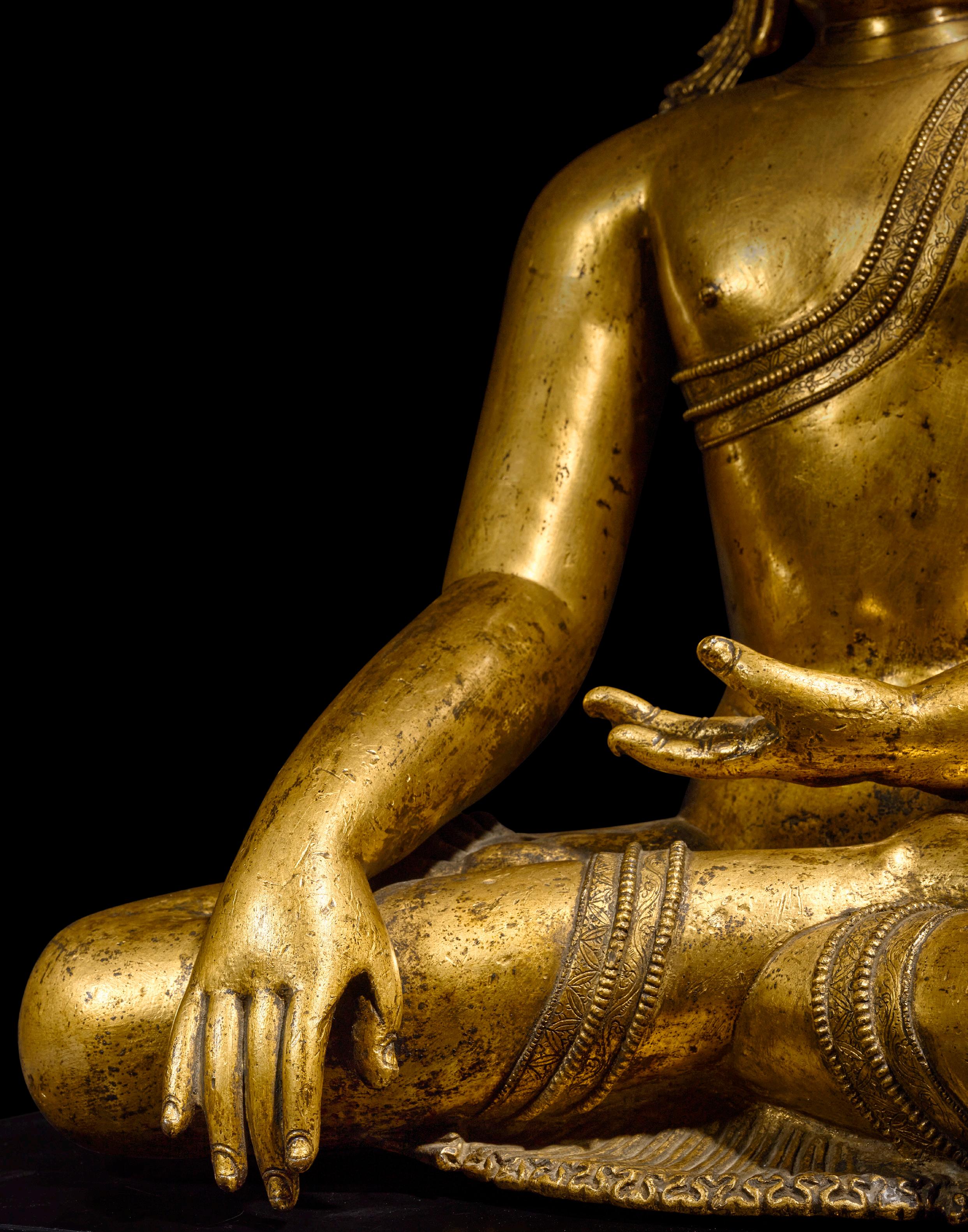
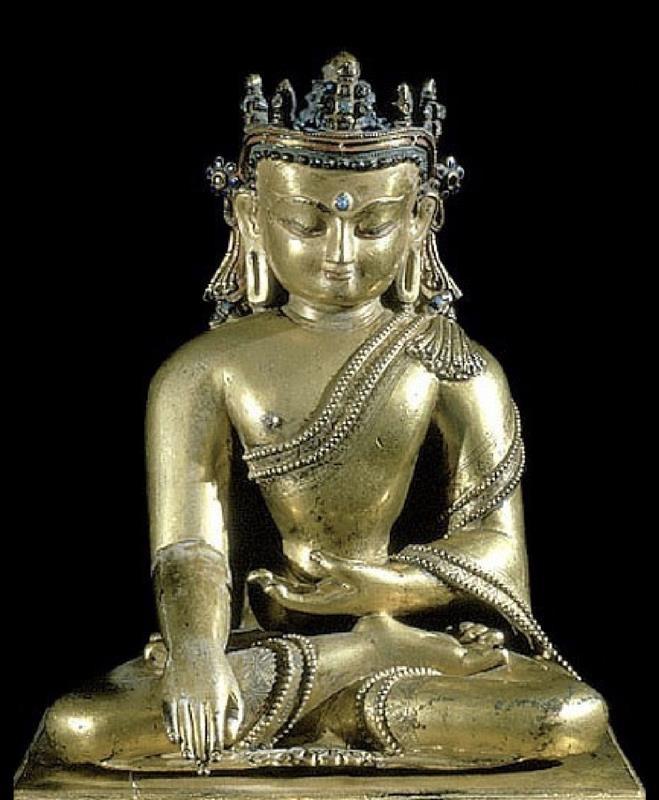
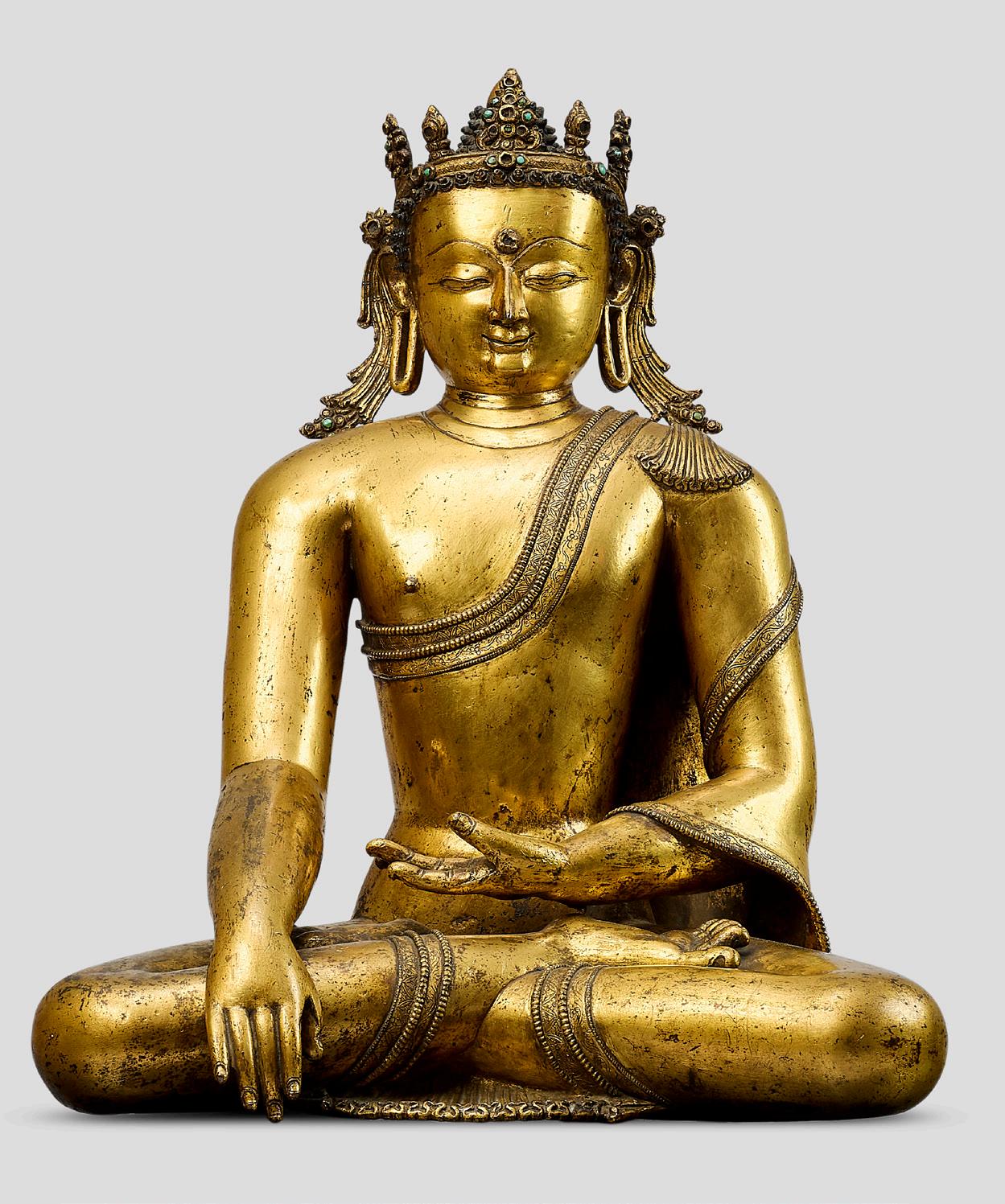
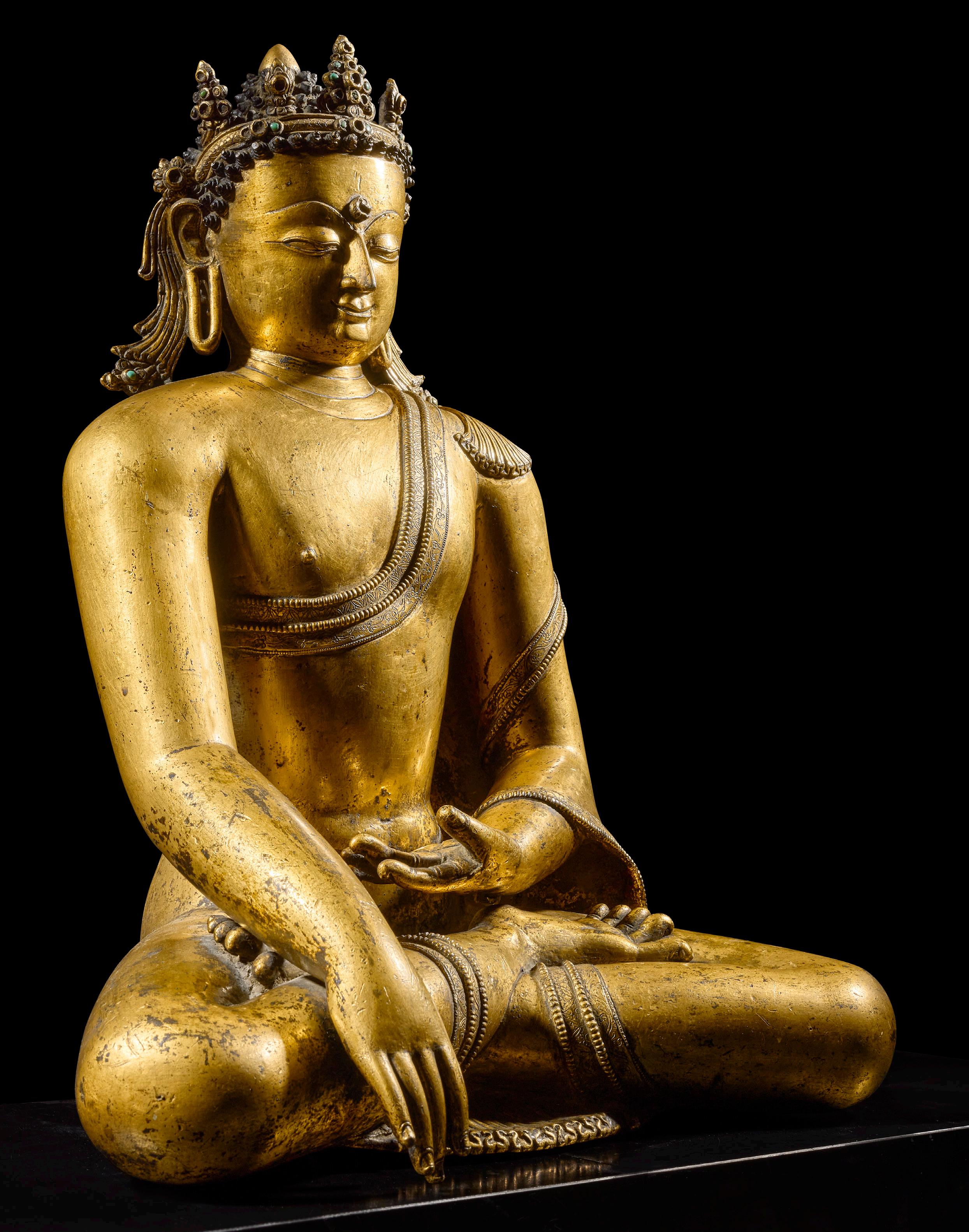
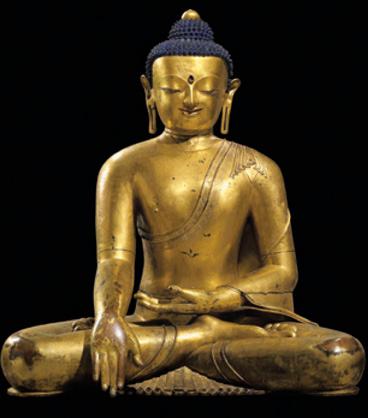
This commanding sculpture represents the historic Buddha Shakyamuni at the moment of his Enlightenment, depicted in the classic and authoritative bhumisparsha mudra , or “earthtouching” gesture. Seated in meditation and dressed in monastic garments, the Buddha extends his right hand downward, palm facing the ground, calling upon the Earth goddess to bear witness to his triumph over the temptations and distractions sent by Mara, the god of death. His left hand rests calmly above his lap, reinforcing the meditative stillness of the moment. The softly rounded face, with a prominent block-like chin and slightly crossed eyes, conveys inward concentration, while a faint, restrained smile lends the image a quiet authority.
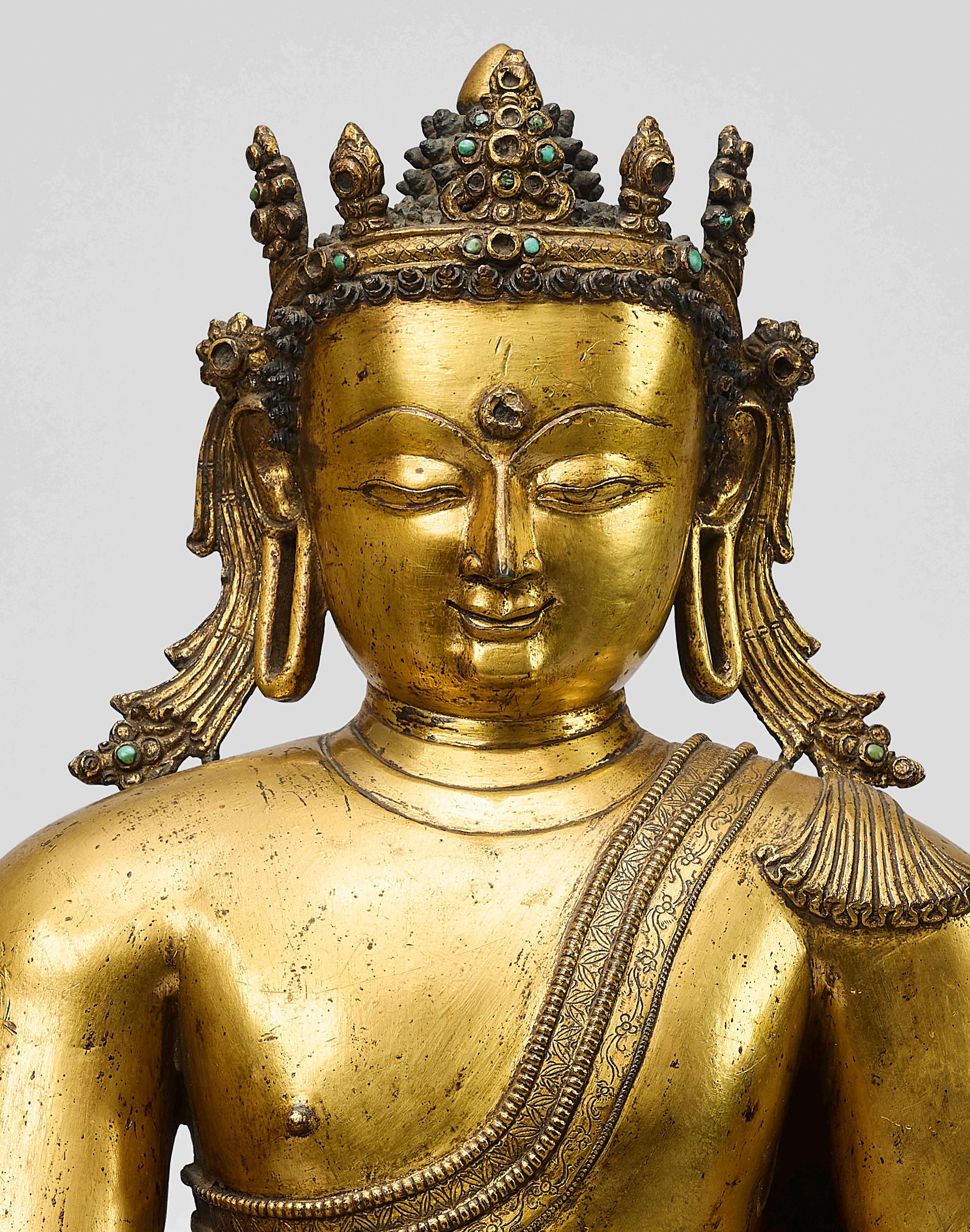
The figure’s physical proportions are especially refined. The torso and arms are well balanced and harmoniously proportioned, with the torso rendered slightly longer and subtly attenuated, a characteristic feature associated with high-quality Himalayan sculpture of the period. The limbs are supple and naturalistic, enhancing the quiet vitality of the pose. The almond-shaped eyes, with pupils subtly indicated, gaze downward in deep concentration, reinforcing the spiritual focus of the composition.
The sculpture is richly endowed with the canonical marks of the Buddha’s supernatural status. The hair is arranged in small, crisply articulated curls and rises to a pronounced ushnisha , symbolizing supreme wisdom. Here, the ushnisha is further emphasized by a bud-shaped golden finial conceived as a jewel crowning the head. The crown itself is a rare and distinctive variant: rather than the more usual upright posts, it is set with three primary leaves of ten circular inset elements arranged as floral forms and two small intermediary leaves with singular gem insets. The band supporting the leaves is defined as chevron patterns ingeniously imitating lapis lazuli inlay and spaced with triple gem turquoise insets. Typical of the period, the crown is secured with a cloth band that falls in broad pleated bands with a gem-set terminal across the shoulders and another flower above each ear.
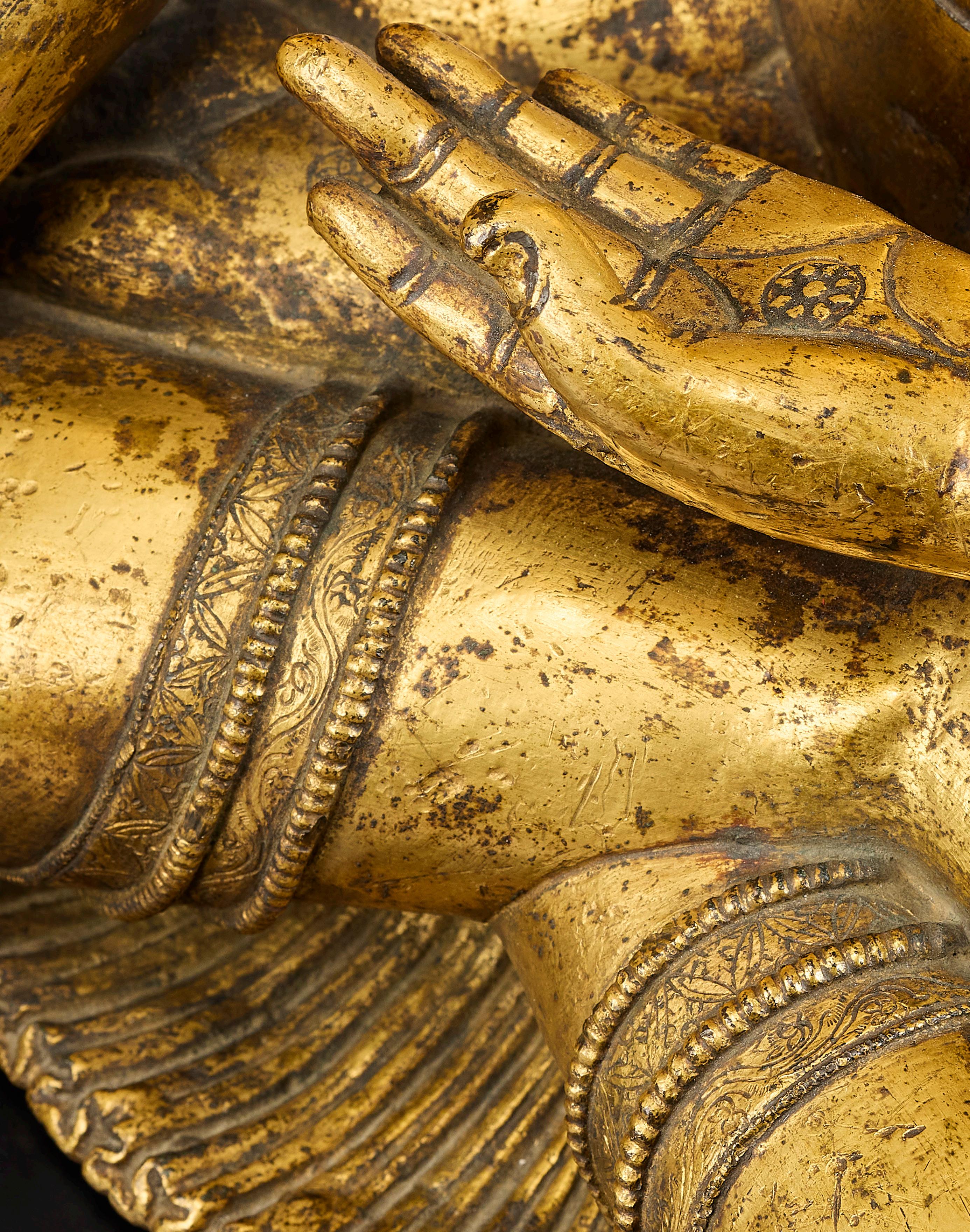
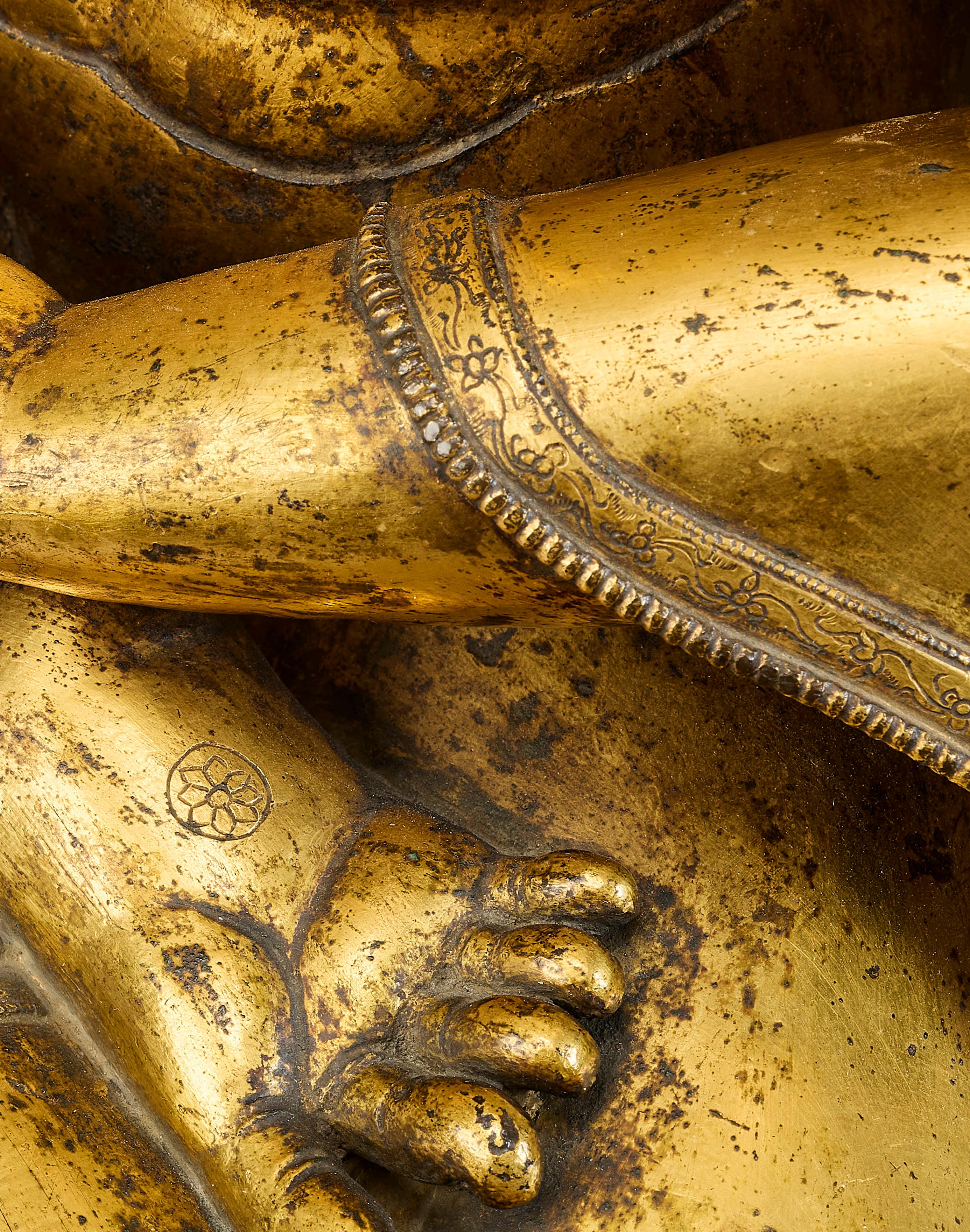
Between the eyebrows appears the urna, rendered as a raised circular frame that once held an inset stone, signifying spiritual insight. The elongated earlobes recall the Buddha’s former life as a prince adorned with heavy earrings, now transformed into a mark of renunciation. The palms of the hands and the soles of the feet are incised with chakras, eight-spoked wheels that allude to the Buddha’s First Sermon and the “turning of the wheel of the law” (dharmachakra) . The eight spokes symbolize the Noble Eightfold Path, right understanding, thought, speech, action, livelihood, mindfulness, concentration, and view, here proclaiming Shakyamuni as both spiritual teacher and universal sovereign.
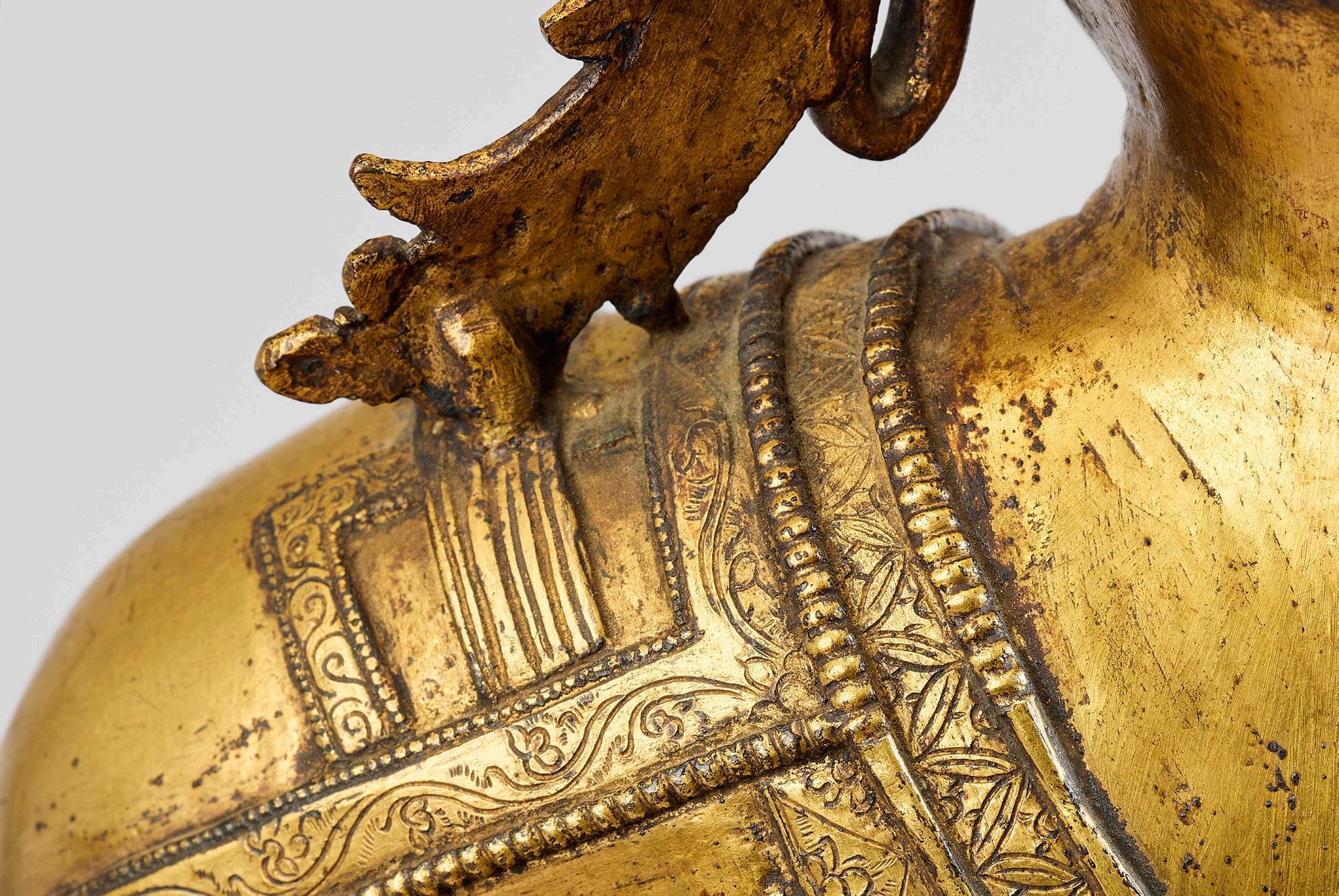
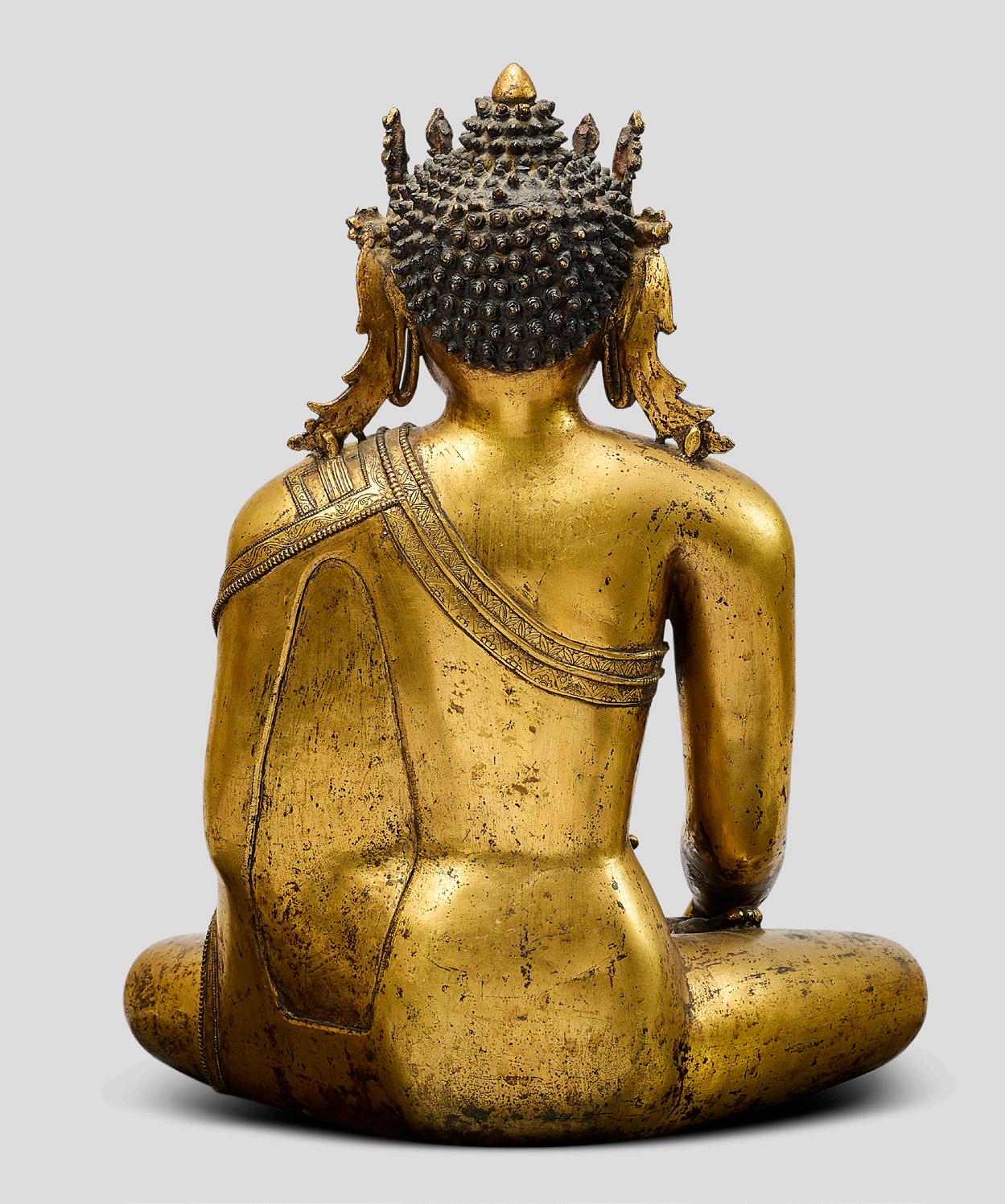
The treatment of the monastic robe (sanghati) is particularly distinguished. The plain expanse of cloth clings gently to the body, emphasizing restraint, while the hems across the torso and hems are richly articulated. Two prominent beaded hemlines frame the lower edge of the robe, accompanied by a third, slightly shallower beaded band. The hems are incised with band of loose scrolling vines and three-petal flower and the primary band carved with stylized so-called ricegrain patterns. Across the left arm bears only a single foliate hem indicating a secondary layer and behind the left shoulder the two layers converge with the fan-shaped pleated tassel drawn through the small window of the outer layer. The sculptor’s masterful and realistic rendering of the robes finishes in a flourish of the neatly pleated semi-circle between his legs.
The legs are arranged in the dhyanaasana , with the right leg placed above the left thigh and the left foot drawn close to the right thigh. The toes are subtly splayed, with joints carefully articulated and toenails discreetly incised, lending a gentle naturalism to the figure. The hands and feet are full and fleshy, reinforcing the sculpture’s physical presence while maintaining an idealized calm.
Remarkably this Buddha has the original consecration material preserved with the sculpture. Although it was removed from the interior cavity of the body, the material has been documented with the sculpture when it first appeared at auction in 1978. A typed note preserved with the material
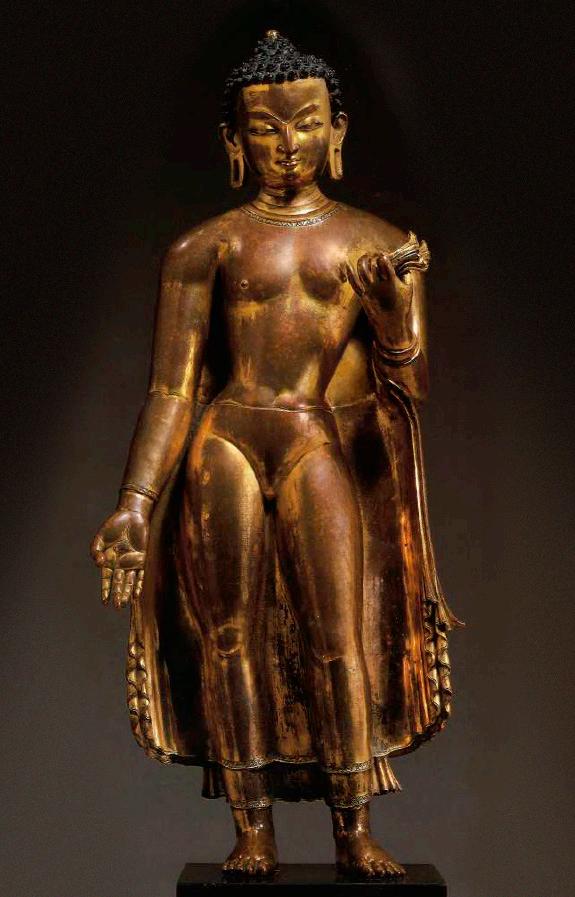
2. An Important Giltbronze Figure Of Buddha ShakyamuniNepal, Early Malla Period, 13th Century 20 in. (50.8 cm.) high
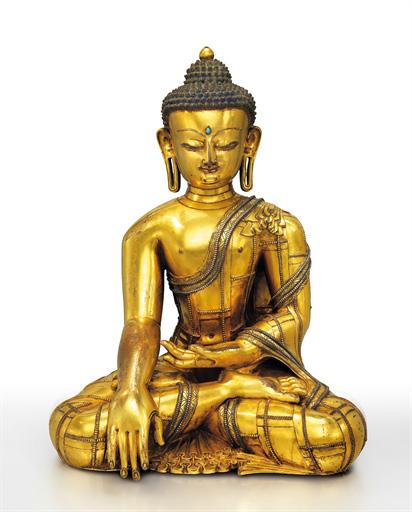
3. A Highly Important And Very Rare Malla Style Gilt-Bronze And Silverinlaid Seated Figure Of Buddha Shakyamuni Tibet, 13th–14th Century 15¾in.
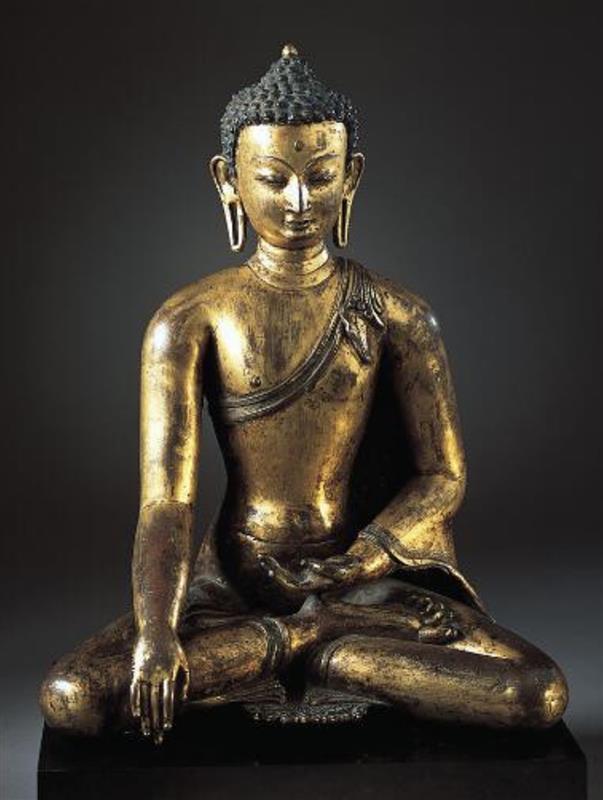
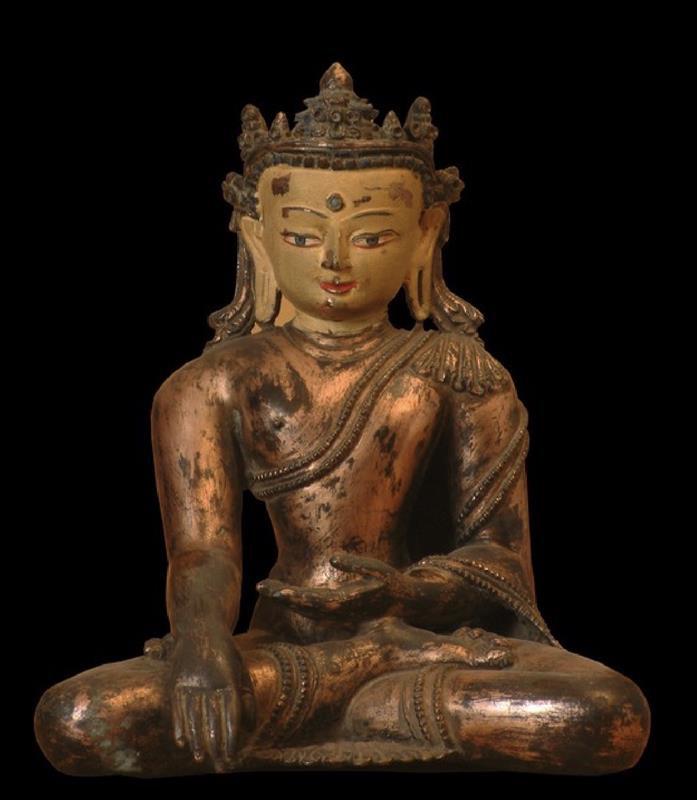
states. ‘Tibetan and Nepalese Sale 4.7.’78, Contents of Tibetan Crowned Buddha, lot 430, to be sold with the lot’.
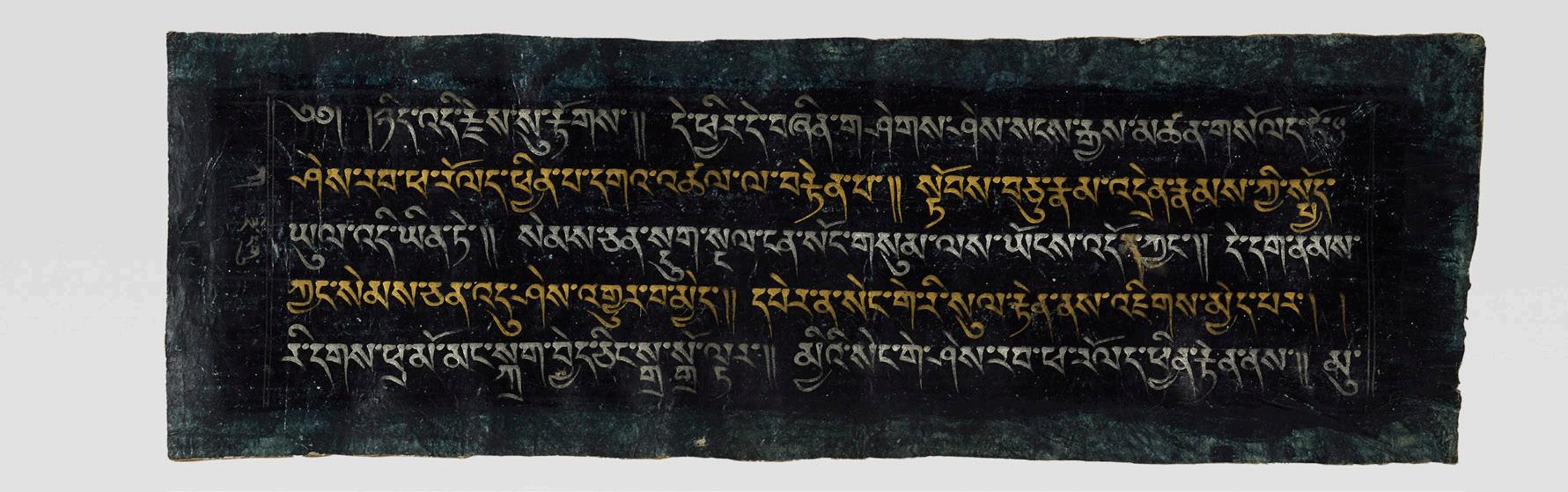
The consecration material that has been preserved includes; a large quantity of moulded terracotta tsatsa in the form of stepped stupas, silk-bound and loose black paper manuscript pages bearing gold and silver Tibetan script; loose resist-dyed silk sections, seeds, grain, dried fruit, and soil.
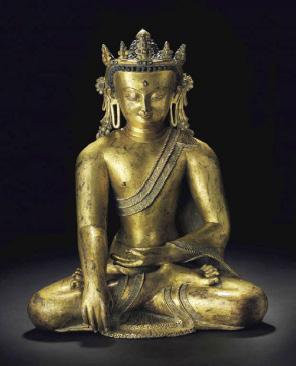
In its refined proportions, distinctive crown type, ornamental vocabulary, and physiognomic features, this sculpture closely compares to a crowned Buddha formerly in the Thyssen collection sold at Christie’s, New York, September 2017 and now preserved in the collection of Li Ka Shing at the Tsz Shan Monastery, Hong Kong ( FIG. 1 ). Both works have been attributed to Newar sculptors of the Kathmandu Valley, renowned for producing sophisticated Buddhist images for Himalayan patrons in Tibet and in the Khasha kingdom of northwestern Nepal, including the regions of Dolpo and Jumla, during the 13th–14th century. While the Tsz Shan Buddha is slightly larger at 50.5 cm it is less refined and overall bears
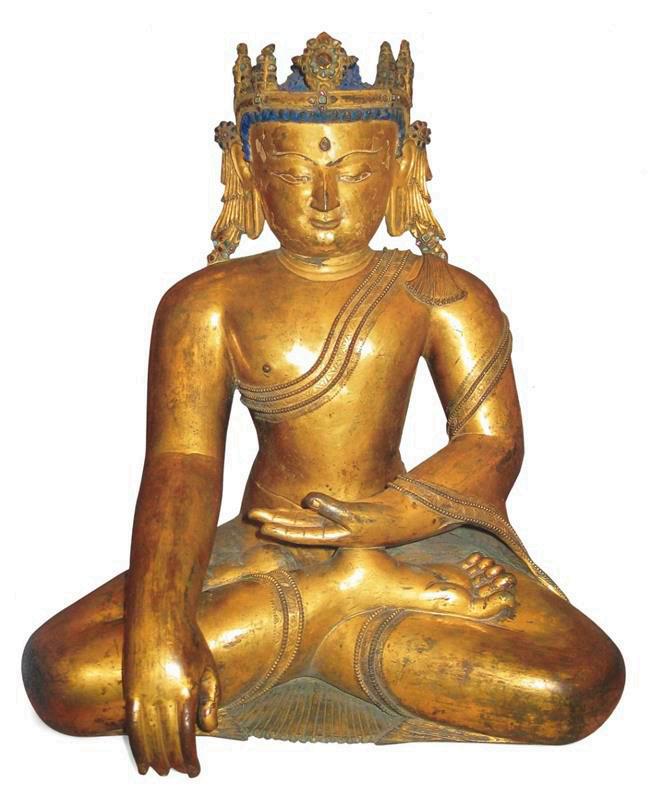
heavier proportions. Particularly notable is the manner in which the robe is finished at the back which includes the continuous incised motif along the hem and a square-panel along the corner of the robes.
Two notable important comparisons can be found in A standing Buddha ( FIG. 2 ) from Nepal, 13th century (50.8 cm.), sold for HKD 80,200,000 ($10,347,404) at Christie’s Hong Kong, December 2015 and a silver overlaid Gilt copper alloy figure of Shakyamuni Buddha ( FIG. 3 ) from Tibet, 13th–14th Century (40 cm.) sold for HKD 50,940,000 ($6,530,769) Christie’s Hong Kong, May 2017.
Further related examples from Nepal from the 13th and 14th century can be found in Shakyamuni Buddha ( FIG. 4 ) in the Norton Simon Museum, (34.9 cm.), Crowned Buddha, ( FIG. 5 ) in the Tibet House Museum, New Delhi (23 cm) and another Crowned Buddha in ( FIG. 6 ) the Museum der Kulturen Basel, (23.5 cm.). A later Crowned Buddha ( FIG. 7 ) that follows in the heavier proportions of the Tsz Shan Buddha was believed to have been associated with the monastic complex of Densatil from the late 14th century as noted by Jean-Luc Estournel (https://www.asianart.com/articles/ densatil/index.html), fig. 364.
As such, this sculpture stands as an exceptional example of the Newar artistic tradition at its height, embodying spiritual authority and exquisite craftsmanship. This superb sculpture of Shakyamuni Buddha is the most important and largest example still held in private hands and its appearance on the market after 48 years represents a remarkable opportunity to acquire a masterpiece of world art.
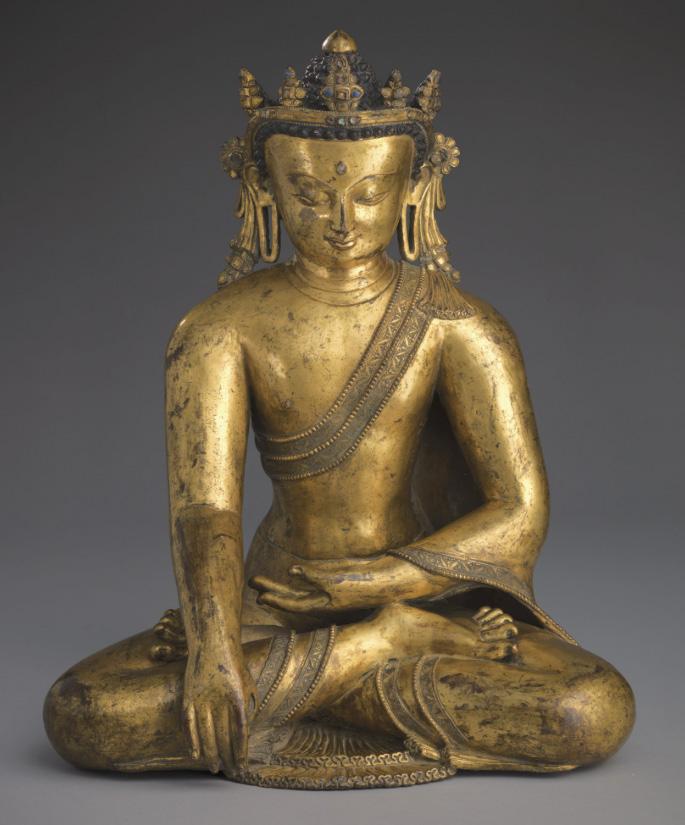
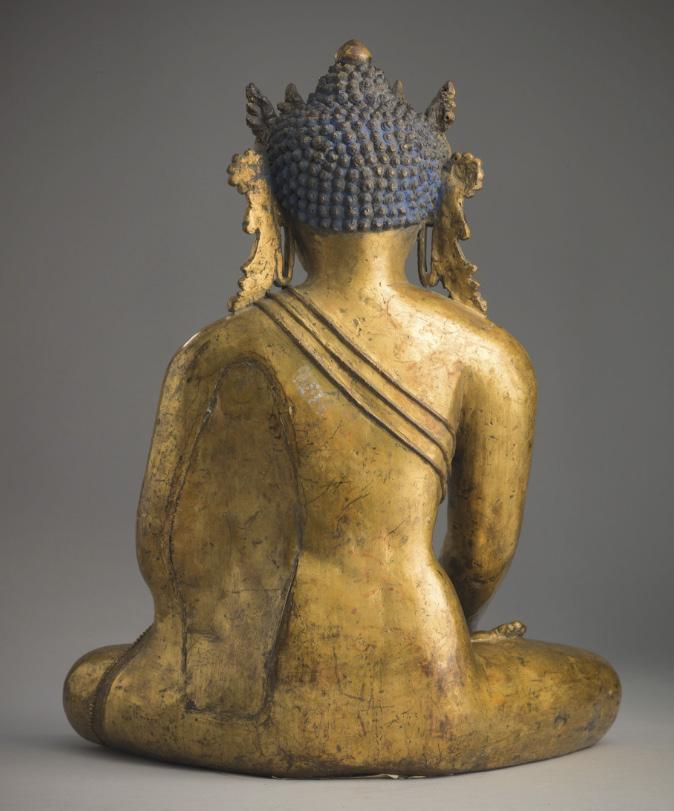
Comparing Two Masterpieces of the Crowned Buddha:
Tsz Shan Monastery Buddha and the Buddha from the Private Collection
1. A GILT COPPER FIGURE OF SHAKYAMUNI BUDDHA
NEPAL, LICCHAVI PERIOD, CIRCA 8th CENTURY
10½in. (26.7 cm.) high
Estimate:
HKD 5,000,000–7,000,000
Sold for HKD 9,525,000 ($1,225,000)
Christie’s Hong Kong, November 2025
190% OF LOW ESTIMATE
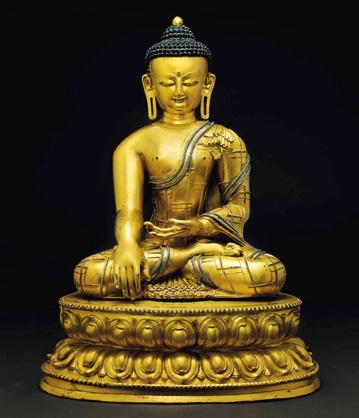
2. A LARGE AND IMPORTANT SILVER-INLAID GILT BRONZE FIGURE OF BUDDHA SHAKYAMUNI
TIBET, CIRCA 1400 buddha 16⅛in. (40.8 cm.) high; 20¾in. (52.7 cm.) high with base
Estimate:
$1,000,000–2,000,000
Sold for $3,612,500
Christie’s New York March 2018 361% OF LOW ESTIMATE
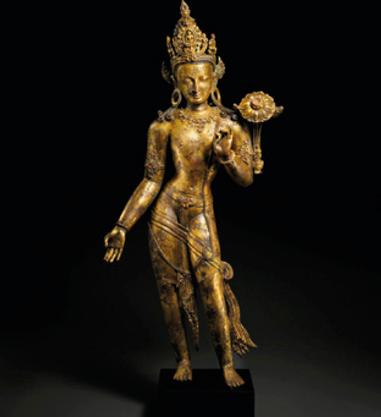
6. A LARGE AND IMPORTANT GILT BRONZE FIGURE OF AVALOKITESHVARA
NEPAL, 13th CENTURY 25 in. (63.4 cm.) high
Estimate: $2,000,000–3,000,000
Sold for $8,229,000
Christie’s New York, March 2015
411% OF LOW ESTIMATE
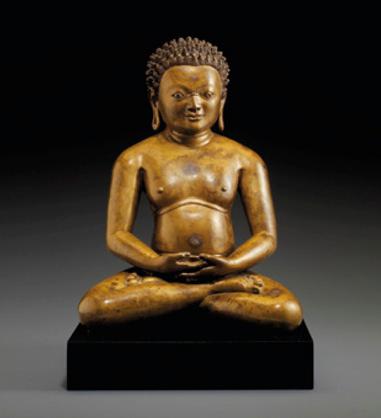
7. A RARE AND IMPORTANT BRONZE FIGURE OF A SEATED YOGI, POSSIBLY PADAMPA SANGYE
TIBET, 11th–12th CENTURY 13½ in. (34.2 cm.) high
Estimate: $1,000,000–1,500,000
Sold for $4,869,000
Christie’s New York, March 2015
487% OF LOW ESTIMATE
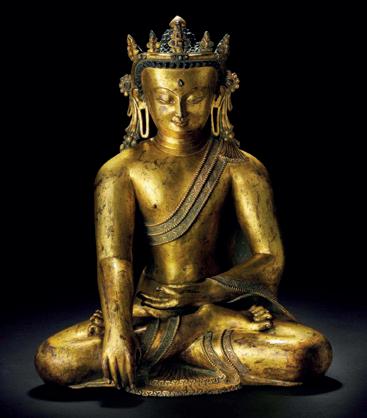
3. A LARGE AND IMPORTANT GILT BRONZE FIGURE OF BUDDHA
NEPAL, 13th/14th CENTURY 19⅞in. (50.5 cm.) high
Estimate: $600,000–800,000
Sold for $3,852,500
Christie’s New York, September 2017
642% OF LOW ESTIMATE PURCHASED FOR THE COLLECTION OF LI KA SHING AT THE TSZ SHAN MONASTERY IN HONG KONG
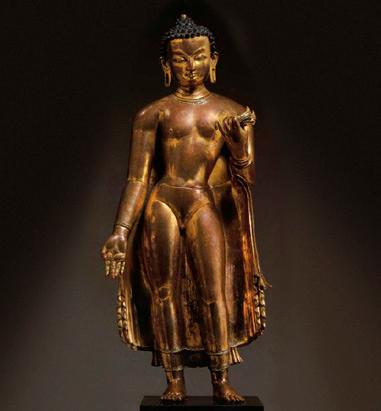
8. AN IMPORTANT GILTBRONZE FIGURE OF BUDDHA SHAKYAMUNI
NEPAL, EARLY MALLA PERIOD, 13th CENTURY
20 in. (50.8 cm.) high
Estimate: HKD 30,000,000 50,000,000
Sold for HKD 80,200,000 ($10,347,404)
Christie’s Hong Kong, December 2015
267% OF LOW ESTIMATE WORLD AUCTION RECORD FOR A HIMALAYAN BRONZE
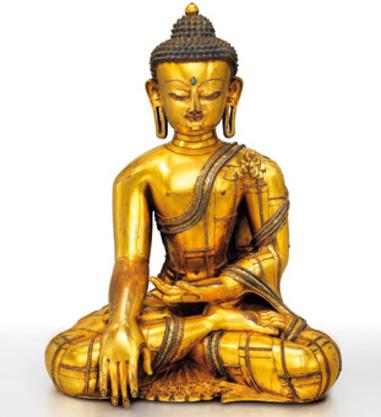
4. A HIGHLY IMPORTANT AND VERY RARE MALLASTYLE GILT-BRONZE AND SILVERINLAID
SEATED FIGURE OF BUDDHA SHAKYAMUNI
TIBET, 13th–14th CENTURY 15¾in. (40 cm.) high
Estimate on Request
Sold for HKD 50,940,000
($6,530,769)
Christie’s Hong Kong, May 2017
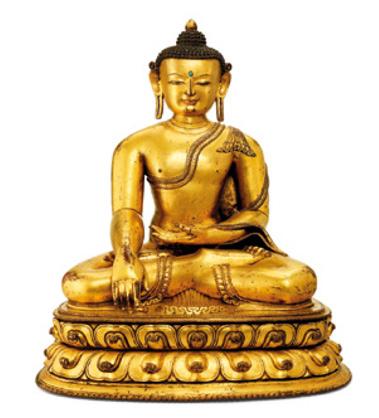
5. A MAGNIFICENT LARGE GILT-BRONZE FIGURE OF BUDDHA SHAKYAMUNI
NEPAL, 14th CENTURY
18⅝in. (47 cm.) high
Estimate: HKD 20,00,000 30,000,000
Sold for HKD 23,640,000 ($3,030,769)
Christie’s ww 118% OF LOW ESTIMATE
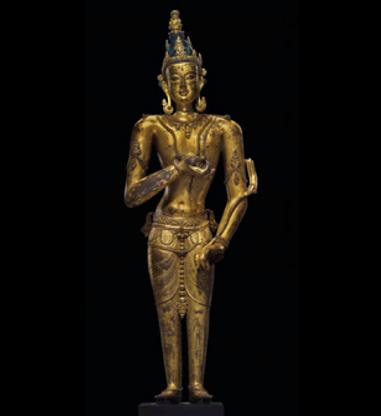
9. AN IMPORTANT AND LARGE GILT BRONZE FIGURE OF A BODHISATTVA
TIBET, 9th–10th CENTURY 43¼in. (110 cm.) high
Estimate on Request
Sold for $2,811,750
Christie’s New York, March 2013
10. AN IMPORTANT AND MONUMENTAL GILT BRONZE FIGURE OF BUDDHA
TIBET, 14th CENTURY
56 in. (142 cm.) high
Estimate on Request
Sold for $3,666,500
Christie’s New York, September 2008
Global Head of Classical Indian, Himalayan and Southeast Asian Art
Christie's London

Head
Senior
Senior
Managing
Managing
RAHUL KADAKIA President, Asia Pacific
Christie's Hong Kong

REBECCA YANG Chairman, China
Christie’s Shanghai
KEVIN CHING Chairman, Asia
Christie's Hong Kong
ADA ONG
Deputy Chairman, Asia Pacific and Chairman, Taiwan
Christie’s Taipei
JONATHAN STONE
Senior Advisor, Asia Pacific and Asian Art
Christie's Hong Kong
CHI FAN TSANG
Deputy Chairman, Asia Pacific and International Director, Chinese Works of Art
Christie's Hong Kong
NICOLE WRIGHT
Senior Vice President, Global Managing Director, Asian and World Art
Christie's Hong Kong
SINGH Chairman, India
Christie's Mumbai

CHARMIE HAMAMI
Deputy Chairman, Asia Pacific and Managing Director, Indonesia
Christie’s Jakarta
HAK JUN LEE
Vice President, Managing Director, Korea
Christie's Seoul

PRAPAVADEE SOPHONPANICH
Vice President, Managing Director, Cambodia, Laos, Myanmar, Thailand and Vietnam
Christie's Bangkok
KATSURA YAMAGUCHI
Senior Vice President, Managing Director, Japan and International Director Asian Art
Christie's Tokyo
ADRIAN MEYER
Global Head, Private Sales
Christie's New York

TINA ZONARS Co-Chairman, Asian Art
Christie's New York
ALLISON RABINOWITZ
Specialist, Head of Sale, Classical Indian, Himalayan and Southeast Asian Art
Christie's New York
MICHAEL BASS
International Director, Asian Art
Christie's New York

MICHELLE CHENG
Senior Vice President, Senior Specialist, Asian Art
Christie's New York
ANDREW LUECK
Vice President, Specialist, Asian Art
Christie's San Francisco