The Teach book empowers teachers with all the tools they need to help students access grade-level content and meet the diverse learning needs of their students through language supports, varied assessments, and effective instructional design.
The Learn book is students’ companion text to the instruction in Teach. It contains all the pages students need for each lesson, including in-class work pages, glossaries, and opportunities for practice.
The digital platform provides seamless digital access to items in Teach and Learn. It also includes lesson slides, digital interactives, assignments and assessments, implementation videos, and teaching supports.
Assessment
The Eureka Math2TM assessment system helps teachers understand student learning by generating data from many perspectives. The assessments are designed to monitor student learning, providing teachers with feedback that may be used to inform ongoing instruction. Assessments may also be summative to produce a grade or report that becomes part of a student, school, or district record. Using the data from a combination of assessments generates a complete picture of student learning.
Topic Tickets consist of items that assess proficiency on major concepts and skills covered in a topic.
A Topic Ticket is a brief, formative assessment of key learning in the topic. The back of each Topic Ticket includes space for students to reflect on their understanding of the topic’s objectives. Topic Tickets are available after the final lesson of each topic.
Observational Assessment Recording Sheets are checklists in each topic or module that can be used to record observations and evidence of student thinking by date or activity.
Module Assessments consist of 3 or 4 interview-style items that evaluate student proficiency of the major concepts, skills, and applications from the module.
Performance Assessments provide students with multiple means of entry and opportunities to apply a variety of skills to solve complex, real-world problems. This work allows students to demonstrate a deep understanding of content and process standards. Go to the digital platform to access performance assessments.
Lesson Design
The Dynamic Middle
The Eureka Math2® lessons strategically blend conceptual understanding, procedural fluency, and real-world application.
• Conceptual Understanding: Daily lessons include concrete–pictorial–symbolic representations and simple-to-complex progressions to develop understanding, as well as opportunities to identify math relationships and patterns and engage in meaningful discourse to answer Why does this work?
• Procedural Reliability and Fluency: Distributed and interleaved practice through fluency and practice problems provides ample daily opportunities for students to grow through the three stage hierarchy of mathematical fluency.
• Application: Real-world problems and collaborative tasks consolidate student thinking through why and how questions, inviting students to draw conclusions and make deep connections among math ideas.
Coherence
Following a logical and systematic mathematical progression designed around the mathematical areas of emphasis, Eureka Math2 lessons foster deep and lasting connections.
• A consistent structure—Fluency, Launch, Learn, Land—connects concepts from topic to topic, module to module, and grade to grade.
• High-leverage models—such as number bonds, area models, tape diagrams, and number lines—build knowledge within and across grade levels.
Fairness and Empowerment
Eureka Math2 advances fairness and empowers students and teachers.
• Lessons provide suggestions for proactive student support, including flexible grouping ideas that leverage students’ home languages and knowledge, academic terminology, and sentence frames to support discourse.
• Lessons engage students through a variety of facilitation styles (problem-based learning, direct instruction, guided discovery) to meet all students’ needs.
• Authentic problems and videos represent and engage students from different cultures, backgrounds, and abilities.
Multilingual Learner Support
Language supports embedded into instructional design
Mathematical content, practices, and language development are interconnected. The curriculum uses a variety of tools to support students’ diverse language needs. Leverage the following supports to customize a plan for your multilingual learners.
Amplify rather than simplify language
Support for interpretive, and expressive language from the WIDA English Language Development Standards Framework, 2020
The following research-informed supports amplify rather than simplify language by drawing students’ attention to important aspects of language, such as language functions, structure, syntax, and morphology. These supports provide multilingual learners with equitable access to sense-making that happens in mathematical discussions.
• Strategically pair multilingual learners to leverage every turn and talk and think–pair–share for multilingual learners to clarify in their home language, pause and take time to translate, and orally rehearse responses.
Each of the following actions supports language comprehension from written and spoken texts, or interpretive language.
• Provide varied and flexible opportunities to make meaning. Use different structures such as pairs, small groups, and whole-class discussion. Support language used to engage in dialogue.
• Support expressive language. Model using the Talking Tool during class discussions, including specific sentence frames and starters.
• Observe multilingual learners’ strengths during discussion. Use those strengths to build toward academic language in student responses.
These supports allow multilingual learners to meaningfully participate in mathematical discussions.
Multilingual Learner Support
Consider using strategic, flexible grouping throughout the module.
• Pair students who have different levels of mathematical proficiency.
• Pair students who have different levels of English language proficiency.
As applicable, complement any of those groupings by pairing students who speak the same home language.
Multilingual Learner Support
Consider supporting students in the Always Sometimes Never routine by displaying an equation labeled with words from the statement.
Research-based, multimodal terminology support
Lessons provide research-based embedded support for math-specific terms, multiplemeaning terms such as homophones and homographs, academic verbs, and everyday language. Support focuses on what students are expected to know and be able to do by the end of each lesson:
• Build or activate background knowledge to honor students’ assets and funds of knowledge
• Integrate all four domains of language: reading, writing, speaking, and listening
• Use multimodal methods, such as pairing terms with visuals, real items (realia), gestures, or acting out
Lessons invite students to engage with concepts through mathematical discussions and experiences, such as digital interactives, manipulatives, or math language routines, before they learn mathematically precise terminology for the concept. This opportunity allows all learners, and especially multilingual learners, to attach new terms to their own lived experience.
Lessons contain functional language needed to engage with the mathematics of the grade level. Each grade level explicitly teaches the meaning of a small list of targeted academic verbs, such as combine or approximate, as the verbs take on mathematical meaning.
Lessons use synonyms to preview and support meaning before students are expected to use the language.
Math language routines to amplify, assess, and develop language
Math language routines are structured but adaptable formats for amplifying, assessing, and developing students’ language. Lesson-embedded routines support sense-making, optimize output, cultivate conversations, and maximize meta-awareness. Math language routines can be used flexibly whenever there are opportunities to support students with interpretive, and expressive language.
Universal Design for Learning (UDL) & Differentiation
UDL: Engagement
Support motivation and enthusiasm
• Make real-world connections and relate concepts to students’ interests and experiences
• Form cooperative groups with roles to promote equity in participation
• Offer choice of, and options within, tasks and activities
• Provide action-oriented feedback
• Recognize mistakes as opportunities
• Support self-regulation by modeling coping strategies for dealing with frustration
Eureka Math2 has been awarded CAST’s Universal Design for Learning (UDL) Product Certification, demonstrating Great Minds’ commitment to making math accessible for all learners. This certification recognizes that Universal Design for Learning (UDL) is core to the product’s design. UDL suggestions are organized according to the three principles of the framework: engagement, representation, and action & expression. Differentiation suggestions are provided for students who need more individualized support or are ready for a challenge. The chart below summarizes the suggestions provided at point of use in the materials, but teachers are encouraged to apply the suggestions at any time to best meet the needs of their class and individual students.
UDL: Representation
Support perception and comprehension
• Provide visuals, realia, and hands-on experiences
• Activate prior knowledge
• Use graphic organizers
• Emphasize patterns, key features, and big ideas through labeling, annotations, color-coding, etc.
• Chunk information into smaller elements
• Pause to provide think time and to emphasize the importance of information
UDL: Action & Expression
Support expression of learning and executive function enthusiasm
• Provide sentence starters and frames
• Offer manipulatives, calculators, or other tools
• Provide exemplars, worked examples, checklists, or templates
• Model by thinking aloud
• Prompt students to plan and strategize
• Provide questions that guide self-monitoring and reflection
Differentiation
Offer additional support and provide challenge
• Support: Targeted approaches to supporting students with specific challenges of the concepts, procedures, or calculations presented
• Challenge: Targeted suggestions for expanding or deepening understanding for students who demonstrate readiness for more
Support for Families
The resources in the Learn book give students more practice with the concepts learned in class. There are two components in Learn that support students in deepening their understanding of the concepts covered in the daily lesson: Family Math and Terminology.
Terminology
These terms are introduced in the module. Use the blank space to
Students
count out groups up to 10.
Tip: Use the number cards from the set sent home with Family Math, module 1 topic B, or write the numbers 1–10 on index cards or sticky notes.
Activity Idea 2 Trace Numbers
Practice writing numbers 1 through 5 by asking your child to trace each number with their finger. Use the rhymes on the back of this page to remind them how to write each number.
Then make it a game by asking your child to trace a number on your back. See whether you can guess the number your child traced. Once your child has had time to practice each number, trade places and see whether your child can guess the number you traced.
When we want to find out how many of something there are, we count.
(Lesson 3) enough
When there is enough of something, we don’t need any more. For example, each dog gets 1 treat, each person gets 1 pair of shoes, or there is 1 fork for each plate.
(Lesson 7) line
Objects organized straight across (or up and down) are in a line.
Family Math is a letter to families that describes the major concepts in the current topic. Terminology includes a list of terms and definitions introduced in the module.
Read Aloud
Represent add to with result unknown story problems by using drawings and numbers.
Lesson 2
Relate number sentences and number bonds through story problems.
Lesson 3
Represent and solve add to with result unknown story problems.
Lesson 4
Represent decomposition situations by using number bonds and addition sentences.
50
64
Lesson 5 .
Represent take apart with both addends unknown situations with a number sentence.
Lesson 6 . . .
Tell addition story problems starting from number sentence models.
Lesson 7
Find the total in an addition sentence.
Topic A Topic Ticket Sample Solutions
Topic B
Represent Subtraction
Lesson 8
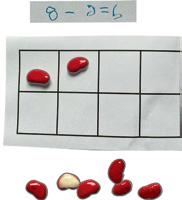
Understand taking away as a type of subtraction.
Lesson 9
Represent take from with result unknown story problems by using drawings and numbers.
Lesson 10
Represent and solve take from with result unknown story problems.
Lesson 11
Represent decomposition situations by using number bonds and subtraction sentences.
Lesson 12
Relate parts to total in subtraction situations.
Lesson 13
Tell subtraction story problems starting from number sentence models.
Lesson 14
Find the difference in a subtraction sentence.
Topic B Topic Ticket Sample Solutions
Topic C
Make Sense of Problems
Lesson 15
Identify the action in a problem to represent and solve it.
Lesson 16
Relate addition and subtraction through word problems.
Lesson 17
Reason about different units to solve story problems.
Lesson 18
Count on to find the total.
Lesson 19
Represent and solve take from with change unknown problems.
Lesson 20
Find the number that makes 10 and record with a number sentence.
Lesson 21
Organize drawings to solve problems efficiently.
Lesson 22
Investigate different ways to represent equality.
Topic C Topic Ticket Sample Solutions
Topic D
Make Use of Structure
Lesson 23
Identify and extend linear patterns.
Lesson 24
Use a pattern to make a prediction.
Lesson
Solve story problems by using repeated reasoning.
Lesson 26
Extend growing patterns.
Reason about numbers to add and subtract.
Achievement Descriptors: Overview
Addition and Subtraction
Achievement Descriptors (ADs) are standards-aligned descriptions that detail what students should know and be able to do based on the instruction. ADs are written by using portions of various standards to form a clear, concise description of the work covered in each module.
Each module has its own set of ADs, and the number of ADs varies by module. Taken together, the sets of module-level ADs describe what students should accomplish by the end of the year.
ADs and their proficiency indicators support teachers with interpreting student work on
• informal classroom observations (recording sheet provided in the module resources),
• data from other lesson-embedded formative assessments, and
• Module Assessments.
This module contains the twelve ADs listed.
FL.K.Mod2.AD1: Describe positions of figures in a sequence by using ordinal number words.
MA.K.NSO.1.3
FL.K.Mod5.AD1: Count forward from a number other than 1.
MA.K.NSO.2.1
FL.K.Mod5.AD2: Represent addition with objects, fingers, drawings, number lines, or equations.
MA.K.NSO.3.1
FL.K.Mod5.AD3: Represent subtraction with objects, fingers, drawings, number lines, or equations.
MA.K.NSO.3.1
FL.K.Mod5.AD4: Add and subtract within 10 by using objects, drawings, or other math tools.
MA.K.NSO.3.2
FL.K.Mod5.AD5: Add with procedural reliability within 10.
MA.K.NSO.3.2
FL.K.Mod5.AD6: Subtract with procedural reliability within 10.
MA.K.NSO.3.2
FL.K.Mod5.AD7: Find the partner to 10 for any number 1–9.
MA.K.AR.1.1
FL.K.Mod5.AD8: Decompose numbers within 10 into pairs in more than one way and record with equations such as 5 = 2 + 3 and 5 = 4 + 1.
MA.K.AR.1.2
FL.K.Mod5.AD9: Solve add to, take from, and put together with result unknown story problems within 10 by using addition and subtraction.
MA.K.AR.1.3
FL.K.Mod5.AD10: Record solutions to story situations in which both addends are unknown with an addition sentence.
MA.K.AR.1.3
FL.K.Mod5.AD11: Determine if addition and subtraction equations are true and explain by using objects or drawings.
MA.K.AR.2.1
Before This Module
Kindergarten Module 4
Students explore number relationships through sorting, games, and math stories. They use number bonds and their teacher writes number sentences to record part–total relationships. They also practice different methods for representing story situations including put together with total unknown and both addends unknown.
Overview
Addition and Subtraction
Topic A Represent Addition
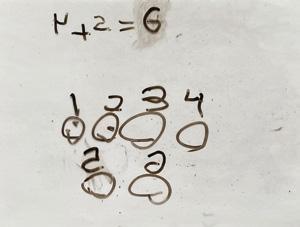
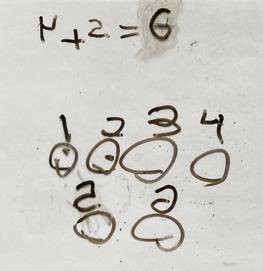
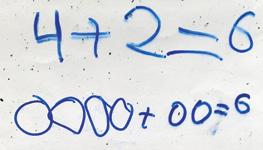
Students make a major leap forward in their understanding of number sentences. They represent addition stories by using number sentences with mathematical symbols, such as 4 + 2 = 6, and read their work by using mathematical language, “4 plus 2 equals 6.” They also recontextualize the number sentence by using it to retell the story. Students work with three problem types in this topic: add to with result unknown, put together with total unknown, and both addends unknown. By the end of the topic, students can find the total of an addition sentence without a story context.
Topic B
Represent Subtraction
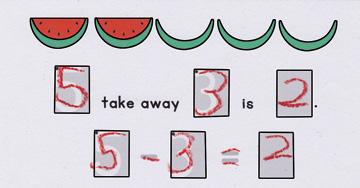
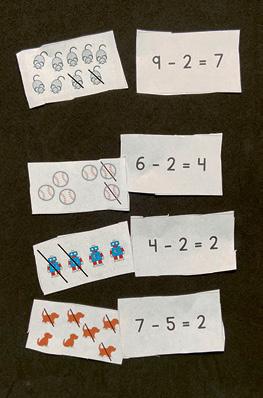
Students solve subtraction problems and represent their thinking by using number sentences with mathematical symbols. For example, 5 – 3 = 2. They work with a single problem type, take from with result unknown, to understand subtraction as taking away. Students use familiar story structure (beginning, middle, and end) to write and understand subtraction sentences: “I had 5 watermelon slices. I ate 3 of them. Now there are 2 watermelon slices. 5 minus 3 equals 2.”
Topic C
Make Sense of Problems
Students transition from working with addition and subtraction separately to thinking about both as they determine which operation can be used to solve. As they focus on story context and the information presented, they build their capacity for sense-making and perseverance. This topic also presents a number of opportunities for students to practice finding partners to 10 through story and measurement contexts.
Topic D
Make Use of Structure
Students look for and make use of structure by looking for and making use of patterns. They learn what a pattern is and how to recognize and extend patterns, and they use patterns to extend their work with numbers. Students apply their knowledge of patterns to help them answer how many questions.
After This Module
Kindergarten Module 6
Students extend counting and work with part–total relationships to numbers to 20. Increasing students’ familiarity with teen numbers as 10 ones and some ones lays the groundwork for place value strategies in grade 1. Students learn to verbally express teen numbers in a variety of ways (e.g., 16 can be expressed as “10 and 6,” “1 ten 6 ones,” and “Ten 6”). Students continue to look for and make use of structure as they extend the counting sequence to 100. They uncover patterns in number words and in the digits used to write them. The utility of 10 comes to light when students find efficient methods for counting out larger sets of objects.
Grade 1 Module 1
Counting all and counting on strategies continue to be applied in Grade 1 to solve addition and subtraction problems. Students use counting on as a more efficient way to find the total or a missing part.
Why
Addition and Subtraction
What are the stages of development as students learn to solve addition and subtraction problems?
In their first years of school, students generally move through three stages of development as they solve addition and subtraction problems.
• Stage 1: Count all
• Stage 2: Count on
• Stage 3: Make a simpler addition or subtraction problem
Many students rely on direct modeling to count all throughout the kindergarten year. To add, they represent the parts by using objects or drawings and then count all to find the total. To subtract, they first count out the total, then count to take away the known part, and finally count the remaining part.
Kindergarten students often spend the full year at Stage 1 because they are developing conceptual understanding of what it means to add and subtract. They are learning many different ways to represent those actions, including using concrete objects, drawings, mental images, and number sentences. They are also learning which situations call for each operation. As students build conceptual understanding of addition and subtraction through counting all, they increasingly see that parts are embedded in the total. This is foundational for counting on to add or subtract.
Students begin to use counting on to solve addition problems in kindergarten. Module 5 includes teacher notes and lessons to support the development of this skill. The lessons include examples of student strategies from Stages 1 and 2, including questions to advance student thinking from one stage to the next. Comparing and connecting different student work can help them make sense of more sophisticated strategies and relate them to their own thinking.
Students spend much of their first and second grade years in the third developmental stage, using what they know to make simpler problems. Once they acquire several strategies, students reason about which strategy best fits the problem they are solving. The goal is to empower them to continue developing number sense and flexibility in problem solving.
3
What is the associative property and how do kindergarten students understand it?
The associative property of addition says that in an addition equation, we can choose to start by adding any two numbers that are next to each other, rather than working left to right. For example, to find 3 + 4 + 6, we can first add 4 + 6 to make 10, resulting in the simpler problem 3 + 10 = 13. Put more formally, the associative property states that for any numbers a, b, and c, (a + b) + c = a + (b + c).
As with the commutative property, students’ early understanding of the associative property develops from their work with part–total relationships and builds on their understanding of conservation. For example, students are presented with a picture of lollipops and asked to find the total. Some students will count the lollipops from left to right. Others may notice that they can use the doubles fact 3 + 3 = 6 if they start with the lollipops on the right and then add the 2 lollipops on the left.
In grade 1 students use the associative property, particularly when practicing the make 10 strategy. For example, when presented with 5 + 7, students may decompose 5 into 2 + 3, resulting in a new problem: 2 + 3 + 7. Then students add 3 and 7 first, making use of the associative property to create the simpler problem 2 + 10.
Why is it important for students to interpret number sentences in different ways?
In module 4 students describe the relationships between numbers by using everyday language: and, make, take away, and is. Everyday language precedes academic language because experiences of making things and taking away are relatable to young students. Statements such as 10 take away 3 is 7 align neatly with the numbers and symbols in an equation, creating a smooth transition to the mathematical terminology of plus, minus, and equals: 10 minus 3 equals 7. In module 5 reading number sentences using everyday and mathematical terminology helps students make sense of how numbers and symbols work together in a number sentence. The term number sentence is utilized in place of equation in kindergarten. This language is both accessible and approachable, as students will be familiar with the concept of a sentence from their language arts studies.
Another way that students read number sentences is called reading like a storyteller: The baker made 10 muffins. He sold 3 of them. There are 7 muffins left. By using story language after solving, students move from computation back to context. Rather than saying, “the answer is 7,” they can more specifically say, “there are 7 muffins left.” Recontextualizing the entire number sentence as a story shows that students understand the meaning of each quantity, as well as how the actions or relationships correlate to the symbols.
Saying the number sentence by using mathematical and story language prepares students for the Read-Draw-Write (RDW) process. Beginning in grade 1, students write both a number sentence and a statement in the last step of the RDW process.
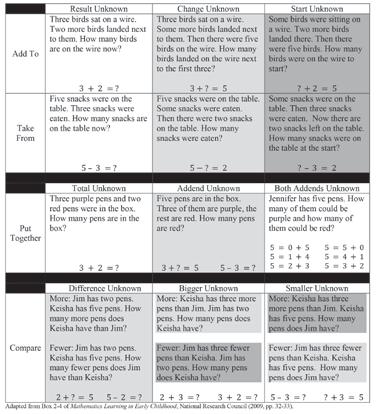
Which word problem types, or addition and subtraction situations, must be mastered in kindergarten?
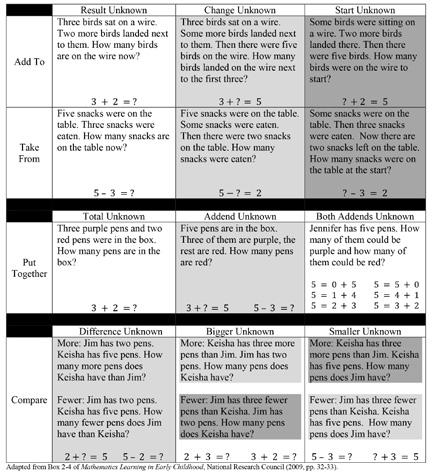
These situations represent the fundamental meanings and uses of addition and subtraction. Kindergarten students are expected to work with the four unshaded situation types. Grade 1 and 2 students should work with all situation types. Darker shading indicates the four most difficult situation types students should work with in grade 1 but are not required to master until grade 2.
Students solve all four of the kindergarten problem subtypes in module 5.
• Add to with result unknown: Both parts are given. An action joins the parts to form the total.
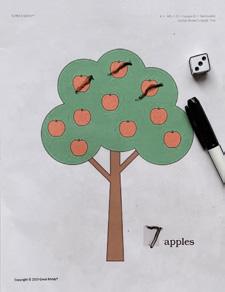
Auntie had 3 apples at home. Then she went to the store and bought 5 apples. How many apples does she have now? (Module 5, Lesson 1)
• Take from with result unknown: The total and one part are given. An action takes away one part from the total.
I bought 9 oranges. I ate 5 oranges. How many oranges do I have now?
(Module 5, Lesson 9)
• Put together with total unknown: Both parts are given. No action joins or separates the parts. Instead, the parts are distinguished by an attribute such as type, color, size, or location.
There are 6 baby ducks and 1 adult duck. How many ducks are there?
(Module 4, Lesson 12)
10 – 3 = 7
Everyday language: 10 take away 3 is 7.
Mathematical language: 10 minus 3 equals 7.
Story language: The baker made 10 muffins. He sold 3 of them. There are 7 muffins left.
• Both addends unknown: Only the total is given. Students take apart the total to find both parts. This situation is the most open ended because the parts can be any combination of numbers that make the total.
There are 8 meerkats moving to a new zoo. Two trucks drive them to their new home. How could the zookeeper put the meerkats in the trucks? (Module 4, Lesson 15)
What are numberless word problems? Why are they used in kindergarten?
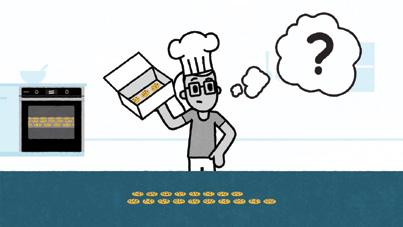
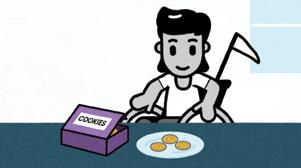
Numberless word problems are math stories told without numbers. For example: I bake some sugar cookies. My friend brings over some chocolate chip cookies. These problems are used in two different ways in module 5.
The first lesson opens with the cookies problem. Students visualize the story in their minds and then make a math drawing to show what they see. They choose the numbers for the math story. One student may see 3 of each type of cookie while another sees 8 sugar cookies and 3 chocolate chip cookies. Numberless word problems build in choice, validate emerging visualization skills, and naturally create engagement and differentiation.
Once students have more experience using addition and subtraction to solve problems, numberless word problems serve a new purpose. They cause students to analyze action and relationships, which provides a scaffold as students make sense of story problems. Consider the following numberless word problem: Some students are reading in the library. Some of those students go to the computer center. The class can discuss whether students are coming or going from the library and whether there are more or fewer students in the library. They consider the relationship between quantities before they know the exact numbers. Once students make sense of the situation, numbers are inserted and they choose a solution path to solve the problem.
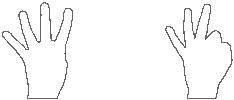
Sometimes problems are presented with only one number given: 5 students are reading in the library. Some of those students go to the computer center. Students can model or visualize to figure out which numbers make sense in the story. They might use 5 fingers to show the students in the library and reason that, at most, 5 students can leave because that’s how many fingers are showing. Numberless word problems focus students on reasoning about and understanding the context and relationships between quantities before they select an operation or solution strategy.
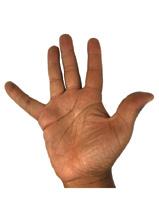
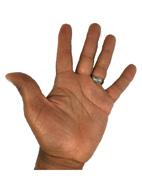
There are 5 students. I can take away 1, 2, 3, 4, or 5 fingers, but I can’t take away 6 fingers.
Student B
Student A
Mathematical Language Routines
Addition and Subtraction
Routine Description
Five Framing Questions This language routine supports students in analyzing a work sample or solution strategy by providing them with a sequence of questions to frame their thinking.
Math Chat This language routine develops number sense, flexibility, efficiency, and accuracy as students solve a math task and discuss their different solution strategies.
Share, Compare, and Connect This language routine fosters students’ meta-awareness as they identify, compare, and contrast different mathematical strategies, representations, concepts, and examples.
Lessons
Topic D Lesson 24
Topic C Lesson 18
Topic D Lesson 26
Topic B Lesson 10
Topic C Lesson 17
Topic C Lesson 19
Topic C Lesson 21
Think–Pair–Share This language routine supports mathematical discourse and maximizes linguistic output as students mentally rehearse their ideas and discuss with a partner before sharing with the class.
Most lessons in this module contain the Think–Pair–Share routine.
Topic A Represent Addition
In topic A, students solve a variety of addition problems and use number sentences with symbols to represent their thinking. They work with three of the four kindergarten situations, or problem types:
• Add to with result unknown: Both parts are given. An action joins the parts to form the total.
• Put together with total unknown: Both parts are given. No action joins or separates the parts. Instead, the parts are distinguished by an attribute such as type, color, size, or location.
• Both addends unknown: Only the total is given. Students take apart the total to find both parts. This situation is the most open-ended because the parts can be any combination of numbers that make the total.
Add to with result unknown stories are featured in the first three lessons of the topic because they are the easiest problem type for students to understand as addition. I baked 7 sugar cookies. My friend brought over 2 chocolate chip cookies. Now there are 9 cookies. Students use the familiar story structure of beginning, middle, and end to write and understand number sentences. 7 + 2 = 9 represents both the story and the relationship between numbers.
Students make an important transition in how they say number sentences. In previous modules, they used familiar language to describe part-total relationships, such as, “7 and 2 make 9” or “9 is 7 and 2.” In topic A, they begin to read number sentences using mathematical language, “7 plus 2 equals 9” and “9 equals 7 plus 2.” They also write number sentences using math symbols. Students compare the structure of number bonds and number sentences to better understand how to find the parts and total in an addition sentence. The use of related facts leads to procedural reliability for addition within 10.
Students also explore different ways to represent addition by using concrete objects and drawings. They may use the structure of math tools such as 5-groups or number paths to solve addition problems, or they may use fingers to represent the parts. They discuss the similarities, differences, and connections between the representations to build a robust and flexible concept of addition. Regardless of which tool they use, most kindergarten students will use the counting all strategy to find the total as they build procedural reliability within 10.
Progression of Lessons
Lesson 1
Represent add to with result unknown story problems by using drawings and numbers.
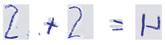
2 plus 2 equals 4.
Lesson 2
Relate number sentences and number bonds through story problems.
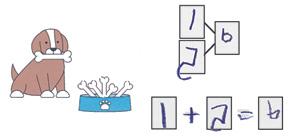
I see the parts and total in the number sentence and number bond.
Lesson 3
Represent and solve add to with result unknown story problems.
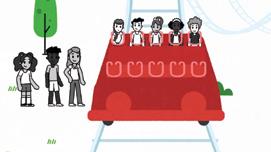
4 blue cubes show the children on the roller coaster. The red cubes show the children who get on. Now there are 7 children.
Lesson 4
Represent decomposition situations by using number bonds and addition sentences.
Lesson 5
Represent take apart with both addends unknown situations with a number sentence.
Lesson 6
Tell addition story problems starting from number sentence models.
5 + 2 = 7
2 4 Tam 6 is 2 and 4.
6 = 2 + 4 6
6 is the total. 2 and 4 are the parts.
= 6 + 1
There are a lot of ways we could color the crayons. I colored 4 red and 3 blue.
I wrote 7 = 4 + 3.
My story is: 5 giraffes were eating leaves. 2 giraffes came over to eat leaves. Now there are 7 giraffes eating leaves.
Lesson 7
Find the total in an addition sentence.
3 plus 2 equals 5.
Represent add to with result unknown story problems by using drawings and numbers.
I can tell or draw an addition story. I can write a number sentence to match.
Lesson at a Glance
Students use drawings and number sentences to represent add to with result unknown story problems. They transition from reading number sentences as “1 and 2 make 3” to “1 plus 2 equals 3.” Students recontextualize the number sentence by using it to tell the story. This lesson introduces the terms plus and addition and advances the term equals.
Key Question
• What happens when we put things together, or add?
Mathematical Thinking and Reasoning Standard
MTR.2.1
Language Objectives
• Listen to a story problem and orally describe the parts and the total in the problem.
• Use a number sentence to orally explain the relationship between the parts and the total by using the terms plus and equals.
Agenda
Fluency 15 min
Launch 10 min
Learn 20 min
• Read and Write Number Sentences
• Represent Stories
• Problem Set
Land 5 min
Achievement Descriptor
FL.K.Mod5.AD2 Represent addition with objects, fingers, drawings, number lines, or equations. (MA.K.NSO.3.1)
Materials
Teacher
• Puppet’s Work (in the teacher edition)
• Puppet
• Hide Zero® cards, demonstration set
• Computer or device*
• Projection device*
• Teach book*
Students
• Count and Write How Many Sprint (in the student book)
• Crayon (1)
• Blank paper (1 sheet)
• Hide Zero® cards
• Personal whiteboard
• Dry-erase marker
• Learn book
• Pencil*
*These materials are only listed in lesson 1. Ready these materials for every lesson in this module.
Florida B.E.S.T. Standard
MA.K.NSO.3.1 Explore addition of two whole numbers from 0 to 10, and related subtraction facts.
Lesson Preparation
Consider tearing out the Sprint pages in advance of the lesson.
Fluency
Sprint: Count and Write How Many
Materials—S: Count and Write How Many Sprint
Students find the total number of objects to prepare for finding the total in addition situations.
Read the instructions to students and have them complete the sample problems.
Count and write how many.
Direct students to Sprint A. Frame the task.
I do not expect you to finish. Do as many problems as you can, your personal best.
Take your mark. Get set. Think!
Time students for 1 minute on Sprint A.
Stop! Underline the last problem you did.
I’m going to read the answers. As I read the answers, call out “Yes!” and mark your answer if you got it correct.
Read the answers to Sprint A quickly and energetically.
Count the number you got correct and write the number at the top of the page. This is your personal goal for Sprint B.
Celebrate students’ effort and success.
Lead students in one fast-paced and one slow-paced counting activity, each with a stretch or physical movement.
Point to the number you got correct on Sprint A. Remember this is your personal goal for Sprint B.
Direct students to Sprint B.
Take your mark. Get set. Improve!
Time students for 1 minute on Sprint B.
Stop! Underline the last problem you did.
I’m going to read the answers. As I read the answers, call out “Yes!” and mark your answer if you got it correct.
Read the answers to Sprint B quickly and energetically.
Count the number you got correct and write the number at the top of the page.
Stand if you got more correct on Sprint B.
Celebrate students’ improvement.
Teacher Note
Count forward by ones from 10 to 20 for the fast-paced counting activity.
Count backward by ones from 20 to 10 for the slow-paced counting activity.
Launch
Materials—S: Blank paper, crayons
Students visualize and represent a numberless math story.
Cover your eyes and make a movie in your mind as I tell a story.
I bake some sugar cookies. (Pause.) My friend brings over some chocolate chip cookies. (Pause.)
Open your eyes. Draw a picture of what you saw in your mind.
Distribute paper and crayons. Give students a few minutes to draw.
Display a few obviously different work samples that showcase a range of numbers. Look for samples that use color, labels, or spacing to show the two parts.
Look at Lila’s drawing. How did she show the cookies I baked and the cookies my friend brought? She colored some red and some blue.
Lila used different colors to show the different parts in the story.
Stand up, find your math partner, and see how they showed the parts.
Consider having students share with more than one partner so they see various drawing styles. After sharing, offer time to revise drawings. Focus their revisions on changes that make it easier for other people to see the parts.
Transition to the next segment by framing the work.
Drawing is one way we can show people a story that we are thinking about. Writing is another way. Today, we will find out how mathematicians might write about this story.
Multilingual Learner Support
Consider using strategic, flexible grouping throughout. Pairing suggestions include the following:
• Pair students who have different levels of mathematical proficiency.
• Pair students who have different levels of English language proficiency.
As applicable, complement any of these groupings by pairing students who speak the same home language.
Universal Design for Learning: Engagement
Students choose the numbers for the math story. This serves as a natural source of engagement and differentiation.
Numberless word problems also help students make sense of the story. A focus on the story context allows students to consider important questions. Are cookies being added or being taken away? Are there more or fewer cookies at the end of the story?
Learn
Read and Write Number Sentences
Materials—T: Puppet’s Work, Puppet, Hide Zero cards; S: Drawing from Launch, Hide Zero cards
Students write equations to match a story and read or interpret them in various ways.
Show Puppet’s drawing. Have students Think–Pair–Share about the following question.
How did Puppet show the parts?
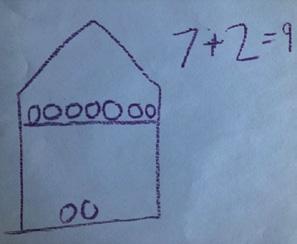
Puppet made the sugar cookies plain. The ones with dots are chocolate chip cookies.
Puppet drew a line down the middle, so you wouldn’t get them mixed up.
Puppet put the cookies you made in a 5-group.
Have students tell how many of each cookie. Use the Hide Zero cards to label each part. Distribute Hide Zero cards to students.
Look at your drawing. Count how many of each cookie you drew. Use cards to label each part.
Pause while students work.
Look at Puppet’s drawing. We have 7 cookies and 2 cookies. How many total cookies are there now?
9
How did you find the total?
I counted all the cookies.
I put the numbers together in my head.
Teacher Note
Gestures can help clarify meaning. Each time a number sentence is read, carefully track each symbol or word. Encourage students to point in the air along with you.
You put together all the cookies to find the total. When we put groups or parts together to find the total, it’s called addition.
Raise your hand when you can finish this sentence: 7 and 2 make …?
7 and 2 make 9.
As students make the statement, use a combination of Hide Zero cards and writing to build the sentence.
Mathematicians use special symbols to write a number sentence. Instead of writing and they write a plus sign.
Hold up the plus card. Place the card on top of the and card, covering the word with the symbol.
Repeat the process with the equal card and the word make.
Mathematicians read the number sentence like this: 7 plus 2 equals 9. Try it.
7 plus 2 equals 9.
Have students read the number sentence another time to a partner.
Promoting Mathematical Thinking and Reasoning
When students read their number sentence as a mathematician and then as a storyteller, they decontextualize by using their drawing and the numerals to find the total. They recontextualize by putting the numbers and symbols back in context to tell the complete story. 7 2 9 and make . 7 + = 2 9
Recontextualize the number sentence by using it to tell the story. Point to each symbol as you say the story.
Storytellers read it like this: I baked 7 sugar cookies. My friend brought me 2 chocolate chip cookies. And now we have 9 cookies altogether.
Have students tell the story to a partner. Expect their language to vary.
You have a plus sign and an equal sign, too. Use your cards to make an addition sentence that matches your story. When you think you’ve got it, ask a partner to check it.
Read it like a mathematician and like a storyteller.
As students create a drawing and a number sentence to show the story and they explain the meaning of the symbols in their number sentence, they demonstrate understanding by representing problems in multiple ways (MTR.2).
Teacher Note
Students who have parts or totals greater than 10 will need support to build a number sentence with the Hide Zero cards. Give those students one of the longer cards that show tens and demonstrate how to put the shorter card over the 0 in the ones place. Students will learn to use the cards to support place value understanding in module 6.
1 2
Circulate to check for accuracy and offer feedback as needed. Once students build an accurate number sentence, ask them to write it alongside their drawing.
Represent Stories
Materials—S: Personal whiteboard, dry-erase marker
Students represent a story by using drawings and number sentences.
Progress through the suggested sequence of problems as time permits. For each problem, have students:
• Draw to represent the story and label each part with a number.
• Write a number sentence to match the story.
• Read the number sentence like a mathematician and like a storyteller.
I baked 5 oatmeal raisin cookies. My friend brought over 4 peanut butter cookies. How many cookies are there now? Problems
Auntie had 3 apples at home. Then she went to the store and bought 5 apples. How many apples does she have now?
Complexities
The context is familiar and the cookies are easily represented by drawing circles. Having 5 as a part may encourage drawing 5-groups.
The new context is a new complexity, although it also lends itself to drawing circles. Sometimes students find it more challenging to add when the smaller part comes first in the story.
Teacher Note
In this lesson, students use the equal sign in a different way than they did when comparing numbers in module 3. Consider addressing this difference if students notice it by using the following statements:
We used equal when comparing two numbers that are exactly the same. We can also use equal when parts make a total. 7 plus 2 equals 9.
There will be many chances for students to consider the meaning of the equal sign in kindergarten and first grade.
I baked 3 sugar cookies. Then my friend brought over 5 chocolate chip cookies. Then my cousin brought over 1 oatmeal raisin cookie. How many cookies are there now?
The familiar context draws attention to the addition of a third part, which is just 1 more. Presenting three parts poses a challenge, but the total stays within 10.
Problem Set
This Problem Set is guided to help students transition from the work of the lesson to independent practice.
Look at the first picture. What do you see?
I see some birds flying.
I see a bird in a tree.
I’m going to tell myself a story about this picture. There is 1 bird in the tree. 3 more birds fly over.
The first number sentence tells about my story. Let’s trace the numbers as we read it together.
3 and 1 make .
How can we figure out the total?
We should count all the birds.
Count the birds as a class. Write 4 in the writing rectangle and invite students to do the same.
Look at the next number sentence. It’s another way of telling the same story, but this time by using plus and equals.
(Trace each symbol as you read.) 3 plus 1 equals …?
4
Write 4 in the writing rectangle and invite students to do the same. Point to 3 + 1 = 4.
Let’s read this number sentence like mathematicians.
3 plus 1 equals 4.
Release students to work on the rest of the Problem Set independently.
Observational Assessment
; Watch as students solve the Problem Set.
• Can students add by counting all?
• Are students representing the picture in their number sentence?
Differentiation: Challenge
If students find it easy to tell a story about the picture, challenge them to answer the following question:
What how many question does your story answer?
How many birds are in the picture?
Teacher Note
Traceable symbols are provided in this module as a scaffold to support students as they learn the structure of number sentences. Writing and saying the full number sentence supports students as they learn the structure of addition sentences.
Land
Debrief 5 min
Objective: Represent add to with result unknown story problems by using drawings and numbers.
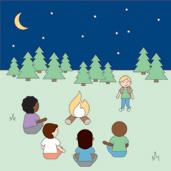
Display the picture of the campfire.
Today we told lots of stories. Turn and tell your partner a story about this picture.
Even though we’re all looking at the same picture, I heard more than one story. One person said: There are 4 children sitting at a campfire. Another boy comes. Now there are 5 children.
Another person said: There are 4 children sitting and 1 standing. There are 5 children at the fire.
What is the same about those stories?
The numbers are the same.
They have the same parts and the same total.
Both of these stories have 4 and 1 as parts and 5 as the total. What did we do with the parts to get the total?
We put them together.
What happens when we put things together, or add?
You put the parts together and then you get the total. You have more when you add.
It means that you use a plus.
When we see a plus sign, we know that we are putting things …
Teacher Note
The student responses shown here are typical of students who are beginning to understand addition. In kindergarten, the total is usually greater than the parts. That is not true when zero is a part. In lesson 5, students will have an opportunity to refine their thinking.
Sample Solutions
Expect to see varied solution paths. Accept accurate responses, reasonable explanations, and equivalent answers for all student work.
Relate number sentences and number bonds through story problems.
I can tell an addition story. I can show the parts and total with a number bond and a number sentence.
Lesson at a Glance
In this lesson students relate the parts and total of a number bond to the parts and total of a number sentence. Students realize that number bonds and number sentences are ways to represent math stories, and that they can identify the parts and total in both representations.
Key Questions
• How do number sentences and number bonds help us tell math stories?
• How are number sentences and number bonds the same?
Mathematical Thinking and Reasoning Standard
MTR.5.1
Language Objective
• Orally compare parts and their total in a number bond and in a number sentence within a math story.
Agenda
Fluency 10 min
Launch 10 min
Learn 25 min
• Relate Representations
• Represent Pictures
• Problem Set
Land 5 min
Materials
Teacher
• Sticky notes (2) Students
• Shake Those Disks removable (in the student book)
• Two-color counters (10 per student pair)
• Cup (1 per student pair)
• Blank paper
• Crayons
• Personal whiteboard
• Dry-erase marker
• Student book
Achievement Descriptor
FL.K.Mod5.AD2 Represent addition with objects, fingers, drawings, number lines, or equations. (MA.K.NSO.3.1)
Florida B.E.S.T. Standard
MA.K.NSO.3.1 Explore addition of two whole numbers from 0 to 10, and related subtraction facts.
Lesson Preparation
Tear out the Shake Those Disks removable from the student book and place it in a personal whiteboard. Each student pair needs one. Save the removable for use in lesson 3.
Fluency
Ready, Set, Count
Students represent two parts and find the total to prepare for understanding addition as putting together.
Have students form pairs and stand facing each other. Model the action during a practice round. Make a fist and shake it on each word as you say, “Ready, set, count.” At “count,” open your fist, and hold up any number of fingers.
Tell students that they will make the same motion. At “count,” they will show their partner any number of fingers. The partners count all of the fingers to find the total.
Clarify the following directions:
• Show zero with a closed fist after you hear “count.”
• Try to use different numbers each time to surprise your partner.
Each time partners show fingers, have them both say the total number of fingers.
Circulate as students play the game to ensure that each student is trying a variety of numbers.
Differentiation: Challenge
Students who demonstrate procedural reliability with totals within 10 can be placed into triads. This challenges them to find a total with three parts and increases the complexity by extending to totals within 15.
Partners A and B: “6”
Shake Those Disks
Materials—S: Two-color counters, cup, Shake Those Disks removable, personal whiteboard, dry-erase marker
Students record a total and parts in a number bond to build fluency with decomposing a number in more than one way.
Form student pairs. Distribute a marker, a cup of counters, and the Shake Those Disks removable in a personal whiteboard to each pair. Have them play according to the following rules. Consider doing a practice round.
• Partner A: Shake and spill the cup of counters.
• Partner A: Place the counters on the number path and count.
• Partner B: Write the total in the number bond.
• Partner B: Count the number of red and yellow counters, and then write the numbers in each part.
• Switch roles after each turn.
Circulate as students play and ensure they are correctly recording the parts and totals.
Differentiation
Consider differentiating the activity by assigning different numbers of counters. Students can be given anywhere from 3 to 10 counters to support or challenge them as needed.
Materials—S: Blank paper, crayons
Students visualize and represent a math story by making a drawing and using numbers.
Cover your eyes and make a movie in your mind as I tell a story.
There are some pigeons on our playground. Then some more pigeons land on our playground.
Open your eyes. Turn and talk about how you saw the pigeons in your mind.
Teacher Note
If pigeons are not common in your region, change the story to incorporate a bird that is more familiar to students.
Give students a moment to talk about what they saw in their mind. Then use the following prompts to help them with the mathematical parts of the story.
Tell your neighbor how many pigeons you saw at first.
Tell your neighbor how many pigeons landed next. Distribute paper and crayons.
Make a math drawing of how you saw the pigeons. Use a number bond or a number sentence to tell about the picture.
As students work, support them as needed. Identify two student work samples for use in Learn: one that uses a number bond and one that uses a number sentence.
Look at your picture. Do you know the total number of pigeons? How do you know? I know the total. I counted all of them. The total is right here in my number bond.
Transition to the next segment by framing the work.
Today, we will use our pictures to see how our number bonds and number sentences are the same and different.
Learn
Relate Representations
Materials—T: Sticky notes; S: Drawing from Launch
Students make connections about how number bonds and number sentences represent a math story.
Display two student work samples, one that uses a number bond and one that uses a number sentence. Invite the students who own the work to tell their story about the pigeons.
Multilingual Learner Support
In the previous lesson, students drew pictures for a numberless word problem. Support the understanding that students will now write number bonds or number sentences along with their drawings for a numberless word problem. After giving directions to the class, ensure the equitable participation of multilingual learners by asking them to repeat the directions of the activity to you or a partner.
Sam’s math drawing
Sam, tell us about your math story.
Here are the birds that were there at the beginning. There are 2. These are the birds that came flying. There are 3. 2 and 3 is 5. I wrote that in the number bond.
Jacob, tell us about your math story.
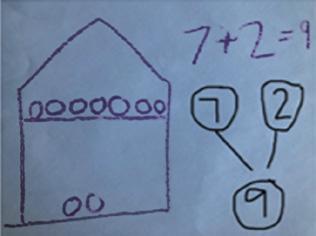
There were 7 birds on the playhouse. Then 2 came walking up. Now there are 9 birds.
Focus attention on the sample that uses a number bond.
Where are the parts and the total in Sam’s math drawing?
As students explain, point to the parts and total in the picture and in the number bond. Connect the numbers in the bond to their referents in the picture.
Focus attention on the sample that uses a number sentence. Have students Think–Pair–Share about the following question.
Does Jacob have two parts and a total in his math drawing? What about in his number sentence?
Listen as students discuss.
I heard Lorena and Kailey say they see parts in the drawing. Where do you see parts?
The birds on top were already there. The birds on the bottom came over to play. Those are the parts.
Where are the parts in the number sentence?
7 and 2. The 7 birds are on top there. (Points.) And there are 2 birds are on the bottom. (Points.)
Where do we see the total in Jacob’s work?
The total is all of the birds, all of the circles. 9. There are 9 birds in the drawing and 9 in the number sentence.
As students share their thinking, connect the parts and the total in the picture to the numbers in the number sentence.
Jacob’s math drawing
There are parts and a total in a number bond and in a number sentence. Let’s write both ways for each picture.
Here are the parts and total in Sam’s number bond. (Point). How can I write the parts and total in a number sentence?
As students explain, write the number sentence on a large sticky note and attach it to Sam’s drawing. Use the same questions as you write the number bond on a large sticky note and attach it to Jacob’s drawing.
Conclude by pointing to both representations of the parts and total on each sample. For example, point to the 3 flying birds as well as the 3 in the number bond and the number sentence.
Represent Pictures
Materials—S: Personal whiteboard, dry-erase marker
Students tell a story about a picture, and then represent it with a number sentence and a number bond.
Display the picture of bees near a hive. Give students a quiet moment to look at the picture. Then have them turn and tell a partner what they notice about the picture.
Let’s tell a math story about the bees. How could our story begin?
2 bees are next to the hive. 2 bees are flying to the hive.
How many bees will be next to the hive at the end of the story?
4 bees
Teacher Note
Depending on how they see the picture, students’ stories may be add to with result unknown or put together with total unknown problem types. Both types can accurately describe the pictures.
The given example is an add to problem because it involves movement of one part. In put together problems, parts are distinguished by a feature other than movement. The following is an example of a put together problem for the bee picture:
2 bees are next to the hive.
2 bees are in the tree.
There are 4 bees altogether.
The story is: 2 bees are next to the hive. 2 bees fly over to the hive. Now there are 4 bees next to the hive. Did I get that right? Yes.
Use your whiteboard to write a number bond and a number sentence that tells the story.
Give students a few minutes to write their number bonds and number sentences. Invite a student to write their number bond and number sentence where everyone can see them. Explain all the referents.
Repeat with the other story pictures as time allows. Instead of repeating the story back to students, invite them to retell it to a partner.
Transition students to the Problem Set when they are able to write the number bonds and number sentences independently.
Promoting Mathematical Thinking and Reasoning
As students represent the images with a number sentence and number bond, noticing the part-total relationship in both representations, they use patterns and structure (MTR.5).
As students explain the referents, or what the numbers refer to, in the number sentence and number bond, they make sense of where the parts and total are in the story and in their work. Students can then use the part-total structure of the representation they prefer (the number sentence or number bond) to better understand the other representation.
Problem Set
The Problem Set directions follow the work of the previous segment to help students transition to independent work. Circulate and assist as needed. Use the following questions and prompts to assess and advance student thinking:
• Tell me a story about this picture.
• What part of the story does this number show? (Point to a number in the number sentence or bond.)
• Where are the parts in your number sentence? Where is the total?
Observational Assessment
; Prompt students as they complete the Problem Set.
• Can students write a number sentence that accurately represents the picture?
• Can students relate the number sentence to objects in the picture?
Differentiation: Support
Support students with number formation or number sentence structure by writing in highlighter and having them trace. Give every student the opportunity to write a number sentence independently at least once on each Problem Set to build independence and assess their progress.
Display the dollar problem from the Problem Set and instruct students to look at the dollar problem on their Problem Set.
Look at the number sentence and number bond you wrote for the girl counting her money.
If your work shows the girl counting the 2 dollars in her hand first, stand up.
(Point to the example 2 + 5 = 7.)
If your work shows the girl counting the money on the table first, sit down.
(Point to 5 + 2 = 7.)
Lead a discussion identifying the parts and total in the number sentences and the number bonds and answering the following questions.
Does it matter which part she counts first? Will she have $7 either way? It doesn’t matter.
She has $7 if she counts the money in her hand first or if she counts the money on the table first.
How do number sentences and number bonds help us tell math stories?
They both tell the story. We can point to all the parts and total in the number bond and in the number sentence.
You can use the numbers to tell what happened in the story.
How are number sentences and number bonds the same?
They have the same numbers for the same story.
We can see the parts and total in both of them.
Represent and solve add to with result unknown story problems.
I can tell an addition story. I can choose tools to help me solve it.
I can write a number sentence to match.
Lesson at a Glance
In this lesson, the class writes a story problem based on a video. After students solve the problem by using tools of their choice, they write a number sentence to match. They use the number sentences to show their solution and retell the math story. Students compare solution strategies and tools for solving addition problems.
Key Question
• How can a number sentence help us tell a story?
Mathematical Thinking and Reasoning Standard
MTR.2.1
Language Objectives
• Orally describe the parts and total of a math story by using a number sentence and a math tool.
• Orally compare strategies for solving story problems (including fingers, 10-frames, and drawings) by showing the totals and parts.
• Orally explain how a number sentence matches a story context by describing the parts and total.
Agenda
Fluency 10 min
Launch 5 min
Learn 30 min
• Roller Coaster Story
• Represent and Solve
• Number Sentence Hunt
Land 5 min
Materials
Teacher
• Chart paper
• Story cards (digital download)
Students
• Shake Those Disks removable
• Two-color counters (10 per student pair)
• Cup (1 per student pair)
• Personal whiteboard
• Dry-erase marker
• Student book
Lesson Preparation
• Prepare the Shake Those Disks removable from lesson 2.
• Gather the story cards needed for this lesson and hang them around the classroom. Student pairs will look for them and use them to write number sentences. Consider making them somewhat difficult to find to increase engagement. Copy or print the story cards needed for this lesson if you do not already have them.
• Gather various tools, such as sticks of 10 cubes, 10-frames, and number paths. Set them out so that students can choose from them to solve problems in the lesson.
Achievement Descriptors
FL.K.Mod5.AD2 Represent addition with objects, fingers, drawings, number lines, or equations. (MA.K.NSO.3.1)
FL.K.Mod5.AD4 Add and subtract within 10 by using objects, drawings, or other math tools. (MA.K.NSO.3.2)
FL.K.Mod5.AD9 Solve add to, take from, and put together with result unknown story problems within 10 by using addition and subtraction. (MA.K.AR.1.3)
Florida B.E.S.T. Standards
MA.K.NSO.3.1 Explore addition of two whole numbers from 0 to 10, and related subtraction facts.
MA.K.NSO.3.2 Add two one-digit whole numbers with sums from 0 to 10 and subtract using related facts with procedural reliability.
MA.K.AR.1.3 Solve addition and subtraction real-world problems using objects, drawings or equations to represent the problem.
Fluency
Ready, Set, Compare
Students compare values within 10 to prepare for understanding how parts and a total are related in addition.
Have students form pairs and stand facing each other.
Model the action during a practice round. Make a fist, and shake it on each word as you say, “Ready, set, compare.” At “compare,” open your fist, and hold up any number of fingers.
Tell students that they will make the same motion. At “compare,” they will show their partner any number of fingers. The partners compare the number of fingers shown on each hand.
Clarify the following directions:
• Show zero with a closed fist after you hear “count.”
• Showing more fingers is not a win.
• Try to use different numbers each time to surprise your partner.
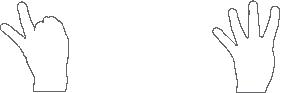
Partner A: “4 is greater than 2.”
Partner B: “2 is less than 4.”
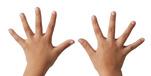
Each time partners show fingers, have them compare amounts by using the words greater than, less than, or equal to. See the sample dialogue under the photograph.
Circulate as students play the game to ensure that each student is trying a variety of numbers.
Differentiation: Support
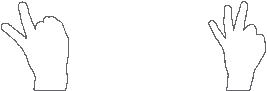
If students need support with comparing, they can use the one-to-one matching strategy of touching fingertips to compare their numbers.
Consider also having students say their counts as they touch fingertips, so that they experience the greater number as being said last.
Shake Those Disks
Materials—S: Two-color counters, cup, Shake Those Disks removable, personal whiteboard, dry-erase marker
Students record a total and parts in a number bond to build fluency with decomposing a number in more than one way.
Form student pairs. Distribute a marker, a cup of counters, and the Shake Those Disks removable in a personal whiteboard to each pair. Have them play according to the following rules. Consider doing a practice round.
• Partner A: Shake and spill the cup of counters.
• Partner A: Place the counters on the number path and count.
• Partner B: Write the total in the number bond.
• Partner B: Count the number of red and yellow counters, and then write the numbers in each part.
• Switch roles after each turn.
Circulate as students play and ensure they are correctly recording the parts and totals.
Consider giving students the option to play individually or with a partner.
Differentiation
Consider differentiating the activity by assigning different numbers of counters. Students can be given anywhere from 3 to 10 counters to support or challenge them as needed.
Materials—T: Chart paper
Students watch a video and tell a math story to match.
Set the context for the video. Tell the class that some children visit an amusement park and ride a roller coaster. Play the video.
Turn and tell your partner a story about what happens in the video. Make sure you both have a chance to tell a story.
Multilingual Learner Support
Structure partners for success with storytelling by pairing students strategically. Students who speak the same home language might opt to retell the story in that language.
Alternatively, a language learner paired with a home speaker might go second so they can benefit from hearing the story told first.
Provide time for each student to tell the story. Circulate and ensure that both partners share.
Let’s write the story so we can share it with people who haven’t seen the video.
Use questions such as the following to elicit students’ thinking. As they describe each part of the story, use their words to write sentences on a piece of chart paper.
What happened at the beginning?
There were children riding on a roller coaster.
How many children were on the roller coaster?
5
I’ll write, There were 5 children riding on a roller coaster. What happened next?
3 more children got on the roller coaster.
There were 5 children riding on a roller coaster.
3 more children got on the roller coaster.
How many children are on the roller coaster?
We can turn our story into a story problem by asking a how many question. What how many question can we ask about all of the children?
How many children are on the roller coaster?
Transition to the next segment by framing the work.
Now we have a problem to solve. Today, we will think of ways to solve the problem and show our thinking.
Universal Design for Learning: Representation
Presenting the roller coaster situation in a video format supports students in understanding the problem context by removing barriers associated with written and spoken language.
Learn
Roller Coaster Story
Materials—T: Charted story; S: Assorted math tools
Students choose tools and solve a story problem.
Reread the story. Provide 2 minutes for students to solve the problem by using tools of their choice (e.g., sticks of 10 cubes, 10-frames, number paths). Invite a few students to share how they found the total.
I counted out 5 cubes and 3 cubes. When you count them all, you get 8.
In the video, I could see that it was 8. There were 5 children in one row and 3 children in the other row. That makes 8.
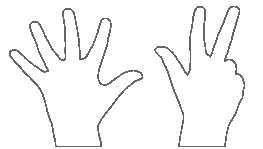
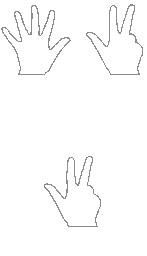
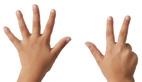
I showed 5 like this. (Holds up 5 fingers on one hand.) And I showed 3 like this. (Holds up 3 fingers on the other hand.) I counted and got 8.
There were 5 children riding on a roller coaster.
3 more children got on the roller coaster.
How many children are on the roller coaster?
Differentiation: Challenge
If students solve the roller coaster problem quickly, challenge them with any of the following questions:
• Can 3 more children get on the roller coaster? Why?
• How many children would have to get off the roller coaster to make room for 3 children? 4 children?
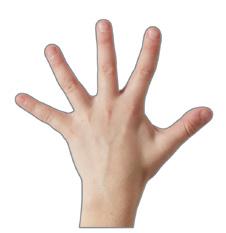
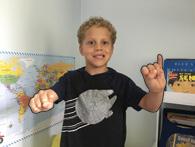
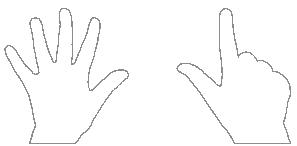
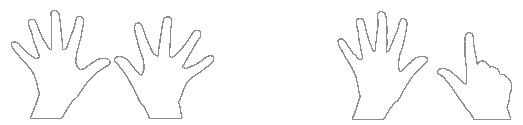
If no one uses fingers to find the total, share the idea as one that students have used in the past. Show 8 fingers the math way.
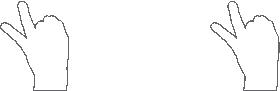
This hand shows the children who were already on the roller coaster. (Push out the hand showing 5 fingers.) hand shows the children who got on the roller coaster. (Push out the hand showing 3 fingers.)
How many children are on the roller coaster now?
8 children
Promoting Mathematical Thinking and Reasoning
Students demonstrate understanding by representing problems in multiple ways when they choose a tool to solve the roller coaster problem.
Encourage students to think strategically about the tool they chose by asking questions such as the following:
Why did you choose to use that tool? Did it help?
What other tool could you use to help you solve the problem?
My fingers show counting the … Math way
Refocus students’ attention on the chart paper. As students respond to the following questions, record the number sentence.
Help me write a number sentence for our story. How many children were on the roller coaster at first?
5 How many children got on?
3
We are adding the children who were on the roller coaster to the children who got on. What should I write to show that we are adding?
Plus
5 plus 3 equals …
8
There were 5 children riding on a roller coaster.
3 more children got on the roller coaster.
How many children are on the roller coaster?
5 + 3 = 8
Have students turn to a partner and read the number sentence. Then cover the written story and ask students to use the number sentence to tell the story. Encourage them to finish the story by giving the total instead of asking a how many question.
Represent and Solve
Materials—S: Student book, assorted math tools
Students solve a story problem and represent it with a number sentence.
Distribute student books.
Listen to my next roller coaster story: There are 4 children on the roller coaster. 3 children get on. How many children are on the roller coaster now?
Choose any tools that you want to help you solve. After you solve, use the writing rectangle in your book to write a number sentence to match.
Circulate and observe as students work. Take a picture or make note of the strategies and tools students use. Select one or two students to share. If possible, select a variety of representations and include at least one student who uses a 10-frame.
Observational Assessment
; Watch students as they solve the roller coaster story.
• Can students solve the word problem by using objects or drawings to represent the story?
• Can students write a number sentence to match the story?
Gather the class for discussion. As each student shares, ask questions to elicit their thinking, clarify their strategy, and help the class make connections between different students’ work. The following sample dialogue demonstrates such discussion.
Hands 10-Frame Drawing
Hadley, how did you use your hands to solve?
I counted 4 fingers on one hand. Next, I counted 3 fingers on my other hand. Then, I counted all the fingers I had up and got 7.
Demetri, tell us how you used the 10-frame.
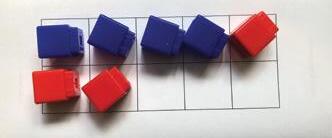
I put 4 blue cubes on the 10-frame. I put 3 red cubes on it to show that 3 more children got on. I saw that the top row was filled. 2 more is 7, so I knew there were 7 children on the roller coaster.
Pria, tell us about your drawing.
First I drew the 3 children who are waiting to get on. Then, I drew the 4 children on the roller coaster. I counted all of the children and saw that there are 7 total.
How are Demetri’s and Pria’s ways the same?
Hands (Hadley’s Way)
Teacher Note
Kindergarten students are expected to use the Stage 1 strategy of counting all to find the total and the Stage 2 strategy of counting on. When counting on, students begin counting from a known part and count the objects in the second part to find the total. In this problem it might sound like, “That’s 4, so 5, 6, 7. 7 is the total.”
They both showed the 4 children on the roller coaster and the 3 children getting on.
They have the same parts and total.
How are Demetri’s and Pria’s ways different?
Demetri used the 10-frame and Pria used a drawing.
Pria drew the 4 children in a roller coaster and 3 out of the roller coaster, but Demetri put all the children together in the roller coaster.
I noticed one other difference. Pria and Hadley both counted all of the children to find the total. Demetri used what he knows about 5-groups to see that 5 and 2 make 7.
10-Frame (Demetri’s Way)
Drawing (Pria’s Way)
Continue comparing by asking how Hadley’s way is the same and different. Share the selected students’ number sentences.
Did Demetri, Hadley, and Pria get the same total? Yes.
Did they all solve in the same way? No.
We can solve the problem in many different ways, but we all get the same total.
Number Sentence Hunt
Materials—T: Story cards; S: Student book
Students partner to tell a story from a picture and record a matching number sentence.
Make sure the story cards are posted around the room. Then show the Number Sentence Hunt in the student book. Tell students that they will go on a number sentence hunt with a partner.
The same pictures on this page are also hidden in different places around the room. You need to find all of the pictures.
When you find a picture, tell a story about it. Write a number sentence in your book to match.
Display the squirrel scene. Have a student volunteer help you demonstrate expectations for partner work. Work together to tell a story about the squirrels. Show how to write the number sentence in the writing rectangle. It may be helpful to make a number bond for the picture.
Pair students for the hunt and invite partners to begin.
Circulate and assist as needed. Use the following questions and prompts to assess and advance student thinking:
• Use your number sentence to tell me a story about this picture.
• Read your number sentence.
• Where are the parts in your number sentence? Where is the total?
• Could you find other parts in that picture? How would that change your story?
Debrief 5 min
Materials—S: Student book
Objective: Represent and solve add to with result unknown story problems.
Display the frog scene. Invite students to look at the frogs on the number sentence hunt. Have them Think–Pair–Share about the following question.
What number sentence did you record for the frog story?
Select a student to write their number sentence. Then remove the frog scene so that only the number sentence shows.
Look at Mira’s number sentence. Can you share a story that matches her number sentence?
There are 8 frogs on the leaf. 2 frogs jump over. Now there are 10 frogs on the leaf.
8 + 2 = 10
Who can tell a different story that matches this number sentence?
There are 8 puppies playing at a park. 2 more puppies come to the park to play. Now there are 10 puppies.
How can a number sentence help us tell a story?
It can tell you how many frogs or puppies there were in the beginning and how many came.
The equal sign tells you the total at the end. The numbers tell the parts and the total.
Teacher Note
If students need additional support to tell a different story, consider rewording the question or breaking it into a series of questions and prompts, such as the following:
• Let’s tell a story about puppies that matches this number sentence.
Represent decomposition situations by using number bonds and addition sentences.
I can sort the same total into different parts. I can show the parts and total with a number bond and a number sentence.
Lesson at a Glance
Students decompose a group and represent the situation with number bonds and addition sentences. Students begin with a total number of objects and then sort to create the parts, rather than beginning with the parts as they did for add to with result unknown problems. This naturally leads to recording the total on the left (e.g., 7 = 4 + 3).
Key Question
• How can the same total be made of different parts?
Mathematical Thinking and Reasoning Standard
MTR.3.1
Language Objectives
• Use a number bond and a number sentence to orally explain the relationship between a total and its parts.
• Orally describe different ways a total can be decomposed into parts.
Agenda
Fluency 10 min
Launch 5 min
Learn 30 min
• Number Sentences
• Sorting Bears
• Problem Set
Land 5 min
Materials
Teacher
• Dot cards
• 10-sided die
• Teddy bear counters (10)
• Recording Sheet (digital download)
• Paper plates (2)
Students
• 10-sided die
• Two-color beans (20 per student pair)
• Teddy bear counters (10)
• Paper plates (2)
• Recording Sheet (in the student book)
• Student book
Achievement Descriptors
FL.K.Mod5.AD2 Represent addition with objects, fingers, drawings, number lines, or equations. (MA.K.NSO.3.1)
FL.K.Mod5.AD8 Decompose numbers within 10 into pairs in more than one way and record with equations such as 5 = 2 + 3 and 5 = 4 + 1. (MA.K.AR.1.2)
Florida B.E.S.T. Standards
MA.K.NSO.3.1 Explore addition of two whole numbers from 0 to 10, and related subtraction facts.
MA.K.AR.1.2 Given a number from 0 to 10, find the different ways it can be represented as the sum of two numbers.
Lesson Preparation
• Prepare bags of 20 two-color beans for student pairs.
• Copy or print the Recording Sheet to use for demonstration.
• Set out the 6-dot card.
• Rather than counting out 10 teddy bear counters for each student, consider assembling larger bins of mixed teddy bear counters that students can share.
Fluency
Ready, Set, Add
Students find the total and say an addition sentence to develop fluency with solving add to with result unknown problems.
Have students form pairs and stand facing each other. Model the action during a practice round. Make a fist and shake it on each word as you say, “Ready, set, add.” At “add,” open your fist, and hold up any number of fingers.
Tell students that they will make the same motion. At “add,” they will show their partner any number of fingers. The partners count all the fingers to find the total, and then say a number sentence.
Clarify the following directions:
• Show zero with a closed fist after you hear “add.”
• Try to use different numbers each time to surprise your partner.
Partners A and B: “6”
Partner A: “4 + 2 = 6”
Partner B: “2 + 4 = 6”
Each time partners show fingers, have them both say the total number of fingers. Then have each student say the addition sentence, starting with the number of fingers on their own hand. See the sample dialogue under the photograph.
Circulate as students play the game to ensure that each student is trying a variety of numbers.
Make It Equal with Beans
Materials—S: 10-sided die, two-color beans
Students add or remove objects to create sets with the same number to develop an understanding of equality.
Differentiation: Challenge
Students who demonstrate procedural reliability with totals within 10 can be placed into triads. This will challenge them to find a total with three parts and will increase the complexity to totals within 15.
Likewise, partners can be challenged to show any number of fingers by using both hands, increasing the complexity to totals within 20.
Have students form pairs. Make sure each student pair has a bag of beans and a die.
Invite students to complete the activity according to the following procedure. Consider doing a practice round.
• Partner A rolls the die and lines up a row of beans to match the number rolled.
• Partner B rolls the die and lines up a row of beans underneath partner A’s beans by using one-to-one matching.
• Partner A makes the sets of beans the same length, or the same number, by removing or adding beans.
• Partner B counts to verify the rows of beans are equal.
• Both partners make the comparison statement by using the words is equal to. For example, “9 is equal to 9.” Consider having them write the equation 9 = 9 as well.
• Put the beans to the side, switch roles, and play again.
Circulate as students work and provide support as needed.
Launch
Materials—T: Dot cards
Students share total–part thinking and record with a number bond.
Show the 6-dot card. Encourage subitizing by flashing it for 2–3 seconds. Have students give a silent signal to indicate when they know the number of dots. Flash the card a second time if needed.
How many dots? 6
Hold up the dot card. Ask a student to point to the parts that make 6 for them.
Tam, how do you see the 6 dots?
I see 2 on that side. (Points.) And I see 4 on that side. (Points.)
Record Tam’s way with a number bond. Begin with the total.
Tam sees that 6 is 2 and 4.
Start another number bond by writing 6 inside a circle.
Does someone see different parts inside the total?
Complete the number bond and repeat the process as other students share the parts they see. Emphasize starting with the total each time, and have students read the complete number bond as 6 is and .
Transition to the next segment by framing the work.
Today, we will see whether we can write number sentences that match the different ways we can see the 6 dots.
Learn
Number Sentences
Students use number bonds to write addition sentences.
Focus attention on one of the number bonds from Launch. Have students turn to a partner and read the number bond. While they are talking, write 6 is 2 and 4.
Invite students to Think–Pair–Share about the following question.
Teacher Note
Students do not automatically see the part–total relationship in number sentences the way most adults do. Expect some incorrect responses to the question about how they think a mathematician would rewrite the number bond as a number sentence. Students may pull numbers from the number bond without considering the reasonableness of their placement. For example, students may say, “Maybe 6 plus 2 equals 4.”
How do you think a mathematician would write this as a number sentence?
We use a plus sign for and, so I think 6 is 2 plus 4. 2 plus 4 equals 6.
I heard a lot of people using the word plus, which tells me we want to add. When we add, do we put the parts together or do we put the total and a part together?
The parts
Look at Tam’s number bond. What are the parts?
2 and 4
Write 2, leave a space, and then write 4.
Where should we put the plus sign in our number sentence?
Between 2 and 4
Ask a few volunteers to share why the plus sign goes between 2 and 4. After hearing their explanations, invite students to turn and tell their partner why the plus sign belongs between 2 and 4.
Write the plus sign.
Instead of writing is, mathematicians write an equal sign. (Write 6 = in front of 2 + 4.)
Let’s read the number sentence like mathematicians. 6 equals 2 plus 4.
Recontextualize the number sentence by connecting it to the dot card. Point to each symbol and the dots they represent.
Tam saw 6 dots in total. She saw 2 over here and 4 over there.
Engage students in rewriting other number bonds as number sentences. If there is a number bond with more than two parts, be sure to write a number sentence for it.
Teacher Note
Use student thinking to introduce number sentences with more than two parts, or addends. Kindergarten students regularly see dot cards with more than two parts, so this is an ideal time to show that number sentences can have more than two addends. Without this type of exposure, students sometimes develop a misconception that number sentences always have two parts.
Promoting Mathematical Thinking and Reasoning
Students complete tasks with mathematical fluency (MTR.3) when they connect number bonds and number sentences (with and without symbols) and are careful to identify the parts and total even when the total is given on the left.
Decomposition situations naturally lend themselves to writing the total on the left. Students must be precise as they identify the meanings of the symbols + and =, as well as the parts and totals in the situation.
Sorting Bears
Materials—T/S: Teddy bear counters, 10-sided die, Recording Sheet, paper plates
Students write a number bond and an addition sentence to represent a sort.
Demonstrate the activity. Use a set of bears, a 10-sided die, plates, and the Recording Sheet in the student book to name and show the following steps:
• First, roll the die to find out how many bears to take.
• Count out bears to match the number on the die.
• Sort the bears into groups (two or more). Use paper plates to help organize the sort.
• Complete the number bond and number sentence on the Recording Sheet in the student book.
Set out containers of bears for students to share. Give each student a 10-sided die, their student book, and two paper plates.
Have extra plates available in case students want to decompose the total into more than two parts. Show them how to get extra plates, draw an extra arm on their number bond, and extend their number sentence.
Circulate and support students as needed. Use the following questions and prompts to assess and advance student thinking.
• What do the numbers in your number sentence tell us about your bears?
• Can you show me the total in your number bond? In your number sentence?
• Could you sort your bears in another way? How would the number bond and number sentence change? How would they stay the same?
Teacher Note
If students choose all one type of bear (e.g., all red, all large), use it as an opportunity to highlight 0 as a part. Support them in placing all the bears on one plate and writing a number sentence such as 9 = 9 + 0.
Observational Assessment
; Ask assessing questions as students sort the counting bears.
• Can you show me the total in your number bond? In your number sentence?
• Could you sort your bears in another way? How would the number bond and number sentence change? How would they stay the same?
Universal Design for Learning: Representation
Reading number sentences in various ways helps clarify the meaning of terms and symbols. Using everyday words such as is, and, or makes helps students understand the meaning of the mathematical terminology. Including units, such as bears, in the sentence helps students relate the math to the sorting situation, such as in the following examples:
9 equals 5 plus 4.
9 bears is 5 bears and 4 bears.
Problem Set
Systematically model the first problem by using the following prompts and questions. Then release students to work independently.
Look at the picture. Let’s count the total number of bears. What parts do you see? Circle them. Now, fill in the number sentences.
Circulate and ask questions as students work. Point to a number and ask what it represents in the picture.
Multilingual Learner Support
While students are working on the Problem Set, consider meeting with multilingual learners individually or in a small group. Ask students to describe their number sentences and the totals and parts in the pictures while encouraging pointing or gesturing. Validate their responses and, as needed, revoice their responses to include mathematically precise language.
• 7 equals 3 plus 4.
• There are 9 hats in total.
Land
Debrief 5 min
Materials—S: Problem Set
Objective: Represent decomposition situations by using number bonds and addition sentences.
Gather students with their Problem Sets.
Look at the butterflies on your Problem Set.
Display the two number sentences that show ways to decompose the butterflies.
If you told about the 10 butterflies with the number sentence 10 equals 5 plus 5, stand up.
If you told about the 10 butterflies with the number sentence 10 equals 4 plus 3 plus 3, stay sitting down.
If you told about the 10 butterflies a different way, raise both hands in the air.
Choose a few students that decomposed the butterflies in different ways to share. Write their number sentences next to the slide, emphasizing the total.
Look at all our number sentences. What is the same about all of them?
They all have 10 in them. They all start with 10.
What is the 10 telling about in the picture?
All of the butterflies
Can the same total be made from different parts?
Yes. We wrote down a lot of different parts but the total is the same.
Yes. We all had the same total; it’s at the beginning. But then we got to choose any parts we wanted.
Represent take apart with both addends unknown situations with a number sentence.
I can break the total in a math story into parts. I can show the parts and total with a number sentence.
Lesson at a Glance
Students continue to work with decomposition situations by representing a take apart with both addends unknown story. The story provides a total and students decide how to separate it into groups. Their number sentences also begin with a total.
Key Questions
• Why can the same total have different parts?
• What happens to the total when zero is a part?
Mathematical Thinking and Reasoning Standard
MTR.2.1
Language Objectives
• Orally describe the total and the parts in a math story by using drawings and number sentences.
• As a class, orally justify why the same total can have different parts.
Agenda
Fluency 15 min
Launch 5 min
Learn 25 min
• Both Addends Unknown Stories
• Analyze Decompositions
• Represent Stories
• Problem Set
Land 5 min
Materials
Teacher
• Puppet’s Work (in the teacher edition) Students
• Make It Equal Sprint (in the student book)
• Personal whiteboard
• Dry-erase marker
• Student book
• Crayons (3 different colors)
Achievement Descriptors
FL.K.Mod5.AD2 Represent addition with objects, fingers, drawings, number lines, or equations. (MA.K.NSO.3.1)
FL.K.Mod5.AD10 Record solutions to story situations in which both addends are unknown with an addition sentence. (MA.K.AR.1.3)
Florida B.E.S.T. Standards
MA.K.NSO.3.1 Explore addition of two whole numbers from 0 to 10, and related subtraction facts.
MA.K.AR.1.3 Solve addition and subtraction real-world problems using objects, drawings or equations to represent the problem.
Lesson Preparation
Consider tearing out the Sprint pages in advance of the lesson.
Fluency
Sprint: Make It Equal
Materials—S: Make It Equal Sprint
Students draw equal sets to develop an understanding of the equal sign.
Read the instructions to students and have them complete the sample problems.
Draw more dots to make it equal.
= 4
Differentiation: Challenge
Checking the Sprint answers may pose a challenge for some students. Display the additional dot or dots for each problem and read the answers by asking students the question, Did you draw more? For example, with 3 = 3, display the additional dot. Ask, Did you draw 1 more?
5 = 5
Direct students to Sprint A. Frame the task.
I do not expect you to finish. Do as many problems as you can, your personal best.
Take your mark. Get set. Think!
Time students for 1 minute on Sprint A.
Stop! Underline the last problem you did.
I’m going to read and show the answers. As I read the answers, call out “Yes!” and mark your answer if you got it correct.
Read and display the answers to Sprint A.
Count the number you got correct and write the number at the top of the page. This is your personal goal for Sprint B.
Celebrate students’ effort and success.
Lead students in one fast-paced and one slow-paced counting activity, each with a stretch or physical movement.
Point to the number you got correct on Sprint A. Remember this is your personal goal for Sprint B.
Direct students to Sprint B.
Take your mark. Get set. Improve!
Time students for 1 minute on Sprint B.
Stop! Underline the last problem you did.
I’m going to read and show the answers. As I read the answers, call out “Yes!” and mark your answer if you got it correct.
Read and display the answers to Sprint B.
Count the number you got correct and write the number at the top of the page.
Stand if you got more correct on Sprint B.
Celebrate students’ improvement.
Teacher Note
Count forward by ones from 20 to 30 for the fast-paced counting activity.
Count backward by ones from 30 to 20 for the slow-paced counting activity.
Launch
Materials—T: Puppet’s Work; S: Personal whiteboard, dry-erase marker
Students represent a story to decompose a group starting with the total.
Distribute personal whiteboards and dry-erase markers. Display the picture of muffins.
I made these muffins. How many did I make?
10
My friend is having a party. How many muffins should I take to my friend? How many muffins should I leave at home to eat?
Draw a picture to show what you think I should do with the muffins. Try to use numbers in your drawing.
As students draw, select three or four drawings to discuss. Work samples should show different decompositions with a total of 10.
Display the work side by side. Ask students to Think–Pair–Share about how to identify the parts and total in each sample. Reinforce the idea that the same total can be broken into many different parts, and that they are all correct.
Place Puppet’s work next to the student samples.
Look at Puppet’s drawing and number sentence. Show me with your fingers: How many muffins does Puppet think I should leave at home?
0
How many muffins does Puppet think I should take to the party?
All of them
10 go to the party.
Transition to the next segment by framing the work.
Today, we will write number sentences for some other stories.
Teacher Note
This is an opportunity to reinforce drawing concepts. Look for and address the following common issues with student drawings:
• Numberless drawings—Discuss where there could be number labels, number bonds, or number sentences.
• Indistinguishable groups—Discuss ways to show two groups in a drawing (e.g., circling, drawing a line between the groups, color coding).
Learn
Both Addends Unknown Stories
Materials—S: Student book
Students represent a story by using drawings and number sentences.
Ask students to point to the first scene in their student book.
7 bears are in the forest. Some bears are in the cave and the rest are in the water.
Make a math drawing to show the way that you see the bears.
Allow enough time for students to make math drawings. Tell students that their scene may differ from their neighbor’s.
Point to the number 7 in the number sentence. Is 7 a part or the total?
The total
Use the empty writing rectangles to write your parts. (Point.) Write your number sentence, starting with the total.
Circulate and ask students to read their number sentences. Select three work samples that use different parts to discuss in the next segment.
Use your number sentence to tell the story to your partner.
There were 7 bears. 4 were in the cave and 3 were in the water.
Differentiation: Support
Allow students to use counters to solve the problems as needed.
Analyze Decompositions
Materials—T: Student work samples
Students analyze work to see that the same total may have different parts.
Show the three selected student work samples side by side.
What is the same about the bears in each picture?
They have the same total of 7.
What is different about the bears in each picture?
There are different numbers of them in the cave and in the water.
Some people did math drawings and some people drew bears.
Emma, Connor, and Lev drew their 7 bears in different places. Did that change the total?
No.
What is the same about all of their number sentences?
They all start with 7.
Why do the number sentences all start with 7?
What does the 7 tell about in the story?
The 7 tells about all the bears.
The 7 is the total. It doesn’t change. Just where the bears are changes.
What is different about the number sentences?
The parts are different.
They have different numbers of bears in the cave and in the water.
We can break a total into different parts, depending on how we sort.
Teacher Note
It may be harder for students to identify the total and parts in number sentences containing 0. Review the referents (what the numbers refer to in the story) by using the following statements to help clarify misunderstandings:
• There are two 7s in this number sentence.
• This 7 tells about all the bears, the total. (Point.)
• When the total number of bears are all in the same place, one of the parts and the total are the same.
Promoting Mathematical Thinking and Reasoning
As students use drawings and number sentences to show their bear story, they demonstrate understanding by representing problems in multiple ways (MTR.2).
The nature of the both addends unknown situation invites students to decontextualize by using drawings and numbers to show how the bears could be. Students recontextualize by explaining what each number in their number sentence refers to within the story.
Represent Stories
Materials—S: Student book
Students represent a story by using drawings and number sentences.
As time permits, progress through the following sequence of story situations by using the remaining scenes in the student book. For each problem, have students do the following:
• Draw to represent the story, labeling each part with a number.
• Write a number sentence to match the story, beginning with the total.
• Read the number sentence like a mathematician and like a storyteller.
Problems
I have a bouquet of 6 flowers. I want to put them in two vases. How could I do it?
Complexities
The structure is similar to the bear problem. Movement is involved in decomposing the total into two parts. The total can be evenly split.
Multilingual Learner Support
Support student understanding of the story problem contexts by clarifying unfamiliar words. As you read the story problems, consider using words while gesturing to objects depicted in the student book scenes such as the vases. Consider holding up pictures or objects for items that are not depicted such as the bouquet of flowers while saying the words as well.
Universal Design for Learning: Action & Expression
I have 10 pencils and three pencil cups. How could I put all the pencils in the cups?
8 cookies are in a jar. Some are chocolate chip cookies and some are sugar cookies. What is one way the cookies could look?
9 apples are in a bowl. Some are red, some are green, and some are yellow. What is one way the apples could look?
(The student book has no scene for this problem. Students may complete this challenge problem on blank paper if they are ready for it.)
The addition of a third part poses an additional challenge. Students are not able to put an equal number of pencils in all three cups.
No movement is in this story. The parts are not separated. They are together in the jar. No scaffold for writing the number sentence is available.
No movement is in this story. The story has three parts, and they are not separated. No scaffold for the drawing or writing the number sentence is available.
Support students in planning their approach to take apart with both addends unknown problems by modeling a think-aloud. Highlight the unique aspect of multiple correct responses in this problem type by using the following statements:
• There could be 3 flowers in one vase and 3 in the other. The total is still 6.
• I could do it another way, too: 5 and 1. That’s 6.
• There are many ways to solve this problem, and they are all right. I only need to pick one.
Alternatively, ask a student who has demonstrated understanding to think aloud as peers listen.
Problem Set
Materials—S: Student book, crayons
Systematically model the first problem with the class by coloring some cars red and some cars blue and filling in the number sentence. Identify the parts and total in the number sentence.
Show students that they might make more than two parts. For example, if they want to color 2 cars red, 2 cars blue, and 2 cars yellow, they would simply write +2 on the number sentence.
Differentiation: Support
Gather a small group of students for additional support on the first page while the rest of the class works independently. Continue to use systematic modeling to guide students in the small group to represent both addends unknown problems and record with a number sentence beginning with the total.
Observational Assessment
; Observe and prompt students as they solve the Problem Set.
• Are students representing the picture in their number sentence?
• What part of the picture does this number show? (Point to a number in the number sentence or bond.)
Land
Debrief 5 min
Materials—S: Problem Set
Objective: Represent take apart with both addends unknown situations with a number sentence.
Gather students with their Problem Sets. Display the crayon problem.
Put your finger on the crayon problem. Turn to a partner and read your number sentence.
After students share, select a pair to read their number sentences. Record.
Now turn to someone sitting in front of you or behind you and read your number sentence.
Invite pairs to raise their hands if they have a different number sentence than the ones already recorded. Record all the unique number sentences students offer. Most kindergarten students will see 7 = 6 + 1 and 7 = 1 + 6 as unique number sentences. If a student does not include 7 = 7 + 0, share it as Puppet’s number sentence.
How can the same total have different parts?
You just color the total differently. I colored 4 red and 3 blue, but Avi colored 5 yellow and 2 red.
There are lots of ways to make 7. It’s like when we did the number bonds and found different parts.
I remember we found all of the partners to 7. All the numbers that come before 7 can be part of 7.
What happens to the total when zero is a part? (Point to 7 = 7 + 0.)
Nothing changes. It’s just 7 and nothing, it stays 7.
The other part is the same as the total.
In most of our number sentences, the total is greater than the parts. When is the total the same as one of the parts?
It is the same when zero is in the number sentence.
The total is the same as one of the parts if zero is a part.
Sample Solutions
Expect to see varied solution paths. Accept accurate responses, reasonable explanations, and equivalent answers for all student work.
10 = 0 + 10 10 0
Tell addition story problems starting from number sentence models.
I can tell a math story to match a number sentence. I can match number sentences and pictures.
Lesson at a Glance
Students solidify their understanding of the relationship between a number sentence and a story context. In previous lessons, they began with a story and wrote number sentences to match. In this lesson, they begin with a number sentence and tell a story to match. This directs attention to the structure of the number sentence, requiring students to identify the parts and total to develop or identify a matching story.
Key Question
• How do you know when a number sentence matches a story or a picture?
Mathematical Thinking and Reasoning Standard
MTR.4.1
Language Objectives
• Orally generate a story context from the numbers and operations in a number sentence.
• In groups, orally explain how a number sentence matches a story context by describing the parts and the total.
Agenda
Fluency 10 min
Launch 5 min
Learn 30 min
• Tell a Story
• Whiteboard Exchange
• Number Sentence Hunt
Land 5 min
Achievement Descriptor
FL.K.Mod5.AD2 Represent addition with objects, fingers, drawings, number lines, or equations. (MA.K.NSO.3.1)
Materials
Teacher
• Story cards (digital download)
• Containers (5)
• Number Sentence Strips (in the teacher edition) Students
• Match cards (1 set per student pair)
• Number Sentence Strips (1 set per group)
• Personal whiteboard
• Dry-erase marker
Lesson Preparation
• Prepare sets of Match cards with numerals and objects 0–5 for each student pair. Save for use in lesson 7.
• Copy or print enough copies of the Number Sentence Strips so that each group has a set. Cut out each number sentence so that groups can match them to different pictures.
• Gather the story cards needed for this lesson. Take out the frog story card. Hang the rest of the story cards around the classroom. Consider making them somewhat difficult to find to increase the engagement. Copy or print the story cards needed for this lesson if you do not already have them.
• Set a container, such as an envelope, bin, or box near each story card to hold Number Sentence Strips as students match them.
Florida B.E.S.T. Standard
MA.K.NSO.3.1 Explore addition of two whole numbers from 0 to 10, and related subtraction facts.
Fluency
Show Me the Math Way: Pop Up More
Students show a number the math way, pop up some more, then say an addition sentence to build procedural reliability for addition within 10.
Let’s play pop up! I’ll say a number. You’ll pop up that many fingers the math way.
Have students keep their left hand visible, with the right hand out of view (i.e., under the table or behind the back).
Show me 2. Pop up 1 more. Show me 2 again.
Say the addition sentence starting with 2. Ready?
2 + 1 = 3 (Shows corresponding fingers.)
Close it up. Get ready for the next one. Continue adding 1 more within 10.
As students grow accustomed to the routine, have them hide both hands to build kinesthetic memory.
Match: Make 5
Materials—S: Match cards
Students make 5 to build fluency with writing addition sentences.
Have students form pairs. Distribute a set of cards with numerals and objects 0–5 to each pair and have them play according to the following rules:
• Lay out six cards.
• Partners take turns matching cards that make 5. If no cards make 5, draw an additional card until a match is made.
Differentiation: Support
Have students who need more support lay out their cards with only sets of objects facing up. This will allow them to easily count all.
• Write the corresponding addition sentence.
• Place the matched cards to the side and add two more cards from the deck.
• Continue taking turns until no more matches can be made.
• Shuffle the cards and play again as time allows.
Circulate as students play the game and provide support as needed.
Launch
Materials—T: Frog story card
Students select a number sentence to match a picture or story.
Students study a pair of number sentences and decide which one represents the frogs on the story card. Select the pair of number sentences that best meets your students’ needs from the following chart.
Number Sentences Complexities
None of the numbers in the incorrect number sentence match the picture.
The totals of both number sentences match the picture, but the parts do not.
The total and one of the parts in the incorrect number sentence match the picture.
Differentiation: Challenge
Students who are ready can make 5 with three or more cards and write the corresponding addition sentence. For example: 2 + 2 + 1 = 5.
+ 2 + 1 = 5
Show the frog story card.
Look at the picture. In your mind, think of a math story about the frogs.
Write the pair of number sentences you selected where all can see.
Invite students to Think–Pair–Share about which number sentence matches the picture. Select students to share who justify their thinking by using referents, part-total relationships, or nonexamples. The following sample responses show possible thinking about different number sentences from the chart.
3 + 2 = 5 matches the picture. The 3 tells us about the 3 frogs in the pond. The 2 tells us about the 2 frogs on the log. The 5 tells us about all the frogs.
There are not 7 of anything in the story, so 7 + 1 = 8 does not match the story.
The total in 4 + 1 = 5 matches the story but not the parts.
Transition to the next segment by framing the work.
Today, we will think more about how stories and number sentences go together.
Teacher Note
Some students may argue that they see both number sentences in the picture. For example, students may say that 2 + 1 = 3 matches the frogs in the pond. Validate their thinking and ask how the number sentence would change if they include the frogs on the log.
Tell
a Story
Students use numbers in a number sentence to generate a story context.
Write 5 + 2 = 7. Ask students to read the addition sentence.
Let’s come up with a story to go with this addition sentence.
Let’s see … could the story be about 9 giraffes? No.
Universal Design for Learning: Representation
To clarify the meaning of symbols and equations, couple reading the number sentence with a tactile representation. Have students use the following hand gestures to mimic the familiar number bond and action of composition as they read the equation:
• 5 (extend one hand, one part)
• plus 2 (extend the other hand, the other part)
• equals 7 (bring both hands together, the total)
Why?
There’s no 9. But it could be about 5 giraffes. 5 is one of the parts. It has to be about 5 things and 2 things. It could be giraffes or something else.
Have students apply their knowledge of comparison to reason about the rest of the number sentence.
Is this story about having 2 more or 2 less things?
2 more
How can you tell?
Because it’s plus.
When you add, you put things together. You have to start with 5 and get 2 more. Then you’ll have 7.
Turn and talk to your partner. Tell a story to match 5 + 2 = 7.
Listen in. Share what you hear with the class. Highlight contexts that include add to or put together situations and language that describes the action of joining or composing, such as came along, get together, and got more.
Whiteboard Exchange
Materials—S: Personal whiteboard, dry-erase marker
Students draw pictures to match number sentences.
This segment should move at a brisk pace, so students need to use math drawings. Highlight efficient drawing styles, such as shaded and unshaded circles, x’s and o’s, or a line to separate two parts.
Write 4 + 2 = 6.
Let’s read the addition sentence like mathematicians. Ready? 4 plus 2 equals 6.
4 + 2 = 6
Multilingual Learner Support
Use the following scaffolds for generating story contexts, according to the degree of support needed:
• Provide all necessary details: characters, setting, action. Your story could be about fish swimming in the pond.
• Provide some details: characters and setting. Your story could be about children at the playground.
• Provide minimal details: setting. Your story could be about the farm.
What are the two parts?
4 and 2
What is the total?
6
Direct students to make a math drawing to match the number sentence. Once their drawings are complete, invite them to use their picture to tell a story.
Have partners share their drawings and stories to promote the idea that several stories can match the same number sentence.
Continue with other number sentences as time allows.
Number Sentence Hunt
Materials—T: Story cards, containers; S: Number Sentence Strips
Students match number sentences to pictures.
Make sure that the story cards are in slightly hidden places around the room. Place a small box or container by each card, where students can put number sentence strips that match the story.
Have students form groups of two or three. Give each group a set of Number Sentence Strips. It may be helpful to distribute one number sentence at a time to focus their attention.
First, read your number sentence. Make sure everyone in the group knows the parts and the total.
Then, hunt around the classroom for a picture that matches. When you find a picture, check to be sure it matches by reading your number sentence like a storyteller.
Place the matching number sentence in the container near the picture.
Observational Assessment
; Probe students as they complete the Number Sentence Hunt.
• How do you know this number sentence matches this picture?
• Where is the total in your number sentence? Where is the total in the picture?
• What other number sentences could match this picture?
Teacher Note
Consider allowing students to self-check by taping correct number sentences to the back of the story card. Students can flip the card to reveal the match.
Some story cards match more than one number sentence. Students may put more than one number sentence next to a story card.
Circulate and assist as needed. Use the following questions and prompts to assess and advance student thinking:
• How do you know this number sentence matches this picture?
• Where is the total in your number sentence? Where is the total in the picture?
• What other number sentences could match this picture?
• What other story could you tell for this number sentence?
Promoting Mathematical Thinking and Reasoning
As students complete the Number Sentence Hunt, they engage in discussions that reflect on the mathematical thinking of self and others (MTR.4).
By nature, this exercise is open-ended because each picture is open to interpretation. Students will have different ideas about where they see the parts and the total. The suggested questions and prompts in this section help students construct viable arguments. Encourage students to critique their group’s reasoning by asking questions if they don’t understand the thinking.
Debrief 5 min
Materials—T: Story cards
Objective: Tell addition story problems starting from number sentence models.
Show the frog story card and the matching number sentence from Launch.
Write the following number sentences:
7 + 1 = 8
4 + 1 = 5
2 + 1 = 3
3 + 2 = 5
These number sentences do not match the frogs in the picture. Choose one and explain to a partner why it does not match the frogs. If you finish early, try another one.
Circulate and listen for reasoning based on part-total relationships, understanding of referents, and use of the entire picture.
How do you know when a number sentence matches a story or a picture?
You have to see if the numbers match the things in the story. Like 3 shows 3 frogs in the water, and 2 shows 2 frogs on the log.
It matches if you see the parts and total in the picture.
2 + 2 = 4 4 = 3 + 1
2 + 3 + 1 = 6 6 = 3 + 3 3 + 6 = 9 3
Find the total in an addition sentence.
I can choose a tool to help me find a total. I can write an addition sentence with that total.
Lesson at a Glance
In this lesson, students add two parts to find the total without story context. They self-select tools and strategies. After sharing and discussing their work, students find the total of a new expression in a different way. They compare their experiences with the tools and strategies.
Key Question
• How can you add when there is no story?
Mathematical Thinking and Reasoning Standard
MTR.2.1
Language Objectives
• Orally share strategies for finding the total of a two-part expression (including using cubes, 10-frames, fingers, number paths, and drawings).
• Orally compare and connect each strategy to a number sentence.
Agenda
Fluency 10 min
Launch 5 min
Learn 30 min
• Find the Total
• Compare and Connect
• Try a Different Way
• Problem Set
Land 5 min
Materials
Teacher
• Story cards
Students
• Match cards (1 set per student pair)
• Student book
Lesson Preparation
• Prepare sets of Match cards with numerals and objects 0–5 for each student pair. These cards were assembled in lesson 6.
• Set aside the fish story card to be used during the lesson.
• Have a variety of math tools such as sticks of 10 cubes, 10-frames, number paths, and personal whiteboards available for students to use.
Achievement Descriptors
FL.K.Mod5.AD2 Represent addition with objects, fingers, drawings, number lines, or equations. (MA.K.NSO.3.1)
FL.K.Mod5.AD5 Add with procedural reliability within 10. (MA.K.NSO.3.2)
Florida B.E.S.T. Standards
MA.K.NSO.3.1 Explore addition of two whole numbers from 0 to 10, and related subtraction facts.
MA.K.NSO.3.2 Add two one-digit whole numbers with sums from 0 to 10 and subtract using related facts with procedural reliability.
Fluency
Show Me the Math Way: Pop Up More
Students show a number the math way, pop up some more, then say an addition sentence to build procedural reliability for addition within 10.
Let’s play pop up! I’ll say a number. You’ll pop up that many fingers the math way.
Have students keep their left hand visible, with the right hand out of view (i.e., under the table or behind the back).
Show me 2. Pop up 2 more. Show me 2 again.
Say the addition sentence starting with 2. Ready?
2 + 2 = 4 (Shows corresponding fingers.)
Continue adding 2 more within 10.
Show me 2. Pop up 0 more. Show me 2 again.
Say the addition sentence starting with 2. Ready?
2 + 0 = 2 (Shows corresponding fingers.)
Continue adding 2 more or 0 more within 10.
As students grow accustomed to the routine, have them hide both hands to build kinesthetic memory.
Match: Make 5
Materials—S: Match cards
Students make 5 to build fluency with writing addition sentences.
Have students form pairs. Distribute a set of cards with numerals and objects 0–5 to each pair and have them play according to the following rules:
• Lay out six cards.
• Partners take turns matching cards that make 5. If no cards make 5, draw an additional card until a match is made.
• Write the corresponding addition sentence.
• Place the matched cards to the side and add two more cards from the deck.
• Continue taking turns until no more matches can be made.
• Shuffle the cards and play again as time allows.
Circulate as students play the game and provide support as needed.
Launch
Materials—T: Story cards
Students select an expression to match a picture or story.
Students study a pair of expressions and decide which one represents the fish on the story card. From the following chart, select the pair of expressions that best meets your students’ needs.
Complexities
None of the numbers in the incorrect expression match the picture.
The totals of both expressions match the picture, but the parts do not.
The total and one of the parts in the incorrect expression match the picture.
Teacher Note
Consider giving students the option to play individually or in pairs. Offer different totals within 10 for those who are proficient with sums to 5.
Teacher Note
Launch uses expressions instead of number sentences to encourage students to calculate the total. An expression is like a number sentence, but there is no equal sign. Students are introduced to the term expression in grade 1.
Show the fish story card.
Look at the picture. In your mind, think of a math story about the fish.
Write the pair of expressions you selected where all can see.
Invite students to Think–Pair–Share about which expression matches the picture. Select students to share who justify their thinking by using referents, part–total relationships, or nonexamples. The following sample responses show possible thinking about different expressions from the chart:
4 + 2 matches. The 4 tells about the yellow fish and the 2 tells about the pink fish.
2 + 2 doesn’t match the story. There aren’t 2 yellow fish; there are 4 yellow fish.
4 + 2 = 6, and there are 6 fish.
Transition to the next segment by framing the work.
Today, we will find the total for an addition sentence.
Learn
Find the Total
Materials—S: Assorted math tools
Students choose tools and strategies to find the total of an expression.
Write 4 + 3 = and ask students to find the total. Have students work independently to represent and solve the problem. Provide materials such as Unifix Cubes, 10-frames, number paths, and personal whiteboards. Encourage students to self-select their tools. The use of tools, including drawings and fingers, leads to procedural reliability for addition within 10.
Circulate and observe student strategies. Select two or three students to share in the next segment. Look for work samples that help advance the lesson’s objective by using the count all and count on strategies to find a total.
Multilingual Learner Support
To support the construction of a math story about the fish, consider having pairs tell a story to each other before you write the expressions for students to discuss. Students could use their home language to process and tell their stories.
Promoting Mathematical Thinking and Reasoning
Students demonstrate understanding by representing problems in multiple ways (MTR.2) as they find the totals of expressions throughout this lesson.
Inviting students to try different tools for different problems encourages them to choose their tools more strategically going forward. The next lesson segment provides an opportunity for students to compare tools and describe their experience by using different tools to add.
Compare and Connect
Materials—T: Sample student work
Students discuss strategies for finding the total of a 2-part expression.
Gather the class to discuss the selected work samples. Show the samples side by side. If one of the selected samples involved fingers, allow the student to demonstrate the action. Invite students to Think–Pair–Share about the following question.
What do you notice about this work?
They both counted out the parts, 4 and 3.
Eliana used cubes and Ryder drew circles in a 10-frame.
They both got 7. Look, 4 plus 3 equals 7.
Ryder wrote a number sentence.
Eliana and Ryder, how did you find that the total is 7?
I drew 4 circles and 3 circles and then I counted them.
I counted the cubes.
Unifix Cubes
10-Frame
Unifix Cubes (Eliana’s Way)
10-Frame (Ryder’s Way)
What is the same about how Eliana and Ryder found the total? What did they both do?
They both counted.
Eliana, when you counted the cubes, did it look like this? 1, 2, 3, 4, 5, 6, 7. (Touch and count each cube.)
Yes.
That’s one way to count. Other students counted on from the fourth cube like this: (Put your hand over 4 cubes.) fooouuur … (Touch and count each of the other cubes.) 5, 6, 7.
Invite students to try counting on by using the same sample. Use gestures to show that the word four represents all of the cubes in the first part. Then have the class count on by using the other student sample, again starting with 4.
Try a Different Way
Materials—S: Assorted math tools
Students choose a different tool to find the total of a 2-part expression.
Write 3 + 6 = and tell students they will find the total in a different way than they did before. Remind students of the available tools, such as cubes, 10-frames, number paths, whiteboards, fingers, or drawing.
Invite students to share their thinking with a partner. Then ask them to use their chosen way to find the total.
What is the total of 3 + 6?
9
Ask a few students to share their strategy for finding the total.
Turn and talk to your partner: Which way was easier for you to solve, the way you solved 4 + 3 or the way you solved 3 + 6? Why?
Problem Set
Materials—S: Student book, assorted math tools
Invite students to self-select their tools to complete the Problem Set. Space is provided for drawing, but students may or may not choose to draw.
Before releasing the class to work independently, ask students to notice the differences between the number sentences on the front and back sides of the page.
Observational Assessment
; Watch as students solve the Problem Set.
• Can students add by counting all? Counting on?
• Are students using objects, fingers, drawings, or other math tools to add?
Land
Debrief
5 min
Objective: Find the total in an addition sentence.
Today, we found lots of totals. We added, but there were no stories! How can you add when there is no story?
I used my fingers to show the parts from the number sentence and then I counted them. It’s kind of the same as adding with a story, but you have to look at the number sentence to know about the parts.
I made my own story. I pretended that my cubes were kittens and put them together.
Invite students to pretend they are visiting another planet. Have them put on imaginary space helmets and countdown to blast off. Then have partners Think–Pair–Share about the following question.
Pretend that we are landing on a planet where they have never heard of addition. What would you tell the people there about addition?
I would tell them that it’s about putting things together so you know the total.
It’s when you add numbers together and you use a plus sign.
Topic Ticket 5
min
Direct students to the Self-Reflection on the back of the Topic Ticket. Have them read the I can statement to reflect on their learning in this lesson. Invite them to circle the choice that best matches their agreement with the statement. After they complete the Topic Ticket, consider having students confirm whether they still agree with their selection.
Provide up to 5 minutes for students to complete the Topic Ticket. It is possible to gather formative data even if some students do not complete every problem.
Universal Design for Learning: Action & Expression
Consider reserving time for students to reflect on their overall experience with addition in this topic. Celebrate their progress energetically with class acknowledgments, such as the following:
• If you used a new tool today, raise your hand. Let’s give these students three claps.
• If you’re getting better at addition, give yourself a pat on the back.
Sample Solutions
Expect to see varied solution paths. Accept accurate responses, reasonable explanations, and equivalent answers for all student work.
TOPIC TICKET
AName
Tell a story. Color to make two parts. Fill in the number sentence.
Sample:
Tell a different story. Color to make two parts. Fill in the number sentence.
Sample:
Topic B Represent Subtraction
In topic B, students solve subtraction problems and use number sentences to represent their thinking. They work with a single problem type in this topic as they build an understanding of subtraction as taking away.
• Take from with result unknown: The total and one part are given. An action takes away one part from the total.
A transitional lesson marks the shift from addition to subtraction, focusing student attention on the action of taking away, as in 5 take away 3 is 2. In the next lesson, students write number sentences with the minus and equal symbols and use mathematical language to read them, as in 5 minus 3 equals 2. Throughout the topic, students use familiar and mathematical language interchangeably to ensure comprehension of the symbols’ meanings.
Students use the familiar story structure of beginning, middle, and end to write and understand subtraction sentences: I had 5 watermelon slices. I ate 3 of them. Now there are 2 watermelon slices. 5 – 3 = 2 represents both the story and the relationship between numbers.
Identifying part–total relationships in subtraction situations presents a unique challenge. In a kindergarten student’s experience, the total often comes first in subtraction sentences and last in addition sentences. In take from with result unknown situations, each of the two parts plays a different role. One part is taken away and one part remains. Putting the story context into their own words can help students better identify that something is being taken away and whether a number is a part or a total in that subtraction situation. Slowly writing number bonds while retelling the beginning, middle, and end of the story can also support understanding of part–total relationships.
Students explore different ways to represent subtraction by using concrete objects and drawings. Most kindergarten students will use a counting all strategy as they build procedural reliability for subtraction within 10. This strategy may involve up to three steps: counting the total, counting the part that is removed, and counting the part that remains. Certain math tools, such as fingers, 5-groups, or the rekenrek, may nudge students toward subitizing or using the structure of 5 to make counting more efficient and accurate. Likewise, when drawing, students may find efficiency in crossing off “all at once” compared with one by one.
Progression of Lessons
Lesson 8
Understand taking away as a type of subtraction.
10 take away 3 is 7.
Lesson 9
Represent take from with result unknown story problems by using drawings and numbers.
7 minus 3 equals 4.
Lesson 10
Represent and solve take from with result unknown
I made a 7-stick and then took off 2 cubes. There are 5 left, so I know the answer is 5.
Lesson 11
Represent decomposition situations by using number bonds and subtraction sentences. - =
Lesson 12
Relate parts to total in subtraction situations.
Lesson 13
Tell subtraction story problems starting from number sentence models.
5 - 2 = 3
My story is: I had 5 flowers. I gave 2 flowers to my mom. Now I have 3 flowers.
8 is the total. 3 and 5 are the parts.
I drew 8 circles to show the eggs. I counted and crossed out 6 for the cooked eggs. There are 2 eggs left.
Lesson 14
Find the difference in a subtraction sentence. - = 4 minus 1 equals 3.
Understand taking away as a type of subtraction.
I can take some away and write how many are left.
Lesson at a Glance
This is the first formal lesson on subtraction. The familiar song “Farmer Brown Had Ten Red Apples” provides context that allows students to experience subtraction as taking away. They model subtraction by crossing out the part that goes away and recording the part that is left. This lesson introduces the term subtraction.
Key Question
• What happens when we take things away, or subtract?
Mathematical Thinking and Reasoning Standard
MTR.5.1
Language Objective
• Given a subtraction problem, orally describe the part that is taken away and the part that is left.
Agenda
Fluency 5 min
Launch 10 min
Learn 30 min
• Farmer Brown
• Take Away Apples
• Problem Set
Land 5 min
Materials
Teacher
• 100-bead rekenrek
• “Farmer Brown Had Ten Red Apples” song lyrics (in the teacher edition)
Students
• Apple Tree removable (in the student book)
• 6-sided dot die
• Personal whiteboard
• Dry-erase marker
• Student book
Achievement Descriptor
FL.K.Mod5.AD3 Represent subtraction with objects, fingers, drawings, number lines, or equations. (MA.K.NSO.3.1)
Florida B.E.S.T. Standard
MA.K.NSO.3.1 Explore addition of two whole numbers from 0 to 10, and related subtraction facts.
Lesson Preparation
• Set out the lyrics for the “Farmer Brown Had Ten Red Apples” song.
• The Apple Tree removable must be torn out of the student book and placed inside a personal whiteboard. Consider preparing this material in advance.
Fluency
Counting on the Rekenrek by Ones Within 50
Materials—T: Rekenrek
Students associate a number word with a quantity to build fluency with counting to 100 by ones.
Show students the rekenrek. Start with 38 beads to the left side.
How many beads? (Gesture to the 38 beads.)
38
Say how many beads there are as I slide them over.
Slide over each bead, one at a time, as students count to 48.
39, 40, 41, 42, 43, 44, 45, 46, 47, 48
As students are ready, consider counting down or switching directions within 38 to 48.
Invite play and promote focus by varying the pace, inserting dramatic pauses, or changing your voice or volume at specific intervals, such as the color change or when crossing 40.
Show Me the Math Way: Hide and Show
Students hide fingers the math way to prepare to understand taking away as a type of subtraction.
Student View
Continue the process with the following sequence:
Repeat the process, this time having students show and hide fingers with 4 as the total. Invite play and promote focus by varying the pace or inserting dramatic pauses.
Launch
Students associate taking away with subtraction.
Display the pictures. Have students Think–Pair–Share about the following questions. As needed, use prompts from the Talking Tool to help students engage with one another’s ideas.
One thing is different in these pictures. Can you find it?
One tree has more apples than the other.
1 apple is missing from the tree in this picture. (Point to the picture on the right.) What do you think happened to the apple? Maybe the boy put it in his backpack. The squirrels ate it.
Teacher Note
For efficiency, when students hide 4, encourage them to close 4 fingers all at once, leaving the thumb up.
How many apples are on the tree in this picture? (Point to the picture on the left.)
6
Are there more apples or fewer apples in this picture? (Point to the picture on the right.)
There are less—fewer apples.
Display the picture of the boy holding 1 apple.
There are fewer apples because the boy took 1 of the apples.
6 take away 1 is 5.
When something gets taken away and we figure out how many are left, we call it subtraction.
Transition to the next segment by framing the work.
Today, we will learn more about subtraction.
Promoting Mathematical Thinking and Reasoning
Students use patterns and structure (MTR.5) when they recognize that take away stories such as this one, where the amount taken away is greater than zero, result in the number of objects getting smaller.
The context of Farmer Brown’s apples gives students an accessible entry point to this line of reasoning. Understanding this relationship becomes increasingly important through the rest of kindergarten and into grade 1, as the scenarios students consider become increasingly complex.
Farmer Brown
Materials—T: “Farmer Brown Had Ten Red Apples” song lyrics; S: Apple Tree removable, personal whiteboard, dry-erase marker
Students cross out to show subtraction.
Give each student the Apple Tree removable inserted in a personal whiteboard.
Let’s sing “Farmer Brown Had Ten Red Apples” and subtract the apples by crossing them out on the tree.
Farmer Brown had 10 red apples hanging on a tree. (Repeat)
Then, he plucked 1 apple and he ate it greedily.
Leaving 9 red apples a-hanging on a tree.
What did Farmer Brown do with 1 of the apples?
He ate it.
That means we have to take it away. Cross out 1 apple on your tree to show we are subtracting 1.
Write the number of apples that are left in the writing rectangle.
Continue singing the song. Stop after the third apple is crossed off.
What happens to the number every time Farmer Brown eats an apple?
The number gets smaller.
What do you think will be the last number we sing in the song?
Maybe 1 or 0
Let’s keep singing and find out.
Continue until all the apples are crossed off. Confirm that 0 is the last number in the song.
Take Away Apples
Materials—S: Apple Tree removable, personal whiteboard, dry-erase marker, 6-sided dot die
Students take away and say subtraction number sentences.
Demonstrate how to play Take Away Apples by using the Apple Tree removable.
• Roll the die and tell how many.
• Pretend Farmer Brown ate that many apples. Cross off apples to show how many he ate.
• Write the number of apples left in the writing rectangle.
• Say the number sentence. For example, 10 take away 3 is 7.
Circulate and support students as they play the game alone or with a partner. Listen carefully to how students order the numbers in their number sentences. Take note of students who say number sentences that do not match the picture. Prompt them to look at the picture and retell the story as they fix their number sentence.
Universal Design for Learning: Action & Expression
Support students in expressing their learning in flexible ways. When stating the subtraction sentence, allow for language variation that calls attention to the referents, what each number refers to in the contextual situation. Starting with “I have 10” brings the focus to the total. Ending with “7 apples are left” clarifies which part remains versus the part that was removed.
Differentiation: Support
Mixing up the order of numbers in a subtraction sentence is a common error. Support students as they structure their sentences by asking them the following questions:
• How many apples were there at the beginning?
• Then what happened?
• How many apples were left?
• 10 apples take away 3 apples is …
Observational Assessment
; Listen as students play Take Away Apples.
• Can students subtract by counting the apples that are left?
• Can students say a number sentence that matches the picture?
Problem Set
Read the directions. Work through the strawberry problem together. Then have students begin on their own with the tacos.
Have early finishers make sense of the subtraction situations by telling a story such as this one: “There were 3 strawberries. The mouse ate 2. Now there is only 1 left.”
Multilingual Learner Support
Reinforce the new term subtraction by connecting the action of taking away by using subtracting. Encourage students to say “subtract” each time they cross out an item on the Problem Set.
Land
Debrief 5 min
Objective: Understand taking away as a type of subtraction.
Display the blueberries from the Problem Set.
How many blueberries?
7
If I take away blueberries by eating some, will there be more blueberries or fewer?
Fewer
If there are 7 blueberries and I eat some, how many could be left?
It depends on how many you eat.
1, 2, 3, 4, 5, or 6
Why can’t there be 10 blueberries left?
Because you ate some.
10 is more than 7. You can’t have more than when you started.
What happens when we take things away, or subtract?
You take away and then you get a smaller number. You have fewer when you subtract.
Teacher Note
Pete the Cat and His Four Groovy Buttons by James Dean and Eric Litwin uses subtraction sentences to represent a silly situation where Pete loses his buttons one at a time. Consider using the book as a read aloud before or after this lesson.
Teacher Note
The student responses shown here are typical of students who are beginning to understand subtraction. In kindergarten, subtraction usually results in a number smaller than the total. That is not true when the amount taken away is zero. In lesson 12, students will have an opportunity to refine their thinking.
Farmer Brown Had Ten Red Apples
Farmer Brown had 10 red apples hanging on a tree. (Repeat)
Then, he plucked 1 apple and he ate it greedily, leaving 9 red apples a-hanging on a tree.
Farmer Brown had 9 red apples hanging on a tree. (Repeat)
Then, he plucked 1 apple and he ate it greedily, leaving 8 red apples a-hanging on a tree.
Farmer Brown had 8 red apples hanging on a tree. (Repeat)
Then, he plucked 1 apple and he ate it greedily, leaving 7 red apples a-hanging on a tree.
Farmer Brown had 7 red apples hanging on a tree. (Repeat)
Then, he plucked 1 apple and he ate it greedily, leaving 6 red apples a-hanging on a tree.
Farmer Brown had 6 red apples hanging on a tree. (Repeat)
Then, he plucked 1 apple and he ate it greedily, leaving 5 red apples a-hanging on a tree.
Farmer Brown had 5 red apples hanging on a tree. (Repeat)
Then, he plucked 1 apple and he ate it greedily, leaving 4 red apples a-hanging on a tree.
Farmer Brown had 4 red apples hanging on a tree. (Repeat)
Then, he plucked 1 apple and he ate it greedily, leaving 3 red apples a-hanging on a tree.
Farmer Brown had 3 red apples hanging on a tree. (Repeat)
Then, he plucked 1 apple and he ate it greedily, leaving 2 red apples a-hanging on a tree.
Farmer Brown had 2 red apples hanging on a tree. (Repeat)
Then, he plucked 1 apple and he ate it greedily, leaving 1 red apple a-hanging on a tree.
Farmer Brown had 1 red apple hanging on a tree. (Repeat)
Then, he plucked 1 apple and he ate it greedily, leaving no red apples a-hanging on a tree.
Represent take from with result unknown story problems by using drawings and numbers.
I can tell or draw a subtraction story. I can write a number sentence to match.
Lesson at a Glance
Students use drawings and number sentences to represent take from with result unknown story problems. They transition from reading number sentences as “3 take away 1 is 2” to “3 minus 1 equals 2.” Students recontextualize the number sentence by using it to tell the story. This lesson introduces the term minus.
Key Question
• What happens when we take away, or subtract?
Mathematical Thinking and Reasoning Standard
MTR.2.1
Language Objectives
• Listen to a story problem and orally describe the total and the parts in the problem.
• Use a number sentence to orally explain the relationship between the total and its parts by using the terms minus and equals.
Agenda
Fluency 5 min
Launch 5 min
Learn 35 min
• Represent a Subtraction Situation
• Read and Write Number Sentences
• Represent Stories
• Problem Set
Land 5 min
Materials
Teacher
• 100-bead rekenrek
• Hide Zero® cards, demonstration set
• Puppet’s Work (in the teacher edition)
Students
• Blank paper
• Crayons
• Hide Zero® cards
• Personal whiteboard
• Dry-erase marker
• Student book
Achievement Descriptor
FL.K.Mod5.AD3 Represent subtraction with objects, fingers, drawings, number lines, or equations. (MA.K.NSO.3.1)
Florida B.E.S.T. Standard
MA.K.NSO.3.1 Explore addition of two whole numbers from 0 to 10, and related subtraction facts.
Lesson Preparation
Students will represent and solve word problems. Decide whether to have students record their work by using paper and crayons or by using personal whiteboards and dry-erase markers. Consider saving their work for informal assessment purposes.
Fluency
Counting on the Rekenrek by Ones Within 60
Materials—T: Rekenrek
Students associate a number word with a quantity to build fluency with counting to 100 by ones.
Show students the rekenrek. Start with 48 beads to the left side.
How many beads? (Gesture to the 48 beads.)
48
Say how many beads there are as I slide them over.
Slide over each bead, one at a time, as students count to 58.
49, 50, 51, 52, 53, 54, 55, 56, 57, 58
As students are ready, consider counting down or switching directions within 48 to 58.
Invite play and promote focus by varying the pace, inserting dramatic pauses, or changing your voice or volume at specific intervals, such as the color change or when crossing 50.
Show Me the Math Way: How Many Are Left?
Students show a number the math way, hide some, then say how many are left to build kinesthetic memory and develop procedural reliability for subtraction within 10.
Have students count the math way to 5 and immediately put that hand behind their back or under a table so that it cannot be seen.
Open your full hand. No peeking!
How many fingers are you showing?
Differentiation: Support
If students find it difficult to count fingers they cannot see, encourage them to tap their fingers on their back or on their lap under the table to build confidence.
Hide 1. How many are left?
4
Let’s check. Bring your hand in front. Were you correct?
Allow time for students to verify, then celebrate.
Repeat the process with the following sequence:
Launch
Students visualize and discuss a numberless math story.
Cover your eyes and make a movie in your mind as I tell a story.
You bought oranges at the store. (Pause.) You ate some. (Pause.)
Invite students to open their eyes.
How many oranges did you buy at the store, Theo?
7
Class, if Theo bought 7 oranges, how many could he have eaten?
Have students share responses. Validate those that are equal to or less than the total.
Could he have eaten 8 oranges? No.
Why?
Because that’s more than what he started with.
Differentiation: Challenge
For a challenge, consider showing a subtraction sentence on the board and asking students to find the difference by using their fingers behind their backs.
Multilingual Learner Support
Consider using some of the following strategies to increase comprehension when telling story problems:
• Promote relevance by using proper names of familiar places and people in the community.
• Generate enthusiasm and increase engagement by building suspense with strategic pauses.
• Connect with students through conversational remarks, such as “You’ll never believe what happened next!”
• Use familiar storytelling phrases, such as “once upon a time” and “the end.” Find out if comparable phrases exist in students’ home languages.
He only bought 7 oranges.
8 is greater than 7.
Survey a few more students about their total and the part that was eaten.
Transition to the next segment by framing the work.
Today, we will find out how mathematicians draw and write about take away stories.
Learn
Represent a Subtraction Situation
Materials—S: Blank paper, crayons
Students draw to show taking away.
Cover your eyes and make a movie in your mind as I tell my orange story.
I went to the store and bought 9 oranges. (Pause.) I was really hungry when I got home. I ate 4 oranges. (Pause.) How many oranges are left?
Open your eyes. Draw a picture of what you saw in your mind.
Distribute paper and crayons. Give students a few minutes to draw.
Invite a few students to share about their drawings. Select samples that show obviously different drawing styles, such as the following:
• Crossing out one by one, or all at once
• Circling, labeling, or drawing a line to show the two parts
• Erasing the part that was taken away
For each sample, have students indicate which part was taken away and which part is left.
Students will continue to use their work in the next segment.
Read and Write Number Sentences
Materials—T/S: Hide Zero cards
Students write equations to match a story and read or interpret them in various ways.
Display Puppet’s work.
Puppet used pictures to show the orange story. What happened at the beginning of the story?
You bought 9 oranges.
Use a Hide Zero card to label the total. Distribute Hide Zero cards to students.
Look at your drawing. Use a card to label the oranges that were there in the beginning.
Pause while students work.
What happened in the middle of the story?
You ate 4 oranges.
4 oranges were taken away because I ate them.
Label the eaten oranges with a Hide Zero card.
Look at your drawing. Use your cards to label the oranges that were taken away.
Pause while students work.
What happened at the end of the story?
There were 5 oranges left.
Direct students to label as before.
Raise your hand when you can finish this sentence: 9 take away 4 is …?
9 take away 4 is 5.
As students make the statement, use a combination of Hide Zero cards and writing to build the sentence.
Teacher Note
Puppet’s work uses more sophisticated images than students are expected to produce. This work shows the remnants, the orange peels, to help students see the part that went away and the part that remains. This picture previews the kinds of pictures that are on the Problem Set.
Mathematicians use a special symbol to write a subtraction number sentence. Instead of writing take away, they write a minus sign.
Hold up the minus card. Place the card on top of take away. Cover the words with the symbol.
Repeat the process with the equal card and the word is.
Mathematicians read the number sentence like this: 9 minus 4 equals 5. Try it.
9 minus 4 equals 5.
Use your cards to make the number sentence.
Circulate to check for accuracy and offer feedback as needed. Have students write the number sentence next to their drawing and read it to a partner.
Recontextualize the number sentence by using it to tell the story. Point to each symbol as you say the story.
Storytellers read it like this: I bought 9 oranges. I ate 4 oranges. Now there are 5 oranges left.
Have students tell the story to a partner. Expect their language to vary.
Represent Stories
Materials—S: Personal whiteboard, dry-erase marker
Students represent a story by using drawings and number sentences.
Progress through the following sequence as time permits. Have students do the following for each problem:
• Draw to represent the story. Label the total and both parts with a number.
• Write a number sentence to match the story.
• Read the number sentence like a mathematician and like a storyteller.
Promoting Mathematical Thinking and Reasoning
As students write a number sentence using the minus and equal signs, they demonstrate understanding by representing problems in multiple ways (MTR.2). decontextualize the idea of taking away by using the minus sign. When they read their number sentence as a storyteller, they contextualize the minus sign as the take away part of the story.
Having students practice both decontextualizing the story as a number sentence and contextualizing the number sentence in terms of the story helps them problem solve in more complex scenarios in later grades.
Problems Complexities
There are 6 candles on my birthday cake. I blow out 3 of them. How many candles are still lit?
There were 8 children at the party. They all went home. How many children are left?
I bought 9 oranges at the store. I didn’t eat any of them. How many oranges are left?
Marisol wears rings on every finger. She took off the rings on one hand. How many rings is she wearing now?
The context could be represented with straight lines. The part that is left is the same as the part that is taken away. This supports students in recognizing the position of the total in a number sentence.
The total is the same as the part that is taken away. The number being taken away is not stated, so students must discern that all refers to the total.
The context is familiar. There is no action to take when representing the situation. The total is the same as the part that is left.
The context prompts students to work with units of 5 and 10. They may take away 5 all at once, and select tools that lend themselves to doing so, such as fingers or cube sticks. Students must reason about the total and the part removed since they are not stated directly.
Problem Set
Help students transition from the work of the lesson to independent practice. Have them Think–Pair–Share about the following question.
What story can we tell about the watermelons?
There were 5 pieces of watermelon. Someone ate 3.
Universal Design for Learning: Representation
Support students by guiding them to process information by chunking. Tell the first part of the story. Then pause and give them drawing time before telling the next part and then the last part. When chunking the story, use transition words that are familiar from language arts, such as first, next, last, beginning, middle, and end.
Read the first number sentence with students. Have students tell a partner one way to figure out 5 take away 3. Write 2 to complete the first number sentence.
Point to the second number sentence.
This tells the story by using minus and equals. 5 minus 3 is …? 2
Write 2 to complete the second number sentence. Then have students read it as a storyteller and as a mathematician.
Release students to complete the rest of the Problem Set independently.
Observational Assessment
; Observe and prompt students as they solve the Problem Set.
• Can students write a number sentence to match the picture?
• Can students identify the part of the picture each number represents in the number sentence?
Land
Debrief 5 min
Objective: Represent take from with result unknown story problems by using drawings and numbers.
What did we do today: Add or subtract?
Subtract
Invite students to use fingers or arms to show what the minus sign looks like or to finger-write it in the air.
What does minus mean?
Take away
What are some ways that things can be taken away? Think about the stories and pictures we used today.
You eat something.
Give stickers to your friends.
Somebody leaves a party.
Balloons pop.
How can you show take away in your drawing?
You could cross out or erase so it looks like it went away.
You could draw a line or a circle to show the different parts. You can label so you know which part got taken away and which part is left.
What happens when we take away, or subtract?
Something goes away.
You get a smaller number.
Represent and solve take from with result unknown story problems.
I can choose a tool to help me find how many are left. I can write a number sentence to match.
Lesson at a Glance
The class writes a story problem based on a video. Students self-select tools to show and solve the problem. They write a number sentence to match. The class shares and compares solution strategies.
Key Question
• Why do you think mathematicians use number sentences?
Mathematical Thinking and Reasoning Standard
MTR.2.1
Language Objectives
• Orally share strategies for solving a story problem (including hands, cubes, and a rekenrek).
• Orally compare and connect each strategy to a number sentence.
Agenda
Fluency 15 min
Launch 5 min
Learn 25 min
• Edwin’s Cookies
• Represent and Solve
• Share, Compare, and Connect
• Problem Set
Land 5 min
Materials
Teacher
• Chart paper (2 pieces)
• Marker Students
• Take Away 1 Sprint (in the student book)
• Student book
Lesson Preparation
• Consider tearing out the Sprint pages in advance of the lesson.
• Gather various tools, such as sticks of 10 Unifix Cubes, 10-frames, number paths, a rekenrek, and personal whiteboards. Set them out so that students can choose from them as they represent problems. Have enough available so that students can choose the tools they want to use.
Achievement Descriptors
FL.K.Mod5.AD3 Represent subtraction with objects, fingers, drawings, number lines, or equations. (MA.K.NSO.3.1)
FL.K.Mod5.AD4 Add and subtract within 10 by using objects, drawings, or other math tools. (MA.K.NSO.3.2)
FL.K.Mod5.AD9 Solve add to, take from, and put together with result unknown story problems within 10 by using addition and subtraction. (MA.K.AR.1.3)
Content Standards
MA.K.NSO.3.1 Explore addition of two whole numbers from 0 to 10, and related subtraction facts.
MA.K.NSO.3.2 Add two one-digit whole numbers with sums from 0 to 10 and subtract using related facts with procedural reliability.
MA.K.AR.1.3 Solve addition and subtraction real-world problems using objects, drawings or equations to represent the problem.
Fluency
Sprint: Take Away 1
Materials—S: Take Away 1 Sprint
Students cross out 1 and count how many are left to prepare for solving take from with result unknown problems.
Read the instructions to students and have them complete the sample problems.
Cross out 1 and write how many are left.
Direct students to Sprint A. Frame the task.
I do not expect you to finish. Do as many problems as you can, your personal best.
Take your mark. Get set. Think!
Time students for 1 minute on Sprint A.
Stop! Underline the last problem you did.
I’m going to read the answers. As I read the answers, call out “Yes!” and mark your answer if you got it correct.
Read the answers to Sprint A quickly and energetically.
Count the number you got correct and write the number at the top of the page. This is your personal goal for Sprint B.
Celebrate students’ effort and success.
Lead students in one fast-paced and one slow-paced counting activity, each with a stretch or physical movement.
Point to the number you got correct on Sprint A. Remember this is your personal goal for Sprint B.
Direct students to Sprint B.
Take your mark. Get set. Improve!
Time students for 1 minute on Sprint B.
Stop! Underline the last problem you did.
I’m going to read the answers. As I read the answers, call out “Yes!” and mark your answer if you got it correct.
Read the answers to Sprint B quickly and energetically.
Count the number you got correct and write the number at the top of the page.
Stand if you got more correct on Sprint B.
Celebrate students’ improvement.
Launch
Materials—T: Chart paper, marker
Students watch a video and tell a math story to match.
Set the context for the video. Tell students that Edwin just got home from school and he is hungry. Play the video, which shows Edwin taking 3 cookies out of a package of 10.
Turn and tell your partner a story about what happens in the video. Make sure you both have a chance to share.
Teacher Note
Count forward by ones from 45 to 55 for the fast-paced counting activity.
Count backward by ones from 55 to 45 for the slow-paced counting activity.
Multilingual Learner Support
Support partners with successfully retelling a story in sequence by providing sentence frames such as:
• In the beginning, _____.
• Next, _____.
• In the end, _____.
Circulate and ensure that both partners share.
Let’s write the story so we can share it with people who haven’t seen the video.
Use questions such as the following to elicit students’ thinking. As they describe each part of the story, use their words to write sentences on a piece of chart paper.
What happened at the beginning?
Edwin got cookies to eat for a snack.
How many cookies?
10
I’ll write, Edwin has 10 cookies. What happened next?
He ate 3.
Edwin has 10 cookies. He ate 3.
How many cookies are there now?
What how many question can we ask about the cookies?
How many cookies are there now?
Transition to the next segment by framing the work.
Today, we will think of ways to solve the problem and show our thinking.
Edwin’s Cookies
Materials—S: Assorted tools
Students choose tools and solve a story problem.
Reread the story. Provide 2 minutes for students to solve the problem by using tools of their choice (e.g., sticks of 10 Unifix Cubes, 10-frames, number paths). Invite a few students to share how they solved the problem.
Edwin has 10 cookies. He ate 3.
How many cookies are there now?
Universal Design for Learning: Representation
Using video to present the cookie situation supports students’ understanding of the problem context by removing barriers associated with written and spoken language.
I showed 10 with my fingers like this. (Holds up 10 fingers.) Then I took 3 away like this. (Puts 3 fingers down one at a time.) Now I have 7 fingers up.
I showed 10 on the rekenrek. Then I moved 3 beads over and saw that there were 7 left.
I had a 10-stick and took off 3 cubes. Now there are 7 cubes left.
If no students use fingers to solve, share the idea that we can always use fingers because they are always with us. Show 10 fingers.
My hands show how many cookies Edwin had at the beginning. (Hold up both hands showing 10 fingers.)
Now I’ll show how many cookies Edwin ate: 1, 2, 3.
(Put down 3 fingers one at a time.)
How many cookies are left?
7 cookies
Refocus students’ attention on the chart paper. As students respond to the following questions, record the number sentence.
Help me write a number sentence for our story. How many cookies did Edwin have at first?
Edwin has 10 cookies. He ate 3.
How many cookies are there now?
We are subtracting the cookies that Edwin ate. What should I write to show that we are subtracting?
10 - 3 = 7
10 minus 3 equals …? 7
Have students turn to a partner and read the number sentence like a mathematician. Then, cover the written story and ask students to use the number sentence to tell the story. Encourage them to finish the story by giving the missing part instead of asking a how many question.
Represent and Solve
Materials—S: Student book
Students solve a story problem and represent it with a number sentence.
Distribute student books and help students turn to the cookies problem.
Listen to the next cookie story: Edwin has 7 cookies. He eats 2 cookies. How many cookies does Edwin have now?
You can use any tools that you want. When you have solved the problem, write a number sentence to match it. Use the space on the page to show your thinking.
Observe as students work. Take a picture or make note of the strategies and tools they use. Select one or two students who used different representations to share their work.
Promoting Mathematical Thinking and Reasoning
Students demonstrate understanding by representing problems in multiple ways (MTR.2) as they represent and solve the cookies problem.
Asking questions such as Why was that tool helpful? What other tool could you use to solve the problem? How would that tool help? encourages students to think strategically. Students who are experiencing success have the opportunity to think about why the tool they chose is helpful. Students who are experiencing difficulty have the opportunity to think about why a different tool might be more useful.
Observational Assessment
; Observe and prompt students as they solve the word problem.
• Can students solve the word problem by using objects or drawings to represent the story?
• Can students write a number sentence to match the story?
Hands
Unifix Cubes
Rekenrek
Share, Compare, and Connect
Gather the class for a discussion. As each student shares, have them speak about their tool and strategy, but do not have them share number sentences yet. Ask questions to elicit their thinking, clarify the strategy, and to help the class make connections between different strategies. Refer to the Talking Tool for ideas to support student-to-student discussion. The following sample dialogue demonstrates such discussion.
Jaxtyn, how did you use your hands to solve?
I held up 7 fingers and then put down 2 fingers. I still had all of my fingers up on this hand so I knew there were 5 left. (Points to hand.)
Nirimi, tell us how you used cubes.
I made a 7-stick and then took off 2 cubes. There were 5 left, so I knew the answer was 5.
Dalton, how did you use the rekenrek to solve?
I counted 7 beads. Then I took 2 beads and moved them back over to show what was left.
How are Jaxtyn’s, Nirimi’s, and Dalton’s work different?
Jaxtyn used fingers. Nirimi used cubes. Dalton used the rekenrek.
They used different math tools.
What is the same about Jaxtyn’s, Nirimi’s, and Dalton’s work?
They all started with 7 and ended with 5. They all took away 2.
Do you think their number sentence are the same or different? Why?
Teacher Note
Help students connect their representation to the story, especially when they use numbers without also stating the units, as in the following examples:
• You said there are 5 left. 5 what?
• So are you saying that 7 cookies minus 2 cookies equals 5 cookies?
Hands (Jaxtyn’s Way)
Unifix Cubes (Nirimi’s Way)
Rekenrek (Dalton’s Way)
Share the number sentences that go with each sample.
Why do you think their number sentences are all the same? They were solving the same problem.
They all started with 7 and took away 2. It doesn’t matter which tool they used.
Problem Set
Read the directions for the Problem Set. As needed, clarify that students should help Mr. Triangle by crossing out all the triangles. Release students to work independently.
As students work, use the following questions and prompts to assess and advance student thinking:
• Read your number sentence like a mathematician.
• What part of the picture does this number tell about? (Point to a number.)
• Use your number sentence to tell a story about Mr. Triangle.
Select a student who tells a short, clear story about their number sentence to share in Land.
Land
Debrief 5 min
Materials—T: Chart paper; S: Problem Set
Objective: Represent and solve take from with result unknown story problems.
Ask the student you selected during the Problem Set to share the story about their number sentence. Have the class point to the relevant problem on the Problem Set as the student shares.
Write the student’s number sentence. Record their story as they share. Ask a different student to read the number sentence.
Compare the written story and the number sentence.
There are 9 shapes. Mr. Triangle took 4 triangles.
Now there are 5 shapes left.
9 - 4 = 5
What is the same about the story and the number sentence?
They are telling about the same story.
They both have numbers, 9, 4, and 5.
They are both about Mr. Triangle taking 4 triangles.
What is different about the written story and the number sentence?
One uses words and the other one doesn’t.
The number sentence has a minus sign and an equal sign.
The story is long and the number sentence is short.
Why do you think mathematicians use number sentences?
Number sentences are easier to write.
You can see the numbers easier in a number sentence.
Number sentences help you know if you are adding or subtracting.
Sample Solutions
Expect to see varied solution paths. Accept accurate responses, reasonable explanations, and equivalent answers for all student work.
Represent decomposition situations by using number bonds and subtraction sentences.
I can show the parts and total with a number bond and a subtraction sentence. I can sort the same total into different parts.
Lesson at a Glance
Students identify the parts and total in a subtraction number sentence through familiar sorting contexts. They begin with the total and sort to take one part away. The action of taking a part away is key to understanding the sort as a subtraction situation. Students relate the parts and total of a number bond to the parts and total of a subtraction sentence.
Key Question
• Where is the total in the subtraction sentence? Where are the parts?
Mathematical Thinking and Reasoning Standard
MTR.5.1
Language Objective
• Use a number bond and a number sentence to orally explain the relationship between a total and its parts.
Agenda
Fluency 10 min
Launch 5 min
Learn 30 min
• Crayon Story
• Sorting Bears
• Problem Set
Land 5 min
Materials
Teacher
• Dot cards (digital download)
• 10-sided die
• Teddy bear counters
• Recording Sheet (digital download)
Students
• Number Bond removable (in the student book)
• 10-sided die (1 per student pair)
• Teddy bear counters (10 per student pair)
• Cup
• Personal whiteboard
• Dry-erase marker
• Student book
Achievement Descriptor
FL.K.Mod5.AD3 Represent subtraction with objects, fingers, drawings, number lines, or equations. (MA.K.NSO.3.1)
MA.K.NSO.3.1 Explore addition of two whole numbers from 0 to 10, and related subtraction facts.
Lesson Preparation
• Tear out the Number Bond removable from the student book and place it in a personal whiteboard. Consider whether to prepare this material in advance or have students prepare it during the lesson.
• Select the following dot cards from the set:
• Gather various tools, such as 10 bear counters, 10-frames, number paths, and personal whiteboards. Set them out so that students can choose from them as they show different situations. Have enough so that students can choose the materials they want to use.
• Consider printing or downloading the recording sheet that students have in their student book to use for demonstration.
Florida B.E.S.T. Standard
Fluency
Happy Counting by Ones Within 30
Students visualize a number line while counting aloud to build fluency counting within 100.
Invite students to participate in Happy Counting.
When I give this signal, count up. (Demonstrate.) When I give this signal, count down. (Demonstrate.)
Let’s count by ones. The first number you say is 20. Ready?
Signal up or down accordingly for each count.
Continue counting by ones within 30. Change directions occasionally, emphasizing crossing over 25 and where students hesitate or count inaccurately.
Dot Cards: Number Bonds
Materials—T: Dot cards; S: Number Bond removable, personal whiteboard, dry-erase marker
Students identify parts and the total in a group of dots, then write a number bond to represent the dot card to prepare for decomposition by using number bonds.
Make sure students have a personal whiteboard with a number bond removable inside.
Show thumbs-up when you know how many dots. Ready?
Flash the 5-dot card for 2–3 seconds.
Multilingual Learner Support
To support the idea that making mistakes is a part of learning, identify opportunities throughout this lesson when you can offer multilingual learners feedback such as the following:
• I see you had trouble with this part, but then you solved it. What did you do that led to this success?
Teacher Note
Consider incorporating movement. Invite students to run in place, hop, or engage in another physical exercise while counting.
Wait until most students give thumbs-up. Flash the card a second time if needed.
How many dots total?
How did you see the 5 dots? Draw a number bond to show the parts and the total. Display the card and give students time to work. Circulate as students work, asking questions about the referents. For example, “Where do you see the parts 2 and 3?” When most students are ready, signal for students to show their whiteboards. Provide immediate and specific feedback. If students need to revise, briefly return to validate their corrections.
Teacher Note
If students finish their number bond quickly, invite them to draw a number bond showing another way to represent the total dots.
When students show their whiteboards, invite them to look around at other ways their classmates saw the group of dots.
Repeat the process with the following sequence:
Launch
Students listen to a story problem and solve.
Display the picture of 7 crayons in a box.
Listen to my story problem. There are 7 crayons in our writing center. Someone took out all the blue crayons. How many crayons are left?
Have students tell a partner what the story is about. Repeat the story problem.
Does the story tell us the total number of crayons at the beginning? How many?
Yes. There are 7 crayons.
Does the story tell us the number of crayons that are taken away?
No. It just says the blue crayons.
No, but you can use the picture. Look, there are 4 blue crayons.
Tell your partner what how many question our problem asks.
After partners talk, ask students to solve the problem. Some students may use the picture to solve without modeling. Invite others to select math tools and model, as needed. As students finish, have them share their work with a partner.
Transition to the next segment by framing the work.
Today, we will write a number bond and a subtraction sentence to match our work.
Learn
Crayon Story
The class creates a number sentence and a number bond that match the crayon story.
Keep the crayon picture displayed. Invite students to tell the crayon story. As they tell it, record 7 – 4 = 3 to match their words.
There are 7 crayons at the writing center. Someone took 4 blue crayons. There are 3 crayons left.
How many crayons are there at the beginning of the story? 7
7 is the total in the crayon story. (Point to all the crayons.)
Look at the number sentence. Use your finger in the air to draw a circle around the total.
Begin making a number bond by writing and circling 7.
Someone took all the blue crayons. How many crayons did they take?
Differentiation: Support
If students have difficulty finding the total in a subtraction sentence, refer them back to the picture of the crayons by using the following questions:
• How many total crayons are there?
• How many crayons were taken away?
• How many crayons are left?
4 is the part that went away. (Cross out the blue crayons in the picture.)
Look at the number sentence. Use your finger in the air to draw a circle around the part that went away.
Draw an arm from 7 and write 4 as a part on the number bond.
Repeat the questions with the part that is left at the end of the story. Finish the number bond.
Promoting Mathematical Thinking and Reasoning
When students represent take apart with result unknown situations with number bonds, they use patterns and structure (MTR.5). Take apart with result unknown situations are often easier to represent with number sentences because they retell the story as you read it from left to right. To complete the number bond, students have to instead rely on the structure of the parttotal relationship.
Being able to represent subtraction situations in this way will help students use related addition facts to subtract in grade 1.
Have students Think–Pair–Share about the following question.
Did our subtraction story start with the total or a part? Tell your partner how you know. The story started with all the crayons. That’s the total. It started with the total. I know because 7 is the total in the number bond.
Sorting Bears
Materials—T/S: Teddy bear counters, 10-sided die, student book, cup
Students write a number bond and a number sentence to represent a sort.
Select a partner to help demonstrate the activity. Use bear counters, a 10-sided die, a cup, and the recording sheet in the student book to name and show the following steps:
• Partner A, roll the die to find out how many bears to take. (Roll.) Then count out bears to match the number on the die.
• Partner B, say a color and then take out all the bears that are that color. Put them in their den, the cup.
• Both partners complete the matching number bond and number sentence on their recording sheet.
Partner students. Place a container of bears within reach. Distribute student books and give each pair a cup and a 10-sided die.
As students work, check the accuracy of their number sentences. Look for a match between the bears in the den and the part that is taken away in the number sentence.
Use the following questions and prompts to assess student thinking.
What do the numbers in your number sentence tell us about your bears? Read your number sentence like a storyteller.
Can you point to the total in your number bond? In your number sentence?
Teacher Note
The number sentence reflects the story situation. The number sentence shows the total, which group of bears is taken away, and which group of bears is left. The number bond describes the relationship between numbers. The number bond shows the total and parts, but it does not necessarily show which part is taken away or which part is left.
Universal Design for Learning: Engagement
Consider providing feedback related to the value of understanding errors. Pointing out strengths despite the error and normalizing error enable students to be more receptive to critique. Use the following example feedback:
• You have all the right numbers. Let’s make sure they are in the right places in the subtraction sentence.
• When you are learning something new, it’s normal to make mistakes. I’m here, and your partner is here, to help you fix them.
Problem Set
Model the first problem before releasing students to work independently.
Look at the picture. Sort the picture into two parts. Cross out a part to show you are taking away.
Complete the number sentence to match how you subtracted. Complete the number bond to show the total and the parts.
For the second problem in each set, tell students to sort the apples or the lions in a different way. Circulate and ask students to identify the total and parts in their work.
Observational Assessment
; Ask assessing questions as students work on the Problem Set.
• What part of the picture does this number show? (Point to a number in the number sentence or bond.)
• Where are the parts in your number sentence? Where is the total?
Land
Debrief 5 min
Materials—S: Problem Set
Objective: Represent decomposition situations by using number bonds and subtraction sentences.
Gather students with their Problem Sets. Display the lions. Invite students to share their work on the lion problems with a partner.
Choose a few students to share how they sorted the lions and their number sentences. Record the different number sentences next to the lion picture.
What is the same about all of our number sentences?
They all start with 9.
What does the 9 tell about in the picture?
All of the lions
The total
9 is the total in the picture. Where is the total in the subtraction sentences?
The total is at the beginning.
Where can we see the part that we crossed off in the subtraction sentences?
It’s after the minus sign.
It’s the number in the middle.
Where can we see the part that is left in the subtraction sentences?
It’s at the end.
It’s on the other side of the equal sign.
Teacher Note
All of the subtraction sentences presented in this lesson begin with the total and end with the part that is left, or the difference. However, subtraction sentences such as 7 = 9 – 2 are also true. Students will see number sentences like this one in grade 1. Avoid overgeneralizations such as, All subtraction sentences start with the total.
Relate parts to total in subtraction situations.
I can choose a tool to help me find how many are left.
I can show the parts and total with a number bond and a subtraction sentence.
Lesson at a Glance
Students use subtraction stories to write number sentences and number bonds. They identify the part that goes away and the part that is left in the number sentence. Students see that number sentences show this information, but number bonds do not.
Key Question
• How do the parts in a number sentence tell about the story?
Mathematical Thinking and Reasoning Standard
MTR.7.1
Language Objectives
• Use a number bond and a number sentence to orally explain the relationship between the total and the parts in a story problem.
• Orally explain why a number sentence can show which part is taken away and which part is left but a number bond cannot.
• Given a shape puzzle, orally conjecture about what might have led to its shape and what would happen to the shape if it were manipulated further.
Agenda
Fluency 10 min
Launch 5 min
Learn 30 min
• How Many?
• Egg Carton Story
• Represent and Solve
• Bowling Game
Land 5 min
Materials
Teacher
• 100-bead rekenrek
• Dot cards (digital download)
• Construction paper Students
• Bowling Recording Sheet (in the student book)
• Student book
Lesson Preparation
• Select the following dot cards from the set:
• Cut out a hexagon from the center of a piece of construction paper. Save the hexagon and the scrap paper for use during the lesson.
• Gather various tools, such as sticks of 10 Unifix Cubes, 10-frames, number paths, and personal whiteboards. Set them out so that students can choose from them as they represent a story problem. Have enough available so that students can choose the tools they want to use.
Achievement Descriptors
FL.K.Mod5.AD3 Represent subtraction with objects, fingers, drawings, number lines, or equations. (MA.K.NSO.3.1)
FL.K.Mod5.AD4 Add and subtract within 10 by using objects, drawings, or other math tools. (MA.K.NSO.3.2)
FL.K.Mod5.AD9 Solve add to, take from, and put together with result unknown story problems within 10 by using addition and subtraction. (MA.K.AR.1.3)
Florida B.E.S.T. Standards
MA.K.NSO.3.1 Explore addition of two whole numbers from 0 to 10, and related subtraction facts.
MA.K.NSO.3.2 Add two one-digit whole numbers with sums from 0 to 10 and subtract using related facts with procedural reliability.
MA.K.AR.1.3 Solve addition and subtraction real-world problems using objects, drawings or equations to represent the problem.
Fluency
Counting on the Rekenrek by Ones Within 70
Materials—T: Rekenrek
Students associate a number word with a quantity to build fluency with counting to 100 by ones.
Show students the rekenrek. Start with 58 beads to the left side.
How many beads? (Gesture to the 58 beads.)
58
Say how many beads there are as I slide them over.
Slide over each bead, one at a time, as students count to 68.
59, 60, 61, 62, 63, 64, 65, 66, 67, 68
As students are ready, consider counting down or switching directions within 58 to 68.
Invite play and promote focus by varying the pace, inserting dramatic pauses, or changing your voice or volume at specific intervals such as the color change or when crossing 60.
Dot Cards: Imagine 1 Less
Materials—T: Dot cards
Students recognize a group of dots and imagine 1 less to prepare to work with images that represent subtraction.
After asking each question, wait until most students show thumbs-up, and then signal for students to respond.
Show thumbs-up when you know how many dots. Ready?
Flash the 5-dot card for 2–3 seconds.
Multilingual Learner Support
To support emphasizing effort and improvement over time, identify opportunities throughout the lesson when you can offer multilingual learners feedback such as the following:
• You must be so proud of yourself for putting in the time to really understand this concept.
Differentiation: Support
Encourage students to use their hand to hide 1 of the dots. This way they can see what the dot card would look like with 1 less dot.
Student View
How many dots total? 5
Hold up the 5-dot card.
Imagine there is 1 less. How many dots total? 4
Repeat the process with the following sequence:
Show Me the Math Way: Subtract
Students show a number the math way, hide some, then say a subtraction sentence to develop procedural reliability for subtraction within 10.
Show me 5.
Take away 1. How many are left?
4
Show me 5 again. Say the subtraction sentence. Ready?
5 – 1 = 4
Show me 5. Display the number 1. Take away this many. (Point to the 1.) How many are left?
Display the equation 5 – 1 = .
What is the answer? Raise your hand when you know.
Wait until most students raise their hands and then signal for students to respond.
4 Display the answer.
On my signal, say the number sentence. Ready?
5 – 1 = 4
Repeat the process with the following sequence:
Launch
Students reason about a total shape based on its parts.
Present the hexagon cutout and scrap paper as shown.
Look at what I made. How do you think I made it?
You used your scissors to cut the shape out of the middle.
Maybe you traced it first and then cut it out.
Point to the sides of the cutout as students chorally count them. Ask students to name the shape. 5 - 1 = 4
What do you think the paper looked like at first?
A piece of paper with nothing cut out yet
A whole sheet of paper
A rectangle
I cut it, and now I have two pieces of paper, or parts. One part is the shape I cut out, the hexagon. What is the other part?
The other part is the scrap paper.
What would it look like if we put it back together?
Test or verify ideas by having a student come forward to demonstrate.
You can put it here, like a puzzle. It fits.
Now it’s a whole sheet of paper again.
With the hexagon placed in its outline, ask the following question:
If I take away the hexagon part, what part will be left?
The scrap paper part
Demonstrate.
If I take away the scrap paper part, what part will be left?
The hexagon part
Transition to the next segment by framing the work.
Today, we will find the parts and total in subtraction stories.
Learn
How Many?
Students analyze a picture to find the parts and total.
Display the egg carton picture.
Take a moment to look at the picture. (Pause.) How many?
There are 5 eggs.
3 empty spots
I see 3 eggs on the bottom and 2 eggs on the top.
What would it look like if I took the eggs away?
An empty egg carton
There would be 8 empty spots.
What would it look like if all the spots were filled?
The carton would be full.
There would be 8 eggs.
Have students use the words part and total to tell a partner about the picture.
As students discuss it, listen for reasoning that suggests a part being removed from the total.
Egg Carton Story
Students write a subtraction number sentence to match a story problem.
Continue to display the egg carton picture.
Listen to a story about the picture. The chef bought 8 eggs. She cooked 3 eggs to make breakfast.
Let’s write a number sentence to show the story, starting with the total. How many eggs did the chef have at first?
She started with 8 eggs.
Differentiation: Challenge
Give the story as a numberless word problem.
The chef bought eggs. She cooked some eggs to make breakfast.
Give students time to consider the possible number of eggs the chef had at first and the number that she might have used. The problem has many possible answers.
Write 8.
In this story, the chef cooked 3 eggs. How can we show in our number sentence the part of the eggs that went away?
Take away 3
Minus 3
Write – 3.
Let’s finish the story by writing the part that is left. How many eggs were left?
5 eggs
Complete the number sentence by writing = 5. Then support students in seeing the parts and total by writing a number bond while telling the story.
What’s the total?
8
Where do you see the total in the number sentence?
It’s the first number.
It’s at the beginning.
Remind me: What happened first, or at the beginning of the story?
The chef bought 8 eggs.
We started the subtraction story and our subtraction number sentence with the total. Both times, we started with the total. What are the parts?
3 and 5
What happened in the middle of the story?
The chef cooked 3 eggs.
Continue the process of comparing the position of parts in the number sentence to the sequence of the story. Then have students Think–Pair–Share about what they notice about the number sentence, the number bond, and the subtraction story.
The total is the beginning of the story and number sentence. The end of the story is the leftover part. And that’s the last number in the number sentence.
The number sentence can help us tell the story. We start with the total, then we take away a part, and one part is left.
Represent and Solve
Materials—S: Student book
Students choose tools and solve a story problem.
Let’s listen to a different egg story. Think about a number sentence as you listen. A chef had 8 eggs. She used 6 of them for breakfast. How many are left?
Invite students to retell the story to a partner.
Distribute student books and help students turn to the egg problem. Set out assorted math tools, such as sticks of 10 Unifix Cubes, 10-frames, number paths, and personal whiteboards.
In your student book, write a number sentence to match the story.
Think about what happened at the beginning and in the middle. How many eggs are there at the end?
You can choose tools to help you show the story and solve.
Circulate and observe. Notice the strategies and tools students use. Select one or two students to share their work. If possible, select samples that use different representations.
Promoting Mathematical Thinking and Reasoning
Students apply mathematics to real-world contexts (MTR.7) when they find a way to represent and solve the egg story problem.
As students work, use the following questions to promote MTR.7:
• How did you show the total? How did you show the parts?
• How is your work the same as the eggs in the story? How is it different?
Observational Assessment
; Observe and prompt students as they solve the word problem.
• Can students solve the word problem by using objects or drawings to represent the story?
• Can students write a number sentence to match the story?
Gather the class for discussion. Invite the selected students to share. Ask questions to elicit their thinking, clarify their strategy, and make connections between samples.
Emma, how did you use your picture to solve?
I drew 8 circles for the eggs that the chef bought. I counted and crossed out 6 circles for the cooked eggs. Then I had 2 circles, so I knew there were 2 eggs left.
Jackson, tell us how you used the 10-frame. I folded it so there were 8 places. I put 8 beans on there.
I took 6 beans off to show eggs that were cooked. There were 2 beans left, so I knew there were 2 eggs left.
How are Emma’s and Jackson’s work the same? They both put the total first and then took a part away. They both had 2 left.
Point to the total in your number sentence. Tell your partner what part of the story that number shows. 8 is the total. It is the eggs at the beginning.
Drawing (Emma’s Way)
Drawing 10-Frame
10-Frame (Jackson’s Way)
Point to the parts in your number sentence. What part of the story does each of those numbers show?
6 is the part cooked for breakfast. It’s the middle of the story.
2 is the part that is left. It’s the end of the story.
Bowling Game
Materials—S: Bowling Recording Sheet
Students write subtraction number sentences by using a consistent total.
Use the digital interactive to provide practice with writing number sentences. As needed, use the digital interactive to briefly activate or build knowledge about bowling. In this version of the game, the player gets one roll to hit as many pins as possible.
Familiarize students with the configuration of bowling pins by having them count the number of pins in each row: 4, 3, 2, 1. Have the class find the total of two or more rows. Then have them find the total number of pins.
Have students turn to the recording page in their student book. Use the digital interactive to play the game as follows:
• Establish the total by saying there are 10 pins.
• Roll the ball.
Universal Design for Learning: Representation
Consider presenting the bowling game in another format. Instead of using the digital interactive, engage students in a kinesthetic activity. Set up bowling pins by using empty plastic bottles. Make a triangle with tape on the floor to facilitate organization. Students can take turns rolling a ball individually or in small groups, depending on the availability of materials and space.
Teacher Note
Count the total bowling pins at the start of each round so that students understand the role of the total in subtraction and note its position in the subtraction sentence.
• Have students identify the part that is taken away by telling how many pins fall.
• Have students identify the part that is left by telling how many pins still stand.
• Have students complete the subtraction sentence for that round on the recording page.
Play seven rounds of the game.
Land
Debrief 5 min
Materials—S: Completed recording page
Objective: Relate parts to total in subtraction situations.
Invite students to turn to a partner and tell a bowling story to match one number sentence on their recording page. Circulate and listen in to ensure that the story matches the number sentence.
I noticed everyone’s story starts with 10. What does the 10 tell us about?
All the bowling pins
The bowling pins that were there at first
Ask students to point to each 10 on their recording sheet.
There were 10 bowling pins in the beginning, and all our number sentences begin with 10. Is 10 a part or the total?
The total
Start a number bond by writing 10 and circling it. Invite students to write a number bond on their recording page to match the story they told. Students should stand to show that they are finished writing.
I see 0 as one of the parts in some of your work. What does that 0 tell us about?
All 10 of the pins were knocked down, so there are 0 left.
None of the pins were knocked down, so all 10 are still standing.
Finish the number bond to match one student’s number sentence.
If your number bond shows a total of 10 and parts of 7 and 3, sit down.
Continue writing and reading other number bonds until all students are seated.
We found a lot of partners to 10 in our bowling game.
If Puppet came in right now, could Puppet look at our number bonds and tell which part shows the bowling pins that fell down? Do the number bonds show which part fell down?
No.
Select one number bond and write the matching number sentence.
If Puppet looks at the number sentence, can Puppet tell which part fell down? How?
Yes, Puppet can see that 7 fell down.
The 7 comes after the minus, so that’s how Puppet can know.
Where would Puppet find the part that shows the pins that are still up?
It’s the 3.
The part that is after the equal sign
Tell subtraction story problems starting from number sentence models.
I can tell a math story that matches a number story. I can match number sentences and pictures.
Lesson at a Glance
Students solidify their understanding of the relationship between a number sentence and a subtraction story. In previous lessons, they began with a story and wrote number sentences to match. In this lesson, they begin with a number sentence and tell a story to match or identify a matching picture. This directs attention to the structure of the number sentence, requiring students to identify the total and the part that went away.
Key Question
• How do you know when a subtraction sentence matches a story or a picture?
Mathematical Thinking and Reasoning Standard
MTR.4.1
Language Objectives
• Orally generate a story context based on the numbers and operations in a number sentence.
• Orally explain how a number sentence matches a story context by describing the total and the parts.
Agenda
Fluency 15 min
Launch 5 min
Learn 25 min
• Tell a Story
• Whiteboard Exchange
• Subtraction Match
Land 5 min
Achievement Descriptor
FL.K.Mod5.AD3 Represent subtraction with objects, fingers, drawings, number lines, or equations. (MA.K.NSO.3.1)
Materials
Teacher
• Story cards
• Subtraction Match cards (digital download)
Students
• Match cards (1 set per student pair)
• Subtraction Match cards (in the student book)
• Scissors
• Personal whiteboard
• Dry-erase marker
• Student book
Lesson Preparation
• Set aside the muffin story card pictured below. Cross off the 3 muffins in the top row.
• Decide whether students will work in pairs or individually during the Subtraction Match cards segment of the lesson. Tear out the Subtraction Match cards from the student book and cut them apart. Make one set per student pair or one set per student, depending on the grouping structure you choose. If you have students assemble the materials during the lesson, provide scissors. One partner might be responsible for cutting the picture cards while the other cuts the number sentence cards.
• Copy or print the Subtraction Match cards removable for demonstration in the lesson.
Florida B.E.S.T. Standard
MA.K.NSO.3.1 Explore addition of two whole numbers from 0 to 10, and related subtraction facts.
Fluency
Ready, Set, Compare with Cards
Materials—S: Match cards
Students compare sets or numerals to build fluency with comparing numbers from module 3.
Have students form pairs. Distribute a set of Match cards to each pair and have them play according to the following procedure. Consider doing a practice round with students.
• Shuffle the cards and give about half to each partner.
• Place your cards into a pile. Keep your pile of cards close to you so your partner cannot see them.
• Say “Ready, set, compare!” At “compare,” place the top card from your pile in front of you.
• Say the number or amount shown on your card.
• Compare the amounts by using the words greater than, less than, or equal to, starting with the amount on your own card.
Partner A: “I have 4.”
Partner B: “I have 7.”
Partner A: “4 is less than 7.”
Partner B: “7 is greater than 4.”
• The partner with the card showing the greater amount keeps both cards. If the cards show equal amounts, return your card to the bottom of your pile and play again.
• Continue playing until one partner runs out of cards.
Circulate as students play the game and provide support as needed.
Happy Counting by Ones Within 40
Students visualize a number line while counting aloud to build fluency counting within 100.
Invite students to participate in Happy Counting.
Let’s count by ones. The first number you say is 30. Ready?
Signal up or down accordingly for each count. 30 31 32 33
Continue counting by ones within 40. Change directions occasionally, emphasizing crossing over 35 and where students hesitate or count inaccurately.
Show Me the Math Way: Subtract
Students show a number the math way, hide some, and then say a subtraction sentence to develop procedural reliability for subtraction within 10.
Display the equation 4 – 1 = .
Show me this number. (Point to the 4.)
Take away this much. (Point to the 1.)
How many are left? (Point to the blank in the equation.)
3
Display the answer.
On my signal, say the number sentence. Ready?
4 – 1 = 3
4 - 1 = 3
Teacher Note
Accept and encourage students to say the number sentence in the following ways to support their understanding of mathematical symbols:
• 4 minus 1 equals 3.
• 4 take away 1 is 3.
Repeat the process with the following sequence:
Materials—T: Story card
Students select a number sentence to match a picture or story.
Students study a pair of number sentences and decide which one represents the muffins on the story card. Select the pair of number sentences that best meets your students’ needs from the following chart.
Complexities
None of the numbers in the incorrect number sentence match the picture.
The difference in both number sentences matches the story, but the total and the other part do not. Both 6 and 3 are referenced in the story, but 6 is a part not the total.
Teacher Note
Totals less than 5 are more challenging than a total of 5. Students must keep track of which fingers are in use and which are not. With 5, all fingers are represented in the equation.
Show the muffin story card with the top 3 muffins crossed off.
Look at the picture. In your mind, think of a math story about the muffins.
Write the pair of number sentences you selected where all can see.
Invite students to Think–Pair–Share about which number sentence matches the picture. Select students to share who justify their thinking by using referents, part–total relationships, or nonexamples. The following sample responses show possible thinking about different number sentences from the chart.
9 – 3 = 6 matches the picture. The 3 tells us about the 3 muffins that are crossed off. The 6 tells us how many muffins are left. The 9 tells how many muffins there were at first.
There are not 10 of anything in the story, so 10 – 8 = 2 does not match.
Some of the numbers in 6 – 3 = 3 match, but they’re in the wrong places. 6 is not the total number of muffins. There were 3 taken away, but there are more than 3 left.
Transition to the next segment by framing the work.
Today, we will think more about how stories and number sentences go together.
Teacher Note
Students may identify and count the parts on the story card and use that information to select the number sentence. It is easier to see the two parts than it is to visualize what the picture looked like at the beginning. Bring attention to the total by counting all the muffins. Or ask students to imagine what the picture looked like before 3 were crossed out.
Tell a Story
Students use numbers in an equation to generate a story context.
Write 5 – 2 = 3. Ask students to read the subtraction sentence like a mathematician.
Let’s come up with a story to go with this subtraction sentence.
Let’s see. Could the story be about 6 flowers? No. Why?
There’s no 6 in the number sentence.
It could be about 5 flowers. 5 is the total.
It has to be about 5 and 2 things being taken away. It could be flowers or something else.
Have students apply their knowledge of comparison to reason about the rest of the number sentence.
Is this story about having 2 more or 2 less?
2 less
How can you tell?
Because it’s minus.
When you subtract, you take some away.
Tell a story to match 5 – 2 = 3.
Listen in and share what you hear with the class. Highlight contexts that include take from or take apart situations and also language that describes the action of taking away or decomposing (e.g., gave, ran away, left, ate).
Whiteboard Exchange
Materials—S: Personal whiteboard, dry-erase marker
Students draw pictures to match number sentences.
This segment should move at a brisk pace, so students need to use math drawings. Emphasize efficient drawing styles and strategies for showing take away, such as crossing out a part all at once.
Write 6 – 2 = 4.
Let’s read the subtraction sentence. Ready?
6 minus 2 equals 4.
What is the total?
6
Universal Design for Learning: Representation
To clarify the meaning of symbols and equations, couple reading the number sentence with a tactile representation. Have students use the following hand gestures to mimic the familiar number bond and action of decomposition as they read the equation:
• 5 (Hands are clasped together, indicating the total.)
• minus 2 (Fingers on one hand show the part that is taken away, and the hand goes behind the back.)
• equals 3 (Fingers on the other hand show the part that is left.)
Multilingual Learner Support
Use the following scaffolds for generating story contexts, according to the degree of support needed:
6 - 2 = 4
• Provide all necessary details: characters, setting, and action. Your story could be about fish swimming in the pond.
• Provide some details: characters and setting. Your story could be about children at the playground.
• Provide minimal details: setting. Your story could be about the farm.
Which part is left?
Direct students to use their whiteboard to make a math drawing that matches the number sentence. Invite them to use their drawing to tell a story.
Have partners share their drawings and stories to promote the idea that several stories and representations could match the same number sentence.
Continue with other number sentences as time allows.
Subtraction Match
Materials—S: Subtraction Match cards, scissors
Students match pictures to number sentences.
Decide whether students will work individually or in pairs. Distribute Subtraction Match cards to each student or pair or provide scissors and have students assemble the materials.
Ask students to sort their picture cards into a yellow pile and a blue pile. Have students start with the blue pile. Partners should work together to match a picture card with a number sentence card.
Circulate to listen to student strategies, such as counting the total and parts or telling a story with a beginning, middle, and end structure. When pairs have matched all the blue cards, have them move on to the yellow cards.
Differentiation: Support
Some students may initially respond that 6 and 2 are the parts and 4 is the total. This is because they are accustomed to the structure of addition sentences, where the total appears most often to the right of the equal sign.
To address this misconception, ask the following questions that help students to lightly consider context:
• How many were there at first?
• How many are taken away?
• How many are left?
Summarize in terms of part–total relationships by saying the following statement:
• To subtract, we start with the total, take away a part, and the other part is left.
Observational Assessment
; Watch and listen as students play Subtraction Match.
• Are students able to identify the total in the picture and number sentence?
• Can students tell what part is taken away and what part is left?
Land
Debrief 5 min
Materials—T: Subtraction Match cards
Objective: Tell subtraction story problems starting from number sentence models.
Show the baseball card with 6 – 2 = 4 and 4 – 2 = 2 as shown.
Establish 6 as the total by chorally counting all the baseballs. Then ask the following question.
Which number sentence matches the baseball picture?
6 – 2 = 4
Hold up the card 4 – 2 = 2.
Why doesn’t this match?
There are 6 baseballs, but there’s no 6 in the number sentence.
Playfully challenge students’ assumptions about matching number sentences.
But wait, I see 4 baseballs here. (Point to the picture.) And I see 2 baseballs here. (Point to the picture.) This is just like in the number sentence. Are you sure this is not the right number sentence?
Yes, but there’s not 2 left like when you do 4 minus 2. There’s 4 left. 4 is not the total.
The 4 comes first in the number sentence. That means there were 4 in the beginning and 2 got taken away. That’s not what you see in the picture. 6 were there at first.
There’s still no 6 in that number sentence.
Hold up the card 6 – 2 = 4.
Promoting Mathematical Thinking and Reasoning
As students explain why one equation matches the baseballs and the other doesn’t, they engage in discussions that reflect on the mathematical thinking of self and others (MTR.4).
The argument presented by the teacher, that the baseballs match 4 – 2 = 2, gives students an opportunity to find the flaw in someone else’s reasoning. Encouraging students to use precise language, such as part and total, helps them to see how their specific mathematical knowledge can be used to explain the teacher’s mistake.
Use the words part and total to explain why this number sentence matches.
2 is the part that was taken away.
4 is the part that is left.
We counted all the baseballs and the total was 6.
How do you know when a subtraction sentence matches a story or a picture?
You have to match the numbers to the things in the picture.
When you see the right total minus the crossed off part, you know it matches.
Find the difference in a subtraction sentence.
I can choose a tool to help me find how many are left. I can write how many are left in a subtraction sentence.
Lesson at a Glance
In this lesson, students subtract to find the difference without the context of stories. They look at a number sentence and choose strategies and tools to subtract. The class discusses different students’ work. Then students are asked to try new tools or strategies.
Key Question
• How do you subtract when there is no story?
Mathematical Thinking and Reasoning Standard
MTR.2.1
Language Objectives
• Orally share strategies for finding the difference (including hands and a number path).
• Orally compare and connect each strategy to a number sentence.
Agenda
Fluency 10 min
Launch 5 min
Learn 30 min
• Find the Difference
• Compare and Connect Strategies
• Try a Different Way
• Problem Set
Land 5 min
Achievement Descriptors
FL.K.Mod5.AD3 Represent subtraction with objects, fingers, drawings, number lines, or equations. (MA.K.NSO.3.1)
FL.K.Mod5.AD6 Subtract with procedural reliability within 10. (MA.K.NSO.3.2)
Materials
Teacher
• Story cards
Students
• Match cards (1 set per student pair)
• Student book
Lesson Preparation
• Gather various tools, such as sticks of 10 Unifix Cubes, 10-frames, number paths, 10-frame cartons, number bonds, and personal whiteboards. Place them in a central location so that students can choose from them as they show different situations during the lesson. Have enough so that students can choose the materials they want to use.
• Set aside the birds story card pictured below for use in the lesson. Cross off the blue bird flying near the bench.
Florida B.E.S.T. Standards
MA.K.NSO.3.1 Explore addition of two whole numbers from 0 to 10, and related subtraction facts.
MA.K.NSO.3.2 Add two one-digit whole numbers with sums from 0 to 10 and subtract using related facts with procedural reliability.
Fluency
Ready, Set, Compare with Cards
Materials—S: Match cards
Students compare sets or numerals to build fluency with comparing numbers from module 3.
Have students form pairs. Distribute a set of match cards to each pair and have them play according to the following procedure. Consider doing a practice round with students.
• Shuffle the cards and give about half to each partner.
• Place your cards into a pile. Keep your pile of cards close to you so your partner cannot see them.
• Say “Ready, set, compare!” At “compare,” place the top card from your pile in front of you.
• Say the number or amount shown on your card.
• Compare the amounts by using the words greater than, less than, or equal to, starting with the amount on your own card.
Partner A: “I have 4.”
Partner B: “I have 7.”
Partner A: “4 is less than 7.”
Partner B: “7 is greater than 4.”
• The partner with the card showing the greater amount keeps both cards. If the cards show equal amounts, return your card to the bottom of your pile and play again.
• Continue playing until one partner runs out of cards.
Circulate as students play the game and provide support as needed.
Happy Counting by Ones Within 50
Students visualize a number line while counting aloud to build fluency counting within 100.
Invite students to participate in Happy Counting.
Let’s count by ones. The first number you say is 40. Ready?
Signal up or down accordingly for each count. 40 41 42
Continue counting by ones within 50. Change directions occasionally, emphasizing crossing over 45 and where students hesitate or count inaccurately.
Show Me the Math Way: Subtract
Students show a number the math way, hide some, then say a subtraction sentence to develop procedural reliability for subtraction within 10.
Display the equation 10 – 1 = .
Show me this number. (Point to the 10.)
Take away this much. (Point to the 1.)
How many are left? (Point to the blank in the equation.)
9
Display the answer.
On my signal, say the number sentence. Ready?
10 – 1 = 9
10 - 1 = 9
Teacher Note
Totals of 5 or 10 are easiest for modeling subtraction because a full hand or both hands are used. Students can see every finger represented in the equation, and they do not need to track which are in use and which are not.
Repeat the process with the following sequence:
Launch
Materials—T: Story card
Students select an expression to match a picture or story.
Students study a pair of expressions and decide which one represents the birds on the story card. Select the pair of expressions that best meets your students’ needs from the following chart.
Complexities
None of the numbers in the incorrect expression match the picture.
The total in each expression matches the picture, but one has an incorrect part.
Both 6 and 1 are referenced in the story, but 6 is a part not the total.
Show the bird story card with the blue bird crossed off.
Look at the picture. In your mind, think of a math story about the birds.
Write the pair of expressions you selected where all can see.
Invite students to Think–Pair–Share about which expression matches the picture. Select students to share who justify their thinking by using referents, part–total relationships, or nonexamples. The following sample responses show possible thinking about different expressions from the chart.
7 – 1 matches. The 7 tells about all the birds, and the 1 tells how many birds are crossed off.
7 – 1 = 6, and there are 6 birds left.
7 – 3 doesn’t match the story because 3 birds aren’t crossed out.
Transition to the next segment by framing the work.
You are becoming experts at using number sentences. Today, we will find the missing part for a subtraction sentence.
Learn
Find the Difference
Students choose strategies and tools to find the difference.
Write 7 – 3 = . Ask students to complete the number sentence. Invite them to draw or select math tools, such as Unifix Cubes, 10-frame cartons, number paths, fingers, or 10-frames. The use of tools leads to procedural reliability for subtraction within 10.
Circulate and observe as students work. Select students to share in the next segment. If possible, select work samples that use different tools.
Compare and Connect Strategies
Materials—T: Student work samples
Students discuss various ways to find the difference.
Gather the class to view and discuss the selected work samples. Show the samples side by side. If a sample involves fingers, have the student demonstrate the action. Invite students to Think–Pair–Share about the following question.
What do you notice about this work?
Heather used hands and Alejandro used cubes on a number path.
They both had 7 and then took away 3. They both got 4.
Promoting Mathematical Thinking and Reasoning
As students work to complete subtraction number sentences throughout the lesson, they demonstrate understanding by representing problems in multiple ways (MTR.2).
Since problems are presented without a context, it is important for students to be able to choose a tool that helps them “see” the problem. However, encouraging students to choose a different tool in the next section also helps them see the differences between tools. Recognizing those differences supports them to choose more strategically.
Hands (Heather’s Way)
Hands Number Path
Heather and Alejandro, how did you find your answer?
I held up 7 fingers and then took away 3. I still had 4 fingers up, so I knew the answer was 4.
I put a 7-stick on the number path. I took off 3 cubes. There were 4 cubes still on the number path.
Let’s practice showing 7 – 3 by using our hands. How many fingers should we hold up first?
7
What do we do next?
Put 3 fingers down.
(Put 3 fingers down one at a time.) How many fingers do we still have up?
4
Complete the number sentence by writing the number 4.
Try
a
Different Way
Students select a new way to find the difference.
Write 9 – 6 = . Ask students to find the answer in a different way than before. Remind students of available tools, such as cubes, fingers, 10-frames, number paths, 10-frame cartons, or drawing.
Invite students to share their thinking with a partner.
What is 9 – 6?
3
Ask a few students to share their work.
Turn and talk to your partner: Which way was easier for you, the way you found 7 – 3 or the way you found 9 – 6? Why?
Number Path (Alejandro’s Way)
Problem Set
Invite students to self-select tools to complete the Problem Set. Space is provided for drawing, but students may or may not choose to draw.
Before releasing the class to work independently, ask students to notice what is different about the last two number sentences on the back page.
Observational Assessment
; Watch as students solve the Problem Set.
• Are students able to subtract by counting all?
• Are students using objects, fingers, drawings, or other math tools to subtract?
Debrief 5 min
Objective: Find the difference in a subtraction sentence.
Today, you did a lot of subtraction with no stories. What did you do to subtract?
I used my fingers.
I used cubes by counting out the cubes and then taking some away.
Invite students to pretend that they are visiting friends on another planet. Have them put on imaginary space helmets and count down to blast off. Have partners Think–Pair–Share about the following question.
Our friends on this planet have never heard of subtraction. What would you tell them about subtraction?
I think subtraction is when you have some and then take some away.
Subtraction is when you have a group of something and then you lose some.
Subtraction is when you use a minus sign.
Topic Ticket 5 min
Direct students to the Self-Reflection on the back of the Topic Ticket. Have them read the I can statement to reflect on their learning in this lesson. Invite them to circle the choice that best matches their agreement with the statement. After they complete the Topic Ticket, consider having students confirm whether they still agree with their selection.
Provide up to 5 minutes for students to complete the Topic Ticket. It is possible to gather formative data even if some students do not complete every problem.
Universal Design for Learning: Action & Expression
Consider reserving time for students to reflect on their overall experience with subtraction in this topic. Celebrate their progress energetically with class acknowledgments, such as the following:
• If you used a new tool today, raise your hand. Let’s give these students three claps.
• If you’re getting better at subtraction, give yourself a pat on the back.
Multilingual Learner Support
To encourage equitable participation of multilingual learners, consider substituting the scenario of telling friends on another planet with telling Puppet about subtraction. Students have prior practice explaining to Puppet, and a familiar routine may support the task of describing subtraction.
Sample Solutions
Expect to see varied solution paths. Accept accurate responses, reasonable explanations, and equivalent answers for all student work.
The mouse ate 4 of each snack. Write how many are left. Fill in the number sentence.
Topic C Make Sense of Problems
Up to this point in the module, students have worked with either addition or subtraction in isolation. In topic C, they work with problems that may be solved by using addition, subtraction, or both operations. As they grapple with the context and information presented in a diverse set of problems, students develop their capacity for making sense of them as they relate to operations and the part–total relationship. They also develop perseverance.
The topic opens with two lessons intended to solidify understanding of when and why to use each operation. Rather than focus on keywords, which can lead to errors as problem types grow in complexity, the focus is on the context. Students use manipulatives, drawings, or visualization to understand the action in the story and to answer the following question: Are things being added or taken away? Modeling the action helps students both answer the question posed in the problem and write a number sentence that matches their thinking. Students will learn that when we compare numbers and they are exactly the same, we say that they are equal. By the end of the topic, students consider how particular representations help them make sense of the problem and best serve their solution strategies.
Topic C exposes students to a number of concepts and problem types that they will not be asked to master until later grades. They will consider the inverse relationship between addition and subtraction, reason about units, and find an unknown change. The goal is not to master these concepts but rather to make sense of the context and consider entry points for solving the problems. Every problem presented in the topic can be solved through direct modeling by using tools that are familiar at this point in the kindergarten year.
The topic also presents opportunities to practice and apply key kindergarten standards. Counting on from a number other than 1 is familiar because students have exercised this skill in Fluency throughout the year. Now, through practical application, they begin
Threeee, 4, 5, 6; the blue bear has 6 points.
to explore its usefulness in finding a total. With growing confidence in their ability to count from a number other than 1, they may be inclined to count on when approaching add to with change unknown problems or finding partners to 10.
The goal of topic C is to introduce students to a specific way of thinking rather than to specific content. They think through the meaning of a problem, choose a way to represent it, and compare solution pathways. Making sense of problems is a practice that will serve students well beyond kindergarten.
Progression of Lessons
Lesson 15
Identify the action in a problem to represent and solve it.
3 of the students are leaving. I subtract because they are going away.
Lesson 16
Relate addition and subtraction through word problems.
Lesson 17
Reason about different units to solve story problems.
Add means put together. Subtract means take away. The number bond is the same for both problems.
I drew 5 children. They each have 2 shoes. There are 10 shoes total.
Lesson 18
Count on to find the total.
Lesson 19
Represent and solve take from with change unknown problems.
Lesson 20
Find the number that makes 10 and record with a number sentence.
The blue bear already had 3 points. I counted threeee, 4, 5, 6.
5 must have been taken away because 8 is 3 and 5.
The 7-stick needs 3 more cubes to be the same length as the 10-stick. 7 and 3 makes 10.
Lesson 21
Organize drawings to solve problems efficiently.
Lesson 22
Demonstrate equality using objects.
I draw so it’s easy to see the parts and total. I can just look and tell how many.
3 = 3
The dogs have the same number of bones. 3 is equal to 3.
Identify the action in a problem to represent and solve it.
I can show what happens in a math story. I can write a number sentence to match.
Lesson at a Glance
After studying addition and subtraction separately, students are ready to work with these operations in the same lesson. They make sense of different problem types by acting out stories or modeling the action with tools. Modeling the action helps students determine whether to write an addition sentence or a subtraction sentence to represent the story.
Key Question
• How do you decide whether to write an addition sentence or a subtraction sentence for a story?
Mathematical Thinking and Reasoning Standard
MTR.1.1
Language Objective
• Listen to a story and orally explain how to solve the problem it presents by acting it out, using tools, and writing a number sentence.
Agenda
Fluency 15 min
Launch 5 min
Learn 25 min
• Act It Out
• Rock Story
• Solve Story Problems
Land 5 min
Achievement Descriptors
FL.K.Mod5.AD2 Represent addition with objects, fingers, drawings, number lines, or equations. (MA.K.NSO.3.1)
FL.K.Mod5.AD3 Represent subtraction with objects, fingers, drawings, number lines, or equations. (MA.K.NSO.3.1)
FL.K.Mod5.AD4 Add and subtract within 10 by using objects, drawings, or other math tools. (MA.K.NSO.3.2)
FL.K.Mod5.AD9 Solve add to, take from, and put together with result unknown story problems within 10 by using addition and subtraction. (MA.K.AR.1.3)
Materials
Teacher
• Puppet
• Cardstock (10 sheets)
• String or tape
• Square sticky notes (11 pieces)
Students
• Take Away 2 Sprint (in the student book)
• Assorted math tools
• Personal whiteboard
• Dry-erase marker
Lesson Preparation
• Consider tearing the Take Away 2 Sprint pages out of the student book in advance for easy distribution.
• Use 10 pieces of cardstock, 5 of one color and 5 of another color, to make a big number path. Write the numbers 1–10 on sticky notes and place them in the center of each piece of cardstock. Write 0 on a sticky note. Use string or tape to create a big number line with 11 tick marks on it that are evenly spaced and that can accommodate a piece of cardstock between them. Save the big number line for use in lesson 16.
• Gather various tools, such as sticks of 10 Unifix Cubes, 10-frames, rekenreks, and 10-frame cartons. Set them out so students can self-select materials.
Florida B.E.S.T. Standards
MA.K.NSO.3.1 Explore addition of two whole numbers from 0 to 10, and related subtraction facts.
MA.K.NSO.3.2 Add two one-digit whole numbers with sums from 0 to 10 and subtract using related facts with procedural reliability.
MA.K.AR.1.3 Solve addition and subtraction real-world problems using objects, drawings or equations to represent the problem.
Fluency
Sprint: Take Away 2
Materials—S: Take Away 2 Sprint
Students cross out 2 and count how many are left to prepare for relating the action of crossing out to subtraction.
Read the instructions to students and have them complete the sample problems.
Cross out 2 and write how many are left
Direct students to Sprint A. Frame the task.
I do not expect you to finish. Do as many problems as you can, your personal best.
Take your mark. Get set. Think!
Time students for 1 minute on Sprint A.
Stop! Underline the last problem you did.
I’m going to read the answers. As I read the answers, call out “Yes!” and mark your answer if you got it correct.
Read the answers to Sprint A quickly and energetically.
Count the number you got correct and write the number at the top of the page. This is your personal goal for Sprint B.
Celebrate students’ effort and success.
Lead students in one fast-paced and one slow-paced counting activity, each with a stretch or physical movement.
Point to the number you got correct on Sprint A. Remember this is your personal goal for Sprint B.
Direct students to Sprint B.
Take your mark. Get set. Improve!
Time students for 1 minute on Sprint B.
Stop! Underline the last problem you did.
I’m going to read the answers. As I read the answers, call out “Yes!” and mark your answer if you got it correct.
Read the answers to Sprint B quickly and energetically.
Count the number you got correct and write the number at the top of the page.
Stand if you got more correct on Sprint B.
Celebrate students’ improvement.
Students reason about the action in a story problem.
Tell a math story. Adjust the following context to use centers in your classroom so students can act it out in the next segment.
Listen to my story. 5 students are reading in the library. Some of those students go to the computer center.
Let’s talk about what we know. What can you tell me?
Teacher Note
Count forward by tens from 0 to 100 for the fast-paced counting activity.
Count backward by tens from 100 to 0 for the slow-paced counting activity.
Teacher Note
Extend the problem by asking students to think about how many students can leave the library to go to the computer center.
Have students stand. Starting with 1, say one number at a time. Tell students to sit down when they hear a number that cannot represent how many students can leave the library to go to the computer center.
Use the way students respond to select from the following questions to facilitate a brief discussion:
• Everyone was standing when I said . Why?
• Everyone was sitting when I said . Why?
• Could 5 students have left? Why?
We know there are 5 students at the library.
Some left to go to the computer center.
Repeat the second line of the story. Then invite students to Think–Pair–Share about the following question.
Are there more students or fewer students in the library than before? How do you know?
There are fewer because some left.
Students are going away. There aren’t as many in the library now.
Transition to the next segment by framing the work.
Today, we will practice paying close attention to what happens in math stories. That will help us show problems and solve them.
Learn
Act It Out
Materials—T: Big number line, cardstock, sticky notes; S: Personal whiteboard, dry-erase marker
Students act out story problems and write a matching number sentence.
Lay the big number line on the floor where the class can see it.
Look at the big number path on the floor. Watch as we turn the number path into a number line, which is a line with evenly spaced tick marks labeled with numbers. This number line starts at 0.
Create the number line in view of students. Use the tape to connect the pieces of cardstock with the tick marks. Place the sticky note labeled with 0 on the first tick mark.
Promoting Mathematical Thinking and Reasoning
As students work to understand the story at hand before moving on to solve the problem, they actively participate in effortful learning (MTR.1).
Throughout topic C, students are asked to make sense of the story first to help them decide whether they should solve the problem by using addition, subtraction, or another method. As the scenarios increase in complexity, more students will need to display perseverance, returning to the story and seeing whether their work and the story match.
The questions in this section encourage students to make sense of the problem.
This number line starts at 0. This paper represents the length between 0 and 1 (point to the cardstock with the sticky note labeled 1). This tick mark is 1. This arrow at the end means the numbers keep on going even though we can’t see them.
Move the sticky note labeled 1 from the cardstock to label the first tick mark. Repeat by moving each numbered sticky note from the cardstock to the appropriate tick mark. Each time you move a sticky note, reiterate that the pieces of cardstock represent the distance between 0 and the number being labeled to the tick mark.
Now we are ready to use this number line to help us add and subtract.
Invite the class to act out the story. Select 5 student actors to read in the class library. As you tell the following story, tap 3 of the actors to move to the computer center.
5 students are reading in the library. 3 of the students go to the computer center.
How many students are in the library now?
2 students
Ask the 5 actors to stand on the number line. Have 1 person stand on each tick mark, 1 to 5.
Let’s show the story by using the number line.
5 students are reading in the library. (Gesture to all the actors.)
What happens next?
3 students go to the computer center.
How can we show that on the number line?
Have 3 students leave the number line.
Tap the students standing on 5, 4, and 3. Have them step away from the number line.
Turn and tell your partner the end of the story.
Start your sentence with, “There are …”
There are 2 students left.
There are 2 students in the library.
Distribute personal whiteboards and dry-erase markers. Ask students to write a number bond and number sentence to match the story. Invite a student to share their work.
I notice that many of you think this is a subtraction story and used a minus sign in your number sentence. How do you know that this is a subtraction story?
3 students go to the computer center. Since they go away, I put a minus sign. It’s subtraction because we are taking away students from the library. We started with 5 and then there were 2. 2 is less, so it must be subtraction.
Continue with other story problems from the list below. Adjust the contexts to make them meaningful to your classroom setup and routines. For each story, have students act it out, represent it on the large number line, and write a number bond and number sentence to match. Facilitate discussion about how students knew which operation and symbol to choose for their number sentences.
Problems Complexities
4 students are writing at the table. 4 students come to the table to write. How many students are at the table now?
There are 6 students dancing. 2 students sit down. How many students are still dancing?
There are 3 students at the triangle table. There are 4 students at the square table. How many students are at the two tables?
Having just completed a subtraction problem, students must shift to addition. The movement in the story makes it easier to see the shift.
There are two actions involved in this story problem. Students need to reason that sitting is the action of taking away in the problem.
There is no action in this put together story. That makes it more challenging to determine the operation. The language two tables in the question forces students to think carefully about the meaning of each number in the story.
Rock Story
Materials—S: Personal whiteboard, dry-erase marker, assorted math tools
Students represent a story by using tools and number sentences.
Listen to my story. I found 6 rocks. My sister found 3 rocks. How many rocks do we have altogether?
What tools could you use to answer the how many question? You could use cubes.
We could use our fingers.
Invite students to self-select tools and solve. After they represent the story, have students write a number sentence to match on their personal whiteboard. Circulate and observe. Select a student to share their work.
Isaac, tell us how you solved.
I used the rekenrek. I pushed 6 beads over. Then I pushed 3 more beads over. There was only 1 bead on this side, so I knew there were 9. (Points to the right side.)
Show us your number sentence. What number did you put first?
I put 6 first because that came first in the story.
Did you use a plus or minus sign? Why?
I used a plus sign because the sister finds more rocks.
How did you end your number sentence? Why?
I wrote 9 because 6 and 3 make 9.
Solve Story Problems
Materials—S: Personal whiteboard, dry-erase marker, assorted tools
Students use tools to solve and write number sentences to match each story.
As time permits, progress through the following sequence of problems. For each problem, have students
• draw or use tools to represent the story,
• write a number sentence to match the story, and
• explain why they used a plus or minus sign.
Problems
I picked 8 flowers. I gave 3 flowers to a friend. How many flowers do I have now?
There are 4 leaves on the ground. 5 more leaves fall on the ground. How many leaves are there now?
There are 10 frogs on a log. 6 frogs jump into the pond. How many frogs are on the log now?
Complexities
The action of giving, when written in the first person, signals subtraction in this take from story. The part that remains is 5, making it easy to represent the story with tools that group 5.
Shifting back to addition, the accumulation of leaves on the ground signals the operation in this add to story. Once again 5 is one part, making the story easier to represent.
The action of jumping is ambiguous in this take from story, as it could indicate joining or separating. Having two locations, the pond and the log, helps students visualize or act out the story with tools. Having a two-digit number for the total makes it stand out.
Universal Design for Learning: Representation
Support students as they make sense of information by helping them chunk word problems, such as in the following example. Pause for them to represent what they heard after reading each line.
• I picked 8 flowers. (Pause for students to draw or model with manipulatives.)
• I gave 3 flowers to a friend. (Pause again.)
• How many flowers do I have now?
Observational Assessment
; Watch as students solve the story problems.
• Can students add or subtract to solve?
• Can students make a drawing, number bond, or equation to match the story?
Multilingual Learner Support
I collected 3 big shells and 4 little shells. How many shells did I collect?
There is no action in this put together story, which makes it more challenging to determine the correct operation.
Discerning the action of the story just by listening may be a challenge. Demonstrate joining or separating as you tell the story to support students in deciding whether to write an addition or subtraction sentence.
For example, as you tell the first story, show 8 fingers to represent the flowers at first. Move 3 fingers to the side to show that they are given away.
Land
Debrief 5 min
Materials—T: Puppet
Objective: Identify the action in a problem to represent and solve it.
Display Puppet’s number sentences.
Puppet wrote number sentences for some of the math stories we told today.
If you see an addition sentence in Puppet’s work, put your hands on your head.
Choose a student to point out an addition sentence and tell how they know it is an addition sentence. Invite the class to give examples of addition stories. Highlight the way that things are joined or put together in those stories.
If you see a subtraction sentence in Puppet’s work, put your finger on your chin.
Repeat the discussion for subtraction. Highlight the way that things are taken away or separated in those stories.
Have students Think–Pair–Share about the following question.
5 - 3 = 2 4 + 4 = 8 3 + 4 = 7 6 - 2 = 4
How do you decide whether to write an addition sentence or a subtraction sentence for a story?
You have to listen to what’s happening in the story. If more are coming, it’s addition. If some are leaving, it’s subtraction.
I think about if there are more things at the end or if there are less things at the end.
Sometimes you are putting things together. Then I use a plus sign.
When things are taken away, I subtract.
Teacher Note
In Pigeon Math by Asia Citro, pigeons come and go in a series of unexpected events. The narrator uses addition and subtraction to adjust the story accordingly. Consider using the book as a read aloud before or after this lesson.
Sample Solutions
Expect to see varied solution paths. Accept accurate responses, reasonable explanations, and equivalent answers for all student work.
Relate addition and subtraction through word problems.
Language Objective
I can show how addition and subtraction are alike with a number bond. I can show how they are different with a number sentence.
Lesson at a Glance
In this lesson, students use the context of word problems, number bonds, and number sentences to see how addition and subtraction are related. They see that by using the same numbers, they can subtract to undo an addition problem. Students play a game and strategize whether to move forward or backward on a number line to reach the target number.
• Listen to a story and orally discuss how addition and subtraction are related by using a number bond and a number sentence.
Key Questions
• How are addition and subtraction alike?
• How are addition and subtraction different?
Mathematical Thinking and Reasoning Standard
MTR.5.1
Agenda
Fluency 10 min
Launch 10 min
Learn 25 min
• Bunnies in the Garden
• Martza’s Cakes
• Problem Set
Land 5 min
Materials
Teacher
• Flat Shapes Set (in the teacher edition)
• Big Number Line (lesson 15)
• Puppet Students
• Birthday Candles removable (1 per student pair, in the student book)
• Crayons (6 per student pair)
• 6-sided dot die (1 per student pair)
• Number Path removable (in the student book)
• Unifix® Cube
• Personal whiteboard
• Dry-erase marker
• Student book
Achievement Descriptors
FL.K.Mod5.AD2 Represent addition with objects, fingers, drawings, number lines, or equations. (MA.K.NSO.3.1)
FL.K.Mod5.AD3 Represent subtraction with objects, fingers, drawings, number lines, or equations. (MA.K.NSO.3.1)
FL.K.Mod5.AD4 Add and subtract within 10 by using objects, drawings, or other math tools. (MA.K.NSO.3.2)
FL.K.Mod5.AD9 Solve add to, take from, and put together with result unknown story problems within 10 by using addition and subtraction. (MA.K.AR.1.3)
Florida B.E.S.T. Standards
MA.K.NSO.3.1 Explore addition of two whole numbers from 0 to 10, and related subtraction facts.
MA.K.NSO.3.2 Add two one-digit numbers with sums from 0 to 10 and subtract using related facts with procedural reliability.
MA.K.AR.1.3 Solve addition and subtraction real-world problems using objects, drawings, or equations to represent the problem.
Lesson Preparation
• Copy or print three copies of the Flat Shapes Set. Post the shapes in various locations around the room.
• Tear out the Birthday Candles removable and the Number Path removable from the student book for each student pair. Consider whether to prepare these materials in advance or have students prepare them during the lesson. Save the Birthday Candles removable for use in lesson 19.
Fluency
Shape Tap: Flat Shapes
Materials—T: Flat Shapes Set
Students find and name a shape based on its attributes to build fluency with shape terminology from module 2.
Hang multiple copies of flat shapes around the room.
Hold up a circle.
I am looking around the room to see whether I can find this shape.
Think aloud as you try to find a circle. Model safely walking to it and tapping it.
Let’s say the name of this shape. Ready?
Circle
This time I’ll hold up a shape. You find it, walk to it, and tap it. Sometimes you might see more than one copy of the correct shape. Ready?
Hold up a square. Signal for students to walk to a copy of the shape.
Say the name of this shape.
Square
This time I will describe a shape. You find it. Ready?
This shape has 3 straight sides.
Signal for students to walk to a copy of the shape.
Say the name of this shape.
Triangle
Teacher Note
As an alternative to hanging shapes in the room, consider doing this activity outdoors. Draw shapes with chalk and ask students to move to the shape that fits the description.
Continue with the following sequence:
Birthday Candles
Materials—S: Birthday Candles removable, crayons, 6-sided dot die
Students create a set by adding or removing candles on a cake to prepare for moving flexibly between addition and subtraction.
Have students form pairs. Distribute a Birthday Candles removable, crayons, and a die to each student pair. Have them play the Birthday Candles game by using the following procedure. Consider doing a practice round with students.
• Partner A rolls the die and puts that many candles, or crayons, on the birthday cake.
• Partner B rolls the die and adjusts the candles by adding or removing candles to match the number on the die.
• Partners continue taking turns. At the end of each partner’s turn, the number of candles on the cake should match the die.
Circulate as students work and provide support as needed.
Differentiation: Challenge
Provide a pair of dice for students who are ready to work with larger numbers.
Launch
Number Path Game
Materials—S: Number Path, Unifix Cube, 6-sided dot die, personal whiteboard, dry-erase marker
Students relate movement on the number path to increasing or decreasing quantity.
Let’s play the Number Path game.
Select a student to help demonstrate the game.
• Partners use different-color Unifix Cubes as game pieces. They both try to get their cube to the number 8.
• Partner A rolls the die and places their cube on the number they roll.
• Partner B rolls the die and places their cube on the number they roll.
• Partners take turns rolling the die and moving their cube the number of spaces that matches the roll. They may move their game piece forward or backward. If a player is on 5 and rolls a 6, they should roll again.
• Play continues until one partner lands on 8.
• Have students play again and let the winning partner pick the new target number.
Distribute materials and allow 7–8 minutes for students to play.
When a piece moves forward on the number path, is that like adding or subtracting?
It’s like adding because you’re getting more. The number you land on is bigger than at first.
When a piece moves backward on the number path, is that like adding or subtracting?
It’s like subtracting. You land on a smaller number than where you were before.
Transition to the next segment by framing the work.
Today, we will use the number path to help us see how addition and subtraction are the same and different.
Universal Design for Learning: Action & Expression
As you demonstrate the game, clarify that deciding whether to move the cube forward or backward is a strategy for getting to the target number. Think aloud to model strategic decision-making as in the following example:
My cube is on 7. I rolled 3. I can move my cube forward or backward 3. If I go back 3 spaces, where do I land? If I go forward 3 spaces, where do I land? I need to think about which landing place is closer to 8, 4 or 10.
Consider flagging the target number by placing a sticky note on the number path.
Differentiation: Challenge
Consider having students record a number sentence on their personal whiteboard each time they roll. They may write an addition or subtraction number sentence depending on whether they move their cube forward or backward. For example, if their cube is on 3 and they roll a 3, they can write 3 + 3 = 6 or 3 – 3 = 0.
Learn
Bunnies in the Garden
Materials—T: Big number line
Students act out addition and subtraction by using a number path.
Lay the big number line on the floor in a central location. Invite students to listen to a story and act it out on the number line.
5 bunnies are in the garden. 2 more bunnies come to the garden. How many bunnies are in the garden now?
What happened first?
There were 5 bunnies in the garden.
Select 5 students to represent the bunnies on the number line. Have 1 person stand on each tick mark from 1 to 5. Ask students to tell what happens next in the story.
Should we add bunnies or take away some bunnies? Why?
We should add because more bunnies come to the garden.
Select 2 students to join the others on the number line.
Now how many bunnies are in the garden?
7 bunnies
Write a number bond to match the story. Ask students how many bunnies there are to start and how many come. Write 5 and 2 as parts. Ask for the total number of bunnies and write 7 as the total.
Turn and tell a partner a number sentence that matches the story.
Write 5 + 2 = 7 under the number bond.
Listen to what happens now. 2 of these bunnies go home.
Teacher Note
If students are ready for more abstract work with the number line, consider having one student walk or hop on the number line to show each part of the story. Distribute number lines to all students and have them follow along with a finger.
How can we show that on the number line?
2 people on the number line have to get off of the number line.
Tap the students standing on 6 and 7. Have them step away from the number line.
Turn and tell your partner whether we added or subtracted.
Gesture to the 7 students standing on or near the number line.
How many bunnies were in the garden?
There were 7 bunnies.
Next to the first number bond, begin a new number bond with 7 as the total. Ask students to tell what happens next and how many bunnies are left. Write 2 and 5 as the parts.
Ask students what number sentence matches the story. Write 7 – 2 = 5 below the number bond.
What do you notice about these number bonds and number sentences?
Both number bonds have 7 as the total.
I see that the number sentences and the number bonds have the same numbers in different spots.
The number bonds have the same parts.
In the number sentences the numbers are the same numbers, but the signs are different.
What do you wonder?
How can addition and subtraction sentences have the same numbers?
Why are the numbers in different spots?
Multilingual Learner Support
To support equitable participation of multilingual learners in the notice and wonder discussion about the two number bonds and number sentences, consider asking students to Think-Pair-Share about each question.
Martza’s Cakes
Materials—S: Personal whiteboard, dry-erase marker
Students relate addition and subtraction stories.
Listen to my story. Martza has 5 cakes for sale. She sells 2 cakes. How many cakes does she have now?
Tell students to draw a picture on their whiteboard to show the story. Ask them to write a number sentence and a number bond to match. When they finish working on their own, elicit their help to record a number bond and number sentence on the board.
Repeat the process with the following story.
Listen to another story. Martza has 3 cakes. She makes 2 new cakes to sell. How many cakes does she have now?
Write the class recording for the second story next to the recording for the first story.
How are these stories the same?
Both of the stories are about Martza’s cakes.
They have the same numbers, 5, 2, and 3. They both have 5 as the total.
How are these stories different?
The first story is subtraction and the second story is addition. The first story started with 5 and the second story ended with 5.
One number sentence has a plus sign and the other number sentence has a minus sign.
Have students Think–Pair–Share about the following questions. As needed, use prompts from the Talking Tool to help students engage with one another’s ideas.
Are the number bonds the same or different?
They have the same total, so they are kind of the same even though the parts are in different places. 5 - 2 = 3 5 3 2
Observational
Assessment ; Watch as students solve the word problem.
• What tools does the student use to solve the problem?
• Can students explain why they chose to write an addition or subtraction sentence?
Teacher Note
Students are likely to point out differences they can see, such as that 5 is at the beginning of the subtraction sentence and at the end of the addition sentence. Build on those observations to help them discuss the quantities in terms of part–total relationships by asking the following questions:
• Is 5 a part or the total in the first story? Is it a part or total in the second story?
• The total is at the beginning in the subtraction sentence. Where is the total in the addition sentence?
Are the number sentences the same or different?
They are different because this one has 5 at the beginning. (Points to the subtraction sentence.) And this one has 5 at the end. (Points to the addition sentence.)
They are different. That one is adding. (Points to the addition sentence.) That one is subtracting. (Points to the subtraction sentence.)
They are different but they have the same numbers, so they are a little the same.
Problem Set
Not all classes will have time for the Problem Set. If time permits, review the directions for each page. Encourage students to tell a partner a story about each picture before completing the number bond and number sentence. While students work, circulate and ask the following questions:
• What is the same about the bird problems? What is different?
• Why does the same number bond work for both pictures?
Differentiation: Challenge
The muffin picture can be interpreted as an addition or subtraction situation. After students have written their number bond and number sentence, ask them to consider the other operation. For instance, a student might tell a story about someone buying muffins and write a subtraction sentence. Ask them to think about how their number sentence would change if the person was putting muffins in the case.
Land
Debrief 5 min
Materials—T: Puppet
Objective: Relate addition and subtraction through word problems.
Gather students with their Problem Set. Display the two work samples.
Puppet and a friend wrote different number sentences for the muffin problem. What do you notice about their work?
The number bonds are the same.
The purple one is subtraction. The red one is addition. I added like the one in red. But I started with 6 and then wrote 3.
Ask students who wrote a subtraction sentence to move to one area of the room and students who wrote an addition sentence to move to another area of the room. Invite students to find a partner in their area and talk about why they chose addition or subtraction. Facilitate a class discussion by having a few students from each group share their thoughts.
How are addition and subtraction different?
Addition is putting things together. Subtraction is taking away.
You write plus for addition and minus for subtraction.
The numbers go in a different order in the number sentence.
We can use the word alike when things are the same but not exactly the same. How are addition and subtraction alike?
In the muffin problem, the number bond was the same for addition and subtraction.
Addition and subtraction are alike because they both have parts and totals.
Both number sentences use the equal sign.
Promoting Mathematical Thinking and Reasoning
Students use patterns and structure (MTR.5) when they recognize the same part–total relationship in an addition problem and a subtraction problem.
In kindergarten, addition and subtraction situations are clearly distinct. However, as students get older, they learn about the relationship between addition and subtraction. Recognizing that the operations have part-total structure in common lays a foundation for using either operation to solve either kind of problem in grade 1.
Reason about different units to solve story problems.
I can choose tools to solve a story problem with equal groups.
Lesson at a Glance
This lesson explores story problems and pictures that involve reasoning about different units within the same situation. For example, if you can see 8 legs, how many giraffes are there? Students self-select tools to represent the situations by making equal groups for counting. The class writes number sentences to represent thinking.
Language Objectives
• Orally share different strategies for representing and solving a problem (including drawings, cubes, fingers, and number bonds).
• Orally compare each representation and solution and connect them to the story context.
Key Question
• How can we use groups to help us count or solve problems?
Mathematical Thinking and Reasoning Standard
MTR.1.1
Agenda
Fluency 10 min
Launch 5 min
Learn 25 min
• Bouncy House Story
• Share, Compare, and Connect
• Represent Stories
Land 10 min
Materials
Teacher
• Geometric solids set
• 100-bead rekenrek
Students
• Assorted math tools
Lesson Preparation
• Take out three of each of these solids from the geometric solids set: sphere, pyramid, cube, rectangular prism, cone, and cylinder. Place the solid shapes in various locations around the room.
• Students will self-select math tools to represent and solve a problem. Make a variety of tools, such as personal whiteboards, Unifix Cubes, and number paths, available.
Achievement Descriptors
FL.K.Mod5.AD4 Add and subtract within 10 by using objects, drawings, or other math tools. (MA.K.NSO.3.2)
FL.K.Mod5.AD9 Solve add to, take from, and put together with result unknown story problems within 10 by using addition and subtraction. (MA.K.AR.1.3)
Content Standards
MA.K.NSO.3.2 Add two one-digit whole numbers with sums from 0 to 10 and subtract using related facts with procedural reliability.
MA.K.AR.1.3 Solve addition and subtraction real-world problems using objects, drawings or equations to represent the problem.
Fluency
Shape Tap: Solid Shapes
Materials—T: Geometric solids set
Students find and name a shape based on its attributes to build fluency with shape terminology from module 2.
Place multiple solid shapes around the room.
Hold up a sphere.
I am looking around the room to see whether I can find this shape.
Think aloud as you try to find a sphere. Model safely walking to it and tapping it.
Let’s say the name of the shape. Ready?
Sphere
This time I’ll hold up a shape. You find it, walk to it, and tap it. Sometimes you might see more than one of the correct shape. Ready?
Hold up a sphere. Give a signal for students to move to the shape.
Say the name of this shape.
Sphere
This time I will describe a shape. You find it. Sometimes there will be more than one correct shape! Ready?
This shape has no flat faces.
Give a signal for students to move to the shape.
Say the name of the shape.
Sphere
Teacher Note
Consider including everyday objects in the activity, such as a soup can, box, block, ball, or party hat.
Differentiation: Support
After describing the shape’s attribute, provide the name of an everyday object example of that shape.
Students count by tens and fives to prepare for unitizing.
Show students the rekenrek. Start with all the beads to the right side.
Say how many beads there are as I slide them over.
Slide the top row of beads to the left side.
10
Continue sliding 10 beads all at once as students count to 100.
20, 30, 40, 50, 60, 70, 80, 90, 100
Slide all the beads back to the right side.
Now I will say the fives and you say the tens. Join me if you know how to count by fives. If not, it’s okay to just listen.
Slide 5 beads in the top row all at once to the left side. 5
Slide 5 more beads in the top row all at once to the left side.
Slide 5 beads in the next row all at once to the left side.
Student View
Student View
Slide 5 more beads all at once to the left side.
20
Continue to 30.
Slide all the beads back to the right side.
Repeat the process, counting by fives from 10 to 50, from 30 to 70, and from 50 to 100.
Launch
Students answer different how many questions about the same picture.
Display the picture of giraffe legs.
How many giraffe legs are in the picture?
8
Ask students to Think–Pair–Share about how many giraffes there are.
How many giraffes are there? How do you know?
I think there are 2 giraffes because giraffes have 4 legs.
Encourage students to agree or disagree with one another’s thinking.
Are you saying that this group of 4 legs belongs to 1 giraffe? (Circle one set of legs.) And this group of 4 legs belongs to the other giraffe? (Circle the second set of legs.)
Show the entire picture of the 2 giraffes to confirm student thinking.
I can write a number sentence to show our thinking about the giraffes’ legs. We counted 8 legs.
Write 8 = below the picture.
Promoting Mathematical Thinking and Reasoning
As students reason about different units and solve nonstandard problems, they actively participate in effortful learning (MTR.1).
In standard kindergarten story problems, students are given two numbers and determine whether to add or subtract. The problems in this lesson require more flexible thinking. Students have to imagine the scenario and change their perspective based on the unit or what they are counting (e.g., giraffes or legs).
4 legs belong to 1 giraffe and 4 legs belong to the other giraffe.
Complete the number sentence so it reads 8 = 4 + 4.
Each 4 in our number sentence shows the legs on 1 giraffe.
Display the picture of bird legs.
Repeat the process used with the giraffes. Ask partners to discuss how many birds are in the picture and invite one or two students to share. Circle pairs of legs on the picture. Reveal the full picture and write 6 = 2 + 2 + 2 to show the decomposition.
Each 2 in our number sentence shows the legs on 1 chick.
Display the partial picture of people riding bikes.
Ask partners to discuss how many bicycles and wheels there are. Invite one or two students to share. Draw wheels on the picture to match students’ thinking. Reveal the full picture and write 2 + 2 + 2 + 2 + 2 = 10 to show the composition.
Each 2 in our number sentence shows the wheels on 1 bicycle.
Transition to the next segment by framing the work.
We counted groups in pictures. Today, we will count other groups of things to solve story problems.
Multilingual Learner Support
Help students distinguish between units by using a unit counting exercise. Have them count the bicycles and include the word bicycle as the unit, such as, “1 bicycle, 2 bicycles …”
Students can also count the wheels the same way: “1 wheel, 2 wheels, 3 wheels …”
Stating the number and the unit emphasizes what is being counted. Incorporate movement when relevant. For example, students might make a circle with their hands as they count the wheels.
Learn
Bouncy House Story
Materials—S: Assorted math tools
Students visualize and use tools to represent a story involving groups of two.
Make a variety of tools, such as personal whiteboards, Unifix Cubes, and number paths, available for students to choose from as they solve the following problem.
Cover your eyes and make a movie in your mind as I tell a story.
5 children are in the bouncy house. (Pause.) Their shoes are outside the bouncy house. (Pause.) How many shoes are outside?
Open your eyes. Use math tools to show the shoes outside the bouncy house.
As needed, support students to choose a tool to represent the story. Circulate and use the following questions and prompts to assess and advance student thinking:
• Close your eyes and imagine 5 children’s feet. Can you use cubes to show a shoe for every foot?
• Where are the shoes in your work? Where are the children?
• Could you write a number bond or a number sentence to show your thinking?
Make note or take a picture of the strategies and tools students use. Select a few students to share in the next segment. Look for work samples that help advance the lesson’s objective by showing groups of 2 or 5.
Teacher Note
Students have to track two units in this story, children and shoes. In the following representation, a student uses green Unifix Cubes to show children and blue Unifix Cubes to show shoes.
As you study students’ representations, probe to assess how they are thinking about the two units in the story.
Drawing Unifix Cubes
Number Path
Share, Compare, and Connect
Students discuss different ways to represent and solve a problem.
Gather the class for a discussion. As each student shares, ask questions to elicit their thinking, clarify their representation, and to help the class make connections between different students’ work. The following sample dialogue demonstrates such discussion.
Vsevolod, tell us about your drawing.
I drew 5 children and counted their shoes. They have 10 shoes.
Dhonielle, how did you use cubes to show the story?
I drew a circle for each person. Then I gave each person 2 shoes. The cubes are the shoes. There are 10 shoes.
Landon, tell us how you used your fingers to show the story.
I counted 1, 2 shoes for 1. (Shows 2 fingers.) I counted 3, 4 shoes for 2. (Shows 2 more fingers.) I counted 5, 6 shoes for 3. (Holds up thumbs.) I counted 7, 8 shoes for 4. (Shows 2 fingers on the other hand.) And I counted 9, 10 shoes for 5. (Shows 2 more fingers.)
How is the work of Dhonielle, Landon, and Vsevolod alike?
They all counted 2 shoes for each child. Everyone says that there are 10 shoes.
Focus the class’s attention on the fact that the parts and total are the same in all the representations. Write a number bond and a number sentence to represent the students’ thinking. Invite the class to help track the number of twos in the number bond and number sentence.
Invite another student to put the thinking into their own words.
Represent Stories
Materials—S: Assorted math tools
Students represent a story by using drawings or manipulatives.
Display a picture of a bird, tricycle, or a puppy if needed as a visual for each story.
As time permits, progress through the following sequence of problems. For each problem, have students
• visualize the story,
• model the story by using self-selected math tools, and
• share their thinking with a partner.
Problems
4 birds are in the tree. How many bird wings are in the tree?
Complexities
The structure is similar to the shoe problem. The unit, 2, is small and familiar. Students have had many experiences with partners and pairs.
Universal Design for Learning: Engagement
3 tricycles are on the playground. How many tricycle wheels are on the playground?
3 puppies are in the yard. How many puppy legs are in the yard? How many puppy ears are in the yard?
The unit size increases. Groups of 3 make a less familiar situation than pairs.
The unit size increases. The total legs go beyond what can be counted on fingers. Two units, legs and ears, are asked about in the same situation.
Students have their choice of tools to solve each story problem. Make sure they understand that they can change course at any time by opting to use a different tool. Part of students’ learning is recognizing which tools work best for them in each problem.
Observational Assessment
; Watch as students solve the problems.
• Do the objects or drawing match the story context?
• Are students able to retell the story based on their model?
Land
Debrief 10 min
Objective: Reason about different units to solve story problems.
Invite a student to retell the bouncy house story.
Display the two work samples that match the story.
When we make drawings or show a story with math tools, other people can see our thinking even if we aren’t there to explain.
Puppet isn’t here now, but Puppet made a drawing to show the bouncy house story. (Point.) What does Puppet’s drawing tell you about Puppet’s thinking?
Puppet drew all the shoes to see that there are 10 shoes outside.
Puppet wrote some numbers. 2, 4, 6, 8, 10, …. That’s counting by twos. I think Puppet counted by twos.
Look at what Puppet did with the rekenrek. What does that tell you about what Puppet was thinking?
Puppet moved 2 beads over on some rows. Maybe to show the shoes.
I think you can see all the children’s shoes on a stick. That stick is 1 child. (Points.) That stick is the next child. (Points.) There are 5 sticks and 5 children.
We can see groups of 2 in Puppet’s drawing and on the rekenrek.
How did making groups help us count and solve problems today?
When we put the shoes in groups, we could count to find the total. We made groups out of the giraffe legs to see how many giraffes were in the picture. Sometimes it’s hard to see all the things in your mind, so it helps to make groups with cubes or something. Then you can see and count them.
Count on to find the total.
I can start counting from different numbers to find the total.
Lesson at a Glance
Counting from a number other than 1 is foundational to the Stage 2 counting on strategy. In this lesson, students use their subitizing skills to count on and find the total. Students then have a chance to compare the efficiency of counting all with counting on.
Key Question
• What does it mean to count on?
Mathematical Thinking and Reasoning Standard
MTR.5.1
Language Objective
• As a class, orally compare the efficiency of counting from 1 with counting on from another number.
Agenda
Fluency 10 min
Launch 10 min
Learn 20 min
• Baseball Bears
• Problem Set
Land 10 min
Materials
Teacher
• 100-bead rekenrek
• Counters (9)
• Hide Zero® cards, demonstration set
• Number Path (in the teacher edition)
• Puppet Students
• Baseball Bears Scoreboard (in the student book)
• Personal whiteboard
• Dry-erase marker
• Student book
Achievement Descriptor
FL.K.Mod5.AD1 Count forward from a number other than 1. (MA.K.NSO.2.1)
Florida B.E.S.T. Standard
MA.K.NSO.2.1 Recite the number names to 100 by ones and by tens. Starting at a given number, count forward within 100 and backward within 20.
Lesson Preparation
• Gather 9 small counters, 7 of one color and 2 of another color, for demonstration.
• Set aside Hide Zero card 7.
• Make sure you have three number paths for demonstration.
• The Baseball Bears Scoreboard must be torn out of the student book and placed inside of personal whiteboards. Decide whether to assemble these materials in advance or during the lesson.
Fluency
5-Group Hands
Students represent 5-groups with their hands to prepare for counting from a number other than 1.
After asking each question, wait until most students raise their hands, and then signal for students to respond.
Raise your hand when you know the answer to each question. Wait for my signal to say the answer.
Display the 5-group card that shows 6.
How many dots are on top? (Gesture to the top row.)
5
How many dots are on the bottom? (Gesture to the bottom row.)
1
We can show this 5-group on our hands. Hold up 5 fingers on top, and 1 finger on the bottom, like this. (Demonstrate holding one hand showing 5 fingers above your other hand showing 1 finger.)
Your turn! Show the 5-group on your hands.
(Shows 5 and 1 on hands, one above the other)
Push your hands out as you count on from 5, like this: 5. (Extend the top hand forward.) 6. (Extend the bottom hand forward.) Try it with me.
5. (Extends the top hand forward.) 6. (Extends the bottom hand forward.)
Continue to 10, having students show the 5-groups with their hands and then count on from 5 each time.
Teacher Note
The student pictured is showing fingers differently than when counting the math way. In this case, the linear progression of showing fingers the math way is not useful or necessary.
The idea is to relate the number of fingers on each hand to the number of dots in each row. Any finger representation that accomplishes that is desirable.
Relating the two models, fingers and 5-groups, supports students in thinking of 5 as a unit.
Green Light, Red Light
Students count from different numbers to prepare for counting from a number other than 1.
Display the green and red dots with the numbers 3 and 6.
On my signal, start counting with the green light number. Stop at the red light number.
Look at the numbers.
Think. Ready? Green light!
3, 4, 5, 6
Repeat the process with the following sequence:
Counting on the Rekenrek by Tens
Materials—T: Rekenrek
Students count by tens to build fluency counting to 100 by tens.
Show students the rekenrek. Start with all the beads to the right side.
Say how many beads there are as I slide them over.
Slide the top row of beads to the left side.
Teacher Note
Consider incorporating movement. Invite students to run in place, hop, or engage in another physical exercise while counting.
Student View
Continue sliding 10 beads all at once to the left or to the right in the following sequence as students count:
Materials—T: Counters, Hide Zero cards
Students find how many by counting on from numbers other than 1.
Show two sets of counters in 5-groups as shown and use the Math Chat routine to engage students in mathematical discourse. Have students give a silent signal to indicate when they know the number of counters.
Ask students to turn and talk about how they found the total. Circulate and listen for students who use different ways of counting to find the total. Invite a few students to share their thinking with the class.
After a few students share, have students demonstrate their strategies. Help the class make connections between strategies.
Listen as Jasir counts. Notice what number he starts with.
1, 2, 3, 4, 5, 6, 7, 8, 9
What number did Jasir start with?
Now listen as Ella counts. Notice what number she starts with.
I saw 5 on top, so I counted like this: Fiiiive, 6, 7, 8, 9.
What number did Ella start with?
Now listen as Rosey counts. Notice what number she starts with.
I saw 7 blue erasers, so I just went: Sevennnn, 8, 9.
What number did Rosey start with?
7
Let’s all try Rosey’s way, but a little differently. We’ll do Whisper–Shout Counting.
Use a Hide Zero card to label the group of 7.
We’ll all start at 1, in a whisper. (Put a finger to your lips.)
Teacher Note
If no student shares counting on from 7, then present it as a way that students in years past found the total. Consider connecting counting on from 7 to the thinking of students who subitize 7 and 2 and then add.
When we get to 7, we’ll shout. (Cup your hands around your mouth.)
1, 2, 3, 4, 5, 6 (Says in a whisper voice.)
7, 8, 9 (Shouts.)
As students say 7, 8, 9, point to the 7 card and then to the eighth and ninth counters.
This time we’ll do Think–Shout Counting. We’ll all think 1. (Put a finger to your temple.)
When we get to 7, we’ll shout. (Cup your hands around your mouth.)
(Silently thinks each number, 1 through 6)
7, 8, 9 (Shouts.)
As students say 7, 8, 9, point to the 7 card and then to the eighth and ninth counters.
This time just start with 7. Ready?
Sevennnn, 8, 9
When you already know how many are in one group, and you just start with that number, it’s called counting on.
We counted on from 5. Fiiiive, 6, 7, 8, 9
We counted on from 7. Sevennnn, 8, 9
Both times, the total was 9.
Transition to the next segment by framing the work.
Today, we will try counting on from different numbers when we count.
Differentiation: Support
Students are accustomed to counting aloud. To help them exercise restraint and move toward mental math, demonstrate Think–Shout Counting with a brief finger count. For example:
Bob your head as you pop up fingers: 1, 2, 3, 4, 5. Then repeat, but stop at 3. Ask students to say what number they are thinking or saying in their mind.
Learn
Baseball Bears
Materials—T: Number Line; S: Baseball Bears Scoreboard, personal whiteboard, dry-erase marker
Students count on from a number other than 1 in a real-world situation.
Make sure that students have the Baseball Bears Scoreboard inside of a personal whiteboard.
Display the Baseball Bears digital interactive. Help students recall that the blue and red teddy bears are having a home run competition. They get 1 point for every home run they hit.
Write a score of 3 for the blue team and 2 for the red team. Have students write the score on their scoreboard.
The bears have been playing baseball. What do you notice about the score?
The blue bear is winning. It has more points.
The blue bear has 3 points. The red bear has 2 points.
Tell students that the bears will keep playing. Their job is to keep score.
Instead of erasing and writing a number every time a bear hits a home run, we will draw dots to keep track of home runs.
Using the digital interactive, swing to let the blue bear take the first turn at bat.
The blue bear hit a home run! Let’s draw a dot on our scoreboard to keep track.
If the bear does not hit a home run, the digital interactive records an out. Repeat the process until there are three outs.
The blue bear has three outs. Let’s pause and figure out the blue bear’s score. How many points did the blue bear have to start?
3 points
Let’s count on from 3. Put your finger on the number 3. Let’s count the rest by pointing to each dot.
Threeee, 4, 5, 6
How many points does the blue bear have now?
6 points
Let’s count on from 3 again, but this time let’s show it on the number line.
Show the number line and use it to demonstrate counting on from 3.
What number did we start with?
3
Circle 3 on the number line.
After that we said …?
4
Draw a jump to 4. Repeat the process to 6. Emphasize that there are 3 dots and 3 jumps on the number line. Have students erase the dots and the 3 on their scoreboard and write 6 for the blue bear.
Repeat the process for the red team. Then continue, alternating teams, for as long as time and students’ interest permit.
Problem Set
Direct students’ attention to the strawberry problem.
We want to know the total number of strawberries. What number do you see on the bowl?
4
How could that help you count?
We could just start counting at 4 and then keep going to count the rest.
The 4 tells how many strawberries are in the bowl. That part is already counted.
Release students to complete the remainder of the Problem Set independently.
Observational Assessment
; Watch how students count to find the total.
• Can students count on from a number other than 1 to find the total?
Land
Debrief 10 min
Materials—T: Puppet, Number Line
Objective: Count on to find the total.
Show the 7-dot card.
Select a student who confidently counts on to participate in a race with Puppet.
How many dots are on the top row?
5
Let’s see who can count the dots the fastest. Puppet is going to count all the dots, but Jesse is going to count on from 5.
Have the whole class signal the start. Begin counting at the same time. Make sure that the student finishes first.
Did Puppet and Jesse get the same total?
Yes.
Ask students to describe how the counts were different. Make their thinking visible by recording each count on a number line, as shown.
Puppet counted starting at 1. Jesse counted on from 5.
Both ways of counting are correct.
I heard someone say that Jesse’s way was faster. Why do you think it was faster? He won the race.
It sounded quicker. Jesse was done and Puppet was still counting.
Count
Universal Design for Learning: Representation
This activity supports visual and auditory processing. As students listen during the counting race, they hear that starting from 1 takes longer than starting from 5. The number line recording allows students to interpret the information visually. Both ways of getting the information help them compare the counts.
Count
Jesse’s looks shorter on the number line.
Puppet said more numbers, so it took longer to count them all.
Display the 5-group and scattered configurations side by side.
Jesse counted this one by counting on from 5. (Point to the 5-group.) Why do you think he chose 5?
Because there’s 5 in a row. It’s easy to see 5.
We use 5-groups a lot, so he probably already knew there was 5 on top.
Would you count on from 5 to count this one? (Point to the scattered configuration of 7.)
No.
Why?
It’s hard to find 5.
That one is really messy. The dots are all over the place.
How would you count them?
I would do mark and count so I don’t miss any.
I would start from 1 and count all of them very carefully.
Who can explain to Puppet what it means to count on like Jesse did?
You start with a different number, like 5.
It’s when you don’t start counting at 1.
Promoting Mathematical Thinking and Reasoning
When students count the same set starting from different numbers and see that counting on results in the same total as counting all, they use patterns and structure (MTR.5).
To count on, students trust their ability to subitize and have a strong sense of cardinality, or understanding that the number said represents how many are in a group. The scattered dots example helps students understand that counting on is only helpful if they can subitize part of the total.
Multilingual Learner Support
To encourage participation in explaining how they would count the dots and what it means to count on, consider pairing students who have different levels of English language proficiency. Encourage pairs to explain to each other prior to asking students to share with the class.
0 1 2 3 4 5 6 7 8 9 10 1 2 3 4 5 6 7 8 9 10
Represent and solve take from with change unknown problems.
I can choose tools to find a hidden part.
Lesson at a Glance
This lesson introduces a problem type that students are not expected to master until grade 1. The goal is to make sense of the context and consider entry points for solving the problem. Students practice explaining their thinking by using models, drawings, and number sentences and through playing a game.
Key Question
• Why can some problems be solved by using either addition or subtraction?
Mathematical Thinking and Reasoning Standard
MTR.7.1
Language Objectives
• Orally share and discuss solution pathways for finding a hidden part (including fingers and number paths).
• Orally compare and connect each solution pathway to the story context.
Agenda
Fluency 10 min
Launch 10 min
Learn 25 min
• Chicken Coop
• Share, Compare, and Connect
• How Many Are Hiding?
Land 5 min
Materials
Teacher
• 100-bead rekenrek
Students
• Birthday Candles removable
• Crayons (6 per student pair)
• 6-sided dot die (1 per student pair)
• Teddy bear counters (10 per student pair)
• Cup (1 per student pair)
• Assorted math tools
• Personal whiteboard (1 per student pair)
• Dry-erase marker
Achievement Descriptors
FL.K.Mod5.AD2 Represent addition with objects, fingers, drawings, number lines, or equations. (MA.K.NSO.3.1)
FL.K.Mod5.AD3 Represent subtraction with objects, fingers, drawings, number lines, or equations. (MA.K.NSO.3.1)
Florida B.E.S.T. Standard
MA.K.NSO.3.1 Explore addition of two whole numbers from 0 to 10, and related subtraction facts.
Lesson Preparation
• Reuse the Birthday Candles removable from lesson 16.
• Designate a hiding place in the classroom where two or three students can comfortably stay out of sight from the rest of the class.
• Students will self-select math tools to represent and solve a problem. Make a variety of tools, such as personal whiteboards, Unifix Cubes, and number paths, available.
• Assemble cups with 10 counters per student pair for easy distribution.
Fluency
Birthday Candles
Materials—S: Birthday Candles removable, crayons, 6-sided dot die
Students create a set by adding or removing candles on a cake to prepare for moving flexibly between addition and subtraction.
Have students form pairs. Distribute a Birthday Candles removable, crayons, and a die to each student pair. Have them play by using the following procedure. Consider doing a practice round with students.
• Partner A rolls the die and puts that many candles, or crayons, on the birthday cake.
• Partner B rolls the die and adjusts the candles by adding or removing candles to match the number on the die.
• Continue taking turns. At the end of each student’s turn, the number of candles on the cake should match the die.
Circulate as students work and provide support as needed. Ask students if they added or subtracted to make the number on the die.
Green Light, Red Light
Students count from different numbers to build fluency counting from a number other than 1.
Display the green and red dots with the numbers 7 and 10.
On my signal, start counting with the green light number. Stop at the red light number.
Look at the numbers.
Think. Ready? Green light!
7, 8, 9, 10
Differentiation: Challenge
Provide a pair of dice for students who are ready to work with larger numbers.
Teacher Note
Consider incorporating movement. Invite students to run in place, hop, or engage in another physical exercise while counting.
green red
Repeat the process with the following sequence:
Counting on the Rekenrek by Tens
Materials—T: Rekenrek
Students count by tens to build fluency counting to 100 by tens.
Show students the rekenrek. Start with all the beads to the right side.
Say how many beads there are as I slide them over.
Slide the top row of beads to the left side. 10
Continue sliding 10 beads all at once to the left or to the right in the following sequence as students count:
Launch
Students reason about an unknown change.
Form a group of 6 to 8 students. As the class watches, move students from one group into smaller, subitizable groups. For example, a group of 6 may become groups of 3 and 3 or 5 and 1.
Show the total number of friends in this group with your fingers.
(Holds up 6 fingers)
Have the class turn their backs to the group and cover their eyes. Ask 1 student from the group to hide in a designated hiding place.
Uncover your eyes and turn around.
How many friends were there before we covered our eyes?
6
Look at the group now. How many friends do you see?
5
Part of the friends are hiding. Use your fingers to show how many are hiding.
Allow wait time as students think and hold up 1 finger.
Check your thinking as our hiding friends come out. (Signal for student to come out.)
What part of our friends were hiding?
1
Repeat with the other groups.
Transition to the next segment by framing the work.
Today, we will practice finding more hidden parts.
Teacher Note
Students study the relationship between addition and subtraction in grade 1 module 2. This lesson provides early exposure for this work. Kindergarten students are not assessed on change unknown or part unknown word problems.
Learn
Chicken Coop
Materials—S: Assorted math tools
Students represent and solve a story problem involving a hidden part.
Play part 1 of the Chicken Coop video. The video shows 8 chickens in a yard at first. Then some go into their coop.
Think about how many chickens you could see at first and how many you could see at the end.
How many chickens went into the coop?
Set out assorted math tools, such as Unifix Cubes, 10-frames, number paths, and personal whiteboards. Invite students to self-select tools to show the story and solve the problem.
Replay the video so students can check their work and revise their representations as needed. Encourage students to write a number sentence to match their thinking.
Facilitate a turn and talk discussion by using the following prompts:
• Show your partner the chickens that are outside at first.
• Show the part of the chickens that are outside at the end.
• Show the part of the chickens that went into the coop.
Listen in as students share. Notice their tools and strategies. Select two or three students to share their work in the next segment. Also, set aside a sample that uses addition and one that uses subtraction for use in Land. If possible, select samples that use different representations. Show part 2 of the Chicken Coop video to confirm that 3 chickens went into the coop.
Multilingual Learner Support
Support students with the instructions and questions following the video by renaming the term coop with a more familiar word, such as house. For example: “How many chickens went inside the coop, or house?” Invite students who know the word for coop in their home language to share.
Promoting Mathematical Thinking and Reasoning
Students apply mathematics to real-world contexts (MTR.7) when they find a way to represent and solve the chickens story problem. As students work, use the following questions to promote MTR.7:
• How do you know how many chickens are in the coop, even though you can’t see them?
• What in your work matches with the chickens in the video? What in your work is different from the video?
Fingers Number Path Drawing
Share, Compare, and Connect
Materials—T: Student work samples
Students share and discuss solution pathways for finding a hidden part.
Gather students to view and discuss the selected work. Invite students to discuss a classmate’s solution pathway for finding a hidden part. After the class discusses the work, invite the student who created it to confirm or clarify the class’s interpretation. The following sample dialogue demonstrates such discussion.
Fingers (Kevin’s Way)
Ask a student to demonstrate how they used their fingers to find the hidden part without giving any explanation. Display the student’s number sentence, if available.
Invite the class to Think–Pair–Share about how the student used his fingers to represent the story and find the hidden part.
Kevin started with 8 fingers. He took away 5 fingers and had 3 fingers left.
I think Kevin saw 5 on one hand and 3 on the other. He knew that 8 is 5 and 3. If there were 5 still outside the coop, he knew 3 went inside.
I think Kevin started with 8 fingers because there were 8 chickens outside in the morning. He took away 5 fingers because that was the number of chickens left outside at night. He knows that 3 went into the coop because that’s the other part.
Kevin, how did you use your fingers to represent the story?
I started with 8 fingers to show the 8 chickens that were outside in the beginning. Then I took away the 5 that I could see still outside at night. I saw that the other part was 3, so I knew 3 chickens went into the coop.
Why do you think Kevin wrote a subtraction sentence?
I think he wrote a subtraction sentence because he started with the total and took away a part.
I think he wrote subtraction because he took some away.
Number Path (Landon’s Way)
Display work that uses the number path.
How do you think Landon used the number path to represent the chicken story?
I think Landon put 8 cubes on the number path. I think he saw that 5 cubes and 3 cubes make 8 cubes. The 5 cubes show the chickens outside the coop at the end. He knows that 3 chickens went into the coop.
I see in Landon’s number sentence that he added 5 and 3 to make 8.
Landon, how did you use the number path to represent the story?
I started with 5 cubes because there were 5 chickens outside the coop. I added more cubes until I had 8 cubes. I needed 3 more cubes to get to 8. I knew that 3 chickens were hiding.
Universal Design for Learning: Representation
Consider drawing a representation of Kevin’s finger work for students to use as they interpret his solution pathway.
Teacher Note
If the student work does not include a number sentence, elicit a number sentence from the class by asking the following questions:
• What did the student represent first? Is that the total or a part?
• Did they take away or add more?
• Should I use a + or a – ?
Why do you think Landon wrote an addition sentence?
I think Landon wrote an addition sentence because he started with 5 and added more to get to the total.
He started with the 5 chickens that were left and added more until he got to 8.
As time allows, continue the discussion with other work.
How Many Are Hiding?
Materials—S: Teddy bear counters, cup, personal whiteboard, dry-erase marker
Students hide part of the total and represent and tell a story about the situation.
Pair students. Give each pair 10 teddy bear counters, a cup, a personal whiteboard, and a marker. Instruct partners to work together by using the following procedure. Consider modeling a problem before letting pairs work at their own pace.
• Partner A has 10 bears and a cup. Partner B has a whiteboard and marker.
• Partner A positions some of the 10 bears to begin a story. Partner B counts and represents them on a whiteboard. Partner A confirms the count.
• Partner B covers their eyes. Partner A continues the story by hiding some of the bears under a cup.
• Partner B uncovers their eyes. They figure out and represent how many are hiding.
• Partners work together to tell the story. They point to identify matching parts in their respective representations.
• Partners switch roles and repeat.
Circulate and support as needed. Encourage students to talk about how they knew how many bears were hiding.
Universal Design for Learning: Engagement
Consider providing choice in the hidden part game. Invite students to select a context that is personal or familiar and allow them to choose the tools to represent it. To maintain focus on the math, the alternative context should allow for one part to be hidden, such as foxes in a den or toys in a toy box.
Observational Assessment
; Prompt students as they play.
• What does this number tell us about in the story? (Point to a number in the number sentence or bond.)
• Can you retell the story by using your number sentence or drawing?
Land
Debrief 5 min
Materials—T: Student work samples
Objective: Represent and solve take from with change unknown problems.
Share work samples from the chicken coop story that show addition and subtraction. If the work is shown with fingers or by moving counters, ask students to demonstrate.
Look at how Kevin and Dana showed the chicken story.
Briefly retell the chicken story as you show each work sample. Write the addition and subtraction sentences that match the work.
Let’s look at Kevin’s work. He showed 8 fingers. What do Kevin’s 8 fingers represent in the chicken story?
The chickens that were outside the coop in the beginning.
I see that Kevin subtracted 5. What was the 5 in the chicken story?
The 5 was the number of chickens that were left outside the coop at night.
Why do you think Kevin subtracted 5? Did the 5 chickens go away?
The chickens didn’t go away. 5 was the part that was left, after some went into the coop.
We can’t see how many chickens went inside the coop. I think Kevin took away the 5 so he could know how many went in the coop.
I think Kevin knew that 5 was one part, so he took 5 fingers away to know how many went inside the coop because we can’t see that part.
Dana’s work shows the chicken story too. She wrote 8 = 3 + 5. Why do you think she wrote an addition sentence to find the hidden part?
She knew that there were 8 chickens to start. Some went in the coop and there were 5 left. She knows that 5 and 3 make 8, so 3 went in the coop.
Dana used addition to solve and Kevin used subtraction. Why do they both work?
5 and 3 make 8. If you take away 5, like 8 – 5, you get 3. If you add 5 and 3, you get 8.
I think the parts and total were the same no matter what.
If time permits, use a number bond to connect the different ways that students solved the problem.
Find the number that makes 10 and record with a number sentence.
I can choose tools to find partners to 10 with weight and length.
I can write a number sentence to match.
Lesson at a Glance
This lesson builds on the comparison work of module 3. Students apply what they know about comparing weight and length to find partners to 10. Given a number of cubes, they add more to balance the scale or match the length of a 10-stick of cubes. Students write number sentences to represent the partners to 10 that they find.
Key Question
• What are some ways to find partners to 10?
Mathematical Thinking and Reasoning Standard
MTR.4.1
Language Objectives
• Orally explain how to use weight, length, and fingers to find partners to 10.
• With a partner, orally discuss ways to find an unknown partner to 10 and write a number sentence to match.
Agenda
Fluency 10 min
Launch 10 min
Learn 25 min
• How Many More?
• Ten and Tuck
• Find Partners to 10
Land 5 min
Achievement Descriptor
FL.K.Mod5.AD7 Find the partner to 10 for any number 1–9. (MA.K.AR.1.1)
Materials
Teacher
• Unifix® Cubes
• School Rocker Scale
• Sticky notes (2)
Students
• Unifix® Cubes (per student pair)
• Student book
Lesson Preparation
Students need several sets of Unifix Cubes for use at different points in the lesson. Assemble the following sets for use in the lesson:
• 10-stick of cubes with a color change at 5 (per student pair)
• 10-stick of cubes in one color (per student pair)
• 20 loose cubes in two colors, 10 of each color (per student pair)
• You will need the following for demonstration: 7 blue cubes, a 10-stick of red cubes, and 5 yellow cubes.
Florida B.E.S.T. Standard
MA.K.AR.1.1 For any number from 1 to 9, find the number that makes 10 when added to the given number.
Fluency
Say Ten Push-Ups
Students represent teen numbers to prepare for work with place value beginning in module 6.
Let’s count to 10 the math way. Ready?
Students count the math way from 1 to 10.
Now let’s use Say Ten push-ups to keep counting.
11 is ten (Push out hands as if doing a push-up in the air.) and 1. (Pull fists close to body when you say the word and. Push out pinkie finger when you say 1.)
Keep counting with me.
12 is ten and 2. (Model motions.)
13 is ten and 3.
Continue to 20 (ten and 10).
As students gain proficiency, consider calling out various teen numbers for students to show with a Say Ten push-up (e.g., Show me 16. Show me ten and 3).
Snap: Partners to 10
Materials—S: 10-stick of Unifix Cubes
Students decompose a number in more than one way to build fluency with partners to 10.
Have students form pairs. Distribute 10-sticks of Unifix Cubes with a color change at 5 to each student pair. Have students play according to the following procedure. Consider doing a practice round with students.
Teacher Note
The word and serves as a placeholder so that each word matches a motion. This helps maintain an even pace and creates space between the two numbers.
When students count the Say Ten way, they will say “2 ten” for 20. This exercise prepares students to understand that 20 is composed of 2 tens in grade 1.
• Partner A shows partner B the 10-stick, asks how many, and then puts it behind their back.
• When partner B says, “Snap!”, partner A quickly breaks the 10-stick into two parts.
• Partner A shows one part to their partner, keeping the other part behind their back.
• Partner B tells how many cubes are behind partner A’s back, the hidden part.
• Partner A shows the hidden part to check whether partner B is correct.
• Put the 10-stick back together and switch roles.
Circulate as partners play and provide support as needed.
Launch
Materials—T: School Rocker scale, Unifix Cubes, sticky notes
Students use weight as a way to visually compare the relationship between 10 and partners to 10.
Put a 5-stick of blue Unifix Cubes in one bucket on the scale and label the bucket 5. Put a 10-stick of red cubes in the other bucket and label it 10. Invite students to notice and wonder about what they observe.
Turn and talk: How could we make the scale balance?
We need to make both sides have the same number of cubes.
We could take some away from the 10 side so it has 5. We could add some to the 5 side so it has 10.
Differentiation: Support
To build confidence, select a total with fewer decompositions. Students can work with a 4-stick or a 5-stick at first. As they grow accustomed to the routine, and the decompositions, they can build up to 10.
Let’s make both sides have 10. How can we do that?
I know 5 and 5 make 10. I can put 5 more cubes with the 5 blue cubes to make 10. We could add cubes until the scale balances and count how many cubes we added.
As students share, use more cubes with the balance scale to demonstrate.
What happened to the scale when we made 10?
It balanced. Now the sides are the same weight. The buckets have the same number of cubes. They are equal because 10 is equal to 10.
Show the 5-stick of blue cubes and the 10-stick of red cubes next to each other. Leave enough space between them for 5 more cubes.
We started with 5 cubes. (Point.) We added some cubes to make 10. (Point.)
Below the sticks, write 5 and 10 to label them. Point to the space between the blue and red cubes.
How many cubes did we add to make 10?
5
We added 5 more cubes to balance the scale.
Put a 5-stick of yellow cubes between the blue and red cubes. Label it 5.
Let’s make a number sentence to show our thinking.
Point to the numbers and read them as a number sentence. As you read, write a plus sign and an equal sign to show 5 + 5 = 10. Connect the two 5-sticks.
5 and 5 are partners to 10.
Transition to the next segment by framing the work.
Today, we will find other partners to 10 and write number sentences to match.
Universal Design for Learning: Representation
As needed, relate the concrete to the abstract by color-coding the number sentence to match the cube sticks. Use the following statement and question:
• The blue 5 matches the blue cubes. What does the yellow 5 match?
5 5 + = 10
Learn
How Many More?
Materials—T: Unifix Cubes; S: Recording sheet
Students compare lengths to find an unknown partner to 10.
Hold up the two 10-sticks with endpoints aligned.
The balance scale helped us see that 5 and 5 equals 10. What else do you see?
The stick with blue and yellow is the same length as the 10-stick of red cubes.
The sticks have the same number of cubes. They are equal.
The lengths of these cube sticks also help us see that 5 and 5 make 10.
Let’s use length to help us find other partners to 10.
Hold up a 7-stick and a 10-stick. Invite students to Think–Pair–Share about the following question.
What are some ways to find how many go with 7 to make 10?
I could make a 7-stick and add more cubes until the stick is the same length as the 10-stick.
I could hold up 7 fingers and see how many more fingers I need to make 10.
Try a student’s idea that involves length. As you add to the 7-stick, use different-color cubes to make the parts visible.
Let’s try Melanie’s idea. She said we could add more cubes until the 7-stick is as long as the 10-stick. Count as I add cubes.
1, 2, 3
Show the sticks with endpoints aligned and ask students whether they are the same length. Have the class count the cubes in each stick to confirm. Ask students to name the total and the partners that make 10.
7 and 3 make 10.
Help students turn to the recording sheet in the student book. Ask students to write a number sentence to match the blue and yellow stick. Invite a couple of students to share.
Anticipate that some students will write 7 + 3 = 10 while others write 3 + 7 = 10. As students share, use the number line at the bottom of the page to demonstrate that both number sentences are accurate. Place the cube stick on the number path so that the group of 7 is at the beginning.
Stand if you wrote 7 + 3 = 10.
Have students take a seat. Flip the stick so that the group of 3 is at the beginning of the number line.
Stand if you wrote 3 + 7 = 10.
Turn and talk to your partner: Why do you think both number sentences can represent our cube stick?
Ten and Tuck
Students use their fingers efficiently to find partners to 10.
Have students stand and wiggle their fingers.
Show 10 the math way.
Show 7 the math way.
Teacher Note
Students are not expected to use the commutative property to rearrange addends until grade 1. This work with the number line hints that 7 + 3 = 3 + 7 and helps students understand that there is more than one way to write a matching number sentence.
Clarify the meaning of up and tucked by wiggling the corresponding fingers as you ask the following questions. How many fingers are up?
Teacher Note
How many fingers are tucked? 3
I have 7. How many more to make 10? 3
Say the number sentence starting with 7 as I write it. Ready?
7 plus 3 equals 10.
Continue with 6 and 8 as time allows.
Find Partners to 10
Materials—S: Unifix Cubes, recording sheet
Students compare lengths to find an unknown partner to 10 and write a number sentence to match.
Assign partners. Give each pair a 10-stick in one color and 10 cubes each of two other colors. Give the following directions for the activity:
• Partner A makes a cube stick in one color.
• Partner B compares partner A’s cube stick to the 10-stick. Partner B figures out how many more cubes partner A needs to make 10. Partner B shows the partner to 10 by using cubes in another color. Students use the number line at the bottom of the recording sheet as needed to find the number that makes 10.
• Both partners write the matching number sentence on their recording sheet.
• Partners switch roles. 7 3 + = 10
Stating the complete number sentence promotes fact retrieval. When asking How many more to make 10? be sure to follow up by requesting the complete number sentence. Use the following question and prompt to request the complete number sentence:
• How many more to make 10?
• Say the number sentence starting with 6.
Promoting Mathematical Thinking and Reasoning
As students work together to find partners to 10, they have the opportunity to engage in discussions that reflect on the mathematical thinking of self and others (MTR.4).
The suggested questions help students construct viable arguments. If partners disagree, encourage them to ask each other questions to understand each other’s thinking.
Multilingual Learner Support
While students are working on Find Partners to 10, encourage the equitable participation of multilingual learners by directing partners with multilingual learners to pause periodically and allow think time. Encourage pairs to accept pointing and gesturing as valid forms of communication.
Circulate and support students as needed. Use the following questions to assess and advance student thinking:
• How did you figure out how many more cubes you need to make 10?
• This number in your number sentence shows which cubes? (Point.)
• What other number sentence could you write to represent this stick?
Land
Debrief
5 min
Objective: Find the number that makes 10 and record with a number sentence.
Display the cube sticks that show partners to 10.
These are all of the partners to 10 you found today. What do you notice?
At first there are lots of blue and no yellow. Then as you go down, there are lots of yellow and not so many blue.
The colors make triangles that fit together.
Every time you go down, there’s another yellow cube in the stick and 1 of the blue cubes goes away.
Display the number sentences that show partners to 10.
These number sentences show all the partners to 10 you found today.
Invite students to Think–Pair–Share about what they see on the display.
Observational Assessment
; Observe students as they complete the recording sheet.
• Can students find the number they need to make 10?
• What strategy do students use to find the number they need to make 10?
Teacher Note
As the visual shows, it is easier to see a pattern when all the colors in one partner to 10 are the same. Consider trading colors with another teacher so you have enough for each pair to have 10-sticks in the same two colors. If that isn’t possible, consider using the two shades of red and blue that come in most sets of cubes.
What do you notice?
They all equal 10.
They all have a plus sign and an equal sign.
The first numbers count back. 10, 9, 8, 7, …
The middle numbers count forward. 0, 1, 2, 3, …
Display the cube sticks and the number sentences together.
Invite students to Think–Pair–Share to compare the cube sticks and the number sentences.
The cube sticks and the number sentences match. How?
They both show partners to 10.
The first one is all blue cubes. The number sentence has 10 to match the blue cubes. There are no yellow cubes.
The numbers in the number sentence show how many blue cubes and how many yellow cubes.
What are some ways to find partners to 10?
We can use our fingers.
We can use cubes.
We can use a number line.
We can put our cubes next to a 10-stick to see how many more we need to make 10.
Organize drawings to solve problems efficiently.
I can draw to show the parts and total. I can write a number sentence to match.
Lesson at a Glance
Students make math drawings to represent and solve a story problem that involves partners to 10. Students discuss and compare different math drawings that show the same problem. They begin to identify the features of a useful math drawing. This lesson introduces the term organize.
Key Question
• Why is it helpful to organize drawings?
Mathematical Thinking and Reasoning Standards
MTR.2.1, MTR.7.1
Language Objectives
• Orally compare how efficient different kinds of math drawings are when they are used to represent and solve a story problem.
• Orally compare and connect each representation and solution to the story context.
Agenda
Fluency 10 min
Launch 5 min
Learn 30 min
• Jamel’s Stickers
• Share, Compare, and Connect
• Represent Stories
• Problem Set
Land 5 min
Materials
Teacher
• None
Students
• Unifix® Cubes (10 per student pair)
• Paper
• Crayons
• Student book
Achievement Descriptors
FL.K.Mod5.AD2 Represent addition with objects, fingers, drawings, number lines, or equations. (MA.K.NSO.3.1)
FL.K.Mod5.AD3 Represent subtraction with objects, fingers, drawings, number lines, or equations. (MA.K.NSO.3.1)
Florida B.E.S.T. Standard
MA.K.NSO.3.1 Explore addition of two whole numbers from 0 to 10, and related subtraction facts.
Lesson Preparation
• Prepare 10-sticks of Unifix Cubes with a color change at 5 for each student pair.
• Read the Math Past resource in preparation of the lesson.
Fluency
Ten and Tuck
Students use their hands to represent a partner to 10 and say a related addition sentence to build fluency with partners to 10.
Show me 10.
(Shows 10 fingers)
Show me 7.
(Puts down 3 fingers)
How many fingers are up? (Wiggle the 7 fingers that are up.)
7
How many fingers are tucked? (Wiggle the 3 fingers that are tucked.)
3
I have 7. How many more to make 10?
3
Say the addition sentence with me. Ready?
7 + 3 = 10
Repeat the process with the following sequence, beginning with 10 fingers each time:
Teacher Note
Though students may tuck any fingers for this activity, encourage use of the math way to result in familiar finger formations.
Differentiation: Support
Students with fine motor delays may find it easier to use their fingers when they lay their hands on the desk or floor. The flat surface helps them hold out the fingers they want to raise and to keep the others tucked.
Snap: Partners to 10
Materials—S: 10-stick of Unifix Cubes
Students decompose a number in more than one way to build fluency with partners to 10.
Have students form pairs. Distribute 10-sticks of Unifix Cubes with a color change at 5 to each student pair. Have students play according to the following procedure. Consider doing a practice round with students.
• Partner A shows partner B the 10-stick, asks how many, and then puts it behind their back.
• When partner B says, “Snap!”, partner A quickly breaks the 10-stick into two parts.
• Partner A shows one part to their partner, keeping the other part behind their back.
• Partner B tells how many cubes are behind partner A’s back, the hidden part.
• Partner A shows the hidden part to check whether partner B is correct.
• Put the 10-stick back together and switch roles.
Circulate as partners play and provide support as needed.
Launch
Students find the total number of dots for different configurations.
Display the first dot card for about 3 seconds. Have students give a silent signal to indicate when they know the number of dots. Flash the card a second time if needed.
How many dots?
6 dots
Show the card again. Ask students what parts they see that make 6.
I see 5 and 1. I know that’s 6.
I see 2 and 4.
Continue with the remaining dot cards.
The Math Past resource includes information about ancient writing materials such as bone, clay, and papyrus. It explains how students in ancient times used these materials to record their mathematical thinking. Consider sharing the Ishango Bone and discussing the markings. Engage students in mathematical discourse by asking the following questions:
• What do you notice about how the markings are organized?
• For which groups can you tell how many without counting?
• How are the markings similar to and different from dot cards?
Learn
Jamel’s Stickers
Materials—S: Paper, crayons
Students draw to represent a story problem.
Ask students to cover their eyes and make a movie in their mind as you tell a story.
Jamel had 6 stickers. His sister gave him 4 more stickers. How many stickers does Jamel have now?
Invite partners to retell the story. Then tell the class that today everyone will use the same math tool to show the story.
Let’s draw to show the story. There are lots of different ways to draw.
Distribute paper and crayons and give students time to draw. Retell the story as needed. If necessary, encourage students to think about the dot pictures if they need an idea about how to draw.
Help students find a partner whose drawing is different from theirs. Drawings may be different because they use different models such as a 5-group, array, or other arrangement. Or they may be different because they show parts in different ways, such as by shading or by using different shapes.
Look for the parts and the total in your partner’s drawing.
Turn and talk: How did your partner make it easy to see the parts and total? Is there anything they could do to make it even easier?
Circulate and listen in. Notice the strategies and tools students use. Select two or three students to share their work. If possible, select samples that use different representations.
Differentiation: Support
Make additional tools available for students to use to model the problem concretely before drawing. For example, a student might represent the story with cubes or by using the rekenrek and then match their drawing to the concrete representation.
Observational Assessment
; Listen and prompt students as they solve and share.
• How does your drawing match the story?
• Where are the parts and the total in your drawing?
Share, Compare, and Connect
Materials—T: Student work samples
Students discuss different ways to represent a story.
Gather students away from their workspaces to view and discuss the selected work samples. Invite students to identify the parts and total in each drawing. The following sample dialogue demonstrates such discussion.
Linear (Raymar’s Way)
Display a work sample that is organized in a linear formation.
Raymar, please use your drawing or tools to retell the story.
First I used the rekenrek to help me. Jamel had 6 stickers, so I moved six beads over on the rekenrek. His sister gave him 4 more stickers. I see that there are 4 beads left in the row on the rekenrek, so I know that Jamel has 10 stickers.
Let’s look at Raymar’s drawing. Where do we see the 6 stickers Jamel had at the beginning of the story?
Promoting Mathematical Thinking and Reasoning
As students use drawings to solve story problems, they demonstrate understanding by representing problems in multiple ways (MTR.2). Students decontextualize the story by creating the drawing and then contextualize the drawing to explain where they see the parts and total.
This lesson also invites students to consider the usefulness of different drawings for solving a particular problem. This is important as students apply mathematics to real-world contexts (MTR.7) because it helps students notice that well-organized representations that give only necessary information are the most helpful.
Raymar made the drawing look like the beads on the rekenrek. I see 6 circles. 5 are colored in and 1 is not.
Where do you see the 4 stickers that Jamel got from his sister?
I see 4 white circles in line like the 4 beads left on the rekenrek.
5-group (Jakeira’s Way)
If possible, show a work sample that is organized in a 5-group formation.
Where do we see the 6 stickers Jamel had at the beginning of the story in Jakeira’s work?
I see 5 dots in a line and 1 underneath.
I see 6 in a 5-group.
Where do you see the 4 stickers that Jamel got from his sister?
They are the 4 dots that are colored in.
How does Jakeira’s work show the total?
The 6 dots and the 4 dots are together like a 10-frame. It’s easy to see that 6 and 4 make 10.
I can see 10 without counting. 5 on the top and 5 on the bottom.
Arrays (Jose’s Way)
Where do we see the 6 stickers Jamel had at the beginning of the story in Jose’s work?
Jose circled a group of 6. (Points.) I see 3 circles on top and 3 on the bottom. 3 and 3 makes 6.
I see 2 and 2 and 2. That makes 6.
Where do you see the 4 stickers that Jamel got from his sister?
It’s the other circle. (Points.)
I see 2 in a row and 2 under that row. 2 and 2 makes 4.
How does Jose’s work show the total?
On the top I can see 3 and 2 going across. That makes 5. I see the same on the bottom. 5 and 5 makes 10.
I see 5 twos. 2, 4, 6, 8, 10
Display all three pieces of student work. Invite students to Think–Pair–Share about what number sentence would match all the drawings.
What number sentence matches all the drawings?
6 + 4 = 10
Help students make connections between the sample work and their own work with the following questions.
What is something about each student’s drawing that you think is helpful?
What is something you saw that you’d like to try next time you draw? Why?
Represent Stories
Materials—S: Paper, crayons
Students represent a story by using drawings and number sentences.
Progress through the suggested sequence of problems as time permits. For each problem, have students draw and write a number sentence to represent the story.
Problems
Jamel has 10 stickers. He uses 2 stickers on a card. How many stickers does he have left?
Jamel has 8 stickers. He gives 4 stickers to his friend. How many stickers does he have left?
Complexities
The context is familiar, but the problem type has changed. Students must focus on the action to know that the problem involves subtraction.
Problems involving doubles can be easily shown with an array model. Consider comparing the usefulness of an array and a 5-group drawing as the class discusses this problem.
Jamel has 4 stickers. His teacher gives him some stickers. Now he has 7 stickers. How many stickers did his teacher give him?
The context is familiar, but the problem type has changed. This is an add to with change unknown problem.
Problem Set
Review the directions for the Problem Set before releasing students to work independently. If needed, clarify that there are 0 dots in the last problem and that 0 is a part.
Universal Design for Learning: Engagement
Support students in monitoring their own progress as they complete the Problem Set. Encourage students to use self-talk as they work. They may make the following statements:
• I have 7. How many more to make 10?
• My job is to make 10. One part is already there. I need to draw the other part.
Land
Debrief 5 min
Objective: Organize drawings to solve problems efficiently.
Display Puppet’s work sample. Invite students to Think–Pair–Share about the following.
Puppet made a drawing to show that 7 and 3 makes 10.
How does Puppet show the parts?
Puppet drew 7 on the top and 3 on the bottom.
Puppet drew the parts in two lines.
Does Puppet’s drawing make it easy to see the total?
No, I thought there were 8, but then I counted again. There aren’t 5 on the top.
It tricked me because when I looked, I thought there were 8, but then I looked closer and saw that there are not 5 in the top row. I had to count them all to see how many.
How could Puppet organize his drawing? How could Puppet draw to make it easier to see the total?
Puppet could make it look like a 10-frame. 7 dots colored in and 3 dots empty.
Puppet could make it look like the beads on the rekenrek.
Why is it helpful to organize drawings?
It makes it easier to see how many things there are.
Sometimes you can just look and see. If the drawing is organized, you don’t have to count them all.
Multilingual Learner Support
This is the first use of the term organize. Support the term in future instances by describing it as a way to sort, group, line up, or arrange things so they are easier to see and find. Look for opportunities to point out things that are organized throughout the classroom.
“The toys are organized into bins so you can find the toy you want.”
“Your names are organized in the pocket chart so you can see which center to visit.”
Investigate different ways to represent equality.
I can make equal groups. I can write a number sentence to match.
Lesson at a Glance
Students explore the meaning of the term equal in various contexts and demonstrate using body movements. Students play a game in which they determine how to make two groups equal. They learn that the actions taken to achieve equality can be expressed verbally and in written form as a number sentence.
Key Questions
• What does it mean when two things are equal?
Mathematical Thinking and Reasoning Standard
MTR.6.1
Language Objectives
• Orally and in writing, describe how to make two groups equal by adding, subtracting, or sharing objects.
• Orally explain how two equal groups are related to a number sentence.
Agenda
Fluency 10 min
Launch 5 min
Learn 30 min
• Equal or Not Equal
• Make It Equal Game
• Problem Set
Land 5 min
Materials
Teacher
• None Students
• 10-sided die (1 per student pair)
• Two-color beans (20 per student pair)
• Unifix® Cubes (10)
• Dogs removable (in the student book)
• Recording Sheet removable (in the student book)
• Student book
Achievement Descriptor
FL.K.Mod5.AD11 Determine if addition and subtraction equations are true and explain by using objects or drawings. (MA.K.AR.2.1)
Florida B.E.S.T. Standard
MA.K.AR.2.1 Explain why addition or subtraction equations are true using objects or drawings.
Lesson Preparation
• Consider tearing out the Dogs removable and the recording sheet from the student book in advance of the lesson.
• Create one 10-stick with Unifix Cubes for each student.
Fluency
Choral Response: Ordinal Numbers
Students identify positions of three-dimensional figures to develop understanding of ordinal numbers and prepare for describing patterns.
Display the group of shapes.
Let’s name the shapes and their colors. Ready?
(Point to each shape as students name them.)
Green cone, red cube, orange cylinder, blue cylinder, yellow sphere
After asking each question, wait until most students raise their hands, and then signal for students to respond.
Which shape is second in line?
Red cube
In what position is the green cone? First
Continue asking students to identify various shapes and positions.
Repeat the process with the following group of shapes:
Teacher Note
Using the same group of shapes rearranged in a different order will help students understand that rearranging the group of objects does not change the total number of objects but may change the order of an object in that group.
Make It Equal with Beans
Materials: S—10-sided die, two-color beans
Students add or remove objects to create sets with the same number to develop an understanding of equality.
Have students form pairs. Make sure each student pair has a bag of beans and a die. Invite students to complete the activity according to the following procedure. Consider doing a practice round.
• Partner A rolls the die and lines up a row of beans to match the number rolled.
• Partner B rolls the die and lines up a row of beans underneath partner A’s beans by using one-to-one matching.
• Partner A makes the sets of beans the same length, or the same number, by removing or adding beans.
• Partner B counts to verify the rows of beans are equal.
• Both partners make the comparison statement by using the words is equal to. For example, “9 is equal to 9.” Consider having partners write the equation 9 = 9 as well.
• Put the beans to the side, switch roles, and play again.
Circulate as students work and provide support as needed.
Launch
Students use body movements to demonstrate equal or not equal.
Display the picture of the dogs.
What do you notice?
Nobody is down or up.
The scale is balanced.
The dogs weigh about the same.
The weight of the dogs is equal. Let’s show equal with our bodies like this. (Position your forearms parallel to each other with space between, like an equal sign.)
Display the picture of the dog and hippo.
Are these animals the same weight? How do you know?
No. The hippo goes down and the dog goes up. (Gestures.)
No. You can just see it. The hippo looks bigger.
The hippo is heavier. Their weight is not equal. Let’s show not equal with our bodies like this. (Cross your forearms like an X.)
Continue with the following sequence. Have students use gestures to show equal or not equal. As time allows, invite students to share their thinking.
Transition to the next segment by framing the work.
Today we will find different ways to make groups equal.
Multilingual Learner Support
The terms equal and not equal can be used to describe the relationship between numbers, quantities, and measurement attributes (e.g., size, weight, and length).
Help students understand the meaning of these terms in various mathematical contexts by using the following sentence stems:
• The (weight, length, number) is equal.
• The is heavier (lighter).
• The is longer (shorter).
• is greater (less than) .
Look for opportunities to point out things that are equal and not equal throughout the classroom environment.
Display the picture of the equal groups of bones. Have students Think–Pair–Share about the following question.
What do you notice about the groups of bones?
Those bones are in a line. (Points.) These bones are in 2 lines. (Points.)
Both groups have 4 bones.
Show me with your body if the groups of bones are equal or not equal.
Record numerals under each group of bones after students have signaled equal or not equal.
Both dogs have 4 bones. When we compare numbers and they are exactly the same, we say that they are equal. 4 is equal to 4.
Record the equal sign to create a number sentence. Invite students to chorally read the number sentence.
Display the picture of the unequal groups of bones.
Distribute the Dogs removable and a 10-stick of cubes to each student. Have students use their cubes to show the bones as pictured.
How can you make the groups of bones equal?
Show me with your cubes.
Circulate as students work. Select a few samples that show different ways of making the groups equal, such as adding bones, taking bones away, or sharing bones.
Multilingual Learner Support
Young children are learning to formulate and express their ideas mathematically. Encouraging and modeling varied descriptions (e.g., “they have the same number of bones,” “3 is the same as 3,” and “3 is equal to 3”) supports the formation of ideas and provides an inviting space for students to share. This practice supports all students as they learn the language of math.
Gather the class to view and discuss the selected work samples.
Tam, tell us how you made the groups equal.
I took 1 bone from the gray dog and gave it to the brown dog.
How do you know that the groups are equal?
They both have 3 bones now. 3 is equal to 3.
Record the number sentence and invite students to demonstrate the gesture for equal.
Kat, how did you make the groups equal?
I gave 2 more bones to the brown dog.
How do you know the groups are equal?
2 and 2 makes 4. Each dog has 4 bones now.
Record the number sentence and invite students to demonstrate the gesture for equal. As time allows, repeat the process for the other selected work samples.
Make It Equal Game
3 = 3
Promoting Mathematical Thinking and Reasoning
Students assess the reasonableness of solutions (MTR.6) when they verify possible solutions in selected work samples by explaining the methods used.
Encourage students to assess the reasonableness of solutions by asking the following questions:
Students use objects to create equal groups and express the number sentence.
Form student pairs. Distribute materials to each pair and have them play according to the following rules of the game. Consider doing a practice round with students.
• Each partner rolls the die and counts out cubes to match the number rolled.
• Partners decide how to make the groups equal.
• Each partner draws or writes a number sentence on their recording sheet to show the equal groups.
• How did they make the groups equal? How do you know the groups are equal?
• Are there different ways to make the groups equal?
Teacher Note
Consider using strategic groupings as students play the Make It Equal game. Pairing students who have different levels of mathematical proficiency will provide a peer model as students record their number sentences.
Observational Assessment
; Prompt students as they play.
• How did you make the groups equal?
• What does your number sentence tell us about the cubes?
• How do you know the groups are equal?
Problem Set
Systematically model the first problem with the class by drawing to make the groups equal and filling in the number sentence. Release students to complete the rest of the problem set independently.
Debrief
Materials: S—Problem Set
Objective: Demonstrate equality by using objects.
Gather students with their Problem Sets. Display the picture of the third problem from the Problem Set.
Look at the third problem on your Problem Set. (Point to the third problem.) How did you make the groups equal?
I drew 2 dots here and here. (Points.)
I wrote a 2 in the box. 3 + 2 = 5.
What does it mean when two things are equal?
They’re the same.
They have the same number, like 5 and 5.
The dogs on the scale have the same weight. They look like this. (Gestures to indicate balance scale.)
How do you know that 5 is equal to 3 plus 2?
I see 5 dots here and 5 dots here. (Points.)
When you put 3 dots and 2 dots together, it makes 5 dots.
5 is the same as 5.
If time permits, display the picture of Puppet’s number sentence. Discuss the different ways to make the number sentence true. For example, Puppet might add instead of subtracting.
Topic Ticket 5
min
2 – 5 = 7
Direct students to the Self-Reflection on the back of the Topic Ticket. Have them read the I can statement to reflect on their learning in this lesson. Invite them to circle the choice that best matches their agreement with the statement. After they complete the Topic Ticket, consider having students confirm whether they still agree with their selection.
Provide up to 5 minutes for students to complete the Topic Ticket. It is possible to gather formative data even if some students do not complete every problem.
Sample Solutions
Expect to see varied solution paths. Accept accurate responses, reasonable explanations, and equivalent answers for all student work.
Topic D Make Use of Structure
In these lessons, students look for and make use of structure, by looking for and making use of patterns. They learn what a pattern is, how to recognize and extend patterns, and they use patterns to extend their work with numbers.
At first, students work with visual and geometric patterns. They recognize that something is repeating. As they discuss what repeats, students see the same set of objects from different perspectives. In the case of the bear counters, the repeating element could be big-small or red-red-blue. Movement and sound help students notice that a natural rhythm comes from naming the properties that repeat (big-small, big-small, big-small, … or red-red-blue, red-red-blue, red-red-blue, …).
The rhythm of patterns helps students identify the repeating part, or the pattern unit. Students demonstrate their recognition of the structure by recreating the same pattern by using different materials, attributes, or properties. For example, red-blue becomes big-small, or penny-bean. All of these have the structure of an AB pattern.
Recognizing the pattern unit helps students understand a defining feature of patterns: When we notice a pattern, we can use it to extend the pattern and predict what comes next. For example, students watch a video of a toy car going down different-color ramps. After watching enough runs to determine the pattern, they make a prediction about which color ramp the car uses on the fifteenth run.
Students apply their knowledge of patterns to help them answer how many questions. For example, using the bouncy house context from topic C, students are given numbers of children inside the house and asked to find how many shoes are outside. Students draw to solve, write a number sentence to represent their work, and record the relationship between children and shoes in a table. After solving several problems, they analyze the numbers in the table, looking for patterns in the number of children and number of shoes. They see that 1 more child means 2 more shoes. Students use this information to predict how many shoes are outside when a given number of children are inside without solving.
“I see a pattern about size: big-small, big-small.”
“I see a color pattern: red-red-blue, red-red-blue.”
Students also work with growing patterns, such as the sequence of triangle towers. They notice that each new row has 1 more triangle than the row before it. A growing pattern such as the triangle towers has a two-part structure that makes it more complex than other patterns. First, students notice what is added (e.g., new rows). Then, they notice how much the added part grows each time (e.g., by 1 more triangle with each new row). Students ask and answer how many questions to understand that second part of the structure and to extend the pattern. Practice with counting and adding are implicitly built into students’ work with growing patterns.
Progression of Lessons
Lesson 23
Identify and extend linear patterns.
I see a color pattern: green-orange, green-orange.
Lesson 24
Use a pattern to make a prediction.
The pattern is red, yellow, orange, yellow, so the next one will be red.
Lesson 25
Solve story problems by using repeated reasoning.
I see a plus 2 pattern. Each time we add 1 child to the bouncy house, we add 2 more shoes.
Lesson 26
Extend growing patterns.
Lesson 27
Reason about numbers to add and subtract.
+ 2+ 3 + 1
I think there are 4 more. The pattern is like counting, 1, 2, 3, so next is 4.
I can find patterns and use them to solve problems.
Identify and extend linear patterns.
I can find a pattern. I can add more to a pattern.
Lesson at a Glance
This lesson expands student understanding of part–whole relationships to include patterns. Students look for a pattern unit, the part that repeats, in linear patterns. They replicate and extend patterns by using movements, materials, and letters. This lesson introduces the term pattern.
Key Question
• How can you tell when something is a pattern?
Mathematical Thinking and Reasoning Standard MTR.5.1
Language Objectives
• Listen to and follow directions to identify a pattern unit.
• Orally describe, create, and extend a pattern.
Agenda
Fluency 15 min
Launch 5 min
Learn 25 min
• Recreate a Pattern with Movement
• Recreate a Pattern with Materials
• Problem Set
Land 5 min
Materials
Teacher
• Unifix® Cubes
• Pennies
• Beans Students
• 5-Groups Sprint
• Assorted pattern materials
• Sentence strip
• Unifix® Cubes
• Student book
Lesson Preparation
• The 5-Groups Sprint must be torn out of the student book. Decide whether to prepare this material in advance or have students prepare it during the lesson.
• Set aside the following Unifix Cubes for demonstration: 5 each of green and orange, 4 each of yellow, blue, and red. Students will need assorted colors for making patterns on the Problem Set.
• Students will recreate patterns by using assorted pattern materials, such as cubes, beans, pennies, paper clips, crayons, or erasers. Assemble resealable plastic bags or bins of assorted classroom objects for this purpose.
Achievement Descriptor
FL.K.Mod5.AD1 Count forward from a number other than 1. (MA.K.NSO.2.1)
Florida B.E.S.T. Standard
MA.K.NSO.2.1 Recite the number names to 100 by ones and by tens. Starting at a given number, count forward within 100 and backward within 20.
Fluency
Sprint: 5-Groups
Materials—S: 5-Groups Sprint
Students recognize 5-groups to build fluency with subitizing and counting from a number other than 1.
Read the instructions to the students and have them complete the sample problems.
Write how many dots.
Direct students to Sprint A. Frame the task.
I do not expect you to finish. Do as many problems as you can, your personal best.
Take your mark. Get set. Think!
Time students for 1 minute on Sprint A.
Stop! Underline the last problem you did.
I’m going to read the answers. As I read the answers, call out “Yes!” and mark your answer if you got it correct.
Observational Assessment
; Watch as students solve the Sprint.
• Are students able to recognize the 5-group?
• Can students count on from a number other than 1?
Read the answers to Sprint A quickly and energetically.
Count the number you got correct and write the number at the top of the page. This is your personal goal for Sprint B.
Celebrate students’ effort and success.
Lead students in one fast-paced and one slow-paced counting activity, each with a stretch or physical movement.
Point to the number you got correct on Sprint A. Remember this is your personal goal for Sprint B.
Direct students to Sprint B.
Take your mark. Get set. Improve!
Time students for 1 minute on Sprint B.
Stop! Underline the last problem you did.
I’m going to read the answers. As I read the answers, call out “Yes!” and mark your answer if you got it correct.
Read the answers to Sprint B quickly and energetically.
Count the number you got correct and write the number at the top of the page.
Stand if you got more correct on Sprint B.
Celebrate students’ improvement.
Teacher Note
Count forward by ones from 65 to 75 for the fast-paced counting activity.
Count backward by ones from 75 to 65 for the slow-paced counting activity.
Launch
Students isolate different attributes to describe and extend a pattern.
Display the line of bears. Invite students to share what they notice. Use student language to focus attention on size.
When I point to a bear, say whether it’s big or small. Ready?
Big, small, big, small, …
Incorporate movement such as swaying or head bobbing to attach a musical quality to the pattern.
Have students continue to state the pattern and continue movement to communicate the idea that patterns can be extended.
We knew which words to say even after the line of bears stopped because the bears make a pattern.
There’s something that we keep saying, something that repeats. What is it?
Big, small
We keep repeating big, small. The part of that pattern that repeats is called the pattern unit. Let’s find the pattern unit.
Teacher Note
Some students may perceive the pattern unit to be big-small, big-small (AB, AB). This is a valid response. They are recognizing units of units. AB (big-small) is embedded within AB, AB (big-small, big-small).
Promoting Mathematical Thinking and Reasoning
This lesson supports the Mathematical Thinking and Reasoning Standard (MTR.5), patterns and structure. This lesson focuses on discerning the structure of a pattern, which is foundational to recognizing number patterns.
Ask students to state the pattern again. Have them pause as you circle the pattern unit each time they say it. Ask students to extend the pattern by having them tell what comes next.
Erase the circles to reset.
There’s a different pattern in the same bears. Look again. Show thumbs-up when you find it.
If necessary, encourage students to think about color. Identify the pattern unit and verbally extend the pattern as before.
You just learned something very important about math: There is more than one way to look at something.
Transition to the next segment by framing the work.
Today, we will find more patterns and find different ways to look at them.
Learn
Recreate a Pattern with Movement
Students use movement and sound to recreate visual patterns.
Display the rowhouse picture. Invite students to Think–Pair–Share about what patterns they see.
The pattern goes: black, brown, gray, brown, black, …
It goes plant-step, plant-step, plant-step, …
Yeah, but there’s a window too. So it’s plant-step-window, plant-step-window, …
Or you could look upstairs and see windows, no windows, …
If you look way up top near the roof it goes high, low, high, low, …
Choose a simple pattern that students identify from the picture and highlight its rhythm.
When I hear plant-step, plant-step, plant-step, it sounds a lot like boom-bep, boom-bep, boom-bep. It has a beat and it repeats.
Guide the class to state the pattern in a rhythmic way. Then substitute a movement for each word.
This time instead of saying plant, we clap. Instead of saying step, we stomp. Everyone try. Ready?
Have students make the pattern with claps and stomps until you signal to stop.
As time allows, repeat the process with other patterns that students identify from the picture. Work toward increasingly sophisticated patterns, such as ABC or ABAC.
Display Unifix Cubes in an AB pattern: green-orange.
Look at my pattern. How does it go?
Green-orange, green-orange, green-orange, …
Have students continue the pattern beyond the cubes to reinforce the idea that patterns can be extended.
Some teachers call this an AB pattern. See if you can figure out why.
Label cubes A and B, respectively. After you label the cube stick, invite students to say what comes next, A or B.
All the A’s stand for … Green
All the B’s stand for … Orange
Pretend we don’t have cubes. What if I only had pennies and beans. How could I make a pattern with the same beat?
You put a penny and then a bean. Then you put another penny, and then another bean, and just keep going like that.
All the greens would turn into pennies. And then all the oranges would be beans.
As students explain, model their thinking with pennies and beans directly below the cube pattern so that they can see the relationship.
So now instead of A’s we have … Pennies
Promoting Mathematical Thinking and Reasoning
When students recognize that the cubes make an AB pattern and create a new AB pattern by using pennies and beans, they use patterns and structure (MTR.5).
This engages students in early algebraic thinking. Through this work, students begin to understand that different objects can be substituted for A and B to create the same type of pattern.
Differentiation: Support
Work up to the idea of substitution, progressively exchanging one material at a time. Consider the following sequence.
• green-orange, green-orange
• yellow-orange, yellow-orange
• cube-bean, cube-bean (The more generic word cube is used to remove the attachment to color.)
• penny-bean, penny-bean
A A B B A B A B A B
And instead of B’s we have … Beans
I wonder what else we could use.
Invite suggestions and model those as time allows.
Then show a new pattern based on students’ current level of understanding. Have students work independently to recreate the pattern unit by using materials such as cubes, beans, pennies, paper clips, crayons, or erasers. As you circulate, ask students about the substitutions they make, and ask them to identify the pattern unit.
Problem Set
Materials—S: Student book, Unifix Cubes
Direct students’ attention to the first cube stick on the Problem Set.
Look at the pattern. What is the pattern unit or the part of the pattern that repeats? Yellow-blue-red
Demonstrate how to build a cube stick to match the first pattern on the Problem Set. Engage students in deciding which cubes should come next. Build the extension with cubes and then color it on the Problem Set. Encourage this practice to avoid frustration with mistakes.
Point out that the last problem is different. Students create their own pattern with colors of their choice. Encourage students to think of a pattern unit and then make sure it repeats.
Release students to work independently. Challenge students to circle the pattern unit, the part that repeats, in each cube stick.
Teacher Note
Have students create their patterns on sentence strips to support them with organizing their workspace and materials.
Sentence strips guide students to extend the pattern in a linear direction rather than making rows to continue.
Universal Design for Learning: Engagement
Offer a choice of patterns, at various degrees of sophistication. Display them around the room and allow students to choose which one they would like to recreate.
Multilingual Learner Support
While students are working on the Problem Set, consider meeting with multilingual learners individually or in a small group. Highlight where students show understanding of identifying and extending the patterns. Celebrate successes with students and encourage them to build on this understanding to complete the remainder of the problems.
Land
Debrief 5 min
Objective: Identify and extend linear patterns.
Some students think that only colors can make patterns. Is that true?
No. Today, we saw bears that made patterns. And some were big and some were little. The buildings had patterns with plants and stairs. Those aren’t colors. We made patterns with beans and pennies.
How can you tell when something is a pattern?
The same thing keeps repeating. It has a beat. You can dance to it like music. It just goes on and on.
Mathematicians call the part of the pattern that repeats the pattern unit.
What are some pattern units we saw today?
We saw green and orange cubes going again and again. There was clap-stomp, clap-stomp.
Sample Solutions
Expect to see varied solution paths. Accept accurate responses, reasonable explanations, and equivalent answers for all student work.
Use a pattern to make a prediction.
I can use a pattern to decide what comes next. I can create a pattern.
Lesson at a Glance
Students continue to engage with patterns by watching a video of a toy car going down a set of three ramps. Students organize data as they watch the video. They discuss what makes a pattern and use patterns to make predictions. The structure of this lesson makes use of the Five Framing Questions routine.
Key Questions
• What is a pattern?
• Why is a pattern helpful?
Mathematical Thinking and Reasoning Standards
MTR.2.1, MTR.5.1
Language Objectives
• Orally describe characteristics of a pattern and generalize how to use patterns to make predictions.
• With a partner, orally describe a pattern and how to extend a pattern.
Agenda
Fluency 10 min
Launch 5 min
Learn 30 min
• Ramp Pattern
• Pattern Partners
Land 5 min
Achievement Descriptor
FL.K.Mod5.AD1 Count forward from a number other than 1. (MA.K.NSO.2.1)
Materials
Teacher
• Recording Sheet (digital download)
• Crayons
Students
• Recording Sheet (in the student book)
• Crayons
• Unifix® Cubes
Florida B.E.S.T. Standard
MA.K.NSO.2.1 Recite the number names to 100 by ones and by tens. Starting at a given number, count forward within 100 and backward within 20.
Lesson Preparation
• Copy or print the Recording Sheet to use for demonstration.
• Set aside an orange crayon, a red crayon, and a yellow crayon for demonstration. Students will need crayons in these colors as well.
• Assemble resealable plastic bags or bins of loose Unifix Cubes in a variety of colors. Partners will use them to make and extend patterns.
Fluency
Say Ten Push-Ups
Students represent teen numbers to prepare for work with place value beginning in module 6.
Let’s count to 10 the math way. Ready?
Students count the math way from 1 to 10.
Now, let’s use Say Ten push-ups to keep counting.
11 is ten (Push out hands as if doing a push-up in the air.)
and (Pull fists close to body.)
1. (Push out pinkie finger.)
Keep counting with me.
12 is ten and 2. (Model motions.)
13 is ten and 3.
Continue to 20 (ten and 10).
As students gain proficiency, consider calling out various teen numbers for students to show with a Say Ten push-up (e.g., Show me 16. Show me ten and 3.).
5-Group Hands
Students represent 5-groups with their hands to build fluency counting from a number other than 1.
After asking each question, wait until most students raise their hands, and then signal for students to respond.
Raise your hand when you know the answer to each question. Wait for my signal to say the answer.
Display the 5-group card that shows 6.
How many dots are on top? (Gesture to the top row.)
5
How many dots are on the bottom? (Gesture to the bottom row.)
1
We can show this 5-group on our hands. Hold up 5 fingers on top, and 1 finger on the bottom, like this. (Demonstrate holding one hand showing 5 fingers above your other hand showing 1 finger.)
Your turn! Show the 5-group on your hands. (Shows 5 and 1 on hands, one above the other)
Push your hands out as you count on from 5, like this: 5. (Extend the top hand forward.)
6. (Extend the bottom hand forward.) Try it with me.
5. (Extends the top hand forward.) 6. (Extends the bottom hand forward.)
Continue with 5-groups in order to 10. Then skip around within 10 by using the following sequence:
Observational Assessment
; Watch as students practice 5-Group Hands.
• Are students able to model two parts on their hands?
Happy Counting by Ones Within 80
Students visualize a number line while counting aloud to build fluency counting within 100.
Invite students to participate in Happy Counting.
Let’s count by ones. The first number you say is 70. Ready?
• Can students count on from a number other than 1?
Signal up or down accordingly for each count.
Continue counting by ones within 80. Change directions occasionally, emphasizing crossing over 75 and where students hesitate or count inaccurately.
Launch
Students notice and wonder about the path of a toy car traveling down a set of 3 ramps.
Play the video of the toy car going down a ramp. Show the first 5 runs. Use the first part of the Five Framing Questions routine to invite students to notice and wonder about the video.
What did you notice?
The car came down a different way each time.
The car started at the same place on the top.
The roads are different colors.
The car crashed when it came down the orange middle one.
What do you wonder?
How many times does the car go down?
Can you make the car go down just the red road?
Promoting Mathematical Thinking and Reasoning
When students discern the structure of a pattern, they use patterns and structure (MTR.5). Discerning the structure of a pattern is foundational to recognizing number patterns.
Why is the middle road off the ground? It makes the car crash.
What happens if you start the car lower, not on the top?
What road will the car go on next?
Transition to the next segment by framing the work.
Today, we will keep track of how the car comes down the ramp and look for a pattern.
Learn Ramp Pattern
Materials—T/S: Recording Sheet, crayons
Students record data and recognize patterns.
Continue using the Five Framing Questions routine to organize data and reveal a pattern about the ramps the toy car uses.
Organize
Play the video to show the first 5 runs again. This time, track which ramp the toy car uses by using the Recording Sheet. Color the trial number to match the color of the ramp.
Do you see a pattern?
I’m not sure.
Yes. It keeps going red or orange and then yellow.
No. I don’t see the colors repeating.
Invite students to Think–Pair–Share about how they can see if there is a pattern.
Universal Design for Learning: Representation
Students may use cubes to record the ramp used on each run. If they place the cubes next to the number path, they can match each cube to the trial number it represents.
How could we find out whether the colors repeat or test to see whether there is a pattern?
We need to watch the car come down some more.
We need to see which color road the car comes down another time to see if there is a pattern.
Let’s watch some more and record the colors together.
Distribute student books and red, yellow, and orange crayons. Again, play the video from the beginning. This time, show the first 8 runs. After each trial, guide students to record.
Reveal
Let’s look at the colors we recorded and say them together.
The colors are repeating. The pattern can help us figure out which ramp the car will use next.
Turn and talk about which ramp you think the car will use next.
Play the video to show the ninth run. The car goes down the red ramp. Record the run and invite students to show thumbs-up if their prediction was correct.
How could we use the pattern to figure out which ramp the car uses on the fifteenth run?
We could keep coloring the pattern until we got to 15.
We could say the colors until we get to the fifteenth.
Ask students to use the pattern to find the color of the ramp on the fifteenth run.
Which ramp will the car use on the fifteenth run?
The orange one
Universal Design for Learning: Representation
The alternating red and orange adds a layer of complexity to the pattern. Engage students in a kinesthetic activity to call attention to the pattern unit. When students say the colors, have them clap on red to define the start of the pattern unit. Or have them clap on yellow to help them hear the two parts in the pattern unit: red-yellow and orange-yellow.
Promoting Mathematical Thinking and Reasoning
Students use patterns and structure (MTR.5) when they predict which ramp the car will go down on the fifteenth run. Students continue to color or say the colors until they get to 15, recognizing and expressing that the pattern will continue.
This also helps students demonstrate understanding by representing problems in multiple ways (MTR.2), since they need to recognize that coloring the fifteenth square orange or saying the word orange when they get to the fifteenth run represents the car going down the orange ramp.
Pattern Partners
Materials—S: Unifix Cubes
Students work in pairs to create and extend patterns.
Pair students and give them an assorted group of loose Unifix Cubes. Instruct them to create and extend patterns according to the following procedure. Consider modeling.
• Partner A makes a pattern. The pattern unit repeats twice.
• Partner A gives their pattern stick to partner B. Partner B extends the pattern.
• Partners switch roles.
Continue using the Five Framing Questions routine as you close partner work. The ideas in the following questions come up again in Land.
Distill
What is a pattern?
A pattern is something that repeats.
Why is a pattern helpful?
A pattern is helpful because it tells you what cubes to put on the stick next. The pattern helped us figure out which ramp the car would go down on the fifteenth time.
Patterns repeat. We can use them to make predictions about what comes next.
Land
Debrief 5 min
Objective: Use a pattern to make a prediction.
Continue using the Five Framing Questions routine to help students synthesize their learning.
Know
Display the picture of the train ride.
Is there a pattern? How do you know?
Yes. The fire truck is first, the car is second, and the airplane is third. Then it repeats.
If you know what comes after the airplane, put your finger on your nose. What comes next after the airplane?
A fire truck
Have students raise their hand to indicate whether they would like to ride in the fire truck, car, or airplane.
Invite students to Think–Pair–Share about how the pattern helps them.
How does knowing the pattern help you decide where to line up so you can ride your favorite?
I want to ride in the fire truck, so I would get in line first. I want to ride in the fire truck too. So I would have to be fourth in line.
Multilingual Learner Support
The word car has multiple meanings in this context. It could refer to any of the carriages: the fire truck, the car, or the airplane. It could also refer to a specific carriage, such as the blue convertible car.
When asking What comes next after the airplane? clarify by offering choices: the fire truck, the car, or the airplane.
Solve story problems by using repeated reasoning.
I can use a pattern to solve a story problem. I can find groups of 2 and write a number sentence to match.
Lesson at a Glance
Students return to the familiar bouncy house story from lesson 17. They use repeated addition to find how many shoes are outside, given different numbers of children inside. Students discuss the relationship between the number of children and the number of shoes and find patterns. They use repeated reasoning to extend the pattern.
Key Question
• How do we describe a pattern?
Mathematical Thinking and Reasoning Standard
MTR.5.1
Language Objective
• As a class, orally analyze relationships in a story context to find and extend patterns.
Agenda
Fluency 10 min
Launch 10 min
Learn 25 min
• Bouncy House Story
• Problem Set
Land 5 min
Materials
Teacher
• Empty can
• Pennies (5)
• Chart paper Students
• Circle Groups of 2 (in the student book)
• Assorted math tools
• Personal whiteboard
• Dry-erase marker
• Student book
Achievement Descriptor
FL.K.Mod5.AD2 Represent addition with objects, fingers, drawings, number lines, or equations. (MA.K.NSO.3.1)
Florida B.E.S.T. Standard
MA.K.NSO.3.1 Explore addition of two whole numbers from 0 to 10, and related subtraction facts.
Lesson Preparation
Students will self-select math tools to model word problems. Have a variety of tools such as cubes and number paths available.
Fluency
Coin Drop
Materials—T: Empty can, pennies
Students track the count mentally to prepare for adding and subtracting within 5 beginning in module 6.
Show students the can. Drop a penny into the can to let students hear the sound. Repeat a few more times, then empty the can.
In your mind, count the pennies as I drop them into the can.
Drop 3 pennies into the can, one at a time, pausing between each penny.
On my signal, say how many pennies. Ready?
3
Empty the can, then continue counting different amounts of pennies between 1 and 5.
Happy Counting by Ones Within 100
Students visualize a number line while counting aloud to build fluency counting within 100.
Invite students to participate in Happy Counting.
Let’s count by ones. The first number you say is 90. Ready?
Signal up or down accordingly for each count.
Continue counting by ones within 100. Change directions occasionally, emphasizing crossing over 95 and where students hesitate or count inaccurately.
Circle Groups of 2
Materials—S: Circle Groups of 2
Students circle embedded groups of 2 to prepare for working with units of 2.
Direct students to the circle groups of 2 activity.
Read the directions aloud. Have students use their finger to practice circling groups of 2, rather than circling 2 objects separately. Then invite students to begin the activity by using a pencil.
Let students work for 1 minute or until most of the class nears completion. Do not extend beyond 2 minutes of written work. If some students finish early, they can go back and circle more groups of 2.
Celebrate students’ effort and success.
Launch
Materials—S: Personal whiteboard, dry-erase marker
Students find embedded groups of 2 in pictures and write number sentences to match.
Make sure that students have a whiteboard and a marker.
Display the 4 dots.
Put your finger on your nose when you see a group of 2.
In your mind, circle the group of 2.
Look and see: How many groups of 2 make the whole picture?
Promoting Mathematical Thinking and Reasoning
When students focus on discerning the structure of a pattern, they use patterns and structure (MTR.5). Discerning the structure of a pattern is foundational to recognizing number patterns.
Ask students to signal when they are ready.
Use your fingers to show me how many groups of 2 you see. (Raises 2 fingers)
Engage students in the Whiteboard Exchange routine.
• Ask students to write a number sentence that shows the parts and the total.
• Tell students to turn over their whiteboards when they are ready so that the red side is up. Say, “Red when ready!”
• When most are ready, tell students to hold up their whiteboards to show you their work.
• Give quick individual feedback, such as “Yes!” or “Check your total.” For each correction, return to validate the corrected work.
Record 2 + 2 = 4.
We found two groups of 2 in this picture. (Gesture.) How does the number sentence show the two groups of 2? It has two 2s. One 2 is there. (Points.) Another 2 is there. (Points.)
2 + 2 = 4
Repeat the process of finding groups of 2 and leading a Whiteboard Exchange with the remaining dot pictures, which show totals of 8, 5, and 2. For the total of 5, students may write 2 + 2 + 1 = 5 or an equivalent variation. For the total of 2, students may write 2 + 0 = 2 or 2 = 2. Both number sentences are valid.
Observational Assessment
; Observe students as they complete the Whiteboard Exchange routine.
• Can students represent the parts and total in a number sentence?
• Can students use the symbols + and = to represent the groups?
Teacher Note
How Many Feet in the Bed? by Diane Johnston Hamm invites students to reason about the number of feet in the bed as family members come and go. Consider using the book as a read aloud before or after this lesson.
Transition to the next segment by framing the work.
Today, we will see how thinking about things in groups can help us solve problems.
Learn
Bouncy House Story
Materials—T: Chart paper; S: Assorted math tools
Students use repeated reasoning about groups of 2 to solve story problems.
Help students recall the bouncy house problem from lesson 17.
Remember the bouncy house problem we solved? It went like this: There are 5 children in the bouncy house. How many shoes are outside?
Draw 5 children with shoes.
I see groups of 2 in this drawing. Put your finger on your nose when you see them too. (Pause.) Where do you see groups of 2?
I see a group of 2 children and another group of 2 children and then 1 more.
There are 2 shoes on each child. Those are groups of 2.
Validate student responses.
Each child has 2 shoes. There is a group of 2 on each child.
Draw a circle around the first child’s shoes.
Let’s count together to see how many groups of 2 shoes are in our picture.
One group of 2, two groups of 2, … , five groups of 2.
Turn and talk: How many 2s should we write to make a number sentence for our picture?
Write 2 + 2 + 2 + 2 + 2. Have the class count to find how many shoes. Write the number under each shoe as students count. Then write = 10 to complete the number sentence.
On chart paper, draw a table to keep track of the number of children in the bouncy house and the number of shoes outside.
Shoes
Multilingual Learner Support
The recording can be described as a table or a chart. Support language learners by using the word chart with students. Table is a multiple meaning word that could be an obstacle to understanding. It does not need to be introduced at this time.
How many children inside the bouncy house?
5
How many shoes outside the bouncy house?
10
Record 5 and 10 in the table, as shown.
Suppose 6 children are in the bouncy house. (Write 6 in the column on the left.) How many shoes are outside then?
Have students Think–Pair–Share to answer the question. As needed, invite them to self-select tools to model.
I made a drawing like you. I drew 6 children and their shoes. Then I counted the shoes. There are 12 shoes.
I put out 10 cubes to show the shoes that are outside. Just 1 more child is inside, so that’s one more group of 2. I put out 2 more cubes and then counted all my cubes. There are 12.
When there were 5 children inside, we wrote a number sentence with five 2s. (Point to the number sentence.) Now there are 6 children. How many 2s do you think we will write in our number sentence?
6
Write 2 + 2 + 2 + 2 + 2 + 2 = 12 under the first number sentence so that visually it is clear that there is one more 2.
Suppose 7 children are in the bouncy house. How many shoes are outside then?
Have students Think–Pair–Share. Listen for students who use repeated reasoning to recognize that 1 more child means one more group of 2. These students are likely to add on to their earlier work rather than start over.
Look at the chart. What do you notice about the number of children?
It goes up by 1 every time.
Universal Design for Learning: Representation
Provide a visual cue of the number of shoes by keeping track on the rekenrek. Use two rows on the rekenrek to show each group of 2. Slide over 2 beads at a time, each on a different row, counting the children as you go.
What do you notice about the number of shoes?
You get one more group of 2 every time. It goes up by 2 every time.
Point to each row in the shoes column as you rhythmically say plus 2.
I hear something repeating. Put your finger on your nose if you hear it too. (Pause.) What is repeating?
Plus 2
We have a name for something that repeats again and again. Whisper the name to your partner.
If every new child means one more group of 2, then how many shoes are outside if there are 8 children in the bouncy house?
16
How many shoes if there are 9 children?
18
Continue as time allows.
Promoting Mathematical Thinking and Reasoning
As students solve the bouncy house problem for different numbers of children and find a pattern in the solutions, they use patterns and structure (MTR.5)
The end of this section is designed to help students make use of this repeated reasoning.
Problem Set
Pointer finger up! Look at the hearts. Circle a group of 2. (Circles 2 hearts with a finger)
Can you circle another group of 2?
Yes. (Circles another 2 hearts with a finger.)
Raise your hand when you can say the addition sentence to match the groups of hearts. Ready?
2 + 2 = 4
Have students circle the groups of 2 and write the number sentence with their pencil, then release students to work independently.
Teacher Note
Be prepared to address unexpected responses. For example, with the squares problem, 4 + 3 = 7 is a fact, but it does not match the grouping of the objects shown. Nor does it demonstrate repeated reasoning. Gently encourage students to keep their original addition sentence while writing a second one to match the way they circled in the picture.
Use a similar technique with students who show their creativity by using both addition and subtraction, or repeated zeros, as in the following examples:
Land
Debrief 5 min
Objective: Solve story problems by using repeated reasoning.
Display the circle problem from the first page of the Problem Set.
I see groups of 2. Put your finger on your nose when you do too. (Pause.) Where do you see groups of 2?
I see groups of 2 in the circles.
I see groups of 2 in the number sentence. It’s the 2s.
What patterns do you see in these ways to show groups of 2?
In the dots, the pattern goes 2 dots, space, 2 dots, space, 2 dots, space.
+ 2 + 2 = 6
In the number sentence, there’s kind of a pattern—2, plus, 2, plus, 2. But then it changes to equals 6. That’s not part of the pattern. It’s kind of like the bouncy house though—2s again and again.
Invite students to Think–Pair–Share about a way they can tell about the pattern in the dots and number sentence.
See if you can think of just one way to tell about the pattern in both the dots and the number sentence.
It’s just groups of 2. In both ways it goes group of 2, group of 2, group of 2. You could just say plus 2. That’s the pattern.
Extend growing patterns.
I can find a number pattern. I can use the pattern to decide what comes next.
Lesson at a Glance
Students activate their knowledge about patterns by analyzing a quilt. Students then work with a number, or growing pattern. They look at a birthday picture album and discover a growth pattern of 1. Then students build towers from triangles and discover a more complex growing pattern.
Key Question
• What is the same about number patterns and other kinds of patterns?
Mathematical Thinking and Reasoning Standard
MTR.5.1
Language Objectives
• Orally describe patterns found in the environment.
• As a class, orally analyze relationships in a story context to find and extend growing patterns.
Agenda
Fluency 10 min
Launch 10 min
Learn 25 min
• Rosario’s Birthday
• How Many Triangles?
Land 5 min
Achievement Descriptor
FL.K.Mod2.AD1 Describe positions of figures in a sequence by using ordinal number words. (MA.K.NSO.1.3)
Materials
Teacher
• Plastic pattern blocks (10)
Students
• Circle Groups of 3 (in the student book)
• Quilt (in the student book)
• Plastic pattern blocks (10)
Lesson Preparation
• Consider tearing out the quilt removable and distributing it to give students a closer look at the patterns.
• Assemble resealable plastic bags with 10 green triangle pattern blocks per pair or triad of students plus one additional bag of 10 blocks for demonstration.
Florida B.E.S.T. Standard
MA.K.NSO.1.3 Identify positions of objects within a sequence using the words “first,” “second,” “third,” “fourth” or “fifth.”
Fluency
Circle Sets of 3
Materials—S: Circle Groups of 3
Students circle embedded groups of 3 to build fluency with part–total relationships.
Direct students to the circle groups of 3 activity.
Read the directions aloud. Have students use their finger to practice circling groups of 3 rather than circling 3 objects separately. Then invite students to begin the activity by using a pencil.
Let students work for 1 minute or until most of the class nears completion. Do not extend beyond 2 minutes of written work. If some students finish early, they can go back and circle more groups of 3.
Celebrate students’ effort and success.
Say Ten Push-Ups
Students represent teen numbers to prepare for work with place value beginning in module 6.
Let’s use Say Ten push-ups to count. Start at ten and 1.
Model the actions along with the students.
Ten (Push out hands as if doing a push-up in the air.) and (Pull fists close to body.)
1. (Push out pinkie finger.)
Keep counting with me.
Continue to 20 (ten and 10).
Have students form pairs and stand facing each other.
Tell students one partner will say a teen number and the other partner will say and show the number with a Say Ten push-up. Then they will reverse roles.
Circulate as students practice, offering support as needed.
Launch
Materials—S: Quilt
Students find and discuss different patterns in a picture.
Display the picture of the quilt.
Use the Math Chat routine to engage students in a mathematical discussion.
Give students 2 minutes of silent think time to determine if the quilt has any patterns. Have students give a quiet signal when they are ready.
Invite students to turn and talk. Circulate and listen. Identify a few students to share their thinking. Purposefully choose thinking that allows for rich discussion about patterns.
Invite the students you identified to share. Facilitate a class discussion.
I thought the triangles going around the outside made a pattern because I saw the same colors over and over. But when I looked closer, I noticed the colors don’t go in the same order every time.
The colors on the shapes inside of the squares make patterns. One goes red, purple, red, purple, red, purple. Another goes green, orange, green, orange.
As students share, annotate the quilt picture to show their thinking. Revoice students’ reasoning about patterns as you hear it as in the following examples.
I hear you saying that patterns repeat.
I also hear you saying that a pattern can be colors or shapes that repeat.
Invite students to turn and talk about other types of patterns.
Transition to the next segment by framing the work.
Today, we will look at different ways that patterns can help us find what comes next.
Learn
Rosario’s Birthday
Students associate numbers with the passing of time and developmental growth.
Display the collection of family photos. Alternatively, consider sharing similar photos from a personal album.
1 + 1 + 1 + 1 + 1 2 1 3 4 5 6
This is Rosario’s birthday photo album. It shows how she’s grown since she was a baby. Let’s talk about what we see.
Teacher Note
Though not all cultures observe birthday celebrations, or do so in this manner, every student can relate to the phenomenon of age increasing by 1 each year. If the birthday cake context presents discomfort, omit the cake images, and instead label each picture with tallies, dots, or another indicator of the child’s current age. Be sure to communicate that each picture represents 1 year.
Give students time to look at the pictures.
What do you notice? What do you wonder?
I notice that the pictures go in order from a baby to a bigger kid.
I notice birthday cakes with candles. Each cake has 1 more candle.
I notice different cakes. The cakes go in a pattern: white, brown, white, brown, white, brown.
I wonder if she had a birthday party.
I wonder what she will look like on her next birthday.
Let’s look at the pictures to see whether we can see another pattern.
How old is Rosario in the first picture? How do you know?
I think she is 1. She still looks like a baby. Her cake has 1 candle.
Write 1 below the first cake. Direct students’ attention to the picture of Rosario when she was 2 years old.
How is Rosario different in the second picture?
She’s a little bigger now.
She can sit up and feed herself.
How old is she now? How do you know?
She’s 2. Her cake has 2 candles.
Write 2 below the second cake. Repeat the process of sharing observations, counting and writing the number of candles, and stating the child’s age through 6 years old.
What do you notice about how Rosario changes and grows?
As she grows, she gets taller. She’s bigger and she’s learning how to do more things.
How is that change shown on the cakes?
The number of candles get bigger. There are more and more on every cake.
At first the candles don’t fill up the whole cake, but then they start to.
Promoting Mathematical Thinking and Reasoning
As students recognize different growth patterns, they use patterns and structure (MTR.5). Unlike the patterns from earlier lessons, which were more visual and involved qualities such as color and size, these patterns involve predicting how many of something will appear in the next iteration.
The questions used throughout the lesson are designed to draw students’ attention to this structure and help them formalize it mathematically.
Let’s look at the candles on each cake and see whether we notice a pattern. What happens to the number of candles on each birthday cake?
Each cake has 1 more candle.
Each birthday she gets 1 year older and you need 1 more candle on the cake.
Each birthday you add 1.
Let’s count. The first cake has 1 candle. 1 more is 2. The second cake has 2 candles.
1 more is …?
3
Continue to have students count 1 more. Annotate with arrows labeled +1.
What pattern do you see?
You add 1 more every time.
It’s plus 1.
We can make patterns keep going. What would the next picture in the album look like?
She’ll be bigger. Maybe she’ll be riding a bike.
It’ll have a cake with 7 candles.
If Rosario were 17, how many candles would her next cake have?
18
If she were 27, next would come …?
28
If she were 97, next would come …?
98
We noticed a pattern that helps us know how many candles will be on Rosario’s cake even when we can’t see the cake. Sometimes patterns tell us what color or size the next object will be. Other times they help us answer how many questions.
Let’s look for another pattern that helps us know how many.
How Many Triangles?
Materials—T/S: Pattern block triangles
Students use pattern block triangles to discover a growth pattern.
Display the triangle towers.
Invite students to Think–Pair–Share about what they notice.
I notice the towers get bigger each time.
I notice each tower has more triangles than the one before it.
I notice the tower is growing like Rosario grew each year.
Does the triangle tower grow by 1 each time, like Rosario?
No.
Let’s see how much the tower grows, or how many triangles are added, each time.
Partner students and distribute 10 green pattern block triangles to each pair. Have pairs work together for 2–3 minutes to recreate each tower. Circulate and support students as needed.
Differentiation: Support
Consider providing a template to support students with visual motor perception so that they can replicate the towers from the display.
Teacher Note
Record the number above the towers as students tell how many. At first we had 0 triangles. We added 1 triangle to make our first tower.
Give students enough time to experiment and persevere in their attempts to replicate and discover the growth pattern. Although each pair may not independently discover the growth pattern, the concrete experience will enhance their participation in the rest of the discussion.
Write 0 next to the first tower. From 0 to the first tower, draw an arrow labeled +1.
Invite students to Think–Pair–Share about how they can find how many more triangles are in the second tower than in the first.
I can see that the second tower has 2 more than the first tower.
Both the first and second towers have 1. I can count the extra triangles in the second tower to see how many more it has.
Observational Assessment
; Listen and prompt students as they discuss how many more triangles are in the next tower.
• Are they using repeated reasoning?
• Can students use ordinal words to locate and identify towers in the pattern?
The first tower has 1 and the second tower has 3. I know that 1 + 2 = 3, so there are 2 more triangles in the second tower.
Draw an arrow labeled +2 from the first tower to the second.
Invite students to Think–Pair–Share about how many more triangles are in the next tower. Annotate as students share their thinking.
Let’s say how many we added each time.
Gesture to each tower as students count +1, +2, +3.
How many more will be in the next tower? How do you know?
I think there will be 4 more. The pattern is like counting, 1, 2, 3, so next is 4.
I think there will be 4 more. First it got 1 bigger, then 2 bigger, and then 3 bigger.
There will be 4 more. Without looking, what are some ways to find how many triangles are in the next tower?
We can add 4 more triangles to the 6 triangles that are in the third tower. 6 + 4 is 10.
I can start at 6 and use my fingers to count 4 more.
6, 7, 8, 9, 10
Build the fourth tower and have students confirm that there are 10 triangles.
Multilingual Learner Support
As students predict how many triangles will appear in the next iteration of a pattern, revoice their responses by using a sentence structure that they can repeat or emulate, such as:
“There will be _____ more triangles in the next tower.”
Land
Debrief 5 min
Objective: Extend growing patterns.
Puppet says that patterns can only help us predict color and size, such as red or blue, or big or little. Is Puppet correct?
No, we can also make number patterns.
The pattern can be adding the same amount each time like on Rosario’s birthday cakes or the bouncy house.
The pattern can also be a counting pattern, like with our triangle towers. First we added 1, then we added 2, then 3, and then 4.
Invite students to Think–Pair–Share about the patterns.
How are number patterns like other kinds of patterns?
The number patterns repeat, just like patterns that use colors.
The number pattern has a rhythm just like some of the other patterns we saw. Like boom-bep, boom-bep, boom-bep.
You can figure out what comes next in all the different kinds of patterns.
Reason about numbers to add and subtract.
I can find patterns to solve problems. I can use numbers to make true number sentences. I can find different partners to 10.
Lesson at a Glance
This lesson includes three activities to present as stations or rotations. Each activity invites students to practice adding or subtracting in different ways. For example, in one activity they look for and apply growth patterns, and in another they manipulate Hide Zero cards to make true number sentences.
There is no Fluency component in this lesson.
Key Question
• In what ways did you get better at adding and subtracting?
Mathematical Thinking and Reasoning Standard
MTR.5.1
Language Objectives
• Orally generalize about numbers to find and extend a pattern.
• With a partner, orally discuss ways to find an unknown partner to 10 and write a number sentence to match.
Agenda
Launch 10 min
Learn 35 min
• Introduce Stations
• Find Robot’s Pattern
• Write Number Sentences
• Match: Make Ten
• Dot Card Number Sentences
Land 5 min
Achievement Descriptors
FL.K.Mod5.AD2 Represent addition with objects, fingers, drawings, number lines, or equations. (MA.K.NSO.3.1)
FL.K.Mod5.AD3 Represent subtraction with objects, fingers, drawings, number lines, or equations. (MA.K.NSO.3.1)
FL.K.Mod5.AD7 Find the partner to 10 for any number 1–9. (MA.K.AR.1.1)
Materials
Teacher
• Match cards
• Hide Zero® cards, demonstration set Students
• Assorted math tools
• Match cards (1 set per student pair)
• Number Sentence Recording Sheet (in the student book)
• Hide Zero® cards
• Dot Cards (digital download) (1 set for Dot Card Number Sentences station)
• Dot Card Recording Sheet removable (in the student book)
• Student book
Lesson Preparation
• Designate three spaces in the classroom for three stations. The class will divide into three groups and groups will rotate through each station.
• Depending on which stations are chosen, at one station, place enough sets of Hide Zero cards for each student in the group to have one. At another station, place enough sets of Match cards for each pair of students to have one. At another station, place 1 set of dot cards facedown. Reserve a set of Hide Zero cards, Match cards, and one dot card for demonstration.
• There is an optional suggestion to create more than three stations with activities that use two-color counters or pattern blocks. Decide whether to create these additional stations and assemble the materials if needed.
• Throughout the lesson students are encouraged to self-select math tools as needed. Make assorted tools, such as cubes, number paths, and personal whiteboards available.
Florida B.E.S.T. Standards
MA.K.NSO.3.1 Explore addition of two whole numbers from 0 to 10, and related subtraction facts.
MA.K.AR.1.1 For any number from 1 to 9, find the number that makes 10 when added to the given number.
Launch
Materials—S: Assorted math tools
Students reason about numbers to find a pattern.
Show the Robot Rule digital interactive.
When we give the robot a number, it uses a rule to change it.
Type the number 1 into the digital interactive. The robot changes it to 2.
Think about how the number changed. (Pause.)
Let’s try other numbers and see whether we can find a pattern that tells us how the robot changes numbers.
Type the number 2 into the digital interactive. The robot changes it to 3.
Think about how the number changed. (Pause.)
The robot changed 1 to 2 and 2 to 3. Touch your nose if you notice something that is the same about the way the robot changed both of those numbers.
Let’s use what we notice to make a good guess about how the robot will change number 3.
Provide a moment of work time. If needed, partner students or encourage them to self-select tools.
What will the new number be? How do you know?
I think the robot will change 3 to 4. It likes to do plus 1. It changed 1 to 2 and 1 + 1 = 2. It changed 2 to 3, and 2 + 1 = 3. If it gets 3, then 3 + 1 = 4.
Promoting Mathematical Thinking and Reasoning
Students use patterns and structure (MTR.5) when they find a pattern in how the robot changes numbers and use that pattern to predict what the robot will do with the number 3.
This activity alludes to mathematics that students will study in detail in algebra and beyond. For example, the robot taking a number in and producing a new number is related to the concept of a function, one of the core ideas studied in algebra, calculus, and higher-level mathematics courses.
I think it will be 4. I used my fingers. I counted from 1 to 2, and that was plus 1. Then I counted from 2 to 3. That was plus 1 too. I think when we feed the robot 3 it will add 1. 3 … 4.
What pattern did we notice to help us figure out how the robot changes numbers?
The pattern is plus 1.
Type the number 3 into the digital interactive to confirm students’ thinking.
Transition to the next segment by framing the work.
Today, we will work in stations to practice adding and subtracting.
Learn
Introduce Stations
Students learn procedures for station rotations.
Depending on the needs of the class, choose three activities for stations that groups will rotate through. Activity options include the following:
• Find Robot’s Pattern—Students reason about numbers to find a pattern;
• Write Number Sentences—Students reason about numbers to create number sentences;
• Match: Make Ten—Students use Match cards to find partners to 10. (This is familiar from Fluency.); and
• Dot Card Number Sentences—Students reason about the parts and total to create number sentences.
Launch introduced the first station, Find Robot’s Pattern. Take a few minutes to give directions for Write Number Sentences, Match: Make Ten, and Dot Card Number Sentences.
Teacher Note
Consider making additional stations by using the following suggestions:
• Shake Those Disks—Students find partners to 5, 6, 7, 8, 9, or 10. They shake a cup of two-color counters and pour them out. The two colors become the addends that make the total. Consider having students record their number sentences.
• Pattern Blocks—Students use pattern blocks to make and extend patterns.
Then divide the class into three groups and direct each group to their first station. After about 10 minutes, rotate groups. Continue until groups rotate through all the stations.
Find Robot’s Pattern
Materials—S: Student book, assorted math tools
Students find a pattern in a series of numbers and apply the pattern to extend a sequence.
This station is based on the activity the class did together in Launch. Help students turn to Robot’s Patterns in the student book and give directions.
Universal Design for Learning: Engagement
Encourage students to practice selfregulation as they persevere to find or apply patterns. Model the use of self-talk and selfquestioning by thinking aloud. For example:
• This is what we did in Launch. When we gave the robot a number and it used a rule to change it. But I don’t see the pattern yet and I’m frustrated. I’m going to take a deep breath. I feel calmer now. I can figure this out. Maybe I can use cubes to help me.
In the first table students analyze the relationship between the in and out numbers to find and record the pattern. In the second table the pattern is given. Students add 3 to each in number to find and record the out number. Encourage students to self-select tools as needed.
If students finish before it is time to rotate to the next station, they can create their own pattern for a partner to discover.
• When I try to figure out the pattern, I ask myself questions such as: “How did the number change?” “Do I see a pattern?” “Do I notice something that is the same about the way the robot changed both of those numbers?”
Help students recall that hard work can feel challenging and that it’s important for us to know how to help ourselves when we feel this way.
Write Number Sentences
Materials—T: Hide Zero cards; S: Number Sentence Recording Sheet, Hide Zero cards, assorted math tools
Students use a collection of numeral cards and symbols to make true number sentences.
Briefly demonstrate the Write Number Sentences activity. Help students turn to the Number Sentence recording sheet in the student book.
Let’s use Hide Zero cards to make number sentences that are true.
Use Hide Zero cards to make the number sentence 4 + 1 = 3.
Is this number sentence true? How do you know?
No, 4 + 1 makes 5, not 3.
I think you mixed up the symbol. 4 – 1 = 3 is right, but 4 + 1 = 5.
Correct the number sentence by replacing 3 with 5. Ask students to validate the correction. Then model recording the number sentence on the recording sheet.
At this station you will use Hide Zero cards to make number sentences that are true. Record them. When you finish, trade with a partner and check each other’s work.
Encourage students to self-select math tools as needed. As students work at stations, notice the strategies they use for this activity. Look for misconceptions or common errors, such as not attending to the symbols or confusing the order of the numbers.
Observational Assessment
; Observe students as they write number sentences.
• Can students explain why they chose the numbers they used in each number sentence?
• Can students identify the parts and total in each number sentence?
Match: Make Ten
Materials—T/S: Match cards
Students combine different parts to make 10.
Students work in pairs at this station. Each pair uses a set of Match cards with numerals and objects from 0–10. Demonstrate the following procedure, which is familiar from Fluency:
• Lay out six cards so that some show objects and others show numerals.
• Partner A matches cards that make 10. If no cards make 10, partner A draws more cards until a match is made.
• Partner A writes the corresponding addition sentence and places the matched cards aside.
• Partner A replaces the missing cards with more cards from the deck.
• Partner B takes a turn.
Partners may shuffle the cards and play again as time allows.
Students identify parts and the total in a group of dots and then write a number sentence to represent the dot card.
Briefly demonstrate the following procedure:
• Students place cards in a pile with the dots facedown.
• Each student selects one card.
7 + 3 = 10
Differentiation: Support
If students need to count all, have them lay their cards out so that only sets of objects and no numerals are faceup.
Observational Assessment
; Observe students as they play Make Ten.
• Can students find partners to 10 by using objects, numbers, or both?
Observational Assessment
; Observe students as they play.
• Can students identify the parts and the total in the group of dots and in the number sentence?
• Can students represent the group of dots in different ways?
• Students identify the parts and the total on their card.
• Students record addition sentences on their Dot Card Recording Sheet.
Students may select a new card and play again, as time allows.
Debrief 5 min
Objective: Reason about numbers to add and subtract.
Have students Think–Pair–Share about which station they found easiest, which they found most difficult, and why.
Which strategies and tools did you use today? How did they work for you?
I used my fingers sometimes. Like in the robot station. To do plus 3 I showed the first number and 3 more. Then I counted. It was fast.
I did a lot of counting the different things on the match cards to see if they matched. That worked pretty well. I didn’t make any mistakes.
I used the number path to help me make number sentences. I chose a number, put my finger on it on the number path, and then chose another number and counted that many more.
I could find one part on the dot cards and then count the other part to write my number sentence.
Since coming to kindergarten, in what ways have you gotten better at adding and subtracting?
Now I know my numbers and I can make number sentences.
I can solve story problems, like the bouncy house problem.
At first, I could only do problems with small numbers, but now I can do bigger numbers too.
I can find patterns, like plus 2.
I just know a lot of facts now. Before I always had to count on my fingers.
Multilingual Learner Support
To support multilingual learners with sharing their strategies, tools, and successes, consider providing think time prior to asking students to share their stories. Support by providing sentence frames such as:
• I used ____ to ____.
• I can ____.
• Now I know ____.
Universal Design for Learning: Action & Expression
The debrief creates an opportunity for self-reflection. In addition to the suggested questions in Land, invite students to consider their answers to the following questions:
• How am I growing as I learn math?
• What is still confusing? What can I do to help myself?
Topic Ticket 5 min
Direct students to the Self-Reflection on the back of the Topic Ticket. Have them read the I can statement to reflect on their learning in this lesson. Invite them to circle the choice that best matches their agreement with the statement. After they complete the Topic Ticket, consider having students confirm whether they still agree with their selection.
Provide up to 5 minutes for students to complete the Topic Ticket. It is possible to gather formative data even if some students do not complete every problem.
Sample Solutions
Expect to see varied solution paths. Accept accurate responses, reasonable explanations, and equivalent answers for all student work.
Module Assessment
Grade K Module 5
Addition and Subtraction
Only administer this assessment to students whose observational assessments show inconsistent proficiency throughout the module. Use the suggested language or support students in their home language to better ascertain their understanding of math content. If a student is unable to answer the first few questions, end the assessment and retry after more instruction.
Materials
• Dot image and number line in a whiteboard
• Plain white paper or a personal whiteboard and dry-erase marker
• Addition and subtraction equation sheet
Achievement Descriptors and Standards Assessment Question
FL.K.Mod5.AD2
Represent addition with objects, fingers, drawings, number lines, or equations.
(MA.K.NSO.3.1)
FL.K.Mod5.AD3 Represent subtraction with objects, fingers, drawings, number lines, or equations.
(MA.K.NSO.3.1)
FL.K.Mod5.AD4 Add and subtract within 10 by using objects, drawings, or other math tools.
(MA.K.NSO.3.2)
FL.K.Mod5.AD4 Add and subtract within 10 by using objects, drawings, or other math tools. (MA.K.NSO.3.2)
FL.K.Mod5.AD7
Find the partner to 10 for any number 1–9. (MA.K.AR.1.1)
1. Place the dot card in a whiteboard in front of the student.
How many dots?
Circle parts that make . (Say the student-provided total.)
Write a number sentence that tells about all the dots.
Erase the parts the student circled.
Show another two parts to make . (Say the student-provided total.)
Teacher note: Students may write an addition number sentence with the total at the beginning or end of the number sentence. Both representations are correct.
Erase marks and the number sentence on the dot card.
How many dots?
Cross out some dots.
Write a number sentence that tells about the dots.
2. Prompt the student to look at the number line. Circle the number 7.
How many more to make 10?
Teacher note: Students may say “three” or show 3 hops to 10 on the number line. Both responses are acceptable.
Achievement Descriptors and Standards Assessment Question
FL.K.Mod5.AD3
Represent subtraction with objects, fingers, drawings, sounds, acting out situations, verbal explanations, expressions, or equations.
(MA.K.NSO.3.1)
FL.K.Mod5.AD9 Solve add to, take from, and put together with result unknown story problems within 10 by using addition and subtraction.
(MA.K.AR.1.3)
FL.K.Mod5.AD5 Add with procedural reliability within 10. (MA.K.NSO.3.2)
FL.K.Mod5.AD6 Subtract with procedural reliability within 10. (MA.K.NSO.3.2)
FL.K.M5.AD11
Determine if addition and subtraction equations are true and explain by using objects or drawings.
(MA.K.AR.2.1)
3. Place a plain piece of paper in front of the student.
Listen to my story.
There are 9 children playing after school. 4 children go home. How many children are still playing?
Prompt the student to write a number sentence to show their thinking. Have math tools (such as cubes) available for students to use if desired. Point to different parts in their representation and use the following questions to check for understanding.
What does this number tell about in the story?
Where is the total in your number sentence? Where are the parts?
Which cubes show the children that are still playing?
Teacher note: If the student provides an answer without using a number sentence or any math tools, ask them to use a number sentence or drawing to explain their thinking.
4. Hand out the number sentence sheet.
Fill in the number sentences.
Teacher note: Note whether students use fingers, objects, or drawings. These supports are acceptable as students develop procedural reliability with sums and differences within 10.
Point to the last number sentence on the sheet.
How do you know both sides of the number sentence are equal?
1 2 3 4 5 6 7 8 9 10
Spiral Review Sample Solutions
Each module contains two Spiral Review sets to reinforce skills and concepts through distributed practice. The sets do not contain content from the current module so they can be given to students at any time during the module. Expect to see varied solution paths. Accept accurate responses, reasonable explanations, and equivalent answers for all student work.
Spiral Review 1 Name
Trace
the numeral
Count and write how many. Circle the one with fewer.
Spiral Review 2 Name
Circle the one that is LONGER .
Circle the parts. Fill in the number sentence.
5 is 2 and 3 .
Fill in the missing number.
4 is 3 and 1 .
Standards
B.E.S.T. Standards
Develop an understanding for counting using objects in a set.
MA.K.NSO.1.3 Identify positions of objects within a sequence using the words “first,” “second,” “third,” “fourth” or “fifth.”
Recite number names sequentially within 100 and develop an understanding for place value.
MA.K.NSO.2.1 Recite the number names to 100 by ones and by tens. Starting at a given number, count forward within 100 and backward within 20.
Develop an understanding of addition and subtraction operations with one-digit whole numbers.
MA.K.NSO.3.1 Explore addition of two whole numbers from 0 to 10, and related subtraction facts.
MA.K.NSO.3.2 Add two one-digit whole numbers with sums from 0 to 10 and subtract using related facts with procedural reliability.
Represent and solve addition problems with sums between 0 and 10 and subtraction problems using related facts.
MA.K.AR.1.1 For any number from 1 to 9, find the number that makes 10 when added to the given number.
MA.K.AR.1.2 Given a number from 0 to 10, find the different ways it can be represented as the sum of two numbers.
MA.K.AR.1.3 Solve addition and subtraction real-world problems using objects, drawings or equations to represent the problem.
Develop an understanding of the equal sign.
MA.K.AR.2.1 Explain why addition or subtraction equations are true using objects or drawings.
Mathematical Thinking and Reasoning Standards
MA.K12.MTR.1.1 Actively participate in effortful learning both individually and collectively.
MA.K12.MTR.2.1 Demonstrate understanding by representing problems in multiple ways.
MA.K12.MTR.3.1 Complete tasks with mathematical fluency.
MA.K12.MTR.4.1 Engage in discussions that reflect on the mathematical thinking of self and others.
MA.K12.MTR.5.1 Use patterns and structure to help understand and connect mathematical concepts.
MA.K12.MTR.6.1 Assess the reasonableness of solutions.
MA.K12.MTR.7.1 Apply mathematics to real-world contexts.
ELA Expectations
ELA.K12.EE.1.1 Cite evidence to explain and justify reasoning.
ELA.K12.EE.2.1 Read and comprehend grade-level complex texts proficiently.
ELA.K12.EE.3.1 Make inferences to support comprehension.
ELA.K12.EE.4.1 Use appropriate collaborative techniques and active listening skills when engaging in discussions in a variety of situations.
ELA.K12.EE.5.1 Use the accepted rules governing a specific format to create quality work.
ELA.K12.EE.6.1 Use appropriate voice and tone when speaking or writing.
Module Achievement Descriptors and B.E.S.T. Standards by Lesson
Focus content Supplemental content
A Topic 1 Lesson
Achievement Descriptor Aligned
FL.K.Mod2.AD1
MA.K.NSO.1.3
FL.K.Mod5.AD1 MA.K.NSO.2.1
FL.K.Mod5.AD2
FL.K.Mod5.AD3
FL.K.Mod5.AD4 MA.K.NSO.3.2
FL.K.Mod5.AD5
FL.K.Mod5.AD6 MA.K.NSO.3.2
FL.K.Mod5.AD7
FL.K.Mod5.AD8
FL.K.Mod5.AD9
FL.K.Mod5.AD10
FL.K.Mod5.AD11 MA.K.AR.2.1
Mathematical Thinking and Reasoning Standards by Lesson
Focus content
A Topic 1 Lesson
MTR Standard
MA.K12.MTR.1.1
MA.K12.MTR.2.1
MA.K12.MTR.3.1
MA.K12.MTR.4.1
MA.K12.MTR.5.1
MA.K12.MTR.6.1
MA.K12.MTR.7.1
Assessment to Standards Alignment
Assessment
Module 5
Topic A Ticket
Aligned Florida B.E.S.T. Standards
MA.K.NSO.3.1
MA.K.AR.1.2
MA.K.AR.1.3
Module 5
Topic B Ticket
Module 5
Topic C Ticket
MA.K.NSO.3.1
MA.K.NSO.3.2
Achievement Descriptors
FL.K.Mod5.AD2
FL.K.Mod5.AD8
FL.K.Mod5.AD10
Module 5
Topic D Ticket
MA.K.NSO.2.1
MA.K.NSO.3.1
MA.K.AR.1.3
FL.K.Mod5.AD3
FL.K.Mod5.AD6
Module 5
Module Assessment
MA.K.NSO.3.1
MA.K.AR.1.1
FL.K.Mod5.AD1
FL.K.Mod5.AD2
FL.K.Mod5.AD3
FL.K.Mod5.AD9
MA.K.NSO.3.1
MA.K.NSO.3.2
MA.K.AR.1.1
MA.K.AR.1.3
MA.K.AR.2.1
FL.K.Mod5.AD2
FL.K.Mod5.AD7
FL.K.Mod5.AD2
FL.K.Mod5.AD3
FL.K.Mod5.AD4
FL.K.Mod5.AD5
FL.K.Mod5.AD6
FL.K.Mod5.AD7
FL.K.Mod5.AD9
FL.K.Mod5.AD11
Achievement Descriptors: Overview
Addition and Subtraction
Achievement Descriptors (ADs) are standards-aligned descriptions that detail what students should know and be able to do based on the instruction. ADs are written by using portions of various standards to form a clear, concise description of the work covered in each module.
Each module has its own set of ADs, and the number of ADs varies by module. Taken together, the sets of module-level ADs describe what students should accomplish by the end of the year.
ADs and their proficiency indicators support teachers with interpreting student work on
• informal classroom observations (recording sheet provided in the module resources),
• data from other lesson-embedded formative assessments, and
• Module Assessments.
This module contains the twelve ADs listed.
FL.K.Mod2.AD1
Describe positions of figures in a sequence by using ordinal number words.
MA.K.NSO.1.3
FL.K.Mod5.AD1
Count forward from a number other than 1.
MA.K.NSO.2.1
FL.K.Mod5.AD2
Represent addition with objects, fingers, drawings, number lines, or equations.
MA.K.NSO.3.1
FL.K.Mod5.AD3
Represent subtraction with objects, fingers, drawings, number lines, or equations.
MA.K.NSO.3.1
FL.K.Mod5.AD4
Add and subtract within 10 by using objects, drawings, or other math tools.
MA.K.NSO.3.2
FL.K.Mod5.AD5
Add with procedural reliability within 10.
MA.K.NSO.3.2
FL.K.Mod5.AD6
Subtract with procedural reliability within 10.
MA.K.NSO.3.2
FL.K.Mod5.AD7
Find the partner to 10 for any number 1–9.
FL.K.Mod5.AD8
Decompose numbers within 10 into pairs in more than one way and record with equations such as 5 = 2 + 3 and 5 = 4 + 1.
MA.K.AR.1.1
FL.K.Mod5.AD9
Solve add to, take from, and put together with result unknown story problems within 10 by using addition and subtraction.
MA.K.AR.1.3
FL.K.Mod5.AD10
Record solutions to story situations in which both addends are unknown with an addition sentence.
MA.K.AR.1.3
FL.K.Mod5.AD11
Determine if addition and subtraction equations are true and explain by using objects or drawings.
MA.K.AR.1.2
MA.K.AR.2.1
Each lesson identifies the ADs aligned with that lesson. Each AD may have up to three indicators, each aligned to a proficiency category (i.e., Partially Proficient, Proficient, Highly Proficient). While every AD has an indicator to describe Proficient performance, only select ADs have an indicator for Partially Proficient and/or Highly Proficient performance.
FL.K.Mod5.AD3 Represent subtraction with objects, fingers, drawings, number lines, or equations.
An example of one of these ADs, along with its proficiency indicators, is shown here for reference. The complete set of this module’s ADs with proficiency indicators can be found in the Achievement Descriptors: Proficiency Indicators resource.
RELATED B .E .S .T
MA.K.NSO.3.1 Explore addition of two whole numbers from 0 to 10, and related subtraction facts.
ADs have the following parts:
Partially Proficient Proficient
Highly Proficient
• AD Code: The code indicates the grade level and the module number and then lists the ADs in no particular order. For example, the first AD for grade K module 5 is coded as FL.K.Mod5.AD1.
Represent subtraction within 5 with objects, fingers, drawings, number lines, or equations.
Represent subtraction within 10 with objects, fingers, drawings, number lines, or equations.
Represent subtraction within 10 in more than one way.
• AD Language: The language is crafted from standards and concisely describes what will be assessed.
Cross out a part. Make a drawing, write a number bond, or write a subtraction sentence to tell about the crackers..
Cross out a part. Make a drawing, write a number bond, or write a subtraction sentence to tell about the crackers.
Cross out a part. Write a number bond and a subtraction sentence to tell about the crackers.
• AD Indicators: The indicators describe the precise expectations of the AD for the given proficiency category.
• Related Standard: This identifies the standard or parts of standards from the Florida Benchmarks for Excellent Student Thinking (B.E.S.T) that the AD addresses.
Language
FL.K.Mod5.AD4 Add and subtract within 10 by using objects, drawings, or other math tools.
RELATED B .E .S .T
MA.K.NSO.3.2 Add two one-digit whole numbers with sums from 0 to 10 and subtract using related facts with procedural reliability.
Partially
Great Minds PBC AD Code FL.Grade.Mod#.AD#
Add and subtract within 5 by using objects, drawings, or other math tools.
Add. You can use a drawing, a number line, your fingers, or any other tool to help.
Add and subtract within 10 by using objects, drawings, or other tools.
Add. You can use a drawing, a number line, your fingers, or any other tool to help.
EUREKA
Achievement Descriptors: Proficiency Indicators
FL.K.Mod2.AD1 Describe positions of figures in a sequence by using ordinal number words.
RELATED B E S T
MA.K.NSO.1.3 Identify positions of objects within a sequence using the words “first,” “second,” “third,” “fourth” or “fifth.”
Partially Proficient
Identify figures in a sequence given the ordinal number words describing their position or place.
Starting here (point to the circle), point to the figure in the third position.
Describe positions of figures in a sequence by using ordinal number words.
Starting here (point to the circle), what position, or place, is the rectangle in?
Describe positions of figures in a sequence by using ordinal number words when the figures are rearranged.
Starting here (point to the circle), what position, or place, is the rectangle in?
Starting here (point to the triangle), what position, or place, is the rectangle in now?
Third.
Third.
Fourth.
FL.K.Mod5.AD1 Count forward from a number other than 1.
RELATED B E S T
MA.K.NSO.2.1 Recite the number names to 100 by ones and by tens. Starting at a given number, count forward within 100 and backward within 20.
Partially Proficient Proficient Highly Proficient
Count forward from a number other than 1 with the help of a visual aid.
Count the carrots. Start at 6.
Count forward from a number other than 1.
Count to 10 starting at 3.
FL.K.Mod5.AD2 Represent addition with objects, fingers, drawings, number lines, or equations.
RELATED B E S T
MA.K.NSO.3.1 Explore addition of two whole numbers from 0 to 10, and related subtraction facts.
Partially Proficient
Represent addition within 5 with objects, fingers, drawings, number lines, or equations.
Make a math drawing, write a number bond, or write an addition sentence that tells about the frogs.
Proficient
Represent addition within 10 with objects, fingers, drawings, number lines, or equations.
Make a math drawing, write a number bond, or write an addition sentence that tells about the frogs.
Highly Proficient
Represent addition within 10 in more than one way.
Write a number bond and an addition sentence that tells about the frogs.
FL.K.Mod5.AD3 Represent subtraction with objects, fingers, drawings, number lines, or equations.
RELATED B E S T
MA.K.NSO.3.1 Explore addition of two whole numbers from 0 to 10, and related subtraction facts.
Partially Proficient Proficient
Represent subtraction within 5 with objects, fingers, drawings, number lines, or equations.
Cross out a part. Make a drawing, write a number bond, or write a subtraction sentence to tell about the crackers..
Represent subtraction within 10 with objects, fingers, drawings, number lines, or equations.
Cross out a part. Make a drawing, write a number bond, or write a subtraction sentence to tell about the crackers.
Proficient
Represent subtraction within 10 in more than one way.
Cross out a part. Write a number bond and a subtraction sentence to tell about the crackers.
FL.K.Mod5.AD4 Add and subtract within 10 by using objects, drawings, or other math tools.
RELATED B E S T
MA.K.NSO.3.2 Add two one-digit whole numbers with sums from 0 to 10 and subtract using related facts with procedural reliability.
Add and subtract within 5 by using objects, drawings, or other math tools.
Add. You can use a drawing, a number line, your fingers, or any other tool to help.
Add and subtract within 10 by using objects, drawings, or other tools.
Add. You can use a drawing, a number line, your fingers, or any other tool to help.
FL.K.Mod5.AD5 Add with procedural reliability within 10.
RELATED B E S T
MA.K.NSO.3.2 Add two one-digit whole numbers with sums from 0 to 10 and subtract using related facts with procedural reliability.
Partially Proficient Proficient Highly Proficient
Add with procedural reliability within 5. Fill in the number sentence.
Add with procedural reliability within 10. Fill in the number sentence.
FL.K.Mod5.AD6 Subtract with procedural reliability within 10.
RELATED B E S T
MA.K.NSO.3.2 Add two one-digit whole numbers with sums from 0 to 10 and subtract using related facts with procedural reliability.
Partially Proficient
Subtract with procedural reliability within 5. Fill in the number sentence.
Subtract with procedural reliability within 10. Fill in the number sentence.
Proficient
FL.K.Mod5.AD7 Find the partner to 10 for any number 1–9.
RELATED B E S T
MA.K.AR.1.1 For any number from 1 to 9, find the number that makes 10 when added to the given number.
Partially Proficient
Decompose 10 into two parts by using objects, drawings, or other tools.
Look at the apples. Fill in the number bond to match.
Find the partner to 10 for any number 1–9 by using objects, drawings, or other tools.
Look at the apples. How many more to make 10?
FL.K.Mod5.AD8 Decompose numbers within 10 into pairs in more than one way and record with equations such as 5 = 2 + 3 and 5 = 4 + 1.
RELATED B E S T
MA.K.AR.1.2 Given a number from 0 to 10, find the different ways it can be represented as the sum of two numbers.
Partially Proficient Proficient
Decompose numbers within 10 into pairs in more than one way by using objects, drawings, or number bonds.
Complete the number bonds in two different ways.
Decompose numbers within 10 into pairs in more than one way and record with equations such as 5 = 2 + 3 and 5 = 4 + 1.
Complete the number bonds in two different ways. Fill in the number sentences.
FL.K.Mod5.AD9 Solve add to, take from, and put together with result unknown story problems within 10 by using addition and subtraction.
RELATED B E S T
MA.K.AR.1.3 Solve addition and subtraction real-world problems using objects, drawings or equations to represent the problem.
Solve add to, take from, and put together with result unknown story problems within 10 by using addition and subtraction.
There are 2 frogs in the pond. 5 more frogs hop into the pond. How many frogs are in the pond?
FL.K.Mod5.AD10 Record solutions to story situations in which both addends are unknown with an addition sentence.
RELATED B E S T
MA.K.AR.1.3 Solve addition and subtraction real-world problems using objects, drawings or equations to represent the problem. Partially
Record solutions to story situations in which both addends are unknown with objects, drawings, or number bonds.
There are 9 cookies on a pan.
Some are sugar cookies, and some are chocolate chip.
How many of each cookie might there be? Fill in the number bond.
Record solutions to story situations in which both addends are unknown with an addition number sentence.
There are 9 cookies on a pan.
Some are sugar cookies, and some are chocolate chip.
How many of each cookie might there be? Write an addition sentence.
FL.K.Mod5.AD11 Determine if addition and subtraction equations are true and explain by using objects or drawings.
RELATED B E S T
MA.K.AR.2.1 Explain why addition or subtraction equations are true using objects or drawings.
Determine if addition and subtraction equations are true and explain by using objects or drawings.
Does 5 minus 1 equal 6? Use the cubes to show how you know.
Observational Assessment Recording Sheet
Grade K Module 5
Addition and Subtraction
Achievement Descriptors
FL.K.Mod2.AD1* Describe positions of figures in a sequence by using ordinal number words.
FL.K.Mod5.AD1* Count forward from a number other than 1.
FL.K.Mod5.AD2 Represent addition with objects, fingers, drawings, number lines, or equations.
FL.K.Mod5.AD3 Represent subtraction with objects, fingers, drawings, number lines, or equations.
FL.K.Mod5.AD4
FL.K.Mod5.AD5
FL.K.Mod5.AD6
Add and subtract within 10 by using objects, drawings, or other math tools.
Add with procedural reliability within 10.
Subtract with procedural reliability within 10.
FL.K.Mod5.AD7 Find the partner to 10 for any number 1–9.
FL.K.Mod5.AD8* Decompose numbers within 10 into pairs in more than one way and record with equations such as 5 = 2 + 3 and 5 = 4 + 1.
FL.K.Mod5.AD9
Solve add to, take from, and put together with result unknown story problems within 10 by using addition and subtraction.
FL.K.Mod5.AD10* Record solutions to story situations in which both addends are unknown with an addition sentence.
FL.K.Mod5.AD11
Determine if addition and subtraction equations are true and explain by using objects or drawings.
*These ADs are not assessed on the Module Assessment.
Notes
Student Name
Dates and Details of Observations
Terminology
The following terms are critical to the work of grade K module 5. This resource groups terms into categories called New, Familiar, and Academic Verbs. The lessons in this module incorporate terminology with the expectation that students work toward applying it during discussions and in writing.
Items in the New category are discipline-specific words that are introduced to students in this module. These items include the definition, description, or illustration as it is presented to students. At times, this resource also includes italicized language for teachers that expands on the wording used with students.
Items in the Familiar category are discipline-specific words introduced in prior modules.
Items in the Academic Verbs category are high-utility terms that are used across disciplines. These terms come from a list of academic verbs that the curriculum strategically introduces at this grade level.
New addition
When we put groups or parts together to find the total, that’s called addition. (Lesson 1)
equals
When writing a number sentence, instead of saying or writing “makes” or “is,” mathematicians use the equal sign and say “equals.” A mathematician reads 2 + 3 = 5 as “2 plus 3 equals 5” and 4 – 3 = 1 as “4 minus 3 equals 1.” (Lesson 1)
Students were initially introduced to the term equals in module 3 in the context of comparing two numbers, e.g., 5 = 5. In module 5,
students advance their understanding of the term to include comparing an expression and a number, e.g., 2 + 3 = 5.
minus
When writing a number sentence, instead of saying or writing “take away,” mathematicians use the minus sign and say “minus.”
A mathematician reads 4 – 3 = 1 as “4 minus 3 equals 1.” (Lesson 9)
number line
Watch as we turn the number path into a number line, which is a line with evenly spaced tick marks labeled with numbers. (Lesson 15)
pattern
When we see a pattern, we can decide what comes next. For example, a pattern can help us know what color, size, or number comes next. (Lesson 23)
Students are introduced to two kinds of patterns in module 5, repeating patterns and growing patterns. These patterns are not named, instead students focus their attention on how different patterns help them predict different kinds of things, e.g., color, size, or number.
plus
When writing a number sentence, instead of saying or writing “and,” mathematicians use the plus sign and say “plus.”
A mathematician reads 2 + 3 = 5 as “2 plus 3 equals 5.” (Lesson 1)
subtraction
When something gets taken away and we find how many are left, it’s called subtraction. (Lesson 8)
Familiar
number sentence part partners to x sort strategy total triangle whole
Academic Verbs organize
Math Past
Ancient Homework
When did people start writing down mathematics? What materials did people write on before they had paper? Did ancient people think about story problems?
Students have been making drawings and writing number sentences to represent story problems. How did students do their homework in ancient times? They didn’t have workbooks, paper, or pencils!
The 25,000-year-old Ishango bone is the earliest known example of written mathematical thinking. It was discovered at Ishango in what is now the Democratic Republic of the Congo in 1950. The bone comes from a mammal, but the particular species is unknown. The pictures here show different sides of the bone.1
Show students pictures of the Ishango bone and ask them what they notice and wonder. They should see that the lines on the bone look like a math drawing. What numbers do they see? Students are unlikely to notice this pattern now, but down the central column of the Ishango bone, we see familiar numbers and their doubles: 3 and 6, 4 and 8, 5 and 10.
The Ishango bone is the earliest known mathematical artifact, but bone is not particularly convenient for doing your math homework.
1 ADIA, Have You Heard of Ishango?
2 Patrick Lynch, A 3,800-year journey from classroom to classroom
Ancient Mesopotamians wrote on pieces of clay, some of which are almost 4,000 years old.2 Archaeologists believe that clay tablets that are circular in shape are the work of students. The students would take a handful of wet clay from a riverbed, shape it, and put it in the sun to dry. When it was still moist, they would pick up the clay and make impressions in it to show their thoughts. Then they would put the tablets back in the sun to dry completely, which is how they remain to this day. One tablet even shows that the Mesopotamians were familiar with the Pythagorean theorem, mathematics we usually attribute to the ancient Greeks. However, this tablet is dated at least 1,300 years before those ancient Greeks.
Show your students the picture of the Mesopotamian clay tablet. How does this student’s work look different from the work on the bone? What do they think this student was thinking about? Would they rather do their work on paper or on clay? Consider having students create their own clay tablets with math drawings that archaeologists might find in the future.
In ancient Egypt, we start to see something that looks more like a material we use today: papyrus. Papyrus is similar to a thick paper and was used in Egypt as far back as 3,000 years ago. It is different from modern paper, which was invented in China in the early years of the Common Era.
3 The Editors of Encyclopaedia Britannica, Rhind papyrus.
4 Scott Williams, Mathematicians of the African Diaspora.
This particular example is known as the Ahmes, or Rhind, Papyrus.3 Ahmes refers to the scribe who copied it from an older document in 1650 BCE. Rhind refers to the Scottish collector who purchased it in 1858 CE. Tell students that this papyrus shows how ancient Egyptians used addition to solve story problems. In fact, the Ahmes Papyrus shows Egyptians doing complex work with fractions, including some algebra. Some of the story problems are a lot like ours though. One could be paraphrased in student-friendly language as There are 7 houses. Each house has 7 cats. Each cat finds 7 mice. How many houses, cats, and mice are there in total? Parts of the papyrus also refer to the geometry of pyramids, which students are familiar with from module 2.4
What we use to show our thinking has changed as people invented new, more convenient tools. Ask students whether they can think of any new tools that students in the future might use to show their thinking. Even though the materials change, one thing stays constant: Showing our thinking helps us to talk to other people about mathematics, which forms a strong mathematical community.
The following materials are needed to implement this module. The suggested quantities are based on a class of 24 students and one teacher.
240 Two-color beans, red and white
1 Two-color counters, 200 pieces
1 Unifix® Cubes, set of 1,000
Daily Tool Kits
In module 5, students and teachers work with hands-on materials to explore the math concepts introduced in each lesson. The list of materials below includes the most frequently used items in module 5. Consider creating a tool kit for each student to minimize materials preparation for each lesson. Having student and teacher tool kits on hand each day allows for smooth transitions and drastically decreases lesson prep time.
Student Daily Tool Kit
Unifix® Cubes (10)
Two-color counters (10)
Eureka Math2TM Hide Zero® cards, basic student set of 12
Crayons (5)
Dry-erase marker
Pencil
Teacher Daily Tool Kit
Puppet
Unifix® Cubes (10)
Two-color counters (10)
Eureka Math2TM Hide Zero® cards, demonstration set
10-sided die
6-sided dot die
Dry-erase marker
Pencil
Works Cited
Association pour la Diffusion de l’Information Archéologique. “Have You Heard of Ishango?” Royal Belgian Institute of Natural Sciences (RBINS) Museum website: https:// www.naturalsciences.be/sites/default/files/Discover%20 Ishango.pdf. Accessed 8/24/2020.
Carpenter, Thomas P., Megan L. Franke, Nicholas C. Johnson, Angela C. Turrou, Anita A. Wager. Young Children’s Mathematics: Cognitively Guided Instruction in Early Childhood Education. Portsmouth, NH: Heinemann, 2017.
CAST. Universal Design for Learning Guidelines version 2.2. Retrieved from http://udlguidelines.cast.org, 2018.
Danielson, Christopher. How Many?: A Counting Book: Teacher’s Guide. Portland, ME: Stenhouse, 2018.
Danielson, Christopher. Which One Doesn’t Belong?: A Teacher’s Guide. Portland, ME: Stenhouse, 2016.
Florida Department of Education. Florida’s B.E.S.T. Standards: Mathematics. Tallahassee, FL: Florida Department of Education, 2019.
Franke, Megan L., Elham Kazemi, and Angela Chan Turrou (Ed.). Choral Counting and Counting Collections: Transforming the PreK–5 Math Classroom. Portsmouth, NH: Stenhouse, 2018.
Lynch, Patrick. “A 3,800-Year Journey from Classroom to Classroom, ” Archaeology News Network: https://archaeologynewsnetwork.blogspot.com/2016/04 /a-3800-year-journey-from-classroom-to.html. Accessed 8/24/2020.
National Research Council. Adding It Up: Helping Children Learn Mathematics. Washington, DC: The National Academies Press, 2001.
National Research Council. Mathematics Learning in Early Childhood: Paths Toward Excellence and Equity. Washington, DC: The National Academies Press, 2009. https://doi.org/10.17226/12519.
Smith, Margaret S. and Mary K. Stein. 5 Practices for Orchestrating Productive Mathematics Discussions, 2nd ed. Reston, VA: National Council of Teachers of Mathematics, 2018.
The Editors of Encyclopaedia Britannica, “Rhind Papyrus.” Encyclopaedia Britannica, Inc.: https://www.britannica .com/topic/Rhind-papyrus, July 16, 2008.
Williams, Scott. “Mathematicians of the African Diaspora.” The Mathematics Department of The State University of New York at Buffalo website: http://www.math.buffalo.edu /mad/Ancient-Africa/mad_ancient_egypt_algebra .html#rhind24, 2008.
Zwiers, Jeff, Jack Dieckmann, Sara Rutherford-Quach, Vinci Daro, Renae Skarin, Steven Weiss, and James Malamut. Principles for the Design of Mathematics Curricula: Promoting Language and Content Development. Retrieved from Stanford University, UL/SCALE website: https://ul.stanford .edu/resource/principles-design-mathematics-curricula -and-mlrs, 2017.
Credits
Great Minds® has made every effort to obtain permission for the reprinting of all copyrighted material. If any owner of copyrighted material is not acknowledged herein, please contact Great Minds for proper acknowledgment in all future editions and reprints of this module.
All United States currency images Courtesy the United States Mint and the National Numismatic Collection, National Museum of American History.
For a complete list of credits, visit http://eurmath.link/media-credits.
Shutterstock.com, Carolyn Franks/Shutterstock.com; page 333, Steve Skjold/Alamy Stock Photo; page 334, (composite image) bhathaway/Shutterstock.com, KJBevan/Shutterstock.com, BABAROGA/Shutterstock.com, JFunk/Shutterstock.com, James Steidl/Shutterstock.com, dbullock/Shutterstock.com; page 377 (top right), amelipulen/Shutterstock.com, www.BibleLandPictures. com/Alamy Stock Photo; page 378 (bottom right), Rhind Mathematical Papyrus: detail (recto, left part of the first section) Thebes, End of the Second Intermediate Period (c.1550 BC ). Courtesy British Museum Department of Ancient Egypt and Sudan. Photo credit: The Picture Art Collection/Alamy Stock Photo; All other images are the property of Great Minds.
Acknowledgments
Leslie S. Arceneaux, Beth Barnes, Melissa Benner, Lauren Brown, Melissa Brown, Dawn Burns, Karla Childs, PhD, Mary ChristensenCooper, Katie Cummings, Julia Dantchev, Cheri DeBusk, Stephanie DeGiulio, Jill Diniz, Brittany duPont, Melissa Elias, Lacy Endo-Peery, Megan Fantozzi, Ryan Galloway, Krysta Gibbs, Danielle Goedel, Melanie Gutierrez, Karen Hall, Eddie Hampton, Brittney Hawkins, Rachel Hylton, Travis Jones, Kelly Kagamas
Tomkies, Laura Khalil, Jennifer Koepp Neeley, Liz Krisher, Whitney Lyle, Ben McCarty, Kate McGill Austin, Cristina Metcalf, Ashley Meyer, Melissa Mink, Katie Moore, Bruce Myers, Marya Myers, Amy Ng, Tara O’Hare, Maximilian Peiler-Burrows, Shelley Petre, Jay Powers, John Reynolds, Meri Robie-Craven, Jessica Sims, Robyn Sorenson, Lori Sponenburgh, Danielle Stantoznik, Julie Stoehr, James Tanton, Stella Tessarollo, Julia Tessler, Janel Verrilli, Philippa Walker, Rachel Waltke, MaryJo Wieland, Jackie Wolford, Rachel Zanders, Leslie Zuckerman
Trevor Barnes, Brianna Bemel, Lisa Buckley, Adam Cardais, Christina Cooper, Natasha Curtis, Jessica Dahl, Brandon Dawley, Delsena Draper, Sandy Engelman, Tamara Estrada, Soudea Forbes, Jen Forbus, Reba Frederics, Liz Gabbard, Diana Ghazzawi, Lisa Giddens-White, Laurie Gonsoulin, Nathan Hall, Cassie Hart, Marcela Hernandez, Rachel Hirsh, Abbi Hoerst, Libby Howard, Amy Kanjuka, Ashley Kelley, Lisa King, Sarah Kopec, Drew Krepp, Crystal Love, Maya Márquez, Siena Mazero, Cindy Medici, Ivonne Mercado, Sandra Mercado, Brian Methe, Patricia Mickelberry, Mary-Lise Nazaire, Corinne Newbegin, Max Oosterbaan, Tamara Otto, Christine Palmtag, Andy Peterson, Lizette Porras, Karen Rollhauser, Neela Roy, Gina Schenck, Amy Schoon, Aaron Shields, Leigh Sterten, Mary Sudul, Lisa Sweeney, Samuel Weyand, Dave White, Charmaine Whitman, Nicole Williams, Glenda Wisenburn-Burke, Howard Yaffe
ON THE COVER
Domino Design embedded in the pavement of Maximo Gomez Park
Date Taken: April 17, 2007
Little Havana, Miami, Florida
Ellen Isaacs/Alamy Stock Photo
Grade K Modules
Module 1
Counting and Cardinality
Module 2
EXPONENTIALLY GREATER
Eureka Math² Florida is crafted by teachers, for teachers, to bring Florida’s B.E.S.T. Standards to life in classrooms across the state. Grounded in research and shaped by real classroom experience, the program empowers educators and students to explore math with confidence, clarity, and joy while ensuring college and workforce-readiness.
CONCEPTUAL UNDERSTANDING Through a consistent use of visual models, manipulatives, and a coherent lesson progression, Eureka Math² Florida helps students develop deep conceptual understanding so they learn the why behind the how.
PROCEDURAL FLUENCY Daily fluency routines and spiral reviews help students build efficient, flexible problem-solving strategies they carry forward lesson after lesson, year after year.
REAL-WORLD APPLICATION Eureka Math² Florida students connect math to their world every day as they solve problems, communicate their reasoning, and apply learning in meaningful ways.