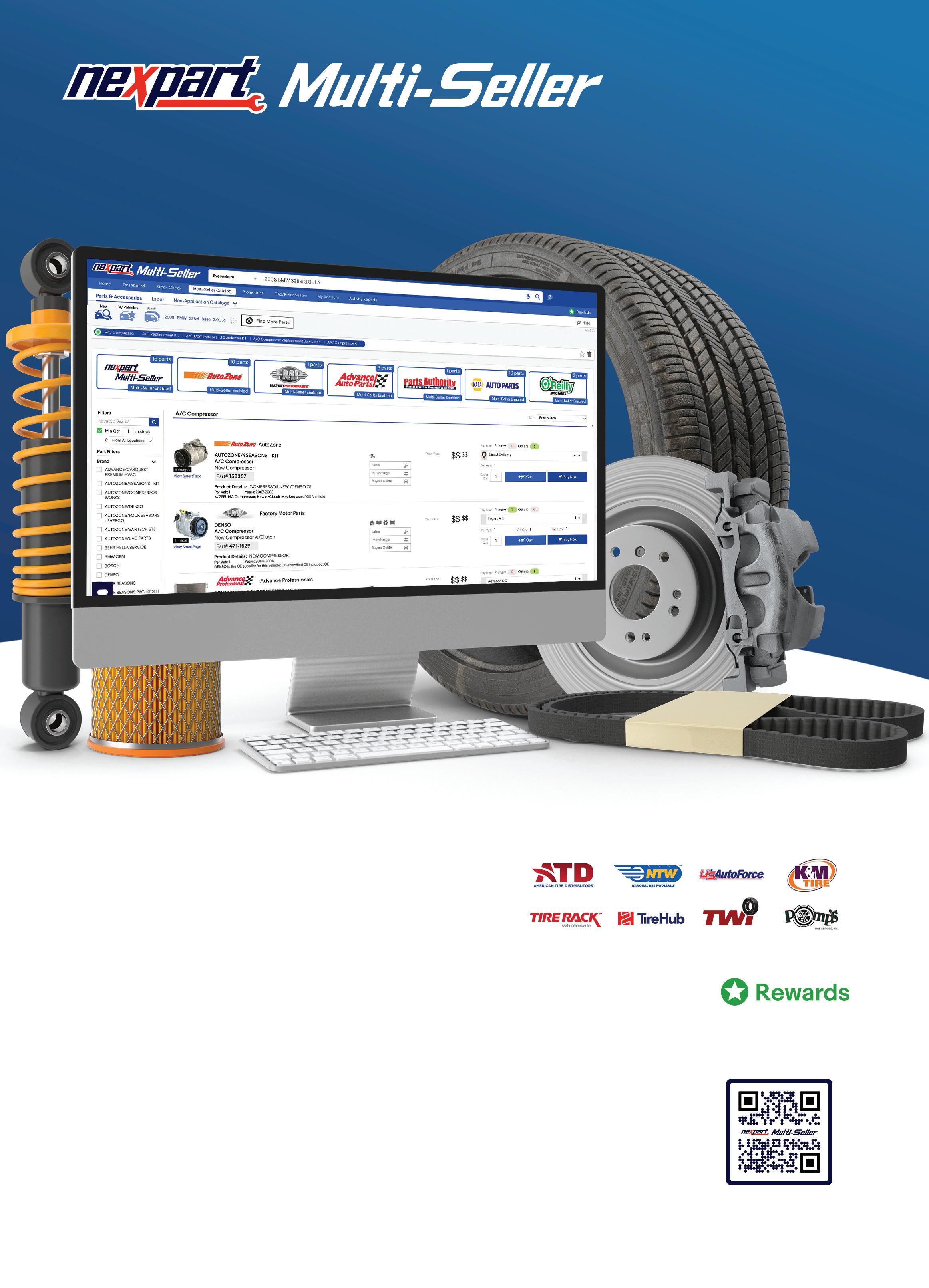
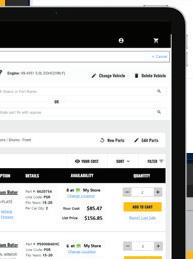
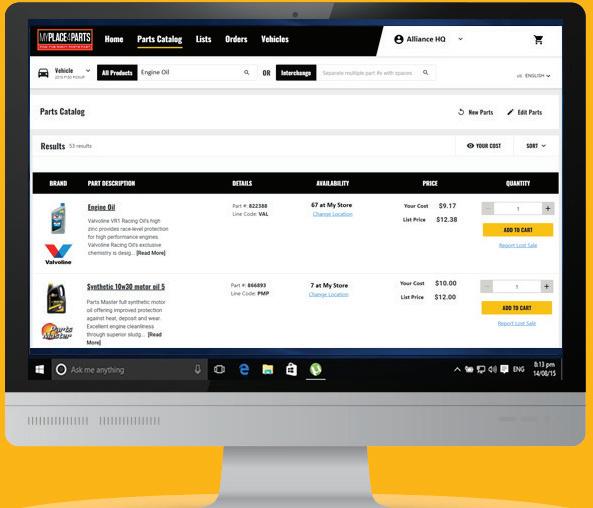
Wit h N expar t Mult i-S el ler you’re c onne cte d to real-t ime inventor y and whole sale pricing from al l o f your par ts suppl iers. Find par ts, t ires, and more Bui ld detai le d est imates fast!
Backe d by t he most c omprehensive catalo g in t he af termarket . You’l l se e more pro ducts, from more suppl iers, g iving you more c ontrol o f your supply chain.
earn points on every parts order Multi-Seller
ORDERING CATALOG
THE TECHNICIAN’S MOST ROBUST
MYPLACE4PARTS integrates seamlessly with leading shop management systems, providing a comprehensive electronic catalog for efficient parts ordering across automotive, truck, agricultural, marine, and small engine applications.
PARTS, ACCESSORIES, TOOLS, SUPPLIES, CHEMICALS. You need it, we’ve got it.
BY CHRISTINE SCHAFFRAN
MOST DOWNLOADED EPISODE
PODCAST: Bridging the Technician Gap: How Shops Can Adapt to the Industry’s Biggest Disruption
Thousands of technician jobs are still sitting open, but the shortage isn’t the only issue shop owners are facing in the new year. Keith Crerar, chief transformation officer at Repairify, shares how shop owners can stay competitive and safe while dealing with the technician shortage, rising vehicle complexity, training changes, and the latest technology.
MOST READ ONLINE COLUMNS
BUNCH: Why So Few Shops Break $3 Million: Part 6
From the outside, a shop can look successful, with new equipment and investments in the business. From the inside, however, it often feels far more fragile than it should. Aspen Auto Clinic and Transformers Institute CEO Greg Brunch continues his series breaking down the challenges shops need to address to break $3 million in revenue.
BROSKI: After the Customer Hangs Up
How often do you consider your shop’s attrition rate? Victor Broski explains why it’s important to re-evaluate the relationship between customers and service advisors and why a customer agreeing to a job on the phone doesn’t always translate to a positive experience.
RATCHET+WRENCH RADIO
Strategies and inspiration for auto care success.
Catch new episodes every Wednesday featuring thought leaders from across the automotive aftermarket. Scan to subscribe!
EDITORIAL
EDITORIAL DIRECTOR
Chris Jones
EDITOR-IN-CHIEF
Christine Schaffran
ASSISTANT EDITOR
Griffin Matis
ASSISTANT EDITOR
Kacey Frederick
CONTRIBUTING WRITERS
Tess Owings, Alison Johnson, Noah Brown
EDITORIAL ADVISORY BOARD
Tara Topel, Topel’s Towing and Repair
Andrew Marcotte, American Pride Automotive
Rachel Spencer, Spencer’s Auto Repair
Tonnika Haynes, Brown’s Automotive
Ceasar Cordon, Fifth Gear Automotive
Bill Snow, Rad Air Complete Car Care
SALES
PUBLISHER
Andrew Johnson / ajohnson@endeavorb2b.com
ASSOCIATE SALES DIRECTOR
Mattie Gorman-Greuel / mgorman@endeavorb2b.com
DIRECTOR OF BUSINESS DEVELOPMENT
Cortni Jones / cjones@endeavorb2b.com
ACCOUNT EXECUTIVES
(NATIONAL ACCOUNTS)
Diane Johnston / djohnston@endeavorb2b.com
Darrell Bruggink / dbruggink@endeavorb2b.com
Marianne Dyal / mdyal@endeavorb2b.com
Chad Hjellming / chjellming@endeavorb2b.com
Lisa Mend / lmend@endeavorb2b.com
Austin Miller / austinm@endeavorb2b.com
Kyle Shaw / kshaw@endeavorb2b.com
Sean Thornton / sthornton@endeavorb2b.com
ART AND PRODUCTION
ART DIRECTOR
Emme Osmonson
PRODUCTION MANAGER
Mariah Straub
AD SERVICES MANAGER
Jen George
ENDEAVOR BUSINESS MEDIA, LLC
CEO
Chris Ferrell
COO
Patrick Rains
CDO
Jacquie Niemiec
CALO
Tracy Kane
CMO
Amanda Landsaw
EVP TRANSPORTATION GROUP
Chris Messer
EVP ENDEAVOR BUSINESS INTELLIGENCE
Paul Mattioli
VP OF CONTENT STRATEGY, TRANSPORTATION GROUP
Josh Fisher
SUBSCRIPTIONS
Send address changes and subscription inquiries to:
Ratchet+Wrench PO Box 3257
Northbrook, IL 60065-3257
SUBSCRIPTION CUSTOMER SERVICE: 877-382-9187
ratchetwrench@omeda.com
LETTERS TO THE EDITOR
editor@ratchetandwrench.com
Opinions expressed in Ratchet+Wrench are not necessarily those of Endeavor Business Media, and Endeavor Business Media does not accept responsibility for advertising content.
AVAILABILITY
Millions of parts in-stock, ready to ship from four locations across the nation.
SELECTION
Parts available from over 1,500 top-brand name manufacturers. If you can’t find it, we’ll get it!
CONVENIENCE
Unbeatable customer service.
millions of parts from 1,500+
the
JUMP START
EMPLOYEE OWNERSHIP: BRAD’S SERVICE CENTER’S STORY OF SUCCESSION
When Peyton Leveillee’s father passed away, he wanted the shop to be in the hands of the team that helped build the business. Through a partnership with Teamshares, he made it happen
BY KACEY FREDERICK
Succession is a topic most shop owners will face at some point, and it can be one of the most difficult. Deciding who will take over the business is never an easy choice. In some cases, shop owners aren’t leaving the business to one person; instead, they are transitioning to a model of employee ownership.
When Peyton Leveillee was left with his father’s shop after this death, he was met with the same predicament. Though he wanted to convert the shop to employee ownership, the path to get there wasn’t so clear because there had been little planning and zero discussion about it beforehand.
Returning to the Family Business
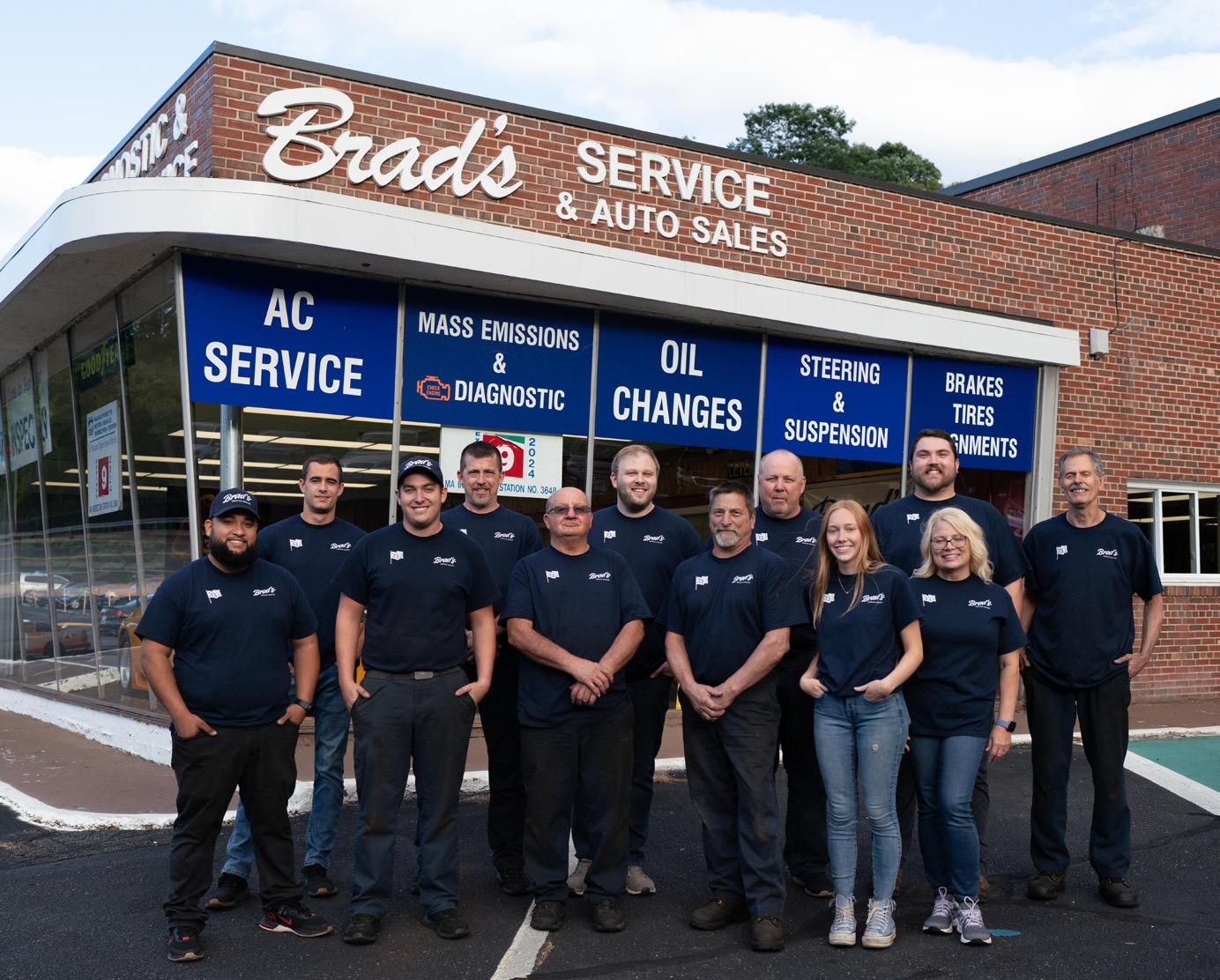
Leveillee’s father, Brad Leveillee, first opened the shop around 1980, just after graduating from high school. It was originally a gas station and a two-bay shop, with Leveillee’s father being the only employee. Through a connection with the original owner, he took it over and implemented increasing expansions from the 1980s into the early 2000s.
The shop went through several different locations before ending up at its current spot in Chicopee, Massachusetts, growing from
a one-person operation to a main garage with nearly 25 bays and a staff that included 7-12 technicians and three office personnel.
“He really put everything into the business that he had. Growing up, I remember him going to work at four in the morning and coming back home at eight or nine at night,” recalls Leveillee. “He really gave it his all.”
Leveillee assisted with small odd jobs as a kid, but as he came of age in the 2010s, he became more involved and realized he had a passion for the backend work of the business—specifically marketing. He decided to attend college and study business and psychology and began working within marketing and tech sectors.
During the COVID-19 pandemic, Leveillee returned to support the family business after the death of his father. With no succession plan and a team of loyal employees—some having worked there longer than Leveillee had been alive—Leveillee wasted no time in picking up the reins.
In the first week of taking over, the roof collapsed, the water heater stopped working, and the phones were dropping calls due to old wiring in the building. While Leveillee’s father handled much of the building maintenance, his declining health left much of it unattended.
While Leveillee had never planned to run the business himself, all he could focus on at first was keeping it afloat in his father’s absence. Fortunately, with a stellar customer service team, much of the focus was updating equipment for the shop, like lifts and oil systems.
“There were just so many fires that immediately needed to be dealt with. So, you know, my first year in the business was just heavily reinvesting back into the infrastructure that was there,” Leveillee explains.
A Solution That Checks all the Boxes
After about a year of helping the shop get back on its feet, Leveillee began considering the next steps. He didn’t intend on running the shop long-term; he planned to move to California and pursue a different career path. He thought back to a concept he learned during his time in college: an Employee Stock Ownership Plan. Having heard it pitched as
a solution in scenarios with family businesses facing succession issues, Leveillee wondered if an ESOP could be the solution his family’s business needed.
“I was like, ‘Okay, could something like this be a succession plan for me?’ Could I use an ESOP to exit the business but put the equity where I think it needed to go— which is with the people that really built this business,” Leveillee recalls.
It was the right track but needed more work. Upon further research, Leveillee determined an ESOP would be too complex and expensive for a small shop but he still wanted to leave the business with the people connected to it.
With his father passing away without a will, Leveillee was prompted to make up his own will. In speaking with his lawyer about the situation with the shop, he learned of Teamshares. Leveillee’s lawyer had recently represented a business that sold to the company with the goal of transitioning to employee ownership. It immediately caught Leveillee’s interest.
Employee ownership with Teamshares works a bit differently from something like an ESOP. Teamshares starts by purchasing the business from the owner, and upon sale, grants 10% of the company’s equity to the employees. Then, over time, the company uses its own profits to buy out Teamshares’ remaining ownership, gradually increasing employee ownership. Employees do not need to put in their own money and receive dividends based on the company’s profits as the process continues.
Upon reaching out to Teamshares, Leveillee not only met with representatives of the company but also former owners of businesses that were taken over by Teamshares. Leveillee got to hear firsthand accounts from people who went through the process and what it entailed for them. He soon decided that his goal for the shop was something Teamshares could help him achieve.
“It checked the number of boxes that I thought were really important: I was able to move on. The business was able to keep its name. People were going to get rewarded for their time spent in the business without having to pay a bunch of money into something,” explains Leveillee.
Involve Your Team in Every Step
While inviting Teamshares to take over did end up being the right choice for him, Leveillee was met with uncertainty from shop employees. He first shared the news with just the shop’s general manager and lead diagnostician, who initially agreed with the idea— but the day after breaking the news, they began to have doubts and considered leaving.
It was a terrifying moment for Leveillee, who had been working hard to keep the shop together. It required an extra push to involve the employees in a process they had, until then, been largely unaware of. Teamshares’ leadership—including the COO, CEO, and others—flew out to the shop for an after-hours group conversation to address the general manager’s and lead diagnostician’s concerns.
“I think what we ultimately came to was, ‘Look, they just needed some more time to sit with this.’ Because if you tell someone, ‘The business is going to become employee owned; it’s ultimately changing hands; we want you to be bought in,’ that’s not something people get to within a day,” says Leveillee. “So, take some time. Ask us some more questions. Let’s figure out how we can make this work. There was a lot of space for communication.”
That communication was essential. It helped Leveillee’s two lead staff members understand that it was a plan for them to
acquire ownership of the business without taking on any debt. After about a week and a half of discussions, they broke the news to the rest of the team, who—with the support of Leveillee’s lead members—were on board.
With the transition in motion, the shop appointed a new president to help fill a leadership gap. While the existing team was strong in technical and operational roles, Leveillee realized there needed to be a figure that would guide the team through managing aspects like systems, equipment, and coordination.
Leveillee had so much success with Teamshares that he now has a career with the company as an industry lead. But it was a long, hard road to get to where he is now. A shop looking to transition to employee ownership can’t take any shortcuts there—it can only happen with dedicated, consistent communication with your whole team.
“I do think one of the hardest things is the transition away from the former owner. The emotional ties that person has to the business—the emotional ties that all the employees may have to them,” says Leveillee. “I know that I’m coming from a lens of, ‘This is my father.’ Other former owners might have different relationships with their employees, and that’s fine. But ultimately, it’s a change, and getting anybody to buy into a new leader takes time. Both parties need to show up. Both parties need to trust each other.”
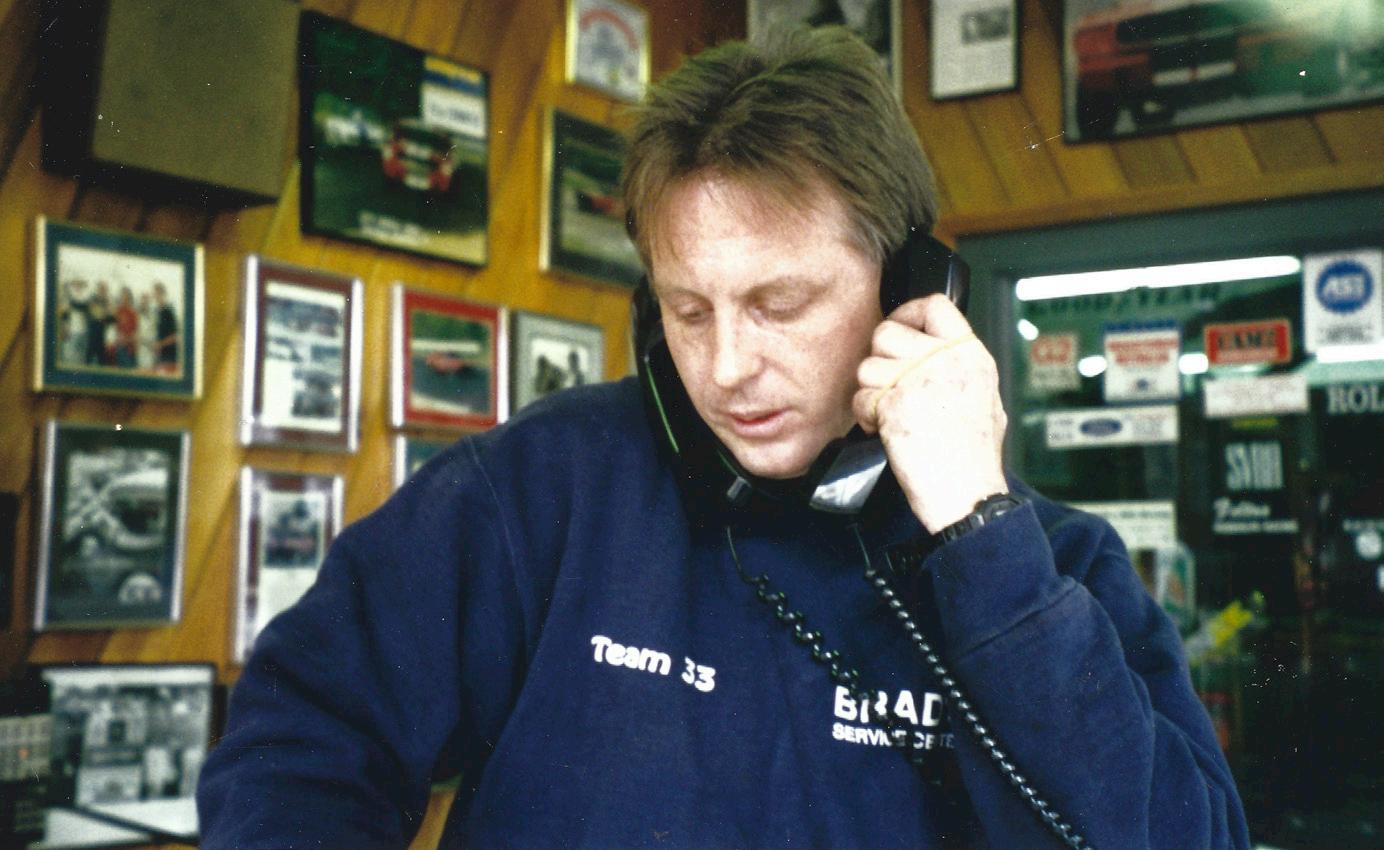
BRAD LEVEILLEE purchased his shop from the original owner in 1980 shortly after he graduated high school.
Cooper Standard Automotive Closing Ohio Manufacturing Plant
Cooper Standard Automotive Inc. will be shutting down its manufacturing plant in New Lexington, Ohio, reports The Street.
The company—which provides automotive products for sealing, fluid handling, and specialized rubber and plastic components—announced in a Dec. 8 letter to the Ohio Department of Job & Family Services that layoffs began Feb. 6, 2026, and will continue through the plant’s closure, which is set for approximately July 1, 2027.
One hundred ninety-three hourly workers and 35 salaried workers are employed by Cooper Standard Automotive. They will have the option to transfer to another company facility based on certain eligibility requirements. Components produced by the company include fuel and brake delivery systems, fluid transfer systems, custom rubber and plastic seals, spliced O-rings/ corners, custom molded profiles, die-cut, rubber-to-metal bonding, overmolding, molded details, dual and tri-durometer seals, clip-on seals, push-pin solutions, and vibration isolation and dampening.
“Cooper Standard is continually analyzing plant utilization and looking for opportunities to optimize our manufacturing footprint and overall operating efficiency,” the company wrote in its Dec. 8 letter. “As a result, the company has made the difficult decision to close our New Lexington, Ohio, facility.”
BMW Patents Screw Head That Would Require Specialized Tools to Remove
BMW has patented a screw that would require exclusive tools to remove, as shared in a report from CarBuzz.
The screw features the BMW roundel logo as its head, to be used in places where fasteners are usually visible, such as seat mounting places, as well as other parts including connecting “the cockpit to the load-bearing body structure.” Notably, these areas use large fasteners, and mildly high levels of torque.
The controversy with the screw is the tools that would be needed to remove it. Per the patent, “the shape of the engagement recesses prevents the screw from being loosened or tightened using common counter-drive structures, e.g. by
unauthorized persons.” If implemented, any repair provider working on a vehicle with these screws would require an entire set of specialized tools.
The concept is only a patent at the moment and may not make it to any part of production—but its revelation has sparked concern from independent repair providers.
Toyota Faces Multiple Lawsuits Over Allegedly Faulty Eight-Speed Transmissions
Toyota is now facing multiple class action lawsuits over its eight-speed transmissions, according to Driving.com.
The most recent one, filed in the Eastern District of Texas, alleges the UA80 gearboxes are prone to premature wear, stalling, poor shifting, and even failure. The lawsuit claims that the UA80’s control units force premature upshifts and torque converter clutch engagement, leading to damage.
Vehicle owners have also claimed the vehicle’s counter drive gear sub-assembly, which allegedly contains a main retention nut prone to detaching as a result of a defective backing tab. The electronic control unit will also keep the torque converter locked, according to the lawsuit, even when coasting.
Furthermore, the suit claims that repair costs for these issues can reach thousands of dollars, with one of the impacted parts—a gear drum—costing just under $2,300.
The lawsuit seeks to cover any current or former owner or lessee of the following Toyota or Lexus models: the 2017 to 2020 Sienna; 2017 to 2024 Camry; 2017 to 2026 Highlander; 2019 to 2022 Avalon; 2019 to 2026 RAV4 SUV; 2023 to 2026 Grand Highlander; and newly built Lexus ES 250, ES 350, NX 250, NX 350, RX350, and TX 350 models.
This is the most recent in a growing list of lawsuits surrounding the UA80. Another suit has been filed in the U.S. District Court for the Eastern District of New York, which details virtually the same defects.
Christian Brothers Automotive Franchisee Opens Second Texas Location
Christian Brothers Automotive has opened a new franchise location in Katy, Texas, reports Katy Times.
The new store, CBA Stockdick, is the
second Christian Brothers store in the area owned by Rob and Lydia Woodall. It’s joined by CBA Katy Westgreen.
“Katy has been home to our family for more than a decade, and we care deeply about serving our neighbors well,” said Rob Woodall. “Expanding with a second shop gives us the opportunity to support even more families in the area. Lydia and I look forward to providing guests with an experience they can feel confident in and continuing to build meaningful relationships throughout the community.”
A grand opening celebration was held in January.
“Rob and Lydia demonstrate the values that define Christian Brothers Automotive,” said CBA President and CEO Donnie Carr. “Their dedication to integrity, service, and community connection has shaped their success at Katy Westgreen, and we are proud to see them expand their impact with this new location.”
High-Speed Winds in New York Wreak Damage on Auto Repair Shop’s Exterior
High-speed winds in Lewiston, New York, caused an auto repair shop’s facility to suffer damage, reports Niagara Gazette.
Coppins Service Center has operated as a family business since 1937 and is located within a building dating back to 1909. The facility hadn’t experienced any severe weather damage until Dec. 29.
With high-speed winds in the area, the brick facade over Coppins Service Center came falling down. No one was hurt, but it left debris scattered across the front of the business.
The shop closed for around four hours, with the street in front of the shop being temporarily closed off for a little over an hour. Lewiston Fire Company No. 1 arrived on the scene, in addition to Lewiston Police, the village DPW, and even members from the community coming to help clean up.
“It opened the attic up, but I had some good friends and a great community that came together and got it done quick,” said Jay Coppins, a fourth-generation owner who’s operated the shop since 2007.
Coppins will need to go over the damage with insurance but predicts a repair will take at least a few months. He will also need to gain village approval for any repair plans.
Lighten Your Load with APEX Four-Post Lift Ramps
Four-post lifts are probably the easiest style of lift to use. They’re also incredibly versatile. They provide unhampered access under and around the vehicle, are the industry standard for performing alignments, and can be equipped for brake, suspension and wheel work. They even make it possible to stack two vehicles in a single parking space.
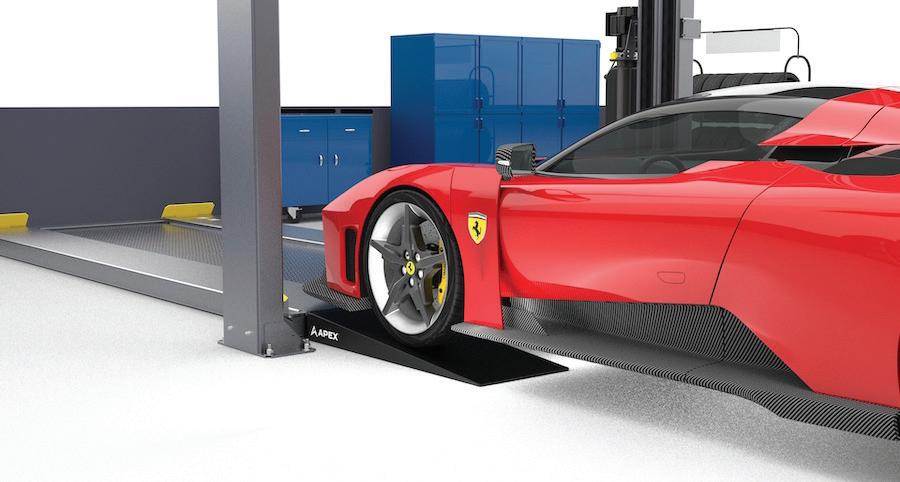
However, while four-post lifts’ built-in approach ramps are ultra convenient and can accommodate most vehicles, they just don’t work for many sportscars, supercars, luxury sedans and lowered builds. For vehicles with low ground clearance, splitters, lips and front overhangs, traditional ramps may be too steep, making scraping a concern.
To address this challenge, shops may choose to invest in longer ramps to lower the approach angle. But many techs hesitate to go through the hassle of taking off heavy steel ramps, dragging over slightly less heavy extended ramps, and then reversing the process when the job is done.
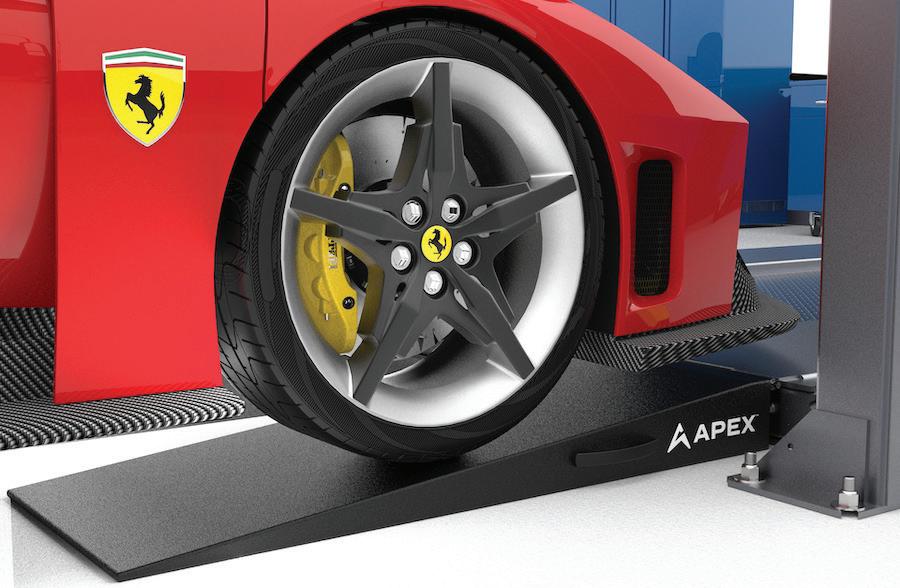
Now there’s a new lightweight and durable solution for easing low vehicles onto four-post lifts. APEX 48-inch four-post lift ramps are built of solid high-density expanded polystyrene (EPS) fully encapsulated in a high-performance polyurea elastomer coating to deliver smooth, stable vehicle loading while eliminating the flex, separation and premature wear common in other foam ramps.
Compared to 36-inch steel factory ramps that weigh 44 pounds apiece, APEX ramps are a full foot longer at half the weight: 22 pounds each. APEX ramps also have integrated thermoplastic handles molded directly into the body to make them easy to quickly lift, carry and position with just one hand.
APEX four-post lift ramps deliver a smooth 5.7-degree approach angle with 5 inches of lift, making them ideal not just for lowriders and performance vehicles, but also for those with standard ride heights.
These aren’t “off-the-rack” may-fit products. APEX lift ramps are engineered specifically for BendPak HD-7 and HD-9 Series four-post lifts to
deliver factory-grade engagement, stability and safety. The hook nose geometry, ramp profile and pocket engagement are all matched to the ramp receivers on these BendPak models for a positive, repeatable fit.
APEX four-post lift ramps are designed for true mechanical strength. A precision-formed S-shaped insert anchors deep within the foam core, distributing load forces through the entire ramp rather than just a surface joint. The proprietary
assembly is fully encapsulated in polyurea, sealing out corrosion and preventing delamination. This design eliminates loosening, separation and fatigue, even after years of heavy use.
BendPak
30440 Agoura Road Agoura Hills, CA 91301 (800) 253-2363
www.bendpak.com/apexramps
NUMBER OF LIFTS
Availability is key in understanding capacity
Vehicle lifts are a critical piece of equipment for fully servicing a vehicle, and the number of lifts in a shop often determines how many vehicles a shop can service at once. Square footage, ceiling height, and installation requirements can limit your options, but only 8% of shops say that they don’t have a lift. A total of 48% of shops report either 3 to 4 or 5 to 6 in-house lifts, with 16% having 9 or more lifts at their disposal. Here is the complete breakdown from the Ratchet+Wrench Industry Survey.
Want to read more from our 2025 Readership Survey and see how your shop measures up? Scan the QR code.
JAMMIN’ J AUTOMOTIVE
Through determination, community support, and strategic rebuilding, Doug Jacquot restored his business within seven months after a disastrous accident
STORY & PHOTOS BY GRIFFIN MATIS
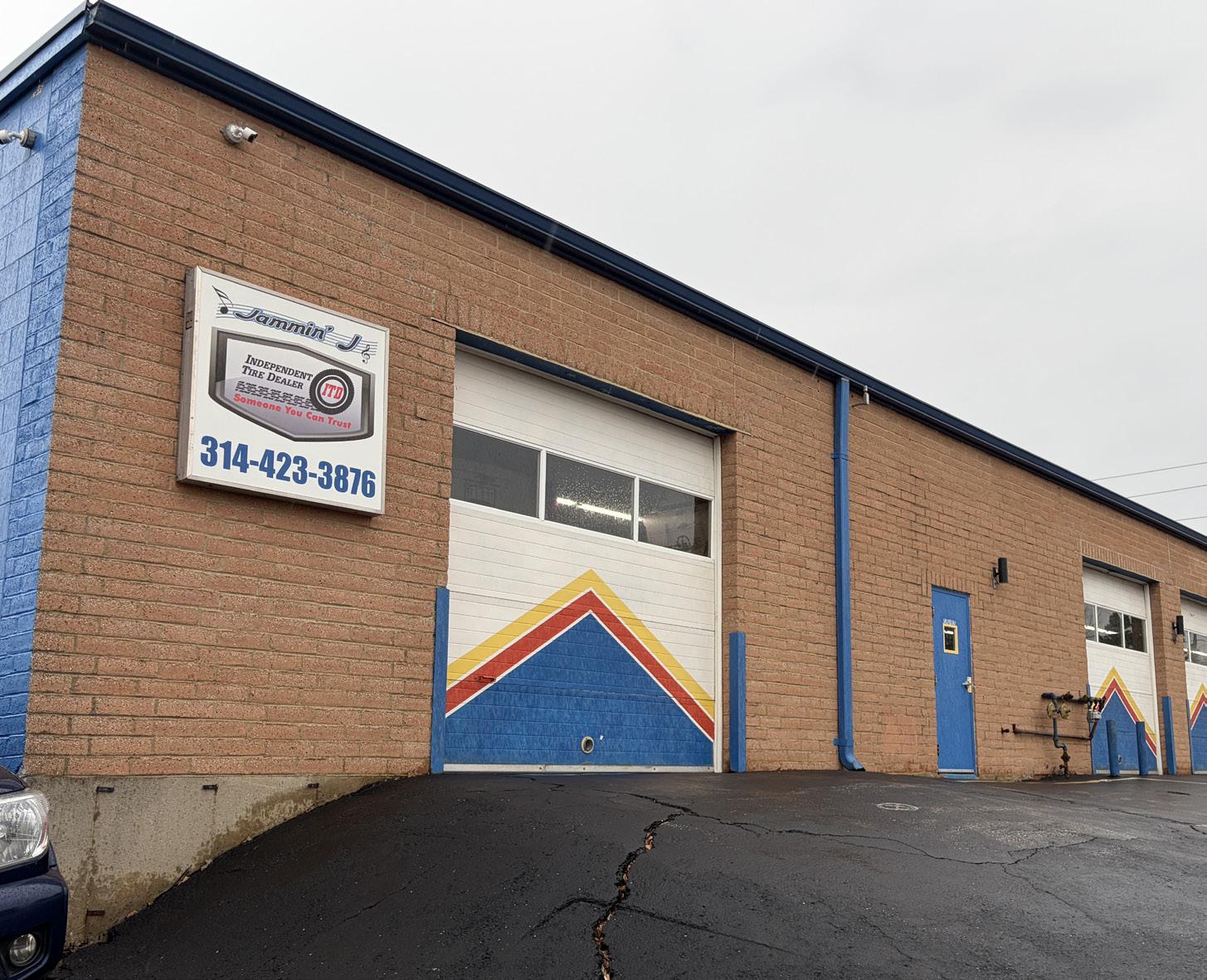
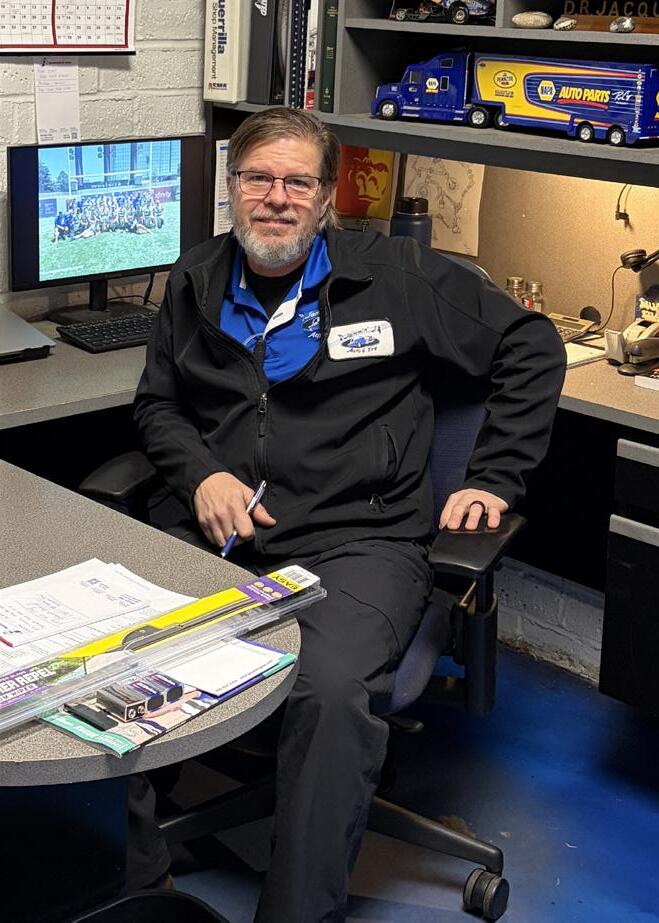
While it wouldn’t be unusual to find a vehicle in an automotive repair shop, it would likely be surprising to find one inside the lobby. That was the situation Doug Jacquot found himself in when a vehicle crashed through the front lobby of Jammin’ J Automotive in Overland, Missouri, on April 23, 2020. The car destroyed the front of the building, hit the front desk, and pinned Jacquot in the corner. He had just finished talking with two of his technicians, who were standing exactly where the car tore through the exterior just before the accident.
It’s hard to imagine a more frightening scenario as a small business owner. The very business you built comes crashing down quite literally and metaphorically due to factors beyond your control. Once Jacquot was unpinned
and extracted, he made a quick call to his wife to check the security footage and to implore her to get down to the shop. She made the 30-minute drive in 10 minutes. Hurting and dazed, all Jacquot could think was how annoying it was going to be to clean up.
REBUILDING AFTER THE ACCIDENT
Jacquot was seriously injured, requiring 89 doctor’s visits and more than $60,000 in medical bills, and he even had to have some of the nerves in his back deadened as a result of the accident. The damage wasn’t just physical— it was a traumatic and violent experience all around. Simply recovering took an enormous amount of willpower, but Jacquot could only rest so long before having to simultaneously work on restoring his business.
Jacquot is a co-chair of the St. Louis chapter of the Midwest Auto Care Alliance and was fortunate enough to have several chapter members and fellow owners help him clean up after the accident, but that was just the beginning. The rebuild process had a seven-month timeline, and the temporary conditions added to the difficulties.
“I went through the entire summer of 2020 with no air conditioning in this office and no windows that open,” Jacquot says. “It was brutal.”
Still, he felt that he had no choice but to soldier on. His insurance ultimately
JAMMIN’ J AUTOMOTIVE
Owner: Doug Jacquot
Location: Overland, Missouri
Staff Size: 3
Shop Size: 5,000 square feet
Number of Lifts/Bays: 7
HAVE AN OUTSTANDING SHOP?
Send a few photos and a brief description to submissions@ratchetandwrench.com and we might feature it here.
paid out about $45,000 for the rebuild, but it wasn’t until he hired a new employee amid the construction that he was able to make time for the dozens of doctor’s visits and contractor meetings required to get back to normal.
“I’d like to say I was strong, but I don’t know that I was,” he says. “You just have to go through it.”
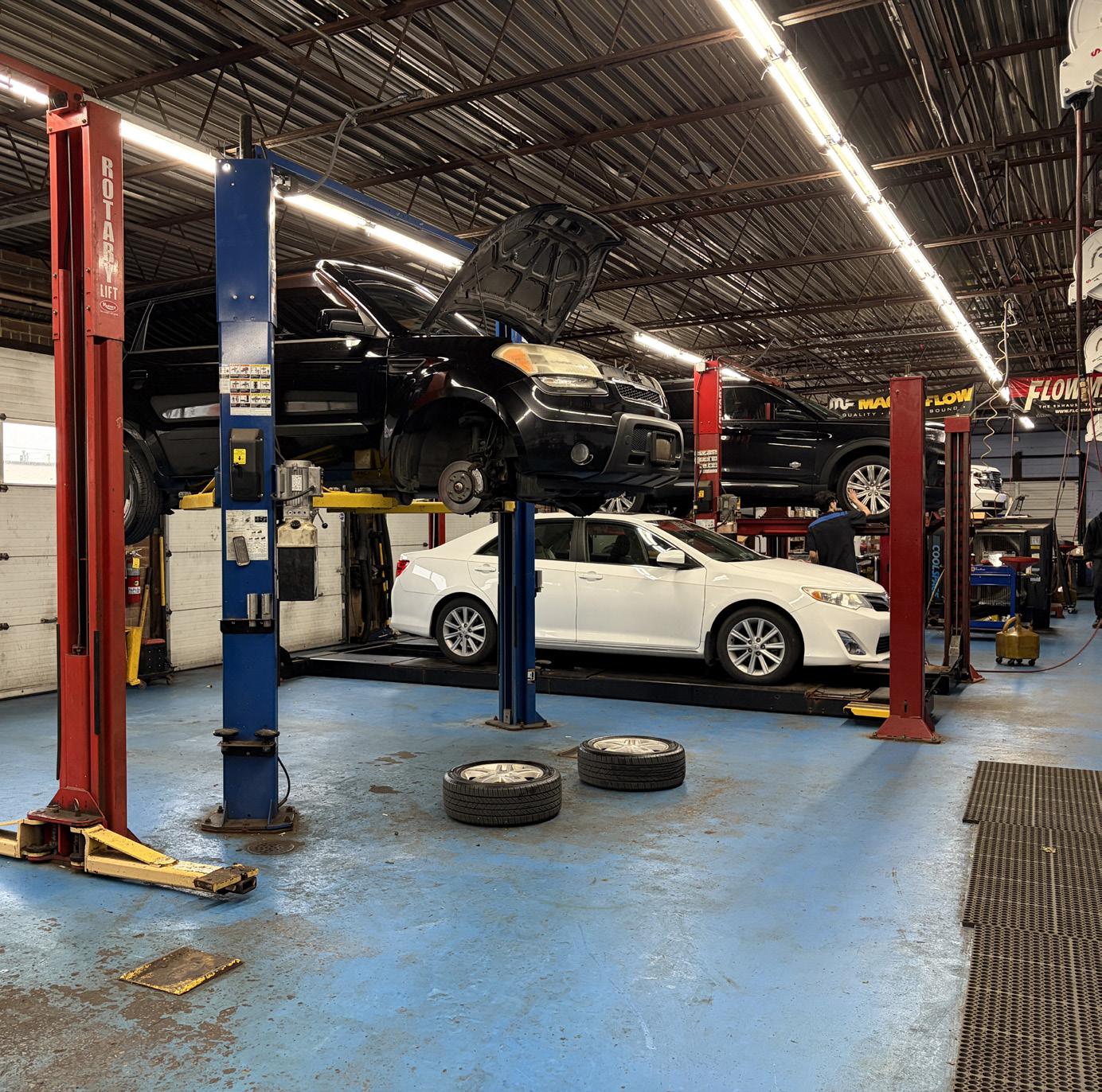
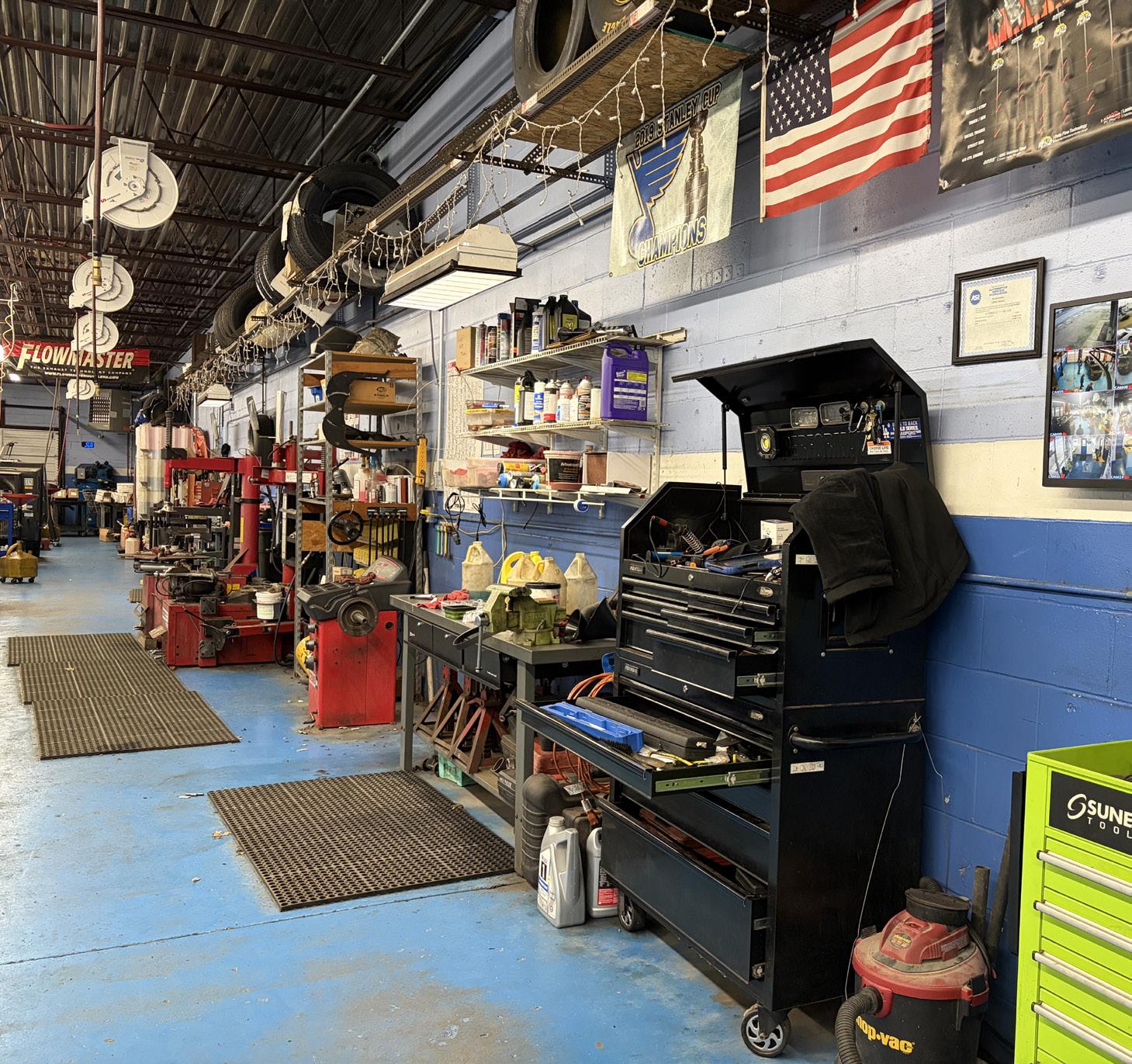
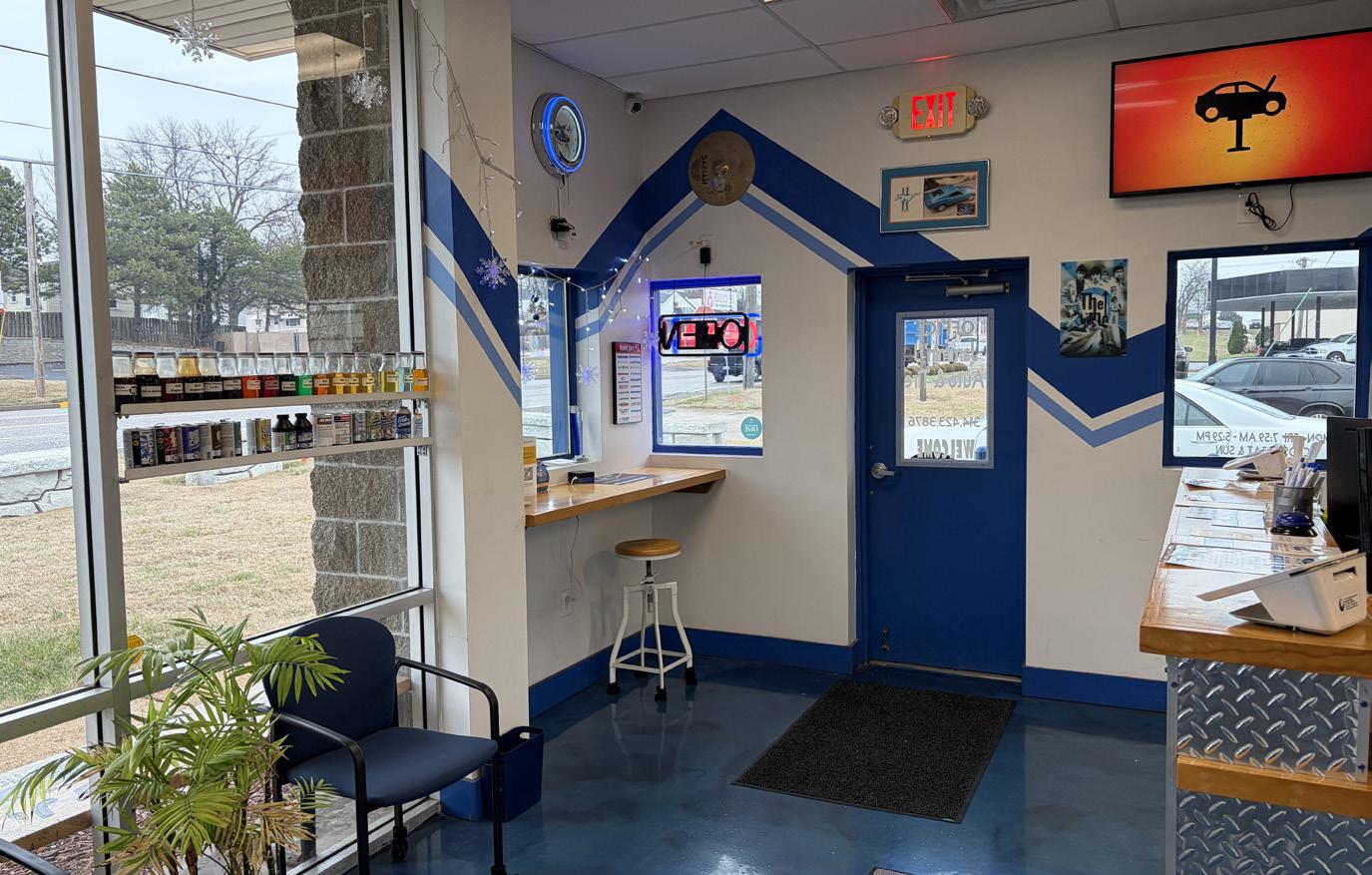
Back in 2018, he had moved from a tiny three-bay gas station setup to the current seven-bay setup, which required its fair share of rehabbing and upgrades but was far more accessible. Looking at Jammin’ J Automotive now, it’s essentially impossible to see the damage. Jacquot paid out of pocket to add new windows (“So I can see it coming next time,” he jokes), so the lobby is full of natural light. The same desk that survived the crash got a new countertop to replace the damage, and customers can wait comfortably and grab a cup of coffee in the rock ‘n’ roll-themed lobby. The rest of the shop remained untouched, which includes the sharp custom paint job that Jacquot himself designed and painted across the full exterior of the building.
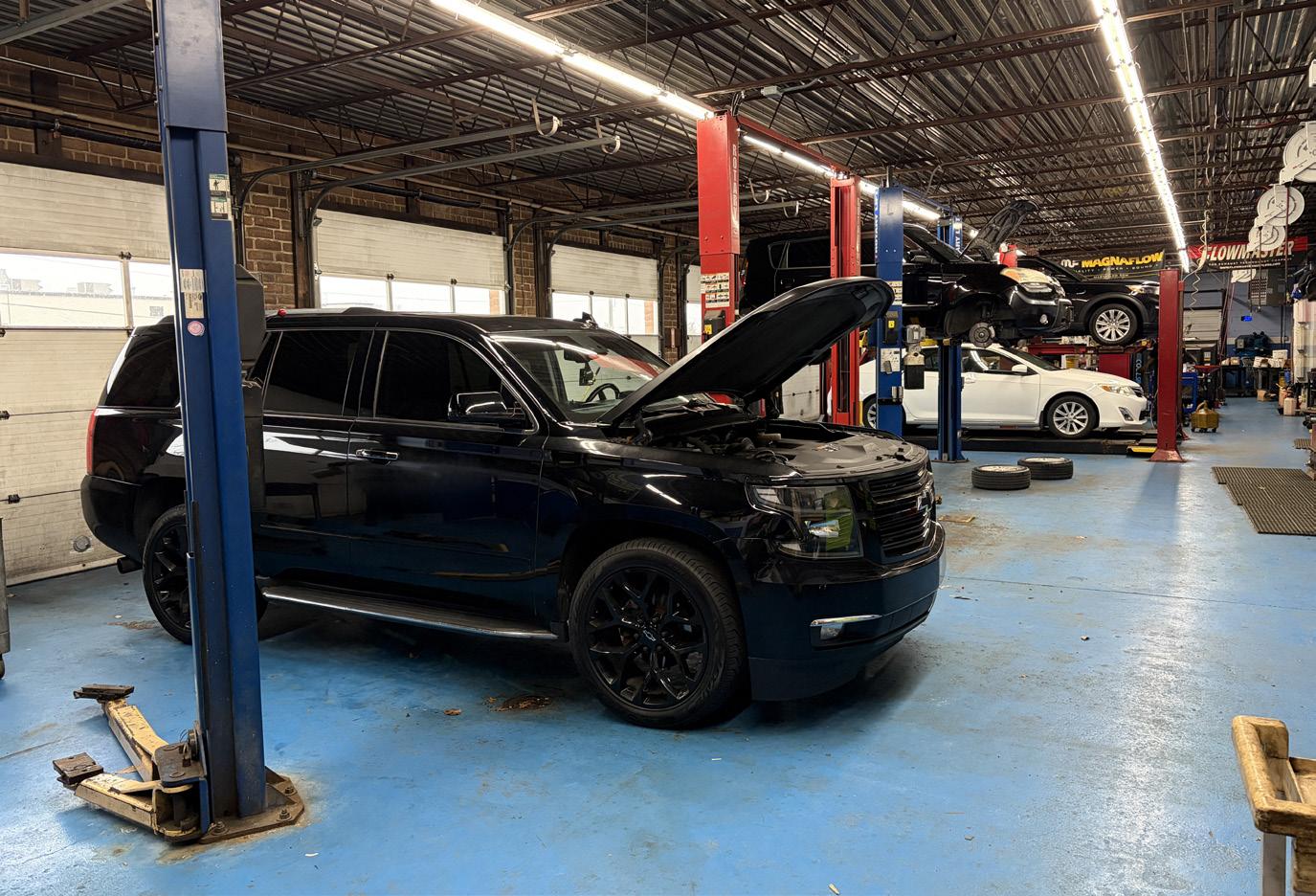
“I’m pretty proud of this new shop setup,” he says. “I have plenty of space between the bays and the cars. In my old building, I couldn’t pull in a long truck and shut the door.”
STAYING STRONG
Jacquot’s biggest piece of advice is simple: “Have good insurance, and when the guy who’s going to determine what gets paid for and what doesn’t comes around, you stand your ground,” he says. That extends to fully understanding what your insurance will cover as well as being ready to fight for everything you deserve. Try to document every change, every day, just in case the insurance company suddenly changes course or demands proof that the work was done to code.
After the first accident, Jacquot added stones along the strip of land between the shop and the road. In July 2023, a car crashed into the barrier. Jacquot soon replaced the stones with even larger ones, just in case, and in December 2024, a truck slammed into the larger stones. Despite the truck flipping over vertically, the shop (and the driver) emerged undamaged.
ROOTED IN SUCCESS
Simply—No
Sometimes it’s OK to say it to protect your business and your brand
BY LOLA SCHMIDT
During the holiday season, I love offering a hand to my friends who feel too overwhelmed to decorate their spaces. This past December, I had the opportunity to help a friend untangle garland and string glittery lights throughout her store. We talked about the upcoming holiday weekend in town, and how her shop would be booming! We were knee deep in tinsel when a customer approached that she has a great relationship with. Let’s call her Judy for today’s parable.
Judy told my friend a long, drawn-out story about needing a ride to the airport that weekend. She was asking my friend to take her at the exact time the shop should be opening for the weekend event. My jaw hit the floor that Judy was even asking this of my friend, who I watched stumble and stutter over the word no. She explained to Judy her shop needed to be open, and how she was the only employee of her business. She explained how the hour drive, one way, to the airport wouldn’t work with her timeline for the event. She said everything, but no. And as Judy persisted, I could see my friend breaking down. She was going to put the entire holiday event at risk to help her client.
NO SHAME
Recognizing what was about to occur, I interjected with a few words about the event’s timeline and offered up a wonderful driver I knew to get her to the airport safely. Judy happily accepted. My friend heaved a sigh of relief. When Judy left, I asked my friend why she just didn’t say no. I wanted to know why she considered allowing a single person to jeopardize an entire morning of events. It all boiled down to feeling like she let Judy down,
and having a tough time telling people no. I left that night thinking about how we overextend ourselves in life because we are uncomfortable with the word no. I started thinking about how many times I didn’t say no when I should have in business, and life. How many times I’d overextended myself to the point of exhaustion to make others happier. How many people I kept around when I should have let them go. How many times I allowed our shop to break policies that resulted in complete disaster. When I reflected, me allowing a yes, when there should have been a no, almost always ended poorly. And that no usually made me dip below my standards. You see, accommodation is an amazing gift we get to offer people, but it can also be abused if we allow it.
KNOW YOUR BOUNDARIES
For those of you who struggle with no, like my friend, there are moments in life no is ok. There are moments it is necessary. This is why standards and KPIs are important to identify and outline in your business. Clearly defining what has meaning to your brand helps guide you when decisions need to be made. You cannot say yes to everything. The standards you put in place create parameters for both business protection and growth. This makes saying no when the time comes a little less painful because there is reasoning behind it, as opposed to emotion. Take some time to consider the guidelines that define greatness in your business. I promise there will be a time when you will have to say yes or no, and it may be difficult. But if your business standards are clearly outlined, and you need to protect the culture and integrity of your brand, sometimes, it’s OK
Lola Schmidt is the vice president of operations and marketing for Schmidt Auto Care in Springboro, Ohio. She joined her husband, Erich, in helping to run his shop nearly 10 years ago with ambitions as high as her heels. Through the years, she has helped to develop an award-winning business that provides veterans with opportunities for employment as well as the community with a trusted resource for auto repair. Outside of the family business, she is a mom to one, a gardener, an artist, and a musician.
Lauralee@schmidtautocare.com
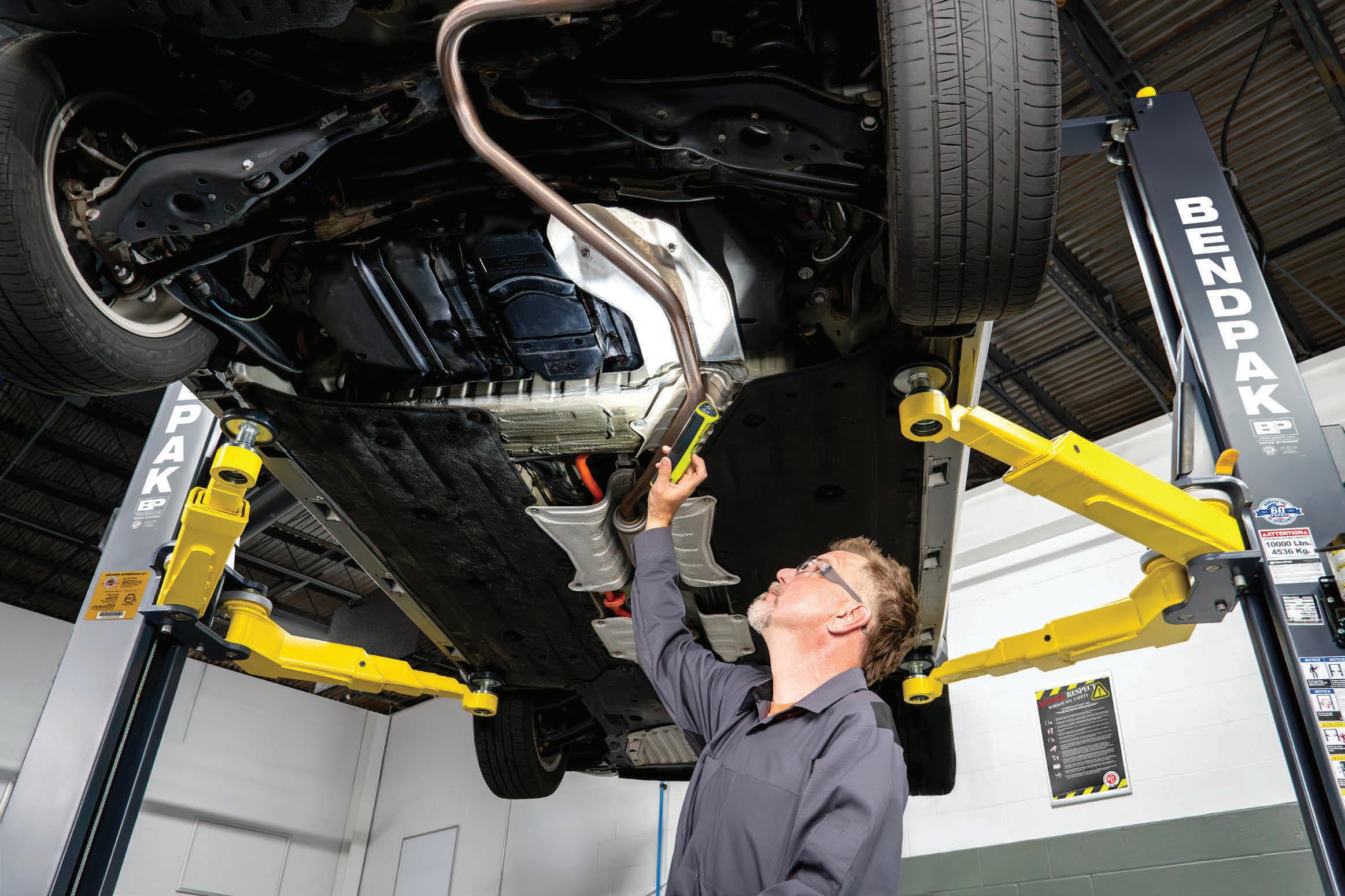
Every day, professionals and DIYers trust their lives to vehicle lifts. But the web is flooded with offshore resellers pushing uncertified, no-name lifts with bold claims — no proof, no oversight, no accountability.
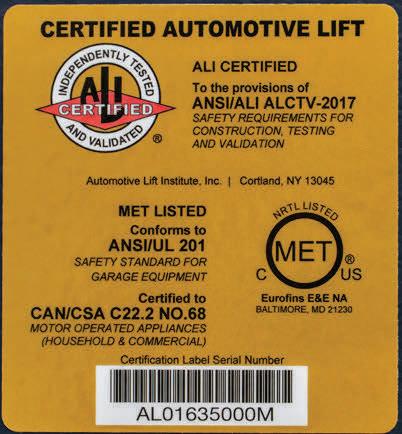
BendPak certified lifts meet ANSI/ALI ALCTV (current edition), the only nationally recognized lift safety and performance standard. Only certified lifts carry the ALI Gold Label and appear in the official ALI Directory, proof of third-party testing and validation.
At BendPak, safety is engineered into every lift. Built strong. Certified tough. And every Gold Label tells the story.
If you’re lifting cars and putting people under them, nothing matters more than safety. Don’t risk it on unverified imports. Get the lift that’s certified. Get BendPak.
Maximizing Efficiency: Strategies to Boost Profit and Customer Satisfaction
Real-world strategies on how to use digital inspections, organized bays, and effective communication to reduce bottlenecks and improve customer retention
BY CHRISTINE SCHAFFRAN
ORGANIZATION FROM THE FRONT of the shop to the back does more than streamline communication—it increases workflow and ultimately, your ability to turn a profit.
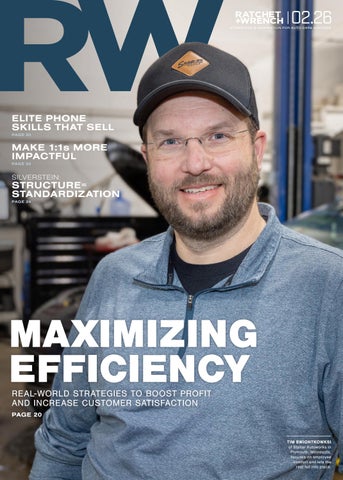
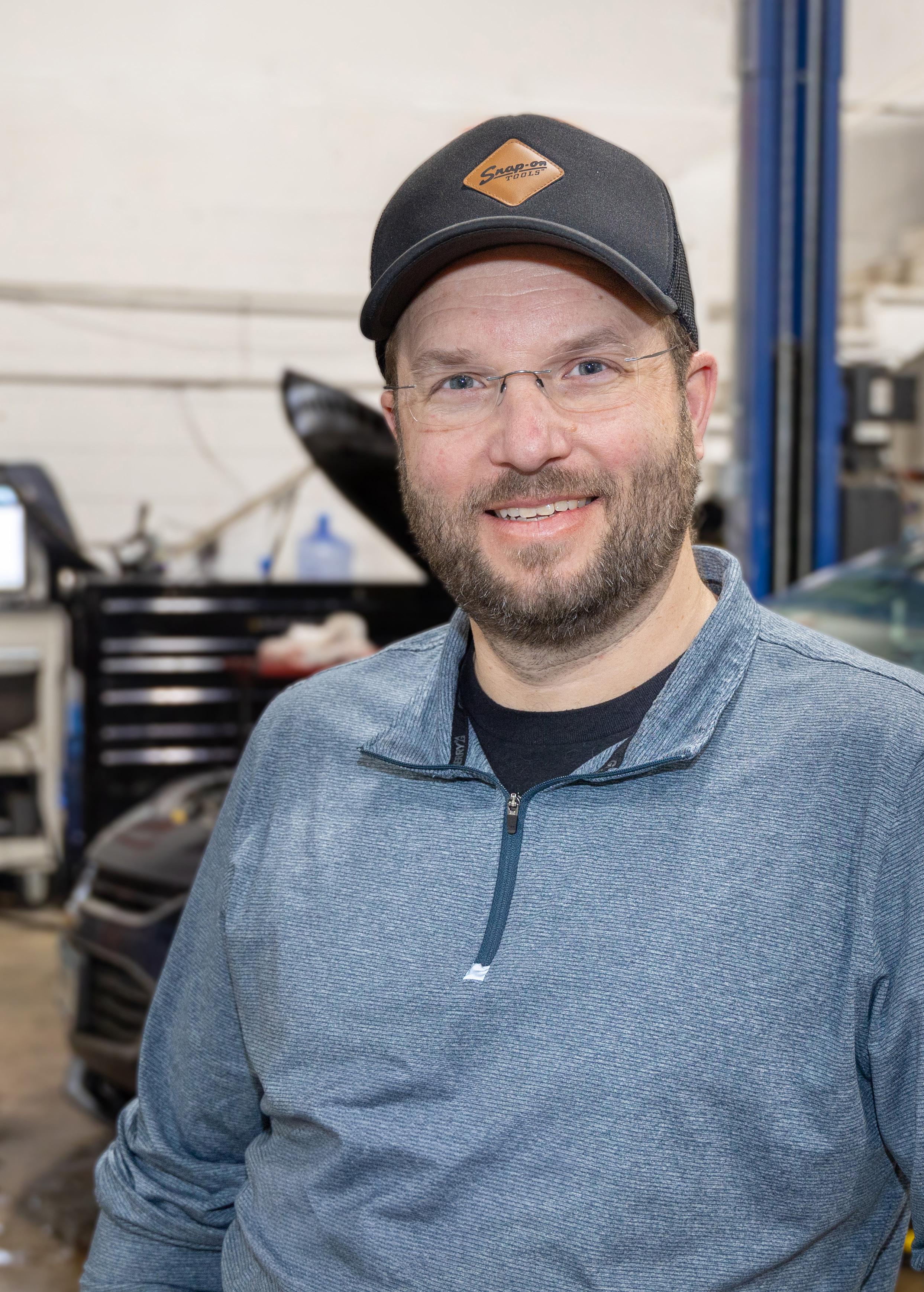
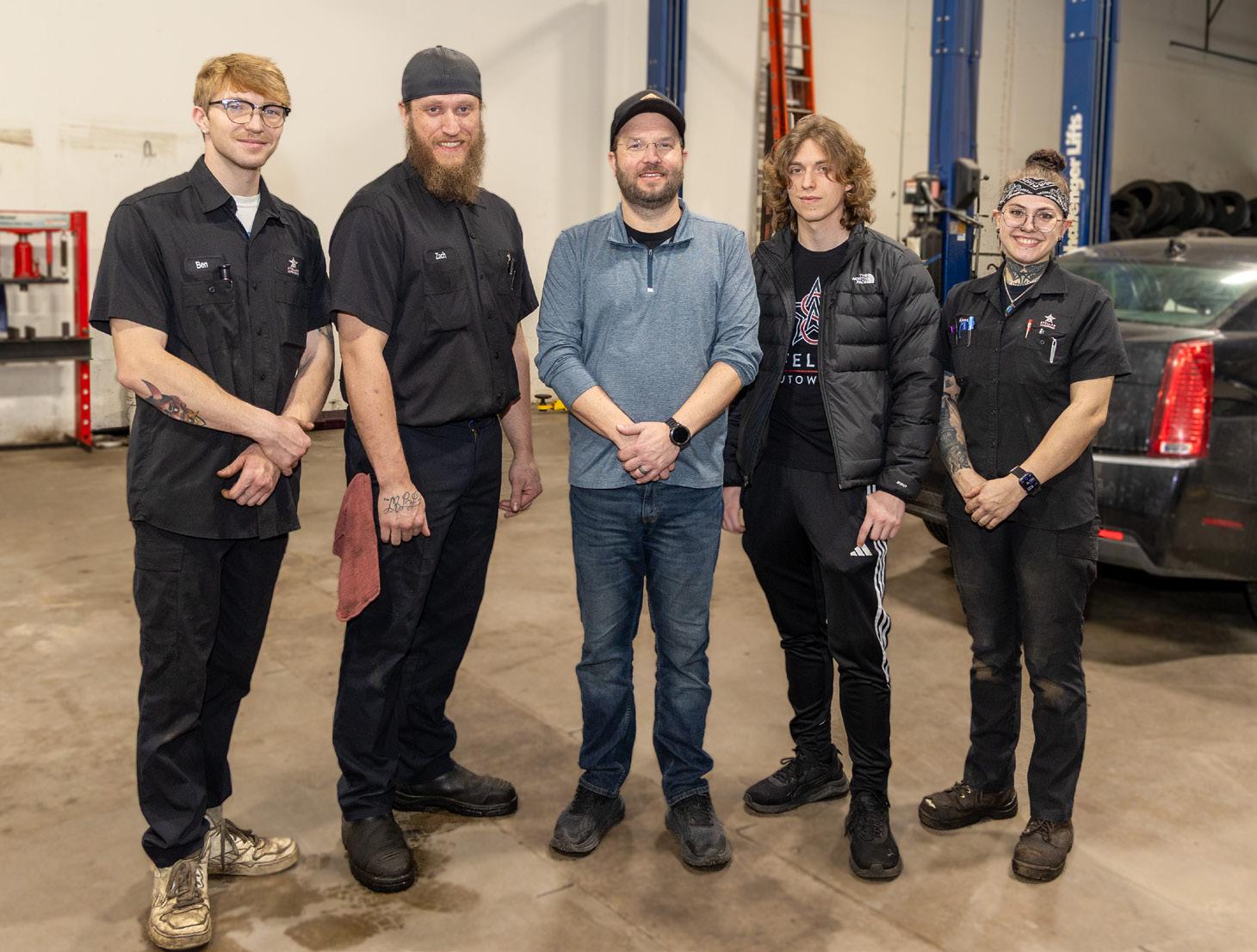
“We all know the process,” says Tim Swiontkowski, owner of Stellar Autoworks in Plymouth, Minnesota. “Get the cars in, get them looked at, get parts on the way, get them fixed, get them out the door. There’s not a lot more to it than that.”
However, if you routinely experience bottlenecks and delays in parts deliveries, or fail to utilize technology to assist your operation, you could feel the effects in everything from morale to the inability to monetize your efforts. So, what are the best ways to maxi -
mize efficiency and minimize downtime? Two shop owners share some of their best tips for increasing customer satisfaction while making sure employees remain productive in the bays.
SEAMLESS PROCESSES
When it comes to delivering the best experience for customers, Swiontkowski says, nothing beats a good process.
“I think it’s pretty common practice from what I’ve seen, but maybe there’s shops out there that aren’t doing digital inspections,” he notes. “I think that’s probably one of the best ways to provide transparency.”
He adds that meticulous notes and records also go a long way not just in
making sales, but in establishing a rapport with customers for long-term relationships. To achieve this, Swiontkowski says each of his technicians has a tool cart with a built-on tabletop that hides a secret weapon—a laptop with a battery-backup power strip to record every vehicle’s evaluation and diagnosis.
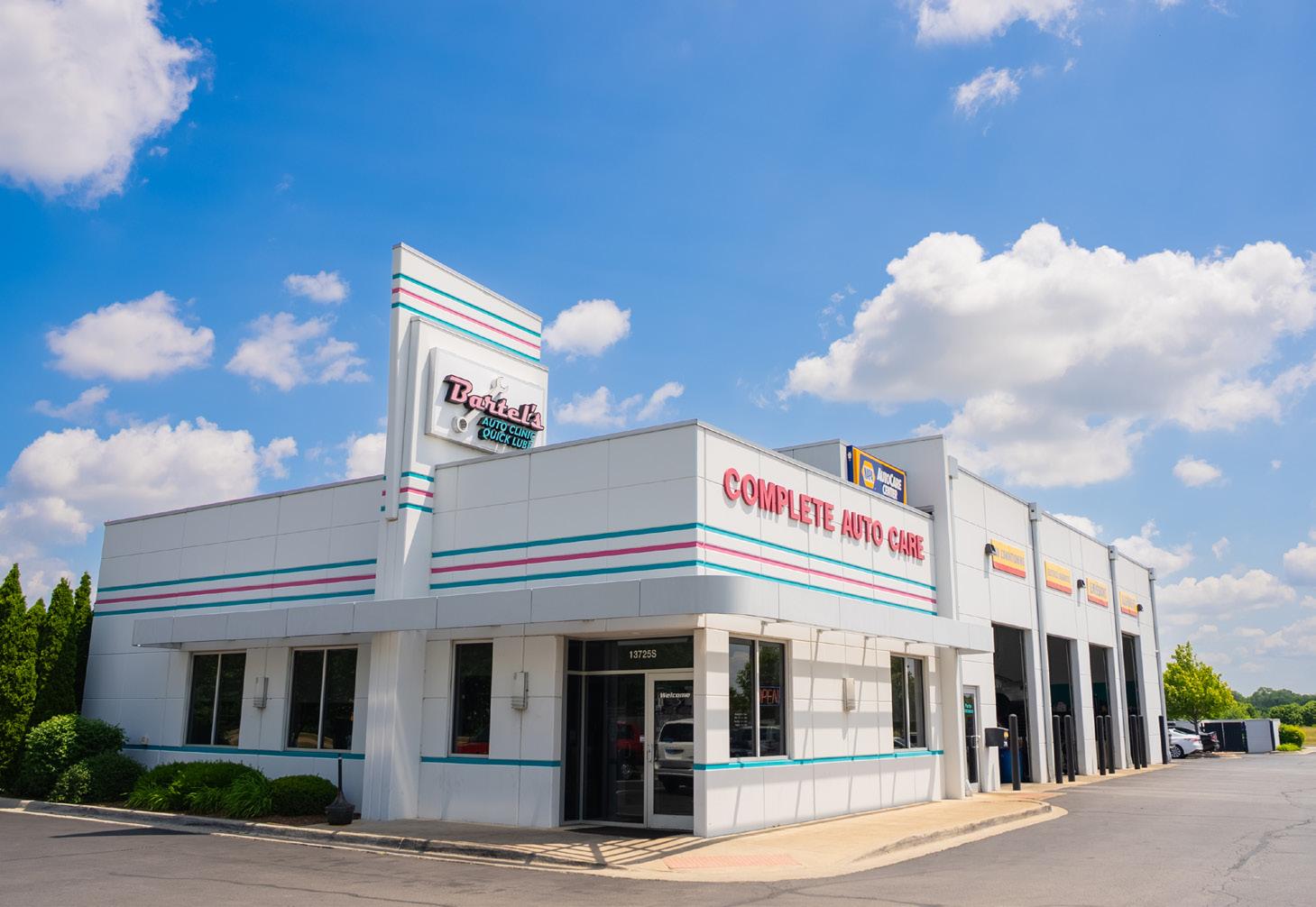
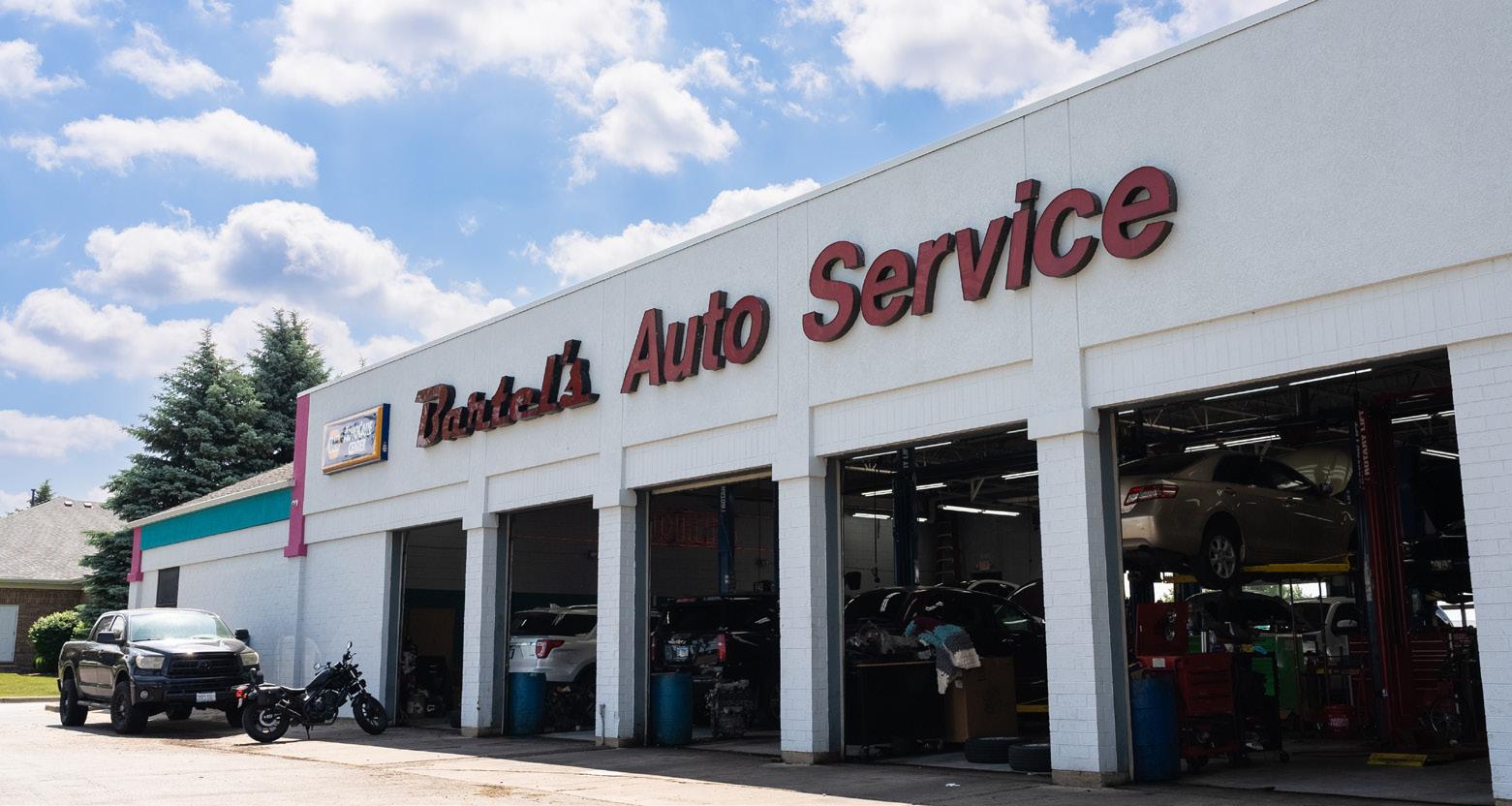
To keep the lines of communication open between technicians and service advisors, a shop management system is utilized for customer interactions while Slack is the platform of choice for internal odds and ends, such as low shop supplies or waste pickups. Meanwhile at Bartel’s Auto Clinic’s three shops in the surrounding Chicago area, Amy Bartel’s secret sauce involves a
PHOTOS BY AUTOSHOP MEDIA & TONKA REAL ESTATE PHOTOGRAPHY: DAVE MUELLER
single bay and a process that ensures every vehicle makes it through the door to be examined the day of the customer’s initial request.
It begins with the rack attack.
STREAMLINED WORKFLOW
Bartel, a fourth-generation co-owner along with her brother, Adam Bartel, says their rack-attack concept has been an absolute game changer in their communication with customers who are typically in a panic when they call to report an issue with their vehicle.
“They’re there because they’re at the doctor’s office. They want to know what’s wrong with their vehicle,” Bartel explains. “Why is my car presenting with this symptom?”
To address concerns as quickly as possible, bay one is reserved only for vehicle inspections, which are expected to take
about 15 minutes. From there, the vehicle is triaged and assigned accordingly. Bartel notes this one adjustment in their process has allowed them to never turn a vehicle away from being seen on demand.
“In bay one, the rack attack bay, there’s absolutely no work being done. That is an inspection bay only,” she stresses. “So, no matter what, when that phone rings, I can tell a customer, ‘I can get you right in.’ Always having that bay space available to bring a vehicle in has astronomically increased our efficiency and getting vehicles in and out.”
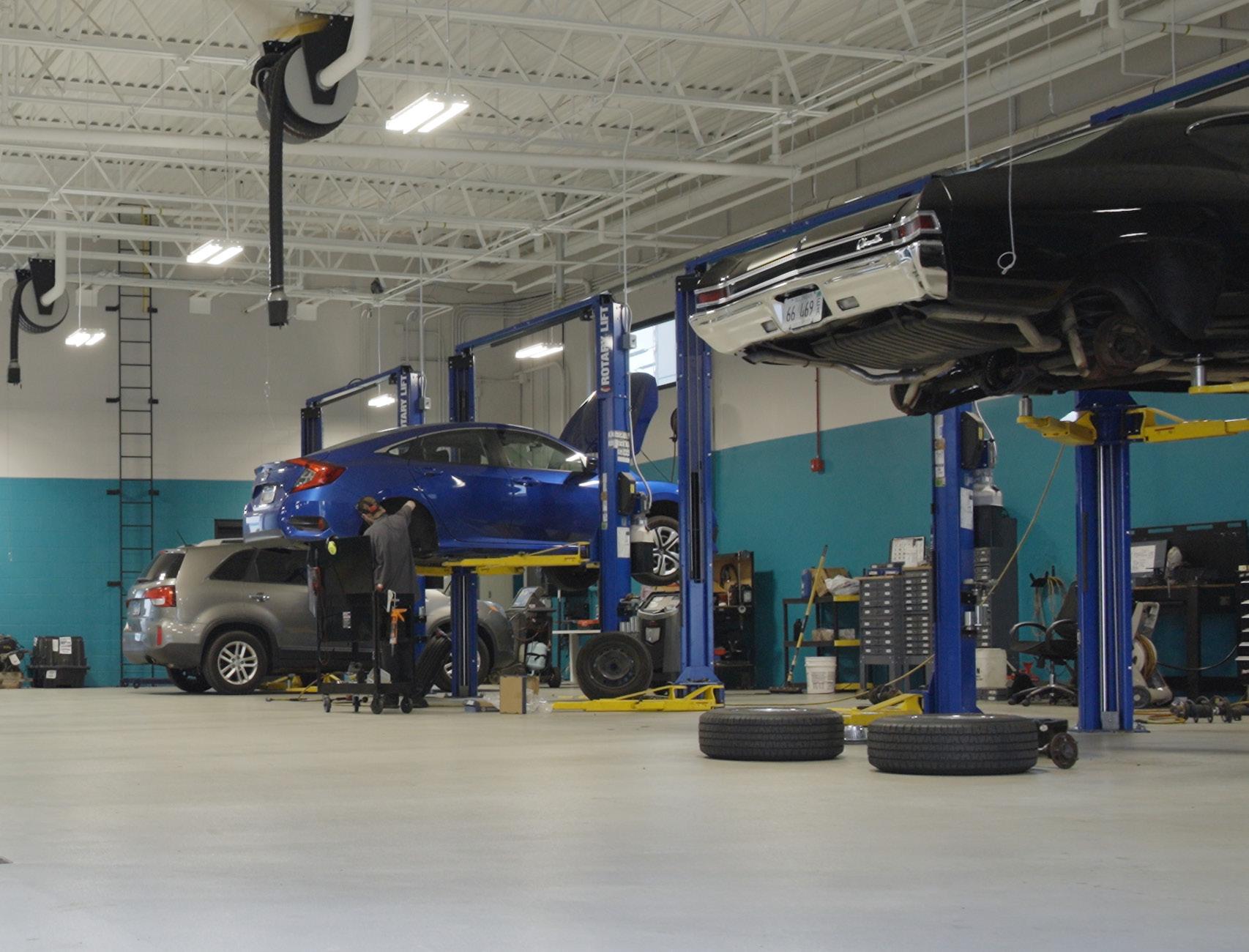
With nine bays and only three technicians in a 9,000-square-foot warehouse space, Swiontkowski describes himself as a “bit of an oddball” when it comes to the workflow formula that best addresses customers’ needs. Since each technician can spread out their work over three bays, Swiontkowski says the cadence of the day is more important in his case. For this reason, all vehicles are morning drop-offs by appointment only.
“Everybody just drops their car off just wanting an oil change, but we know better. For us it comes down to appointment management and knowing that
our average repair order is going to end up being north of $500,” Swiontkowski explains. “So, if we’ve got these eight cars in here for the day, let’s spend the time we need to and manage our workflow that way. And we can probably count on half of them getting some significant work done.”
He adds that while he does occasionally assist his technicians, he is most focused on his marketing efforts.
“I don’t want to let up off of the marketing because I feel like that is the no. 1 way to create workflow and efficiency is by making the phone ring,” he explains.
PRODUCTIVE LAYOUT
And while most might consider investing in overhauling a space to improve traffic flow or make tools more centrally accessible, Swiontkowski encourages shop owners to think outside the box.
“One of the things I found that really helps with efficiency and employee satisfaction is I air conditioned my shop,” he notes. “So, it’s air-conditioned, it’s heated, it’s well lit. I try to keep everybody comfortable because comfortable employees are happy, and happy employees make for happy customers.”
Bartel agrees a small shift in thinking can make all the difference. In their case,
it meant removing the distinction of designating bays for individual technicians.
“I think the auto industry mentality is, ‘This is Joe’s bay. This is Tyler’s bay. This is Phil’s bay.’ When we do that, we’re cutting productivity just by designating a bay. So, the biggest shift that we’ve made is these are all our bays. We’re all working as a team. We have plenty of cars coming in, so there’s no reason that I’ve got any technicians that are starving.”
Bartel adds being able to flip cars out of bays like restaurants flip tables if a job stalls while waiting on parts is another benefit of getting away from the designating bays game.
“There’s a reason that technicians come with carts, right? You can move that cart to any bay around the shop. There’s no reason that you need to have a designated bay,” she asserts. “So, I think that that first and foremost is huge in bay efficiency. If I’m waiting on parts, get that car out of the bay and get another car in the bay.”
RESPOND TO THE EMERGENCY
Ultimately, Bartel says, the speed of communication is going to make or break your operation.
“At the end of the day, it’s about speed of service, not speed of repair,” she
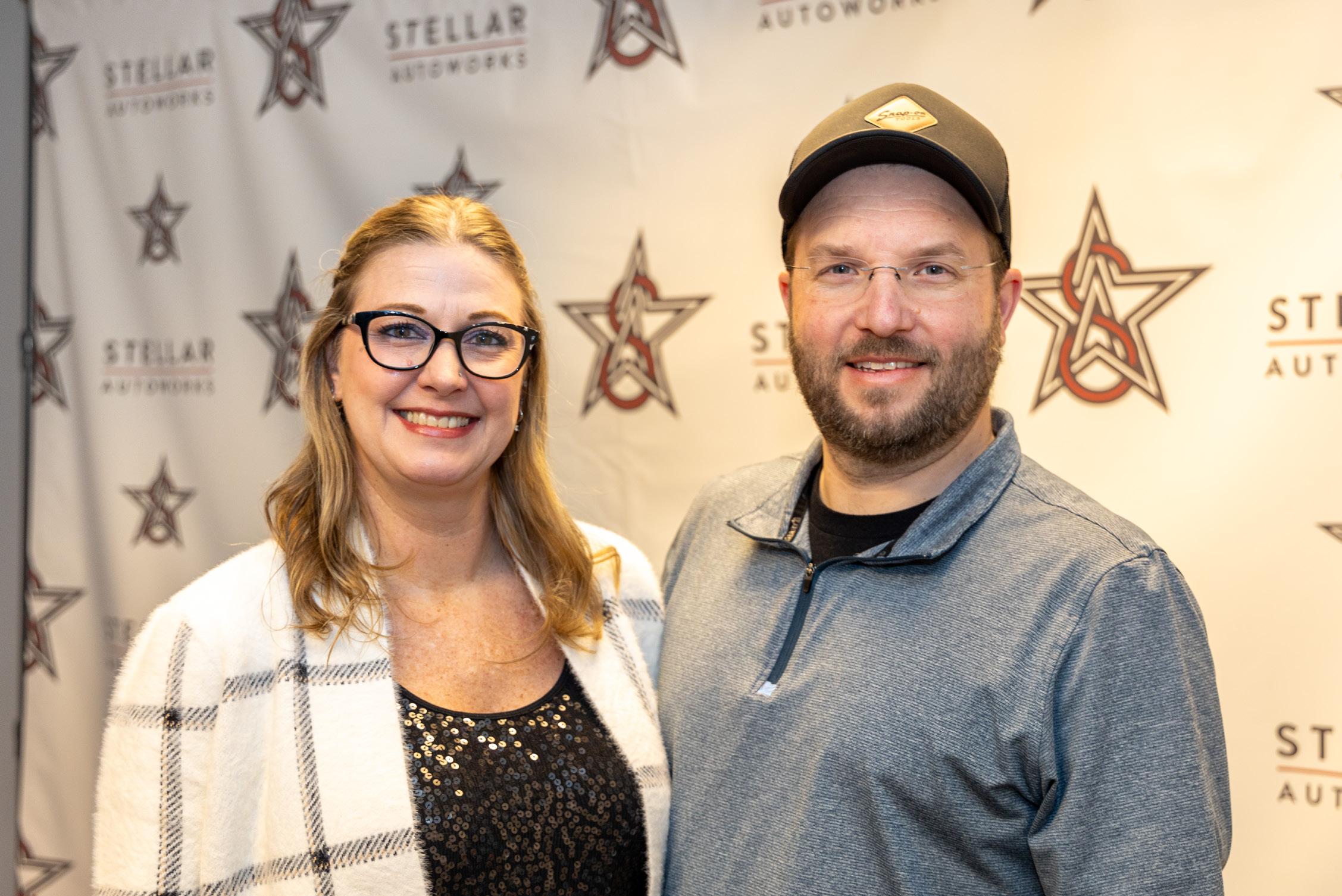
DENA SWIONTKOWSKI was affectionately known as Customer #132 before becoming Tim’s wife. They originally met in a college class where Tim first wrote the business plan for Stellar Autoworks.
“We operate as auto hospitality. We are here to solve any of your problems.”
— Amy Bartel, Bartel’s Auto Clinic
KEEPING
CUSTOMERS INFORMED with check-ins at 10 a.m. and 2 p.m. helps to minimize the number of phone calls coming into the shop, which increases shop efficiency, says Amy Bartel, co-owner of Bartel’s Auto Clinic.
points out. “I think that’s a big misconception in the industry.”
Check-ins at 10 a.m. and 2 p.m. not only routinely deliver updates so customers know what is happening with their vehicles, but ironically it, too, helps with workflow.
“It is directly tied to how efficient the shop is because now you don’t have problems with customers calling and going, ’Well, you promised me this, and you’re not delivering,’ right? Instead, we under promise. We over deliver,” she says. “If we are communicating with the customer, and they know exactly what’s happening multiple times throughout
the day, they’re more confident in our repairs, and they’re more confident because of our transparency.”
Like any good repeatable process, the results are measured by your ability to turn one-time customers into lifelong patrons of your business.
“Everything comes back to the hospitality piece of the customer, waving that white flag, and us being here to help, and seeing how quickly we can get to servicing them and helping them,” Bartel says. “We operate as auto hospitality. We are here to solve any of your problems.”
As such, Bartel likens their approach
to being the ambulance that responds to a customer’s emergency in their time of need.
“I know when my check engine light comes on, I’ve got a problem, and that’s generally the general public, right? They have no idea what’s going on, so they are literally calling in an S.O.S for help,” she notes. “So, what do we have to do to help them take it off of their plate and to get it into our shop as quickly as possible? And most of the time, creating that sense of urgency also iterates to the customer, ‘Not only is your problem important to me, but I will do anything I can to help’.”
From Dream to Drive
With
a path that extends from reading repair manuals to managing a thriving auto shop, Ashley Jo Bloom highlights her dedication, expertise, and commitment to community and industry growth
BY ALISON JOHNSON
PHOTOS BY ASHLEY JO BLOOM
BY AGE 16, ASHLEY JO BLOO M had decided that one day, she would open her own automotive shop. At the time, she was struggling to keep her old Volkswagen Dasher on the road by reading about basic repairs in how-to manuals.
After a short stint in the Navy— much of it spent powering through the pain of a fractured hip—and about 10 years as a Field Service Engineer, Ashley Jo transitioned to be an Automotive Technician and realized her dream.
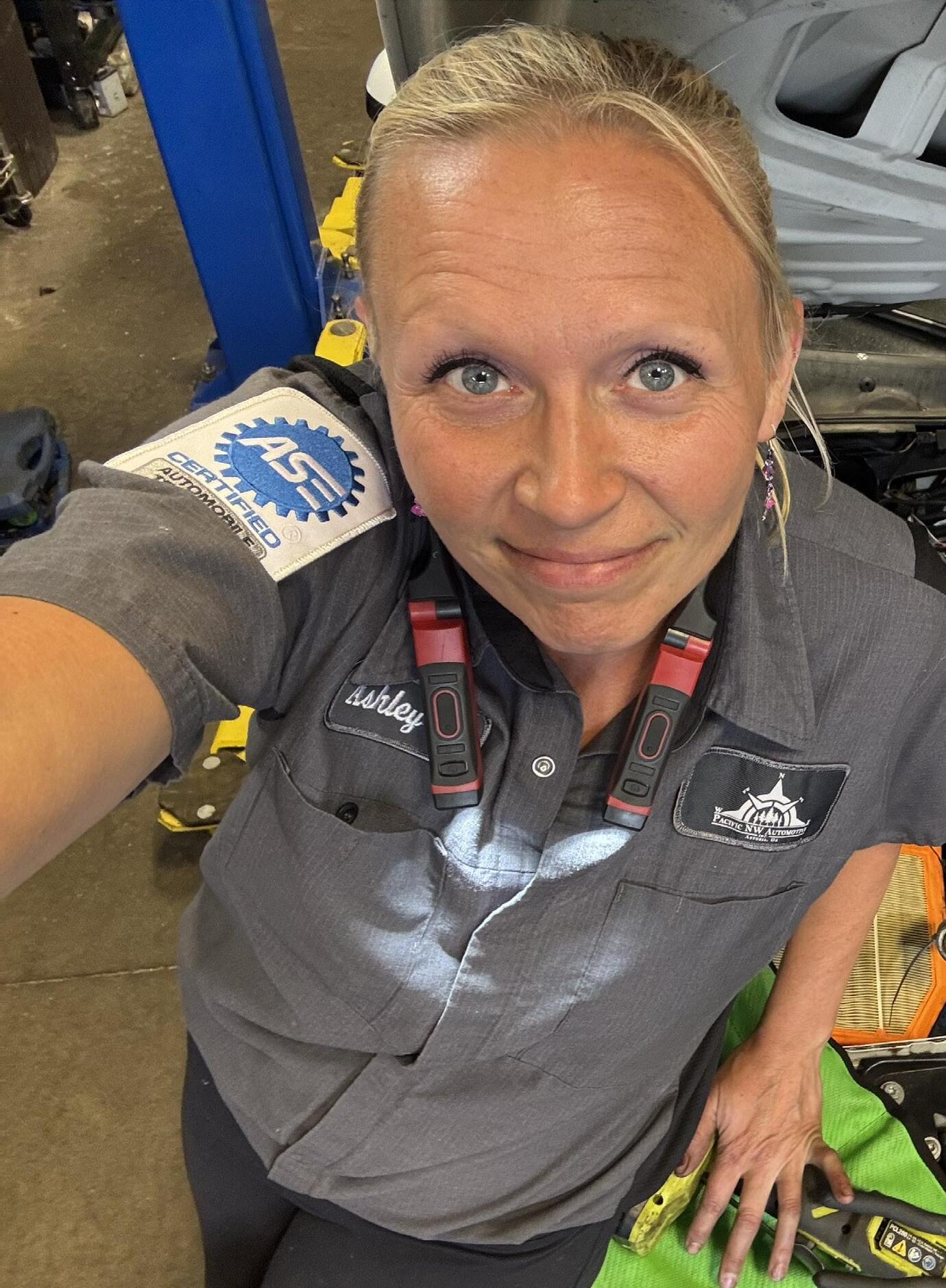
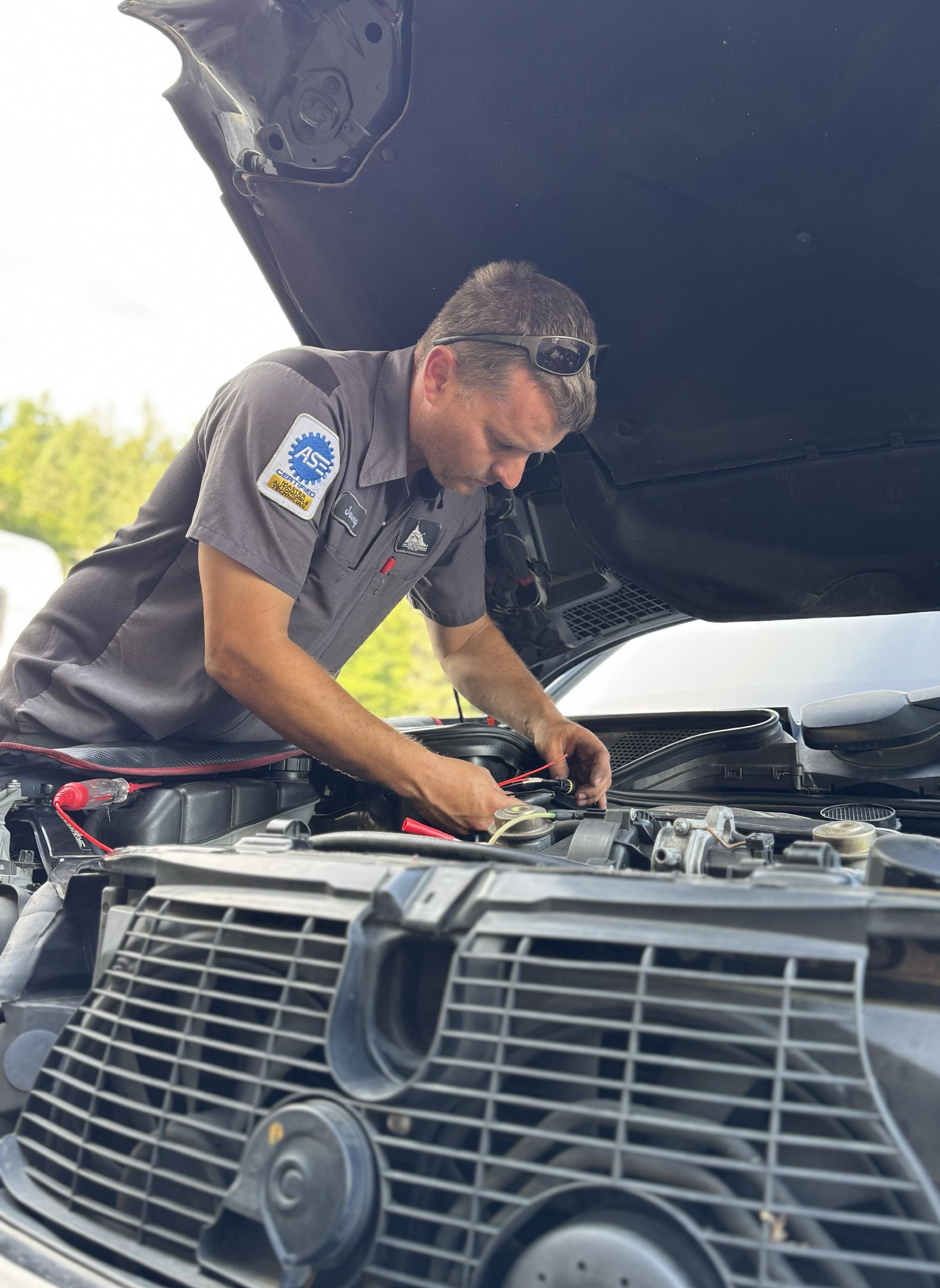
Since 2019, Ashley Jo and her husband, Jeremy, an ASE Certified Master Technician and European Specialist with 20-plus years of experience, have co-owned PNW (Pacific Northwest) Automotive, a European Specialty Shop on the north Oregon Coast.
Both also are Diagnosticians, although Ashley Jo, an ASE Certified Technician, recently has
taken on more management and service advisor tasks. While she’d rather get her hands dirty, she also enjoys helping customers feel comfortable with honesty and transparency.
“I love the complexity of working on European vehicles while being able to explain things in a way that customers understand,” she says. “That makes me feel successful: when a customer tells me, ‘No one’s ever explained it that way before’ or ‘I appreciate that you’re talking to me and not my husband’ or ‘Thank you for talking to me, not down to me.’”
“We always want a customer to understand why a repair is needed the best they can and see the value in the work,” Jeremy Bloom explains. “That includes sharing pictures and, at times, in-depth diagnostic notes.”
A Shining Star
Competitive by nature, Ashley Jo, 43, has never shied away from male-dominated settings. Generally speaking, she ignores people who treat her differently and focuses on her own education, preparation, and hard work as a combination technician-advisor.
“In our shop, she is definitely the star,” says Jeremy, 46. “Much of the time, I am just along for the ride.” (Ashley Jo, in turn, credits her husband for his drive to master new technologies, solve tricky electrical or mechanical problems, and mentor young techs.)
Often the only woman in highlevel technical classes, Ashley Jo would like to see the automotive industry grow its workforce by embracing girls who like to work with their hands. That should begin at middle and high school career fairs, she says, and continue to college mechanics classes where women might enroll to master simple skills.
“They’re not always shown that this can be a real career path for them,” she notes. “How many of these talented young ladies could we redirect into entry-level tech -
nician roles if there were more support and encouragement?”
Even women who don’t want to turn wrenches could be better service advisors with more technical training, she adds: “You can communicate more clearly if you have the understanding to answer difficult questions while staying kind and patient.”
PNW has a six-member team and a nearly 3,000-square-foot building with a 1,600-square-foot bay in Astoria, Oregon, overlooking the scenic Saddle Mountain and Youngs Bay. The shop has an annual revenue of $860,000 and an average repair order of $1,025. Specialty areas include BMW, Mini, Audi, VW, Mercedes-Benz, Volvo, Land Rover, Jaguar, and Subaru.
A Natural for the Industry
A native of Boring, Oregon, Ashley Jo grew up with a father who was a mechanical engineer and liked tinkering with cars at home. By elementary school, she remembers peppering him with questions as he replaced the engine in their Ford Pinto station wagon and rebuilt carburetors on a 1973 Mercury Outboard that is still going strong to this day. “He didn’t always know what he was doing,” she recalls. “But he definitely sparked my interest.”
Once she had her driver’s license, Ashley Jo scraped together money for a bright green 1977 car that she kept alive for two years. She did oil changes, replaced belts and, with trial and error, fixed a faulty valve cover that was damaging the alternator.
Throughout high school, she worked two retail jobs while juggling homework and dance team competitions. She eventually was able to buy her dream car at the time, her best friend’s 1990 Acura Integra.
Not long after graduation, Ashley Jo joined the Navy. In a boot camp accident, other recruits smashed her into a cement wall during a drill; she limped away and persisted through the rest of camp plus 10 months of
technical training before an MRI revealed a hairline fracture in one of her hips. She was given an honorable medical discharge. “I have a high pain tolerance,” she explained. “By staying in for that time, I gained really valuable skills that all lend themselves to what I do now.”
Before she turned 20, Ashley Jo had replaced the engine on her first husband’s used Toyota Supra, which caught fire soon after they bought it. She finished the job over two weeks in a poorly-lit barn in Virginia, where the couple was living, using tools from Advance Auto.
“I wasn’t fast, but I had no one nearby to help,” she says. “I had to just figure it out.”
Partners in Life and Business
Ashley Jo continued her career path by training as a Field Service Engineer with two companies,
Hitachi High Technologies America and Lam Research. She met Jeremy when he came over to her dad’s house to help her brother rewire the electronics in his car.
Jeremy, too, had been interested in mechanics since childhood. He frequently took apart his toys and electronics—and, on occasion, his siblings’ belongings—to try to figure out how they worked. “Sometimes these items were reassembled, but unfortunately they often were not,” he says. “They were casualties of my curiosity.”
After entering the automotive field as a teenager, Jeremy was immediately drawn to diagnostics. Yet he felt shops often rushed through diagnostic work, underpaid technicians, and made unnecessary repairs that eroded customers’ trust in the industry.
As Jeremy and Ashley Jo planned their own business, they vowed to do better by customers and boost employee salaries,
both for retention purposes and to encourage better pay at other local shops. They also have transitioned to a four-day work week.
Still, one of the Blooms’ biggest challenges is keeping a consistent year-round staff, largely due to lucrative seasonal work, such as commercial fishing in Alaska and landscaping. “We could bring in people from other states, but we have great talent here,” Ashley Jo says.
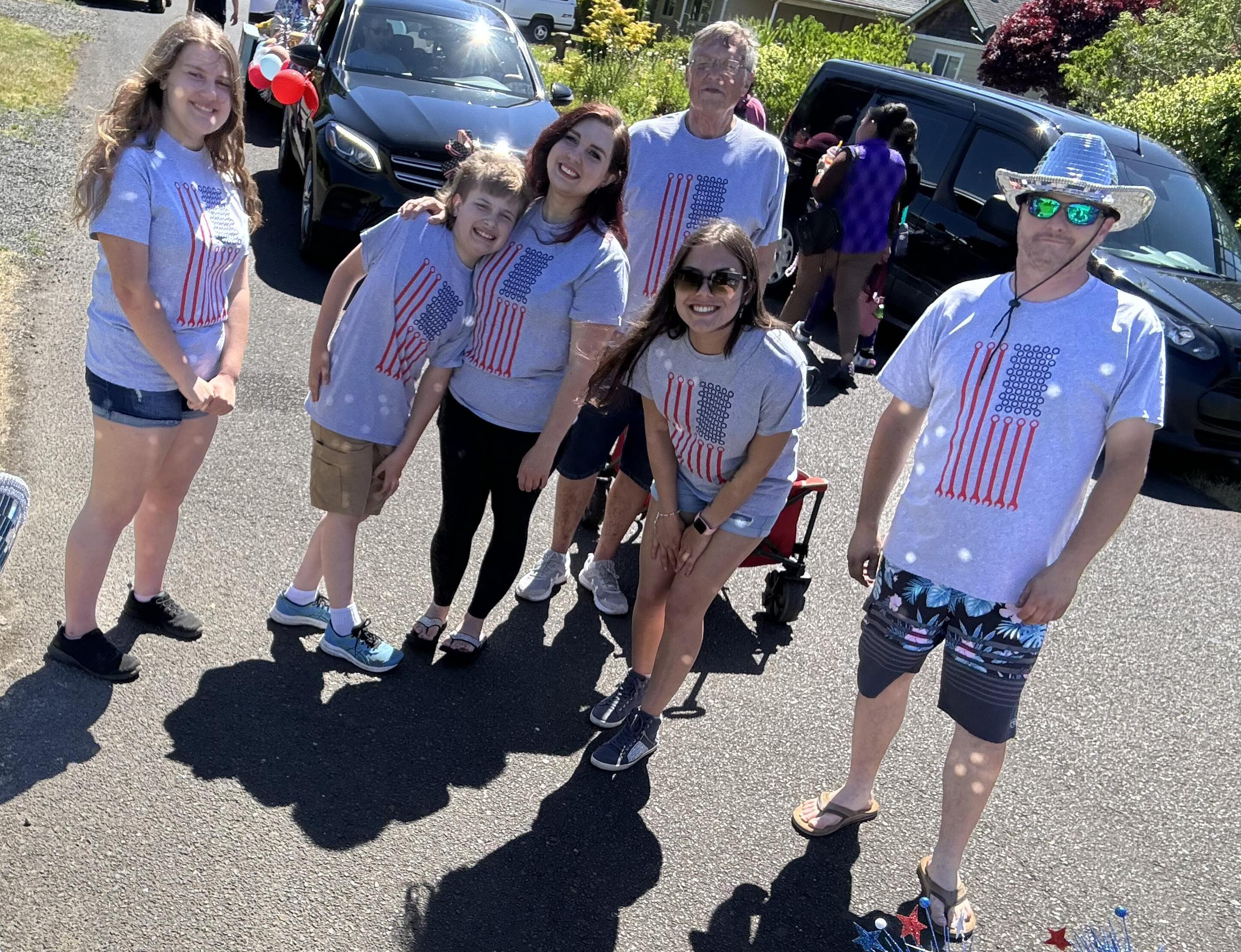
To further integrate into the community, the PNW team takes on regular volunteer projects, such as creating free holiday light displays, sponsoring youth dance teams, and building floats for parades.
Outside of work, Ashley Jo’s hobbies range from archery and wakeboarding to baking and gardening. She and Jeremy have a combined five children, ages 9 to 22; Ashley Jo’s son, Fries, 20, has worked for PNW since he was 17,
and the couple’s two daughters, 9 and 10, are both interested in their parents’ work.
Running a family business is tough but rewarding, Jeremy says: “As one might expect, spending all day every day with your spouse has its moments. But it works for us. Ashley Jo is my partner and my best friend, and honestly, I feel kind of lost when she is not here.”
The Blooms are weighing the possibility of expanding their current building and potentially adding new locations sometime in the future. In the meantime, Ashley Jo welcomes contact from other women who are considering or building a career in the industry.
“It’s not just that women belong here,” she said. “It’s that we can really thrive.”
ASHLEY JO AND JEREMY BLOOM make it a point to contribute to the community by volunteering regularly.
TALK SMART, SET YOURSELF APART
From the first hello to the final follow-up, how you communicate with customers is essential to leaving a lasting impression
BY NOAH BROWN
Competition in the automotive repair market has never been stronger than it is today. With the amount of information available to customers online—both about their vehicles and their options for repairers—technical skill is no longer a differentiator.
Most every customer coming into your shop assumes that you know how to fix their vehicle correctly. So, how are you supposed to set yourself apart from you competition?
Katie French, 2025 AAPEX Service Advisor of the Year, says how you talk
to your customers and the relationship you build with them is your best way to stand out.
“My favorite part of this industry is being customer-facing,” French says. “We bridge the gap between customers and the technical side of what we do. It’s a tremendous opportunity.
Greg Damon, general manager of Sparks Tire and Auto in St. Charles, Missouri, agrees, and says from the moment a customer walks into your shop, they need to feel valued. “It’s imperative to make a fantastic first impression, whether on the
phone or in person,” Damon says. “Customer acquisition is expensive, and competition is fierce.”
Go all in on the Greeting
Whether it’s a first phone call or the first time a customer walks through your door, the initial point of interaction sets the tone for the entire customer experience. A rushed or dismissive greeting can lose business before it starts.
French says customers are usually in a state of stress, frustration, and worry when they reach out to you, and while
the industry has historically had a reputation for less-than-ideal phone etiquette, she says empathy and a customer service mindset are non-negotiable.
“When we answer the phone, it’s always consistently met with kindness,” French says. “The first question we ask is ‘how are you today?’ or ‘what can I do for you?’”
Damon agrees and adds that first impressions go beyond just what your advisors say. For customers walking into your shop, what they see is often just as important as what they hear.
“Make sure the front-of-house is clean and that your front desk associates are well-dressed and well-groomed,” Damon says. “When customers come in, they want to know that they’re going to be taken care of. If you don’t make a good first impression, they’re going to be put off right away.”
Both Damon and French say authentic interactions are important. Damon advises against using a script to allow for more organic conversations but also to still have standards on how customers are being greeted.
French says avoiding negative language such as “we’re booked out for weeks” and instead using problem-solving language such as “let’s see what options are available” are small steps that can make a big difference.
Communication is Key
Good communication shouldn’t stop once your shop secures a customer’s business. French points out that break downs in customer trust usually come down to communication.
“If you look at a lot of negative reviews, the underlying cause isn’t that they didn’t fix something right,” French says. “It’s that they didn’t effectively communicate.”
Any time your shop is communicating with a customer, French says it’s crucial to use QVR—question, validate, respond. Make sure you’re addressing what the customer is asking about.
Damon adds that it’s also important to make sure that the customer understands what you’re telling them. Vehicles are incredibly complicated, and not everyone is going to understand the finer details.
“Explain repairs like you’re talking to your mom,” Damon says. “Show them why something needs to be done and what options they have.”
important to keep in touch with customers to let them know about the progress on the vehicle. Even if there isn’t a new update, sending a text or a quick call shows cus tomers that they’re still a priority.
communication you have with a custom er, Damon says it’s essential to make sure that you are always honest and upfront with customers. Give them options and let them have the final say. Honesty can be a key separator between you and your competition, and every interaction with a customer is a chance to show you have their best interest in mind.
trade on in your life is your name. If your name gets tarnished, people aren’t go ing to believe you,” Damon says. “But if you’re always honest with your customers, that really works wonders.”
Adapt Your Style
Every customer is different, and French says successful shop advisors are able to ad just their tone and pace to fit the situation.
“Learn about yourself and others,” French says. “Adjust your pitch and pace. If a customer is older and hard of hearing, slow down. If they’re emotional, lower your tone.”
She recommends personality assessments like DISC or Myers-Briggs to help advisors understand communication styles. Having a better understanding of their own strengths will help them identify what skills they need to improve.
Damon suggests recording some phone calls for training purposes, letting service advisors get comfortable with uncomfortable situations and learn how to have tough conversations with real-world examples.
In an age in which customers have so many options available to them, strong communication can keep customers coming back. Building trust is essential, and strong phone and communication skills are crucial tools to build that trust.
So train your team, set standards for phone etiquette, and make communication a core part of your shop culture. The payoff? Happier customers, better reviews, and a reputation that drives longterm success.
“Your reputation is everything,” French says, “and that starts with how we talk to our customers.”
FIVE TIPS FOR CREATING A SAFE SPACE
How to let your team know you’re there for them when they need you
Josh Mullins, Vice President and COO of Honest Wrenches in Iowa, is the type of boss employees search a lifetime for. He’s created an environment where his team knows that he’s always there if they need him. They’re not afraid they’ll be reprimanded if they make a mistake, they’re not dreading an annual performance review, and they know they can tell him anything. That’s not the case at most workplaces. If you’re looking to create an environment like this but aren’t sure how to gain trust in your employees, here are Mullins’ top tips.
1. Tell them you care. It’s as easy as it sounds. Let your employees know they’re important to you. Mullins says he tells his team he loves them every night before he leaves. He says in the beginning, people may think it’s weird, but eventually they trust it and know that Mullins is a person they can confide in.
2. Don’t bring up work. That’s just showing you care about dollars. Mullins says he never brings up anything to do with a car unless the employees ask about their own performance, which they often do on their own because ultimately, they’re there to do a great job.
3. Don’t check boxes. It can’t seem like you’re just going through the motions. Mullins says he never writes anything down anymore because it felt so formal and put people on alert. Instead of running down a list, let employees lead the conversation and see where it goes.
4. Confidentiality is key. Mullins doesn’t tell anyone what he and his employees discuss because it can lead to gossip, which will immediately erode trust. Instead, Mullins makes a point to wait until someone on his team that he’s worried about is alone, so they know it’s a private conversation.
5. Meet them where they’re at. You don’t have to bring your employees into the office. In fact, Mullins says you shouldn’t. It can make it seem intimidating and like they’re going to the principal’s office. Instead, start a regular conversation with them at their toolbox.
MAKE IT COUNT
The key to making your one-on-ones impactful BY
TESS OWINGS
Ask any of the employees at Honest Wrenches when their next one-on-one with their boss is, and they’ll likely respond with something along the lines of “whenever I need it.”
That may catch a lot of leaders by surprise. What do you mean there’s no schedule? Why is it up to the employee to decide? Shouldn’t it be up to the leader?
Absolutely not, according to Josh Mullins. And, when it comes to one-on-ones, don’t even think about bringing up work. That’s off the table.
Mullins comes from a background that has given him a unique perspective on people. He struggled with addiction issues in the past and is the first to tell you that he has absolutely no right to tell anyone else when they’ve screwed up. He’s since overcome his struggles and is now Vice President and COO of the twolocation Honest Wrenches in Iowa and
has used the lessons that he’s learned to help him bond with his employees and create real change in their lives.
“If someone messes up at my store, either they didn’t know what they were doing or something is going on on the outside; either way, it’s an opportunity for growth.”
Mullins says that the problem with businesses is that people forget that people are just people and that having an outside life is real.
“They expect 110%. If your wife is battling cancer, how can you give that? It’s important to sit down with your people all the time,” he notes. “I do it all day long.”
Mullins shares with Ratchet+Wrench how he’s thrown out the traditional, scheduled one-on-one performance reviews and created meaningful connections with his employees where they know they can come to him for anything.
BACKSTORY:
Before working in the auto industry, Mullins managed restaurants, which gave him a knack for working with people. He eventually tired of the hectic hospitality schedule and was interested in nursing school, which had a year-and-a-half wait. While he was waiting, he took some auto courses and met his business partner, Travis Troy, and the two have been in business together for 14 years.
PROBLEM:
Mullins has an issue with performance reviews because he believes that talking about numbers and writing down responses kills the mood instantly. He adds that owners that talk to their employees only when they’ve done something wrong sends the wrong message. Namely, if they’re asking to talk to you, you’re in trouble.
Mullins has found a way to check in with employees that works for him, but it wasn’t always as seamless as it is now. For a while, he tried scheduling check-ins but found that something always came up and the one-on-one ended up getting pushed back until it was eventually forgotten. There was also a period when the managers were running the one-on-ones, but Mullins found that it began to turn into traditional performance reviews, which he’s not a fan.
SOLUTION:
Mullins’ philosophy is that if you have a job with him, you must be doing a good job. He adds he trusts his team, and he doesn’t see a need for traditional performance reviews.
“My advisors run crazy good numbers; we don’t talk about that,” Mullins says. “We talk about life.”
Mullins didn’t even realize that he was doing one-on-ones with his team initially. It’s just the way he leads. He cares deeply and his team knows that they have an open mic to talk to him if they ever need anything. (For tips on building this kind of rapport with your team, check out Five Tips for Creating a Safe Space.)
Every Monday morning, Mullins and his team have a meeting. They circle up and talk about their weekends.
They discuss the fun things that they did, and it gives Mullins an opportunity to see where everyone’s head is at. For instance, if someone who is normally talkative doesn’t have anything to say that morning, he’ll find a time to check in with them later in the day.
“I can see the ones that are tired or someone who isn’t with it,” Mullins says.
And it’s not just him. His team also looks out for each other and notices when someone seems down in the dumps. They’ll take note, and let Mullins know to check in.
“The whole team looks out for each other,” Mullins says. “Everyone knows that everyone else has their back, someone will see it.”
AFTERMATH:
The way Mullins sees it, every one-onone is a breakthrough.
“It gives the person a moment to release. They start to create a way to fix it themselves while we’re talking. I’m just there to listen and give
guidance into thinking about what they should do.”
Mullins says the one-on-ones are so important that he wouldn’t have the people he has working for him today if he didn’t do them. Since everyone messes up, it’s important to check in and make sure that your team sees work as a good and safe place.
TAKEAWAY:
Mullins says that it’s not necessary to harp on numbers and get upset with your team about every little mistake. The key to success is caring about your team and letting them know that they’re supported. It creates a better working environment that results in more success.
“If you do what’s right and take care of people, you’ll get paid.”
To do it right, don’t make it a formal meeting. Don’t call them into your office. Meet your people where they’re at. Walk up to their toolbox and ask how they’re doing and pay attention.
Structure and Standardization
Ignoring them makes it impossible to say what makes a B tech a B tech
BY R. “DUTCH” SILVERSTEIN
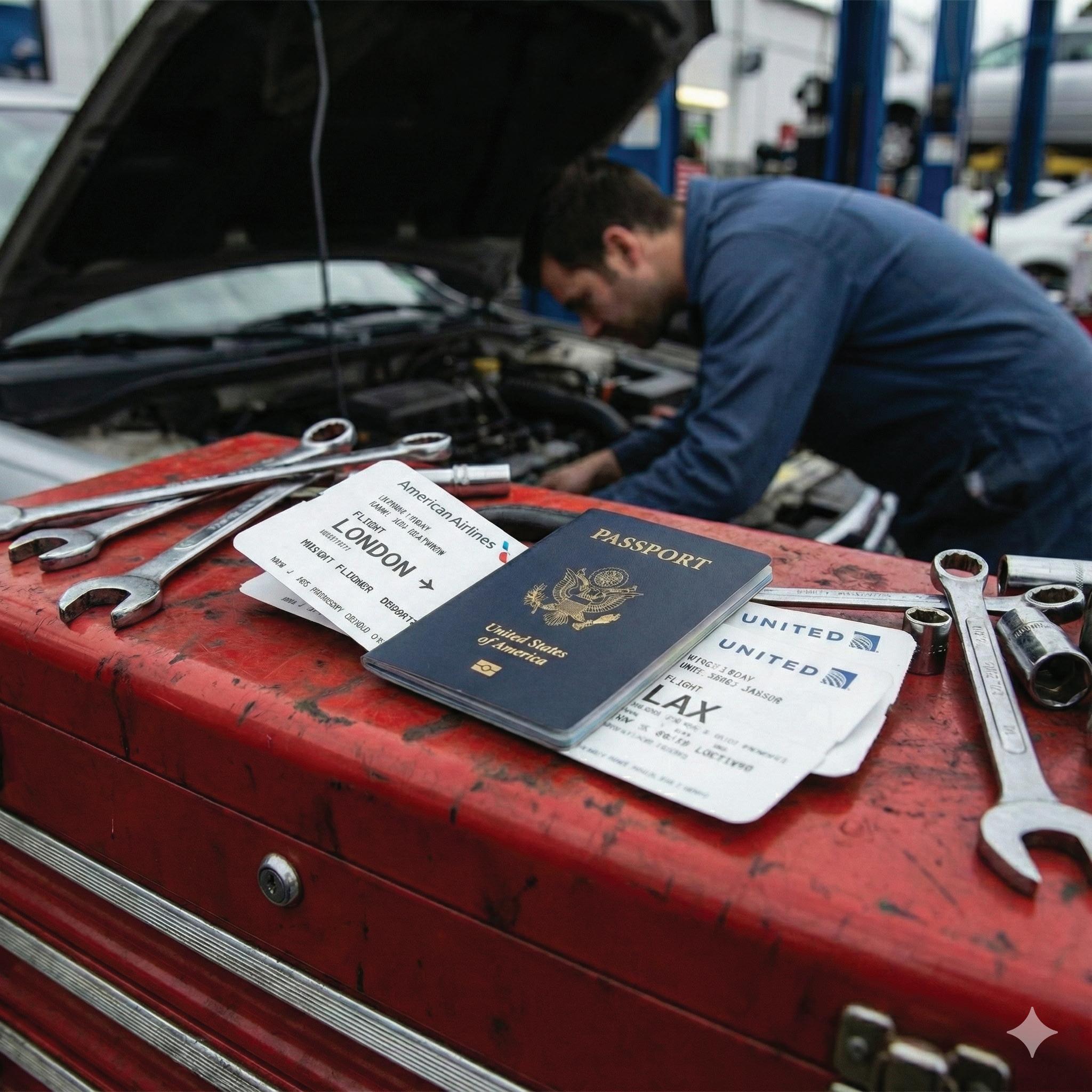
As I reflect on my two careers, I note how different they are, yet seemingly united by one mission: to serve the needs of the traveling public. Not only are they different occupations, but the approach varies so widely. Aviation encompasses a world of rules, standards, consequences, and conformity of behavior. By comparison, auto repair in the non-franchised, non-corporate, independent automotive aftermarket is devoid of rules, standards, and consequences. It is largely unstructured, undisciplined, and it places far less emphasis on conformity.
This is certainly evident in hiring and training new employees, where the process varies with each owner’s preferences. Some choose to conduct interviews and make decisions quickly, citing the dearth of qualified applicants and the fear of losing that applicant to another shop that moved quicker. Others choose to proceed cautiously, employing a multi-step interview process, using time to judge the candidate’s commitment to their organization. This lack of consistency and lack of standardization hurts our business by wasting our most valuable asset: time.
When I was beginning my career in aviation, the first certificate on the path to the coveted Airline Transport Pilot Certificate was the Private Pilot Certificate. There was a written exam, a verbal exam, and then a check-ride in the aircraft. The FAA produced the course material that the candidate was expected to know and discuss. If they failed to demonstrate knowledge of the material necessary to earn the certificate, they failed that portion of the exam and would be required to take the exam again. No advancement would occur until that segment was passed.
PRODUCTIVE DOESN’T EQUAL PROFICIENT
I was reminded of this recently during a discussion of what constitutes an A, B, or C tech and how the absence of stan-
dardization makes those classifications essentially meaningless.
I had an opening in my shop for a B tech. This is someone who could be entrusted to competently perform what I call “mid-grade” work with little supervision and a high degree of proficiency—brakes, routine maintenance, timing belts, steering, suspension, etc. The prospect had to be 120% efficient and 90% productive. I selected an applicant that had those qualifications and was able to prove it by submitting copies of his pay sheets and W2. He had consistently turned between 55 and 60 hours per week. He was leaving his employer (a big box store) because he felt his career had stalled and he wanted to take advantage of the training and opportunity that came with my shop. He started soon thereafter.
He was slow in the beginning (both in efficiency and production), and I was OK with that as I attributed it to working in a new environment. I figured that it would take him a few weeks to get back into his rhythm. After four weeks in, he wasn’t improving. We met for his 30-day review, and I told him I needed help in understanding why his efficiency and production weren’t as good at my shop as they were at his previous shop. What he said next floored me.
“Well,” he began, “It’s because the work is different.”
“Different how,” I asked.
“You don’t sell very many flushes here,” he replied. “I made good money by knocking out flushes fast. I could do two or three at a time and really rack up my hours.”
And then it dawned on me how I screwed up. I didn’t allow for lack of standardization. During the interview process, I asked what services he performed but not how often he did them. He didn’t misrepresent his abilities; he showed that he could do the work, but he hadn’t performed that type of work frequently enough to become truly effi-
cient at it. Instead of beating book time, he would usually match it. I mistakenly assumed that my shop and the work that we performed was typical of the work performed elsewhere much the same as landing at one airport was the same as any other. I was wrong.
Standardization is a key to consistency and a characteristic of professionalism. Implementing it should not be a matter of choice. Not for technicians and not for owners.
R. “Dutch” Silverstein, who earned his Accredited Automotive Manager Certificate from AMI, owns and operates A&M Auto Service, a seven bay, eight lift shop in Pineville, North Carolina. Dutch was a captain for a major airline earning type ratings in a variety of aircraft including the Boeing 767/757, 737, 200, 300 and 400 series, Airbus 319/320/321, McDonnell Douglas MD80/DC9 and Fokker FK-28 mk 4000 and 1000. After medically retiring, he transitioned his parttime auto repair business into a full-time occupation.