FC_Finance_FW_SeptOct26.qxp 23/09/2026 17:40 Page 1
fleetworld.co.uk
+
SEPTEMBER-OCTOBER 2026
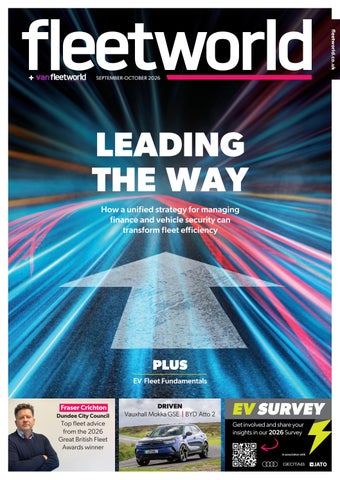
LEADING THE WAY How a unified strategy for managing finance and vehicle security can transform fleet efficiency
PLUS EV Fleet Fundamentals
Fraser Crichton Dundee City Council
Top fleet advice from the 2026 Great British Fleet Awards winner
DRIVEN Vauxhall Mokka GSE | BYD Atto 2 Get involved and share your insights in our 2026 Survey
in association with
READY FOR WHEREVER BUSINESS TAKES YOU. Whether it’s the daily commute, a business meeting or the road less travelled, JAECOO’s executive-specification SUVs combine sophisticated design, genuine SUV capability and the advanced Super Hybrid System (SHS), delivering electric driving with long-distance flexibility. Drivers enjoy premium-level comfort, while fleet decision-makers benefit from exceptional value. Backed by a 7-year/100,000-mile warranty* and growing UK aftersales support, JAECOO is built to keep fleets moving with confidence.
Discover why more fleet decision-makers
Subject to terms, conditions, and exclusions. Coverage varies by component and vehicle usage. Full details are available in the warranty handbook or from your authorised retailer.
are choosing JAECOO at Jaecoo.co.uk/fleet
CONTENTS_FW_SeptOct26.qxp 23/09/2026 19:57 Page 1
Contents September-October 2026 fleetworld.co.uk
18
06 Fleet 15 Dave Williams of Kia UK
08 Analysis ZEV Mandate update
10 Incoming Dacia Spring
10
14 Industry Insight Fleet vehicle fault sharing
16 Diary of a fleet manager
29
Barriers to EV van adoption
18 The big interview Alan Barrett of Geely Auto UK
20 Supplier Stories CalAmp
22 Supplier Stories Motia
24
24 Industry interview Northgate
29 FLEET FINANCE 30 Geotab | 31 Bynx | 32 Holman
34 Fleet Manager Great British Fleet Awards winner Fraser Crichton, Dundee City Council
37 EV Fleet Fundamentals 43 WEBINARS ELECTRIC VEHICLES > highlights
34
44 ON TEST
43
| Geely EX2 | Vauxhall Mokka GSE | | Toyota Yaris X | Fiat Grande Panda | | Kia EV2 | BYD Atto 2 |
50 Our fleet 54 Icons BMW 3 Series
04 LCV conversions
48
06 Volkswagen Transporter
10
fleetworld.co.uk
+
10 Mercedes-Benz Vito Sport-X
publisher Jerry Ramsdale jerry@fleetworldgroup.co.uk
account directors Claire Warman claire@fleetworldgroup.co.uk
editor Fleet World Simon Harris simon@fleetworldgroup.co.uk
Tracy Howell tracy@fleetworldgroup.co.uk
SEPTEMBER-OCTOBER 2026
LEADING THE WAY
editor-at-large Alex Grant alex@fleetworldgroup.co.uk
How a unified strategy for managing finance and vehicle security can transform fleet efficiency
business editor Natalie Middleton natalie@fleetworldgroup.co.uk
PLUS EV Fleet Fundamentals
Fraser Crichton Dundee City Council
Top fleet advice from the 2026 Great British Fleet Awards winner
DRIVEN Vauxhall Mokka GSE | BYD Atto 2 Get involved and share your insights in our 2026 Survey
in association with
editor Van Fleet World John Kendall john.kendall@fleetworldgroup.co.uk
designers Victoria Arellano Dan Bennett
published by Stag Publications Ltd, 18 Alban Park, Hatfield Road, St Albans, Herts, AL4 0JJ tel +44 (0)1727 739160 fax +44 (0)1727 739169 email fw@fleetworldgroup.co.uk web fleetworld.co.uk
web developer Joshua Downey
To subscribe to Fleet World visit: fleetworldsubscriptions.co.uk
Lloyd Ramsdale lloyd@fleetworldgroup.co.uk head of production Luke Wikner luke@fleetworldgroup.co.uk
fleetworld.co.uk 03
SIMON_FW_SeptOct26.qxp 23/09/2026 18:46 Page 1
Stay up to date at fleetworld.co.uk
Simon Harris editor
A fresh perspective... or some 30 years, leasing has been the preferred method for fleets procuring cars, but vans are still more likely to be purchased outright – unless they are electric. Or that’s what I thought until I considered the position for public sector fleets more thoughtfully. Speaking to Fraser Crichton, who runs the fleet at Dundee City Council, was illuminating (see interview on p34). My discussions on the EV transition with van fleet managers in the private sector reveal that operational barriers are still slowing adoption. However, the public sector has been under greater pressure to adopt zero-emission vehicles across their fleets, even when they take the risk on the future value. And a typical public sector van profile is a small or medium van with relatively low annual mileage. When these fleets were running diesel vans, they effectively wrote off the cost of the vehicles over an eight- or 10-year lifecycle. Dundee’s vans are all-electric and all purchased outright. And if the assumption is the van is worth nothing after 10 years, it doesn’t really matter whether the energy source is diesel or electric.
F
The payback is substantial, comparing the cost of diesel with electric over the lifecycle of the vehicle, especially if charging can be done cost-effectively at a depot. And then compare the cost of replacing typical wear and tear items on a diesel van over that period that are simply not components of an electric van. There is still some justification for hesitancy when replacing ICE vehicles with electric, as getting it wrong can be costly, and potentially career-shortening. Yet, it’s worth drawing attention to the fact that flexible rental can give fleets the opportunity to establish where electric vehicles work best on a particular fleet, and in which roles. And when you’re further down the road, perhaps leasing a van can guard against some of the volatility we’ve been seeing on used EV values over the last few years. But for fleets considering purchasing outright with low-mileage vans on a long lifecycle, there are operators already out there that are proving the business case and making it work. Enjoy the issue... and if you want greater insight into what the next decade holds, join our free “FUTURE OF FLEET” Webinar on Wednesday 14th October (register below).
FUTURE OF FLEET
JOIN FOR FREE!
What the next decade holds
10.30am Wednesday 14th October 2026
in association with
VAUXHALL FRONTERA P11D from
£24,730*
Award-winning, affordable and ready for business, with up to 248 miles electric range** and a seven-seater option on our hybrid model†
Fuel economy and CO2 results for the Electric Frontera: MPG (l/100km): N/A, CO2 emissions: 0g/km. Electric range up to 248 miles (WLTP). Fuel economy and CO2 results for the Hybrid Frontera: MPG (l/100km): 53.3 mpg (5.3l/100km), CO2 emissions: 119-120g/km. * Model illustrated is Frontera Electric Ultimate 44kWh (113PS) Auto with optional metallic paint. P11D Price £28,580. ** The Vauxhall Frontera Electric Ultimate 54kWh (113PS) Extended Range. MPG (l/100km): Combined: N/A, CO2 emissions: 0g/km. For comparison purposes only. Range achieved in real world may differ according to factors such as accessories fitted, battery condition, weather, driving style and vehicle load. † 7-seat configuration available on GS and Ultimate Hybrid only. Please contact your Vauxhall retailer for further information. Or call us on 0203 885 4562.
Fleet15_FW_SeptOct26.qxp 23/09/2026 17:48 Page 1
FLEET15 Dave Williams head of fleet | Kia UK What is your ambition in your current job role?
OW! N E B I R C S SUB
> DIGITAL MAGAZINE <
E S C AN HER LATEST E TO SEE TH LINE ISSUES ON
To ensure Kia’s fleet department feels open, accessible and supportive to everyone, helping us to build on our success in the car sector and replicate that momentum as we continue to develop in the LCV market. Ultimately, I would like Kia to be a genuine consideration for every decision-maker, whether that is the driver, fleet manager, finance director, managing director or chief executive.
What job did you want to do when you were growing up?
What are the biggest challenges facing fleets at the moment? Recognising that the marketplace is evolving. The decisions we make today should not only address immediate challenges but also help protect against what comes next. In the long term, value almost always outweighs price when managing a budget. There is nothing wrong with making a profit; without it, we cannot deliver the level of service, support and added value that customers rightly expect and demand.
Professional sportsman, but my parents thought a policeman. Not sure car salesman was on their list.
You’re on your dream holiday. Where are you?
The best takeaway food?
Night in or night out?
Turkish.
Night out – theatre and dinner.
What’s the proudest moment in your career?
Supermarket of choice?
Without doubt, one of the proudest parts of my career has been seeing people I have brought into the business grow in confidence, develop their skills and go on to progress in their own careers. It is a real privilege to have played even a small part in their journey, offering guidance and support along the way. And who knows – one day I may even have the pleasure of working for one of them.
What’s your favourite film and why? I can flick partway through and watch to the end – Grease, The Shawshank Redemption, Road House and Lord of the Rings.
If money was no object, what’s the first thing you would buy? Mum’s care home and the golf club.
Name three cars in your dream garage? McLaren 570, Ferrari Testarossa, Aston Martin DB9.
The Datai Langkawi.
Tesco.
What car do you currently drive? Kia EV9.
Tea, coffee or other? Black coffee.
Books, mags or podcasts? Books.
Who is your idol in life and work? Björn Natthiko Lindeblad – Don’t believe your every thought. You don’t stay at one company for 21 years without good leadership – empowerment and trust.
DESIGNED FOR DRIVERS. BUILT FOR FLEETS. With OMODA’s technologically advanced,
Discover how Omoda Fleet could
high-specification and stylish vehicles, including the
solve your key fleet challenges at
advanced Super Hybrid System (SHS), drivers get
omoda.co.uk/fleet
what they want. Plus you get outstanding value, a 7-year/100,000-mile warranty and the reassurance of a growing retailer and aftersales network to keep your employees mobile. Everything is essential. Subject to terms, conditions, and exclusions. Coverage varies by component and vehicle usage. Full details are available in the warranty handbook or from your authorised retailer.
ANALYSIS_ZEV_Mandate_FW_SeptOct26.qxp 23/09/2026 17:31 Page 1
ANALYSIS
– ZEV MANDATE –
DILUTED TARGETS COULD LEAD TO HIGHER PRICES Why a softer ZEV mandate is good news for the car industry, but bad news for everyone else. By Simon Harris.
B
ritain’s electric vehicle transition is arriving at an awkward moment. The market has built real momentum, but a diluted ZEV mandate affects the infrastructure and investment case built around it, with fleets caught paying the difference. Battery electric vehicle registrations were up 27.7% year-on-year in August, according to SMMT data, but that growth has been bought at a cost: around £14bn in manufacturer discounts and incentives to hit mandate targets so far, according to the SMMT, which argues the situation is unsustainable and is diverting profit away from the investment the transition actually needs. A diluted mandate would ease exactly that pressure, allowing OEMs to discount less and protect margin. Exposure sits elsewhere, and it splits into two different kinds of risk. The first is industrial: more than £7bn has been committed across 14-plus commercial battery projects in the UK, according to a new report from research group New AutoMotive. The investment spans lithium extraction, cell gigafactories and battery recycling; a supply chain that already generates £4.2bn a year in turnover and supports more than 10,000 jobs. These are multi-year, largely sunk commitments made to secure the UK a place in the global battery supply chain. The report argues that diluting the mandate will not rescue domestic manufacturing; it risks starving it of the plants it needs to survive the decade, because a weaker long-term demand
08 fleetworld.co.uk
signal makes follow-on investment and expansion harder to justify, not the capital already spent. Charging infrastructure carries a different, more immediate kind of exposure. Robin Heap, chief executive of charging firm Zest, said weakening the mandate risked deterring the long-term capital charging infrastructure depends on, warning that ministers should not underestimate “how fast the market will grow”. Unlike the battery supply chain, this is not a small number of large, already-committed projects; it is an ongoing series of site-by-site investment decisions, each one priced against nearterm charger utilisation. A softer mandate does not threaten chargers already installed, but it directly slows the pace at which new capital keeps being committed to roll the network out further, because operators price each new site against how quickly EV volumes are actually growing right now. Fleets sit in the middle of this, and stand to lose on cost even as OEMs gain breathing space. Less regulatory pressure to hit targets means less need for manufacturers to buy volume with discounts, which points toward fleets paying more for new EVs. Whether that also means stronger used values remains genuinely unclear. It
is leasing companies, not end-user fleets, who carry residual value risk directly, and three- to five-year-old electric models have risen 9.4% year-on-year to an average of £20,351, according to Autotrader – before the bulk of early ZEV mandate volume has arrived on the market. A smaller future wave of discount-driven used supply could support values; equally, a weaker long-term demand signal could undercut confidence in EVs generally. For now, leasing companies are the ones most likely pricing in a safety margin against that uncertainty. Fleets are being squeezed from another direction too. Diesel prices are within 5p of 2022’s all-time high of 199p a litre, having jumped 10p since the start of September alone. Motoring and haulage bodies are pressing the Chancellor to scrap planned fuel duty increases before they compound an already sharp cost spike, adding pressure to switch to electric at the exact moment the value case for doing so is becoming less predictable. The mandate review, due to conclude by 23 October, will decide how much financial pressure shifts off OEMs and onto fleets buying new electric vehicles, and how much confidence survives in the infrastructure and battery investment that the transition still depends on.
Charge anywhere. Drive everywhere. With the DKV Card +Charge.
Your fleet cannot go electric without the right partner. With access to over 1 million charging points across Europe and in the UK, the hybrid DKV Card +Charge keeps your drivers moving, seamlessly and reliably. Look out for the DKV Mobility logo. You’ll be seeing it a lot on the road. DKV Mobility - your partner for sustainable fleet solutions. For more information: customercareuk@dkv-mobility.com YOU DRIVE, WE CARE.
INCOMING_Dacia_Spring_FW_SeptOct26.qxp 23/09/2026 18:33 Page 1
DACIA SPRING What is it? Electric city car When is it available? Early 2027 Biggest changes? Only the name of the previous car continues Fleet appeal? Public sector fleet interest
Has spring come early? The UK might have only had the Dacia Spring on price lists since 2024, but the car was launched in other markets in 2021. The original will be six years old when it’s replaced by the second-generation model. The new Spring is more a conventional city car, rather than the tall, narrow model it replaces, and looks more like a Sandero than a Duster.
10 fleetworld.co.uk
INCOMING_Dacia_Spring_FW_SeptOct26.qxp 23/09/2026 18:33 Page 2
How much will it cost? Two equipment grades will be offered from launch, starting with Expression, expected to be priced at less than £18,000 before any qualifying grants are applied. Standard equipment includes 15-inch steel wheels, remote central locking, electric front windows, manual air conditioning, automatic headlights, rear parking sensors, electronic parking brake, USB-C port and 50/50 folding seat seats. Highlights in the Journey grade, expected to be priced at less than £20,000, include 16-inch steel wheels, rear camera, 10.1-inch central screen with navigation and an extra USB-C port.
Is it practical? It doesn’t seem bad for a tiny car, with space for four adults, and 337 litres of luggage space with the rear seats in place. This can be expanded to 1,283 litres up to the roof with the rear seats folded. There will be an optional 18-litre ‘frunk’ under the bonnet, which can be used to store the charging cable.
Is there a hardware upgrade? Although the car is on a new platform, battery capacity is similar to the outgoing version, although there is a useful increase in power, with 80hp available and 175Nm of torque – the previous Spring came with a choice of 45hp and 65hp motors. There’s a 6.6kW onboard charger, but DC charging capability is only available in the optional charge pack (which also adds V2L capability). Dacia cites a 15% to 80% charge time of just under three hours for a 7kW AC charger, and 28 minutes using a 50kW DC charger when fitted with the charge pack. Range on a full charge is 155 miles, and efficiency is 4.9mpkWh. Keen-eyed readers might spot that the Spring has much in common with the forthcoming Renault Twingo.
VERDICT The original Dacia Spring was a surprise hit with public sector fleets as they sought affordable electric transport, with few other vehicles coming close on price and ownership costs. The new model has broader appeal, is more practical and, although it may be a little more expensive looking at the P11D value, is likely to be more popular.
fleetworld.co.uk
11
Take your fleet further.
The fully electric Volvo EX60 With up to 503 miles in one charge Meet the new fully electric Volvo EX60, a premium company car designed for modern fleets and business drivers. With up to 503 miles of electric range, it supports long-efficient distance travel with fewer charging stops. Its spacious Scandinavian-inspired cabin combines sophisticated styling with everyday comfort. Advanced safety technologies help support duty of care, while Google Gemini provides an intuitive in-car experience that helps drivers stay informed and productive on the move. Built on Volvo’s latest technology platform, the EX60 improves over time with over-the-air updates, helping your fleet benefit from new features throughout its lifecycle. Search Volvo EX60
Official WLTP figures for the Volvo EX60: Mpg (l/100km): Not applicable, CO2 emissions: 0 g/km, electric range 385.2 – 503.3 miles. The Volvo EX60 is a battery electric vehicle requiring mains electricity for charging. Figures shown are for comparability purposes. These figures may not reflect real life driving results, which will depend upon a number of factors. 503 miles range based on P12 battery. Google, Google Play, Google Maps and Gemini are trademarks of Google LLC.
AFP_COLUMN_FW_SeptOct26.qxp 23/09/2026 17:30 Page 1
industry insight Paul Hollick chair, Association of Fleet Professionals
WHY FLEETS ARE SHARING INFORMATION ABOUT VEHICLE FAULTS
W
e’re living through a transitional moment for vehicle technology – meaning not just electrification, but factors such as increasingly sophisticated autonomous systems and the sheer amount of software now embedded in ever more complex cars and vans. At the same time, the motor industry is perhaps more competitive than ever before. The arrival of EVs creates massive pressure to invest huge amounts of money while new entrants from China and elsewhere are making a significant impact. While this situation is enabling massive leaps forward in some respects, there are also downsides. Budgets are tight and time is short, and some new vehicles reaching the market have more and bigger faults than fleets have generally seen in the past. This is a significant issue for members of the Association of Fleet Professionals (AFP). These problems vary enormously in scope. Some are minor irritants but others raise genuine safety concerns or take vehicles off the road entirely. As a result, many fleet managers spend a disproportionate amount of their time talking to dealers and
“Fleet managers are increasingly using the AFP to compare notes with their peers and it often becomes clear the same problems are across multiple fleets.”
14 fleetworld.co.uk
manufacturers, trying to find workable answers to these problems. A key frustration here are the tactics sometimes employed by OEMs. Often, an operator flags up a fault and, in response, is told it’s an isolated case, unique to their vehicle or fleet. This is then used as licence to take the problem less seriously. However, fleet managers are increasingly using the AFP to compare notes with their peers and it often becomes clear the same problems are turning up across multiple fleets. This aggregated evidence gives our members the means to achieve much better results. Instead of approaching a manufacturer with a single complaint that can be dismissed, they can prove their experience is shared by operators right across the country.
At a recent AFP Mega Fleets Committee meeting — where some of the UK’s largest vehicle operators come together — we worked through a wide range of faults including handbrakes, tyres, windscreen sensor software, alarm systems, traction batteries and more. The sheer number of problems can be daunting. Fleets are encountering problems resolving these issues due to everything from poor parts availability to a shortage of technicians. One member is even installing replacement traction batteries in their own workshops, supplied under warranty by the manufacturer, because the franchise network for that vehicle didn’t have the skills or capacity to do the job. What’s become really apparent is just how differently manufacturers respond to our organisation acting in this coordinated manner. AFP members quickly work out which OEMs are genuinely responsive — the ones offering honest feedback and useful support — and those suppliers earn loyalty as a result. Similarly, those that don’t step up lose out. The reality is that a large percentage of vehicles supplied to fleets today will have some kind of issue, so what really matters is the willingness of the manufacturer to put things right. Fleets want decisive, timely and effective action, not to be fobbed off. In recent months, we’ve seen some manufacturers step up to the challenge, while others remain much less receptive. AFP members often walk away from these latter relationships altogether because their experience is so poor, which has a real and lasting impact on how that brand is perceived across the industry.
Demand more from a family SUV with the all-electric Leapmotor C10
4
• BIK 4%
YEARS
WARRANTY
• Electric range up to 263 miles WLTP combined* • P11D price from £36,435
4
YEARS
ROADSIDE ASSISTANCE
8
YEARS
BATTERY WARRANTY
Scan the QR code to find out more.
Official Fuel Consumption for the Leapmotor C10 69.9 kWh: MPG (l/100km) Combined: N/A. CO 2 emissions (g/km): 0g/km. Equivalent All Electric Range: 263 miles. *For comparison purposes only. Range achieved in real world may differ according to factors such as accessories fitted, battery condition, weather, driving style and vehicle load. Visit https://www.leapmotor.net/uk/fleet
DIARY_FW_SeptOct26.qxp 23/09/2026 17:36 Page 1
... OF A FLEET MANAGER
Our industry insider lifts the lid on everyday fleet issues.
W
e now have some electric cars on our fleet and, as I’ve said previously, we are late to the party. But my next issue is should we, or shouldn’t, we start to look at electric vans? I have endlessly pondered the pros and cons, and on balance, there are many more cons than pros. The advantages are the cost of running them (electricity vs diesel), a bit kinder to the environment, but after that, I’m struggling a bit. But there are so many diesel trucks on our roads that I don’t think switching our diesel vans for electric would make that much difference, looking purely at our company. Our problem is our van drivers are not really van drivers; they are professional, qualified engineers, who just happen to drive a van to get from location to location. Our engineers install machinery (the machinery is delivered by diesel truck). They also make repairs and carry out servicing. They work long days. Without really knowing what time they will finish their last job, it certainly isn’t a nine-to-five occupation. They know they fill up their vans in
a few minutes, at a huge cost, but also know they don’t need to stop again for quite a while, and can do multiple jobs in a day. They can arrive within a known timeframe and keep customers happy. And my job as fleet manager is to keep the engineers on the road. But if we go with electric vans, I do worry that our commitments to customers could be put at risk. I’m sure our customers would not be impressed with a phone call saying our engineer will be late as they are having to charge the van. One day this may be acceptable, but at the moment, I’m not sure. Then there’s the issue of charging the vans at home, for much cheaper costs than using public chargers. But the majority of our drivers are not particularly wealthy, with most currently parking their diesel vans on the road as they don’t have offroad parking, so charging at home is not, for most, an answer. Or we could get the pavement channel system, which, as discussed in my previous column, comes with its own issues and uncertainties. That leaves us with a heavy reliance
Time spent charging during the working day is still a barrier for electric van adoption
16 fleetworld.co.uk
on public charging. But charging during the working day takes time, and time is one thing our engineers don’t have, they go from job to job to job. Spending a few minutes filling with diesel is one thing, filling with electric is another. As fleet managers we don’t like to take risks, but putting some electric vans on our fleet is probably just a risk too far for us. I’m sure they will suit some companies, but for the time being, it’s a no from me. Our MD would not be happy with the productivity hit and the potential downtime of the vans during working hours. ‘Tinkering’ is a word you don’t hear often these days, but I’m sure it still does happen. Probably not as much as it did. There will be many of us who remember our parents, uncles and brothers out on the drive on a Saturday or Sunday morning ‘tinkering’ with the vehicle. Overalls on, box of tools by the side of the car, head under the bonnet. I was having this conversation the other day with others in the office. Some of the younger members of staff looked at me as though as I had gone mad.
THE NEW A L L- E L E C T R I C G L C . Speak to us about our multi-car offers today*. Welcome home.
UK spec may vary. *Exclusions and T&Cs apply. Subject to status, availability and change. Official government electric power consumption figures in wh/km for the new all-electric GLC combined 164-173. CO2 emissions of 0-0g/km. Figures for comparison purposes only and may vary with external factors such as driving styles, environmental conditions, road conditions and accessories fitted. Further information about the test used can be found at www.mercedes-benz.co.uk/WLTP Correct at time of print 08/26.
IVIEW_Geely_ABarrett_FW_SeptOct26.qxp 23/09/2026 18:34 Page 1
The big interview
Steady hand v
Alan Barrett who leads Geely Auto UK’s fleet team, talks to Simon Harris about leasing demand for the EX2 and EX5, why he isn’t under pressure to chase volume, and what comes next for the brand’s plug-in hybrids.
G
eely Auto UK is on course to hit its target of around 6,000 units into leasing this year, according to Alan Barrett, with demand strong enough that the total, once public sector business is included, is likely to land closer to 6,200. Crucially, he says, the launch of the smaller EX2 hasn’t materially altered that plan – it has simply added another channel of demand on top of what was already forecast. Across the final four months of the year, Barrett expects the EX2 to account for just over 11% of Geely’s leasing sales – roughly 400 units of what remains to be delivered in 2026 – with particularly strong interest already coming from leasing brokers. “It could change, as anything can change,” he says. “But as it stands,
18 fleetworld.co.uk
only around 10 to 11% of our sales will be EX2 in leasing for the balance of the year.”
Geely EX5
EX5 building the brand, one fleet channel at a time The EX5, now approaching a year on the market, has done real work in building
awareness of Geely in the UK, even if it isn’t yet the brand’s biggest fleet seller. Demand is coming from a mix of channels, chiefly leasing brokers, with regular requests continuing through to year-end. Public sector interest has been a notable bright spot: the NHS has bought more than 200 EX5s this year and has placed a further order for the fourth quarter. Barrett says fleet managers have been consistently open to listing the car, largely on the strength of its specification, interior space and build quality. “We aren’t struggling to get the vehicle onto corporate fleet,” he says. “We’re being added to corporates pretty much every week, and now that we’re with most of the major funders, we expect corporate to continue to grow.”
IVIEW_Geely_ABarrett_FW_SeptOct26.qxp 23/09/2026 18:34 Page 2
vs heavy foot: No pressure from head office to chase volume Barrett claims growth isn’t being pursued at the expense of residual values (RVs). At a fleet event a few weeks ago, bringing together rental, leasing and broker partners to set out Geely’s growth story, the message from the top was explicit: RVs and the brand itself require protection and careful management. Barrett says he works closely with senior figures at Geely’s UK operation and HQ, but doesn’t discuss fleet volumes directly with head office, and hasn’t yet had cause to push back on any growth targets. “We’ve got good demand, as it stands at the moment, and we are growing share,” he says. “I don’t have any examples where I’ve had to push back to China on anything at all.”
Geely Starray
Starray’s fleet appeal goes beyond BiK tax Geeley’s Starray EM-i plug-in hybrid has proved popular with fleets, partly on the strength of its benefit-in-kind (BIK) position – but with rates set to become less favourable for PHEVs over the coming years, Barrett was asked how much of that fleet interest he expects to survive the change, and whether it’s shaping how hard Geely is pushing PHEV against fully electric models. His view is that tax is a genuine part of the Starray’s appeal, but not the whole story. Fleet customers, he says, are focused on total cost of ownership – an area where he says the car performs strongly – alongside suitability and how well a model fits a business’s broader transition roadmap toward electrification, whether that transition is fast or gradual. Even as BiK advantages narrow, he believes Starray will remain a solid choice for fleets on its own merits, rather than one propped up purely by tax policy. Barrett is confident Geely has the scale and flexibility to adapt as both the market and tax policy evolve, pointing to continued growth in corporate accounts and a
INSIDE GEELY’S DISCIPLINED BLUEPRINT FOR FLEET GROWTH
large section of the market still untapped. “While the demand for battery-electric vehicles (BEVs) might reduce in the nearterm appeal sense, we’ve still got a lot to go at,” he says.
Monjaro arrives in 2027 Geely has also confirmed the Monjaro for the UK, a larger, higher-priced SUV due to arrive in 2027. Barrett doesn’t hide his enthusiasm. “I’m very confident about Monjaro. I’m very excited about it, actually – I’ll definitely be getting one as my own car,” he says. By 2027, he expects some businesses will still be reluctant, or unable, to move fully to BEVs, and sees the large SUV as one of the largest segments in the market – one where Geely will now have the right product at the right time. Monjaro isn’t expected to be the brand’s bestseller, he stresses, but an important part of a broader product roadmap he’s confident will pay off. “I think it’s going to be a really brilliant product,” he says. “I’m really looking forward to it.” Salary sacrifice, used values and a growing team Geely’s salary sacrifice partnership with Tusker is now up and running, following a signing ceremony in August. Barrett says the partnership brings valuable brand recognition as Geely continues to build awareness in the UK, and noted that Tusker had already sold a healthy number of EX5s even before the deal was formalised. With strong demand also expected for EX2 through the scheme, Tusker has asked Geely to set aside dedicated stock, and the two companies are now working through supply and logistics to support it.
On residual values, Barrett acknowledges it’s still early days. The first of Geely’s own internal company cars and demonstrator vehicles are only now reaching the end of their use, and the business hasn’t committed to any buyback transactions. A new used car manager joins the team in two weeks, and Barrett expects that appointment, together with a fourth-quarter push to get an approved used programme fully in place across the dealer network to give a much clearer picture of how Geely’s residual values are actually performing by the time Q4 is underway. The fleet team itself is growing in step with the business. Currently five-strong, overseen by sales director Andrew Stuart who covers both fleet and retail, the team will welcome the incoming used car manager as its sixth member, working closely within Barrett’s team. Recruitment beyond that hasn’t formally begun, but Barrett expects his team to expand further in the fourth quarter, with SME, corporate and public sector identified as the three priority growth areas. Challenges, not risks Asked to identify the single biggest risk to Geely’s plans over the next 12 months – residual values, internal expectations, or competition from other Chinese entrants – Barrett pushed back gently on the framing. He prefers to talk about challenges rather than risks, and views competition, residual values and the task of gaining and maintaining market share as familiar territory for any growing OEM, rather than anything unique to Geely’s position. A profitable dealer network and continued volume growth both matter, he says, to ensure that network’s investment is worthwhile. Even so, he remains confident in the fundamentals: global scale, a well-structured local operation and what he regards as the right products for the UK market. “I think we’ve got the right foundation,” he says. “I’m confident that we are on the right track, and we are sustainable.”
“Geely’s salary sacrifice partnership with Tusker is now up and running.” fleetworld.co.uk
19
STORY_CalAmp_FW_SeptOct26.qxp 23/09/2026 18:47 Page 1
supplier stories CalAmp
Safer, more efficient fleets with CalAmp iOn
Safety and efficiency are key priorities for commercial fleets. CalAmp iOn brings the visibility and intelligence operators need to better manage both. Ashley Davies-Payne, senior sales director, CalAmp explains.
R
oad risk is a material business issue for any organisation that asks people to drive for work. Department for Transport (DfT) estimates show that 22,871 police-reported collisions in Great Britain in 2025 involved at least one driver or rider travelling for work. Those collisions resulted in 6,460 people being killed or seriously injured. DfT says this data likely underestimates the actual total for commercial fleets because “journey purpose” is sometimes unknown. Financial exposure is substantial as well. DfT’s 2024 total value-of-prevention estimate for all road collisions in Great Britain was almost £55bn. DfT does not publish a work-related cost subtotal, but work-related journeys comprise
20 fleetworld.co.uk
a quarter of all collisions annually. Cost pressure also makes efficiency a priority. In May 2026, 84% of transportation and storage businesses told the Office for National Statistics (ONS) they were concerned about fuel costs; ONS data also show that motor-vehicle maintenance and repair costs continue to grow. Connected fleet technology gives fleet operators the opportunity to use vehicles, fuel and driver time more efficiently and reduce avoidable downtime. Meanwhile, operators that delay adopting robust fleet management technology risk carrying higher costs and losing ground to more efficient competitors. CalAmp iOn: End-to-end fleet management CalAmp iOn brings safety and efficiency into one operational view. The enterprisegrade, end-to-end fleet management solution combines real-time visibility, AI video safety, driver behaviour scoring, asset utilisation, fuel management, maintenance and compliance. Because the camera, GPS device and user interface are delivered as an integrated plug-and-play solution, fleets can avoid unnecessary marketplace purchases and integrations. Real-time mapping, dashboards and analytics give managers a clear view of fleet and driver activity, with precision GPS and optional traffic, weather and custom map overlays. Managers can drill down to an individual vehicle’s status, history, health and safety information. For driver safety, CalAmp Vision uses road- and driver-facing AI cameras to identify distraction, speeding, tailgating, lane drift and more. In-cab alerts prompt drivers to correct behaviour in real time and each event clip includes before and after footage to support incident review,
coaching and driver exoneration. Driver scorecards help managers quickly identify patterns and reinforce safer performance. On the efficiency side, utilisation dashboards show when and how vehicles are being used and help managers isolate underused assets, while fuel reporting tracks consumption and helps reduce idling. Customised DVIR forms simplify inspections, while servicing can be scheduled by time, mileage or engine hours. To proactively inform maintenance decisions and planning, the system tracks odometer readings, engine hours, battery status and diagnostic trouble codes. Alerts warn stakeholders about vehicle health issues, helping fleets address problems before they cause unplanned downtime. Together, these capabilities support proactive maintenance and help keep vehicles on the road. CalAmp iOn gives fleet operators the visibility to identify issues and act sooner. By bringing fleet visibility, AI video safety, driver scoring, utilisation, fuel and vehicle health together, CalAmp iOn turns connected-vehicle data into informed decisions that can support safer, more efficient operations.
“Utilisation dashboards show when and how vehicles are being used and help managers isolate underused assets.”
When business and driver demands compete, Chery fleet offers a smarter choice that’s value for money, low risk and easy to justify, in the boardroom and beyond. With Chery Super Hybrid offering electric driving with petrol flexibility, businesses can transition with confidence. Backed by a 7-year/100,000-mile warranty*, nationwide aftersales support and growing UK fleet infrastructure, Chery is built to keep businesses moving.
Chery. On top of fleet needs. *Subject to terms, conditions, and exclusions. Coverage varies by component and vehicle usage. Full details are available in the warranty handbook or from your authorised retailer.
Find out how Chery can support your fleet. go.chery-fleet.co.uk/2026
STORY_Motia_FW_SeptOct26.qxp 23/09/2026 18:48 Page 1
supplier stories Motia
From ‘Big Brother’ to buy-in Motia’s telematics and fuel card platform aims to cut fleet admin and misuse, says Conor Patton, strategic growth director, UK and Europe.
M
otia was created by bringing together two established businesses under one roof: Cubo, a specialist in telematics and tracking, and Fuel Card Services, one of the UK’s largest fuel card providers. The aim was simple but overdue. Fleet managers were routinely juggling three or four separate systems just to manage tracking, fuel spend and compliance, and we wanted to remove that friction by bringing it all onto a single platform with one login. We believe data is most powerful when it delivers practical outcomes. Our platform tracks fuel levels every 60 seconds and identifies any unusual movement, whether fuel is added or removed. By combining this with transaction data, we help fleets uncover potential fuel misuse and theft. Looking ahead, we’re investing heavily in expanding the range of data and insights available through a single platform, enabling customers to make smarter decisions, improve efficiency, and drive even greater savings. Fuel card capability remains a core part of the Motia proposition, giving fleets access to a broad UK-wide network alongside consolidated invoicing and spend management tools. By bringing fuel card transactions and telematics data together, operators can more easily compare fuel purchases against vehicle usage, helping to identify anomalies, improve control and reduce administrative effort. As the platform evolves, our focus is on providing a clearer, more connected view of fleet costs and performance from a single system. Vehicle safety has been a particular focus. Our vehicle safety check app streamlines driver walkarounds and feeds defect data directly back through partners such as Aquarius, giving fleets a single sign-on view of compliance issues that need attention before they become breakdowns. Driver buy-in remains one of the biggest hurdles in telematics adoption,
22 fleetworld.co.uk
though the landscape has shifted considerably from the early ‘Big Brother’ resistance of years past. Our work with fleet operator Collett’s illustrates how that shift happens in practice. Rather than imposing monitoring on drivers, Collett’s involved them from the outset: sharing performance data openly, setting KPIs linked (via API) to insurer HDI Global, and running a league table with weekly incentives for top performers. Driverfacing cameras, often the most contentious element, have proved their worth in a different way: in one case, footage cleared a driver wrongly accused by police of using a mobile phone at the wheel, turning a source of initial suspicion into a genuine safety net. We have also recently added legal roadside assistance, through a partnership with LMP Legal, as a further layer of driver support for our fuel card customers. On the shift toward electric and mixedenergy fleets, particularly in the slower-
“Fuel card capability remains a core part of the Motia proposition.” Conor Patton
Visitors on the Motia stand at GBFE 2026
moving LCV segment, our approach is to help customers make better use of the data they already hold rather than waiting for a single switchover moment. Electrification is a process, not an event, and the telematics data fleets are already collecting can identify efficiencies now, ahead of any wider transition. That focus on practical, incremental progress, rather than one dramatic leap, sums up where Motia is headed: one platform, built from two specialisms, still being knitted more tightly together.
Trusted by 84% of the UK’s leading fleets.
FIND OUT MORE
Fuel and EV charging, unified. Vehicles maintained. Every mile, every cost, under control. All brought together in one strategic platform.
Fuel
Public Charging
Workplace Charging
Home Charging
Near-Home Charging
Service & Maintenance
Vehicle Mileage Management
Parking
Allstar. Driving the future of fleet.
Fleet-World-A4.indd 1
allstarcard.co.uk
15/06/2026 17:29:04
IVIEW_NMcCrossan_Northgate_FW_SeptOct26.qxp 23/09/2026 18:35 Page 1
industry interview Northgate
One fleet, one platform: Northgate Mobility on life after consolidation It has been a busy few months for Northgate. With Blakedale and Fridge Express now fully integrated under a unified banner, and Redde (the group’s insurance replacement hire business) folded into Zigup, the group that owns Northgate, the dust is only just settling on a period of significant structural change. Fleet World editor Simon Harris sat down with Neil McCrossan to find out what the new ‘one fleet’ model actually means for customers on the ground.
F
or McCrossan, the consolidation wasn’t simply about administrative tidiness, it was a direct response to how customers were already behaving. “Our customers were telling us it was time to do this,” he says. When Northgate acquired Blakedale and Fridge Express, the priority was retaining the specialist expertise in those businesses without alarming existing customers by absorbing them wholesale into “the bigger Northgate machine”. So the brands, and their teams, were initially kept separate. But it quickly became clear that customers weren’t thinking in those terms. “More and more customers were trading with different parts of the organisation, but having to have a Blakedale account, a Fridge Express account and a Northgate account,” McCrossan explains. Larger customers in particular wanted cars, standard vans, traffic management vehicles and refrigerated vehicles from a single supplier, but were receiving separate invoices and dealing with separate account managers for the privilege. “We thought that there’s no time like now that we can sweep this up and make it easier for our customers, and easier for us,” he explains. The result is a single fleet, managed through one platform, with one branch network delivering multiple brand liveries and vehicle types. McCrossan is keen
to stress that, crucially, customers haven’t lost the relationships they valued. “If you were traditionally a Blakedale customer, you’ll now have a Northgate Highways account, because we’re rebranding the business, but through that account, you can access any part of the business, any vehicle, any service and keep the relationship with the people you know best. We don’t force you to change it.” The benefits extend well beyond the vehicles themselves. Ancillary services,
including fleet management and accident management, that were previously seen as core Northgate offerings are now available to every customer across the group, regardless of which brand they originally signed with. Behind the scenes, that’s meant untangling legacy systems built up across multiple acquisitions: standardising terms and conditions, and building a single unified communications environment. “It sounds easy, but it was actually quite challenging,” McCrossan admits.
“We thought that there’s no time like now that we can sweep this up and make it easier for our customers.” 24 fleetworld.co.uk
IVIEW_NMcCrossan_Northgate_FW_SeptOct26.qxp 23/09/2026 18:36 Page 2
“We crossed lots of legacy platforms and systems.” The outcome, he says, is a single email and telephony environment that allows calls and enquiries to be routed and turned around far more efficiently; a tangible improvement that customers are already noticing. Scaling to 80,000 vehicles With Northgate targeting an aggregate fleet size of 80,000 vehicles under the new model, maintaining a reliable supply pipeline, particularly for complex LCV requirements, remains a live challenge. McCrossan credits “robust, long-term relationships” with a wider roster of OEMs and supply chain partners than the business has ever had, partly reflecting genuine growth in the number of manufacturers now competing in the space.
Forecasting demand accurately, though, is as much art as science, “We’ll always have a vehicle-on-hire plan that says we’re going to have this many vehicles on hire by this point.” New business is a known certainty in aggregate (Northgate always signs new customers), but the specific mix of vehi-
cle types is often impossible to predict until those customers are actually on the books. “You need that flexibility and the ability to react,” he says, describing a “fluid fleet” held across the estate specifically to respond quickly when new demand materialises. Honesty with customers about realistic lead times is, in his view, non-negotiable. “We can be honest and say, yeah, we can get you that next week, we can get you that in three weeks. That’s going to be a six-month build slot, and that’s just the reality.” He’s careful to note that vehicle availability has improved substantially compared with the difficult post-Covid years, even if the era of manufacturers being able to simply push product onto the market is unlikely to return.
Neil McCrossan has overseen consolidation in the Northgate business.
fleetworld.co.uk
25
IVIEW_NMcCrossan_Northgate_FW_SeptOct26.qxp 23/09/2026 18:36 Page 3
industry interview Northgate
Making EV adoption less daunting Northgate’s own research from its EV open days suggests the biggest barrier to van electrification is no longer vehicle availability, but operational education: driving range, payload degradation and cost comparisons against diesel. McCrossan sees this as central to the role of Drive2Zero, Northgate’s EV consultancy arm. “Fleet managers can be understandably risk-averse, it’s a decision you’re making for the next four or five years, and you want to get it right,” he says. The open days let customers “dip a toe in the water” without commitment, while Drive2Zero’s diagnostic approach is deliberately vendor-neutral. “We aren’t pushing an agenda that says electric vehicle. If you’re thinking about it, let us gather your fleet data, put it through our diagnostics, and come back and say: these vehicles, doing that job, in that way, you absolutely could deploy electric vehicles here, and here’s the range of vehicles with the carrying capacity that would fit the bill, and here are the prices.” Diesel equivalents
remain on the table too, alongside practical considerations such as charging capacity at depots and engagement with district network operators. Driver resistance, McCrossan notes, is a recurring but often short-lived issue. “It’s usually subjective and objective, but when drivers give the vehicles a chance, they absolutely love them.” Northgate’s flexible hire model is central to lowering that barrier: customers can trial electric LCVs on short-term arrangements before committing to longer-term funding, moving from a handful of vehicles through successive case studies until they’re comfortable enough to sign a longer agreement, one that, even then, retains more flexibility than a formal lease or outright purchase. Charging infrastructure is treated as inseparable from the vehicles themselves. Northgate has recently exited the domestic installation market, unable to make the economics work at scale, but has deliberately retained commercial installation capability in-house. “If you’re talking seriously to a business about taking on
The former Blakedale vehicles have been branded Northgate Highways, providing specialist traffic management and support vehicles
26 fleetworld.co.uk
a fleet of electric vehicles, you shouldn’t be saying, phone someone else about the charging,” McCrossan argues. “We don’t want to be dealing with somebody over the fence.” That includes recognising infrastructure needs will shift over a vehicle’s three- to five-year lifecycle, requiring the same flexibility Northgate applies to the vehicles themselves. On the wider uncertainty around EV adoption timelines, with OEMs recalibrating ambitions, infrastructure providers questioning registration forecasts and government policy under review, McCrossan sees a mixed picture among fleet operators. Some are pausing entirely, waiting to see how the landscape settles; others are mid-cycle and need to replace vehicles regardless, even if they’re not yet ready to commit fully to electric. Both scenarios, he notes, favour Northgate’s flexible model over traditional longterm contract hire or outright purchase. “Uncertainty, generally, isn’t a good thing,” he reflects, “Although perversely, it’s actually quite good for the Northgate business model.”
SURVEY_Scope_ADVERT_FW_SeptOct26.qxp 23/09/2026 18:49 Page 1
in association with
2026
HAVE YOUR SAY! TAKE THE SURVEY... ... AND HELP US INFORM THE FLEET INDUSTRY’S TRANSITION TO ELECTRIFICATION!
SCAN HERE
fleetworld.co.uk info@fleetworldgroup.co.uk
(THERE’S A TWO-NIGHT HOTEL STAY ON DORSET’S JURASSIC COAST UP FOR GRABS AS WELL)
Fleet Solutions for Business
Downtime Management
Our innovative approach can help you navigate your organisation through the changing face of fleet management
Fleet Sustainability Daily Hire
Funding, Procurement & Disposal Vehicle Fit-out
Duty of Care Vehicle Administration
Accident Vehicle Management Maintenance
Our industry white papers arm the Fleet Manager with the knowledge to future proof their fleet www.venson.com/white-papers
Get in Touch
Tel: 0330 094 7803 www.venson.com
FEATURE_Finance_FW_SeptOct26_v2.qxp 23/09/2026 17:43 Page 2
THE UNIFIED FLEET INDUSTRY:
CHANGING HOW BUSINESSES MANAGE FINANCE AND VEHICLE SECURITY Running a business fleet today requires a much closer look at everyday costs than it did in the past. High inflation, changing tax rules and vehicle supply delays mean that transport managers can no longer rely on simple purchasing habits.
or a long time, companies used fixed monthly leasing contracts to protect themselves from financial surprises. However, these rigid agreements can create hidden costs that damage an operational budget, such as unexpected repair bills, contract extension charges and vehicle downtime. To protect company spending, operations managers must stop treating vehicle purchasing and vehicle security as separate decisions. Instead, they need to use clear, connected data to manage funding and asset tracking together. The way a company handles vehicle finance depends heavily on its size. Small businesses face distinct problems because they rarely have a dedicated fleet manager. Instead, transport choices are often left to a warehouse manager or a human resources assistant who must look after these assets alongside their daily jobs. These smaller operations frequently struggle with tight credit limits, strict pollu-
F
tion caps and complicated company car tax bands, which can cut them off from the bulk discounts enjoyed by large corporations. To fix this inequality, the automotive industry relies on digital portals that allow major leasing firms to pass down their best wholesale rental prices to local brokers and car dealers. This allows small businesses to keep the personal service of a local supplier while capturing the low running costs of a large corporate finance firm. For larger companies running hundreds of cars, saving money requires moving away from traditional contract hire and using finance lease options instead. Contract hire provides an easy monthly number on a single invoice, but it often conceals extra charges for exceeding agreed mileages or minor body damage at the end of the lease. A finance lease gives a company far more control, allowing the business to decide the best moment to rotate high-mileage cars or sell an asset off to the second-hand market.
This financial control must work alongside modern security measures. The growth of professional theft networks across Europe means that securing a car is now a major operational necessity. If an expensive vehicle is stolen by criminals using cheap signal jammers to block standard factory trackers, the business faces contract failures and lost work. Protecting a company’s transport budget requires treating vehicle security as a complete network rather than buying a single piece of hardware. This means using secondary tracking devices that work on independent signal paths to spot unusual driving patterns before a theft is even confirmed. Ultimately, whether a company is trying to reduce fuel use, cut maintenance bills or stop theft, the answer relies on using live mileage and location data to get the absolute maximum value out of every single vehicle.
>>
fleetworld.co.uk
29
FEATURE_Finance_FW_SeptOct26_v2.qxp 23/09/2026 17:44 Page 3
FINANCE
Vehicle theft myths fleet managers can’t afford to believe Stefano Peduzzi, vice president, technology solutions and operations Europe, Geotab
A
cross Europe, the organised networks behind high-value commercial vehicle theft have become highly specialised. These groups methodically study fleet protection systems, map operational weak points and plan their activities around them. Despite this shift, many fleets continue to protect their assets based on assumptions formed before these professional networks emerged. To secure active assets effectively, there are four common myths that require careful reconsideration. Myth 1 Fitting a tracker means the vehicle can automatically be located Organised theft networks now plan their operations specifically around tracking hardware. Signal jammers are cheap, widely available and routinely deployed by professional groups responsible for the majority of high-value commercial vehicle theft across Europe. The time window between a vehicle leaving a depot and a standard tracker being detected and disabled is frequently much shorter than many operators assume. A single tracking device, regardless of how well it is hidden or installed, can be defeated if that specific hardware pathway is compromised. The immediate consequence for the business is a lost asset, an operational contract failure, a complex insurance claim and a driver left without a vehicle. Location and recovery rates improve significantly when tracking is treated as an integrated system with built-in redundancy and no single point of failure, rather than relying on a standalone piece of hardware to do a job it cannot achieve alone.
Myth 2 Factory-fitted tracking alone is sufficient Standard factory-fitted telematics are engineered primarily for vehicle optimisation, diagnostics and routine operation, not dedicated fleet security. While the communication paths and operational data they provide are excellent for daily management, certain vehicle configurations can compound security vulnerabilities. On various models, the driver retains the ability to switch the vehicle into a privacy mode, which immediately cuts off data transmission. While this is a legitimate data protection feature for the individual, from a fleet security standpoint, it creates an information gap that organised theft groups have learned to exploit. An independent security layer, installed separately and operating on different signal paths, does not share this vulnerability. This combination produces a level of operational redundancy that a single factory source cannot replicate, creating a barrier that professional networks struggle to defeat systematically. Myth 3 Theft cannot be predicted and only allows for a reaction Vehicle location is widely treated as a purely reactive process where a vehicle goes missing, an alert is triggered and a manual search begins. By that stage, the window for successful recovery is already closing. Implementing strict geofencing rules, night movement detection protocols and high-risk border alerts can flag suspicious behavioural anomalies before a theft is even confirmed. Advanced telematics systems can now adjust data reporting frequency automatically when a vehicle enters areas or time windows associated with elevated risk, surfacing unusual movement patterns long before a driver reports an incident. The difference
between recovering an asset and writing it off is measured in minutes, and detecting anomalies before confirmation is where those vital minutes are won. Myth 3 The same security approach works across every European market A security method calibrated for one specific European country may be poorly suited to the operational realities of another. The factors driving commercial vehicle theft differ sharply by region, as do the criminal networks operating within them. Organised groups operate along distinct geographic corridors and tend to move stolen vehicles rapidly across national borders, deliberately pushing assets into jurisdictions where location and recovery become legally and logistically complicated. Furthermore, police response times and cross-border frameworks vary across every market. A fleet operating across multiple European borders faces a highly complex threat map that requires a protection strategy designed for regional complexity from the outset, rather than applying a singlecountry template and hoping for the best. Ultimately... what connects these four myths is the assumption that protecting vehicles is a product purchase decision rather than a systemic operational strategy. Because professional theft networks will eventually probe every single layer of a business’s transport network, security redundancy is no longer optional. Implementing multilayered tracking across independent signal paths, utilising data-driven anomaly detection and ensuring continuous coordination through dedicated security operating centres are now essential steps to keep recovery rates well above the industry average.
“There is the assumption that protecting vehicles is a product purchase decision rather than a systemic operational strategy.”
30 fleetworld.co.uk
FEATURE_Finance_FW_SeptOct26_v2.qxp 23/09/2026 17:46 Page 4
WHEN YOUR FLEET MANAGER IS YOUR WAREHOUSE CONTROLLER Gary Jefferies, sales and marketing director, Bynx
S
mall businesses with smaller fleets face unique challenges when it comes to financing business vehicles. Few and far between are dedicated fleet managers in those smaller businesses. When you consider challenges such as: - Restricting carbon emission caps - Understanding different tax rates for various levels of pollution - Having to wrangle with often complex Benefit-in-Kind (BIK) company car tax rules. And not forgetting the usually stricter cashflow and credit available to smaller businesses when it comes to financing vehicles. It is no surprise, with no dedicated fleet manger, that small businesses value the relationship they have with their local broker or dealer group. Personal service and handholding Large leasing companies understandably focus on larger businesses where there lies the tasty carrot of large rewards and easier transactions. There is far less handholding to be done when there is not only a dedicated fleet manager, but perhaps an entire fleet department, operating to a mutually understood and implemented company fleet policy. Through large leasing companies (and recent news has announced some lease cos are now even bigger), large businesses have access to levels of vehicle choice, whole life cost advice and
discounted pricing that smaller businesses are less able to take advantage of. Conversely, small businesses can often end up shopping like retail customers because that feels like the easiest, but as we know is often not the most financially prudent or tax-efficient way, to fund company vehicles. Collaboration; Everyone’s a winner More than most industries; the automotive sector lives or dies by the depth of the collaboration. Manufacturers, parts specialists, funding specialists, tyre specialists, service and repair specialists, fleet management specialists, brokers, dealers, leasing companies. Software has enabled, maybe even enforced, greater levels of collaboration. Yet still, smaller business fleets can find themselves cut off from the greatest choice and the best deals available. Even though, if we just take the UK commercial fleet operator segment as a measure, fewer than 700 businesses run over 100 vehicles. Yet some 46,000 businesses run five vehicles or fewer. And how many tens of thousands of business fleets sit in the five to 10-plus bracket? That leaves a lot of vehicles that aren’t necessarily top of mind for leasing companies who carry the greatest choice and best deals. Easy access to smaller fleets Fortunately, software exists that can tie all the invested parties together. A quotation portal that allows lease cos to pass down leasing deals to brokers and dealer groups in a controlled way. Decide the deal levels and cars available. Set and control commission rates. Software that allows brokers to provide
their dependent network of smaller businesses with large leasing company benefits, without those leasing companies having to refocus sales strategies or enlarge sales teams. Software that allows smaller businesses to still lean on their network of familiar and trusted automotive suppliers. That allows brokers and dealer groups more access to car choice and deal availability. That allows larger leasing companies to use the contacts and knowledge of smaller fleets brokers and dealers have, while allowing those local providers better access to deals for their fleet customers. - The smaller fleets have more options - The brokers and dealers have more options - The leasing companies have access to more customers. A single platform, based on a direct relationship between the lease co and their agent, allowing control over products, pricing, services, content, and importantly, the lease cos brand. - Live data ensures missed renewals are a thing of the past - No double keying, no multiple tabs across browsers, no added applications. - Do it all from one log on. And all this available on an international basis.
“Software has enabled, maybe even enforced, greater levels of collaboration.”
fleetworld.co.uk
31
FEATURE_Finance_FW_SeptOct26_v2.qxp 23/09/2026 17:46 Page 5
FINANCE
FLEET FINANCE AND COST MANAGEMENT: IT’S TIME FOR A SWITCH IN THINKING
I
n today’s challenging financial climate, where inflationary pressures continue to impact fleet budgets, it has never been more important to have an intimate understanding of just what your vehicles are costing your business. This may sound an obvious point to make, but do you really know exactly what each vehicle on fleet is costing you to run? For many fleets, the answer is probably not, as the mainstay of vehicle funding – contract hire – does not give you exact data. Contract hire gives you cost certainty on the monthly leasing invoice, but it also comes with other elements to consider, such as excess mileage and end-ofcontract damage charges, opportunities for hidden margins, extension costs and maintenance extras that are not included or are hidden. So you’re not getting the full picture on
that vehicle’s whole life cost. You get a headline lease number, not the real one. And so what you’re paying in lease rental may not match what your business really pays. With any funding method, the key is understanding how to sweat your asset to the best of your operational requirements and cost. How do you ensure you pay as near to actual value as you can, without introducing extra operational or financial burdens into your business? A simple answer is utilising finance lease for your fleet funding. It gives you far greater control over cost than contract hire, with the ability to make strategic decisions about each vehicle’s financial and operational lifecycle. In order to do this though, you need to change the way you think about asset management, focusing on every cost
FINANCE WHEN the insights from across the industry are brought together, it becomes clear that modern fleet efficiency relies on a single factor: visibility. Whether a business is a small local firm whose warehouse manager looks after five cars, or a major corporation managing hundreds of motorway workhorses, the days of hands-off fleet procurement are over. The traditional safety nets – such as relying on a standard contract hire invoice to predict costs, trusting a single factory tracker to secure an asset, or shopping like a retail buyer due to a lack of purchasing power – now expose companies to severe financial risk and unpredictable operating expenses. The path forward requires a unified
32 fleetworld.co.uk
incurred from procurement to in-life and eventually defleeting, and understand how you can affect and reduce them. Until fairly recently, this has been seen as a daunting prospect because of the extra work involved in collating information, but the advent of increasing numbers of vehicles with connected data is now making this a much easier option. It no longer takes extra effort, just a ‘different effort’. By doing this, you can move away from focusing on an individual cost and see it instead as part of a finance ecosystem where various inputs can impact on the decisions to be made. For instance: is a vehicle spending too much time off the road? Is it time to replace it? Is a vehicle’s mileage significantly under what was budgeted for? Can this
Balancing technology, scale and security to protect operational budgets
approach that links funding, day-to-day operations and security through shared data. By using new digital quoting portals, large leasing firms can give smaller businesses the same wholesale discounts and vehicle choices that large corporations enjoy, ensuring smaller operators are no longer left out of the market. At the same time, switching to flexible finance leases and using secondary, multi-layered tracking systems allows transport managers to spot problems early. By tracking live mileage to avoid lease penalties and monitoring vehicle movements to stop professional thieves, businesses can move from simply reacting to problems to stopping them before they impact fleet expenditure. Ultimately, the
companies that manage their transport budgets successfully will be those that stop treating vehicles as simple standalone products, and start managing them as active, data-driven assets that must be protected and fully utilised.
Key takeaways for fleets... To protect operating budgets and keep drivers on the road, transport operations should focus on four practical areas: 1 > Review leasing terms for hidden penalties: Standard contract hire leases look simple but often carry heavy extra charges for body damage and mileage overruns. Look into finance leasing combined with live
FEATURE_Finance_FW_SeptOct26_v2.qxp 23/09/2026 17:47 Page 6
Martin Reeves, sales director, Holman
vehicle swap into another role? Does the business have too many vehicles for its current and future needs? Is it time to sell? Integrating connected vehicle data into your business and supply chain, and sharing it with key suppliers will help you understand vehicle utilisation, operational need, idle/vehicle off-road (VOR) time, work scheduling, vehicle choice and size. This then feeds into the amount you pay for each vehicle, and how long you run it for. It’s a far more granular and proactive way to manage funding. A new approach to funding, finance lease with connected data allows you to plan for various scenarios and to adapt in the moment for maximum operational and financial return, allowing your business to be flexible in response to the changing needs of the market and your business.
Purpose-Built for Fleet & Mobility Providers
Manage vehicles, customers & contracts in one platform Vehicle Leasing & Finance
Mobility as a Service
Fleet Operator mileage data to gain direct control over each car’s lifecycle and avoid unexpected end-ofcontract invoices. 2 > Use backup tracking systems : Relying entirely on a single factory tracker leaves vehicles highly exposed to cheap signal jammers and privacy settings that block location data. Protect expensive cars by using separate, independent secondary tracking devices to ensure there is no single point of failure.
Short Term Rental
Fleet Management
Accident Management
3 > Utilise digital wholesale portals: Small businesses often pay high retail rates for cars because they lack bulk purchasing power. Partner with local dealers and brokers who use shared quoting software to access the large-scale discounts and vehicle choices usually reserved for multinational fleets. 4 > Switch from reactive to proactive monitoring: Waiting for a driver to report an accident, a mechanical breakdown, or a theft reduces the chances of protecting running costs. Use automated software that flags unusual movements or extended garage delays early, allowing the business to step in before the costs escalate.
We would love to Speak, Contact Bynx today: +44 (0) 1789 471600 sales@bynx.com www.bynx.com fleetworld.co.uk
29
MANAGER_IVIEW_FCrichton_FW_SeptOct26.qxp 23/09/2026 18:41 Page 1
fleet manager
CLOSING THE LOOP How Dundee City Council built an energy-first fleet Fresh from success at this year’s Fleet World Great British Fleet Awards, Dundee City Council corporate fleet manager Fraser Crichton talks to Simon Harris about 16 years of building a genuinely closed-loop, renewable-powered fleet.
F
raser Crichton has been thinking about electric vehicles and mobility for Dundee City Council for 16 years – long enough, he admits, that the number itself gives him pause. What started as a bid to prove that a large public sector fleet could go electric has evolved into something considerably more ambitious: a self-sufficient, closed-loop energy system in which solar generation, secondlife battery storage and vehicle charging are all designed to work together, on a site that also happens to service and maintain a 750-strong council fleet. The starting point, Crichton says, was air quality rather than vehicles as such. Transport accounted for a striking 78% of Dundee’s pollution, and the council wanted to demonstrate that decarbonising a fleet at city scale was achievable, not just as a pilot but as a genuine, city-wide proof of concept. What followed was 16 years of incremental additions – “adding bits to the jigsaw” as Crichton puts it – shaped as much by outside scrutiny as by strategy.
34 fleetworld.co.uk
“Our battery storage has had one faulty cell replaced for £700. Not bad for 10 years.”
MANAGER_IVIEW_FCrichton_FW_SeptOct26.qxp 23/09/2026 18:42 Page 2
The circle has to be a circle The most striking recent addition – solar panels on the roof of the council’s workshop, feeding second-life battery storage, which in turn powers overnight EV charging – emerged directly from a recurring criticism that Crichton faced on the presentation circuit. Fleets could point to renewable-powered charging for their electric vans, cars and bin lorries, critics argued, but the moment those vehicles went in for maintenance, the workshop itself was drawing straight from the grid. “Your fleet’s nearly 40% EV, but you’re still only partially using renewable energy,” was the recurring theme, as Crichton recalls it. “Your cycle isn’t a circle.” Dundee already had relevant experience to draw on. The council had been running renewable energy hubs with rapid charging and second-life battery storage since 2018, and applied the lessons learned from that earlier work to the workshop project. With the cost of solar continuing to fall, putting panels on a large workshop roof to power the building and its tools was, in Crichton’s words, “relatively easy”. The more interesting problem was what to do with the surplus: in summer, with staff on leave and demand for workshop power lower, excess solar generation risked going to waste – unless it could be redirected to the row of chargers Crichton already had installed across the yard, ready to top up vehicles that often arrive back at the depot around 10% charged. The result, in effect, is a small-scale bi-directional system: battery storage capturing surplus solar energy and releasing it to vehicles when it’s needed. The batteries themselves are second-life Renault Zoe units, still holding 90-93% of their original capacity, sourced through the specialist storage company Connected Energy. Dundee has had them in operation across seven or eight sites for a decade, with only a single failure – one faulty cell, replaced for around £700. “Given 10 years, that’s not bad,” Crichton says.
Beyond the hardware, he points to an unexpected cultural benefit: engineers who had spent careers working with oil and combustion engines have become invested in understanding an entirely different kind of ecosystem. By his estimate, around 70% of the council’s engineers now drive electric vehicles themselves – a level of buy-in that, once established, tends to spread by word of mouth. The wider payoff is now feeding back into public pricing. As more of the council’s charging is now genuinely powered by renewables generated onsite, the local authority has been able – in partnership with eVolt – to reduce its rapid charging tariff from 57p to 55p per kWh, and trim two pence off its AC charging rate too. As a local authority, Crichton notes, Dundee isn’t looking to turn a profit on charging – but for the first time, the economics of the renewable investment are visibly working in the public’s favour. Safety, data and reaching the drivers who get overlooked Two other results from Dundee’s award submission for the Great British Fleet Awards stand out: zero positive alcohol readings since the rollout of in-cab breathalyser interlocks, and a 21.25% reduction in accidents attributed to a genuine cultural shift in driver behaviour. The interlock programme began life as a response to EU legislation on driver alcohol-testing for professional vehicles – something the UK, outside the EU, was in no hurry to adopt, but which Crichton judged inevitable given the reliance of manufacturers such as Dennis Eagle, which supplies Dundee’s refuse fleet, on the wider European market. Implementation took roughly a year, deliberately involving a small working group of around
seven people, spanning legal, health and safety, and union representation, rather than a large, unwieldy committee. The council was careful to frame the initiative around driver welfare rather than punishment: a driver who had been drinking the night before a shift might be over the limit without realising it, putting themselves and colleagues in the vehicle at risk. Crucially, Crichton says the council’s first response to a positive test was never “you’re in trouble”, but “how can we help you?”. The technology is now on 14 vehicles, planned to rise to 25 by the first quarter of 2027, and Crichton expects drug-testing to be the logical next step – though he acknowledges that, unlike alcohol, drug traces can remain detectable in the body for far longer, adding legal and practical complexity the council hasn’t yet fully communicated to its workforce. The accident reduction followed a similarly data-led approach. By combining 12 years of tracking and insurance data, the council identified accident hotspots and specific driving patterns – such as vehicles consistently running 5mph over the limit on Dundee’s Kingsway ring road – and took the findings directly to drivers, framed around protecting their own licences and reputations rather than as criticism of individual competence. The more significant discovery, however, was about where the council’s attention had been misdirected. Historically, driver training had focused heavily on the roughly 100-200 staff qualified to drive heavy vehicles. But the data showed that smaller vans and cars – driven by a much larger pool of council drivers – were actually generating more incidents. “It was a shift to understand that it was all the drivers,” Crichton says, not just those already receiving formal CPC training.
Solar panels are installed on the roof of Dundee City Council's vehicle workshop to provide 100% of its energy
fleetworld.co.uk
35
MANAGER_IVIEW_FCrichton_FW_SeptOct26.qxp 23/09/2026 18:42 Page 3
fleet manager
Fleet Initiative Superstar DUNDEE CITY COUNCIL Learning that no two depots are the same and how teams operate Dundee’s experience running parallel smart-charging trials at two very different depots reinforced a lesson that Crichton returns to repeatedly: assumptions don’t transfer between sites, even within the same fleet. One trial site, covering construction services, ran 80 short-journey EVs on relatively predictable, planned routes; a second, much smaller site of five vehicles supported pest control work, with irregular hours and unpredictable job locations. Intuitively, Crichton expected the construction site to be easier to optimise and the pest control site to be genuinely erratic. In practice, pest control drivers turned out to have surprisingly consistent charging habits, just built around a different rhythm to the working day. The real lesson, he says, wasn’t about vehicles or routes at all, but about people: successful rollout depends on understanding how each team actually operates, and bringing staff into the process rather than dictating charging schedules to them. Now expanded well beyond its original 70-vehicle trial toward 250-300 vehicles, the programme’s underlying principle remains communication and buy-in.
Dundee City Council's electrification even includes refuse collection trucks
36 fleetworld.co.uk
Funding, ownership and Dundee City Council’s road to 2035 Dundee’s approach to procurement has shifted markedly over 16 years. Rather than leasing, the council is increasingly moving to buy vehicles outright, borrowing at low public-sector rates to fund its 750-vehicle fleet directly. For Crichton, the driving principle is control – over the assets, over charging behaviour and costs, and over long-term planning – at a time when leasing and hire costs are rising. It has also reframed how the council deals with manufacturers: rather than simply buying vehicles, the council now expects OEMs to commit to longer-term partnership, including data-sharing on vehicle-to-grid capability and battery performance, as part of major framework agreements covering hundreds of vehicles over several years. Dundee has a target of full electrification by 2035, and Crichton is candid about where the real risk lies: not budget, grid capacity or supply chain in the abstract, but the stark cost gap for larger vehicles. An electric refuse collection vehicle currently costs in the region of £450,000, against roughly £250,000 for a diesel
equivalent – a gap he hopes will narrow as Chinese manufacturers continue to drive down costs. In the meantime, Dundee is focusing on getting its charging infrastructure ready in advance and considering operational changes – such as moving some refuse rounds from double shifts to single shifts – to make the most of lower-cost overnight, renewably generated power. Underpinning all of it is a mindset Crichton says has changed more than any specific technology choice: an early focus on which vehicles to buy has given way to a focus on energy first – where it comes from, how much capacity is needed, and what infrastructure will still make sense years down the line. It’s a lesson he offers freely to smaller fleets asking how to replicate Dundee’s approach: start small, expect to make mistakes, put charging infrastructure where staff will actually use it, and resist writing a rigid long-term strategy in a sector moving as fast as this one. “By the time you’ve written the strategy,” he says, “six months later, maybe 10% of it still makes sense!”
evfleetworld.co.uk
FUNDAMENTALS OF EVs An essential reference point for all things related to electric vehicles – providing help, advice and all the information drivers and fleet managers need as they transition from ICE models
READ THIS ONLINE
REMARKETING in association with
EV ADOPTION in association with
EV MOBILITY in association with
INSIDE
ELECTRIC VEHICLES in association with
in association with
FUNDAMENTALS OF
REMARKETING
MODERNISING THE DISPOSAL PROCESS: FACTUAL REMARKETING FOR END-OF-LIFE BATTERY VEHICLES As volume electric vehicles complete their initial operational cycles, a significant volume of used stock is entering the wholesale market. Historically, disposing of defleeted assets relied on methods calibrated entirely for internal combustion vehicles, where mileage and body condition were the primary price drivers. Applying this traditional framework to electric cars and vans creates unnecessary friction, as trade buyers approach used battery technology with entirely different priorities. Success requires a data-led approach that focuses on target digital audiences and objective vehicle metrics.
ALIGNING WHOLESALE STOCK WITH LOCALISED RETAIL DEMAND
Wholesale buyers face significant uncertainty regarding battery health and real-world degradation when bidding on used electric vehicles. Overcoming this hesitation requires moving away from superficial visual inspections toward transparent and specific vehicle data. Providing clear, verified information on remaining traction battery capacity and vehicle charging history helps eliminate financial risk for independent retailers. This transparency allows trade buyers to purchase with absolute confidence, ensuring stock is valued on its actual physical state rather than speculative assumptions.
Consumer demand for used electric vehicles varies dramatically by region, influenced by local charging infrastructure density, clean air zones and clean commuting routes. Relying on a single, fixed physical auction venue limits asset exposure to a narrow geographical group of buyers. Utilising digital B2B remarketing platforms allows fleet operators to expose defleeted stock to a nationwide network of active, targeted retailers, placing the right vehicle directly in front of the specific businesses experiencing high consumer demand.
DYNAMIC PRICING USING REAL-TIME MARKET DATA
REDUCING VEHICLE DOWNTIME THROUGH EFFICIENT SALES CHANNELS
Setting accurate residual values at the end of a vehicle’s life cannot be achieved using static, historical pricing books in a fast-moving electric market. Rapid adjustments in new car list prices and shifting public perception mean that wholesale values can fluctuate quickly. Fleet operators must leverage live digital transaction data and real-world retail price tracking to establish accurate reserve values. This analytical approach protects against financial losses while preventing cars from sitting unsold on disposal compounds.
Every day a defleeted vehicle spends awaiting disposal incurs depreciation, storage fees and administrative costs. Traditional remarketing schedules often mean vehicles sit idle for weeks between physical transport events and scheduled auction slots. Transitioning to open digital sales formats allows operations to list vehicles for sale the moment they are decommissioned. This immediate market exposure shortens the disposal cycle significantly, freeing up operational capital and reducing defleet storage overheads.
VIEWPOINT
ESTABLISHING TRANSPARENT ASSET VERIFICATION
38 fleetworld.co.uk
The EV parc is growing rapidly, but many fleets are still relying on remarketing strategies designed for ICE. EVs require a different approach. Building buyer confidence is essential, making access to accurate data on consumer demand, retail pricing and buyer behaviour more important than ever. Dealer Auction is uniquely positioned to give fleets the data, insight and control to determine which assets are offered to which buyers, when, at what price point and through which sales format. This maximises exposure to the right audiences, helping reduce days to sell and improve returns. For Hertz, this approach increased the buyer base by 31%, reduced time to sell by four days and delivered a 5% uplift against CAP Clean. It is also central to our recent partnership with Leasys, demonstrating how fleets are adopting a more data-led approach. Now is the time to question whether your remarketing strategy is keeping pace with the market. Le Etta Pearce CEO Dealer Auction www.dealerauction.co.uk/remarketing-services
in association with
FUNDAMENTALS OF
EV ADOPTION
CHANGING PERCEPTIONS: FOSTERING NATURAL EMPLOYEE TRANSITION TO BATTERY POWER The shift to zero-emission transport can easily stall if corporate policies rely on strict compliance measures rather than gentle persuasion. When zero-emission vehicles are forced onto a workforce without prior preparation, businesses often encounter immediate resistance from drivers worried about vehicle usability. Successfully integrating battery power across an operation requires a shift away from absolute requirements toward comprehensive training, open information, and clear, evidence-based demonstration.
ADDRESSING DRIVER HESITATION THROUGH OBJECTIVE INFORMATION
EVALUATING REAL-WORLD CAPABILITY WITH VEHICLE DEMONSTRATION
A primary obstacle to widespread adoption is the presence of conflicting information regarding battery life, infrastructure reliability, and cold-weather operation. Overcoming these doubts requires providing drivers with clear, evidence-based data regarding vehicle capabilities. Offering precise facts on vehicle range, practical charging methods, and public charging network accessibility helps dispel common myths, allowing employees to assess the technology based on technical capability rather than common misconceptions.
A specification sheet cannot replace first-hand experience behind the wheel. Introducing dedicated trial vehicles into an operation allows hesitant drivers to evaluate battery-electric options within their actual daily routines without any long-term commitment. Experiencing real-world range, linear power delivery, and smooth regenerative braking first-hand helps demystify the technology, proving that a zero-emission model can seamlessly fulfil regular commuting and travel demands.
SHIFTING FOCUS TOWARD OVERALL OWNERSHIP HABITS Hesitation often stems from focusing exclusively on the occasional, long-distance motorway trip rather than regular driving patterns. Most corporate vehicles cover distances well within standard battery limits on a single charge, making overnight charging straightforward. Encouraging employees to evaluate their complete driving patterns helps reframe the transition from an operational compromise into a straightforward routine adjustment that offers low noise, low vibrations, and effortless everyday operation.
PROVIDING STRUCTURED SUPPORT FOR CHARGING LOGISTICS
VIEWPOINT
Alleviating infrastructure anxiety requires clear guidance on daily charging procedures. Drivers need clear information on utilising standard domestic wallboxes, workplace charging locations, and public rapid chargers efficiently. Explaining how to precondition a battery before departure and use native satellite navigation to schedule public rapid charging sessions helps build long-term confidence, ensuring that drivers feel fully supported throughout their transition to electric motoring.
In 2026, the benefits of going electric, particularly for cars, are clear to those with an open mind. However, as with any major change, some people embrace it while others feel uncertain, especially if it appears to be forced on them. Misinformation only adds to that hesitation. The key to EV adoption is simple: never mandate it. Make it optional and support it with a strong education and information programme. Provision of demo vehicles, charging guidance and real-world range information are all vital to building confidence. At Fleet Evolution, we’ve pioneered EV adoption since 2012, taking a fair and unbiased approach. While petrol or diesel is sometimes still the right choice, it’s increasingly rare. An EV is not just a vehicle change. It’s a lifestyle change. Encourage employees to consider the overall experience, not just the occasional long journey, and perceptions will begin to change. Andrew Leech Managing director, Fleet Evolution w fleetevolution.com/fleet-evolution-flex fleetworld.co.uk 39
in association with
FUNDAMENTALS OF
EV MOBILITY
BEYOND THE ASSET: MANAGING FLEET VEHICLES AS FLEXIBLE RESOURCES In the traditional corporate model, vehicle mobility was typically treated as a fixed, predictable capital expense. A company car or utility van was acquired, driven until a contractual mileage limit was reached, and then replaced. But a volatile economic landscape and the operational shift towards sustainability have broken this rigid cycle. Modern fleet mobility requires an analytical approach that looks past basic acquisition to treat vehicles as flexible resources.
OPERATIONAL AGILITY IN FUNDING STRUCTURES Traditional operating leases often lock businesses into rigid mileage allocations and inflexible return dates. When a company’s operational requirements shift, whether due to changing commercial territories or altered driver patterns, these fixed contracts can lead to severe cost penalties. Transitioning towards flexible funding, such as finance leases, allows organisations to match vehicle deployment directly with actual business demands, offering the structural flexibility needed to alter strategy when operational requirements change.
TRACKING EXPENSES TO CONTROL LIFECYCLE COSTS
“Integrating disparate data streams gives fleet managers a granular view of total cost of ownership.” PROACTIVE DRIVER RISK MITIGATION Protecting a business from financial loss requires moving away from reactive accident management toward preventing incidents before they occur. Telematics data serves as a critical catalyst here, highlighting harsh braking, excessive speeding and inefficient driving habits before they lead to accidents or insurance claims. Tailoring targeted coaching to specific driver behaviours reduces vehicle downtime, minimises wear on components such as brakes and tyres, and ensures corporate duty of care remains fully compliant.
MANAGING A MIXED-POWERTRAIN FLEET The introduction of battery-electric vehicles alongside internal combustion engines has added operational friction to daily routines. A mixed-powertrain fleet cannot be managed using a single, generalised strategy; electric vehicles require proactive management of battery health, public charging access and winter thermal preconditioning. By monitoring real-time powertrain data, fleet managers can deploy the right vehicle for the right route, protecting real-world range while cutting fuel expenses.
MOBILITY MUST BE FIT FOR TOMORROW The pace of change in fleet and mobility is accelerating faster than ever before. Organisations are balancing rising costs, sustainability, electrification and evolving operational demands, all while looking to maximise the value of their assets. In this environment, having the flexibility to adapt has become essential.
Forward-thinking businesses are moving beyond simple vehicle replacement and taking a more strategic approach to fleet management. Flexible funding solutions, such as finance leases, are giving organisations greater control over how assets are deployed, managed and optimised throughout their lifecycle, helping them adapt as business needs change. However, flexibility without insight delivers limited value. The real advantage comes from understanding what fleet data is telling you and using that knowledge to make better decisions. Data can help improve utilisation, optimise vehicle lifecycles and enable more informed planning across the fleet. Organisations that combine flexibility with a clear understanding of their data are better placed to respond to change, optimise performance and support long-term business objectives. Ross Palman Project lead EV & mobility, Holman UK w www.holman.com/uk/contact 40 fleetworld.co.uk
VIEWPOINT
Managing modern mobility effectively requires a single source of truth for all vehicle expenses. Integrating disparate data streams – from maintenance transactions and fuel cards to rapid charging events – gives fleet managers a granular view of the total cost of ownership. This ongoing analysis allows operators to identify under-utilised cars and vans, adjust service schedules dynamically, and determine the precise operational moment to defleet a vehicle before maintenance costs escalate.
in association with
FUNDAMENTALS OF
ELECTRIC VEHICLES
HOW CAN FLEETS CREATE A CULTURE OF SAFE DRIVING – AND WHAT TOOLS ARE AVAILABLE TO SUPPORT THEM? Employers have a legally enforced duty of care to ensure they provide a safe working environment, with obligations covering risk management, training and staff welfare. And those responsibilities also apply when employees are on the road, even if they’re driving their own vehicles. The Health and Safety Executive identifies driving for work as one of the most dangerous activities employees can undertake, and the stakes are high. Human effects aside, the Department for Transport reports an average per-casualty cost of £99,048, rising to £2.4m per fatality, while Volkswagen Commercial Vehicles claims vehicle downtime can cost £550 per day. Those figures make risk management an important investment for fleets. MILD HYBRID (MHEV)
FULL HYBRID (HEV)
PLUG-IN HYBRID (PHEV)
THE BASELINE ENGINE WITH ELECTRICAL RECOVERY
THE BASELINE ENGINE WITH ELECTRICAL RECOVERY
BRIDGING THE GAP WITH DUAL-ENERGY CAPABILITY
Mild hybrids (MHEVs) represent the most straightforward step away from traditional internal combustion power, requiring no alteration to standard driver habits. This setup pairs a conventional petrol or diesel engine with a low-voltage starter-generator and a compact battery pack. The electrical components recover energy during deceleration and provide brief assistance under acceleration, slightly reducing engine load. As initial acquisition premiums are low and the system adds no plug-in charging requirements, it functions as a simple mechanism for incremental fuel savings on mixed routes.
Full hybrids (HEVs), often referred to as self-charging hybrids, utilise a larger battery and more powerful electric motors capable of driving short distances entirely on electrical energy. These systems operate as a closed loop, capturing kinetic energy that would otherwise be wasted as friction or heat during braking, then deploying it automatically to assist the combustion engine. For urban operations or stop-start commuting, full hybrids deliver consistent fuel efficiency and reduced urban emissions without requiring any investment in corporate charging infrastructure.
Plug-in hybrids (PHEVs) expand battery capacity significantly, allowing drivers to cover a meaningful distance solely on grid electricity before the internal combustion engine intervenes. For company car users, the low certified emissions figures deliver substantial personal tax advantages through low BIK brackets. However, real-world fleet efficiency depends entirely on operational discipline. If drivers do not charge the vehicle regularly, the business incurs the penalty of carrying a heavy, depleted battery pack using conventional fuel, making them highly unsuited to unmanaged, long-distance duties.
Availability: MHEVs will be phased out in 2030
Availability: HEVs will be phased out in 2035
Availability: PHEVs will be phased out in 2035
BATTERY ELECTRIC VEHICLE (BEV) MOVING DIRECTLY TO ZERO-TAILPIPE OPERATIONS
FUEL CELL ELECTRIC VEHICLE (FCEV)
2
ONBOARD ELECTRICAL GENERATION FOR HEAVY DUTIES
Fuel cell electric vehicles (FCEVs) represent a zero-emission alternative that creates its own electricity rather than storing energy inside a large, heavy battery pack. The system combines onboard chemical hydrogen storage with atmospheric oxygen to generate electricity, producing nothing but pure water from the tailpipe. While high capital procurement costs and a sparse national refuelling infrastructure, for heavy commercial fleets where long distances, maximum payloads, and fast, predictable refuelling are critical, hydrogen offers long-term compliance without the battery weight penalties.
Availability: ZEVs, so no phase-out date
Availability: ZEVs, so no phase-out date
VIEWPOINT
Battery electric vehicles (BEVs) eliminate internal combustion entirely, utilising high-capacity traction batteries to drive one or more electric motors. This technology continues to evolve rapidly, with standard real-world ranges now frequently exceeding 200 miles and rapid public DC infrastructure enabling fast en-route replenishment. As they produce zero tailpipe emissions, BEVs offer fleets complete protection against urban clean air zones and secure the lowest tax liabilities. Selecting pure electric power offers the most robust long-term compliance insulation.
As the Drive to Zero continues, balancing the requirements of fleets and businesses is an ongoing challenge. In talking to our customers, carbon reduction remains the primary reason for LCV fleets to transition from diesel and petrol to electric vehicles. Meeting customer requirements is a key factor in their decision making, as Environmental, Social and Governance (ESG) plays an ever more important role in tendering. As part of this, Electric Vehicles (EVs) come into play. EVs need to form part of a wider vehicle fleet solution; which means considering aspects such as initial outlay, running costs, total cost of ownership (TCO) and charging needs at home/work/on-the-go. At Northgate we’re here to help customers cut through the noise and guide them by analysing fleets, explaining what is needed alongside flexible rental packages. Our new resource hub contains a wealth of information, wherever you are on the journey. Spencer Davi UK sales & marketing director, Northgate w www.northgatevehiclehire.co.uk/drive-to-zero fleetworld.co.uk 41
FTI_IFM_Grosvenor_FW_SeptOct26_lhp.qxp 23/09/2026 18:30 Page 1
FROM THE
INDUSTRY Managing the cost of your company fleet: Why it’s time to think differently unning a vehicle fleet in 2026 feels like a constant juggling act. While some costs have steadied, the overall expense of keeping your cars and vans moving remains at an all-time high. For many fleet managers, the main concern is securing the optimum solution for a vehicle that will be on fleet for the next 3-4 years. Contract hire offers fixed costs, but monthly rentals can vary by up to £50 per month for exactly the same vehicle and contract, depending on which leasing provider you choose. Ownership brings flexibility, but leaves you with the risks of volatile resale values and unpredictable maintenance costs. As more company car drivers opt for the tax advantages of fully electric, this brings even greater volatility. Used vehicle prices for EVs have been substantially lower than forecasts predicted, and their overall running costs hard to pin down. For many businesses, this has led to a change of tack. Many who were committed to certain funding methods are now looking more broadly, often on a vehicle by vehicle basis. Making an ill-calculated choice when ordering one company vehicle could result in you paying thousands more than you need to while it’s on your fleet. On a fleet of 50 or 100 vehicles, a company could save hundreds of thousands of pounds through more careful procurement and management. This is why we are seeing companies turn to us so that we can secure the best arrangement for each car or van, then manage it for them. As a leading independent fleet management specialist,
R
IFM isn’t tied to any single lender or manufacturer, which means we don't have a hidden agenda. We look at every option, whether that’s leasing, buying, or salary sacrifice, and deliver the solution that works best for you financially and operationally.” Fo contract hire vehicles, one of the simplest ways IFM helps lower costs is by putting each vehicle out to tender with their panel of funders. We then secure the best deal, however to avoid their customers and drivers dealing with multiple suppliers, we manage everything for them centrally for the duration of the contract. When ownership is the preferred option, we will procure each vehicle at the best price, then manage all aspects of maintenance control, downtime and in life activity all the way through to disposal. This drives down costs and maximises vehicle uptime.
Shaun Redhead Commercial Director IFM
Sourcing and matching the best funders and suppliers into a single, bespoke and fully fleet managed solution. Forward thinking for fleet ifmfleet.co.uk
info@ifmfleet.co.uk
IFM-Fleet-World-Quarter-Page-Ad_v3.indd 1
01536 536 590
Tailored Fleet Management Solutions
21/08/2026 13:03
REPORT_WEBINAR_Q3_EVs_FW_SeptOct26.qxp 23/09/2026 18:45 Page 2
in association with
SCAN HERE to access the session
ELECTRIC VEHICLES A recent webinar brought together three perspectives on fleet electrification — strategic, operational and data-driven — to examine how the business case for EVs is holding up as energy costs, residual values and incentive frameworks continue to shift. The panel featured Edwin Kemp, director at EY-Parthenon, Mel Creedy, EV business development at Northgate Mobility, and Abhinav Vasu, AVP solutions engineering EMEA at Geotab, chaired by Simon Harris, editor of Fleet World. Building a business case that survives contact with reality Edwin Kemp opened by arguing that the EV business case can no longer be a single total-cost-of-ownership calculation. With energy prices, residual values and incentives all more volatile than in earlier adoption phases, he called for a scenario-based approach that stress-tests charging mix, utilisation, downtime and policy shifts. EY-Parthenon research suggests fleet electrification could unlock cumulative operating cost savings running into the hundreds of billions across Europe by 2030, driven by lower energy costs and reduced servicing spend – though Kemp stressed those savings depend entirely on how a fleet is operated, not on the vehicle alone. He pointed to charging mix, duty cycles, downtime and residual value tools such as battery state-of-health certification as the variables most commonly underestimated. He also framed electrification as an ecosystem opportunity spanning OEMs, charge point operators and finance providers, not just individual fleets.
Where the plan meets the depot Mel Creedy brought this into operational focus. Northgate’s approach centres on understanding each customer’s fleet in granular detail and building readiness before pressure to transition arrives — which she termed as getting “match ready”. Driver engagement, she argued, is as much about sentiment as practicality: identifying EV champions within a driver cohort, tailoring education and giving honest advice about which routes or duty cycles simply aren’t ready yet. Because Northgate retains asset risk, it can flex quickly if a customer’s circumstances change including reverting to diesel where necessary. Creedy was candid that the first five or 10 EVs in a fleet take disproportionately more work than the next 50, and that fleets succeed by investing there first rather than avoiding it.
What the data actually shows Abhinav Vasu outlined how Geotab’s telematics data, drawn from a global base of connected vehicles, largely confirmed one concern and reassured on another. Vehicle suitability, the source of much pre-transition ‘range anxiety’, is not showing up as an operational problem: daily mileages sit comfortably within modern EV range. Driver engagement is a different story — average daily depth of discharge across European fleets sits at just 48%, meaning EVs are frequently returning to depot with half their battery unused, roughly halving the fuel, emissions and financial return the transition was meant to deliver. A separate efficiency study across seven European cities found London ranked last for EV and diesel efficiency alike, due to stop-start traffic; and fast DC charging was shown to degrade batteries roughly twice as fast as slow charging (3% versus 1.5% annually). Trucks, by contrast, showed far higher discharge rates and stronger returns, attributed to fixed routes and operational discipline.
THE TAKEAWAY... All three speakers converged on a similar conclusion: the technology case for fleet electrification is largely proven, but the transition succeeds or fails on operational discipline and driver engagement rather than vehicle capability. Kemp urged fleets to treat electrification as genuine value creation rather than a compliance exercise; Creedy emphasised change management and honesty about what isn’t ready yet; and Geotab’s data underlined that closing the ‘confidence gap’, not the technology gap, is where the next phase of fleet electrification will be won or lost.
fleetworld.co.uk 43
ROAD_Geely_EX2_FW_SeptOct26_lhp.qxp 23/09/2026 20:30 Page 1
ON TEST
Geely EX2 China’s best-selling car is now in the UK targeting entry-level EVs. By Simon Harris.
T
he arrival of the Geely EX2 marks a significant moment for affordable electric motoring in the UK, even if its primary destination lies within the retail sector rather than fleets. While the mainstream fleet market is dominated by larger models, entry-level compact vehicles are designed primarily to entice private buyers looking for an accessible switch to electric power. Yet, while Geely expects the EX2 to be retail-driven, these small models sometimes deserve closer evaluation from a fleet perspective. Visually, the EX2 is a little more distinctive looking than is usual for this type of affordable Chinese electric vehicle. Geely has given this compact hatchback – currently the best-selling car in China – a clean and defined presence on the road. It manages to represent an honest aesthetic that works well in a fleet environment. First impressions behind the wheel reveal a remarkably quiet and refined driving experience. Road and wind noise are isolated effectively from the cabin, providing a level of rolling refinement that punches well above its entry price tag. Crucially, the EX2 offers a sensible, measured amount of power that is well pitched for its target audience. With either an 82hp or 116hp electric motor
driving the rear wheels, the performance is progressive and easy to manage. It delivers the predictable, safe power delivery required for daily urban commuting, avoiding the unnecessary acceleration typical of larger electric vehicles. Cabin space is another strong suit. Despite its compact footprint, the packaging creates a genuinely spacious environment. Front and rear legroom are generous, ensuring a comfortable cabin, while the dashboard layout is dominated by a touchscreen that houses most controls seamlessly alongside a digital instrument cluster.
“Performance is progressive and easy to manage.” The straightforward line-up is divided into Pro, Max and Ultra grades. The entrylevel Pro model starts at £20,990 OTR, featuring a 35kWh battery with a 157-mile range. Stepping up to the £23,490 Max introduces a larger 47kWh pack, boosting the range to a more useful 214 miles. But efficiency of 3.9-4mpkWh is a little disappointing in a small car. Standard active safety equipment is comprehensive across all variants, although many of
these features are now mandatory in Europe in any case. However, the specification strategy does present a significant frustration. Essential winter driver comforts – specifically heated front seats and a heated steering wheel – are completely absent from both the Pro and Max versions. Geely has followed the exact, stingy trim playbook seen on key segment rivals such as the Citroën ë-C3 and Hyundai Inster by withholding these basic items from entry-level buyers. Restricting these features to the top-tier £25,490 Ultra model feels like a missed opportunity for the UK market. Making these universal could have been a good USP. Beyond that equipment quirk, the EX2 proves to be a competent machine that simply gets the job done without fuss. For operators seeking a budget-focused, dependable option for urban pool fleets or local service roles, it could make a case for itself.
IN BRIEF WHAT IS IT? Small EV hatchback HOW MUCH? From £20,990 ECONOMY? 3.9-4.0mpkWh RANGE? 157-214 miles Key fleet model Pro Space, comfort, sensible performance So-so efficiency; lack of physical controls 7-word summary Competence, value and space, if not sparkle Also consider MG4 Urban / Nissan Micra / Renault 5 E-Tech
44 fleetworld.co.uk
ROAD_Vx_Mokka_GSE_FW_SeptOct26_rhp.qxp 23/09/2026 20:28 Page 1
ON TEST
Vauxhall Mokka GSE The Mokka now comes with performance many would not have thought likely. By John Kendall.
T
his summer, Stellantis has unleashed a clutch of performance electric models. These include the Peugeot E-208 GTi and the Vauxhall Mokka GSE. There is more to come too in the shape of the Vauxhall Corsa GSE, but more of that in another issue. Vauxhall introduced GSE (Grand Sport Electric) in 2023 with plug-in hybrid variants of the Astra and Grandland. For the Mokka and Corsa, the emphasis is now on electric-only models. The logic is sound. As electric models produce maximum torque at 0rpm, even relatively modest electric cars have sprightly performance. Crank the specifications up a bit and we’re in proper hot hatch territory. The Mokka GSE has drawn much of its running gear from the Mokka GSE Rally, including its 281hp motor, inverter, battery, wiring harness and other components. Compared with the standard Mokka, the steering, chassis and brake components have all been upgraded. It is fitted with a Torsen multi plate limited slip differential and the suspension has been lowered by 10mm and stiffened. There’s a stiffer anti-roll bar, new shock absorbers with hydraulic bump stops and GSE suspension bushes. Then
there are uprated brakes and tyres. All this is a bit technical for Fleet World, but no driver is going to choose the Mokka GSE if they don’t want the performance it brings. Vauxhall sees its GSE lineup as continuing the legacy of sporty Vauxhalls past, including the Astra GTE and Corsa Gsi. The downside of such a powerful small electric car is that it only has so much space for a battery. With a 54kWh battery, if you also exploit the performance, that 200 or so miles of range is going to come down pretty rapidly.
“The GSE far removed from the original Mokka.” Standard equipment includes heated front seats, a heated steering wheel, aluminium pedals, ambient lighting, front and rear parking sensors, 180º reversing camera, a 10-inch touchscreen and digital instrument cluster, wireless phone charger, LED matrix headlights, automatic lights and wipers, a suite of advanced driver assistance systems and more. It is well equipped. It’s fun too, sprinting from 0-62mph in 5.9 seconds. For all the stiffened suspen-
sion, you can walk away with your spine intact after a couple of hours behind the wheel. The suspension is more compliant than I was expecting. There are three driving modes – Sport, Normal and Eco – and as you might expect, power output varies according to the mode chosen. If you want to preserve range, you’re better off in Eco but if you want the full 281hp, Sport gives you everything. Even so, floor the pedal in any mode and it will instantly dial in maximum power. There’s reasonable rear seat space and boot room, but it’s about as far removed from the original Vauxhall Mokka as it’s possible to be. Another thing to be thankful for is that it doesn’t make fake internal combustion engine noises in the pursuit of ‘sportiness’. If you want a discreet performance EV, no-one is going to believe a Mokka could have the performance of a scalded cat. Greater driving range would be appreciated though.
IN BRIEF WHAT IS IT? Compact performance eSUV HOW MUCH? From £35,495 (inc. ECG) ECONOMY? 3.4 miles/kWh RANGE? 201-209 miles Key fleet model Mokka GSE Performance; handling; practicality Restricted driving range 7-word summary Quick, practical, also well-equipped and fun Also consider Mini Cooper electric / Abarth 600e / Peugeot E-208 GTi
fleetworld.co.uk
45
ROAD_Toyota_Yaris_Cross_FW_SeptOct26_lhp.qxp 23/09/2026 20:29 Page 1
ON TEST
Toyota Yaris Cross A mild facelift for Toyota’s compact SUV hybrid makes it more appealing. By Simon Harris.
T
he updated 2027 Toyota Yaris Cross might look familiar at a glance, but revisions to this compact SUV are more substantial under the skin. Toyota has simplified the range by dropping the entry-level 116hp hybrid option entirely. Now, the more muscular 130hp hybrid powertrain is standard across all four equipment grades. This mechanical change yields the upgraded power output from the 1.5-litre three-cylinder engine and electric motor setup, while maintaining an official WLTP combined fuel economy figure between 55.3 and 64.1mpg. Front-wheel drive remains standard, though all-wheel drive is available optionally on the high-specification Excel grade to provide extra traction. Aesthetically, the front end has been redesigned with a body-coloured honeycomb mesh grille. The cosmetic tweak effectively pulls the Yaris Cross into the same design family as the newer RAV4 and Hilux models, delivering a more recognisable presence on the road. New 17- and 18inch alloy wheel designs arrive on the higher- tier models, while the GR Sport grade features a deeper front bumper layout with integrated side pods to signal its firmer, more driver-focused setup. Inside, the cabin delivers an immediate high-quality feel. The touchpoints are
tactile, the car’s overall assembly feels durable and the switchgear has a reassuring weight to it. However, living with the car exposes a few frustrating ergonomic choices. The updated infotainment layout buries critical driver functions deep within sub-menus of the central digital display. Disabling the mandatory, intrusive speed limit warning chimes requires a multi-step navigation sequence through the digital instrument cluster every single time you start the car. For high-frequency driving, this repetitive digital intervention quickly becomes a tedious daily chore.
“Toyota has simplified the range by dropping the 116hp hybrid.” On the road, the extra power makes the Yaris Cross feel reasonably alert, covering the 0-62mph sprint in a respectable 10.7 seconds. Yet, when the petrol engine fires up under acceleration, it feels noticeably noisier than expected. The three-cylinder thrum cuts through the cabin abruptly. Once up to a steady motorway cruise speed, the mechanical noise recedes into a far more settled and comfortable background hum. Prices now kick off at £27,445 (OTR) for
the entry Icon grade, which adds auto-folding mirrors and LED headlights with automatic high beam alongside a nine-inch touchscreen. The mid-tier Design grade sits at £29,995, introducing a wireless phone charging tray, parking sensors and sports seats. Moving to the Excel at £33,695 brings a 10.5-inch infotainment screen, a 12.3-inch digital instrument cluster, a power tailgate, a heated steering wheel and sustainable ‘SakuraTouch’ seat fabrics. The range tops out with the £35,095 GR Sport, which includes ‘Ultrasuede’ upholstery, a power tailgate, a blind-spot monitor and an enhanced safety pack. Ultimately, the Yaris Cross remains what it has always been: a safe, predictable choice that genuinely impresses with excellent real-world fuel economy. While the interface ergonomics require patience, its mechanical familiarity, strong residual values and low running costs ensure it remains an exceptionally pragmatic tool for daily use.
IN BRIEF WHAT IS IT? Compact hybrid SUV HOW MUCH? From £27,025 ECONOMY? 55.2-64.1mpg EMISSIONS? 100-114g/km Key fleet model Design Fuel economy; quality feel; familiarity Confusing infotainment; engine note 7-word summary Worthwhile improvements add to hybrid SUV’s appeal Also consider Citroën C3 Aircross Hybrid / Dacia Duster Hybrid / MG ZS Hybrid+
46 fleetworld.co.uk
ROAD_Fiat_Grande_Panda_FW_SeptOct26_rhp.qxp 23/09/2026 20:30 Page 1
ON TEST
Fiat Grande Panda Hybrid The mild hybrid version of the new Grande Panda has some fleet appeal. By John Kendall.
A
compact car starting from £18,035 sounds like a bargain these days, particularly as that includes automatic transmission. Throw in the Grande Panda’s cheeky design too and it looks as though Fiat is on to something here. As we have said in reviewing the electric variant, it shares its Stellantis Smart Car platform with the Vauxhall Frontera, Citroën C3 and Citroën C3 Aircross, which aims to help keep costs down. Grande Panda shares the drivetrain options for those other models too. This time, we are turning our attention to the 1.2-litre three-cylinder turbo petrol mild hybrid engine. Several generations have come along since the original Fiat Panda caused a stir in the 1980s and Fiat has given us several visual cues recalling the original, including the four Fiat stripes on the side panel behind the rear doors. Move slightly and they form Fiat instead. No electronics are involved, it’s lenticular print, the same visual trick that used to be used on some children’s toys. What it does is accentuate the fun element that Fiat included in the Grande Panda design. In some ways, the entry-level Pop spec suits the internal combustion-powered model well, while also recalling some of the simplicity of the original Panda. It’s
not short of equipment though. Advanced driver-assistance systems include rear parking sensors, cruise control, speed limiter, active safety braking and lane keeping assist. A touch of a button will temporarily disable the speed limit warning signal and lane keeping assistance. There’s plenty here to keep a fleet manager happy. There is a digital instrument display and central touchscreen which includes screen mirroring for a smartphone, as well as wireless phone charging and up to four USB-C sockets.
“There’s plenty here with Grande Panda to keep a fleet manager happy.” The core of the hybrid power system, the Stellantis 1.2-litre three-cylinder turbo motor, can trace its origins back over 10 years to a Peugeot and Citroën engine. It’s one I have driven fairly extensively in various models with both manual and automatic transmission. There are smoother three-cylinder engines but allied to a conventional automatic, it was a good travelling companion. To my mind, something has been lost in the switch to a dual-clutch auto-
mated transmission, combined with the hybrid drive system. The transmission seemed to be constantly shifting at lower speeds and in stop/start driving. It doesn’t seem to be as well set up as it could be. Electric power definitely provides more peaceful progress. With 100hp available, the engine provides acceptable performance with the 28hp hybrid motor providing more acceleration when needed and also acting as a regenerating system. Combined power for the system is 110hp. Reversing is usually in electric drive and it’s also possible to drive off under electric power only. 117g/km CO2 is respectably low too. For drivers covering longer distances, a petrol engine may be preferred, but the Grande Panda Electric would be our choice. Grande Panda is a fun place to be thanks to the attention to design detail and good driving dynamics. The hybrid drive will suit some, but the electric variant is the better choice.
IN BRIEF WHAT IS IT? Mild hybrid hatchback HOW MUCH? From £18,035 OTR ECONOMY? Up to 56.5mpg EMISSIONS? 115-117g/km Key fleet model Hybrid Pop Design; fun interior; Inside space. Engine noise; restless gear-shifting 7-word summary Fun and affordable Fiat has fleet appeal Also consider Citroën C3 Aircross / Citroën C3 / Vauxhall Frontera
fleetworld.co.uk
47
ROAD_Kia_EV2_FW_SeptOct26_lhp.qxp 23/09/2026 20:29 Page 1
ON TEST
Kia EV2 Kia’s EV2 is now available with a larger battery as the First Edition runs its course. By Simon Harris.
A
few months ago, EV Fleet World sampled the First Edition variant of the new Kia EV2. The limited-run edition took advantage of early production of the smaller battery, making it more attractive by loading it with equipment. The plan was always to follow up with a larger-battery, longer-range variant over the summer, giving potential users more than the smaller battery’s 190-mile range on a full charge. Now the main EV2 range steps into the spotlight, with a 61kWh battery across the full complement of Air, GT Line and GT Line S grades. The First Edition had already impressed with its practicality and comfort, but the 42kWh battery limited its appeal. The high-spec equipment list was a sweetener to help persuade customers to take the plunge. With prices starting at just under where the First Edition came in, customers can now choose from the familiar Kia grade structure with only the 61kWh battery on offer – the 42kWh variant disappears along with the First Edition. That means around 80 miles more range on the entry-level Air. Compared with other EVs of this size and price – the Peugeot e-2008, Vauxhall Mokka Electric and Ford Puma Gen-E – the EV2’s larger battery makes it more
reassuring for those moving into electric power for the first time. The Air comes with a panoramic 12.3inch touchscreen and 12.3-inch driver information display, heated front seats and steering wheel, wireless Apple CarPlay and Android Auto, over-the-air software updates and seven years’ access to Kia Connect services, 16-inch alloy wheels, grey cloth upholstery and a sixspeaker audio system.
“The larger battery is reassuring for first-time EV users.” GT Line swaps to 19-inch alloys, and adds automatic flush door handles, rear privacy glass, a wireless phone charger and a 15-litre storage compartment under the bonnet. GT Line S builds further on this with ventilated front seats, V2L capability, eight-speaker Harman Kardon audio and an optional heat pump. Kia has tended to reserve its range-friendly heat pump as an option for top grades in recent years, while some rivals now make it standard across their EV ranges. The EV2 is relatively roomy for a car with such a compact footprint – though
not so roomy that it threatens sales of the larger EV3 – and feels agile and nimble around town. It’s predictable and safe rather than engaging, but that’s likely to matter more to this car's target buyer than outright thrills. With 133hp on offer, output is 11hp down on the smaller-battery First Edition – one of several ways Kia sweetened that limited-run model to offset its shorter range. Torque remains identical at 250Nm, and the 0-62mph benchmark is covered in just under 10 seconds. Boot space of 362 litres with the rest seats in place, and just over 1,200 with them folded (almost flat), is fairly impressive when you consider the car is barely any longer than the old Kia Rio used to be. Kia’s strike rate with its EVs in terms of all-round capability has been impressive. Each new EV sets benchmarks for the sector it joins, and the EV2 continues this trend.
IN BRIEF WHAT IS IT? Compact SUV HOW MUCH? £27,930 (P11D) EFFICIENCY? 3.81-4.08mpkWh RANGE? Up to 275 miles Key fleet model GT-Line Equipment; practicality; quality feel Heat pump optional-only on GT Line S 7-word summary Benchmark for compact EV range and practicality Also consider Fiat 600e / Toyota Urban Cruiser / Vauxhall Mokka Electric
48 fleetworld.co.uk
ROAD_BYD_Atto_2_FW_SeptOct26_rhp.qxp 23/09/2026 20:31 Page 1
ON TEST
BYD Atto 2 BYD now offers a plug-in hybrid alternative in the Atto range. Meet the Atto 2. By John Kendall.
I
f you find BYD model names a little confusing – not all Dolphins are the same, and also true of the Seals, then you might find the Atto 2 (not to be confused with the Atto 3) a little easier to get your head around. Atto 2, BYD’s smallest SUV, was launched last year with electric power. Now it has been joined by the Atto 2 DM-i. The body is essentially the same but power comes from a plug-in hybrid (PHEV) powertrain. It is an easy button for Chinese manufacturers to push: consumers not going for electric cars? Offer something with an engine and a usable electric range. It’s a stepping stone to an all-electric car, but it might help those who are not sure, to get a flavour of electrification. DM-i stands for Dual Mode-intelligent. There are two grades: Active and Boost with Active prices starting from £26,995 (OTR). For that you get: 16-inch alloys, LED exterior lights, an 8.8-inch digital instrument panel, four USB ports, and rear-view camera. For £29,995, Boost gets 17-inch alloys, rear privacy glass, panoramic sunroof, front parking sensors and electric folding door mirrors. It doesn’t end there with heated steering wheel and front seats, rear reading lights,
360º view camera, 50W wireless phone charging and 6.6kW on-board charger in place of the Active’s 3.3kW. These figures may seem low for charging but the batteries are small compared with fully electric models. Opt for Boost and most drivers would be able to cover the majority of their daily mileage on electric drive, assuming they have access to overnight charging.
“Performance is reasonably brisk by today’s standards.” Other standard equipment includes a central 12.8-inch touchscreen and Google Built-In, which brings Google Maps as the navigation system. Apple CarPlay and Android Auto are also part of the deal. In other words, you get a lot for a competitive price. The plug-in hybrid system mates a 1.5litre petrol engine with electric drive. Active models get a 7.8kWh battery, good for up to 31 miles of electric driving, while Boost models get an 18kWh battery pack, enough for up to 93 miles of electric driving according to BYD. The 1.5-litre engine puts out 97hp and, combined with the electric motor, this
comes to 165hp from Active models and 212hp from Boosts. The engine is not usually used to drive the front wheels directly, working principally as a generator for the electric drive. Although compact, it offers reasonable rear seat space and a 425-litre boot with the rear seats upright. On the road, the Atto 2 proves to be a good car to drive. Physical switches control some functions, such as the drive mode, auto stop/start and audio system. Other items, such as heating and ventilation, are controlled from the foot of the central touchscreen, but there’s no need to wade through screen menus to find them. The engine can be noisy when pressed and the ride can be compromised on poor road surfaces. The Atto 2 DM-i is an attractive alternative for drivers who are not sure about switching to a fully electric car. Pricing is competitive and equipment levels are high.
IN BRIEF WHAT IS IT? Plug-in hybrid SUV HOW MUCH? From £26,995 ECONOMY? Up to 56.5mpg EMISSIONS? 13/33g/km (Boost/Active) Key fleet model DM-i Boost Pricing; e-driving range; well-equipped Engine refinement could be better 7-word summary Smallest BYD SUV offers lots of kit Also consider Renault Captur E-Tech PHEV / Ford Kuga PHEV
fleetworld.co.uk
49
LTT_FW_SeptOct26_new BIK!!!!!!!.qxp 23/09/2026 20:09 Page 1
ON FLEET VOLVO ES90 Single Motor Extended Range RWD Plus DE-FLEET REPORT
THE NUMBERS P11D £69,140 BiK* 4% I £46 (20%) /£92 (40%) RANGE 411 miles ON FLEET RANGE 350 miles EFFICIENCY 3.7mpkWh
hree months with the ES90
Thas given us a short but sweet
opportunity to test out Volvo’s allelectric flagship liftback/saloon in real-world UK conditions. Over that time, it’s proved itself a practical, yet premium cruiser that successfully challenges the premium German establishment. Out and about, the ES90’s sleek, streamlined looks have turned heads while also returning
a highly commendable average efficiency. Over our entire test, we achieved a figure of 3.7mpkWh but at the end we were seeing up to 4.5mpkWh. Its 800V architecture also means it can handle ultra-rapid DC charging speeds of up to 350kW, significantly slashing public charging stops. The ES90 also boasts a superbly serene driving experience that’s comfortable
and exceptionally well-isolated, excelling in its capacity as a luxury cruiser. As Volvo’s software-defined flagship – alongside its EX90 SUV twin – the ES90 introduces a level of computing power never before seen in a production Volvo. That’s been evident over our trial period through a fast, completely lag-free response across the huge central touch-
screen. The native Google Built-In system delivers a wealth of functionality, running directly on Android Automotive OS, which means apps are live inside the dashboard rather than mirroring from your phone, such as instant Spotify access. Personally, I’ve become reliant on the Google Assistant that, at the touch of a button, can tell you about the weather forecast for the next week or the history of the exact landmarks you’re driving past. If you can forgive some touchscreen gripes, the ES90 is a distinctive, highly intelligent and refreshing alternative to rivals. Natalie Middleton
KIA EV5 GT Line S THE NUMBERS P11D £47,080 BiK* 4% I £31 (20%) /£62 (40%) RANGE 313 miles ON FLEET RANGE 270 miles EFFICIENCY 3.5mpkWh
ne of the things I had not
Odiscovered on the EV5 until
recently – and standard on the GT Line S – is a massage function for the driver. Passengers are not deserving of such luxuries at this price point – which is understandable – but as most of my trips have carried me alone, I was delighted to find a massage function button next to the seat memory controls, and within the touchscreen menu for the seats.
50 fleetworld.co.uk
There are three functions – lumbar, pelvic and whole body (the latter, a combination of the two former). As well as requesting a massage on demand, the system can also be programmed to begin a massage during a journey, and mine is currently set to kick in with a 10-minute massage after an hour. On premium-badge cars, massage seats are often an option, even on the higher grades, so Kia ought to be commended for having it as stan-
dard on the GT Line S. However, there are also a number of Chinese car brands that make massage seats more accessible than we have been used to. Another noteworthy factor at the moment is as the hot weather has subsided, the range prediction in the car has become less optimistic. One of the things I miss moving from the smaller EV3 and EV4 hatchback into the EV5 is that, as they all use the same 81kWh battery, the heavier and
less aerodynamic EV5 rarely gets close to 300 miles in real-world driving, whereas the smaller models were guaranteed to beat 300 miles in warm weather and get very close to it even in winter. Most of my charging is still done at home at 5.5p per kWh, but the need to top up on the road in the EV5 is a little more common. Simon Harris
*2026/27 Tax year – Benefit-in-Kind tax cost per month for 20% taxpayer / 40% taxpayer
LTT_FW_SeptOct26_new BIK!!!!!!!.qxp 23/09/2026 20:10 Page 2
for more reports visit
fleetworld.co.uk
AUDI A6 AVANT S line e-hybrid quattro S tronic
Wcle, the accepted logic is hen you’re buying a vehi-
that a PCP is the best bet, but having a play on Audi’s finance calculator reveals that another option may be better. Our top-of-the-range A6 currently comes with a £6,750 deposit contribution for Audi’s three-year/30,000-mile PCP product, leaving you to find £11,775 for a deposit and then 35 monthly payments of £639. You can then pay nearly £26,000 to own the car, or use your equity to fund another PCP. But if you just want to walk away after that three years, Audi’s current personal contract hire deal makes more sense – £3,865 down followed by 35 months at £644. And if you want the full maintenance package and tyre replacement, it will be £684 a month. That seems really good value for a big, fully loaded family car, and the £40 a month for servicing and tyres is also good value, as a new full set of tyres is going to take up
THE NUMBERS P11D £64,340 BiK* 10% I £107 (20%) /£214 (40%) CO2 EMISSIONS 59g/km ECONOMY 109.1mpg ON FLEET 63.3mpg
about half of that figure anyway. Interestingly, that £684 monthly price is cheaper than the smaller A5 Avant which costs £700 a month for the same engine and specification level. So in Audi’s finance calculator world, you pay less and get more by opting for the A6. All of which continues to prove my point that the A6 is a really under-rated executive car. While an SUV is now seemingly the default option for anyone taking a cash allowance, the deals available on the A6 show that it’s worth having a shop around before ticking the big, shiny 4x4 box. Julian Kirk
FUTURE OF FLEET
JOIN FOR FREE!
What the next decade holds
10.30am Wednesday 14th October 2026 in association with
LTT_FW_SeptOct26_new BIK!!!!!!!.qxp 23/09/2026 20:10 Page 3
ON FLEET BYD SEALION 7 Excellence
t’s funny how quickly luxury
Ibecomes normal. I recently
drove a friend’s car and found myself noticing all the little things it didn’t have – things I’ve apparently started taking for granted in the Sealion 7. The ventilated seats are probably the best example. With the recent heatwaves, they’ve been a godsend, getting almost daily use. The air-con manages to cool even a sweltering cabin in mere seconds, too. And the leather
seats themselves are excellent – soft, supportive and comfortable, even after several hours behind the wheel. It’s the smaller things that add up, though. Soft-touch leather is plastered throughout the cabin, the adjustable cupholders accommodate the various takeaway coffees I inevitably accumulate, and even the vanity mirrors gently illuminate when you open them. Then there are the more obvious luxuries. The enormous
panoramic roof remains a favourite with the kids, while adult passengers in the back almost always comment on the frankly ridiculous amount of legroom – shortly before discovering that they have their own heated seats. I’ve even become blind to the huge rotating touchscreen, excellent adaptive cruise control and highly detailed instrument cluster. They’re just part of driving the car now. There are still a few too many beeps and boops from the various safety systems, but as a tradeoff for everyday luxury, I’ll take it.
THE NUMBERS P11D £58,960 BiK* 4% I £40 (20%) /£80 (40%) RANGE 312 miles ON FLEET RANGE 300 miles EFFICIENCY 3.1mpkWh
Perhaps that’s the biggest compliment I can give the Sealion 7. Its luxuries stopped feeling luxurious remarkably quickly. They’ve simply become what I expect a car to have. Richard Bush
SUPPLIER DIRECTORY EV CONTRACT HIRE, LEASING & FINANCE
TELEMATICS & TRACKING Geotab Tel: 0800 0885482 www.geotab.com/uk
Webfleet Solutions Tel: 0208 822 3605
+ ONLINE
www.webfleet.com
Tel: 0371 384 0140
Arnold Clark Leasing Tel: 0141 332 2626 www.arnoldclarkleasing.com
GKL Electric Leasing 01844 852000 www.gkluk.com
Ogilvie Fleet Tel: 0330 333 5677 ogilvie-fleet.co.uk
Europcar Mobility Group UK www.europcar.co.uk/business
Windsor Vehicle Leasing
Venson Automotive Solutions
Tel: 01753 851 561
Tel: 0800 328 0370
www.wvl.co.uk
NORTHGATE
Tel: 0330 042 0903
www.northgatevehiclehire.co.uk
www.venson.com
Promote your company here and online for just £500/year.
FLEET MANAGEMENT Octopus Fleet octopusfleet.com
Bynx Tel: 01789 471600 www.bynx.com
TEMPERATURECONTROLLED VANS Northgate Temperature Controlled
Tel: 0800 612 8902 northgatetemperaturecontrolled.com
info@fleetworldgroup.co.uk
LTT_FW_SeptOct26_new BIK!!!!!!!.qxp 23/09/2026 20:14 Page 4
for more reports visit
fleetworld.co.uk
MAZDA6e 258PS Takumi Plus THE NUMBERS P11D £39,930 BiK* 4% I £27 (20%) /£54 (40%) RANGE 348 miles ON FLEET RANGE N/A EFFICIENCY N/A
ur new long-term Mazda6e
Orevives the name of a former
fleet favourite, elevating its legacy straight into the era of electrification – and we have six months to see if it lives up to the hype. Born out of Mazda’s collaboration with Chinese automotive giant Changan, the 6e pairs Japanese design philosophy with a proven electric vehicle platform.
The exterior features sweeping Kodo design lines, innovative lighting and frameless windows. Coupled with a cabin that benefits from premium microsuede materials, it feels distinctly upmarket, instantly recognisable as a Mazda and has already clinched the 2026 World Car Design of the Year title. Housed under the cabin floor
is a 78kWh LFP battery that’s good for a combined WLTP range of 348 miles. What’s perhaps more pertinent is that there’s a rear-wheeldrive motor that produces 258hp and 290Nm of torque, accelerating from 0-62mph in 7.6 seconds. It’s designed to channel Mazda’s traditional Jinba Ittai driving dynamics.
There are two grades available: Mazda’s familiar Takumi and Takumi Plus designations. We’re testing the latter, which pairs the range-wide full-length panoramic roof with an electric sunshade and adds premium tan Nappa leather with Artificial Suede Cloth woven fabric seat trim, along with a dedicated touchscreen for rear passengers. Both models come with an array of tech, featuring some quite notable additions. Throw in a sub-£40k price tag for both versions and Mazda’s latest flagship packs a big proposition for company car drivers. Natalie Middleton
SEAT ARONA FR Sport 1.5 TSI EVO 150PS DSG DE-FLEET REPORT
THE NUMBERS P11D £30,540 BiK* 32% I £163 (20%) /£326 (40%) CO2 EMISSIONS 132g/km ECONOMY 47.1-48.7mpg ON FLEET 57.2mpg
ll good things come to an
Aend, and so it is time to say
goodbye to our fetching pale blue Arona after 5,000 troublefree and very comfortable miles. It’s not all doom and gloom though, as it’s back to the EV fold for the forseeable future, firstly with the latest 2026 Cupra Born and then later with the new Raval.
The Arona heads back to SEAT HQ in rude health and freshly valeted, and I’ll double-down on my previous conclusion that it’s a great all-rounder. I hesitate to use the word “competent” as it sounds a little flat, but the car really did do everything rather well. I also mentioned in my previous report that anyone looking
to upsize from the Arona now has only Cupra (excluding other manufacturers, obviously) that can facilitate this. The space afforded by the car was slightly less than the Cupra Born we now have the keys for, but there were very few occasions when I felt like I needed extra room for passengers or the like.
In reality, it’s provided six months of the easiest driving anyone could ever wish for, and the fact that my average fuel economy for those months has been over 57mpg (against c.47mpg WLTP) is the icing on the cake. With fuel prices now threatening £2 per litre in some places, it’s a good time to be getting back into an EV charging routine. The Born on FW’s fleet in 2022 was my favourite company car at that time, and improvements made in battery efficiency, quality and styling have moved the game on again. It’s so impressive and a worthy Arona successor. Luke Wikner
fleetworld.co.uk 53
ICONS_BMW_3Series_FW_SeptOct26.qxp 23/09/2026 18:31 Page 1
icons FLEET
T
he very late 90s brought a permanent change to the types of cars filling British company car parks. For decades, a promotion at work meant moving up into a well-equipped Ford Mondeo or Vauxhall Vectra. However, the arrival of the fourth-generation BMW 3 Series – known to enthusiasts as the E46 – ended the absolute dominance of those mainstream brands. It was the car that brought a premium badge within reach of ordinary company car drivers, changing what people expected from a business car. Before the E46 arrived in late 1998, running a German executive saloon was usually seen as an expensive luxury saved for senior directors. Most fleet managers assumed that mainstream hatchbacks were the only sensible option for sales reps and middle management. The E46 completely challenged that way of thinking by proving that the initial showroom price tag did not tell the whole story. Instead, this generation of 3 Series became the perfect example of how whole-life running costs actually worked. Independent leasing companies quickly realised that while a 3 Series cost more to buy in the first place than a Mondeo, it was worth significantly more money at the end of a three-year contract. As the E46 held onto its value so well on the secondhand market, BMW did not need to offer the massive, profit-cutting discounts that volume manufacturers relied on. This strong resale value meant the monthly
54 fleetworld.co.uk
We look back on some of the most important company cars of the last six decades BMW 3 SERIES (E46)
lease rates dropped to a point where they matched the running costs of standard, everyday hatchbacks. For the first time, mainstream brands began losing their core corporate customers to a premium saloon. With the financial hurdles cleared, the 3 Series became an easy choice for individual drivers who were allowed to choose their own vehicles. Visually, the E46 was a beautifully designed car, offering a balanced, smart look that stood out in the office car park and gave drivers a genuine sense of progress. The most effective tool in conquering the market was the 320d. Most diesel engines in this class at the time were noisy, slow and unrefined, but BMW’s new 2.0litre, four-cylinder engine completely changed that perception. It produced 136hp at launch, which later rose to 150hp when common-rail technology was introduced. Paired with a precise manual gearBMW’s introduction of the E46 3 Series in the late 1990s began to erode the stranglehold of the mainstream ‘repmobile’
box, the 320d felt like a genuine driver’s car, offering plenty of overtaking power, motorway refinement and rewarding rearwheel-drive handling. Despite the performance, it could easily return more than 50mpg. When the UK government switched company car tax to focus on carbon emissions in 2002, the 320d’s low emissions made it the default choice for saving money on tax. The E46 and its successor did its job so well that it regularly outsold the Ford Mondeo in the UK during the early 2000s, something that would have seemed impossible just a few years earlier. By offering a desirable badge and a great driving experience alongside sensible running costs, the E46 3 Series did more than just enter the fleet sector; it completely redefined it. It earned its place as a true fleet icon by permanently changing what it meant to drive a company car.
SUPPLIER DIRECTORY_FW_SeptOct26.qxp_SUPPLIER DIRECTORY_Aug'07 23/09/2026 18:49 Page 2
SUPPLIER DIRECTORY CONTRACT HIRE, LEASING & FINANCE JCT600 Vehicle Leasing Solutions (VLS)
Tel: 0113 391 1791 jct600vehicleleasingsolutions.co.uk
VEHICLE RENTAL
GKL Leasing Chesterfield: 01246 572181 Princes Risborough: 01844 852000 www.gkluk.com
WVL Leasing Tel: 01753 851 561 www.wvl.co.uk
Promote your company here and online for just £500/year.
Holman enquiries@holman.co.uk www.holman.co.uk
Venson Automotive Solutions Tel: 0330 094 7803 www.venson.com
Ogilvie Fleet Tel: 0330 333 5677 ogilvie-fleet.co.uk
FLEET MANAGEMENT SOFTWARE
RED Corporate Driver Training Tel: 01332 810007 redtraining.com
Jaama Tel: 0844 8484 333 www.jaama.com
Arnold Clark Car & Van Rental Tel: 0141 567 0561 www.arnoldclarkrental.com
Drivetech (UK) Ltd Tel: 01256 610907 www.drivetech.co.uk
MatrixiQ Tel: 0161 524 1110 www.matrixiq.com
Europcar Mobility Group UK Tel: 0871 384 0140 www.europcar.co.uk/business
Promote your company here and online for just £500/year.
NORTHGATE
INDUSTRY ASSOCIATION
Fleetondemand Tel: 0330 123 1089 www.fleetondemand.com
Zenith Tel: 0344 848 9327 www.zenith.co.uk
Arnold Clark Leasing Tel: 0141 332 2626 www.arnoldclarkleasing.com
RISK MANAGEMENT
Tel: 0330 042 0903 www.northgatevehiclehire.co.uk
Grosvenor Leasing Tel: 01536 536 536 www.grosvenor-leasing.co.uk
Fairview Vehicle Hire
q p_Layo
ut 1 29/0
Howden Self-Drive Hire
PR AND COMMUNICATIONS
Tusker
Jasper Business Communications
Tel: 0333 400 1010 www.tuskercars.com
Tel: 020 8654 7618 www.jasper-biz.com
www.howdenbroking.com/self-drive-hire
Quartix Tel: 01686 806 663
Webfleet Solutions Tel: 0208 822 3605
www.quartix.com/en-gb
www.webfleet.com
Echoes Tel: 07902 757592
CalAmp Tel: +1 866-456-7522 www.CalAmp
16:12 Pag
e1
MONEY MATTER S your fleet
finance fru
www.echoes.solutions
rld.co.uk
SEPTEMBER -OCTOB ER 2025
How to fix
TELEMATICS & TRACKING
fleetwo
JUNE-JULY 2026
9/2025
01252 377546 / 07742 877519
fleetworld.co.uk
+
SALARY SACRIFICE
FLEET INSURANCE
euroShell Card Tel: 0800 915 6021 www.shell.co.uk/euroshell
+
Full listings online at fleetworld.co.uk
Tel: 01932 361212
FUEL, FUEL CARDS, FLEET SOLUTIONS BP Oil UK Ltd Tel: 0345 603 0723 www.bpplus.co.uk
Geotab Tel: 0800 0885482 www.geotab.com/uk
strations
Nationwide Fleet Installations
Tel: +44 (0) 161 786 6600 nationwidefleetinstallations.com
PLUS
Paul Middleton | SCCI Inside the strategy of our
Taranto Systems Tel: 0151 832 0623 www.tarantosystems.com
The Association of Fleet Professionals (AFP) Tel: 07598 686500 www.theafp.co.uk
www.fairview-hire.co.uk
For more information, please contact Tracy Howell on 01727 739160 or tracy@fleetworldgroup.co.uk
Bynx Tel: 01789 471600 www.bynx.com
Promote your company here and online for just £500/year.
Guardian Bell Tel: 0161 399 2956 www.guardianbell.co.uk
EV READY Promote your company here and online for just £500/year.
PRINT + ONLINE www.fleetworld.co.uk fleetworld.co.uk
55
FILLER_EV+VFW_FW_Oct22.qxp_Layout 1 06/10/2022 11:24 Page 1
fleetworld.co.uk
evfleetworld.co.uk
vanfleetworld.co.uk
FRONT COVER_Merc_Vito_VFW_SeptOct26.qxp 23/09/2026 18:29 Page 1
vanfleetworld.co.uk
SEPTEMBER-OCTOBER 2026
SPORT MODE
INSIDE
Mercedes-Benz outlines its new van range strategy and the return of the Sport-X badge on Vito
SECOND-LIFE PROBLEMS LCV conversion advice
SUBSCRIBE!
DRIVEN Volkswagen Transporter
Scan here to receive every single issue...
StreetVision
Turn Sight Into Insight Your existing cameras. A powerful new layer of intelligence. Scan to learn more
JOHN_VFW_SeptOct26.qxp 23/09/2026 18:38 Page 1
John Kendall VFW editor
No end to fuel price rises...
“Taking on electric vehicles is a good strategy, but can be easier said than done.”
You don’t need me to tell you that UK diesel prices are high at the moment. Looking at today’s information from the RAC, the UK-wide average is currently 196.08 pence per litre – an eye-watering 214.26ppl on the motorway network. Worse still, the RAC expects the price to increase further, not what any of us want to hear, particularly where fleets cannot easily pass the cost on to their customers. It’s probably not a great surprise that supermarkets are offering the lowest prices. The Middle East war is blamed by most commentators and at the moment, there is no sign of an end to the conflict, although the impending mid-term elections in the USA in November may have an impact on US policy, which in turn may have a beneficial impact on the price of fuel. Obviously, there is little that most operators can do about it. Fuel cards can take the edge off a bit if you have a fixed-price deal, but speaking from experience, mine is not making a big impact on that at the moment. Most would agree that taking on electric vehicles is a good strategy but, as we’ve discussed a few times before, that can be easier said than done. Vehicles covering shorter daily distances may be easy to switch over, but there’s the whole issue of charging which needs to be considered. The Liberal Democrats have suggested a 10p per litre fuel duty cut until Christmas. That would certainly help, but a longer-term strategy and reduced dependence on imported energy are probably what we need.
Stay up to date at vanfleetworld.co.uk
> DIGITAL MAGAZINE <
+ NEWSLETTER
TO ACCESS EVERYTHING YOU NEED TO KNOW ABOUT ELECTRIC VANS
SIGN UP HERE
CONVERSIONS_VFW_SeptOct26.qxp 23/09/2026 17:32 Page 1
LCV essentials
THE SECOND LIFE PROBLEM: WHAT HAPPENS TO SPECIALIST VANS WHEN THE JOB IS OVER? For many van operators, the standard panel van is only the starting point. Matt MacConnell investigates what happens beyond the original job.
A
plumber might need racking, shelving and secure storage. A mobile workshop could require a generator, workbench and specialist tools, while a refrigerated delivery fleet may need an insulated load space and temperature-control equipment. Ambulances, welfare vehicles, cherry pickers and utility vans can all be transformed almost beyond recognition from the vehicle that originally left the factory. For the business running it, the conversion is essential. But what happens when the lease ends, the vehicle is replaced, or the original job disappears? This is where the economics of specialist van conversions become complicated — and where the industry is beginning to confront the second-life problem. A conventional used van has a relatively predictable future. Once it leaves one fleet, it can be sold to another operator, a small business or a private buyer. Age, mileage, condition, payload and specification all help determine its value.
04 vanfleetworld.co.uk
A van fitted out for one particular purpose is a different proposition. Does the conversion add value, or does it actually make the vehicle harder to sell? Residual values become harder to predict. A £30,000 panel van might have a straightforward second life. However, a £50,000 van with £20,000 worth of bespoke equipment is much harder to value — and potentially harder to remarket. On the other hand, removing that equipment isn’t always straightforward, either. Built for the job, not necessarily for the next job Traditional conversions have often been permanent. Shelving is bolted in, floors are replaced, electrical systems are added and equipment is mounted wherever it needs to go. None of this is a problem when the vehicle is intended to remain with the same operator for years. But if the objective is to maximise its usefulness beyond its first life, things look different.
A conversion that can be removed without damaging the underlying vehicle potentially gives the van a much broader future. Specialist equipment can be transferred to a replacement vehicle, while the original van can be returned closer to standard specification. In theory, it sounds simple. In practice, it depends on how the conversion was designed. This is where companies such as bott have been pushing the industry forward. Its guidance for fleet operators emphasises early collaboration with the converter, ideally before a base vehicle is selected. Seemingly minor factory options can have major implications for payload, compliance and long-term flexibility. Bott also stresses the value of involving end users early. The people who operate the vehicle day to day often highlight problems that fleet managers or procurement teams miss, helping to create a conversion that works better in its first life and is easier to adapt in its second.
CONVERSIONS_VFW_SeptOct26.qxp 23/09/2026 17:34 Page 2
“A cheaper conversion may save money upfront but create hidden costs through downtime, reduced productivity or shorter component life – all of which can affect the vehicle’s second life.” Modularity matters – but it isn’t the whole story bott says its vario3 racking system is designed for durability and, when properly maintained, can outlast the lifecycle of a single vehicle — sometimes two. Crucially, bott uses existing vehicle fixing points rather than drilling into the structure, making it easier to transfer equipment into a replacement van. Its modularity means racking can be refurbished, reconfigured and reused, and in many cases only the mounting brackets need to change. However, even with a modular system, vehicle suitability isn’t guaranteed. Replacing a van with the same make and model does not always mean the internal dimensions will be identical. Wheel-arch positions, door apertures, fixing-point locations and load-space measurements can vary between model years or trim levels. Racking may therefore need modification before it can be installed in a replacement vehicle, increasing labour and material costs. Safety and certification are also essential. Any second-life installation requires inspection to confirm that refurbished components are safe for continued use. A vehicle may have been involved in an accident without obvious damage to the racking. Although vario3 is crash-tested, a significant impact could compromise its structural integrity. There may also be limited visibility regarding how equipment has been used – whether it has been overloaded, subjected to excessive wear or modified during its life. These unknowns can affect warranty provision, product liability, health and safety compliance and certification. Cost is another factor that is often misunderstood. Reusing equipment isn’t always cheaper than buying new. Removing racking, transporting it, cleaning and refurbishing components, inspecting them, replacing worn parts, manufacturing new brackets and reinstalling the system can add up quickly. In some cases, the total cost can exceed that of a new system. Reuse makes the strongest financial sense when removal and reinstallation are efficient, components are highly modular, vehicle layouts are broadly similar and little reconfiguration is required. Product evolution adds another
complication. vario3 continues to develop, bringing improved functionality but potentially making refurbishment harder as older components become obsolete or superseded. Sourcing replacement parts or integrating older equipment with newer vehicle platforms can become increasingly difficult. bott also warns operators against letting cost-cutting drive poor specification decisions. A cheaper conversion may save money upfront but create hidden costs through downtime, reduced productivity or shorter component life – all of which can affect the vehicle’s second life. Specialist sectors face even greater challenges The problem becomes more pronounced where vehicles are heavily customised. Victory Conversions – now led by newly appointed managing director Mark Brickhill – specialises in protected carrier vehicles, ambulances, incident command units and dog cars for police, fire and ambulance services. These vehicles are built for highly specific operational roles, often with bespoke electrical systems, reinforced structures, specialist storage and mission-critical equipment. Brickhill inherits a business that has grown rapidly under founding MD Steve Shaw, and Victory’s work highlights a key truth: the more specialised the vehicle, the harder it can be to repurpose for a second owner. Emergency service conversions are often engineered around unique requirements. The equipment may have value, but the underlying van can have a much narrower market. In these cases, the second-life challenge isn’t just technical – it’s commercial. The market for used conversions A leasing company selling a fleet of identical panel vans can usually remarket them through a broad network of dealers and auctions. Highly converted vehicles require a much more targeted approach. The audience becomes narrower, and the vehicle needs to be placed in front of operators who understand and value the equipment fitted to it. That might mean approaching businesses in the same
sector, specialist commercial-vehicle dealers or companies that trade in niche used vans. Condition becomes particularly important. A standard van with a few cosmetic marks may still be perfectly acceptable to a second owner, but a specialist conversion that has worked hard for five years can be a different proposition. Damage to racking, refrigeration systems, electrical equipment or bespoke bodywork can quickly erode its value. Mileage matters, but it isn’t the only factor. For many buyers, a well-maintained specialist vehicle with a complete service history and a conversion from a recognised manufacturer can be more attractive than a lower-mileage example with an uncertain past. That gives fleets an opportunity to think about remarketing from the moment a vehicle enters service. Keeping detailed records of the conversion, maintaining specialist equipment properly and retaining documentation about what has been fitted or modified can all make the eventual sale easier. A van with clear traceability and evidence of professional upkeep is more likely to find a second owner who appreciates its capabilities rather than seeing it as a disposal problem. A specialist van doesn’t have to become a specialist used van If the conversion can be separated from the vehicle, the equipment can find another home while the underlying van returns to the wider market. One vehicle can effectively have several lives. That doesn’t mean every conversion should be designed to be stripped out. Sometimes the equipment is the most valuable part of the vehicle and removing it would destroy rather than create value. The important thing is understanding that distinction before the conversion is commissioned. As businesses look more closely at total cost of ownership — not just what a van costs when new, but what it is worth when the job is over — the second-life problem is becoming impossible to ignore. The industry is getting smarter about how vans are specified, converted and operated. The next step is getting smarter about what happens next.
vanfleetworld.co.uk 05
ROAD_VW_Transporter_VFW_SeptOct26.qxp 23/09/2026 18:46 Page 1
FIRST DRIVE
Volkswagen Transporter T30 There’s much to admire about VW’s popular panel van, tested here in long wheelbase form. By John Kendall.
T
here is no shortage of choice in the medium van sector and having just returned from the 2026 IAA Transportation Show in Hanover, there is plenty more to come too. The VW Transporter has held our ‘Medium Van of the Year’ award for the past two years and for good reason. Choosing a Transporter for your van fleet is not likely to get you the sack. With over 75 years of building a model with that name, customers have a good idea of what they are getting too. The latest Transporter shares much of its architecture with the Ford Transit Custom. Even so, you don’t climb aboard the latest model and think you are in anything other than a VW, despite the recognisably shared parts in the cab. For our test in this issue, we’re looking at the long wheelbase model, in this case with the well-equipped Commerce Pro trim. Our test model came with a long list of standard equipment including 16-inch alloy wheels, LED headlights, running lights and rear lights, automatic high beam, heated, electric folding door mirrors, side loading door on the nearside, heated driving seat and passenger seats, bulkhead through-loading system, LED lights in the load compartment, load lashing points, 12-inch driver’s display, 13-inch touchscreen central display,
wireless phone charging, a 5G modem, USB A and C sockets, alarm, adaptive cruise control with speed limiter, and front and rear parking sensors. With VAT, the whole lot comes to £51,398.80, which includes electrical operation of the sideloading door (£228), the Premium Plus parking package (£228) and towbar preparation (£222), as well as ply lining (£311.80 excluding fitting) and eightspeed automatic transmission. Long wheelbase models add 400mm to the vehicle length which goes directly to the load floor length, making it 3,450mm long at floor level. Load volume is extended by 1.0m3 to 6.8m3. As we’ve said, our test van benefits from ply lining to protect the body panels, a good use of £312 plus fitting. It also had the throughloading bulkhead, helping to accommodate longer pipes and other items too long for the load floor. The Transporter is offered with a choice of 110, 150 or 170hp diesel engines. Our test van was fitted with the most powerful 170hp engine, quite capable of brisk performance with a lightly laden vehicle, or good fuel consumption – we saw over 40mpg in long-distance running when lightly laden and keeping to LCV speed limits. The automatic gearbox, based on VW’s DSG twin-clutch
transmission, provides almost seamless gear shifting and ensures the best gear is selected for the vehicle’s speed. It’s a pleasure to drive the Transporter thanks to the clear instruments and controls. Although things such as the heating and ventilation are operated via the central screen there is a separate menu that can always be accessed at the bottom of the screen. Similarly, if you find the lane-keeping assistance intrusive, it’s a simple button press to override it. The cabin has a quality feel to it and includes a range of storage spaces in the doors and around the dashboard. The middle seatback includes a folding table top, useful for operating a laptop for instance. For fleets using telematics, a 5G modem is built in and should simplify the installation of additional equipment. There are plenty of USB sockets for charging compatible equipment, as well as the phone charging pad in our test van.
VERDICT Although the Commerce Pro adds to the cost, it provides additional features that drivers would appreciate. The lesser-equipped Commerce and Commerce Plus models offer a more cost-effective alternative.
IN BRIEF WHAT IS IT? LWB medium panel van HOW MUCH? From £40,815 (ex.VAT) GROSS PAYLOAD? 991kg ECONOMY? 36.7mpg (WLTP combined) DRIVE? 2.0-litre turbo diesel with 170hp / 390Nm of torque, eight-speed automatic
06 vanfleetworld.co.uk
ADVTL_Bott_VFW_SeptOct26.qxp 23/09/2026 17:29 Page 1
Dan Martin Strategic Relationship Manager
Bott Ltd
THE DOS AND DON’TS GUIDE FOR OPERATORS
VAN CONVERSIONS DOS
DON’TS
Collaborate with your converter early – including when selecting the van g Engage with your conversion partner before the base vehicle is selected or ordered. g Not every van is suitable for every conversion, and factory options can affect payload, compliance and functionality. Early collaboration ensures the right vehicle and specifications are selected from the outset, reducing delays, rework and unnecessary cost.
Don’t let cost reduction be the master – consider total cost of ownership g Reducing upfront cost can create hidden costs through increased downtime, maintenance and reduced productivity. g Consider vehicle uptime, productivity, maintenance, driver efficiency, safety and whole-life operating costs. Focus on value, not simply price.
Engage with end users – understand their challenges and blind spots g The people using the vehicle every day often provide the most valuable insight. g At bott, vehicle assessments, driver engagement and operational reviews help identify real-world challenges and opportunities to improve safety, efficiency and productivity. End users can highlight issues and workarounds that may not be visible to fleet or procurement teams. Understand the operational requirements – don’t simply replicate the existing specification g A specification that has worked historically may no longer be the best solution. g Review power requirements, data logging, security, lighting, roof equipment, ladders and other operational needs. Understanding actual usage can identify where systems have been overspecified and where technology or alternative solutions can improve efficiency, safety and total cost of ownership. Plan for the EV transition – payload and range require a different approach g EV conversions introduce additional considerations around payload, range, charging and auxiliary power. g Engage with your converter before selecting an EV platform to ensure it meets operational requirements. A direct “like-for-like” replacement may not always be possible, and changes to equipment, materials or layout may be needed to achieve the right balance of payload, range and functionality.
Don’t let payload restrictions dictate the wrong design decisions g Payload is particularly important for EVs, but should not compromise safety or operational effectiveness. g Rather than removing essential equipment, explore lightweight materials, revised layouts and smarter storage with your converter. The aim should be the best balance of payload, safety and performance. Don’t assume what is or isn’t operationally possible g Specifications are often based on historic builds or assumptions about how vehicles are used. g Conversion technology and working practices continue to evolve. Challenge existing assumptions and engage your converter early to identify alternative products, innovative approaches and best-practice solutions. Don’t think the partnership ends when the van leaves the converter g Ongoing support is important throughout the vehicle’s lifecycle. g Dealers and maintenance providers may not have specialist knowledge of conversion equipment, power systems or ancillary components. Your converter should remain an accessible source of expertise, helping avoid unnecessary repairs and downtime. g Digital tools such as the bott Toolkit can also provide valuable information, guidance and best practice. g The strongest partnerships continue long after delivery, helping keep fleets productive, compliant and fit for purpose.
To find out more, please visit: www.bott.uk/solutions/vehicle-conversions
advertisement feature
MERC_VITO_2pp_VFW_SeptOct26.qxp 23/09/2026 18:43 Page 1
interview
BACK IN SPORT MODE Mercedes-Benz unveiled the first of a new generation of vans at the IAA Transportation Show in Hanover. The company has also recently launched a new version of the popular Vito Sport-X exclusively for the UK market. It probably won’t feature widely in large fleets, not least because initial models will be L2 and L3 crew vans only, but we would expect to see an enthusiastic following in some small fleets and among retail buyers. In between test drives, we caught up with Mercedes-Benz Vans UK managing director Iain Forsyth and operations director Simon Neill to discuss both Vito Sport-X and what’s happening at Mercedes-Benz Vans.
C
anadian Iain Forsyth has worked for Mercedes-Benz for 15 years, mostly in Canada and the US, where he held responsibility for international fleets before a board appointment overseeing product marketing. He joined Mercedes-Benz Vans UK as managing director in 2025. Simon Neill has worked for MercedesBenz Vans in the UK for 29 years, mostly in sales. For the past six years, he has been responsible for customer service and parts plus related topics. “We launched Sport-X here in the UK about 10 years ago and after taking a couple of years off, we’re adding it in again,” explains Forsyth. “We thought that it would be the right time to bring it to the market. The medium van sector is a very
competitive market with some new variants coming into play. It’s something that our customers have been asking us to bring back for quite some time. Dealer partners have asked us to come back too and we think that coming into the market now is the right time. Obviously, we’re going to test the market a bit to see what people think about it. Our dealers are definitely excited; we showed it to them at our investors’ conference and we expect our customers to be just as excited.” Simon Neill identifies SMEs and owner-operators as the most likely customers. “I think it’s maybe anybody who’s into sport and leisure as well and I expect that it will get some traction in the market very quickly.” Forsyth thinks that it isn’t just product that has won fleet customers over to Mercedes. “We, along with all the competition, have a fleet strategy and we’ve been very successful with some of the large fleets. More importantly, if you look back in the UK history with the customers that we’ve had, we are winning back those customers not only because of the product but also because
of the service and the dealer network.” “I think we’ve seen a real shift in the dynamic in the market,” says Neill. “What I mean by that is that previously, if we go back to the last decade, it was very much driven by transaction pricing. What we’re seeing now – and predominantly, I think it’s come as a legacy of Covid – is that there’s real recognition about that whole total cost of ownership (TCO) package. What’s driving that is an understanding of ‘What’s this vehicle going to cost me when it’s not operating?’ I think that with the conversations that we’re having with customers now, transaction pricing is always going to be a key element of the purchase decision, but it’s a case of, ‘What can you do to keep me moving?’, because the understanding that we have is great and we engage with customers but our customers are serving their customers. “It’s a fleet buyer market and the fleet guys have got a very big share of voice. They can stamp their feet. They’ve got a lot of assets, they’ve got a huge scale, a lot of leverage and they flex their muscles and that can put our businesses under some pressure.”
“We launched Sport-X here in the UK about 10 years ago and after taking a couple of years off, we’re adding it in again.” Iain Forsyth, MD, Mercedes-Benz Vans UK
10 vanfleetworld.co.uk
ADVERT_GBFE_SaveDate_FW_SeptOct26.qxp_Layout 1 23/09/2026 17:17 Page 1
SAVE THE DATE! 15 APRIL 2027 ARENA MK • MILTON KEYNES
incorporating...
MERC_VITO_2pp_VFW_SeptOct26.qxp 23/09/2026 18:44 Page 2
FIRST DRIVE
Mercedes-Benz Vito Sport-X John Kendall gets behind the wheel of Mercedes’ crew van revival of the Sport-X badge.
T
he Vito Sport-X landed in Mercedes showrooms in September, re-introducing a model to the Vito range that had been absent for a few years. It’s a rarity to describe any model as UK-specific these days, but Vito Sport-X has been designed for that sole purpose, while marking 130 years of transport involvement from Mercedes-Benz. Based on the Vito Select trim, it is powered by a 190hp variant of Mercedes’ 2.0-litre diesel, driving the rear wheels through a nine-speed automatic transmission. On the outside, changes include a redesigned front bumper and grille with integrated splitter, rear spoiler, gloss black detailing, side skirts, roof rails, Sport-X badging, sport stripes on the bonnet and sides and 19-inch diamond-cut black alloy wheels. Standard paint colour is Alpine Grey, with Arctic White or six metallic paints, offered as no cost alternatives. On the inside, the three-seat front bench has been replaced with two individual sport seats featuring redesigned bolsters and Sport-X branding. Other features include motorsport-inspired black ‘eco-leather’ and dark grey suede upholstery with orange stitching. Heated front seats, a heated steering wheel, wireless phone charging and a centre console unit with storage are all part of
the standard package. Since the model is based on Select trim, other standard equipment includes smartphone integration, automatic air conditioning, ambient lighting and a range of advanced driver-assistance systems (ADAS). It’s an eye-catching design, quite clearly aimed at rivals such as the Ford Transit Custom MS-RT and VW Transporter Sportline. At launch, there is no panel van variant, Mercedes is starting off with the five-seat crew van format, but that’s not to say that a panel van won’t join the line-up if there is sufficient demand. For now, it does mean that its fleet appeal is a bit limited.
“It’s an eye-catching design, quite clearly aimed at rivals from Ford and Volkswagen.” Not surprisingly, the Vito Sport-X feels like a nice place to be. The stripes and body kit ensure that it stands out from the crowd – not a van for the shy and retiring. The 190hp diesel gives plenty of power while the nine-speed automatic transmission makes using that power very easy. Even 10 years ago, automatic transmission was relatively rare in a van,
but we are quite rapidly turning into a nation of automatic drivers. The quality of modern automatics, providing smooth gear shifts and the absence of the fuel consumption penalty that used to come with them has made a big difference. Then the transition to electric will consign manual transmission to history for most drivers. Obviously, even with the L3 body, load space is a bit limited with all seats in place, but the rear three seats can be removed to open the space up, although there is no bulkhead to separate the load from the front seats. That helps to maximise the available space. On the road, it goes well and handles well. Even without a bulkhead, noise seems to be fairly well suppressed. For those who regularly carry people as well as cargo, or for those who want one vehicle for home and work use, the Vito Sport-X offers a smart compromise.
VERDICT While the range-topping Vito Sport-X may not be at the top of fleet managers’ priorities, we suspect that Mercedes will sell every one that appears in a showroom.
IN BRIEF WHAT IS IT? Crew van with five-seat cab HOW MUCH? From £56,995 (ex.VAT) GROSS PAYLOAD? 733kg ECONOMY? 38.7mpg (WLTP combined) DRIVE? 2.0-litre turbo diesel with 190hp / 440Nm of torque, nine-speed automatic
12 vanfleetworld.co.uk
VFW SUPPLIER DIRECTORY_SeptOct26.qxp_VFW SUPPLIER DIRECTORY_Aug'07 23/09/2026 18:50 Page 1
SUPPLIER DIRECTORY CONTRACT HIRE, LEASING & FINANCE
TELEMATICS & TRACKING
GKL Leasing Chesterfield: 01246 572181 Princes Risborough: 01844 852000 www.gkluk.com
Quartix Tel: 01686 806 663
VEHICLE RENTAL
FLEET MANAGEMENT SOFTWARE Bynx Tel: 01789 471600 www.bynx.com
DESCARTES Tel: 01249 477 099 routinguk.descartes.com
www.quartix.com/en-gb
Webfleet Solutions Tel: 0208 822 3605
Fleetondemand Tel: 0330 123 1089 www.fleetondemand.com Arnold Clark Car & Van Rental Tel: 0141 567 0561 www.arnoldclarkrental.com
Full listings online at
vanfleetworld.co.uk
www.webfleet.com
0845 2172 608
ACCIDENT MANAGEMENT
TEMPERATURECONTROLLED VANS
Selsia Tel: 0333 444 5500 www.selsia-vac.co.uk
Northgate Temperature Controlled
daysfleet.com
Alphabet (GB) Limited Tel: 0370 50 50 100 www.alphabet.co.uk
PHVC Minibus & Fleet Suppliers Tel: 01489 580333
Promote your company here and online for just £400/year. Lightfoot Tel: 01392340419 www.lightfoot.co.uk
Europcar Mobility Group UK Tel: 0871 384 0140 www.europcar.co.uk/business
NORTHGATE
Full listings online at
www.phvc.co.uk
Tel: 0330 042 0903 www.northgatevehiclehire.co.uk
vanfleetworld.co.uk _dashc
_RenM
aste
ly24.qxp
08/07/
2024
17:12
Page
1
am_VF
W_Jun
eJuly2
5.qxp
23/06/
2025
15:29
Page
1
co.uk
RO
VER NT CO
_Ju r_VFW
tworld.
Geotab Tel: 0800 0885482 www.geotab.com/uk
vanflee
Zenith Tel: 0344 848 9327 www.zenith.co.uk
Tel: 0800 612 8902 northgatetemperaturecontrolled.com
4 JULY 202
+
ER M A S T KE STRO
.co.uk
g offerin latest ive nault’s competit y ive Re – We dr increasingl n market e va ch rg in the Te la c Eelectri w Master the ne
L THROIFE A LE UGH NS
ONLINE
Lex Autolease Tel: 0344 824 0115 www.lexautolease.co.uk
euroShell Card Tel: 0800 915 6021 www.shell.co.uk/euroshell
Venson Automotive Solutions Tel: 0330 094 7803 www.venson.com
BP Oil UK Ltd Tel: 0345 603 0723 www.bpplus.co.uk
Ogilvie Fleet Tel: 0330 333 5677 ogilvie-fleet.co.uk
Promote your company here and online for just £400/year.
CRIBE! SUBS RITY n SECU LCV st protectio The be ies for your strateg van fleet e whol
EN to DRIV Duca Fiat e- EET s ON FL indscreen W Auto
eive to rec here issue... Scan single every
INSID E
FUEL MANAGEMENT
Asse ss of da ing the co shcam st s for benefits LCV fle ets
E INSID
Arnold Clark Leasing Tel: 0141 332 2626 www.arnoldclarkleasing.com
5
tworld
WVL Leasing Tel: 01753 851 561 www.wvl.co.uk
LY 202
vanflee
JUNE-JU
OPINI ZEGV ON ru IN CO le change BT Gr NVERSA s oup ge TIO ts EV N read y
SUBSC
RIBE!
Scan he every re to rece single ive issue ...
Full listings online at vanfleetworld.co.uk
SUPPLIER DIRECTORY
For more information, please contact Tracy Howell on 01727 739160 or email tracy@fleetworldgroup.co.uk vanfleetworld.co.uk 13