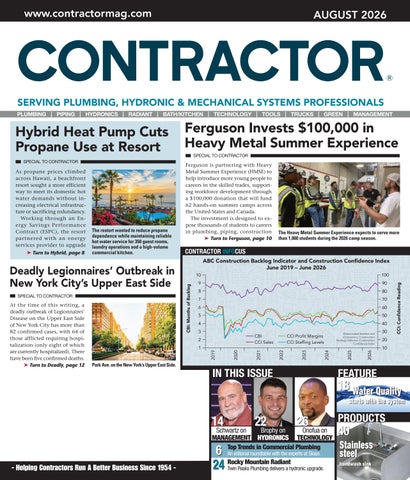
As propane prices climbed across Hawaii, a beachfront resort sought a more efficient way to meet its domestic hot water demands without increasing electrical infrastructure or sacrificing redundancy. Working through an Energy Savings Performance Contract (ESPC), the resort partnered with an energy services provider to upgrade
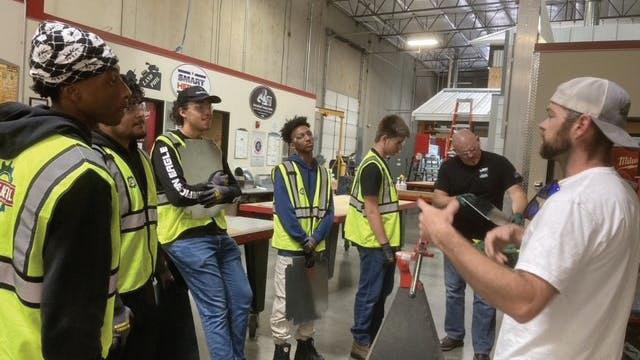
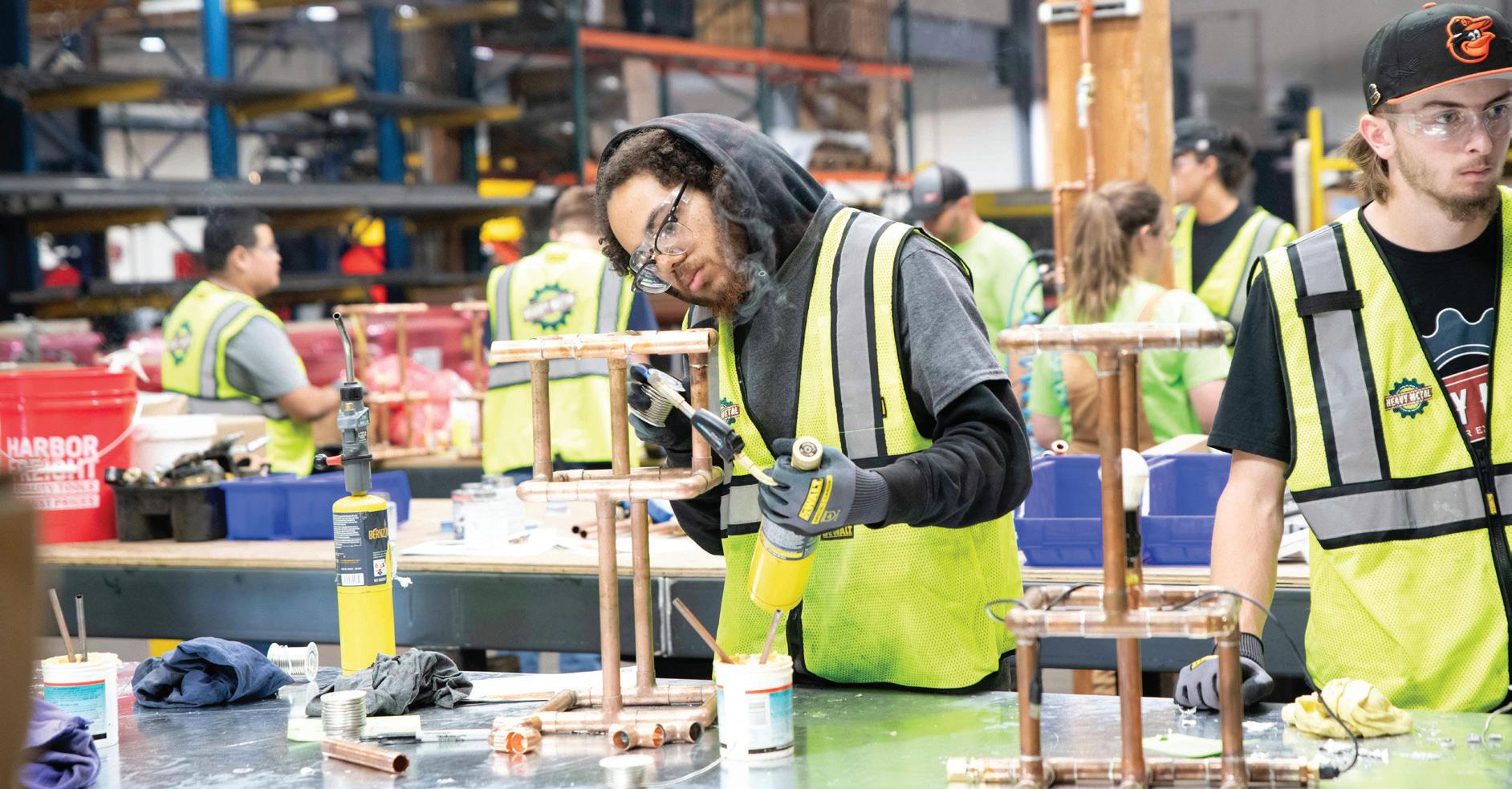
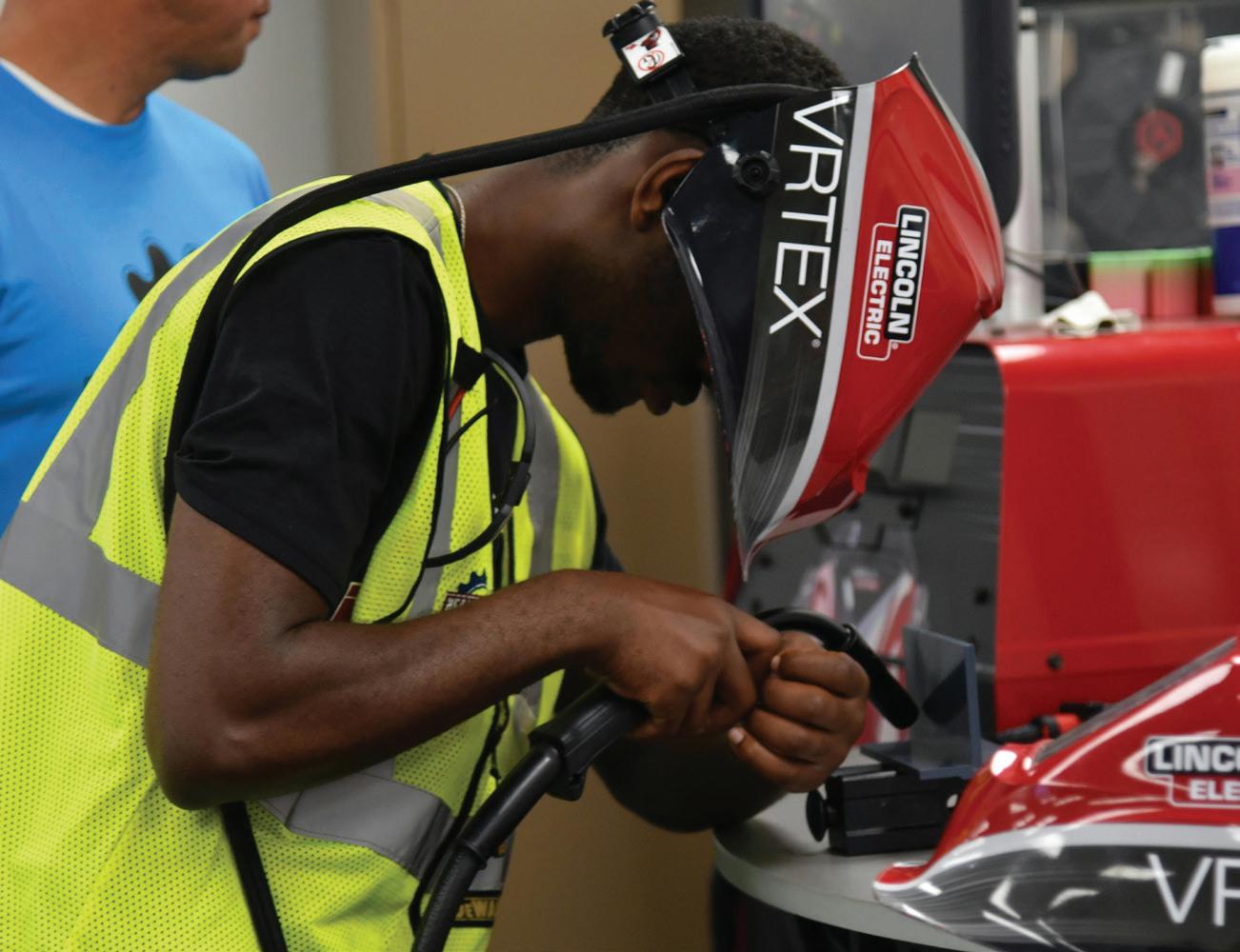
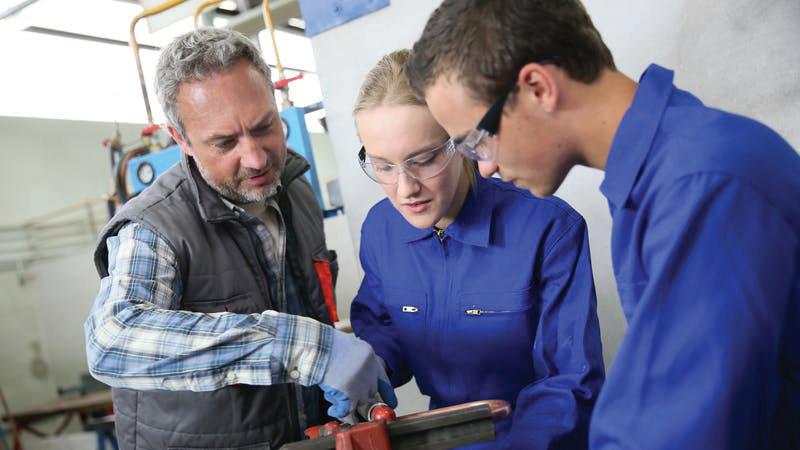
Ferguson is partnering with Heavy Metal Summer Experience (HMSE) to help introduce more young people to careers in the skilled trades, supporting workforce development through a $100,000 donation that will fund 62 hands-on summer camps across the United States and Canada.
The investment is designed to expose thousands of students to careers in plumbing, piping, construction
Legionnaires’ Outbreak in New York City’s Upper East Side
a
outbreak of
Disease on the Upper East Side of New York City has more than 82 confirmed cases, with 64 of those afflicted requiring hospitalization (only eight of which are currently hospitalized). There have been five confirmed deaths.
➤ Turn to Deadly, page 12
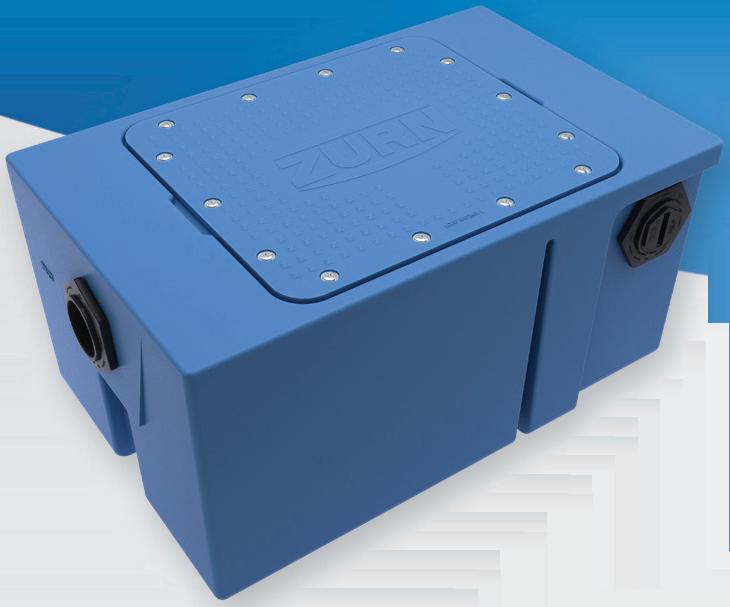
Code-Compliant Design
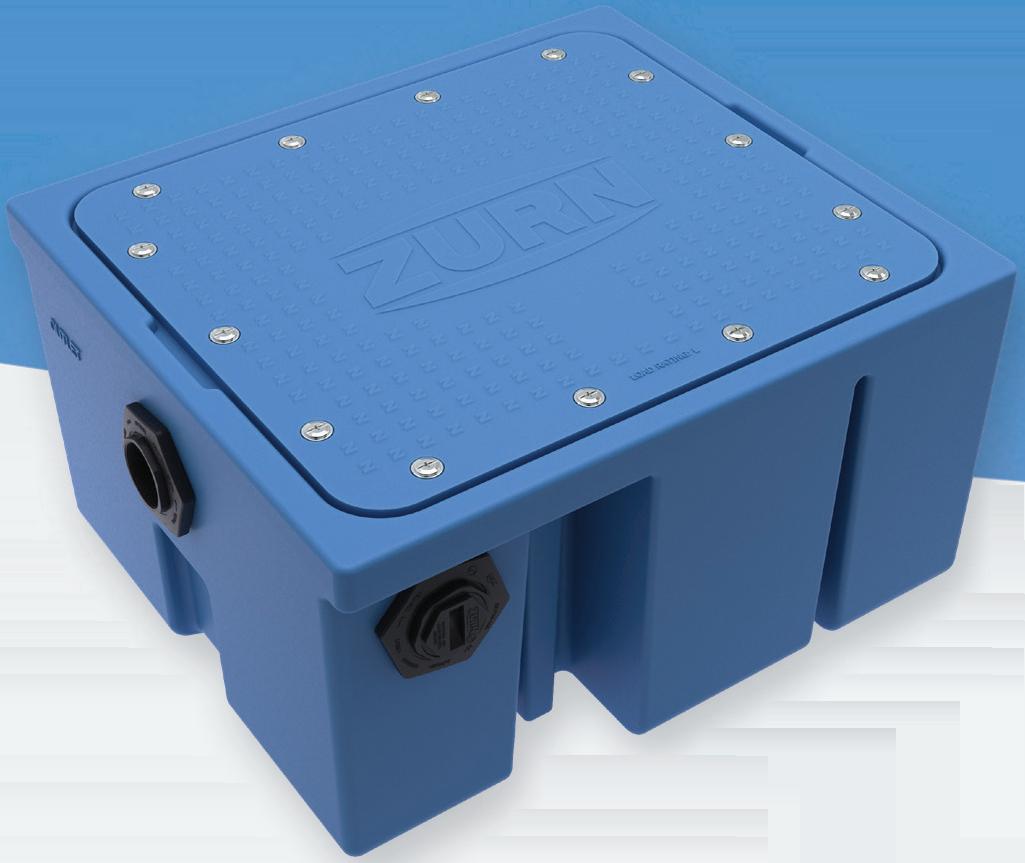
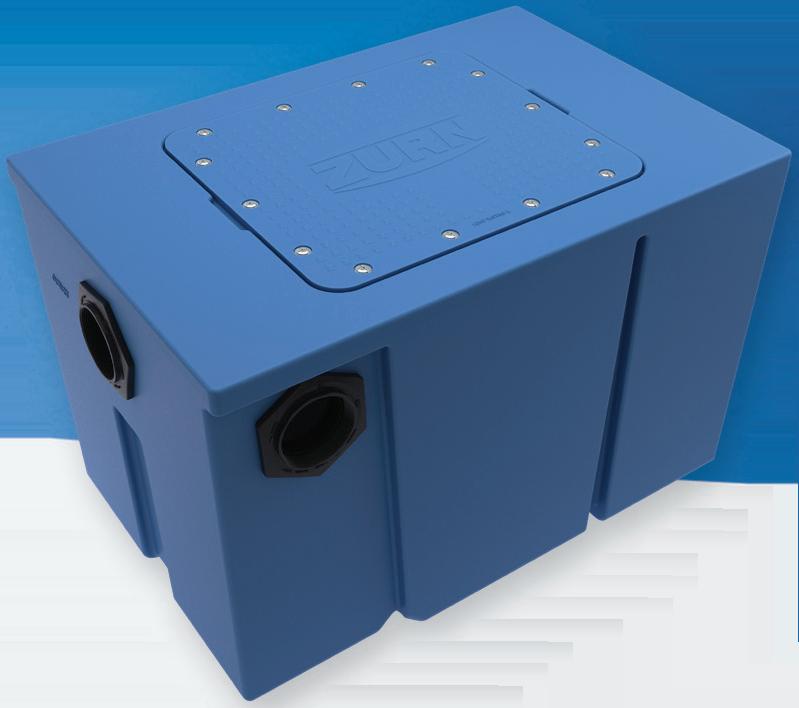
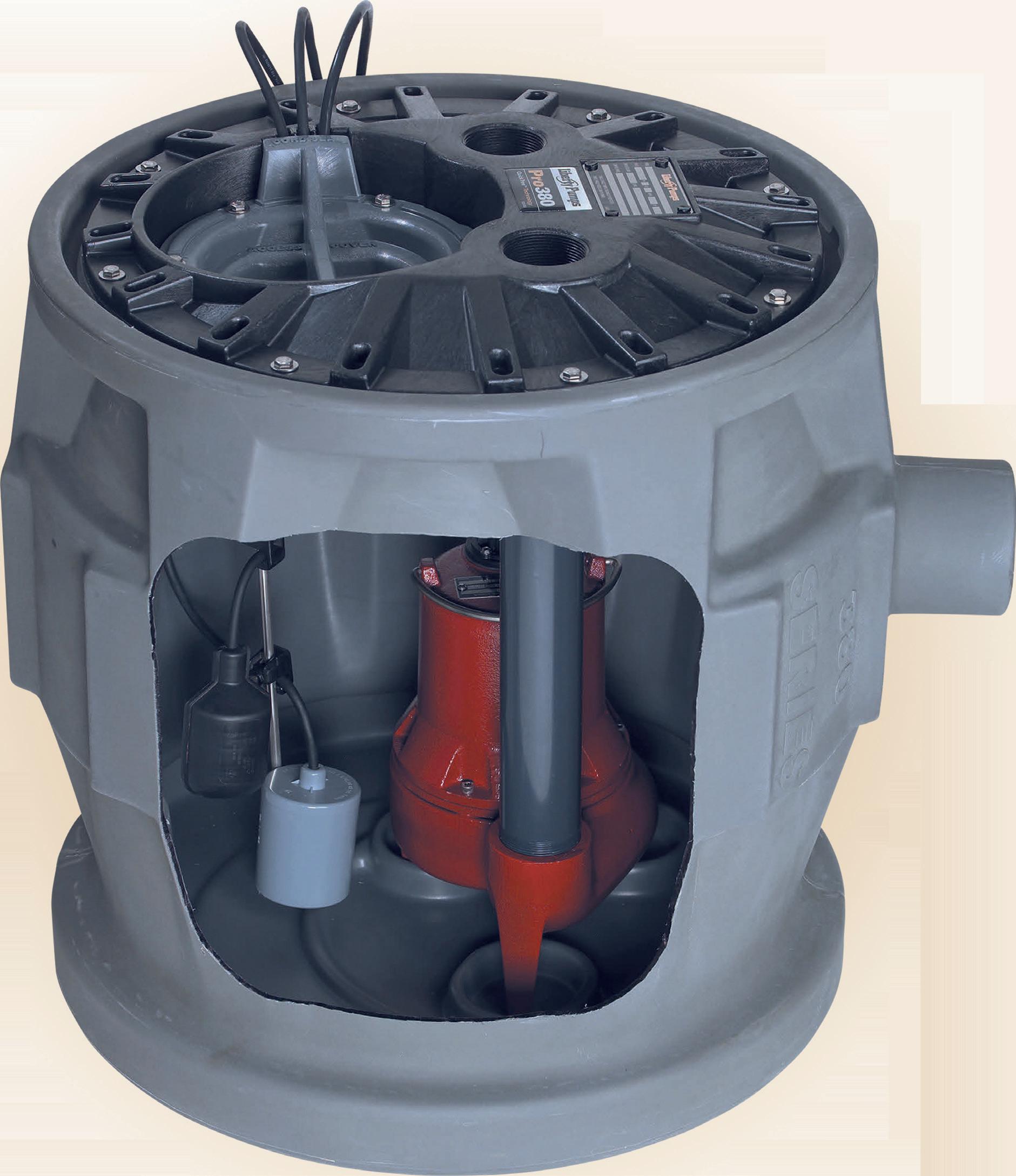
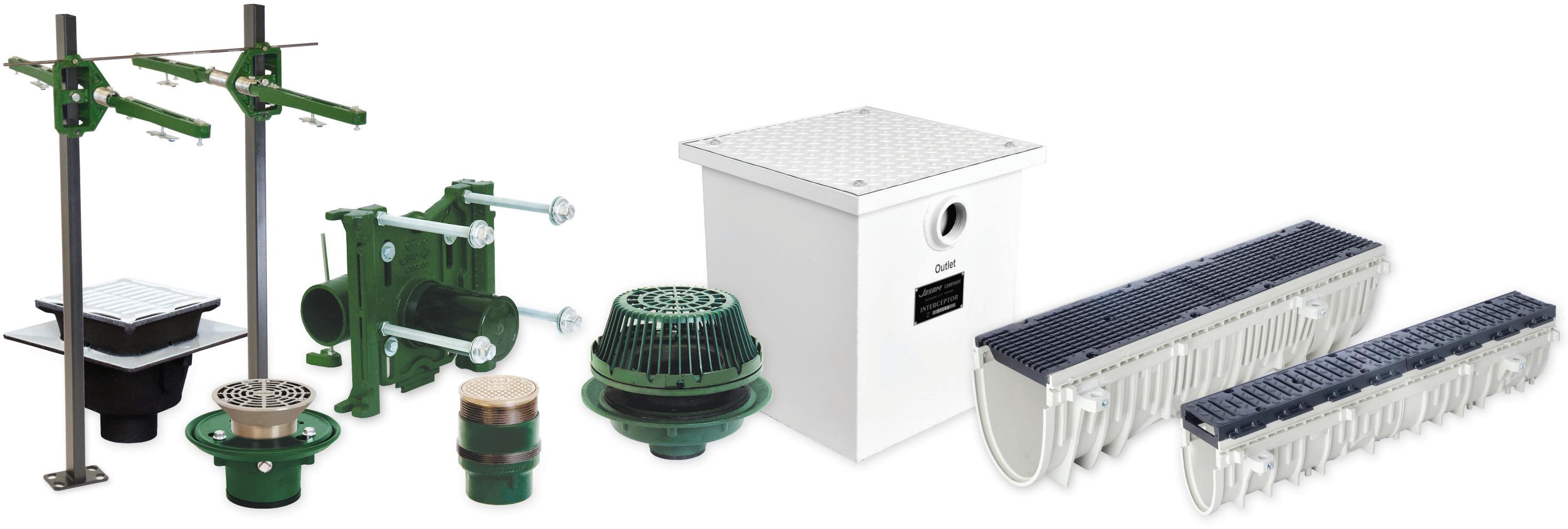
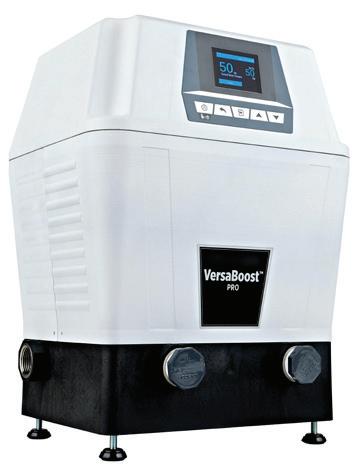
IAPMO listed and conforms to ASME/CSA with PDI-G101 certified external flow control. Flexible Flow Control Available with internal or external flow control in 25, 50 and 75 GPM models.
to Last Durable polyethylene construction backed by a lifetime warranty. Industry-Leading Grease Removal
Up to 97.9% grease removal efficiencies for reliable performance.
BlackRock, Ford, Google Carhartt Launch Skilled Trades Alliance
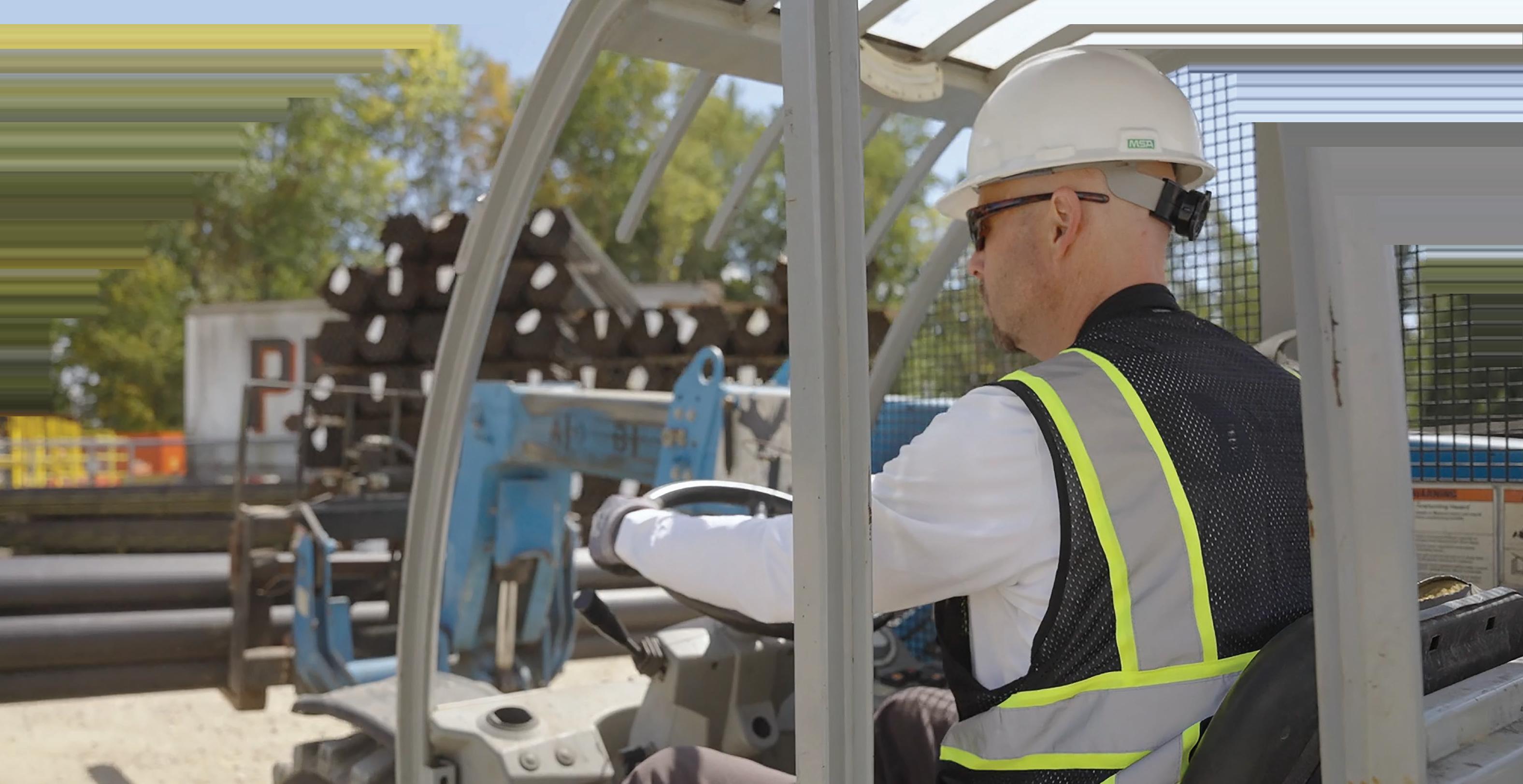
Four major US companies have formed the Alliance for America’s Skilled Trades, a new initiative designed to expand access to skilled trades training and help address the growing workforce shortage affecting construction, manufacturing, infrastructure and other essential industries.
The founding members—BlackRock, Carhartt, Ford Motor Company and
New GA Law Targets Unlicensed Plumbing and HVAC Advertising
ATLANTA, GA — On May 11, Georgia Governor Brian Kemp signed Senate Bill 553 into law, establishing new restrictions on how plumbing, HVAC, electrical and utility contracting services can be advertised in the state of Georgia. The law, which took effect July 1, prohibits unlicensed individuals and businesses
➤ Turn to BlackRock, page 34 ➤ Turn to New, page
Charlotte Pipe Celebrates 125 Years of American Manufacturing
CHARLOTTE, NC. — Charlotte Pipe and Foundry is celebrating its 125th anniversary this year, marking more than a century of manufacturing pipe and fittings in the United States.
Founded in 1901 by W. Frank Dowd, the fifth-generation, family-owned company has grown from a local foundry into one of the nation’s largest manufacturers of cast iron and plastic pipe and fittings. Today, Charlotte
➤ Turn to Charlotte, page 38
EDITORIAL STAFF
VP/Market Leader-Buildings & Construction
Mike Hellmann, mhellmann@endeavorb2b.com
Editor-In-Chief
Steve Spaulding, sspaulding@endeavorb2b.com
Editor-At-Large John Mesenbrink, jmesenbrink@endeavorb2b.com
Endeavor Business Media, LLC CEO, Chris Ferrell COO, Patrick Rains CRO, Paul Andrews CDO, Jacquie Niemiec CALO, Tracy Kane CMO, Amanda Landsaw EVP Endeavor Business Intelligence, Paul Mattioli
EVP Building & Construction Group, Chris Perrino VP of Content Strategy, Mike Eby
In Brief
NETZSCH Pumps USA, announces that Brad Schard has joined the company as Sales Director for the Oil & Gas business field. Brad will develop and execute strategies to grow NETZSCH’s Oil & Gas sales across the US, leading outside and inside sales teams to hit revenue, profitability, and market share targets. He’ll build relationships with key stakeholders while representing the company industry-wide.
KROHNE has expanded its California sales presence through a new partnership with Vector PSI, strengthening local support and responsiveness for customers across a broad range of industrial markets. Customers throughout much of the state will have greater access to local sales support and technical expertise for KROHNE’s process instrumentation solutions.
The New Flat Rate is responding to the new era of AI-search by providing homeowners with reliable data on maintenance and repair costs across the most popular home repair needs. Access to accurate price ranges is a major advancement for residential customers, helping them to evaluate the comparative cost of service and installation in their local area.
MCAA has joined forces with the National Fire Protection Association to offer resources and tools customized and curated to address and mitigate risks related to electrical safety posed to MCAA members, including physical, compliance and financial risks. Crafted by NFPA’s trusted subject matter experts, this content will provide actionable information and strategies to help contractors keep pace with the ever-changing regulatory environment.
IAPMO led the US–Indonesia Plumbing Trade Mission that brought together officials from Indonesia’s National Standardization Agency (BSN), Ministry of Industry, Ministry of Trade, Ministry of Public Works, utilities, IAPMO clients, and experts alongside representatives from the US Dept. of Commerce, Dept. of State, and leading US plumbing manufacturers. The mission represented a coordinated approach to strengthening product standards, conformity assessment, workforce development, and drinking water safety.
Videos & Media Galleries
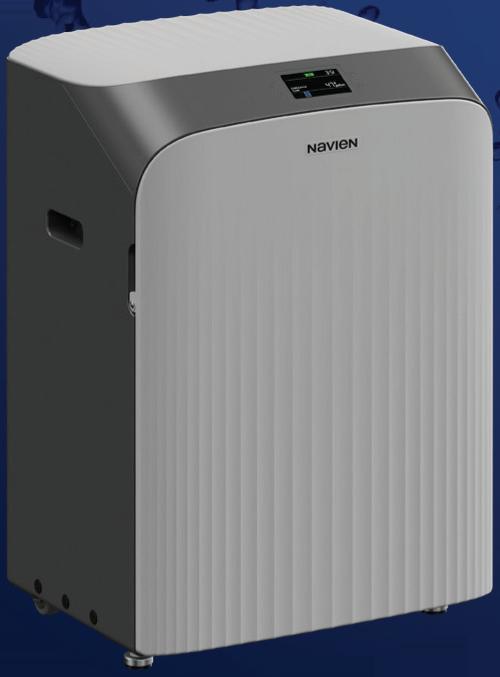
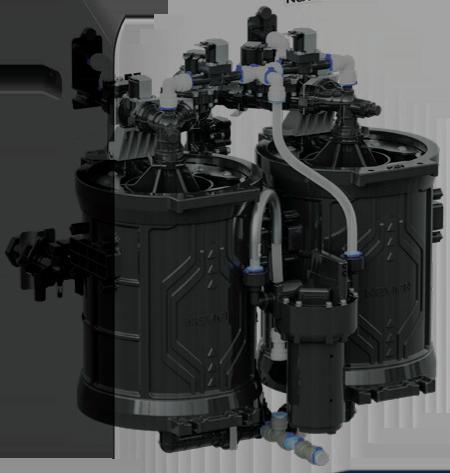
Whole-House Water Treatment Without the Salt
NEW WEC saltless, tankless, electric water treatment system
Navien’s WEC Series brings enhanced water treatment to the entire home. Using advanced electro-membrane technology, WEC significantly reduces total dissolved solids (TDS), hardness*, and other contaminants—all without the need for salt. The WEC is the complete package with a sediment pre-filter, post carbon block filter, and dual-module continuous conditioning. It’s simple to install, easy to maintain, and easy to operate.
To learn more visit navieninc.com.
* This product reduces the concentration of hardness minerals but does not necessarily produce soft water, defined as having <1 gpg hardness.
Top Trends in Commercial Plumbing Systems
We talk with the experts at Sloan about integrated components, connectivity, water safety and much more.
BY STEVE SPAULDING OF CONTRACTOR’S STAFF
Sloan has been in business since 1906. Today, the family-led company is in its fourth generation and has made a name for itself around the world as the leading manufacturer of commercial plumbing systems. Sloan has been an industry innovator since its founder, William Elvis Sloan, invented the Royal Flushometer. Today, the company uses its technical expertise and more than a century of experience to deliver on its promise of efficiency, sustainability and wellness. We asked the experts at Sloan to discuss what they see as the most important trends in commercial plumbing today.
Ease of Installation
Emerson Vogel: Product Line Manager – Sink Systems and Hand Dryers
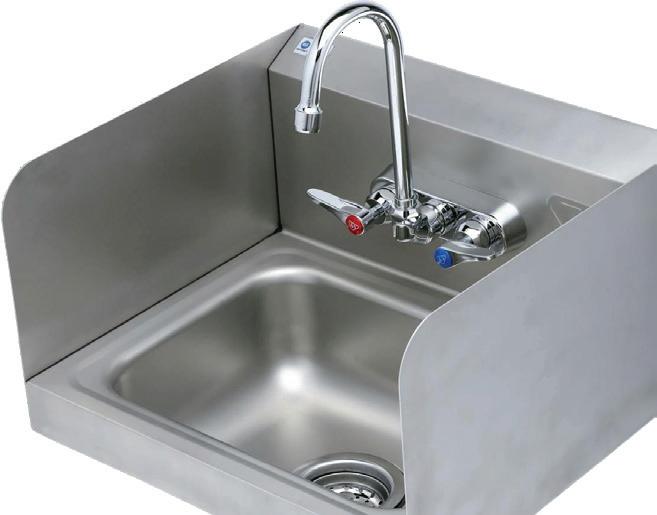
Sloan has moved beyond selling individual sink components to designing complete, integrated sink systems: the faucet, soap dispenser, hand dryer, sink, frame, and enclosure are engineered as a package meant to work together, rather than sourced and specified piece by piece. That integration is a big part of what makes installation faster: fewer compatibility issues, less field coordination between trades, and less guesswork for installers.
To further ease the burden on installation crews, Sloan also offers a seaming service to handle the finish work on solid surface joints, and a start-up service where Sloan personnel assist on-site during commissioning to make sure everything is set up and running correctly before handoff.
Rolando Zambrano: Product Line Manager –Flushometers and Fixtures
The CX conceal flushometer streamlines the installation process. Instead of bringing the valve to the plumbing, the CX features an integrated control stop and adjustable flush connection, with an all-vertical, in-line rough-in that allows the installer to bring the plumbing to the valve. Once installed, all the servicing of repair parts can be done single-handedly in front of the wall, through the wall plate using half the labor.
In addition, Sloan’s popular fixture combination units integrate water efficient flushometers with water closets or urinals to help save time and labor costs. The combo units ensure that contractors are ordering compatible fixture and flushometer pairings and the products ship in the same package to ensure the flushometer and fixture stay together for ease of installation.
Adam Myers: Product Line Manager – Restroom Accessories, Hand Dryers, Bottle Fillers
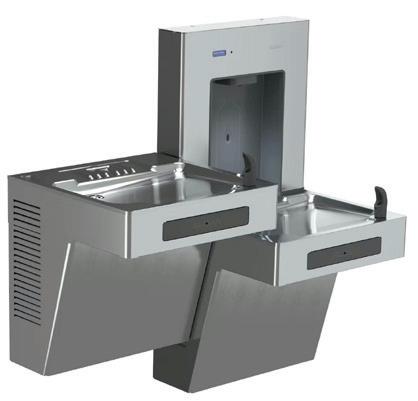
The DropSpot Bottle Filler and Water Coolers match most manufacturers’ rough-ins, simplifying installation
Building owners, architects, and engineers are looking for products that not only perform well and look great but also help support broader environmental objectives.
and making upgrading easier. The portfolio includes unrefrigerated configurations that help balance performance, cost, and application needs. The unrefrigerated versions of the DRS110 and DRS120 bottle filler and water cooler combo units address concerns regarding cost, installation, and operational simplicity. By removing the chiller, these models cost less, and unrefrigerated models require no electrical connection, which reduces installation complexity and opens the door to applications where power is limited or unavailable. These units are manually operated, so they continue to provide access to drinking water during power outages and emergency situations.
Practical Connectivity
Lynn Walldorf: Senior Product Manager – IoT, PWT & Parts
Commercial plumbers are increasingly expected to deliver solutions that not only perform reliably on day one but also simplify maintenance throughout the life of the building. Connected plumbing products help shift maintenance from a reactive process to a proactive one by providing facility teams with actionable information before minor issues become service calls.
Through SC Argus Pro, maintenance professionals can remotely monitor connected Sloan flushometers, faucets, and bottle fillers from a single dashboard. They can view device status, battery levels, water usage, and activation history, as well as receive alerts when attention is needed. This visibility helps teams prioritize maintenance, troubleshoot more efficiently, and often arrive on-site with a better understanding of the issue. Connected devices also provide operational insights that support preventive maintenance. Features such as line flush documentation, water usage reporting, and remote configuration help simplify routine tasks while giving facility managers greater confidence in system performance. New connected products like
Sloan Track-On extend these benefits even further by providing immediate notification of flushometer run-on conditions, allowing maintenance personnel to respond quickly before excessive water waste or larger facility issues occur.
For contractors, connected plumbing solutions offer an opportunity to deliver lasting value well beyond the initial installation.
Water Quality and Efficiency
Adam Myers
Hydration-related legislation is expanding rapidly across the country. What began with Michigan’s Filter First initiative has since spread to states such as Delaware, New Jersey, and Maryland, with additional requirements emerging in Illinois, Washington, and Maine. These regulations may apply to new construction, renovation projects, or existing facilities, and they vary by location.
Because of this complexity, Sloan introduced a state regulations and compliance landing page that helps educate plumbing contractors about current ➤ Turn to Top, page 33
Sloan's FLITE-DEC system is built to withstand heavy commercial and public use while still offering full customization in finish and design.
The DropSpot Bottle Filler and Water Coolers match most manufacturers’ rough-ins, simplifying installation and making upgrading easier.
Sloan Sloan Sloan
We’ve
Hybrid Heat Pump System Cuts Propane Use at Hawaii Beach Resort
➤ Continued from page 1
both its domestic hot water and chiller systems. The goal was to reduce propane dependence while maintaining reliable hot water service for 350 guest rooms, laundry operations and a high-volume commercial kitchen.
The challenge was delivering that capacity while integrating with existing infrastructure, including storage tanks and electrical service.
Reducing Fuel Dependence Without Major Infrastructure Changes
The resort needed a system capable of handling largescale domestic hot water loads across two separate buildings while avoiding the cost of upgrading electrical service.
That meant finding a solution that could maximize efficiency, work with the existing storage system and provide reliable backup during peak loads or maintenance periods.
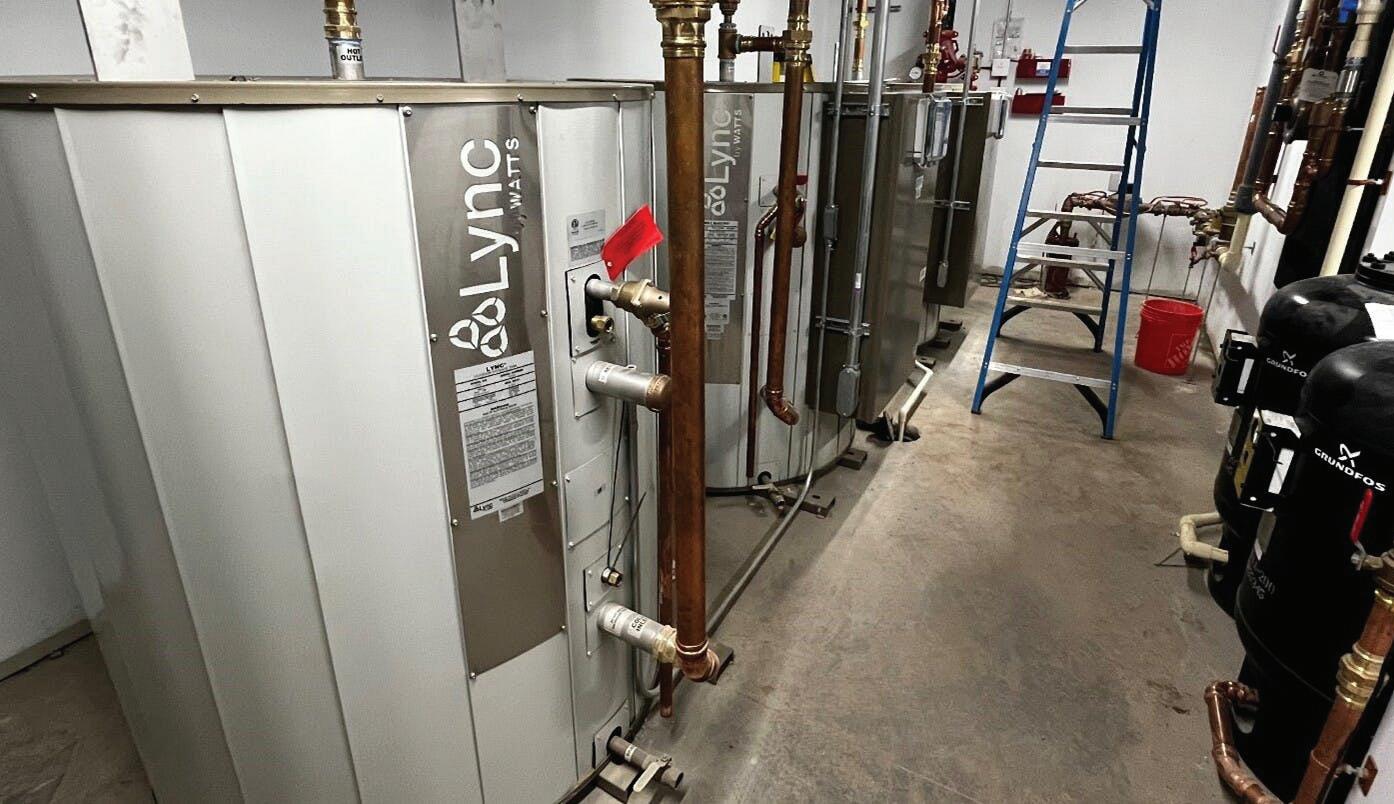
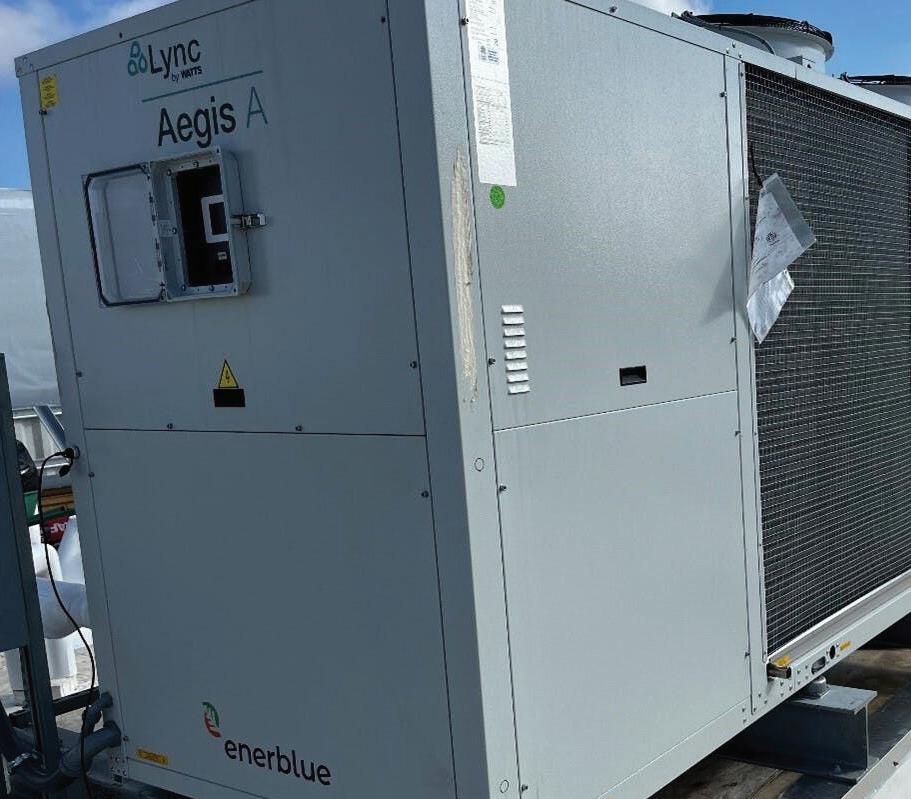
Lync developed a hybrid system built around an Aegis water-source heat pump water heater, a new 300-gallon Lync storage tank, the reuse of the resort’s existing storage tank, and three AERCO Innovation high-efficiency gas-fired water heaters for backup.
The system was engineered to support hot water demand across 350 guest rooms, five commercial washing machines and a large commercial kitchen.
Heat Pump System Tied Into Existing Chiller Loop
A key part of the design was integrating the Aegis heat pump with the resort’s existing chiller water loop, which operates between 50°F and 55°F.
This setup allowed the heat pump to generate domestic hot water while simultaneously removing heat from the chiller loop, effectively adding cooling capacity back into the hotel’s HVAC system.
Two recirculation loops—one operating at 120°F and another at 140°F—were incorporated to meet varying hot water requirements across the property. By leveraging both heating and cooling loads, the system achieved a combined coefficient of performance (COP) of 6.4.
Built-In Redundancy for Continuous Hot Water
To maintain uninterrupted service, the hybrid plant used three AERCO Innovation gas-fired water heaters tied into the resort’s existing propane connections. These units automatically provide full backup whenever the heat pump is offline or additional hot water capacity is needed.
The approach gave the resort lower operating costs and system redundancy while avoiding the higher first cost of building a larger all-heat-pump plant.
Reliable Performance With No Service Callbacks
Since startup, the hybrid system has operated as the resort’s primary domestic hot water source, delivering stable performance while reducing propane consumption.
Josh Jackson , Sales Engineer for Lync’s representative in Hawaii, noted, “It is extremely rare for all HVAC and plumbing equipment not to have a callback in 1.5 years of operation, but since startup, there have been none.”
The completed project delivered an upgraded domestic hot water and chiller system with no upfront capital cost to the resort through the ESPC model. In addition to long-term energy savings, the hybrid configuration improved cooling system efficiency by offloading the The Aegis
condenser water loop while maintaining full domestic hot water redundancy.
To learn more, visit Lync at www.lyncbywatts.com, and visit Aerco at www.aerco.com
water-source heat pump water heater.
The 300-gal. storage tank (foreground) in the mechanical room.
Lync
Lync
Ferguson Expands Invests $100,000 in Heavy Metal Summer Experience
and related mechanical trades while helping them build practical skills, connect with industry mentors and explore apprenticeship opportunities.
“We’re certainly proud of our partnership with HMSE, along with others like the mikeroweWORKS Foundation, Explore the Trades and Tools & Tiaras, all contributing to our goal of connecting 50,000 youth to the skilled trades,” said Melissa Hazelwood , Director of Social Impact for Ferguson. “By investing in programs that meet young people where they are, we’re helping them get real exposure to careers in the skilled trades and see what’s possible. Our focus is on building a strong, sustainable skilled trades pipeline so the next generation is ready to step in and keep our communities running.”
Summer Camps Provide Real-World Jobsite Experience
HMSE serves students ages 15 to 20 through immersive summer programs that introduce participants to careers in sheet metal, piping, plumbing and electrical work.
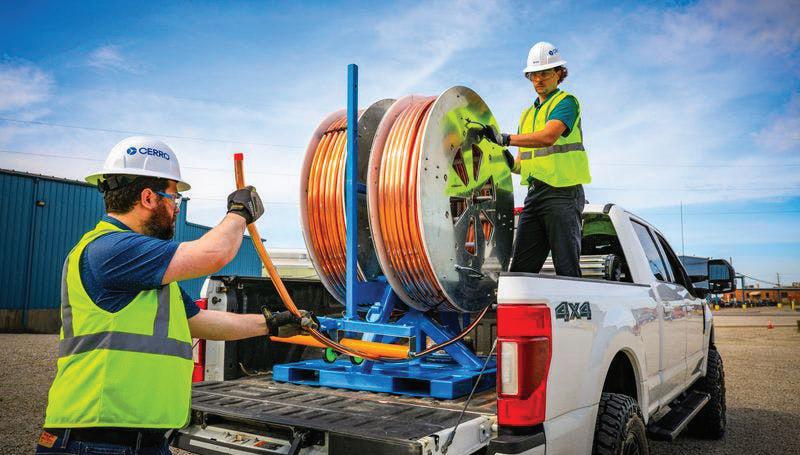
Students receive up to 40 hours of project-based instruction at contractor facilities and training centers, where they complete hands-on projects under the guidance of experienced tradespeople. Activities include fabricating sheet metal toolboxes, assembling copper pipe lamps and wiring DIY air conditioning units.
The camps also connect students directly with pre-apprenticeship programs, registered apprenticeships and employer partners, creating path -
ways into long-term careers in the skilled trades.
“What started as a simple idea to open doors for young people has grown into something much bigger,” said Hazelwood. “HMSE gives young people the opportunity to work with their hands, build their confidence and really see themselves in a career in the trades. It’s about connecting them to real-world experiences, job sites and industry professionals. It really is an extraordinary experience.”
Workforce Program Continues to Grow
Since launching in 2021 with 28 students, Heavy Metal Summer Experience has expanded rapidly. The organization expects to serve more than 1,000 students during the 2026 camp season.
“Ferguson’s partnership helps HMSE give students something many have never had before: the chance to see the skilled trades up close, work with their hands and imagine a future in an industry ready to welcome them,” Ellen Young , Executive Director for Heavy Metal Summer Experience said. “HMSE began by serving 28 students in 2021 and has grown
to serve more than 1,000 students in 2026 alone, reflecting an industry-wide commitment, strengthened by philanthropic partners like Ferguson and by the response from students, parents, and trades professionals eager to mentor the next generation. We are grateful to Ferguson for investing in these moments of discovery and confidence that can change the direction of a young person’s life.”
Camp participants say the experience provides valuable insight into careers they may not have otherwise considered.
“The amount of opportunity that this camp has given me is definitely going to impact my future in the trades positively,” said Nathaniel, an HMSE camper.
Long-Term Focus on Skilled Trades Recruitment
The HMSE partnership is part of Ferguson’s broader workforce development strategy aimed at connecting 50,000 young people with skilled trades careers by 2030.
In addition to HMSE, Ferguson supports organizations including the mikeroweWORKS Foundation, Explore the Trades and Tools & Tiaras to increase awareness of career opportunities throughout the plumbing, HVAC, mechanical and construction industries.
Together, Ferguson and HMSE hope to strengthen the pipeline of future skilled trades professionals by giving students early exposure to the industry while helping contractors address long-term workforce needs.
To learn more visit www.fergusonpressroom.com
➤ Continued from page 1
The camps also connect students directly with pre-apprenticeship programs, registered apprenticeships and employer partners.
HMSE
Ferguson
Ferguson
Deadly Legionnaires’ Outbreak in NYC’s Upper East Side: What You Need to Know
➤ Continued from page 1
The latest outbreak is being investigated as a “community cluster” affecting the Upper East Side neighborhoods of Carnegie Hill and Yorkville. The outbreak was first reported July 2.
The New York City official government site, www. nyc.gov, advises that any New Yorkers in ZIP codes 10028, 10128, and 10075 can continue to drink tap water, bathe, shower, cook, and use air conditioners at home, as the source of the aerosolized bacteria is cooling towers, not plumbing systems.
New Yorkers who currently live or work in the affected area, or people who have visited the area since late June and are experiencing flu-like symptoms, such as cough, fever, or difficulty breathing should contact a health care provider immediately.
Testing and Remediation
Officials also confirmed that live Legionella bacteria had been discovered in 34 cooling towers at 33
buildings through culture tests. The cooling towers that have tested positive have been fully cleaned and completed remediation.
While The Ardsley, a residential co-op building on Central Park West—where one-bedroom apartments sell for nearly $1 million—had its hot water system test positive for the Legionella bacterium, a statement from the mayor’s office has dismissed it as the source of the outbreak. The building has no cooling tower, and has since disinfected its water system.
The bacteria that cause Legionnaires, Legionella pneumophila, are common, widespread, and can survive in most water systems. Eradication is not possible, only mitigation, prevention and control. A similar outbreak in the Bronx neighborhood back in 2015 sickened 130, killing 10.
21st Century ROAD to Housing Act Aims to Boost Affordable Housing
WASHINGTON, DC — On June 23, the US House of Representatives passed the 21st Century Renewing Opportunity in the American Dream (ROAD) to Housing Act (H.R. 6644) by a vote of 358 to 32.
The ROAD to Housing Act is the first major, bipartisan housing legislation passed in 40 years. The main goal of the Act is to increase the supply of affordable housing. Historic spikes in home prices, high interest rates, and acute inventory shortages have made homeownership historically unattainable for the average American.
While President Trump refused to sign the bill he did not veto the bill, and it became law automatically on July 10.
Major Provisions
The once-in-a-generation legislative package includes 18 sections from both the House and Senate bills and at least 26 sections that incorporate previously introduced bipartisan legislation. Five key provisions address:
Land-Use and Zoning. The bill targets restrictive zoning and land-use policies that have limited residential construction. It directs the Department of Housing and Urban Development to work with stakeholders, including home builders and developers, to identify best practices and give state and local governments options to increase housing production. It also rewards communities that adopt policies
that expand supply and support housing growth. Aging Housing Stock. This provision authorizes a pilot program to provide grants and forgivable loans for home repairs and health-hazard mitigation in aging housing.
Multifamily Financing. FHA-insured multifamily loan limits have not changed in 12 years and no longer reflect market conditions. Raising those limits and indexing them to inflation will better align financing with construction costs and support new apartment development.
Environmental Reviews. This provision streamlines the National Environmental Policy Act review process for small and infill housing projects, helping them move to construction faster.
Community Banks. Multiple provisions are aimed at strengthening community banks and expanding access to housing credit.
The legislation also includes other provisions important to housing construction, rehabilitation, and infrastructure, including support for manufactured and modular housing, whole-home repairs, adaptive reuse, water and sewer line repairs, and housing-related infrastructure planning.
The bill attempted to reconcile approaches taken in both the House and Senate versions while reflecting Trump Administration priorities—particularly limits on institutional investor purchases of single-family homes.
Industry Reactions
The National Association of Home Builders (NAHB) helped shape the legislation through years of advocacy.
“NAHB applauds lawmakers for working in a bipartisan, bicameral way to pass historic housing legislation that will deliver real benefits for the American people,” said NAHB Chairman Bill Owens
Associated Builders and Contractors (ABC) offered its support for the ROAD to Housing Act, although with some caveats.
“At a time when the nation faces a significant housing supply gap, policies should encourage the financing and construction of new housing,” said Kristen Swearingen, ABC Vice President of Government Affairs.
For other reactions from around the industry, visit us online at contractormag.com.
Microscopic view of Legionella pneumophila, the causative agent of legionellosis or Legionnaires’ disease.
by Al Schwartz
Expanding Your Plumbing Business in a Slow Market
While it may seem counter-intuitive to think about expanding your business in a slow market, when you look at most subcontractor business models it makes sense. Presently we are not in a down market, but the cyclical nature of our economy makes a downturn inevitable. The high cost of fuel right now is the big problem and no one knows if the market will correct back to an affordable zone, or if we are to be permanently stuck in the European fuel cost model. Looking at the global economy and using past as prologue, I would say that fuel prices will stay high for the foreseeable future. So get ready for a post-election downturn. It is easy to say, “It’s a tough market out there, I’ll just pull back and wait for it to improve.” The problem with that type of thinking is it’s a negatively self-fulfilling prophecy. At what point would you deem it alright to ramp up your business? Do you hit the beginning of the upswing (when there is an upswing) or do you catch it in the middle? As I mentioned in a previous column, trying to predict or beat the curve is a fool’s errand. You and your business are subject to all the vagaries of the marketplace all the time, so why try to simply “ride it out” by deliberately slowing yourself down?
Getting Aggressive
There are things you can do to streamline your business—make yourself leaner and more efficient. However, once you’ve done that, you will need to get aggressive in your approach, not shrink back until things improve. Instead of pulling back in a slow market, move ahead and ramp-up your efforts. There is always work to be had for the contractor who looks for it. In good times you can be selective (to a degree), in hard times it pays to be less so.
Doing things that you have never done before, such as cold calling prospective clients, architects, engineers and the like can bring good results. If you can’t make a personal appearance at their offices, utilize the social and digital media outlets and compose a letter
Instead of pulling back in a slow market, move ahead and ramp-up your efforts.
of introduction, along with your qualifications and send it along with your business card or contact data, to as many prospective contacts as you can find.
Getting noticed online is a hard target to hit. You, of course, are going to be one of many ads a prospective client might get. How do you make yourself stand out in the crowd? Be professional! A sloppy or slap-dash letter will say more about you than anything else.
Producing a professional, interesting and informative introduction is key. At best you might get a job. At the very least you might make a friend or start a relationship that will bear fruit later on. Either way, you will get your company name out in front of people that may be able to do you some good, if not immediately, then down the road.
Known Customers
In a service context, why not send an e-card or letter to past customers offering special pricing on various services? This method is not new, but be creative! You won’t be spending money on broad market advertising, but will be narrowly focusing on known customers for hardly
any out-of-pocket expense. Offering to do free inspections of their plumbing or HVAC systems is a well-known method of generating service and remodel work or, at least, making contact with your customer base and keeping your name in front of them.
If you aren’t super busy (and even if you are) doing this type of customer service will pay big in the future. If you are busy, and your service people are particularly personable (and knowledgeable), there is a good probability a free inspection will generate more work immediately. Just don’t fall into the trap of selling your customers a service or product they don’t need.
Honesty is always the best policy and your customers will hold you and your company in high regard if they perceive that you have been straightforward in your dealing with them. Conversely, selling a customer something they don’t need, or which is questionable in their mind, will always come back to bite you.
Know Your Market
Keeping abreast of the status of projects in the geographic area in which you do
business is a must. If you do work in a small town as opposed to a major metropolitan area, keeping track of projects is much easier. The downside of doing business in a small town is your competition is fewer, fiercer and more focused. In a large metropolitan market there may be more competitors, but there is also more work available and there are less “insider” issues to deal with (or at least they are not as intense).
As mentioned above, consider also using the internet and social media to broaden your reach. If you aren’t wellversed in those areas then learn and become fluent. If you can’t or won’t learn, then hire or subcontract someone who can get you to a good place online. The Internet has become the major superhighway of commerce and personal information and has become a critical tool for doing business in the 21st century.
Stay Positive
Keeping a positive attitude is, arguably, more important than anything else. The contracting/subcontracting business is a rough one, not for the faint of heart. If you are in business today, you are to be congratulated for just staying solvent, but you can’t stand still, or you will get run over. Make a plan. It doesn’t have to be an elaborate plan, but you need a plan of action that makes sense for you and your company. There is a saying in the military; “every battle has a plan… and the first casualty in battle is the plan.” Never be so invested in a course of action that you can’t change it. Being stubborn is sometimes a good thing, but being blindly tied to a course of action that isn’t working is not.
The Brooklyn, N.Y.-born author is a retired third generation master plumber. He founded Sunflower Plumbing & Heating in Shirley, N.Y., in 1975 and A Professional Commercial Plumbing Inc. in Phoenix in 1980. He holds residential, commercial, industrial and solar plumbing licenses and is certified in welding, clean rooms, polypropylene gas fusion and medical gas piping. He can be reached at omeletman01@gmail.com.
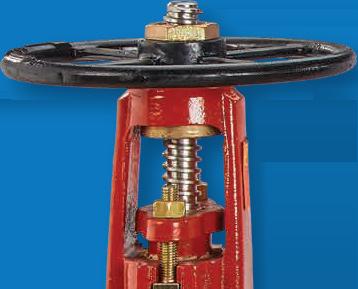
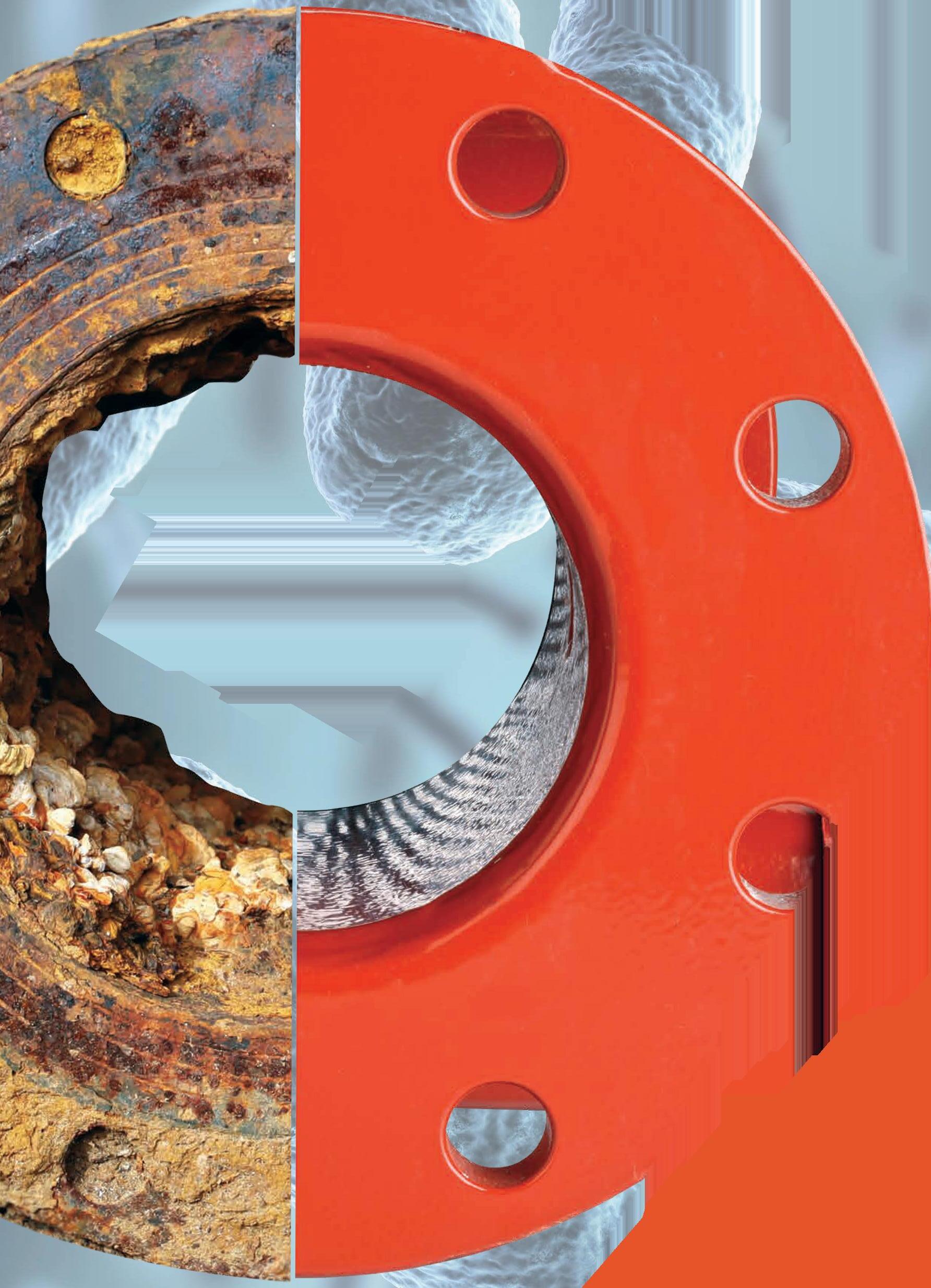
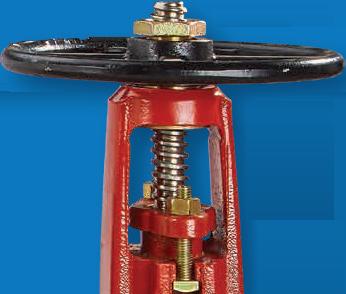
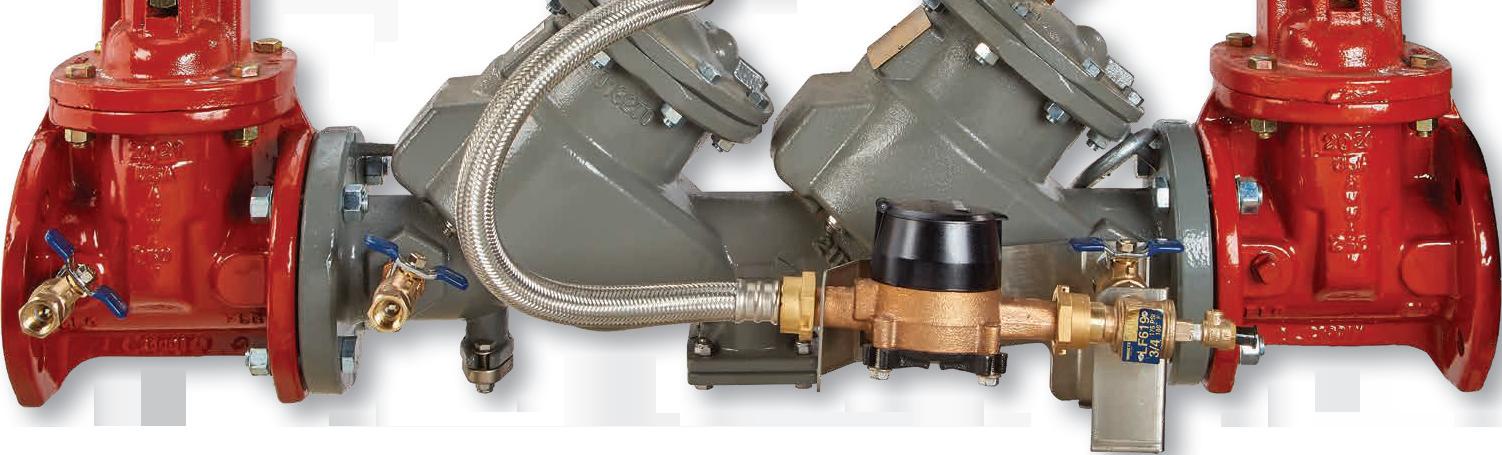
Stop Replacing Corroded Valves
Extend Valve Life and Prevent MIC
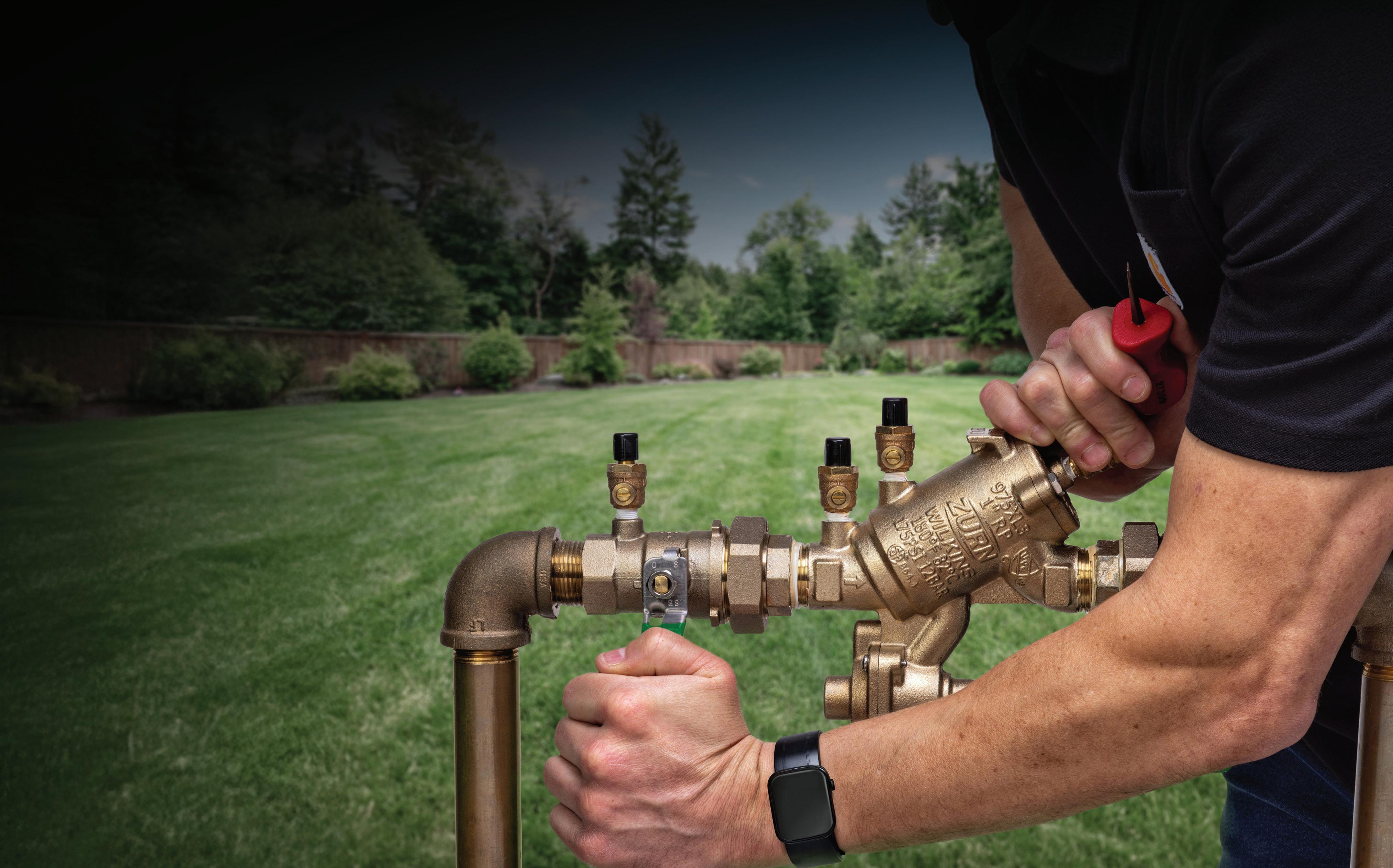
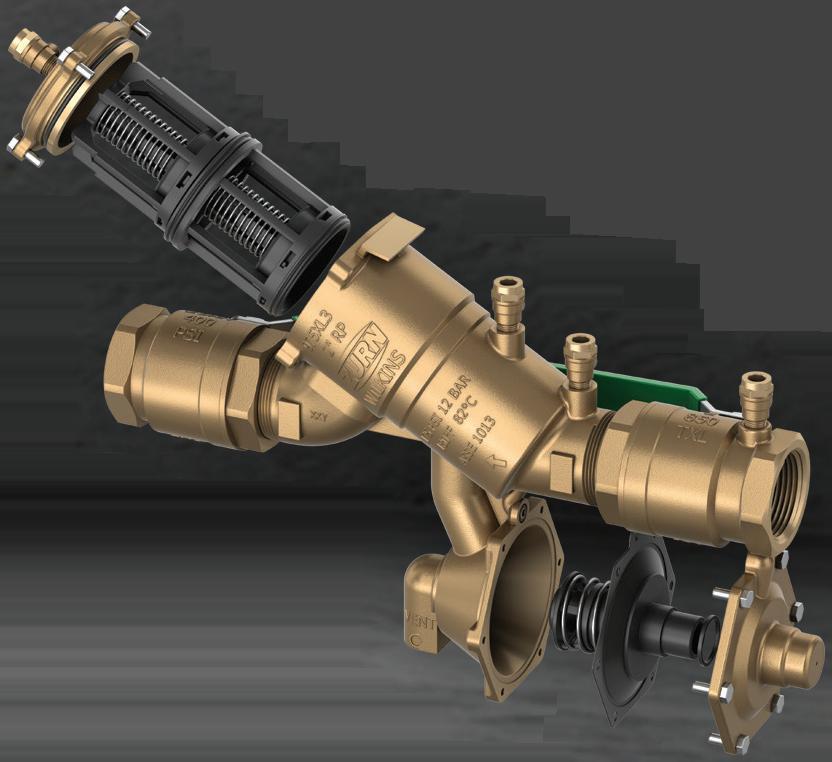
The ONLY ACVs, Strainers, and Backflow Preventers with an 8-year MIC warranty*
Microbiologically Induced Corrosion (MIC) kills your equipment. Avoid it with ArmorTek® coated valves
*Terms and conditions apply.
How to Build an AEC Company That Commands a Premium Valuation
BY HARI VASUDEVAN,
Most founders building in the hottest infrastructure market in a generation will leave significant company value on the table when they sell their company. That is, if they successfully sell their business at all, because 70% of business successions fail. This is not for lack of vision or capacity to execute, but because investors don’t pay a premium valuation for a company that lacks leadership, financial discipline, and technology depth.
With an expected $5.3 trillion in AIdriven data center and infrastructure investment on the horizon, the race isn’t just to win projects. Rather, it is to build firms with financial, management, and technology depth durable enough to outlast the founder’s direct involvement.
From Founder-Led to Scalable: Why Management Depth Drives Higher Valuations
Founders’ perseverance, determination, and personability are behind the grit and resourcefulness that have long been prized in the Architecture, Engineering, and Construction (AEC) landscape. It’s time to embed these traits in a management model that creates more value for firms and appeals to investors.
A long-tenured bookkeeper may have helped build the financial foundation of the company. As the organization grows, however, financial complexity often increases as well. At that stage, many firms benefit from adding strategic financial leadership in the form of a controller or CFO who can oversee capital planning, lender relationships, risk management, and investor-grade reporting.
Championing this model starts with the founder. Building the management depth surrounding their leadership is a vital undertaking in this new age of opportunity to enhance resilience and risk management under careful investor assessments.
Ultimately, it’s a win-win situation where the founder is still the face and head of the firm, but has mobilized agility in the form of greater management
Investors are looking for leadership that replicates the founder’s standards without requiring the founder’s presence.
depth. The CFO’s role extends beyond financial reporting and compliance; they serve as a strategic partner who helps guide the company’s growth, manage risk, and support key business decisions alongside the founder and leadership team.
The same principle applies across the organization. Consider a seasoned sales leader who has spent twenty years winning work on the strength of the founder’s relationships and reputation. In a scalable firm, that sales leader has been equipped with the processes, data, and decision-making authority to close work independently, without bringing in the founder in the sales process.
Another example to consider is a head of safety who doesn’t just enforce compliance but leads a living and breathing safety culture, actively coaching field supervisors and documenting near-miss learnings in scalable systems the whole organization can access. These are the markers investors look for: leadership that replicates the founder’s standard without requiring the founder’s presence.
Why AI Adoption Is Now a Valuation Driver for AEC Companies
Management depth must be prioritized to drive enduring value. For this founder-inspired model to work, leadership beyond the founder—such as the CFO, CMO, and head of sales—must be able to make autonomous, informed decisions. AI adoption is another key valuation driver by which a company can differentiate itself from the competition.
While AI is not a substitute for sound financial controls, strong leadership, or experienced professionals, it can help firms improve consistency, visibility, and decision-making when implemented thoughtfully.
However, AI adoption in the AEC industry is still in its nascent stages. A 2025 global survey of AEC professionals found that only about a quarter reported using AI in their operations. And, according to a 2024 Autodesk and Dodge Construction Network report, AEC professionals spend an average of 5.5 hours per week searching for project information. This
is valuable time that compounds into significant operational drag across a firm. Both these statistics underscore how much runway remains for firms willing to move first into AI-driven leaders in their category.
AI’s value in the AEC industry is rooted less in its ability to transform the job site or automate architectural planning and more in its back-office potential. AI can accelerate financial operations, democratize knowledge management, and streamline project controls. These are the functional areas where seemingly small breakdowns most often cascade into major cash-flow problems and could potentially cripple a business.
Even during periods of strong demand, many construction and AEC firms face cash-flow challenges long before they face a shortage of opportunities, especially when demand for their service surges like the current AIdriven infrastructure boom. A minor billing delay, a missed change order, or a poorly tracked purchase order can tie up millions in receivables.
Here’s where founders should opt for an 80/20 approach, because not every workflow and process needs an overnight overhaul. A smarter strategy is to tackle 20% of the operational process that drives 80% of outcomes. When founders and firms can demonstrate to investors that the most critical workflows and operations are data-driven and documented and not locked inside one person’s head, that kind of transparency changes the conversation entirely. Why? Because investors will actively see the resilience and risk management in the firm’s DNA.
How Founder-Inspired AEC Firms Win the Talent Competition
Greater AI adoption is, however, no panacea for AEC companies. The industry’s essential roles—skilled trades, boots-onthe-ground engineering, and field supervision—all require human judgment that
PE, FOUNDER & CEO OF KYRO AI; NEIL SHAH, PRESIDENT & CEO OF CFMA; AND TONY HAZEN, MANAGING PARTNER, DHR GLOBAL
Outdoor reset performance without the outdoor sensor.
SIMPLE L.P. CONVERSION - NO KITS
Nothing extra to buy or bring, saves time and money.
Scan the QR code to find out more about Alta. It’s the easiest boiler you’ll ever install because it’s the most advanced boiler ever made.
By Stephanie Radel, MBA,
How design, materials, and installation preserve potable water performance.
Every day, contractors install systems that will transport drinking water for the next 50 years or more. Yet, many conversations about water quality often begin at the treatment plant or with point-of-entry filtration. Both play an essential role in ensuring the quality of the water entering a building. But once water passes through the treatment plant, a different part of the equation takes over—the plumbing system itself.
While a piping system does not treat water, it does influence how water moves, how long it remains within the distribution system, and how reliably it is delivered
throughout the life of the building. Material selection, hydraulic design, pipe sizing, system layout, commissioning, and long-term maintenance all contribute to maintaining water quality.
In other words, water quality doesn’t end at water treatment; it continues with every decision made during design and installation by engineers, designers, and contractors. This creates both a responsibility and an opportunity. Every routing decision, every connection, and every commissioning step contributes to the long-term performance of the potable water system.
Looking Beyond Treatment
Imagine two identical buildings supplied by the same municipal water source. One plumbing system is thoughtfully designed with properly sized piping, efficient routing, and minimal unnecessary pipe volume. The other includes oversized branches, excessive offsets, and dead-end piping.
Both buildings receive the same water. Yet over time, the plumbing systems may perform very differently. That’s because one of the most important, and sometimes overlooked, aspects of potable water system design is how efficiently water moves through the building.
Water that reaches fixtures quickly and efficiently spends less time sitting stagnant in the distribution system. Conversely, oversized systems, excessive branch lengths, unnecessary dead legs, or poorly designed recirculation systems can increase water volume within the piping network and extend the time water remains in the system between uses.
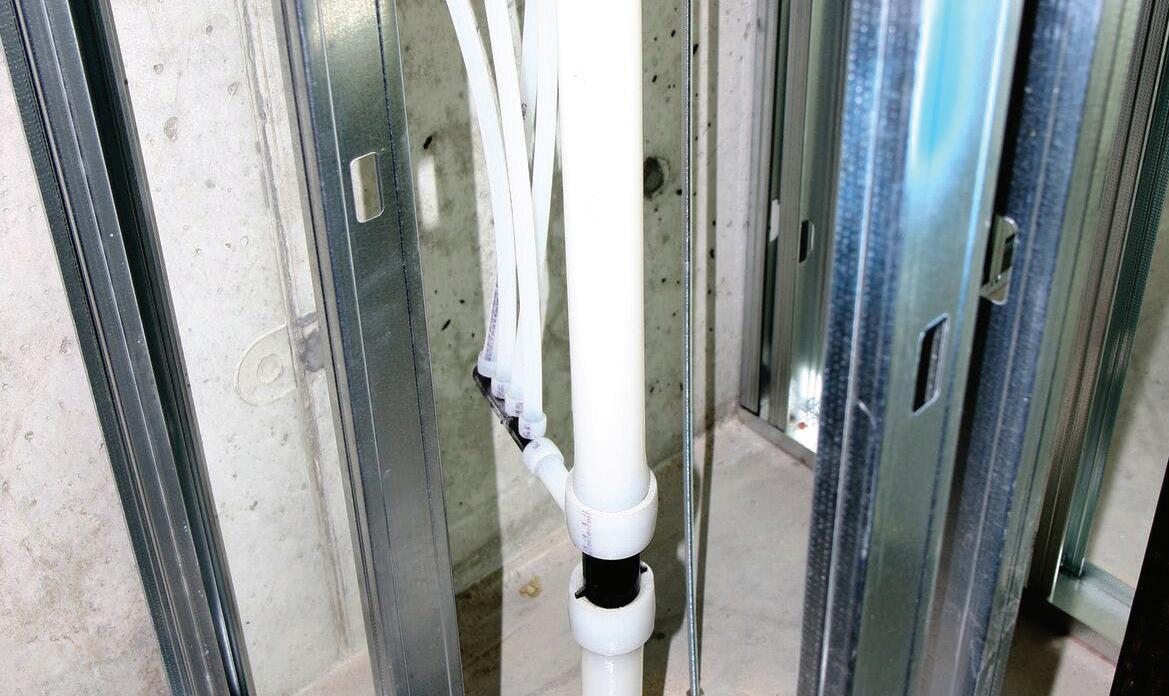
A final inspection of the plumbing and piping at the Radisson Blu Hotel in the Mall of America, Bloomington, MN.
Uponor
These are not water treatment decisions. They are engineering and installation decisions, yet they directly influence the long-term performance of the plumbing system. At the end of the day, contractors are not only installing pipes. They are building the infrastructure that will deliver potable water every day for decades to come.
Designing for Water Movement
Good plumbing design begins long before material selection. Today’s contractors and engineers have access to more sophisticated hydraulic modeling tools, better fixture demand data, and a greater understanding of actual building usage than ever before. Rather than relying on historical oversizing practices, plumbing systems can now be designed to more closely match anticipated demand while still delivering the required pressure and flow.
Thoughtful system design includes:
• Proper pipe sizing
• Efficient routing
• Minimizing unnecessary water volume
• Eliminating dead legs whenever practical
• Designing effective hot-water recirculation systems
• Reducing unnecessary fittings and directional changes
Every gallon of water that doesn’t need to remain in the system is one less gallon wasted.
The Importance of Certified Materials
After system design, material selection is the next critical decision. Every wetted component, pipe, fitting, and valve should be specifically designed and certified for potable water applications. Independent third-party certifications such as NSF/ANSI/CAN 61
provide confidence that products have been evaluated for drinking water applications.
There is an important distinction between a product tested for compliance and one certified by a third party. Compliance to testing demonstrates compliance at a specific point in time, at the point of testing; certification represents ongoing review, manufacturing audits, and continuous verification that these products continue to meet established performance requirements, not simply a one-time compliance check.
Compatibility matters as well. Components engineered and performance-tested together can provide greater confidence than assembling products from multiple manufacturers that may not have been evaluated as a complete system. This is particularly crucial at connection points, where variations in material properties
and dimensional tolerances, along with installation methods, can influence long-term reliability.
As an example, Uponor AquaPEX®, when used as part of a complete PEX-a plumbing system with compatible ProPEX® fittings, demonstrates how certified components can support a system-based approach to potable water design.
Why Material Characteristics Matter
Water chemistry varies considerably across North America. Hard water, aggressive chemistry, varying pH, and mineral content all interact differently with plumbing materials over decades of service. Material selection should therefore focus on long-term system performance rather than short-term installation considerations alone.
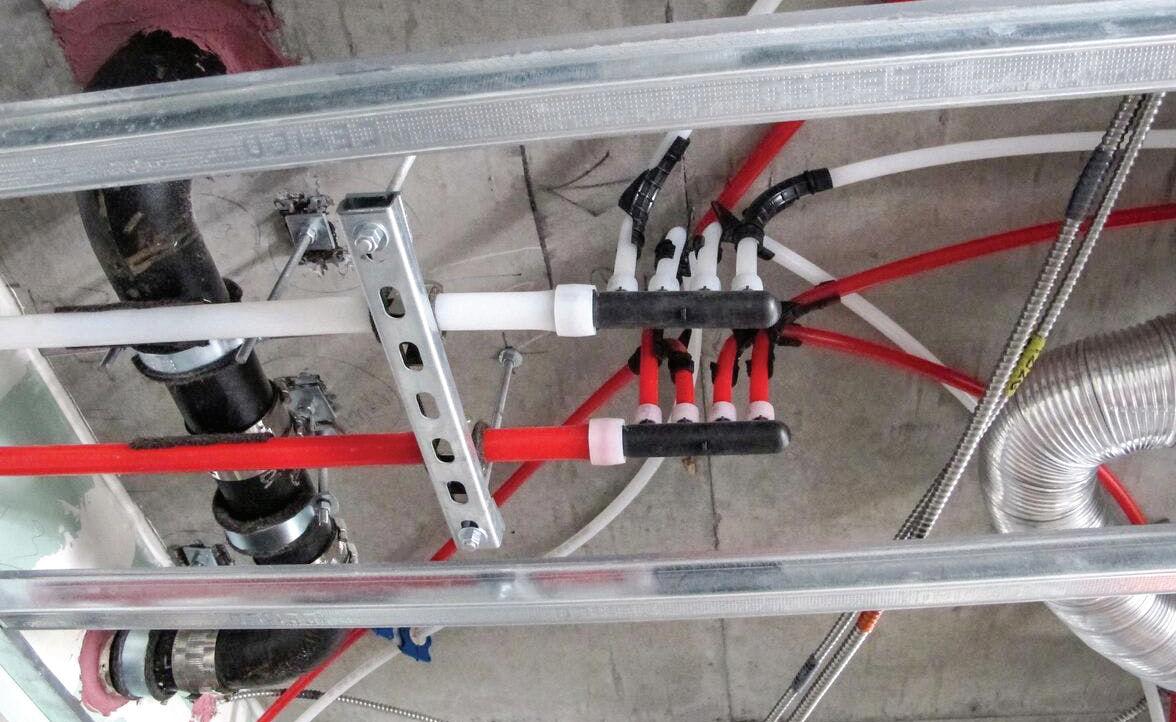
A multi-port T installed at the Mall of America. Components engineered and performance-tested together can provide greater confidence than assembling products from multiple manufacturers.
Uponor
PEX-a and CPVC are widely used in potable water systems because they are inherently resistant to corrosion, pitting, and mineral scale buildup. Those characteristics can help maintain consistent internal flow throughout the system’s life while reducing maintenance concerns commonly associated with corrosion or scale accumulation.
Uponor AquaPEX® and ChlorFIT® Schedule 80 Corzan® CPVC are examples of a piping system that combines these material characteristics with certified potable water components designed to work together as an engineered system. Together, they deliver the best of both worlds from a single supplier, adapting to diverse installation environments and reducing labor time to keep water moving.
These complete systems, consisting of pipe, fittings, and valves, combine flexibility, strength, and chemical resistance to handle high-demand commercial and domestic water applications. By providing a complete solution from main to fixture, they can help enhance workflows, reduce installation time, and improve overall jobsite efficiency.
The point, however, extends beyond any individual product. Selecting certified materials that resist common long-term performance challenges helps support reliable plumbing systems when paired with good design.
Installation Quality Completes the System
But even the best material and design cannot overcome poor installation practices. Contractors ultimately determine whether a carefully engineered design performs as intended. Successful installations begin with following the manufacturer’s installation instructions, using approved tools, and employing validated connection methods.
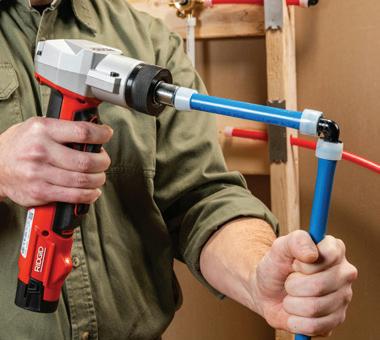
For expansion fitting systems such as Uponor ProPEX®, proper expansion techniques, fully seating fittings, and allowing connections to recover before pressurization are important steps in producing consistent, reliable joints.
Installation quality also includes protecting pipe during construction by:
• Properly supporting piping
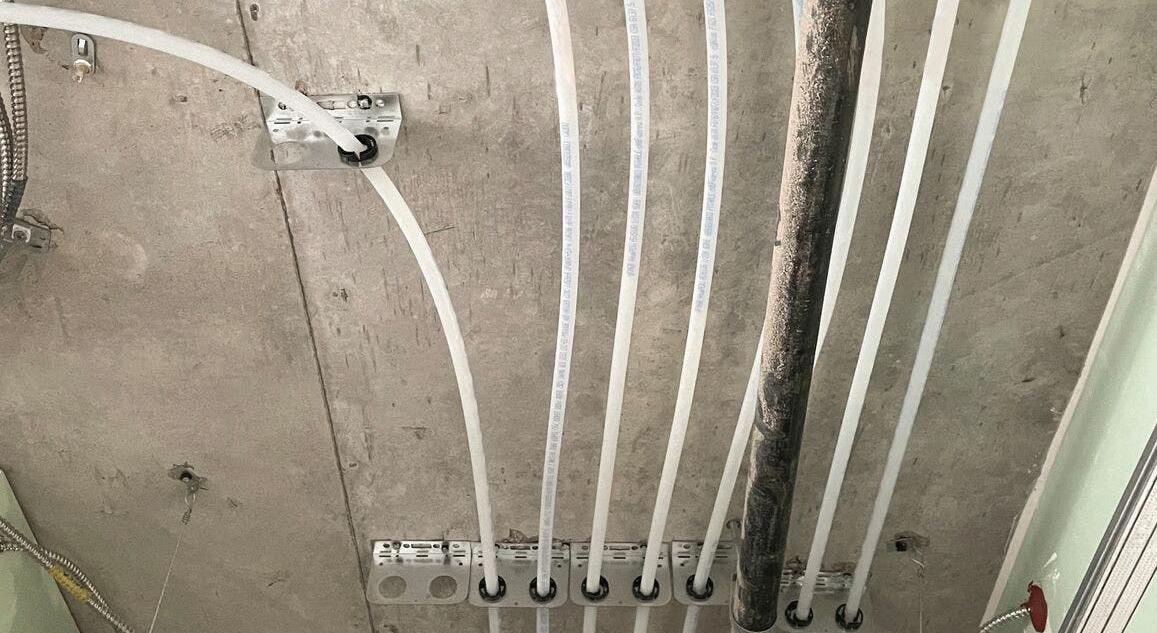
• Protecting penetrations through framing and concrete
• Minimizing unnecessary UV exposure
• Maintaining clean installation practices
• Avoiding unnecessary system contamination
• Each of these practices contributes to long-term system reliability.
Commissioning: The Final Step, Not an Afterthought
A plumbing system should never be considered complete just because the last fitting has been installed. Final tasks include proper commissioning, pressure testing, and flushing.
• Proper commissioning verifies that the installed system performs as designed.
• Flushing removes construction debris and pre pares the system for occupancy.
These final steps often receive less attention than design or installation, yet they represent the contrac tor’s final opportunity to deliver a high-performing potable water system.
Talking Water Quality
Contractors have an important opportunity to help owners understand that water quality is influenced by more than municipal supply or treatment equipment. It is also shaped by the entire plumbing system, includ ing certified materials, thoughtful hydraulic design, efficient water movement, quality installation, and proper commissioning. Each of these factors contrib utes to preserving potable water system performance over its service life.
That means contractors can credibly discuss how material selection can support resistance to corrosion and scale buildup, how flexible piping can help create efficient layouts, and how proper sizing and routing can reduce unnecessary water volume. The piping system does not treat water, but it does influence how water moves through the building.
That distinction matters. No single product deter mines water quality, and no single material guarantees system performance. Great plumbing systems are de fined by how all the system materials and components work together.
When certified materials, smart design, and proper installation practices come together, contractors can deliver a potable water system that performs reli ably, reduces lifecycle risk, and gives building owners greater confidence in the long-term performance of their investment.
Stephanie Radel is the Director of Hot and Cold Water Supply Americas at GF Building Flow Solutions. She can be reached at stephanie.radel@georgfischer.com.
Piping at the Urby Dallas Luxury Apartments in Dallas, TX. 27 stories, 388 units. The project used Uponor on DHW/DCW risers and mains and in-suite plumbing 3" and down.
A commercial PEX installation.
Robert Buchwald, Uponor
Daniel Worm
Presented in partnership with Radiant Professionals Alliance
by Brady Brophy
HYDRONICS MANAGER AT CORKEN STEEL PRODUCTS CO.
Radiant Heating in Self-Storage Facilities
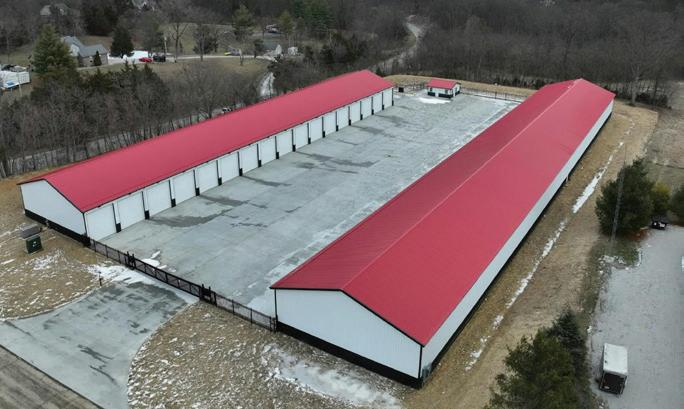
Back in 2023 I had a job come across my desk from a local contractor I work closely with, Anderson Automatic. They were bidding a new construction climate-controlled self-storage facility. It consisted of two buildings— roughly 17,000 and 14,000 square feet— facing each other across a drive aisle. The owner’s request was simple. Keep it efficient, reliable, and predictable from an operating cost standpoint.
That’s where hydronics, and more specifically radiant, start to make a lot of sense.
Let’s Talk Storage
The US self-storage industry has evolved from a niche service into a $40B+ real estate juggernaut. From 2005-2019, development surged, averaging thousands of new facilities annually. That growth accelerated again during the pandemic as relocation, downsizing and remote work reshaped how people used storage. By 2023, construction spending hit an alltime high, and a large percentage of those new builds were climate-controlled.
Most contractors first instinct would be package units, ducted systems, minisplits or unit heaters. These are familiar, fast and relatively low first cost. But in self-storage, these options come with drawbacks. Air stratification in tall corridors makes it difficult to keep the scorched air from rising to the top of the structure. You will often see fans mounted to the ceiling to try to force the warm air to ground level. Frequent door openings cause all the warm air to quickly escape the building envelope, forcing the scorched air equipment to work hard to maintain setpoint. When using forced air in these facilities temps unit to unit are often uneven.
Self storage facilities aren’t traditional commercial heating applications. These spaces experience frequent door openings, minimal internal gains, and wide infiltration swings. Most buildings are designed for temperature maintenance rather than comfort conditioning, making them ideal for low-temperature radiant systems. Often the setpoints in these facilities are 50-60 degrees Fahrenheit.
Storage facilities are designed for temperature maintenance rather than comfort conditioning, making them ideal for low-temperature radiant systems.
Why Radiant Works
Instead of trying to heat air that keeps escaping, radiant heating systems warm the building mass, the slab and stored contents rather than relying on air temperature alone. This creates a thermal buffer, allowing spaces to recover quickly after infiltration events. When a roll-up door opens, you lose air—not slab temperature. PEX tubing layout provides consistent floor temperature across long corridors, eliminating cold pockets. Compared to forced air, radiant provides more uniform heat, reduced stratification, and lower operating temperatures. Most of these systems can run with supply water temps between 90-120F. That pairs perfectly with high efficiency boilers, water-to-water geo units or even future electrification strategies. In Anderson Automatic’s case, we chose gas fired high efficiency boilers—one boiler for each building. The bigger building has
one 500k btu/hr Lochinvar FTXL and the smaller building has a 400k FTXL.
Key Considerations
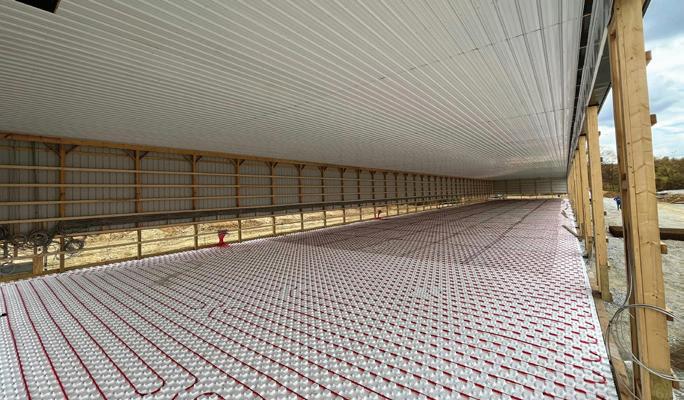
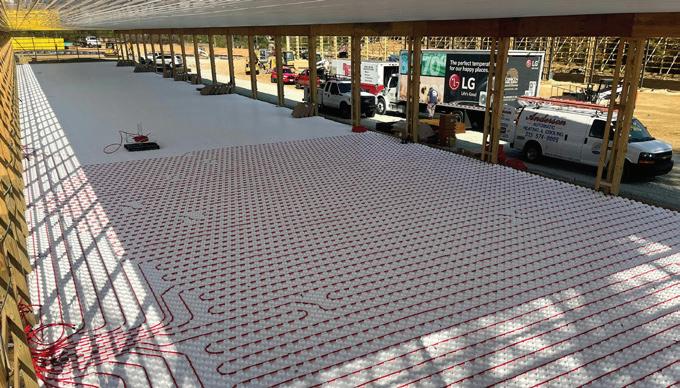
Proper design is critical. Underslab insulation is essential to prevent downward heat loss. The insulation forces the radiation up and through the slab. In this case, the concrete contractor provided a 2” foam board insulation with a PEX tubing grid. Anderson was thankful for this. Rather than zip tying the tubing to a road mesh grid every two or three feet, they were able to walk the tubing into the PEX grid on the insulation. This project has roughly seven miles of tubing (imagine the amount of zip ties!). The PEX grid insulation is quite the back saver.Because of the size of each of these buildings, we decided to use 5/8” PEX tubing so we could extend our loop lengths to about 375’ each. The larger building would get six manifolds, nine loops each. While the smaller building
got five manifolds, nine loops each. Both boilers have been in operation since December of 2023 and have run without a hiccup. Anderson Automatic did a great job with the installation, and the building owner couldn’t be happier with the efficient system.
A Solution That Performs
At the end of the day this project wasn’t about reinventing the wheel, it was about choosing the equipment that would make the most sense. Radiant systems in these applications aren’t just competitive, they’re often the better long-term solution when it comes to efficiency, stability and operating cost predictability. As more storage facilities move toward climate control, expect this conversation to come up more often. Radiant is a solution that performs—not just day one, but over the life of the building.
Brady Brophy is a Hydronics Department Manager for Corken Steel Products with experience in both the contracting and distribution sides of the HVAC industry. He began his career in 2015 and became a Hydronics Specialist in 2018. Brady supports contractors with the design of radiant floor and snow melt systems, and works across design-build, bid/spec, and retrofit hydronic applications, providing equipment sizing, training and hands-on technical guidance.
Overhead view of the self-storage facility.
PEX tubing in an early stage of layout.
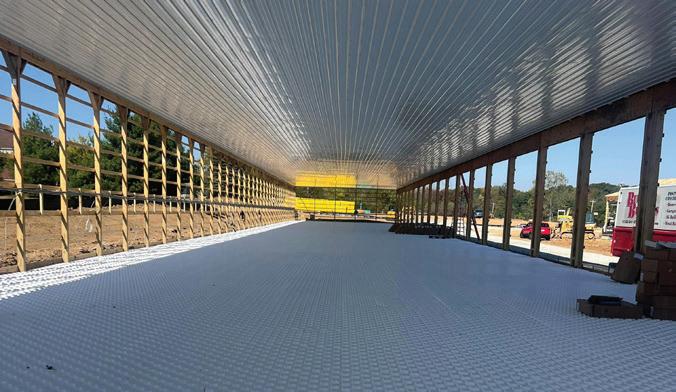
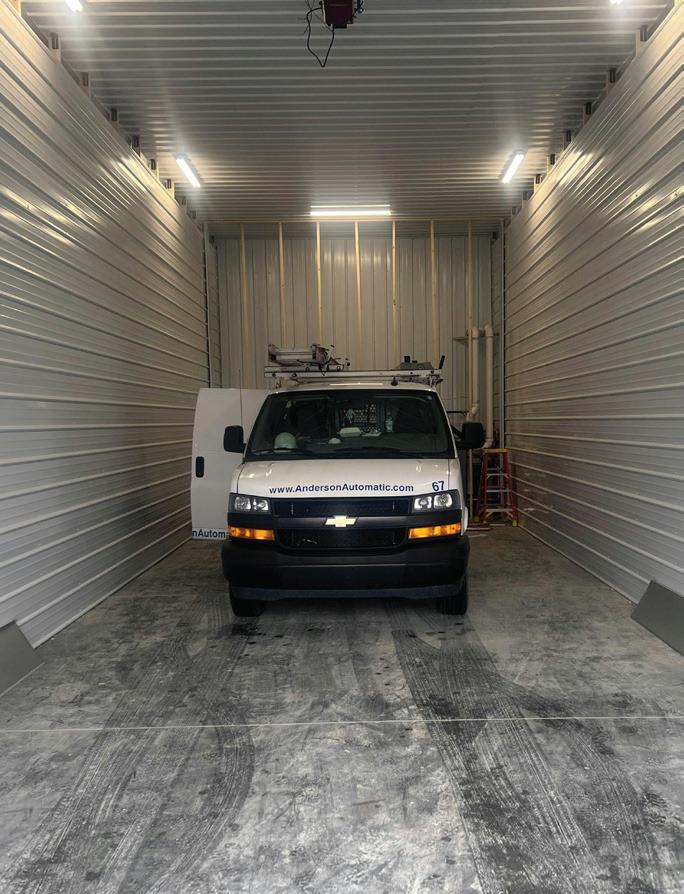
A complete storage bay.
A finished tubing layout.
Underslab insulation.
Presented in partnership with Radiant Professionals Alliance
Vicinity Recognized for Growing District Energy Footprint in Greater Boston
BOSTON, MA — Vicinity Energy has received a Gold Award from the International District Energy Association (IDEA) recognizing the continued growth of its Boston and Cambridge district energy network and the increasing adoption of district energy by commercial and institutional building owners.
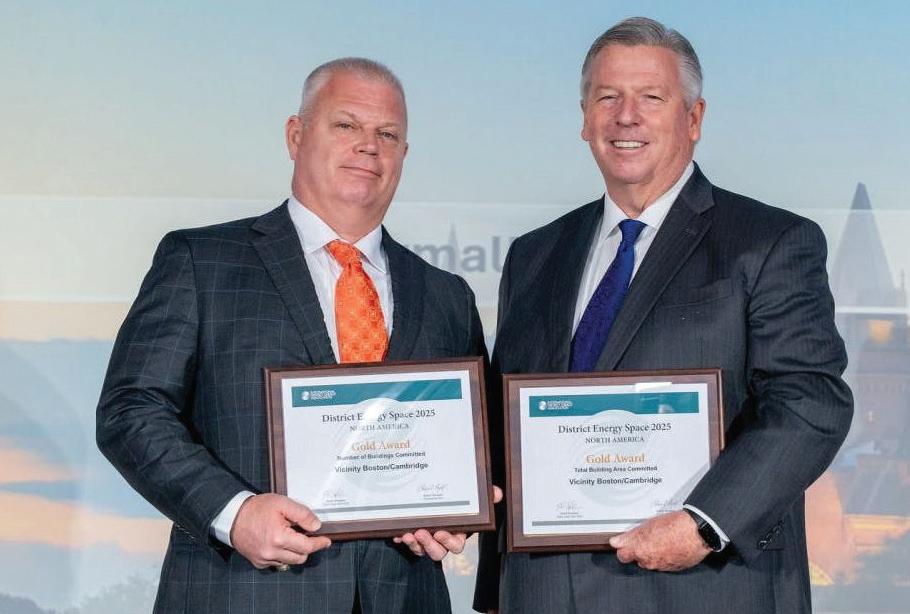
The award, presented during IDEA2026, the association’s 117th Annual Conference & Trade Show in Ottawa, Canada, recognizes both building area committed and total square footage connected to Vicinity’s district energy system. Vicinity Chief Development Officer Brian Mueller accepted the award on behalf of the company.
District Energy Growth Reflects Decarbonization Demand
Founded in 1909, IDEA represents nearly 3,000 members in more than 30 countries and serves as the leading industry association for district energy professionals. This year’s conference, themed “Connecting Networks,” focused on decarbonization, energy resilience, system integration and thermal network innovation.
Vicinity also participated in the conference’s North American industry plenary panel, where CEO Kevin Hagerty joined other energy leaders to discuss mar-
ket trends, building decarbonization and the future of integrated energy networks.
Expanding Network Serves Major Commercial Buildings
Vicinity operates one of the nation’s largest district energy systems, supplying thermal energy to more than 240 buildings through approximately 29 miles of un-
derground piping across Greater Boston and Cambridge.
The network serves hospitals, universities, commercial properties and institutional facilities with centralized heating and cooling designed to improve reliability, resilience and long-term energy efficiency.
The company estimates its district energy systems help avoid more than 97,000 tons of local carbon emissions each year.
Innovation Supports Lower-Carbon Building Operations
Vicinity has continued investing in technologies that help customers reduce building emissions, including its electric-powered boiler at its Kendall facility in Cambridge. The system produces eSteam®, a carbon-free thermal energy solution that supports building decarbonization goals without requiring major changes to existing building infrastructure.
The IDEA Gold Award recognizes the continued expansion of Vicinity’s district energy network as more organizations across Boston and Cambridge look to district energy as a reliable, cost-effective and lower-carbon approach to heating and cooling.
To learn more visit www.vicinityenergy.us
Rheem’s Digital Strategy Wins Big at 2026 Manufacturing Leadership Awards
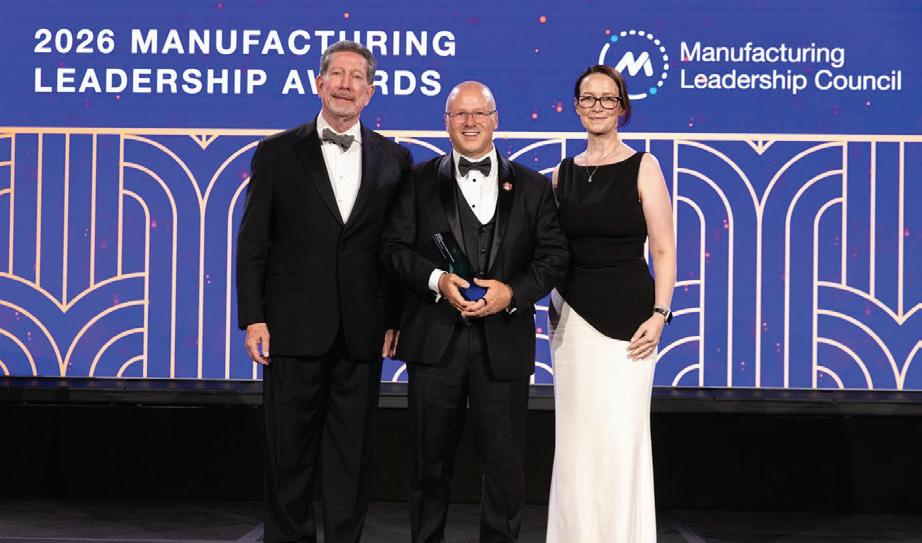
Rheem Manufacturing Co. has been recognized at the 2026 Manufacturing Leadership Awards for its digital transformation strategy, with the company earning the Business Model Transformation award and Executive Vice President of Technology Alan Machuga named Manufacturing Leader of the Year. Presented by the Manufacturing Leadership Council, the awards recognize manufacturers advancing operations, customer engagement and business strategy through digital technologies and automation. .
Internal Operations
Machuga was recognized for leading Rheem’s transition toward a digitally driven business model, modernizing core technologies and reworking internal systems to improve collaboration and efficiency across the organization.
He oversees Rheem’s Global Technology Group, which includes controls engineering, IT, digital services and cloud architecture. In that role, he is responsible for the company’s long-term technology strategy and the de-
ployment of digital tools designed to improve workflows and strengthen connectivity between business units.
Connected Customer Experience
Rheem’s Business Model Transformation award recognizes
the company’s shift from a product-focused approach to a more connected, service-oriented business model.
The Manufacturing Leadership Council cited Rheem’s “Digital First, AI Ready Platform” as an example of how manufacturers are applying advanced technologies to streamline operations and improve customer engagement.
For contractors and distributors, that type of digital infrastructure can improve access to product information, service tools and system connectivity while supporting faster response times and better decision-making.
Continued Innovation Push
The awards reflect Rheem’s broader investment in digital tools, controls and connected technologies across its HVAC and water heating portfolio.
As manufacturers continue integrating AI and cloudbased systems into their operations, the ability to improve speed, accuracy and customer support is becoming increasingly important across the supply chain.
To learn more visit www.rheem.com
Vicinity Energy Chief Development Officer Brian Mueller (left) accepts IDEA's Gold Award on behalf of the company at IDEA2026 in Ottawa, Canada.
Vicinity Energy
(Left to right) David Brousell Founder, Vice President and Executive Director, Manufacturing Leadership Council; Alan Machuga, Executive Vice President, Technology at Rheem Manufacturing; and Lisa McEvoy, Associate Vice President of Digital Manufacturing at Merck. Rheem
& R
Presented in partnership with Radiant Professionals Alliance
Rocky Mountain Radiant
Third-generation master plumber and heating contractor goes back to the “scene of the crime” for heating system upgrade.
BY JOHN MESENBRINK, EDITOR-AT-LARGE
TRINIDAD, COLO.—Radiant in the Rockies is a thing. In this case more specifically, in the foothills of the Spanish Peaks in the Sangre de Cristo Mountains, a major subrange of the southern Rocky Mountains. Discernable homeowners, resort and commercial property owners in this area rely on the complete comfort and efficiency of hydronics, in part, due to the climate, geography, elevation and consistent snowfall.
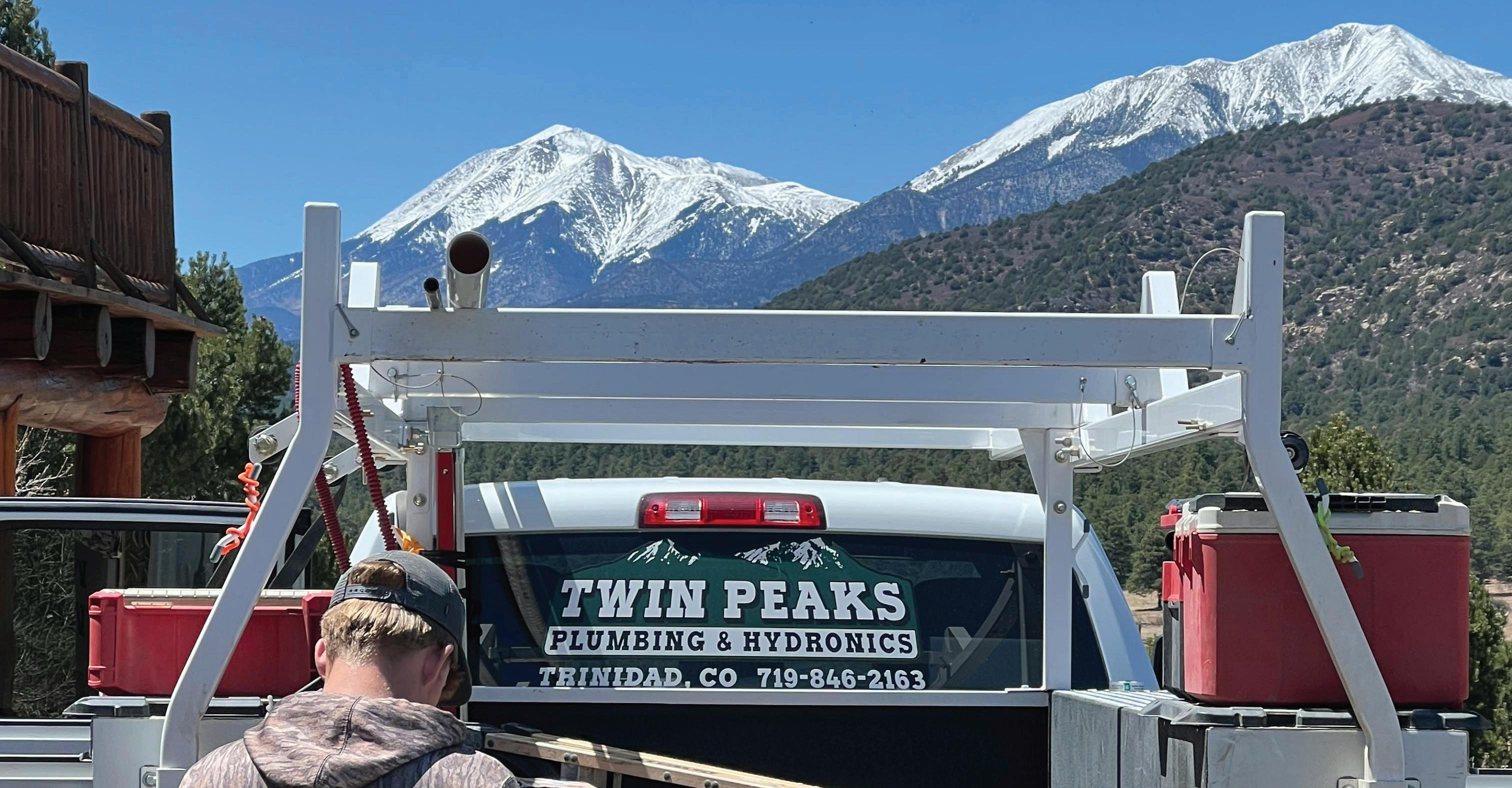
Steve Fernandez, a third-generation master plumber and heating contractor, has been preaching and working on hydronics for decades, 29 years in fact. As a master plumber, Fernandez established Twin Peaks Plumbing & Hydronics LLC, Trinidad, Colo., in 2017, and the company provides both commercial and residential plumbing, and serves all of southern Colorado and northern New Mexico.
Employing five full-time employees, including one other master plumber and three apprentice plumbers, Twin Peaks specializes in all phases of plumbing and hydronic in-floor heating and boiler systems. “Hydronic heat provides more even, comfortable heat without drying you out with forced air,” says Fernandez.
Time for an Upgrade
Fernandez was called earlier this spring to a home in the hills north of Trinidad experiencing issues with the existing heating system, and its 30+-year-old castiron boiler. Interestingly enough, the old system was, in fact, installed by Fernandez, his brother and his father in the ’90s. And while the old system gave it a good run, and since there was a work history and knowledge of the existing heating system in the residence, Fernandez met with the homeowner to discuss the next plan of action. “After assessing the boiler, the homeowner agreed that it was time for an upgrade,” says Fernandez.
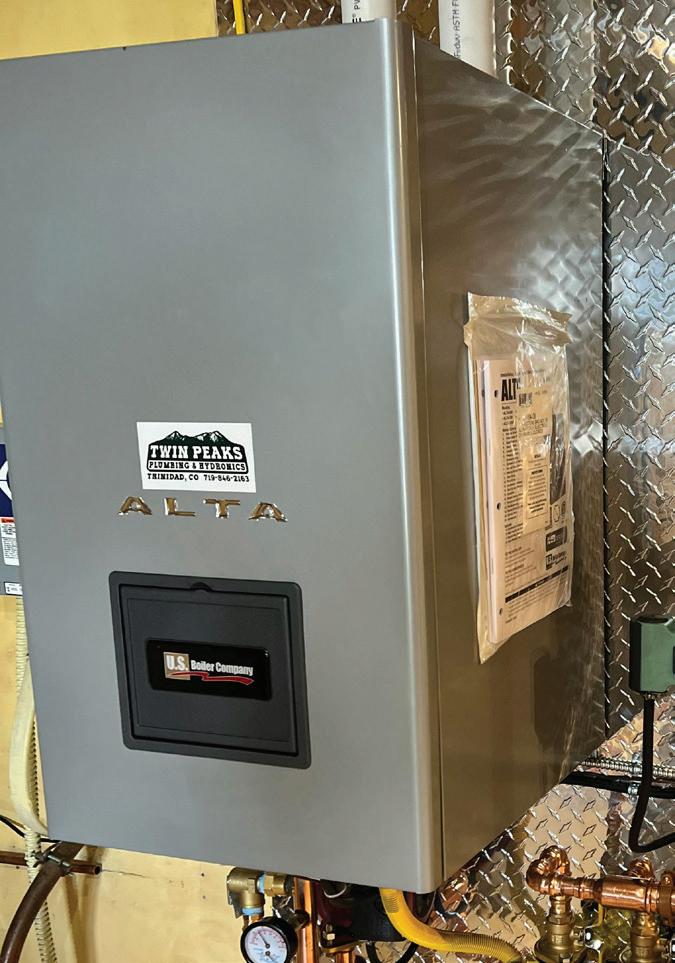
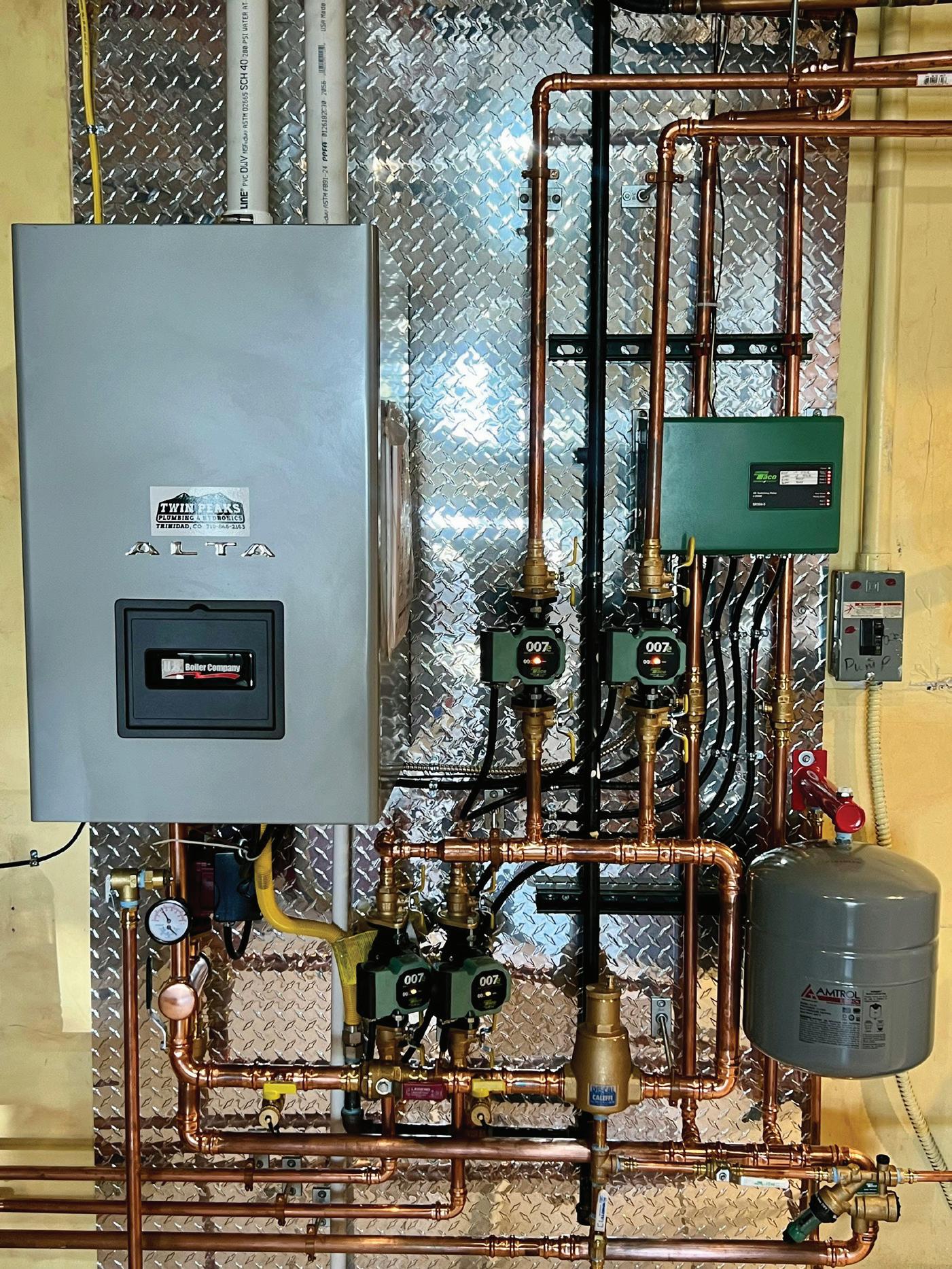
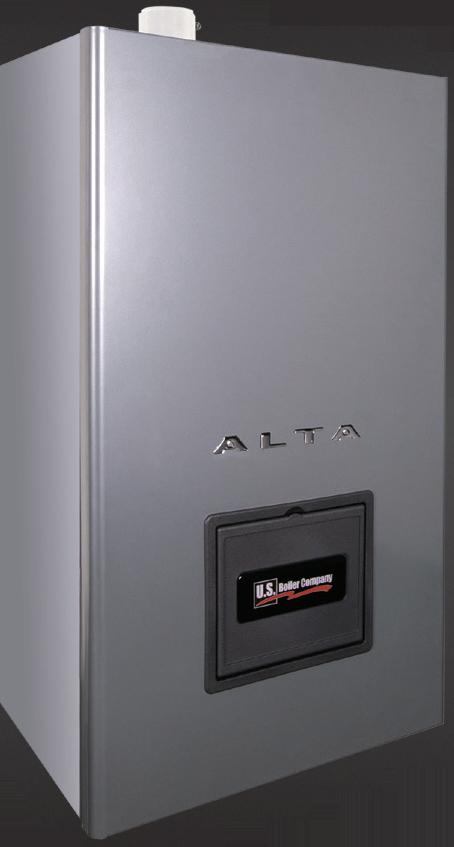
After determining heat loss calculations for the 3,000-sq.-ft. home, a new U.S. Boiler Alta high-efficiency boiler, replacing the old boiler and existing indirect water heater. And since the old
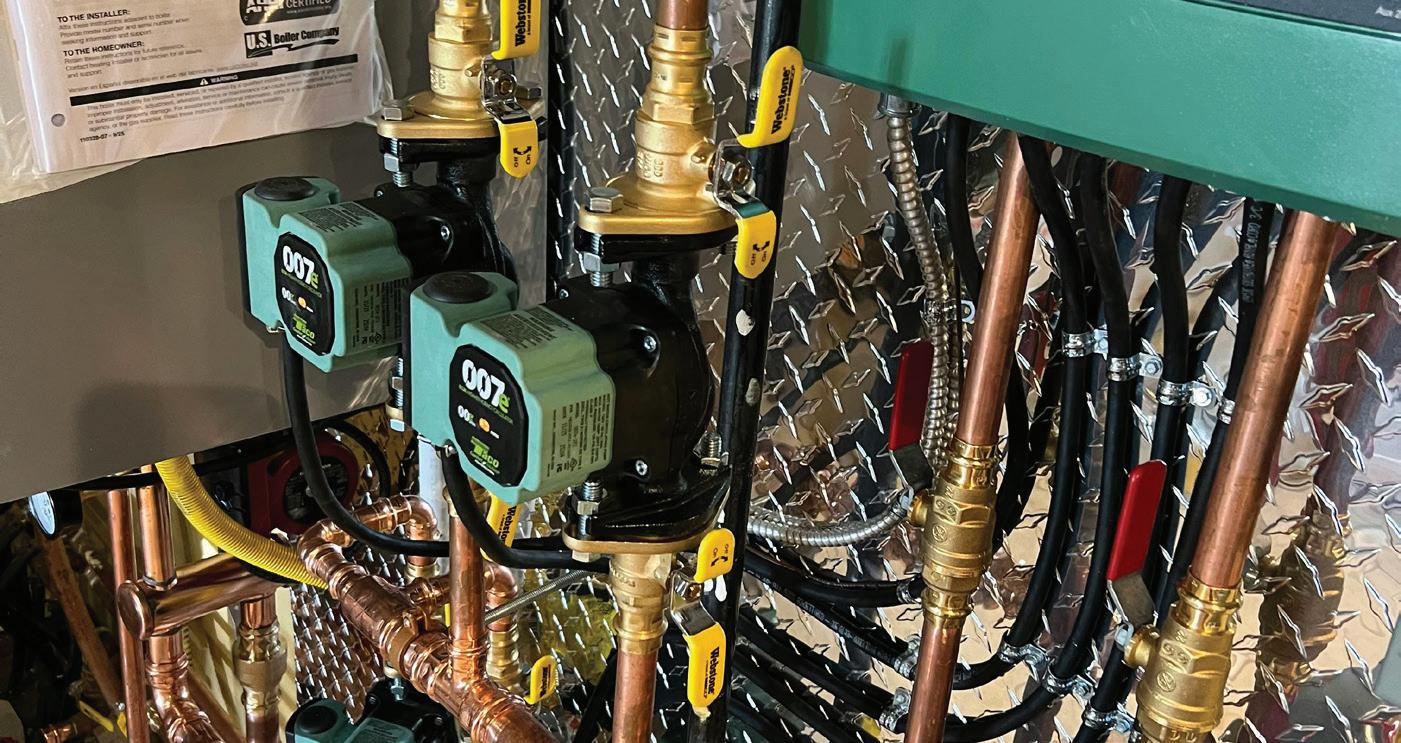
system was piped with zone valves, the new installation featured the Alta with zoning pumps—featuring Taco 007es— and a Taco SR405-5, 4-zone switching relay to control four zones, two in the existing slab and two for the upper level of the home. The entire retrofit’s piping system was press connected with Viega ProPress fittings.
Because the new heating system was piped into an existing Entran EPDM
tubing system in the slab and through staple up for the upper level, “The plan was to install the new Alta, and replace zone valves with zoning pumps, all new copper primary and secondary piping, a new Caleffi air separator and an Amtrol expansion tank,” says Fernandez.
Sweat and Tears
This three-man, four-day project didn’t come without its challenges. In particu-
from U.S. Boiler was ideal for the highaltitude application.
lar, “challenges on the job were getting PVC venting out of the house,” says Fernandez. “We overcame this with some sweat and tears while drilling through concrete and rebar.”
High-efficiency Taco 007es circulators, engineered with variable-speed technology.
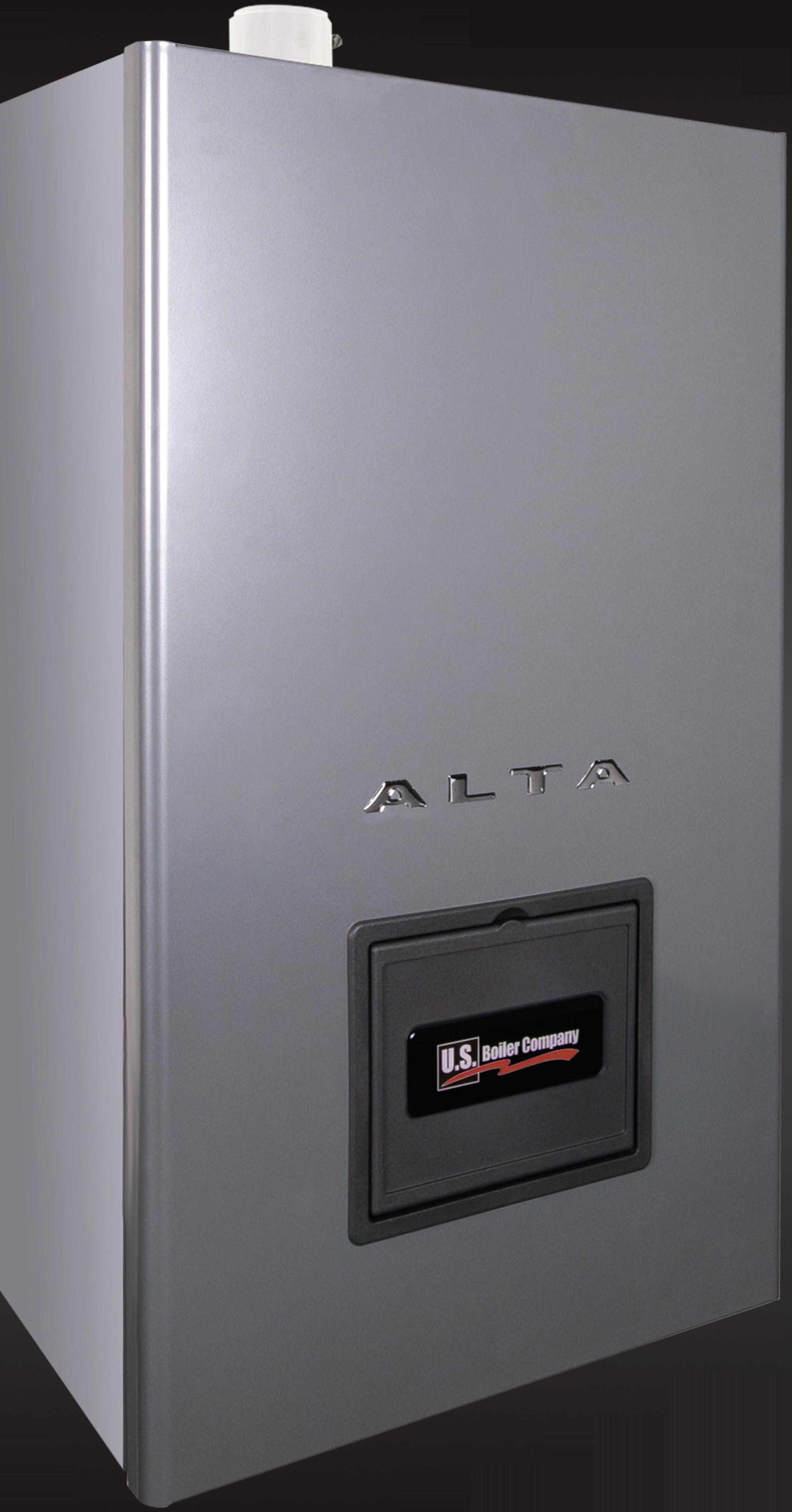
The Alta high-efficiency condensing boiler
Twin Peaks Plumbing & Hydronics
Twin Peaks Plumbing & Hydronics Twin Peaks Plumbing & Hydronics
But the ultimate test came when it was time to fire up the system, but before that, Fernandez injected glycol throughout the system for freeze protection. Ultimately, the proof is in the
pudding and the last word that counts is that of the homeowner. “System is up and running and the customer is extremely satisfied with finished result,” says Fernandez.
Key Components
Alta High-Efficiency Boiler
• 10:1 turndown, gas-adaptive combi boiler
• Virtually instantaneous DHW response time
• Selectable economy or comfort/recirculation modes
• Three-side unobstructed service access
• Easy lift, wall hanging design
• Low gas pressure capability (2.5 in. wc gas, 8.0 in. wc LP)
• High altitude performance with zero or minimal derate
007e ECM High-Efficiency Circulator
• SureStart® automatically purges air and unblocks the pump to keep it trouble-free
• Dual electrical knock-outs
• 6” stranded wire leads for easy wiring
• Double Insulated—no ground necessary
• Integral Flow Check (IFC®) included
• Cast iron casing
Pro-Press Fittings
• Available in sizes 1/2” to 4”
• Customizable with three sealing elements: EPDM, HNBR and FKM
• More than 400 engineered fitting configurations for copper and Zero Lead bronze from 1/2” to 4”
• Approved for more than 250 different applications
Twin Peaks Plumbing & Hydronics LLC provides both commercial and residential plumbing services to all of southern Colorado and northern New Mexico.
Steve Fernandez with the completed hydronic system.
A view of the wall-hung mechanical systems package.
Twin Peaks Plumbing & Hydronics
Twin Peaks Plumbing & Hydronics
Twin Peaks Plumbing & Hydronics
by Steven Onofua TECHNICAL WRITER AND RESEARCHER
The Digital Stethoscope: Acoustic AI as the New Pressure Test
Any experienced hydronic technician is familiar with the trick. You place the tip of a long, flathead screwdriver onto the cast iron casing of a circulator pump and press the handle against the bone behind your ear. The metal is better at conducting sound than air. If the bearing hums properly, you proceed to the next one. If the sound is like sand grinding in a coffee can, you write up a replacement.
This is called “structure-borne sound diagnosis.” Very crude, quite effective, and as old as the trade itself. It does have a fatal flaw, however, and that is, it is reactive. That bearing has been wearing out for weeks by the time you hear the gravel in your ear. The impeller has been wobbling. The seal has been weeping. The no-heat call was already in the cards. You didn’t diagnose the problem; you confirmed the obituary. What if the same principle—listening to the sound that passes through metal and fluid—can be automated, digitized, and monitored for 24 hours a day by an algorithm that can hear what human ears physically cannot? What if you could find out about a failing circulator before it fails, that is, on the day it first whispers that something is wrong?
This is the promise of Acoustic AI, and it is poised to shift the way hydronic services are provided from “fix what’s broken” to “prevent what’s breaking.”
How Machines Sound Different When They Are Sick
The acoustic and vibration characteristics of a healthy piece of rotating equipment in a hydronic system (a circulator pump, a zone valve actuator, an induced-draft fan, etc.) are all different. There is a change in that signature when it starts to fail. The change can often be undetectable to human ears, but it’s not undetectable to an algorithm mathematically.
Vibration analysis and ultrasonic monitoring are the primary detection methods used for mechanical equipment faults, which are effective at identifying mechanical conditions, such as bearing problems, imbalance, misalignment, and the likes that result in identifiable vibration signatures and acoustic patterns. Bearing wear is one of the most common mechanical faults in rotating machinery and makes up approximately 40% of all mechanical failures, according to Augury (https://www.augury.com/blog/asset-care/fault-detection-and-diagnostics-the-foundation-of-reliable-operations/), a leader in machine health diagnostics. Their industrial-grade IoT sensors collect vibration, magnetic, and temperature information to provide fault diagnosis with 99.9%+ accuracy.
That translates to 40% of your circulator pump failures being from bearings for the hydronic professional. All of those bearings had their acoustic fingerprint
Hydronic technicians have always been relying on their ears. Today, AI has brought those ears superhuman abilities, enabling them to detect pump failures weeks in advance and even generating a revenue stream from ‘reactive maintenance.’
altered days or weeks prior to failure. Each of those emergency calls, whether it’s a frozen pipe or the house at 2:00 AM in January that’s cold, is preventable.
The Head-to-Head: AI vs. the Human Expert
The skeptic in all mechanical rooms will ask, “How much better can a sensor be than an experienced tech?”
The answer is documented. A Prague-based company, Neuron Soundware, an expert in AI diagnostics, conducted a direct comparison of its acoustic AI system against the existing industrial gold standard—vibro diagnostics (governed by ISO 10816-3)—on a pump in which the fault was gradually worsened.
The outcome was clear-cut. Neuron Soundware reacted at the initial 90° twist of the screw and registered an anomaly. The conventional vibro diagnostics (in accordance with the usual ISO 10816-3) would have taken much longer to send the alert.
It got worse. The second phase of the test, which saw a substantial twisting of the frame and the beginning of
the pump seal leaking, just barely reached the warning level of the vibro diagnostics system. Even though the pump seal was leaking almost everywhere, and the elastomeric coupling member had already begun to noticeably deteriorate, vibro diagnostics still indicated a value just above the alarm level in the third and extreme phase of testing.
The traditional system, which most of the industrial facilities are using today, was basically sleeping at the wheel. The AI instantly recognized the problem.
However, there’s a second and equally important advantage: vibration analysis is performed by an expert who has a set working time, while Neuron Soundware works online, continuously and remotely, through HW, SW, and AI. A human technician can only be in one mechanical room at a time. Every pump, on every system you install, is simultaneously monitored, 24 hours a day, by an acoustic AI sensor.
➤ Turn to The Digital, page 37
SEE IT FIX IT
NEW Under Sink Guardian® with Cross Sense™ Indicator
QUICKLY REPAIR FOULED VALVES
With just one simple strainer cartridge replacement
EASILY IDENTIFY CROSS FLOW
With the industry’s first diagnostic indicator
IDENTIFY CROSS FLOW IN SECONDS
by Matt Michel
Should You Grow Your Plumbing Company?
Idon’t want any employees,” remarked a plumbing contractor to me in a trade show. “They’re all problems. I don’t want any problems.” Is this you? If so, maybe you should rethink.
Decades ago, after starting a national contractor franchise organization, I took a call from a contractor who received one of my marketing pieces. I quickly discerned that he wasn’t interested in a franchise. He was lonely and just wanted to talk, to pass on a lesson he learned the hard way.
The Need to Grow
The contractor was calling me from bed. He was difficult to understand because his jaw was wired shut. He told me his story. He was a happy single truck operator. He made enough money from his “business” to pay the bills and live a modest life with his wife. His kids were grown and gone. He was content. Then, the accident happened.
The accident was a bad one. The contractor’s van was totaled. His truck stock was scattered. He was in bad shape and rushed to the hospital. When he emerged, he couldn’t work. He was bedridden, recovering. Medical bills (he didn’t have health insurance) and the inability to work quickly depleted his meager savings, forcing his wife to go back to work to earn enough money for them to survive. His company was gone. He couldn’t run calls so competitors served his customers. After that, they became his competitors’ customers. Even when he recovered enough to work, he would be starting from scratch, rebuilding everything when he was long past the youthful enthusiasm he possessed when he started. His outlook wasn’t great. Too late, he realized that if he had hired people to work for him, he might still have a business and an income stream. While he didn’t say it directly, he message to me was, “Help contractors grow. Help them to see the need to grow. Don’t let them end up like me.”
Working for Me, Inc.
I’ve never forgotten that phone call. It’s haunted me through the years. I remem-
Growing a business to the point it can run without you—that’s true freedom.
bered it when I started my next company and was operating it by myself.
“Me, Inc.” was fun. There was freedom because there was no boss. I could set whatever hours I wanted. I could take off any afternoon I wanted, but I couldn’t take off any week. And, remembering that contractor, I knew that “Me, Inc.” was selfish. I had a family. What would happen to them if something happened to me? Growth was always in my plan, but memories of that phone call added urgency to grow.
When the plumbing contractor at the trade show told me he didn’t want any employees because he didn’t want any problems, I didn’t try to persuade him different. After all, few creatures in this world are more stubborn than a plumber whose mind is made up. I did comment, “Well, I hope you’ve got great insurance.”
“Whaddya mean?” he replied.
“What’s going to happen to your family if you get in a serious accident tomorrow and you can’t work for six months?” I asked.
“Aw,” he replied. “I don’t think like that.”
He should. You should. The perils and risk of “Me, Inc.” never abate. The challenges employees represent never let up either, but there’s a bonus that comes from building a team.
Growth Means Freedom
It’s hard work to build a good team. It takes years. You may run through a lot of oysters before you find the pearls, but they’re out there. When you build a team of them, there will come a day when you realize, you not only don’t have to do it all, you only have to do what you enjoy. You can delegate
or hire people to take on most of the tasks you don’t like. If you grow to that point, chances are strong that you will have a business that can run without you. That’s true freedom.
When you build a business that can run without you, not only do you have the freedom to take off any afternoon you want, you can take off for a month at a time. Plus, you will have financial security and the likelihood of a lucrative exit, selling to a competitor or private equity.
Of course, you may be one of the stubborn plumbers who refuses to grow. If that’s you, please get some good insurance to protect your family.
CONTRACTOR Magazine named Matt Michel one of the “18 Most Influential People in the History of the Plumbing/ Hydronics Industries.” After taking his own exit, he spends his time, writing, speaking, and ranching. He is the author of “Contractor Stories” and “The Business Exit Roller-Coaster,” both available on Amazon. He can be reached at mattmichel@mail.com.
by Andrew Brown
The Skilled Trades Don’t Just Need Another 300,000 Trainees
Google just announced a $50 million commitment aimed at preparing more than 300,000 skilled trades workers by supporting unions, trade associations, apprenticeship access, training capacity, and worker support. Meta has also announced an initial $115 million first-year investment in America’s Workforce Academy, which includes free training and guaranteed jobs for graduates.
The two investments are structured differently. But even a program that combines training with a guaranteed job cannot fully control what happens after someone enters the workplace. Once someone reaches the workplace, the employer becomes a major part of whether that training turns into a lasting career.
To be clear, the trades do need more people entering the field. But another training target will not solve the workforce shortage unless we pay equal attention to how many people stay.
And that’s what I keep coming back to. Getting 300,000 people into a training program is not the same thing as getting 300,000 people into a career.
Talk to enough employers, apprentices, and workforce leaders, like I do every week on my podcast, The Lost Art of the Skilled Trades, and you hear the same thing over and over: many people leave for reasons that have little to do with whether they are capable of learning and performing the work. The breakdown is not always technical ability.
In the workplaces I have studied and the conversations I have had, the warning signs often show up within the first 90 days. The mentorship is not there. The culture is not what they expected. The job looks different from what they were told it would be.
Recruiting Gets the MoneyRetention Gets an Afterthought
I’ve spent close to twenty-five years around this industry, first building a national tool supply company from scratch, now talking to workforce leaders every week for my podcast. And the same pattern keeps showing up.
Getting 300,000 people into a training program is not the same thing as getting 300,000 people into a career.
Companies pour money into recruiting. Job fairs, signing bonuses, slick videos, partnerships with trade schools, all aimed at getting more people to raise their hand.
Then employers are surprised when many of those new hires do not make it through the first year. I hear it constantly: getting people interested is hard, but keeping them engaged, supported, and moving forward can be even harder.
In an informal LinkedIn poll of 110 respondents, 44% selected lack of mentorship from the four choices I provided. That’s not a study you can cite in a grant application, but it lines up with pretty much every conversation I’ve had on this.
Apprenticeship trains the tradesperson. Mentorship builds the tradesperson. The best apprenticeship programs already understand this. The problem is that not every workplace surrounding an apprentice operates with the same level of intention.
Apprenticeship teaches technical skills: how to run a bead, size a duct, or read a print. Technical training is usually the part that is easiest to see and measure. There is a curriculum, a set number of hours, and a skill to demonstrate.
Mentorship is different. It’s what tells someone they matter before they’ve proven anything. It’s the difference between handing someone a task list and telling them why the list matters and who to go to when they’re stuck. It is rarely measured with the same discipline as technical training.
In too many shops, no one is clearly accountable for it.
Your Best Producer Is Not Automatically Your Best Mentor
Here’s a pattern I run into constantly when I ask companies how they actually pick mentors.
When someone needs to pair a new hire with an experienced hand, too often the default is the same: grab one of the best producers. Makes sense on the surface. Who better to learn from than the person putting up the best numbers?
Except being great at the work and being great at teaching it are two different things, and too many companies treat them like they’re the same. Your best producer may know the work inside and out. But much of what they do has become automatic. Asking them to slow
down, explain every step, and remember what it felt like to be new requires a completely different skill set.
Meanwhile there’s usually somebody else on that floor, not the fastest, not the one with the trophy, who’s a natural at this. Patient. Notices when someone’s lost. Remembers what it felt like to not know anything. That person can easily be overlooked when mentor selection is based mainly on production.
And even when the right person does get picked, they need support too. If mentoring someone hurts a mentor’s production numbers or paycheck, the system is punishing the exact behavior the company says it wants. You can’t ask someone to slow down and teach, then measure them like they never slowed down at all.
Mentorship is not the only issue. Pay, transportation, scheduling, supervision, workplace culture, and whether the job matches what someone was promised all matter too. But mentorship is often the first line of support when those problems appear.
So Which Is it: Finding People or Keeping Them?
The trades absolutely need more people, and these two investments totaling $165 million support training, apprenticeship access, worker support, and employment. That is good news.
But recruiting alone will not solve the shortage if many of the people who show up leave before they have the chance to become skilled tradespeople.
Training gets someone ready to walk through the door. What happens after that is still on us.
Because the goal is not to create 300,000 trainees. The goal is to build 300,000 careers.
So where you are right now, which is the bigger challenge: finding people or keeping them?
Andrew Brown is the founder and CEO of Trades Media LLC, host of The Lost Art of the Skilled Trades podcast, and a keynote speaker and workforce strategist helping skilled trades employers become the company the next generation actually wants to work for.
5 Small Business Loan Alarm Bells Every Contractor Should Hear
Every contractor knows the feeling, you are three draws into a job, the GC is slow-paying, payroll lands Friday and a lender you have never heard of calls promising low interest, no strings and $80,000 by tomorrow morning. No collateral, no hard credit pull, just a signature.
Debt-relief groups say construction companies and contractors are among the businesses most often trapped by cash advances, which are the most expensive form of small business credit. These high interest small business credit tools are designed around the exact pain points that contractors feel— progress billing, retainage and 60-day receivables make contractor cash flow lumpy. They also know something else: you are running crews, quoting jobs and chasing inspections.
You do not have 40 hours to compare lenders, another 40 to create individual applications and another week to wait for an answer, so they have found a way to monetize the one thing everyone in the trades lacks, time.
Alarm Bells
Before you sign anything, listen for these five alarm bells.
1. Explaining the repayments is complicated
Predatory offers hide behind various different terms and if the repayment isn’t clear it’s because they have tied it up with different fees, structures & timings. Take “factor rates” as an example; they sound small but can translate into triple-digit annual costs. A 1.4 factor rate on a sixmonth advance can exceed 100% APR (annual percentage rate), and effective rates on MCAs run as high as 350%. If you cannot get the annual percentage rate, the total payback, and every fee in writing, that is your answer.
2. Repayment doesn’t sound straightforward
Companies that sell merchant cash advances are in essence buying your future revenue, and they want to be repaid daily. While these instruments are helpful for growing companies, they can really hurt when payments are delayed.
Predatory lenders build their business models around one fact: contractors have no time to search for alternatives and need cash now. Here is how the traps work and how to step around them.
Merchant cash advances pull money from your account every banking day, whether or not the GC has paid the draw. Repayment that ignores how contractors actually get paid is a structural trap and you should always consider aligning the loan term with either the asset, the job or the draw down.
3. You have to sign today!
Repeated calls, countdown clocks and offers that “expire in 24 hours” exist to stop you from reading the contract or comparing terms. Legitimate lenders give you time to run the numbers past your accountant. Manufactured urgency is the oldest alarm bell in lending, and it works best on people with no time, which is to say, contractors. If you are in this situation tools like OpenAI / Claude / Gemini can help. Copy the contract across with this instruction “what are the most important parts of this contract I need to know”
4. Anyone asking for fees to process
If you hear that the lender charges a “processing fee” or “insurance deposit” before money is disbursed—Red FLAG. Advance-fee scams are growing and getting especially sophisticated at targeting small businesses. While some fees from lenders can be common, they are generally taken out of the money that hits your account.
5. Biggest red flag of them all!
A confession of judgment lets a funder obtain a court judgment without notice or trial, sometimes freezing your accounts before you know a filing exists.
A UCC blanket lien can let a funder tell your GCs and customers to redirect your receivables at the source. Any contract containing these terms deserves a lawyer’s eyes first. We have seen horror stories, where courts are completely skipped, and businesses lose entire jobs worth of revenue, with little to no recourse.
The Broker Trap
Contractors are time poor, want to grow or keep the business going and need help but here is the uncomfortable part: brokers are incentivized to put you into the most expensive debt possible. Their commissions can top 20% of the total loan size.
What Good Looks Like
The good news is that technology is finally pointing the other way, providing options that scan the entire market, find the best solution and walk you through to closing for free in the time that you need.
That is the gap Frank was built to close. Frank is an AI loan broker that searches more than 550 US lenders in under 60 seconds, negotiates on your behalf and works for you, not the lender. It is completely free to the borrower, with no kickbacks steering your file and no hard credit pull to see your options. You see the exact cost of every offer upfront, terms typically come back within hours and repayments are fixed monthly, where they are not—you are notified.
In other words, the answer to the alarm bells is not avoiding speed. It is demanding speed and transparency at the same time. The guy on the phone promising $80,000 by morning is counting on you being too busy to check. Now it takes 60 seconds to prove him wrong.
Frank is an AI broker built to help contractors find, negotiate, and close the best loan for their business. We’re paid a fee by the lender only when your funding is successfully arranged. To receive a 2% cash back offer exclusive to CONTRACTOR readers, visit www.talktofrank.ai/ partners/contractormag and use promo code Contractor2026.
Will Chomley is CEO at Frank (talktofrank. ai), He was the owner of NBG landscapes for three years, before turning to finance and then software. Blending the three he started Frank - an AI broker for US small business loans headquartered in New York City. Frank searches more than 11,000 lenders, shows borrowers the exact cost of every offer and charges no fees to business owners.
Commercial drainage products up to 100% domestic when specified
Compliant with strict government regulations for federally funded projects
Pre-packaged in protective, biodegradable plastic
Complete with product compliance certification documentation
Rinnai Funds Folds of Honor Scholarships
PEACHTREE CITY, GA — Rinnai America Corporation is highlighting its ongoing partnership with Folds of Honor, a nonprofit organization that provides educational scholarships to the spouses and children of America’s fallen and disabled service members and first responders.
Founded in 2007 by Lt. Col. Dan Rooney, Folds of Honor has awarded scholarships that help military families pursue higher education and vocational training, honoring the sacrifices made by those who serve.
Partnership Supports Military Families and Skilled Trades
Since partnering with Folds of Honor in 2018, Rinnai has contributed nearly $600,000 to the organization, helping fund 118 educational scholarships for military families across the country.
Rinnai prioritizes scholarships for recipients planning to attend trade or vocational schools, supporting
both military families and the growing need for skilled trades professionals in the United States.
“I’m grateful to the outstanding and patriotic team at Rinnai for the longtime support of Folds of Honor and our recipients,” said Lt Col Dan Rooney, founder and CEO of Folds of Honor. “Rinnai understands the importance of an education, and is committed to mak-
ing a positive impact. The generosity of Rinnai and its customers directly help the spouses and children of American heroes, and demonstrate to these families that their sacrifice and loved ones are not forgotten.”
Shared Commitment to Education and Opportunity
Rinnai said the partnership reflects its broader commitment to supporting educational opportunities while helping address workforce needs in the skilled trades.
“What makes Folds of Honor so special is its focus on the families at the heart of its mission,” said Frank Windsor, President of Rinnai America Corporation. “Its reach extends far beyond scholarships and reflects Rinnai’s commitment to creating a healthier way of living.”
To learn more about Folds of Honor or donate in support of military and first responder families, visit foldsofhonor.org
A Company That Commands a Premium
technology cannot replace. Attracting and retaining that talent remains one of the industry’s persistent challenges. This is made harder by large-scale retirements among veteran professionals, a perennial shortage of experienced mentors coming up behind them, and the need for additional workers driven by the current AI-driven infrastructure boom.
What separates founder-inspired firms in this environment is how they recruit, and more importantly, the culture a new leader is walking into. The strongest candidates weigh far more than compensation. They want equity alignment, a genuine seat at the leadership table, and evidence that the firm will invest in their development. But in founder-led businesses specifically, the thing experienced candidates probe for hardest is something else: whether there is an inner circle.
Many founder-led firms benefit from a core group of long-tenured, highly trusted employees who have helped build the company over time. Their institutional knowledge, loyalty, and commitment are often among the organization’s greatest strengths. However, as companies grow and bring in senior leaders from outside the organization, those same dynamics can create chal-
lenges if decision-making authority, access to information, and expectations are not clearly defined.
A new CFO, operations leader, or other executive may arrive with the experience and mandate to help drive the business forward, but struggle to gain traction if key relationships, knowledge, and decisions remain concentrated within a small circle. Experienced candidates recognize this risk and often assess it during the hiring process. They want to understand how decisions are made, how leadership teams work together, and whether new leaders are empowered to contribute meaningfully to the organization’s future.
The firms that win the best talent are the ones that have done the harder work of opening the inner circle, not dissolving the founder’s trusted relationships, but extending that trust to new leaders and visibly backing them when they push for change. That means clear decision rights the whole organization respects, a founder who publicly reinforces a new executive’s authority, and a culture where being effective matters more than being there since the beginning.
When candidates see that level of trust and support, the firm begins competing on more than salary. It offers the opportunity to influence strategy, lead
meaningful change, and help build a scalable organization where leadership authority is matched by the ability to drive results.
This is also where documented systems, leadership pipelines, and a real technology backbone matter, not just for investors, but as proof to a prospective leader that authority in the firm flows from role and results, not proximity to the founder. AI-enabled knowledge sharing reinforces it by making information open and accessible rather than hoarded by the few. Operational efficiency built on genuine leadership investment is what turns a strong hire into a long-term asset and a long-term asset into enterprise value.
The Payoff: How AI and Management Depth Translate to Higher Multiples
The firms best positioned to capture this moment are not simply those with the strongest backlog or the most aggressive growth targets. They are the ones that combine strong financial management, scalable leadership, disciplined operations, and thoughtful technology adoption. In these organizations, the founder’s standards, relationships, and decision-making principles have been embedded so deeply across leadership and operations that the company can
perform at a high level with or without the founder in the room.
That combination of leadership depth, financial discipline, operational consistency, and technology enablement is what investors, lenders, and potential buyers look for when assessing long-term value and resilience. It is also what separates firms that can capitalize on today’s opportunities from those positioned to thrive for decades.
The real question for every AEC founder isn’t whether the firm can win the next project. It’s whether the organization has built the leadership, financial, operational, and technology foundation to succeed over the next decade—without relying on the founder to be at the center of every decision.
Hari Vasudevan, PE, is Founder & CEO of KYRO AI, a platform connecting utilities, contractors, linemen and capital providers. Neil Shah is President & CEO of The Construction Financial Management Association, an organization serving the needs of construction financial professionals and their service providers through education, networking, and information. Tony Hazen is a Managing Partner at DHR Global, a leading, privately-held provider of executive search, leadership consulting, and emerging leader search solutions.
➤ Continued from page 16
Rinnai
Top Trends in Commercial Plumbing Systems
and pending state requirements so they can make more informed decisions.
Rolando Zambrano
Sloan’s fixture combination units integrate water-efficient flushometers with water closets or urinals for significant water savings. Water closet combos like WETS-2451-1401 use as little as 1.1 GPF, and urinal combos like WEUS-7000.1201 use as little as 0.125 GPF. These combo units not only save water but help save time and labor costs since they are paired for ease of ordering and ship together.
Continued from page 6 Environmental Product Declarations (EPDs) and verified carbon reduction initiatives. As green building programs such as LEED continue to place greater emphasis on decarbonization, transparency, and sustainability, manufacturers
Beauty, Durability, Sustainability
Emerson Vogel
One trend worth highlighting: sinks are increasingly expected to be both aesthetically flexible and vandal-resistant, where historically manufacturers made you choose one or the other. Sloan addresses that through its AER-DEC and FLITE-DEC systems, which are built to withstand heavy commercial and public use while still offering full customization in finish and design.
There’s also a broader shift in how restrooms themselves are being designed—they’re being treated less as purely functional spaces and more as true “restrooms” in the fuller sense of the word, with amenities like baby changing stations, makeup counters, and extra countertop space becoming standard expectations rather than upgrades.
Rolando Zambrano
Aesthetic designs are becoming more popular (i.e. CX), but there is also a continuous industry-wide focus on health, hygiene, sustainability, and achieving net-zero carbon goals. Building owners, architects, and engineers are increasingly looking for products that not only perform well and look great but also help support broader environmental objectives.
At Sloan, we’re seeing growing demand for solutions that help reduce both water consumption and embodied carbon. That’s one of the reasons we’ve expanded our Carbon Neutral program, which gives customers access to carbon neutral restroom products supported by
have an important role to play in helping customers achieve those goals.
Looking ahead, I expect sustainability, wellness, and connectivity to become even more interconnected. The most successful products will be those that help facilities conserve resources, support occupant well-being, and contribute to long-term environmental performance without sacrificing reliability, aesthetics, or ease of maintenance. To learn more, visit www.sloan.com.
BLACK Matte Black is red hot.
Watco Universal NuFit® tub drain cover: makes old drains look new. Watco tub drains
Watco NuFit
BlackRock, Ford, Google and Carhartt Launch National Skilled Trades Alliance
➤ Continued from page 3
Google—have already committed independently to supporting skilled workforce training initiatives in 30 states. Through the alliance, the companies plan to coordinate their efforts to increase awareness of skilled trades careers, expand training opportunities and strengthen partnerships across the workforce development ecosystem.
Coalition Responds to Growing Labor Shortage
The alliance launches as demand for skilled labor continues to outpace supply. An estimated 2.1 million skilled trades positions—including electricians, technicians and construction professionals—could remain unfilled by 2030, creating challenges for infrastructure, energy and manufacturing projects.
For plumbing, HVAC/R and mechanical contractors, the shortage continues to affect hiring, project schedules and long-term business growth as companies compete for qualified workers.
The coalition emphasizes that skilled trades careers offer competitive wages, stable employment and opportunities for long-term advancement without requiring a traditional four-year college degree.
Initiative Focuses on Workforce Development
The Alliance for America’s Skilled Trades will concentrate on three primary objectives:
• Expanding awareness of skilled trades careers and increasing access to career pathways.
• Supporting proven workforce development programs, including apprenticeships and pre-apprenticeships that allow workers to earn while they learn.
• Growing partnerships with labor organizations, trade associations, educational institu-
tions and nonprofit organizations to reach more workers nationwide.
The alliance also plans to partner with Burning Glass and Jobs for the Future to develop research measuring workforce gaps, tracking progress and identifying effective workforce development strategies.
“Building the physical infrastructure for America’s future requires significantly increasing the pipeline of skilled tradespeople across the country—a challenge that can only be addressed with collective action,” said Ruth Porat , President and Chief Investment Officer of Alphabet and Google. “Google is proud to help launch the Alliance for America’s Skilled Trades, expanding on our years of investment to both strengthen pathways to enduring opportunities in high-demand careers and increase economic opportunity for communities across the country—powered by collaboration across industry, civil society, and government.”
Companies Expand Existing Workforce Investments
Each founding member brings existing workforce development initiatives to the alliance.
“Investment in America’s infrastructure will help shape the country’s long-term economic trajectory, but its success ultimately depends on the skilled workforce that brings these projects to life,” said Bayo Ogunlesi, Chairman and Chief Executive Officer of Global Infrastructure Partners, a part of BlackRock. “Expanding that talent pipeline requires long-term commitment and partnership across sectors. BlackRock and GIP are proud to launch the Alliance for America’s Skilled Trades to support the workers who will build, operate, and maintain the infrastructure that underpins America’s future competitiveness.”
“For more than 137 years, Carhartt has proudly served the skilled men and women who build, repair, and keep America running,” added Linda Hubbard, President and Chief Executive Officer of Carhartt. “Through the Alliance for America’s Skilled Trades, we’re honored to work alongside like-minded organizations to raise awareness of the trades and open more pathways to meaningful careers that strengthen families, communities, and our economy.”
Long-Term Industry Impact
The companies say the alliance is intended to build on existing relationships with unions, trade associations and workforce organizations that have long supported skilled trades education and career development.
“At Ford, we recognize the skilled trades workforce shortage is a national crisis but also a generational opportunity,” said Jim Farley, President and Chief Executive Officer of Ford. “Skilled trades are at the heart of what we call the Essential Economy, the 95 million Americans who build, move, and fix the things our country depends on every day. You see it across our own business, from the tens of thousands skilled tradespeople and technicians in our plants and dealerships to the millions of workers who rely on Ford Pro vehicles to do the jobs that keep our country running. These vital trades and industries form the backbone of the American economy, and their future is America’s future. Ford’s work is inseparable from America’s, and we are honored to join these great companies who are also committed to securing our nation’s future.”
The alliance says its long-term goal is to create more pathways into skilled trades careers while helping employers develop the workforce needed to support continued growth across America’s construction, infrastructure and manufacturing sectors.
Milwaukee Tool, PHCC Expand Partnership with Workforce Development Investment
FALLS CHURCH, VA — Plumbing-Heating-Cooling Contractors—National Association (PHCC) and Milwaukee Tool have expanded their partnership through a significant investment in workforce development initiatives designed to attract, train and retain the next generation of plumbing and HVAC professionals. As part of the expanded collaboration, Milwaukee Tool has elevated its support of PHCC to Strategic Partner status, reinforcing both organizations’
commitment to strengthening the skilled trades workforce.
The enhanced partnership includes Milwaukee Tool’s exclusive sponsorship of the PHCC Educational Foundation’s Workforce Advocacy Video Initiative, a national campaign that will showcase career opportunities in the plumbing industry and encourage more students to consider careers in the skilled trades.
The initiative will feature Charlie Goede, the 2026
US WorldSkills plumbing competitor and former PHCC National Plumbing Apprentice Champion, whose progression from apprentice to international competitor highlights the career opportunities available through apprenticeship programs.
For more information about PHCC partnership and sponsorship programs, contact PHCC Vice President of Business Development Elicia Magruder at magruder@naphcc.org
WHERE FACILITY CHALLENGES FIND SOLUTIONS
NORTHERN
CALIFORNIA
October 6-7, 2026
Santa Clara, CA
NORTH TEXAS
October 14-15, 2026
Irving, TX
New Georgia Law Targets Unlicensed Plumbing and HVAC Advertising
➤ Continued from page 3
from advertising themselves as plumbers, HVAC contractors, electrical contractors or utility contractors unless they hold the appropriate state-issued professional license.
The legislation is designed to strengthen consumer protections while helping ensure licensed contractors compete on a level playing field.
New Advertising Rules Apply to Licensed Trades
Before SB553 became law, unlicensed businesses could advertise plumbing, HVAC and other skilled trade services despite lacking the credentials required to perform the work legally. That often left homeowners unable to distinguish qualified contractors from unlicensed operators.
Under the new law, only contractors licensed by the State of Georgia as Master Plumbers, Conditioned Air Contractors, Electrical Contractors or Utility Contractors may advertise services within those regulated trades.
For example, a business cannot market itself as a plumbing contractor or operate under a name such as “Bob’s Plumbing” without holding a valid Georgia Master Plumber license. Violations may result in significant fines and potential criminal penalties.
Law Aims to Reduce Poor-Quality Installations
Supporters of the legislation say the change addresses a long-standing problem in which unlicensed contractors performed installations, repairs and service work that failed to meet building codes or industry standards.
Substandard work can result in costly repairs, property damage and safety concerns for homeowners. By limiting advertising to licensed professionals, lawmakers intend to give consumers greater confidence that the contractor they hire has met Georgia’s licensing requirements.
Industry Groups Helped Shape the Legislation
The legislation was developed with input from several organizations representing Georgia’s licensed skilled trades after Gov. Kemp’s office and state lawmakers sought recommendations on how to better protect consumers from misleading contractor advertising.
“SB553 is the culmination of years of advocacy by PHCC of Georgia and our members to protect both consumers and the integrity of the licensed trades,” said Ellen Whitaker, Executive Director of PHCC of Georgia. “We are grateful to Governor Brian Kemp, the General Assembly, and our coalition partners for working together to pass legislation that ensures Georgians can trust that those advertising licensed plumbing, HVAC,
electrical, and utility services have met the professional standards required by state law. This law strengthens consumer confidence, supports ethical businesses, and reinforces the value of professional licensure.”
“This is a significant step forward, but our work doesn’t end here. PHCC of Georgia will continue educating contractors, consumers, and policymakers about the importance of professional licensing and enforcing the standards that protect the health, safety, and welfare of every Georgian.”
In addition to PHCC of Georgia, organizations representing electricians, utility contractors and other specialty construction trades participated in developing the legislation.
Broad Legislative Support
SB553 received near-unanimous bipartisan approval in both chambers of the Georgia General Assembly before being signed into law.
Supporters say the measure benefits both consumers and licensed contractors by helping ensure businesses advertising regulated trade services meet the qualifications required by the state.
For Georgia homeowners, the law provides added assurance that contractors advertising plumbing, HVAC, electrical or utility services have the licensing credentials required to perform the work.
Texas Adopts the 2024 UMC for HVAC
AUSTIN, TX — IAPMO® is applauding the Texas Department of Licensing and Regulation (TDLR) for adopting the 2024 Uniform Mechanical Code (UMC®) for applications regulated under the state’s Air Conditioning and Refrigeration Contractors program. The updated code is scheduled to take effect Sept. 1. The adoption gives Texas HVAC contractors, inspectors, engineers, manufacturers, and building owners access to the latest mechanical code requirements addressing public health, safety, energy efficiency, indoor air quality, and system reliability. The UMC is developed through an American National Standards Institute (ANSI)-accredited consensus process.
Public Health and Safety
“Texas continues to demonstrate its commitment to protecting public health and safety through the adoption of modern, science-based codes,” said Christina Kaeini, IAPMO senior director of Government Relations. “The 2024 Uniform Mechanical Code incorporates critical updates that address evolving technolo-
gies, indoor air quality, ventilation performance, and refrigerant safety while providing clear, enforceable requirements for the mechanical industry.”
Among the most significant updates in the 2024 UMC are enhanced air filtration requirements, new ventilation system balancing provisions, updated refrigerant safety classifications, and requirements governing the use of emerging low-global-warming-potential
refrigerants. The code also adds new provisions that support current mechanical system design.
For HVAC contractors, the updates provide guidance on evolving equipment technologies while establishing enforceable requirements that align with current industry best practices.
Consistency Across the Industry
Texas has a long history of adopting nationally recognized construction and safety codes that promote consistency for contractors and regulators while supporting innovation and economic growth. According to IAPMO, adopting the 2024 UMC helps ensure HVAC and refrigeration professionals across the state will be working under current standards that reflect today’s mechanical industry.
IAPMO also recognized the Texas Department of Licensing and Regulation, the Texas Commission of Licensing and Regulation, industry stakeholders, and code officials who participated in the rulemaking process and contributed to advancing safe and sustainable mechanical systems throughout the state.
Texas state flag, with the dome of the State Capital in Austin.
Best Practices
The Digital Stethoscope: Acoustic AI as the New Pressure Test
Cavitation: The Silent Killer, Now Audible
Cavitation is the most insidious failure mode for hydronic contractors in particular. It occurs when the pressure in the system falls below the fluid’s vapor pressure, forming microscopic bubbles that violently collapse against the impeller with a force much like tiny jackhammers. The pump sounds “wrong” to a human ear after the impeller surface is already pitted.
The phenomenon known as cavitation can cause severe damage to pump parts; this occurs when the vapor bubbles form and burst within a fluid, creating shock waves. This will lead to regular and expensive repairs and also damage the quality and efficiency of the manufactured components. Most conventional monitoring systems are unable to detect cavitation early enough, resulting in unforeseen failures, costly repairs, and valuable uptime loss.
The use of Neuron Soundware has proven that anomalous cavitation sound (ACS) signals can be detected quickly and major failures eliminated in record time. Their technology was an effective solution to a problem that is not addressable by conventional monitoring systems.
For hydronic systems, this is a game-changer. Cavitation in a residential circulator is rarely diagnosed until the pump fails completely. Acoustic AI will notify the contractor as soon as the acoustic signature of cavitation is detected—which could be as a result of an auto-fill valve failure or a slow leak resulting in the system’s pressure drop by just 2 PSI.
From Municipal Mains to Mechanical Rooms
The skeptic’s second objection is scale: “This is industrial technology; it is not applicable to my residential boiler with a 200,000 BTU capacity.”
The science disagrees. In an open access paper published in the National Institutes of Health (PMC), researchers at the University of Ulsan conducted a study that tested acoustic emission (AE) sensors that were paired with machine learning algorithms on pinhole-sized leaks in pipelines. In recent times, the capability of the acoustic emission (AE) technology to diagnose leaks has been well proven.
The AE signal has been analyzed to obtain a set of features to train the machine learning models, such as statistical measures like kurtosis, skewness, mean value, mean square, root mean square (RMS), peak value, standard deviation, entropy, and frequency spectrum features.
They tested various classifiers (such as neural networks, decision trees, random forests, and k-nearest neighbors), which achieved classification accuracies of
nearly 99% on pinhole-sized leaks at different pressure levels. If 99% accuracy of a pinhole leak can be achieved with acoustic AI, the ability to detect a circulator bearing in progressive failure or a zone valve seat that is passing is well within reach.
A New Revenue Model
The story from here moves from the science to the business plan.
The current hydronic service model is reactive: The heat stops working. The homeowner calls. You roll a truck. You diagnose on-site. Parts are brought on your return. Two trips, one bill, and one dissatisfied customer who spent a night in the cold.
Acoustic AI allows for a completely new model: The System Health Subscription.
At commissioning, the contractor places clamp-on acoustic sensors on each circulator, on the boiler fan, and on the valves of the primary zone. The data from the sensors are transmitted to the cloud platform. The AI creates a “healthy baseline” of that particular system and tracks for outlier conditions twenty-four hours a day.
When you run the math: a contractor with 200 residential hydronic systems in their portfolio who has a $25/month monitoring subscription will generate $5,000 per month in recurring revenue ($60,000/year) with no trucks rolled. The contractor proactively con tacts the homeowner when the AI detects early signs of failure on a circulator bearing, saying, “Our monitoring system detected early wear on your circulator. We’d like to schedule a swap before it fails.”
This is NOT an emergency call. That is a planned, billable, parts-and-labor service visit, which is done at the convenience of the contractor. No overtime. No frozen pipes. No angry customer. More importantly, no competitor is given the call, as there is no acoustic baseline data with the competitor for that system.
This forms what technologists refer to as a “data moat.” The diagnostic history is owned by the contrac tor who installs the sensors. Any other contractor that comes in with a new sensor doesn’t have a baseline or context, and no predictive capability. The contractor performed the installation is, in a sense, irreplaceable.
The Cardiologist Model
Cardiologists don’t wait for patients to suffer a heart attack. They put on an EKG, set a baseline reading, and watch for changes. They intervene at the whisper, not the scream.
For a century, the hydronic industry has operated as a form of emergency-room medicine. We wait for the cardiac arrest (the seized pump, the frozen pipe, and the 2:00 AM no-heat call), and then we resuscitate the system with heroic measures.
Acoustic AI provides us the EKG. The pressure gauge gives you real-time information about the pressure. Acoustic AI gives you a description of what it foresees for next week. In a trade built on reputation, the contractor who can help prevent the failure will always be more valuable than the contractor who can correct the failure. The screwdriver-to-the-ear trick has never been wrong. It was just too late. The Digital Stethoscope is the same instinct—just on time and on target.
Sources:
1. Augury, “Condition Monitoring for Motors” — [www.augury.com/use-cases/asset-condition-monitoring/ condition-monitoring-for-industrial-motors/]
2. Augugry, “Fault Detection and Diagnostics: The Foundation of Reliable Operations” — [www.augury.com/ blog/asset-care/fault-detection-and-diagnostics-the-foundation-of-reliable-operations/]
3. Neuron Soundware, “Successful diagnosis of a pump fault using sound and AI” — [www.neuronsw. com/ai-diagnosis-of-a-faulty-pump/]
5. National Institutes of Health (PMC), “Pipeline Leakage Detection Using Acoustic Emission and Machine Learning
F.W. Webb Expands New Jersey Footprint with New Whippany
WHIPPANY, NJ — F.W. Webb Company has opened a new 27,000-square-foot wholesale store and warehouse in Whippany, New Jersey, giving plumbing, heating, HVACR and industrial contractors expanded inventory and faster access to the products they need for daily service work and construction projects.
Located at 48 South Jefferson Road, the new facility replaces the company’s former Madison branch and is designed to help contractors, technicians and facility professionals save time by offering a broader selection of products in a convenient, easy-to-navigate location.
“We searched extensively for the right location and arrived at a property that makes us well positioned to serve the skilled trades in Whippany and the surrounding communities,” said Bob Mucciarone, COO of F.W. Webb Company. “Our company has made a significant commitment to supplying trade professionals in the New York metropolitan area, and this larger, upgraded facility builds on our efforts to help them work more efficiently and more effectively.”
Larger Inventory Supports Faster Jobsite Service
The new branch stocks thousands of plumbing, heating, HVACR, industrial and institutional products, including
multiple piping systems, condenser units, replacement parts and complete equipment for projects of all sizes.
An open-concept, self-service layout allows contractors to quickly locate fittings, valves, tools, cleaning supplies and other everyday products, while convenient access to Routes 80, 287 and 10 helps minimize travel time between jobs.
The facility also offers will-call ordering through text, phone or the F.W. Webb mobile app, allowing customers to place orders in advance and retrieve materials quickly.
New Facility Expands Services for Trade Professionals
“At F.W. Webb, giving our customers the highest level of service is our priority, and this new facility allows us to truly address their needs with an extensive product selection and easy-to-browse design,” said Peter Sramowicz, General Manager of F.W. Webb’s Whippany operations. “We look forward to supporting professionals, from one-van contractors to operators of large facilities, with a variety of services and the guidance of our experienced and knowledgeable team.”
The Whippany location is staffed by employees from the former Madison branch, and F.W. Webb plans to hire additional team members for key positions. The branch is open Monday through Friday from 7:00 AM to 5:00 PM and Saturday from 8:00 AM to noon.
Company Continues Mid-Atlantic Growth
Later this year, F.W. Webb will open a Frank Webb Home bath, kitchen and lighting showroom at the same location, replacing the existing Madison showroom. The retail space will feature working product displays and serve homeowners, contractors and designers.
The Whippany opening is part of the company’s continued expansion across the Mid-Atlantic region. Earlier this year, F.W. Webb opened a new branch in Somerdale, New Jersey, and is preparing to open another wholesale location in Central Islip, New York. The company also plans to open its second central distribution center in Hazleton, Pennsylvania, next year.
F.W. Webb has also expanded its presence throughout the Tri-State region through partnerships with Madison Square Garden, MetLife Stadium, the New Jersey Devils, the New York Yankees and New York City FC.
To learn more visit www.fwwebb.com
Charlotte Pipe Celebrates 125 Years of American Manufacturing
➤ Continued from page 3
Pipe operates eight manufacturing facilities across the country and employs approximately 1,800 associates.
As the United States celebrates its 250th anniversary, the company continues its long-standing commitment to American manufacturing.
“It’s an exciting and monumental year for both our country and our company,” Charlotte Pipe and Foundry CEO, Hooper Hardison said. “We’re proud
to say we’ve been manufacturing domestically for half of America’s history, and we can’t wait to celebrate this incredible milestone with our associates who made it all possible.”
Company Honors Associates Throughout Anniversary Year
Charlotte Pipe has planned a series of anniversary celebrations throughout the year, including company picnics and commemorative giveaways recog -
nizing the associates who have contributed to the company’s success over the past 125 years.
Company officials said its workforce has long been defined by a culture that often includes multiple generations of employees, helping strengthen both its operations and long-term stability.
Looking Ahead to the Next Generation
Charlotte Pipe says it remains focused
on the same values that have guided the business since its founding while continuing to invest in its future.
“As we embark on the next 125 years, we remain committed to the core principle this company was founded on: integrity,” Hardison said. “By staying true to our values, we are building an even stronger future for generations to come.”
To learn more visit www.charlottepipe. com
The new warehouse in Whippany, NJ.
F. W. Webb
editor’s choice
THE STAINLESS-STEEL HAND-WASH SINK (17" x 15") from T&S Brass features side splash shields and a 4", wallmount mixing faucet with chrome-plated brass body, a 4-3/8" rigid gooseneck, a 2.2 GPM aerator, ceramic cartridges with check valves, lever handles with color-coded indexes, ½" NPT male inlets and a chrome-plated escutcheon. Certified to ASME A112.18.1/CSA B125.1, ASME A112.18.2/CSA B125.2, ASME A112.19.3/CSA B45.4, NSF 61 Section 9, and NSF 372. Meets ADA ANSI/ICC A117.1 requirements.
T&S Brass
WWW.TSBRASS.COM
▲ THE CULINARIO 50” STAINLESS STEEL SINK is the largest workstation sink in the company’s collection. Combining exceptional craftsmanship with innovative functionality, Culinario is a fully integrated kitchen workstation that simplifies food preparation, serving, and cleanup. The sink comes equipped with premium interchangeable accessories, including a walnut cutting board.
House of Rohl HOUSEOFROHL.COM
THE DROPSPOT ON-WALL BOTTLE FILLER with Bi-level Cooler from Sloan is uniquely designed with style to promote sustainable drinking practices. It is available in both stainless and black finishes. With its touchfree sensor operated bottle filler, this unit provides a hygienic bottle filling experience. It is ADAcompliant when installed properly. Up to 1.2 gpm fill rate for quick fill. A backlit LED light illuminates bottle filling area when sensor is activated. Sloan WWW.SLOAN.COM
AUTO-DRAIN TRIM PLATE
THE VERSABOOST PRO SERIES is a constant-pressure boosting system. The compact solution maintains consistent water pressure throughout a property, even as demand in the system changes. Powered by the company’s 4" submersible pump-motor and built-in variablefrequency drive, the unit delivers consistent pressure under sinks, in basements, indoors or out. It features a rotatable top cover with an integrated display.
Franklin Electric Co.
WWW.FRANKLINWATER.COM
▲ COPPERBOSS FOR LEAD SERVICE LINE REPLACEMENT
combines long-length coils of Type K copper tube with a truck-bed-mounted reel machine, allowing contractors to cut custom lengths of copper tube directly at the jobsite. Available in ¾" Type K (about 850 lineal feet), 1" Type K (about 600 lineal feet) and 1¼" Type K (about 350 lineal feet), it can be loaded with two coils and transported in the back of a standard pickup truck.
Cerro Flow
THE
ST SERIES
SEMIINSTANTANEOUS WATER
from Chicago Faucets is designed to support shower retrofit installations in healthcare, senior care, and other environments where occupant safety and water management are critical priorities. By cleanly masking large or rough wall openings encountered during valve replacements, this retrofit-friendly plate minimizes wall reconstruction and eliminates the need for complex tile patching.
Chicago Faucets INFO.CHICAGOFAUCETS.COM
▲ HUSKY 4000 SERIES COUPLINGS from Anaco-Husky are super-duty stainless steel coupling for joining No-Hub cast iron soil pipe and fittings. They provide extra width for lateral support, and additional sealing clamps for better load distribution and a more positive seal. The couplings are manufactured from 304 heavy duty stainless steel. They meets ASTM C-1540 standard specification for Super Duty shielded couplings.
Anaco-Husky
WWW.ANACO-HUSKY.COM
WWW.CERRO.COM/COPPERBOSS
HEATER LINE adds a high-output, doublewall heat exchanger option. Available across all ST Series models, including 6", 8", 10" and 12" shell sizes. Designed for a broad range of commercial and institutional applications, the series provides engineers and contractors greater flexibility in designing high-demand domestic hot water systems.
Diversified Heat Transfer WWW.DHTNET.COM
▲ THIS DUAL ACTION DRIVER RATCHET from GripEdge is 1/4” drive standard flex Head, 7/16 hex low profile. The rachet delivers the performance and adaptability that professionals in demanding trades require, particularly where space, angle, and clearance are limiting factors.At just 6.5 inches in overall length, it is forged from high-strength chrome molybdenum steel for superior resistance to wear and deformation under heavy torque loads. A 72-tooth ratchet head that provides smooth, high-resolution operation with a minimal 5-degree swing arc. GripEdge WWW.GRIPEDGETOOLS.COM
DYNAFLO DHW is a prepackaged system that fits in the smallest boiler rooms, delivering precise DHW temperatures while enhancing the efficiency of modern condensing boilers. It is available in 15 different models, ranging up to 340 GPM of DHW at 60° F Delta T. It is equipped with a three-way motorized valve, a very accurate PIDbased control and a variety of options in material.
Camus Hydronics
WWW.CAMUS-HYDRONICS.COM
▲ THE F SERIES INLINE FLOW METER from AQ Matic is an ultrasonic flow meter engineered to elevate water treatment and usage measurement in a wide range of industrial and commercial applications. It uses ultrasonic technology with no moving parts in the water stream, increasing service life by eliminating mechanical wear and enhancing long-term reliability in demanding environments.
AQ Matic
AQMATICVALVESANDCONTROLS.COM
New Products
▲ THESE FITTINGS FOR THE TRACPIPE FLEXIBLE GAS PIPING SYSTEM contain a silicone cover that prevents exposed stainless steel at the fitting joint and distinct features that make installs more intuitive, efficient and consistent. The new fittings come in sizes 3/8" up to 2" for both the TracPipe and TracPipe PSII Systems and are suitable for natural gas and propane installations.
Omega Flex
TRACPIPE.COM
CORRUGATED MEDICAL TUBING
from MediTrac is the next generation of copper tubing for medical gas distribution. Available in sizes ranging from ½” to 2”, it combines the benefits of traditional brazed, cleaned and capped copper tubing with long, coiled lengths that significantly reduce hot work, installation time and labor costs.
MediTrac
MEDITRAC.US
▲ THE AX WITH NITRUS CARBIDE TEETH SAWZALL BLADE (9") for wood with nails and screws from Milwaukee Tool features an aggressive 5TPI design with specialized teeth to deliver fast cuts in wood and durability in tough fasteners and roofing materials. NAIL GUARD allows users to rip nails, and FANG TIP provides quick plunge cuts. The blade is ideal for residential remodeling and demolition jobs. Also available in 6" and 12" blade lengths. Milwaukee Tool WWW.MILWAUKEETOOL.COM
SANITARY VALVES WITH TRI CLAMP CONNECTIONS from Watts provide hygienic, high-reliability flow control where cleanliness, uptime and serviceability are required. The valves are engineered with 3-A-compliant hygienic connections and built from 316L stainless steel, with highly polished internal surfaces to minimize particulate buildup, resist corrosion and promote smooth, reliable flow performance.
Tri Clamp Connections offer fast, tool-free installation and removal, reducing maintenance time and enabling rapid system modifications. The quick-disconnect design simplifies inspection and servicing, helping operators minimize downtime and maintain consistent process performance.
Watts
WWW.WATTS.COM
▲ THE HYDRO ECO WATER FILTRATION SYSTEM from Kinetico is a premium electric tankless RO system is designed to meet the evolving needs of modern, efficiencyfocused homeowners. It is certified to reduce a wide range of contaminants, including heavy metals, chlorine, fluoride and total dissolved solids. Dual LED indicators, on the system and the faucet, deliver real-time performance updates and filter status reminders. An integrated leak detection system enhances protection with audible alerts and automatic shut-off to help prevent water damage before it starts. It is designed for easy maintenance, with quick-change filter cartridges that can typically be replaced in less than one minute.
Kinetico
WWW.KINETICO.COM
▲ LOW NPSH IMPELLERS (for low Net Positive Suction Head required) from National Pump Company support reliable performance in challenging suction conditions. The line includes 12 low NPSH first-stage impeller options in 2”-size increments, giving engineers and end users more flexibility to match hydraulics to specific applications.These impellers are well suited for installations where available NPSH (NPSHA) is limited or where operating conditions may vary over time.
National Pump Company NATIONALPUMPCOMPANY.COM
THE ALTHERMA 3 H HT is an all-electric, 3-in-1 “plumb-and-play” solution that provides space heating, cooling and domestic hot water in a single system. Engineered for year-round operation, it helps reduce a home’s CO emissions. Using inverterdriven compressors, fan motors and intelligent controls, the system delivers reliable comfort and outstanding energy efficiency.
Daikin
NORTHAMERICA-DAIKIN.COM
THE CTR SRL SELFRETRACTING LIFELINE from FallTech engineered for ladder climbing, maintenance work, and other overhead anchorage applications where lightweight mobility and efficient movement matter most. Designed to support smoother walking-speed movement while reducing nuisance lockups, the CTR combines compact construction with FallTech’s external Armored EA Energy Absorber for streamlined durability and dependable ANSI Class 1 performance. FallTech
WWW.FALLTECH.COM
SURE STOP 350 GASKETS from McWane Ductile are available in sizes from 3" to 24", providing instant, easy joint restraint for Tyton Joint pipe. They are rated for 350 psi working pressure with a 2:1 safety factor, allowing up to a 5-degree deflection at each joint. The gaskets are boltless, allowing quick and simple installation without special wrenches or tools. They can be furnished with various gasket compounds, including the standard SBR, EPDM and Nitrile. UL-listed and FM-approved McWane Ductile
WWW.MCWANEDUCTILE.COM
▲ THE MIX AND MATCH FAUCET COLLECTION brings customization to bathroom design. Featuring distinct aesthetic expressions such as Artifacts, Occasion and Components, the collection offers more than 50 combinations, empowering homeowners to create a sink space tailored to their personal style. A curated assortment of spouts, handles and finishes allows consumers to create a statement piece.
Kohler Co.
WWW.KOHLER.COM
THE RPE 100 PEX EXPANDER FROM RIDGID is engineered for fast, reliable and consistent expansions. With threaded, interchangeable heads, the expander can handle common plumbing jobs and fits tubing sizes ranging from 3/8” to 1” PEX Type-A tubing. The RPE 100 features industryfirst AutoReturn technology, which automatically returns the expansion head to the closed position after each expansion.
RIDGID
WWW.RIDGID.COM
by Steve Spaulding
Water Quality, Legislation & You
Welcome to our August issue—we hope all our readers are enjoying the Summer while it lasts. Our two big topics this month are commercial plumbing and water quality, and those subjects intersect in some interesting and important ways.
In this month’s feature (which starts on pg. 18), Stephanie Radel discusses how plumbing system design is as essential to a building’s water quality as the municipal water supply or treatment. And in an editorial roundtable on commercial plumbing (that starts on pg. 6), one of the subject matter experts from Sloan mentions how the company has introduced a state regulations and compliance landing page to help installers and specifiers keep up with complex requirements often related to water quality.
Water quality is one of those thing we take for granted—until, of course, people start to get sick and die, like they are doing in New York City due to an outbreak of Legionnaires’ Disease (you can read about it on the cover).
While the origin of the outbreak is not the domestic plumbing systems (cooling
towers are the most likely source) it still highlights the need for codes and regulations, backed by sensible legislation, and all informed by the latest research.
As we reported in our July issue (pg. 6, PILC: Advocating for the Health of the Industry), that research is at risk. The National In-
Meanwhile, over at the Environmental Protection Agency—the place where legislation becomes regulation—the Trump Administration has enacted a sweeping deregulation agenda. As one example, the EPA announced plans to remove drinking water limits on four types of PFAS (forever
Decisions being made now at the federal level will impact the quality of our drinking water for decades to come.
stitute of Standards and Technology (NIST) has been facing aggressive budget cuts. The NIST plumbing research program is the only federal effort coordinating premise-plumbing research with the private sector.
“We essentially walked away from this kind of work in the 1970s, and we’re now paying for it in gaps around water quality, efficiency and the science behind our codes and standards,” Dain Hansen, Executive Vice President, Government Relations at IAPMO said.
chemicals) and delay compliance deadlines for two other compounds.
Since federal legislation underpins the funding and priorities that affect the quality of our nation’s water, there is a bill worth keeping on your radar.
The Water Resources Development Act (WRDA) of 2026 has advanced in both chambers, with the House Transportation and Infrastructure Committee unanimously approving H.R. 9497 on July 14, and the Senate Environment and Public
Works (EPW) Committee unanimously approving its version on July 15.
The House version authorizes studies by the Army Corps of Engineers, mostly concerning water infrastructure. The Senate proposal (among other things) reauthorizes drinking water and wastewater infrastructure programs administered by the EPA, including $16.5 billion for the Drinking Water State Revolving Fund, $14 billion for the Clean Water State Revolving Fund and $65 million annually for the Water Infrastructure Finance and Innovation Act (WIFIA) program.
The Senate version would also reauthorize the Safe Water for Small and Disadvantaged Communities program at $140 million annually, and would expand funding for infrastructure security by reauthorizing the Drinking Water Infrastructure Resilience and Sustainability Program to address cybersecurity vulnerabilities at $25 million annually.
We will follow the progress of the WRDA in future stories. Meanwhile, if this is an issue you feel strongly about, write your Representative or Senator and let them know.
r, Spend Less
The 900XL3 Series Pays You Back.
Upgrade your next project with the market’s most compact backflow preventer
Wilkins® 900XL3 backflow preventers help you finish more jobs and pocket more profit.
EZSwap® Modular Checks
Captured springless top access to modular stacked checks speeds up repairs and replacements.
Low-Cost, Simple Repair Kits
Priced lower than the competition—and with only seven complete repair kits, you can repair all sizes of double check and RPZs, streamlining your business and saving space in your truck.
Certifications
• ASSE® Listed
• cUPC® Listed
• CSA® Certified
• UL® and C-UL Classified
• AWWA Compliant
• Lead Free
Shortest Lay Length
Replace other valves faster with the most compact, lightest, bronze small backflow on the market.
Royal Boiler Series CH/CO Gas -Fir d Cond nsing, High Effici nc y, Wall Hung
Advanced Home Heating For Ever y Household
• Next Generation Enhanced Stainless Steel Water-Tube Heat Exchanger
• BlueJet Burner with Improved Flame Stability & Reduced NOX
• Cold Burn r Door D sign for Improv d Effici ncy
• Up to 95.2% AFUE Effici ncy and Up to 10:1 Turndown Ratio
• 8 R sid ntial Mod ls 80 - 200 MBH with Combi mod ls availabl