FENDERBENDER.COM / SEPTEMBER 2026
BEST REPAIR PLANNER/ ESTIMATOR NAMED
PAG E 3 8
REPAIR FLOW AND THE PARTS DEPARTMENT
PAG E 46
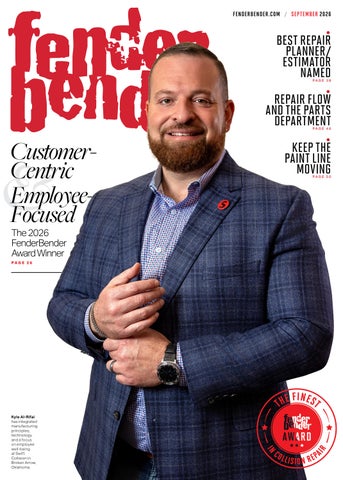
CustomerCentric EmployeeFocused The 2026 FenderBender Award Winner PAG E 26
Kyle Al-Rifai has integrated manufacturing principles, technology, and a focus on employee well-being at Swift Collision in Broken Arrow, Oklahoma.
KEEP THE PAINT LINE MOVING
PAG E 50
ORWDR: 588R0GLAWR: 33 F Y B FD. GV REA 8KG 6SL
26 TO Y, EFF E . BY: UC F D . K E N T R F RR M S S A F E T I N A B OSV. C A R M DS WN PAS AW F O E CLE M E B G C O VN E H I C LA N D AER S H O0 EHI 150 5 /70R1 L L V C 3 I 23 CLE OR N ST TUR 000 VEH01/ 03 27 35LB WITRHES P1263X7.0J kPa/35 R 4V E H I M W OT NTIO UFAC 0000 V G I 0 T S I S R A L ESOURCE 24 0 0 FOR ALL AN ATE: T GAWR: YOUR SINGLE VE R H O T T M T I E R D A MO PR OF M00000 D 7 L E RON40KG 16SL A T L R F 082 DE 00 E EF DATE A F H K E PSI CO 12 5 /70R L T 5 . CAB EPG .A F001883 P23 7.0J Pa/30 THE APPLI BOVE. L -- C I N U . S L A L 0 X k 0 N A 3 T 6 W O 1 205 ST SHO ACVMADE NFORNMDARDS INUFACTURE AT 3 O C 4 E E A ⁄L 41 EHICL Y STA F MAN 000 4 Q 21 A ⁄ U 2 THIS IVCLE SAFETHE DATE 0O 00000 : R 0 VEH CT ON T 0000 C ⁄ T⁄ T M : -N 00 A EFFE B
STICK WITH US : 00
VIN E: MPV TYP
TIRESS RIM LD PSI CO
REPLACEMENT LABELS!
DS0: R 3 1 : RC TR SPB D AXLE5 V
3U51 F05
ISSIOATION M E M ICLEINFOR Gasoline H E V ROL el T CON
VEHICLE MFD . BY HONDA OF AMERICA MFG ., INC . 06 ⁄ ’10 GVWR 2200KG ( 4894LBS ) TIRE SIZE RIM SIZE GAWR F 1155KG ( 2546LBS ) P235/55R18 99V 18X7 1 ⁄2J GAWR R 1080KG ( 2381LBS ) P235/55R18 99V 18X7 1 ⁄2J THIS VEHICLE CONFORMS TO ALL APPLICABLE FEDERAL MOTOR VEHICLE SAFETY AND THEFT PREVENTION STANDARDS IN EFFECT ON THE DATE OF MANUFACTURE SHOWN ABOVE. V.I.N.: 00000000000000000 TYPE: MPV
STK
A
AA5
--NH737M
--A
--A
TIRE AND LOADING INFORMATION SEATING CAPACITY
AUTO DATA LABELS HAS THE LABELS YOU NEED WHEN YOU NEED THEM!
TOTAL 3
FRONT 3
REAR 0
The combined weight of occupants and cargo should never exceed 505 Kg or 1114 Lbs.
TIRE SIZE FRONT P265/70R17 REAR P265/70R17 SPARE P265/70R17
COLD TIRE PRESSURE SEE OWNERS 303kpa 44psi MANUAL FOR 303kpa 44psi ADDITIONAL 303kpa 44psi INFORMATION
New Dashboard is available on our WEBSITE & MOBILE APP • Faster, Easier Ordering: Place orders in just a few clicks with our streamlined interface. • Track Your Orders: Get real-time updates on every order you place. • Access Shipping Info & Reprint Invoices: All your order and billing details in one place. • View Credits: Easily see account activity and available credits. • Order History: Quickly search past purchases and reorders.
SCAN THE QR CODE TO GET STARTED NOW! DOWNLOAD ON THE
APP STORE
DOWNLOAD ON THE
GOOGLE PLAY
FOR ADDITIONAL INFORMATION ABOUT AUTO DATA LABELS: visit our website at www.AutoDataLabels.com | email us at labels@AutoDataLabels.com | or call us at (631) 667-2382
LKQ B2B WEB PORTAL
Synchrony Car Care cardholders spend
$
148
MORE
on average than non-cardholders.*
CONTENTS
SEPTEMBER 0 9 . 2 6
|
V O L U M E
2 8
|
N U M B E R
0 9
AWA R DS
26 FENDERBENDER AWARD WINNER
38 THE BEST REPAIR PLANNER/ESTIMATOR
BY JAY SICHT
His ability to combine deep OEM knowledge with a disciplined repair planning process drive measurable results.
AWARD WINNER: MIKE MEAD
Kyle Al-Rifai has integrated manufacturing principles, technology, and a focus on employee well-being at Swift Collision in Broken Arrow, Oklahoma.
BY JAY SICHT
FenderBender (USPS Permit 25614), (ISSN 1937-7150 print) is published monthly by Endeavor Business Media, LLC. 201 N Main St 5th Floor Fort Atkinson, WI 53538. Periodicals postage paid at Fort Atkinson, WI, and additional mailing offices. POSTMASTER: Send address changes to FenderBender, PO Box 3257, Northbrook, IL 60065-3257. SUBSCRIPTIONS: Publisher reserves the right to reject non-qualified subscriptions. Subscription prices: U.S. ($93 per year). All subscriptions are payable in U.S. funds. Send subscription inquiries to FenderBender, PO Box 3257, Northbrook, IL 60065-3257. Customer service can be reached toll-free at 877-382-9187 or at fenderbender@omeda.com for magazine subscription assistance or questions. Printed in the USA. Copyright 2026 Endeavor Business Media, LLC. All rights reserved. No part of this publication may be reproduced or transmitted in any form or by any means, electronic or mechanical, including photocopies, recordings, or any information storage or retrieval system without permission from the publisher. Endeavor Business Media, LLC does not assume and hereby disclaims any liability to any person or company for any loss or damage caused by errors or omissions in the material herein, regardless of whether such errors result from negligence, accident, or any other cause whatsoever. The views and opinions in the articles herein are not to be taken as official expressions of the publishers, unless so stated. The publishers do not warrant either expressly or by implication, the factual accuracy of the articles herein, nor do they so warrant any views or opinions by the authors of said articles.
September 2026
5
fenderbender.com
CONTENTS
SEPTEMBER
STARTER
09
DRIVER’S SEAT
Recognizing standout collision repairers
10
PAST THE PAGE
ADAS Calibration Requirements: Why a Clean Scan Isn’t Enough, Plus Proposed Merger of AkzoNobel and Axalta Approved by Shareholders
QUICK FIX
14
BREAKDOWN The path to payment for destructive weld testing
21
NUMBERS
Are you paid for destructive weld testing?
17
LIGHT HITS
The latest stories from around the industry
22
Q&A
The missing piece in Right to Repair
12
ON THE SCENE
CIC focuses on the Consumer in Chicago
12
STRATEGY
COLUMNS
46
FINANCE+ OPERATIONS
50
Repair Flow and the Parts Department
24
SHOP PROFITS Leadership to transform your shop
BY G REG LOB S IG E R
52
50
COLLISION COURSE
FINANCE+ OPERATIONS
Why is collision repair unregulated?
Keeping the paint line moving
BY TIFFANY ME NE FE E
54
ON THE BUSINESS
Find missing labor hours on small and medium repairs BY MIK E ANDE RSON
September 2026
6
fenderbender.com
New finish. Proven expertise. Bolder ambition. Built on the heritage of BASF Coatings, Surventis brings decades of expertise together with the freedom to move faster and think bigger. Science-driven, passion-led, and centered on your challenges, we deliver surface solutions that perform, inspire, and create lasting value.
surventiscoatings.com
Learn more
CONTENTS
ONLINE EXTRAS
CL ICK ON THE L OGO BEL OW F OR PRODUC T INF ORMATION Ameri-Cure
AUTEL
Auto Data Labels
Axalta Coating Systems
BASF Coatings
BodyShop Marketing
Bosch
Buy Auto Supply
Car-O-Liner
CCC Intelligent Solutions
Certified Collision Group
Ford Motor Company
Hunter Engineering Company
I-CAR
KECO Body Repair Products
LKQ Corporation
Motor Age Training
OEConnection
PartsTrader
ProColor Collision USA
SEMA
SUN Collision Repair Systems
Synchrony Financial
Telwin
8/4/26 10:11 AM
September 2026
8
fenderbender.com
DRIVER’S SEAT
EDITORIAL
Chris Jones VSRG Editorial Director Jay Sicht Editor-in-Chief Peter Spotts Associate Editor Kacey Frederick Assistant Editor Emily Kline Special Projects Editor Leah Marxhausen Special Projects Editor Drew Bryant Contributing Writer Tiffany Menefee Contributing Writer Greg Lobsiger Contributing Writer Noah Brown Contributing Writer Lindsey Gainer Contributing Writer Todd Kortemeier Contributing Writer Steve Trapp Contributing Writer
EDITORIAL ADVISORY BOARD
Jordan Beshears Steve’s Auto Body Sheryl Driggers Collision Advice Jason Mundy Mundy’s Collision Center Stan Medina Certified Collision Works
SALES
Andrew Johnson Publisher ajohnson@endeavorb2b.com Mattie Gorman-Greuel Associate Sales Director Cortni Jones Director of Business Development Diane Braden Account Executive (National Accounts) dbraden@endeavorb2b.com Marianne Dyal Account Executive (National Accounts) mdyal@endeavorb2b.com Chad Hjellming Account Executive (National Accounts) chjellming@endeavorb2b.com Lisa Mend Account Executive (National Accounts) lmend@endeavorb2b.com Kyle Shaw Account Executive (National Accounts) kshaw@endeavorb2b.com Sean Thornton Account Executive (National Accounts) sthornton@endeavorb2b.com
ART AND PRODUCTION
Mariah Straub Production Manager Jen George Ad Services Manager Mitch Bradford Art Director
ENDEAVOR BUSINESS MEDIA, LLC
CEO Chris Ferrell COO Patrick Rains CDO Jacquie Niemiec CALO Tracy Kane CMO Amanda Landsaw EVP Transportation Chris Messer EVP Endeavor Business Intelligence Paul Mattioli VP of Content Strategy, Transportation Group Josh Fisher
SUB SCRIPTION S
Send address changes and subscription inquiries to: FenderBender PO Box 3257 Northbrook, IL 60065-3257 Subscription Customer Service: 877.498.4668 customerservice@fenderbender.com
LET TE RS TO THE E DITOR editor@fenderbender.com
Opinions expressed in FenderBender are not necessarily those of Endeavor Business Media, and Endeavor Business Media does not accept responsibility for advertising content.
September 2026
RECOGNIZING STANDOUT COLLISION REPAIRERS KYLE AL-RIFAI has used his background in manufacturing to shape his unconventional approach to collision repair, including implementing round-the-clock shifts for unusual producitivity in the massive 140,000-square-foot facility in Broken Arrow, Oklahoma. At the same time, he stresses that the collision repair industry needs a culture shift to compete with other trades vying for some of the same personnel. “Blue-collar work today should mean work/life balance, respect, smart tooling, and a real career path,” he says. “We have to show the next generation that this is a skilled, technical profession they can be proud to choose.” He sees culture as a quality issue, as employees who feel respected and have clear direction deliver quality repairs. It is for these reasons and more our judging panel selected Al-Rifai as our FenderBender Award winner from a number of highly qualified nominees, and we look forward to sharing more of his story as he is prepared to talk about the latest developments in his operation. Our Best Repair Planner/Estimator for 2026 is Mike Mead, of Dacus Auto Body & Collision Repair in McPherson, Kansas, who in his nomination was praised for consistently delivering accuracy, efficiency, and safety at a high level, which are qualities we wished to promote when we introduced the award in 2024. Mead’s completed estimate exercise from Collision Advice for a 2025 Ford F-150 that needed a frame replacement included over 500 line items and was over $37,000, including many one-time-use fasteners and other parts. I want to thank supporters of both our awards, and especially for sponsors our Best
9
Repair Planner/Estimator Award: Ford Certified Collision Network and RepairLogic from OEC. I also want to give a special thanks to Mike Anderson, Danny Gredinberg, and other staff at Collision Advice, without whom we would not be able to include the critical estimate exercise component. Competition for both awards, as always, was extremely close this year. Read about both of these winners in this issue, and also look for the roundtable video with Mike Mead, Mike Anderson, Ford’s Chris Wallace, and OEC’s Tanya Sweetland on our combined Vehicle Service & Repair Group YouTube channel. If you will be at the SEMA Show, join us for the Red Carpet Industry Awards on Tuesday evening following the Collision Industry Conference, where we will present both awards. As always, I encourage you to nominate your choice (or another) next year. I appreciate your interest and support, and I hope to see another flood of entries next spring.
JAY SICHT
EDITOR-IN-CHIEF
jsicht@endeavorb2b.com
fenderbender.com
PA ST T H E PAGE
ADOBE STOCK 976190386
ADAS CALIBRATION REQUIREMENTS: WHY A CLEAN SCAN ISN’T ENOUGH
Isaac Aronson of OEC talks through how OEM procedures, repair planning and documentation can help collision repairers identify calibration needs earlier and support safer, more defensible repairs. By JAY S ICHT
ADVANCED DRIVER ASSISTANCE SYSTEMS calibrations have become a routine part of collision repair, but misconceptions about when they’re required can lead to missed procedures, unnecessary work, and added risk. In this CollisionCast episode sponsored by OEC, Isaac Aronson, product manager at OEC and a former automotive technician with nearly two decades of hands-on experience, shares why repairers shouldn’t rely on a clean scan or past experience alone. He explains how current OEM repair procedures can help shops identify ADAS calibration requirements, improve repair planning and documentation, and avoid costly surprises. Find CollisionCast on your favorite podcast platform or scan the QR code.
@fenderbendermag September 2026
@fenderbendermag 10
fenderbender.com fenderbender.com
VIDEOS
PROPOSED MERGER OF AKZONOBEL AND AXALTA APPROVED BY SHAREHOLDERS
Shareholders overwhelmingly voted to approve the previously announced all-stock merger of equals of AkzoNobel N.V. and Axalta Coating Systems. AKZONOBEL AND AXALTA COATING SYSTEMS LTD. announced in separate Aug. 5 news releases that shareholders voted to approve their previously announced all-stock merger of equals of Akzo Nobel N.V. (“AkzoNobel”) and Axalta Coating Systems at their individual General Meetings of Shareholders held Aug. 5.
“We appreciate the strong support we have received for our merger of equals with AkzoNobel and we are excited about the opportunity to deliver significant value to shareholders, customers and employees,” said Chris Villavarayan, Axalta CEO. “Building on our record second quarter, we are excited to embark on our next phase with real momentum in the business. Our teams are working diligently to advance integration planning and remain focused on bringing together two highly complementary businesses to capture the full value of this combination from day one.”
AkzoNobel CEO Greg Poux-Guillaume will serve as CEO of the combined company. “Today’s vote represents a significant milestone towards bringing together two highly complementary businesses,” he said. “It gives us a clear mandate to realize our vision of a stronger, more innovative global coatings leader which will deliver outstanding long-term value for customers, employees and shareholders.” Ben Noteboom, chair of AkzoNobel’s Supervisory Board, will serve as vice-chair of the combined company.
|
PODCASTS
|
WEBINARS
|
NEWS
“We’re delighted that shareholders have backed our ambitious growth plans and share our vision for what the two companies can achieve together,” he said. “We can now move into the final phase of the merger process with confidence and begin to unlock the value of our full combined potential. We also thank our shareholders, employees, customers and other stakeholders for their continued support.” Rakesh Sachdev, chair of the Axalta Board of Directors, noted that the approval marks a milestone toward creating a premier global coatings company. “The resounding support reaffirms our conviction that combining Axalta and AkzoNobel will create a differentiated industry leader with broad capabilities, world-class innovation and an even stronger platform for growth and value creation. I look forward to working with our combined team to deliver on the promise of this combination.” Completion of the merger remains subject to receipt of required regulatory approvals and other customary closing conditions. Subject to the satisfaction of these conditions, the companies continue to expect the merger to be completed in late 2026 to early 2027. The final voting results, as certified by an independent inspector of election, will be filed as a Form 8-K filed with the U.S. Securities and Exchange Commission.
Visit FenderBender.com/news for daily updates from around the collision repair industry.
September 2026
11
fenderbender.com
ON THE SCENE
BEYOND THE ESTIMATE: CIC EXPLORES WHY TRANSPARENCY IS BECOMING COLLISION REPAIR’S MOST VALUABLE SERVICE
As vehicle technology grows more complex and insurance disputes become more common, repairers are finding that consumer education may be as important as the repair itself. By JAY S ICHT
|
PHOTO: JAY SICHT
TODAY’S VEHICLES REQUIRE extensive research, OEM repair procedures, calibrations, documentation, and increasingly complex conversations about insurance coverage. At the same time, consumers file collision claims so infrequently that most have little understanding of how the process works until they’re suddenly forced to navigate it. That disconnect was the focus of a panel discussion at the recent Collision Industry Conference (CIC) in the Chicago
September 2026
suburb of Schaumburg, Illinois, where repairers, industry leaders, and even a recent collision repair customer explored how trust and transparency are reshaping customer expectations.
Moving Beyond the Traditional Intake Model
According to panelists Maria Quintero, owner of Body Builders Automotive in Illinois, and Drew Plischke, director of client/ insurance reconciliation of Gold Coast
12
Auto Body, the foundation of that guidance begins long before any repairs begin. Instead of treating the initial meeting as an estimating appointment, both shops view it as a consultation. “When consumers walk through my door, they’re not leaving with an estimate, per se,” Quintero said. “They’re leaving with resources to help them understand how the claim process is going to work within our shop and then how that’s going to impact them.” As vehicle repairs become increasingly tied to OEM procedures, certified repair requirements, and insurance coverage questions, the consultation serves as an opportunity to establish expectations from the beginning. Customers learn how repairs will be planned, how supplements are handled, what happens when coverage disputes arise, and what role they may need to play if disagreements occur between the shop’s repair plan and the insurer’s payment position. For repairers, that proactive approach eliminates surprises later in the process. For consumers, it creates confidence.
fenderbender.com
Bridging the Gap At the recent Collision Industry Conference (CIC), the usual empty chair representing the consumer in the repair was replaced with a customer on stage. Roxanne Raffaelli (right), praised the thorough and transparent communication with the shop, Body Builders Automotive, Inc., whose owner, Maria Quintero (second from right) was joined by Gold Coast Auto Body’s Andrew Plischke and Moderators Danny Gredinberg (left), and Erin Killcoyne-Solis.
Transparency Builds Trust
The Value of a Team Approach
Those who have attended CIC in recent years are aware of what is typically an empty chair on the stage to represent the consumer. At this CIC, consumer panelist Roxanne Raffaelli shared her recent collision repair experience. After filing her first insurance claim in nearly two decades, Raffaelli said she entered the process feeling overwhelmed and uncertain, but Body Builders Automotive put her at ease by letting her know, “Our team will be working on your case,” she said. “When you have a car accident, that’s an upsetting day. So, you’re looking for relief from someone. And I immediately felt relief when I reached out to Body Builders,” Raffaelli said. Quintero said all staff understand the process a consumer must go through from when they walk through the door until they pick up the completed vehicle. “When we say we work as a team, it takes all of us to do it, and not just the people that they see on the front lines but also the technicians and everybody who works in the back,” Quintero said.
September 2026
The discussion repeatedly returned to one central theme: transparency. When insurance companies decline to pay for certain repair operations or parts, many repairers hesitate to involve customers too deeply, fearing technical discussions will create confusion. But the panelists advocated the opposite approach. Quintero and Plischke said customers are included in virtually every major communication. Supporting documents, repair plans, insurer responses, and advocacy efforts are routinely shared with vehicle owners so they understand exactly what is occurring. Plischke described the process using three simple words: educate, advocate, and empower. The goal is not to overwhelm consumers but to help them understand the difference between a repair plan designed to restore a vehicle safely and an insurer’s payment decision. “The best way to describe what we’re doing is it’s simply advocating, educating, and empowering the consumer, because this is not our claim; it’s their claim,” Plischke said. “We are in position to safely and properly repair their automobile for them, and they are entrusting us to do so.” That transparency proved influential for Raffaelli with Quintero’s shop, who described receiving regular updates and having visibility into communications between the repairer and insurer. “They communicated with me every other day on the status of where they were with the repairs. That was wonderfully helpful and really gave me a lot of relief during that anxious time. They were transparent about, ‘Here’s what the insurance company is saying, here’s what they’re going to pay, here’s what they’re going to deny.”
The Industry Knowledge Gap
Raffaelli admitted she did not understand
13
the difference between OEM and aftermarket parts before her accident, or that an insurance policy rider endorsing OEM parts was available. Panel moderator Erin Kilcoyne-Solis, Square One Systems senior vice president, noted that repair professionals hear these terms so frequently they often assume customers understand them as well. The conversation served as a reminder that education remains one of the industry’s greatest opportunities. The revelation prompted discussion about an issue many repairers may underestimate. Consumers do not live in the collision repair world.
Why Consumer Participation Matters
The panel also challenged the notion that repair shops alone can resolve insurance disputes. While repairers can provide documentation, repair plans, and technical justification, ultimately the policy belongs to the customer. As Quintero explained, consumers often possess the strongest voice in discussions about claim payments because they are the party the insurer is obligated to indemnify. That can create uncomfortable conversations, particularly with customers who simply want to drop off their vehicle and avoid involvement. Still, the panelists agreed that even the most hands-off customers benefit from receiving documentation and resources throughout the process. Whether they choose to act immediately or later seek reimbursement, they possess the information necessary to advocate for themselves. “If you want to know the most powerful piece of equipment or tool that you have inside your shop, it’s the customer,” Plischke said. “And once they understand that money’s their money and not the shop’s money, their choice changes to be hands-on.”
fenderbender.com
Q U I C K
F I X
BREAKDOWN
COLLECT FOR DESTRUCTIVE WELD TESTING WITH CONSISTENCY AND DOCUMENTATION
It’s a crucial operation, but many shops struggle to secure payment for their work. Two shop owners share strategies that give them the best chance of being reimbursed. By PETER SPOTTS
FILE PHOTO/I-CAR
D E S T R U C T I V E W E L D T E S T I N G is a vital practice to ensure the safety of the customer. However, many shops encounter challenges with compensation for the work, leading to the practice not being a consistent industry standard. Test welds are necessary for technicians to know if the weld they’re performing will deliver a safe, quality repair. The best way to achieve this is by performing a test weld on a piece of scrap from the ve-
September 2026
hicle being repaired and confirming the metal tears before the test weld fails, according to I-CAR Welding Instructor David Brinkley. Test welds also enable the technician to adjust and confirm the welder settings, so they don’t need to be adjusted while in the middle of the repair. “Any shop that isn’t doing it every time... they need to be doing [destructive weld tests],” says Tim Paap, owner of Paap Auto Body in Mattoon, Illinois. “Regardless of
14
whether they end up getting paid by the insurance company or the customer, they need to be doing it.” A 2026 “Who Pays for What” survey, conducted by CRASH Network and Collision Advice, found that only one in four shops that regularly list destructive weld tests on their estimates are actually paid for it by the insurer, which is down 15% from last year. The shops that said they “never” get paid went up 15% to 44%. Kris
fenderbender.com
NEWS
Burton, owner/operator of Rosslyn Auto Body in Alexandria, Virginia, says their payment success rate is about 50-50. The biggest challenge he encounters is a lack of knowledge about the topic. “There’s a lack of education on the insurance company side and they’re not trained. They think they’re experts and can dictate price,” he says. “We’re dealing with a lot of people who don’t know what it takes to fix these vehicles.” The path to payment starts with consistency, Burton says. Rosslyn Auto Body has a dedicated welding station, and technicians perform the work for each job in accordance with OEM procedure requirements. “If you’re struggling to get paid, consistency is our biggest thing. Shop setup- have a station, do you have the equipment? When the adjuster comes, they can see it or virtually send a photo immediately,” Burton says. “We have our own station, and we do it the same way every time...Techs know how to do it. Our shop is very specialized, so there are only a few people who do welding here.” Paap, says documentation, including video, is the key for his shop to get paid for the work it performs. His shop uses Collision Clarity, an AI-powered platform that connects shops, insurance companies, and OEMs. It helps technicians document every step and provides linked evidence supporting the work. “[Insurers] just say, well, we don’t have proof of that or that’s included [in another labor operation],” Paap says. “We can show them videos, images, documentation, and they can search through all 283 or 300 pages of documentation...If [they] don’t want to pay for it, it’s between [them] and the customer, but all the documentation is in there.” Getting paid any amount isn’t the end of the battle. Burton frequently encounters issues with being paid fairly for the time performing the work takes versus what the insurer pays for various labor operations. “It’s a lot of work. Even when we do get paid, I don’t think it’s enough to cover
September 2026
what it really costs,” he says. “[For example], If we ask for corrosion protection or pre-wash, post-wash. They’ll say we don’t pay for that…They’ll give us 0.2. That doesn’t cover the hour that we asked for. Washing a car two to three times takes more than an hour.” A positive note from the “Who Pays for What” Survey is that a record low of 31% of shops said they never listed destructive weld testing on their estimates. It was 80% 10 years ago. The improvement implies more shops are aware of the need, even if they aren’t getting paid. Not performing destructive weld testing at all puts customers, and your shop, at risk. For Burton, safety is one of three things his shop will not skimp on. “Safe and proper repairs, that’s our mission. There are no compromises,” he says. “OEM parts. OEM repair procedures. Anything safety-related. These are the three things we don’t compromise on. Not all repairs fit that, and we understand that. Our overall objective and, when you have consistency in your building, if you start deviating, it sends a bad message to the team. Be consistent in your message to the shop.”
|
IDEAS
|
PEOPLE
|
TRENDS
A Goliath Weld Test Stand Is one of the options technicians can use to per form and document welds. GOLIATH CARTS
Tearout A destructive test of a plug weld. Make sure to measure the nugget diameter after. FILE PHOTO/DAVE BRINKLEY
15
fenderbender.com
ADVERTORIAL
COLLISION WORK IS HARD. TIRES SHOULD BE EASY.
The WalkAway® System makes the case to keep ‘em in-house WA L K I N G I N T O A C O L L I S I O N R E PA I R S H O P, there are types of equipment you can be sure you’ll always see. Tire changers and wheel balancers usually won’t make that list. It’s nothing personal. Collision shops naturally focus on collision work, so subletting the tire work helps them do that. Yet not subletting tire changing and balancing helps them do something else: Maintain control of their work, increase customer satisfaction and boost productivity and profitability. To that end, Hunter Engineering offers the new WalkAway® System. The system is formed by pairing Hunter’s autonomous Revolution™ tire changer with the new autonomous Road Force WalkAway® wheel balancer. The result is a stacking up of tasks that delivers dramatic timesaving with minimal technician involvement. Minimal technician training, too. The hard parts are automated, so even inexperienced techs can pick up the repeatable process quickly. Here’s how it works. Changing and balancing requires periods of time when the tech stands staring at the machine, waiting for something to happen. If that minute or two per tire could be reallocated, productivity would soar. The WalkAway® System’s key innovation is integrating a new autonomous inflation arm into the balancer. When inflation is completed, the air chuck releases automatically and the spin begins, balancing the assembly and measuring Road Force. All of this occurs without the technician present, who is then free to “walk away” and tend to other duties, such as getting the next assembly, installing and pre-torquing assemblies on the vehicle, and so forth. In this way, the time spent on a four-tire, door-to-door changeover can be cut by 44 percent. So why does this matter in a collision context? At a time when the changing collision landscape pushes shops to consider alternate ways of doing business, keeping tire work in-house makes a lot of sense: • Control: It’s your work. Subletting makes it someone else’s. Maybe they do it right, maybe they don’t, but your name is on it. You give away the profit but keep the responsibility.
September 2026
• Quality: It’s your work. Make sure it’s done to your standards. Keep the tires in-house and the comebacks out. • Cycle time: Keeping tires in-house significantly reduces it. Customers love short cycle times, insurers love short cycle times, and your shop will, too. • Quick learning curve: WalkAway® includes on-board training videos, with online and onsite training available as well. • Productivity and profitability: Even if you’re already doing your own changing and balancing, the WalkAway® System will allow you to do it much faster. Less time on tires is more time on your primary focus. Collision work is hard. Tires should be easy. The WalkAway® System makes them really, really easy, with happy results for both your customers and your business.
16
fenderbender.com
QUICK FIX
LIGHT HITS
K&M COLLISION JOINS COLLISION PARTNERS Collision Partners has acquired K&M Collision in Hickory, North Carolina. The transaction is structured as an operatorled partnership, with the Bradshaw family becoming significant shareholders in Collision Partners. As part of the partnership, Michael Bradshaw will join Collision Partners as executive vice president of Collision Operations and become a member of the company’s board of directors. Kyle Bradshaw will assume the role of general manager of K&M Collision. In his new title, Michael Bradshaw will lead Collision Partners’ collision repair strategy and the development of a scalable, highperforming operating platform across every Collision Partners location. He will work across Collision Partners’ collision centers to strengthen each location’s local identity,
build upon the practices that made it successful, and identify opportunities to collectively raise the standard for quality, safety, performance, and customer experience. As general manager, Kyle Bradshaw’s leadership will help ensure K&M remains rooted in the same principles that built its reputation while continuing to grow as part of Collision Partners.
BRANDON ECKENRODE STEPS DOWN AS CREF EXECUTIVE DIRECTOR Brandon Eckenrode has resigned from his role as executive director of Collision Repair Education Foundation (CREF), according to a news release. The Board of Trustees and Executive Committee are working closely with CREF’s staff to ensure a seamless leadership transition while maintaining the momentum of
the programs and initiatives that support CREF’s mission. “Our strategic priorities have not changed, and the work of the Foundation continues uninterrupted,” said Brenda Hogen, chair of CREF’s Board of Trustees. “Our dedication to serving students, supporting collision repair schools and educators, engaging industry partners, and helping develop the next generation of collision repair professionals remains as strong as ever.” CREF continues to connect the collision repair industry with schools and students through scholarships, grants, workforce initiatives and strategic partnerships. Its programs, fundraising efforts and events – including preparations for its 35th anniversary celebration – will continue as planned. CREF will share additional information regarding the leadership transition as it becomes available.
Bosch ADAS Positioning (BAP) System: Combines advanced technology and industrial-grade vision sensors to precisely measure fixture position, ensuring accurate target placement for reliable ADAS calibration.
We develop ADAS vehicle technologies for OEMs. Trust us to recalibrate them.
Modular and future-proof: Designed to be upgradable to accommodate future ADAS calibration technologies and new targets.
Bosch is the only automotive supplier developing ADAS vehicle technologies with OEMs and the equipment to calibrate them. DAS 3000
Integrated storage and maneuverability Keep your equipment clean and serviceable and ready to use at a moment’s notice. White glove on-site setup and installation* Where available, an authorized Bosch field representative will unpack, assemble and provide instruction on the use of the DAS 3000.
Guided interactive workflow on the ADS 10X Plus. Step-by-step instructions from start to finish including fixture placement, target selections and calibration. Scan tool sold separately.
Solutions for every job.
Get more information about the DAS 3000
Bosch DAS 3000 ADAS Calibration Solution A future-proof investment for fast, reliable and precise calibrations on a wide range of dynamic and static advanced driver assistance systems. *White Glove Service valid in the U.S.A. only. Limitations apply.
boschdiagnostics.com/adas
QUICK FIX
FOUR STATE AUTO BODY ASSOCIATIONS ANNOUNCE THE CENTRAL STATES COLLISION CONFERENCE The Kansas Auto Body Association (KABA), Oklahoma Auto Body Association (OKABA), Nebraska Auto Body Association (NABA), and Missouri Auto Body Association (MABA) announced the Central States Collision Conference (CSCC) on April 2324, 2027, in Wichita, Kansas. Built on the theme “Education. Collaboration. Innovation. Excellence.,” the Central States Collision Conference is a collaborative effort among four state auto body associations dedicated to strengthening the collision repair industry through education, networking, and the exchange of ideas.
the organization’s dedication to compassion, community, and critical support for industry professionals facing hardship. As part of this milestone celebration, CIF is launching its new “$25 for 25” campaign — an initiative designed to encourage individual giving and unite the industry around a shared mission of support and service. The campaign’s goal is simple yet powerful: inspire 1,000 individuals to contribute $25 in honor of CIF’s 25 years of impact. “Every contribution, regardless of size, helps us provide hope and emergency assistance to people in our industry facing incredibly difficult circumstances,” said Paul Hill, CIF president. “The collision repair community has always shown tremendous generosity in supporting its own, and this campaign gives every individual an opportunity to be part of that legacy.”
team as the company continues to grow its affiliate network of independent collision repair facilities across the U.S. and Canada. Horne brings more than a decade of financial leadership experience across private equity-backed, multi-entity organizations. He joins CCG from Babilou Family US (Little Sprouts), a multi-state, private equity-backed early education platform. He led enterprise FP&A, controllership, treasury and liquidity management, and strategic planning across more than 40 operating units and multiple legal entities. As CFO, Horne will oversee financial planning and analysis, controllership, treasury, and support for CCG’s affiliate network, partnering closely with Sullivan and the broader executive team on the company’s continued growth strategy.
CIF MARKS 25 YEARS OF SERVICE WITH $25 FOR 25 CAMPAIGN
CCG NAMES MICHAEL HORNE AS NEW CFO
REPAIRIFY AND OPUS IVS COMPLETE COMBINATION IN AUTOMOTIVE DIAGNOSTICS
The Collision Industry Foundation is celebrating 25 years of service to the collision repair industry. The milestone year marks
Certified Collision Group (CCG) appointed Michael Horne as chief financial officer effective July 20. Horne joins CCG’s executive leadership
Repairify and Opus IVS have completed their previously disclosed transaction, formally bringing the two organizations’ automotive
September 2026 2409FB_BuyAutoSupply.indd 1
18
fenderbender.com 6/20/24 2:51 PM
diagnostics businesses together under a unified operating structure. This milestone builds on the companies’ January announcement outlining an intent to combine their diagnostics capabilities to strengthen service offerings, expand technology capabilities, and better support customers across the automotive repair and collision industries. Operations across both organizations will align to deliver a more cohesive experience for customers and partners, with coordinated efforts in engineering, service delivery, and customer support. Leadership teams from each company will guide integration efforts and ensure continuity across the business. Opus IVS CEO Brian Herron will now lead the combined companies’ diagnostics business comprised of asTech, Opus IVS, and BlueDriver.
ASE EDUCATION FOUNDATION RECEIVES $25 MILLION GRANT TO SUPPORT APPRENTICESHIPS The ASE Education Foundation has been awarded a $25 million, four-year grant from
..
,.1.1.n
&,II@
the U.S. Department of Labor to expand registered apprenticeships for auto, collision, and truck service technicians nationwide. Program sponsors — dealer groups, shop associations, franchise operators and similar organizations — will receive $3,500 for every apprentice they bring on and retain, which will be paid in two parts as the new technician reaches 90 and 270 days on the job. Every dollar is tied to a technician reaching real milestones, which gives sponsors a direct stake in the coaching, support and structure that keep a new hire in the bay and on a path forward. Registered apprenticeships are a proven way to grow the workforce. Studies show that employers realize an average return of $1.47 for every dollar invested, and more than 90% of apprentices stay with the same employer when they complete the program. Employers who have an existing registered apprenticeship can participate, and those who don’t won’t have to build their programs from scratch. The Foundation and National Automobile Dealers Association (NADA) provide a free, ready-made playbook Apprenticeship-
in-a-Box that covers everything from mentor training to interview guides.
PROCOLOR COLLISION ADDS INTEGRITY COLLISION CENTER IN CALIFORNIA EXPANSION Integrity Collision Center in North Hollywood, California, has joined ProColor Collision as ProColor Collision NoHo. To ensure every vehicle is repaired safely and accurately, the shop continually invests in ongoing training, advanced technology, and state-of-the-art equipment to help the team deliver precise repairs that meet the highest industry standards while keeping pace with the ever-changing demands of today’s vehicles. Led by Owner Vrezh Isayan, ProColor Collision NoHo has more than 40 years of collision repair industry experience in the North Hollywood area. According to ProColor Collision, the partnership will provide the shop with additional resources, industry expertise, and support.
ONE PLATFORM. EVERY REPAIR.
OEM Collision + Mechanical Info Delivered Together Don't settle for collision repair info alone. Get everything you need on one powerful platform, so your shop can work faster with confidence. Try SUN Collision Repair Information today. Visit suncollision.com
I '
-----------
-
-
You are the PRO. We rally around you.
A proven business model for over 20 years, ProColor Collision is growing! Independent body shop owners driving their business forward are choosing ProColor. Standardized operations, management tools and consolidated technology solutions improve performance. The ProColor team of industry professionals are dedicated to performance excellence offering the sales, operational and marketing support needed to take business to the next level. ProColor Collision is committed to helping shop owners grow their business locally while leveraging established relationships with global insurers, suppliers, and fleet companies.
The ProColor PROcess is a winning formula.
Find out more at procolor.com
ProColor Collision USA LLC, 650 Pelham Blvd, Suite 100, St. Paul, MN 55114 ® Registered Trademark of Mondofix Inc. MN File No.11345 This advertisement is not an offering. An offering can only be made by a prospectus filed first with the Department of Law of the State of New York. Such filing does not constitute approval by the Department of Law.
QUICK FIX
NUMBERS
ARE YOU PAID FOR DESTRUCTIVE WELD TESTING? OUR A RTICLE IN THIS ISSUE SHOWS how to collect for destructive weld testing. It's for good reason we included it. Data from a recent "Who Pays for What?" survey found that only one in four shops that list destructive weld testing on their estimates are actually paid for it on a regular basis, down from 37 percent two years ago. Those shops that said insurers “never” pay for it has risen from 32 percent two years ago to 44 percent in 2026.
“It’s a process that needs to be performed for every type of weld being made on the vehicle," said Mike Anderson of Collision Advice, who conducts the surveys with CRASH Network. "Every OEM states that we need to do this, and for good reason. It is nearly impossible to tell if the welder settings are correct without first performing destructive test welds.”
SHOPS THAT LIST DESTRUCTIVE WELD TESTING ON ESTIMATES AND ARE PAID FOR IT:
2026 2024
25% 37%
2026 2024
44% 32%
SHOPS REPORTING INSURERS NEVER PAY FOR DESTRUCTIVE WELD TESTING:
QUICK FIX
Q&A
THE MISSING PIECE IN RIGHT TO REPAIR
Revv’s Adi Bathla supports increasing data access for shops but says the unaddressed issue of telematics leaves a gap in the current legislation. By PETER SPOTTS
THE RIGHT TO EQUITABLE AND PROFESSIONAL AUTO INDUSTRY REPAIR
(REPAIR) Act, if passed by Congress, would increase the access independent shops and car owners have to manufacturer data that is usually available only to franchised dealers. The House Energy and Commerce Subcommittee on Commerce, Manufacturing, and Trade advanced the bill to the full committee in February. The legislation would set data sharing requirements for manufacturers, prohibit the use of vehicle-generated data beyond diagnostics and repair, and establish data rights for vehicle owners. Revv ADAS CEO and Co-Founder Adi Bathla says he is a firm believer in Right to Repair. When he founded the company in 2022, he sought to solve the challenges around ADAS at the point of repair. It required shops to understand what ADAS safety functional procedures needed to be done for a particular vehicle and get that information fast. “Ultimately, the time it takes to get to understand what needs to be done to the car bleeds into cycle time and, if cycle time bleeds, that’s bleeding revenue,” he says. “This whole problem is getting exacerbated by the day because cars are getting more advanced; there’s more information that is required about the car exponentially increasing by the day.” Bathla spoke with FenderBender about how Right to Repair would change the information that shops and companies such as Revv have access and why he feels the omission of telematics, which allows modern cars to collect real-time data on vehicle performance and wirelessly send diagnostic info directly to the manufacturer, creates an information gap; independent shops can’t get the data until a car is physically in the shop for a repair.
September 2026
Q: What information do Revv and shops have access to now, and how does Right to Repair help expand that information access? “Let’s say a 2026 model goes into repair, and Revv produces the calibration report of required ADAS functional safety procedures that need to be performed on that vehicle based on the repairs that are happening and based on that particular car. Now, the level of information that is accessible to us, independent shops, and everybody for new vehicles coming into the car parc is limited, or is delayed, basically. So, what our technology does is let the technicians who are repairing the cars in real time give us feedback on the output generated. So, the Right to Repair movement will bring more information to shops and this improved access means shops aren’t waiting on secondhand or delayed information to determine what a new vehicle actually requires for repair.”
Q: What is the information gap between independent shops and manufacturers that you feel the bill doesn’t address?
“Telematics is another piece of the puzzle. Take two 2025 BMW 330i xDrives - same make, model, year, same trim. One was ordered with the Driving Assistance Professional package, the other wasn’t. Those are physically different cars. The optioned one has forward radar and camera hardware that the base car simply doesn’t have. Now that car comes in for front-end damage. On one of them, replacing the bumper cover triggers a radar recalibration. On the other it doesn’t. Same year, same trim, same line on the estimate - completely different functional safety requirements. And you can’t tell which is which from the RO.
22
In order to get to complete certainty at the point of repair when the car comes into the shop, you not only need the manufacturer-level of repair information, but you also need real-time data about the car around what’s equipped in terms of systems and features to be able to be completely certain and accurate. If that’s not there, there’s going to be manual steps to figure it out, but that again adds to the cycle time and the willingness of the shop to take up that work, which creates this gap in how well the car is repaired. Telematics was in the original REPAIR Act. It got stripped out of the version that advanced this spring, and Massachusetts has been litigating its telematics provision for years. So, the piece the industry needs most for calibration precision is the exact piece that keeps falling out of the bill.”
Q: Is this problem exclusive to independent shops, or does it affect MSOs as well?
“The information gap isn’t unique to independents; MSOs face the same OEM data access issues. This is really a broader collision repair industry problem, not just an independent shop problem. The main difference is that larger MSOs have more resources to work around the gap, so independents feel it more acutely. But the gap itself is industrywide.”
Q: Are there any resources or tools shops can use to access telematics data without manually figuring it out themselves? “Right now, telematics is quite the black box for independent shops, and independent shops are already being squeezed in terms of margins. They already must use a plethora of software
fenderbender.com
ADOBESTOCK_2005673651
to aid their efforts to complete the repair and put the safest car back on the road. So, I do not believe that shops need a new piece of software to have this level of access. At the end of the day, what they end up doing is inspecting the car and spending more time physically validating what’s equipped and what’s not equipped in the car, which can be a pretty painful job given the extent of repair that is being. A lot of these components require a thorough disassembly to really figure out whether they’re equipped or not. The scan tool doesn’t give you the full picture. It’s tedious and they do end up missing some things that might be ver y important to get the repair done properly. So, I think access is number one, but access doesn’t really fix the whole issue…. synthesizing that information and being able to utilize it at the point of repair efficiently is a completely different ballgame.”
Q: What is Revv doing to try to address this issue?
“What we have noticed time and again is that the industry on the repair side of things is extremely fragmented and just the sheer number of players in the ecosystem has one disadvantage – it’s very hard to have a collective voice from that side of the industry coming together and aiming the right thing to do
September 2026
with the right stakeholders at the right point in time. At Revv, we are trying to fundamentally solve this by bringing the most expert, powerful voices with good intentions together to have a collective voice. This doesn’t really apply to the specific Right to Repair movement or the addition that we need to make to the Right to Repair movement. I do think that it’s a great step forward… and it’s going to lead to better access to data, which is going to be great for everybody. Adding telematics to it might just be a natural next step.”
Q: Aside from telematics, are there any other information gaps?
“[Yes]. The usability of the data is how I would categorize it. So, the data will come; they will have access, but it’s going to be very fragmented. It’s going to be difficult to navigate. It’s not going to be presented in a way that is practical for the technicians and, with data on new cars being met new as well, there becomes a steep learning curve for technicians, no matter how skilled you are, or whether you’re just at the entry point of starting your repair career. So, the usability of the data matters so much, [but that’s] not a legislative thing to solve for, but it’s more on companies like Revv to help technicians quickly identify the right procedures, complete required steps about those procedures, and then the ability to document that work with confidence.”
23
Q: Any final comments or remarks?
“If this access materializes the way it’s described, it’s a real step forward for shops. But it hasn’t happened yet - the telematics piece was cut; Massachusetts is still in court, and the version moving through the House mostly codifies a handshake agreement the industry has had since 2014. Worth celebrating when it lands, not before. The industry should keep on advocating for more data, the right data, and I would urge the major players in the hardware and technology side of things to utilize this as an opportunity to provide a better service to the industry. As we get more data, we need to also show that there’s a real impact that we can make with this data.”
Adi Bathla Revv CEO and Co-Founder REVV
fenderbender.com
COLUMNS
SHOP PROFITS
Transforming Your Shop: Leadership Principles for Long-Term Growth and Employee Respect Establish clear goals, build respect with employees, and lead with integrity to ensure long-term success and operational independence. terviews, and social media discussions on the collision repair industry. The subjects range from ADAS calibrations, certifications, flat-rate vs hourly, lack of work, billing correctly, or just selling to an MSO. It’s funny how very little is written on effective leadership. As an owner/manager, sometimes we need to just stop and ask ourselves, ”Am I a leader worth following?” I started working for my two uncles in 1985. They were very different from each other, often giving conflicting direction. I worked as a combo tech for 15 years before becoming the owner in 2000. I was full of spice and vinegar out of the gate, but by 2008 I was at my wits’ end and near a nervous breakdown. Then a consulting company coldcalled me and changed my perspective. What had to change was ME! They taught me that leadership starts with understanding the current scene inside our shop and envisioning the ideal scene. The definition of the “ideal scene” can look different between shops, but there are some non-negotiables here: 1. Business must be profitable. 2. Have checking points for daily, weekly, monthly targets and growing year after year. 3. The owner can’t be a technician/manager, which equals a bad manager. 4. The business should ultimately become “operational”, therefore not need to be constantly supervised. 5. The owner/manager must have knowledge of how every facet of the business should operate. 6. Have clear goals and a vision for the future. I’m not sure if you noticed the six definitions of the “ideal scene,” but I didn’t include that the owner/manager should be liked by the employees. Let’s consider this hypothetical scenario: We are 18 years old with the dream of becoming a Navy SEAL. Let’s say we join the Navy and make it all the way to SEAL training. We’re assigned a platoon commander, “GI Joe.” He makes us meet all the minimum requirements t to become a SEAL.
September 2026
Now let’s flip this scenario and instead of “GI Joe” as our commander, we get “GI Jerk,”’ and he is the meanest, most demanding commander in all the Navy SEALs. He pushes his candidates harder than any other SEAL team. Only 10% end up making it through his training, and this guy is just over the top, to say the least. Now comes SEAL graduation for those that made it through this grueling experience. GI Joe and GI Jerk’s team members all graduate and then start going on a few missions. They all return safely from several missions. Now comes THE mission. The general speaks to many SEAL teams about the objective and basically tells them, “It’s pretty much ‘kill or be killed.’” GI Joe’s team meets all the requirements. GI Jerk’s team is faster, stronger, and more capable than any other team. So, which team would you like to be on? Here’s the deal for owners/managers, granted we shouldn’t strive to be a GI Jerk, but we should also never strive to have our employees like us. The one thing that is a must, they must respect us! This is crucial to leading our employees to the “ideal scene.” This leads to success, a great place to work, good pay, and pride in a job well done. Respect — and just as important, integrity — is earned. Doing the right thing isn’t always easy or profitable, but you do it. I will never forget what one of my uncles said decades back about a guy who had no integrity, “He doesn’t know what lie he told who.” Never forget that employees are always watching. “Integrity gives you real freedom because you have nothing to fear since you have nothing to hide.” Zig Ziglar Being a good leader is not easy, but like the Bible says in 2 Tim 1:7 “For God did not give us a spirit of timidity, but a spirit of power, of love and of self-discipline.” So back to the beginning, “Am I a leader worth following?
24
GREG LOBSIGER
JOSIE SMITH PHOTOGRAPHY
It’s interesting to observe all the articles, in-
Greg Lobsiger has owned Loren’s Body Shop in Bluffton, Indiana, for over 23 years. He has been a member of Mike Anderson’s groups for ten years and had extensive lean manufacturing training.
EMAIL:
greg@lorensbodyshop.com
ARCHIVE:
fenderbender.com/lobsiger
fenderbender.com
FenderBender AWARD WINNER
Kyle Al-Rifai September 2026
26
fenderbender.com
September 2026
27
fenderbender.com
Innovating Collision Repair:
Kyle Al-Rifai’s ManufacturingInspired Approach Under the FenderBender Award winner’s leadership, Swift Collision emphasizes quality, employee development, and customer experience, utilizing innovative workflows and a strong company culture to set new industry benchmarks. By JAY S ICHT
|
CURTIS SPRAGUE PHOTOGRAPHY
W
ith his nontraditional background, Kyle Al-Rifai approaches collision repair a little differently than most. In a span of less than 10 years, he’s used his manufacturing mindset to grow from four employees in a 2,200-square-foot shop to a staggering 140,000-square-foot facility on 40 acres and more than 100 employees in the Tulsa, Oklahoma, suburb of Broken Arrow. With over 20 OEM certifications and I-CAR Gold Class recognition, he says his company, Swift Collision, is built on a culture-centric, employee-first philosophy where people come before profits and innovation is powered by purpose. For his innovation and dedication to his employees and community, Al-Rifai is our 2026 FenderBender Award winner. Daniel Burkholder, Founder of BodyShop Marketing, nominated several outstanding collision repair owners and operators, including Al-Rifai. He praised Al-Rifai for going above and beyond running a successful collision repair center. September 2026
28
“He is rethinking how a collision business should operate,” Burkholder wrote. “With a background in manufacturing and industrial engineering, he has brought process discipline, scalability, and innovation into an industry that often relies on outdated workflows.” Under Al-Rifai’s leadership, Burkholder pointed out, Swift Collision has paired OEMcertified repair standards with a customerfirst model built around transparency, convenience, and long-term trust.
fenderbender.com
A BETTER WAY
“His work stands out because it improves three things at once: repair quality, employee opportunity, and customer experience.” Al-Rifai is quick to share the honor with his employees. “The recognition from FenderBender is meaningful because it reflects the work of the entire Swift Collision team,” he says. “It also reinforces the responsibility that comes with growth: to protect repair quality, invest in employees, serve customers well, and move the industry forward without losing sight of the fundamentals.” September 2026
Before venturing into the automotive industry, Al-Rifai built businesses in manufacturing. He then began a business in automotive remarketing, work that required him to sublet work to multiple repair and reconditioning vendors. He soon discovered inconsistencies in quality, timing, and communication. He was convinced there had to be a better method of organizing the work. Drawing on his manufacturing background, he studied the repair process. He didn’t know how to massage dents or colormatch a panel, but he understood processes. Workflow, accountability, repeatability, and the value of designing a system around the customer’s desired outcome were second nature to him. “I kept asking what collision repair could look like if we applied manufacturing principles to it,” he says. In 2017, Al-Rifai opened a 2,200-squarefoot operation focused on dealer and fleet reconditioning with a painter, two body technicians, and detail team. The learning curve was steep, he says, but it also allowed him the freedom to question the industry’s status quo. “Outside eyes looking in have been one of the reasons we have been successful,” he says. “I love innovation, and I want people to challenge the way we are doing things so we can continue to improve.” As the business grew, the company moved into larger facilities and expanded its capabilities. The current facility opened in Jan. 2023 and features 15 paint booths, 90 body work areas, and 30 mechanical work areas. Al-Rifai found the former generator manufacturing facility in Sept. 2021. He designed the master plans and served as general contractor on the project to implement his vision. Through 29
fenderbender.com
Congratulations
KYLE AL-RIFAI and the team at Swift Collision!
“” It is about consistency, doing the work correctly, & elevating the customer experience.
CCC is honored to recognize Kyle's leadership and the team's dedication to repair excellence, customer service, and continued growth.
—Kyle Al-Rifai, CEO, Swift Collision
We are thrilled to congratulate Kyle on this accomplishment. Join us in making a contribution to Kyle’s charity of choice:
Collision Engineering Career Alliance
the expansions, Al-Rifai says his focus has remained on building an operating system that could support quality at scale. “That meant creating specialized functions for training, certifications, process improvement, customer communication, and quality control,” he says. “It also meant applying lessons from manufacturing, such as clearly defined work stages, visual management, accountability, and a relentless search for bottlenecks.” As it expanded into consumer-oriented collision repair, the name changed from Swift Recon to Swift Collision in Feb. 2026, which reflects not only a broader mission but a transformation, Al-Rifai says. “It is not about the name. It is about consistency, doing the work correctly, and elevating the customer experience.” The facility added 20 OEM certifications within a year, and 14 months later, it stands at 22. And beyond its immense size, Swift
September 2026
9FB_CCCIntelligentSolutions.indd 1
30 8/12/26 9:19 AM
fenderbender.com
Quality at Scale Al-Rifai applied lessons from manufacturing in the 140,000-square-foot facility, such as clearly defined work stages, visual management, and looking for bottlenecks.
September 2026
31
fenderbender.com
Collision has maximized efficiency by operating 21 shifts a week, round-the-clock, every day, compared to a typical shop’s 20 shifts per month. “Technicians work three 12s, have four days with their family, and they love it,” AlRafai says.
POWERED BY "SWIFTIES"
Swift Collision is “powered by its people,” affectionately known as “Swifties,” Al-Rifai says, a belief that shapes how he and company managers approach the workplace, career development, recognition, and the future of the skilled trades. Employees work in a professional environment with modern equipment, ongoing
September 2026
9FB_ICAR.indd 1
32 8/3/26 3:49 PM
training, team recognition, and leaders supporting those doing the work. “Blue-collar work today should mean work/life balance, respect, smart tooling, and a real career path,” he says. “We have to show the next generation that this is a skilled, technical profession they can be proud to choose.” Al-Rifai says this philosophy is necessary at a time collision repair competes for talent with many skilled industries, and he sees culture as a quality issue. It’s to what he points as a reason why the company’s retention rate over a year’s time is over 93%. “When employees feel respected, understand expectations, and have the resources to perform at a high level, the customer
fenderbender.com
Congratulations!
Kyle Al-Rifai
"Repairing a damaged workforce culture" Al-Rifai wants to change the employee experience and attract talented technicians who might otherwise be lured away by other industries.
ultimately benefits. A strong culture is not separate from operational performance. It is one of the conditions that makes consistent performance possible.”Al-Rifai says the workforce culture in collision repair is often damaged, and he describes it as new hires often having something akin to PTSD in dealing with chaos and worry. “I had one employee who had been here two weeks come to me and he said, ‘I was a little concerned yesterday. A manager asked me to come to his office, and I only get asked to go to the office when I’m in trouble. But he actually wanted my opinion on changing a process and if I would be comfortable with it.’ He said, ‘That’s not normal. I thought for sure I was in trouble.’
September 2026
“I said, ‘Well, did you do something wrong?’ He said, ‘Well, no, but that’s not how it usually is.’” Another employee, a senior technician, came to Al-Rafai to pass along thanks from his wife for allowing him to discontinue taking his blood pressure medicine. “So, those are the moments that make me want to drive even more into changing the way the employee experience is in the collision industry. I think employee by employee, region by region, state by state, we can create a benchmark. We can create a level employees and other employers know they have to meet so we can bring these great techs back to the industry — and not lose them to HVAC and plumbing, because it is tough.”
33
OEC is proud to support awardwinning leaders like Kyle who are committed to safe and proper repair.
Thanks for letting us be your partner from OEM certification to repair research & parts sourcing. OEConnection.com fenderbender.com
PartsTrader is proud and excited to recognize Kyle Al-Rifai and his team at Swift Collision for all of their outstanding accomplishments and customer first experience model.
Powered by "Swifties" Swift Collision is “powered by its people,” affectionately known as “Swifties,"a belief that shapes how managers approach the workplace, career development, recognition, and the future of the skilled trades.
KYLE AL-RIFAI CEO/Founder Swift Collision Broken Arrow, OK
Join us in donating to Kyle’s charity of choice: Collision Engineering Career Alliance The company has also been voted a Great Place to Work for the third year in a row. “That’s a very vulnerable thing because we’re telling the whole world what our employees think of us internally,” Al-Rifai says. “Our industry standard is 57%, and I believe we scored a 79 or 81. So, 81% of our employees love us to death. That’s not easy.” The company’s score has improved each year, and Al-Rifai says he hopes to score an 88 to 90 next time.
September 2026
9FB_PartsTrader_REV.indd 1
34 8/4/26 11:17 AM
“Those tests openly and anonymously tell us where we’re dropping the ball as a company so we can fix it. Employees never want to come and talk about what’s wrong because they’re afraid that would hurt their job or their position, so it’s a great place to vent.” The company has a program in place to help employees buy homes, and as of February, it has helped 17 employees, Al-Rifai says. The company assists with closing costs and deals with realtors that have a discounted rate. “So,
fenderbender.com
“” Those tests openly and anonymously tell us where we’re dropping the ball as a company so we can fix it. —Kyle Al-Rifai, CEO, Swift Collision
we can get the house a little more aggressively and cheaper for those employees.”
INSPIRING CUSTOMER CONFIDENCE IN THE REPAIR PROCESS
Considering other industries such as retail, banking, technology, and delivery services, Al-Rifai considered why collision repair should not be expected to provide customers with the same convenience and transparency. “A collision repair will always involve technical complexity, insurance coordination, parts availability, and careful quality controls. The customer, however, should not have to navigate that complexity alone.”
September 2026
35
fenderbender.com 2609FB_SnapOnEquipment.indd 1
A Better Way Before venturing into the automotive industry, Al-Rifai built businesses in manufacturing. He was convinced there had to be a better method of organizing the work in collision repair.
It has pushed him to focus on timely updates, education, convenient approvals, and a more coordinated experience from first contact to final delivery, he says. “The goal is not technology for its own sake. It is to reduce uncertainty and help customers feel informed and cared for during a stressful event.”
September 2026
The company’s app, Swift Care+, is currently in beta testing to address some of these industry concerns. “Customers do not compare their experience only with another body shop. Their expectations are shaped by every great service experience they have in the rest of their lives,” he says.
36
Combining technical excellence with hospitality will be what makes collision repairers stand out in the future, Al-Rifai believes. “A safe, correct repair is the foundation. The differentiator is how well the company communicates, how consistently it delivers, and how much confidence the customer feels throughout the process.”
fenderbender.com
The Best Repair Planner/Estimator AWARD WINNER
Mike Mead
His approach to OEM-driven planning results in optimized processes and safe, proper repairs. BY JAY SICHT
September 2026
38
fenderbender.com
BEST
REPAIR PLANNER/E
STIMATOR
AWARD 20
26
COURTESY OF DACUS AUTO BODY & COLLISION REPAIR
Thank you to the sponsors for the Best Repair Planner/Estimator Award! Special thanks to Collision Advice for collaboration and expertise for the final estimating exercise. September 2026
39
fenderbender.com
The Best Repair Planner/Estimator Award Winner
M
ike Mead’s approach to repair planning emphasizes complete disassembly, OEM repair procedures, extensive documentation, and cross-department collaboration to produce comprehensive repair plans. And that’s why Mead, of Dacus Auto Body & Collision Repair in McPherson, Kansas, is FenderBender’s 2026 Best Repair Planner/Estimator. Marketing Director Heidi Myers praised him in her nomination for consistently delivering accuracy, efficiency, and safety at a high level. “His ability to combine deep OEM knowledge with a disciplined blueprinting process drives measurable results: fewer supplements, strong parts accuracy, improved cycle times, and more predictable repairs,” she wrote. “He doesn’t just plan repairs; he sets the entire team up for success.”
Mead turns a complex repair into a clear process before the vehicle enters production, she continued, by building OEM-driven repair plans that account up front for each step, including structural procedures, one-timeuse parts, and calibrations. And beyond those skills, Mead was recognized for his leadership in the shop. “He elevates those around him, communicates clearly across departments, and thrives under pressure, especially during high-volume periods,” she wrote. “Mike bridges the gap between departments by translating complex
repair plans and OEM procedures into clear, actionable direction for technicians, parts, CSRs, and insurers. He ensures everyone is aligned from the start, which prevents breakdowns, keeps production moving, and creates a more cohesive team environment.” After the nominations were whittled down to a half-dozen finalists, Mike Anderson and his team at Collision Advice judged their completed estimate exercises for a 2025 Ford F-150 Super Crew four-wheel drive selected on a salvage pool website. (Ford and OEC are this year’s award sponsors.) Contestants were
provided the VIN and photos of the totaled vehicle and instructed on which major parts needed replacement, such as the rear bumper, left bedside, and complete frame. “The reason we chose those, which was a pretty difficult task, was really to assess the knowledge of any of the candidates who were competing not only of not included operations,” Anderson said. “But more importantly, it was also their ability to navigate Ford’s repair procedures through the electronic service manual to determine, what procedures and one-time use parts are required.” Mead’s completed estimate exercise totaled over $37,000 and included over 500 line items.
INDUSTRY SUPPORT AND THE DIFFICULT PROCESS OF SELECTING A WINNER
Thank you to this year’s sponsors, the Ford Certified Collision Network and RepairLogic, which allow us to recognize Mead and help bring attention to the need for quality, safe
ACCURACY AND EFFICIENCY Mike Mead’s repair planning focuses on complete disassembly, OEM procedures, and detailed documentation. COURTESY OF DACUS AUTO BODY & COLLISION REPAIR
September 2026
40
fenderbender.com
repairs. We’d also like to give a special thank you to Mike Anderson and his staff at Collision Advice for their expertise and assistance with the estimating portion of the awards selection process.
MEAD’S REPAIRPLANNING JOURNEY
Mead moved from repair planner into a production manager role in July 2025, and since he was nominated has been promoted to shop manager at the McPherson location. “But I still jump in and help with repair planning whenever needed,” he says. He has been in collision repair since 2011, working on semi-trucks for the next seven years, followed by three years on passenger vehicles before joining Dacus in 2021. Even before that, he painted school buses for about five years and even worked in building amusement park rides at Chance Rides in Wichita, Kansas. “I worked on carousel animals and other fiberglass components,” he says. “We did all the bodywork, carving, sculpting, and painting. So, I’ve always been involved in painting and bodywork, just in different industries. I also worked on semis before that and got involved with a lot of custom trucks that were featured at shows like MATS, which is kind of the SEMA show for the trucking industry.” His transition into full-time repair planning was in early 2022. “ One of our repair planners went on maternity leave and didn’t come back, so I applied for the position. At first, I handled my own disassembly and wrote estimates while we were getting staff in place. Once we hired enough people, I was able to focus fully on repair planning. At previous jobs, I wrote some estimates and larger supplements, but nothing nearly as extensive as what we do today.”
HOW HE APPROACHES THE REPAIR PLANNING PROCESS
Once a vehicle has been detailed and checked in, it moves into repair planning. The staff reviews the estimate and notes and begins documenting.
September 2026
41
fenderbender.com
The Best Repair Planner/Estimator Award Winner
are provided to the technician. Every stall has a tablet, so technicians can access procedures, repair plans, and photos at any point in the repair. “ Body technicians can take in-process photos during repairs, structural work, and refinishing,” Mead says. “Insurance companies want documentation, and this creates a complete record from start to finish.” Later in the process, reassembly technicians can review photos taken during disassembly or structural repairs. It gives everyone visibility into what happened throughout the repair and improves communication, he says.
DIGITAL TOOLS Mike Mead uses RepairLogic to access OEM information and documents each step using OneDrive, enhancing communication and transparency across departments.
GETTING PAID FOR OEM PROCEDURES
COURTESY OF DACUS AUTO BODY & COLLISION REPAIR
“We use colored markers to identify damage,” Mead says. “Green marks indicate known damage already included in the estimate, while red identifies damage that’s not yet included. We take extensive photographs to document damage, unrelated prior damage, and vehicle condition. Then every vehicle receives a prescan. We review the scan results, identify any related DTCs, and document those findings.” Seat belt inspections are performed on every vehicle, and a technician then begins disassembly. The shop uses two parts tables: a black table for repair-and-install components and a red table for replacement parts. Every part is photographed and documented as it’s removed. All photos are uploaded automatically to OneDrive, which allows the repair plan to be built from live documentation as the disassembly happens. “If there’s no photo, it doesn’t go on the estimate. We label every photo with the corresponding CCC line item so it’s easy to cross-reference later. Once the vehicle is fully disassembled, we complete our line notes and research OEM repair procedures through RepairLogic.”
September 2026
After that, Mead says, the staff holds what they call a “hard-copy huddle.” “We print estimates for multiple team members, including body technicians, painters, reassembly technicians, and PDR specialists when applicable. Everyone reviews the repair plan and identifies anything that may have been missed or any labor times they disagree with. Any revisions are added before finalizing the estimate.” Then all required calibrations and OEM procedures, including links, are attached to the documentation and OneDrive files, and the repair plan is sent to the front office for approval.
TABLETS IN EVERY STALL
OEC’s RepairLogic is used to research OEM repair procedures on every vehicle. “For Ford and Toyota, since we’re factory-certified, we’ll often go directly to the OEM information systems, because those are usually the most current resources,” Mead says. “We also use Toyota’s TIS and Ford service information.” If a repair involves structural components, quarter panels, bedsides, or similar repairs, printed procedures in addition to digital copies
42
This documentation aids in negotiating with insurers, Mead says. “ We work closely with our claims specialist. If an insurer questions a procedure or line item, we can quickly pull the OEM documentation and attach it to CCC or OneDrive. For example, if an insurer questions a wheel repair procedure that isn’t approved by the manufacturer, I’ll locate the OEM documentation showing exactly what the procedure requires. Once we provide that information, the discussions usually go much smoother because they don’t have to search through hundreds or thousands of pages themselves.”
WINNING THE REPAIR PLANNER COMPETITION
This was Mead’s third year in the competition, and during the roundtable discussion we hosted with him, Anderson, Ford’s Chris Wallace, and OEC’s Tanya Sweetland, he estimated he spent 15 to 20 hours ensuring he captured every operation he could. What made this estimate particularly challenging for him was the frame replacement. “Every year the repairs get more complex. At first glance, this one looked fairly straightforward, but then you get to the frame replacement and realize how many details
fenderbender.com
New cred. New customers. When you join the Ford Certified Collision Network (FCCN), you’ll be recognized by Ford, customers, and insurance companies as someone who offers the highest standards in Ford and Lincoln repairs. That puts you into a referral stream for new customers from our digital properties and call center. It also gets you access to not only the right parts but exclusive Ford procedures, training, and support. What’s more, you’ll be included in the Ford Pro™ Fleet and Commercial certified shop list. Take word-of-mouth referrals to the next level by joining the FCCN today.
Learn more about FCCN.
Message and data rates may apply.
The Best Repair Planner/Estimator Award Winner
are involved,” he says.“ The biggest challenge was finding all of the one-time-use fasteners Ford requires for suspension and structural components. CCC doesn’t always contain all of that information. RepairLogic helps identify many of those items, but I also rely heavily on DEG [Database Enhancement Gateway] resources and OEM websites to locate information that estimating systems don’t always include. Knowing where to find information is just as important as knowing how to write the estimate.” Resourcefulness in repair planning is a major asset, Mead says. “ We’ve even had situations where dealership parts departments couldn’t find a component, and I’d locate it using OEM diagrams available through DEG resources. You have to know where your information lives.” A lot of one-time-use parts are found in suspension systems, airbags, and safetyrelated components, Mead points out. “Many people don’t realize that common items such as locknuts, body mount bolts, and bed bolts are often single-use components. Ford does a good job of identifying them in the service information. Some manufacturers use icons like a trash can symbol, an X, or a black dot to indicate replacement is required. The challenge is identifying every one of those parts and documenting them correctly.”
TRAINING AND CONTINUOUS LEARNING
Mead says all in the shop train heavily with I-CAR. This year, the shop personnel are focused on Toyota training because they are pursuing Toyota’s Shop of the Year recognition. The more estimators, technicians, and staff members who complete training, the more points you earn, he says. “Toyota uses a lot of manufacturer-specific online training. Ford tends to emphasize I-CAR training a little more. We also obtained Rivian certification last year, and much of their training is conducted directly through Rivian’s platform.” The shop has been certified for Rivian repairs for about seven months. In that time,
September 2026
RESOURCEFUL Mike Mead leverages OEM diagrams, DEG resources, and manufacturer-specific training to locate parts and understand complex repair requirements. COURTESY OF DACUS AUTO BODY & COLLISION REPAIR
it’s repaired two and totaled another. As one of the few Rivian-certified facilities in the region, Mead says, it draws those vehicles from as far away as Wichita, about 60 miles away.
FUTURE CHALLENGES FOR REPAIR PLANNING
Looking ahead, Mead predicts safety inspections are going to become increasingly important as manufacturers further emphasize documenting proper inspections and repair processes. As vehicles continue to add additional safety systems, more calibrations will be required. “I don’t know if some systems will eventually become more self-learning, but either way, the complexity is increasing. One challenge we’re already seeing is calibrations failing because of issues discovered only during the process.
44
For example, you can start a calibration and discover a service bulletin requiring replacement of another component before the calibration can be completed. Those situations create difficult conversations because nobody knew the component needed replacement until the calibration process began.” As parting thoughts for readers who would like to up their repair planning game, Mead says “documentation is everything.” “Between photos, OEM procedures, proper line notes, scans, calibration documentation, and one-time-use parts research, the more thoroughly you document the repair, the easier it becomes to support the estimate and perform a safe repair. And just as importantly, know your resources. The information is out there, but you have to know where to find it.”
fenderbender.com
More Complete Repairs Start Here. RepairLogic helps collision repairers create more complete, OEM-backed repair plans with confidence. Access OEM repair procedures to identify required operations, strengthen documentation, and support safe, proper repairs. With RepairLogic, your team can: Find the right OEM procedures faster: Access repair procedures across nearly the entire North American car parc without searching across multiple OEM sites. Catch what could otherwise get missed: Identify required procedures, single-use parts, calibrations, and other repair considerations earlier in the process. Build documentation you can stand behind: Create comprehensive repair plans that help support repair decisions, conversations with insurers, and the work performed. Keep everyone working from the ators, same information: Give estimators, technicians, and repair planners clear access to the OEM information behind the repair.
YOUR ESTIMATE AND REPAIR DOCUMENTATION, FINALLY IN SYNC. RepairLogic integrates directly with CCC ONE, bringing estimating and repair planning closer together. Launch RepairLogic from your estimating workflow, carry vehicle information into the repair plan, access relevant OEM procedures, and send completed repair documentation back to the CCC ONE workfile.
Less searching. Less switching. Less manual documentation.
COURTESY OF DREW BRYANT
S T R A T E G Y
FINA NCE+OPER ATIONS
WHY WE ELIMINATED PARTS CARTS AND REBUILT OUR PARTS DEPARTMENT AROUND REPAIR FLOW
DB Orlando Collision reimagined its parts department by replacing traditional carts with modular crates, focusing on repair flow, space efficiency, and visual communication to boost productivity and accountability.
F O R D E C A D E S , the traditional red parts cart has been treated as a required piece of equipment in collision repair. When a vehicle enters production, the cart follows it. Removed parts go on the cart. New parts go on the cart. The cart moves from department to department until the repair is complete. At DB Orlando Collision, we stopped asking how many more carts we needed and started asking whether the cart itself was contributing to the problem. What initially started as a capacity problem became an opportunity. Traditional parts carts consume a tremendous amount of valuable floor space.
By DRE W B RYA NT
September 2026
46
fenderbender.com
LEARN
|
GROW
|
WORK SMARTER
and used elsewhere. That eliminates the risk of a wheeled cart being accidentally bumped or rolled into a client’s vehicle. The crate remains stationary until the parts are needed. This also created a clearly defined location where parts can be delivered to technicians. Parts are no longer placed on random tables or open surfaces, where several team members may eventually waste time searching for something that was misplaced, assigned incorrectly, or poorly communicated.
Our Parts Zones: Today, our system includes dedicated zones for each stage of the repair process. More importantly, they quietly reduce production efficiency through unnecessary movement, excessive handling, and transitional waste. Each time a cart is moved, searched, repositioned, or worked around, time is being consumed without adding value to the repair. Our parts department had reached its physical capacity. Even inside our brand-new facility, we could not add one more cart. We needed more capacity, but simply purchasing more equipment or expanding the same system would have created more congestion, not more efficiency. So, our team locked ourselves in a room and began brainstorming outside the traditional collision-repair model.
We Did Not Want a Bigger Parts Area Our objective was not simply to create more storage. We wanted to address several smaller operational problems at the same time. We reviewed the flow of our delivery drivers, the daily receiving process, the amount of walking required from our team, and the way parts activity could interfere with client and production movement. We also wanted clearer visual communication throughout the facility. Anyone standing inside the parts department should be able to identify whether a
September 2026
bumper or panel is waiting to be reinstalled, repaired, matched to a replacement part, prepped for paint, or returned to a vendor. Instead of creating one large parts area, we created clearly defined parts zones. Those zones make capacity, work in progress, and repair-versus-replacement decisions visually obvious. Our teams should not need to dig through a weekly report to understand what is happening. In many cases, the condition of the department should be understandable simply by standing in front of it.
Replacing Carts with Industrial Crates We transitioned from traditional metal carts to industrial, collapsible, pallet-sized plastic crates. These crates are commonly used for commercial shipping and material handling. The change increased our capacity from approximately 53 traditional carts to more than 120 available parts bins. Because the crates are modular and designed for pallet storage, they can be stored vertically on pallet racks instead of consuming prime production floor space. Empty crates can be collapsed and stored outside without the same weather concerns associated with traditional metal carts. The crates are moved using removable wheeled dollies. Once a crate reaches its designated zone, the dolly is removed
47
R&I Bumpers and Panels
Parts being removed and reinstalled are labeled with the repair-order number immediately after repair planning. They remain in this zone until reassembly is ready for them. They do not move throughout the repair. That reduces handling, clutter, and the risk of shop-inflicted damage.
R&I Glass
All reusable glass is stored in one designated area. It is no longer leaning against walls throughout the shop or being stored inside the vehicle.
Body Repair Needed
Any removed part being repaired instead of replaced is labeled and moved directly from repair planning into the body-repair zone.
Prep for Paint
Once the body department completes a panel repair, the part transitions into the paintpreparation zone. This becomes the staging area for the next phase of production.
Freshly Painted Parts
Everything leaving the booth is placed into a dedicated zone while awaiting reassembly and final quality assurance.
fenderbender.com
STRATEGY
Cores
Parts carrying core charges are labeled and placed in a dedicated core-return zone once the replacement has been installed. Without a defined system, cores can leak through the repair process, become misplaced, or be unintentionally discarded. When that happens, the shop absorbs a core charge that directly reduces parts margin.
Client Belongings Hold
Items removed from total-loss vehicles are labeled and stored for 30 days. If the client does not retrieve them, the items are donated to a local Goodwill. They are never allowed to become an unidentified pile in the corner of the shop.
Returns
Incoming and outgoing returns are separated and organized with the supporting invoice documentation. The visual system allows vendor drivers to confidently self-service pickups and deliveries while our parts team continues checking in parts, gathering payments, and confirming receipts.
Bumper, Rocker, and Panel Replacement
Replacement bumpers, rockers, and panels are stored on empty pallet racks and panel stands. This gives our team clear space to mirror-match incoming parts against the original components.
September 2026
Once the part is confirmed, it transitions to the appropriate production zone. A replacement bumper cover, for example, can be labeled and moved directly into the prep-for-paint area while the original bumper is properly disposed of.
The System Creates Accountability Without Constant Enforcement
The end results most significant benefit is not storage capacity. It is operational visibility. Each zone is managed by a department lead who is responsible for understanding what entered the zone, what takes priority, and why anything has remained there for more than a day or two. I compare it to a plated meal sitting under the heat lamp in a restaurant. Even the busser eventually asks why the food has been sitting there for so long. The system does not depend on every employee being perfectly connected, perfectly informed, and incapable of making mistakes. Instead, the environment itself helps maintain discipline. When each department controls its zone, the team begins supporting one another through confidence in the process. Repair Planning places the correct parts into the system. Body Repair completes its work and advances the parts. Paint prepares and refinishes them. Reassembly receives the parts when they are ready. Each area depends on the previous department doing its job correctly.
48
What We Are Still Refining The system continues to evolve. We currently maintain three exterior crate zones: empty crates waiting for repair planning, crates pulled from storage and waiting for reassembly, and crates completed by repair planning that are awaiting transportation to formal pallet rack storage and mirror-matching review. We are also developing better protection standards for headlights, textured plastics, trim pieces, and other damage-sensitive components. Our team is testing different bubble-wrap materials and reusable protection solutions that are practical, sustainable, and affordable. That is especially important because insurers do not always fairly compensate shops for the labor and material required to protect parts during the repair process.
What Other Shops Should Consider This system should not be copied simply because it replaces a cart with a crate. The real improvement comes from designing the flow around the needs of the repair. Shops should first identify where parts are being handled repeatedly, where employees are walking unnecessarily, where damage occurs, and where accountability disappears. The red parts cart is not automatically the problem. Accepting it as the only possible solution is.
fenderbender.com
YOUR TOOLBOX JUST GOT AN UPGRADE. We’ve consolidated our individual channels into one authoritative platform — the Vehicle Service & Repair Video Network. Get reviews for the latest tools, master complex repairs, hear interviews from automotive experts and more — all on one channel.
SUBSCRIBE HERE
youtube.com/@VehicleServiceandRepair
STRATEGY TRAVIS DEWITZ/DEWITZ PHOTOGRAPHY
FINA NCE+OPER ATIONS
KEEPING THE PAINT LINE MOVING
issues that slow production can often begin long before the vehicle reaches paint.
Effective collision repair requires seamless coordination among departments, from initial estimates to final paint. By TROY KNOPIK
C O L L I S I O N R E PA I R C E N T E R S today are very different from what they were even five years ago. The industry continues to evolve, with a continued focus on repair quality and operational efficiency. A successful collision repair center must operate like a finely tuned machine, from the front office to the final delivery of the vehicle back to the customer.
September 2026
Every stage of the repair process is important as the vehicle moves through the shop. Smooth handoffs from one department to the next do not happen by accident; they require planning, communication, and discipline. Keeping the paint line moving is influenced by every step in the vehicle’s journey. While the paint shop may at times be viewed as the bottleneck, many of the
50
It Starts with a comprehensive estimate The process begins with a thorough estimate. When operations are missed at this stage, delays can potentially snowball. Close collaboration between the estimator and the parts department is essential. Potential parts issues that could delay the repair should be identified as early as possible. Too often, one overlooked part has a major impact on the repair timeline and can result in slowing down the entire process. These departments need to communicate constantly to keep the repair on track. At this stage, the estimator should also pull the repair procedures for each job. This doc-
fenderbender.com
umentation should be added to the file and made available to the technician to ensure the vehicle is repaired back to OEM standard. Repair procedures can also identify products the shop may not have on hand, such as specific adhesives or welding materials. For example, many repairs involve bumper repair or replacement. OEM repair procedures will indicate whether a bumper can be repaired at all, especially when ADAS components are involved. Following these procedures helps ensure repairs are completed to manufacturer specifications and reduces surprise parts needed later in the repair process.
Blueprinting creates a second opportunity The next step may involve a blueprinter or teardown technician. This stage provides a second opportunity to catch missed repair needs or parts. By disassembling the vehicle for a closer inspection, the technician can identify additional damage or repair requirements that were not visible during the initial estimate. This information should be communicated back to the estimator and parts department so the estimate and repair procedures can be updated. Involving the body technician or painter at this stage can also be helpful if questions arise. The estimator can only see so much during the initial inspection, and this additional step has been known to reduce delays in modern repair processes.
The body technician plays a critical role Once the vehicle moves to the body technician, another key checkpoint is reached. The body technician should review the repair plan with the estimator or production manager, depending on the shop’s structure. This review can uncover anything that may have been overlooked in earlier stages. Body technicians are highly trained and often identify missing items or repair considerations that others may not catch. Addressing these items early helps prevent interruptions later in the process. The painter should also be involved at this stage. Some colors may require additional blending or disassembly, and discussing this before the vehicle enters paint can save valuable time. Communication between the body technician and painter is critical. The more qualified eyes on the repair at this point, the better.
September 2026
Once the vehicle enters the paint line By the time the vehicle enters the paint line, it has already passed through multiple departments. Ideally, the repair has been reviewed thoroughly and there should be no surprises. But even when the process is followed correctly, issues can still arise. So, what should the painter do to help keep the paint line moving? First, read the estimate and review it with all involved parties to make sure everyone is aligned. Use a highlighter or checklist to mark completed items and avoid missing anything. At this point, the painter is the last person in the process who can prevent delays before the repair moves forward. The repair should be inspected as soon as it is handed off from the body technician. If something does not meet shop standards, it should be addressed immediately so rework can be completed before the body technician moves on to the next vehicle. Time matters at this stage, and delays in inspection can quickly impact the schedule.
Verify parts before paint The painter should also confirm that all necessary parts are on hand to complete the job. When reviewing the estimate with the body technician, use the same checklist or highlighter to verify that parts are available. Whenever possible, a vehicle should only enter the paint line if it can be completed without interruption. If a missing part does not affect the ability to proceed with paint work, the repair can continue. Otherwise, sending an incomplete job into the paint line can create unnecessary delays.
Color work must be done in advance By this point, the painter should already have prepared the correct color for the vehicle. This includes performing a camera read and completing a spray-out card as far in advance as possible. Color-matching should never begin once the vehicle is already in the booth. When this step is skipped, unnecessary delays arise. The booth is not the place to work through color-match issues. The most productive shops have a standard operating procedure for this process and follow it consistently. Most shops only have four to six booth cycles available each day. Those cycles should be used for applying paint, not troubleshooting
51
the color. If even one cycle is lost, that vehicle is pushed into the next day, which contributes directly to the bottleneck.
Build and follow a booth schedule A daily booth schedule is another effective tool for keeping the paint line moving. This schedule is typically developed with the production manager and outlines the plan for the day. Vehicles that have confirmed parts availability and completed color preparation should be placed on the schedule. The booth schedule should be visible to everyone in the shop. As each job progresses, update the board so all departments know the current status. This visibility allows team members to anticipate when a vehicle will be ready for final assembly, detailing, file updates, or customer communication. It is important to avoid changing the booth schedule unless necessary. The plan established in the morning — or even the day before — reflects the shop’s agreed-upon priorities. Sticking to that plan creates accountability and sets clear expectations for everyone involved.
Organization and communication drive results Keeping the paint line moving requires organization and communication across every department. Collision centers that adopt standard operating procedures for each stage of the repair process — from pre-wash to final delivery — create alignment, consistency, and clear expectations. At first, implementing SOPs may seem like a daunting task. But if a shop works on one department at a time, the process becomes manageable. Adoption is often quicker than expected because most people respond well to organization and appreciate having clarity around what is expected of them. When departments recognize how directly they affect one another, the entire repair process improves. In the end, keeping the paint line moving is not just about what happens in the paint department. It is about ensuring the vehicle moves efficiently through every step before it ever reaches the booth. The processes that take place before paint are often more complex and more important than they appear. By focusing on those upstream operations, shops can reduce delays, improve workflow, and create a more efficient repair process overall.
fenderbender.com
COLUMNS
COLLISION COURSE
Pistol Pete, a Sawzall, and No License Required, Part 1
You need a license to cut hair, but not to cut a car in half? In Texas, as in many states, we regulate all kinds of professions in the name of consumer protection. Depending on the occupation, you may need education, testing, certifications, inspections, continuing education, or a stateissued license before you can legally provide a service to the public. But collision repair? Pistol Pete down the street, missing a finger and armed with a Sawzall, can potentially cut a vehicle in half, weld it back together, throw some paint on it, and send a family down the highway at 75 miles per hour. No collision repair license. No required industry training. No proof that he understands OEM repair procedures. No requirement that he owns the specialized equipment necessary to correctly perform that repair. He can even paint the car without the kind of professional paint booth and equipment that legitimate shops spend thousands upon thousands of dollars to purchase and maintain. And somehow, we are all supposed to act like that makes sense. Before somebody gets offended, this isn’t an attack on technicians who learned through experience instead of a classroom. Some of the best technicians in this industry learned their craft long before many of today’s certifications existed. The problem is that our industry has changed dramatically. We aren’t repairing the same cars we repaired 30 years ago. Today’s vehicles have advanced highstrength steels, aluminum, composites, ADAS, cameras, radar, sensors, complicated restraint systems, specific welding requirements, sectioning limitations, corrosionprotection procedures, and repair processes that can vary tremendously from one manufacturer to another. Yet in many places, the barrier to entry of calling yourself a collision repairer remains remarkably low. Why? That is the question our industry should be asking.
September 2026
I cannot tell you that insurance lobbying is the reason collision repair licensing hasn’t become widespread. That would require evidence that goes far beyond my opinion. But I absolutely think we should be willing to ask who benefits financially from keeping collision repair largely unlicensed and fragmented. Because required training costs money. Proper equipment costs money. Certifications cost money. Qualified technicians cost more money. And when you create a more educated, properly equipped and professional workforce that is LICENSED BY THE STATE, the true cost of repairing vehicles becomes harder to ignore. If a technician is required to complete specialized training before performing structural repairs, that technician becomes more valuable. If a shop must invest $50,000, $100,000 or considerably more in equipment, training and facility requirements, those expenses must eventually be reflected in labor rates and repair costs. You cannot demand professional-level qualifications while expecting amateurlevel pricing. And this is where state licensing could completely change the conversation. Right now, much of the training, certification and equipment investment in our industry is left up to the individual shop. One shop may spend tens of thousands of dollars every year training technicians, maintaining certifications, researching OEM procedures and purchasing specialized equipment, while another shop down the street may choose to invest in almost none of it. Yet both shops can influence what is considered the going rate for collision repair in that market. If state licensing established minimum training, equipment and competency requirements, those expenses would no longer be something a shop simply chooses to incur. They would become part of the recognized cost of legally operating a collision repair facility.
52
That distinction matters. An insurance company could no longer so easily treat advanced training or specialized equipment as an individual shop’s business decision when those requirements were established by the state as a minimum standard for performing collision repairs. The baseline for the entire industry would move. Technicians meeting those requirements would command higher wages. Shops would have greater training and equipment expenses. Labor rates would have to reflect the cost of maintaining those standards, and ultimately insurers would face pressure to recognize the higher legitimate cost of those repairs when adjusting claims. In other words, licensing could help establish something our industry has struggled to establish on its own: a consistent minimum standard. And consistency costs money. Higher repair costs mean higher claim severity for insurers. That doesn’t automatically prove some grand conspiracy or that insurers are intentionally preventing licensing. But I think it raises a fair question: Who financially benefits from an industry where training, certification and equipment standards remain largely optional rather than mandatory? Follow the money and at least ask the question. Next month: Why the insurer’s different perspective means “safe and proper repairs” may not be a compelling argument and instead reinforces the call for licensing.
T I F F A N Y M E N E F E E has more than 20 years
experience in the insurance business and now runs a collision repair shop in El Paso, Texas.
EMAIL:
tiffany@prontobodyshop.com
ARCHIVE:
fenderbender.com/menefee
fenderbender.com
NOVEMBER 3–6
LAS VEGAS, NV
REAL INNOVATION
WHERE THE FUTURE OF AUTOMOTIVE IS DISCOVERED.
REGISTER NOW!
HAPPENING #IRL 2026 S E M A S H O W. C O M
COLUMNS
ON THE BUSINESS
Adapting to the Shift: Maximizing Profits in Modern Collision Repair With a significant decline in large, labor-intensive repairs, focus on maximizing labor on smaller repairs for sustained profitability. Recently, I’ve been analyzing repair order data for a number of our private clients, and what I’ve found should get every collision repair business owner’s attention. When we looked at first-quarter data from 2025, roughly 22% of repair orders carried more than 114 labor hours. These were the larger, more complex repairs that many shops rely on to drive both labor sales and gross profit. This year, however, the story changed. Analyzing first-quarter 2026 data, we found that the percentage of repair orders exceeding 114 labor hours had dropped to somewhere between 8% and 11% for many shops. In other words, those larger repairs have declined by 10 to 12 percentage points in just a year. Data always tells a story. The question is: What is this data trying to tell us? Part of the explanation is obvious. As total losses continue to increase, fewer heavily damaged vehicles make it into our repair facilities. But I don’t believe total losses are the only factor. I also believe ADAS technology is doing exactly what it was designed to do. Vehicles equipped with advanced safety systems are avoiding some accidents altogether and reducing the severity of others. Lower-speed impacts often result in less structural damage and fewer laborintensive repairs. That’s good news for consumers, but it changes the economics of collision repair. The reality is that many shops have built estimating habits around larger repairs. We’ve spent years teaching estimators how to identify non-included operations on quarter panel replacements, rear body repairs, and major structural jobs. Those lessons are still important, but the volume of those repairs appears to be shrinking. That means we need to shift our focus. Today, the opportunity is no longer just in the large jobs. It’s in maximizing labor opportunities on small- and medium-sized repairs. When I conduct seminars, I’ll often ask someone to come to the front of the room and give me 10 non-included operations associated with replacing a quarter panel. Most people can do that fairly easily. Then I’ll ask them to identify five non-included paint operations associated with replacing a fender. That’s when the room gets quiet.
September 2026
What we’ve discovered is that many estimators know how to find additional operations on the big jobs but overlook them on the smaller repairs that now make up a larger percentage of their workload. Think about a fender replacement. Removing static is not included. Refinishing the backside of the panel is not included. Applying gravel guard where required is not included. Those operations can add meaningful labor dollars when properly documented. The same principle applies to bumper covers, doors, hoods, deck lids, and countless other routine repairs. As an industry, we need to get back to the fundamentals. Tools like the SCRS Blueprint Optimization Tool (BOT), Collision Advice’s Who Pays for What survey, and other estimating support programs can help increase awareness. But technology alone isn’t the answer. The real solution is understanding your estimating system’s included and not-included operations. Whether your system calls them P-pages, H-notes, labor exclusions, or something else, estimators need to know them inside and out. Years ago, many of us learned estimating by reading printed MOTOR guides and Mitchell manuals. We had to understand the estimating procedure pages because there was no shortcut. Today, computerized estimating has made the process faster, but it has also made some people complacent. Point-and-click estimating is not the same as understanding what is actually included in a labor allowance. One of the best lessons I ever learned came from Roger Cada, formerly of State Farm: If it’s not listed as (included), it’s not included. It doesn’t automatically become free simply because it isn’t called out elsewhere as not included. Estimators must evaluate every operation necessary to return the vehicle to pre-accident condition. The big jobs may be becoming less common, but profitable estimating opportunities haven’t disappeared. They’ve simply moved. The shops that thrive over the next few years will be the ones that learn how to capture every legitimate labor operation on the small and mediumsized repairs that increasingly define today’s collision repair market.
54
M I K E A N D E R S O N is
president of Collision Advice and provides training and consulting for all collision repair stakeholders. He leverages his life experiences, OEM certification training, and former multi-shop ownership to deliver high-quality and customized services that meet the needs and challenges of the collision industry.
EMAIL:
mike@collisionadvice.com
ARCHIVE:
fenderbender.com/Mike-Anderson
fenderbender.com
Any P.A.R.T Any Time.
P. A. R. T. Paint & Supplies
Aftermarket
Recycled
Transmissions & Engines
LKQ’s Got It!
With more than 500 locations across
Drivetrains
Electrical
Fuel Delivery
Parts to Paint
Wheels
Emissions
Interior
Body Repair Supplies
Body
Exhaust
Power Steering
Equipment
Cooling/HVAC
Audio
Restraint System
...and more!
North America and thousands of dedicated employees to serve you, LKQ has the automotive parts you need. Whether it’s Paint and Supplies, Aftermarket, Recycled, or Transmission & Engine Remanufactured Parts, we’ve got it!
866-LKQ-CORP www.LKQCorp.com
AXALTA COATING SYSTEMS
Take productivity and appearance to the next level with the Spies Hecker Refinish System
=
+ Surfacer and Clearcoat
Basecoat
The new Spies Hecker Speed-TEC Fast Cure Low Energy (FCLE) Repair System is an advanced surfacer and clearcoat system engineered for bodyshops that demand maximum productivity, superior performance, and measurable energy savings. When paired with Spies Hecker Hi-TEC basecoat, the complete Spies Hecker system unlocks its full potential - enabling a complete refinish process in as little as 30 minutes.
Copyright © 2026 Axalta Coating Systems. All rights reserved.
A complete refinish process In just 30 minutes
See how Axalta is redefining the future of refinish at: spieshecker.com/FCLE