Strategies and Inspiration for Collision Repair Success
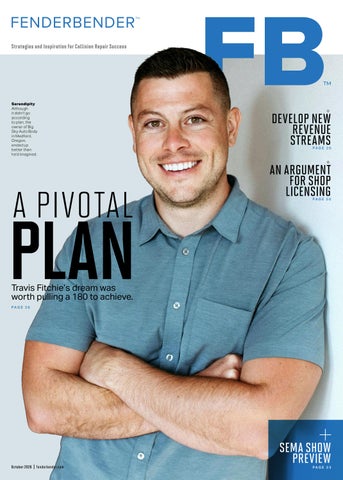
Serendipity Although it didn’t go according to plan, the owner of Big Sky Auto Body in Medford, Oregon, ended up better than he’d imagined.
A PIVOTAL
PLAN
DEVELOP NEW REVENUE STREAMS
PAG E 20
AN ARGUMENT FOR SHOP LICENSING
PAG E 50
Travis Fitchie’s dream was worth pulling a 180 to achieve. PAG E 26
October 2026 | fenderbender.com
SEMA SHOW PREVIEW
PAG E 33
.A . L IN U.S L APP ABOVE P L 0 k N A 3 W O ST SHO ACVMADE 205 NFORNMDARDS INUFACTURE 3 O C 4 E E A N ⁄L 41 EHICL Y STA F MA 000 4 Q 21 A ⁄ U 2 THIS IVCLE SAFETHE DATE 0O 00000 : R 0 VEH CT ON T 0000 C ⁄ T⁄ T M : -YOUR SINGLE SOURCE FORSIO ALL N A EFFE 0000 B 1 DS0: 3U5 S ATION I VIN: E: MPV M 5 R 3 E 0 F RM TYP LE RC: 1 TR SPB e EHICOL INFO el: Gasolin XLE V D V A R 4 5 TC Fu TR U CON TP/ PS K UA R 15 TT P NT: : 20 / TIER2 ualified s EXT P BRK IN WITH n G STICK US o i t LDV EV q gula WB 4 to re / stds: PC / UL G s : N I H m T 114 A N s or : WARJURY OR DoEor. Conf A clas / stds 1.2L
.
REPLACEMENT LABELS! ss EP 11 U.S. ornia cla XV01.80 05 f i Cal p: FGM XR00958 D: I I Grou : FGM WC, OB Evap HO2S/T SFI/
G AUTO LABELS HAS THE LABELS RBA • AIDATA E • D I T S N E S SR SEM ERTIS V A YOU NEED, WHEN YOU NEED THEM! E EMISSION CONT L
ONF
A LATÉR LABLE
SIN G COUS ) S R (S
S IN st the dhat RIOU t . ID SE an againcoversloyment O V A TO t le eat dep
o s Do nnot use air bagual for Do ck side ’s man blo owner ation. Seere inform ES mo SSUR
orte. S BLE : R DE LLES e la p ÉVITEU MORTE pas contriège du R U s O O z P AVES ent vreuye GR ous app un cou éploiem
L VEHIC
Ne vtilizez pasquer le dtéral. r pour N’u peut blonflable la nducteu qui ssin go el du co cou manu Voir le
s to
orm
f Con
New Dashboard is available on our WEBSITE & MOBILE APP • Faster, Easier Ordering: Place orders in just a few clicks with our streamlined interface. tes • Track Your Orders: Get real-time updates on every order you place. • Access Shipping Info & Reprint Invoices: ces: All your order and billing details in one ne place. • View Credits: Easily see account activity and available credits. • Order History: Quickly search past purchases and reorders.
SCAN THE QR CODE TO GET STARTED NOW! DOWNLOAD ON THE
APP STORE
FOR ADDITIONAL INFORMATION ABOUT AUTO DATA LABELS: visit our website at www.AutoDataLabels.com | email us at labels@AutoDataLabels.com
DOWNLOAD ON THE
GOOGLE PLAY
LKQ B2B WEB PORTAL
s
tion
ula reg
CONTENTS
OCTOBER 1 0 . 2 6
20
FEATURE
BEYOND COLLISION REPAIR: FINDING NEW REVENUE STREAMS AMID FALLING CLAIMS
Mark Probst and Jason Mundy aren’t waiting for collision volume to return to build businesses that can succeed.
|
V O L U M E
2 8
|
PROFILE
N U M B E R
1 0
SEMA PREVIEW
26 A PIVOTAL PLAN
33 FENDERBENDER’S
BY LINDSEY GAINER
See what awaits you this year in Las Vegas.
Travis Fitchie’s dream was worth pulling a 180 to achieve.
SEMA SHOW PREVIEW
BY NOAH BROWN
FenderBender (USPS Permit 25614), (ISSN 1937-7150 print) is published monthly by Endeavor Business Media, LLC. 201 N Main St 5th Floor Fort Atkinson, WI 53538. Periodicals postage paid at Fort Atkinson, WI, and additional mailing offices. POSTMASTER: Send address changes to FenderBender, PO Box 3257, Northbrook, IL 60065-3257. SUBSCRIPTIONS: Publisher reserves the right to reject non-qualified subscriptions. Subscription prices: U.S. ($95 per year). All subscriptions are payable in U.S. funds. Send subscription inquiries to FenderBender, PO Box 3257, Northbrook, IL 60065-3257. Customer service can be reached toll-free at 877.498.4668 or at customerservice@fenderbender.com for magazine subscription assistance or questions. Printed in the USA. Copyright 2026 Endeavor Business Media, LLC. All rights reserved. No part of this publication may be reproduced or transmitted in any form or by any means, electronic or mechanical, including photocopies, recordings, or any information storage or retrieval system without permission from the publisher. Endeavor Business Media, LLC does not assume and hereby disclaims any liability to any person or company for any loss or damage caused by errors or omissions in the material herein, regardless of whether such errors result from negligence, accident, or any other cause whatsoever. The views and opinions in the articles herein are not to be taken as official expressions of the publishers, unless so stated. The publishers do not warrant either expressly or by implication, the factual accuracy of the articles herein, nor do they so warrant any views or opinions by the authors of said articles.
October 2026
3
fenderbender.com
CONTENTS
OCTOBER
STARTER
07
DRIVER’S SEAT Are you ready for Vegas?
08
PAST THE PAGE
Talking custom paint with House of Kolor’s Jon Kosmoski
QUICK FIX
11
BREAKDOWN
How rising bodily injury claims could mean a boon for collision repairers
14
LIGHT HITS
The latest stories from around the industry
15
NUMBERS
Who does your ADAS calibrations?
16
SNAP SHOP
Bell’s Body Shop rebuilds and thrives after tornado
16
STRATEGY
COLUMNS
42
THE SOP
46
Mediating total-loss settlement disputes
44
CASE STUDY
A new path to building a healthy culture
46
FINANCE +OPERATIONS
Transforming materials management in collision repair
18
SHOP PROFITS
The ‘low trust’ tax and its impact on business BY G REG LOB S IG E R
50
COLLISION COURSE
Why is collision repair unregulated? Part 2
BY TIFFANY ME NE FE E
52
ON THE BUSINESS
Is the person answering your phone costing you business? BY MIK E ANDE RSON
October 2026
4
fenderbender.com
New cred. New customers. When you join the Ford Certified Collision Network (FCCN), you’ll be recognized by Ford, customers, and insurance companies as someone who offers the highest standards in Ford and Lincoln repairs. That puts you into a referral stream for new customers from our digital properties and call center. It also gets you access to not only the right parts but exclusive Ford procedures, training, and support. What’s more, you’ll be included in the Ford Pro™ Fleet and Commercial certified shop list. Take word-of-mouth referrals to the next level by joining the FCCN today.
Learn more about FCCN.
Message and data rates may apply.
CONTENTS
ONLINE EXTRAS
CL ICK ON THE L OGO BEL OW F OR PRODUC T INF ORMATION
October 2026
3M
Auto Data Labels
Axalta Coating Systems
Binks/Devilbiss
Bosch
Buy Auto Supply
Ford Motor Company
Fuji Industrial Spray Equipment
Hunter Engineering Company
KECO Body Repair Products
LKQ Corporation
Motor Age Training
ProColor Collision USA
Telwin
TEXA USA
6
fenderbender.com
DRIVER’S SEAT
DRIVER’S SEAT
EDITORIAL
Chris Jones VSRG Editorial Director Jay Sicht Editor-in-Chief Peter Spotts Associate Editor Emily Kline Special Projects Editor Mike Anderson Contributing Writer Noah Brown Contributing Writer Richard Desvousges Contributing Writer Sheryl Driggers Contributing Writer Lindsey Gainer Contributing Writer Greg Lobsiger Contributing Writer Tiffany Menefee Contributing Writer Elisabeth Sobczak Contributing Writer Dr. Paul White Contributing Writer
EDITORIAL ADVISORY BOARD
Jordan Beshears Steve’s Auto Body Sheryl Driggers Collision Advice Stan Medina Certified Collision Works Jason Mundy Mundy’s Collision Center
SALES
Andrew Johnson Publisher ajohnson@endeavorb2b.com Mattie Gorman-Greuel Associate Sales Director Cortni Jones Director of Business Development Marianne Dyal Account Executive (National Accounts) mdyal@endeavorb2b.com Chad Hjellming Account Executive (National Accounts) chjellming@endeavorb2b.com Diane Johnston Account Executive (National Accounts) djohnston@endeavorb2b.com Lisa Mend Account Executive (National Accounts) lmend@endeavorb2b.com Kyle Shaw Account Executive (National Accounts) kshaw@endeavorb2b.com Sean Thornton Account Executive (National Accounts) sthornton@endeavorb2b.com
ART AND PRODUCTION
Mariah Straub Production Manager Jen George Ad Services Manager Mitch Bradford Art Director
ENDEAVOR BUSINESS MEDIA, LLC
CEO Chris Ferrell COO Patrick Rains CDO Jacquie Niemiec CALO Tracy Kane CMO Amanda Landsaw EVP Transportation Chris Messer EVP Endeavor Business Intelligence Paul Mattioli VP of Content Strategy, Transportation Group Josh Fisher
SUB SCRIPTION S
Send address changes and subscription inquiries to: FenderBender PO Box 3257 Northbrook, IL 60065-3257 Subscription Customer Service: 877.498.4668 customerservice@fenderbender.com
LET TE RS TO THE E DITOR editor@fenderbender.com
Opinions expressed in FenderBender are not necessarily those of Endeavor Business Media, and Endeavor Business Media does not accept responsibility for advertising content.
October 2026
ARE YOU READY FOR VEGAS? D E P E N D I N G U P O N W H E N you read this, online or fresh from your mailbox, the SEMA Show will be only two to five weeks away. As we like to say in our company's Vehicle Service and Repair Group, this is our industry's Super Bowl. It's a time for industry veterans to say hello to old friends, and it's also a time for newcomers to be impressed — and even often overwhelmed — with the sights and sounds of all the industry segments that make up the automotive aftermarket. Although this week brings a plethora of co-located receptions and meetings scattered across the Strip, most of the SEMA Show's collision repair-oriented training events and exhibits are centrally located in the upper level of the South Hall. With a bit of planning and strategy, you can maximize your time and travel investment at the show. Pre-run the show by referring to our SEMA Show guide within this issue, which includes a training schedule for I-CAR and SCRS Repairer Driven Education sessions. Check out our featured companies in that guide, as well as the Ultimate Collision Repair Shop guide packaged with ABRN and this magazine, for a preview of the latest tools, equipment, and products to look forward to at the show. Also, check out the semashow.com website, where you can map out the vendors you want to visit and their locations. Although paper maps are available at the show, the mobile app is a useful guide to help you navigate the expansive halls and outdoor exhibits. You can scan products in the New Products Showcase in the lower level of the South Hall for more information and to find those manufacturers’ booths.
7
It's common to walk seven miles a day, so pack two pairs of comfortable and broken-in shoes and alternate them each day. It’s the desert, so don't forget saline nasal spray and lip balm. It’s noisy inside the halls, so don’t forget mints or chewing gum. (There will be a lot of "close-talking!") The co-located Collision Industry Conference and the Collision Industry Red Carpet Awards, Nov. 4, return to Westgate this year, where I look forward to honoring our 2026 FenderBender Award and Best Repair Planner/Estimator there. I hope to get the chance to say hello to many of you there. Rest up, and I hope to see you soon!
JAY SICHT
EDITOR-IN-CHIEF
jsicht@endeavorb2b.com
fenderbender.com
VIDEOS
PA ST T H E PAGE
|
PODCASTS
|
WEBINARS
|
NEWS
VIBRANT VELOCITY This 1927 Ford Roadster drag car was built and painted by Jim Boitnott from Fairfield/Liberty Township, Ohio.
FROM BASEMENT TO INDUSTRY LEADER: THE STORY OF HOUSE OF KOLOR’S FOUNDER JON KOSMOSKI BY JAY S ICHT
|
PHOTOS COURTESY OF HOUSE OF KOLOR
J O N K O S M O S K I F O U N D E D House of Kolor in 1956 as the original “kustom” paint brand, introducing the industry’s first organic pigment formulations, “kandies,” “kameleons,” and more trusted by professional painters and car builders. Those who know me know I’m a hot rodder and custom car enthusiast, and I got to sit down recently with “Koz” to talk about 70 years of custom paint and how he built it into the brand that defines custom finishes. Although House of Kolor is now owned by Sherwin-Williams, Koz remains a highly visible — and passionate — spokesman for the brand. And like many success stories, his business success story started by accident. He painted helmets and 600 sets of motorcyle tins one winter in his mother’s basement. Understandably so, she tired of the fumes, so he rented a stall at his friend’s body shop. Business grew from there, including painting motorycles with custom finishes for a local Honda motorcycle dealer. Selling supplies to fellow painters was not his original business plan.
October 2026
“My inspiration was I wanted the best stuff for me. I never intended to sell a quart of it to anyone.” But he started winning Best Paint awards in local car shows and painters came to him wanting to buy his custom formulas. It was around 1962 that he became an official manufacturer and hired a chemist to help him perfect his formulas, including bucking the industry standard of using inorganic pigments. At a higher cost, organic pigments could give Kosmoski the bright, vivid, and highly saturated colors he sought. Later, he worked to develop the breakthrough encapsulation process that made flake and pearl base coat application accessible to a wider range of painters after seeing the finished product in the early ‘80s at a show. “The next year, I came out with the urethanes,” he says. “That was a boon moment for this company, when we could offer kandies, and we could offer basecoats. You used to have to base a car on one day and let it dry overnight, come in the next morning to put the kandy on by noon, and
8
then wait a couple hours before you cleared it. Because if you didn’t all of that solvent and all of that material would start to mottle the base.” It was evident in our discussion that Koz still has the fire in the belly that led him to forgo automotive mechanical repair for car building and custom painting. “The painting became such a love. You take a raw piece of steel, whether it be motorcycle parts or a car — or whatever it is — and make a thing of beauty out of it. Let me tell you something — that does not get old. And that passion lives on today in all the painters out there. They want to be the best, they want it to look the best, and they want to use the best materials that can be made. And that was my goal.” Check out our discussion on YouTube at https://bit.ly/4xrjvnN or scan the QR code.
fenderbender.com
You are the PRO. Together we achieve victory.
A proven business model for over 20 years, ProColor Collision is growing! Independent body shop owners driving their business forward are choosing ProColor. Standardized operations, management tools and consolidated technology solutions improve performance. The ProColor team of industry professionals are dedicated to performance excellence offering the sales, operational and marketing support needed to take business to the next level. ProColor Collision is committed to helping shop owners grow their business locally while leveraging established relationships with global insurers, suppliers, and fleet companies.
The ProColor PROcess is a winning formula.
Find out more at procolor.com
ProColor Collision USA LLC, 650 Pelham Blvd, Suite 100, St. Paul, MN 55114 ® Registered Trademark of Mondofix Inc. MN File No.11345 This advertisement is not an offering. An offering can only be made by a prospectus filed first with the Department of Law of the State of New York. Such filing does not constitute approval by the Department of Law.
NEWS
Q U I C K
|
IDEAS
|
PEOPLE
|
TRENDS
F I X
ADOBE STOCK 273701323
BREAKDOWN
HOW RISING BODILY INJURY CLAIMS COULD MEAN A BOON FOR COLLISION REPAIRERS
CCC’s Erik Bahnsen discusses a historic shift in bodily injury percent of total liability dollars and what it means for collision repair shops. F O R T H E F I R S T T I M E E V E R , CCC Intelligent Solutions reported that bodily injury claims accounted for 52.3% of the combined dollars paid across bodily injury and auto physical damage claims in 2025. The shift could indicate a future increase in auto physical damage claims as injured parties have
October 2026
less incentive to avoid filing a claim. Additionally, insurers that push for anything less than safe, proper repairs risk greater costs on the next injury claim. The report, “Auto Claims Payout Trends in the Age of Generative AI,” says 15 years ago, BI accounted for approximately 45% of dollars
11
paid across BI and APD claims. The largest shift happened in 2025 – 2.6% – which also had a significantly lower frequency of casualty claims compared to APD claims. “It’s unprecedented. The real baseline of this going back about 20 years was about 45% of the dollars paid for liability coverage,” said CCC Director of Casualty Industry Analytics Erik Bahnsen in a video interview with FenderBender. “It wasn’t until officially the last year where that was flipped on its head because of the pressure of both a rise in relative BI claim frequency and notable severity pressure at the same time.” The report explores what factors are causing the shift including: • Increasing numbers of uninsured/underinsured motorists • Healthcare inflation, particularly auto liability claims
fenderbender.com
QUICK FIX
• • • • •
Changing treatment patterns Greater attorney involvement Rising social inflation More sophisticated claim narratives The introduction of generative AI technology
For collision repair shops, Bahnsen says this has a more indirect effect. Any property damage claim requires better documenta-
tion, making it easier to attribute the cause of injury based on vehicle damage. “What happens with a property damage claim? It’s more about documenting the damages to where we can basically recreate the collision forces,” Bahnsen said during the interview. “You may have heard us reference delta V or change in velocity, right? So, better documentation around the damages to ideally both vehicles, not just one vehicle,
allows us to have better support to say, hey, is this injury likely based on what damages we see on the vehicles?” For insurers, the change is putting more pressure on the bottom line. The combined ratio would run five to 10 points lower, but the industry remained profitable due to premium increases in 2023 and 2024. Bahnsen said if this continues, consumers will have more increases to their premiums. “Up until this point, the property damage line and just the improving profitability of just property damage claims or material damage claims has been sort of offsetting the pressure that’s happening with bodily injury,” he said. “But if bodily injury continues to increase and become a larger percentage of the dollars that are paid, that is ultimately going to impact the consumer. They’re going to have to pay more insurance because even if it’s offsetting to a certain degree, the point is that the claims are likely still being overpaid to a certain degree.” For a legal perspective, FenderBender reached out to Sean Preston, managing
attorney at Coverall Law. He said that the rising BI claims figure should make insurers more serious about safe, proper repairs and not more aggressive about cutting the physical-damage side of the claim. “When a carrier pressures a shop to skip a necessary operation, substitute a cheaper procedure, or underfund a calibration, it may save money on today’s repair only to increase
the risk and cost of tomorrow’s injury claim,” he said. “Shops must follow manufacturer procedures and clearly document the repair and payment decisions, because the shop is ultimately expected to stand behind the repair.” Bahnsen said over the last three years, collision claims, comp claims, and property damage claims have decreased in frequency. Two lines that increased in frequency are
bodily injury claims and uninsured, underinsured motorist injury claims. “If you didn’t cause any damage to anybody else and you can maybe pay it without even filing a claim, you don’t want your rates to go up. There’s an incentive to not make a claim there,” Bahnsen said during the interview. “Whereas a third-party injury claim or a large percentage of those involved an attorney, there is a financial incentive to make a claim on that side.” Notable stats cited in the report include data from CCC’s 2026 Crash Course report (https:// www.cccis.com/reports/crash-course-2026). That estimated a 33% increase in liability costs associated with social inflation between 2020 and 2024, a 52% year-over-year increase in verdicts of $10 million or more, and a cumulative economic and social inflation impact of $92 billion to $102 billion on personal auto over the past decade. The report concludes “these trends suggest that BI severity could be the result of a system in which medical, legal, economic, and operational complexity increasingly reinforce one another.”
Bosch ADAS Positioning (BAP) System: Combines advanced technology and industrial-grade vision sensors to precisely measure fixture position, ensuring accurate target placement for reliable ADAS calibration.
We develop ADAS vehicle technologies for OEMs. Trust us to recalibrate them.
Modular and future-proof: Designed to be upgradable to accommodate future ADAS calibration technologies and new targets.
Bosch is the only automotive supplier developing ADAS vehicle technologies with OEMs and the equipment to calibrate them. DAS 3000
Integrated storage and maneuverability Keep your equipment clean and serviceable and ready to use at a moment’s notice. White glove on-site setup and installation* Where available, an authorized Bosch field representative will unpack, assemble and provide instruction on the use of the DAS 3000.
Guided interactive workflow on the ADS 10X Plus. Step-by-step instructions from start to finish including fixture placement, target selections and calibration. Scan tool sold separately.
Solutions for every job.
Get more information about the DAS 3000
Bosch DAS 3000 ADAS Calibration Solution A future-proof investment for fast, reliable and precise calibrations on a wide range of dynamic and static advanced driver assistance systems. *White Glove Service valid in the U.S.A. only. Limitations apply.
boschdiagnostics.com/adas
QUICK FIX
QCG
LIGHT HITS
PAUL WILLIAMS NAMED COO OF QUALITY COLLISION GROUP Paul Williams is the new chief operating officer of Quality Collision Group. He will serve on QCG’s executive leadership team and oversee operations across its growing portfolio of collision repair brands. Williams brings decades of experience across the automotive and collision repair industries, He has served as a frontline employee, business owner, regional operations leader, and chief executive. His leadership philosophy centers on investing in people, strengthening team culture, and creating an environment where employees are supported in delivering quality repairs and customer experiences.
REVV TO MERGE WITH AIRPRO DIAGNOSTICS FOLLOWING PURCHASE BY ROTUNDA CAPITAL Revv was acquired by Rotunda Capital and will merge with AirPro Diagnostics. Revv Co-Founder Adi Bathla said the combination of Revv’s software expertise with AirPro Diagnostics’ hardware capabilities will enable the combined company to work on the first vertically integrated ADAS tool. He will serve as president, chief innovation officer, and board member. Revv Co-Founder and Chief Technology Officer Rashmi Sinha will be senior vice president of technology and product integration of the combined company. AirPro CEO Driaan du Toit will be the CEO of the new combined company. “The industry is expecting hardware and software to kind of come together,” Bathla said. “So, that is one reason why it made so much sense for one of the best remote diagnostics companies and the best ADAS identification platform to come together. We will build this best-in-class hardware software vertically integrated solution, a full stack solution that the industry needs.” While the merger with AirPro offers new opportunities, Bathla emphasized that Revv will continue to follow its original vision of remaining tool agnostic and letting customers use the hardware they like most.
October 2026
MITCHELL EV COLLISION INSIGHTS REPORT FINDS REPAIRABLE SEVERITY GAP BETWEEN BEVS AND ICE VEHICLES DROPS TO RECORD LOW Mitchell’s Q2 2026 Plugged-In: EV Collision Insights report revealed that, among repairable claims, the gap in average severity between battery electric vehicles (BEVs) and gasoline-powered automobiles narrowed to a record low, although BEVs remain more costly to repair. If this trend persists, it may indicate that a combination of higher total loss frequency and a maturing electric vehicle fleet are bringing repair costs across powertrain types closer to parity. “The shrinking BEV repair cost premium is an important development for insurers and collision repairers, particularly as the electric vehicle car parc ages,” said Ryan Mandell, Mitchell’s vice president of strategy and market intelligence. “At the same time, ongoing trade and geopolitical uncertainty could put renewed
14
pressure on replacement part costs and availability, with BEVs particularly exposed because of their greater reliance on OEM components.”
ILLINOIS GOVERNOR SIGNS LAW ESTABLISHING RIGHT TO APPRAISAL FOR AUTOMOBILE INSURANCE POLICIES Governor JB Pritzker has signed Illinois House Bill 4160 — Right to Appraisal into law. Beginning July 1, 2027, automobile insurance policies issued, renewed, or delivered in Illinois that include first-party physical damage coverage will be required to contain a Right to Appraisal provision. The new law provides Illinois consumers with a process for resolving disputes involving the amount of loss on an automobile insurance claim. When there is disagreement regarding the amount of a covered loss, an insured will be able to invoke the appraisal process at the insured’s sole discretion without first obtaining the insurance company’s consent.
fenderbender.com
NUMBERS
DO YOU PERFORM ADAS CALIBRATIONS IN-HOUSE?
AS MORE VEHICLES COME EQUIPPED with ADAS features, the need for ADAS calibrations continues to grow. The number of shop owners and operators responding to the FenderBender Industry Survey each year have reported a marked increase, jumping from an average of 30% (average) in 2023/2024 to 46% in 2025, with 80% now reporting they perform in-house ADAS calibrations.
In this year’s survey, the majority (35%) of those surveyed who said they don't complete all calibrations in-house use their our own targets but with remote assistance, followed by OEM dealers (21%), and mobile service (19%). YES
IS YOUR SHOP EQUIPPED TO PERFORM ADAS CALIBRATIONS (IN-HOUSE)?
46%
2025 2026
October 2026 2409FB_BuyAutoSupply.indd 1
NO
54% 80%
20%
15
fenderbender.com 6/20/24 2:51 PM
QUICK FIX
SNAP SHOP
BELL’S BODY SHOP
By Peter Spotts Photos Courtesy of JAKE BELL
L O C AT I O N :
WEST PLAINS, MISSOURI
OWNER:
JAKE BELL
SIZE:
9,500 SQUARE FEET
S TA F F :
5
A V E R A G E M O N T H L Y C A R C O U N T:
100-150
AV E R AG E R E PA I R O R D E R :
$5,000-$10,000
Submit Your Shop Proud of your shop and want to show it off to your peers? Tell us about it at NEWS@FENDERBENDER.COM
October 2026
BELL’S BODY SHOP changed forever at 9:30 p.m. on March 14, 2025. Second-generation Owner Jake Bell found himself without a shop after a tornado ripped through the family business, which had been in operation by the Bell family since 1981. “It ripped the entire roof off of [the front shop],” Bell said. “It was completely exposed. And what was bad about that was a month after the tornado hit, West Plains got completely flooded. So, you can imagine with not having a roof how much water was in that shop. We were squeegeeing out water every day for almost a month and a half trying to let it air out.” The flood caused massive damage to the foundation, and more than 20 potholes formed in and around the shop. Black mold grew everywhere. Nine of the 10 steel beams in the back building of the shop buckled. Bell, who studied dentistry before finding his way back to the family business in 2013, took the rebuilding process as an opportunity to make some shop improvements, beginning with the paint booth. Staff first attempted repairs to the damaged original. “We had to re-weld the seams on it and caulk the seams, and we got it to where it contained the overspray from the paint, but it just wasn’t right,” he said. “We wanted to make sure our jobs were going to have the highest quality.”
16
Bell extended the wall and put in a new 27-foot paint booth – a Garmat Zephyr downdraft paint booth. He also connected the back building to the front building to create one fully connected repair experience. At the same time, the parking lot was expanded to accommodate a loyal customer base built over 46 years, plus new customers arriving daily. “For the design layout of everything, obviously we just want to make it one continuous building [with the] office in the front andmake it make sense for the workflow where teardown, repair, paint, and final touches are processed,” Bell said. “Our business sits on highway frontage and so we catch a lot of traffic coming from Arkansas to Missouri or vice versa.” The shop employs a variety of tools and equipment based on OEM requirements but has always had a preference for Snap-on tools since the 1980s. For welders, Bell’s has the Lincoln Electric SP-100 arc welder, Snap-on MIG 185 pulse welder, Miller Millermatic 150 arc welder, Hypertherm plasma cutter, Snap-on YAH-22350 dent puller, Dent Fix RIVE multifunction riveter (Model DF-SPR80B), and Snap-on ADP-265 aluminum panel dent puller. The shop’s air compressor system employs the Kaishan KRSB 15 HP rotary
fenderbender.com
screw air compressor, Sullair ShopTek ST-1100 air compressor, Schulz air storage tank, Schulz ADS-125 compressed air dryer, and Speedaire aftercooler. Other tool and equipment choices include the PPG DigiMatch spectrophotometer, Trisk CureMaster Super Twin infrared lamp, Polyvance 8003 Nitro-Fuzer plastic welder, Challenger Lifts Versymmetric model CL10V3 Tto-post automotive lift, and an LED lighting control system. Bell’s Body Shop prides itself on being a community. It has technicians who have worked on vehicles there for more than 40 years, and Jake Bell says he takes pride in making each repair experience unique for customers. “We want to continue growing Bell’s Body Shop while never losing the smalltown values that built it…We don’t want customers to feel like they’re simply another repair order,” he says. “We want to know their names, hear their stories, earn their trust, and treat them like family. Every vehicle that leaves our facility represents our name, our reputation, and our promise that it has been repaired correctly, is road-ready, and is safe for the families driving it.” The shop’s rebuilding and comeback was a true community effort, Bell said, including by PPG distributor ColorVision, whose staff checked on the welfare of the staff and the business. “They helped us with damaged items, to organize our product cabinets, and to update our systems. Their customer service and professionalism speak volumes of who they are and what they represent.” Employees, friends, neighboring businesses, customers, and other community members helped the shop get its doors back open for business. “That experience reinforced something we’ve always believed: a business is only as strong as the people who stand beside it,” Bell said. “We hope to create more career opportunities, invest in our employees, provide exceptional customer service, perform the highest-quality repairs possible, and continue building genuine relationships throughout our community.”
October 2026
17
fenderbender.com
COLUMNS
SHOP PROFITS
Understanding the Hidden ‘Low Trust’ Tax and Its Impact on Business Building character and trustworthiness within your team can significantly decrease operational costs and improve overall business success. cans’ yearly income is taken by all types of taxes. For high income earners, that total tax could be 50%+. It can be overwhelming for business owners. One thing we can do to mitigate or defer paying taxes is to consult with our CPA, tax/attorney, tax consultant, or financial planner. Even with all the professional help available to us, there is a hidden tax that was never passed by any federal or state government. For most folks, it’s a huge tax. But for savvy folks, it can be nearly nonexistent. It’s called the “tax on trust” (or low-trust tax ). It’s a concept from Stephen Covey’s book The Speed of Trust that describes the hidden financial and operational costs incurred when trust is low. For body shop owners/managers, we see this everyday with insurers. As we all know, this is just over the top anymore. They require detailed estimates or even squeal if we don’t do their job for them and rekey. Then we must add line notes, multiple-labeled photos, OEM repair procedures, P-page screenshots, parts invoices, paint invoices, and the list goes on. Some shops have gotten so fed up that they’re adding $150-250 admin fee for all this baloney. Go team!!! I totally get it, but one little caveat to all this time vampire activity: even though the percentage is low, some shops are just crooks. These folks have no integrity and now ALL shops are paying this “tax on trust” to get paid by insurers. Disclaimer: Even with all documentation provided, many insurers still deny paying for everything required to do a safe and proper repair. Dealing with insurers is just one part of the “low-trust tax.” How about trusting employees? In Covey’s book, he talks about the Smart Trust matrix and its four quadrants: 1. Gullibility/Blind trust: This is where the “suckers are born everyday” live. 2. Judgment/Smart trust: This is where good business judgment, good people judgment, enhanced instinct and intuition live. 3. Indecision/No trust: People here don’t trust anyone, and often do not trust themselves. They live in
October 2026
indecision, insecurity, protectiveness, apprehension, and even immobilization. 4. Suspicion/Distrust: These folks trust themselves but rarely extend trust to anyone else. If they do, it’s only by their own evaluation and decision. Surprisingly, according to Covey, the highest “lowtrust tax” is paid by those with Suspicion/Distrust. These folks analyze everything to death – which ends up decreasing speed and increasing costs. They miss out on many opportunities. The ideal quadrant to live in is # 2, Judgment/Smart Trust. These folks understand the high value of time, and it can’t be wasted on the “trust tax” of, for example, micromanaging employees. “You may be deceived if you trust too much, but you will live in torment if you don’t trust enough.”— Author Frank Crane In 2003, Warren Buffett made a deal to buy McClain industries for $23 billion from Walmart. This happened only after a two-hour meeting and a handshake with Walmart’s executives. The deal closed 29 days later with no due diligence. Obviously, Warren Buffett has lived his entire career in quadrant 2. Judgement/Smart Trust. When Buffett looks to hire an employee, he looks primarily at two crucial attributes, integrity and intelligence. Any individual with only one of these attributes is of little value to Buffett; it’s just that simple, and owners/ managers should take notice here. I have even seen business owners who remain a one-man show for decades. These folks may have had an employee or two over the years. Then they were most likely “burned” by living in quadrants 1, 2 or 4, along with missing the key attributes of integrity/intelligence before hiring in the first place. At the end of the day, we each need to be sure that someone else is not paying a “low trust tax” for our inability to be trustworthy. Just do the right thing, always. “There are no moral shortcuts in the game of business – or life. There are, basically, three kinds of people: the unsuccessful, the temporarily successful, and those who become and remain successful. The difference is character.” — Author Joe Huntsman, from “Winners never cheat.”
18
GREG LOBSIGER
JOSIE SMITH PHOTOGRAPHY
It’s crazy to think that on average, 33% of Ameri-
Greg Lobsiger has owned Loren’s Body Shop in Bluffton, Indiana, for over 23 years. He has been a member of Mike Anderson’s groups for ten years and had extensive lean manufacturing training.
EMAIL:
greg@lorensbodyshop.com
ARCHIVE:
fenderbender.com/lobsiger
fenderbender.com
COLLISIONCAST
CollisionCast is the premier collision repair industry podcast, helping shop owners and operators improve their businesses with real-world solutions to common problems, delivered by leading industry experts and elite shop leaders.
fenderbender.com/podcasts
FEATURE
BEYOND COLLISION REPAIR: FINDING NEW REVENUE STREAMS AMID FALLING CLAIMS Mark Probst and Jason Mundy aren’t waiting for collision volume to return. Instead, they’re building businesses that can succeed through restorations, custom fabrication, dealership partnerships, and other emerging opportunities. By NOAH BROWN
W
hen a classic Mustang recently rolled into Mark Probst’s shop, it wasn’t there because of a fender-bender. The owner didn’t need insurance paperwork processed or a repair plan written. He needed help getting unstuck. The decades-old restoration project had hit a wall. It required floor pan and firewall repairs, and Probst knew exactly what he was willing to take on. Nothing more, nothing less. “We’re welding some patches in, some floor pans and some firewall patches. And that’s it,” says Probst, owner of Probst Auto Body, near Effingham, Illinois. “That’s all I promise.” That deliberate approach ref lects a reality collision repair shop owners across the country are confronting in 2026. Claim counts remain down in many markets, and while no one knows exactly where the industry is headed, operators are increasingly asking the same question: What happens if this isn’t temporary? For Probst and Jason Mundy, owner of Mundy’s Collision in Lawrenceville, Georgia, the answer isn’t sitting around waiting for vehicles to arrive. Instead, both have expanded well beyond traditional collision repair, building alternative revenue streams that keep employees productive
October 2026
and create opportunities regardless of what happens to claim volume. Their approaches look very different. Probst has returned to restoration projects, added glass services and expanded ceramic coating offerings. Mundy has built a portfolio that includes calibrations, fabrication, restoration, truck customization, dealership work, mechanical services, and even painting aircraft components. The common thread for both, though, is a willingness to adapt.
Facing an Uncertain Future For many collision repairers, the challenge isn’t simply that work is down. It’s that no one seems to know where the bottom is. “We’re all like, where’s the stop at?” Probst says. “What’s our new normal? That’s what I always keep saying, ‘Is this the new normal?’ I don’t know.” After more than two decades in the industry, Probst says the current environment is unlike anything he has experienced. “For years, I always thought I could project,” he says. “I looked at growth, and I staffed for growth,” he says. “It’s probably the biggest questionable time I’ve ever had in the industry because I’ve never seen anything like this in 20-some years.” That uncertainty forced him to challenge long-held assumptions about how his business operates. “It reminds me of Blockbuster when
20
streaming was becoming a thing,” he says. “How serious is this? Is now the time to adapt? I think if we wait too long, I don’t think you’re going to survive this. I think we have to adapt.” Mundy sees many of the same pressures, though he believes some recovery will eventually come. “I think we’re all kind of spoiled after COVID. Every business kind of ramped up during that period,” Mundy says. “Overall today, I would say the industry is 20 to 30 percent down.” While he expects some rebound as economic conditions improve, he doesn’t necessarily expect a return to the boom years. “I don’t see it getting back to post-COVID times,” he says. For shop owners, that should be enough reason to start exploring alternatives.
Returning to His Roots Long before collision repair became Probst’s primary business, his first love was classic cars. “The old cars are what brought me into the industry,” he says. Years ago, Probst’s shops regularly took on restoration projects. But as collision volume increased, balancing the two businesses became increasingly difficult. “You take on a big project and the next thing you know your collision side explodes and you’re busy with collision work,” he
fenderbender.com
Diversification At Scale Jason Mundy’s shop recently acquired Defiant Motorsports, a performance and restoration shop. The expansion, among others, has allowed Mundy’s team to take on everything from fabrication and custom vehicle builds to tires, wheels, lighting, and more.
October 2026
21
fenderbender.com
FEATURE
says. “As much as I love the old cars, it didn’t mix great.” Eventually, he stopped taking restoration work altogether. In the face of declining sales and technicians running out of work, though, Probst started reintroducing restoration projects this past May. Taking what he learned from last time, Probst changed how his shop handles these projects. Rather than accepting year-long rebuilds, he’s targeting smaller jobs with clearly defined scopes. “Let us help you get unstuck on your project,” became the message. The formula is simple. A hobbyist who’s stalled on welding repairs, bodywork, fabrication or another specific task can hire the shop to complete that portion before taking the vehicle back. Since making the shift, Probst says the shop has completed roughly half a dozen projects. “I’m trying to be picky and choosy,” he says. “I’m not trying to get something I’m married to for six months or a year.” The strategy allows his team to generate labor revenue while preserving capacity for collision work. For the Mustang project, for example, Probst estimates roughly 40 labor hours split over a few weeks. “My collision side doesn’t miss a lick,” he says. That’s the balancing act he believes more shops need to master. “I think you’re going to have to find your balance,” he says.
“Collision repair relies heavily on estimating systems and book times,” Mundy says. “Restoration and fabrication projects are billed based on actual touch time.” It took some getting used to, Mundy says, since it’s a completely different business. Once the team got used to the workflow, though, the acquisition created opportunities that extended beyond restoration work itself. The operation now handles fabrication, custom vehicle builds, lift kits, truck accessories, wheels, tires, lighting, and more.
A recently completed custom truck project generated roughly $48,000 in revenue through a combination of parts, fabrication, painting and installation work. Those projects help diversify revenue while maximizing the capabilities already found inside a collision repair business.
Looking Beyond Traditional Markets Some of Mundy’s most successful diversification efforts weren’t planned at all but instead came about organically through conversa-
Diversification at Scale While Probst returned to a familiar niche, Mundy pursued diversification on a much larger scale. Over the last several years, his company has steadily expanded in a variety of directions. The business built a standalone calibration center. It acquired Defiant Motorsports, a performance and restoration shop. It purchased an additional collision repair facility. It continues adding services across multiple operations. The Defiant acquisition, in particular, introduced an entirely new business model.
October 2026
Buggin’ Out This 1969 Volkswagen Beetle needed extensive metal work at Probst Auto Body, including a complete floor pan.
22
fenderbender.com
tions. By building relationships with customers and local businesses, Mundy’s team uncovered opportunities many collision shops would never think to pursue. For example, his shop is near a small airport. Over time, a relationship with a local aircraft mechanic led to painting work on aircraft components. “We’ve painted airplane parts because we’re near an airport,” Mundy says. “You’ve got to get out and just meet people.” The jobs aren’t enormous, but they provide profitable work during slower periods.
In addition to the aircraft jobs, his shops have cultivated work from dealerships, fleet operators and specialty customers. The dealership relationships, in particular, have become a valuable revenue stream. Mundy’s collision operation is certified for GM, Volvo, and Porsche repairs. Those partnerships generate traditional collision work while also opening doors for aftermarket customization projects. “We do a lot of blackout kits and any kind of upfitting on trucks or cars,” Mundy says. The work helps dealerships differentiate
vehicles while creating an additional source of business for the shop. Fleet work has proven equally effective. Plumbing companies, HVAC contractors, landscapers, and electrical firms all operate vehicle f leets that occasionally require repairs. Many prefer paying out of pocket rather than filing insurance claims. “Most of these guys just want their car right back on the road,” Mundy says. Without insurance approval delays, repairs can move quickly through the shop.
Flying High A GMC Sierra Denali recently received a lift kit, custom wheels, and more at Defiant Motorsports. PHOTO COURTESY OF REECE YEOMANS
October 2026
23
fenderbender.com
What The Cat Dragged In A stalled 1978 Chevrolet Malibu project gets a fresh two-tone coat of paint on its way to becoming set up as a drag-racing car. COURTESY OF MARK PROBST
Start With What You’re Good At Neither owner believes there is a single formula for diversification. Instead, both recommend looking at existing strengths, interests, and market opportunities. For Probst, that meant classic cars. For Mundy, it meant building on expertise already present within the organization. Not every shop needs a restoration division or fabrication department. Probst has added glass replacement services and ceramic coatings. In past years, he generated meaningful revenue through spray-in bedliners and tire services. Though unconventional, the service leverages equipment and expertise the shop already possesses. Mundy encourages operators to think similarly. “If you don’t ask, you’ll never know,” he says. Conversations with dealership managers, business owners, local organizations
October 2026
and customers often reveal needs that shops can already fulfill. The key, Mundy says, is staying engaged. “You can’t just sit in your shop and wait for people to walk in,” he says. “You’ve got to really go out and sell yourself and sell your business.”
More Than Revenue While alternative services often get discussed as revenue generators, Probst measures success differently. His biggest concern isn’t restoration sales totals. It’s making sure his employees have work. For years, he staffed aggressively to support anticipated growth. When collision repair volume declined instead, the business suddenly found itself overstaffed. “I had always planned for growth,” he says. “I always had extra people in the bullpen.” When sales fell, that strategy became expensive.
24
“The shop was bleeding cash,” Probst says. “I got into the reserves multiple times.” He faced a difficult choice: increase revenue or reduce staffing. His answer was to find work. “My first plan was increased revenue. Let’s take on projects. Let’s see if we can keep the guys busy.” Today, restoration work helps accomplish exactly that. “The guys aren’t running out of work,” he says. “I’m not dipping into reserves to pay my technicians.” For Probst, keeping employees productive carries benefits beyond the financial statement. “I don’t like to send my guys home not paid,” he says. “As a business owner, I think it’s my responsibility to make sure they have a paycheck.” Seeing technicians sit idle was painful. “It hurt,” he says. “Financially, it hurts in a big way.”
fenderbender.com
The restoration projects help bridge those gaps while creating additional profit opportunities. “At least we’ve got a paycheck coming in,” he says. “We’re paying our light bill, we’re paying our insurance bill, we’re still clicking away.”
A Critical Moment Neither owner claims to have all the answers. In fact, both acknowledge the uncertainty surrounding the industry’s future. Probst openly admits that the hardest part is not knowing where the market ultimately settles. “When are things going to flatten out?” he asks. “When can I say this is my new normal?” Until that answer arrives, he refuses to stand still. “We can’t just sit here,” he says. “You can moan and cry that there is no work out here, or you can get off your ass and get out there and do something.” Mundy shares that same philosophy. “Don’t take your foot off the gas right now,” he says. “It’s a tough season for everyone.” For collision repair operators navigating shrinking claim counts, that may be the most important lesson. Diversification isn’t necessarily about abandoning collision repair. It’s about protecting the business while positioning it for whatever comes next. Whether that’s restoring classic Mustangs, installing lift kits, servicing f leet vehicles, replacing windshields, applying ceramic coatings, painting aircraft parts, or helping dealerships customize inventory, the opportunities are often closer than owners realize. The shops that thrive won’t be the ones waiting for the industry to return to yesterday’s conditions. They’ll be the ones building tomorrow’s business today. “As much as I hope the collision side comes back around,” Probst says, “you’ve got to do something. You can’t just sit and wait.”
October 2026
25
fenderbender.com
PROFILE
A PIVOTAL PLAN Travis Fitchie’s dream was worth pulling a 180 to achieve. By LINDSEY GAINER
October 2026
|
PHOTOS COURTESY OF SKY AUTO BODY
26
fenderbender.com
A “Bulldozer” Mentality Sky Auto Body Owner Travis Fitchie was partowner of a successful independent shop. When it sold to a large MSO, he changed his career trajectory to strike out on his own. October 2026
27
fenderbender.com
PROFILE
It
’s fair to say that Travis Fitchie’s dream of owning his own shop didn’t go exactly according to plan, but where he’s ended up is even better than anything he originally imagined. “You know what they say…when one door closes, another opens. You can choose what you feed into,” says the owner of the recently opened Sky Auto Body in Medford, Oregon. “Am I going to get hung up on disappointment when something doesn’t go my way? Or pivot and find a different path forward to keep the dream alive?” Fitchie decided to pivot, and with the support of an incredible team, he’s building a place where people love to work and clients love to patronize. And that, he says, was the goal all along.
The Pivot It was 2013, and Fitchie had just returned home to Medford, Oregon, after traveling with an NHRA Funny Car on its West Coast circuit, where he was a top-end-engine mechanic. “I moved back and got a detailing job at what was then Apland’s Auto Body,” he reminisced. Going to work for a body shop was, he says, a natural transition, given that he’d grown up helping his dad build custom street rods. With a can-do attitude and “bulldozer” mentality — a term coined by the owner of Apland’s at that time, Mike Apland — a 20-year-old Fitchie was managing the shop within six months. “Mike used to say I basically told him I was coming in to run the shop and I did it; I called my shot,” Fitchie chuckled. “Over the years, we did a bunch of different business training courses and vendor conferences, met with different shop owners; really dug into growing the business. When I first started, they were doing $1 million a year in revenue out of both their locations; when he and his wife exited the business in 2024, we were doing $6.6 million and I was part-owner and COO of the company.” Fitchie was all in, he says, with his sights set on purchasing the business. But things didn’t end up going according to plan, and Apland’s was instead sold to a large MSO. “Very quickly, I had a decision to make; I could either stay and change my career trajectory or do what I love and employ people out on my own.”
October 2026
Open For Business Since its February opening, Sky Auto Body is ahead of sales projections in its first six months by 40%.
It was a scary proposition, of course, but an exciting one. And he knew what he had to do. “There were probably a million reasons why I shouldn’t open my own shop, but I chose to focus on the two million reasons that I should.” Fitchie stayed on with the new company for around a year as he searched for and purchased his new facility, managing four additional shops — for a total of six — in the interim. “I wanted to make sure my staff that I had spent years hiring and training felt secure in the transition,” he explained, “and my boss, Brie Hoyer, was a wonderful person to work for. Those were the two big reasons I stayed. I learned a lot and met a lot of great people through it all. Everyone there was sad to see me go, but they understood being an owner was my dream.” When the time came to leave in October 2025, Hoyer — who is still a valued mentor to this day — was one of the loudest voices cheering him on, alongside Fitchie’s longtime friend and colleague (and now Sky’s general manager) Aaron Hernandez, and Fitchie’s wife, Kelsie. “When I was deciding whether to open a business at the very start of all this, Aaron
28
was the guy in my corner like, ‘Yeah, let’s do it. Let’s go.’ He left a month after I did and helped me do anything and everything to get the shop operational. Same with my wife. Kelsie knew the sacrifices this would require, and how much I’d be gone — we’re talking seven days a week, 15-hour days for six months to get us up and running — and she stood by me every step of the way. I can’t ever thank them enough for their support.” Fitchie is quick to acknowledge the rest of his team, too — all of whom were previous colleagues — for making Sky possible. “They believed in this dream, and they’ve shared my excitement from day one. I couldn’t be doing any of this without them.” The shop officially opened for business in February 2026, and, thanks to Fitchie and his team’s long-standing reputation for excellence in the community, customers have been “lined up” ever since. “We’re well ahead of our projections and what we thought we would be able to do in the first 6 months by about 40%.”
Stars in the Sky Every member of Sky’s I-CAR-recognized six-person team plays an integral role in the success of the business, says Fitchie, and, together they’re building the kind of
fenderbender.com
Believing In A Dream Owner Travis Fitchie assembled a team of former colleagues who he says share his excitement.
October 2026
29
fenderbender.com
PROFILE
work environment people dream of being a part of. “Everyone truly cares for everyone else here,” he says. “Our team likes to be here; they actually enjoy coming to work.” That in and of itself, he says, was one of the biggest reasons he wanted to open his own shop in the first place. “There’s a lot of places lacking that, you know? They don’t have the feel of a community, of being a place where people are happy to go to day in and day out. I wanted to change that.” The team — who all worked together at Apland’s — brings a wealth of experience and expertise to the table and includes a unique husband-wife body tech duo, Beau and Trish, who have been repairing together for nearly 15 years. “They’re phenomenal,” Fitchie says, “and they work so well together. I’ve never seen anything like it.” Sky also has an RV, bus, fleet, and boat tech, Justin, who does all his own jobs from start to finish in tandem with a fleet estimator, Sean. “Those two have a great, symbiotic relationship. They work on a 50/50 commission split. Sean will go out and do all of the estimatics, parts ordering, customer relations, and pull the jobs in for Justin, then he’ll do the jobs in the back. From disassembly to body-
October 2026
work, paint, reassembly, detail…he does it all on those jobs.” Fitchie and the shop’s painter, Michael, have worked together for six years; Sky is his first head painting position. “I’ve watched Michael grow so much in his skills and confidence over the years; I’m really grateful to have him on the team.” And Aaron Hernandez — Fitchie’s aforementioned long-time friend — rounds out the team as the general manager, main office administrator, and estimator. “Everyone is in their position for a reason, and I have the utmost trust in them,” Fitchie says. “I try not to overstep or micromanage in any way, shape, or form. They’re all extremely good at what they do,” which frees Fitchie to focus on upperlevel operations. “You have to meet people where they’re at every day, because every day is different. We’re never all going to have a perfect day at the same time; that’s just not how it goes. And there’s reasons for everything,” he says, if you’re willing to listen and help people through issues that arise. “Show empathy and have grace.” His shop will never be one that has people walking on eggshells, either. “Everyone knows they have leeway here. When people are comfortable enough to talk
30
and open up and make mistakes, it leads to more authentic, organic relationships.”
Authentic Through and Through The authenticity that Fitchie and the Sky team share extends to customers, too. “People come to us because they see the pride and craftsmanship that we have, not only in our work, but in our facility and our employees. And we’re not here to fix every car,” he adds. “It has to be the right fit.” Honest, upfront pricing — and comprehensive estimates — are paramount. “We write a full sheet from the get-go, catching everything that the car needs to get back on the road safely. We’re not just pumping out estimates to get the car in and then doing a 60% supplement; our supplements are generally under 5%.” Sky works on all makes and models and is in the process of obtaining Tesla certification. Whether more OEM certifications will come in the future is up in the air, but there are not immediate plans to pursue them, Fitchie says. “Our market really isn’t big enough to support it [obtaining certs],” he explains, “and there’s such a wide variety of vehicles. But we do lean heavily on OEM parts and repair procedures for all of our jobs. We have fantastic relationships with all of our
fenderbender.com
vendors, so we can get pretty much any part price matched by the dealer down here.” And any profit lost is a drop in the bucket compared to the high-quality repair that results, adds Fitchie, who’s found that customers are often willing to pay the difference, if necessary, to ensure the best repair. This commitment to high-quality craftsmanship, transparency, and topnotch customer service is gaining traction fast for Sky. And it’s not just traditional vehicle repair that’s helping them stand out from the rest; they’re quickly amassing a large amount of RV, f leet, and boat repair work, too. The RV market, especially, says Fitchie, is an “untapped” opportunity and is something he was eager to incorporate into Sky’s business model. “There’s a demand for it here, and I like the segment a lot. These are people driving around in their second homes…it’s just as important as a vehicle to them, if not more important, because it’s six times the cost.” Repairing RVs and large fleet vehicles, such as the city buses the team works on, for
October 2026
example — don’t require specialized equipment, per se, Fitchie says. But they are laborintensive and require a large space, which is one of the reasons he knew this particular property was “the perfect one” from the moment he first laid eyes on it. “I walked onto the property, and I visualized this place and immediately knew how I wanted it set up. It felt like destiny, like it was meant to be. As soon as we walked in, I’m like, ‘this is the one.’” The 6,000 sq. ft. facility includes 4,500 sq. ft. of open collaborative space dedicated to production, plus approximately 800 sq. ft. of office space and a 600 sq. ft. parts room. The property also features a 24 x 60 ft. metal outbuilding perfect for large RV and fleet repairs. The shop is highly functional, no doubt, but it’s so much more than that. Fitchie meticulously planned the entire building’s beautiful aesthetic, down to the perfectly manicured landscaping outside, with one goal in mind…making a great first impression. “You have one shot to capture a client’s attention and show them your quality and
31
your pride in craftsmanship and what you can do,” says Fitchie, who did much of the renovation work himself. From painting and wiring to securing the shop’s windows and glass for the bay doors and wood for the front office, creating Sky truly was a labor of love…and he’s nowhere near done. “You sit down and draw everything out in your head, right? But when you actually build it, you realize how long it takes to get to the picture in your head. It takes so much longer than you could ever anticipate. We’re still buying a new piece of equipment every month.” But, if you’re an aspiring owner, don’t let that scare you. “The idea, the mountain of opening a facility, is much larger in your mind than it actually is in real life. You can sit there and you can play through every single situation over and over again, all the what ifs. But, in reality, if you’re willing to take the leap of faith and you’re willing to put in the time, it will pay off.” The sky really is the limit…just like Fitchie’s tagline says.
fenderbender.com
#1 TRUSTED SOURCE FOR ASE TEST PREP
YOU PASS OR YOU DON’T PAY! THANKS TO OUR TRAINING SUPPORTERS PLATINUM LEVEL
GOLD LEVEL
SILVER LEVEL
www.PassTheASE.com
SEMA Preview
2026
FENDERBENDER’S
S H O W
P R E V I E W
In 2025, SEMA’s show drew worldwide attention with 2,300 exhibitors and more than 153,000 attendees from 140 countries. In 2026, thousands of vendors, hot rodders, buyers, and enthusiasts will travel again to the Las Vegas Convention for SEMA’s 59th show, Nov. 3 to Nov. 6. Where else can collision repair shop owners, managers, and technicians check out the latest product innovations, catch up on the latest education, and experience the latest custom vehicle trends? Get a first look at the cutting-edge technology in action on the show floor. The SEMA Show floor is massive, so FenderBender is here to guide you through this year’s highlights. The 2026 SEMA Preview highlights available educational seminars and featured vendors. All show information is subject to change, so please visit semashow.com for all updates and information.
October 2026
33
fenderbender.com
SEMA Preview
Coverage
EXPERIENCE SEMA LIKE NEVER BEFORE
STAY CONNECTED WITH ALL THE EXCITEMENT THROUGH OUR SOCIAL MEDIA Can’t make it to SEMA this year, or want to be in too many places at once during the show? In order to give everyone an opportunity to see what is going on, FenderBender will cover the SEMA Show all week long. The coverage will include news items throughout the week, product releases, award winners, event information, and other SEMA happenings. For a behind-the-scenes look at what it’s really like to attend the show, follow FenderBender’s website and social media accounts.
@FenderBenderMag The top stop for almost every bit of coverage throughout the week. Like and follow “FenderBenderMag” on Facebook for daily photo albums, events, and news
@FenderBenderMag
SEND US YOUR COVERAGE At the show and snapped a great picture or took a video you want to share with @FenderBender? Tag us on Facebook with what you got @FenderBenderMag.
October 2026
34
Photos from the week will be posted during the show for a behind-the-scenes look at everything SEMA.
fenderbender.com
2026
BY THE NUMBERS
A closer look at the statistics that comprise SEMA
New Products Showcase The SEMA Show New Products
Showcase in Lower South Hall is
the world’s largest display of new
automotive aftermarket products. It is the top buyer and media
BUYERS AT THE SHOW
2,300+ EXHIBITS
destination at the show, featuring
thousands of the hottest products in the industry.
Use the SEMA Show mobile app’s
“Product Scanner” feature to scan
and download product photos and
exhibitor information that will remain on your SEMA Show app long after the 2026 show has ended.
How It Works Browse Products
Take a look around the showcase to
view products you have heard of but never seen, and discover products new to you.
Scan Products
Either scan products using the
SEMA Show’s app or a provided scanner to acquire information.
Capture Product Information Access production descriptions,
images and exhibitor booth numbers
The Upper South Hall is
464,658 square feet
and is approximately 1,690 feet end-to-end
2,500
through the app or through printouts.
For more information on what exhibitors and products will be showcased, visit semashow.com
MEDIA REPRESENTATIVES FROM ONLINE, DIGITAL, AND PRINT PUBLICATIONS
October 2026
35
fenderbender.com
SEMA Preview
Q&A
TOM GATTUSO
ANDY TOMPKINS
SEMA Vice President of Events
SEMA Trade Show Director
THE SEMA SHOW IS GEARING UP FOR 2026 with an increased focus on ADAS, a new exhibit area for collision repair tools and equipment, continued growth for SEMA Live, and the latest plans for the popular SEMA Fest. SEMA Vice President of Events Tom Gattuso and Trade Show Director Andy Tompkins discuss updates and changes to this year’s programming to make the experience even better for attendees.
FB: What are some of the changes to the show this year compared to last year that attendees should look forward to? TG: We have a partnership that we're proud to be able to nurture with both I-CAR and SCRS, and we feel that that really gives us a finger on the pulse of the collision industry. We're working with them on their programming, and they've got some great stuff in the works. We're going to have a live stage on the show floor that we've had in the past, which we call our collision repair stage, and that will be
October 2026
where technicians and people in the industry can go see some of the most updated and latest innovations that are happening in the industry. We're going to have a little bit of an ADAS focused curriculum where we're going to involve some vehicle manufacturers and some equipment manufacturers and really educate the industry on some of the ADAS advances that are happening these days and that really can mean anything from modifying a vehicle to repairing a vehicle. From my standpoint, there are a couple of industries that are at the forefront of ADAS,
36
and the collision repair industry is one of those groups. I think we're learning a lot by connecting and partnering with them on these items. It's really going to help speed up the process when you look at some of the requirements and specifications we're going to need from a standpoint of people that are putting parts on vehicles or raising or lowering a vehicle. It's going to fall in line with one other thing that we do that we call our Future Tech Studio; that's us giving a glimpse into what people can expect moving forward. It can be modification everything from electric vehicles and alternate fuel vehicles…It really is our opportunity to go to an industry and say, what are you doing that's really outside the box and where are we going to be in five to 10 years? FB: With ADAS gaining an increasing presence at the show, are there any specific events or education sessions that people should look to attend? AT: Through SCRS and I-CAR programming, they're going to focus on ADAS quite a bit, and anywhere from calibration spaces to new tools to the OE equation, how shops can potentially bring a vehicle back up to calibration or even a modified vehicle back to calibration. A lot of conversation is going to be happening around that and specific education sessions; that's in Upper South Hall. I would encourage you to go to Lower South Hall [as well] because, due to the market's expansion in collision repair and new tools and equipment largely brought on by ADAS, we have a new section in Lower South that's collision repair and tools and equipment. There's a new exhibit area where more products are going to be shown just adjacent to the new product showcase. It’s kind of an
fenderbender.com
2026
example of how that market is expanding, and we need to accommodate more. We've created a new section for that. The collision repair stage is going to have content throughout the show. It's not something new per se, but there's going to be new content displayed consistently. FB: What is SEMA Fest looking like this year? TG: We're going to be in the same space that we were [last year], and this really is an opportunity for us to engage with a consumer in a more organic and social level. In 2023, we came up with this concept of trying to take a consumer and show them what our industry is all about and get them excited to not only start to become more of an enthusiast or have more aftermarket parts on their car but really explore an industry in general…But
October 2026
we've found an unintended positive result of this as well, where we made tickets for SEMA Fest available to our registrants. Last year, we sold almost a third of our tickets to that group. So that was again this indication that we were on the right track by taking the passion of automotive and the passion of music and really combining it together. We're continuing to focus on the music this year. We're really excited about our lineup (The Offspring, Jimmy Eat World, 311, and The Alive). It's going to be a great exclamation point to a week of business that's happening. FB: Is SEMA Live getting any updates this year? AT: It’s going to be the third year of the program. So, we're literally livestreaming 31 hours of activity from the SEMA show. It's kind of an ESPN-style sports desk interface
37
hosted by Chris Jacobs. There's going to be anywhere from industry luminaries to cool builds to new products. There's going to be some fun, different interactions. There are a variety of hosts that they'll kick to around the campus. Of course, this show is business-to-business-only Tuesday through Thursday, and the SEMA Show Friday is open to the public, but millions who are following this industry can't attend. SEMA Live is designed to be a window into the action, and it's getting a really great response. We've had millions of views. We published it on YouTube and Meta…If you're at the show, I'd recommend you check out booth 20341. You'll see it on the map, SEMA Live, that's in Central Hall. You can see the production happening in real time and it's impressive. It really does look like a TV studio, and it's fun to see them cut to different feeds and the content they're covering.
fenderbender.com
SEMA Preview
Calendar of Events
EDUCATIONAL SESSIONS The SEMA schedule is packed with learning
Tuesday, Nov. 3 9:00 AM
opportunities for the hottest industry
topics. Here are the offerings from I-CAR
9:00 AM - 10:00 AM Requirements and Considerations for ADAS Calibration
ADAS, welding, auto claims, AI, and more.
9:00 AM – 10:00 AM GMA/MIG Welding Basics
and SCRS, which cover electric vehicles,
Session times and locations are subject to
change, so make sure to check semashow. com for the latest information about these
10:00 AM
9:30 AM - 11:00 AM Repair Planning That Pays: Protecting Revenue Through Research
seminars and other events.
All times in Pacific Time (PT).
I-CAR’s 2026 Seminar Lineup
9:30 AM - 11:00 AM Reclaiming Technical Authority: The Collision Shop’s Fiduciary Role
11:00 AM
SCRS Repairer Driven Sessions
FURTHER OPPORTUNITIES TO GROW
The SEMA Show holds many other educational sessions in addition to the I-CAR and SCRS seminars. Below are some of the other topics that have sessions during the week. Check the SEMA Show website for the full schedule and session information. Driving Smarter Decisions: Insights Into Today’s Vehicle and Consumer Trends
11:00 AM - 12:00 PM Introductions to Diagnostics and Scan Tools 11:00 AM - 12:00 PM GMA/MIG Welding Advanced Features
12:00 PM 12:00 PM - 1:30 PM Beyond the Class: Turning Training into Real Shop Performance
Talent Is the Constraint: How Aftermarket Companies Must Rethink Leadership, Engineering and Frontline Skills to Compete SEMA Women’s Leadership Symposium: Own the Room: Executive Presence, Leadership Transitions and Strategic Influence for Women Leaders, Powered by SBN
12:00 PM - 1:30 PM The Estimator Bottleneck: How Modern Shops Shape Mindset for Complex Repairs
1:00 PM 1:00 PM - 2:00 PM Understanding the Blueprinting Process
Leadership in the Era of AI: How Great Leaders Keep the Human Edge, Presented by Dale Carnegie Build to Grow: A Strategic Framework for Scaling Automotive Businesses
9:30 AM - 11:00 AM Fix Your Shop’s Digital Marketing: A Live Advertising Workshop
12:00 PM - 1:30 PM Capturing Mechanical Labor: Being Intentional About the Opportunity
1:00 PM - 2:00 PM Requirements and Considerations for ADAS Calibration
2:00 PM
2:30 PM - 4:00 PM Repair Transparency: The Key to Defensible Repairs and Better Outcomes
3:00 PM
The Aftermarket Blind Spot: Why Your Next Generation of Customers Can’t Find You
3:00 PM - 4:00 PM Introductions to Diagnostics and Scan Tools 3:00 PM - 4:00 PM Glue Pull Repair (GPR)
2:30 PM - 4:00 PM Run Your Collision Business Like a Fortune 100 Company 2:30 PM - 4:00 PM Bringing Mechanical Repairs In-house
4:00 PM
October 2026
38
fenderbender.com
2026
Wednesday, Nov. 4
Thursday, Nov. 5
9:00 AM - 10:00 AM Understanding the Blueprinting Process
9:00 AM - 10:00 AM Requirements and Considerations for ADAS Calibration
9:00 AM – 10:00 AM GMA/MIG Welding Basics
9:00 AM – 10:00 AM GMA/MIG Welding Basics
9:30 AM - 11:00 AM Stop Guessing, Start Earning: Building Bulletproof Repair Plans 9:30 AM - 11:00 AM The 3 Daily Mistakes Repair Shops Make That Empower Insurers 9:30 AM - 11:00 AM Own It: The Difference Between Responsibility and Accountability
11:00 AM - 12:00 PM Introductions to Diagnostics and Scan Tools 11:00 AM - 12:00 PM GMA/MIG Welding Advanced Features
11:00 AM - 12:00 PM Glue Pull Repair (GPR) 11:00 AM - 12:00 PM GMA/MIG Welding Advanced Features
12:00 PM - 1:30 PM Speak Their Language: Communication That Actually Works in a Body Shop 12:00 PM - 1:30 PM The Profit & Control Playbook: Bringing Auto Glass In-House
1:00 PM - 2:00 PM Understanding the Blueprinting Process
12:30pm - 1:30pm
OEM Summit Session I
12:00 PM - 1:30 PM Financial Success Starts with a Plan: Turning Numbers into Action
1:00 PM - 2:00 PM Understanding the Blueprinting Process
1:00 PM - 2:00 PM Requirements and Considerations for ADAS Calibration
1:00 PM - 2:00 PM Requirements and Considerations for ADAS Calibration
2:00pm - 3:00pm
OEM Summit Session II 2:30pm - 4:00pm 3:00 PM - 4:00 PM Introductions to Diagnostics and Scan Tools
The IDEAS Collide Showcase
3:00 PM - 4:00 PM Introductions to Diagnostics and Scan Tools
3:00 PM - 4:00 PM Glue Pull Repair (GPR)
3:00 PM - 4:00 PM Glue Pull Repair (GPR)
3:30pm - 4:30pm
OEM Summit Session III
October 2026
39
fenderbender.com
SEMA Preview
Featured Companies
Booth 30125 3mcollision.com At 3M, the art and science of automotive collision repair is a crucial part of our longstanding connection to our customers. For decades we have crafted abrasives, adhesives, and coatings to solve the latest auto body repair demands. Some of these products include our groundbreaking 3M™ Cubitron™ II and Trizact™ abrasives, 3M™ Platinum™ body fillers and our premium 3M™ Perfect-It™ compounds, polishes, and pads. Our 3M™ Performance Spray Gun, together with our 3M™ PPS™ 2.0 Paint Preparation System, delivers new levels of efficiency in paint and coating application and material savings. Every 3M product, every solution, is backed by our expert technical team to help guide you and your body shop every step of the way. As digital technologies continue to transform the world and the way we work, 3M is at the forefront of driving tools that enable this transformation. Operational efficiency is an area where 3M is working especially hard to simplify the process and transform the way work gets done in body shops. We do this not only by promoting training and standardized repair processes, but now with a new customized, connected digital solution to aid in the most critical information flow to help drive performance, timing, and material usage. 3M’s tools empower the connected body shop and help you to unlock opportunities for profit and growth.
DeVilbiss by Binks
Booth 31243 binks.com/DeVilbiss Built on Heritage. Fueled by Innovation. Since 1888, DeVilbiss has set the standard in spray finishing technology and that history was built in the shop and has been trusted by generations. We bring that same no-shortcuts approach to everything we build — grounded in heritage, quality, and innovation — to deliver confidence in every finish. You’ll see that spirit firsthand at SEMA 2026! Stop by Booth #31243 for a first look at our newest lineup, including FlexTemp Hoses, Premium Coveralls and Lab Coats, and ProAir, built to tackle the everyday challenges faced in your shop. And there’s plenty more happening beyond product demos. Enter for your chance to win a free spray gun, cast your vote on the artwork that will define our next custom DV1 gun release, and grab a fun DeVilbiss T-shirt as a thanks for weighing in. Are you a student? We’ve got something special for you, too. Stop by to learn about programs that can help jumpstart your career in the industry, get answers to your questions, and receive a bonus gift of your own. That’s what’s waiting at the DeVilbiss booth! Come find us on the show floor at SEMA 2026, Booth #31243.
Booth 30125 in South Hall Upper
October 2026
40
Fuji Spray Auto
Booth 34087 fujisprayauto.com In the collision repair industry, time, precision, and reliability make all the difference. For over 40 years, Fuji Spray Auto has been a trusted name in advanced spray finishing equipment. proudly serving repair professionals across North America and beyond. Our reputation is built on delivering equipment that combines affordability with uncompromising quality. We understand that collision centers operate in fast-paced environments where every hour counts. By providing cost-effective solutions without sacrificing performance, we help shops maintain profitability while ensuring superior finishes. At Fuji Spray Auto, we believe that a strong manufacturer-to-consumer relationship is essential to success. That’s why we work directly with collision repair professionals, listening to their needs and refining our products to maximize throughput, minimize downtime, and reduce frustration. This synergy allows us to deliver equipment that isn’t just built to meet industry standards-it’s crafted to exceed them. Whether it’s through improved efficiency. enhanced control, or unmatched durability. our spray systems empower repair shops to keep vehicles moving, customers satisfied, and businesses thriving. Choosing Fuji Spray Auto means choosing a partner committed to your success in every detail.
fenderbender.com
2026
Featured Companies Hunter Engineering Co. Booth 40217 Hunter.com
What was new at SEMA 2025 is new again at SEMA 2026. Following the introduction of the autonomous Road Force WalkAway® wheel balancer at last year’s show, Hunter has gone on to pair it with the autonomous Revolution™ tire changer to create the Walkaway® System. The result is even more dramatic time savings. Here’s how the WalkAway® System works. The key innovation is integrating a new autonomous inflation arm into the balancer. When inflation is completed, the air chuck releases automatically and the spin begins, balancing the assembly and measuring Road Force. All of this occurs without the technician present, who is then free to “walk away” and tend to other duties, such as getting the next assembly, installing and pre-torquing assemblies on the vehicle, or other necessary activities. On average, a four-tire, door-to-door changeover takes 34 minutes. When the autonomous Revolution™ tire changer works in tandem with the autonomous Road Force WalkAway® balancer, that time can drop to 19 minutes – a 44 percent reduction. Additionally, Hunter’s new Core X series of tire changers will be debuting at SEMA 2026. The foundational series builds on Hunter’s decades of experience designing and producing productive, profitable, safe and durable equipment. Sized to fit the majority of assemblies in service today, the Core X series will provide what technicians need most from a basic tire changer: power, torque, speed, simplicity and reliability. Or more than basic. “We’re modernizing time-tested machines with brushless motor technology and center clamping to redefine what a ‘basic’ tire changer can be,” said Hunter Product Manager Jim Hudson.
October 2026
KECO Body Repair Products
Booth 32209 kecotabs.com/collections/ keco-collision-systems KECO Body Repair Products is a leader in Glue Pull Repair (GPR) tools, systems, and training for the collision repair industry. Our mission is to help technicians and shops unlock repairability by providing less-invasive, highly controlled solutions for correcting damage while preserving as much of the original vehicle as possible. From rough-out and structural movement to lateral tension, precision pulling, and final refinement, KECO products are designed to support technicians throughout the repair process. Our lineup includes complete GPR systems, the K-Tower Pull Tower, K-Power Lateral Tension Tool, precision lifters, slide hammers, glue tabs, and a wide range of accessories built for real-world collision repair.
3M
Booth 30125
DeVilbiss by Binks Booth 31243
Fuji Spray Auto Booth 34087
Hunter Engineering Co. Booth 40217
KECO Body Repair Products Booth 32209
KECO also places a strong focus on technician education. Through hands-on training, technicians learn practical repair strategies, damage analysis, metal flow, tool selection, and KECO’s 6C Process to build a more consistent and repeatable approach to GPR. By pairing purpose-built tools with practical training and support, KECO helps technicians develop the confidence to tackle increasingly complex repairs. At the 2026 SEMA Show, visitors can connect with the KECO team, see live product demonstrations, and learn how GPR can help shops reduce invasive repair methods, improve cycle time, and take on repairs that may otherwise require welding or panel replacement. Visit KECO Body Repair Products at booth #32209 to see how our tools, systems, and training are helping collision repair professionals expand their capabilities and unlock new levels of repairability.
41
fenderbender.com
S T R A T E G Y
ADOBE STOCK 2106122438
THE SOP
TOTAL LOSS TIEBREAKERS: MEDIATING ACV, OPTIONS, AND TAX/TITLE IN 90 MINUTES
Total-loss disputes rarely turn on one number. They turn on whether the number can be explained, tested, and trusted.
T H E V E H I C L E I S GO N E, but the argument is still accumulating costs. Storage continues, rental days disappear, and the customer calls the collision shop because it may be the only place where someone has actually seen the vehicle. The adjuster has a valuation report. The owner has online listings. Everyone has a number, but no one trusts anyone else’s.
BY ELISABETH SOBCZAK
October 2026
42
fenderbender.com
LEARN
CCC’s 2026 Crash Course report placed total-loss frequency at 23.1% of claims across all loss categories, an industry high. For repairers, that means more vehicles occupying space without becoming repairs and more customer relationships strained by decisions the shop did not make. Total-loss disputes rarely turn on one number. They turn on whether the number can be explained, tested, and trusted. A focused 90-minute mediation can transform competing reports into a transparent, lineitem resolution.
One Number Often Hides Four Disputes A disagreement between a $21,000 valuation and an $18,600 offer may appear to be a $2,400 gap. In reality, it often contains four smaller disputes: • Base market value: Are the comparables truly similar in year, trim, drivetrain, mileage, geography, and timing? • Vehicle identity and options: Which factory packages or aftermarket items were actually on the loss vehicle, and did they affect market value? • Adjustments: What evidence supports mileage, condition, prior-damage, or projected-negotiation adjustments? • Tax, title, fees, and deductions: Which items are payable under the policy and applicable law, and how do the deductible or owner-retained salvage affect the net payment? Keep these categories separate; one disputed line item should not conceal another.
The Tiebreaker Is Symmetry A credible process requires the same explanation from both sides. If an owner must prove a premium package to receive an upward adjustment, the carrier should explain the evidence supporting a downward condition adjustment. If a claimant’s listing is discounted because it is an asking price, any projected negotiation adjustment should be tested against the same market and time period.
October 2026
|
GROW
|
WORK SMARTER
No material adjustment should stand without a reason, a source, and a calculation another person can reproduce. Software may calculate the number, but the report is evidence, not an oracle.
85–90 minutes: Write an auditable settlement. Record ACV, additions, deductions, net payment, payees, deadlines, title and salvage duties, vehicle release terms, and the scope of the release.
A 90-Minute Framework
The Shop’s Proper Role
Ninety minutes works only when preparation occurs before the meeting. At least 48 hours beforehand, the mediator should receive the valuation report, applicable policy language, each party’s strongest comparables, VINspecific option evidence, pre-loss condition documentation, and an itemized tax, title, and fee calculation. Someone with settlement authority must attend. 0–10 minutes: Define the scope. Confirm whether the parties are resolving ACV alone or the complete payment ledger, and identify whether each quoted figure is gross value or net payment. 10–25 minutes: Build one agreed vehicle profile. Lock the year, make, model, trim, drivetrain, mileage, location, options, and documented pre-loss condition. Label disputed facts rather than allowing the vehicle description to shift. 25–50 minutes: Test the three strongest comparables from each side. Examine relevance, source, listing status, and every adjustment. A vehicle requiring excessive adjustments may be mathematically usable but practically unpersuasive. 50–65 minutes: Resolve options and condition. First establish whether an option or condition fact exists, then determine its market effect. Maintenance records, dated photographs, invoices, build data, and measurements carry more weight than labels such as “excellent” or “average.” 65–75 minutes: Audit taxes, title items, fees, deductibles, salvage, and the net-payment arithmetic. State-specific requirements and policy language must be addressed directly. 75–85 minutes: Price the remaining uncertainty. Correct the valuation, negotiate within a defensible range, or identify one decisive missing item and set a short deadline to reconvene.
Collision repairers often become the relationship shock absorber. They need not become advocates or offer legal advice. They can provide a neutral documentation packet containing VIN and build information, photographs, repair estimates, relevant OEM procedures, communication history, and itemized charges for work performed. They can also explain the difference between physical repairability and an economic total loss and identify who made the decision. The best settlement is not necessarily the midpoint; a midpoint can divide error as easily as difference. The better tiebreaker is traceability. When both sides can identify the accepted facts, changed assumptions, priced uncertainty, and exact obligations, the process becomes understandable. A disciplined 90-minute mediation cannot recreate the day before the collision. It can, however, prevent the first collision from becoming a second one between the customer, shop, and insurer. That is structured closure grounded in evidence and transparency.
43
Disclosure: This article is educational and reflects a neutral dispute-resolution perspective. It is not legal advice. Laws, regulations, policy language, and remedies vary by jurisdiction and claim type.
Author bio Elisabeth Sobczak, MS.B., LL.M., is Founder & Principal Mediator of Equitable Resolut ion Group, which provides neutral mediation, arbitration, and umpire services across regulated and complex industries.
fenderbender.com
STRATEGY
CASE STUDY
BEYOND PING-PONG TABLES: A NEW PATH TO BUILDING A HEALTHY WORKPLACE CULTURE
Why traditional engagement strategies no longer work, and what leaders can do instead WA L K T H R O U G H A L M O S T A N Y modern workplace, and you will probably see evidence that someone has been trying to create a positive culture. You may find snacks in the break room, team lunches on the calendar, an employee recognition program, company contests, or even a ping-pong table tucked into the corner. None of those things are necessarily bad; people should have fun at work, celebrate accomplishments, and spend time together outside the pressure of daily responsibilities. Problems begin to surface when leaders expect those activities to make up for inconsistent leadership behaviors and unhealthy workplace practices. A ping-pong table cannot repair broken trust, and a pizza party cannot compensate for poor scheduling practices that create excessive work demands on team members. Unclear expectations, inconsistent communication, or a manager who only speaks to team members when something goes wrong can’t be corrected by free pizza on Fridays. While an award program can be a positive activity, genuine engagement is not created when team members do not feel known, heard, supported, respected, or valued for the contribution they make each day. This is where many organizations get culture wrong, because they focus on adding activities instead of examining what their employees experience in the workplace every day . Leaders may look at participation in company events or recognition programs and assume they are building engagement and a positive workplace culture, while employees evaluate culture through very different experiences. In a collision repair center, culture is not primarily shaped during an occasional team celebration. Culture is shaped on a stressful Monday morning when parts have arrived damaged (or are not the correct parts). Simultaneously, customers want updates, insurance approvals are delayed, and pressure continues to build throughout the shop.
October 2026
During those moments, team members watch how leaders respond, communicate, and make decisions. They notice whether leaders remain steady or reactive, whether mistakes are treated as opportunities to learn or reasons to assign blame, and whether concerns can be raised without fear of embarrassment or retaliation. Those daily leadership moments communicate far more about workplace culture than any sign hanging in the break room or pizza lunch. Culture is created through what people consistently experience from their leaders, coworkers, and the organization around them. A healthy culture is the natural result that occurs when people experience positive, healthy interactions with team members – actions demonstrating trust, meaningful appreciation, respect, accountability, and confidence that their voice matters. Building a healthier culture requires leaders to look beyond workplace perks, pay attention to what employees experience every day, and learn how to communicate appreciation in ways that feel meaningful to each person.
Engagement Cannot Be Manufactured Traditional engagement strategies frequently treat employee engagement as something leaders create for team members through programs, incentives, events, or rewards. A shop may celebrate reaching a monthly sales goal by providing lunch for the team without addressing the stress employees experienced while trying to reach that goal because of poor scheduling, inconsistent communication, or unclear expectations. The celebration may provide a temporary boost in energy, but lasting engagement grows from the cumulative experiences employees have with their work, their leaders, and the people around them. Team members become more engaged when they understand how their work contributes to the organization’s larger purpose. Engagement also grows when expectations
44
are clear, communication is consistent, leaders follow through with commitments, and individual efforts are noticed and valued. The goal should not simply be to get employees to participate in more activities. The greater goal should be to create a workplace where people want to participate, contribute, solve problems, and grow. Engagement begins with trust, because employees who trust their leaders are more willing to share ideas, acknowledge mistakes, ask questions, and take ownership of problems. Employees may comply with expectations when a trusting relationship is lacking, but compliance should never be mistaken for commitment.
Recognition and Appreciation Are Not the Same One reason traditional engagement efforts commonly fall short is that leaders confuse recognition with appreciation (or think they are the same). Although both are important, recognition and appreciation communicate different messages. Recognition usually focuses on performance, achievement, and results. An employee may receive recognition for reaching a production goal, completing a certification, maintaining strong quality scores, or helping the shop achieve an important milestone. Appreciation focuses on the value of the person and the contribution that individual brings to the team. Meaningful appreciation may acknowledge someone’s patience with a frustrated customer, willingness to help a coworker, attention to detail during a repair, or steady attitude during a demanding week (or maybe, a good sense of humor!). Healthy workplaces need both recognition and appreciation, but employees who hear only positive feedback after an extraordinary performance may believe their value depends entirely on what they produce. This can lead team members to conclude they are only valued as a “production unit,” rather than being seen and valued as a person.
fenderbender.com
About the authors:
This message can become especially damaging in a collision repair environment, where team members often carry pressures that leaders never see: • Technicians work through complex repairs and changing procedures • Estimators manage competing expectations • Customer service representatives absorb frustration • Parts teams navigate delays • Production leaders work to keep everyone moving forward Meaningful appreciation helps each person understand that individual effort, judgment, attitude, and contribution are noticed, rather than taken for granted. Effective appreciation must also be personal, specific, and timely . A general comment such as “Good job today” may sound positive, but a thoughtful message communicates that the leader truly noticed what happened. A leader might thank an estimator for patiently explaining a delay to a frustrated customer, or acknowledge a technician who helped a coworker when the schedule became difficult. Connecting someone’s actions to the difference those actions made leads to appreciation feeling sincere and important rather than routine. Leaders should also remember that not everyone wants to receive appreciation in the same way. One team member may enjoy public recognition during a morning meeting, while another may prefer a quiet, personal conversation. Healthy leaders take time to understand what communicates value to each person, rather than rely on the approach they personally prefer.
Build Culture Through Everyday Leadership Perks may add something enjoyable to the workplace, but team members need leaders who are present, approachable, and aware of what happens throughout the organization. Leaders build trust by spending time where the work happens,
October 2026
asking thoughtful questions, listening without becoming defensive, and paying attention to the challenges people face. Healthy leaders also create opportunities for employees to share feedback through morning meetings, technician round tables, individual conversations, surveys, and regular team discussions. However, asking for feedback represents only the beginning of a healthy communication process. Trust grows when employees know their concerns were heard, understand what action will follow, or receive an honest explanation when a requested change cannot happen. Most employees do not expect leaders to agree with every suggestion or solve every problem immediately, but they do expect honesty, communication, and evidence that speaking up serves a meaningful purpose. Healthy workplace culture is shaped through the experiences team members have every day, especially when pressure is high. Before adding another workplace perk or planning the next celebration, leaders should examine whether their people consistently experience trust, clear communication, meaningful appreciation, and confidence that their voices matter. Meaningful appreciation begins when leaders take time to understand what communicates value to each person on their team. The Motivating by Appreciation Inventory can help leaders understand how their team members prefer to receive appreciation and equip coworkers to support one another more meaningfully. Ping pong tables and pizza lunches may add fun to the workplace, but healthy culture grows when people consistently experience healthy leadership and know they are valued. Visit www.appreciationatwork.com and explore the Motivating by Appreciation Inventory, which identifies the specific ways people feel appreciated.
45
Sheryl Driggers is a seasoned entrepreneur, leadership coach, and keynote speaker with 24 years of experience in the collision repair industry. She cofounded and grew a three-location repair business in Tallahassee, Florida, before selling it in 2021. Today, Sheryl partners with Collision Advice and serves shops nationwide, helping leaders elevate both customer and employee experiences. She is certified with the John Maxwell Team, Appreciation at Work, Maxwell DISC, and The Working Genius, equipping organizations to build high-performing teams, strengthen culture, and deliver extraordinary customer care.
Dr. Paul White is a psychologist who “makes work relationships work.” Coauthor of the best-selling The 5 Languages of Appreciation in the Workplace (over 600,000 copies sold in 25 languages), he has developed tools to communicate authentic appreciation, leading to lower staff turnover, increased employee engagement, and higher productivity. His online assessment at https://mbainventory.com/#, available in multiple languages, has been taken by 450,000 employees. Dr. White has spoken around the world, and his expertise has been requested by Mercedes-Benz, Ford Motor Company, Caterpillar, and Bridgestone Tires. He has been interviewed by the BBC News, the New York Times, Forbes, and Fortune.
COURTESY OF SHERYL DRIGGERS COURTESY OF DR. PAUL WHITE
fenderbender.com
STRATEGY
3M AUTOMOTIVE AFTERMARKET DIVISION
FINA NCE+OPER ATIONS
TRANSFORMING MATERIALS MANAGEMENT IN MODERN COLLISION REPAIR
Today’s shops face a different challenge: materials aren’t just disappearing; they are mischarged, mispriced, misordered and misaligned with repair orders.
F O R Y E A R S , one of the biggest materials concerns was simple: things vanished. A roll of tape here, a box of clips there. But today’s materials crisis is more complex and far more expensive.OEM compliance expectations are high, margins are tighter, and the operational lag created by materials mismanagement is no longer something a shop can absorb quietly. This is an organization and visibility problem, and it is contributing to reshaping the economics of the industry.
By RICHARD DESVOUSGES
October 2026
46
fenderbender.com
3M AUTOMOTIVE AFTERMARKET DIVISION
So, how did we get here? Speaking from personal experience as an insurer prior to being educated on the topic, I did not have the perspective to fully understand the critical role materials play in modern collision repair. To me, tape was tape, adhesives were sticky, and sandpaper was scratchy. It was a basic cost of doing business. In hindsight, that perspective was fundamentally incorrect. Historical market conditions helped maintain high workloads and strong profit margins. At times, however, it was challenging to drive a broader industry focus on OEMspecific repair procedures when shops were primarily focused on capturing the keys and keeping everyone busy. The industry is advancing and moving in a positive direction; however, additional emphasis is required around the importance of proper repair procedures and materials. When I ask customers how they are coping with reviewing, understanding and applying the OEM repair procedures in their shops, it’s almost always an astounding, “We do it on every job.” However, when it goes past conversation and into the documentation and certification side of the repair,
October 2026
it’s not always the case. As a shop, if they completed the OEM repair, it’s not always obvious by looking into the repair order or the final bill. Proper material management starts with accountability. Accountability means consistently reviewing and following the procedures established by the OEM, material manufacturers, and paint manufacturers. OEMs, estimators, technicians, distributors and shop owners must hold one another accountable cross-functionally for understanding the requirements and maintaining the documentation to complete the repair with the 100% specified new material. They must also ensure the estimate line is created correctly and that the charge is properly supported by the documentation they control. OEM accountability is clear. For the specified approved materials, the OEM is the authority on repair procedures and recommended products required in conducting a safe and quality repair. Products vary by chemistry, strength and other factors; leave it up to the OEMs as experts on what should be used to repair their vehicles. There’s too much at stake in modern collision repair to deviate
47
from their recommended products in specific OEM repair procedures. Material manufacturers drive accountability by working with many OEMs to support their evaluation and selection of specific products for use in repair procedures. They also provide key technical information on the tech data sheets to set shops up for success through proper application. An estimator/blueprinter/repair planner drives accountability by ensuring repair documentation is accurate, specific, and aligned with applicable OEM procedures. It is important to recognize that OEMs do not universally approve individual product usage across repair procedures. Material requirements often vary by make, model, year, and the specific repair being performed, so documentation must clearly reflect those details. Estimators can further strengthen accountability by working with materials manufacturers to build a deeper understanding of the products being used. They should also be proactive in requesting demonstrations of proper product application. attending handson collision repair training and taking every
fenderbender.com
STRATEGY
3M AUTOMOTIVE AFTERMARKET DIVISION
opportunity to engage with the technician throughout the repair process. Furthermore, estimators need to educate against the “cost of doing business.” According to the definition of a “new undamaged panel,” the refinish material calculation starts when a panel is restored to a new undamaged panel. Therefore, in addition to high value materials, the abrasives, fillers, primers, masking and other items required to make the panel ready for the paint shop are rarely included and should be invoiced as outlined by the definitions in the guides to estimating. Technicians should also be consulting with material manufacturers when working with a new product, requesting information on the latest changes to product lines, and requesting product demonstrations. Technicians should always be open to learning and avoid falling into “the way we’ve always done things.” They must hold one another accountable if a material is being misused. What happens behind the panel matters and everyone has a duty to assure passenger safety as a priority. Technicians must remain accountable by reviewing repair procedures and technical data sheets before selecting or using any material. Materials should never be chosen based on convenience, ease of use, or assumption.
October 2026
To support accurate documentation and reimbursement, technicians should photograph the materials used and retain them on a parts cart to aid the estimator until compensation has been agreed upon. They should also document test beads, repair methods, efforts to match factory performance and appearance, and any relevant expiry dates. Expired materials should be removed and disposed of properly as hazardous waste in coordination with the distributor or manufacturer. Distributors and parts departments need to take the time to restock material without overstocking the customer. While it may be easier to put the new product at the front of the bin, that practice can lead to expired and excess inventory. For that reason, inventory should be restocked using a first-in-first-out procedure. Over time, expired material can lose effectiveness, becoming stiff, losing its corrosion-inhibiting properties, or failing to cure to its full strength, all of which can compromise the repair. Shop owners are the party tasked with the accountability of building successful processes and procedures amongst all employees and all locations. Partner with employees and vendors that value your reputation, inventory goals, invoicing goals, and can provide unwavering support towards the goal of customer service and safety.
48
It is imperative that shop owners provide a consistent message regarding the importance of quality OEM approved materials. The message does not change regardless if you’re discussing with an employee, customer or insurer. Materials must be traceable back to the manufacturer through a trusted distribution partner to complete a proper repair. Avoid industry pressures to buy non-certified, gray market, or materials with equivalency claims from a vendor you do not know. These issues can contribute to slowing down productivity, and they may also distort profitability, could inflate cycle times, and may create compliance risk. Everyone should have a consistent process and message to customers and insurers regarding what repairs were done and provide full transparency to the repair. The future of materials management is intelligent, connected, and automated. Build or partner with a manufacturer to invest in a system to track purchases and sales of your actual tangible product. Remember, your part code table estimate line is not material that can be certified. Shops that create visibility between the product, the procedure, and the invoice will be best positioned to deliver repair procedure-compliant repairs, recover costs, and protect profitability.
fenderbender.com
ALL THE COVERAGE YOU NEED, DELIVERED YOUR WAY UP-TO-DATE INDUSTRY NEWS AND EVENTS, NEW PRODUCT LAUNCHES AND MORE!
SCAN FOR:
Free Magazine Subscription
Enewsletters
fenderbender.com
Podcast Library
COLUMNS
COLLISION COURSE
Pistol Pete, a Sawzall, and No License Required, Part 2 Why ‘safe and proper repairs’ may not be the compelling argument for insurer reimbursement “Pistol Pete” can cut a vehicle in half, weld it back together, throw some paint on it, and send a family down the highway at 75 miles per hour with no collision repair license, required industry training, knowledge of OEM repair procedures, or owning specialized equipment. I Spent Years on the Other Side Before becoming a body shop owner, I spent more than 20 years in the insurance industry as a licensed insurance agent, adjuster and special investigator. And there is something I think collision repairers need to hear. In all those years, I don’t remember sitting in insurance meetings where the primary discussion or any discussion was: ‘Are We Performing a Safe Repair?’ I started hearing that language constantly when I entered the collision repair industry. That difference in perspective matters. An insurance company is a financial institution. It collects premiums, manages risk and pays claims. Its business model depends on the relationship between money coming in and money going out. That doesn’t mean every adjuster is a bad person. It doesn’t mean insurance companies consciously want unsafe cars on the road. Most adjusters are simply doing their jobs within the rules, authority and guidelines they’ve been given. But we make a mistake as shop owners when we assume the insurer is approaching the repair from the same perspective we are. We say: “This procedure is necessary for a safe and proper repair.” And then we are shocked when the response is: “We don’t pay for that.” We keep thinking safety is the magic word that should end the argument. It isn’t. Stop Arguing the Wrong Argument Of course, we must repair vehicles safely.
October 2026
That isn’t negotiable. But “it’s necessary for a safe repair” cannot be our entire justification for getting paid because we are making an argument to someone whose primary concern may be completely different from ours. We need documentation. We need OEM procedures. We need invoices. We need labor documentation. We need equipment requirements. We need estimating-system documentation. We need position statements. We need photos. We need measurements. We need proof of what was performed and why it was required. Most importantly, we need to stop letting an insurance company decide what operations belong on the repair plan. What does the vehicle require? That’s the repair question. Who is responsible for paying for it? That’s the financial question. We hurt ourselves when we combine the two. We also hurt ourselves when we believe that repeatedly telling an insurance company, “But this is necessary for a safe repair,” is somehow going to change the economics of the conversation. Safety is our responsibility. Controlling claim costs is part of theirs. Once you understand that the two sides may be walking into the conversation with completely different objectives, the constant friction between shops and insurers starts making a lot more sense. Maybe It’s Time We Professionalize Ourselves I know licensing is controversial. Government regulation can create bureaucracy, unnecessary costs and unintended consequences. I am not suggesting that every licensing proposal would automatically be good for our industry. But I do believe the conversation is overdue. If you need demonstrated competency and, in many cases, licensing to perform services that affect a consumer, why should there be virtually no minimum professional standard for someone
50
performing structural repairs on a vehicle carrying an entire family down an interstate? Our industry wants better technicians. We want higher labor rates. We want consumers to understand the complexity of modern collision repair. We want insurers to recognize the true cost of proper repairs. Maybe we also have to accept what comes with being treated like professionals: training, accountability, documentation, equipment requirements and enforceable standards. And maybe it’s time we stopped asking only why our industry doesn’t have those standards and start asking who benefits from the fact that we don’t. Because Pistol Pete might be a great guy. But before he cuts my car in half, welds it back together, paints it and sends me down I-10 at 75 miles per hour with my family inside, I’d at least like somebody to make sure he knows what the hell he’s doing.
TIFFANY MENEFEE
has more than 20 years experience in the insurance business and now runs a collision repair shop in El Paso, Texas.
JOE GRETO
In the previous column, I wrote of how
EMAIL:
tiffany@prontobodyshop.com
ARCHIVE:
fenderbender.com/menefee
fenderbender.com
WE’RE SOCIAL CONNECT WITH US ON YOUR FAVORITE SOCIAL MEDIA SITES
www.fenderbender.com
COLUMNS
ON THE BUSINESS
Is the Person Answering Your Phone Costing You Business? Are you unintentionally deterring customers by prioritizing insurance claims over understanding their needs? When a collision repair facility contacts me about consulting, I typically do some homework first. I’ll read their Google reviews, look at their online presence, and pay close attention to what customers are saying about their experience. Lately, I’ve noticed a troubling pattern. The complaints usually aren’t about repair quality or communication during the repair process. Instead, they’re about what happened during the very first phone call. Several reviews I’ve come across describe customers reaching out to a shop after an accident only to be immediately asked: “Have you filed an insurance claim yet?” or “Are you going through insurance?” From the customer’s perspective, that conversation often sends an unintended message: “If you’re not going through insurance, we don’t really want to talk to you.” I don’t believe that’s what most shops mean to communicate. But unfortunately, perception becomes reality. Recently, I decided to test this for myself. I mystery-called a number of collision repair facilities, including some of my own clients. I simply posed as a customer who had been involved in an accident and was looking for help. In almost every case, the first question I was asked was some variation of: “Have you filed an insurance claim yet?” That concerns me. We know that a growing number of consumers are interested in exploring alternatives before filing a claim. Yet many shops are guiding customers toward the insurance route before they’ve even taken the time to understand the customer’s situation. What if that customer isn’t sure whether filing a claim makes sense (check out my April column on “Help Them Decide”)? What if the damage is close to their deductible? What if they’re worried about premiums increasing? What if they simply want information before making a decision? The reality is that many customers today want guidance, not directions. Instead of immediately asking whether they’ve filed a claim, perhaps a better conversation would sound something like this: “Are you thinking about filing an insurance claim, or are you considering paying out of pocket? Would you like me to help you decide which option may make the most sense?” Now we’ve changed the entire tone of the conversation. Instead of pushing the customer toward a particular path, we’re positioning ourselves as a trusted advisor. We’re helping them
October 2026
make an informed decision. That builds trust from the very first interaction. I would encourage every shop owner reading this to mystery-call your own business. Ask a friend, family member, or even a professional service to call posing as a customer after an accident. Listen carefully to the questions your staff ask first. Are they helping the customer? Or are they unintentionally creating barriers? The Value of Live Interaction The second issue I see involves what happens after normal business hours. Many accidents occur in the evenings, on weekends, and during times when the shop isn’t open. Unfortunately, that’s also when many customers encounter voicemail systems, recordings, or increasingly, AI-powered call handlers. Personally, I’m still a strong believer in having a live person answer the phone whenever possible. After an accident, people are anxious. They’re frustrated. Sometimes they’re scared. They don’t want to have a conversation with a machine. They want reassurance from another human being. I’ve worked with shops that forward after-hours calls to a manager, owner, or designated team member. Some rotate on-call responsibilities among staff members and provide additional compensation for covering those calls. The results can be remarkable. I’ve seen shops capture multiple repair opportunities every week simply because someone answered the phone. In many cases, the objective isn’t to write an estimate at 9:00 p.m. on a Friday night. It’s simply to connect with the customer, answer basic questions, and help arrange towing or vehicle storage if necessary. Because if the customer can’t reach you, they’ll call the next shop on the list. And if that shop answers, chances are that’s where the vehicle is going. The takeaway is simple: don’t underestimate the importance of first impressions. Your marketing, your facility, and your repair quality all matter. But none of them matter if the customer never makes it through the first phone call. Read your online reviews. Mystery-call your shop. Listen to how your team handles inquiries. Make sure you’re helping customers navigate their options instead of pushing them down a path they may not be ready to take. The person answering your phone may be either your greatest sales asset or your biggest source of lost opportunities. The choice is yours.
52
M I K E A N D E R S O N is
president of Collision Advice and provides training and consulting for all collision repair stakeholders. He leverages his life experiences, OEM certification training, and former multi-shop ownership to deliver high-quality and customized services that meet the needs and challenges of the collision industry.
EMAIL:
mike@collisionadvice.com
ARCHIVE:
fenderbender.com/Mike-Anderson
fenderbender.com
Any P.A.R.T Any Time.
P. A. R. T. Paint & Supplies
Aftermarket
LKQ’s Got It!
Recycled
Transmissions & Engines
With more than 500 locations across North America and thousands of dedicated employees to serve you, LKQ has the automotive parts you need. Whether it’s Paint and Supplies, Aftermarket, Recycled, or Transmission & Engine Remanufactured Parts, we’ve got it!
Drivetrains
Electrical
Fuel Delivery
Restraint System
Wheels
Emissions
Interior
Parts to Paint
Body
Exhaust
Power Steering
Body Repair Supplies
Cooling/HVAC
Audio
Equipment ...and more!
866-LKQ-CORP www.LKQCorp.com
AXALTA COATING SYSTEMS
Take productivity and appearance to the next level with the Spies Hecker Refinish System
=
+ Surfacer and Clearcoat
Basecoat
The new Spies Hecker Speed-TEC Fast Cure Low Energy (FCLE) Repair System is an advanced surfacer and clearcoat system engineered for bodyshops that demand maximum productivity, superior performance, and measurable energy savings. When paired with Spies Hecker Hi-TEC basecoat, the complete Spies Hecker system unlocks its full potential - enabling a complete refinish process in as little as 30 minutes.
Copyright © 2026 Axalta Coating Systems. All rights reserved.
A complete refinish process In just 30 minutes
See how Axalta is redefining the future of refinish at: spieshecker.com/FCLE
Brought to you by:
Special Promotion
UCRS_2026.indd 1
9/17/26 8:14 AM
From cutting-edge equipment to innovative shop solutions, these products help collision repair professionals meet the demands of modern vehicle repairs. The future of collision repair doesn’t wait — and neither do the shops that want to stay ahead. Repair expectations continue to rise as vehicles become more complex, which means technicians and shop owners need solutions — solutions that meet today’s needs and prepare shops for what’s next. From equipment that delivers precision to technology that streamlines workflow, the right investments can enhance everyday operations. Welcome to the Ultimate Collision Repair Shop. This annual guide highlights the products, tools, equipment, and solutions that are enhancing collision repair shops in 2026. Inside, readers can discover what is capturing attention, solving real-world problems, and helping shops move confidently into the future. While there may never be a “perfect” repair facility, the right combination of solutions can help shops continuously improve efficiency and quality. Because in an industry that never stops evolving, staying ahead isn’t just an advantage — it’s essential. For additional content, including photos, videos, and more, go to :
ultimatecollisionrepairshop.com
2
UCRS_2026.indd 2
UCRS
9/17/26 8:14 AM
2026
UCRS_2026.indd 3
3
9/17/26 8:14 AM
4
Cat
UCRS_2026.indd 4
UCRS
9/17/26 8:14 AM
Table of Contents
06 ADAS
Autel
08 Dent Repair
KECO
10 Dust Extraction
3M
12 Paint Coatings
PPG
14 Parts Procurement 16 Spray Guns 18 Wheel Alignment
PartsTrader
SATA
Hunter Engineering Company
ultimatecollisionrepairshop.com 2026
UCRS_2026.indd 5
5
9/17/26 8:14 AM
Introducing Autel’s Integrated Collision ADAS Solution Autel has brought together vehicle identification, diagnostics, wheel alignment, ADAS calibration, OE-level remote services and connected documentation into one collision workflow—designed to improve accuracy and efficiency from vehicle intake through final documentation. As vehicles become more complex, collision repairers must identify affected systems, verify calibration prerequisites, perform required procedures and document the work. Autel connects these operations through its diagnostic tablets, an ADAS identification platform connected to OEM repair information, IA900 and IA1000 alignment and calibration systems, Remote Expert and Guided ADAS services, Autel Cloud and CCC ONE integration. The concept is straightforward: Identify. Diagnose. Align. Calibrate. Report.
Identify: Start in the Parking Lot
ADAS systems need to be identified early. A separate ADAS identification platform connects to OEM repair information to help determine required procedures and potential calibration needs. The MaxiSYS MS906 MAX is well suited as a collision shop’s go-to lot tablet, providing all-systems diagnostics, pre- and post-scanning, bi-directional controls, coding, adaptations and service functions. Together, these resources help shops identify operations earlier, build a more complete repair plan and reduce late-stage surprises.
Diagnose: Understand the Vehicle
The MS906 MAX provides a practical foundation for intake and everyday collision diagnostics, while the Autel S2 generation of MaxiSYS tablets—including the Ultra S2, MS919 S2 and MS909 S2—provides advanced capabilities for increasingly sophisticated vehicles. A pre-scan establishes the vehicle’s electronic condition and identifies faults requiring investigation.
Align: Make Sure the Vehicle Is Ready
Before ADAS calibration, the shop needs to know whether the vehicle is mechanically and geometrically ready. Autel’s IA900 and IA1000 combine wheel alignment and ADAS calibration within the same workflow. Shops can check alignment, make necessary corrections and proceed to calibration without moving the vehicle through disconnected processes. The IA900 integrates four-wheel alignment and ADAS calibration using optical positioning technology. For high-volume collision centers and MSOs, the IA1000 adds robotic positioning designed to improve throughput and repeatability.
software guides technicians through the procedure, while optical positioning technology helps streamline frame and target setup. The goal is to identify the systems, consult OEM information and perform the calibrations required by the repair.
Extend Capability with Remote Expert
When a repair requires OE tools, software or procedures beyond available aftermarket capabilities, Autel Remote Expert provides another path for completing the work while keeping the vehicle in the shop. Collision technicians can connect with experienced specialists for OEM post-scans, module programming and other procedures requiring OE software and tooling. Remote Expert can also support ADAS calibrations on newly released vehicles for which Autel may not yet have aftermarket calibration coverage. Through Guided ADAS, shops can use Autel calibration equipment while a Remote Expert technician accesses the necessary OE software and procedures. Remote Expert helps bridge the gap between aftermarket and OE-level service, allowing shops to retain specialized work and better control cycle time.
Report: Close the Loop with CCC ONE
Autel Cloud connects supported diagnostic reporting with CCC ONE, allowing reports to be uploaded into the repair file and reducing manual administration. That closes the loop: identify requirements; diagnose; verify and correct alignment; calibrate; access OE-level capabilities when needed; and bring documentation into CCC ONE to support insurer review and billing.
The Autel Advantage
The Autel advantage goes beyond integration. It is about making every step more accurate and efficient—and then making those steps work seamlessly together. The result is a collision workflow where every step works better—and every step works better together. To learn more about the Autel Collision Solution, visit autel.us/collision-repair/.
Calibrate: Perform What the Repair Requires
Once repairs and prerequisites are complete, technicians can perform the required static or dynamic calibrations. Autel’s ADAS systems support calibration procedures for cameras, radar, lidar and other driver-assistance technologies. Vehicle-specific 6
ADAS
UCRS_2026.indd 6
UCRS
9/17/26 8:14 AM
2610FB
2610FB_UCRS_Autel.indd 1 UCRS_2026.indd 7
9/1/26 1:32 9/17/26 8:14 PM AM
Beyond the Tools
Building GPR confidence through training Glue Pull Repair (GPR) continues to expand what collision centers can repair, giving technicians new ways to address complex damage while preserving more of the vehicle's original panels and corrosion protection. But adding GPR equipment to the shop is only the first step. To get the most from that investment, technicians need more than tools. They need a process, hands-on experience, and the confidence to know when and how to use them. That is why KECO Body Repair Products has made training a key part of its approach to collision repair.
From Owning the Tools to Using the System
The KECO Premium Collision System gives collision technicians the tools needed to perform GPR throughout the repair process, combining pulling tools, lateral tension, lighting, tabs, knockdowns and other equipment in one shop-ready system. But the value of that equipment is realized when technicians have the knowledge and confidence to put it to work. Technicians must learn to read damage, understand metal movement, select the right pulling method, establish and maintain lateral tension, and recognize how each step affects the next. KECO training is designed to develop those skills through hands-on instruction. Rather than focusing only on how individual tools operate, technicians learn how those tools work together as part of a complete repair strategy.
A Process Technicians Can Repeat
At the center of KECO training is the 6C Process: Check, Choose, Clean, Coat, Correct, Continue. The process gives technicians a structured approach to GPR, beginning with damage analysis and repair planning before the first tab is ever pulled. Technicians learn to evaluate the damage, choose the appropriate tools and strategy, properly prepare the panel and adhesive, correct the damage with controlled pulls and tension, and continue through the repair until the panel is ready for the next stage. The goal is repeatability. Instead of treating GPR as a collection of individual tools and techniques, the 6C Process gives technicians a framework they can carry from one repair to the next.
Throughout the course, technicians have extensive time for hands-on application and repetition, working through real-world repair scenarios and increasingly complex damage. The extended training format gives technicians the opportunity to develop their skills through guided practice and build the confidence to apply what they have learned when they return to the shop.
Bringing Training to the Shop
For collision centers that cannot send technicians to Oklahoma City, KECO also offers one-day and two-day on-site training. These options bring KECO instruction directly into the collision center, allowing technicians to train in their own shop environment. Whether training takes place at KECO or inside the collision center, the objective is the same: help technicians understand not just what GPR tools do, but when, why and how to use them effectively.
Turning an Investment into a Repair Process
For a collision center, investing in new equipment only creates value when that equipment becomes part of the repair process. A trained technician is better equipped to identify GPR opportunities, develop a repair strategy and confidently use the tools available to them. That can help shops expand repair capabilities, preserve more original panels and get more value from their investment in GPR. KECO's approach brings three pieces together: the system, the process and the training. The Premium System provides the tools. The 6C Process provides the repair strategy. Hands-on training gives technicians the knowledge, repetition, and confidence to put both into practice. Because expanding repairability isn't just about putting more tools in the shop, it's about giving technicians the confidence to use them. Ready to build your team's GPR capabilities? Explore KECO's hands-on training options and Premium Collision System at kecotabs.com.
Hands-On Training in Oklahoma City
KECO offers five-day GPR+ Training at its Oklahoma City training facility. The five-day GPR+ Training is an intensive, hands-on course designed to build practical GPR skills, repair knowledge and technician confidence. Technicians receive in-depth instruction on KECO’s 6C Process, damage analysis, metal flow, lighting and damage reading, lateral tension, crown correction, round dent and crease repair, tab and lifter selection, glue selection and setup, advanced GPR tool techniques and pushto-paint repair concepts. 8
Dent Repair
UCRS_2026.indd 8
UCRS
9/17/26 8:14 AM
2606FB
2606FB_Keco.indd UCRS_2026.indd 9 1
4/29/26 9/17/26 3:54 8:14 PM AM
Designed to Stand Up to the Job The 3M™ Hookit™ Blue Net Abrasive
For a technician in the collision repair industry, maintaining a clean workspace in the shop while maximizing efficiency and productivity is essential to a successful day on the job. The 3M™ Hookit™ Blue Net Abrasive was engineered to help support those goals. This abrasive is designed to deliver a fast, consistent cut while standing up to the demands of the repair process to enable product longevity. From paint removal and filler sanding to blend preparation and primer sanding, the 3M™ Hookit™ Blue Net Abrasive – when used as part of the 3M™ Clean Sanding System and in accordance with applicable instructions – can help collision repair technicians support efficiency, reduce cleanup time, and improve shop productivity.
extraction through the 3M™ Clean Sanding System. The hole-agnostic design of the 3M™ Hookit™ Blue Net Abrasive allows fantastic extraction at any orientation on the backup pad of the tool.” When dust doesn't get collected at the source, it tends to spread through a wide working area," Stoll said. "Our net abrasives are designed to help reduce loading or clogging, especially when used in combination with a compatible dust extractor." Capturing dust at the source can help reduce downstream cleanup across a wider working area. This may support technician efficiency in the shop by allowing technicians to spend more time focused on the job at hand and less time on cleanup.
The Right Cut for the Job
Keeping a collision technician's workspace cleaner can help support a cleaner work environment when used with appropriate dust collection and personal protective equipment. "Reducing airborne dust can help reduce potential exposure when appropriate dust extraction and personal protective equipment are used," Stoll said. "Technicians should always follow applicable workplace safety requirements and 3M product instructions." This is why 3M™ Hookit™ Blue Net Abrasive can be a useful addition for a shop. "You can get more done in a given time frame with it, depending on the application, operator technique, and overall sanding system setup, and that may create opportunities for greater efficiency and productivity," Stoll said. "For net abrasive users, it's a valuable addition to your 3M™ Clean Sanding System and can help improve your collision refinish experience."
The 3M™ Hookit™ Blue Net Abrasive is engineered for strong cut performance. "The disc, offered from Grade 80 to 400, features a tough ceramic blended with a premium aluminum oxide mineral," said Gabe Stoll, an application engineer at 3M. "This combination of materials was designed to provide an excellent cut rate and quality results in less time, depending on the application and use conditions." Not only that, but the materials in the 3M™ Hookit™ Blue Net Abrasive Disc allow it to be used on a range of jobs and to endure the stresses of those jobs with long-lasting quality.
Designed for Durability
One of the other big draws for the 3M™ Hookit™ Blue Net Abrasive is its strong edge retention and its resistance to wrinkling, stretching, or tearing under recommended use conditions. Traditionally, backings used for abrasives are predominately paper or film. "That's been the long-running standard throughout the industry," Stoll said. "In order for a net backing to be adopted, it needs to be capable of surviving the durability requirements achieved by the traditional paper and film abrasives. 3M’s new Blue Net Abrasive has been designed and evaluated to accomplish this.” Another feature that is a huge draw for collision technicians is the 3M™ Hookit™ Blue Net Abrasive’s ability to maintain a clean workspace.
Enabling Profitability
To learn more about the 3M™ Hookit™ Blue Net Abrasive, visit: https://go.3M.com/3MHookitBlueNetAbrasive
A Cleaner Approach
The 3M™ Hookit™ Blue Net Abrasive uses an open net construction that can help reduce loading by allowing dust to pass through to a compatible dust-extraction system. “Certain users appreciate the numerous open pockets of a net backing that collect dust with usage preventing potential for loading or clogging the abrasive,” Stoll said. “However, loading prevention is maximized through usage of the abrasive in combination with dust 10
Dust Extraction
UCRS_2026.indd 10
UCRS
9/17/26 8:14 AM
2610FB
Go for performance. Leave the dust behind. The total sanding solution—3MTM HookitTM Blue Net Abrasives + 3MTM Clean Sanding System.
Experience the total clean sanding solution. 3MTM HookitTM Blue Net Abrasives are designed to help pull dust away at the source while supporting a fast, consistent cut. When paired with the 3MTM Clean Sanding System—sander, pad, hose, and dust extraction—they can help you maintain a cleaner workspace, extend disc life, and achieve a quality finish with less rework. One system for cleaner results and everyday productivity. © 2026 by 3M. All rights reserved. 3M is a trademark of 3M Company
2610FB_UCRS_3M.indd 1 UCRS_2026.indd 11
8/18/26 9/17/26 1:25 8:14 PM AM
Innovations for Accelerating Paint Shop Throughput The PPG LINQTM Digital Ecosystem
Opportunities to spark gains in key-to-key productivity lie in the mixing room, where digital advancements recently introduced by PPG are proving to save time, reduce waste, and improve color-matching accuracy. The PPG LINQTM digital ecosystem is comprised of interconnected hardware, software, and innovative services, using a cloud-based platform.
PPG DIGIMATCHTM Spectrophotometer
This compact spectrophotometer takes readings of a vehicle’s color from six imaging angles as well as six reflective angles to provide color and texture information—including effect pigment particle size. Its lightweight, small form allows users to take accurate readings even on curved surfaces, with readings taking less than 30 seconds. The color reading is then seamlessly loaded into PPG retrieval software to find color formulations providing the best match. The spectrophotometer’s readings work in concert with another PPG innovation to further enhance the ability to determine the best match—PPG VISUALIZID™ software.
PPG VisualizID Software
The first of its kind in the industry, this digital color visualization tool works with a PPG spectrophotometer to enable the technician to compare realistic 3D renderings of the retrieved colors and determine the best color variant from PPG’s extensive color match library. Technicians can compare multiples of these “virtual sprayouts” in a matter of minutes. Each sprayout can be compared from flash, flop, or face angles, rotated in any direction as well as from “blend” and “edge” views. “In the old days, we would have to do our own sprayouts to test the colors,” explains Carl Garcia, owner of Carl’s Collision Center in Fall River, Massachusetts. “It would take us a minimum of 15 minutes for each car, sometimes over an hour. So now instead of having to do sprayout cards, we can do a virtual sprayout.” Once satisfied with the match, the technician can hit a button to send the formula to another PPG innovation that Garcia’s operation has incorporated into their process—the PPG MOONWALK® mixing system.
Color software, the technician loads the required toners on a dispensing rack. With one click, the PPG MoonWalk system takes it from there. First, it double-checks barcodes to ensure the right toners are loaded. The system then automatically dispenses the exact amount of each toner at an accuracy ten times more precise than the standard. To further eliminate waste, the system is designed to ensure all the product is used, down to the last drop. “One of the most obvious differences is that it mixes to the hundredth—not to the tenth—so it’s much more accurate with the color match,” explains Frank McClosky, owner of McClosky’s Collision Repair in Baytown, Texas. “When the painter has full confidence knowing that the color is going to match the first time, there’s no need to mix extra paint that you might need to tint.” “This is a great advantage for us,” echoes Garcia. “It’s 100% accurate. No waste. And it has increased our efficiency by at least 15%.” Garcia adds that the digital tools he’s incorporated from the PPG LINQ ecosystem are especially advantageous given his primarily younger team. “These kids today grew up with computers, with smartphones—it’s a totally different mentality. So we need to adapt to the changing workforce.” Given that paint shop throughput is an important KPI of the Ultimate Collision Repair Shop (UCRS), these PPG innovations can significantly contribute to maximizing key-to-key productivity. For more information on the PPG LINQ digital ecosystem and the MoonWalk automated mixing system, contact your local PPG distributor or sales representative.
PPG MoonWalk Mixing System
Designed for PPG ENVIROBASE® High Performance toners, this automated mixing system replaces the manual mixing process with a self-contained system that eliminates spills and achieves extreme mixing accuracy. Creating a color mix is simple and straightforward. Once the technician retrieves the matching formula from PPG’s LINQ(TM) 12
Paint Coatings
UCRS_2026.indd 12
UCRS
9/17/26 8:14 AM
2610FB
PPG QUICKLINE™ NEWEST WATERBORNE SYSTEM
Not every bodyshop has the latest technical equipment, but all bodyshops need to be able to produce good quality paint finishes, regardless of application conditions. Introducing PPG QUICKLINE™ waterborne paint system that’s specifically designed to work effectively in any environment. Using proven technology as the basis for the development of the Quickline brand, the team focused on designing a robust waterborne system that has lower volatile organic compound (VOC) emissions that reduces air pollution and overall environmental impact.
Engineered for today’s vehicles, our waterborne refinish system provides excellent color match, smooth blends, and fast cycle times with proper airflow. Lower emissions and easier compliance make it a smart choice for high‑performance repair operations.
Make the switch now and take advantage of the new Quickline waterborne system— engineered to deliver consistent, good quality finishes in any bodyshop, under any conditions.
2610FB_UCRS_PPG.indd 1 UCRS_2026.indd 13
9/15/26 9/17/26 2:48 8:14 PM AM
Simplifying the Complexity of Modern Collision Repair To say collision repair has a lot of moving parts is no longer just a fact, it’s an understatement. Parts prices and availability change constantly. DRP requirements continue to evolve. Add disconnected systems and rapidly changing vehicle technology, and managing the procurement process becomes increasingly complex. PartsTrader®, an Enlyte company and an industry innovator of parts procurement, has the solution. Orderly™, an AI powered platform, removes complexity from parts procurement by connecting every step of the ordering process. Through estimate accuracy, intelligent sourcing, and complete back-office transparency, it creates a consistent, end-to-end workflow that keeps business moving.
A smarter way to manage parts
For years, collision repair operations relied on manual processes, disconnected systems, and inconsistent information. Orderly changes that by capturing supplier data in real time, managing orders from start to finish, and eliminating unnecessary steps. Teams no longer need to switch between systems or enter the same information multiple times. Everything flows seamlessly through a single, efficient workflow.
14
Parts Procurement
UCRS_2026.indd 14
Built-in accuracy and productivity
Collision repair teams manage orders, quotes, supplier guidelines, and countless details every day. With information moving quickly between shops and vendors, errors and delays are common. Orderly helps eliminate those risks through automatic validation and standardized workflows. The result is fewer mistakes, fewer reorders, greater productivity, and better customer service.
Complete visibility for better decisions
Orderly gives users real-time visibility into every stage of the procurement process. With better insight, teams make faster, more informed decisions while consistently meeting DRP requirements across multiple locations. Orderly integrates seamlessly with leading estimating systems and connects every shop with a trusted network of preferred and verified vendors. By improving collaboration, streamlining workflows, reducing cycle times, and minimizing costly errors, Orderly helps collision repair businesses improve efficiency, increase profitability, and bring order to an increasingly complex industry.
UCRS
9/17/26 8:14 AM
2604FB
Efficient, Accurate, Intelligent Parts Management is Here. And It’s Orderly™. Take the complexity out of parts procurement with Orderly™ by PartsTrader®, the next-gen AI-powered platform. Built with repairer inputs, Orderly seamlessly integrates with your existing estimating software and connects every shop with a trusted network of preferred and verified parts providers, while ensuring compliance through integrated DRP guidelines. This user-friendly platform streamlines workflows, reduces cycle times, boosts margins, and offers transparency at every step. It’s the future of parts management. And it’s Orderly. To learn more or request a demo, visit myorderly.com.
Learn More
myorderly.com
2604FB_PartsTrader.indd 1 UCRS_2026.indd 15
3/18/26 9/17/26 3:59 8:14 PM AM
S SATA Maintenance Sets
Ju
H
Help extend spray gun life and minimize downtime if your spray gun needs only a tune-up. Whether you're performing scheduled maintenance or replacing worn parts after years of spraying, these sets make it easy to restore your spray gun's performance and keep it operating like it should. Every SATA Maintenance Set includes replacements for the most commonly worn parts needed to keep your spray gun performing at its best.
Maintenance Sets are currently available for many of our most popular guns, such as the SATAjet® 100 B (also compatible with the SATAjet® 100 BP Poly Gun), SATAjet® 1500 B SoLV, SATAjet® 4000 B, SATAjet® 5000 B, SATAjet® X 5500, and the jet X. SATA makes it easier than ever to keep your equipment in peak operating condition.
Instead of purchasing a complete repair kit filled with components you may not need, these maintenance sets provide replacements for the parts commonly required during routine service and preventative maintenance, such as the sealing ring for the air cap ring; sealing element for the fluid tip; air distribution ring and extraction tool; air piston rod; seal retainer; spindle seal; air piston head; and paint needle packing, seal, pressure ring for the needle seal, and compression screw.
If you have questions during the repair process, SATA USA's knowledgeable repair department is available to help. Simply call 800-533-8016 and ask for the Repair Department for technical assistance.
It's a simple, cost-effective solution that helps extend the life of your spray gun while minimizing downtime.
For additional maintenance tips and instructional videos, visit the SATA USA YouTube channel by searching SATAUSAInc. There you'll find helpful videos covering spray gun maintenance, rebuilding procedures, and proper cleaning techniques to help maximize the performance and longevity of your SATA spray equipment.
Developed with input from SATA's repair technicians and authorized service centers, each maintenance set contains the components that experience the most wear through everyday use.
satausa.com SATA USA Inc 800.533.5016
jet Re #1
Ea
16
Spray Guns
UCRS_2026.indd 16
UCRS
9/17/26 8:14 AM
2610FB
SATA Maintenance Sets Just what you need to tune-up your spray gun! Handy “slimmed-down” maintenance sets
Visit our Booth #31017
South Hall, upstairs
jet® X Repair Kit #1203562
SATAjet® 100 B & 1000 B Maintenance Set #1173260
SATAjet® 1500 B SoLV Maint. Set #1173278
SATAjet® 4000 B Maintenance Set
SATAjet® 5000 B Maintenance Set
SATAjet® X 5500 Maintenance Set
#1047837
#1050674
#1173286
For SATAjet 5000 B and 5000 B PHASER
For SATAjet X 5500 and X 5500 PHASER
Each set contains common repair parts pertaining to each spray gun, it’s an affordable way to maintain your gun.
SATA USA Inc. Scan for YouTube video and the benefits of the slimmed down maintenance set
2610FB_UCRS_SATA.indd 1 UCRS_2026.indd 17
800-533-8016 satajet@satausa.com
www.satausa.com
9/8/26 3:01 9/17/26 8:14 PM AM
‘Something’s bent’
Finding hidden damage before it finds you Things everyone knows: An alignment is an alignment is an alignment. Which is true, except when it’s not. A collision alignment is not a maintenance alignment, and shops that don’t know this are bound to learn the hard way.
Find the Damage, Take Control
Let’s start with the basics. Many, if not most, collision shops sublet their alignment business and other tire services. That’s understandable but unfortunate, since alignments usually head the list of highest-margin services, and there’s ample opportunity to perform them. Subletting this easy work means subletting easy profitability, although not responsibility and liability. But there’s much more to it than that. Keeping alignments in-house and performing collision-specific alignments not only makes sense but provides something even more important: control. And here’s the bat signal for why control matters: “Something’s bent.” If your shop has never had an alignment come back accompanied by the phrase “something’s bent,” you’re lucky, because when it does, the job you sent out is far from complete and you’re starting all over. Which means supplements. Which means inefficiency. Which means extended cycle time, which means neither your shop, your customer, nor the insurance company is happy. It doesn’t have to be that way. Every shop strives for a clean first sheet, and there’s a reliable way to get one: choosing to do your own alignments.
18
Wheel Alignment
UCRS_2026.indd 18
A More Profitable Repair
Collision-specific alignments that is, using OEM procedures and getting down into the weeds of toe-out on turn, maximum steer, ride height, suspension body dimension, symmetry and setback. This is where “something’s bent!” damage hides, which won’t be discovered by a typical alignment. What might this damage be? Many possibilities. Shifted or damaged subframe. Damaged lower control arms. Shifted or damaged axles. Bent spindle. Bent tie rod end. And it doesn’t take a major collision to inflict this damage. Thumping a curb can often cause it. The benefits from early measuring proceed like a parade. The correct parts are ordered at the beginning, skipping repeated trial and error to figure out what’s wrong. The mechanical labor rate, usually the highest a shop will charge, comes into play. A $100 alignment may become an $800 alignment. By using OEM procedures, you can anticipate a smooth ride with insurance companies, since they’ll know the vehicle has been repaired properly. By maintaining complete control, cycle time can be drastically cut. In all, you will be providing professional, complete service, which is precisely what all parties to the repair are looking for.
Fixed Right, Done Right
“Something’s bent!” But now everything is fixed by your shop, the first time, efficiently and profitably. One last thing: Mastering your own alignments sets you up perfectly for the next logical step, which is ADAS calibrations. But that’s a story for another time.
UCRS
9/17/26 8:14 AM
2610FB
2610FB_UCRS_HunterEngineering.indd 1 UCRS_2026.indd 19
9/1/26 9/17/26 11:24 8:14 AM AM
Brought to you by:
Special Promotion
UCRS_2026.indd 20
For additional content including photos, videos, and more, go to:
ultimatecollisionrepairshop.com
9/17/26 8:14 AM
KEEP MORE OF
EVERY SALE
Reduce your credit card processing fees SWITCH NOW! get a FREE * TERMINAL Accept EMV/NFC (Apple Pay, etc.)
Smart Terminal
Online Payment Gateways Available
Next Day Funding
“We were losing thousands of dollars every year in hidden processing fees. The transition was seamless and we saw savings in the first month.”
Standard Terminal
PRICING PROGRAM 1
PRICING PROGRAM 2
Rates as Low as
Accept Credit Cards Without Paying Processing Fees*
0.05%
*
OR
Edge program only from North is a true dual pricing program combining Flat Rate Pricing with Cash Discount.
Wholesale Pricing
No setup fees
Payment Links available
Chip card & contactless payment acceptance (Apple Pay, etc.)
$295 towards any early termination fees**
Seamless integration with your current POS system** One-time & recurring invoices that you can upload in bulk**
COMPATIBLE with GAS CARDS
A secure online merchant portal
Wright Express Fleet Cards Voyager and More...
Access to multiple online payment gateways Free printer paper, & more*
SAVE MONEY using a Direct Processor!
Go North. Call Today nynorth.com ©2026 North is a registered DBA of NorthAB, LLC. All rights reserved. NorthAB, LLC is a registered ISO of BMO Harris Bank N.A., Chicago, IL, Citizens Bank N.A., Providence, RI, The Bancorp Bank, Philadelphia, PA, and FFB Bank, Fresno, CA. *Merchant Classification restrictions apply. Dual signage pricing required. Other fees may apply. Contact North for more details. **Some restrictions apply. Merchant agreement required. Hardware is free for use while processing and must be returned upon termination of merchant agreement. Other fees may apply. Contact 866.481.4604 for details.
2610FB_NABancard_Outsert.indd 1
8/25/26 9:09 AM