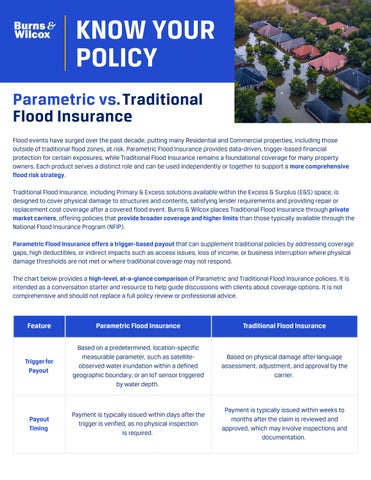
KNOW YOUR POLICY Parametric vs. Traditional Flood Insurance Flood events have surged over the past decade, putting many Residential and Commercial properties, including those outside of traditional flood zones, at risk. Parametric Flood Insurance provides data-driven, trigger-based financial protection for certain exposures, while Traditional Flood Insurance remains a foundational coverage for many property owners. Each product serves a distinct role and can be used independently or together to support a more comprehensive flood risk strategy. Traditional Flood Insurance, including Primary & Excess solutions available within the Excess & Surplus (E&S) space, is designed to cover physical damage to structures and contents, satisfying lender requirements and providing repair or replacement cost coverage after a covered flood event. Burns & Wilcox places Traditional Flood Insurance through private market carriers, offering policies that provide broader coverage and higher limits than those typically available through the National Flood Insurance Program (NFIP). Parametric Flood Insurance offers a trigger-based payout that can supplement traditional policies by addressing coverage gaps, high deductibles, or indirect impacts such as access issues, loss of income, or business interruption where physical damage thresholds are not met or where traditional coverage may not respond. The chart below provides a high-level, at-a-glance comparison of Parametric and Traditional Flood Insurance policies. It is intended as a conversation starter and resource to help guide discussions with clients about coverage options. It is not comprehensive and should not replace a full policy review or professional advice.
Feature
Parametric Flood Insurance
Traditional Flood Insurance
Trigger for Payout
Based on a predetermined, location-specific measurable parameter, such as satelliteobserved water inundation within a defined geographic boundary, or an IoT sensor triggered by water depth.
Based on physical damage after language assessment, adjustment, and approval by the carrier.
Payout Timing
Payment is typically issued within days after the trigger is verified, as no physical inspection is required.
Payment is typically issued within weeks to months after the claim is reviewed and approved, which may involve inspections and documentation.