What Matters for Bar Success:
Doctrinal Performance, Coursework Exposure, and First‑Time Bar Passage
Bar success is driven by learning, not exposure. Background Drawing on data from more than 13,000 law graduates from 36 law schools, this study examined how academic performance (GPA and course grades) and coursework exposure (credit hours and course completion) relate to first-time bar passage. Results indicate that academic performance is more strongly associated with bar success than completing additional credits or specific bar-related courses.
Key Findings •
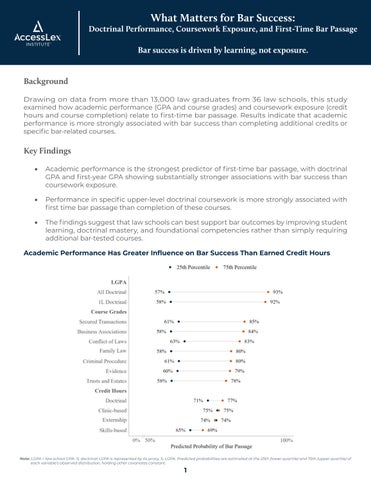
Academic performance is the strongest predictor of first-time bar passage, with doctrinal GPA and first-year GPA showing substantially stronger associations with bar success than coursework exposure.
•
Performance in specific upper-level doctrinal coursework is more strongly associated with first time bar passage than completion of these courses.
•
The findings suggest that law schools can best support bar outcomes by improving student learning, doctrinal mastery, and foundational competencies rather than simply requiring additional bar-tested courses.
Academic Performance Has Greater Influence on Bar Success Than Earned Credit Hours
Note: LGPA = law school GPA. 1L doctrinal LGPA is represented by its proxy, 1L LGPA. Predicted probabilities are estimated at the 25th (lower quartile) and 75th (upper quartile) of each variable’s observed distribution, holding other covariates constant.
1
What Matters for Bar Success:
Doctrinal Performance, Coursework Exposure, and First‑Time Bar Passage
Data and Methods Researchers used statistical methods to account for differences in student backgrounds, prior academic achievement, and course-selection patterns, helping distinguish whether bar success is more closely associated with learning and mastery or with the number and type of courses completed. The primary dataset includes: •
13,115 graduates
•
36 ABA-approved schools
•
9 years of bar examinations (2015 – 2023)
Implications for Law Schools •
Bar passage appears to be driven more by academic performance than course selection. The findings suggest that helping students succeed in the courses they take may have a greater impact on bar passage than requiring or steering them toward particular courses.
•
Strengthening core legal reasoning and writing skills may be the most effective intervention. Academic support that improves doctrinal understanding, analytical ability, and foundational competencies, particularly in doctrinal courses, appears more closely aligned with factors associated with bar success than an emphasis on bar-tested content alone.
•
Advising should focus on learning outcomes rather than course accumulation. Students may benefit more from guidance that emphasizes academic performance and mastery of course material than from advice focused primarily on completing specific courses or accumulating credits.
2