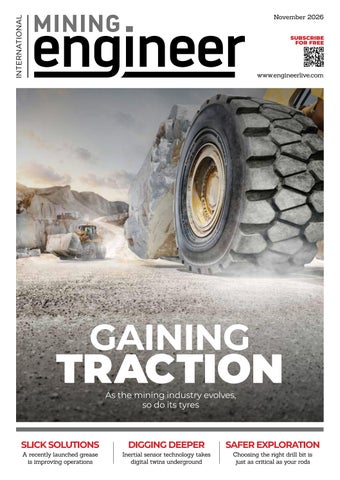
November 2026 SUBSCRIBE FOR FREE
www.engineerlive.com
GAINING
TRACTION As the mining industry evolves, so do its tyres
SLICK SOLUTIONS
DIGGING DEEPER
SAFER EXPLORATION
A recently launched grease is improving operations
Inertial sensor technology takes digital twins underground
Choosing the right drill bit is just as critical as your rods
CONTENTS
Welcome As we reach the end of 2026, it is hard not to reflect on the year of innovation and growth the mining industry has experienced. This issue of International Mining Engineer features particular coverage on underground mining technology. As near-surface and open-pit reserves age and resources are exhausted, we will soon be digging deeper to access high-grade ore. Articles on pages 22, 28 and 32 introduce technologies specifically designed to handle the dark, wet and unpredictable environments of underground mines. The cover story on page 6 also touches on underground mining, in relation to tyres. As climate change continues and our surroundings alter alongside it, tyre manufacturers will need to adapt. In addition to the cover story, page 28 also examines the importance of tyre conditions. Meanwhile, a couple of Q&As in this issue provide the perspective of those sticking to the mining industry for the long haul. On page 18, SealRyt’s Mark Wilkinson shares valuable insights from his career in in mechanical packing and sealing solutions. Page 42 features a Q&A with R. Todd Swinderman, 2026 recipient of the CEMA Lifetime Achievement Award, about the future of bulk handling. This issue of International Mining Engineer also explores the current safety landscape of the industry. Although we have a better understanding of why catastrophic events occur in mining, there are still fatal catastrophes every year. Page 37 analyses research about catastrophic events in mining and what kind of approach is required to prevent them. Saskia Henn Editor
6
– NOVEMBER 2026 – COVER STORY
OPERATIONS MANAGEMENT
06
14
Gaining traction We sit down with Continental Tyres to explore trends in tyres for mining
LOAD & HAUL
08
Test for the best Battery-electric haul trucks are undergoing testing in one of the world’s most extreme environments
10
Fuelling mining’s toughest demands
12
From concept to mine site
16 18
A concrete solution Examining what goes into effective concrete spraying
Slick solutions A recently launched grease s improving operations
FROM THE INDUSTRY: Mark Wilkinson SealRyt’s Mark Wilkinson shares valuable insights from his career in in mechanical packing and sealing solutions
A look at Cummins’ new mining engine
A mine truck named Trish takes on Australia's Pilbara for testing
16 www.engineerlive.com
3
CONTENTS
22
Digging deeper
MATERIALS HANDLING
Inertial sensor technology takes digital twins underground
40
SPECIALIST EQUIPMENT
24 26 28 30 32
Explore first, drill later
42
A new technology helps mine operators to avoid committing to the wrong ground
Safer exploration Why choosing the right drill bit is just as critical as your drill rods
47
Tyre engineering and digital monitoring in underground operations
Underground automation
37 HEALTH & SAFETY
34 36 37
32
Looking forward A Q&A with R. Todd Swinderman about the future of bulk handling
A long-term investment How one mining company is attracting a new generation of mining expertise
SHOW PREVIEW
Mining independence
A look at one of Sandvik’s latest underground innovations
A materials handling solution to support reliable operation throughout the entire handling chain
SKILL ZONE
Underground innovation
The American government is funding more mining projects
Enclosed by design
48
Sensing a change Intelligent mine operations in the US are putting safety at the forefront
Resourcing Tomorrow The agenda for Resourcing Tomorrow 2026 is looking packed and ready for a big year of connections and conversations
A safe ecosystem Exploring reliable comms in the digital age
Controlling catastrophe Recent research explores trends behind catastrophic mining events
48
PUBLISHER Jerry Ramsdale EDITOR Saskia Henn shenn@setform.com DESIGN – Dan Bennett, Jill Harris HEAD OF PRODUCTION Luke Wikner production@setform.com HEAD OF SALES & PARTNERSHIPS David Pattison ACCOUNT DIRECTORS John Abey | Peter King SENIOR ACCOUNT MANAGERS John Davis | Darren Ringer | Roy Glasspool ACCOUNT MANAGERS
4
Setform’s international magazine for mining engineers is published four times annually and distributed to senior engineers throughout the world. Other titles in the company portfolio focus on Process, Design, Transport, Oil & Gas, and Power. The publishers do not sponsor or otherwise support any substance or service advertised or mentioned in this book; nor is the publisher responsible for the accuracy of any statement in this publication. ©2026. The entire content of this publication is protected by copyright, full details of which are available from the publishers. All rights reserved. No part of this publication may be reproduced, stored in a retrieval system, or transmitted in any form or by any means, electronic, mechanical, photocopying, recording or otherwise, without the prior permission of the copyright owner.
Paul Maher | Iain Fletcher
Setform Limited | Suite 3.10, Ellisse by Spacemade, 10 St Bride Street, London EC4A 4AD
e advertising@setform.com
t +44 (0) 207 253 2545 e mail@setform.com
www.engineerlive.com
GAINING TRACTION As the mining industry evolves, so do its tyres
MAXIMIZING PRODUCTIVITY, MINIMIZING DOWNTIME. Protect your hydraulic cylinders from abrasive wear and premature failure with Seal Saver.
EXTEND THE LIFE OF YOUR EQUIPMENT UP TO 3X LONGER Seal Saver designs custom-fitted, lightweight flexible protective boots to keep your hydraulic equipment running efficiently in tough mining conditions. Each protective boot is resistant to debris, minerals, abrasions and installs in minutes.
Minimize Rod Scoring Prevent Chemical Wash Pitting Protect Cylinder Seals Four Material Options Including Kevlar & Ballistic Nylon 10 Minute Install - No Disassembly Required
READY TO PROTECT YOUR INVESTMENT? Request a quote or get additional information by calling 770.509.5833 or visiting SealSaver.com.
Fluid Control Services, Inc. 1155 Allgood Road • Suite 15 Marietta, Georgia 30062
Phone: 1.800.683.5189 Fax: 770.509.5832
COVER STORY
GAINING TRACTION
Reinhard Klant, product line manager from Continental Tires, explores trends in tyres for the mining industry Tyres can impact budgets, safety, sustainability and productivity of a mine site
C
ontinental Tires was founded in Hanover, Germany in 1871 as a rubber manufacturer, and since then, has evolved into a leading technology company and tyre specialist. In the 150+ years of operating, Continental Tires has formed a tight bond with the mining industry. Mining operators are under constant pressure to maximise their equipment, and tyres play a critical role in this equation. Harsh haul roads, sharp rocks, heavy loads and continuous operating cycles place stress on tyres. With digital and electric innovation trending, it’s more important now than ever for mining operators to find the right tyres for their systems.
THE IMPACT OF CLIMATE CHANGE
Tyre performance and durability are impacted by the characteristics of a mine site, including the effects of the surrounding climate. The emergence of more extreme operating environments will require tyres that can maintain reliable performance across a wider range
6
www.engineerlive.com
of temperatures, sites and ground conditions. “Climate and environmental conditions are critical factors when selecting the right tyre solution,” says Reinhard Klant, product line manager Earthmoving & Compact/MPT, Continental Tires. “On top during intensive load cycles, particularly in 24/7 operations, mining tyres generate significant heat. High environment temperature is here an additional amplifier that can lead to premature tyre failures.” However, according to Klant, although climate change is a challenge for mining tyres, it is also a driver of innovation. “We are already preparing for these developments. Across the entire value chain, we are working on responsible material sourcing, increasing the use of renewable and recycled materials, low-carbon production processes and circular solutions for end-of-life tyres,” he says. “At the same time, we continuously improve key tyre characteristics such as durability and wear performance, helping to reduce emissions during the use phase while maintaining the highest safety standards.”
SAFE FOR UNDERGROUND OPERATIONS
In addition to preparing for future conditions, Continental Tires is also taking into account specific characteristics of mining operations. Underground mining, for example, is a key area of focus for the company due to its highly demanding conditions. “Continuous operation in wet conditions, which is common in many underground mining environments, represents a significant challenge, particularly for cut-resistant tyre compounds, says Klant. “For this reason, correct tyre selection must always consider the complete operating environment, including climate, haul distances, load levels, vehicle type and surface severity.” Modern Ultra cut-resistant compound technologies ensure high protection against severe tire cuts when operating on harshest, wet surfaces while remaining at the same time relatively cool in the continuous operations of intense load cycles. (e.g. DumperMaster) Reinforced carcasses with high load carrying capacity and crescent sidewall protection designed to
COVER STORY
Key trends such as digitalisation, electrification and sustainability are shaping the future of mining tyre technology
Operational, environmental, and physical factors of a mine site directly impact tyre life, safety, and wear rates
support the demanding duty cycles and increasing payload requirements of modern mining equipment, such as our LD-Master Rock. For particularly narrow and highly abrasive underground environments, Continental Tires has developed its V.ply concept, providing enhanced sidewall protection against impacts and cuts, which are integrated in e.g. ScoopMaster and DrillMaster. “Our focus is always on delivering
Trucks for underground mining frequently operate in wet, muddy, or damp conditions
the best balance between durability, traction, comfort and total operating cost,” says Klant.
LOOKING FORWARD
Key trends such as digitalisation, electrification and sustainability are shaping the future of mining tyre technology. “We expect closer integration between tyres, vehicles and fleet management systems, creating smarter and more efficient mining operations overall,” says Klant. “Looking further ahead, we see significant opportunities through the continued integration of tyre expertise, sensor technology and data-driven services.” Digitalisation will continue accelerating, and tyres will become connected assets that generate valuable operational data and contribute to predictive maintenance strategies. Electrification creates new requirements for tyre design. Electric mining equipment delivers higher torque immediately and requires tire constructions and compounds specifically optimised to withstand these additional stresses. Lastly, sustainability will remain a
major driver for the industry. Miners are seeking ways to reduce emissions, improve resource efficiency and extend product lifecycles. This will increase demand for innovative materials, retreadability concepts and more sustainable production methods.
A PERIOD OF CHANGE
The mining industry is undergoing significant change, and equipment will have to adjust accordingly. Continental Tires plans to focus on the continued integration of tyre expertise, sensor technology and data-driven services. The aim is to remain a partner to the mining industry and invest in tyre technology that helps mining operators improve productivity, safety and sustainability. “Ultimately, our ambition is not simply to supply tyres but to act as a trusted technology partner, helping mining companies improve safety, productivity and sustainability in an increasingly demanding operating environment.”
For more information visit: www.continental-tires.com/
www.engineerlive.com
7
LOAD & HAUL
TEST FOR THE BEST Testing of battery-electric haul trucks is ongoing in Jimblebar
E
lectric haulage is increasingly being explored as a potential option in mining. As they eliminate the toxic exhaust gases, cut heat generation and lower emissions, battery-electric haul trucks continue to gain traction. BHP, Rio Tinto and Caterpillar recently launched a trial of two Cat 793 XE Early Learner batterelectric haul trucks. The trial was at a mine site demonstration in Western Australia’s Pilbara region.
Following safety validation and controlled testing at Caterpillar’s Tuscon Proving Ground in the US, the trucks arrived at BHP’s Jimblebar iron ore mine late last year. Since then, the trucks have been put through their paces. “Investing in battery-electric haul truck fleet technology and operations in the Pilbara is key to our decarbonisation,” says BHP president Australia Geraldine Slattery. “This trial is helping to advance the technology we need and improve
our understanding of how to scale across our operations, from charging infrastructure and energy management through to how it integrates into safe and productive operations.
JIMBLEBAR TESTING
Jimblebar was chosen because it is one of the world’s harshest mining environments. The scale and operational intensity of the Pilbara region make it a suitable testing ground for haul truck testing.
BHP, Rio Tinto and Caterpillar launched a trial of two Cat 793 XE Early Learner batter-electric haul trucks. The trial was at a mine-site demonstration in Western Australia’s Pilbara Jimblebar is currently home to two of seven Caterpillar Early Learner battery-electric haul trucks being tested globally
8
www.engineerlive.com
The extreme conditions of Pilbara make it a useful area for testing
LOAD & HAUL
The trial is generating critical data to assess technical readiness, infrastructure requirements and commercial feasibility, including trialling high-powered static and dynamic charging solutions
“Working side by side in the Pilbara’s demanding environment allows us to validate battery-electric trucks and charging infrastructure in the exact conditions our customers face,” says Thad Litkenhus, Caterpillar Resource Industries VP of Product Management. Rio Tinto Iron Ore chief executive Matthew Holcz adds: “The Pilbara’s scale and intensity are unique, and that’s exactly what makes it the right place to test this technology to
The trial is showing meaningful progress
understand what’s needed to support broader deployment.” Onsite testing at Jimblebar shows the trial has made meaningful progress. Over 100 hours of operation and over 200 test laps have occurred in early phase testing, with insights helping to validate key assumptions around safety, technology and maintenance of the trucks. The trial is generating crucial data to assess technical readiness, infrastructure requirements and
commercial feasibility – including trialling high-powered static and dynamic charging solutions. The next phase of the trial will evaluate dynamic charging via an energy transfer system that will charge the trucks while in motion.
For more information visit: www.caterpillar.com
BHP has completed its first high-power charging test of the Cat 793 XE battery-electric mining truck
www.engineerlive.com
9
LOAD & HAUL
FUELLING MINING’S TOUGHEST DEMANDS A look at the engineering behind Cummins all-new S29 mining engine, by Rebecky Chen, director of Product Strategy & Management for Cummins Components and Software, China
C
ummins recently introduced the S29, a clean-sheet 29l V-12 engine developed primarily for 90t to 120t haul trucks and 150t to 220t excavators. With an intermittent rating of up to 1,300hp (969kW) at 2,100rpm, it’s designed for mining duty cycles where sustained high loads put significant demands on fuel delivery, efficiency and durability. That combination of output and sustained high-load operation created a fuel-system challenge: delivering greater fuel flow without giving up precise injection control, durability or compact packaging. Cummins evaluated several available fuel system options against those requirements and ultimately selected XPI, a high-pressure common-rail fuel system, as the foundation. From there, the engine and fuel system teams then developed the new high-flow XPI system alongside the S29 combustion system, allowing the injector design and combustion requirements to be refined together.
WHY HIGH-FLOW XPI?
From the outset, the S29 was developed to deliver strong performance and competitive total cost of ownership in demanding mining applications. This placed particular emphasis on power density and fuel economy. The Modular Common Rail
10
www.engineerlive.com
System (MCRS) has driven proven performance across Cummins’ highhorsepower mining portfolio since its first use in 2008. The clean-sheet S29 gave the development team an opportunity to evaluate that experience alongside advances in the Cummins XPI fuel system, which has also been in production since 2008, with extensive operating experience in heavy-duty, industrial and highhorsepower applications. For the S29, XPI offered the lighter, more compact foundation best suited to the engine’s power-density goals, as well as the flexibility to optimise fuel delivery and combustion for its performance, fuel economy and durability targets. The S29’s displacement and power targets required substantially greater fuel-flow capability than existing XPI configurations provided. Cummins engine and fuel system teams therefore worked together to develop the new high-flow XPI specifically for the S29, combining a high-capacity pump and purpose-designed injectors with durability enhancements for demanding mining duty cycles.
A PURPOSE-DESIGNED INJECTOR AND COMBUSTION SYSTEM
The S29 uses a high-flow injector developed specifically for the engine. The teams used simulation and iterative testing to refine fuel-flow capacity, spray-hole configuration,
spray angle and rate shape — the way fuel delivery changes as the injector opens and closes. Those variables were refined alongside the combustion system, with results from each helping guide the next design iteration. That work produced a high-flow XPI configuration that supports injection pressures up to 2,200bar, helping provide precise fuel metering and atomisation for efficient combustion. The combined XPI injector and combustion optimisation contributes to a brake-specific fuel consumption (BSFC) improvement of about 2.5g/ kWh, supporting the S29 engine’s bestpoint BSFC target of 180g/kWh. The injector also incorporates durability enhancements, including a reinforced architecture, wear-resistant materials and improvements to sealing, nozzle and valve-seat design. Cummins designed the S29 high-flow XPI system around a 20,000hr life target, drawing on previous XPI field experience as well as accelerated and comparative validation.
INTERNATIONAL COLLABORATION AND SMARTER VALIDATION
Cummins engine and fuel system specialists worked as one international team, sharing models, designs and test data throughout development. Because Cummins develops both the base engine and key component technologies, including the fuel system,
LOAD & HAUL
accelerated rig test reproduced evidence of a cavitation risk that could otherwise require 1,000 to 2,000hrs of engine testing in about 300hrs.
FUEL DELIVERY TAILORED TO MINING DEMANDS
The S29 engine and fuel system were developed as a complete system
the teams could evaluate technologies against the S29’s requirements and integrate them as a complete system rather than treating the fuel system as a separate component. That approach allowed specialists from different disciplines to challenge assumptions
as the design evolved. The same integration carried into validation. Using simulation, field-return experience and mining duty-cycle data, the team developed targeted tests around specific durability risks. For example, an
Bringing together Cummins engine, fuel system and application expertise allowed the S29 development team to select and tailor technologies for demanding mining duty cycles. For high-flow XPI, that meant combining compact packaging, precise high-load fuel delivery and a purpose-designed injector and combustion system to support the S29’s fuel-efficiency and total-cost-of-ownership targets. For miners, the result is a fuel system developed alongside the engine, with performance, durability and operating cost considered together from the start.
For more information visit: https://link.cummins.com/syxia4
MINING ELECTRIFICATION. FULLY REALISED. XNO® is the world’s leading niobium anode, delivering unmatched power, life and safety in one battery. Mining’s tough duty cycles destroy conventional battery chemistries. They charge slowly, degrade quickly under sustained high-rate cycling, and cannot maintain performance across temperature extremes.
XNO® delivers on safety and fast-charge performance, at significantly higher energy density and lower cost. The result: a smaller, lighter battery that lasts longer and costs less over the vehicle’s operating life. See XNO® in action. The world’s first hybrid Cat 785 water truck, powered by XNO®, is now on trial at an active mine site in Western Australia’s Pilbara region.
www.echiontech.com
www.engineerlive.com
11
LOAD & HAUL
testing of a FROM CONCEPT The hybrid mining truck
TO MINE SITE
in the Pilbara
F
or mining companies looking to electrify their operations to increase productivity and reduce exposure to diesel, selecting the right battery technology is a key consideration. In making their selection, the technology must deliver the power, charging performance, reliability, and lifetime required to operate continuously in some of the world’s most demanding environments to ultimately improve the mine’s $/ton. Equating battery performance into mine performance is a challenge that has been put to the test in Western Australia’s Pilbara region. Since June 2026, in conjunction with partners HD Hybrids, a subsidiary of Switch Technologies and its mine partner and global lithium producer PLS Group Limited (PLS), a hybrid CAT 785 water cart has been undergoing mine site trials using a battery system powered by Echion’s proprietary niobium-based XNO anode material. The truck, nicknamed Trish after Tricia the elephant from Perth Zoo, is the first of its kind and is the result of several rapid stages of development. The CAT 785 truck was retrofitted by HD Hybrids with a 1MW-capable battery system comprising three XNO powered sub packs. The system supports safe continuous fast charging and discharging at 10C without generating excess heat, has a projected life cycle exceeding 50,000 cycles. It enables effective regenerative charging during braking, including on declines and a significant power boost on inclines. For water carts, maintaining speed on grade is important to not impact the productivity of the mine. During the Pilbara mining trials, Trish was repeatedly driven up and down a steep section of a waste dump with conditions described by the team as a more intensive battery duty cycle than a typical mining haul cycle. Even under these conditions, the system performed without producing excess heat generation due to its high efficiency design, which starts from the battery chemistry level with XNO.
12
www.engineerlive.com
The hybrid system tested could improve productivity and financial performance of the mine
THE RESULTS AND IMPLICATIONS
Early operational results indicated that the hybrid system could improve productivity and thus financial performance of the mine. The water cart travelled uphill under load at around twice the speed of its diesel counterpart, while drivers reported noticeably greater power, strong handling, and reduced noise. For operators, this performance difference could benefit the wider fleet. A fully loaded truck that climbs more quickly can complete its operating cycle in less time, potentially increasing utilisation, reducing the number of movements required to complete the workload or potentially reducing fleet size. Overall, the early trial data indicate that the hybrid system could reduce annual fuel consumption by more than 15%, compared to conventional CAT 785 water trucks operating under comparable conditions and consuming over
500,000l of diesel a year. The battery system and modified fuel tank of the hybrid retrofit kit occupies approximately the same volume in the truck chassis as a standard long range fuel tank. This non-invasive modification encourages operators to retrofit existing equipment rather than replace entire fleets, creating a quicker route to electrification and allowing the technology to be introduced progressively. For Echion, Trish is an example where the XNO battery chemistry is operating in a heavy-duty vehicle at an active mine. The truck is generating evidence that can support miners in making their battery technology selection for mining vehicle electrification.
For more information visit: www.echiontech.com
Shouldn’t greater efficiency come standard?
THIS CHANGES EVERYTHING
Scan to explore the new S29 platform Introducing the Cummins S29 mining engine, where a clean-sheet platform and Cummins-designed fuel system come together to deliver best-in-class efficiency by design — raising expectations for what fuel economy can look like in mining applications.
OPERATIONS MANAGEMENT
A CONCRETE SOLUTION
Keeping the underground mining cycle moving with sprayed concrete
I
n underground mining, concrete spraying plays an important role in securing excavated areas and enabling the next stages of the mining cycle. However, efficient concrete spraying is not simply about how quickly concrete can be applied. It requires coordination between concrete production, transportation, spraying equipment, and operators to ensure that the entire process runs smoothly. Delays in concrete delivery, equipment downtime or the need for additional spraying can all affect underground operations. With the right equipment, technologies and working practices, mines can improve spraying efficiency and quality while reducing material waste and interruptions.
IT ALL STARTS WITH RIGHT CONCRETE MIX
The quality of sprayed concrete depends on a mix design that meets the requirements of the application and underground conditions. The mix needs to achieve the required strength, durability, workability and pumpability while ensuring effective application
14
www.engineerlive.com
and minimal rebound. Important factors include cementitious content, water-to-cement ratio, aggregate grading and superplasticiser dosage. Alkali-free accelerators are used to promote rapid setting and early strength development, while fibre reinforcement can improve toughness and crack control. The mix design must also consider spraying equipment, application thickness, substrate conditions and environmental exposure. The journey from the batching plant to the spraying location can affect concrete workability. Long transportation distances, ambient temperatures and delays all need to be taken into account. Trial mixes and field help verify performance of the mix under actual operating conditions.
COORDINATING CONCRETE TRANSPORTATION WITH SPRAYING OPERATIONS
Efficient transportation ensures that the concrete reaches the spraying location in suitable condition and
Spraymec equipped with Normet SmartScan, a 3D laser scanner to measure sprayed concrete thickness, helping reduce over-spraying, material consumption and respraying
at the right time. Delivery must be coordinated with the batching plant and spraying capacity to avoid waiting times and interruptions. Too few deliveries leave the sprayer waiting, while too many can create queues, affect concrete workability and potentially result in wasted material. Selecting the right transport capacity is therefore important to keep the process running efficiently. Normet’s Utimec range includes purpose-built underground concrete agitators and transmixers in different capacities. Transmixers transport ready-mixed concrete, whereas agitators provide additional mixing capacities. In addition to capacity, the reliability and performance of transport equipment are essential. A breakdown in concrete transportation can interrupt the entire spraying operation.
SELECTING THE RIGHT SPRAYER FOR APPLICATION
Underground mines have different tunnel profiles ground support requirements. The sprayer must be
OPERATIONS MANAGEMENT
Proven Utimec concrete transmixers are also available with BEV technology, providing zero local emissions and high energy efficiency
matched to the required boom reach, pumping capacity and available maneuvering space. Normet’s Spraymec range covers tunnel profiles from 3m x 3m to 20m x 15m, providing solutions for different underground mining and tunnelling needs. Consistent concrete flow contributes to spraying quality. Strong pulsation can make nozzle control difficult and lead to uneven accelerator distribution, increased rebound and material consumption. Normet’s in-house developed concrete pump technology minimises flow pulsation, supporting consistent application and better nozzle control. Combined with accurate accelerator dosing, this helps improve spraying quality and material efficiency. Operator safety and working conditions are important in concrete spraying. Depending on the equipment configuration, spraying can be performed from inside a protected HEPA-filter cabin or remotely from a suitable position outside the machine. Good visibility, ergonomic controls and comfortable working conditions help reduce operator fatigue, while batteryelectric and electrically operated equipment can reduce local emissions, heat and noise underground.
MEASURING SPRAYING THICKNESS TO REDUCE UNNECESSARY WORK Applying the correct thickness is essential for achieving the required ground support performance. Insufficient thickness requires additional spraying, while excessive application increases concrete
consumption and costs. Traditional manual probing provides information only at selected points and may require personnel to approach recently supported ground. Normet SmartScan uses 3D laser scanning to measure applied concrete thickness. A color-coded visualisation allows operators to identify areas requiring additional concrete while the sprayer is still in its position. This can reduce over-spraying and repeat visits, and the measurement data can be used for quality assurance and documentation.
components should be regularly inspected and maintained. Equipment data and remote monitoring support maintenance planning and spare part inventory optimisation. Concrete remains can harden inside pumps, hoses and pipes, causing blockages and additional wear. That is why proper cleaning is extremely important. Normet’s form oil system and automatic washing functions can help simplify cleaning, while specialised chemicals such as TamCrete CR can remove hardened concrete deposits.
SKILLED OPERATORS AND EFFECTIVE TRAINING
ENSURING CONTINUOUS MINING CYCLE
Operator competence has significant impact on spraying quality and efficiency. As skilled operators become increasingly difficult to find, improved ergonomics, operator assistance technologies, automation and training become more important. Normet’s virtual reality concrete spraying simulators allow operators to practice without consuming concrete, accelerator, fuel or requiring production machinery. Normet is a member of EFNARC, an international association promoting industry standards, professional competence and certification for specialist concrete applications.
KEEPING EQUIPMENT AVAILABLE AND READY
Preventive maintenance and access to critical spare parts help reduce unexpected downtime in concrete transportation and spraying. Concrete pumps, hoses, seals and other wear
Efficient concrete spraying requires more than a capable sprayer. It depends on the entire process, from mix design and reliable transportation to accurate application, skilled operators and equipment availability. By improving the efficiency of each stage of the process, mines can reduce interruptions and material consumption, enabling headings to be secured and returned to production sooner. With decades of expertise supporting the whole concrete spraying process, from mix design to the finalised concrete lining, Normet can help identify opportunities to improve overall process efficiency and ultimately reduce costs.
For more information,visit: www.normet.com
www.engineerlive.com
15
OPERATIONS MANAGEMENT
A new high-performance thread grease can handling even the most demanding rock drilling applications Epiroc Bio thread grease is engineered for harsh drilling environments and extreme temperatures
SLICK SOLUTIONS
G
rease plays a vital role in drilling operations. Its ability to seal out contaminants, reduce friction and protect against vibrations makes it a key player in drilling operations. Epiroc recently released Bio thread grease, a high-performance thread grease developed for demanding rock drilling applications. The grease is designed to protect drill string connections, withstanding harsh environments and extreme temperatures. “Customers today expect solutions that deliver both performance and sustainability. With Epiroc Bio thread grease, we are providing a product that helps protect rock drilling tools, supports operational efficiency, and contributes to lower environmental impact without compromising performance,” says Fredrik Gransell, head of Strategic Marketing at Epiroc Tools division. Tested according to ISO standards, Epiroc Bio thread grease helps reduce friction, prevent cold welding and contributes to extended service life of rock drilling tools. The company’s life cycle assessment showed a carbon footprint of at least 45% lower than conventional grease.
16
www.engineerlive.com
Unlike many conventional options, Eprioc Bio thread grease is not classified as hazardous to transport or store. The product also offers a shelf life more than twice that of alternative products, according to the company. Epiroc Bio thread grease is formulated with biodegradable
synthetic esters and renewable resources and is certified with the EU Ecolabel (Licence No. DE/027/331). It is also approved for underwater use
For more information visit: www.epiroc.com
Epiroc Bio thread grease is made from biodegradable synthetic esters and renewable raw materials
OPERATIONS MANAGEMENT
SIGNS OF GREASE INCOMPATIBILITY • Odd texture: The grease loses its smooth consistency and becomes lumpy, uneven or even curdled • Overheating: Heat resistance is a sign that the grease is failing to reduce friction • Leakage: The grease leaks from seals or cracks • Hardening: If the grease stiffens, it cannot flow properly throughout the system
Thread grease plays an important role in protecting drill string connections, maintaining drilling efficiency and extending drilling tool life
• Unusual noises: Vibrations, rumbling and grinding can imply a problem
INERTIAL SENSOR SOLUTIONS
Precision Drilling: from Mining to Geothermal Energy
asc-sensors.de
Drilling down several thousands of meters requires high-tech tools and equipment. Equally crucial is the appropriate sensor technology, to keep to the exact drilling path for precise results. So are shock and heat resistance to prevent strong vibrations and high temperatures from skewing measurement outcomes while drilling through the rock strata. For the geothermal energy industry, this is enabled by ASC inertial sensor technology. Our portfolio includes high-end JAE quartz-based JA-5 and JA-25 accelerometers particularly suitable for this purpose. In addition, MEMS-based ASC OS-series accelerometers conduct accurate, stable vibration analyses on machines like hydraulic deep drilling vibrators for soil inspection and preparation, to keep them running smoothly and prevent damage.
Gyroscopes
MEMS accelerometers
ASC_Anzeige_IME_185x121.indd 2
IMUs
Seismic sensors
Quartz-based accelerometers
Measurement While Drilling (MWD) Geothermal Energy Mining Seismic Monitoring
SUCCESSFUL WORLDWIDE. AT HOME IN GERM ANY.
11.01.25 19:09
www.engineerlive.com
17
OPERATIONS MANAGEMENT
SealRyt is proud to be a family business, Left to Right: Emily, Christian, Seth, and Mark Wilkinson
– FROM THE INDUSTRY –
MARK WILKINSON SealRyt CEO Mark Wilkinson shares valuable insights from his career in mechanical packing and sealing solutions WHAT TECHNOLOGIES IS SEALRYT BEST KNOWN FOR, AND WHAT ADVANTAGES DO THEY PROVIDE? I believe SealRyt is best known internationally for two things. The first is the development of shaft stabilisation methods within limited-space sealing cavities. That work came from identifying shaft movement as a significant cause of premature sealing failure. Rather than simply focusing on the sealing material itself, we began looking
18
www.engineerlive.com
more closely at what was happening mechanically inside the equipment – and what could be done to control it. The second is the highly focused environment our people create to help users fully understand and properly apply these approaches to sealing. When implemented correctly, these technologies can provide substantial financial gains through increased reliability, reduced maintenance, lower water consumption, and longer equipment life. But ultimately, it’s about more than selling a product. It’s about the
process of teaching and learning.
WHAT FIRST DREW YOU TO INDUSTRIAL ENGINEERING?
I was never really “drawn” to engineering – especially industrial engineering. I was a reluctant college student at best in the 1960s, and the engineering courses I took mostly taught me that memorising formulas allowed me to pass courses, but didn’t necessarily teach me how to think. As a child, though, I had an intense desire to build things, create things,
OPERATIONS MANAGEMENT
SealRyt systems are designed for harsh mining and mineral processing environments
and dream beyond my ability to actually make those things happen. Then physics came along, and I began to realise that most everything I was looking for was contained in the application of physics. Learning how to apply those concepts and tools required me to dive more deeply into engineering so I could connect ideas to physical reality. I began to research. I began to think. And the rest, as they say, is history.
WHAT CHANGES HAVE YOU SEEN IN INDUSTRIAL ROTATING SHAFT SEALING TECHNOLOGY AND SHAFT STABILISATION SYSTEMS OVER THE YEARS?
My direct involvement in rotating shaft sealing began in 1974 with mechanical seals, braided packing, and bearing isolators. In all that time, with a few notable exceptions, most of the changes I’ve seen have involved materials and material design rather than the quantum leaps experienced in some other technical disciplines.
The industry appeared poised for dramatic change during the 1980s. Asbestos litigation forced an evolution in textile materials. Mechanical seals moved toward cartridge designs. Sealless magnetic-drive pumps evolved. There was even a widespread belief that whoever developed the first truly successful split mechanical seal would dominate the industry and perhaps eliminate braided packing as a practical sealing choice. And yet, here we are decades later, and most of those approaches are still with us. The materials have improved and the designs have evolved, but many of the fundamental challenges remain. The small, often poorly designed stuffing boxes of decades past still plague us. Within those confined spaces, we’re still dealing with friction, hydraulic forces, mechanical forces, and shaft movement. And I still hear the quintessential argument at mill sites: Operations tells Maintenance, “If you’d fix it right, we could run it.” Maintenance responds, “If you’d run it right, we wouldn’t have to fix it.”
Some things in this industry change more slowly than others.
WHAT PROJECT HAVE YOU BEEN MOST PROUD OF WORKING ON?
Every one of them. But I’m probably even more proud of our engineering staff and what they’ve been able to accomplish. They take concepts developed by others and flesh them out into workable solutions, while also developing entirely new approaches of their own. It’s classic applied physics on steroids. That process – taking an idea, understanding the physical forces at work, and turning it into something that solves an actual problem in the field – is what makes this work interesting.
WHAT LESSONS HAVE YOU LEARNED DURING YOUR TIME IN THE INDUSTRY? Patience. I have something of a personality flaw: I tend to believe that if something is good enough to do, it’s good enough to do now.
www.engineerlive.com
19
OPERATIONS MANAGEMENT
The materials have improved and the designs have evolved, but many of the fundamental challenges remain
On a technical basis, there often isn’t much benefit in waiting. The laws of physics aren’t going to change, so what are you waiting for? We work with thousands of plant mechanical people. When there are clear, measurable gains available today – better reliability, less maintenance, reduced water use, longer equipment life – why not take advantage of them today? I’ve come to the conclusion that eliminating the lack of urgency in what is traditionally a low-and-slow industry may take me another lifetime. But I’m working on it.
WHAT CHANGES DO YOU PREDICT FOR INDUSTRIAL ROTATING SHAFT SEALING TECHNOLOGY AND SHAFT STABILISATION SYSTEMS OVER THE NEXT DECADE? To understand where this industry is going, you first have to look at the
20
www.engineerlive.com
industries that require rotary sealing. Many of the most demanding applications involve large equipment handling heavy solids suspended in water – mining, pulp and paper, hydropower, and similar industries. As the fortunes of those industries ebb and flow, the sealing industry tends to follow them. In the United States, I would characterise many of those heavy industries as either relatively static or experiencing modest decline, so domestic sealing opportunities will naturally reflect that. At the same time, heavy industries continue to develop in other parts of the world where the necessary natural resources exist alongside lower labour costs and different taxation structures. That makes the future of sealing increasingly international. There is another challenge as well: relatively few entirely new rotary sealing applications are being created. Much of our industry is working with equipment and fundamental designs
that have existed for decades. That leaves sealing companies with a choice. They can compete generically for volume, or they can develop design improvements that make sealing systems significantly more reliable. Ironically, making a sealing system more reliable can mean selling fewer replacement parts. But I believe that is where meaningful innovation has to go. It may paint a somewhat bleak picture of the traditional replacement market, but the need for effective sealing isn’t going away. This industry will remain absolutely necessary as long as stuffing boxes exist. The real opportunity is helping more people understand why sealing systems fail – and giving them the tools to prevent those failures in the first place.
For more information visit: www.sealryt.com
Control dust and spillage. For over 40 years, the largest mining companies in the world have put their confidence in Richwood’s innovative material handling solutions. When it comes to solving problems with dust and material containment, Richwood achieves success with engineered passive dust containment systems. Application-specific solutions optimize efficiency through sealed and protected load zones without the need for vacuums, filters or other additional equipment. The reduced wear and tear on equipment and controlled dust and spillage create a safer and more productive work environment. Worry-free load zones are designed and built by Richwood every day. What would it mean for your productivity if dust and spillage issues were eliminated? Contact Richwood today for a review of your application.
Rely on Richwood!
richwood.com
before and after installation of Richwood Containment System
Belt Cleaning Systems Impact Protection Systems Material Containment Systems Pulley Lagging Wear Liners Complete Transfer Chutes
+1 (304) 525-5436 Located in Huntington, WV USA
OPERATIONS MANAGEMENT
DIGGING DEEPER Inertial sensor technology takes digital twins underground
D
igital twins are changing the way mines, underground structures and drilling operations can be planned, monitored and maintained. However, there is a fundamental difference between a digital model and a digital twin: The latter needs to know what is happening in the physical world. That is where precise sensor data becomes critical.
GOING UNDERGROUND
Building Information Modelling (BIM) has long moved beyond its origins in building design. The principle of creating a detailed digital representation of a physical asset also has considerable potential in mining and underground engineering, where operators manage complex networks of shafts, tunnels, caverns, access routes and technical installations – often under demanding and continuously changing conditions. This is where ASC inertial sensor technology comes into play: precise accelerometers that make these changing conditions and their impact on underground structures as well as machinery and equipment visible. BIM can bring geological, structural and engineering information together within a common digital environment. During planning and construction, this helps engineers understand spatial relationships, coordinate infrastructure and identify potential conflicts. But once excavation, mining or drilling begins, another question becomes paramount: How is the real structure or machine behaving? This is where the transition from BIM model to digital twin takes place.
FEEDING THE DIGITAL TWIN REAL-WORLD DATA By integrating measurement data from the physical asset, a digital twin can continuously compare expected and actual behaviour. In a mining environment, acceleration and vibration data can, for example, contribute to monitoring machinery and equipment or provide information
22
www.engineerlive.com
The ASC ECO series is a family of highly precise and durable industrial accelerometers built on capacitive MEMS
Built for demanding environments, the ASC ECO series features low power consumption and a compact design
about dynamic loads affecting structures and installations. Applications range from monitoring crushers, conveyors, drilling equipment and other machinery to tracking vibrations in underground infrastructure. Sensor data helps reveal changing vibration patterns or unusual dynamic behaviour that may warrant closer investigation. Combined with other monitoring information, these measurements support condition-based and predictive maintenance strategies – typically allowing intervention before deterioration results in unplanned downtime, or worse. The same principle applies to underground structures. Measurements taken at selected points in tunnels, shafts or other excavations provide additional real-world information to improve structural health monitoring. Rather than relying solely on periodic inspection or a static engineering model, operators can progressively enrich their digital representation with measured behaviour.
both slow structural movement and dynamic vibration phenomena need to be captured. ASC ECO sensors provide a differential analogue voltage output and come in a lightweight aluminium housing. Their IP68 protection and shock resistance of up to 10,000g are particularly relevant for installations exposed to dust, moisture and mechanical loads. For applications requiring longer transmission distances, ASC ECO CS sensors offer a 4–20mA current output. They are used in applications involving cable lengths exceeding 100m or requiring high EMC immunity.
ASC ECO SERIES
Capacitive MEMS-based ASC ECO accelerometers provide uni-, bi- or triaxial measurement, allowing the sensor configuration to be matched to the task at hand. All models are available with measurement ranges from ±2g to ±40g and a noise density from 22.5 to 90µg/√Hz. Their ability to measure from DC, including very low-frequency acceleration, makes capacitive technology particularly suitable where
POWER OF PREDICTION
The true potential of digital twins in mining, therefore, is not simply better visualisation; it is the connection and integration of virtual representation with continuously acquired real-world data from the actual worksite. As mining operations become more connected and data-driven, this feedback loop enables engineers to identify changes, validate models and make maintenance decisions based on current asset conditions and behaviour. BIM provides a digital framework. Sensors provide physical reality. Bringing the two together turns a virtual model of the mine into far more value for its operator.
For more information visit:: www.asc-sensors.de
YOUR LIFETIME PARTNER IN MINING. EQUIPMENT
SERVICES
CONSTRUCTION ROCK CHEMICALS REINFORCEMENT
Normet is a global technology partner for underground mining. With decades of expertise, over 50 locations in 30 countries, and a comprehensive portfolio of equipment, technologies, consumables and services, Normet helps customers improve safety, productivity and sustainability in demanding underground environments.
We provide solutions for: > Explosive charging > Scaling
> Rock breaking
> Rock and ground support > Water control
> Concrete transportation > Concrete spraying
> Lifting and installations > Underground logistics
NORMET.COM
SPECIALIST EQUIPMENT
EXPLORE FIRST, DRILL LATER Avoid committing to the wrong ground
D
rilling can easily become one of the most expensive parts of a mining operation.1 Using non-drilling exploration methods to obtain noninvasive data and narrow down anomalies is a way to send expensive drills to the most promising locations. In September, TerraEye launched a second version of its AI-driven remote sensing and mineral exploration targeting platform, TerraEye 2.0. TerraEye 2.0 supports exploration on remote projects with limited rock exposure and short field seasons. Geologists can bring in data they already own, assess where datasets support or challenge a target and trace the interpretation back to its source data and analysis methods. TerraEye 2.0 combines satellite imagery, geophysical data and geochemical results into a single mineral exploration targeting workspace. It can switch back and forth between 2D and 3D imagery with every layer draping over the real terrain. The imagery includes the data brought in by the user themselves.
24
www.engineerlive.com
USING TERRAEYE 2.0
Using TerraEye 2.0 enables operators to draw the area, pull the layers, run analyses and built their own interpretation. Operators are guided by build-in workflows and a team of AI specialists, as well as a geologist. The operator begins by removing vegetation, water and snow to focus on the desired analysis on exposed ground. After choosing a deposit model and loading relevant indicator minerals, the user then maps alteration minerals, iron oxides, clays and carbonates from satellite and hyperspectral sources. There are over 6,000 reference spectra to compare against. Once operators have loaded their satellite, geophysics and geochemistry into the single workspace, they can see how these datasets line up, and whether they have a target worth testing. With independent layers registered to the same ground, it will be easier to see where they converge. “For the first time I can put the magnetics next to the spectra and watch the same anomaly show up in both,” says TerraEye’s head of Product Wojciech Kuloza-Kaczan. “That
Dr Wojciech Kuloza-Kaczan, head of Product at TerraEye
SPECIALIST EQUIPMENT
Every target traces back to its source data and the physics behind it
overlap is what you want in hand before you commit a field season.” TerraEye selects its remote sensing methods to suit surface conditions. On exposed ground, it maps surface alteration signatures using hyperspectral and multispectral imagery, including EMIT, EnMAP, ASTER and Sentinel-2. In forested areas, vegetation- stress analysis can provide an additional, indirect indicator to assess alongside geological, geophysical and geochemical evidence. An independent regional assessment examined TerraEye’s metal-stressed vegetation index. In Mining Potential of Northern Ontario’s Ring of Fire, a July 2026 report prepared for the Regional Assessment Working Group by R. Mohan Srivastava, Alan Lambden and Petr Cizek, the index provided the strongest initial separation between locations with and without rock samples exceeding 2% nickel.2 The analysis used outcrop and drill-hole assay data and assessed predictors including magnetic and gravity data.
In a separate screening program for BMRC/International Resources Holding (IRH), TerraEye assessed approximately 97,300km2 using satellite analysis and existing exploration data, delivering 51 ranked targets for field follow-up. These included 15 targets within an equatorial area of more than 53,000km2 situated under nearcontinuous forest cover.
Ignancy, TerraEye 2.0’s in-app assistant, is the agent manager of an AI team designed to help operators. It comprises the expertise of a geologist, a spectral geologist and a TerraEye guide. When a user asks a question, Ignacy briefs the right specialist before responding.
TERRAEYE 2.0 IMPROVEMENTS
Finding anomalies in the earth is just the beginning. The real key to saving money and reaping rewards is to pursue only the ones worth testing. With TerraEye 2.0, users can make that call using evidence grounded in satellite imagery, geophysical data and geochemical results.
The ability to switch between 2D and 3D while viewing every layer is a new feature for TerraEye. In addition to better visualisation than the first TerraEye version, the system also offers more precise mineral matching through the Analogy Lab. Here, users can display and compare spectral curves side-byside and look for special analogues. Mineral matching runs off SFF, a precise matcher with SAM as a crosscheck. The redesigned workspace enables teams to view satellite and uploaded exploration data together over the terrain in 3D.
MAKING THE RIGHT CALL BACKED BY EVIDENCE
[REFERENCES] 1 https://www.youtube.com/watch?v=n04rLxME0aU&t=15s 2 https://iaac-aeic.gc.ca/050/documents/p80468/167232E.pdf
For more information visit: https://terraeye.co
www.engineerlive.com
25
SPECIALIST EQUIPMENT
SAFER EXPLORATION Why choosing the right drill bit is just as critical as your drill rods, according to Di-Corp principal metallurgist Gadi Greenman
Led by deep metallurgical expertise, Di-Corp’s Drillers Edge team engineers each matrix to optimise performance
J
ust as choosing high-quality drill rods prevents costly breaks deep in the ground, selecting the right diamond core bit is key to a safe, successful drilling project. If you pick the wrong bit or use a setup that doesn’t match your ground conditions, you risk losing valuable time. You may end up polishing the bit by pushing too hard, losing your steering direction, damaging your drill rods, or blowing your budget. To achieve the fastest drilling penetration rates while protecting your equipment and drilling direction, you must match your bit’s crown profile, matrix hardness, and waterway configuration to your specific rock formation you are cutting.
SHAPING THE BIT FOR YOUR DRILL RIG
Just as premium drill rods are engineered to handle heavy torque and bending loads without failing, a drill bit’s face must be designed to cut through rock efficiently. If you want to drill faster, or if you are operating a smaller drill rig with limited feed pressure, reducing the surface area of the bit’s crown is a highly effective strategy. • The turbo profile: Choosing a turbo profile reduces the surface area of the bit in contact with the rock. This concentrates the rig’s feed pressure onto a smaller contact zone, making it much easier to cut.
26
www.engineerlive.com
• Pairing with softer matrices: When you combine a turbo profile with a softer matrix – which wears away faster to consistently expose fresh, sharp diamonds – you can easily slice through extremely hard rock, even with underpowered rigs. However, pushing a soft bit too hard just to speed up core retrieval can backfire. You risk wasting valuable time pulling rods for frequent bit changes, and excessive feed pressure can cause hole deviation, steering your drill path off course. Where a soft matrix isn’t strictly necessary, a mid-range matrix is often the ideal choice to penetrate moderately hard formations. You can then transition back to a softer matrix only when you encounter hard- to extremely hard sections of rock.
MANAGING WATER USE AND CLEARING ROCK CUTTINGS
Modern drilling projects often face strict environmental regulations regarding water consumption. In areas where water is scarce or expensive to haul, the design of your bit’s waterways becomes incredibly important: • Standard & pie-shaped narrow waterways: Selecting narrower fluid paths reduces the overall volume of water required. Because the pathways are restricted, the
drilling fluid exits at a higher velocity. This high-speed flow quickly sweeps away rock dust and abrasive cuttings before they can clog or polish the bit. • Standard & pie-shaped wide waterways: In standard operating conditions where water is not a challenge, these wider channels provide maximum cooling and excellent face-cleaning action across the entire profile of the bit. To keep your project running smoothly, you must maintain a perfect balance between three key variables: weight on bit (WOB), rotational speed (RPM), and the use of high-quality drilling fluid additives to effectively flush out debris. By matching your bit design to the geology, you will keep your project on schedule, protect your drill string, and keep your total costper-foot down. Di-Corp is here to help drillers select the right bit for the job with their CoreMatrix line of diamondimpregnated drill bits. CoreMatrix bits are available in 21 different matrices and three waterway configurations, engineered to optimise performance and meet the demands of today’s driller.
For more information visit: www.di-corp.com/corematrix
Frustrated with Mechanical Seals? Letterhead, Bills, envelopes... Simple and on white background - darker blue with PMS 877 for contrast on white
DITCH THEM.
SILVER = C0.M0.Y0.K30 DARK BLUE = C90.M50.Y5.K40
SIMPLE IS BETTER.
LIGHT BLUE = PMS285 or C91.M53.Y0.K0 Orange = C0.M56.Y92.K0
INTRODUCING THE
DURAPACK® System BLUE = C90.M50.Y5.K40 PMS 7462
SILVER = PMS877 or C47.M38.Y38.K2
ROTATING SHAFT SEALING EXPERTS
Innovative hybrid bearing and lantern ring sealing system. BLACK ONLY LOGO - FAX, ETC. PATENTED PRODUCT
• PackRyt® BRG Bearing for shaft stabilization
PATENTED TECHNOLOGY
• SealRyt’s patented SLR® (Structural Lantern Ring)
GRAYSCALE LOGO
• Resists clogging and is removable for easy cleaning and maintenance • Non-collapsible design won’t crush or shift inside the stuffing box
PREMIUM MECHANICAL PACKING
THERE ARE RELIABLE OPTIONS OUTSIDE MECHANICAL SEALS.
64 Servistar Industrial Way | Westfield, MA 01085 | Phone: 413-56
to| Phone: 413-56 64 Servistar Industrial Way | Westfield,SCAN MA 01085
TECHNICAL SERVICES GRAY
learn more.
C78.M64.Y50.K39
64 Servistar Industrial Way | Westfield, MA 01085 | Phone: 413-56
64 Servistar Industrial Way | Westfield, MA 01085 | Phone: 413-56 PACKING AND PACKRYT BLUE C90.M50.Y5.K40
ROTATING SHAFT SEALING EXPERTS
Find out why reliability and maintenance managers are moving FUTURE BLUE to our patented solutions! C91.M53.Y0.K0 64 Servistar Industrial Way, Westfield, MA 01085 Phone: 413-564-5202 | Fax: 413-564-5203
whit
SPECIALIST EQUIPMENT
Different underground vehicles face unique load profiles and operating conditions, so a one-size-fits-all approach rarely works
UNDERGROUND
INNOVATION U
A look at tyre engineering and digital monitoring for underground mining operations
nderground mining environments place exceptional demands on tyres. Freshly blasted rock, abrasive surfaces, steep gradients and continuous operating cycles create conditions where tyre performance directly impacts equipment availability, safety and productivity. As a result, tyre manufacturers are developing application-specific solutions that address the operational requirements of loaders, haul trucks and specialised support vehicles. One important development is the adoption of dedicated tire portfolios instead of a one-size-fits-all approach. Different underground vehicles face unique load profiles and operating conditions, requiring optimised tread designs, carcass constructions and rubber compounds.
28
www.engineerlive.com
THE IMPORTANCE OF STRUCTURAL PROTECTION
For load-haul-dump (LHD) machines, durability and traction are critical. These vehicles transport heavy ore loads at low speeds, often over sharp, freshly blasted ground. The ContiMine ScoopMaster was developed specifically for these conditions. Premium tread and sidewall compounds provide resistance to rock cutting, penetration and tearing, while the tyre’s V.ply carcass construction delivers high structural strength, improved flex-fatigue resistance and enhanced sidewall protection. Originally inspired by racing tyre technology, V.ply technology represents an advancement of traditional cross-ply tyre design. Multiple carcass cords are arranged
in a characteristic V-shaped angle, providing improved tyre stability, force transmission and steering response. The geometry also compresses the tread rubber, helping to slow the propagation of cuts caused by sharp rock edges. This ContiCutCompress effect cannot eliminate tyre damage but can help reduce crack growth and improve overall tire service life in harsh underground environments.
A FURTHER LOOK AT THE SPECIFICS
Heavy haulage applications demand a different tyre design focus. Articulated dump trucks and heavy loaders operate under high payloads and repeated impact loads. The ContiMine DumperMaster addresses these requirements through a four-star carcass design combined with an
SPECIALIST EQUIPMENT
against impacts and abrasion while supporting continuous vehicle uptime.
DIGITAL OPTIONS
EM-Master E4/L4 For ADTs, Loaders & Dozers
LD-Master Traction For Heavy Loaders
ultra-cut-resistant tread compound. The construction is engineered to deliver high load-carrying capacity while providing the robustness required for demanding underground mining conditions. Specialised underground machines such as drill rigs, scalers and bolters impose additional challenges. During drilling and ground-support operations, these vehicles can generate extremely high tyre loads, particularly when operating multiple booms. The ContiMine Drillmaster utilises V.ply technology together with a highly cut-resistant rubber
RDT-Master For Rigid Dump Trucks
compound to protect the carcass in freshly blasted rock environments. An innovative zigzag tread pattern creates multiple gripping edges in all directions, supporting traction, stability and manoeuvrability on steep inclines and tight underground turns. For loader operations in highly abrasive conditions, the ContiEarth LD-Master Rock provides an additional solution. Designed for demanding rock-handling applications, it combines a reinforced carcass, extra-deep L5 tread pattern and three-star load-carrying capacity to maximise protection
®
Alongside advances in tyre construction, digital tyre management is becoming increasingly important in underground mining. Continental Tires supports operators with its ContiConnect lite and ContiConnect Pro solutions, which enable real-time monitoring of tyre pressure and temperature. By providing continuous tyre condition data, these systems help identify potential issues early, reduce manual inspections and support predictive maintenance strategies. Combined with applicationspecific tyre technologies, digital tire monitoring helps improve safety, maximise tyre life and increase equipment availability in demanding underground mining operations.
For more information visit: www.continental-tires.com/
DIAMOND DRILL BITS
RUGGED TO THE CORE Di-Corp is a registered trade name of Diversity Technologies Corp.
1-800-661-2792 info@di-corp.com di-corp.com/corematrix
www.engineerlive.com
29
SPECIALIST EQUIPMENT
MINING INDEPENDENCE The American government is funding projects to accelerate the development of mining technology
A
s the push for critical mineral independence continues, the United States continues to fund its own mining operations. The US Department of Energy’s (DOE) Office of Critical Minerals and Energy Innovation (CMEI) aims to accelerate mining technology development and reduce dependence on foreign supply chains. CMEI has selected 17 US National Laboratory projects for USD 29.5m in funding. “Today’s investment is about unleashing the full innovative power of our National Laboratories,” says assistant secretary of Energy Audrey Robertson. “These projects will advance President Trump’s effort to strengthen domestic mining, protect our supply chains, and ensure the United States leads the world in critical mineral technologies.”
PUSHING AI FORWARD
One company selected under the initiative is robotics and AI company Exyn Technologies. Exyn is part of a national laboratory-led team supporting the Mining Autonomous Platform for Prospecting and Ore Discovery (“MAPPOD”) project, which has been selected by the DOE for award negotiations under its Mine of the Future Initiative. The MAP-POD project will combine autonomous robotics, advanced sensing and artificial intelligence to accelerate underground mapping and identify minerals in real time. Exyn is expected to contribute ExynAI-powered near-zero drift navigation for ground vehicle autonomy to support the project’s development of advanced underground mining and mineral discovery capabilities. The company has experience in autonomous mapping of underground minds, where GPS is often unavailable and conventional surveying can be slow and hazardous. ExynAI has
30
www.engineerlive.com
ExynAI has achieved Level 4B autonomy, enabling aerial and ground robots to navigate, map and collect data in complex, GPS-denied environments without prior maps or continuous human control
achieved Level 4B autonomy, enabling aerial and ground robots to navigate, map and collect data in complex, GPSdenied environments without prior maps or continuous human control. At Tüprag, Eldorado Gold’s mining operation in Turkey, for example, Exyn Nexys reduced survey capture times from approximately 40 minutes to approximately five minutes per scan. “Securing America’s supply of critical minerals is a national priority, and our participation in this national laboratory-led project selected under the DOE’s Mine of the Future Initiative represents an important opportunity to demonstrate ExynAI’s capabilities,” says Ben Williams, Interim CEO and
CEOO of Exyn Technologies. “ExynAI was built for the conditions this project will face underground, where there is no GPS and the environment can be hazardous for people. This project is closely aligned with the three pilot programmes we are running to automate the digitisation of complex physical environments across industries. We see each of them as a pathway to expand ExynAI into new commercial and government markets.”
For more information visit: www.exyn.com
Built to Master the Toughest Ground. Underground Mining Solutions by Continental. From drilling and loading to heavy-duty haulage, Continental‘s ContiMine portfolio and digital solutions support every stage of underground mining. Designed to maximise uptime, safety and productivity, they deliver proven performance in even the most demanding environments. Engineered for mining. Proven in the hardest conditions.
www.continental-tyres.co.uk
DrillMaster
DumperMaster
ScoopMaster
LDMaster Rock
SPECIALIST EQUIPMENT
UNDERGROUND
AUTOMATION M
A look at AutoMine Aura from Sandvik
ining equipment faces extra challenges working underground. Loaders, for example, must navigate narrow tunnels that push against their turning radius and overall ability to maneuver. They must also manage limited visibility in dark environments and blind corners. For these reasons, having equipment designed to manage these unpredictable environments can help mining companies save money and prevent accidents. One tool that has come out this year to counter underground uncertainty is Sandvik’s AutoMine Aura. Automine Aura integrates with existing networks and access
control systems to support everyday operations. The system delivers situational awareness by limiting blind spots and enabling consistent productivity. Automine Aura launched initially on underground loaders, and is set to expand across additional Sandvik product lines over time. “AutoMine is already a worldleading solution, proven across over 140 mines globally,” said David Hallett, VP Automation at Sandvik “It has defined automation in mining for more than two decades across both surface and underground operations. With AutoMine Aura, we have not built the next version; we have built an entirely new platform. AutoMine introduces a navigation
AutoMine is already a world-leading solution, proven across over 140 mines globally
32
www.engineerlive.com
system with 3D perception. According to Sandvik, the navigation system has helped to move over 15% more material underground. A wider, more intuitive interface offers full awareness of the mining environment. Operators can remotely supervise and control machines, reducing exposure to dust, noise and vibration. Automine Aura was presented to the global mining industry at Sandvik’s Future of Mining event in Tampere, Finland in September.
For more information visit: www.sandvik.com
This year’s release of AutoMine Aura has come a long way since the introduction of AutoMine over 20 years ago
A WIRTGEN GROUP COMPANY
The next generation of the WR series. Maximum mixing performance and quality.
CLOSE TO OUR CUSTOMERS From the compact WR 200 X and the versatile all-rounder WR 240 X to the power-packed WR 250 X, the powerful all-wheel drive systems of these stabilizers and cold recyclers make them the ideal solution for fast and practical deployment on all soil conditioning and structural road rehabilitation projects. The WR series offers powerful, robust and high-performance solutions for challenging applications in even the most difficult terrain. wirtgen-group.com/wr-series-wirtgen
HEALTH & SAFETY
Spot can operate without interventions – autonomously charging, dynamically replanning around new obstacles, and selfrighting if it falls
SENSING A CHANGE Intelligent mine operations in the US are putting safety at the forefront
AI
, automation and sensors can make a significant difference in the safety of mining operations. Gas and smoke detectors monitor dangerous gases, airflow sensors detect weak air circulation and vibration sensors can detect unusual heat, pressure and wear. Research in the American Journal of Mining Engineering determined that wearable sensors can also contribute to a safer mining environment, tracking vital signs and detecting hazards in real time.1 Crystal Instruments’ ruby wireless vibration sensor was launched in May 2026
The research stated: “Wearable technology and sensors are revolutionising mine safety by providing continuous monitoring of both worker health and environmental conditions. By integrating real-time data with advanced alert systems, these devices can identify potential hazards before they escalate into accidents, thereby preventing injuries and fatalities.” Sensors are becoming a regular part of the equation. Just this year, many advancements have been made, including Crystal Instruments’ ruby wireless vibration sensor. Meanwhile, Bingham Canyon Mine in Utah is using robots from Boston Dynamics to collects thermal, visual and acoustic data.
EXPANDING SAFETY EFFORTS
The US has embraced the idea that real-time data communication and automated alert systems are crucial for improving worker safety in mining. The U.S. Department of Energy and the U.S. Department of Labor have
34
www.engineerlive.com
recently signed a Memorandum of Understanding establishing a framework to accelerate the deployment AI, automation, advanced sensors, and other emerging technologies across the nation’s mining sector. The five-year agreement strengthens federal coordination to advance mining innovation while improving worker safety, increasing productivity, and supporting the secure domestic production of critical minerals. “America’s security and economic future depend on developing a strong domestic mining sector,” says US secretary of Energy Chris Wright. “By pairing the Energy Department’s technical expertise with the Labor Department’s leadership on mine safety, we can support American miners, secure domestic supply chains, and put cutting-edge technology to work for the people who power our nation.” Under the agreement, DOE’s Hydrocarbons and Geothermal Energy Office (HGEO) and Office
HEALTH & SAFETY
SENSORS IN MINING CAN IMPROVE THE SAFETY OF MINING IN MANY WAYS: Hazard detection (tunnel integrity, noise, vibration) Health monitoring (heartbeat, respiration, temperature, fatigue) Air quality (airflow, toxic gases, temperature) Communications (alerts, location instructions, emergency notifications)
THE PARTNERSHIP WILL FOCUS ON: ostering collaborative research and development: Conducting joint F research, testing, and demonstration projects involving AI, automation, advanced sensors, and other technologies that improve mining operations. everaging federal expertise: Working with multidisciplinary teams at L DOE’s National Energy Technology Laboratory Coal Centre of Excellence to accelerate technology development and deployment. I mproving mine safety: Applying advanced technologies to strengthen hazard detection, reduce mining accidents, and enhance emergency preparedness and response. acilitating workforce development: Identifying future workforce needs F and supporting education and training opportunities that equip miners with the skills needed for increasingly technology-driven operations. nhancing data access and digitisation: Working with stakeholders to E digitise legacy mining data and improve public datasets that support characterisation of domestic mineral resources, including on federally managed lands.
of Critical Minerals and Energy Innovation (CMEI) will collaborate with DOL’s Mine Safety and Health Administration (MSHA) to share non-proprietary data, research, and technical expertise that supports the deployment of next-generation mining technologies. “Today’s agreement ensures that the Department of Labor and the Department of Energy will work side by side to prepare the mining workforce, advance mining technology, and support the safe production of the coal that powers America’s future,” says acting secretary of Labour Keith Sonderling. “It is our commitment to you that this MOU will further President Trump’s promise to restore coal as a key driver of America’s energy supply chain and American coal will again be the envy of the world for generations to come.”
THE BIGGER PICTURE
The agreement to focus on sensors comes during a time when the US is trying to expand domestic mining and processing to reduce its reliance on China. The US Geological Survey reports 100% import reliance for 16 key non-fuel mineral commodities.2 The country has invested billions to strengthen its supply chains. During an August 2026 roundtable discussion on US mining, president Donald Trump said: “Critical minerals are the raw materials of American strength that power everything from advanced weaponry to automobiles, and we want these essential products to be mined, refined and made right here in the USA.” AI, automation and sensors can certainly improve domestic production, ensuring safer operations and offering the data needed to make decisions efficiently. The more data mining operators hav++e to work with, the more equipped they will be to respond to respond effectively. [REFERENCES] 1 https://www.researchgate.net/publication/403238475_Enhancing_ Mine_Safety_with_Wearable_Technology_and_Sensors
The Trump administration launched a major push to invest in domestic and international mining to secure critical mineral supply chains
2 https://www.usgs.gov/media/images/minerals-net-import-reliancechina
For more information visit: https://www.energy.gov/
www.engineerlive.com
35
HEALTH & SAFETY
All picture credits: i.safe MOBILE
A SAFE ECOSYSTEM
As we enter an age of digital mining, reliable communication cannot be understated AN ECOSYSTEM FOR ALL HAZARD ZONES
Private LTE and 5G networks are rapidly replacing Wi-Fi meshes, leaky feeders and outdated radio systems in mining. Yet every initiative depends on the person at the mining face or in the shaft who must see, hear, report and be located. Every device in i.safe Mobile’s mining range is ATEX and IECEx certified and complies with equipment category M1, the highest level of protection for mining. Unlike M2 devices, which must be switched off when mine gas or combustible dust is present, M1 devices are designed to remain operational. When every second counts, the control centre stays connected.
RADIOS THAT CONNECT OLD AND NEW NETWORKS
TABLETS THAT CLOSE THE MAINTENANCE LOOP
Predictive maintenance only pays off if the right information reaches the right person at the asset. The IS940.M1 (Android) and IS945.M1 (Windows) let technicians receive work orders, check condition data and complete digital checklists at the machine. Completed tasks feed back into the system, keeping digital twins current. 5G, 4G and Wi-Fi 6 ensure seamless integration.
KEEPING AN EYE ON PEOPLE
As private 5G enables precise location tracking, the devices staff carry become part of the safety system. A programmable red key (e.g. for SOS), lone worker features and direct voice/ video link ensure an immediate response.
Most sites have run a mix of LTE, hybrid and 5G for years. The 4G radio IS380.M1 offers push-to-talk over LTE and a cost-effective entry into digital communication. The IS440.M1 5G radio brings the same robust design to public and private 5G and Wi-Fi. The preinstalled i.safe Mobile App World offers device-compatible push-to-talk and MDM solutions. Removable batteries, amplified speakers and emergency buttons are standard, and gateway compatibility allows migration on the operation’s own schedule.
ACCESSORIES THAT ENHANCE EVERYDAY USABILITY
A SMARTPHONE THAT BRINGS EXPERTS TO THE FAULT
Radios, smartphones and tablets share a common design language, the same M1, ATEX and IECEx certification and a unified accessory ecosystem. As an Android Enterprise Silver Partner, i.safe Mobile designs its devices for established MDM platforms, enabling central configuration and updates, which is essential as operational technology security incidents rise. The result: a future-proof foundation for digital mining in the hazardous areas.
Scarce specialists increasingly work from central control centres. With live video via 5G, an underground technician can show a surface expert a faulty pump or conveyor belt, resolving problems within minutes. The professional camera documents faults on the spot. As an “Android Enterprise Recommended” device, the IS540.M1 meets Google’s requirements for enterprise-grade security and managed deployment. A bright display and replaceable battery handle long, dusty shifts.
36
www.engineerlive.com
Alexander Schulgowski, article author, sales manager Eastern Europe at i.safe Mobile
Every device in i.safe Mobile’s mining range is ATEX and IECEx certified
Desktop and multi chargers keep fleets ready between shifts. A trigger handle turns the IS540.M1 into an ergonomic barcode scanner. Remote speaker microphones and suitable headsets improve voice intelligibility, while belt clips, leather cases and a PanzerGlass screen protector foil provide everyday protection.
A PORTFOLIO, NOT A PATCHWORK
For more information visit: www.isafe-mobile.com
At tough mine sites, it is critical that the control centre stays connected
i.safe Mobile accessories assist the technology while providing protection in harsh mining environments
HEALTH & SAFETY
CONTROLLING CATASTROPHE
Catastrophic events can result from inattention to risks such as old mine workings, natural water-bearing structures and ground stress
Fatal catastrophic events still occur in mining operations. A recent report suggests how to stop them
L
ast year’s ICMM members recorded 39 fatalities, 13 of which were associated with two catastrophic events. These 13 represented 33% of total fatalities for the year. Their causes? Fall of ground and inrush and outburst events – events which remain some of the most significant hazards in mining.1 These were detailed in ICMM’s 2025 safety performance report. Fall of ground events occur when the ground or rock mass is no longer being controlled. Factors such as geology, rock mass characteristics and changing ground behaviour can influence ground conditions. Although fall of ground events are, by nature,
not controllable, it is possible to assess, monitor and manage ground support to ensure mine operators stay within marked areas. Inrush events happen when water, mud or tailings enter workings in an uncontrolled way. Mine planning, water management and robust barriers are some approaches that can prevent inrush events. However, inrush events are particularly challenging because the volume, pressure and speed of material movement can overwhelm recovery measures. Lastly, outburst events involve the sudden release of gas, rock or pressure from the rock mass. Underlying geological conditions
A strong safety culture is more than the existence of standards, training and procedures
such as structures, gas content and stress conditions can make outburst events difficult to control. However, mining companies can still manage exposure through assessments, monitoring and ventilation. Following last year’s safety report, ICMM released a second report called the Safety Insights Report: Spotlight on Catastrophic Events. In this report, ICMM explores what controls mining companies have over catastrophic events and how to prevent them.
THE NATURE OF CATASTROPHIC EVENTS
Catastrophic events are described in ICMM’s report as “events with the potential to cause multiple (five or more) fatalities or life altering consequences, either through a sudden loss of control or the failure of critical barriers.2 They are often characterised by limited warning, rapidly changing conditions and reduced opportunity for recovery once control is lost.” According to ICMM, recent fatal events suggest that catastrophic events are rarely caused by a single failure, but rather reflect a combination of factors that reduce reliability of controls over time. Controls are specific measures that prevent high-consequence events.
www.engineerlive.com
37
HEALTH & SAFETY
Catastrophic risk increases with every control that is not working properly. This could look like controls not being applied consistently, or outdated controls still being used, particularly during non-routine work, work under production pressure or work in areas where ground, water and gas conditions are changing. It is also possible that changing conditions are not always reassessed before work continues. Learning often
focuses on immediate corrective actions, which can lead to long-term solutions being overlooked. However, ground behaviour is changing constantly, so where reassessment does not occur, controls can become misaligned with actual risk.
A SAFETY CULTURE With so much potential for catastrophic events, ICMM recommends mining companies
Preventing catastrophic events requires a holistic perspective of the mine, rather than treating one potential incident at a time
implement a safety culture. According to the report, a safety culture “refers to the shared values, attitudes and everyday behaviours that determine ‘how we do things round here’ when it comes to risk: whether rules are followed, concerns are voiced and lessons are learned. A strong safety culture is demonstrated by how work is planned, how supervisors respond to uncertainty, how frontline teams feel able to stop or escalate work and how leaders respond when verification identifies weak or degraded controls. Companies should be clear about which controls are critical, what performance is required, who owns them and how their effectiveness will be verified. It is vital that a company builds confidence in their critical controls, which should all have clear requirements describing what the control must do, how it should perform, how it can fail and what to if performance is uncertain. It can help to consider changing conditions such as ground behaviour, water inflows, gas levels and weather. Catastrophic risk is best managed through a systems-level approach, so it is less likely to be influenced by individual behaviour alone.
ELIMINATING FATALITIES
Catastrophic events still occur in the mining industry despite an overall better understanding of safety measures than in the past. Preventing catastrophic events requires a holistic perspective of the mine, rather than treating one potential incident at a time. Identifying and implementing critical controls is key, and companies should use fatality data, verification results, weak signals, monitoring tools and frontline learning to test whether the controls that matter most remain effective at the point of work.. [REFERENCES] 1 https://www.icmm.com/en-gb/research/healthsafety/benchmarking-2025-safety-data 2 https://www.icmm.com/website/publications/ pdfs/health-and-safety/2026/insights_safetydata.pdf?cb=144938
Catastrophic events rarely result from a single failure
38
www.engineerlive.com
For more information visit: www.icmm.com
HEALTH & SAFETY
Always one step ahead!
ISM_MA0349_260921
Innovative mobile devices for ATEX/IECEx and MINING with the most advanced technology.
www.engineerlive.com
39
MATERIALS HANDLING
Portal Scraper Reclaimer installed at a copper operation in the DRC
ENCLOSED BY DESIGN Enclosing a stockyard can help control emissions and protect material, but successful implementation requires more than putting a roof over the stockpile
A
s mining operations face increasingly demanding environmental and operational requirements, enclosed storage is becoming an important consideration in modern bulk material handling. Yet moving stockpiles indoors is only part of the solution. The handling system itself must be engineered around the characteristics of the material, the required storage function and the wider process. Enclosure can protect stored material from weather exposure while helping control dust and limit interaction between the material and its surroundings. At the same time, operating large stockyard machines within a building introduces specific engineering considerations. Moisture sensitivity, abrasion, stickiness, lump formation and dust generation can all influence equipment selection and system design. The starting point is the role the stockyard needs to perform. Buffer storage, blending and homogenisation place different demands on the
40
www.engineerlive.com
equipment. Depending on the application, solutions can include stackers, combined stacker-reclaimers, bucket-wheel reclaimers or scraper reclaimers, with the appropriate technology determined by material characteristics, storage geometry and operating requirements. Scraper reclaimers are particularly well suited to automated enclosed storage facilities and can handle challenging materials, including sticky and abrasive products. Fullportal, semi-portal, side and bridge configurations allow the technology
to be adapted to different stockyard layouts and duties. With more than 400 scraper reclaimer installations worldwide, TAKRAF has applied the technology across a broad range of bulk materials and operating environments.
A CASE STUDY
A major copper operation in the Democratic Republic of the Congo illustrates this integrated approach. TAKRAF supplied an enclosed stockyard package comprising a radial boom stacker, a bridge
Portal Scraper Reclaimer installed at a major thermal power project in Bangladesh
MATERIALS HANDLING
Circular Blending System designed as part of a stockyard package for a DRC operation
scraper reclaimer, two portal scraper reclaimers and an overhead tripper conveyor. Together, the equipment provides an integrated arrangement for stacking, reclaiming and onward material transport. The stockyard itself, however, is only one part of the material flow. The conveyors feeding and discharging enclosed storage facilities also influence overall system performance. Where containment is important, tube conveyors offer an alternative to
conventional troughed-belt systems, combining flexible routing and fewer transfer points with protection for both the conveyed material and the surrounding environment. Ultimately, effective enclosed material handling depends on considering the complete system rather than individual machines in isolation. Material behaviour, storage requirements, equipment selection, conveying interfaces and operating conditions all need to be addressed together.
By combining established stockyard and conveying technologies with application-specific engineering, TAKRAF develops enclosed material handling solutions designed not simply to contain bulk materials, but to support reliable operation throughout the entire handling chain.
For more information visit: www.takraf.com
Circular Stacker and Portal Reclaimer supplied to a company in Kuwait
www.engineerlive.com
41
MATERIALS HANDLING
Todd Swinderman holding his Lifetime Achievement Award
LOOKING FORWARD A Q&A with R. Todd Swinderman, 2026 recipient of the CEMA Lifetime Achievement Award, about the future of bulk handling
M
any unprecedented factors make the future of bulk handling sectors uncertain. Innovative technologies like AI and machine learning software may further automate operations and change the nature of work. Computer chip production to support these innovations has drastically increased demand for rare earth elements, applying new pressures on mining production and introducing new bulk handling processes. As an aging workforce retires, so too goes decades of knowledge and in-house training opportunities. All of this is happening while safety becomes a greater focus for government regulators. When uncertainty looms,
42
www.engineerlive.com
experience and expertise matter most. That is why we asked R. Todd Swinderman, 2026 recipient of the Conveyor Equipment Manufacturer’s Association (CEMA) Lifetime Achievement Award, for his insights into future trends. CEMA is a business organisation dedicated to setting standards and best practices for conveyor materials handling. Mr. Swinderman was president of Martin Engineering, one of the largest global manufacturers of conveyor components and bulk flow aids. He was a principal contributor to the Martin Foundations conveyor operations and safety textbooks for the company’s worldwide training programme. He was also President
of CEMA, and in that role, edited the organisation’s sixth and seventh editions of Belt Conveyors for Bulk Materials, The Design Guide for Belt Conveyors.
TECHNOLOGY
Throughout your career, you developed dozens of products and hold more than 140 active patents. What are your thoughts on how new monitoring and machine learning technology will change the material handling industry, and what will it look like moving forward? In the future, the conveyor will no longer be considered a dumb machine. Even today, too many consider a
MATERIALS HANDLING
functional conveyor to be a tail pulley, a head pulley, a motor and a belt, with maintenance of the other components optional. The number of skilled operators and maintainers is increasing. More owners now understand the cost of running poorly, thanks to information gained from sensing and monitoring. This trend will continue, but there is a tendency to collect too much information, simply because it’s become easy to add every imaginable option to apps and computer programs. A key to improving performance will be in monitoring the critical information and taking proactive action while not making the system so difficult and complex to maintain that operators simply ignore it, or, as in the “good old days,” jumper the problem out of the circuit. Innovation in conveying is driven by the need for increased capacity and reduced maintenance. Although fully depreciated for financial accounting purposes over 10 to 15 years, conveyor systems are typically kept in service for decades. The high capital cost, long life, and the consequences of failure make owners reluctant to try new conveyor designs. Suppliers drive innovation but struggle to secure testing agreements with bulk-handling partners, even though the technological advancement would benefit them over the long run. When conveyor engineers and manufacturers develop an innovation for one industry, it is often quickly adopted by other industries. This has led to the emergence of specialty contractors and consultants to assist with conveyor design and maintenance. Conveyors are often purchased by the kilogram or on the lowest bid, which isn’t sustainable in today’s 24/7 running environment. The key to investing capital is not reducing capital costs but spending it in the right places. Consider the lifecycle costs of maintenance and cleaning and choose designs that accommodate solutions to future problems. This will pay dividends in safety and productivity.
SAFETY
You’ve always taken safety into account in CEMA policy and in
Innovation has led to the emergence of specialty consultants to assist with conveyor design and maintenance
Todd Swinderman (right) providing hands-on site training
the products you’ve designed. What are the main conveyor risk exposures you still see in the field? How do they affect safety and production? How do you think they should be addressed? Problem areas are generally known, and you can allow for future upgrades in your design process. High-wear areas can be designed for modular changeouts to reduce the need for costly and dangerous confined-space entry. Areas known to accumulate spillage or carryback can be accessible, paved and designed for easy cleanup. Quite often, simply having adequate access to known problem areas will be all that’s needed to enable safe, cost-effective solutions when future problems arise.
A good example of this is keeping tunnels as small as possible, with one side of the conveyor against the tunnel wall, leaving no access for maintenance or cleaning on the far side. As a result, the conveyor gets neglected and doesn’t operate effectively on the inaccessible side, leading to more safety and environmental incidents and requiring more downtime for safe maintenance. Not anticipating or addressing known issues up front raises costs. In my experience, if an operator reclassifies part of a capital investment as an operating expense for safety, cleanup, or maintenance to be implemented after startup, the project never gets done, and production suffers.
www.engineerlive.com
43
MATERIALS HANDLING
RARE EARTH HANDLING Lanthanide elements in mining and quarrying tailings are now considered valuable commodities. From extraction to the lab, conveyors play a pivotal role, emphasizing the need for efficiency. How do you think this will affect the design of material handling systems in the future? The processing needs of rare earth minerals highlight an issue operators have dealt with for a long time: as high-grade ore deposits are depleted, more raw material must be processed to produce the same mineral concentration. This requires handling more tonnage of lower-quality material, often with a significant percentage of fines. To minimise initial capital costs, the future decline in ore quality and increase in tonnage are ignored. You know it’s going to happen, so why not plan for it? It is difficult to “upgrade” capacity with an existing conveyor simply by increasing its speed. Many times, I have seen this approach reduce throughput and increase plugging and wear. Premature wear issues are proportional to the square or cube of the belt speed. Environmental problems such as noise and dust are also proportional to speed. Overloading the conveyor is another common practice that usually results in more spillage, wear, and unscheduled downtime. Engineering can mitigate all these issues upfront. Knowing that the conveyor system’s capacity and speed will progressively shift over time in response to changes in the material. Owners who spend as little as 10% more on upfront engineering to make a conveyor easily upgradable save money later.
EDUCATION
Young engineers and tradespeople are entering the bulk handling sector at a time of unprecedented change and technological innovation. You said in your CEMA award acceptance speech, “If you’ve got an engineer who rocks the boat but he’s making you money, give him a bigger boat and see if the naysayers can hang on.” What advice can you offer to help the next generation navigate the industry’s future and thrive in their profession?
44
www.engineerlive.com
Raw material is conveyed, crushed, conveyed, ground, and conveyed again for magnetic and/or chemical processing
A lack of proper access for maintenance leads to serious safety issues and degrades efficiency
The retirement of the Baby Boomers after 50 years is nearly complete. They learned from the knowledge and techniques passed from previous generations involved in the design and development of material extraction, transport, and processing technology. In the 21st century, they and subsequent generations expanded on that knowledge and continue to innovate. Originally, training was delivered by word of mouth and through trial and error, but now education is streamed on devices. While price-effective, remote learning is not a substitute for handson field training and experience. It’ll take some time for operators to realise the limited value of remote training compared to live training.
Even if bulk conveying systems are identical on paper, each has its own personality. An on-site trainer can see conditions live in a way that video doesn’t allow. Unfortunately, many operators still treat symptoms and not root causes. For example, dust is a symptom you can treat, but prevention takes knowledge. Some issues can be monitored and corrected remotely, while others cannot. It’s difficult to run 24/7 without education, training, and competent, thoughtful design.
For more information visit: www.martin-eng.co.uk
MATERIALS HANDLING
Reliable Bulk Material Handling. Enclosed. Cleaner. Controlled. Engineered solutions for enclosed bulk material handling. Designed to control emissions, protect material quality and ensure reliable operation.
Discover our enclosed bulk material handling solutions.
TAKRAF Circular Blending System designed as part of a stockyard package for a DRC operation.
www.takraf.com info@takraf.com
www.engineerlive.com
45
artin® QC1+™ Primary Belt Cleaners deliver the industry’s best performance for punishing mining operations worldwide. These cleaners efficiently discharge material from the belt while minimizing the carryback that can lead to belt misalignment, unscheduled downtime for clean-up, and diminished throughput. Featuring Martin's patented blade-tobelt technology, mining-specific urethane blades, and a rugged mainframe construction, the QC1+™ maximizes cleaning for all belt sizes and speeds.
+ XHD
QC1
SKILLS ZONE
A LONG-TERM INVESTMENT How a mining company is attracting a new generation of mining expertise
A
new generation is entering the mining industry. While many young people do not express much interest in mining, there are programmes out there encouraging graduates to consider their options through immersive experiences. Early this year, mining and mineral processing company Covia launched its Structured Training & Experience Programme (STEP), giving recent graduates the chance to gain firsthand mining experience. The 18-month programme helps to develop plant supervisors, engineers and technical specialists for the company. “The idea was to create a pathway to opportunities for people who are just graduating from college,” says Covia talent acquisition manager Adrianna Ateh. “This way we can develop internal talent for open positions across Covia and give that talent the opportunity to learn what they like and where they excel.” As the programme is in its early stages, Covia is still experimenting to see how cross-functional exposure throughout the company can support its trainees. “This year we decided to start with three people when we launched the programme and see what works, and
Covia trainees Gavin Antonini (Marston plant), Favour Ordim, (Roff plant) and Nolan Joynt (Hephzibah plant)
what doesn’t work,” says Ateh. “Then we hope to be able to grow it each year and make it better, just like the internship programme.”
PROGRAMME STRUCTURE
In the beginning, the inaugural trainees Gavin Antonini, Nolan Joynt and Favour Ordim attended a safety boot camp together and regularly participate in monthly meetings as a group to share their experience and identify other areas they may want to explore. During the programme, students receive immersive experiences across
the plant functions that keep Covia’s operations moving forward. Across 18 months, trainees progress through a structured series of phases that expose them to both plan operations and the teams that support them. These phases include health, safety and environmental; operations and supply chain; mine and quality control; maintenance, parts and inventory; and the cross-functional capstone project. This structure allows trainees to spend meaningful time with a range of different functions. As trainees work with different people and departments throughout the programme, they gain technical expertise while developing a broader understanding of the company. STEP is designed to help trainees develop technical knowledge, but also to develop relationships with peers navigating the same experiences. “We want them to enjoy the experience and feel that they really are a part of the community,” Ateh says.
A LONG-TERM INVESTMENT
The current cohort is scheduled to complete their programme in June 2027. Over the next several months, the three trainees will continue exploring new teams, responsibilities and experiences.
www.engineerlive.com
47
SHOW PREVIEW
T
RESOURCING TOMORROW: AN ADAPTING INDUSTRY
he agenda for Resourcing Tomorrow 2026 is looking packed and ready for a big year of connections and conversations. The theme of this year’s event is Beyond the Echo Chamber: Turning Talk Into Action. The conference will attract leaders from mining, government, finance and downstream
Index to advertisers
48
industries to discuss the future of global mineral supply. Rohitesh Dhawan, President and CEO of the International Council on Mining and Metals will open the conference with A Rebel’s Manifesto for the Mining Industry. Further addresses from Oman, Armenia and Nigeria are scheduled to discuss mineral security, the growing role of state governments and the
mutually derived benefits of successful mining operations. “This is not a programme built around repeating familiar conversations,” says Resourcing Tomorrow divisional director Andrew Thake. “It will challenge what is ‘feasible’, identify where action is falling short and generate the actions needed to move projects forward”. Over 2,300 mining professionals
Di Corp
29
Normet
23
Echion Technologies
11
Railveyor
IBC
Hägglunds
OBC
Richwood
21
ASC Sensors
17
Hilliard Brake Systems
IFC
Seal Saver
5
Cirrus Research
39
i.safe Mobile
39
SealRyt
27
Continental Tyres
31
Martin Engineering
46
TAKRAF
45
Cummins
13
Nasaco
45
Wirtgen
33
www.engineerlive.com
SHOW PREVIEW
are expected to attend Resourcing Tomorrow. Additional topics to be discussed include how project development can be accelerated, how mineral security can be strengthened without fragmenting global markets and who will fund new production. Following their success in 2025, the Leadership Roundtables are returning in 2026 in expanded form. The series of
90-minute discussions, held under the Chatham House Rule, will create space for candid discussion around important but often sensitive subjects. Topics will include deep-sea mining, rare earths, Ukraine and battery supply chains, alongside the second Mine to Mission Defence Roundtable. Sessions will be facilitated by organisations including the International Council on Mining
and Metals, OECD, Critical Minerals Association UK and TechMet. Resourcing Tomorrow will take place 1st-3rd December at London’s Business Design Centre. For more information visit: www.resourcingtomorrow. com/
www.engineerlive.com
49
YOUR GUIDE TO DISTRIBUTORS, SUPPLIERS AND MANUFACTURERS IN THE INDUSTRY
CIRRUS RESEARCH
CONN-WELD INDUSTRIES, LLC.
DIEMME FILTRATION
At Cirrus Research, we specialise in the design, manufacture, and distribution of high-quality noise measurement instruments and solutions.
Conn-Weld Industries, LLC is an engineering firm and 400,000 sq. ft. manufacturing facility providing a full product line of vibrating screening equipment, sieves, and various components serving the mining industry.
Diemme Filtration has the widest range of filter presses available on the global market in terms of size, design and technical characteristics. The equipment is tailor made and designed according to the needs of the specific application.
T +44 (0)1723 891655
T +1 304 487 1421
T +39 0545 20611
E sales@cirrusresearch.com
E sales@conn-weld.com
E info@diemmefiltration.com
W www.cirrusresearch.com
W www.conn-weld.com
W www.diemmefiltration.com
HILLIARD
J.H. FLETCHER & CO
LabFacility
Hilliard offers a diversified product line for industrial applications in a wide variety of industries. Hilliard products are designed, manufactured and sold according to our customers' applications.
Celebrates their 80th anniversary of serving the underground mining industry. Fletcher world renowned roof support, is accompanied by an entire product line, which serves the coal, industrial mineral, metal, and construction industries.
The UK’s leading ISO 9001-accredited manufacturer and supplier for the complete temperature chain. From Temperature Sensors, Thermocouple Connectors and Cabling to supporting instrumentation and components, we are the GO-TO people.
T +1 607 733 7121
T +1 800 543 5431
T +44 (0) 1243 871280
E sales@hilliardcorp.com
E sales@jhfletcher.com
E Sales@labfacility.com
W www.hilliardcorp.com
W www.jhfletcher.com
W www.labfacility.com
GET INVOLVED
®
RICHWOOD
e advertising@setform.com t +44 (0)207 253 2545
RICHWOOD
ROTECH SYSTEMS AND ENCODERS
Richwood designs innovative solutions for the worldwide bulk material handling industry. Clean conveyors and sealed and protected load zones from site specific solutions mean lowered maintenance costs, safer work areas and more productive operations.
Founded in 1983, Rotech Systems manufactures robust industrial monitoring solutions, including encoders and motion sensors, delivering reliable speed and position monitoring that reduces downtime and protects critical rotating machinery worldwide.
T 304-525-5436
T +44 (0)151 356 2322
E info@richwood.com
E sales@rotechsystems.co.uk
W www.richwood.com
W www.rotechsystems.co.uk
www.engineerlive.com
xx
THE HAULAGE QUESTION EVERY MINE SHOULD BE ASKING. Can you move more material, at a lower cost and with less energy, over the life of your mine?
Lower OPEX (cost per tonne)
Electric & efficient (lower kW per tonne)
Continuous flow (95% availability)
Request a study & discover what your mine can save.
Up to 20% grades
30 m turning radius (20 m possible)
Request a Study
www.railveyor.com
Thunder Hägglunds
An electric start to a lasting boom.
That’s more than a sound you hear. It’s expectations being shaken. One small change that sets the stage for so much more. When the new Hägglunds Thunder resonates with your needs, the result is electrifying. Learn what a difference a single difference can make at www.hagglunds.com.
Hägglunds is a brand of Rexroth.