Technology & news for radio decision makers
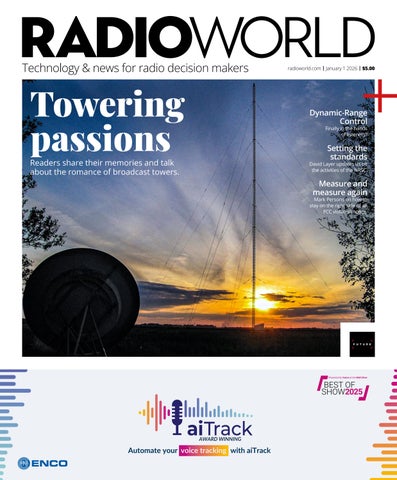
Towering passions Readers share their memories and talk about the romance of broadcast towers.
radioworld.com | January 1 2026 | $5.00
Dynamic-Range Control Finally in the hands of listeners?
Setting the standards
David Layer updates us on the activities of the NRSC.
Measure and measure again
Mark Persons on how to stay on the right side of an FCC violation notice.
Vol. 50 No. 1 | January 1 2026 www.radioworld.com FOLLOW US www.twitter.com/radioworld_news www.facebook.com/RadioWorldMagazine www.linkedin.com/company/radio-world-futureplc CONTENT Managing Director, Content & Editor in Chief Paul J. McLane, paul.mclane@futurenet.com, 845-414-6105 Assistant Editor & SmartBrief Editor Elle Kehres, elle.kehres@futurenet.com Content Producer Nick Langan, nicholas.langan@futurenet.com Technical Advisors W.C. “Cris” Alexander, Thomas R. McGinley, Doug Irwin Contributors: David Bialik, John Bisset, Edwin Bukont, James Careless, Ken Deutsch, Mark Durenberger, Charles Fitch, Donna Halper, Alan Jurison, Paul Kaminski, John Kean, Larry Langford, Mark Lapidus, Michael LeClair, Frank McCoy, Jim Peck, Mark Persons, Stephen M. Poole, James O’Neal, T. Carter Ross, John Schneider, Gregg Skall, Dan Slentz, Dennis Sloatman, Randy Stine, Tom Vernon, Jennifer Waits, Steve Walker, Chris Wygal Production Manager Nicole Schilling Senior Design Director Lisa McIntosh Senior Art Editor Will Shum ADVERTISING SALES Senior Business Director & Publisher, Radio World John Casey, john.casey@futurenet.com, 845-678-3839 Advertising EMEA Raffaella Calabrese, raffaella.calabrese@futurenet.com, +39-320-891-1938 SUBSCRIBER CUSTOMER SERVICE To subscribe, change your address, or check on your current account status, go to www.radioworld.com and click on Subscribe, email futureplc@computerfulfillment.com, call 888-266-5828, or write P.O. Box 1051, Lowell, MA 01853. LICENSING/REPRINTS/PERMISSIONS Radio World is available for licensing. Contact the Licensing team to discuss partnership opportunities. Head of Print Licensing Rachel Shaw licensing@futurenet.com MANAGEMENT SVP, MD, B2B Amanda Darman-Allen VP, Global Head of Content, B2B Carmel King MD, Content, Broadcast Tech Paul J. McLane Global Head of Sales, Future B2B Tom Sikes Managing VP of Sales, B2B Tech Adam Goldstein VP, Global Head of Strategy & Ops, B2B Allison Markert VP, Product & Marketing, B2B Andrew Buchholz Head of Production US & UK Mark Constance Head of Design, B2B Nicole Cobban
FUTURE US, INC. Future US LLC, 130 West 42nd Street, 7th Floor, New York, NY 10036 All contents ©Future US, Inc. or published under licence. All rights reserved. No part of this magazine may be used, stored, transmitted or reproduced in any way without the prior written permission of the publisher. Future Publishing Limited (company number 02008885) is registered in England and Wales. Registered office: Quay House, The Ambury, Bath BA1 1UA. All information contained in this publication is for information only and is, as far as we are aware, correct at the time of going to press. Future cannot accept any responsibility for errors or inaccuracies in such information. You are advised to contact manufacturers and retailers directly with regard to the price of products/services referred to in this publication. Apps and websites mentioned in this publication are not under our control. We are not responsible for their contents or any other changes or updates to them. This magazine is fully independent and not affiliated in any way with the companies mentioned herein. If you submit material to us, you warrant that you own the material and/ or have the necessary rights/permissions to supply the material and you automatically grant Future and its licensees a licence to publish your submission in whole or in part in any/all issues and/or editions of publications, in any format published worldwide and on associated websites, social media channels and associated products. Any material you submit is sent at your own risk and, although every care is taken, neither Future n or its employees, agents, subcontractors or licensees shall be liable for loss or damage. We assume all unsolicited material is for publication unless otherwise stated, and reserve the right to edit, amend, adapt all submissions. Radio World (ISSN 0274-8541) is published bi-weekly by Future B2B. 130 W. 42nd St, 7th Floor, NY NY 10036. Periodicals postage paid at New York, NY and at additional mailing offices. POSTMASTER: Send address changes to PO Box 1051 Lowell MA 01853. Please recycle. We are committed to only using magazine paper which is derived from responsibly managed, certified forestry and chlorine-free manufacture. The paper in this magazine was sourced and produced from sustainable managed forests, conforming to strict environmental and socioeconomic standards. The manufacturing paper mill and printer hold full FSC and PEFC certification and accreditation.
An audio revolution? John Kean explores an exciting concept
J
ohn Kean asks a question in this issue: “What if listeners could finally adjust how wide or narrow the loudness range feels — tailoring it to their environment and personal taste — instead of accepting a one-size-fits-all mix?” John is a widely respected researcher and author. In his article, he explains that the latest generation of the AAC codec family includes an option Paul for dynamic-range control of both live and recorded McLane audio. He writes that this led him to conduct live internet Editor in Chief testing and a perceptual listening trial. He’s not the only accomplished author in this edition. I asked David Layer of the National Association of Broadcasters to provide you with an update on activities of the National Radio Systems Committee. Its current topics of exploration include next-gen digital transport, digital transmitter power displays, AM boosters, AM noise and noise mitigation, and guidelines for RDS use. David also explains how the NRSC works and extends you an invitation to participate. And popular contributor Mark Persons returns in this issue. When the FCC sent a notice of violation recently to the owner of an FM transmitter in California, I asked Mark if he would look it over and share advice about how to avoid similar problems at your own station. I’m pleased to be able to bring you the work of authors like these. John Kean is a past recipient of the NAB Radio Engineering Achievement Award. David Layer received the Radio World Engineering Achievement Award. Mark Persons was honored with the Society of Broadcast Engineers Lifetime Achievement Award. And of course John Bisset of Workbench is a past SBE Educator of the Year. That’s a lot of technical smarts. We’re honored to count engineers of their caliber as members of the Radio World community.
Special letters Also in this issue you’ll find an expanded Opinion section. Our readers responded warmly to my column “I Love the Sticks” and the followup “Tall Towers, Long Memories,” in which I shared my personal feelings about radio towers and memories of early career days when I became excited just walking into a station. I certainly am not alone in having such feelings. Those letters start on page 27. And this gives me one more chance to share this super drawing by a third-grader at Glen Park School, from Nick Langan’s article about of the Sutro Tower in the Sept. 24 issue.
THIS ISSUE NEWS 3
From the Editor
4
NAB looks to advance BPS
5
DynamicRange Control: Finally in the hands of listeners
11
Future in Focus with ... William Harrison
FEATURES 12
Use ferrules to ease your work in tight spaces
16
Shape the future of radio — join the NRSC
20
Measure, measure and measure again
24
Marketplace
25
APMG Settles With FCC Over EAS Tones
26
Marketplace
OPINION 27
Readers’ Forum
On the cover
KDLM(AM), Detroit Lakes, Minn., by Mark Persons
3
Newswatch NAB Looks to Advance BPS The National Association of Broadcasters announced a “strategic realignment” to accelerate development and deployment of the Broadcast Positioning System. BPS is a public safety and national security initiative made possible by the NextGen TV ATSC 3.0 standard. The announcement came two months after the U.S. Department of Transportation awarded NAB a $744,000 contract to advance field testing. BPS is a technology invented and developed by the NAB. The system uses NextGen TV/ATSC 3.0 signals to deliver terrestrial-based timing and location services that can serve as a backup to the Global Positioning System. NAB believes BPS has the potential to protect the nation’s critical infrastructure in the event of a GPS outage, cyberattack or disruption. It is partnering with Dominion Energy for the system’s contract and field testing. NAB Executive Vice President of Technology and CTO Sam Matheny and Vice President of Advanced Technology Tariq Mondal, who have led BPS
development, will move into roles dedicated exclusively to the initiative. Matheny will serve as executive vice president of BPS and Mondal as its vice president. NAB said they will build a team focused solely on advancing BPS technology and services. “[W]e are accelerating a technology that strengthens national resilience while creating meaningful long-term opportunities for our members,” President/CEO Curtis LeGeyt said. NAB also launched an Industry Affairs and Innovation department, led by Executive Vice President April Carty-Sipp, bringing together NAB’s Industry Affairs and Technology teams under one umbrella. It said that the integration will align member services, innovation, engineering and technology expertise to help address the challenges and opportunities facing media outlets “at the intersection of business and technology.” Senior Vice President of Emerging Technology and Executive Director of PILOT John Clark has a newly created role of chief innovation officer and senior vice president of emerging technology.
A conference room at NAB headquarters. Photo by Garrett Rowland
4
Streaming for Radio
Dynamic-Range Control: Finally in the hands of listeners A new kind of listener control
F
ew people realize that xHE-AAC, the latest generation of the AAC codec family, includes an option for dynamic-range control of both live and recorded audio. As an audiophile, that discovery made me ask: What if listeners could finally adjust how wide or narrow the loudness range feels — tailoring it to their environment and personal taste — instead of accepting a one-size-fits-all mix? That led to live internet testing and a perceptual listening trial to understand how this technology behaves in practice. What happened may be the start of a revolution: dynamicrange control moving from the content producer to the listener’s fingertips.
A little background
Controlling the dynamic range of audio — the difference between soft and loud passages — has challenged sound engineers since Edison’s day. His early phonographs hissed so
Writer
John Kean Above Listening test setup at New York Public Radio in November. Dr. Ellyn Sheffield talks with a participant.
badly that he turned to quieter wax cylinders, the first of many compromises between technical limits and artistic intent. For most of the 20th century, audio engineers fought those limits. Compressors, limiters and automatic gain circuits were used to keep recording and broadcast levels consistent. Now that digital audio has arrived, noise and headroom are no longer the problem. Today’s delivery chains can preserve the full dynamic range of a symphony hall, yet many people hear that music on phones, smart speakers or in cars, where the equipment or background noise masks quiet detail. The problem flipped: The medium can deliver more than listeners can comfortably use.
From loudness wars to loudness standards
That drive to control audio also triggered “loudness wars” and uneven loudness and the search for measurement standards. In 2006 the International Telecommunication Union issued ITU-R BS.1770, defining a reliable method of
radioworld.com | January 1 2026
5
Streaming for Radio Right Here’s the 7,000mile round trip from WETA and NYPR to Qbit in Germany, where the unprocessed audio was encoded into xHE-AAC and streamed on the internet, and then back to my home, where the stream was decoded on a Lenovo tablet and converted to audio with a USB-to-audio dongle. This audio was recorded on a TASCAM DR-60D as WAV files used in the listening tests. The internet streams were also decoded on Android devices and Chrome browsers for critical listening quality tests.
6 measuring perceived loudness. Suddenly engineers could quantify what once was subjective. The Audio Engineering Society followed with Technical Document TD1008 in 2021 (now standard AES 77-2023). It recommends loudness “targets” for different media types — speech, music and album vs. track normalization — so that content from different sources play back at consistent levels. As editor of TD1008, I remember that the committee saw normalization as only an interim, sending stage. An unsolved problem, we wrote, was “content with wide dynamic range.” Classical music, film scores and acoustic jazz simply didn’t fit a target model, and compressing them risks destroying their expressive quality.
The unfinished work: Listener-side control
When the committee drafted TD1008, MPEG DRC was an obscure, file-based feature within xHE-AAC, and real-time DRC capabilities did not exist for streaming services. Because widespread adoption looked remote, the committee understood that loudness normalization still had to be handled before distribution. Consequently, we acknowledged that this document was an “interim” solution. TD1008 serves as a bridge to a time when listeners will finally have the option to hear music exactly as the artists and producers intended. That meant shifting the dynamic-range control (DRC) from the producer to the listener. Rather than baking compression into audio for all, codecs in future devices
TD1008 foresaw ‘consumer hardware and software upgrades’ that would make dynamicrange metadata practical. Four years later, those upgrades are possible. radioworld.com | January 1 2026
Backi n
BL ACK Hi ghendf eat ur esatal owendpr i ce Br i dgeI TI IandBr i dgeI TXTRAI Icodecsar ei dealf orhomeandvoi ce overst udi os,si mpl er emot es,STLs,andi nt er st udi ol i nks.Wi t habui l t i n mi cpr eampandcust omi zabl eonscr eenheadphonemi x,r emot eshave neverbeensi mpl er .Pl us,youget :
ST20227
•Suppor tf orf ul l dupl exst er eoor2monoconnect i ons,mul t i cast i ng andmul t i uni cast i ng,pl uscel l ul arconnect i ons •Mul t i pl eEt her netandAoI Ppor t sandsi mpl ef r ontpanelor webGUIconf i gur at i on •Nat i vesuppor tf orLi vewi r e+,RAVENNA,AES67,ST211030, ST20227( XTRA) ,NMOS I S04andI S05andSI P •Fai l overt oanot herconnect i on,HTTPst r eam,orf i l epl ayback Expandt hepowerofyournet wor kwi t hBr i dgeI TI IandBr i dgeI TXTRAI I
ORDER NOW !
Web:www. t i el i ne. com Amer i cas:+13178458000|I nt er nat i onal :+61894132000
Streaming for Radio
Above Simple diagram of the xHE-AAC encoding and decoding stages, showing the elements that are unique to xHEAAC’s MPEG DRC with heavier black lines.
8
would read standardized metadata and decide — at playout — how much to compress or expand. The same recording could sound natural in a quiet living room and intelligible in rush-hour traffic.
Enter xHE-AAC: Codec with built-in loudness and DRC
That codec is here. xHE-AAC (Extended High-Efficiency AAC), developed by Fraunhofer IIS and standardized by ISO/IEC 23003-3, is already in most major streaming services, smartphones, car infotainment systems and even internet browsers. (xHE-AAC is a registered trademark of Fraunhofer in Germany, the United States and other countries.) xHE-AAC players are compatible with older AAC versions (although its newer encoding and metadata are not playable on older generation decoders). Inside each xHE-AAC stream are two key data blocks: • Loudness Info — objective measurements of program loudness using the ITU BS.1770 algorithm. • DRC Metadata — a compact set of gain controls that a decoder applies dynamically. Together, they let the playback devices manage loudness across programs and adapt the dynamic range to the listener’s context — all without altering the source content. Smartphones could automatically tighten dynamics, going from headphones to the tiny speaker. A connected car system can apply a tighter DRC profile. In the quiet at home, a hi-fi system can play the original digital content with full range for critical listening. Each listener — or device — makes their own choice.
How the metadata works
xHE-AAC defines several DRC “presets” ranging from light to heavy control. The encoder stores them inside the audio, and the decoder carries out the loudness management. Because encoding sends the original audio to everyone, quality is maintained (xHE-AAC is more efficient than HE-AAC). The original waveform remains intact, only the playback gain envelope changes
according to the encoder’s direction. For producers, this means one well-mastered file can satisfy all streaming or podcast listeners. This mechanism fulfills exactly what TD1008 anticipated. The document foresaw “consumer hardware and software upgrades” that would make dynamic-range metadata practical. Four years later, those upgrades are possible. xHE-AAC’s implementation aligns with CTA-2075 and could support the loudness standards cited by TD1008. This would help loudness matching between content sources, such as different streams and podcasts.
Live real-time testing
I am honored to work with a small group of volunteers from classical public radio stations WQXR/New York Public Radio, WETA-FM in Washington, and Qbit GmbH and Fraunhofer IIS, both based in Germany. Live digital audio from the stations’ control rooms were sent in full dynamic range via LPCM to Qbit, which encoded a total of four program sources in xHE-AAC audio on a nearly 7,000-mile round trip on the internet. The streams ran continuously for most of 2025. An Android player app decoded the xHE-AAC and provided controls for selecting DRC modes. As an audiophile I was thrilled with the sound, both in pristine form and with the coder’s well-designed DRC. I found that in my old SUV, the DRC allowed me to enjoy every moment of the classical music and no “reaching for the volume control.” An added benefit is that popular music, which seldom needs DRC because it is carefully mixed and processed, is reproduced faithfully and sounds as intended by the artists and producers.
What do listeners think?
On Nov. 10 we completed a pilot test at New York Public Radio with a group of listeners. The listener sat in front of a pair of Genelec 1030 monitor speakers, surrounded by four of the same speakers (on the floor) playing road noise recorded at 60 mph in a Lincoln Corsair PHEV on I-66 in Virginia and
radioworld.com | January 1 2026
Streaming for Radio Right Thomas Edison with his deluxe home cylinder player, taken in his New Jersey offices in 1908.
10 National Park Service
Learn More
This article is from the ebook “Streaming Best Practices.” Access it at radioworld. com/ebooks.
NYPR’s Mercedes-Benz Sprinter van on the New York City parkway along the Hudson River. Classical music was selected with varying loudness (drops of >15 LU from loud parts). The road noise at times masked the music, depending on depth of the drops and the noise levels. The results are being processed now, but data indicate that listeners favor DRC over the same music without DRC under certain circumstances. In both noise environments, participants stated that it was easier to hear notes and more enjoyable, compared to the original recordings. Some discriminating listeners (recording engineers or musicians) commented on the excellent quality of the DRC. This was only a pilot, and more extensive testing should be done with a large group of listeners to evaluate the benefits of DRC in a range of conditions, such as earphones, smart phones and smart speakers, as well as popular music.
Looking ahead
The AES Technical Council continues to monitor these advances and plans
to revisit TD1008/AES 77 in connection with xHE-AAC. Android and iOS systems and Chromium-based browsers already decode xHE-AAC, so bringing out controls for DRC metadata should be a reasonable step. It took 140 years to move from Edison’s wax cylinders — plagued by noise and limited range — to a codec that can intelligently shape dynamics for each listener in real time. After more than a century of technology controlling dynamics for the listener, the balance has shifted. DynamicRange Control is now literally in the listener’s hands — or more precisely, in their devices. Many, many thanks go to Dr. Ellyn Sheffield for designing and conducting the perceptual testing, Steve Shultis of New York Public Radio and William Harrison of WETA-FM, Jan and Michael Bläsi of Qbit for encoding and live streaming, and members of Fraunhofer for participating and helping with technical assistance. The author is a member of Cavell Mertz & Associates (now Capitol Airspace Group) and recipient of engineering awards from the National Association of Broadcasters and Association of Public Radio Engineers. A former radio chief, he also consulted with Jules Cohen & Associates and Moffet Larson & Johnson. He helped launch NPR Labs and was senior technologist at NPR at retirement.
radioworld.com | January 1 2026
Newsmaker
The year ahead with … William Harrison The chief engineer of WETA looks into his crystal ball
I
n a series of Q&As on the Radio World website, we’ve asked industry thought leaders, executives and engineers to comment about the year ahead. William Harrison is chief engineer for WETA-FM in Arlington, Va., near Washington, D.C. This is an excerpt.
What technology trend do you think is going to have the greatest impact? William Harrison: I think that 2026 is truly going to be the year of AI. Broadcasters are already experimenting with it to make programming choices, and I’ve seen some AI DJs now, but these are just a few of the use cases I can envision. And while somewhat scary, there are others that could potentially be beneficial to both stations and talent. Let’s say, for example, that an on-air host takes the time to train an AI model of their own voice. While I don’t think a lot of hosts would be too crazy about the possibility of someone else putting words into their voice, it could just as easily be used in cases where the host is sick and cannot use their voice. The host could type in what they want to say, and have AI convert that into audio in their own voice — a simple, easy way to simultaneously have laryngitis and still be able to do your show. There are ethical and legal issues to work out, but it’s just a matter of time. Any new disruptive technology causes both excitement and terror, and while there are a lot of things we can do, we still need to ask if we should do them.
11
How will our industry be different in 10 years? Harrison: Obviously it’s hard to gaze into the crystal ball and see the future, but there are some things I feel pretty confident about. I think we’ll end up with fewer stations overall, both AM and FM. Broadcasting is an expensive business, and some are going to fold. We’ll probably end up with fewer manufacturers as well. Be it through higher tariffs, less specialization or just people
retiring, it’s easy to see some consolidation of the number of companies actually making broadcast gear, from antennas and transmission lines to audio systems. The average age of an engineer will continue to rise — as an industry we haven’t done very well attracting new, younger talent to train and take our place. I see a lot of discussion about this and how to attract them, but I still haven’t seen many positive results. We’ll always get some folks who do it for the love of broadcasting, but it’s hard to compete with “9 to 5, work from home, your weekends are your own” careers. I think that as ATSC3.0 becomes more readily available, more radio stations will end up putting audio-only channels up in that spectrum. Consumption of media via alternate methods (video streaming as opposed to over-the-air TV) is already very popular, so it’s a natural fit. And speaking of streaming, I expect to see a lot more radio streams made available on video streaming platforms like Roku. The average household has a lot more TVs in it than radios at this point, and I can’t tell you how many people I know who think nothing of turning on the TV for background noise, but never think to turn on a radio. Do you receive Radio World’s daily SmartBrief newsletter? It’s free with email signup. Click the Subscribe option at radioworld.com.
radioworld.com | January 1 2026
Workbench
John Bisset CPBE The author is in his 35th year of writing Workbench. He handles western U.S. radio sales for the Telos Alliance and is a past recipient of the SBE’s Educator of the Year Award.
Send your tips
12
Workbench submissions are encouraged and qualify for SBE recertification credit. Email johnpbisset@ gmail.com.
Use ferrules to ease your work in tight spaces Also, NATE publishes safety documents about smoke and animal poop
Y
Above Working in cramped spaces with short wires can be frustrating. Right These ferrules may help you navigate close quarters.
ou may remember that a couple of years ago, Roy Becker of Bible Broadcasting Network told us about using ferrules for making wiring connections on modules. Ed Bukont of systems integration firm E2 Technical Service expands on that idea. He says you have probably used butt splices to join two wires. However, when the wires are too short or if you can’t fit a crimping tool into your workspace, ferrules can help. They do a great job in splicing wires together and they come in a variety of sizes.
Warming food
After getting my driver’s license at age 16, I mapped out and visited every radio station in the D.C. metro. I remember
seeing a grate that someone had installed above the 4-400 transmitter tubes in an old 1 kW AM transmitter; it was used to keep food warm! Cheese and grease ran down the sides of the tubes from the grate, showing that this “warming oven” got a lot of use. It didn’t occur to me until I took an electronics course in college that those tubes had at least 2,000 volts on them. The jocks were regularly reaching in to place wrapped burgers and fries atop the grate, to keep them warm! Frequent contributor Dan Slentz offers a better, safer idea: The next time you get to the transmitter site, the food is cold and there’s no microwave, Dan suggests grabbing your heat-shrink gun! Voilà, hot food again. Just be sure the gun isn’t lined with asbestos.
radioworld.com | January 1 2026
Workbench Right NATE offers this resource about handling, cleanup and prevention of exposure to bird droppings, rodent waste and contaminants from roaches and other insects. Below The eppfun AK3056R Pro Bluetooth receiver.
Safety docs
The organization called the National Association of Tower Erectors changed its name six years ago but retains the acronym. It is now NATE: The Communications Infrastructure Contractors Association, a non-profit group that aims to provide a unified voice for the tower and communications industry. NATE recently released two new safety documents that may be of interest to those of us who work around tower sites. These have to do with smoke and poop. The Wildfire Smoke Protection Chapter is part of the NATE Safety & Health Manual Online Resource Library, which is free to members and available for purchase to others. And the NATE Biological and Animal Excrement Awareness Guideline is available for free for all to download. Radio World’s Nick Langan pulled out some of the tips on our website; read his post at https://tinyurl.com/rw-nate. And NATE offers a lot of other great material. Explore those assets at https://natehome.com/resource.
Small-engine tips
Frank Hertel of Hertel Engineering watched a YouTube video by the offbeat host of “Taryl Fixes All” in which the host discusses problems involving small engines. He
14
reviewed a product that stabilizes fuel and rejuvenates old or stale fuel. Perhaps you have a lawn mower or generator that has untreated fuel in the tank and the engine doesn’t run well, if at all. The stabilizer may be worth considering. Frank was convinced by the video and ordered some. The product is made by Power Research Inc. It is sold by Amazon, Home Depot and other online retailers. Search “PRI-G” and scroll through the options.
Quick phone interface
PHOTO: Amazon
Michael Baldauf offers a quick, inexpensive way to set up an interface for remote broadcasts so the talent can use a cell phone. At the station, connect the receiving cell phone to a Bluetooth receiver and then to an input on the control board. Michael used an eppfun brand Bluetooth 5.2 receiver purchased for $10 from Amazon. There are many similar products available with a range of prices. (Note that some console models now have Bluetooth capability built in.) Initially, the output level of the Bluetooth adapter was too low for the board. You can boost the gain with a preamplifier; Michael used a Radio Design Labs RDL ST SH2 Headphone amplifier. The Bluetooth pairing is easy. Remember to mute the phone if there is noise in the studio. Also keep a phone charger at hand especially for longer broadcasts. Install one of these in your production room to record calls.
radioworld.com | January 1 2026
Technical Standards Writer
David Layer Vice President, Advanced Engineering, National Association of Broadcasters
Shape the future of radio — join the National Radio Systems Committee David Layer presents an invitation and provides an update on its activities
B
16
Above Members gathered in Las Vegas at the 2025 NAB Show to attend NRSC Subcommittee meetings. Subcommittee meetings are also held during the annual CES (January) and NAB Show NY (October) events.
roadcast radio technology is evolving rapidly in response to listener preferences and increasingly capable digital infrastructures. If you are involved in the design and operation of broadcast facilities or radio receivers, or simply interested in the future of radio, you should consider becoming a member of the National Radio Systems Committee. It’s an opportunity to enhance your level of understanding of modern radio systems while collaborating with industry experts to develop technical standards, guidelines and reports that benefit the industry as a whole.
What is the NRSC?
The NRSC is co-sponsored by the National Association of Broadcasters and Consumer Technology Association and was formed in the late 1970s to address technical issues with AM radio existing at that time. Standards, guidelines and reports developed by the NRSC are available for free at nrscstandards.org. Participation in the NRSC is free for NAB broadcaster members and for members of CTA, while others pay a $25 fee per subcommittee per year. Currently, the NRSC has three subcommittees and three working groups pursuing technical work. Each group is chaired by an NRSC member
representative or representatives as shown in the graphic on page 18. These groups cover the full range of technologies used by broadcasters today, addressing both analog and digital signal generation. The NRSC develops three kinds of documents: • NRSC Standards — Documents that establish engineering and technical requirements for processes, procedures, practices or methods that have been adopted by consensus. An NRSC standard is normative in nature, however usage of NRSC standards is voluntary. There are four active NRSC standards, shown in the first table on page 17. • NRSC Guidelines — Documents that state specifications or criteria within terrestrial radio broadcast systems that are not strictly necessary for effective implementation and interoperability, but that the NRSC has determined to be advisable and may improve the efficiency of implementation or reduce the probability of implementation errors. An NRSC Guideline is informative, not normative, in nature. There are 10 active NRSC Guidelines, shown in the second table. • NRSC Reports — A document that describes the results of technical work, including technology surveys and evaluations, which are of benefit to the radio broadcast industry. Many NRSC reports are not authored by the
radioworld.com | January 1 2026
Technical Standards Active NRSC Standards Standard NRSC-1-C 2024
Title NRSC AM Preemphasis/deemphasis and Broadcast Audio Transmission Bandwidth Specifications
Originally Adopted
Comments
1989
Incorporated into the FCC rules in 1989 as a part of the First Report and Order to FCC, Mass Media Docket No. 88-376
NRSC-2-C 2024
Emission Limitation for Analog AM Broadcast Transmission
IEC-62106-9
Radio data system (RDS) – VHF/FM sound broadcasting in the frequency range from 64.0 MHz to 108.0 MHz – Part 9: RBDS – RDS variant used in North America
1993
Originally the RBDS Standard; unified with European RDS Standard in 2021
NRSC-5-E
In-band / on-channel (IBOC) Digital Radio Broadcasting Standard
2005
Referenced in the FCC rules that define digital radio broadcasting in the US
NRSC but rather serve to archive important technical works on radio broadcast technology. NRSC reports may be either strictly informational or may include recommendations for further action, including development of NRSC standards or guidelines. There are currently 39 NRSC reports, including nine on AM radio, 10 on FM radio and 19 dealing with digital radio.
Why join the NRSC?
Professional Development: Stay at the forefront of broadcast technology. Members gain deep understanding of emerging systems and technologies before they become mainstream. Early Access: Participate in developing standards and guidelines while they’re being formulated, giving you advance insight into future technical requirements and best practices.
Current projects making an impact
Whether you’re designing broadcast facilities, involved in receiver design, managing technical operations or simply passionate about radio technology, NRSC membership offers tangible benefits: Direct Industry Impact: Help shape the technical standards that define how radio broadcasting operates. Your expertise contributes to documents that broadcasters nationwide rely on. Expert Collaboration: Work alongside leading engineers, equipment manufacturers and technical experts. NRSC working groups provide a forum for solving complex technical challenges through collective knowledge.
Here are some key projects being pursued by the NRSC. Most of this activity takes place within the working groups, which hold monthly or semi-monthly meetings via Zoom, while the subcommittees typically hold face-to-face meetings at NAB and CTA trade show events. • “Next-gen” digital transport — An open standard for transport of audio and data over IP networks is being considered by the ISDWG. This would involve defining profiles for sending an analog multiplex (MPX) signal (also referred to as the “FM baseband”) over
Active NRSC Guidelines Guideline
Title
Originally Adopted
Comments
NRSC-G100-B-2024
Bandwidth Options for Analog AM Broadcasters
2007
Discusses advantages of reduced bandwidth
NRSC-G101-A-2024
AM Modulation-Dependent Carrier Level (MDCL) Usage Guideline
2013
Power-saving techniques for AM broadcasters
NRSC-G102
AM Carrier Synchronization Guideline
2023
How to synchronize AM carriers to reduce interference
NRSC-G201-B-2024
NRSC-5 RF Mask Compliance: Measurement Methods and Practice
2009
Describes the HD Radio digital radio system
NRSC-G202-B
FM IBOC Total Digital Sideband Power for Various Configurations
2010
Contains numerous tables of digital power for symmetric and asymmetric signals
NRSC-G203-A
NRSC IBOC Time and Level Alignment Guideline
2017
Focuses on analog-to-digital blending of main audio service
NRSC-G300-C
RDS Usage Guideline
2012
Comprehensive review of RDS technology
NRSC-G302
Harmonization of Radio Metadata Across Transports Guideline
2020
Discusses various metadata delivery technologies
NRSC-G303
Best Practices for Delivering Emergency Alerts and Information for FM Radio Broadcasters
2022
Technical information on EAS and relevant FCC rules
NRSC-G304
Metadata for Streaming Audio Handbook
2023
First streaming audio guideline published by the NRSC
radioworld.com | January 1 2026
17
Technical Standards Right NRSC Subcommittees and Working Groups active in 2025.
Right Sample NRSC documents.
18
DCP (a forward error correction-protected, transport layer digital communications protocol) so that it can align with and be linked to the digital audio simulcast delivered via another DCP stream, eliminating timing issues associated with the HD Radio “blend to analog” feature. • Digital transmitter power displays — A new NRSC guideline, NRSC-G204, “IBOC Digital Radio Transmitter Power Display Guideline,” is being developed to provide guidance to FM-band transmitter manufacturers on the preferred methods of calculating digital transmitter power (particularly when using asymmetric sidebands) and displaying upper and lower sideband power within the transmitter user interface. Currently, manufacturers utilize a number of different approaches, which causes confusion (and the potential for FCC rule violations) among broadcasters. • AM boosters — The AIWG has initiated an AM booster project to study coverage and interference issues and to design and test a prototype low-cost AM booster facility. These boosters offer AM broadcasters an opportunity to improve service to listeners, especially in today’s urban environments, which are subject to high levels of RF interference in the AM band. • AM noise and noise mitigation — Earlier this year, a new report on RF noise and reception in the AM
radio band was adopted by the AFAB Subcommittee. NRSC-R102, “Measurement of AM Band RF Noise Levels and Station Signal Attenuation,” documents measurements of RF noise and AM signal levels on various roadway types from open interstate highways to city streets, establishing how the noise affects AM broadcast reception. Audio recordings collected during this effort are now available for review as well. A related effort to develop practical AM receiver improvements using tools available in software-defined radios (SDRs) is also underway. • RDS usage guideline — The MSWG is preparing an update to NRSC-G300, “RDS Usage Guideline,” last updated in 2018. This is one of the NRSC’s most comprehensive guideline documents and provides valuable, practical information to broadcast engineers about how the Radio Data System (RDS) digital FM subcarrier works and how to make the best use of this technology.
Getting involved
The NRSC Subcommittees will meet on Jan. 6, 2026, in Room W222 of the Las Vegas Convention Center in Las Vegas, Nevada, in conjunction with the 2026 CES. These meetings provide excellent opportunities for new members to observe working group dynamics and meet fellow technical professionals. For more information about NRSC membership and upcoming meetings, or to access the complete library of standards, guidelines and reports, visit nrscstandards.org/. Radio broadcasting’s technical landscape is evolving rapidly. Whether you’re addressing AM interference challenges, implementing digital broadcasting systems or exploring next-generation transport technologies, the NRSC provides the collaborative framework and technical expertise to move the industry forward. Your participation matters. Join us in shaping radio’s future.
radioworld.com | January 1 2026
Tech Tips
Writer
20
Mark Persons CPBE, CBNT, AMD The author wrote here recently about the rebirth of radio station WELY(AM).
Measure, measure and measure again
narvo vexar/Getty Images
We live in an RF-rich environment where unintentional signals are created and must be dealt with
W
hen I was on the road servicing stations, I kept an RF spectrum analyzer in my truck. I used it frequently to measure station performance and to verify that all RF output was within licensed parameters. I discussed this in my article “How an RF Spectrum Analyzer Can Help You” in the Nov. 5 issue. But I am prompted to expand this discussion after seeing that the FCC recently issued a notice of violation to the owner of an FM transmitter in California. Per the notice, FCC Rule 73.317 (d) states: “Any emission appearing on a frequency removed from the carrier by more than 600 kHz must be attenuated by at least 43 + 10 Log10 (Power, in watts) dB below the level of the unmodulated carrier, or 80 dB, whichever is the lesser attenuation.” The station in question apparently had violated the rules. The owner was told to make it right at the site and with the FCC. I suspect some translators of AM stations and LPFMs have never
been measured and are in violation of FCC rules. Every licensee is responsible for keeping equipment in compliance. Remember, violations look bad on a station’s record at renewal time. There are often legal fees too. This particular notice was published just when we thought the FCC wasn’t out there checking very much.
When to measure?
You should measure when you: • Turn on a new station • Replace a transmitter • Install an auxiliary transmitter • Turn on a translator for an AM station • Add something as innocent as an RDS subcarrier • Replace audio processing Basically, measure whenever you make a change that might affect the RF bandwidth of the station. FCC rules haven’t changed in this respect — they are intended to protect ALL licensed users of the RF spectrum. Documentation reports are required to be kept for
radioworld.com | January 1 2026
Tech Tips
two years. I recommend you keep the latest report on hand, even if it is older. The report is a benchmark for the future.
FM
Normally we think of the piece of radio spectrum for which a station is licensed. With +/– 75 kHz of FM modulation, each station is allotted 200 kHz of bandwidth. Allowed emissions decrease farther out from the assigned frequency. Yes, a new transmitter will have been checked at the factory and found to be compliant with FCC rules, but that doesn’t mean it will play well in an RF environment. The most common problem is when a signal from a nearby transmitter comes into a transmit antenna and mixes in the transmitter’s power amplifier. This is when we find mathematical sum and difference products that don’t make specs. Example: A new transmitter is on 95.1 MHz while a nearby transmitter is on 94.1. They mix in the new transmitter and out comes an unwanted signal on 96.1 MHz. Oops! An RF filter in the antenna line will be required here to knock down the incoming 94.1 so the mix product on 96.1 is less. Assuming that filter is of the bandpass type, it will further attenuate the unwanted 96.1 MHz. A filter will likely be required at the 94.1 station too. Mixing of signals is inevitable; it is a matter of how much. The goal is to keep unwanted radiation sufficiently low so as to comply with the rules. The FCC requires better in some special cases. I once had to prove that an FM station was RF clean into the aviation band (118 to 137 MHz). The mandate was to keep any radiation at or more than 88 dB below the station’s carrier in its 10 kW transmitter. The normal requirement is 80 dB. That extra 8 dB or more was difficult to measure, but I got it done so the station could go on the air.
There was an occasion when a 5 kW FM transmitter was being installed on a site that had three 20 kW transmitters. I knew there would be RF mixing products, but how much? I connected a spectrum analyzer to an RF sample element in a section of the transmission line to the antenna. Holding my breath, I turned the 5 kW transmitter on and let the analyzer display all of the signals in the FM band. Then I turned the transmitter off and did the measurement again. The difference between the two displays was dramatic, with many unwanted signals generated in the 5 kW transmitter from all the other signals. That gave me enough data to determine what type of filter was required to put the station in compliance. For perspective, sum and difference RF mixing products are limited only by the bandwidth of the RF output network in the transmitter and the antenna. Solid-state transmitters are more susceptible than tube transmitters because their output networks are more broadband. I have seen where replacing a tube transmitter with solid-state required a new RF filter. RF harmonics, as you may know, are mathematical multiples of a station’s operating frequency. For FM, that means measurements for compliance up to 1 GHz. This is not normally a problem. However, one manufacturer ran into this and used tiles in transmitter power amplifier cavities to absorb unwanted frequencies. The military band ranges from 225 to 400 MHz. You don’t want to cause problems there! I remember an instance where a 5 kW FM Collins transmitter passed all of the FCC-required measurements. But a cellular company called shortly after it went on the air to say they were getting unwanted signals in the 800 MHz cellular bands. Investigation showed the signal to the antenna was clean but there was unwanted radiation coming from
radioworld.com | January 1 2026
Above Fig. 1, left, shows WJON before filtering, and Fig. 2 is after filtering.
21
Tech Tips the transmitter itself — it was “cabinet radiation”! Copper hardware cloth over the air intake and exhaust ports helped but did not cure the problem. Finally, I was able to tune the transmitter in such a way that minimized the unwanted signal. I left instructions describing how to tune the transmitter for best results, with only a 1% loss in PA efficiency. Let’s say your transmitter VSWR meter shows high reflected power when everything else looks and sounds normal. This could be caused by a spur created in the RF exciter. Unwanted signals might be 200 to 600 kHz or more from the station’s frequency. It usually comes down to a failed capacitor or two in the exciter. At that point, the station’s signal is likely not in compliance with FCC rules. Below These 950 MHz STL transmit dishes are too close to one another.
AM NRSC
It was back in the early 1980s when annual AM proof of performance measurements went from audio frequency response and distortion measurements to RF occupied
bandwidth measurements. Spectrum analyzers were becoming more affordable and yielded a much better look at transmitted signals. We are careful to look at the +/– 10 kHz spectrum of AM stations and also what goes out 100 kHz in each direction. When I was doing an annual NRSC measurement at 1240 kHz WJON Radio in St. Cloud, Minn., I detected a new signal at 1300 kHz. It was a mix product between WJON and the newly constructed 50 kW KYES on 1180 kHz. The unwanted 1300 mix was above the FCC mask limit and had to be dealt with. The solution was to design and install a filter to notch 1180 kHz. That reduced the amount of 1180 kHz getting into the WJON transmitter and thus there was less mix product to be retransmitted. Figs. 1 and 2 on page 21 show the before and after. Yes, WQPM, 1300 kHz in Princeton, Minn., only 30 miles away was being interfered with until the filter was installed. The interference was heard as a mix of audio from WJON and KYES. Delta Electronics, manufacturer of TCA RF ammeters, offers the SM-1 AM Splatter Monitor, which can be used in place of a spectrum analyzer when doing NRSC compliance measurements.
STL 22
Studio-transmitter links can get into trouble too. Mounting two STL transmit antennas close together can create a situation where there is cross-coupling of the two signals. Multiple 950 MHz signals can and will mix in the output amplifiers of STL transmitters. Mix products can interfere with other local STL systems. I like to mount STL transmit antennas a minimum of 10 feet apart to avoid this problem. The dishes in Fig. 3 were installed by a “professional” tower crew but with no engineer overseeing the project.
Diligence
As I mentioned, annual measurements are required on AM stations. FM stations don’t face that requirement but are just as susceptible to problems, if not more so. Don’t walk away after a successful set of measurements and think you are done. When you learn that a nearby station has signed on or made a change, grab a spectrum analyzer and check again. You might find RF mixing products that don’t make FCC specs. We live in an RF-rich environment where unintentional signals are created and must be dealt with. It is good engineering practice to check whenever there is a question. Mark Persons, WØMH, is an SBE Certified Professional Broadcast Engineer. Now retired, he still mentors five radio broadcast engineers. He and his wife Paula were inducted into the Minnesota Broadcasters Hall of Fame after 60 years of broadcast engineering and 44 years in business. Their website is www.mwpersons.com.
radioworld.com | January 1 2026
Marketplace AAT Offers VNA Module
24
American Amplifier Technologies has released a vector network analysis module. The EmPower Controller VNA brings automated feedline and antenna evaluation to the company’s remotecontrol suite. “The system allows engineers to assess transmission performance in real time, without interrupting on-air operations,” AAT said. The VNA module is designed for the broadcast and RF communications industries, measuring both time- and frequency-domain characteristics. AAT said this gives engineers complementary perspectives on the same signal path, which can help identify where changes occur along the feedline and how they affect overall system performance across the band. Using stored references and continuous monitoring, the EmPower Controller VNA identifies variances in antenna or feedline behavior, alerting engineers before the variance results in an outage or degraded signal quality, AAT said. Through AAT’s EmPower Mobile App, users can access visual overlays, automated comparisons and historical trends. The VNA works alongside AAT’s RF power monitoring, control modules and cloud-based analytics.
AAT is the parent of Shively Labs and Kathrein-Scala. It makes FM, VHF and UHF antennas, filters, combiners, coax and rigid line components. Info: www.americanamptech.com
Digital Alert Systems Adds DC Supply Option Digital Alert Systems says demand for DC-powered emergency alerting infrastructure has increased, so it now offers a DC power supply option for its DASDEC-III system. The DAS3-DC-PS supports an input range of –36V to –72V, making it suitable for standard –48VDC facilities. “By eliminating the need for multiple AC-to-DC converters, the new option reduces heat generation, improves operational efficiency and simplifies backup power integration using direct battery banks,” it said.
The supply replaces the standard AC power supply and connects via a two-lug terminal strip. “Operating at 48V DC — below the 50V threshold recognized by safety regulations — the DAS3-DC-PS reduces the risk of electric shock and allows for the use of lower-voltage cabling, simplifying installation and maintenance,” DAS stated. “The negative polarity of –48V DC helps prevent corrosion of copper cables and battery terminals, while its compatibility with telecom standards ensures seamless integration with other equipment.” It said facilities can use standard 12V leadacid batteries wired in series to create a 48V backup power source, enabling uninterrupted operation during power failures without the need for inverters or AC-to-DC conversion. Retail price is $450. The supply can be fitted into new DASDEC-III units at the factory or retrofitted to units sent to the company.
Info: www.digitalalertsystems.com
radioworld.com | January 1 2026
Newswatch APMG Settles With FCC Over EAS Tones A program that aired on more than 500 U.S. noncom stations in 2023 contained Emergency Alert System tones in the absence of a real emergency. American Public Media Group, distributor of the program, agreed to a consent decree with the Enforcement Bureau in December. APMG, parent of American Public Media, will make a “voluntary contribution” of $86,400 to the Treasury Department as a result of the transmission of tones during a “BBC Witness History” program about tornado chasing. “Unauthorized use of the EAS tones thus presents a substantial threat to public safety,” the FCC stated. Minnesota Public Radio and Southern California Public Radio are subsidiaries to APMG, which includes 46 full-power noncom stations in Minnesota, South Dakota, Iowa, Idaho, Michigan and California. All MPR and SCPR stations aired the episode, as did approximately 500 other stations that have distribution agreements with APM. The program “Chasing the World’s Biggest Tornado” centered on an EF-3 tornado that struck El Reno, Okla., in 2013, the widest tornado ever recorded. The rules apply to any part of the message used to activate an emergency alert. That includes the preamble and EAS header
Post-storm damage in El Reno, Okla., in 2013. Joe Raedle/ Getty Images
codes, the audio attention signal, the actual message and end-ofmessage codes. The bureau noted that use of tones for non-authorized purposes can lead to alert fatigue and false activations. APMG must develop a compliance plan, put written procedures in place and file updates with the FCC over the next two years.
25
Marketplace BDI Releases Passive Switchers Broadcast Devices Inc. released two passive audio switchers as part of its RAS-200 series. The RAS-208 eight-channel stereo switcher and the RAS216 16-channel monaural switcher (shown) are suitable for radio and TV station environments. The switchers use relay-based passive signal paths that result in audio integrity supporting analog, AES3 digital and control signals. The manufacturer said they are suitable for Emergency Alert System switching, with RS-232 command set support for Sage Digital ENDEC and Digital Alert Systems DASDEC EAS systems. The switchers can also be used for console input manipulation in radio studios and remote source selection for syndicated
programming. For TV interests, the switchers are suitable for satellite feed management and automation switching in master control studios. They come with redundant power supplies, channel naming via Windows-based software and remote-control interfaces, via GPIO, RS-232/485 and LAN SNMP v2. Info: https://broadcast-devices.com
26
What are you waiting for? Get your message across with an ad in radio’s industry leading publication.
For more information contact John Casey at1-845-678-3839 or email john.casey@futurenet.com
radioworld.com | January 1 2026
RWM_Class_House1_Jul23.indd 1
8/29/23 6:00 PM
Readers’ Forum
The comfort of those flashing red beacons
I was blown away by the beauty of those red lights on the towers, with the top beacons blinking. I thought it was just plain beautiful. Years later I would work at WRCH. Sometimes I’d open the back door and stare at them for a while. I would think: Imagine ... my voice is traveling through those towers. Wow. FM towers are fine and dandy; but to me, they don’t have the same magical and beautiful image that AM towers have.
Our readers have strong emotional ties to their tower memories In response to Paul McLane’s recent columns about his memories of towers and to Nick Langan’s cover story about Sutro Tower, readers share recollections. Here’s a sampler.
Larry Kratka WTBR-FM Pittsfield, Mass.
Just look in the mirror As a teenager in my first job doing overnights at WADB(FM) 95.9 licensed to Point Pleasant, N.J., I enjoyed checking the lights on the 155-foot self-supporting Union Steel monopole. The station was in a converted garage apartment, and to ensure that the tower lights were flashing, you had to look out of a window next to the transmitter toward a bus mirror that had been mounted on the wall, to see around the roof overhang. When I designed the replacement station down the street, currently home to WRAT, I included a skylight, so the bus mirror is history! Ken Peach Former owner and station manager
Not her bag
Telefarm Towers, Shoreview, Minn., by Mark Persons
Paul, thoroughly enjoyed your piece on the love of sticks! Having visited WDEL/WSTW myself several times (after you had departed), I can see that four-tower DA array in my mind’s eye like it was yesterday. I too tell my wife about towers as we drive by. She could care less after 52 years on our way to forever together. Tom McGinley Montana Public Radio and Television Missoula, Mont.
Just plain beautiful Hi Paul. I read your article about your “love for sticks” and I was compelled to tell you about MY love for those beautiful AM towers. It began back around 1960 in my hometown of New Britain, Conn. My folks used to visit family on the outskirts of town; and on one trip, I was captivated by five blinking AM towers off in the distance. They were the directional array of 910 WHAY(AM), later WRCH and today WLAT.
Don’t look down Paul your “Tall Towers, Long Memories” articles tugged at my long memory in the engineering business. In 1980 I was hired to build a 5 MW UHF subscription TV station in Dallas. We installed the 110 kW RCA transmitter in
radioworld.com | January 1 2026
27
Readers’ Forum a building at the base of one of the myriad 1,500-foot towers in Cedar Hills, south of DFW. Normally I had no official reason to use the tower elevator, but I would occasionally take a ride after I’d finished a project in the transmitter suite. One time I had the opportunity to take my two grown kids to the top. My daughter loved the experience but my son just about lost it when he stepped out of the cab at the top onto the metal grating. He took one look down, grabbed whatever he could get his hands on and didn’t let go until he was back in the elevator. John Bredesen Eugene, Ore.
Beauty from the air I enjoyed the article by Nick Langan regarding the Sutro Tower in San Francisco.
I’m not sure that Shasta Bally mountain west of Redding, Calif., was my favorite site. It was more of a love/hate relationship. Shasta Bally is located within Whiskeytown National Park and sits above Whiskeytown Lake. The site is home to ABC affiliate KRCR(TV), PBS station KIXE(TV), country station KNCQ(FM) and NPR affiliate KFPR(FM). I loved driving up the 6,200-foot mountain on a warm, fall day, as the trees showed their autumn colors. But when the snow fell and a transmitter failed, that was a long Sno-Cat ride in cold, frigid conditions. If a problem needed immediate attention and if conditions were bad enough, a helicopter flight was necessary. This didn’t happen often, but when it did, I had the opportunity to take in-flight pics. Attached is a photo on final approach to Shasta Bally [shown at lower left]. We are coming from the northwest, with TV towers and antennas on the right and the “FM tower” on the left. The helipad is south of the TV towers, so the helicopter will fly past the TV towers and land facing eastward towards Redding. Mike Birdsill Chief Engineer (Ret.) Northstate Public Radio KCHO(FM)/KFPR(FM) California State University, Chico
28
High lights, high winds Your reminiscences about looking out the back door at the towers of WNRK brought back similar memories. In 1977 I worked 4 p.m. to midnight at KWAS(FM) in Amarillo, Texas. The studio was in the old Channel 7 transmitter building at the base of an 800-foot rectangular tower. The TV station had long before moved to a location on “Texas’ Tallest Tower!” a few miles to the northwest, so the KWAS studio and transmitter and two other full-power FM transmitters occupied the building. After dark, while a long record played, I’d step outside and look up. I remember the flashing top beacon illuminating the crow’s nest with pulsing red light. I remember the sound of the ever-present high plains wind blowing through the tower and guy wires. I climbed the tower once, when we had an antenna problem, and got a close-up look. Years later, I returned to work at that site as chief of a new UHF TV. KWAS had moved its studio into town, but in that same building was the master control for the TV station with the RCA transmitter in the next room behind a big window. According to the ASR database, that tower is gone now, the three FM signals and the TV moved to a newer tower to
radioworld.com | January 1 2026
Readers’ Forum the northeast. But a Google Earth image from last February shows the tower and guy wires. So its demise is recent or the database is wrong.
Similar to Paul, my dad would frequently point out towers during our family trips. Fascinated as a child, I did not comprehend a lot of the knowledge he was sharing; but it was pretty cool. At Christmas in St. Paul, Minn., any flashing red beacon was Rudolph the Red-Nosed Reindeer, helping Santa deliver gifts to all the good boys and girls. This yielded to eyerolls during my teenage years, when I was too cool to be bothered with such information. Funny, the last two homes my husband and I purchased happened to have the same spectacle. To this day, I am comforted by a view of flashing red tower lights at night.
Cris Alexander Director of Engineering Crawford Broadcasting Denver
Fun finds There’s a Facebook group with over 24,000 members called “I Take Pictures of Transmitter Sites.” It is one of my favorites. Some of the posts are people asking about certain antennas they come across, but it’s fun when someone posts a fascinating tower. WSM is one of my favorites.
Cynthia Jacobson, P.E. Consulting Engineer Carl T. Jones Corp.
Chasing thrills Well-designed towers possess a beautiful aesthetic that is truly emotionally compelling. I am reminded of PCJ’s fully rotatable tower. To see a photo of the rotatable wooden structures built for shortwave station PCJ and later serving Radio Netherlands, go to https:// tinyurl.com/rw-netherlands. Even more intriguingly mysterious are “curtain arrays” frequently used by shortwave broadcast outlets. As a biofeedback therapist, I assist people through all manner of dependencies. Should we add broadcast towers and tower “chasing” to the addiction list? Ron Fitch, WQ6X
I’ve had the pleasure of visiting multiple sites in Utah and Nevada and a few in Pennsylvania. Above is a shot I captured during a northern lights show. Thanks again for your article! Frank Mueller WPSU(FM) State College, Pa.
Radio safety blanket As a young girl in the 1960s, I would look out the window from my top bunk bed, in the bedroom I shared with my three sisters, and watch the beacon atop the tower. The flashing red light was a blanket of security, reminding me that my parent’s radio station was serving the small community of Park Rapids, Minn.
From sea to shining sea Driving along Long Island’s Southern State Parkway as a youngster meant zipping past a two-tower array. You could identify the station from the neon letters on the four-sided tower: “WHLI 1100.” Eventually the neon was removed, but the letters remained. A third tower was built because WKJY’s antenna on the AM stick was shorter than allowed. WHLI/WKJY happens to be where I got my first paying job in radio, something I hadn’t anticipated when driving past in my father’s Buick. I also remember driving down Britton Road on the north side of Oklahoma City. There were at least six 1,500-foot towers there. The construction of a candelabra eventually brought two of them down, including the one for KWTV. But
radioworld.com | January 1 2026
29
Readers’ Forum also on Britton Road is the tallest tower ever built for an AM station, a 900-footer for WKY. I will close by recalling one of those times you know you married the right person. We were driving along I-5 in southern California and I said to my wife, “There’s KFI.” Her reply, “That looks short for KFI.” Of course — they’ve had two towers knocked down by planes, so the current tower has a hat to make it think it’s taller than it is. I chose well.
“” Kevin Curran College of Liberal Arts & Sciences Arizona State University
30
We were driving along I-5 in southern California and I said to my wife, ‘There’s KFI.’ Her reply, ‘That looks short for KFI.’
Towers abroad
Christmastime memories
Hi Paul, I just read your editorial about your love of towers — very cool! The Sept. 24 issue was sitting on the floor of my office for a few weeks, as we recently returned from a trip to Portugal and Morocco. And it reminded me that I took these pics [shown above] while we were in Morocco. Only a radio nerd could appreciate a four-bay FM transmitting antenna atop a building in downtown Tangier.
I grew up in Moberly, Mo., home to KWIX(AM) 1230. Every Christmas season they’d illuminate the entire tower in red lights, calling it the Christmas candle. They would kick off the celebration with an on-air Christmas party that culminated with a countdown to the lighting of the “candle.” I remember my grandmother walking me down to the corner of our street, where we had an unobstructed view of the entire tower. With portable radio in hand, we’d count down along with the announcer and witness it come to life. We never missed the illumination of that tower until they ceased the tradition several years later.
Hank Landsberg Henry Engineering
More, please I share Paul McLane’s fascination with radio towers. As a suggestion, I’d like to see featured in each edition a different U.S. or international AM, FM or shortwave transmission facility.
John Dutton KMMO(AM/FM) Marshall, Mo.
Al Kirton Radio 4DX Australia
radioworld.com | January 1 2026
9000