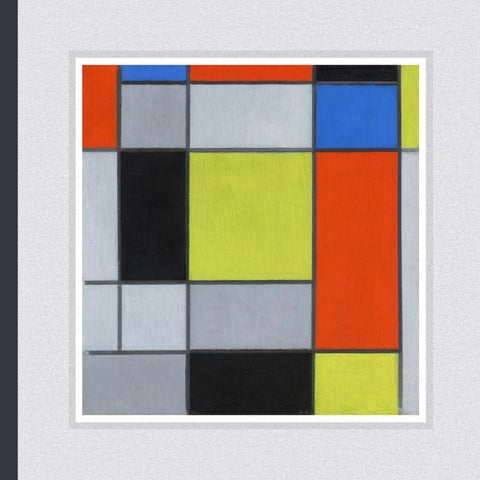
PIET MONDRIAN COMPOSITION III 1920
4
CONTENTS Piet Mondrian Composition III, 1920
7
Achieving a direct expression of beauty: Piet Mondrian’s Composition III
13
Mondrian’s Paintings of 1920
41
“I work from intuition”: The Experimental Techniques of Piet Mondrian’s Paintings from 1920
59
Le Néo-Plasticisme: Principe général de l’équivalence plastique
87
Mondrian’s Path to Neo-Plasticism, 1909-1919.
103
Sale Information
123
JENNIFER DUIGNAM
JENNIFER DUIGNAM
PIET MONDRIAN
5
PIET MONDRIAN COMPOSITION III 1920
THE PROPERTY OF A GENTLEMAN
PIET MONDRIAN (1872-1944) Composition III (Komposition No.XIII) signed with initials and dated '20 PM' (lower centre); signed again and titled 'Composition III PiET MONDRiAN.' (on the stretcher) and inscribed 'HAUT' (on the canvas turnover) oil on canvas 21 x 20¿ in. (53.4 x 51.2 cm.) Painted in 1920 £20,000,000-30,000,000
8
Piet Mondrian in his studio in Paris, 1926. Photograph by André Kertész. Photo: © GrandPalaisRmn - Gestion droit d’auteur André Kertész. Digital image: © Centre Pompidou, MNAM-CCI, Dist. GrandPalaisRmn / Christian Bahier, Philippe Migeat.
10
PROVENANCE:
LITERATURE:
Sophie Küppers, Hanover & Dresden, on consignment from the artist from 1924. with Kunstausstellung Kühl, Dresden, transferred from the above in 1927. with Kaiser Wilhelm Museum, Krefeld, in 1929. Dr Werner Rusche, Cologne, by whom acquired from the above in 1952. Hugo Perls, New York, by whom acquired in 1952. Celeste & Armand P. Bartos, New York, by whom acquired in 1952 and until 1973. Harold Diamond, New York, by whom acquired in 1973. Benedek Fine Art, New York, by whom acquired in 1973. Galerie Beyeler, Basel & Galerie Gmurzynska, Cologne, by whom jointly acquired from the above on 18 January 1978. Galerie Gmurzynska, Cologne, by whom acquired outright on 26 September 1979. Private collection, Germany, by whom acquired from the above in 1979. Acquired from the above by the present owner; the heirs of Piet Mondrian have released and discharged all claims to the artwork.
Letter from Mondrian to T. van Doesburg, 4 December 1919. Letter from Mondrian to T. van Doesburg, 4 May 1920. Letter from Mondrian to T. van Doesburg, 16 May 1920. Letter from Mondrian to T. van Doesburg, 1 June 1920. Letter from Mondrian to T. van Doesburg, 15 June 1920. Letter from Mondrian to T. van Doesburg, undated (probably written after the above). Letter from Mondrian to T. Brugman, July 1924. Letter from Mondrian to T. Brugman, 13 November 1924. Letter from Mondrian to J.J.P. Oud, undated (late 1924). Letter from Mondrian to S. Slijper, 21 December 1924. Letter from Mondrian to J.J.P. Oud, 10 March 1925. M. Seuphor, Piet Mondrian, Life and Work, New York, 1956, no. 457, p. 427 (illustrated no. 313, p. 384; dated '1921' and with incorrect dimensions). R.P. Welsh, ed., Piet Mondrian, exh. cat., The Art Gallery of Toronto, 1966, pp. 174 & 178. F. Elgar, Mondrian, London, 1968, no. 108, p. 242 (illustrated p. 116; dated '1921' and with incorrect dimensions). P. Wember, Kunst in Krefeld, Öffentliche und private Kunstsammlungen, Cologne, 1973, p. 22. M.G. Ottolenghi, L'opera completa di Mondrian, Milan, 1974, no. 320, p. 109 (dated 'circa 1920', with incorrect dimensions and with incorrect illustration). S. Lissitzky-Küppers, El Lissitzky, Life, Letters, Texts, London, 1980, p. 52. Relief, konkret in Deutschland heute, exh. cat., Saarlandmuseum, Saarbrücken, 1981, pp. 25-26 (illustrated fig. 4, p. 25). E. Hoek, ‘Mondriaan’ in De beginjaren van De Stijl, 1917-1922, Utrecht, 1982, pp. 71 & 73. Y.-A. Bois, J. Joosten, A. Zander Rudenstein & H. Janssen, eds., Piet Mondrian, exh. cat., Gemeentemuseum, The Hague, 1994, pp. 322324 (illustrated fig. 3, p. 322; with incorrect dimensions). J.M. Joosten, Piet Mondrian, Catalogue Raisonné, vol. II, Work of 1911-1944, New York, 1998, no. B110, pp. 118, 128, 135, 276-278 & 281-283 (illustrated p. 282). M. Bax, Complete Mondrian, Aldershot, 2001, p. 498 (illustrated).
EXHIBITED:
Mannheim, Städtische Kunsthalle, Wege und Richtungen der abstrakten Malerei in Europa, January - March 1927, no. 258, p. 18. (probably) Frankfurt, Kunstgewerbemuseum, Der Stuhl, March 1929. Basel, Galerie Beyeler, Delaunay, Mondrian, April - May 1977, no. 9 (illustrated on the back cover). Cologne, Galerie Gmurzynska, Mondrian und De Stijl, May - August 1979, p. 180 (illustrated p. 181; detail illustrated on the dustjacket). Cologne, Galerie Gmurzynska, Klassische Moderne, May - August 1981, no. 135, p. 192 (illustrated p. 193). Cottbus, Brandenburgisches Landesmuseum für moderne Kunst, on loan from 1993 until 1997.
11
ACHIEVING A DIRECT EXPRESSION OF BEAUTY: PIET MONDRIAN’S COMPOSITION III.
NEO-PLASTICISM IN PAINTING CLARIFIES AND PURIFIES; IT CAN INFLUENCE THE WHOLE OF LIFE BECAUSE IT IS BORN OF LIFE’S TOTALITY. PIET MONDRIAN
14
On a Sunday afternoon in May 1920, the Dutch journalist Willem Röell paid a visit to Piet Mondrian at his new studio in Paris. A correspondent for the daily newspaper Het Vaderland, Röell was intrigued to meet the revolutionary painter and avantgarde theorist, who had recently returned to the city. Upon entering Mondrian’s modest atelier, Röell was amazed by the stark, minimalist environment the artist had created, where he “grapples with his material in monk-like solitude, in his quest for his lofty, highly controversial idea.”1 Mondrian eagerly showed Röell his latest experimental works, a cluster of new paintings that represented an extraordinary breakthrough. “The paintings with rectangular shapes are the most recent,” Röell wrote. “The formerly scattered horizontal and vertical lines now meet to demarcate rectangles of various sizes and position, filled with strongly contrasting colours… One by one the painter has abandoned the pictorial means...”2 Composition III was most likely among the works the artist unveiled that day, a highly refined and diligently worked composition that he was putting the finishing touches to after months of careful deliberation. Within the bounds of this almost square canvas, a sequence of geometric coloured planes are set within a grid of straight lines, the interplay of abstract forms generating an intriguing visual tension that draws the viewer in and prompts contemplation. This was a powerful statement of intent by Mondrian, reducing his pictorial language to its essential fundamentals of pure colour and line, boldly proclaiming the key elements of the revolutionary, visionary aesthetic he had now reached in his art. “The task today, then, is to create a direct expression of beauty – clear and as far as possible ‘universal’,” Mondrian wrote, explaining his intentions. “It will be a purely plastic beauty, that is… a beauty without natural form and without representation. It is purely abstract art.”3
15
One of just eight works the artist completed in 1920 – the majority of which are now held in museum collections, including the Tate in London, The Museum of Modern Art in New York, the Galleria Nazionale d’Arte Moderna e Contemporanea in Rome, the Stedelijk Museum in Amsterdam, and the Wilhelm Hack Museum in Ludwigshafen – Composition III is a testament to Mondrian’s daring originality as he took this great leap forward in his art, solidifying the rules of his pioneering abstract language known as Neo-Plasticism for the very first time. It was with these iconic works that Mondrian cemented his legacy within the history of the twentieth-century avant-garde, forging a new style of non-objective painting that would prove to be a crucial catalyst in the development of modern art. *** Mondrian had made his much longed for return to Paris almost a year prior to his meeting with Röell, arriving in the French capital in late June 1919. Having found himself stranded unexpectedly in Holland at the outbreak of the First World War, he spent much of the ensuing five years dreaming of the lively artistic scene he had left behind in Paris, making plans to travel back at the earliest opportunity. Nevertheless, the War years proved to be an incredibly fruitful and stimulating period for Mondrian. In Holland, he discovered a group of like-minded artists, architects and thinkers, who shared his belief that a new language of modern art was key to prompting a spiritual renewal that would bring harmony and unity to the world. Chief among them was the energetic, confident and charismatic polymath Theo van Doesburg, who had first encountered Mondrian’s work at an exhibition at the Stedelijk Museum in Amsterdam in October 1915, and was immediately inspired to write to the artist. This exchange sparked a close, stimulating friendship between the two men that profoundly shaped their artistic outlook over the following decade – never before had Mondrian enjoyed such a sense of intellectual camaraderie with a friend, and the pair challenged and encouraged one another in equal measure as their ideas advanced.
16
Piet Mondrian, circa 1922. Photographer unknown.
17
In 1917, Van Doesburg and Mondrian founded the international art journal De Stijl (The Style) as a vehicle for their ideas on art, architecture and culture, giving a name to their bourgeoning group. Though not a formal movement in the traditional sense, De Stijl came to refer to those who congregated around the periodical – from Bart van der Leck and Georges Vantongerloo, to J.J.P. Oud and Vilmos Huszár – drawn together by their shared ambitions and ideals, and belief in the profound possibilities of abstraction. “The new is connected with the universal…” they proclaimed in the De Stijl manifesto, composed in 1918, though not published until four years later. “The founders of the new plastic art, therefore, call upon all who believe in the reformation of art and culture to eradicate these obstacles to development, as in the new plastic art (by excluding form) they have eradicated that which blocks pure artistic expression.”4 In their mind, visual harmony in art could provide a model for restoring order and balance to everyday life, an urgent and lofty goal in a world torn asunder by war. Keen to share his spiritual philosophy with the world, Mondrian published several essays in the De Stijl journal, each one tracing the crucial evolution of his personal theories and ideas. At the same time, he began his prolonged quest to translate these concepts into his paintings, further reducing his pictures to an abstract play of colours and geometric shapes, gradually eschewing references to the natural world. These revolutionary ideas were at the very forefront of Mondrian’s mind when he arrived by train into Paris on 22 June 1919, reporting to Van Doesburg that he was happy to be back, where he felt “the seriousness of the big city.”5 He had continued to pay rent on the small studio on the rue du Départ he had occupied before the War, and was pleased to find all of the work he had left behind in the atelier still there, fully intact, which he planned to use to secure the funds needed to start over in Paris. Over the course of the ensuing months, Mondrian reestablished himself in the city, renewing contacts with fellow members of the avant-garde, visiting exhibitions and galleries, bookstores and art supply shops, and absorbing the energy and rhythms of life in the metropolis.
18
The Paris Mondrian had left behind before the War was a fervent melting pot of ideas and styles, rife with experimentation and daring artistic innovation, led by the work of the Cubists, the Orphists, and the Futurists. In 1919, however, Mondrian was surprised to find the city’s avant-garde had shifted. Artists including Pablo Picasso, Henri Matisse and Gino Severini, were now favouring a more traditional and classically-influenced approach to form and figuration, taking inspiration from the art of the past, both the Old Masters and the ancient world. Known as the “retour à l’ordre,” this new tendency in painting appeared startlingly conservative to Mondrian, though it was shaped by a similar desire for purity and harmony. In his reports to Van Doesburg about the artistic life of the city, he repeatedly expressed his dismay at this turn, which he felt was no longer in tune with the modern experience. This made Mondrian even more determined to continue his own researches into abstraction, in pursuit of a different, more fundamental sense of the universal. As Hans Janssen has noted, “He realised that the development of the new must proceed. There could be no half measures. He had to see where the work took him.”6 While Mondrian had found himself at an impasse in his painting in his final months in Holland, in Paris he was now filled with a fervent urge to work, brimming with new ideas and possibilities. “I’m looking for still something else,” he reported. “I am working now on two things which have more of that something else…”7 The new Plastic art, Mondrian explained, “should find its expression in the abstraction of form and colour, that is to say, in the straight line and the clearly defined primary colour.”8 To this end, he set himself the challenge of focusing on an entirely non-objective pictorial language that adhered to these principles, eschewing the modular grids and soft colour gradations that had previously dominated his work, and instead focusing on the interaction of horizontal and vertical lines combined with planes of the three primary colours – red, blue and yellow – as well as the “non-colours” of white, black and grey. Thus, his painterly aesthetic was radically transformed, as Mondrian finally reached the breakthrough he had been searching for. “Perhaps his leaving for Paris was necessary to give him new possibilities in his work. Refreshing,” Van Doesburg mused.9
Vilmos Huszár, Cover design for De Stijl, 1917. The Museum of Modern Art, New York. Artwork: © 2026 Vilmos Huszár / DACS. Digital image: © 2026 The Museum of Modern Art, New York/Scala, Florence.
***
19
THE COLOURED PLANES, AS MUCH BY POSITION AND DIMENSION AS BY THE GREATER VALUE GIVEN TO COLOUR, PLASTICALLY EXPRESS ONLY RELATIONSHIPS AND NOT FORMS. PIET MONDRIAN
20
Towards the end of 1919, as Mondrian was in the midst of his first phase of pursuing these landmark, experimental compositions, the painter Conrad Kickert returned to the rue du Départ with his new wife, intent on reclaiming the studio space he had been subletting to Mondrian. Though the artist managed to spend a short while sharing the space with the couple, the cramped conditions soon prompted Mondrian to move to a new studio-cum-apartment located on the ground floor in a small courtyard on the rue de Coulmiers, a narrow thoroughfare in the 14th arrondissement, located alongside a railway line near the Porte d’Orléans. Though modestly sized, the rooms were bathed in light from three separate windows (including French doors and a skylight), providing an environment that filled his imagination with possibility. It was here that Mondrian first explored the idea of extending his Neo-Plastic principles to the fabric of his atelier, creating a three-dimensional translation of many of the same ideas he was then exploring in his paintings. He began looking for a means of deploying colour within the space, striking upon an innovative solution. “I’ve been experimenting a bit,” he wrote to Van Doesburg. “I could not paint on the wall, so I had to limit myself to hanging up some painted cardboard. But I have clearly seen now that it is quite possible, New Plastic in the room, just like that. Of course, I also had to paint the furniture. I have not regretted my efforts; it has a good effect on my work.”10 The detachable panels of colour made it easy for Mondrian to rearrange the cards around the space as he desired, reaching new combinations and different effects depending on his vantage point. Though no photographs of the studio at rue de Coulmiers exist, Röell’s article portrayed it as a haven for artistic experimentation, completely shaped by Mondrian’s unique vision. Similarly, passages within the artist’s ambitious essay “Natural Reality and Abstract Reality,” serialised in De Stijl between June 1919 and July 1920, give us further insight into the set-up of the interiors. The final portion of the text, which is presented as a three-way conversation between the characters X (“a layman”), Y (“a naturalistic painter”), and Z (“an abstractreal artist”), describes Z’s studio, which is not cluttered or filled with antiques or nods to the past, but rather embraces a modern, minimalist aesthetic. “I’m not in the least surprised that this studio is yours,” Y proclaims. “It breathes your ideas.”11
According to the main character Z, who can be read as a semi-autobiographical portrait of Mondrian, each element and decoration within the room contributed to the articulation of the space, affecting our experience. “The curtains form a rectangular plane that divides the wall surrounding the window,” he explains to his companions. “To continue the division, I added those red, grey and white planes on the wall. Even the white shelf with the grey box and the white cylindrical jar contribute.”12 Furniture was painted in primary tones, benches and stools, chests and even the painter’s easel, placed in a particular position to correspond and interact with other aspects of the interior, from a wicker chair he had painted stark white, to a paint cupboard and the artist’s all-important work table. “As our complete ‘surroundings,’ the New Plastic would be even more really alive,” he argued.13 Z’s proclamations and observations were clearly rooted in Mondrian’s own experiences, developed within the studio at the rue de Coulmiers. This incredibly stimulating environment propelled Mondrian’s quest towards realising a truly universal nonobjective language in his compositions of this period. At the same time, he was simultaneously working on an essay that he believed would prove essential to establishing Neo-Plasticism in Paris, striking an agreement with Léonce Rosenberg, proprietor of the Galerie L’Effort Moderne, to publish it as a booklet under the gallery’s imprint. Rosenberg had first encountered Mondrian’s painting at the 1911 Salon des Indépendants, and was intrigued by the recent developments in his work following his arrival in the city after the War. For the artist, Rosenberg’s gallery was a beacon of modernity within the city, showcasing the most cutting-edge innovation then occurring in the artworld. Titled Le Néo-Plasticisme: Principe général de l’équivalence plastique, and dedicated “Aux hommes futurs” (“To the men of the future”), the short pamphlet was a distillation of Mondrian’s theories and the core principles of his vision up to this point, representing the first time his writings were available in French. The fourteen-page booklet, which Mondrian spent months working on and translating with the help of his close friend Rinus Ritsema van Eck, issued a call-to-arms for avant-garde painters, writers, architects and musicians, to join him in his pursuit of a universal purity.
22
Piet Mondrian’s studio at 26 rue du Départ, 7 April 1926. Photograph commissioned by Katherine S. Dreier. Digital image: Album/Alamy.
23
[THE NEW PLASTIC] CAN AWAKEN THE MOST DEEPLY INWARD, THE UNIVERSAL IN US, NOT ONLY STRONGLY BUT DETERMINATELY. PIET MONDRIAN
24
Infused with a striking sense of optimism as to the possibilities of abstraction, the text explained that “the essential characteristic of the New Plastic in painting… is a composition of rectangular colour planes that expresses the most profound reality. It achieves this by plastic expression of relationships and not by natural appearance… The coloured planes, as much by position and dimension as by the greater value given to colour, plastically express only relationships and not forms. The New Plastic brings its relationships into aesthetic equilibrium and thereby expresses the new harmony.”14 It was these essential concepts that Mondrian brought to powerful, triumphant realisation in his compositions over the course of 1920, finally achieving the fundamental breakthrough he had been searching for. ***
Cover of Piet Mondrian’s Le Néo-Plasticisme. général de l’equivalence plastique, 1920. Editions de L’Effort Moderne.
Each of the eight paintings completed in 1920 display a keen sense of exploration, the canvases filled with subtle details and revisions that suggest Mondrian was working through his ideas as he went along, experimenting and reaching for the precise visual form that he felt best fulfilled these ambitious ideals. “I am searching for the right harmony in the rhythm and the constant proportion – like I wrote in the article. How difficult that is,” he proclaimed during the earliest stages of composing these works.15 From one canvas to the next, the artist proposed new formal relationships, establishing a painterly formula using large rectangles set in close proximity to one another, which he then filled with a restricted range of primary colours. By reducing his formal language to just a handful of elements in this way – geometric planes of pure colour, softly demarcated lines establishing a grid structure – Mondrian believed he could convey such an absolute sense of harmony and reach a pure expression of the fundamental laws that governed the universe. All of these works boast a complex process of construction, shaped through deep thought and prolonged contemplation, in order to achieve their delicate equilibrium. Though employing a limited range of elements, they are incredibly nuanced works that took months at a time to achieve, as he analysed the intricacy of each painting’s visual dynamics and the interrelationships of their different elements. Mondrian worked concurrently
25
on several canvases through the year, discussing multiple compositions in progress across his correspondence with Van Doesburg, and the different stages of their development. Though each composition is distinctly individual, exploring their own complex internal relationships and tensions, together they reveal the common lines of thought that occupied Mondrian as he pursued these new ideas. He quickly recognised that he had reached a key breakthrough with this striking pictorial idiom: “I have now made something which pleases me more than all I did before…” he wrote. “It has cost me a lot of searching through, ever since I have been here [in Paris].”16 Composition III encapsulates the essential threads of Mondrian’s thinking at this time. The geometric, rectangular planes are subtly different in size and configuration from one another, their height or width shifting as the eye moves across the work. Delicately variegated lines cut decisively through the coloured panels, dividing the composition into distinct segments and increasing the overall sense of rhythm within the painting. While there is a general uniformity to the picture, by introducing this sense of variety within the core elements Mondrian deftly avoids repetition, using his own intuition to guide his choices and set up a harmonious composition. At the centre, a yellow plane (notably the largest element within the painting) draws the viewer’s attention, acting as the centre of gravity for the entire composition. Directly above and below, this bright element is bracketed by planes of grey, one warmer and deeper in tone, the other slightly cooler and lighter, generating different effects as they are balanced against their neighbour. To the right and left, meanwhile, the yellow is placed alongside a plane of vibrant red and a shorter rectangle of deep, velvety black, the intensity of their hues matching the power of this central element, while above and set on a diagonal to the yellow plane, a panel of vivid cobalt blue pigment provides a striking visual counterpoint. All three primary colours appear multiple times through the composition – while the planes of red and blue appear to be concentrated in the upper half of the canvas, the yellow tone is repeated twice towards the edges of the painting along the bottom and the extreme right hand side. Mondrian counterbalances these vivid pigments with corresponding panels of grey and black paint, placing them in a particular position so as to enhance or disrupt the patterns of pure colour. In this way, Composition III reveals the way Mondrian used colour to move the eye around the canvas, relying on a complex system of balance and imbalance.
27
Piet Mondrian, Composition C, 1920. The Museum of Modern Art, New York. Digital image: © 2026 The Museum of Modern Art, New York/Scala, Florence.
28
Piet Mondrian, Composition B, 1920. Wilhelm Hack Museum, Ludwigshafen. Digital image: Wilhelm-Hack-Museum, Ludwigshafen.
This is further enhanced by the powerful sense of asymmetry within the configuration and shape of the panels. The central yellow plane, for example, is set ever-so-slightly off-centre, so that it sits marginally to the right of the principle axis. Similarly, there is a discrepancy in the width and height of the outer “frames” – the rectangles along the top and right edge are significantly thinner than those on the opposing sides, an impression enhanced by the presence of the notes of vibrant colour that occupy these planes. Combined, these details create an impression of centrifugal movement, the energy of the composition radiating outwards from the yellow square at the centre, yet contained within the frame of the canvas. These internal tensions set up a powerful clash between regularity and irregularity, filling the composition with a dynamism that counters the strict minimalism of Mondrian’s highly refined geometric abstract language. For Mondrian, Composition III represented a culmination of his ideas, in particular the unique sense of balance and harmony he had been searching for. In a letter to Van Doesburg dated 15 June 1920, he recalled a recent conversation he had with the painter Leopold Survage during a visit he paid to Mondrian’s studio. “At first I showed him [Composition III], the small square one you and I liked so much. He said it wasn’t balanced and that the yellow was disharmonious against the red, etc. And the two little blues at the top did not have [a counterpart in] blue at the bottom. (I think that even this, among other things, makes it so off-centre). I then told him that we were looking for a different harmony; he said there was only one, anyway, back and forth. He also began very theoretically about colours. At that moment, however, I saw that a balanced relation does not always require harmonious colours, and started to write down something about it.”17 *** A striking illustration of the landmark developments he had achieved that year, Mondrian was clearly pleased with the outcome of Composition III and intended for the painting to be included in an exhibition organised by the artists’ group known as the Section d’Or in Belgium in the summer of 1920. In June he wrote that this work, along with two others, were now ready to send, he was just waiting for the address to dispatch them to. It is likely at this point that he assigned the work its title – while the
29
I BELIEVE THAT EQUILIBRIUM CAN EXIST WITH DISSONANTS. PIET MONDRIAN
30
three paintings he had sent to an earlier exhibition in Amsterdam were named Composition A, B, and C, for the Belgian exhibition he preferred numbers, designating them Composition I, II and III.18 However, after several postponements, the show never occurred, and Mondrian diligently wrapped up the present canvas, to protect it against dust. The painting remained with him until 1924, when Mondrian selected it to send to the art historian and curator Sophie Küppers, a keen advocate of modern art who organised the first exhibition of Mondrian’s Neo-Plastic works in Germany. Born Sophie Schneider, she had studied art history in Munich, under the curator of the Pinakothek, Dr Heinz Braune. “His classes were extremely interesting,” she recalled, “because the young scholar always showed us originals… He told my parents that I should study art history – because I had a good eye and excellent visual memory.”19 It was in her lectures that she met her future husband, Paul Erich Küppers, who would go on to become the inaugural director of the Kestner Gesellschaft, an institution established to introduce new, innovative artists to Hannover. An inheritance from Sophie’s uncle allowed the young couple to begin collecting art, and soon their home was filled with works by contemporary painters such as Emil Nolde, Wassily Kandinsky, Paul Klee, Kurt Schwitters, Ernst Ludwig Kirchner, Paula Modersohn-Becker, as well as Marc Chagall and Albert Gleizes. Following Paul’s untimely death in 1922 from the Spanish Flu, the leadership at the Kestner Gesellschaft gave Küppers the opportunity to organise and stage a series of modern art exhibitions at the institution, which helped to support her two young sons. Though she was forced to sell many of the artworks she and Paul had acquired together, these experiences brought Küppers into direct contact with a legion of forwardthinking collectors in Hannover, as well as many key figures of the European avant-garde. It was at the Kestner Gesellschaft that she first met the Russian-born artist El Lissitzky, who was in Hannover for a Dada concert arranged by Kurt Schwitters. Küppers purchased one of his works on the spot, during a group visit to the gallery, and the pair would go on to marry in 1927. Küppers had initially contacted Mondrian in September 1924, on behalf of Lissitzky and Hans Arp, who were then in the process of compiling a book titled Kunst-Ismen, chronicling the so called “isms” of modern art in the twentieth century. She quickly became interested in the artist’s work and asked if he
Sophie Küppers, 1914. Photograph by Friedrich Müller. Photo: Alamy/Album.
31
The work room at Sophie and Paul Küppers’s home in Hannover, with Wassily Kandinksy’s Improvisation no. 10, 1911 and a reproduction of the Winged Victory of Samothrace.
32
Cover design for the catalogue of the exhibition Wege und Richtungen der abstrakten Malerei in Europa at the Kunsthalle Mannheim, January-March 1927.
would be interested in sending a handful of paintings to her on consignment. The following month, Küppers confirmed the safe arrival of four pictures in Hannover, “two new ones and two older ones” Mondrian reported in a letter to Til Brugman – the present work, Composition III, was included in this first shipment.20 The following spring, Küppers visited Paris again, this time on behalf of the Kunsthandlung Kühl und Kühn in Dresden, with the aim of engaging members of the Parisian avant-garde and organising exhibitions of their work at the gallery. Küppers appears to have visited Mondrian at his studio during this trip, and secured an agreement with him – the artist sent a dozen works to her in Dresden later that summer, carefully recording them in his sketchbook, ten of them with quick, schematic drawings. In September, an exhibition dedicated to Mondrian’s paintings, Kurt Schwitters’s collages and Man Ray’s photograms curated by Küppers opened in Dresden, with an accompanying lecture by Will Grohmann on the latest developments in abstract art. Encouragingly, one of Mondrian’s works sold to the collector Ida Bienert at this time, prompting him to send further artworks to Küppers on consignment through 1925 and 1926. Küppers was a key advocate of Mondrian’s unique aesthetic, encouraging buyers, both private and institutional, to acquire his work and leading the charge in promoting his work within Germany. Towards the end of 1926, Küppers decided to move to Russia to be with Lissitzky, and transferred the works still under consignment with her to the care of the recently renamed Kunstausstellung Kühl. Even from afar, she continued to champion Mondrian’s work, writing to collectors and museum curators about their extraordinary power and bold visual language. From her correspondence, it is clear that Mondrian relied on the income from his sales in Germany, and she was determined to ensure this support continued. It was through Küppers’s intercession that Composition III was included, along with thirteen other works by Mondrian, in the large-scale exhibition “Wege und Richtungen der abstrakten Malerei in Europa” (“Ways and Directions of Abstract Painting in Europe”) at the Kunsthalle in Mannheim in January 1927. Organised by the museum’s director Gustav F. Hartlaub, who was a key supporter of contemporary art, the show intended to showcase the diverse approaches of such members of the avant-garde as Lyonel Feininger, Wassily Kandinsky, Paul Klee, Oskar Schlemmer, Fernand Léger, Laszlo MoholyNagy, El Lissitzky and, of course Mondrian. The majority of
33
Mondrian’s paintings shown in Mannheim were subsequently included in the exhibition “Der Stuhl” at the Kunstgewerbe Museum in Frankfurt, in which the latest models of modern chair design, largely made from tubular steel, were displayed alongside a selection of contemporary art, showing the dynamic interrelationship between the fine and applied arts at this time. Between 1929 and 1952, Composition III was with the Kaiser Wilhelm Museum in Krefeld, before being acquired later that year by the esteemed American collectors and philanthropists Armand P. and Celeste Bartos. Armand, an architect perhaps best known for his innovative design for the Shrine of the Book at the Israel Museum, had known Mondrian personally during the artist’s time in New York during the Second World War, having been introduced by the dealer Sidney Janis in the early 1940s. Armand and Celeste would go on to assemble an impressive collection of modern and contemporary art during their lives together – their Manhattan home was filled with an extraordinary array of works, from Joan Miró’s Le Port of 1945 and Juan Gris’s Le Fumeur (Frank Haviland), to Fernand Léger’s Etude pour la ville from 1919 and a monumental work by Mark Rothko, all of which were hung alongside sculptures by Constantin Brancusi and Alexander Calder. The Bartoses owned several other Mondrians from diverse periods of his career, including Composition with Red, Blue and Yellow from 1930 (Joosten, no. B219) and one of the artist’s famed trans-Atlantic paintings, Composition with Red and Blue (Joosten, no. B293.304), which had been purchased directly from Mondrian shortly after his arrival to New York during the War. The couple were dedicated philanthropists and patrons, providing essential support to the New York Public Library, the Massachusetts Institute of Technology (MIT), and The Museum of Modern Art, where the Celeste Bartos Film Preservation Center is named in honour of Mrs. Bartos’s tireless advocacy and support. They also gifted several works from their extensive collection to important public institutions, including Francis Picabia’s early masterpiece Edtaonisl (Ecclesiastic), which was donated to The Art Institute of Chicago in 1953, as well as works by Jasper Johns, Helen Frankenthaler, Sam Francis and Barnett Newman to The Museum of Modern Art. Composition III remained in the Bartos collection until the early 1970s, before being purchased by a private collector in Germany, who generously placed the work on loan to the Brandenburgisches Landesmuseum für moderne Kunst in Cottbus, in the 1990s.
36
Installation view of the exhibtion Der Stuhl, at the Kunstgewerbemuseum, Frankfurt, March 1929. Photograph by Grete Leistikow.
37
ENDNOTES 1
2 3
4
5
6 7
8
9
10 11
12 13 14
15
16 17 18 19
20
W.F.A. Röell, “A Visit to Piet Mondrian,” 1920; reproduced in F. Manacorda and M. White, eds., Mondrian and his Studios: Colour in Space, exh. cat., Tate Liverpool, 2014, p. 34. Ibid., p. 36. P. Mondrian, “Purely Abstract Art,” 1926; reproduced in H. Holtzman and M.S. James, The New Art – The New Life: The Collected Writings of Piet Mondrian, London, 1986, p. 199. De Stijl, “Manifesto 1”; reproduced in C. Harrison and P. Wood, eds., Art in Theory, 1900-2000: An Anthology of Changing Ideas, London, 2003, p. 281. P. Mondrian, letter to T. van Doesburg 1 August 1919; quoted in J.M. Joosten, Piet Mondrian: Catalogue Raisonné of the Work of 19111944, New York, 1998, vol. II, p. 116. H. Janssen, Piet Mondrian: A Life, London, 2022, p. 55. Letter to T. van Doesburg, 21 August 1919; quoted in Joosten, op. cit., 1998, p. 276. P. Mondrian, quoted in M. Seuphor, Piet Mondrian: Life and Work, New York, 1956, p. 142. T. van Doesburg, letter to J.J.P. Oud, 24 June 1919; quoted in Joosten, op. cit., 1998, p. 115. Letter to T. van Doesburg, 4 December 1919; quoted in ibid., p. 116. P. Mondrian, “Natural Reality and Abstract Reality,” 1919-1920; reproduced in Holtzman and James, op. cit., 1987, p. 109. Ibid., p. 112, Ibid., p. 112. P. Mondrian, “Neo-Plasticism: The General Principle of Plastic Equivalence,” 1920; reproduced in ibid., p. 137. Letter to T. van Doesburg, 16 September 1919; quoted in Joosten, op. cit., 1998, p. 116. Letter to T. van Doesburg, 4 December 1919; quoted in ibid., p. 276. Letter to T. van Doesburg, 15 June 1920; quoted in ibid., p. 283. See comment 9.01 in B108-110 in Joosten, ibid., pp. 282-283. S. Küppers quoted in U. Krempel, El Lissitzky, Sophie LissitzkyKüppers. From Hanover to Moscow, Munich, 2015, p. 62. Letter to T. Brugman, July 1924; quoted in Joosten, op. cit., 1998, p. 283.
38
AS A PIONEER AND FOUNDER OF ABSTRACT ART, MONDRIAN WAS THE UNDAUNTED, COMPLETELY SELFLESS CHAMPION OF OBJECTIVITY. HANS L.C. JAFFÉ
39
MONDRIAN’S PAINTINGS OF 1920
42
PIET MONDRIAN No. IV / Composition No. II, 1920. Tate, London. Joosten, no. B104. Digital image: © Tate.
43
PIET MONDRIAN Composition A, 1920. Galleria Nazionale d’Arte Moderna e Contemporanea, Rome. Joosten, no. B105. Digital image: Luisa Ricciarini / Bridgeman Images.
44
45
46
PIET MONDRIAN Composition B, 1920. Wilhelm Hack Museum, Ludwigshafen. Joosten, no. B106. Digital image: Wilhelm-Hack-Museum, Ludwigshafen.
47
PIET MONDRIAN Composition C, 1920. The Museum of Modern Art, New York. Joosten, no. B107. Digital image: © 2026 The Museum of Modern Art, New York/Scala, Florence.
48
49
50
PIET MONDRIAN Composition I, 1920. Private Collection. Joosten, no. B108.
51
PIET MONDRIAN Composition II, 1920. Private Collection. Joosten, no. B109. Digital image: © Mondrian/Holtzman Trust / Bridgeman Images.
52
53
54
PIET MONDRIAN Composition III, 1920. The Present Lot. Joosten, no. B110.
55
PIET MONDRIAN Composition with Yellow, Red, Black, Blue, and Grey, 1920. Stedelijk Museum, Amsterdam. Joosten, no. B117. Digital image: Collection Stedelijk Museum Amsterdam.
56
57
“I WORK FROM INTUITION”: THE EXPERIMENTAL TECHNIQUES OF PIET MONDRIAN’S PAINTINGS FROM 1920.
IT IS PROBABLY NOT EASY TO BE AN ORIGINAL. IT TAKES A LOT OF EXPERIENCE AND SERIOUS INTROSPECTION. PIET MONDRIAN
60
Upon first glance, Piet Mondrian’s paintings appear deceptively simple, their familiar language of coloured planes within a highly controlled grid of lines offering a dynamic, but straightforward abstract painterly vision. Yet, upon close inspection, these compositions reveal themselves to be alive with detail and nuance, their surfaces an intricate map tracing the evolution of Mondrian’s thought process as he worked. Standing in front of these paintings, the viewer is immersed in the process of their creation, each plane of colour, stroke of pigment, and delicately manoeuvred line, revealing the deliberate choices and subtle adjustments he made along the way in order to achieve the most powerfully resonant composition possible. The paintings of 1920 are particularly rich in this way – looking closely at these canvases, a plethora of compositional changes and adjustments become evident, variations of technique, brushwork, colour and texture revealing the development of Mondrian’s ideas and intentions as he probed the visual possibilities of his new, Neo-Plastic language for the first time. In the summer of 1920, Mondrian himself admitted that there was a degree of tension between theory and practice in his paintings: “I work from intuition,” he wrote, “… but I do think that, generally speaking, the theoretical can be of great importance for New Plastic.”1 The paintings he completed over the course of that year encapsulate this dichotomy, each one revealing the ways in which Mondrian sought to marry the principles of his theories about unity and harmony with the practical act of painting. As such, each composition is the product of in-depth investigation and development. The artist would sometimes spend months on a single painting, working in stages, leaving time not only for his paints to dry and settle, but also for reflection, so that he could consider and analyse the success of a composition with each new alteration to the configuration. For example, in a letter to his close friend and co-founder of De Stijl, Theo van Doesburg dated 4 December 1919, Mondrian reported that he had reached an initial conclusion with the large scale Composition A (Joosten, no. B105; Galleria Nazionale d’Arte Moderna e Contemporanea, Rome) and was immensely happy with the effect. However, he would wait before sending his comrade images of the work, as he needed to see how it held up under further inspection. Over the following few months, Mondrian continued to edit and change certain elements, working and reworking the composition in a quest to achieve a powerful sense of balance and energy. Four months later, towards the end of March 1920, another letter to Van Doesburg details some of the most recent changes: “Added that blue square on the right and changed the yellow one on the left to white. Repainted the grey and black and white...”2
61
Composition III underwent a similarly protracted period of gestation – in the same letter from December 1919, Mondrian reported that he was at work on “6 or so” new paintings, including the present work, which pleased him “more than all I did before.”3 The following February, Van Doesburg arrived in Paris and stayed with Mondrian for almost a month, where he had the opportunity to view this suite of new compositions in person, following their progression as Mondrian continued to work on certain aspects, shifting lines and revising the colour of different elements. In the pair’s correspondence through the ensuing months once Van Doesburg had departed Paris, Mondrian discussed further edits he was making to the compositions, reporting only in May that after six months he had brought Composition A to a satisfying end, and was now returning to review the other works from the series. On 1 June, he announced that “three of the six you saw at my place at an early stage” were now ready for exhibition, and were being wrapped up to protect them from the dust in his studio.4 Among this group was Composition III, which had reached its final state and was now ready to share with the public. Some of the most dramatic alterations to Composition III are initially almost imperceptible to the naked eye on the surface – it is only when we shift to the reverse of the canvas that we begin to get a sense of the extent of the changes Mondrian wrought as he investigated his compositional ideas. Patches of vivid red pigment have seeped through the canvas in one corner, their vibrant tones bound within a subtly different network of lines than that which appears in the final work. From the front, however, the corresponding panels along the lower left edge of the canvas appear as different tones of light and middle grey, demonstrating that Mondrian had initially started with an entirely different palette in mind, and only later established the precise interplay of colours seen in Composition III, painting over the red hue with thick layers of the secondary grey pigment. This detail guides our eye to the edges of the canvas and the materiality of these planes of colour, where small touches of red can be glimpsed among the strokes of grey paint. Similarly, a single scarlet brushstroke is visible on the side of the canvas as it turns over the stretcher. As already noted, the artist wrote of the same thing occurring in the process of working on Composition A, while No. VI/Composition no. II (Joosten, no. B104; Tate, London) similarly contains traces of yellow pigment along the edges the white panel in the top right corner, suggesting it had an entirely different colour schema in an earlier state. Even in those colour planes that remain largely consistent in their specific hue, Mondrian experimented with deftly modulated tones from one layer to the next in the paintings of 1920, adjusting the brightness, warmth and intensity of
62
Reverse of Composition III
63
THE NEW PLASTIC IS DUALISTIC THROUGH ITS COMPOSITION. THROUGH ITS EXACT PLASTIC EXPRESSION OF COSMIC RELATIONSHIP IT IS A DIRECT EXPRESSION OF THE UNIVERSAL; THROUGH ITS RHYTHM, THROUGH ITS MATERIAL REALITY, IT IS AN EXPRESSION OF THE SUBJECTIVE, OF THE INDIVIDUAL. PIET MONDRIAN
64
THE FIRST THING TO CHANGE IN MY PAINTING WAS THE COLOUR. I FORSOOK NATURAL COLOUR FOR PURE COLOUR… INSTINCTIVELY, I FELT THAT PAINTING HAD TO FIND A NEW WAY TO EXPRESS THE BEAUTY OF NATURE. PIET MONDRIAN
66
a tone as he worked. Such is the case in Composition C (Joosten, no. B107; The Museum of Modern Art, New York) where a panel of cadmium red was changed to a vermillion half-way through working on the composition, in order to grant it a more fiery appearance. Similarly, the yellow segments are the result of a carefully studied and analysed process, as the cross-sections of a microscopic chip of paint reveal six different yellow hues, each with subtle individual adjustments to reach the artist’s desired tone.5 While the upper most layer contains a mixture of cadmium yellow, two different types of white and a hint of blue, imbuing it with a cooler tone, Mondrian had progressed from a warm, pure yellow, to a more orange tinted hue, followed by three further layers of paler yellow achieved through different concentrations of white, before reaching the final colour.6 “It is not enough, simply to place a red, a blue, a yellow, a grey, etc. alongside one another,” Mondrian explained. “Everything depends on ‘how’ – such as the positioning, the size, and what tone the colour has.”7 Tableau I from the collection of the Fondation Beyeler (Joosten, no. B113.153; 1920(?) /1921-1925) has undergone extensive paint sampling as part of the institution’s dedicated analysis of Mondrian’s materials and technique.8 While the double dating of “21-25” reveals that the artist worked on the painting in two different stages in 1921 and 1925, elements of the work’s composition and structure, combined with the presence of an earlier signature and date visible under infrared reflectography, suggest that Mondrian actually began work on the painting in 1920. In their analysis of the work, conservators have found at least two separate layers of paint beneath each of the coloured planes, while a sample taken from the upper left edge of the canvas reveals ten distinct layers of paint, the blue panels shifting through a range of hues from light to dark and back again, each one a subtle gradation of the one before, until he settled on the final tone we see today.9 These stratified layers can occasionally be glimpsed at the edges of these panels, small slivers of the various underlying pigments left visible at the juncture between the lines of the grid and the colour planes. While Mondrian would allow his pigments to dry sufficiently before adding new layers of paint, preventing their mixing on the canvas, the specific order in which he deployed these subtly different pigments resulted in a highly nuanced tonality. The interaction of these individual layers when stacked on top of one another granted the coloured planes a particular dimensionality, rendering them warmer or cooler, more intense or ethereal, depending on the sequence in which the paint was applied. Few clues remain as to the precise manufacturers and brands of pigment Mondrian preferred, though Hans Janssen has noted that many members of the De Stijl movement employed Rembrandt paint by the Royal Talens company in their compositions. In Paris, Mondrian is known to have visited Lefebvre-Foinet
67
for supplies, including oil paints, while several canvases from this period include a stamp of Robinot Frères, which also sold ready-made pigments. Technical analysis of several of the canvases from 1920 have identified passages of cobalt blue, vermillion, cadmium yellow, both zinc and lead white, ultramarine and bone black, showing a clear preference for materials that carried a vibrant intensity.10 However, he was not satisfied with these colours as he found them – rather than squeezing the pigments directly from the tube onto the canvas, Mondrian devoted an enormous amount of time and energy to playing with their gradation, mixing them on his palette with other pigments to alter or enhance certain effects, sometimes spending months hunting for the precise tone he desired. A pair of Mondrian’s palettes now reside in the collection of the Kunstmuseum den Haag, donated by the artist’s estate, and reveal the systematic process of experimentation that lay behind this detail. One, which was designated solely for “light” tones, features dots of primary colours and black in little wells along the edge of the palette, which were used to modulate the white pigments before applying them to the canvas. In contrast, the other palette featured multiple passages of the same dark black pigment, each enhanced with natural oils and varnish to achieve varying levels of glossiness and fluidity. Mondrian most likely added minute traces of blue pigment to the three areas of yellow in Composition III, in order to achieve their cool, almost acidic colour. This highly intuitive approach to colour was based solely on Mondrian’s own eye, each subtle shift executed with purpose and intent as he sought to capture a unique sense of harmony. As Hans Janssen has noted of Mondrian’s carefully modulated colours during this period, “They are all mixed, so they remain in unison with the bordering surfaces. As a result, they change the pictorial space delicately, from surface to surface. Depending on how one casts the eye over the picture, the surfaces recede or come to the fore. It is extremely subtle, primarily because the black lines of the picture keep everything in check. Nonetheless, if the changing relationships are comprehensible it is always a question of context. The visual weight of the colour, a format, a relationship, appears to change continually when scrutinised.”11 Mondrian takes this idea even further in Composition III in the passages of black pigment, which are the only portions of the canvas to which he has added a varnishing layer, creating both a different optical and textural effect. The black planes stand in sharp contrast to the more matte panels they adjoin as a result, their tones more saturated, with a greater sense of depth and reflection within them. “You know I made that shine,” Mondrian remarked of this treatment of his black pigments, “it’s like a coffin otherwise.”12 He was also very aware of the way
68
Detail of Piet Mondrian, Composition A, 1920. Galleria Nazionale d’Arte Moderna e Contemporanea, Rome. Digital image: Luisa Ricciarini / Bridgeman Images.
69
Detail of Piet Mondrian, Composition C, 1920. The Museum of Modern Art, New York. Digital image: © 2026 The Museum of Modern Art, New York/Scala, Florence.
70
the lighting of a work could affect our perception of the colours – in a letter date 30 June 1920, he explained: “Here in the studio, in the dim light, I also found the red in the large thing [likely Composition A] too intense against the others, but in a strong light it dissolves so beautifully.”13 It was a topic he was keenly aware of during that summer, writing extensively to Van Doesburg about how best to light the works he was sending him for an upcoming exhibition in Amsterdam, so that the colours would sing. There is an exceptionally painterly quality to each of the paintings that date from 1920, in part thanks to the array of individual brushstrokes that remain clearly visible across their surfaces, the hairs of the artist’s paintbrush leaving distinct trails through his pigments as he worked them onto the canvas. From short, linear marks, to looser, free curving brushwork in other areas, these short dashes, fluid lines and overlapping, interwoven passages appear purposeful, their directionality and dynamic movements imparting a sense of energy to the canvas. In Composition III, there is an overall consistency to the brushwork, the individual panels of colour rendered in short linear patches that overlap and abut one another slightly. Some of the planes feature a diagonal criss-cross pattern, the brushwork interwoven into a braid of colour, while other areas appear much freer and looser in their application, such as in the lower right pane of yellow paint, where a passage of short, diagonal strokes curves to the right as they reach the edge of the canvas. In contrast, the large scale of No. VI/Composition no. II in the Tate collection, which measures just over a metre square, would have required a large brush to cover more area, resulting in a slightly different surface. Here, Mondrian appears to have chosen to deliberately alternate the direction of the brushstrokes within neighbouring planes of colour, finishing one panel in strong horizontal strokes, while the adjoining one features sharp vertical brushwork. In other instances, the direction shifted from one layer to the next, creating a different sense of depth within each panel of colour, as the paint overlapped and settled, catching the light in different ways. This sense of ongoing experimentation extended into Mondrian’s treatment of the network of dark lines that cut across the canvases of his Neo-Plastic paintings and provided their essential structure. “It is a great mistake,” the artist wrote, “to think that Neo-Plastic constructs rectangular planes set side by side – like paving stones. The rectangular plane should be seen rather as the result of a plurality of straight lines in rectangular opposition. In painting, the straight line is certainly the most precise and appropriate means to express free rhythm.”14 As with the planes of colour, he paid particular attention to their size and weight, the positions at which they overlap and intertwine with one another, the sense of
71
PIET DID NOT JUST WANT A SPECIAL BLUE, HE WANTED REAL BLUE. AND REAL RED AND REAL YELLOW. HE NEVER ACTUALLY FOUND THEM. IT ALWAYS TURNED OUT DIFFERENTLY, BUT HE ALWAYS SOUGHT THE MOST AUTHENTIC COLOUR POSSIBLE. MICHEL SEUPHOR
72
rhythm generated by each juncture, as well as the distribution of pigment within each stroke. “The lines kept me busy for quite some time,” the artist admitted.15 X-rays of The Museum of Modern Art’s Composition C taken by conservators reveals that an earlier grid of very regular arrangement was placed on the canvas first, a feature also found in the Stedelijk’s Composition with Yellow, Red, Black, Blue, and Grey.16 Mondrian clearly felt that this was too condensed and rigid, and subsequently adjusted the alignment of the lines as he worked, shifting them slightly in certain areas, more dramatically in others, with a handful of elements showing multiple reworking as the canvas progressed. In Composition III the lines are composed of multiple layers of repainting, subtle pentimenti suggesting that Mondrian similarly adjusted their length and thickness as the composition progressed. In most instances these are millimetric adjustments, sometimes shifting up or down, the linear bands of dark paint thinned or expanded to generate a different sense of dynamism. The final lines appear to have been added towards the end of the composition, overlying the edges where the planes of colour meet, after the other pigments had time to dry and settle, though some do feature small touches of overlapping pigment, as if the artist’s brush had slightly overrun as he completed a final layer on a neighbouring plane of colour. The strong, anchoring presence of these lines is interrupted by the fact that the majority stop short as they approach the edges of the canvas, their forms cut off so that they do not appear to continue beyond its boundaries. Again, Mondrian was guided by intuition as he worked on these details, basing the point at which they “stop” entirely on what he felt looked best within the overall balance of the composition. There is no systematic approach to his decision-making in this instance, no specific measurement that he carefully adheres to along each individual line. Instead, they finish at varying points, some shorter, some longer, occasionally creating large gaps to the edge, while others almost brush the limits of the canvas. For the most part, these final stopping points are not linear and crisp, but soft-edged and at times asymmetric, the paint gradually tapering off or, as in the lower right corner, appearing to gradually dissipate, revealing an earlier, paler line beneath. As early as October 1919, Mondrian noted that “not all the lines should be equally dark all the time,” a revelation he eagerly explored through the following year.17 In Composition III and its sister paintings, the subtle modulation of colours within these lines takes slightly different forms, shifting as they transition across the canvas, from deep black to charcoal grey, through to paler, toned down, hues particularly when differentiating lighter panels from their neighbours. This is the case in Composition B (Joosten, no. B106; Wilhelm
74
Detail of Piet Mondrian, Composition B, 1920. Wilhelm Hack Museum, Ludwigshafen. Digital image: Wilhelm-Hack-Museum, Ludwigshafen.
75
Detail of Piet Mondrian, No. IV/Composition No. II, 1920. Tate, London. Digital image: © Tate.
76
Hack Museum, Ludwigshafen), where the tonality of the vertical line that cuts across the yellow plane in the middle of the composition appears exceedingly pale in contrast to the rest of the grid, almost echoing the middle grey tone used elsewhere in the painting. It darkens considerably as it progresses downwards, apparently responding to the neighbouring blocks of colour it passes along the way. A similar effect is used in Composition III, most noticeably where Mondrian demarcates the junction between the yellow square at the centre and the palest of the grey tones above, achieved by adding a streak of lighter pigment atop the dark line in a single fluid streak. In Composition C at The Museum of Modern Art, the linear elements appear less concrete and defined than other examples from this year, the individual hues of each of the coloured planes clearly visible through the quite thinly painted lines of the grid. In several spots, the tones of the lines appear to intermingle with these pigments, suggesting the artist was working wet-in-wet – this is perhaps most notable in the boundaries of the red panels, where touches of the scarlet paint stream and flicker through the black and grey pigment of the lines. As in Composition III, the edges repeatedly appear unfinished or cut off, not only as they approach the boundaries of the canvas. In the trio of darker blue panels in the centre left, for example, the line along the right of the longest panel includes a stroke of blue paint that appears to bleed over into the line, disrupting its geometry and creating the impression that it is in the process of dissolving. Above, a small gap leaves the linear element unconnected to the rest of the grid, a small strip of blue paint cutting across the dividing line, so that now the viewer is left to question if it is a single pane of colour subdivided, or two separate panels merging together. The artist would later eschew this exploratory, imprecise approach to line in his works, deploying solid black lines only, to which he typically added a gloss or varnish to achieve a high shine as they cut through the remaining colours. As a result, this highly individual interpretation of the grid in the 1920 paintings represents a unique moment of experiment and breakthrough in Mondrian’s oeuvre. One of the most intriguing passages in Composition III lies in the interaction between the blue and black panels in the top right corner of the canvas, where the dividing line between the two rectangles is only lightly delineated, appearing much more slender and loosely worked than the rest of the grid. As a result, the line does not cover the juncture between the two planes of colour, instead allowing the boundary at which they meet to remain open to the viewer – here, the striking bright blue pigment interacts directly with the shiny black tone, their edges soft and brushy, allowing the colours to merge and intermingle with
77
I HAD ALSO ALREADY NOTICED THAT NOT ALL THE LINES SHOULD BE EQUALLY DARK ALL THE TIME... PIET MONDRIAN
79
one another, creating an almost cloud-like appearance. A similar detail is found in the picture in the Tate collection, where the red rectangle on the far right of the canvas meets the light-toned grey plane above. Here, the irregular black line is only thinly indicated, a single stroke that loosely drags across the plane of colour in a meandering line, falling out of alignment with the rest of the grid. Michel Seuphor, who was a regular visitor to the artist’s studio through the later years of the 1920s, briefly described Mondrian’s typical painting practice for his Neo-Plastic compositions. The principle revelation was that Mondrian didn’t work at an easel, but rather placed his canvases flat on a table, which he positioned close to a window for the best light. The easel was reserved for the review period, Seuphor reported, allowing the artist to step away from the painting and gain a new perspective on its effect. While constructing the grids, meanwhile, Mondrian most likely used a long, flat ruler like a mahlstick, placing one end on the table or the edge of the canvas and tilting it at an angle, using it to support his hand as he worked across the expanse of the painting. This would have allowed him to draw the lines freehand while remaining steady and controlled as he moved the loaded brush across the surface.18 The paint would have had to be quite fluid to produce such smooth, continuous lines as those seen in Composition III, while the lack of smudging reinforces the assumption that Mondrian worked in this manner – had the artist laid the ruler directly on to the surface of the canvas, it would have inevitably pulled the wet pigment upwards as it was removed, creating a rougher, more irregular edge. Instead, while there is a certain softness and delicate imprecision to the lines, there is a sense of clarity and painterliness to their forms. Working and reworking, testing and experimentation, refinement and evolution, are vivid hallmarks of the paintings of 1920, setting them apart from many of the artist’s later Neo-Plastic works. With each adjustment and edit, the canvases showcase an artist hard at work, wrestling with his own theories, as he sought to transform his thoughts into physical works of art. “By searching, one finally attains truth,” Mondrian proclaimed, “but not before its time has come.”19 From here on out, he would work almost obsessively to develop this visionary aesthetic, seeking greater purity, at times simplifying and reducing the elements, at others increasing the complexity and dynamism of his language, all in pursuit of his artistic goals, which he deftly summarised as “Always further.”20
80
Piet Mondrian working in his atelier. Photo: ullstein bild/ullstein bild via Getty Images.
81
ENDNOTES 1
Letter to T. van Doesburg, 12 June 1920; quoted in J.M. Joosten, Piet Mondrian: Catalogue Raisonné of the Work of 1911-1944, New York, 1998, vol. II, p. 118.
2
Letter to T. van Doesburg, 20 March 1920; quoted in ibid., p. 277.
3
Letter to T. van Doesburg, 4 December 1919; quoted in ibid., p. 276.
4
Letter to T. van Doesburg, 1 June 1920; quoted in ibid., p. 281.
5
See C. Albertson and A. Martins, “Piet Mondrian in the Collection of the Museum of Modern Art” in The AIC Paintings Speciality Group Postprints, vol. 27, 2014, p. 97.
6
E. Ordonez, “Looking at Art: Mondrian’s Composition C (1920)” in ARTnews, October 1997, p. 120.
7
P. Mondrian, “Natural Reality and Abstract Reality: A Trialogue (While Strolling from the Country to the City),” 1919-1920; reproduced in H. Holtzman and M.S. James, eds., The New Art – The New Life: The Collected Writings of Piet Mondrian, London, 1987, p. 112.
8
See “Piet Mondrian Conservation Project” on the Fondation Beyeler’s website: https:// www.fondationbeyeler.ch/en/pietmondrianconservationproject.
9
For further information, see I.D. van der Werf, et. al., “Zinc white marker paint in Mondrian’s neoplastic paintings” in Heritage Science, 2024, 12:22, p. 10.
10
See Albertson and Martins, op. cit., 2014, p. 94.
11
“Space and Colour in Mondrian: The Time Experience of Art,” in Visionary Spaces. Kandinsky, Mondrian, Lissitzky, and the Abstract-Constructivist Avant-Garde in Dresden 1919-1932, exh. cat., Albertinum – Staatliche Kunstsammlungen Dresden, 2019, p. 167.
12
Letter to T. van Doesburg, 10 July 1920; quoted in Joosten, op. cit., 1998, p. 119.
13
Letter to T. van Doesburg, 30 June 1920; quoted in ibid., p. 278.
14
P. Mondrian, “Realist and Superrealist Art (Morphoplastic and Neo-Plastic)” (1930); reproduced in Holtzman and James, eds., op. cit., 1987, p. 231.
15
Letter to T. van Doesburg, 4 May 1920; quoted in Joosten, op. cit., 1998, p. 277.
16
Albertson and Martins, op. cit., 2014, p. 97; and V. Blok, E. Bracht and L. Wijnberg, “Mondrian in the Stedelijk Museum Amsterdam: Research and Conservation of early abstract paintings” in Zeitschrift für Kunsttechnologie und Konservierung (ZKK) / Journal for Art Technology and Conservation, vol. 25, no. 2, 2011, p. 192.
17
Letter to T. van Doesburg, 11 October, 1919; quoted in Joosten, op. cit., 1998, p. 116.
18
See I.D. van der Werf, et. al., “The Black Lines in Piet Mondrian’s Paintings (1921-1938)” in Heritage 9, no. 6: 245, June 2026, pp. 23-26.
19
P. Mondrian, “Neo-Plasticism: The General Principle of Plastic Equivalence” (1920); reproduced in Holtzman and James, eds., op. cit., 1987, p. 145.
20
P. Mondrian, quoted in H.L.C. Jaffé, Mondrian, London, 1970, p. 9.
82
MONDRIAN WAS, BY NATURE, A TINKERER. HIS PAINTINGS CONTAIN EXTRAORDINARY EVIDENCE OF THE ARTIST THINKING AND RETHINKING AS HE LAID BRUSH TO CANVAS. ANDREA KIRSH
83
MONDRIAN’S PAINTINGS OF 1920
Piet Mondrian, No. IV/Composition No. II, 1920. Tate, London. Digital image: © Tate.
Piet Mondrian, Composition A, 1920. Galleria Nazionale d’Arte Moderna e Contemporanea, Rome. Digital image: Luisa Ricciarini / Bridgeman Images.
Piet Mondrian, Composition B, 1920. Wilhelm Hack Museum, Ludwigshafen. Digital image: Wilhelm-Hack-Museum, Ludwigshafen.
Piet Mondrian, Composition C, 1920. The Museum of Modern Art, New York. Digital image: © 2026 The Museum of Modern Art, New York/ Scala, Florence.
84
Piet Mondrian, Composition II, 1920. Private Collection. Digital image: © Mondrian/Holtzman Trust / Bridgeman Images.
Piet Mondrian, Composition I, 1920. Private Collection.
Piet Mondrian, Composition with Yellow, Red, Black, Blue, and Grey, 1920. Stedelijk Museum, Amsterdam. Digital image: Collection Stedelijk Museum Amsterdam.
PRESENT LOT Piet Mondrian, Composition III, 1920.
85
LE NÉO-PLASTICISME: PRINCIPE GÉNÉRAL DE L’ÉQUIVALENCE PLASTIQUE PIET MONDRIAN
THROUGH THE NEW SPIRIT, MAN HIMSELF CREATES A NEW BEAUTY. PIET MONDRIAN
88
Although art is the plastic expression of our aesthetic emotion, we cannot therefore conclude that art is only “the aesthetic expression of our subjective sensations.” Logic demands that art be the plastic expression of our whole being: therefore, it must be equally the plastic appearance of the nonindividual, the absolute and annihilating opposition of subjective sensations. That is, it must also be the direct expression of the universal in us which is the exact appearance of the universal outside us. The universal thus understood is that which is and remains constant: the more or less unconscious in us, as opposed to the more or less conscious the individual, which is repeated and renewed. Our whole being is as much the one as the other: the unconscious and the conscious, the immutable and the mutable, emerging and changing form through their reciprocal action. This action contains all the misery and all the happiness of life: misery is caused by continual separation, happiness by perpetual rebirth of the changeable. The immutable is beyond all misery and all happiness: it is equilibrium. Through the immutable in us, we are united with all things; the mutable destroys our equilibrium, limits us, and separates us from all that is other than us. It is from this equilibrium, from the unconscious, from the immutable that art comes. It attains its plastic expression through the conscious. In this way, the appearance of art is plastic expression of the unconscious and of the conscious. It shows the relationship of each to the other: its appearance changes, but art remains immutable. In “the totality of our being” the individual or the universal may dominate, or equilibrium between the two may be approached. This latter possibility allows us to be universal as individuals: to exteriorize the unconscious consciously. Then we see and hear universally, for we have transcended the domination of the most external. The forms of external appearance we see, the noises, sounds, and words we hear, appear to us otherwise than through our universal vision and hearing. What we really see or hear is the direct manifestation of the universal, whereas what we perceive outside ourselves as form or sound shows itself weakened and veiled. In seeking plastic expression we express our universal perception and thus our universal being as individuals: therefore, the one and the other in equivalence. To transcend the limitations of form and nevertheless to use limited form and descriptive word is not a true manifestation of our being, is not its pure plastic expression: a new plastic expression is inevitable, an equivalent appearance of these opposites, therefore plastic expression in equilibrated relationship. All the arts strive to attain an aesthetic plastic of the relationship existing between the individual and the universal, the subjective and the objective, nature and spirit: therefore, all the arts without exception are plastic. Despite this, only architecture, sculpture, and painting are considered as plastic arts because we ordinarily experience them through individual consciousness. But for the unconscious, musical or verbal expression is no less plastic than the other arts. Pure plastic expression is manifested through the unconscious, while plastic expression in limited form is created by and represents individual consciousness.
89
Until the present, none of the arts has been purely plastic because individual consciousness dominated: all were more or less descriptive, indirect, approximative. The individual, dominating within us and outside of us, “describes.” The universal in us also describes but only if it is insufficiently conscious in our (individual) consciousness to manifest itself purely. Whereas the universal in us becomes more and more conscious and the indeterminate grows toward the determinate, things outside of us retain their indeterminate form. Hence the necessity, in the measure that the unconscious (the universal in us) approaches consciousness, to continually transform and to better determine the capricious and indeterminate appearance of natural phenomena. Thus the new spirit destroys limited form in aesthetic expression and reconstructs an equivalent appearance of the subjective and the objective, of the content and the containing: an equilibrated duality of the universal and the individual; and this “duality-in-plurality” creates purely aesthetic relationship. It is usually thought that literature and music, through description and paraphrase, have followed the so-called plastic arts. But the converse is equally true: the plastic arts seem to have followed the romantic and symbolic spirit of literature and music. As long as natural form was used as a plastic means, this tendency toward description was understandable, especially in sculpture and painting. Natural form veils direct plastic expression of the universal because it does not express the subjective and objective in plastic equivalence and their plastic expressions become confounded. Natural plastic appearance presents itself as corporeality.1 This is plastically expressed as the spherical seeking to be plane or as the plane forced to be spherical; as curve tending toward the straight or as the straight forced to be curved. This plastic expression is therefore not equilibrated. Similarly, the plastic means of verbal art has become impure (form) and consequently follows the same path as the so-called plastic arts. Here too one tried to express the whole content by paraphrase and not through the word itself. Words, assembled into sentences, were weakened as a homogeneous plurality. Expression was dependent upon symbols. There nevertheless exist a few, perhaps even a number of words, which, by their inherent strength and their mutual relationships, can express the two principles of being.2 In all the arts objective fought against subjective, universal against individual: pure plastic expression against descriptive expression. Thus art tended toward equilibrated plastic. Disequilibrium between individual and universal creates the tragic and is expressed as tragic plastic. In whatever exists as form or corporeality, the natural dominates: this creates the tragic.3 The tragic in life leads to artistic creation: art, because it is abstract and in opposition to the natural concrete, can anticipate the gradual disappearance of the tragic. The more the tragic diminishes, the more art gains in purity. The new spirit can manifest itself only in the midst of the tragic. It finds only the old form, for the new plastic is yet to be created. Born in the environment of the past, it can be expressed only in the vital reality of the abstract.4
90
Because it is part of the whole, the new spirit cannot free itself entirely from the tragic. The New Plastic, expressing the vital reality of the abstract, has not entirely freed itself from the tragic but it has ceased to be dominated by it. In contrast, in the old plastic the tragic dominates. It cannot dispense with the tragic and tragic plastic. So long as the individual dominates, tragic plastic is necessary, for that is what creates its emotion. But as soon as a period of greater maturity is reached, tragic plastic becomes insupportable. In the vital reality of the abstract, the new man has transcended the feelings of nostalgia, joy, delight, sorrow, horror, etc.; in the “constant” emotion of beauty, these feelings are purified and deepened. He attains a much more profound vision of perceptible reality. Things are beautiful or ugly only in time and space. The new man’s vision being liberated from these two factors, all is unified in one unique beauty. Art has always desired this vision but, being plastic form and following natural appearance, was unable to realize it purely, and it remained tragic plastic while intending to be the contrary. Verbal art strongly reveals this intention. Tragedy, comedy, epic, lyricism, romanticism are but diverse expressions of tragic plastic. So far as was possible, and so long as it did not degenerate into actual Impressionism (another form of tragic plastic), the tragic found its first opposition in pure realism because of its more objective vision. In painting, Neo-Impressionism, Pointillism, Divisionism attempted to abolish the corporeality dominant in the plastic by suppressing modelling and habitual perspective vision. But it is only in Cubism that we find this built into a system. In Cubism, the tragic plastic lost most of its dominating power through opposition of pure colour and abstraction of natural form. Likewise in the other arts, Cubism, like Futurism and later Dadaism, have purified and demolished the dominating tragic in the plastic. But Abstract-Real painting or Neo-Plasticism “freed itself” by being a really new plastic. At the same time it transcended the old values and conceptions that require tragic plastic.
Nevertheless, the old transforms itself and grows toward the new. We have seen the birth of the new: it arises in all the arts to some degree. The old is harmful only insofar as it is an obstacle to the new. Only when confronted by the new does it no longer count. There was a moment in the past when all varieties of the old were “new”… but they were not the new. For let us not forget that we are at a turning point of culture, at the end of everything ancient: the separation between the two is absolute and definite. Whether it is recognized or not, one can logically foresee that the future will no longer understand tragic plastic, just like an adult who cannot understand the soul of the child. At the same time as it suppresses the dominating tragic, the new spirit suppresses description in art. Because the obstacle of form has been destroyed, the new art affirms itself as pure plastic. The new spirit has found its plastic expression. In its maturity, the one and the other are neutralized, and they are coupled into unity. Confusion in the apparent unity of interior and exterior has been resolved into an equivalent duality forming absolute unity. The individual and the universal are in more equilibrated opposition. Because they are merged in unity, description becomes superfluous: the one is known through the other. They are plastically expressed without use of form: their relationship alone (though direct plastic means) creates the plastic. It is in painting that the New Plastic achieved complete expression for the first time. This plastic could be formulated because its principle was solidly established, and it continues to perfect itself unceasingly. Neo-Plasticism has its roots in Cubism. It can equally be called Abstract-Real painting because the abstract (just like the mathematical sciences but without attaining the absolute, as they do) can be expressed by plastic reality. In fact, this is the essential characteristic of the New Plastic in painting. It is a composition of rectangular colour planes that expresses the most profound reality. It achieves this by plastic expression of relationships and not by natural appearance. It realizes what all painting has always sought but could express only in a veiled manner. The coloured planes, as much by position and dimension as by the greater value given to colour, plastically express only relationships and not forms. The New Plastic brings its relationships into aesthetic equilibrium and thereby expresses the new harmony. The future of the New Plastic and its true realization in painting lies in chromoplastic in architecture.5 It governs the interior as well as the exterior of the building and includes everything that plastically expresses relationships through colour. No more than the “New Plastic-as-painting,” which prepares the way for it, can chromoplastic be regarded as “decoration.” It is entirely new
[…] The old conception, which desires the tragic, predominates in the masses. Because of this we have art as we know it, our theatres, cinemas, and concerts such as they are. Tragic plastic is a negative force by which the old conception imprisons us. It serves in moralizing, preaching, and teaching… Let us not forget that our society wants the useful along with the beautiful!
91
painting in which all painting is resolved, pictorial as well as decorative. It unites the objective character of decorative art (but much more strongly) with the subjective character of pictorial art (but much more profoundly). At this moment, for material and technical reasons, it is very difficult to foresee its exact image. At present each art strives to express itself more directly through its plastic means and seeks to free its means as much as possible. […] Thus Neo-Plasticism in art is not simply a question of “technique.” In the New Plastic, and through it, technique changes. The touchtone of the new spirit, next to composition, is precisely what is so often lightly called “technique.” “It is by appearance that one judges whether a work of art is really pure plastic expression of the universal.”6 Because sculpture and painting have been able to reduce their primitive plastic means to universal plastic means, they can find effective plastic expression in exactness and in the abstract. Architecture by its very nature already has at its disposal a plastic means free of the capricious form of natural appearance. In the New Plastic, painting no longer expresses itself through the corporeality of appearance that gives it a naturalistic expression. To the contrary, painting is expressed plastically by plane within plane. By reducing three-dimensional corporeality to a single plane, it expresses pure relationship. However, the plastic means of architecture as well as sculpture have an advantage over painting through their other possibilities. By its plastic means, architecture has an aesthetic and mathematical appearance, which is therefore exact and more or less abstract. Being a composition of contrasting and selfneutralizing planes, architecture is the exact plastic expression of aesthetic relationship equilibrated in space. The New Plastic does not regard architecture, any more than painting, as morphoplastic. That was the old view. Although form does appear in architectural plastic, it is not closed and limited form, any more than is the composition of rectangular colour planes in the New Plastic of painting. Real form is closed or round or curved in opposition to the apparent form of the rectangle, where lines intersect, touch at tangent, but continue uninterrupted. Seen as equilibrated opposition of expansion and limitation in plane composition, architectural expression (in spite of its third dimension) ceases to exist as corporeality and as object. Its abstract expression appears even more directly than in painting. However, the abstract is not realized through stylization, it is not produced merely through simplification and purification. For the abstract remains plastic expression in function of the
universal: it is the most profound interiorization of the outward and the purest exteriorization of the inward.7 Today we see architecture becoming purified and simplified but little realization of the plastic expression of the abstract. As direct appearance of the universal, abstract plastic neutralizes the individual. Present-day attempts toward generalization only accentuate the “particularity” of the architectural work. As with every form that is stylized or reduced to its geometric expression, the particular emerges the more strongly as the capricious is more completely eliminated. In our time we even see buildings in the severe style of temples, but this is not the new. The new spirit abolishes the particular. It is not enough that form be reduced to its quintessence, that the proportions of the whole work be harmonious: on the contrary, the entire work must be only the plastic expression of relationships and must disappear as particularity. Building by masses is preferable to building by units. In the first, the particular is already suppressed by the composition that is automatically formed. But properly speaking, composition is equally the prime condition in construction by units: just as in painting, it is above all composition that must suppress the individual. However, from the very beginning, architecture by its very nature was unconsciously striving toward abstract plastic expression. In fact, it was not possible for architecture to distort the plastic means so radically as in painting and sculpture. It was only by calling upon the latter for assistance that the mathematically shaped stone occasionally took on a natural appearance. And only in its decadence did it assume the more capricious aspects of things in nature. In contrast, painting had to rise from natural plastic to abstract plastic. Its path toward the exact plastic of relationships was more difficult. We therefore understand that whereas architecture, through the very facility of its plastic means, came close to pure plastic expression without being aware of it, it was painting that first achieved the clear conception that art is at its purest in the plastic expression of aesthetic relationships alone. Although sculpture possessed an exact plastic means in the prism, like painting it preferred more or less natural plastic. There were times when sculpture achieved stylization and even spiritualization of form, but it always remained morphoplastic. Natural appearance gradually gained such prerogatives that in the end it came to be considered indispensable to the arts. Even architecture shared this fate. It is generally not recognized as “art” if it expresses beauty through the pure plastic of relationships and if it refuses to be inspired by nature or to cloak itself in sculpture and painting. We thus can see how far the aesthetic conception has become impure: only plastic expression cloaked by limited form is recognized as “art.”
92
Thus the New Plastic in painting is sometimes called “decoration” because, instead of negating the individual in the plastic, it has reduced it to rectangular colour planes. While on the one hand the old conception continues to be an obstacle to recognition and continues to be the greatest enemy of the spirit, on the other hand many artists fear the great difficulty of having only such simple plastic means at their disposal for creation. In any case, the new spirit must be manifested in all the arts without exception. That there are differences between the arts is no reason that one should be valued less than the other; that can lead to another appearance but not to an opposed appearance. As soon as one art becomes plastic expression of the abstract, the others can no longer remain plastic expressions of the natural. The two do not go together: from this comes their mutual hostility down to the present. The New Plastic abolishes this antagonism: it creates the unity of all the arts. […] Each art possesses its own specific expression, its particular nature. “Although the content of all art is one, the possibilities of plastic expression are different for each art. Each art discovers these possibilities within its own domain and must remain limited by its bounds. Each art possesses its own means of expression: the transformation of its plastic means has to be discovered independently by each art and must remain limited by its own bounds. Therefore the potentialities of one art cannot be judged according to the potentialities of another, but must be considered independently and only with regard to the art concerned…”8 “With the advancing culture of the spirit, all the arts, regardless of differences in their expressive means, in one way or another become more and more the plastic creation of determinate, equilibrated relationship: for equilibrated relationship must purely express the universal, the harmony, the unity that are proper to the spirit.”9 […] It follows that the more easily the plastic means of an art can be purified, the more quickly it can attain the New Plastic. The different arts do not come to equal profundity at the same time, for being different appearances of the universal, they do not mature at the same time. […] In painting, the New Plastic employs exteriorizing colour, although plastic expression through duality of position and straight line is the purest. In verbal art equally, the plastic (at least for the present) will still remain close to the exterior. In order to achieve definiteness, verbal art will have provisionally to make use of its present means. It will have to express itself plastically through the multiplicity of varied relationships. Just as the New Plastic in painting makes use of its dimensional relationships, in verbal art the New Plastic uses not only this
93
but also content as the relationship of opposition. Any given thing will become better understood through its multiple aspects and its different relationships; a multiplicity of words will be expressed in a more determinate plastic. The new art of the word will itself determine to what extent it can make use of the opposition of contraries. The essential is that the principle of opposites rules the work as a whole as much in its composition as in the equilibrated relationship of its plastic means. Each artist will have to seek the best way to achieve this. He will use and improve the contributions to syntax, typography, etc., already discovered by the Futurists, Cubists, and Dadaists. He will use equally all that life, science, and beauty offer. But above all he will be guided by pure plastic perception.10 In classical and romantic literature we also find the action of contraries expressed . . . but without verbal plastic and veiled by description. Dr. H. Schoenmaekers sought to show that in Candida Bernard Shaw opposes psychological contraries. Similarly, in the literature of ancient India we often see two things that seemingly destroy each other. Thus verbal art remains morphoplastic because the contraries are not yet manifested as the plastic expression of word. By concentrating upon “the outward” there was recently evolved a plastic expression by analogies,11 simply by placing them side by side. Then the object and its action change, become broadened in expression; but this plastic transformation does not yet contain completely equilibrated plastic. Nevertheless, the old conception of composition is demolished and the new can make its appearance. From the maturing “outward-individual” things are born in totality, and thanks to this the universal attains direct plastic expression. Being more abstract than natural appearances, the word represents the content and the appearance of everything that exists. It compresses a whole world of beauty into a few signs or sounds. The new art wishes to express this world plastically in a precisely determinate way. At present, the word alone is vague. This vagueness is somewhat clarified by composition and proportion but nevertheless remains veiled by form. The word, as form, is a limitation, and this limitation depends partly on ourselves. Each of us sees a sphere in his own way, but a sphere remains a sphere for everyone. By seeing the content of things in relation to our own content, we penetrate somewhat closer to the universal and thus partially resolve our personal vision. A sphere is a world in ourselves and a world outside the self: our personality only sees a part of it. It only sees the part that reaches our consciousness resulting from our outward life. Thus the sphere becomes a representation of our subjective thought as a function of this sphere. Art transcends particular thought as the unconscious (the universal) transcends individual consciousness. In the moment of aesthetic creation, when the universal (the unconscious) pierces the conscious, when the complete vision of things as a whole is finally achieved, the particular no longer matters. For this reason art’s mission resides in the plastic suppression of particular thought. The Futurists wanted to free word from idea. D. Braga writes: “Art henceforth will dispense with ideas. Ideas are fraught with the past. They freeze perceptions, give them the logical form that allows them to persist in the brain. Marinetti hates intelligence.” 12 But if our consciousness attributes to words a content, a meaning, this can reach us only through our intellect. If modern man experiences aesthetic emotion, how can we disregard intelligence? The new man combines
94
feeling and intellect in unity. When he thinks, he feels; when he feels, he thinks. Both are in him, despite him, automatically alive.13 The emotion of beauty constantly vibrates throughout his being: thus he achieves abstract plastic expression of his whole being. In the mentality of the past, sometimes intellect, sometimes feeling, was active: each in turn dominated the other. This mentality separated the two and bred their antipathy. If the Futurists hate intellect, it is because their thinking about this problem still follows the old mentality. Through the new spirit, feeling and intellect change their nature: particular thought ceases to exist. For particular thought is quite different from concentrated and creative thought, which is a contemplative awareness. The former produces descriptive and morphoplastic art, the latter, purely plastic appearance: the universal as opposed to the individual. The New Plastic is in accord with Futurism in seeking to eliminate the “self” in art. It goes even further than they do. The art of the Futurists shows that they do not understand the consequences of the New Plastic. For now exhausted “human psychology” they would substitute a “lyrical obsession with matter.” “Futurism calls above all upon sensation. It is the frenzy of environment or, according to Marinetti’s own formulation, a lyrical psychology of matter.”14 Thus “their” lyricism remains descriptive, and in painting the Futurists even fell into symbolism. Despite their penetration of matter, they did not attain plastic expression of all matter (matter and energy). They did not achieve expression of the one and the other in equilibrated relationship. Depending on the emphasis, “thinking-in-beauty” or “feelingin-beauty” may therefore predominate in the work of art, or both may be united into a single entity. The first mode produces prose, the second, poetry, and the third, the new art of word. […] Art is the plastic expression of man in his totality; therefore, nothing must be lacking. […] …the old mentality will be an obstacle to the new spirit for a long time to come: especially in music, for music lends itself admirably to tragic expression. But life continues: everyday life through its real necessities will influence art, which will evolve all the more rapidly. Alas, art is the ideal place, for the weak, to slumber in traditional beauty, lulled by the rounded rhythm of the agreeable and the pretty. The multiplicity of life, even outside of art, will erode the old music and sustain the new. In the midst of traditional music in
our time there appears, perhaps somewhat brutally, the jazz band, which dares abrupt demolitions of melody and dry, unfamiliar, strange noises that oppose rounded sound; although the old instruments have not yet been abandoned, it nevertheless opposes to them other, more modern ones. Traditionalists will cry in vain; the new spirit is advancing, and nothing will stop it. If financial power were not in the hands of the past, the new spirit (become conscious only in the few because it is largely repressed by the many) would show itself more clearly and more widely. Today, however, the new spirit has nothing to gain from a total upheaval of our society: as long as men themselves are not “new,” there is no place for “the new.” Without deprecating music’s effort toward “the new,” we must admit that even if there have already been many innovations, the great renewal has not yet taken place. This is equally true of painting before Neo-Plasticism. We can never appreciate enough the work and the achievement of the Cubist, Futurist, or Dada movements; but as long as they continue to use morphoplastic, even if refined or stylized, they will never attain the new mentality or completely demolish the old. It is clear that the Neo-Plasticists want “the new” in all the arts and devote all their strength to this. The new is impossible to realize experimentally without financial means. If social and material circumstances were favourable, it would not be impossible because all the arts are basically one. But today each art needs all its own strength. The time of the Maecenas is past, and the Neo-Plasticist cannot imitate da Vinci. All he can do (and even that is not permitted him) is to use logic to expound his ideas on the other arts. […] The old harmony represents natural harmony. It is expressed in the harmony of the seven tones but not in the equivalence of nature and spirit, which for “the new man” is all that matters. The new harmony is a double harmony, a duality of spiritual and natural harmony. It is manifested as inward harmony and outward harmony: both in interiorized outwardness. For only the most outward can be plastically expressed by natural harmony; the most inward cannot be plastically expressed. The new harmony therefore can never be as in nature: it is the harmony of art. This harmony of art is so totally different from natural harmony that (in the new plastic) we prefer to use the term equivalent relationship rather than “harmony.” However, the word “equivalent” must not be taken to mean symmetrical. Equivalent relationship is plastically expressed by contraries, by neutralizing oppositions, which are not harmonious in the old sense.
95
The three fundamental colours, red, yellow, and blue, remain prismatic colours in spite of the distance that separates them in the spectrum, and despite Neo-Plasticism, which does not express them as they appear in the spectrum. If we express these colours according to their scientific or natural laws, we only express natural harmony in another way. Because the New Plastic wants to abolish the natural, it is logical that it places the three colours in painting, and the corresponding tones in music, in quite different relationships of dimension, strength, colour, or tonality while still preserving aesthetic equilibrium. Can it be objected that the New Plastic is not harmonious (in the old sense of the word), that it does not express unity precisely when in reality it expresses unity to greater perfection? Does it not suppress the apparent unity of the natural? This “disharmony” (according to the old conception) will be fought and attacked everywhere in the new art so long as the new harmony is not understood. In our time, which is everywhere characterized by the striving for unity, it is most important to distinguish real unity from apparent unity, universal from individual. Thus we distinguish aesthetic harmony from natural harmony. As human beings we tend to conceive of unity as an individual vision, as an individual idea. Our “conscious self” seeks unity but in the wrong way. Our “unconscious self,” being itself “unity,” brings it naturally toward clarity, at first veiled, then clearly (when the unconscious becomes conscious, as seen above). Thus we see apparent unities (therefore natural harmonies) successively destroyed until the moment when true unity, real harmony is revealed. Individual consciousness employs only naturalistic expression, even when it wants to proceed logically, even when it “reasons.” But the unconscious in us warns us that in art we have to follow a special path. And if we follow it, it is not the sign of an unconscious act. To the contrary, it shows that in ordinary consciousness there is a greater awareness of the unconscious: the unconscious pushes aside individual consciousness with all its knowledge. In art we cannot ignore the human being himself; it is his relationship to “what is,” not “what is” alone, that creates art. We have a tendency to apply the old conception to art, that is, the natural conception of harmony. And it is this conception that makes us cling to the natural sequence and relationship of the seven colours of the spectrum and the seven corresponding tones. But the art of the past already showed the way by having broken the natural sequence of colours and tones. Music too, within its old conception, is also seeking another harmony in several ways (but without achieving clarity). If, as in Gregorian music, one tried to deepen the dominating natural by simplification and purification, one would only achieve another form of sentimental expression. Modern music has tried
to free itself from the old form but instead of constructing a new appearance it simply “ignores” the old. This is the result of a structure that always preserves the old foundations. Any art movement goes astray that does not clearly represent the new spirit. Nevertheless, by searching one finally attains truth, but not before its time has come. Superficially one hopes to find it by searching, but in reality it will be found only when the new spirit has matured. When we listen to modern musicians who have not broken radically with sentimental instrumentation, it seems indeed that our time is not yet mature enough for the new music. Nevertheless, we see the new appearing through the old, and we see a need for it expressed by some. This fact must suffice us. The old tonic scale, along with the usual instruments, must be banished from music if the new spirit is to be plastically expressed. Besides new composition, other plastic means must be created in order to attain a new technique, as in the so-called plastic arts. […] The New Plastic no longer wants tragic plastic but the plastic expression of beauty – of beauty as truth. It wants to exteriorize abstract beauty. It could create an environment of abstract beauty through the new chromoplastic in architecture, which would replace the old scenery. The new music would do the same for opera. The new art of the word could precede the “beautiful-as-truth” through the contraries of the verbal plastic. Words could even be “spoken” without any appearance of the human figure. In this way the theatre could become a great instigator of “the new” by presenting performances in the “New Plastic.” But it will be a long time before this comes about, because of the great material difficulties involved: since everything will have a different appearance, this will involve tremendous preparation. The theatre will therefore have to wait until the other arts are transformed: then it will follow quite naturally. The equilibrated relationship of which the old theatre was the negative plastic exteriorization appears in the new. The striving toward harmony does appear in the old tragedy but it plastically expresses itself through disharmony or fictitious harmony. In the new art, dance (ballet, etc.) follows the same path as gesture and mime. It passes from art into life. Dance as a spectacle will be relinquished, for everyone will realize rhythm through himself. In the new dances outside of art, the tango, fox trot, etc., we can already see something of the new idea of equilibrium through opposition of contraries. Thus it becomes possible to experience equilibrated reality physically.
96
The decorative arts disappear in Neo-Plasticism, just as the applied arts – furniture, pottery, etc. – arise out of simultaneous action of new architecture, sculpture, and painting, and are automatically governed by the laws of the new plastic. Thus, through the new spirit, man himself creates a new beauty, whereas in the past he only painted and described the beauty of nature.15 This new beauty has become indispensable to the new man, for in it he expresses his own image in equivalent opposition with nature. THE NEW ART IS BORN.
*Written by Mondrian in 1920 and published the following year in a dedicated pamphlet titled Le Néo-Plasticisme: Principe général de l’équivalence plastique by Léonce Rosenberg’s Editions de L’Effort Moderne, Paris. These excerpts are taken from the translated version of the text which appears in H. Holtzman and M.S. James, eds., The New Art – The New Life: The Collected Writings of Mondrian, London, 1987, pp. 134-147. Reproduced with the kind permission of The Mondrian Trust © 2026 Mondrian / Holtzman Trust.
97
ENDNOTES 1
2 3 4 5
6 7 8 9 10
11
12
13
14 15
See P. Mondrian, “The New Plastic in Painting,” 1917, part 3. Translated and reproduced in H. Holtzman and M.S. James, eds., The New Art – The New Life: The Collected Writings of Piet Mondrian, London, 1987, pp. 35-40. See letter from Mondrian to T. van Doesburg, 30 June 1920. See P. Mondrian, “The New Plastic in Painting,” 1917, part 5 in op. cit., 1987, pp. 47-64. See ibid. See P. Mondrian, “Natural Reality and Abstract Reality: A Trialogue (While Strolling from the Country to the City),” 1919-1920, scene 7. Translated and reproduced in ibid., pp. 106-123. See P. Mondrian, “The New Plastic in Painting,” 1917, part 4 in ibid., pp. 40-47. See P. Mondrian, “The New Plastic in Painting,” 1917, part 3 in ibid., pp. 35-40. See P. Mondrian, “The New Plastic in Painting,” 1917, part 1, in ibid., pp. 28-31. ibid. See P. Mondrian, “Natural Reality and Abstract Reality: A Trialogue (While Strolling from the Country to the City),” 1919-1920, scene 3. Translated and reproduced in ibid., pp. 89-99. According to Marinetti in the “Technical Manifesto of Futurist Literature” (1912), the substantive directly followed by “its double… to which it is bound by analogy” expresses the “immense love that joins distant and seemingly different hostile things.” Mondrian could have found this text in his copy of Les mots en liberté futuristes (1919), presented to him by Marinetti. From D. Braga, “Le Futurisme” in Le Crapouillot (Paris), 14 April 1920, pp. 2-3. Braga here draws upon Marinetti’s “Technical Manifesto of Futurist Literature. See P. Mondrian, “The New Plastic in Painting,” 1917, part 4 in op. cit., 1987, pp. 40-47. D. Braga, op. cit., 1920. On his copy of the pamphlet, Mondrian substituted “painted and described” for “sang or plastically expressed.”
98
99
MONDRIAN’S PATH TO NEO-PLASTICISM 1909-1919
THE UNITY RESULTING FROM THE EQUIVALENCE OF OPPOSITES, I FELT MUST BE EXPRESSED IN A CLEAR AND STRONG WAY... THROUGH MY PLASTIC EXPERIENCES, I BECAME COGNIZANT OF THE TRUTH THAT THE ABOLITION OF ALL PARTICULAR FORM IS THE ONLY WAY TO ACCOMPLISH THIS. PIET MONDRIAN
104
The year 1920 was a watershed moment in Piet Mondrian’s art, a great turning point in which his bold, iconic language of abstraction known as NeoPlasticism fully crystalized and found expression in his paintings. Mondrian did not arrive at this breakthrough by chance, however – these paintings were the culmination of a long, meandering path of experimentation and exploration that had occupied the artist for much of the previous decade. From his earliest forays into the fields of theosophy and post-impressionism, to his transformative encounters with Cubism and the Parisian avant-garde, and the fervent theoretical and painterly developments he reached alongside his De Stijl colleagues during the First World War, Mondrian’s paintings progressively transformed as he sought a new pictorial and visual idiom that could articulate a universal sense of harmony. The dynamic sequence of paintings he created between 1909-1919 illustrate this gradual forward-movement in his work, each one searching for an answer that remained just beyond his grasp, until he finally reached a profound conclusion. Mondrian saw painting as a process of consistent and continuous evolution, each work building on the achievements of the last. “My new paintings have the same aim at the previous ones,” he wrote in 1919. “Both have the same aim, but my latest work brings it out more clearly.”1 To this end, Mondrian was unafraid to investigate new avenues of thought as they sprung to mind, following divergent threads and tangents to test their potential, always probing and testing the limits of his vision. This dogged pursuit of innovation meant that occasionally Mondrian would only complete one or two works in a particular style before changing direction again, exploring a new idea or concept which he felt brought him closer to his visionary breakthrough. “I am constantly changing,” he once proclaimed.2 Considered in sequence, the works he created between 1909-1919 reveal the powerful, incremental advancements that occurred in Mondrian’s painting through this pivotal decade, as his compositions grew gradually more abstract, moving away from the traditions of figurative realism and embracing a revolutionary language based solely on pure lines and colour. Examining these important developments as they played out across his canvases, we are able to trace the progression of Mondrian’s thoughts and technique, as he searched tirelessly for a solution to the extraordinary challenge he had set himself, navigating the path towards a precise method of universal beauty.
105
Piet Mondrian, Dune III, 1909. Kunstmuseum den Haag. Digital image: © 2026 Album/Scala, Florence.
1909 Dune III is an emblematic work from the concentrated series of studies Mondrian created of the dunes along the Dutch coastline at Domburg, which provided an important step in his development towards abstraction. Seeking to render the vast beauty of nature through passages of pure colour, Mondrian’s landscapes underwent monumental change over the course of this year, as he eschewed naturalism and instead broke his subject down into a deftly worked play of colour. The rhythmic, undulating profile of the dune meanders across the canvas in a wave of pigment, its stylized form appearing to almost dissolve beneath the bright sunlight. In Dune III the block-like brushstrokes overlap and intertwine, transitioning from short, staccato touches to longer, flowing streams of paint, accentuating and emphasising the sloping curves of the rugged dunes. Here, Mondrian aims to capture an impression of the unity of nature, translating its essential forces into pure rhythm and colour. Though remaining anchored to the natural world, Mondrian recognised that his painting were searching for something profound: “For the present at least I shall restrict my work to the customary world of the senses, since that is the world in which we still live. But nevertheless art already can provide a transition to the finer regions, which I call the spiritual realm...”3
106
Piet Mondrian, The Trees, 1912. The Carnegie Museum of Art, Pittsburgh.
1912 In October 1911, Mondrian visited the first exhibition of the progressive artist’s circle known as the Moderne Kunstkring in Amsterdam, which sought to introduce the latest work of the European avant-garde to Dutch audiences. This show featured a large group of works by Paul Cezanne, alongside early Cubist compositions by Pablo Picasso and Georges Braque, an encounter which had an enormous impact on Mondrian’s art. Inspired by these works, he took a decisive step away from descriptive depiction of the natural world, and began to allow abstracted form and rhythm to take hold in his compositions. In a suite of paintings created through the ensuing months, he experimented with this distinctive new language, using the forms of trees as his starting point. Mondrian transformed their organic shapes into an array of faceted planes, their volumes delineated in a sequence of curving ellipses, straight lines and overlapping ovoids, that together convey the core structure of their towering forms. Restricting his palette to tones of purple, ochre, bluish-green and grey, and using a deliberately diagonal, constructive brushstroke, Mondrian translates the lessons of the Cubists and Cezanne into his own unique idiom, capturing a new vision of nature’s dynamic, vital forces. In The Trees, Mondrian places particular emphasis on the vertical, upward thrust of his subject, its trunk stretching towards the sky, while the curvilinear elliptical elements cluster and overlap towards the top of the canvas, creating the impression of a canopy.
107
Piet Mondrian, Composition no. II, 1913. Kröller-Müller Museum, Otterlo.
1913-1914 Mondrian was living in Paris at this time, and saw first-hand the extraordinary developments that were emerging among the avant-garde. While Synthetic Cubism was returning to a more concentrated focus on the object and playing with unconventional materials and collage, Mondrian continued on his own distinct path, pushing further into the realm of abstraction. “Cubism did not accept the logical consequences of its own discoveries,” he later explained, “… it was not developing abstraction towards its own goal, the expression of pure reality.”4 Using a limited colour palette of greys and ochres, he gradually eliminated references to his subjects and instead favoured a total interplay of orthogonal lines and interlocking planes. In the spring of 1914, Mondrian began to explore architectural motifs in his paintings, taking inspiration from the Parisian cityscape around him, particularly the details of facades, advertising, and the ghostly outlines of floors, chimneys and walls left visible in the brickwork when a neighbouring dwelling had been demolished. Reducing these elements to a schematic, geometric rendering and using a more saturated colour palette of soft pinks, sky blues and warm ochres, the paintings of this period appear to evoke the curves of archways, sloping eaves, the detailing of window frames, clustered together and reconfigured, though without any particular alignment or symmetry that would suggest a precise building pattern.
108
Piet Mondrian, Tableau III: Composition in Oval, 1914. Stedelijk Museum, Amsterdam.
1915 By 1915, the previously identifiable forms had fully dissolved in Mondrian’s paintings, disappearing entirely into carefully composed configurations of lines. Yet these abstract musings still remained rooted in specific visual motifs, which provided a jumping off point for the artist. For example, Composition 10 in Black and White is an extreme distillation of the pier and ocean subject Mondrian had been pursuing in his drawings since his return to Holland at the outbreak of war – here, he conveys through a series of vertical and horizontal accents the essential rhythms and structure of a man-made pier as it juts outwards into the water, and the cadence of the waves that meet it. While the initial spark of inspiration lay in this romantic, familiar scene from the natural world, Mondrian reduced it to a simplified pattern of short, vertical and horizontal dashes of black pigment that appear like a series of plus and minus notations, scattered across the white picture plane. Divided from one another by subtly different intervals, almost like notes in a musical score, the lines reduce in scale as they approach the top of the canvas, creating an impression of recession and perspective. These works deepened his understanding of what Mondrian termed the “fundamental opposition” of horizontal and vertical elements, finding in their opposition a profound tension, that would prove crucial as he continued down this path.
109
Piet Mondrian, Composition 10 in Black and White, 1915. Kröller-Müller Museum, Otterlo. Digital image: © 2026 Photo Scala Florence/Heritage Images.
110
OBSERVING SEA, SKY AND STARS, I SOUGHT TO INDICATE THEIR PLASTIC FUNCTION THROUGH A MULTIPLICITY OF CROSSING VERTICALS AND HORIZONTALS. PIET MONDRIAN
111
Piet Mondrian, Composition, 1916. Solomon R. Guggenheim Museum, New York. Digital image: © 2026 The Solomon R. Guggenheim Foundation/Art Resource, NY/ Scala, Florence.
1916 The canvases of 1916 are among the last of Mondrian’s paintings to trace their inspiration back to a particular, observable motif. Composition, for example, developed out of the prolonged series of studies he completed of the façade of a church in Domburg, examining its domineering presence in the landscape. However, Mondrian was no longer interested in the specific individuality of this starting motif, only intimating its most essential characteristics in his complex interplay of lines. Here, he builds on the plus-and-minus patterning of his works from the previous year, and combines it with soft-edged passages of pigment. There is a renewed emphasis on colour in Composition, adopting more saturated and intense tones of rose pink, deep blue and ochre, set against a grey field, the intensity of their hues gradually dissipating towards the edges of the canvas as if they are fading away into the ether. At the same time, Mondrian explores different ways of emphasising the linear elements within the painting, varying the thickness of certain lines as they punctuate the plane, generating a lively sense of rhythmic progression in the process. More of these linear elements interact with one another than in the paintings of the previous year, connecting and overlapping, creating complex chains of scaffolding while still remaining open and independent.
112
Piet Mondrian, Composition in Colour A, 1917. Kröller-Müller Museum, Otterlo.
THIS YEAR I WORKED AND SEARCHED A LOT, MUCH OF THE OLD HAD TO BE CHANGED. I SEARCHED FOR A PURER EXPRESSION: THAT IS WHY NOTHING YET SATISFIED ME. PIET MONDRIAN
113
Piet Mondrian, Composition with Colour Planes 2, 1917. Collection Museum Boijmans Van Beuningen, Rotterdam. Gift A.P. van Hoey Smith. Photo: Studio Tromp.
1917 1917 saw Mondrian placing colour within his compositions as clearly defined geometric rectangles for the first time, granting them a new form and prominence in his work. In Composition in Colour A and Composition in Colour B they appear in a series of block-like orthogonal shapes, as Mondrian brings his lines and colours into closer connection, further exploring their relationship to one another and to the white ground. At points, the short, black dash-like lines are placed alongside the colour planes, or superimposed over them, creating a distinct layering effect in which the different elements appear to float within the illusory space of the canvas. In contrast, Composition with Colour Planes 2 has a consciously different character, the rectangles of soft pastel tones existing independently within the picture plane, the black lines eliminated so that pink, blue and golden yellow forms float freely across the white ground, without overlapping one another. At points, these rectangles appear to break free from the internal gravity of the picture, spreading out beyond the boundaries of the canvas, their coloured forms slipping over the edge. It is purely through the spatial relations of these passages of colour that Mondrian achieves the sense of dynamism and energy within the canvas, playing with the arrangement of the white spacing between their forms, enlarging and reducing it, to generate new tensions.
114
Piet Mondrian, Composition with Grid 3: Lozenge Composition, 1918. Kunstmuseum den Haag.
1918 The diamond or lozenge paintings that emerged in 1918 represented a bold step for Mondrian – turning a square canvas forty-five degrees so that it stands on one point, it was an experiment that would resurface at various points during the rest of his career. Subdivided into regular geometric pattern of squares, these paintings may have been conceived as a reaction to debates among the De Stijl artists regarding the impact and possibility of the diagonal line. In Composition with Grid 3: Lozenge Composition, Mondrian superimposes a double linear network onto the canvas, one thick and bold, the other lighter and thinner and set at an alternate angle. Operating like counter melodies that complement and accentuate one another in their differences, the effect is visually dazzling, the lines crossing one another both perpendicularly and diagonally, creating subdivisions and secondary shapes that expand the geometry of the composition. The repetitive regularity of the pattern is counteracted by the different weight of the lines, this essential contrast lending them a different sense of balance within the canvas, while the points at which they converge become charged with a bold energy. As Mondrian explored the concept of the diamond further, he reduced the prominence of the second network of lines and instead began to add colour to the canvas – muted tones of the three primary colours make an appearance alongside shades of grey. The lines appear to continue beyond the edge of the canvas, as if extending infinitely into another space, generating a feeling of continuous movement.
115
Piet Mondrian, Composition with Grid 6: Lozenge Composition with Colours, 1919. Kröller-Müller Museum, Otterlo.
I’M GLAD THE [DIAMOND] THING PLEASES YOU MORE AND MORE. I QUITE LIKE IT TOO, BUT I’M LOOKING FOR STILL SOMETHING ELSE. PIET MONDRIAN
116
Piet Mondrian, Composition with Grid 9: Checkerboard Composition with Light Colours, 1919. Kunstmuseum den Haag. Digital image: © 2026 DeAgostini Picture Library/Scala, Florence.
1919 In his paintings of 1919, Mondrian attempted to pull the threads of his ideas together, marrying colour and line in a new way, deploying a uniform, modular grid onto the picture plane that anchored the coloured planes. Space and form, colour and line, are woven tightly together in a dense checkerboard pattern, the canvas divided into sixteen by sixteen evenly delineated rectangles that mirror the shape of the overall picture. Within this regimented structure, Mondrian allows colour to provide a sense of variation and nuance across the picture plane, creating intriguing sub-patterns and configurations in the placement of the rectangular planes of pigment. In certain instances, adjacent panels are granted the same hue, creating an impactful block of colour that suggests a particular shape, while in other parts of the canvas, tension is achieved through the contrasts of neighbouring rectangles executed in different pigments. Mondrian explored this precise modular grid in two paintings from 1919, one accented with “light” colours, sporting gradated tones of red, yellow, blue and subtly nuanced shades of grey and white, while the so-called “darker” version relies on the contrasts between a bright, almost pinkish red, a deep coppery orange, and a vivid blue. The exact placement of these colours was guided by the artist’s intuition, a technique he would carry on into his first Neo-Plastic paintings the following year. However, the precision of the modular grid proved too restrictive for Mondrian, allowing little space for nuance or progression, an issue he only resolved with his great break-through in 1920.
117
I HAVE NOW MADE SOMETHING WHICH PLEASES ME MORE THAN ALL I DID BEFORE. PIET MONDRIAN
118
Piet Mondrian, Composition III, 1920.
119
ENDNOTES 1
2
3
4
P. Mondrian, “Dialogue on the New Plastic,” 1919; reproduced in H. Holtzman and M.S. James, The New Art – The New Life: The Collected Writings of Piet Mondrian, London, 1986, p. 75. Letter to H. van Assendelft, 6 January 1919; quoted in in J.M. Joosten, Piet Mondrian: Catalogue Raisonné of the Work of 1911-1944, New York, 1998, vol. II, p. 267. Letter to I. Querido, 1909; quoted in R.P. Welsh, Piet Mondrian: Catalogue Raisonné of the Naturalistic Works (until early 1911), New York, 1998, vol. I, p. 130. P. Mondrian, quoted in A. Moszynska, Abstract Art, London, 1995, p. 50.
120
121
20TH / 21ST CENTURY: LONDON EVENING SALE 14 OCTOBER 2026 8 KING STREET LONDON SW1Y 6QT VIEWING Thursday Friday Saturday Sunday Monday Tuesday Wednesday
8 October 9 October 10 October 11 October 12 October 13 October 14 October
CONTACTS Keith Gill Vice Chairman, 20th/21st Century Art kgill@christies.com +44 207 389 2175 Ottavia Marchitelli International Specialist & Head of Evening Sales, Impressionist & Modern Art omarchitelli@christies.com +44 207 389 2980
This is not a sale catalogue. The sale of each lot is subject to the Conditions of Sale, Important Notices and Explanation of Cataloguing Practice which are set out online, with other important sale information at christies.com. For the most up to date sale information for a lot, please see the full lot description, which can be accessed through the sale landing page on christies.com.
123
Editor and Writer Jennifer Duignam Copyright Coordinators Samantha Moreno Yana Dzhakupova Designer Graeme McQuarrie Special Thanks Zoe Ainscough Alexandra Anholt Rob Bennett Lucy Brewer Harriet Carew Stuart Elwell Maria Falco Phoebe Fenton Gabrielle Ford Caroline King Lilly Murphy Laetitia Pot Jada Richard Sean Smith Olivia Vonberg Steve Ward Natasha Wilcockson Emily Wood
124
125
AW: Bright white GF Smith paper Dark grey foil dark grey linen spine
PIET MONDRIAN COMPOSITION III 1920