INTERNATIONAL EDITION
Radio
Rises to the Cloud Sponsored by
July 2018 From the Publishers of Radio World International
Manage your Tieline codecs from anywhere in the world
Real Time Monitoring
Adjust Levels & Record
Dial & Hangup Connections
Launch Web-GUI Remotely
* Not all features are available on some Tieline products. Report-IT features refer to Report-IT Enterprise edition
Americas
International
Phone: +1-317-845-8000
Phone: +61(0)8 9413 2000
Email: sales@tieline.com
www.tieline.com
Email: info@tieline.com
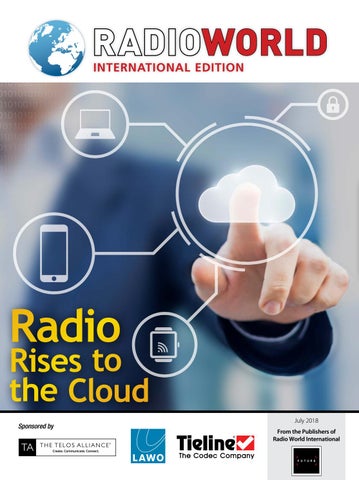
Radio Rises to the Cloud
INTERNATIONAL EDITION
Radio
Rises to the Cloud Sponsored by
July 2018 From the Publishers of Radio World International
4
Cloud Management to Streamline Workflows
6
Cloud Software Frees Station From Studios
8
Leveraging Technologies to Forge the Broadcast Future
12
Radio in the Cloud: The Next Virtual Frontier?
14
Need to Know: Cybersecurity
Cloud-based technology has transformed the way broadcasters and media companies are delivering content to their customers. In fact, it has changed virtually all aspects of radio station management — from program production, scheduling and contribution through to distribution. By adding cloud solutions to their operations, radio stations are simplifying their entire process. Thanks to this technology, it is becoming easier for broadcasters Marguerite to manage operations remotely and creatively as well as Clark conveniently share and store resources to optimize perContent Director formance. It also simplifies the process and eases costs associated with delivering programming of local interest. But, while cloud technology brings with it many advantages, it also raises a number of questions regarding security, privacy and dependability. This latest Radio World International eBook features examples of ways radio broadcasters are implementing cloud solutions productively into their day-to-day operations. It explores specific issues one should consider when contemplating cloud usage. These include understanding when it’s advantageous to use cloud storage over local storage; what security measures are necessary to ensure privacy and integrity of material; steps to take if a cloud service goes down or is unavailable due to loss of internet connectivity; the necessity (or not) of special firewalls for cloud storage and retrieval; and more. Radio World has published more than 40 eBooks exploring the many facets of radio station and network operations including mobile reporting, studio/transmitter links, visual radio, studio apps, social media, consoles, digital radio developments and more. Find recent issues at https://www. radioworld.com/resource-center/radioworld-ebooks. — Marguerite Clark
19
Radio-as-a-Service Brings Benefits
20
Cloud Technology Aids Business Continuity Planning
21
Cybersecurity — It’s Not Just a Problem for IT RADIO RISES TO THE CLOUD Cover image: Thinkstock/NicoElNino
Radio World International Edition | July 2018
3
Cloud Management to Streamline Workflows Examining how Software as a Service is redefining contribution and control for broadcasters • Automatic updates: Incremental updates are automatic, reducing IT service requirements. • Accessibility: Services delivered over the internet provide accessibility from anywhere with connectivity. • Remote control: Engineers have the ability to control equipment remotely from the studio.
GUESTCOMMENTARY By Charlie Gawley The author is V.P. Sales APAC/EMEA, Tieline Technology. Cloud technology solutions have been drivers of change in the broadcasting industry for some time, and increasingly station infrastructure and the cloud are further intertwined. From a content delivery perspective, much has been said and written about how broadcasters can now distribute rich content to consumers through Over-the-Top IP-based technologies using the internet, instead of traditional channels like terrestrial radio transmitters. So too have broadcasters streamlined broadcast workflows behind the scenes in order to create flexible IP-based studios with scalable routing, storage, management and transmission solutions. Therefore it was natural for cloud technologies, and in particular Software as a Service, to become more influential as an interface between “the studio” and the multitude of “capture assets” at remote sites — assets employed to ingest news, sports and other content and then transmit IP streams flexibly to affiliates and transmitter sites as required.
CLOUD MANAGEMENT AND REMOTES
From the broadcast engineer’s perspective, one of the most significant ways in which SaaS has changed broadcast engineering is the ability to control equipment remotely in real time. In the old days, adjusting equipment at a remote location or transmitter site may have required hours or even days of travel time in some situations. Whereas today, complete remote control of a station’s broadcast equipment is at our fingertips every minute of every day over IP. These days, hardware manufacturers and countless other suppliers of broadcast technology provide solutions for managing fixed infrastructure at transmitter sites. This equipment can be configured using fixed IP addresses, providing a direct IP link into the equipment. It is more complicated to manage “mobile” broadcast contributions from IP devices with changing IP addresses over cellular or Wi-Fi networks. However, there are solutions that now deliver remote control of hardware like audio codecs used to stream news reports and live audio from major and minor league sporting events and other remote broadcast applications. This connectivity can be provided by cloud-based servers, which detect the presence of devices when they connect to the internet. Tieline’s Cloud Codec Controller is one such service. No longer do engineers need static IP addresses to reach out and interrogate and configure codec equipment. This is done automatically by devices “reaching out” to a cloud-based server to identify themselves as soon as they are connected to the internet. Devices don’t need to be connected, just present and available to allow secure, real-time monitoring and
SAAS FOR BROADCASTERS
SaaS has streamlined operations in many broadcast facilities. Typically, third-party applications are used over the internet to perform a myriad of broadcast tasks like equipment control, mixing as well as data ingest and storage. In today’s cost-driven environment, SaaS cloud services have many advantages for broadcast networks. These include: • Pay as you go: Services deliver predictable costs that can be managed easily. • Scalable: Services can be scaled in size and feature-set to suit the broadcast application.
RADIO RISES TO THE CLOUD Radio World International Edition | July 2018
4
Tieserver in the cloud discovers codecs and Report-IT users, and provides a remote engineering control interface.
• Whether adequate ISP and provider backups are in place. • SaaS provider server locations; latency can be affected by server locations. • SaaS provider redundancy; ask about support and what happens if the closest server crashes.
remote control — even over cellular and Wi-Fi networks. Even apps like Report-IT can be accessed and controlled remotely using minimal bandwidth. The advantages of this level of control are obvious. Technical support staff can be in a main office looking after multiple sites and monitor connection status of many devices simultaneously.
Whatever the service, the importance of off-cloud backup cannot be underestimated. Always think about how you would recover data in a worst-case scenario when designing risk management mitigation strategies.
SECURITY AND RELIABILITY CONSIDERATIONS
Carefully consider “privileged user access” to maintain security when using outsourced cloud-based services. These services bring an inherent level of risk, so having adequate controls over access to sensitive data and information is critical. Ask providers to supply information about who has oversight and access to this information. In addition, adequate Tier 1 ISP bandwidth is required to stream audio and video services reliably and integrate SaaS applications and control reliably. It is also important to consider: • The fine print in ISP and provider Service Level Agreements to avoid pitfalls like bandwidth limiting.
THE FUTURE
Remote management of all broadcast assets using the cloud is the future. For many networks it is already happening today, albeit in varying degrees. Engineers should embrace the significant advantages provided by cloudbased assets after mitigating risk and planning carefully for all eventualities. 5G cellular networks will deliver even better connectivity and bandwidth, and SaaS opportunities for broadcasters will only grow as a result. n
The Tieline Cloud Codec Controller User Interface
RADIO RISES TO THE CLOUD Radio World International Edition | July 2018
5
Cloud Software Frees Station From Studios Virtual radio station This Is Electric broadcasts online and via DAB By Will Jackson HULL, England — U.K.-based dance music radio station This Is Electric is an entirely virtual radio station broadcast on DAB digital radio and online, created using a dedicated “Radio In The Cloud” solution from Broadcast Radio. The station uses the innovative system to broadcast a unique format of pure house music, without the need for a permanent studio base. Managing Director Quentin Nield, an experienced engineer and studio builder, said the station came about as he believed club music was being ignored by radio. the Focusrite Scarlett 2i2 audio interface. I have a Belkin TuneStudio multitracker we use for OBs and artist recording, as it has a built-in mixer with two mic and three line inputs. Access to the playout system is by proprietary software from Broadcast Radio — we just connect and voice track.” Nield said the system makes its remote broadcasts simple, as the equipment is light and easily carried to site, where the only requirement is power and internet access. “DJ mixes are uploaded to a Dropbox folder monitored by our system, which drops them into ‘carts’ that are already scheduled. We then use Myriad playout with Spatial’s SAM Cast streaming encoder, passing through a Breakaway processor which combines the four channels into one, and processes the audio to the same high standard as an Omnia 9.”
THE SETUP
“We set up This is Electric to play the music we were hearing in the clubs, broadcasting online-only initially, but then going on the small-scale DAB multiplex in Cambridge. This allowed us to be on the U.K. Radioplayer app, which we thought was important for marketability, credibility and accessibility. For online, we also found it is important to make sure your station is registered with all the ‘tuning services,’ such as Reciva, TuneIn, myTuner Radio, vTuner, iTunes — between them they cover every device or car/home stereo system.” With the station hosted “in the cloud,” the need for studio equipment is light, said Nield. “All the presenters use their home setup of mic into an external USB audio interface, into a PC. Most of them use
Quentin Nield is managing director of This Is Electric.
DJ Massimo Paramour records his Ministry of Sound DJ set for broadcast.
RADIO RISES TO THE CLOUD Radio World International Edition | July 2018
6
David Boulton is brand manager for Broadcast Radio.
elements such as news and travel bulletins. Remote voice tracking allows presenters based anywhere in the world to voice-track their shows for later broadcast. Meanwhile, Online Content Processor sends “now playing” information to DAB multiplexes, websites and streams and can send tweets and Facebook posts automatically with dynamically built information about the surrounding audio. Finally, Myriad Playout in its “AutoFade” mode is able to hit time-critical events, so the program hour can be back-timed to hit a news bulletin exactly. Boulton said Broadcast Radio manages the hardware required for the station. “We look after the maintenance, electricity and cooling. There’s a fiber backbone connection to the internet, and we have our own streaming servers for the end client connections. We also have a variety of different audio processors — physical and
Quentin Nield edits audio at This Is Electric’s coverage of Pride in London.
Last year, the station broadcast live from the Pride in London festival, using a Soho bar as its base. Nield edited and produced from there, while presenters went out and captured audio using iPhones with IK Multimedia’s iRig Mic HD 2 external reporter microphones. SIMPLIFIED WORKFLOW
When setting up the station, Nield brought in Broadcast Radio, based in Hull, Yorkshire. “I went with Myriad Playout as a lot of our team had used it before, so there was less of a learning curve — plus I have a good relationship with them going back almost 20 years. They host our admin, playout and streaming functions. It’s been running for nearly five years with very few outages during that time, so reliability is not something I have to worry about.” David Boulton, Broadcast Radio’s brand manager, explained how their part of the station’s broadcast chain works. “As we all know, ‘the cloud’ is just some This Is Electric’s Myriad playout screen from Broadcast Radio. computers, somewhere in a data center. We have dedicated Winsoftware — to provide a signature station sound, and a dows PCs that run the full versions of our Myriad Playout choice of encoding options.” system, and AutoTrack Professional scheduling software. For This Is Electric, Nield believes using “radio in the Our clients then use standard remote-control applicacloud” has simplified its workflows while retaining flexitions to ‘dial in’ and control the system. They have full bility. access to the features that would be available to them if “You can be with your setup at home or on a trestle they were based at their own premises.” table at a festival; it’s irrelevant as long as you have a The Myriad suite used by This Is Electric includes sevgood internet connection,” he said. “Truly live OBs with eral software tools. Auto Importer checks sources such some sort of link can be unreliable — we record links as FTP, file locations and Dropbox, and brings audio proin the same hour so it’s ‘as live,’ but with the comfort of duced off-site directly into the system. Stations use this knowing it’s loaded into the log and in good quality.” n either to deliver complete shows, or for ingest of hourly RADIO RISES TO THE CLOUD Radio World International Edition | July 2018
7
Leveraging Technologies to Forge the Broadcast Future Cloud implementation offers a multitude of advantages
GUESTCOMMENTARY
It is true that availability to direct connect, or peer, to these networks is at present somewhat limited based on locations of points of presence. But more high-bandwidth backbone points of presence are being built as the demand for cloud access grows globally across all industries. A lot of questions come up regarding security of the broad-
By Greg Shay The author is CTO for The Telos Alliance. If you will permit me a metaphor about progress: We study the past under a microscope, We craft the present with precision, But we forge the future with blunt hammers … Right now, the broadcast industry is in the “blunt hammers” stage of forging the mold of how we will do broadcasting using cloud technologies. Note I said “technologies,” plural. Consider that “the cloud,” a term that seems to have been coined to be intentionally vague, means more than one thing. At the most basic level, “the cloud” is simply the open-market commercialization of racks of computing hardware for hire, maintained and managed at an economy of scale with which no individual user company can compete by building server farms themselves.
One way to think about taking advantage of the cloud, viewed as a high-quality facility, is to flip the way a studio typically is built on its head.
cast when using the cloud. Quite to the contrary, there is a growing consensus that the cloud facilities actually are more secure, more carefully managed and maintained, and stricter regarding network control and firewalls. Anyone wanting to build their own secure data center has a rather high bar to match what the professional cloud provides. As the broadcast industry has borrowed technology from the IT industry, the way forward for security is to also borrow the best practices around security from the IT industry. The cloud providers are at the top of the IT security world. I predict that broadcast will benefit from working with them.
SECURITY
Broadcasters already are taking advantage of the vast amounts of computation and data (file) storage for file transfer-based audio, playout systems and all manner of corporate data processing, scheduling and accounting. But I would draw attention to one additional resource offered by the cloud, potentially the most important one for broadcasting: high-bandwidth global fiber-optic data networks to be put into use more and more as the broadcast networks. Broadcasting began using IP networks for web streaming audio over the internet two decades ago. But the high-bandwidth global fiber networks that are part of the cloud are of a higher quality and reliability than the internet, suitable for live professional audio, live broadcast contribution, remote production and delivery of final program.
POTENTIAL
One way to think about taking advantage of the cloud, viewed as a high-quality facility, is to flip the way a studio typically is built on its head. Rather than a self-contained studio with local sources, which uses a network connec-
RADIO RISES TO THE CLOUD Radio World International Edition | July 2018
8
Livewire, and in 2008 fostered the creation of the industry standard for AoIP, AES67. It is easy to lose sight of now, but we were intentionally following closely on the heels of the success of VoIP overturning traditional telephone networks. Over the years, I have often asked my audiences the question, “What is the most important thing that AoIP connects to?” And my answer is “software.” By using IT-friendly IP protocol for professional audio, we were opening the door to what has become possible today, to leverage and harness the massive power (and investments) of open-market commercial computing IT industry platforms and services, the so-called “cloud,” and the flexible, adaptable, software-based platforms they provide. Keep this in mind: If professional broadcast audio was still stuck in physical XLR audio cables, AES/EBU digital transport, MADI and TDM switchers, this ability to leverage the cloud would be lost. n
tion to deliver the final program, think of the core of the studio function being in the most secure place: the cloud data center. Highly connected to sources and playout servers (also in the cloud data center), if the connection for the voice of the host (one of the few distant connections) happened to be lost for whatever reason, the show can continue with backup automation (also connected via and running in the cloud). This is the “cloud” equivalent version of the Virtual Local Radio (ViLoR) project worked out by the BBC. There are many other ways to think about restructuring how a live show is produced, but in this new cloud point of view, build it on the foundation of a highly network connected facility that is least likely to go offline. At Telos, we first planted the seeds for this transition in handling broadcast audio programs in the late 1990s, when the first steps were taken to create professional audio over IP (AoIP). We created and brought to market
RADIO RISES TO THE CLOUD Radio World International Edition | July 2018
9
cloud
BBC ViLoR Trailblazes into Cloud-Based Radio In England, the British Broadcasting Corporation (BBC) faced a critical yet specific challenge. All of their local radio stations across the county were in dire need of technical updating. But rebuilding them using traditional hardware, wiring, and equipment would require many years if done sequentially, so that today’s tech would be out of date by the time the rebuilds were done. And the price tag for traditional refits was staggering. BBC Radio sought to find a better way. In concert with our partner Broadcast Bionics, Axia’s team went to work to create a new model. What emerged was Virtual Local Radio, or “ViLoR.” With ViLoR, local stations would keep their studios and talent. They would also have their usual mics, headphones, automation touchscreens, and mixing consoles in each local studio. However, in a bold rethink of audio system layout, nearly all other infrastructure to support their work would be located in two secure data centers. Both individual station and shared system resources are housed in London and Manchester. The studio equipment, which to the presenter looks the same as any other Axia Fusion surface in each local BBC Radio outlet, is actually controlling audio mix engines, on-air talkshow systems, audio codecs, and automation playout systems physically located remotely in these two, redundant data centers functioning as a private cloud. BBC Editorial teams have full control over the play-out system and mixing desks, but the actual audio files are stored, streamed, mixed and processed in these remote data centers in real-time. Importantly, the system is designed to ensure that only the back-end equipment is centralized; editorial and production teams continue to present from their respective local communities. This innovative approach has allowed the BBC to solve the critical challenge: How to refresh the equipment and systems used across the BBC’s 39 local radio stations as they reach the end of their natural technology life. About 20 BBC local radio studios are now on-air with the ViLoR system, and about four more are being added every month. A small team of engineers is able to refit the local stations one by one far more quickly than if done with traditional equipment layout. Updating stations using traditional technology on this scale is both expensive and slow, taking between six to eight months per station. By sharing infrastructure and equipment across multiple sites, the BBC is substantially reducing costs and time to refresh a local BBC station with two on-air studios is minimized to only a few weeks! Wiring and systems needed at each
Phone +1 (216) 241-7225 | TelosAlliance.com | inquriy@telosalliance.com
Checkout ViLoR on Twitter with #vilor
local studio are greatly simplified. Think of the new layout as having all the back-end systems in a data center, while the local operators and talent use traditional-looking audio consoles from Axia. The equipment being controlled is many miles away. Redundant, secure high-speed data links connect the local studios to the infrastructure they use every moment of the day. Some common resources, such as audio codecs and on-air talkshow systems, are shared among all the stations. Local operators are, however, unaware that they may be sharing a talkshow system with other local stations, as a supervisory software system allocates codecs, phone lines and hybrids instantly, as needed. The local operators and talent are presented with traditional controls for these systems, while in the background they are assembled virtually, on the fly, by the software. This technique affords maximum efficiency and avoids having infrastructure lay idle most of the day. When BBC’s ViLoR system was first designed, the performance of Virtual Machines for real-time audio mixing and processing was not guaranteed and the private/public cloud was in its infancy. ViLoR’s system designers relied on Telos Alliance research and development engineers in the US and Europe to create an efficient and reliable mating of Telos software and blade CPU platforms. These hardware CPU blades used by BBC Radio have proven the ViLoR operational and technology concept. Now, Telos Alliance engineers are fitting real-time broadcast audio functions into today’s Virtual Machines, bringing the next level of efficiency and ease of implementation. The BBC’s ViLoR rollout has been operating for more than 500,000 studio-hours now. It demonstrates that local studios and remote audio infrastructure can work perfectly together. Low-latency, local mix monitoring, and wire reliability show this model can—and does—work. It also highlights a real benefit of locating complex systems in a data center—maximizing efficiency and value of high-end, redundant broadcast infrastructure.
The Benefits of Cloud-Based Radio Operations
cloud
Automation playout systems are available for purchase or a small monthly fee, cloud-hosted in a data center and remote-controlled by modern web browsers. On-air talent simply logs in and works on his or her show. By moving most or all back-end operations to the cloud, broadcasters eliminate equipment and PC failures and the dedicated IT staffers required to maintain equipment. A cloud-based “centralization” of broadcast infrastructure makes it more accessible to talent and other content creators, making the production of high-quality, localized shows, even in smaller markets where talent and production may not have been affordable, easier. In a cloud-based broadcasting world, broadcasters get more efficient operations and far lower capital expenditures. Talent gets to spend more time on-air, creating worthwhile programming. Listeners benefit from perfectly clear digital audio, streaming for every station, easier highlight retrieval through station apps, and consistent sound from their local over-the-air transmitter.
Phone +1 (216) 241-7225 | TelosAlliance.com | inquriy@telosalliance.com
Radio in the Cloud: The Next Virtual Frontier? The role of cloud-based services depends on a broadcaster’s unique needs and the services available services: public and private. Public cloud services are accessible to anyone with a public internet connection, and are great for delivering apps to a wide number of people or locations. Private cloud services require a dedicated peer connection from subscriber IPs to cloud servers, limiting access but increasing security for developers and creators.
GUESTCOMMENTARY By Clark Novak The author is radio marketing specialist for Lawo AG. If you think about it, broadcasting and IT are nearly twins. They’re both about communication and information. And lately, they’ve been moving even closer. In 2005, studios using switched Ethernet for audio transport were exotic; now AoIP is commonplace. PCs supply the lion’s share of most stations’ daily audio, editing is performed on laptops and workstations, and even mixing consoles can be “virtual.” It’s fair to say that today, most radio engineers’ daily routines involve as much IT activity as RF — maybe more. Now, broadcasters are buzzing about the possibilities of another IT technology: “The cloud.”
HOW CAN BROADCASTERS USE THE CLOUD?
Thanks to ubiquitous Wi-Fi and cellular data services, radio consumers increasingly listen on phones, smart speakers and other connected devices instead of actual radios. Because of this, everyone agrees that program distribution via public cloud services is perfect for the distribution of radio content on the internet, whether live or on-demand. This has become much easier and cost-effective recently, thanks to development of modern media protocols such as HLS and MPEG-DASH, which use pure
WHAT IS THE CLOUD?
It’s a blanket term for internet-based services that provide computing power or mass storage or run applications from an off-site server. The cloud is an outgrowth of the enormous increase in computing power that replaced racks of physical computers with powerful “super servers,” each running dozens of virtual machines performing different tasks. Well-known CSPs [Cloud Service Providers] include Amazon Web Services, Microsoft Azure and Rackspace; there are many others. Nearly every CSP offers two types of cloud Virtualization is at the heart of the cloud.
RADIO RISES TO THE CLOUD Radio World International Edition | July 2018
12
HTTP transmission to deliver content instead of relying on RTSP and stream replicators. CSAs’ “big pipe” internet connections make cloud-based content distribution even more of a natural fit. At the other end, cloud services can be leveraged to enhance content contribution. Some readers may already keep their music libraries, or even the automation system itself, on cloud-based servers — great for redundancy and guaranteed uptime. Talk show conferencing and call-ins are another Cloud-based broadcasting from creation to delivery. interesting application. Many cloud-based VoIP phone systems are already available tailored to the needs of TO USE OR NOT TO USE broadcasters. These utilize software hybrids running in Are cloud-based services right for your radio station? virtual machines to deliver clear digital caller audio to the Here are some questions to help you decide. studio, and mix-minus to callers and guests. Content ingest is yet another area where cloud services Do you stream your programming? How much shine. With the future of C-Band satellite services uncerdoes it cost you? If you are already streaming tain, syndicated content distribution via cloudservers using first-generation stream replication, moving to (real-time or file-based) provides a viable and cost-effecnewer codecs in conjunction with cloud-based HTTP tive replacement solution. servers might reduce your overall cost per stream. Perhaps the best use so far for cloud services is to provide broadcast tools on-demand for remote talent. CloudHow much of your programming comes from based audio production libraries, recording and editing external sources? If much of your programming software, and contribution methods give reporters, remote is already from externally delivered content, moving presenters and editors studio-grade tools — without the more services (such as automation and content libraries) expense of building and maintaining off-site studios. to cloud-based servers may make financial sense. But if most or all of your content is locally created, cloud services will likely not be useful to you. THE BIG QUESTION When radio folks talk about the cloud services, one question invariably pops up: “Can I run my radio studio Do you have remote contributors? If your orgafrom the cloud?” While many of the tools needed for nization has creators and editors working while radio production are already virtualized and ready for travelling, or from satellite locations or home studios, it use, there’s one barrier to completely virtualized studios may be worth converting remote-studio hardware into hosted by CSPs: that old demon latency. cloud-hosted production tools that can be accessed While it’s certainly possible to create, edit and mix on-demand from any place with an internet connection, programming with cloud-based software, the latency and require no physical replacement or maintenance. involved in transmitting local talent audio over the internet, mixing it and then sending it back for monitoring As computing power and internet availability continue makes real-time content creation problematic unless a to rise, it’s clear that cloud services will play a part in the zero-latency local mix is employed to mirror the mixing future of radio. How much a part? As always, one size being done by cloud-hosted software. Perhaps the future does not fit all. The role of cloud-based services in your holds a solution to this problem, but for now, complete operations will always depend on your unique needs and cloud-based studio virtualization remains out of reach. the services available. n
1.
2. 3.
RADIO RISES TO THE CLOUD Radio World International Edition | July 2018
13
Need to Know: Cybersecurity Every enterprise is at risk as attacks diversify and adversaries get smarter By Paul McLane
threats are ever-evolving, and the sophistication of adversaries keeps growing. But, according to the White House report, the private sector may, for any number of reasons, be tempted to underinvest in cybersecurity. National security officials echo the concern. “Our daily life, economic vitality and national security depend on a stable, safe and resilient cyberspace,” says the U.S. Department of Homeland Security in explaining why it devotes a large web resource to the topic. The department this spring released a strategy hoping to help reduce vulnerabilities, build resilience, counter malicious actors and make the ecosystem more secure. It identifies 16 “critical infrastructure” sectors where a loss of networks would have a debilitating effect on the country. But even trying to define the sectors demonstrates how broadly the subject touches every corner of American life; they range from commercial facilities and manufacturing to the communications sector and health care. Homeland Security took particular note of a growing
“We keep building new things on old infrastructure that never seems to get fixed.” Chris Wysopal is a hacker who was quoted in a Washington Post column about the state of internet security (or perhaps we should call it insecurity). In May Wysopal — also known by his hacker name “Weld Pond” — joined several others in a return visit to Capitol Hill, where 20 years earlier they’d testified in a congressional hearing about the insecurities of software and networks. Their 1998 appearance helped put the issue of cybersecurity on the national stage. A central part of their 2018 message is that digital security isn’t much better today. COSTLY AND DANGEROUS
Malicious cyber activity cost the U.S. economy between $57 billion and $109 billion in 2016, according to the White House Council of Economic Advisors. Cyber
RADIO RISES TO THE CLOUD Radio World International Edition | July 2018
14
concern about the threat of “widescale or high-consequence events” that could cause harm or disrupt services on which the economy and millions of people depend. “Sophisticated cyber actors and nation-states exploit vulnerabilities to steal information and money and are developing capabilities to disrupt, destroy or threaten the delivery of essential services.” How might your own business be whacked? A threat can come via denial of service attacks; destruction of data and property; disruption of business, perhaps for ransom; and the theft of your proprietary data, intellectual property and financial and strategic information. Reports of data breaches An “adverse cyber event” can cost your business in numerous ways. This graphic is from a report by and cyberattacks are everyday the White House Council of Economic Advisors. news. Lewis Morgan on the IT Governance Blog curated more than 60 such stories in the Cisco made note of several other trends and findings: month of May and counted the total of breached records that month at more than 17 million — “actually quite low • Short, pernicious “burst attacks” are growing in comwhen compared with previous months.” plexity, frequency and duration. “In one study, 42 In 2018, virtually every major and minor business or percent of the organizations experienced this type organization relies on the global, interdependent IT of DDoS [distributed denial of service] attack in 2017. ecosystem. The degree to which leaders take the subject In most cases, the recurring bursts lasted only a few seriously could, in the long term, determine the survival minutes.” of those enterprises. To learn what trends businesses should be watching, • Many new domains are tied to spam campaigns. we turned to several sources approaching the topic from “Most of the malicious domains we analyzed, about various angles. 60 percent, were associated with spam campaigns,” Cisco reported. THREATS IN BURSTS
• Security is seen as a key benefit of hosting networks in the cloud. “The use of on-premises and public cloud infrastructure is growing. Security is the most common benefit of hosting networks in the cloud, the security personnel respondents say.”
In its 2018 Annual Cybersecurity Report, Cisco said malware is definitely becoming more vicious and harder to combat. “We now face everything from network-based ransomware worms to devastating wiper malware,” the company stated. “At the same time, adversaries are getting more adept at creating malware that can evade traditional sandboxing.” While encryption can enhance security and is used by roughly half of global web traffic, Cisco continued, encryption provides bad actors with a powerful tool to hide command-and-control activity. “Those actors then have more time to inflict damage.” Artificial intelligence may help. “Encryption also reduces visibility. More enterprises are therefore turning to machine learning and artificial intelligence. With these capabilities, they can spot unusual patterns in large volumes of encrypted web traffic. Security teams can then investigate further.”
• One bad insider can be a big threat, and a few rogue users can have a huge impact. “Just 0.5 percent of users were flagged for suspicious downloads. On average, those suspicious users were each responsible for 5,200 document downloads.” • It’s not just your IT assets that are at risk. Expect more attacks on operational technology (OT) as well as the internet of things (IoT). “Thirty-one percent of security professionals said their organizations have already experienced cyberattacks on OT infrastructure.” Continued on page 16 ❱
RADIO RISES TO THE CLOUD Radio World International Edition | July 2018
15
❱ Continued from page 15
a company’s critical assets; systems to spot and identify suspicious behavior; better network traffic analysis; and “real-time change auditing solutions” that do things like detect abuses of user privileges or suspicious activity in files and folders. But Simister too sees the risk of more attacks backed by hostile governments; in response he predicts more efforts to train staff and to develop international sharing of information.
• The multivendor environment affects risk. “Nearly half of the security risk that organizations face stems from having multiple security vendors and products.” IOT RANSOMWARE
Another observer taking stock is Aidan Simister, the global SVP for Lepide Software. Writing in a post on the CSO website, he too predicts artificial intelligence will take a bigger role. But while AI may help the good guys, he notes, hackers too can use it to launch more sophisticated cyberattacks. Further, new strains of malware can work around “sandbox” defensive techniques, waiting until they are outside the sandbox before executing their malicious code. Meanwhile, Simister agrees that the “internet of things” could become more of a target for ransomware, with hackers targeting power grids, factory lines, smart cars or home appliances to demand payment. Many businesses, Simister predicted, will not comply with the European Union’s new General Data Protection Regulation on data protection and privacy (the thing you’ve been getting all those emails about). He predicts some companies will choose to ignore it, accepting the risk. We’re also likely to see a growing number of companies adopt multi-factor authentication in response to data breaches involving weak, stolen or default passwords. He expects that more sophisticated security strategies may find wider adoption. These may include the use of “remote browsers”; deception technologies that imitate
PRIVACY PARADOX
One change in mindset visible in the market is a deemphasis on the idea of “perimeter security.” “You are not safe behind the perimeter, because the perimeter itself no longer exists,” Akamai argues on its website. “Today’s world is cloud- and mobile-driven, and the traditional moat-and-castle approach to enterprise security is no longer applicable for modern business practices.” With applications hosted in various places and a workforce on the move, the company argues, there is no longer a delineation between inside and outside the network. “As a result, seemingly every week there are new reports about high-profile data breaches and cyberattacks.” Akamai Chief Technology Officer Charlie Gero argues in favor of what he calls zero trust security architecture. “Companies must evolve to a ‘never trust, always verify’ zero trust model to secure against the wide variety of threats that exist and are constantly evolving,” Akamai states. Looking at the consumer economy more broadly, cybersecurity is only likely to become more crucial thanks to ongoing developments in areas as diverse as cryptocurrency, interactive smart speakers and mobile payments. For example, a major trend toward platform personalization — whether it be on Facebook or Spotify, Wave or NextDoor — raises the privacy stakes. Venture capitalist Mary Meeker of Kleiner Perkins notes the massive amount of personalized data that people have put into such platforms. That data, she said in remarks at the Code 2018 conference, improves engagement and leads to better experiences for consumers — but it also helps creates what she calls a privacy paradox: “Internet companies are making low-price services better in part from user data. Internet users are increasing their time on internet services based on perceived value. Regulators
Investment projections in cybersecurity (in billions of dollars).
Continued on page 18 ❱
RADIO RISES TO THE CLOUD Radio World International Edition | July 2018
16
Welcome to
Broadcast 3.0 ruby – Radio never looked so good.
Join us @
IBC #8.B50 DOWNLOAD ruby BROCHURE bit.ly/2kT8Obi
Feast your eyes on the new ruby mixing console. Intuitive. Uncluttered. Powerful, yet so refined. Streamlined from every angle. Optimized controls: everything you need, nothing you don’t. Only 5 cm (2”) tall, from the bottom of its exquisitely cast side frames to the tops of its carefully chosen rotary selectors. But great design goes beyond mere good looks. Which is why ruby is expertly crafted for both speed and accuracy — controls perfectly placed to fall naturally to hand. Premiumgrade displays, faders and switches. Standards-based AES67 networking. Powerful features like AutoMix smart mixing and instant one-button switching between live and production modes. Up to 96 channels of DSP and 1,920 routing crosspoints*. The cherry on top? A customizable, context-
Welcome to your command cockpit. Graphical, intuitive, customizable: ruby’s onscreen interface, powered by our VisTool GUI builder, is so much more than just meters and a clock. Multi-touch controls instantly give what’s needed to control studio devices, tweak dynamics, adjust virtual faders, meter true loudness — even design your own custom screens. The possibilities are virtually limitless.
sensitive touchscreen GUI that puts virtual control of mixer functions, playout software, studio devices, even Web feeds, social media and video, right at your operator’s fingertips. No other console is this smart. Slim, trim, and sharp as the cutting edge. Engineered and built without compromise by German craftsmen. Sprechen Sie deutsch?
Who says small can’t be mighty? ruby’s mixing engine, Power Core, is equipped with redundant IP networking, dual-redundant power capability, and tons of built-in I/O – 384 stereo channels, standard – with room to add even more. There are dozens of DSP channels, and a built-in routing switcher, too. It’s like 12 rack units of power, packed into only 1RU.
www.lawo.com
❱ Continued from page 16
— like DDoS or ransomware — to an organization, [but] host computing resources can be [affected] such that legitimate application use is impacted. Malicious mining scripts can easily be picked up from a casual website visit, and this opens a new area for antivirus protection software.” Pecena said for him this recalls the days of desktop computers being unknowingly hijacked to serve music or distribute porn.
want to ensure data is not used improperly, and not all regulators think about this in the same way.” Regulatory considerations are thus a big, uncertain element in this picture. THE WEAK HUMAN LINK
IT expert Wayne Pecena, who works in the broadcast and education sectors, says security should be an ongoing process. Yet that at many business, unfortunately, it tends to be treated as a one-time, set-it-up-and-forget-it event. Pecena is assistant director information technology of educational broadcast services at Texas A&M University and director of engineering for KAMU Public Radio and Television; he says cybersecurity never has an end. “It is a continuous process of monitoring, evaluation, analysis and prevention as the threat landscape is always in a state of change and evolution,” he said. “I would also not lose sight of the past, as ransomware, phishing [and] distributed denial of service will likely continue at an accelerated pace. As cloud services and applications continue to expand, I would also keep the cloud cybercrime landscape or Cybersecurity-as-a-Service (CaaS) on my radar.” In Pecena’s experience, most organizations do spend plenty of time and money in protecting their IT environment, but often the simplest areas can be overlooked while the focus is on higher-tech matters. “Social engineering remains one of the largest threats to an organization, and the human factor remains a weak link. The internet of things movement brings challenges, as most of these types of devices lack any real internal security capability and instead rely on external protection means.” He also finds “crypto-mining” a fascinating area of concern as computing resources are hijacked for someone’s bitcoin mining applications. “Not necessarily destructive
As cloud services and applications continue to expand, I would also keep the cloud cybercrime landscape or Cybersecurity-as-a-Service on my radar. — Wayne Pecena Those well-meaning hackers who returned to Washington recently hoped to draw attention once again to the issue of digital security. At least one pushed for government to play a larger role. But another said companies also need to take advantage of the tools and knowledge that are already available. It was Robert Mueller — yes, that one — who is credited with saying back in 2012 that there are only two types of companies: those that have been hacked and those that will be hacked. Today that wisdom is often updated to read: “There are two types of companies: Those that know they’ve been hacked, and those that don’t know that they’ve been hacked.” Manage accordingly. Paul McLane is managing director, content, of Radio World and the Future Media — Technology group. n
SOURCES AND MORE READING Derek Hawkins, The Washington Post, “Hackers: Internet Security Threats From 20 Years Ago Persist” Department of Homeland Security, “Cybersecurity Strategy” Adam Simister, “7 Cybersecurity Trends to Watch Out for in 2018” Cisco, “2018 Annual Cybersecurity Report” Mary Meeker, Kleiner Perkins, “Internet Trends 2018” White House Council of Economic Advisors, “The Cost of Malicious Cyber Activity to the U.S. Economy” Charlie Gero, Akamai, “Moving Beyond Perimeter Security”
RADIO RISES TO THE CLOUD Radio World International Edition | July 2018
18
Radio-as-a-Service Brings Benefits The industry continually is striving for freer and more nomadic modes of operation gic aspects that should not be overlooked when choosing to migrate real-time features to the cloud. For example, it is preferable to select hosting in the geographical area of the broadcaster to avoid latencies in audio streams that can occur unexpectedly on the Internet.
GUESTCOMMENTARY By Pascal Malgouyard The author is head of marketing for Digigram. The adoption of cloud solutions by the broadcast market is accelerating. Thanks to the portability of data and flows, as well as the relative standardization of systems, we now have access to a full range of services: Infrastructure-as-a-Service, Platform-as-a-Service, Software-asa-Service, and tomorrow, Radio-as-a-Service.
CONSIDERATIONS
Furthermore, while security is based on the hosting of the applications it also relies on the confidence that one has in the developers and the security of their implementation. It is therefore a good idea to work with recognized major brands. It is also good to check redundant access to applications and their data with the developers. That being said, cloud development will have a major role in the broadcast world for years to come, bringing with it a virtual radio studio concept that heralds an unprecedented freedom of action. It is therefore natural for current market solutions to turn toward this vision, particularly in infrastructure with important parts of the workflow associated with solutions that allow real-time audio applications to be linked together. Offered on a subscription basis and accessible from anywhere, cloud technologies make it easy and affordable for even the smallest broadcasters or production companies to connect and manage audio outside sources and bring content to the control room. Virtualized infrastructures open the door to the virtualization of a secure cloud-based studio thanks to new applications that enable greater flexibility, pay-as-you-go operation, integration with a professional console in the cloud and, above all, an ease of use that corresponds to new, freer and more nomadic modes of operation. n
FLEXIBILITY AND SECURITY
This turning point corresponds to a strong technological trend that today combines two worlds: flexibility and security. It is by surfing the wave and the success of the IT world in exploiting professional business applications that these services gradually have been opened to broadcasters, particularly radio. Starting from a mature and stable market, radio workflows can now be built easily using cloud technologies. The cloud benefits from shared structures, which make it more accessible and cheaper than before, turning cap-ex spending into flexible op-ex. It also offers more elasticity in terms of investment; while you “get what you pay for,� customers also benefit from a multitude of ancillary services, including performance indicators, regular updates (new features and functionality), scalability and security of access as well as the outsourcing of maintenance and online support. As far as security is concerned, professional applications have implemented a level of security and data protection similar to the famous GAFA [Google, Apple, Facebook and Amazon], which now seems suitable for broadcasters. Nevertheless, it is important to highlight some strate-
RADIO RISES TO THE CLOUD Radio World International Edition | July 2018
19
Cloud Technology Aids Business Continuity Planning Decentralizing content and technology ensures nonstop operation cast of up-to-the-minute content. Specialized IT service companies can manage measurement variables of all content effortlessly. The cost is proportional to the consumption of storage and bandwidth. User fees for content services are becoming extremely flexible. Also, service providers ensure online content maintenance by organizing the replication of data, guaranteeing availability. As regards signal processing such as audio routing, the mixing of on-air sources or audio processing of on-air broadcast sources, broadcasters increasingly are implementing IP technology. These real-time audio processing services are becoming more accessible and it’s now possible to decentralize these technologies gradually as well. The only limitation today lies in the latency inherent to the network in the case of a remote cloud hosted on medium or long distances. In short, cloud technology brings broadcasters many benefits, including lowering investments, remote access to updated technology and data and permanent availability. The cloud allows users to create a relevant business continuity plan, ensuring continuous radio operations no matter the conditions or the cause of the disaster that could affect a media house. By progressively virtualizing all services, a radio broadcaster — transitioning from a technical/hardware model to a network/software engineering model — will be able to follow technological developments while remaining economically competitive. It will also guarantee the distribution of advertisements, whatever the circumstances, an aspect that should not be overlooked. n
GUESTCOMMENTARY By Arnauld Vallin The author is CEO of ACE Medias Tools. All media organizations, regardless of size, number of studios or technical infrastructure, must be prepared to cope with a large-scale disaster that could interrupt their broadcasts. A flood, a fire or simply the impossibility to access their studios is a major concern, knowing that only about a quarter of the companies that have suffered a major disaster will survive economically. In the past, those who had the means built makeshift rescue studios as a solution, but this came with many drawbacks, including lack of system upgrades, remote operational maintenance and teams as well as substantial investment. Due to the heavy financial burden, many companies skip a business recovery plan solution. CLOUD ADVANTAGES
One of the major benefits of cloud technology is the ability to allow its users to decentralize IT services outside the technical (radio) infrastructure and make them accessible from anywhere, as long as a connection is available. Cloud computing can aid in disaster recovery and it’s important for stations to consider the reality of having their technical infrastructure virtualized with cloud solutions. Content handling, media asset management, client databases and program backup are just a few examples of areas that can be managed easily via the cloud. Having a backup is paramount to the quality of a Business Continuity Plan. Having up-to-date content accessible from anywhere, anytime is an undeniable advantage as it will help avoid program interruption and ensure the broad-
RADIO RISES TO THE CLOUD Radio World International Edition | July 2018
20
Cybersecurity — It’s Not Just a Problem for IT NAB Senior Director of Engineering & Tech Policy says cyberattacks are a very real threat for radio by Emily M. Reigart
work — from cyberattacks. Increased incidents of phishing and other cyber breaches, like those that targeted KBOO or KQED, worry him, Williams said. He encourages stations to have “an action plan in place so that you can detect a breach and recover from it.” In an email, Williams said broadcasters should remember: “It’s not if you will be breached; it’s when. So be ready.” “The number one goal is to not let a breach take your station off the air,” he said. Nonetheless, Williams noted, “The
If you want to know the National Association of Broadcasters’ stance on whether or not cybersecurity is important to modern radio stations, a recent nomenclature change should give you a hint. In 2017, the NAB tweaked the name of the annual educational conference held in conjunction with NAB Show. Originally known as the “Broadcast Engineering Conference,” it was rechristened the “Broadcast Engineering & Information Technology Conference.” It’s no secret that silos that long divided broadcast engineers and IT guys are going the way of the dinosaur. As everything from transmitters to apps to security cameras becomes networked and reliant on the Internet of Things, this trend is not likely to reverse. What is also clear is that locking the doors and gate at your transmitter site and studios is no longer an adequate security procedure, at least not on its own. Copper thieves and vandals continue to cause problems, but hackers and others with malicious intent have joined the ranks of threats to radio stations of all sizes and locations. It’s easy to cite several recent, high-profile incidents of hacking that have challenged radio stations. Among them: Portland, Ore., station KBOO(LPFM) was hacked this spring as part of Drupalgeddon2; Indiana station WZZY broadcast a fake EAS alert about zombies; San Francisco’s KQED(FM) was temporarily crippled by a ransomware attack; and a number of stations had egg on their faces when hackers exploited a default password to play an anti-Trump song last year.
The NIST framework breaks down the elements of a good cybersecurity plan into 1. Identify, 2. Protect, 3. Detect, 4. Respond and 5. Recover.
N. Hanacek/NIST
significant increase recently in cybersecurity awareness by broadcasters encourages me.” NOW WHAT?
Assuming you need no further convincing that this issue is relevant to you and your radio station, what should you do next to beef up (or perhaps establish) your cybersecurity presence? A good first step is to review standards and best practices recommended by organizations like NAB, the Society of Broadcast Engineers and the World Broadcasting Union. “NAB’s focus is on educating broadcasters about cybersecurity issues,” Williams said. “NAB has put together white papers that stations can use, and we are in the process of rolling out online courses to educate station personnel on how to implement a cybersecurity program.”
WHAT SHOULD YOU WORRY ABOUT?
According to NAB Senior Director of Engineering and Technology Policy Kelly T. Williams, broadcasters need to focus on defending stations’ IP infrastructure — the net-
Continued on page 22 ❱
RADIO RISES TO THE CLOUD Radio World International Edition | July 2018
21
INTERNATIONAL EDITION
❱ Continued from page 21
Williams added, “We are very bullish on something called the NIST framework. This is a document that outlines how to take a risk assessment approach to cybersecurity in your organization.“ The NIST cybersecurity framework was developed by the U.S. Department of Commerce’s National Institute of Standards and Technology. According to the NIST website, “This voluntary framework consists of standards, guidelines and best practices to manage cybersecurity-related risk. The Cybersecurity Framework’s prioritized, flexible and cost-effective approach helps to promote the protection and resilience of critical infrastructure and other sectors important to the economy and national security.”
“It’s not if you will be breached; it’s when. So be ready.” — NAB Senior Director of Engineering and Technology Policy Kelly Williams
July 2018
www.radioworld.com FOLLOW US www.twitter.com/radioworld_news www.facebook.com/RadioWorldMagazine
CONTENT Managing Director, Content Paul J. McLane, paul.mclane@futurenet.com Content Director Marguerite Clark, marguerite.clark@futurenet.com Senior Content Producer — Technology Brett Moss, brett.moss@futurenet.com Content Manager Emily Reigart, emily.reigart@futurenet.com Technical Advisers Thomas R. McGinley, Doug Irwin Technical Editor, RWEE W.C. “Cris” Alexander Contributors: Africa: Gregory Lagat, Lameck Masina, John Masuku; Asia: Md. Azizul Alam Al-Amin, Martyn Green, Frederick Noronha, Mark Timpany; Australia: James Cridland; Europe: Andy Bantock, Kevin Branigan, Giuseppe Camonita, Nuno de Sousa, Charles Flores, Blazo Guzina, Lawrie Hallett, Will Jackson, Hans K. Kristjansson, Drew Leifheit, Raúl Llarull, Urmas Loit, Marc Maes, Davide Moro, Emmanuelle Pautler, Panos Polyzoidis, Bernd Trutenau, Andreas Tzanakos, Thomas Völkner; Latin America: Jorge J. Basilago, Carlos Eduardo Behrensdorf, Juan G. Buenaventura; Eduardo Curuchet, Arturo Valentino; New Zealand: Nick Gerritsen; North America: John Bisset, James Careless, Scott Fybush, Randy J. Stine Production Manager Caroline Freeland Managing Design Director Nicole Cobban Senior Design Director Karen Lee ADVERTISING SALES Publisher, Radio World International Raffaella Calabrese, raffaella.calabrese@futurenet.com, +39-320-891-1938 Group Publisher, TV/Video/Radio John Casey, john.casey@futurenet.com, 212-378-0400 x512 REPRINTS/PERMISSIONS This publication may not be reproduced or quoted in whole or in part by printed or electronic means without written permission from Future. To obtain permissions, contact Wright’s Media, 877-652-5295.
The most recent version of the NIST framework was published in late April and can be found online here. According to the website, “Version 1.1 includes updates on: authentication and identity, self-assessing cybersecurity risk, managing cybersecurity within the supply chain and vulnerability disclosure.” An article in the June 6 issue of Radio World entitled “Do You Know If Your Broadcast Plant Is Really Secure?” summarized KAMU Director of Engineering Wayne Pecena’s BEITC presentation on network security for broadcasters. According to Pecena, basic elements of a contemporary cybersecurity plan may include — but are not limited to — controlling access to the physical network components; for Ethernet switch port programming, use VLANs to segment traffic for user groups or functions; implement physical and software firewalls; and add encryption tools. Of course, all of these steps require an investment of time and money, but a hacking incident could cost your station much more — just ask any broadcast engineer who has had to recover from a cybersecurity breach. Emily M. Reigart is a content manager and features/opinion editor for Radio World. n
FUTURE US, INC. 28 East 28th Street, 12th Floor, New York, NY 10016
All contents © 2018 Future Publishing Limited or published under licence. All rights reserved. No part of this magazine may be used, stored, transmitted or reproduced in any way without the prior written permission of the publisher. Future Publishing Limited (company number 2008885) is registered in England and Wales. Registered office: Quay House, The Ambury, Bath BA1 1UA. All information contained in this publication is for information only and is, as far as we are aware, correct at the time of going to press. Future cannot accept any responsibility for errors or inaccuracies in such information. You are advised to contact manufacturers and retailers directly with regard to the price of products/services referred to in this publication. Apps and websites mentioned in this publication are not under our control. We are not responsible for their contents or any other changes or updates to them. This magazine is fully independent and not affiliated in any way with the companies mentioned herein. If you submit material to us, you warrant that you own the material and/or have the necessary rights/permissions to supply the material and you automatically grant Future and its licensees a licence to publish your submission in whole or in part in any/ all issues and/or editions of publications, in any format published worldwide and on associated websites, social media channels and associated products. Any material you submit is sent at your own risk and, although every care is taken, neither Future nor its employees, agents, subcontractors or licensees shall be liable for loss or damage. We assume all unsolicited material is for publication unless otherwise stated, and reserve the right to edit, amend, adapt all submissions.
Future plc is a public company quoted on the London Stock Exchange (symbol: FUTR)
RADIO RISES TO THE CLOUD Radio World International Edition | July 2018
MANAGEMENT Managing Director/Senior Vice President Christine Shaw Chief Content Officer Joe Territo VP/Marketing Meg Estevez Managing Director/Europe Mark Burton Head of Production US & UK Mark Constance
www.futureplc.com
22
Chief executive Zillah Byng-Thorne Non-executive chairman Peter Allen Chief financial officer Penny Ladkin-Brand Tel +44 (0)1225 442 244