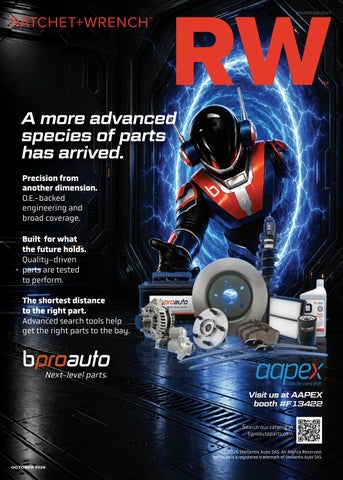
A more advanced species of parts has arrived. Precision from another dimension. O.E.-backed engineering and broad coverage. Built for what the future holds. Quality-driven parts are tested to perform. The shortest distance to the right part. Advanced search tools help get the right parts to the bay.
Visit us at AAPEX booth #F13422 Search our catalog at bproautoparts.com
©2026 Stellantis Auto SAS. All Rights Reserved. bproauto is a registered trademark of Stellantis Auto SAS. OCTOBER 2026
2610RW_Stellantis_CVRTip.indd 1
9/16/26 4:55 PM
Power to the future. Every bproauto® battery is built to initiate power with absolute precision. With corrosion-resistant construction, advanced venting and industry-best intercell welds, and up to a 2-year warranty, this is energy deployment at max capacity.
bproautoparts.com Visit us at AAPEX booth #F13422
Six ways to search parts bproautoparts.com
©2026 Stellantis Auto SAS. All Rights Reserved. bproauto is a registered trademark of Stellantis Auto SAS. See your dealer for warranty details.
2610RW_Stellantis_CVRTip.indd 2
9/16/26 4:55 PM
STRATEGIES AND INSPIRATION FOR AUTO CARE SUCCESS
“If (new hires) don't have any comebacks their first month, you're ahead of the game,” says John Flick, owner of Qyst Tire & Automotive Service Centers in Pennsylvania.
TEACHING TOMORROW’S TECHNICIANS PAGE 20
MAKE COMMUNITY GIVING A TEAM EFFORT
PAGE 32
ONBOARDING LIKE A PRO PRACTICAL STRATEGIES THAT HELP NEW TECHNICIANS BECOME PRODUCTIVE FASTER AND STAY FOR THE LONG HAUL PAGE 29
OCTOBER 2026 | ratchetandwrench.com
EXP EN THE CONCEPT EXPERIENCE EPT THATT IS CHANGING SHOPS TH HOPS AC ACROSS THE COUNTRY NTRY S K C A B L L A C O KEY TO KEY T car repair.
concept of tees exceptional e th d re te s a m guaran ced, but m te n s a y h s n r e u t o o , n n o e li We hav s over $1 mil cedented sales number. re u g fi e u n e v re re p With monthly customer ser vice and un
CESS. C U S N E V LTS. PRO U S E R N E M. PROV E T S Y S PROVEN
E S C A N H E RE R T O R E G I S TE FOR TH E S NEXT COUR
S: E T A D T X E N - 22 nt und, Preside Todd WesterlopAnswers.com www.AutoSh
YS 844-3to6S2hop-AKnswEers.com und@Au
ToddWesterl
R 21 NOVEMBE R 12 - 13 DECEMBE
“I’M A TECHNET SHOP BECAUSE... It gives us a clear advantage— elevating our service value above our competitors, delivering an unmatched customer experience, and ensuring our customers are covered long after they leave our shop. ”
MARTY WOODS Martin’s Tire and Service, Burton, MI TechNet Member Since 2019
NATIONWIDE WARRANTY
ROADSIDE ASSISTANCE
ROAD HAZARD TIRE PROTECTION
LOCAL SHOPS, NATIONWIDE NETWORK Level up your shop and access exclusive business and marketing solutions, including motorist programs like Nationwide Warranty, Roadside Assistance and Road Hazard Tire Protection. Scan the QR code or visit technetprofessional.com/membership to learn more. Follow Us @TechNetPros
PHOTOS BY CHRISTINE SCHAFFRAN
OCTOBER
10.26
VO LU M E 15 N U M B E R 10
08
EDITOR’S NOTE
11
ONLINE
12
BREAKDOWN
15
NUMBERS
16
SHOP VIEW
18
ROOTED IN SUCCESS
The fundamentals of the future
Exploring industry language, success metrics, and the trajectory of today’s workforce are the focus of this month’s columns and podcast
Staying ahead of new cybersecurity threats
Where shops are finding their next apprentices
Co Auto is designed to surprise
Marketing through the seasonal shuffle LOL A SCHMIDT
29
CULTURE+TEAM
32
CASE STUDY
34 F E AT U R E
THE 35,000-FOOT VIEW
20
D U T C H S I LV E R S T E I N
Onboarding like a pro
Make community giving a team effort
Why auto repair needs fiduciaries, not salesmen
TEACHING TOMORROW’S TECHNICIANS Three leaders in technician education explain why the future of the profession still begins with mastering the fundamentals
ON THE COVER:
BY CHRISTINE SCHAFFR AN
John Flick, owner of Qyst Tire & Automotive Service Centers, photo by Stephen Albert Hall Photography.
Ratchet+Wrench (USPS 9957), (ISSN 2167-0056) is published monthly 12 times per year by Endeavor Business Media, LLC. 201 N Main St 5th Floor, Fort Atkinson, WI 53538. Periodicals postage paid at Fort Atkinson, WI, and additional mailing offices. POSTMASTER: Send address changes to Ratchet+Wrench, PO Box 3257, Northbrook, IL 60065-3257. SUBSCRIPTIONS: Individual print subscriptions are available without charge to qualified subscribers in the U.S. Please visit www.ratchetandwrench.com and click on “Subscribe”. Publisher reserves the right to reject non-qualified subscriptions. Subscription prices (USA Only): $95.00 per year, back issue $15.00 prepaid, if available. All subscriptions payable in U.S. funds. Send subscription inquiries to Ratchet+Wrench, PO Box 3257 Northbrook, IL 60065-3257. Customer service can be reached toll-free within US/Canada at +1 (877) 498-4668 or outside US/Canada at +1 (920) 249-4687 or at customerservice@ratchetandwrench.com for magazine subscription assistance or questions. Printed in the USA. Copyright 2026 Endeavor Business Media, LLC. All rights reserved. No part of this publication may be reproduced or transmitted in any form or by any means, electronic or mechanical, including photocopies, recordings, or any information storage or retrieval system without permission from the publisher. Endeavor Business Media, LLC does not assume and hereby disclaims any liability to any person or company for any loss or damage caused by errors or omissions in the material herein, regardless of whether such errors result from negligence, accident, or any other cause whatsoever. The views and opinions in the articles herein are not to be taken as official expressions of the publishers, unless so stated. The publishers do not warrant either expressly or by implication, the factual accuracy of the articles herein, nor do they so warrant any views or opinions by the authors of said articles.
4 / R + W / 10 . 2 6
PROMO STARTS 9/1/26
25
PROMO ENDS 11/30/26
Winners And Their Guest
WILL EXPERIENCE THE ULTIMATE TRIP TO OAHU, HAWAII • EXCLUSIVE MEALS & RECEPTIONS • AIRFARE AND TRAVEL INCLUDED • PRIME ACCOMMODATIONS
6 nights $45,000 IN 240 GIFT CARD PRIZES 7 days Trip Dates OF PURE BLISS
MAY 16-22, 2027
www.bigkahunagetaway.com FOR OFFICIAL RULES, VISIT WWW.BIGKAHUNAGETAWAY.COM. Aftermarket Auto Parts Alliance, Inc. No purchase necessary. Void where prohibited. Promotional images may not reflect actual prizes. Logos and trademarks are the property of their respective owners. Trip Dates: 5/16/27 – 5/22/27.
Users are automatically entered on MyPlace4Parts with each qualifying invoice of $150.
O N L I N E
E X T R A S
CLICK ON THE LOGO BELOW FOR PRODUCT INFORMATION
Aftermarket Auto Parts Alliance
Atech Motorsports
Auto Shop Answers
BendPak
BG Products
Dorman Products
Jasper Engines & Transmissions
NAPA
Nexpart
TechNet
Worldpac
6 / R + W / 10 . 2 6
SHOW STOPPERS BG
O P F
Tools
JOIN US AT AAPEX 2026 November 3–5 • Venetian Expo • Las Vegas Booth V3646 • Joe’s Garage, Bay 5
SIGN UP FOR: • Your shot at winning $2,500 BG Bucks • A chance to win one of 20 BG BOS oil service tools • Access to our 30% Off Show Special • A premium BG backpack
REGISTER NOW
FOR A CHANCE TO WIN
EDITOR'S NOTE
THE FUNDAMENTALS OF THE FUTURE Blending old skills with new technologies “Must be good with your hands and a
good problem solver.” Fifty years ago, that description could have appeared in a help-wanted ad for almost any skilled trade. Plumbers. Electricians. Welders. Automotive technicians. The tools and techniques varied, but the expectation was the same: Know how things work. Know how to fix them. And know enough to recognize when something was about to go wrong. For generations, much of that knowledge was passed down from one person to the next. Apprentices watched experienced tradespeople work, picked up their tricks, absorbed their hard-earned warnings, and learned which shortcuts were best avoided. Fast-forward to today, and the learning curve for automotive technicians has taken a sharp turn. Being good with your hands and a good problem solver still matters—but now add computer literacy, diagnostics, vehicle networks, and an evergrowing understanding of sophisticated electronic systems to the skill set. Today’s technician has to be part mechanic, part electrician, part diagnostician and, increasingly, part IT professional. As one educator in this issue puts it, the old skills haven’t disappeared; they’ve simply gained “layers and layers of complexity.” But here’s the interesting part: As we look toward the future of technician education, educators keep pointing us back to something that might sound decidedly old school—electrical fundamentals. Why? Because electrical knowledge is no longer confined to one corner of the vehicle. It is woven through the systems technicians interact with every day: ABS, engine control modules, ADAS, vehicle networks, and the countless sensors and modules that now communicate across the vehicle. 8 / R + W / 10 . 2 6
That’s an important reminder as shops think about where to invest in training. Yes, ADAS and EV technology deserve attention. Yes, technicians need to keep pace with whatever comes next. But chasing the newest technology without first building a strong foundation can leave technicians struggling to understand what that technology is actually telling them. The future of technician education, it turns out, may have less to do with leaving the past behind and more to do with building on it. Every technician needs a solid foundation. One might even say they need a “grounded” one.
EDITORIAL EDITORIAL DIRECTOR Chris Jones EDITOR-IN-CHIEF Christine Schaffran STAFF WRITER Kacey Frederick CONTRIBUTING WRITERS Tess Owings, Noah Brown EDITORIAL ADVISORY BOARD Tara Topel, Topel’s Towing and Repair Andrew Marcotte, American Pride Automotive Tonnika Haynes, Brown’s Automotive Ceasar Cordon, Fifth Gear Automotive Bill Snow, Rad Air Complete Car Care SALES PUBLISHER Andrew Johnson / ajohnson@endeavorb2b.com ASSOCIATE SALES DIRECTOR Mattie Gorman-Greuel / mgorman@endeavorb2b.com DIRECTOR OF BUSINESS DEVELOPMENT Cortni Jones / cjones@endeavorb2b.com ACCOUNT EXECUTIVES (NATIONAL ACCOUNTS) Diane Johnston / djohnston@endeavorb2b.com Darrell Bruggink / dbruggink@endeavorb2b.com Marianne Dyal / mdyal@endeavorb2b.com Chad Hjellming / chjellming@endeavorb2b.com Lisa Mend / lmend@endeavorb2b.com Kyle Shaw / kshaw@endeavorb2b.com Sean Thornton / sthornton@endeavorb2b.com ART AND PRODUCTION ART DIRECTOR Emme Osmonson PRODUCTION MANAGER Mariah Straub AD SERVICES MANAGER Jen George
ENDEAVOR BUSINESS MEDIA, LLC CEO Chris Ferrell COO Patrick Rains CDO Jacquie Niemiec CALO Tracy Kane CMO Amanda Landsaw EVP TRANSPORTATION GROUP Chris Messer EVP ENDEAVOR BUSINESS INTELLIGENCE Paul Mattioli VP OF CONTENT STRATEGY, TRANSPORTATION GROUP Josh Fisher
SUBSCRIPTIONS Send address changes and subscription inquiries to: Ratchet+Wrench PO Box 3257 Northbrook, IL 60065-3257 SUBSCRIPTION CUSTOMER SERVICE: US/Canada: +1 (877) 498-4668 Outside US/Canada: +1 (920) 249-4687 customerservice@ratchetandwrench.com PO Box 3257, Northbrook, IL 60065-3257 LETTERS TO THE EDITOR editor@ratchetandwrench.com Opinions expressed in Ratchet+Wrench are not necessarily those of Endeavor Business Media, and Endeavor Business Media does not accept responsibility for advertising content.
CHRISTINE SCHAFFR AN, EDITOR CSCHAFFR AN@ENDEAVORB2B.COM
Find Parts & Tires In ONE Look-up. Supercharge Your Supply Chain With Nexpart Multi-Seller.
Build Estimates In Seconds. With Nexpart Multi-Seller you’re connected to real-time inventory and wholesale pricing from all of your parts suppliers. Find parts, tires, and more. Build detailed estimates fast!
More Products. More Places. Backed by the most comprehensive catalog in the aftermarket. You’ll see more products, from more suppliers, giving you more control of your supply chain.
20
Million Parts
53K Supplier Locations
Now Available!
50+ Tire Suppliers For FREE
And More...
Earn Points, Get You’ll earn points on every parts order Multi-Seller shops can redeem up to $500/year in rewards.*
Get Started
Scan the QR code for more information
Aftermarket | Tires | OE | Heavy Duty *Earn 1 point for every $1 spent on parts. Available to all US and Canadian Nexpart Multi-Seller users. Tire purchases not currently eligible for Rewards. Learn more and see the full terms and conditions at whisolutions.com/rewards
SERIOUS PERFORMANCE. S E R I O U S W H O L E S A L E P OW E R B Y AT E C H M O T O R S P O R T S .
AVAILABILITY
SELECTION
Millions of parts in-stock, ready to ship from four locations across the nation.
Parts available from over 1,500 top-brand name manufacturers. If you can’t find it, we’ll get it!
SERVICE
CONVENIENCE
Unbeatable customer service.
FAST, FREE shipping! We export at competitive rates.
BOOTH #22733 1 1/3 - 1 1/6 CONTACT US FIRST! ATECH MOTORSPORTS is the fastest, easiest way
to access the best parts and brands in the industry at wholesale prices, with real-time inventory and pricing available to you 24/ 7. Our four national warehouses are packed to the rafters with millions of parts from 1,500+ brands — we continually add new brands all the time— ready to ship to your door at a moment’s notice. Simply tell us your needs and give us the opportunity to become your go-to parts source for all things automotive.
HIGH PERFORMANCE & RACE LATE MODEL TRUCK & DIESEL JEEP & OFF–ROAD STREET ROD & RESTORATION PREMIUM & STOCK REPLACEMENTS
8 0 0 . 5 1 7 . 1 0 4 0 • 1 . 3 3 0 . 6 3 0 . 0 8 8 8 • FAX: 1 . 3 3 0 . 6 3 0 . 5 3 6 5
At e c h M o t o r s p o r t s . c o m
WHSE26RW
TALLMADGE, OH • MCDONOUGH, GA • SPARKS, NV • ARLINGTON, TX
10.26
RATCHET+WRENCH
ONLINE
RATCHET+WRENCH
MOST READ ONLINE COLUMNS
PHOTO COURTESY OF MIKE BENNETT
BENNETT: Are You Measuring What Made You Successful—or What Makes You Profitable? The metrics that made you successful in your last role don’t disappear when you take on a new role. They come with you. When you were the one writing service, closing every ticket yourself, those numbers told you something true and useful. The problem is that ownership changes the game entirely, and too often, the dashboard doesn’t change with it. Mike Bennett breaks down how you can turn the metrics you may be missing into tools you can use to grow your business.
PHOTO COURTESY OF TODD HAYES
HAYES: The Language of Winning Every profession has a language, from pilots to surgeons to elite athletes. The most successful automotive repair businesses have one, too. The challenge is that most shop owners are trying to build championship-level businesses while speaking a completely different language than the people who are already operating at that level. Todd Hayes explains how the right language can make you not just a better business owner, but a better mentor and leader for your team.
MOST DOWNLOADED PODCAST EPISODE PODCAST: The Next Generation of Technicians Is Here. Are Shops Ready? While more students are pursuing skilled trades than in recent years, many independent shops are still struggling to hire and keep young technicians. Drawing on findings from the latest technician supply and demand report from TechForce Foundation, Jennifer Maher explains why Gen Z is rethinking traditional career paths, what today’s technicians expect from employers, and how mentorship, career development, communication, and culture can become a shop’s greatest competitive advantage.
PHOTO COURTESY OF TECHFORCE FOUNDATION
RATCHET+WRENCH RADIO Strategies and inspiration for auto care success. Catch new episodes every Wednesday featuring thought leaders from across the automotive aftermarket. Scan to subscribe!
APPLE PODCASTS
SPOTIFY
10 . 2 6 / R + W / 11
SANDWISH / ADOBE STOCK
JUMP START
N E WS I D E AS PEO PLE TRENDS
CYBERSECURITY THREATS ARE EVOLVING—BUT SO ARE THE TOOLS TO COMBAT THEM With the growth of new technologies like AI comes new ways for hackers to exploit vulnerabilities, causing disruptions to entire business operations. We break down some of the latest trends in cybersecurity for auto shops, and what you can do to protect your business BY KACEY FREDERICK
12 / R + W / 10 . 2 6
Many shops are already aware of
cybersecurity threats—but how do they culminate? What does it look like when a shop is targeted, and what sets a cyberattack in motion? This month, we’re breaking down some of the top threats and recent trends in cybersecurity, while Taylor Fuqua, Tekmetric’s chief technology off icer, provides insight into how you can safeguard your own shop against those threats.
How Cybersecurity Attackers Target Shops
Like many small businesses, auto repair shops have become more reliant on digital tools to help streamline processes like scheduling, communicating with customers, building repair orders, and collecting vehicle information. While these tools have become essential in operations, the new digital landscape also brings with it certain risks that shops must be aware of. The most noticeable impact for a shop hit by a cyberattack can be connection issues, affecting things like a shop’s Wi-Fi or shop management system. In that event, it can bring operations to a grinding halt. “If your Wi-Fi goes down or your shop management system is no longer available, how are you going to check in customers? How are you going to fix cars, and how are you going to accept payment and get your customers out the door?” says Fuqua. The data makes it clear where shops are being targeted: as shared in VikingCloud’s most recent Auto Service, Repair, and Parts Businesses Survey, point-of-sale systems were cited as the most targeted function of a shop, accounting for 66% of attacks. It’s followed by websites and mobile apps at 36%, IoT-connected diagnostic tools in service bays at 38%, and customer-facing portals at 32%. The survey also showed that 68% of auto service shops were successfully attacked throughout 2025, with 40% of cybersecurity leaders believing those attacks were driven by AI. This is further
emphasized by Upstream in its 2026 Global Automotive and Smart Mobility Cybersecurity Report, which found that the rapid adoption of AI has created even more vulnerabilities for cybercriminals to target. “Even if interfaces are properly secured, the AI systems operating behind them can be exploited,” the report states. “These AI-specific vulnerabilities represent a new frontier that extends beyond the protocol surface. … AI models, particularly LLMs, can be tricked through carefully crafted queries into revealing sensitive information they were trained on or have access to.” Upstream cited an incident occurring in late 2025, in which a massive cyberattack targeted an AI-driven component within a popular customer relationship management platform, Salesforce. The attack impacted major corporations that used the platform, including Stellantis. “The growing reliance on external services and third-party AI platforms is dissolving the traditional vehicle perimeter, extending the attack surface across a distributed ecosystem of cloud servers, mobile apps, and interconnected APIs,” the report added. In addition, small businesses in general are more likely to be targeted by cybersecurity attacks. Hackers realize that small businesses often lack the resources available to larger companies, making them seem like a better opportunity to target for a cyberattack.
Safeguarding Your Business
Just because small businesses face hurdles doesn’t mean there’s nothing they can do to protect themselves. Shop management systems are integral to business operations, but when choosing one, consider how much control you’re given over your data and how it’s used. Tek metric offers feat ures like multi-factor authentication, separate accounts for each employee, and the ability to adjust permissions for what each employee can access. However, a software provider is not meant to handle every aspect of your security. What these features do is help counteract
one of the biggest slipups shops make, which is a lack of hygiene around logins and permissions. Shops need to pay close attention to what permissions each employee has. When bringing on a new hire and assigning them roles, make it part of the onboarding process to determine what permissions they have. Conversely, it should also be part of the off boarding process to ensure no one retains permissions and has lingering access to shop data. It can also be worthwhile to conduct a monthly audit of your shop management systems and tools, reviewing who has permissions to what. When choosing a shop management provider, it’s crucial to consider whether they offer adequate patching, infrastructure, and backups. But it’s not just shop management systems to examine; businesses should take inventory of all their vendors, including DVI or payment processing software, and see how much they offer in the way of cybersecurity. “It’s really important to understand … all (the) systems that you’re using. How secure are they, and how transparent are they with their security posture?” Fuqua says. “Do they offer MFA? Do they have role-based security, and do they have everything in place for you to roll out a good security policy within your shop?” Finally, shops should have a plan for what to do if an internet or software outage takes place to ensure their business operations are still able to run smoothly. Fuqua recommends having manual processes in place for customer check in, repair workf low, communication, and payments. As with each step of your cybersecurity plan, it will require not just conceptualizing, but putting it into place to ensure it works. Keep all your tools up to date and ready to adapt, because the technology our industry works with is only growing more complex. “If you’ve said, ‘Hey, if an incident happens, this is what we’ll do,’ but you’ve never gone through the process, at that point your backup plan is a bit of a hope, not really a recovery plan,” Fuqua says. 10 . 2 6 / R + W / 13
J U M P S TA R T / S P E E D R E A D
its Demand Index tool, giving members unprecedented access to point-of-sale and market data to make better business decisions. • Building Associations in Motion—establishing the international program to strengthen collaboration and shared learning across the global aftermarket association community. Bill Hanvey to Retire as Auto Care Association CEO in 2027 The Auto Care Association Board of Directors announced that Bill Hanvey, president and CEO, Auto Care Association, will retire effective June 30, 2027, concluding a distinguished tenure leading the association. “After a great deal of reflection, I’ve decided it’s time to let the next generation take the reins,” said Hanvey. “I am extremely proud of what our team has accomplished and of the service we’ve provided to this industry. It’s been the honor of my career to lead this association, and I know it’s in a stronger position today because of the people who make it up. While I have announced my retirement, my work is far from finished. Over the coming months, I will continue fighting every day for our members and this industry, including tirelessly pursuing passage of Dr. (Neal) Dunn’s REPAIR Act to protect vehicle owners and independent repair shops across America.” Hanvey has served as president and CEO of the Auto Care Association since December 2015, capping a career of more than 40 years in the automotive aftermarket industry. During his tenure, the association achieved a number of milestones on behalf of its members, including: • Guiding the industry through COVID19—successfully navigating the association and its members through the pandemic, including securing the industry’s designation as an essential service at the local and federal level so members could continue operating. • Advancing Right to Repair—leading passage of Right to Repair legislation in Massachusetts and Maine, while pushing the federal REPAIR Act further through Congress than it has ever advanced before. • Expanding industry data resources— launching and growing TrendLens and 14 / R + W / 10 . 2 6
• Fostering the next generation of leaders— from advocating for the industry’s under40 group to dedicating time at Northwood University seminars, his commitment to strengthening the career pipeline of the aftermarket has ensured the next generation of leadership for the auto care industry. • Staying true to the industry’s roots— earning a reputation as a leader who never forgot where he came from, remaining an approachable, hands-on advocate for members throughout his tenure. “On behalf of our members and the board of directors, I want to thank Bill for the extraordinary impact he has had on this industry,” said Greg Noethlich, chair, Auto Care Association Board of Directors. “His leadership has left this association stronger, more data-driven and better positioned for the future, and we are deeply grateful for his years of service.” To ensure a smooth transition, the board of directors has engaged Korn Ferry, a global executive search firm, to lead the search for the association’s next president and CEO. Hanvey will continue to lead the Auto Care Association through the transition period, working closely with the Board to ensure continuity of operations and a seamless handoff to his successor. Additional details regarding the transition timeline and search process will be shared with members and staff as they become available. BMW Recall Addresses Potential Power and Rollaway Hazards BMW has issued a recall over a risk of rollaway and/or loss of power, reports Car and Driver. 27,720 vehicles were included in the recall, comprising 2022–2026 model year 8-series models; 2021–2023 model year 5-series models; and 2024–2026 model year 750e xDrive sedans.
The problem stems from excessive wear caused by the connection of the driveshaft and the rear-axle differential. These parts can become degraded and lead to a total loss of power to the rear wheels. There may also be a rollaway risk if the parking brake isn’t engaged. To resolve the issue, BMW will be inspecting the driveshaft and rear differential, and will add adhesive to the connection as needed, or replace both the driveshaft and rear differential if necessary. Owner notification letters were sent out beginning Oct. 2.
Worldpac Announces Dates and Location for 2028 Supplier and Training Expo Worldpac announced the dates and location for its biennial Supplier and Training Expo (STX), to take place in 2028. The announcement was made during the opening session of STX 2026, revealing that STX 2028 will take place March 29 to April 2, 2028, in Aurora, Colorado, at the Gaylord Rockies Resort & Convention Center. Registration for STX 2028 will open in December 2026. “We’re excited to announce the next STX and look forward to welcoming our customers, suppliers, and industry partners,” said John Hamilton, president and chief executive officer at Worldpac. “STX brings automotive aftermarket professionals together to experience world-class training, meaningful networking, and an inside look at the latest industry advancements. We can’t wait to build on the momentum of STX 2026 and deliver another exceptional conference in 2028.” Since the Supplier and Training Expo launched in 2009, more than 12,000 automotive professionals have attended the multiday conference to learn from key industry leaders, discover new products and technologies, and connect with peers from across the automotive aftermarket.
J U M P S TA R T / N U M B E R S
WHERE ARE SHOPS FINDING THEIR NEXT APPRENTICES? In-house program (training from the ground up)
41%
Local high schools or career & technical education (CTE) programs
41%
Technical or trade schools
30%
Community colleges
20%
Military or veteran transition programs
13%
Referrals from current employees
29%
Job boards or online postings
26%
We do not currently source apprentices
20%
According to the 2026 Ratchet+Wrench
Industry Survey, more than half of the shops surveyed report having some form of an apprenticeship program. But with the technician shortage on owners’ minds,
where are they sourcing these apprentices? In-house programs and local education programs were the two most common sources for apprentices, each cited by 41% of respondents as their primary source,
MONKEYBUSINESSIMAGES / ISTOCK / GETTY IMAGES PLUS
The most common sources for developing new talent
while only 13% of shops rely on veteran transition programs. As shop owners look for the next generation of talent, investing in apprenticeships allows them to build loyal teams with skills they can trust.
VVTs and Cam Phasers
Get Engine Timing Back on Track From common driveability concerns to complex timing-related repairs, trust Dorman®’s comprehensive VVT and cam phaser coverage.
Scan to see available solutions
2610RW_DormanProducts.indd 1
10 . 2 9/21/26 6 / R+W 15 3:20/PM
J U M P S TA R T / S H O P V I E W
COAUTO IS DESIGNED TO SURPRISE
How CoAuto blends art, hospitality, and community to redefine the customer experience BY CHRISTINE SCHAFFRAN | PHOTOS COURTESY OF VINNIE LUCIDO
Looks of shock and confusion are some of Vinnie Lucido’s most favorite customer reactions. In fact, they are looks he has come to love. “I love seeing the shock in people’s eyes when they walk in and think they are in the wrong spot until they see through the windows … which allows you to see into the shop,” he says with a smile. “It’s like, ‘Am I in the wrong spot?’ And then, ‘Oh, wait, this is the auto shop.’”
ACCENTED BY DETAILS Crystals, candles, paintings of sunset landscapes, and murals may not be commonplace in every auto repair shop, but at CoAuto in Reno, Nevada, they set the stage for a memorable experience. CoAuto is short for CommunityConscious Auto Care, and it is hardly lacking local presence—or personality. In fact, Lucido says, the entire shop model was designed around integrating with the community and welcoming guests to learn about their operation through five different community-outreach programs. “I’ve always loved being a part of the community and wanted the shop to be
a part of it as well,” notes Lucido, who began the shop with his brother before becoming the sole owner in 2020. The 7,000-square-foot shop boasts seven lifts, four open bays, and an alignment rack. In this space, a manager, two service advisors, four technicians, a quality-control specialist, and a bookkeeper enthusiastically wait on customers who are encouraged to check out local artists’ most recent creations, which are staged throughout the waiting room. “It feels really clean, and we have local art displayed,” Lucido explains. “Every quarter, we do a rotation of the art, so it’s ever changing and feels new and vibrant.”
AUTO SHOP MEETS ART GALLERY Among the barstools and bright orange art-deco chairs that perfectly mimic the shop’s color scheme, rows of paintings line the walls while potted plants give the waiting room vibrance and the relaxed feel of a coffee shop. While there are no baristas to take your order, Lucido says, employees may offer to whip you up an
HAVE AN OUTSTANDING SHOP?
Send a few photos and a brief description to submissions@ratchetandwrench.com and
16 / R + W / 10 . 2 6
COAUTO Owner: Vinnie Lucido Location: Reno, Nevada Staff Size: 9 Shop Size: 7,000 square feet Number of Lifts/Bays: 7; 2 post lifts; 1 alignment rack; 4 open bays Average Monthly Car Count: 170 Annual Revenue: $1,813,000 ARO: $860
espresso or latte with any variation of almond, oat, or whole milk—all complimentary while you wait for “your most prized possession” to be handled with care. Lucido intended for the shop—which was named VISION’s Facility of the Year in 2018—to change the perception of auto repair facilities. “I wanted to be an auto repair facility that stretched the limits,” he notes. “I wanted to create this place and this ambience that was enlightening for everybody that comes in.”
ENJOYABLE ENERGY In the bays, the playful mood continues with murals painted by local artists. Although safety, precision, and auto repair are still top of mind, there’s nothing that says it can’t be done under the watchful eye of a giant dragon, a UFO, or a skull with wrench crossbones. Lucido adds the playful elements are all with the intention of creating a culture that encourages employees to enjoy working. “I wanted the staff to feel like they work at the coolest job in the world and that it’s fun to come to work,” he notes. “We have a very light-hearted, fun culture, and with the murals and the paintings and the vibe that we’ve created, it just induces this fun atmosphere, and that atmosphere really just evolves all the way through your repairs.”
SERVICE BEYOND THE REPAIR When it comes to service, Lucido ensures every vehicle gets the same attention to detail, which is punctuated by a qualitycontrol specialist who cleans all the windows, wipes the dash, and vacuums each vehicle before it’s returned to the owner “just because it’s part of the experience.” And since the name of the game is community, not every customer walks through the door for auto repair, Lucido explains. Some might just stop in for a cup of coffee—or two. Or to check out the latest creations from the local artisans. “Ultimately, the idea of starting a shop with art and murals—everything we’re doing—was to create community in an auto repair shop,” he says. “And it’s working.” That philosophy has helped CoAuto stand out not only for its atmosphere, but also for its performance, generating $1.8 million in annual revenue while continuing to challenge traditional expectations of what an auto repair shop can be.
10 . 2 6 / R + W / 17
COLUMN / SCHMIDT
ROOTED IN SUCCESS
Marketing Through the Seasonal Shuffle Why consistency matters even when business is booming When business is moving along nicely and money is f lowing, it may
seem like a no-brainer to cut marketing expenses to stack extra cash. Of course it feels great when the bays are full day after day, but I would caution against cutting your marketing budget under the guise of today’s success. As someone who has danced the seasonal shuff le, I can assure you even the fullest bays can empty out, and it’s much easier to keep the marketing machine going than to stop and restart it. Just because business is good now doesn’t mean it will remain steady. You must stay vigilant with your marketing, as it is often the f irst touchpoint for most customers that enter your doors. Here are a few ways to keep your marketing efforts moving all year long. • Set a spend and stick to it. This should not be a haphazard number you pull from midair. This should be a calculated number you commit to spending throughout the year for the acquisition of new foot traff ic and community efforts. Ideally, you want to take the expected gross sales you would like to hit and spend about 5%-6% of that. I spend an average of 7% annually, and I f ind that works well for us. Sit down and do a little math to make this decision before the end of the year. Whatever percentage you choose to allocate, organize the way you put it to work. • Make a marketing calendar of where you will spend next year’s marketing money. This provides a path and a commitment to the effort. It also introduces a tracking system for year-over-year to see the history of your efforts. When you know what you spent money on, you can track it to see if that expenditure was successful. 18 / R + W / 10 . 2 6
Everyone will ask you for money, but you can’t give it to everyone. It’s important to know what your core beliefs are, what your marketing messages will be, and where you will place that message. Then you need to know if it’s working. • Track the spending. Everyone talks about the ROI, but I’m not sure everyone digs into it. If I’m spending $100, I want to see a $300 return at the bare minimum. You need a standard for your ROI, and then once you’ve committed to your standard, you need to make sure your investment is working for you. It is easy to spend money on ads and other tools and never track their success, but that’s like setting your money on f ire. Spend time on your reporting and f igure out if your expense was worth the return. • Keep going. No matter the ups or downs, don’t stop investing in your marketing efforts. Once you’re in a good rhythm of planning and tracking marketing, you’ll see the benef its of continually moving the marketing pendulum. The lag between shutdown and startup of online ads can break a business, and inconsistent messaging makes Google unhappy. A constant stream of content and strategic marketing efforts creates a more stable calendar and workf low. So, keep efforts going both online and locally all year long. Marketing your business doesn’t have to be hard, but like anything worth gaining benef it from, you do have to put in some effort. Planning, preparing, and presenting consistent marketing can help secure full bays all year long, and get you out of the seasonal shuff le.
Lola Schmidt is the vice president of operations and marketing for Schmidt Auto Care in Springboro, Ohio. She joined her husband, Erich, in helping to run his shop nearly 10 years ago with ambitions as high as her heels. Through the years, she has helped to develop an award-winning business that provides veterans with opportunities for employment as well as the community with a trusted resource for auto repair. Outside of the family business, she is a mom to one, a gardener, an artist, and a musician. Lauralee@schmidtautocare.com
START BUILDING YOUR PIPELINE TODAY
FREE INCLUDED BENEFIT AS A NAPA AUTO CARE MEMBER*
Finding, hiring and retaining technicians are some of the industry’s biggest pain points. The NAPA Apprentice Program is designed to give your shop the tools necessary to train your technicians to combat this issue. Get the tools to attract passionate, driven individuals who bring more than just technical skills to your shop.
THE STAGES 1. Orientation & Safety Duration 1 month
STAGES
2. General Service Duration 2 months
Paid, hands-on training every step of the way.
3. Earn ASE G1 (General)
YEAR PROGRAM
4. Earn ASE A5 (Brakes)
Duration 3 months Duration 3 months
Flexible pacing for apprentices to learn as they grow.
ASE CERTIFICATIONS Earned throughout to boost skills and credibility.
5. Earn ASE A4 (Suspension) Duration 3 months
6. Electrical
Duration 3 months
7. Earn ASE EPA 609 Certification Duration 3 months
8. Emissions Certification/ Diagnostic & Fuel Systems Duration 3 months
9. Diesel & Hybrid
OUR CURRICULUM INCLUDES: Classroom Training Videos
Hands-On Learning
Duration 3 months
Autotech eLearning
Autotech Training Classes
Auto Care members login to member.napaautocare.com to register your shop and technician today. Not an Auto Care member? Scan this QR code and a NAPA representative will contact you to get started.
*Utilize our curriculum at no cost once registered. Turn a profit in as little as 60 days.
FEATURE
2 0 / R + W / 10 . 2 6
Teaching Tomorrow’s Technicians Without Forgetting Yesterday’s Lessons B ri a
Ph oto
n O ’ Le a r y
ar cour ’Le tesy of Br ian O
t S he p a nek Mat
y
Ph oto c
our t e sy
Ph oto
ek an hep of Matt S
Three leaders in technician education explain why the future of the profession still begns with mastering the fundamentals STORY AND PHOTOS BY CHRISTINE SCHAFFRAN
B ra
n d o n St ec kler
cou
c Ste r t e sy o f Brandon
r kle
T
echnology is changing faster than technician education ever has—but educators say the biggest challenge isn’t learning new technology. It’s mastering the fundamentals that make every new technology work. That message came through consistently from three educators working at different levels of the industry. Brandon Steckler, owner of S.W.A.T. Training and Diagnostics, trains working 10 . 2 6 / R + W / 21
FEATURE
technicians across the country. Matt Shepanek, vice president of credentialing at the National Institute for Automotive Service Excellence, helps shape the industry’s certif ication standards. Brian O’Leary, an automotive technology instructor at Moore Norman Technology Center, prepares students to enter today’s repair shops. Despite their different roles, all three reached the same conclusion: the future of technician education isn’t about choosing between foundational skills and emerging technologies—it’s about using one to support the other. “Although we want to stay with the times and we want to keep changing our curriculum to match the new technology, we still have to stick to the fundamentals because without those fundamental tasks and mastering those fundamental tasks, we’ll never be able to prepare a student well enough for the newest technology,” says O’Leary, who teaches students hoping to enter the industry at the Oklahoma campus. While there has been an emphasis on ADAS, EVs, and other emerging technologies, particularly in recent years, Steckler agrees there is still something to be said for basic mechanical aptitude.
“Technicians are no longer mechanics. You’re electricians, you’re IT (professionals) and diagnosticians.” — Brian O’Leary, automotive technology instructor, Moore Norman Technology Center 2 2 / R + W / 10 . 2 6
10 . 2 6 / R + W / 2 3
FEATURE
“The technicians that lack the basics are the ones that are going to struggle with the new stuff because all this new stuff still requires those basic operating principles,” he points out. And just where should technicians focus their efforts? Across the board— one subject rose to the top for the educators—electrical systems. “Electrical is definitely a foundational course that everybody should have a good understanding of,” Shepanek notes. He adds the ripple effect it has on troubleshooting abilities surprises a lot of technicians. “We’ll get this feedback every once in a while: ‘Well, I went and took the brake test, but man, there are a lot of electrical questions on it.’ Well, there’s a lot of electrical in the brakes now. You know, you have an ABS control module, and it’s … monitoring wheel speed sensors and all this kind of stuff,” he explains. “Basic electrical is still a foundation for many things.” More Than a Mechanic And while the basics are still important, they will only get you so far, O’Leary points out. “Technicians are no longer mechanics. You’re electricians, you’re IT (professionals) and diagnosticians,” he says. “A lot of people say that you make …
your money diagnosing. I’m not sure you make all your money diagnosing, but you can lose a ton of money and lose a ton of time misdiagnosing.” Which is all the more reason why technicians need to hone their skills and balance old-school diagnostic skills with new technology, Steckler adds. “You’ve got to be almost a jack of all trades now: electricians, vibration analysts, drivability specialists,” he notes. “All that old stuff is still there. It’s not going away. It’s just got varied layers of complexity.” And the sharper the skills, the more technicians will be able to rely on them as the tides turn and new technology takes center stage. “The engine is still the same old engine it ever was ... but there’s layers and layers of complexity that have been added,” Steckler says. Teaching Has Changed —Learning Hasn’t And just as important as what they’re learning is how technicians are learning, says Shepanek. “Most technicians are tactile learners. They learn by touching and doing,” he explains. Additionally, he says, there is a demand for instructor-led training instead of virtual learning and webinars, which
became necessities during the COVID-19 pandemic. “A lot of times, you can read about it, you can watch the video, but when you actually go to a class and you have a part that you can touch and open up and take a look inside of it, that’s when it all kind of comes together,” Shepanek notes. Meanwhile, Steckler says virtual presentations and video animations have enhanced the manner in which instructors present materials to help “connect the dots” between classroom instruction and hand-on learning. “Technicians tend to be visual learners,” he asserts. “Don’t tell me— show me.” For his part, O’Leary is looking forward to applying a new visual he learned at the ASE Instructor Training Conference that uses pieces of string to explain how modules and computers in cars communicate across a vehicle’s network. “It really dumbed it down to a level where the students can see the cross communication between all the different modules,” he marvels. “So, I’m going to use that in my classroom.” Soft Skills Are Now Technical Skills As for the frontrunner among the skills technicians can expect to lean on more and more? Surprisingly, Steckler says,
“Most technicians are tactile learners. They learn by touching and doing.” — Matt Shepanek, vice president of credentialing, National Institute for Automotive Service Excellence
24 / R + W / 10 . 2 6
FIVE SKILLS TOMORROW’S TECHNICIAN CAN’T DO WITHOUT
Electrical fundamentals. Electrical knowledge is foundational to understanding today’s increasingly complex vehicle systems. Diagnostic thinking. Technology can provide information, but technicians still need to understand what that information means and avoid costly misdiagnoses. Technology literacy. Technicians need to understand how modules, computers, and vehicle networks communicate. Communication. Talking with customers can provide critical clues, particularly when diagnosing intermittent problems. Lifelong learning. As technology advances, technicians must continue training to keep their knowledge current. 10 . 2 6 / R + W / 2 5
FEATURE
it’s communication skills that come in handy when the dreaded “intermittent problem” rears its head for a customer and a technician must try to diagnose it. “If you tell any technician they’re about to analyze a vehicle with an intermittent concern, they’re rolling their eyes and they’re huffing and puffing because intermittent concerns are very difficult to solve because not only do you have to find the problem, but you got to get the symptom to surface,” Steckler explains. “And half the battle is getting the problem to occur.” However, the former technician notes that a short 10- to 15-minute interview with the customer may help to narrow the cause of the problem. For instance, a customer may say the issue occurs in the rain, which prompts Steckler to spray the engine compartment with a hose and “suddenly the car is acting up right there.” “It’s not so much I do something more than other technicians. I wasn’t smarter,” he explains of the process. “I chose to get some more information from the customer, and most techni-
THE BENEFITS OF ASE CERTIFICATION ASE Certification has long been considered the gold standard for technician training. While the list of certifications stretches from the most recent technological advances to the most basic skill sets, it may be difficult to determine where to focus technicians’ attention. Matt Shepanek, vice president of credentialing at the ASE Education Foundation, helps break down where to begin, what to concentrate on, and how to advance in the future. Ratchet+Wrench: Are there any certifications that you feel are often overlooked, but highly valuable? Shepanek: The big ones for us are A-Series. These are automotive series of credentials, so A1 through A8; those are really good foundational knowledge. And then we also have our advanced level test. So that’s the
2 6 / R + W / 10 . 2 6
L1 through L4, with L4 being one of our newest advanced level tests. That’s on ADAS. And since ADAS is in something like 94% or 95% of all new vehicles produced today, it’s important to stay on top of that because the ADAS systems are tied into the rest of the vehicle. So the networks, the ABS system, the engine control module, all of that kind of stuff. So that’s all good knowledge to have. RW: Do you think that every technician should pursue Master Technician status, or should it be more selective? Shepanek: I think it depends on how big the shop is that you’re working in, and what type of work (the shop does). In a lot of respects, the days of knowing everything—it’s getting harder and harder to have that level of knowledge. There are some people that do have it, but the cars are get-
ting so complicated. So some people, if they can just specialize in a certain area and they’ve got plenty of that type of work coming in and they can make a good living on it, that’s fine. It all depends on the individual. RW: How should independent shops decide which certifications to prioritize? Shepanek: I think it’s based on the type of work that they’re taking in and … the area of the country that they’re in. ADAS systems are in almost all the new cars coming out right now. When they started out, they were real prevalent in a lot of the European cars starting almost 20 plus years ago, and so depending on the area of the country that you’re in and what types of vehicles are out there, those are the kind of things I think you need to focus on.
cians will not want to talk to the customer because ‘they don’t have time to talk to customers. They’re here to fix cars.’ So, communication skills are not only absolutely crucial in your company, but also with your clients.” When it comes to digital video inspections—another increasingly common tool in repair shops—O’Leary says those communication skills are also helping technicians to become the content creators that are needed to tell a good story. “When these consumers watch those inspection videos, they’re not watching it to completion. They’re only watching 50% … if the technician is not grabbing the attention of the customer right away,” he explains. “And then if they’re not keeping their attention … the customer may miss valuable information.” The Future Belongs to Lifelong Learners When a student graduates from a technical school, they’re often surprised to learn that their educational journey is not over. In this industry, it’s never really over. “You have to be a lifelong learner because the technology is advancing at such a quick pace that if you’re not staying on top of it with your training and everything, it’s going to pass you by,” Shepanek points out. O’Leary agrees the lifelong commitment to training often comes as a shock to some. “You don’t finish a program like ours and go into a shop and you’re done with schooling,” he says. “You will constantly take classes to maintain your training, your certifications, and your knowledge on vehicles.” When in doubt on what to focus on, however, Steckler says technicians should return to the basics, even as they climb the ladder in the industry. “If I want to commit it to memory, like tying my shoes, focus on the classes that apply to every vehicle,” he suggests. “That’s the type of training I want committed to memory. One that will help me on every car I work on.” As vehicles continue to evolve, educators agree that the technicians best prepared for tomorrow won’t be the ones chasing every new technology— they’ll be the ones with a firm enough grasp of the fundamentals to adapt to whatever comes next. 10 . 2 6 / R + W / 27
PHOTOS COURTESY OF QYST TIRES MEDIA
T O O L B OX / C U LT U R E +T E A M
ONBOARDING LIKE A PRO The first 90 days can make or break a new hire. Shop owner John Flick shares practical onboarding strategies that help new technicians become productive faster and stay for the long haul BY NOAH BROWN
Hiring a technician is already a difficult enough process, but ensuring that technician becomes a productive, longterm member of the team is often the bigger challenge. For independent repair shops facing an ongoing technician shortage, every new hire represents a major investment, which is why many shop owners spend months recruiting the right candidate. However, for all the effort put into landing a top candidate, too often, not nearly enough time is spent thinking about what happens after that employee accepts the job offer. John Flick, owner of Q yst Tire and Automotive Service Centers in Dela-
ware County, Pennsylvania, believes successful onboarding starts with a simple principle: following through. “The ultimate goal would be to keep your end of the bargain,” Flick says. “You can promise the moon and the stars, but if you don’t back that up, then your word is nothing.” A robust onboarding program gives new hires the tools they need to succeed. And the best onboarding programs, Flick says, don’t need to be overcomplicated. Start Before Day 1 Many shop owners view onboarding as something that begins on an employee’s
Make sure the rest of the team is happy with your new hire.” John Flick, Owner of Q yst Tire and — Automotive Service Centers
10 . 2 6 / R + W / 2 9
T O O L B OX / C U LT U R E +T E A M
first day. Flick recommends starting much earlier. Before a technician officially joins the team, he likes to bring them into the facility for a walkthrough of the shop. The visit gives new employees an opportunity to familiarize themselves with the layout and learn where critical resources are located. It’s also an opportunity to get to know the team they’ll be joining. “Show them where everything’s at,” Flick says. “Go over repair orders, where to find certain information, specialty tools, and all the equipment so they can get a feel for the layout.” The goal isn’t to overload them with information, but rather to get them primed for their first day so they’re better able to retain what they learn. “They’re not going to remember it all,” he says. “But they’ll get a feel for the shop.” That familiarity can make a significant difference once they arrive for their first day of work, reducing anxiety and preventing production slowdowns caused by constant questions. Create a Support System One challenge unique to the automotive
Ensuring a new employee is getting along with the rest of the team is sometimes the best barometer in determining whether they’re a good fit.
3 0 / R + W / 10 . 2 6
industry is that shops rarely have the luxury of dedicating a veteran technician exclusively to training. Unlike retail environments where new employees can spend days shadowing experienced workers, repair shops often need technicians to contribute immediately. To bridge that gap, Flick assigns experienced apprentices or students to support new hires during their first few weeks. “If I have somebody coming on, I’ll tell whoever it is to assist the new guy,” he says. The support person can answer questions, retrieve tools or parts, and help the technician navigate daily processes without interrupting the rest of the shop. For new employees, it provides an immediate resource. For the shop, it helps maintain productivity while onboarding occurs. Measure Progress While culture and relationships are important, onboarding success ultimately needs to be measurable. “The numbers don’t lie,” Flick says. While shops track a variety of productivity and efficiency metrics, comeback rates are one objective indicator of
gone out of their way to let him know when a new hire has been performing well, and that feedback tends to carry more weight for him because it came from people who rarely hand out praise. Those conversations have become an important part of evaluating whether a new hire is truly succeeding beyond productivity metrics.
how quickly a technician is adapting to the shop’s processes and expectations. “If they don’t have any comebacks their first month, you’re ahead of the game,” he says. Flick recommends formal evaluations at the 30-, 60- and 90-day marks. The reviews create opportunities to address concerns early while giving technicians a clear understanding of where they stand. “Usually within the first 30 days, you can tell (whether) somebody is going to work out or not,” he says. “Then by 90 days, either they’re staying or they’re pretty much already gone.”
Work-Life Balance For many technicians, an onboarding experience begins shaping their longterm opinion of an employer almost immediately. Flick believes that attracting and retaining top talent requires more than competitive pay, though it is still essential. Shops must also demonstrate a commitment to employee growth and quality of life. That starts with practical benef its such as covering tool-moving expenses for new hires, offering signing bonuses, and investing in their ongoing development. Technicians want to stay current as vehicle technology evolves, particularly as ADAS systems and the tools required to diagnose them become more complex. Shops that invest in ongoing education show employees they’re committed to their future. Equally important is encouraging work-life balance. “We want guys that go fishing or golfing,” Flick says. “We try to stress life outside of work.” By promoting healthy boundaries and discouraging burnout, shops can create an environment where employees are more likely to remain engaged and productive over the long term.
Culture Matters Just because a technician can produce doesn’t mean they’ll be the right fit. Flick regularly seeks feedback from existing employees to determine how well new hires are integrating into the team. Longtime staff members often identify strengths and problems that managers may not notice right away. “Make sure the rest of the team is happy with your new hire,” Flick says. “You don’t want to bring in a cancer.” The feedback process works both ways, too. Flick says there have been instances where veteran technicians have
The Bottom Line An effective onboarding process doesn’t need to be complicated, but Flick stresses that it needs to be robust. Hiring the right technician is important, but ensuring they’re supported and aligned with the organization’s goals is what ultimately determines whether they’ll succeed. A great onboarding program should build confidence and strengthen relationships with new hires. And, as Flick puts it, keeping your end of the bargain may be the most important onboarding practice of all. 10 . 2 6 / R + W / 31
T O O L B OX / C A S E S T U DY
BUILDING A STRONG NONPROFIT PARTNERSHIP
PHOTO COURTESY OF SERVICE PLUS AUTOMOTIVE
A 2025 article by Forbes shared 19 strategies for success for businesses interested in partnering with a local organization. Here’s a look at the highlights:
MORE THAN A DONATION How one shop turned community giving into a team effort
•
Establish a shared vision
•
Practice trust, transparency, and listening
•
Operate with co-creation in mind
•
Approach collaboration with authenticity
•
Build trust over time
•
Bring a genuine attitude of partnership
•
Understand the “why”
•
Develop trust to foster mutual vulnerability
•
Be flexible and responsive to change
•
Be reliable
•
Focus on relationships beyond transactions
•
Demonstrate tenacity, flexibility, and transparency
•
Seek out feedback
•
Align with your core values and mission
•
Ensure the partnership has complementary propositions
•
Prioritize strategic alignment
•
Focus on common viewpoints
•
Prioritize good, consistent communication
BY TESS OWINGS
The employees at Service Plus Automotive know that the causes that matter to them matter to the entire team. Throughout the year, the shop partners with local nonprofit organizations as a way to give back to the community they are so proud to be a part of, and the choice of those nonprofits is in the hands of the employees. Two employees in particular have been able to bring attention to organizations that are especially important to them. Owner Jennifer Hulbert shared that one of her technicians had a nephew who tragically passed away in a bike accident in which he wasn’t wearing a helmet. Hulbert is now a major advocate for the North Country Adventure Team, which helps encourage kids to explore and stay active outdoors. The shop currently contributes a monetary donation and hopes to buy and assemble 3 2 / R + W / 10 . 2 6
bikes next year. Another employee has a child with special needs and brought Encompassing Recreation to Hulbert’s attention. The small group, which Hulbert had never heard of before, helps bring inclusive sports and recreation to kids and families. Thanks to a supportive employer dedicated to giving back to the community, staff members are able to share and give back to causes that are important to them, which has left a lasting impact. BACKSTORY Hulbert’s father started Service Plus Automotive in Calcium, New York, in 1992. Hulbert joined the shop in 2001 when her father decided to expand the business and build a new location. In 2009, Hulbert took over day-to-day operations from her father when he retired, and since then, they’ve expanded the number of techs and started utilizing the building
differently while continuing to be a pillar in the community. In addition to owning the shop, Hulbert is the director of programs for The Institute for Automotive Business Excellence.
increased employee morale and that customers have had positive feedback and shown appreciation that they are looking out for their community.
PROBLEM Although they’ve always supported their community, Hulbert says their involvement reached a new level after they did a deep dive about three years ago into who Service Plus Automotive was from a cultural standpoint. She explains that the team felt it important to serve not only their customers, but also the local community, and in order to truly do that, they needed to step up and contribute to local organizations.
TAKEAWAY If you’re looking to get more involved in the communit y, Hulber t ’s advice is simple. “Star t the conversation with your staf f.” She says the idea came to them organically when they were talking about new marketing ideas
SOLUTION The Service Plus Automotive team decided to find nonprofit organizations that the employees were passionate about and partner with them. Throughout the year, the team offers support through fundraising, awareness campaigns, and involvement with the goal of making a positive impact in the community. The 2025 partners included Lewis County Humane Society, Caring4Cats Rescue, Encompass Recreation, the Wounded Warrior Project, Stuff-ABus, Volunteer Transportation Center, and Children’s Miracle Network. The staff has a big impact on which organizations are selected, and they are discussed at staff meetings. Anyone can bring up an organization that they are passionate about. Once the nonprofit is selected, funds are raised during the month of the partnership—which typically range from $500 to $750. A flyer with the organization is displayed in the waiting room, and the shop’s goals are communicated on social media channels as well as in the monthly email. AFTERMATH A bulletin board in the shop is covered with thank you notes from various people involved in the organizations that Service Plus Automotive has assisted. Hulbert says the involvement has
and that the team seemed really passionate about it. “ We as shop owners can’t do what we do without vehicles and customers and if we’re not suppor ting the communities that suppor t us, we’re missing out.” She adds it’s important to make sure that supporting nonprofits makes sense for your shop and that it’s profitable because at the end of the day, you’re still a business. “If it does (make sense), we should be suppor ting people in our communit y,” she points out.
THE PARTNERSHIP IMPACT The founder of a nonprofit shares how far the support goes Kylie Schell, founder and executive director of Encompass Recreation, one of the nonprofits that Service Plus Automotive partners with, spoke with Ratchet+Wrench about just how impactful the support has been. How did you first get introduced to the Service Plus Automotive team? We first were connected with the Service Plus Automotive team through one of their employees, who is a big supporter of our mission—supporting youth with higher support needs. From the very beginning, it was clear that they genuinely cared about programs and the impact we’re having on the community. What do partnerships like this mean to your organization? Partnerships like this are truly invaluable. Encompass Recreation exists because of the support of businesses and community members who believe that every child deserves access to sports, recreation, and meaningful experiences. These relationships allow us to provide all our programs at no cost to families while creating a community where belonging and inclusion are more than just words … they’re put into action.
Is there anything that stands out to you with your partnership with Service Plus Automotive? What stands out most about Service Plus Automotive is that they have been invested in our mission and consistently demonstrate a genuine desire to make a difference. Their financial support goes beyond sponsorship; they have become partners in helping us create opportunities for youth with higher support needs and their families. Is there any advice you’d give to a business that’s looking to partner with a nonprofit? My advice would be to look for a partnership rather than simply a sponsorship. The most meaningful relationships are built when businesses and nonprofits share a vision and work together to strengthen their communities. Beyond the positive community impact, these partnerships allow businesses to demonstrate their values, connect with families, build trust, and show employees and customers that they are invested in something bigger than themselves. People want to support businesses that support their communities, and partnerships like these create benefits that extend far beyond a single event or donation.
10 . 2 6 / R + W / 3 3
C O L U M N / S I LV E R S T E I N
THE 35,000-FOOT VIEW
The Industry’s True Metric: Why Auto Repair Needs Fiduciaries, Not Salesmen In recent decades, much of the au-
tomotive aftermarket has chased an arbitrary target. We direct our focus to monthly dashboards, and worship at the altar of the average repair order (ARO). We train service advisors to be absolute killers at the counter, armed with scripts to overcome objections to close the sale. But let’s look in the mirror for a minute. Our focus on the transactional sale is precisely why our industry’s reputation is so lousy. With my apologies to Irina Dunn, an auto repair shop needs salesmen like a f ish needs a bicycle. We do not need people who know how to sell f luid f lushes. We absolutely need consumer advocates. We need an automotive equivalent of a f inancial f iduciary—a professional legally and morally bound to act strictly in the best interest of the client. THE PERVERSE INCENTIVE When we treat our front counter staff like ordinary salespeople, we introduce a toxic element in our shop known as the perverse incentive. If an advisor’s pay structure is tied directly to sales, their primary loyalty can easily shift away from helping the customer achieve their goals toward padding their paycheck. This is where Goodhart’s law comes into play. The law states that when a measure becomes a target, it stops being a good measure. If we tell our staff that success is measured by car count and increased ARO, they will work for those exact numbers. History shows that they will push unnecessary preventative maintenance, over-diagnose minor issues, and ignore the actual 3 4 / R + W / 10 . 2 6
long-term needs of the vehicle owner. The metric wins and your numbers ref lect that but, ultimately, your customer relationship is a casualty in the war of us vs. them. TRUST COMPOUNDS True shop health isn’t built on the back of high pressure, single visit spikes. It is built on trust, and trust behaves exactly like compound interest: It is slow to accrue at f irst, then picks up speed and value as time progresses. When a customer walks in and your advisor assumes the role of a fiduciary advocate, you might lose an immediate sale. However, you just deposited a massive incremental element of trust into your customer’s account. “I feed my family by fixing cars, right?” I would ask. “So if I tell you that based on your goals, this car isn’t worth fixing and deny myself that revenue, whose best interest do I have in mind, yours or mine?” That customer typically returns again and again. They bring their spouse’s vehicle in, and they tell their neighbors that they f inally found a shop that won’t rip them off. The longterm value of that relationship exceeds the quick buck off a manipulated ARO. CHANGE THE CULTURE It’s time to change the culture of the front counter. Stop hiring salesmen who view cars as mere prof it-producing machines. Hire and train advocates who understand that by helping people def ine and achieve their goals, everyone wins. When we shift from a salescentric model to a f iduciary mindset, we align our business goals with the human beings driving our success.
R. “Dutch” Silverstein, who earned his Accredited Automotive Manager Certificate from AMI, owns and operates A&M Auto Service, a seven bay, eight lift shop in Pineville, North Carolina. Dutch was a captain for a major airline earning type ratings in a variety of aircraft including the Boeing 767/757, 737, 200, 300 and 400 series, Airbus 319/320/321, McDonnell Douglas MD80/DC9 and Fokker FK-28 mk 4000 and 1000. After medically retiring, he transitioned his parttime auto repair business into a full-time occupation. dutch@dutchsgarage.com
S!, NV N A L R P VEGAS
U 26 • LAS Y-O E , K M A BER 3 6 20
E EXCLUSIVW SHO SPECIALS
, S D N A R B B I G O N E RO O F R E D N U
NOVE
M
Check Us Out
AT TWO LOCATIONS! Outdoor Booth
Indoor Booth
#80043
#36129
Silver Lot
Upper South Hall
America’s Favorite Car Lift Company is heading to SEMA 2026, and we’re coming fully loaded! Visit BendPak outside at Booth #80043 in the Silver Lot, where all of our top brands—including QuickJack, Autostacker, MaxJax, Cool Boss, and more will be on display. While you’re there, be among the first to witness the unveiling of the Valor C/10 on Tuesday, November 3rd and experience one of the show’s biggest outdoor attractions. When you’re ready to cool off, stop by our South Hall Booth #36129 to see the innovative Octa Flex 8-Arm 2-Post Lift, engineered to deliver unmatched versatility and lifting capability for today’s diverse vehicles. And wherever you find us, don’t miss your chance to take advantage of EXCLUSIVE SEMA SHOW SPECIALS on your favorite BendPak equipment across all of our brands!
1-800-253-2363 • BENDPAK.COM © 2026 BendPak Inc. All rights reserved.
KEEP MORE OF
EVERY SALE
Reduce your credit card processing fees SWITCH NOW! get a FREE * TERMINAL Accept EMV/NFC (Apple Pay, etc.)
Smart Terminal
Online Payment Gateways Available
Next Day Funding
“We were losing thousands of dollars every year in hidden processing fees. The transition was seamless and we saw savings in the first month.”
Standard Terminal
PRICING PROGRAM 1
PRICING PROGRAM 2
Rates as Low as
Accept Credit Cards Without Paying Processing Fees*
0.05%
*
OR
Edge program only from North is a true dual pricing program combining Flat Rate Pricing with Cash Discount.
Wholesale Pricing
No setup fees
Payment Links available
Chip card & contactless payment acceptance (Apple Pay, etc.)
$295 towards any early termination fees**
Seamless integration with your current POS system** One-time & recurring invoices that you can upload in bulk**
COMPATIBLE with GAS CARDS
A secure online merchant portal
Wright Express Fleet Cards Voyager and More...
Access to multiple online payment gateways Free printer paper, & more*
SAVE MONEY using a Direct Processor!
Go North. Call Today nynorth.com ©2026 North is a registered DBA of NorthAB, LLC. All rights reserved. NorthAB, LLC is a registered ISO of BMO Harris Bank N.A., Chicago, IL, Citizens Bank N.A., Providence, RI, The Bancorp Bank, Philadelphia, PA, and FFB Bank, Fresno, CA. *Merchant Classification restrictions apply. Dual signage pricing required. Other fees may apply. Contact North for more details. **Some restrictions apply. Merchant agreement required. Hardware is free for use while processing and must be returned upon termination of merchant agreement. Other fees may apply. Contact 866.481.4604 for details.
2610FB_NABancard_Outsert.indd 1
8/25/26 9:09 AM