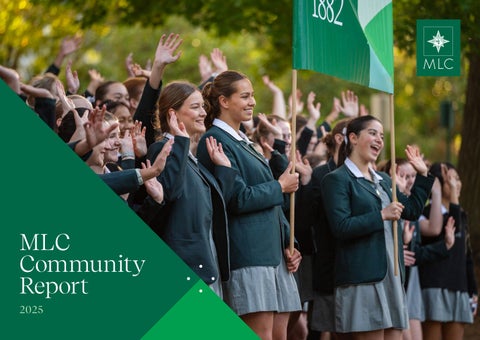
MLC Community Report 2025 1
Principal’s Introduction It is my pleasure to present the 2025 MLC Community Report, reflecting on the achievements, operational milestones and progress of the College throughout the year.
Our new MLC Strategic Plan 2025–2027, Connected, Growing and Evolving for Her Future, launched at the beginning of 2025, sets our direction for the College and marks an important next chapter for MLC. As one of Australia’s leading girls’ schools, MLC has always evolved to ensure our students are prepared not only for the world they will enter, but to contribute meaningfully to it. Developed with input from students, staff, parents, alumnae and community partners, the Plan builds on this proud history and our enduring purpose: to inspire our students to be citizens the world needs. Centred around four interconnected themes: Connecting our College, Fostering Growth, Championing Women and Inclusion, and Actively Evolving, the Plan provides a clear direction for how we will continue to strengthen the learning, wellbeing and opportunities we provide every student. Throughout 2025, we began translating this direction into action across the College. We continued to strengthen the learning
2 | MLC Community Report
and wellbeing experience for students, launched the MLC People Strategy to support the growth and development of our staff, and progressed initiatives to ensure our systems, programs and environments continue to evolve with the needs of our students and College. Significant progress was also made on Phase 1 of our new Physical Education and Sport Precinct. This major investment in MLC’s future will provide outstanding new facilities and create greater opportunities for every girl to develop confidence, embrace challenge, build lifelong healthy habits and experience the many benefits of physical activity. Our commitment to providing an unmatched breadth of opportunities remained central to the MLC experience throughout 2025. Across learning, wellbeing and the broader life of the College, our focus remained on supporting each student to discover and develop her individual interests and talents, challenge herself, grow and ultimately achieve her best.
The first year of our Strategic Plan has laid a strong foundation for the work ahead. As we continue its implementation, we remain focused on ensuring an MLC education responds to the changing world around us, while remaining grounded in what has defined the College for more than 140 years: continually expanding what girls can learn, do and become. None of this would be possible without the strength of our community. I extend my sincere thanks to our students, parents and families, staff, alumnae, volunteers, friends of the College, Board Directors and Stakeholder Members for the many ways you contributed to MLC throughout 2025. As we look ahead, we will continue to connect, grow and evolve, ensuring our students leave MLC with the confidence, skills and character to thrive beyond our gates and make a positive contribution to the world.
Julia Shea Principal
Our Vision, Mission and Values
Vision
Values
An MLC education inspires our students to be citizens the world needs.
The MLC values articulate what we stand for and aspire to, guiding the culture we foster and the behaviours we expect of everyone in our community:
Mission MLC, as a leading girls’ school, develops and nurtures a community of independent, resilient, ambitious learners, by providing an unmatched breadth of integrated learning and wellbeing experiences and environments.
Engage with Respect Aspire with Responsibility Act with Compassion Explore with Courage
Principal Julia Shea welcoming students to the annual MLC Founders Day celebrations at the Krome Gates on the morning of 14 February. 3
Strategic Plan 2025 — 2027
The four interlinking themes will shape our direction and priorities across every part of the College over the next three years.
Championing Women and Inclusion
Connecting our College
We promote the empowerment and success of women and foster a diverse and inclusive environment.
Theme 3
We foster a united community of students, staff, parents, alumnae, and tertiary, community and industry partners to empower our students’ growth and success.
At its heart is MLC’s vision: to inspire students to be the citizens the world needs. In a world marked by rapid change, technological advancement, shifting workforce demands, and growing wellbeing needs, this plan ensures MLC remains a place where girls and young women are equipped to thrive. The strategy honours MLC’s proud 143-year legacy while looking forward with purpose.
We build dynamic learning and wellbeing environments; we empower students and staff to adapt and excel in a changing world.
Theme 4
Theme 1
We proudly launched the new MLC Strategic Plan for 2025–2027: Connected, Growing, and Evolving for Her Future at the start of this year. Built on extensive input from students, staff, parents, alumnae, and community partners, the plan reflects a shared vision for what girls’ education should be in an ever-changing world.
Theme 2
MLC Vision We inspire a mindset where growth is highly valued; we celebrate progress, resilience, and the journey towards personal excellence.
Fostering Growth
An MLC education inspires students to be the citizens the world needs. Actively Evolving
More information, including our measures of success for each theme, can be found in the full Strategic Plan available on our website: mlc.vic.edu.au/about-us/publications 4 | MLC Community Report
Our Community MLC is an open-entry, nonselective school that welcomes students of all cultural, religious and economic backgrounds.
Our community includes current students, parents and staff, our network of alumnae and past families, friends of the College, volunteers, our Board Directors and Stakeholder Members. The Board of Directors is comprised of members of our community who volunteer their time and expertise to support MLC. They have an ethical and financial obligation to act in the best interests of the College and its students. Our Stakeholder Members are comprised of a combination of parents, alumnae, and additional member positions in accordance with the College constitution. They maintain an interest in the operations and governance of the College.
2,303 124 Total students
MLC Kindle students
79
1,952
Boarders
Families
994
20,000+
including full-time and flexible
2,179 Prep-Year 12 students
Staff
including full-time, part-time and casual
Active global alumnae network
5
Our Students Attendance The College follows up on and records reasons for student absences and continually monitors these via each school section. Student absences occur due to a variety of reasons, including illness, injury, religious observance, and family commitments, including liaison with parents. The schools support absent students and their families through regular contact from the Mentor or Class Teacher and/or Subject Teachers and Student or Section Coordinators as relevant for different year levels.
% Attendance
80
94 96 94 94 94 95 94 93 91 90 88 90 89
100
60 40
Year Level Table 1: Average 2025 Attendance by Year Level
6 | MLC Community Report
Year 12
Year 11
Year 10
Year 9
Year 8
Year 7
Year 6
Year 5
Year 4
Year 3
Year 2
Prep
0
Year 1
20
Wellbeing MLC students in Years 5-12 have taken the Resilience Youth Survey (RYS) over the past 10 years. In 2025, it was predominantly administered onsite at Kew campus in Term 2. The anonymous survey captures some essential indicators of youth resilience, reporting on students’ views on being ‘Connected, Protected, Respected’. MLC uses the Australian norm data to benchmark MLC against students from over 800 schools across Australia. Taken together with the areas of focus identified in the MLC Strategic Plan 2025-2027, the data informs review and planning for wellbeing programs, co-curricular activities, and teaching and learning initiatives, with careful attention to ensure alignment across the College from Junior School to Year 12. Overall, the 2025 RYS results demonstrate that MLC students continue to perform strongly against Australian norms in many wellbeing indicators. Across all year levels, students reported high levels of safety, positive relationships, co-curricular participation, family support and freedom from bullying. Participation in extracurricular activities was consistently well above national averages, highlighting a strong culture of engagement and belonging. Students also reported positive levels of teacher encouragement, problem-solving skills and healthy behaviours. In the Junior School, Year 5 students demonstrated particularly strong results in feeling safe at school, enjoying learning, and participating in co-curricular activities. As Year 5 is a significant intake year, the timing of the survey may have influenced friendship-related results, as students are still forming relationships when the survey was taken. The wellbeing team is putting additional strategies in place to address challenges that emerged around help-seeking behaviours, with fewer students reporting that they talk to others when something goes wrong or discuss issues that upset them. Year 6 students showed strengths in recreational reading, co-curricular involvement and healthy behaviours, such as sleeping and eating habits. Key challenges related to physical activity levels and feeling valued through meaningful responsibilities at school. Addressing these challenges directly, a more structured Year 6 leadership program has subsequently been launched, and enhanced outdoor playground spaces are due to open in 2026.
Within the Junior Secondary School, both Year 7 and Year 8 students recorded strong participation in co-curricular activities. Year 7 students also reported positive device management habits and strong problem-solving skills, while Year 8 students demonstrated high levels of effort in their learning. Middle School data highlighted strong social connections, feelings of safety, low bullying rates and healthy lifestyle choices. Year 9 students reported particularly strong friendships and positive self-perceptions, while Year 10 students showed high levels of trust in peers and confidence in problem-solving. However, concerns emerged around sleep, physical activity, help-seeking and students’ perceptions that they are not given meaningful responsibilities. The data suggests that the one-to-one mentoring and check-in programs may be having a positive impact, particularly in Year 10, where perceptions of teacher care and self-efficacy were strengthened. Senior School results were highly positive in areas relating to teacher support, family encouragement, co-curricular participation and student connectedness. Year 12 students reported significant gains in feeling supported by teachers, confidence in seeking help, participation in activities and healthy lifestyle choices. At the same time, increased anxiety, worry and sleep-related challenges remain concerns, particularly as academic demands increase. A consistent theme across the College is the positive impact of mentoring, one-to-one check-ins and relationships with caring adults, with students in secondary years increasingly recognising teachers as trusted sources of support. These are all elements of the structured wellbeing program introduced across Years 7-12 with the implementation of the evolved Curriculum for Learning and Wellbeing in 2024. Future wellbeing priorities identified by the survey results include strengthening helpseeking behaviours, improving sleep education, continued support for healthy device use, increasing opportunities for meaningful student leadership and responsibilities, and ensuring more consistent implementation of school rules and expectations. The College plans to address this through improved communication, visible behaviour expectations, continued mentor training, and by strengthened guidance for teachers to support greater consistency in student experience across classrooms. These targeted initiatives aim to build on MLC’s existing strengths while addressing emerging wellbeing challenges identified in data trends across all year levels.
7
Student Outcomes Literacy and Numeracy Average Student Results
2025 Results
MLC students continue to perform well against national averages. The table below shows the year-level averages for MLC students and National scores based on 2025 NAPLAN results.
Our overall results in 2025 once again saw MLC students achieve some of the highest ATAR scores in the state.
Year 3
Year 5
Year 7
Year 9
The combined VCE, VCE VET, and IB Diploma results continue the College’s longstanding tradition of academic excellence across a broad range of subject disciplines.
MLC
National
MLC
National
MLC
National
MLC
National
Grammar and Punctuation
501
408
567
497
632
539
649
559
VCE and VCE VET Highlights
Numeracy
475
405
564
492
635
545
652
573
Reading
478
402
552
492
613
538
642
568
Spelling
470
405
540
487
596
542
608
569
Across our VCE students, 17 students received perfect study scores in nine subjects: Biology (3), English (6), English as an Additional Language (1), English Language (1), Food Studies (1), General Mathematics (2), History: Revolutions (1), Health and Human Development (1), and Psychology (3).
Writing
481
414
552
480
628
538
653
575
Table 2: 2025 NAPLAN Year Level Averages – MLC and National scores
Seven students received Premier’s VCE 2025 Study Awards in: English as an Additional Language (1), English Language (1), VCE VET Hospitality (2), VCE VET Hospitality: Cookery (1), and Psychology (2).
Five-Year Trend in Year 9 Average Standardised Assessment Results
IB Diploma Highlights
The average standardised assessment results for Year 9 are based on NAPLAN results for 2025 and include international students for whom English is an additional language. The results indicate that the average achievement of MLC students is above state-wide average achievements in all areas assessed by NAPLAN. Data is derived from the five-year trend report.
Among our IB Diploma candidates, four students achieved a perfect score of 45, and another two students achieved 44. 34% of MLC’s IB Diploma cohort achieved a score of 40 or above. The median ATAR for the IB Diploma cohort was 93.95 with 17.5% scoring an ATAR of 99 or above.
Table 3 below indicates improvement in all areas assessed. MLC
State
National
640
570
564
Numeracy
642
582
576
Reading
638
578
570
Spelling
610
575
572
Writing
634
575
565
Grammar and Punctuation
Table 3: 2025 NAPLAN Year 9 Five-Year Trend – MLC, State and National scores
8 | MLC Community Report
3
students achieved
142
students achieved
ATAR
90+
ATAR
99.95 Median ATAR for 2025
89.35 20
IB candidates achieved a diploma score of 40 or above.
Five-Year Rolling Average in Year 12 Results
% of Year 12 students
60 50 40 30
MLC 2021 MLC 2022
20
MLC 2023 MLC 2024
10 0
MLC 2025 National
99+
95+
90+
ATAR/NATAR Table 4: MLC Results (including IB Diploma) compared with National Average
University Offers
The University of Melbourne The University of Melbourne 98 offers 98 offers
The breadth of opportunity offered by MLC’s all-girls education is reflected in the offers received by the Class of 2025 to take up further study in a wide range of institutions across Australia and overseas. The diversity of study areas in the courses offered reflect the breadth of pathways available at the College, and included areas such as the arts, business, commerce, engineering, health, medicine, and sciences. 79% of our Year 12 cohort received an offer for their first or second preference for university courses. In addition to Australian institutions, students were offered places in universities in the UK (Cardiff University, City St George’s University of London, Imperial College London, King’s College London, The University of Manchester, University College London (UCL), University of Bristol, and University of Edinburgh), the US (Northeastern University, University of Hawai’i, and University of Southern California) and the AsiaPacific region (National University of Singapore (NUS), University of Auckland, and the University of Hong Kong).
Monash University Monash University 96 offers 96 offers
Agriculture, Environmental & Related Studies Agriculture, Environmental & Related Studies Architecture & Building Architecture & Building Creative Arts Creative Arts Education Education Engineering & Related Technologies Engineering & Related Technologies Health Health Information Technology Information Technology Management & Commerce Management & Commerce Natural & Physical Sciences Natural & Physical Sciences Society & Culture Society & Culture % %
Others Others 5 offers 5 offers
0 0
5 5
10 10
15 15
Table 5: 2025 Cohort % Round 1 and 2 Tertiary Course Offers by Area of Study
20 20
25 25
30 30
Deakin University Deakin University 41 offers 41 offers RMIT RMIT 21 offers 21 offers
La Trobe University La 16 Trobe offersUniversity 16 offers Swinburne University of Technology Swinburne 10 offers University of Technology 10 offers Australian Catholic University Australian 5 offers Catholic University 5 offers
Table 6: 2025 % Cohort University Offers by Victorian Institution
9
In September 2025, the inaugural Music Fest was a whole community event, featuring student musicians from across Prep to Year 12. 10 | MLC Community Report
Our Parents Parents and guardians are active members of the MLC community. Alongside supporting their daughter’s education, they build connections, contribute to College life and share feedback that helps shape the experience of students and families. Through their involvement, they also model the importance of connection and community participation for their daughters.
Parent Engagement Throughout 2025, the MLC Parents’ Association, supported by the College, coordinated more than 122 community events and activities for parents across the College, with at least 65% of parents attending at least one event. These opportunities help families form relationships, participate in College life and feel connected to the broader MLC community. Parents also contributed generously through volunteering. During the year, 294 parents volunteered across College events and activities, giving their time and experience to support students, families and the wider community.
Parent Feedback More than 35% of MLC families participated in a parent survey during 2025, sharing their perspectives on learning and teaching, student wellbeing, co-curricular opportunities, College culture and communication, and facilities and resources.
The feedback also highlighted areas where we can continue to strengthen the experience we provide to students and families. These include enhancing consistency in students’ learning experiences, providing parents with clearer information about their daughter’s academic progress, and continuing to develop the individual support and connections that contribute to student wellbeing and belonging. Families whose first daughter commenced at MLC in 2025 reported a particularly positive introduction to the College, with average overall satisfaction of 9.0 out of 10. New parents rated the admissions and enrolment experience particularly highly, along with the support provided to help students and families transition into the College community. Following the launch of the MLC Strategic Plan 2025–2027, feedback gathered from parents throughout 2025, considered together with feedback from students and staff, helped guide the strategic initiatives prioritised for 2026. Priority areas span wellbeing and student connection, careers education, the Junior School curriculum, and the systems supporting learning, wellbeing and communication between families and the College.
At least
65%
of parents attended a Parents’ Association community event in 2025
9.0 10 out of
average overall satisfaction among new parents
Parents continued to identify the breadth of opportunities available to students as an important strength of the MLC experience. The College’s facilities and learning resources were also viewed positively, together with opportunities for parents to participate in and feel connected to the MLC community.
11
Our Staff Research shows that quality educational outcomes are driven by excellence in teaching and learning, making the recruitment, retention and ongoing professional development of high quality staff a core priority for MLC. Across 2025, the College continued to implement measures designed to support our staff across all three campuses, ensuing a workplace where everyone can thrive.
Initiatives within these themes are designed to ensure that MLC staff are equipped to continue to provide students with an academically robust education, strengthened by a deep sense of connection and belonging to the College and the MLC community.
Staff Engagement In mid-2024, the College implemented a new staff survey tool, initiating six monthly online surveys via the Culture Amp platform as a method for measuring staff engagement. The aim of the surveys is to capture actionable feedback, by allowing analysis of data across different staff cohorts, monitoring shifts over time, and comparing MLC to education sector benchmarks on various elements of staff experience.
The new MLC People Strategy was developed and launched in 2025 as a key priority within the year one of the MLC Strategic Plan 2025–2027 with the aim of fostering a vibrant, supportive, and high-performing community at MLC. The five strategic themes identified as part of the People Strategy will inform ongoing actions over the life of the plan: 1.
Survey insights inform priority actions at an overall College level via our People Strategy, as well as department-specific actions to support enhanced staff engagement and wellbeing, and a high-performance culture.
Building a values-based, inclusive and connected culture
2. Growing effective, engaging, and accountable leadership at all levels
Pleasingly, M/F/Non the August 2025 survey showed improvements in each of the College’s identified focus areas being senior leadership, staff wellbeing as a priority, and reward and recognition.
Teachers/ESS
3. Attracting and retaining talent and fostering continuous learning and growth 4. Enhancing health, safety and wellbeing 5. Delivering enabling People and Culture systems, processes and supports that manage risk and compliance
Teachers/ESS
Number of Staff – full-time equivalent
1 staff member has indicated they are of Aboriginal and Torres Strait Islander descent
Table 7: 2025 Staffing across all campuses
Table 8: 2025 Staff gender
55% Teachers
80.2% Female
45% Educational Support Staff
M/F/Non
421
M/F/Non
S
12 | MLC Community Report
19.8% Male
1 staff has indicated they are non-binary/ prefers not to say
College Operations This report covers the period of the 2025 College operational year, from 1 January to 31 December 2025.
Table 9: 2025 College Revenue
84% Tuition fees
Table 11: 2025 College Expenditure Allocation
10% Government grants
The impact of continued inflation on key operational expenses, as well as necessary wage growth for staff, and the ongoing collection of several State Government levies factored into increases in operating costs.
6% Other non-operating income, including donations
For 2026, a base increase of 5% was applied to all Tuition Fee categories, with some year levels seeing higher adjustments as part of a two-year alignment strategy.
Every $100 in expenditure is allocated by the College to the following areas: $28.62 Learning and Curriculum
$19.52 W hole of College operations $14.82 Schools
$3.81 Other
Table 10: 2025 College Expenditure
70% E mployee benefits expenses
12% Finance costs and other expenses
11% School and general expenses
$1.29 Community Relations including Parents’ Association, OCC and Alumnae $1.63 Staff Development and Research $2.08 Boarding
$8.99 Technology $6.77 E ducation Outdoors $5.80 Sport $2.45 Music $2.11
Learning Support
$2.11 A dmissions, Marketing and Communications
7% Depreciation
13
MLC 207 Barkers Road Kew Victoria 3101 Australia T +61 3 9274 6333 E college@mlc.vic.edu.au mlc.vic.edu.au 14 | MLC Community Report
Methodist Ladies’ College Limited ABN 55 006 036 979 CRICOS 00325A 25 August 2026