




PREPARING FOR AGENTIC AI
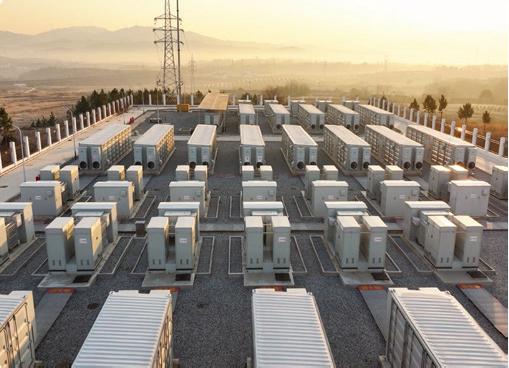
IMPROVING SOLAR PLANT EFFICIENCY
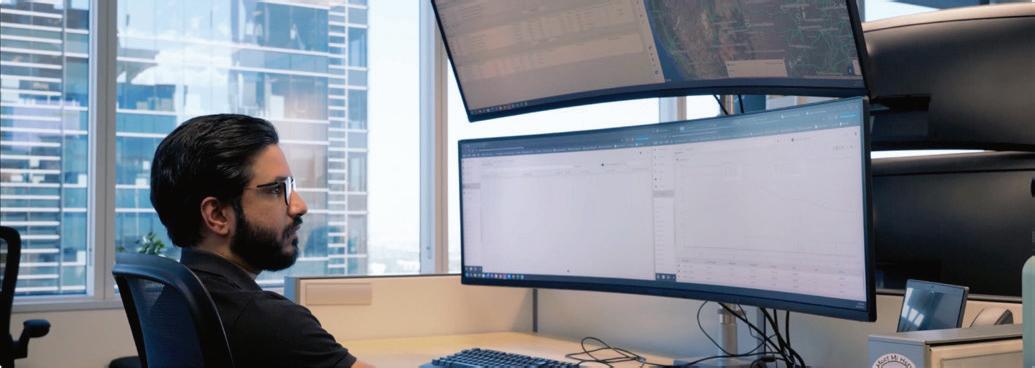
MANAGING INSTRUMENTATION END-OF-LIFE


PREPARING FOR AGENTIC AI
IMPROVING SOLAR PLANT EFFICIENCY
MANAGING INSTRUMENTATION END-OF-LIFE
How the new inductees were inspired and motivated by their control engineering peers

Yokogawa empowers a world where industry and sustainability move forward in synch and in harmony. Through the transformation of data into action, we co-innovate with our customers to connect and orchestrate systems of systems, enabling smarter, safer, and more sustainable operations. Together, we advance autonomy, protect our planet, and realize human potential for generations to come.

Learn how we harmonize people and progress


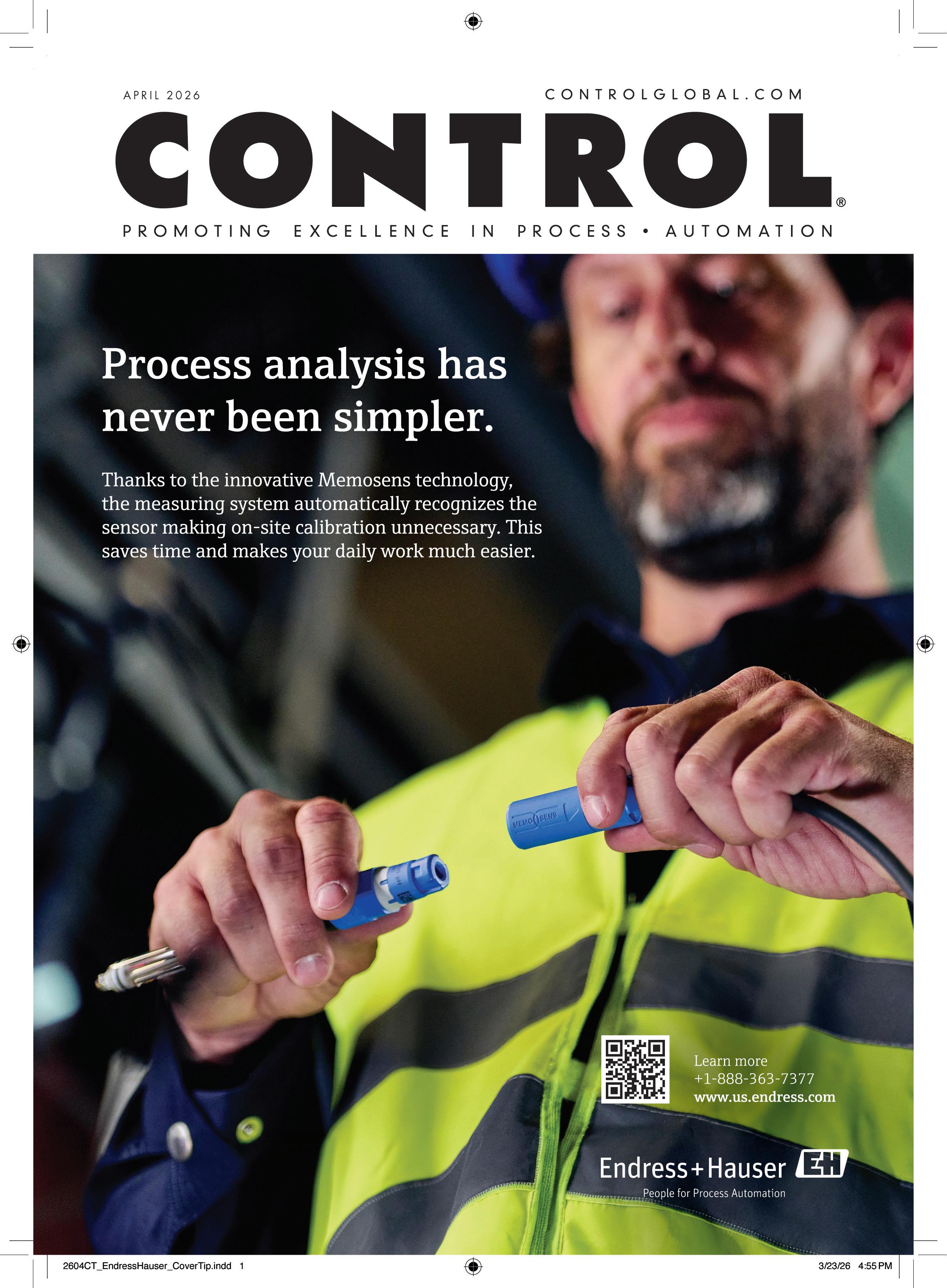
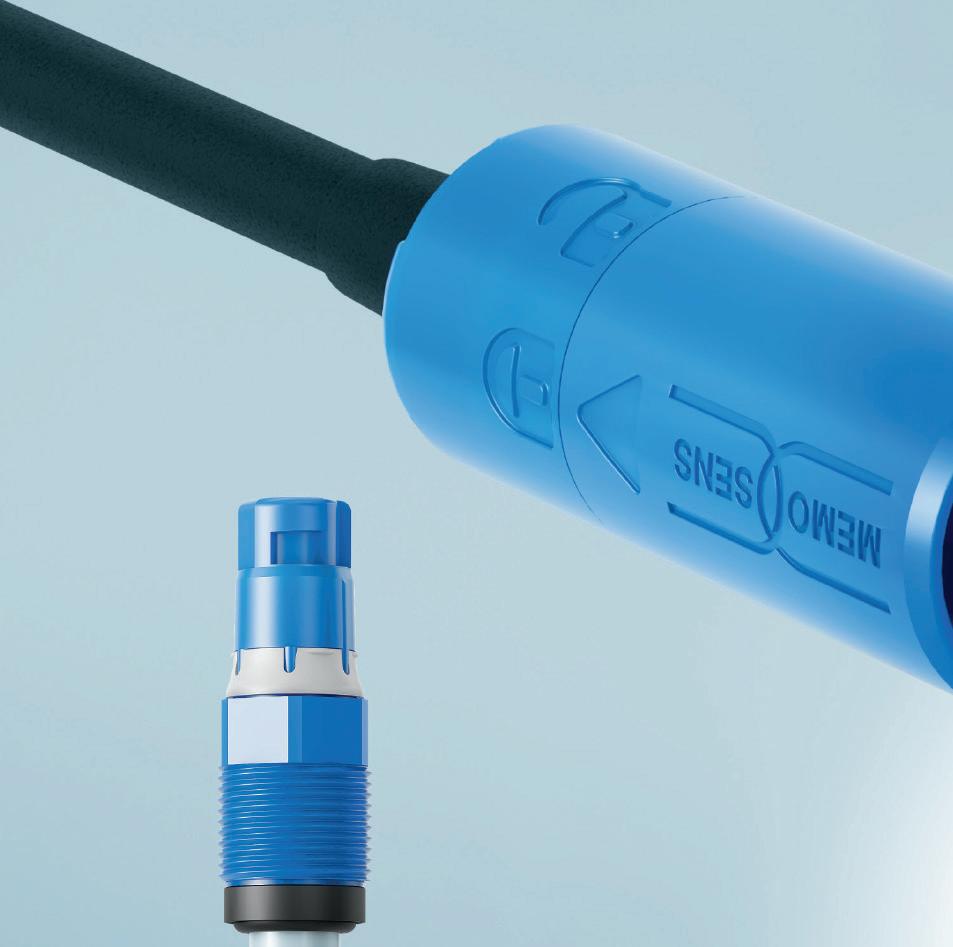
Memosens sensors are available for all relevant parameters of liquid analysis. They deliver precise, digital measured values increasing your product yield and ensuring consistently high process quality.


Jim Montague
9 EDITOR’S PAGE
Mastering the craft
It takes a lifetime of dedicated practice to become an expert in control engineering, and a little help from your peers
10 OTHER VOICES
Avoid irrecoverable failure with industrial orchestration
As artificial intelligence (AI) proliferates, it’s imperative to deploy an orchestration layer to thoughtfully add to human expertise
13 ON THE BUS
Grim Reaper of tech
Obsolescence is inevitable, even for reliable instruments
14 WITHOUT WIRES
Smart data dependency
Smart systems are controlheavy, not just data- heavy
15 EXCLUSIVE
Tender, loving cold box care
Fisher IC2 cryogenic, topentry, control valve limits leaks and energy loss
16 INDUSTRY PERSPECTIVE
Powering a smarter, scalable future for bioprocessing
Yokogawa’s Shahzad Khan discusses how integrated automation and data intelligence delivers real- time analytics, streamlined automation and compliance- ready workflows
18 IN PROCESS
Energy, chemicals industries race to fully automate
ISA publishes a new SCADA systems standard; Enforcers project plans to strengthen European cybersecurity; Yokogawa and ANYbotics integrate robotics software with inspection robots; Audobon buys Alliance Engineering
28 INDUSTRY PERSPECTIVE
Smart device manufacturers move towards FieldComm Group FDI device management tools
VEGA Americas’ Chris Willoughby discusses the benefits of Field Device Integration (FDI) technology
37 RESOURCES
Ins and outs of AI for process control
Control’s monthly resources guide
38 ROUNDUP
How to cover all the severe-service bases
Level, pressure, temperature and flow instruments are extending service ranges for hazardous settings
40 CONTROL TALK
How to get the best conductivity measurement
Best practices for accurate process analytics, sensor selection and installation
42 CONTROL REPORT
New labels warning Don’t let name changes keep you captive to confusion




Connect Legacy Hardware
Centralize Real-Time Data
Create Custom Applications With Ease
Deploy Enterprise-Wide With A Click
Standardize Global Operations
Full enterprise connectivity is easier than you think.
Ignition is the foundation of choice for enterprise innovators everywhere






Endeavor Business Media, LLC
30 Burton Hills Blvd, Ste. 185 Nashville, TN 37215
800-547-7377
EDITORIAL TEAM
Editor in Chief
Len Vermillion lvermillion@endeavorb2b.com
Executive Editor Jim Montague jmontague@endeavorb2b.com
Digital Editor
Madison Ratcliff mratcliff@endeavorb2b.com
Contributing Editor
John Rezabek
Columnists
Béla Lipták
Greg McMillan
Ian Verhappen
DESIGN & PRODUCTION TEAM
Art Director
Meg Fuschetti
Production Manager
Rita Fitzgerald
Ad Services Manager
Jennifer George
PUBLISHING TEAM
Group Editorial Director
Keith Larson
630-625-1129
klarson@endeavorb2b.com
Group Sales Director
Mitch Brian 208-521-5050 mbrian@endeavorb2b.com
Account Manager
Greg Zamin
704-256-5433 gzamin@endeavorb2b.com
Account Manager
Jeff Mylin
847-533-9789 jmylin@endeavorb2b.com
Subscriptions
Local: 847-559-7598
Toll free: 877-382-9187 Control@omeda.com
EXECUTIVE TEAM
CEO Chris Ferrell
COO
Patrick Rains
CDO
Jacquie Niemiec
CALO
Tracy Kane
CMO
Amanda Landsaw
EVP Manufacturing & Engineering Group
Lisa Paonessa
VP of Content Strategy, Manufacturing & Engineering Group
Robert Schoenberger
Jesse H. Neal Award Winner & Three Time Finalist
Two Time ASBPE Magazine of the Year Finalist
Dozens of ASBPE Excellence in Graphics and Editorial Excellence Awards
Five Time Winner Ozzie Awards for Graphics Excellence
It takes a lifetime of dedicated practice to become an expert in control engineering, and a little help from your peers
RECENTLY, I had the opportunity to see and listen to Malcolm Gladwell. As the noted author, journalist and historian answered a question from the audience about the “10,000-hour rule”— the theory he popularized in his best-selling book “Outliers” (gladwell.com/books/outliers)—I couldn’t help but correlate what I heard onstage with what I’d just heard as I conducted interviews for this month’s cover story highlighting the new inductees to Control’s 2026 Process Automation Hall of Fame (p. 22).
Though not scientific law by any means, the theory states it takes a great deal of deliberate practice to achieve mastery in any complex field. It emphasizes that expertise is built through consistent, focused and persistent effort rather than talent alone.
Control engineering is a complex field that requires comprehensive learning and experience to master. When one reads about the longevity of the three inductees—Manfred Morari, S. Joe Qin and Peter Morgan—you realize they put in a tremendous amount of time working on control theory and practice.
One of the most impressive common denominators of each inductee is that, even after decades working with control systems, they chose to keep learning and evolving. Perhaps most important, they chose to help others on their own journeys toward mastering this complex world of process control and automation.
For his part, Morari waved off mandatory retirement to move across an ocean, and continue teaching the next generation of great control engineers. Qin took decades of field experience back to Hong Kong to lead one of the top universities for engineering in Asia. Morgan exchanged his field work for passing along what he’s learned through writing.
It’s a noble and vital path, particularly considering the ongoing dilemma industry faces to cultivate a future engineering workforce, and figure out emerging technologies such as artificial intelligence. This trio has been through massive shifts in technology before, and knows how to identify good uses. In fact, they helped drive some of those technologies into standard practices.
They’re also quick to point out that their years of work to master their craft was significantly helped along the way by other people. Now it’s their turn to help the next generation.
As Gladwell points out with his theory, if you could master these complex tasks in, say, one summer, you probably wouldn’t need anyone’s help, but if it takes 10 years or more, you need all the help you can get along the way.


LEN VERMILLION Editor-in-Chief lvermillion@endeavorb2b.com
“ Control engineering is a complex field that requires a great deal of comprehensive learning and experience
to master”
CALEB EASTMAN
Field Chief Technology Officer, Americas Siemens Digital Industries
“When disruption strikes—such as a cyber-event, a hallucinating model or a physical anomaly—leaders may discover they lack the understanding to get operations back on track.”
As artificial intelligence (AI) proliferates, it’s imperative to deploy an orchestration layer to thoughtfully add to human expertise
THE INDUSTRIAL MARKET is facing a bold and evolving operating model for manufacturing and process businesses, driven by rapidly expanding artificial intelligence (AI) context and generative capabilities. These advances promise massive productivity surges and vast cost savings, empowering employees to spin up new software tools at lightning speed.
At first glance, this appears incredibly advantageous to expanding an enterprise. However, it’s simultaneously creates a risky blind spot in modern boardrooms. As leadership teams fixate on efficiency, scale and cost reduction, they’re unwittingly constructing organizations that are inherently brittle.
If this type of highly optimized system fails, it’s not a gradual breakdown, but a sudden and total collapse. When critical processes live inside AI-generated tooling that no single person designed and no team fully understands, it creates the conditions for nonlinear and irrecoverable failure. As a result, the defining metric for the next decade of manufacturing isn’t productivity, but organizational recovery time.
To survive this paradigm, industrial leaders must reject the prevailing, black box approach to AI, and instead implement an orchestration layer, which is a rigorous system of checks and balances that methodically bridges the gap between people on the plant floor and the software they use.
The core danger of the black box paradigm is opacity. In a rush to reduce costs, it can be tempting to unleash unmanaged AI tools. However, this can quickly create scenarios where software evolves more quickly than governance can track, generating potentially erroneous information and misguided operations.
Simultaneously, industry continues to face challenges retaining talent, which threaten
losses of deep, intuitive understanding of how processes and plants run. AI promises to relieve this scarcity, but replacing personnel with models that generate their own code and operational logic can sever the link between cause and effect. When disruption strikes—such as a cyber event, a hallucinating model, or a physical anomaly—leaders may discover they lack the understanding to get operations back on track. To avoid this pitfall, organizations must orchestrate AI, rather than use it to replace control directly.
To address these and other issues, companies must deploy AI orchestration, a deterministic framework that manages stochastic AI models. An orchestration layer serves as a secure intermediary that sits between AI models and the real-time needs of industrial control systems (ICS). This prevents haphazard connections that may lead to systemic failure by enforcing a unified architecture of safety and policy (Figure 1).
It directly addresses pitfalls of the AI-driven future by:
J Enforcing policy to prevent nonlinear failure. When AI tools optimize without oversight, they can push machinery beyond safe limits to achieve productivity gains. Orchestration enforces inviolable rules and constraints that can override AI recommendations in the event of overreach. This helps ensure that, no matter how efficient an AI tool becomes, physical operations remain within the bounds of physics and safety, turning potential systemwide failure modes into managed constraints.
J Maintaining global state awareness. The opacity problem arises when AI creates silos of operation. Orchestration counters this by maintaining a real-time view of the entire operation’s state—knowing what sensors
are reading, which machines are running, and the status of production orders. It acts as a conductor, so when AI predicts a quality issue, the system can gracefully adjust downstream operations in synchronization. This creates consistency, and prevents chaotic, cascading failures that characterize brittle systems.
J Institutionalizing knowledge via lifecycle management. To counter loss of institutional knowledge, an orchestration layer provides an enduring knowledge base for manufacturing, and oversees the lifecycle of every digital component. It facilitates the methodical rollout of AI models and control logic updates by validating results against expectations.
An orchestrator logs every decision and action into a human-AI system, creating a digital audit trail that replaces tribal knowledge. So, when production issues arise, engineers can replay the sequence of inputs and outputs to understand why. This transparency differentiates systems that can be repaired
from those where recovery from failure is nearly impossible.
AI orchestration isn’t constrained exclusively to a software component because it also represents a shift in deployment mindset. To build resilience and avoid pilot purgatory, organizations should establish a vision to solve data contextualization issues, while keeping humans in the loop.
The companies that succeed start with the end in mind, so foundational steps support long term vision and goals. Also, organizations must standardize their data models before unleashing operational AI. This entails semantic contextualization—giving data meaning, so AI and humans understand what specific information means. Without this initial step, AI tends to hallucinate, while operators are led astray.
And, humans must always be the central component of every technological solution implemented to solve specific operational challenges. An orchestration layer integrates with supervisory control
systems to provide context for operators in addition to alerts. In the same vein, if AI triggers an action, it must communicate its reasoning, and always offer users human-based override options.
Industrial AI must not take over the role of operators because, given enough time, failures will inevitably occur that require human intervention. It’s therefore imperative that operators remain active in workflows, not relegated to being passive observers.
In the wake of the AI revolution, the defining characteristic of industrial success isn’t how fast a company produces, but how quickly it can recover when the black box breaks.
The efficiency upside of AI can’t be overstated. However, we must stop deploying it as a series of disconnected, opaque scripts and software subsystems. Instead, these probabilistic models must be integrated with the guidance of a deterministic orchestration layer to ensure safety, enforce policy, and uphold operational stability.


The American Control Conference (ACC) is the annual conference of the American Automatic Control Council (AACC). It will be held May 26-29, 2026, at the Hilton New Orleans Riverside. ISA is a co-sponsor of the ACC, along with 8 other professional societies.
It is a 4-day event with about 1,300 attendees presenting and discussing research innovations in control for many disciplines. It includes a day of workshops (May 26) intended to bridge the research-practice gap to benefit practitioners, innovators, and instructors.
Here is a brief sampling of several workshops:
There is a well-known “gap” between control theory, research, and practice. Today, the growing power of computation platforms, sensors, actuators, the “Internet of Things”, autonomous bots, drives an explosion of applications requiring feedback control. This workshop is intended to allow: practitioners to improve their applications through best practices supported by theory, and control researchers to credibly apply their work.
For more, visit: https://dabramovitch.com/ practical_methods_acc_2026/
Optimization is fundamental for calculating control action, modeling, design of processes, equipment, and products. This workshop will be a practical guide for those using multivariable, constraint-handling, nonlinear optimization.
The workshop will explain the search algorithm for common gradient-based and direct-search optimization techniques, but the focus is on user choices for the: objective function, constraints, convergence criterion, number of replications to ensure finding the global optimum, and matching the algorithm to the application haracteristics.
For more, visit: https://www.r3eda.com/ then use the “Optimization” link then “Short Course”.
To explore all workshops and the conference program, visit https://acc2026.a2c2.org/program/workshops
To explore the conference program or register, visit https://acc2026.a2c2.org/ Conference registration is not required for workshop registration.
Digital twins and model-based control rely on data, yet experiments are often expensive and constrained. Optimal experimental design provides a systematic way to select experiments that reduce model uncertainty. This workshop introduces Pyomo.DoE, an open-source, equation-oriented framework. By treating experimental inputs (e.g., control trajectories, sampling times, and operating conditions) as decision variables, Pyomo. DoE enables automated experiment design for complex dynamic systems. For more, visit: https://dowlinglab.github.io/ pyomo-doe/Readme.html
Obsolescence is inevitable, even for reliable instruments
RUDY KNEW HE was biding his time. The process gas chromatograph (GC) he specified more than a quarter-century ago was still “tapping its toe,” an expression he liked to use for the analyzer dutifully repeating its endless cycles of sample injection, component separation and analysis. However, now his access to spare parts—PC boards, especially—was close to the eBay phase. In similar death-defying desperation, his friends at the neighboring refinery were sending out ailing door boards—an innovation their favorite supplier sold them in the 1990s to update already aging GCs—to a small enterprise (not their vendor) that could restore them to life. Both teams of professionals knew the day was coming when their strategies would succumb.
When he installed his new NOx analyzers for stack continuous emission monitoring systems (CEMS) more than a dozen years ago, he was impressed how repurposed and cleverly integrated components used the “chemiluminescence” principle to accurately measure nitrogen oxides for U.S. EPA permit compliance. It was an unforeseen stroke of luck that his analyzer choice precisely matched the instruments used by the environmental group’s relative accuracy test audit (RATA) service provider. The preeminent duty of a CEMS instrument is to pass its yearly RATA as well as daily drift tests.
However, while his aging GC was still dutifully—amazingly—tapping its toe, Rudy was stunned to learn that parts for his NOx analyzers would no longer be available after year’s end. Unlike the GC, he couldn’t survive a weeks- or months-long outage on a CEMS unit. The site’s permits allowed only a brief maintenance window; beyond that, they’d slip out of compliance, incur escalating fines, and earn the wrong attention from corporate leadership.
A GC failure would certainly be taxing for operations, but they could limp along with periodic lab analyses or inferential readings. For CEMS, there was no such fallback. As the implications sank in, Rudy felt like he was staring down the barrel of a loaded gun.
The agency officer asked him, “Do you feel lucky?”
What was the gamble? He could stock up on parts while they were still available, and take the chance that he didn’t miss one that turned out to be essential. He would also be tempting fate, betting that his techs and/or his vendor’s shop would remain competent in repairs, a challenge for instruments that were few, and had run for years without needing much more than filter changes and an occasional UV source. His instrument used tiny pressure sensors that looked like they belonged in a medical device. Once, he searched for the part number on the Internet, and discovered it had been superseded by newer generations with incompatible pinouts. As pressure control was a key to maintaining flow ratios for the chemiluminescence method, a scarce spare part would be a serious threat.
Rudy decided he’d better have the new model installed before some unexpected but serious fault rendered his old analyzer incapable of passing a RATA or daily drift test. However, for the EPA, it’s not that simple. Just because an analyzer is new, factory-tested and certified, it hasn’t passed a RATA. This audit certifies the entire system, including sample handling and conditioning. If he could make it to the next test, he could switch to the new instrument at that time.
The surprisingly reliable chemiluminescence method had served him well, but he was intrigued by newer, tunable - diode -laser (TDL) approaches—particularly the Rosemount Quantum Cascade Laser (QCL) analyzer. His existing sample system was already designed to provide cooled, dehydrated and filtered gas for analysis, which made it harder to justify the higher cost. The greater concern was matching the RATA service provider’s method.
The QCL might offer greater precision, but introducing a new measurement technology risked creating discrepancies. It worried him because time was already growing short, and the EPA wouldn’t care how elegant the method was. The agency just wanted the device to pass its test.

JOHN REZABEK Contributing Editor JRezabek@ashland.com
“Just because an analyzer is new, factory-tested and certified, it hasn’t passed a RATA.”

IAN VERHAPPEN
Solutions Architect Willowglen Systems Ian.Verhappen@ willowglensystems.com
“Almost all these data sources use wireless signal transmission for at least part of their collection processes.”
Smart systems are control-heavy, not just data-heavy
SMART, AS ITS name implies, requires lots of data from a range of sources and types. For example, smart cities require data streams in broad categories:
J Traffic flows with real-time (<1 sec) responses;
J Environmental data, such as air quality networks measuring particulates and Internet of Things (IoT)-enabled waste receptacles; and
J Utilities and infrastructure, including smart grids, lighting and water metering.
Almost all these data sources use wireless signal transmission for at least part of their collection processes. Fortunately, at least from the smart city perspective, integrating data from each of these systems occurs at the enterprise level. By that time, it’s been processed into a common database, typically using JavaScript Object Notation (JSON).
As any of us who’ve connected third-party systems can attest, integration challenges are at the control layer. This is where the importance of interoperability comes into play. Interoperability is required to gather data from sensors and equipment, such as transformers, relays and pumps, and transmit actuation commands to make smart cities intelligent.
The degree of interoperability and effort required to have all the different systems and subsystems communicate is a function of how completely the protocol defines and maps the configuration details between the elements.
Fully defined protocols typical of industrial automation, largely based on electronic device description language/device type manager (EDDL/DTM), are easier because their defined I/O mapping is easily understood. On the other hand, protocols like distributed network protocol 3 (DNP3) require arguably twice the effort to define point lists, configure objects, deadbands and event buffering logic. DNP3 is used extensively in North American utilities.
Lastly, complex protocols such as IEC 61850 also take about twice the effort because their substation configuration language (SCL) and extensible markup language (XML) imports mapping complex object models to symbols. Industrial protocols are developed and compliance tested by sponsoring consortia (FieldComm, Profibus, etc) to ensure interoperability—though having lived through the 1990s, it wasn’t a trivial exercise.
Unfortunately, this interoperability isn’t available for other protocols, in part because most standards development organizations (SDO) don’t have arm’s-length compliance/ certification divisions to do interoperability testing. IEC has a multilateral certification system called IEC System for Conformity Assessment Schemes for Electrotechnical Equipment and Components (IECEE), but it doesn’t do protocol interoperability testing.
Interoperability, particularly for power transmission and distribution protocols, will become increasingly important and arguably critical for integrating smart homes to smart grids. With most home-based solar panels being used by consumers, they’ll need foolproof connections to their smart meters. This is because some will be challenged to maintain the apps and security software on their phones, so they can sell and buy into their local grid. Similarly, the grid will also incentivize users to allow it to use electric vehicles and other large batteries as storage devices and buffers, adding another layer of complexity to homebased, nano-grids.
BACnet protocol for building automation also has some interoperability issues, mostly because manufacturers have used its custom block for what should be defined features. There’s no way to test a manufacturer-specific block because only the wrapper needs to comply with the standard, while the details of what’s inside and what’s stored where in the device’s memory can be unique.
Designed for super low-temperature cold boxes in air-separation, LNG and hydrogen processes, Fisher IC2 cryogenic, top-entry, control valve limits leaks and energy loss
IT’S NOT easy to keep cold boxes and their cryogenic contents comfy, mainly because they appreciate -198 °C (-325 °F), but they enjoy -269 °C (-425 °F) even more. The heat exchangers, distillation columns, piping and valves in these insulated enclosures demand super-low temperatures for air-separation processes, and increasingly for liquid natural gas (LNG) and hydrogen liquefaction applications.
The problem is it’s extremely difficult to incorporate recent technical improvements, new capabilities and updated designs in these beyond-frosty settings. Plus, operating in cryogenic environments can be challenging due to product and energy losses from emissions, which reduce profitability, increase maintenance costs, and raise regulatory concerns.
To help users overcome these challenges and gain new capabilities, Emerson is introducing its Fisher IC2 cryogenic, top-entry, control valve that meets the stringent demands of these extremely low-temperature environments, and includes cryogenic enhancements, such as a narrow extension diameter and fluid baffle. It’s rated for the CL600 pressure class, and is available in 1 in. to 4 in. line sizes (DN25 to DN100), with more options forthcoming.
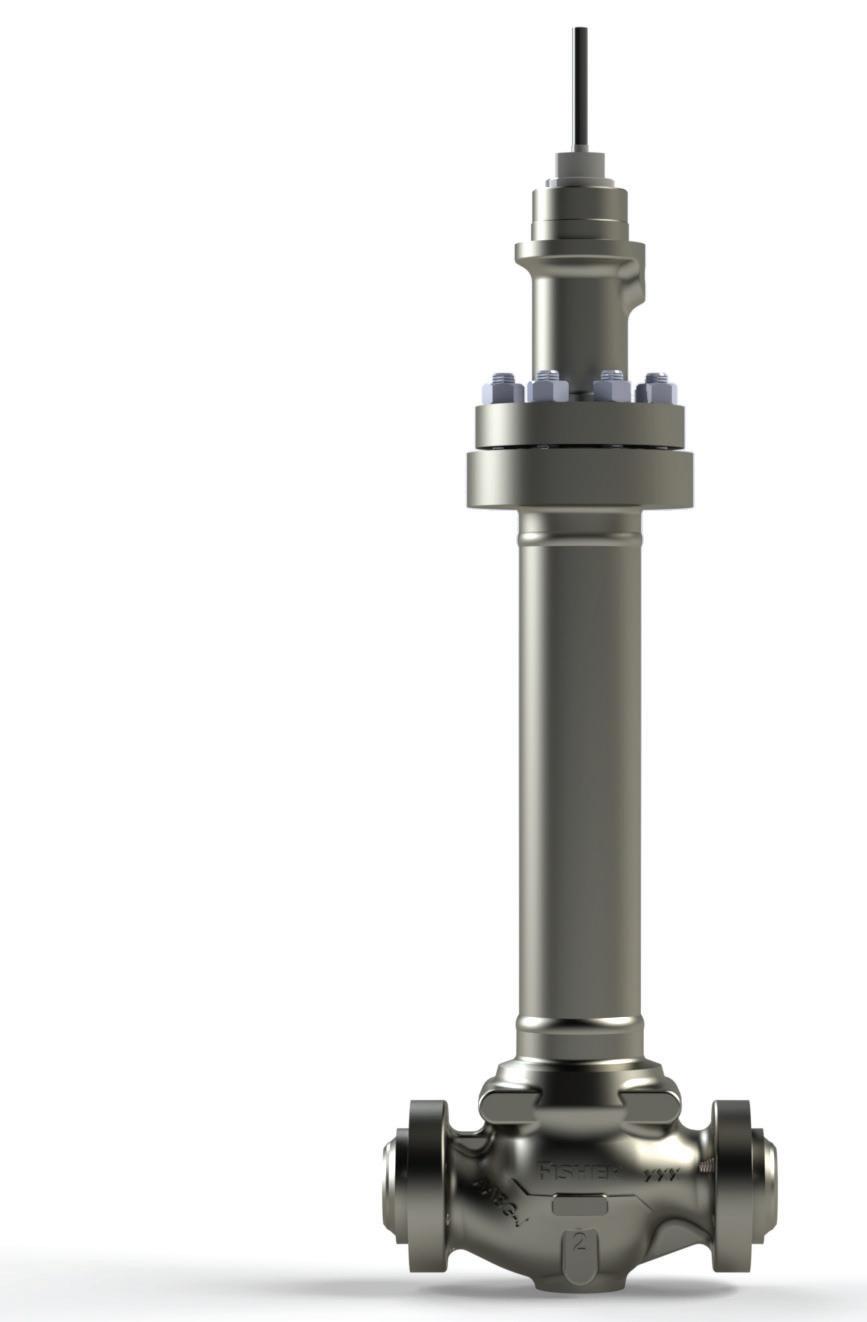
Source: Emerson
“There have been many recent opportunities for new designs in cold boxes and air-separation technologies, and they’ve inspired innovations that can reduce leaks, improve sealing, and keep fluid in valves,” says Brendan Leslie, product marketing manager for flow control products at Emerson. “These new designs are based on capabilities that customers would like to see, such as being able to use cryogenics in emerging LNG and hydrogen
applications, so we’re also making valves more energy efficient, which is why we keep diameters narrow, especially near the valve extension.”
IC2’s components work together to minimize heat conduction, and reduce the energy required to maintain process fluid temperatures, while enhancing overall operational sustainability. Of course, another crucial part of any coldbox’s mission is fending off ambient, environmental temperatures, even though its valves must be accessible by users on the outside. IC2’s Fisher-enhanced
Enviro-Seal packing system and bellows limit leakage to a maximum of 100 parts per million by volume, meeting or surpassing U.S. Environmental Protection Agency standards.
“It’s essential for valves in cold boxes to have sufficient packing on the upper side, such as Enviro-Seal, so they can maintain optimal temperatures in those areas and avoid freezing,” explains Leslie, who adds that appropriate packing also means users don’t have to access cold boxes as often for servicing, which saves on potential emissions and product loss. “These tasks were a lot harder in the past, which is why we’re always striving for better sealing.”
IC2 control valve also provides longevity with hardened trim materials, and metal-to-metal seating. When maintenance is necessary, IC2 offers simple serviceability via features such as topentry, single packing nut, modular stem assembly, independently replaceable bellows, replaceable valve plug and seat ring, and a special tool for seat ring removal.
“Valves serving cold boxes have to walk a tightrope between maintaining extreme cold inside and interfacing with ambient temperatures outside, and this is where IC2 achieves its primary innovations and benefits,” adds Leslie. “We talked with one customer about a month ago, and they hadn’t used a cryogenic product like this before. However, because they know Fisher and Emerson, they were able to trust it would meet the needs of their end user, and give them all the regular control valve capabilities, but this time for long-stem valves in these extremely harsh settings.”
For more information, visit Emerson. com/FisherIC2

SHAHZAD KHAN
Global Systems Consultant, Life Business Unit
Yokogawa
INNOVATIONS, such as bioprocessing, are redefining the life sciences industry by reshaping how therapies are developed and delivered. Bioprocessing using living cells, microorganisms or enzymes to manufacture products, and its global market, are expected to reach more than $100 billion in 2026. But that can’t happen without the ability to unify control systems and instrumentation into streamlined, scalable solutions for producing new products, and getting them into the hands of consumers.
Shahzad Khan, a global systems consultant with Yokogawa’s Life Business Unit, recently discussed how its Bio Pilot integrated automation and data intelligence platform delivers real-time analytics, streamlined automation and compliance-ready workflows from R&D to full-scale production to usher in a new era of operations excellence for the life sciences.
Q: Bioprocessing today is fragmented and manual. What issues does that cause for operators, and what needs to be improved?
A: Today’s bioprocessing environments remain heavily fragmented, with equipment, instruments and software that were never built to operate as a cohesive system. Operators are forced to navigate between bioreactor interfaces, PAT tools, offline analyzers and even paper-based SOPs—each using different communication protocols and software platforms. This lack of integration leads to extensive, manual data entry, constant cross- checking of parameters, and time - consuming efforts to align timestamps, verify samples and synchronize process data.
The result is a heavy operational burden that increases variability, slows decision-making, and heightens the risk of human error that directly affect batch quality, consistency and reproducibility. What’s needed is a truly integrated operational environment that connects
all data sources in real time, minimizes manual touchpoint and empowers operators with guided, automated workflows. This shift allows teams to concentrate on optimizing processes rather than reconciling systems.
Q: How can Bio Pilot help, especially to unify upstream and downstream process?
A: Bio Pilot serves as the neutral, vendor-agnostic integration layer the bioprocessing industry has long needed. Rather than treating upstream and downstream operations as separate domains, it unites them within a single operational environment. Bio Pilot seamlessly connects bioreactors, Raman systems, medium analyzers, cell counters, offline instruments, pumps, skids, and even DCS or PLC systems—creating a cohesive data and control layer across the entire process. In upstream operations, it synchronizes equipment and analytics, so data flows continuously, and process automation can be executed with confidence. Downstream, it applies the same integration principles to clarification, chromatography, UF/DF, filtration, and viral- clearance steps, enabling centralized monitoring and coordination from one platform. By standardizing data flow and orchestrating actions across systems, Bio Pilot eliminates the silos that traditionally separate unit operations. The result is a unified, end-to - end process where seed train, production, purification and final conditioning function as one connected, predictable workflow—not a collection of disconnected tools
Q: Explain the significance of Bio Pilot’s no - code workflow editor.
A: Bio Pilot’s no - code workflow editor transforms traditional SOPs into dynamic, automated processes—without requiring any programming skills. For operators on the floor,

Bioprocessing operations require unified control systems and instrumentation for streamlined, scalable solutions for producing new products.
this means clear, guided execution with step‑by‑step instruc tions, built‑in validations, and intelligent decision branches that adapt to process conditions in real time. Routine tasks such as feeding, sampling, PAT‑triggered actions, and equipment checks become automated and consistent, reducing cognitive load and minimizing run‑to‑run variability.
Just as importantly, the editor captures expert know‑how di rectly within the workflow logic, preserving institutional knowl edge, and ensuring every operator follows the true process design, not a personal interpretation of it. The result is faster training, fewer errors, and a more reliable path from SOP to ex ecution—turning static instructions into actionable automation teams can trust.
Q: What are some real world impacts of Bio Pilot?
A: Bio Pilot has already demonstrated measurable impact across diverse, real‑world applications. For example, in scaled studies from 2 L to 20 L, it enabled consistent glucose control by combining Raman analytics with model predictive control (MPC), delivering reproducible VCD and titer profiles—an es sential factor for successful scale‑up.
In collaboration with Repligen’s MAVERICK system, Bio Pilot sustained fully autonomous operation for two continuous weeks, maintaining precise glucose and amino‑acid feeds with no operator intervention other than routine sampling. During perfusion processes, it balanced multiple pumps simultaneously to stabilize fresh, recycled and spent media flows, preventing the drift that typically undermines long‑term culture stability.
In AAV vector production, Bio Pilot reduced batch failures by detecting abnormal conditions early, and guiding operators through corrective SOP steps via built‑in decision logic.
Across these applications, Bio Pilot consistently improves reproducibility, stabilizes control, lowers manual workload, and transforms advanced analytics into practical, closed‑loop per formance that teams can trust in production environments.
Q: The real world use cases mentioned are upstream. How do the benefits extend downstream?
A: Downstream processing has long been one of the most com plex and costly stages of biomanufacturing—and historically, one of the least automated. This makes it more prone to variabil ity and operational risk. Bio Pilot addresses these challenges by extending the same level of integration, automation and real‑time insight proven in upstream operations to the downstream space.
The platform seamlessly connects with clarification systems, depth filters, centrifuges, chromatography columns, TFF and UF/DF skids, and viral‑clearance units, bringing all these steps into one coordinated environment. Bio Pilot continuously tracks critical parameters, such as turbidity, pressure, flow, conduc tivity, temperature and UV absorbance, aligning those data streams to drive automated control and decision logic across purification operations.
This orchestration stabilizes processes that are typically manual and variable, enhances reproducibility across batches, and significantly reduces operator workload. Ultimately, Bio Pilot helps ensure consistent, high‑quality output from harvest through to purification.
Study finds 400 executives expect 50% of their sectors will be fully automated by 2030 as AI reshapes performance
ALMOST A THIRD (31.5%) of 400 energy and chemical executives from 12 nations report that advancing autonomy will be a critical priority for the next five years, according to the “Global Autonomous Maturity Report” study released Mar. 23 by Schneider Electric (www. se.com/ww/en/work/solutions/globalautonomous-operations-maturity). The report adds that 44% of the participants believe autonomy will be crucial during the next 10 years, while fewer than 5% view it as a low priority.
Citing strong commercial pressures, the executives warn that delaying automation risks higher operating costs (59%), worse talent shortages (52%), and reduced competitiveness (48%). However, the study adds that barriers to automation include high upfront costs (34%), legacy systems (30%), organizational resistance (27%), cybersecurity concerns (26%) and regulatory uncertainty (25%).
The report indicates the energy and chemical sectors are at a tipping point as electrification, automation and digitalization converge. Likewise, surging AI demand, driven mostly by hyperscale cloud and data center growth, is placing unprecedented pressure on global energy systems. Electricity demand is projected to nearly double to 1,000 TWh by 2030, intensifying the need for flexible, efficient and resilient operations. Within this emerging AI energy core, 49% of the executives identify AI as the biggest enabler of autonomy’s acceleration, followed by cybersecurity advances, cloud and edge computing, digital twins, advanced process control and open, software-defined automation.
“Globally, organizations already report operating at 70% autonomy, with plans to hit 80% by 2030,” says Gwenaelle
Avice Huet, EVP at Schneider Electric. “Autonomy is rapidly becoming the new operating model of industry. As AI advances and energy systems come under growing pressure, autonomous operations are proving essential for resilience and competitiveness. And this shift isn’t about replacing people, it’s about empowering them to focus on higher value work, strengthening safety, and elevating skills. Those who scale now will shape the next era of industrial performance.”
The research in “Global Autonomous Maturity Report” was commissioned in partnership with Censuswide and Development Economics, and supported by Sharma’s insights. The 400 participants represent 12 countries in four key regions, namely North America, Europe, Asia and the Gulf Cooperation Council (GCC), which includes Bahrain, Kuwait, Oman, Qatar, Saudi Arabia and the United Arab Emirates (UAE).
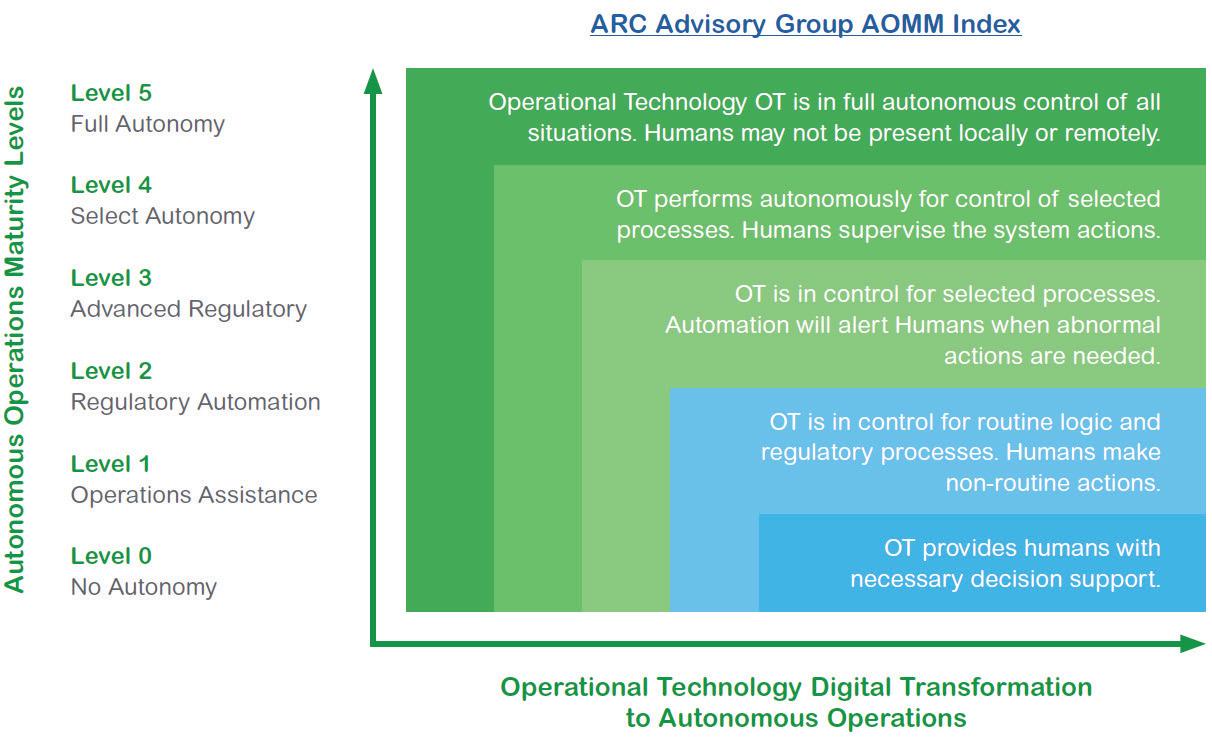
Schneider Electric adds the framework used for the study is the Autonomous Operations Maturity Model (AOMM) developed by ARC Advisory Group, which outlines a five-step
hierarchy for adopting autonomous technology, with Level 5 representing full autonomy. The report revealed:
J The global average of current maturity is reported at 3.52 out of 5, between “advanced regulatory” (where technology is in control of specific scenarios and humans are alerted when unexpected events occur) and “select autonomy” (with systems running autonomously in specific scenarios, such as detecting and correcting issues, though humans are still needed for repairs and resets).
J To enhance clarity and help understand these levels, “advanced regulatory” was defined as “advancing maturity,” and “select autonomy” was “high maturity.” The percentage equivalent of level 3.52 was calculated as approximately 70% autonomy.
J The global average ambition for 2030 is to reach level 4.02 (high maturity with approximately 80% autonomy), where systems can operate autonomously across defined scenarios with humans overseeing, correcting and optimizing as needed.
The International Society of Automation (www.isa.org/standards) reported Feb. 26 that it’s published “ANSI/ISA112.00.01-2025, SCADA systems—Part 1: SCADA lifecycle, diagrams and terminology.” The standard is available for sale, and is accessible to ISA members as a benefit.
ISA-112 Part 1 provides a vendorneutral, technology-independent framework for managing supervisory control and data acquisition (SCADA) systems long term, and executing SCADA modernization projects using an overview of SCADA lifecycles, as well as diagrams and terminology. It’s intended for companies, utilities, system integrators and others, whether they’re designing a new SCADA system or upgrading existing legacy systems to meet modern security
and connectivity requirements. As an ANSI-approved American National Standard, ISA-112 Part 1 includes a functional architecture model and lifecycle framework applicable to every type of SCADA project, regardless of industry, geographic location, technology, regulatory environment or operating history.
Particular areas of focus include organizing end-user SCADA standards, work processes for management and operation, and a set of standardized workflows for designing, building, operating, maintaining, expanding and auditing SCADA systems. The standard’s development committee plans to release further parts of ISA-112 addressing SCADA lifecycle review processes and SCADA architectures in the future.
To learn more about ISA-112 Part 1, register at www.isa.org for an upcoming webinar, “ISA-112 Part 1: The New Standard for Modernizing SCADA Systems.” This free webinar is scheduled for 11 a.m. EDT on April 16.
J The International Society of Automation (ISA.org) issued a call Mar. 19 for participants to join its new ISA113 standard committee, which aims to create a standard that bridges workflow styles, decouples workflow logic from where work happens, establishes action-based integration for operational technology (OT)/information technology (IT) workflows, and builds a foundation for multi-system orchestration. For more information or to participate, contact ISA at standards@isa.org
J ITT Inc. (www.itt.com) reported Mar. 2 that it’s completed its acquisition of SPX Flow Inc. (www.spxflow.com) for $4.775 billion, funded through a combination of cash and equity. SPX Flow will join ITT’s newly renamed Flow Technologies division, which produces centrifugal and twin-screw pumps, engineered valves and aftermarket services. SPX Flow manufactures engineered process technologies that enable production operations, providing solutions for mixing, blending, fluid handling, separation and thermal transfer.
J Yokogawa Corp. of America announced Mar. 9 the return of its third-annual STEMpowerment Camp (www.yokogawa.com/us/ about/careers/stempowerment-camp), an immersive, hands-on program that introduces mostly greater-Houston high school students to real-world applications of science, technology,
The European research and innovation project Enhanced Cooperation for Cybersecurity (Enforcers, www. wibu.com/research-and-development/ enforcers.html) kicked off on Feb. 1011 at Wibu-Systems AG in Karlsruhe, Germany. The project brings together a consortium of industrial manufacturers, cybersecurity providers, and applied research organizations to address one of Europe’s most pressing challenges— ensuring resilient, trustworthy software throughout the lifecycle of industrial automation systems. The group met at the kickoff to settle on Enforcers’ strategic roadmap for the next three years, and set the stage for close cross-border collaboration enabled by European Union (EU) funding.
engineering, and mathematics (STEM). The camp will be hosted at Yokogawa’s Sugar Land, Texas, office in July. Applications are being accepted through May 31.
J As part of its planned software spinoff from Hexagon AB, Octave (octave.com) unveiled Mar. 2 its new brand identity, marking its transition into an independent company. Consisting of Hexagon’s Asset Lifecycle Intelligence and Safety, Infrastructure and Geospatial divisions, as well as its Bricsys, ETQ and Projectmates businesses, Octave reports the brand will provide intelligence at scale, and solve and simplify complexity across lifecycles from design and build to operations and protecting people, property and assets.
J John Crane (www.johncrane.com), a rotating equipment supplier and part of Smiths Group plc (www.smiths.com), reported Mar. 22 that it helped enable a 99.8% reduction in water consumption at an LNG export facility in Louisiana by deploying its Type SB2 USP dual-cartridge seal, which supports high-temperature, hot well pump operations, and reduced daily water consumption from approximately 2,000 gallons to just 3-4 gallons.
J To reflect its evolution from cable manufacturer to electricalconnection systems supplier, Helukabel (www.helukabel.com) reported Feb. 24 that it’s renaming itself as Helu, which includes Germany-based Helu Group and Helu USA
The organization reports it’s designed to go beyond isolated security measures. Its primary objective is closing the loop between cybersecurity incident detection, coordinated response, certification and secure software redistribution in industrial environments. This is particularly relevant for automation and manufacturing, where software must often be updated across segmented, partially disconnected or heterogeneous operations technology (OT) networks.
Consequently, the project’s core is a cybersecurity system platform that links multiple trusted instances into a securely chained “system circle” that includes: Private security operation centers (SOC) that collect, correlate, and classify incident and vulnerability data;
Secure elements that act as trust anchors at OT edges and gateways; Automated playbooks for vulnerability mitigation, certification and secure software updates; and Cross-border, data-exchange mechanisms that allow SOCs and stakeholders to cooperate while respecting data sovereignty.
Enforcers adds its approach directly supports compliance with the Network and Information Security 2 (NIS2) directive, and anticipates requirements of the EU’s Cyber Resilience Act (CRA), while remaining adaptable to future regulatory and technological developments.
As project coordinator, Wibu-Systems is contributing its expertise in software protection, licensing and secure update mechanisms for industrial environments, while ensuring technical coherence and cross-partner integration across the project. Participating companies such as Balluff (Germany and Hungary), Schneider Electric (France), TTTECH Computertechnik (Austria) and Technology Nexus Secured Business Solutions (Sweden) are contributing real-world requirements from automation, manufacturing and industrial networking. Technology and cybersecurity
specialists including Infineon Technologies (Germany), Langlauf Security Automation (Germany), Dynamiki (Greece), AITAD (Germany) and ResilTech (Italy) are providing expertise about AI and embedded systems, secure elements and cryptography, and security operations centers (SOC) and incident responses. Applied research is coming from subcontractors such as Fraunhofer SIT, while VDMA contributes its industrial network and policy interfacing.
Yokogawa Electric Corp. (www.yokogawa.com) and iANYbotics AG (anybotics.com) reported Feb. 10 they’re jointly integrating Yokogawa’s OpreX Robot Management Core software with ANYbotics’ software and four-legged ANYmal inspection robots. The two companies add that integrating manage -
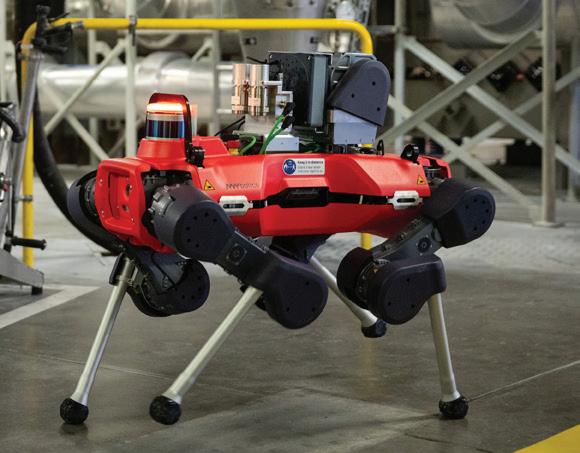
ment of explosion- and non-explosionproof robots that conduct autonomous inspections of facilities will help them develop new opportunities in the oil and gas, power and metals industries.
OpreX Robot Management Core helps users maintain facilities more safely and efficiently by combining management of various types of robots that perform plant maintenance tasks usually performed by humans. When connected to plant control systems, the data acquired can be used to issue instructions to robots, and enable first steps toward autonomous plant operations.
ANYmals are autonomous, remotely operable, and equipped with sensors that enable super-human sensing. They’re IP67-rated, and protected against water and dust ingress. Their two models include ANYmal D for mobile and autonomous inspections in indoor and outdoor settings, and ANYmal X, which is reported to be the first explosion-proof, four-legged inspection robot certified for use in ATEX and IECEx Zone 1 environments. Following several prototype deployments, ANYmal X is expected to launch later this year.
Audubon Companies LLC (auduboncompanies.com), a subsidiary of Nobel Energy, reported Mar. 11 that it’s acquired Alliance Engineering (allianceengr.com), an engineering and construction management firm in Mobile, Ala., with regional offices across the southeast U.S. The company provides mechanical, electrical, structural, piping and process engineering, as well as project and construction management services.
This acquisition is reported to strengthen Audubon’s presence beyond its traditional energy-focused work, adding established capabilities and client relationships in manufacturing, food and beverage, pulp and paper, specialty chemical and other industrial sectors. Audubon adds that Alliance’s multi-discipline engineering expertise and regional footprint complement its integrated, project-delivery model, and support its continued growth across a broader range of markets.
Under the terms of the acquisition, Alliance’s engineering team will join Audubon’s integrated service platform, operating as part of Audubon’s engineering and project delivery organization. Leadership and key staff from Alliance will continue in their roles, ensuring continuity of service and ongoing client relationships.
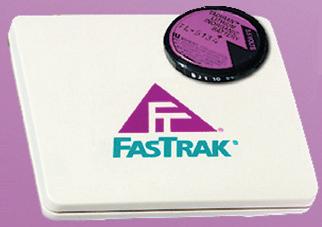
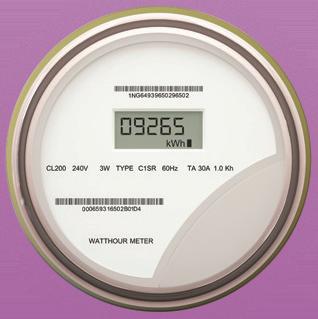

If you have a smart automatic water, gas, electricity, or heat meter in your home.
If you have an electronic toll collection transponder, tire inflation sensor, or emergency E-CALL system in your car.
If you have a GPS tracking device on your trailer, container, or cargo.
If you have wireless sensors, controls, or monitors in your factories and plants.
If you use electronics with real-time clock for memory back-up in your office.


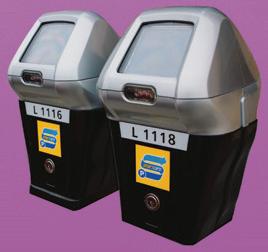
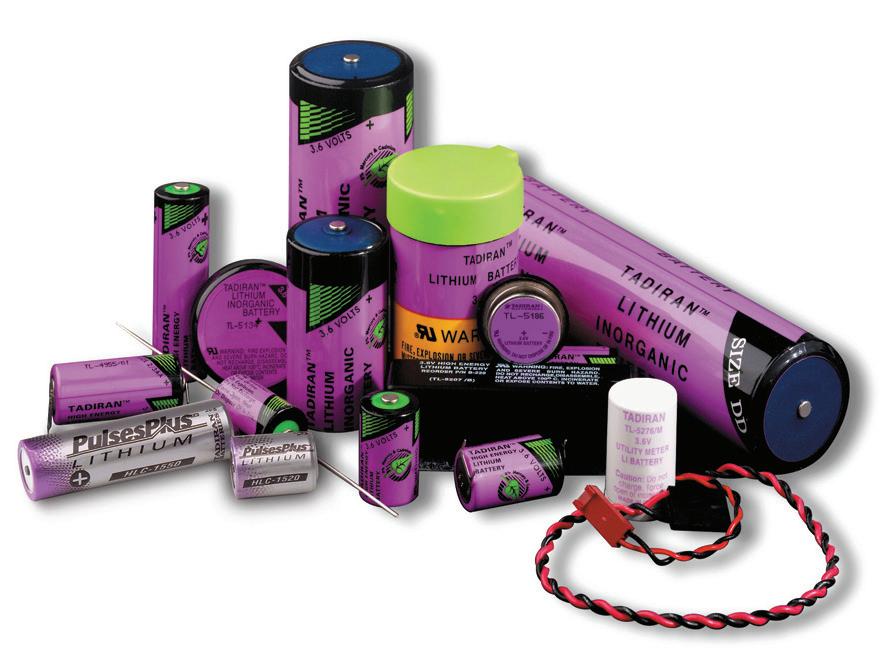
If you have never heard of Tadiran Batteries, it is only because you have never had a problem with our products powering your products.
Take no chances. Take Tadiran batteries that last a lifetime.
Three pioneering engineers honored for their lasting impact on process automation.
by Len Vermillion

PERHAPS THE SUREST sign of a true engineer is someone who recognizes their work is never quite done. That’s truly the case for this year’s three inductees into Control’s Process Automation Hall of Fame. While each has had long and notable careers—buoyed by their ingenuity, willingness to adapt and appreciation for their mentors and colleagues—they share a common goal going forward—to pass their knowledge on to the next generation of great control engineers.
Manfred Morari, Peter Morgan and S. Joe Qin come from different backgrounds, and each found their way to the pinnacle of process automation in vastly different manners. Yet, as you’ll read in their stories, they all recognize they couldn’t have arrived at this moment without the help of several peers and teachers, some of whom are Hall of Fame members, too. And, they aim to continue inspiring new engineers through their own academic work, consulting practices and writings.
Morari faced retirement but still hopped back across the Atlantic Ocean to continue teaching engineering. Morgan continues to write for several publications, and works on standards for the International Society of Automation (ISA), and Qin takes his vast corporate experience into his current role as president of a university.
All three say they cherish this latest honor because it’s bestowed by existing members of the Hall of Fame, and it carries particular weight in a field where many pioneers know one another personally.
Control sat down with the newest members, who highlight their inspirations, journeys and thoughts on the industry. You can also listen to their stories in their own words on our Control Amplified podcast available at www.controlglobal.com/podcasts, or wherever you get your podcasts. You can also view them on our YouTube channel at @ControlControlDesign.
When Manfred Morari learned of his election to the 2026 Process Automation Hall of Fame, his first reaction wasn’t triumph, but humility. The list of past inductees includes several colleagues, whose work he admires and whose advice shaped his own career.
This recognition caps a career that’s spanned continents, and helped bring one of the most influential techniques in modern automation—model predictive control (MPC)—from concept to widespread industrial reality and application.
The spark came in a classroom Morari’s path to engineering began, not in a laboratory, but in a classroom in Graz, Austria. As a student, he found inspiration in a high school teacher, who taught chemistry, physics and mathematics with unusual enthusiasm. That teacher sparked Morari’s fascination with the physical sciences, and set him on the road toward engineering.
He eventually enrolled in chemical engineering at ETH Zurich, one of Europe’s leading technical universities. However, the next major step in his career required crossing the Atlantic Ocean to reach the upper Midwest of the U.S. In the mid-1970s, communication between Europe and the U.S. was far more limited than it is today. Morari jokes that the only widely known facts about Minnesota at the time were that it was extremely cold and that its state bird was the mosquito.
His decision to attend graduate school at the University of Minnesota was largely thanks to the influence of a mentor at ETH, who had studied there himself and encouraged him to apply. That encouragement proved decisive. Minnesota’s chemical engineering program was widely regarded as one of the strongest in the world, and Morari found himself immersed in an intellectually demanding environment.
“I never worked harder in my life,” he says.
At the U of M, his Ph.D. advisor was a young assistant professor named George Stephanopoulos, only a few years older than himself. Their relationship proved formative. Rather than a traditional hierarchy, the two worked more like collaborators. From Stephanopoulos, Morari says, he learned the crucial skill of formulating meaningful research questions—an ability that would define his later work.
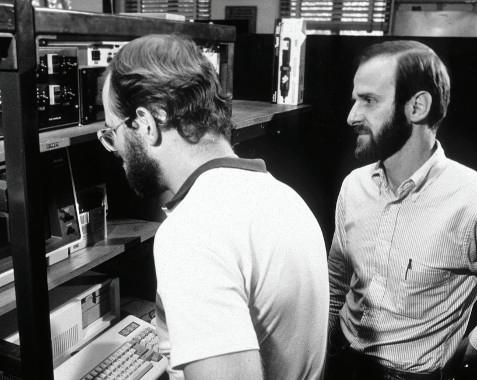
Morari’s first faculty position came at the University of Wisconsin-Madison, where he continued to benefit from strong mentorship. One colleague in particular, Harmon Ray, who’s also a Hall of Fame member, offered frank advice that helped guide the early years of Morari’s academic career.
Morari soon joined the faculty at California Institute of Technology (Caltech), an environment he describes as intellectually unparalleled. At Caltech, he played a key role in building what would become one of the world’s leading centers for control theory. Along with colleagues, including John Doyle, Morari helped establish the Control and Dynamical Systems Dept. The initiative brought together researchers from multiple disciplines to tackle complex system problems.
In the 1990s, Morari made another major life decision. He returned to Switzerland to lead the Automatic Control Laboratory at ETH Zurich. The move was motivated partly by a desire to reconnect with Europe.
At ETH, he found resources that were, in his words, “almost unlimited.” But he also noticed differences in graduate preparation contrasting with the elite programs he experienced in the U.S. To address this, he broadened recruiting efforts to include students from southern and eastern Europe, many of whom would later become prominent leaders in control engineering.
Even retirement didn’t slow Morari down. Swiss universities enforce mandatory retirement at age 65, and when that moment arrived, he wasn’t ready to stop working. Multiple institutions invited him back to North America, and he eventually joined the University of Pennsylvania, where he continues to teach and conduct research.
“At Penn, the talent and interest pool was a perfect environment for me to move into a different area,” he says.
There, he shifted focus toward a rapidly emerging field combining learning and control—Learning for Dynamics and Control (L4DC).
Although best known as an academic, Morari has maintained strong ties with industry throughout his career. He’s held positions or consulting roles with Exxon, ICI, Shell, BP and United Technologies. These experiences shaped his perspective on research. In industry, he brought theoretical expertise; in return, he gained exposure to the complex, practical problems faced by operating plants and engineering teams. That exchange between theory and practice became central to his work.
The rise of model predictive control Morari is perhaps best known for advancing MPC, a technique that’s
2026 Manfred Morari, Peter Morgan, S. Joe Qin
2001 Bela Liptak, Greg McMillan, Greg Shinskey
2002 Marion “Bud” Keyes, Terry Tolliver, Harold Wade
2003 Karl Astrom, Lynn Craig, Charles Cutter
2004 Terry Blevins, Thomas M. Stout, Ted Williams
2005 Richard Caro, William “Bill” Luyben, Russell Rhinehart
2006 Edgar H. Bristol II, Richard E. Morley, Wyman “Cy” Rutledge, Kathleen Waters
2007 James H. Christensen, Thomas F. Edgar, Angela Summers
2008 Vernon Travathan, William M. Hawkins, Dale E. Seborg
2009 Hans Baumann, Renzo Dallimanti, Pat Kennedy, Carroll Ryskamp, Cecil Smith
2010 Joseph S. Alford, John Gerry, Willy Wojsznis, Yutaka Wakasa
2011 John Berra, Sigurd Skogestad, Maurice Wilkins
2012 Mark Nixon, Tom Phinney, Vern Heath
2013 Dennis Brandl, John MacGregor, Peter G. Martin, Ian Verhappen
2014 Dave Emerson, Paul Murrill
2015 Don Bartusiak, Armando Corripio, James Downs
2016 Charlotta Johnson, James Rawlings
2017 Eric Cosman, Charles Moore
2018 Thomas McAvoy, Herman Storey
2019 Micholas Sands, Carlos Smith
2020 Penny Chen, Martin Zielinski, Duncan Mellanchamp, Ian Nimmo
2021 Tom Burke, Bridget Fitzpatrick, Babatunde Ogunnaike, John Rezabek
2022 Tom Bagwell, Lorenze Biegler, Andy Chatha, Brian Ramaker, Thomas Martin
2023 Carlos Enrique Garcia, Tariq Samad, W. Harmon Ray
2024 Mark Darby, Marcos Peluso, Joe Weiss
2025 John Hedengren, Duncan Schleiss, Sandy Vasser
become foundational in modern process automation.
The concept behind MPC is straightforward. Engineers use a mathematical model of a system to predict how it will behave over a future time period.
The roots of MPC date back decades. One early influence was the work of Hall of Fame member Charlie Cutler at Shell, who proposed the idea in a doctoral research proposal in 1969. However, for years, the concept remained largely theoretical because computers lacked the power to perform the necessary calculations in real time.
As computing capabilities improved, the technique matured through collaboration between industrial engineers and academic researchers. Morari and his colleagues helped develop the rigorous mathematical frameworks that transformed MPC from a promising idea into a practical methodology.
“The big advantage of MPC is you can easily deal with complications like multivariable systems, constraints and nonlinearities,” Morari explains.
Today, MPC is used far beyond chemical processing. It appears in applications ranging from robotics to aerospace control. Algorithms resembling MPC even showed up in research on spacecraft reentry decades before the technique became mainstream.
Education, AI and the next generation
Morari believes the future of process control will depend heavily on education. “We have to make sure we continue to attract the brightest minds,” he argues. “At ETH, we’ve witnessed an explosion of interest in courses and research, particularly as interest in automation and control grows worldwide.”
Artificial intelligence (AI) is already transforming engineering education, though Morari believes the field hasn’t yet figured out how to use it effectively. The intersection between AI and control theory—particularly integrating learning
with model-based control—is likely to define the next era of research.
Looking back on his career, Morari doesn’t point first to theories or technologies. Instead, he credits the people around him.
More than 100 former students and collaborators have gone on to influential roles in academia and industry. Among them are fellow Hall of Famers Carlos Garcia, a pioneer of MPC at Shell, and Sigurd Skogestad, whose research and textbooks helped shape modern control engineering.
Some moved far beyond academia. One former colleague, Pascal Grieder, eventually became CEO of the Swiss postal system.
For Morari, those achievements represent the most meaningful legacy of his work. Ideas matter, but the people who carry them forward ultimately determine how a field evolves.
As process automation enters an era defined by artificial intelligence, digitalization and increasingly complex systems, Morari’s career offers a reminder that progress rarely happens in isolation. It grows from collaboration across universities, industries and generations of engineers.
There are engineers who fall into their careers, and there are engineers who seem destined for them. Peter Morgan, newly inducted member of the 2026 Process Automation Hall of Fame, is, by his own cheerful admission, somewhere in between.
“I suppose I was always a bit of a nerd,” he says with a laugh, recalling how, as a boy growing up in England, he set out to build a crystal radio, and found himself hunting down a germanium transistor to boost its output. That early curiosity about how things work
carried him across decades and continents, through nuclear power plants and oil sands facilities, and from analog computers that were the size of rooms to the distributed digital control systems that define the industry today.
His ‘accidental master’s’ and career beginning
Morgan’s formal journey began with a student apprenticeship at the Central Electricity Generating Board in the U.K., a cooperative program that sponsored his bachelor’s degree in electrical engineering. His first professional position was at a large thermal power plant— good experience, he acknowledges, but not quite enough.
“I was looking for more,” he says.
His search led him to the Nuclear Power Group, a British design and construction company with offices in a stately hall in Cheshire, with rhododendrons framing the paths to a building full of humming computers. There, he found himself running transient simulations on analog computers. He did control systems analysis, performance prediction and safety verification for nuclear plants in Scotland and England. It was, by any measure, a remarkable introduction to the field.
Then came what Morgan calls the “accidental master’s.” A canceled Australian nuclear project triggered a layoff, and Morgan found himself unemployed. He applied for a lectureship at Manchester University, at a research center built on the world-renowned work of

Prof. Howard H. Rosenbrock in multivariable control theory. He didn’t get the lectureship, but ended up with something better—a senior research fellowship and the opportunity to submit his work toward a master’s degree.
“I hope others can share the same kind of story about the influence of other people in shaping their careers,” he reflects. When the fellowship ended, he returned to the Nuclear Power Group for several more years—this time coding simulations in CSMP, a Fortran-like language, on an IBM mainframe.
Canada, oil sands and a ‘white knuckle’ commission
In 1980, Morgan and his wife arrived in Canada—“part adventure,” he says— intending to stay a couple of years. They never left. After a stint with Montreal Engineering, where he worked on control system design and commissioning, Morgan joined Syncrude Canada in 1984. He’s been a fixture of the Canadian process automation landscape ever since.
At Syncrude, Morgan was recruited to lead what was, at the time, a bold and technically risky undertaking to replace analog control systems across the entire utility plant following a costly plantwide shutdown. “It was a courageous thing to do,” he says of the decision to migrate to a distributed digital control system. “Not many utilities had done that.”
His responsibility encompassed regulatory controls for three gas-fired boilers, two cokers, three steam turbines, two gas turbines and a steam letdown system. It was, he says, “white knuckle some of the time.”
Morgan retired from Syncrude in 2005, and moved to Edmonton, where he hung out his shingle as an independent consultant under the banner of Control Systems Design Services. For the next 15 years, his projects ranged from pump control on the Keystone Pipeline to modernization work at the University of Alberta to burner management system replacements and digital control system upgrades. Only in
retirement did he finally get sent somewhere other than the U.S., including a project that took him to Florence, Italy.
Alongside his engineering practice, Morgan developed a parallel reputation as a writer and technical contributor. During his Syncrude years, he published articles on Markov modeling, reliability assessment, and—in a nod to the fashions of the era—fuzzy logic, including what may be the first fuzzy PID algorithm ever implemented at Syncrude. His approach to technical writing has always been deliberate.
“I always meant them to be instructive,” he says, noting that too many technical papers neglect to give readers something they can use.
In 2019, at the invitation of frequent Control contributor and fellow Hall of Famer Greg McMillan, Morgan joined the working group developing ISA- 5.9, a technical report on the PID algorithm. He was tapped to lead the chapter on PID algorithms, a project that took two years, but was published in 2023 in what is reportedly record time for that kind of standards work.
“It was a great demonstration of how professionals with sometimes different opinions and certainly different experiences could come together and produce something like that,” he says.
When asked by Control how the field has changed, Morgan points to different platforms. He says digital systems have brought enormous flexibility and the ability to configure “basically anything you can imagine.” But the fundamentals haven’t changed.
“The processes haven’t changed that much. The dynamics, the physics— it’s the same. The implementation has changed, but the thought processes are the same,” he says.
His greater concern for the field’s future isn’t technological at all. It’s human. “The greater concern is attracting
people with inquisitive minds to the field and retaining them in technical positions,” he says. Too often, he argues, technical roles are treated as stepping stones to management, rather than as destinations in their own right—and companies that fail to build technical career ladders risk losing their best engineers at an alarming rate.
Outside of work, Morgan’s pursuits reflect the same blend of precision and adventure that defined his career. He and his climbing partner made a point of tackling only peaks in the Canadian Rockies that had appeared in calendars—“so I could boast about it,” he admits. He still cross- country skis, does woodworking, travels with his wife, and spends time with grandchildren. And he is, as he made clear, still writing.
S.Joe Qin’s career reads like a master class in intellectual agility. Born near Qingdao in China’s Shandong province, he came of age during the Cultural Revolution—a period which emphasized children performing hard work over education. To wit, he admits, he I didn’t study much until junior high school.
It may seem odd now, since Qin is president of Lingnan University in Hong Kong, but with formal schooling barely functional, Qin taught himself carpentry and tailoring, constructing wooden chairs at 11 years old just to have a means of making a living.
Everything changed when Deng Xiaoping came to power and reopened China’s universities. Suddenly, rigorous entrance exams offered a pathway out—and Qin seized it. At 16, he entered Tsinghua University in Beijing with one of the highest entrance exam scores of his cohort, studying automatic control.
In China, automatic control held the status of a top-tier academic discipline in its own right, and the rigorous
curriculum at Tsinghua provided Qin with a foundation that would serve him across continents and careers.
A pivotal encounter came in 1988, when Prof. Harmon Ray (who also mentored 2026 inductee Morari above) visited Tsinghua, and advised Qin to pursue his doctorate in chemical engineering at the University of Maryland. It was advice Qin calls critical and life-changing. Working under Prof. Tom McAvoy, whom he credits as one of the most enthusiastic mentors a young researcher could hope for, Qin earned his Ph.D., and then spent three years as a principal engineer at Emerson Process Management, developing two commercial products before the academic world beckoned him back.
A career built on interdisciplinary migration
In 1995, Qin joined the University of Texas at Austin’s Dept. of Chemical
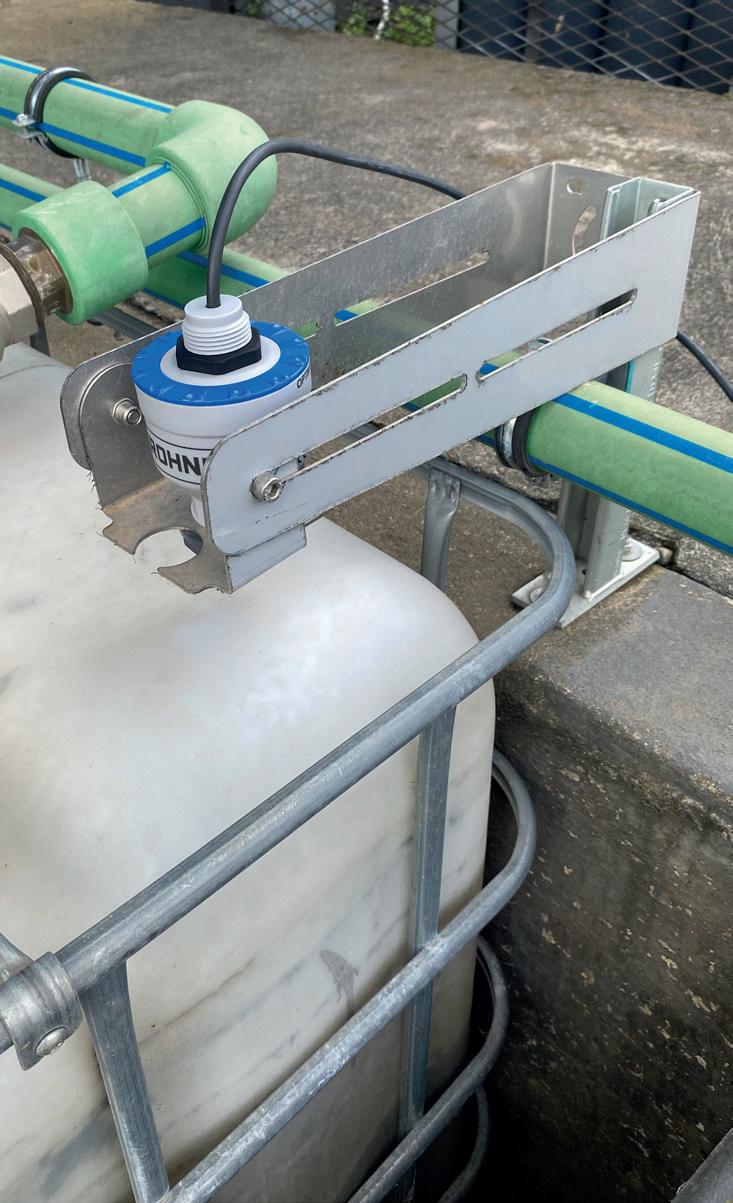
Engineering, eventually rising to full professor. During 12 years in Austin, he found himself at the center of a booming semiconductor manufacturing industry eager to apply statistical process control, multivariable monitoring and fault detection techniques. Then came a move to the University of Southern California, where Qin’s semiconductor work gave way to a new frontier—energy. As part of USC’s CiSoft center, a joint venture with Chevron, Qin turned his attention to upstream oil operations and smart field optimization.
This pattern of reinvention is not accidental. Qin credits his interdisciplinary training—straddling electrical engineering, control theory and chemical engineering—with giving him the confidence to explore unfamiliar territory. That breadth allowed him to publish widely across process monitoring, system identification, chemometrics and machine learning (ML).
Ask Qin about the future of the process industries, and the conversation quickly turns to data. After all, he’s known for his research on industrial data analytics, MPC, and fault diagnosis, among other disciplines. He’s direct about the gap that exists between what computing power can now do and what the chemical engineering sector has yet to exploit.
He points out that process engineering was, for the past 30 to 40 years, traditionally about collecting large amounts of data, but computational power only increased dramatically recently. He says many new opportunities arising from ML and AI have yet to be realized in chemical engineering.
The analogy he reaches for is e- commerce and social networking, where data has long guided major
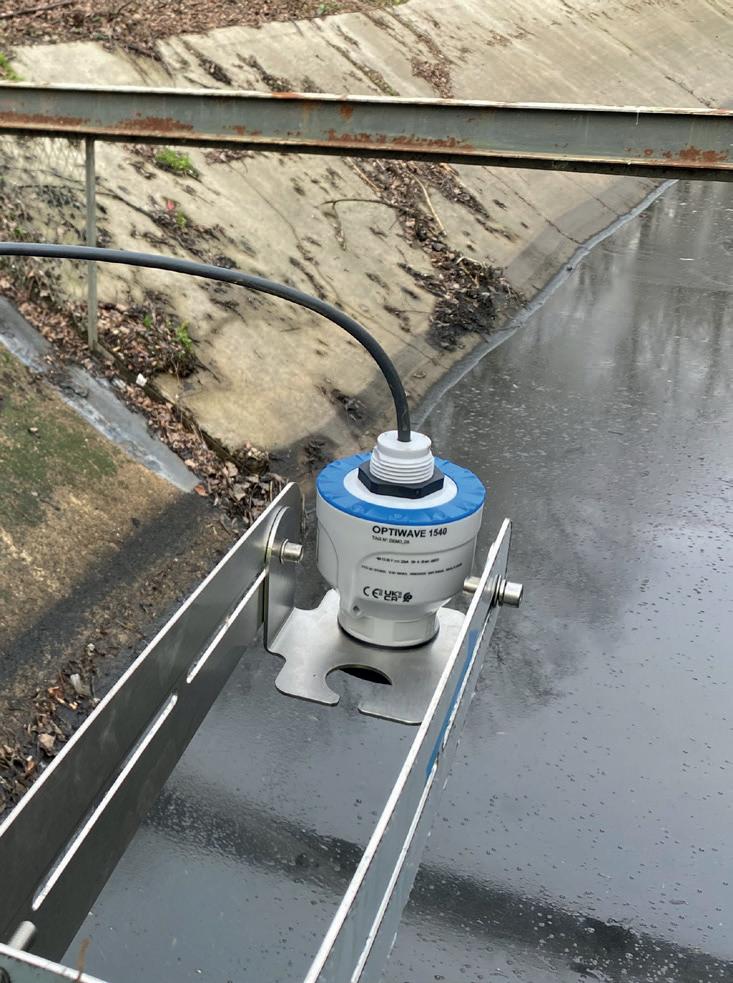
OPTIWAVE 1520 and OPTIWAVE 1540 –Compact radar (FMCW) level transmitters with IP68
• Compact 80 GHz radar with flush-mounted PVDF Lens antenna
• OPTIWAVE 1520 – for (waste)water basins, pumping stations etc.
• OPTIWAVE 1540 – for IBCs, chemical tanks, granular silos etc. and high accuracy requirements (±2 mm / ±0.08 in)
• Commissioning via Bluetooth® and OPTICHECK Level Mobile app











strategic decisions. Translating those same analytical tools to chemical processes—for performance monitoring, control and optimization—represents a compelling opportunity. Qin describes this, not as replacing traditional modeling approaches, but as complementing them. In his view, the next generation of process engineers will need to be as fluent in data analytics and ML as they are in thermodynamics and fluid mechanics.
Engineering education under strain Few topics stir Qin’s thinking more than the state of engineering education. As both a longtime professor and now an academic administrator, he sees the tension between rigor and accessibility playing out in real time. He laments reduced mathematics teaching in engineering today compared to 30 years ago, and says it’s because most people
want a program where even the average student can understand most of the concepts and graduate easily.
He reflects on a linear algebra course he took as a graduate student, one where fewer than 10% percent of students fully grasped the material as it was taught. Today, student teaching evaluations and institutional pressure to improve pass rates have made such approaches difficult to sustain. Qin doesn’t dismiss those pressures, but argues they come at a cost—the advanced mathematical talent the field needs is going underdeveloped.
He believes institutions must create deliberate environments for mathematically gifted students to be challenged at appropriate levels. Countries like China and Russia, he notes, have maintained stronger mathematical training pipelines, and the global talent pool for advanced control work reflects that difference.
An obligation to share Qin sees his Hall of Fame induction less as a capstone, and more as a prompt—to speak more openly about right and wrong paths through a career in engineering, and to make hard-won experiences more accessible to younger generations.
The mentors he names—Tom McAvoy, Harmon Ray, Tom Edgar, James Rawlings, John MacGregor, Lennart Ljung—form a lineage of scholarly generosity that Qin is clearly intent on perpetuating. His advice to young engineers is characteristically long-range: resist the pull of short-term rewards, recognize the full arc of what you’re capable of, and keep the bigger picture in sight.
For a man who once built chairs as a child just to survive, his arc from Shandong to the Process Automation Hall of Fame carries its own quiet eloquence and example




INDUSTRIAL data is the foundation of modern automation strategies, with smart field devices delivering real-time insight into process performance, asset health and operational efficiency. Control recently spoke with Chris Willoughby, Team Lead for Product Management at VEGA Americas, about the benefits of Field Device Integration (FDI) technology.
As manufacturers advance digitalization efforts, many are reducing data silos and enabling broader access to device information across both OT and IT environments. The goal is to support a shift from reactive operations to more predictive, data- driven operations, while improving uptime and performance.
At the same time, most facilities continue to operate a diverse, multi-vendor installed base, often managed through protocol-specific tools. This fragmented approach adds complexity and limits scalability. As a result, end users are increasingly looking for a simplified standard integration approach that can unify device access, streamline lifecycle management, and better leverage existing investments.
FieldComm Group is advancing this effort through FDI technology, which provides a protocol-agnostic framework for device configuration, diagnostics and data access. Following its 2024 combination with FDT Group, the organization is aligning industry standards around a common approach to device integration through an updated FDI specification.
FDI is positioned to support both current installed systems (DTM) and next- generation architectures (FDI) by enabling consistent device access from the field level through enterprise applications. In this Q&A, Willoughby discusses how this standardized device integration platform aligns with VEGA’s perspective on advancing from FDT/DTM to a single FDI solution for intelligent device management, and what this means for end users managing increasingly complex automation environments.
Q: What can smart sensor users improve today by implementing intelligent device management with FDI?
A: FDI gives users a standardized environment to manage the full device lifecycle— configuration, commissioning, diagnostics and parameterization—without switching between vendor-specific tools.
In practice, this means cleaner integration into host systems like DCSs, PLCs or asset management, and more consistent access to device data. Customers see immediate gains in efficiency, along with a stronger foundation for predictive analytics and condition-based maintenance.
Q: What are your customers hoping to achieve with FDI?
A: Customers are looking for a simple, single integration layer that works across their installed base, regardless of protocol or manufacturer. That consistency is critical for scaling operations.
They want faster commissioning, reliable diagnostics, and structured access to device data. On top of that, there’s growing demand for enterprise integration, advanced analytics and support for digital twin strategies. FDI helps standardize how that data is accessed and used.
Q: How does FDI help solve primary pain points of managing devices from multiple vendors?
A: The biggest challenge is the lack of consistency—different tools, data models and interfaces depending on the vendor. FDI addresses it with a common framework for accessing parameters, diagnostics and lifecycle functions.
It removes the need for multiple software environments, and simplifies integration into
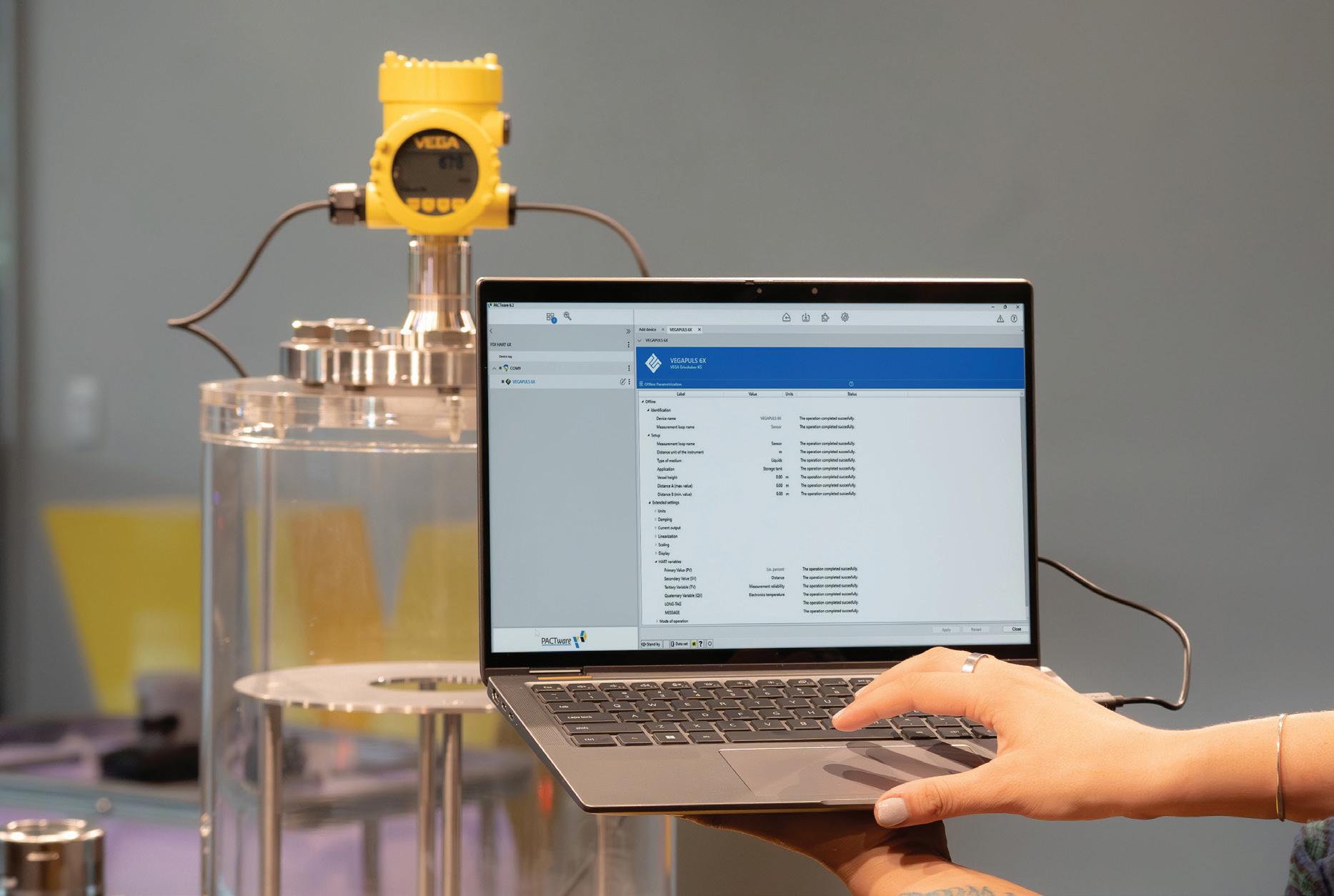
FDI simplifies configuration, monitoring and lifecycle management of intelligent devices, while enabling advanced analytics and predictive maintenance.
host systems, which reduces engineering effort and makes ongoing device management much more efficient.
Q: How are VEGA customers integrating intelligent devices today?
A: Customers today are facing the challenge of doing more with less. They’re investing in intelligent devices to get more actionable diagnostics and better visibility into process conditions. That’s especially important as experienced personnel retire and teams become more digitally focused. We’re seeing more systems designed around capturing highquality device data, and feeding it into control systems and analytics platforms. The goal is to reduce unplanned downtime and enable more data- driven decision-making.
Q: How does FDI simplify integration across different communication protocols?
A: FDI provides a consistent integration layer across both legacy and Ethernet-based protocols—HART, Foundation Fieldbus, Profibus, as well as Profinet, HART-IP, EtherNet/IP, and OPC UA.
It simplifies the protocol complexity, including communication through gateways, so integration into host systems is more
straightforward. Users get a unified interface for device setup and management without needing to account for protocolspecific differences.
Q: What integration challenges does FDI help solve?
A: FDI standardizes how device data is structured and exposed, which is key for integrating OT assets with IT systems. That consistency makes it easier to connect devices to asset management platforms, IIoT applications and enterprise analytics tools. By improving interoperability, customers can more effectively use device data for predictive maintenance, process optimization, and performance monitoring across the operation.
Q: How will FDI impact device lifecycle management in the future?
A: FDI enables a more data- driven approach to lifecycle management by providing consistent, protocol-independent access to device information. That’s foundational for moving from reactive to condition-based maintenance strategies.
As adoption grows, we’ll see broader use of predictive models to anticipate failures and optimize maintenance planning—ultimately improving uptime, reliability and overall asset performance.
Many familiar digitalization tools can help users prepare for artificial intelligence (AI) and go- getter agentic AI
BY JIM MONTAGUE
ONE OF THE best supervillain perks is an endless supply of labor-saving henchmen. So, while it’s wonderful that artificial intelligence (AI) can streamline data gathering, organization and analysis, why stop there? Maybe it can do a few more preselected chores while it’s out there, and perform some preprogrammed responses to conditions it encounters?
That’s what agentic AI is. It’s your minion that does things for you, and it’s getting more capable with increasingly complex goals, plans, tools and actions.
This shouldn’t be a shock for process control engineers, who’s whole gig is predicated on using automation to save time, money and labor. It’s just that software is now automating itself, and gaining increasing autonomy. However, while consumer and business users charge
ahead with trying AI and agentic AI, process-industry users hang back as usual due to safety concerns, and experiment with them in similarly non-critical settings with help from familiar simulation, Internet search, virtualization, analytics and other forms of software-based digitalization.
So users and AI can take advantage, HighByte (www.highbyte.com) approaches digitalization, virtualization and AI by focusing on IT/OT convergence, how data is used in processes and plants, and contextualizing it, according to Aron Semle, CTO at HighByte.
“If a facility has automatic guided vehicles (AGV) running all around, its users need an app to detect when they’re stuck or stalled, so they can free or fix
them quickly,” says Semle. “This means identifying relevant data, shipping it back to the plant, and moving it up and down to users as needed.”
Semle states that developers and users are realizing that AI can accelerate these efforts, and consume and integrate data from outside the OT sphere.
“Over the next five years, the place where AI can really add value is addressing workforce issues,” explains Semle.
“It will enabe operations personnel to ask questions about unusual machine conditions, and receive answers and confirmations based on previously archived information, as well as other tribal knowledge. This makes AI perfect for ‘if you see this, then do this’ situations.”
For example, Vivix Vidros Planos (vivix.com.br) produces about 900 tons of float glass per day at its 90,000-square-meter facility in Goiana, Pernambuco, Brazil, and has a unique position as the only Brazilian glass manufacturer with its own solar plant that supplies power for production, as well as its own raw material processing plant.
In conjunction with its “mine-to-line” policy for ensuring consistent, highquality production, Vivix established its
Industrial Transformation department to cut costs, increase team productivity, and improve resilience to global changes by becoming more data-driven. The department’s committee documented initial use cases, including digitalizing engineering checklists, real-time temperature regulation and asset maintenance, and began evaluating people, processes and technology required to achieve their three main digital transformation goals:
J Merge, normalize, standardize and contextualize operations data to better predict, schedule and complete asset maintenance;
J Overcome challenges related to scalability, data integration and data product development within the company’s Mendix application-development platform; and
J Balance cost efficiency and performance, while restructuring Vivix’s data architecture for future growth.
To scale its projects, the glassmaker’s committee focused on building a solid foundation for its data architecture and process information. Vivix enlisted Amazon Web Services (AWS) and HighByte
in 2022 to build its data foundation using an industrial data fabric design. Their approach included:
J Deploy HighByte’s Intelligence Hub software in the corporate data center to curate, orchestrate and model data from OPC-networked servers, SQL servers and other industrial sources at the edge before publishing payloads into the AWS ecosystem.
J Build a scalable, industrial data fabric using Intelligence Hub as the dataops layer and Amazon S3 as the centralized cloud data store.
J Host Intelligence Hub in AWS’ cloud to streamline integrations and transformations between various cloudbased services, including Amazon Bedrock, Snowflake and businessintelligence applications like Mendix (Figure 1).
J Use Amazon Bedrock and Mendix to build generative AI (genAI) agents for maintenance teams.
“Intelligence Hub provides an agile solution for industrial data integration. It’s fundamentally changed how we architect and use data in our plant,” says Aristóteles Terceiro Neto, industrial transformation manager at Vivix. “We
built a digital infrastructure with Intelligence Hub that lets us improve operational efficiency, and make data-driven decisions for consistent production of high-quality glass. The low-code approach is key.”
Neto and Vivix report the primary benefits of implementing its new data foundation with help from HighByte and AWS include:
J Less unscheduled downtime;
J Increased asset lifespans and reduced maintenance costs;
J Reduced operating expenses;
J Improved collaboration between people, departments and systems;
J Faster time-to-experience for new data products and apps;
J Reduced development and maintenance costs; and
J The ability to address larger organizational goals without sacrificing the material quality or production efficiency.
In the future, Vivix plans to accelerate adoption of machine learning (ML) and gen AI to rapidly develop AI products with Mendix and Snowflake. It also expects to employ a loop of “autonomous agents” that allows its model to
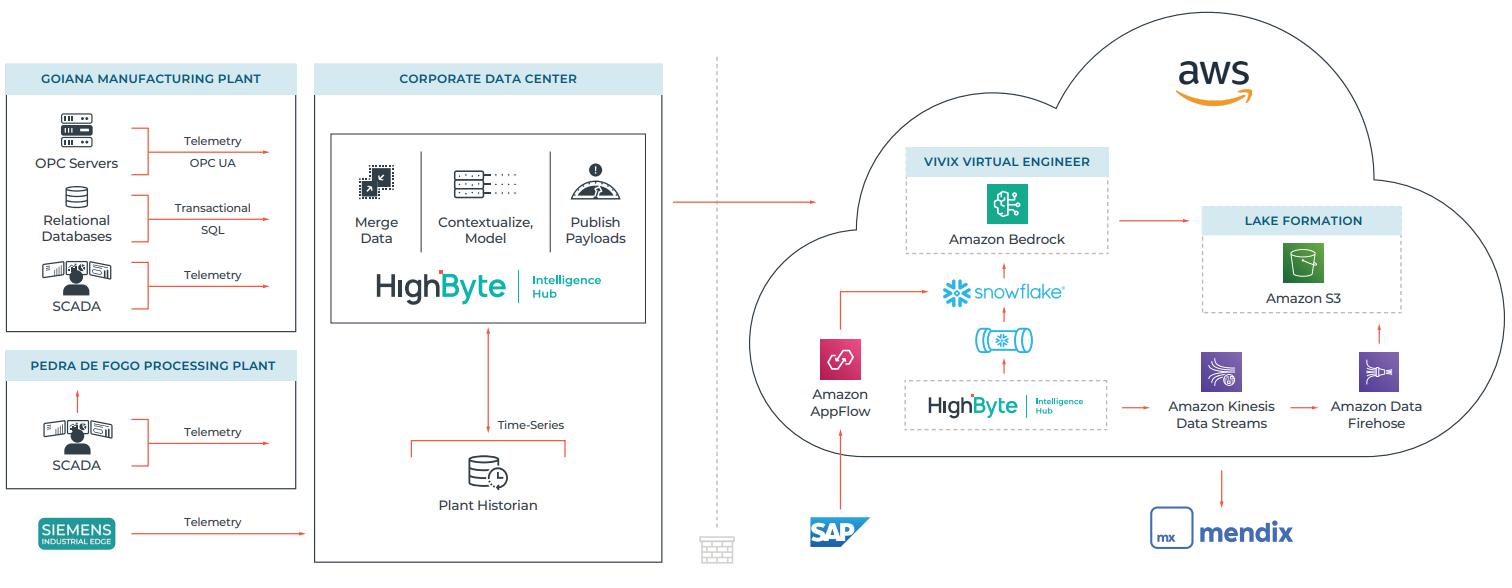
Figure 1: To maintain consistent, high- quality, float-glass production, Vivix Vidros Planos deployed HighByte’s Intelligence Hub software to curate, orchestrate and model data from OPC-networked servers, SQL servers and other sources before publishing to Amazon Web Services (AWS). It also built a scalable, industrial data fabric using Intelligence Hub as the data- ops layer and Amazon S3 as the centralized cloud data store, and hosted Intelligence Hub in AWS’ cloud to integrate cloud-based services, including Amazon Bedrock, Snowflake and business applications like Mendix.
Even though AI, gen AI and agentic AI are evolving quickly, and seemingly gaining skills daily, there are some essential tools for developing and implementing them. Here are some of the best known and reportedly most widely applied so far:
Claude Code (code.claude.com) is an AI-based, agentic, command-line interface (CLI) tool from Anthropic that runs in local software terminals, and uses natural language to interact, understand, construct and debug codebases. It functions as an autonomous, interactive assistant that can navigate repositories, adjust files, perform tests, and manage Git operations, which are programming instructions and actions used by Git distributed version control systems.
Industrial information interoperability eXchange (i3x) (connect.cesmii.org/i3x) is a standard, manufacturing-information API that provides a common interface for accessing, contextualizing and sharing production data. Developed by the Clean Energy Smart Manufacturing Innovation Institute (CESMII), it seek to pierce data silos, and encourage portable applications that can operate across platforms and settings.
Large language models (LLM) access huge volumes of text, which are used for training by machine learning (ML) that’s self-supervised. They typically generate natural language and perform other language-processing tasks. Generative, pretrained transformers (GPT) are the biggest, most capable LLMs. They can be tailored for particular jobs or guided by prompts. They gain predictive capabilities by using human syntax, semantics and ontologies, but also acquire preexisting mistakes and prejudices in their training data. The best-known LLMs include ChatGPT, Gemini LLM, Claude and Llama.
Model context protocol (MCP, modelcontextprotocol.io) is an open-source standard, also developed by Anthropic, which lets AI-based applications and models like ChatGPT and Claude link securely to outside information sources like local files and databases, software programs, and tools like search engines and calculators. It serves as a common bridge, like a USB port for AI, which lets LLMs access files, databases and application program interfaces (API) without specialized integrations for each device.
MCP servers are programs that introduce functions to AI applications via standardized protocol interfaces, and deliver functions via three building blocks: tools, resources and prompts. They use several server types, including file system for document access, database for data queries, GitHub for code management, Slack for team communication, and calendar for scheduling.
Retrieval- augmented generation (RAG) lets LLMs bring back and integrate new information from outside sources. The means LLMs don’t have to answer queries until they reference a particular collection of texts, which are added to data from their existing training information. This permits LLMs to employ domain-specific and/ or up-to- date content that isn’t available in the training data.
Software agents are behavior-based programs that can act on behalf of a human user or another software program. They’re reportedly able to start themselves in response to contextual conditions, activate other functions such as initiating communications, and don’t need to interact with users to perform tasks.
Unified namespace (UNS) allows users to collect data, incorporate meaning and context, and convert it into a format that other users and systems can understand. UNS accomplishes this by separating content computing from task computing, and setting up a central repository for context and information. In this location, other users can consume or disseminate information needed to perform tasks. UNS usually partners with Message Queuing Telemetry Transport (MQTT) publish-subscribe protocol and Sparkplug B framework on top, and together they provide a platform for digitalized, scalable processes.
decide in real time which data sources to consult, which tools to use to process the information, and how to perform the tasks in an orchestrated manner. Finally, the company also wants to build “Vivix Virtual Engineer” to reduce customer response times from days or weeks to minutes when quality incidents are reported, and cut the time spent searching for and interpreting information by 90%.
As terrific as AI is expected to be, it’s not a solution in and of itself. Instead, it’s a feature that can assist other solutions, according to Karthik Gopalakrishnan, solutions architect for digital transformation at Yokogawa (www.yogagowan.com).
“The power AI is taking off because it lets users do things they couldn’t do before, including predicting potential failures, and even making control processes more predictable and stable,” says Gopalakrishnan. “This is useful because closed-loop, PID controls and advanced process control (APC) have limits in response speeds and numbers of variables. However, users can now add gen AI to open systems, and produce results and recommendations in response to operating parameters, though not yet for closed-loop control.”
Gopalakrishnan confirms that gen AI is often accused of being a glorified search engine. However, he adds that Yokogawa’s end users appreciate it because it helps them more thoroughly sort through all their data that they wouldn’t be able to use otherwise, and routinely develop more accurate and actionable results.
For instance, Aramco’s (www.aramco.com) Fadhili gas plant in Saudi Arabia recently implemented Yokogawa’s autonomous-control AI agents to increase efficiency. This solution uses coordinated AI agents based on Factorial Kernel Dynamic Policy Programming (FKDPP) to directly and autonomously control and optimize acid gas removal
(AGR). FKDPP is a reinforcement-learning, AI algorithm jointly developed by Yokogawa and the Nara Institute of Science and Technology (NAIST).
The AI agents were introduced in three phases at Fadhili, progressively optimizing various sections until autonomous control of core process in the AGR unit was achieved. To ensure safety, Yokogawa first simulated the plant to train the agents, and then evaluated their reliability and validity. Subsequently, they were integrated with Yokogawa’s Centum VP integrated production control system to use the safety functions of the existing plant (Figure 2).
Yokogawa and Aramco add their project is undergoing a detailed evaluation, but initial results from Fadhili found 1015% less amine and steam use, around 5% less power use, improved process stability, and decreased manual intervention by operators, despite ambient condition changes.
Gopalakrishnan adds that Yokogawa worked with another user on adding gen AI functions, and found the next level is using AI to handle different process hypotheses, such as dealing with shutdown situations. “Gen AI summarizes data like a human, and delivers presentable results right away, instead of the two days it usually takes to get one paragraph,” he says. “Users typically receive research, trends and manual standard operating procedures (SOP), but we say gen AI can provide them, too, and add them to Yokogawa’s Asset Health Insight platform via a gen AI analytics extension.”
To implement gen AI and achieve similar gains, Gopalakrishnan reports that users must start by checking their data, and not just their process control information, but other structured and unstructured data sources. Structured sources usually include numbers, tables and columns, organized in Excel or other spreadsheets. Structured sources typically include photographs, videos

2: Aramco’s Fadhili gas plant in Saudi Arabia implemented Yokogawa’s autonomouscontrol AI agents based on Factorial Kernel Dynamic Policy Programming (FKDPP) reinforcement-learning, AI algorithm to directly and autonomously control and optimize acid gas removal (AGR) operations, and initially experienced 10-15% less amine and steam use, around 5% less power use, improved process stability, and decreased manual intervention.
and other images of gauges and other instruments, which users previously visited in-person to scan or write down values manually.
“Besides accelerating research and tasks, AI can also break down organizational silos by putting data into more suitable contexts, which makes it easier to apply analytics and other software tools,” adds Gopalakrishnan. “What makes gen AI work is good data, access to it, and governance policies and orchestration. Governance enables data to accurately reflect what’s happening in reality. Orchestration is about how users come to perform analytics, and asks how they’re cleansing their data, and are they saving it the right way?”
For example, Yokogawa and Craft Bank Co. (craftbk.net) in Kyoto Prefecture, Japan, and Yokogawa recently proof tested a manual temperaturesetting schedule created by FKDPP algorithm. It was applied to the fermentation process for the brewer’s Bank IPA 1 craft beer.
Previously, fermentation temperature was kept constant, and the brewmaster
manually measured sugar content daily, performed sensory evaluations of aroma and taste, and checked for offflavors. So, Craft and Yokogawa’s proof of concept (PoC) focused on temperature’s effect on fermentation speed. They confirmed the AI algorithm’s temperature-setting schedule was valid and effective.
To implement the PoC, a simulation was developed that replicated Craft’s beer production process. Using data from the brewmaster, including stress conditions on the yeast, the AI algorithm developed the temperaturesetting schedule for the fermentation tank within the simulation. The brewmaster reviewed the plan’s appropriateness, and followed it to manually set temperatures. Using sensory evaluation during fermentation, it was confirmed that all quality criteria were met.
By manually implementing this temperature-setting schedule developed by FKDPP, Craft reports it shortened its fermentation time by 28% from 336 hours to 240 hours.

R. RUSSELL RHINEHART
russ@r3eda.com
“Currently, solar thermal plants have low levels of automation, largely because complex control systems that would demonstrate improved efficiency haven’t been developed.”
Part three of this three-part series on justifying improved control via economics
THE PLATAFORMA SOLAR de Almeria, Spain, is a full-scale CIEMAT research center for exploring several approaches to generate electricity from thermal collection of solar energy. CIEMAT (Centro de Investigaciones Energéticas, Medioambientales y Tecnológicas) is a Spanish public research organization focused on energy, environment and technology.
An aerial view of the TCP-100 facility (Figure 1) shows its parabolic trough collection (PTC) approach. Mirrors in the parabolic trough refocus sunlight on a pipe that runs along the mirrors’ focal points. Oil is heated as it runs through the pipe, and the hot oil is used to generate superheated steam to run a turbogenerator.
There are three lines that loop north and then south in the TCP-100 facility. Each line has a total collection length of about 96 meters. The mirrors change orientation during the day as they track the sun. Direct normal irradiance (DNI) is the intensity of solar energy falling on the aimed mirrors, and nominally
increases from about 400 to 1,000 W/m2 and back to 400 W/m2 during the course of the day, though this value is also affected by local atmospheric events (mainly clouds). There are some ambient losses in each line, which depend on random changes in wind and ambient temperatures. For many reasons (fouling, dirt, mirror damage, sun angles, mirror aim), the optical efficiency of each line is unique and changes over time. Similarly, fluid friction loss factors change independently in each line due to changes in fouling and other inline effects. Variable speed pumps feed return oil to the header for the solar collection lines. Valves in the lines adjust flow rates to make the exit temperature match a target, and pump speed is also adjusted to minimize parasitic power losses. Currently, solar thermal plants have low levels of automation, largely because complex control systems that would demonstrate improved efficiency haven’t been developed. The results shown here are from a CIEMAT study of TCP-100’s solar-collection facility.
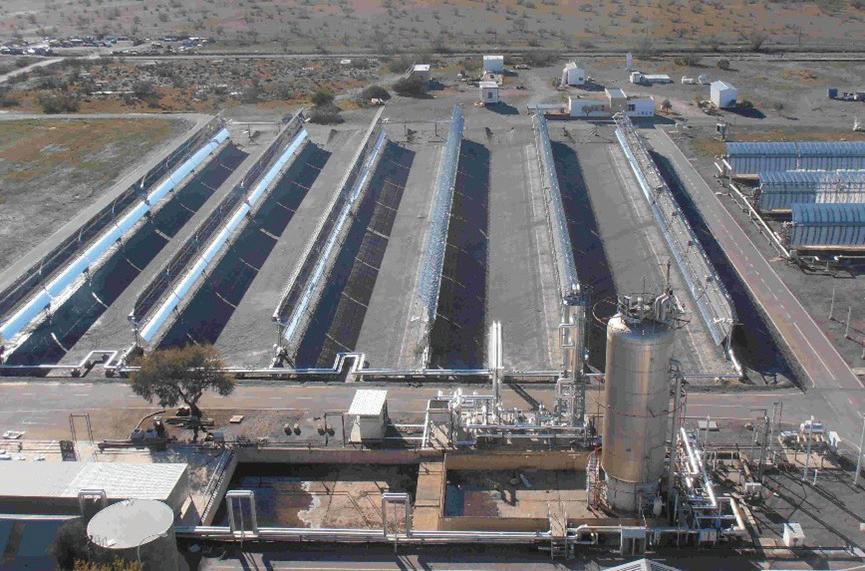
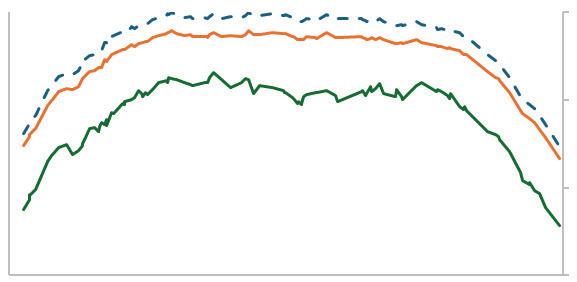
One challenge is temperature control in the thermal collection line due to long and variable transport delays (2 to 5 minutes), nonlinearities, and continual uncontrolled input disturbances. Another is minimizing pump power consumption (parasitic losses).
Figure 2 shows how DNI changes during a nominal day (with the solar peak at noon). Perturbations in the DNI trace (dashed line) are due to random walk perturbations driven by Gaussian noise. (See references 2 or 3 below for the applicable models.) The drifting influences were calibrated to mimic actual field measurements. Since we don’t know the absolute truth about what’s occurring in nature, we measure process variables. However, measurements have calibration errors, so the information that the controller has isn’t the true DNI. Instead, it’s the somewhat erroneous measured value, which is the middle trace in Figure 2. Ambient heat losses, inlet oil temperature and pipe friction factors, each have individual characteristic drifts and measurement errors.
The main control objective is to keep the exit oil temperature at a setpoint. As DNI changes during the day, so must the oil flow rate, which is the lower trace in Figure 2. The perturbations on it are larger than what the DNI alone would suggest because of simulated variations in ambient losses and inlet temperature.
The initial control strategy investigated by the authors was simple proportional-integral (PI) feedback on the exit oil temperature measurement and feed-forward correction based on the measured inlet oil temperature. It worked acceptably for the conditions it was tuned for (without significant variations in the DNI, inlet T or ambient losses). But, as the day progresses, the flow rate creates about a 2:1 change in the delay, and the process gain also has about a 2:1 ratio. Gain scheduling seemed to be a possible solution, but the number of scheduling factors for each of the six PI and FF tuning coefficients seemed to violate the keep it simple, stupid (KISS) principle.
The authors next investigated using a nonlinear feedback controller on the exit oil temperature (T) cascading a flow rate setpoint to a nonlinear flow controller. The T controller used generic model control (GMC) with a steady-state
model. This is equivalent to classic advanced regulatory output characterization3. The model in GMC includes feedforward compensation for the inlet T. The primary GMC temperature controller sent a setpoint value to the secondary model-based flow controller (MBC), which uses a simple, dynamic model for the flow rate response to the signal sent to the valve. This strategy is relatively simple, with only two tuning coefficients for GMC and one for MBC. It kept the exit temperature within ±1 °C of the setpoint during the simulated day.
Midline temperature would provide an early indication of the impact of disturbances (inlet T, DNI and ambient losses) on the exit T. This suggests another level of cascade control. In this strategy, the exit T controller sends a setpoint to the mid-line T controller, which sends a setpoint to the flow controller that operates the valve. Since midline T is nearly a linear indication of exit line T, we used a PI controller for the exit T, cascading to the GMC controller for the midline T, cascading to the model-based flow controller. In total, there are five tuning coefficients, and over the simulated day, control kept the exit T within ±0.3 C of the setpoint. This is an advantage because precise T control permits operating close to constraints for oil degradation and boiler performance. However, in this case, the improvement in net power that could be generated by operating 0.7 °C closer to a constraint is within the noise on power due to the process input variations.
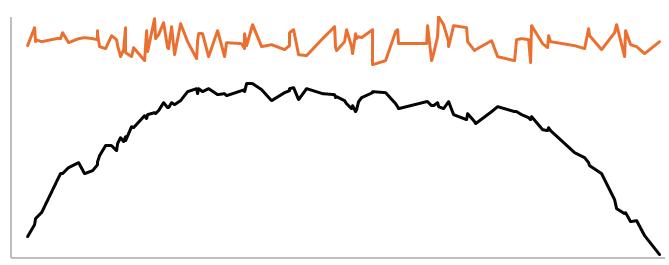
Finally, we the authors explored a supervisory adjustment of pump speed, with a simple logic to adjust speed to keep valves at about 95% open to minimize parasitic energy loss. If the pump remains at full speed during the day, then the valve must throttle flow rate to control temperature. This requires greater pump power than is necessary. By reducing pump speed if the valve is less than 92% open, and increasing pump speed if the valve is more than 98% open, the valve is kept at about 95% open. This provides some immediate control flexibility, while minimizing parasitic losses. Figure 3 shows how the signal to the valve and pump speed (as a fraction of maximum) change during the simulated day. Compared to operating the pump at 100% speed during the day, this action reduces parasitic losses by about 25%, which is significant.
“Develop
your potential in all aspects of the profession to add value as a control engineer. Use simulation to explore and quantify the economic benefits of improved control.”
This example reveals that simulation can be used to investigate alternate control strategies, quantify the reduction in controlled variable variation, and quantify the resulting economic benefit (in this example, operating power consumption).
The domain of control engineering is more than control algorithms. It includes the instrument system, process optimization, dynamic and steady-state simulation, calibration, design, equipment selection, coding, device communication and standards for each.
Develop your potential in all aspects of the profession to add value as a control engineer. Use simulation to explore
and quantify the economic benefits of improved control.
Simulators aren’t free. They can consist of phenomenological models that range from rigorous to first-principle types. They could include empirical models for some elements of the process. They could be steady-state design models adapted to represent dynamics with simple linear dynamic add-ins. In any case, digital twins require engineering effort to create, update as processes changes, and validate against process data. Once you have a digital twin, however, it serves many other engineering endeavors, such as process troubleshooting, inferential process monitoring, design, personnel training, preservation of mechanistic process knowledge, and, of course, process control.

































I greatly appreciate input on this article from Sandeep Lal, senior process control and optimization engineer at Chevron Phillips Chemical Co. LP. I also enjoyed collaborating with Luis J. Yebra of the CIEMAT Research Centre on simulation and control projects supported in part by the Spanish Ministry of Science and the European Union. These projects include “Digital twin analysis of solar, parabolic, trough- collector plant to scale to higher powers for integration into electrical distribution network (DISOPED),” reference number PCI2022-134974-2, and “Modelling and diagnosis of parabolic trough collectors (MODIAG-PTC),” reference number TED2021-129189B- C21/ TED2021-129189B- C22.


Russ Rhinehart started his career in the process industry. After 13 years and rising to engineering supervision, he transitioned to a 31-year academic career. Now “retired,” he returns to coaching professionals through books, articles, short courses and postings on his website at www.r3eda.com.
Control ’s monthly resources guide
AI FOR CONTROLS ENGINEERS
This 3-minute video, “What is AI – for industrial automation” by Walker Reynolds, quickly defines artificial intelligence (AI), and compares it to regular programs, especially from the perspective and concerns of industrial automation. It’s at www.youtube.com/ watch?v=6ldMV20pBW4
4.0 SOLUTIONS PODCAST and IIOT UNIVERSITY
www.iiot.university
PROCESS AND OPTIMIZE
This 57-minute podcast/video, “Realtime industrial process optimization and control with AI” by Kudzai Manditereza and Aldo Ferrante, show how real-time, AI-based process optimization can deliver immediate value, while laying the groundwork for autonomous manufacturing operations. It’s at www.youtube. com/watch?v=uNsFVvrcMIw INDUSTRY40TV and SORBA AI www.sorba.ai; www.industry40.tv/
GEN AI FOR AUTOMATION
This 54-minute video, “Gen AI application for industrial automation” by Tony Kgatle and Tshepiso Morabe covers practical implementations of Gen AI in industrial automation, focusing on how technologies such as retrievalaugmented generation (RAG), reinforcement learning and model distillation are deployed to build scalable, efficient and interpretable AI solutions. It’s at www. youtube.com/watch?v=bJ3C9OWOTtY ENGINEERING INSTITUTE OF TECHNOLOGY www.eit.edu.au
AND MACHINE VISION
This 6-minute video, “How to use AI in industrial automation,” covers basic machine vision, and demonstrates how it can be aided by AI-driven visual
inspections, and supports it with a use case in about how AI can enable primary inspection. It’s at www.youtube. com/watch?v=NGPwaExODXQ
REALPARS
www.realpars.com/
This online report, “10 th annual state of smart manufacturing,” shows how companies are driving real results with AI, cybersecurity and digital transformation, overcoming resistance and training their workforces. It lets readers benchmark their strategies, explore best practices, and take advantage of investments in AI, machine learning (ML), generative AI (gen AI) and causal AI. It’s at www.rockwellautomation.com/en-us/capabilities/ digital-transformation/state-of-smartmanufacturing.html
ROCKWELL AUTOMATION www.rockwellautomation.com
This 27-minute video, “Advanced process control for manufacturing with AI agents” by Joseph Hernandez, engineering VP at Liveline Technologies, covers how it employs AI agents to automate factory processes. Its approach allows rapid deployment of real-time process controls that can handle complex situations, including nonlinear systems and non-numeric goals. It’s at www.youtube. com/watch?v=T4DKgE8OH34
LIVELINE TECHNOLOGIES and AWS EVENTS www.liveline.tech/; aws.amazon.com/events/
This 54-minute video, “Harnessing AI in industrial automation and machinery with Matlab” by Dr. Chong Shin Horng of the Advanced Remanufacturing and Technology Centre (ARTC), covers how AI is reshaping industrial automation and machinery, and shows
how to integrate AI technologies using Matlab and Simulink software. It also introduces viewers to several applications of AI, including predictive maintenance, visual inspection, and operationalizing AI-driven systems. It’s located at www.mathworks.com/videos/ introduction-to-ai-in-industrial-automation-1714506463923.html
MATHWORKS www.mathworks.com
This 14-minute video, “How AI is changing manufacturing” from Newlab Detroit, examines how AI is deployed on plant-floors, shows how large language models (LLM) write job safety analyses (JSA); details the differences between ML, deep learning and physical AI; demonstrates liquid neural networks that let robots adapt to their settings; and shows how manufacturers are applying AI tools. It’s at www.youtube. com/watch?v=eggdmbRh7c0 NEWLAB DETROIT www.newlab.com/
This 10-minute video, “AI agent, clearly explained” by Jeff Su, breaks down their three primary evolutionary steps from LLMs like ChatGPT to AI workflows, and onward to AI agents, and also presents a real-world case study. It’s at https://www.youtube.com/ watch?v=FwOTs4UxQS4&t=35s In a second, 17-minute video, “The AI agent tutorial that should have been your first,” Su shows how to build an AI agent using n8n software, including creating an automated subscription tracker that processes natural language input, and updates Google Sheets software automatically. It’s at www.youtube.com/ watch?v=GchXMRwuWxE MY AI TOOLKIT academy.jeffsu.org/ai-toolkit
Level, pressure, temperature and flow instruments are extending service ranges for hazardous settings
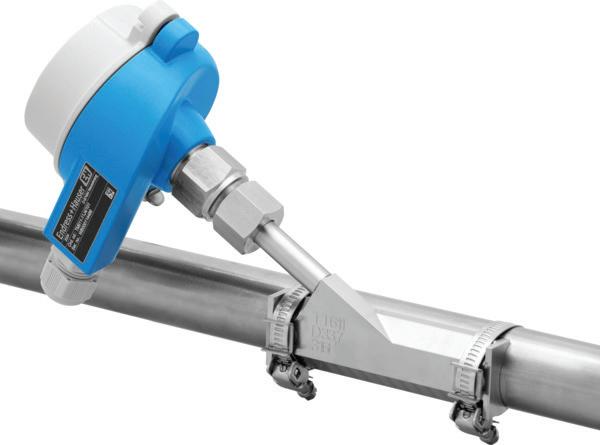
iTherm SurfaceLine TM611 non-invasive thermometer is designed for demanding process conditions, such as high flow velocities, elevated pressures, corrosive or abrasive media and small pipe diameters. Unlike conventional invasive sensors that require thermowells, flanges or pipe modifications, it mounts externally on pipe surfaces. Its advanced, thermal-coupling element ensures optimal heat transfer to the sensor, while minimizing ambient interference. This design enables measurement accuracy and response time comparable to invasive RTD and thermocouple sensors without risking leaks or process disruptions.
ENDRESS+HAUSER www.us.endress.com
Vegapoint level switches deliver reliable performance in a compact design. A defining feature is the 360° illuminated status ring with up to 256 colors that’s clearly visible from any direction, even in bright environments. These sensors conform to standards such as FDA, EC 1935/2004, GMP and GB regulations. A uniform hygienic adapter system allows flexible configuration. Vegapoint is available in two-wire, three-wire, and IO-Link versions. Wireless access via the VEGA Tools app lets users retrieve data from safe distances.
VEGA AMERICAS INC. www.vega.com/en-us/products/product-catalog/ switching/capacitive/vegapoint
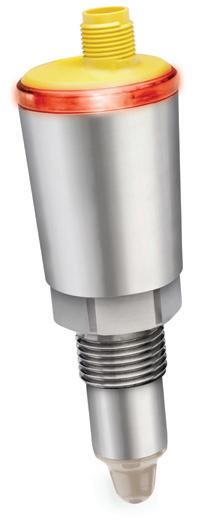
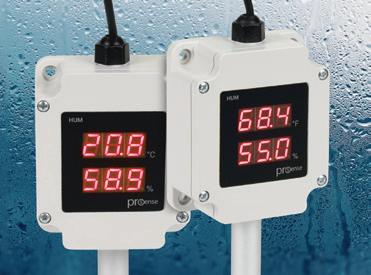
ProSense HUM humidity sensors provide reliable temperature and relative humidity (RH) measurements. They offer versatile mounting options and wide measurement ranges (-4 to 140 °F and 0 to 99.9% RH) with select models providing a seven-segment display for quick, at-a-glance monitoring. Duct-mount models include probes that mount in air ducts for HVAC and ventilation. Wall and duct models allow flexible installation, with probes that can be mounted through a duct or suspended freely from a wall. Compact, wall-mount room sensors also are easy to install.
AUTOMATIONDIRECT www.automationdirect.com
RFO flow-rate monitors from Gems combine a compact paddlewheel design with solid-state electronics, offering accurate flow rate measurement and integral visual confirmation. With materials like brass, stainless-steel or polypropylene, they handle diverse operating environments and pressures up to 500 psi. Featuring a pulsed output (4.5 to 24 VDC), RFO suits water purification, chemical metering and semiconductor processing. Their robust construction and wide compatibility ensure reliability in demanding applications like chillers, welders and heat exchangers.
GALCO www.galco.com
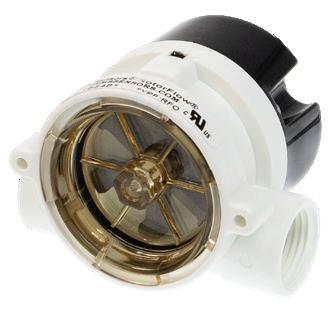
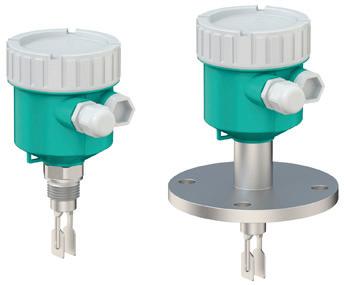
Vibracon LVL-M3 and LVL-M4 vibration limit switches can be used worldwide in potentially explosive atmospheres thanks to their ATEX and IECEx approvals. A Bluetooth interface enables intelligent remote diagnostics and convenient proof tests. LVL-M3 is suitable for universal use in all liquids that can be pumped, and withstands temperatures of -40 °C to 150 °C and process pressures up to 40 bar. LVL-M4 can be used for safety applications up to SIL 3 in accordance with IEC/EN 61508. It can also withstand process temperatures of -50 °C to 150 °C, as well as process pressures up to 100 bar.
PEPPERL+FUCHS www.pepperl-fuchs.com
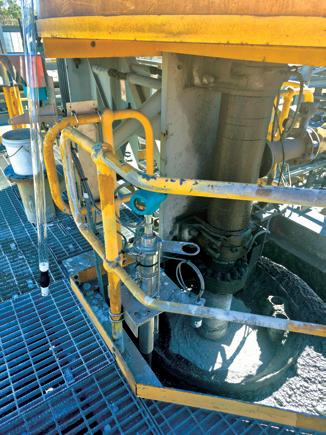
Flotation PulpMaster (FPM) controls liquid (pulp) levels in flotation cells with a compact, low-profile HDPE float that resists buildup, combined with an encapsulated sensing element that protects it. It targets millimeter-level measurements (±3 mm accuracy, 1.0 mm resolution), while responding directly to pulp levels rather than froths. FPMs is based on pulse guided-wave radar, float-level technology. It’s specified for three measurements per second, and measures the pulp interface up to 1 m below the launder.
HAWK MEASUREMENT SYSTEMS www.hawkmeasurement.com
COMPACT, NON-CONTACT
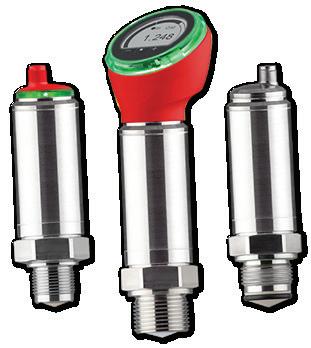
CNCR-400 compact, non-contact, radar level sensors provide inventory control in a small, stainless-steel housing. Each hygienic sensor measures bulk solids and liquids within ranges up to 49 ft (15 m). At just 6 in. long and 1.5 in., it’s ideal for small vessels. Its 80 GHz radar provides accuracy within 5 mm, despite turbulence, condensation and buildup. CNCR-400 has three models: digital display (DD) with a light ring and programmable colors, lightring indicator (LRI) only, and stainless-steel (SS) only. CNCR400 is compatible with BinCloud inventory software.
BINMASTER SENSORS AND TECHNOLOGIES LLC
www.BinMaster.com
With a narrow 4° beam angle and almost no dead zone, Optiwave 1500 radar instruments achieve accuracy in tight spaces and in vessels with internal obstructions by avoiding interference from walls or fixtures. Their 80GHz radar technology with its high dynamic range overcomes condensation, and reliably measures foamy or agitated liquids, or powders and bulk solids in dusty environments, as well as in poorly reflective media, while maximizing its measurement ranges, even in small tanks.
KROHNE INC.
978-535-6060; www.krohne.com
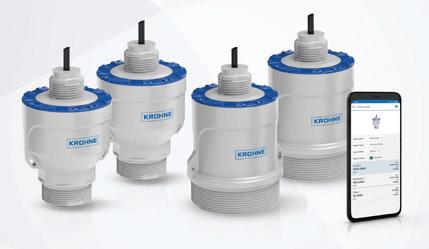
PRESSURE WITH 0.055% ACCURACY
P-300 pressure transmitters measure from 0.05 kPa (0.2 in H2O) in differential pressure applications and up to 105 MPa (15,000 psi) on high-gauge pressure applications, and achieve 0.055% accuracy levels. They’re reported to ensure high accuracy and ease of use over a broad range of applications in petrochemical, chemical, power, pulp and paper, and other industries. P-300 features a high-contrast, backlit HMI display for easy readability, as well as QR-code-enabled, digital advanced diagnostics for instant access to product documentation.
ABB
713-306-9188; https://new.abb.com/products/ measurement-products/instrumentation
MAGNETIC LEVEL WITH 200° VIEWING
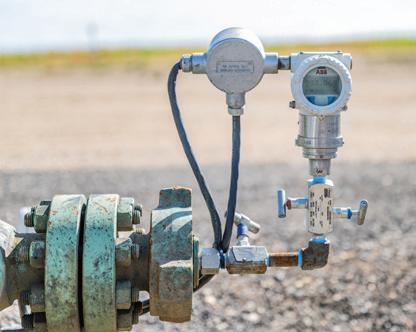
1100 Series magnetic level indicator (MLI) uses its patented vista indicator to provide the most visible level indication with a 200° viewing angle and 250 ft (76 m) visibility range. Manufactured to strict quality standards, it’s designed to meet the rigorous requirements of EU Directive 2014/68/EU (PED), ASME B31.1 and/or ASME B31.3. With specific designs available for flashing/boiling, high vibration, and extreme temperature services, such as elevated temperature or cryogenic, MLIs can be customized to withstand the most severe process conditions.
SOR MEASUREMENT AND CONTROL
913-888-2630; www.sorinc.com/products/magneticlevel-indicators/1100-series-magnetic-level-indicators
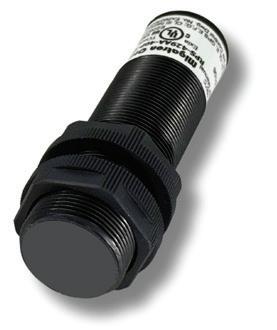
RPS-429AA-80P-IS2 intrinsically safe (IS), ultrasonic sensor achieves precise distance and level measurements and object detections in explosive atmospheres and hazardous areas. It features IS certifications, including thorough testing and approvals for Zone 0, 1, 2, 20, 21, or 22 explosive atmospheres (ATEX and IECEx) and Class I, II, III hazardous locations (C-UL-US). RPS-429AA-80P-IS2 has an IP66/IP67-rated enclosure that protects it from dust, moisture and washdown exposure. It also features a user-friendly interface with a 4-20 mA, two-wire, current-loop design.
MIGATRON CORP.
815-338-5800; www.migatron.com

LASC series provides liquid-level and on/off point-sensing control with self-calibrating, auto-sensitivity, eliminating manual adjustment. When liquid reaches the sensing probe, an algorithm determines its resistivity, and automatically sets optimum control sensitivity. Single- and multi-level designs are in DIN-rail enclosures for compact panel mounting, and powered by 12 to 240 VAC line voltages. If liquid level control and on/off temperature control is needed in one device, specify the series LASD with pushbutton programming and separate control relays.
LUMENITE lumenite.com


Gregory K. McMillan captures the wisdom of talented leaders in process control, and adds his perspective based on more than 50 years of experience, cartoons by Ted Williams, and (web-only) Top 10 lists. Find more of Greg’s conceptual and principle-based knowledge in his Control Talk blog. Greg welcomes comments and column suggestions at ControlTalk@endeavorb2b.com
Best practices for accurate process analytics, sensor selection and installation
GREG: Conductivity plays a significant role in processing applications, offering in some cases, an inferential measurement in a binary mixture. We’re fortunate to have Robert Sherman, ISA Life Fellow, offer his knowledge on how to make the most of this opportunity. He has deep proficiency gained through years of practice (continuous since January 1971) after his military service in the U.S. Army (1969-70). He’s authored and edited major texts on analytical instrumentation (ISA, 1996), sample conditioning (WileyInterscience, 2002), and instrumentation and process control (atp learning, 2019). He recently authored a self-paced, Internet-based analyzer technology course (ISA SP36, 2022).
Robert, what are the different types of conductivity measurements?
ROBERT: There are three types of conductivity sensors to make measurements:
J Magnetic field (two-pole, glass exterior shell);
J Toroidal inductive (electrodeless, PEEK-machined exterior); and
J AC voltage system (four-pole, exteriors: 316SSt, PEEK and ceramic).
GREG: What affects conductivity measurement performance?
ROBERT: Two- and four-pole systems:
J Temperature excursions;
J Greases (viscous hydrocarbons dispersed in liquid being measured); and
J Gas bubbles.
Toroidal systems:
J Immune to all of the above; but
J Sensitive to mounting orientation and distance from pipe wall.
GREG: What are some conductivity measurement applications?
ROBERT: Some examples are:
J Quality control, especially binary solutions that can detect ∆ of single PPM;
J Phase-change situations, the interface between TDS and water (eluent);
J Ion concentrations in acid or a base;
J Use of “inflection point” in tabular data arrays or graphic representations;
J Steam boiler blowdown to lower TDS levels by dilution; and
J Efficiency of reverse osmosis operation by comparing inlet/outlet conductivity measurements.
GREG: Since there’s often a peak in conductivity versus concentration curves, changes from one side to the other reverse the sign of the process gain. How do you address this issue for inferential concentration measurements?
ROBERT: I recommend the following:
J Avoid the inflection point concentration range (keep conductivity well away from peak, and always on one side of the peak in conductivity versus concentration plot);
J Utilize Memosens licensed, signal-processing (digital) system; and
J Use Memosens signal processing, which is compatible with HART and EtherNet/IP signal transmission protocols.
GREG: What guidance can you offer for measurement selection and installation?
ROBERT: Observe manufacturers’ recommendations regarding “wall effect” of metallic piping for toroidal and four-pole sensors. A common guideline is placement at least three probe shank diameters from any pipe wall. Toroidal (inductive) sensors require flow across sensor body (center-mount or wallmount mixer in tanks). They also require flow to impinge on the probe end in pipe tee installations.
For conductivity system design, installation and maintenance, Knick (www.knick-international.com/products/ measuring_systems) is an excellent firm with worldwide coverage.
GREG: What are some common problems and solutions?
ROBERT: Ultra-low level conductivity measurements can be affected by process fluid temperature variations. Depending on the manufacturer, some conductivity probes contain an RTD for feedback and correction of process fluid temperature variations. If there’s an RTD in the process fluid line, it can be connected to the conductivity probe controller through an independent feedback circuit.
Ultra-lO level ranging to HI-level conductivity in the same process may require the installation of a HI/LO sensor pair. The recommendations are:
J For measurements <500 microsiemens, a two-pole measurement probe is recommended;
J For measurements >500 millisiemens, a toroidal measurement probe is recommended; and
J The above specification constitutes a HI/LO sensor-pair application.
GREG: The following best practices are from my book, Process/Industrial Instruments and Controls Handbook, Sixth Edition (2019), McGraw-Hill, with comments from Robert.
J With contacting conductivity sensors, the choice of cell constant (determined by the distance between the electrodes installed inside the conductivity probe) is the important attribute. Knowing what’s in your process is critical to selecting the right sensor. Typical choices of conductivity sensors are PEEK toroidal or ceramic four-pole.
J If there are any solids suspended in the process, high conductivity levels or corrosive liquids, contacting sensors (two-pole or four-pole) will not
generally work, so a toroidal sensor is usually a better choice.
J Conductivity sensors can’t tell what’s causing the ions, only the total concentration of ions. However, if the sample is pure, some analyzers have built-in conductivity curves that correlate conductivity levels with the concentration of a select number of common acids or bases
J Always install contacting and toroidal conductivity sensors, so they’re fully immersed in the process, preferably in a vertical pipe run with flow from bottom to top, to minimize the presence of air bubbles.
J A change in cell constant of 3% or less isn’t a concern. If the change in cell constant after a calibration is greater than 3%, you must redo the calibration. If the reading is still in error, you should check if the sensor needs to be cleaned. Another possibility is it’s damaged, and needs to be replaced. To resolve this, you can bracket the desired measurement value with the manufacturer’s standard solutions. However, calibrate
the conductivity probe with only one manufacturer’s standard solution.
J Toroidal sensors need to be installed at least ¾ of the toroid’s (loop) diameter away from the process pipe’s wall to limit the effects of the wall on ionic current.
J Calibrate the RTD (use a stirred ice water bath) on the conductivity sensor regularly to maintain proper temperature correction.
J Use an analyzer with built-in, temperature-correction algorithms specifically for the application. Many analyzers have standard linear temperature correction, high purity water, and cation conductivity (dilute HCl) temperature correction. These are typically included in the analyzer transmitter functionality.
J Regular cleaning is good for contacting conductivity sensors, but use only a warm detergent (Dawn, manufactured by Procter & Gamble, is recommended) solution or isopropyl alcohol (rubbing alcohol), and not a strong acid, so the sensor isn’t degraded.


JIM MONTAGUE Executive Editor jmontague@endeavorb2b.com
“Use specific problems and detailed performance goals to guide your search for the few appropriate capabilities, software and other tools that prove they can solve and accomplish them. Flush everything else.”
Don’t let name changes keep you captive to confusion
I’VE CONFESSED BEFORE that I’m not a process control engineer, so I’m also not one of those guys who can put a hand on a pipe or tank, and tell what’s wrong or not from how it feels or sounds. What I’ve learned over the years is to pay attention, mostly as I try to understand what Control ’s many expert authors, contributors and other sources are describing, so I can help relay it to our readers.
I know I’ve missed some important points, but I think I’ve also gotten good at knowing when useful details are being expressed or not. In fact, after editing so much text, and correcting so many misspellings—or fashionable overuse of dashes—I can see when writers appear to lose their initial focus and even interest in their subjects. It usually occurs in the last quarter of a long story. Errors and unnecessary words increase, vague statements grow plentiful, passive-voice language based on “to be” phrases multiplies, and first references defined earlier get restated. These snags can trip up readers, and kill what’s left of their already short attention spans.
One consolation is that striving against bad writing helps identify a newer problem. Nebulous talk has been around forever, but at least there were many different and sometimes quirky ways to say little or nothing substantive. Now, much of the text I encounter seems to have an added glaze of beige foam and pink slime sameness, as if one breezy, AI- generated voice is repeatedly speaking for those who used to be talking.
Similarly, one of journalism’s traditional and somewhat sneaky directives for writing news and feature stories is, “Say it once, say it again, say it again, etc.” This low- expectation repetitiveness is right up AI’s alley.
Luckily, even the shortest attention spans get bored eventually. So, what’s a hardworking AI agent, I mean, enterprising journalist supposed to do? How can all those readers, listeners and viewers be kept captive-ated?
Change the names, in this case, to protect the guilty. And pretend all the topics, devices, activities, dogs, ponies, smoke and mirrors being covered again and again are somehow new and different each time.
Yes, you’ve seen this show before. Lowpower, point-to-point networks and fieldbuses were joined by Ethernet TCP/IP communications, which became the Internet of Things (IoT), the Industrial Internet of Things (IIoT) and a bunch more variants. More data became big data, data lakes and other names I glazed over before retaining. Data processing became edge computing, cloud computing and, sweet Jesus, fog computing with a “cloud near the field” or something.
Most recently, someone likely thought artificial intelligence (AI) sounded too oldfashioned. I mean, even The Matrix movie, which highlighted AI, came out in 1999, and AI was coined decades before that. So they put the prefix lipstick of generative AI (gen AI) and on it, and sent it out on the street again.
Sure, some of these aliases represent software and other tools with distinct capabilities meriting different names, but most don’t. This whole ball of wax is simply software running on servers or modules linked by wired or wireless networks. Much simpler than it’s usually made to appear, right?
Unfortunately, the baloney spigot will never shut off because it’s so much easier to spew sparkling promises and drivel than it is to work on something genuinely useful that doesn’t need to be trumpeted as loudly. So, like any workplace hazard that can’t be mitigated, it must be caged and warned against.
I’d recommend what many sources in Control ’s stories advise: use specific problems and detailed performance goals to guide your search for the few appropriate capabilities, software and other tools that prove they can solve and accomplish them. Flush everything else.