All Maintenance, All Vehicle Classes, All Management, All the Time
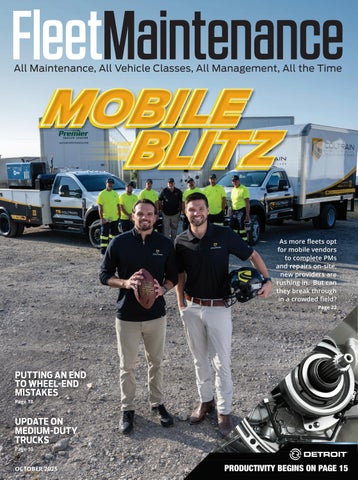
MOBILE BLITZ As more fleets opt for mobile vendors to complete PMs and repairs on-site, new providers are rushing in. But can they break through in a crowded field? Page 22
PUTTING AN END TO WHEEL-END MISTAKES Page 18
UPDATE ON MEDIUM-DUTY TRUCKS Page 10
OCTOBER 2025
PRODUCTIVITY BEGINS ON PAGE 15
Scan to learn more
PRO-LINK N + ®
Professional Power in Your Hands PRO-LINK+, built for servicing a complete range of commercial vehicles, makes Benny more than just a pitstop technician - it makes him an efficiency expert. Under the hood, PRO-LINK+ delivers: • OEM-specific coverage for engines, transmissions, chassis, and brakes • Code-specific information with detailed testing procedures, component photos and wiring diagrams Take control with over 200 special tests and 600 user-configurable parameters. Built tough for medium and heavy-duty trucks, PRO-LINK+ is your essential diagnostic companion.
CONTENTS / OCTOBER 2025
Mobile maintenance P. 22
p.
10
SPOTLIGHT ON...
p. 28
Trailers
Equipment
Skirting the issue
Medium-duty truck trends for 2026
Trailer side skirts can take a beating, but all those bumps and bruises can still lead to problems if maintenance teams aren’t keeping an eye on things.
Slower sales and economic and regulatory uncertainty have not diminished efforts by medium-duty truck makers to offer new models and options that enhance safety, efficiency and productivity.
p.
18
In The Bay
Wheel-end game: Failure is not an option
p. 32
Cleaning
Make your shop a shining example
Repairing trucks is dirty work, but with the right habits and products, that doesn’t mean your shop has to be.
Mediumduty trucks P. 10
VIEWS FROM THE EXPERTS
As one of the most failure-prone areas on a truck, the wheel-end demands far more attention than it’s getting. We offer expert advice and products to change that.
p.
34 Guest Editorial
Focus on coolant filtration; your engine will thank you By William Huff
22
ATMUS FILTRATION TECHNOLOGIES
» O N T H E CO V E R
D E PA R T M E N T S FROM THE EDITOR
Shop Operations
6 Hitched Up
Mobile blitz
We’re tackling several of the most critical mobile maintenance trends, from what it takes to compete in the crowded field to how to find the right provider for emergency roadside service.
The wheel-end butterfly effect
Wheel-ends P. 18
36 Fleet Parts & Components What’s new in products for more efficient fleet operation.
38 Tools & Equipment Cover photo: Dave Evans | Coltrain Onsite Fleet Care
Want to contribute? Contact us at editor@FleetMaintenance.com
A roundup of the latest tool and equipment offerings.
October 2025 | FleetMaintenance.com
3
ONLINE
Published by Endeavor Business Media, LLC 30 Burton Hills Blvd, Ste. 185, Nashville, TN 37215 800-547-7377 Vol. 28, No. 8 FLEET MAINTENANCE
E XC L U S I V E S
Market Leader - Commercial Vehicle Group Dyanna Hurley 248-705-3505 | dhurley@fleetmaintenance.com
Visit the official website of Fleet Maintenance for more information from stories in this issue, plus online exclusives on pertinent topics in the fleet maintenance management industry.
Editorial Director Kevin Jones kevin@fleetmaintenance.com Editor-in-Chief John Hitch john@fleetmaintenance.com Associate Editor Alex Keenan alex@fleetmaintenance.com Associate Editor Lucas Roberto lucas@fleetmaintenance.com Contributors Jim Park, Seth Skydel, Gregg Wartgow Sales Development Representative Sachin Sinha sachin@fleetmaintenance.com
S I G N U P FOR THE FLEET MAINTENANCE NEWSLE T TER Stay up-to-date on industry news and events, new product launches, and more. FleetMaintenance.com/subscribe
Uribe Refuse
NEWS
Fleet Maintenance Multimedia Account Executives THE
F L E ET L EA D The Fleet Lead podcast features EndeavorB2B’s CV journalists and aims to help fleet managers and trucking professionals navigate the industry. It covers topics like new technology, efficiency, and regulations with expert analysis and realworld insights. Apple Spotify Podcasts
Multimedia Account Executive - West Michael Simone 973-713-0094 | michael-s@fleetmaintenance.com Multimedia Account Executive - Southeast Peter Lovato 231-233-2660 | peter@fleetmaintenance.com Multimedia Account Executive - Northeast Larry Schlagheck 248-444-1320 | larry@fleetmaintenance.com Tool & Equipment Multimedia Account Executives Multimedia Account Executive - Midwest Diane Braden 920-568-8364 | diane@fleetmaintenance.com Multimedia Account Executive - West Mattie Gorman-Greuel 920-563-1636 | mattie@fleetmaintenance.com Multimedia Account Executive - East Cortni Jones 920-568-8391 | cortni@fleetmaintenance.com Production Manager Patricia Brown Ad Services Manager Karen Runion Art Director Erin Brown List Rental Representatives InfoGroup Michael Costantino 402.836.6266 | michael.costantino@infogroup.com Kevin Collopy 402.836.6265 | kevin.collopy@infogroup.com Audience Development Manager Laura Moulton
Dashcam captures trash panda’s attack on garbage truck driver
An altercation between a garbage truck driver and a raccoon caught on a dashcam highlights how crazy commercial driving can be, and why fleets should cover their rears, fronts, and everything in between. FleetMaintenance.com/55313814
NEWS Drivers vs. technicians: How to bridge the communication divide
The words drivers use when describing defects contain clues technicians can use in diagnosing the problem. Fleets can improve defect reporting by increasing drivers’ understanding of their equipment and its maintenance needs. FleetMaintenance.com/55316872
ENDEAVOR BUSINESS MEDIA, LLC CEO Chris Ferrell COO Patrick Rains CRO Paul Andrews CDO Jacquie Niemiec
Join the conversation: Facebook.com/ FleetMaintenanceMag
CALO Tracy Kane CMO Amanda Landsaw EVP Vehicle Service/Repair Group and Fleet and Trailer Group Chris Messer VP of Content Strategy, Transportation Group Josh Fisher
Follow us on X.com/fleetMx
Connect with us LinkedIn.com/ company/fm-mag
SUBSCRIPTION CUSTOMER SERVICE 877-382-9187; 847-559-7598 Circ.fleetmag@omeda.com PO Box 3257 • Northbrook IL 60065-3257 ARTICLE REPRINTS reprints@endeavorb2b.com
NEWS Passing the torch: How a truck repair shop transitioned from father to son
Passing your business to the next generation can be an emotionally loaded affair, but Liberty Fleet Solutions managed the process by making sure that expectations were clear and the son was ready and willing to carry the business forward. FleetMaintenance.com/55315794
MEDIA GALLERY Milwaukee Pipeline ‘25: Focus on technician efficiency
Milwaukee Tool’s annual Pipeline event introduced a slew of new products to be released in early 2026. FleetMaintenance.com/55311833
4 Fleet Maintenance | October 2025
Watch our videos youtube.com/@ fleetmaintenance
READ ANY TIME, ANYWHERE
Read the digital edition online at FleetMaintenance. com/magazine/78701
Fleet Maintenance (USPS 020-239; ISSN 2150-4911print; ISSN 2150-492Xonline) is published nine times a year in January/February, March, April, May, June, July, September, October, and November/December by Endeavor Business Media, LLC. 201 N Main St 5th Floor, Fort Atkinson, WI 53538. Periodicals postage paid at Fort Atkinson, WI 53538 and additional mailing offices. Postmaster: Send address changes to Fleet Maintenance, PO Box 3257, Northbrook, IL 60065-3257. Subscriptions: Publisher reserves the right to reject non-qualified subscriptions. Subscription prices: U.S. $75 per year; Canada/Mexico $110 per year; All other countries $162 per year. All subscriptions are payable in U.S. funds. Send subscription inquiries to Fleet Maintenance,, PO Box 3257, Northbrook, IL 60065-3257. Customer service can be reached toll-free at 877-382-9187 or at fleetmaintenance@omeda.com for magazine subscription assistance or questions. Printed in the USA. Copyright 2025 Endeavor Business Media, LLC. All rights reserved. No part of this publication may be reproduced or transmitted in any form or by any means, electronic or mechanical, including photocopies, recordings, or any information storage or retrieval system without permission from the publisher. Endeavor Business Media, LLC does not assume and hereby disclaims any liability to any person or company for any loss or damage caused by errors or omissions in the material herein, regardless of whether such errors result from negligence, accident, or any other cause whatsoever. The views and opinions in the articles herein are not to be taken as official expressions of the publishers, unless so stated. The publishers do not warrant either expressly or by implication, the factual accuracy of the articles herein, nor do they so warrant any views or opinions by the authors of said articles.
H I T C H E D U P FROM THE EDITOR
The wheel-end butterfly effect Overlooking minor details when servicing and installing wheel-ends can have dire consequences. It’s an issue that demands your attention.
By John Hitch Editor-in-chief
@Hitched2Trucks
One of my first memories in school was on a January day in 1986. The teacher rolled in a cart with a chunky television on top and turned it on in preparation for a very special space shuttle launch. A high school teacher from New Hampshire was on board the Challenger, so that made it a big deal to our educators. I’m quite sure we were just happy to get a break from phonics. But a little over a minute after launch, the Challenger exploded in the sky, with all seven astronauts dead, having never left the atmosphere. The only person I remember being emotionally scarred from the incident was a girl named Punky Brewster, but when I learned the cause of the accident, it did leave a lasting impression. It turns out the $9 billion shuttle (in 2025 dollars) and seven explorers were lost due to a faulty O-ring. The weather was unusually cold in Cape Canaveral that day, and the rubber gasket lost its elasticity, allowing gas to escape and sear through a strut, causing a chain reaction that exploded the external fuel tank. The point is, overlooking even the smallest detail can end up in disaster. This would further be impressed upon me during my days as a submariner. If you think the vacuum of space leaves zero margin for error, imagine being hundreds of feet under the ocean, on a warship loaded with dozens of torpedoes and missiles, a nuclear reactor, life support systems, and a bunch of dysfunctional dudes, most of them in their late teens and early 20s, with nowhere else to go. As a sonar tech, we would often work on energized gear, and in port have to hang upward of 100 danger tags (our lockout/tagout system) on various valves forward and aft to prevent divers from being killed inspecting the keel. We would do this every time we got to port and it required a very tedious process involving several crew members. This was to ensure any mistake was caught, but if two people overlooked the same error—a valve in open instead of closed, for example—one of our friends could die. Rushing the job just so we could get off the boat and see the sun and breathe real air once again was never an option. This is why I always find myself thinking about the butterfly effect in wheel-end maintenance: A simple miscalculation in torque can ripple into a deadly wheel separation. If you’re a regular reader, you’re probably sick of hearing so much about the dangers of wheel-offs. They make me sick, too, because they are so dang preventable. A 2016 study by Ontario’s
6 Fleet Maintenance | October 2025
Ministry of Transportation found failed fasteners were the cause of 80% of wheel separations, and failed bearings 10-15%. Proper inspection and installation using the R.I.S.T. (Remove/Inspect/ Snug/Torque) method should catch a great deal of these. We explain this in depth on Page 19. Technicians need to remove the wheel-end assembly for all sorts of work on wearable components like brakes and tires. Each time that happens is an opportunity to make sure studs and lug nuts are in good shape. And no matter how monotonous it seems, do it the right way every time with a torque wrench you know is correctly calibrated. A 1992 NTSB report estimated there were at least three heavy truck wheel separations per day, based on reported events. It’s likely much higher. We only hear about the ones that kill people, like the one in April 2024 that killed a Kentucky truck driver. The driver of the other tractor-trailer didn’t even realize his trailer lost a wheel and police only found him after checking local shops. The fact is every time you don’t follow wheel-end maintenance best practices and casually tighten the fasteners is like playing Russian roulette, spinning a revolver’s cylinder and hoping the bullet isn’t chambered. And what’s the true danger if your apathy or oversight does cause a wheel-off? “It’s killed people sitting in their house watching TV,” noted Billy Turner, a former fleet owner who felt compelled to invent the TetherTech Wheel Safety System, a series of special hubs connected through the axle by a steel cable that has shown in stress tests not to fail. He also noted that similar to space shuttles, “you can forget one 50-cent washer, and have the whole thing come off and kill somebody.” He spent years engineering the solution after one wheel-off event hit very close to home.
»By inventing the TetherTech Wheel Safety System, Billy Turner has made sure even poor maintenance won’t result in a wheel-off. Courtesy of Billy Turner
It was June 3, 2002, just outside of Oklahoma City. A dual-wheel assembly came off a tractor-trailer, shot down the highway, and slammed into the windshield of an SUV driven by Justin Sullivan, killing the 18-year-old. Just the day before, The Oklahoman named Sullivan the Baseball Player of the Year. A day later, that same paper was reporting the details of his death. Apparently, the catcher swerved into the 800-lb. loose assembly to absorb the impact, protecting his passengers. His family—who were all excitedly wondering where in the Major League draft he would land—were now planning his funeral. Sullivan had brains, too, finishing third in his class with a 4.33 GPA. The most important thing in his life, though, was leading a life of faith and humility. If not for a mistake unnoticed by the driver and likely at least one shop, this young man would have gone on to do something great. But maybe he did, because his passing inspired Turner to create his device, which may go on to save many more people. It’s not the only wheel-end product that can prevent wheel-offs and improve overall safety and efficiency. I encourage you to take our suggestions on page 21 and do your own research. But if you do buy Turner’s device and wonder why every part number begins with the letters JDS, know that it’s for Justin David Sullivan. And you can honor Justin and the many more who die every year by giving even a few more seconds of scrutiny every time you inspect or service a wheel-end at your fleet or shop. You never know the impact of that attention—or inattention—to detail could mean down the road.
ALIGNMENTS DON’T STOP YOUR FLEET — THEY KEEP IT MOVING.
P/N: 702020112TF
Scan the QR code to receive more information about this product.
SCAN QR
KEEP EVERY VEHICLE EARNING WITH THE -613 MOBILE ALIGNER — BUILT TO MAXIMIZE FLEET UPTIME AND ROI. Downtime is expensive. With the X-613 Mobile Wheel Aligner, fleets gain the power to perform precision alignments quickly, anywhere. No dedicated bay. No workflow slowdowns. Just faster service, optimized tire wear, improved fuel efficiency, and vehicles back on the road where they belong. The X-613 isn’t just equipment — it’s an investment that pays for itself in uptime and savings. • NO INSTALLATION NEEDED • FAST & ACCURATE RESULTS • MAGNETIC MEASURING UNIT 3-Point Wheel Clamp Kit x4
1-877-528-6249
4-Point Wheel Clamp Kit x4
www.launchtechusa.com
• NORTH AMERICAN DATABASE • COMPACT DESIGN
sales@launchtechusa.com
Follow Us
Advertorial | Sponsored by Cojali
Fleets Under Pressure: The Daily Reality of Downtime For fl eet managers, the job has never been more demanding. Every day brings the same challenge: keep vehicles moving, control costs, and meet compliance rules without letting downtime derail operations. “Every hour a truck is off the road, we’re not just paying for repairs. We’re losing deliveries and risking customer trust,” said one operations manager at a Midwest logistics company. Industry studies back this up, estimating that a sidelined truck costs anywhere from 450 to 1,000 dollars per day. For fleets with dozens of vehicles, even a single breakdown can throw schedules into disarray. The variety of assets most fleets manage makes this even harder. Trucks, trailers, off-road machinery, and specialized equipment all bring their own systems and diagnostic requirements. “It feels like each brand wants its own language,” noted a fleet supervisor in Texas. Switching between
8 Fleet Maintenance | October 2025
different tools wastes precious time while vehicles sit idle. Rising maintenance costs add another layer of pressure. Parts prices have soared, labor rates are climbing, and older equipment requires more attention. Industry reports show expenses have risen by more than a third in just a few years. A single misdiagnosis can mean wasted parts and longer shop times. “When you make the wrong call, you don’t just pay twice, you also lose the customer’s confidence,” said a maintenance director for a regional carrier. Then there is the shortage of skilled technicians. Between 2023 and 2027, nearly 800,000 roles are expected to go unfilled across North America. Many shops already feel the squeeze. “I can’t afford to wait six months to hire a seasoned tech. We need to train younger staff and give them tools that level the playing field,” explained a fleet maintenance manager in Florida. Without that support, backlogs build quickly.
Compliance is a constant, often frustrating reality. From inspections to emissions records, paperwork consumes hours every week. Managers estimate that a quarter of their time goes into administrative tasks, yet mistakes can trigger fines or even pull vehicles from service. “It’s not the repairs that keep me up at night, it’s the paperwork,” one fleet administrator admitted. None of these challenges are new, but today they are colliding. Downtime is expensive, costs are rising, technicians are scarce, and compliance is unforgiving. Fleet managers need more than quick fixes. They need ways to see their entire operation clearly and act before small problems become major disruptions. One approach gaining traction is predictive maintenance. Fleets using data-driven monitoring and fault detection are catching issues earlier and turning emergencies into scheduled repairs. Paired with GPS tracking, these systems also optimize routes, reduce fuel use, and provide live insights into vehicle health and driver behavior. The goal is simple: control. Control over when vehicles come out of service. Control over how technicians spend their time. Control over costs that erode margins. This is where integrated platforms prove their value. Bringing together diagnostics and telematics unites the maintenance shop with daily operations. Diagnostics give technicians clear guidance for fast, accurate repairs. Telematics add remote monitoring, predictive alerts, and performance analysis across the fleet. Together they give managers a single view of their assets and the ability to act before downtime takes control. That integrated approach is redefining modern fleet management. Instead of chasing breakdowns, managers are staying ahead. Vehicles keep moving, costs stay in check, and teams are more prepared for what’s next. In an industry where every minute matters, being in control of maintenance means being in control of downtime, and, ultimately, in control of the fleet itself. With solutions like Jaltest, that control is now within reach.
Cojali USA, Inc. 2070 NW 79th Ave Doral, FL 33122 (305) 960-7651 jaltest.com
EQUIPMENT
Medium-duty truck trends for 2026
Slower sales and economic and regulatory uncertainty have not diminished efforts by mediumduty truck makers to offer new models and options that enhance safety, efficiency, and productivity. By Seth Skydel
Image: 534026129 | XiXinXing | Getty Images; 157293071 | Jakub Krechowicz | Dreamstime.com
[ PURCHASING CONSIDERATIONS ]
10 Fleet Maintenance | October 2025
B
y earlier this year, the writing was already on the wall—medium-duty truck sales were on the decline. According to the National Automobile Dealers Association (NADA), Q1 2025 sales totaled 55,013 units, representing a year-over-year drop of 9.4% for Class 4-7 vehicles. Then in June, ACT Research reported new orders for Class 5-7 trucks fell by 42% year-over-year, their lowest point since the pandemic. At this point, sales were down 6.7% year-to-date. July data from Wards Intelligence for Classes 4-6 indicated an even more dire market. Overall, Wards said U.S. medium-duty truck sales fell 17.3% yoy, despite Class 7 increasing 6.9%. Class 4 saw a 27.3% decline, Class 5 was down 30.3%, and Class 6 a more respectable 16.5%. But what was driving this? “Elevated inventories and a weaker economic outlook have slowed sales and orders for medium-duty trucks notably,” said Carter Vieth, research analyst at ACT Research. “Slowing services momentum is a particular concern for medium-duty demand.” At ACT Research’s August seminar, Eaton’s Chief Economist Jordan Vickers set the likelihood for reacceleration/modest growth at 75% over the next 18 months, and a 25% chance for a recession.
All reports indicate persistent weak demand across key vocational sectors that use medium-duty trucks, such as services, manufacturing, and housing. A generally weak economic outlook is also a factor contributing to the slowdown in medium-duty truck demand. Public and private sector buyers, including lease and rental fleets, are cautious as well, focusing on essential replacements and delaying broader fleet upgrades due to pricing and policy uncertainty. That includes regulatory issues, specifically regarding EPA 2027 low-NOx regulations, and the ongoing impact that tariffs might have, pushing fleets to delay significant investments. On a positive note, Class 7 saw some signs of normalization. With medium-duty backlogs returned to more traditional levels and have settled, the outlook is now more stable in acquisitions and equipment replacement. With all that in mind, any fleet in the market for new MD trucks should be selective. The good news is the manufacturers’ latest models have enhanced cabs, powertrains, and other systems and technologies to push efficiency and productivity forward now and for the future. Here’s a look at what’s available today and what’s coming down the assembly line in the next few years.
Daimler Truck North America Models: Freightliner M2 106 Plus and eM2 all-electric
Specifications and features: For 2025, all DTNA medium-duty models come standard with a backup camera. Customers can now also opt for a factory-installed multi-camera system with up to four views—rear, driver side, passenger side, and front. To support vocational needs, the system includes prep kits with plugand-play flexibility that make it easy to relocate cameras based on a truck’s body configuration. The cameras are signal-integrated, automatically activating with vehicle inputs like turn signals, so drivers get the right view at the right time without having to toggle to different screens. Freightliner’s QuickFit electrical system streamlines the upfitting process by allowing body builders to integrate equipment directly into the truck’s dash or overhead panel. Consistent connector locations simplify the routing of power, air, and signal lines from chassis to body, reducing installation time and complexity. The platform also supports flexibility and customization of controls for lighting and air body systems. For example, a dump bed can be operated with one factory-installed switch, complete with built-in safety checks for tarp and latch status. Looking ahead: “Our newest medium-duty trucks were shaped by feedback from our customers and partners about customization, flexibility, and ease of upfit,” said Aaron Scates, vice president, vocational & medium duty market development. “Those priorities were directly addressed to give fleets safer operation, simpler upfitting, and more uptime. “For the future, we’re focused on streamlining the upfit process with tools that body builders can use to quickly configure equipment and give operators seamless control from the vehicle dash,” Scates continued. “By partnering with upfitters, we’re helping them deliver faster turnkey solutions with technology that is intuitive, reliable, and ready to work.”
October 2025 | FleetMaintenance.com
11
Hino Models: L Series straight truck and XL Series straight truck and tractor (Class 6 and 7) in standard and extended cab configurations.
Specifications and features: All 2025 Hino L and XL Series trucks include Hino Edge Telematics with Case Management as standard. The Edge platform connects vehicles, dealers, and customers in real time, and when paired with Case Management supports communication and collaboration between dealers, service teams, and fleet managers to help maximize uptime. Also standard on new Hino Class 6 and 7 models are an exclusive 5-year Allison Transmission warranty and Hino Watch Roadside Assistance at no charge for three years with unlimited miles. Options include Hino Safety Suite on trucks equipped with air brakes. The suite includes Collision Mitigation, Adaptive Cruise Control, Traction Control, Lane Departure Warning, and Electronic Stability Control systems. Vocation-specific options include multiple body configurations, chassis lengths, and powertrain
packages tailored for delivery, construction, utility, municipal, and regional haul applications. Looking ahead: “The development of the 2025 Hino L and XL Series trucks was driven by one core priority, to give fleets peace of mind while maximizing uptime,” said Mark Brakeall, director of marketing & dealer operations. “Looking forward, we are developing enhancements to further support fleet needs. On the cab side, our focus is on operator comfort and safety, with updates in ergonomics, visibility, and advanced driver assistance features. “From a powertrain standpoint, we are pursuing both zero-emission and clean diesel technologies to give fleets flexible options as regulations and business requirements evolve,” Brakeall continued. “And on the technology side, we are continuing to expand Hino Edge capabilities to provide deeper insights into vehicle health and fleet performance. Our commitment is to build trucks that not only move goods but also move businesses forward.”
International Models: CV, MV, eMV
Specifications and features: MV Series International trucks now feature a range of safety systems, including Bendix Fusion 3.0, BlindSpotter and Intellipark, and a backup camera accommodation package for greater sensing area around the vehicle. Some models also have heated LED headlights and updated steer axles. Engine options on newer International medium-duty trucks include Cummins B6.7 Octane (2026) and B7.2 Diesel (2027) powerplants. In early 2026, eMV models will feature a new stalk shifter and wing panel. Looking ahead: “International medium-duty products are guided by a strong focus on advanced safety technologies,” said Bruce Vasbinder, director of segment marketing, medium duty. “With a customer- and partner-driven approach, we are working to ensure that our medium-duty line continues to set a high standard for performance and integration. “For example, for our body builder partners we are emphasizing the importance of seamless integration around component placement, wiring, interlocks, and tailored options for specific applications,” Vasbinder continued. “By combining these features, we can continue to deliver solutions that enhance safety, reliability, and vocational flexibility.”
12 Fleet Maintenance | October 2025
DEPENDABLE. SAFE. LONG LASTING. We don’t just build jack and truck lifts. We build solutions.
Experience the Gray Difference
Call us at
Explore our products at
1.800.821.7320 • GRAYUSA.COM
Isuzu
are a 7-in. color display, driver controls on the steering wheel, and a passenger side tray and cupholder.
Models: 2026 low cab forward NPR Gas (Class 3), NPR-HD Gas (Class 4), NQR Gas (Class 5), NRR Gas (Class 5), NPR-HD Diesel (Class 4), NPR-XD Diesel (Class 4), NRR Derate Diesel (Class 5), NRR Diesel (Class 5), ISUZU NRR Derate EV (Class 5), NRR EV (Class 5), FTR (Class 6), FVR Derate (Class 6), FVR (Class 7)
Safety enhancements on the models include additional driver and front outboard passenger airbags, ADAS systems (with an electric parking brake), including DAS (Distance Alert System), FVSN (Forward Vehicle Start Notification), and MAM (Mis-Acceleration Mitigation) that restricts engine output when an object in front is detected and the accelerator pedal is depressed more than necessary, FACC (Full-Range Adaptive Cruise Control), LDWS (Lane Departure Warning System), and AEBS (Advanced Emergency Braking System).
Specifications and features: For 2026 model year N-Series Diesel and EV models, Isuzu has updated exterior designs with a new front panel and grille, changed the headlamp appearance, added headlamp washers to front bumpers, and made all lamps (except taillamps) LEDs. Interior designs now include a completely updated dash and storage area and there are auto headlamps, new windshield wiper functions, updated HVAC controls, and a redesigned steering wheel, instrument panel meter, and multi-information display. Also on the new Isuzu models
Kenworth Models: T180 (Class 5), T280 and T280V (Class 6), T380 and T380V (Class 7)
Specifications and features: Options for 2025 include a new LED headlamp assembly with a heating element (for new models and available for upfitting current trucks), and LED running, side marker, and turn signal lights. An expansion of the medium-duty vocational hood to Class 6 T280 models features a larger stationary grille, which is mounted to the cooling module to support bumper-mounted equipment. The vocational hood also accommodates optional full parent rails, providing an additional 24” of frame rail on the front of the truck for applications requiring full rails.
Updates for 2025: Kenworth medium-duty models have been made the transfer case for front drive axle units featuring a lighter-weight aluminum housing that eliminates the need for a cooler while maintaining the same torque and packaging as the previous cast-iron version. There are also updates to the Paccar TX-8 8-speed transmission that improve shifting performance and increase the torque rating to 1,050 lb.-ft., and a higher park pawl to 36,000 lbs. GCW for a broader range of applications such as a full truck towing a trailer. Kenworth has also partnered with BOLT Custom Trucks and Manufacturing to offer a crew cab conversion for all models that adds rear seating for up to three people to accommodate a full work crew heading to a jobsite. Looking ahead: “As we set our sights on future regulatory updates, Kenworth has partnered with Cummins to offer the new B6.7 Octane engine,” said Kyle Kimball, director of marketing. “This gasoline-powered engine was designed to perform like a diesel, but with lower NOx emissions to give customers more flexibility.”
Mack Trucks Models: MD6 (Class 6) and MD7 (Class 7)
Specifications and features: In January 2025, Mack Trucks began production on a cab update to the Mack MD Series that features an additional four inches of length for enhanced space and comfort for both drivers and passengers. Interior improvements include a flat-bottom steering wheel equipped with integrated controls for cruise, phone, and audio functions for convenience and promoting safer operation. Updated seating offers improved comfort, adjustability, and durability. Safety is also elevated with an Anti-lock Braking System (ABS) and Automatic Traction Control (ATC), now standard on all Mack MD models. For body integration and upfit efficiency in vocational applications, Mack introduced a standard pre-wired body builder connection and updated wheelbase options, enabling greater flexibility for specialized bodies. In March 2025, Mack further expanded the MD Series’ capabili-
14 Fleet Maintenance | October 2025
Looking ahead: “We will be bringing new low cab forward cabs and most features from the N-Series diesel and EV to our N-Series gas and F-Series 2027 models,” said Brian Tabel, assistant vice president of marketing. “This will help complete the lineup with new cabs and features that N-Series diesel customers have been enjoying since our 2025 models were introduced.”
ties with two new options targeted at more demanding vocational applications: a 23,000-lb. rear axle and a Cummins B6.7 engine rated up to 325 hp. The powertrain enhancement aims to improve performance in hilly terrain and heavy-load conditions, while the higher axle rating increases durability and load-bearing capability. Looking ahead: “The MD Series is Mack’s dedicated Class 6 and 7 medium-duty truck, purpose-built for applications ranging from non-CDL box trucks to dump trucks and everything in between,” said Alex Lee, Mack senior product manager of vocational and medium duty. “We continue working closely with our customers to develop and release new content and options that address their everyday needs, whether it’s enhanced cab features, improved powertrain offerings, or expanded vocational specifications. “To support MD growth and enhance production agility, Mack is also investing in manufacturing capacity,” Lee continued. “Our Roanoke Valley Operations manufacturing facility in Virginia is nearing completion of a 72,000-square-foot expansion, which is scheduled to be fully operational in Q4 2025.”
Peterbilt Models: Model 535 (Class 5), Model 536 (Class 6), Model 537 (Class 7)
For related content go to FleetMaintenance.com/ equipment
Specifications and features: LED headlights are now available as optional equipment across Peterbilt’s medium-duty vehicle lineup to offer greater light output, improved range, and increased beam spread for visibility on roads and other jobsites. The Paccar TX-12 and TX-12 Pro automated transmissions are available with PACCAR PX-9 engines for medium-duty Model 536 and Model 537. The TX-12 provides PACCAR transmission coverage for higher combined weights and vocational applications in the medium-duty lineup. Looking ahead: “Our medium-duty lineup continues to be highly adaptable and cover a huge range of applications,” said Patrick Wallace, medium-duty marketing segment manager. “We remain focused on offering a serviceable, ergonomic, safe, and economic medium-duty lineup and will continue to add features to improve safety and efficiency.”
MEET DT12-V THE TRANSMISSION THAT POWERS EFFORTLESS OPERATION Reliable and ready to work, the Detroit® DT12® Vocational Series transmission is built for everything the job demands. This automated manual transmission delivers convenience that lets you get more done in the day. Innovative technology handles both shifting and clutch, keeping your drive intuitive and your attention undivided on the task at hand. With the DT12-V powering your truck, confidence is built in. Demand productivity. Demand Detroit.
Available in Western Star 47X, Western Star 49X, Freightliner M2 112 Plus, Freightliner 114SD Plus
Advertorial | Sponsored by Ranger Division of BendPak
Balancing Act: How to Keep the Whole Fleet Rolling Wheel service for fl eets can be complicated. Depending on the vehicle mix, technicians may have to change tires and balance wheels on everything from cars to Class 8 trucks, not to mention all the smaller trucks, delivery vans and other commercial vehicles in between. A wheel balancer designed for passenger vehicles may not have the capacity to handle larger wheels. And even if the machine can balance them, hoisting a 90-pound tire and wheel assembly into position is a backbreaker for techs who don’t spend all their free time in the weight room. However, relying solely on a heavyduty wheel balancer to handle lightduty vehicles also isn’t the answer. Many traditional heavy-duty wheel balancers are designed solely to meet the parameters of heavier wheels.
16 Fleet Maintenance | October 2025
Their round-off tolerance is often too high (more than a quarter ounce) to accurately balance passenger vehicle wheels. Try to send a driver out in a light truck or car where the wheels have been balanced on an HD machine, and they’ll be back complaining about ride quality before the shift is over. Fortunately, wheel balancers are evolving. Shops that want to be able to efficiently balance all the wheels in the fleet should consider adding a new hybrid wheel balancer. The latest hybrid balancers, like the Ranger RB30T, combine the precision needed to balance passenger vehicle wheels with the strength and durability of a heavy-duty truck wheel balancer, delivering the best of both worlds. With a single machine, it’s possible to balance virtually any wheel: car, truck, SUV, van or heavy-hauler.
Operators move easily between lightduty and heavy-duty applications with the push of a button. Plus, many of these balancers feature an integrated pneumatic wheel lift to take the heavy lifting off the operator’s back, improving ergonomics and reducing the risk of injuries. Keep productivity and customer satisfaction high with a hybrid balancer like the Ranger RB30T — a reliable, versatile workhorse that technicians can use every day, regardless of what pulls into the shop.
Ranger Division of BendPak 30440 Agoura Road Agoura Hills, CA 91301 (800) 253-2363 bendpak.com/rb30t
REDEFINING STRENGTH NEW SUPER-DUTY 2-POST LIFT
MADE STRONG™ Equalization System Failsafe mechanical system delivers equal lifting and a stable, level vehicle for operators.
BendPak Model 20AP-192 2-Post Lift
Extended Height The extended-height top beam on 192 models provides greater clearance.
RAISES UP TO 20,000 LLBS.
Hydraulic Cylinders Dual-drive hydraulic cylinders deliver smooth operation and rise higher than those in comparable lifts.
UHMW Polyethylene Load Bearings Evenly distribute radial and axial forces during operation.
Column Safety Locks Placed every four inches in the columns and engage automatically when lifting.
Safety Lock Failsafe mechanisms secure the lifting carriages and arm assemblies during operation.
Multi-face Metal Columns Innovative design better withstands twisting and biaxial loading forces to minimize movement for greater stability.
OVER 90" Performance Guaranteed*
OF MAX LIFTING HEIGHT
FOR BETTER ERGONOMICS**
AS ARS AUTOMATIC SWING ARM RESTRAINT
Lift Dampener Precision controls allow operators to manage descent speed.
SYSTEM SEE IT IN ACTION!
SHOP NOW Adapters Included Comes with a 12-piece set of lifting adapters to suit your lifting needs.
A versatile choice for mixed fleets, BendPak’s new 16AP and 20AP Series super-duty two-post lifts easily take on Class 1 through 5 vehicles, from passenger cars to commercial trucks and vans. They reach further, lift higher and deliver greater stability than other lifts, all while protecting technicians with unmatched safety systems and ergonomics. With fewer moving parts, they’re easier to maintain, less prone to wear, and more cost-effective to operate. Maximize your uptime and efficiency with BendPak’s super-duty lifts — delivering superior performance and unmatched value. To learn more or to shop now, visit bendpak.com or call us at 1-800-253-2363.
HEAVY DUTY TELESCOPING ARMS
Contract # 121223-BND ©2025 BendPak Inc. All rights reserved. *For comprehensive details about BendPak’s 5-2-1 warranty, visit www.bendpak.com/support/warranty/. **Max Lifting height is measured with adapters stacked and on top lock positions.
ASARS AUTO ARM RESTRAINTS
FRAME CRADLE PADS
1-800-253-2363 • BENDPAK.COM
IN THE BAY
WHEEL-END GAME: Failure is not an option
As one of the most failure-prone areas on a truck, the wheel-end demands far more attention than it’s getting. We offer expert advice and products to change that. By Lucas Roberto
[ WHEEL END ]
18 Fleet Maintenance | October 2025
T
he wheel-end is one of the most component-dense parts of a truck, requiring careful maintenance from hub to nuts. And because you can’t change a tire or service brakes without removing it, it’s also one of the most handled areas. Neglect can be measured at best in dollars and at worst—innocent lives. Under- or poorly-maintained wheel-ends commonly lead to irregular tire wear and, when drivers and technicians fail to see the proper signs, may eventually spiral into a wheel-off event. It’s dangerous enough when this happens with a pickup tire, let alone a trailer with a dual-tire assembly. Billy Turner, a former fleet owner in Oklahoma who invented the TetherTech Wheel Safety system to stop wheel separations by holding the wheel-ends together via a steel cable through the axle, knows all too well the damage they can cause. He’s had the grim task of reviewing dozens of tragic accidents where rubber and steel collide, and seen what wheel-offs can do. “A separated wheel opens up cars like a can opener,” he lamented. And the cause may come down to missing very minor details when re-attaching a wheel-end assembly. Turner noted “you can forget one 50-cent washer, and have the whole thing come off and kill somebody.” It’s hard to pin down how many wheel-offs happen a year, though a 33-year-old NTSB study pegged it as three a day. And that was only what was reported. That’s the worst-case consequence when technicians cut corners or receive poor training, and there are no quality checks in place. Subpar hub maintenance doesn’t always result in losing a wheel, but the costs do add up. Irregular tire wear, for instance, impedes rolling resistance and therefore fuel efficiency. On one truck, that’s not so bad, but what if you have 1,000? The wheel-end needs to be a point of emphasis, and everyone involved in the operation and maintenance of commercial vehicles and trailers should be up to speed. With that in mind, here’s a primer on the best practices and parts to put an end to wheel-end headaches.
ConMet
First line of defense: inspections
Most issues should be caught early through driver preand post-trip inspections. Turner noted certain indications of damage may mean the equipment will need to be taken out of service and immediately repaired, but you have to know what to look for. Experts outlined several inspection focuses: Ü Seal integrity: look for leaks and damage Ü Bearing condition : check for noise, play, or discoloration Ü Lubricant quality: inspect for contamination or breakdown Ü Hub cap and vent plug condition Bob Fogal, president and CEO of IMI Products, stressed the importance of cleanliness for properly identifying signs of wear or damage. Technicians may not even be able to see indications of potential issues when a wheel is covered in grease, grime, and brake dust. “It’s difficult to actually see the surface of the wheel unless you clean it,” he said. “When you simply wash a wheel on a more regular basis, like when your tires are being changed, you would have an opportunity to uncover some of those safety issues. They’re just concealed otherwise.” Recognizing a seal leak, though, isn’t so cut and dry. Brian Beathard, co-founder and principal at RevHD, noted that most seal manufacturers will say that a
moist wheel seal is fine. In fact, “some seal engineers will tell you they prefer to see a moist or damp seal as opposed to a bone-dry seal,” he explained. “However, if that lubricant is accumulating to where it appears to be dripping soon or it’s already dripping, then that is a leaky seal, and that needs to be changed.” Truly leaking seals can be disastrous if not caught, so it’s critical to know the signs. “If you go across the DOT scale and they climb up your trailer and see any oil running down your wheel seal, you’re not moving until a service vehicle comes out and repairs that wheel seal, because that’s how critical that is,” Turner cautioned. “If that thing runs out of oil, you’re only a matter of minutes away from it being catastrophic and the bearing completely eating itself up, and the tires and wheels coming off.” Another area to visually inspect is the level, color, and consistency of the lubricant itself, added Jason Galbraith, national service manager at ConMet. “If you see signs of contamination like water, metal flakes, or discoloration, or if a seal leak is present, that’s when the wheel-end needs to come apart for service,” he continued. Metal flakes may indicate bearing damage or early failure, and can be found by running a magnet through the hubcap fill plug. A milky appearance may mean oil has been contaminated by water. For more comprehensive inspections, Greg Dvorchak, engineering supervisor, application engineering, wheelends and braking systems, Hendrickson, recommends checking the hubcap for cracking or damage monthly. Inspect the wheel-end itself every three months, “lifting the trailer and spinning the wheel-end to look for quiet and smooth rotation,” he said, adding to pay attention to wheel-end play, which can only be done when the wheels are not installed. Galbraith agreed, especially in the case of manual-adjust systems.
R.I.S.T. Method Remove debris from mating surfaces Inspect components for damage Snug the lug nuts in a star pattern Torque all lug nuts to specification (Source: Tire Industry Association)
» Many issues, like seal leaks and lubricant contamination, can be caught visually. John Hitch | Fleet Maintenance
October 2025 | FleetMaintenance.com
19
» It’s important to apply the correct amount of semi-fluid grease or oil to avoid wheel-end failure. ConMet
Recommended practices and tools Industry standards provide most of the guidelines for wheel-end maintenance and best practices. The Tire Industry Association’s R.I.S.T. method (see Pg. 19) should always be followed. Turn to TMC Recommended Practice 618 for wheel bearing adjustments; RP 622 for wheel seal and bearing removal and replacement; RP 631 for wheel-end lubrication; and RP 644 to evaluate damage to hubs, bearings, nuts, seals, and spindles. The 2-1-1 method is also generally accepted for wheel bearing adjustment, and stands for 200 ft.-lbs. first, back the nut off until it’s loose, go back with 100 ft.-lbs., and then back off one hash mark, outlined Brian Beathard, co-founder and principal at RevHD. The standardized process ensures that bearings are seated properly without being too loose or too tight. However, as with most maintenance processes, these best practices aren’t the final word, and the required tools and training depend on the specific requirements for the wheel-end system being used, advised Hendrickson’s Greg Dvorchak. Tools required for wheel-end repairs or rebuilds are relatively consistent, and a typical tool kit might include: • Spindle nut sockets • Calibrated torque wrenches • Dial or digital endplay gages • Standard hex keys or screwdrivers • Correct/OEM-specific seal driver Jason Galbraith, national service manager at ConMet, also recommends having a set of forged sockets and a stud installation tool on-site. “Forged sockets are robust and designed to handle a wide range of torque. This is especially important when working on components that require higher torque, such as axle nuts,” he said, while a stud installation tool helps prevent stud and hub damage when doing stud replacements.
20 Fleet Maintenance | October 2025
Now to the actual maintenance portion of the job. While wheel-ends may be messy work, they still demand precision. Without proper training or attention, mistakes are bound to happen. “The last thing anybody wants to work on on a trailer is a wheel-end because you’ve got to take tires and wheels off, the brake drum off, take the hub off,” Turner said. “It’s nasty, greasy, hot. They don’t want to do that job in the first place. So in a lot of shops, what happens is the least qualified tech gets put on the most crucial part of the trailer.” This can mean cutting corners and a lack of attention to detail that fleets can’t afford. Improper installation, contamination, overloading, and lack of lubrication are all avoidable mistakes that can lead to leaky seals and loose bearings. But at the same time, junior techs often take the role on because it’s less complicated than tracing upstream aftertreatment issues. “There’s a shortage of trained technicians in our industry, and they’re pressed to get the job done,” said Fogal. “I think in terms of wheel-ends, oftentimes they’re hurried and not given a lot of time to fully go through a process for proper wheel inspection [or maintenance], which ties directly to the safety of those vehicles out on the roads.” While keeping wheel-ends operating as they should has a lot to do with proper maintenance procedures and inspection, it has just as much to do with constant, quality technician training. “Don’t assume that because your technicians took a training class five years ago that everything’s still the same,” Beathard emphasized. “The industry is changing rapidly.” Training up on the components likely to fail is a good start. Beathard said the most commonly cited issues are seal leaks and damage to the hub or hub cap, which can allow for loss of lubricant or lubricant contamination, and bearing failure or misalignment. Seals in particular deserve special attention by design, since they are meant to sound the alarm when something needs attention, he explained, noting the seal is designed to be the “weakest link in the chain.” And when it comes to seal failure, he explained that incorrect installation is usually the culprit, which could include anything from a bad spindle shoulder to using the wrong tool. “You shouldn’t use a STEMCO tool to put in a National seal and vice versa,” Beathard explained. “The tools are really designed in a way that they can harm another manufacturer’s seal.” Another leading cause of seal failure is bad bearing adjustment. Beathard explained this can be the result of the plethora of options available on the market today when it comes to different nuts, hubs, and configurations, making it tough for technicians to memorize proper procedures. “Whatever [the technician] looked up or was told to be the correct bearing adjustment on the previous spindle they worked on, they’ll assume that’s going to work on the next one,” he said, “Especially if it’s the same make and model.” This isn’t always the case. “We’ve seen makes and models change from year to year,” he cautioned. “A 2019 tractor might
John Hitch | Fleet Maintenance
Wheel-end repair
“The last thing anybody wants to work on on a trailer is a wheel-end because you’ve got to take tires and wheels off, the brake drum off, take the hub off. It’s nasty, greasy, hot.” Billy Turner, founder, TetherTech Wheel Safety
call for 500 ft .-lbs. on the steer. The next one you look at that’s a 2020 might call for 300 ft .-lbs. If you do 500 ft .-lbs. on a hub that’s only requiring 300, you’re going to have big issues.” Beathard said most seals on the market are built to last five years minimum, but their lifespan can be impacted by additional factors like the age of the equipment, whether it operates off-road or over-the-road, what is being hauled, and more. Bearings are another critical point of failure, and misalignment can quickly end up costing fleets in downtime and potential safety issues down the line. “There are only two contact points on that wheel, and that’s your outer bearing and your inner bearing,” Turner explained, “and when you run those bearings out of alignment by having end play in them, you get all kinds of movement in your wheel. You get that tire wear, seals go out, ABS light issues—all the things that the truck industry deals with right now on a daily basis.” Other common service-related issues revolve around improper lubrication, according to Galbraith. “At times, technicians fail to get the correct amount of semi-fluid grease or oil into the wheel-end, which can result in a wheel-end failure relatively quickly,” he said. “It’s important to understand the fill volume requirements of wheelends given the type of lubricant being used.”
Smarter solutions
Although wheel and hub maintenance can be tedious and includes multiple steps, product innovations have made the process faster and safer, helping technicians avoid mistakes and get the job done efficiently. SKF Group’s Scotseal X-Treme is a wheel seal designed to perform in all operating conditions and save up to a calculated 10 gallons of fuel per seal annually, according to Cengiz Shevket, president of vehicle aftermarket sales, N.A., for SKF. Considering a tractor has six seals and a trailer adds four more, this comes out to 100 gallons per tractor-trailer. “If you multiply that across a fleet of 100, 200, 300 » Scotseal X-Treme vehicles—it adds up pretty quickly,” Shevket said.
» RevHD Rev-Sockets
» The STEMCO Auto-Torq axle fastener
Another time-saver is the STEMCO Auto-Torq axle fastener, a solution compatible with any industry hub manufacturer. It streamlines installation by securely applying the optimum clamp load on the bearings every time to minimize wear and maximize service life. According to STEMCO’s Reeder, it “takes the guesswork out of axle fastener installation by eliminating complex processes and specialty tools.” The company also offers STEMCO University, an online training portal, as well as personalized on-site training.
RevHD Rev-Sockets, which work with both manually- and pre-adjusted hubs, feature etched hash marks on the outside to help with precise bearing adjustments without guessing or counting threads. The company also offers seals that solve the issue of OEM tools only securing the samebrand seals, as the only seal that doesn’t require any tool at all. They can be installed using a hammer, a block of wood, or even your bare hands.
» The Lug Linx Wheel Safety System
Visual indicators are also a worthy investment that can help fleets determine when components need attention before it’s too late. IMI offers the Lug Linx wheel safety system, a product that slides over two lug nuts at a time, providing confirmation that everything is remaining intact, and giving a heads up when it’s not.
» The Wheel Teq Stud & Hub Cleaner
The Wheel Teq Stud & Hub Cleaner from IMI Products connects to an impact wrench and fits over studs, using interior steel brushes and an abrasive head to clean the hub area at the same time. The tool allows technicians to clean 10 studs in about one minute more thoroughly than with a manual wire brush, which saves time and frustration. “[With a manual wire brush] you’re going to be busting your knuckles on a job like that, and it’s just too time-consuming,” Fogal explained. “That job really doesn’t get done because it just takes too long without a tool like this.”
» ConMet PreSet Plus hub
Innovations in hub assembly, like the ConMet PreSet Plus hub, which turned 30 this year, further simplify the install process by eliminating the need for end play measurement with a dial indicator, removing a step that can be time-consuming and prone to error, according to Galbraith.
» Auto Hub Cleaning Kit
Clean surface rust and debris off the mating surfaces of wheels, hubs, drums, and rims withthe Tire Mechanic’s Resource Auto Hub Cleaning Kit. It attaches to the same 1/2” impact wrench used to remove certain vehicle lug nuts and comes pre-installed with a high-strength, wear-resistant nylon fiber abrasive pad, measuring 50mm O.D. x 16mm I.D.
» Hendrickson’s Watchman
Hendrickson’s Watchman wheel-end sensor provides real-time monitoring and alerts regarding tire and wheel-end issues, allowing fleets to stay proactive and avoid downtime.
» TetherTech Wheel Safety system
Finally, there’s the aforementioned TetherTech Wheel Safety system. Per axle, intallation takes less than an hour, and a test at Auburn University showed that in a simulated bearing failure, the system doesn’t fail. Three million road miles also indicate that it’s foolproof. “The big thing with the TetherTech product is [the wheel] can’t come off,” he said. “If you have a bearing failure, lug nut failure, lug stud failure, for any reason, tires and wheels can’t leave your trailer.” Turner added the system has also been shown to reduce bearing and tire wear, seal leaks, and help the ABS system work properly. TetherTech’s system also works with certain automatic tire inflation systems. For related content go to FleetMaintenance.com/in-the-bay
October 2025 | FleetMaintenance.com
21
SHOP OPERATIONS
MOBILE BLITZ » L to R: Brothers Kyle and Kevin Coltrain are no rookies when it comes to mobile fleet repair. But with their just-launched business, this will be the first time they get to call all the plays. Dave Evans | Coltrain Onsite Fleet Care
We’re tackling several of the most critical mobile maintenance trends, from what it takes to compete in the crowded field to how to find the right provider for emergency roadside service. By John Hitch
[ MAINTENANCE ] 22 Fleet Maintenance | October 2025
T
he Coltrain family’s passion runs deep in two areas: football and mobile maintenance. And it might be because they are so similar. “They both take place outdoors, and there are long days of hard work that bring the team closer,” described Kevin Coltrain, who, with his brother Kyle, kicked off a new business called Coltrain Onsite Fleet Care. In September, Coltrain rolled out its service offering— mobile fleet maintenance and repairs, emergency service (but not roadside), embedded technicians for shops with labor gaps, and on-site preventative maintenance for fleets—kicking off in the Cincinnati area. Their mobile technicians and trucks (F-450s and F-550s) will be equipped to service 95% of routine repairs and maintenance. This includes fluid changes, diagnostics, hydraulics, welding— really anything short of catastrophic engine failure or serious collision damage. The plan is to methodically grind it out in the trenches and ensure they gain positive ground with customers market by market, as opposed to scrambling around the country. Next up is Louisiana, then Alabama and Florida. Texas, Kentucky, and their home state of Indiana will follow. Indiana, by the way, is where the brothers, who serve as co-executive officers, learned mobile repair and football. They both padded up in high school. Kyle played wide receiver, and Kevin was a fullback. Kyle made it onto the University of Central Florida’s team, while a knee injury cut Kevin’s playing days short. The brothers don’t expect to fall short in the mobile sector, which they’ve been around their whole lives. Kyle was three and Kevin still a baby when their family started Dickinson Fleet Services in 1997. This included their grandfather, Bob Dickinson and his brother Dick, as well as their father, Ted Coltrain, and uncle, Mike Dickinson. Over the years, Kyle, age 30, and Kevin, 29, watched as the family business marched down the field, taking advantage of opportunities and amassing a nationwide reach, innovating soft ware to help track maintenance scheduling, real-time reporting, and inspections along the way. Then the family sold a majority stake to Cox Automotive in 2021. After integrating operations for the new parent company, Ted and Mike sold their shares of the business, now called Fleet Services by Cox Automotive, this past March.
Building an identity
While Kyle and Kevin both still love football, mobile maintenance has the edge in their hearts because it’s where they went pro—and where they truly learned the value of teamwork. “It’s the ultimate team sport,” Kyle offered, explaining everyone needs to do their job the right way. When everyone is working together, their team is like the Super Bowl XLI-winning Indianapolis Colts. Though when one link in the mobile service chain fails to deliver, even the equivalent of Tom Brady would get sacked, Kyle reasoned. He continued, “The most badass technician on the planet can go out and get that truck fi xed, but
what if we’ve got a bad billing experience in the back end? Or it takes us two weeks to send an invoice, and it’s got errors on it? We fail.” Like a great football team, Coltrain is building around their playmakers, the front-line workers driving to the customers to execute PMs and repairs. These are the quarterbacks, and to fill the role, Coltrain is seeking “the best-of-the-best talent in the industry, and then fostering that talent and giving them a home forever,” Kyle offered. “We strive for zero employee turnover—in an industry where I think the average turnover is over 60%.” To do that, they said they’ll provide commensurate pay and benefits. They also plan to lean away from certain practices responsible for high turnover, such as treating technicians as merely a number, something that makes the metrics on their myriad management dashboards go up or down. “They’re the most wholesome, strong individuals in the country, and for them to get ping ponged around and observed as a widget or a profit center and not a human being is what has driven Kevin and me crazy,” Kyle said. Trust is the final component, with the brothers encouraging techs to call audibles in the field, something Peyton Manning famously did on that Colts team. This was proved out with mobile technician Guenter Grote, who has already scored the customer-service equivalent of a touchdown. The job was simple: drive up from Cincinnati to the Columbus area to replace a wheel for a trucker waylaid at a highway rest area. Grote knew the drivers would have been there for a few hours by the time he got the replacement part and drove up Interstate 71, and it was getting to be about lunchtime. He texted the fleet manager and offered to pick them up something to eat, insisting on paying for it because they were waiting for so long. The customer immediately called Grote’s manager, starting with, “Your tech just texted me…” His manager was expecting to hear bad news, because why else would the customer call and not Grote? But the customer was indeed ecstatic at the personal care and human decency shown to his driver. And on Truck Driver Appreciation Week, no less. It was no big deal for Grote. He was only doing what he learned working with his dad long ago. “If a customer’s driver broke down, either at the scale house or rest area or wherever, [my dad] would bring them something along, where they had something to eat and drink,” Grote said matter-of-factly. This was about the best news owners Kevin and Kyle Coltrain could hear. This mobile tech wasn’t afraid to make a decision and, in turn, made a lasting impression. “No one told our technician to do that, but we also never told them not to,” Kevin said. What the brothers do tell their team is to “take care of the customer, treat them with best-in-class service,” Kyle added. “Our biggest mission and what’s going to separate us from our competitors is how well we treat our employees,” he said. “And in turn, they’ll treat our customers like that every day.”
October 2025 | FleetMaintenance.com
23
»Coltrain’s front-line workers are a staunch bunch ready to defend fleet uptime at client sites, parking lots, or even cover shifts in short-staffed shops. Dave Evans | Coltrain Onsite Fleet Care
»Despite his age, wily veteran Guenter Grote is still a mobile “quarterback” who can orchestrate victories for the customer. Dave Evans | Coltrain Onsite Fleet Care
Coincidentally, this is something they learned working for their family business, and later Fleet Services. Now they are on their own and running things their way, taking what they learned from the past and applying their own spin. They’ll need every trick in the playbook, considering the stiff competition.
Forward progress
The mobile sector is already a crowded field: Amerit Fleet Solutions, Fleet Services by Cox Automotive, Love’s, Torque by Ryder, and Rush are just a few of the many big-name options fleets have. But there’s no shortage of demand. “Now is an ideal time to launch a mobile fleet service provider because the market is growing and customer expectations are shifting,” Kyle asserted. That shift is one that favors convenience. It’s hard to spend most of your life getting everything delivered right to your doorstep, but you must pay a driver to
24 Fleet Maintenance | October 2025
deliver your truck to a brick-andmortar shop—and have that asset out of service for simple PMs. Kyle said fleets are “waking up” to this. “We are coming to you during the hours that your business is already scheduled to have those units down: nights, weekends, early mornings,” he said. “That’s when our team wants to be there, not during traditional shop hours.” Fleets do pay for that convenience. In addition to any service call fees, mobile labor rates are 7.2% higher on average at $149/ hr, according to Fullbay’s 2025 State of Heavy-Duty Report. Four out of five shops surveyed said they offered some mobile service. “The growth of mobile maintenance in the trucking industry is being driven by the rising cost of downtime, the need for greater flexibility, the ongoing difficulty in hiring qualified technicians, and fleets’ desire to complete service work after hours,” said Mitchell Scates, director of Mobile Service for Rush Enterprises. “As demands on fleets continue to increase, mobile maintenance has become an essential strategy to keep trucks operating efficiently and businesses moving forward.” Rush Enterprises now has more than 700 technicians working away from Rush Truck Centers— mostly mobile techs working out of the truck, with some staying long-term on customer sites. Scates said fleets’ need for embedded techs “is driven by technician shortages, temporary workload increases, or the needed skill set they do not currently have in-house.” Rush also recently added welding services and same-day PMs and repairs. And that trend will continue for the foreseeable future. According to an industry report Coltrain cited, by 2030, outsourced maintenance is predicted to grow a minimum of 25% overall, while mobile specifically could be 50-60% higher than today.
The growth opportunities have created a lot of movement in the mobile space. Last March, Fleet Maintenance had discussed with Epika’s CEO at the time, Joe Dougherty, how the company was set to double in size. Their strategy was to acquire small independent mobile owners, then keep them on as employees. Leveraging the economies of scale, Epika would then supply them with the tools and technology they could not afford themselves. That model was enticing enough for a private equity fund managed by Ares Management Corporation to acquire Epika this spring. Kyle said the changing mobile landscape, and “growing corporatization in the industry” prompted him to start this new family-owned venture with his brother, who left his role at Cox—one where they can stand on the sidelines and let their managers play owner in their assigned region. “We believe in hiring very entrepreneurial-minded field leadership who treat their local market as if it’s their own business,” Kyle said.
New dynasty
One of Kyle’s favorite football quotes comes from famed Alabama Crimson Tide Coach Nick Saban: “Mediocre people don’t like high achievers, and high achievers don’t like mediocre people.” Because he wants the new family business to succeed, he subscribes to the philosophy of “coaching up or coaching out.” Coltrain says it will provide its team members—whether in operations, administration, leadership, or the field— with the training and tools needed to win. For the techs this means dashcams and telematics on the trucks and everything they need to complete diagnostics and repairs. Kyle said Coltrain will provide training and help to team members to get to where they need to be, and good work comes with “massive upside rewards.” On the flip side, if one region is performing poorly
Is outsourcing right for your fleet? By Jim Park Just like no two technicians are the same, no two fleets’ needs are the same. It’s important when hiring a service provider that you define the needs of the fleet based on size, type, and age of the equipment. This includes a discussion of the equipment life cycles. The length of time you plan to keep a trailer has some influence on how much you’ll spend looking after it. And as Todd Browning, COO, Epika Fleet Services, told Fleet Maintenance, everyone has to be onside with the PM requirements: whether it’s mileage or time-based, what the intervals are, and what service is expected. “Knowing when the next PM is due is important because consistently performing maintenance at the recommended intervals will help reduce the frequency, magnitude, and cost of repairs, although not eliminate them altogether,” he emphasized. There’s more to this than just numbers. When you turn over your maintenance work to an outside party, you forfeit some control over the process. “Fleets need to share in-house practices, goals, such as uptime percentages, and the fleet
and bringing the whole team down (drawing a personal foul, if you will), they should not expect to reap the same rewards. “It’s definitely not a company where, if [one region] is carrying the weight for the rest of the company, we’re all going to be rewarded equally,” he asserted. As for dealing with all the opponents in the sector, Kyle’s strategy harkens back to his football days: fostering a culture heavy on internal competition; and not worrying about the other mobile providers. “When I would line up at practice, my job was to beat the defensive backs I was going up against, and his job was to beat me—and that would make us better,” Kyle explained. Likewise, he hopes the Louisiana team will want to outperform the Cincy team. That could really benefit a trucker downed near New Orleans. Whereas Grote gave the Ohio driver Burger King, the Nawlins tech could easily outdo that with a muffaletta and beignets. The sibling rivalry does have its limits, though. “It’s one team,” Kyle concluded. “We’re sharing best practices all the time.” Kevin, meanwhile, wants to get back to the days where the Dickinson clan and mechanics would come together for “tight-knit” company picnics.
»Rush and other mobile providers have expanded the services they can provide onsite for fleets. Rush Enterprises
management philosophy,” Browning advised. According to Darry Stuart, president and CEO of DWS Fleet Management Services, an independent “Limited Time Executive” transportation and fleet management company, getting your management philosophy across to the service provider is important.
mechanics and technicians may not be managed the same way we manage our own fleets.”
“When fleet managers decide to outsource, they forget they are really just buying labor,” he told Fleet Maintenance. “What changes is those
Stuart added that fleets should remember the vendor now decides how money is spent and how repairs are done. “For example, are they going to put a 3M connector in the wiring harness or just take a household wire connector and spin it on to get the light on?” he asked. “Not only have you outsourced the repairs, you have also outsourced the fleet management philosophy.”
“It wasn’t a company more than it was a family,” he said. “Over the years, as the industry has grown, that family touch has somewhat gone away.” If the Coltrains can manage to bring that back,
in an age of private equity funds and flexible time off instead of paid time off, where company parties are held on Microsoft Teams, now that would truly be innovative.
2510FMS_AssociatedEquipment.indd 1
The PROFESSIONAL Fleet Operator’s CHOICE IBC6008 Intellamatic® Smart Charger and Reflash Power Supply • Adjustable charging voltage within each battery type as well as adjustable charging amperage to accommodate smaller batteries and to comply with OE vehicle and battery manufacturer specifications. • Adjustable voltage reflash power mode required by several OEM’s affords extended vehicle reflash procedures and key-on/engine off diagnostics while holding a specific voltage. • Partial or Full Charge Mode to address charge & retest messages. • Adjustable 12 Volt 60 Amp Charger • Adjustable 70 Amp Reflash Power Mode • 270 Amp Crank Assist
IWANTTHEBLUEONE
AMERICAN MADE, FAMILY OWNED SINCE 1948 5043 Farlin Ave. | St. Louis, MO 63115 800-949-1472 | www.associatedequip.com
9/8/25 2:04 PM
October 2025 | FleetMaintenance.com
25
Leave the ROADSIDE BLUES behind Using a truck service locator app can ease some of the pain a breakdown causes by connecting fleets to trusted service providers. By Jim Park
P
ity the poor drivers of years past. If they broke down far from home, their search for a repair facility often ended at a bank of pay phones in a truck stop. Shrouded in cigarette smoke and packed with drivers waiting for their next load, the walls were covered with business cards from local service providers. It was fortunate those cards were there, because most of the truck repair listings in the Yellow Pages had already been torn out. Sourcing a mobile repair provider is much easier today. It’s still fraught with risk, though not from the nicotine clouds. You’re not a regular customer, so you lack leverage. You have little bargaining power on door rates and labor rates. Parts? Ha, what’s 30 or 40% among friends? And of course, you have very little control over the skill of the technician who is working on your precious truck. So, where do you start? Google searches and websites have replaced stained business cards, but
164960803 © Vitpho | Dreamstime.com
they are still imperfect solutions—unless you have hours to spend scrolling through service listings. Now, truck service locator apps and fleet management platforms dominate the breakdown space. Providers such as TruckDown, Trucker Path, and Find Truck Service offer fleets fast access to reliable local repair services. These platforms maintain nationwide directories of repair shops, roadside service providers, towing, tire services, diagnostics, and parts suppliers. Listings are vetted and updated to ensure accuracy. Geolocation capabilities identify qualified shops in the truck’s immediate vicinity or within a specified radius.
This functionality reduces downtime by quickly connecting fleets to the right service provider and allows filtering by capability. It also helps manage repair costs by enabling price comparisons and, in some cases, tracking historical repair expenses. Fleets can make better decisions when they have all the facts.
Who are you dealing with?
Platform-based or online vendor directories make it easier to find appropriate service providers, while often revealing previous user experiences with that vendor.
Tow your woes away Most small and mid-sized fleets don’t maintain nationwide towing relationships. When a breakdown happens, they usually resort to a quick online search.
their service charges. The platform also ensures quality through vetting by the platform and through fleet feedback, which Schneider said “practically eliminates the risk of predatory operators.”
Tow4Tech, founded two and a half years ago by Craig Schneider, streamlines that process with a geo-located platform linking fleets to a vetted network of towing providers in mere minutes.
Darry Stuart, president and CEO of DWS Fleet Management Services, noted that negotiating with towers is notoriously difficult: “Tow truck operators are the toughest people in the world to negotiate with. It’s next to impossible to build relationships with companies you hopefully only deal with once.”
“In many markets, we get responses from multiple tow companies in under two minutes,” he told Fleet Maintenance. “And 100% of the time we’re assigning a vendor and dispatching a truck in under five minutes.” Schneider plans to eventually expand across North America and Europe, pushing a very simple proposition: “By connecting fleet managers directly with top-tier tow operators, we’re creating a win-win for both industries.” Tow4Tech tracks every event, billing either per-use or via monthly subscription. The user pays $99 and the towing companies keep 100% of
26 Fleet Maintenance | October 2025
Ryder has been working in Florida with the company, and is so far impressed. “Tow4Tech brings speed, transparency, and automation to a process that has historically lacked all three,” said Jenn Dixon, VP of maintenance technology at Ryder. “Their innovative platform makes it easier for our teams to coordinate roadside assistance, and we’re excited to expand our pilot throughout Florida as they continue to build out their platform.” —JP
TruckDown, for example, draws on 28 years of fleet-reported ratings. According to Bob Toews, president of TruckDown Info International, vendors undergo thorough vetting. “We have banned vendors because of past behavior,” Toews told Fleet Maintenance. “Our internal verification process includes ownership checks, address verification, phone number validation, and other steps.” Other reputable service directory platforms do the same in the name of customer satisfaction. Find Truck Service follows a similar process. Vendors must indicate which services they are equipped to provide. According to founder and CEO Amer Avdic, most applicants check five to 10 boxes on a service list. “The ones you have to watch are the ones that check every box,” Avdic told Fleet Maintenance. “It’s not impossible, but very rare. Misleading information results in removal from our platform.” Companies are warned ahead of time that such deception will get them kicked off the platform, Avdic said. Some wannabe vendors can get pretty creative. Toews and Avdic shared stories of suppliers who had sent in photographs of their service trucks, which were actually some other company’s wellequipped and professional-looking service trucks, with a different logo photoshopped onto the image. Others send fanciful photos of well-equipped shops, whereas the address associated with the application is a third-floor walk-up on the Lower East Side. “We start with a look at Google Earth satellite view to see if the business actually exists, and whether or not there really is room for trucks,” said Chris Oliver, CMO at Trucker Path. It doesn’t take much to weed out some of the bogus players. “After nearly 18 years in the business, I’ve seen and heard just about everything,” Advic said. By the time you locate a potential service provider through one of these platforms, you can be pretty confident you’re dealing with a reputable company.
Internally, they are called “service call brokers.” The goal of their advertising is to draw in unsuspecting fleets with promises of great service and pricing. Then they turn around and broker the call to a real vendor and just mark the costs way up. These operators are not to be confused with the legitimate managed services in the industry, such as FleetNet. Legitimate managed services tell their customers upfront that they can arrange repairs but will add a fee. “Call-brokers flat-out lie about their services and disappear if something goes wrong with the actual repair,” Toews pointed out. And then they have someone post a positive review. So, can you trust ratings and customer reviews? They can be helpful, but it’s probably better to base the buying decision on some other factor. “In my experience, not many people go out of their way to leave positive reviews,” said Advic. “They are more likely to say something if they are unhappy and the problem isn’t resolved.” Or, unscrupulous operators can try to damage a competitor’s reputation with bad reviews or low ratings, but there are ways to minimize that. “We do police against that as best we can,” said Oliver. “If all of a sudden a vendor gets 30 reviews in two days, that looks a little suspicious. It’s probably a bot of a customer writing and distributing reviews with AI. We guard against that with our own bots.” At TruckDown the company only allows verified fleets with registered accounts to rate their vendor services, and each fleet rating is reviewed for compliance by employees using TruckDown’s rating policies before they are released to the vendor. For related content go to FleetMaintenance. com/shop-operations
π
Benefits of service provider locator apps These features help fleets minimize downtime by streamlining the process of finding and selecting emergency repair services. • Rapid Search, Filtering, and Verification: Fleets can quickly locate and verify qualified repair vendors nationwide, reducing the time spent searching and vetting. • Centralized Repair Management Dashboard: Fleets can track active repairs, vendor assignments, and truck statuses in real time, ensuring more efficient breakdown management. • Data-Driven Insights and Transparency: Optimize and simplify vendor selection using aggregated repair histories, vendor performance, and cost/ speed/quality metrics. • Up-to-Date Availability: These apps’ large user base means information on service locations, services, and parking availability is updated frequently, supporting better decision-making during emergencies.
»Tow4Tech’s mobile dispatch app connects fleets to reputable towing companies in about 5 minutes, founder Craig Schneider said. Tow4Tech
• Seamless Communication and Documentation: Platforms can link repair tickets to specific trucks, drivers, and vendors, providing a clear record of actions taken, completion times, and communication history.
MOVE MOUNTAINS (OF INVENTORY) PALLET TRUCKS IN STOCK. READY TO ROLL.
SHIPPING SUPPLY SPECIALISTS
Ratings and reviews
Even if the vendor passes muster with the platform monitors, the way they treat customers out in the field is also under scrutiny. During the first three years of operation, TruckDown built up a base of regular fleet users. Toews knows fleets can get pretty vocal when they get burned. “We listened carefully to what fleets were telling us and introduced a rating system. As ratings increased, we could see there were distinct patterns of behavior around vendors that were happy to take advantage of customers,” he said. “These vendors typically fall into two groups. First, vendors with actual facilities and service trucks that routinely overcharge and underperform, and second, vendors that don’t exist.”
ORDER BY 6 PM FOR SAME DAY SHIPPING
COMPLETE CATALOG
1-800-295-5510 2510FMS_Uline.indd 1
uline.com 9/11/25 8:40 AM
October 2025 | FleetMaintenance.com
27
SPOTLIGHT ON TRAILERS » Today’s trailer side skirts are usually made of composite materials, and help streamline airflow to reduce drag, diesel fuel consumption, and CO2 emissions. ZF
Skirting the issue Trailer side skirts can take a beating, but all those bumps and bruises can still lead to problems if maintenance teams aren’t keeping an eye on things. By Gregg Wartgow
Trailer side skirts are a relatively simple and cost-effective add-on that can do a world of good when it comes to aerodynamics and fuel economy. They are often overlooked and underappreciated, so it’s time to shine a spotlight on them. Made of lightweight materials such as fiberglass or thermoplastic composites, these long, thin panels hang from the trailer’s flanks to close the gap to the road, blocking wind from making its way toward the trailer’s bogie. They are most effective when they extend from the landing gear to the front trailer axle and are as low to the ground as possible. And while there’s not a whole lot to these aero devices, they provide several benefits. Skirt makers say a tractor-trailer can save roughly 4 to 7% in fuel. North American Council for Freight Efficiency, meanwhile, found 2-3% fuel economy improvement is a solid baseline expectation. “By streamlining airflow to reduce drag, side skirts help fleets reduce diesel fuel consumption and CO2 emissions, meet regulatory requirements, improve electric range, and boost the bottom line,” said Paul Provencher, program manager for aero-
28 Fleet Maintenance | October 2025
dynamic devices at Transtex, a manufacturer of trailer aerodynamic solutions. Aside from the fuel savings, they also offer a safety advantage. “When you reduce air turbulence around the trailer, you get better stability at higher speeds, which is really important for long-haul trucks,” said Jason Paauwe, head of trailer sales for North America at ZF, whose broad truck and trailer product portfolio includes trailer braking systems, telematics, and aerodynamic devices. Fleets, including their maintenance teams, also benefit from the fact that many of today’s side skirt options are engineered far better than in years past. “Early on, maybe 15 years ago, a lot of side skirts didn’t last very long,” NACFE Executive Director Mike Roeth said. “They were either really rigid or too flimsy. It wasn’t uncommon to hear about them cracking or falling off. The big challenge was when going over a curb or railroad crossing, or traveling across a yard and banging into a pallet or other obstacle. But a lot of those issues have been fi xed through improved product designs over the past five to seven years.”
Side skirts are often made of composite materials nowadays, and are engineered to flex and absorb some degree of impact. Under the right circumstances, they’ve been known to last the life of a trailer with little to no maintenance issues. But as resilient as these things are, that doesn’t mean fleets can completely ignore them. “Side skirts can take a beating in certain situations,” said Justin Morgan, director of engineering at Energy Guard, a provider of aerodynamic solutions for the trucking industry. “Steep dock approaches, railroad crossings, or anywhere the trailer needs extra clearance can put them in harm’s way. They can also get dinged by snowbanks, fire hydrants, or other fi xed obstacles when making tight turns. Road debris—especially from blown tires—can do a number on them, too.”
What to keep an eye on
That damage can impact the aero benefits of side skirts, much like a paper airplane loses its zip the more times you crash it. So it is important to regularly inspect your fairings. Paauwe pointed out damaged, bent skirts can actually drag down fuel economy more than if a side skirt wasn’t even installed. “Even a small tear or dent could disrupt airflow, which impacts the skirt’s ability to minimize air resistance,” Paauwe explained. “The same can be said of a skirt that has become partially detached or is improperly aligned. The nice thing is that these things are relatively easy to see.” Morgan suggested that fleets do “quick and frequent” side skirt checks, preferably after each trip. A thorough visual inspection should take around 10 minutes, according to Connor Smith, quality control manager at Transtex. He said the following should be inspected:
Outside the panels – Look for holes, deep scratches, delamination at edges, and major changes in the shape of the panel. Inside the panels – Check tightness of the flange bolts clamping the brackets to the trailer’s crossmembers, and tighten loose bolts and flange nuts as required. Also, look for signs of broken brackets. At Transport Service, a Translead dealer and repair shop in North Royalton, Ohio, mounting issues due to broken brackets are the most common problem for side skirts, said the shop’s lead trainer, Mike Conley. “The things I look for the most is just to make sure that the skirt’s attached to the crossmember, and that all the bolts are present,” he said. “When one of those bolts comes out, you’ve got to think about the vibration from the wind. If it starts getting loose and starts to vibrate, everything else is going to vibrate.” The tech also needs to have the right tools. “When inspecting a side skirt, the technician should have a ratchet with a torque meter handy to make sure all connections remain properly torqued,” Paauwe added. “While under there, a technician could also look for scuffi ng on the I-beams, which could indicate that the side skirt’s brackets have been moving and are either damaged or simply in need of tightening.” Morgan said it’s wise to not only look, but touch. “A good hands-on step is to give the skirt a push and pull near each bracket,” Morgan said. “If it feels loose, the bracket may be damaged or coming apart.”
communication) tags at strategic locations around a trailer,” Cutler explained. An NFC tag is a plastic tag that sticks to the trailer and contains a chip. While companies have used RFID tags in the past, NFC tags use technology akin to Apple Pay on an iPhone, Cutler noted, and provide timestamps throughout a driver’s inspection. “Those timestamps help show if the driver just did a quick lap around the trailer, or if they spent some time at each zone and actually did a 10-minute overall inspection,” he said. Cutler said most fleets focus on inspection points that simply help them maintain DOT compliance. However, more fleets are wanting to customize their inspections by adding optional items, including side skirts. They can do this by adding inspection items to one of the three NFC tags at different zones around the trailer in Zonar’s inspection builder tool. The NFC tags above the rear wheels are a good place to add side skirt inspections, Cutler said. “Our inspection builder tool shows pictures of different trailer systems and accessories you can add, such as side skirts. You just click on the picture to add it. Once saved, that updates the configuration and also syncs to all the mobile apps being used in the field by drivers, technicians, or whomever.” Now, when a driver scans an NFC tag above the rear wheels, side skirts are on the list of items that must be inspected. “What’s nice is that the driver can note any abnormal conditions they see right in the app,” Cutler said. The different conditions are listed in a dropdown menu that is also customizable. So, with side skirts, a fleet could add conditions like minor crack, loose hardware, rust visible, etc. The driver could also take a photo and attach it to the inspection report so a technician can see what’s going on. Zonar EVIRs can also tie into shop maintenance soft ware through an API, making it seamless to get reported defects into the shop maintenance queue.
Drivers’ role
Repair or just replace?
Drivers can also help keep an eye on side skirts, if you can get them to care. When it comes to trailers in general, this is not all that common. “One of a fleet’s biggest complaints is that drivers often fail to report things, especially with trailers,” said Jose Caraballo, a senior technician at Transport Services. “With tractors, the driver feels like it’s theirs, so they feel more of a sense of ownership and give it the proper attention. With trailers, they just pick it up and drop it off, and don’t seem to care as much about what happens to it. Small problems can grow into big ones.” Electronic DVIRs (eDVIRs) help ensure that trailer issues get reported by making communication more convenient than cumbersome paper inspections. But according to Carl Cutler, principal product manager at Zonar, even eDVIRs have their limitations. He asserted Zonar’s EVIR, on the other hand, provides an element of verification that encourages drivers to actually inspect what they’re supposed to be inspecting—including side skirts, if a fleet so chooses. “Zonar’s EVIR system uses NFC (near field
Whenever a side skirt is damaged, a technician must determine if it’s repairable or if it makes more sense to simply replace the skirt. “If there’s a crack, keep an eye on it,” Energy Guard’s Morgan said. “Small cracks can be stable. But once a crack grows large, it’s usually replacement time because it’s hard to repair without losing strength or performance. Additionally, larger cracks are more likely to spread and compromise safety.” Minor cracks and holes can often be patched up with body fillers or self-adhesive patches. If there is significant delamination at the point of damage, however, it may be necessary to cut out the affected portion and replace it with self-adhesive patches. Whatever you do, follow the manufacturer’s instructions and do it right. “Fleets can get creative out in the field,” Morgan said. “We’ve seen everything from duct tape patches to zip-tied stitching. The best route is to develop a system that’s simple and low-cost to install and replace when needed, like many modern skirt systems offer today.”
According to ZF’s Paauwe, side skirts are a relatively inexpensive item considering the ROI in fuel savings. He said it’s a good investment to keep a few spare panels in inventory for quick replacements with minimal downtime. Some side skirt manufacturers, including ZF, provide three-panel skirts, so a technician can just replace the panel containing damage, reducing cost and servicing time. Wabash also offers a modular panel design that allows for single-panel replacement. But installing an entire Wabash DuraPlate AeroSkirt can be done in less than two labor hours, according to the company.
» If a skirt bolt gets loose, that can increase trailer vibration, said Mike Conley, lead trainer at Transport Services. Photos by John Hitch
“I’ve had a lot of experience with side skirts over the years,” said Paul Pettit, vice president of maintenance at Ascend Transportation, a dry van, full-truckload carrier based in Jackson, Tennessee. He fi rst began handling side skirts in 2012 and has seen significant changes in brackets and skirt material.
October 2025 | FleetMaintenance.com
29
Trailer fairings made to bend, not break Trailer side skirts are a relatively simple accessory that can help improve fuel economy by anywhere from 4-7%, depending on which manufacturer you’re talking to. The independent North American Council for Freight Efficiency (NACFE) says a 2-3% fuel economy gain is a solid baseline expectation. For long-haul and line-haul fleets, the fuel savings can add up quickly—making it easy to justify the modest investment required to add a couple of side skirts to a trailer. Today’s trailer side skirts are also engineered to bend, flex, and take a pretty good beating out in the field, making them a long-lasting product with minimal maintenance needs, barring any unforeseen circumstances. Here’s a look at some of the top trailer side skirt options out there today.
Energy Guard Trailer Skirts are supported by brackets made of four thin stainless steel sheets. Initially very stiff, they can toggle and easily bend. When impacting an object, the skirt material flexes easily on the bracket. When the skirt bends, the springs slide through, preventing the bracket from putting tension on the skirt panel and protecting it from damage. Energy Guard also offers top fairings, wheel covers, and mud flaps.
Utility’s Side Skirt USS-120A-4 features one-piece construction, which reduces weight while increasing strength, and UV-protected Fiberglass Reinforced Plastic (FRP) material. The skirt has increased ground clearance and a securely bolted forward edge, using a 2-spring mount bracket at the support leg assembly to reduce potential impact damage. Its galvanized steel braces allow the skirt to flex inward and outward and can be bent back into shape if damaged. The USS-120A-4 is a standard feature on Utility’s 4000DX- Composite dry vans and 3000R refrigerated trailers.
FleetAero TrailerBlade Side Skirts are made of steel panels with an LDPE (low-density polyethylene) core for flexion. The lower part of the skirt is made of TPV (thermoplastic vulcanite) rubber. The mounting strut is made of highstrength steel, designed to pivot and articulate, and includes a triple-coated galvanization. They can offer doors for access to spare tires, battery compartments, and tire chains. FleetAero offers other aerodynamic solutions including mud flaps, wheel covers, and the Rocketail that’s designed to reduce rear-end trailer drag. Wabash’s DuraPlate AeroSkirt is constructed with DuraPlate composite panels and is installed with a spring bracket system that allows the skirt to flex inward and outward to resist damage. It also features two external steel skins thermally bonded to a high-density polyethylene core, a flexible thermoplastic lower section, and galvanized bracket hardware for corrosion resistance.
FOR MAXIMUM PRODUCTIVITY, ENHANCED SAFETY AND GENERAL PEACE OF MIND.
TWO CHAINS ARE BETTER THAN ONE!
www.bedlocksafety.com 217-553-0963
2507FMS_BedlockSafety.indd 1
30 Fleet Maintenance | October 2025
6/13/25 10:35 AM
Fruehauf offers Transtex side skirts (see below) as standard on its trailers, but will also install other aerodynamic options. The company considers factors like skirt weight, alignment with the bottom rail, and access doors, also for skirt installs. Its product specialists will also work with fleets to identify the best overall solution for a fleet’s needs.
Transtex Edge Skirts are made from glass-reinforced thermoplastic composite. They are supported by the company’s T-Flex Blue Bracket, which is engineered to bend without breaking under stress. In addition to side skirts, Transtex’s Edge Elite Aero System+ includes the company’s Edge Topkit+ and Edge Flaps.
ZF ’s OptiFlow TrailerSkirt consists of tough fiber-reinforced plastic panels and features a one-bolt mono-clamp system and flexible thermoplastic struts that hold up in both hot and cold conditions. Its heavy-duty brackets are made of a durable polymer. The OptiFlow TrailerSkirt is available in multiple lengths and standard black or white finishes. A newer addition is the compact 115” model, which provides flexibility for a wider range of trailer configurations. ZF also offers its OptiFlow Flap with a curved honeycomb design to reduce drag.
“Our drivers have had some serious accidents, and the skirts we use are virtually indestructible,” he said. “If a panel ever does happen to get damaged, we typically remove and replace that side only. The cost for the skirt and labor to rehang it would be very comparable to having someone repair the skirt.” Whether installing a single panel or an entirely new side skirt, executing a flawless installation is key. Paauwe said many side skirt issues a fleet might run into can tie back to a poor installation. “They aren’t difficult to install, unless the technician isn’t paying close attention to what they’re doing,” Paauwe said. “The good thing is, it’s fairly easy to see if one side of the skirt is more angled than the other. So, it’s a good idea to double-check that type of thing after a month or so in service.” One leading manufacturer of trailers and trailer aerodynamic solutions offers the following advice on what technicians should check after installing a side skirt to ensure safety and proper performance: Ü Check the location of each mounting bracket to ensure that all panels and components aren’t sticking out past the edge of the base rail. Ü Ensure that each mounting post has the correct number of bolts and nuts, and that they are installed flush to the panel and free of burrs. Ü Ensure proper torque on all mounting posts and nuts. Ü Ensure that the safety tethers have been installed, one per panel section, at roughly the midpoint between each post. Confirm they are flush to the panel with no burrs under the tether. Confirm proper torque on all nuts and bolts. Ü Push and pull on the skirt at the posts to ensure that the mounting posts flex as intended and return to their original vertical position. Trailer skirts now comprise materials and design features that can take a pretty good beating in the field. But that doesn’t mean they’re bulletproof. Technicians need to remain vigilant and not take for granted how sturdy these skirts are most of the time. And drivers should be reminded that harsh turning and excessive speeds on bumpy roads can lead to damage that puts a skirt out of commission. “Drivers must also understand the reduced ground clearance of their skirt-equipped trailers, and
how that impacts their ability to properly navigate angled docks, curbs, and other vehicles,” Transtex’s Provencher added. Fleet managers should also make sure drivers are aware of the skirt-to-ground distance. By ensuring proper installation, careful operation, and rigorous inspection, a trailer skirt can be a relatively trouble-free, cost-effective accessory for many years.
» Example of skirt flexing Energy Guard
GENUINE PARTS Original Parts, Original Fit, Original Performance
Original by Design
COME SE
E US AT
ATA
Actual product performance may vary depending upon vehicle configuration, operation, service and other factors. ©2025 Hendrickson USA, L.L.C. All Rights Reserved. All trademarks shown are owned by Hendrickson USA, L.L.C., or one of its affiliates, in one or more countries.
hendrickson-intl.com
SPOTLIGHT ON CLEANING
»Valentine Performance Detailing’s Garage Gloss gets shop floors so shiny that you can see your reflection. This may be overkill for most truck shops, but cleaner bays are also more productive. Valentine Performance Detailing
Make your shop a shining example Repairing trucks is dirty work, but with the right habits and products, that doesn’t mean your shop has to be. By Alex Keenan
There’s no way to avoid it. Vehicle repair shops get streaks, stains, and smudges on the floors, walls, toolboxes, and pretty much everywhere. That’s because for all the technology and circuits as modern trucks have, engines, chassis, wheel-ends, and more still require grease and oil to lubricate their moving parts. And the threaded fasteners holding everything together? Those get brushed with grease, too. Then there are all the coolants and other fluids that leak from certain trucks rolling into the bay. Over time, these little blemishes and spills build up. On the floor, the obvious danger is a technician running afoul of an oil slick and hitting the deck, but your reputation with customers could also take a tumble if you don’t take your shop’s appearance seriously. “If you have a clean, crisp, pristine environment that shines and makes you proud, you feel better if you have associates in it,” explained Steve Wilson, CEO of Valentine Performance Detailing. “If you’re a commercial operation, it makes everyone feel better, and makes your customers believe you care about the detail.” Craig Probst, president of Hendrickson Fire Equipment, a dealership in Islandia, New York, agreed. “[Customers] take a lot of pride in their equipment,” Probst said. “They want to know that their vehicles are being serviced and cared for in a dealership that values quality.”
32 Fleet Maintenance | October 2025
There are several studies that show the link between clean work environments and employee productivity, such as a 2016 Staples survey where 94% of respondents said they felt more productive in a clean work space. Probst also noted a main reason a lot of effort is put into cleaning and organizing the shop is to make a good impression on prospective new hires. “They want to come work here because it’s different than a lot of other shops,” Probst stated. “It’s really clean and organized, and it’s something that they tell us is pretty unusual.” With the right attitude and solvents, a little elbow grease, and a steady supply of discipline, any shop can clean up its act. Here are some strategies and products your shop can use.
Shop floors
The way to make the biggest impact is focusing on the biggest surface area: the floor. “No one can argue that a nice, shiny, clean floor is a great thing,” noted Wilson, who spent much of his career managing high-end hotels before switching to automotive and garage products. “It builds pride as well, and pride will translate into performance and customer service and all the other things we strive for.” To get that impressive shine, Valentine offers Garage Gloss, a polymer-based floor finish that gives floors that racing-shop sheen. He recom-
mends four or five coats, which each take about an hour to dry, but some customers go up to nine. Before you apply that, your floor has to be clean so you don’t seal in stains. Neutral cleaners and powders should be applied regularly to prevent a buildup of dirt. “We have the expectation that whenever a truck comes in, when we pull that truck out, that bay gets cleaned,” said Doug Conniff, Rihm’s south regional service operations manager. If grime builds up while six trucks move in and out of a bay, “It’s not professional, it’s not safe, and it’s not efficient,” he added. Rihm uses Tennant Company floor sweepers for newer locations. For older bays, they dry sweep and follow with a power washer. For set-in oil and grease stains, you could try Oil Eater Overnight Stain Remover. It contains microbes that eat away at the stains beneath asphalt or concrete. After applying the liquid, wait six to 12 hours and sweep away the remains. We tested it at Beaulieu Auto Center, based in Cleveland, Ohio, and found on larger set in stains, more than one application may be needed. To make cleaning easier, always attack oil and other spills posthaste. For one, it keeps oil from seeping into porous concrete. Safety is the main priority, though, which is why Rihm Kenworth preaches immediate action. “We don’t need people slipping and being out of the shop,” Conniff said. Several suppliers carry emergency spill kits containing sorbent rolls, socks, and pillows to corral runaway oil. When deciding what kind of spill kit to have handy, some math is required. If you have 55-gallon drums, make sure what you have on hand can handle the whole drum tipping over. “If it’s a big spill out there, our first goal is to keep it from spreading out any further than what it is,” Conniff commented. To do this, shops can use spill kits like SpillTech’s Universal 65-Gallon OverPack Salvage Drum kit or Andax Industries’ Big Containment Pac, which come with absorbent socks and, in Andax’s case, a pop-up containment pool. For smaller accidents, Conniff explained that they’ll put down absorbent pads to pick up as much liquid as possible. Then, they’ll come back later and spread granular absorbents over the spill, or use a sweeper if absorbents aren’t needed. Wilson noted while some spill kits contain clay absorbents, Valentine prefers coconut coir in its FlashDry Rapid Response Spill Kit. “It’s an amazing absorbent, five to seven times more absorbent than clay-based products that are on the market,” he said, adding it picks up gas, diesel, and even jet fuel. He said a 50-liter bag has the same absorbing power as a 40-lb. bag of its clay counterpart.
Tool and toolbox care
Clean technician workstations also go a long way in instilling trust in customers and co-workers. This extends from tool storage and worktops to the tools themselves, as even the most robust tools will wither if not maintained. “The truth is that nothing’s indestructible, so if you’re not taking care of your tools, you will start to see things like corrosion, depending on your environment,” said Colin Speer, director of sales
at Sonic Tools. Fortunately, taking care of tools is easier than oily floors. When Conniff was a tech, he’d wipe down his tools before putting them back after every job. And Speer said that most cleaners and degreasers applied to a rag or paper towel will do the trick. “If you were in a more caustic environment, you might want to add a little drop of oil,” Speer noted. Marshall Sheldon, a mobile tech at MHC Kenworth, said brake cleaner is also a good option. He added that in the field, soap and water will promote rusting on metal tools. Wipes such as Apex’s Heavy Duty Cleaning Wipes and Tub O’ Towels’ Heavy Duty Dual Texture Wipes also work for tools, surfaces, and technicians’ hands. As for toolboxes, be sure to wipe down or vacuum out your box on occasion, Speer advised. If you use a foam system to organize your tools, this might not be as necessary. Foam will help you keep drawers tidy and every tool in its place, but they are not all the same. Open-cell foam, which tends to have a pool-noodle consistency, collects more debris and oil that may deteriorate the material. Speers said closed-cell formulation, which Sonic uses in its Foam System, is more durable and easier to clean. “It’s very, very dense,” Speer noted. “It does not collect any of that foreign debris or oil, so it can be wiped down.”
»Technicians with a neat workstation are not only making their jobs more efficient, but making the shop look better for customers and potential new hires alike. Rihm Family Companies
Organizing tools and equipment
Along with making toolboxes easier to clean, foam systems help protect tools and make it easy to spot what you need, improving productivity. “The longer you spend looking for stuff that you didn’t put back where you’re supposed to, is time wasted,” Rihm’s Conniff affirmed.
On a formal level, foam systems can be part of the 5S lean strategy, a workplace organization method that stands for ‘Sort,’ ‘Set in order,’ ‘Shine,’ ‘Standardize,’ and ‘Sustain.’ Probst said at Hendrickson, the goal has been to make 5S “part of our culture and part of everyone’s habits on a daily basis.” This helps keep track of tools, parts, and materials. Hendrickson uses an automated locker system to check communal tools in and out, which fulfills the shop’s ‘Set in order’ principle. “When we talk about the 5S system, [the lockers] check a lot of the boxes there,” Probst affirmed. “All these tools have a set place where they belong. They’re not just random shop tools put on a shelf or left on someone’s toolbox.” But shops have plenty of options for organizing their shared tools. For instance, at Taylor & Lloyd, Missy Albin, senior lead master technician and International Trucks ambassador, noted that her shop uses a reinforced peg-board system to store tools. The tools are separated per engine, and items in a tool kit are stored on shelves and organized by color, with S13 engine kits marked with purple, Eaton boxes with blue, and coolant in red. “I always recommend this system, because it gets everything off the floor,” Albin said. Alternatively, Conniff said he’d seen some Rihm shops paint tool locations on the floor and walls. And in the future, “I can foresee us having a mapped directory in the store,” he added.
Professional Power in Your Hands
PRO-LINK NK+ ®
“Access to live data, tests and calibrations for all makes of engines, transmissions, brakes and body control systems is critical today with everything being electronic. The comprehensive coverage and ability to go from code to diagnostic procedure, component location and wiring diagram make PRO-LINK+ the best diagnostic system I’ve ever used.” Frankie Mendoza Owner Frankie’s Truck Repair Nogales, AZ
Scan to learn more
GUEST EDITORIAL
» Clean, filtered coolant extends component life and prevents costly downtime. Atmus Filtration Technologies
Focus on coolant filtration; your engine will thank you Coolant filters are needed more than ever as diesel emissions standards evolve. But fleets need to know which filters best serve their needs and how to work with them.
By William Huff
SENIOR MATERIALS SCIENCE ENGINEERING CHEMIST William Huff is a senior materials science engineering chemist at Atmus Filtration Technologies, where he supports Fleetguard coolants, coolant filters, and related products. This includes new product validation and development, solving coolant-related issues, and conducting training sessions. William has worked for Atmus for eight years, with five years of experience in the company’s coolant analysis lab. He earned a B.S. in analytical chemistry from Tennessee Technological University.
34 Fleet Maintenance | October 2025
Coolant filtration systems used to be standard equipment in diesel engine builds. In recent years, however, some manufacturers have started offering them only as options (at additional cost) or removing them altogether. As noted in SAE Technical Paper 881270, approximately 40% of problems in heavy-duty diesel engines are related to cooling systems. However, most of these issues can be prevented with the use of quality coolant, proper system maintenance, and filtration. Evolving global diesel emissions standards have forced major changes to cooling system temperatures, operating conditions, chemistry, and flow rates. All these factors are driving the need for more efficient coolant filtration at a time when the trend is to remove the systems that have traditionally provided it. In addition, coolant for heavy-duty diesel engines is now available in more varieties than ever, and original equipment manufacturer (OEM) recommendations often differ. A bewildering array of choices—including water-based, glycol-based, additive chemistries, supplemental coolant additives (SCAs), and service/mainte-
nance intervals—have caused general confusion industry-wide. Many end users are unaware of the benefits coolant filtration provides, why it’s essential to reliable equipment operation, and what they risk losing without it.
Why coolant filtration matters
Proper coolant filtration reduces unnecessary downtime by filtering harmful contaminants from the coolant that can interfere with heat removal and contribute to component wear and failure. Significant benefits to the cooling system include: Ü Extended water pump life Ü Maximized corrosion protection Ü Longer coolant life Ü Improved heat transfer Ü Increased thermostat and radiator durability Ü Lower cooling system maintenance costs In contrast, poor coolant filtration can cause: Ü Worn piston rings Ü Scuffed piston skirts Ü Premature fouling or failures of water pumps, thermostats, and radiators
GUEST EDITORIAL
Sources of contamination
Contamination in the cooling system is more common than many people realize. In fact, some particulate matter (PM) may already be in the system as soon as it leaves the factory. This challenge is a common by-product of the casting process. Engines have complex internal shapes that are often made via a casting process. Manufacturers mix high-purity sand with resins, oils, or clay to create core sand, a compound that can stand up to the heat of molten metal but is flushed out once casting is complete. Unfortunately, traces of it are often left behind in the system. Contaminants such as metal shavings, additive dropout, and other solids are also created under normal operation. In addition, the use of impure water or dirty containers during service and maintenance tasks can introduce dirt and silt into the cooling system. Poor-quality coolant, spent or degraded additives, or overtreatment with SCAs will result in the formation of insoluble substances, such as silicate gelling, within the cooling system. If concentrated coolant is mixed with hard water, scale can form on hot surfaces such as cylinder liners, cylinder heads, and water pump seal faces.
Types of heavy-duty coolant filters
The ideal coolant filter is determined by the needs of the equipment and its operator. These may include: Ü The volume of the cooling system Ü Filter and coolant service intervals Ü Coolant technology Ü SCA requirements Ü Filter height Ü Thread size Ü Environmental factors Some coolants can use chemical coolant filters for additive replenishment throughout their service interval. No SCAs are required for organic acid technology (OAT) products and related formulations like nitrited organic acid technology (NOAT), which can use non-chemical “blank” coolant filters.
» Chemical coolant filters, like the WF2075 from Fleetguard, are designed to replenish SCA levels to keep the cooling system fully protected while also providing cooling system filtration. Atmus Filtration Technologies
Engine
Radiator
Water pump Coolant filtration bypass loop
» Typically located in a bypass loop off the engine block, coolant filters remove contaminants from the coolant that can interfere with heat removal and contribute to component wear and failure.
Coolant filter
Standard coolant filters typically require service intervals of less than 500 hours or 25,000 miles (40,000 km). These filters use a cellulose medium to capture debris and contaminants. Immediate-release technology is used to ensure the right amount of SCA is available throughout the service interval. Extended service interval coolant filters are designed to last up to a year—approximately 4,000 hours of operation or 150,000 miles (250,000 km). Some advanced extended service coolant filters use synthetic media and a coated tablet technology to release the proper amount of SCA throughout the service interval.
What if there’s no place to attach the filter?
Some OEMs that no longer offer standard coolant filtration still provide ports for add-on or aftermarket systems. If your equipment doesn’t have a coolant filter head, there are aftermarket options available that will allow you to add one. Many engines have ports or hose fittings that enable a competent diesel mechanic to tap into the cooling system. Failing that, there are products that will allow you to splice an appropriate fitting into the system. This is a more invasive process requiring more time, equipment, and know-how. The physical package size of the coolant filter and the location of the filter head will be key factors when determining specifically where the filter can be mounted. There are several common industry-accepted thread sizes, plus a variety of filter heights to accommodate most applications. It’s also important to ensure there’s enough clearance for filter removal and service. Your application and environment will help determine the type of filter you need: Ü Standard head fi lters are intended for on-highway use with regular filter services. Ü Severe-duty head filters are designed for off-highway applications where the environment can be severe, such as construction or mining.
Atmus Filtration Technologies
Threats from within Contamination doesn’t just come from outside the cooling system. Internal chemical reactions can create substances that clog filters and restrict coolant flow, potentially causing overheating and component damage. Additive dropout is when one or more of the chemicals in coolant— known as additives—solidify and drop out of solution. Additives are used to protect the cooling system and engine from corrosion, scale, deposits, and other issues. Additive dropout can occur if the system isn’t properly maintained or incompatible types of coolant are mixed together. Silicate gelling is a type of additive dropout that can occur in coolants that use silicate-based formulations to inhibit corrosion. Silicate additives precipitate out of the coolant, forming a gel-like substance. Low pH, excessive silicate levels, extreme temperatures, and poor water quality are among the most common causes.
Ü Dual-head fi lters can handle the large system volumes required by generator sets and other high-horsepower applications. Physical and environmental factors to consider when selecting coolant filters include: Ü Maximum and minimum system and ambient temperatures Ü Vibration Ü Hose routing and specifications Ü Filter head pressures and restrictions Ü System fittings and shut-off valves As performance demands continue to increase, the need has never been greater for coolant filtration—as part of a broader filtration science approach—to remain as a critical engine component and a key part of a complete preventative maintenance regimen. Although engines sold without coolant filtration may offer lower up-front costs, end users risk paying more over time without the essential protection these systems provide. They remain indispensable, even if no longer provided as a standard feature.
October 2025 | FleetMaintenance.com
35
» F L EE T PA R T S & CO M P O N EN T S What’s new in products for more efficient fleet operation. Signals coupling status with red or green light Fontaine Fifth Wheel’s SmartConnect represents a breakthrough in fifth wheel technology. Equipped with advanced sensors and an intelligent controller, SmartConnect enhances safety procedures and required checks to reduce the risk of trailer disconnects while utilizing smart technology to anticipate maintenance needs and increase uptime. Drivers can have increased confidence of a secure trailer connection with the red or green coupling status light. For more information visit FleetMaintenance.com/55309315
Warrantied against defects, corrosion for 10 years The Peterson Defender Harness System is a corrosion-proof, modular harness with a .001% fail rate, according to the company. It features a fully sealed design that decreases the chance of shorts and corrosion with molded, corrosion-resistant plugs and an Integrated Moisture Barrier. The system also features a 10-year corrosion warranty, while its modular design allows for quick section swaps without rewiring. For more information visit FleetMaintenance.com/55311263
Can accommodate a wide range of hoses for air tools The Multi-Port Air Manifold from VMAC is a billet aluminum manifold block designed to accommodate a wide range of hoses for air tools. The air manifold is equipped with three couplers with 1/2” and 3/8” quickconnect fittings and a 1” Chicago Fitting to support various hose sizes and tools. It can handle air flow up to 185 cfm and pressures up to 200 psi, and is machined from anodized 6061-T6 aluminum billet. The air manifold can be used with service trucks and vans, and weighs 3.3 lbs. For more information visit FleetMaintenance.com/55306457
Engineer with steel belts for optimal traction Maxam Tire North America’s AgriXtra line has been expanded to include new VF and CFO (cyclic field operation) capable sizes designed to meet the evolving needs of next-generation agricultural equipment, with fitments specifically built for tractors, sprayers, floaters, and harvesters. All VF-rated tires in the AgriXtra family are engineered with steel belts ensuring top-tier performance in the field. For more information visit FleetMaintenance.com/55319501
Designed for 2025-2020 Chevrolet Silverado 3500 HD, 2025-2020 GMC Sierra 3500 HD Dayco has added 25 new Timing Chain Kits for a wide variety of makes and models, such as the Ford F-series, which comprise precision engineered, high-quality parts such as sprockets and were designed to eliminate stretch and make installation easier for technicians. Each kit includes chains, sprockets, tensioners, and seals, as well as high-grade plastic guides to increase wear resistance. The master kit include VVT solenoids and cam phasers as needed. Includes 2-year/60,000-mile warranty. For more information visit FleetMaintenance.com/55319492
Scan for full catalog Home off the Original Mini-Ductor® D ®
18650
18700
Deutsch Terminal Service Kit
Master Terminal Service Kit
heater, delivering safe, fast, and precise heat for removing
18850
18870
rusted, corroded, or seized parts — all without open flames! Perfect for: • Rusty bolts, nuts, and fasteners • Stubborn adhesives and decals • Automotive, construction, and maintenance
Weather Pack Terminals Crimping Kit
Deutsch Crimper for 6, 8 & 10 Gage Terminals
Heat it. Don’t torcH it. The Mini-Ductor® Venom HP is the premier mini induction®
Follow Us on Social Media:
Available through your local tool distributor.
2510FMS_InductionInnovations.indd 1
36 Fleet Maintenance | October 2025
9/17/252510FMS_ToolAid.indd 3:51 PM 1
8/21/25 9:53 AM
Suited for utility vehicles and hauling heavy gear OTR Engineered Solutions has expanded its Prowler line of all-terrain tires with a new 25x10-12 size engineered for side-by-side utility vehicles. Built with a blend of turf protection, quiet ride quality, and hard-surface durability, the tire is an ideal fit for commercial golf carts, municipal utility vehicles, and ATV/UTV applications on asphalt, concrete, and gravel, the company said.
BUY ONCE. BUY RIGHT.
BUY A MOHAWK!
For more information visit FleetMaintenance.com/55319506
Built from durable 14-gauge carbon steel Buyers Products’ Universal Heavy-Duty Cargo and Tool Basket comes in 24” or 36” kits to add storage space to any flatbed, service body, or landscape trailer or truck. They can also be combined for a customizable length as needed. Built from durable 14-gauge carbon steel and powder-coated for corrosion resistance, these baskets are perfect for gas cans, cones, tools, and more. Able to be assembled in minutes with the included fasteners and risers.
ML-220
TWO POST LIFTS
For more information visit FleetMaintenance.com/55304950
Rugged, heated LED light for snow plows 506K LED Heated Snow Plow & Auxiliary Light Kit from Peterson offers allweather illumination by combining LED high/low beam headlights with frontand rear-facing LED turn signals. All of these lights are protected by durable aluminum housing, while integrated heating technology helps keep the lenses clear from snow and ice buildup. The 506K also features low-profile housing and a 1/2” diameter adjustable-ball mounting stud for installation. The kit includes two lights, wiring, a switch, mounting hardware, a Phillips screwdriver, and instructions, and it meets FMVSS 108 requirements.
TR-25
MP-18
FOUR POST RUNWAY LIFTS
MOBILE COLUMN LIFTS
PARALLELOGRAM LIFTS
VERTICAL RISE LIFTS
For more information visit FleetMaintenance.com/55311265
Can be tracked and managed remotely IceStriker 4500 SSA/SSC from Hilltip is a stainless-steel salt spreader that offers a 4.5-cu.-yd. capcity. Designed for trucks with >15,000 GVWR, the spreader was engineered for precise spreading of road salt and other materials. For better corrosion resistance, the hopper body was entirely submerged in an acid bath. The HTrack tracking software allows fleets to remotely track and manage the spreaders and monitor driving routes, vehicle speed, GPS location, and material usage in real-time. Options include LED work lights, strobe lights, brake lights, and a tarp kit. For more information visit FleetMaintenance.com/55319507
Nfifififififififififififififivfifififififififififi’fifififififififififififiMfifififikfififififififififivfifififififififififififi fififififififififififivfififiqfifipfififififififififififififififififififififififififijfibfififififififififififififififififi fifififififififiMfifififikfifififififififififivfififififififififififififififififififibfivfi-fifififififififififivfifififi fifififififififififififififipfififififififififififififififififififififi10fi000fifififi240fi000fipfifififififi Mfifififikfibfifififififififififibfifififipfififififififififififififififififififififififififififififififififififififififififi fifififififififififififififififififififififififififififififififififififififififififififififififififififififififififififififififi fifififififififi
fifififififirfifiisfiafivfifiiclfifiinfififififiair,fimakfifisurfififififirfifiisfiafi fifififififi MofiawkfiLifififiundfirnfiafififiifi!
www.mohawklifts.com
fifififififi1-800-833-2006
» T O O L S & E Q U IP M EN T A roundup of the latest tool and equipment offerings. Ideal for areas with restricted access or obstructive edges
Contains essential medical supplies
Hazet’s 3/4” Universal Joint Sockets are available in sizes 22mm and 24mm, making them ideal for chassis and brake repair work as an alternative to conventional joint sockets. Each socket features the Hazet traction profile with 25-degree angular movement, allowing users to work in areas with restricted access and get around obstructive edges. The sockets are also available as a 2-pc set with a soft foam insert. For more information visit FleetMaintenance.com/55318237
Milwaukee Tool’s 79PC Class A Type III PACKOUT First Aid Kit contains bandages, adhesives, antibiotics, and other essential medical supplies protected from rain and other jobsite debris by an IP65-rated weather seal. The impactresistant body also keeps contents safe from drops and bumps, while the no-travel bin seals to keep all contents secure and in their proper place. Heavy-duty latches and reinforced hinges ensure that the organizer keeps the contents contained and protected. For more information visit FleetMaintenance.com/55311497
Ball hex geometry enables 22.5-degree pivot angle The GripEdge Tools 3/8” Drive RPT Metric & SAE Long Ball Hex Driver Sets, Nos. BHBM6LS and BHBS6LS, feature Rounding Prevention Technology that provides up to 50% more torque on new fasteners compared to standard tools. The metric set, No. BHBM6LS, includes sizes 4mm, 5mm, 6mm, 7mm, 8mm, and 10mm, while the SAE set, No. BHBS6LS, includes 5/32”, 3/16”, 7/32”, 1/4”, 5/16”, and 3/8”. RPT Ball Hex geometry allows up to a 22.5-degree pivot angle. Each bar is formed from S2 steel and precision-machined to reduce thickness and increase access to hard-to-reach areas, and each socket has an overall length of 6”. The sockets feature large, stamped, ink-filled size markings and come in an EVA foam tray with size markings. For more information visit FleetMaintenance.com/55318239
Thirteen percent lighter than competitive pneumatic grinders The DeWalt’s ATOMIC 20V MAX 4” Angle Grinder, No. DCG400, is the company’s first cordless 4” angle grinder compatible with standard 4” by 3/8” and 4” by 5/8” accessories. This tool is equipped with the DeWalt ANTI-ROTATION System to help maximize control, quickly stopping the wheel when it senses a pinch, stall, or bind-up event to reduce reactionary torque. An ergonomic design allows access to ultra-tight spaces, while the clip-on guard can quickly convert a Type B guard into a Type A guard. According to DeWalt, the grinder is 13% lighter than competitive pneumatic angle grinders and delivers up to 44% more power than 0.7 hp-rated pneumatic angle grinders. For more information visit FleetMaintenance.com/55318251
If making excuses is a full-time job, maybe it’s time to hire some experts. s With due ju t st starting a ’s a $100, there r fo ip h members MC. T t a everyone ! JOIN NOW
Now, more than ever, you need TMC. Technology & Maintenance Council Turning Experience Into Practice
With today’s parts and labor shortages, it’s more difficult than ever to keep trucks running. ATA’s Technology & Maintenance Council (TMC) can help you maximize your equipment’s service life with our industry leading recommended practices and subject matter experts.
CONTACT US TODAY! http://jointmc.trucking.org • Office: 703-838-1761 • email: cblanton@trucking.org 2510FMS_TechnologyAndMaintenanceCouncil.indd 1
38 Fleet Maintenance | October 2025
9/2/25 9:07 AM
Designed to reduce user fatigue The Low Profile Wire Stripper, No. 55310, from Cal-Van Tools features self-adjusting stripping blades that automatically move to the proper position. It strips standard or solid insulated wire from 10 to 26 AWG and can cut standard or solid insulated wire up to 14 AWG, and is designed for stripping wires in confined areas with a narrow nose that can fit into tight spaces. The tool’s lightweight and ergonomic design helps reduce user hand fatigue. For more information visit FleetMaintenance.com/55318312
Provides additional 7” of reach The Snap-on Extra Long-Neck High-Torque Ratchet, No. CTR869, features a 13” neck that provides an additional 7” of reach compared to standard extended ratchets. It includes a 6-LED ring light to illuminate dark workspaces and offers up to 80 ft.-lbs. of torque output to remove stuck fasteners. It also features a variable speed trigger to give users precise tool control. Available in red, blue, green, and dark titanium.
Offers 10,000-lb. capacity and triple-telescoping swing arms
For more information visit FleetMaintenance.com/55318230
BendPak’s 10AP-SRT Two-Post Lift is ideal for tire shops, wheel and brake service centers, and more with a capacity of 10,000 lbs. and a lift column height of 92.5”. Able to service passenger cars and light trucks, the 10AP-SRT has a maximum lifting height of 46.25” and features BendPak’s tripletelescoping swing arms that can extend and retract to reach more vehicle lifting points. The system also has the Automatic Swing Arm Restraint System (ASARS) with forged steel components and can provide symmetric or asymmetric lifting configurations. ALI Gold Certified and backed by BendPak’s 5-2-1 warranty.
With five light modes The Flexible Multifunction COB/LED Rechargeable Worklight, No. 312-00380, from Ascot Supply emits 1,500 lm COB light and 300 lm gooseneck. This worklight has five light modes and is powered by a 4,400mAh rechargeable battery for convenient and rapid charging. The light’s aluminum alloy construction features two strong magnets on the back side, as well as a ring magnet on the top side. It takes three hours to charge. For more information visit FleetMaintenance.com/55318323
For more information visit FleetMaintenance.com/55309681
United States Postal Service Statement of Ownership, Management, and Circulation (Requester Publications Only) 1. Publication Title: Fleet Maintenance 2. Publication Number: 020-239 3. Filing Date: 09/01/2025 4. Issue of Frequency: Monthly 5. Number of Issues Published Annually: 9 6. Annual Subscription Price: 7. Complete Mailing Address of Known Office of Publication (Not Printer): Endeavor Business Media, LLC, 201 N Main Contact Person: Laura Moulton Street, Ste. 5, Fort Atkinson, WI 53538 Telephone: 941-259-0859 8. Complete Mailing Address of Headquarters or General Business Office of Publisher (Not Printer): Endeavor Business Media, LLC,30 Burton Hills Blvd., Ste. 185., Nashville, TN 37215 9. Full Names and Complete Mailing Addresses of Publisher, Editor, and Managing Editor - Publisher: Chris Messer, Executive Vice President, 201 N. Main St., Floor 5, Fort Atkinson, WI 53538; Editor: Kevin Jones, Editorial Director, 201 N. Main St., Floor 5, Fort Atkinson, WI 53538; Managing Editor: John Hitch, Editor-in-Chief, 201 N. Main St., Floor 5, Fort Atkinson, WI 53538 10. Owner - Full name and complete mailing address: Endeavor Media Holdings I, LLC, 905 Tower Place, Nashville, TN 37204; Endeavor Media Holdings II, LLC, 905 Tower Place, Nashville, TN 37204;Resolute Capital Partners Fund IV, LP, 20 Burton Hills Blvd, Suite 430, Nashville, TN 37215;RCP Endeavor, Inc, 20 Burton Hills Blvd, Suite 430, ,Nashville, TN 37215;Northcreek Mezzanine Fund II, LP,312 Walnut Street, Suite 2310,Cincinnati, OH 45202;Invegarry Holdings, LP,44235 Hillsboro Pike,Nashville, TN 37215;Everside Fund II, LP,155 East 44th St, Suite 2101 - 10 Grand Central,New York, NY 10017Everside Endeavor F1 Blocker, LLC, 155 East 44th St, Suite 2101 - 10 Grand Central, New York, NY 10017;Everside Endeavor International Blocker, LLC, 155 East 44th St, Suite 2101 - 10 Grand Central, New York, NY 10017;Everside Founders Fund, LP, 155 East 44th St, Suite 2101 - 10 Grand Central, ,New York, NY 10017;Suncap Endeavor Blocker, LLC,155 East 44th St, Suite 2101 - 10 Grand Central,New York, NY 10017; 11. Known Bondholders, Mortgagees, and Other Security Holders Owning or Holding 1 Percent or More of Total Amount of Bonds, Mortgages or Other Securities: None 12. Tax Status (For completion by nonprofit organizations authorized to mail at nonprofit rates) (Check one) The purpose, function, and nonprofit status of this organization and the exempt status for federal income tax purposes: N/A 13. Publication Title: Fleet Maintenance Average No. Copies Each Issue During 14. Issue Date for Circulation Data: September 2025 15. Extent and Nature of Circulation Preceding 12 Months a. Total Number of Copies (Net press run) 53,417 b. Legitimate Paid and/or Requested Distribution (By Mail and Outside the Mail) (1) Outside County Paid/Requested Mail Subscriptions stated on PS Form 3541. (Include direct written request from 51,940 recipient, telemarketing and Internet requests from recipient, paid subscriptions including nominal rate subscriptions, employer requests, advertiser’s proof copies, and exchange copies.)
c. d.
No. Copies of Single Issue Published Nearest to Filing Date 53,004 51,933
(2) In-County Paid/Requested Mail Subscriptions stated on PS Form 3541. (Include direct written request from recipient, telemarketing and Internet requests from recipient, paid subscriptions including nominal rate subscriptions, employer requests, advertiser’s proof copies, and exchange copies.)
0
0
(3) Sales Through Dealers and Carriers, Street Vendors, Counter Sales, and Other Paid or Requested Distribution Outside USPS® (4) Requested Copies Distributed by Other Mail Classes Through the USPS (e.g. First-Class Mail®) Total Paid and/or Requested Distribution (Sum of 15b (1), (2), (3), and (4)) Nonrequested Distribution (By Mail and Outside the Mail)
62
68
0 52,002
52,001
(1) Outside County Nonrequested Copies Stated on PS Form 3541 (include Sample copies, Requests Over 3 years old, Requests induced by a Premium, Bulk Sales and Requests including Association Requests, Names obtained from Business Directories, Lists, and other sources)
934
801
(2) In-County Nonrequested Copies Stated on PS Form 3541 (include Sample copies, Requests Over 3 years old, Requests induced by a Premium, Bulk Sales and Requests including Association Requests, Names obtained from Business Directories, Lists, and other sources) (3) Nonrequested Copies Distributed Through the USPS by Other Classes of Mail (e.g. First-Class Mail, Nonrequestor Copies mailed in excess of 10% Limit mailed at Standard Mail® or Package Services Rates)
0
0
25
23
477
179
e.
(4) Nonrequested Copies Distributed Outside the Mail (Include Pickup Stands, Trade Shows, Showrooms and Other Sources) Total Nonrequested Distribution (Sum of 15d (1), (2), (3), and (4))
1,436
1,003
f.
Total Distribution (Sum of 15c and 15e)
53,437
53,004
g.
Copies not Distributed
0
0
h.
Total (Sum of 15f and g)
53,437
53,004
i.
Percent Paid and/or Requested Circulation (15c divided by 15f times 100)
97.31%
98.11%
Airtronic & Hydronic Heaters Eberspächer’s fuel-operated heaters give fleets reliable comfort and efficiency on every route. Airtronic air heaters keep cabs and bunks warm without idling, lowering fuel use and boosting driver comfort, while Hydronic water heaters pre-
16 Electronic Copy Circulation a.
Requested and Paid Electronic Copies
-
-
b.
Total Requested and Paid Print Copies (Line 15c)+ Requested/Paid Electronic Copies (Line 16a)
52,002
52,001
Total Requested Copy Distribution Distribution(Line 15f) + Requested/Paid Electronic Copies
53,437
53,004
97.31%
98.11%
c.
warm engines for faster starts, less wear, and
(Line 16a) d.
Percent Paid and/or Requested Circulation (Both Print & Electronic Copies)
reduced emissions. Together, they deliver
(16b divided by 16c x 100) x
I certify that 50% of all my distribution copies (electronic and print) are legitimate requests or paid copies:
17. Publication of Statement of Ownership for a Requester Publication is required and will be printed in the issue of this publication.
dependable performance that keeps trucks and
Oct-25
18
Date Laura Moulton, Audience Development Manager
9/1/25
I certify that all information furnished on this form is true and complete. I understand that anyone who furnishes false or misleading information on this form or who omits material or information requested on the form may be subject to criminal sanctions (including fines and imprisonment) and/or civil sanctions (including civil penalties).
crews moving in any climate.
PS Form 3526-R, July 2014
| MORE PRODUCT INFORMATION AT EBERSPAECHER-TRUCKS.COM
Information Classification: General #
2510FMS_Eberspaecher.indd 1
39
9/17/25 3:46 PM
October 2025 | FleetMaintenance.com
» TOOLS & EQUIPMENT Easily removed and stored The Autostacker by BendPak 48” Extended Approach Ramps make loading low-slung vehicles onto Autostacker lifts safe and easy. The ramps are 18” wide, compatible with most tire sizes, and feature a non-slip textured surface for increased traction. They are made of high-strength, lightweight aluminum for durability without adding excess weight, and the ramps securely attach to Autostacker’s existing ramp system without any modifications required. When not in use, they can be easily removed and stored.
Up to 1/4-mile visibility
For more information visit FleetMaintenance.com/55310291
The Maxxeon WorkStar LightVisor Safety Rechargeable Headlight is designed to deliver hands-free lighting with enhanced safety and comfort features. It offers 700 lm on high for three hours and 350 lm on low for 5.5 hours, plus a built-in 33 lm rear red LED for up to 1/4-mile visibility, flashing every 2 seconds when activated (hold switch for 1.5 seconds). The red LED runs for up to 48 hours, or two hours and 50 minutes when used with a high beam. Designed for rugged performance, it also includes reflective straps and an integrated, air-cushioned silicone headband to reduce heat against the forehead. The light is IP65 and IK07 rated. For more information visit FleetMaintenance.com/55318249
SPEED CLICK
ª
Eliminate mess, stripped oil pans, and over tighten drain plugs... FOREVER QUICK | EASY | CLEAN | SAFE
www.nospillsystems.com | call us for special fleet pricing 866.466.7745
2510FMS_NoSpillSystems.indd 1
24_096
9/3/25 1:06 PM
Offers up to 20 jump starts per charge Built with a 10,000mAh battery, the TOPDON V1200Air Jump Starter & Tire Inflator can jump-start 12V cars, motorcycles, and heavyduty machinery with up to 6.0L gasoline or 4.5L diesel engines. It includes a smart psi control that detects real-time pressure to avoid over- and underinflation, and it offers five inflation modes. The V1200Air features a 3-150 psi inflation pressure range as well as short circuit, reverse polarity, overcurrent, high-temperature, and undervoltage protection. The jump starter also includes a 2A USB-C input, a 2.1A USB-A output, three emergency lights, and a capacity of up to 20 jump starts per charge. The complete unit weighs 2.6 lbs.
FOR THE LIFE OF YOUR TRUCK SEARCH OUR PARTS CATALOG
TRPPARTS.COM
For more information visit FleetMaintenance.com/55318328 ACCESSORIES • AIR SYSTEMS • BRAKES • CAB & CHASSIS • CHARGE & START • CLUTCH • DRIVELINE ELECTRICAL • ENGINE • EXHAUST • FLUIDS • HOSES • HVAC • LIGHTING • SAFETY • STEERING • SUSPENSION • WHEEL END
2504FMS_TRPBusParts.indd 1
40 Fleet Maintenance | October 2025
3/18/25 3:52 PM
TODAY New and improved, just for you! Get the most up-to-date fleet news, tips on maintaining vehicles to maximize vehicle uptime, and more, delivered right to you.
SUBSCRIBE TODAY!
FleetMaintenance.com/subscribe
FLEET TECHNICIAN THE
REPORT From
Fleet Maintenance’s monthly roundup of the latest shop recruiting and training best practices and personnel management strategies.
SUBSCRIBE NOW!
FleetMaintenance.com/subscribe
» TOOLS & EQUIPMENT With soft grip, non-slip handles
Provides warmth without added bulk
Chicago Pneumatic CP89 Series Digital Torque Wrenches offer +/- 2% accuracy with a robust gear system that’s accurate up to 25,000 cycles. Each wrench features a soft grip, non-slip handle, and a 12 LED progressive light display. The series includes 1/2” drive models that cover a torque range of 15 ft.-lbs. to 250 ft.-lbs., and the wrenches are available in standalone or Torque Check configuration. Models with Torque Check provide torque and angle measurement, P-sets, sequencing, and reporting via the CPLinQ application.
The Milwaukee Tool Freeflex Lightweight Insulated Vest, No. MB350, features shoulder and side mobility panels for increased range of motion and a drop tail for extra coverage. The vest is wind and water resistant with a brushed fleece-lined collar and pockets for added warmth, while the full zip front pockets offer secure item storage. It is made from 100% poly Ripstop woven fabric for durability, even in harsh job environments. For more information visit FleetMaintenance.com/55311463
For more information visit FleetMaintenance.com/55319281
50,000-hour rating Eliminates back strain during tire-changing Building upon their original Maverick center-clamp tire changer, Hunter Engineering’s Maverick Pro adds an ergonomic pick-and-place wheel lift capable of lifting and tilting heavy assemblies and 19.5s up to 175 lbs. in one motion. The lift holds position while elevated and then lowers automatically, eliminating the most repetitive and back-straining part of the tire-changing process. The second new feature is an auto-activating under-wheel light that illuminates the lower roller and bottom bead during the mount/ demount process. Additional features include hydraulic controls that combine low-speed functionality with on-demand acceleration, automatic tools-clear functionality, and the InflationStation, which fills tires to the desired pressure automatically without the operator’s presence, allowing the technician to tend to other tasks simultaneously. For more information visit FleetMaintenance.com/55310112
The Industrial Duty LED Lights for the C Series line from Coxreels features three new LED lights now available on the C (Dual Purpose) Air/Electric reels: The compact LED light (-M), the LED light with an additional power source (-K), and the industrial-duty, UL-Listed LED light (-H). Featuring a 50,000-hour rating, internal light diffusers, shatter-resistant polycarbonate lenses, and adjustable steel hooks for hands-free placement, the lights are built for a variety of applications. For more information visit FleetMaintenance.com/55318245
Designed for use with two-post lift models The Blackout Kit from Challenger Lifts is designed for use with two-post lift models so facilities can manually lower a lift during any loss of electricity. It should only be operated by properly trained technicians. The lift prep kit includes hoses, connectors, a valve, and quick disconnects that attach directly to each lift. Additionally, a pump kit is required for operation. The pump kit contains a highpressure portable manual hand pump, attachment hoses, hydraulic connectors, a high-pressure flow control device, and a tote bag. For more information visit FleetMaintenance.com/55318315
Raising Performance to New Levels
ADVERTISER INDEX Advertiser
Page
Associated Equipment
25
Autel US Inc.
5
BedLock Safety Products LLC
30
BendPak
16, 17
Cojali USA, Inc
8, 9
Daimler Truck North America
Cover, 15
Eberspaecher
39
Railgates, Stowaways, Conventionals,Side Loaders, & Pickup/ Service Body Models
Gray Manufacturing
13
Hendrickson USA, L.L.C.
31
Induction Innovations Inc.
36
Launch Tech (USA) Inc.
7
Milton Industries
42
Sales and Service Available from a Nationwide Distributor Network
Mohawk Lifts (LiftPoint USA)
37
Nexiq/Snap-on Diagnostics
2, 33
No-Spill Systems
40
Noregon Systems
44
Technology & Maintenance Council (TMC, ATA/MCE)
38
Thieman Tailgates
42
Tool Aid
36
TRP (PACCAR Parts)
40
Uline
27
Full line of liftgate models, plus special applications
Quality Liftgates for Every Application 600 East Wayne Street Celina, Ohio 45822 info@thiemantailgates.com www.thiemantailgates.com
2506FMS_ThiemanTailgates.indd 1
800.524.5210
42 Fleet Maintenance | October 2025
5/13/25 2510FMS_MiltonIndustries.indd 11:22 AM 1
9/12/25 11:01 AM
Scan to learn more
PRO-LINK N + ®
Professional Power in Your Hands PRO-LINK+, built for servicing a complete range of commercial vehicles, makes Benny more than just a pitstop technician - it makes him an efficiency expert. Under the hood, PRO-LINK+ delivers: • OEM-specific coverage for engines, transmissions, chassis, and brakes • Code-specific information with detailed testing procedures, component photos and wiring diagrams Take control with over 200 special tests and 600 user-configurable parameters. Built tough for medium and heavy-duty trucks, PRO-LINK+ is your essential diagnostic companion.
Fleet Diagnostics
Proactive management: the best remedy for burnout by John Hitch n this supplement, we usually put the focus on the tools used to troubleshoot and resolve issues with your vehicles’ complex systems: which ones you need, how many, and what they can do. This year, however, we wanted to center everything around who uses them. These would, of course, be the diagnostic technicians working for your fleet and at your chosen maintenance providers. You need these people to be at their best more than any one tool, and they are far more valuable and harder to come by. And despite their tough exterior, these experienced shop workers are more difficult to maintain. Sure, you can get them wet and cover them in grease and oil and their processors will work just fine. But you don’t always know when something else can slow them down and burn them out. It could be long hours, or lack of guidance or proper resources. Burnout is an issue for any manager or employee, but diagnostic techs handle everything from initial scans to the several painstaking hours of troubleshooting to get a problem truck back in service. When these essential workers lose their spark, the whole shop or fleet can flame out. But how to fix that? This issue presents three ways. First, give them the right tools and software (Pg. 4). Check if they are happy with their laptop, or if it has any issues that are messing with their rhythm. I know from going way too long with a broken shift key that even minor CPU damage can have severe consequences on productivity. And beyond that, can scan tools infused with AI take them to the next level and ease their cognitive workload? TEXA, for example, has an AI Diagnostic Assist feature that automatically provides repair paths using global scan data. On Pg. 10, our resident technician-turned-writer Missy Albin covers how mentoring can light a fire in the apprentice and keep their passion burning for the master. After working with her over the past few years, I doubt an ice age could cool Missy’s love for the job, which she now shares with those she mentors. But never assume that even self-starters have an endless supply of motivation. There were times male colleagues made it hard on her. If not for encouragement from key mentors, things may have turned out differently. So, as a manager, decide wisely who you pair up in these situations. Finally, on Pg. 14, I tackle the best way to ease burnout: asking for help. More specifically, offer a way for diag techs to seek expert opinions and troubleshooting advice from the OEMs and suppliers via a phone call or virtual chat session. These services come at a cost but have been proven to save hours of downtime, helping to ensure your best techs don’t burn all their fuel on a few stressful jobs. They may still want to figure out most problems on their own, but just knowing help is available can make all the difference.
Cover Images: 509760261 | Nithya | Adobe Stock; 28539540 | Sam Lee | Dreamstime.com; 1328479838 | Elena Kalinicheva, 1392032185 | lemono, 1456721860 Lyudinka, 1690625217 | Anastasiia_New, 220889774 | lemono | Getty Images
I
Special section brought to you by
Contents 4
Tools & tips to jump-start your diagnostic operations
Embedded with AI and more functional than ever, diagnostic tools are keeping productivity alive in the shop.
10
Bridge the repair gap with diagnostic mentorship
When shops invest in mentoring new diagnostic techs, they will reap the benefits in the bay and beyond.
14
Who you gonna call?
Eliminating ghosts and other vexing diagnostic issues from a truck’s complex systems takes time many shops can’t afford. Here are some available options to call on.
16
Diagnostics product guide
Here are some of the latest products in the industry.
THE
F L E ET L EA D
The Fleet Lead Podcast The Fleet Lead podcast offers information essential for managing fleets, maximizing uptime and efficiency, and understanding the future of trailer design and autonomous trucks. FleetOwner.com/podcasts
October 2025 | Fleet Diagnostics 3
Embedded with AI and more functional than ever, diagnostic tools are keeping productivity alive in the shop. by Mindy Long
4 Fleet Diagnostics | October 2025
Illustration: 593305754 | shapecharge | Getty Images; 17271975 © ConnectUA, 57182406 © Fotosv, 11671296 © Yuriy Chaban | Dreamstime.com
Tools & tips to jump-start your diagnostic operations
Fleet Diagnostics
he number of sensors, modules, and computer-based systems on commercial vehicles continues to increase across every class with each new model year. This relentless technological advancement not only adds complexity—and several benefits—to operations but also creates more diagnostic challenges for shops. Compared to decades past, it’s like going from playing the game Operation to open heart surgery. Maintenance teams are adept at adjusting to change, but shops have reported serious challenges in finding capable technicians in general, let alone ones who can decipher diagnostic trouble trees and perform root cause analysis. And to make matters worse, costs are climbing while the freight recession has pushed many fleets’ cash reserves to the brink. As a result, shops have to do more with less to survive. And advanced diagnostic tools, which can access, interpret, and analyze vehicle data to enable faster resolutions, have become the maintenance equivalent of defibrillators. When used correctly, they can jump-start shop throughput and fleet uptime. Shops that don’t leverage them, however, might not survive this challenging trucking transition. “Without the diagnostic software, you’re dead in the water,” said Dan Carrano, vice president of fleet maintenance at A. Duie Pyle, a logistics carrier in the Northeast with over 1,800 power units. “It’s impossible [to complete a repair] without a diagnostic tool, and the frequency of use seems to continually increase as vehicles become more ingrained with technology.” The capabilities of diagnostic tools have increased, evolving from simple fault readers to multifunctional platforms that integrate real-time remote diagnostics, artificial intelligence-driven fault analysis, and predictive insights, allowing technicians to pinpoint problems faster and reduce downtime. “They now go beyond basic troubleshooting, using intelligent technology
T
for predictive maintenance and comprehensive diagnostics across multiple vehicle systems and models, including electric and hybrid powertrains,” said Duane ‘Doc’ Watson, technical trainer at Bosch Mobility Aftermarket.
DRAWING ON MORE DATA Modern diagnostic tools are now utilizing telematics, the Internet of Things, and AI and machine learning to predict potential failures before they occur while also increasing efficiency within the shop. “Modern scanners access ECUs for complex diagnostics, use smart scanning and AI to speed up accurate problem identification, and offer real-time data tracking for pinpointing intermittent issues,” Watson explained. Jimmy Singh, tech support lead for TEXA USA, said the quantity of diagnostic functions, activations, and adjustments that rely on stored data, as well as the required live data testing, only increases as newer, more complex system vehicle models are introduced. TEXA’s IDC6
platform features an AI Diagnostic Assist feature, which autonomously provides a service or repair diagnosis by comparing vehicle global scan data with known vehicle data records to suggest repair paths. Bruno Gattamorta, chief commercial officer for Cojali USA, which provides Jaltest diagnostic tools, said the tighter integration and use of AI enable technicians to work with greater accuracy. “This leads to faster turnaround times for customers and, ultimately, a lower total cost of ownership for fleets,” he said. Equipment Experts Inc., an independent shop based in Lakewood, Washington, services multiple makes and models of equipment, including diesel trucks, forklifts, and liftgates. The shop has invested in several diagnostic tools, including Diesel Laptops with TEXA software and JPRO from Noregon, for its 12,000-sq.-ft. shop and 15 service trucks. “All in all, we’ve probably got eight different laptops or scanners and 15 to 20 different software programs,” Joe LeMeiux, operations manager for Equipment
Newer trucks have far more potental causes for faults, but diagnostic tool makers are answering with smarter software and stronger hardware. Photo: Cojali
October 2025 | Fleet Diagnostics 5
Experts, said. “Having resources and support is very important, especially for our mobile guys in the service trucks because they’re out there on their own.” Jason Hedman, product manager at Noregon, said bidirectional testing has become necessary for many repairs, which can become a bottleneck for shops that lack sufficient tools. “It also speaks to the reason that the tech-to-tool ratio is tightening, because in order to complete those bidirectional tests, shops need tools like JPRO available for each technician to do so,” he explained. One way that shops are addressing the tightening tech-to-tool ratio is by pairing comprehensive diagnostic applications with lighter, handheld devices. “Younger technicians are gravitating toward the smaller, lightweight devices. While they don’t have the full capabilities of a laptop-powered option, they can help technicians get the job started until a diagnostic laptop becomes available,” Hedman said. A. Duie Pyle primarily relies on laptops and OEM software, which Carrano said provides the most flexibility for addressing complex issues. The fleet runs four different engine platforms, requiring different software from each manufacturer. Technicians also need software from Eaton to support transmissions and Bendix for brakes. “A lot of times, you need multiple laptops because of the multiple OEMs. The laptops can only support so many,” he said. As time goes on, more systems become computer-controlled and require a laptop for a repair. “Hypothetically, a laptop
6 Fleet Diagnostics | October 2025
Illustration: 146895311 | Kaneos | Getty Images; 8753246 | Sergey Rusakov | Dreamstime.com
Fleet Diagnostics
A technician from A. Duie Pyle performs diagnostics on a truck. Photo: A. Duie Pyle
TEXA’s IDC6 diagnostic software employs AI to help technicians troubleshoot, comparing global and real-time vehicle data to identify the likely repair path. Photo: TEXA
that was used for six hours a day now could be used 12 hours a day because it is required more for diagnosing than it was previously,” Carrano said, adding that the fleet has increased the number of laptops available.
The ratio of tools to technicians has shifted from roughly one for every six techs a few years ago to about one for every three today, and it’s heading toward oneto-one, according to Gattamorta. “That reflects how essential these tools have
become for keeping up with the growing complexity and electronics in modern vehicles,” he said.
TACKLING THE TECH SHORTAGE In addition to dealing with increased complexity, shops are facing a shortage of skilled diesel technicians. “This puts huge pressure on shops because they have to get more work done with a smaller team,” Gattamorta said, adding that tools can help close the skills gap. “Modern tools, supported by customer support, training, technical information, and tailored fleet packages, enable less-experienced technicians to diagnose problems more accurately and with greater confidence.” Step-by-step guided diagnostics and interactive wiring diagrams can give less-experienced technicians the confidence to tackle advanced systems. “Tools that are easy to navigate and offer guided diagnostic features can help entrylevel technicians perform like their more experienced counterparts and reduce the burden caused by a shortage of qualified techs in the field,” Hedman said. JPRO’s Fault Guidance feature enables technicians to click on wires and trace them through the schematic or search within the diagram for specific sensors, relays, wires and other labeled items. Tools can also increase shop throughput and increase uptime, helping shops and fleets control costs. “The total cost of ownership for fleets has shot up by almost 40% since 2020. With aging fleets needing more frequent and precise repairs, these cost pressures are a major concern,” Gattamorta said. However, even the best tools can only lead a technician so far. “A lot of people think you plug the laptop in and it tells you what is wrong with the truck, but that isn’t what happens,” Carrano explained. “Without true knowledge of how systems work, you’re going to have a hard time diagnosing them. A lot of times, it will tell you to perform a test, and you have to know how to do it.”
Technicians also need to know how to use diagnostic tools properly. A. Duie Pyle developed video training in-house to teach techs how to use the various software programs the fleet uses. “Before we had the training, we had people who couldn’t navigate through,” Carrano said. “If you don’t know what you’re doing, you can cause more harm than good. It is so easy to create some damage that may not rear its ugly head at the moment but will be problematic down the road.” A. Duie Pyle has also created a fleet tech help desk within the maintenance department. “If a technician has his laptop hooked up to a truck, is going through the diagnostic procedures and gets stuck, our trainers can jump on the fleet tech’s laptop, see what he’s doing and coach him through the diagnostic programs,” Carrano said. For LeMeiux, one of the benefits of tools and software that can be used for multiple makes and models is that the format is the same so technicians don’t have to learn numerous programs. “If you were to use Ford-specific software on a Ford vehicle, their software is laid out their own way. Cummins, Detroit, and Allison all have their own platforms,” he explained. “Whereas if you’re connecting with the Diesel Laptop or JPRO, the navigation is going to be the same no matter what you’re connecting to.” According to Kristy Coffman, director of the commercial vehicle group at Mitchell 1, training is essential. “You can’t just buy something and say, ‘Here’s this pretty new toy. Isn’t it cool?’ If it just sits on the shelf, it’s not doing anybody any good,” she said. “If you encourage them to utilize the new tool or a new process, you’re going to see the ROI.” Creating a seamless technician experience is a top priority for many technology providers. “Being able to create consistency amongst all brands is one of the reasons why we do what we do, because it is less work for the technician to have to learn and navigate just finding the repair information,” Coffman said.
Several providers said they’re working to increase tool knowledge before techs even enter the workforce. TEXA equips technicians with tools in the early stages of their training and provides access to advanced levels of shop-level training through the TEXA EDU program, White said. TEXA also has a video library to address specific questions and offers support teams that can connect to a registered TEXA tool in the field while connected to a vehicle to explain how to navigate the software features or perform activations, adjustments or maintenance resets. Noregon’s Education Program works with 150 schools to provide training materials and access to diagnostic and repair tools. The company provides on-site training when shops purchase tools and offers a JPRO Certification Program, where technicians who achieve a test score of 70% or higher receive a diploma and a JPRO uniform patch. If technicians require additional support, Noregon offers a Technician as a Service (TaaS) program that provides remote assistance from master mechanics. “This gives newer techs the assistance to solve issues without pulling away their more experienced coworkers so a shop can remain at peak efficiency,” Hedman said. Cojali also provides onboarding sessions, virtual training, tutorial videos, and weekly training and Q&A sessions, along with optional services where diesel expert technicians offer step-by-step guidance.
UTILIZING INTEGRATIONS To further increase efficiency, more diagnostic tools are integrating with shop management software, telematics, and other systems to enhance connectivity and create a seamless flow of data from the vehicle to the repair order. Noregon’s ShopPulse platform connects diagnostics to broader shop management functions, including invoicing, parts, and customer relations. By linking data directly to work orders,
October 2025 | Fleet Diagnostics 7
ShopPulse reduces administrative friction while improving quoting accuracy and scheduling. Coffman said that pulling fault codes, labor times, and parts availability into the RO before the vehicle even enters the bay enables technicians to start repairs better prepared. Mitchell 1 has recently integrated the FinditParts catalog into its system, allowing shops to source parts directly through their diagnostic workflow. “That’s something that has been in our automotive shop management system for about 20 years, but it is a new concept in the heavy-duty space,” Coffman said, explaining that the integration eliminates the need for multiple calls, saving time and ensuring a more accurate quote for the customer. Having a single pane of glass to manage repairs without having to jump back and forth between systems also adds convenience. TEXA IDC6 software integrates with industry accounts, such as Motor TrueSpeed and AutoAuth, to give technicians instant access to service data or vehicle authentication software within the same operating system without the need for separate logins or applications, Singh said. The IDC6 software also embeds wiring diagrams so techs can access them quickly and without Wi-Fi when a shop’s internet connection is interrupted. Mitchell 1 has added bookmarks to its system and component wire diagrams, allowing technicians to look up specific details on the diagrams and search for additional issues without losing their place. Remote diagnostics are becoming increasingly common, enabling technicians to access vehicle data and perform diagnostics remotely, which can resolve issues without a service visit. “This approach may result in less downtime, lower maintenance costs, and greater operational efficiency for truck owners and fleets,” Watson said. Integrating telematics and remote diagnostics is a must for any shop that wants to stay competitive, Gattamorta said. “It fundamentally changes the relationship with customers by allowing for
8 Fleet Diagnostics | October 2025
Bosch’s ADS 625X is one of the newer tools to include bidirectional functionality. Photo: Bosch
“While heavy-duty diagnostic tools require a higher initial investment due to modern truck complexity and ongoing software fees, they streamline repairs, minimize downtime and boost efficiency, resulting in strong ROI for repair shops.
”
Dan Carrano, vice president of fleet maintenance, A. Duie Pyle a more proactive, rather than reactive, service model,” he said.
PLANNING AHEAD Carrano expects equipment to continue getting more complex as emissions controls, electric components and safety technologies increase. “Everything is becoming more computer-controlled. You have the mechanic doing the nuts-and-bolts things, but when it comes to computerized functions, you need the laptop,” he said. That will increase the costs for shops, but Watson said they will see a return on investment. “While heavy-duty diagnostic tools require a higher initial investment due to modern truck complexity and ongoing software fees, they streamline
repairs, minimize downtime, and boost efficiency, resulting in strong ROI for repair shops,” he said, adding that as more manufacturers enter the market, increased competition may lower aftermarket tool prices in the future. To measure the ROI of a diagnostic tool, Hedman recommends shops benchmark performance and measure improvements against historical operations or industry standards. “For example, compare how many work orders your shop completed in an average quarter before and after investing in the tool,” he said. “Has dwell time decreased? Has your average invoice increased due to a thorough diagnosis uncovering all vehicle issues? There are plenty of efficiencies that directly impact profitability that the right tool can unlock for a shop.” ●
Fleet Diagnostics
Bridge the repair gap with
diagnostic mentorship When shops invest in mentoring new diagnostic techs, they will reap the benefits in the bay and beyond. by Missy Albin
Taylor & Lloyd service manager Joe Dougherty teaches Missy Albin the finer points of PTO maintenance. Photos courtesy of Missy Albin
10 Fleet Diagnostics | October 2025
Missy Albin, right, teaches fellow technician Kat Alva about measuring ohms via a bracelet embedded with resistors. Photos courtesy of Missy Albin
HOW MENTORSHIP SHAPED ME
he demand for accurate diagnostics in this industry has accelerated much faster than there are technicians available with the skill set and knowledge. Noregon’s 2025 “Unpacking the Commercial Vehicle Diagnostics Industry” report highlights the primary challenges faced by both shops and fleets. In the survey, 44% of shops and 54% of fleets listed accurately and effectively troubleshooting/diagnosing vehicle issues as a top challenge, while hiring technicians was a top challenge for 61% of shops and 48% of fleets. I didn’t need a survey to tell me this, though. As a diagnostic technician at an International Motors dealership, Taylor and Lloyd, I experience it every day. Commercial vehicle multiplexing and emissions systems have become increasingly complex. Every component has evolved into a module, from mirrors and headlights to NOx sensors and telematics. And
T
when they start spitting out fault codes or stop working altogether, they require a seasoned diagnostic mind to figure out what’s wrong. Fortunately, I’ve had mentors who guided me on program logic and theory—and I had time to grow and learn. But because of the previously mentioned challenges, the newest generation of techs is being thrown into the fire right away. Proper diagnostic methods take a long time to learn, which means from day one, it’s essential to mentor new technicians and apprentices as they come through the door while also mentoring existing technicians for advancement in their skill sets. I’ve found this is the best strategy for keeping up with this ever-evolving technology, but it’s easier said than done. But if I can figure out how to navigate the unwritten circuits and tangle of wires of a power takeoff unit, I can help guide you through this.
Mentoring was unheard of when I started at Dattco Inc., an IC school bus dealership, but somehow I still found myself a great guide in Ron King, the company’s technical director. King shaped my foundation on how to look at problems and find the root cause, especially in electrical, guiding me through best practices and overcoming boundaries I had in the industry, and even becoming a great friend over the years. After six years of repairing school buses, I moved back to diesel truck repair, where I found another mentor who helped me become the technician I am today: Joe Dougherty, service manager at Taylor and Lloyd. He was already mentor -ing another tech but took me on after I was experiencing some harassment (something not uncommon for female techs). He taught me to work on setting boundaries, overcoming self-doubt, and building confidence while also advancing my technical and mechanical skills, such as the art of bolt extraction. My main niche was diagnostics and engine/electrical builds, so with his mentorship, I felt ready to take my ASE T6 Truck Electrical test. Unfortunately, I missed passing by a single question. The section on starting and charging systems seemed to be a weak area. After that, in 2022, I had the opportunity to meet George Arrants, vice president of the ASE Education Foundation, at the ASE Instructor Training Conference. Fighting my own shame, I mustered up some courage and showed him my ASE test scores. During those moments, we discussed a variety of topics, including career and skill growth, the need for theory, and my current position in the industry. I humbly left that conversation with a goal and even more confidence. Adamant that I needed to understand the theory of relays and PTO diagnostics better, I turned to Dougherty to improve this
October 2025 | Fleet Diagnostics 11
Fleet Diagnostics new skill. At first, it was challenging, as there are many different ways to wire PTO circuits. When hardwired circuits become integrated with modules like the Transmission Controller (TCM) and/ or the Body Controller (BCM), they may sometimes need to be wired and programmed. It’s important to first determine what will and will not work in the circuit instead of throwing switches, relays, and wire at the Remote Power Modules (RPMs) to the PTO without a second thought. It took a lot of self-control not to rip it all out to install my own circuits. But through Dougherty’s perspective and insight, I realized that not every circuit is written in a diagram. This helped me become more patient and look at each circuit one at a time, rather than getting overwhelmed when adding or editing installed circuits and programming modules. Dougherty worked with me and guided me to success, and the hard work paid off in unimagined ways. I authored two PTO circuits that were previously unwritten, hardwired, and linked through data to the TCM, while also adding a switch and relay and programming. By being able to examine those circuits more closely, I was able to get a better sense of how the circuits function, execute new electrical builds more efficiently and properly, and route my work effectively, which in turn gives the customer quality repairs and more uptime as well as a beautiful, factory-like installation. Yes, I gained a deeper understanding of the theoretical side of a complicated system, but the most valuable lesson was the importance of passing wisdom on to the next generation. That’s why I also started mentoring in February 2022. One of my mentees is Stepheni Trunk, who works 300 miles away at Ascendance Truck Centers. Not only do I support her with International and Cummins product diagnostics but with self-doubt as well. “Having Missy as my mentor has helped me be less fragile and more
12 Fleet Diagnostics | October 2025
R to L: Mobile diesel tech mentor Marshall Sheldon and his apprentice Julian Aguirre. Courtesy of Marshall Sheldon
graceful with my emotions,” Trunk told me. “I am not stupid, and I will figure it out. It’s just really refreshing to have a genuine support system.” Through this experience, I learned something new: Mentoring is rewarding for both sides. Recently, I helped her over the phone with a fuel injector job. After she finally solved it, she told me, “Even from miles away, I could feel how proud you were, and that made me proud of myself.”
MENTORING KEYS TO SUCCESS According to Arrants, if a shop doesn’t encourage mentorship, it’s going to have trouble keeping technicians long enough to mold them into productive diagnosticians. “If you’re not mentoring, your success rate, or retention rate, is going to be horrible,” Arrants explained. “And if your turnover rate is over 20%, the problem is in the mirror.” Marshall Sheldon, a mobile diesel technician at MHC Kenworth in Georgia, who has mentored apprentices for eight years, agrees. In his experience, mentorship is crucial “to having a consistent pipeline of turnkey ready-to-work technicians.” And with the proper mentorship, you can turn techs into dedicated workers who are equally profitable and loyal to the business. “The increase in retention is immense,” Sheldon added. Arrants also stressed a big part of mentoring for new and seasoned techs is onboarding them to their current shop’s culture, which could be very different from their previous job.
Like troubleshooting, your first option for finding the right mentor might not work. Arrants advised to have apprentices and new techs “shop around” and spend time with several possible mentors “to figure out what it is they like, or what it is they’re good at and what they are not.” Not every tech is going to catch on to diagnostics from the start or have the time or inclination to put in the extra time it takes to be a diagnostic wiz. “If those technicians really didn’t come from some formalized training and understand the theory side on how things work, diagnostics is very difficult,” Arrants offered. Trunk admitted a lack of formalized training impacted her ability to pick up troubleshooting skills. “Diagnostics is difficult for me because I didn’t go to school,” she said. “It took me over two years to finally grasp the basics of electronics.” To find out what style technician a diagnostic apprentice is, it’s a great idea to discuss their goals up front. You may find out that their desired skill sets are ones they want to develop strongly, which may be their hardest lessons to learn. Sheldon found that testing them in practical situations will help sort out their level and how they rise to challenges. “When mentoring, you see quickly how a person’s mind works,” he said. “Put them into positions to see where they are weak quickly. That allows you to see if they are more mechanically driven or theory driven.”
CHOOSING THE RIGHT MENTOR “The most important decision an employer will ever make is choosing that mentor— and a lot of times they choose incorrectly or they put no thought into it,” Arrants said.
He said a successful mentor should have five to seven years in the industry and at least one year at your shop. And it’s not a temporary position. “Mentoring is not something you do for a week or two weeks,” Arrants advised. “It’s based on the growth of the individual and their increased productivity.” Personality-wise, they should not have a big ego, which could prevent them from teaching someone all their diagnostic secrets and eventually surpassing them. Modeling good ethics and behavior is also important, as the mentees “pick up your good habits and your bad habits,” Arrants said.
INCENTIVIZING MENTORSHIP Managers should recognize that as rewarding as mentoring is, it does not pay the mortgage or grocery bills. If you officially assign a mentor, they will likely put in more effort if they are getting paid
for the extra work. According to WrenchWay’s last Voice of the Technician survey, only 26% of diesel techs said their current employer does a good job of teaching new techs and compensating mentors. That’s a drop of 15% from the previous survey, and it means that three out of four techs think their shop does a bad job at this. Maybe we have found the root cause of why about half of the shops face labor and troubleshooting issues. The ASE Education Foundation works with the online training provider S/P2 to certify mentors so they can get paid an hourly rate for mentoring, Arrants noted. Sheldon said he “would love to see pay plans that drive mentorship in the right direction.” And that direction needs to be pointed forward, as the industry needs more techs able to work with scan tools, perform volt drop tests, and trace circuits. Theoretically, they could watch videos and take all sorts
of online classes to get a little better, but a computer will not help improve your confidence or give you a pep talk when you need it most. A computer certainly cannot do for MHC Kenworth apprentice Julian Aguirre what Sheldon did. After completing a six-month program with Sheldon, Aguirre shared, “I didn’t think I was smart enough to do everything I am doing, and I’m able to do more than I ever thought I could.” It’s the same with Jordan Hatfield, who is an L4 diesel apprentice mentored by Sarah McCullar, an L5 diesel technician at a Love’s Travel Stop in Falkville, Alabama. “My confidence has been skyrocketing due to my mentor,” he said. “I can feel as though I can diagnose and repair properly.” For a diagnostic tech to be succesful, they have to be confident they will find the answer, even if it takes a while. And mentorship certainly provides that. ●
Heavy duty diagnostics at the next level The Bosch ESI[truck] platform is unlike any other in the industry HDS 1000 touchscreen Windows® 10 tablet Ruggedized drop-tested tablet designed for the garage environment Enhanced bidirectional controls − Injector coding, forced DPF regen, VGT relearning, special tests, component actuations & more Standardized software user interface Scan procedures the same for a Sprinter van to a Terex Titan dump truck All-in-one subscription unlocks access to repair information for all makes and models Handy soft-sided carrying bag for easy transport between vehicles and sites Live tech support Industry leading nationwide field support
Full-Color Wiring Diagrams (without the monthly fees):
Extended License Subscription: Diagnostic functions continue after subscription expiration
View 3D models to see a full picture of the exact Optional Off-Highway vehicle, its system software and cable kit for components — including working on stationary critical sensors, actuators generators, forklifts, and more combines, cranes and Embedded repair everything in between information & quick
Live Data Stream: System display breaks down complicated systems into smaller subsystems for an easily digestible view of the vehicle, so techs know exactly what’s in the vehicle and what to expect during repair
one touch links to guided diagnostics
Solutions for every job.
Visit us at AAPEX Booth #A4409 & SEMA at Booth #36087
boschdiagnostics.com/hd October 2025 | Fleet Diagnostics 13
Fleet Diagnostics issues with new hardware and software that slow things down. How long might the ghosts in your machine be wreaking havoc on uptime? It’s hard to say, but the obvious answer is to turn to the experts, or rather, the OEM- and OE-trained technical support professionals. At several manufacturers and developers, these diagnostic ghostbusters are a phone call away, standing by and ready to jump in when there’s something strange under your hood. And more often, they know there’s an issue before you do. Spooky. We caught up with some manufacturers and tool and software suppliers to better understand the diagnostic support they provide and how that has helped fleets reach higher levels of uptime.
Who you gonna call? Eliminating ghosts and other vexing diagnostic issues from a truck’s complex systems takes time many shops can’t afford. Here are some available options to call on. by John Hitch
hen a truck rolls into the shop displaying various fault codes or won’t start at all, the technician isn’t always quite certain what the problem is. Something is up in the labyrinthine electrical system, but could it be a faulty wire, a bad sensor, or something else? It’s not like an air or fluid leak where you can visually identify the source. It can take hours upon hours to diagnose a problem. Third-party maintenance and logistics provider Transervice, for instance, took weeks to discover the
W
14 Fleet Diagnostics | October 2025
reason a dozen new 2020 Freightliner Cascadias would require a jump start to get going every Monday. After technician Curtis Hart ran a parasitic draw test on one during a normal preventive maintenance interval, he discovered the issue was a spliced trailer aux circuit drawing too much power. The fix was promulgated quickly to get all 12 trucks up and running. But what if you don’t have a crack diag tech on staff who has seen it all and done it all? It should be noted that even the best troubleshooters can also have
Launched in 2011 as a remote diagnostics solution for Detroit engines, Virtual Technician (VT) has expanded into several other areas—axles, transmissions, and more—providing real-time fault detection, detailed diagnostic codes, and prioritized repair recommendations for vehicles manufactured by Daimler Truck North America. “Dealers have access to the VT system and can view fault data, recommended actions, and even estimate when the vehicle will arrive,” Vicente Torres, manager of remote updates, regulatory & vehicle health, explained. “This means technicians spend less time isolating problems and more time resolving them, reducing cognitive load and helping improve overall shop efficiency.” Along with leading sensor technology and data analytics, fleet users also have access to in-house diagnostic experts and engineers at the Detroit Customer Support Center who can quickly identify the root cause of issues. Torres said their OEM-level training and “unique access to engineering data, product development insights, and proprietary diagnostic knowledge” cannot be matched by external diagnostic teams. You don’t even technically need to call
Illustration: 162457904 | Vitpho | Dreamstime.com; 1696258606 | seamartini | Getty Images
OEMs
Detroit, as fleets receive near-instantaneous customized email alerts. “By the time a truck arrives at the dealership, VT has already provided a guided diagnostic path, allowing service teams to skip time-consuming troubleshooting and move directly into the repair process,” Torres said, adding service events on average are cut down by an hour or more. And large fleets enrolled in VT have a fleet service manager to coordinate service and follow up to ensure everything is going smoothly. Each major OEM has a comparable solution to support customers and get trucks in and out of the bay faster. International Trucks uses Uptime Advocates who have access to OnCommand Connect data that can forecast potential critical issues and know where to find a dealer. Repairs, parts, and case info can be managed through the online portal. Kenworth and Peterbilt customers have Paccar TruckTech+ remote diagnostics that detect problems and guide trucks to dealers. From there, dealer techs can get diagnostic help from OEM-trained engine specialists who work at the Paccar Parts 365 Center. Volvo Group’s North American Uptime Center in Greensboro, North Carolina, handles calls and service for both Volvo and Mack customers, providing ECU programming and tech support, as well as parts, repair scheduling, and status tracking. In a given year, the center, which has about 600 employees, handles a quarter million incoming calls and makes another 350,000 to coordinate service. The Volvo Connect and Mack GuardDog Connect systems provide telematics and fault code data, respectively.
SUPPLIERS AE Tools & Computers supplies and supports tools from more than 100 OEMs and diagnostic and calibration tool providers, offering custom 2TB laptops that can run five different OEMs’ software. It’s unlikely a tech at a municipality can get up to speed on all of the OEM tools, which is where
Engine specialists at Paccar Parts 365 Center get hands on to provide help. Photo: Paccar
the company comes in. In addition to traditional tech support, AE Tools offers a managed services program called RedLine Support. Its 13 trained technical experts can guide a shop’s device to resolve issues ranging from a bad internet connection to restoring hard drives and programming modules or a set of keys. Phil Hutchens, chief revenue officer at AE Tools, said the company handles an average of 2,000 remote events a month, all to help shops keep repairs in-house. “The last thing that a fleet manager wants is to have to send a truck or a piece of equipment out to a dealer and have no certainty that they’re going to get the vehicle back in any quick time frame,” Hutchens said. “It’s usually weeks nowadays.” Technician as a Service is Noregon’s answer to the question of how to keep up with the growing amount of highly technical troubleshooting while qualified labor dwindles more every year. Shops that sign up for the monthly subscription have virtual access to the expertise of JPRO and ASE-certified technicians. These master diagnosticians are a bit like the ghost of Obi-Wan Kenobi giving nuggets of wisdom to techs fresh off the moisture farm, helping them dispatch trouble codes, resolve phantom electrical system menaces, and move trucks out of the bay. “Use the forced regen, Luke.” The monthly service, which includes the software, rugged laptop, cables and a case, has more than doubled in call volume and subscribers since starting
up in 2023, with Noregon reporting wait times are still brisk. “TaaS has been an amazing time-saver for our shop,” said Wayne D. Garrett Jr., shop foreman at Van Cleef Auto Parts. “It gives me an added sense of security.” When Diesel Laptops was in its earlier stages, founder and CEO Tyler Robertson pointed to the diagnostic tool and service provider’s in-house technical experts as a main strength. When a client’s tech gets stuck on a diagnosis or repair, these 20+ former diesel techs—who have more than 350 years of combined experience— walk them through issues via a phone call or virtual chat tool. Robertson boasted that online queries are instant, while 85% of phone calls are answered (with callbacks only taking 15 minutes on average). Now that “diagnostics are moving from ‘in shop’ to ‘in cab and in the cloud,” Robertson said, the company has evolved to offer WatchTower. The service monitors a fleet’s trucks 24/7 and uses both AI and people to give both reactive assistance (remote diagnostics, repair info, and parts numbers) as well as proactive assistance through predictive AI. The proactive approach is key to saving techs’ time. As Robertson noted, before Diesel Laptops gets a call or chat, “customers have already spent a good hour or more trying to figure it out by themselves at this point.” WatchTower, which monitors 1,300 vehicles currently, has proven to cut diagnostic time in half and prevent 20% of road calls. Meanwhile, the expert guidance and AI prevent shops from throwing parts at a problem, resulting in nearly a quarter less spent on materials. Most importantly, the experts serve as remote mentors and “have the heart of a teacher and won’t just ‘do it’ for them,” Robertson asserted. Additionally, enterprise customers can obtain reports on what techs are frequently calling for help in order to provide more in-house training. “It’s a great feedback loop and helps drive efficiency on the customer’s end,” he concluded. ●
October 2025 | Fleet Diagnostics 15
Fleet Diagnostics:Products
Enables 10x faster vehicle scans
Makes oscilloscope diagnostics faster and easier
The X-431 Throttle V from Launch Tech USA is designed to deliver a combination of automotive intelligence, quick navigation, and ergonomic handling for optimal efficiency. According to Launch Tech, the Throttle V is the most powerful scan tool in the X-431 family, providing fast performance during diagnostics and vehicle repair. With access to X-431 FIX and CODE ASSIST carline repair information, the Throttle V aims to accelerate the diagnostic repair process.
Pico Technology’s latest update to PicoScope 7 Automotive is designed to make oscilloscope diagnostics faster and easier. The release simplifies setup, expands Guided tests to cover more vehicle systems, enhances Demo mode for hands-on learning, and introduces new Tracking rulers for real-time waveform analysis. Also, improvements to the Math channels, serial decoding, and extended timebases provide deeper insights into signal behavior for easier diagnostics.
For more information visit FleetMaintenance.com/55136499
For more information visit FleetMaintenance.com/55297363
Includes built-in VMRS coding TruckSeries from Mitchell 1 delivers web-based repair information for Classes 4-8 trucks—covering all makes and models from 1990 to today. It combines repair information, diagnostics, and labor time estimations on a single dashboard, with key features like advanced diagnostics with interactive wiring diagrams, ADAS repair info, VIN decoding, component locations, and specifications. Also features built-in VMRS coding. For more information visit FleetMaintenance.com/12079417
16 Fleet Diagnostics | October 2025 2510FMS_DiagnosticSupplement_Hunter.indd 1
9/4/25 4:28 PM
Fleet Diagnostics:Products Field-tests engine coolant and DEF The PEAK 5-scale digital refractometer from Old World Industries is designed for field-testing engine coolant and the concentration of urea in Diesel Exhaust Fluid (DEF). It delivers fluid analysis by placing a drop of fluid in the well and pressing a button, and the backlit LCD display is easily read and removes the subjectivity of interpreting where a boundary line crosses tiny scale divisions. Calibration is automatic, and the five preset scales are: Final Charge Global DAT GIVCOI %, Final Charge Global OAT Freeze Point, NOAT/HD SCA GIVCOI %, NOAT/HD SCA Freeze Point, and DEF Urea %. Kit includes a rubber jacket and plastic carrying case along with three 1.7 ml disposable pipettes. For more information visit FleetMaintenance.com/55268596
Preset shortcuts adapt to repair needs The TEXA IDC6 AI Diagnostic Assistant uses its IDC6 engine to parse relevant and filtered data, validated vehicle records, and code-specific technical service bulletins to identify the correct repair blueprint for vehicle issues. The tool’s two functional steps operate IDC6 diagnostic assistance, focusing on autonomous working access. The AI Smart Diagnosis function guides technicians through all diagnostic stages. IDC6 completes the TGS3 control unit scan for automatic vehicle selection and VIN Scan confirmation, then optimizes malfunction identification and suggests effective troubleshooting and repair or service options.
Battery tester for 12V and 24V systems The TOPDON BT600 is an advanced battery tester for 12V and 24V systems. With a 3-1/2” color screen and built-in thermal printer, this tool lets users view the battery’s condition and print test reports. The BT600 features conductivity testing technology and includes reverse polarity protection to prevent improper connections. This multifunctional tool can measure the Cold Cranking Amp capacity of the car’s battery, its state of health, and analyze the starter and charging systems. For more information visit FleetMaintenance.com/55290161
For more information visit FleetMaintenance.com/55252879
Includes coverage for early ‘25 vehicles The Bosch Diagnostics ADS and ADS X 6.2 and 6.3 Software Update includes more 2024 model vehicle coverage, new coverage for early 2025 models, and ADAS calibrations for certain vehicles from 2022 and 2024. The update adds over 5,000 new special tests as well as bug fixes, and it adds DTC, data support, and bidirectional functions to various vehicles. For more information visit FleetMaintenance.com/55245758
Remotely connects to OE tools The asTech Mechanical from asTech Driven by Repairify lets users connect to OE tools remotely operated by certified technicians to perform programming, calibrations, health checks, coding, variant coding, registration, adaptation, and configuration. It creates a bidirectional connection with an OE tool and can erase DTCs and reset maintenance lights. For more information visit FleetMaintenance.com/55276650
Features integrated camera with light Snap-on PRO-LINK+ now offers code-specific repair guidance for Classes 1-8 trucks. The ruggedized platform features a large 12” touchscreen, and the vehicle-communication interface can be used wirelessly or wired. It features OEM-level software for all makes of trucks, engines, transmissions, and brakes with over 600 user-configurable parameters and 200 OEM special tests. Select the code and a complete diagnostic path is provided, including wiring diagrams. For more information visit FleetMaintenance.com/55276955
October 2025 | Fleet Diagnostics 17
Fleet Diagnostics:Products Helps calibrate ADAS quickly The ADASLink Diagnostic Scan Tool from Hunter Engineering features ADAS calibration and secure FCA gateway capabilities. This complete solution integrates with Hunter’s WinAlign software, providing the technician with quick access to specific calibration procedures for more than 25 million vehicles. ADASLink guides the technician with stepby-step onscreen instruction, ensuring the calibration is completed accurately and according to OE requirements. ADASLink enabled Complete Collision Center in St. Robert, Missouri, to do all their own ADAS work and expand their operations, the shop owner said. For more information visit FleetMaintenance.com/53079521
Allows hands-free interaction with data and real-time assistance The Jaltest Diagnostics AR from Cojali USA allows users to interact hands-free with electronic units, technical data, and real-time assistance without interrupting the job at hand or requiring any back-and-forth between a computer and a vehicle. The mixed-reality glasses are customizable, allowing them to be tailored for repair bays, end-of-line testing, and training programs.
Includes eight sensors The Autel MaxiTPMS TS900K8 Kit includes the MaxiTPMS TS900 tablet and eight 1-Sensors. The Android-based tablet offers TPMS, diagnostics, and service functions, including sensor activation and programming. Compatible with Tesla OE and Autel BLE sensors, the TS900 provides diagnostics, pre- and post-scans, and service functions. The 1-Sensor TPMS offers dual frequency and interchangeable valve stems. For more information visit FleetMaintenance.com/55301987
For more information visit FleetMaintenance.com/55278575
Now supports hundreds of off-highway OEs The Noregon JPRO Professional 2025 v2 update includes a pre-scan to detect issues that could affect compliance with CARB’s Clean Truck Check regulation. The update offers new coverage for vehicles and off-highway equipment, including over 100 new off-highway OEs and 1,000 new equipment models from manufacturers such as Deutz, John Deere, Kubota, and Volvo CE. Also includes bidirectional tests and support for medium- and heavy-duty manufacturers like Ford, GM, Detroit, and Paccar. For more information visit FleetMaintenance.com/55311227
Features fully unlocked software capabilities The Maximus Pro from Matco Tools is a mid-level scan tool designed for automotive technicians. It features fully unlocked software capabilities and an innovative user interface for easy navigation and quick diagnostics, according to the company, while the latest Android 15 powers enhanced speed and performance. Featuring a large screen, the Max Pro is IP-65 rated for durability against dust and water and is built to withstand tough shop environments. With the MaxSync VCI and MaxFix included, users have the tools they need to maximize their diagnostic capabilities. For more information visit FleetMaintenance.com/55283351
18 Fleet Diagnostics | October 2025
Features 7” HD IPS color display Teslong’s NTS700 Pro Inspection Camera features a 7” HD IPS color display screen that lets users choose between a single, dual, triple, or rotating lens probe option. The camera kit uses a 6000mAh rechargeable lithium battery, and users can choose a probe with either a dual or triple lens for split-screen functionality. All the probes are IP67 waterproof and dust resistant, and the flexible cord can navigate bends and curves. Also comes with Wi-Fi streaming functionality. For more information visit FleetMaintenance.com/55273256
dealer LEVEL DIAGNOSTICS
OONE NE PPLATFORM LATFORM
AI DIAGNOSTIC ASSISTANT northamerica@texa.com
www.texausa.com