Those of us grappling with the punishing temperatures sweeping across western Europe will have all seen the headlines: Last month, France experienced its hottest day ever, the UK saw record heat for June, and Spain reached its highest daily average since 1950. This current heatwave is just another example of how climate change is driving up temperatures around the world, with Europe now deemed the fastest warming continent according to Copernicus climate service.
Achieving current climate goals requires emissions to be reduced by 45% by 2030, and global industries have a vital role to play. Our cover story (page 6) highlights how improving machine efficiency by just a fraction of a percentage could yield enormous emissions reductions while saving billions in the process.
Elsewhere, AM is enabling lighter components within automotive and aerospace applications (pages 14 and 16), while alloy steels are helping to reduce vehicle weight (page 10). Circular materials are gaining increasing attention (page 31), with applications from reusable spacecraft (page 28) to lightweight hydrogen storage tanks (page 34). Digitalisation is also playing a part, with digital twins reducing the environmental impacts of producing physical prototypes (page 20) and sophisticated software that brings energy considerations earlier into the design phase (page 43).
As exceptional temperatures continue to bring about severe weather events across the globe, the need for industry to tangibly reduce its environmental footprint is only becoming more urgent.
Hayley Everett Head of Editorial
ABB’s TIE initiative could provide billion-dollar savings across industry
The alloy advantage
How sophisticated steels are reducing vehicle complexity, cost and weight
Running vehicle dynamics tests in one-tenth of the time
How generative design and topology optimisation can unlock lightweight metal components 16
Engineering the next generation of lightweight structures
18 Digital agents How agentic AI is reshaping product development
20 Dynamic digital twins
Enabling faster and more informed manufacturing decisions across the factory lifecycle
22 Optimising dispensing performance
How size influences fluid behaviour and assembly efficiency
24 Safe space
The material challenge for the next phase of space exploration
26 Good vibrations
How a newly observed Higgs Mode could unlock nextgeneration materials COMPOSITES
28 Self-healing spacecraft
Transforming reusable spacecraft design
31 Sustainable joints Can advanced composites become truly circular?
34 Graphene generation
Unlocking new material options for lightweight hydrogen storage tanks FASTENERS & SEALING
36 Medical manufacturing Eliminating the limitations of adhesive bonding
39
Driving fastener demand How technical requirements are reshaping fastener selection
PUBLISHER
Jerry Ramsdale
EDITOR
MOTORS, DRIVES & CONTROLS
40Advancing automation
The challenges of upscaling liquid production from semiautomatic to fully automated
43 Grid congestion
How grid congestion can turn from a constraint to a strategic design parameter
SKILLS ZONE
46 Closing the skills gap
How apprenticeships provide a vital solution to the engineering skills gap
SHOW PREVIEW
48Advanced materials on show
The Advanced Materials Show returns to the NEC in July
x From promise to production
AMAA 2026 brings together the aerospace AM sector
x Design engineering in focus
The Engineering Design Show takes place in October
Hayley Everett heverett@setform.com
DESIGN – Dan Bennett, Jill Harris
HEAD OF PRODUCTION
Luke Wikner production@setform.com
HEAD OF SALES & PARTNERSHIPS
David Pattison
ACCOUNT DIRECTORS
John Abey | Peter King
SENIOR ACCOUNT MANAGERS
John Davis | Darren Ringer | Roy Glasspool
ACCOUNT MANAGERS
Paul Maher | Iain Fletcher | Marina Grant e advertising@setform.com
Setform’s international magazines for engineers are published quarterly and distributed to senior engineers throughout the world. Other titles in the company portfolio focus on Oil & Gas, Design, Transport, Mining, Energy and Power.
Setform Limited | Suite 3.10, Ellisse by Spacemade, 10 St Bride Street, London EC4A 4AD t +44 (0) 207 253 2545 e mail@setform.com
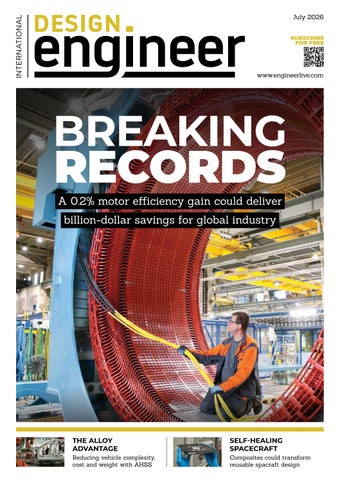
A 0.2% motor efficiency gain
BREAKING RECORDS
How a 0.2% motor efficiency gain scales to billions: ABB’s TIE initiative is providing large-scale savings across industrial sectors
As the global energy transition picks up pace, industrial energy efficiency is increasingly gaining importance. With rising demand from AI and data centres accelerating this shift, maximising the use of each unit of electricity is key.
“Industry has spent decades optimising what happens inside a plant. Yet large motors and generators have rarely been part of that conversation, even though they run continuously for 25 years and sometimes even more, converting more energy to motion than almost anything else on site,” says David Bjerhag, global business line manager, high speed synchronous, at ABB. “The gap between a standard machine and a TIE-optimised one is not technological. It is a specification gap. The companies closing it fastest are the ones where the engineer who selects the motor and the CFO or CSO responsible for energy performance are aligned around a single metric: total cost of ownership.”
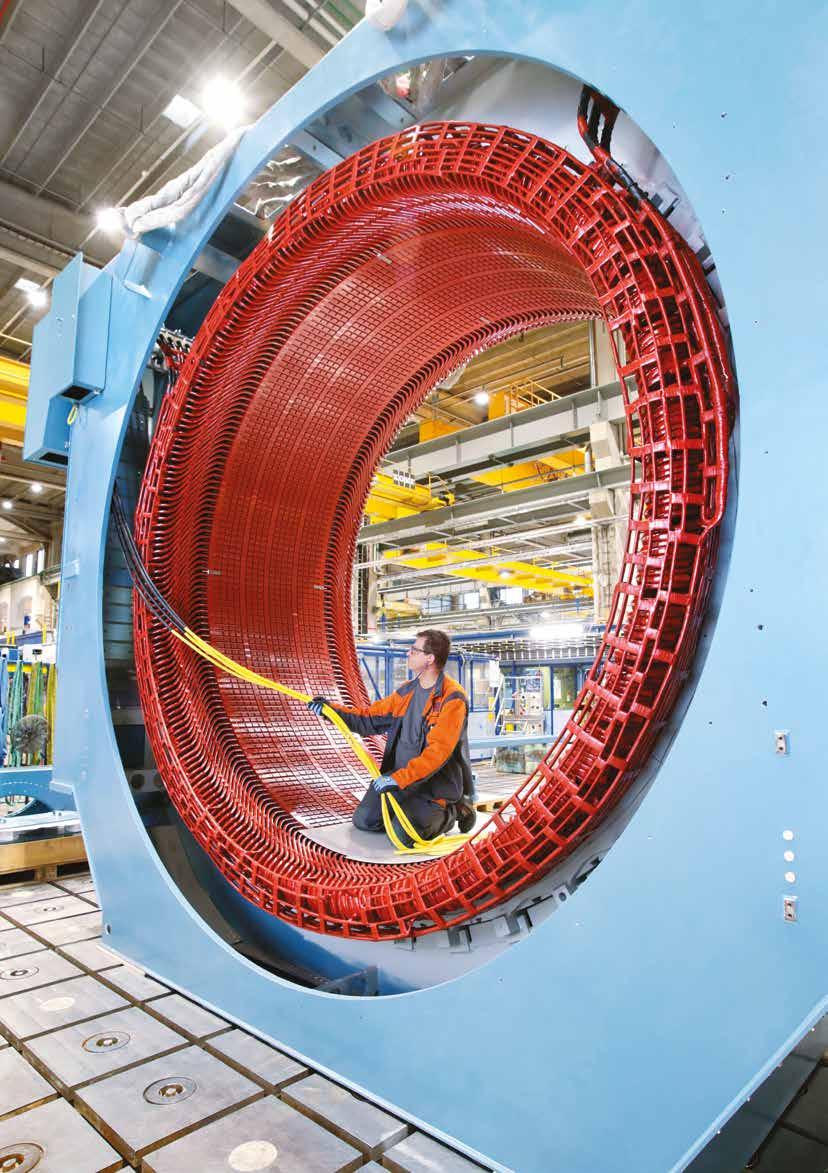
TIE refers to ABB’s Top Industrial Efficiency initiative, which was launched to encourage the adoption of the highest-efficiency large motors and generators available today. Backed by a growing body of operational data and extensive engineering development, the initiative aims to push the boundaries of what is technically achievable. The Industrial Efficiency Gap, a new report from ABB, examines a decade of data for over a thousand large motors and generators delivered globally by ABB’s Västerås facility in Sweden.
International Design Engineer was invited out to the facility to hear how the company is unlocking one of the largest untapped opportunities to save energy, cut costs and reduce emissions across global industrial sectors.
THE SCALE OF OPPORTUNITY
Industrial electrification is being driven by the replacement of combustion-based systems with electric motor-driven solutions and the upgrading of existing electrical systems to higher efficiency technologies. This means that the performance of the entire motordriven system – drives, controls and
Västerås was the first ABB facility to adopt the TIE concept
David Bjerhag, global business line manager, high speed synchronous, ABB
Gunnar Porsby, R&D manager highspeed synchronous machines, ABB
operating system – is vital for overall system efficiency. Still, large motors and generators are one of the most significant asset investments heavy industry operators can make.
“Large motors might only be a small fraction of the total amount of motors installed globally, but they still consume around 20-23% of the total electricity of all motors,” explains Bjerhag. In fact, motors rated above 375kW account for an estimated 10.4% of global electricity demand today, and this figure is expected to double by 2040.
According to ABB’s TIE Gap report, a persistent gap remains between achievable and realised efficiency within these systems, particularly across industries such as oil and gas, metals, chemicals, utilities and pulp and paper.
EFFICIENCY MATTERS MORE THAN EVER
The TIE initiative was developed against a backdrop of increasing pressure on industry to reduce energy consumption and emissions. The International Energy Agency (IEA) has estimated that improvements in energy efficiency could deliver more than 37% of the greenhouse gas reductions required to achieve global climate targets. ABB cites this finding as one of the primary motivations behind TIE.
Bjerhag believes efficiency improvements offer a particularly attractive route because they can often be implemented without major infrastructure changes: “Going from an efficient motor to a highly efficient one doesn’t require a drawn-out permitting process, you can simply do it right away,” he says.
Unlike many decarbonisation technologies, motor-based efficiency upgrades typically integrate easily into existing industrial processes while delivering immediate operational benefits.
The TIE Gap report is based on data from over 1,000 large synchronous motors and generators from ABB’s Västerås facility that were delivered worldwide between 2015 and 2025. For large synchronous machines, TIE typically improves efficiency from around 98.5% to 98.7-98.8%. The findings show that the 0.2% gap between routinely-specified systems and ABB’s TIE approach is costing
operators between $9.5-$12 billion in unnecessary electricity costs and generating 60-75 million tonnes of avoidable CO2 over a 25-year asset life.
THE TIE INITIATIVE
ABB’s TIE initiative delivers large synchronous motors and generators with the highest possible energy efficiency, without compromising reliability or specification compliance. The initiative enables systems to be optimised for lifecycle performance rather than upfront cost, and is available to OEMs, EPCs and end users.
According to ABB’s report, applying the TIE 0.2% efficiency improvement across the global installed base of industrial motors and generators would save 4-6TWh per year. Over a 25-year motor lifetime, that rises to 100-150TWh of electricity saved, equivalent to powering the whole of the UK for five months. The associated CO2 reductions would be an impressive 60-75 million tonnes, or the same as taking 13-16 million cars off the road permanently.
To take advantage of this, though, industry must look beyond upfront cost and embed long-term energy efficiency into procurement decisions. “About 99% of the cost of a motor is actually during its operation phase,” Bjerhag says. “A huge number of megawatts go into a single motor over time, and with electricity costs that becomes a dominating factor
over a 25-year lifetime. Therefore, efficiency plays a major role here.”
A NEW WORLD RECORD
ABB’s most recent achievement demonstrates how far efficiency optimisation can be pushed.
“We were able to reach 99.13% efficiency,” Bjerhag explains. “This is something we are extremely proud of.”
The record-setting 56MW TIEoptimised synchronous motor was delivered to a steel plant in India in 2025. Over its lifetime, the machine is predicted to save $5.9 million in electricity costs and avoid 45,000 tonnes of CO2 with a payback period of just over three months.
According to the TIE Gap report, if every one of the thousand standard machines delivered by the Västerås factory over the past decade had been specified under the TIE option, 11.1TWh of electricity could have already been saved (approaching $1billion), and 5.9 million tonnes of CO2 might have been avoided.
CHASING FRACTIONS OF A PERCENT
Synchronous machines can be used as a motor, generator or rotating synchronous condenser, and operate by rotating in synchronisation with the supply net frequency according to the relation 120 frequency/poles (rpm). The absence of slip eliminates slip-related rotor losses, contributing
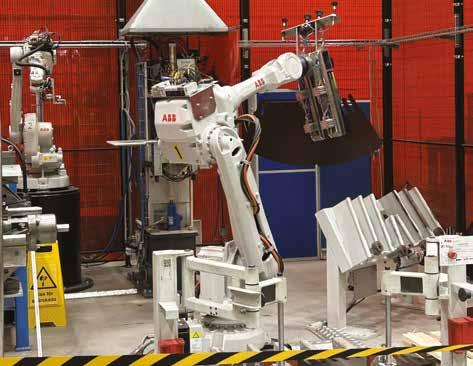
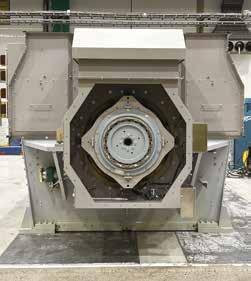
ABB’s complete range of high-speed synchronous machines is manufactured in Västerås
The Västerås facility produces up to 200 machines annually
ABB’s Västerås operation
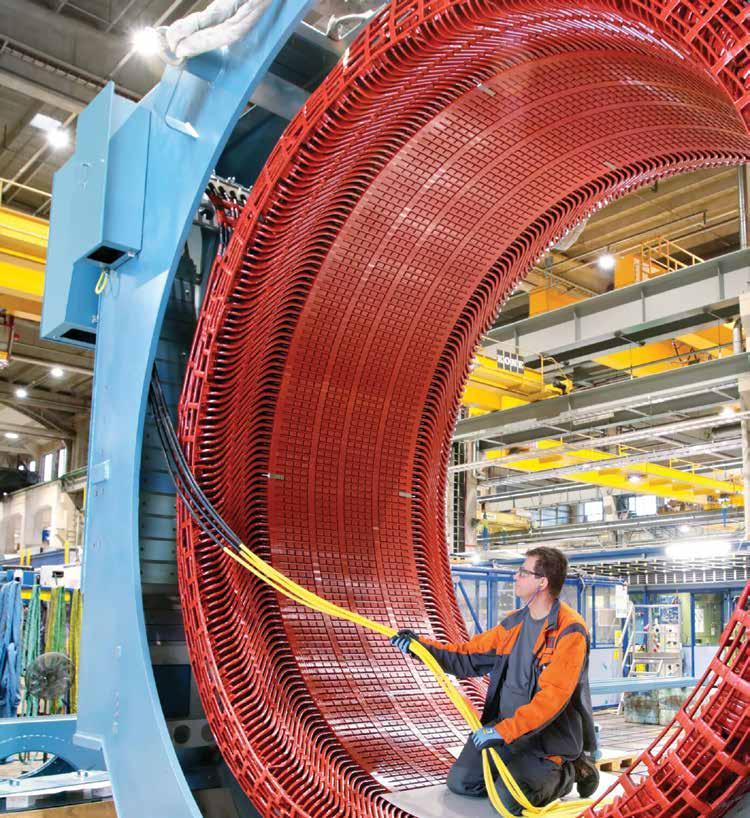
The centre of ABB’s highspeed synchronous motor development is its Västerås facility in central Sweden.
The 22,000m² factory, built in 1976, designs and manufactures ABB’s complete range of highspeed synchronous motors, generators and condensers.
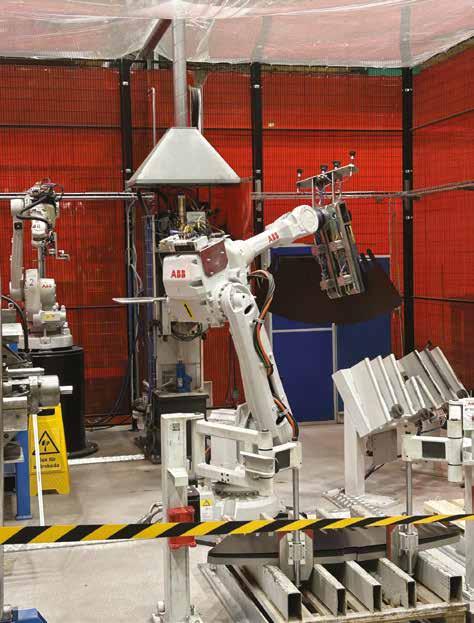
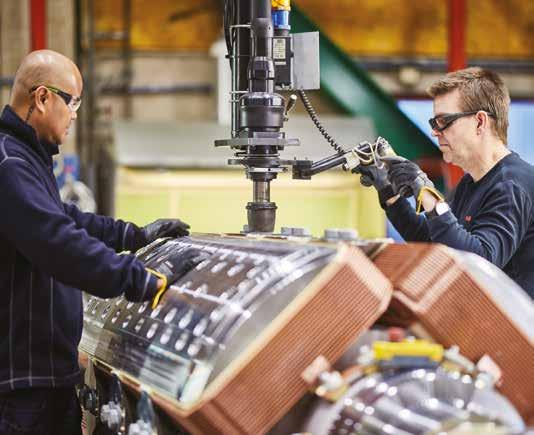
Employing around 600 people, it produces up to 200 machines annually and supports an installed base exceeding 4,000 machines worldwide. The site was also the first ABB facility to adopt the TIE concept.
According to ABB, standard large motors produced in Västerås achieve average efficiencies of approximately 98.3%, while TIEoptimised machines have achieved 99.05% efficiency levels, equivalent to an IE7 classification.
the high efficiency. Synchronous machines can operate at lagging, unity or leading power factor depending on excitation, meaning it can boost the net by reactive power.
Reaching efficiencies above 99% requires increasingly sophisticated engineering, says Gunnar Porsby, ABB’s R&D manager of high-speed synchronous machines: “There are five main efficiency losses in a machine – Ohmic losses in the stator winding coils caused by current flowing through stator copper conductors, stator iron losses in the magnetic core of the stator due to time-
varying magnetic flux, friction losses, excitation losses and additional losses. To further increase efficiency, we need to consider all of these and analyse what we can try to affect.”
To enable this, ABB has built a comprehensive and continually evolving R&D toolbox that allows its engineers to design machines to suit the specific needs of its customers.
“This toolbox of possibilities is a strategy that distinguishes us somewhat from our competitors,” says Porsby. “We have many alternative technologies and capabilities to design efficient machines and
TIE sector insights
Air separation/chemicals:
• 85% TIE adoption
• 24/7 operations
• Same owner pays for energy
Oil & gas:
• 10% TIE adoption
• Fragmented value chain
• CAPEX-driven decisions
• Efficiency under-valued
Power generation:
• 15% TIE adoption
• Massive energy volumes
• Continuous operations
• Direct link to fuel & emissions reduction
optimise them to the standards and local conditions they will be operating within.”
Artificial intelligence is increasingly becoming a part of that toolbox, he adds: “AI and machine learning is already incorporated into our in-house tools when designing the machines, to help us understand where we can make the biggest impacts.”
The efficiency gains of ABB’s machines are not coming from exotic or untested materials, either. Instead, progress stems from the company’s industry knowledge, increasingly precise manufacturing, and the creative application of established, proven technologies. Digital tools and modelling techniques have advanced significantly, enabling ABBs engineers to explore more design possibilities and simulate and optimise fine details with accuracy.
TURNING POTENTIAL INTO IMPACT
ABB’s TIE Gap report sets out a clear set of actions to accelerate adoption of high efficiency machines and also highlights the importance of using total cost of ownership as a primary decision metric. To lower carbon emissions and achieve global climate goals, energy efficiency needs to be embedded into procurement decisions, including specifying minimum performance levels and requesting optimised designs.
ABB’s engineers are constantly evolving the company’s R&D toolbox
Ingo Olschewsk, director at WorldAutoSteel
THE ALLOY ADVANTAGE
Ingo Olschewski tells Louise Davis why today’s sophisticated steels offer a scalable pathway to reducing vehicle complexity, cost and weight
An interesting feasibility study entitled Reducing Complexity & Cost through Parts Consolidation was recently commissioned by WorldAutoSteel, the automotive group of the World Steel Association. The organisation says the study’s results demonstrate a credible pathway for manufacturers to rethink how vehicles are designed and manufactured – an intriguing premise that shines a light on the real-world potential of advanced high-strength steels (AHSS).
In the context of automotive design, where we’re used to slight, incremental advances being heralded as enormous success stories, the study’s findings are quite astonishing. Results include a 34% reduction in part count for a front body structure, along with 8% weight savings, 10% reduction in piece cost and the potential for up to US$21 million in overall manufacturing investment savings.
Naturally, Ingo Olschewski, director of WorldAutoSteel, is delighted with the findings. They confirm his belief that, as vehicle architectures evolve
for electrification and lightweighting, AHSS are well placed to compete with aluminium and composites in future body structure design.
“For high-volume automotive applications, material selection is increasingly driven by the need to balance performance, cost and manufacturability. Our study shows that parts consolidation using AHSS can considerably reduce cost and complexity, while enabling weight reduction,” he explains.
“Technologies such as thirdgeneration AHSS and tailor-welded blanks allow multiple grades and thicknesses to be combined within a single part, optimising strength and formability locally. Together, this enables a weight reduction of 8% in the front body structure, while maintaining safety and performance,” Olschewski details.
CONSOLIDATION STRATEGY
But successful parts consolidation – particularly across mixedmaterial architectures – isn’t always
straightforward, and Olschewski acknowledges there are several challenges to be addressed. “In the automotive industry, pressures have never been greater to find ways to deliver more efficient and cost-effective manufacturing solutions that don’t compromise vehicle performance or safety. This is especially relevant for battery-electric vehicle (BEV) platforms that incorporate a wide range of structural components,” he comments.
“These barriers for BEVs formed the basis of our study, which focused on parts consolidation for a steel front vehicle body structure. The potential for a 34% reduction in part count combined with 10% piece-cost savings demonstrates a clear opportunity to reduce complexity and costs,” says the steel evangelist.
Discussing mixed-material architectures, Olschewski notes that consolidating components can introduce a range of systemsengineering challenges in vehicle manufacturing – affecting factors such as cost, scalability, safety and crash performance. “For example,
Ingo Olschewsk says that steel offers a clear opportunity to reduce complexity and costs in automotive design
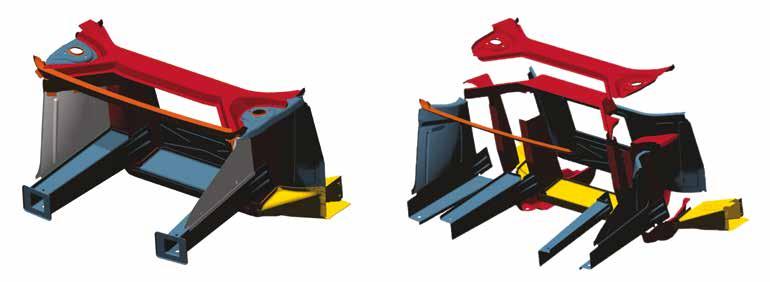
Comparison of baseline design Steel E Motive front body structure (left) and Parts Consolidation Study (right)
CONCEPT CAR
For its study, WorldAutoSteel tasked Ricardo, a global specialist in automotive technology development, with creating a virtual solution for a new front body structure using the Steel E-Motive vehicle concept as the baseline reference.
Using the Steel E-Motive vehicle concept as the base, the new design achieved a reduction of 13 parts – 34% of the overall. The reductions were based on consolidating individual parts into larger single hot and cold stamped parts, often incorporating more complex geometry. “The study highlights the applicability of this solution for real-world use in current and future vehicle platforms,” comments Olschewski.
joining mixed materials can create corrosion issues, while crash performance can be impacted by different material stiffness or stress,” he explains. WorldAutoSteel’s report highlights the role of tailor welded blanks, AHSS and advanced stamping simulation in overcoming such challenges and enabling parts consolidation.
Looking ahead to the next generation of BEVs, where does Olschewski see the biggest remaining limitations in pushing consolidation even further? “Next-generation BEV platforms are pushing towards higher levels of functional integration
through structural battery packs and integrated systems. As architectures evolve, manufacturers must balance increasing integration with serviceability, cost efficiency and production feasibility,” he states.
“One of those remaining limitations is repairability. Highly consolidated structures can result in larger repair zones, higher replacement costs and longer repair cycles. Steel offers opportunities to improve this through modular, replaceable structures and excellent weldability, helping to reduce repair complexity and insurance costs.”
And, he adds, “From a broader perspective, material decisions
WorldAutoSteel’s study showcased the real-world potential of advanced high-strength steels (AHSS) in developing the next generation of BEVs
are increasingly assessed through a lifecycle lens, where steel also offers advantages in terms of lower production emissions and high recyclability.”
RISK VERSUS REWARD
As vehicle platforms become more modular and EV-focused, there’s another issue around parts consolidation that will require greater focus: assessing when parts consolidation creates true systemlevel value versus introducing downstream risks in repairability, tooling complexity or supply chain flexibility. On this subject, Olschewski observes: “The challenge is not just making fewer parts, but ensuring the overall vehicle structure still delivers on its key attributes – including cost, safety, manufacturability and scale.
“Our study findings demonstrate that minor adjustments to material grade and strength enable a reduction in the total number of stamped parts, which helps streamline the assembly process, requiring fewer machines, tools and less overall factory space. It also reduces production complexity, resulting in an estimated manufacturing investment cost savings of US$21 million. Crucially, this work underlines a scalable pathway that leverages existing manufacturing infrastructure, helping to minimise disruption to production,” he emphasises.
TIME-SAVVY TESTING
Ford’s simulators can now run ten times more vehicle dynamics tests in just a tenth of the time
In a recent post, Ford’s vehicle dynamics core methods and simulation supervisor Louis Jamail discussed the speed benefits of the company’s virtual testing capabilities. Jamail spent time on Ford’s racing team during his two decades with the company, and envisioned transitioning the simulation tools used by the racing division over to Ford’s other programmes.
“The Product Development Simulator I envisioned started putting vehicles through their paces in a virtual environment in 2020,” he said. “In the years since it opened, it’s lived up to the potential.”
According to Jamail, part of virtual testing’s power is speed: “In a single day, we can run simulations that would take six months in real life. We can run ten times as many tests in a tenth of the time.”
VIRTUAL TESTING ADVANTAGES
Virtual testing offers numerous advantages for engineers, such as eliminating the need for mechanics to switch out parts before running the next test. Vehicle damage that might destroy a physical test vehicle can instead be repaired with a few clicks. Virtual testing also allows vehicle performance to be simulated in all kinds of environments, from sub-zero
temperatures and frozen landscapes to deserts and rough terrain, without any of the associated time, cost or logistics of getting a vehicle to and from such locations.
Another key advantage of virtual testing is the ability to control variables such as temperature and weather to ensure identical conditions for repeat tests.
SPEEDING UP SIMULATION
Today, the simulator in Ford’s Dearborn facility has been used by every programme at the company, and other simulators have been opened at Ford sites across the world. Ford’s Advanced Driver Assistance Systems (ADAS) team is using the simulator for the development of key features such as its BlueCruise hands-free highway driving.
As Ford’s virtual testing programme has grown, the simulator team has developed a global ecosystem to keep virtual testing consistent across all the company’s programmes and locations, meaning information and improvements can be shared quickly.
“We’re also branching out into offroad simulations and have started to work with suppliers to integrate supplier simulation capabilities into the Ford Simulator ecosystem,” Jamail added.
ELECTRIC ERA EXPANSION
Ford is expanding operations at its Long Beach, California hub, where it has brought together tools, talent and labs to design, test, and refine the company’s next generation of electric vehicles, beginning next year with an affordable midsize truck.
What started three years ago as a secret skunkworks project has grown into a 350-person team at the Electric Vehicle Development Centre. Here, the Advanced EV team can move ideas from concept to testing in hours or days instead of weeks or months – a pace reflected in its mantra of “fail fast, learn faster.”
Everything in Long Beach is focused on Ford’s Universal EV Platform. So the team doesn’t have to compete with other products for resources, work spaces feature a design studio, a complete milling and 3D printing lab, battery development, and real-world testing capabilities.
Before ideas become physical, collaboration goes digital. A meeting room features a floorto-ceiling LED wall to display life-sized vehicles and is even large enough for the team to drive in multiple prototype vehicles. Long Beach staff can also use the wall to collaborate with colleagues in Dearborn, Palo Alto, Louisville, or elsewhere, helping speed up decisions.
Virtual testing allows simulation in different types of environments
The Ford Simulator
Parylene Medical and Electronics Coating
l Ultra thin bio compatible protection
l Outstanding chemical, moisture and electrical barrier protection
l High lubricious dry film conformal coating
l Metals, Elastomers, Electronics and Plastic
l Proprietary Dimer is 99.7% pure
l CW Parylene: USP Class VI and ISO10993 tested
l MAF No. 1176 on file with the FDA
WORTH THE WEIGHT
Stratasys’ Andrew Graves shares how generative design and topology optimisation can unlock lightweight metal components
The drive to reduce weight while maintaining performance continues to shape engineering decisions across aerospace, motorsport and other high-performance industries. Generative design and topology optimisation have emerged as powerful tools for achieving significant mass reduction without sacrificing structural
integrity. However, manufacturing the resulting geometries can present a major challenge.
According to Andrew Graves, sales manager at Stratasys, the demand for lightweight components is particularly acute in sectors where every gram matters. He explains: “Motorsport, aerospace, lots of other industries require lightweight metal components,”
and notes that topology optimisation makes it possible to “take away a lot of metal from the part that you don’t actually need.”
NO NEED TO COMPROMISE ON PERFORMANCE
Topology optimisation enables engineers to remove unnecessary material while retaining critical load-bearing functionality. As Graves explains, “it’s a way of lightweighting components, but without compromising any of their structural integrity, so you get the same load-bearing capabilities.”
The process begins with a conventional design before software identifies where material can be removed. The result is often a highly organic geometry that would be difficult to create using traditional manufacturing methods.
Describing the outcome, Graves says: “You start off with a design, and that will work fine, but if you lightweight it using topology optimisation, you
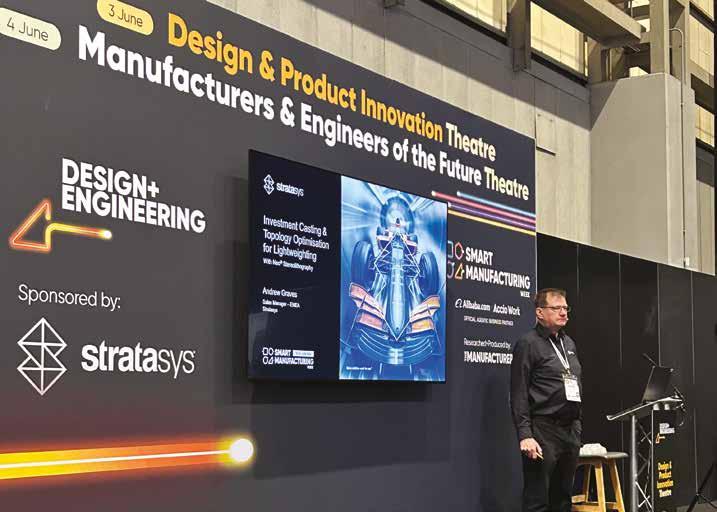
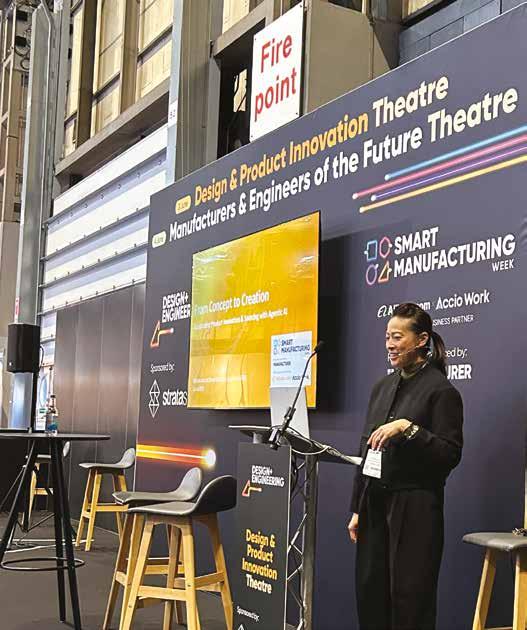
Andrew Graves, sales manager at Stratasys, speaking at Smart Manufacturing Week 2026
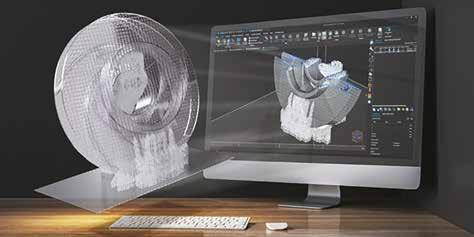
Stratasys Neo Build processor for investment casting. Image via Stratasys
get a part that will withstand all the same loads, all the same load-bearing capability, same connection points, but its mass would be far less than the original design.”
The benefits are particularly valuable in applications such as motorsport braking systems, where reducing unsprung mass can improve vehicle dynamics. Referring to a topologyoptimised brake calliper, Graves notes that, “most of the metal work that doesn’t need to be there has been removed by a software package.”
THE MANUFACTURING CHALLENGE
While generative design delivers impressive weight savings, it often creates geometries that are difficult or impossible to manufacture using conventional techniques. “Lead times for these can be weeks or months, or even impossible to make,” says Graves. Complex internal channels and inaccessible features can limit the suitability of CNC machining. Even advanced metal additive manufacturing processes can introduce challenges. Graves points out that metal 3D printing, “is a very specialised area of 3D printing,” adding that, “it is expensive if you’re setting it up in house, especially for industrial metal 3D printing.”
Traditional investment casting also has limitations. For highly optimised geometries, tooling can become impractical.
COMBINING TOPOLOGY OPTIMISATION WITH SLA-BASED INVESTMENT CASTING
A practical alternative is to use stereolithography (SLA) to produce investment casting patterns directly from topology-optimised CAD models, meaning no mould is required. The key benefit is speed, Graves explains: “One of the advantages is very short lead time. Hundreds of parts can be printed overnight and you can then begin casting in a few days,” he explains. Equally important is the ability to manufacture geometries that would be difficult or impossible with conventional tooling. According to Graves, “we have almost unlimited geometry freedom.” This allows engineers to fully exploit the
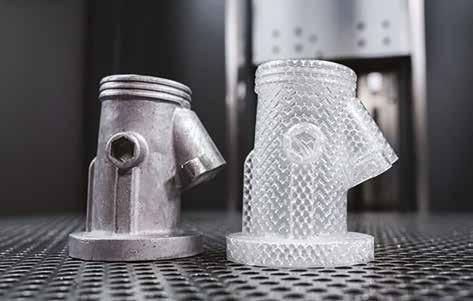
The investment casting process utilises sacrificial patterns and ceramic shell moulds that allow for highly complex casting designs. Image via Stratasys
capabilities of generative design without being constrained by mould design or machining accessibility.
FASTER DESIGN ITERATION
The combination of topology optimisation and SLA-generated casting patterns can significantly accelerate product development.
Graves highlights the opportunity for rapid design refinement: “You can print a part, cast it, and ask: Does it work? Do I need to make a design change? If so, go back, print another one, cast it, and within a couple of weeks you could have gone through two or three iterations to get the perfect metal part.”
This ability to move quickly through multiple design cycles is particularly valuable when validating lightweight structures for demanding applications.
SURFACE QUALITY AND CASTING READINESS
For investment casting applications, surface quality is critical. Graves emphasises that SLA technology offers excellent results directly from the machine.
“You cannot see the layer lines on a typical vertical wall,” he says. “We get an RA of about 3.54 microns straight out of the machine, so very little post processing is required before we go into the casting.”
This readiness minimises preparation work and helps maintain the accuracy of complex topology-
optimised geometries throughout the casting process.
ENABLING DESIGN FREEDOM
Perhaps the greatest advantage of combining generative design with additive manufacturing-enabled investment casting is the freedom it gives engineers to optimise solely for performance.
Discussing large-scale turbine applications, Graves explains that the process, “allows those designers total freedom to make the design as efficient as it can possibly be, such as very complex vein shapes and guide vanes. They don’t have to worry about how they would manufacture these parts via a traditional method, because they know they’re going to 3D print it.”
For design engineers pursuing aggressive lightweighting targets, this represents a fundamental shift. Instead of designing around manufacturing constraints, topology optimisation and generative design allow components to be engineered around functional requirements first, with advanced manufacturing methods providing a practical route to production.
As industries continue to push for lighter, stronger and more efficient products, the combination of topology optimisation, generative design and additive manufacturing-enabled investment casting is becoming an increasingly valuable part of the design engineering toolkit.
MIL-STD-810H validated tethered UAS manufactured in Windform composites. Image via Hoverfly Technologies
BEYOND THE HYPE
Engineering the next generation of lightweight structures
Additive manufacturing is moving beyond the hype and is increasingly evaluated as an industrial production technology based on concrete applications, qualified materials, process repeatability, and economic return, rather than geometric freedom alone. Its adoption should begin at the design stage, to fully leverage feature and component integration, reducing subassembly complexity and unlocking performance gains that conventional manufacturing cannot reach.
AM is leaving the prototype lab and entering low-rate initial production—evaluated today on qualified materials, process repeatability, and measurable return, Windform components have already supported over 10 orbital missions and the deployment of over 57 PocketQubes, demonstrating how AM is enabling flight-qualified applications. The shift is substantial: the most successful applications no longer originate from adapting conventionally designed components for additive production. They result from designing around the process
from the outset, enabling engineers to consolidate assemblies, integrate functions, and optimise structures before a single part is produced.
THE MATERIAL ADVANTAGE
Material performance determines whether AM can move from one-off parts into a reliable LRIP solution. CRP Group’s proprietary Windform composite family—developed over three decades of SLS investment and validated across motorsport,
space, and demanding industrial applications—is engineered specifically to extend the mechanical ceiling of Selective Laser Sintering. Rather than a one-size-fits-all material, the portfolio allows engineers to select specific formulations based on critical requirements. For masscritical applications, Windform SL delivers an ultra-low density of 0.87g/cc, enabling weight reductions of 30–60% over equivalent aluminium designs. Conversely, where structural integrity is
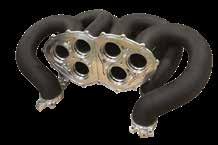
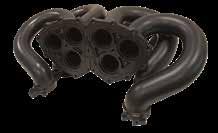
Figure 1: Monolithic Windform intake plenum validated at 5 bar pressure, replacing multi-part assemblies and reducing manufacturing complexity
paramount, the flagship Windform RS pushes mechanical boundaries, achieving a tensile strength of 85.25MPa and a Heat Deflection Temperature (HDT) of 191.90°C. For design engineers, matching these specific material profiles to critical load paths results in direct architectural consequences: thinner walls, optimised load paths, integrated mounting features, and structural efficiency without reliability penalties.
FROM PART CONSOLIDATION TO SYSTEM INTEGRATION
The most significant opportunity additive manufacturing offers is not the part itself but the ability to rethink entire assemblies. Monolithic structures can absorb cable routing, cooling channels, mounting points, passive elements, and electronic hardware within envelopes that would defeat conventional multi-part
approaches. Combined with precision CNC machining at critical interfaces, this hybrid methodology reduces assembly operations, eliminates tolerance stack-up, and compresses development cycles.
CRP Group applications across motorsport, aerospace, space, and advanced unmanned systems demonstrate the range of this approach: LRIP-qualified components operating where weight, reliability, and performance are non-negotiable design constraints—not targets to be traded against each other.
UNLOCKING CONVENTIONAL PRODUCTION LIMITS FROM PHASE ZERO
The challenge is no longer whether additive manufacturing works, but identifying where it can replace complex assemblies, reduce weight and accelerate development cycles in real production programmes.
Laura Fabbi is at CRP Group. www.crp-group.com/integrated-manufacturing-defense
DIGITAL AGENTS
Michelle Lau, managing director at Alibaba.com
How agentic AI is reshaping product development
Bringing a new product to market has never been a straightforward process. While software development cycles have become increasingly agile, the journey from an initial product concept to a manufacturable design and ultimately scalable production remains complex, fragmented and often time-consuming.
For design engineers, product developers and sourcing teams, a big challenge lies in navigating the numerous handovers, approvals, supplier interactions and procurement processes required to transform those ideas into physical products.
According to Michelle Lau, managing director at Alibaba.com, agentic AI could fundamentally change how these activities are managed.
“Alibaba.com, our agentic AI platform, is bridging the gap between an initial
idea from a sketch to a manufacturable prototype and ultimately into scalable global production,” says Lau.
The emergence of agentic AI represents a significant shift from conventional AI tools. Rather than simply generating content or answering questions, agentic systems are designed to execute tasks, coordinate workflows and automate complex business processes. For product development teams, this has the potential to reduce delays and accelerate decision-making across the entire product lifecycle.
TACKLING BOTTLENECKS
Despite advances in digital engineering tools, physical product development remains characterised by numerous manual processes. Lau highlights the reality facing many engineering
organisations: “Turning a promising product concept into a physical product prototype. It might take weeks, if not months, or sometimes for more complex products, years.”
The underlying problem is not necessarily technical complexity, but fragmentation. “In reality, product development is a logical development track, but it’s also a very highly fractional process. Every single transition is a silo,” she explains.
From supplier identification and quotation management to procurement, manufacturing validation and logistics, product development often involves multiple disconnected systems and stakeholders. Each transition introduces delays and opportunities for miscommunication. The objective of agentic AI is to remove these barriers by creating a connected digital workflow capable of managing tasks autonomously while maintaining human oversight.
BEYOND SEARCHBASED SOURCING
One of the most immediate impacts of agentic AI is in supplier discovery and sourcing. Traditional sourcing platforms have relied heavily on keyword searches and manual supplier evaluation. However, product developers increasingly work with richer forms of engineering data, including sketches, technical drawings and CAD files.
“Today product designers and engineers can upload 2D drawings, a sketch or a CAD file directly into our agent system,” says Lau.
Rather than requiring users to manually search for suitable suppliers, the system analyses design information and identifies potential manufacturing partners capable of producing the component or product. This capability effectively transforms sourcing from a search exercise into an engineering-driven workflow, reducing the time required to identify manufacturing options and assess production feasibility.
BUILDING DIGITAL AGENT TEAMS
Perhaps the most significant shift is the emergence of AI agents that can perform specialised functions
throughout the development process.
“We are moving into the next generation of our Agent Business Platform,” says Lau. “We believe that, when we talk about product development, sourcing is only one journey along the complete value chain.”
Alibaba.com’s Accio Work platform enables users to deploy multiple AI agents tailored to specific activities within the product development cycle: “Now our platform can now provide manufacturers a team of agents that can actually perform the different tasks of the value chain for you,” Lau explains.
These agents can undertake market research, competitor analysis, supplier engagement, quotation management and procurement support, allowing engineering teams to focus on higher-value activities such as design optimisation and product innovation.
ACCELERATING MARKET RESEARCH AND VALIDATION
One of the earliest stages of product development involves validating whether a concept addresses a genuine market need. Historically, this process has required significant manual effort, involving the collection and analysis of information from multiple sources.
“Every great product starts with market validation,” says Lau. “Previously, you might have needed a lot of very repetitive, time-consuming tasks to scroll through pages and information reports.”
Agentic AI can automate much of this work by gathering information, analysing trends and producing summaries that help engineering and product teams make informed decisions more quickly. “Agentic AI can actually automate the entire process,” Lau explains.
Accio Work enables users to deploy multiple AI agents for specific activities within the product development cycle.
Image via Accio Work
This capability enables organisations to evaluate opportunities more rapidly and potentially reduce the time between concept generation and development approval.
Engineers and product managers
Agentic AI can automate much of the product development process. Image via Accio Work
must continually monitor competitor activity, pricing strategies and market developments. Traditionally, this has been another labour-intensive process. Agentic AI changes this by creating autonomous monitoring systems that operate continuously.
“Accio Work’s competitive monitoring workflow can assign your agent to work 24/7 behind the scenes,” she explains. “This means that every morning, you can get automated, summarised reports that your development teams can then action throughout the day.”
AN AUTONOMOUS PRODUCT DEVELOPMENT WORKFLOW
The broader significance of agentic AI lies in its ability to connect activities that have traditionally been treated as separate functions. From market validation and competitive analysis to supplier sourcing and procurement, AI agents are increasingly capable of executing workflows that once required extensive manual coordination.
For design engineers, this could mean shorter development cycles, faster access to manufacturing expertise and more time dedicated to solving technical challenges rather than managing administrative processes
DYNAMIC DIGITAL TWINS
How digital twins are enabling faster and more informed manufacturing decisions across the factory lifecycle
Digital twins have evolved into a practical engineering tool that is reshaping how factories are designed, commissioned, operated and optimised. By creating dynamic virtual representations of products, equipment and entire production systems, manufacturers can validate decisions before committing time, capital and resources in the physical world.
According to Daniel Bierwirth, senior software development consultant at Unity Software, digital twins are now delivering measurable value across the manufacturing lifecycle. “Digital twins are no longer an emerging technology. Leading manufacturers are already using and deploying them in their day-to-day product development cycles,” he says. “When you work with digital twins you can reduce development costs by around 50% just by being able to validate a new assembly line without building it physically.”
REDUCING RISK
One of the greatest advantages of digital twins is their ability to simulate outcomes before physical assets are built or modified.
“Digital twins allow manufacturers to reduce risk by simulating outcomes before they actually have to make costly changes on the real assembly line,” says Bierwirth. “They have a virtual representation of the assembly line, they can replay the process, they can tweak parameters and procedures, and see if the outcome
improves or not before they deploy the new process into the existing manufacturing line.”
This enables engineering teams to move beyond assumptions and intuition. “This means when they make design decisions or change decisions, they have a data record. It’s not based on a gut feeling,” Bierwirth explains. “They have hard numbers that they can use as proof points.”
The result is faster decision-making backed by evidence rather than trial and error.
PHYSICALLY ACURATE VIRTUAL FACTORIES
Historically, early factory planning often relied on CAD layouts, spreadsheets and physical mockups. Digital twins provide a more immersive alternative.
“What is interesting with our software Unity, you can actually use digital twins as virtual replicas of real equipment and start in an early phase in a lightweight way, prototyping new assembly lines,” says Bierwirth. He contrasts this with traditional methods: “Without those tools, people would use paper or whiteboard drawings, which is not that insightful.”
Instead, with Unity engineers can work with a realistic virtual environment, he continues: “Here, you have a one-to-one physically correct representation that allows you to
quickly mock up a new production line and hand it over to decision makers.”
Unity Industry is a suite of products designed to help OEMs import and optimise complex 3D, CAD, and BIM models, while Unit Asset Manager seamlessly integrates into workflows to ensure cloud-based unified 3D asset management across all models and teams. These capabilities allow engineering teams to evaluate layout options, equipment positioning and process flows long before any physical installation begins.
IMPROVING COLLABORATION ACROSS DISCIPLNES
One of the recurring themes throughout the digital twin journey is the democratisation of engineering information. Traditionally, factory planning decisions have been made within specialist software environments accessible only to engineering teams. Digital twins provide a common platform that can be understood by stakeholders across the organisation.
“If you think about how people on the shop floor level work, they typically have to work with the planning result created by an engineer, but the shop floor worker actually has the domain expertise because he’s working in the factory all day long,” says Bierwirth. Digital twins
Daniel Bierwirth, senior software development consultant at Unity Software speaking at Smart Manufacturing Week 2026
allow those operators to participate directly in design validation. “They are now part of the decision making process. They can immerse themselves and they can validate if the production line is actually planned correctly based on their hands-on experience.”
This human-in-the-loop approach helps ensure that factory designs are practical as well as technically correct.
VIRTUAL COMMISSIONING BEFORE INSTALLATION
The value of digital twins extends beyond planning and into commissioning. Bierwirth describes an example of a fully automated warehouse where the virtual environment is connected directly to real control systems. “The virtual warehouse is driven by 11 PLCs, so you can test the whole process as working before anything has been built physically,” he says.
This enables virtual commissioning, allowing engineers to validate automation logic, machine behaviour and process interactions in a safe environment. “Unity can connect to all kind of control systems,” Bierwirth explains, allowing PLC programmers and automation engineers to visualise how control signals affect real-world operations before deployment.
For robotic applications, digital twins also provide important contextual information.
“The robotic engineer is still working and Robot Studio is doing their robotic planning but on the other side he has the robot in context of the whole assembly line,” says Bierwirth. “That is very powerful to make sure that at a later stage when you are offline programming, you reduce the need for a rework.”
A REAL-WORLD EXAMPLE: BATTERY DISASSEMBLY OPERATIONS
Ian Taylor-Spikings, research engineer at MTC, describes how digital twins were used to develop an automated electric vehicle battery disassembly facility. “We needed to create a safe environment for disassembly of electric vehicle batteries,” he says. “There’s going to be millions of them by 2030
so it’s best to get working on that now.”
The project faced several challenges, including validating robot paths, accommodating multiple battery designs and training operators before equipment arrived.
“If we have the operators trained and aware of what they’re doing before the machines are here, then that lowers lead times, lowers costs, makes it a lot easier and less of a headache for everyone involved,” he explains.
By creating a digital twin connected to real operational data, the team established what TaylorSpikings describes as “a single source of truth.” The visual nature of the environment also simplified decisionmaking: “You can actually physically see where the robot is going. If you want to know where the robot is, look at the digital twin.”
THE NEXT PHASE
Looking ahead, both Bierwirth and Taylor-Spikings see digital twins evolving into collaborative environments that bring together engineering, operations and maintenance teams. Taylor-Spikings describes a future where, “safety officers, engineers, operators, all in the same space” can interact with the same digital representation of a process.
As manufacturers continue to pursue shorter development cycles, greater operational efficiency and more agile production systems, digital twins are becoming far more than visualisation tools. They are increasingly serving as decisionmaking platforms that connect design, commissioning and operations into a continuous digital thread.
The MTC uses Unity as its real-time 3D development platform. Image via Unity
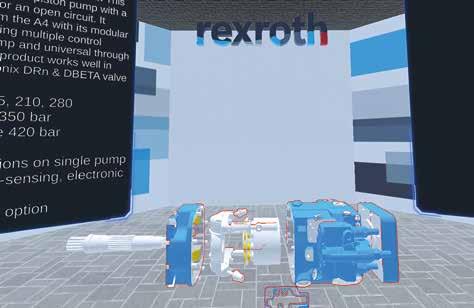
Bosch Rexroth’s virtual showroom created with Unity. Image via Unity
Felicitas Stuebing is the global product line manager of one-component dispensing at Nordson EFD
OPTIMISING DISPENSING PERFORMANCE
Available from 3cc to 70cc capacities, Nordson EFD syringe barrels are designed and moulded to provide exceptional clarity and chemical compatibility. These reservoirs are clear in colour for most fluid dispense applications, but also available in UV/light blocking amber and opaque black for complete light blocking
How size influences fluid behaviour and assembly efficiency, according to Nordson EFD’s global product line manager of one-component dispensing, Felicitas Stuebing
There is explosive demand for highly engineered products in industries such as electronics and medical devices.
Forward-thinking engineering teams are aligning technology strategies and the required expertise to leverage these growth opportunities. The need to guarantee quality part assembly is a critical, real-world challenge and requires extensive fluid process and dispensing expertise.
Choosing the right dispensing technology requires striking a delicate balance between a fluid’s physical properties and the demands of a manufacturer’s operational output, such as throughput and precision
requirements. Optimising this pairing prevents costly material waste, process interruption and downtime. Automated dispense systems also bridge the gap between fluid properties and production demands by eliminating operator variability and delivering the exact fluid shot size at the same location, time after time, to radically increase efficiencies.
SIZE IS FUNDAMENTAL
In assembly production, finding the right size fluid dispensing components is fundamental. To place an accurate bead of fluid, size selection is critical for single-use plastic components like dispense tips used with hand-held
dispensers or the most sophisticated automation systems. Serving as the “point-of-dispense,” dispense tips also come in a multitude of styles, lengths, and outer/inner diameters. Tips are instrumental in controlling how a fluid leaves a syringe barrel or valve as it is deposited onto a substrate. The miniaturisation of products, especially in the medical and electronics space, has created demand for even smaller, more precise tips to dispense without overflow in hard-to-reach areas.
A customer’s unique assembly application always drives the sizing requirements. If the manufacturer is assembling thousands of parts a day versus a few hundred, a cartridge may
be another option for the dispensing system. Formulators of fluids like epoxies and adhesives typically package this material in either a syringe barrel or cartridge when working with a single or pre-mixed fluid.
Syringe barrel volumes range from 3cc to 70cc and cartridges vary
from 2.5 fl oz to 32 fl oz. The upper volume range in syringe barrels, such as the popular 70cc size, provides the flexibility needed to add more fluid capacity to each cycle, which translates to less downtime as the fluid body is switched out less frequently. For smaller batch
dispensing, syringe barrels may be the better fit. A general rule of thumb is to dispense fluid containers from full-to-empty in any given shift, achieving maximum value-dispensing to the very last deposit. This practice reduces fluid waste and saves money on syringe barrel or cartridge usage.
KEEPING ASSEMBLY OPERATIONS TOP OF MIND
The sizing principles outlined for fluid dispense applications shine a light on the path toward constructing highly engineered parts and products with confidence and quality. The surge in demand for next generation products – sensors, semiconductors, smart medical devices and fibre optics – has manufacturers rethinking their production models. The competitive reality for OEMs and contract manufacturers lies in prioritising assembly processes much earlier in the product development cycle to streamline time to market. Getting ahead of the process control curve simply saves time and money in the long run.
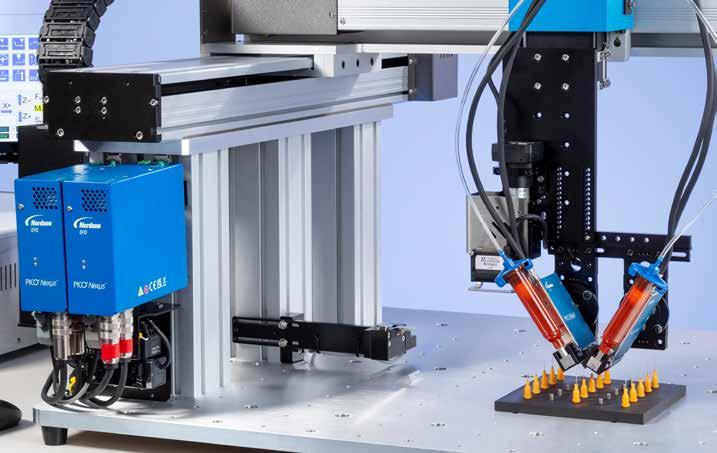
The vision-guided GV Series gantry robot can work as a standalone dispensing system or for fully automated, conveyer-fed assembly production. The configuration includes an engineered needle valve and tip for precision fluid dispensing in an electronics application
Nordson EFD’s engineered dispensing tip styles range from 14ga to 37ga to accommodate a wide range of assembly fluids with unique viscosities
SAFE SPACE
Igna Van Der Weide, head of product management at Zotefoams, explores the material challenge for the next phase of space exploration
With NASA progressing plans for a long-term Moon Base at the lunar South Pole, the idea of permanent infrastructure beyond Earth no longer feels like science fiction. In fact, the wider space economy is forecast to grow from $630 billion in 2023 to $1.8 trillion by 2035, with conversations about spacebased infrastructure, including the prospect of data centres to support rising AI compute demand, now seeping into the mainstream.
The next phase of space exploration will place new demands on equipment design
While some of this remains earlystage and technically complex, the direction is clear: space exploration is shifting from isolated missions towards sustained activity. Equipment must therefore be built to perform for longer, in demanding conditions and with safety at the forefront of design. That creates a new challenge for designers and engineers when it comes to advanced materials manufacturing. The conversation now goes beyond building equipment that can withstand launch vibration and transit, to designing equipment and infrastructure that can perform effectively through long-term exposure to environments shaped by thermal extremes, heightened levels of radiation and microgravity. In this context, materials specification becomes a fundamental engineering decision. The wrong material choice can add unnecessary mass, complicate assembly, release vapours that affect sensitive equipment, or degrade under conditions where access for repair is limited or impossible. Space applications leave little room for variation, making reliable, repeatable materials an absolute priority for engineers and materials manufacturers as we enter the next phase of space exploration.
RAISING THE BAR FOR RELIABILITY AND REPEATABILITY
A material may look suitable for space applications in isolation, but the real test is how it behaves once it has been cut, formed, assembled, cleaned, stored, transported and exposed to demanding conditions over extended periods of time.
Space-related materials must deliver
predictable mechanical behaviour, so designers and engineers can understand how they will perform under compression, vibration, impact or temperature change. And as developing and maintaining permanent infrastructure becomes a more realistic objective, that consistency will be even more crucial. Components may need to remain stable and functional for extended periods - often in systems that are difficult to access, maintain or replace.
Materials in this sector are also assessed against strict requirements covering flammability, toxicity, outgassing, corrosion, microbiological resistance and ageing. Outgassing –that is, the release of vapours from a material - is a particularly important consideration because those vapours can affect sensitive equipment, optics, electronics or enclosed crew environments. Material performance must therefore account for factors like strength, cushioning and how cleanly and consistently a material behaves within the wider system, which is now intended to remain operational in challenging conditions over a longer period of time.
Physically expanded closedcell foams can be particularly effective for these reasons, as their internal cells are sealed rather than interconnected, helping to create a cleaner material structure and support applications where low weight, cleanability, low emissions and protective performance matter.
CHANGING NEEDS
Equipment protection has always been central to space exploration. Before any system reaches orbit, payloads
MATERIALS, PROCESSES, FINISHES
– as in the instruments, electronics and support equipment carried for a mission purpose - must survive launch vibration, shock, acceleration forces and the handling demands of transit, while remaining aligned and functional.
This is why advanced foam materials are already used in spacerelated applications such as cargo bags, electronic equipment packaging, harnesses, and anti-vibration components. Their role is to secure delicate or high-value equipment, absorb energy where needed and provide protection without adding unnecessary mass.
But demands are now expanding. As space activity moves towards longer-term infrastructure, materials must continue to support equipment through launch and transit, but also through storage, deployment and operation on the lunar surface. Durability, cleanability, low emissions and stable behaviour over time will therefore become as important as initial cushioning performance.
EARLY DECISIONS, LONGER-TERM PERFORMANCE
The next phase of space exploration will place new demands on equipment design. As missions begin to involve sustained lunar activity and more permanent infrastructure, components will need to be engineered for longterm exposure.
That changes the role of materials specification, with performance at the point of launch only part of the requirement and the materials used for vital equipment and infrastructure needing to remain stable in extreme conditions with limited maintenance access. For designers and engineers, this means working earlier and more closely with advanced materials manufacturers.
The next era of space exploration will still be defined by rockets, robotics and mission architecture. But its success will also depend on quieter specification decisions made much earlier, before equipment is built, tested and sent beyond Earth.
Igna Van Der Weide, head of product management at Zotefoams
GOOD VIBRATIONS
How a newly observed Higgs Mode could unlock next-generation materials
New research could open up exciting opportunities for photovoltaic applications
The ability to manipulate material properties with precision is one of the defining challenges of modern materials engineering. From high-efficiency photovoltaics to ultrafast electronics and quantum technologies, researchers are increasingly looking beyond conventional approaches to discover new ways of controlling the behaviour of matter at the atomic scale.
A recent breakthrough by scientists at Argonne National Laboratory has revealed a promising new pathway. By using ultrafast laser pulses to drive coordinated atomic motion in semiconductor materials, researchers have observed a Higgs mode in a semiconductor for the first time – a discovery that could ultimately enable engineers to access entirely new material phases and functionalities.
FOCUSING ON METAL HALIDE PEROVSKITES
At the heart of the work is a class of materials known as metal halide perovskites. These materials have attracted significant interest because of their highly tunable properties and strong interaction with light, making them attractive candidates for nextgeneration solar cells, advanced sensors and emerging quantum technologies.
Microscope image of another 2D butylammonium lead iodide crystal. The dimensions of the sample in this image are on the order of a few hundred micrometers in length and width. Image via Argonne National Laboratory
While materials may appear static to the naked eye, their atoms are constantly in motion. Under the right conditions, these movements can become synchronised, creating collective vibrations known as phonons. Understanding how these vibrations influence material behaviour has become a major focus for researchers seeking to engineer new properties on demand.
In the Argonne study, scientists exposed a layered two-dimensional perovskite crystal to ultrafast laser pulses and observed an unexpected response. The light induced a collective vibration that altered the symmetry of the crystal itself.
“When we excite this material, the atoms that make up its structure start to oscillate in more ways than one,” says Richard Schaller, an Argonne scientist and author on the study. “Because of the ways those atomic vibrations are coupled with each other, the collective motion actually changes the material’s structure, driving it toward a state with higher crystal symmetry.”
The significance of the finding extends well beyond a single material
system. The researchers discovered that light could steer the crystal toward a structural phase that cannot be reached simply by heating the material. This demonstrates that optical excitation can access regions of the material-property landscape that remain inaccessible through traditional thermal processes.
UNDERSTANDING THE HIGGS MODE
The term Higgs mode may be familiar from particle physics, where the Higgs boson became one of the most celebrated scientific discoveries of recent decades. Similar mathematical concepts, however, appear in a wide range of physical systems.
In materials science, a Higgs mode represents oscillations in the degree of order or symmetry within a system. These oscillations emerge when a material undergoes spontaneous symmetry breaking – a process that causes it to adopt a lower-energy configuration. Perovskite materials naturally exhibit this behaviour.
“You can simulate an ideal perovskite structure, but you won’t find most perovskites in that configuration in nature,” explains Argonne scientist Pierre Darancet, a theorist on the study. “They tend to lower their energy by creating secondary structures that decrease their crystal symmetries.”
What makes the Argonne result particularly noteworthy is that it represents the first observation of a Higgs mode in a semiconductor. Unlike previous observations in superconducting systems and other exotic materials, this discovery occurs in a material platform already considered highly relevant for future electronic and photonic devices.
CHANGING COLOURS
The experiments focused on butylammonium lead iodide, a twodimensional metal halide perovskite. The material’s bandgap – the energy threshold that determines which wavelengths of light it absorbs – plays a critical role in its electronic and optical behaviour. Rather than generating electrical excitations, the researchers deliberately illuminated the material with light below its bandgap energy.
“In these experiments, when we excite the sample below its bandgap,
MATERIALS, PROCESSES, FINISHES
Microscope image of the type of perovskite crystal used in the experiments. Under laser illumination, the crystal emits the green fluorescence shown here. The length of the grains visible in the image are on the order of a few hundred micrometers. Image via Argonne National Laboratory
there’s not enough energy to create electric excitations. Instead, at these very low energies, the light pulse can excite only vibrations,” says Schaller.
As groups of atoms oscillated throughout the crystal structure, the material’s bandgap began changing in real time. Using impulsive stimulated Raman spectroscopy, the team detected rapid periodic shifts in the bandgap that directly reflected changes in crystal symmetry.
“We found that the bandgap increased and decreased periodically and rapidly,” continues Schaller.
“Essentially, the colour of the sample oscillated as it rocked through different crystal symmetries – turning redder and then bluer, over and over.”
Theoretical modelling revealed that the light-induced motion combined multiple vibrational modes simultaneously, creating a coherent collective response across the crystal.
“Two frequencies were involved in the bandgap oscillations, and that’s where this material is special. Instead of just one simple vibration, the material displayed a coherent superposition of harmonics, resonating similarly to a violin when you bow its strings,” Darancet adds.
ENGINEERING FUTURE MATERIAL STATES
Different crystal symmetries can produce dramatically different material properties. By controlling symmetry directly with light, researchers could eventually engineer
materials whose electrical, optical and structural characteristics can be switched on demand.
“In this study, the oscillations steer the material toward a state with higher symmetry - and with a much lower bandgap - than its ground state,” says Sraddha Agrawal, a postdoctoral researcher at Argonne and theorist on the study. “Our next steps are to try and actually achieve that higher symmetry state, and to explore other light-induced phases in perovskite materials.”
Such control could have far-reaching implications for energy generation, electronics and quantum computing.
“If we can use light to control structural and electronic changes in materials on ultrafast timescales - for example, switching a material between conducting and insulating states every picosecond - they might find use as optical switches in modern microelectronics and quantum technologies,” adds Argonne postdoctoral researcher and experimentalist Ayushi Shukla. “Also, stabilising novel, high-symmetry phases with low bandgaps could open exciting opportunities for photovoltaic applications.”
The study ‘A meta stable tetragonal phase in twodimensional halide perovskite lattices driven by a coherent Higgs mode’ is published in Nature Materials
SELF-HEALING SPACECRAFT
Self-healing composite structures could transform reusable spacecraft design
As the space industry moves towards reusable launch systems and longer-duration missions, engineers face a persistent challenge: how to maintain lightweight composite structures that are repeatedly exposed to extreme mechanical and thermal loads.
A new European research project may offer a solution. By combining advanced composite materials, embedded sensing technologies and integrated heating systems, researchers have demonstrated a structural material capable of detecting damage and autonomously repairing itself. The technology has the potential to improve the durability of future spacecraft while reducing maintenance requirements and operational costs.
Developed through a collaboration between Swiss companies CompPair and CSEM, Belgian sensing specialist Com&Sens and the European Space Agency (ESA), the project represents a significant step towards intelligent spacecraft structures that can monitor their own condition and recover from damage without external intervention.
ADDRESSING A GROWING CHALLENGE IN SPACE TRANSPORTATION
Composite materials are increasingly becoming the material of choice for spacecraft structures. Carbon fibre reinforced polymers offer a combination of low weight, high strength and corrosion resistance that is difficult to
match with metallic alternatives.
However, while composites deliver significant performance benefits, they also present unique maintenance challenges. Repeated launch cycles, cryogenic conditions, vibration, impacts and thermal stresses can all generate small defects that may grow over time. For reusable launch vehicles and future space transportation systems, these issues become particularly important. Inspection, repair and refurbishment activities can add significant cost and complexity between missions, potentially limiting the economic benefits of reusability.
To address this challenge, CompPair developed HealTech, a composite material designed to repair damage through a controlled heating process. The material contains a healing agent embedded within the composite matrix that can be reactivated when required.
Rather than replacing damaged structures or conducting extensive repair operations, engineers can apply heat to the affected area, allowing the material to restore itself and recover mechanical performance.
FROM SELFHEALING MATERIAL TO INTELLIGENT STRUCTURE
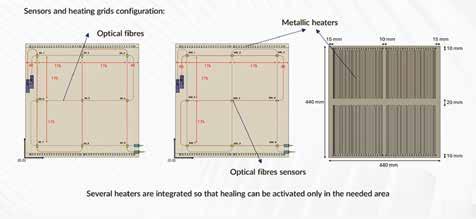
This latest development takes the concept significantly further. Under Project Cassandra—short for Composite Autonomous SenSing AnD RepAir—the research team integrated a network of fibre-optic sensors directly into the HealTech composite material. These sensors continuously monitor the condition of the structure and identify the location of emerging damage. Once damage is detected, integrated heating elements activate
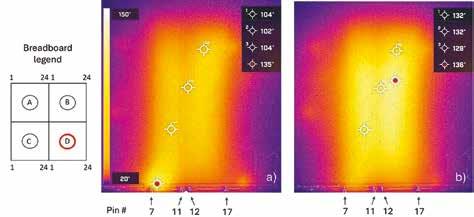
Infrared images of the Cassandra repair process on a test sample through heating. Image via ESA
The Cassandra test panel. Image via ESA
the repair process automatically.
The prototype combines several advanced technologies within a single structural component. Fibre-optic sensor networks provide continuous health monitoring, while integrated 3D-printed aluminium heating grids deliver controlled heating to the affected area. The material is heated to between 100°C and 140°C, activating the healing agent contained within the composite resin.
The result is a structure capable of both identifying damage and initiating its own repair process. This combination of structural health monitoring and autonomous repair has long been a goal for aerospace engineers seeking to improve reliability while reducing maintenance requirements.
DEMONSTRATING PERFORMANCE UNDER SPACE CONDITIONS
To evaluate the concept, the project team produced a series of test articles ranging from small samples measuring 2cm by 10cm to larger demonstrator panels measuring 40cm by 40cm. Testing focused on three key areas: damage detection capability, heating uniformity and repair effectiveness.
Researchers also conducted thermal shock testing to assess how the material responds to conditions representative of cryogenic fuel tanks. These tests are particularly relevant for launch vehicle applications, where structures can experience rapid and extreme temperature fluctuations during operation.
The successful demonstration suggests the technology may be suitable for larger spacecraft structures, including propellant storage systems. The next phase of development will focus on scaling the technology to larger geometries, with researchers targeting a complete cryogenic fuel tank as a future demonstrator. For spacecraft designers, the ability to integrate sensing, diagnostics and repair functions directly into structural components could fundamentally change how future vehicles are designed, maintained and certified.
SUPPORTING REUSABLE LAUNCH SYSTEMS
The emergence of reusable launch vehicles has transformed the
Cassandra demonstrator diagram. Image via ESA
economics of space transportation. However, achieving rapid turnaround between missions remains a significant engineering challenge.
Structural inspection and maintenance activities continue to account for a substantial portion of refurbishment effort. Technologies capable of reducing these requirements could therefore have a major impact on operational efficiency.
Bernard Decotignie of ESA believes the technology could play an important role in future transportation architectures: “Implementing this technology into our systems could have enormous benefits for space transportation. It will help develop reusable space infrastructure and reduce mission costs. This really proves what European innovation can do for the space sector.”
The environmental benefits are also noteworthy. Extending component life and reducing the need for replacement hardware could help minimise material waste associated with future space programmes.
FROM SCIENCE FICTION TO REALITY
For CompPair, the project demonstrates how advanced materials can move beyond passive structural functions to become active participants in vehicle health management.
“I’m excited by the autonomy and durability benefits we can bring for the future spacecrafts and launchers, closing the gap between sciencefiction and reality!” says CompPair chief technology officer Robin Trigueira. “This project is a major step for CompPair in the space sector,
HealTech is unlocking unprecedented technological advancement for composite material health monitoring and management, clearly highlighting the possibilities brought by healable composites for reusable space structure costs efficiency.”
The ability to combine sensing, diagnostics and repair capabilities within a lightweight composite system could open new possibilities not only for launch vehicles but also for satellites, orbital infrastructure and future deepspace missions.
Looking ahead, CompPair’s head of research and development, Cecilia Scazzoli, sees broad potential for the technology in demanding aerospace applications: “I’m thrilled that we have demonstrated that HealTech composites with health monitoring and heating systems show autonomous damage sensing and healing and high resistance to micro-cracking. This makes them suited to the demanding requirements of propellant tanks and reusable space structures, and paves the way for lighter, more maintainable spacecraft components.”
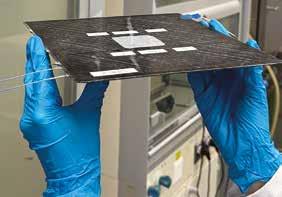
The Cassandra demonstrator panel in the lab. Image via ESA
Composites
Trade Association
“Composites UK has been really important to us as a company over the last few years. It provides access to industry specific advice that an SME like us would struggle to source otherwise. Additionally, the networking opportunities give us a place to keep upto-date with industry developments.”
Lyndon Sanders, Director, Far-UK
Composites UK is the Trade Association for the UK composites industry.
Across the UK each member of Composites UK receives the opportunity to:
• Save money
• Save time
• Boost their impact
• Expand their network
• Secure their future
Capitalise on the growth of the Global composites market and join the expanding list of Composites UK member companies today.
“Our visibility across the composites community has not only increased since becoming members but also continues to allow us to deepen our knowledge about this innovative sector by working with our industry peers and specialists. Everyone at Composites UK is a pleasure to work with and we are looking forward to what is next in store.”
Julia Loeser, Sales and Marketing, DK Holdings
SUSTAINABLE JOINTS
Can advanced composites become truly circular? How resistancewelded CF/LM PAEK structures could transform automotive and aerospace sustainability
For decades, carbon-fibre composites have delivered the lightweight performance demanded by the aerospace and automotive sectors. Their exceptional strength-to-weight ratio has enabled significant reductions in vehicle mass, improved fuel efficiency and increased structural performance. Yet despite these advantages, composites have faced a persistent sustainability challenge: what happens when a component reaches the end of its useful life?
Traditional thermoset composites are notoriously difficult to repair, separate and recycle. Once cured, their polymer matrices cannot be remelted, making disassembly and material recovery both technically challenging and economically unattractive. As a result, many high-value composite components ultimately follow linear rather than circular material pathways.
A recent study investigating resistance-welded carbon-fibrereinforced low-melt poly(aryl ether ketone) (CF/LM-PAEK) composites suggests a different future may be
possible. By optimising both the welding and separation processes, researchers from Technical University of Braunschweig and Leibniz University Hannover have demonstrated that high-performance thermoplastic composite joints can be assembled, disassembled and potentially re-used, offering a compelling route towards circular composite structures.
MOVING BEYOND PERMANENT JOINTS
The emergence of thermoplastic composites has already begun reshaping thinking around lightweight structures. Unlike thermoset materials, thermoplastic
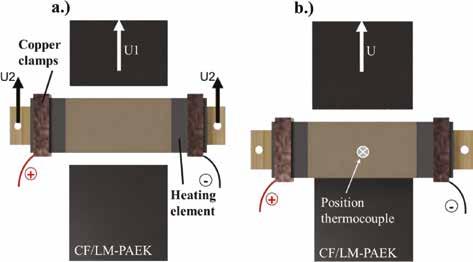
Schematic of the joint separation during resistance heating. With (a) complete separation of both adherends and the heating element; U1 and U2 denote the displacements at two distinct points in time; (b) partial separation, where only the upper adherend is lifted; U indicates the displacement
matrices can be reheated and remelted, enabling welding processes that eliminate the need for mechanical fasteners or adhesives. This characteristic offers several advantages. Resistance welding enables rapid assembly, reduced part counts and lower manufacturing complexity while preserving the excellent mechanical properties associated with continuous carbonfibre reinforcement. Thermoplastic composites also offer strong impact resistance, high fracture toughness and excellent chemical durability. However, the most important implication may be their potential contribution to circular manufacturing. Rather than creating permanently bonded structures, resistance welding creates joints that can potentially be separated in a controlled manner. This capability allows engineers to consider repair, refurbishment, component replacement and material recovery much earlier in the product lifecycle. For industries increasingly focused on lifecycle performance rather than simply manufacturing efficiency, this represents a significant shift.
OPTIMISING STRENGTH AND DISASSEMBLY
The study focused on understanding how welding parameters influence the performance of resistance-welded CF/ LM-PAEK lap joints. Using a Taguchi experimental design and analysis of variance, the researchers evaluated the influence of welding time, power and pressure on joint strength. The optimised process produced lap-
Lap-shear welding configuration according to DIN EN 1465 with a HE covered with LM-PAEK matrix on both sides (all dimensions are in mm)
COMPOSITES
Fracture surface after lap shear testing of a re-welded CSW sample: (a) fracture surface overview; (b) and (c) magnified views of selected regions
shear strengths of approximately 50MPa, demonstrating that resistance welding can generate structurally robust joints suitable for demanding engineering applications. More significantly, a postweld annealing process further increased performance, raising lap-shear strength to more than 63MPa.
These findings are important because circularity cannot come at the expense of structural integrity. Automotive and aerospace designers require joining methods capable of delivering production-ready performance while simultaneously supporting repair and recovery strategies.
ENABLING DESIGN FOR DISASSEMBLY
One of the central principles of the circular economy is designing products so that valuable materials can remain in use for as long as possible. For composite structures, this often means enabling inspection, repair, remanufacture and eventual material recovery. Historically, this has been difficult to achieve. Adhesively bonded or co-cured composite assemblies are frequently challenging to separate without damaging the underlying materials.
Resistance-welded thermoplastic composites offer a fundamentally different approach. Because the joining mechanism relies on localised melting of the thermoplastic matrix, joints can be intentionally separated under controlled conditions. The study specifically investigated both
joining and controlled disassembly, highlighting the potential for reversible assembly strategies in future composite structures.
For automotive manufacturers, this could support component replacement and refurbishment programmes that extend vehicle life while reducing waste. For aerospace applications, it could enable repairable structural assemblies that minimise replacement of high-value composite components.
A STRONG FIT FOR AEROSPACE APPLICATIONS
The aerospace sector may be particularly well positioned to benefit from these developments.
Carbon-fibre-reinforced thermoplastics have attracted growing interest because they combine lightweight performance with weldability and rapid manufacturing. Researchers note that thermoplastic composites offer significant advantages compared with conventional materials, including high strength, corrosion resistance and improved processability. They also support lightweight structures capable of reducing aircraft mass and improving operational efficiency.
Importantly, welding technologies can also simplify maintenance operations. Resistance welding enables damaged sections to be repaired or replaced more easily than traditional bonded structures, helping to extend service life and reduce downtime.
As aerospace manufacturers face increasing pressure to improve sustainability across the full lifecycle of aircraft structures, recoverable thermoplastic composite assemblies could become an important enabling technology.
IMPLICATIONS FOR AUTOMOTIVE LIGHTWEIGHTING
The automotive sector faces a similar challenge. Lightweight composites offer significant opportunities to reduce vehicle mass, extend electric vehicle range and lower energy consumption. However, regulators and manufacturers are increasingly demanding evidence that lightweight materials can also support circular-economy objectives. Resistance-welded CF/LM-PAEK structures align closely with these requirements. By supporting both high-performance lightweighting and controlled disassembly, they create opportunities for repair, remanufacture and material recovery that are difficult to achieve with conventional composite architectures.
TOWARDS CIRCULAR COMPOSITE STRUCTURES
The significance of this research extends beyond welding process optimisation. It highlights a broader transition occurring within advanced composites engineering—from designing purely for performance towards designing for performance throughout multiple life cycles. By demonstrating that thermoplastic composite joints can be both structurally robust and intentionally separable, the study provides a practical foundation for future composite structures that are lighter, repairable and ultimately more circular. For aerospace and automotive engineers pursuing ambitious sustainability targets, that combination could prove increasingly valuable in the years ahead.
The study ‘Sustainable joints in thermoplastic composites: An experimental study of disassembly and re-welding’ is published in Materials Design
GRAPHENE GENERATION
Graphene reinforcements could open up a new generation of lightweight hydrogen storage tanks
As hydrogen gains momentum as a lowcarbon energy carrier, the challenge of storing it safely and efficiently remains a major engineering hurdle. For automotive and aerospace applications in particular, the performance of hydrogen storage tanks (HSTs) is governed by a delicate balance between weight, strength and safety.
Current Type IV hydrogen storage tanks, which combine polymer liners with carbon fibre/epoxy composite overwraps, have emerged as the dominant solution for transport and aerospace applications because of their high gravimetric efficiency and lightweight construction. However, the industry continues to seek materials capable of further improving structural performance without adding mass.
A new study investigating graphene and related materials (GRMs) suggests that nanoscale reinforcement could provide a significant step forward. By evaluating several commercially available graphene materials alongside a novel microwave-assisted graphene intermediate (MGI), researchers have identified how graphene morphology, crystallinity and dispersion behaviour
The study demonstrates MGI as a cost-effective and scalable alternative for the cost-effective and sustainable design of carbon fibre/epoxy laminate-based HSTs
influence the performance of carbon fibre/epoxy laminates intended for hydrogen storage applications.
WHY GRAPHENE MATTERS FOR HYDROGEN STORAGE
Hydrogen storage tanks face demanding requirements. Hydrogen’s low volumetric energy density means tanks must withstand extremely high pressures while remaining as light as possible. Traditional engineering approaches often increase wall thickness to improve safety, but doing so adds weight, reducing gravimetric storage capacity and limiting system efficiency.
(a) Fabrication process; (i) GRM mixing with epoxy resin, (ii) homogenous dispersion of GRM in epoxy resin using stirring and probe sonication, and (iii) Fabrication of carbon fibre/epoxy laminates, and (b) SBSS testing, and (c) impact test rig for LVI test
Carbon fibre/epoxy composites have already proven effective in reducing weight while maintaining structural performance. However, researchers are increasingly looking at nanoscale reinforcements to further improve fibre-matrix interactions and enhance composite performance.
Among the available options, graphene and related materials have attracted considerable attention because of their exceptional mechanical properties and hydrogen barrier characteristics. The study notes that graphene’s layered structure, large flake sizes and rippled morphology make it particularly effective at enhancing both composite strength and hydrogen barrier performance, even at concentrations below 1wt%. The challenge, however, is that not all graphene materials perform equally well.
COMPARING GRAPHENE REINFORCEMENT STRATEGIES
The research compared four graphene-based materials incorporated into carbon fibre/epoxy laminates:
• Microwave-assisted graphene intermediate (MGI)
• Bottom-up graphene material 1 (BGM1)
• Bottom-up graphene material 2 (BGM2)
• Top-down graphene material (TGM)
Production process of (a) MGI, and spider diagram comparison of (b) energy demand and (c) production cost for four GRM alternatives (MGI, BGM1, BGM2, and TGM)
A key objective was to identify which graphene morphology delivers the greatest benefit when used as reinforcement in hydrogen storage tank structures. The researchers found that MGI possessed a distinctive expanded, worm-like structure with large flake dimensions and hierarchical porosity. Unlike conventional graphene materials, this morphology promoted resin infiltration, enhanced interfacial bonding and improved load transfer between the carbon fibres and epoxy matrix.
Morphological analysis showed that MGI featured partially exfoliated structures with average flake dimensions of approximately 32μm and interconnected pore networks extending across multiple length scales. This architecture created additional surface area while preserving structural integrity.
THE IMPORTANCE OF DISPERSION
One of the most important findings was the relationship between graphene dispersion and mechanical performance. Using Raman mapping, the researchers evaluated how evenly each graphene material dispersed throughout the epoxy matrix. Uniform dispersion proved critical because it enabled effective stress transfer and prevented localised stress concentrations.
For MGI, dispersion remained highly uniform up to a loading of 0.1wt%. Beyond this concentration, agglomeration became increasingly apparent and mechanical performance began to decline. Similar clustering effects were observed for the other graphene materials at even
lower concentrations.
The study concluded that welldispersed graphene particles strengthen the interlaminar region by bridging microcracks and improving fibre-matrix interaction. However, excessive graphene loading introduces structural irregularities that can undermine laminate performance.
SIGNIFICANT GAINS IN MECHANICAL PERFORMANCE
The most compelling results emerged during short-beam shear testing, which evaluates the quality of fibre-matrix bonding and interlaminar strength. Carbon fibre/epoxy laminates containing 0.1wt% MGI achieved the highest performance, increasing short-beam shear strength by approximately 20% compared with unmodified laminates. The resulting strength reached 68.9MPa, outperforming all other graphene variants tested. The researchers attributed these gains to the combination of effective stress transfer, enhanced interfacial bonding and the crack-bridging behaviour enabled by the MGI structure.
Structural characterisation also revealed that MGI maintained the highest sp² carbon content among all materials evaluated while exhibiting relatively low oxygen functionality and limited structural defects. This combination preserved graphene’s intrinsic mechanical properties while still providing sufficient surface activity for strong interaction with the epoxy matrix.
IMPROVED IMPACT RESISTANCE
Hydrogen storage tanks must also tolerate accidental impacts and operational damage without catastrophic failure. To evaluate damage tolerance, the research team conducted low-velocity impact testing at 20J. Once again, MGI delivered the strongest performance.
Compared with unmodified laminates, MGI-reinforced composites increased peak contact force by approximately 25% and improved energy absorption by approximately 14%. The researchers observed evidence of crack deflection, matrix plastic deformation and crackbridging mechanisms that contributed to improved damage tolerance. These findings are particularly relevant for aerospace and transport applications, where impact resistance is a critical design consideration.
NEXT-GEN HYDROGEN STORAGE STRUCTURES
Both TOPSIS and EXPROM2 analyses independently identified MGI as the highest-performing option. Researchers concluded that its combination of large flake dimensions, preserved graphitic structure, controlled porosity and strong mechanical performance provided a clear advantage over existing commercial graphene materials.
Importantly, MGI also demonstrated the lowest energy demand and production cost among the materials studied, positioning it as a potentially scalable solution for future composite manufacturing.
The paper concludes that, as hydrogen-powered vehicles and aerospace platforms continue to evolve, graphene-reinforced carbon fibre composites may play an increasingly important role in delivering the lightweight, durable and safe storage systems required to support a hydrogen-based future.
The study ‘Microwave-assisted graphene intermediates for carbon fibre reinforced composite cylinders: achieving sustainability through state-of-the-art graphene and related materials’ is published in Materials & Design
MEDICAL MANUFACTURING
A recent case study from SPIROL details how limitations associated with adhesive bonding can be eliminated for medical device handles
SPIROL’s Press-N-Lok Pin was designed to permanently retain two plastic components to each other, manufactured from lightweight, lead free, corrosion resistant aluminium. One major advantage of the pin is that assembly time is quicker and it requires lower assembly equipment costs when compared to screws and adhesives. This latest case study from the global fastener manufacturer explains how the pins helped a medical device manufacturer improve the assembly of its medical device handles.
THE PRIOR SOLUTION
A medical device manufacturer was using adhesive to join two halves of a plastic housing for a medical device handle. Although glue initially
provided a practical joining method, it created several challenges during manufacturing. Precise dispensing was required to prevent excess adhesive, uneven bond lines, and cosmetic defects. In addition, the required curing time slowed production by creating delays and increasing workin-process inventory.
The adhesive application also introduced inconsistency into the assembly process. Too little adhesive could reduce joint strength, while over-application could spread into surrounding features and require additional cleanup. As a result, the manufacturer sought a fastening method that would deliver greater process control, improved repeatability, and higher production efficiency.
To address these issues, the medical
device manufacturer reached out to SPIROL for help identifying a fastening solution that would simplify assembly, support highervolume production, and eliminate the limitations commonly associated with adhesive bonding.
THE SPIROL SOLUTION
SPIROL Engineering recommended Press-N-Lok Pins as the ideal solution for the medical device handle. Specifically designed for plastic applications, Press-N-Lok Pins allow for quick, controlled installation, making them particularly well suited for high-volume medical device manufacturing environments where consistency and cycle time are critical. Unlike adhesives that require careful application and curing, Press-
FASTENERS &
N-Lok Pins are installed through a straightforward press-in process that provides immediate retention. This eliminates cure-time delays and helps streamline production operations. Because the retention is mechanical rather than chemical, the assembly method becomes more predictable and less dependent on operator technique or adhesive variability.
Press-N-Lok Pins securely join the plastic housing halves while supporting a clean, efficient assembly operation. Transitioning from adhesive bonding to a mechanical fastening solution also enabled the manufacturer to reduce process complexity, improve line productivity, and minimise the risk of assembly defects associated with inconsistent adhesive application.
THE RESULT
By replacing adhesives with SPIROL Press-N-Lok Pins, the medical device manufacturer improved assembly consistency, increased throughput, reduced process variation, and achieved a more dependable fastening solution for its medical device handle.
How technical requirements are reshaping fastener selection
As industries pursue lightweighting, electrification, automation and higher levels of structural performance, the industrial fasteners market is continually evolving to meet increasingly demanding applications. According to a recent analysis of the global industrial fasteners market by Mordor Intelligence, these changing requirements are driving steady growth across the sector, with the market expected to increase from $92.13 billion in 2026 to $113.33 billion by 2031.
More importantly for design engineers, the report highlights how technical requirements are reshaping fastener selection across automotive, aerospace, construction and industrial machinery applications.
AUTOMOTIVE AND AUTOMATION DRIVES DEMAND
One of the strongest drivers is the ongoing electrification of transportation. While electric vehicles often contain fewer fasteners than conventional vehicles, the performance requirements placed on those fasteners are significantly higher.
Battery pack assemblies must withstand repeated thermal cycling while maintaining clamping force and structural integrity. As a result, manufacturers are increasingly specifying specialised fastening solutions, including torque-to-yield screws capable of maintaining preload through temperature ranges from -40°C to +85°C. This shift is increasing the value and complexity of individual fasteners even as overall fastener counts decline.
The automotive sector remains the largest consumer of industrial
fasteners, accounting for 33.47% of market demand in 2025. However, the report identifies industrial machinery and robotics as the fastest-growing application segment, with projected growth of 5.66% annually through 2031.
This trend reflects the growing precision requirements of modern manufacturing systems. Collaborative robots, automation equipment and advanced production machinery increasingly rely on miniature, highprecision fastening systems capable of meeting tight dimensional tolerances while maintaining reliability in dynamic operating environments.
AEROSPACE ADVANCES INNOVATION
Aerospace represents another significant area of technical development. Although aerospace fasteners account for a relatively small proportion of overall fastener volumes, they are forecast to be the fastestgrowing product category, expanding at 5.07% annually through 2031. The sector’s requirements for lightweight materials, traceability and extreme environmental performance continue to drive innovation in fastener design and manufacturing.
Titanium fasteners are increasingly specified for high-temperature and weight-sensitive applications, while nickel-based superalloy fasteners are being deployed in environments approaching 700°C. Certification requirements, including AS9100 compliance and extensive non-destructive testing, further differentiate aerospace fasteners from standard industrial products.
MATERIAL SELECTION IS EVOLVING
Metal fasteners accounted for 49.23% of market revenue in 2025 and are
expected to maintain their dominant position. Carbon steel remains the primary choice for many structural applications because of its balance of strength and cost, while alloy steels continue to serve fatigue-critical applications such as automotive drivetrains and suspension systems. Stainless steel remains important where corrosion resistance is essential, although fluctuating nickel and molybdenum prices are encouraging some manufacturers to explore alternative material options.
At the same time, engineers are increasingly evaluating polymer fasteners for non-structural applications. Advances in reinforced engineering polymers have expanded their use in electronics, appliances and lightweight assemblies, although their lower mechanical performance continues to limit adoption in highload applications.
The report also highlights the growing influence of infrastructure investment on fastener technology. Offshore wind projects, seismicresistant construction and major transportation infrastructure developments are increasing demand for large-diameter, highstrength fastening systems capable of operating reliably in harsh environments for decades. These applications increasingly require advanced materials, corrosionresistant coatings and full traceability throughout the supply chain.
According to the report, whether supporting electric vehicle battery systems, aerospace structures, robotic automation cells or offshore renewable energy installations, fastening technologies are becoming increasingly specialised and application-specific.
Manufacturers are placing greater importance on lifecycle support
ADVANCING AUTOMATION
The challenges of upscaling liquid production from semi-automatic to fully automated
As production demand increases, many liquid manufacturers eventually reach the limits of semiautomatic processing. While moving to fully automated production can significantly improve throughput and consistency, the transition presents a range of engineering challenges that extend beyond simply increasing machine speed.
THE CHALLENGES
One of the primary difficulties is maintaining product consistency at higher outputs. Semi-automatic systems often rely on operator adjustments to compensate for variations in viscosity, foaming
characteristics or fill tolerances. At increased production speeds, manual intervention becomes less practical, making accurate process control far more important.
To achieve consistent performance, filling systems must work in close synchronisation with conveyors, cap feeding systems, labelling equipment and downstream packaging machinery. In many cases, production inefficiencies are caused not by the filling process itself, but by instability elsewhere on the line. Poor conveyor management, accumulation issues or inconsistent product spacing can quickly reduce overall throughput and increase downtime.
Container handling also becomes
more challenging as line speeds increase. Lightweight plastic bottles and non-standard packaging formats can become unstable during transfer between machines, particularly where conveyors are not correctly configured for product type or speed. This can lead to rejected products, inaccurate labelling or interruptions further downstream.
LOOKING LONG-TERM
Another important consideration is scalability. Many manufacturers cannot replace entire production systems in a single phase and instead choose to automate gradually. This requires new equipment to integrate with existing machinery, controls and
factory layouts while still allowing future expansion. Modular line design and flexible automation architecture are therefore essential when planning long-term production growth.
LIFECYCLE SUPPORT
As production lines become more integrated, downtime reduction also becomes increasingly important. Automated systems can improve efficiency and reduce labour dependency, but they also place greater emphasis on preventative maintenance and technical support. A fault in one section of the line can quickly affect overall production performance, particularly in high-speed environments where interruptions rapidly create backlogs. For this reason, manufacturers are placing greater importance on lifecycle support, planned servicing and remote diagnostics when investing in automation. Longterm operational reliability is often determined as much by engineering support and maintenance strategy as by the equipment itself.
DATA AND ENERGY CONSIDERATIONS
Data monitoring is also playing a larger role within automated liquid production. Modern systems can provide detailed information relating to throughput, reject rates and machine efficiency, allowing manufacturers to identify recurring issues and improve overall line
Container handling becomes more challenging as line speeds increase
Ultimately, scaling from semi-automatic to fully automated liquid production requires a balanced engineering approach focused on stability, flexibility and long-term reliability
performance. However, effective automation depends on using this data to support practical operational improvements rather than simply increasing system complexity.
Energy efficiency is another growing consideration. As production capacity increases, manufacturers are looking more closely at reducing utility consumption, minimising product waste and improving overall operational efficiency through smarter system design.
Ultimately, scaling from semiautomatic to fully automated liquid production requires a balanced engineering approach focused on stability, flexibility and long-term reliability. Manufacturers that prioritise full-line integration and ongoing support are typically better positioned to increase throughput while maintaining consistent product quality and operational performance.
PACKAGING EQUIPMENT
LABELING
CARD
FILLING MACHINES
SLEEVING MACHINES
MOTORS, DRIVES, CONTROLS
Lenze works with OEMs and suppliers to ensure that machines are energy-aware and future-proof by design
GRID CONGESTION
Marc Vissers explains how grid congestion can turn from a constraint to a strategic design parameter
Across Europe, grid congestion is no longer a technical bottleneck confined to infrastructure discussions. It is rapidly evolving into a strategic design parameter for industry.
In countries such as the UK, long connection queues, rising constraint costs and regulatory reform have pushed the issue into the boardroom. This is not an isolated case, but a leading indicator of a broader European shift in which access to energy is becoming less predictable, more regulated and increasingly decisive for industrial investment.
A SHIFT IN INDUSTRIAL LOGIC
This transition is changing how industry defines performance. Competitiveness was once driven mainly by scale: more output, more speed, more power. That logic is losing relevance. Today, the best machine is no longer simply the most powerful, but the one that can deliver reliable output within increasingly tight energy limits.
Controllability, flexibility and resilience are moving from
Those that contribute to energy intelligence move up the value chain
engineering concerns to board-level decision criteria. Grid constraints now influence plant location, project timelines and investment feasibility. As such, energy availability is becoming a decisive factor in industrial competitiveness.
EUROPE: ONE CHALLENGE, DIFFERENT REALITIES
The trend is pan-European, but the way congestion manifests differs by region. In the Netherlands and parts
of Germany, grid saturation has led to connection restrictions and delays, forcing companies to rethink expansion. The UK is addressing structural inefficiencies through reform but still faces long lead times for new connections. Southern Europe is balancing renewable growth with local constraints, while the Nordics are preparing for similar pressure as electrification accelerates.
Despite these differences, the strategic implication is consistent: energy availability is no longer
MOTORS, DRIVES, CONTROLS
guaranteed, and industrial resilience depends on how effectively companies can operate within these constraints.
FROM ENGINEERING FEATURE TO BUSINESS IMPERITIVE
This shift is redefining machine and system design. Capabilities such as intelligent control, energy management, buffering and regeneration are no longer incremental improvements; they are essential to maintain performance in a constrained energy landscape.
Software plays a central role as the layer that makes energy consumption visible, controllable and economically defensible. It helps companies align production with available capacity, reduce peak loads and create a more predictable operational footprint.
A pragmatic first step is to bring energy considerations earlier into the design phase. Tools such as Lenze’s Easy System Designer can help engineers model and dimension drivebased applications earlier, improving
visibility into system behaviour before implementation. In that role, software is not a commercial add-on, but a practical instrument for more robust design choices.
For OEMs and machine builders, designing with constrained capacity in mind is no longer optional but a prerequisite for relevance.
THE RIPPLE EFFECT
This transformation also extends into the supplier ecosystem. As energy becomes a constraint, every component contributes to overall system behaviour. Performance is no longer defined solely by speed or output, but by how effectively energy is used, controlled and balanced over time.
OEMs increasingly expect suppliers to provide components that deliver real-time energy data, support dynamic load control and minimise peak demand. Without that transparency and controllability, suppliers risk becoming a limiting factor in system design.
Those that contribute to energy
Energy considerations should be brought into the design phase earlier
intelligence move up the value chain by enabling machines that are easier to connect, more predictable in operation and more resilient under constrained conditions. At Lenze, this ecosystem perspective is central. By combining drives technology, automation and software, Lenze works with OEMs and suppliers to ensure that machines are not only highperforming, but also energy-aware and future-proof by design.
FROM CONSTRAINT TO VALUE CREATION
The strategic question is no longer whether congestion matters, but whether current investment choices reflect the conditions under which industry will have to operate.
Companies that act early can move from reactive adaptation to proactive value creation by designing machines that are easier to connect, plants that are more resilient and production systems that respond dynamically to energy availability. Lenze supports this transition by enabling energy transparency, controllability and system-level optimisation.
DRIVING THE DIALOGUE
Given the strategic impact of grid congestion, awareness and dialogue remain essential. Lenze contributes to that dialogue through knowledge sessions and industry engagements, including events, alongside online sessions, workshops and one-toone conversations. The aim is not to highlight the problem, but to accelerate understanding of practical, future-proof approaches.
LOOKING AHEAD
Grid congestion marks a structural shift in how industry operates. It challenges assumptions about growth, capacity and efficiency, but also creates opportunity.
The companies that will lead are not those waiting for infrastructure to catch up. They are the ones redesigning their systems – and their ecosystems – to operate within constraint.
CLOSING THE SKILLS GAP
Kate Ellison, VP HR at John Crane, explains how apprenticeships provide a vital solution to the engineering skills gap
UK industry is navigating a complex mix of pressures, including faster technology cycles, the energy transition, and persistent productivity challenges. Alongside these trends, employers are grappling with another issue that has become impossible to ignore: the growing gap between the skills organisations need and those available in the market.
Recent research from the Institution of Engineering and Technology found 76% of UK engineering employers are struggling to fill key roles, with gaps particularly evident in technical and sustainability-related capabilities. That will feel familiar across the energy value chain. It is critical that we build the capabilities the U.K. needs and do it in a way that is scalable and inclusive. Apprenticeships and vocational training are often discussed as early-career routes into employment, and that is absolutely true. But to genuinely increase national capability, we need to treat them as something broader. We need to treat them as a strategic workforce mechanism that builds skills at multiple career stages, aligned to business need and (perhaps most importantly) designed for retention as well as recruitment.
THE UPSKILLING PROBLEM
The current challenge is a mismatch between the skills organisations have and the skills roles now require. Businesses are adopting digital tools, strengthening safety and compliance processes, and responding to customer expectations that increasingly include sustainability outcomes. The growth of hydrogen, carbon capture, sustainable fuels and electrification is also creating demand for the new technical capabilities that did not exist at scale a decade ago.
Traditional hiring alone can’t keep up. Graduate routes take time, and experienced hires are scarce. At the same time, many young people are struggling to access the first rung of the career ladder, with graduate opportunities reportedly down year-on-year and an estimated one million 16-24-year-olds not in employment, education and training. That combination makes vocational routes like apprenticeships even more important. They convert potential into capability through structured, paid, in-work learning.
One area where I believe we still have work to do is improving awareness of degree-level
apprenticeships. Too many young people and parents remain unaware that it is possible to gain a university equivalent qualification while working, earning and developing real-world experience. These programmes broaden access to engineering careers, provide recognised qualifications without the significant debt often associated with full-time university study, and enable employees to develop skills directly aligned with industry needs. As we look to address the engineering skills gap, helping more people understand these opportunities is just as important as creating them.
Crucially, they also create a clearer line of sight between learning and productivity. When programmes are tied to real operational requirements and specific roles, apprenticeships become a practical route to developing role-specific expertise without waiting for the wider labour market to catch up. For employers, they can also help reduce recruitment costs, improve retention and create a more sustainable pipeline of critical skills.
A MODERN VIEW
A common misconception is that apprenticeships are only for school leavers. In reality, some of the most
Expertise from specialist training providers is invaluable
valuable activities are with existing employees. Particularly if that’s people who know the organisation and can grow into new roles with the right support.
At John Crane in the UK today, we have 44 apprentices on a range of pathways. 20 are new earlycareer recruits joining through apprenticeship standards spanning
engineering, marketing, data, HR, software, procurement and supply chain. The remaining 25 are existing employees who are upskilling or reskilling through programmes including AI, coaching, leadership and management, lean methodologies, digital technologies and project management.
Looking ahead, we are also exploring
how emerging apprenticeship and skills initiatives can help us further develop the capabilities in areas such as AI. While AI is often discussed as a technology challenge, it is equally a workforce challenge, requiring employees across functions to develop skills and confidence in using these tools effectively.
Many of these programmes are directly aligned to succession planning and future capability requirements, helping ensure we develop talent in areas where specialist engineering expertise is becoming increasingly difficult to source. This reflects the reality of modern industrial work. Performance depends on technical capability. But it also depends on strong leadership, project delivery, digital confidence and continuous improvement. All of these skills can be built through structured vocational routes.
PROGRAMMES IN PRACTICE
The difference between apprenticeships that build capability and those that become a wellintentioned initiative ultimately comes down to execution. It’s important that we integrate apprenticeships into workforce planning. We need to move beyond annual intake targets and, instead, focus on the roles and skills that are needed in 12–24 months.
Line managers also play a critical role. Apprenticeships are most successful when managers actively coach, support and create opportunities for individuals to apply their learning in real operational environments. We also need to govern quality and consistency.
John Crane works with around 19 training providers across the UK. That access to specialist expertise is valuable, and it increases the need for clear standards, feedback loops and alignment between learning and operational needs.
If we want to close the UK’s engineering skills gap, apprenticeships and vocational training need to be embedded into core workforce planning. They are not simply a route into employment; they are a strategic investment in the future capability, competitiveness and resilience of U.K. industry.
John Crane has 44 apprenticeships on a range of pathways
Apprenticeships should be integrated into workforce planning
The Advanced Materials Show returns to the NEC Birmingham on 8–9 July 2026, bringing together the entire advanced materials supply chain under one roof.
Designed for engineers, researchers and technology leaders, the event provides a focused platform for exploring the latest developments in materials science, manufacturing processes and commercial applications. From early-stage research through to large-scale production, the exhibition attracts professionals involved in the specification, development and implementation of advanced materials technologies.
Visitors will have the opportunity to explore innovations spanning composites, polymers, ceramics, metals, coatings, adhesives, sealants, nanomaterials and advanced textiles. Exhibitors from sectors including aerospace, automotive, medical, electronics, construction, defence and energy will showcase technologies
ADVANCED MATERIALS ON SHOW FROM PROMISE TO PRODUCTION
Additive manufacturing in aerospace and defence has reached a pivotal stage.
The industry is no longer focused solely on demonstrating what metal additive manufacturing technologies can achieve, but on proving they can deliver repeatable, qualified and scalable production for mission-critical applications.
This transition from innovation to industrialisation forms the central theme of Additive Manufacturing
that are shaping future products and infrastructure.
Alongside the exhibition, a comprehensive conference programme will address the key technical and commercial challenges facing industry. Materials experts, R&D leaders and manufacturing specialists will present the latest research advances, discuss market developments and
Advantage: Aerospace, Space and Defense 2026 (AMAA 2026), which takes place online on 9 July. Organised by 3D Printing Industry, the specialist event brings together leading experts from aerospace, defence, space and advanced manufacturing to address the practical challenges facing additive manufacturing adoption.
The programme reflects the industry’s growing emphasis on certification, qualification and operational readiness. Sessions will explore topics including metal AM qualification, machine and material certification, wire arc additive manufacturing (WAAM), electron beam powder bed fusion, and the use of advanced refractory materials for extreme operating environments.
Speakers from organisations including NASA, RTX, Safran, GKN Aerospace, America Makes and Divergent Technologies will examine how additive manufacturing is progressing from prototype development to production deployment. Discussions will focus on the qualification pathways required
examine how advanced materials can improve performance, efficiency and sustainability.
For design engineers, the show offers valuable opportunities to compare suppliers, evaluate emerging technologies and identify practical solutions to real-world engineering challenges. Co-located with The Advanced Ceramics Show, Battery Cells and Systems Expo, and Vehicle Electrification Expo, the event provides a comprehensive insight into the technologies driving the next generation of engineering innovation.
A further highlight is the ScaleUp Accelerator, which supports the commercialisation of emerging materials technologies by connecting innovators and researchers with investors, technology scouts and industrial partners.
to support aerospace and defence applications, where reliability, repeatability and traceability remain essential.
Materials innovation also features prominently. Presentations will address the use of tungsten and niobium alloys for high-temperature applications, while electron beam technologies and advanced process control methods will be explored as manufacturers seek to improve consistency and production efficiency. Beyond conventional aerospace applications, the agenda examines emerging opportunities in defence autonomy, tactical manufacturing and electric aviation. Topics such as battery safety for eVTOL platforms and soldier-led innovation programmes highlight the widening role of additive technologies across multiple sectors.
The Advanced Materials Show returns to the NEC Birmingham
DESIGN ENGINEERING IN FOCUS
As product development cycles accelerate and engineering teams face increasing pressure to deliver smarter, faster and more sustainable designs, the Engineering Design Show (EDS) remains the UK’s leading event dedicated to mechanical, electronic and embedded design.
Taking place at the Coventry Building Society Arena on 7–8 October 2026, EDS brings together more than 4,500 visitors, over 200 exhibitors and more than 50 conference sessions and workshops, making it the largest UK event focused exclusively on design engineering.
The exhibition provides direct access to more than 1,000 products, technologies and services from UK
and international suppliers. Visitors can explore the latest developments in CAD software, product design tools, mechanical engineering solutions, embedded systems and electronic design technologies, alongside live demonstrations and hands-on exhibits.
For practising design engineers, the event offers an opportunity to address real-world engineering challenges by engaging directly with solution providers and evaluating emerging technologies. The Innovation Zone will showcase cutting-edge developments from established companies and start-ups alike, highlighting advances that could influence future design methodologies and product performance.
The free-to-attend conference programme examines the latest
trends, opportunities and technical challenges facing the sector. Industry experts and technology leaders will deliver keynote presentations and technical sessions covering topics ranging from advanced design practices to emerging engineering applications.
Practical workshops remain a key attraction, providing engineers with new tools and techniques that challenge conventional design approaches and encourage innovative thinking.
Alongside the technical content, EDS offers valuable networking opportunities across the engineering community, connecting design engineers, electronics specialists, embedded system developers, manufacturing professionals and engineering managers.
Boker’s Inc.
Boker’s, Inc., is a full-service manufacturer of precision metal stampings, washers, spacers and shims. Since 1919, nearly every industry around the world has trusted Boker’s to provide quality made-to-order components, world-class service and fast delivery.
T +1 612 729 9365
E sales@bokers.com
W bokers.com
Lenze
Lenze is a global automation specialist supplying drive, control and software solutions for machine builders. Its electromechanical and automation technologies support efficient industrial machinery across the lifecycle, from design and commissioning to operation and optimisation.
T +44 (0) 1234 753200
E sales.uk@lenze.com
W www.lenze.com
PCE Instruments
Develops, manufactures and distributes test instruments, scales and balances and selected laboratory equipment for industry, trade and research. In addition to pre- and after-sales support, calibration and repair are also offered.
T +44 (0) 161 464902 0
E info@pce-instruments.co.uk
W www.pce-instruments.com
GET INVOLVED
e advertising@setform.com
t +44 (0)207 253 2545
Gold & Wassall Hinges
With over two centuries of experience in the hinges industry, Gold and Wassall provides a fully comprehensive design and manufacturing service for any kind of hinge for practically any application.
T +44 (0)1827 63391
E enquiries@goldwassallhinges.co.uk
W goldwassallhinges.co.uk
LMI Technologies
As the global leader in 3D scanning and inspection, LMI Technologies works to advance quality and productivity with 3D sensor technology.
E contact@lmi3d.com W lmi3d.com
HIOKI
HIOKI, founded in Japan in 1935, leads precision test and measurement technology. Renowned for advanced electrical current sensors, power electronics, and battery solutions, we deliver uncompromised accuracy and innovation built and engineered in Japan.
T +49-(0)6196-76515-0
E hioki@hioki.eu
W shop.hioki.eu/
North Composites Engineering
A highly professional company who over the last 14 years have trained and actively empowered the composite sector. Experts in composite services, we provide world class training, consultancy and equipment to the Aerospace, Marine, Wind Turbine and Automotive sectors.
T +44 (0) 1942 665292
E info@northcompositesengineering.co.uk
W www.northcompositesengineering.co.uk
RECOM Power
RECOM produces standard and custom DC/ DC, AC/DC converters, switching regulators, and LED drivers from sub-1W to tens of kW. Headquartered in Gmunden, Austria, RECOM is known for quality, innovation, wand excellent customer service.
T +43 7612 883 25 700
E info@recom-power.com
W recom-power.com
Rutland Plastics
With 70 years of experience, we offer a full range of plastic injection moulding services across all sectors with the ability to make plastic parts from 1g to 45kg and up to 1.5m in size.