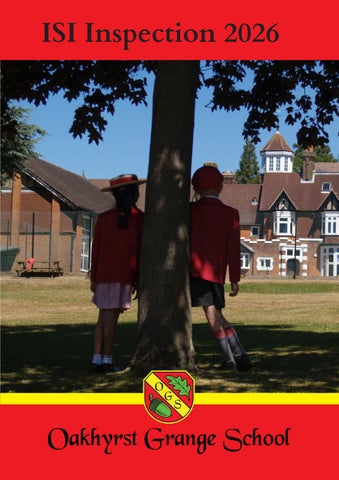
ISI Inspection 2026
A Very Special Moment for Oakhyrst Grange School Our ISI Inspection Report A Community Where Every Child Belongs Oakhyrst Grange School is delighted to share the findings of its recent Independent Schools Inspectorate (ISI) inspection. The inspection confirmed that the school meets all the required Independent School Standards across every area, including leadership and management, the quality of education, pupils' wellbeing and personal development, contribution to society and safeguarding. The findings reflect the school's strong commitment to providing an inclusive, nurturing and ambitious education, where every child is valued as an individual and encouraged to flourish. Inspectors recognised the distinctive character of Oakhyrst, highlighting the strength of its family-oriented community and the positive relationships that underpin school life.
The report describes Oakhyrst as: "An inclusive, caring and family-oriented community, where individuality is celebrated and diversity actively promoted." Of particular significance was the recognition that pupils themselves describe Oakhyrst as a 'family' – a reflection of the warmth, belonging and sense of community that are at the heart of the school's ethos. Inspectors also praised the school's "vibrant, broad and balanced curriculum", recognising the quality of teaching, strong academic foundations, excellent pastoral care and extensive opportunities for enrichment beyond the classroom. The report highlights pupils' positive attitudes to learning, good behaviour and the confidence, independence and resilience they develop throughout their time at the school.
The inspection further recognised the meaningful opportunities pupils have to take on responsibility, contribute to school life and make a positive difference within the wider community. Inspectors concluded that "pupils are confident and well prepared for moving on." These findings are further supported by exceptionally positive feedback from the school's parent, pupil and staff surveys: 100% of parents who responded said their child enjoys coming to school. 100% of pupils said their teachers give them the help they need to learn. 100% of pupils agreed that they enjoy opportunities to take part in activities beyond the classroom. 100% of staff agreed that the welfare of pupils comes first. The report also acknowledges the clear and shared vision of the school's leaders, staff and governors, the effectiveness of safeguarding arrangements and the strength of the partnerships established with families. This inspection represents an important milestone for Oakhyrst Grange School. It provides recognition not only of the standards achieved, but also of the dedication, ambition and collective commitment of the entire school community. As Oakhyrst looks ahead to its next chapter as part of the Caterham Family of Schools, it remains firmly committed to preserving the qualities that make the school distinctive: its warm family ethos, individual approach to education and determination to help every child achieve their full potential. Small enough to know every child. Ambitious enough to inspire every child. A school where every child belongs
Summary of findings:
“
Leaders ensure an inclusive, caring and family-oriented community, where individuality is celebrated and diversity actively promoted. Governors, leaders and staff share a clear vision promoting the school values of aspiration, kindness, respect, responsibility, resilience, curiosity and independence. Leaders work in partnership with parents to create a sense of belonging. As a result, relationships between staff and pupils are good, allowing pupils to develop and grow.
“ “
Leaders provide a vibrant, broad and balanced curriculum, enhanced by an extensive programme of extra-curricular activities. Teachers use their knowledge of pupils’ needs and detailed assessment information to adapt teaching and provide appropriate support and challenge. Provision for pupils who have special educational needs and disabilities (SEND) is well developed, with early identification and targeted support enabling pupils to make good progress from their starting points. Skilled teaching in the early years develops children’s knowledge and skills effectively, particularly in early reading, writing and mathematics.
Leaders foster a meaningful sense of community within the school and beyond. Pupils contribute positively to the wider community through charitable activities, local events and opportunities to build relationships with older generations. Through the eco-council, pupils develop an understanding of environmental responsibility and take an active role in promoting sustainability. The curriculum, visits and special events also develop pupils’ financial literacy and understanding of the wider economy.
“
Leaders establish and maintain an effective culture of safeguarding throughout the school. Staff identify, report and respond promptly to safeguarding concerns. Leaders take appropriate action and work with external agencies when necessary. As a result, pupils are well protected and their safety and welfare are prioritised.
Teaching, Learning & Co-Curricular
“
Leaders have designed a broad and balanced curriculum that meets the requirements for independent schools and the early years, developing pupils’ knowledge and skills in age-appropriate ways. Pupils develop their mathematical, scientific and language skills alongside their knowledge and skills in creative and artistic subjects. Leaders invest in appropriate resources and specialist expertise to support effective teaching, for example by employing specialist staff to teach subjects such as personal, social, health and economic education (PSHE).
“
Leaders have designed an early years curriculum that builds children’s knowledge and skills progressively across all areas of learning, with a clear emphasis on communication and language, phonics, early reading, writing and mathematics. Teachers use their knowledge of children’s starting points and ongoing assessment to plan and adapt activities that provide appropriate support and challenge. Through carefully structured phonics teaching, children learn to recognise letters and sounds and apply this knowledge in their early reading and writing. Purposeful activities help children develop their mathematical understanding and fine motor skills. As a result, children make good progress from their starting points and develop the knowledge, skills and confidence needed for the next stage of their education.
“
Teachers have secure subject knowledge and plan lessons that build on pupils’ prior learning. They use appropriate resources and adapt their teaching to provide support and challenge for pupils from different starting points. Learning is brought to life through engaging activities and meaningful links between subjects.
“
Senior leaders have established an assessment framework that enables teachers to monitor pupils’ attainment and progress, identify gaps in their knowledge and plan appropriate next steps. Teachers use assessment information to adapt their teaching and provide feedback that helps pupils understand how to improve. Pupils respond positively to this feedback and apply it to their work. As a result, pupils build securely on their prior learning, develop their knowledge and skills and make good progress.
“
Teachers establish positive relationships and clear expectations that encourage pupils to approach learning with enthusiasm and confidence. Pupils engage readily in lessons, respond positively to challenge and take pride in their work. They are willing to contribute their ideas, explain their thinking and persevere when tasks are difficult. These positive attitudes help pupils make the most of the learning opportunities provided.
“
Leaders identify and assess the needs of pupils who have SEND and use this information to plan appropriate support. They review pupils’ progress regularly and adjust provision where necessary. Teachers adapt their teaching through targeted support, scaffolding and additional opportunities to practise and consolidate learning. As a result, pupils with SEND are supported to access the curriculum, develop their knowledge and skills and make good progress from their starting points.
Health & Wellbeing
“
Staff have high expectations and use positive approaches, adapting support to meet pupils’ individual needs. As a result, pupils behave well, positive relationships are established and the school provides a calm and supportive learning environment. Leaders have ensured that the school is a mobile-free environment with clear policies and procedures in place for staff and pupils.
“
“
Leaders in the early years place an emphasis on children’s emotional and physical development. Staff help children recognise and manage their feelings, build confidence and develop positive relationships with others. Through a range of planned activities and opportunities for active play, children develop their balance, co-ordination and fine motor skills. As a result, children become increasingly independent, learn to manage their emotions and develop the physical skills and confidence needed for the next stage of their learning.
Leaders provide a broad physical education (PE) curriculum, supported by appropriate teaching, which enables pupils to develop their physical fitness, co-ordination and sporting skills. Pupils enjoy opportunities to participate in a wide range of physical activities, including swimming, outdoor play and competitive sports. Teachers adapt activities to meet pupils’ individual needs, ensuring that pupils can participate and experience success. As a result, pupils develop their physical confidence, teamwork and understanding of the importance of an active and healthy lifestyle.
“
“
Pupils develop the knowledge and skills they need to make informed choices, build healthy relationships and look after their wellbeing. Relationships education is taught in an age-appropriate way and in line with statutory requirements. Parents are consulted about the curriculum content.
Leaders promote pupils’ emotional wellbeing and mental health through positive relationships and a supportive school environment. Pupils feel confident seeking help when they are worried and know which adults they can turn to. Initiatives such as the wellbeing club and playground buddies provide additional opportunities for pupils to share concerns and support one another. Assemblies encourage pupils to reflect on their values, beliefs and the needs of others. Outdoor learning provides opportunities to appreciate the natural world and develop a sense of curiosity and wonder. Together, these experiences support pupils’ spiritual and moral development and help them build confidence, self-esteem and consideration for others.
“
Leaders have effective arrangements in place to maintain a safe and healthy school environment. Leaders have appropriate arrangements in place to provide first aid and care for pupils who become unwell or have an accident. Staff receive relevant first aid training, including paediatric first aid in the early years.
Social & Economic Education
“
Leaders utilise the school’s values to develop pupils’ social skills and help them to build positive relationships with others. Pupils describe the school as a ‘family’, with friendships and play extending across year groups. Leaders reinforce this deliberately through mixed-age activities, productions, house events and having older pupils act as playground buddies. Family-style lunches with pupils of different age groups eating their lunch with members of staff, enhances the strong sense of belonging and community.
“ “ “ “ “
Early years actively promote the development of the youngest children’s social skills. Teachers model polite language and encourage pupils to say please and thank you. Turn-taking and sharing are developed through carefully planned activities as well as during guided play
Pupils have a wide range of opportunities to take on responsibilities, influence school life and make a positive contribution to their community. Pupil digital leaders help other pupils and parents to understand how to stay safe online. Pupils also learn about democracy and the importance of helping others in the wider community. Leaders promote an inclusive school community in which pupils learn to understand, respect and value differences between people. Pupils learn about different cultures and religions, developing an appreciation of the beliefs, traditions and customs of others. As a result, pupils show respect for others, value differences and understand the importance of treating everyone fairly. They recognise that prejudice and discrimination can affect people’s lives and appreciate the importance of ensuring that everyone feels included.
Leaders prepare pupils well for the next stage of their education and help them develop the confidence and independence they need for the future. As pupils move through the school, they have opportunities to explore their interests and aspirations, including through an annual careers week, which introduces them to a wide range of professions. Consequently, pupils are confident and well prepared for moving on.
Pupils develop age-appropriate economic and financial understanding. This provides pupils with practical experience of managing money and develops their financial literacy and skills of entrepreneurship.
Leadership, Management, Goverance & Safeguarding
“
Governors provide effective oversightof the school. They undertake appropriate training and have clear areas of responsibility to support them in fulfilling their duties.Through regular visits, discussions with staff and pupils, and scrutiny of school information, they gather precise and accurate evidence about the effectiveness of leaders’ work.
“ ““ “
Risk is assessed and managed appropriately. Detailed systems and record-keeping ensure that pupils are able to benefit from the school’s facilities, on and off site.
Leaders and Governors ensure that there is a culture of vigilance in safeguarding pupils. Staff receive regular, high-quality training, ensuring they understand their responsibilities, recognise potential indicators of concern and use referral procedures appropriately.
Leaders ensure that the curriculum teaches pupils how to keep themselves safe, including online. Pupils are confident using the internet and know what to do should they encounter anything that makes them uncomfortable.
Proudly part of the Caterham Family of Schools