2026
Q3
AGVIEWS
How Our Rural Communities Can Thrive in the Future — BY LYNN PAULSON
Bell Bank Director of Agribusiness Development
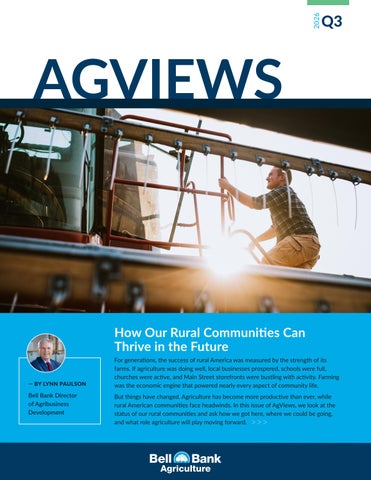
For generations, the success of rural America was measured by the strength of its farms. If agriculture was doing well, local businesses prospered, schools were full, churches were active, and Main Street storefronts were bustling with activity. Farming was the economic engine that powered nearly every aspect of community life. But things have changed. Agriculture has become more productive than ever, while rural American communities face headwinds. In this issue of AgViews, we look at the status of our rural communities and ask how we got here, where we could be going, and what role agriculture will play moving forward.
Today, agriculture is still one of America's greatest success stories. Farmers produce more food, fiber, and fuel than ever before, using fewer people, fewer inputs per unit of production, and increasingly sophisticated technology. U.S. agriculture continues to be among the most efficient in the world.
nation's food supply. The land remains productive and the farms remain profitable, but the surrounding community often becomes smaller. A township (36 square miles) that once supported 30 or 40 farm families may now have fewer than half that number farming essentially the same amount of land. One operation is likely managing the acres that previously supported several families.
But despite this amazing success, many rural communities are struggling. We see it across North Dakota, as well as in other agricultural states in the region, as these communities face an aging population and changing demographics. Looking ahead, rural America faces the question of how to thrive when modern agriculture simply requires far fewer people.
We can see this playing out through a couple of key statistics. First, according to the USDA, the non-metro or rural population in 2024 was approximately 46 million people – or 13.6% of the overall population. In 1970, it was estimated that about 60 million folks fit into this category, or about 30% of the overall population at the time.
THE PARADOX OF MODERN AGRICULTURE
Not surprisingly, this trend aligns with the overall number of farms in the U.S. In 1960, there were nearly 4 million farms in the country. In 2025, there were 1.865 million, according to the USDA – a 53% reduction overall.
Modern farming is extraordinarily productive. It’s American free enterprise, capitalism and entrepreneurship at its finest. Today's agriculture producers operate equipment capable of planting or harvesting hundreds of acres in a single day. GPS guidance, drones, artificial intelligence, automation, improved genetics and larger machinery have transformed agriculture into one of the world's most technologically advanced industries.
As an example, much of the farmland my wife and I own is in Benson County, located in central North Dakota. Our home township, West Antelope, has so few farms and people left that just about every resident is needed to fill the required township offices. There’s not a lot of campaigning going on at election and annual meeting time, which is often held in one of the township residents’ homes.
The result is a tremendous success story, yes, but one with unintended consequences. Because as farms become more efficient, fewer people are needed to produce the
2
A RIPPLE EFFECT OF AN AGING RURAL POPULATION
equipment and automation, modern agriculture needs fewer people than ever. Instead, successful rural communities understand that agriculture must remain the foundation, but perhaps not the only economic pillar.
A second important stat concerning rural America is age. The average American farmer is now approaching 60 years of age, with many landowners older still – on average, about a decade older. During the next two decades, this generation will pass on its wealth to the next generation. Some of that wealth will stay in the community, but much of it will likely leave.
It doesn’t have to be all gloom and doom for rural America. There are many examples of communities that continue to grow, and they typically share several similar characteristics, including manufacturing employers, healthcare services, an embrace of tourism, recreation, outdoor amenities and local quality of life. And, above all, they’re a great place to raise a family.
Interestingly, one of the biggest misconceptions about rural America is that declining population means declining wealth. On the contrary, there’s probably more wealth in rural America than ever before. Farmland values have appreciated dramatically over the past several decades. Equipment fleets represent millions of dollars in investment, and successful operations often generate significant cash flow.
The communities most likely to thrive will focus on becoming places where people choose to live, not simply places where people work. That means investing in high-speed internet, quality schools, healthcare access, childcare, housing, recreation, and vibrant downtowns.
Yet wealth and population are not the same thing. A community can contain millions of dollars in agricultural assets while simultaneously losing school enrollment, healthcare services, young families and retail businesses. Economists sometimes describe this phenomenon as "wealth without people."
The communities most likely to thrive will focus on becoming places where people choose to live, not simply places where people work.
As that wealth is passed on to the next generation, many heirs will continue owning farmland but may not live where that land is located. Instead, rental income may flow hundreds or even thousands of miles away from the local economy. When this happens, the community loses not only residents but volunteers, civic leaders, school families, church members and future entrepreneurs. These changes will have – and in fact already have had – ripple effects through our rural communities. In the past, farm families have supported grocery stores, hardware stores, equipment dealerships, veterinarians, accountants, banks, schools, restaurants, churches, fuel suppliers, local contractors and countless other local businesses. When there are fewer families, every one of those businesses feels the impact and struggles to remain viable.
It means encouraging and embracing entrepreneurship as enthusiastically as recruiting large employers. It means helping young families envision a future in rural America, and being an open-minded and welcoming neighbor, willing to lend a hand when needed. Support of local businesses will also be key, even if that might mean paying a few dollars more for goods and services. And for those businesses themselves, they’ll need to work harder and go that extra mile to earn business from area residents. Merely having a business in a rural community isn’t an entitlement for residents to support.
HOW COMMUNITY LEADERSHIP CAN ADAPT TO THESE CONDITIONS Faced with these changes, community leaders often ask a tough question: "How do we attract young families back to rural America?"
Success for these rural communities may also mean recognizing that retirees, remote workers and small business owners can become just as valuable to community vitality as traditional agricultural employers.
There’s no easy answer, and agriculture alone can’t accomplish that goal. Because of large and efficient
3
WHAT’S NEXT?
Additionally, one of agriculture's greatest strengths may become one of rural America's greatest opportunities: Consumers today want to know where their food comes from. Communities that can capitalize on these changing consumer preferences can generate entirely new sources of economic activity.
It’s easy to focus on the challenges facing rural America, and they are real. The reality is that some communities will continue to struggle as they confront aging populations, labor shortages, succession planning challenges, healthcare access, school enrollment declines and business consolidation.
None of these changes will happen on their own. They will require strong local leadership and institutions committed to the long-term success of their communities.
But rural America has reinvented itself before. Railroads transformed agriculture, rural electrification changed communities forever, mechanization reshaped farming, and the internet connected isolated communities to global markets. Looking ahead, artificial intelligence and automation will likely become the next chapter.
COMMUNITY BANKS WILL PLAY A ROLE Community banks in particular will play an important role in the health of rural America moving forward. These institutions are often deeply woven into the social fabric of their communities. Bank owners and leaders live locally and interact with residents at school events, churches and around town. They have their fingers on the pulse of the community.
Throughout each transformation, the communities that survived were the ones with selfless leaders and cheerleaders to show the way, who were willing to adapt while preserving the values that made them unique. And maybe that’s the lesson for today: The future of rural America will not be determined solely by commodity prices, cattle markets or interest rates, but whether communities can continue investing in people as aggressively as agriculture has invested in productivity. The next challenge is ensuring that fewer people doesn’t also mean fewer opportunities, fewer vibrant communities and fewer reasons for the next generation to call rural America home.
Community banks help finance farms, businesses, schools, churches and community projects. They often serve as partners in economic development efforts and provide leadership during periods of transition and change. As consolidation continues throughout the banking industry, preserving local decision-making becomes increasingly important. Healthy community banks can take the lead and become catalysts for healthy communities, helping young entrepreneurs obtain financing, encouraging business expansion, supporting housing development, and providing leadership during periods of economic transition.
The future of rural America will be shaped by the choices communities make today to innovate, collaborate, welcome new ideas and build places where the next generation wants not only to farm, but to live, work, raise a family and lead. It won’t be easy – nothing of lasting value ever is. But if those choices are made wisely, rural America can remain not only relevant, but indispensable to the nation's economy, culture and future.
4
Ag Economy Observations With Harvest in Full Swing As I write this in mid-September, we’re in the middle of harvest for many crops. Yields are about as variable as any harvest season I can remember. In many cases, it depends on whether you were under the right cloud at the right time and caught some helpful rain. If so, you may have a decent (though maybe not a great) yield this fall. But if you were just a few miles away and caught very little rain, it’s likely a different story. Some areas around North Dakota received less than 30% of normal rainfall this summer.
• You can’t turn on the news or read the paper without hearing or reading an article about artificial intelligence or data centers. Both elicit strong opinions. AI can do some incredible things, including in crop and livestock agriculture, as we’ve discussed in this newsletter before. But at the same time, there is concern that all of this is moving too quickly, with minimal guardrails and an increasing chance of unintended consequences. Technology always outruns regulation. Any reining in of AI needs to be done and agreed upon globally – not just in the U.S. • The Federal Reserve recently announced a 0.25% fed funds rate increase. This was not unexpected. It’s worth noting that the Fed only has control in setting the short-term or variable rate. The market sets fixed rates for the longer term. So, for farm borrowers, this will likely mean the interest rate on operating loans will go up, but long-term fixed rates for land or equipment may – or may not – increase.
Here are some of the other things I’m watching around the ag economy this fall: • The grain market has been seeing positive signs lately, with corn around the $5 mark and soybeans nearing the “teens” ($13, specifically). Wheat is also up, with local prices around $7. What’s causing the recent market strength? War, weather and geopolitics are probably the biggest contributors.
• The Federal Reserve has a dual mandate set by Congress: maximum employment, stable prices (inflation) and moderate long-term interest rates. Even though it’s actually three goals, if you take care of the first two, the last one (moderate long-term rates) will take care of itself.
• With harvest in full swing, rising diesel prices couldn’t have come at a worse time, as many producers have a heavy demand for fuel this time of year. Prices around $6 per gallon for diesel are taking a big bite out of producers’ expense budgets and profitability. Unfortunately, there doesn’t appear to be much relief in the short term.
• Interest costs have been on a steady rise over the past few years, up 63% since 2018. Coupled with farm debt increasing 50% over the same period, you get a picture of how important interest rates are to producers’ profitability. A sliver of good news is that a lot of the farm debt – mainly for real estate – is set at a fixed rate, which helps to buffer the latest increase, at least in the short term.
• President Trump recently announced plans to import 300,000 metric tons (660 million pounds) of ground beef to help consumers. It remains to be seen how much it accomplishes that goal – it undeniably doesn’t help cattle producers.
-Lynn Paulson
5
12th AgViews Live Addresses Agriculture’s Most Pressing Issues With the agricultural economy facing a number of headwinds, Bell Bank’s 12th annual AgViews Live seminar brought together producers, lenders and stakeholders to discuss the most pressing issues in ag.
Successful operations can prepare for risks by building working capital during good times, locking in margins, reducing debt, and finding off-farm income streams. Additionally, effective operations work to avoid arrogance, bureaucracy and complacency, what Dr. Kohl termed the “bad ABCs of business culture.”
Lynn Paulson, Bell’s director of agribusiness development, once again teamed up with ag finance speaker Dr. David Kohl to discuss how the time is now for farmers, ranchers and producers to make important – and perhaps difficult – choices.
Other topics discussed at this year’s AgViews Live included: Succession Planning: With many ag operations preparing for generational transitions, succession planning remains one of the biggest challenges.
Lower commodity prices, elevated interest rates, weather challenges, changing trade and geopolitical events, and succession planning concerns are creating difficult conditions, especially for crop producers. In fact, 2026 looks to be the fourth consecutive year of negative returns for many crop producers, making it essential to pay attention to fundamentals, Lynn said.
According to Dr. Kohl, 49 percent of farmers and ranchers have no will, which represents a major risk to effective farm succession planning as baby boomers look ahead to retirement. For families that want to pass the operation to the next generation, having important conversations as early as possible is critical.
“In these tougher times, you have to go back to the basics,” he added.
6
"I think it’s all about communication on the front end, being able to share what your wishes are,” Lynn said. That’s where a professional facilitator, such as a lawyer, can help, he added. Consolidation: In response to an audience question about whether consolidation in agriculture can be reversed, Dr. Kohl said that he expects it to continue, especially in the grain industry and in suppliers to the grain industry.
LOOKING AHEAD While the current environment presents challenges, both Lynn and Dr. Kohl emphasized that agriculture has always been cyclical. Operations that adapt to changing conditions while preparing for risks can best position themselves for long-term success. Producers who know their numbers, maintain liquidity, surround themselves with trusted advisors and focus on long-term planning will be able to navigate uncertainty and take advantage of opportunities in the years ahead.
“I think that train has left the station,” Lynn agreed. “I don’t know how you reverse that trend.” Artificial Intelligence: As at past AgViews Live seminars, the rapid development of artificial intelligence was another topic discussed by the presenters. Dr. Kohl said AI is already beginning to influence agriculture, from helping producers analyze data to assisting with crop monitoring through drones and other technologies. "It's not going away, but advancing at record speed," he said.
7
Call us to start the conversation! If you’re ready to talk about your farm financing, call an experienced Bell Bank ag lender in your area. We’re proud to serve American farmers and agribusinesses!
PO Box 10877 | Fargo, ND 58106-0877
Our roots run deep. Bell has the area’s longest-serving group of lenders, with more than a century of experience among them. We understand that as the business of farming becomes ever more complex each year, you need a lender who understands that challenges are opportunities for success. We have money to lend. Find greater stability from season to season with a long-term loan, or use shorter-term loans to increase cash flow to your farming operation.
Member FDIC
Lynn Paulson | 701-298-7138 | lpaulson@bell.bank Lynn is Bell’s director of agribusiness development. He writes and speaks about agricultural lending and finance, the global economy and the ag economy. He has expert knowledge of the ag industry, having worked in ag lending for more than 40 years and as a retired owner and operator of a Benson County, N.D., family farm. His banking experience includes mergers and acquisitions. He has also served on various financial boards.
Joe Watzke
Jeff Stanislawski
Matt Schenck
Jake Rossbach
218-291-3310 Moorhead, Minn.
218-486-8811 Hawley, Minn.
218-205-0201 Wahpeton, N.D.
218-291-3311 Moorhead, Minn.
Ben Watkins
701-672-8601 Wahpeton, N.D.
Katie Grant
Jerry Polejewski 218-998-5603 Fergus Falls, Minn.
218-291-3309 Moorhead, Minn.
Don Lacey
Kelly Hubrig
Emily Odland
701-298-7031 Fargo, N.D.
Brett Starr
218-592-4008 Pelican Rapids, Minn.
218-998-5602 Fergus Falls, Minn.
701-672-8617 Wahpeton, N.D.
We offer: Jason Bolluyt
218-291-3308 Moorhead, Minn.
Josh Cann
701-672-8612 Wahpeton, N.D.
Jason Bauer
218-486-8810 Hawley, Minn.
• Operating loans • Machinery and equipment loans • Agricultural real estate loans • Ag co-op loans
Karna Loyland
701-765-6106 Grand Forks, N.D.
www.bell.bank 8