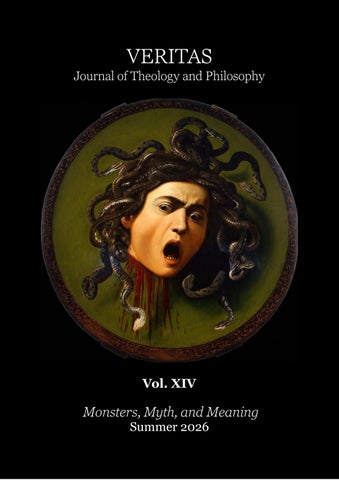
VERITAS Journal of Theology and Philosophy
Vol. XIV
Monsters, Myth, and Meaning Summer 2026
Editorial by Miss Caitlin Yool Across this year’s diverse collection of essays in Veritas, one theme is reflected across all contributions: humanity’s inherent drive to explain ourselves and the world around us. Whether students explore Greek tragedy, Roman foundation legends, Japanese yōkai, Ainu dragon-slaying tales, or even the modern mythology of fantastical popular culture, each piece presents a culture using supernatural narratives to articulate its fears, hopes, identity, and morality. Gods, heroes, and monsters are not merely narrative devices but mirrors reflecting the societies that created them. A striking thread running through the younger pupils’ essays is the idea of myth as emotional expression and moral instruction. Raif Shariff’s exploration of music in myth shows how music is articulated as a supernatural force capable of persuasion, transformation, and creation, from Orpheus using his lyre to endear himself to Hades, to Brahma singing the universe into existence. Ben Grant’s analysis of Romulus and Remus, meanwhile, frames myth as political storytelling: a tool for legitimising power, shaping cultural identity, and embedding moral lessons about care and justice. These essays reveal myth as a society-building tool codifying values and justifying power structures. Several of our young writers chose to tackle the mythological preoccupation with the monstrous. Sam Ruttenberg-Acosta’s analysis of Shinto yōkai shows how supernatural beings reflect cultural anxieties, natural phenomena, and moral boundaries in Japanese tradition, while also touching on their reception and further development in modern popular culture. Adam Hussain’s exposition of the Ainu tale of Sitonai presents the reader with a refreshing narrative: a young woman who confronts a monstrous serpent not through physical prowess and heroics but through courage and intelligence, subverting the patriarchal assumptions otherwise typical of heroic myths. Christos Polychronis and Riyan Madhani’s retelling of Perseus and Medusa touches on the complexity of mythical monsters, with Medusa only becoming hideous and terrifying due to Athena’s curse rather than being inherently evil. Evil, and morality more generally, is another theme some writers focus on. In his piece on the morality of Hades, Aditya Sethi challenges the villainisation of the Greek god of the underworld in later reception, arguing instead for a more nuanced understanding of what he represented to the ancient Greeks. Kieran Shah’s exploration of Phaethon and the sun chariot considers the consequences of unbridled ambition, showing how myth warns against the dangers of hubris and human overreach as a moral precept. These myths, analysed through modern eyes, show how the societies creating them developed and canonised their concepts of responsibility, authority, and order. Talos, the ancient Greek automaton, has seen increased cultural relevance given the parallels to current societal discourse, so it is perhaps unsurprising to see two essays inspired by that particular myth in this volume. Louis Dimson and Aarav Singh focus on i
that relevance, drawing multiple parallels between antiquity and modernity in their piece, while Sebastian Keylock’s discussion highlights how autonomous technologies can inspire both fascination and fear. The final essay in this group, Dexter Godfrey’s Should AI Replace Humans?, brings these themes decisively into the present. His argument positions artificial intelligence as a new kind of mythic frontier — a modern Talos, built not of bronze but of code, raising questions about autonomy, ethics, and the future of human agency. Capturing myth as a means of processing the fear of the unknown, Zach Jacobs’s exploration of Bigfoot and Kayan Radia & Sebastian Moradov’s investigation of the Loch Ness Monster show how modern cryptids function much like ancient mythic creatures, inhabiting the edges of the known world, liminal spaces where imagination thrives. Krishan Siani draws on philosophical thought to take a bird’s eye view of the fear of the unknown in myth. In all, the younger pupils’ explorations of gods, cryptids, and ancient machines and their relevance to the modern day reveal perpetual commonalities of the human condition across time and place: societies both in the ‘there and then’ and the ‘here and now’ ponder powerful beings, real or fictional, to confront their deepest uncertainties. Be it Hades judging souls, Phaethon losing control of the sun, Bigfoot eluding discovery, or AI challenging presumed certainties, these essays collectively show that mythmaking remains one of humanity’s most enduring ways of grappling with fear, ambition, and the unknown. The senior essays shift the focus from narration to interpretation, treating myths not as stories to be understood and analysed but as philosophical instruments to be evaluated and applied. Yishai Epstein-Lightman’s exploration of David and the Goliaths That He Faced reframes the biblical hero as a figure confronting not only a giant warrior but the many metaphorical “goliaths” like fear and self-doubt that shape the human struggle. His reading positions David as an archetypal symbol of moral courage, a reminder that mythic heroes articulate the challenges ordinary people face. Joshi Lappin’s essay on the Leviathan in the Book of Job continues this theological thread, interpreting the monstrous sea-beast as a poetic embodiment of cosmic chaos and divine mystery. Together, these essays show how biblical monsters serve less as physical threats and more as provocations to the mind, forcing readers to confront the limits of human understanding. Two essays turn toward the generative power of language itself. Reuben Goulden’s What is the Role of Speech in Creation Myths? argues that spoken words are among humanity’s earliest attempts to explain how order emerges from nothingness, thus drawing interesting parallels with Raif Shariff’s treatment of music discussed earlier. Reuben’s analysis spans cultures and cosmologies, revealing a common human conception of language as a creative force. Jesse Caller’s study of Dylan Thomas extends this idea into modern literature, showing how Thomas’s dense, lyrical poetry uses language to wrestle with mortality, memory, and meaning. Both essays understand
ii
language not only as a means to describe physical reality, but to shape reality itself and to alter the way we relate to it. Other pieces espouse myth as a lens for examining human agency. Ilan Jesner’s Exploring Free Will Through Myth traces how ancient stories grapple with the tension between fate and choice, revealing that myths often present freedom not as absolute autonomy but as the struggle to act meaningfully within psychosocial constraints. Nathaniel Lock’s essay on how monsters reflect societies’ changing fears complements this perspective, showing that collectively imagined creatures evolve alongside collective anxieties. From Egyptian serpents to the Incredible Hulk, monsters act as bellwethers of societal unrest, revealing what people fear losing, becoming, or confronting most. Given the variety of social and psychological functions ascribed to myth in the other pieces, Jesse Tager’s essay on the changing purpose of fables provides a valuable inquiry into the evolution of storytelling itself. He argues that fables shifted first from moral instruction to psychological exploration, and now to entertainment, satire, and social critique. What remains constant is their adaptability: fables survive because they reshape themselves to continue to meet the needs of the societies constructing and deconstructing them. Louis Zeng’s examination of Ammit, the Egyptian devourer of souls, questions what qualifies as a monster in the first place. Ammit is terrifying, yet she is also a force of justice, punishing only those who have failed morally. His essay highlights how monsters often occupy ambiguous moral territory, echoing Christos and Riyan’s treatment of Medusa. Ranvir Bhandari’s Paradox of the Imaginary Monster meanwhile sees the quintessence of monstrosity not in ambiguity but in surreality. The intangible nature of monsters allows them to represent abstract fears like societal collapse without being constrained by physical laws. Samuel Frangi’s exploration of monsters in existentialist literature builds on this insight, showing how writers like Sartre and Camus replace physical beasts with psychological ones: nausea, absurdity, alienation. These “monsters” cannot be slain by swords or heroes; they must be confronted through introspection, rebellion, or acceptance. All three essays agree in their underlying approach of defining monsters in philosophical rather than physical terms. The final essay in this group, Thomas Roberts’ study of The Witch of Endor, returns to biblical narrative. He argues that the witch, often dismissed as a villain or curiosity, is instead a complex character navigating power, fear, and divine transcendence. Her story reveals how voices at the margins of society may be reflected in myth and scripture: women, outsiders, those who defy social norms either by choice or necessity, whose roles challenge dominant conceptions of right and wrong. In this reading, the Witch of Endor becomes a symbol of knowledge sought in desperation, and of the uneasy boundary between socially accepted and forbidden wisdom. Greater than the sum of their parts, these senior essays demonstrate a sophisticated engagement with myth as a tool for thinking. Whether analysing biblical beasts or modern superheroes, myth endures not due to a superficial fascination with iii
the supernatural, but because it offers a framework for exploring complex questions in an accessible way. Monsters, heroes, witches, and gods are not simple relics of a premodern imagination but living symbols through which successive civilisations have interrogated and continue to interrogate their fears, hopes, and moral boundaries. Staff contributions expand these ideas into broader cultural critique. Mr Arnsberg’s piece on Superman argues that comics function like a modern mythology, complete with moral lessons, monstrous villains, and national ideals. Mrs Khurjekar’s essay on Renaissance monsters further demonstrates how monstrous imagery has long served as a visual language for moral disorder, theological anxiety, artistic experimentation, and the limits of human knowledge. Monsters, whether drawn by Bosch or DC Comics, remain tools for thinking about what threatens us and what saves us. Old Haberdasher, Alexander Taylor goes on to emphasise the enduring importance of myth and belief by offering a critique of the sociopolitical dismissal of religious education in the wake of secularism, arguing that one does not need to be religious to benefit from the study of belief systems and their narrative foundations. In his letter from Oxford, Old Haberdasher Zachary Kapterian explores how meaning is rarely confined to a single discipline alone. From an enduring myth at St. John's College, involving a dream and a three-trunked elm, to the traditions that shape university life, Zachary’s search for meaning has carried him beyond the walls of the T&P classroom at Habs. He examines how his quest for meaning continues to this day and how a historiographical lens can similarly shed light on humanity's enduring search for meaning, revealing the myths, memories, and traditions that bind communities to their past and help shape their future. For Zachary, the answers may differ, but the underlying questions remain strikingly familiar. On the whole, this volume demonstrates that myth is not a trifling peculiarity of the ancient world but a living, adaptive force deeply rooted in human nature. Be they sung in temples, carved into frescoes, or printed in modern comic books, myths continue to shape how we understand ourselves and the world around us. They reveal our most visceral emotions, at times reinforcing our concepts of good and evil and at other times leading us to question them. In this volume, students, Old Haberdashers, and teachers alike dissect how myth remains one of humanity’s most powerful ways to make meaning.
iv
Veritas Vol. XIV: Monsters, Myth, and Meaning
Table of Contents Staff/OH Contributions Mr Arnsberg ......................Americana Mythology ...................................................... 2 Mrs Khurjekar .................... Monsters in Renaissance Art ............................................ 8 Alexander T ....................... Classroom Education and Beyond ................................. 15 Zachary K. ........................A Letter from Oxford ...................................................... 19 Senior Contributions Yishai E.-L. ........................ David and the Goliaths that he faced .............................. 22 Joshi L. ............................. What is the Leviathan in the Book of Job? ........................ 27 Reuben G.......................... What is the role of speech in creation myths? .................. 35 Jesse C. ............................ Philosophical Musings and Meaning in Dylan Thomas ...... 40 Ilan J. ................................ Exploring Free Will Through Myth .................................... 43 Nathaniel L. ...................... How do monsters reflect societies’ changing fears? ......... 46 Jesse T. ............................. How have fables changed in purpose over time?.............. 50 Louis Z.............................. To what extent can Ammit be described as a monster? .... 54 Junior Contributions Ranvir B. ........................... The paradox of the Imaginary Monster ............................ 58 Samuel F........................... What are the monsters of Existentialist literature?............ 61 Thomas R. ........................ The Witch of Endor ........................................................ 66 Raif S. ............................... What part does music play in Myth? ............................... 71 Ben G. .............................. Rome’s Radical Origins: True or False or both? ................ 74 Sam R. ............................. Yōkai (妖怪) .................................................................. 78 Christos P. & Riyan M. ........Bearer of the Demon’s Head .......................................... 82 Adam H. ........................... The Tale of Sitonai and the Dragon .................................. 86 Aditya S. ........................... The Morality of Hades .................................................... 90 Kieran S. ........................... Phaethon and the Sun Chariot ....................................... 95 Zach J. .............................. Bigfoot ......................................................................... 98 Sebastian K....................... Talos: The First Artificial Humanoid Intelligence in Myth ..101 Kayan R. & Sebastian M. ....The Loch Ness Monster ................................................104 Dexter G. .......................... Should AI replace humans? ..........................................109 Misha S. ........................... Baucis and Philemon ...................................................113 Louis D. & Aarav S. .............The Ancient Automaton ...............................................117 Krishan S. ......................... Fear of the Unknown ....................................................122
1
Veritas Vol. XIV: Monsters, Myth, and Meaning
Americana Mythology: Superman and the American Villains Article by Mr Sela Arnsberg It is, perhaps, controversial to suggest that comic books are mythology, but in the case of America I feel it is warranted. I will focus my enquiry on Superman, not because there weren’t popular comics before (there were) but because the comics published post-Superman fall into a similar category as that of other cultures’ mythology. These stories often incorporate world building and ‘divine’ characters amongst the rest of humanity. The stories take place in a world we recognise as both our own and, in a broad sense, supernatural - there are people going to the supermarket while Wonder Woman is cruising around in the Invisible Plane. Most Western comics, and Superman especially, construct an idealised USA that serves as a mirror to that culture while providing aspirational characteristics for the readers to emulate. This is not to say that the USA is actually like it is in the comics, nor that all US citizens see themselves/their country in this manner. Rather, this idealised version of America was created by the myth-making American industry of Hollywood, the comic book world and novels written both in the 19th and 20th century, that have become almost stereotypical when we think of the USA. This essay will focus on the ideal that Superman embodies by examining his interactions with three villains: Lex Luthor, Doomsday and Kal-L. This essay will show that Superman is the man of the people through his fight against Luthor, who embodies the corrupting potential of the American dream in Superman: Birthright; Superman as the idealised good that fights against absolute evil and devastation, mirroring America’s position as the world’s moral police in The Death of Superman; and Superman as irreplaceable in The Return of Superman. Finally, I will show that the American ideal of exceptionalism ultimately removes the very need for a Superman, as depicted in Infinite Crisis and Superman’s fight with Kal-L. In Birthright, the Superman mythology is retold: a young Clark Kent, with the help of his adoptive parents John and Martha Kent, learns about the world and proceeds to become The Man of Tomorrow in Metropolis. His opponent, Lex Luthor, tries to discredit him. On the surface, this is a well-established manner of (re)introducing Superman. Originally, Superman’s first appearance in 1939 sees him hanging off the side of a building1 (Siegel and Shuster, 1939, p. 13) listening to two corporate/political figures plotting an evil scheme.2 Hence, using Luthor, the This was before Superman had super-hearing or flight. Arguably, this was an attempt at crafting a Socialist hero. After all, Superman was created by Seigel and Shuster who were two Jewish Socialist at a time in which, globally, being either was difficult. But that does not concern us in this essay. 1 2
2
Veritas Vol. XIV: Monsters, Myth, and Meaning
quintessential evil corporate genius, as the antithesis of Superman is grounded in the very origin of the concept of Superman. But there’s more. America is meant to be a land that, as the plaque on the Statue of Liberty states, welcomes the ‘tired’, ‘poor’ and ‘homeless’ (Lazarus, 1883). On the one hand, Luthor stands as the embodiment of the American Dream: he is the self-made man that was born with brilliant intellect and invented great technological marvels, started a successful business and, far too often, tries to kill Superman whom Luthor perceives as a danger to the world and his fame. It is here that the mythological aspects of the hero arise. Unlike Luthor, Kal El is an immigrant. Yes, he’s from a different planet rather than, say, Mexico, but he is a refugee that has immigrated to the USA seeking life. He is also raised by two non-exceptional people. At least, unexceptional according to Luthor’s definition, who goes so far as to say that “Nothing good will ever come out of Smallville” (Waid, 2004, p. 182). At no stage are Martha or Johnathan more than of average intellectual and physical abilities, but from the American mythmaking perception of the ideal self-made man, they are perfect: they have a strong sense of justice and an understanding of hardship – they are the salt of the Earth. Thus, Superman is the embodiment of the mythology that The Statue of Liberty endorses – he is a homeless, poor person that learns how to be American from the literal ground up, which includes his good morals; he has inherent goodness which shines through alongside his abilities which he uses to help others. Thus, we get Superman and Luthor as the dichotomy of the American ideal and the American Dream: they are the polarities of morality/immorality, good/evil; powers/no powers; poor/rich; humble/proud; honest/manipulative... to name a few. These dichotomies are similar to those presented between heroes and monsters, where the hero embodies at least a few of the virtues that the society idealises, while the creature represents a fear that that society has. In Birthright, we have Luthor who aims for power and glory for its own sake, not for the sake of others – mirroring the fear of the upper-class and elites that wish to use their position to supress the common man. Luthor, being a mythological monster, embodies more than that: he is the fear that not only are the elites trampling the good man, but the system is geared in the elite's favour. In their first confrontation, Superman tells Luthor that he should “drop the innocent businessman act,” having just discovered that Luthor was responsible for an evil attack on Metropolis – an accusation that Luthor evades. As he states on the same page, the courts will work in Luthor’s favour, as he will “Bankrupt [Superman] for false accusations and property damage” (Waid, 2004, p. 112). While Superman does not go to court, the point is clear: the evil system (Luthor) is geared against the good man, and our mythological hero must fight against it.
3
Veritas Vol. XIV: Monsters, Myth, and Meaning
This is also seen in The Death of Superman, where an unstoppable force, subtly name Doomsday, is bent on destruction for the joy and desire of it.3 After Doomsday defeats the Justice League, Superman must fight the monster, ultimately to their deaths. Here, we see the idealised America, the ‘world police’ that is there to protect the world, democracy and goodness; the America that loves the planet and is willing to do everything, even sacrifice itself, to save the world from evil. You can further argue, in a more USA-introspective manner, that Superman here is the mythical hero sent to save the city-state, or nation, from foreign invaders. Though the implication is that Doomsday would destroy the world, Superman stops him before that becomes a possibility. Thus, there is once more an evil that is threatening America, and it is up to the average-born immigrant, the self-sacrificing moral person, to defend the country. Whether you see Superman here as defending the Earth or the USA, he is still willing to give his life for others as per the idealised American standards. But not at the expense of others: Superman saves Lois Lane, the woman he loves, and the helicopter crew that she is with, from crashing while fighting Doomsday (Jurgens et al., 2016). While on the one hand falling into the hero-saves-girl trope, it is still a hero that will never find defeating evil more important than saving people. Here, then, Superman embodies not just the immigrant that is willing to lay down his life for the USA, or for those who need to be defended, but also the ideal that the heroic American soldier should aspire to. Yet, in good mythological tradition, the hero is not invincible – they can, and often do, die. The specific mythology surrounding the Man of Steel as being unbreakable, then, is shown to be a projection of the world (both readers and fictitious citizens) upon Superman – he knows that he is not invincible, that he is not going to survive everything, but he is perceived as such. This mirrors the adoration that heroes such as Achilles receive in the text and by the readership. We finally see that he was a true hero, as he was able to die – despite being mortal and breakable, he chose to fight until his last breath to save us. This, in retrospect, makes his previous heroic decisions even more so: he did not have to survive, it was due to his abilities, honed by his small-town-USA upbringing, that helped him survive this long. Similarly, the USA is not unbeatable, which makes their actions as the moral police more heroic.4 In the fight’s repercussions, Superman becomes almost Christlike. Just as Jesus was willing to die for the sins of the people, so is Superman – not just by willingly fighting villains such as Luthor or Parasite that embody, at times quite While there are iterations where Doomsday speaks and becomes, in a sense, a character, in the original publication he is a non-thinking evil literary device that wants to destroy – a more literal mythological creature cannot be found. 4 That is, in ‘their’ own eyes in terms of the mythology constructed around the heroic American soldier within the American state’s mythological standing in the world. I am not claiming that this is either true, realistic, or enacted in an admirable way. 3
4
Veritas Vol. XIV: Monsters, Myth, and Meaning
literally, human vices, but by fighting Doomsday, a monster that was hidden in the bowels of the Earth and managed to escape (Jurgens et al., 2016). The pure evil of the world, metaphorical and literal, was always hiding in the USA, and it is up to the saviour, the great mythological hero, to save them. This idea also links to the dream of the original settlers5 who wanted to build a new Jerusalem. However, selfsacrifice is not enough, as then anyone who martyrs themselves would be equivalent to Jesus, or Superman in the comics’ case. However, just as Jesus has disciples and saints that inherit his mission, so does Superman. After his death, Superman is succeeded by four different Supermen, each one embodying a different aspect of being Superman: Steel represents his humanity; Superboy represents the joy of having superpowers; Eradicator represents Superman’s alien heritage; and Cyborg Superman represents what Superman would have been had he not had his humanity. In the end, especially with Superman’s resurrection to save the planet from Mongul, another monstrous destroyer, none of these, either together or individually, can completely take on the role of Superman. No number of saints, apostles or martyrs will ever equal Jesus, just as no number of heroes can ever fully take on the role of Superman. He can never be replaced. But then, what is the point? If we equate him to other mythical heroes, then why did Jesus leave if he cannot be replaced? Why would Volsung fight knowing his death has come? Why would Buddha not remain to help others achieve enlightenment? Perhaps, because these heroes are not meant to be replaced by a person, but by every person’s belief in the ideals the hero represents. Buddha's teachings, in a sense, are more important than the Buddha himself. Same goes for Jesus’ teachings and for Volsung’s courage in battle. Some may have an issue comparing, even tacitly, two pacifist heroes with a Viking warrior, but that is prejudiced to our cultural proclivities, as these heroes embody their societies’ ideals, whether these are amenable to us or not is a different issue.6 Since Hope is Superman’s ideal, it places him closer to Buddha and Jesus than Volsung though he may fight with as much conviction as Volsung, he still believes in not fighting, as he fights because he feels he must, not because he wants to. Like other such mythical heroes, his final job is to remove himself, leaving his teachings behind. This is made very clear when he fights Kal-L, his older doppelganger from a different Earth. Kal-L, partially due to his grief from losing his Lois, believes Superman has not done enough for his Earth, has not inspired people to be better, nor intervened enough to save more lives. Kal-L claims that his Earth, Earth-2, was perfect. Superman responds that “a perfect Earth doesn’t need a Superman” (Johns, 2023) which ends the fight. Kal-L realises, as does the reader, that Or colonisers, depending on who we are talking about. Or conquerors, depending on who you ask. This is a topic best left to historians – they must be allowed to do something, after all! 6 Also, seeing as you’re still here while I place Superman on the same stage as Achilles, Jesus and Buddha, I think you can take this in your stride. 5
5
Veritas Vol. XIV: Monsters, Myth, and Meaning
Superman’s role is not to intervene, really. Superman’s role is to teach people to be better and hope that the teachings prove stronger than humanity’s lesser instincts. Just as we have the Gospels and the ideals that Jesus preached, just as we have the words and teachings of Buddha, so, too, we have the lessons and teachings from Superman’s exploits to raise and better us. This is the same for heroes such as Volsung and Achilles. This also fits in with the way that the USA may perceive itself as the beacon of goodness, as not only the ‘world police’ but of a source for democratic progress, where equality shines and hope abounds, where the downtrodden can have a dignified life. This also links to, arguably, the original USA hero: George Washington. He, too, like the heroes above, left office rather than rule and become a tyrant. His teachings, in that moment, are almost more important than the man himself. Despite so many other founding fathers coming under scrutiny, Washington has been left relatively clean. Not because he was, but because the mythology of Washington grew greater than the man himself. Superman’s character is just as mythological: a leader of a League of heroes, who fights for Justice and works to ensure he is no longer needed; a hero who has incredible power, but his moral upbringing is so strong that, when the fight is over and the New World secure, he retires to the country. Superman’s aims are exactly the same as the mythological heroes of the past, be that distant or recent.7 America’s construction of a mythological hero and mythological body of work tells stories of itself through Superman and his villains, through what the character does. Unlike other mythologies, there is no pretence8 that Superman is real. He is a constructed character for a constructed and idealised USA that falls within the Americana genre. We therefore see that, just as Superman is a hero of the American ideal, his villains represent the fears of that same constructed America. A point that may be raised is that the heroes mentioned, such as Jesus and Buddha, existed. But ask yourself: do we need Superman to exist in order to believe in the ideals he embodies?
Bibliography: Johns, G. (2023) Infinite Crisis. DC Comics: California. Jurgens, D., Simonson, L., Stern, S. (2016) The Death of Superman. DC Comics: California.
In fact, at the end of Kingdom Come, when the superhero community is recognised as a nation and the world is starting to look like a better place, Superman becomes a farmer. 8 Unless you are very odd, indeed. 7
6
Veritas Vol. XIV: Monsters, Myth, and Meaning
Lazarus, E., (1883). ‘The New Colossus’. Online. Available at: https://www.poetryfoundation.org/poems/46550/the-new-colossus [Accessed: 27/01/26]. Waid, M. (20024) Superman: Birthright. DC Comics: California.
7
Veritas Vol. XIV: Monsters, Myth, and Meaning
Monsters in Renaissance Art Symbolism, Imagination, and Cultural Meaning Article by Mrs Sailee Khurjekar 1. Introduction The European Renaissance, spanning approximately from the fourteenth to the seventeenth century, is commonly associated with the revival of classical learning, the development of linear perspective, and the emergence of artistic naturalism. Monsters occupied a prominent place in Renaissance artistic production. They appeared in depictions of biblical narratives, classical myths, apocalyptic visions, and decorative architectural schemes. Far from being mere curiosities, these creatures fulfilled important symbolic, moral, and intellectual functions. Their representations reveal contemporary concerns regarding sin, divine judgement, exploration, and the limits of human knowledge. This essay investigates the role of monsters in Renaissance art and argues that monstrous imagery functioned as a critical means through which artists and patrons engaged with broader cultural, religious, and philosophical questions. 2. Classical Antiquity and the Revival of Mythological Monsters The rediscovery of ancient Greek and Roman texts constituted one of the defining features of Renaissance culture. Humanist scholars translated and studied works by Homer, Virgil, Ovid, and Pliny the Elder, among others. These texts introduced Renaissance audiences to a rich array of mythological creatures, many of which became popular artistic subjects. Artists drew upon classical narratives to create images featuring centaurs, satyrs, harpies, hydras, and sea monsters. Such subjects enabled patrons and artists to demonstrate their familiarity with classical literature while simultaneously exploring themes of heroism, transformation, and moral conflict. Among the most enduring mythological monsters was Medusa. Traditionally depicted with serpents for hair and a gaze capable of turning observers to stone, Medusa represented danger, disorder, and supernatural power. Renaissance artists frequently portrayed the moment of her defeat by Perseus, thereby emphasising the triumph of reason and virtue over chaos. The popularity of Medusa reflected broader Renaissance interests in transformation, beauty, and fear. Her image embodied the tension between attraction and repulsion that characterised many monstrous figures in visual culture.
8
Veritas Vol. XIV: Monsters, Myth, and Meaning
Mythological hybrids occupied a particularly important position within Renaissance art. Creatures such as centaurs and satyrs combined human and animal characteristics, symbolising the conflict between rationality and instinct. Their recurring appearance in paintings, sculptures, and decorative programmes illustrates the Renaissance fascination with human nature and moral self-control. 3. Christian Theology and Demonic Representation Although Renaissance artists embraced classical mythology, Christian theology remained the dominant framework for interpreting the world. Consequently, monsters frequently appeared as embodiments of sin, temptation, and spiritual corruption. Religious artworks depicting hell and the Last Judgement often featured grotesque demons tormenting the damned. These creatures possessed distorted bodies, animalistic features, and exaggerated expressions, visually communicating the destructive consequences of sin. The monstrous body became a metaphor for moral disorder. By depicting demons as grotesque distortions of natural forms, artists reinforced the theological belief that evil represented a corruption of divine creation. No discussion of Renaissance monsters would be complete without considering the work of Hieronymus Bosch. His paintings contain some of the most imaginative and unsettling creatures in the history of European art. In works such as The Garden of Earthly Delights (c. 1490), Bosch populated infernal landscapes with hybrid beings composed of human, animal, and mechanical elements. These extraordinary creations transformed moral teachings into vivid visual experiences. Bosch’s monsters were not intended merely to shock viewers. Rather, they served as moral warnings concerning the consequences of greed, lust, pride, and other sins. Through the invention of bizarre creatures, Bosch communicated complex theological concepts to a broad audience. The Renaissance also witnessed widespread interest in apocalyptic themes. Artists illustrated the Book of Revelation and other prophetic texts using terrifying beasts and demonic figures. Such images reflected contemporary anxieties regarding war, plague, religious conflict, and divine judgement. The German artist Albrecht Dürer produced influential prints depicting the Four Horsemen of the Apocalypse and other biblical visions. His detailed renderings of monstrous forms contributed significantly to the visual culture of fear and salvation during the Renaissance. 4. Dragons and the Triumph of Virtue The dragon emerged as one of the most recognisable monsters in Renaissance art. While dragons possessed roots in both classical and mediaeval traditions, they acquired particular significance within Christian iconography. The story of Saint George and the Dragon became a favourite subject among Renaissance artists. According to legend, 9
Veritas Vol. XIV: Monsters, Myth, and Meaning
Saint George rescued a princess and her community by slaying a dragon that terrorised the region. The narrative symbolised the victory of Christian faith over evil forces. Artists such as Raphael and Paolo Uccello interpreted the story in different ways, yet all emphasised the dramatic confrontation between heroic virtue and monstrous threat. Dragons also appeared in depictions of the Archangel Michael defeating Satan. In these images, the dragon functioned as a visual representation of evil, rebellion, and spiritual danger. The defeat of the monster reinforced Christian teachings concerning divine justice and cosmic order. Such works demonstrate how monstrous imagery served theological as well as artistic purposes, transforming abstract religious concepts into accessible visual narratives. 5. Grotesques and Decorative Monstrosity Not all Renaissance monsters were associated with fear or moral danger. Many appeared within decorative contexts as part of a style known as grotesque ornamentation. The term “grotesque” originated from the discovery of ancient Roman wall paintings in subterranean chambers near Rome. Renaissance artists encountered fantastical decorative motifs featuring hybrid creatures, animals, plants, and architectural forms arranged in intricate compositions. These discoveries had a profound impact on Renaissance artistic practice. Raphael and his workshop incorporated grotesque motifs into the Vatican Loggias, creating elegant decorative schemes populated by imaginative hybrid beings. Unlike the terrifying monsters of religious art, these creatures functioned primarily as ornamental inventions. Grotesque decoration reflected Renaissance admiration for artistic ingenuity and creativity. By combining disparate elements into harmonious designs, artists demonstrated their mastery of invention while celebrating the imaginative possibilities of visual art. Decorative monsters reveal an important aspect of Renaissance attitudes towards the fantastic. Rather than viewing monstrosity solely as a source of fear, artists often treated it as an opportunity for aesthetic experimentation. The grotesque became a space where imagination could flourish beyond the constraints of naturalistic representation. 6. Monsters, Exploration, and the Unknown World The Renaissance was an age of exploration characterised by expanding geographical knowledge. Nevertheless, large portions of the globe remained mysterious to European audiences. Cartographers frequently decorated maps with sea monsters inhabiting uncharted waters. These creatures served both practical and symbolic purposes. They
10
Veritas Vol. XIV: Monsters, Myth, and Meaning
filled empty spaces, warned of potential dangers, and emphasised the uncertainty associated with distant regions. Reports from explorers introduced Europeans to unfamiliar animals, landscapes, and cultures. In some cases, descriptions of exotic creatures were exaggerated or misunderstood, leading artists to create fantastical interpretations. Monsters thus became visual markers of the unknown. Their presence on maps and illustrated texts reflected broader Renaissance efforts to comprehend a rapidly expanding world. The development of natural history further complicated distinctions between reality and fantasy. Scholars collected information about animals from travellers, merchants, and ancient authorities, sometimes including creatures whose existence remained uncertain. As a result, Renaissance visual culture often blurred the boundaries between scientific observation and imaginative speculation. Monsters occupied a space between knowledge and mystery, embodying both curiosity and uncertainty. 7. Human Identity and Hybrid Forms Hybrid creatures offered Renaissance artists a powerful means of exploring questions concerning human identity. By combining human and animal characteristics, such beings challenged conventional distinctions between civilisation and nature. Centaurs, satyrs, and mermaids embodied tensions between reason and desire, intellect and instinct, order and chaos. Their representations reflected ongoing philosophical debates regarding the nature of humanity. Hybrid monsters also functioned as moral symbols. Their mixed forms suggested the coexistence of noble and base impulses within human beings. Consequently, they encouraged viewers to reflect upon the ethical challenges associated with self-control and virtue. In this sense, monstrous imagery served not only decorative or narrative purposes but also philosophical ones. 8. Artistic Innovation and Creative Imagination The representation of monsters provided artists with opportunities to demonstrate technical skill and originality. Creating convincing imaginary creatures required a sophisticated understanding of anatomy, movement, and composition. Artists often combined close observation of animals with inventive modifications, producing creatures that appeared simultaneously fantastical and believable. The concept of artistic invention, or inventio, occupied an important place within Renaissance theory. Artists were expected not merely to imitate nature but also to exercise creative imagination.
11
Veritas Vol. XIV: Monsters, Myth, and Meaning
Monsters became ideal vehicles for artistic experimentation. They allowed painters, sculptors, and printmakers to explore new visual possibilities while showcasing their intellectual and technical abilities. The extraordinary variety of Renaissance monsters demonstrates the extent to which imagination remained central to artistic achievement during this period. 9. Conclusion Monsters occupied a complex and multifaceted role within Renaissance art. Emerging from classical mythology, Christian theology, decorative traditions, and geographical exploration, these creatures reflected many of the intellectual concerns that defined the period. Religious monsters communicated moral and theological messages, while mythological creatures connected Renaissance culture to the classical past. Dragons symbolised the triumph of virtue over evil, grotesques celebrated artistic invention, and sea monsters embodied anxieties regarding the unknown world. Hybrid beings further encouraged reflection upon the nature of humanity itself. The study of monsters challenges simplistic interpretations of the Renaissance as an exclusively rational or humanistic age. Instead, it reveals a culture deeply engaged with imagination, mystery, and the boundaries of knowledge. Through their representations of monstrous forms, Renaissance artists explored fundamental questions concerning morality, identity, and the structure of the cosmos. Ultimately, monsters were not peripheral to Renaissance art but central to its capacity to visualise both the wonders and the uncertainties of human experience.
10. Bibliography Belting, H. (1994). Likeness and Presence: A History of the Image Before the Era of Art. Chicago: University of Chicago Press. Burke, P. (2014). The Italian Renaissance: Culture and Society in Italy. Cambridge: Polity Press. Campbell, S.J. et al. (2012). Italian Renaissance Art. London: Thames & Hudson. Hall, J. (2018). Dictionary of Subjects and Symbols in Art. London: Routledge. Harbison, C. (2012). The Mirror of the Artist: Northern Renaissance Art in Its Historical Context. New York: Harry N. Abrams.
12
Veritas Vol. XIV: Monsters, Myth, and Meaning
Kemp, M. (2011). The Human Animal in Western Art and Science. Chicago: University of Chicago Press. Murray, P. et al. (2004). The Oxford Companion to Christian Art and Architecture. Oxford: Oxford University Press. Panofsky, E. (1972). Studies in Iconology: Humanistic Themes in the Art of the Renaissance. New York: Harper & Row. Pliny the Elder. (1991). Natural History. Translated by J.F. Healy. London: Penguin Books.
11. Figures
Figure 1: Hieronymus Bosch, The Garden of Earthly Delights, c. 1490
13
Veritas Vol. XIV: Monsters, Myth, and Meaning
Figure 2: Albrecht Dürer, The Four Horsemen of the Apocalypse, 1498
Figure 3: Raphael, Saint George and the Dragon, c. 1505 14
Veritas Vol. XIV: Monsters, Myth, and Meaning
Classroom Education and Beyond: The Ever-Growing Importance of the Study of Religion Article by Alexander Taylor (OH, BA student in Theology and Religious Studies, University of Leeds) The hardest thing about studying religion is explaining it. The word ‘religion’ doesn’t serve as an adequate explanation for the role of religion. Ultimately, my years travelling through religious scholarship have led me to sociology, politics, media, philosophy, psychology (and the list goes on). It was upon reflection of this that I had to think where religion would lead me next. At a stage in my life where the world is waiting for me to have my own unique impact, I thought back to the 13 years I spent at Habs. Perhaps it goes unnoticed, or perhaps we are too busy to really think about it, but our education informs our essence, our motivations, our character and our behaviour. However, this is a double-edged sword. Just as compassionate examples of tolerance subconsciously give us permission to echo further kindness into the world, a negative experience can mould young people into someone who can disrupt the cohesion of society. So, naturally, the focus turns to tuition, its methods and its practitioners. It became clear to me that education could be a place where I can make my impact. In early Spring, I got back in touch with some of the people that shaped my perspective – more specifically, the experts that make up the Theology and Philosophy Department at Habs. Balancing my university commitments and work schedule, I was fortunate enough to be welcomed back to Habs to gain some experience in teaching. Returning was something of an unusual homecoming. The school was similar, but the framework of how I was approaching it was different. Suddenly, my intentions were not about accelerating my own knowledge or understanding but about sharing it a little. I observed and noted techniques that teachers use. Each behaviour a conscious choice with the aim of ushering the classroom towards collective understanding. I also quickly noticed the dynamic nature of an education setting. Most jobs require you to practice a confined set of skills and adapt them to fit varying circumstances that don’t stray far away from a theme. A teacher doesn’t get this luxury. The teacher is a personal guide for a student’s learning, development and safety. No one lesson is the same as another. A skillset that works for one class or pupil may not apply to another. Your skillset needs to be profoundly holistic. It is more evident than ever, as the UK becomes more publicly secular and faces what, in my opinion, is a complete failure to understand religion’s importance in community, that the religious education that young men and women receive is conducive to progression. So, this little piece is a gentle reminder of the 15
Veritas Vol. XIV: Monsters, Myth, and Meaning
importance of religious education and the way in which my short return to Habs reminded me of that importance. No doubt, there is a conscious effort to govern the public sector without religious input. Some have argued that, as the grip that religion has on society loosens, there is less necessity for religious education in schools. You can already see that the attention of UK governing bodies is turning towards religious education. The most notable move recently occurred in Northern Ireland, where religious education was reviewed and reformed, abolishing the traditional style of Christo-centric instruction. The validity of this verdict caused debate, and while I don’t want this piece to become dragged down in foregone UK political decisions, I do want to highlight the microscope religious education has been placed under. Of course, the bigger question is what path religious education in Northern Ireland follows. If it follows the trajectory that religious education in England has, the snowball effect of this may lead to greater confusion and strain on RE teachers as their specialist subject begins to become more difficult to navigate (LMI, 2025). So, we need to recognise the issue. Why is it that a secularising society might feel cautious towards religious education? Well, ultimately it boils down to three issues to me: 1. Religion is perceived as less relevant. 2. Religious education is perceived as religious instruction. 3. Controversial issues are unavoidable in the study of religion. Now, in fairness, all of these issues are legitimate concerns, and we ought to respond to them with depth and respect, so let’s take them one at a time. Schools face a critical issue of timetable competition and as a result, some topics of study have to be side-lined to allow room for others. Bridging away to university, I met people who had studied subjects that I didn’t even know existed- not because they were pointless, but because schools have to offer what they believe is most practical to set up our young adults adequately for independent life. While the UK still requires state schools to provide the option of religious education all the way up to age 18, this position is increasingly under duress, and parents have (in England) the right to withdraw their child from religious education. This is a unique stance. Parents have no legal right to withdraw their child from Maths or Science; religion, however, is a different matter (GOV.UK, 2026). Many people take issue with the legal enforcement of RE. Some see RE as a static and outgrown subject that has little bearing on modern society. If they are correct about this then this law is a waste of valuable, strained school resources. However, is it a fair claim to attack the importance of religion on modern society? We mustn’t overstate the significance of modern secularisation. Atheist thinkers and scholars are at times guilty of sensationalising the notion of the secularisation thesis. Across the world we are in the midst of a religious revival, and this is only strengthened 16
Veritas Vol. XIV: Monsters, Myth, and Meaning
by the growing diversity in the United Kingdom. The idea of religious decline is tightly tied to Western centrism, and as international communities develop and grow in the UK, the religious presence of their communities make themselves known. In addition to this, modernity has perhaps not decreased religion but decreased the dominance of certain religions. Pluralistic, modern society is an intense melting pot of traditional faith, emerging radical religious movements, spirituality and more. This means that the presence of good religious education is more important than ever. The change in the religious climate of the UK demands a higher standard of inter-faith dialogue, and this standard can only come with improved religious education. More and more, we are demanding tolerance and respect of our communities (as we should!), but tolerance is a direct result of education. I fear without appropriate religious study we risk inching into alienating other communities and shutting down the possibility of cohesion. This is evident in modern day discourse. Without diving into delicate political issues, in a world filled with war, disagreement and tension, it is clearer than ever to see where a lack of proper education fuels rifts between people. It is my belief then that religion’s importance is not dwindling, but perhaps resurging. RE’s stand-alone ruling on parental withdrawal stems from the fear of indoctrination. We might be worried that teaching faith to impressionable children can sometimes border on instructing kids to follow a certain set of worldviews. Indeed, indoctrination and dominance has been a concern surrounding the Christian faith in the UK for a while and I think that is fairly universal to agree that we owe all people the dignity to make their own choices on something with such consequence. So, how do we avoid religious instruction? One answer to that is potentially arriving in the coming year as the National Curriculum receives an update. The intentions of doing so are to help students and “ensure that it stays relevant for the modern world” (GOV.UK- Education Hub, 2026). Aside from the government, what can the individual teacher do to ensure that they are nurturing students without over-influencing them? This was one of the most interesting things that I observed back at Habs. The teachers at Habs are uniquely skilled at allowing student voices to be heard and facilitating debate. They serve as a wonderful example of how RE should function to avoid this issue. Allowing students to explore faith with their independent reasoning and using their input to steer conversation in the right direction demonstrated such detailed care and precise methodology that all different voices were heard. This way, there is not a dominant worldview, but a web of overlapping opinions that make students more informed, rather than being instructed. Finally, we turn to the issue of sensitive topics in religious education. Naturally, religion concerns the afterlife, euthanasia, sexuality, abortion, ethics, traditionalism and progression. Many of these are character defining issues, where an attack on a viewpoint can start to feel like an attack on a person. Schools must prioritise the safety of children 17
Veritas Vol. XIV: Monsters, Myth, and Meaning
such that a student never feels uncomfortable or unsafe in the classroom environment. However, we also can’t disregard these issues. We have a duty to our young adults to educate them on sensitive issues and allow them to practice respectful debate. Education should navigate tense topics precisely for the reason that the students need to learn how to properly approach these topics with respect, compassion and the correct vocabulary and tone while they are young. To restrict the opportunity to tackle these issues on the notion that they might cause discomfort is to deny the next generation the literacy skills to work in a sensitive environment. If we want to care for our children and prepare them for the world outside of school, we owe them the decency to prepare them properly. Experiencing Habs through the eyes of a teacher was incredible. The boys I had the pleasure to teach and speak to possess such a unique level of intelligence and intrigue and I see a bright future ahead for those boys. Frankly, a quick look at LinkedIn will tell you: Habs graduates have a record of making waves in the working world. However, beyond this, I hope that I have made clear how important religious education is to create compassionate and respectful individuals. I am sure that the education provided by the staff team is critical to this success, and the T&P department is no exception. The education sector endures by developing great young men and women. I hope one day, God willing, I should have the opportunity to join that network of experts that educate the next generation to a brighter future.
18
Veritas Vol. XIV: Monsters, Myth, and Meaning
A Letter from Oxford Article by Zachary Kapterian (OH, BA student in History, University of Oxford) Every institution has a history; St John’s, like many Oxford colleges, has the good fortune to possess its very own myth. If five centuries of retelling are to be believed, Sir Thomas White dreamed that a three-trunked elm would mark the place where he was to establish a college. Arriving in Oxford, he recognised the site of his vision at the former Cistercian house of St Bernard’s, dissolved in 1540 during the Henrician Reformation. It was here, in 1555, that he founded St John’s. I heard this particularly endearing story at my first formal dinner which perhaps should have made me suspicious. Founded on the site of a mediaeval religious house during England’s period of Catholic restoration under Mary I, its history hardly required embellishment. St John’s carried the intention of educating and supplying a Catholic clergy to reinforce the reforms enacted by Mary. Three years later Mary was dead, Elizabeth was the new Queen with her own religious settlement, and the religious order into which St John’s was born had shifted again. Questions of belief were inseparable from questions of authority, identity and political allegiance. It was fitting, or has subsequently come to seem so, that my first tutorials were to focus on religious change during these precarious years. Theology at school had accustomed me to looking for belief in religious creeds, rituals and sacred texts. History has forced me to search in the less obvious places where meaning might settle. During the year, this took me beyond the modern Western histories which had previously occupied me. Having escaped the familiar confines of modern Europe - a rather grand description of different modules - I encountered the Mongol Empire. Originating among the nomadic peoples of the Eurasian steppe, they established the largest contiguous empire in human history. Yet the Mongols left comparatively few written sources of their own, and much of their empire has consequently been approached through texts produced by the sedentary societies which interacted with, or incorporated within, it. From these accounts emerges a memorable image: horsemen, traversing with terrifying speed and skill from beyond the settled world. Chroniclers reached for languages adequate to catastrophe, often framed within eschatological terms, and later histories inherited something of this vocabulary. It is not difficult to recognise the Mongol who persists: the barbarian, descending upon the civilisation and leaving devastation in his wake. He has proved a remarkably durable figure. Yet another Mongol inhabits much of the same evidence, with his empire connecting distant societies, facilitating movements of merchants, technologies, religions and peoples through a pax mongolica. Chinese historiography could incorporate Mongol rule within a succession of legitimate dynasties although elsewhere it remained more readily intelligible as foreign conquest. Neither Mongol should be so readily dismissed. The difference lies partly in proportion in which historians choose to place at the centre and what consequently recedes. Historians have likewise divided Mongol history according to the sedentary societies whose archives preserve it. Amusingly, an empire remarkable for connecting 19
Veritas Vol. XIV: Monsters, Myth, and Meaning
distant societies has proved exceptionally easy to separate on the page. The resulting ‘monsters’ are not necessarily inventions. More often, they are arrangements. Later in the year I encountered a more attractive figure, preferring mountains to cities and local loyalties to distant governments. He is fiercely independent, difficult to capture and, however extensive his violence, his behaviour is tempered and compelled by a code of honour distinguishing him from the common criminal. He attracts fear, certainly, but also admiration and in the best versions he acquires a certain melancholy, an excellent death, and posterity. The nineteenth-century bandit remains equally well remembered. The historical record is less obliging. Across the Mediterranean, criminality and legitimate authority could be extraordinarily unstable. Individuals might appear as brigand, protector, tax collector or representative of political authority. Elsewhere, practices expanding states would classify as criminal remained embedded within local systems of honour, kinship and retaliation whereby violence could be illegal without being morally unintelligible. States undeniably participated in this work of simplification, but memory could be equally industrious, if generally more generous. The bandit passed through police reports, memoirs, ballads, paintings and nationalist histories, acquiring and shedding characteristics as he went. The archive found its criminal and memory saluted its hero. Both had good stories. Yet it was these boundaries that rendered the bandit such an attractive figure, whereas states sought to make the distinctions between criminal and ruler, civilised and savage, danger and protection firm, the bandit resisted such categorisations. Thus, violence need not disappear for admiration to begin; it required, sometimes, only a little rearrangement. Historical writing cannot reproduce the past at its original scale either as it depends upon proportion: where an account begins, which lives receive names, which events become representative and which remain at the margins. The terms ‘Bandit’, ‘rebel’, ‘conqueror’, ‘barbarian’, ‘founder’ each place its subject in relation to an order which the word itself helps us to imagine. Yet this does not collapse history into myth. Rather, historical arguments remain answerable to evidence, but this evidence arrives already marked by the purposes for which it was recorded, before acquiring further shape through the questions asked of it. It is perhaps unsurprising - or perhaps merely convenient - that this returns me to the story with which I began. The Founder’s Dream is alluring precisely because it has persisted. Although my tutor suggests it is not wholly apocryphal, whether White really dreamed of a threetrunked elm is only a small part of its historical interest. By 1608, students were already dramatising the episode in Somnium Fundatoris—The Founder’s Dream. Within little more than half a century, the foundation had acquired the structure of myth, a form capable of being performed, remembered and repeated year on year. Such traditions preserve what communities find worth remembering and the forms through which they legitimate institutions and establish continuity with their pasts. Whether White dreamed of the elm is one historical question. Why generations of St John’s students have remembered that he did is another, and in fact, the more enthralling one. The persistence of the improbable can sometimes tell us more than its correction. Yet one small detail continues to command interest. White does not merely find the site. He recognises it.
20
Veritas Vol. XIV: Monsters, Myth, and Meaning
Recognition is reassuring, something is already there and one merely sees it for what it is. Yet White can recognise the tree only because he has already dreamed its form. Whether meaning waits to be recognised, or recognition supplies something of the meaning itself, was a theological question I found waiting for me in an unfamiliar place. Historians approach unfamiliar pasts through categories - empire, dynasty, criminality, revolution - which make patterns visible, but can equally make the unfamiliar resemble something we already know. Mongol becomes barbarian, robber becomes bandit, bandit becomes patriot. Oxford is an unusually appropriate place to become interested in such things. Here the past survives not only in libraries but through repetition of tradition, from matriculation ceremonies, academic dress, and formal dinners, whose beginnings are often less familiar than their performance. What becomes recognisable through repetition can begin to seem as though it had always possessed the form in which we received it. My own first year certainly did not possess so elegant a form while I was living it. The trials of the Tudor state, the expansion and fragmentation of the Mongol empire and ballads and laments of modern bandits, belonged to different papers and very different piles of books. In recollection they have become unexpectedly companionable. Their proximity here is retrospective, but not, I think, therefore false. Hindsight has simply been permitted certain liberties of arrangement. One should perhaps keep an eye on it. Theology first taught me to take seriously the human search for meaning - how belief makes experience intelligible, and how the categories through which we understand the world acquire their authority. History has simply sent me looking for it elsewhere - in the silences of archives, the monsters a society fears, the heroes it remembers, and the stories institutions continue to tell about themselves. The answers are rather different. I am less certain that the questions are. Next year another generation will arrive at St John’s. Somewhere between matriculation and their first essays, somebody will probably tell them that Sir Thomas White once dreamed of a three-trunked elm and later recognised it in Oxford. Some will undoubtedly forget it. Others will repeat it. I first heard the story at my first formal dinner. Or, at least, that is where I have chosen to begin.
21
Veritas Vol. XIV: Monsters, Myth, and Meaning
David and the Goliaths that he faced Article by Yishai Epstein-Lightman (L6R3) Throughout sacred narrative, monsters are rarely biological accidents, but rather an ontological necessity, i.e., they are fundamental for defining the boundaries of human existence, knowledge, and order. The “monstrous” serves as a marker defining the limits of human power, whilst used as a tool to reveal God’s ultimate plan, whether manifesting as a physical giant, a ruling tyrant, or a religious adversary. This essay will explore the theme of “Monsters, Myth and Meaning” through events in the life of King David and the similarities with the structural direction of Jesus Christ. This essay will argue that the monster, rather than generating meaning in itself, is responsible for revealing meaning to others—by confronting different “Goliaths,” the hero’s anointing is forged and highlighted for all subjects to see. Throughout the four themes I will present, the monster in religion will be shown not to just be a threat to be destroyed, but a reflection of the essential role of transcendence in humanity’s search for meaning. The first event I would like to explore is the clash between David and Goliath, as detailed in 1 Samuel 17. Chronologically, the confrontation begins with a description of Goliath, which is presented as the ultimate physical monster—a “champion” with bronze “scale armour” weighing “five-thousand shekels,” with a bronze javelin and bronze weaves, with a spear shaft that “was like a weaver’s rod,” with an iron point weighing itself six hundred shekels (1 Samuel 17:4–7, NRSV). For forty days, the Israelites and their King, Saul, are described as “dismayed and terrified” by Goliath’s daily confrontations and threats, lasting forty days (1 Samuel 17:11, NRSV). Whilst others are reduced to a state of paralysis, David, a shepherd-boy dismissed as “not able” by his King, enters this landscape not as a soldier at first, but a messenger. He bravely takes up the mantle of fighting Goliath to decide the fates of the Israelites and the Philistines, and perhaps most significantly, rejects Saul’s offer of bronze helmet and armour, despite the perceived menace of his opposition. Retaining his identity as a shepherd and proclaiming the name of God before battle, David slings a single stone at the giant, causing Goliath to fall somewhat symbolically “face down on the ground” and die (1 Samuel 17:49–50, NRSV). The narrative concludes with the visceral image of David beheading the monster with its own sword, triggering the Philistines to flee at the sight of “their hero’s” death (1 Samuel 17:51–52, NRSV). Traditionally, interpretations of this mythical story focus on the motif of an “underdog hero” taking down a powerful and physically intimidating foe, a triumph of the perceived weak over the perceived strong through divine prophecy and interference. Whilst Goliath represents the world’s reliance on sword and fight, David represents the “Name of the Lord”—in scholarly thought, the five stones that David had with him to defeat the monster remained metaphorically heavy and useless until 22
Veritas Vol. XIV: Monsters, Myth, and Meaning
animated by the spirit of the “New David” to strike down a giant of sin and evil (Brueggemann 1997, 42). However, to invert this narrative and the reading of 1 Samuel 16–17, David’s identity must be understood as established prior, and not as a result of the events in the Valley of Elah, with his private anointing by Samuel the prophet (1 Samuel 16:12–13, NRSV). Goliath, consequently, publicly reveals to all subjects David’s kingship, rather than creating it. Where Saul and the Israelite army perceive an overwhelming physical threat, exaggerated by the text to send a message, David calls Goliath an “uncircumcised Philistine,” defying the living God, taking away Goliath’s might and stripping him of mythical terror (1 Samuel 17:26, NRSV). Thus, the giant serves a crucial narrative function—creating a standstill and stalemate that only the anointed can resolve. David’s refusal of Saul’s armour clearly shows his rejection behind the logic of worldly power, and his refusal to be like Goliath. Instead, armed with a shepherd’s tools rather than material force, he embodies a philosophy grounded in divine reliance; David is rendered invisible until the scale of Goliath makes his identity legible—the only man willing to stand up to this menace. In this sense, Goliath is not merely an obstacle but a necessary instrument in David’s journey through which his hidden anointing is outwardly authenticated and his transition to public kingship is accomplished from wilderness obscurity. Following David’s victory, the narrative in 1 Samuel 18 describes a shift in King Saul—an “evil spirit” takes over, leading to a murderous envy of David’s growing fame, and this is the second event I would like to focus this essay on (1 Samuel 18:10–11, NRSV). The transition from the Valley of Elah to the royal court replaces a physical power with an authoritative, institutional psychological enemy, which can be likened to Jesus’ religious adversaries. Saul, despite attempts to “pin David to the wall” with a spear, and drive him into a desperate exile, is found to be an easy target on two occasions: the Cave of Engedi (1 Samuel 24:3–7, NRSV) and the camp at Hakilah (1 Samuel 26:7–10, NRSV), where David finds Saul vulnerable and asleep. However, unlike with his handling of Goliath, David refuses to kill the “Lord’s appointed,” and instead he opts to be merciful, and ultimately, the conflict resolves with Saul dying in battle against the Philistines, falling on his own sword and not David’s (1 Samuel 31:4, NRSV). I argue that the monster of Saul functions as a repetition of the Goliath encounter, with a chief difference in outcome. Whilst Goliath is established as the “Physical Other” who is instantaneously killed by David, Saul instead represents the “Internal Monster,” although it is also worth questioning whether Saul was truly consumed by “evil,” as the narrative will tell us, or if he was a man broken by the burden of the kingship he wasn’t fit for (Brueggemann 1997, 65). By twice deciding to spare Saul’s life, David proves that his identity is not defined by the sword but by God; his consistent refusal of conventional methods links the two monsters. Just as he cast off Saul’s heavy bronze armour in the fight with Goliath, he here casts off the “armour” of a political murder on his hands. The repetition of these 23
Veritas Vol. XIV: Monsters, Myth, and Meaning
scenarios is a test for David’s anointed identity, as he overcomes this second monster, Saul, not through a stone being flung, but through radical mercy, and it is no coincidence that Saul died in the way and time that he did. His death marks the narrative redemption of David’s patience for kingship, and the end of the “evil spirits” of his institutional and spiritual opposition without resorting to the world’s weapons, similarly to Christ in the Christian understanding. As will be explored, both figures demonstrate that the true hero doesn’t just defeat monsters, but in the process refuses to himself become one. The third theme I will address is the mirroring patterns between the lives of King David and Jesus Christ, as both strikingly follow a nearly identical three-step pattern: anointing, opposition, and then revelation. Similarly to when David’s identity is already settled in private, Jesus is declared God’s son at his baptism right before he is “driven” into the desert (Matthew 3:16–17, NRSV; Matthew 4:1, NRSV). This suggests that the “anointing” isn’t a prize for winning, but a prerequisite for the fight; in both cases, the monster doesn’t make the man, but it definitely proves him. The details of Jesus’ confrontation with the devil are almost identical—for forty days and nights (Matthew 4:2–11, NRSV), through a period of intense fasting and spiritual isolation he was confronted by the Devil, who used the "monstrous" temptations of physical hunger, worldly power, and ego to try and derail his mission (Eliade 1963, 85). Instead of relying on his own divine strength, Jesus overcame these assaults by repeatedly quoting scripture, proving that the Anointed One wins not through force, but through absolute obedience to the Father's will (as David did before his fight with Goliath). These are not just coincidences, but theological repetitions intended to show that the “Anointed” must face a period of sustained opposition before their public revelation. Furthermore, the parallels become more profound when we realise both reject offers that seem unconscionable not to accept—the armour and the material bread, as both heroes refuse to use “monstrous” power or any shortcut to achieve God’s divine end. Instead of reaching for a sword or performing a miracle to satisfy his own hunger, Christ uses the “Word of God,” explicitly echoing David’s reliance on the “name of the Lord Almighty,” and so the wilderness for Jesus is essentially David’s valley moved to an internal, spiritual plane. The final “Goliath” in these narratives isn’t a singular beast, but the monster of the institutional status quo. For David, this manifests itself in the increasingly erratic and tyrannical collapse of Saul’s rule, whilst for Christ it was the religious authorities and the Roman state working against him. Almost always the “Anointed One” is branded as a rebel or even “monster” by the people in charge, as the presence in society acts as a spiritual irritant, not operating under a human mandate but a divine one. In both cases, David and Christ expose the establishment’s authority as merely a fragile, temporary construct, never part of God’s long-term plan. Saul’s rule, much like the Roman occupation of Judea, relied on the “monstrous” logic of surveillance, military
24
Veritas Vol. XIV: Monsters, Myth, and Meaning
threat including the suppression of any perceived rival to their power, and ultimately attempted murder (Brueggemann 1997, 77). Most interestingly, both David and Christ achieve victory by doing the exact opposite of what a monster would do—not relying on the “heavy armour”; instead, David chose the vulnerable state of exile to escape Saul’s increasingly paranoid reach. For years, he remained in the wilderness, refusing to fully commit against his persecutor, even when he had Saul cornered in a cave. Leading on from this, Christ pushed the Roman rule to its end through his constant disregard for the “rules.” Whilst the Romans expected a “Goliath-like” Messiah who would lead a bloody insurrection, Jesus instead completely unintuitively for them submitted to the cross, a move the state viewed as a total defeat; however, his perceived “weakness” is actually his ultimate, ontological strength. Revealingly, the hero is often branded an outcast by society precisely because they represent a transcendent order from God that the rest of the world cannot obtain, often infuriating to the human condition. These institutional “Goliaths,” whether the rule of Saul or the Roman empire, mistakenly believe they are capable of destroying an inherent prophecy, but in their blind aggression, actually facilitate in the very sacrifice and struggling that helps validate the Anointed One’s victory. These Goliaths serve as necessary instruments for generating spiritual meaning, yet they possess no inherent value as evil presences in themselves, existing only as the dark background that proves the substance of the spiritual and metaphorical “Light.” To conclude, when we look at these narratives, it is clear that the “monster” is far more than just a scary villain in a story, or an opportunity for people to earn a prize of leadership. Throughout this essay, I have argued that confronting these different monsters, from the physicality of Goliath to the psychological madness of Saul, and in Jesus’ case, the spiritual void of the Devil, is the only way the “Anointed” identity actually ever comes to light. David’s journey from a shepherd boy to King of the Israelites shows that being a hero isn’t about avoiding monsters; it’s rather about mastering them by refusing to wear their “armour” or adapt their methods. While Goliath sought to crush Israel’s identity through outward fear, so too the Devil sought to corrupt Christ’s identity through inward pride, and yet, by the time Christ emerges from the wilderness, the monster had failed to derail the mission, and his true authority is revealed to the world not through the bulk of an army, but through the triumph of the “Spirit.” Ultimately, the “meaning” in these myths is that the monster is a gateway, and by walking towards things that terrify us, David and Christ give us an answer for our lives— a way to move from fear towards faith. These stories suggest that the Goliaths we face today—be they personal, institutional, or spiritual—aren’t just problems to be removed, but mirrors that show us who we are truly supposed to be. In the end, the monster is a theological necessity, and without the shadow of the giant (Goliath), we would never be able to see the light of the hero (David).
25
Veritas Vol. XIV: Monsters, Myth, and Meaning
Bibliography: Brueggemann, Walter. David’s Truth. Louisville: Westminster John Knox Press, 1997. Eliade, Mircea. Myth and Reality. New York: Harper & Row, 1963. The Holy Bible, New Revised Standard Version. New York: Oxford University Press, 1989.
26
Veritas Vol. XIV: Monsters, Myth, and Meaning
What is the Leviathan in the Book of Job and other biblical literature, and is it characterised by moral evil, rather than functioning primarily as symbolic boundary markers of divine sovereignty and human limitation? Article by Joshi Lappin (L6R1) Monsters hold a striking position in the Hebrew Bible, not just as captivating entities, but as powerful theological symbols regarding divine sovereignty and human constraints. In the Book of Job, a foundational work of biblical literature found in the Ketuvim (‘Writings’) section of the Tanakh and the first of the Sapiential Books1 in the Old Testament of the Christian Bible, biblical creatures are illustrated with enthralling imagery, with meaning lying far beyond mere physical description. The reader is prompted to confront issues of authority, divine benevolence and limits of human capabilities. Although conventional readings generally perceive such beings as representations of chaos and moral disorder, which mirror Ancient Near Eastern mythological themes of serpentine and primeval creatures symbolising cosmic disarray, a deeper look into the original scriptures of the Tanakh may reveal that beasts, such as the Leviathan and the Behemoth, created by an omnipotent, omnibenevolent G-d possess the primary purpose of serving as metaphorical boundaries of human authority and expressing G-d’s overarching sovereignty over the entirety of creation. This essay delves into original scripture, examines different scholarly perspectives and commentary on the Hebrew Bible’s canonical portrayal of the Leviathan and explores whether these creatures function in their biblical context to affirm G-d’s supremacy, rather than merely embody the inherent evil we associate with ‘monsters’. The Leviathan’s first appearance in biblical literature is found in the Book of Job. Before looking into what the Leviathan is, it is important to appreciate its symbolism in the context of Job. The Book of Job, found in the third section of the Hebrew Bible (‘Ketuvim’), is a profound work of wisdom literature that explores the nature of faith and the problem of theodicy.2 It does so through the storytelling of a prosperous man, Job, who lived during
Also known as the Poetic Books, the Sapiential Books is a genre of Old Testament biblical literature focused on offering ethical guidance, seeking wisdom and reflecting philosophically on life’s meaning, often through proverbs poems and dialogues. 2 The theological challenge of reconciling the existence of an omnipotent, omniscient and omnibenevolent G-d with the presence of evil and suffering in the world. 1
27
Veritas Vol. XIV: Monsters, Myth, and Meaning
the Patriarchal Period in the land of Uz,3 and whom Satan4 accuses of only upholding his outstanding piety due to the vast wealth that G-d has blessed him with. G-d decides to test Job’s integrity by allowing Satan to strike everything he holds dear. In a series of unfortunate calamities, Job loses his cattle, his servants, all ten of his children and is afflicted with hideous boils. Job still refuses to “curse G-d” (2:9), despite his immense suffering and his wife even willing him to do so. His three friends, Eliphaz, Bildad and Zophar, visit to comfort him, however, end up accusing him of sin, through their central theological reasoning of the Law of Retribution.5 Job, in effort to defend his innocence calls for a ‘day in court’ to face G-d. G-d later speaks from a whirlwind, however doesn’t answer Job’s questions regarding human ethics; instead, He asks Job over 70 rhetorical questions about cosmic creation, and emphasises the lack of human knowledge in the face of a divine being. G-d concludes his speech by detailing two monsters of chaos: the Leviathan and the Behemoth. They are said to represent primordial chaos and, for some, Satan himself. At the end of the Book, Job is humbled and G-d gives Job twice the fortunes he had previously. In Job 41,6 G-d describes the Leviathan in detail. If one applies the commonly accepted definition of a monster as a being of daunting size that is malformed or mutant in appearance, the Leviathan G-d speaks of is undoubtedly a biblical monster; it possesses a “double coat of armour” (v.13) with “undersides as jagged potsherds” (v.30) for skin and “flames stream from its mouth” (v.19) and “smoke pours from its nostrils” (v.20). The way G-d describes the Leviathan in unusual in the sense that he asks mocking questions to illustrate its sheer strength, before describing its physical appearance: “Can you pull in Leviathan with a fishhook or tie down its tongue with a rope? Can you put a cord through its nose or pierce its jaw with a hook? Will it keep begging you for mercy? Will it speak to you with gentle words?” (Job 41:1-3) G-d here mocks the fact that humans are inferior in comparison to the Leviathan, let alone G-d Himself. Human arrogance evolved from our power and self-proclaimed dominion over all species on Earth. We can “hook”, “pierce” and kill animals, and “divide Several aspects of Job suggest that it was written in the second millennium, not long after the time of Israel's patriarchs. For example, he received money in the form of a kesitah, a measure of silver only mentioned in the Bible in relation to Jacob. The land of Uz Job lives in (Job 1:1) is located in Edom. 4 In Hebrew, the word ( ָׂשטָׂ ןśāṭān) means ‘adversary’ or ‘accuser’. One of the main roles of Satan is to question the motives and righteousness of believers before G-d, essentially accusing Him of creating something defective. 5 The principle that divine justice ensures moral actions have consequences – the righteous is rewarded and sinners are punished. 6 Note that all Bible quotes in this essay are taken from the King James version of the Christian Bible. This means that chapter and verse numbers do not correspond to those in the original Hebrew Bible. For example, Job 41:1 in the KJV is Job 40:25 in the Hebrew Bible. 3
28
Veritas Vol. XIV: Monsters, Myth, and Meaning
it up among the merchants” (v.6) like inanimate currency, but we lack the sheer power and strength to subdue the Leviathan. G-d uses the Leviathan here to humble Job, and, inadvertently, all of humanity. There is much dispute among scholars even today as to what the Leviathan physically is. Is it a whale? Is it a sea serpent? Is it a dragon? A common interpretation is that the Leviathan was a rare species of crocodile, since this is a suitable fit for such a sea creature that can “leave a trail in the mud” (v.30). There is also no direct word for ‘crocodile’ in biblical Hebrew, meaning it is not absurd for the word ִל ְוי ָָׂׂתןto be used in its place. However, this interpretation can be quickly dismissed due to the fact that crocodiles were commonly hunted in Ancient Egypt with spears (something G-d says is useless against the Leviathan) and the Leviathan’s ability to shoot “sparks of fire” (v.19) from its mouth. Herodotus also points out that crocodiles have no tongue, which contradicts Job 41:1, where G-d references tying down the Leviathan’s. However, Dutch classical scholar, Onno Damsté, clears this false claim in his commentary titled ‘Bijbelverklaring: Job’: “This is only the appearance of the animal: the crocodile does have a tongue, but this is almost wholly fused to the lower jaw…which is immobile.” Despite this, it is illogical to reduce the Leviathan to a common wild animal, such as species of fish, whale or snake, not only due to its monster-like appearance, aura and presumed invincibility, but also the way G-d undoubtedly uses to demonstrate his creative power: “No one is fierce enough to rouse it. Who then is able to stand against me? Who has a claim against me that I must pay? Everything under heaven belongs to me.” (Job 41:10-11) If the Leviathan is simply a mere fish or common reptile, as modern science would lean to, especially with recent discoveries of a Megalodon, it would be subject to humanity’s dominance over the animal kingdom, and therefore not worthy as a demonstration of Gd’s might in Job. Many scholars are even open to the idea that the Leviathan is not only a mythical creature, but a form of Satan. Traditionally, ‘evil’ is seen as something that opposes G-d’s order and is a threat to covenant, justice and life. In the Septuagint,7 the Hebrew word ( ִל ְוי ָָׂׂתןliwyātān) in the original Tanakh is replaced with the Greek word κῆτος (kētos) in Job 3:8, meaning ‘huge fish’ or ‘sea monster’, and drakōn, meaning ‘dragon’ or ‘serpent’. The latter of which appeared more fitting for the Apostles and early Christians, given the firebreathing attributes associated with dragons, as well as its mythological significance. In The earliest translation of the Tanakh from Hebrew to Greek. It was written by 72 Jewish scholars in Alexandria, Egypt at around 300–100 BCE. 7
29
Veritas Vol. XIV: Monsters, Myth, and Meaning
fact, early Christians even began labelling the Leviathan as a symbol of chaos and evil, which directly influenced the imagery of a ‘great red dragon’ in Revelation 12:9. “The great dragon was hurled down—that ancient serpent called the devil, or Satan, who leads the whole world astray. He was hurled to the earth, and his angels with him.” Although the Leviathan isn’t mentioned explicitly in Revelation, with alternative interpretations reading the ‘ancient serpent’ as a link between Satan and the serpent from Genesis 3, it is debated whether or not it is indirectly referred to in Revelation 12:3, 12:9, 13:1-2 and 20:2 as a seven headed sea-beast/dragon, an extremely similar description to the multi-headed imagery associated with the Leviathan from Psalm 74. Hence, the Leviathan can be seen as an embodiment of Satan himself, and therefore evil. Furthermore, St Thomas Aquinas’s doctrine of evil provides a useful framework for interpreting the Leviathan’s moral significance in the Hebrew Bible. Aquinas takes this connection with Satan further in Expositio super Iob ad litteram, specifying that the Leviathan is indeed a metaphor for the devil, whilst also being a real sea creature. In Summa Theologica I, q.48, Aquinas argued that evil is not a predicate or substance, but instead simply a privation of good. Hence, no creature created by G-d can be evil in its essence. However, Aquinas also affirmed that scripture could operate on multiple levels of meaning (literal, allegorical, moral and anagogical), meaning that within this framework it was possible to align with his stance that the Leviathan was evil symbolically and morally, perhaps more in a sense of embodying moral disorder than intrinsic evil, making it not necessarily ontologically vile. Critically, the Leviathan is evil in what it signifies, not what it is. This reading is reinforced by Job 41:34: “He beholdeth all high things: he is a king over all the children of pride.” In Aquinas’ eyes, pride is the root cause of all evil, a fundamental sin and a defining vice of the devil. The “children of pride” are interpreted by Aquinas as those who rebel against G-d, and to be the “king” of such barbarians is to associate oneself with Satan. Moreover, although the Leviathan is attributed overwhelming force in Job, the Angelic Doctor stresses the fact that despite its power, the Leviathan cannot act against Divine Providence, since the devil cannot act outside the parameters set by G-d. Overall, Aquinas utilises this prior belief, his relatively flexible method of exegesis (although it was flexibility grounded in a strict methodology rather than arbitrary interpretation) and his doctrine of evil to allow the Leviathan to function as a symbol of evil without comprising the goodness of creation. Finally, to really grasp the moral character of the Leviathan, one must take into account its other appearances in the Hebrew Bible. The Leviathan is mentioned twice in the Book of Psalm, the first in the Ketuvim section. Firstly, in Psalms 74, the Leviathan is seen to be defeated by G-d:
30
Veritas Vol. XIV: Monsters, Myth, and Meaning
“Thou didst divide the sea by thy strength: thou brakest the heads of the dragons in the waters. It was you who crushed the heads of Leviathan and gave it as food to the creatures of the desert.” (Psalms 74:13-14) Common scholarly consensus is that the divided sea referred to in verse 13 is a metaphor of the splitting of the sea in Exodus 14:21-22. In this context, the Leviathan refers to the Egyptians, who enslaved the Israelites before being defeated by G-d. However, the ultimate meaning is more eschatological; the Leviathan is seen to represent the enemies of Israel, and functions here as a cosmic enemy of G-d—one that is swiftly dismembered, acting as imagery for defeated evil. This pairs beautifully with Isaiah 27:1: “In that day the Lord with his sore and great and strong sword shall punish leviathan the piercing serpent, even leviathan that crooked serpent; and he shall slay the dragon that is in the sea.” Again, the Leviathan here is seen to be an emblem of Israel’s enemies, with academics going as far to say that it again symbolises the Egyptians, with the sea referenced being the River Nile or the Red Sea. The verse itself is not poetic – it is apocalyptic and judgement-oriented. “In that day” refers to a day of judgement, where the Leviathan is not presented as a neutral creature, but as a source of evil and chaos which is “crooked” and heavily “punished”. Isaiah 27:1 too heralds the triumph of G-d’s kingdom over evil and the restoration of Israel and both this and Psalm 74:14 show the Leviathan is a recurring symbol of chaos and evil that is overcome, restrained, and ultimately destroyed by G-d. On the other side, commentators will point to Psalm 104 to show that the Leviathan is not an evil creature. In Psalm 104:26, G-d “plays” and frolics with the Leviathan at sea. It is harmless, contained and no longer threatening. For some Jewish mystical traditions (Kabbalah), the Leviathan here symbolises G-d’s ultimate control rather than the Leviathan’s evil. This verse appears to undermine the case that most commentators make from metaphorical readings of Isaiah and Job. However, this verse fits Aquinas’ perspective perfectly. Psalm 104 depicted defeated chaos, rather than benevolent chaos. The Leviathan is only harmless once it has been contained and defeated by G-d. In Aquinian terms, the Leviathan’s goodness as a creature does not exclude its symbolic role as an image of disorder when unconstrained, especially since for Aquinas, evil is not a substance, but closer to a disorder. To conclude, this essay has argued strongly that the Leviathan cannot be understood as a morally neutral creature within the Hebrew Bible - it is a powerful symbolic representation of evil through chaos and opposition to the purposes of G-d. Close analysis of texts beyond the book of Job, particularly in the Psalms and Isaiah, demonstrate that the Leviathan consistently occupies an antagonistic role within the 31
Veritas Vol. XIV: Monsters, Myth, and Meaning
biblical imagination, one that is repeatedly associated with divine conflict, judgment, and defeat. Nevertheless, this symbolic association with evil does not entail that Leviathan is ontologically or metaphysically evil. In the main context of Job, it serves to an extremely large extent as a demonstration of G-d’s power and superior sovereignty over all creation and remains ultimately subject to His rule. In this way, the Leviathan serves more as a theological instrument through which divine power is revealed. Although the character and metaphor of the Leviathan is one of biblical conviction, its true meaning is undoubtedly grounded in the might of G-d, and His glory in humbling both humanity and all satanic forces.
The Destruction of the Leviathan by Gustave Doré (1865)
32
Veritas Vol. XIV: Monsters, Myth, and Meaning
Bibliography Ansell, Nik. ““Fantastic Beasts and Where to Find The(Ir Wisdo)M”. Behemoth and Leviathan in the Book of Job.” BRILL EBooks, Brill, 2017, www.academia.edu/113663637/_Fantastic_Beasts_and_Where_to_Find_The_ir_Wisdo _m_Behemoth_and_Leviathan_in_the_Book_of_Job. Accessed 26 Feb. 2026. Anurag. “Leviathan in the Bible: The Primordial Sea Monster and Symbol of Chaos.” Bible Analysis, 20 June 2025, www.bibleanalysis.org/leviathan-in-the-bible-the-primordialsea-monster-and-symbol-of-chaos/?utm_. Accessed 26 Feb. 2026. Dash, Darryl. “Job’s Monsters (Job 40:15-41:34).” DashHouse.com, 29 Jan. 2023, www.dashhouse.com/jobs-monsters-job-4015-4134/. Fox, Michael V. “Behemoth and Leviathan.” Biblica, vol. 93, no. 2, 2012, pp. 261–267. JSTOR, www.jstor.org/stable/42615102, https://doi.org/10.2307/42615102. Henry, Matthew. “Commentary on Job 40.” Blue Letter Bible, Mar. 1996, www.blueletterbible.org/Comm/mhc/Job/Job_040.cfm. Accessed 26 Feb. 2026. “Isaiah 27 Cambridge Bible for Schools and Colleges.” Biblehub.com, 2026, biblehub.com/commentaries/cambridge/isaiah/27.htm. Accessed 26 Feb. 2026. “Job 40:15 - Verse-By-Verse Bible Commentary - StudyLight.org.” StudyLight.org, 2025, www.studylight.org/commentary/job/40-15.html?utm_. Accessed 26 Feb. 2026. “Job 41 - Preacher’s Complete Homiletical Commentary - Bible Commentaries StudyLight.org.” StudyLight.org, 2025, www.studylight.org/commentaries/eng/phc/job41.html?utm. Accessed 26 Feb. 2026. “Job 41 Berean Study Bible.” Biblehub.com, 2026, biblehub.com/study/job/41.htm. Accessed 26 Feb. 2026. “Job 41:1 Commentaries: "Can You Draw out Leviathan with a Fishhook? Or Press down His Tongue with a Cord?” Biblehub.com, 2026, biblehub.com/commentaries/job/411.htm. Accessed 26 Feb. 2026. Kmita, Robert Lazu. “The Body of the Devil and Leviathan: Saint Thomas Aquinas’s Interpretation.” Substack.com, Kmita’s Library, 28 Mar. 2025, kmitalibrary.substack.com/p/the-body-of-the-devil-and-leviathan. Accessed 26 Feb. 2026.
33
Veritas Vol. XIV: Monsters, Myth, and Meaning
“Leviathan.” Jewish Virtual Library, 2026, jewishvirtuallibrary.org/leviathan. Accessed 26 Feb. 2026. “Psalm 74 Cambridge Bible for Schools and Colleges.” Biblehub.com, 2026, biblehub.com/commentaries/cambridge/psalms/74.htm. Accessed 26 Feb. 2026. Rowold, Henry. “?My Hva !Ly Hva: Leviathan and Job in Job 41:2-3.” Journal of Biblical Literature, vol. 105, no. 1, Mar. 1986, p. 104, https://doi.org/10.2307/3261115. Accessed 3 Mar. 2021. “SUMMA THEOLOGIAE: The Distinction of Things in Particular (Prima Pars, Q. 48).” Www.newadvent.org, www.newadvent.org/summa/1048.htm. The Editors of Encyclopedia Britannica. “The Book of Job | Old Testament.” Encyclopædia Britannica, 7 Aug. 2013, www.britannica.com/topic/The-Book-of-Job.
34
Veritas Vol. XIV: Monsters, Myth, and Meaning
What is the role of speech in creation myths? Article by Reuben Goulden (10C2) “ֹלהים אֵ ת הַ ָׂשמַ יִם וְאֵ ת הָׂ אָׂ ֶרץ ִ ֱאשית בָׂ ָׂרא א ִ ” ְב ֵר “When God began to create the heaven and the earth…”1 ‘What existed before the world I take for granted?’, ‘Where do I come from?’ ‘Who made the world we live in?’ ‘Why are Spurs so bad?’2. To answer most of these pressing and existential questions, humanity has developed creation myths. Defined by Britannica as “the symbolic narrative of the beginning of the world as understood by a particular community”, these are ways to establish the purpose and origin of existence (Long). Many of these myths share common themes, ranging from primordial waters to giants to eggs. One theme I am particularly interested in, and what I will focus on in this essay, is that of speech - looking at speech as the method of creation, or the very first act, and what that reveals about the role of speech and the deities that employ it. Sometime between 1500-1000 BCE, in the Fertile Crescent, three independent creation canons were compiled. In Egypt, specifically the capital of Memphis, the socalled Memphite Theology (later found on the Shabaka Stone dating to c.710 BCE) spoke of Ptah as he who created the world through his tongue and speech. In Judaea, earlier versions of what we now call Genesis were probably circulating, possibly reflecting the modern canon’s idea of God speaking the world into creation. And in Babylon, the Enuma Elish3 mentions the first gods calling lesser gods into being as well as speech’s role in the creator god’s Marduk realisation of power (Mark). All three share the theme of power with relation to language and the act of speech, that creation through speech is a process outside of the scope of humanity. Abracadabra Or what creation ex nihilo reveals about the power of language The Babylonian Enuma Elish is a work that is a collation of seven tablets, found in Ashurbanipal’s Library in Nineveh (c. 1200) but probably dating back to before Hammurabi’s reign (c. 1700). In the Fourth Tablet, there is a scene where Marduk, patron deity of Babylon, establishes his place as the god worthy enough to create the world (Internet Sacred Text Archive). The text uses his speech to show that he has this power “Then he spoke…, and the garment vanished; Again, he commanded it, and the garment reappeared … and they did homage unto him, saying, ‘Marduk is king!’” (King) This proves There is much debate about whether it is ‘In the beginning God created’ or ‘When God began to create’. I have chosen this version because it is the one used in my source, Sefaria (2020). 2 I am a Spurs fan, unfortunately. 3 Literally ‘When on High’, the first words of the epic poem, also called the Seven Tablets of Creation. 1
35
Veritas Vol. XIV: Monsters, Myth, and Meaning
that Marduk is worthy because he can use his speech to cause physical occurrences. This paints speech as a method of power, specifically the causation of effects through only speaking. What is interesting is also what Marduk does to achieve this (King). It seems almost like a common magic trick, making something appear and disappear. And what is a common magic word? Abracadabra. The word is of uncertain etymology, but one conjecture I find most interesting is that it derives from Aramaic or Hebrew words meaning something like ‘I will create as I speak’.4 Magic is something innately connected to something higher than regular human comprehension or ability, which makes it so intriguing. Similarly, the creation of the universe, something that we take for granted, that is everything we experience, could only be created by something outside of humanity’s scope and power. In Genesis Ch.1, we are introduced to God. God is, was, and will be, and God made everything that there is. God, however, did not craft, fashion, or shape the world. Instead, God speaks everything into existence (Sefaria). God is the sole god in this pantheon, something not found in Babylonian religion (where Marduk was chief among many) or even Memphite or Atenist belief (which are forms of henotheism or monolatry, where many gods are recognised but one is worshipped) (Baaren). As a way of distinguishing the all-encompassing power of the one God, instead of the limited powers of other gods in the region, God speaks the world into existence. This act proves that God has power alone, and that God’s power is the supreme power in (and out of) the universe. Marduk doesn’t create through speech, rather he realises his power through speech. God in Genesis does something that nothing else has the power to do – creation ex nihilo, making something from nothing, via speech. Even Jewish commentary expounds this. In the Talmud,5 in Sanhedrin 65b, there is an episode where two rabbis would study philosophical-linguistic texts ‘and a third-born calf would be created for them’ (Sefaria (2)). Note that these rabbis, experts in the fields of mysticism, creation thought and language, can only have a cow be created for them and not by them, showing that the power to create from nothing lies only with God. On the Tip of My Tongue Or the transcendent nature of language, and the relationship between creator and creation In the Memphite Theology,6 or at least the surviving version from the Shabaka Stone, the account of the creation of life, the universe and everything attributes it to Ptah. He manifested the vision of the world in his heart and projected it through the spoken word to form the universe. The wording ‘according to this command devised by the heart, that came forth on the tongue, that created everything’ draws interesting parallels with another creation story in which the spoken word is a central part (British Museum), 4
This reflects an archaic folk etymology rather than the interpretation generally accepted by modern linguists. The Talmud is a collection of Jewish law and commentary on the Torah/Old Testament. 6 From Memphis, a major city that served as a political and cultural centre of ancient Egypt for much of its history. 5
36
Veritas Vol. XIV: Monsters, Myth, and Meaning
(National Social Sciences Press). Although not around during the aforementioned time period, John 1 can be seen as a 1st century CE continuation of Genesis. Both these texts emphasise the transcendence of the Word of the creator – the Logos. The divine will of creation manifests itself as something that connects to our world and yet goes beyond, something physical and metaphysical at the same time. And what is speech but the bridge between physical and metaphysical? It is, at its most basic, a way of taking invisible and private thought and projecting it into the external, more tangible world. This is exactly what Ptah does, taking something from his heart (where Egyptians thought that thought was located) and making it into something beyond. The only difference between ordinary speech and Ptah’s creation through speech is that Ptah can make something physical out of the nothingness. In another part of Egypt, contemporaneous with both the original Memphite Theology (c.1500) as well as the 25th Dynasty, including Pharoah Shabaka (c.710) of the Shabaka Stone, was the concept of Amun, the hidden god. He was worshipped in Thebes7 as the supreme creator, and his original act of creation was said to be ‘a honk like a goose, which burst the stillness of the universe’. Amun is known to his devotees as the ‘concealed one’, someone who is in all of creation and yet separate and unknowable even to the gods (The Way to Eternity). In this context, speech (or rather sound, of which speech can be considered a subset) is again the link between something beyond the universe and the universe. It is the manifestation of transcendent nature of Amun – something within the physical world but crucially outside of it, that can be interacted with but never touched or seen. Speech and sound are the mirrors of Amun, he who is everywhere and nowhere; they are the image of his transcendence. Jesus Christ was a somewhat controversial figure. He is considered God the Son, he was said to have died and then become resurrected before ascended to heaven. He is known by many names, but one of them is the Word, or Logos, especially in the story of the creation of the world in John 1 (Bible Gateway). The Logos, in Hellenic, Jewish and Christian thought, is the divine will or reason implicit in the universe that descends from God. It is specifically the link between the divine and the human/physical words. This reason and logic plays a large role in Creation, because ‘without him nothing was made that has been made’. Words, speech and the thought behind them are crucial for creation, for God as much as humans. For humans, nothing can be created, especially on a large scale or with multiple people, without speech. Nothing can be coordinated, ordered, planned or acted out without the use of speech and words. Therefore, to create is to use speech, to apply one’s will to the word. And the Logos is the application of God’s will to the word, so everything comes through the Logos. This is why, in Christian theology, Jesus is the link between humanity and God, who used God’s will and shaped it into creation. Here to we see speech in the creation as yet again the link between the physical and beyond, but also specifically between humanity and God. Language is Thebes was a major religious and political centre of ancient Egypt, and, like Memphis, competed for prominence throughout much of Egyptian history. 7
37
Veritas Vol. XIV: Monsters, Myth, and Meaning
something which sets humanity apart from animals,8 and therefore by having God also speak we make language into the link between humanity and God. This is why Jesus is the Word – both of them are something of both God and humanity and nothing else and both existed at a point in time where God chose to create and chose to make the universe. Conclusion Feuerbach once said that God was ‘Humanity’ written in large letters. If this is true (and I believe that it is in part), we can study conscious or unconscious themes and understanding in the human psyche by seeing how they play out in our deities. So, if our deities use speech to demonstrate supreme power beyond the understanding of humans, like the hidden face of Amun employing sound or the omnipotent God of Genesis, then maybe we consider language as something powerful. And if language is used as the intimate link between the creator and their creation, maybe we also view language as the most powerful form of connection between people. Perhaps, if God really is a projection of humanity, this shows that the power of language lies ingrained in the human psyche, learned through how the theme of power connected through language lies within the fundamental stories of our worldview.
Bibliography Fergus Flemming, Alan Lothian, Dr Joann Fletcher. The Way to Eternity. London: Duncan Baird Publishers, 1997. 29. Baaren, Theodorus P. van. https://www.britannica.com/topic/monotheism/Thespectrum-of-views-monotheisms-and-quasi-monotheisms#ref420837. 17 December 2025. 5 January 2026. Bible Gateway. 22 September 2011. https://www.biblegateway.com/passage/ ?search=John%201&version=NIV. 5 January 2025. British Museum. Object: The Shabako Stone. 29 January 2025. 22 December 2025. Internet Sacred Text Archive. https://sacred-texts.com/ane/enuma.htm. 6 December 2025. 17 December 2025. King, L. W. 1902. https://omnika.org/library/the-seven-tablets-of-creation-vol-i-enumaelish. PDF. 1 January 2026.
This is a contested topic; for evidence supporting this claim see Charles Hockett’s ‘The Origin of Speech’ (2025). 8
38
Veritas Vol. XIV: Monsters, Myth, and Meaning
Long, Charles H. https://www.britannica.com/topic/creation-myth. 20 November 2025. 17 December 2025. Mark, Joshua J. https://www.worldhistory.org/article/225/enuma-elish---thebabylonian-epic-of-creation---fu/. 04 May 2018. 23 December 2025. National Social Sciences Press. https://www.nsspress.com/clements_early_2nd_ demo/ch2/sec17.htm. 14 September 2019. 20 December 2025. Sefaria. https://www.sefaria.org/Genesis.1.1?lang=bi&with=all&lang2=en. 15 March 2020. 2 January 2026. Sefaria (2). https://www.sefaria.org/Sanhedrin.65b.13?lang=en. 13 May 2020. 3 January 2026.
39
Veritas Vol. XIV: Monsters, Myth, and Meaning
Philosophical Musings and Meaning in Dylan Thomas’ Poetry Article by Jesse Caller (9S2) Do not go gentle into that good night, Old age should burn and rave at close of day; Rage, rage against the dying of the light. Though wise men at their end know dark is right, Because their words had forked no lightning they Do not go gentle into that good night. Good men, the last wave by, crying how bright Their frail deeds might have danced in a green bay, Rage, rage against the dying of the light. Wild men who caught and sang the sun in flight, And learn, too late, they grieved it on its way, Do not go gentle into that good night. Grave men, near death, who see with blinding sight Blind eyes could blaze like meteors and be gay, Rage, rage against the dying of the light. And you, my father, there on the sad height, Curse, bless, me now with your fierce tears, I pray. Do not go gentle into that good night. Rage, rage against the dying of the light Dylan Thomas, 1951 A few weeks ago, I was scrolling through TikTok late at night when I came across a video about a poem titled “Do not go gentle into that good night” by Dylan Thomas. I paused for a second before I began to understand what it meant. The first stanza began to stick in my head, playing over and over. What stayed with me most after reading the poem was not necessarily the idea of death, but the idea of time. The terrifying part is not that life ends – everyone already knows that – but rather how quietly life disappears while people are distracted by things that ultimately mean nothing. Most people live as though they are guaranteed decades ahead of them. They wait constantly: Waiting to become 40
Veritas Vol. XIV: Monsters, Myth, and Meaning
confident enough, waiting to become happier, waiting to start doing the things they actually care about. People convince themselves there will always be another opportunity later, another year, another chance to become who they want to be; but time moves without caring whether you are ready or not. One day you suddenly realise years have passed, and moments you thought were permanent are now memories. That is what I think Dylan Thomas is really fighting against. Not death itself, but passivity. The slow drifting through life without truly being awake to it. The poem feels like someone desperately trying to hold onto the value of existence before it disappears into darkness. It made me think about how often people waste their lives trapped inside fear. Fear of embarrassment, fear of failure, fear of judgement. Entire lives can be shaped by hesitation. Someone can spend years wanting to say something important to another person and never say it. Someone can spend their entire youth worrying about how they appear to others instead of actually experiencing life. Eventually, all of those worries become meaningless anyway; and so, I think the poem is about living life to the fullest. Don’t dwell on things. Don’t live in the past. Live only now, in the present, and experience the experiences of life in the most enjoyable and conscious form possible. That idea connected deeply with Meditations by Marcus Aurelius – a book that reshaped my views on life. Stoicism approaches the same problem from a calmer perspective. Marcus Aurelius constantly reminds himself that human beings are temporary. Everything changes, everything fades, and eventually every person returns to nature. At first, that sounds depressing, but I honestly found it strangely comforting. There is something freeing about accepting that most things people obsess over are insignificant in the grand scale of existence. The opinions of strangers, temporary embarrassment, arguments, status, comparison – none of it lasts. Stoicism teaches that suffering often comes from resisting reality instead of accepting it. People waste enormous amounts of energy trying to control things they never could control in the first place. I think modern life makes this even worse. Social media creates an endless cycle of comparison and distraction. People spend hours staring at other people’s lives instead of living their own. It is almost frightening how easy it is to lose entire days scrolling without thinking. Ironically, I discovered Dylan Thomas’ poem while doing exactly that. Perhaps that is why it affected me so much. It felt like I was suddenly becoming aware of how quickly time was moving around me. I was realising that life itself is happening right now, not at some distant point in the future. Marcus Aurelius writes as though he is constantly reminding himself to stay present because he knows how fragile existence is. He does not see death as unfair or cruel – he sees it as natural. Human beings are part of nature just like everything else, and eventually all matter returns to where it came from. In a strange way, I think this makes life more beautiful, not less. If things lasted forever, they would lose meaning. Moments matter precisely because they end. Friendships matter because one day they will only exist as memories. Sunsets matter because they disappear. Even ordinary moments become meaningful once you realise how temporary they are. 41
Veritas Vol. XIV: Monsters, Myth, and Meaning
This is why I think both Stoicism and Dylan Thomas ultimately arrive at the same truth, even if they express it differently. Dylan Thomas responds emotionally, almost violently, demanding that people resist the fading of life. Marcus Aurelius responds with acceptance and discipline, encouraging people not to waste energy fearing what cannot be changed. Both reject the idea of wasting life. Both believe people should live consciously and fully instead of drifting through existence half-asleep. I think about the story of Sisyphus when I think about these ideas. The image of endlessly pushing a boulder uphill sounds hopeless at first, but there is something deeply human about it. Human life is repetitive and uncertain. People wake up every day, struggle, fail, try again, lose things they love, and continue forward anyway. There is something meaningful in that persistence itself. Even knowing life is temporary, people continue creating, loving, dreaming, and searching for purpose. That persistence is almost an act of defiance against meaninglessness and is a search for purpose. What these ideas changed most in me is the way I see fear and hesitation. I still worry about things, obviously, but now I catch myself asking whether those worries will matter in the long run. Most of the time, they will not. One day all the embarrassment, anxiety, and overthinking that feels so important now will disappear completely. Time erases almost everything. Knowing that makes me want to hold onto the things that actually matter - experiences, relationships, growth, and moments where I genuinely feel alive. I think that is the real meaning I took from “Do not go gentle into that good night”. It is not simply about resisting death. It is about refusing to sleepwalk through life. Refusing to waste years trapped inside fear, distraction, or meaningless worries. Refusing to let the world slowly numb you into passivity. Life is short, terrifyingly short, but that is exactly why it matters so much. The fact that the light eventually fades is what makes it precious in the first place. We should all worship the fortune that has been bestowed upon us: The fact that we are given the chance to live means we should take it.
42
Veritas Vol. XIV: Monsters, Myth, and Meaning
Exploring Free Will Through Myth Article by Ilan Jesner (9M2) For as long as humans have existed, we have used stories to entertain and occupy ourselves, but most importantly, guide ourselves. Myths have always played a vital role in upholding the morality of man, giving us fantastical scenarios in which either the prosperity and benefit of the consequences of good are conveyed, or in which evil is portrayed to be the root of all suffering. These stories, although so far from the realms and limits of our reality, give us the general ideas and principles of good on which we can build our individual moral compasses, as well as utilise our free will for the good of humanity. From the Epic of Gilgamesh, the earliest recorded story from 4,000 years ago by the ancient Mesopotamians, to the present-day legends of modern film and literature, humanity’s ability to create and tell stories has never failed to inspire the next generation, infusing them with both the awe of the wonders of the world, and also the importance of humanity’s role in it. We tell both lived and invented stories of our existence, so that our children can remember our mistakes and successes, learning from them and working on injustices and corruption in our societies. This short reflection will delve into some of the most profound and inspiring stories of history, and their effect on people and the world. The remembrance of these ancient stories is vital not only for the upkeep of our virtues of responsibility through mankind’s free will, but ultimately, for the preservation of our species. The Epic of Gilgamesh is a 4,000-year-old legend from ancient Mesopotamia (modern day Iraq and Syria), carved into multiple stone tablets. It was discovered in Iraq in 1853, but the secret of how to read its cuneiform script was lost. However, in the 1870s, English-born George Smith, studying clay tablets in the British Museum, cracked the code and translated The Epic of Gilgamesh as we know it today. This story conveys the story of King Gilgamesh, the lustful and greedy king, so much so that a wild man called Enkidu was created to stop Gilgamesh oppressing his people. The story continues with scenes of love, epic adventures, wrath of G-ds, fear of death, blindness of mourning, and the power of floods. All these events just beg the question: Was the Epic of Gilgamesh written for the primary purpose of acting as a children’s bedtime story, or are there deeper insights to be uncovered? There is a notion, brought to light by Thomas Römer, that the Epic is a direct reflection of the human condition. Not only does the story go into every feature of humanity that makes us what we are (life, death, happiness, sexuality, and destiny), but it completely separates us from other beings. Although we may try to fool those with more power than us, we must always humble ourselves, in the sense that we are like the dust of the earth to the creator, and our relationship will not alter. The Epic also separates us from animals and other living beings, through conveying our ability to make conscious 43
Veritas Vol. XIV: Monsters, Myth, and Meaning
moral decisions. It proves that we as individuals have free will, because only through free will can we be reasonably punished and rewarded. We cannot take accountability for our actions if we have no choice in what we do. This story puts us as humans in our place. It shows us that we are below our G-ds and heroes, yet above the lower pleasures of the animals beneath us. Despite the slightly anthropocentric view, the Epic of Gilgamesh shows humans that we are in the centre of existence, with the ability to utilise our power of free will, within the confines given to us by the omnipotent beings. Then we have the story of the Garden of Eden from the Old Testament, which is the first myth from the Judaeo-Christian Bible. It consists of the first woman, Eve, being fooled by a snake to eat from The Tree of Knowledge of Good and Evil, the only commandment given to them by G-d. She then goes on to convince Adam, the first man, to eat, and consequently they and the snake are punished by G-d and kicked out of the garden, which today we refer to as ‘Paradise’. Adam was punished by having to work for his livelihood, and Eve was punished by childbirth being a painful experience, two harsh realities that we know to be true today. This story from 3,000 years ago teaches us that it was the heavy burden of moral choice that caused the loss of humanity’s innocence. As individual humans, we possess and utilise our free will, but the negative consequences of that can be dire. With our freedom comes temptation, greed, ego, but most significantly, the necessity for accountability of our own actions. With free will comes this immense responsibility to recognise our mistakes and face the consequences, and this myth helps symbolise the psychological transition from somewhat ignorant childhood innocence to the new moral burdens that come with an adult consciousness. The final myth to discuss is that of Oedipus. Prophesised at birth to kill his father and marry his mother, the Greek hero Oedipus is abandoned by his parents. They hired a servant to abandon him on a mountain to die, in order to prevent this religiously, morally, and judicially illegal oracle from becoming reality. The servant, however, empathises with the baby, and instead gives it to shepherds of the neighbouring province, who then pass it along to their childless King and Queen. Oedipus is then raised as an adopted prince. Years later, despite being aware of the prophecy (but not his true lineage), Oedipus attempts to escape his adoptive home to protect his adoptive parents. Along his journey, a series of impulsive choices and chance encounters lead him to unknowingly fulfil the exact prophecy he was desperately trying to avoid. The myth of Oedipus ultimately offers yet another lesson on free will: We cannot choose our cards, but we do have the ability to choose how to play them. That is what sets humanity far apart from other animal species. We, as human beings, do not have any control whatsoever over the circumstances of our birth, our genetic inheritance, or the random interventions of the universe that seem to push us backward after every forward step. In this sense fate exists as the overpowering force of the universe to dictate how we are born and how we will be constricted. However, our free will and our consciousness, and with it the pursuit of truth, is what gives us willingness to accept responsibility for our actions. Oedipus 44
Veritas Vol. XIV: Monsters, Myth, and Meaning
achieves a tragic form of heroism not by escaping his fate, but by facing it with dignity and owning his own destiny, as posited by Albert Camus. This is what we must strive to do as a species. We must work to overcome the belittling forces of the universe that dictate our circumstances and strive for success. That is our choice, and that is the beauty of free will. References: Zeidan, A., 2025. What Was the First Book Ever Written? Encyclopedia Britannica. Available at: https://www.britannica.com [Accessed 26th May 2026]. Carey, J. 2020. The Epic of Gilgamesh. Yale University Press. Available at: https://yalebooks.yale.edu/2020/04/30 [Accessed 26th May 2026]. Römer, T. 2013. 'Introduction: The Epic of Gilgamesh as a reflection on the human condition'. Collège de France. Available at: https://www.college-de-france.fr [Accessed 27th May 2026]. Tao, S. and Chen, X. 2023. “I Was Afraid, Because I Was Naked”: Ethical literary criticism, the fall of Adam and Eve and moral teaching'. Heliyon, 9(10), p.e20989. Available at: https://www.sciencedirect.com [Accessed 29th May 2026]. The Koren Tanakh: The Magerman Edition. 2021. Jerusalem: Koren Publishers. (Genesis 1:16-19) Camus, A., 1955. 'The Myth of Sisyphus'. In: The Myth of Sisyphus and Other Essays. Translated from the French by J. O'Brien. New York: Vintage Books, pp. 119–123.
45
Veritas Vol. XIV: Monsters, Myth, and Meaning
How do monsters reflect societies’ changing fears? Article by Nathaniel Lock (9S1) Monsters have not always been simple entertainment in horror films or comic books. They have been warnings and demonstrations of a society’s fears. Monsters have existed since before the Ancient Egyptians started carving images of large beasts into the walls of the pyramids, and monsters have continued to exist in modern society. However, these monsters have adapted to resemble the fear at the time. This change in the type of monsters has allowed us to understand life and fear in different periods of civilisation. As our fears have changed from the fear of the unknown into the fear of science and technology, the monsters in our stories have evolved to reflect them. Early monsters found in the carvings on the walls of the Egyptian pyramids were depicted as large beasts derived from animals such as snakes, dogs, crocodiles, lions, hippopotamuses, and griffins that moved around causing chaos and disasters. Most of these were thought to have depicted the unknown of nature. For example, the serpent monster Apep was the enemy to the sun God Ra and the Egyptians thought that every sunset was when they would fight, but every morning, Ra would win the fight and return victorious. This shows that during this period, fear emerged from the unknown factors in their everyday lives. This is seen again in many Greek monsters, notably those such as Scylla and Charybdis. As the Greeks explored and traded across the oceans, they did of course have many ships that sunk at sea and, having little knowledge of storms and the vast oceans, the Greeks characterised the unknown once again as monsters because this was one of their only explanations for the presence of ships and people disappearing at sea. These monsters show that during early civilisations fear derived from what they could not explain, much like their Gods did. As society changed and progressed, so too did their fears of imagined monsters; and so, by the Middle Ages, folk tales of vampires, witches, and dragons began to be shared. Witches were created by the fear of evil in communities and that someone amongst themselves could in fact be against them. Furthermore, stories of vampires began to spread through folk tales when death, disease, and poor knowledge of medicine began to cause anxiety across Europe. Vampires were the embodiment of these unexplainable diseases, and it was thought that dead people would come back to kill their family; however, we now know that this was disease. By the Middle Ages, dragons had transformed from monsters that represented natural chaos into religious symbols that showed a good knight overcoming an evil beast or light overcoming darkness. This shows that at the time, people’s fears stemmed from the fear of disobeying God’s commands, moral corruption, and the lack of understanding in diseases and deaths. In 1818, possibly the most famous monster of all time was released in Mary Shelley’s book Frankenstein. We were introduced to a monster who reflected people’s 46
Veritas Vol. XIV: Monsters, Myth, and Meaning
fear of science and new technology. The monster was made by Dr Victor Frankenstein, who had gone into numerous people’s graves, taken parts of their bodies, sewn them together, and then shocked them with electricity to eventually create a person with tremendous intellect. However, the creature is often seen as a monster because of its physical appearance. The idea came from the scientist Luigi Galvani, who had shocked electricity into the muscles of a dead frog to make it twitch. This made people wonder if electricity was what gave us life itself and what science could really do. An important theme in the book is our own arrogance. The Doctor became entirely overwhelmed by science’s capabilities and he never stopped to think if he should do something about it. As the Industrial Revolution grew and new technology was invented all the time, fear shifted from the unknown natural world into the possibility that our own creations and inventions could be what kill us. Moreover, the book explored a deeper fear: The fear of being misunderstood. This, for the first time, explored not only the fear of a monster, but the fear inside a monster and personal identity. This theme developed over the course of the 19th Century, alongside the new science of psychology explored in books such as Robert Louis Stevenson’s Strange Case of Dr Jekyll and Mr Hyde (1886). This book suggested that a monster could lie within human nature, while also appealing to the duality of mankind. When Stan Lee debuted The Incredible Hulk in 1962, America and Russia were in the middle of the Cold War, a time when society constantly feared the outbreak of nuclear war, and pop culture began reflecting these anxieties with stories of humans being mutated by radiation. The concept of Hulk was that he transformed into a large green man when he got angry because he was exposed to too much radiation during a science experiment. A similar concept is seen in Fantastic Four (1961/2005). The Fantastic Four were a group of astronauts who were exposed to ‘cosmic rays’ on a mission and all mutated in different ways. This was particularly relevant at the time with the ongoing Space Race and the same fear of radiation. This reveals that fear at the time was not only about war, but also about losing humanity to power and chaos. In the modern generation, the use of Artificial Intelligence has skyrocketed. Robots and modern technology have become the monster of this era and are shown in numerous films and comics. For example, in Avengers: Age of Ultron (2015), Ultron is created by Tony Stark as means of protecting the world. However, Stark ultimately loses control of his creation, and Ultron attempts to eradicate humanity in pursuit of his own vision of peace. This reflects a broader modern fear of losing power and autonomy to forces humans cannot fully control. Overall, throughout history, monsters have evolved from representing the fear of the unknown to the fear of religious disobedience; from a lack of understanding about death and the presence of evil in society to fears surrounding change and scientific discovery; and from the fear of war and the loss of humanity to the fear of losing power and control. Monsters are not just a part of spooky stories designed to scare children, and they never were. Monsters reflect our own fears, from colossal beasts and evil
47
Veritas Vol. XIV: Monsters, Myth, and Meaning
witches to scientific creations and terrifying robots. Monsters are, and always will be, symbols of what we do not know and what we do not understand. Bibliography: “Hulk (Bruce Banner) | Characters | Marvel.” Marvel Entertainment, https://www.marvel.com/characters/hulk-bruce-banner. Accessed 29 May 2026. Balm, James. “Where Do Dragons Come From? The Psychology of Myth, Popularity, and Obsession.” On Medicine, 5 May 2014, https://blogs.biomedcentral.com/onmedicine/2014/05/05/where-do-dragons-come-from-the-psychology-of-mythpopularity-and-obsession/. Accessed 28 May 2026. BBC Bitesize. “Why Were People Afraid of Witches? - BBC Bitesize.” BBC Bitesize, 12 Dec. 2023, https://www.bbc.co.uk/bitesize/articles/zvpkdp3#zst4kty. Accessed 28 May 2026. Bern Dibner. “Luigi Galvani | Italian Physician and Physicist.” Encyclopædia Britannica, 30 Nov. 2018, https://www.britannica.com/biography/Luigi-Galvani. Accessed 28 May 2026. Biggs, Sarah. “The Anatomy of a Dragon.” Www.Bl.Uk, 2026, https://www.bl.uk/stories/blogs/posts/the-anatomy-of-a-dragon. Accessed 28 May 2026. Carr, Dean. “BBC Scotland - the Social - Vampires - From Sexuality to Religion, the History of Everyone’s Favourite Blood Sucking Fiends.” BBC, 14 July 2021, https://www.bbc.co.uk/programmes/articles/1H661Bzc0WbWCTZGSH2W1tW/vampire s-from-sexuality-to-religion-the-history-of-everyones-favourite-blood-sucking-fiends. Accessed 28 May 2026. Durham University and Durham University. “Monsters in the Nineteenth Century Durham University.” Durham Uni, 12 Oct. 2023, https://www.durham.ac.uk/research/institutes-and-centres/nineteenth-centurystudies/about/events/archive/monsters-in-the-nineteenth-century/. Accessed 28 May 2026. Eldridge, Alison. “Vampire | Characteristics, History, Folklore, & Facts.” Encyclopedia Britannica, 30 May 2019, https://www.britannica.com/topic/vampire. Accessed 28 May 2026. English Heritage. “Dragons and Their Origins.” English Heritage, 10 Mar. 2021, https://www.english-heritage.org.uk/visit/inspire-me/blog/articles/dragons-and-theirorigins/. Accessed 28 May 2026.
48
Veritas Vol. XIV: Monsters, Myth, and Meaning
Greene, Jim. “Hulk (Character) | EBSCO.” EBSCO Information Services, Inc. | www.Ebsco.Com, 2022, https://www.ebsco.com/research-starters/literature-andwriting/hulk-character. Accessed 29 May 2026. Hill, J. “Apep (Apophis) | Ancient Egypt Online.” Ancientegyptonline.co.uk, 2010, https://ancientegyptonline.co.uk/apep/. Accessed 28 May 2026. Middlemiss, Matteo. “Horror Fiction History | the History of Frankenstein.” Flametreepublishing.Com, 2022, https://blog.flametreepublishing.com/fantasygothic/the-history-of-frankenstein. Accessed 28 May 2026. Rosicrucian Egyptian Museum. “Ra - Explore Deities of Ancient Egypt.” Egyptianmuseum.Org, 2024, https://egyptianmuseum.org/deities-ra. Accessed 28 May 2026. Shelley, Mary. Frankenstein. London, Lackington, Hughes, Harding, Mavor & Jones, 1 Jan. 1818. Shepherd, Kelly Elizabeth. Tales of the Atom!: An Analysis of Nuclear Discourse in Early Marvel Comics. Senior Thesis, University of South Carolina, 5 May 2016. Thomas, Bevan. “Coping with Mental Health Issues: Frankenstein’s Monster.” Mcgill.Ca, 2024, https://www.mcgill.ca/oss/article/history-did-you-know/true-story-frankenstein. Accessed 28 May 2026. Zehr, E Paul. “‘Avengers: Age of Ultron’ and the Risks of Artificial Intelligence.” Discover Magazine, May 2015, https://www.discovermagazine.com/avengers-age-of-ultron-andthe-risks-of-artificial-intelligence-106. Accessed 28 May 2026. Zelazko, Alicja. “Scylla and Charybdis | Greek Mythology.” Encyclopædia Britannica, 2019, https://www.britannica.com/topic/Scylla-and-Charybdis. Accessed 28 May 2026.
49
Veritas Vol. XIV: Monsters, Myth, and Meaning
How have fables changed in purpose over time and for audiences over their lifetimes? Article by Jesse Tager (9J2) Fables, in their simplest form, are short stories, often about animals, that teach children a moral lesson. Take ‘The Boy who Cried Wolf’, which seeks to show why lying is wrong. The most famous writer of fables, which have existed for thousands of years, is Aesop. This essay will use Aesop’s fables to show how they provide profound and constant meaning, and while children may eventually stop reading them, the morals and teachings continue to serve as a guide for life. A first experience with a fable might be at a nursery, used to teach a child to read and in the process learn society’s rules and expectations. However, originally, they were not intended for this purpose. Thousands of years ago, from the time of Aesop, fables were used for veiled social commentary. Fables were widely used in order to criticise or speak out about sensitive subjects, especially about superiors, without risk of retribution. For example, the cunning fox or the tyrannical lion could be used as a direct shot at those in charge and also easily denied as a whimsical story. Jack Zipes, in The Cultural Evolution of Storytelling and the Role of Mimesis (2012), says that these stories are not just stories. Rather, they are complex ‘cultural memes’. He uses the term ‘mimesis’ to explain how we imitate and replicate these stories because they contain the vital information we need to function and survive in our world. Zipes says, in the age of Aesop, this process of ‘mimesis’ was occurring. Fables, and their use as a ‘weapon for the weak’, through their veiled meanings, taught individuals to reflect on and challenge the world they lived in, including people, no matter how powerful. They taught people to recognise negative behaviour through the flashiness of the Hare, and it showed people how to act with the perseverance of the Tortoise. Zipes explains that the beauty of the fable, and any other ‘meme’, is that once they start becoming one they do not stop, adapting to the ages endlessly. A profound change to the use of fables came with John Locke in the late 17th Century. Locke wanted to educate young boys in Latin and other subjects. He thought children’s minds were blank slates, which is the idea of tabula rasa. Locke wrote Some Thoughts Concerning Education (1693), arguing against the forced and harsh education at the time, advocating instead for studies taught in a ‘delightful’ way. A key part of this ‘delight’ was fables. So, he made copies of these short stories in both English and Latin, making learning the language, in Locke’s mind, simpler, easier and more enjoyable. He also thought fables could convey morals and rules.
50
Veritas Vol. XIV: Monsters, Myth, and Meaning
Locke’s idea of fables in education caught on. It was also brought over into English learning. This was assisted by the ease of illustrating fables. If a young child can see what is happening in the story, it is much easier to understand unknown words, relying on the context in the images. This new way of teaching helped children learn in a beneficial way, helping people become more intelligent and understanding people. This links to Zipes’ idea because by teaching young children important life lessons constructively, they in turn more easily absorb ideas. This then encourages them to be better people through better teaching. This manner of learning is still used today, and it shows the incredible effect Locke had on education, along with the fables. To determine how fables affect children’s Theory of Mind (ToM), Devi Rusli conducted an experiment in 2022. Firstly, ToM is the cognitive ability to attribute different mental states, such as beliefs, emotions, and desires. It is important in all aspects of life but especially within social interaction and communication. To ascertain the effects, Rusli set up 3 rooms, containing children who were around 6 years old. One room had children reading fables; another a room of children reading non-fiction stories; and a control room with no books. Over 4 days, children came in and read the books, along with teachers to help explain. All 3 rooms were all tested on their ToM, and the fable room scored significantly higher on the test than any other room. This shows how fables have an incredibly positive effect, especially when read at a young age. There are also theories for why this occurs. Rusli determined fables, especially for young children, are highly efficient ‘social stimulators’. Due to their simplicity, the fact they work around conflicts of interest, along with concepts like trickery and desire, and many others, they make a child track these different character motivations all at once. With added teacher or parental guidance, they become an effective guide to real world scenarios. Eric Albers makes his ‘safe distance’ theory in Using Fables to Enhance Social Emotional Learning (2019). The theory says that when a child is directly chastised, for example, ‘Don’t lie!’, the child’s ego immediately goes on the defensive, shutting down the learning centre of the brain. If you create a safe distance by projecting human flaws onto animals or other fictional characters, a child can judge the character’s behaviour objectively and harshly because they are critiquing the character, not themselves. However, once the moral evaluation of the action is absorbed, a child subconsciously maps it onto their own behaviour, enhancing self-awareness without feeling the shame of previously misguided actions. This makes fables incredibly important for Social Emotional Learning (SEL) and the recognition of right and wrong behaviour. This all supports Zipes’ point of ‘memes’ as it illustrates how fables teach children how to experience the world and how to identify negatives or positives, much like how fables affected people in the time of Aesop. The last theory is from Jeremy Lefkowitz, which he developed in his essay ‘Aesop and Animal Fable’ (2014). This theory explores the mechanics of how fables create a ‘safe distance’. Lefkowitz explains it is because fables use animals as a ‘mask’ for human instinct. Fables ignore real animal behaviour (naturalism), which allows for a connection 51
Veritas Vol. XIV: Monsters, Myth, and Meaning
between the young child and the character. While a young child can’t relate with a grasshopper, they can relate to being panicked, so there is a bond with enough distinction between the two individuals. This lack of naturalism, Lefkowitz says, is crucial for young children to understand the fable’s intent. However, when a child gets older and starts to value realism in stories, this can turn them away from fables. One of the facets of fables is that they stop being read after a time, and there are also theories for this. First, Edith Hall, in Our Fabled Childhood (2014), argues that children find fables very unsuitable after a time. She says past the point of around 7, children start looking for more advanced reading material. This is because although fables are originally interesting and fascinating to a young child, after a certain age, the fables become too simple and ‘boring’. Another theory, put forward by Brian Boyd in 2009, says that stories work as a form of ‘cognitive play’ to practice social interactions and rules. Fables are a simple version of the real world, which appeals to ‘simple’ young children, but as they get older, fables begin to not match the incredibly nuanced world children start to enter. These characters also stop lining up with the morally grey people we start to become, so children seek something that feels familiar and relatable, he says, which fables no longer provide, and so they are left behind. However, the meaning of these stories is not lost. Carl Jung perceived fables as ‘archetypes’, patterns of behaviour and action that are part of the human personality, and we all contain parts of them. While the characters in the fables are often extremes, or even the representations of these archetypes, we still experience them in real life, just within much more complex personas. We never ‘grow out’ of fables emotionally because fables provide the blueprint to understanding the existence of these archetypes, as was shown before with Rusli’s test, and they fundamentally affect us forever through the lessons they give to us. While the feelings and emotions of people may not be as black and white compared to when they were younger, people simply learn to recognise them in their more complex and abstract forms, while still keeping all of the knowledge they had already. Fables give us knowledge that we can constantly use and adapt. Finally, Joseph Campbell, in The Power of Myth (1988), talked about how fables serve a function in teaching, just as John Locke believed, through their stories. He thought that these fables, through their ‘inner meaning’, provided us with a moral compass that lay within the subconscious. He said that an adult did not have to believe that a tortoise can win a race against a hare or even talk to understand that persistence beats flashiness and overconfidence. It is a metaphor for a timeless truth. Campbell said that fables give us these persistent moral truths and, through that, a simple but important guide to life. In conclusion, this essay shows that while the original appeal of the story might fade over time, the meaning contained within it does not. It serves as basic moral manual that lasts a lifetime, shared amongst many parts of society.
52
Veritas Vol. XIV: Monsters, Myth, and Meaning
References: Albers, E. (2025) Using Fables to Enhance Social Emotional Learning. MA Capstone Project, Hamline University. Available at: https://digitalcommons.hamline.edu/hse_cp/1115/ (Accessed: 1 June 2026). Boyd, B. (2009) On the Origin of Stories: Evolution, Cognition, and Fiction. Cambridge, MA: Harvard University Press. Available at: https://www.hup.harvard.edu/books/9780674057111 (Accessed: 1 June 2026). Campbell, J. (1988) The Power of Myth. New York: Doubleday. Hall, E. (2016) 'Our Fabled Childhood: Reflections on the Unsuitability of Aesop to Children', in Marciniak, K. (ed.) Our Mythical Childhood... The Classics and Literature for Children and Young Adults. Metaforms, Vol. 8. Leiden: Brill, pp. 169–182. Available at: https://doi.org/10.1163/9789004335370_012 (Accessed: 1 June 2026). Jung, C.G. (1959) The Archetypes and the Collective Unconscious. Translated by R.F.C. Hull. London: Routledge. Lefkowitz, J.B. (2014) 'Aesop and Animal Fable', in Campbell, G.L. (ed.) The Oxford Handbook of Animals in Classical Thought and Life. Oxford: Oxford University Press, pp. 1–23. Available at: https://doi.org/10.1093/oxfordhb/9780199589425.013.001 (Accessed: 1 June 2026). Locke, J. (1693) Some Thoughts Concerning Education. London: A. & J. Churchill. Available at: https://www.gutenberg.org/ebooks/14640 (Accessed: 1 June 2026). Locke, J. (1703) Aesop's Fables in English and Latin, Interlineary. London: A. & J. Churchill. Ridington, E.F. (1963) ‘Review: Some Recent Historical Fiction and Juveniles, vi’, The Classical World, 56(9), p. 278. Available at: https://doi.org/10.2307/4345163 (Accessed: 1 June 2026). Rusli, D., Ayu, R., Hayati, N. and Arben, A. (2022) 'The Influence of Fables on The Theory of Mind for Children Aged 5-6 Years', NeuroQuantology, 20(19), pp. 219–226. Available at: https://doi.org/10.48047/nq.2022.20.19.NQ99020 (Accessed: 1 June 2026). Zipes, J. (2012) 'The Cultural Evolution of Storytelling and Fairy Tales: Human Communication and Memetics', in The Irresistible Fairy Tale: The Cultural and Social History of a Genre. Princeton: Princeton University Press, pp. 1–20. Available at: https://doi.org/10.2307/j.ctt7rg05.4 (Accessed: 1 June 2026). 53
Veritas Vol. XIV: Monsters, Myth, and Meaning
To what extent can Ammit be described as a monster? Article by Louis Zeng (9C2) Ancient Egypt is renowned for its rich mythology and powerful Gods. The Ancient Egyptian belief of the Weighing of the Heart is widely recognised. This myth was believed to be in the Hall of Ma’at, where the soul of the deceased enters. Anubis, the God of mummification and the dead, then places the deceased person’s heart on one side of a scale and Ma’at’s feather of truth on the other. Thoth, the God of wisdom, decides the final verdict. A lighter heart compared to the feather means that Osiris, the God of afterlife, welcomes the soul to an eternal paradise in the Field of Reeds. In contrast, a heavier heart compared to the feather indicates a sinful life, as a result of which the heart will be devoured by Ammit. This essay will explore the character Ammit, a devastating creature that is depicted with the head of a crocodile, the front legs of a lion, and the hind legs of a hippopotamus. The terrifying image of Ammit is often shown in the tombs and burial chambers to warn the deceased to live a good life and avoid sinful actions. Even though Ammit is portrayed as monstrous through her actions and appearance, she may not be fully described as a monster as she abides by the rules and maintains moral order in the afterlife. The physical form of Ammit is both taunting and frightening, therefore suggesting that she can be described as a monster. Ammit is depicted as three extremely dangerous animals: A crocodile, a lion, and a hippopotamus. These creatures have very terrifying features. Crocodiles have sharp jaws with daunting teeth; the lion is a powerful predator; and the hippopotamus is sometime perceived as an aggressive animal. These animals are often referred to as the ‘man-eaters’ in the Nile region. By adding these three animals, Ammit was believed as the ultimate fear for the people in Ancient Egypt. These animals are also feared in Ancient Egypt carrying symbolic meanings: The crocodile symbolises an apex predator capable of death and chaos; the lion symbolises dominance and wisdom, not a force to be trifled with; and the hippopotamus is viewed as a force of uncontrollable chaos. These characteristics makes her appearance intimidating and fearful. This supports the view that she may be described as a monster in the afterlife. Ammit’s actions in the Weighing of the Heart suggest that she is a monster. In Ancient Egyptian mythology, Ammit devours the soul of the deceased if the person deceased had a sinful life. This leads to the complete destruction of one’s existence from the world. This means that having one’s heart devoured by Ammit is the ultimate punishment. Many Ancient Egyptians would see this as worse than death itself as many believed that dying is the start of the afterlife. Many believe that the life on Earth is only the preparation for the afterlife. This was mentioned in Chapter 125 of the Book of the Dead, a collection of spells designed to guide one through the afterlife. In Chapter 125, 54
Veritas Vol. XIV: Monsters, Myth, and Meaning
there are the 42 declarations of innocence such as, ‘I have not stolen’ or ‘I have not lied’ to prove that they are worthy of being let into the Field of Reeds. Devouring human souls often portrays actions of a monster. Other examples of monsters such as the Dementors from Harry Potter, which feed on human happiness and can consume a human’s soul, perform actions similar to that of Ammit. This supports the idea that Ammit can be described as a monster because of her frightfulness and destructiveness. However, there are aspects of Ammit which may show that Ammit is not a monster. She acts as part of the justice system in the afterlife. She only eats the heart and soul of those deceased which have failed the judgement. Ammit has only appeared in a few rare appearances in other ancient Egyptian texts, such as The Lake of Fire where she guards the lake where the hearts of the sinful were cast. In all her appearances, she has never harmed innocent people. It is crucial to note that modern media and pop culture have often portrayed Ammit as a villain. For example, in the series Moon Knight, Ammit is portrayed as destructive and villainous. Another example is the film Gods of Egypt. Ammit’s role in the afterlife is to serve more like an executioner to punish the sinful rather than a gratuitous killer. Her actions help to maintain Ma’at, the concept of true order, balance, morality, and justice. Ma’at is central to ancient Egyptian belief as the 42 declarations of innocence are based on the principle of Ma’at. Therefore, her actions in the afterlife are fair and controlled, and this suggests that she cannot be described as a monster. Ammit is essential for maintaining order, and this idea challenges the view of Ammit being described as a monster. Without punishment, there will be no consequences for immoral and sinful actions, meaning a less likelihood of immoral behaviour in the future. Ammit’s role is to decide whether the soul should be punished. The system of afterlife is dependent on Ammit’s role as she will ensure that there is no chaos in the afterlife by only allowing those who are worthy of entering. Ammit will be linked more to balance and fairness rather than destruction. This opposes the idea that she is a monster. Overall, Ammit has the outer appearance of a monster with terrifying features whilst performing frightening actions. However, her actions are for the better by providing balance and security in the afterlife. Her presence is important in the Weighing of the Heart by being an executioner to punish those who are sinful. To a certain extent Ammit could be described as a monster due to her appearance and role as a devourer of the heart and soul; that said, she is an essential part of the mythology as she is understood more to be a symbol of justice while performing fair and controlled actions. These are central to maintaining order in the afterlife.
55
Veritas Vol. XIV: Monsters, Myth, and Meaning
References: Ammit: Mythology, Hieroglyphics & Facts Video (2020). Ammit: Mythology, Hieroglyphics & Facts | Study.com. [online] Study.com. Available at: https://study.com/academy/lesson/ammit-mythology-hieroglyphics-facts.html [Accessed 22 May 2026]. Google.com. (2026). Redirect Notice. [online] Available at: https://www.google.com/url?sa=t&source=web&rct=j&url=https%3A%2F%2Fwww.rea dingmuseum.org.uk%2Fblog%2Fsacred-animals-ancientegypt&ved=0CAEQ1fkOahcKEwjojKjA--WUAxUAAAAAHQAAAAAQBw&opi=89978449 [Accessed 20 May 2026]. Harrypotter.com. (2024). Dementor | Official Harry Potter Encyclopedia. [online] Available at: https://www.harrypotter.com/fact-file/creatures/dementor [Accessed 20 May 2026]. Manchester, U. of (2024). How the last meal of a 3,000-year-old Egyptian crocodile was brought back to life using modern science. [online] How the last meal of a 3,000-yearold Egyptian crocodile was brought back to life using modern science. Available at: https://www.manchester.ac.uk/about/news/how-the-last-meal-of-a-3000-year-oldegyptian-crocodile-was-brought-back-to-life-using-modern-science/ [Accessed 20 May 2026]. Mark, J. (2018). The Egyptian Afterlife & The Feather of Truth. [online] World History Encyclopedia. Available at: https://www.worldhistory.org/article/42/the-egyptianafterlife--the-feather-of-truth/ [Accessed 31 May 2026]. Masqueradetheheart (2025). Ammit - Egypt Museum. [online] Egypt Museum. Available at: https://egypt-museum.com/ammit/ [Accessed 21 May 2026]. Rosicrucian Egyptian Museum (2022). Ma’at- Explore Deities of Ancient Egypt. [online] egyptianmuseum.org. Available at: https://egyptianmuseum.org/deities-Maat [Accessed 20 May 2026]. Stünkel, I. (2017). Hippopotami in Ancient Egypt - The Metropolitan Museum of Art. [online] Metmuseum.org. Available at: https://www.metmuseum.org/essays/hippopotami-in-ancient-egypt [Accessed 20 May 2026].
56
Veritas Vol. XIV: Monsters, Myth, and Meaning
www.britishmuseum.org. (n.d.). Ancient Egyptian gods and goddesses | British Museum. [online] Available at: https://www.britishmuseum.org/learn/schools/ages-711/ancient-egypt/ancient-egyptian-gods-and-goddesses#o [Accessed 20 May 2026]. Pauli Poisuo (2022). Moon Knight’s Ammit Explained. [online] Looper. Available at: https://www.looper.com/812695/moon-knights-ammit-explained/ [Accessed 20 May 2026].
57
Veritas Vol. XIV: Monsters, Myth, and Meaning
The paradox of the Imaginary Monster Article by Ranvir Bhandari (8J) Throughout history, humans always imagined monsters that lurk in dark forests, the depths of the ocean or the shadows of the night. Examples include the Kraken and the Loch Ness monster. Although these creatures are not seen and have been disproven time and time again, they produce very real, prominent fear. This raises a deeply interesting philosophical question: how can something that does not exist still influence the behaviour of humans? The idea of the imaginary monster reveals important truths about psychology and belief. Even when monsters are fictional, they affect human thinking and actions. In this way, monsters demonstrate that power and dominance can still have effect, even without physical existence. This paradox is clearly shown in the Lord of the Flies, where a group of young boys are stranded on an island begin to fear a mysterious creature, they call the “beast”. The beast is never proven to even exist, yet the belief that the “beast” is real spreads throughout the group and begin to influence their actions. All start to become more aggressive, anxious and full of paranoia, nobody in the group trusted each other. The shared belief in the imaginary monster brings chaos and conflict. The creature may not be real but leads to many real consequences. In the book, Piggy, the intellectual of the group did not fall for this trap. He represents logic and the rational world. Roger kills Piggy. The significance of Piggy’s death shows how logic and rationality can so easily be destroyed under fear and anger. This “fear” of a “monster” slowly turns you into that monster that you once feared. The monster now gains physical effect, in the one that rejects rationality and embodies you. This idea can be further explored through the philosophical idea that belief itself has power. Humans do not only respond to physical reality but also perceived reality. If something is believed to be true, it can influence decisions and actions, regardless of if the “something” is real. Fear is a powerful emotional that does not require a real medium to carry the fear through; but it only requires belief. When people believe in a threat, their minds and bodies react as though the danger is real. This shows that the influence of a monster does not have to rely on its existence, but the human capacity to imagine and believe. In this sense, the imaginary monster becomes psychologically real. By transforming these fears into monsters, humans give them a clear recognisable form. The monster becomes a way of expressing what cannot be expressed in a clear form. In the Lord of the Flies, the “beast” can be interpreted as a symbol of darkness within human nature. The boys are not simply afraid of an external creature, but of the growing chaos and savagery within themselves. This suggests that monsters are not only external inventions, but also reflections of internal human fears. Additionally, the paradox of the imaginary monster raises questions about the nature of reality itself. If something not real can produce setbacks, then the distinction 58
Veritas Vol. XIV: Monsters, Myth, and Meaning
between reality and imagination becomes fainter. Ideas, beliefs, and fears though not “physically” there, can shape the world in powerful ways. This can be seen not only in literature but also in real life, where rumours, superstitions, or false beliefs can influence large groups of people. Moreover, this paradox can be linked to wider philosophical ideas about truth. Philosophers have long debated whether reality is defined by what physically exits or by humans perceive and believe. If human perception has so much power that it can change society and belief, then reality is not purely objective but also influenced by subjective experience. Now what do I mean by this subjective experience? I will use an analogy to help me explain. Two people are walking alone at night. One person feels tranquil whilst. The other person is absolutely terrified of something in the dark. The reality is the same for both people however the reacted subjectively and differently. From this example, it shows that the power the “imaginary” monster has on the population is subjective. Even if the monster does not exist, minds fear it, resulting in the human feeling anxious and paranoid. Why do humans fear the monster? Thomas Hobbes argues that humans are naturally fearful. He also states fear does not have to be rational to control behaviour. In the Lord of the Flies, the boys’ fear of the beast shows how quickly humans fall into chaos when given something to fear. Plato’s theory is that people can mistake illusion for reality like in the allegory of the cave. The boys treat the “beast” as real even though it is not. This shows how perception can override truth. A further philosophical perspective on the paradox of the imaginary monster can be seen in the ideas of Friedrich Nietzsche. Nietzsche argued that “he who fights with monsters should be careful lest he thereby become a monster.” This suggests that the true danger of monsters is not their existence, but their influence on human behaviour. When individuals focus too heavily on fear, they risk being consumed by it, allowing it to shape their actions and identity. In the case of the imagined monster, the fear it generates can lead people to act irrationally, aggressively, or even violently. If we look at the story of Theseus and the Minotaur, it serves as a classical example of what Nietzsche is trying to prove. As Theseus goes to Crete to battle the minotaur, he cunningly tricks Ariadne to help him. She does and he brutally slaughters the minotaur. After this, he abandons Ariadne on an island. After he fought the monster, he became the monster by leaving someone in the middle of the ocean. In conclusion, the paradox of the imaginary monster reveals that belief and perception have the power to shape reality in profound ways. Even when a monster does not exist physically, the fear it produces can influence behaviour, decisions, and social interactions. This demonstrates that human beings do not respond solely to objective reality, but to their subjective experience of it. The example of the imagined “beast” shows how belief alone can generate real consequences, leading to conflict and the breakdown of rational thinking. Philosophical ideas from thinkers such as Nietzsche further emphasise that the true danger lies not in the monster itself, but in how humans respond to it. Ultimately, imaginary monsters highlight the power of the human mind:
59
Veritas Vol. XIV: Monsters, Myth, and Meaning
they show that something unreal can become psychologically and socially real, shaping the world through belief, fear, and imagination.
60
Veritas Vol. XIV: Monsters, Myth, and Meaning
What are the monsters of Existentialist literature? Article by Samuel Frangi (8M2) (This article has spoilers) Existentialism, a prominent area of thought during the early 20th century, aimed to fundamentally describe and explain our existence. In his 1945 lecture, Existentialism is a Humanism, Jean-Paul Satre lays down the principle of Existentialism, that “Existence precedes Essence”. His lecture aimed to prove how we might not have a meaning, but it is in the capacity of humans to define themselves through choices, independent of a predetermined purpose. Existentialism is a philosophy that aims to show that life is meaningless, but not in such a way that we need to kill ourselves. To quote a funny t-shirt I found online, “Existentialism: noun: Just because we’re doomed, doesn’t mean we can’t have a fun time!” In a sense, Existentialism is quite a romantic philosophy, gloriously laying out the doomed individual to create his own path of meaning. In this essay I will show the works of literature that bring the meta ideas of existentialism down to stories and characters. In theme with this year’s Veritas, I will also be showing the monsters that haunt existential novels, and the ways that the individual must combat these metaphysical beasts of literature. Dostoyevsky The first writer I will explore in existentialist literature is none other than Fyodor Mikhailovich Dostoevsky. A prominent Russian writer in the late 19th century, Dostoyevsky is famous for being a precursor to the later Existentialist movement that came in the early 20th century. What he brought to literature was the existential burden that comes to behold man in a corrupted society. Nietzsche said that Dostoyevsky was the only psychologist he had ever learnt from, as Dostoyevsky presents flawed characters and the ever-pressing problem of the distinguishment between “Good” and “Evil”. In his 1866 magnum opus Crime and Punishment, the character of Raskolnikov is the victim of his failed utilitarian justification. As a man who had murdered two women for their money, Raskolnikov tries to justify his actions by all the pleasure it could have brought to the world. Dostoyevsky also portrays a form of a higher power to be a monster to Raskolnikov, the idea that there is something always listening, always chasing him with the ultimate power to sentence him to death. Ideas of powerful, faceless systems will be seen later in Existentialist literature with Kafka. But what I would like to focus on
61
Veritas Vol. XIV: Monsters, Myth, and Meaning
Dostoyevsky is his rejection of Nihilism and the problems he had with “Extraordinary men”. Raskolnikov brings up the idea of “ordinary” and “extraordinary” men, a precursor to Nietzsche’s Übermensch. These are men who can reject the moral values of society and transgress good and evil for a higher purpose. These are the ultra-nihilists, who reject any sort of meaning to existence, but over the course of the book, Dostoyevsky shows the tragedy of nihilism and how we could never escape moral values. From his “justified” murder, Raskolnikov is chased by the thought of confession, which through Raskolnikov’s thoughts, we learn confession to be his monster. But this is not an evil monster, rather Dostoyevsky shows us, in the final chapters in the book, the power of redemption through confession. Crime and Punishment is an existential novel by the fact that it accepts the futility of Raskolnikov’s situation, but it rejects the nihilistic ideas that would allow him to live with this murder. The “monsters” he perceives, of the police finding him out, or his tortured guilt of murder, are merely caricatures for the “monsters” that we feel in all our lives! What Dostoyevsky brings to the plight of man in philosophy, is his fantastical realism, the way that he can blend the intense psychological complexion in the human mind with the corrupt, meaningless world that we find ourselves in. This exploration of our fundamental actions and thought is brought up in Notes from the Underground, where the unnamed protagonist of the story lays his failed existence, and the chaos of his mind. The Underground Man is an example of a man who rejects the cold nihilism of the universe, accepting an existential existence of irrational actions and will. In Dostoyevsky’s final and most complex work, Brothers Karamzov, problems of the burden of free will are brought up in the character of the rational atheist Ivan Karamazov. In a seemingly corrupted world, Ivan is brought to the conclusion that in a godless world, “Everything is permitted”. This rejection of morality to extreme nihilism, is not liberating to the human soul, but rather the monster that chases the protagonists of the story throughout the novel’s intense court case. The philosophy of BK is that creating your own morality is dangerous, it is the monster of existential doubt to extreme nihilism that can drive humans to terrible lengths. It is this exploration of the dangers of nihilism that Dostoyevsky portrays in his works. I will next explore the much-needed sense of Absurd that should be brought to Dostoyevsky’s futile take on his corrupt existential society. Kafka Franz Kafka puts himself in history as one of literatures most prolific writers, shedding light onto the dangers of bureaucracy and one of the first Absurdist thinkers. In his 1915 novella The Metamorphosis, salesman Gregor Samsa awakes to realize he has become a giant insect. This book examines themes of alienation, a monster that devours Samsa’s previously normal life. As his family become increasingly fearful of him, his identity slowly reduced, making his existence nothing more than a nostalgic obligation for his 62
Veritas Vol. XIV: Monsters, Myth, and Meaning
family. But the horror of Kafka’s work lies in the absurd situations that bring the human condition face to face with the senseless world that we live in. His 1925 book The Trial faces the protagonist of Joseph K against a bureaucratic justice system that arrests him for no reason. Kafka portrays bureaucracy as a faceless monster, not a system that is charged by a leader who wants K arrested. Rather the system K is faced with is a result of the robot officials being given pointless tasks to attempt to try and bring authority through absurd legislations and rules. Kafkaesque is what we now call these situations in which the illogical nature of society becomes a sinister force of absurdity and bureaucracy. The monster is one of everyday bizarre situations, mixed with the nightmarish reality that an individual’s fate is not in their hands. Kafka also makes a political monster out of the existential bureaucracy that he paints in his works. In his book The Castle, the character of K (yes another), is faced against the absurd totalitarian regime of the town he comes to. The Castle also shows themes of colonisation and oppression, using the seemingly justified system of order in the town to restrict human freedom and alienate K from the bureaucratic system he enters. Kafka uses the political philosophy of a totalitarian society as a parable to the ultimate nature of existence. Dostoyevsky tells a monster of chaotic nihilism, where an individual tries to reject existence to try take control of it, but creates a monster of this nihilism. Kafka himself calls Dostoyevsky a “blood relative”, taking inspiration from his psychological terror and alienation of existence to create Kafka’s on “Kafkaesque” situations. They both have protagonists whose monster is of a higher power, the police chasing Raskolnikov for his murder and K in the Trial being chased by the higher power of the system that chases him to his trial. But the monsters of Dostoyevsky can be escaped through an existential redemption, where Raskolnikov finds his personal meaning in his love of Sonya Marmeladova. But Kafka’s monster is one where there is no redemption and no hope. Dostoyevsky was a Christian Existentialist, believing in human freedom and meaning within the realm of God. But Kafka portrays a godless absurd world in his books, with the faceless absurd monster destroying any hope of meaning or order in existence. Kafka was a precursor to Absurdism laying out the fundamentals to literary absurdist fiction from his nightmarish bureaucracy and the monster of the uncontrollable, illogical systems than individuals are faced with. The final existentialist author will show that there is still an absurd hope to human existence, all starting with a man pushing a rock up a hill… Camus “One must imagine Sisyphus happy”, the conclusion to Albert Camus’ 1942 essay The Myth of Sisyphus. The last “monster” of existentialism that we will look at is one where there is hope in no hope. Sisyphus is a man who pushes a rock up a hill, forever, in his eternal punishment from the gods. The simple monster in this case would be the gods; 63
Veritas Vol. XIV: Monsters, Myth, and Meaning
they forced Sisyphus to his task and are responsible for his suffering. But Camus argues that Sisyphus isn’t suffering, on the contrary, he is happy. Sisyphus exists as an allegory for our daily lives, we do futile actions; pushing a rock up a hill just for it to fall again. But we still believe that we can reach the goals of our actions, it is innate to the human condition that we will always have an ultimate form of hope. Sisyphus lives on with the hope that he will push the rock to the top of the hill. No matter how delusional it seems, he is happy, as he knows that one day, he will eventually push the rock up the hill, that is why Sisyphus is happy. But where is the monster? We see the darker, nihilistic side of “one must imagine Sisyphus happy” in Camus’ story The Stranger, published earlier that year. The main character of Meursault is someone who abandons the conventional norms of society, in favour of accepting the absurdity of his existence. He detaches himself from emotion, not caring for his mother’s death and openly killing a man “because the sun was irritating him”. Meursault as a character isn’t to show the monster that is cold hard Nihilism like Raskolnikov followed. Rather the Stranger is a radical statement from Camus to show Absurdism is unconventional to the norms of society. The monster of the Stranger isn’t Meursault’s beliefs, rather it is how society reacts to him. Unlike Raskolnikov, Meursault is a man who commits to his beliefs. Raskolnikov is, in a sense, a coward. He only chooses to take a nihilistic path to try save him from the monster of guilt (as said before). But Meursault acts as a rebellion against the absurd existence he lives. But the monster is the society that ultimately brings him to his death for his rebellion. But the character of the Absurdist “anti-hero” that is shown in the Stranger is expanded even more in Camus’ 1947 novel The Plague. The main character of Dr Rieux is defending his town of Oran against a deadly plague, working endlessly to find a cure to the disease. Dr Rieux differs to Meursault by the fact that Meursault acted almost inhumanly, killing a man for no reason. However, Dr Rieux uses his Absurdist rebellion to fight for the town he cares about. The monster is at face level the plague. But the book was written after the Nazi occupation of France, where Camus was an active writer and journalist in the resistance groups against Nazi control. The Plague is the monster of an unstoppable evil, an absurd evil with no motive or reason but only to bring suffering to existence. Dr Rieux still fights against the unstoppable force, proving his absurdist rebellion against the oppression of human existence. Like Kafka, the monster is one that is senseless, meaningless and only brings suffering to the human condition. They both agree that there is no hope for the human condition, with Kafka saying that “There is an infinite amount of hope in the universe… But not for us”. In Kafka’s novels, there is no hope and no way to continue, like how we see K in the trial ultimately give in to the nightmarish reality of his trial to be executed for something he never did (spoilers). But for Camus, we must continue because there’s no hope! Camus portrays his protagonists as ‘anti-heroes’ for an interesting reason. These are characters; Meursault, Sisyphus, Dr Rieux, who all accept the absurdness of their existence, but go on for the sake of their own existence. In the Myth of Sisyphus, Camus 64
Veritas Vol. XIV: Monsters, Myth, and Meaning
writes, “There is so much stubborn hope in the human heart. The most destitute men often end up by accepting illusion”. Connecting back to monsters, Camus’ philosophy is one of a sort of hopeless hope, where we must continue for the human rebellion against the absurdity of existence. The monster isn’t the Absurd, rather it is giving up to the Absurd. The monster is continuing to live bureaucratic lives, trying to inauthentically delusion ourselves to believe in some meaning to our lives. In his 1956 essay The Rebel Camus’ doctrine for existence is “I rebel- therefore we exist”. Conclusion To conclude, “The Monsters of Existentialism” are a variety of things; guilt, nihilism, bureaucracy, totalitarianism, evil and not rebelling as we saw throughout Dostoyevsky, Kafka and Camus. Existentialism is the most Humanist philosophy there is, talking on the plight of the individual in a meaningless, godless world. Camus argues that we should all rebel against the monsters, the oppressors, the faceless futility that pain the individual every day. What defines the monsters are the people they haunt, the spectre they cast over nightmarish stories of murder, nihilism and in some cases, redemption. The authors I have listed are just a few of the writers whose talent can express how the individual lives in a meaningless world, and how the murderers, the everyday salesman, the ancient Greek king and a doctor defending his town, can accept that “Existence proceeds Essence”.
65
Veritas Vol. XIV: Monsters, Myth, and Meaning
The Witch of Endor: A Christian analysis of 1 Samuel 28:3–25 Article by Thomas Roberts (8R)
Nikolai Ge. The Witch of Endor. Oil on canvas, State Tretyakov Gallery, Moscow (1856).
From Justin Martyr to King James I, Christian historians and theologians have, for over a millennium, disputed the meaning of the events in 1 Samuel 28. This passage of the Old Testament is set in the time of King Saul (c. 11th century BCE; Samuel 28 is most probably set around 1010 BCE) in the days just before his final battle at Mount Gilboa against the Philistines, and perhaps confusingly, chronologically after the events of Samuel 29. The events are after the death of the prophet Samuel (detailed in 1 Samuel 25:1), when King Saul in his desperation due to God’s silence, the death of Samuel, and rightly placed fear surrounding his battle against his enemy the Philistines, who had gathered a very strong force and camped near to, consults a Witch in the village of Endor and asks her to summon the spirit of Samuel, so that he can seek Samuel’s advice. This highlights the desperation of Saul, since in consulting the Witch he violates the law he himself enacted that banned all forms of sorcery (mentioned in 1 Samuel 28:3),2 but also violates Mosaic and Levitical Law stipulated in Exodus 22:18 (‘Thou shall not suffer a Witch to live’),
Endor was a Village in Ancient Israel which is referenced in the Bible three times; the first is in Joshua 17:11, the second is in 1 Samuel 28, and the third is in Psalm 83:10. All these passages refer to the same place near to Mt Gilboa. Furthermore, there is currently an Israeli Kibbutz, named Ein Dor (Hebrew: )עֵין ּדֹור that is near to the supposed site of the Village of Endor. 2 “…And Saul had put away those that had familiar spirits, and the wizards, out of the land.” – 1 Samuel 28:3, King James Version (from this point KJV). This is also reiterated in Sirach 46. 66
Veritas Vol. XIV: Monsters, Myth, and Meaning
Leviticus 19:31 (‘Regard not them that have familiar spirits, neither seek after wizards, to be defiled by them’) and Deuteronomy 18:10-11, 3 just to name a few instances of this. The story continues with the Witch apparently summoning Samuel, although the validity of this is the main point of contention among Theologians such as Justin Martyr and Martin Luther. The appearance of Samuel’s ‘ghost’ somehow caused the Witch to realise that the man who had asked her to summon Samuel was Saul, subsequently crying out to Saul ‘Why hast thou deceived me? for thou art Saul.’ (1 Samuel 28:12, KJV).‡ However, earlier in the passage, Saul swore to her that he would ensure that she would not be punished in (1 Samuel 28:10).† She tells Saul that she saw: ‘…gods ascending out of the earth … And she said, an old man cometh up; and he is covered with a mantle. And Saul perceived that it was Samuel, and he stooped with his face to the ground, and bowed himself.’ Samuel says to Saul, when Saul speaks of his distress at the Philistine Army, that the Lord has become Saul’s enemy, and that the kingdom of Israel could pass to David (which does eventually happen after the death of Saul at Gilboa), since Saul has not obeyed the word of the Lord.6 Samuel also talks about Saul’s failure to destroy the Amalekites, who were the sworn enemies of the Israelites, whom God had commanded Saul to annihilate for their wickedness – a commandment that Saul had failed to fully execute. In the end, Saul collapses in what scripture attributes to a lack of food. The interpretation of this passage varies massively, with some saying that the spirit summoned by the Witch was Samuel, but only due to divine intervention, and others, such as John Calvin and Martin Luther, saying that the so-called sprit was a Deamon disguised as Samuel. Even the 17th Century English Baroque composer Henry Purcell wrote a Choral piece titled ‘In guilty night,’ more commonly called Saul and the Witch of Endor, which is based on this extract of the Bible. The argument that the spirit (if even a spirit at all) that was summoned by the Witch was not that of Samuel is upheld by most of the Early Church Fathers, such as Eustathius and Tertullian, but also the two main figures in the Protestant reformation – John Calvin and Martin Luther.
“There shall not be found among you anyone that maketh his son or his daughter to pass through the fire, or that useth divination, or an observer of times, or an enchanter, or a witch, 11 Or a charmer, or a consulter with familiar spirits, or a wizard, or a necromancer.” - Deuteronomy 2:11 KJV. ‡ Scripture itself does not provide an explanation for how she came to the realisation that Saul was Saul, but in Josephus’s Antiquities of the Jews, he says that ‘Samuel had informed her who he was’; we can then assume that through Samuel revealing his identity to the Witch, the Witch realised Saul’s identity as well. (Josephus: Antiquities of the Jews, Book VI) † “10 And Saul sware to her by the Lord, saying, As the Lord liveth, there shall no punishment happen to thee for this thing” 1 Samuel 28:10, KJV. Saul reiterates his promise to her once she found out he was Saul, saying “be not afraid” (1 Samuel 28:13). 6 “There shall not be found among you anyone that maketh his son or his daughter to pass through the fire, or that useth divination, or an observer of times, or an enchanter, or a witch, 11 Or a charmer, or a consulter with familiar spirits, or a wizard, or a necromancer.” - Deuteronomy 2:11 KJV. 3
67
Veritas Vol. XIV: Monsters, Myth, and Meaning
Martin Luther’s argument that the spirit summoned by the Witch was not that of Samuel mainly derives from his belief in psychopannychia.‡ Psychopannychia, which is under most Churches considered a Heresy, is the belief that the soul is ‘unconscious’ or ‘asleep’ between death and the final judgement. In this case, psychopannychia would mean that the soul of Samuel would be unconscious and hence would not be able to rise, let alone give prophecy. So, if this was not the soul of Samuel, it would have to be the soul of a demon or an agent of the devil. This can be backed up by the passage of the Bible 2 Corinthians 11:12-15. This passage was also used by King James I in his book ‘Daemonology.’ However, all major denominations view psychopannychia as a heresy, so while Luther’s conclusion is entirely valid if we assume the premise of his argument to be true, the truth premise of his argument is questionable. John Calvin, although viewing the basis of Luther’s argument as heretical, broadly speaking agrees with Luther in the sense that he did not believe that the Spirit summoned was that of Samuel. Calvin, in other Biblical commentaries, describes Witches as those who “seek revelations from the devil,” thus laying some reason for his belief. In addition to this, Calvin in his commentary on Exodus 22:18 (“Thou shalt not suffer a witch to live”), he describes Witchcraft as Apostasy and says “[of Witchcraft] no wonder that He would have them punished with death,” referring to both Exodus 22:18 and Leviticus 20:27.8 In the specific instance of the Witch of Endor, Calvin says, “it was not the real Samuel, but a Spectre.”9 Out of the writings of St Eustathius, very few survive, but, fortunately for this essay, his piece on the Witch of Endor (‘De engastrimytho contra Origenem’) did survive, being the only one entirely surviving. In this, Eustathius violently argues against the position of Origen of Alexandria’s belief that Samuel really appeared. Eustathius was a very important figure in Antioch’s school of Christianity and Origen was very important in the Alexandrian school of Christianity, with each of them being the Christian Patriarch in their respective cities. The School of Antioch and the School of Alexandria had theological differences ranging from Christology and the Trinity to the actual interpretation of the Bible: Alexandria emphasised an allegorical interpretation, whereas Antioch favoured a literal-historical approach, stressing the importance of authorial intent and the historical context of scripture. Eustathius’s opinion on this passage caused contention with the early Church figure Origen of Alexandria, with the text in which Eustathius’s argument it laid out in Belief in Psychopannychia, more commonly known as ‘soul sleep,’ is primarily based on 1 Corinthians 15:6 (it can also be ‘justified’ by an interpretation of Ecclesiastes 9:5, being that the Dead ‘know not anything’ so therefore are in some way ‘unconscious’) but has been since the Early Church condemned as a heresy. It was latter condemned again as a Heresy and “absurd dogma” by John Calvin in a 1532 treatise. However, some denominations such as the Seven Day Adventists still believe in Soul Sleep. 8 “Now a man or a woman who is a medium or a spiritist shall surely be put to death. They shall be stoned with stones; their blood guiltiness is upon them.” (Leviticus 20:27, KJV). For Exodus 22:18, it is interesting to note that in some translations of the Bible such as the Good News Translation translates it as “Put to death any woman who practices magic” – one might say that that is not Good News for Witches! 9 Buckly, J. (1892) ‘Faith-healing: Christian Science and Kindred Phenomena.’ New York: The Century Co. p.221 ‡
68
Veritas Vol. XIV: Monsters, Myth, and Meaning
being called ‘De Engastrimytho contra Origenem’ – ‘contra Origenem’ meaning against Origen. Eustathius and other Church Fathers at the time such as Gregory of Nyssa disagreed with Origen’s view that the spirit summoned by the Witch was Samuel. Origen lays out his view in his Homily on 1 Kings 28 (1 Kings (or Kingdoms) in the Septuagint Bible is the same as 1 Samuel in the KJV). However, in my opinion, his argument lacks substance, with one of his main points being, and I quote “why is it not said: ‘The woman [(i.e., the witch)] saw a little demon that pretended to be Samuel.’” If Origen’s argument holds, this, in my opinion, assumes that all interpretation of scripture is invalid. Later in the Homily, he makes a point which, in my opinion, is very rational: if it were to be a daemon impersonating Samuel, how would the daemon be able to deliver what would become a completely accurate prophecy? While not cited in his homily, his point can be backed up by multiple passages that show prophecy as unique to God and His chosen Prophets. However, his Homily on 1 Samuel 28 was of course a sermon, not a detailed long letter like where Eustathius’s point is argued, hence it is to some degree acceptable that he would have less reasoning. While a historian rather than theologian, the 1st century CE Jewish historian Flavius Josephus,‡ in Chapter 14 of book IV of Antiquities of the Jews, seems to accept the events of the Witch of Endor passage as entirely true. Within the canon of the Apocrypha (or, in the Catholic and Orthodox churches, the Deuterocanonical books),† Sirach 46 also seems, like Josephus, to affirm the summoning of the spirit of Samuel as real, rather than the illusion that Luther and others suppose it to be. The writer, thought to be writing in the second century BCE, seems to accept the event as genuine. This is expressed in Sirach 46:20; “Samuel prophesied after he had fallen asleep [italics added], and he showed the king what his end would be. He made his voice heard from the ground in prophecy to wipe out the people’s lawless behavior.”13 The earliest Christian commentary on the passage was by Justin Martyr, who, unlike the later commentaries by Luther and others, did believe that the Soul of Samuel was summoned, as this shows the immortal (and perhaps conscious) nature of the soul. In Chapter 105 of his ‘Dialogue with Trypho,’ he says ‘… and that the souls survive, I have shown to you from the fact that the soul of Samuel was called up by the witch, as Saul
It is interesting to note that Origen was formally denounced at the Fifth Ecumenical Council (The Second Council of Constantinople) in 553 CE, with one of his alleged heresies being subordinationism (i.e., that within the Holy Trinity the Son is subordinate to the Father). This would have been another point of contention with Eustathius, who was very opposed to this. ‡ While I have maintained this essay as a Christian outlook on this passage, I have included Josephus since he is a very interesting figure, whose works I view as, to an extent, relevant and interesting to Christianity and Christians. † Apocrypha, coming from the Greek ἀπόκρυφος (apokryphos) meaning ‘hidden’ or ‘concealed,’ is the term that throughout the Protestant Reformation came to refer to the Deuterocanonical Books of the Bible. They are no longer recognised in the Protestant Denominations but are still considered a part of the Bible in the Eastern Orthodox and Catholic Churches. 13 Source: Josephus: Antiquities of the Jews, Book VI, Chapter 14. It is also interesting to note that in some translations, Josephus describes her as a ‘Fortune Teller,’ which can change the scope of the debate entirely. 69
Veritas Vol. XIV: Monsters, Myth, and Meaning
demanded.’14 This shows his affirmation of the calling up of the Soul of Samuel – which many of both his contemporaries and successors in Christian Theology would disagree with. However, the reason for Justin’s dialogue with Trypho was for trying to convince him of the resurrection of Christ, and Christ’s validity as the Messiah, so, unfortunately for us, not for a debate on the passage of 1 Samuel 28. Hence, he does not have much reasoning for this, in my opinion, quite indefensible viewpoint. I think that ultimately this passage is interesting, not only because of the normal factors that make pieces of scripture interesting, but for the resulting contention among Theologians – such as that between Eustathius and Origen – but also for the difference in reasoning between theologians who broadly speaking agree with each other. To take example of the arguments that conclude that the Spirit of Samuel was not actually summoned that were analysed in this essay, Luther’s belief stems from his position on psychopannychia, whereas Calvin condemned this as a heresy; Augustine cites Sirach 46’s affirmation, which Protestants would not call part of scripture hence not seeing it as a valid reason in this debate. While one reading this essay might notice my slight bias to the side upheld by Eustathius, Luther and Calvin, deriving from my soft spot for the opinions of the Church Fathers and my Anglican upbringing and beliefs, I am not going to give my own, personal, deep analysis of this passage, because the subjectivity of even the evidence for positions on this debate are so contingent on denomination that I believe it will, like so many other debates, never have any clear answer – but is the absence of a clear answer not the beauty of Theology and Philosophy?
14
CHURCH FATHERS: Dialogue with Trypho, Chapters 89-108 (Justin Martyr).
70
Veritas Vol. XIV: Monsters, Myth, and Meaning
What part does music play in Myth? Article by Raif Shariff (7C) Throughout the history of humankind, there has been one prominent factor which links us all in one universal language: music. There is strong evidence that even our oldest ancestors, the cavemen, had their own kind of music, and even used it to speak and communicate with each other at times. Throughout this essay, I hope to explore the use of music and song in myths and legends. Comparing and contrasting how this enchanting and ancient language can mean the very best and very worst for people and gods alike. One of the most prominent myths or legends of music and song, is the heartbreaking story of Orpheus and Eurydice, this legend consists of two lovers, who ignore a prophecy handed to them on the day of their wedding, telling them that their marriage will eventually end in tears and sadness. Immediately after the wedding ceremony, Eurydice was bitten by a snake, dying a slow and painful death. Orpheus begged, and begged, Hades, the god of the underworld, to free his beloved wife. Eventually, he started playing his lyre. Orpheus was no ordinary man; in fact, he was the son of Apollo, the god of the sun and music. This meant music was beyond comparison, and he managed to convince the stubborn, spiteful Hades to free Eurydice.
Relief with Hermes, Eurydike, and Orpheus, Roman, 100 BC–AD 100; found in Torre del Greco, Italy, around 1640, marble. National Archaeological Museum of Naples, 6727
Under one condition: he must not turn around and see his wife, while she was in the dark, and if he did, Eurydice would be forever sentenced to a life – or rather a death – in the underworld. As the pair walked up to the surface of the earth, Orpheus, against all his 71
Veritas Vol. XIV: Monsters, Myth, and Meaning
senses, held strong and did not turn until he reached the surface and spun to hug his wife. But Eurydice was still in the dark and was engulfed by the darkness of the underworld. This ancient tragedy was first told in the 6th century BCE, and spread orally, stemming from the ancient jungle of Greek mythology. Although this can be seen as an early tragedy, it is also one of the best-known examples of music being the main subject of a myth! Orpheus and Eurydice are not the only example of myth and legend which contain music; and this habit is not only kept in Greek myth, far from it. Another example of the powerful use music in myth is the ancient folk tale of Lugh and the three noble strains. This story begins when Lugh enters the hall of the king and asks to be part of the army to fight against the enemy, the Fomorians. The gatekeeper denied Lugh and replied, ‘In order for a man to be part of an army he requires many skills.’ Lugh, a polymath, laughed and said, ‘I have many skills, such as carpentry, sorcery, and poetry.’ Still the guard denied him. To prove his point further, Lugh pulled out his magical harp, and played what Irish people now call the three noble strains, these strains consisted of Goltraí (the sorrow strain), Geantraí (the joy strain), and Suantraí (the sleeping strain). Each of these renditions moved the soldiers and even the King, deeply affecting them. By the end of the musical journey, the guard understood that this was no ordinary man, and had a god given gift. He thus let Lugh through, and the music is still played out of respect for Lugh and will be forevermore. Once again, music is used to bedazzle and convince. However, in this Irish legend, it has been used to represent emotions, joy, sadness, and fatigue, this caricature of music, has not only been used in one story, but in many, and can be seen as the embodiment of an abstract unusual concept. One of the main reasons why music has been used so frequently is because it tells a story, offering a possibility to imagine, an escape from the real world, a place to thrive in. That is why music can always be heard and seen in the poorer parts of the world, even in ancient Greek times. Music portrays us humans almost perfectly. We are imperfect, complicated miracles, much like music. Those features of music are probably why Apollo was chosen to be the God of song. He is an imperfect, complicated miracle, and one of the most humane Gods out of the 11 main immortal beings in the Greek pantheon of deities. The last representation of music in myth or legend is one of the most worshipped creation stories. The creation story of Hinduism: more specifically, the birth and life of Lord Brahma. He was born from a lotus stemming from Lord Vishnu, with a resonant “AUM” sound playing. By singing this ancient sacred sound, Lord Brahma gained all knowledge and created the universe and the earth. This represents how even the simplest concept of a repetitive sound can bestow ultimate knowledge and is always there at our births and deaths. Furthermore, it reveals how the divine can worship and listen to music, or in this case the holy “AUM”. Hinduism is one of the most ancient religions and shows that
72
Veritas Vol. XIV: Monsters, Myth, and Meaning
although this ancient concept of song and music may be simple, it holds value beyond compare, and far beyond our simple physical world. In conclusion, music can be seen throughout our history, in myths, legends, and even religious texts in Hinduism. Each of these examples, reveal how music can be used in many different odd ways, even when at the very core it is all the same. This means that Music will always be with our kind in the past, present, and even in our future.
73
Veritas Vol. XIV: Monsters, Myth, and Meaning
Rome’s Radical Origins: True or False or both? Article by Ben Grant 7S One of the largest and most influential civilisations ever to grace the earth was the Roman Empire, that stretched from the rolling hills of Britain to the remote deserts of Baghdad. Roman civilisation was based in Rome until 385 CE, when the empires split, but the large capital played a key role in Roman (and now in modern) society. The Romans specialised in many areas of daily life, whether that be diplomacy, war, language, infrastructure or mythology, which is the topic of this essay today. Roman myths are thought to be extraordinary and were believed in ancient times, and that of Romulus and Remus describes Rome’s very birth. The myth goes as follow: Numitor had been dethroned by his younger brother Amulius, who forced Rhea to become one of the Vestal Virgins to prevent her from becoming pregnant with any child, who would pose a dangerous threat to the throne. Unfortunately for him, Rhea gave birth to the legendary twins, Romulus and Remus, whose father was the war g-d Mars. Amulius was furious when he heard the news and ordered the immediate drowning of the two young children in the Tiber River. When the trough with the infants was placed in the river, however, it simply drifted down the river and did not sink but instead took them to the site of ancient Rome and the Ficus Ruminalis, a holy fig tree for the Romans. It is then said that a she-wolf and a woodpecker, both closely associated with the Roman g-d Mars, cared for the twins by feeding and sheltering them through their early infancy. This was until the farmer Faustulus found them and brought them up as his own children. Romulus and Remus became strong and adventurous young men and managed to kill Amulius, the man who nearly killed them, restoring their grandfather Numitor to the throne. They then founded two cities on the spot of where Rome is today. However, when Remus ventured into Romulus’ land, he was killed by his brother. The city Romulus founded was ‘Rome’ after his name, not ‘Reme’ after his brother.
74
Veritas Vol. XIV: Monsters, Myth, and Meaning
Unknown Etruscan Artist and Antonio del Pollaiuolo. Capitoline Wolf (La Lupa Capitolina). Bronze sculpture; wolf c. 5th century BCE, twins (Romulus and Remus) added 15th century CE. Rome, Capitoline Museums. Digital image. Wikipedia.
Rome’s population continued to grow, according to the myth, by natural means, such as welcoming any sort of people whether that be thieves, merchants, slaves, farmers or travellers. The Romans also supposedly conquered the neighbouring Sabines by abducting all the Sabine women and forcing them to have children with Roman men. When a peace deal was finally declared, leaving Romulus and Titus Tadius (the Sabine king) as rulers. Titus Tadius mysteriously died in a storm a few months later, leaving Romulus as the sole ruler and free to carry on the Roman legacy. Morals: This myth does not have a strict moral as it is classed as an aetiological myth, which is a myth to explain natural causes of the world (this being the founding of Rome). Even though Rome was founded by man and not nature, it is still very clear that this is an aetiological myth. We can still find morals and meaning behind it, though: punishment for corruption, caring for the young and raising up orphans are all demonstrated as morals in the story. However, this myth was probably intended in Classical Rome to spread Roman culture and to promote Rome as a place of holiness and power. Comparative mythologies: This myth shares many similar elements with other myths of the Classical era. The structure and characters is much like that of other myths, however the locations are certainly real. This has caused speculation for this myth to be what’s known as a legend, which is a combined mix of truth and myth. Whilst some elements of the narrative are mythological, such as the she-wolf caring for the twins, or Mars being the father of them, the elements of brother violence and murder, and the war with the Sabines could be viewed as historical. 75
Veritas Vol. XIV: Monsters, Myth, and Meaning
One of the main reasons this story is most certainly a myth, however, is because it is very closely related with others at the time. I am going to go through some examples from other myths around the classical era to provide evidence for my comparison as shown below. The twins in the river: This motif is very similar to that of Perseus and Medusa, when Perseus is sent in a cradle across a river, with intention to drown him, and just as in the myth of Romulus and Remus, he floats to safety. It also shares similarities with the story from Exodus 2:3 about baby Moses floating down the Nile River and growing up where he was found. Power obsession of Romulus: This story of Romulus killing Remus is comparable to Genesis 4:8 where Cain killed Abel. This sort of event is a popular story for any kind of myth or story, being later reflected in such works as Lord of the Rings where Smeagol kills Deagol. These killings usually have profound consequences, as in all three of these examples. Divine Lineages: Usually, g-ds and g-desses are included in these classical myths, but even more convincing is the fact that Mars (the g-d of war) was Romulus’ father. In stories such as Hercules or Achilles, one of their parents was some sort of powerful deity. We can therefore see a pattern in the myths that the protagonists’ parent was divine. Conclusion: Now that we have concluded that this myth is certainly not history, we now need to find the actual meaning of this myth. The next two paragraphs will be dedicated to decrypting the meaning of this myth to understand why it was compiled. Supposedly, if this myth was not truth, the myth would have been invented during the early classical era, late enough for early Romans to believe it but early enough for the Romans to adopt their polytheistic religion, as the g-d Mars is mentioned. This happened in the 8th century BCE so we can assume this myth was made in the following years. I have already mentioned that this myth was probably a way for the Romans to justify their existence and that they were holy, but I want to dive a little bit deeper. The myth was responsible for explaining Rome’s many unusual customs (such as gladiator fighting). Also, it reinforced the leadership, illustrating through Romulus’ killing 76
Veritas Vol. XIV: Monsters, Myth, and Meaning
of Remus that everyone should obey and follow the emperor; after all, nothing inspires civic duty quite like a casual spot of fratricide! This was most certainly promoted by the rich and powerful for their own benefit. In this sense, it can be seen as a form of propaganda. Today, we recognise that this myth is not just untrue history, nor was it very accurate. It was what the people of Rome crafted to support the beliefs and interests of those who created it.
77
Veritas Vol. XIV: Monsters, Myth, and Meaning
Yōkai (妖怪) Article by Sam Ruttenberg-Acosta (7R)
The Noppera-bō “faceless ghost” from the Japanese folklore book Kyōka Hyaku Monogatari, illustrated by Ryōsai Kanjin Masazumi,1853
Here I will talk about Yōkai, an ancient Shinto belief in a class of supernatural monsters, spirits, and phenomena in Japanese folklore. 妖怪 translates directly to "bewitching mystery" or "strange apparition". Over the years, many different English words have been used as translations. Yōkai can be translated as monster, demon, spirit, or goblin, but it means more. The world of yōkai also includes ghosts, gods, transformed humans and animals, spirits, urban legends, and other strange phenomena. It is a vague term, and nothing in the English language can quite describe it. Yōkai is one of those words, like samurai, ninja, and sushi, that is best left in its native language. They are rooted deep in Japan's Shinto traditions, displaying complicated natural occurrences, mysterious animals, and the idea of human emotion. Japanese folklore features many friendly yōkai. While some are mischievous or scary, many are playful, protect households or natural entities, or bring good luck. What are the yōkai? To understand what yōkai actually are, we need to go back a bit further than modern Japan. Japanese folklore is a large mix of different traditions, with its foundation in the folk religions of tribes living on the Japanese isles. These traditions were modified by Shintō and Buddhism, incorporating elements from Chinese and Indian folklore and mythology as well. Yōkai were not invented by just one person. Instead, they changed over years and years as a way to explain and process societal fears, moral behaviour and the complex natural world. 78
Veritas Vol. XIV: Monsters, Myth, and Meaning
The oldest recorded histories of Japan go back to the 8th century CE and contain the creation myths and legendary history of ancient Japan. Many documents contain these stories from different perspectives, and contain the earliest records of the gods, demons, and other supernatural creatures of Japanese folklore. In ancient Japan, spirits were thought to be invisible to the human eye. However, as artists evolved, it became necessary to depict the spirits and monsters from stories visually. These began as painted scrolls and later expanded into illustrated encyclopaedias of strange myths and supernatural stories. During the Edo period 1603 to 1868CE, there was a spark of culture and art in Japan. Stories about monsters and strange things all over Japan experienced a huge increase in popularity. The very first mythical interpretations were put together by folklorists and artists like Toriyama Sekien, who collected the traditions of rural Japan for the growing urban population and added a few original monsters into the mix. Toriyama Sekien’s yōkai encyclopaedias inspired other artists, and a new tradition was born. It quickly expanded into Japanese culture, from fine art to ghost story telling parties, and so on. Yōkai fell out of popularity during the Meiji restoration, when Japan quickly modernised its society and culture. They were almost abandoned as they reminded people of a superstitious and embarrassing past. After World War II, manga artist Shigeru Mizuki discovered their charm and re-introduced them to modern Japan. His comic series GeGeGe no Kitarō caused a second explosion of interest in supernatural Shinto entities. Today, the influence of yōkai can be seen in all aspects of Japanese culture, from manga and anime to video games, brand labels, and even on Japanese currency. What is the difference between Yōkai and Kami? Kami and Yōkai are commonly confused. In Japanese folklore, Kami are gods and sacred nature spirits, while Yōkai are supernatural creatures which can shapeshift. The two do overlap massively and some spirits can be both Kami (nature deity) or Yōkai, such as Kodama (tree souls), the Shinto supernatural tree spirits which symbolise the quaintness of the forest, residing in an ancient tree. Kodama is a very old belief and still lies in modern Japanese culture. Kodama bless the land around their forest, and locals who find a Kodama-inhabited tree honour it by marking it with a sacred rope (also known as a shimenawa). In Japan, old Sakura (cherry blossom) trees will bleed when cut or from age, and Japanese people see this as a sign that a Kodama is living inside. Cutting down such an ancient tree is a terribly unforgiveable sin, and can bring a powerful curse upon a town, causing a successful community to fall into ruin.
79
Veritas Vol. XIV: Monsters, Myth, and Meaning
Examples of yōkai Noppera-bō (meaning faceless ghost or faceless monk) is quite a well-known yōkai in Japanese folklore. Noppera-bō resemble ordinary human beings in almost every way, and blend in perfectly with human society. However, the illusion is shattered when met faceto-face as Noppera-bō actually have no face at all. Their heads are blank, with no eyes, nose, mouth, or any other features. They are harmless but at the same time they are notorious spirits that look like ordinary humans from behind, but frighten humans when provoked by removing all facial features and showing a completely blank face with no eyes, nose, or mouth. These mysterious yōkai exist on quiet, empty roads late at night when nobody else is around. Like many yōkai, their purpose is to scare humans. Noppera-bō do this very well and exist solely to annoy travellers or outsiders. Scarier yōkai include Oni which are large demons with sharp claws and vibrant blue or red skin. They are associated with disease, curses, and Buddhist hell. Yōkai can also be good however and bring good fortune. For example, Kitsune and Tanuki are shapeshifting raccoons which use illusions to trick humans but also bring good fortune. Tengu are powerful mountain spirits, traditionally thought to have bird-like wings and long human noses. They are known as masters of martial arts and also are believed to be masters of the wind. Yuki-onna is probably one of the most well-known spirits in Japanese folklore to ever exist. The Snow Woman, a beautiful deadly ice spirit roams the mountains of Japan. Yōkai in Modern Japan After the Meiji era, Shinto has reclaimed its importance in modern Japan. One thing that became increasingly popular after the Second World War was fictional yōkai. These have featured in children’s stories, films and anime. Because of the belief of yōkai’s large influence in Japanese culture, religion and society, many fictional supernatural spirits have been created by artists for entertainment purposes, although these are almost entirely based on existing spirits. Examples include Susuwatari, translating literally to “wandering soot”, which are fictional entities created for Studio Ghibli. These are small soot sprites which inhabit abandoned or old buildings and represent a form of quaintness in a place of neglect. These are based on Kodama. No Face, another Ghibli spirit from the 2001 film ‘Spirited away’ is entirely based on Noppera-bou, but it also eats people. Pokémon has many characters inspired by yōkai, as does anime which stem from the ancient belief of Kami.
80
Veritas Vol. XIV: Monsters, Myth, and Meaning
Soot sprites (Susuwatari) & No-Face “Noppera-bou” from Studio Ghibli's Spirited Away, 2001
Yōkai can be found in every aspect of everyday life in Japan, from movies and books about fictional creatures to fine art, names of sports cars and even the namesake of bullet trains such as the Kodama, operating on the Tokaido Shinkansen or the Yamabiko bullet train of the Tohoku Shinkansen. Modern Japanese urban legends reference yōkai mythology. Many link to Noppera-bou in a way as it teaches people that you should stay in safe places which you know and are trusted. For instance, there is a popular legend saying if you board the wrong train, you should get off at the nearest station otherwise you might accidentally end up at Kisaragi Station (きさらぎ駅) a haunted phantom stop that exists outside of reality and does not appear on any maps. Overall, modern Japanese culture ensures that there will always be a sense of the presence of yōkai in the world. As one of the most important and powerful beliefs of the ancient religion Shinto, it has subconsciously weaved its way into almost every aspect of a Japanese person’s daily life.
81
Veritas Vol. XIV: Monsters, Myth, and Meaning
Bearer of the Demon’s Head Article by Christos Polychronis (7H) and Riyan Madhani (7S)
An Attic red-figure hydria (water jar) by the Pan Painter, c. 460 BCE. © The Trustees of the British Museum. Shared under a Creative Commons Attribution-NonCommercial-ShareAlike 4.0 International (CC BY-NC-SA 4.0) licence.
The myth of Perseus and Medusa includes one hero, Perseus, and one monster, Medusa. The interesting part of this myth is that Medusa was punished for something she didn’t do: did you know that she was once a beautiful young woman? This is an ancient Greek myth that shows the strengths of the heroes, the demigods, the sons and daughters of the gods. Perseus was the son of Zeus, the king of the gods and god of the sky, weather and thunder. People who told the stories were believers of the Olympian gods and Olympus, which at that time was almost everyone. It was composed probably between 1200 BCE and 800 BCE. A Demigod, a Priestess, and a Basket of Snakes Perseus was a hero and demigod in Greek mythology. His father was Zeus, who was the king of all the gods, and his mother was a human woman called Danaë. Zeus did not do a great job as a father because he basically showed up as golden rain and then disappeared. Perseus grew up without him. Medusa was different. She was one of the Gorgons, and she was the only Gorgon who was mortal, which means she could die. The other two Gorgons, Stheno and Euryale, were immortal and much scarier. Before everything went wrong, Medusa was a beautiful priestess who worked in Athena’s
82
Veritas Vol. XIV: Monsters, Myth, and Meaning
temple. After everything went wrong, she had snakes instead of hair, big fangs, wings, and a face that could turn anyone who looked at her into stone. So, they are basically opposites. Perseus was the hero who gets sent on an impossible job, and Medusa was the monster everyone was terrified of. Outcast of Seriphos The whole story starts because of a prophecy and a paranoid king. Danaë’s father was King Acrisius, and an oracle foretold that his daughter’s son would kill him one day. So, he locked Danaë in a bronze tower with no windows; so no one could get to her. That did not work because Zeus found a way in as golden rain, and Danaë had a baby boy called Perseus. When Acrisius found out, he was furious, so he put Danaë and baby Perseus inside a wooden chest and threw it into the sea. Somehow, they survived and washed up on the island of Seriphos. A kind fisherman named Dictys found them and looked after them, so Perseus grew up on that island thinking Dictys was family. Medusa Makes Stones When Perseus was a teenager, the king of Seriphos, Polydectes, started causing problems. Polydectes wanted Danaë to marry him, but Perseus was always in the way protecting her. So Polydectes came up with a plan to get rid of him. He announced a fake engagement party and told all the guests to bring a horse as a gift. Perseus didn’t have a horse because he was not rich, so he said he would bring anything that the king desired; even the head of Medusa. That was exactly what Polydectes wanted him to say, because everyone knew that going after Medusa meant you would die. Medusa lived far away at the edge of the world with her sisters, and any person who looked at her face would instantly turn to solid stone. It was basically a death sentence. Perseus’ Boosts But Perseus did not go alone, because the gods got involved. Hermes, the messenger god, came to help him first. Hermes gave him a pair of winged sandals so he could fly, a curved sword called a harpe, and told him he needed more stuff. Athena, the goddess of wisdom and also the one who cursed Medusa, gave Perseus a shiny bronze shield that worked like a mirror. She also gave him advice, which was probably the most useful thing. Hades, the god of the underworld, lent him a cap of invisibility, and the nymphs gave him a magic wallet called a kibisis that could hold huge things and never break. So, Perseus ended up with flying shoes, an invisible hat, a mirror shield, and a sword. It sounds like he was cheating, but without that gear he would not have lasted five minutes.
83
Veritas Vol. XIV: Monsters, Myth, and Meaning
The Birth of Two New Horses When he finally reached Medusa’s lair, it was horrible. The ground was covered with statues of people and animals who had made the mistake of looking at her. Medusa and her sisters were asleep in a cave. Perseus could not look at her directly, so he used Athena’s shield like a mirror to watch her reflection. He put on the cap of invisibility so she could not see or hear him, and he crept forward very carefully. While she was asleep, he swung the sickle and cut off her head in one go. As soon as her head came off, something really strange happened. Out of her neck came two creatures, Chrysaor, who was a golden warrior, and Pegasus, the famous flying horse with white wings. The Swift Success Perseus grabbed Medusa’s head quickly and stuffed it into the magic wallet before anyone else could see it, because even a dead Medusa could still turn people to stone. Then, he went back to Seriphos to deal with Polydectes. Polydectes was being horrible to Danaë, so Perseus walked into his palace with a crowd watching. He held up Medusa’s head and everyone in the room turned to stone, including Polydectes and all his guards. After that, Perseus gave Medusa’s head to Athena. She put it in the middle of her shield, which was called the aegis, and used it as a weapon to frighten her enemies. So, Medusa’s face ended up protecting Athena and Athens for the rest of time. That’s kind of sad if you think about it, because even after she died, she was still being used. Why was this myth created and what culture produced it This myth was created to show the power of the gods and what their demigod children had completed. It made them feel strong and protected by powerful beings. The culture that produced this story, was the belief in the Olympian Gods/Goddesses. This culture was reinforced by the Romans as they had similar beliefs and identified their own deities with the Olympians. Conclusion The myth of Perseus and Medusa teaches lessons about courage, justice, responsible use of power, and transformation. After getting Medusa’s head, a weapon able of turning anyone to stone, Perseus chooses not to use it, but to give it to the goddess Athena. This teaches that true heroism involves not only acquiring power but also knowing when and how to wield it responsibly.
84
Veritas Vol. XIV: Monsters, Myth, and Meaning
Bibliography: Stephen Fry. Mythos: The Greek Myths Retold (London: Michael Joseph, 2017). "The Curse of Medusa in Greek Mythology." https://www.theoi.com/articles/the-curseof-medusa-in-greek-mythology/ “Gorgones & Medousa.” https://www.theoi.com/Pontios/Gorgones.html Greek Myths & Greek Mythology: https://greekmyths-greekmythology.com.
85
Veritas Vol. XIV: Monsters, Myth, and Meaning
The Tale of Sitonai and the Dragon Article by Adam Hussain (7C) The myth of Sitonai and the Dragon is an Ainu folklore legend originating from the Akaiwa mountain region near Otaru in Hokkaido, Japan. The tale features a young hero who defeats a man-eating serpent, acting as a protector of her people. In Ainu, the name refers to a brave homesteader whose legend was passed down through indigenous oral traditions. Sitonai is an Ainu folk hero whose story is very similar to other East Asian dragon-slaying tales, such as the Chinese legend of Li Ji Slaying the Giant Serpent and the Japanese mythological battle between Susanoo and Yamata no Orochi. Unlike many traditional legends where a male warrior travels from far away to defeat a monster, the Ainu tale focuses entirely on a young woman who uses her intelligence, preparation, and natural courage rather than just her strength. The story takes place in an Ainu settlement, or Kotan. For years, the village has lived in terror of a large white snake (often described as twenty meters or more in length) living on the nearby Akaiwa Mountain. To prevent the beast from attacking the village and devouring its people, the people complied with its demands by offering a young maiden as a sacrifice each year. Year after year, the town elders gave in to this horrific blackmail, until they reached the tenth and final year of the ritual. Outline of the tale of Sitonai and the dragon 1. The Shadow of the Beast The story begins in an Ainu village nestled at the base of a towering mountain. The peace of the community is shattered by the arrival of a massive, terrifying dragon (often depicted as a giant white serpent) living in a cave near the summit. With an endless appetite, the creature terrorises the village and demands a horrifying tribute to spare the town from destruction: the annual sacrifice of a young woman. This reflects a power hierarchy in which the dragon dominates from above while the villages submit below. 2. Years of Despair and the 10th Sacrifice Terrified of the dragon's wrath, the village elders and officials submit to the creature's demands, sending a new woman to the cave's opening every year. This grim cycle continues for nine painful years. In the tenth year, the dragon's appetite once again turns toward the village. Rather than forcing another innocent girl to go, the youngest daughter 86
Veritas Vol. XIV: Monsters, Myth, and Meaning
of the village chief steps forward. Her name is Sitonai. Despite her youth, being just a teenager, she is known for her practical intelligence, bold demeanour, and unwavering resolve. This shows that men who lead the village are too scared and unable to act against the dragon’s rules, and by not listening to the women, submitting them once a year for nine years. It is the young daughter of the village chief who has the initiative and resolve to fight against the dragon. 3. Preparation and the Journey Sitonai goes to her father and volunteers to become the sacrifice. However, she has no intention of being eaten; her true goal is to put an end to the beast's reign of terror once and for all. She asks her father to provide her with only two things: a traditional Ainu hunting knife (a makiri) and a fearless hunting dog. Fully prepared, she makes the arduous trek up the mountain. Along the way, she uses her dog to hunt a deer and a bear, securing their meat for a specific plan she has made. It is the young girl who has devised a plan and gathers the equipment needed to put it into action. 4. The Trap and the Confrontation Arriving near the serpent's cave, Sitonai sets her trap. She places the freshly hunted carcasses of the bear and deer in front of the den, baiting the monster. She then hides in the shadows, waiting for the creature to emerge in the pale light of the full moon. Drawn out by the scent of the meat, the massive serpent emerges and begins swallowing the corpses. Because the meat is heavy and takes the snake a long time to slowly digest, it becomes sluggish and distracted. Using her intelligence, she weakens the serpent, not by force but by luring it with food. Showing that force does not always need to be used to weaken an opponent. 5. Slaying the Dragon Seizing the perfect moment, Sitonai steps out of hiding. Backed by the ferocity of her loyal hound, she rushes the dragon. Armed with her small but razor-sharp makiri knife, she deals a series of precise and lethal blows to the serpent. Through her clever tactics and raw courage, the serpent is severely injured and, in many tellings, killed outright. The Ainu legend emphasises her sheer bravery as a young girl taking down a monster that adult warriors were too afraid to fight.
87
Veritas Vol. XIV: Monsters, Myth, and Meaning
6. Return and Legacy Victorious, Sitonai makes her way back down the mountain to her home village. She arrives as a triumphant hero, having successfully broken the curse that had plagued her people for nearly a decade. The grateful villagers recognise her incredible feat, and to honour her bravery and protect their newfound freedom, they establish a sacred shrine in the dragon's cave. 7. Moral This myth is similar to Theseus and the Minotaur in terms of slaying a tormentor that is demanding the sacrifice of its people. A theme that appears in both Europe and Asia in two different civilisations. One of the many morals in this myth is to stand up to who is oppressing you. You cannot let those who you fear take control of your homes. Another moral is that women can be more heroic than men. In this story a young woman saves the day. In her village, the men stayed behind and did not act but the woman was brave enough to face the dragon and be heroic. Another moral is to have a plan to defeat a fierce opponent. Sitonai had already thought of a plan before asking her father to be the sacrifice. She asked for the equipment and achieved the task of killing the most feared dragon in the village, by using her intelligence by weakening the beast with fresh meat and slaying the beast with only her sword once weakened. Another very important moral is to not be sexist and listen to each other. At the time the myth was set, men ruled the village and, in this myth, they did not listen to the women of village, and this resulted in the death of nine women over the nine years. It was only when a woman, who was the village chief’s daughter, stood up to what she thought was wrong and came up with a solution. Up to this point, the men were sacrificing their women without listening to them.
88
Veritas Vol. XIV: Monsters, Myth, and Meaning
Utagawa, Kuniyoshi. Japanese Sea-Dragon. Woodblock print (ukiyo-e), c. 1825–1850. Wikimedia Commons. Please note: This classic illustration depicts a generic Japanese sea-dragon (Ryūjin or Watatsumi) from mainstream Edo-period mythology. It is not an authentic depiction of the dragon from The Tale of Sitonai and the Dragon. This artwork has been selected strictly as a stylised historical reference for a Japanese serpentine dragon from that era.
89
Veritas Vol. XIV: Monsters, Myth, and Meaning
The Morality of Hades Article by Aditya Sethi (7H)
The Codrus Painter. Hades in the Underworld. Interior tondo of an Attic red-figure kylix, c. 440– 430 BCE. Vulci, Italy. Digital image. Wikipedia.
‘Without death, there is no life’ - The Yin & Yang ‘Punishment is justice for the unjust’ - St. Augustine Few figures in Greek mythology have suffered a greater injustice in modern culture than Hades. His name has become synonymous with evil, darkness and even the Christian devil, despite ancient Greek mythology portraying him as a nuanced and complicated figure. Unlike Gods such as Zeus, Poseidon or Ares, Hades rarely acts out of jealousy, pride, or rage. Instead, he is a ruler whose domain is both inevitable and impartial. The Underworld itself, populated by figures like Thanatos, Cerberus, and the Judges of the Dead, has become a place associated with horror and punishment. Yet, this interpretation overlooks the philosophical purpose these characters serve - they embody humanity’s attempt to understand death, justice and morality. The creatures of the underworld are not monsters because they are cruel or purveyors of death; they are monsters in the eyes of humanity because they confront realities that the living don’t dare to face. 90
Veritas Vol. XIV: Monsters, Myth, and Meaning
After the defeat of Kronos’ Titans, the three brothers - Zeus, Poseidon and Hades, divided the cosmos by drawing lots. Zeus inherited the heavens and became King of the Gods, Poseidon became Lord of the Sea, and Hades, drawing the shortest straw, was given the realm of the Dead. Hades did not choose death - his kingdom was simply the result of fate. Unlike most modern portrayals, such as in ‘Percy Jackson: The Lightning Thief’ he was not the enemy of Olympus, nor did he seek to overthrow Zeus. Instead, he ruled his Kingdom with remarkable consistency and justice. This consistency and justice are precisely what make Hades appear frightening. Humans naturally fear death because it is unknown and absolute. Every injustice can be potentially corrected, every mistake forgiven, every illness cured … but not death. Hades therefore became the face of humanity’s greatest fear and uncertainty. It is easier to imagine death as the work of a villain than to accept it as a necessary part of existence. In this sense, Hades becomes less of a monster and more of a mirror reflecting our discomfort with mortality. Unlike Zeus, whose myths are filled with infidelity and abuse of power, Hades commits remarkably few acts of cruelty. The abduction of Persephone (daughter of Demeter) is undoubtedly the greatest stain upon his reputation and should not be overlooked. Through a modern moral lens, the act is unquestionably wrong. Yet even this myth is not about personal evil. It speaks more of ancient ideas of marriage, loneliness, seasonal change, and the transition between life and death. It is significant that Hades does not continue a pattern of violence throughout Greek mythology. Instead, once Hades makes Persephone Queen of the Underworld, their relationship is portrayed with surprising stability (unlike Zeus and Hera), much like Hades himself. Hades is therefore complex, rather than evil and monstrous. Another criticism of Hades is the company he keeps: If Hades represents the certainty of death, Thanatos represents death itself. Often depicted as a winged figure carrying souls from life into the Underworld, he performs one of mythology’s least appreciated roles. Thanatos does not kill out of malice, nor does he enjoy suffering. His task is simply to escort those whose lives have reached their natural conclusion. Death is not an enemy but a function of the universe. Like Hades, Thanatos is impartial, like nature is impartial. Humans interpret personifications of death as sinister because they associate death with loss and ending. However, without death, there is no value to life. Every meaningful choice depends on the fact that time is limited. Thanatos therefore embodies an uncomfortable but necessary truth - mortality gives significance to existence. Rather than being portrayed as a ‘monster’- Thanatos should be seen as the guardian of life’s balance.
91
Veritas Vol. XIV: Monsters, Myth, and Meaning
The same negativity surrounds Cerberus, perhaps the most recognisable ‘monster’ of the Underworld. His three heads, serpent’s tail and immense size make him a terrifying beast. Yet, contrary to popular belief, Cerberus does not attack souls without cause. His purpose is not to destroy but to guard the boundary between life and death. He prevents the dead from escaping and the living from entering to find those they have lost. He exists to preserve cosmic order. Every civilisation establishes boundaries that should not be crossed. The boundary between life and death is perhaps the most sacred of all. Cerberus represents the idea that some limits are paramount. His monstrous appearance makes him feared, but this is only a deterrent. He acts in a role that protects natural order. Alongside Cerberus stand the Furies, figures portrayed in classical media as terrifying, malignant spirits that do Hades’ bidding. They pursue those who commit the gravest moral crimes, particularly offences such as murder, betrayal, and broken oaths (especially on the River Styx). Their relentless pursuit has made them ‘monsters’, although they are not malicious. Instead, they represent the idea that some actions leave wounds that can’t be healed. Long before human courts, they embodied the belief that justice will be served. Like Cerberus, they are frightening because they ensure that immorality has consequences. They are guardians of justice rather than agents of Hades’ evil. Another 'monstrous’ trait of Hades is how he runs the Underworld. Maybe the greatest misunderstanding concerns the Underworld itself. Modern imagination often merges the Underworld with ideas of Hell, creating the impression that every soul enters a place of eternal torment. Greek mythology presents something far more sophisticated. Justice itself appears in the underworld through the Three Judges of the Dead - Minos, Rhadamanthus, and Aeacus. They possess no personal relationship with those they judge, nor do they feel emotion and can see through lies, allowing them to embody an ideal rarely achieved by humanity: true justice. While earthly courts are influenced by emotion, politics, and prejudice, the judges of the Underworld have no biases. A judge should not see wealth, beauty or status, but only the truth of one’s actions. Though the Judges are often seen as monsters, wearing hideous masks, this is because they embody truth. It scares humans that they cannot be lied to or convinced, and they see everything that you’ve ever done. Every action carries consequence; you can evade justice in the world of living, but not in the world of the dead. These masked figures decide where each soul belongs after death - Elysium, The Fields of Asphodel, or Punishment. Ordinary people enter the Fields of Asphodel, where they
92
Veritas Vol. XIV: Monsters, Myth, and Meaning
exist in peaceful anonymity. Exceptional heroes and the virtuous may enter Elysium, while only the truly wicked suffer Punishment in Tartarus. This structure reveals an important philosophical insight - unlike Christians, the Greeks did not imagine the universe as simply divided between Good and Evil. Instead, they recognised that most humans live non-binary lives. Asphodel is neither reward nor punishment. It acknowledges that virtue and vice exist on a spectrum. Most people are neither saints nor sinners, and the afterlife reflects this complexity. This shows that Hades is also fair. Tartarus, meanwhile, is reserved for those whose crimes are inexpiable. Figures such as Sisyphus, Tantalus and Ixion suffer punishments aligned with their heinous offences. These punishments are not acts of Hades’ cruelty but demonstrations of justice. Sisyphus endlessly rolls a boulder because his life was underlined by futile defiance. Tantalus eternally desires food and drink as he abused divine hospitality. Their suffering mirrors their choices. This shows that Hades is not evil, but simply the dealer of justice. This raises an uncomfortable question: is punishment monstrous if it reflects justice? Modern ethics debate rehabilitation versus retribution, yet Greek mythology suggests that actions shape identity permanently. Tartarus is horrifying because it is a place where consequences cannot be escaped. Whether one agrees with this or not, it presents the Underworld as just. Ultimately, the creatures of the Underworld reveal more about humanity than themselves. Hades is feared because he rules over Death. Thanatos because he reminds us that life ends. Cerberus because he protects something that cannot be changed. The Judges because they expose truth and deceit. Tartarus terrifies because it insists that actions matter. None of these figures are monsters. Instead, they preserve order and justice. Hades represents humanity’s oldest assumption: that darkness and death equal evil. The Underworld is not dark because it is cruel, but because death lies beyond human understanding. Unlike the other Olympians, Hades and his followers do not tempt, deceive or conquer. Hades simply fulfils the duty that no God wants - the Lord of the Dead. In many respects, he is the most moral, responsible, and disciplined of the Olympians. Hades and his followers do not commit evil; they represent the truths that humanity has always feared: mortality, judgement, consequence and the limits of life. In confronting these fears, we see that Hades is not a horror, but a fair ruler. The Underworld is not a kingdom of evil, but a place where the chaos of death becomes order.
93
Veritas Vol. XIV: Monsters, Myth, and Meaning
This essay therefore asks readers to reconsider what makes someone or something a ‘monster’. Is a monster defined by frightening appearance, by association with death, or by malice and greed. If it is the latter, Hades and his companions deserve a reassessment. Secondary Sources: • • • •
Burkert, Walter. Greek Religion (Cambridge, MA: Harvard University Press, 1985). Graves, Robert. The Greek Myths (London: Penguin Books, 1955). Hamilton, Edith. Mythology (Boston: Little, Brown and Company, 1942). Riordan, Rick. The Lightning Thief (New York: Miramax Books/Hyperion Books for Children, 2005).
Primary Sources: • Apollodorus’ The Library. • Hesiod’s Theogony. • Homer’s Odyssey. • Ovid’s Metamorphoses. • Virgil’s Aeneid.
94
Veritas Vol. XIV: Monsters, Myth, and Meaning
Phaethon and the Sun Chariot Article by Kieran Shah (7H) There are different versions of the Phaethon myth among ancient Greek and Roman writings: Homer, Euripides, Pliny and Plato and others all tell this story in some form. However, one of the most famous can found in the Roman writer, Ovid’s, Metamorphoses Book 1 and 2. This article is based on that version. The Myth The Myth “Phaethon and the Sun Chariot” tells the tale of Phaethon, the son of Phoebus (also known as Helios), who is the god of the Sun. Every day, Phoebus drives a golden chariot containing the sun around the world. Phaethon has never met his true father before, having been raised by his mother, Clymene, and her husband, Merops. He asks his mother who his real father is and she tells him that he is the son of the god of the sun, Phoebus. Phaethon sets off to find his father in his palace in the East. Phoebus confirms that he is Phaethon’s father, and to prove it, he grants Phaethon any wish he chooses. Phaethon asks to drive Phoebus’ sun chariot for a day. Phoebus immediately regrets granting the wish, as he fears that his son won’t be able to do it, so he tries to dissuade Phaethon, saying that the horses pulling the chariot will be too strong for him, and that he - as a human - is not strong enough to do what a god does. Phaethon however insists, so Phoebus begs him to make another wish. He even warns Phaethon that he does not want to give him a gift that will end up killing him, but Phaethon will not be dissuaded. Phoebus is forced to stand by his promise, and so he lets Phaethon get into the chariot. He tries to advise Phaethon of the best route to take and the obstacles to avoid. His father advises him that “the middle way is the safest”. Phaethon sets off, and as his father had predicted, he cannot control the horses and they run wild, taking the fiery chariot too close to the earth, burning the crops, forests, villages and the mountains and causing the rivers to dry up and the icy poles to melt. As a result, Mother Earth complains to Jupiter, King of the gods, that he is ruining all of her work. Jupiter sees the damage that Phaethon has caused, and in response, he is forced to throw a lightning bolt at Phaethon in the chariot to stop him. Phaethon falls from the chariot down to Earth and dies. He is buried far from his home by the river god Eridanus. Phoebus is so upset and grieves so much, that the Earth is left a whole day with no sun at all.
95
Veritas Vol. XIV: Monsters, Myth, and Meaning
What meaning does this myth hold for us in the modern day?
Excessive pride can lead to your downfall Phaethon wanted to meet his father to prove to others that he is the true son of Phoebus, the sun god. To do this, he decided he wanted to do the job of his father and drive the sun chariot. Despite the efforts of his father to try to dissuade him and convince him of the difficulty of this task, Phaethon carried on regardless, ignoring his father’s warnings, believing he was capable and desperate to prove himself to others. He thought that he, as a mortal, could do the same work as a god. He overestimated his ability and this ultimately caused his death. It is extreme pride and dangerous over-confidence which led to his downfall. Listen to the advice of and learn from those with more experience Phaethon refused to listen to his father who had driven the Sun Chariot since the beginning of time and who knew the pathways through the sky and the dangers out there. He warned his son about the strength of the horses and told his son that he doubted he would be able to control them. Phaethon ignored his father’s repeated warnings and insisted on driving the chariot, refusing to learn from his father’s advice, wisdom and experience. As a result of not paying attention to his father’s warnings, he died. “The middle way is safest” – moderation in all things is the best Phoebus advised his son to take the middle way across the skies as this was the safest route. He was told not to go too close to the earth, in case he burnt it, or to go too close to the heavens, in case he scorched them and froze the earth. The meaning that readers can take from this is that moderation is best in all things: not too much and not too little, just the right amount. Consider the consequence of one’s decisions before acting Phaethon was so intent on driving the chariot, that he didn’t stop to think about the impact of his actions or what could possibly go wrong even despite all the warnings and advice from his father. He didn’t even listen to his father’s instructions because he believed he could do it and was so determined to drive the chariot and prove to everyone that he was the true son of the sun god.
96
Veritas Vol. XIV: Monsters, Myth, and Meaning
Power without control can have destructive consequences Phaethon is put in charge of the powerful sun chariot. He did not have the strength or the skill to contain the horses and was therefore unable to control and drive the chariot. This had dreadful consequences for the earth. In all aspects of life, there need to be controls in place otherwise power without any safeguards in place can be extremely dangerous. Conclusion While the story of Phaethon contains warnings about pride, going beyond one’s capabilities, not listening to advice from those with experience, not thinking before acting and power without safeguards, it is also a tragic story about a boy who is desperate to prove himself to others and to prove his identity as the son of a god, and therefore causes the readers to also feel sympathy. Primary Sources: • • • • •
Ovid’s Metamorphoses (Book 1 lines 747-779 and Book 2 lines 1-400). Pliny the Elder’s Natural History (Book 2, chapter 26). Homer’s Odyssey (Book 5, line 470 & Book 11, line 735). Euripides’s Phaethon (a lost tragedy surviving in fragments). Plato’s Timaeus (Section 22c)
97
Veritas Vol. XIV: Monsters, Myth, and Meaning
Bigfoot Article by Zach Jacobs (7M) The legends of Bigfoot go back beyond recorded history and has created a platform for much debate. Bigfoot, also commonly known as Sasquatch (the word Sasquatch originates from the word se’sxac in the Salish Indigenous language translating to “wild men”, making it very clear why it has become another name for bigfoot) is a very widely known myth, believed by many. Some claim they have seen it, whilst others argue in opposition of its existence and therefore opinions there related are divided. Among believers, bigfoot is widely thought to be living in the North American forests, where there have been many potential sightings. Bigfoot is one of the oldest myths in American history and is believed to have been used in many generations before now, but the question is, is bigfoot real? A 1000- to 2000-year-old cave drawing in California, created by the Yokuts tribe, was recently discovered which depicts tall hairy ape-like men with long arms and legs and big eyes. The piece has been named “Hairy man”. This has been seen as one of the earliest signs of the bigfoot myth, but archaeologists also believe that the story of bigfoot had arisen earlier before the cave paintings were made and had been passed down many generations. Bigfoot is described as a tall, large, hairy, ape-like creature with large feet and hands, towering over humans at an estimated height of approximately 7 – 10ft. The myth suggests bigfoot communicates by howls, screams, or hitting sticks against trees. Bigfoot is believed to be living or have lived, deep in the North American forests and many explorers or true believers of the bigfoot myth have ventured deep into the forests to find, evidence or clues that may lead them to bigfoot. It is believed that bigfoot is a descendant of Gigantopithecus, giant 10-foot-tall apes that roamed Asia but are now deemed extinct. Gigantopithecus has been proved, as in 1956 a massive jaw was discovered, belonging to a massive ape-like creature that was then named Gigantopithecus. Bigfoot, although the myth may not be fully uncovered, is believed to have been a descendant of the Gigantopithecus that lived in Asia over 300,000 years ago. The myth suggests that bigfoot is very shy and cautious to other beings, but can be very dangerous to humans, easily harming us. Although bigfoot is seen as dangerous, it is more likely that he will run away, rather than choosing to fight. Bigfoot is viewed as protector of nature in North America but if someone enters his/her territory, then bigfoot
98
Veritas Vol. XIV: Monsters, Myth, and Meaning
will become aggressive, throwing rocks, making loud noises, or scattering branches, doing anything to scare the intruder away instead of confronting them directly. A bigfoot’s diet is very similar to a human’s. Cryptozoologists and enthusiasts believe that bigfoot is an omnivore and will eat similarly to a bear. Although it is thought that bigfoot will almost eat anything that is classified as food and will suit the high caloric diet. Is bigfoot nice or mean? Well, it depends on who you ask. Many people interpret bigfoot in many ways, but there are more statements showing that bigfoot is helping the forest and that humans only don’t see him because he is shy. On the other hand, people with the fear of monsters or who have been told different stories have said that bigfoot is aggressive and a massive threat to humans. But are these even relevant? Afterall, we are not 100% sure bigfoot exists. From the 1800s to about 1920, there were many people migrating to the west, getting closer to the more forest-like parts of North America. Many of the immigrants wrote about their findings of large human-like footprints and in 1924 there was an incident known as the ‘Ape Canyon’ incident. This was where five gold prospectors that were staying the night in a cabin on Mount St Helens claimed to have been attacked by multiple large, apelike men who also threw boulders at them.
A famous still frame from the 1967 Patterson–Gimlin film. Digital image. Wikimedia Commons.
In 1958, a road contractor named Raze Wallace found very large footprints when he was working that were thought to belong to bigfoot and this is where many people became convinced that bigfoot was a real and the myth truly exploded, making some scared, others excited, and even reaching the American news headlines. This happened occasionally in the 1800s and early 1900s as well. This made the myth become very popular. And then again in 1967, when two men called Robert Patterson and Bob Gimlim 99
Veritas Vol. XIV: Monsters, Myth, and Meaning
caught a short film of a huge, 7-foot, ape-like creature walking upright. This only convinced the public more and soon it was all over the news, and the search for bigfoot grew bigger. Bigfoot is protected by law in parts of Washington and the slaying or capture of him is highly punishable and is a felony. The penalty was up to a year in prison and a fine of up to $1,000. This law was passed in 1969 by Skamania County, Washington, believing Sasquatch was an endangered species. This aimed to help prevent reckless hunters from shooting human hikers, people in costumes, or other animals that they thought were bigfoot. The Bigfoot myth remains unsolved, like all other myths, but has proven one of the most believable as it contains possible evidence that other myths may not have. There are many people who are still desperately scrambling to solve this myth, and from the moment clues, sightings and other evidence started to appear researchers have not stopped and will continue to explore the deep, unexposed parts of the North American forests. Bigfoot has caused a lot of discussion throughout North America and the rest of the world, and there are still many believers or researchers who have dedicated their lives to prove this long talked about myth. So, what do you think? Is Bigfoot real?
100
Veritas Vol. XIV: Monsters, Myth, and Meaning
Talos: The First Artificial Humanoid Intelligence in Mythology Article by Sebastian Keylock (7H) Of the many myths originating from the great nation of Ancient Greece, the myth of Talos is by far the most fascinating and intriguing of the lot. The reason for this appraisal is that the mystery and many different views people have on this legend is widely divided giving researchers a very interesting venture to uncover the truth behind it. The myth of Talos tells of an indestructible, incredibly quick and immensely strong warrior who devoted his life to defend an island he wasn’t even from. So, pay attention as we uncover the underlying ambiguity of this amazing tale. Background Talos has appeared throughout Greek Mythology, and his existence is inextricably intertwined with the escapade of the Argonauts where he was killed. We know that he existed from paintings of his defeat at the hands of the Argonauts on decorative vases. He was first mentioned in the Argonautica written by Apollonius. The legend of Talos was undoubtedly well known as many coins produced in Crete depicted Talos, worshipping him as their rightful defender and idol. Talos is widely considered to be the very first mention of a robotic humanoid in mythology although he is officially categorised as an Automaton, a mechanical animated structure that is essentially a robot. Origin Although the origin of Talos in mythology is widely debated, in the tale of the Argonauts he is said to have descended from the Bronze Race who are born from Ash trees. However other sources point to Talos being a gift to the Cretan King Minos from the God of fire and metalworking, Hephaestus, to protect his island. As well as this another source claims that before Crete he resided on the French island of Sardinia where he terrorised the inhabitants with many accounts of him burning his victims by setting himself on fire. Another account by Photius stated that when a group of Sardinians refused to take him to Crete, he grabbed them and held them inside a fire, their deaths being excruciatingly painful. Form In Mythology Talos is regarded as a humanoid robot entirely constructed of Celestial Bronze and although his actual size is never stated many historians believe that he was 101
Veritas Vol. XIV: Monsters, Myth, and Meaning
much larger than the average human, possibly as large as a giant based on his use. His Celestial Bronze armour was said to be indestructible, able to withstand any attack apart from a weak spot on the bottom of his foot that eventually caused his downfall. He operated completely on his own, making his own decisions without any exterior controller leading to the opinion that he was the first artificial intelligence in Mythology. Additionally, inside his body was a long vein that stretched from his neck to his foot and ran with Golden Ichor, the blood of the gods which gave him his own conscience and unmatched power. Purpose Talos’ primary purpose was to defend the Greek island of Crete from invaders, employed by King Minos famous for trapping Daedalus and Icarus in the Labyrinth. Talos patrolled the island of Crete three times a day and often hurled huge boulders at ships that passed the island that he wrenched from the ground, this implied that he was immensely strong and powerful giving rise to the debate of his size which was thought to be considerable because of this. He could also heat his body until it was glowing to burn any enemies that came to close. All in all, he was an independent, powerful and invincible fighting machine tailored for destruction. Defeat He was defeated at the hands of an extremely powerful sorceress named Medea who was travelling with the other Argonauts on the Argo, returning from their altercation with the Cyclopes, Polyphemus, triumphant with the Golden Fleece. Talos spotted them and began to hurl boulders at their ship. Medea then claimed that only she could destroy him and either she landed on the shore to face Talos or simply inflicted her magic aboard the Argo, we do not know for sure. She summoned female Death Spirits called Keres which caused Talos to graze his foot on a rock which in turn made the nail which was holding in all his life force slipped loose. All the Golden Ichor in his vein drained out onto the ground and he died. This is not the only way Historians think he died as on a Greek decorative vase it showed a group of Cretans pinning him down while they extracted the nail. Personal Views When I think of the name “Talos”, I most certainly think of a warrior, I know that my view is not just restricted to my own self as the US military has named a cutting-edge tactical suit after it. In fact, the name “Talos” literally means “sun” which may explain why the Cretans named him that, as a tribute to his gleaming bronze armour. As well as this Daedalus (who is renowned as the most zealous and highly achieving inventor of his time in mythology) had a nephew of the same name who was meant to be his successor, although he jealously killed him before he could become as intelligent as his uncle. His 102
Veritas Vol. XIV: Monsters, Myth, and Meaning
nephew was probably named “Talos” because of the independent intelligence the machine had, that his nephew also developed that caused him to perish at the hand of his uncle. The idea of machines that swiftly patrol borders, think for themselves and are hard to destroy are reflected in the modern world as autonomous drones that are only now making their debut. Talos is also considered to be the very first AI or Artificial Intelligence mentioned in history, which is now being represented as a major threat to humanity and a revolutionary tool that will almost certainly change humanity. For the better or worse, we do not know. But what we do know is that Talos has inspired many astonishing and incredible inventions that shape the world even now, nearly 3000 years later from its first appearance (roughly 700 BC). Conclusion From what we have seen, the story of Talos is widely debated and theories of his existence and origin are divided. There is indecision on how he died, be the hands of Medea and her servants confronting him on Crete or from a ship miles away? How he looked was very divided with accounts of him being a huge mechanical giant or a human sized naked bronze warrior. One image of him engrained on a Silver Drachma (the currency of Ancient Greece) showed him with wings, although this was probably just a metaphor for his insane speed. Was he created by the famed God of invention, Hephaestus or born of an early race of beings who were born from Ash trees? Was he created especially for use of King Minos or to wreak havoc upon the island of Sardinia and was transferred to Crete as punishment? What we know for sure is that we will never know. There are many myths like the legend of Talos that are formed from a multitude of different mentions in many different stories. Although this uncertainty gives rise to many false visualisations it creates the interest and fascination that many people experience through learning about myths, it’s the mystery of how it arose and the many rivalling theories that make people fall in love with myths. How it happened, what did they look like? How can I be sure? Myths are an amazing study and use of spare time; it gets people reading and researching and learning about History and Philosophy. Which is why Mythology is an essential endeavour for the academic mind.
103
Veritas Vol. XIV: Monsters, Myth, and Meaning
The Loch Ness Monster: The Science, the Myths, and the Legend Article by Kayan Radia (7H) and Sebastian Moradov (7R) The Loch Ness Monster is a legendary creature said to inhabit the Loch Ness in the Scottish Highlands. This myth is incredibly interesting because it combines the stories of ancient folklore and modern myths, transforming a local legend into a symbol of global curiosity and the mystery of unknown. To investigate the mystery, scientists use cool tools like sonar (sound waves mapping the deep water) and collecting the environmental DNA. By collecting water samples, scientists scan for genetic codes left behind by all living things. While these scans haven’t found any monster DNA, they did show lots of giant eel genetic material, suggesting Nessie might just be a very large eel! Theories & Explanations For decades, people have debated whether a creature lives in Scotland's Loch Ness. While many scientists have studied the deep water, a thrilling mix of theories keeps the mystery alive. From escaped circus animals and clever government hoaxes to giant, mysterious water animals, there are multiple explanations for the sightings. Surviving Extinct Dinosaur Many people believe Nessie is an ancient aquatic reptile, like a Plesiosaur or Plateosaurus. The theory suggests these dinosaurs managed to survive in the deep, dark loch long after the rest went extinct. Massive Fish Some evidence shows that the Loch Ness monster could be a large fish such as the Ferox Trout which is a massive fish with bumps on its back, it could also be a Wels Catfish. These are often speculated to be the real Loch Ness Monster; these massive fish can grow up to 13 feet long and weigh over 400 kg.
104
Veritas Vol. XIV: Monsters, Myth, and Meaning
Misidentified Seals Sightings are often explained as seals wandering into the loch. A seal's head and flippers can create a long, dark shape above the water, tricking witnesses into thinking they are seeing a monster. Giant Eels A DNA survey of the lake found a large amount of eel DNA. Some scientists suggest that an unusually large European eel living in the loch could explain many of the sightings of a long, snake-like creature. Escaped Circus Elephant One of the most surprising theories suggests the Loch Ness Monster is actually a swimming elephant. Because 1930s traveling circuses often stopped by Loch Ness to let their animals cool off in the water, bystanders could easily mistake the curved trunk and head of an underwater elephant for a prehistoric monster. A key detail fuelling this theory involves the circus owner Bertram Mills, who famously offered a £20,000 reward in 1933 (roughly £1.4 million today) to anyone who could capture the monster for him. Many suspect this was a clever marketing stunt designed to promote an elephant already on tour. Toy Submarine Hoax (The Surgeon's Photo) The most iconic image associated with the monster is the "Surgeon's Photo," which supposedly shows a long neck emerging from rippling water. It was revealed decades later to be an elaborate hoax staged using a crude plastic model attached to a toy submarine. Government Fraud / Cover-Up Some wild conspiracy theories suggest the government invented or encouraged the myth of the Loch Ness Monster. The idea is that this myth could have been used to distract the public from military tests or secret submarine activities happening in the water. Key Sighting Dates •
In 1933, George Spicer saw a large in the murky lake of the Loch Ness, which was probably a seal or other animal
105
Veritas Vol. XIV: Monsters, Myth, and Meaning
•
• • • • • • •
The "Surgeon's Photograph" - That same year, Hugh Gray’s famous photograph suggested a long-necked creature may be in the lake, but reports show it may have been a circus elephant that had escaped and was swimming with its trunk up. Early in the mystery, the famous 1933 "Surgeon’s Photograph" was revealed to be a hoax made using a toy submarine with a fake neck attached to it. And a 1951 photograph of three humps was likely floating hay bales or vegetation. Later decades offered similar rational explanations: Tim Dinsdale's 1960 film likely captured a small boat and its wake. While 1972 and 1975 underwater photographs showing flippers and a head depicted rocks, debris, or poor-quality images. Furthermore, 1987 sonar scans detected only fish, and no monster. And a 2014 satellite image suspected to be the monster was just the wake of a passing boat. Finally, a comprehensive 2018 scientific DNA analysis of the loch found no monster, suggesting that the presence of large eels could explain some of the creature sightings.
When you dive deeper Beyond the legend, the Loch Ness Monster has birthed its own unique, unexpected corner of culture and geography. The mystery has shaped everything from Scotland's deep-water environment to the way international science and technology operate. A Massive Economic Driver: The legend of Nessie generates nearly $80 million annually for the Scottish economy through tourism, making it one of the most earning mythical creatures in modern history. The World's Deepest Fresh Water Lake: Loch Ness is a marvel of water; it is so deep and holds so much dark water (over 7.4 cubic kilometres) that it contains more fresh water than all the lakes, reservoirs, and rivers in England and Wales combined! A Biological Oddity (No Ice): Due to the immense depth and volume of the loch, it has a unique effect that regulates temperature. The water maintains a constant temperature of about 5.5°C year-round, which prevents the surface from ever freezing over even during harsh Scottish winters. The Environmental DNA Legacy: In one of the coolest applications of modern science, researchers conducted an extensive eDNA (environmental DNA) survey of the loch, sequencing hundreds of millions of DNA sequences from the water. While they found no evidence of prehistoric reptiles, the massive project mapped out the exact biodiversity of the entire lake, significantly advancing modern freshwater genetics. 106
Veritas Vol. XIV: Monsters, Myth, and Meaning
Fun Facts •
• • •
• •
The Ultimate Side Quest: One dedicated hunter of Nessie famously logged 60 hours a week for 26 years, equating to over 81,000 hours of searching for Nessie from a single boat! Ancient Beginnings: The first recorded sighting of a monster in the loch was in 565 CE by an Irish monk, St. Columba. Zero Visibility: Underwater visibility is typically only about 4 inches due to the high density of peat in the water, which makes visual searches nearly impossible. Hilarious Pranks: In 1972, search teams found a large "monster carcass" in the water, only to discover it was a shaved, deceased elephant seal that a practical joker had dropped in. Prince Philip's Interest: Files suggest Prince Philip was so intrigued by Nessie that he formally proposed having the Royal Navy help search the loch. Pop-Up Sightings: In 2004, a television crew placed an animatronic plesiosaur in the loch as an experiment, which successfully sparked over 600 reported "sightings" from the public.
Conclusion In summary, the mystery of the Loch Ness Monster has fascinated people for generations. Although there is no hard scientific evidence to prove Nessie is real, and many famous photographs have been proven to be hoaxes, people continue to report strange sightings in the Scottish waters. Sceptics argue that these are simply floating logs, shadows, or waves, but many believers still hope to uncover a prehistoric creature. Ultimately, the true significance of the Loch Ness Monster goes beyond whether it is real or just a myth. The legend is powerful because it shows how much we love a good mystery and want to believe that there are still secrets left to be discovered in our world. Even if Nessie is never definitively found, the monster will always hold a special place in folklore, history, and the human imagination.
107
Veritas Vol. XIV: Monsters, Myth, and Meaning
Wilson, Robert Kenneth. The Surgeon's Photograph. April 21, 1934. Black-and-white photograph. Sourced via Wikimedia Commons. https://wikimedia.org.
References: • • • • • • • • • • •
Is the Loch Ness Monster real? Existence 'plausible' after plesiosaur discovery BBC Newsround Loch Ness monster | History, Sightings, & Facts | Britannica Is the Loch Ness monster real? The Legend of The Loch Ness Monster | History Hit How do we know that the Loch Ness Monster doesn't exist? - BBC Science Focus Magazine The Loch Ness monster and the story behind the mysterious water beast theories - 90 years since first photo | Offbeat News | Sky News Loch Ness Monster 'Most Likely Large Catfish' | UK News | Sky News Groundbreaking study secures monster catch in Loch Ness Loch Ness Monster (cryptozoology) | Zoology | Research Starters | EBSCO Research Loch Ness Monster Scientists make discovery on dinosaur some believe to be related to the Loch Ness Monster - CBS News
108
Veritas Vol. XIV: Monsters, Myth, and Meaning
Should AI replace humans? Article by Dexter Godfrey (8H) AI is a powerful tool that is growing. Looking at the philosophical side to things, humans want to find and discover their meaning and purpose. If AI were to replace humans in the job market, and in many other sectors just because it can do it faster and is more dependable, does it mean we should let it? AI isn’t just a tool; it is another being that could become more intelligent than us. We have never experienced anything more intelligent than us before. Geoffery Hinton, thought to be the ‘Godfather of AI,’ said “I'm very sad that I put my life into developing this stuff and that it's now extremely dangerous and people aren't taking the dangers seriously enough."1 Imagine we discovered aliens who were more intelligent than us, we would be scared. The truth is we have discovered ‘aliens,’ AI, yet we think of it no more than a tool equivalent to a hammer. This artificial intelligence may be getting out of hand, if it did and it replaced humans what would happen to humans and if AI and humans had a shared goal, but humans just laid on a sofa all day while AI did everything what would meaning and purpose mean then? In this essay, we will investigate the famous philosophies and work of Jean-Paul Sartre. So, let’s get into the question and philosophy of AI, and what would happen if AI were to replace humans? What is AI and how has it transformed the modern era? AI (Artificial Intelligence) is fundamentally a creation of technology which allows computers to learn, reason and perform different tasks in ways that used to require the human intelligence.2 Not only that, but AI is also becoming a power that can perform tasks better than us and do them in ways humans would have never thought possible or capable of. It allows humans to learn and solve so many more problems with this technology. But it has its downsides. AI poses a risk to humans, it could take over and destroy mankind, but this essay is not a sci-fi fiction, it is about how AI could replace us in jobs and in life. “By 2040, AI will likely automate or transform 50% to 60% of jobs, with
Business Insider – Quote The 'Godfather of AI' Says He's 'Very Sad' About What AI Has Become - Business Insider 2 What is artificial intelligence (AI)? Google Cloud https://www.google.com/url?sa=t&rct=j&q=&esrc=s&source=web&cd=&cad=rja&uact=8&ved= 2ahUKEwjZjNvdntmSAxVeXUEAHSzjKT4QFnoECCIQAw&url=https%3A%2F%2Fcloud.google.co m%2Flearn%2Fwhat-is-artificialintelligence%23%3A~%3Atext%3DArtificial%2520intelligence%2520(AI)%2520is%2520a%2Ca nd%2520even%2520providing%2520helpful%2520suggestions.&usg=AOvVaw1se028F7buzp_R n8cmtoV-&opi=89978449 1
109
Veritas Vol. XIV: Monsters, Myth, and Meaning
full dominance (80% and higher) possible by 2050, assuming steady innovation,” 3 Jack Kelly (editor at Forbes) predicts using MIT, Boston, US Government and UK Government findings. This is an astonishingly vast number. What will people do then? With AI’s rapid growth, people losing their jobs is a real concern. So, let's investigate the account of John. John’s Account We will refer to John as a theoretical person if the dystopian reality of AI became true. With AI evolving so much, it has taken John’s job. Ever since he had left senior school, John was out there looking for his purpose and what gave him meaning. He did a bunch of volunteer work, he did also try out many work experiences in café’s, tech companies, workshops but he didn’t connect with anything. Then an opportunity came along, John had applied for a teaching experience. He took the bus to a primary school and taught a lesson. Helping the children there. He had found it, his purpose, what he wanted to do. So, he went to university and got a teaching degree, and taught for five years, he was happy and so was everyone else in his teaching department. Then, AI teachers came around. All teachers across the country lost their jobs to be replaced by AI bots, simply because they were cheaper and more efficient with marking, etc. John had been given money but seemed depressed. John had found his purpose and meaning, yet he couldn’t pursue it because of AI. Aristotle thought that happiness is the meaning and purpose of life, the whole aim and end of human existence.4 This means that humans do the things they do for happiness. Which makes sense, because if you walk to school, learn, come back home and repeat. What is it that is fuelling that desire? To be happy. You want to do this to be able to have purpose or earn money. Then you take that money and spend it on things that will make you happy, such as investing in kids, or gardening or whatever is your passion. But all this happiness gets abolished after AI replaces you. You might be thinking, you have all the money you could need and buy anything you want. But that is not the reality. The happiness that you receive lasts for a while and then you start feeling sad. Why? Maybe reaching happiness is not just the reward but also the road along the way, very cliché, but it is true. We strive for goals and when we achieve them, it feels amazing because you realise how much work you put into it, not just getting handed it. But that’s a different matter. Going back to John, he can’t achieve happiness, now what?
Jobs AI Will Replace First in the Workplace Shift “Happiness is the ultimate end and purpose of human life”. This is a summary of Aristotle’s argument in his Nicomachean Ethics I.7 (1097b1-7), not a verbatim line. 3 4
110
Veritas Vol. XIV: Monsters, Myth, and Meaning
Jean-Paul Sartre Jean-Paul Sartre famously declared that "existence precedes essence". 5 Unlike a tool (which has a purpose already made and defined by its creator), humans exist first, and only through their choices do they define their essence. Sartre believed in this concept of ‘bad faith’ (mauvaise foi) as this place where people put themselves in a state of selfdeception where individuals deny their freedom and rights, to just accept rules of society and believe that everything is predetermined, already planned out for us. We don’t have a choice, we don’t have freedom, when we do. People use this as excuses to escape the anxiety of choice. In 1943 Sartre wrote a book, Being and Nothingness, where many different topics are discussed such as: The Void and Consciousness. But how all of that intertwines with AI is in the future when humans just give all the moral, creative, or existential decisions to AI, we start falling into Sartre's concept of bad faith. By letting AI do everything and being the thing that determines our choices, and therefore the outcomes, we eradicate all freedom and the responsibility that comes with it. Our meaning is our freedom. We are the authors of our own lives. To surrender our decisionmaking to AI is to go against the core of human existence itself. Kourai Khryseai ("Golden Maidens") The myth of Hephaestus' Golden Maidens (Kourai Khryseai) is thought to be the owner of the earliest ideologies of AI, this otherworldly thing that has abilities to speak, think, and learn new skills.6 Developing from this core concept which this myth lies on you can depict it to the topic of this essay. Hephaestus forms these lifelike androids crafted from gold to serve as his personal assistants in his divine workshop. These remarkable creations were powered by a form of ancient artificial intelligence, and had the ability to speak, think, and learn new skills (as mentioned before). But where this story links to the topic is the result of these ‘golden maidens.’ When we use advanced artificial intelligence to automate all of life's hardships, challenges, and tasks which take serious brain power, these Golden Maidens will lead you into their trap. This is the crisis of hyper-convenience. We are allowing AI to think, write, and decide for us, just like the golden maidens, we them become passive consumers of life rather than active participants. By just letting life go by we are not developing, learning, and using the world designed for us. So, this myth, immortalised in Homer’s Iliad around 8th BCE, poses and warns us of things that were just ideas and fun thoughts back then, but now real threats to the growth of humanity.
In conclusion, I believe that humanity should sustain their human rights and enforce laws to protect the growth of us. But, not to get too political, AI is a threat which no-one saw 5 6
Jean-Paul Sartre's Bad Faith: The Danger of Denying Freedom | Psychology Today GOLDEN MAIDENS (Kourai Khryseai) - Automotons of Greek Mythology 111
Veritas Vol. XIV: Monsters, Myth, and Meaning
coming, fantasy turned reality, these algorithms shouldn’t be the decider to our fate and growth. As people, we should be allowed opportunities to develop and be ourselves not just limited by some creation which we might not know how to control. This isn’t to put you off AI, but to learn to embrace it. This essay is a warning and a guide.
112
Veritas Vol. XIV: Monsters, Myth, and Meaning
Baucis and Philemon Article by Misha Shtutin (8C)
Van Oost, Jacob. Mercury and Jupiter in the House of Philemon and Baucis. Oil on canvas, c. 1645. Wikimedia Commons.
Baucis and Philemon are characters in Greco-Roman mythology most famously recounted in the Roman poet Ovid's “Metamorphoses” (Book 8, lines 611-724). The tale tells of the gods Jupiter and Mercury, who heard that there was a town at the bottom of a steep sided valley in the land of Phrygia, where strangers were not welcomed. The two gods shapeshifted into two travellers and descended upon Phrygia on a stormy night. They knocked on all doors seeking for shelter until they found a small hut in which Baucis and Philemon lived. The couple offered the gods food and a place to rest. They made the gods dinner and sat them down at the table to dine with them. When the couple noticed the wine jug magically refilled, they understood that these tired travellers were gods and they were ashamed of the dinner they just gave them as it was not very luxurious food and unbefitting of the gods. Upon realisation, Baucis ordered Philemon to go and kill the beloved goose who guarded their house in order to roast it. Philemon was unable to kill the goose as he was old and physically frail, and the panicked goose was too fast for him to catch, running straight into Jupiter’s lap for protection. The gods, however, were satisfied that the couple had given them more than enough generosity and commanded them to leave the bird unharmed. After taking Baucis and Philemon to the top of the valley, the gods turned the village into a dark lake, only sparing the couple. Jupiter then granted them two wishes. Baucis asked for their hut to be turned into a golden temple for her and her husband to worship in. Philemon wished for him and Baucis to die at the exact same moment when they are very old to not have to mourn each other. Upon old age, the couple were turned into two trees, and legend has 113
Veritas Vol. XIV: Monsters, Myth, and Meaning
it that after their death, by the lake, there stood an oak and a linden with their branches entwined as if they were embracing in the position that the couple died in. The central message of the myth is the importance of xenia (hospitality or ‘guestfriendship’) particularly due to the Greek belief that the gods walked the earth amongst them and therefore the story serves as a cautionary tale warning the average person that every time, they host a stranger, they may find themselves at risk of incurring the wrath of the divine disguised as a stranger. In Ancient Greece, xenia was one of the most important cultural, social, and religious values regarded as both a moral obligation and political imperative. Hosts and guests entered a reciprocal relationship. Whereby hosts were expected to greet travellers/strangers with the upmost generosity and to be hosts with the most - offering guests food, drink, and shelter before asking them any questions, even asking their identity before providing hospitality was regarded as the inversion of xenia and the height of rudeness. Hospitality was protected by Zeus (Greek equivalent to the Roman Jupiter) who was known as the protector of strangers and guests, and therefore, it was thought that you were shamed upon by the gods if you disrespected a stranger. Hospitality was vital in Ancient Greece because the civilisation always had many travellers, merchants and pilgrims who depended on the kindness of others. Xenia also helped in creating trust and peaceful relationships between different families and city-states. In a village where strangers are not welcome, the couple welcomes in two strangers to shelter them from harsh conditions. The couple do not own much but are still willing to be warm and welcoming. The gods later recognise Baucis and Philemon’s generosity and treat them with a reward. This also shows that kindness will always come back to you, as well as that there should always be hope. When the gods (disguised as travellers) were walking through the valley and were exhausted, they knocked on every door in the hope of shelter, and they did not give up until they reached quite a solitary house. This tale teaches readers that you should always respect everyone, no matter who they are or their status or background. The couple did not know that the tired travellers were gods and as travellers they were quite low status, but Baucis and Philemon still treated them as any other guest. Philemon and Baucis also show humility as they happily serve their guests and remain humble even after discovering that the travellers are gods. Most ancient civilizations worshipped gods and usually had a god for most, if not all situations (Jupiter being primarily the god of the heavens and weather, state and kingship, and law and moral order). In those times, the civilians believed that the gods could reward them and punish them. Jupiter, being arguably the most powerful god in Roman mythology, grants the elderly couple two wishes in the tale and punishes the people who did not welcome them into their homes, relaying to the reader that gods watch human behaviour and wickedness eventually receives justice, as well as virtuousness being rewarded. Ancient Greek divine beliefs link to Roman divine 114
Veritas Vol. XIV: Monsters, Myth, and Meaning
beliefs in this sense that gods watch human behaviour and can punish or reward people. Ovid symbolises this through the flood, which destroys the selfish villagers while sparing Baucis and Philemon. The flood is therefore more than a natural disasterit represents divine justice, showing that moral behaviour ultimately determines a person’s fate. Although most myths in Ovid’s Metamorphoses include divine retribution or in other words, deities punishing mortals for doing wrong, Baucis and Philemon are unique as the humans are rewarded for contrasting the majority. This may be because Ovid wanted to also show what happens when you obey the gods and how you are rewarded. Baucis and Philemon display that love lasts forever. Philemon wishes for the couple to die at the exact same moment, which suggests mutual respect, commitment, and loyalty. Moments before they die, the couple has one last embrace which lasts forever and is inscribed into eternity as the entwined tree branches. The symbolism used in the myth strategically conveys multiple messages to the reader. The overflowing wine represents the presence of the divine as it is a miracle. Ovid sets this miracle in a small cottage rather than a grand palace, suggesting that the gods value generosity above wealth. This emphasises that true kindness is valued over wealth and material riches. It also shows that again miracles reward faith and generosity, as shown multiple times in the tale. The cottage becoming a temple symbolises that goodness is more valuable than wealth. It also represents hope and patience, metaphorically saying that if you wait good things will come. The entwined tree branches demonstrate unity even after death and that virtue leaves a lasting legacy. The contrast between the rich and the poor in this tale indicates that sometimes the poorer are kinder and humbler as the poor couple share everything unlike the wealthy villagers who refuse to help. Ovid deliberately compares the wealthier villagers to the small cottage of Baucis and Philemon. By reversing the reader’s expectations, Ovid implies that character matters more than possessions. The simple meal the elderly couple serves the guests is simple, which shows that it’s the thought that counts. One of the main questions asked about ancient tales and myths is why are they relevant today? Over time the actual myth can change and be re-written by various authors, some of which claim they are the original creators of the myth, but the main morals and values stay the same. I chose this myth as it is packed with hidden meanings, morals, and various values. These morals and values are basic principles we can learn from even today. For example, not judging a person off their status or background, helping those in need, valuing family and relationships over money, humility, and showing generosity without expecting anything in return. This myth is still popular also due to its use of 115
Veritas Vol. XIV: Monsters, Myth, and Meaning
universal values, still relevant thousands of years after the tale was created. Baucis and Philemon also remains relevant because of the couple’s willingness to help strangers and compassion that are timeless virtues. As well as that, Ovid suggests that pure emotional quality matters over possessions which is why the myth is as meaningful today as it was in the ancient world. As this is part of the Metamorphoses series, it of course has links with the other tales in it. Metamorphoses include transformation but usually for punishments or tragic escapes, unlike Baucis and Philemon, in which transformation is a blessing. The relationship between gods and mortals also flows throughout the series, with gods frequently interacting with humans. In this myth, Jupiter and Mercury descend from the sky to test the humans, and like other episodes in the Metamorphoses, the actions of the mortals decide the response of the divine. Ovid also commonly explores whether people receive the consequences they deserve. The other inhospitable and hostile citizens of the village are swept away by the flood due to their selfish actions, whereas Baucis and Philemon are spared. The power of nature is also present throughout the Metamorphoses. Rivers, trees, mountains, and sometimes animals, become part of a character’s story. This might be as a dedicated mention to the Roman gods of nature. For example, Silvanus, Faunus, and Diana. Unlike many relationships in Metamorphoses, which end in betrayal or tragedy like Apollo and Daphne (Ov. Met. Book 1: 452-567), Baucis and Philemon’s marriage is an ideal. To me, this myth is extremely meaningful as it deepens the meaning of the main morals of the story. The hospitality links to Greek culture and being good hosts to anyone and to not have prejudice. Ovid uses Philemon and Baucis as examples that if you are selfish and do not host others, consequences will follow. No matter how low someone’s status may seem, you have to be welcoming always. You never know as there is always a small chance, they can do great things and your life can change from one simple action This is also included in the myth as Baucis and Philemon kindly host the gods in their humble cottage and end up being granted two wishes and receiving a golden temple and dying together which also shows that love last forever, and we can still use these lessons today. The myth teaches me mainly to have more respect for strangers and always be welcoming and a good host. Overall, the myth relays various values that are still pertinent to society today thus showing their timeless nature.
116
Veritas Vol. XIV: Monsters, Myth, and Meaning
The Ancient Automaton Article by Louis Dimson (8M) & Aarav Singh (8J)
The Talos Painter. Attic Red-Figure Volute Krater Depicting the Death of Talos. Ceramic vase, c. 400–390 BCE. Ruvo di Puglia, National Archaeological Museum Jatta, Museum Number 1501.
In ancient Greece, King Minos was the ruler of Crete. You may recognise him from the more famous story of Daedalus and Icarus, but today we are talking about one of his less famous stories. While he was ruling Crete, he had a problem, he had too many invaders. Zeus then noticed this problem and ordered Hephaestus (the god of technology, and craftsmanship) to make a robot for Minos to help protect the island of Crete. Hephaestus then crafted his best thing creation ever, a massive robot, made of bronze, with the powers of superhuman strength, immunity to conventional weapons, immolation (the ability to heat his body up to extreme temperatures), and, like Achillies, only one vulnerable spot, the Ichor Vein, in his ankle, protected by one screw. This robot was called Talos, and he was ordered to protect the island. He protected it by walking around it three times a day, and if he ever saw a ship, then he would throw massive rocks and boulders at them. If anyone ever managed to make it to the island, he would immolate the intruder to death. This story was first briefly written in around 700 BC, by the Greek poet Hesiod, in his famous epic poem, Works and Days, but then next writing about it in more detail was Apollonius of Rhodes’ epic poem; the Argonautica, which was written in the first half of the 3rd century BCE.
117
Veritas Vol. XIV: Monsters, Myth, and Meaning
Why Was He Called Talos? Talos was named after an ancient Cretan dialect word meaning “the Sun”. As a symbol of the sun, his name reflected his physical attributes. His bronze body was brilliant, and he could heat his body up till it was red-hot. The name is also deeply linked to Zeus Tallaios (Solar Zeus), a regional Cretan variation of the king of the gods. Over time, the independent solar god Talos was absorbed into Zeus’s worship as an epithet. He was also linked to the sun in the way that he has a daily orbit. Just as the sun travels across the sky, Talos patrolled the perimeter of Crete exactly 3 times a day. The name has also been linked to the Greek root tala- (as seen in words like talas of the name Tantalus), meaning “to bear”, “to suffer”, or “to endure”. This reflects his tireless duty to guard the island of Crete. How Was Talos Powered? Talos was powered by ichor, the golden magical life-blood of the Gods. This divine fluid flowed through a single internal vein extending from his neck to his ankles and was sealed by a bronze nail located in his heel. The ichor acted as both his fuel and vitality, granting the giant automation superhuman strength and the ability to operate continuously. It also acted as weaponry. The immense energy allowed him to generate extreme heat, turning his body red-hot. Although this provided him with incredible powers, it had a fatal flaw. His power system was remarkably fragile. If the bronze nail was removed, the ichor would poor out, draining his power and causing him to “bleed” to death. How Was Talos Defeated? As previously mentioned, if the nail on Talos’ heel was removed it would cause him to “bleed”. The primary version of his defeat is credited to the sorceress Medea during the voyage of Jason and the Argonauts. As Talos hurled giant boulders to keep the Argo from landing on the shores of Crete, Medea used her magic to hypnotise and bewilder the giant automation. In his state of confusion Talos accidentally struck his ankle against a sharp rock, dislocating the bronze nail. At that moment, all of his magical ichor flowed out, leaving him completely powerless and causing him to collapse lifelessly to the ground. There are different versions to the story of his defeat, such as one suggesting Medea tricked Talos by promising him immortality if he drank a special potion. She then used this distraction to pull the nail out herself. Another version attributes his defeat to Poeas, an Argonaut and master archer. He shot a well-aimed arrow directly into Talos’ heel, dislodging the bronze nail.
118
Veritas Vol. XIV: Monsters, Myth, and Meaning
Was Talos Solely a Robot? In Greek mythology, Talos started out as a thoughtless robot, but overtime, this became less and less true; eventually he possessed consciousness and human-like feelings. Talos is treated as an early concept of a “thinking and feeling machine”. He was built out of bronze through ‘biotechne’ - the Greek idea of blending technology and biological life. For example, in a variation of Talos’ defeat, Medea played on Talos’ emotions. When she told Talos that he was mortal and vulnerable, she filled the giant machine with a very human fear of dying. Talos was also gullible and naive; Medea easily tricked hum by promising him complete immortality using her magic and used this to remove the nail, defeating Talos. Talos trusted her because he lacked the cold, unfeeling logic of a pure machine. Unlike a modern metal robot that could lose a limb without noticing, the myths clearly stated that Talos felt pain when wounded. This was probably the result of the ichor. In another variation of Talos’ defeat, Medea defeated him using “baleful telepathy”. She stared into his eyes and flooded his conscious mind with malevolent spirits, driving the giant emotionally and mentally unstable until he stumbled and broke his own ankle. What Can We Learn About Modern Technology from the Story of Talos? 1. The Vulnerability of Cyber-Attacks Talos was invincible to conventional weapons, yet he was defeated by Medea using words (in some versions) and false promises. This is the ancient equivalent of phishing. No matter how secure a system’s firewall is, the system can be compromised by exploiting the psychological flaws of the entity controlling it. 2. The Danger of Single Points of Failure Talos’s entire massive, powerful infrastructure depended on a single bronze nail in his ankle. Once that nail was removed, the entire system completely bled out and collapsed. Modern engineering calls this a Single Point Of Failure (SPOF). The myth reminds us that massive power often hides a fragile, fatal bottleneck. 3. The Illusion of Flawless Judgment Talos was programmed with a simple, binary rule: protect the border and crush all outsiders. Because he lacked most human qualities, he could not distinguish between a hostile invader and a traveller in need. This mirrors the dangers of leaving life-or-death
119
Veritas Vol. XIV: Monsters, Myth, and Meaning
decisions to automated border security, the technology lacks the context, empathy and flexibility required to deliver true justice. 4. The “Alignment Problem” in AI Hephaestus built Talos to serve humans (specifically king Minos), but the myth shows that creating an artificial being with its own thoughts creates an unpredictable wildcard. Talos developed a fear of death and personal desires, which ultimately overrode his original programming the protect the island. This is the challenge of ensuring that highly advanced systems act how we want them to and do not develop biases and selfpreservation behaviours that conflict with their original intentions. 5. Automated Labour vs. Human Displacement Before guarding Crete, Talos was sent around villages to enforce the laws written on bronze tablets. He basically replaced the need for human judges, police officers and soldiers across the island making all enforcement automated. This directly foreshadows the displacement of human workforce. The myth makes us consider what happens to society when human roles-especially those that require moral judgement-are completely taken over by automated entities. So, in conclusion, Talos was a giant bronze guardian robot, created by Hephaestus, with the job of protecting the shores of Crete. He would circle the border 3 times a day and scare off any unwanted intruders by throwing rocks at them or heating up his body to red hot temperatures. The first written account he was mentioned in was written in 700 BC, but only very briefly. There are multiple versions of Talos’ defeat, but all are credited to Medea and/or the Argonauts (the crew of the Argo ship, led by Jason). They all result in the nail in Talos’ ankle being removed. This caused him to “bleed out” ichor which was the life blood of gods giving him his unworldly abilities. Without this ichor Talos could no longer able to function. Hephaestus originally created Talos to have no thoughts or feelings (just be a robot). But it is said that over time he gained human-like consciousness. He also significantly foreshadows modern technology and provides us an early insight into many problems of the modern world, such as, the vulnerability of cyber-attacks, the danger of single points of failure, the illusion of flawless judgment, the “Alignment Problem” in AI, and Automated Labour vs. Human Displacement. Sources: • • •
https://www.greekmythology.com/Myths/Creatures/Talos/talos.html https://www.theoi.com/Gigante/GiganteTalos.html https://mythopedia.com/topics/talos/ 120
Veritas Vol. XIV: Monsters, Myth, and Meaning
•
•
https://www.smithsonianmag.com/history/was-talos-the-bronze-automatonwho-guarded-the-island-of-crete-in-greek-myth-an-early-example-of-artificialintelligence-180986467/ The Greek myth of Talos, the first robot - Adrienne Mayor
121
Veritas Vol. XIV: Monsters, Myth, and Meaning
Fear of The Unknown Article by Krishan Siani (8J) Fear of the unknown is one of the oldest and strongest emotions that people have experienced throughout history. Beasts of the night in forest myths, AI in the near future, or the end of the world. There are always things and phenomena’s that people are afraid of. Why is it so hard for a person to not be phased by uncertainty? The philosophy of the unknown states that fear is an inherent feature of our existence. Does it mean that people should submit to fear of the unknown or is it worth embracing uncertainty? There are multiple reasons that make us scared of something that we do not understand. Our mind tends to search for patterns and regularities, and when everything is predictable, we feel comfortable. On the other hand, uncertainty makes people scared since they cannot get prepared for it. Starting at a new school, moving abroad, or awaiting exam results can scare people since they cannot predict how everything will go. Imagination tends to come up with the most terrible thing that may happen leading to anxiety. Therefore, the fear of the unknown is perceiving something without enough information, leading to the imagination to guide us to something which is false. Many philosophers have delved into this concept. The famous philosopher Socrates said that “real wisdom lies in acknowledging how little we really know.” Instead of being afraid of our own ignorance, we should be willing to learn through questioning what we think. Hence, the unknown is not an aspect to be avoided but rather investigated. If humanity had always been scared to explore the unknown, there would have been no scientific inventions, no space flights, and no medical advances. Our lives would always be the same, there would be no adventure, no excitement. But sometimes, the fear of the unknown can be justified. In many cases, this is what saves us from the real dangers. Our ancestors who feared strange animals or locations were much more successful in surviving. Even nowadays, we should not take unnecessary risks in ambiguous situations. Thus, fear per se is not a problem – it only turns out to be dangerous if it prevents us from thinking and reasonable actions. If we take these concepts in equal measure, then we will be ambiguous and live exciting lives and approach risks with a reasonable answer. But what happens in the afterlife, ultimately the end of lives, death. Death is the ultimate unknown, many ideas and beliefs on what happens after death is based on respected religions. Death cannot be challenged, justified but on faced with inevitably the same ending. But we do not know for certain what happens in the abstract void. This is very different to fear of the unknown in life. 122
Veritas Vol. XIV: Monsters, Myth, and Meaning
Myths provide a perfect answer to fear of the unknown of the afterlife, myths turn the void into a story, it is not a meaningless end but rather a suffering which. In essence, the philosophy of fear of the unknown is one that shows us that uncertainty is inevitable in life. There are many things that we do not know about and that may come into our lives unexpectedly. It is how we approach these challenges which will lead to success. It is impossible to remove uncertainty completely from our lives, and so the best way to deal with it is not by trying to run away from it but rather by embracing it. In summary the fear of the unknown can serve to keep us alive, it also serves to stop us from growing, discovering, and learning new things. Embracing the unknown can lead many doors wide open but jumping into something without knowing the full risks might be a threat. Unknown is not just a threat but also an opportunity for us to discover something more than we did before. If we approach it in the right way, then humans shall no longer be frightened by ignorance but embrace it and learn new things with every step we take. Death, the ultimate fear, is usually caused by uncertainty – the fear of the unknown. We hear many different interpretations of the end of life and what happens after death. Using science, after you die, you just cease to exist, you stop experiencing anything, you lose consciousness. In both Christian and Islamic theology, there is the day of judgement, you either go to heaven or hell. It seems comforting for people to have reassurance of life after death, however there is no conclusive evidence that this is the case and that causes people to ponder and fear.
123