Great Heart 4 A LE A R N Module 1
4 | Module 1
A Great Heart What does having a great heart mean?
Name
Great Minds® is the creator of Eureka Math®, Eureka Math2®, Wit & Wisdom®, Arts & Letters™, and PhD Science®. Published by Great Minds PBC greatminds.org © 2025 Great Minds PBC. All rights reserved. No part of this work may be reproduced or used in any form or by any means—graphic, electronic, or mechanical, including photocopying or information storage and retrieval systems—without written permission from the copyright holder. Printed in the USA B-Print 1 2 3 4 5 6 7 8 9 10 XXX 33 32 31 30 29 28 27 26 25 24 ISBN 979-8-88811-299-1
4 | Module 1
Contents A Great Heart | What does having a great heart mean? Knowledge Statements . . . . . . . . . . . . . . . . . . . . . . . . . . . . . . . . . . . . . . . . . . . . . . . . . . . . . . . . . . . . . . . . . . . . . . . . . . . . . . . . . . . . . . . . . .
1
Lessons . . . . . . . . . . . . . . . . . . . . . . . . . . . . . . . . . . . . . . . . . . . . . . . . . . . . . . . . . . . . . . . . . . . . . . . . . . . . . . . . . . . . . . . . . . . . . . . . . . . . . . . . .
5
Lesson 2 “Heart to Heart” . . . . . . . . . . . . . . . . . . . . . . . . . . . . . . . . . . . . . . . . . . . . . . . . . . . . . . . . . . . . . . . . . . . . . . . . . . . . . . . . . . . . . . . . . . . . . . . . . . . . . 7 Notice and Wonder Chart | “Heart to Heart” . . . . . . . . . . . . . . . . . . . . . . . . . . . . . . . . . . . . . . . . . . . . . . . . . . . . . . . . . . . . . . . . . . . . . . . . . . . . 9 Notice and Wonder Chart | Work of Art 1 . . . . . . . . . . . . . . . . . . . . . . . . . . . . . . . . . . . . . . . . . . . . . . . . . . . . . . . . . . . . . . . . . . . . . . . . . . . . . . . 10 Lesson 3 Gallery | “Poet Laureate” . . . . . . . . . . . . . . . . . . . . . . . . . . . . . . . . . . . . . . . . . . . . . . . . . . . . . . . . . . . . . . . . . . . . . . . . . . . . . . . . . . . . . . . . . . . . . . . 11 Poem Organizer | “Heart to Heart” . . . . . . . . . . . . . . . . . . . . . . . . . . . . . . . . . . . . . . . . . . . . . . . . . . . . . . . . . . . . . . . . . . . . . . . . . . . . . . . . . . . . . 12 Lesson 4 Idiom Chart | “Heart to Heart” . . . . . . . . . . . . . . . . . . . . . . . . . . . . . . . . . . . . . . . . . . . . . . . . . . . . . . . . . . . . . . . . . . . . . . . . . . . . . . . . . . . . . . . . . 13 Lesson 7 Notice and Wonder Chart | The Circulatory Story . . . . . . . . . . . . . . . . . . . . . . . . . . . . . . . . . . . . . . . . . . . . . . . . . . . . . . . . . . . . . . . . . . . . . . . 14 Lesson 8 Informational Outline 1 | The Circulatory Story . . . . . . . . . . . . . . . . . . . . . . . . . . . . . . . . . . . . . . . . . . . . . . . . . . . . . . . . . . . . . . . . . . . . . . . . . . 15
Arts & Letters | © Great Minds PBC
4 | Module 1
Lesson 10 Informational Outline 2 | The Circulatory Story . . . . . . . . . . . . . . . . . . . . . . . . . . . . . . . . . . . . . . . . . . . . . . . . . . . . . . . . . . . . . . . . . . . . . . . . . 17 Lesson 11 Transitions for Writing Chart . . . . . . . . . . . . . . . . . . . . . . . . . . . . . . . . . . . . . . . . . . . . . . . . . . . . . . . . . . . . . . . . . . . . . . . . . . . . . . . . . . . . . . . . . 19 Lesson 16 Word Parts Web | circ . . . . . . . . . . . . . . . . . . . . . . . . . . . . . . . . . . . . . . . . . . . . . . . . . . . . . . . . . . . . . . . . . . . . . . . . . . . . . . . . . . . . . . . . . . . . . . . . 20 Lesson 17 Notice and Wonder Chart | Work of Art 2 . . . . . . . . . . . . . . . . . . . . . . . . . . . . . . . . . . . . . . . . . . . . . . . . . . . . . . . . . . . . . . . . . . . . . . . . . . . . . . 21 Lesson 20 Gallery | “Dr. Samuel Gross” . . . . . . . . . . . . . . . . . . . . . . . . . . . . . . . . . . . . . . . . . . . . . . . . . . . . . . . . . . . . . . . . . . . . . . . . . . . . . . . . . . . . . . . . . . . 22 Lesson 22 “The Legacy of Walter Dean Myers” . . . . . . . . . . . . . . . . . . . . . . . . . . . . . . . . . . . . . . . . . . . . . . . . . . . . . . . . . . . . . . . . . . . . . . . . . . . . . . . . . . . 23 Notice and Wonder Chart | “The Legacy of Walter Dean Myers” . . . . . . . . . . . . . . . . . . . . . . . . . . . . . . . . . . . . . . . . . . . . . . . . . . . . . . . . . . 25 Lesson 23 Summary | “The Legacy of Walter Dean Myers” . . . . . . . . . . . . . . . . . . . . . . . . . . . . . . . . . . . . . . . . . . . . . . . . . . . . . . . . . . . . . . . . . . . . . . . . . . 26 Lesson 24 Legacy Chart | Walter Dean Myers . . . . . . . . . . . . . . . . . . . . . . . . . . . . . . . . . . . . . . . . . . . . . . . . . . . . . . . . . . . . . . . . . . . . . . . . . . . . . . . . . . . . . . 27 Frayer Model | courageous, generous, empathetic . . . . . . . . . . . . . . . . . . . . . . . . . . . . . . . . . . . . . . . . . . . . . . . . . . . . . . . . . . . . . . . . . . . . . . . 29 Lesson 26 Notice and Wonder Chart | Love That Dog . . . . . . . . . . . . . . . . . . . . . . . . . . . . . . . . . . . . . . . . . . . . . . . . . . . . . . . . . . . . . . . . . . . . . . . . . . . . . 30
Arts & Letters | © Great Minds PBC
4 | Module 1
Lesson 33 “Love That Boy” . . . . . . . . . . . . . . . . . . . . . . . . . . . . . . . . . . . . . . . . . . . . . . . . . . . . . . . . . . . . . . . . . . . . . . . . . . . . . . . . . . . . . . . . . . . . . . . . . . . . . . 31 Lesson 35 Word Parts Web | cor, cour . . . . . . . . . . . . . . . . . . . . . . . . . . . . . . . . . . . . . . . . . . . . . . . . . . . . . . . . . . . . . . . . . . . . . . . . . . . . . . . . . . . . . . . . . . . 33 Talking Tool . . . . . . . . . . . . . . . . . . . . . . . . . . . . . . . . . . . . . . . . . . . . . . . . . . . . . . . . . . . . . . . . . . . . . . . . . . . . . . . . . . . . . . . . . . . . . . . . . . . . . 35 Writing . . . . . . . . . . . . . . . . . . . . . . . . . . . . . . . . . . . . . . . . . . . . . . . . . . . . . . . . . . . . . . . . . . . . . . . . . . . . . . . . . . . . . . . . . . . . . . . . . . . . . . . . . Painted Essay® — Informative . . . . . . . . . . . . . . . . . . . . . . . . . . . . . . . . . . . . . . . . . . . . . . . . . . . . . . . . . . . . . . . . . . . . . . . . . . . . . . . . . . . . . . . . . On-Target Writing Model . . . . . . . . . . . . . . . . . . . . . . . . . . . . . . . . . . . . . . . . . . . . . . . . . . . . . . . . . . . . . . . . . . . . . . . . . . . . . . . . . . . . . . . . . . . . . . Advanced Writing Model . . . . . . . . . . . . . . . . . . . . . . . . . . . . . . . . . . . . . . . . . . . . . . . . . . . . . . . . . . . . . . . . . . . . . . . . . . . . . . . . . . . . . . . . . . . . . . Checklist for the Writing Model . . . . . . . . . . . . . . . . . . . . . . . . . . . . . . . . . . . . . . . . . . . . . . . . . . . . . . . . . . . . . . . . . . . . . . . . . . . . . . . . . . . . . . . . Module Task 1 . . . . . . . . . . . . . . . . . . . . . . . . . . . . . . . . . . . . . . . . . . . . . . . . . . . . . . . . . . . . . . . . . . . . . . . . . . . . . . . . . . . . . . . . . . . . . . . . . . . . . . . . . Checklist for Module Task 1 . . . . . . . . . . . . . . . . . . . . . . . . . . . . . . . . . . . . . . . . . . . . . . . . . . . . . . . . . . . . . . . . . . . . . . . . . . . . . . . . . . . . . . . . . . . . Evidence Organizer for Module Task 1 . . . . . . . . . . . . . . . . . . . . . . . . . . . . . . . . . . . . . . . . . . . . . . . . . . . . . . . . . . . . . . . . . . . . . . . . . . . . . . . . . . . Module Task 2 . . . . . . . . . . . . . . . . . . . . . . . . . . . . . . . . . . . . . . . . . . . . . . . . . . . . . . . . . . . . . . . . . . . . . . . . . . . . . . . . . . . . . . . . . . . . . . . . . . . . . . . . Checklist for Module Task 2 . . . . . . . . . . . . . . . . . . . . . . . . . . . . . . . . . . . . . . . . . . . . . . . . . . . . . . . . . . . . . . . . . . . . . . . . . . . . . . . . . . . . . . . . . . . Module Task 3 . . . . . . . . . . . . . . . . . . . . . . . . . . . . . . . . . . . . . . . . . . . . . . . . . . . . . . . . . . . . . . . . . . . . . . . . . . . . . . . . . . . . . . . . . . . . . . . . . . . . . . . . Checklist for Module Task 3 . . . . . . . . . . . . . . . . . . . . . . . . . . . . . . . . . . . . . . . . . . . . . . . . . . . . . . . . . . . . . . . . . . . . . . . . . . . . . . . . . . . . . . . . . . . Evidence Organizer for Module Task 3 . . . . . . . . . . . . . . . . . . . . . . . . . . . . . . . . . . . . . . . . . . . . . . . . . . . . . . . . . . . . . . . . . . . . . . . . . . . . . . . . . . . End-of-Module Task . . . . . . . . . . . . . . . . . . . . . . . . . . . . . . . . . . . . . . . . . . . . . . . . . . . . . . . . . . . . . . . . . . . . . . . . . . . . . . . . . . . . . . . . . . . . . . . . . . . Checklist for the End-of-Module Task . . . . . . . . . . . . . . . . . . . . . . . . . . . . . . . . . . . . . . . . . . . . . . . . . . . . . . . . . . . . . . . . . . . . . . . . . . . . . . . . . . . Evidence Organizer for the End-of-Module Task . . . . . . . . . . . . . . . . . . . . . . . . . . . . . . . . . . . . . . . . . . . . . . . . . . . . . . . . . . . . . . . . . . . . . . . . . . Sentence Strategies . . . . . . . . . . . . . . . . . . . . . . . . . . . . . . . . . . . . . . . . . . . . . . . . . . . . . . . . . . . . . . . . . . . . . . . . . . . . . . . . . . . . . . . . . . . . . . . . . . . Arts & Letters | © Great Minds PBC
39 41 43 48 55 57 61 63 67 71 73 77 79 81 85 89 93
4 | Module 1
Fluency . . . . . . . . . . . . . . . . . . . . . . . . . . . . . . . . . . . . . . . . . . . . . . . . . . . . . . . . . . . . . . . . . . . . . . . . . . . . . . . . . . . . . . . . . . . . . . . . . . . . . . . . . 95 Fluency Practice | “Heart to Heart” . . . . . . . . . . . . . . . . . . . . . . . . . . . . . . . . . . . . . . . . . . . . . . . . . . . . . . . . . . . . . . . . . . . . . . . . . . . . . . . . . . . . . 97 Fluency Practice | The Circulatory Story, passage 1 . . . . . . . . . . . . . . . . . . . . . . . . . . . . . . . . . . . . . . . . . . . . . . . . . . . . . . . . . . . . . . . . . . . . . . . 99 Fluency Practice | The Circulatory Story, passage 2 . . . . . . . . . . . . . . . . . . . . . . . . . . . . . . . . . . . . . . . . . . . . . . . . . . . . . . . . . . . . . . . . . . . . . . . 101 Fluency Practice | “Stopping by Woods on a Snowy Evening” . . . . . . . . . . . . . . . . . . . . . . . . . . . . . . . . . . . . . . . . . . . . . . . . . . . . . . . . . . . . . . 103 Fluency Practice | Love That Dog . . . . . . . . . . . . . . . . . . . . . . . . . . . . . . . . . . . . . . . . . . . . . . . . . . . . . . . . . . . . . . . . . . . . . . . . . . . . . . . . . . . . . . . 105 Fluency Practice | “Love That Boy” . . . . . . . . . . . . . . . . . . . . . . . . . . . . . . . . . . . . . . . . . . . . . . . . . . . . . . . . . . . . . . . . . . . . . . . . . . . . . . . . . . . . . . 107 Volume of Reading . . . . . . . . . . . . . . . . . . . . . . . . . . . . . . . . . . . . . . . . . . . . . . . . . . . . . . . . . . . . . . . . . . . . . . . . . . . . . . . . . . . . . . . . . . . . . . 109 Volume of Reading Questions . . . . . . . . . . . . . . . . . . . . . . . . . . . . . . . . . . . . . . . . . . . . . . . . . . . . . . . . . . . . . . . . . . . . . . . . . . . . . . . . . . . . . . . . . 110 Reading Log . . . . . . . . . . . . . . . . . . . . . . . . . . . . . . . . . . . . . . . . . . . . . . . . . . . . . . . . . . . . . . . . . . . . . . . . . . . . . . . . . . . . . . . . . . . . . . . . . . . . . . . . . . 111 Glossary . . . . . . . . . . . . . . . . . . . . . . . . . . . . . . . . . . . . . . . . . . . . . . . . . . . . . . . . . . . . . . . . . . . . . . . . . . . . . . . . . . . . . . . . . . . . . . . . . . . . . . . . 119 Credits . . . . . . . . . . . . . . . . . . . . . . . . . . . . . . . . . . . . . . . . . . . . . . . . . . . . . . . . . . . . . . . . . . . . . . . . . . . . . . . . . . . . . . . . . . . . . . . . . . . . . . . . . . 133 Works Cited . . . . . . . . . . . . . . . . . . . . . . . . . . . . . . . . . . . . . . . . . . . . . . . . . . . . . . . . . . . . . . . . . . . . . . . . . . . . . . . . . . . . . . . . . . . . . . . . . . . . . 134
Arts & Letters | © Great Minds PBC
Knowledge Statements
World Knowledge Statements
4 | Module 1 | Knowledge Statements
Module 1 | Write complete sentences about what you learned.
2
Arts & Letters | © Great Minds PBC
4 | Module 1 | Knowledge Statements
Arts & Letters | © Great Minds PBC
3
Lessons
4 | Module 1 | Lesson 2 1
It’s neither red nor sweet. It doesn’t melt or turn over,
5
break or harden,
but I can’t open it:
so it can’t feel
there’s no key.
pain,
I can’t wear it
yearning,
RT A E to HEAR T H
25
regret. 10
or tell you from the bottom of it
It doesn’t have
how I feel. Here,
a tip to spin on, it isn’t even shapely— just a thick clutch 15
by Rita Dove
of muscle,
on my sleeve,
it’s all yours, now— 30
but you’ll have to take me, too.
lopsided, mute. Still, I feel it inside its cage sounding 20
a dull tattoo: I want, I want—
Arts & Letters | © Great Minds PBC
7
L2 | Notice and Wonder Chart
4 | Module 1 | Lesson 2
“Heart to Heart” | Write what you notice and wonder about the poem. A two-column chart with headings labeled Notice and Wonder.
Notice
Arts & Letters | © Great Minds PBC
Wonder
9
L2 | Notice and Wonder Chart
4 | Module 1 | Lesson 2
Work of Art 1 | Write what you notice and wonder about the work of art. A two-column chart with headings labeled Notice and Wonder.
Notice
10
Wonder
Arts & Letters | © Great Minds PBC
L3 | Gallery
4 | Module 1 | Lesson 3
“Poet Laureate”
The Greek god Apollo wearing a laurel wreath
Robert Frost, the 1958–1959 Consultant in Poetry, alongside two of his famous poems
Arts & Letters | © Great Minds PBC
Rita Dove, the 1993–1995 Poet Laureate
11
L3 | Poem Organizer
4 | Module 1 | Lesson 3
“Heart to Heart” | Answer questions about the poem. Poet: Subject: How many stanzas are there?
Does the poem rhyme?
How long are the lines?
yes no
short long a mix
What words or lines repeat?
What is happening in this text?
12
Arts & Letters | © Great Minds PBC
L4 | Idiom Chart
4 | Module 1 | Lesson 4
“Heart to Heart” | An idiom is an expression that cannot be understood from the meanings of its individual words but that has a separate meaning of its own. Annotate idioms you are familiar with in the Idioms column. A two-column chart with headings labeled Idioms and Meanings.
Idioms
Meanings
melts my heart
makes me feel sympathy or affection
my heart turned over
felt strong feelings
a broken heart
feeling very sad
harden my heart
to block myself from feeling love
open my heart
to allow myself to feel something
a key to my heart
way to unlock love
wear my heart on my sleeve
to openly express emotions
from the bottom of my heart
to express something honestly
Arts & Letters | © Great Minds PBC
13
L7 | Notice and Wonder Chart
4 | Module 1 | Lesson 7
The Circulatory Story | Write what you notice and wonder about the text. A two-column chart with headings labeled Notice and Wonder.
Notice
14
Wonder
Arts & Letters | © Great Minds PBC
L8 | Informational Outline 1
4 | Module 1 | Lesson 8
The Circulatory Story | Add main ideas and key details from pages 8–13 to the chart. A box with the Main Idea. The Key Details are in a bulleted list underneath.
Topic: Main Idea:
• • • Main Idea:
• • • Arts & Letters | © Great Minds PBC
15
4 | Module 1 | Lesson 8
Main Idea:
• • • Summary:
16
Arts & Letters | © Great Minds PBC
L10 | Informational Outline 2
4 | Module 1 | Lesson 10
The Circulatory Story | Add main ideas and key details from pages 14–22 to the chart. A box with the Main Idea. The Key Details are in a bulleted list underneath.
Topic: Main Idea:
• • • Main Idea:
• • • Arts & Letters | © Great Minds PBC
17
4 | Module 1 | Lesson 10
Main Idea:
• • • Summary:
18
Arts & Letters | © Great Minds PBC
L11 | Transitions for Writing Chart
4 | Module 1 | Lesson 11
Identify and label the way each group of transition words and phrases signals connection. Then add additional transitions to each group. Four vertical boxes with a list of transitions in each. Arrows point from one box to another showing the connection or flow between ideas.
also another in addition
Arts & Letters | © Great Minds PBC
but instead unlike
for example for instance one way
before finally first
19
L16 | Word Parts Web
4 | Module 1 | Lesson 16
circ | In the ovals, write words that contain the root circ. A circle in the center for the root word, circ. Lines branch off the circle in different directions. The lines connect the central circle to seven other circles.
circ
ring, as in the shape of a circle
20
Arts & Letters | © Great Minds PBC
L17 | Notice and Wonder Chart
4 | Module 1 | Lesson 17
Work of Art 2 | Write what you notice and wonder about the work of art. A two-column chart with headings labeled Notice and Wonder.
Notice
Arts & Letters | © Great Minds PBC
Wonder
21
L20 | Gallery
4 | Module 1 | Lesson 20
“Dr. Samuel Gross”
A wood engraving of an amputation from around 1840
X-ray image of an arm
22
An operating room from the early 20th century
An excerpt from the Autobiography of Samuel D. Gross, M.D.
Portrait of Dr. Samuel D. Gross (The Gross Clinic) by Thomas Eakins (1875)
Arts & Letters | © Great Minds PBC
4 | Module 1 | Lesson 22
THE LEGACY OF WALTER DEAN MYERS by Anne Rouyer, Supervising Librarian New York Public Library (NYPL) December 29, 2014 1
This past July saw the passing of the legendary young
helping to get those stories out there into the hands that needed them. 3
at NYPL in 1998, I could count on one hand the number
Walter wrote over 100 books for teens and children, won
of authors I’d met. Now I’d need at least 20 hands to get
and was nominated for countless literary awards such
through them all, but Walter still stands out. I remember
as the Newbery, Printz, Coretta Scott King, Margaret
he was tall with a deep, booming voice like James Earl
Edwards, Hans Christian Anderson, among others.…
Jones, and I remember thinking he probably did a great
However, what made Walter special wasn’t necessarily his
Darth Vader impression but I never asked him. Instead, I
books or writing, although those are still pretty special.
shyly told him how much I’d loved Slam (1998), and he’d
No, what made Walter stand out was his tireless belief that
told me how wonderful he thought it was that I worked
the telling and reading of all kinds of stories mattered; that
for New York Public Library in Harlem and wished
teens mattered, communities and families mattered; and 2
I remember Walter telling me and other NYPL librarians that he told the stories he told of African American teens in Harlem and New York City because he needed to. He needed to give voice to their lives, their experiences, their realities because at the time he started,
Arts & Letters | © Great Minds PBC
What I remember most about Walter was his kindness and his sense of humor, his graciousness. When I started
adult (YA) author Walter Dean Myers. Over his lifetime
that libraries and librarians mattered.
no one else was and he was grateful to YA librarians for
me well. 4
He found these authentic voices by endlessly meeting and talking with young people. He visited as many schools as he could across the country. When he had the time, Walter pretty much went anywhere he was asked because he knew teens needed to be heard and listened to, that their stories were important.
23
4 | Module 1 | Lesson 22 5
Walter wrote a little bit of everything. He wrote sport stories, edgy urban stories, love stories, historical fiction, poetry, memoir, nonfiction, biographies, picture books. The list goes on and on and on. All written with the same commitment and assertion that ALL children and teens need books and stories filled with characters and people that look like them. His passing leaves a huge hole in YA literature.
6
In a nutshell, this is who Walter Dean Myers was: giving, encouraging, kind. Yes, he was a great author, but
Walter Dean Myers
he was a great guy first and foremost. 7
The legacy of Walter Dean Myers looms large here at the New York Public Library and he’ll never be forgotten. He’ll be remembered for his commitment to YA literature and for writing authentically for and about New York City teens, his commitment to making a difference not just in New York but around the country, and his commitment to libraries and librarians, who he knew worked so hard to help the teens in their neighborhoods, communities, and schools.
8
So on behalf of the New York Public Library and its librarians, Thank You Walter for all you did for us and for the youth of New York City. It’s been a pleasure.
24
Arts & Letters | © Great Minds PBC
L22 | Notice and Wonder Chart
4 | Module 1 | Lesson 22
“The Legacy of Walter Dean Myers” | Write what you notice and wonder about the text. A two-column chart with headings labeled Notice and Wonder.
Notice
Arts & Letters | © Great Minds PBC
Wonder
25
L23 | Summary
4 | Module 1 | Lesson 23
“The Legacy of Walter Dean Myers” | Respond to the question in each row.
Who?
Summary
What?
Why?
How?
26
Arts & Letters | © Great Minds PBC
L24 | Legacy Chart
4 | Module 1 | Lesson 24
Walter Dean Myers | At the top of each of the four columns, write a cause or group that Walter Dean Myers was committed to. In each column, add evidence from the blog post that shows his commitment to each cause or group. Then add a subtitle for the blog post. Walter Dean Myers is remembered for being committed to:
Arts & Letters | © Great Minds PBC
27
4 | Module 1 | Lesson 24
Walter Dean Myers is remembered for being committed to:
Subtitle:
28
Arts & Letters | © Great Minds PBC
L24 | Frayer Model
4 | Module 1 | Lesson 24
courageous, generous, empathetic | Write your assigned term in the oval. Complete the graphic organizer. A blank Frayer model. An oval in the center for the assigned word. Four boxes surround the word and have headings labeled Definition, Characteristics, Examples, and Nonexamples.
Arts & Letters | © Great Minds PBC
Definition
Characteristics
Examples
Nonexamples
29
L26 | Notice and Wonder Chart
4 | Module 1 | Lesson 26
Love That Dog | Write what you notice and wonder about the text. A two-column chart with headings labeled Notice and Wonder.
Notice
30
Wonder
Arts & Letters | © Great Minds PBC
4 | Module 1 | Lesson 33
LOVE THAT BOY by Walter Dean Myers
1
Love that boy, like a rabbit loves to run
5
His mama like to hold him 15
like to feed him cherry pie
I said I love that boy
I said his mama like to hold him
like a rabbit loves to run
feed him that cherry pie
Love to call him in the morning
She can have him now
love to call him
I’ll get him by and by
“Hey there, son!” 20
10
He walk like his grandpa
before the setting sun
grins like his uncle Ben
I said he got a long, long road
I said he walk like his grandpa
to walk down,
and grins like his uncle Ben
before the setting sun
Grins when he happy when he sad he grins again
Arts & Letters | © Great Minds PBC
He got long roads to walk down,
25
He’ll be a long stride walker and a good man before he done
31
L35 | Word Parts Web
4 | Module 1 | Lesson 35
cor, cour | In the ovals, write words that contain the roots cor or cour. A circle in the center for the root words cor and cour. Lines branch off the circle in different directions. The lines connect the central circle to seven other circles.
cor, cour heart
Arts & Letters | © Great Minds PBC
33
Talking Tool
Talking Tool
4 | Module 1 | Talking Tool
What do you mean by
Listen Closely
?
Can you tell me more about
?
What evidence supports your idea? How does your idea relate to I think First,
Share What You Think
because
.
. Also,
. Finally,
I agree and I will add that
. .
I hear you say that
. This makes me think that
I hear you say that
. However,
.
.
.
For example, One reason is
. . Another reason is
This evidence shows
.
This evidence means
.
This evidence is important because Arts & Letters | © Great Minds PBC
.
I disagree because
In the text,
Support What You Say
?
.
.
37
Writing
Six boxes arranged vertically show the different parts of a Painted Essay. From the top, the first heading is labeled Introduction. The second heading is labeled Thesis, with sub parts labeled point 1 and point 2. The third box is labeled 4 | Module 1 | Writing Proof Paragraph 1 (evidence). The fourth box is labeled transition. The fifth box is labeled Proof Paragraph 2 (evidence). The sixth box is labeled Conclusion. The Conclusion box contains two questions: What? (restate your thesis) and So What? (reflect). The Key at the bottom of the page says: red or dots, green or squares, yellow or horizontal lines, and blue or vertical lines. catches the reader’s attention, gives some background context
Painted Essay® — Informative
Introduction Thesis
point # 1
point # 2
Proof Paragraph # 1 (evidence)
transition
Proof Paragraph # 2 (evidence)
Conclusion
What? (restate your thesis) So What? (reflect) Key: Arts & Letters | © Great Minds PBC
red,
green,
yellow,
blue
The Painted Essay® is a registered trademark of Diana Leddy. All rights reserved.
41
On-Target Writing Model
4 | Module 1 | Writing
Prompt: How does the author of “Heart to Heart” use literal and figurative language to describe the human heart? Two columns. The first column has a writing sample. The second column is labeled Notes. How would you describe a heart? Rita Dove, who is the author of “Heart to Heart,” uses literal and figurative language to describe the
Notes
human heart. She uses literal language to describe what the heart looks like and figurative language to describe what it feels like to have a heart. Rita Dove uses literal language to describe how a heart looks. In the second stanza, she mentions that the heart is made of muscle. A heart is a muscle that pumps blood. Also, she describes the heart as lopsided. A human heart is not symmetrical like a heart on a greeting card. In addition, Dove uses figurative language to describe what it feels like to have a heart. She says that a heart is in a cage. This shows that feelings can be trapped. She also uses figurative language when she says a heart cannot be opened. A heart that is closed cannot share feelings. The author of “Heart to Heart” uses literal and figurative language to describe the heart. This helps readers understand that the word heart has different meanings.
Arts & Letters | © Great Minds PBC
43
On-Target Writing Model
4 | Module 1 | Writing
Prompt: How does the author of “Heart to Heart” use literal and figurative language to describe the human heart? Two columns. The first column has a writing sample. The second column is labeled Notes. " How would you describe a heart? Rita Dove, who is the author Notes of “Heart to Heart,” uses literal and figurative language to describe the
human heart. She uses literal language to describe what the heart looks like and figurative language to describe what it feels like to have a heart. Rita Dove uses literal language to describe how a heart looks. In the second stanza, she mentions that the heart is made of muscle. A heart is a muscle that pumps blood. Also, she describes the heart as lopsided. A human heart is not symmetrical like a heart on a greeting card. In addition, Dove uses figurative language to describe what it feels like to have a heart. She says that a heart is in a cage. This shows that feelings can be trapped. She also uses figurative language when she says a heart cannot be opened. A heart that is closed cannot share feelings. The author of “Heart to Heart” uses literal and figurative language to describe the heart. This helps readers understand that the word heart has different meanings.
Arts & Letters | © Great Minds PBC
45
Advanced Writing Model
4 | Module 1 | Writing
Prompt: How does the author of “Heart to Heart” use literal and figurative language to describe the human heart? Two columns. The first column has a writing sample. The second column is labeled Notes. How would you describe a heart? Rita Dove, who is the author of “Heart to Heart,” uses literal and figurative language to describe the
Notes
human heart. She uses literal language to describe the appearance of the heart and figurative language to describe the experience of having a heart. Rita Dove uses literal language to describe the appearance of the heart. In the second stanza, she mentions that the heart is made of muscle. This is literal language that means exactly what it says. A heart is a muscle that pumps blood. She also describes the heart as lopsided. This is another literal description because a human heart is not symmetrical like a heart on a greeting card. In addition to describing the heart by using literal language, Dove uses figurative language to describe the experience of having a heart. She says in the second stanza that a heart is in a cage. This means that the feelings within a heart are trapped. She also uses figurative language when she says that a heart cannot be opened. This idiom means that a heart that is closed cannot share feelings.
48
Arts & Letters | © Great Minds PBC
4 | Module 1 | Writing
The author of “Heart to Heart” uses literal and figurative language to describe the heart. Literal descriptions and idioms help her readers
Notes
understand that the word heart has different meanings.
Arts & Letters | © Great Minds PBC
49
Advanced Writing Model
4 | Module 1 | Writing
Prompt: How does the author of “Heart to Heart” use literal and figurative language to describe the human heart? Two columns. The first column has a writing sample. The second column is labeled Notes. How would you describe a heart? Rita Dove, who is the author of “Heart to Heart,” uses literal and figurative language to describe the
Notes
human heart. She uses literal language to describe the appearance of the heart and figurative language to describe the experience of having a heart. Rita Dove uses literal language to describe the appearance of the heart. In the second stanza, she mentions that the heart is made of muscle. This is literal language that means exactly what it says. A heart is a muscle that pumps blood. She also describes the heart as lopsided. This is another literal description because a human heart is not symmetrical like a heart on a greeting card. In addition to describing the heart by using literal language, Dove uses figurative language to describe the experience of having a heart. She says in the second stanza that a heart is in a cage. This means that the feelings within a heart are trapped. She also uses figurative language when she says that a heart cannot be opened. This idiom means that a heart that is closed cannot share feelings.
52
Arts & Letters | © Great Minds PBC
4 | Module 1 | Writing
The author of “Heart to Heart” uses literal and figurative language to describe the heart. Literal descriptions and idioms help her readers
Notes
understand that the word heart has different meanings.
Arts & Letters | © Great Minds PBC
53
Checklist
4 | Module 1 | Writing
Writing Model | Prompt: How does the author of “Heart to Heart” use literal and figurative language to describe the human heart? Checklist with headings labeled Knowledge, Writing, and Language. To the right are two columns labeled Review 1 and Review 2. At the bottom are two boxes labeled Review 1 Comments and Review 2 Comments. Review 1 Review 2 Knowledge shows knowledge of the difference between literal and figurative language shows knowledge of how the author of “Heart to Heart” uses literal and figurative language to describe the human heart Writing uses a hook to catch the reader’s attention uses the first sentence of the thesis to state a clear focus uses the second sentence of the thesis to name two main points uses a transition word or phrase to begin proof paragraph 2 writes about each point in a proof paragraph
Arts & Letters | © Great Minds PBC
55
4 | Module 1 | Writing
Review 1
Review 2
uses a topic sentence to begin each proof paragraph uses evidence from “Heart to Heart” to support each point uses elaboration to develop each piece of evidence uses a transition word or phrase to connect ideas within proof paragraphs has a concluding paragraph that answers the so what? question Language uses topic-specific vocabulary to explain the topic uses relative pronouns and relative adverbs correctly writes in complete sentences uses correct capitalization spells grade-level-appropriate words correctly
56
Arts & Letters | © Great Minds PBC
Module Task 1
4 | Module 1 | Writing
Prompt: How does the author of The Circulatory Story use figurative language? Write proof paragraph 1 and proof paragraph 2 to complete the essay.
How can an author help you understand new information? In The Circulatory Story, the author uses figurative language to describe the circulatory system. The author uses similes and metaphors to describe parts of the circulatory system. Arts & Letters | © Great Minds PBC
57
4 | Module 1 | Writing
58
Arts & Letters | © Great Minds PBC
4 | Module 1 | Writing
The author of The Circulatory Story uses figurative language to describe the circulatory
system. Figurative language can help a reader understand new information. Arts & Letters | © Great Minds PBC
59
Checklist
4 | Module 1 | Writing
Module Task 1 | Prompt: How does the author of The Circulatory Story use figurative language? Write proof paragraph 1 and proof paragraph 2 to complete the essay. Checklist with headings labeled Knowledge, Writing, and Language. To the right are two columns labeled Review 1 and Review 2. At the bottom are two boxes labeled Review 1 Comments and Review 2 Comments. Review 1 Review 2 Knowledge shows knowledge of figurative language shows knowledge of how the author of The Circulatory Story uses figurative language to describe the circulatory system Writing writes about each point in a proof paragraph uses a transition word or phrase to begin proof paragraph 2 uses a topic sentence to begin each proof paragraph uses evidence from The Circulatory Story to support each point uses elaboration to develop each piece of evidence uses a transition word or phrase to connect ideas within proof paragraphs Arts & Letters | © Great Minds PBC
61
4 | Module 1 | Writing
Review 1
Review 2
Language uses topic-specific vocabulary to explain the topic uses correct capitalization writes in complete sentences spells grade-level-appropriate words correctly Review 1 Comments
62
Review 2 Comments
Arts & Letters | © Great Minds PBC
Evidence Organizer
4 | Module 1 | Writing
Module Task 1 | Collect evidence to support each point in your thesis. Elaborate on the evidence. Prompt: How does the author of The Circulatory Story use figurative language? Write proof paragraph 1 and proof A four-column chart with headings labeled Source, Point, Evidence, and Elaboration. paragraph 2 to complete the essay.
Thesis: In The Circulatory Story, the author uses figurative language to describe the circulatory system. The author uses similes and metaphors to describe parts of the circulatory system.
Source
Arts & Letters | © Great Minds PBC
Point
Evidence
Elaboration
63
4 | Module 1 | Writing
Source
64
Point
Evidence
Elaboration
Arts & Letters | © Great Minds PBC
4 | Module 1 | Writing
Source
Arts & Letters | © Great Minds PBC
Point
Evidence
Elaboration
65
Module Task 2
4 | Module 1 | Writing
Prompt: What do healthy valves do for the circulatory system? Write the introductory paragraph and concluding paragraph to complete the essay.
Arts & Letters | © Great Minds PBC
67
4 | Module 1 | Writing
Healthy valves help blood move in the correct direction through the chambers of the heart by opening and closing. In The Circulatory Story, it says that when blood goes into one chamber of the heart, a valve closes behind it to keep blood from flowing in the wrong direction. This shows that valves are like one-way doors because valves keep blood flowing in just one direction. Healthy valves close all the way and do not leak. Without healthy valves, blood could go in the wrong direction and the heart would have to work harder. In addition, there are also valves in the body’s veins that keep blood flowing. The valves in the veins are called venous valves. They are similar to valves in the heart because they open and close to keep blood moving in one direction. Sometimes blood needs to flow up to get back to the heart, and the venous valves work together by opening and closing to help the blood climb to the heart. This is important because the blood is flowing against gravity.
68
Arts & Letters | © Great Minds PBC
4 | Module 1 | Writing
Arts & Letters | © Great Minds PBC
69
Checklist
4 | Module 1 | Writing
Module Task 2 | Prompt: What do healthy valves do for the circulatory system? Write the introductory paragraph and concluding paragraph to complete the essay. Checklist with headings labeled Knowledge, Writing, and Language. To the right are two columns labeled Review 1 and Review 2. At the bottom are two boxes labeled Review 1 Comments and Review 2 Comments. Review 1 Review 2 Knowledge shows knowledge of what healthy valves do for the circulatory system Writing uses a hook to catch the reader’s attention uses the first sentence of the thesis to state a clear focus uses the second sentence of the thesis to name two main points has a concluding paragraph that answers the so what? question Language uses correct capitalization writes in complete sentences spells grade-level-appropriate words correctly Arts & Letters | © Great Minds PBC
71
4 | Module 1 | Writing
Review 1 Comments
72
Review 2 Comments
Arts & Letters | © Great Minds PBC
Module Task 3
4 | Module 1 | Writing
Prompt: How was Walter Dean Myers greathearted? Write proof paragraph 1, proof paragraph 2, and the concluding paragraph to complete the essay.
Walter Dean Myers was an author who wrote over 100 books. Walter Dean Myers was greathearted. He
showed empathy for others, and he was generous. Arts & Letters | © Great Minds PBC
73
4 | Module 1 | Writing
74
Arts & Letters | © Great Minds PBC
4 | Module 1 | Writing
Arts & Letters | © Great Minds PBC
75
Checklist
4 | Module 1 | Writing
Module Task 3 | Prompt: How was Walter Dean Myers greathearted? Write proof paragraph 1, proof paragraph 2, and the concluding paragraph to complete the essay. Checklist with headings labeled Knowledge, Writing, and Language. To the right are two columns labeled Review 1 and Review 2. At the bottom are two boxes labeled Review 1 Comments and Review 2 Comments. Review 1 Review 2 Knowledge shows knowledge of how Walter Dean Myers was greathearted Writing writes about each point in a proof paragraph uses a transition word or phrase to begin proof paragraph 2 uses a topic sentence to begin each proof paragraph uses evidence from “The Legacy of Walter Dean Myers” to support each point uses elaboration to develop each piece of evidence uses a transition word or phrase to connect ideas within proof paragraphs has a concluding paragraph that answers the so what? question
Arts & Letters | © Great Minds PBC
77
4 | Module 1 | Writing
Review 1
Review 2
Language uses topic-specific vocabulary to explain the topic uses relative pronouns and relative adverbs correctly uses correct capitalization writes in complete sentences
Review 1 Comments
78
Review 2 Comments
Arts & Letters | © Great Minds PBC
Evidence Organizer
4 | Module 1 | Writing
Module Task 3 | Collect evidence to answer the prompt. Select evidence to support two points and elaborate on that evidence.
A four-column chart with headings labeled Source, Point, Evidence, and Elaboration.
Prompt: How was Walter Dean Myers greathearted? Write proof paragraph 1, proof paragraph 2, and the concluding paragraph to complete the essay.
Thesis: Walter Dean Myers was greathearted. He showed empathy for others, and he was generous.
Source: “The Legacy of Walter Dean Myers” Point
Arts & Letters | © Great Minds PBC
Evidence
Elaboration
79
4 | Module 1 | Writing
Point
80
Evidence
Elaboration
Arts & Letters | © Great Minds PBC
End-of-Module Task
4 | Module 1 | Writing
Prompt: What does having a great heart mean, both literally and figuratively? Write an essay to explain.
Arts & Letters | © Great Minds PBC
81
4 | Module 1 | Writing
82
Arts & Letters | © Great Minds PBC
4 | Module 1 | Writing
Arts & Letters | © Great Minds PBC
83
Checklist
4 | Module 1 | Writing
End-of-Module Task | Prompt: What does having a great heart mean, both literally and figuratively? Write an essay to explain. Checklist with headings labeled Knowledge, Writing, and Language. To the right are two columns labeled Review 1 and Review 2. At the bottom are two boxes labeled Review 1 Comments and Review 2 Comments.Review 1 Review 2 Knowledge shows knowledge of how a healthy heart functions shows knowledge of what it means to be greathearted Writing uses a hook to catch the reader’s attention uses the first sentence of the thesis to state a clear focus uses the second sentence of the thesis to name two main points writes about each point in a proof paragraph uses a transition word or phrase to begin proof paragraph 2 uses a topic sentence to begin each proof paragraph
Arts & Letters | © Great Minds PBC
85
4 | Module 1 | Writing
Review 1
Review 2
uses textual evidence to support each point uses elaboration to develop each piece of evidence uses a transition word or phrase to connect ideas within proof paragraphs has a concluding paragraph that answers the so what? question Language uses topic-specific vocabulary to explain the topic uses relative pronouns and relative adverbs correctly uses correct capitalization writes in complete sentences spells grade-level-appropriate words correctly
86
Arts & Letters | © Great Minds PBC
4 | Module 1 | Writing
Review 1 Comments
Arts & Letters | © Great Minds PBC
Review 2 Comments
87
Evidence Organizer
4 | Module 1 | Writing
End-of-Module Task | Collect evidence to support each point in your thesis. Elaborate on the evidence. Prompt: What does having a great heart mean, both literally and figuratively? A four-column chart with headings labeled Source, Point, Evidence, and Elaboration.
Thesis:
Source
Arts & Letters | © Great Minds PBC
Context
Evidence
Elaboration
89
4 | Module 1 | Writing
Source
90
Context
Evidence
Elaboration
Arts & Letters | © Great Minds PBC
4 | Module 1 | Writing
Source
Arts & Letters | © Great Minds PBC
Context
Evidence
Elaboration
91
Sentence Strategies
4 | Module 1 | Writing
Module 1
Strategy 1: Use a coordinating conjunction to expand or link ideas. Examples: and, but, or, for, so, yet Sample Sentences: Blood contains red blood cells and white blood cells. Blood contains red blood cells, and it contains white blood cells. Your Turn
The heart has two sides and
.
Veins are smaller than arteries but
.
A cut may heal or
.
Strategy 2: Use a relative pronoun to add more information about a noun. Examples: that, which, who Sample Sentence: Walter Dean Myers wrote books, which won many awards. Your Turn
Walter Dean Myers was a giving person who
.
Walter Dean Myers wrote books that
.
Arts & Letters | © Great Minds PBC
93
4 | Module 1 | Writing
Strategy 3: Use a relative adverb to provide information about a time, place, or reason. Examples: when, where, why Sample Sentences: Walter Dean Myers was famous in New York City, where he was a popular speaker in schools. Myers wrote about African American teens when few others were writing about them. Myers cared about children’s stories, and this is the reason why he wrote so many books about them. Your Turn
Walter Dean Myers was giving when
.
Walter Dean Myers’s kindness was the reason why
.
Walter Dean Myers visited schools where
94
.
Arts & Letters | © Great Minds PBC
Fluency
Fluency Practice “Heart to Heart”
4 | Module 1 | Fluency
A two-column chart with headings labeled Initials and Comments.
1. Ask a friend or adult to listen to you read.
2. Read aloud the fluency passage three to five times. 3. Focus on the day’s fluency element as you read.
4. Ask the listener to initial and comment below. Initials
Day 1 Accuracy Day 2 Phrasing Day 3 Expression Day 4 Rate Retelling Arts & Letters | © Great Minds PBC
Comments Fluency Elements Accuracy: Correctly decode the words. Phrasing: Group words into phrases, and pause for punctuation. Expression: Use voice to show feeling. Rate: Read at an appropriate speed.
97
4 | Module 1 | Fluency
“Heart to Heart” by Rita Dove
It’s neither red
It doesn’t have
but I can’t open it:
nor sweet.
a tip to spin on,
there’s no key.
It doesn’t melt
it isn’t even
I can’t wear it
or turn over,
shapely—
on my sleeve,
break or harden,
just a thick clutch
or tell you from
so it can’t feel
of muscle,
the bottom of it
pain,
lopsided,
how I feel. Here,
yearning,
mute. Still,
it’s all yours, now—
regret.
I feel it inside
but you’ll have
its cage sounding
to take me,
a dull tattoo:
too.
I want, I want— 98
Arts & Letters | © Great Minds PBC
Fluency Practice
4 | Module 1 | Fluency
The Circulatory Story, passage 1
A two-column chart with headings labeled Initials and Comments.
1. Ask a friend or adult to listen to you read.
2. Read aloud the fluency passage three to five times. 3. Focus on the day’s fluency element as you read.
4. Ask the listener to initial and comment below. Initials
Day 1 Accuracy Day 2 Phrasing Day 3 Expression Day 4 Rate Retelling Arts & Letters | © Great Minds PBC
Comments Fluency Elements Accuracy: Correctly decode the words. Phrasing: Group words into phrases, and pause for punctuation. Expression: Use voice to show feeling. Rate: Read at an appropriate speed.
99
4 | Module 1 | Fluency
The Circulatory Story, passage 1, pages 12–13 by Mary K. Corcoran
If you look up, you’ll see that you just went through the mitral valve. That thump was the sound of the valve closing. Heart valves are one-way doors that keep blood flowing in the correct direction. When the left atrium contracts, or squeezes, the mitral valve opens; this lets blood go through to the left ventricle. Then the valve closes and the ventricle contracts, pushing the blood out to the rest of the body. There are thin, strong cords that connect the valve to the ventricle wall and help keep the valve shut. Like most pumps, the heart can function with slightly leaky valves. With more serious valve problems, the valve doesn’t close or stay closed properly; this lets blood flow back from the ventricle into the atrium. This makes the heart have to work harder, which could damage it. But when everything works well, blood goes through the valve and keeps going where it is supposed to go. 100
Arts & Letters | © Great Minds PBC
Fluency Practice
4 | Module 1 | Fluency
The Circulatory Story, passage 2
A two-column chart with headings labeled Initials and Comments.
1. Ask a friend or adult to listen to you read.
2. Read aloud the fluency passage three to five times. 3. Focus on the day’s fluency element as you read.
4. Ask the listener to initial and comment below. Initials
Day 1 Accuracy Day 2 Phrasing Day 3 Expression Day 4 Rate Retelling Arts & Letters | © Great Minds PBC
Comments Fluency Elements Accuracy: Correctly decode the words. Phrasing: Group words into phrases, and pause for punctuation. Expression: Use voice to show feeling. Rate: Read at an appropriate speed.
101
4 | Module 1 | Fluency
The Circulatory Story, passage 2, pages 36–37 by Mary K. Corcoran
Oh no . . . look at that sticky gunk on the walls of this coronary artery. It’s plaque—no, not the kind that can build up on your teeth. The plaque in arteries is a fatty substance. An unhealthy diet, especially lots of fatty foods, can cause plaque to build up in people’s arteries, which can lead to a clog in a coronary artery. Think of the pipes below your kitchen sink. If too much gunk builds up, water can’t pass through the pipes. Then it’s time to get the plunger. Adults with lots of plaque in their coronary arteries are at risk of having a heart attack. Some of this nasty plaque may prevent blood from reaching heart cells. Without oxygen, these cells become damaged. When this happens, a doctor has to unclog that artery. Treating your heart well helps prevent heart trouble. Two heart-smart ideas are to eat right and to exercise. This way the heart can be buff and healthy. This advice is straight from the heart! 102
Arts & Letters | © Great Minds PBC
Fluency Practice
4 | Module 1 | Fluency
“Stopping by Woods on a Snowy Evening”
A two-column chart with headings labeled Initials and Comments.
1. Ask a friend or adult to listen to you read.
2. Read aloud the fluency passage three to five times. 3. Focus on the day’s fluency element as you read.
4. Ask the listener to initial and comment below. Initials
Day 1 Accuracy Day 2 Phrasing Day 3 Expression Day 4 Rate Retelling Arts & Letters | © Great Minds PBC
Comments Fluency Elements Accuracy: Correctly decode the words. Phrasing: Group words into phrases, and pause for punctuation. Expression: Use voice to show feeling. Rate: Read at an appropriate speed.
103
4 | Module 1 | Fluency
“Stopping by Woods on a Snowy Evening” by Robert Frost
Whose woods these are I think I know.
He gives his harness bells a shake
His house is in the village though;
To ask if there is some mistake.
He will not see me stopping here
The only other sound’s the sweep
To watch his woods fill up with snow.
Of easy wind and downy flake.
My little horse must think it queer
The woods are lovely, dark, and deep,
To stop without a farmhouse near
But I have promises to keep,
Between the woods and frozen lake
And miles to go before I sleep,
The darkest evening of the year.
And miles to go before I sleep.
104
Arts & Letters | © Great Minds PBC
Fluency Practice Love That Dog
4 | Module 1 | Fluency
A two-column chart with headings labeled Initials and Comments.
1. Ask a friend or adult to listen to you read.
2. Read aloud the fluency passage three to five times. 3. Focus on the day’s fluency element as you read.
4. Ask the listener to initial and comment below. Initials
Day 1 Accuracy Day 2 Phrasing Day 3 Expression Day 4 Rate Retelling Arts & Letters | © Great Minds PBC
Comments Fluency Elements Accuracy: Correctly decode the words. Phrasing: Group words into phrases, and pause for punctuation. Expression: Use voice to show feeling. Rate: Read at an appropriate speed.
105
4 | Module 1 | Fluency
Poetry from Love That Dog Choose one of the following poems that appear at the end of the text in the section “Some of the Poems Used by Miss Stretchberry.” Circle your choice. 1. “dog” by Valerie Worth
2. “The Pasture” by Robert Frost
3. “Street Music” by Arnold Adoff
106
Arts & Letters | © Great Minds PBC
Fluency Practice “Love That Boy”
4 | Module 1 | Fluency
A two-column chart with headings labeled Initials and Comments.
1. Ask a friend or adult to listen to you read.
2. Read aloud the fluency passage three to five times. 3. Focus on the day’s fluency element as you read.
4. Ask the listener to initial and comment below. Initials
Day 1 Accuracy Day 2 Phrasing Day 3 Expression Day 4 Rate Retelling Arts & Letters | © Great Minds PBC
Comments Fluency Elements Accuracy: Correctly decode the words. Phrasing: Group words into phrases, and pause for punctuation. Expression: Use voice to show feeling. Rate: Read at an appropriate speed.
107
4 | Module 1 | Fluency
“Love That Boy” by Walter Dean Myers
Love that boy, like a rabbit loves to run I said I love that boy like a rabbit loves to run Love to call him in the morning love to call him “Hey there, son!” He walk like his grandpa grins like his uncle Ben I said he walk like his grandpa and grins like his uncle Ben Grins when he happy when he sad he grins again
108
His mama like to hold him like to feed him cherry pie I said his mama like to hold him feed him that cherry pie She can have him now I’ll get him by and by He got long roads to walk down, before the setting sun I said he got a long, long road to walk down, before the setting sun He’ll be a long stride walker and a good man before he done
Arts & Letters | © Great Minds PBC
Volume of Reading
Volume of Reading Questions
4 | Module 1 | Volume of Reading
Module 1 | After reading or listening to a text, add to your reading log for module 1. Then follow your teacher’s instructions for which questions to answer in your journal.
Wonder
What do I notice and wonder about this text?
Organize
What is happening in this text?
Reveal
What does a deeper look at figurative language reveal?
Distill
What is a central idea in this text?
Know
How does this text build my knowledge about having a great heart?
Essential Question Your Knowledge 110
What does a deeper look at a character’s actions and words reveal?
What does having a great heart mean? How do people in your family or community display a great heart? How do you take care of your heart? Arts & Letters | © Great Minds PBC
Reading Log
4 | Module 1 | Volume of Reading
After reading or listening to a text, write the date and text title. If you did not read a whole text, write the page numbers for the section that you did read. A three-column chart with headings labeled Date, Title, and Pages.
Date
Arts & Letters | © Great Minds PBC
Title
Pages
111
4 | Module 1 | Volume of Reading
Date
112
Title
Pages
Arts & Letters | © Great Minds PBC
4 | Module 1 | Volume of Reading
Date
Arts & Letters | © Great Minds PBC
Title
Pages
113
4 | Module 1 | Volume of Reading
Date
114
Title
Pages
Arts & Letters | © Great Minds PBC
4 | Module 1 | Volume of Reading
Date
Arts & Letters | © Great Minds PBC
Title
Pages
115
4 | Module 1 | Volume of Reading
Date
116
Title
Pages
Arts & Letters | © Great Minds PBC
4 | Module 1 | Volume of Reading
Date
Arts & Letters | © Great Minds PBC
Title
Pages
117
4 | Module 1 | Volume of Reading
Date
118
Title
Pages
Arts & Letters | © Great Minds PBC
Glossary
Glossary
4 | Module 1 | Glossary
Module 1 | Parts of Speech Key: (n.) noun, (v.) verb, (adj.) adjective abstract art
Notes
a work of art that does not try to show the world as it actually is but still uses line, color, shape, form, texture, value, and space; includes works that evoke or react to other ideas or images
artery (n.) a blood vessel that carries blood away from the heart
120
Arts & Letters | © Great Minds PBC
4 | Module 1 | Glossary
Notes background (n.) in a work of art, the area that appears to be farthest away from the viewer
blood vessel a tube in which blood travels through the body
capillary (n.) a tiny, one-cell-thick blood vessel that carries blood between an artery and a vein
Arts & Letters | © Great Minds PBC
121
4 | Module 1 | Glossary
Notes cellular respiration the reaction that occurs when glucose and oxygen, in the presence of water, meet in body cells; the result is the release of carbon dioxide and energy
chiaroscuro (n.) an Italian word meaning “light-dark” that describes when bright light and deep dark come together in a work of art to show objects and their volumes
circulate (v.) to move without stopping through a closed system
122
Arts & Letters | © Great Minds PBC
4 | Module 1 | Glossary
Notes circulatory system the heart and a group of connected tubes that together move blood throughout the body
commitment (n.) the attitude of someone who works very hard to do or support something
coronary (adj.) of or relating to the heart and especially the vessels through which blood travels before reaching heart cells
Arts & Letters | © Great Minds PBC
123
4 | Module 1 | Glossary
Notes courageous (adj.) very brave
elaboration (n.) details that develop evidence and connect it to a point
empathetic (adj.) understanding and sharing another person’s experiences and emotions
evidence (n.) information from a text that supports an idea
124
Arts & Letters | © Great Minds PBC
4 | Module 1 | Glossary
Notes figurative (adj.) involving the meaning of a word or phrase that is different from its ordinary or usual meaning
fluency (n.) the ability to read with accuracy, phrasing, and expression at an appropriate rate
focal point in a work of art, the area that the artist draws your attention to
Arts & Letters | © Great Minds PBC
125
4 | Module 1 | Glossary
Notes foreground (n.) in a work of art, the area that appears to be closest to the viewer
form (n.) 1. an element of art; a three-dimensional object in a work of art 2. the overall physical nature of a work of art 3. the final product that a work of art aspires to
generous (adj.) showing kindness and concern for others by giving or sharing valuable things
126
Arts & Letters | © Great Minds PBC
4 | Module 1 | Glossary
Notes greathearted (adj.) courageous, generous, and empathetic
healthy (adj.) well or free from disease
heart (n.) the organ in a person’s chest that pumps blood through their veins and arteries
Arts & Letters | © Great Minds PBC
127
4 | Module 1 | Glossary
Notes idiom (n.) an expression that cannot be understood from the meanings of its individual words but that has a separate meaning of its own
inform (v.) to give information
inspire (v.) to make a person want to do something; to give a person an idea about what to create
128
Arts & Letters | © Great Minds PBC
4 | Module 1 | Glossary
Notes legacy (n.) contributions a person makes to the world; memorable actions or characteristics of a person
literal (adj.) involving the ordinary or usual meaning of a word or phrase
metaphor (n.) a phrase that shows how two things are similar by saying one thing is the other
Arts & Letters | © Great Minds PBC
129
4 | Module 1 | Glossary
Notes negative space the empty areas between and around a subject in a work of art; in a three-dimensional work of art (e.g., a sculpture), the area not occupied by the art itself
plaque (n.) a fatty substance that can build up in blood vessels and cause a clog
simile (n.) a phrase that uses the words like or as to compare two things that are similar
130
Arts & Letters | © Great Minds PBC
4 | Module 1 | Glossary
Notes theme (n.) a universal idea or message
tribute (n.) something that you say, give, or do to show gratitude, respect, or admiration for someone
Arts & Letters | © Great Minds PBC
131
4 | Module 1 | Glossary
Notes valve (n.) a structure that controls the flow of a fluid by opening and closing mechanically
vein (n.) a blood vessel that carries blood toward the heart
132
Arts & Letters | © Great Minds PBC
4 | Module 1
Credits Great Minds® has made every effort to obtain permission for the reprinting of all copyrighted material. If any owner of copyrighted material is not acknowledged herein, please contact Great Minds for proper acknowledgment in all future editions and reprints of this module. Cover: Mother and Child, 1934, Dame Barbara Hepworth, Cumberland alabaster on marble base, 230 × 455 × 189 mm, Purchased with assistance from the Friends of the Tate Gallery 1993. © Dame Barbara Hepworth. Photo: Tate Gallery; page 2, Look and Learn/Valerie Jackson Harris Collection/Bridgeman Images; page 7, Shahena z/Shutterstock.com; page 10, Courtesy Getty Online Collection; page 15, Library of Congress. New York World-Telegram & Sun Collection, UPI/Alamy Stock Photo, Hugh Olliff/Alamy Stock Photo; page 18, Courtesy Getty Online Collection; page 21, Stacy C. Hollander, Heart-and-Hand Love Token, in American Anthem: Masterworks from the American Folk Art Museum (New York: Harry N. Abrams in association with American Folk Art Museum, 2001); page 22, Science History Images/Alamy Stock Photo, Courtesy of Images from the History of Medicine, Old Book Images/Alamy Stock Photo, Gift of the Alumni Association to Jefferson Medical College in 1878 and purchased by the Pennsylvania Academy of the Fine Arts and the Philadelphia Museum of Art in 2007 with the generous support of more than 3,600 donors, 2007; page 24, Shawn Miller, Library of Congress, Cover from DOWN TO THE LAST OUT by Walter Dean Myers, cover art by Mike Heath. Used by permission of Scholastic Inc., Cover from THE DREAM BEARER by Walter Dean Myers. Used by permission of Harper Collins, Cover from HARLEM by Walter Dean Myers, illustrated by Christopher Myers. Cover art copyright © 1997 by Christopher Myers. Used by permission of Scholastic Inc.; page 25, Courtesy American Folk Art Museum Digital Collection; page 30, Bridgeman Images; page 31, “Love That Boy” from Brown Angels: An Album of Pictures and Verse by Walter Dean Myers. © 1993 by Walter Dean Myers. Used by permission of HarperCollins Publishers; page 121, Gorodenkoff/Shutterstock.com; page 123, FAMILY STOCK/Shutterstock.com, DC Studio/Shutterstock.com; page 124, gameover/Alamy Stock Photo, Fotokostic/Shutterstock.com; page 125, Mix and Match Studio/Shutterstock.com; page 126 Hero Images Inc./Alamy Stock Photo; page 127, Gorodenkoff/Shutterstock.com, Library of Congress; page 129, H_Ko/Shutterstock. com. Gorodenkoff/Shutterstock.com, Courtesy of the Library of Congress; page 133, H_Ko/Shutterstock.com. All other images are the property of Great Minds. Selected dictionary content appearing in Arts & Letters curriculum materials is used with permission of Merriam-Webster © 2025.
Arts & Letters | © Great Minds PBC
133
4 | Module 1
Works Cited Boon, B. “Leonardo da Vinci on Atherosclerosis and the Function of the Sinuses of Valsalva.” Netherlands Heart Journal, vol. 17, no. 12, Dec. 2009, pp. 496–99. PubMed Central, doi.org/10.1007/BF03086311. Cleveland Clinic. “30 Facts About Your Heart.” healthessentials, 26 July 2022, health.clevelandclinic.org/facts-about-the-heart/. Corcoran, Mary K. The Circulatory Story. Illustrated by Jef Czekaj, Charlesbridge, 2010. Creech, Sharon. Love That Dog. HarperCollins, 2001. Dove, Rita. “Heart to Heart.” American Smooth, W.W. Norton & Co., 2004. Editorial Staff. “Types of Replacement Heart Valves.” American Heart Association, 9 Feb. 2021, www.heart.org/en/healthtopics/heart-valve-problems-and-disease/understanding-your-heart-valve-treatment-options/types-of-replacementheart-valves. “An Evening of Poetry at the White House.” 11 May 2011. The White House, obamawhitehouse.archives.gov/videos/2011/ May/051111_AnEveningofPoetry.mp4. Frost, Robert. “Stopping by Woods on a Snowy Evening.” 1923. Poetry Foundation, www.poetryfoundation.org/poems/42891/ stopping-by-woods-on-a-snowy-evening. Myers, Walter Dean. “Love That Boy.” Love That Dog, by Sharon Creech, HarperCollins, 2001. Rouyer, Anne. “The Legacy of Walter Dean Myers.” The New York Public Library, 27 Oct. 2015, wayback.archive-it. org/18689/20220312211354/www.nypl.org/blog/2014/12/29/walter-dean-myers. WIDA. WIDA English Language Development Standards Framework 2020 Edition: Kindergarten–Grade 12. Board of Regents of the University of Wisconsin System, wida.wisc.edu/sites/default/files/resource/WIDA-ELD-StandardsFramework-2020.pdf. “What Is the Painted Essay™?” Vermont Writing Collaborative, www.vermontwritingcollaborative.org/painted-essay/.
134
Arts & Letters | © Great Minds PBC
Knowledge is your superpower. Read great books from around the world. Explore documents that take you back in time. Write like an author.
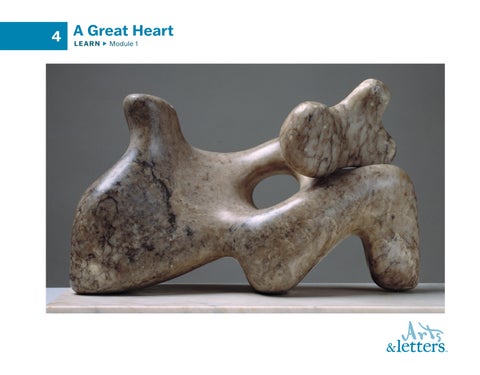
Mother and Child, 1934
Discuss and debate topics you care about.
Dame Barbara Hepworth
Study art to make paintings come to life.
Cumberland alabaster on marble base, 230 × 455 × 189 mm
Ready to tap into knowledge?
GR A D E 4 M O DULES Module 1 | A Great Heart Module 2 | Myths and Enduring Stories Module 3 | The American Revolution Module 4 | Let’s Play Ball
ISBN 979-8-88811-299-1
9
O N TH E COVER
798888 112991
B
Purchased with assistance from the Friends of the Tate Gallery 1993. © Dame Barbara Hepworth. Photo: Tate Gallery