Minnesota’s Most Rural Diocese Diocese of New Ulm Vol. 41 No. 2 October/November 2026
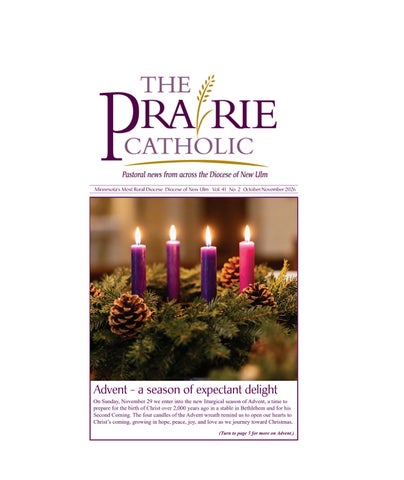
Advent - a season of expectant delight On Sunday, November 29 we enter into the new liturgical season of Advent, a time to prepare for the birth of Christ over 2,000 years ago in a stable in Bethlehem and for his Second Coming. The four candles of the Advent wreath remind us to open our hearts to Christ’s coming, growing in hope, peace, joy, and love as we journey toward Christmas. (Turn to page 5 for more on Advent.)
(Photo by Cait McMahon)
A century of faith and learning Minnesota’s Most Rural Diocese
Diocese of New Ulm
Vol. 41 No. 2 October/November 2026
ST. PETER, Minn. –1973 classmates Jim Chouanard and Michelle Leonard pose for a photo during John Ireland Catholic School’s 100th anniversary celebration, honoring its rich history, cherished memories, and lasting legacy. (Read more, page 6.)
Ethics Conference calls Catholics to uphold life, accompany the dying by: Deacon Ryan Pope Prairie Catholic correspondent SLEEPY EYE, Minn. – At a time when questions of life, death, and human dignity will soon take center stage in Minnesota’s legislative debate, clergy, religious, healthcare professionals, parish leaders, and the faithful from across the Diocese of New Ulm gathered to reflect on what it means to uphold the sanctity of life while accompanying those who suffer. On Oct. 10, 2026, participants gathered at Schoenstatt on the Lake Retreat Center for the diocesan Ethics Conference, titled “The Gift of Life, The Grace of Dying: Responding to the Church’s Teachings on Assisted Suicide.” The conference took
inside Page 3
New counselor joins Catholic Charities
Page 7
DMA begins weekend of Nov. 21-22
Page 11
Schoenstatt community welcomes new Fr. Kentenich statue
Visit us online! www.dnu.org
place as Minnesota prepares for another legislative session in January in which lawmakers are expected to consider, for the thirteenth time, legislation promoting physician-assisted suicide under the term “medical aid in dying.” The annual ethics conference sought to deepen Catholics’ understanding of Church teaching, strengthen moral clarity, and equip the faithful to uphold the dignity of every human life with truth and compassion. Through this formation, participants were invited to consider how the Church can accompany those facing suffering and end-of-life decisions, offering mercy and hope while affirming the sacredness of life and the inherent dignity of every person. Created in God’s image Bishop Chad Zielinski of New Ulm opened the day with Mass. Preaching from Genesis and the opening creation accounts of the Gospel of John, Bishop Zielinski reminded the faithful that God pronounced His creation “good” and, creating the human person in His own image and likeness, declared it “very good.” Human life is not merely one good among many; it is the only part of creation stamped with God’s own likeness, having an infinite and inherent dignity. Yet sin introduced disorder into the world and into our own lives. Illness, suffering, and death were not a part of God’s original design. The bishop emphasized that the holy sacraments restore a right order within us, reorienting our hearts toward the God who created
The Prairie Catholic
their faith and the power of Christ working through them.” Ethical and religious directives Dr. Scott Helstad, Ph.D., Director of Ethics with Avera Health, led two sessions exploring the Ethical and Religious Directives for Catholic Health Care Services (ERDs), the Church’s authoritative guide for Catholic healthcare in the United States.
Presenters Amy Crowley, RN, BSN, Scott Helstad, Ph.D., and James Joyce, M.D., review highlights with Sr. Candace Fier, MTS, RN, BSN of the Ethics Conference that effectively combined the guidance of Church teaching on Assisted Suicide with the expertise of patient care. (Photo by Christy Baker) us, redeemed us, and accompanies us through every stage of life. Naming the issue clearly Opening the conference, Dr. James “Jerry” Joyce, M.D., established the moral foundation for the discussion by directly naming the issue: “What is being proposed as ‘medical aid in dying’ is truly ‘physician-assisted killing.’” He warned that “euphemisms,” or indirect words, can desensitize the public and obscure moral reality. Dr. Joyce is a retired Family Practice physician with over 43 years of rural medicine practice. He noted that “pain” does not appear among the top five reasons patients give for seeking physician-assisted suicide. Instead, he explained, “fear of the unknown” and “loss of control,” as well as other concerns, are among the most commonly cited reasons in states where physicianassisted suicide is legal. Therefore, l
Page 1
l
the claim that “your doctor won’t be able to help you relieve pain without this type of legislation” is misleading and simply untrue. Drawing on Scripture, the Catechism of the Catholic Church, and the Hippocratic tradition, Dr. Joyce emphasized a vision of mercy that encourages virtue while relieving suffering. Upholding Jesus, the Divine Physician, as our model, he highlighted Christ’s compassion, self-gift, and suffering with and for others, perfectly revealed in the image of the crucifix, as paramount to compassionate care. “We have lost so much faith in systems to alleviate suffering,” Dr. Joyce explained, speaking of healthcare systems and providers. “We would do well to grow in our faith in God, in Christ, and even in the individuals we are with. We should express our faith to them and let them demonstrate
October/November 2026
Dr. Helstad reflected on a foundational truth expressed in the ERDs: “Without health of spirit, high technology focused strictly on the body offers limited hope for healing the whole person.” He emphasized that Catholic healthcare, and healthcare more broadly, must always care for the whole person, body, mind, and soul (spirit), recognizing that every patient is created in the image of God. He also traced the development of the Catholic moral teaching on healthcare, beginning with the life and example of Jesus Christ and the teachings of the Church Fathers. Drawing from the seventh edition of the Ethical and Religious Directives, published in 2025, Dr. Helstad highlighted several key principles, including the sacredness of human life as a gift from God. As he explained, “We are not the owners of our lives and, hence, do not have absolute power over our lives.” While we have a responsibility to preserve life, Dr. Helstad clarified that this duty is not absolute. (Continued on page 5.)
Identify, Invite, & Ignite Encouraging and supporting religious vocations by Bishop Chad W. Zielinski In April 2026, the Diocese of New Ulm Office of Vocations launched a “Called By Name” program inviting parishes throughout the diocese to identify young men, ages 15-35, who reflect Catholic virtues. Thanks to the priests and parishioners who promoted the program, 247 young men were identified and invited to a Called by Name dinner in Olivia on June 14. Approximately 35 attended, along with some parents. Thank you to the Knights of Columbus Council #2000 for hosting the dinner and to all the Knights of Columbus councils that helped provide financial support. In an informal conversation I had during dinner with about seven young men and several parents, three key influences emerged as important in their faith journeys: prayer, a home environment that encourages vocational discernment, and encounters with joyful priests and supportive parishioners who live out their faith. Prayer: A robust prayer life at home and regular participation in Sunday Mass and Holy Days of Obligation play a significant role in the spiritual growth of families. I strongly encourage families to pray daily at home: at meals, with the Rosary, through devotions to
P
THE
RA RIE
The Bishop’s Column: That they may have life saints, using the Halo App, and in many other ways. Children often find comfort and joy in a regular prayer routine, especially when it builds a relationship with Jesus, Mary, and the saints. In fact, at the end of the day, when parents are exhausted and might be tempted to skip prayer, children can be great advocates, inspiring their parents to remain faithful to prayer, even when life gets busy. A consistent connection exists between an increase in vocations and an increase in hours of Eucharistic adoration at the parish and diocesan levels. I highly recommend dedicating time each week to adoration, and I offer profound thanks to those who engage in this prayerful posture of listening to the Lord. When a child sees their parents sacrifice time for adoration, it is a powerful witness that mom and/or dad are attentive to God. Pilgrimage is another growing form of prayer, particularly popular among the younger generations. During the summer of 2025, the diocese organized a pilgrimage featuring an image of its patroness, Our Lady of the Prairie. Young pilgrims visited all the Area Faith Communities throughout the diocese, engaging in prayer and adoration, while fostering discernment of their vocations. Recently, 20 youth and young adults, accompanied by two diocesan priests, made a pilgrimage to Our Lady of
Champion in Green Bay, Wis.
Encountering Priests, Deacons,
The pilgrimage offered the opportunity to step away from the busyness of everyday life and familiar surroundings to visit a holy site, spend time in prayer, listen for God’s voice, and remain open to his call to holiness.
and Parishioners Joyful in their Faith: Many who have discerned a vocation to religious life can point to a priest, deacon, consecrated man or woman, or a parishioner whose joyful witness of faith inspired them to consider a religious vocation.
Consecrated Men and Women,
I encourage the faithful of the diocese to visit our diocesan Shrine of Our Lady of the Prairie at the Church of St. Mary’s in New Ulm or the Schoenstatt Jubilee Shrine in Sleepy Eye. Our diocese is blessed to have both of these shrines available to those seeking a pilgrimage experience. Creating a Vocation-Friendly Haven at Home: Many scripture scholars refer to the home of the Holy Family as the “School of Nazareth.” It is here, in this haven of holiness, that Jesus grew in age and wisdom under the care and love of the Blessed Mother and St. Joseph, all while knowing his Father’s will. I strongly encourage parents to create their own “School of Nazareth” at home where children feel comfortable asking, “Lord, what do you want me to do with my life?” This space should allow for open discussion without judgment, fostering discernment while offering love and support. God calls all of us to a life of holiness and gives each free will. He invites us to pursue a vocation driven by his beauty, goodness, and truth, and on this journey, we discover true holy joy.
Friends in Christ, please consider taking the time to enter into prayer and stepping forward to identify, invite, and ignite a young person in our diocese to consider a vocation to the priesthood or religious life.
testing reports on the tissue removed during the Holy Father’s surgery confirmed that the tumor was localized. A subsequent oncological assessment has confirmed that no further treatment is necessary.
The Prairie Catholic, the official newspaper for the Diocese of New Ulm since May 1972, is published every six weeks, Sept.–June.
Pope Leo XIV was discharged from Romeʼs Gemelli Hospital
Publisher: Bishop Chad W. Zielinski Editor: Christine E. Clancy
Postmaster: Send notice on Form 3579, “The Prairie Catholic,” 1421 6th Street North, New Ulm, MN 56073-2071. Periodical postage paid at New Ulm and additional mailing offices. USPS 926-760.
I want to thank the clergy, religious, and lay faithful throughout the diocese who dedicate time to prayer, seek a deeper encounter with Christ, and strive to grow in holiness. Our youth often tell me that some of the most powerful witnesses of faith are those they see praying in church, waiting in line for confession, or walking with a rosary in hand. Thank you for your sacrifices and for the example you set through your faithful discipleship in Christ.
Awareness Week
NOVEMBER 1-7, 2026
Diocese launches new plan to promote vocations This year and into next, the diocesan Office of Vocations will implement a new Vocation Plan to inspire young men to become ardent and gentle heralds of the Gospel. Initiatives include a new vocation team, a Called by Name Campaign, discernment events and regional groups, personal accompaniment, renewed communications, the new DiscernerBase app, and an appeal for financial support. Upcoming Vocation Events Nov. 19-21: Vianney Visit to the seminary Nov. 29: St. Andrew Dinner in Granite Falls Feb. 18-20: Vianney Visit to the seminary
LEARN MORE!
nuvocations.org (507) 233-5302
Pope Leo XIV’s health: “No further treatment is necessary”
CATHOLIC
Publication office: Diocesan Pastoral Center, 1421 6th Street North, New Ulm, MN 56073; phone: 507-359-2966, Email: dnu@dnu.org Website: www.dnu.org
During the first few weeks of my assignment as a newly ordained priest, I clearly remember the pastor encouraging me to develop fraternal friendships with priests my age and to form relationships with families who have holy, healthy, and happy marriages. This was incredibly wise advice.
National Vocations
on Oct. 17 and returned to the Vatican. On Oct. 21, he held his first general audience since the operation. Appearing to be in excellent spirits, he wanted to be close to the faithful and thank them for their prayers.
Statement of ownership, management, circulation
Pope Leo greets hospital staff and well-wishers as he arrives at Rome's Gemelli Hospital Oct. 13, 2026, for an operation to remove a nodule in his lung. (CNS photo/Vatican Media) VATICAN CITY (EWTN News) Following surgery which removed the lower lobe of his right lung, Pope Leo XIV’s doctors have reported that the tumor removed on October 13 was a lung adenocarcinoma and that
The Prairie Catholic
the disease was localized. The pope’s doctors issued a statement on October 21 noting that a subsequent oncological assessment has confirmed that “no further treatment is necessary.” The final histopathology and molecular l
Page 2
l
During the 2025-2026 publishing year, “The Prairie Catholic” was published every six weeks, September – June resulting in seven issues. Location of the office of publication and general business office of the publisher, Bishop Chad W. Zielinski, is 1421 6th Street North, New Ulm, MN 56073-2071. The editor is Christine E. Clancy, 1421 6th Street North, New Ulm, MN 560732071. “The Prairie Catholic,” the publication of a non-profit organization, is authorized to mail at special rates, according to Section 411.3 DMM postal regulation(s). “The Prairie Catholic” accepts advertising only by invitation. Extent and nature of circulation Net press run Free or nominal rate distribution Total paid circulation Total distribution Office use Total
October/November 2026
Average # copies each issue during last 12 months 19,748 19,643 none 19,643 105 19,748
Actual # copies single issue publication date 9/2026 19,606 19,594 none 19,594 12 19,606
diocesan church
Knights honor Way of the Cross Committee for preservation efforts by Christine Clancy The Prairie Catholic NEW ULM, Minn. –The Knights of Columbus Council #1076 recently honored the Diocese of New Ulm’s Way of the Cross Committee for its dedication and significant improvements at the historic Way of the Cross Shrine and Loretto Park in New Ulm. The Way of the Cross is a 14 station pilgrimage site depicting the crucifixion of Jesus. The shrine, built in 1904, was placed on the National Register of Historic Places in 2020. At the Aug. 17, 2026, meeting, the Knights presented the committee with a certificate of recognition, congratulating its members on their work maintaining, improving, and preserving these special historic sites. In recent years, the committee has completed several notable projects to enhance the beauty, safety, and accessibility of the sacred grounds while preserving the site’s spiritual significance for visitors. Recent improvements
include a new parking lot sign directing visitors to the shrine and a new placard in the display case at the foot of the shrine’s entrance featuring three QR codes that link to information about the site’s history, the Stations of the Cross, and opportunities to make donations. Major projects also included a new sprinkler system for Loretto Park, a new waterline along the pathway, and a new sidewalk connecting the city sidewalk to the park. Additionally, new steel railings have been installed at the entrance to Loretto Park to improve safety and accessibility. A significant hillside renovation project reinforced the 14 Stations along the pathway of the Way of the Cross and improved the surrounding landscaping. In addition, a moisture issue at one of the Stations was addressed, numerous dead trees along the path were removed, and maintenance was performed on all the light poles along the shrine’s path. A new automated locking system was installed in the Chapel
These projects reflect the committee’s ongoing commitment to caring for the shrine and Loretto Park, ensuring that the grounds remain a welcoming place for prayer, reflection, and pilgrimage.
Knights of Columbus Council #1076 recently recognized the Diocese of New Ulm’s Way of the Cross Committee for its dedication to preserving and improving the historic Way of the Cross Shrine and Loretto Park in New Ulm. Pictured are current and former committee members Duane Hansel (left), Denise Richter, Chuck Keller, Gary Neubauer, current chairperson; Eddie Stadick, Earl LaPlante, former chairperson; Scott Osborne, Darlene Filzen, and Steve Gehrke. (Photo by Christy Baker) of the Mother of Sorrows located atop the hill of the shrine. Another preservation effort included refurbishing the statue of Father Alexander Berghold located in
Beth McMahon by Christine Clancy The Prairie Catholic The Diocese of New Ulm Catholic Charities has expanded its counseling outreach to individuals and families by adding a new counselor. Beth McMahon began offering services in September and brings a strong blend of clinical preparation and pastoral
As McMahon begins this new chapter with Catholic Charities, she looks forward to continuing her work alongside a team of dedicated professionals. In addition to serving children, teens, adults, couples, and families, she will also be available as a resource to Catholic schools throughout the diocese. McMahon will provide counseling services under the clinical supervision of Catholic Charities office director Tami Behnke, MS, LPCC, a Minnesota Board-approved
The Prairie Catholic
Editor’s note: Maintenance of the Way of the Cross Shrine and Loretto Park is funded primarily through donations from the Knights of Columbus and private donors. Contributions to both the shrine or Loretto Park may be sent to the Diocese of New Ulm at 1421 6th Street North, New Ulm, MN 56073.
Bishop and seminarians attend Beatification of Sheen
Catholic Charities expands counseling services with new counselor formation. She holds a Master of Arts in Psychology with an emphasis in Marriage and Family Therapy, and has completed advanced formation in spiritual direction, theology, and ministry leadership through the Diocese of Stockton, California.
Loretto Park. Father Berghold (1838–1918) was a pioneering missionary priest whose work laid the foundation for the Diocese of New Ulm.
The Knights also recognized Earl LaPlante of New Ulm for his 10 years of service on the Way of the Cross Committee. Although he retired from the committee in 2022, LaPlante continues to consult with its members and support the ministry by crafting more than 1,500 small wooden crosses each year for chapel visitors to take home as keepsakes.
supervisor, as she works toward Minnesota licensure. The Diocese of New Ulm Catholic Charities is committed to making counseling accessible and affordable. Services are available through telehealth and in-person appointments, with most health insurance plans accepted and a sliding-scale fee offered. McMahon’s office is located in Canby, Minn. She is available for in-person and telehealth sessions. Call Catholic 1-866670-5163. Editor’s note: Catholic Charities services in the Diocese of New Ulm are made possible in part by donations to the annual Diocesan Ministries Appeal (DMA). Visit the diocesan website at www.dnu.org to view the 2026 Diocesan Ministries Appeal promotional video.
l
Page 3
l
Bishop Chad Zielinski and seminarians from the Diocese of New Ulm traveled to St. Louis, Mo., for the Sept. 24 beatification Mass of Archbishop Fulton J. Sheen. Celebrated by Cardinal Luis Antonio Tagle, the Mass drew nearly 50,000 pilgrims as Sheen became the first bishop born in the United States to be declared Blessed. Sheen graduated from The Saint Paul Seminary in 1919, the same seminary where the New Ulm seminarians pictured (l-r), Deacon Brent Sundve, David Rabaey, Mark Schommer, Matthew Collins, and Isaac Timmerman are currently preparing for the priesthood. (Photo submitted)
October/November 2026
diocesan church
Bishop Zielinski celebrates a Blue Mass in honor of veterans and first responders
Para que tengan vida
Identificar, Invitar y Encender Fomentar y apoyar las vocaciones religiosas
por Bishop Chad Zielinski En abril de 2026, la Oficina de Vocaciones de la Diócesis de New Ulm lanzó el programa “Llamados por su Nombre” (Called By Name), por el cual se invitó a los fieles de todas las parroquias de toda la diócesis a identificar a jóvenes varones, de entre 15 y 35 años, que reflejaran las virtudes católicas. Gracias a los sacerdotes y feligreses que promovieron el programa, se identificó a 247 jóvenes, quienes fueron invitados a una cena la cual se llamó: Llamados por su Nombre en Olivia el 14 de junio. Aproximadamente 35 asistieron, junto con algunos padres de familia. Agradezco al Consejo #2000 de los Caballeros de Colón por organizar la cena y a todos los consejos de los Caballeros de Colón que ayudaron a brindar apoyo económico. Durante una conversación informal que tuve en la cena con unos siete jóvenes y varios padres de familia, surgieron tres influencias fundamentales en sus caminos de fe: la oración, un ambiente familiar que fomente el discernimiento vocacional y los encuentros con sacerdotes llenos de alegría y feligreses comprometidos que viven su fe. Oración: Una vida de oración sólida en el hogar y la participación regular en la Misa dominical y en los días de precepto desempeñan un papel importante en el crecimiento espiritual de las familias. Recomiendo encarecidamente a las familias que oren diariamente en casa: a la hora de las comidas, el Rosario diario o frecuente, mediante devociones a los santos, utilizando la aplicación Halo App y de muchas otras maneras. Los niños suelen encontrar consuelo y alegría en una rutina constante de oración, especialmente cuando esta fortalece su relación con Jesús, María y los santos. De hecho, al final del día, cuando los padres están agotados y pueden sentir la tentación de omitir la oración, los niños pueden ser grandes promotores de ella, inspirando a sus padres a permanecer fieles a la oración, incluso cuando la vida se vuelve muy ocupada. Existe una relación constante
entre el aumento de las vocaciones y el incremento de las horas de adoración eucarística a nivel parroquial y diocesano. Recomiendo especialmente dedicar tiempo cada semana a la adoración y expreso mi profundo agradecimiento a quienes adoptan esta actitud de oración y escucha del Señor. Cuando un niño ve que sus padres sacrifican parte de su tiempo para dedicarlo a la adoración, recibe un testimonio poderoso de que su mamá y/o su papá están atentos a Dios. La peregrinación es otra forma de oración cada vez más frecuente, especialmente popular entre las generaciones más jóvenes. Durante el verano de 2025, la diócesis organizó una peregrinación con una imagen de nuestra patrona, la Virgen de la Pradera. Los jóvenes peregrinos visitaron todas las Comunidades de Fe del Área de la diócesis, participando en momentos de oración y adoración, mientras fomentaban el discernimiento de sus vocaciones. Recientemente, 20 adolescentes y jóvenes adultos, acompañados por dos sacerdotes diocesanos, realizaron una peregrinación al Santuario de Nuestra Señora de Champion, en Green Bay, Wisconsin. La peregrinación les brindó la oportunidad de alejarse del ajetreo de la vida cotidiana y de su entorno habitual para visitar un lugar santo, dedicar tiempo a la oración, escuchar la voz de Dios y permanecer abiertos a su llamado a la santidad. Animo a los fieles de la diócesis a visitar nuestro Santuario Diocesano de Nuestra Señora de la Pradera, en la Iglesia de Santa María en New Ulm, o el Santuario Jubilar de Schoenstatt en Sleepy Eye. Nuestra diócesis tiene la bendición de contar con ambos santuarios para quienes desean vivir una experiencia de peregrinación. Crear un Refugio Favorable a las Vocaciones en el Hogar: Muchos estudiosos de las Sagradas Escrituras se refieren al hogar de la Sagrada Familia como la “Escuela de Nazaret”. Es allí, en ese refugio de santidad, donde Jesús creció en edad y sabiduría bajo el cuidado y el amor de la Santísima Virgen María y San José, conociendo
The Prairie Catholic
siempre la voluntad de su Padre. Recomiendo encarecidamente a los padres de familia que creen su propia “Escuela de Nazaret” en el hogar, donde los hijos se sientan cómodos preguntando: “Señor, ¿qué quieres que haga con mi vida? Este espacio debe permitir un diálogo abierto, sin juicios, que fomente el discernimiento y brinde amor y apoyo. Dios nos llama a todos a una vida de santidad y nos concede el libre albedrío. Nos invita a seguir una vocación impulsada por su belleza, bondad y verdad, y en este camino descubrimos la verdadera alegría santa. Encontrarse con Sacerdotes, Diáconos, Hombres y Mujeres Consagrados y Feligreses que Viven su Fe con Alegría: Muchos de quienes han discernido una vocación a la vida religiosa pueden señalar a un sacerdote, diácono, hombre o mujer consagrada, o a un feligrés cuyo testimonio alegre de fe los inspiró a considerar una vocación religiosa. Durante las primeras semanas de mi asignación como sacerdote recién ordenado, recuerdo claramente que el párroco me animó a cultivar amistades fraternas con sacerdotes de mi edad y a establecer relaciones con familias que tuvieran matrimonios santos, saludables y felices. Fue un consejo extraordinariamente sabio. Quiero agradecer al clero, a los religiosos y a los fieles laicos de toda la diócesis que dedican tiempo a la oración, buscan un encuentro más profundo con Cristo y se esfuerzan por crecer en santidad. Nuestros jóvenes me dicen con frecuencia que algunos de los testimonios de fe más poderosos son los de aquellas personas a quienes ven orando en la iglesia, esperando en la fila para confesarse o caminando con un rosario en la mano. Gracias por sus sacrificios y por el ejemplo que dan mediante su fiel discipulado en Cristo. Amigos en Cristo, les pido que consideren dedicar tiempo a la oración y dar un paso adelante para identificar, invitar y encender en algún joven de nuestra diócesis el deseo de considerar una vocación al sacerdocio o a la vida religiosa.
l
Page 4
l
At the Church of the Holy Redeemer, Bishop Chad W. Zielinski and clergy gather for a photo with military veterans and first responders following a Blue Mass celebrated in their honor. The Mass recognized the dedication, service and sacrifices of those who serve and protect. (Photo by Christy Baker) by Christine Clancy The Prairie Catholic MARSHALL, Minn. – Bishop Chad W. Zielinski celebrated a special Blue Mass on Tuesday, Sept. 29, 2026, at the Church of the Holy Redeemer in Marshall honoring military veterans and first responders. The Mass provided an opportunity for the faithful of the Diocese of New Ulm to gather and recognize those who have served in the armed forces and those who continue to protect and assist their communities, often placing themselves in harm’s way to safeguard the lives and well-being of others.
Since arriving in the diocese in 2022, Bishop Zielinski has met numerous veterans and first responders in the parish communities he has visited. Their stories of service and sacrifice have highlighted the important role these men and women play in their communities and the need to support them through prayer, gratitude, and recognition. A military veteran himself, Bishop Zielinski encourages the faithful to continue praying for all veterans and first responders, as well as for peace throughout a world wounded by war and conflict.
Anyone who has suffered sexual
abuse or exploitation by clergy or church personnel of the Diocese of New Ulm should immediately report such misconduct to local law enforcement. They are encouraged to contact the Victim Assistance Coordinator or the Bishop’s Delegate in Matters Pertaining to Sexual Misconduct, 1421 6th Street North, New Ulm, MN 56073, phone: 507-233-5313, for counseling or assistance, if that is desired.
Toda persona que haya sido víctima de abuso o explotación
sexual por parte del clero y personal de la Iglesia de la Diócesis de New Ulm debe reportar dicha mala conducta a las autoridades policiales inmediatamente. Se les exhort ponerse en contacto con el Coordinador de Asistencia para victimas o el Delegado del Obispo en cuestiones sobre el mal comportamiento sexual, 1421 6th Street North, New Ulm, MN 56073, teléfono: 507-233-5313, hay consejería o asistencia disponible si así lo desea.
October/November 2026
family life
Season of Advent begins November 29:
Exploring India’s traditions and spiritual practices in preparation for Christmas by Fr. Beschi Savarimuthu, OSB
Advent is a joyful season for
Christians worldwide as they prepare to celebrate the birth of Jesus Christ. Soon, parish communities in the Diocese of New Ulm will sparkle with Christmas lights, and the air will fill with anticipation. One of the most common Advent practices in my homeland of India is an increased emphasis on prayer and worship. Parishes often begin the sacred season with Scripture readings about hope, repentance, the coming of the Messiah, and the call to prepare one’s heart for Christ. As in the United States, Advent wreaths mark the four weeks before Christmas, with candles associated with themes such as hope, peace, joy, and love. Families and congregations gather each week to light the candles, sing hymns, and pray together. Advent through an Indian lens Local culture strongly shapes Advent traditions in India. One of the most visible customs is the Christmas star hung outside homes, churches, schools, and other institutions as a reminder of the Star of Bethlehem. The custom is especially popular in Tamil Nadu, Karnataka, Andhra Pradesh, Goa, Kerala, and many urban Christian communities.
Families also prepare cribs or nativity scenes, decorate their homes with lights, and begin making sweets and festive foods. In Goa and Mangalore, families prepare traditional sweets and gather for community celebrations as Christmas approaches.
Christmas carol singing is another important Advent practice in India. In many areas, groups of young people and church members visit homes singing in local languages such as Tamil, Telugu, Konkani, Kannada, Hindi, Khasi, Mizo, and English, fostering fellowship. In the Northeast, where Christianity has a strong presence especially in Nagaland, Mizoram, and Meghalaya, preparations include choir practices, community worship, youth programs, and cultural gatherings. Music becomes a powerful expression of faith and community identity. Home, hospitality, fellowship Advent in India is not limited to church rituals; it also extends into family and community life. Families clean and decorate their homes, plan Christmas meals, purchase new clothes, and prepare to welcome relatives and neighbors. In Tamil Nadu, Christian families share sweets and cakes with people of other faiths, reflecting India’s wider culture of hospitality and
Fr. Beschi Savarimuthu, a monk of Asirvanam Benedictine Monastery in Bangalore, India, has served the Diocese of New Ulm for 11 years. He is parochial vicar for the Mary, Mother of God Area Faith Community, serving Marshall, Cottonwood, Tracy and Milroy. (Photo submitted) interreligious friendship. It strengthens family bonds, renews community relationships, and creates opportunities for sharing joy beyond the boundaries of one’s own religious community. Compassion in action Charity is a vital aspect of Advent practice in India. Churches and Christian organizations organize visits to the poor, the sick, the elderly, and those who are
alone. Parish groups distribute food, clothes, gifts, or financial assistance to families in need. Schools and church communities conduct outreach programs, Christmas collections, or social service activities. Thus, Advent becomes a season of compassion and practical love. One season, many expressions India’s regional traditions give Advent many distinctive
expressions. In Goa, a strong Catholic heritage shaped by Portuguese influence is visible in decorated churches, music, and festive preparations. In Tamil Nadu, family prayer, spiritual renewal, fellowship, and sharing are especially prominent. Across Northeast India, choirs, cultural programs, community worship, and large gatherings animate the season. In cities such as Mumbai, Delhi, Chennai, Bengaluru, and Kolkata, traditional worship often blends with modern urban celebrations. These varied practices share one spiritual message: Advent calls Christians to peace, joy, and readiness for Christ. Advent in India unites prayerful expectation with the cultural life of families and communities. The lighting of candles, singing of carols, making of cribs, hanging of stars, and sharing of food with people in need express a faith that is both deeply Christian and distinctly Indian. Across regional and denominational differences, these practices give the season its enduring purpose: to wait with hope, live with compassion, and prepare to welcome Christ at Christmas.
Ethics Conference explores Church teaching on assisted suicide (Continued from page 1.) Medical treatments must be evaluated in light of their potential benefits and burdens, distinguishing between ordinary/ proportionate means of preserving life and treatments that demand extraordinary/disproportionate means of preserving life and result in excessive burden. Throughout the ERDs, Christ remains at the center of Catholic healthcare, which is understood as a continuation of his work. In the directives, we see that suffering can unite us to Christ’s passion and death, until transformed by his Resurrection, it becomes a final act of Communion with him. He also explored the newly revised directive concerning nutrition and hydration, offering a compassionate perspective on its application in end-of-life care. Through these sessions,
Dr. Helstad invited participants to consider how the ERDs guide healthcare decisions rooted in faith, compassion, and respect for the dignity of every human person, particularly in the most vulnerable moments of life. Responding to suffering Drawing on more than 40 years of hospice and palliative nursing care through the Mayo Healthcare System, Amy Crowley, RN, BSN, offered a moving reflection on suffering, presence, and the sacredness of accompanying the dying. She began by inviting attendees to prayerfully consider their own definitions and experiences of suffering, explaining that “there’s no wrong in the room” when it comes to defining suffering. Crowley reminded the audience that suffering extends beyond the physical and can often leave individuals feeling isolated. She emphasized that we all have
The Prairie Catholic
a role in accompanying those who suffer, including family members, caregivers, healthcare professionals, clergy, parishes, and the wider community. After sharing what hospice care entails, Crowley noted, “Hospice is hard work, but it is sacred work.” She reflected on the difficulty of putting the beauty of hospice care into words, and when asked how she could do such challenging work, she explained, “If you have that calling, how can you not?” Sharing stories of families who discovered unexpected grace in the final days of a loved one’s life, Crowley noted that suffering is not just experienced by the dying, but also by the spouse or parents, family, friends, the healthcare professionals, clergy, and others who experience suffering alongside dying. “It’s not my story and plan,” l
Page 5
l
Crowley said. “It’s their story and plan,” and emphasized the importance of presence, silence, listening, and time when accompanying those who are nearing the end of life. In contrast, she expressed concern that medical aid in dying (physicianassisted suicide) takes all of that away and rushes to the end. She added that accompanying the dying is an act of mercy that honors the dignity of the person and the hope of eternal life. A call to witness The conference concluded with a challenge from Sister Candace Fier, ISSM, MTS, RN, BSN, director of the diocesan Office of Family Life and a key organizer of the annual Ethics Conference. She asked: How will we become witnesses? How will we speak the truth with clarity, accompany those who suffer, and defend the sanctity of life in our parish communities?
October/November 2026
She explained that Minnesota’s repeated attempts to legalize physician-assisted suicide demand a clear, compassionate response. The Church does not deny suffering; she enters it. She doesn’t hasten death; she reverences it. She doesn’t abandon the dying; she accompanies them. Bishop Zielinski urged those gathered to “take it to prayer.” Pray for our legislators, for our healthcare workers, for families facing difficult diagnoses, and for all who fear suffering or death. Pray for courage to speak the truth with love and compassion. Above all, pray that our state may always choose authentic mercy – one that protects life, accompanies the suffering, and honors the Godgiven dignity of every person from conception to natural death.
church community
A century of Faith, Learning, and Families John Ireland Catholic School in St. Peter celebrates 100 years
Alumni and friends of all ages with ties to John Ireland School in St. Peter gathered for a photo Oct. 3, 2026, to celebrate the school’s 100th anniversary. (Photos by Cait McMahon)
Named for a distinguished Church leader, John Ireland Catholic School traces its roots to the early 1900s by Elli Burmis Prairie Catholic correspondent ST. PETER, Minn. – Celebrating a century of faith, academic excellence, and a parish family spanning generations, John Ireland Catholic School and the Church of St. Peter in St. Peter recently celebrated 100 years of Catholic education. On Saturday, October 3, alumni, current students, parents, and supporters gathered for a special centennial reunion featuring an open house, Mass celebrated by parish pastor Msgr. Douglas Grams, a social hour, and a meal, honoring not only the school’s rich history but also the enduring bonds that create a sense of family. Steve Boehm, centennial event coordinator and member of the Church of St. Peter Parish Administrative Committee, noted that the first parochial school in St. Peter traces back to 1865. The School Sisters of Notre Dame led the school, and the Sisters of St. Francis later took over its operation. School named for distinguished Church leader In 1922, an agreement between the two Catholic pastors in St. Peter, Rev. Hilary Jordan of the Church of St. Peter and Rev. James Mamer of the Church of St. Mary, along with members of both parishes, led to a school consolidation that created Union Catholic School. Three years later, the school was renamed John Ireland Catholic School, named after one of Minnesota’s distinguished church leaders, Archbishop John Ireland, the first archbishop of Saint Paul, Minn. In 1925, construction began on a new school building, completed in 1926 in time for the start of the new academic year. A local resident later purchased the original school building and converted it into a residence.
renovations while remaining committed to its mission of promoting “Gospel values, academic excellence, and Christian service.” Yet students, staff, and alumni agree that John Ireland’s strong sense of family truly sets it apart. This close-knit community has been at the heart of the school since its earliest days and continues to define its identity today. School principal Amanda Roche emphasizes that John Ireland’s Gospel-centered culture sets it apart. “God is at work here in powerful ways, touching hearts and forming little disciples. Once you become part of the John Ireland family, you are always part of it.” Heather Gilbertson, John Ireland music teacher and school alumna, shares this same sense of belonging. “Our family has been part of this community for nearly 20 years. Along the way, we’ve met so many wonderful people and built beautiful, lifelong friendships. John Ireland Catholic School has always felt like family to us.”
John Ireland Catholic School alumna MaryAnn Enz (far left), Linda Olson, and Ruth Sonnek (far right) along with friends of the school look through a display of photographs and newspaper memories.
John Ireland is unique for the lasting connections its alumni maintain with the school and their continued commitment to its mission. Bob Genelin attended John Ireland from 1952 to 1959 and now serves as the school’s custodian. He finds a special sense of family among the students and staff, sharing, “I do not have any grandkids of my own, but these little ones, teachers included, make me feel like a grandpa. The community feels like a big family.” Cindy Lynch, who taught third grade at the school for 25 years, has deep family connections dating to the school’s founding, when her great-aunts and great-uncles attended. Lynch, both of her parents, all her siblings, and her own children also attended John Ireland. Reflecting on her years at the school, she recalls, “I loved teaching there.” (Continued on page 9.)
Over the years, the school has undergone several
The Prairie Catholic
l
Page 6
l
John Ireland School principal Amanda Roche (right) visits with parent Kelly Clancy and her children, Audra, a preschooler, and Emmett, a third grader, during the school’s centennial reunion, which celebrated 100 years of fellowship and Catholic education.
October/November 2026
diocesan church
Answering the call: Y E S!
Seminarian Formation Strengthened by the Diocesan Ministries Appeal
Rev. Mr. Brent Sundve has entered Theology IV, his final year at Saint Paul Seminary in St. Paul, following his May ordination as a transitional deacon. He served the Holy Cross Area Faith Community (New Ulm, Searles, and West Newton Township) over the summer and will continue there for his weekend parish assignment. Priestly ordination is anticipated for June 12, 2027, at the Cathedral of the Holy Trinity in New Ulm.
David Rabaey has entered Theology III at Saint Paul Seminary in St. Paul. This summer, he completed a Spanish immersion course at Olé in Querétaro, Mexico, and will continue developing his Spanish proficiency while pursuing an M.A. in Theology at the seminary. His transitional diaconate ordination is scheduled for May 8, 2027, at the Cathedral of the Holy Trinity in New Ulm.
Matthew Collins has entered Pre-Theology II this academic year. This summer he completed a Spanish Immersion Course at Olé in Queretaro, Mexico and will continue to develop his proficiency in Spanish through tutoring this academic year before returning in the summer to Olé to further develop his Spanish skills.
Mark Schommer has entered Pre-Theology I after completing the Propaedeutic Stage at Saint Paul Seminary in St. Paul. This summer, he participated in COR Expeditions, a leadership experience combining sacramental formation, wilderness challenges, mental tenacity, and intentional growth in Christ.
Isaac Timmerman has entered his spirituality year in the Propaedeutic Stage at Saint Paul Seminary. He is a graduate of North Dakota State University with a B.A. in History. He is a member of the Church of the Holy Redeemer in Marshall, and in December he completes his enlistment in the U.S. Army Reserves’ 7410th MTC.
The power of giving
DMA chair couple highlight the impact of the annual appeal served as a priest of the diocese for more than 16 years. The couple said they were not surprised when their son expressed a desire to enter the seminary. “We could see how joyful he was, and we wanted to support that.”
Rhonda and Ron Wiering 2026 DMA Chair Couple
TYLER, Minn. – Ron and Rhonda Wiering, members of the Church of St. Dionysius in Tyler, are serving as this year’s Diocesan Ministries Appeal (DMA) chair couple. The Wierings are the parents of Fr. Matthew Wiering, who has
Rhonda acknowledged that it took time to adjust to the thought of having a son become a priest, but prayer helped her embrace the blessings of his vocation. “What really helped me was every day I prayed this prayer: ‘God, help me see the blessings of the priesthood.’ And God revealed that to me,” she said. Ron encouraged parents whose children may be discerning a vocation to religious life to offer
their support and trust in God’s plan. “Please encourage them, pray for them, and trust God will do what he wants with their life,” he said. The Wierings’ commitment to supporting vocations is reflected in their support of the DMA, which helps fund essential diocesan ministries and programs that individual parishes may not have the resources to sustain n their own. “There’s many things that our local parishes probably cannot do on their own,” Ron said. “But, with the help of everyone coming together, it makes all these programs possible.”
Aaron Gnerer is a college junior who entered his second year at Saint John Vianney College Seminary in St. Paul. This summer, he served as a Totus Tuus team leader, providing weekly youth catechesis at parishes throughout the diocese. He also volunteered with the diocesan Office of Youth and Young Adult Ministry at Camp Greatness.
Help meet our $1.3 million goal! DONATE NOW: dnu.org/dma
The nine ministries supported by the Diocesan Ministries Appeal continue to make a meaningful difference in the lives of people throughout the Diocese of New Ulm. Through their work, these ministries provide spiritual, mental and physical support to those in need, support Youth Ministry Vocations the formation of 16% 20% seminarians and deacons, and help Family Life children, youth and 2026 DMA 8% adults grow in their Faith Formation faith. Hispanic Ministry 8%
Track your parish’s progress at dnu.org/dma.
10%
Diaconate 5%
Social Concerns 8% Catholic Charities 15%
Catholic Schools 10%
Donations to the DMA are restricted gifts to be used in support of the specifically designated ministries ONLY.
Learn more
about the important work of the 9 ESSENTIAL MINISTRIES supported by the annual appeal or view the DMA VIDEO
www.dnu.org/dma.
The Prairie Catholic
Caleb Kronback began his first year of formation at Saint John Vianney College Seminary. Raised near rural Lamberton, he speaks fluent Spanish, thanks to his mother. A member of St. Raphael in Springfield, Minn., Kronback took over the family farm after losing both parents. He began coursework at Century College with plans to transfer his credits to the University of St. Thomas in St. Paul.
l
Page 7
l
October/November 2026
(Sign up at www.mncatholic.org)
Your voice matters in the conversations that shape our life together. Faithful citizenship means more than voting every few years. It means staying informed, engaging thoughtfully, and making our voices heard on the issues that affect our neighbors and the common good. The Catholic Advocacy Network, created by the bishops of Minnesota, makes it easy to participate in the political process by keeping you informed on the bills in play, helping you get to know your legislators, and encouraging you to take action during crucial decisionmaking moments. This is especially pertinent as the 2027 legislative session nears, when lawmakers will debate how to to spend a $70 billion budget, address fraud, and protect religious liberty and family economic security. The DIOCESE OF NEW ULM continues its partnership with the Minnesota Catholic Conference in support of the CATHOLIC ADVOCACY NETWORK by providing educational resources and opportunities to help keep you informed on political issues that matter! Visit the Diocese of New Ulm FAITHFUL CITIZENSHIP page, www.dnu.org/faithful.citizenship or call 507-359-2966.
Your engagement with our “elected state officials, rooted in a
well-formed Catholic conscience, has a profound influence on shaping the common good in Minnesota—the very foundation of Catholic social teaching.
”
— Bishop Chad Zielinski
The Prairie Catholic
l
Page 8
l
October/November 2026
catholic life
National CCW sets coming year priorities
Grace and the Mind
Where faith meets mental health
by Lori Timmerman NUDCCW President
St. Dymphna
From August 26-29 ten representatives from the Diocese of New Ulm attended the 2026 National Council of Catholic Women (NCCW) Convention in Grand Rapids, Mich. Every two years, NCCW approves resolutions guiding its work at the diocesan and parish levels. This year, the assembly approved six new resolutions. 1. Concerning Hunger: Reinforce a commitment to educate about hunger worldwide, while focusing on donating resources to this cause. 2. Violence in Schools: Reduce violence in schools by encouraging a culture of peace among students and the community through prayer, personal reflection, and communication with legislators. 3. Servant Leadership: Enhance the NCCW’s identity as a Catholic organization that embodies Gospel values and uniting Catholic women in prayer, service, and leadership to advance its mission. 4. Human Dignity and Catholic Social Teaching: Encourages Council leaders to educate about the National Eucharistic Revival’s
Patron for those with Mental Illness
by Tami Behnke MS LPCC
“Walking Beside our Youth” As a counselor, a mother, and now a grandmother watching young children begin their school journeys, I know a new school year brings a mix of excitement, hope, and anxiety. Whether parents, grandparents, or caregivers, we all want children to learn, build meaningful friendships, grow in confidence, and feel safe and supported.
New Ulm DCCW representatives attending convention are pictured (front row, left): Arlyce Anderson, Deanery 1 representative; Chris Heiderscheidt, Diocesan Resource and Development Team; Donna Sanders, former national officer; Lori Timmerman, diocesan president; Dianne Vangness, St. Paul/Minneapolis Province director representing Winona-Rochester; Sharon Illikman, immediate past diocesan president; and Kathy Urban, Deanery 3 treasurer. Back row, left: Barb Mathiowetz, immediate past national treasurer; Shirley Nowak, Diocesan Resource and Development Team member and parliamentarian; Msgr. Eugene Lozinski, diocesan spiritual advisor; and Dorothy Vandendriessche, Deanery 2 Legislative Committee member. (Photo courtesy of C.P.S. inc. 2026)
four steps of the “Walk with One Initiative,” eucharisticrevival.org/ walk-with-one. 5. Sanctity of Life: Confirms that every person is part of the Body of Christ from conception to natural death. It states that abortion is wrong and calls for legal protection of the unborn, in line with Evangelium Vitae and the U.S. Catholic bishops.
6. End the Persecution of Christians Worldwide: Encourages daily recitation of the Memorare prayer to help stop the persecution of Christians. It seeks the protection of Mary and promotes making the prayer available in Councils, diocesan wide. For more information visit https:// www.nccw.org/.
John Ireland Catholic School (Continued from page 6.) Reflecting on the school’s mission and lasting impact, Lynch explained, “We taught [our students] about God and the love he has for them. We wanted them to understand that they have a part to play in showing God’s love to others through care and service.” That same servant-heart mentality remains interwoven throughout the school’s daily operations today. Principal Roche details how students put this mission into practice: “Whether it’s serving at Mass, stuffing bulletins, raising money, or cleaning the chapel, the students desire to give in a sacrificial way because Jesus has shown us this way first. Our school’s mission is really about leadership, service, learning, and centering all we do in Christ, for Christ, and through Christ,” she said. “Our students are learning and growing while also experiencing a discipleship way of life.” Jessica Yost, an alumna and former kindergarten teacher, shares that same appreciation, adding, “Sharing
the love of Jesus is at the heart of everything received at John Ireland. It is so much more than just a place where kids learn. It’s a place where kids are loved, celebrated, educated, and seen,” she said. Roche adds, “The John Ireland community is truly alive. There is no place for you to journey alone. No matter what, people want to help and give of themselves.” She emphasizes that this spirit of generosity extends beyond adults, recalling how students contributed to the school marathon using money they earned over the summer or saved in their piggy banks. “This melted my heart!” she exclaims. Alumna and parish volunteer Marge Miller has witnessed this same generosity and kindness firsthand. “The John Ireland community is amazing! The [staff] works very hard to shape the students into well-rounded citizens, growing in faith, knowledge, respect, love, and kindness toward others. I can walk through the halls and have students and teachers greet me with a big smile on their faces. The respect of them all is awesome to witness.”
The Prairie Catholic
Miller said that the faith-filled environment and education she experienced at John Ireland Catholic School reinforced the values she learned through her family’s daily practice of faith and helped shape who she is today. She continues to live out those values through her service to the parish as a catechist, lector, Eucharistic minister, and sacristan. Miller is not alone in expressing gratitude for the school’s lasting influence on her faith. Gilbertson also praises God, sharing, “Even in the hard times, Jesus has remained at the center of it all. Being a part of a small Catholic school has helped me learn to trust more fully in God’s will.” As the banners come down from John Ireland Catholic School’s centennial celebration, its 100year legacy continues. Built on generations of faith and supported by a vibrant parish community, the school looks to the future with hope, continuing its century-long mission of forming young hearts and minds in Christ and inspiring them to share his love with others. l
Page 9
l
Yet, beneath the excitement of a new school year, many children and teenagers carry emotional burdens that may not always be visible. Some are naturally more anxious, while others may struggle with friendships, academic pressure, family changes, social media, feelings of exclusion, or simply navigating a world that can at times feel overwhelming. Younger children may not yet have the words to express feelings like “I am anxious,” “I feel lonely,” or “I do not know how to handle this.” Teenagers may have the vocabulary but still struggle to share what they are experiencing. Emotional distress can manifest as irritability, headaches or stomachaches, trouble sleeping, tearfulness, refusing to go to school, withdrawing from family or friends, or spending more time alone. As adults, our first instinct is often to fix the problem. We want to reassure them, provide solutions, protect them, and make the uncomfortable feeling go away. However, one of the most important things we can offer a struggling child or teenager is a calm presence. Sometimes they need us to listen before we offer advice. A simple response such as “That sounds really hard” can open the door to a deeper conversation. Gentle questions like “What has been the hardest part?” or “What do you think would help?” show their feelings matter and that they don’t have to manage everything alone. We can also help our youth build healthy coping skills. Regular sleep, physical activity, time spent
October/November 2026
outdoors, predictable routines, healthy limits on technology use, family meals, and opportunities for connection all support emotional well-being. For some youth, support at home may be enough to help them through a challenging time. Others might need assistance from a school counselor, physician, mental health professional, or another trusted adult. Our Catholic faith also gives us an important lens through which to view mental health. However, just because we have faith does not mean that we will never experience anxiety, sadness, fear, or emotional pain. Instead, it reminds us that these struggles do not diminish a person’s dignity or worth. Our children and teenagers need to understand that struggling emotionally does not mean they are weak in faith or character. Asking for help can be a healthy and courageous step toward healing, and sometimes God’s care reaches us through the people, relationships, and resources he places in our lives. Remind young people that their worth is not measured by grades, athletic performance, popularity, friendships, or how well they cope. Their value goes beyond achievements and circumstances. They are loved by God and worthy of care simply because of who they are. As another school year is well underway, one of the greatest gifts we can offer our children and teenagers is grace — the freedom to struggle, ask for help, make mistakes, and know they are still deeply and unconditionally loved. And we must extend this same grace to ourselves as parents, grandparents, and caregivers. In difficult times, grace reminds us we don’t have to be perfect or carry our burdens alone. God meets us there, offering hope, healing, and help. Editor’s note: Tami Behnke is a licensed professional clinical counselor. She serves as diocesan director of the offices of Catholic Charities and Social Concerns. Need Mental Health Support? Call (866) 670-5153 or 988 Suicide & Crisis Lifeline.
education
Ask a Canon Lawyer This month’s question: “What do I tell my son or daughter who got married outside the Church?” by Fr. Mark Steffl, STL, JCL
T
his is a question that I have had brought to me by many parents during my time as a priest. (I wrote about this early on in the history of this standing column in the Prairie Catholic, but it is timely to revisit the topic.) Church law says this about the celebration of a valid marriage for a fully initiated member of the Catholic Church: Can. 1108 §1. Only those marriages are valid which are contracted before the local ordinary, pastor, or a priest or deacon delegated by either of them, who assist, and before two witnesses according to the rules expressed in the following canons and without prejudice to the exceptions mentioned in cann. 144, 1112 §1, 1116, and 1127 §§1-2.
§2. The person who assists at a marriage is understood to be only that person who is present, asks for the manifestation of the consent of the contracting parties, and receives it in the name of the Church. This canon from the Code of Canon Law requires that someone who is a baptized Catholic has an obligation to exchange consent (i.e., the marriage vows) in the presence of a priest or deacon. As an exception for mixed marriages (a Catholic marrying a nonCatholic), the couple can work with their priest or deacon to get what is called a “dispensation from canonical form” (i.e., permission from the bishop to be married outside of the normal requirement of law) so that the marriage, even though celebrated in a non-Catholic ceremony, is still recognized by the Catholic Church. Many Catholics today seem to be unaware that they must be
in a marriage recognized by the Catholic Church in order to be considered a “practicing Catholic in good standing with the Church.” Many times this will come up when someone is being considered for the role of a Baptismal godparent or Confirmation sponsor. In addition to not being able to receive the Sacrament him/herself, someone who is not in a validly recognized marriage is unable to fulfill these other roles until their marriage is validated by the Catholic Church, and the same would be required of an individual who works for a Catholic parish or a Catholic school. It is important for parents to do what they can to encourage their Catholic child to properly receive this Sacrament of Marriage if they would perhaps hear that they are planning on a wedding. It puts parents and family members in a difficult place if they are invited to a wedding of a Catholic who is getting married outside the
Church; making them have to decide if their presence at such a ceremony would be encouraging or even passively condoning an act which would place their child outside the sacramental life of the Church. For those with an adult child who has already gotten married outside the Church, it is good for parents to encourage their Catholic child to get his/her marriage validated so that he/she can again receive the other sacraments of the Church. This is done by approaching the local parish and asking to meet with a priest or deacon who can help to chart out a path to getting their non-Catholic marriage to be recognized by the Church. This will involve some paperwork, some marriage preparation (tailored to the situation) and an exchange of vows according to the Rite of Marriage of the Catholic Church, in the presence of a Catholic priest or deacon. Speaking pastorally with people about this topic, I mention that the Catholic Church is so serious about marriage (and the way that marriage is contracted) because
the Lord Himself was so serious in teaching about marriage in the Gospel. Beyond that, the decision to marry is the biggest decision that a couple can make, and the Church desires to do all possible to prepare a couple for that lifelong decision. Today, in what is all-too-often a “throw-away” culture, it is good for the Church to be firm in her teaching about marriage in all of its components, as the sacramental commitment each person to do what he/she can do to help one’s spouse to get to Heaven.
Next Issue: Who “controls” Catholic cemeteries? If you have a question concerning Canon law, email The Prairie Catholic at cclancy@dnu.org. Fr. Mark Steffl is a canon lawyer. He serves as judicial vicar of the diocesan Tribunal and is vicar general and moderator of the curia for the diocese.
Bishops’ November meeting to focus on AI, immigration, evangelization The United States Conference of Catholic Bishops’ November plenary also will address diversity, lectionary translations, canonization causes, and votes on leadership positions. by Tyler Arnold EWTN News The U.S. Conference of Catholic Bishops (USCCB) will livestream the public portion of its November meeting, where bishops will discuss artificial intelligence, immigration, and evangelization, while voting on liturgical texts, canonization causes, and conference leadership positions. The 2026 Fall Plenary Assembly in Baltimore is set for November 16-19, with public portions on November 17-18.
The gathering, which has been livestreamed for the past 15 years, also will include addresses by Archbishop Paul S. Coakley, USCCB president, and by Archbishop Gabriele Caccia, papal nuncio to the United States. Bishop Oscar Cantù of the Diocese of San José, California, will address the bishops on AI. He chairs the Task Force on Preserving Human Dignity in the Age of Artificial Intelligence, which the USCCB created this year to advance the Church’s priorities on AI, as laid out in Pope Leo XIV’s encyclical Magnifica Humanitas. An address by Bishop Brendan J. Cahill of the Diocese of Victoria, Texas, who chairs the Committee on Migration, will provide an update one year after U.S. bishops adopted a special message that opposes “the indiscriminate mass deportation of people.”
The Prairie Catholic
new life in the Church. Catholics can expect votes on whether the bishops support investigating the canonization causes for Maria Middleton and Thomas Steven Vander Woude, two Americans whose causes are being investigated by their dioceses.
Bishop Robert J. Brennan of Brooklyn, New York, who chairs the Committee for Cultural Diversity in the Church, will address the bishops on the Guadalupan Novena. The bishops are also expected to vote on an annual observance of a Day of Prayer for Racial Justice. The bishops plan to discuss evidence of increased conversions and a reported resurgence of religious interest among young adults in a panel presentation on l
Page 10
l
There will also be a vote on a new edition of the Lectionary for Mass and Book of the Gospels. The bishops will vote on whether to approve the USCCB budget. There will also be a vote to approve a review and update of the pastoral plan for the Secretariat on Pro-Life Activities. In addition, the bishops will vote on updates to the USCCB’s Diocesan Financial Reporting Guidelines and Socially Responsible Investment Guidelines.
October/November 2026
With terms expiring for certain leadership positions, the USCCB will also elect replacements. During the assembly a new secretary will be elected, choosing between Bishop Kevin C. Rhoades of Fort Wayne-South Bend, Indiana, and Bishop Earl K. Fernandes of Columbus, Ohio. The bishops will also vote on who will chair the committees on Catholic Education, Communications, Cultural Diversity in the Church, Doctrine, National Collections, and Pro-Life Activities. To stay up-to-date on the activities of the bishop’s fall general meeting visit www.usccb.org.
around the diocese
Diocesan educators gather to strengthen Catholic identity in every classroom
New statue of Schoenstatt founder unveiled during October anniversary celebration by Sr. Candace Fier, ISSM SLEEPY EYE, Minn. – It is a rare occasion to celebrate a 50th anniversary, and rarer still to mark a 100th anniversary. To celebrate both milestones together is truly extraordinary. Yet that is exactly what the Schoenstatt Sisters of Mary did.
REDWOOD FALLS Minn. – On Oct. 19, 2026, 150 Catholic school educators and leaders from the Diocese of New Ulm gathered at the Church of St. Catherine in Redwood Falls for the annual Faith Formation Day, sponsored by the diocesan Office of Catholic Schools. The featured speaker was Brett Salkeld, Ph.D., author of Educating for Eternity: Making Every Class Catholic. Pictured far right, Dr. Salkeld facilitates a small-group discussion with a group of middle and high school religion/theology teachers representing various schools in the diocese. Through these collaborative discussions, participants explored intentional ways to strengthen Catholic identity in every classroom and subject area through both content and context. (Photo by Dr. Michelle Kramer)
Students gather at Cathedral for Children’s Holy Field Trip
Over the weekend of Sept. 18-20, 2026, the Schoenstatt Movement gathered at Schoenstatt on the Lake Family Retreat Center, steps away from the Jubilee Family Shrine in Sleepy Eye for a special celebration in anticipation of the 100th anniversary of the founding of the Schoenstatt Sisters of Mary on Oct. 1, 2026, and the 50th anniversary of the Jubilee Family Shrine on Oct. 3, 2026. The celebration brought together approximately 200 parents and children for a family retreat featuring prayer, talks, games, skits, a scavenger hunt, and campfires. The weekend culminated Sunday with a prayer service at the Jubilee Family Shrine. Following the prayer service, New Ulm’s Bishop Emeritus John LeVoir blessed a newly donated life-size statue of Fr. Joseph Kentenich, founder of the Schoenstatt Movement. Sculpted by Gwen Moore of Vanguard Metal Sculptures of Milwaukee, Wis., the statue is one of six identical works placed at Schoenstatt centers in Wisconsin, Germany, Puerto Rico, and Rome. More than a memorial to the movement’s founder, the statue represents Father Kentenich’s mission to share the Blessed Mother’s love and care with others. The gift reflects
NEW ULM – In celebration of the month of the Holy Rosary, more than 330 students and teachers from Catholic schools in the Diocese of New Ulm joined Bishop Chad W. Zielinski (assisted by Deacon Rick Christiansen) on Oct. 1, 2026, for the Children’s Holy Field Trip. Catholic schools and homeschooled children were invited to the Cathedral for this special day by the diocesan Office of Catholic Schools. Students from the School of St. Philip in Litchfield and St. Anastasia Catholic School in Hutchinson led the Rosary and music. The morning also included a time of Eucharistic Adoration and a homily from Bishop Zielinski, and concluded with Benediction. Schools had the opportunity to visit the Diocesan Shrine of Our Lady of the Prairie, patroness of the diocese, at the Church of St. Mary and the Way of the Cross shrine, both in New Ulm, and Schoenstatt on the Lake Retreat Center in Sleepy Eye. A few schools also had a special visit with Bishop Zielinski at the Diocesan Pastoral Center in New Ulm. (Photo by Christine Clancy)
The Prairie Catholic
Sr. Emily Kenkel, Provincial Superior of the Schoenstatt Sisters of Mary (front), and Sr. Catherine Ditto along with her niece Destiny Ditto, pray a Rosary beside the newly errected statue of the Schoenstatt Movement founder Fr. Joseph Kentenich. (Photo by Christy Baker) the Schoenstatt community’s commitment to carrying that mission forward, to bring about through the person and life of Mary, encounters with God, as a loving Father, and in this way form free, holy personalities and families. After the statue’s blessing, a festive Jubilee Mass was held at the Church of St. Mary in Sleepy Eye. About 400 people attended. Bishop Chad Zielinski of the Diocese of New Ulm celebrated the Mass, with Bishop Emeritus John LeVoir, Fr. Mark Steffl, Fr. Craig Timmerman, Fr. Sam Perez, and Fr. Mark Niehaus of the Schoenstatt Fathers concelebrating. The choir of the Schoenstatt Sisters, joined by members of the Schoenstatt Movement, provided music for the Mass.
Through the gift of a statue of Father Kentenich, the Schoenstatt Family of Minnesota gives thanks for all the blessings of its 50-year history at Schoenstatt on the Lake. As they look to the future with hope and joy, they remain confident that the Jubilee Shrine will always be a spiritual home where the Mother Thrice Admirable Queen and Victress of Schoenstatt will always welcome them with her motherly love and care, as long as they, in turn, make a loving home for her and her Son in their hearts. This is the covenant of love that Father Kentenich proclaimed, lived throughout his life, and left as his legacy.
Have you been married 65 years or more? The Prairie Catholic will recognize couples celebrating their 65th or a subsequent wedding anniversary in 2027. To be eligible, couples must be members of a parish within the Diocese of New Ulm. Please complete this form and submit it along with a current photograph (please do not submit newspaper clippings) by Dec. 30, 2026. Recognized couples will be featured in the January/February 2027 edition. Submissions may be mailed to: The Prairie Catholic, 1421 6th Street North, New Ulm, MN 56073 or emailed to cbaker@dnu.org. Groom’s Name: ______________________________ Bride’s (Maiden) Name: ______________________________________ Parish and City Where You Were Married: ___________________________________________________________________ Date Married: ___________________ Number of Years Married as of Dec. 31, 2027: _________________________ Current Parish: _______________________________ City: ____________________________ Phone Number or E-mail: _________________________________________________________
l
Page 11
l
October/November 2026
evangelization, governance, and the protection of children and vulnerable persons.
WASHINGTON – Drawing on the emerging Catholic engagement with AI, both domestically and internationally, the Administrative Committee of the U.S. Conference of Catholic Bishops (USCCB) recently established the bishops’ Task Force on Preserving Human Dignity in the Age of Artificial Intelligence. Bishop Oscar Cantù of San José was appointed as its chairman who is joined by seven bishop members and three consultants. The task force will emphasize that AI must serve human dignity
and the common good and will maintain constructive and ongoing dialogues with the frontier labs, research organizations, academic centers and other stakeholders across the United States and will also assist the Catholic Church in the U.S. in responding faithfully, prudently, and effectively to the opportunities and challenges presented by AI related emerging technologies. Special attention will be given to helping Church leaders understand both the opportunities and risks posed by AI in areas such as education, communications, employment, healthcare,
WASHINGTON – The United States Conference of Catholic Bishops are opposing proposed Census Bureau rule changes that would determine who is counted for congressional apportionment in the 2030 census, arguing that excluding noncitizens without lawful permanent resident status would effectively deny them recognition as persons. The bishops issued a public comment on Oct. 22 to the Commerce Department, which houses the Census Bureau, asking it to entirely withdraw the proposed changes, which the bishops say “conflict with our fundamental belief in the equal dignity of every person, the obligations of a just society, and legal precedent.” The bishops compared the proposal to the Three-Fifths Compromise, calling to mind a constitutional provision rooted in slavery that was later changed and counted enslaved people as threefifths of a person for purposes of congressional representation. They pointed to potential harm to federally funded healthcare,
anti-poverty, family support, and infrastructure programs if millions of people are excluded from the census count. The proposed rule changes, published Sept. 10, would count only citizens and lawful permanent residents (LPRs) for apportionment, with the bureau stating that “illegal aliens (among others) should not be included in the apportionment count, as they are not true inhabitants, members of the body politic, or persons with a ‘usual residence’ in the United States due to their lack of a sufficient tie and allegiance to the United States.” “Excluding from the census
noncitizens without LPR status, including but not limited to members of the undocumented population, is effectively to deny they are ‘persons,’” the letter said. The bishops called this change a “novel view,” challenging the Census Bureau’s interpretation of “usual residence,” which it says would generally be the place where a person lawfully spent the greatest number of days from Jan. 3 to April 1, consistent with tax records. The letter also notes some drafting ambiguity in the proposal about whether non-LPRs would be excluded from the census entirely or only from the apportionment base.
COR NIGHT PROMO