Minnesota’s Most Rural Diocese Diocese of New Ulm Vol. 41 No. 1 September 2026
Seminary Life
Where faith meets fun
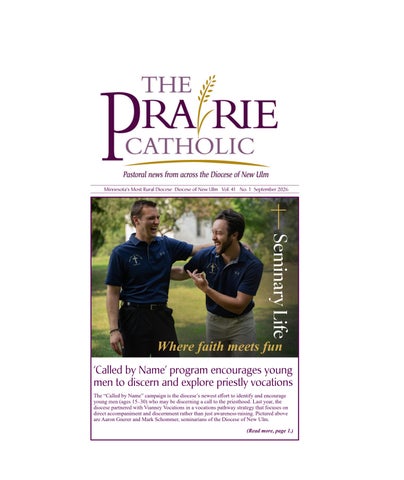
‘Called by Name’ program encourages young men to discern and explore priestly vocations The “Called by Name” campaign is the diocese’s newest effort to identify and encourage young men (ages 15–30) who may be discerning a call to the priesthood. Last year, the diocese partnered with Vianney Vocations in a vocations pathway strategy that focuses on direct accompaniment and discernment rather than just awareness-raising. Pictured above are Aaron Gnerer and Mark Schommer, seminarians of the Diocese of New Ulm. (Read more, page 1.)
Historic milestone Minnesota’s Most Rural Diocese
Diocese of New Ulm
The Church of Our Lady in Mannanah celebrated its 150th anniversary on Saturday, Aug. 15, 2026, with a special Mass celebrated by Bishop Chad Zielinski. (Read more, page 6.)
Vol. 41 No. 1 September 2026
Partnership with Vianney Vocations helps diocese identify and nurture young men with the potential for a priestly vocation by Deacon Ryan Pope Prairie Catholic correspondent OLIVIA – Sunday, June 14, 2026, unfolded as a landmark evening for vocations in the Diocese of New Ulm, as thirty-five young men gathered at the Church of St. Aloysius in Olivia for the diocese’s first-ever “Called by Name” dinner. Organized by the diocesan Office of Vocations, the event brought together young men personally recommended by parishioners who recognized in them the potential to serve the Church as a priest. “Called by Name” initiative In 2025, the diocese partnered with Vianney Vocations, a national Catholic organization founded in 2009. The organization supports and strengthens vocation efforts
inside Page 5
Diocesan summer youth camps
Page 8
Advancing cause for Minnesota’s first saint
Page 11
Stuebenville conference draws record crowd!
Visit us online! www.dnu.org
in dioceses across the United States by providing training, resources, and a network of priests to help diocesan vocations directors identify, encourage, and accompany young men as they discern a vocation to the priesthood. The dinner in June was part of Vianney Vocations’ “Called by Name” campaign, which resulted in the Vocations Office receiving an overwhelming 376 nominations, identifying 247 dedicated young men. Evening prayer and welcome New Ulm’s Bishop Chad Zielinski welcomed the young men and their families, setting a positive tone for an evening centered on prayer, fellowship, and vocational discernment. The bishop shared his personal journey to the priesthood, reflecting on his experiences as both a priest and a bishop and expressed his love for his ministry, highlighting the profound privilege of celebrating the Eucharist. “In that moment, you realize you are holding the same Christ that Mary held in her hands at the nativity,” he said.
along with a growing internal struggle over what constituted authentic worship. This quest eventually led him to find a sense of belonging and fulfillment within the Catholic Church. Following the presentations, everyone gathered for dinner prepared by the area Knights of Columbus. The dinner provided a great opportunity for the young men to engage in conversations with the clergy and seminarians present, who shared their personal stories of faith, service, and the journey of discovering their calling. The diocese’s newest seminarian Caleb Kronback (r), of rural Lamberton, is in his first year of formation at Saint John Vianney College Seminary in St. Paul. He is the son of the late Eric Kronback and Julia Kronback Muñoz. (Photo by Deacon Ryan Pope)
The bishop also described the joy he finds in his ministry, especially visiting parishes, baptizing children, celebrating weddings, and engaging with the faithful.
Father Rolling recounted a pivotal moment from his youth while growing up on a farm in rural Minnesota, where he stood on a hay rack with his grandfather, gazing over the fields. In that moment, he felt a deep awareness of God’s existence, which ignited a lifelong journey of discernment around the question, “What does Jesus want with my life?”
Witness to the call Additional highlights of the evening included a presentation by Fr. Brendan Rolling, the diocesan director of Seminarians, and New Ulm seminarian Deacon Brent Sundve. Both men shared their personal stories of encountering God’s call.
Father Rolling described how his call to the priesthood became clear during his senior year of high school when he distinctly heard the words, “Be a priest.” Throughout college, he experienced many affirmations of that call, including during World Youth Day in Denver in 1993.
The Prairie Catholic
l
Page 1
l
He was also inspired by reading about the courageous stories of priests who sacrificed their lives for Christ during World War II. Their courage and fidelity stirred something profound within him, motivating him to pursue priesthood with conviction. Deacon Brent Sundve, a seminarian in his final year of priestly formation, shared a compelling testimony about his journey from Protestant ministry to the Catholic Church. Raised in the Church of the Nazarene, he reflected on how his mother’s faith and his desire “to do what God wanted with my life” shaped his early years. His path included both ministry and theological study,
September 2026
Bishop Zielinski beautifully summarized the evening by reminding everyone that priests are not formed in isolation. “A priest is not hatched in an incubator in the seminary. We grow up in normal families where faith is lived – sometimes imperfectly, but always with God’s grace,” he said. The bishop’s message highlighted the essence of the “Called by Name” initiative: the Church sees potential in these young men, as well as in many others identified throughout the diocese, inviting them to consider whether God may be calling them to serve his people as priests. Editor’s note: If you or anyone you know is interested in a religious vocation, contact the Diocese of New Ulm Office of Vocations, www.dnu.org/vocations, (507) 233-5302.
diocesan church
The Bishop’s Column: That they may have life and witnessed his healing and miracles. It is here that Jesus entrusts Peter with a unique authority – to guard, proclaim, and hand on the truth of faith. This authority does not belong only to Peter but continues in the Church through the Magisterium: the pope and the bishops in communion with him, guided by the Holy Spirit, to safeguard, interpret, and proclaim that truth, even when it is not popular opinion.
by Bishop Chad W. Zielinski I want to draw your attention to Matthew 16:13-20, the Gospel reading proclaimed on Sunday, Aug. 23, 2026, the 21st Sunday in Ordinary Time. This is the most foundational scripture of the establishment of the Church and her authority on earth. Jesus poses a question to his disciples, “Who do people say that the Son of Man is?” In other words, “What is the word on the street?” The disciples offer a range of answers based on public opinion.
Throughout the centuries, the Church has proclaimed the truth in her social and moral doctrine as rooted deeply in the Gospel of Christ. She carries a grave responsibility to address injustices and ideologies that threaten our social and moral teaching, in a desire to protect the common good of all humanity. This same prophetic calling belongs to the Minnesota Catholic Conference (MCC), which serves as the public policy voice of the Catholic bishops in our state. By virtue of our apostolic office, we as bishops urge Catholics, and all people of good will, to form their consciences according to the truth revealed in Jesus Christ.
Then, Jesus gets more personal and asks, “Who do you say that I am?” Peter responds without hesitation: “You are the Christ, the Son of the living God.” Jesus affirms that Peter’s insight is not merely human reasoning but a grace-filled revelation from the Father: “For flesh and blood has not revealed this to you, but my Heavenly Father.”
Conscience cannot be shaped solely by “the word on the street” or “popular opinion.” Rather, the Church’s social and moral teaching should directly influence “the word on the street.” We must share the truth of divine revelation with society, advance the common good, and build a society of justice that strives for the common good of all.
This moment illustrates that Jesus is not concerned with what the “word on the street” is, but with those who have listened to his teaching, observed his forgiveness,
General election invites clarity, courage, and faithful citizenship With the August 11 primaries now complete, each political party has selected its candidates
P RA RIE THE
CATHOLIC
The Prairie Catholic, the official newspaper for the Diocese of New Ulm since May 1972, is published every six weeks, Sept.–June. Publisher: Bishop Chad W. Zielinski Editor: Christine E. Clancy Submission deadline is the 1st of each month prior to publication. Publication office: Diocesan Pastoral Center, 1421 6th Street North, New Ulm, MN 56073; phone: 507-359-2966, Email: dnu@dnu.org Website: www.dnu.org Postmaster: Send notice on Form 3579, “The Prairie Catholic,” 1421 6th Street North, New Ulm, MN 56073-2071. Periodical postage paid at New Ulm and additional mailing offices. USPS 926-760.
for the upcoming general election on Tuesday, November 3. This year is a consequential election year for Minnesotans as we will choose every member of the Minnesota Legislature, a Governor, all U.S. House representatives, and one U.S. Senator.
In a time of such significance, responsible and faithful citizens must develop values based on the principles of Catholic social teaching to participate rightly in the public arena. This formation must be paired with careful attention to the issues before us and a clear understanding of where each candidate stands. Our participation is vital in shaping a state that reflects our values, strengthens the common good, and upholds human dignity. Thanks to the engagement of faithful citizens like you, we have seen notable successes this year, some of which have garnered bipartisan support!
However, our work is not done. The Minnesota Catholic Conference has been actively working to create resources to help Minnesotans prepare for the upcoming November election. Their 2026 Minnesota Elections Hub, available at www.mncatholic. org/election2026, offers valuable tools, including a list of questions to ask candidates, principles of Catholic social teaching to consider, a tool to view your sample ballot, and information on polling locations. As Election Day approaches, I ask you to pray, become informed, and remain engaged in the civic life of our state with clarity, charity, and conviction. Together, may we continue to be faithful witnesses to Christ in both our Church and our communities.
The Minnesota Catholic Conference applauds the overwhelming passage of the Stop Harms from Addictive Social Media Act. This landmark legislation addresses social media addiction among youth by requiring parental consent for children under 16 to create social media accounts and prohibiting platform features that are known to be particularly addictive for children. Working together, citizens and advocates helped to protect life and uphold human dignity by blocking bills such as the IVF Insurance Mandate, Physician-Assisted Suicide, Online Sports Gambling, and the proposed Equal Rights Amendment, which would have further entrenched abortion rights and imposed gender ideology on Minnesotans.
Subscribe to receive the Minnesota Catholic Conference (the public policy voice of the Minnesota bishops) Action Alerts sent when legislators most need to hear from Catholics. Each includes a simple one-click tool to message your legislator. Visit www.mncatholic.org/election2026
Paulist Fathers launch Communion Project to heal ‘toxic polarization’ within U.S. Church ahead of November elections by Tessa Gervasini DC Bureau The Communion Project initiative hopes to repair polarization in the U.S. Church and aid the Church in offering a better and more joyful witness in a divided country, organizers said. “Unfortunately, too often Catholics and Catholic leaders are acting more like thermometers instead of thermostats,” Jonathan Lewis, mission strategy officer for the Paulist Fathers and co-director of the Communion Project, told EWTN News.
is aimed to do is to lower the temperature of division and distrust, starting with those of us Catholics who call ourselves brothers and sisters, who are a real spiritual family,” Lewis said. “As we approach any election season, thereʼs always a need to help lower the temperature, have more thoughtful conversations, discern our Catholic values,” he said.
trying to share,” Lewis said. “Weʼre starting with a lot of resources” and “adapting resources that already existed.”
“Then weʼre planning, over the next year or two years, to develop programs for dioceses and organizations and religious communities, students in Catholic schools.”
“Weʼre reading the temperature of the room or the culture, instead of setting the temperature according to our values and the truths of the Church,” he said.
The Catholic initiative hopes to heal toxic polarization in the Church by creating dialogue, providing resources, promoting unity through national communication methods, and by aiding local communities to create unification at their level, organizers said. Exact plans are still being formed.
“The polarization affecting the U.S. Catholic Church is not merely a matter of policy dispute or partisan loyalty,” said Father Ricky Manalo, CSP, co-director of the Communion Project. “It is a deeply spiritual and relational rupture, shaping how Catholics imagine moral life, celebrate the sacraments, interpret tradition, and remain in communion amid difference.”
“So, part of what this effort
“Weʼre just beginning … and
“Within Catholic life, polarization
The Prairie Catholic
l
Page 2
l
September 2026
is more than disagreement; it is the loss of our capacity to remain in relationship, even amid difference, as one body in Christ,” he said. Inspired by Pope Francis, the group founded The Paulist Initiative on Polarization as a national partnership of Catholic leaders committed to strengthening unity across political, theological, and cultural divisions. In 2025, the effort was renamed the Communion Project following Pope Leo XIV’s public commitment to building communion in the Church. “This is really a priority of Pope Leo,” Lewis said. “In his first inaugural Mass, Pope Leo said his first great desire would be for a unified Church in communion. We (Continued on page 3.)
Rebuilding unity within in a divided Church (Continued from page 2.) really see this as an initiative that is trying to live out the message and the priority of the Holy Father.” Polarization in the U.S. When people think of polarization, they usually first think of “left and right politics, Republicans, Democrats,” Lewis said. “And certainly thatʼs one area, but I really see polarization showing up in a lot of different ways.” “This isnʼt only in public life or in politics, where one might expect, itʼs also in the Roman Catholic Church in the United States,” Lewis said. It can come up due to division surrounding the liturgy, or cultural or generational differences, but ultimately the goal is to remind Catholics of shared beliefs and values. The project hopes to help the faithful “see that while people might prioritize different dimensions of our Catholic social teaching, thereʼs unity within that work, and we need to bring people together,” Lewis said. The initiative’s resources and formation experiences are organized around three interconnected dimensions: the head, the heart, and the hands. The project offers a “development of resources that impact our head, meaning our knowledge and our self-awareness,” and “also our hearts in terms of our prayer and discernment,” Lewis said.
impact “our hands,” which focus on “building skills and building relationships,” Lewis said. “So we want to help organizations and churches work with leaders in particular, to equip them with the resources and programming to help them make a positive impact in their local community,” he said. The resources can be found in the Communion Project’s “resource library” on its website, which offers a number of options for people to independently utilize or bring to a group. It also offers gatherings and workshops to aid its cause. In the online library, people can find upcoming events, online courses, prayers for communion, articles, learning sessions to be used in small groups, and a Communion Project podcast. It also has educational videos provided by outside organizations including Georgetown University, University of Notre Dame, and Boston College. The initiative is only “just beginning in terms of programming and trying to share,” Manalo said. But since starting, “thereʼs a great interest” among local communities wanting to be involved. “The path of healing begins not in dominating strength, but in shared vulnerability. When both Church and nation dare to move toward one another, wounded yet willing, they may discover that grace lives precisely in the places we thought were beyond repair,” Manalo said.
There are also resources that
diocesan church
August retreat strengthens formation for permanent diaconate in diocese
MARVIN, S.D. – From August 21-23, 2026, candidates in formation for the permanent diaconate, their wives, and ordained permanent deacons and their wives from the Diocese of New Ulm participated in a weekend retreat focused on prayer, study, and spiritual formation. The retreat, led by Fr. Andrew Jaspers, a hospital chaplain in the Archdiocese of St. Paul and Minneapolis and a philosophy instructor at the University of St. Thomas, was held at the Abbey of the Hills near Marvin, South Dakota. Sessions were split into six halfhour conferences that centered on key dimensions of diaconal life and ministry. Topics included Diaconal Couple Spirituality, Diaconal Spirituality, Biblical Foundations for the Diaconate, Eucharistic Inspirations (Parts I and II), and the Mission of the Deacon. These sessions provided participants with a deeper understanding of the spiritual
identity and responsibilities of the permanent deacon and the shared vocation of the deacon couple. Liturgical prayer formed the core of the retreat. The Liturgy of the Hours and periods of Eucharistic Adoration offered participants time for reflection and spiritual renewal. New Ulm Bishop Chad Zielinski celebrated Mass.
A total of 38 deacon candidates, deacons, and their wives from the diocese participated in the weekend. Five men are currently in permanent diaconate formation. They are scheduled to be installed as acolytes in May 2027, with ordination planned for April 2028.
Our Lady brings hope and healing to Avera Marshall Medical Center by Sr. Candace Fier, ISSM MARSHALL, Minn. – Since her formal introduction to the faithful of the Diocese of New Ulm, Our Lady of the Prairie has been establishing her presence in churches, homes, and various facilities across the rural diocesan landscape and beyond. In June of 2025, Bishop Chad Zielinski of New Ulm rededicated the diocese to Our Lady, naming her the new patroness. This summer, the diocese gifted a replica of the original painted image of Our Lady to Avera Marshall Regional Medical Center in Marshall. On June 3, Bishop Zielinski visited the medical center and blessed the image, which is now displayed near the center’s chapel where it serves as a meaningful reminder of faith, hope, and healing for patients, families, visitors, and staff. Avera Marshall is a partner of the Avera Health System of Sioux Falls, SD, which is a Catholic healthcare organization. The medical center primarily serves Lyon County and surrounding areas, including Chippewa,
The Prairie Catholic
Fr. Andrew Jaspers, retreat director, presents on diaconal ministry during the Diocese of New Ulm’s permanent diaconate retreat at the Abbey of the Hills. (Photo by Deacon Mark Kober)
l
Page 3
l
Bishop Chad Zielinski joined Debbie Streirer, CEO of Avera Marshall Regional Medical Center, along with facility chaplains David Nelson and Josh Doughty, to welcome the image of Our Lady of the Prairie, to Avera Marshall. As he blessed the image, the bishop prayed that Our Lady would extend her motherly care to all patients, families, staff, and visitors. (Photo courtesy of Avera Marshall Regional Medical Center) Cottonwood, Lincoln, Murray, Pipestone, Redwood, and Yellow Medicine counties. During his visit, Bishop Zielinski visited patients, toured the facility with the Avera care team, and gained a deeper understanding of its broad services including behavioral health, cancer care, women’s health to emergency
September 2026
care. Afterward, he praised the team’s evident dedication, noting that hospitality, compassion, and stewardship were woven throughout the visit. Editor’s note: Sr. Candace Fier serves as the director of the Office of Family Life for the Diocese of New Ulm, cfier@dnu.org.
diocesan church
Para que tengan vida proteger el bien común de toda la humanidad.
por Bishop Chad Zielinski Quiero invitarles a reflexionar sobre Mateo 16:13-20, la lectura del Evangelio proclamada el domingo 23 de agosto de 2026, el XXI Domingo del Tiempo Ordinario. Esta es la Escritura más fundamental sobre el establecimiento de la Iglesia y su autoridad en la tierra. Jesús plantea una pregunta a sus discípulos: “¿Quién dice la gente que es el Hijo del Hombre?” En otras palabras, “¿Qué oyen en la calle?” Los discípulos ofrecen una variedad de respuestas basadas en la opinión pública. Luego, Jesús hace la pregunta más personal y les dice: “Y ustedes, ¿quién dicen que soy yo?” Pedro responde sin vacilar: “Tú eres el Cristo, el Hijo de Dios vivo.” Jesús afirma que la comprensión de Pedro no es meramente fruto del razonamiento humano, sino una revelación llena de gracia que procede del Padre: “Porque esto no te lo ha revelado la carne ni la sangre, sino mi Padre celestial.” Este momento demuestra que a Jesús no le preocupa lo que “se dice en la calle”, sino aquellos que han escuchado su enseñanza, han observado su perdón y han sido testigos de sus curaciones y milagros. Es aquí donde Jesús confía a Pedro una autoridad única: custodiar, proclamar y transmitir la verdad de la fe. Esta autoridad no pertenece solamente a Pedro, sino que continúa en la Iglesia a través del Magisterio: el papa y los obispos en comunión con él, guiados por el Espíritu Santo, para salvaguardar, interpretar y proclamar esa verdad, aun cuando no sea la opinión popular. A lo largo de los siglos, la Iglesia ha proclamado la verdad en su doctrina social y moral, profundamente arraigada en el Evangelio de Cristo. Ella tiene la grave responsabilidad de abordar las injusticias y las ideologías que amenazan nuestra enseñanza social y moral, con el deseo de
Este mismo llamado profético corresponde a la Conferencia Católica de Minnesota (MCC), que sirve como la voz de política pública de los obispos católicos de nuestro estado. En virtud de nuestro ministerio apostólico, nosotros, como obispos, exhortamos a los católicos, y a todas las personas de buena voluntad, a formar sus conciencias de acuerdo con la verdad revelada en Jesucristo. La conciencia no puede formarse únicamente por “lo que se dice en la calle” o por la “opinión popular.” Más bien, la enseñanza social y moral de la Iglesia debe influir directamente en “lo que se dice en la calle.” Debemos compartir la verdad de la revelación divina con la sociedad, promover el bien común y construir una sociedad de justicia que se esfuerce por alcanzar el bien común de todos. Las elecciones generales nos invitan a la claridad, la valentía y a una ciudadanía fiel Con las elecciones primarias del 11 de agosto ya concluidas, cada partido político ha seleccionado a sus candidatos para las próximas elecciones generales del martes 3 de noviembre. Este año es un año electoral de gran trascendencia para los habitantes de Minnesota, ya que elegiremos a todos los miembros de la Legislatura de Minnesota, un gobernador, a todos los representantes de la Cámara de Representantes de los Estados Unidos y a un senador de los Estados Unidos. En un momento de tanta importancia, los ciudadanos responsables y fieles deben desarrollar valores basados en los principios de la doctrina social católica para participar correctamente en la esfera pública. Esta formación debe ir acompañada de una atención cuidadosa a los asuntos que tenemos ante nosotros y de una comprensión clara de la postura de cada candidato.
humana. Gracias a la participación de ciudadanos fieles como ustedes, hemos visto logros notables este año, ¡algunos de los cuales han recibido apoyo bipartidista! La Conferencia Católica de Minnesota celebra la aprobación por abrumadora mayoría de la Ley para Detener los Daños de las Redes Sociales Adictivas. Esta histórica legislación aborda la adicción a las redes sociales entre los jóvenes al exigir el consentimiento de los padres para que los menores de 16 años creen cuentas en redes sociales y al prohibir funciones de las plataformas que se sabe que son particularmente adictivas para los niños. Trabajando juntos, ciudadanos y defensores ayudaron a proteger la vida y defender la dignidad humana al bloquear proyectos de ley como el Mandato de Cobertura de Seguros para la FIV, el Suicidio Asistido por Médicos, las Apuestas Deportivas en Línea y la propuesta Enmienda de Igualdad de Derechos, que habría afianzado aún más el derecho al aborto e impuesto la ideología de género a los habitantes de Minnesota. Sin embargo, nuestro trabajo no ha terminado. La Conferencia Católica de Minnesota ha estado trabajando activamente para crear recursos que ayuden a los habitantes de Minnesota a prepararse para las próximas elecciones de noviembre. Su Centro de Elecciones de Minnesota 2026, disponible en www.mncatholic.org/election2026, ofrece herramientas valiosas, incluida una lista de preguntas para hacer a los candidatos, principios de la doctrina social católica que se deben considerar, una herramienta para ver su boleta de muestra e información sobre los centros de votación. A medida que se acerca el Día de las Elecciones, les pido que oren, se informen y permanezcan comprometidos con la vida cívica de nuestro estado con claridad, caridad y convicción. Juntos. Para que sigamos siendo testigos fieles de Cristo tanto en nuestra Iglesia como en nuestras comunidades.
Nuestra participación es vital para forjar un estado que refleje nuestros valores, fortalezca el bien común y defienda la dignidad
The Prairie Catholic
New leadership in three Catholic schools in diocese
Gavin Van Moer TRACY
Dr. Amanda Bruning CANBY
by Christine Clancy The Prairie Catholic Three new principals will take on leadership roles in three Catholic schools within the Diocese of New Ulm for the upcoming academic year. Gavin Van Moer has been appointed principal of St. Mary Elementary in Tracy, Dr. Amanda Bruning will lead St. Peter Elementary School in Canby, and Jennifer Cassidy has been named principal of St. Raphael Catholic School in Springfield. These new leaders bring extensive experience in Catholic education and a shared commitment to serving students and families with clarity, compassion, and purpose. Gavin Van Moer is a graduate of South Dakota State University in Brookings, where he earned a bachelor’s degree in history with a specialization in education. Before his appointment as principal, he lived and worked in Tracy, Minn.
Page 4
l
Dr. Amanda Bruning, a resident of Canby and a parent of students who attend St. Peter School, brings a unique background in chiropractic care to her new leadership role. Her holistic approach emphasizes the growth, health, and well‑being of each student–body, mind, and spirit. She is currently advancing her leadership formation through the Catholic School Leadership Certificate program at Saint Paul Seminary, located on the campus of the University of St. Thomas in St. Paul. Jennifer Cassidy has more than 25 years of experience in Catholic school administration. A graduate of the University of St. Thomas, she holds a bachelor’s degree in elementary education, a master’s degree in administration, and an education specialist degree. Cassidy has worked as both a teacher and administrator in several Catholic schools throughout the Archdiocese of Saint Paul and Minneapolis.
Father Steiner of New Ulm dies at the age of 91 NEW ULM – Fr. Bernard Steiner, a retired priest of the Diocese of New Ulm, died on June 19, 2026, at the New Ulm Medical Center in New Ulm. He was 91. A Mass of Christian Burial was celebrated by Bishop Chad Zielinski on June 29, 2026, at the Cathedral of the Holy Trinity in New Ulm. The burial was in the Church of St. George Cemetery, West Newton Township. Father Steiner was born on November 4, 1934, in New Ulm where he attended Holy Trinity
l
Jennifer Cassidy SPRINGFIELD
September 2026
Grade and High School. In 1952 he attended St. John’s University, Collegeville, Minn., and Nazareth Hall Preparatory Seminary in Saint Paul. He continued his studies for the priesthood at the Saint Paul Seminary in St. Paul. He was ordained a priest for the Diocese of New Ulm on Feb. 19, 1961, by Bishop Alphonse J. Schladweiler, the first bishop of New Ulm.
youth ministry
Youth formed in faith through popular summer camps by Luke Miller
The summer months in the Diocese of New Ulm are busy
for the diocesan Office of Youth Ministry. Each year, the office sponsors two popular camps: Camp Beloved and Camp Greatness, inviting teens in the diocese to encounter Christ through fun, faith, and fellowship.
CAMP BELOVED - MIDDLE SCHOOL
These camps, held at the Schoenstatt on the Lake in Sleepy Eye, are favorites among youth and are filled to capacity each summer. The camps offer a vibrant mix of prayer, dynamic speakers, daily Mass, and numerous games and activities, creating a true Christian community experience. CAMP BELOVED features two sessions for girls; one for middle school students and another for junior and senior high students. Directed by the female Totus Tuus missionaries, this camp helps participants grow in their identity as beloved daughters of God and deepen their personal relationship with Jesus through prayer. In addition to having a lot of fun, campers form meaningful friendships, experience a joyful sense of belonging, and participate in daily Mass, prayer, and Eucharistic Adoration.
CAMP GREATNESS - HIGH SCHOOL
CAMP GREATNESS includes two sessions for boys; one for middle school students and one for high school students. Led by male Totus Tuus missionaries and diocesan seminarians, (and participantion from a few diocesan priests), the campers explore prayer and virtue through engaging talks, along with a full schedule of games and sports, including the favorite activity, “ManBall,” dodgeball with a twist. Each day also features Mass and time for Eucharistic Adoration and prayer. For information on upcoming diocesan youth events contact Luke Miller, Office of Youth Ministry, lmiller@dnu.org, (507) 233-5327.
CAMP GREATNESS - MIDDLE SCHOOL
CAMP GREATNESS - HIGH SCHOOL
The Prairie Catholic
l
Page 5
l
September 2026
parish life
150 years strong: Our Lady in Manannah “Rises to the Occasion” by Christy Baker The Prairie Catholic
that “[John] had to sell his best horse to pay for it.”
MANANNAH, Minn – On Saturday, Aug. 15, 2026, the bell of Our Lady joyfully rang 150 times to gather the people for Mass. Each bell ring represented one year since the Church of Our Lady in Mannanah was built in 1876. Situated in the middle of four larger cities (Litchfield, Eden Valley, Paynesville, and Grove City), the parish currently has over 500 members, according to their 2024-2025 Parish Self Study, some of whom are seventhgeneration parishioners.
The painting was restored prior to the 150th Anniversary Mass, with years of accumulated grime removed and previous restoration work addressed. Today, it hangs to the right of the altar, where Bishop Zielinski blessed it before the conclusion of Mass.
The anniversary Mass was celebrated by Bishop Chad W. Zielinski and concelebrated by Fr. Jeff Horejsi, Fr. Brian Mandel, Fr. George Schmit, and Fr. Mark Mallack, with assistance from Deacons Roger Osborne and Brent Sundve. “Our Lady rises to the occasion,” said Father Horejsi, pastor of the Shepherd of Souls Area Faith Community, which, besides Our Lady, also includes the Churches of St. Philip in Litchfield, St. John in Darwin, and St. Anthony in Watkins. He credited the celebration’s success to the many parishioners who devoted the past year to planning – working through a core committee and 18 additional committees. Parishioner Anne McCarney compiled a book chronicling the parish’s 150-year history. The legacy of her ancestors lives on in the church’s stained-glass windows, where their names remain as a testament to the family’s enduring connection with the parish. Today, their descendants remain an active and vibrant part of the church community. Anne McCarney sings in the choir. “I grew up with Mom playing organ, so we knew everybody by the backs of their heads,” she said with a smile. During the anniversary Mass, she sang in the choir while her mother played the organ. In Manannah’s history book, McCarney writes about John Hanses, a German settler in a predominantly Irish parish who, in 1880, donated a large nineteenthcentury oil painting of Our Lady of Perpetual Help to the parish. The painting, commissioned in his hometown of Westphalen, Germany, arrived at a higher cost than expected; McCarney noted
The bell that tolled 150 times before Mass, much like the treasured painting, carries a story stretching back more than a century. Purchased from the McShane Bell Foundry of Baltimore for $450, it arrived on July 21, 1892, and has endured remarkable trials. Twice lightning struck the tower, the most recent in 1951, when according to their 150th Anniversary history book, “bits of wood from the steeple were found a block away, and all the electrical appliances in the rectory were put out of commission.” Yet the bell remained, a steadfast witness to the parish’s unfolding history.
Ron Anderson, center, a minister of hospitality, greets parishioners as they arrive for the Church of Our Lady’s 150th anniversary Mass on Aug. 15, 2026. The Manannah parish has more than 500 members, including some whose ties to the church span seven generations. (photos by Christy Baker)
While the bell and the painting serve as tangible links to earlier generations, the faith they symbolize continues to flourish among the families of Our Lady. Over the decades, parishioners and priests have shown extraordinary creativity and devotion in passing that faith on. With limited space available, religious education classes were held wherever room could be found: in the kitchen, the basement, the rectory, a parishioner’s home, even above a store. One summer around 1946, Fr. Joseph Esser offered his entire rectory to the visiting nuns who taught the children, choosing instead to live in the small church storage room across from the sacristy.
Bishop Chad W. Zielinski blesses the newly restored 1880 painting of Our Lady of Perpetual Help during the anniversary Mass. Previously mounted on the wall above the high altar, it now hangs in a frame to the altar’s right.
Same spirit shines today For the anniversary, parishioners transformed the Parish Center into themed exhibits featuring old vestments and vessels, scrapbooks and other pieces of parish history. One room honored the late Msgr. Francis Garvey, a native son of Manannah Township who returned home to serve the parish from 1996 to 2013. The exhibit would not have been complete without a bottle of his beloved Wild Irish Rose wine.
From the families who built and sustained the parish to those who continue its mission today, that same faith remains at the heart of Our Lady.
Today, the Church of Our Lady stands as a testament to the 150 years of faith and love for the Lord, and the old sanctuary
The Prairie Catholic
Greg Euerle joins others in ringing the bell 150 times, once for each year since the Church of Our Lady was built.
lamp that now hangs above the altar symbolizes the connection between past and present. This lamp, once found in a nowdemolished garage near the road, has made its way back into the church, signifying Christ’s presence in the tabernacle of the preserved high altar.
“We celebrate what has been and we look forward with hope to what will be,” Father Horejsi wrote in a letter to Manannah parishioners.
l
Page 6
l
Joyce Henfling stands beside her wedding dress in an exhibit celebrating generations of sacramental life at the Church of Our Lady. The Parish Center, formerly the Woodman Hall purchased by the parish and moved to the church property, housed historical displays for the church’s 150th anniversary.
September 2026
parish life
Historic Murdock church building marks 100 years of parish life by Christine Clancy The Prairie Catholic MURDOCK, Minn. – The Church of the Sacred Heart in Murdock marked a significant milestone this summer, celebrating 100 years of continuous worship in its current church building. The Saturday, June 20 event was highlighted by a Mass celebrated by Bishop Chad Zielinski, the bishop of New Ulm, and concelebrated by parish pastor Fr. Brian Mandel. Historical background The parish’s roots trace back to the late 19th and early 20th centuries, when Catholic immigrants – often German and other European groups – settled in rural Swift County. Initially, worship was held in private homes or temporary chapels, with visiting priests providing sacraments. As the congregation grew, land was acquired for a permanent site to serve the local Catholic community. The first church, a wooden structure, was built in 1894 and incorporated the following year. The current Murdock church was built in 1926 on the same location as the original building. It has stood as a focal point for Catholic worship and community life in the small, agricultural town, with a population of approximately 375 parishioners as recorded in 2025. The 100th anniversary commemorated not only the longevity of the building but also highlighted the resilience and faith of the parishioners over the past century. In addition to the Mass, the occasion included a short historical program showcasing pictures and information about the church’s history, as well as a special supper in the parish hall attended by approximately 175 people and games for the children. Throughout June leading up to the celebration, historical documents, vestments, and other liturgical items dating back 131 years were on display in the parish’s gathering space. To honor past parishioners and show appreciation for current members, a comprehensive collection of historical information, individual stories,
Seated before the altar is Richard Murphy, 92, of Murdock, a lifelong Sacred Heart parishioner whose family traces its roots to the establishment of Archbishop John Ireland’s pioneer colony in nearby city of De Graff in 1876.
New Ulm’s Bishop Chad W. Zielinski celebrated Mass during the parish’s June 20, 2026, centennial event at the Church of the Sacred Heart in Murdock. The historic event marked 100 years of faith, resilience, and community life of the parish. (Photos by Jannet L. Walsh)
and memories, along with numerous photos, was compiled into a book covering the years 1925 to 2025. In his foreword to the centennial history book, Bishop Zielinski reflects on the generations who have shaped Sacred Heart. “For 100 years,” he writes, “devoted men and women have come together at this rural parish of Sacred Heart, sowing the seeds of faith. And throughout this century-long journey, the Lord has served as the master gardener, nurturing and guiding every prayer, every act of service, and every individual who has walked through the welcoming doors.” “Each generation,” he notes, “has contributed its unique gifts, deepened your shared faith, and strengthened your bonds. Together, you have created a vibrant spiritual home, where the fruits of love, compassion, and hope continue to flourish.” As the parish marks this milestone, Bishop Zielinski encouraged the faithful to give thanks for the past, live faithfully in the present, and trust God for the future, praying the Holy Spirit will continue to guide and strengthen the Sacred Heart parish community in its every good works. Editor’s note: The Church of the Sacred Heart’s first Mass was
The Prairie Catholic
held in 1879 followed by it’s first church being built in 1894. The church was incorporated on June 7, 1895. Today, the parish is part of the St. Isidore the Farmer Area Faith Community (Appleton, Benson, and Murdock.)
Bishop Chad Zielinski visits with parishioners and parish priest Fr. Brian Mandel during a meal in the historic basement of Sacred Heart Church. Seated from left are Jonathan Collins, Tom Walsh, and Ann Hippe.
Parish leaders commissioned to strengthen hispanic youth and family ministry by Anisabel Palma, director Diocesan Hispanic Ministry The Diocese of New Ulm is celebrating a transformative milestone in Hispanic youth and family ministry. Fifteen dedicated leaders have successfully concluded their in-person, twoyear Thriving Catholic Parishes (TCP) / Parroquias Vitales formation program. They have met all the requirements to earn their certificates from Instituto Fe y Vida, a Catholic ministry that trains parish leaders for the evangelization of Latino youth in the United States. By focusing on dynamic, holistic, and culturally responsive ministry, TCP equips local leaders to support adolescents and young adults as lifelong missionary disciples and empowers parish leadership teams, comprised of pastors, youth ministers, parents, and young people. The final in-person formation day and Graduation Mass took place at the l
Page 7
l
Bishop Chad Zielinski presents José Montes of the Church of St. Mary in Willmar, with a missionary cross during the commissioning of the TCP formation program graduates. Fr. Jeff Horesji assists.
Church of St. Philip in Litchfield on Saturday Aug. 29, 2026. The historic gathering concluded with Mass celebrated by Bishop Chad W. Zielinski, followed by a shared meal. The 15 graduates who completed this rigorous 48-hour formation are St. Mary, Willmar: Antonio Medina, Claudia Reyes, Diana Alvarado Reyes, Emanuell Montes, Isaura Alvarado, José Montes, Juana Franco, María Dolores Reyes, Mayra Velasquez, and Raquel Molina; St. Philip,
September 2026
Litchfield: Eduardo Serrato, Fr. Jeff Horejsi and Miriam Gaeta; St. Joseph, Montevideo: San Juanita Lopez and Selvin Flores. Active pastoral work now begins in parishes as the new leaders put their training into action and shape plans suited to their local communities. Though the in‑person cohort has wrapped up, Instituto Fe y Vida will continue guiding parish teams through bimonthly Zoom mentorship.
trending
Case for Minnesota’s first saint advances Pope Leo: Vatican II In 2024, the remains of Monsignor Joseph Buh were exhumed from Calvary Cemetery, and his crypt fittingly reads “Patriarch of the Diocese of Duluth,” the Northern Minnesota diocese for which he founded 57 parishes from Brainerd to Ely.
His ministry coincided with demographic changes in northern Minnesota as mining and railroad expansion drew new immigrant communities to the region. His fluency in multiple languages allowed him to minister across cultural lines, particularly among European immigrant groups who often lacked stable parish structures in their early years in the United States.
by Gigi Duncan NCR staff writer, DC Bureau ORLANDO, Florida – The U.S. Conference of Catholic Bishops (USCCB) voted June 10, 2026, to support advancing the cause of beatification and canonization for Monsignor Joseph Buh, a Slovenian-born missionary priest who spent more than half a century ministering in northern Minnesota. The vote took place during the bishops’ plenary assembly in Orlando, Florida, after Duluth Bishop Daniel J. Felton asked members to consider whether it was advisable to advance the cause on the local level. Presenting the request to his fellow bishops, Felton described Buh as “a remarkable example of missionary discipleship” whose “love for Christ and the Church led him to leave his homeland of Slovenia and dedicate his life to the people of northeastern Minnesota.” “His story remains profoundly relevant for the Church today,” Felton said. “For we live in a missionary age.” The action marks another step in a process that has been developing in the Diocese of Duluth for several years. In 2024, the diocese began formally exploring whether Buh’s cause should move forward, consulting clergy and the faithful about devotion to the priest and his reputation for holiness. Buh was born in 1833 in what is now Slovenia and was ordained in 1858. After emigrating to the United States, he became one of the most influential Catholic missionaries in northern Minnesota during a period of rapid immigration and settlement. Known for extensive travels across the region – often by horseback over long distances and difficult terrain – Buh ministered
Monsignor Joseph Buh to immigrant mining communities and Native American settlements at a time when priests could spend weeks or months covering a single mission circuit. He helped establish more than 50 parishes and missions and later served as vicar general of the Diocese of Duluth. Felton said Buh anticipated key elements of modern Catholic teaching on evangelization. “He immersed himself in the communities that he served. He learned their languages, understood their customs and struggles and, most importantly, learned the language of their hearts,” Felton said. Buh spoke six languages, including Ojibwe, an Algonquian language, which Felton said he learned so that he could “faithfully serve and evangelize the Indigenous communities.” He added that Buh’s pastoral method was rooted in presence and listening. “He began by listening after learning their language, their story, and their needs,” Felton said. “His example reminds us that evangelization begins with presence, listening, and genuine love for the people entrusted to our care.” ‘A true spiritual father’ Although Buh died in 1922, interest in his life has persisted within the Diocese of Duluth. Advocates of the cause point to both his missionary work and the reputation for sanctity that followed him during his lifetime and after his death. Felton said the faithful of northeastern Minnesota have long regarded Buh as “a true spiritual father,” reflected in the title by which he became known, the “patriarch of the Diocese of Duluth.”
The Prairie Catholic
“Stories of his life continue to be shared throughout our region, even to this day,” Felton told the bishops. “There are accounts of his sacrifices while traveling through severe winters, his tireless efforts to provide both spiritual and material assistance, and the deep trust people placed in his prayers.” Interest in Buh’s cause has increased in recent years. His remains were exhumed in 2024 and transferred to the Cathedral of Our Lady of the Rosary in Duluth, where they were formally entombed in 2025. As supporters have examined Buh’s life and writings, Felton said he is remembered as “a beloved, gentle, humble, and generous priest” whose life was ordered toward helping others draw closer to God. “He did not come to Minnesota in search of adventure or personal gain,” Felton said, “but out of a desire to serve Jesus Christ and to lead others.” The bishops’ vote does not open the cause nor declare Buh a saint. Rather, it represents one of several preliminary steps in the canonization process. If the process continues, the Vatican’s Dicastery for the Causes of Saints would need to grant a “nihil obstat” (“nothing stands in the way”), allowing the cause to be formally opened. At that point, Buh would receive the title “servant of God.” Felton told the bishops that Buh’s witness speaks to the Church’s present missionary context. “I truly do believe the Holy Spirit is lifting him up in this time,” he said. “I think the Holy Spirit has lifted him up for our times to be our inspiration, to be our guide.”
reformed the liturgy to promote active participation by Ishmael Adibuah· EWTN News
human elements, which may undergo various modifications.”
VATICAN CITY – Pope Leo XIV has described the liturgical reforms following the Second Vatican Council as necessary to encourage active participation by the faithful.
“The need arose for the faithful to celebrate the liturgies more consciously and actively, not ‘as strangers and silent spectators,’ but participating fully in the salvific mystery,” Leo added.
“Since the gestures and words of the sacred liturgy are critical to realizing this experience, the participation of the faithful cannot be passive,” Leo said. “The liturgical reform promoted by the Second Vatican Council is thus firmly rooted in the living tradition of the Church.”
Liturgical reform began long before Vatican II The Church’s present liturgy was established in 1969 following the Second Vatican Council. It replaced the older Tridentine liturgy, also called the Traditional Latin Mass, standardized since the Council of Trent in 1570.
During his general audience at the Vatican on Aug. 26, the pontiff concluded his summer catechesis on the Second Vatican Council’s constitution on the liturgy, Sacrosanctum Concilium.
The pope also explained that the liturgical reform began long before the Second Vatican Council, under several popes. “The assertion that the faithful should not attend celebrations ‘as strangers or silent spectators’ had already been raised in Pius XI’s Apostolic Constitution Divini Cultus.”
The faithful cannot be passive during the liturgy Leo defended the Council Fathers’ decision at the Second Vatican Council to reform the liturgy, citing a letter Saint Paul VI wrote as Archbishop of Milan to encourage the faithful’s participation. “Motivated by these convictions, the future Pope Saint Paul VI affirmed that the faithful ‘cannot and must no longer remain silent and passive. Their physical presence cannot be reconciled with their spiritual absence,’” Leo said. The pope also explained that the liturgy has divine aspects that cannot change and human elements that can change to promote the faithful’s participation. “When the Church carries out a reform of the liturgy – a constant process of development across the centuries – there is an important distinction to be made between the divine, immutable elements, and the
Leo also recalled Pope Pius XII’s reform of the Tridentine Holy Week liturgy in 1955, in which he “rescheduled to the hours corresponding to the events of Easter, after they had for centuries been brought forward to the morning hours.” The pope also recalled the interventions of St. John XXIII, who called for the Second Vatican Council in 1959. Leo explained that John XXIII contributed to the Church’s liturgical reform by simplifying “the rubrics of the Breviary and the Missal,… in which he referred the proposal of fundamental principles for a reform of the liturgy.” “Indeed, since the liturgy is a living entity, throughout the centuries it has always been subject to developments and changes,” Leo added.
Catholic Charities Counseling
Serving over 18,500 people for 19 years! Canby, Marshall, New Ulm, and Willmar Providing: Individual, Marriage, and Family Counseling; Pregnancy Counseling, Adoption, Project Rachel, and Respect Life Resources; Parish and Community Response; Transition and Grief Services. Referred Services include: Immigration, Financial Counseling, and Guardianship Resources.
(866) 670-5163 | jgriebel@dnu.org l
Page 8
l
September 2026
catholic life
NUDCCW Fall Gatherings taking place in all three deaneries in diocese
Ask Father Mike
Question: Why is the Catholic Church so ‘judgy’?
by Lori Timmerman NUDCCW president
by Fr. Michael Schmitz
Each year in the fall, women from across the diocese gather for fellowship, prayer, and inspiration at the New Ulm Diocesan Council of Catholic Women (NUDCCW) Deanery Fall Gatherings. These gatherings provide opportunities to connect with one another, deepen faith, and learn from engaging motivational and educational speakers. Each of the three deaneries in the diocese hosts its own fall gathering, planned by the deanery CCW president and board. The Deanery 2 Fall Gathering will be held Monday, Sept. 21, at the Church of St. Mary in Cottonwood beginning with Mass at 5:30 p.m., followed by a meal. The speaker will be Tasia Dass, who will address the theme “Unbreakable: Based on a True Story.” Dass will share her authentic and moving account of faith, resilience, and redemption, illustrating how God’s grace brings hope, healing, and purpose. The Deanery 1 Fall Gathering will occur on Tuesday, Sept. 29, at the Church of St. Mary in Arlington. The guest speaker will be Geri Groebner from New Ulm, who will present on “Dementia Friends.” This gathering will similarly begin with Mass at 5:30 p.m., followed by a meal and the speaker’s presentation.
It’s a fair question — and honestly, I’m grateful for it. Because behind that question is usually a real experience. Maybe someone felt looked down on at Mass. Maybe they encountered a Catholic who came across as cold, critical or dismissive. If that’s been your experience, I’m genuinely sorry. That’s not what the Church is meant to be. (Photo by Christy Baker)
CCW Recognition Sunday is October 11
Bishop Chad W. Zielinski signs the annual proclamation declaring Sunday, Oct. 11, 2026, as Council of Catholic Women (CCW) Recognition Sunday in the Diocese of New Ulm. Pictured with Bishop Zielinski are (l-r) NUDCCW president Lori Timmerman, long-time spiritual advisor Monsignor Eugene Lozinski, and Spirituality Commission chair Mary Koralewski. The Deanery 3 Fall Gathering, titled “Praise and Prayer,” took place on Saturday, Sept. 5, at St. John’s Education Center in Cokato. The presenter was Janice Crowe from Dassel, who shared her personal testimony about her faith journey, by recounting how Jesus became a constant companion during her childhood and highlighted the significance of her prayers in his name. Crowe, who joined the Catholic Church as an adult one year before
marrying her late husband, Tom, also discussed her experiences in coping with life’s hardships, particularly the loss of a spouse. The gathering included a session of praise and worship music led by Darcy Ready, from Sisseton, SD. To register for the Deanery Gatherings contact your parish CCW president or visit www. nudccw.org.
The 2026-27 NUDCCW Service Project is My Grandma’s House, a statewide nonprofit organization based in Fairbanks, Alaska. Founded by Cynthia Erickson, the organization aims to address the issues of child abuse and neglect that many children face in various villages across Alaska. According to the program’s website, these issues are believed to contribute to the state’s suicide epidemic among young people. In an article for The Alaskan Shepherd Newsletter - Diocese of Fairbanks, Erickson was asked what motivated her to start My Grandma’s House. She responded,
“I was seeing too many kids losing their lives to alcohol and suicide, and I wanted to do something about it. However, I struggled to find someone who wanted to genuinely address the underlying reasons and start dealing with them.” (The Alaskan Shepherd Newsletter, Vol. 59, Number 4, Summer 2021).
Erickson began tackling these issues by engaging with the youth through activities such as sewing, beading, playing games, swimming, picking berries, and jarring fish. During these activities, she would discuss making healthy choices and coping strategies for their trauma and issues at home. In 2014, these conversations and daily activities
The Prairie Catholic
evolved into the start of My Grandma’s House.
Today, the organization operates in schools and supports children and young adults throughout Alaska. They provide essential services such as food and clothing, assistance with school and job applications, access to healthcare, and various other resources aimed at helping these young people make positive choices for their future well-being. (US Catholic, 09.15.21) To learn more about My Grandma's House, visit www. mygrandmashouseak.org or contact your parish or deanery CCW Service Commission Chairperson. l
Page 9
But back to the heart of the question. There are times when Catholics can come across as judgmental. I’ve heard stories – even from my own family – about parents at Mass getting “the look” because their kids were noisy. That’s real. And when that happens, it’s not a reflection of Jesus – it’s a reflection of human weakness. At the same time, there’s something deeper going on. The Catholic Church does make distinctions between right and wrong, good and evil, truth and falsehood. And in a culture that often prefers “you do you,” that can feel like judgment. But here’s the key distinction:
‘My Grandma’s House’ nonprofit designated as 2026-27 NUDCCW project by Colleen Bonniwell NUDCCW Service Commission
Quick side note: Isn’t it at least a little ironic to say, “Catholics are so judgy”? I mean … that’s kind of a judgment too. Not a bad thing, just worth smiling at for a second.
Jesus tells us not to judge people – their hearts, their souls, their ultimate standing before God. Why? Because we don’t have that kind of access. Only God sees the heart. But Jesus does not tell us to turn off our ability to evaluate actions. In fact, he says the opposite. He tells us, “You will know them by their fruits.” In other words, we are called to discern, to evaluate, to recognize whether something is good or not. Not to condemn the person, but to be honest about the action. Isn’t this what love must do? Think about it: Would we actually want a Church
l
September 2026
that refused to say anything is wrong? A Church that never named evil? A Church that couldn’t recognize goodness and praise it? That wouldn’t be loving, it would be indifferent. Love cares enough to say, “This is good — go toward it.” And, “This is harmful — turn away from it.” But here’s where it gets personal. Sometimes, what we experience as “being judged” is actually just being noticed. I remember a man who once wrote to me. He had recently come to faith after a rough past and started attending Mass. He told me he felt uncomfortable, like people were staring at him. He had tattoos covering his arms, his neck, even his face. At one point, I gently pointed out: there was likely a time in his life when he chose those tattoos precisely because he wanted to be noticed. Now, he didn’t want that attention anymore. We both had a good laugh about it, but he also saw the point. Not every glance is condemnation. Not every reaction is rejection. So yes, Catholics are called to make judgments about actions. We have to be. But we are never allowed to condemn the person. And when we do, when we look down on others, when we assume the worst, when we fail to love — we’re not being “too Catholic.” We’re not being Catholic enough. Because the truth is this: The Church doesn’t exist to stand above the world in judgment. She exists to stand in the middle of it, pointing to what is good, calling out what is harmful, and inviting every single one of us to the mercy of Jesus Christ.
Editor’s note: Fr. Michael Schmitz is director of youth and young adult ministry for the Diocese of Duluth and chaplain of the Newman Center at the University of Minnesota Duluth.
education
Ask a Canon Lawyer This month’s question: “Is it possible to not be a member of the Church once you are baptized?” by Fr. Mark Steffl, STL, JCL
T
his question is more theological than it is a question of Canon Law, but it is good to start with Canons 842 §1 and 849, which describe what Baptism is and what it does. Can. 842 §1. A person who has not received Baptism cannot be admitted validly to the other sacraments. Can. 849. Baptism, the gateway to the sacraments and necessary for salvation by actual reception or at least by desire, is validly conferred only by a washing of true water with the proper form of words. Through Baptism men and women are freed from sin, are reborn as children of God, and, configured to Christ by an indelible character, are incorporated into the Church. Canon 842 describes Baptism as the first of all sacraments that we receive. Theologically, Baptism makes it possible for us to receive
the grace that comes through the sacraments, so other sacraments cannot be received prior to Baptism. Baptism is, in effect, the foundation on which all of the other sacraments are built. (An interesting example is a baptized Catholic who is validly married to a non-baptized person: such a marriage is recognized by the Catholic Church, but is not a sacrament for either person until the non-baptized person would be baptized. After that Baptism, then ipso facto, the marriage would become sacramental for both spouses.) Canon 849 further notes the necessity of Baptism for salvation (words from the Lord Himself), as well as how Baptism is conferred, with water and the proper form of words. Theologically, Baptism confers forgiveness of all sin, including original sin, on the person who receives it. Baptism also confers a juridic (legal) reality on those who receive it, that we are “incorporated into
the Church.” This incorporation, our membership in the Church, comes through Baptism. Baptism confers in a juridic or legal sense both rights and responsibilities on the one who is then baptized and therefore a member of the Church. Baptism leaves an “indelible mark” on the one who receives it: a permanent change to the soul of the one who has been baptized which cannot be erased or undone. A person might later reject his/her Baptism or membership in the Church, but once it is conferred, we believe it is permanent (into eternity) for the one who has been baptized. Since the earliest years of the Church, this understanding has been captured in the Latin phrase Semel Catholicus, Semper Catholicus (once a Catholic, always a Catholic). This means that even if one defects from the Catholic Church, or no longer considers him/herself Catholic, the Church still considers that person a member. Membership in the Church cannot be lost by sin,
by the non-practice of one’s faith or even by excommunication. One might not be in a “state of grace” but that baptized person is still a member of the Church. Excommunication, a juridic proclamation by the authority of the Church, does not take away membership in the Church, but only forbids an individual from reception of the sacraments. There does exist a procedure for one to make a formal act of defection from the Catholic faith, but even this does not remove the effects of a person’s Baptism or membership in the Church. Such an act of an individual rejecting what he/she has received (and will always possess) through Baptism mostly happens in countries (such as Germany, Austria, or Italy) that have a “Church tax” which the civil government assesses and collects from members of the Church and pays directly to the Church. A formal “leaving the Church” in these countries then frees an individual from being assessed that extra “Church tax” but has no effect within the Church. Since Baptism is indelible, the Church would never erase the record of a Baptism, even if
that person has renounced his/ her faith in a formal way or does not consider himself/herself a member of the Catholic Church any longer. The question is an interesting one, where the Church’s law reflects the theological reality of what Baptism is (and what it confers) as being permanent; different from how we usually think of membership in voluntary organizations, or even membership in a particular parish. Our membership, through Baptism, in the Universal Church is a permanent identity that no earthly action can change, even more than the reality of “death and taxes” that our culture likes to joke about! Next Issue: “What do I tell my son or daughter who got married outside the Church?” If you have a question for Ask a Canon Lawyer, please send it to cclancy@dnu.org. Editor’s note: Fr. Mark Steffl is a canon lawyer. He serves as judicial vicar of the diocesan Tribunal and is vicar general and moderator of the curia for the diocese.
Applying Pope Leo’s AI wisdom to public policy in Minnesota by Minnesota Catholic Conference SAINT PAUL – Pope Leo XIV has dedicated much of his leadership to applying Catholic social teaching to public life. In an address on August 21, 2026, he spoke to Catholic legislators from around the world about the implications of artificial intelligence (AI). He cautioned that AI risks becoming a “Tower of Babel, where power, efficiency, and control obscure the face of the human person.” He urged legislators to proactively craft policies that prioritize human dignity. While the Church does not provide specific policy recommendations for every situation, Pope Leo reminded legislators that the principles of the Church’s Social Doctrine “provide the sure criteria for discernment.” Rooted in these principles, the Minnesota Catholic Conference
(MCC) has played a key role in shaping AI policy in the state and aims to continue this effort. In the 2026 legislative session, MCC supported four landmark measures: 1) social media legislation to protect children from addictive AI-driven algorithms; 2) a requirement for human review of adverse health insurance coverage decisions; 3) a ban on minors using chatbots for recreational purposes; and 4) a temporary moratorium on the construction of AI data centers. Protecting children from AIfueled algorithms The MCC led legislation that was enacted to require parental approval for social media accounts for children under 16. The law also aims to eliminate the addictive AI algorithms that keep kids glued to screens instead of encouraging real-life interactions. As Pope Leo writes in paragraph 142 of his encyclical Magnifica Humanitas, “Interventions by legislators are appropriate for setting age
The Prairie Catholic
limits, holding service providers accountable rather than shifting the entire burden of control onto families, and for providing specific protections against all forms of online sexual exploitation and violence.” Keeping humans at the center of healthcare decisions MCC helped pass a bill that mandates human review of adverse health insurance coverage decisions. Such critical decisions should not rely solely on data analyzed by AI, as this depersonalizes the human-centered care that individuals are entitled to. The Vatican document Antiqua Nova emphasizes that “decisions regarding patient treatment and the weight of responsibility they entail must always remain with the human person and should never be delegated to AI.” Banning chatbots for minors MCC supported a bill that would limit minors’ access to AI chatbots. Engaging with AI l
Page 10
l
chatbots instead of interacting with family and friends may lead to social isolation and divert children’s attention from real-life relationships. In January, the Holy Father addressed this concern, stating, “Appropriate regulation can protect individuals from forming emotional attachments to chatbots and curb the spread of false, manipulative, or misleading content, safeguarding the integrity of information rather than its deceptive simulation.” Imposing a temporary moratorium on data centers MCC lobbied for legislation to impose a temporary moratorium on the construction of data centers in Minnesota. This pause will allow for an assessment of their impact on energy prices, water consumption, local communities, and the environment. Data centers demand substantial resources, often transferring costs to communities before the full implications are clear. Antiqua Nova also points out the heavy
September 2026
toll these technologies take on the environment, stating, “It is vital to develop sustainable solutions that reduce their impact on our common home.” Get Involved with AI legislation We leave you with a relevant question from Pope Leo: “Every technological achievement also confronts humanity with a moral question: not merely what can we do, but what ought we to do?” We invite you to visit our “Pope Leo on Politics” webpage at www. mncatholic.org/popeleoonpolitics. This free resource aggregates important addresses and writings from the Holy Father on politics, faithful citizenship, and pressing policy matters, including the need for legislation to address technological change. Editor’s note: Located in St. Paul, MCC serves as the public policy voice of the Catholic bishops of Minnesota.
around the diocese
Steubenville Youth Conferences celebrate 50 years with record attendance and a message from Pope Leo XIV “Steubenville was absolutely transforming. Being able to see so
by Christine Clancy The Prairie Catholic ROCHESTER, MINN. – For over 50 years, the Steubenville Conference has been a transformative experience for high school youth across the United States, fostering a personal encounter with Jesus and deepening their faith. This summer, around 2,300 teens (grades 8-12) and their adult leaders attended the Steubenville Youth Conference held in Rochester, Minn., July 10-12. In addition to three days of amazing speakers, teens had the opportunity for worship, praise, adoration, and confession, while enjoying fellowship with hundreds of other teens who share the same Catholic faith. A total of eighteen Steubenville Youth Conferences were held across the United States and one in Canada from June to August. Leading up to the conferences, organizers anticipated that over 43,000 teens would attend. This year’s attendance at the Rochester Conference was the second highest in its history, just below the record set in 2014. The conferences trace their roots back to 1976, when Franciscan
many people my age who love Jesus as much as me made me want to grow so much in my faith. All the talks were great and adoration was so powerful. Everyone was singing at the top of their lungs when Jesus was processed around the arena, and you could feel the presence of God. Absolutely transforming.
”
- Max Fischer, New Ulm Cathedral High School
“Steubenville is where you go when seeking an encounter with
Christ. It fills up your spiritual gas tank, so to speak. The simple fact of seeing so many peers united by one purpose is in itself profound, but even more so when that purpose is to celebrate Christ. That’s truly awe-inspiring. I’ve never seen anything like it.
”
New Ulm Cathedral High School students Max Fischer, left, and Solomon Pekrul were among the 2,300 teens who attended the Stuebenville Youth Conference this past July in Rochester, Minn. (Photo by Partnership for Youth) University of Steubenville in Ohio hosted its first on-campus youth gathering. That inaugural event drew more than 1,000 young people from across the United States and Canada. In the decades since, the conferences have grown into one of the most influential Catholic youth ministries in the country, forming and inspiring more than one million teenagers. Kari Nilles, director of the Office of Religious Education for the Diocese of New Ulm, was among the 85 youth and adult
- Solomon Pekrul, New Ulm Cathedral High School
leaders from parish communities throughout the diocese who attended the Rochester conference. “It was wonderful to see the New Ulm group come together, even for just a few minutes to take a group photo and to connect with each other. Each time I attend the Steubenville Conference my excitement and hope for the future of the Catholic Church is renewed,” Nilles said.
message from Pope Leo XIV to the teens, celebrating the 50th anniversary of the conference. In the nearly eight-minute video, the Holy Father reflected on the example of St. Francis of Assisi, particularly during the Jubilee Year commemorating the 800th anniversary of the saint's death. “St. Francis’ message, and mine, is simple: true peace and perfect joy are gifts from God that come when we open ourselves to him and trust in his power to transform us,” he stated.
Message to youth from pope This year’s Steubenville season marked a milestone with a video
“What can we give him in return for such great love and generous gifts? Nothing but ourselves!”
The pope’s message follows reports indicating that many conference attendees go on to dedicate themselves to God by entering the priesthood or religious life. According to a 2025 CARA survey, 15% of men ordained to the priesthood and 14% of both men and women who professed final vows with religious orders had attended a Steubenville Youth Conference. For details on upcoming faith formation programs, visit www. dnu.org/faith-formationreligiouseducation or contact Kari Nilles at knilles@dnu.org or 507‑233‑5324.
Mission‑focused workshop launches new year for parish leaders The workshop opened with a focused training on sexual identity led by Dr. Michelle Kramer, diocesan Director of Catholic Schools. Her session provided a clear presentation of the Church’s teaching on sexual identity and practical guidance for responding to related situations with both clarity and compassionate pastoral care.
Religious Education/Faith Formation director Kari Nilles, center, visits with Karen Kulzer, left, from St. Philip in Litchfield and Karen Riendl from St. Raphael in Springfield during the Equipped for Mission Workshop on August 26. (Photo by Christy Baker) NEW ULM – Directors of Religious Education and Youth Ministers from across the Diocese of New Ulm gathered on Aug. 26, 2026, at the Pastoral Center in New Ulm for a workshop titled Equipped for Mission, launching
a new year of formation and ministry. Bishop Chad Zielinski joined the gathering, celebrating Mass with the group and discussing religious education in the diocese.
The Prairie Catholic
while the “equipped” portion highlighted the importance of physical, human, and spiritual resources–as well as individual strengths–in setting goals for parish religious education programs.
In the afternoon, John Peterson of Catholic Mutual Group addressed Transportation and Safety Concerns, answering numerous questions from parish staff regarding permission slips and best practices for safely hosting events for students. Kari Nilles, diocesan Director of Religious Education/Faith Formation, presented “Leading Like Jesus: Formed, Equipped, Sent.” The “formed” portion emphasized the importance of living a life of discipleship rooted in prayer, sacraments, and service, l
Page 11
l
September 2026
The day concluded with a presentation on the “Mission Possible” project, which will be featured on social media throughout the upcoming school year.
Mass on Sept. 24, 2026, at the Dome at America Center in St. Louis, Missouri. Cardinal Luis Antonio Tagle, Pro-Prefect of the Dicastery for Evangelization, will preside on behalf of Pope Leo XIV.
Seminarians of diocese to witness beatification of Venerable Fulton J. Sheen this month ST. PAUL – Anticipation is growing as the Church prepares for the beatification of Venerable Fulton J. Sheen. Seminarians from Saint Paul Seminary in St. Paul, Minn., are eager to witness this historic moment. Sheen, one of the most
influential Catholic figures of the 20th century, completed his seminary formation at Saint Paul Seminary and graduated in 1919, a point of pride for the community now honoring his legacy. Thousands of faithful from across the United States are expected to gather for the Beatification
Seminarians from the Diocese of New Ulm traveling for the celebration include Deacon Brent Sundve, David Rabaey, Mark Schommer, Mathew Collins, and Isaac Timmerman. Fulton Sheen was declared Venerable in 2012 by Pope Benedict XVI. In 2019, Pope Francis authorized a decree recognizing a miracle attributed to his intercession. This recognition cleared the way for Archbishop Sheen’s beatification, after which he will have the title “Blessed.” The future Blessed Fulton Sheen was known for his dynamic preaching, particularly on television and radio. He was born to an Irish family in El Paso, Illinois, on May 8, 1895, and discovered his call to the priesthood at the age of 24, being ordained a priest in 1919. He pursued higher studies at the Catholic University of America
in Washington, the Catholic University of Leuven in Belgium, and the Pontifical University of St. Thomas Aquinas in Rome. Sheen returned to the U.S. in 1926 and began teaching at the Catholic University of America, a position he held until 1950. He served as the Bishop of Rochester, New York, from 1951 to 1969, and Pope Paul VI later appointed him as the Titular Archbishop of Newport, Wales, in 1969.
in the Sunday radio program entitled “The Catholic Hour,” which reached an estimated four million listeners at the height of its popularity. In 1951, he began hosting a weekly television series, “Life is Worth Living,” which addressed matters of faith and attracted around 30 million viewers. Venerable Fulton J. Sheen died in New York at the age of 84 on December 9, 1979.
In 1930, he began participating
Blue Mass With Bishop Chad Zielinski